
Invite priority is the order in which people get a seat when the ceremony room is tiny. This guide gives you a fair, repeatable invite priority method for a civil ceremony or courthouse wedding with limited guest capacity, plus kind wording for the people who will not be in the room and a plan to include them elsewhere.
Find the true seat count first, then build your invite priority in five rungs: fixed seats, household seats, close family, chosen people, and everyone else. Use three tie-breakers (who cannot join a later event, equal treatment of both sides, one rule for everyone), and write the invite priority rule as one sentence that names no one. Tell people personally, closest first, before the date is public. Then give the people outside the room a real second event, so the answer is “not in the room” and never “not wanted.”
Most couples who choose a civil ceremony are not trying to hurt anyone. They want a quiet legal appointment, a small cost, or a fast timeline. Then the room turns out to hold ten people, the family list has thirty-one names, and a decision that was supposed to simplify things becomes the hardest conversation of the engagement.
The difficulty is not arithmetic. Ten is smaller than thirty-one, and everyone understands that. The difficulty is that each seat feels like a statement about love, and each empty seat feels like a verdict. A clear invite priority method takes most of that weight off. It replaces a mood-driven list, rewritten at midnight, with a short set of rules that you decided calmly and can explain in a single sentence.
This article is about that decision and nothing wider. It does not cover what to wear, how to photograph a short ceremony, or how to schedule the rest of the day. For the timing of the legal appointment and the party around it, the site has separate guides. For the broader work of building and trimming a guest list, see the wedding guest list guide. What follows is narrower: who gets a seat when capacity is tiny, how to justify the choice fairly, and how to talk to the people who are not invited.
A note on scope. This is general planning information, not legal, tax or financial advice, and the rules for marriage licenses, witnesses and courthouse rooms differ by state and county, so confirm the current ones with the office that issues your license.
Why invite priority matters when the room is tiny
At a large wedding, a guest list can absorb a few judgment calls. If you are unsure about a cousin, you invite the cousin and the budget stretches a little. At a civil ceremony with limited guest capacity, there is no stretching. Every seat you give to one person is a seat you cannot give to another, and everyone in your family can see it.
That visibility is what makes small weddings socially harder than large ones, even though they are cheaper and simpler in nearly every other way. Three things tend to go wrong without a method.
The list drifts toward whoever asks loudest. Without a rule, seats flow to the people who call, hint, or send a relative to speak on their behalf. Quiet relatives who would never ask lose out, and those are often the people you are closest to.
Each decision is made again every day. A couple with no rule reopens the question whenever someone new raises it. Over six weeks that wears down both partners, and it often produces arguments between the two of you that have nothing to do with the guests.
The two sides drift apart. One partner has a large family nearby and the other has a small one far away. Without an explicit comparison, one side ends up with six seats and the other with three, and nobody notices until the parents compare notes.
An invite priority method fixes these by moving the argument to the beginning. You decide the rules before you look at names, and you apply them to everyone. When a relative objects, you are not defending a personal choice. You are describing a rule you applied the same way to every person on both sides.
What invite priority is not
It is not a ranking of how much you love people. This is worth saying aloud, because the language of “tiers” and “rungs” can sound cold. The rungs in this guide sort people by practical roles, such as who is legally or physically needed, who lives in your household, who cannot attend a later event, and who is closest in the family you grew up in. Love does not sort neatly into those groups, and a best friend of twenty years can matter more to you than a second cousin by blood.
The method simply asks how to share a very small number of seats in a way people can understand, and it deals with the friend through the second event, which later sections cover in detail.
It is also not a way to avoid hard conversations. A rule makes the conversations shorter and calmer. It does not remove them. Plan on a handful of difficult phone calls, and plan the wording in advance.
Who this applies to
The method suits any ceremony where the room, the rules or the budget cap guests far below your invite priority list. That includes a county courthouse or clerk’s office, a judge’s chambers, a town hall, a small chapel with a strict fire limit, a garden ceremony that the city limits by permit, and a private ceremony you chose on purpose to keep small.
It also suits couples who have a wide range of family, including divorced parents, step-families, children from earlier relationships, and relatives who do not get along, because those are the situations where an unwritten list breaks down fastest.
If you are still deciding whether to hold the ceremony small at all, or whether to do something larger later, that is a separate question. The wedding decision rights guide covers how couples and families share input on choices like that. This article assumes you have already chosen the small room.
Find the real number before you build an invite priority list
The most common mistake in this whole process is starting with names. People write the list first, find it is too long, and then cut. Start in the opposite direction: find the true number of seats, and only then begin to place names. Cutting from an oversized list feels like rejecting people one at a time. Filling a defined number of seats feels like choosing, which is a gentler act for you and for them.
The true number is rarely the number printed on a web page. Work through these questions, and write down the answer to each one, with the date and the name of the person who gave it to you.
What is the room limit, and who counts toward it? Some offices state a limit on guests. Others state a fire-code occupancy figure for the room and leave the guest count to the clerk. Ask whether the officiant, a court clerk, a security officer and the couple count toward the limit. Ask whether children and babies count. The answer can move your guest total by three or four people.
How many witnesses does the license require, and who may serve? Some jurisdictions require witnesses and some do not, and the rules about age and eligibility differ. If witnesses are required, they usually take seats from your guest allotment, but they can be people you were going to invite anyway. That makes them a useful way to honor two people, and the section on the invite priority ladder returns to this. The wedding officiant requirements guide covers the officiant side of the paperwork, and the county clerk is the authority on the witness side.
Can the room handle mobility aids and support people? Public buildings that are run by state or local governments generally have to be accessible to people with disabilities. If a grandparent uses a wheelchair or a walker, ask the office where the accessible route is and where the accessible seating sits. Also ask whether a support person or aide takes a seat from the allotment. Plan on it counting.
Is a photographer or videographer allowed, and do they count? Many courthouses have rules on cameras, phones and recording, and some restrict them entirely. If you hire someone, ask whether they count as a guest. If you plan to ask a friend to take photos from their seat, ask whether phones may be used. This guide does not cover photography choices. It only asks you to account for the seat.
Is the limit fixed, or does the clerk have discretion? Ask directly, and ask politely. “Is the limit of ten firm, or is there any flexibility for an older relative who needs extra space?” is a fair question. Sometimes the answer is a plain no. Sometimes a different time slot or a different room has a larger limit. Do not plan around a favor you were not clearly offered.
Does the limit change by time slot, day or room? Some courthouses use a small room for weekday morning slots and a larger one for specific appointments. A different slot may mean ten more seats. A different time slot may change the whole list, so ask before assuming.
Turn the answers into one number
Once you have the facts, do the arithmetic in plain sight. Start with the stated room limit. Subtract the people who are not guests but who count: the officiant, any clerk or security staff the office says are counted, and the two of you. The remainder is the number of open seats. Then subtract any attached seats, such as an aide for a relative who needs one or a parent who must stay with a baby. What is left is the number of seats you are actually deciding about.
Write that number at the top of a blank page. In the worked example later in this guide, a room that holds fourteen people becomes ten open seats once the couple, the officiant and a clerk are counted, and that number stays visible until the last name is placed.
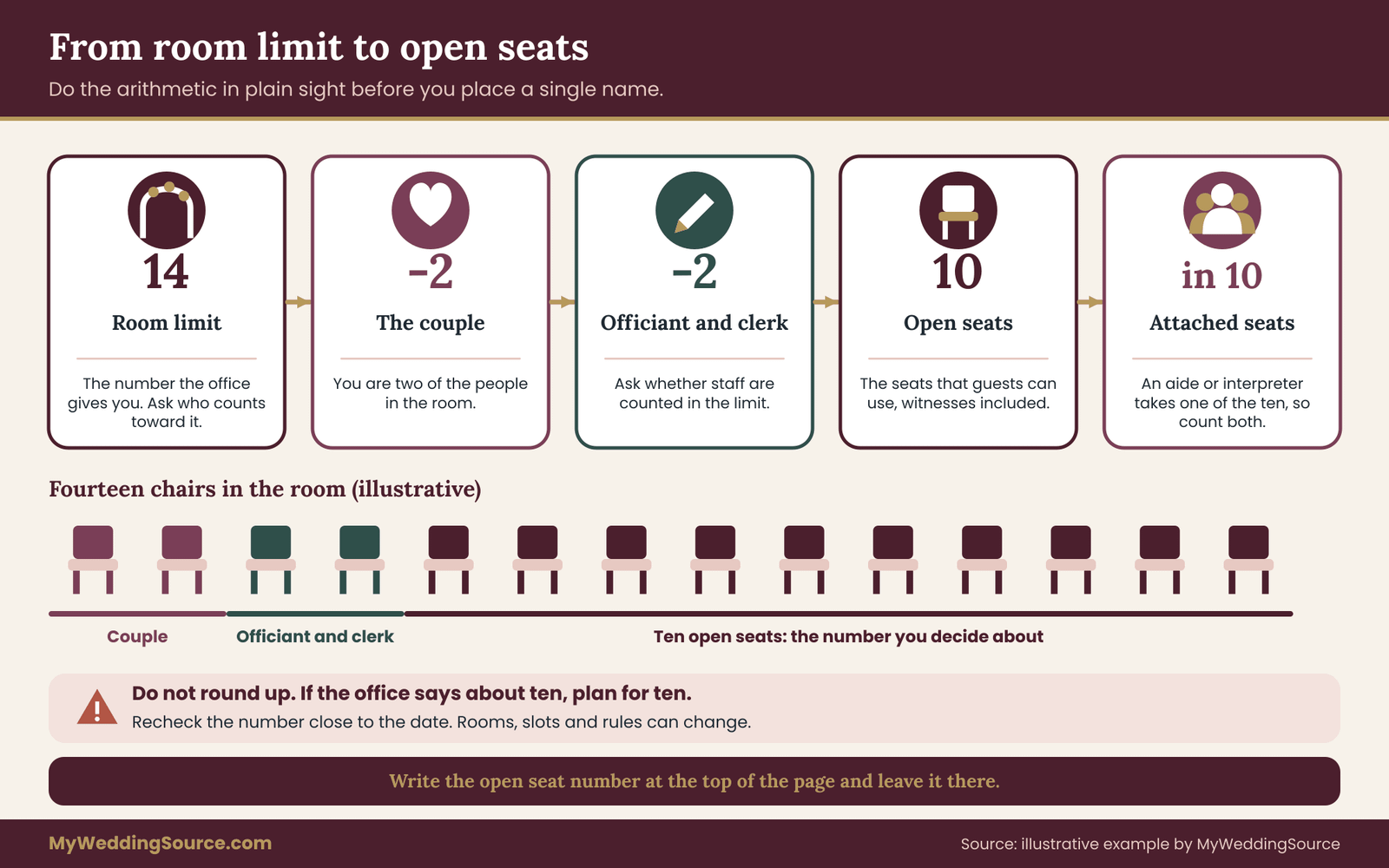
Two cautions about the number. First, do not round up in your own favor. If the office says “about ten,” plan for ten and treat an eleventh as a pleasant surprise only if the clerk confirms it in writing or by message. Second, recheck the number close to the date. Policies change, rooms get reassigned, and a limit that was ten in January can be eight in March because of a renovation. The checks section near the end of this guide includes a final confirmation step.
The Seat Ladder: a five-rung invite priority method
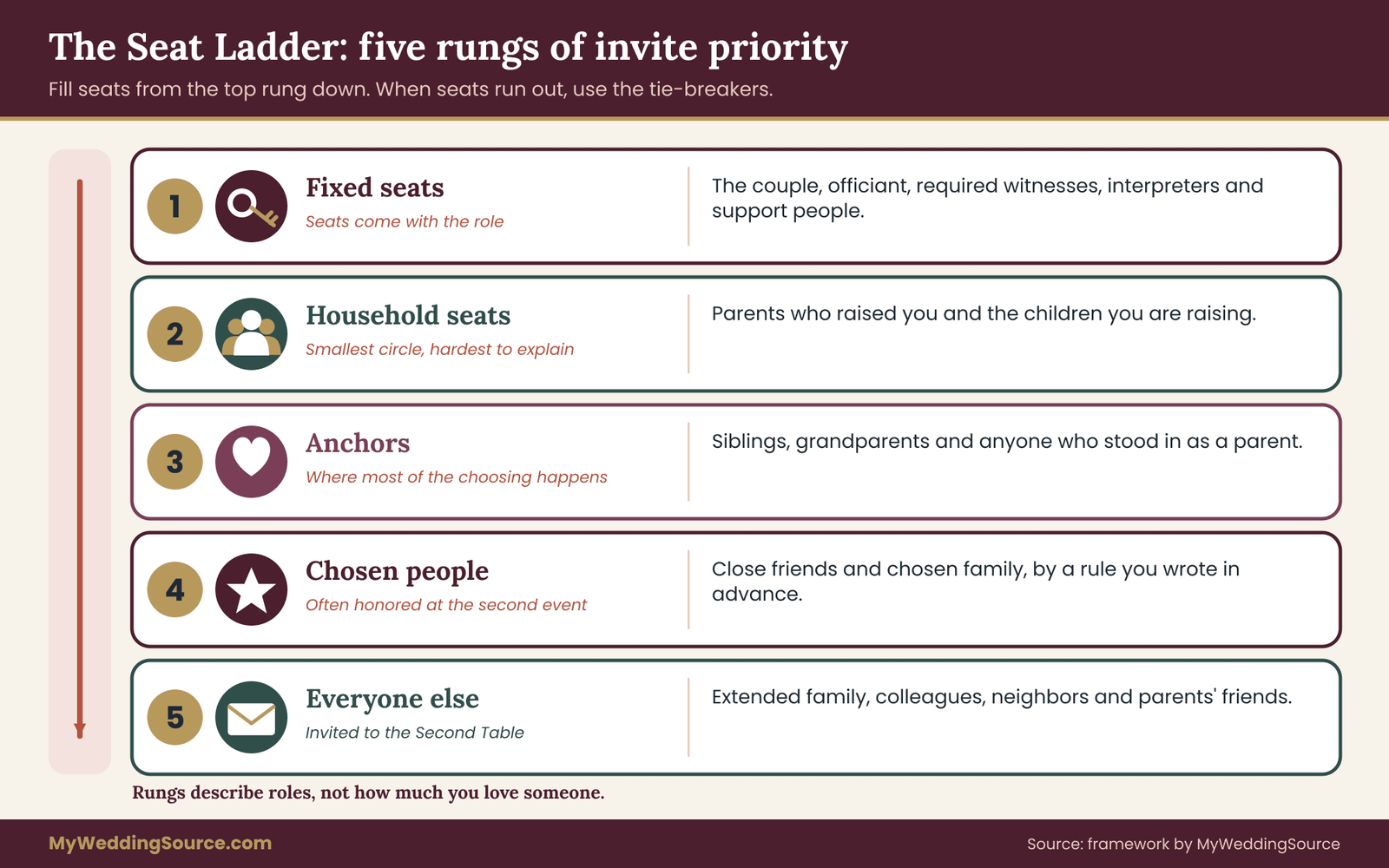
The method in this guide is called the Seat Ladder. It sorts everyone on your raw list into five rungs, and you fill seats from the bottom rung upward until the seats run out. Whoever is on the rung where the seats run out gets a second look with the tie-breakers in the next section. Everyone above that rung is outside the room and moves to the second event.
Here are the five rungs in order.
Rung one: fixed seats. The people who must be there for the ceremony to happen or to be safe: the couple, the officiant, required witnesses, and anyone whose presence is a practical necessity, such as a sign-language interpreter or a support person for a guest who needs one.
Rung two: household seats. The people who share your daily lives or raised you. For most couples that means parents and your own children. This is the smallest circle of people for whom an empty seat would be hardest to explain.
Rung three: anchors. Close family who are woven into your lives in a way the family would find hard to imagine missing: siblings and grandparents in most families, and sometimes an aunt or uncle who stood in as a parent.
Rung four: chosen people. Close friends and chosen family. Many couples find that these people matter as much as anyone in the room. They sit on rung four because a short list of family roles is easier to apply fairly than a list of friendships, and because the second event is the best place to honor them.
Rung five: everyone else. Extended family, colleagues, neighbors, friends of your parents, and the long tail of a typical wedding list. These people receive the invitation to the second event, not a seat.
Why a ladder works better than a long list
A flat list invites comparison. If you write thirty-one names in a column and put a star beside ten of them, every unstarred name feels like a snub, and every starred name feels like a favor. A ladder changes the question. The question becomes “which rung do these people belong on?” and that is a question about roles, which is easier to answer honestly than “do I like this person enough?”
The invite priority ladder also makes mistakes easy to see. If your parents sit on rung two and your cousin sits on rung four, nobody can say the order was arbitrary. If someone asks why a particular uncle is not in the room, you can say which rung he is on and which rungs filled the seats. The conversation then sticks to the invite priority rule rather than to your feelings about the uncle.
Finally, a ladder fits the two-sided nature of most weddings. You can run the same rungs for each partner and compare the results. If one side has twice as many people on rung three as the other, you see that early, when you can still choose a fair way to share the seats.
Defining each rung before you place a name
The most important step in the invite priority method is a rule you write before you place any name. Take ten minutes, sit with your partner, and agree on the definition of each rung in plain words. Do not use names in this conversation. Use categories. Here is how the definitions might read, and each couple should adjust them.
Rung two might read: “Our parents, and the children we are raising.” Rung three might read: “Our brothers and sisters, and grandparents.” Rung four might read: “Friends we would call in a crisis.” Rung five might read: “Everyone else.”
Notice that every definition names a category and none names a person. That is on purpose. When a definition names a person, you are no longer writing a rule. You are defending a decision you already made.
Two questions help you set the definitions. First, what would you be willing to say aloud to the least-favored person on a rung? If you would feel uncomfortable telling your grandmother “we kept the room to parents and siblings,” the invite priority rule needs work. Second, would the invite priority rule still feel fair if you swapped your family with your partner’s? If the invite priority rule favors your large local family over your partner’s small distant one, it is a rule that works for you and for no one else.
Where parents who pay fit on the invite priority ladder
At a courthouse wedding, parents rarely cover the cost of a large event, but sometimes they offer to pay for something, such as a dinner afterward, the license fee or travel for a grandparent. Money does not move anyone up the invite priority ladder for the ceremony. A seat in a government room is not for sale.
A parent who funds the second event deserves a warm thank-you, a role in that event, and an honest conversation about the ceremony rule. Even at larger venues, paying for a meal and holding a seat are different things, and in a tiny government room there is even less flexibility.
Rungs one and two: fixed seats and household seats
Fill the first two rungs before you think about anything else. They are the least debatable, and filling them gives you an honest sense of how much room remains.
Rung one in detail
Start with the people who are required. The couple is obvious. The officiant is usually provided by the office, or is someone you arranged, and may or may not count toward the limit. Witnesses vary a great deal. If the jurisdiction requires two, you need two adults who meet its rules. Ask the clerk whether witnesses must be present for the whole ceremony and whether they sign the license, then ask whether the office can supply witnesses if you arrive without any.
That last point is practical. Some offices will find a staff member to witness. That can be an attractive fallback if a limited room means you do not want to spend two seats on witnesses. But a staff witness is a stranger at your marriage, and most couples prefer to name two people they love. The choice is yours. The only point is to make it deliberately, with the facts, instead of discovering on the day that you need a witness you did not plan for.
Support seats belong on rung one too. If a grandparent needs an aide, a family member who interprets, or a nurse, the aide or interpreter is an attached seat. Attached seats are not a favor to anyone. They are a condition of the person’s attendance. If you invite the person, you invite the support person, and the count must include both. Plan for it before you finalize rung three, because a sizable share of surprise overflow comes from attached seats nobody counted.
The guest care planning guide goes deeper on the practical needs of older relatives and children at weddings, including seating, rest and support, and it is a good companion for this step.
Rung two in detail
Rung two is where most couples feel the first real pressure, because it includes the most emotionally loaded relationships. Treat it as a small, fixed category and resist the urge to expand it.
For most couples, rung two means parents. That raises a question the invite priority method must answer clearly: which parents? Families are rarely simple. Here are the common cases and a consistent way to handle each.
Divorced parents. Treat each biological or adoptive parent as a seat on rung two, whether or not they get along. A rule that seats one divorced parent and not the other will be read as a verdict on the divorce. If seating both is likely to cause a scene, solve it in the arrangement, with seats at opposite ends of the room, not in the guest count.
Step-parents. This is where rules differ among families. A step-parent who raised you from childhood belongs on rung two for many couples. A step-parent who joined the family recently may sit on rung three or four. The test is the same either way: did this person play a parent’s role in your daily life? Apply it to both sides of your family.
Parents’ partners. A parent’s long-term partner who is not a step-parent is a gray area. Decide by the same household test and apply it equally. If you include one side’s new partner and not the other’s, expect questions.
Your children. Children you are raising belong on rung two, and they count as seats. Ask the clerk about age limits and whether babies in arms count. A child who is old enough to understand the day usually wants to be there, and being left out of a parent’s wedding can leave a lasting mark. If a child will be nervous or restless, a calm plan helps more than leaving them out, but the seat comes first.
Stepchildren and partner’s children. If your partner has children who live with them, those children are part of your household and belong here. If they live elsewhere and you see them occasionally, discuss with your partner and the children’s other parent what feels right. Ask the children when they are old enough to answer.
Count after each rung
After you fill rung two, stop and count. Write the number of seats used and the number remaining. Do the same after rung one. In many families, rungs one and two already take most of the room, and that is a useful finding. It tells you that rung three will be small, and rung four may not exist at all, which is the reason to start planning the second event early.
If rungs one and two together exceed the room, you have a different problem, and the answer is not to squeeze. Ask the office about a larger room or a different time. Consider whether a second household seat could be handled by a witness who is also a parent, so one person fills two roles. If the room still cannot hold everyone in rungs one and two, apply the tie-breakers in the next section within rung two, and be honest with the people affected as early as possible.
Rungs three and four: close family and chosen people
By the time you reach rung three, you know how many seats are left. This is the rung where the real choosing happens, and where the invite priority method either earns its value or does not. Take your time here, and do the work separately for each partner before comparing.
How to define the anchors
Rung three is the category the family would find hard to imagine missing. In many families that is siblings and grandparents. In others it is an aunt who raised you for a few years, an uncle who gave you a home when you were nineteen, or a godparent whose role was formal and serious. The category is defined by role in your upbringing and daily life, not by genetic distance.
A practical way to test a candidate is to ask two questions. First, if this person learned about the wedding only after it happened, would they be hurt in a way that would last? Second, would the people closest to you, such as your parents or siblings, be surprised that this person was missing? If both answers are yes, the person belongs on rung three. If only one is yes, consider whether the person is better placed on rung four or five.
Be wary of anchors defined by obligation alone. “We have to invite Aunt Joan because she invited us to her wedding” is a reciprocity argument, and reciprocity belongs to large events with large budgets. It does not carry weight in a ten-seat room. A better question is whether Aunt Joan is part of your life now, and whether she would feel the absence personally.
Siblings and their partners
Siblings are the most common rung three group, and they bring the most common friction: the sibling’s spouse or partner. When capacity is tiny, you cannot seat everyone’s partner, and a rule that seats some partners and not others will be read as a ranking of relationships.
The simplest fair rule is one seat per invited relative and no plus-ones, with partners joining at the second event. The invite priority rule is easy to say and easy to apply, and nobody can claim you treated one partner differently from another. The cost is real: a sibling may feel their spouse of ten years has been excluded. Prepare for that conversation, and offer a seat at the second event with a prominent welcome.
The alternative is a household rule: a sibling’s spouse and children are seated together as one unit. That rule works in a room with enough seats and breaks quickly in a small one. If you have one sibling with a family of five and another sibling with no partner, the household rule will take half your remaining seats on behalf of one branch of the family. Choose the invite priority rule that matches your room, and apply it to everyone.
Grandparents
Grandparents often carry a special weight. They are the people for whom a delay can truly matter. A grandparent in their nineties, or one in poor health, may not be able to travel to a later celebration, and the ceremony may be the only time they can see you married. That is a legitimate reason for priority, and it is handled formally in the tie-breakers in the next section as the time-sensitive test.
Be honest with yourself here. Not every grandparent is equally close, and not every grandparent wants to go to a government building. Some prefer a quiet visit at home or a dinner. Ask, without pressure, what they would want. Some will say they would rather meet you for lunch afterward, and that is useful information.
If a grandparent attends, remember the attached seat. Ask about transportation, the accessible entrance, and a place to sit while waiting for the appointment. Courthouse waits can run long, and a long wait standing in a corridor is hard on an older body.
Rung four: chosen people
Rung four is the category that most often fills the second event instead of the room. That is not because friends matter less. It is because a fair invite priority rule is easier with family roles, and because the second event can hold dozens of friends.
If rung four has seats left, use a sentence that you can say without naming anyone, such as “friends who have known us both since before we met.” Then check whether the invite priority rule produces a clear answer. If you have two friends who fit and one seat, the invite priority rule has not decided anything, and you are in the territory of tie-breakers.
If you have no seats left for chosen people, say that plainly to your closest friends, early and personally, and give them something meaningful. This is where the second event plan matters most, and later sections show how to give a best friend a real role without a seat in the room. An invitation to a meal, a brief meeting on the courthouse steps if the office allows, a toast, or a letter read aloud can all tell a close friend how much they matter.
One more point. If a friend serves as a witness, they have a seat and a formal role. Choosing friends as witnesses is a clean way to honor chosen people within a small room, as long as the friends meet the legal requirements. A pair of friends can become the witnesses, and siblings can sit as guests. Or siblings can serve as witnesses, and friends join the second event. There is no single right answer, and the choice should follow the invite priority rule you wrote, not the loudest request.
Tie-breakers that keep your invite priority fair
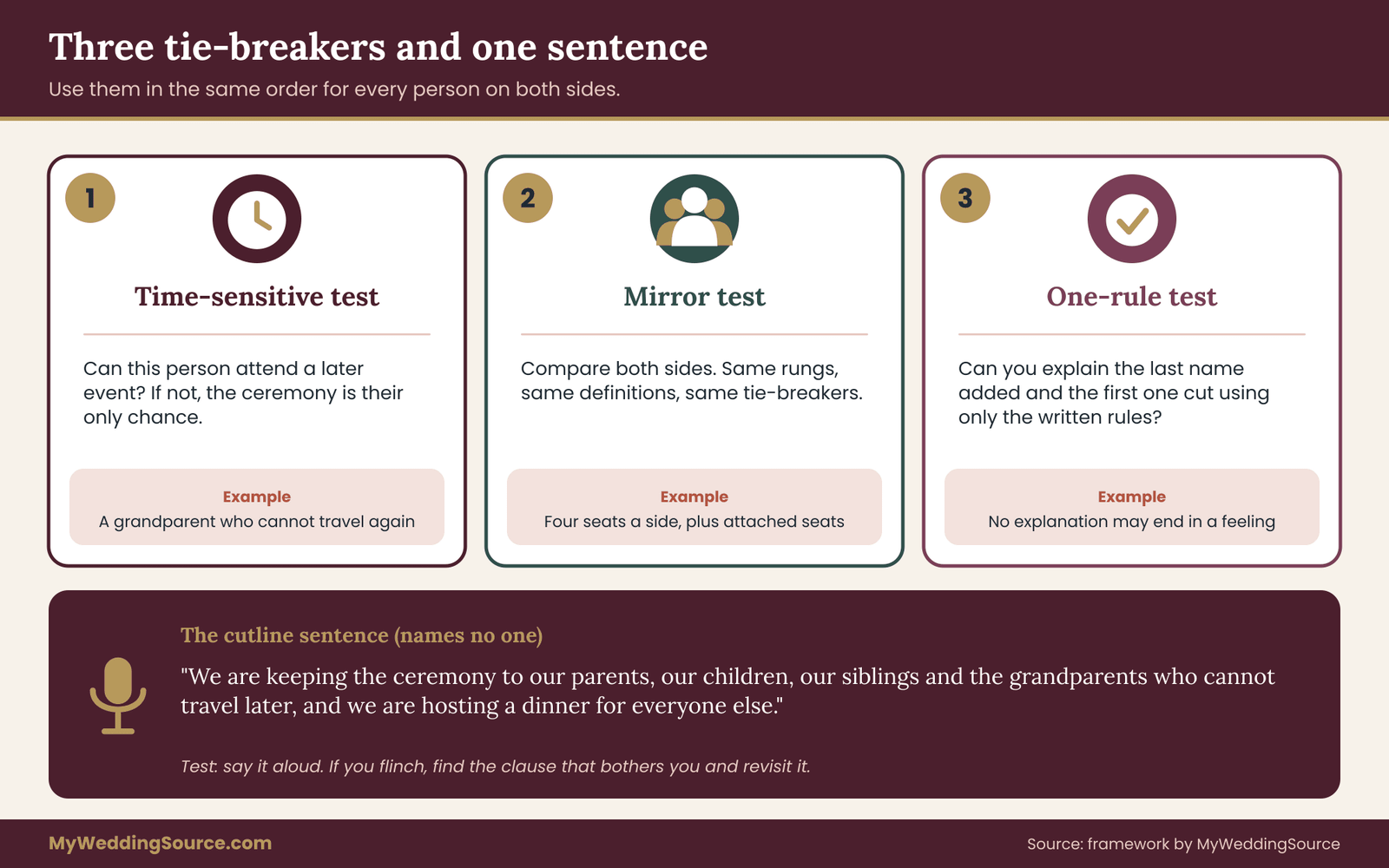
Even a clear ladder leaves ties. Suppose rung three has six people and there are four seats. The invite priority ladder cannot decide, and you need a short set of tie-breakers that you apply in the same order each time. Three work well, and they are deliberately few. A long list of tie-breakers becomes a scoring system, and scoring systems invite arguments about weights.
Tie-breaker one: the time-sensitive test
Ask whether this person can attend a later event. A grandmother who is frail and does not travel can attend only this event. A friend who lives nearby can attend a dinner next week. If everything else is equal, the seat goes to the person for whom the ceremony is the only chance.
This is the strongest tie-breaker because it is the most objective. It rests on a fact about the person’s circumstances, not a judgment about the relationship. It also tends to be received well. Relatives who are asked to step aside for someone who cannot attend later events usually understand, especially when the reason is explained in a sentence.
Apply it carefully and kindly. Do not say “she is too old to come later.” Say “we want her to be there while she can travel comfortably.” Do not make assumptions about someone’s health; ask a close relative if you are unsure. And remember that the test can cut the other way. A guest who has flown in from abroad for the occasion and will not be around for a second event has a case under this test, too.
Tie-breaker two: the mirror test
Compare the seats allotted to each side of your family. If one partner’s side has six seats and the other has three, you have a fairness problem that no one else will point out until it is too late.
The mirror test does not demand that the numbers be identical. Families differ in size, and one partner may have one parent living and the other four. It demands that the process be the same: the same rungs, the same definitions, the same tie-breakers. When the numbers differ because of the facts, you can explain them. When they differ because one side lobbied harder, you cannot.
Run the test at the end, after you have a draft. Write each side’s seated list next to the other. For each seat on one side, ask whether the equivalent person on the other side has a seat. Where the answer is no, find out whether the invite priority rule or a one-off preference created the gap.
Tie-breaker three: the one-rule test
Check that every decision follows from a rule you wrote down. If a person is on the list because “she would be so upset,” and no rule produces that result, you are carving out an exception. One exception can be handled gracefully. A handful of exceptions means the invite priority rule is not the one you are really using, and you should rewrite it.
A useful practice is to pick the last person you added and the first person you cut. Explain both choices in a sentence each, using only the written rules. If either explanation falls back on “because” followed by a feeling, go back and revise.
Write the cutline sentence
When the list is final, write one sentence that describes the line. Name no one. It should be something like: “We are keeping the room to our parents, our children, our siblings, and the grandparents who cannot travel later, and we are holding a dinner for everyone else.” If you can say that sentence aloud without wincing, the invite priority is fair enough to defend. If you flinch, find the clause that bothers you and revisit it.
The cutline sentence does three jobs. It is the script for every conversation. It is the text for your announcement. And it is the test you use when a late request arrives: does this person fit inside the sentence? If not, the answer is the second event, kindly and quickly.
What to do when the tie-breakers still do not decide
Occasionally two people are equal on every test and one seat is left. This is rare, and the honest response is to say so and choose without false precision. Some couples flip a coin, which feels odd and works well because it removes a personal judgment from the decision. Others ask the two partners to hold one seat each, a pair of “wild cards” that do not need an argument. If you choose that approach, announce it in the cutline sentence in advance, so it never looks like favoritism.
What does not work is asking the two candidates to settle it between themselves, or asking a parent to decide. A parent will often choose out of love for one person, and the other will know it.
A worked invite priority example: thirty-one names, ten seats
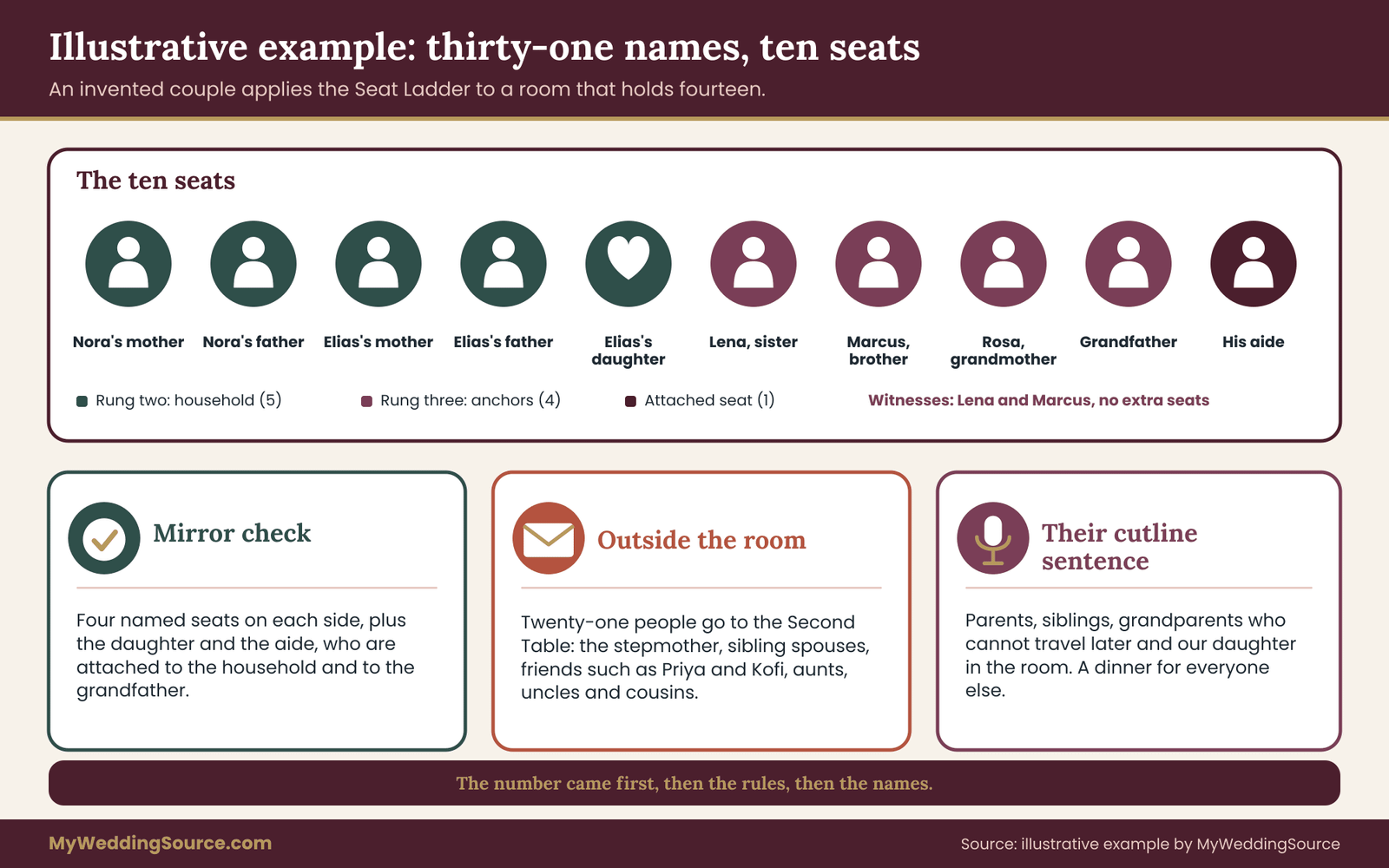
The following example is invented, and it is here to show the steps, not to suggest what any real couple should do. Nora and Elias are getting married at a county courthouse. Elias has a nine-year-old daughter who lives with him. They have a family list of thirty-one names, and they have just learned the room’s limits.
Step one: the real number
The clerk’s office tells them that the ceremony room holds fourteen people at once, including the couple, the officiant and one clerk who handles the paperwork. Children count. A support aide counts. Two witnesses are required, and the office confirms that guests may serve as witnesses.
Fourteen minus the couple, the officiant and the clerk leaves ten open seats. Nora and Elias write “10” at the top of the page and do not change it.
Step two: the rungs
They agree on definitions before placing names. Rung two is “our parents and the child we are raising.” Rung three is “brothers and sisters, and grandparents.” Rung four is “friends who have known us both for a long time.” Rung five is everyone else.
Rung one has no extra people. The two witnesses will come from the guests, so they cost no extra seats, and the couple decides to choose them from rung three.
Rung two comes next. Nora’s parents are divorced, and Nora’s father has remarried. Nora decides her parents both belong on rung two and her stepmother does not, because the stepmother joined the family when Nora was an adult. She applies the same household test to Elias’s family. Elias’s parents are together, so both belong on rung two. Elias’s daughter belongs on rung two as well. That is five seats, and five remain.
Rung three comes next, and it is where the arithmetic gets tight. Nora has a sister, Lena, and a ninety-one-year-old grandmother, Rosa. Elias has a brother, Marcus, and a grandfather who uses a wheelchair and travels with an aide. That is four people plus the aide, which is five seats, and five seats remain. The room fills exactly.
Step three: the tie-breakers
The invite priority ladder itself decided this example, so the tie-breakers act as checks. The time-sensitive test supports both grandparents: neither can travel easily to a later event, so the ceremony is their chance. The mirror test shows four named seats on each side, plus the daughter and the aide, who are attached to the household and to the grandfather respectively. The one-rule test passes, because every seated person fits the cutline sentence.
Their cutline sentence reads: “We are keeping the ceremony to our parents, our siblings, the grandparents who cannot travel later, and our daughter, and we are hosting a dinner for everyone else.”
Lena and Marcus will serve as witnesses. Both are adults, both are on rung three, and neither takes an extra seat.
Step four: who is left, and what they get
Twenty-one people are not seated. They include Nora’s stepmother and her sister’s husband, Elias’s brother’s wife, a handful of aunts, uncles and cousins, and the couple’s closest friends, Priya and Kofi. Each is placed on rung four or five.
That outcome stings, and the couple knows it. The invite priority ladder does not hide the cost. What it gives them is a clear reason, a consistent rule, and a plan for each group of people who are not in the room.
Priya and Kofi, who sit on rung four, get a personal phone call from the couple before anyone else hears the news, an invitation to the dinner with places near the couple, and a short role at the dinner: each is asked to give a toast. Nora’s stepmother and the sibling spouses get a call from the sibling or parent they are connected to, followed by a warm invitation to the dinner. The remaining aunts, uncles and cousins receive a message that includes the cutline sentence and the dinner details.
What this example shows
Three points stand out. First, the order of the steps matters: the number came first, then the rules, then the names. Second, the hard cases, such as the stepmother and the sibling spouses, were resolved by the rules and not by emotion, which does not make them painless but does make them defensible. Third, the couple planned the response to the unseated twenty-one at the same time as the list. A list without a plan for the people outside the room is only half a decision.
A final detail is worth stealing. Nora and Elias kept their working list and the written rules together in one note, so that when someone asked “why not Aunt Carla?” they could check the invite priority rule instead of answering from memory under pressure.
A variation: when the room is even smaller
Suppose the room holds six rather than fourteen. After the couple, the officiant and the clerk are subtracted, two seats remain, and the household rung alone has five people. The invite priority ladder still helps. It tells you that the ceremony cannot seat the household, so the question becomes who sits and who watches by video or joins immediately afterward.
In that situation, many couples choose the two witnesses as the only guests, then bring the household together right after the ceremony for a meal or a short gathering outside. The witnesses are chosen by role, and the invite priority rule is stated in advance: “Two witnesses, and everyone else joins us right afterward.” The invite priority rule is clean, and it treats every household member equally, since none has a seat. It also avoids the nasty situation in which two of four parents sit inside while the other two wait in the hallway.
Handling pressure, parents, and plus-ones
A well-built list can still meet resistance. Most of it arrives from the same few directions, and each has a response that fits the invite priority rule rather than the mood of the moment.
When a parent asks for more seats
A parent who asks for seats for their own siblings, friends or colleagues is usually trying to share the news or avoid embarrassment, not to override your decision. Start with that assumption. Thank them for caring, repeat the room limit and the number of seats, and show them the cutline sentence. Then offer what is actually available: a role at the second event, a place for their guests at the dinner, or help hosting it.
If a parent says “but I never get to see them,” acknowledge it. The real loss is often the chance to share a moment with their own circle, and the second event can answer that. Ask what they would like that event to include. Giving a parent a role in the dinner often changes the tone of the conversation.
When a parent offers to pay for more
Offering money is a way of trying to solve the problem, and it comes from a good place. The honest answer is that money does not change a room limit. The courthouse has a fixed number of seats, and paying more does not create any. Say that gently, and redirect the offer. “We would love your help with the dinner, because that is where we can include everyone” turns the offer into something useful.
When siblings feel passed over
Siblings who are not on the list, for instance because the invite priority rule seated only some, deserve the most careful handling. A direct, personal conversation before anyone else hears is essential. Explain the invite priority rule, explain how it applied to them, and tell them what you are asking of them at the second event. A sibling who is asked to do something important, such as hosting the dinner toast, is more likely to feel valued than one who simply receives an apology.
Plus-ones, partners and dates
At a ten-seat ceremony, plus-ones do not exist. State this plainly in your invite priority rule and your messages, so that no one has to ask. Engaged and married partners are the hardest case, and the wording should acknowledge that: “We know this means partners are not in the room, and we are sorry. Everyone’s partner is warmly invited to the dinner.”
The same rule should apply to your own side. If your partner’s friend is seated, the friend’s date is not. If a relative’s partner is a witness, that person is chosen as a witness, not as a plus-one. Keep the logic tidy and the answers simple.
When someone is simply upset
You cannot prevent every hurt, and the goal of the invite priority method is not to remove disappointment. It is to make sure that disappointment is not made worse by confusion, unfairness or a sense of being excluded without explanation.
If someone is upset after you have followed your invite priority rule and spoken kindly, you can acknowledge the feeling without changing the decision. “I understand why that is hard to hear, and I am sorry it feels that way. We wish the room were bigger” is honest and sufficient. Do not argue the person out of the feeling, and do not give them a seat to end the conversation, because that will create a harder problem with the next person.
The wedding etiquette guide covers general expectations around guest lists and hosting, and it is a useful reference when a relative cites a tradition you do not share. For many such conversations, the best response is calm and short.
Telling people: kind wording for everyone outside the room
The invite priority list is only half of the work. The other half is how and when people hear about it, and that half decides whether your family remembers the wedding as warm or as a source of old hurt. A fair invite priority is easier to accept when it arrives with care, so plan the conversations as deliberately as you planned the seats.
Order of telling
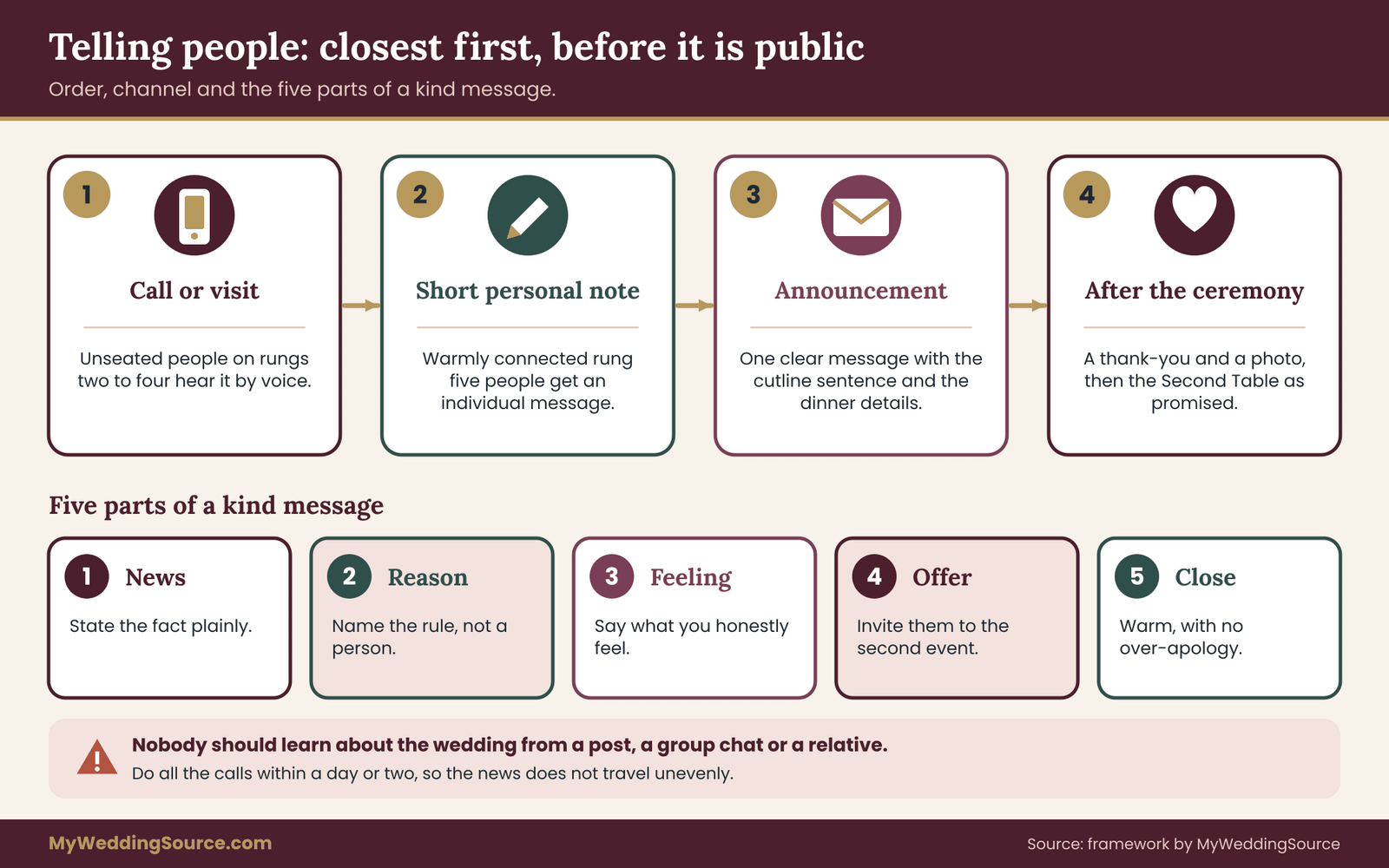
Tell people in an order that respects how close they are, and do it before the date or the photos are public. Nobody should learn about your wedding from a social media post, a group chat or a relative’s comment. People can forgive being left out of the room far more easily than being the last to know.
A reliable order follows the invite priority ladder in reverse. The people who are hurt most by absence hear first and hear by voice. That means the household and the closest family who are not seated, then close friends, then the wider family, and finally an announcement for everyone else.
First, call or visit. Anyone on rung two, three or four who does not have a seat should get a personal conversation, by phone or in person. A text is not enough for these people. Do not outsource this to a parent, because it turns your decision into a family negotiation.
Second, send a short personal message. For rung five people who are warmly connected to you, a short, individual message works well.
Third, send the announcement. For everyone else, a single clear message with the cutline sentence and the details of the second event.
Do this over a day or two, not a week. A long gap lets the news travel through the family unevenly, and the person you meant to call first will hear from a cousin.
The elements of a kind message
A good message for someone outside the room has five parts, in order: the news, the reason, the feeling, the offer and the closing. Keep it short.
The news. State the fact plainly. “We are getting married on a weekday at the county courthouse, and the room holds only ten people.”
The reason. Say what produced the limit, and name the invite priority rule, not the person. “We decided to keep the ceremony to our parents, siblings and the grandparents who cannot travel later.”
The feeling. Say honestly what you feel. “We wish the room were bigger, and we know this is a disappointment.”
The offer. Say what the person is invited to. “We are hosting a dinner the following weekend, and we would love for you to be there.”
The closing. Keep it warm, and do not over-apologize. “We love you, and we wanted you to hear this from us first.”
Avoid the temptation to add excuses, details about other people’s seats, or comparisons. “We could not even invite our friends” is a fair statement of the invite priority rule, but “your cousin did not get a seat either” can sound like a justification, and it sets people against each other.
Sample wording by relationship
The following scripts are starting points for explaining your invite priority. Change the words until they sound like you, and say them aloud before you send them.
For a close friend who has no seat:
“I wanted to tell you this myself before anyone else hears. We are getting married at the courthouse, and the room only holds ten, so it will be family only. You are one of the people I would pick if there were room for twenty, and I am sorry there is not. Would you give a toast at the dinner afterward? It would mean a lot.”
For a sibling’s spouse:
“We wanted to call you before the news spreads. The courthouse room is tiny, and we have kept it to parents, siblings and grandparents, with no plus-ones for anyone. That means you will not be in the room, and we are sorry. We want you at the dinner, and we would like to save you a seat next to us.”
For an aunt or uncle who expected an invitation:
“We wanted you to hear from us that we are getting married next month at the courthouse. The room is very small, and we have limited it to our household and grandparents. We would love to celebrate with you at a dinner on the following weekend. I will send the details soon.”
For a parent’s friend or a colleague, a short written note is enough:
“We are getting married in a small courthouse ceremony with immediate family only, and we are planning a celebration afterward. We hope you can join us, and we will send the details soon.”
For a parent who is hurt that their siblings are not invited:
“I know this is hard, and I am glad you told me how you feel. The room has ten seats, and we used one rule for both sides. I would love your help with the dinner, which can hold your whole family.”
What not to say
A few phrases cause more damage than they prevent when you explain your invite priority.
“We did not want to make a fuss” can suggest that the person would have been a fuss. “It is not a big deal” belittles someone’s feelings. “You would not have enjoyed it anyway” is a guess about the other person’s enjoyment, and it rarely lands well. “We thought you would understand” puts the burden on them. “It is just a legal formality” can hurt people who care about the ceremony, and it may not match how you feel.
Say instead what is true: the room is small, you used a fair invite priority rule, you are sorry about the disappointment, and you want them at the celebration.
Timing and channels
The way you deliver your invite priority matters as much as its content, so choose the channel with care.
Choose the channel based on the relationship. A phone call or in-person conversation suits close relationships. A handwritten note or email suits relatives you see rarely. A group announcement is acceptable for a wide circle, but only after you have spoken to everyone on the closer rungs.
Avoid group chats for the first announcement. They give everyone a public audience and invite people to compare notes before you have spoken to the people who matter most. Also avoid telling people at a family event or a holiday, where an emotional response has to be managed in public.
If you plan to post about the wedding afterward, wait until everyone who needs a personal call has had one. A photo of ten people on the courthouse steps will reach everyone you left out, and a person who sees it before they hear from you will feel it as a double hurt.
When you are telling someone who cannot be there for a different reason
Some people are outside the room not because of the invite priority ladder but because they cannot travel, are ill or live far away. For them, the wording changes. “We wanted you there, and we know it is not possible” is a warm acknowledgment. Offer them a way to join: a video call if the office allows it, a recorded message, or a visit afterward. The RSVP etiquette guide covers the basics of handling replies and changes when you invite people to the second event.
Writing the announcement for the second event
The announcement that invites everyone to the second event is itself an act of care, and it should do two things. It should state the cutline sentence of your invite priority so nobody has to wonder what happened, and it should describe the second event as a real celebration, not a consolation. People can tell the difference.
A strong announcement names the date, time and place of the event, says who is hosting, says what will happen, and says how to reply. It avoids phrases like “just a small dinner” and avoids apologizing in every sentence. It treats the second event as the event for which the larger family is the guest of honor.
A sentence worth including is simple: “The ceremony will be small by necessity, and this celebration is where we want to be with everyone we love.” That sentence tells the reader that the second event is the main party and that nobody is a reserve.
After the ceremony
When the ceremony is done and your invite priority has done its work, send a short message to the people who were not there, with a photo if you like, and a thank-you for understanding. A short note to the people outside the room is not required, but it reinforces that you thought of them. Keep it simple. “We are married, and we thought of you. See you at the dinner” is enough.
If someone remains hurt weeks later, a short, private conversation is better than an apology on social media. Ask what would help, listen, and do not renegotiate the decision. The seat is gone, but the relationship is still yours to tend.
Building the second event that makes your invite priority feel kind
A tiny ceremony and its invite priority work socially only if the people outside the room have somewhere real to go. This second event is the other half of your invite priority, and it deserves a plan with the same care as the seat list. In this guide we call it the Second Table, because for most couples it is a meal.
The Second Table has one job: to let the people who matter to you celebrate the marriage with you, in a setting that is not limited by a government room. It does not need to be large or costly. It needs to be warm, scheduled, and clearly presented as part of the wedding rather than a follow-up.
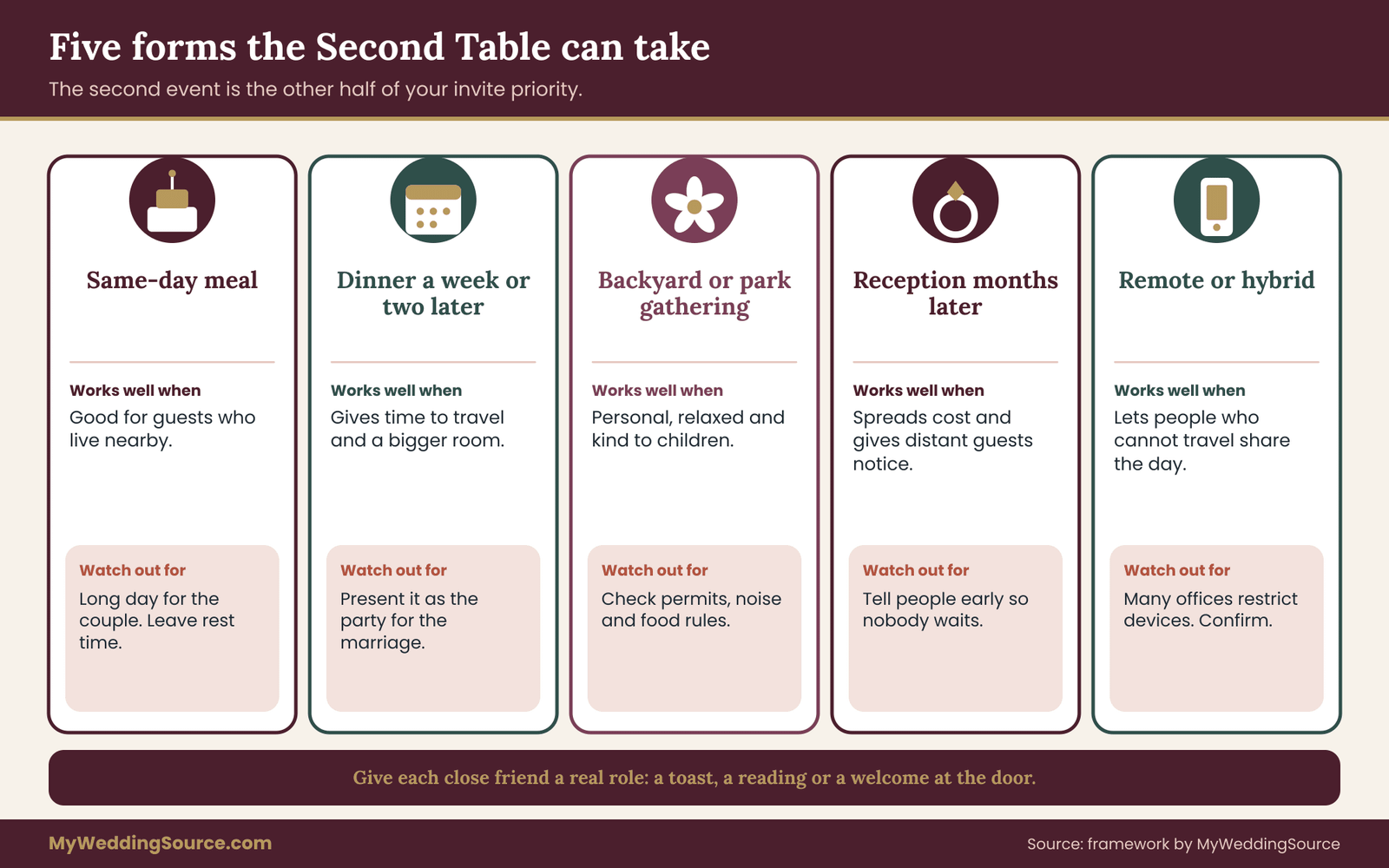
Five forms the Second Table can take
There is no single right format, and the best choice depends on your budget, your guest count and how far people must travel. Here are five common forms, with what each does well and where it falls short.
Same-day lunch or dinner. A meal on the day of the ceremony keeps the celebration close to the legal moment, and it lets seated and unseated guests meet within hours. It works well when most guests live nearby. The cost is that the day is long, and the couple must go from a formal appointment to hosting with little rest. If you choose this, leave real time between the two, and arrange for someone else to handle logistics.
A dinner on a nearby weekend. A meal a week or two later gives you time to rest, lets guests plan travel, and allows a larger room. It suits families spread across a region. The drawback is that some people feel the celebration is detached from the wedding, so the announcement should present it as the party for the marriage.
A backyard or park gathering. A casual event at someone’s home or in a park costs less than a restaurant and feels personal. Rules about permits, noise and food safety vary by place, so check with the local office before you plan. It can run longer and let children attend comfortably.
A reception months later. If a larger party was always the plan, the civil ceremony can serve as the legal step and the reception as the celebration. This approach spreads costs over time and gives distant guests notice. It also leaves a long gap in which people may feel uncertain about their status, so tell them early.
A remote or hybrid option. Where the office permits, a video connection lets someone who cannot travel see the ceremony, and a recorded message or a phone call right afterward lets them share the moment. Many courthouses restrict recording and devices, so ask in advance and treat a “yes” as something to confirm in writing. If a live link is not allowed, a short video call from the steps afterward can serve a similar purpose.
Choosing the right form by the people you left out
Match the Second Table to the people on rungs four and five. If your unseated guests are mostly friends and colleagues who live nearby, a dinner is easy. If they are mostly older relatives who travel poorly, a daytime event with seating and quiet space matters more than a venue with a view. If they are mostly relatives living far away, a later reception with notice is kinder than a rushed dinner that most cannot attend.
Be careful about promising the Second Table too early or too vaguely. “We will have a party sometime” leaves people waiting. A better approach is to tell people the form, the rough timing and the date by which they will receive details. If you do not know yet, say so: “We will send details within a month.”
Budget logic for the Second Table
The invite priority tells you who is outside the room, and that number drives the cost of the second event.
You do not need figures from anyone else to plan the cost. Start with the number of people on rungs four and five who you want to invite, add the people already seated, and multiply by a per-person cost you obtain from actual quotes. The most important variable is not food. It is the number of guests, because the number of unseated people can run well above the number seated.
Two choices lower costs without lowering warmth. First, choose a time of day that fits a lighter meal, such as an afternoon gathering with food and drinks, instead of a full dinner. Second, ask whether any family member wants to host a part of it, such as dessert or a toast. Many relatives want a job, and a job is a useful way to give a hurt person a place.
If a parent offers to contribute, accept help with the Second Table rather than the ceremony, and agree on what the help covers before you commit. The wedding etiquette guide can help when you are unsure how to handle shared hosting, but a quick conversation about who pays for what prevents most trouble.
Giving close friends a real role
A fair invite priority puts friends on a lower rung for the ceremony only, so the second event has to make up the difference.
For rung four friends, a seat at the Second Table is not enough. Close friends expect to hear that they matter, and the Second Table is the place to show it. Offer a role that fits the person: a toast, a reading, a welcome at the door, a seat at the head table, or help with a special tradition. People who feel they were given a part do not feel they were left out of the main event.
A role should be real. Do not offer a toast to someone who hates public speaking just to fill a gap. Ask what they would enjoy. For some, the best role is being the person who sits with your grandmother or the person who takes pictures.
A meaningful moment outside the room
Where the courthouse allows it, a brief meeting after the ceremony can bring seated and unseated people together for ten minutes. Many offices have steps, a courtyard or a nearby park. The moment can include a short toast, a photo, a cheer, or just hugs. It is not a replacement for the Second Table, but it can close the distance between the room and the people outside it.
Check the rules in advance. Some offices restrict gathering outside, loud celebration or throwing items, and many ask that groups not block entrances. Confirm what is allowed, and designate someone to keep the group tidy and on time. A short, well-run moment beats a crowded, awkward one.
Edge cases: waitlists, last-minute changes, and cancellations
No invite priority plan survives contact with real families untouched. A few situations come up often enough to plan for, and each calls for a decision you can make in advance.
Should your invite priority include a waitlist?
A waitlist for a ceremony seat sounds practical, since someone may cancel. In a small room, it usually backfires. A person on a waitlist learns that they were not a first choice, and that is a harder message than “the room is limited.” If a seat opens, the person who gets it feels second-best, and the first person who declined may feel their decline was an inconvenience.
If you still choose to hold a replacement, make it a rule, not a favor. State in advance that if a seated guest cannot attend, the seat goes to the next person on the same rung, by the tie-breakers, and tell that person only if the seat truly opens. Do not announce a waitlist to the family. Treat it as a private contingency.
A seated guest cancels and the invite priority shifts
Illness, travel trouble and family emergencies will sometimes remove a seated guest. Decide in advance what happens. The simplest rule is to offer the seat to the next person on the same rung. If a witness cancels, ask a seated guest who meets the requirements to serve in their place, and confirm with the clerk that you can substitute.
If a cancellation happens on the morning of the ceremony, avoid a scramble. A last-minute invitation can be received well by a close friend who lives nearby and badly by anyone who learns they were the replacement. Often the cleaner choice is to leave the seat empty and let the person who cancelled join by phone if the office allows.
A late request from someone who fits the cutline
Sometimes a person who fits your cutline sentence was missed because of an oversight. A grandparent you forgot to ask, a sibling you did not realize wanted to come, or a household member who was out of touch can appear late. Treat this as a correction, not an exception, and handle it without drama: apologize, invite them, and if the room is full, apply the tie-breakers to decide who steps aside.
If the person who steps aside is already told, you will have to be honest about the mistake. “We made an error, and we are sorry. We want you at the dinner and want to make it right” is better than a vague change.
A late request from someone who does not fit
When someone who sits on rung five asks to attend, the cutline sentence is your answer. “We are keeping the ceremony to our household and grandparents, and we would love for you to join us at the dinner” is short and consistent. Resist the urge to soften the answer by making a special case, because each exception changes the invite priority rule for everyone who followed it.
A change in the room limit
If the office changes the limit after you built the list, return to the invite priority ladder. A smaller limit means moving down from the bottom: rung four and then rung three shrink first, and the tie-breakers decide within the rung. A larger limit means moving up from the top of the remaining list: the next people on the rung where the seats ended receive the seats.
In both cases, tell the affected people promptly and explain the cause. A change forced by an outside rule is easier to accept than a change that looks like a second thought.
A relationship that changes before the date
Families change in the weeks before a wedding. A sibling and a partner separate, a grandparent’s health changes, a rift appears or heals. The invite priority ladder can absorb this if you keep the rungs defined by roles rather than by temperature. If a rung three sibling has become estranged, the invite priority rule still holds: they are on the rung unless you decide, with your partner, to change the invite priority rule for everyone in the same category.
The guide to cutting a wedding guest list discusses how to handle broader changes in list size, and its approach to explaining decisions to relatives fits well with the cutline sentence here.
Questions for the clerk and checks before your invite priority is final
Before you tell anyone anything, take your invite priority list and the rules to the people who control the room. The clerk’s office, a court administrator or the venue manager can settle in a few minutes questions that would otherwise cost you weeks of worry. Ask politely, ask in writing where possible, and keep the answers with your invite priority list.
Questions worth asking the office
Ask about the numbers first. What is the maximum number of people in the room, and who counts toward it? Do children, babies, aides, interpreters and photographers count? Is the limit the same for every time slot and room, and is there a larger room if we need one?
Ask about the people. How many witnesses are required, what are the eligibility rules, and can staff serve if we arrive without any? May a guest use a wheelchair or a walker, where is the accessible route, and where do support people sit?
Ask about the day. How early should guests arrive, where do they wait, and is there a place to sit? Are phones or cameras allowed in the room, and may anyone record or stream? Is there a place outside where a group may gather for a few minutes after the ceremony without blocking a door?
Ask about changes. If a guest cancels, can we substitute? If we need to change the time, does the limit change? How much notice does the office need for changes, and how do we confirm them?
The guide to officiant requirements is a good companion for the officiant and paperwork questions, and the issuing office is the authority on licenses, witnesses and what the day looks like. The USA.gov marriage-certificate page lists the starting points for finding your state’s office and records.
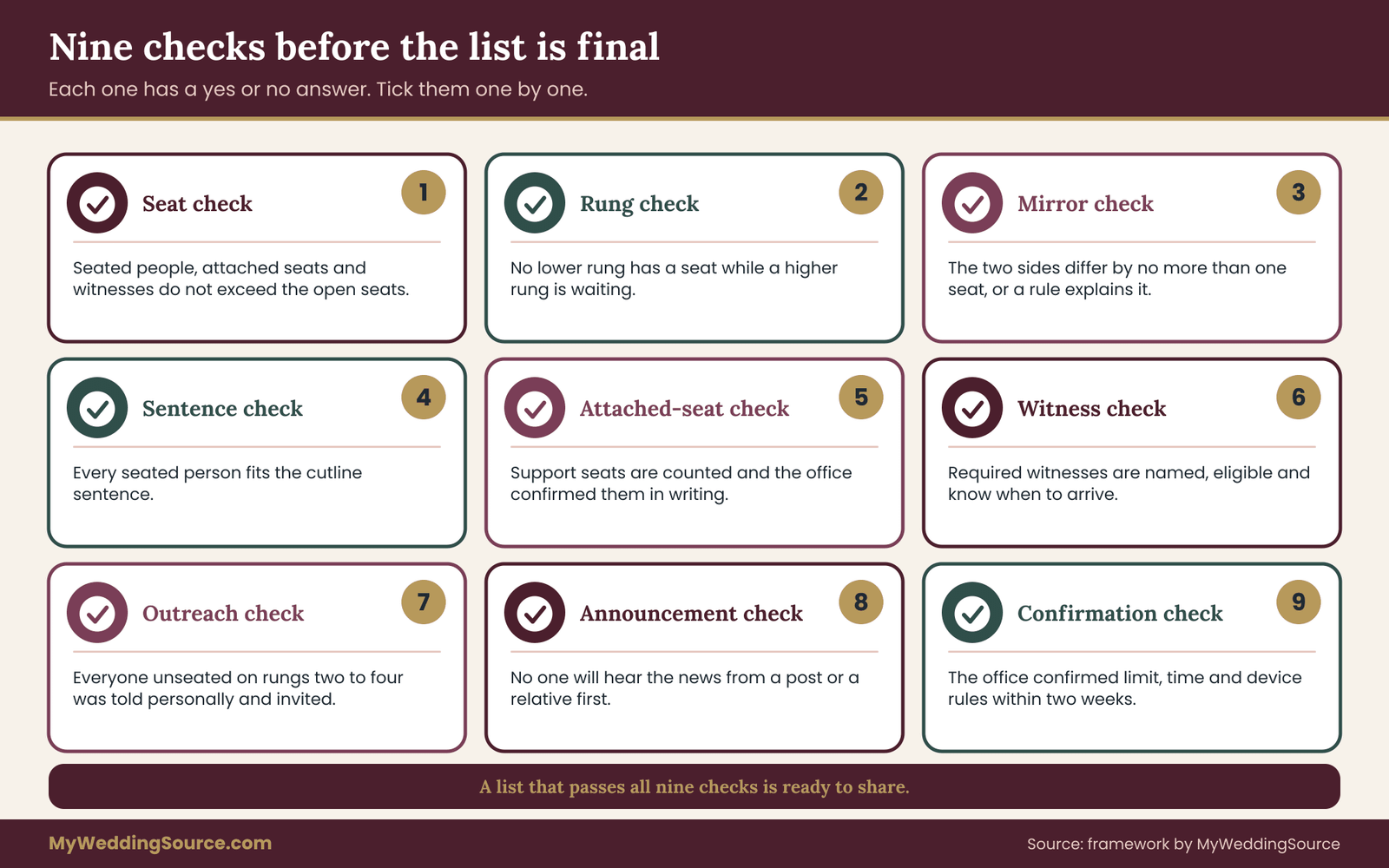
The measurable checks
Once you have a draft, run these checks. Each has a yes or no answer, and each is easy to verify. A list that passes all of them is ready to share.
The seat check. Count the seated people, including attached seats and witnesses. The total must be equal to or lower than the number of open seats you wrote at the top of your page. If you are above it, you are over capacity, and no amount of goodwill fixes that.
The rung check. Every seated person has a rung, and no seat was given to a lower rung while a higher one is waiting. If rung four has a seat and rung three has someone left out, find out why.
The mirror check. Compare the seated people from each partner’s side. If the numbers differ by more than one, find the invite priority rule that explains the difference. If you cannot, adjust.
The sentence check. Read the cutline sentence aloud. Every seated person fits the sentence, and every unseated person is covered by it.
The attached-seat check. Every person who needs support has the support seat counted, and the office has confirmed it in writing.
The witness check. Required witnesses are named, are eligible, and know when and where to be.
The outside-the-room check. Every unseated person on rungs two to four has been told personally, and every unseated person has been invited to the Second Table or offered a clear alternative.
The announcement check. Nobody will learn the news from a public post, a group chat or a relative before they hear from you.
The confirmation check. The office has confirmed the limit, the time and the rules for devices, in writing, within the last two weeks.
Write these checks at the bottom of your invite priority list and tick them one by one. It takes ten minutes and prevents most of the surprises that turn a calm plan into a crisis.
A simple timeline
A small ceremony still benefits from a schedule, and the invite priority steps fit into it naturally. These time frames are suggestions. If your appointment is sooner, compress the steps and keep their order.
Four to six weeks before. Ask the office the questions above and write the open seat number. Write the rung definitions with your partner, with no names. Collect your raw lists separately, one for each of you.
Three to four weeks before. Place names on rungs. Run the tie-breakers, the mirror check and the sentence check. Choose witnesses. Decide the form of the Second Table and fix a date or a window.
Two to three weeks before. Make the personal calls and visits, closest first. Send the short messages. Then send the announcement for the Second Table.
One to two weeks before. Confirm the limit and the rules with the office again. Confirm travel, access and rest for older guests. Tell the seated guests where to arrive and what to bring.
The day before. Reconfirm the witnesses and the support seats. Give a trusted person the list of seated guests and the contact number for the office, so you do not have to manage arrivals yourself.
After the ceremony. Send a warm message to the people outside the room, and then hold the Second Table as you promised.
Broader guest planning, such as building the full list and handling RSVPs for the Second Table, is covered in the site’s guide to planning a wedding guest list, which complements this narrower method.
Keeping the decision calm
Plan for the likelihood that you will feel uneasy even when the list is fair. That is normal. A small ceremony asks you to give priority to a few people, and it is natural to feel the absence of those you could not seat. Give yourselves time after the calls to recover, and do not reopen the list at midnight. When doubt returns, read the cutline sentence and the checks. If they still hold, the plan is sound.
If you and your partner disagree about a person, return to the written rules and ask which rung applies. If you still disagree, try a swap: give your partner a say on one of your seats in exchange for a say on one of theirs. The aim is not to avoid every disagreement. It is to keep the process in the open, with rules that both of you agreed to before names were involved.
Your next steps
- Call or email the office and get the real number: the room limit, who counts, the witness rules and the support rules.
- Write the open seat number at the top of a page and leave it there.
- With your partner, write the definition of each rung in words, with no names.
- Make separate raw lists, then place each name on a rung and fill seats from the bottom up.
- Apply the three tie-breakers where seats run out, and write your cutline sentence.
- Run the checks, then plan the Second Table and a real role for each close friend outside the room.
- Make the personal calls, closest first, then send the announcement, and confirm everything with the office again.
FAQ
What is invite priority for a civil ceremony?
Invite priority is the order in which people receive a seat when a ceremony room holds only a few guests. You decide the order with written rules, applied the same way to both partners’ families, before you place any names. The point is to replace mood-driven choices with a method you can explain in one sentence and defend calmly if someone asks.
How do I find out how many guests the courthouse allows?
Ask the clerk’s office or court administrator directly, and ask who counts toward the limit: the officiant, staff, children, support aides and any photographer. Also ask whether the limit changes by time slot or room, and get the answer in writing if you can. Recheck close to the date, because rooms and rules can change.
Do witnesses take seats from my guest list?
Often they do, because witnesses are usually guests, but rules differ by state and office. Ask how many are required, who is eligible and whether staff can serve if you have none. If witnesses come from your seated guests, choose them from people already on your invite priority list so they cost no extra seats.
Should I invite one parent and not the other if my parents are divorced?
A fair rule seats each parent who raised you, whether or not they get along, because leaving one out is usually read as a verdict on the divorce. If seating both may cause tension, solve it with seating positions and a calm plan, not with the guest count. Apply the same test to your partner’s family.
Can my parents pay to add more guests?
Money does not change a fixed room limit. A courthouse room holds a set number of people no matter who pays. Thank parents for the offer and redirect it to the second event, where help with hosting, food or a toast makes a real difference and can include far more people.
Is it rude not to invite my friends to the ceremony?
It is not rude when you apply a clear rule, tell close friends personally before anyone else, and invite them to a real celebration. What hurts is learning the news indirectly or being treated as an afterthought. Give close friends a meaningful role at the second event, such as a toast or a reading.
What should I say to someone who is not invited?
Use five parts: the news, the reason, how you feel, the invitation to the celebration and a warm close. Name the invite priority rule, not the person. For example, explain that the room is small and you kept it to household and grandparents, then invite them to the dinner. Avoid excuses and comparisons with other relatives.
What if a seated guest cancels at the last minute?
Decide the invite priority rule in advance. The simplest approach offers the seat to the next person on the same rung, chosen by your tie-breakers, if time allows. If a witness cancels, ask an eligible seated guest to serve and confirm the substitution with the clerk. Often the calmest choice is leaving the seat empty and offering a phone call.
Sources
- USA.gov: Marriage certificates
- USA.gov: Government services and information
- ADA.gov: U.S. Department of Justice, Americans with Disabilities Act
- National Fire Protection Association: codes and standards
- National Association of Counties
- CDC National Center for Health Statistics: Marriage and divorce
- Social Security Administration
- U.S. Department of State
- Internal Revenue Service