
A restaurant reception after a courthouse ceremony looks simple on paper: you marry at the clerk’s office, then walk to a table you reserved. In practice it is a booking problem with a hard edge, because the legal appointment cannot move to suit the kitchen. This guide gives you a five-line booking worksheet that covers the travel gap, the room hold, the money terms, the guest count and the fallback plan.
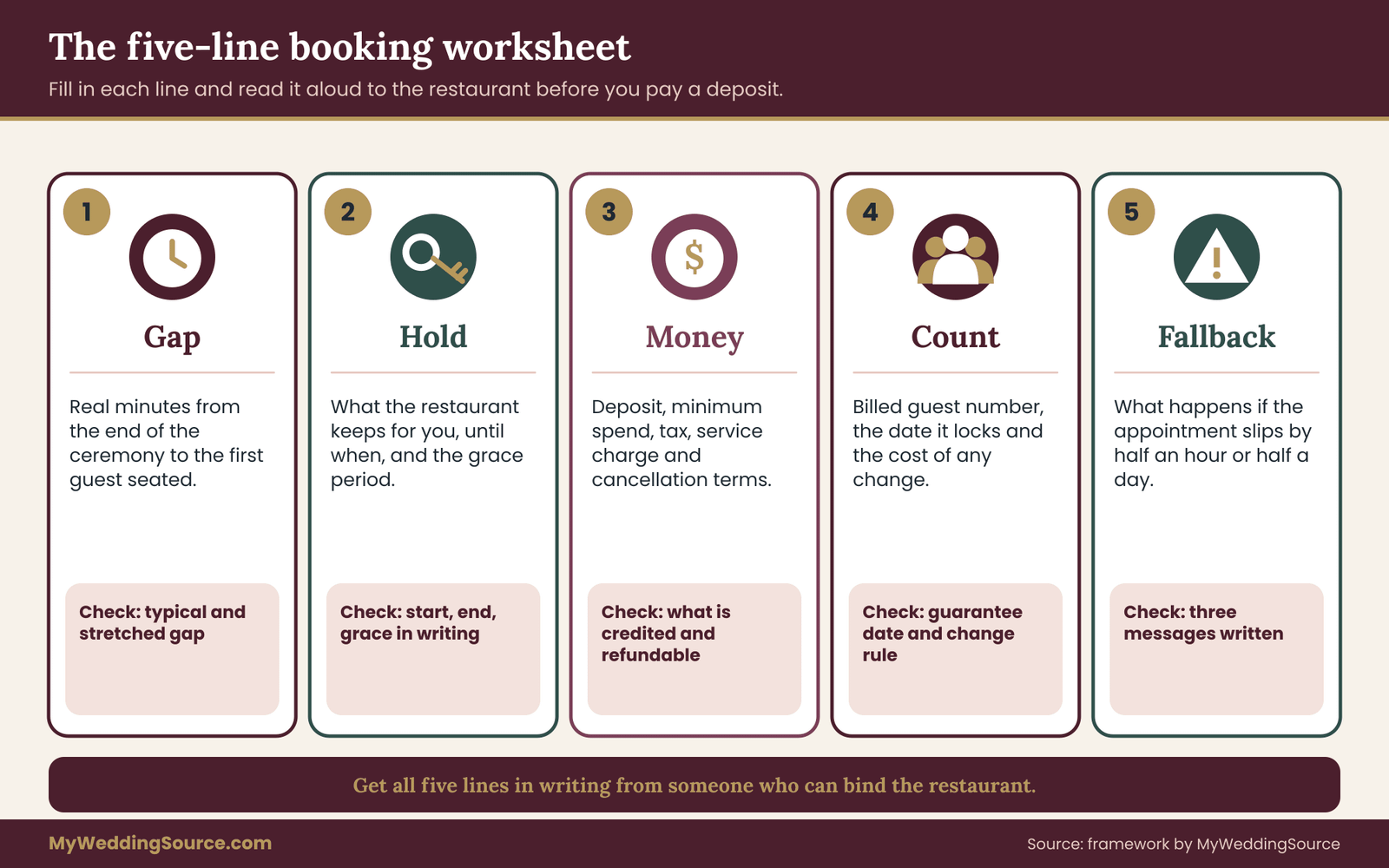
For a restaurant reception that follows a courthouse ceremony, settle five lines before you pay any deposit. Gap: the real minutes between the ceremony ending and the first guest sitting down. Hold: what the restaurant actually promises to keep for you, and for how long if you are late. Money: the deposit, the minimum spend, tax, service charge and cancellation terms. Count: the final guest number and the date it locks. Fallback: what happens if the appointment slips. Get all five in writing from someone who can bind the restaurant.
Couples who choose a courthouse ceremony usually want the marriage without the machinery of a large wedding. Then someone suggests lunch or dinner afterward, and the machinery quietly returns in smaller form. A restaurant has a kitchen schedule, a seating plan, a reservation system and other customers. The clerk’s office has a time slot, a security line and a docket that runs on its own pace. A restaurant reception sits between those two systems, and most of the stress comes from the seam.
This article is about that seam. It does not explain how to get the license or what the clerk’s office will do during your appointment, and it does not cover outfits, photography or the invitation order, which have their own guides on this site. It covers the restaurant reception booking: how to hold a table or a room, how to read the deposit and the minimum, how to count heads, and how to protect the first thirty minutes of the meal from a late ceremony.
A note on scope. This is general information, not legal, tax or financial advice. Courthouse hours, witness rules, fees and waiting periods differ by county and state, and restaurant policies differ by business, so confirm each one directly with the office or the restaurant before you rely on it.
What a restaurant reception after a courthouse wedding really is
A restaurant reception is a catered event with a very small footprint and a very tight start time. It may be a table for six at a favorite neighborhood place, a semi-private corner for fourteen, a private room for thirty or a full buyout for a Friday afternoon.
The size changes the paperwork, but the logic stays the same. You are buying a block of time in a room, a menu priced per person or by minimum, and a promise that the staff will be ready when you arrive.
What makes it different from a standard restaurant booking is that your arrival time is not really yours. It depends on a clerk, a judge or a staff officiant who is running a schedule you do not control. Couples at a venue wedding can tell the caterer “we will be there at five” and mostly mean it.
Couples at a courthouse can only say “we will be there sometime after the appointment, probably within a window.” Restaurants can work with a window, but only if somebody tells them the window exists and agrees what happens at each edge of it.
Think of the day as two clocks, as the broader courthouse wedding celebration guide describes it. The appointment clock belongs to the office. The meal clock belongs to the restaurant. Your job is to build a bridge between them that survives a fifteen-minute delay on either side. Every decision in this guide serves that one aim, which is a restaurant reception that starts well even when the courthouse runs behind.
The five-line worksheet in this guide is that bridge, written down so that a host, a manager and a bride or groom with a phone full of messages can all read it the same way.
Why booking logistics deserve their own plan
Couples tend to treat the restaurant as the easy part. It is only a meal, after all, and restaurants take reservations every day. The problem is that an ordinary reservation is built for an ordinary party: it arrives together, it is the size it said it would be, and it stays a normal length of time.
A wedding party does none of those things reliably. Guests drift in from the courthouse in three cars. Two of them are still parking when the first toast starts. A cousin brings a plus-one nobody mentioned. The restaurant reception runs ninety minutes longer than the reservation, because nobody wants to leave.
Each of those moments is a small booking failure that a clear agreement would have absorbed. A restaurant that knows the party may arrive over a twenty-minute span can plan its first course accordingly. A restaurant that knows the count may move by two until a stated date can order food accordingly. A restaurant that has agreed to a three-hour hold will not seat another party in your corner at the two-hour mark. None of that happens by luck. It happens because someone asked.
The five lines of the worksheet
The worksheet has five lines, and each one answers a question you can check.
Line one, the gap. How many minutes lie between the end of the ceremony and the first guest seated? You measure it, you do not guess it.
Line two, the hold. What does the restaurant keep for you, from what time to what time, and what is the grace period if you are late?
Line three, the money. What is the deposit, is it credited against the bill, what is the minimum spend, what do tax and service charge add, and what happens if you cancel?
Line four, the count. How many people are confirmed for billing, by what date can the number change, and what does each extra or missing guest cost?
Line five, the fallback. If the appointment slips by thirty minutes, or by half a day, what is the agreed next step?
You will notice that none of the five lines asks what the food tastes like. The menu matters, and a later section covers it, but a good menu does not rescue a day where the room was given away at the thirty-minute mark. Settle the structure first, then choose the dishes inside it. A restaurant reception that has the structure right can survive an average menu, but the reverse is rarely true.
Who the worksheet is for
The worksheet suits any couple whose restaurant reception follows a legal appointment within a few hours, including same-day lunches, early dinners and evening meals after a late-afternoon appointment. It also suits couples who plan the restaurant reception for the same weekend. If your restaurant reception is weeks later, the gap line shrinks to almost nothing, but the hold, money, count and fallback lines still apply in full.
It is meant to be filled in by one person, usually the partner who is better at paperwork, and then read aloud on the phone to the restaurant contact. Reading it aloud is the useful part. Any line that makes the contact pause is a line that was not previously agreed. If you remember one habit from this guide, make it that one, because it turns a loose restaurant reception plan into a checked one.
Line one: measuring the travel gap between courthouse and table
The travel gap is the first line because it feeds every other line. If the gap is longer than you think, the hold starts too early, the first course is cold, and the guests who drove arrive after the toast. If the gap is shorter than you think, the restaurant has you waiting at the host stand with a room that is not ready, because you told them four-thirty and arrived at four-ten.
Both mistakes come from using a single number for something made of several pieces. A restaurant reception with a single guessed number for the gap has only one way to go wrong, and it usually does.
Break the gap into its legs
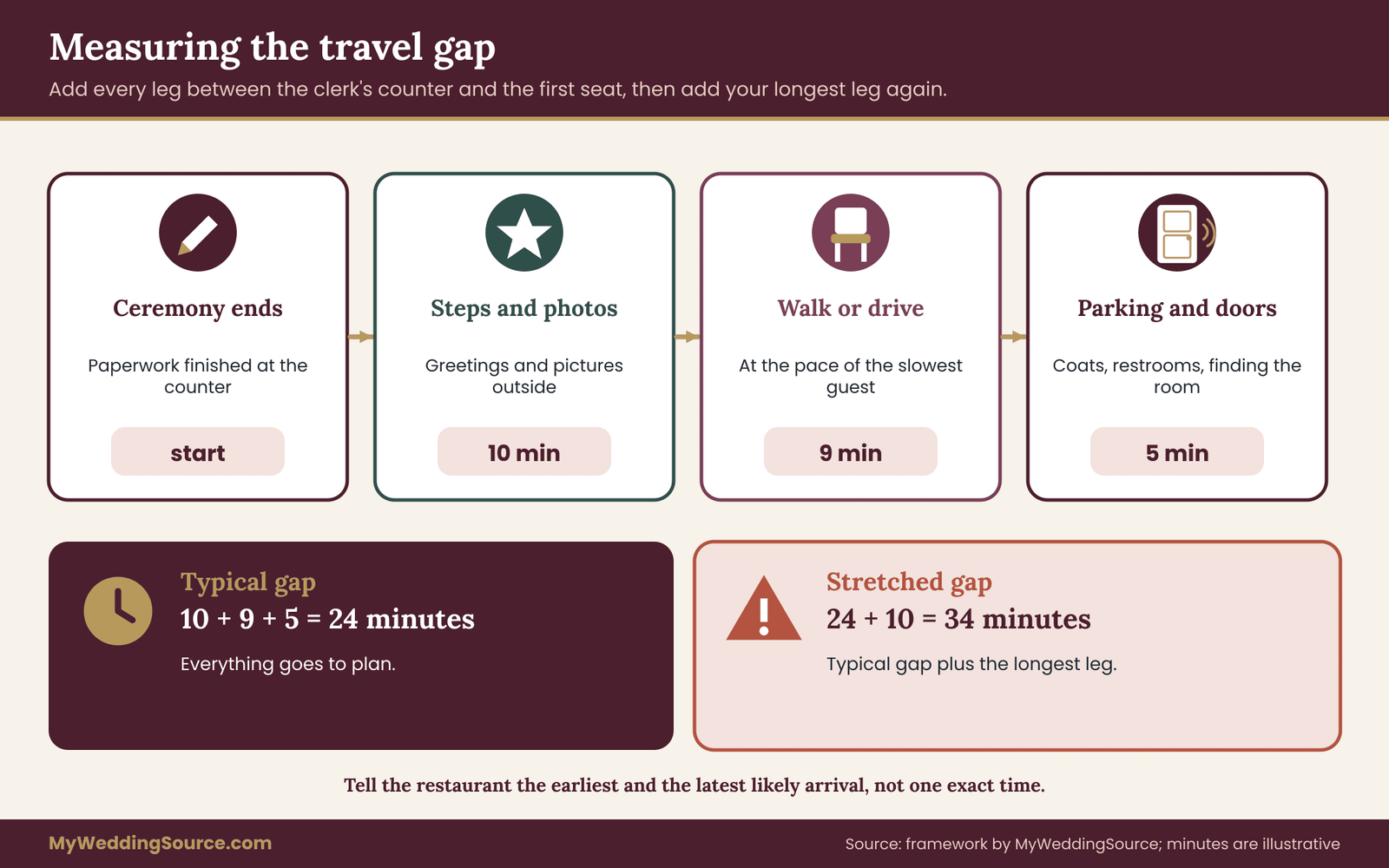
Here are the legs that most couples forget when they say “it is only a five-minute walk.”
The ceremony itself ends, but the appointment is not finished. The clerk may need signatures on the license, a witness may need to add details, and you may be asked to wait while the record is processed. Some offices hand you paperwork at the counter, and others ask you to come back for a certified copy.
Ask the office how long you should expect to stay after the vows, and what happens if there is a line. The officiant requirements guide explains who may perform and sign off a civil ceremony, which helps you ask the clerk sharper questions about the end of the appointment.
Then there is the exit. Courthouses often have security screening at the entrance, and getting out can be slower than expected when a crowd of wedding guests stands in a lobby taking photos. If you plan any pictures on the steps, count them as a leg, not as a bonus.
After that comes the move itself. If the restaurant is a short walk away, the leg is the walking time at the pace of your slowest guest, including crossing signals and a grandparent. If the guests drive, the leg is the drive plus parking, and parking near a courthouse can be tight on a weekday morning because jurors and lawyers fill the lots.
The last leg is arrival. Coats, a restroom stop, finding the right room and finding the right table. Add a few minutes for the people who walk in and then turn around to look for the person they came with.
The two measurements that matter
You need two numbers for line one. The first is the typical gap: the sum of all the legs when nothing goes wrong. The second is the stretched gap: the sum when one leg runs long. A simple rule gives you the second number. Take your longest single leg and add it again on top of the typical gap. If the typical gap is thirty-five minutes and parking is the longest leg at ten minutes, the stretched gap is forty-five.
Measure on the day of the week and at the hour of your appointment, not on a quiet Sunday. A mapping app can give you a drive time at the time you will travel, and many apps let you set a future departure. Use that, and walk the route once if it is walkable.
If your guests are older or use mobility aids, time the walk with someone moving at that pace, or ask the restaurant whether a vehicle drop-off at the door is allowed. The same buffer logic that protects guests arriving from far away applies in miniature here.
What the gap tells the restaurant
Once you have the typical and stretched numbers, you can translate them into something the restaurant can use. The restaurant does not need to know your legs. It needs to know two times: the earliest the first guest could walk in, and the latest the last guest is likely to arrive. Everything else is your problem. Giving the restaurant a clear window is the quiet foundation of any restaurant reception that follows a courthouse appointment.
Suppose the appointment is booked for two o’clock and the clerk’s office says to plan for about fifteen minutes. Your typical gap from ceremony end is thirty-five minutes and the stretched gap is forty-five. If the ceremony ends at two-fifteen, the earliest first guest is two-fifty, and the latest last guest is three.
A reasonable instruction to the restaurant is that the room should be ready at two-forty-five, the first course should not be fired until three-ten, and a grace period of thirty minutes beyond the ready time is built into the hold.
Notice how that instruction is built. It starts from measured pieces, then converts them into a ready time, a first-course time and a grace period. You can say it in one breath on the phone, and the manager can write it in one line in an email.
Line two: the room hold and what a restaurant is really promising
A hold is the restaurant’s promise to keep something for you. The trouble is that the word covers a wide range of promises, from “I wrote your name in the book” to “this room is contractually yours until six.” Couples often learn the difference when the party arrives forty minutes late and the corner has been given away. The second line of the worksheet pins down exactly what is being held.
Four kinds of hold
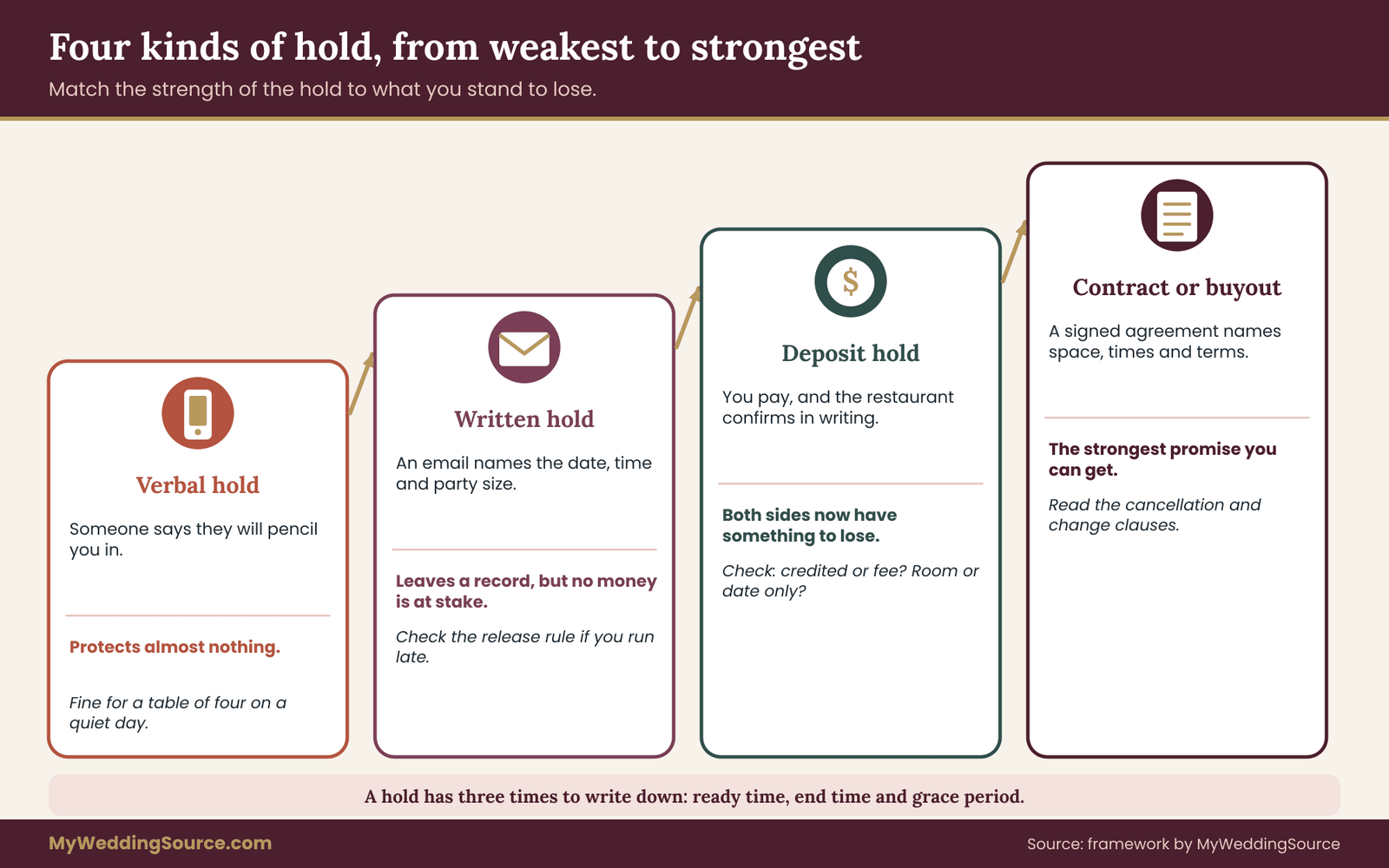
It helps to sort holds into four kinds, from weakest to strongest.
A verbal hold. Someone on the phone says they will pencil you in. It protects almost nothing, because it leaves no record and depends on the same person being on shift. It is fine for a table for four on a quiet Tuesday and not for anything more.
A written hold without a deposit. An email from a manager says the table or room is reserved for a named date, time and party size. It is better, because the commitment exists in writing. But the restaurant can still release it if it suspects you will not show, and many do so if the party is late and the evening is busy.
A deposit-secured hold. You pay a deposit and receive a written confirmation. Now both sides have something at stake. The restaurant has your money and an obligation to keep the room, and you have a financial reason to arrive. Read the confirmation carefully, because the deposit may secure the date but not the exact room, or may secure the room only until a stated grace time.
A contracted hold or buyout. You sign an agreement that names the space, the dates, the times, the price terms and the cancellation rules. This is the strongest form and is normal for private rooms and buyouts. It is also where you most need to read every line, because the contract is the only version of the promise that counts.
The right level depends on party size and on what you stand to lose. A table for six that can be replaced by walking next door needs a written hold at most. A private room for twenty-five on a Saturday evening, with a menu ordered in advance, needs a deposit and a signed agreement. The mistake is to under-protect a large party because “it is just a restaurant.” A restaurant reception for twenty-five is a catered event, and it deserves the paperwork of one.
The hold window: start, end and grace
Every hold has three times, and the worksheet asks you to write all three.
The start time is when the room is ready for you. Ask whether the staff will be in the room, with tables set, at that time, or whether the restaurant only promises the space will exist. For a courthouse timeline you want the room ready before the earliest first guest, not at the appointment time.
The end time is when you must be out. For a lunch it might be the start of dinner prep. For a private room it might be the start of the next booking. Ask what happens at the end time if the party is still there: some restaurants allow a short extension if the next booking is not until later, and some charge by the hour.
The grace period is the one most couples forget. It is the number of minutes the restaurant will keep the room after the start time before it treats you as late. For a courthouse reception it is the most valuable line in the hold, because it is the line that absorbs a clerk’s delay. A restaurant reception without a grace period is a reservation that will fail the first time the clerk runs late.
Ask for a grace period that at least matches your stretched gap, and ask what the restaurant will do at the end of it. A good answer is “we will call the number on the booking, and we will keep the room an additional thirty minutes before releasing any part of it.”
Naming a decision-maker and a phone number
A hold is only as good as the person behind it. Restaurants have floor staff, hosts, managers and owners, and a promise made by a host is not always a promise the manager recognizes. When you confirm a hold, ask who has authority to change it on the day, and get a direct number for that person, not only the main line.
Then give the restaurant a number to reach on the day. The best person is not either of you, since you will be in front of a clerk with your phones off. Choose a friend or family member who is not in the ceremony, who knows the worksheet and who can answer questions such as “the couple is running twenty minutes behind, should we hold the first course?”
That person becomes the single link between the two clocks. That person is the most useful guest at any restaurant reception that depends on a courthouse schedule.
Reading the hold confirmation
When the confirmation arrives, check it against the worksheet line by line. It should say the date, the start time, the end time, the grace period, the room or section name, the party size, the contact for the day, and the deposit amount and its status. If any of those is missing, reply with a short message asking for it.
Politeness helps and so does specificity: “Could you confirm the room will be set by 2:45 and held until 3:30 before any release?” is easier to answer than “Can you hold it a bit if we are late?”
Keep the confirmation where you can find it on the day. A restaurant reception can hang on one forwarded message, so make that message easy to reach. A screenshot saved to your phone’s photos is more reliable than an email you will have to search for in a courthouse lobby with a weak signal.
What a hold does not cover
Be clear about what a hold usually does not promise. It does not promise a particular table within a larger dining room unless the confirmation names it. It does not promise a menu or a price unless those are written down. It does not promise that the restaurant can accommodate a larger party if your count grows.
It does not promise quiet, music control or decorations unless the policy says so. Each of those is its own question, and the later sections cover them. Knowing the limits of a hold keeps a restaurant reception from resting on assumptions.
When the restaurant does not take holds at all
Some popular restaurants do not take reservations for small parties, or only take them through an online system with no way to add notes. If the restaurant you love is one of them, you have three honest options. You can choose a different restaurant that takes a proper booking. You can ask whether the restaurant accepts a larger party by arrangement and, if so, who handles it. Or you can choose a quiet hour, such as an early weekday afternoon, when walking in with a party of six is realistic, and treat the restaurant reception as unscheduled.
The second and third options both depend on being honest about the size and the timing. A party of eight that walks in at the Friday dinner rush without notice is asking for a wait, and the restaurant is within its rights to give you one.
If the online system has a notes field, use it for the worksheet’s essentials: “wedding lunch after a courthouse ceremony; the party may arrive up to thirty minutes after the booked time; please call the number below before releasing.” It is a small step, and it often shifts the booking from a routine reservation to a flagged one.
Choosing a format for your restaurant reception
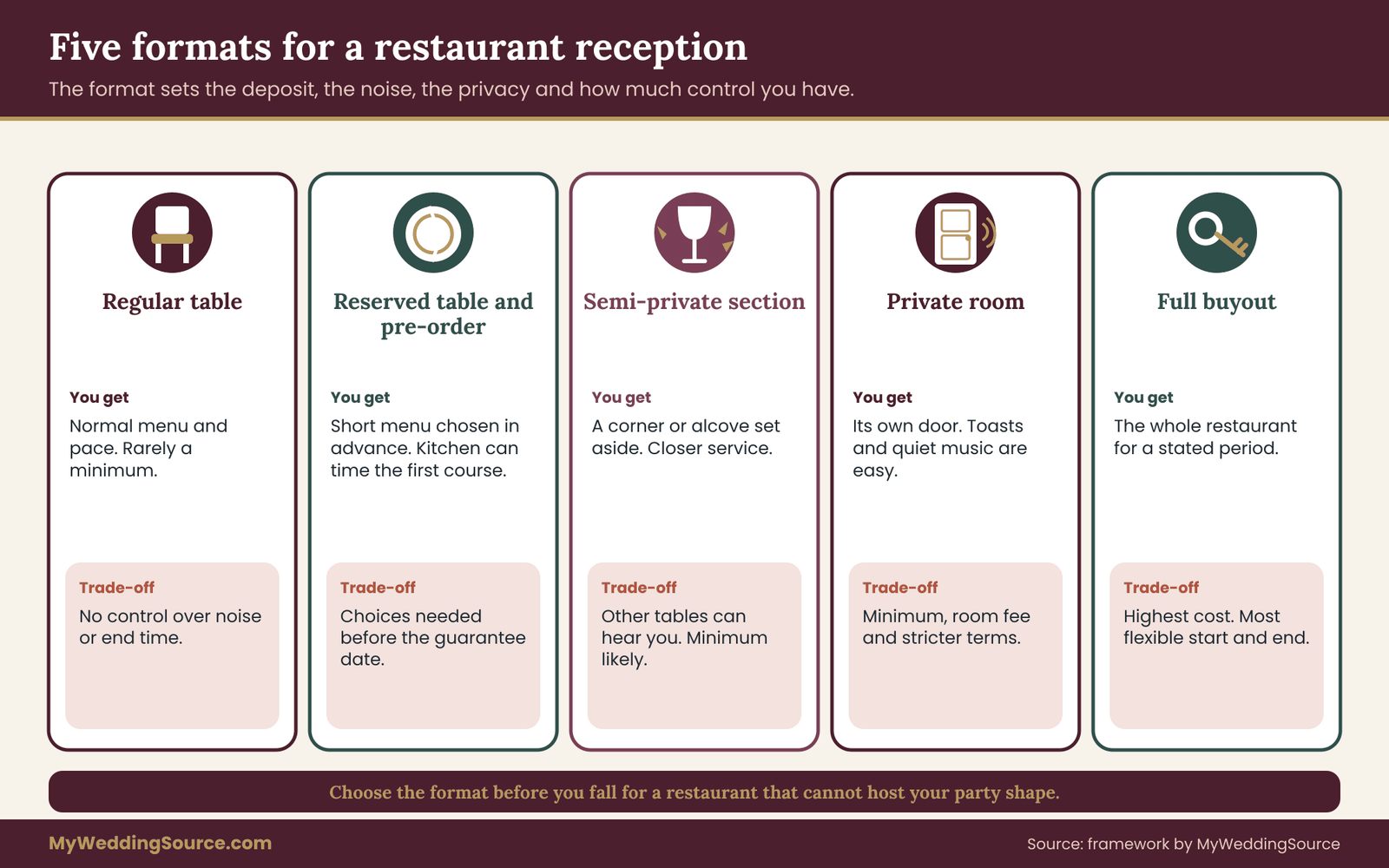
The format is the physical shape of the restaurant reception booking: regular table, reserved section, private room or full buyout. It decides the deposit, the minimum, the noise, the privacy and how much control you have over the timing. Choosing the format before the restaurant is a useful discipline, because it stops you from falling in love with a place that cannot host your party shape. The format is the first real decision in a restaurant reception, and the others follow from it.
Five formats, compared in prose
A regular table. Best for small parties, roughly up to the size of the restaurant’s largest ordinary table. You get the normal menu, the normal service and the normal pace. You get no control over the noise or the end time, and the restaurant may ask you to order from the regular menu with a fixed sitting length. The big advantage is that there is rarely a minimum or a room fee. For a very small restaurant reception, that simplicity is worth a lot.
A reserved table with a pre-order. The restaurant seats you at a larger table and asks you to choose from a short menu in advance. This protects the kitchen’s timing and protects you from a long wait after the ceremony. It is a good choice for six to twelve guests when the kitchen needs to know what to fire.
A semi-private section. A corner, an alcove or a patio area set aside for you but open to the room around it. You get closer service and room to move, but you will hear other tables, and they will hear you. The restaurant may charge a minimum spend rather than a fee.
A private room. A closed or separable room with its own door. You can speak, play quiet music and toast without worrying about other diners. In return you usually face a minimum spend, a room fee or both, a longer contract and stricter cancellation terms.
A full buyout. The whole restaurant is yours for a stated period. It is the most expensive and the most flexible, and it suits a larger party or a restaurant that is normally closed at that hour, such as a weekday afternoon between lunch and dinner.
Matching the format to the party
Count your guests first, including the two of you, any children and anyone who might join at the last minute. Then consider three questions. Will you give toasts or speeches? Will anyone need to move around, for instance to take photos or help an older relative? And do you want the restaurant to treat the group as a single event, with a defined start and end, or as a group of friends having a meal?
If the answer to the first two questions is no and the party is small, a regular or reserved table is usually enough. If you want to make a short toast with every guest able to hear it, a semi-private section or a private room is worth the extra cost.
If you want to arrive in a room that is ready, decorated, and entirely yours, the private room or buyout is the choice, and the later cost section shows what that choice does to the bill.
The wedding venue guide covers the broader questions of choosing and inspecting a space. For a restaurant reception, the same inspection habits still apply on a smaller scale: visit at the day and hour you plan to use it, look at the lighting, count the chairs, hear the noise level and find the restrooms.
Line three: deposits, minimums and the true price of a restaurant reception
The third line is the money line, and it is where couples most often discover that a friendly restaurant has a very specific contract. Restaurants that host private events usually charge in one of a few ways, and the way they charge shapes how much you can control. Before you compare menus, compare the money structure. A restaurant reception can look inexpensive on the menu and expensive on the contract, so read the contract first.
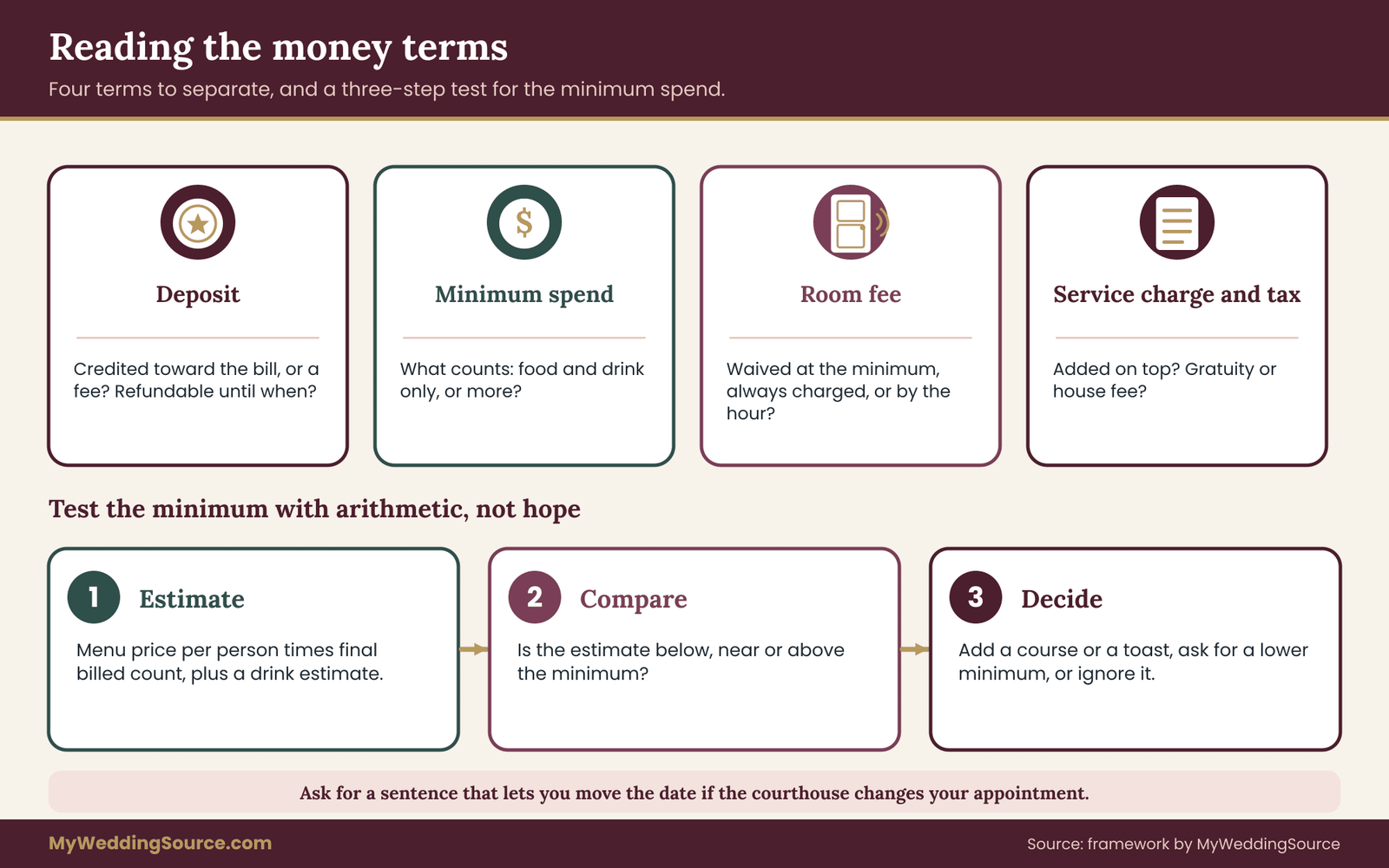
Four terms to separate
The deposit. An amount paid to secure the date and space. Ask whether it is credited toward the final bill, whether it is refundable, and under what conditions. A deposit that is credited is a prepayment. A deposit that is not credited is a fee. The two are very different, and a confirmation that only says “deposit” does not tell you which one you paid.
The minimum spend. The amount the restaurant expects your group to spend on food and drink before certain charges. If your total falls under the minimum, you may be billed the difference. Ask what counts toward the minimum. Food and beverages usually do. Tax, service charge and room fees often do not, and gift certificates or the deposit may or may not be applied. Two restaurants with the same stated minimum can end up with very different real costs because of that one detail.
The room fee. A separate charge for the space. Some restaurants waive it if you meet the minimum, some charge it regardless, and some charge it only for certain hours.
The service charge and tax. Many restaurants add a service charge, often presented as a percentage, to private events in place of or in addition to a voluntary tip. Sales tax is added by law in most places. Neither is usually included in the minimum. Ask whether the service charge is the staff’s gratuity or a house fee, because that affects whether you should add anything else, and ask how it will appear on the bill.
The Internal Revenue Service publishes general guidance on tips and how they are treated. Ask the restaurant to describe its own policy in a sentence you can keep.
Reading the minimum against your menu
A minimum is a promise from you, so test it before you sign. You can do this with plain arithmetic and no invented numbers: take the per-person prices on the menu you are likely to choose, multiply by your final billed count, add a realistic drink estimate, and compare the result with the minimum.
If the estimate is below the minimum, you will pay for food and drink you did not order, or you will add courses or a bar to reach it. If the estimate is well above the minimum, the minimum is not your constraint and you can ignore it.
Consider an illustrative case. A private room carries a stated minimum of one thousand two hundred dollars on a weekday afternoon. The menu offers a set lunch at a price per person, and fourteen guests are coming. Multiply the per-person price by fourteen. If that number is, say, nine hundred dollars before drinks, the gap to the minimum is three hundred dollars.
You can choose to cover the gap with a welcome drink and dessert for everyone, or you can ask the restaurant to lower the minimum for a smaller party. Either way you have made a decision instead of discovering it on the bill. That is the habit that keeps a restaurant reception inside the budget you set.
The point of the exercise is not the figures, which are invented for illustration. The point is the method: estimate honestly, compare to the minimum, and choose how to close any gap before the day.
Cancellation and change terms
The money line also includes what happens if plans change. Ask for the cancellation terms in writing, and look for four things.
First, the date after which the deposit becomes non-refundable, if it is refundable before that. Second, whether you can move the date without losing the deposit, and how many times. Third, what happens if the courthouse appointment itself is rescheduled by the office, which is outside your control. Fourth, whether the restaurant can cancel on you, and what it owes you if it does.
The third item matters more for courthouse couples than for most. A clerk’s office may reschedule an appointment because of a court closure, a staffing change or a weather event. A restaurant that treats a rescheduling by the office as the same as a casual cancellation will keep your deposit. Ask for a sentence that treats a documented change by the issuing office as a reason to move the date without penalty.
This one sentence does more for a courthouse restaurant reception than any decoration could. Some restaurants will agree, and some will not. Either way you will know where you stand before you pay.
Where the money fits in your wider plan
A deposit and a final bill for a restaurant reception are two payments in a larger budget. The wedding cash-flow planning guide explains how to schedule deposits and final balances so that they do not collide with other costs, and it is worth a few minutes if your courthouse day also involves a photographer, flowers or travel.
For the restaurant, put two dates on your calendar: the date the deposit is due, and the date the final guarantee locks, which is usually earlier than the day of the meal.
Pay with a method that leaves a record. A card payment or a bank transfer gives you a statement line. If the restaurant asks for cash, ask for a receipt that names the date, the amount, the event and the purpose of the payment. Contracts for vendors in general are covered in the wedding vendor contract guide, which lists the clauses that tend to matter, and several of them apply here: the cancellation clause, the change clause and the force majeure clause.
Price signals that deserve a second question
A few phrases on a proposal are worth a follow-up call.
“Subject to availability” next to a menu item means the dish may be replaced. Ask what the substitute policy is. “Market price” on a main course means the number can move before the event. Ask for a cap. “Plus applicable charges” means more lines are coming. Ask for them by name.
“Beverage package” without a description means you do not know what is included. Ask for the list, the length of service and what happens after it ends. “Overtime” means a clock is running on the hold. Ask for the rate in advance, before the party is relaxed and unwilling to leave.
None of these is a trick. Restaurants write proposals in a hurry, and shorthand is common. Each phrase simply stands for a decision you will make anyway, so you may as well make it on your terms and on the phone rather than at the end of the meal.
Line four: the guest count and the guarantee date
The fourth line turns a vague number into a commitment. A restaurant buys food, schedules staff and sets tables based on the count you give it, and it will bill you based on the number it prepared for. The count is the quiet driver of the price of every restaurant reception. The count therefore has three parts: the number you hope for, the number you guarantee, and the number who actually sit down.
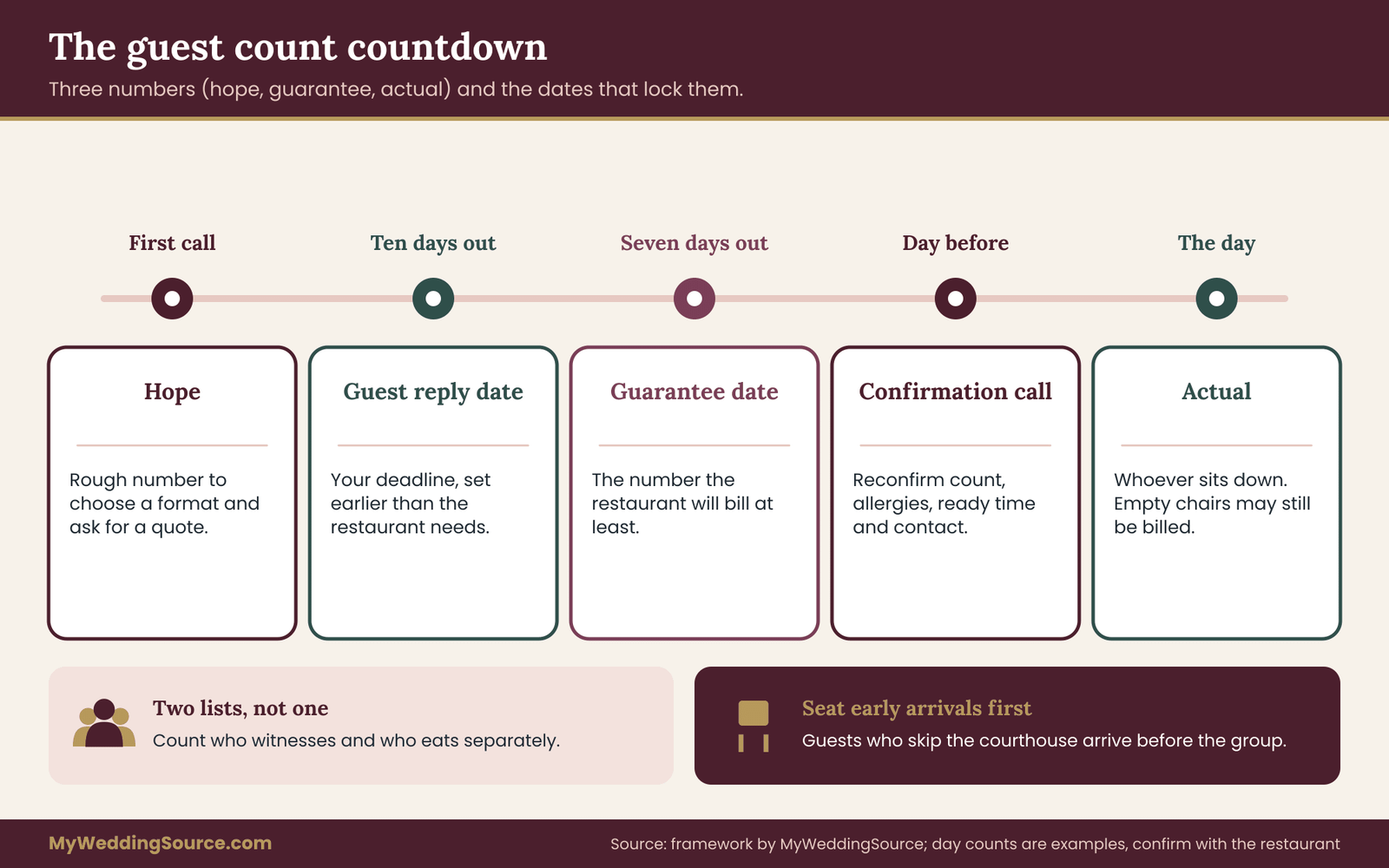
Hope, guarantee and actual
The number you hope for is your first estimate, and it is allowed to be loose. You use it to choose a format and to ask for a quote.
The number you guarantee is the one the restaurant will bill at least. It is set at a stated date before the restaurant reception, often called the guarantee date or final count date. After that date you may be allowed to add guests if the kitchen can cope, but you usually cannot reduce the count without paying for it.
The number who actually sit down is the number on the day. If it is lower than the guarantee you pay for empty chairs. If it is higher, the restaurant either seats the extra guests, charges you for their meals, or declines.
A useful habit is to ask three questions in the first call. What is the guarantee date, counted in days before the event? Can the count go up after that date, and by how many? What happens to the bill if it goes down? The answers fit in one line on the worksheet.
Counting for a courthouse day
Courthouse guest lists have their own quirks. The legal ceremony may have a strict limit on the number of people in the room, set by the office, while the restaurant reception can welcome many more. That creates two lists: those who witness, and those who join the restaurant reception.
Some people will be on both, and some only on one. If you are still deciding who to invite to which part, the wedding guest list guide explains how to build and trim a list without damaging relationships, and its advice applies equally to a short meal.
Two kinds of guest are easy to miss. The first is a guest who attends the ceremony but cannot stay for the restaurant reception, such as a colleague on a lunch break. Count them in the ceremony list but not in the guarantee. The second is a guest who skips the courthouse and goes straight to the restaurant, such as a grandparent who cannot manage stairs or a friend arriving from the airport.
Count them in the guarantee and tell the restaurant to expect them early, so that they are seated and comfortable before the main party arrives.
Setting the guarantee date
Ask the restaurant for a guarantee date that is as late as it allows, and then set your own response deadline for guests a few days earlier. If the restaurant needs a final count seven days before the restaurant reception, your guests should reply by ten days before. That gap gives you time to chase the people who did not reply.
When guests are slow to answer, a short and direct message works better than a general reminder: “We need a final count for the restaurant on Thursday. Could you tell us by Tuesday if you can join us for lunch after the ceremony?” The wedding RSVP etiquette guide covers the tone for this kind of follow-up.
Children, plus-ones and the extra chair
Restaurants plan food and furniture by the head, so a child counts. Ask whether children’s portions are priced differently, and whether very young children who do not eat are counted at all. If a guest might bring a partner, decide in advance whether you will allow it, and say so plainly in the invitation.
A guest who arrives with an unannounced companion puts the restaurant in the position of saying no on your wedding day, which is a poor position for everyone. A restaurant reception goes better when the guest rules are settled before the day.
Keep one spare chair in your plan, but do not pay for it unless the contract demands it. If the restaurant can seat one more at the end of the table without a problem, say so in the confirmation, so that an unexpected guest does not become an emergency.
Menu, allergies, drinks and access at a restaurant reception
With the structure settled, the menu can be chosen without damaging the booking. A menu for a restaurant reception that follows a courthouse ceremony has one special job: it must be servable on a fuzzy start time. That rules out some dishes and favors others, and it changes how you ask the kitchen to plan. Planning the menu for a restaurant reception is partly a cooking question and partly a timing question.
Menus that survive a late arrival
Think about what happens to a dish if the party is thirty minutes late. A seared fish course goes dry. A soufflé collapses. A hot soup held too long develops a skin. A salad with a dressing wilts. The kitchen can manage some of this by timing the firing of each course to the actual arrival, which is why the first-course instruction from the gap line matters.
Dishes that hold well include braised meats, stews, baked pastas, roasted vegetables, grain dishes and anything served at room temperature. Shared platters work well too, because they do not require a plate-by-plate sequence and they let guests who arrive in dribs and drabs start eating without waiting for the group. Family-style service also suits a table where two cars are still parking. For many couples, a shared-platter restaurant reception is the most forgiving format available.
A set menu is usually easier on the kitchen than a choice from the full menu. A set menu with two or three options per course, chosen in advance, gives the cook a count for each dish, which reduces waste and speeds service. For a party of ten or more, ask for the choices to be collected before the guarantee date, with the names of the guests written beside each choice.
If your reception is at a restaurant that does not normally offer set menus, ask what it can do for a group. Many will offer a limited list at a fixed price for parties over a certain size. If the restaurant says the whole menu is available to everyone, ask about timing: “For a party of twelve, can the kitchen fire all the mains at once, or will they come as they are ordered?”
Allergies and dietary needs
Collect dietary information early, and pass it on in writing. An RSVP can ask for allergies and restrictions in a single line. The wedding menu planning guide explains how to build a menu across different ages and diets, and the principles carry over to a restaurant with a smaller menu.
For a restaurant, there are three practical steps. First, send a list of allergies and the guest’s name beside each, and ask the manager to confirm that the kitchen has seen it. Second, ask whether the restaurant can handle each allergy safely, or whether cross-contact is a risk in its kitchen.
A restaurant that says it cannot is doing you a favor, and you can adjust the plan. Third, on the day, make sure the server knows which guests have allergies before the first course lands.
Food safety is the restaurant’s responsibility, and food allergy information is published by the Food Allergy Research and Education organization and by federal agencies. Do not try to manage it from memory or from a guest’s reassurance. A restaurant reception is a poor place to rely on guesses about ingredients. If a guest has a severe allergy, let that guest talk with the manager before the day if they wish.
Drinks, corkage and the bar
Drinks are a frequent surprise on the final bill. Ask what the options are. A host bar charges you per drink or by consumption. A limited bar offers a short list, such as sparkling wine, one red, one white and a non-alcoholic option. A cash bar asks guests to pay. A package sets a price per person for a stated number of hours.
Many couples want to bring a bottle of sparkling wine for the toast. Restaurants that allow outside bottles often charge a corkage fee, a charge for opening and serving a bottle you supplied. Others do not allow outside alcohol at all, because of their license. Ask about it in the first call, because it affects both the toast plan and the minimum.
If you serve alcohol at a restaurant reception, plan for the people who are driving home. A non-alcoholic option that looks like a real drink is a small kindness that costs little, and it can be listed on the menu card alongside the others.
A toast needs a glass for everyone, and a short window when the servers are not carrying plates. Tell the restaurant when you plan to toast, so the servers can fill glasses before the speech and then stand back. A toast is a small piece of the restaurant reception, but it is the piece guests remember.
Cake, dessert and outside food
Restaurants differ on outside desserts. Some allow a cake and charge a cake-cutting fee. Some prefer to supply the dessert. Some bring out a candle on their own dessert at no charge. Ask which applies, and if you plan to bring a cake, ask who will store it, who will cut it, and whether the restaurant will provide plates and forks.
Access, seating and comfort
Check access before you commit. Is there a step at the door? Is there an elevator to a private room on an upper floor? Are the restrooms on the same level? Where is the nearest place to drop off a guest who cannot walk far?
The Americans with Disabilities Act sets accessibility requirements for public businesses, and the Department of Justice publishes plain-language guidance, but the most useful step is simply to ask the restaurant what a guest in a wheelchair or with a walker should expect on arrival.
Seating deserves a thought too. A long table makes conversation hard for guests at the ends. A series of round tables makes it easier but may need a larger room. Ask for a seating plan that puts the couple where they can see the door, because they will want to greet late arrivals, and that puts elderly guests near the restrooms and away from the kitchen door.
Noise matters as well. A restaurant with hard walls and a full dining room can be difficult for older guests and for anyone with a hearing aid. If this is a concern, ask for a quieter hour or a room that closes off, and choose seating that puts the guests with the most difficulty near the couple. Comfort of this kind decides whether older guests enjoy the restaurant reception or endure it.
Line five: the fallback plan when the appointment slips
The fifth line is the one most couples skip, because it feels like planning for failure. In fact it is planning for the most predictable event of the day: the courthouse schedule is not the restaurant’s schedule, and one of them will be late. A restaurant reception that has no fallback is trusting two schedules to agree, which they seldom do.
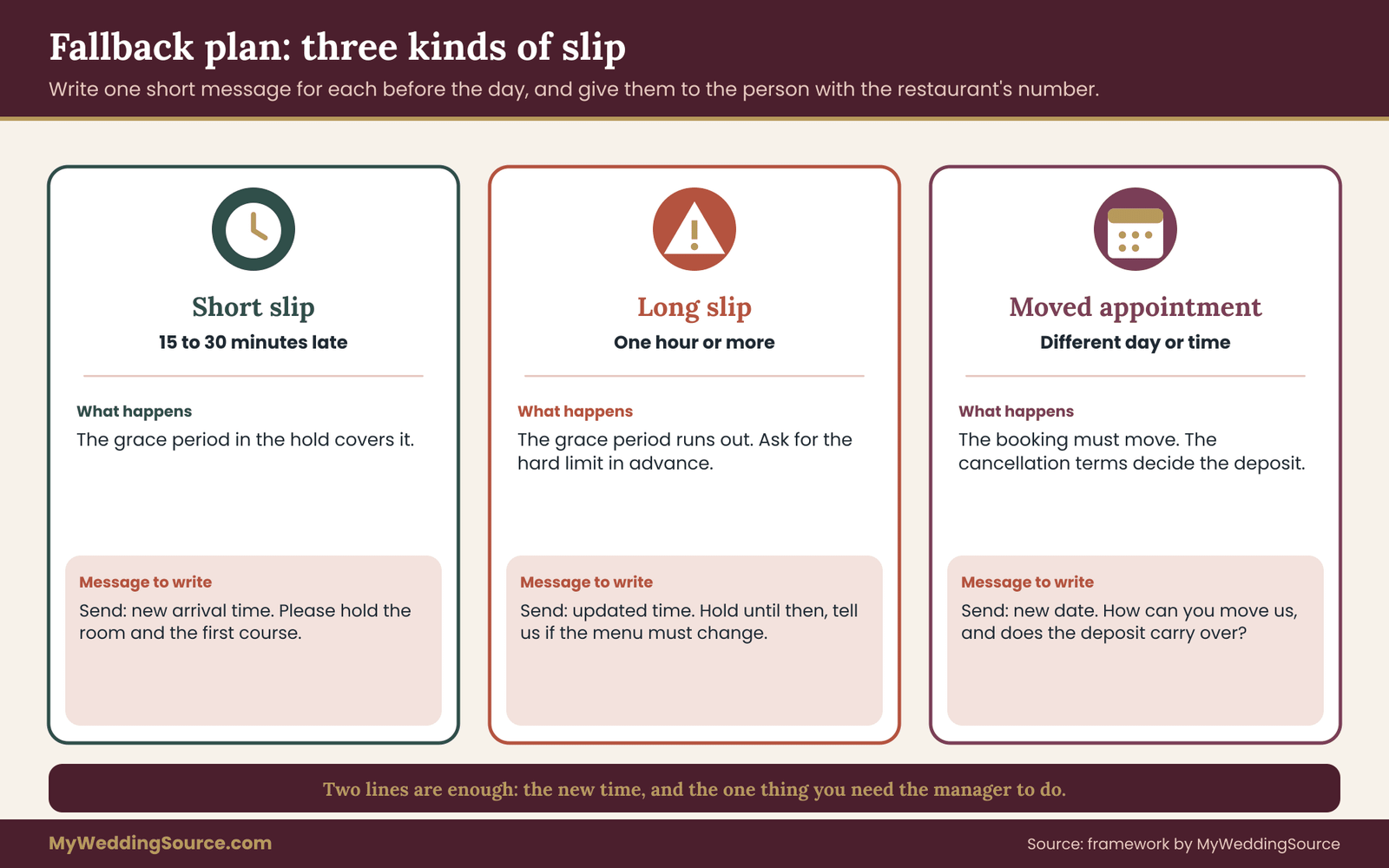
Three kinds of slip
A short slip, fifteen to thirty minutes. The ceremony starts late because the previous couple ran over, or the clerk is called away. This is the most common and the easiest to absorb. The grace period in the hold covers it, provided someone tells the restaurant.
A long slip, an hour or more. The office is running badly behind, a judge is unavailable, or a document is missing and must be fetched. This is harder, because the grace period runs out. The agreed next step might be to delay the first course, to move the guests to a bar or waiting area, or to shorten the meal.
A moved appointment. The office reschedules the whole appointment to another day or time. Now you are rebooking the restaurant, and the question is what the restaurant offers. The earlier discussion of cancellation terms is the answer here.
The message tree
Decide in advance what the person with the restaurant’s number will say in each case, and write the three messages before the day.
For a short slip: “The ceremony has not started yet. We expect to arrive about thirty minutes after the booked time. Please hold the room and the first course.”
For a long slip: “The ceremony is running about an hour behind. Please hold the room until the updated time below, and let us know if you need to change anything about the menu.”
For a moved appointment: “The courthouse has moved the appointment to the date below. Please tell us how you can move our booking, and whether the deposit carries over.”
These messages are short on purpose. A restaurant manager mid-service will read two lines, not two paragraphs. Include the one fact the manager needs, the new time, and the one action you need from them.
What the restaurant can do and what it cannot
A restaurant can hold a room, delay a course, serve appetizers early to hungry guests and extend your end time if the next booking allows. It cannot hold a room past a booking that follows yours, and it cannot keep a kitchen fully staffed forever.
Ask in advance what the hard limit is. A sentence such as “we can hold the room until a stated time, after which we will need to release it” is useful. You may not like the answer, but you can plan around it.
If the delay is long, it also helps to have a plan for the guests. The people who drove to the courthouse, perhaps from some distance, will be hungry, and a thirty-minute delay becomes an hour in their minds. Ask a friend to take charge of a small snack, a table in a nearby café or a seat in the restaurant’s waiting area. The courthouse celebration guide discusses how to keep a group comfortable across the gap between the appointment and the meal.
Building the day-of timeline for a restaurant reception, backward from the courthouse
With the five lines filled in, you can write the timeline. The method is to start from the one fixed time, the appointment, and work backward and forward in blocks. Every block has an owner, a number of minutes and a buffer. Writing it in this order prevents the common mistake of building the schedule from the restaurant’s reservation time and hoping the ceremony fits. A restaurant reception timeline should be written backward, from the one time that cannot move.
Step one: anchor on the appointment
Write down the appointment time and the office’s estimate of how long you will be inside, including the wait before and after. If the office says check-in is fifteen minutes before and the ceremony takes about ten minutes, the appointment block is about forty minutes from arrival to finished paperwork. Treat that number as a minimum, because every office has a bad day.
Add the arrival time of your guests. Guests should reach the courthouse well before the appointment, partly because of parking and security, and partly because the witnesses and any photographers need to be in place. The office will often tell you how early to arrive.
Step two: add the gap and the buffer
From the end of the appointment block, add the typical gap you measured in line one. Then add the buffer, which is your longest single leg. The result is the latest realistic arrival time of your last guest. Set the restaurant’s first-course time slightly after that moment, and set the room-ready time slightly before the earliest guest.
Step three: place the meal inside the hold
Now put the meal inside the hold window. The meal has its own blocks: arrival and seating, welcome drink, first course, toast, main course, dessert, and a closing window. A short meal for a small party can take under two hours, and a longer multi-course dinner can take three or more.
Ask the restaurant for its standard pace for a party of your size, and make sure the end time of the hold is later than the likely end of the meal by at least thirty minutes.
Place the toast carefully. A toast is best after everyone has a drink and before the main course arrives, when attention is high and plates are not in the way. Tell the restaurant the planned time and the person who will speak, so the servers can pause.
Step four: assign owners
Every block needs a person responsible for it. Typical owners are the couple, a family member who handles the guests at the courthouse, a friend who is the contact person with the restaurant, and a driver or two who move the less mobile guests. Write each name beside the block, and send the whole timeline to those people a few days in advance, with a short note about what you are asking of each.
A vendor timeline guide on this site lays out a method for turning a day into a schedule that vendors can read, and its habits of naming owners and writing times in a consistent format work just as well for a restaurant.
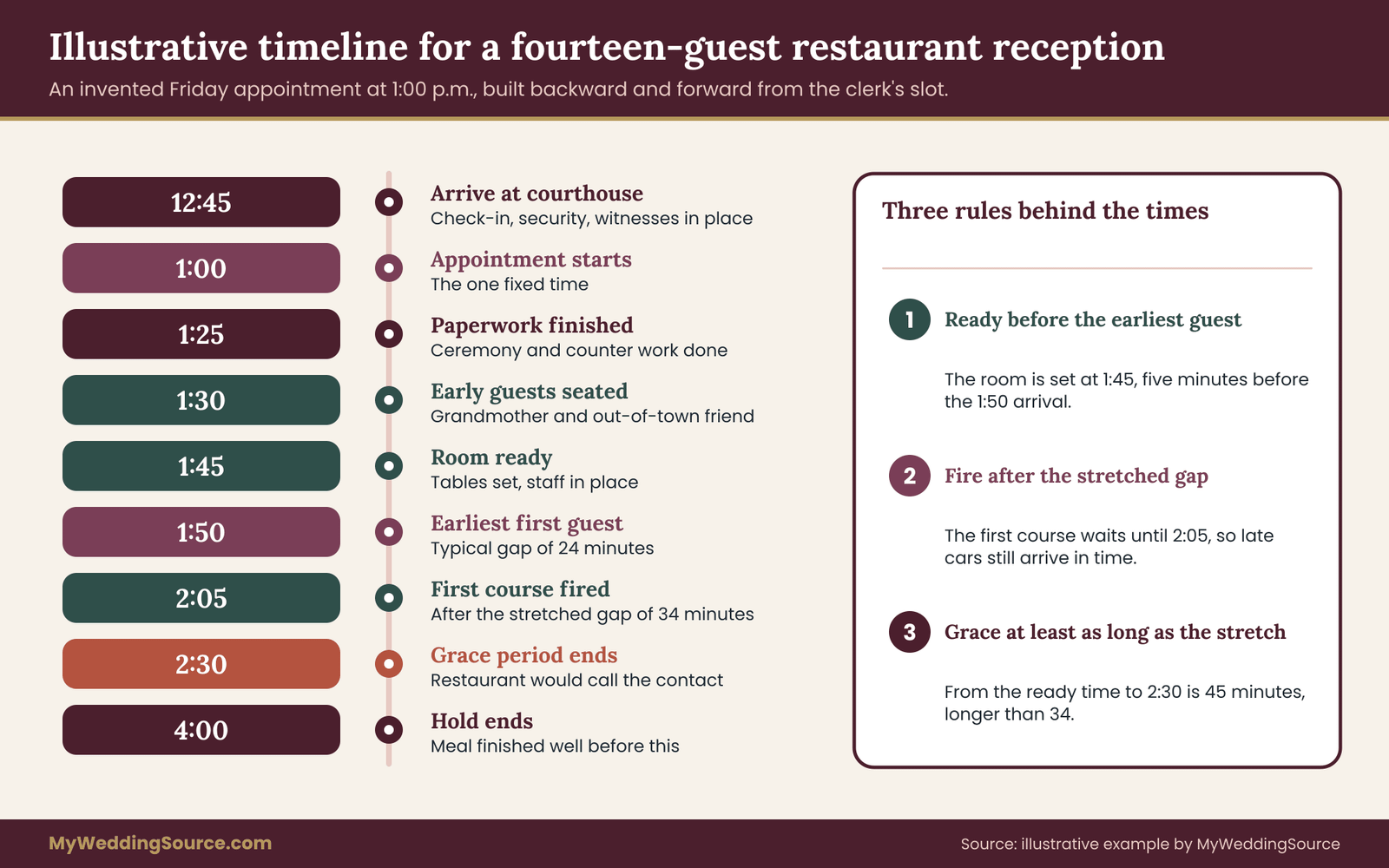
A one-page timeline format
Keep the timeline to one page. It should list, in order: the time each block starts, the block name, the owner and the contact number. At the top, put the courthouse address, the restaurant address, the restaurant’s manager contact and the day-of contact. At the bottom, put the three slip messages from the fallback section.
Print it, and also save it as a screenshot. The one page is the working copy of the whole restaurant reception. Give a copy to the person with the restaurant’s number, to whoever is driving, and to the person who will announce the move from the courthouse to the restaurant. The couple does not need to carry the plan, because the couple will be busy being married.
The handoff moment
There is one moment in the day that deserves attention: the point where the group leaves the courthouse and heads to the restaurant. This is where guests are likely to scatter, lose each other and miss the first course. Someone should be named to announce the plan out loud once the ceremony ends: where the restaurant is, how to get there, where to park and what time the first course will arrive.
A printed card with the address and a map link, handed to each guest at the courthouse, backs up the announcement and costs almost nothing.
If guests are driving, ask a friend to lead the way, or ask the group to follow in one or two cars. If guests are walking, ask someone to stay at the back of the group with the slowest walker.
A worked example: a fourteen-guest restaurant reception
The following example is invented to show the method. The couple, the restaurant and every number below are illustrative, not real, and your own figures will differ.
The situation
Priya and Daniel have a courthouse appointment on a Friday at 1:00 p.m. The clerk’s office tells them to arrive fifteen minutes early, that the ceremony lasts about ten minutes, and that they should allow about fifteen minutes afterward for the paperwork. The room holds ten people, so they invite ten to witness and four others to join the restaurant reception only. Fourteen will eat, including the couple.
They choose a restaurant two blocks from the courthouse, with a back room that seats up to sixteen and a weekday lunch that normally ends at three. The restaurant offers a private room with a stated minimum and no room fee on weekdays.
Line one, the gap
The ceremony ends at 1:25 after the paperwork. Priya and Daniel list the legs. Photos on the steps, ten minutes. Walking at the pace of Daniel’s grandmother, nine minutes. Arrival, coats and finding the room, five minutes. The typical gap is twenty-four minutes, and the longest leg is ten, so the stretched gap is thirty-four. The earliest first guest is about 1:50 and the latest last guest about 2:00.
Line two, the hold
They ask for the room to be set by 1:45, a grace period until 2:30, a first course at 2:05, and an end time of 4:00. The restaurant agrees in writing and names the manager and a direct number. Priya’s sister is the day-of contact.
Line three, the money
The restaurant asks for a deposit credited against the bill, refundable until seven days before the date, and a minimum that does not include tax or service charge. A set lunch is priced per person. Daniel multiplies the price by fourteen and adds a sparkling toast and a non-alcoholic option. The estimate sits just above the minimum, so the minimum is not a constraint. They pay the deposit by card and save the confirmation.
They also ask about a change by the office. The manager agrees to move the booking once without penalty if the courthouse documents a change. They ask for that sentence to be added to the confirmation.
Line four, the count
The guarantee date is five days before the lunch. Priya sets a guest reply date of eight days before. The four meal-only guests include Daniel’s grandmother, who prefers to go straight to the restaurant and sit down, and a friend who is driving in from out of town. They tell the restaurant that two guests will arrive at 1:30, early, and ask for seats near the door.
One guest needs a nut-free meal. Priya sends the name and the allergy in writing, and the manager replies that the kitchen has seen it.
Line five, the fallback
Priya’s sister writes three messages in her phone notes: a short slip, a long slip and a moved appointment. The restaurant tells them it can hold the room until 3:00 and then must release part of it for the dinner setup.
The result
On the day the ceremony starts twenty minutes late. Priya’s sister sends the short-slip message at 1:10. The manager moves the first course to 2:25 and keeps the room. The party arrives at 2:15, sits, toasts at 2:40 and finishes dessert by 3:50.
Nothing in that sequence required the couple to think about the restaurant for a minute. That is the purpose of the worksheet. The couple enjoyed a restaurant reception that never looked like a logistics problem, because the problem had been solved in advance.
Notice what the example does not include. It has no clever decorations and no complicated menu. The couple’s effort went into five questions and three messages, and it protected the most fragile part of the day. The restaurant reception was the fragile part, and the five lines held.
Questions to ask before you book a restaurant reception
A booking call goes better with a script. Restaurant managers handle many requests and appreciate a caller who knows what to ask. The questions below follow the five lines of the worksheet, so you can read them aloud and write the answers in the same order. You do not need to ask all of them every time. Even a modest restaurant reception benefits from a written list. A table for six needs three or four. A private room needs most of them.
Opening the conversation
Start with the facts the manager needs to decide whether the restaurant reception is possible at all. “We are getting married at the county courthouse on this date, and we would like to hold a small lunch afterward for about this many people. The ceremony is at this time, and we expect to arrive about this long after it ends. Do you take group bookings, and who handles them?”
That one paragraph names the date, the size, the courthouse link and the uncertainty of the arrival time. A good manager will either say yes and take details, or say the restaurant does not do groups at that hour and save everyone’s time.
Questions about the hold
- What exactly will you hold for us: a table, a section or a room, and does the confirmation name it?
- What time will it be ready, with tables set?
- How long will you hold it if we are late, and what will you do at the end of that time?
- Who will be our contact on the day, and what is that person’s direct number?
- Is there another booking before or after ours that limits our start or end time?
Questions about the money
- What is the deposit, is it credited against the bill, and is it refundable?
- Until what date can we cancel or move the date without losing it?
- If the courthouse changes our appointment, can we move the booking without penalty?
- What is the minimum spend, and what counts toward it?
- Are there room fees, service charges or taxes on top, and how are they calculated?
- What are the corkage, cake-cutting and overtime charges, if any?
Questions about the count
- By what date must we give you a final count?
- Can the count increase after that date, and by how many?
- If the count goes down, what do we owe?
- How are children priced?
- Do you need names with menu choices, and by what date?
Questions about the menu and the room
- Can you offer a set menu for a group, and can the kitchen time the first course to our actual arrival?
- How do you handle allergies, and can you confirm in writing that the kitchen has our list?
- Are outside cake, flowers and decorations allowed, and are there any restrictions on candles, confetti or tape?
- Is the room accessible, with a step-free entrance and nearby restrooms?
- Can we play quiet music or show a short slideshow, and is there a place to plug in?
- Where should guests park or be dropped off?
Questions about the fallback
- If we are an hour late, what happens to the room and the food?
- At what time would you need to release the room?
- If the appointment moves to another day, how do you handle our deposit?
Getting the answers into writing
After the call, send a short summary email and ask the manager to reply “confirmed.” Do not rely on memory. A summary might read: “Thank you for your time today. To confirm what we discussed: the private room on this date, set by this time, held until this time with a grace period to this time, a minimum of this amount excluding tax and service charge, a deposit of this amount credited to the final bill and refundable until this date, a final count due this many days before, and a free move of the date if the courthouse changes the appointment.
Please reply to confirm or correct anything.”
That message is the same document as the confirmation, with the lines in a form you can check. If the manager corrects a line, you have found a misunderstanding while it is still cheap.
Do not put personal details such as your address or full payment information in an email. If the restaurant asks for card details to hold a booking, prefer a secure payment link or a call, and follow the guidance of the Federal Trade Commission and your card issuer on payment safety.
Comparing the alternatives to a restaurant reception
A restaurant is one of several ways to mark a courthouse wedding with a meal, and it is worth being honest about when a different choice fits better. The comparison below uses the five lines as the test.
A restaurant reception compared with a catered home meal
A meal at home removes the minimum, the room fee and the hold. It adds cooking, cleaning, rentals and a host who is not enjoying the day. The gap line also changes, because guests drive to a house rather than a restaurant, and parking can be harder.
A home meal fits couples with a spacious home and a helpful family. A restaurant reception fits couples who would rather spend the day being married than hosting. A restaurant reception fits couples who want no work on the day.
A restaurant reception compared with a venue rental
A banquet hall or event space offers more room, more control and a longer hold, and it costs more. It usually comes with a standard contract and a longer list of rules. For a small party, a venue is more than most courthouse couples need. For a party of fifty or more, it may be the only workable choice.
A restaurant reception the same day or another day
A same-day meal keeps the energy of the ceremony but forces the tight bridge described in this guide. A meal on the same weekend, or a few weeks later, loosens the bridge. The gap line becomes irrelevant, the hold is simple and you can choose a restaurant that does not take same-day group bookings. The cost is that the emotion of the day may have faded. The broader courthouse celebration guide on this site walks through the timing options in more detail.
A restaurant reception with and without a private room
A private room gives you quiet and control at a price. A semi-private section gives you most of the benefit at a lower cost, if the restaurant is not too loud. A table in the main room gives you the cheapest option, with the least control. If the toast matters, pay for the quiet. If the food and company matter more, choose the table.
A restaurant reception compared with a brunch or a dessert reception
A brunch is often cheaper per person and tolerates a loose start time well, because many dishes are served at room temperature or cooked to order. A dessert-and-champagne reception is the lightest option and can be held at a café or wine bar with little commitment. Both suit couples who want a celebration without a full meal, and both reduce the stakes on the hold. Either one is a lighter relative of the restaurant reception, with a gentler version of the same checks.
The method is the same for every option: measure the gap, define the hold, read the money, lock the count and write the fallback. The restaurant reception is just the version where the lines are most visible.
Edge cases and common mistakes with a restaurant reception
Most restaurant receptions after a courthouse ceremony go smoothly once the five lines are written. The cases below are the ones that tend to break a plan, with the way to handle each.
The courthouse is closed or changes the schedule
Courthouses close for holidays, weather, staffing and building problems, and some publish their closures only a few days ahead. If your appointment is on a day near a holiday, ask the office how it announces closures and whether it will contact you. Check again a few days before.
A restaurant reception booked for a holiday weekend is the most exposed to this. If the office moves the appointment, use the cancellation sentence you asked for and rebook the restaurant as soon as you know the new date.
A witness or document problem delays the ceremony
Some offices require witnesses, identification or specific documents, and a missing item can stop the ceremony. The rules differ by county, and the officiant and ceremony requirements overview is a starting point for understanding who must be present and what must be signed. Confirm each item with the clerk a week ahead, and bring copies. If a delay of this kind happens, it falls under the long-slip message in your fallback plan.
A weekday lunch with working guests
Guests who take a lunch break from work cannot stay long. Ask the restaurant for a short service, such as a set lunch that takes about an hour and a half, and tell guests the end time honestly. A guest who knows the restaurant reception ends at a set time can plan a return to work without stress. If many guests have a hard stop, consider a table with a pre-ordered first course, so the restaurant reception starts the moment they sit.
An evening appointment and a late meal
A late-afternoon appointment pushes the restaurant reception into the dinner rush, when restaurants are least flexible. The hold and the grace period become more valuable and more expensive. Ask for an early or late seating that avoids the peak, and if the restaurant offers a private room, the minimum may be higher on weekend evenings than on weekday afternoons. Check whether the kitchen’s last seating allows the meal you want.
Guests travelling from out of town
Out-of-town guests add three issues: they may not know the area, they may arrive tired, and they may need somewhere to rest between the ceremony and the restaurant reception. Send the restaurant address and parking instructions well in advance, and ask a local friend to look after them at the courthouse. If a guest arrives by air, add a buffer for flight delays and tell the restaurant that one or two seats may be empty at the start.
The restaurant changes its policy
Restaurants change owners, menus, hours and policies. A booking made months ahead can be affected by any of them. A month before the date, call to confirm the restaurant reception booking and ask whether anything has changed. Ask again a week before. If the restaurant has a new manager, ask them to read the confirmation.
The restaurant refuses your terms
Sometimes a restaurant says no to a grace period, a minimum change or a count change. That is information. You can accept the limit and plan around it, you can negotiate with a different offer, such as a larger deposit in exchange for a longer grace period, or you can choose a different restaurant. What you should not do is accept a vague promise in place of a clear no. A clear no is easier to plan around than a hopeful maybe.
Mistakes to avoid
Booking the restaurant before the appointment is confirmed. A confirmed appointment is the foundation of the whole day, so secure it first, and then book. Using the restaurant’s reservation time as the ceremony time, which leaves no gap. Counting guests loosely and discovering the guarantee after it has passed.
Paying a large deposit without reading the cancellation terms. Giving the restaurant only the couple’s phone numbers, when the couple will be unreachable. Forgetting to tell the restaurant about allergies. Leaving the fallback messages unwritten until the delay has already started.
Each mistake is cheap to avoid and expensive to repair. A restaurant reception rarely fails for one big reason, and usually for three small ones that were never written down. The worksheet exists to make them visible. When the plan is on paper, a restaurant reception becomes a series of small checks instead of one large hope.
A short checklist of measurable checks
Before you finish, test the plan against these checks, each of which has a yes or no answer.
- Do you have the typical gap and the stretched gap as numbers, measured at the right day and hour?
- Does the written hold name the space, the start time, the end time and the grace period?
- Is the grace period at least as long as the stretched gap?
- Do you know whether the deposit is credited, refundable and until when?
- Have you compared the menu estimate with the minimum?
- Do you have the guarantee date and your own earlier guest reply date?
- Does the restaurant have the allergy list in writing?
- Do three people have the one-page timeline?
- Are the three slip messages written?
- Is there a sentence about a change by the courthouse in the confirmation?
If every answer is yes, the booking is as protected as a small restaurant reception can be.
Your next steps
Start with the appointment, since everything else hangs from it. Confirm the date and time with the clerk’s office, ask how long to allow before and after the ceremony, and ask how it announces closures. Then measure the gap on the right day and hour, and write down the typical and stretched numbers.
Next, choose a format and call two restaurants with the five-line script. Compare their answers on the hold, the money and the fallback, not only the menu. Send the summary email, wait for the word “confirmed” and pay the deposit by a method that leaves a record. Then set two calendar dates, the guarantee date and your guest reply date, and write the three slip messages before anything else can go wrong. With those steps done, your restaurant reception is booked on terms you understand.
FAQ
How long should the gap be between the courthouse ceremony and the restaurant reception?
It depends on your measured legs: paperwork, photos, the walk or drive, parking and arrival. Add them for a typical gap, then add your longest single leg for a stretched gap. Many couples find the total is longer than they guessed. Tell the restaurant the earliest and latest likely arrival times rather than one exact time.
Should we book the restaurant before the courthouse appointment is confirmed?
Confirm the appointment first. The ceremony is the one fixed point, and the restaurant reception should follow it, not the other way around. If you must secure a popular restaurant early, ask for a refundable deposit and a written term that lets you move the date if the courthouse changes your appointment.
What is a grace period on a restaurant reception booking?
It is the number of minutes the restaurant will keep your table or room after the start time before treating you as late. For a courthouse day, ask for a grace period at least as long as your stretched gap, and ask what the restaurant will do when it ends.
Is a deposit usually credited toward the final bill?
Often, but not always. Some deposits are credited against the bill and some are fees. Ask which one applies, whether it is refundable, and until what date. Get the answer in writing before you pay, and keep the payment record with the confirmation.
What does a minimum spend include?
Policies differ. Food and beverages usually count. Tax, service charge and room fees often do not, and the deposit may or may not be applied. Ask the restaurant to list what counts, then compare the minimum with a menu estimate for your final billed count before you sign.
When do we need to give the restaurant a final guest count?
Restaurants set a guarantee date, often several days before the restaurant reception, and it varies. Ask for the date in the first call, and set your own guest reply deadline a few days earlier so you have time to follow up. Also ask what happens if the count rises or falls afterward.
What if the ceremony runs late on the day?
Have someone other than the couple contact the restaurant with a short message giving the new arrival time. Your grace period and fallback plan should already cover a short delay. For a long delay, the restaurant may need to move the first course or release part of the room, so ask about its hard limit in advance.
Can we bring our own cake or champagne to a restaurant reception?
Some restaurants allow it and charge a cake-cutting or corkage fee, and some do not allow outside food or alcohol at all because of licensing or policy. Ask in the first call, and ask who will store, serve and clear what you bring.
Sources
- How to get a copy of a marriage certificate or a marriage license, USAGov
- Where to write for vital records, Centers for Disease Control and Prevention, National Center for Health Statistics
- State consumer protection offices, USAGov
- Consumer advice, Federal Trade Commission
- Topic no. 761, Tips: withholding and reporting, Internal Revenue Service
- How do I dispute a charge on my credit card bill?, Consumer Financial Protection Bureau
- ADA information and technical assistance, U.S. Department of Justice
- FDA Food Code, U.S. Food and Drug Administration
- Food safety information, FoodSafety.gov
- Food allergy information, Food Allergy Research and Education