
A farewell picnic is a relaxed, outdoor send-off meal the day after a formal wedding, held in a park, on a beach or on a lawn, where guests can eat, say goodbye and leave when their travel requires. This guide gives you a five-check method for a public-space farewell picnic: permission, place, weather, food safety and cleanup.
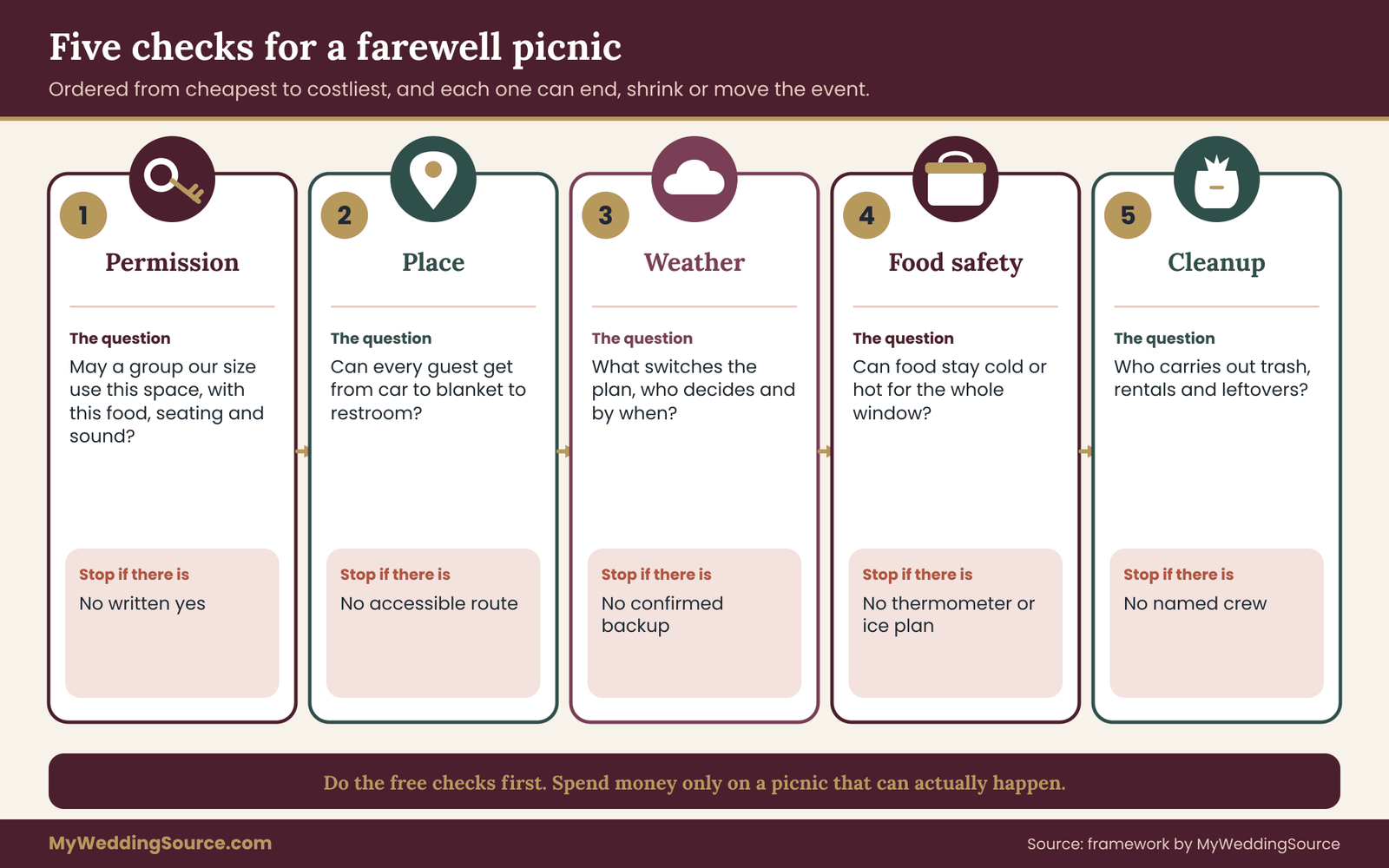
A farewell picnic works when five checks are finished before you send a single invitation. Confirm in writing that the park or beach allows your group size, food, seating and any music. Visit the site at the same hour and walk the route from the parking area and the restroom. Set a weather trigger time and name one person who makes the call. Keep cold food cold and hot food hot, with a two-hour limit on anything perishable. Assign trash, rentals and leftovers to named people. If any check fails, shrink the event or move it indoors.
A formal wedding is built on schedules, staff and a floor plan. The morning after is the opposite. Guests are tired, many are traveling, and the couple wants a softer way to say thank you than another seated meal. A casual outdoor gathering fits that mood well. It also removes most of the safety net that a venue provides: there is no kitchen, no staff on call, no roof and often no one who has agreed to let you be there.
That gap is what this article covers. A farewell picnic is easy to imagine and surprisingly easy to get wrong. The failures are rarely dramatic. A ranger asks a group to move because nobody checked the reservation rules. Potato salad sits in a warm car for an hour. A shower arrives at ten with no plan B and forty guests holding paper plates. Trash bags overflow and the park’s bins are a five-minute walk away.
None of that is hard to prevent. It takes a short checklist, a site visit and a handful of clear decisions made in advance. The sections below walk through each one in order, with scripts for the calls you will need to make, worked numbers, and a sample run sheet.
A note on scope. This is general planning information, not legal advice, and park rules, permit fees, health codes and weather alerts differ by place and change over time, so confirm every rule with the office or agency that issues it.
What a farewell picnic is, and when it fits
The phrase covers a wide range of events, so it helps to define the version this guide addresses. A farewell picnic here means an informal, daytime, outdoor gathering for wedding guests the day after the ceremony and reception. It is hosted by the couple or their families, it is usually optional, and it takes place in a space that is open to the public rather than on private venue grounds.
That last detail drives most of the planning. A public park, a municipal beach, a riverfront lawn or a botanical garden belongs to everyone, and the rules that govern it were written for crowds, safety and upkeep. Your group is a guest of the space. The reception venue had a contract that spelled out what you could do. A picnic site usually has a rules page, a reservation system or a phone number, and the answers you get from them are the closest thing you have to a contract.
Where this event fits among other morning-after options
A farewell picnic is one of several ways to close a wedding weekend. A seated brunch gives guests a defined meal, a table and staff, and it costs more per person. A coffee gathering in the hotel lobby is cheap and short. A casual get-together at the couple’s home works only when the guest count is small. Skipping a group event entirely is a perfectly good decision and leaves guests free to travel.
A farewell picnic earns its place under specific conditions. The guest group is mixed in age and enjoys being outside. The season is mild. The couple wants a long, unhurried goodbye, with children able to run around. The budget favors simple food over plated service. And at least one person on the host side is willing to do some physical work, because a farewell picnic has no waiters.
It is a poor fit in other conditions. Extreme heat or cold, a wedding where many guests have mobility limits and the best park is a long walk from parking, a location where guests fly out in the early morning, or a host team that is already stretched thin after the wedding itself. In those cases a smaller indoor option is the kinder choice. The point of the event is goodwill, and a farewell picnic that exhausts everyone does not create it.
The guests this event is really for
Before choosing a site, decide who the farewell picnic is for, because the answer shapes the invitation list, the timing and the menu. Some couples invite everyone who attended the wedding. Others invite only out-of-town guests, since local guests can see the couple any time. Others invite the wedding party and immediate family. All three are reasonable, and each has a different cost and a different permit conversation, because group size often decides which rules apply.
A rough sorting question helps: who would otherwise leave without a proper goodbye? Those are the guests the farewell picnic serves. Local friends who will see you next week can be thanked another way. Draw that line kindly and openly, and say in the invitation who the farewell picnic is meant for.
Keep one more group in mind: guests who will want to attend and cannot. A guest in a wheelchair, an older relative who tires easily, a parent with a newborn. If the farewell picnic is the only way to see the couple on the final day, the site has to work for them, and that becomes a design constraint rather than an afterthought. The site section later in this guide builds it in from the start.
The five checks at a glance
The method used throughout this guide has five checks, and they are deliberately ordered. Each one can end the idea, shrink it or send it indoors, so the cheapest checks come first. Permission costs a phone call. Place costs an hour of your time. Weather costs a decision. Food safety costs planning and a few supplies. Cleanup costs assignments. Nothing here requires a vendor, a rental or a deposit until the earlier checks pass.
Check one is permission. Is this space open to a group of your size, with your food, your seating, your music and your timing? You are looking for a written answer, a reservation number or a permit, depending on how the site handles groups.
Check two is place. Can guests get from the car to the blanket and from the blanket to a restroom? Is there shade, level ground, and room for the number of people you expect without crowding other park users?
Check three is weather. What conditions turn the farewell picnic off, who decides, by what time, and what happens next? A plan B that nobody has authority to trigger is not a plan.
Check four is food. What can be prepared, moved and served safely outdoors for the length of the event, with the equipment you actually have?
Check five is cleanup. Who removes the trash, returns the rentals, handles leftovers and checks the site afterward?
How a check ends the idea early
Each check has a clear fail condition, and writing those down before you start prevents sunk-cost thinking. If the park does not allow groups of your size and no other park nearby does, the farewell picnic shrinks or moves. If the only usable site has no accessible route and your guest list includes people who need one, the farewell picnic moves indoors or to a different place.
If the forecast on the trigger day is bad and your plan B space has not been confirmed, the farewell picnic is canceled with a clear message rather than left uncertain.
This ordering also protects your money. Couples sometimes rent canopies, order food and buy supplies before finding out the park prohibits canopies, or that alcohol is not allowed, or that the picnic area was reserved by someone else. Doing the free checks first means that the only money you spend goes toward an event that can actually happen.
Who owns each check
A farewell picnic with five unassigned checks has five places to fail. Assign each check to a named person, and put the names in one shared note. The couple does not need to carry all of them, and often should not, because they will be tired and busy greeting people. A sibling, a parent, a close friend or a hired day-of coordinator can own a check if they know exactly what finished looks like.
A useful definition of finished for each check: for permission, a written confirmation saved where others can find it. For place, a site visit completed with photos and a one-page map. For weather, a trigger time, a decision owner and a prepared guest message. For food, a menu with a temperature plan and a named person who will handle it on the day. For cleanup, a list of tasks with names beside them.
The next section starts with the check that carries the most surprise: permission to use a public space.
Check one: permission for a farewell picnic in a public space
Public does not mean unregulated, and that applies to a farewell picnic as much as to any other gathering. Most parks, beaches and shared lawns have rules about group size, reservations, food, alcohol, amplified sound, tents, grills, vendors and decorations. The rules usually protect other visitors and the grounds, and they are often enforced by park staff who have no idea a wedding is involved. The first job in planning any farewell picnic is finding out which rules apply to yours.
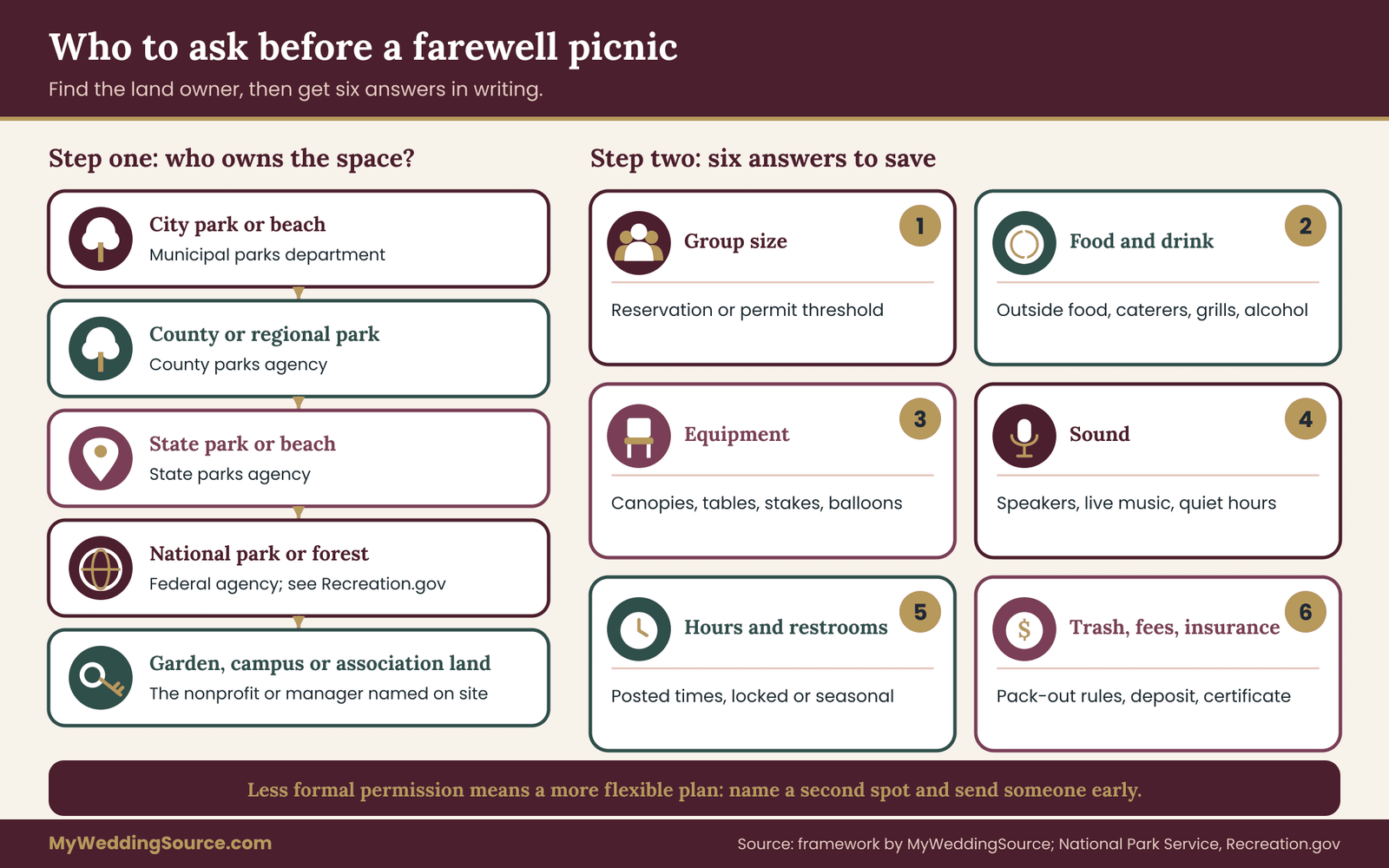
Start from the idea that the land belongs to someone. A city park belongs to a municipal parks department. A county or regional park belongs to a county agency. A state park or beach belongs to a state agency. A national park or forest belongs to a federal agency, and the National Park Service explains on its website how special events and group use are handled across its sites.
A botanical garden or a cemetery lawn may be owned by a nonprofit. A riverside path may be public but maintained by a private association. Knowing who owns the space tells you who to call.
Questions to ask before anything else
Most of what you need to learn fits into a short list. Write the answers next to the date and the name of the person who gave them. Where the person is vague, ask for the rule in writing or a link to the page that contains it.
First, does a group of our size need a reservation or a permit? Many sites set a threshold, and a group that stays under it can simply arrive, while a larger group must reserve a specific area. Ask for the threshold, and ask whether guests who come and go count toward it.
Second, what do the rules say about food and drink? Ask whether outside food is allowed, whether a caterer or a food truck may serve, whether grills or portable burners are permitted, and whether alcohol is allowed at all. Alcohol rules vary widely and are sometimes different for a permitted event than for an ordinary visitor.
Third, what about equipment? Ask about canopies, pop-up tents, folding tables and chairs, balloons, banners, stakes in the ground, and anything attached to trees or structures. Some parks prohibit stakes because of buried irrigation or utility lines. Some limit the size of a canopy. Some ban balloons outright.
Fourth, what about sound? A small speaker at conversation volume may be fine in one park and prohibited in the next. Ask about amplification, live musicians and quiet hours.
Fifth, what are the hours and the restroom arrangements? Some areas have posted opening and closing times, and some restrooms are seasonal or locked until a certain hour.
Sixth, what must we do about trash, insurance and fees? Some permits require the group to remove all trash. Some require a certificate of insurance, and some require a fee or a deposit.
A short script for the first call
Many hosts avoid the permission call for a farewell picnic because they expect to be turned away. In practice, parks staff handle group questions every week, and a clear, specific request gets a clear, specific answer. A script keeps the call short and gets you what you need.
“Hello, I am planning a casual gathering for about forty people on a Sunday morning, from ten to one. We would bring our own food and a few folding chairs. Do we need a reservation or a permit for a group that size, and which area would you suggest?”
Then listen, and follow up on whatever you hear. If they say a permit is required, ask for the application, the fee, the processing time and the cancellation or refund terms. If they say no permit is needed, ask whether any area is first-come, first-served, and how you would know if another group arrives first. If the person transfers you, take down the new name and call again.
End by repeating the key facts back in your own words, so the person can correct you, and ask whether they can send the confirmation by message or link you to the written rule. Save whatever you receive in the shared note.
Reservation, permit or simply showing up
Three permission situations come up repeatedly for a farewell picnic, and each calls for a different approach.
A reservation for a defined picnic area. Many parks have picnic shelters or reserved lawns that can be booked for a block of hours. The advantage is certainty: the space is yours for the time you reserved, often with tables, a roof and nearby restrooms. The disadvantage is cost and lead time, since popular shelters on a Sunday morning in a mild season can be booked weeks or months ahead. Some booking systems open on a fixed schedule, so ask when.
A special event or group permit. Larger groups, amplified sound, vendors, alcohol or structures often trigger a separate permit. These are usually slower and may involve an application, a map and a certificate of insurance. If your farewell picnic is small, you may be able to avoid this by keeping the group below the threshold and leaving out the features that trigger it. If you decide you need it, begin early and read the terms about cancellation.
An informal gathering with no permit. In some places a small group at a public lawn needs nothing at all. That is legitimate, but it carries a risk. With no reservation, nothing prevents another group from taking the spot. Plan for that by naming a second spot nearby, sending someone early to claim the first, and keeping the invitation flexible about the exact location until the morning.
A useful rule of thumb for all three: the less formal the permission, the more flexible your plan has to be.
Where couples get caught
Several surprises recur. A reserved shelter may have a posted capacity lower than the headcount. A park may allow outside food but ban glass containers. A beach may allow gatherings but prohibit canopies in certain zones, or require that any alcohol stay out of sight or off the sand entirely. A lakeside lawn may allow the event but close its only restroom at a set hour. A permit may cover the area but not parking, so cars end up on a residential street.
Another trap is assuming that a previous wedding photographer’s favorite park is also a good site for a farewell picnic. Photo sessions are brief and quiet. A three-hour gathering with food, chairs and children is a different kind of use, and the same park may treat it differently.
A third is the sign-up trap. Booking systems occasionally confirm a date but not the specific location, or confirm a pavilion that turns out to be across the park from the parking lot. Read the confirmation closely, look at the map, and ask if anything is unclear.
Public space and the formal wedding next door
If your wedding venue is attached to a larger site, such as a resort, a vineyard or a city garden, the farewell picnic may be tempting to hold on the same grounds. Ask the venue before assuming. The venue contract may restrict outside food on the property, or the grounds may be reserved for another event on Sunday. The guide on wedding venue selection and questions lists the contract points to check, and several of them, such as outside food, grounds access and extended hours, apply directly to a morning-after gathering.
If the venue says yes, the event may no longer be a public-space farewell picnic at all, and some of this section stops applying. Ask to have the arrangement in writing, including the hours, the area and any fee, and confirm whether venue staff will be on site.
Alcohol, music and decorations
These three items trigger more denied permits than anything else, and they matter little to a farewell picnic. A farewell picnic is a daytime goodbye. Alcohol is optional, and many couples choose a coffee, juice and sparkling water menu to avoid the question altogether. Music can be a small speaker at low volume, or none, since conversation is the point. Decorations can be a few blankets, a sign and flowers left over from the wedding.
Leaving these features out of the farewell picnic simplifies the permission check considerably. If you do want a champagne toast, ask specifically whether alcohol is allowed, and whether it requires a permit or a licensed server. If the answer is no, a toast with sparkling juice carries the same warmth.
What finished looks like
Check one is finished when you hold a written answer for each of the six questions above: group size and permit, food and drink, equipment, sound, hours and restrooms, and trash, insurance and fees. If the answer to any of them is no, either adapt the farewell picnic to fit or choose another site. Add the confirmation and the contact name to the shared note, and keep a screenshot of the rules page, since pages change.
With permission for the farewell picnic settled, the next step is making sure the place works for your guests. For a broader view of how this step fits into the overall sequence, the wedding planning checklist is a useful companion, particularly for the weekend events around the main day.
Check two: choosing the site for your farewell picnic
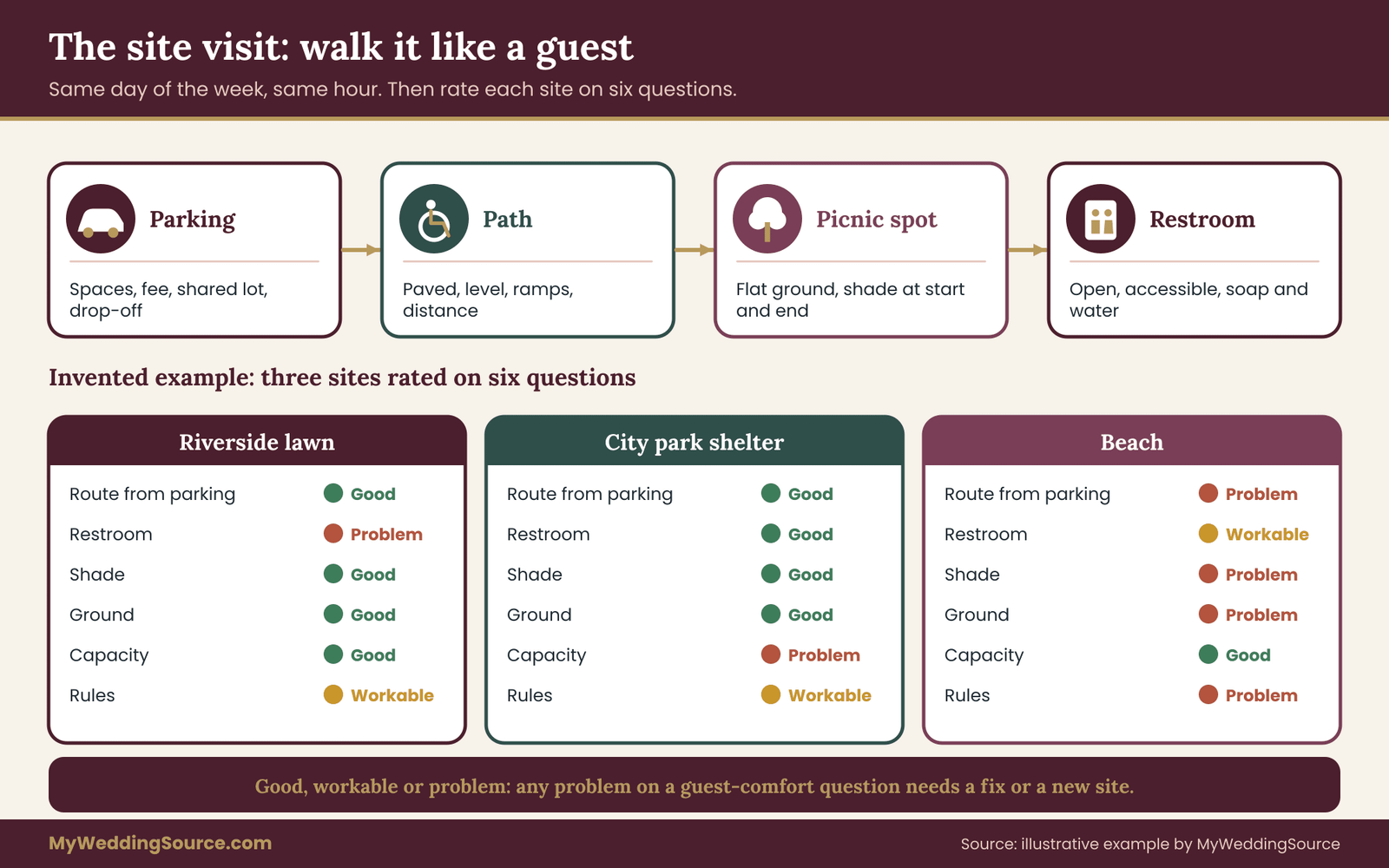
A site that looks lovely in a photograph can fail a farewell picnic in ordinary ways. The parking lot is a quarter mile from the lawn. The shade moves by noon. The restroom is locked. The grass slopes enough that a folding chair tips. A site visit catches all of this, and for a farewell picnic it takes about an hour.
Do the visit at the same day of the week and the same hour as the event if you can. A park that is quiet at nine on a Tuesday may be full of joggers, dog walkers and a youth soccer game at ten on a Sunday. Sun angle matters too. A spot that is shaded at nine may be in full sun at noon, and guests who arrive early will not see how it changes.
What to measure and note on the visit
Bring a phone for photos, a tape or a pacing count, and a short list. Walk the guest route first, as a guest would: from where cars will park, along the path, to the spot. Count paces and note anything that would trouble a person with a cane, a stroller or a wheelchair, such as curbs without ramps, loose gravel, sand, steep grades, steps and soft turf.
Then check the spot itself. Is the ground level enough for chairs and tables? Is there a firm surface for anyone who needs it? Where does the shade fall at the start, middle and end of the event? Is there room to spread out without crowding the edge of a path or a playground? Where is the nearest drinking water, and does it work?
Next come the supporting pieces. Find the restroom and open the door if you can. Note whether it is accessible, whether it has soap and running water, and how far it is from the spot. Locate the trash and recycling bins and estimate whether they could take your volume. Look for the nearest electrical outlet, in case you want a speaker or a warming tray, and check whether outlets are even allowed for public use.
Finally, look at the surroundings. Is there a road, a train line or a construction site nearby that makes noise? Is there a playground or sports field that may be busy? Are there signs of geese, ants, wasps or other wildlife around the farewell picnic area? A garbage can full of food scraps draws insects fast, and a lawn near a pond may have goose droppings that you will want to avoid.
Site comparison without a table
When two or three sites are in contention, compare them by walking the same route in the same order and writing one short line per question. A simple rating helps: for each of six questions, mark the site as good, workable or problem. The six are the route from parking, the restroom, shade, ground, capacity and the rules.
Here is an invented example. A couple is comparing a riverside lawn, a city park shelter and a beach. The riverside lawn is flat and shaded and has an accessible path, but the restroom is a seasonal portable unit a long way off, and capacity is open. The shelter has a roof, tables and a restroom ten steps away, but it needs a reservation and holds only thirty people.
The beach has wide open space and is memorable in photographs, but the route from the lot crosses soft sand, shade is nonexistent, and the rules ban canopies in the main zone.
On a plain reading, the shelter is the safest choice for a group of thirty or fewer and the riverside lawn is best for a larger group if the couple arranges a better restroom plan. The beach scores well for scenery and poorly for everything that affects comfort. The couple does not need a spreadsheet to see this. They need three short notes and an honest sense of who is coming.
Distance from where guests are staying
The morning after a wedding, guests are packing, checking out and heading for transport. A site that sits twenty minutes from the hotel is a hard sell when someone has a one o’clock flight. Look at how far the site is from the main hotel block and from the airport or station, and note how guests will travel. A group that came by shared shuttle to the wedding may have no cars the next day.
The guide on coordinating guest hotels across budgets and mobility needs explains how to keep track of where each guest is staying and what they can manage. That information turns directly into a farewell picnic decision: if half of the guests have no car, the site must be walkable from the hotel or you must arrange a ride.
Parking, drop-off and the last hundred feet
Parking is the most underestimated part of any outdoor event. Ask the park how many spaces the lot has at your hour, whether there is a fee, whether it is shared with a trailhead or sports field, and whether a drop-off zone exists near the picnic area. Include a note in the invitation that tells guests where to park and where to walk.
The last hundred feet matter for guests with limited mobility. If a drop-off point is close to the picnic spot and the main lot is far, ask whether a guest with a disability placard or a driver carrying an older relative may use it. Park staff handle such questions regularly, and a quick call settles it.
The Americans with Disabilities Act website, run by the Department of Justice, explains the accessibility standards that public entities generally have to meet. It is a useful reference when you are reading a park’s accessibility information or asking about it.
Backup site
Name a second site before the invitation goes out. The most useful backup is within sight or a short walk of the first, such as the next shelter in the same park, so guests can find it without a new set of instructions. A second choice in a different park is more useful for weather or closure than for crowding, and it needs its own permission check.
If the first site is first-come, first-served, send an early arrival person with a folding table, a sign and a phone. That person holds the spot and calls the host if it is taken. Do not rely on guests to find the backup on their own.
Seating, shade and layout for a farewell picnic
Seating decides how a farewell picnic feels. A blanket on the grass is charming for forty minutes and uncomfortable for three hours, and it is a poor choice for anyone who has trouble getting up and down. Chairs and tables are easier to use and heavier to carry. The practical answer is a mix, arranged on purpose.
Start with the people. Count guests who need a chair with arms and a firm seat, guests who will want a table for plates, children who will want to sit on the ground, and guests who will stand and move around. For many groups the split is roughly that most want a place to sit with a plate, a few want a blanket, and a small number need something sturdier.
Use your own guest list rather than a rule of thumb, since a wedding with many older relatives has different needs than one with many friends in their thirties.
Building the layout in zones
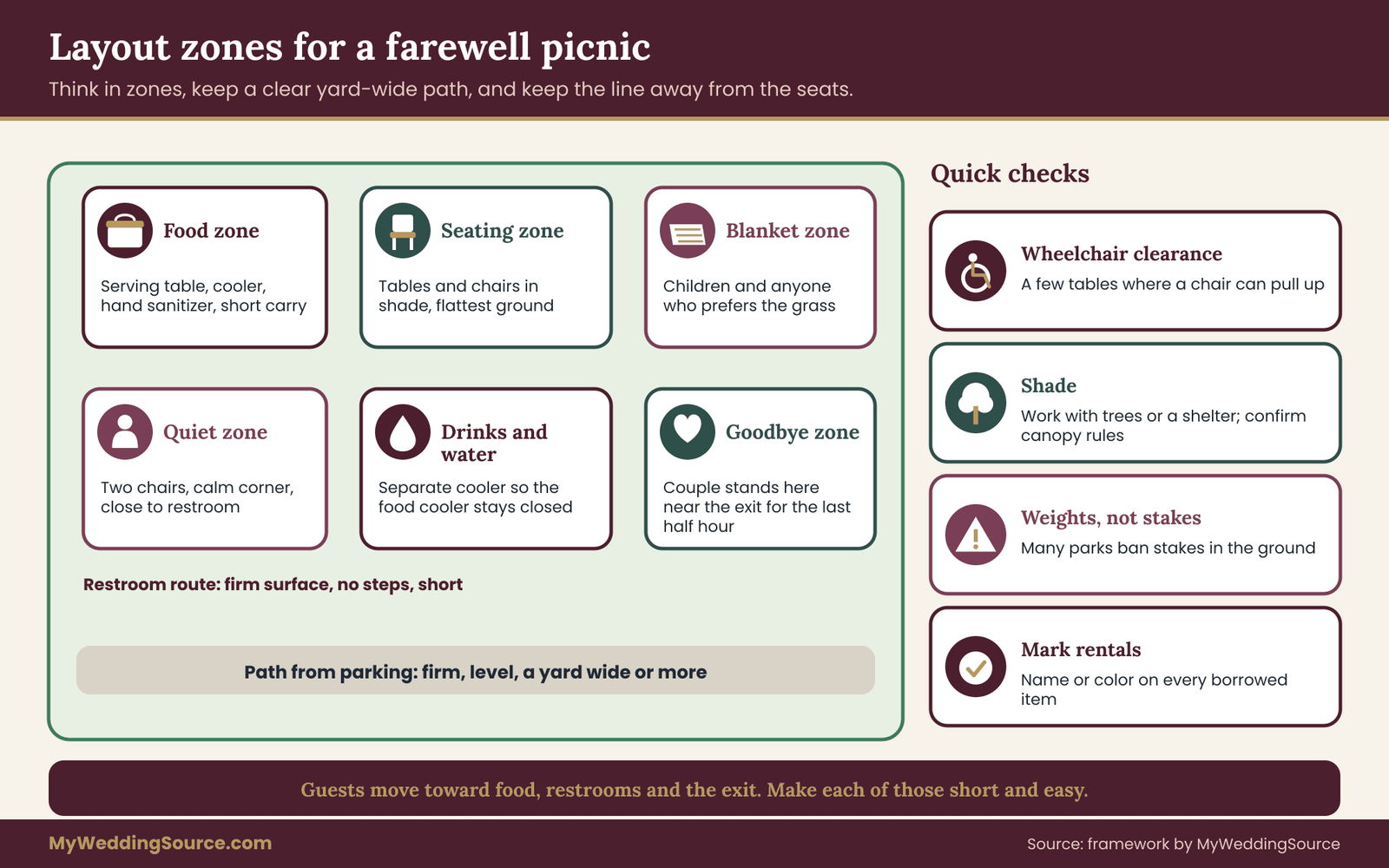
Think in zones rather than a grid when you lay out a farewell picnic. A food zone holds the serving table, the cooler and the drinks, and sits close to the path so that carrying is short. A seating zone holds tables with chairs for those who want them, placed in shade where possible and on the flattest ground. A blanket zone sits a little farther out for children and anyone who prefers the grass.
A quiet zone is a pair of chairs somewhere calm, for a guest who wants a break from the noise. And a goodbye zone, often at the exit path, is where the couple stands near the end so guests can say farewell without pushing through the crowd.
Leave walking paths at least wide enough for a wheelchair or a stroller, about a yard of clear space is a good minimum, and wider where two people may pass. Keep the food table away from the seating zone enough that a line does not block people sitting. The principles from the reception guest flow guide apply on a smaller scale: guests move toward food, toward restrooms and toward the exit, and the layout should make each of those easy.
Shade without breaking the rules
Shade is the single most valued comfort at a daytime farewell picnic, and it is also where permission and weather overlap. If the site has trees or a shelter, work with them. If you want to bring canopies, confirm they are allowed, find out how they may be anchored, and avoid stakes if the park prohibits them. Weighted bases, such as sandbags or water-filled weights, are a common alternative, and a wind check helps, since an unanchored canopy can become a hazard in a gust.
For guests who want more shelter, bring umbrellas, hats and sunscreen in a labeled basket. A small basket by the food table can also hold bug spray, tissues and hand sanitizer, which handles several small needs at once.
Rentals versus bringing your own
Folding tables and chairs can be rented, borrowed or brought from home. Renting costs money and requires delivery and pickup, which matters on a Sunday and may add fees. Borrowing from family and friends is cheaper but needs tracking, so each item returns to its owner. The wedding rental planning checklist covers delivery windows, damage terms and pickup timing, all of which apply even for a small order.
A simple decision rule: if you need more than a handful of tables and chairs, or any item you cannot carry yourselves, a rental with delivery to the site is usually worth it. If you need only a serving table and a few chairs for guests who need them, bring them. In both cases, mark each item with a name or a color so it does not walk away.
Accessibility as a design choice
Plan accessibility into the farewell picnic layout, not as an exception. Keep a firm, level route to the food and to the restroom. Place at least a few tables where a wheelchair can pull up without moving chairs. Offer food at table height for guests who cannot hold a plate while walking. Make sure the quiet zone is reachable without crossing rough ground. None of this costs much, and it makes the farewell picnic better for everyone, since parents with strollers and guests with tired feet benefit too.
With the site chosen and laid out, the next check addresses the thing you cannot control and can only prepare for: the weather.
Check three: a weather plan B for the farewell picnic that decides itself
Every outdoor event, a farewell picnic included, needs a plan B. What makes a plan B useful is not the backup location. It is a rule that triggers the switch without a debate. The morning after a wedding is the worst time for a group discussion, and a decision that nobody owns tends to be made by the sky, at the last minute, with guests already on the way.
Build the weather plan from three pieces: conditions that turn the farewell picnic off, a person who decides, and a time by which they decide. Add a message ready to send and a backup that has been confirmed. With those five in place, the weather becomes a logistics question instead of a crisis.
Pick the conditions in advance
Weather problems for a farewell picnic are more varied than rain. Decide ahead of time which conditions you will treat as a stop, which as a change and which as a nuisance you will accept.
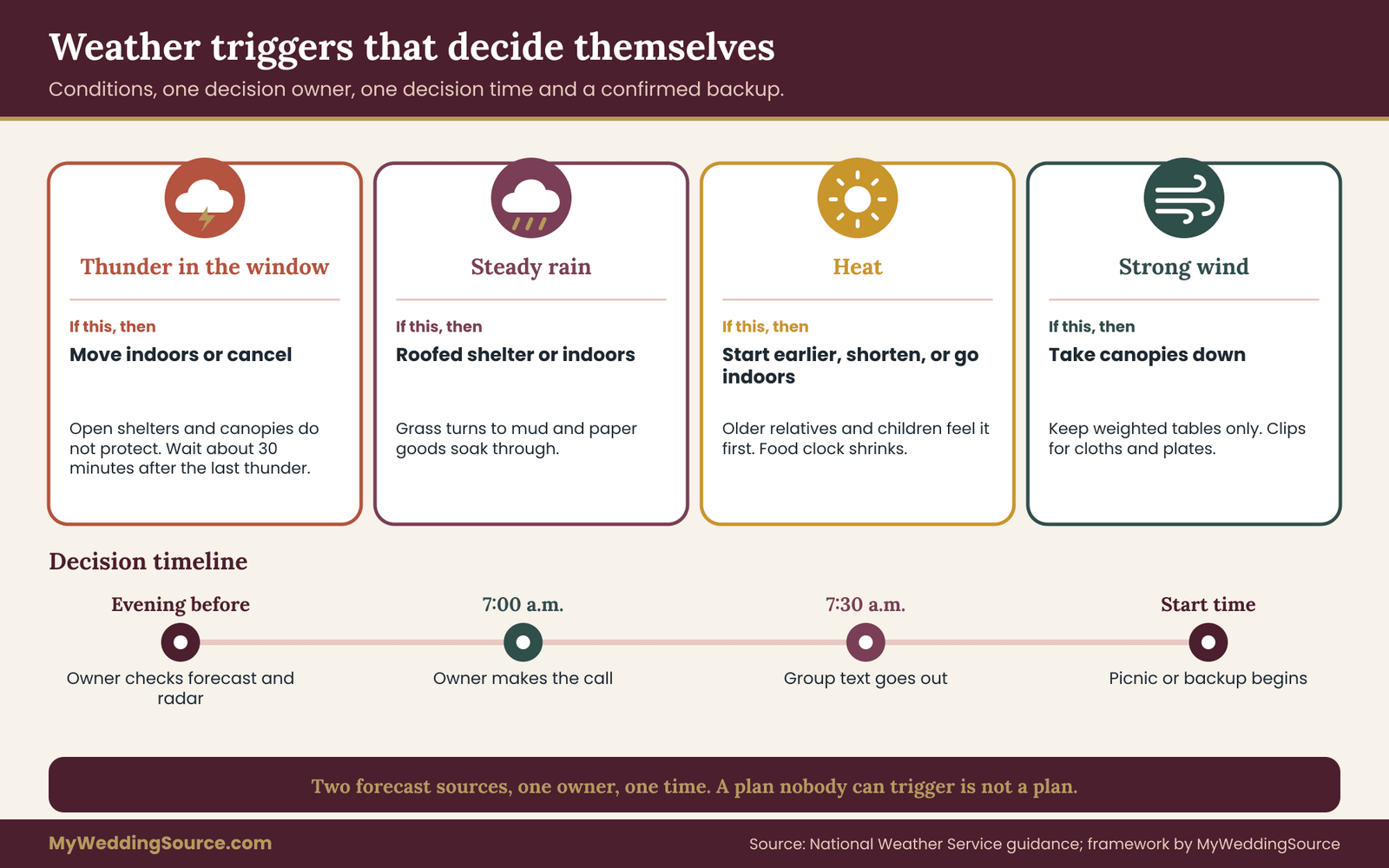
Lightning and thunder. This is the one condition that is never negotiable. The National Weather Service advises that when thunder is heard, you are close enough to be struck, and that people should move to a substantial building or a hard-topped vehicle and wait about thirty minutes after the last thunder before going back out. A canopy, a shelter without walls or a tree offers no protection. If thunderstorms are forecast for your window, the plan is to move or cancel, not to watch the clouds.
Steady or heavy rain. Light drizzle may be fine under a shelter with a roof. Steady rain turns grass to mud, makes food service miserable and soaks paper goods. Decide whether a roofed shelter is enough or whether you will move indoors.
Heat. High heat is a food safety problem and a guest health problem at once. Older relatives, small children and anyone who traveled overnight are the first to feel it. The National Weather Service publishes heat alerts and guidance on heat risk, and a hot forecast is a good reason to shorten the event, move it to early morning, offer shade and water, or switch to an indoor space with air conditioning.
Wind. Wind knocks over tables, lifts paper plates and turns canopies into sails. A steady breeze is manageable with weights and clips. Strong gusts are a reason to take down canopies and simplify the setup.
Cold. A cold, damp morning is rarely worth the effort. If guests will stand around in coats, move indoors or add heaters only if the site allows them.
Air quality and smoke. In some regions, wildfire smoke or poor air makes outdoor gatherings unwise, particularly for guests with asthma, heart conditions or small children. Local air quality information is available from government sources, and a poor reading is a legitimate reason to cancel.
Park closures. Parks close for storm damage, high water, fire danger and maintenance. Ask the park how it announces closures and how you can check.
Name the decision owner and the decision time
One person, not a committee, makes the call. That person should be reachable, calm and not the couple. A sibling, a parent, a friend with good judgment or a coordinator can serve. Give them the authority in writing in the shared note and tell the rest of the host team that their word is final.
Set a decision time that leaves enough room to tell guests and to move. For a farewell picnic that starts at eleven and has a plan B indoors, a reasonable pattern is a first look at the forecast the evening before, a firm decision at about seven the next morning, and a message to guests by half past seven.
If the plan B requires setup, such as hauling food to a different place, you will need earlier. If the farewell picnic is on a day with a clear forecast, the evening check may be the only one.
The decision owner needs reliable information. Pick two sources and agree on them: the National Weather Service forecast for the exact location and a radar view. Looking at five different apps and getting five answers leads to arguments.
Triggers written as if-then rules
The clearest plan is a short list of if-then statements that anyone on the team can follow. Here is a sample, which you can adapt:
If the forecast shows thunderstorms at any point in the event window, then we move indoors to the backup room. If the forecast shows steady rain for most of the window, then we use the roofed shelter if it is reserved, otherwise indoors. If the temperature is forecast to be above a limit that the host team agrees on in advance, then we hold the farewell picnic from eight to ten instead of eleven to two, or move indoors.
If wind is strong enough that canopies cannot be anchored, then we take them down and keep tables only. If the park posts a closure, then we use the backup site.
The numbers in these rules are yours to set, since your guests, your site and your region differ. A coastal park in summer and a mountain meadow in autumn call for different thresholds. The principle holds: pick the thresholds in a calm moment, not at seven in the morning with a hundred things going on.
What plan B can be
The backup for a farewell picnic should fit the same purpose as the original: an informal goodbye with food. Several options work, each with trade-offs.
A roofed shelter at the same park. This is the simplest if the park has one. It keeps the location, the parking and the invitation unchanged. The catch is that a shelter protects against rain but not lightning if it has open sides, so it is not a thunderstorm plan. Ask whether it can be reserved for the same window as a backup, and whether the reservation has a fee.
A hotel function room or lobby area. Many hotels let a group use a small room or a corner of the lobby for a coffee and pastry gathering. This works well for out-of-town guests who are staying there anyway, and it avoids transport. Ask about outside food policies, since some hotels require their own catering.
A restaurant or café with a private area. A café may accommodate a group on a Sunday morning, though the food and cost model changes from a farewell picnic to a small catered event. It is a plan B for a smaller group.
A family home. If a relative lives nearby and the group is small, a living room and kitchen can take over. The host needs enough notice and enough space.
Cancellation with a short message. For some couples the best plan B is no event, with a warm message thanking guests and releasing them to travel. This is a legitimate and kind outcome, especially when most guests are leaving the next morning anyway.
Whichever you choose, confirm it before the invitation goes out. A plan B that has not been confirmed is a guess. If a backup has a reservation fee, compare it to the cost of a canceled farewell picnic with no alternative, and decide whether the peace of mind is worth the price.
Telling guests, quickly and clearly
A weather change for a farewell picnic fails when guests do not hear about it. Decide the channel before the day. Text messages reach people fastest, and a group message is better than many individual ones. A line on the wedding website helps for those who check it. Write the message in advance, with blanks for the final details.
“Update on Sunday’s farewell picnic: because of the forecast, we are moving to the Maple Room at the hotel, same time. Parking is at the front entrance. If you cannot make it, we completely understand and are grateful you came.”
Keep the message calm and specific. Include the new place, the time, how to get there and one line that gives guests permission to skip. Send the same message to every channel at the same time so that nobody gets conflicting information.
Test the plan once
Before the weekend, run through the plan as a short exercise. Ask the decision owner what time they will check the forecast, which sources they will use, who they will message and where the backup is. If any answer is unclear, fix it now. A five-minute rehearsal costs nothing and removes the uncertainty that leads to late, messy decisions.
The weather check ends when the conditions, the owner, the time, the message and the backup are all written down. The next check covers the area where a farewell picnic differs most from a venue meal: keeping food safe outdoors.
Check four: food safety outdoors at a farewell picnic
Food is the reason people come to a farewell picnic, and it is the part of a farewell picnic that can make guests sick. The risk is not exotic. Bacteria grow quickly in perishable food that sits at the wrong temperature, and an outdoor table in the sun is a good place for that to happen. The federal food safety agencies publish simple rules for outdoor eating, and they are easy to follow if you build them into the plan instead of improvising on the day.
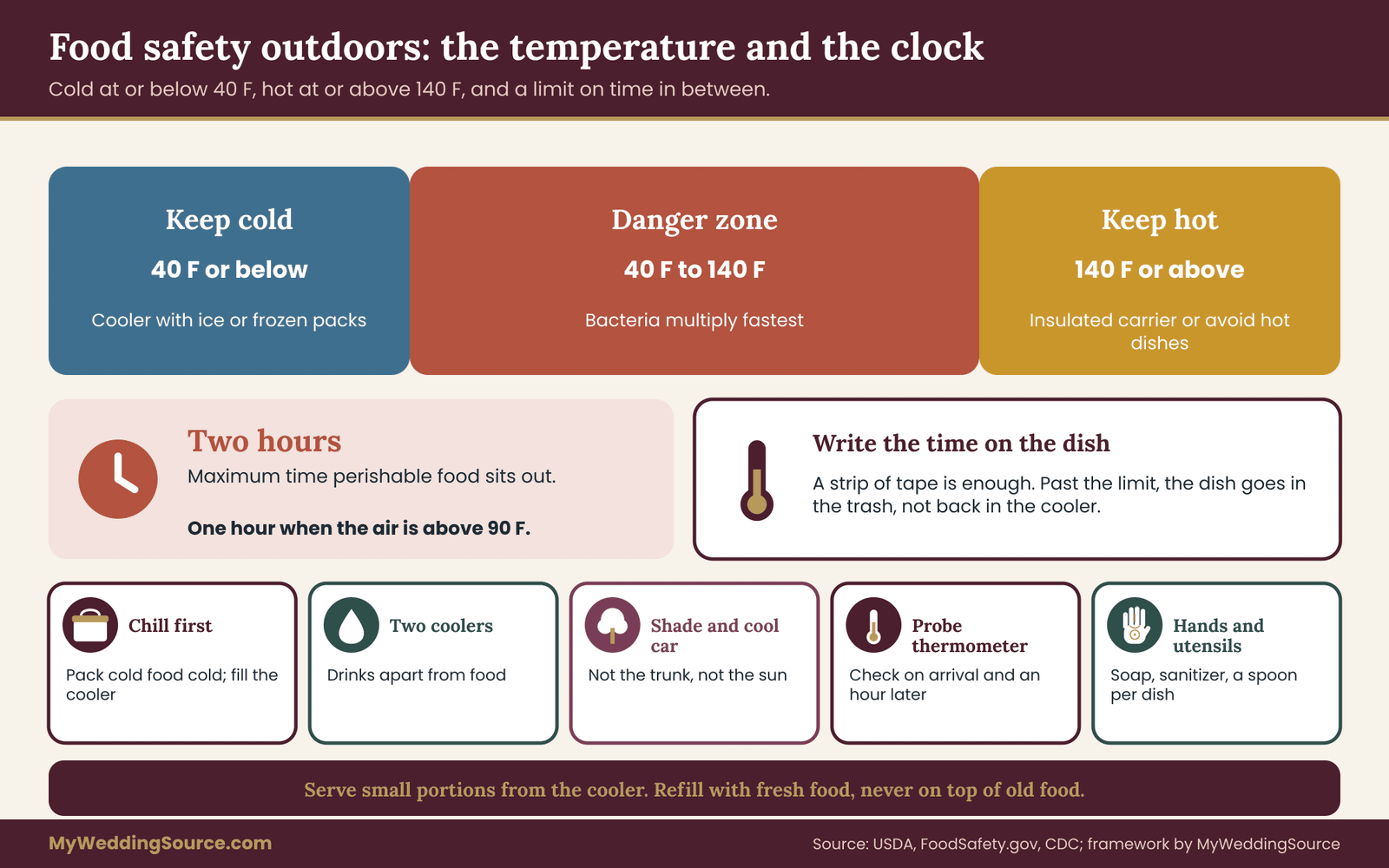
The central idea is the temperature danger zone. The U.S. Department of Agriculture and FoodSafety.gov explain that perishable food should be kept cold, at or below 40 degrees Fahrenheit, or hot, at or above 140 degrees Fahrenheit. Between those temperatures bacteria multiply fastest. The guidance also sets a time limit: perishable food should not sit out for more than two hours, or one hour when the air temperature is above 90 degrees Fahrenheit.
Those numbers carry through the rest of this section. They turn a vague worry into a clock and a thermometer.
The two-hour clock, applied to a picnic
A farewell picnic often runs two to three hours, which is longer than the safe window for food left out. So the planning question is not whether the event lasts too long, but how food is staged. Perishable dishes come out in portions, stay cold in a cooler until needed, and go back into the cooler or are discarded when the clock runs out.
Treat the clock as a rule that the person in charge of food enforces. Write down the time each perishable dish comes out. In practice, a small piece of tape on the serving dish or a note on a phone is enough. When two hours have passed, or one hour on a hot day, the dish is discarded or returned to cold storage only if it was never served and has stayed within limits. Food that has been served and handled by guests should not be saved.
Keeping cold food cold
Cold food is where most picnic problems start, because it begins in a refrigerator and ends on a table in the open. Several habits keep it safe.
Chill food thoroughly before packing. Packing warm food into a cooler warms everything near it. Use ice or frozen gel packs, and fill the cooler well, since the guidance notes that a full cooler holds its temperature longer than a partly filled one. Keep drinks in a separate cooler from food. Drinks get opened constantly, and each opening lets warm air in. A food cooler stays closed until it is needed.
Keep coolers out of the sun and out of a hot car. Place them in shade at the site, and cover them with a blanket if no shade exists. During transport, keep the cooler in the air-conditioned passenger area instead of the trunk when the day is warm.
Use a food thermometer. An inexpensive probe thermometer tells you the actual temperature of a dish, and a quick check of the coolers at arrival and an hour later gives you confidence. If a cooler’s contents have risen above 40 degrees and stayed there for some time, treat the food as having started its two-hour clock.
Serve in small portions. Put out a small bowl and keep the rest in the cooler. When the bowl runs low, refill it with fresh food from the cooler rather than adding to old food. This is also a good way to keep a table looking appealing.
Keeping hot food hot, or avoiding it
Hot food at a farewell picnic is harder to hold than cold food. Keeping it above 140 degrees means insulated carriers, warming trays with a heat source or a grill, and many parks restrict open flames, portable burners and charcoal. A simple answer is to avoid hot dishes that need to stay hot. Serve room-temperature foods that are safe at that temperature, such as baked goods, fruit, whole vegetables, hard cheeses and bread, plus chilled dishes from a cooler.
If you do want something hot, such as a breakfast casserole or coffee, use insulated containers that were heated to well above the safe limit before packing, and check the temperature with a thermometer when it arrives. A thermal carafe for coffee is fine for the whole event. A tray of scrambled eggs is not, unless you have a reliable way to keep it hot.
If you plan to grill, confirm the park allows it and read the rules about where grills may be used and how coals must be disposed of. Cook food to the safe internal temperatures that the agencies publish, and keep raw and ready-to-eat foods apart with separate utensils and plates.
Transport: the part people forget
A lot of food safety on a farewell picnic is actually transport safety. The food travels from a kitchen or a store to the site, and it may sit in a car for an hour or more.
Load the cooler last and unload it first. Keep the trip short, and avoid errands between pickup and arrival. In warm weather, don’t leave food in a parked car. If a caterer is delivering, ask how long the food will be in transit, what temperature it will be at arrival, and what equipment the caterer is using. Ask whether the caterer will check the temperature at drop-off and provide a short written record, which is a normal request for a professional.
If volunteers are carrying food from their own homes, give them clear instructions: a cooler with ice for anything perishable, a labeled container with the dish name and main ingredients, and an arrival time that fits the schedule. A dish brought by a relative at the last minute and set out in the sun is a common source of trouble, so agree on a simple rule that every perishable dish arrives cold in a cooler and goes into the host’s cooler on arrival.
Hands, utensils and surfaces
Outdoor settings often lack running water, and unwashed hands spread illness quickly. The Centers for Disease Control and Prevention recommend washing hands with soap and water, and using hand sanitizer with at least 60 percent alcohol when soap and water are not available. Bring a hand-sanitizer station at the food table, a jug of water, soap and paper towels for volunteers who handle food, and a trash bag nearby.
Use serving utensils for every dish, so guests don’t use hands. Cover dishes with lids or cloths between rounds to keep out insects. Keep a separate cutting board and knife for raw produce if you are cutting fruit on site, and wash fruit and vegetables before packing.
Allergens and labels
A wedding guest list often includes someone with a food allergy, and an outdoor buffet makes cross-contact easy because serving spoons move between dishes. Label every dish with its name and the main allergens it contains. The Food and Drug Administration lists the major allergens that packaged food labels must declare, and the list is a good checklist for your own labels. If a guest has a serious allergy, ask them what they need, and consider offering a sealed, individually packaged option so they don’t have to rely on a shared table.
Keep ingredient lists or packaging for any dish that came from a store or a caterer, in case a guest asks. Keep nut-containing foods on a separate table when possible, and use separate utensils.
Leftovers
Food that sat out for more than the safe window goes in the trash. Food that stayed cold in the cooler and was never served can be kept or donated, provided it stays under 40 degrees until it reaches its destination. If you plan to donate, arrange it beforehand with a receiving organization that has agreed to take prepared food, and confirm its hours.
Do not encourage guests to take food home unless it is packaged, shelf-stable or has stayed cold. Offer sealed baked goods in small bags, and explain that perishable dishes cannot be sent home.
The check is finished when you have a menu with a temperature plan, a thermometer, enough cooler capacity, a person assigned to the clock and a labeling system.
Menu choices that suit a farewell picnic after a formal dinner
The menu for a farewell picnic has to match the mood and the schedule. Guests ate a large dinner the night before, and many stayed up late. They arrive tired, perhaps hungover, perhaps rushed. They want food that is light, familiar and easy to eat while standing or sitting on a chair.
Think of the farewell picnic as brunch without the plates. Fruit, pastries, bagels with spreads, yogurt cups, hard-boiled eggs, small sandwiches and a simple salad cover most of what people want. Coffee, tea, juice and water are the core drinks. Those foods share an advantage: most are either safe at room temperature for a short period or easy to keep cold in a cooler.
Foods that behave well outdoors
Choose items that tolerate heat, travel and handling. Whole fruit, cut melon in a cooler, berries in small cups, muffins, scones, croissants, bagels, wrapped sandwiches kept on ice, pasta salads dressed with oil and vinegar instead of mayonnaise, hard cheeses, crackers, nuts and individually wrapped snacks.
Avoid items that spoil fast or need constant temperature control: dishes with mayonnaise or cream that sit out, raw seafood, custards, soft cheeses in the sun, cut fruit left in the heat and anything with raw eggs. A dessert table of cream pastries is lovely in a hotel room and risky in the sun.
Individual portions versus shared platters
Individually packaged food reduces handling and cuts the risk of cross-contact for allergies. A cup of yogurt with granola, a wrapped sandwich and a boxed fruit cup cost more per serving than a platter, and they save on utensils, cleanup and waste from food left out too long. Shared platters look generous and encourage mingling, but they depend on someone to refill, cover and monitor them.
A good compromise is a few shared items that tolerate time, such as bread, fruit and cookies, plus individually packed items for the perishable foods. Guests can mix and match, and the host’s workload stays manageable.
Three ways to source the food
Do it yourselves. Cheapest in cash, most expensive in time. This works for a small group when a few relatives are cooking, and it needs clear instructions about temperature and transport.
Order from a bakery, deli or grocery. Good for a mid-size group. Ask for trays or boxed meals, order for pickup at a set time and check the quantities. A deli or bakery can usually tell you how many a tray serves, though portions vary, so ask what size each portion is.
Hire a caterer. Best for a large group or when no one on the host team can handle food. Ask the caterer whether they serve at public sites, what equipment they bring, what insurance they carry, how they hold temperature and what the cleanup terms are. The menu planning guide covers how to think about dietary needs across a group, and its approach applies to a smaller menu as well.
Estimating quantity without invented statistics
Avoid rules of thumb you cannot back up. A better method is to count and adjust. Start with the headcount you expect, not the number invited. Take your RSVP count and add a small margin for guests who bring a plus-one without telling you. Then think about the time: a farewell picnic from ten to noon needs a lighter spread than one from eleven to two.
For each food group, think in pieces per person, and then check against what a supplier recommends. Ask a baker how many pastries per person they typically see for a morning event, and ask a deli the same. Use their numbers as a starting point, since they know their own product sizes. Keep a small reserve, and plan the reserve to be shelf-stable so it can go home with the host if unused.
Cost follows from the same logic. Compare the price per person of each source, and add the hidden costs: ice, coolers, serving supplies, napkins, trash bags, hand sanitizer and rental fees. A lower grocery bill that requires six hours of volunteer work is not always cheaper in the sense that matters.
Check five: cleanup, trash and leaving the site better than you found it
Cleanup is the check that nobody wants to plan for a farewell picnic and everybody notices. A public site was open to everyone before you arrived and will be open to everyone after you leave. If trash is left on the lawn or the bins overflow, the consequences fall on the next group, the park staff and sometimes on your permit deposit.
A park’s idea of cleanup is simple: leave no trace. Leave No Trace, the nonprofit education program, teaches that people should pack out what they bring in, dispose of waste properly and respect wildlife and other visitors. Those principles scale down well for a farewell picnic. Whatever you carry in, you plan to carry out.
Estimate the trash before the event
Picnic trash piles up faster than people expect, and park bins are sized for ordinary use. Think about what your menu produces: paper plates, cups, napkins, food scraps, bottles, cans, packaging, wrappers and ice melt. Individually wrapped items produce more waste than shared platters. Compostable plates still need a proper place to go, and many parks do not have compost collection.
A simple method is to count the items you will bring and assume nearly all of it becomes trash. Bring more bags than you expect, including a few large heavy-duty ones. Bring a separate bag for recycling if the park collects it, and a separate bag for food waste if you want to keep it from attracting insects. Ask the park whether their bins can take your volume or whether you must pack everything out.
The guide on wedding waste reduction goes into this topic more deeply, though for a short picnic the main lever is choosing reusable items where it is practical: cloth napkins, real cups, a drink dispenser instead of single bottles. Reusables need washing, so weigh that against convenience.
Assign the cleanup crew by name
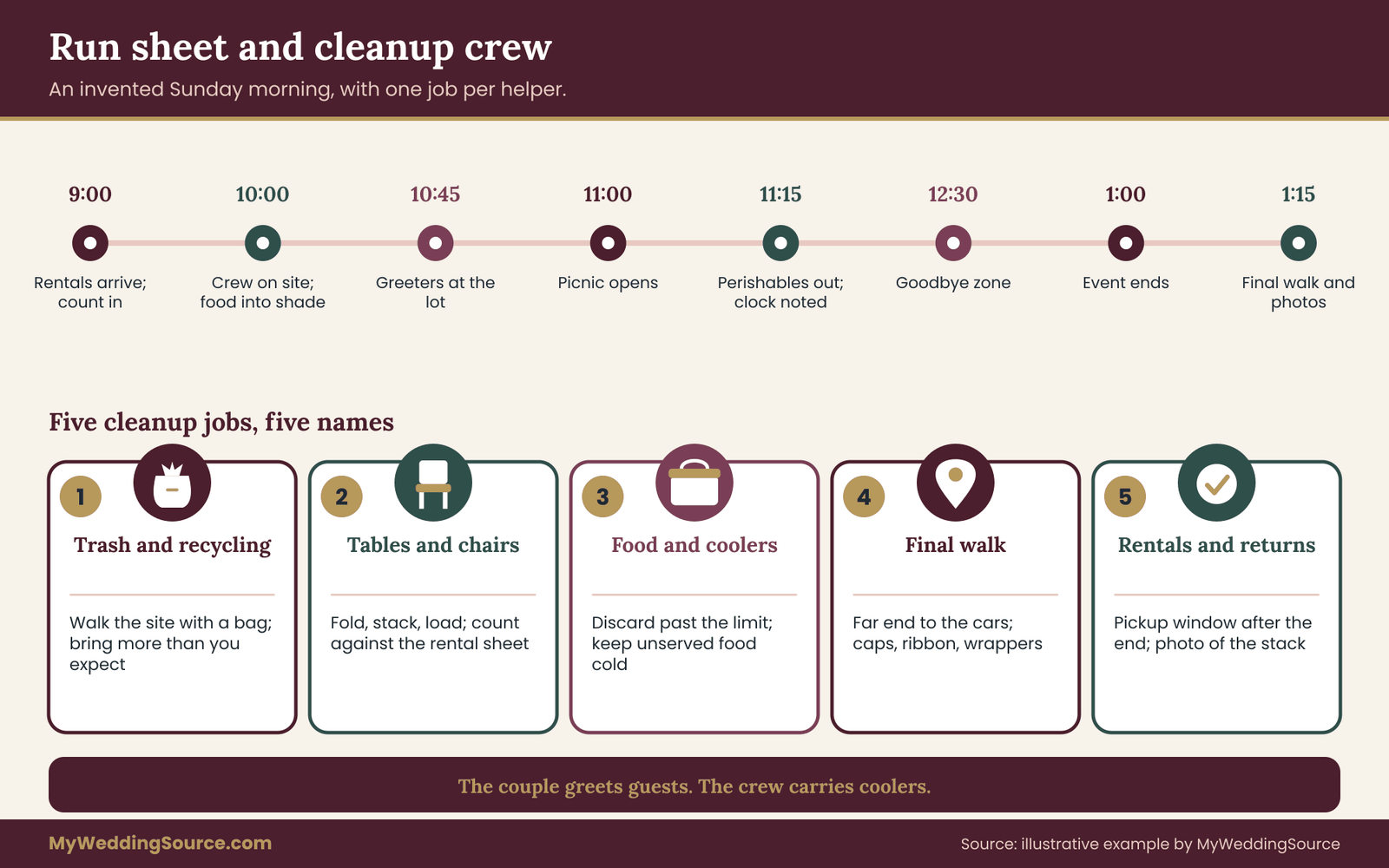
Do not leave cleanup to whoever is still around at the end. Name a small crew before the event, ideally three to five people with clear jobs, and make sure they are not the couple. A parent, a sibling, a few friends or a hired helper can take it on.
Split the work into jobs. One person handles trash and recycling, walking the site with a bag. One person handles tables and chairs, folding and loading them. One person handles the food, packing the cooler and discarding anything beyond the time limit. One person handles the final walk, checking the grass, the shelter, the restroom path and the parking area for anything left behind. And one person handles rentals, confirming that everything is counted, packed and ready for pickup.
Give each person a one-line card with their job and a rough time. People are more willing to help when the task is specific and short.
Rentals, borrowed items and the pickup window
Anything that was rented or borrowed has to go back, and the timing of the farewell picnic can clash with pickup schedules. Rental companies often have limited Sunday hours, and a delivery driver who arrives while guests are still eating is a nuisance. Agree on a pickup window that begins after the event ends, not during it, and ask whether the company needs items stacked in a particular way.
Count every item at setup and again at cleanup. Take a photo of the stack before the company collects it, and keep a copy of the rental agreement on your phone. If an item is damaged, note it right away and tell the company, so the issue is not a surprise on the final bill.
For borrowed items, label each one with the owner’s name using tape, and return them within a day or two. A short thank-you message goes a long way.
Leftover food, flowers and decor
Leftover perishable food that was served goes in the trash. Unserved food that stayed within safe temperatures can go home with hosts or be donated if arranged in advance. Wrapped baked goods and shelf-stable snacks are the easiest to offer guests at the end.
If you bring wedding flowers, think about their afterlife before the event. Some guests will gladly take an arrangement home. A nursing home or hospital may accept fresh flowers if you call ahead. Do not leave flowers on the lawn, since many parks treat that as litter, and plants left behind can attract wildlife or be a hazard.
Take down every sign, banner and ribbon. Do not attach anything to trees, posts or structures unless you have permission, and remove any tape or ties. Check that no stakes were used if the park prohibits them.
The final walk
Before anyone leaves, the last person on site does a slow walk of the area, starting at the farthest point from the parking lot and ending at the cars. Check under tables and chairs, along the path, around the trash cans, near the restroom and at the edge of the lawn. Pick up small items such as bottle caps, napkins, straws, wrappers and pieces of ribbon, which are easy to miss and which wildlife may swallow.
Take a few photos of the site as you leave, showing it clean. If the park later raises a question about condition, those photos are your record. If a permit deposit is involved, ask how to request its return.
The check is finished when the crew has names, the supplies are counted, the rentals have a pickup window and the final walk is on the run sheet.
Timing, invitations and what to tell guests about a farewell picnic
A farewell picnic lives or dies on timing. Too early and guests who stayed up late won’t come. Too late and those with flights have left. Too long and everyone is tired. Think about the morning from the guests’ point of view and then build a window that suits most of them.
Choosing the window
A window of about two hours is a good starting point for most groups. It is long enough for people to eat, talk and say goodbye, and short enough that the food safety clock is manageable. Start after hotel checkout time if you can, so guests do not have to rush between packing and eating, and end before the earliest common departure, such as the early afternoon for many flights.
Check with the guests who matter most. Ask a few friends and relatives what time their trains and flights leave, and shape the window around the most common answers. If a handful of guests must leave early, tell them they are free to go at any point, and let them know you will find them at the start to say goodbye. An open arrival and departure window removes the pressure.
Another consideration is the host team’s energy. A farewell picnic that starts at nine requires setup at seven, and that means a very short night after a formal wedding. A later start gives the helpers time to sleep, and it suits a gathering that doubles as a brunch.
Wording the invitation
The invitation should make clear that the farewell picnic is casual and optional, and it should include practical details: the time window, the place with a specific meeting spot, parking instructions, what to wear, what to bring if anything, and a note on weather. Keep it short and warm. Guests who are traveling do not want a long message.
“Join us for a casual farewell picnic on Sunday from eleven to one at Maple Park, near the north shelter. Parking is in the main lot, with a short, level walk to the lawn. Food, coffee and cold drinks will be provided. Dress for the outdoors. If the weather is bad, we will send a text by half past seven with a new location.”
If the event is by invitation only, say who it is for. If it is open to all wedding guests, say so. If you need an RSVP, set a deadline that gives you time to order food and confirm the headcount, and make it easy to reply. For guidance on how to word invitations and handle replies, the wedding etiquette guide covers the general conventions, and the same warmth applies on a smaller scale.
Where and how to invite
For a small picnic, a text message, a line in the wedding program or a printed card in the hotel welcome bag all work. For a larger group, a note on the wedding website with a link to the details is useful. Include the information in at least two places so that guests who miss one see the other, and make sure the details match everywhere.
Tell guests what you will provide and what they need to bring. If the park has no shade, tell them to bring a hat. If the ground is soft, suggest comfortable shoes. If guests with mobility needs may want a closer drop-off, invite them to contact a named person, not the couple.
Children, pets and plus-ones
Decide in advance whether children are welcome. At most wedding weekends the answer is yes at a daytime picnic, and a clear note helps parents plan. Offer a small activity, such as a blanket with toys or a lawn game, so adults can talk. Remind families that the park is public and that children need supervision near water, parking areas and roads.
Pets are a separate decision. Many parks require leashes, and some prohibit pets in picnic areas. A dog can make a farewell picnic more fun for some and uncomfortable for others, and it complicates food safety. If you want to allow pets, check the park rules and ask guests to let you know in advance, so you can plan for water, waste bags and a separate corner.
Plus-ones need a similar rule. If the farewell picnic is only for the wedding guests, say so, and use the RSVP to confirm numbers. Adding unexpected guests affects food, seating and the permit headcount.
Saying goodbye well
A farewell picnic has one job that no other event has: to let the couple say goodbye to each guest. Build that into the run of the day. Spend the first twenty minutes greeting people as they arrive, then eat, then move toward the goodbye zone for the last half hour. If a guest has to leave early, someone on the host team can walk them to their car and let the couple know.
A short thank-you speech is optional. If you want one, keep it to a minute or two, hold it when most guests are present and choose a time when food is out. Some couples prefer to skip it and simply circulate, which suits the casual mood better.
Photographs are worth thinking about. If you want a group photo, set a time and a spot early so that guests do not leave before it is taken. Ask a friend to take it, and keep it brief. Many guests will have changed into traveling clothes, so a candid group shot works better than a formal pose.
A worked example: the Iyer and Brooks farewell picnic
The following example is invented to show how the five checks fit together. It is not a real event, and the numbers are illustrations, not benchmarks.
Priya Iyer and Daniel Brooks are married on a Saturday in early autumn. About ninety guests attended. Roughly forty are out of town, staying at one hotel, and about thirty-six plan to stay through Sunday morning. Priya’s mother suggests a brunch. The couple would rather have something relaxed outdoors, and a city park sits fifteen minutes from the hotel.
Check one: permission
Daniel’s sister takes the permission check and calls the city parks office. She learns that groups of up to thirty need no reservation, but a larger group should reserve a shelter or lawn area. A roofed shelter near the playground holds fifty and can be reserved for a fee for a Sunday window. Outside food is allowed. Alcohol is not allowed in this park. Amplified sound is prohibited, but a small speaker is acceptable at low volume. The shelter’s restroom is open until dusk.
She asks for the confirmation by message, reserves the shelter for eleven to one with a one-hour buffer on either side for setup and cleanup, and saves the rules page. The couple decides to drop alcohol, which simplifies everything.
Check two: place
Priya’s cousin visits the shelter the previous Sunday at the same hour. She notes that the parking lot has room for about forty cars and is shared with a youth soccer field that has a game at ten. The path from the lot to the shelter is paved and level and takes about two minutes to walk.
The restroom is ten steps from the shelter and has an accessible stall. The shelter has picnic tables, one of which is positioned at a height and with clearance for a wheelchair. Shade from the roof covers the tables, and trees shade the blanket area by noon.
She flags one problem: the soccer game may fill the lot. The solution is to ask the hotel for a shuttle run of two trips at ten thirty and to invite guests who drive to arrive after the game starts.
Check three: weather
The couple names Daniel’s brother as the decision owner. He agrees to check the National Weather Service forecast the evening before and again at seven that morning, and to use a radar view as the second source. The rules are simple: thunder in the forecast moves the event to the hotel’s breakfast room, which the couple has asked about and which the hotel agrees to hold until seven thirty without charge.
Steady rain moves it under the shelter, which is already reserved. Temperatures that are forecast to be too hot for the older relatives move the start to ten and shorten it.
The message to guests is drafted and saved. Daniel’s brother has the contact list as a group text.
Check four: food
The couple orders from a local bakery and a deli. The menu is bagels with spreads, pastries, fruit cups, yogurt with granola in individual cups, hard-boiled eggs and wrapped sandwiches. Coffee comes in two thermal carafes from a café, and juice and water come in coolers. The perishable items travel in two coolers with ice packs, driven by Priya’s uncle in the air-conditioned part of his car. He brings a probe thermometer and checks at arrival.
A volunteer is assigned to track the two-hour clock. Perishables come out in small portions, and each dish has a label that lists the name and main allergens. A guest with a nut allergy gets a sealed, individually packaged pastry from the bakery. The hand sanitizer sits at the head of the table, with a jug of water and soap for the volunteers who serve.
Check five: cleanup
Four friends form the crew with simple cards. They bring ten heavy-duty trash bags, because the shelter has only a couple of bins. The rental company delivers six extra chairs and two tables at nine and picks them up at two. One friend counts them in and out. The final walk happens at one fifteen, with photos taken afterward.
What the numbers looked like
Thirty-six guests were expected, and the couple ordered for forty to leave a modest margin. The spend was split among the shelter reservation, the bakery, the deli, the coffee, the rentals, supplies and the hotel shuttle. The couple compared that total with a quote for a seated brunch at a restaurant and chose the farewell picnic because it cost less and gave guests more freedom. That comparison, not a statistic, is what mattered. The principle is to price the real options with real quotes, and to include the hidden costs in each.
The result was an easy morning. Some guests stayed for the whole window. Others stopped by for twenty minutes on the way to the airport. The couple spent most of their time talking to people, and the cleanup took about half an hour.
Common mistakes and edge cases at a farewell picnic
A few problems recur. Knowing them in advance makes them easy to avoid.
Assuming no permit is needed. A small group at a public lawn may need nothing, but a group that grows past a threshold may be asked to move. Count your real headcount, including plus-ones, and ask.
Choosing a site only for the photographs. Scenery matters, and so do restrooms, shade and a short, level walk. If the best photos are in a spot that fails the other checks, take the photos there quickly and hold the farewell picnic somewhere else.
Forgetting the holiday weekend. If the wedding falls on a holiday weekend, parks may be crowded, reservations may be sold out and hotel checkout may be rushed. Check dates against local holidays and school breaks.
Ignoring tides, water levels and closures. At a beach, tide times affect how much dry sand is available. At a river or lake, water levels and advisories can close areas. Ask the park and check the tide table or water level before choosing a spot.
Relying on cell service. Some parks have weak coverage. If your weather message or your site map depends on a phone, confirm that signal works and print a backup map for the host team.
Letting food sit while people talk. A relaxed event is exactly when the two-hour clock slips by unnoticed. Assign one person to watch it and give them the authority to remove food.
Treating the couple as staff. The couple should not be doing setup or cleanup. If they find themselves carrying coolers, the crew assignments need work.
Edge cases worth a plan
A guest who needs medication with food. Make sure food is available early, and keep a quiet place available.
A national or state park site. These often have stricter rules, longer permit lead times and timed entry, so start early and read the agency’s pages closely.
A destination wedding. If the wedding is abroad, local rules, food standards and parks work differently, and a local planner or the hotel concierge can help. The method still holds: permission, place, weather, food and cleanup.
A very small group. If only a dozen people are coming, a blanket and a bag of food at a nearby lawn needs little more than a quick check of the rules, a plan B and a cooler.
A very large group. Above a certain size, a farewell picnic starts to behave like an event, with permits, vendors and insurance. If the guest count climbs well beyond fifty, compare it with renting a small room or booking a venue instead. The venue selection guide can help you think about the trade-offs between a public space and a booked room.
Your next steps
Work through the five checks in order, and stop at any check that fails until you have decided what to change.
- Decide who the farewell picnic is for and how many guests you expect, using your RSVP list and travel plans.
- Call the park office with the six permission questions, and save every answer in writing.
- Visit the site at the planned day and hour, and walk the route from parking to restroom.
- Write the weather rules, name the decision owner and confirm a backup space.
- Plan the food around the two-hour clock, with coolers, a thermometer and labels.
- Name the cleanup crew and count the bags, rentals and supplies.
- Send the invitation with the window, the place, parking and the weather note.
- Put the whole weekend on one timeline. The wedding planning checklist helps you see where this event fits among the other tasks.
If a check fails, the right answer is often a smaller picnic, a shorter window or a plain, warm goodbye at the hotel.
FAQ
Do we need a permit for a farewell picnic in a public park?
It depends on the park and the group size. Many parks let small groups arrive without a permit and require a reservation or permit above a set number of people, or when you add tents, amplified sound, vendors or alcohol. Call the agency that manages the park, ask for the threshold in writing, and keep the confirmation with your planning notes.
How long can food stay out at a farewell picnic?
Federal food safety guidance says perishable food should not sit out for more than two hours, or one hour when the air temperature is above 90 degrees Fahrenheit. Keep cold food at 40 degrees or below in a cooler, and hot food at 140 degrees or above. Put out small portions, track the time, and discard anything that has passed the limit.
What is the best time of day for a farewell picnic?
Late morning to early afternoon suits most groups, because guests can sleep, check out and still reach transport. A window of about two hours works well. Ask a few guests about their departure times before choosing, and avoid the hottest part of the day in summer. An open arrival and departure window lets people come and go.
What should our weather plan B be?
The best backup fits the same purpose and is confirmed in advance, such as a reserved roofed shelter, a hotel function room or a small café space. Thunder calls for an enclosed building, since shelters with open sides and canopies do not protect from lightning. Name one person to decide by a set time, and prepare the guest message ahead.
Can we serve alcohol at a public-space picnic?
Many parks and beaches ban alcohol or allow it only with a permit, and rules differ even within one city. Ask the managing agency directly. Since a farewell picnic is a daytime goodbye, many couples serve coffee, juice and sparkling water instead, which avoids the issue entirely and keeps the permission check simple.
How do we keep a cooler cold for the whole picnic?
Chill the food before packing, use ice or frozen gel packs, and fill the cooler so little air remains. Keep drinks in a separate cooler, store the food cooler in shade, and open it only when needed. Use a probe thermometer to confirm food stays at 40 degrees Fahrenheit or below, and carry the cooler in the cool part of the car.
How do we handle guests who use wheelchairs or walkers?
Choose a site with a paved or firm route from parking, an accessible restroom and a level spot, and check these during your visit. Place a few tables with clearance for wheelchairs, offer food at table height and name a contact person for drop-off questions. The ADA website explains the accessibility standards that public entities generally follow.
Who should clean up after the picnic?
Name a small crew before the event, not the couple. Give each person one job: trash and recycling, tables and chairs, food and coolers, a final walk of the site, and rental returns. Bring more trash bags than you expect, since park bins may fill quickly, and take photos of the clean site when you leave.
Sources
- FoodSafety.gov: safe food handling and outdoor eating guidance
- U.S. Department of Agriculture, Food Safety and Inspection Service
- U.S. Food and Drug Administration: food allergies and labeling
- Centers for Disease Control and Prevention: handwashing and food safety
- National Weather Service: forecasts, lightning safety and heat alerts
- National Park Service: special events and group use
- Recreation.gov: federal recreation areas and reservations
- U.S. Environmental Protection Agency: waste and recycling
- ADA.gov: Americans with Disabilities Act information
- Leave No Trace Center for Outdoor Ethics