
Shy wedding vows are still real vows. They only need a delivery format that fits the people saying them. This guide gives you a calm way to choose between reading from a card, repeating after your officiant, a prerecorded message or a whispered exchange, and a practice plan that lowers nerves without turning you into a performer.
Pick the format first, then write and practice for it. Shy wedding vows work best when you lower exactly one of three pressures: how many people are watching, how much you must remember, or how loud you must be. Reading from a card removes memory. Repeating short phrases after the officiant removes memory and silence. A whispered or recorded exchange removes the audience. Practice in six small steps over about six weeks, and agree on a recovery plan before the ceremony, so a pause is never a problem.
Plenty of people love their partner and dread the moment when a room full of faces turns to watch them speak. If that is you, you are not behaving badly, and you are not being less romantic. Dreading a spotlight and meaning every word of a promise can sit in the same person at the same time.
The usual advice for this situation is “just be yourself” or “speak from the heart.” That is kind, but it does not help someone whose hands shake when a microphone appears. What helps with shy wedding vows is a short list of formats that have been used at ceremonies for a very long time, a way to match one to your temperament, and a rehearsal routine that is gentle and specific.
That is the whole scope of this guide to shy wedding vows. It does not tell you what your promises should say, how long they should run, or whether to say them in private. Those are separate questions with their own guides on this site. Here the question is narrower: given that you have words you want to say, how do you get them said, kindly, in front of people, when speaking in public is hard?
A note on scope. This is general information, not legal, tax or financial advice. Marriage laws differ by state, and some places require particular spoken words from the couple. Where that matters, this guide points you to the person or office that can confirm the current rule.
What shy wedding vows really ask of you
Before choosing a format, it helps to take the dread apart. When a shy person pictures saying vows, several different fears usually arrive at once, and they need different fixes.
Fear of being watched. Some people are fine speaking in a small group but freeze when many eyes are on them. The fix for this fear is fewer eyes, softer attention, or a different direction of attention, such as facing your partner rather than the crowd.
Fear of the voice. Others worry that their voice will shake, crack, run out of air, or be too quiet to hear. The fix here is shorter phrases, breath planning, a microphone placed well, or a format where volume matters less.
Fear of forgetting. A third group is not really afraid of people at all. They are afraid of going blank mid-sentence and standing there. The fix is to remove the need to remember anything.
Fear of crying. Some people dread the moment their emotion becomes visible. This one is often misjudged. Guests usually read tears as sincerity, and a pause to steady yourself tends to be the most moving part of a ceremony. Still, if the fear is strong, there are formats that make tears easy to handle.
Fear of judgment. The last fear is that the words will not be good enough, or will be compared with someone else’s. The fix is a format that makes the words simple, and an honest conversation about what guests actually listen for.
Most people facing shy wedding vows have two or three of these at once. The next section turns them into three dials you can adjust.
The three dials: audience, voice and memory
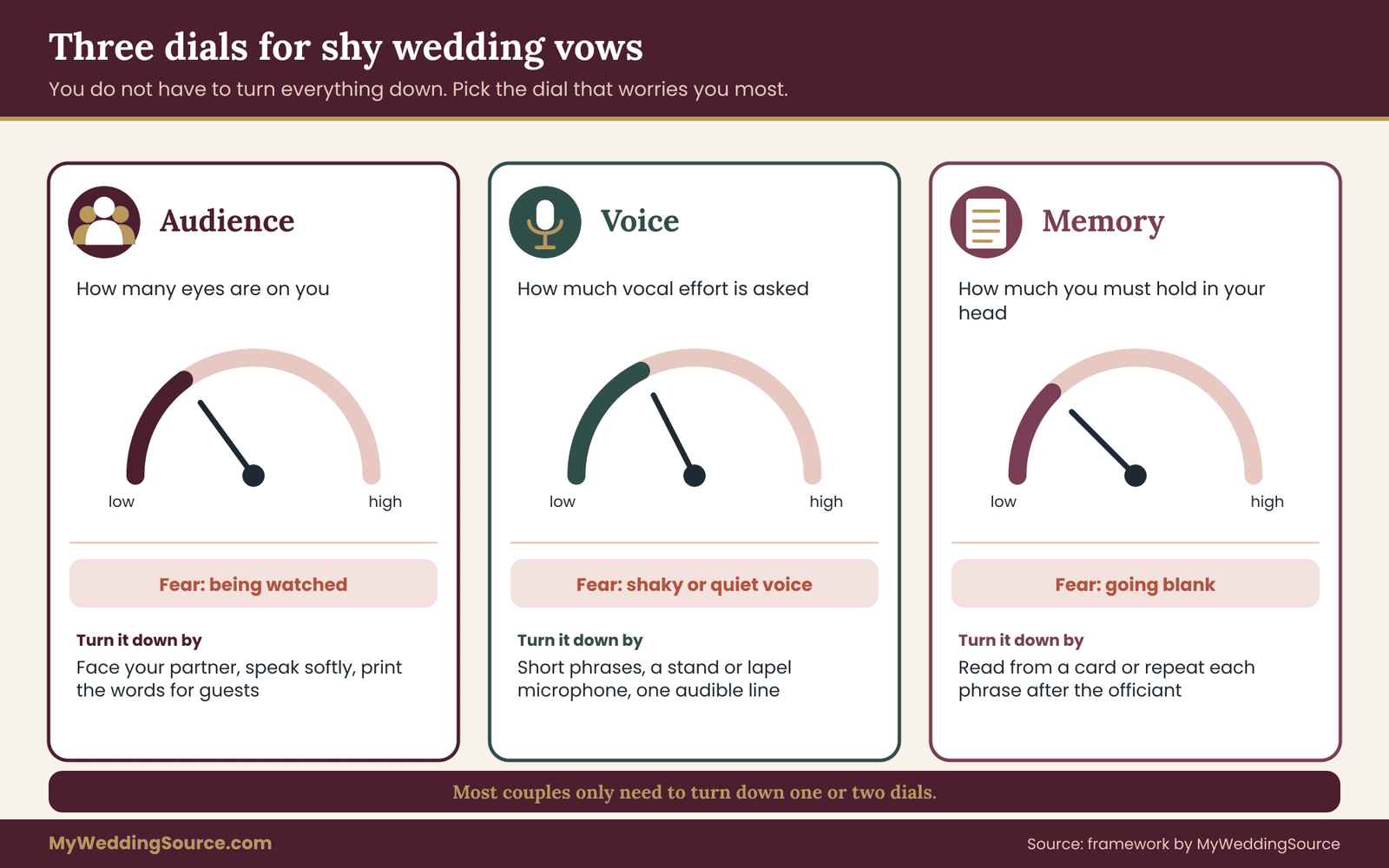
Think of delivery as three dials, each of which you can turn down independently.
The audience dial controls how much of the room is part of the moment. Turned all the way up, you speak to every guest from a microphone. Turned down, you face your partner and speak at conversation volume, or the words reach guests another way, such as a printed card or a recording played later.
The voice dial controls how much vocal effort is expected. Turned up, you project across a room. Turned down, you speak in short phrases, or someone else reads the words, or the words are recorded in a quiet space where you can try again.
The memory dial controls how much you must hold in your head. Turned up, you recite from memory. Turned down, you read from a card, or you repeat each phrase right after the officiant says it.
No dial needs to go to zero, even for shy wedding vows. Most couples find that turning down just one or two is enough to change how the whole day feels.
What guests actually need from the moment
It is worth being honest about what the audience wants from shy wedding vows, because the shy imagination tends to make it much bigger than it is. Guests need three things from vows. They need to see that the two of you are making a promise to each other. They need to be able to follow, loosely, what is happening. And they need the moment to feel unforced.
Shy wedding vows do not need polished delivery. They do not need eye contact with them. They do not need memorized text. Most ceremonies, as the step-by-step ceremony guide shows, already include a reading, a ring exchange and a kiss, and nobody leaves thinking the vows were a failure because a card was in someone’s hand.
There is also a practical point. At most ceremonies, guests stand or sit some distance away, often behind rows of chairs, and part of the room cannot clearly hear much of what is said anyway. A format that is gentle on you rarely costs the guests anything they were relying on.
How a gentle format differs from skipping the vows
Some shy couples feel they have only two options: give a full speech or say nothing personal at all. Shy wedding vows delivered in the formats of this guide sit between those poles. A card-read promise, a repeat-after-me exchange and a recorded message are all personal. They carry your words and your choices. They simply reduce the performance load.
If you do decide to leave personal promises out of the ceremony, that is a legitimate choice too, and some couples exchange written letters before the ceremony instead. This guide treats that as one of the formats, because it solves the same problem for the same people.
Who this guide is for, and who it is not for
This guide to shy wedding vows is for couples where one or both partners find speaking in front of a group hard. That includes people who feel nervous but can manage with support, people who feel intense dread, and people who simply prefer quiet. It also includes couples where one partner is comfortable and the other is not, which gets its own section later.
It is not a guide for people whose distress around public speaking is severe or affects daily life. If that describes you, a doctor or licensed mental health professional is the right person to talk to, and the National Institute of Mental Health publishes plain-language information on social anxiety that is worth reading. A wedding plan can accommodate you, but it should not be asked to treat you.
How the rest of this guide fits together
The guide moves in the order you will probably make decisions. First comes a comfort ladder of five delivery formats, from least to most exposure. Then each format gets its own section, with scripts, set-up details and pitfalls. After that comes a section on writing words that are easy to say aloud, a six-week rehearsal ramp, a section on the day itself, a list of questions for your officiant and venue, edge cases, and a worked example with an invented couple.
You do not need to read it straight through. If you already know you want a card, skip to that section. If you are not sure, read the ladder and the decision rules first, because they will narrow the field quickly.
One more point before the ladder. Nothing in this approach to shy wedding vows depends on being brave on the day. The point of a good format and a good practice plan is that bravery is the smallest ingredient. The setup does most of the work, and your job is mainly to show up, hold your partner’s hand and say what you already know.
A short test for where you stand today
Try this on a quiet evening, before reading further. Say one sentence of a promise aloud to an empty room, such as “I will be on your side when it is hard.” Notice what happens.
If your voice felt fine and you only dread the audience, the audience dial is your main one. If your voice wobbled even alone, the voice dial matters, and shorter phrases will help. If the sentence felt fine but you cannot imagine remembering ten of them, the memory dial is the one to turn. Write down what you noticed. It will guide the choice in the next section.
Do this with your partner, too, and compare notes. It is common for two partners to approach shy wedding vows from completely different places. That is useful information, not a problem, and the section on mixed comfort levels returns to it.
A comfort ladder for shy wedding vows: five delivery formats
Here is the framework this guide to shy wedding vows is built on. Think of five ways to deliver a promise as rungs on a ladder. The bottom rung asks the least of your nerves, and the top rung asks the most. You choose the lowest rung that still feels like you, and you can mix rungs between partners or even between sentences.
Rung one: the officiant leads, you repeat. The officiant says a short phrase and you say it back. You never face silence, you remember nothing, and the pace is set for you. The words can be chosen by you or taken from a traditional text.
Rung two: you read from a card. You hold a small card or booklet and read your own words. You face your partner and speak at conversation volume. Memory is removed, and so is the fear of going blank.
Rung three: a whispered or private exchange. You say the words quietly to each other, with the officiant close by and guests present but not straining to hear. Sometimes the words are also printed in the program so nobody feels left out.
Rung four: a recorded or written promise. The words are spoken into a phone or recorder beforehand, or written as a letter, and shared with guests or kept private. The live moment is replaced by a quiet one.
Rung five: speaking from memory or freely. You stand, face your partner and say the promise unaided. This is the traditional picture of vows, and it is also the highest demand on memory, voice and audience at the same time.
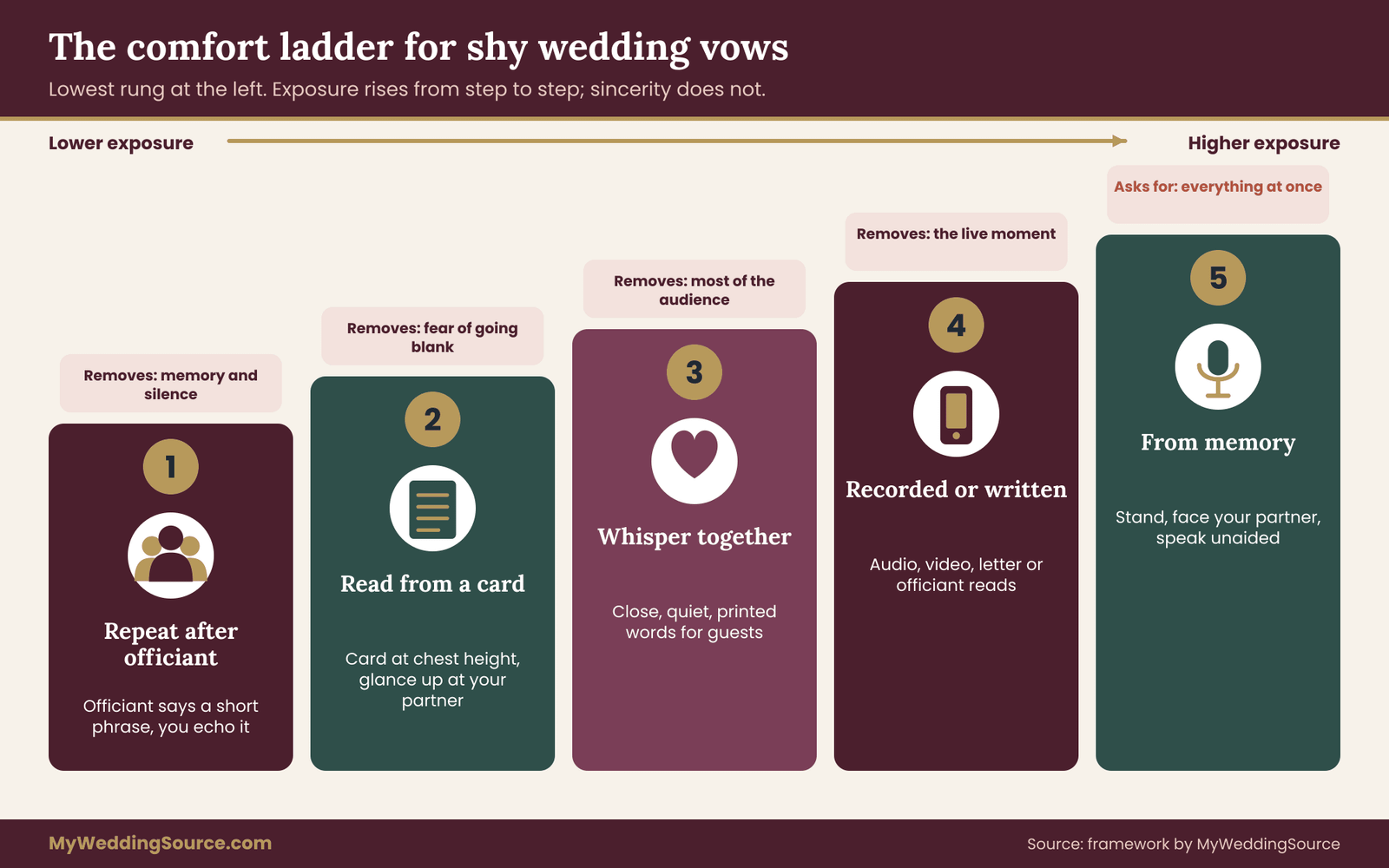
The order is not a ranking of love or sincerity, and shy wedding vows are never lesser vows. It is a ranking of exposure. A promise read quietly from a card is exactly as binding and exactly as personal as one recited from memory.
Decision rules for choosing a rung
Rather than guessing which format suits your shy wedding vows, use these rules. They are simple on purpose.
If your biggest fear is forgetting, start at rung one or two. If your biggest fear is your voice, start at rung one or three. If your biggest fear is the audience, start at rung three or four. If you fear crying, rung one gives you the most natural pauses, because the officiant is already pacing the moment.
If two fears compete, pick the format that handles the stronger one and test whether the weaker one still bothers you in rehearsal. If it does, add a second adjustment, such as a lapel microphone or a seat.
If you and your partner land on different rungs, that is fine. Each person chooses their own, and the section on mixed comfort levels explains how to make two different formats feel like one coherent moment.
Why starting lower rarely costs you
A common worry is that choosing a lower rung for shy wedding vows means you will regret it. In practice the regret usually runs the other way. People who pick a high-exposure format to prove something often spend the ceremony watching themselves from the outside, which is the opposite of being present.
A lower rung also keeps your options open. You can practice a card version and decide close to the day to try memory. You cannot easily go the other way on the morning of the wedding. If you are unsure, start with the card.
Mixing formats inside one ceremony
Formats for shy wedding vows can share a ceremony. One partner reads from a card while the other repeats after the officiant. Both partners repeat a short shared line, then each reads a private sentence from a card. A couple might whisper their vows to each other, then say one spoken line, such as “I do,” at full volume so guests can hear the moment land.
This blending is how most gentle ceremonies actually work. A short, clearly audible moment, even a single sentence, gives guests something to hold onto and often feels less frightening than a long speech, because the finish line is so close.
What to avoid when choosing
Three mistakes come up again and again with shy wedding vows. The first is choosing a format because of what someone else did, such as a sibling’s memorized speech. The second is choosing based on how you feel on a calm Tuesday rather than how you might feel standing in your wedding clothes. The third is picking a format without telling the officiant, who may need to change how the ceremony is paced.
Tell your officiant early that you want shy wedding vows handled gently. A gentle format is a normal request, and officiants hear it more often than couples expect. The guide to what an officiant needs to know and do is a good companion read.
Reading shy wedding vows from a card or booklet
Reading from a card is the most common gentle format for shy wedding vows, and the most forgiving. It is also the one most often done badly, because couples treat the card as a script on a page rather than a tool for the mouth and the hands. A few design choices make a large difference.
Choose the object
A single card is the simplest. A standard index card or a folded card held in one hand keeps the moment light. Choose card stock stiff enough not to flop in wind or tremble in a shaking hand.
A small booklet works well for longer promises or for couples who like the symbolism. Two partners can exchange booklets, read, and then keep each other’s as a keepsake. Booklets add the risk of page turns, so keep the pages few.
A phone or tablet is possible but carries risks. Screens dim, notifications arrive, and glare in sunlight makes text unreadable. If a phone is your only option, turn on do not disturb, set screen timeout to its longest setting, and carry a printed backup.
Lay out the text for a nervous reader
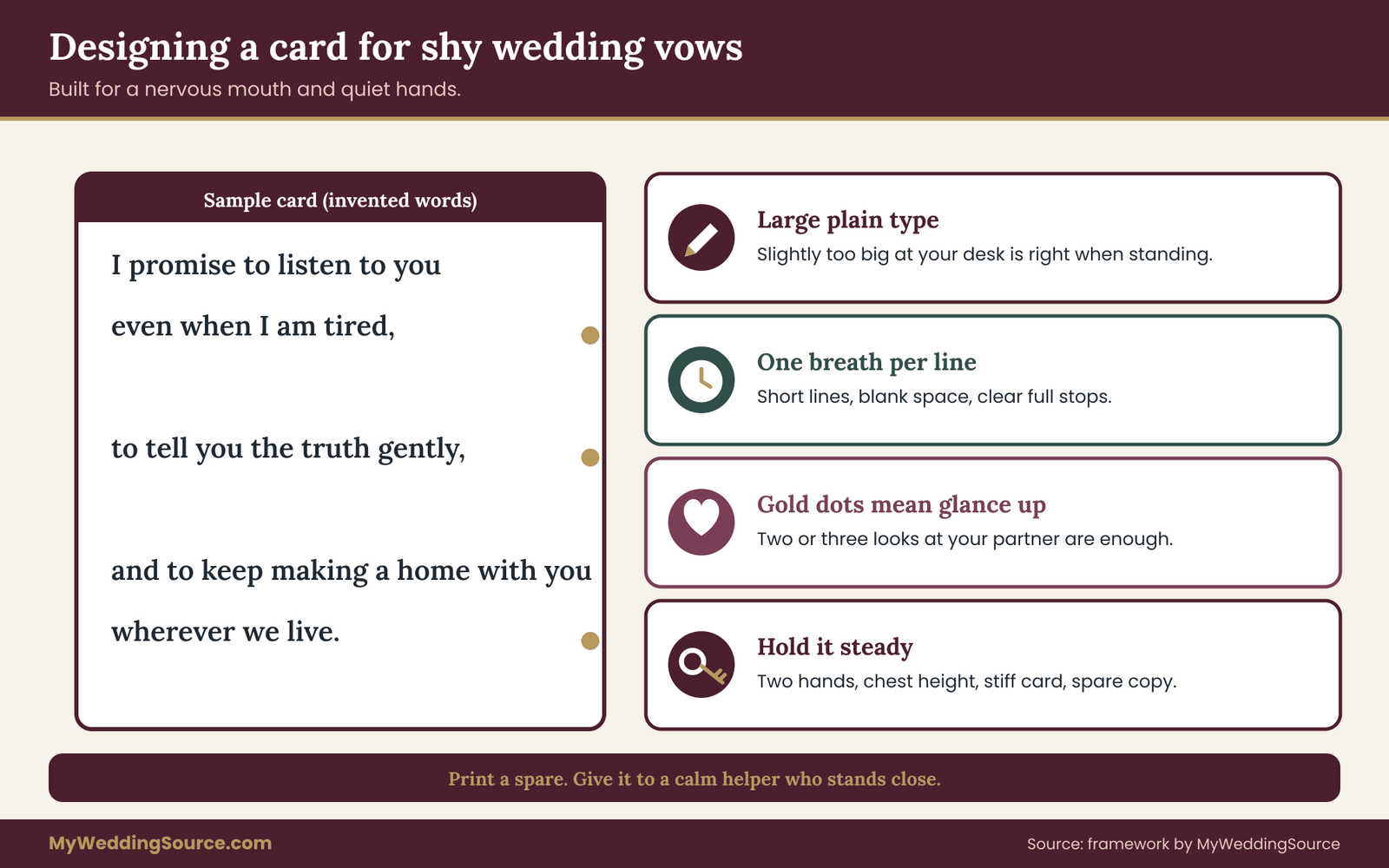
Print your shy wedding vows in a large, plain typeface. A size that feels slightly too big at your desk is usually right when you are standing, a little shaky, and looking down at an angle. Use dark ink on pale card, and avoid script fonts that blur together.
Break each promise into short lines, one breath per line, rather than a block of text. Leave blank space between lines, so your eye can find its place after a glance up. Mark the end of every sentence with a clear full stop.
Some readers like a small mark at natural pauses, such as a slash or a short gap. Add one only if you find it useful in practice. If you will glance up at your partner at certain moments, mark those spots with a small dot, so you know when your eyes are free.
Hold it so your hands stay quiet
Hands shake more when they hold something light and unsupported, and shy wedding vows often come with shaky hands. If your hands tremble when you are nervous, hold the card with both hands, or rest one hand’s wrist against your other forearm. A heavier card or small booklet is steadier than a loose slip of paper.
Keep the card at chest height so you can glance down without bending your neck. Bringing it up to your face hides your expression and muffles your voice. Dropping it to your waist forces you to bow your head and speak into the floor. Chest height is the middle path.
Practice holding it in your wedding outfit, if you can. A dress with a fitted bodice, a jacket with a stiff sleeve or a bouquet in the other hand all change where your arms can go. Decide who holds the bouquet before the vows start, and say so in the cue sheet. The ceremony cue sheet guide shows how to give that kind of detail to your officiant and attendants.
Read in chunks, glance up in gaps
The skill in reading from a card is not reading. It is looking up. Aim for a rhythm: read a phrase, breathe, glance at your partner, read the next. You do not need to look up for every line. Even two or three glances in the whole promise are enough to make the moment feel connected.
If looking at your partner makes you more emotional, look at their collar, their chin or the space just beside their face. Guests cannot tell the difference, and your partner will read it as warmth.
What the card gives you that memory does not
A card is a safety net for shy wedding vows, and there is a quiet benefit hiding inside it. Because you are not afraid of going blank, your attention is free to notice your partner. People who recite from memory spend part of their mind watching for the next line. Readers do not have to.
A card also allows exact wording. If your promise includes a name, a date, a line from a language you do not speak daily, or a phrase you have been polishing for weeks, the card guarantees you say it as written.
Pitfalls of reading from a card
Reading too fast is the most common issue. Nerves speed everything up, and a promise that took ninety seconds in rehearsal can take forty in the moment. Counter this by writing the pauses into the card and by practicing slower than feels natural.
Another issue is losing your place after a glance up. Large text and generous line breaks solve most of this, and so does keeping a finger on the line you are reading.
The third is wind. Outdoor ceremonies have ended with cards flying away. A folded card, a clip or a small booklet with a ribbon holds better. Bring a second copy to give to a trusted attendant, who can stand close.
A short script for the card moment
Your officiant does not need to improvise. A short cue is enough: “[Name], you may read your promise now.” Then a pause, and the reading. When the reading finishes, the officiant can say, “Thank you,” and move on. Agree in advance that nobody applauds mid-reading unless you want them to, and that the officiant will not hurry you if you stop to breathe.
Repeat-after-the-officiant: the gentlest live format for shy wedding vows
If a card still feels like too much for your shy wedding vows, repeating each phrase after your officiant is the lowest-pressure live format there is. It is also the oldest. Many traditional ceremonies are built this way, and the structure is familiar to guests, who rarely think twice about it.
The officiant says a short piece. You say it back. Then the next piece. You never stand in silence, you never need to recall what comes next, and your officiant sets the pace. If your voice drops, they can repeat the phrase a little louder. If you pause, they simply wait.
How the exchange works
The officiant faces the couple, sometimes turned slightly toward one partner at a time. They speak a phrase of perhaps four to ten words, pause, and nod. The partner repeats the phrase, looking at the other partner. Then the officiant moves on.
A full set of shy wedding vows in this format usually takes between six and twelve phrases. That is long enough to feel meaningful and short enough that no single phrase is difficult. Because each phrase is a mini-task, the whole thing feels more like a conversation than a performance.
Who writes the phrases
You have three choices for shy wedding vows in this format. You can use a traditional text, which saves you work and gives you language that has been spoken at countless weddings. You can use a template from your officiant or a published ceremony script, adapting a few lines. Or you can write your own promise and ask your officiant to chop it into phrases.
On this site, the Christian wedding ceremony script and the non-religious ceremony script both show how a repeat-after exchange typically sits inside a full ceremony, which helps you picture the pacing.
If you write your own, keep the whole promise to what can be said calmly in under two minutes. Short phrases are not a weakness here. They are the engine of the format.
How to chop a promise into phrases
The goal for shy wedding vows is phrases a person can say in one breath. Here is a worked example with an invented promise.
Original: “I promise to listen to you even when I am tired, to tell you the truth gently, and to keep making a home with you wherever we live.”
Chopped for repeating:
- “I promise to listen to you”
- “even when I am tired,”
- “to tell you the truth gently,”
- “and to keep making a home with you”
- “wherever we live.”
Notice the rules at work. Each piece is short, ends at a natural pause, and makes sense on its own. The pieces never split a name or an idiom. The last piece is the shortest, so the moment ends lightly rather than on a long, breathless line.
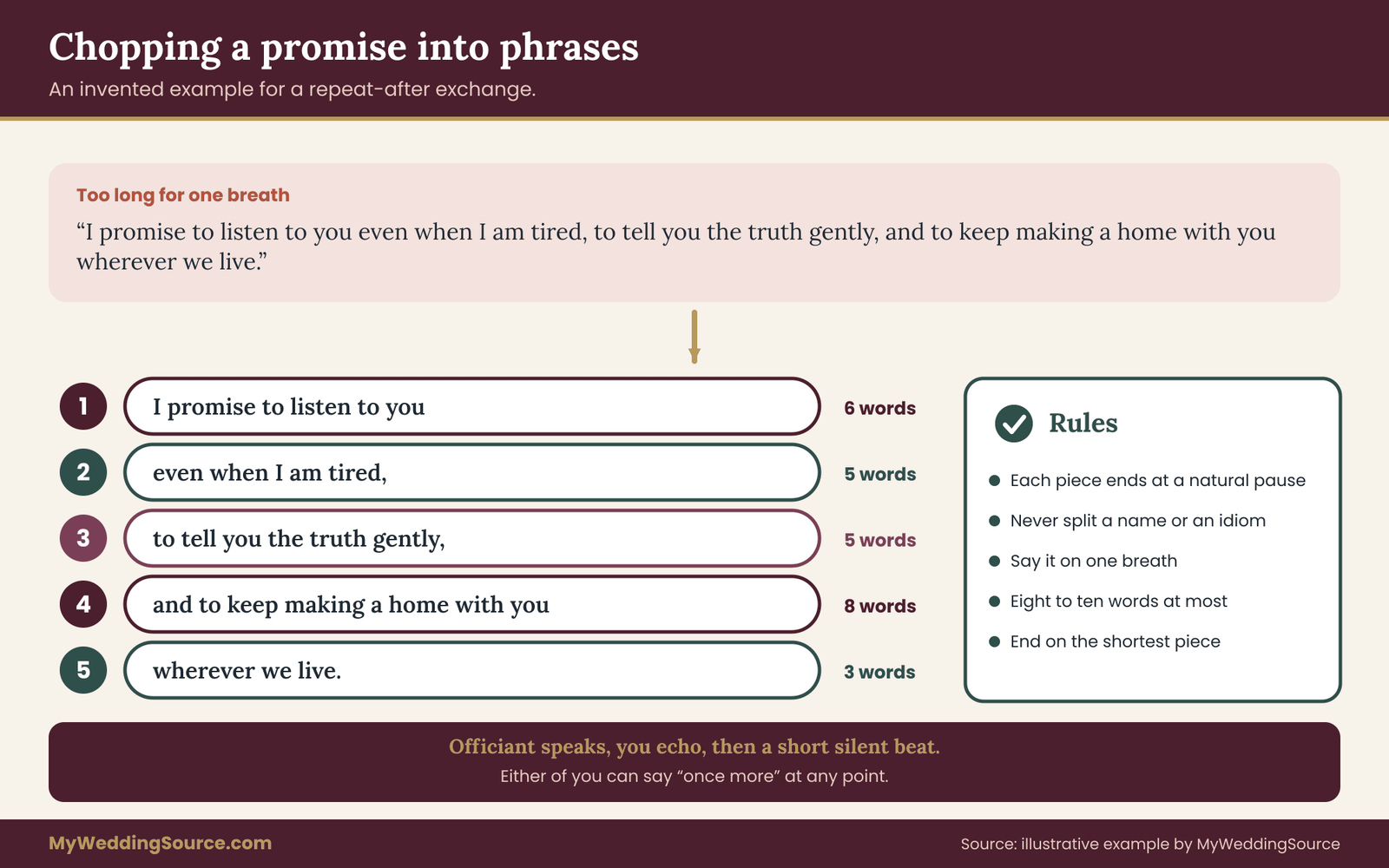
A simple measurable check helps. Read each phrase aloud on one breath. If you need to breathe in the middle, the phrase is too long. Most nervous speakers do well with phrases of no more than about eight to ten words.
Rules for the officiant’s side
Give your officiant a few clear instructions for your shy wedding vows. Ask them to say each phrase slowly and clearly, to wait for you to finish before starting the next, and to avoid prompting while you are still speaking. Ask them to look at you, not at their script, when they can.
If you are worried about your voice, ask them to stand close, and to use the same volume you will be using. A booming officiant and a whispering partner can make the quieter voice feel smaller. Matching volume makes the exchange feel mutual.
If you have a stammer or a speech difference, or if you simply want extra time, tell the officiant ahead of the day. They can learn your rhythm and keep their own pacing steady. A good officiant adjusts to the couple, not the other way around.
Rehearsing a repeat-after exchange
Because the officiant leads, your practice is mostly about getting used to the call and response. Ask your officiant to run through it once at the rehearsal, if you have one. If not, a friend can read the phrases while you repeat them. Practice looking at your partner while you speak, because the temptation is to stare at the officiant for safety.
Practice, too, the small silent moments between phrases. Nervous speakers sometimes rush to fill the gap. The gap is not a problem. It is where the room takes a breath with you.
Pitfalls of repeating after the officiant
The first pitfall is a robotic feeling. Reciting phrases can sound flat if you speak them without meaning. A fix is to read each phrase silently first, think of one specific moment it describes, and then say it back.
The second is mishearing. Wind, music, or a quiet officiant can make you miss a phrase. Agree that either of you can say “once more” and the officiant will repeat it. A repeat is not an error.
The third is guest audibility. If the officiant speaks first and the partner echoes, guests hear the officiant clearly and the couple faintly. This is normal. If you want guests to hear you, ask for a microphone on a stand placed near you, or have the officiant carry a handheld one and hold it toward each speaker in turn.
Legal wording is a separate layer
Here is an important point that applies to every format of shy wedding vows in this guide. In many places the legal marriage depends on spoken words, usually a declaration or consent such as “I do,” made in front of an officiant and sometimes witnesses. Your personal promises may be a separate layer from that legal moment, or the two may be combined.
Rules vary by state. Some places require specific wording, some require only that both people consent in front of the officiant, and some have particular rules for who can perform the ceremony. Ask your officiant and your local marriage license office what is required where you are marrying. The USA.gov marriage page points you to state offices, and the officiant guide on this site covers what officiants typically confirm.
This matters most for the recorded and written formats in the next section. A prerecorded promise can be lovely, but it is unlikely to replace a legally required spoken declaration, so plan to say the legally required words live, even if your personal promises are delivered another way.
Whispered and private exchanges: lowering the audience dial
Some of the most affecting wedding moments are the quiet ones, and shy wedding vows suit them well. If the audience is your biggest fear, a whispered exchange removes much of the pressure without removing the promise. It is closer to rung three on the ladder, and it works because intimacy reduces self-consciousness.
What a whispered exchange looks like
The couple stands close, often forehead to forehead or hand in hand, and speaks softly to each other. The officiant stays nearby and may step back slightly. Guests are present, but the moment feels private. Sometimes a photographer or videographer captures it from a respectful distance, with a microphone clipped to one partner so the words are preserved.
The variations are many. You might whisper from a card. You might whisper a single sentence. You might whisper phrases the officiant has first said aloud for both of you, so the pacing is guided. You might whisper after a short spoken line that guests can hear, and then continue privately.
Making sure guests do not feel shut out of shy wedding vows
A whispered exchange can leave guests wondering what was said. A few gentle fixes help. Print the promises, or a short version, in the ceremony program, so guests can read along. Or read a line aloud at the start so everyone understands the spirit. Or share the promises later, in a thank-you note or a recording.
The officiant can also help. A short sentence such as “They are going to speak quietly to each other now” prepares the room and invites a hush. Guests tend to respond to that cue by being still, which also makes the moment calmer for you.
The microphone question
Whispers and microphones are awkward partners. If the ceremony is recorded, a small lapel microphone on the clothing of one partner, or a hidden one on the officiant, can capture soft speech. Ask your videographer how they plan to record the audio, and confirm that the equipment will not be visible or noisy.
If you do not want the moment recorded, say so clearly, and ask your photographer and videographer to keep a respectful distance. Guests who record on phones can be asked to put them away, and a short note in the program or a sign at the entrance usually does the job.
Keeping one line audible
Many couples with shy wedding vows find that a single audible line, spoken at normal volume, gives guests the moment they need. It might be as short as “I choose you.” One line is easy to rehearse, easy to remember, and easy to say even with a tight throat. Everything else can then be quiet.
Pitfalls of whispering shy wedding vows
The main risk is that the moment can feel too small. Some couples feel in hindsight that they rushed it. Counter this by deciding in advance how long the exchange will last, and by agreeing to pause and look at each other for a few seconds afterward.
Another risk is poor audio if the exchange is being recorded. Ask for a test, and check the recording before the day if possible.
A third is that whispers can sound anxious on a recording even when you felt calm. If you want the recording to be listenable, speak a little more slowly and firmly than feels natural, even at low volume.
Recorded and written promises: when shy wedding vows leave the room
At the top of the audience-dial scale, the live moment is replaced by something prepared in advance. This is rung four on the ladder. It suits people for whom any live speaking is too much, and it can be a lovely choice rather than a compromise.
There are three common versions of recorded shy wedding vows. Each has its own set-up, and each can be combined with a short live moment.
Version one: a prerecorded audio or video promise
You record your shy wedding vows at home, in a quiet room, where you can try as many times as you like. The recording is then played during the ceremony, at the reception, or privately. The quiet room matters. Many shy people speak far more warmly to a phone on a shelf than to a crowd.
Record in a space with soft furnishings, because bare walls make voices echo. Hold the phone steady or prop it up, speak at a normal distance, and listen back with headphones. Try a few takes. The best take is usually the one where you stopped trying to sound like a speech.
If the recording will be played at the venue, check the format with the DJ, band or venue technician. Ask what file types they accept, how the audio plays, and who presses the button. Send the file early, test it on their equipment, and bring a copy on a second device. Avoid relying on guest wifi or streaming links.
Version two: a letter exchanged before the ceremony
Some couples write letters and read them privately in the hour before the ceremony, often in separate rooms or back to back, with the photographer present if they want pictures. The promise is delivered, received and felt, with no audience at all.
This format moves the emotional peak earlier in the day. That can be a relief, because you walk into the ceremony already moved and already connected. Add a short spoken line during the ceremony, such as a mutual “I will,” so the public moment still includes both voices.
Version three: the officiant reads for you
In this version of shy wedding vows, you write the words, and the officiant reads them aloud while you stand together. You can nod, hold hands, or say a single line at the end. It is a good option for a person who cannot or does not want to speak, and it can include both partners’ words in one reading.
Give the officiant the text in advance and agree on how to pronounce any names or unfamiliar words. Ask them to read at a steady, warm pace. If you want to feel included, join in on a short closing line.
Legal cautions for recorded formats
As noted earlier, a recording or letter is a personal promise, not usually a substitute for any spoken declaration the law requires. Ask your officiant and your local marriage office what words must be said live, and plan to say those even if everything else is recorded.
Also ask about witnesses and the rules for the signing. Those do not change with your delivery format, but it helps to confirm them before you decide how much of the ceremony is live.
Protecting the files
A recording of shy wedding vows becomes a valuable file. Keep a master copy on a device you control, a second copy somewhere else, and a copy with whoever will play it. The guide to the wedding day digital contingency plan covers backup communication, files and permissions, and its advice applies directly to a ceremony recording.
Think, too, about who has access. If the recording is private, say so to the DJ, the videographer and the officiant, and tell guests not to share clips if you prefer that. If it will be shared widely, confirm that everyone in the audio and video agrees.
Pitfalls of recorded and written shy wedding vows
The first is the technical failure. Sound systems sometimes fail, files sometimes will not open, and a dead battery at the wrong time is a real possibility. Always have a fallback, such as a printed copy of the words that your officiant can read if the playback fails.
The second is a feeling of distance. Some couples find that a recording feels less present than a live moment. A short live element, even a gesture or a single sentence, brings the two together.
The third is overlength. A recording that runs on can leave guests restless. Keep it within what you would be comfortable saying live, and listen back as a guest would.
Writing shy wedding vows that are easy to say
This guide does not cover how to decide what your shy wedding vows mean. Other guides on this site do that. This section is about something narrower: how to shape words so they are easy for a nervous mouth to say. A promise written for the eye can be hard on the tongue, and a few edits make an enormous difference.
Write for the mouth, not the page
Say every sentence of your shy wedding vows aloud as you write it. If you stumble, the sentence is not finished. Read each line at the speed you will use on the day, which is slower than reading to yourself.
Prefer short words and plain structure. A sentence that has a subject, a verb and an object is easier to say than one with three clauses and a parenthesis. When you notice a sentence running past about fifteen words, split it.
Avoid tongue twisters and sound traps
Some word combinations are difficult when you are nervous. Repeated sounds, such as “she sells,” “rarely really” or a string of similar words in a row, cause stumbles. Listen for places where the end of one word and the start of the next run together, and rearrange them.
Be careful with names. If your partner’s name, a place or a family name is long or unusual, practice it separately. A mispronounced name under pressure is a tiny but real fear. Put the name at a point where you can pause before it.
Place the hard words at the start of a breath
Your voice is steadiest right after you breathe in. Put the words that matter most, or are hardest to say, at the beginning of a phrase rather than at the end of a long one. When your breath runs out, the voice thins and shakes.
If a phrase ends with a very emotional word, consider ending the phrase one word earlier and starting the next phrase with that word. This gives you a fresh breath for it.
Choose a few images, not many
Shy speakers sometimes pile detail into shy wedding vows to prove sincerity. The effect is a long promise that is harder to deliver. A few concrete images, one or two specific promises, and a clear closing line are easier to say and easier for the listener to feel.
If you are tempted to include an inside joke, check whether guests will need explanation. A joke that requires a pause for laughter puts you in the spotlight for longer than you want.
Keep the length matched to the format
Your delivery format changes the right length for shy wedding vows. For repeat-after, shorter is easier, since every phrase requires another exchange. For a card, a moderate length works, since you can pace yourself. For a recording, you have room, but guests have limits. A promise that can be said calmly in around a minute to two minutes works for almost every format here.
If you are not sure, read it aloud once with a timer and a glass of water. If it feels long to you, it will feel longer to the room.
Check the draft with a friend
Read the draft of your shy wedding vows aloud to a person you trust, someone who will tell you honestly if a phrase is awkward. Ask them two questions: where did you lose the thread, and which line did you like best? Cut where they lost the thread. Keep and perhaps move the line they liked.
This is also the first small step in your rehearsal, which the next section builds into a plan. Speaking the words to one safe person is the first rung of the practice ladder.
A six-week rehearsal ramp for nerves
Rehearsal for shy wedding vows should look nothing like a performance class. When you rehearse shy wedding vows, the goal is not to remove nerves. Some nervousness is normal and even helpful, because it sharpens attention. The goal is to make the task familiar enough that nerves do not take over. The tool for that is a ramp: small steps, each slightly more exposed than the last, with a rest between.
The ramp below takes about six weeks and can be shortened to three if needed. Each step takes ten to fifteen minutes, a few times a week. Short and regular beats long and rare.
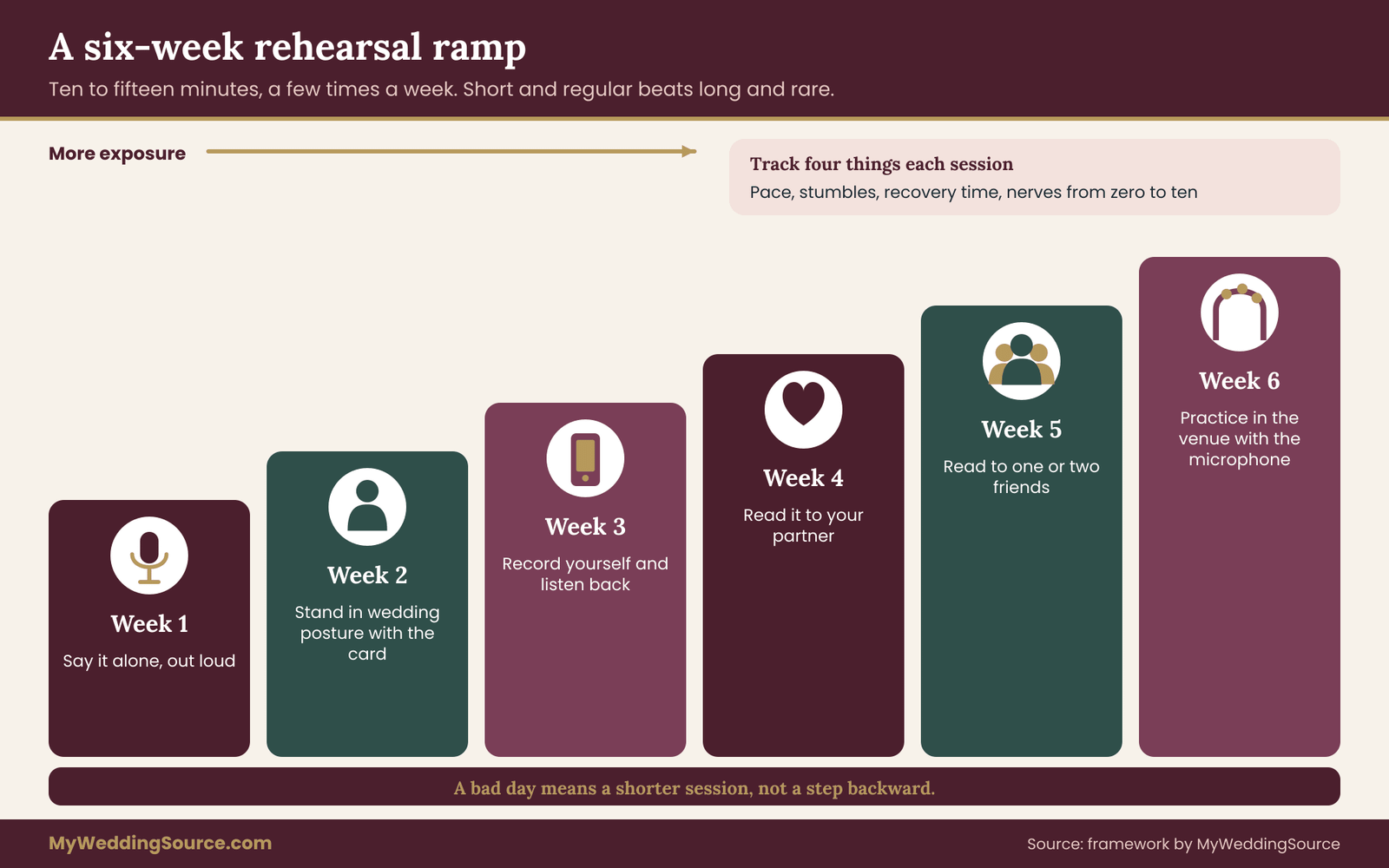
Step one: say your shy wedding vows alone, out loud
In the first week, read your words aloud when nobody is around. Do not perform. Just let your mouth learn the shapes. Read it five or six times across the week and mark any word that trips you.
The purpose is to move the words from your eyes to your voice. Silent reading hides problems that only appear when you speak. Many people discover in this step that a favorite sentence is awkward aloud, and they fix it early, when fixing is easy.
Step two: stand, hold the card, use your wedding posture
In week two, practice standing, with the card or booklet at chest height, in the posture you will have on the day. Wear shoes similar to your wedding shoes, because balance affects breath. If you can, practice in front of a mirror and then away from it.
Add the physical details: where your other hand goes, how the card sits, what you do with a bouquet. Resolve these now, so they are not new on the day.
Step three: record yourself and listen back
In week three, record the reading on your phone. Listening to your own voice is uncomfortable for nearly everyone, which is exactly why it is useful. Listen once for pace, once for volume, and once for clarity, and nothing else.
Most people discover that they sound calmer and clearer than they feel. That discovery is valuable evidence against the fear. A simple measurable check: time the recording. Note your pace. Then try one slower read and compare. The slower one almost always sounds better.
Step four: read it to your partner
In week four, read the words to your partner, in a quiet, private setting. The aim is not to surprise them, so decide in advance whether you want to share the exact words or only practice the delivery. Some couples prefer to keep the content secret until the day. In that case, practice with a placeholder text of similar length, or read with the actual words to a trusted friend instead.
If you share it, ask for just one note: was there a place you could not hear me? Nothing else. Collecting too much feedback at this stage makes nerves worse.
Step five: read it to one or two people
In week five, add a small audience for your shy wedding vows. One trusted friend or relative is enough, two at most. Ask them to sit a few feet away and listen without reacting much. This step builds tolerance for being watched while saying something meaningful.
Many people feel their heart race on step five. That is the point. Notice that you can finish the reading anyway, and that nothing terrible happens. This is the core of how gradual exposure works: you learn from the evidence in front of you, not from reassurance.
Step six: practice at the venue or a similar room
In the final week, practice in the space, or a space like it. If the venue allows a visit, stand where you will stand and read the words, with the officiant present if possible. If the venue is not available, use a large room and have a friend stand at the back to check volume.
If there is a microphone, practice with it. A microphone changes how you hear yourself, and the first time can be startling. The ceremony step by step guide can help you see where the vows fall in the sequence, so you know what comes immediately before and after.
Measurable checks for each step
Rehearsal of shy wedding vows feels vague without a few simple checks. These are not tests to pass. They are ways to see progress.
Pace. Time the full reading at each step. By week six, your time should be steady, within about fifteen seconds of your earlier reads.
Stumbles. Count stumbles per read. Do not aim for zero. Aim for the number to fall, and for recovery to feel easy.
Recovery. After a stumble, how long does it take you to continue? Practice pausing, breathing and continuing, so a stumble becomes a two-second event.
Self-rating. After each session, give your nerves a score from zero to ten. Write it down. The numbers often fall across weeks, and seeing the trend is encouraging.
What to do on a bad practice day with shy wedding vows
Some days the practice goes badly, and your voice shakes or you feel foolish. That does not mean the ramp is failing. Skip ahead nothing, and go back nothing. Do a shorter session, read just the first half, and stop on a calm note.
If a bad day follows another, take two days off and return. The aim is steady familiarity. A rest is part of the plan.
Breathing and body steadying that actually helps
Slow breathing is the most useful physical tool for most people delivering shy wedding vows. Breathe in through the nose for about four counts, and out through the mouth for about six. Do this three or four times before you begin. The longer exhale is the part that tends to settle the body.
Some people find it helpful to press their feet into the floor, loosen their knees and let their shoulders drop. Stand with your weight even. Locked knees can make a person dizzy during a long stand, so keep a slight bend.
Drink water beforehand, but not so much that you are uncomfortable. A dry mouth makes speaking harder. Avoid heavy caffeine on the morning of the ceremony if it tends to make you jittery.
These are general comfort techniques, not medical treatments. If anxiety is strong or interferes with your life, a health professional can offer much more than any wedding guide.
A shortened plan for a short timeline
If your wedding is closer than six weeks, compress the ramp for your shy wedding vows. Combine steps one and two in the first few days. Record yourself in the first week. Read to your partner or a friend in the second. Visit the venue in the final days. The order matters more than the length of each step.
If the wedding is within days, skip the ramp for shy wedding vows and choose the lowest rung on the ladder. A repeat-after format needs almost no practice, and a card needs only a few read-throughs.
Rehearsal with your officiant and the cue sheet
If your officiant is leading a repeat-after format, schedule one run-through with them, even by video call. Agree on the pace, the cue to begin and the signal that you need a moment. Add these to the written plan that your officiant, readers and attendants will use. The wedding ceremony cue sheet guide is the right place to look for what a good cue sheet contains.
A written cue sheet also helps nervous partners, because it removes uncertainty about what happens next. Uncertainty feeds nerves, and clarity starves them.
Practicing for being emotional
Rehearsal of shy wedding vows usually does not produce tears, and then the real day does. It helps to plan for that. Decide in advance what you will do if your voice cracks: pause, breathe, smile if you can, and continue. Practice the pause itself, by purposely stopping mid-sentence in rehearsal, counting to three, and picking up where you left off.
This turns a feared event into a rehearsed one. When it happens, you will recognize it and know what to do.
The day itself: keeping shy wedding vows calm
You have chosen a format for your shy wedding vows, shaped the words and practiced. The day itself is mostly about not adding new pressure. The aim is a morning and a ceremony in which the vows are one small, well-supported moment, not the focus of a day-long dread.
Protect the hours before
Nerves about shy wedding vows build in empty time. Plan the hours before the ceremony so they are full but not frantic. Eat something steady, drink water, and allow a buffer in the schedule so nobody is rushing. Rushing raises the heart rate, and a raised heart rate feeds the feeling that something is wrong.
Choose one person as your calm helper. Their job is to hold the card, the water, a tissue and a spare copy of the words. Tell them in advance that they are not there to comfort you with a speech. They are there to hand you things and to say “you are fine” if you ask.
Avoid last-minute rewrites of your shy wedding vows. Editing on the morning of the wedding is a common way to make a stable plan wobble. Unless something is genuinely wrong, leave the words alone.
The two minutes before you walk
Two minutes is enough for a short routine. Slow your breathing, as in the rehearsal section. Relax your jaw and unclench your hands. Say the first line of your promise silently once. Then stop and walk.
Some people like a small physical anchor, such as pressing a thumb against a finger, or holding a smooth object in a pocket. This is a private habit and need not look like anything. Pick it in rehearsal so it feels familiar.
Recovery plan: what to do when something goes wrong
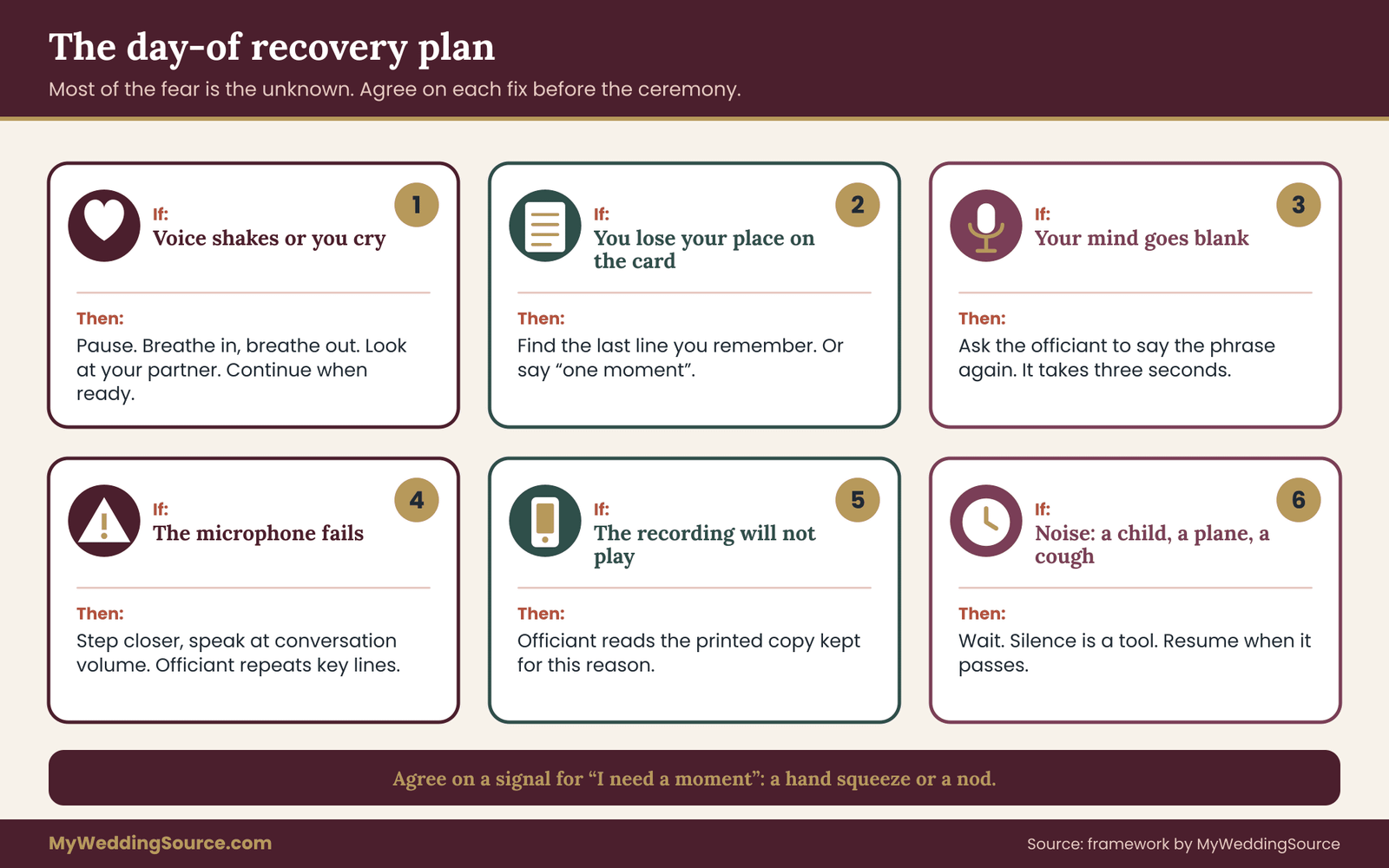
The most calming thing you can do before delivering shy wedding vows is agree on what happens when something goes wrong. Most of the fear is of the unknown. A recovery plan makes the unknown small.
If your voice shakes or you cry. Pause. Breathe in, breathe out. Look at your partner. Continue when you are ready. The officiant waits. Guests usually find it touching rather than awkward.
If you lose your place on a card. Look down, find the last line you remember, and read from there. If you are lost, say, “One moment,” which is entirely natural.
If you go blank in a repeat-after exchange. Ask the officiant to say it again. A repeat takes three seconds and nobody thinks about it afterward.
If the microphone fails. Move closer to your partner and speak at normal volume. Guests may hear less, and the moment will still be intact. Have your officiant ready to repeat key lines.
If a recording fails to play. The officiant reads from a printed copy. This is the reason to carry one.
If a guest coughs, a child cries, or a plane passes. Wait. Silence is a tool. Resume when the noise passes.
A signal for “I need a moment”
Agree on a simple signal with your officiant and your partner. It might be a squeeze of the hand, a small nod, or the words “one moment.” When the officiant sees it, they pause the ceremony, perhaps with a gentle line such as “Take your time.” This tiny agreement removes the fear of being stuck, which is often a bigger fear than the speaking itself.
Tell your partner, too, how you want shy wedding vows handled. They are the person closest to you in that moment, and a partner who knows what the signal means can wait calmly instead of looking alarmed.
What the officiant can do in the moment
A good officiant is a quiet partner in this. They can slow the pace by speaking slowly themselves, they can repeat a phrase, they can lighten the mood with a short sentence, and they can move the ceremony forward when you are ready. They can also stand slightly closer to a nervous speaker.
An officiant cannot support shy wedding vows well if they do not know in advance. Share the plan, and share the signal.
Questions to ask your officiant, venue and vendors
A gentle format for shy wedding vows depends on other people doing small things right. A short set of questions, asked early, prevents most problems. Ask in writing when you can, and put the answers in your cue sheet.
Questions for the officiant
Ask whether they are comfortable leading shy wedding vows as a repeat-after exchange, and whether they have done it for nervous speakers. Ask how they pace phrases, and whether they will stay close to you. Ask how they handle pauses and tears. Ask which words must be spoken live for the marriage to be legal in your location, and whether your personal promises can be separate.
Ask whether they will read your words aloud if you prefer, and whether they can bring a printed backup. Ask whether they are open to a rehearsal run-through. The guide to officiant requirements explains what officiants usually confirm about the legal side, which helps you ask better questions.
Questions for the venue and sound technician
Ask whether a microphone is available and what type. Options include a handheld, a stand microphone and a small lapel clip. For a shy speaker, a stand or lapel microphone is often kinder than a handheld one, because you do not have to hold it, and it stays at a steady distance.
Ask whether there is a sound check before the ceremony, who runs the sound, and whether the system can play a recording from a phone or laptop. Ask about acoustics, since a hard-walled room can echo, and about wind or traffic noise outdoors. Ask where the nearest quiet room is, in case you want a private moment beforehand.
Questions for the photographer and videographer
Ask how they will capture audio during a whispered exchange, and whether they plan to use a lapel microphone. Ask where they will stand, and whether they can stay back during the vows. If you want the vows to be private, ask what they will and will not record, and who will receive the files.
Ask for a plan to share the audio privately with you later, if you prefer. The key point is to settle this before the ceremony so that nobody has to decide on the spot.
Questions for the DJ or music provider
If a recording will be played, ask what file types they accept, how far in advance they need the file, and who will start playback. Ask them to run a test on their equipment. Ask what happens if the file will not play, and agree that the officiant reads a printed copy in that case.
If you want gentle music beneath a whispered exchange, ask whether the volume can be set very low or the music paused. Music that competes with a soft voice defeats the purpose.
Questions for your partner and your attendants
Ask your partner what would make the moment easier for them, and tell them what would make it easier for you. Ask your attendants who holds the bouquet, who holds the spare card, who watches the time, and who handles tissues. Assign these early, and add them to the cue sheet.
A short list to bring to each conversation
Keep the list short, so people actually answer it. For each person, you need the same four things: what they will do, where they will stand, what they need from you and what happens if something fails. Write the answers down. A written plan is easier to follow, and it reassures a nervous couple.
Costs and trade-offs of shy wedding vows
Most gentle formats for shy wedding vows cost very little. A card and a pen are inexpensive. A phone recording is free. A lapel microphone or a technician’s time may carry a fee, so ask before assuming it is included. If the venue charges extra for a sound check or equipment, weigh that against the benefit.
Rather than guessing at prices, ask each provider to state fees in writing and to confirm what is included. If a quote seems unclear, ask again. Clear terms on paper are better than a surprise on the day.
Edge cases: when partners differ and plans change
Real couples with shy wedding vows rarely fit a tidy template. These situations come up often enough to plan for.
Shy wedding vows when only one partner is shy
This is probably the most common case. One partner would happily speak for five minutes, and the other would rather skip the moment. The risk is a visible imbalance, where one person gives a long speech and the other whispers a single line.
The fix is to match the shape, not the content. Agree on a shared length and structure, such as three short promises each. One partner may say theirs from memory, and the other may read from a card. Guests will see two people making matching promises in different ways. Matching length matters more than matching method.
Another approach is to give the confident partner a gentle limit and the shy partner a gentle floor. The confident partner keeps their promise short. The shy partner commits to at least one line spoken aloud. Both are small, fair adjustments, and neither person is asked to be someone else.
Shy wedding vows when both partners dislike public speaking
When both of you are shy, you can plan the whole ceremony around quiet. Choose a repeat-after format or a whispered exchange for both. Put a simple, audible line at the end, such as a shared “I do.” Print the promises in the program so guests can read them.
Make sure the officiant is a warm, steady presence, and consider a smaller ceremony space. The quieter the setting, the less the format has to do on its own.
A stammer or other speech difference
Many people with shy wedding vows to deliver who also stutter or have another speech difference are fully capable of speaking at their wedding, and some prefer to. Others prefer a format that reduces time pressure. Either is a valid choice, and it is yours to make.
If you want to speak, tell your officiant ahead of time, so they know to wait without finishing your sentences. A card helps some people and adds pressure for others. A slower pace and an unhurried officiant usually matter more than any text. If you would rather not speak, the recorded or officiant-read formats are open to you.
The American Speech-Language-Hearing Association and the National Institute on Deafness and Other Communication Disorders publish general information on speech and communication differences. A speech-language pathologist can help with a personal plan. Venues and vendors are expected to treat accessibility requests seriously, and the ADA site describes general accessibility principles for public places.
A partner or guest who is deaf or hard of hearing
If your partner or an important guest has hearing loss, a whispered exchange may be hard for them to follow. Consider a card exchange, printed promises in the program, or an interpreter or captioning. Ask the person what works for them, rather than assuming.
Put the same care into recorded shy wedding vows. A recording played aloud may be inaccessible to some guests. Pair it with a printed transcript or captions, so that nobody is excluded from the promise.
Promises in more than one language
If one of you wants to say a line in a language that is not your daily one, the same rules apply, with extra care. Write the line phonetically on your card, and practice it with a fluent speaker. Ask the officiant to repeat it slowly if you use repeat-after. If a family elder will be listening for it, practice with them in advance, so the line lands warmly.
A very large or very small ceremony
A very large ceremony raises the audience dial, so lean on a lower rung, a microphone and printed promises. A very small ceremony, with a few close guests, is often easy for shy couples, and a card or free speaking may feel natural. Consider an elopement or a small ceremony followed by a larger party if the public moment is the sticking point.
Outdoor ceremonies
Wind, traffic and open air carry sound away. Use a folded card or a booklet, bring a clip or ribbon, and ask for a microphone. Do not rely on a quiet voice to carry across a lawn. If you want a whisper, plan for a lapel microphone, or agree that the moment will be private and the promises printed.
When your plan changes late
Sometimes a partner who planned to speak from memory wakes up sure they cannot. Having a card in your pocket costs nothing, and it turns a crisis into a small adjustment. Tell the officiant, switch rungs, and carry on. Changing formats late is not a failure. It is the ladder doing its job.
When emotions run higher than expected
Some people find that the day brings emotions they did not rehearse for. Grief for someone absent, joy that overwhelms, or sudden shyness are all common. Return to the recovery plan: pause, breathe, signal, continue. If you need to stop and take a moment away from the ceremony space, tell the officiant in advance so they know what to do.
A worked example: Mara and Tomás
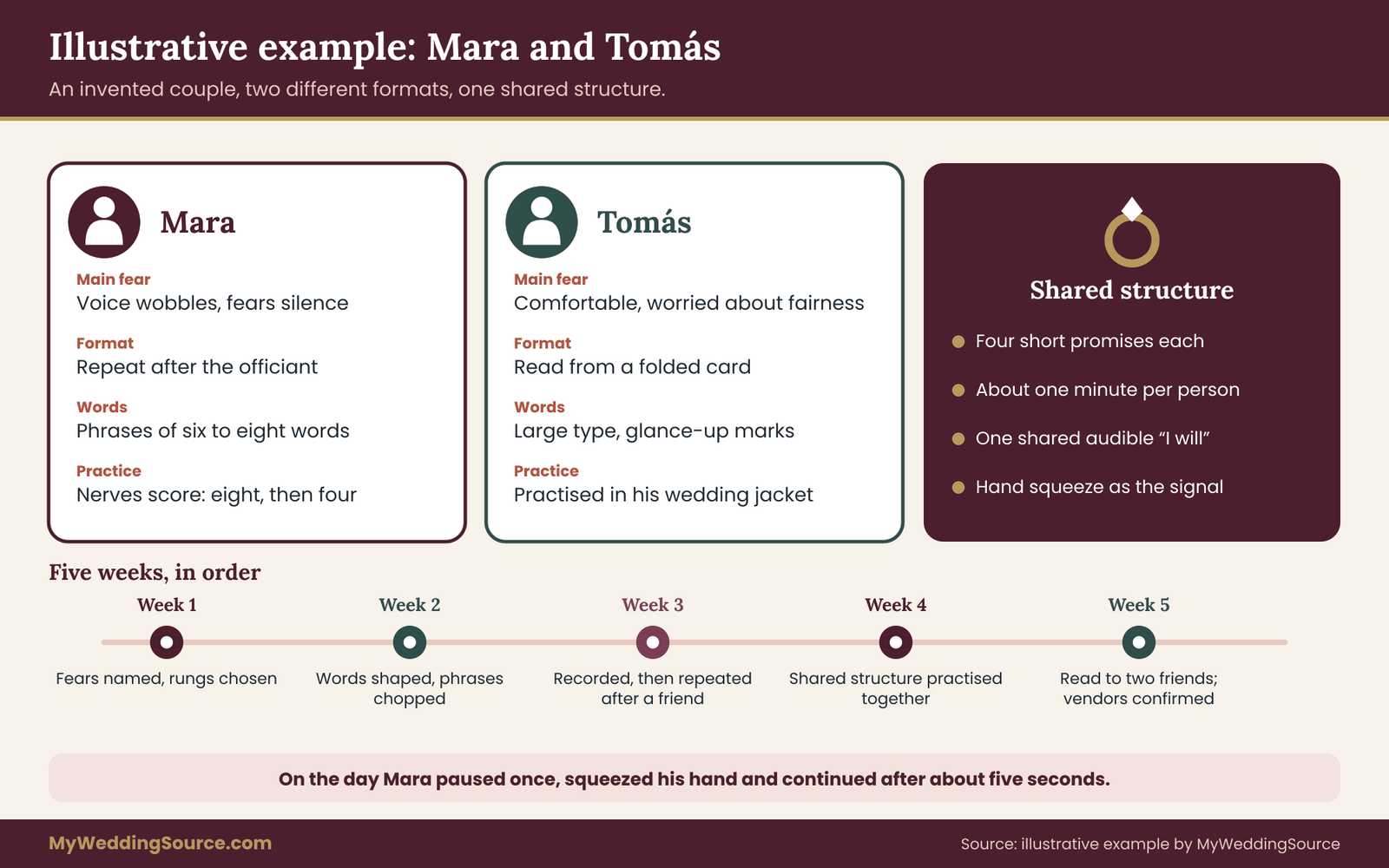
Here is an invented example of shy wedding vows to show the process end to end. Mara and Tomás are not real people, and the details are illustrative only.
Mara is a software tester who dislikes being the center of attention. Tomás teaches high school and is comfortable in front of a room, but he knows Mara finds speeches hard. They are marrying in a garden venue with forty guests, a hired officiant and a small sound system.
Step one: name the fears
They each did the empty-room test from earlier. Mara found that her voice wobbled even alone, and that she most feared silence after a missed line. Tomás found that he was fine speaking but worried about matching Mara’s comfort. The audience dial and voice dial were Mara’s concerns, and fairness was Tomás’s.
Step two: choose the rung
Mara chose repeat-after-the-officiant, because it removes silence and memory. Tomás chose a card, so that he could keep his promise short and matching. They agreed on a shared structure: four short promises each, about a minute per person, then a shared audible “I will.”
Step three: shape the words
Mara wrote four promises and, following the chopping rule, her officiant split them into phrases of about six to eight words. Tomás wrote four lines and printed them in large type on a folded card, with a mark where he would glance up. They both removed a sentence with a tongue-twister, and Tomás moved Mara’s name to the start of a phrase.
Step four: run the ramp
Over five weeks, Mara read her phrases aloud alone, recorded herself, then repeated them after a friend playing the officiant. Tomás practiced with his card in his wedding jacket. In week four they practiced the structure together without sharing exact words. In week five, they read to two close friends. Mara’s nerves score fell from an eight to a four across the weeks, by her own notes.
Step five: ask the vendors
They asked the officiant to stand close and pace slowly, and agreed on a hand squeeze as the signal. They asked the venue for a stand microphone and a sound check, which the venue offered at no extra charge, according to their written confirmation. They asked the photographer to stay back and to record audio using a clip on the officiant.
Step six: the recovery plan
They wrote a one-page plan: spare card with Tomás’s sister, printed copy of Mara’s phrases with the officiant, water and tissues with the best man, signal agreed. During the ceremony, Mara paused once, squeezed Tomás’s hand, and continued after about five seconds. Nobody in the garden seemed to mind, and the officiant simply waited.
What the example shows
The example of shy wedding vows is ordinary on purpose. Nobody was brave in a dramatic way. They picked formats that matched their fears, practiced in small steps, and prepared for a pause. That is the whole method, and it works for any pair of rungs on the ladder.
Your next steps
Here is a short path for shy wedding vows that you can start today.
- Take the empty-room test. Say one sentence aloud alone, and write down what bothered you most: audience, voice, memory or tears.
- Choose a rung for your shy wedding vows. Use the decision rules and pick the lowest rung that still feels like you. Choose separately if your partner differs.
- Tell your officiant. Share your choice, the pacing you want, the signal for a pause, and ask which words must be spoken live.
- Shape the words for the mouth. Short phrases, plain sentences, hard words at the start of a breath.
- Start the ramp. Six small steps over about six weeks, with a rest between.
- Confirm the setup. Microphone, sound check, printed backups, a calm helper and a one-page recovery plan.
- Add it to your plan. Put the vows moment into your wedding planning checklist so it does not wait until the final week.
FAQ
Is it acceptable to read shy wedding vows from a card?
Yes. Reading from a card is common and widely accepted. Guests care that you are making a promise to each other, not whether you memorized it. Use a stiff card, large type and short lines, and glance up at your partner a few times. A card also removes the fear of going blank, which frees attention for the moment itself.
Do we still need to say any words aloud for the marriage to be legal?
Often yes, but rules differ by state. Many places require a spoken declaration or consent in front of an officiant, separate from personal promises. Ask your officiant and your local marriage license office which words must be said live, and plan to say those even if the rest of your promises are recorded or read for you.
What if I cry or my voice shakes?
Pause, breathe and continue when ready. Guests generally take tears as sincerity, and a short pause is rarely noticed as a problem. Agree on a signal with your officiant, such as a hand squeeze, so the ceremony waits for you. Practice the pause in rehearsal by stopping on purpose, counting to three and resuming.
Can the officiant read our vows for us?
Yes, if you prefer. Give the officiant the text early, agree on pronunciation and ask for a steady, warm pace. You can add a short line of your own, such as a shared “I will,” so both voices appear in the ceremony. Check which legal words you must say yourself, because those usually cannot be handed to someone else.
How long does the practice plan take?
About six weeks works well, with short sessions a few times a week, but it can be compressed to three. If the wedding is only days away, skip the full ramp, choose repeat-after or a card, and do a few read-throughs. The order of the steps matters more than the length of each one.
What if my partner is comfortable speaking and my shy wedding vows feel harder?
Match the shape, not the method, when shy wedding vows differ between partners. Agree on similar length and structure, then let each person deliver in the way that suits them, one from memory and one from a card, for example. Guests will see two matching promises. A shared spoken line at the end helps the moment feel unified.
Should we whisper our vows, and will guests feel left out?
A whispered exchange can be lovely if the audience is your main fear. To keep guests included, print the promises in the program, have the officiant introduce the moment, or include one audible line. Ask your videographer how they will capture the audio, since soft voices are easy to lose on a recording.
What if we change our minds on the wedding day?
Switching formats late for shy wedding vows is fine. Carry a card as a backup even if you plan to speak freely, and tell your officiant if you want to move to repeat-after. A calm helper, a printed copy and a signal for a pause make last-minute changes simple. The moment is yours, and a gentle adjustment still counts.
Sources
- U.S. Copyright Office: general information on copyright, relevant if you quote published text in your promises.
- ADA.gov, U.S. Department of Justice: accessibility principles for public places and services.
- National Institute of Mental Health: plain-language information on social anxiety and where to find help.
- National Institute on Deafness and Other Communication Disorders: information on voice, speech and language differences, including stuttering.
- American Speech-Language-Hearing Association: public resources on speech and communication.
- USA.gov: links to state and local marriage license offices and rules.
- PlainLanguage.gov: federal guidance on writing short, clear sentences.
- Library of Congress: guidance on preserving personal digital files such as recordings.
- Cybersecurity and Infrastructure Security Agency: general guidance on backing up important files.