
Experience vouchers are the cooking classes, tasting menus, tours, stays and trip credits that couples add to a registry instead of towels and cookware. This guide shows how to test each one for expiry, booking limits, name rules and refund risk before it goes on your list, and how to write the thank-you notes that keep givers in the loop until the experience actually happens.
Before you list a voucher, run six checks: the clock (expiry and start date), the calendar (blackout dates and booking windows), capacity (class size or seats), the holder (whose name is on it and who can attend), the place (travel and extra costs), and recourse (what you get back if the provider cancels or closes). Score each check from zero to two. Register vouchers that score nine or more, edit or reword the middle ones, and turn the weakest into a plain cash fund. Then log every voucher with a reminder date, and send two thank-you notes: one when it arrives and one after you use it.
A registry full of kitchen gadgets is easy to defend. Experience vouchers take more care. A gift is a box, the box arrives, the box can be returned. Experience vouchers are different in a way that is easy to miss when you are excited about a pasta-making class in Bologna or a long weekend in the mountains. They are promises about the future, made by a business that is not you and not the person who paid.
Every promise has conditions: a date by which you must book, a list of days it cannot be used, a limit on how many people can come, a name on the front. If you do not know the conditions, you cannot tell your guests honestly what they are buying.
Most couples who add experience vouchers to a registry do it for good reasons. They already own a toaster. They would rather learn something together or see somewhere new. Guests often like it too, because a class or a trip feels more personal than a place setting. None of that is the problem.
The problem with experience vouchers is the gap between the day someone clicks “buy” and the day you finally sit at the counter with an apron on. That gap is often months long, sometimes more than a year, and a lot can change inside it.
This guide stays inside that gap. It does not argue about whether you should have a registry at all, and it does not compare every kind of non-traditional gift. Our registry ideas page covers the broad menu of what couples list. Here the subject is narrow: experience vouchers for cooking classes and travel experiences, the booking constraints that decide whether a voucher gets used, the money-back questions nobody asks until something goes wrong, and the thank-you notes that go with them.
A note on scope. This is general information, not legal, tax or financial advice. Voucher and consumer rules differ by state and by seller, and the fine print in your own voucher controls. Where a rule matters, the article points you to the agency or the supplier so you can confirm the current version yourself.
What experience vouchers are and how they differ from cash funds
The phrase “experience vouchers” covers more than one kind of product, and the kind decides most of the risk. It helps to sort what you see on registry sites and provider pages into four forms before you do anything else.
The provider voucher. A cooking school, a tour operator or a hotel sells a voucher or gift certificate directly. It is redeemable only with that business. The terms live on the provider’s own website, and the provider is the only party that can change a date, extend an expiry or issue a refund.
The platform voucher. A marketplace sells credit for experiences from many providers. The platform’s terms sit on top of each provider’s terms, so you have two sets of rules. When a class is cancelled, you may have to work out whether the platform or the provider owes you the money.
The pay-in-full booking. A guest buys a specific class on a specific date for you. This is the most concrete form, and also the most fragile, because the date was chosen by someone who may not know your calendar.
The contribution toward a trip. Guests give money toward a honeymoon, a flight or a hotel night through a registry fund. There is no voucher at all. The money usually goes to you, less any fee, and you buy the travel yourselves.
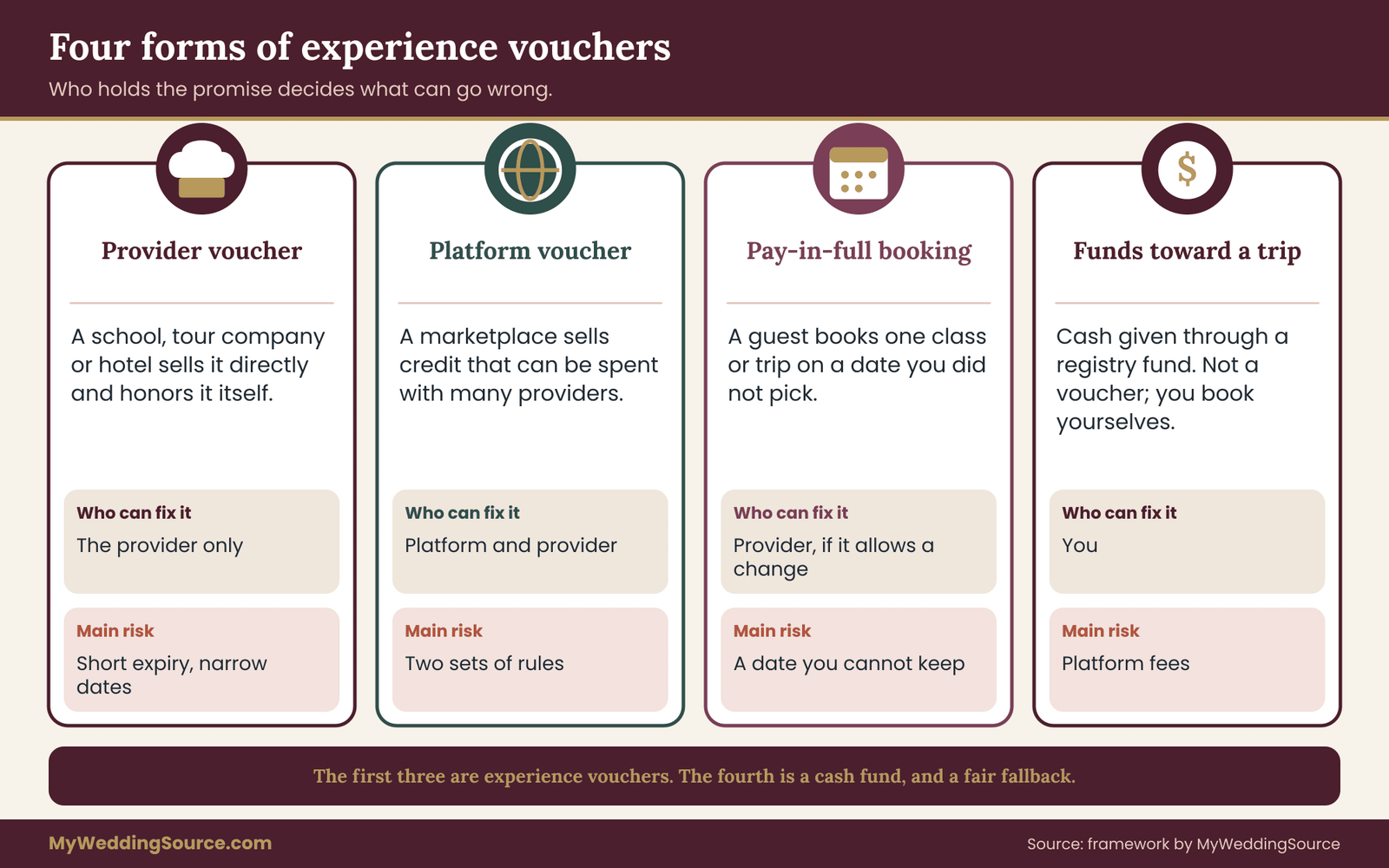
The first three forms are what this guide calls experience vouchers. The fourth is closer to a cash fund, and we cover it here mostly as a fallback, because a cash fund is what a weak voucher should often become. A fund gives you the freedom to book the class or the flight on your own dates under your own rules, and it removes the middleman between the giver’s money and your plans.
Why the form of experience vouchers matters more than the destination
Two couples can both register for “a cooking class” and carry very different risks. One lists a pay-in-full booking at a local school for a Saturday in March. The other lists a platform credit that can be spent at any of two hundred providers. The first is specific and easy to describe, but it breaks if March does not work. The second is flexible but depends on whether providers near you actually appear on the platform, and whether the credit expires before you find a class you like.
Neither is wrong. What matters is that you know which one you are asking guests to buy. When you list experience vouchers, you are asking people to spend real money on a product whose value depends on rules they will never read. Your job is to read the rules for them, and to say plainly in the listing what they are buying.
What experience vouchers are not
They are not store gift cards in the ordinary sense, even when they look like them. Federal and state consumer rules treat some gift cards and certificates in specific ways, and whether a particular voucher for one named class falls under those rules depends on how it is sold and where you live. The Federal Trade Commission and your state attorney general’s office are the places to check, and the sources list at the end of this article points to them.
Do not assume that a voucher will be honored the way a plain store card would be, and do not assume it will not. Read the terms, then ask.
They are also not confirmed bookings. A voucher is a right to ask for a date, not a reserved seat, and most experience vouchers work that way. Some providers hold a seat the moment the voucher is bought. Many do not. The distinction is one of the first questions to ask a provider, and it comes up again in the section on capacity.
The redemption risk test for experience vouchers
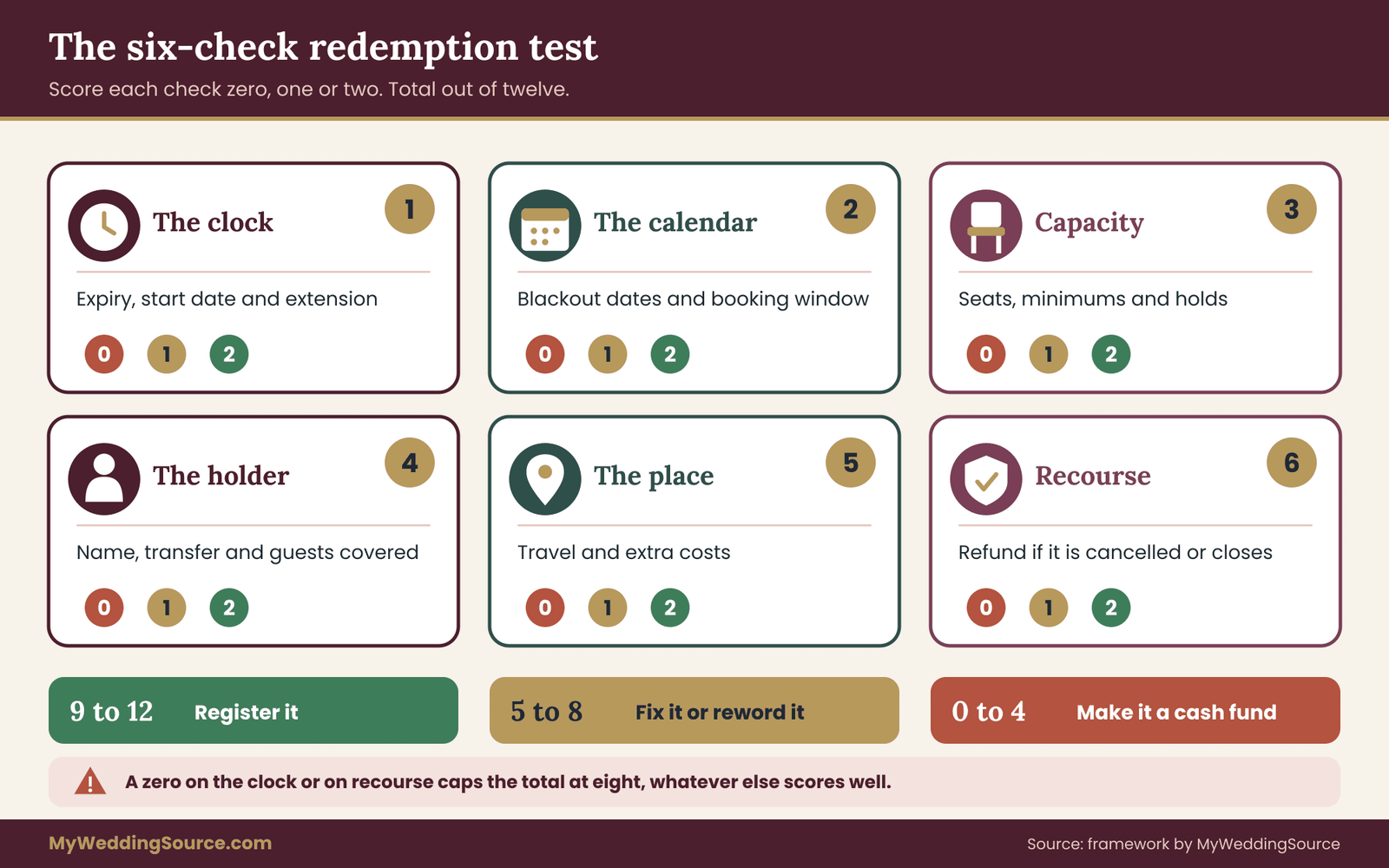
The method for judging experience vouchers is a comparison you can run in about fifteen minutes per voucher. It has six checks. Each check asks a question that can be answered from the provider’s terms or a short email, and each is scored from zero to two. A zero means the terms are a problem or you cannot find them. A one means workable with a caveat. A two means the terms are clear and fit your life.
Check one: the clock. When does the voucher start, when does it expire, and can the expiry be extended? A voucher that expires in twelve months from purchase gives you less than twelve months to use it, because guests buy at different times and you will not be free every week of that year.
Check two: the calendar. Which dates are excluded, how far ahead must you book, and how many dates are actually open? A cooking class that runs one Thursday a month is not the same product as one that runs daily.
Check three: capacity. How many seats does a session have, are seats held for voucher holders, and what happens if a class does not reach its minimum? This is where group classes and private classes diverge sharply.
Check four: the holder. Whose name is on the voucher, can it be transferred, and how many people does it cover? A voucher “for two” may in fact cover one person’s class and a second person’s tasting.
Check five: the place. What does it cost to get there and be there? A flight credit that covers the fare but not baggage, taxes or a seat selection is not a free trip. A class in another city adds travel to a gift that looked self-contained.
Check six: recourse. If the provider cancels, closes or refuses a date, what do you get back: cash, credit, nothing? Who do you ask, and by when?
How to score experience vouchers
Give each check zero, one or two points. The total runs from zero to twelve.
A score of nine to twelve means the voucher is a fair candidate for your registry as it stands. A score of five to eight means the voucher might still work, but you should either ask the provider to fix a weak check in writing or reword the listing so guests know the limit. A score of zero to four means the voucher is more trouble than it is worth, and the same money is better received as a cash fund.
One rule keeps the scoring honest: a zero on the clock or on recourse caps the total at eight, no matter how well the voucher does elsewhere. Those two checks decide whether a guest’s money can disappear, which is why experience vouchers with a weak clock or no recourse do not deserve a recommendation.
A beautiful class with an expiry you cannot meet, or a trip credit with no refund route if the supplier fails, should not be recommended to your family on the strength of a good location.
Why six checks and not a longer list
You could invent twenty checks, and some will occur to you as you read provider terms. These six cover the failures that actually turn into complaints: a voucher that ran out, a date that could not be found, a seat that was not there, a name that did not match, a cost nobody mentioned and a refund that never came.
If a seventh concern matters to you, such as accessibility or a dietary need, treat it as a note beside the score rather than a new column. The test stays quick, and you will actually use it.
What a voucher score is not
A score is not a verdict on the provider. A small family cooking school may score a six because it has a short expiry and runs few classes, and still be a lovely place with an owner who would happily extend a voucher if asked. The score tells you how much work the voucher will take, and how much of that work you should do before the registry goes live.
A six that becomes an eight after one friendly email is a good outcome. A six that stays a six because nobody replies is information too.
The clock: expiry and start dates on experience vouchers
Time limits are the most common reason experience vouchers end up unused, so start there. There are three dates to look for, and they are often hidden in different places.
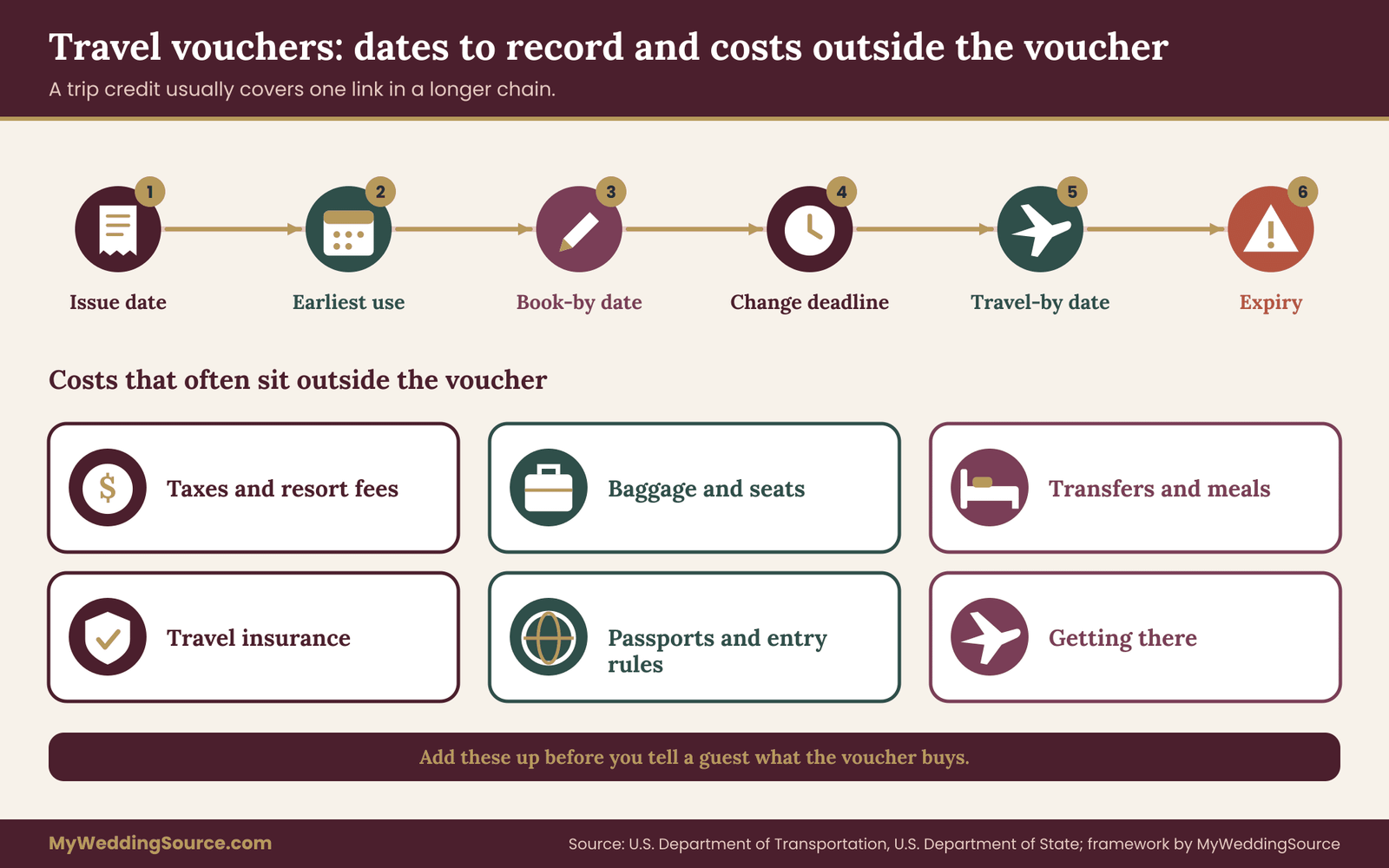
The first is the issue date, the day the voucher is bought or generated. The second is the earliest use date, which some providers set because they sell seasonal classes or trips. The third is the expiry date, the last day you may redeem or book. Some providers also publish a separate book-by date and a travel-by date, and for travel they can be months apart.
Write all of them down for each of your experience vouchers. If the terms say only “valid for one year,” ask whether that means one year to book or one year to complete the experience.
Counting the real window
A guest who buys a voucher the week your registry opens may hand you a one-year clock that starts six months before the wedding. By the honeymoon you may have six months left, and the wedding itself has eaten your free weekends. The usable window is the time between the day you could realistically start booking and the day the voucher expires, minus the weeks when you are away, working long hours or recovering from a very busy year.
A simple way to work it out: take the expiry date, subtract the date you expect to return from the wedding and honeymoon, then count the calendar weeks left. If you want to take a class on a weekend, count weekends. A class that runs on the first Saturday of the month leaves you twelve chances a year at most. A voucher with seven chances left is already a risky one for a couple whose schedules rarely match.
What to do about short expiry dates on experience vouchers
Short clocks on experience vouchers are not always fatal. They are negotiable more often than people think, and a provider that wants a good review and a happy customer will often say yes to a polite request. Before you list the voucher, ask the provider in writing whether it can be extended once at no charge, and ask what the extension fee would be if one applies.
Save the reply with the voucher record. A written answer from the provider is worth much more than a general statement that “they are usually flexible.”
If a provider refuses, you have three choices. You can list the voucher anyway and tell guests the expiry in the description. You can shorten your plan by scheduling the class soon after the wedding. Or you can move the money into a cash fund and book the class yourselves later. The third option costs you a fee on some registry platforms, which is why the fee check belongs in your comparison.
Consumer rules on expiry for experience vouchers
Some federal and state rules limit how quickly certain gift cards and certificates can expire, and some states go further than federal rules. Those rules were written with ordinary store cards in mind, and they carry exceptions, so a voucher for a particular class or trip may or may not be covered.
The Federal Trade Commission publishes plain-language consumer advice on gift cards, and your state attorney general’s office can tell you what applies where you live. If you rely on a rule to protect a voucher, confirm it with one of those offices, not with a registry listing or a provider’s sales page.
Do not read the absence of an expiry date as a promise that the voucher is good forever. Providers close, change owners and update their terms. A voucher without a printed expiry may still be subject to the provider’s terms at the time of redemption. Ask the question anyway.
Start dates and seasonal windows
Some experience vouchers cannot be used when you first receive them. A harvest cooking class that runs only in autumn, a whale-watching tour with a summer season, or a ski weekend that opens in December all have start dates. If your wedding is in April and the voucher’s earliest use date is October, you have no problem so long as the expiry is far enough after October. If the voucher expires in September, you can never use it.
Check both ends together. Put the start date, the expiry and your own calendar on one page, and look for the stretch where all three agree. If there is no such stretch, do not list the voucher.
Calendar and capacity: blackout dates, booking windows and seat limits for experience vouchers
The clock tells you how long you have. The calendar tells you how many of those days are actually open. This is the check that most often surprises couples, because it is rarely mentioned in the listing and always mentioned in the terms.
Blackout dates
Blackout dates are days when experience vouchers cannot be used. Travel experience vouchers often exclude holidays, school vacations and local festival weekends. Dining and class experience vouchers often exclude Friday and Saturday evenings, Mother’s Day, New Year’s Eve and other high-demand dates. Those are the very days many working couples want.
Read the list, then lay it on your calendar. If you work Monday to Friday and the class runs Monday to Thursday, the voucher works only on your vacation days. If the travel voucher excludes July, August and December, and your honeymoon is in July, the voucher does not fit the trip you planned. Neither situation is unusual, and both are fixable before listing: change the plan or change the item.
Booking windows
A booking window is how far in advance you must book, and sometimes how far ahead you can. Popular classes fill weeks out. A weekend lodging voucher may require a minimum notice and cap the maximum, for instance no more than six months ahead. Some travel providers allow changes only until a set number of days before departure.
Ask three questions. How early must we book? How far ahead can we book? How late can we change a date? The answers set the shape of your plan. If you need to book three months ahead and the voucher expires in four, you have a single month to choose a date and no room for a mistake.
Availability is not a reservation for experience vouchers
Many experience vouchers promise “access” to a class or a trip, not a held seat. The provider sells the voucher, then sells the same seats to other customers. If a class sells out and your voucher is for a standard price, you may find that every date for the next three months is full. That is not necessarily a breach of the terms. It is how the product works.
Two phrasings are worth distinguishing. “Subject to availability” means the provider can say no. “Reserved for voucher holders” or a stated allocation means some seats are set aside. Ask for the second where you can, and when you cannot get it, treat the voucher as a lower-capacity one in your score.
Class sizes, minimums and cancellations by the provider
Group cooking classes usually have a maximum and a minimum number of participants. The maximum controls how quickly dates fill. The minimum controls whether a class runs at all. A school might state that a class is cancelled if fewer than a set number sign up, and then offer a different date or a refund. Ask which, and by when the school notifies you.
Private classes, where the chef or instructor comes to you or hosts you alone, usually have fewer capacity problems and more scheduling ones, because one person’s calendar controls everything. A private class is often priced per session or per group. A group class is often priced per person. For a voucher “for two,” confirm whether the price already assumes a second seat.
Time of day and duration
Two more details sit in the calendar check and rarely appear on a registry page. How long does the experience last? A four-hour class that starts at ten in the morning and a half-day excursion that leaves at dawn are different commitments. Is the date a single session or several?
A series of four evening classes can fit a voucher worth one class only if the provider says so. Write the duration and the number of sessions into your notes, and compare them with how you really spend weekends.
A short decision rule for the calendar check
Score two if there are open dates in at least several different months, no blackout that cancels your usual free days, and a booking window you can meet. Score one if you can name one or two limits and live with them. Score zero if the voucher works only in a narrow band, seats are not held and nobody will tell you how often classes run.
A zero here is usually a signal to move the item to a cash fund or to choose a different provider, because the problem will not improve after the wedding.
Working through an example of the calendar check
Suppose a voucher lists a hands-on bread class that runs on the second Sunday of the month, from ten in the morning to two in the afternoon, with a maximum of eight students and a booking window of four weeks. You have a standing commitment on the second Sunday of three months out of twelve. That leaves nine possible Sundays a year, before you account for the honeymoon and any dates the school adds or drops.
With a twelve-month expiry, you have at most nine usable Sundays, and fewer once the wedding year is over. A class with a maximum of eight students that sells out early could take away several of those. Do the same arithmetic for travel experience vouchers with blackout periods, and you can tell in ten minutes whether the experience is realistic. Such arithmetic is the difference between a registry item you can defend and one that quietly goes to waste.
Cooking classes: the booking constraints that matter most
Cooking classes are among the most popular experience vouchers on registries because they are local, they do not need a passport and they suit a couple who likes to eat. They also have a surprising number of conditions, because a class is part workshop, part meal and part scheduling puzzle. The checks below turn the general test into questions a cooking school can answer in a single email.
Group, semi-private or private
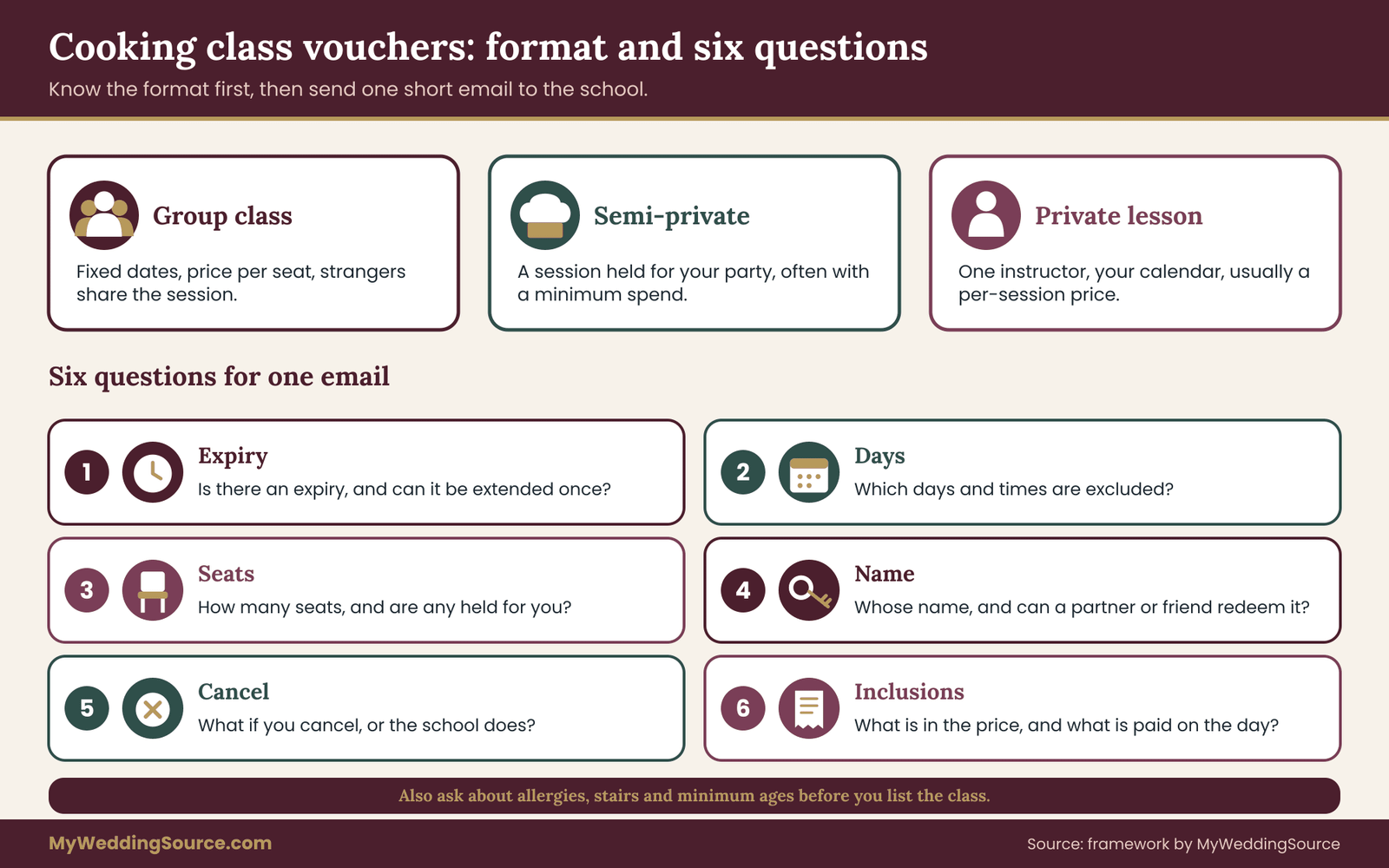
The format changes almost everything. In a group class you join strangers on a fixed date at a fixed price per person. Seats are limited, dates are set by the school, and you take what is offered. In a semi-private class the school reserves a session for a small party, often with a minimum spend. In a private class an instructor teaches only you, sometimes in your own kitchen.
Group classes tend to be the cheapest per person and the hardest to schedule around. Private classes cost more and bend to your calendar. When you list a voucher, say which format it covers. “A pasta class for two” is not enough if a guest assumes it is private and the school sells it as one seat each in a shared session.
What cooking class vouchers actually cover
Read the inclusions as a list. Ingredients, equipment and the meal you eat afterward are usually included, though not always. Wine pairings, take-home recipes and aprons may be extras. Some classes include a tasting, others a full seated meal, others only what you cook. A voucher for a fixed amount may cover the class fee but not the drinks, or may stop at a total that leaves a balance for you to pay on the day.
Ask the school three plain questions. What is included in the price on this voucher? What would we pay extra for on the day? Is gratuity added? If the school can answer in a short paragraph, keep it in your voucher record. If it cannot, count that as a mark against the clarity of the terms.
Skill level, pace and fit
A class labeled “intermediate” is not the right gift for a couple who has never held a knife, and a beginner session may bore a pair who already cook well. Check how the school describes levels and whether it lets you move between sessions. Look at the pace too. A demonstration class, where you watch a chef cook, is a different afternoon from a hands-on class in which everyone chops, stirs and cleans.
None of this is a reason to avoid a class. It is a reason to read the description before you register for it, so that the voucher guests buy is one you will enjoy using.
Dietary needs, allergies and cross-contact
If either of you has a food allergy, an intolerance or a religious or ethical dietary rule, ask the school how it handles that before you list the class. Many schools can adapt a menu. Some cannot, because the recipes, the shared equipment and the shared work surfaces make true allergen separation impractical. Ask how the kitchen manages cross-contact, whether substitutions are possible and whether the school wants advance notice.
Do not wait until the day of the class to say it out loud. A good provider would much rather hear about a shellfish allergy in an email two weeks ahead than at the counter. If the answer is that the class cannot accommodate you safely, take it off the registry, and tell the provider why in a short, friendly note. That saves everyone a disappointing evening.
Accessibility and physical demands
Cooking classes involve standing, lifting pots, using knives and sometimes climbing stairs. If a member of your party uses a wheelchair, has limited stamina or needs seating, ask about the venue before you list it. The ADA information from the U.S. Department of Justice explains the general accessibility obligations of many businesses, and the sources list below points to it.
A direct conversation with the school is faster and more specific: what is the entrance like, how high are the counters, can a stool be provided, are there restrooms on the same level?
Location, parking and the cost of getting there
A class in your own city has a simple cost. A class in another city adds fuel, parking, a train ticket or a hotel night. A voucher for a famous school three hours away can quietly become a weekend trip that costs more than the voucher was worth. Count that cost under the “place” check in the test, and note it in the listing so guests understand that the class is a destination.
Providers that cancel classes sold as experience vouchers
Providers sometimes cancel a class sold through experience vouchers for low enrollment, a sick instructor, a kitchen problem or a weather event. Ask three things: how much notice the provider gives, whether you get a replacement date or a refund, and how long the replacement is valid.
A strong answer reads something like this: if we cancel, you choose another date within the voucher’s validity or receive a refund of the value of the class. A weak answer is silence. Silence scores a zero or a one on the recourse check.
Guest-bought bookings among experience vouchers
Occasionally a guest buys a specific date for you, such as a Saturday in March, instead of a flexible voucher. It feels generous and personal, but it is the riskiest form. You may not be free, you may have no way to move the date without a fee, and you may feel obliged to go anyway.
If a guest does this, say thank you warmly, then ask whether the class can be moved. Most schools allow one reschedule with notice. Save the reschedule terms and tell the guest later how it went. The thank-you section shows you how to word both messages.
You can prevent most of this by listing flexible experience vouchers rather than dated bookings, and by saying in the description that the class date will be chosen after the wedding.
Cheap experience vouchers for cooking classes
Watch for experience vouchers that sit well below the school’s usual price. Some classes are sold through discount platforms with stricter terms than the school’s own vouchers: shorter expiry, a smaller menu, fewer dates, a ban on refunds. The discount may be real, but the restrictions are part of the price. Among experience vouchers, one that seems inexpensive and cannot be used is the most expensive kind.
If you spot a bargain, compare its terms line by line with a standard voucher from the same school. Often the school will sell a regular voucher at a fair price with better conditions, and the difference is worth the extra money to a guest who would like their gift to work. The same applies to classes sold as part of a multi-experience bundle: the bundle price may be low because each part has a narrow window.
Cooking classes as a gift to the couple, not a task
One last consideration is the one a registry cannot show. A class is a shared evening, not a chore. If one partner dislikes cooking in public or is shy in groups, the voucher will be used with some reluctance, or not at all. That is not a failure of the provider’s terms. It is a sign that the voucher does not fit you.
Be honest about this when you choose which experience vouchers to list. A voucher that you would be happy to use only if you were already booked is a weak registry item, and a stronger candidate may be something you would choose for yourselves this month.
Questions to send a cooking school before listing a voucher
Send one short email with six questions and keep the reply with the voucher record. What is the expiry, and can it be extended once? Which days and times are excluded? How many seats are in a session, and are seats held for voucher holders?
Is the voucher in one person’s name and can it be used by a partner or a friend? What happens if you cancel the class or we need to move it? What is included in the price, and what would we pay on the day?
Six questions, one email, usually a reply within a few days. If the school does not reply at all, you have learned something about how it will treat you after the wedding, and you can move on to another school with a clear conscience. Experience vouchers from a provider that answers a pre-sale question promptly tend to be easier to use, because the same person is likely to answer the later ones.
Travel experiences as experience vouchers: tours, stays and trip credits
Travel is where experience vouchers carry the most money and the most moving parts. A cooking class is one provider, one place, one afternoon. A trip is a chain: flights, lodging, transfers, tours, taxes, insurance and documents, often from several businesses that do not coordinate with each other. Each link has its own terms, and a voucher usually covers only one of them.
Sort travel gifts into three kinds
Single-supplier vouchers. A hotel night, a guided tour, a rail pass or a boat trip, sold by the business that provides it. These work much like a class voucher, and these experience vouchers can be scored with the same six checks.
Trip credits. A balance with a travel agency, an online travel company or an airline that can be spent on bookings. Flexibility is the appeal. The risks are an expiry on the balance, a limit on which products it can buy and extra fees at checkout.
Funds toward a trip. Cash given through a honeymoon fund. This is not a voucher at all. It goes to you, the registry or payment service may deduct fees, and the booking decisions are entirely yours.
If you are not sure what a registry listing of experience vouchers actually sells, find the terms before you add it. A “honeymoon fund” that pays you cash and a “honeymoon package” that is a voucher with a named supplier look alike on a registry page and behave very differently.
The place check: costs outside experience vouchers
Many travel experience vouchers cover a fixed amount, and everything else falls to you. List the things that are rarely included.
Taxes, resort fees, cleaning fees and local charges can be added at checkout. Baggage, seat selection and meals on an airline are often separate. Transfers between an airport and a hotel may not be covered. Travel insurance is usually your own purchase. Passports, visas and entry fees are your responsibility, and entry rules change, so check them with the U.S. Department of State and the destination’s own authorities before you commit.
Add these up and compare the total with what you planned to spend. If a voucher covers four nights but the resort fee is paid per night in cash at the desk, the cost is real even though it never appears on the registry page. The point of the place check is to show guests an honest picture, and to show you whether the voucher moves you toward a trip you can afford.
Seller of travel rules and who stands behind the booking
A few states regulate businesses that sell travel, and some require registration or financial protection. Rules differ widely, and many sellers are not covered. The practical step is to look up the seller, check whether your state has a travel seller program and read how refunds are handled if the supplier fails. Your state attorney general or consumer protection office can tell you what exists locally. The National Association of Attorneys General keeps a directory of state offices, and the sources list points to it.
Ask a different question, too: who is the merchant? If a voucher is sold by a platform that resells a hotel’s rooms, a hotel closure may mean the platform owes you a refund, or it may mean the platform’s terms say it does not. Look for words such as “agent,” “reseller” and “merchant of record,” and ask the platform plainly who refunds the money.
Airline credits and refunds
Flights have their own rules. The U.S. Department of Transportation publishes information about refunds when an airline cancels or significantly changes a flight, and it separates refunds from credits. If someone gives you an airline credit as a gift, or if your registry holds a voucher for a flight, the airline’s own terms say how long the credit lasts, whether it can be transferred to another person and whether it can be used for companion fares.
The wording matters. A credit issued after a cancelled flight may follow different rules from a voucher bought as a gift. If you receive an airline credit as part of a gift, record the expiry and the name restriction at once. Airline credits are usually tied to the traveler named on the original ticket, which means a gift voucher may be redeemable only by one person. For a couple traveling together, that is a significant limit and worth a zero on the holder check.
If you hold a delayed honeymoon and an airline credit, our guide to wedding cash-flow planning explains how to track credits and deposits next to the rest of your wedding payments.
Blackout dates and peak seasons on travel experience vouchers
Travel experience vouchers lean on blackout dates more than almost any other kind. Ask for the list in writing and hold it against the season you want to travel. If your honeymoon season is the busiest one at the destination, the voucher may be unusable in the very weeks you were saving it for. Ask also about change fees. A voucher that permits one date change at no cost is worth far more than one that charges a percentage of the value.
Travel insurance and supplier failure
Travel insurance exists to cover certain unexpected events, but policies vary widely in what they cover and what they exclude. A gift voucher is not a travel insurance policy, and none of these experience vouchers replaces one, and an insurer may treat a voucher purchased by someone else differently from a trip you paid for yourselves. Read the policy before you assume anything is covered, and talk to the insurer or a licensed agent if you need an answer for your own trip.
Supplier failure, where a tour operator or airline stops operating, is the scenario nobody thinks about when buying a gift. Ask whether the seller is bonded or protected under any program, how credit card payments are treated and what documents you would need to claim. If the voucher was bought with a credit card, the giver may have rights to dispute a charge for services that were never delivered, and the Consumer Financial Protection Bureau explains how disputes work, including timing limits that can be as short as sixty days from the statement.
That route belongs to the cardholder, so it only helps if the giver knows about the problem in time.
Group trips and add-ons
Some couples invite family to join the honeymoon or plan a wedding-adjacent trip with guests. A voucher bought for two travelers may not extend to a third. Adding a person after booking can mean a new reservation at a new price. If you want an experience that others can join, ask whether the voucher can be applied to a booking for a larger party, and who must be named.
Booking travel experience vouchers too early or too late
Booking a trip the day after the wedding sounds pleasant but can spend a voucher before you know your schedule. Booking too late can run into expiry. The sensible window for most couples is the time after wedding costs settle and before the clock runs short. As a rule of thumb that you can adjust, aim to choose and book within the first half of the voucher’s validity, so that the second half acts as a safety margin for a rescheduled date.
A worked check for travel experience vouchers
Imagine a hotel group sells a voucher worth two nights in a standard room at a named resort. The terms say it expires twelve months from issue, excludes weekends in high season, requires booking at least thirty days ahead, is valid for the named guest and one companion, does not cover taxes or resort fees, and can be changed once at no charge.
Run the six checks. The clock is fine at a full year, though a guest who buys late shortens it. The calendar is restricted, which makes it a one. Capacity is based on availability, so another one. The holder is workable with one named guest and one companion, which scores a two.
The place check costs you taxes and fees, so a one. Recourse is not stated, which scores a zero. The total is six out of twelve, and the zero on recourse caps the score anyway. A voucher like this needs a written answer about refunds before it goes on a registry.
That is the whole method for experience vouchers, applied to travel in the time it takes to read the terms twice. For an honest comparison, our wedding budget page helps you put the fees on top of the voucher beside the other trip costs, so the real cost is visible before you share the list.
Name, transfer and guest limits on experience vouchers
The holder check asks a question that seems minor until a voucher is refused at the door: whose experience is this, and who is allowed to use it?
Whose name is on the voucher
Experience vouchers are issued in one of three ways. Some are bearer vouchers, usable by whoever holds the code. Some are issued in the giver’s name, with a recipient field. Others are issued in the recipient’s name and require identification. Where the voucher names one partner and not the other, ask the provider whether the second partner can redeem it. Most small providers will say yes, but you want that in writing before the day.
Names matter more on travel. An airline credit or a tour booking may need a name that matches a passport exactly. If either of you plans to change your name after the wedding, the date of the change matters: a booking made under one name and a passport under another can cause trouble at a check-in desk.
Our guide to wedding records covers the order for updating names, and the safe rule for travel is to book in the name that appears on the identification you will carry on the day of travel.
Transfer and resale of experience vouchers
Some providers allow experience vouchers to be passed to another person, and some forbid it. Prohibitions on transfer are common on promotional or discounted vouchers and on airline credits. If a voucher cannot be transferred, a gift to a couple may be usable by only one of them, or by neither if the name field is wrong.
Why does this matter for a registry? Because couples change plans. A partner may be unable to travel, a friend may be a better fit for a class, a baby may arrive. A transferable voucher survives all of that. A non-transferable one may not. Ask about transfers directly, and score the holder check accordingly: two for a voucher that lets you name either partner or a substitute, one if it is tied to one named person but covers two attendees, zero if it is tied to a single person who cannot be changed.
“For two” and what it really means
Registry listings for experience vouchers often say “for two,” and the provider’s terms may say something quite different. A class voucher “for two” might cover two seats in a group class, or one seat plus a discount on a second, or a private session for up to two. A dinner experience “for two” might cover a set menu without drinks. A hotel “for two” is usually about occupancy, which may exclude a child.
Ask the provider to confirm the number of attendees in plain words for each of the experience vouchers you list. If you intend to bring a friend, or later a child, ask how that works. The answer shapes how you describe the item to guests, which is covered in the listing section below.
Guests and plus-ones
Another form of the holder question concerns people who are not you. A guest might want to attend a class with you, or you might want to share a voucher with a parent for an anniversary trip. If the voucher is a bearer voucher, there is no problem. If it is named, the provider may need to reissue it.
Children, minimum ages and access for experience vouchers
Some cooking schools set a minimum age, often for knife and stove work. Tours may restrict young children or require a guardian. If you expect to have children, or if you plan to use the voucher when family visits, check the age rules. An experience voucher that cannot be used by the family you will have in two years has a shorter useful life than its expiry date suggests.
A worked holder check
A cooking school sells a gift certificate “for the recipient and a guest.” The terms say it is issued in the recipient’s name, valid for the recipient and one guest, non-transferable, and may be redeemed in person with identification. For a couple who both want to attend, the certificate must name the person who can attend.
If it names only one partner and that partner cannot go, the other cannot use it. Score: one, with a note to ask whether the second partner can be added at no cost.
Refunds, credits and what happens if the provider closes
Recourse is the check that decides whether a guest’s money is safe, and for experience vouchers it is the one most often left out, and the one most often left out of registry listings. It deserves its own section because the answers are rarely simple.
The cash question: refund, credit or nothing
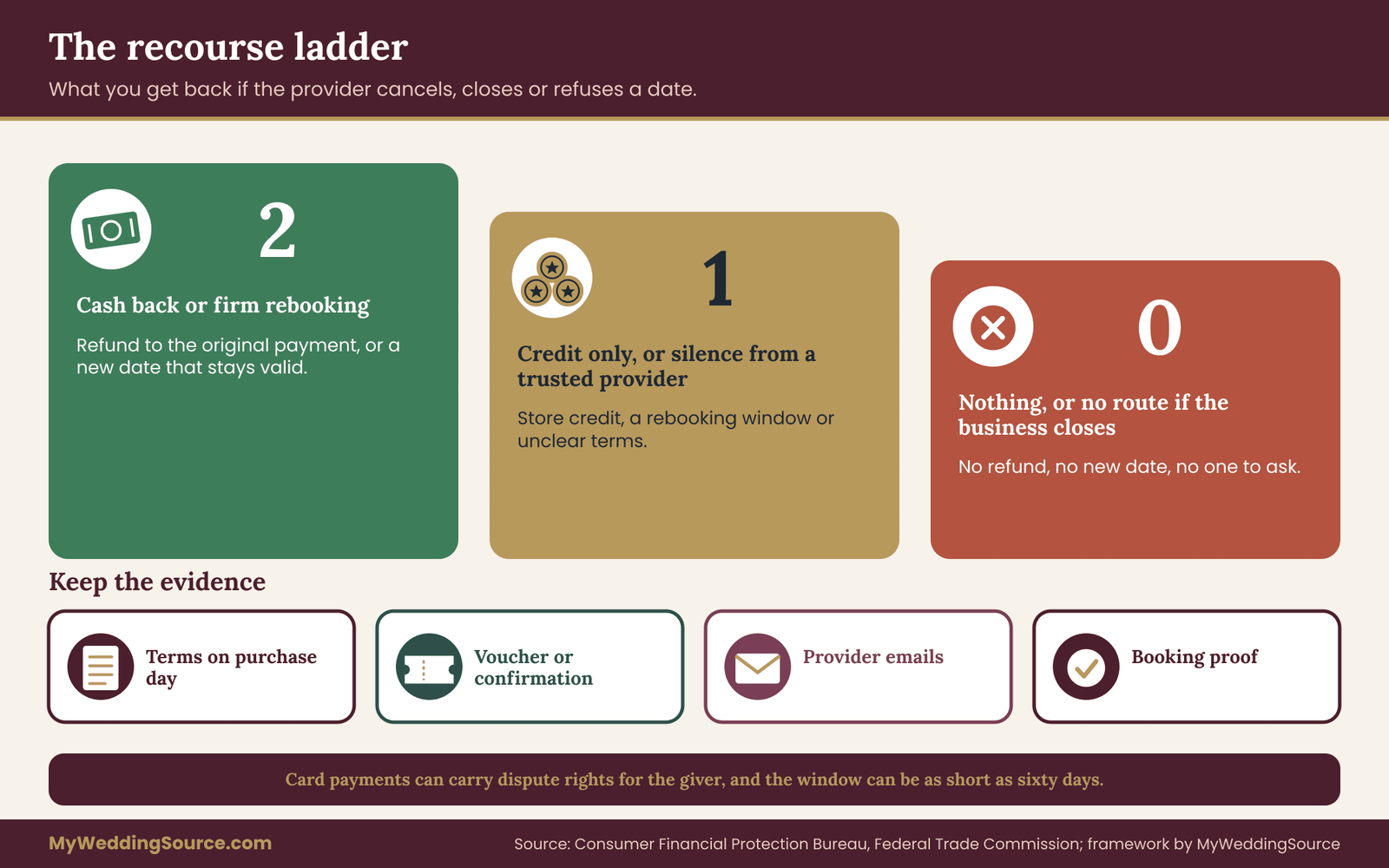
Providers handle cancellations of experience vouchers in three ways. Some give cash back to the original payment method. Some give store credit or a rebooking only. Some give nothing, which is how the terms read on certain discounted vouchers. The terms often distinguish between the voucher holder cancelling and the provider cancelling, and the second case is almost always more generous.
Read both sections. Ask what happens if you cancel a class, how much notice is needed and whether a cancellation fee applies. Ask also what happens if the provider cancels, closes or fails to deliver. A voucher that offers a refund only when the provider cancels, and only credit when you do, is a middling one. A voucher that offers neither is a one-way street.
Partial use and change
A voucher worth a set amount, used for a cheaper class, raises a question about the balance. Some providers issue a new voucher for the difference, some require you to use the full amount in one go and some keep the balance. Ask. Equally, if you want to upgrade to a more expensive class, find out whether the voucher can be applied toward a higher price, and whether you pay the difference by card.
Credit card payments and who can dispute them
A guest who paid by credit card may have dispute rights if a business fails to deliver. The CFPB explains how a billing dispute works and the time limits involved. The practical issue is timing. By the time you try to use a voucher, the chance to dispute may have passed. This is one reason expiry dates and prompt booking matter: using the voucher early gives you time to discover a problem while a dispute is still possible, and leaves the giver’s remedies open.
Tell the giver about a problem quickly. If a class is cancelled or a provider stops responding, a short message to the guest saying what happened and what you plan to do gives them the chance to act while their options are open. It also keeps the matter honest. Our wedding vendor contract guide explains the kinds of terms to look for in vendor agreements, and the same habit of reading cancellation and refund language applies to vouchers.
If the provider closes
Businesses close. Experience vouchers for a business that no longer operates can be difficult to recover. In some cases a bankruptcy process allows claims, but outcomes vary and often fall short of full value. Ask whether the voucher is backed by any protection, whether the provider is a long-standing local business or a short-lived online venture, and whether money paid is held in any account separate from the provider’s own funds. Most small providers will not have a formal answer, and that is useful information.
You cannot eliminate this risk, only manage it. Choose providers with a track record, use vouchers soon after you get them and keep the proof of purchase. Our vendor due diligence checklist walks through how to check a business before trusting it with money, and the questions apply to a cooking school as much as to a caterer.
The platform problem with experience vouchers
When a platform sells experience vouchers for a third-party provider, the platform’s terms often apply first. Look for language about who is responsible if the experience is not delivered. Some platforms refund in full and chase the provider themselves. Others pass you to the provider, and the provider may be unreachable. A platform that clearly states a refund process is a better candidate than one that leaves it vague.
Keep the evidence for each of your experience vouchers
For every voucher, keep four things: the terms as they read on the day of purchase, the voucher or confirmation itself, any email from the provider about expiry or extension and, later, the booking confirmation. Take a screenshot of the terms page, since the page may change. If a dispute arises, the original terms are the document that matters.
The recourse score
Give two for a voucher that offers cash back or a firm rebooking if the provider cancels, and a reasonable route if the business closes. Give one for credit only, or for terms that are silent but a provider you trust. Give zero for no refund, no rebooking and no stated route. Remember the cap: a zero on recourse caps the total at eight, because a voucher with no route back is a risk to the giver, not just to you.
A worked example: scoring three experience vouchers
The following example is invented to show the method. The names, terms and prices are illustrations, not real providers or real quotes, and nothing here says what any real school or travel company offers. Substitute the terms you actually find.
Imagine a couple, Dana and Marcus, who have a spring wedding and a honeymoon planned for the autumn. They want three experience vouchers on the registry and have narrowed the choice to three candidates.
Candidate one: a pasta class at a local school
The school sells vouchers for a hands-on group class, priced per person. The terms say the voucher is valid for twelve months from purchase, group classes run on weekends with a few excluded holiday dates, a session holds up to ten students, and the voucher covers one seat. A second seat is a second voucher. If the school cancels a class, the student may pick another date or take a refund. Vouchers are bearer vouchers and can be passed to another person.
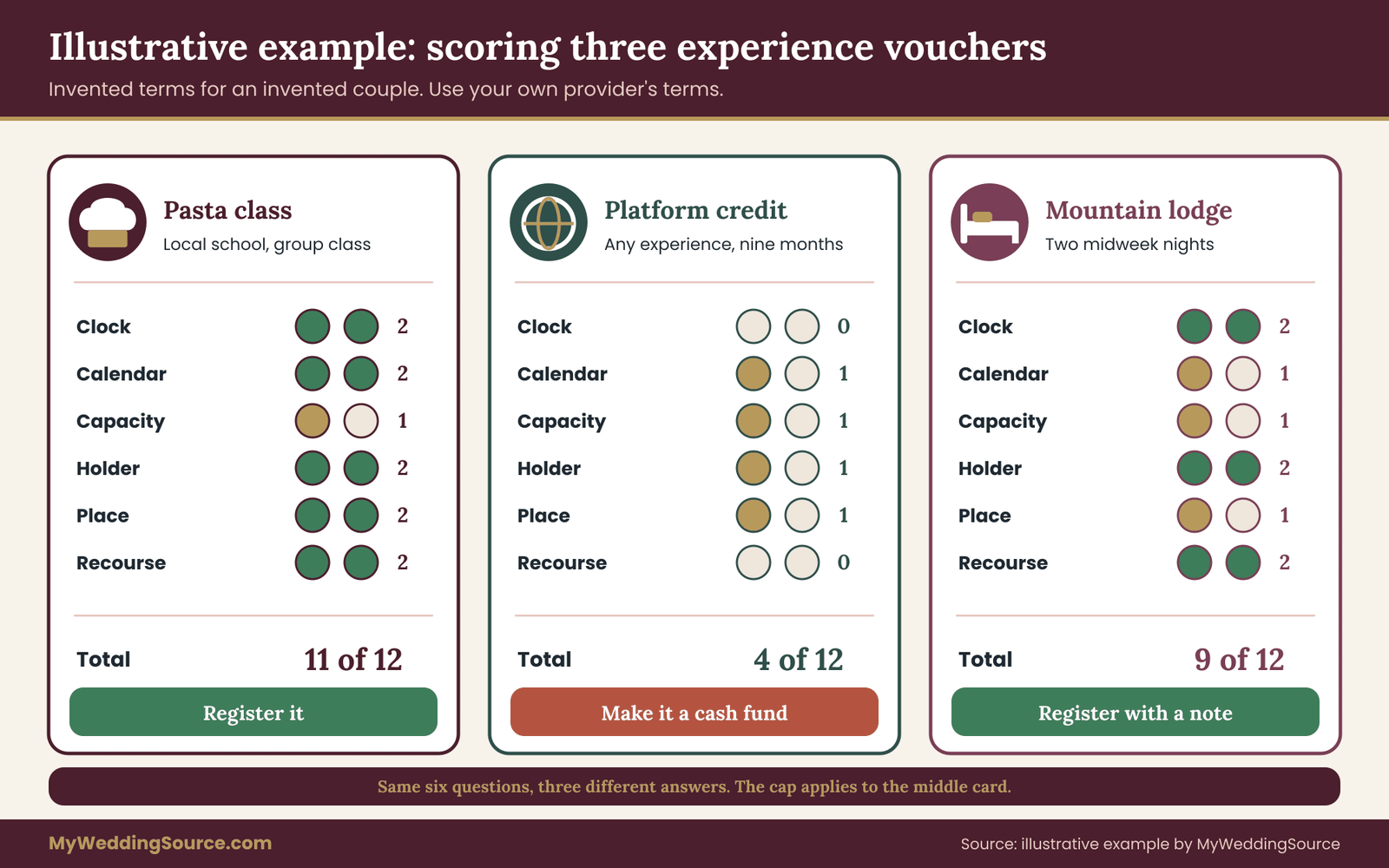
Scores. Clock: two, because twelve months is workable and an extension is possible on request. Calendar: two, with weekend dates in every month. Capacity: one, because seats are limited and sell out for popular dates. Holder: two, thanks to bearer vouchers. Place: two, since the school is in town and the class includes ingredients.
Recourse: two, because the school offers rebooking or a refund. The total is eleven, and the voucher goes on the registry as a pair of seats, with a line in the description about the weekend schedule.
Candidate two: a platform credit for “any experience”
A website sells credits that can be spent on classes and tours from many providers. The terms say the credit expires nine months after purchase, cannot be extended, is non-refundable, and is tied to the purchaser’s account, so the credit must be transferred by the platform at the giver’s request. The platform charges a service fee at checkout on each booking. Experiences are listed by providers who set their own cancellation terms.
Scores. Clock: zero, as nine months with no extension leaves little room around a wedding. Calendar: one, because availability varies by provider. Capacity: one. Holder: one, because the transfer process is awkward. Place: one, thanks to the checkout fee. Recourse: zero, because the credit is non-refundable and the provider terms vary.
The total is four, and the clock and recourse zeros alone would cap it at eight. This one should not go on the registry as a voucher. If guests want to give toward experiences, Dana and Marcus can offer a cash fund with a clear description instead.
Candidate three: a two-night stay at a mountain lodge
A lodge sells a voucher for two nights midweek, for two adults. The terms say the voucher is valid for eighteen months, excludes holidays and the peak summer weeks, must be booked at least thirty days ahead, and can be changed once for free if the lodge is told fourteen days before arrival.
Taxes and a daily resort fee are paid at check-in. The voucher is issued in the recipient’s name, with a second guest allowed. If the lodge closes or cancels, the guest gets a refund of the voucher value.
Scores. Clock: two. Calendar: one, because of midweek only and the peak exclusions. Capacity: one, as rooms are subject to availability. Holder: two. Place: one, because taxes and fees are extra and the lodge is a three-hour drive. Recourse: two. The total is nine, which lands in the registry range. Dana and Marcus add a line to the listing: “midweek stays, taxes and resort fee paid on arrival.”
What the example shows about experience vouchers
Three experience vouchers, three different outcomes, all from the same short list of questions. The platform credit looked the most flexible and scored the worst, because flexibility without refund terms or a long clock is thin protection. The local class scored highest even though it was the cheapest, because the terms were clear and the voucher fit the couple’s life. The lodge needed one sentence of honesty in the listing but otherwise stood up.
You may not get the same pattern, and you do not need to. What matters is that you made each decision from the terms rather than from the photo on the registry page. If a score is close to a boundary, trust the questions behind it: if you could not get a written answer, count the check lower.
Putting experience vouchers on your registry without creating pressure
Once experience vouchers pass the test, the listing has to say enough for a guest to make a good decision, and it has to avoid leaning on anyone. The listing is part of the product.
Write each listing for experience vouchers as facts
A good title names the thing and the format: “Pasta-making class for one, group session” is clearer than “Date night in Italy.” The description should state the expiry in plain words, the main limits, who can use it and what is not covered. Two or three short sentences are enough: “Valid twelve months from purchase. Weekend sessions, up to ten students. Ingredients and meal included; drinks are extra.”
That is not a legal disclaimer. It is the information a thoughtful guest wants before spending money, and it protects you from awkward misunderstandings later. A guest who reads “midweek only” is less likely to wonder in July why you have not yet used the lodge voucher.
Offer price points and a fallback
Guests have different budgets. Break a trip into smaller experience vouchers that people can choose: a dinner, a tour, a night’s lodging. Give each a clear price. Add a general fund as a fallback for guests who prefer to give cash, and say that the fund will be spent on the class or the trip. Our registry ideas guide shows how couples combine items at different price levels without making any single one feel required.
Avoid pressure and fine-print traps
No guest has to buy any experience vouchers from a registry, or anything else, and a listing should never imply that a purchase is expected. Use neutral phrasing such as “if you would like to give something toward our honeymoon.” Avoid countdown language and avoid pushing the most expensive item to the top of the list. Our wedding etiquette page covers wording around gifts and requests.
Do not list experience vouchers you have not read. If a guest buys it and the terms turn out to be unworkable, the awkwardness lands on the guest as well as on you. Better to list four experience vouchers you trust than eight you have not checked.
Disclose commercial relationships near experience vouchers
If a registry platform or provider pays you or the site you are using for referrals, say so near the recommendation. Honest disclosure is the standard the Federal Trade Commission describes for endorsements, and it applies to couples who share links as much as to businesses. Most couples have no such arrangement, in which case there is nothing to disclose. Do not add language implying one.
Check the registry platform’s own terms
Registry sites have their own conditions. Some charge a percentage on cash funds, some add payment-processing fees, some hold funds for a period before releasing them and some limit how experience listings can be edited. Read the platform’s terms before you decide where to list. The fees on a cash fund are a real cost, and the platform’s rules for refunds when an item is cancelled affect your guests as much as the provider’s.
A short checklist for the platform: what fee comes off a cash gift, when does the money reach you, what happens if an item is cancelled or a voucher is refunded, and how do guests get a confirmation. Save a copy of the terms with your voucher records, because platforms update them.
Thank-you notes for experience vouchers: before and after the experience
Thank-you notes for experience vouchers have a twist that plain gifts do not. With a toaster, the thank-you and the use happen in the same week. With a class or a trip, the gift is still in the future when the note is due. A guest who sends money toward a honeymoon in March may wonder in October whether anything happened. The solution is two notes, not one.
Note one: the arrival note
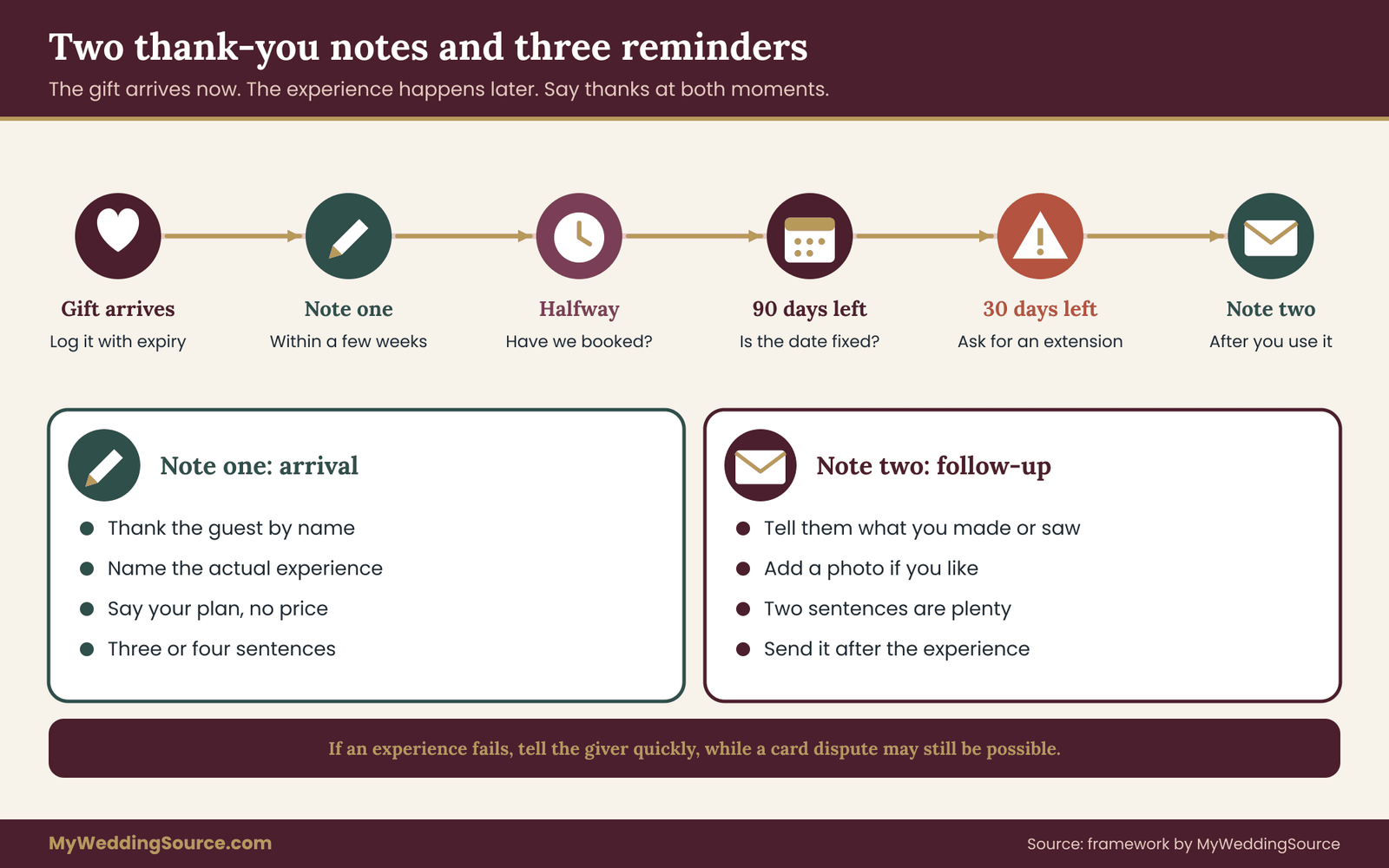
Send the first note within a few weeks of learning about the gift, in line with the usual etiquette on timing. Our wedding etiquette guide covers the general expectations. The arrival note thanks the guest, names the gift specifically and says what you plan to do with it. It does not have to be long. Three or four sentences work.
An example of the shape, in your own words: thank you for the pasta class voucher, we are looking forward to learning to make fresh pasta together, and we will plan it for the first quiet weekend after the honeymoon. Name the actual experience, avoid mentioning the price and mention the plan only if you have one. If you do not yet know the date, say that you will choose one soon.
Note two: the follow-up
After you use the voucher, send a short second message. It can be a card with a photo, a text or a few lines in an email, depending on how you usually talk to that person. Tell the guest what you made, what you saw or what you liked best. This closes the loop, shows the gift was used and often delights the giver more than the first note did.
You do not need to send a long report. Two sentences and a picture are plenty. The follow-up is the part that turns an experience voucher into a shared memory, and it is the part people usually skip.
When experience vouchers cannot be used
Sometimes a voucher fails: the class is cancelled, the provider closes, the expiry passes. Tell the guest, kindly and soon. A short message that says what happened, what you did to try to fix it and what the outcome was is the honest approach. Do not hide it, and do not blame the guest. If a refund or a replacement is available, say so, and thank them again for the thought.
If the problem is a provider failure, the guest may have a dispute route through the card used to pay, and the clock may be short. Telling them quickly is a courtesy that can protect their money. A guest who learns about the failure late, after the window for a dispute has closed, may feel hurt as well as out of pocket.
Thanking a guest who gave toward a fund
For a gift toward a honeymoon fund, name the destination or the plan. If the fund was spent on a specific experience, mention it in the follow-up, which is a good moment to send a photo. The guest has not given you a voucher, but they have given you a share of a trip, and the note should reflect that.
Where the notes for experience vouchers live
Put both notes in your gift log, with dates, beside the entry for each of the experience vouchers. A line for each gift with the giver, the voucher, the arrival note date and the follow-up date is enough. The same log can hold voucher terms and expiry dates, which brings us to the next section. Our guide to wedding records shows how to store the log with the rest of your wedding paperwork.
Scripts for common situations
A short script helps when you are not sure what to say. For a class you have booked: “We booked the pasta class for the second Sunday in May, and we cannot wait. Thank you again.” For a trip that is far off: “We have chosen a lodge for October and will send photos when we are back.” For a voucher you could not use: “I am sorry to say the school closed before we could book.
I wanted you to hear it from us, and I am looking into whether a refund is possible. Thank you for thinking of us.”
Each is brief, specific and kind. None of them blames anyone, and none promises more than you can deliver.
Tracking experience vouchers after the wedding
The best test and the best thank-you note will not help if one of your experience vouchers is forgotten. A short tracking routine keeps experience vouchers from drifting past their expiry dates.
What goes in the ledger for experience vouchers
For each voucher, record the following fields in one place: the giver, the provider, the description, the value, the issue date, the expiry date, the earliest use date, the name on the voucher, the number of people covered, the contact details for the provider, the date you asked about an extension and the reply, the booking date, the use date and the dates of your two thank-you notes. A spreadsheet works. So does a page in a notebook, if you check it.
Store the voucher itself, a screenshot of the terms and any emails from the provider in the same folder. If you use a shared drive, keep it where both of you can reach it, as the records guide suggests.
Reminders for experience vouchers that actually help
Set three reminders for each voucher. The first, at about half of the validity period, asks: have we booked? The second, ninety days before expiry, asks: is the date fixed? The third, thirty days before expiry, asks: if not, who do we ask for an extension today?
Add one more for the end of the first year after the wedding, to review every open voucher and every note. A couple who runs through the ledger once a quarter in the first year rarely loses a voucher.
Booking early and using experience vouchers soon
The most practical habit is to book the first available date that suits both of you, instead of waiting for an ideal one. A booked class can be moved; an expired voucher cannot. If the provider allows a free change, booking early costs nothing. If it charges a fee, weigh the fee against the risk of running out the clock.
Where a voucher is large, such as a trip, consider asking guests who contributed whether they would like an update when you book. Many will, and a short message keeps the story moving.
What to do as expiry approaches
If an expiry is close and you cannot use the voucher, ask the provider for an extension in writing before the date passes. Explain briefly why and propose a new date. If the answer is no, consider whether the voucher can be given to someone who can use it, if the terms allow transfers. A voucher given to a friend is better than one that lapses, and many couples forget that experience vouchers can sometimes be handed on, and the original giver would usually say so.
Edge cases for experience vouchers worth planning for
A few unusual situations are worth a sentence each, because they do arise.
You may receive the same voucher twice, from two guests. Ask the provider whether the second can be used for a later date or transferred, and thank both guests warmly without comparing.
You may receive a voucher for a provider you did not choose. A guest might buy a class from a school across the country. Thank them sincerely, check the terms, and ask whether the voucher can be transferred or used online. If it cannot be used, tell the guest gently, so they can ask for a refund while they still can.
A pregnancy, an illness, a job change or a move can derail a plan. Ask about extension and medical or relocation exceptions on your experience vouchers before you need them. Many small providers are accommodating when asked early.
A change of name affects named vouchers and tickets. Keep the original name on any booking and carry matching identification, or ask the provider to reissue the voucher in the new name.
A voucher bought with a credit card may be eligible for a dispute by the giver if the experience is not delivered. The time limit is short. If you suspect a problem, tell the giver at once.
Finally, a voucher can be a taxable item for no one in ordinary circumstances: gifts are generally not income to the recipient, and the IRS explains that gift tax rules apply to the giver and rarely result in tax. If you have a question about a large gift or a business-related benefit, ask a qualified tax professional.
Your next steps
Start with a single evening and your experience vouchers. List every experience you are thinking of adding or have already been given. For each one, find the terms and run the six checks, scoring from zero to two. Write down the total and the reason for any zero.
Then send one email per provider with your questions about expiry, blackout dates, seats, names and refunds. Save the replies. Move any voucher that scores four or less into a cash fund, and edit the descriptions of the rest so they state their limits plainly.
Finally, set up the ledger and the three reminders, and write the arrival note for the first gift you receive. The follow-up can wait until you have the class or the trip to talk about. Handled this way, experience vouchers become what you hoped they would be: gifts that get used, and guests who hear how it went.
FAQ
Are experience vouchers a good idea for a wedding registry?
They can be, when the terms fit your life. A voucher works well if it has a clear expiry, open dates, a refund route and your name or a transferable one. It works badly if it expires quickly, has narrow dates or cannot be refunded. Test each one with the six checks, and use a cash fund for any that score low.
How long should an experience voucher be valid?
There is no single right length, and rules vary by seller and state. As a working guide, you want at least a year after you could realistically start booking, with a path to a written extension. Count your real free weekends against the expiry date. If the window is shorter than you can use, ask the provider for an extension or choose another item.
Can I ask a provider to extend an experience voucher?
Yes, and it is often worth asking before you list it. Write a short, polite email that states the voucher, the expiry date and the new date you would like. Ask for the answer in writing. Providers are not required to agree, but many small businesses will, particularly if asked before the voucher lapses and for a clear reason.
What happens if a cooking class is cancelled?
It depends on the provider’s terms. Common outcomes are a replacement date, a refund of the class value or store credit. Ask before you list the voucher which applies, how much notice the school gives and how long a replacement stays valid. If the terms are silent, treat that as a weak recourse score and ask for clarification in writing.
Are travel vouchers protected if the company closes?
Not always. Protection varies by seller, by state and by how the voucher was paid for. Some states regulate sellers of travel, and a guest who paid by credit card may have dispute rights with a short time limit. Check your state attorney general’s office, read the seller’s terms and use travel vouchers early rather than late.
Can both of us use a voucher that is in one name?
Only if the provider allows it. Some vouchers are bearer vouchers that anyone can use, while others require the named person to attend. Ask the provider whether the second partner can redeem or be added, and keep the answer in writing. For airline credits, name restrictions are common, so check the rules before you rely on one.
Should I thank guests before I use the voucher?
Yes. Send an arrival note within a few weeks that names the gift and says what you plan to do with it. Then send a short follow-up after you use it, ideally with a photo or a line about what you enjoyed. Two notes give the guest both the thanks and the story, and they cost very little.
What if I cannot use a voucher before it expires?
Ask the provider for an extension in writing before the date passes, and offer a specific new date. If the answer is no, check whether the voucher can be transferred to a friend or family member. Tell the original giver what happened, kindly and soon, especially if they paid by credit card and may still have a dispute route.
Sources
- Federal Trade Commission
- Gift cards, consumer advice, Federal Trade Commission
- How do I dispute a charge on my credit card bill?, Consumer Financial Protection Bureau
- Aviation Consumer Protection, U.S. Department of Transportation
- State consumer protection offices, USAGov
- National Association of Attorneys General
- International travel information, U.S. Department of State
- ADA information, U.S. Department of Justice
- Frequently asked questions on gift taxes, Internal Revenue Service
- Transportation Security Administration