
An overseas flight cancellation a few days before your wedding does not have to become a family emergency. This guide gives you a five-gate decision tree for guests flying in from abroad: what happened, how much time is left, whether the travel documents still fit, which events the guest can still reach, and who pays and who tells whom.
When an overseas flight cancellation hits a guest, run five gates in order. First, confirm the cause, because an airline cancellation, a guest’s own change and a denied boarding lead to different refund and rebooking rights. Second, count the hours to the first event the guest promised to attend. Third, check that the passport, visa or travel authorization still fits the new route and date. Fourth, decide which events are still reachable. Fifth, settle who rebooks, who pays and who needs to be told. The result is one of five outcomes, from “rebook and carry on” to “release the guest kindly.”
Most wedding advice about travel trouble stops at “have a backup plan.” That is fine when the guest lives two hours away. It is not enough when a grandmother is flying from another continent, the nearest rebooking is two days later, her visa has a fixed validity window and the rehearsal dinner is in thirty hours. In that situation an overseas flight cancellation demands quick choices, and the couple needs a way to make them without arguing about it.
An overseas flight cancellation is different from a domestic one in four ways. Rebooking options are thinner, because there may be one daily departure on the route instead of ten. Documents matter more, because a new routing can pass through a country with its own entry rules. Time zones stretch every message and every deadline. And the cost of a wrong call is higher, since a long-haul ticket is rarely cheap to change twice.
This article is about the decisions that follow an overseas flight cancellation, not about preventing one. If you are still deciding when guests should book, the separate material on how early overseas guests should buy tickets covers that. Here we assume the notice has already arrived: a text from a cousin, an airline email at three in the morning, or a phone call from a relative standing at a gate.
A note on scope. This is general information, not legal, tax or financial advice, and entry decisions belong to the government officials who make them, not to you or to this site.
What an overseas flight cancellation does to a wedding weekend
It helps to see what a cancellation actually breaks before deciding how to respond. The damage from an overseas flight cancellation is rarely “the guest cannot come.” More often it is a chain of smaller problems, and some of them are fixable and some are not.
The arrival slides. The guest lands later than planned, sometimes by half a day, sometimes by two days. Which events they miss depends on how the wedding weekend is built. A Saturday-only wedding with a Friday arrival margin absorbs a one-day slip. A three-event weekend with a Thursday welcome party does not.
The ground plan breaks. Hotel nights go unused or have to be moved. A pickup arranged for a specific flight number no longer matches. A shared van seat is empty at the wrong time. A relative who was meant to host the guest at home is now waiting at an airport that has no arrival.
The documents may no longer fit. A traveler on a visa waiver authorization or a visitor visa has dates, passport validity and an onward ticket to think about. A later arrival can shift the length of stay. A reroute through a third country can add a transit rule nobody planned for.
The people around the guest feel it. A seat at the family table sits empty. A reading has no reader. A parent who was meant to walk someone in a procession is stuck in a transit lounge. The emotional cost is real even when the logistics are solved.
The guest is under stress too. The traveler is often the least rested person in the story. They may be dealing with an airline queue, a call center in another time zone and a bank card limit, while trying not to spoil the couple’s week. Many guests will say “do not worry about me” when they mean the opposite.
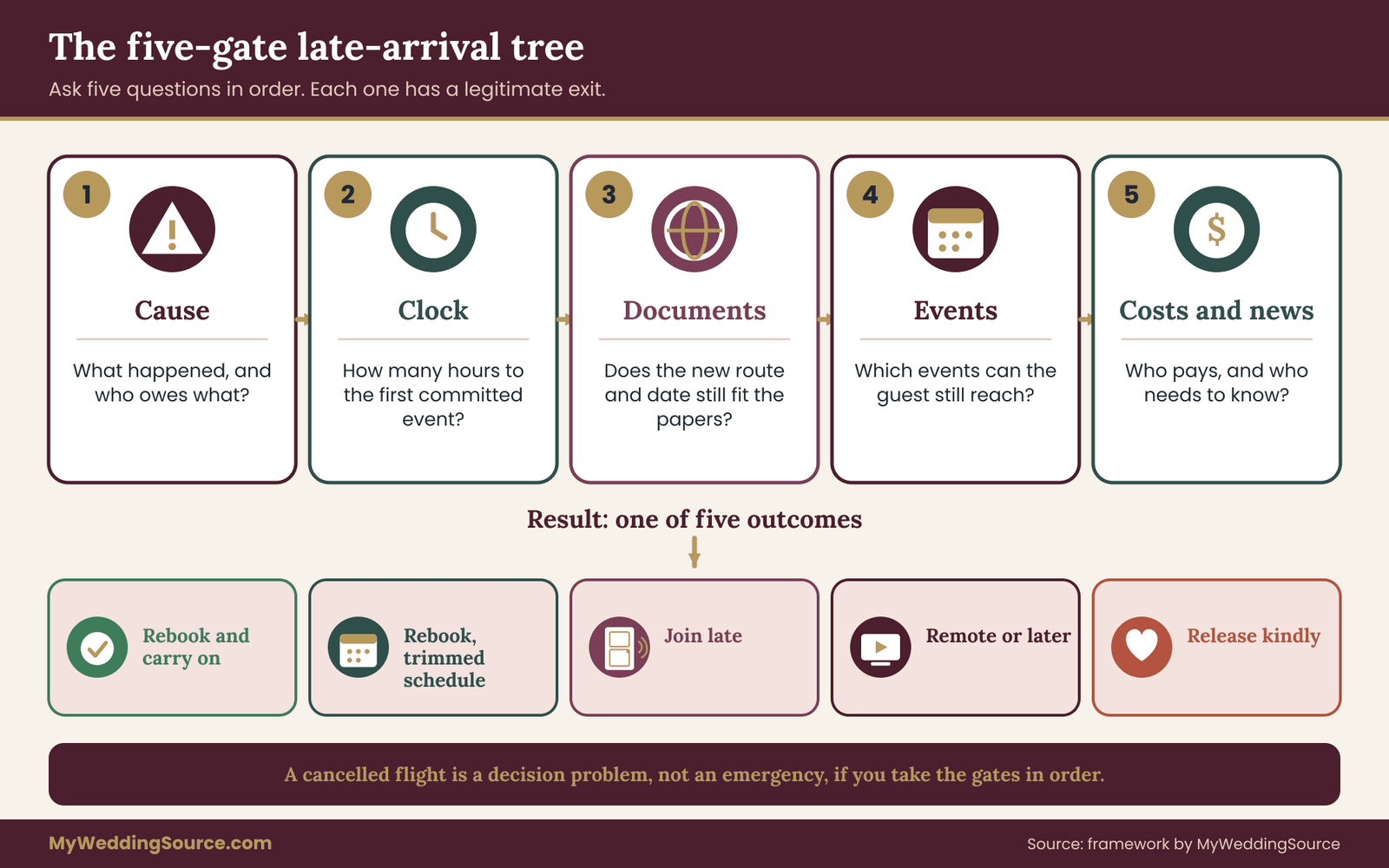
The five gates in the diagram above are built around the chain of problems an overseas flight cancellation sets off. Each gate answers one question, and each question can be answered by one person with the information in front of them. That matters at midnight, when the couple is tired and the helper has no authority to approve a spending decision. The tree turns a vague worry into a short list of checks, and it records which gate produced the decision, which helps if anyone later asks why you chose as you did.
What this tree is not
It is not a replacement for the airline’s own process. The airline decides how it will rebook, and in many places consumer rules decide what it owes the passenger. The tree does not tell a guest what an overseas flight cancellation entitles them to. It tells the couple what to ask, in what order, and when to stop waiting.
It is not a way to push a guest into attending. The tree has a legitimate exit at every gate, and “release the guest kindly” is a normal result, not a failure. An overseas flight cancellation that would require a risky, expensive or rushed itinerary is a good moment to say, “We would rather celebrate with you in two weeks than see you exhausted for ten minutes.”
It is also not a plan for the whole guest list. If a storm grounds forty flights, the couple needs a group method, and the broader guest care planning guidance and its related guides on this site covers how to organize that. The tree works guest by guest, which is how overseas disruptions usually arrive.
Why a decision tree beats a group scramble
Couples under pressure tend to make one of two mistakes. Some try to solve everything at once, which means a dozen messages, three phone calls and a spreadsheet nobody can read. Others do nothing until the guest asks, which means the guest bears the decision and the cost.
A written tree fixes both. For any overseas flight cancellation, it gives the first helper a place to start, and it limits the number of choices anyone faces at a time. When an overseas flight cancellation arrives, nobody has to ask “what do we do?” They ask, “Which gate are we at?”
Three habits the tree depends on
The tree only works if three habits are in place before the wedding week begins.
One point person. Someone other than the couple receives travel news. This might be a sibling, a friend, a planner or a parent. The couple should not be the first stop for every airline email. The point person runs the gates, and the couple makes only the decisions that are really theirs, such as “do we move the dinner?” Our wedding guest list guide explains how to keep contact details current, which is what makes this person useful in a hurry.
One shared record per guest. Each overseas guest has a single note: flight numbers, confirmation code, arrival time, ground transfer, hotel, which events they RSVP’d to, passport country and any special need. The note does not have to be fancy. It has to exist before the cancellation, because collecting this information afterward costs hours.
A decision deadline for each event. A couple should know, in advance, the hour after which a late arrival is no longer worth rushing. That hour differs by event, and the next sections show how to set it.
What the tree optimizes for
There are four goals, and they sometimes conflict. The guest’s safety and health come first, which means no heroic itineraries with a nine-hour layover followed by an overnight drive. The guest’s legal position comes second, since a rebooking that creates an entry problem is worse than no rebooking. The couple’s day comes third, which means protecting the ceremony and the people who are essential to it. Fourth is money, and the tree tries to keep costs with whoever is responsible for them, and to avoid paying twice for the same seat.
If these goals conflict, the order is the order given. A guest who could arrive in time only by risking a missed connection into a country they cannot enter should not be pushed to do it, whatever the budget or the seating chart says.
How the tree is used
When an overseas flight cancellation lands, the first helper opens the guest’s record and writes down three facts: what the airline said, the guest’s current location and the time to the first event they are committed to. Then they walk the gates. Each gate ends with a small decision recorded in one line. At the end, the helper picks one of the five outcomes and sends the couple a short summary, usually four or five sentences.
That summary is the main product of the whole process. A couple who reads “Tomas’s flight was cancelled; the earliest alternative lands Saturday morning; documents are fine; he can reach the ceremony but not the rehearsal dinner; the airline is rebooking at no charge” can answer in one line. A couple who gets a forwarded airline email and a worried voice message cannot.
The next section starts the walk through the tree at gate one, the first check after any overseas flight cancellation, the one that most people skip and then regret skipping.
Gate one: find out what actually happened
The first gate sounds obvious, and it is the one most often skipped. Before anyone books anything, someone has to establish the cause of the problem in plain terms. An overseas flight cancellation can mean four quite different things, and each one points to a different first move.
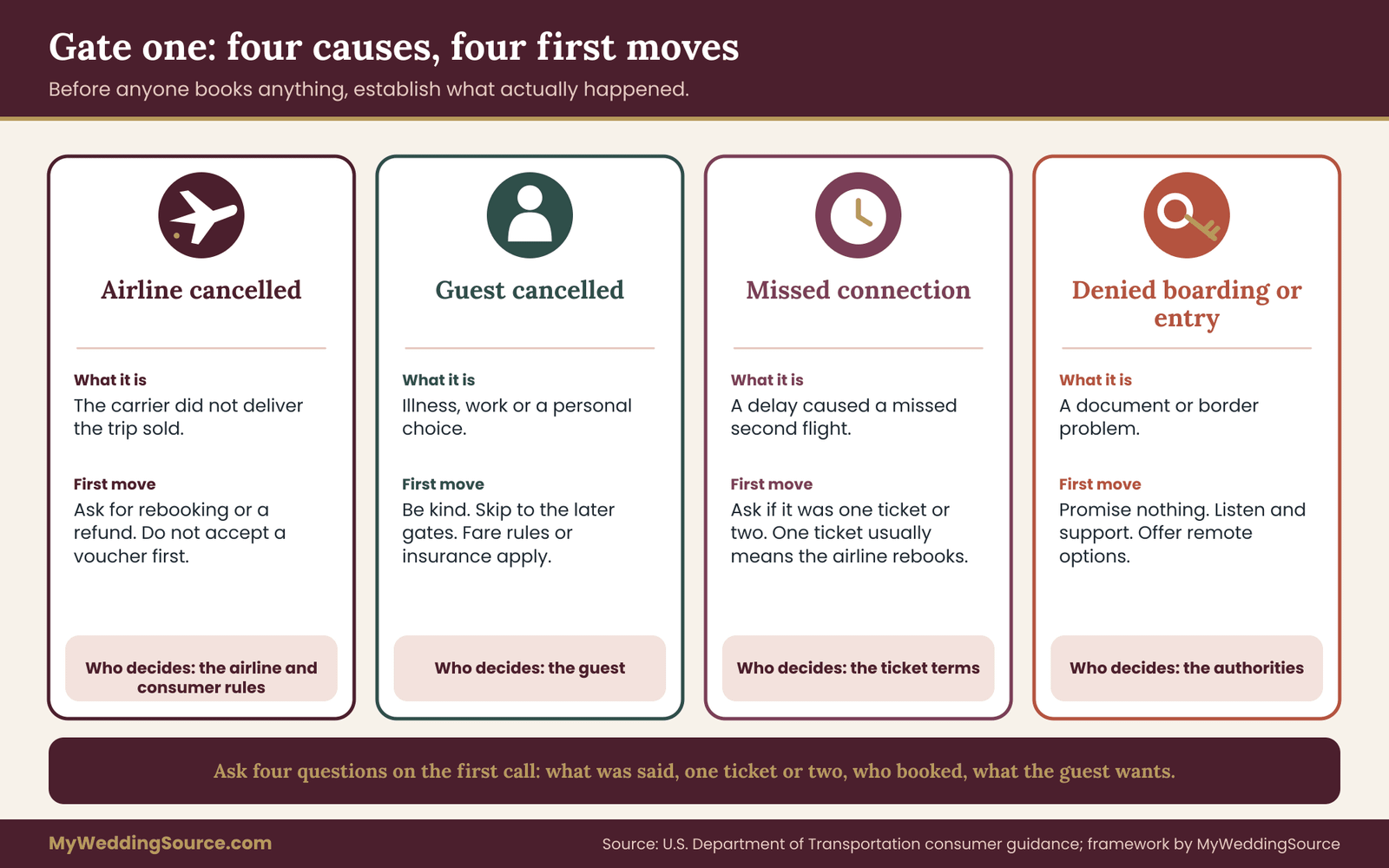
The airline cancelled or changed the flight. This is the cleanest kind of overseas flight cancellation for the guest. The carrier has failed to provide the service sold, and in many places consumer rules then require a rebooking or a refund.
For flights to, from or within the United States, the U.S. Department of Transportation publishes the refund rules and what airlines owe passengers, and the page changes over time, so it is the place to check rather than memory. Flights leaving the European Union or the United Kingdom, or arriving there on certain carriers, fall under separate passenger rights schemes, as do flights in Canada.
The guest cancelled. This is a guest-driven overseas flight cancellation, not an airline one. The guest is ill, has a work emergency or has decided not to travel. Airline rights mostly fall away, and the question becomes what the fare conditions or a travel insurance policy allow. The couple’s task is not to investigate but to be kind and move to the later gates, which then work as a simple exit.
A delay became a misconnection. The first flight left late, and the guest missed the second. Whether the airline must rebook depends on whether both segments were on one ticket. A single itinerary usually means the carrier is responsible for getting the guest onward. Two separate tickets, which happens when guests stitch together cheap fares, often means the guest is on their own for the second one.
The guest could not board or could not enter. A document problem, an expired passport, a missing authorization or an officer’s decision at a border ends the trip for reasons the couple cannot change. This is the case where no one should promise anything. Entry decisions are made by the authorities, and the couple’s role is to listen, support and not pressure.
The four questions for the first call
When the point person reaches the guest, they should ask four things in this order, and write down the answers.
- What exactly did the airline or the officer say, and do you have it in writing?
- Is the whole trip on one booking, or are there separate tickets?
- Who booked it: the guest directly, a travel agent or a family member?
- What does the guest want to do right now, before anyone offers a fix?
The fourth question is the one that protects the relationship. Some guests badly want to come and will pay to do so. Others are relieved and do not know how to say it. Ask first. A kind guest will often volunteer to skip the rehearsal dinner before anyone suggests it, which is generous, and it is also a sign that the couple should offer the choice instead of waiting for a sacrifice.
What not to do at gate one
Do not accept a voucher or a credit before knowing whether a cash refund is available. A voucher can be a fine outcome if the guest plans to fly again, and a poor one if they do not.
Do not buy a new ticket on the same afternoon without checking whether the airline will rebook at no charge, because a purchased replacement can complicate a later refund claim on the original. Do not forward the airline email to the whole wedding group. And do not assume that a family member who booked the ticket is the person the airline will speak to, since privacy rules at many carriers limit who can change a booking.
Also hold off on a travel insurance claim until you understand its notice rules. Policies typically require a reason, timing and paperwork, and a claim filed in a rush may be filed wrongly. The guest or the booker should read the policy wording, or call the insurer, before making commitments. This site cannot tell you what a given policy covers, and a couple should not guess.
The output of gate one is one line about the overseas flight cancellation: “Cause: airline cancelled, single ticket, booked by guest, guest wants to attend.” That line decides which path to follow through the rest of the tree.
Gate two: count the hours to the first event
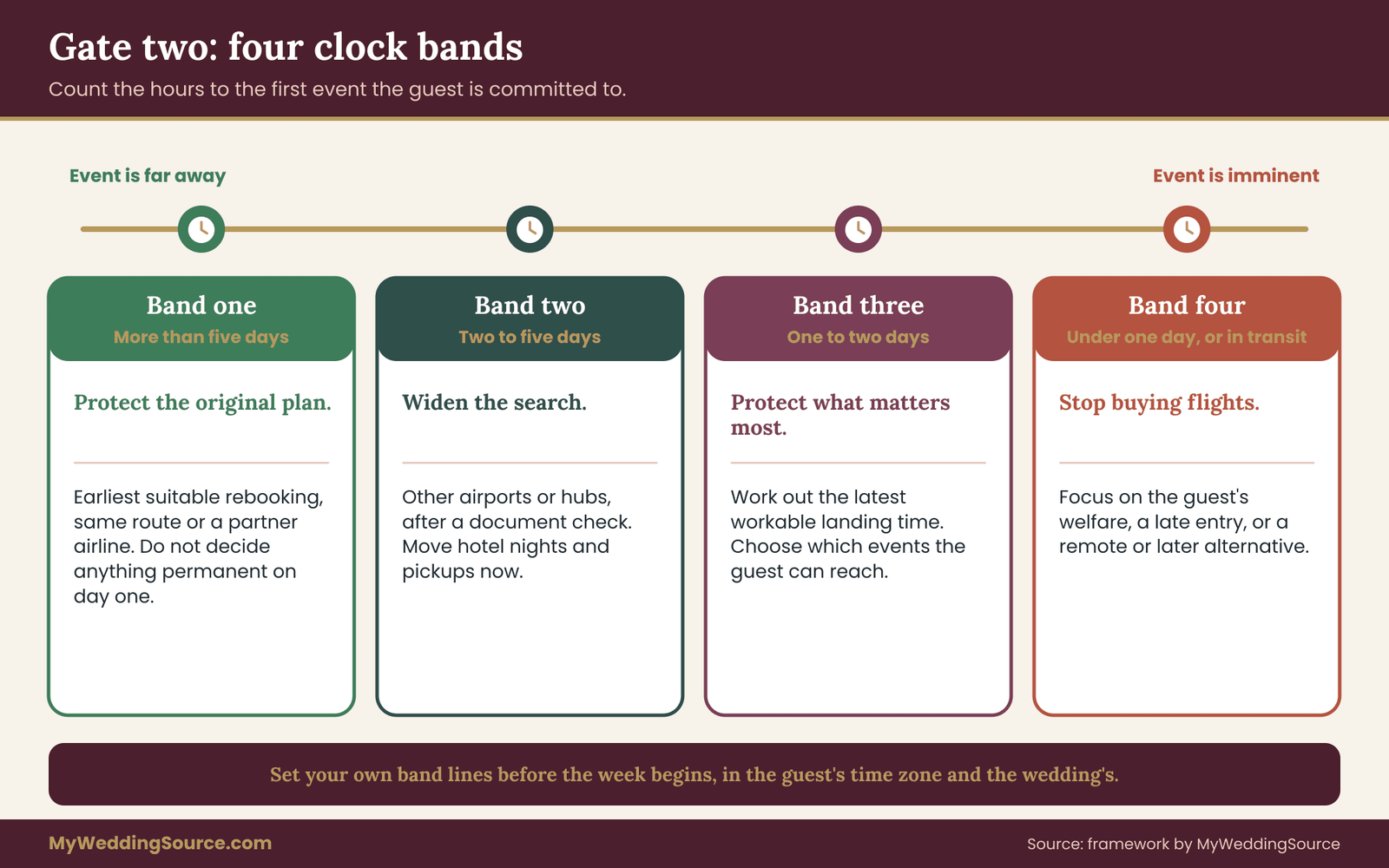
Gate two replaces a vague sense of urgency about the overseas flight cancellation with a number. The question is how much time remains before the first event the guest is committed to, and the answer sorts the case into one of four clock bands.
The word “committed” matters. A guest invited to a welcome drinks evening, a rehearsal dinner, the ceremony and a farewell brunch may only have a role in two of them. The clock runs to the first event where their absence would cost someone something: a reading they are giving, a table that would be uneven, a vehicle they were supposed to ride in, a toast. For a casual guest, that event is usually the ceremony or the reception. For a parent or a member of the wedding party, it is often the rehearsal.
The four clock bands
These bands are starting points. A couple should adjust them for the route, because a long-haul flight that runs daily behaves differently from one that runs three times a week.
Band one, more than five days out. There is time to protect the original plan. The goal is the earliest suitable rebooking on the same or a partner airline, with the guest arriving no later than the day before their first committed event. The helper can afford to ask the airline for options and wait a few hours for an answer. Avoid permanent decisions on the first day.
Band two, between two and five days out. The original plan is under strain. The helper should widen the search: another departure airport, a nearby arrival airport, a routing through a different hub. Each of these changes needs a document check at gate three before it is accepted. Ground transfers and hotel nights should be moved at this point, because late changes to them cost more than early ones.
Band three, between one and two days out. The goal shifts from protecting everything to protecting what matters most. The helper calculates the latest workable landing time, which the next article section explains, and compares it with the available options. Gate four, which events the guest can reach, becomes the main decision, and the couple should hear about it now.
Band four, under one day or in transit. No new long-haul booking is likely to help. The only questions are the guest’s welfare, whether any option lands before the latest workable time, and whether a remote or later alternative should replace attendance. A rushed purchase made out of guilt at this stage is the most common way an overseas flight cancellation turns into a financial regret.
Setting your own band lines
Choose your lines before the week begins, so an overseas flight cancellation does not catch you improvising. A wedding on a Saturday with a Friday rehearsal dinner has a band-three line on Wednesday evening for guests with a role in the rehearsal, and a band-three line on Thursday for guests who only attend the wedding. Write those times, with the time zone, in the guest’s record.
The couple’s own choices decide the lines too. Many vendors set a final headcount date, after which the caterer’s counts, the seating chart and printed place cards are fixed. A hotel may have a cutoff for releasing unused rooms in the block without a charge. Check the contracts, or the guide to coordinating guest hotels for different budgets and mobility needs, to see where those dates fall. A guest who may miss a final headcount can still attend, but the couple should know in advance what a late addition costs.
Do not confuse the date on the ticket with the date of arrival
An easy mistake in the middle of an overseas flight cancellation is to count from the departure date. Overseas flights frequently cross the date line or land a calendar day after departure. When the airline says a flight “leaves Friday,” the guest may land Saturday morning local time. The helper should write both times down with their time zones, and convert them to the wedding’s local time before comparing them with any event.
A second mistake is to treat the airline’s new booking as certain. A rebooking on a full flight may be only a standby. The helper should ask whether the new itinerary has a confirmed seat and a ticket number, not just a confirmation code that says “pending.”
Gate two ends with a sentence of its own: “Band three: about thirty hours to the rehearsal dinner; the next confirmed arrival is Friday late morning local time.” With the cause of the overseas flight cancellation and the clock settled, the helper moves to the part of the tree that can quietly make everything else irrelevant, the documents.
The broader question of picking a wedding date that makes an overseas flight cancellation less likely is covered in the guide to choosing a wedding date around guest availability and travel disruptions, which is the right place to look if you are still early in planning and have time to change the calendar.
Gate three: check the documents before accepting any reroute
Gate three is where an overseas flight cancellation becomes a legal-adjacent problem, and where well-meaning helpers do the most harm by guessing. The airline’s rebooking is a logistics offer. Whether the guest may enter the country on the new date and route is a separate question, and it is not the couple’s to answer.
The rule for this gate is simple, and it applies to every overseas flight cancellation: no new routing is accepted until the guest, not the couple, has checked it against the rules of every country they will pass through or enter. The helper’s job is to prompt the check, to list what needs checking and to point the guest to official sources.
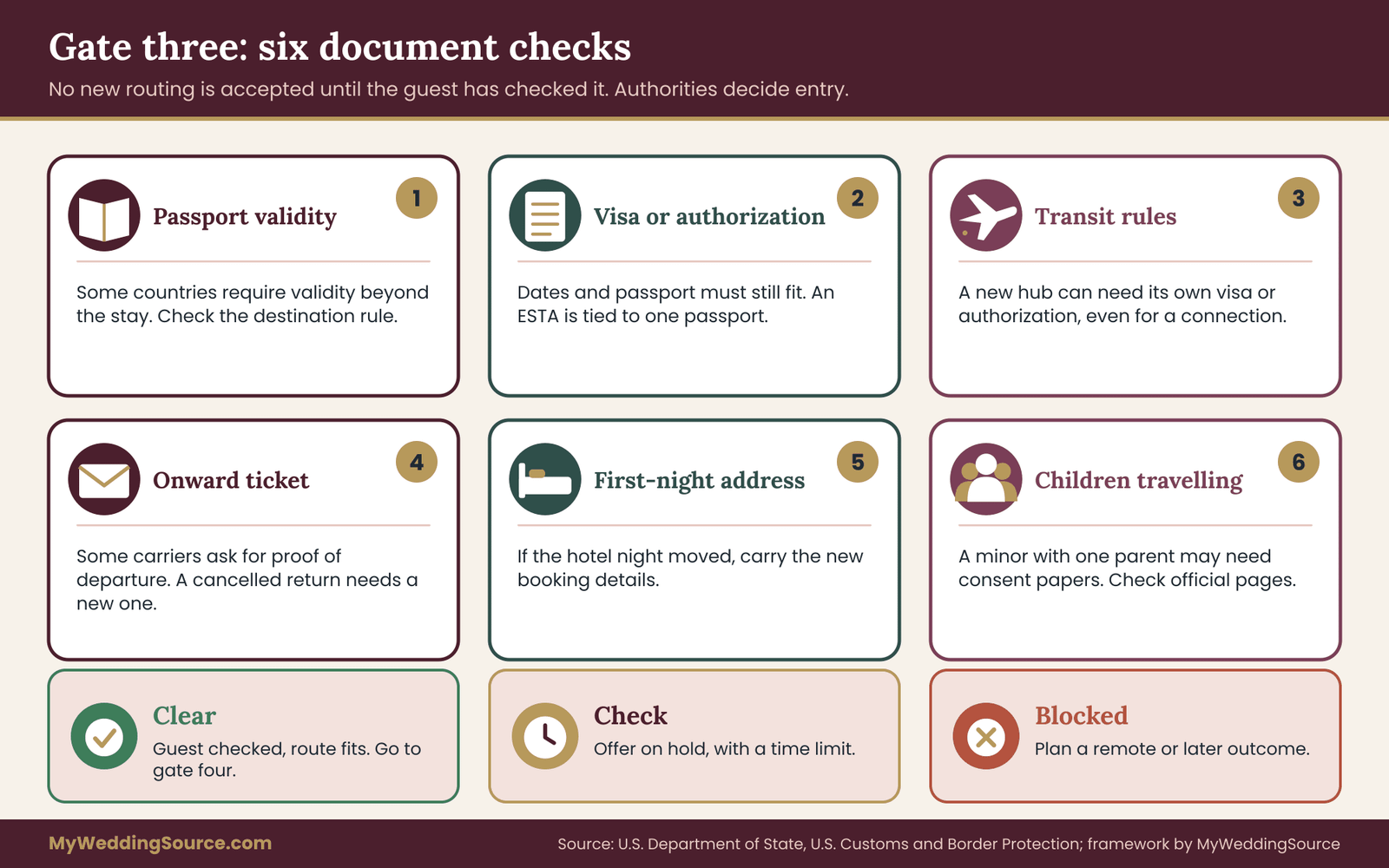
The six document checks
After an overseas flight cancellation, a new itinerary can disturb six things. Check each, in this order.
Passport validity. Some countries require a passport to be valid for a stated period beyond the planned stay, and airlines may refuse boarding when the passport does not meet the destination’s rule. An overseas flight cancellation that moves the trip later by a few days rarely changes this, but a guest whose passport was already close to the limit may now fall below it. The guest should check the destination’s entry rules and the airline’s travel document check.
Visa or travel authorization dates. A visitor visa has validity dates, and so does an electronic travel authorization. For travelers from countries in the U.S. Visa Waiver Program, the ESTA is linked to a specific passport and valid for a set period, and it must be approved before boarding. A later arrival normally falls inside the same authorization.
But a guest whose authorization was due to expire the week of the wedding needs to know now, not at the airport. For a visa, remember that the visa lets a traveler ask for admission at a port of entry. The officer decides whether to admit them and for how long.
Transit rules. A reroute through a hub the guest did not plan to use can add a transit country with its own rules. Some countries require a visa or an electronic authorization even for a connection inside the airport. This is a real trap after an overseas flight cancellation, when rebookings are offered by phone, where the agent proposes a convenient hub without knowing the passenger’s nationality. Ask the airline to confirm the transit requirement, and verify it through the government site of that country.
Onward or return ticket. Airlines and border officers sometimes ask for proof of a ticket out of the country. If the cancellation shifted the outbound date but the return stayed the same, the stay is shorter and usually unproblematic. If the overseas flight cancellation removed both legs, the guest needs a valid return before they board for the trip in.
First-night address. Many entry forms ask where the traveler will stay. If the hotel night was moved, the guest should update the booking and carry the new address.
Travel with children. A guest traveling with a minor without the other parent may need a consent document, and a changed itinerary can change which document applies. Government travel pages explain what to carry.
What the helper may and may not say
A helper can say: “Before you accept that routing, could you check the transit rules for that country and your passport? Here is the official page.” A helper can say: “If you have any doubt, an immigration attorney or the airline’s document check desk can look at your specific facts.”
A helper should not say: “You will be fine.” Or: “They never check that.” Or: “Just tell them you are visiting friends.” Such lines are guesses, and some can cause real trouble. A guest who feels pressured to take a risky route because of a wedding is a guest whose couple has made the wrong decision.
The couple also should not promise to write a letter that goes beyond the facts. A simple invitation note that states the event, the dates and the host’s contact details can be a courtesy. It does not guarantee admission, and it must not exaggerate the guest’s ties or plans. When the new arrival date differs from the date in the original letter, the guest should decide whether to ask for an updated note, and the couple should send exactly what is true.
Where to point the guest
The U.S. Department of State’s travel site explains visas and the Visa Waiver Program. U.S. Customs and Border Protection runs the ESTA application and explains what happens at arrival. The Transportation Security Administration explains what guests need for airport screening. Other countries publish their own entry rules, and the guest should use the official government pages of the country involved instead of a forum, a social post or a friend’s memory.
Mention too that rules change. A page read in an earlier season may no longer apply. The tree does not hold a copy of current rules, and neither does this article. It points to the places where the current rules live.
Three document scenarios in plain terms
Abstract rules are easier to apply once you see how they play out. These three short scenarios are invented, and they only show the sequence of questions, not what any authority would decide.
The shifted authorization. A guest holds an electronic travel authorization that expires on Sunday, the day after the wedding. The original plan had her flying home on Monday, which was already past the expiry. She had meant to renew and forgot. The cancellation exposes the problem a few days earlier than the airport would have. The right move is to apply for a new authorization immediately, through the official site, and to treat the trip as “check” until it is approved. The couple’s part is patience and one reminder, not a lecture.
The surprise stopover. A guest’s airline offers a seat through a hub in a third country because it is the only seat available. The guest holds a passport that needs a transit authorization there. The agent on the phone does not know this, and the guest does not ask. Nothing goes wrong until the guest reaches the gate and is refused boarding. A single question at the time of the offer, “Does my passport need anything for the connection?”, avoids the problem. The helper should make that question a habit.
The expiring passport. A guest’s passport is valid on the original date but will fall under a destination’s remaining-validity rule if the trip slides a week. The guest does not know the rule until the helper asks. Here the answer is not a new flight but a conversation about whether a renewal is possible in time, and a graceful fallback to a remote role if it is not. The tree does not prevent this problem. It simply finds it before the guest is standing at an airline counter.
In all three scenarios the best result comes from asking the question at gate three and not at the airport. A short check made within the first hours of an overseas flight cancellation costs almost nothing, and it keeps a stressful week from turning into a stranded traveler.
Edge cases that need a person, not a checklist
Some situations should leave the tree and go to someone qualified.
A guest who has a visa application pending, with an interview date weeks away, is in a different position from a guest who already holds a visa. An overseas flight cancellation does not speed up an interview. The couple should be honest about that, and the answer may be a later celebration or a remote role.
A guest who has previously had a problem at a border, a visa refusal or an overstay should speak to an immigration attorney before changing travel plans, and the couple should step back and not push for attendance.
A guest who holds a green card, a second citizenship or a status the helper cannot identify should be asked which documents they use to travel, and nothing more. The helper does not need the details, only the confirmation that the guest has checked.
A guest whose trip ended in a refused boarding rather than an ordinary overseas flight cancellation for a document reason should be treated gently. They may be embarrassed. A short message that says “We are sorry that happened; we would still love to include you however we can” helps more than a diagnosis.
Recording the result of gate three after an overseas flight cancellation
The result is one of three words. Clear means the guest has checked and the new routing fits. Check means the guest has not yet confirmed and the offered itinerary is on hold until they do. Blocked means the documents prevent the trip on any realistic timeline.
If the result is clear, the helper moves to gate four. If it is check, the helper waits, and the clock keeps running, so the helper sets a time limit for the guest to answer, usually a few hours, and tells the airline’s rebooking agent the offer is under review. If it is blocked, the case skips to the outcomes with no arrival, which gate four and the later sections describe: remote participation, a later celebration or a graceful release.
This is a good point to stress what the tree protects. An overseas flight cancellation that is solved by flying a guest into a border problem has not been solved at all. Every other gate asks what is convenient. This gate asks what is allowed, and its answer wins.
Gate four: decide which events the guest can still reach
With the cause, the clock and the documents settled, the helper knows whether a rebooked guest can arrive at all. Gate four asks a more useful question: what can the guest actually do once they land? Many couples treat arrival as success, but a guest who lands at 3:40 for a 4:00 ceremony has not arrived in any meaningful sense. The late-arrival question after an overseas flight cancellation is about reachable events, not about airports.
Start with the role, not the invitation
Sort the guest into one of three tiers before doing any arithmetic.
Tier one: an essential role. Someone whose absence would change what happens, such as an officiant, a parent who is part of a procession, a person carrying rings, or anyone serving as a legal witness. Some jurisdictions require witnesses for a marriage ceremony and some do not, so the couple should confirm the rule with the office that issues the license. For this tier, the couple should plan a substitute early, even while hoping the guest arrives.
Tier two: an active role. A reader, a toast giver, a member of the wedding party, a person scheduled for a dance or a cultural ritual. These roles can usually be reassigned or moved. The ceremony cue sheet guide explains how to write down who does what, which makes a swap a matter of reading a line, not reinventing the ceremony.
Tier three: an attending guest. Someone whose presence matters to the couple but whose absence changes no logistics except a seat. This tier has the most flexibility, and it is also the one where couples are most likely to add pressure by insisting on perfection.
Calculate the latest workable landing time
Gate two produced a rough band for the overseas flight cancellation. Now turn it into a clock time. The latest workable landing time, or LWLT, is the last moment a flight can land and still let the guest reach the target event in a fit state. The calculation has five parts, counted backward from the event start.
- Start with the event start time at the venue.
- Subtract a safety margin for anything that goes wrong, such as a slow taxi or a traffic jam.
- Subtract the time the guest needs to wash, change and, for an older guest or a traveler with a medical need, rest.
- Subtract the ground transfer from the airport to the hotel and from the hotel to the venue.
- Subtract the time to get out of the airport, which includes passport control, baggage and the walk to the transfer.
Each piece is an estimate, and the helper should ask the guest and the driver for realistic numbers rather than use a standard allowance. Long-haul arrivals at a large international airport often involve long queues at passport control, while a small airport may be quick. A guest who has to collect a checked suitcase takes longer than one with carry-on only. A guest who needs a wheelchair assist or has a child in tow needs more.
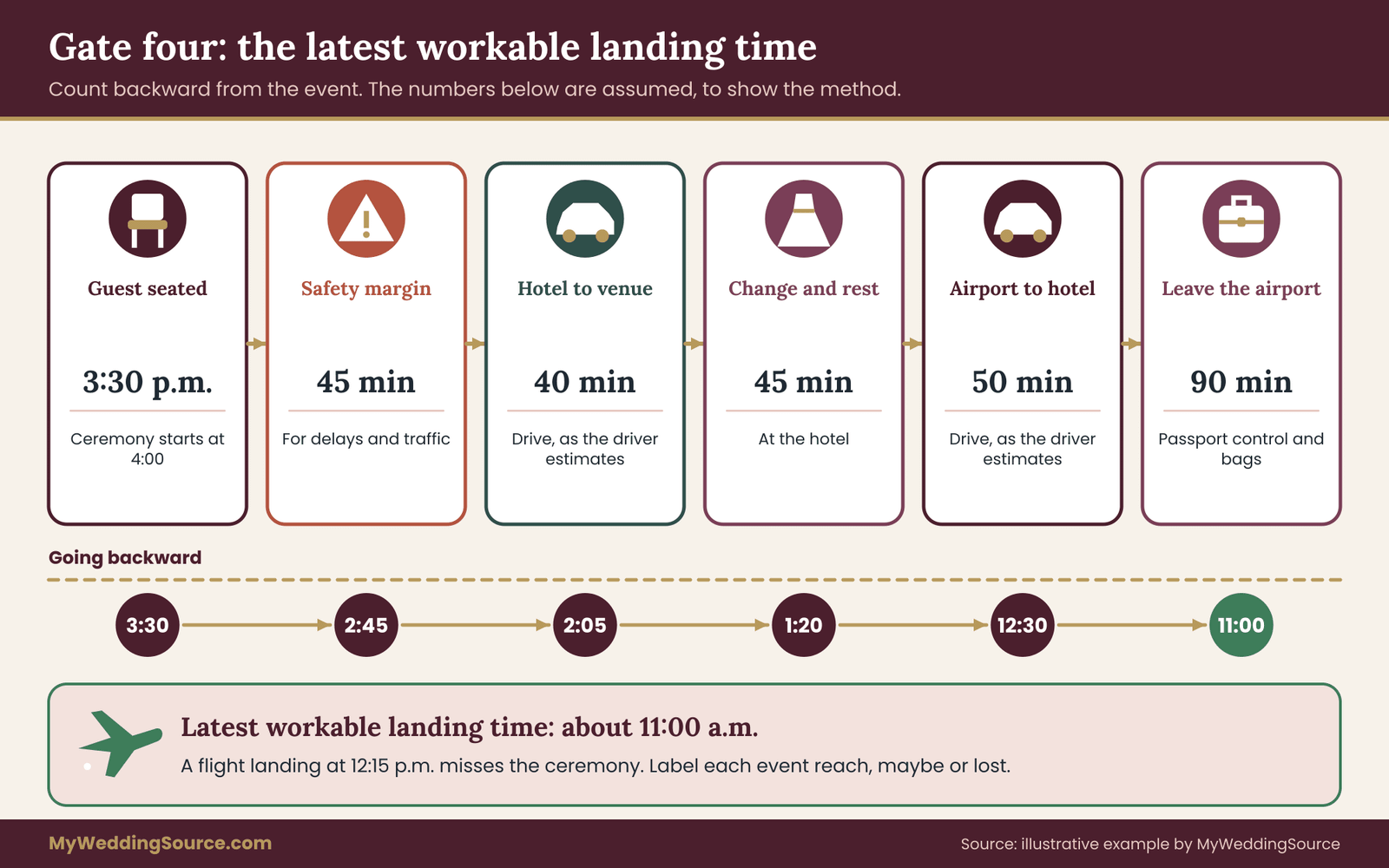
Here is a short illustration with assumed numbers, to show the method, not to set a standard.
A ceremony starts at 4:00 p.m. The couple wants the guest seated by 3:30. The guest needs 45 minutes at the hotel to change. The hotel is 40 minutes from the venue, and the airport is 50 minutes from the hotel. The helper allows 90 minutes to leave the airport and adds a 45-minute safety margin.
Counting back from 3:30 p.m.: 45 minutes of margin brings it to 2:45, the drive to the venue brings it to 2:05, the hotel change to 1:20, the airport transfer to 12:30 and the airport exit to 11:00 a.m. The LWLT in this example is 11:00 a.m. A flight landing at 12:15 p.m. misses the ceremony, however much everyone hopes.
Match the new arrival to the event list
With an LWLT in hand, compare it with each event on the guest’s list. For each one, the answer is one of three labels: reach, maybe or lost.
An event is a reach if the confirmed arrival lands comfortably before its LWLT. It is a maybe if the arrival lands close to the line or depends on a connection that could slip. It is lost if no confirmed option lands in time. Do not label something a reach because a delayed flight “usually” catches up. Overseas schedules rarely give that much slack.
A guest who reaches the ceremony but not the rehearsal dinner is a very common result of an overseas flight cancellation.
The couple can offer a quick walk-through by video, a short written summary of the processional and a trusted person who stands with the guest at the venue. A guest who reaches only the reception is also a common outcome, and it is a good one. The couple can arrange a quiet seat near the door, a plated meal held back, and a moment to say hello. The reception guest flow guide explains how to structure arrivals so that a late guest does not interrupt a toast.
Do not stage a grand entrance
A late arrival after an overseas flight cancellation does not need an announcement. A guest who slips into the back of a ceremony in their travel clothes, or who arrives during dinner, is much more comfortable when the room does not turn to look. The helper can tell an usher, the photographer’s assistant or a reception coordinator, so the right person is at the door and no one has to explain.
Record the result of gate four
The record gives one line per event: “Rehearsal dinner, lost. Ceremony, reach. Reception, reach. Farewell brunch, reach.” If there is a tier-one or tier-two role, the line adds who covers it.
Gate five: settle who rebooks, who pays and who is told
By gate five the practical shape of the case is known. What remains is to assign owners to the money and the messages. A frequent source of family friction after an overseas flight cancellation is not the cancellation itself but an unspoken assumption about who would pay for what.
Three ledgers, three owners
Keep three simple ledgers in the guest’s record.
The airline ledger records what the carrier owes and has promised because of the overseas flight cancellation. That includes a refund, a rebooking, meals or a hotel in some situations and, where local rules provide it, compensation. The guest or the booker deals with the airline, and the couple does not accept a credit in the guest’s name without asking.
The guest ledger records what the guest has paid and expects to pay. That includes a replacement ticket, a change fee, a new hotel night, a taxi or a visa fee. The guest owns these unless the couple has agreed otherwise.
The couple ledger records anything the couple promised or chose to cover. It may include a ground transfer, a hotel night in the block, a seat at dinner or a contribution to a replacement fare. Couples should decide whether they offer any help before the problem arises, not in the middle of it. A short rule written in advance, such as “we cover the transfer and the hotel night for parents and wedding party, and we do not cover airfare,” prevents quarrels and unequal treatment.
Where a couple paid for a ticket in the first place, the refund goes to whoever paid, and everyone should agree on that early. Misunderstandings about a refund sent to the guest’s account when the couple paid are more common than anyone expects. Our wedding cash-flow planning guide explains how to build a contingency reserve, which is the right place to hold any money the couple has set aside for situations like this.
The things that quietly cost money
Several costs of an overseas flight cancellation are easy to forget while attention is on the flight.
A hotel night booked for the original arrival may be charged as a no-show. Many hotels will move it if told in time, and some room blocks have rules about releasing rooms. A pickup booked for a specific flight may be billed whether or not the guest appears. A caterer may need to know whether to hold a late guest’s meal. A rental car, a tour or a spa appointment for the guest may carry a cancellation fee. For each item, the helper writes down who made the booking, the cancellation deadline and what the vendor needs to hear.
If an airline refuses a refund the guest believes is owed, a credit card dispute can be an option, and the Consumer Financial Protection Bureau explains how disputes work, including notice deadlines. A guest should read the current rules for their card and country and act quickly, because disputes have time limits.
Who is told, and in what order
Notification about an overseas flight cancellation follows the money and the plan. First, the point person tells the couple the one-paragraph summary. Second, the people who must change something are told: the hotel, the driver, the caterer and the venue coordinator, plus whoever covers a tier-one or tier-two role. Third, only the people who will notice the change hear about it, such as the table neighbors, the family member who was hosting the guest and the photographer who was asked to capture a specific reunion. The wider guest list hears nothing unless the situation affects them.
The recommendation is to keep the circle small. A story that moves from one worried relative to the whole group chat can turn a manageable delay into a drama and expose a guest’s private trouble. The guest should always be asked what they are comfortable having shared, particularly when the reason involves health or a border problem.
The one-paragraph handoff
At the end of gate five, for any overseas flight cancellation, the helper writes a short note for the couple covering the cause, the clock band, the document status, the reachable events, the money decisions and the list of people told. It should take no more than a minute to read, which is the standard for a message sent to a couple a few days before a wedding.
The five outcomes after an overseas flight cancellation
After five gates, the overseas flight cancellation case lands on one of five outcomes. The point of naming them is speed: a helper at midnight does not need to invent a response, only to pick the one that matches the facts.
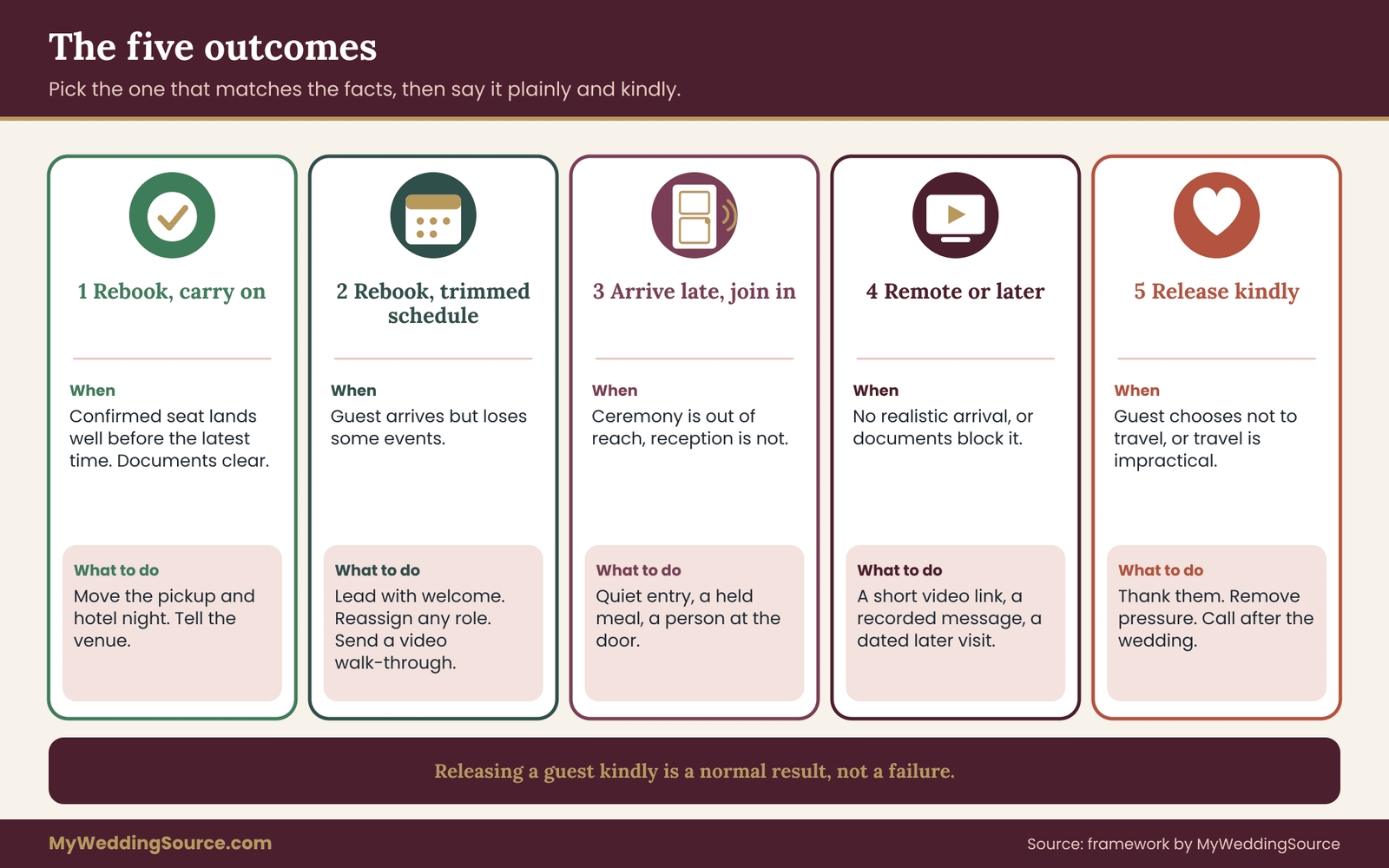
Outcome one: rebook and carry on. The airline has a confirmed alternative that lands well before the latest workable time, the documents are clear and the guest keeps every event. The only changes are logistics: a new pickup, a moved hotel night, a note to the venue. This is the usual outcome of an overseas flight cancellation in the early clock bands, and it is the reason the first day matters so much.
Outcome two: rebook with a trimmed schedule. After the overseas flight cancellation, the guest will arrive, but some events are lost. The couple says so plainly, adjusts the role plan and tells the guest which events remain. A guest in this outcome often feels guilty, so the message should lead with welcome, not with the loss.
Outcome three: arrive late and join in the middle. The guest cannot reach the ceremony but can reach the reception or a later event. The couple arranges a quiet entry, a held meal and a person to greet them. Nobody should treat a mid-reception arrival as an embarrassment.
Outcome four: take part from a distance, or celebrate later. No realistic arrival is possible, or the documents block it. The guest may join through a video link for a part of the day, record a message, or plan a separate gathering after the couple returns. A later celebration works best when the couple names a rough time rather than saying “someday.”
Outcome five: release the guest kindly. The guest decides not to travel, or the cancellation made travel impractical. The couple thanks them, removes pressure and keeps the door open. Releasing a guest is not a defeat. It is often the most generous result for a guest who is tired, anxious or short of money.
What to say: short scripts you can adapt
The wording below is plain on purpose. Adjust it to the way your family speaks.
To the guest, when the cause is clear.
“We heard your flight was cancelled and we are so sorry. Before anything else: are you okay, and what would you like to do?”
To the guest, when you need to nudge a document check.
“Before you accept the new routing, could you check the entry rules for the stopover? We want you here, and we want the trip to work.”
To the guest, when events are lost.
“The rehearsal dinner will go on without you, and we will send a short video of the walk-through. We are keeping your seat for the ceremony.”
To a guest in outcome four.
“We would rather see you rested than rushed. We will stream a few minutes of the day for you, and we want to celebrate together in the spring.”
To a guest in outcome five.
“Thank you for trying so hard. There is nothing to apologize for. We will call you after the wedding and tell you everything.”
To the substitute reader or witness.
“Could you stand in for a reading on Saturday? Here is the text. We will confirm tomorrow morning whether it is needed.”
To the hotel or driver.
“A guest’s flight was cancelled. Her new arrival is Friday at 9:40 p.m. Please move her booking and the pickup, and confirm in writing.”
To the caterer or venue coordinator.
“One guest will arrive during the reception. Please hold a plated meal and a seat near the entrance. We will confirm the time by noon.”
Note the shape of these messages. Each states what happened in one sentence, says what the couple will do and asks for at most one thing. None of them promises something the couple cannot control, such as entry or a refund.
Keep the guest’s privacy in the message
If the overseas flight cancellation involved a health concern, a border problem or a money struggle, say only what the guest has approved. “Marta’s flight changed” is enough for most people. “Marta was refused boarding” is not anyone’s business unless Marta says so. A short line in the guest’s record, “OK to say: flight cancelled; not OK to say: reason,” avoids a mistake later.
A worked case: one overseas flight cancellation, three branches
The example below is invented to show the tree in motion. It is not a report of a real wedding, and the numbers are assumptions chosen for clarity.
Nora and Eli are marrying on Saturday at 4:00 p.m. Eli’s aunt Marta is flying in from Lisbon. She holds a single ticket she bought herself, she is giving a reading in the ceremony and she is invited to a Friday 6:00 p.m. rehearsal dinner. On Thursday at 6:00 a.m. local time, her airline cancels the outbound flight, and the overseas flight cancellation sets the clock running. Eli’s sister, Dana, is the point person.
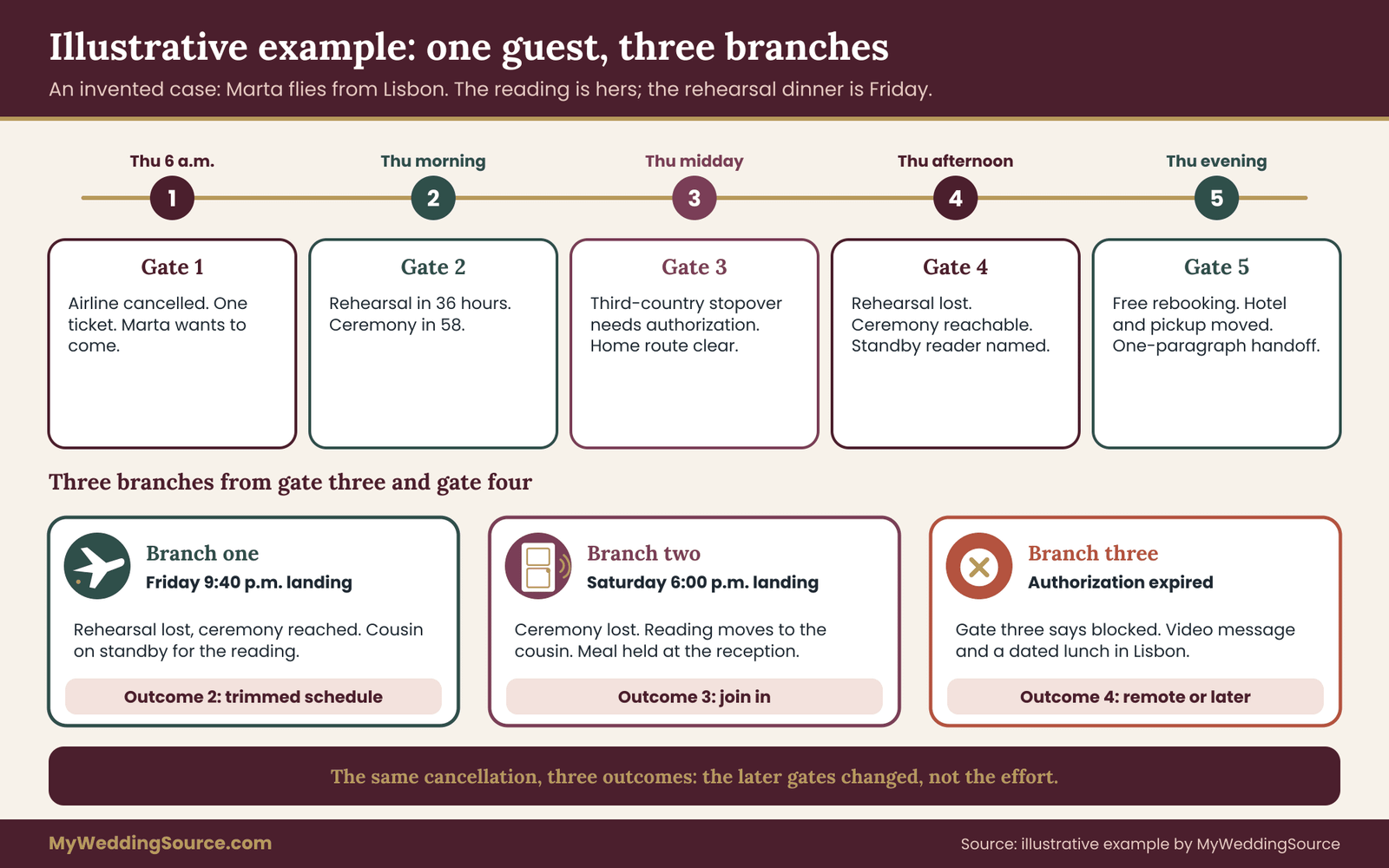
Walking the gates
Here is how the family handles this overseas flight cancellation.
Gate one. Dana calls Marta and asks the four questions. The airline cancelled the flight. It is one ticket, booked by Marta directly. Marta says she very much wants to come. Dana asks her to keep the airline email and to avoid accepting a voucher yet.
Gate two. It is Thursday morning. The rehearsal dinner is about thirty-six hours away, and the ceremony is about fifty-eight hours away. For the rehearsal, this is band three. For the ceremony, band two. Dana writes down both.
Gate three. The airline offers two options. One leaves Thursday evening via a third country and lands Friday afternoon. The other leaves Friday midday through the original hub and lands Friday at 9:40 p.m. Marta checks the transit rules on the official government page for the third country and learns that her passport needs an electronic authorization even for a connection. She can apply online, but she is unsure how long it will take.
She also confirms that her U.S. travel authorization is valid on the new date. Documents for the Friday option are clear. The Thursday option is on hold.
Gate four. For the Friday option, the latest workable landing time for the ceremony is early Saturday morning, which is easily met. The rehearsal dinner is lost. Marta is a tier-two role: the reading. Dana asks a cousin to be standby reader and arranges a short video walk-through for Marta on Saturday morning.
Gate five. The airline rebooks at no charge. The Thursday hotel night is moved to Friday, and the driver is rebooked. Under the couple’s pre-agreed rule, Nora and Eli cover the transfer and the room night. Dana writes the one-paragraph handoff and sends it before breakfast.
The result is outcome two: rebook with a trimmed schedule.
Branch two: the only option lands too late
Suppose instead that the airline’s earliest confirmed seat lands on Saturday at 6:00 p.m. The ceremony is lost. Marta is still welcome at the reception. Dana confirms that the reading moves to the cousin, and she tells the venue coordinator and the caterer. A plated meal is held and a seat near the entrance is kept. This is outcome three. Marta’s message from Nora says, “Come as you are. We will be glad to see you whenever you walk in.”
Branch three: the documents block the trip
Suppose Marta discovers that her travel authorization expired last month, and she cannot get one in time. Gate three returns “blocked.” She cannot board, and nothing the couple does changes that. The tree jumps to outcome four. A short video message is recorded and shown at the reception, a call is planned on the morning after and a small lunch is scheduled for when the couple visits Lisbon. Nobody argues with the authorities, and nobody makes Marta feel she let anyone down.
What the example shows
Three things stand out. The helper never had to ask the couple a dozen questions. Every decision was recorded in a sentence. And the same overseas flight cancellation produced three different outcomes because the later gates differed, not because someone had a better idea in the moment.
The example also shows a limit of the tree for any overseas flight cancellation. The tree did not make Marta’s flight happen. It did make the family’s choices faster and kinder, and it kept anyone from taking a risk at the border.
When the tree fails: failure conditions and what to do instead
A decision framework for an overseas flight cancellation is useful only if it admits where it breaks. The five gates work well for an overseas flight cancellation when information arrives in order, when people answer their phones and when the airline’s rebooking holds. Real weeks are messier. These are the conditions under which the tree stops working, with a signal that tells you it has happened and a fallback.
The point person cannot be reached. A sibling who lives in another time zone may be asleep when the notice arrives, or a friend may be on a plane. The signal is a notification that sits unanswered for several hours during the wedding week. The fallback is two named point people in different time zones with a rule: whoever is awake handles the case and leaves a note for the other. The couple should not have to be the backup, but if nobody else is available, the couple can ask a trusted guest for an hour of help.
The guest does not answer. A guest in a transit lounge may have no data or a dead phone. The signal is silence beyond the time limit you set, usually a few hours in the early bands and about an hour in the later ones. The fallback is a second contact: a travel companion, a relative at home or the hotel’s front desk, which holds the booking email. For planning only, treat the guest as not arriving until you hear otherwise, and keep their seat. Then be warm when they reappear. Silence is rarely rudeness.
The new booking is cancelled too. Airlines sometimes rebook a passenger onto a flight that is itself cancelled, or a rebooked connection is missed. The signal is a second cancellation notice. The fallback is a two-strike rule: after a second cancellation for the same guest, move one outcome down the list. Outcome one becomes outcome two, outcome two becomes outcome three and so on. A guest who has been through two failed attempts at fixing an overseas flight cancellation is exhausted, and the couple’s kindest move is to lower the stakes.
Gate three stays unresolved. The guest cannot confirm a document question before the clock runs out, for example because an official page is unclear or an online application is still pending. The signal is a “check” that persists past its time limit. The fallback is to plan as if it were “blocked” while leaving the door open. If the guest gets the answer and the route is allowed, the couple can still welcome them.
The couple overrides the tree. Under stress, a couple may want to pay for a very expensive last-minute fare or push a guest toward a grueling route. The signal is a proposal that would not pass the question, “Would we do this for any guest in the same tier?” The fallback is a spending threshold, set before the wedding, above which the couple must wait an hour and consult a person outside the situation. This is not about refusing generosity. It is about avoiding an expensive decision made at two in the morning.
Many guests are affected at once. One overseas flight cancellation is a case; ten is an event. A weather system or a strike that grounds a whole route sends dozens of messages at the same time. The signal is three or more guests on the same route in one day. The fallback is a group method, which the guest care planning hub discusses, plus a single shared update from the couple instead of dozens of private ones. The tree still applies per guest, but the point person cannot run twenty trees at once.
The tree collides with a safety problem. A guest stuck overnight in an unfamiliar airport, an older guest without medication or a traveler with a child and no hotel are welfare cases, not scheduling cases. The signal is any mention of health, money running out or being stranded. The fallback is to drop the tree and help: confirm that the guest has a place to rest, a charged phone, food and a way to pay, and ask the airline or airport desk for assistance they may owe. The wedding comes second.
The information is wrong. Time zones get mixed up, a confirmation code is mistyped or an agent gives wrong information on the phone. The signal is any mismatch between two sources. The fallback is the written trail: ask for the new itinerary in writing, convert every time to the wedding’s local time and have a second person check the arithmetic.
Edge cases worth a paragraph
Checked luggage and the outfit. An overseas guest whose suitcase did not come with them may arrive without the outfit they planned to wear. Lost luggage is not an overseas flight cancellation issue in itself, but it often rides along with one. The couple can ask the guest whether they carried the outfit on board. If not, the helper can line up a rental, a loan from a relative or a simple, comfortable alternative, and say clearly that nobody cares what the guest wears.
A guest who is also a host. A relative who was supposed to welcome other guests, carry items or manage a family table is both a traveler and a task. Reassign the task at gate four, and tell the person that it is covered, so they can stop worrying about it.
A guest who is anxious about flying. An overseas flight cancellation can make a nervous traveler decide not to go. Do not argue. Offer outcome four or five and mean it.
A guest who disagrees about priorities. A parent may insist that the grandmother must come, whatever the cost. The tree gives a way to name the decider, and the order of the four goals gives a neutral reason: safety, then the legal position, then the couple’s day, then money.
Alternatives to rebooking that still honor the guest
Sometimes the best answer to an overseas flight cancellation is not a flight at all. When the tree points to outcome four or five, the couple can still make the guest part of the wedding. A few approaches to an overseas flight cancellation work, and each has limits.
A short remote window
The couple can join the guest by video for a small slice of the day, such as the vows, the first toast or the cake cutting. This requires a working connection at the venue, a person to hold the device and a plan for what happens if the link fails. The wedding-day digital contingency plan covers backups for connectivity and power, which apply directly. Remember the time difference. A ceremony that is mid-afternoon in one country may be the middle of the night in another, and a guest who stays up for it is giving something real.
When it works: the guest is well enough to join, the event is short and the couple has a person at the venue who is not otherwise busy. When it does not: the venue has poor reception, the family is spread thin or the guest would rather watch a recording later.
A recorded message
A guest records a short message and the couple plays it at the reception or sends it afterward. A message is flexible and can be made when the guest is rested. The limit is that it lacks the immediacy of a live moment, and some guests dislike being on camera.
A proxy for a role
A reading, a toast or a blessing can be given by a stand-in who reads the guest’s own words. The guest sends the text and says whether they want the stand-in to name them. This keeps the guest present in the program without requiring travel.
A delayed celebration
A dinner, a visit or a gathering after the wedding, planned with a date and not a hope, often means more to the guest than a rushed attendance. The couple can send photographs with a personal note in the meantime. If they are traveling to the guest’s country soon, a lunch there makes the point.
A different route, with caution
After an overseas flight cancellation, sometimes a guest can reach the wedding by landing at a different airport and traveling by train or car. This can work, but it adds fatigue and may add a border crossing with its own rules. Ground journeys also take longer than people expect, particularly late at night. The helper should treat such an option like any reroute: documents first, safety second and the event last. If a long drive is the only way, the better choice is often outcome three or four.
An earlier or later trip
After an overseas flight cancellation, a guest might arrive after the wedding and join the couple for a few days, or fly out earlier than planned. This option depends on the guest’s leave, the cost of a new ticket and the validity of their authorization. It works when the couple’s honeymoon is delayed, or when other relatives are staying on. It does not work when the guest’s time is short and the cost is high.
What none of these should include
None of these alternatives should involve pressure, guilt or a promise to cover costs the couple has not agreed to pay. A guest who has just survived an overseas flight cancellation does not need to be asked, three times, whether they are sure they cannot come. The couple’s job is to make the choice easy to say yes or no to, and then to treat either answer as a good one.
Preparing before an overseas flight cancellation happens
The tree is easiest to use after an overseas flight cancellation when its inputs already exist. None of the preparation below is expensive, and most of it takes an evening. It does not need to start months ahead, though the earlier the better.
Build one record per overseas guest
When RSVPs come in, add a short note for each guest who is flying in from abroad. Include the airline and flight numbers once they are known, the arrival time converted to local time at the wedding, who is meeting them, where they are staying, which events they accepted, any role they hold and the best way to reach them in transit, such as a messaging app that works on airport wifi. If you are still collecting responses, the RSVP etiquette guidance explains how to ask for details without making guests feel questioned.
Add two more lines that people often skip: “Documents checked: yes or no, and when” and “OK to share: yes or no.” The first prompts guests to confirm their own authorization and passport. The second saves a delicate moment later.
Give guests a short, calm notice about travel
Your wedding website or travel note can include a brief paragraph that tells overseas guests what to expect. It should say that entry rules are set by the authorities and that each guest is responsible for checking their own documents, and point to the official government pages. It should suggest that guests keep their confirmation emails and phone numbers handy and tell the point person quickly if their flight changes. It should not tell guests which fare to buy or promise anything about visas.
Consider asking guests to share one thing: their flight details when they are booked. That is not an imposition. It lets the helper act on the day a notice arrives, without hunting for information.
Build a margin into the schedule
The most effective protection against an overseas flight cancellation is a day of slack. An overseas guest who arrives two days before the wedding can survive a one-day slip and still make the ceremony. A guest who arrives the morning of the wedding cannot. Encourage guests to arrive early, say so kindly and do not insist. Guests with essential roles are the ones to ask most directly, since their absence changes the day.
The couple can also reduce the cost of a late arrival caused by an overseas flight cancellation by keeping early events optional. If a welcome evening is a pleasant extra and not a required event, a guest who misses it loses very little. That choice happens at the planning stage, when the calendar is still flexible. The guide to choosing a wedding date around guest availability and travel disruptions covers this in more depth.
Decide your help rule in advance
Sit down together and decide what, if anything, the couple will do after an overseas flight cancellation to support a guest in trouble. The rule can be short: “We move hotel nights and transfers for everyone. We help with a replacement fare only for parents and the wedding party, up to a set amount. We do not cover anything else.” Write it where the point person can see it. A written rule is fairer, and it prevents an awkward moment in which one guest is helped and another is not.
Keep a small contingency line in your budget for an overseas flight cancellation and other late changes. A reserve does not need to be large, and it can be shared with other contingencies. What matters is that its use is decided in a calm moment.
Set band lines and cutoffs
Using the contract dates for headcount, hotel rooms and vendor deadlines, write down for each overseas guest the time at which they move from one clock band to the next. Put the times in the guest’s record with the time zone.
Confirm the contacts that matter
Make a one-page list of the phone numbers the point person might need: the hotel front desk, the driver or shuttle company, the caterer’s day-of contact, the venue coordinator, the officiant and the person who is standing by to read or witness. The planning material on the vendor timeline can help you decide who needs to be on that list.
Rehearse once, on paper
Spend ten minutes with the point person on an imaginary case. Say that an overseas flight cancellation has hit a guest forty hours before the rehearsal dinner. Ask the point person to walk the gates aloud. The exercise shows what is missing from the record and which phone numbers you do not have. It is quick and it takes the fear out of the process.
Add a protective habit for yourselves
Couples often absorb all the stress. Agree that on the days just before the wedding, the point person, not the couple, reads travel messages first. The couple reads the one-paragraph summary and answers the questions that need them. This is not avoidance. It is a way to protect the energy you need for your own day.
Your next steps
This week, name a point person and a backup in another time zone. Then create a one-line record for each guest flying in from abroad, with flight details, role and documents checked. Next, write down your band lines and your rule for what the couple will cover. Finally, save the five gates where the helpers can find them. If a notice arrives, start at gate one, ask the four questions and let the tree do the sorting. An overseas flight cancellation will still be stressful, but it will not have to be chaotic.
FAQ
What is the first thing to do after an overseas flight cancellation?
Find out what actually happened and what the guest wants to do. Ask whether the airline or the guest cancelled, whether the trip is on one booking and whether they have the notice in writing. Do not buy a replacement ticket or accept a voucher before the guest has asked the airline about a free rebooking or a refund. Then check the time left before the first event the guest is committed to.
Who pays for an overseas flight cancellation by the airline?
In most cases the airline owes the passenger a rebooking or a refund, and the refund goes to whoever paid for the ticket. The couple owes nothing unless they agreed to cover something. Rules differ by country and route, so the guest should check the transportation authority for the flight in question, such as the U.S. Department of Transportation for flights to, from or within the United States.
Can an overseas flight cancellation affect a guest’s visa or travel authorization?
It can, indirectly. An overseas flight cancellation does not cancel a visa or an ESTA, but a later date, a changed route or a new transit country can create a problem if dates, passport validity or transit rules do not fit. The guest should check the new itinerary against official government pages before accepting it. Entry decisions are made by officials at the border, and the couple cannot promise an outcome.
How late can a guest arrive and still attend the ceremony?
Work backward from the ceremony using the latest workable landing time. Subtract a safety margin, time to change, ground transfers and the time to clear the airport, using realistic figures from the guest and the driver. If a confirmed flight lands after that time, the ceremony is out of reach and the reception or a later event may be the better goal.
Should we tell all our guests about one overseas flight cancellation?
Usually not. Tell the people who must change something: the hotel, the driver, the caterer, the venue coordinator and anyone covering a role. Tell the people who will notice, such as table neighbors or the relative hosting the guest. Share the reason only if the guest agrees. A small circle prevents rumors and protects a guest who may be dealing with something private.
What if a guest has to miss the wedding after an overseas flight cancellation?
Treat an overseas flight cancellation that ends in a missed wedding as a normal outcome, not a failure. Thank them, remove any pressure and offer a way to take part, such as a short video link, a recorded message, a stand-in for their reading or a celebration planned for later. Choose a rough date for the later gathering so it does not stay a vague promise. Then follow up after the wedding.
Is travel insurance worth recommending to overseas guests?
Insurance for an overseas flight cancellation is a personal choice, and this site cannot tell a guest what a policy covers. A couple can mention that guests may want to read the terms of any insurance or card benefit they already have and keep their receipts. Policies differ on reasons, notice and paperwork, so guests should read the wording or ask the insurer before relying on one.
What if two or more guests are affected by the same disruption?
Switch from the guest-by-guest tree to a group method. Choose one point person to track all affected guests, send one shared update instead of many private ones and use the same help rule for everyone in the same tier. Run the five gates for each guest only where their cases differ, such as documents or roles. Keep the welfare of stranded guests first.
Sources
- Aviation Consumer Protection, U.S. Department of Transportation
- Travel.State.Gov, U.S. Department of State
- U.S. visas, U.S. Department of State
- Visa Waiver Program, U.S. Department of State
- ESTA, U.S. Customs and Border Protection
- International visitors, U.S. Customs and Border Protection
- Travel, Transportation Security Administration
- Passenger rights, European Commission
- Air travel rights, Canadian Transportation Agency
- How do I dispute a charge on my credit card bill?, Consumer Financial Protection Bureau