

A graduation weekend wedding is a wedding held on the same dates as a college commencement in or near your venue city, and the date can look perfectly open until a campus calendar says otherwise. This guide gives you two working tools for it: a campus-event overlap map and an accommodation fallback worksheet, so you can test a date, protect your guests’ rooms and keep arrival routes workable.
Before you sign or send invitations, find every college, university and community college within driving range of your venue and your guest hotels, and write down its commencement, baccalaureate, departmental ceremonies, move-out days and family events. Mark them on one overlap map. Then test the date in three places: hotel rooms, the roads between hotels and venue, and the vendors who need to load in. Keep a written fallback for rooms (a second hotel zone, a later block deadline, a shuttle) so one sold-out property does not decide your graduation weekend.
Couples often pick a spring or early summer Saturday for good reasons. The weather is kind, the venue has openings, and family can travel. What many people do not see is that thousands of other families picked the same graduation weekend for a very different reason. A college commencement draws graduates, parents, grandparents, siblings and friends, most of whom need a hotel room, a restaurant reservation and a parking space. A mid-sized campus can fill every decent hotel within thirty minutes, and the pressure often starts a year or more before the ceremony.
The effect on a wedding is quiet rather than dramatic. Nobody cancels a ceremony over a commencement. What happens is that the room block you hoped to negotiate comes with a two-night minimum, the hotel your aunt wanted is sold out, the shuttle you booked takes an hour instead of twenty minutes, and the caterer’s van sits behind a line of cars on the one road that leads to the venue. Each problem is small. Together they decide whether guests arrive rested or frazzled.
This article is written for a couple choosing between candidate dates, for a couple who already has a date and wants to know how worried to be, and for a parent or planner helping with logistics. You do not need to know anything about the college calendar to use it. You only need a phone, a free hour at a time, and the habit of writing down what you learn, including who told you and when.
A note on scope. This is general planning information, not legal, tax or financial advice, and local rules, event dates and hotel terms change, so confirm each point with the venue, the hotel or the official source before you rely on it.
What a graduation weekend does to a wedding
Start by describing the problem in plain terms, because a graduation weekend is not one event. It is a bundle of smaller events that stretch across several days and several parts of town.
The main ceremony gets the attention, but the surrounding activity matters more to a wedding. There may be a baccalaureate service the night before, a series of school or departmental ceremonies on the same day, an honors reception, a military commissioning ceremony, a student art or music showcase, and a move-out window when residence halls close and families arrive with cars and trailers. Some campuses hold more than one commencement in the same graduation weekend, for example a graduate ceremony on a Friday and an undergraduate ceremony on Saturday. Others hold several smaller ceremonies in one day, which spreads arrivals out and makes traffic harder to predict.
For your guests, the crunch shows up in three places.
Rooms. Hotels near a campus often know their commencement dates years ahead. Some require a minimum stay, some raise rates, some release rooms only to people who book early, and some stop taking new reservations months before the event. A group block that is easy to get on an ordinary Saturday may be unavailable, or available only on terms that cost your guests more.
Roads. Commencement traffic is not like game-day traffic, which peaks at predictable hours. It has several peaks across a day, because ceremonies end at different times and families go to lunch and dinner in waves. Roads near campus, hotels and downtown restaurants fill together.
Vendors and staff. Photographers, florists, rental companies, hair and makeup artists, drivers and caterers all work in the same region. Some are booked for commencement parties or photos. Some have staff who are students or who have family graduating. Delivery windows that work on a quiet Saturday may need to move earlier.

A graduation weekend is not the same as a sports weekend
If you have read about screening a date for a big game, the idea will feel familiar, but the details differ. A game has one start time and one end time, and the crowd arrives and leaves in a visible pulse. A graduation weekend is spread across many ceremonies, runs for two or three days, and has a sharper effect on hotel rooms because families stay overnight. Another difference is the timing of planning: families often reserve commencement rooms very early, because they know the date the moment a student is admitted.
The broader question of how to choose a date from your guest list, your vendors and your travel risks is covered in the guide to choosing a wedding date. This article takes one narrow slice of that decision, the collision with a campus calendar, and gives it a repeatable method.
Where a graduation weekend can hurt and where it barely matters
Not every venue is equally exposed. A venue in a college town, or in a city with several campuses, can be heavily affected. A venue in a rural area two hours from the nearest college may see almost no effect on its own roads, even if a few guests are graduating relatives. What matters is the overlap between three maps: where your guests will sleep, where your venue is, and where the graduation crowd will go.
A useful first question is blunt: does any guest on our list have a connection to a college graduating that graduation weekend? If your own cousin is graduating, that is not a traffic problem, it is a guest-choice problem, and it deserves a kind conversation before the invitations go out. If no one on your list is involved but your hotels sit next to a campus, you still have a room and road problem.
Two tools: the overlap map and the fallback worksheet
The rest of this guide builds two simple documents. You can make both in a notes app, a spreadsheet or on paper.
The campus-event overlap map answers the question: what else is happening, where, and when? It lists every campus event that could touch your graduation weekend, assigns each one a rough size and a location, and places them on a Thursday-to-Sunday timeline. When you finish, you can see at a glance which hours and which districts are crowded.
The accommodation fallback worksheet answers the question: if the first plan for rooms does not work, what is the second, and when do we switch? It sets three tiers of lodging, a trigger date for each, and a note on how guests will hear about the change. It turns a stressful scramble into a decision you made months earlier, calmly.
The two tools are linked. The overlap map shows how tight the graduation weekend is. The fallback worksheet is sized to match. A light weekend needs a short worksheet and a quick check. A heavy weekend needs more tiers, earlier triggers and probably a conversation about moving the date.
How much time this takes
A first pass takes a couple of evenings. One evening is for building the overlap map from official calendars and a few phone calls. The second is for the hotel questions and the worksheet. After that, you revisit both at planned checkpoints, which this guide lists later. If that sounds like a lot, compare it with the cost of discovering the problem after invitations go out, when changing the date means reprinting stationery, rebooking vendors and apologizing to everyone who already booked flights.
What you will need before you begin
Gather a short list. You need your venue’s address and the addresses of two or three candidate hotels. You need your candidate dates, ideally two or three, so you can compare them rather than test one in isolation. You need the guest count by region, because a wedding with eighty guests from out of state is affected differently from one with forty local guests. And you need a place to write notes, with a column for the source and the date you learned each fact, because campus calendars and hotel policies change.
With those in hand, you can start with the map. The next section explains how to build it, event by event, from sources you can verify.
Building the campus-event overlap map for your graduation weekend
The overlap map is a one-page picture of your candidate weekend. It has four columns of information for each campus event: what it is, where it is, when it happens and roughly how many people it draws. It also has a fifth note: how you know. Everything on the map should trace back to an official calendar, a phone call or an email you can cite later.
Step one: list the campuses that matter
Start with distance from two places, not one. Draw a rough circle around the venue and another around each candidate hotel, and list every college, university, community college, technical school and seminary inside either circle. People often forget the smaller institutions. A community college with a few hundred graduates produces a different load than a state university with several thousand, but even a small ceremony can fill a parking lot and book a few dozen rooms.
Then add one more category: institutions beyond your circles that send many families through your region. If your venue is on the main highway to a large campus, the ceremony is not near you, but the traffic still is. A quick check on a map app, looking at the usual route from the interstate to the campus, will show whether your roads overlap.
For a destination wedding in an unfamiliar city, ask the venue coordinator which schools matter locally. Venue staff know which weekends are hard, because they field the same complaints every year.
Step two: find the dates from official sources
The best source is the campus itself. Most colleges publish a commencement page, an academic calendar and a page for family guests. Look for these items.
- The date and start time of each commencement ceremony, including graduate, undergraduate, law, medical and other separate programs.
- Baccalaureate, convocation, honors, ROTC commissioning, nursing pinning, hooding and other ceremonies that may be held outside the main event.
- Residence hall move-out dates, which can create heavy vehicle traffic and parking restrictions.
- Any family weekend, reunion weekend or alumni event attached to the same dates.
- Posted guidance for guests, including hotel advice, parking plans, shuttle routes and street closures.
Write down the date you looked. Calendars are often posted a year or two ahead and then adjusted, so a date you read in the fall may differ from the final version. Treat a posted date as strong evidence, not as a promise, and plan to look again at the checkpoints listed later in this guide.
If a campus has not posted its date yet, call or email the registrar or the commencement office and ask when the date is expected. Many institutions follow the same pattern year after year, such as the second Saturday in May, but a pattern is not a confirmation. If the school truly has no date, mark the graduation weekend as “pending” on the map and treat it as a risk until it clears.
Step three: size each event
You do not need exact attendance numbers. You need a rough size so that a small recital does not get the same weight as a stadium ceremony. A practical way is a four-level scale.
Level one, small. A departmental ceremony, a pinning or a small honors reception. Hundreds of people at most, mostly local, short duration.
Level two, medium. A single-school commencement or a community college ceremony. Families come in from other cities, a few hotels fill, and traffic is noticeable around the venue.
Level three, large. A main university commencement, especially with an outdoor stadium ceremony. Hotels across the region fill, restaurants book out, and traffic builds in several waves.
Level four, regional. Several large ceremonies across the same two or three days, or a city with more than one large campus on the same graduation weekend. Plan as if the whole region is full.
Use the campus’s own published information to place each event on the scale. Many institutions list the number of graduates each year in public reports, and a ceremony page often tells guests how many tickets each graduate can request. If a campus does not say, estimate conservatively and mark the estimate as an estimate. Your goal is a sensible ranking, not a count.
Step four: place events on the graduation weekend timeline
Draw a simple timeline with columns for Thursday, Friday, Saturday and Sunday, and rows for morning, afternoon and evening. Put each event where it happens, then add shaded zones for the aftershocks. A ceremony that ends at noon creates a lunch rush from about noon until two, and a dinner rush later, and families leaving after a long weekend create Sunday traffic.
Look for three patterns once the grid is filled.
First, stacked events. If a main ceremony, a departmental ceremony and a move-out day all land on your Saturday, your hotel and traffic pressure will be higher than any single event suggests.
Second, early signals. Events on Thursday or Friday matter to your guests even if the wedding is Saturday, because those are the days your out-of-town guests will want to check in. A Friday ceremony may mean hotel rooms for Friday night are gone by the time your guests think to look.
Third, aftershocks. Sunday departures, brunches and checkout lines affect your day-after plans, such as a farewell brunch or a morning-after photo session.

Step five: add the non-campus events
Campuses are not the only source of crowds on that graduation weekend. The overlap map is more useful when it includes anything else that fills the same hotels and roads. These might include a regional marathon, a trade show or convention, a county fair, a festival, a major concert, a home game, or a holiday weekend. Memorial Day weekend, for example, can coincide with commencement in some years and adds travel pressure on its own. The city’s visitor bureau, the chamber of commerce and the municipal events calendar are typically the best places to check. Many cities also publish permit information for street closures and large public events.
Step six: add your own constraints
Finally, write your own fixed points on the same grid: the rehearsal dinner, the ceremony and reception times, the vendor load-in window, the shuttle schedule and the hours when out-of-town guests will probably arrive. Now you can see conflicts directly. If the largest ceremony lets out at the same hour your guests need to drive from hotel to venue, the map will show it clearly.
Reading the map: three outcomes
When the map is complete, you will find that your graduation weekend falls into one of three groups.
Clear. No campus events within your circles, or only level-one events. Do the hotel and traffic checks quickly, note your sources and move on.
Busy. One or two medium or large events, but they are not stacked on your key hours. Keep the date, but run the full hotel and traffic checks and write a fallback plan.
Tight. A large ceremony on or near your day, stacked with other events, or anything that falls directly on your ceremony and travel hours. Before you commit, compare at least one alternate date, because the cost of working around the graduation weekend may exceed the cost of moving.
Common map mistakes
A few habits tend to produce misleading maps. One is checking only the largest school, then being surprised by a second campus across town. Another is relying on last year’s dates without checking the current year’s calendar. A third is ignoring Friday and Sunday, when guests will travel. A fourth is treating the map as finished after one pass. The map is a living document, so date it, and update it when you hear from a hotel, a venue or a campus office.
Keep the sources visible. A note such as “University calendar, read on a specific date, says the main ceremony begins at nine in the morning” is far more useful in an argument or a negotiation than “I think it’s that Saturday.”
A short script for asking the venue
Venue managers and coordinators often know more about local graduation weekend pressure than any website. When you call, you can use something like this.
“We are considering this Saturday. Do you see college commencement events affect your guests, hotels or road access that graduation weekend? Have couples had trouble with rooms or arrival times in past years?”
Listen for specifics. A coordinator who says “the main road backs up for a couple of hours after the morning ceremony” has given you something you can test. A coordinator who says “it’s never an issue” may be right, but ask whether they have actually hosted weddings on a graduation weekend before. If they have not, treat the answer as an opinion rather than evidence, and rely more heavily on your own checks.
Edge cases the map should catch
A few situations deserve their own line on the map, because they change how a graduation weekend behaves.
A commencement that moves indoors. If a campus holds its ceremony outdoors and a storm forces it into an arena, tickets, parking and arrival times change at the last minute. Your graduation weekend traffic may shift to a different part of town on the very morning of your wedding. You cannot predict this, but you can ask the campus where the rain plan will happen and mark that location on the map as a second pin.
A split ceremony schedule. Some schools hold several ceremonies in a single day, one after another, so that the crowd turns over three or four times. For your graduation weekend, this means the road is busy for most of the day, not for a single hour, and a ceremony start time that looks safe on the first chart may land in the middle of a handover.
A holiday that sits on top of the date. When commencement falls on a long weekend, travel pressure rises even for people with no connection to the campus. A graduation weekend that is also a holiday weekend should be scored one level tighter than its campus events alone suggest.
A venue that is itself on campus or next to it. Some couples marry at a campus chapel, a faculty club, an alumni house or a botanical garden owned by a university. If your venue belongs to an institution, ask its events office directly about the graduation weekend, because the school may have rules about outside events, closed buildings or restricted parking on those days. Some schools simply do not rent spaces on that weekend, and it is better to learn that before you start.
Keeping the map useful
A map that nobody opens is wasted effort. Save it where both partners can see it, put the date you last updated it at the top, and add a short line for each change, such as a date correction or a hotel answer. When a vendor asks about the graduation weekend, share the map instead of rewriting the explanation. When a guest asks where to stay, answer from the fallback worksheet instead of from memory.
Hotel blocks on a graduation weekend: what to ask and what to expect
Rooms are the first resource to disappear on a graduation weekend, and they are also the one you can protect with a few well-placed questions. This section covers how to read a hotel’s terms, how to ask for a block, and how to set expectations for guests.
For the general mechanics of coordinating rooms across different budgets and mobility needs, see the guide on coordinating wedding guest hotels. What follows is specific to the graduation weekend that a campus has already claimed.
Why blocks behave differently on a graduation weekend
A room block is an agreement in which a hotel holds a set number of rooms at a negotiated rate for your guests, usually with a cutoff date after which unclaimed rooms go back to general sale. On an ordinary weekend, hotels are glad to offer one because the rooms might otherwise sit empty. On a graduation weekend, the hotel may be able to sell every room to graduation families without effort, so your block has less value to them and they may attach conditions.
Common conditions include a minimum number of nights, such as booking Friday and Saturday together. Some hotels set a higher rate for the graduation weekend, a deposit or a deposit-like guarantee, or an earlier cutoff date. A few decline to offer any block at all. None of this means the hotel is acting in bad faith. It means the hotel is responding to demand that is already there.
Questions to ask every hotel
Make the same call to each property so you can compare the answers fairly. Ask in writing when you can, or follow a call with an email that repeats what you heard.
- Do you accept a room block for our dates, and is there a minimum number of rooms or nights?
- Is the block contractual (a commitment we make) or a courtesy hold (the hotel releases rooms if guests do not book)?
- What is the rate per night, and is it the same on Friday and Saturday?
- What taxes and fees will guests see in addition to the rate? Are there resort, destination or parking fees?
- What is the cutoff date, and what happens to rooms we have not filled?
- Is there an attrition clause, meaning a penalty if fewer rooms are booked than agreed?
- What is the cancellation policy for individual guests, and does it change on this weekend?
- Are any of the rooms accessible, and can we reserve them for guests who need them?
- Does the hotel have a commencement-weekend policy of its own, such as an event rate, a minimum stay or a stricter cancellation window?
- Can guests check in early or store bags if the wedding schedule demands it?
The Federal Trade Commission has published rules about transparent pricing for short-term lodging, so ask for the full price a guest will pay, not only the nightly rate. The agency’s site is the place to check how the rule applies to current offers.
Block terms that deserve a second look
Two terms are worth an extra pause because they shift risk to you.
Attrition. If the contract says you will owe money when guests fail to fill the block, you are carrying a financial risk. On a graduation weekend with strong demand, the hotel may fill unused rooms itself, but do not assume it. Ask for the attrition clause in writing, ask whether the hotel will credit rooms it resells, and keep the block small enough that you can be confident of filling it. A cautious pattern for a graduation weekend is a smaller block with a clear release date, rather than a large one with penalties.
Minimum stays. A two-night minimum on a graduation weekend where your guests only need one night can add cost to people on a budget. Consider whether guests are willing to arrive Friday, or whether a second property with no minimum is a better fit. A hotel with a minimum stay can still be useful for guests who want a long weekend, while a different property serves those who do not.
If you are weighing what to do when a hotel refuses a block entirely, there are workable alternatives, such as recommending several hotels without a block and asking guests to book themselves. The planning logic is similar to what couples do whenever a block is not available, and the worksheet below builds it in.
How early to start
Because families book commencement rooms early, the best time to ask a hotel about a graduation weekend is as soon as you have a candidate date, before you have a signed venue contract if you can manage it. If you are less than six months out, expect a thinner choice and be ready to move to the fallback tiers sooner. If you are more than a year out, you may find that the hotel has not yet opened reservations for that graduation weekend, which is a reason to ask for a hold or to get on a list, not a reason to relax.
Put the cutoff date and the date of each hotel conversation on the map. When a guest asks why a room is no longer available, you will have the answer and the history.
The accommodation fallback worksheet
A fallback worksheet is the simplest document in this guide, and the one couples most often wish they had made earlier. It answers a single question in advance: if our first choice of rooms does not work, what do we do, and by when?
The three tiers
Organize the worksheet in three tiers, each with a place, a price range, a distance and a trigger date.
Tier A: the primary block. This is the hotel or hotels closest to the venue that offered you acceptable terms. Record the hotel name, the number of rooms, the rate, the cutoff date, the contract terms, the contact person and the date you last confirmed everything.
Tier B: the overflow zone. This is a second area, usually a bit farther away, with a different hotel or two that have no commencement minimums or a more flexible policy. You may not sign a block here at all. You simply keep a list of properties, rates and distances ready, and you tell guests about them if Tier A fills. Choose a zone that does not share the same congested road as Tier A, because two hotels on the same bottleneck are one fallback, not two.
Tier C: the stretch options. These are alternatives that take more effort from guests, such as properties in a neighboring town, short-term rentals, hotels near a regional airport, or family homes. They include a ride plan, because a cheap room an hour away loses its appeal if a guest must find a taxi at midnight.
Trigger dates
For each tier, write a trigger: a date or an event that tells you to move on. A trigger might be “if fewer than half the Tier A rooms are booked by the cutoff date, announce Tier B in the next guest update” or “if the hotel releases the block early, send the Tier B list the same day.” Triggers prevent the slow drift in which nobody quite decides, and the rooms disappear.
A good habit is to attach each trigger to a person. If one of you tracks rooms and the other handles guest messages, the trigger sends one message to the other.
Guest-facing wording
Draft a short note for each tier before you need it. It should say where to book, by what date, what to say to the hotel to receive the group rate if there is one, and what to do if nothing is available. Keep the tone calm and useful. Guests do not need an explanation of the campus calendar, only a clear path.
“Hotel rooms near the venue are in high demand that graduation weekend because of a college graduation. We have reserved a block at the first hotel until a set cutoff date. If it is full, here are two nearby options and a number to call for help.”
Accessibility and special needs
Guests who use mobility devices, older relatives and families with small children cannot always accept a long drive or a distant room. Put these guests at the top of Tier A, reserve accessible rooms early, and confirm with the hotel what “accessible” means in a specific room, because descriptions vary. The U.S. Department of Justice publishes information about accessible lodging under the Americans with Disabilities Act, and its site is a good place to check what a hotel is required to provide. Do not assign the guests with the greatest need to the Tier C options.
Money and the fallback
A fallback is cheaper if you decide before panic sets in. When rooms run out, rates at nearby hotels tend to rise, and the options left are the ones nobody else wanted. A modest planning step is to set a small buffer in your budget for guest transportation, such as an extra shuttle run, in case Tier B is the only workable zone. You are not paying for your guests’ hotel rooms unless you choose to. You are only preparing to bridge the distance if the first plan fails.
If you choose to subsidize rooms for the wedding party or close family, decide the limit and the rules once, write them down and apply them evenly. Quiet exceptions create awkward conversations later.

Traffic and arrival checks for a graduation weekend wedding
Rooms get guests to town. Roads get them to the ceremony on time. A graduation weekend puts pressure on both, and the second is easier to underestimate because a road looks fine on a map. This section shows how to test your arrival routes without special tools.
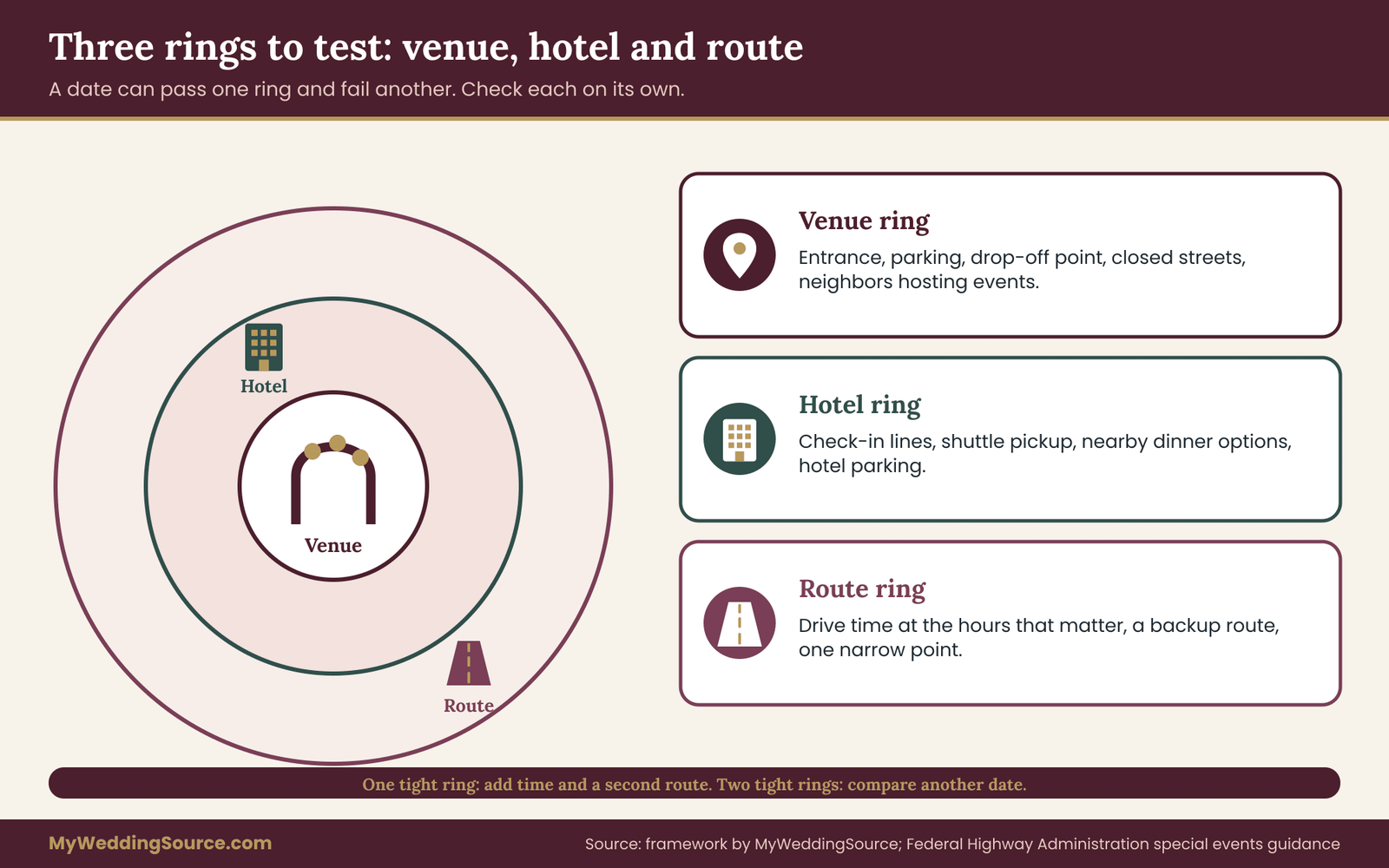
Think in three rings
Draw three rings, and check each one separately.
The venue ring covers the last mile or two around the ceremony site: the entrance, the parking area, the street that leads in and the street that leads out. Problems here include street closures, parking shortages and competing events at neighboring properties.
The hotel ring covers the area around your guest hotels, including the hotel parking lot and the roads to the nearest restaurants. Problems here include slow check-in lines, fully booked shuttles and no table available for the dinner you planned for out-of-town guests.
The route ring covers the road between the two. It is the one that tends to fail. A seven-minute trip on a normal Saturday may become thirty minutes if a ceremony lets out nearby, or if the road runs past campus.
A simple rule: if any ring looks tight on your graduation weekend, add time to the schedule and plan a second route. If two rings look tight, take the date seriously as a candidate for change.
The test drive
You cannot learn everything from a screen, so make at least one trial trip. Ideally you do it on a comparable Saturday, such as another college weekend, or on the same graduation weekend the year before, if you can arrange it. If your wedding is more than a year away, a campus event earlier in the calendar year can give you a preview of how the town behaves.
When you drive, record the time of day, the time it took, the stops and the places where the road narrowed or a signal slowed everything down. Then do it again at the hours that matter, such as the hour guests will head to the ceremony and the hour they will head back to the hotel after the reception. Drive the route yourself rather than asking a navigation app for an estimate alone, because an app shows the current traffic and not the traffic of a particular graduation weekend months away.
The Federal Highway Administration publishes material on managing traffic around planned special events. It is written for agencies, but its basic idea is useful: the busiest hours are predictable, and the best protection is knowing the times and the alternatives before the day arrives.
Questions for local authorities
If you find a clear road conflict, ask the city or county. A planned event often has a published traffic plan, a street-closure notice or a permit on file. Look for the city’s event calendar, its transportation or public works page, and the campus’s own guest information page. Many campuses publish a parking map and a notice of closed roads for commencement. If you cannot find it, call the non-emergency number for the city or the campus public safety office and ask who handles event traffic.
Use direct questions.
“We are hosting a wedding at this address on this Saturday. Will any streets near it be closed or restricted because of the university commencement, and is there a published traffic plan?”
Write down the name of the person, the date and the answer. If the answer is “not yet decided,” ask when the plan is expected.
Parking and drop-off
Parking is a part of the arrival route that gets less attention than it deserves. If the venue has a small lot, a crowded graduation weekend may mean guests from nearby events compete for the same spaces, or that overflow parking is unavailable. Ask the venue whether they enforce their lot for wedding guests only, whether overflow parking exists, and whether any nearby lots are shared with a campus or a church that is hosting its own event.
Plan a drop-off point that does not block the road. Older guests, the wedding party and anyone in formal clothing should be able to get out of the car near the entrance, while the driver parks. If you are hiring a valet or a parking attendant, confirm that they can work on that day, since some staff have other commitments.
Shuttles: when they help and when they do not
A shuttle can smooth the trip between hotel and venue, but only if the route itself is workable. A shuttle stuck in the same traffic as every other vehicle does not save time. Before booking, ask the shuttle company three questions. How many trips can you make in an hour on this route at this time? What is your plan if the road is closed or slow? Do you have another vehicle in case of a breakdown?
Build the schedule with a buffer. If the trip normally takes fifteen minutes, schedule thirty, and plan the first pickup earlier than you think necessary so the last guests arrive before the ceremony begins. Ask the company to check a recent commencement weekend in the same city, if they have operated on one, and tell you what happened.
If you have no shuttle, give guests a plain paragraph with three pieces of information: the recommended route, a backup route and the suggested time to leave. It takes less effort than answering the same question from twenty guests at the last minute.
Rideshare and taxis
Rideshare and taxi service can be strained on a graduation weekend, and waits at the end of the night can be longer than usual. Do not make them your only plan for the ride back from the reception. Ask the shuttle company about a late run, arrange a block of pre-booked rides through a local company, or recommend that guests who plan to drink leave from a hotel that is close enough to walk. A reception that ends at ten in the evening should not leave older guests waiting at the curb for an hour.
Airports and trains
Guests who fly or take the train to a region with a large campus may find that flights fill and fares rise around the commencement dates. For the same reason, rental cars can be scarce. If many guests will arrive by air, tell them early so they can book flights and cars before inventory thins. The U.S. Department of Transportation publishes information about airline passenger rights, including what to expect when a flight is canceled or changed, and it is useful reading for guests with tight arrival windows.
Encourage guests to arrive a day early if they are coming from far away. A Friday arrival also gives you a chance to greet people at an informal welcome gathering, which suits a graduation weekend when the room supply and the roads are unpredictable.
The weather question
A graduation weekend often falls in spring or early summer, when storms and heat can complicate outdoor ceremonies and travel. The National Weather Service publishes forecasts and local climate information, which are useful for choosing the likely weather range of a date, though not for predicting it months ahead. If heavy rain forces both the campus and your venue to move indoors, parking and drop-off areas change too. Ask the venue for its rain plan and compare it to the one the campus will use.
A one-page arrival plan
Pull the traffic and parking checks into a single page that you can share with the wedding party, the venue and your vendors. Include the recommended route, the backup route, the expected drive time at each hour that matters, the drop-off point, parking instructions, the shuttle schedule and a phone number for a person who can answer a question that day. Test it by asking someone who has not seen the plan to follow it. If they have questions, so will your guests.
The Saturday clock
Take one more step and write the hour-by-hour clock for the day with the overlap map beside it. Note when the largest nearby event begins and ends, when your ceremony starts, when guests will leave their hotels, when vendors will arrive, and when the reception ends. If the time guests will be on the road matches the time the campus will be clearing out, shift your own times where you can. A ceremony that starts an hour later can avoid the morning surge, and a cocktail hour that begins earlier gives late arrivals a cushion without making anyone rush.
That kind of change often costs nothing, and it may be the easiest fix in this guide. Before you move any time, check with the photographer, the caterer and the venue, because a shift can affect the light, the food schedule and your venue’s end time. The vendor timeline guide explains how to coordinate a change like this without confusing anyone.
Edge cases on the road
Three situations come up often enough on a graduation weekend to be worth planning for in advance.
Guests who arrive early for the graduation. Some of your relatives may not be connected to the campus at all but will still arrive at the hotel at the same time as the commencement crowd, and wait in the same line. Tell guests the check-in time and suggest they arrive before or after the busiest hours, so the front desk is not the first place they meet the graduation weekend.
A ceremony that runs late. If the largest campus ceremony runs long, the traffic wave moves later too, and the roads you planned to use at one o’clock may not clear until two. Build a cushion between the end of your own ceremony and any hard deadline, such as a photographer’s sunset session or a caterer’s service time. A graduation weekend schedule with fifteen spare minutes tolerates an overrun far better than one without.
A single access road. If your venue has only one way in and out, treat that as the central fact of your plan. Ask the venue whether emergency vehicles, delivery trucks and guest cars all use it, and whether a second gate exists. A graduation weekend adds cars to the same road, and a single access road leaves no room for a mistake.
If you find that the road plan depends on one narrow bridge, one railroad crossing or one intersection, write that on the one-page arrival plan and tell the shuttle company. Local drivers know these spots, and a short conversation can save a good deal of delay on a graduation weekend.
Venue and vendor checks on a graduation weekend
Rooms and roads are the guest side of the graduation weekend. The vendor side has its own checks, and they are easier to do while contracts are still open. This section covers what to ask the venue, the caterer, the photographer and the other vendors who must reach your site on time.
Ask the venue about its own history
A venue that has hosted weddings on a graduation weekend can tell you things no website will. Ask these questions.
- Have you hosted weddings on a graduation weekend before, and what went wrong or right?
- Do you have a policy for vendor load-in when roads are busy?
- Is there a neighboring property, church or event space that hosts large events that graduation weekend?
- Is there a second entrance, a service road or an off-site staging area?
- Does your contract allow a change of date, and what are the deadlines and costs?
The last question matters because it tells you what flexibility you have if the overlap map turns out worse than you expected. A venue with a generous rescheduling clause gives you more room to maneuver than one with a firm no-change policy. For the details of what to read in a vendor agreement, see the guide to wedding vendor contracts, and for the broader task of checking who you are hiring, see the vendor due diligence checklist.
The load-in window
Load-in is when vendors bring their equipment, flowers, food and rentals into the venue. It is the part of the day most sensitive to road conditions. If a delivery truck needs forty-five minutes on a normal Saturday and the road is slow, it may need ninety. Ask each vendor for the earliest possible arrival time and the latest acceptable arrival time, and write both on the vendor timeline.
A reasonable approach is to move the highest-risk deliveries earlier, such as the cake, the flowers and the rentals that must be set before guests arrive. If the venue allows Friday delivery, take advantage of it. If it does not, ask whether a morning window before the nearest commencement ceremony begins is available. Some vendors charge a small fee for an earlier arrival, which you can weigh against the risk of a late delivery.
Photographers and videographers
Photographers sometimes have a conflict that the couple does not expect. Spring and early summer are busy for portrait photographers because of graduation photos, and a studio may have staff shooting on campus. Ask whether your photographer or the associate shooters have other commitments that graduation weekend, and confirm the backup plan in writing.
Ask also about travel time between your locations. If portraits are planned at a scenic spot near the campus, they may be crowded with graduates in gowns and families waiting for turns. A quiet park that is easy on a normal Saturday may be unavailable. Choose a second location in a different part of town, and keep your photo schedule flexible enough to switch.
Caterers, bakers and florists
Food and flowers are time-sensitive, and the people who deliver them often work on a tight route. Ask each vendor how many events they are serving that graduation weekend and how they will staff yours. A caterer serving many graduation parties may be stretched thin, although a large company will have the staff to manage it. A small florist may be able to handle only one wedding and a few graduation orders, so ask about their capacity and their delivery plan.
Consider the cost of change as well. If the caterer needs additional staff to cover the extra travel time, ask for the price now rather than discovering it on the final invoice. A short written note about the arrangement avoids confusion later.
Hair, makeup, transport and officiant
People who travel to you need the same questions. Ask the hair and makeup team how long they need for the route and whether they will arrive earlier on a graduation weekend. Ask a car service or limousine company about its schedule, the route, a backup driver and the pickup times. Check with your officiant, whose own travel may cross a busy area, and ask for the plan if the trip runs long. The wedding officiant guide can help you confirm what an officiant needs to be ready on the day.
Rental items and the extras
Chairs, tents, linens and lighting arrive on trucks that may be shared among many events. Ask the rental company what time the truck will arrive and what the backup is if a vehicle is delayed. Confirm that they have staff and equipment for your event, since a heavy graduation weekend for them may be the same as a heavy graduation weekend for you.
Insurance and cancellation terms
Some couples consider event insurance when the date has a known risk. Policies differ, and many do not cover ordinary traffic or hotel shortages. If you are considering a policy, read what it excludes before you buy it, and ask a licensed insurance professional about your own situation. Do not assume a policy covers a problem it was not designed for. The same goes for vendor cancellation clauses: read what happens when a vendor cannot arrive, and what you can recover.
Guest communication for a graduation weekend wedding
Once the checks are done, the most useful thing you can do is tell guests what they need to know, at the right time, in a calm tone. Most guests do not need to know that a campus is nearby. They need to know where to sleep, how to travel and when to leave.
Save-the-dates and invitations
When you send a save-the-date, include a short line about lodging if the graduation weekend is tight, such as a note that hotel rooms are expected to be in high demand and that a block is available at a named hotel. If you can name the hotel and the cutoff date at that stage, do it. The invitation etiquette guide explains what information belongs where, and a wedding website is a better place for details than the invitation itself.
The timing of messages
A sensible schedule is a first message with the save-the-date, a second when room options are known, a third as the block cutoff approaches, and a final one with the arrival plan in the last week or two. Keep the final message short and specific. Include the route, the backup route, parking, shuttle times and one phone number.
Handling guests with a graduation conflict
Some guests will have a family member graduating that graduation weekend, and they may have to choose. Do not ask anyone to choose in public. A short, private, kind message works better.
“We learned after setting the date that a ceremony falls on the same graduation weekend. We understand if you can’t be in two places, and we want you to do what matters most for your family.”
If the guest’s attendance is essential, such as a parent or a sibling, take that into account when you test the date. A date that forces a close relative to choose between your wedding and a graduation may not be worth keeping. If the guest is one of many, accept the decision with grace.
The day-of message
On the day, send a short text or have a trusted person ready to do so. If traffic is heavy, the message can tell guests to leave earlier, or to use the alternate route. A guest list and RSVP system that includes mobile numbers makes this possible, so collect them when guests reply.

Worked example: Priya and Daniel screen two dates
The example below is invented to show the method. The names, places and numbers are illustrative, and nothing in it describes a real venue or a real campus. The point is the reasoning, so adapt the steps to your own town.
Priya and Daniel are planning a wedding for about ninety guests. The ceremony and reception will be at a garden venue on the edge of a mid-sized college town. About fifty guests are local or within an hour’s drive. About forty will arrive from other states. The couple has two candidate Saturdays in May, and they are not sure whether either one falls on a graduation weekend.
Step one: the list of campuses
They draw a circle of thirty minutes around the venue and around the two hotels they like. Inside the circles they find one state university, one small private college and one community college. They also note that the main highway from the airport runs past the state university, which makes the route ring relevant even though the venue is not on campus.
Step two: the dates
They check each campus’s published commencement page. The state university lists a graduate ceremony on a Friday evening and an undergraduate ceremony on the first Saturday of the month. The small private college lists a morning ceremony on the second Saturday. The community college lists a single evening ceremony on a Thursday.
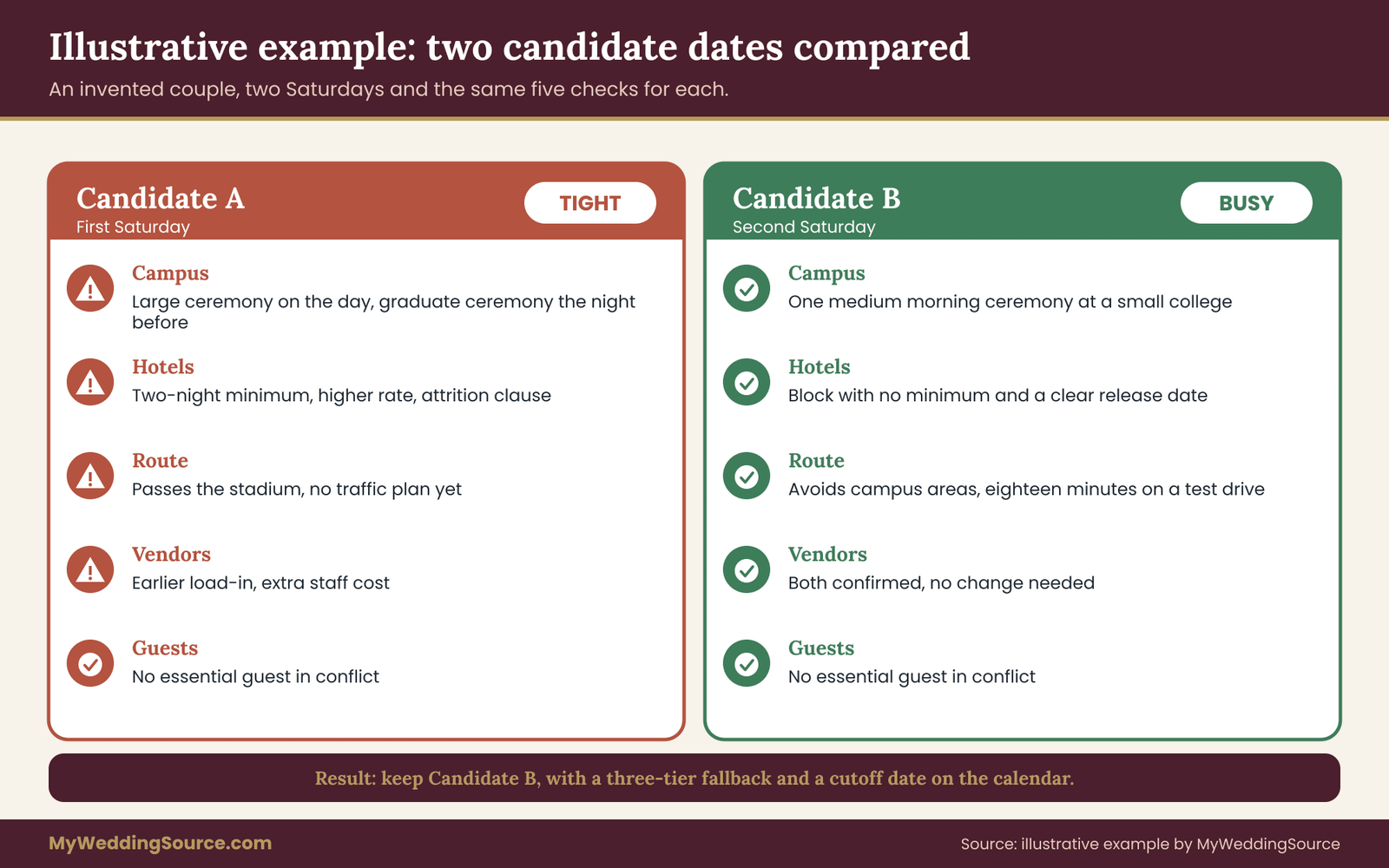
So Candidate A, the first Saturday, falls on a major undergraduate ceremony, with the graduate ceremony the night before. Candidate B, the second Saturday, overlaps only with a small ceremony at the private college. They also see that the state university lists residence hall move-out for the following Sunday, which will not affect either date directly but will affect a farewell brunch on Candidate A.
Step three: sizing
On the four-level scale, they place the state university’s undergraduate ceremony at level three, large, with a graduate ceremony the previous night at level two, medium. They place the private college ceremony at level two and the community college ceremony at level one. Candidate A is “tight” because a large event sits on the wedding day with a medium one the night before. Candidate B is “busy” at worst, with one medium event on the morning of the wedding.
Step four: the hotel calls
Priya calls the three hotels closest to the venue and asks the ten questions from the hotel section. The results differ sharply by date.
For Candidate A, the nearest hotel says it requires a two-night minimum for that graduation weekend and has already sold most of its rooms. The second hotel offers no block but says it will take reservations until its own cutoff. The third has a block available but at a higher graduation weekend rate with an attrition clause. For Candidate B, the nearest hotel offers a block with no minimum and a release date several weeks before the wedding, and the second hotel is open at its normal rate.
Priya writes the answers in a note with each date and the name of the person she spoke to, and she sends a short email to each hotel summarizing what she heard.
Step five: the traffic test
Daniel drives the route from the nearest hotel to the venue on a Saturday morning, at a time that matches the guest travel window, on a graduation weekend with no campus events. It takes eighteen minutes.
He then looks at the roads in a map app and notices that the quickest route passes within a few blocks of the state university’s stadium. For Candidate A, he expects that to be slower. He emails the city’s transportation office and asks whether a traffic plan is published for the commencement. The answer is that the city publishes one a few weeks before the event. That is a gap in the information, and he marks it on the overlap map as an unresolved risk.
For Candidate B, he finds the route does not touch any campus area, and no large event is listed.
Step six: the vendors
They ask the caterer and the photographer about each date. The caterer has other events on Candidate A and is willing to serve the wedding, but would need an earlier delivery window and an extra staff member, which would add a cost. The photographer is free on both dates but notes that the scenic park Priya wanted for portraits is popular with graduates in the days around the large ceremony. On Candidate B, neither raises a concern.
Step seven: the fallback worksheet
Even though Candidate B looks better, they decide to fill in a fallback worksheet for it, because one of the hotels could change its terms. Tier A is the nearest hotel’s block with its release date.
Tier B is the second hotel, with a list of the rates and distances, plus a note that the road to it does not pass the university. Tier C is a small inn in the next town, with a ride plan for guests who choose it. Each tier has a trigger. If fewer than half the Tier A rooms are booked a month before the release date, they send the Tier B details to guests who have not booked. If Tier A releases early, they send the same note the same day.
The decision
Priya and Daniel compare the two dates. Candidate A has a large campus event on the wedding day, a hotel minimum stay, a vendor surcharge, an unresolved traffic plan and a portrait location problem. None of these is fatal by itself, but together they add cost and stress and leave them dependent on information that will not arrive for months. Candidate B has a few small risks and a clear fallback. They choose Candidate B, tell the venue, and send the save-the-date with a short lodging note and the cutoff date.
What the example shows is not that graduation weekends should always be avoided. It shows a way to compare. If Candidate A had been the only date the venue could offer, and if the family had been unable to attend any other graduation weekend, they could have kept it and used the fallback, with an earlier load-in and a clear guest plan. The tools help you make the choice with your eyes open.
Keep, adjust or move: deciding about a graduation weekend date
After the map, the calls and the drive, you have to decide. There are three honest outcomes, and each has a rule of thumb.
Keep the date
Keep it when the overlap map is clear or busy, the hotels offer acceptable terms, the route ring is workable, and your vendors confirm their capacity. Keep it with a written fallback and a calendar of checkpoints, and do not spend more energy on it. If a date is fine, say so and move on, because worry that returns every week is its own cost.
Adjust the plan
Adjust the plan when the date is workable but tight in one or two places. Adjustments tend to be small and inexpensive.
- Move the ceremony start time to avoid the peak traffic hour.
- Ask vendors to load in earlier, or on Friday.
- Add a second hotel zone and a shuttle with a buffer.
- Shorten the distance between ceremony and reception, or hold both in the same place.
- Send guests an earlier arrival plan and encourage a Friday arrival.
- Pick a second location for portraits.
Each adjustment should have an owner and a date. A list of ideas with no names tends to stay a list.
Move the date
Move the date when the graduation weekend is tight in several places at once, such as a large ceremony on your day, hotels that will not offer a block, a road that runs through campus and vendors who are stretched. Moving costs something, and the cost depends on how early you decide. It is much cheaper to change a date before you sign the venue contract, or before invitations print, than after.
If you are far enough in that moving would be costly, ask what the venue’s change policy is, what the vendors charge for a new date and whether any deposit is refundable. Read the contract for the exact terms. The choosing a wedding date around guests and vendors explains how to weigh a date against guest availability and vendor capacity, which helps when you are comparing the cost of change with the cost of staying.
A simple scoring habit
If you cannot decide, score each candidate date on five questions, with one point for each answer of yes. Is the campus calendar clear or only busy? Did at least one hotel offer a usable block or open rooms? Does the route ring look workable on a test drive? Did the venue and key vendors confirm capacity? Do all essential guests have no conflict?
Four or five points suggests keeping the date. Two or three suggests adjusting and keeping a fallback. One or none suggests moving. The score is not a law. It is a way to put the evidence in one place so you can talk about it without going around in circles.
Talk to your families early
A date change touches people. Parents may have booked flights, and a grandparent may have arranged care. When you have a concern about the date, tell close family early and plainly, before the decision is final. Ask whether the date is firm for them, and what they would need if it moved. Most people respond better to an early, honest question than to an announcement.
The checkpoint calendar for a graduation weekend
A one-time check is not enough, because campus calendars, hotel policies and city plans change. The fix is a short list of dates on your own calendar, each tied to a specific task. The schedule below assumes you have a year or more. Compress it if you have less.
At the candidate stage, before any contract. Build the overlap map for each candidate date. Call the two or three closest hotels and the venue. Make a test drive if you can. Decide whether the date is clear, busy or tight.
At contract signing. Confirm the campus dates again, and note the date you checked. Read the venue’s change policy and ask for the vendors’ capacity in writing. Put the hotel block terms in an email.
Eight to ten months out. Open the fallback worksheet. Confirm which hotels have released their commencement terms. If a block is available, decide whether to sign it, and keep it modest.
Six months out. Check the campus calendar once more. Ask whether any new events have been added, such as a second ceremony. Review the route with a map app. Send save-the-dates that include the lodging note.
Three months out. Confirm vendor arrival windows against the road plan. Ask the city whether a traffic plan has been published. Review how many rooms are booked and compare it with your triggers.
Six to eight weeks out. Reach the first hotel’s cutoff date. Check the room count. Release or adjust the block in writing, and send the Tier B details if the triggers say to.
Two weeks out. Finalize the arrival plan, and send it to guests, vendors and the wedding party. Confirm shuttle times and the backup vehicle. Collect phone numbers for a day-of text.
The week of the wedding. Check the weather forecast and the city’s event notices. Make one last drive of the key route at the relevant hour if you can. Brief the person who will send updates.

The wedding planning checklist can absorb these dates, so that you do not keep a second list. If you already follow a long checklist, add the eight dates above as a single group and assign each one to a person.
Review once a year and when rules change
If you are planning more than a year ahead, repeat the campus check every few months, because institutions can revise commencement dates. Hotel policies and local traffic rules also change, and fee rules for lodging may be updated by regulators. When you see a news item about a new local event, a change at a venue, or a policy shift at a hotel chain, treat it as a reason to run the checks again.
Limits of this method and common mistakes
Every screening method has limits, and it is better to know them than to be surprised.
You are working from public information. The overlap map is only as good as the calendars you can find. Some campuses publish late. Some change dates. Some events, such as private receptions and reunions, never appear on a public page. A map that looks clear can still miss something, which is why the fallback worksheet exists.
Traffic is hard to predict. A test drive on a similar graduation weekend is a good guide, but it does not guarantee the same result. Construction, a crash or a storm can change a route on any day. Build buffers rather than counting on precision.
Hotel terms can change. A block you were offered may be withdrawn, and a rate you were quoted may shift. Keep your emails, and ask the hotel to confirm terms in writing. The Consumer Financial Protection Bureau’s guidance on disputing credit card charges can help if a hotel or vendor charges you something that differs from what was agreed, but prevention is better than dispute.
You cannot fix every guest’s situation. Some guests will choose a graduation over a wedding, and some will not find a room. Accept this where it does not involve a person whose presence you cannot do without. Your job is to give people a fair chance and a clear plan, not to remove every difficulty.
The map does not tell you whether the date is right. A tight graduation weekend can still be a lovely day if it is the one that brings the people you love together. The tools help you see the costs. The decision remains yours.
Mistakes that appear again and again
Several errors are common enough to name.
- Checking only the biggest campus and missing a second institution nearby.
- Reading last year’s calendar and assuming this year matches.
- Asking one hotel and assuming the answers apply to all of them.
- Forgetting Friday and Sunday, when guests travel.
- Signing a block with an attrition clause on a graduation weekend when you are unsure how many guests will book.
- Relying on a navigation app’s estimate for a graduation weekend months away.
- Telling guests about the problem but not offering a clear plan.
- Letting a fallback sit on paper with no trigger date and no owner.
- Forgetting that vendors face the same congestion and need earlier load-in times.
- Failing to ask the venue whether it has hosted a wedding on a graduation weekend before.
None of these is difficult to avoid once you know it. Most require only a phone call or an extra line in the notes.
A note on being fair to the people who live there
A wedding in a college town is a guest in someone else’s busy weekend. The families graduating that graduation weekend have planned for years and spent real money, and the local roads and hotels are shared. It helps to take the same tone with campus staff, hotel staff and city offices that you would want from anyone planning around your own big day: ask clearly, thank people, and do not expect special treatment because the event matters to you.
Your next steps
Pick one candidate date this week and spend an hour on it. List the colleges within range of your venue and your hotels, find each campus’s commencement page and write down the dates. Put them on a Thursday-to-Sunday overlap map, and mark the date as clear, busy or tight. Then call the nearest hotel with the ten questions in this guide and ask the venue whether it has hosted a wedding on a graduation weekend.
With that in hand, fill in the three tiers of the accommodation fallback worksheet, set the trigger dates and put the checkpoint calendar on your phone. If the date looks tight in several places, compare it with a second date before you sign anything. If it looks workable, keep it, tell your guests about lodging early and move on to the rest of your planning.
FAQ
Can we have a wedding during college graduation weekend without major problems?
Yes, many couples do. The graduation weekend is workable when you check the campus calendar early, ask hotels about minimum stays and block terms, test the route at the hours that matter, and keep a written fallback for rooms. The problems come from finding out late. A date that is clear or only busy on your overlap map usually needs little more than extra buffer time.
How far ahead do hotels near a campus book up for commencement?
It varies by campus and hotel, and many families reserve rooms a year or more ahead because the date is known early. Some hotels also set minimum stays or earlier cutoffs for that graduation weekend. Ask each property when it opens reservations for your dates, and get its terms in writing. Do not rely on a general rule from another town.
Should we avoid a graduation weekend entirely?
Not always. If the campus is far from your venue and hotels, the effect may be small. If a large ceremony falls on your day and hotels, roads and vendors are all affected, moving the date may cost less than working around it. Compare at least two candidate dates using the same checks, and decide with the evidence in front of you.
Where do we find reliable commencement dates?
Use the college’s own commencement page, its academic calendar and its guest information page. Check the registrar or commencement office if a date is missing. Note the day you looked, because dates can change. For city events, use the municipal calendar, the visitor bureau and the transportation office, and ask the venue what local weekends are hard.
What if a guest is graduating on our wedding weekend?
Talk to them privately and kindly, and tell them you understand if they need to be at the ceremony. If the guest is a close relative whose absence would matter a great deal, factor that into your date decision before invitations go out. If the guest is one of many, accept their choice gracefully and keep the relationship warm.
Is a room block worth it on a graduation weekend?
It can be, but read the terms. Look for minimum stays, attrition penalties, higher graduation weekend rates and early cutoffs. A smaller block with a clear release date is often safer than a large one with financial risk. If a hotel will not offer a block, recommend several properties and use your fallback tiers to guide guests.
How early should vendors load in on a graduation weekend?
Ask each vendor for their earliest and latest workable arrival, and move high-risk deliveries earlier, such as cake, flowers and rentals. A Friday delivery, if the venue allows it, removes the Saturday traffic risk. Confirm the arrangement in writing, along with any fee for earlier arrival, so there are no surprises on the final invoice.
Does wedding insurance cover traffic or hotel shortages?
Usually not, though policies vary. Many cover specific events such as vendor no-shows or severe weather, and exclude ordinary delays. Read the exclusions before you buy, and ask a licensed insurance professional about your situation. A plan with buffer time, earlier load-in and a fallback for rooms is more reliable than hoping a policy will pay.
Sources
- Americans with Disabilities Act, U.S. Department of Justice
- Federal Trade Commission, consumer and business guidance on pricing
- Airline passenger rights and consumer information, U.S. Department of Transportation
- Planned special events and traffic management, Federal Highway Administration Office of Operations
- Forecasts and climate information, National Weather Service
- Disputing charges and consumer financial guidance, Consumer Financial Protection Bureau
- College and university data, National Center for Education Statistics
- Travel and consumer information, USAGov
- Air travel screening and airport guidance, Transportation Security Administration