

A post-wedding beneficiary review is a short, structured check of every account and policy that names someone to receive money if you die, plus the coverage that changes when you marry. This guide gives you an adviser meeting prep sheet, a deadline order and a set of plain questions so the first beneficiary review after the wedding takes an evening to prepare and an hour to hold.
Do the beneficiary review in four passes. First, list every policy and account with the owner, the insured person, the named beneficiary and a deadline. Second, start the short clocks, such as health coverage enrollment, before anything else. Third, take the sheet to the right professional: your benefits office for workplace plans, a licensed insurance agent for policies, a fee-only planner or tax professional for the money questions, and an estate attorney for wills and trusts. Fourth, keep the confirmation each company sends, because the form on file decides who is paid, not your intentions.
Weddings change who you would want to take care of, but they do not change the paperwork on their own. A life insurance policy you bought at twenty-five still names whoever you wrote down then. A workplace retirement account still shows the beneficiary you picked on your first day of the job, and sometimes that is a parent, a sibling or nobody at all. A beneficiary review is the habit of opening those forms, reading the names and deciding, on purpose, whether they still match your life.
The beneficiary review is also less glamorous than it sounds. Most of the work is gathering facts that you already have somewhere: statements, benefit portal pages, policy numbers and old emails. In a beneficiary review, the part that needs a professional is smaller than people expect, and it is easier to use that hour well if you arrive with a one-page sheet instead of a shoebox.
A note on scope. This is general information, not legal, tax or financial advice, and the rules differ by state, by plan and by the exact wording of each contract. Where a rule matters, the article points you to the agency, plan administrator or licensed professional who can confirm it for your situation.
What a beneficiary review covers
The phrase sounds narrow, but a useful beneficiary review touches four kinds of items, and they behave differently.
Contracts that pay a named person. Life insurance, annuities, workplace retirement accounts, individual retirement accounts, health savings accounts, pension plans and some bank and brokerage accounts all let you name who receives the balance. These pay according to the form on file, usually outside of a will.
Coverage for the living. Health, dental, vision, disability, auto, renters or homeowners policies and umbrella liability policies do not have beneficiaries in the same sense. They have insured people, household members and enrollment rules, and marriage can open or close options.
Documents that direct everything else. A will, a trust, a durable power of attorney and a health care directive cover property and decisions that the forms above do not reach. They are the estate attorney’s territory.
Records that prove it all. Your marriage certificate, the confirmation emails from each company and the one-page sheet that ties everything together. The records section of the broader guide on organizing wedding records after the event covers the filing side, and this article stays on the beneficiary review itself.
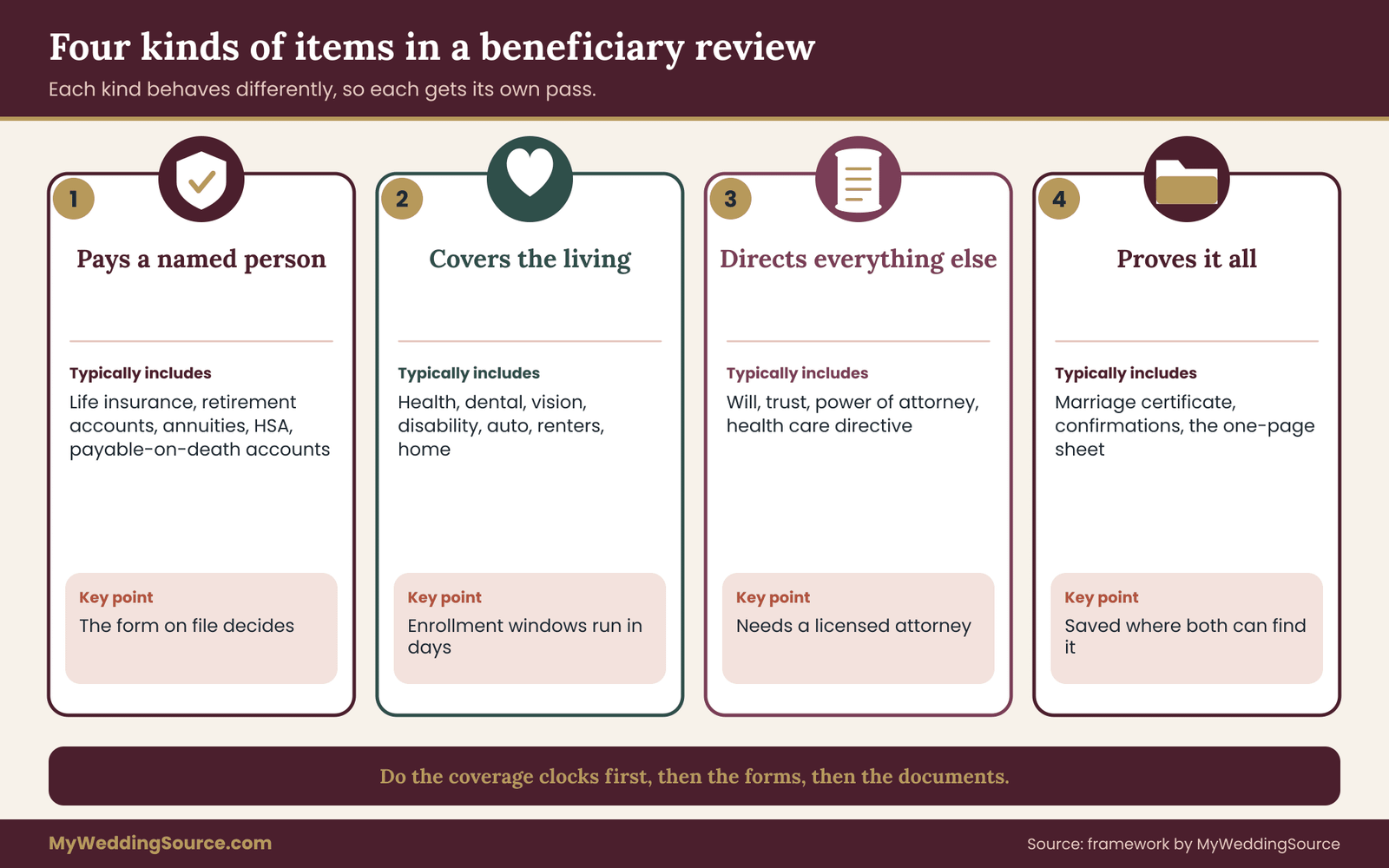
Seeing the four kinds side by side makes the order of a beneficiary review obvious. The coverage clocks run in weeks, so they come first. The beneficiary forms are quick to change but easy to forget. The documents take an attorney’s time and are usually scheduled after the first two are settled. The records tie everything together at the end.
What a beneficiary review does not do
A beneficiary review does not decide how much insurance you need. That is a separate conversation about income, debts, dependents and goals, and it is worth having with a licensed adviser, but it is not the same task. A beneficiary review answers the question “who gets paid under what we already have?” The coverage-amount question answers “is what we already have enough?” Mixing them is how an hour with an adviser turns into a sales presentation.
It also does not require you to move money, buy anything or merge accounts. Many couples keep separate accounts and policies for good reasons, and a beneficiary review works fine with that. The only output you need on the first pass is a list of facts and a list of decisions.
Why the beneficiary review belongs in the first months, not the first years
Three reasons make the timing matter, and none of them involve fear.
The first is that a few enrollment windows are short. Marriage is a qualifying life event for many health plans, and the window to add a spouse is measured in days or weeks, not years. The next section sorts those into an order, so the beneficiary review starts with the clocks.
The second is that the paperwork is fresh. Your marriage certificate is easy to find, your partner is willing to sit down and look at accounts together, and you are already doing name and address updates. Adding a beneficiary check to that stream costs very little extra effort.
The third is that errors compound quietly. Nobody notices an outdated beneficiary until a claim is made, and by then it is too late to fix. A beneficiary review done once in the first quarter, then repeated at each major life change and on a calm annual schedule, catches almost all of it.
Why beneficiary forms outrank good intentions
The most useful fact in this whole subject is simple: for most accounts and policies that allow a named beneficiary, the form on file with the company controls who is paid. A will usually does not override it, and a verbal promise does not either. The company pays the person named, and it generally does so without asking what the policyholder meant.
That is a feature, not a flaw. It lets a payout happen quickly, without a court process, which is why beneficiary designations are used so widely. But it means you have to treat each form as a decision you made, not as background paperwork.
Here is what this looks like in ordinary situations.
The old form that names a parent. A person names a parent on a workplace life insurance form at twenty-three. They marry at thirty-one and assume the spouse is covered. The form still names the parent, because nothing about the wedding touched it. Whether that is a problem depends on what the couple wants, but it should be a choice, not a surprise.
The form that names no one. Some accounts have no beneficiary on file. In that case the company usually follows a default order set by the plan document or the contract, which may name the spouse, then children, then the estate, or may send the money through probate. The details differ, and the point is that “nothing on file” is itself a result with consequences, so ask what the default is.
The form that names an estate. Naming your estate sends the money through the court process that handles a will. It may be a deliberate choice in some plans, but it can add time and make the funds available to creditors in ways a named person’s share would not be. If you see “estate” on a form and do not know why, ask.
The form that names a minor. Insurers and plan administrators generally will not pay a young child directly. Rules for who manages the money differ by state and by company, and an attorney can explain trusts and custodial accounts. If children from an earlier relationship are involved, this question deserves its own time at the meeting.
The difference between a primary and a contingent beneficiary
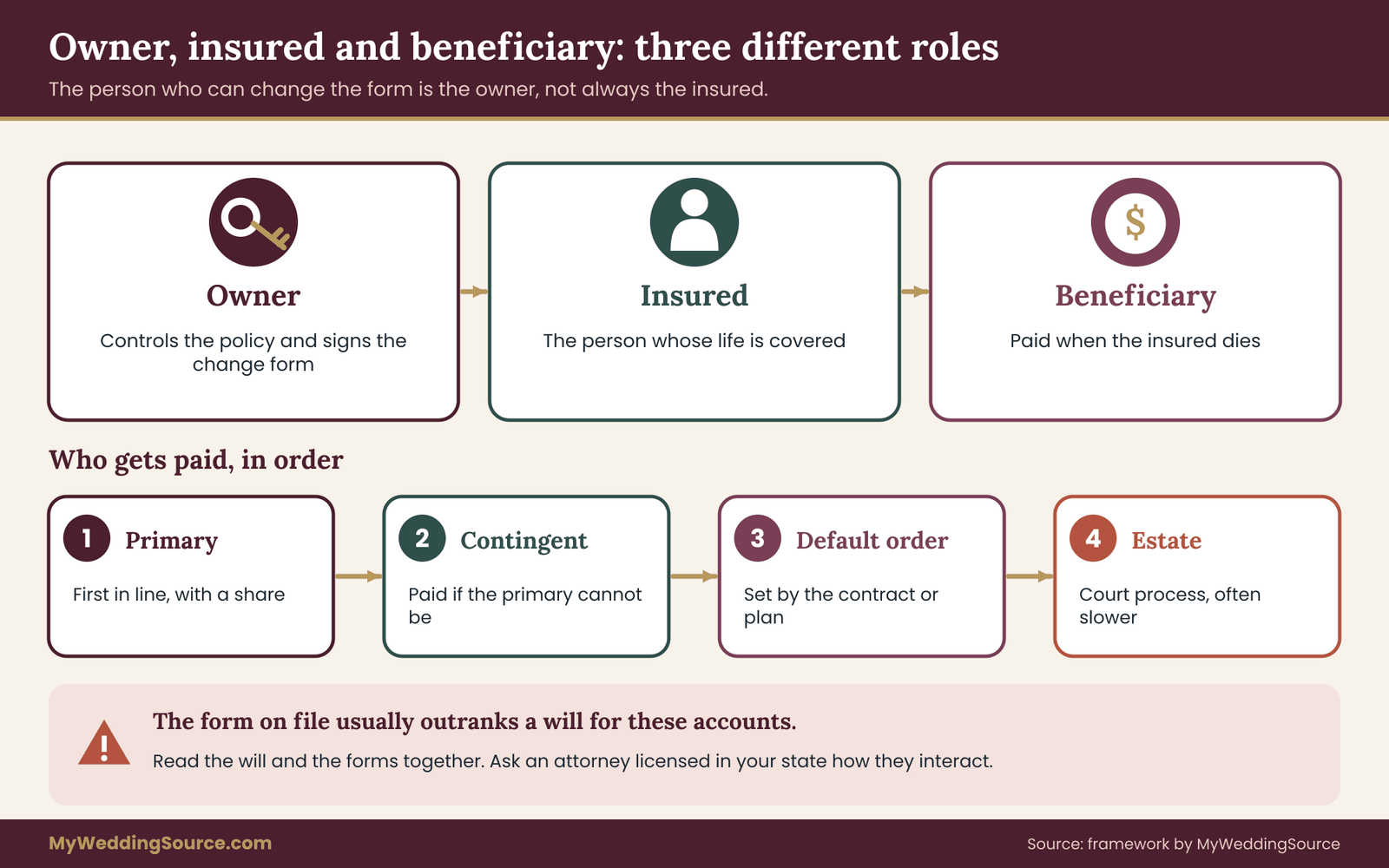
A primary beneficiary is first in line. A contingent beneficiary, sometimes called a secondary beneficiary, is paid only if the primary cannot be. Many couples name each other as primary and fill in nothing for contingent, which leaves a gap if both die together or the primary has died earlier and the form was never updated.
When you review, check three things on each form: who is primary, who is contingent, and what share each person gets. Shares need to add up to a full amount, and a few forms use percentages while others use fractions. A form that names two primaries without shares can produce a split nobody intended, and a form with shares that do not add up can be rejected or delayed.
Wording that causes quiet trouble
Two small details trip people up in a beneficiary review. The first is naming someone by relationship only, such as “my wife,” without a full legal name, date of birth or other identifier the company asks for. The company may then have to decide who that is, and a later marriage or divorce may blur the answer. Always use full legal names as they appear on identity documents.
The second is the phrase “per stirpes” or “by representation.” Some forms let you choose whether a beneficiary’s share passes to that beneficiary’s children if the beneficiary dies first, or gets redistributed among the remaining beneficiaries. The wording and the options differ by company, so ask the plan administrator or agent to explain the choices on the exact form in front of you, in plain words, before you tick a box.
Who to talk to: the people behind a beneficiary review
No single professional covers the whole beneficiary review, and the biggest time-waster in these meetings is bringing a question to someone who cannot answer it. Think of five roles, and match each question to the right one.
Your benefits office or plan administrator. For anything offered through an employer, such as group life insurance, a workplace retirement plan, health insurance and a health savings account, the benefits team or the plan’s website is the first stop. They know the forms, the deadlines and the plan’s own rules. They are generally not allowed to give you personal financial or legal advice, but they can explain how their plan works.
A licensed insurance agent or broker. For individual life, disability or property insurance, a licensed agent can explain how a policy is written, who the owner is, how to file a change and what the company needs from you. Ask how the agent is paid, because commissions and fees can shape recommendations. Your state insurance department can confirm that an agent holds a license.
A fee-only financial planner or a fiduciary adviser. If you want an opinion on how much coverage you need, how to split retirement savings or what a change means for your goals, a planner whose fee does not depend on selling a product is a cleaner fit for a decision-support meeting. Ask in writing whether the adviser acts as a fiduciary and how fees are charged.
A tax professional. A certified public accountant, an enrolled agent or a tax attorney can explain how marriage changes filing status, withholding and the treatment of certain benefits. They are the right call for tax questions that come up in a beneficiary review, such as how an inherited retirement account is treated.
An estate attorney. A licensed attorney who practices in your state drafts wills, trusts and powers of attorney, and can advise when a beneficiary form should name a trust. This is also the right person for community property questions, blended-family concerns and anything involving a business.

You do not need all five at once for a beneficiary review. Most couples get what they need from the benefits office, one conversation with an insurance agent or planner and, if the situation calls for it, a single appointment with an attorney. The prep sheet that follows lets you split the questions so that each professional sees only the part they can answer.
How to check that an adviser is who they say they are
A short verification step is part of the beneficiary review, not an insult to the adviser. For people who sell securities or give investment advice, the Financial Industry Regulatory Authority publishes a free lookup called BrokerCheck, and the Securities and Exchange Commission runs the Investor.gov adviser search. For insurance agents, your state insurance department usually offers a license lookup, and the National Association of Insurance Commissioners links to each state’s regulator. The CFP Board lets you confirm whether someone holds the Certified Financial Planner designation. Attorneys are listed by the state bar. Each of these takes a few minutes.
Look for the license, the length of time the person has held it and any disciplinary history the lookup shows. Then ask directly how the person is paid. A calm, specific answer, in writing if you ask for it, is a good sign. A vague answer, or pressure to decide the same day, is a reason to pause and to book a second opinion.
Four clocks: deadlines that start when you marry
Not everything in a beneficiary review is urgent. A few things are, and the way to avoid a rushed hour is to sort tasks by how fast the clock runs. Think of four clocks that run through any beneficiary review, from the fastest to the slowest. Each one has a different cause for its deadline, and each one calls for a different person.
Clock one: enrollment windows, measured in days or weeks. Marriage is a qualifying life event for many health plans. HealthCare.gov describes a special enrollment period that generally lasts sixty days after the event, and a plan offered through an employer sets its own window, which can be shorter. Dependent care and flexible spending accounts often follow similar rules. If you want to add a spouse to health, dental or vision coverage, or switch plans, find the date first and the details second.
Clock two: employer benefit elections, measured in weeks. Group life insurance, supplemental life coverage, disability options, retirement plan beneficiary forms and health savings account beneficiary forms often sit in the same benefit portal. Some changes are allowed at any time, and some are tied to an event. Your benefits office can tell you which is which. Make this call during the first week back at work, even if you do not change a single thing.
Clock three: individual contracts, measured in months. Individual life policies, annuities, IRAs and bank or brokerage accounts usually accept a beneficiary change whenever you submit the form. There is rarely a hard deadline, which is exactly why they slip. Put a date on the calendar and treat it like a bill.
Clock four: the annual beneficiary review, measured in years. Beneficiary forms drift out of date after children, a move, a job change, a new home, a death in the family or a divorce. One annual check, on the same day each year, catches almost all of it. Your wedding anniversary is a natural choice.

A realistic first month
A first-month plan that fits around work and a honeymoon, and that sits beside the rest of your wedding planning checklist, looks like this. In the first week, confirm the marriage license has been filed, then call your benefits office about the enrollment windows. In the second week, order certified copies of the marriage certificate and write the dates from clock one on a shared calendar. In the third week, collect the documents for the prep sheet. In the fourth, schedule any appointments you need. If the dates are tight, do the enrollment first and everything else second.
The marriage certificate matters here because enrollment usually requires proof of the event. The employer or the marketplace may accept a certified copy, a marriage license that was filed or another document, and each one lists what it accepts. The federal government’s page on marriage certificates, at USAGov, explains how to request a certified copy from the state or county that recorded your marriage. A photocopy may not be enough, so ask what your plan requires before you order or submit.
What changes if the wedding was abroad or the license was delayed
A wedding abroad, a ceremony that is separate from the legal marriage or a license that took weeks to be recorded can push the dates around. The enrollment window usually runs from the date of the legal marriage, not the date of a party, and the proof that a plan accepts depends on where the marriage was recorded. If your situation is unusual, ask the benefits office what document they accept and by what date, and keep the answer in writing.
A related edge case is a marriage that took place earlier than you realized, for instance a courthouse ceremony followed by a larger wedding months later. Pick the date on the marriage certificate as the starting point for every clock, and tell each plan administrator which date you mean.
What to do if you already missed a window
It happens, and it is usually not the end of the story. Many plans offer open enrollment once a year, and a missed spouse enrollment can often be corrected then, although coverage would start later. Some plans allow late requests with a documented reason. A short, polite message to the benefits office or the insurer explaining the situation, with the marriage certificate attached, costs nothing. Ask what options exist, in writing, and note the date you asked.
Do not assume the answer is no, and do not assume it is yes either. Each plan has its own rules, and the person who can tell you what applies to yours is the plan administrator.
The prep sheet: one page that makes the meeting short
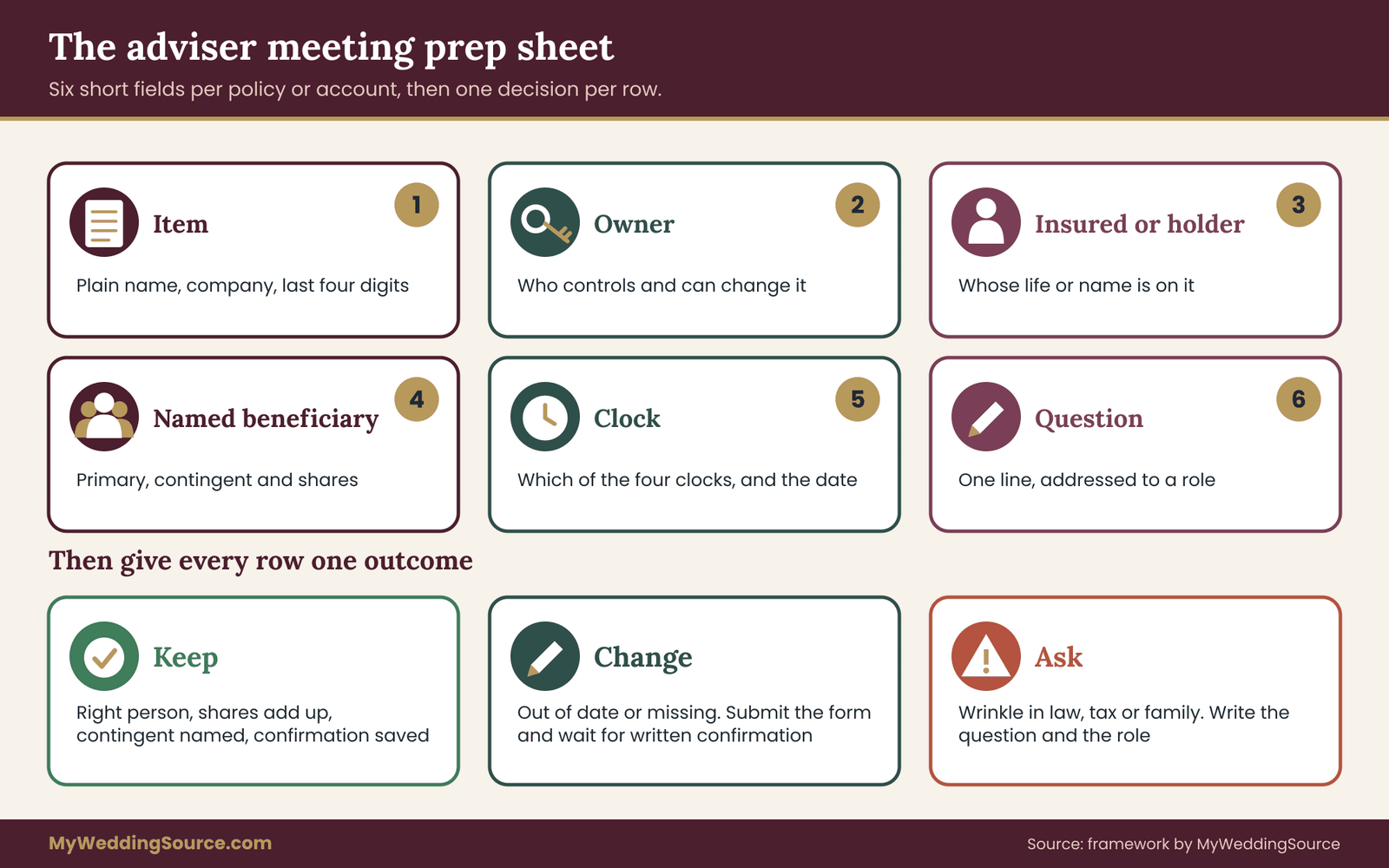
The prep sheet is the center of this beneficiary review guide. It is a single page, or a single screen, with one row for each policy or account, and it is built so that any professional can read it in a minute. The reason to use a standard sheet is practical. Advisers spend the first half of most meetings gathering facts. If you hand them the facts, the same hour goes to your decisions.
Each row has six short fields. They are not complicated, but each one is there for a reason.
Item. The name of the policy or account in plain words, such as “workplace life insurance, Sam” or “IRA, Priya.” Keep the company name and the last four digits of the policy or account number so that you can find it again, but never write a full account number on a shared sheet.
Owner. The person who controls the policy or account and can change it. For most workplace accounts the owner is the employee. For an individual life policy the owner might be someone else, such as a parent or a trust, which changes who can sign the change form.
Insured or account holder. The person whose life or health is covered, or whose name is on the account. On a life policy this is the person whose death triggers the payout.
Named beneficiary. Who the form says gets paid now, primary and contingent, with shares. If you do not know, write “unknown” and fix it before the meeting by logging in or calling.
Clock. Which of the four clocks applies, and the date if there is one.
Question for the meeting. One line, written as a question, and addressed to a role: benefits office, agent, planner, tax professional or attorney.
Why the owner column matters more than people expect
Life insurance has three roles that are often confused: the owner, the insured and the beneficiary. The owner holds the rights and can change the beneficiary. The insured is the person whose life is covered. The beneficiary receives the payout. In many simple policies one person is both owner and insured, and the beneficiary is a spouse or a child. But policies bought by a parent, bought inside a trust or transferred in a divorce can split those roles in surprising ways.
If you are the owner, you can change the beneficiary subject to the contract. If you are only the insured, you may not be able to change anything. A beneficiary review that skips the owner field can end with a lot of effort spent on a form that only another person can sign. The fix is one line on the sheet and a question to the agent: “Who is the owner of record, and what does the company require to change the beneficiary?”
How to fill in the sheet in about an hour
Start the beneficiary review with the sources that list everything in one place. Your workplace benefit portal shows group coverage and retirement accounts. Your pay stub shows deductions that point to benefits you forgot. Your email search for the words “policy,” “beneficiary” and “premium” finds individual policies. Statements and annual notices from banks, brokerages and insurers show account types and sometimes the beneficiaries on file.
Then fill in the beneficiary review sheet by person, not by company. Each partner fills in their own items first, because each knows where the paperwork sits. Afterward you read both sets together, which also gives you a quiet chance to learn what your spouse has set up, who they named and why. Those conversations are among the most useful parts of a beneficiary review, and the sheet gives them a reason to happen.
If a row has an unknown beneficiary, do not guess. Log in, call the company or ask the plan administrator for a copy of the beneficiary designation on file. Many companies will send it if the account holder asks. The request is routine.
A decision rule for each row: keep, change, or ask
After the sheet is full, apply the same short rule to each row. The rule keeps the beneficiary review meeting from turning into a long open discussion, and it works for a couple with two accounts or twenty.
Keep. The beneficiary is who you want, the shares are right, a contingent is named and you have the confirmation on file. Mark the row done and note the date.
Change. The beneficiary is out of date or missing. Download the form, fill it in and submit it through the company’s own channel. A change is not finished until the company confirms it in writing or in the portal. Save that confirmation with the sheet.
Ask. You do not know whether the choice is wise, or there is a legal or tax wrinkle. Examples include a blended family, a child with a disability, a business interest, a large retirement account, a trust, or a state with community property rules. Write the question and the role, and move on.
Most rows in a beneficiary review end up in keep or change. Perhaps one in five rows becomes an ask, and those are the ones that justify paying for a professional’s time. When you come to the meeting with only the asks, an hour is plenty.
A quick example of the three outcomes
Imagine a row for a workplace life insurance policy that names a sibling. The spouse should probably be there now, so the outcome is change. Imagine a row for an old individual policy that names a parent, where the owner is also the parent. The outcome is ask, because the owner must sign any change, and the couple may want to talk about whether the policy still serves a purpose. Imagine a row for a bank account that already names the spouse and a contingent. The outcome is keep, with the date of the last review written beside it.
Workplace benefits: the first stop in a beneficiary review
For many people the largest sources of death benefits and retirement savings sit inside employer plans. That makes the workplace the first stop in a beneficiary review, and it is also where the paperwork is most uniform. Most employers use an online portal, a short form and a human resources contact.
Group life insurance
Employers often provide a base amount of life insurance at no cost and offer extra coverage at a price. Both usually have a beneficiary designation that you can change in the portal. A beneficiary review at work starts with that page. Some employers ask for a form instead.
Questions worth asking the benefits office are simple. Is the beneficiary visible in the portal, and when was it last updated? Can the beneficiary be changed at any time, or only during enrollment? Is there a separate form for supplemental coverage? Does the coverage continue if you leave the job, and if so, is there a conversion or portability option and a deadline to elect it? The last question matters for the future, and the answer often has a strict time limit, so write it down.
If your spouse is also covered under your workplace plan, or the reverse, ask how coverage for a spouse works, who is the beneficiary on that coverage and whether the amount you choose requires evidence of health. Spousal coverage is a separate row on the sheet.
Workplace retirement plans and the spouse
Retirement plans such as a 401(k) deserve extra care in a beneficiary review, because federal law gives spouses particular rights in many employer plans. The Department of Labor’s Employee Benefits Security Administration explains plan rules for participants, and the plan documents are the final word. In many plans covered by federal law, a married participant’s spouse is the default beneficiary, and naming someone else requires the spouse’s written consent, often witnessed by a notary or a plan representative. Some plans, such as certain profit-sharing plans, handle this differently.
The important practical point is that your plan’s own rules decide. Two questions to put to the plan administrator are “Does this plan require my spouse’s consent to name someone other than my spouse?” and “What is the beneficiary on file for my account right now?” The second one occasionally reveals an old designation that nobody remembers.
A related point comes up for people who married and had a retirement account from before the marriage. The account does not become a joint account, but spousal rights in the plan can start with the marriage. Even if you want a different beneficiary, such as children from a prior relationship, the way to do that is through the plan’s consent process, not by assuming the form on file will be honored. An estate attorney can explain how the pieces fit together.
Pensions and survivor options
If either of you has a traditional pension, the plan may offer a survivor benefit, which pays the spouse after the pensioner dies. Whether it applies, and when you make the choice, depends on the plan. Some plans ask for the decision at retirement. Others have rules about spouses from the date of marriage. Ask the pension office for the plan’s summary description and read the section about survivors. If the language is dense, the plan administrator is the right person to explain it, and a planner can help compare the options later.
Health savings and flexible spending accounts
A health savings account has its own beneficiary designation, separate from your health plan. The tax treatment of the account after death differs depending on whether the beneficiary is a spouse or someone else, and the IRS publishes guidance on how that works. For the beneficiary review, simply confirm that a beneficiary is on file and decide whether it should be your spouse. A flexible spending account usually has no beneficiary, but marriage may let you change your election mid-year if the plan allows it, which is another clock-one question.
What to ask when HR says “it’s in the portal”
Portals can be misleading. The screen may show a beneficiary name from years ago, show a partial percentage or fail to show a contingent. Two habits help. Print the beneficiary page to a PDF after you finish a change, with the date visible, and save it with the sheet. Then, a week later, log in again and confirm the change is still showing. A sentence to the benefits office makes the habit easier:
“We recently married and are updating beneficiaries. Could you confirm which plans have a beneficiary form, and send a confirmation when each change is recorded?”
Individual life insurance in a beneficiary review
Individual policies, bought directly or through an agent, sit outside the workplace system, and a beneficiary review has to reach them on purpose. They are also where the most confusion arises, because the contract itself tells you what can be changed and how.
Term, whole and universal: why the type matters
A term policy covers a set number of years and pays only if the insured dies within that period. A permanent policy, such as whole or universal life, covers the insured for life and may build a cash value. The type matters for the beneficiary review because a permanent policy may have loans against the cash value, a different owner structure or a beneficiary that is irrevocable.
An irrevocable beneficiary is one who cannot be removed without their written consent. This can occur after a divorce settlement or in a planned arrangement, and it is not common in a first-marriage setting. If a row on your sheet says “irrevocable,” treat it as an ask, and bring the policy to a licensed agent or an attorney.
How to read the policy when you have lost the paper
Most insurers let the owner request an in-force illustration or a policy summary. The documents show the owner, the insured, the beneficiary, the face amount, the premium and the status. If you cannot find the policy number, an old premium notice, a bank statement showing the payment or an annual statement from the insurer will have it. If you have a policy but no longer know the company, the National Association of Insurance Commissioners and many state insurance departments publish guidance on locating lost policies.
Before you call, have the insured’s full name, date of birth and the last four digits of the Social Security number ready. The company may ask for them to verify identity. Do not email full numbers, and do not use unverified links. Reach the company through the number printed on a statement or through its official website.
Changing the beneficiary on an individual policy
The usual steps are the same across companies. The owner requests the change form, fills in the beneficiary’s full legal name, relationship, date of birth and share, signs it and returns it by the method the company requires. Some insurers want a notarized or witnessed signature. Some accept an electronic form through the portal. The change takes effect on the date the company records it, and a form that is mailed but not received does not count.
Ask for a written confirmation and, if the company allows, a new policy summary showing the updated beneficiary. If the confirmation does not arrive within the time the company promised, follow up. A change that nobody confirmed is a change you cannot rely on.
Name changes and policies
If one of you changes a name after the wedding, the beneficiary form may need the new name or both. A mismatch between the name on a policy and the name on an identity document can delay a claim. The simplest approach is to notify each insurer of the name change after the Social Security Administration and your identity documents are updated, and at the same time confirm the beneficiary name is spelled as you want it. The name-change order is covered in the broader guide on wedding records, linked earlier, and the same sequence works here.
Do we each need our own policy?
That question belongs in the planner-or-agent meeting, not in the prep stage. Whether you need coverage depends on debts, children, income that the other would need to replace and the length of time you want a policy to cover. A beneficiary review simply records what you already have. If you leave the meeting with a suggestion to buy something new, treat it as a separate decision, ask for the proposal in writing and give yourselves a week to compare it.
Three ground rules help here. Ask for the cost of the policy in dollars per year, not just per month. Ask what happens to the cost if you hold the policy for twenty years. And ask what the adviser earns if you buy. These are plain questions, and an adviser who values your business will answer them without strain.
Questions to bring: the script for each role
People often arrive at advisers with a general worry and leave with a general answer. Specific questions get specific answers. Below are questions grouped by role, in a form you can copy onto the prep sheet.
For the benefits office. Which plans have a beneficiary form on file for me? What is the beneficiary listed for each? What documents do you need to add my spouse, and by what date? Is there a separate window for dental, vision or a flexible spending account? Can I change beneficiaries at any time? Does the retirement plan require my spouse’s consent for a different beneficiary?
For a licensed insurance agent. Who is the owner of this policy? Who is the beneficiary on file, and is it primary or contingent? Can the beneficiary be changed online or only by form? Is the beneficiary revocable? What does the policy cost per year, and does the premium change? Can you send the written confirmation after we make a change?
For a fee-only planner. How are you paid, in writing, and are you a fiduciary at all times when giving advice to us? Given our two sets of accounts, where would you look for gaps? What would you want to see before recommending a change? What is the cost of this meeting and of any follow-up?
For a tax professional. How does marriage change our filing status and withholding? How is an inherited retirement account treated for a spouse and for someone else? Are there tax effects if we change who is named on an account? What records should we keep and for how long?
For an estate attorney. What does a will do and not do for assets that pass by beneficiary form? Do we need a trust, and if so for which assets? How do state community property rules affect us? Should a beneficiary form name a trust, or a guardian arrangement for children? What happens if we move to another state?
A good beneficiary review habit is to write the answers beside each question in the meeting, then send a two-line summary by message to the adviser afterward: “We understood the next step to be X by date Y. Please tell us if that is wrong.” The message turns a spoken conversation into a record.
The coverage side of a beneficiary review: health, disability, home and auto
Beneficiaries get the attention, but the coverage side of a post-wedding beneficiary review often saves more money and trouble. These policies protect the living, and marriage changes who counts as a household member.
Health, dental and vision coverage
If one or both of you have employer coverage, compare the plans before choosing. Adding a spouse to a plan is not always the cheapest option, and some employers charge extra for a spouse who has access to coverage elsewhere. Look at premiums, deductibles, out-of-pocket maximums, the doctors and hospitals in each network and the prescriptions you use. A spreadsheet with two columns, one per plan, is useful here, even though the rest of this guide avoids table-style layouts.
If you buy coverage through the marketplace, HealthCare.gov explains the special enrollment period after marriage and the documents that may be required. Marriage can also change the household income used to estimate premium tax credits, so estimates that were right when you were single may be off. The marketplace and a tax professional can explain the effect for your situation.
Do not let coverage lapse while you decide. If you are choosing between two plans, confirm the start date of each and the last day of the coverage you are leaving, so that there is no gap. If you are unsure, call the benefits office or the marketplace and ask what the effective date will be.
Disability insurance
Disability coverage replaces part of your income if illness or injury keeps you from working. Many employers offer short-term and long-term options, and some are paid by the employer while others are paid by you. A beneficiary review checks two things. First, whether you have any disability coverage at all, which many people discover they do not know. Second, whether the policy has a beneficiary, since some plans include a small death benefit or a survivor feature.
If you have a disability policy that you bought on your own, ask the agent or insurer how marriage or a change in income affects it. A raise or a change in job may alter how benefits are calculated. That is a conversation for the agent, and it belongs on the sheet as a question, not as a decision to make in the first week.
Renters, homeowners and auto
These policies often need quick updates after a wedding, mostly for practical reasons. If you moved in together, you need the new address on both policies. If one of you owns a car, ask whether the policy should list the spouse as a driver and how a combined household changes the rates. If you rent, each person’s belongings may need to be listed, and a renters policy may be shared or separate.
Wedding gifts from your wedding registry, a ring and new household items can raise a question about coverage limits. Jewelry, for example, often has a lower limit in a standard policy, and a separate rider or scheduled item can raise it. Ask the agent what is covered, what the limits are and what documentation to keep, such as receipts and photos. The records guide linked earlier explains how to store those.
Some policies treat a spouse who lives in the home as an insured automatically. Others require notice. The agent can tell you which applies, and a short message creates a record: “We married on [date] and now live at [address]. Please confirm what changes are needed on our policy.”
Umbrella liability
An umbrella policy sits above home and auto coverage and pays when a claim exceeds the underlying limits. Not everyone has one. If you do, ask whether the underlying policies need to meet minimum limits after the change and whether the spouse is covered. If you do not, the decision to buy one is a question for the agent or the planner, not a task to complete in a first beneficiary review.
Bank accounts, transfer-on-death and wills
Money that does not sit inside an insurance policy or a retirement plan has its own ways of passing to someone else. These are simple to check during a beneficiary review, and the answers shape what an attorney will need to do.
Payable-on-death and transfer-on-death
Banks often let an account holder name a payable-on-death beneficiary. Brokerage accounts can offer a transfer-on-death registration. Both are forms of beneficiary designation. They let the account pass to a named person without going through probate in many states, which is why people use them. For your sheet, treat each one like any other beneficiary row: who is named, when it was last updated and whether a contingent is listed.
Joint accounts work differently. An account held jointly with a right of survivorship passes to the surviving owner by the terms of the account, and the rules for joint accounts vary. If you are opening a joint account after the wedding, ask the bank how it treats survivorship and whether you can add a payable-on-death designation to a joint account. Keep in mind that a joint account may also be reachable by the creditors of either owner, a point worth raising with an attorney or a tax professional if one of you has significant debts.
What a will does in a beneficiary review
A will directs property that passes through probate. It also names a guardian for minor children and an executor. It generally does not control assets with a valid beneficiary designation, which are handled by the forms discussed above. The result is that a will and your beneficiary forms must tell a consistent story, or the will may be undermined by the forms.
Two situations matter in particular. If you do not have a will, state law decides how probate property is divided, and the result may not match what you would choose. If you have a will written before the marriage, some states treat the marriage as changing parts of it, while others do not. An attorney licensed in your state can tell you what applies. Writing a will is outside the scope of this guide, and so are the forms of a trust, but the prep sheet should list whether a will exists, when it was written and where the original sits.
Powers of attorney and health care directives
These documents appoint someone to make financial or medical decisions if you cannot. Many people name a parent or a sibling long before marriage. After marriage, you may want to name a spouse, and the documents usually do not update themselves. They are cheap and quick for an attorney to prepare, and some states publish forms. Note them on the sheet, with a question for the attorney: “Do these still name the right people?”
Complicated situations that deserve their own appointment
Most couples can finish a beneficiary review in an evening plus one meeting. A few situations call for more care, and it is better to recognize them early than to discover them during a claim.
Children from a prior relationship. If either of you has children, a beneficiary form that names only the new spouse sends everything to the spouse, who may or may not pass it on. A trust, a contingent designation or a split between spouse and children can reflect different goals. This is a conversation for the two of you first, and then for an attorney. It is about values and trust, not paperwork, and it is worth taking slowly.
A former spouse still on a form. A divorce does not always remove an ex-spouse from a beneficiary designation. Some states have laws that automatically revoke the designation after divorce, and federal retirement plans may follow plan documents instead. The only safe approach is to check each account and update it on purpose. If either of you was previously married, put a line on the sheet for each prior-relationship form and review it with the plan administrator.
Court orders and support obligations. A divorce decree or support order can require a person to keep a former spouse or a child as a beneficiary on a life insurance policy. If either of you has such an order, changing the beneficiary against it can cause legal trouble. Bring the order to an attorney before you touch the form.
A business interest. If one of you owns part of a business, ownership may pass according to an operating agreement, a buy-sell arrangement or a policy owned by the business. The beneficiary review should record the agreement and a question for an attorney or an accountant.
A dependent with a disability. Naming a person who receives needs-based public benefits as a direct beneficiary can affect their eligibility. A special needs trust, set up by an attorney, can address that. This is one case where a general guide is not enough, and the careful path is an attorney who works with these trusts.
Community property states. In a handful of states, property earned during the marriage is treated as owned by both spouses. That can affect what a spouse may name and how retirement benefits are viewed. If you live in one of these states, or you move to or from one, ask an attorney how the rules apply to your forms.
Premarital agreements. If you signed one, read it again before changing beneficiaries. It may say something about life insurance, retirement accounts or support, and the beneficiary review should be consistent with it. An attorney can reconcile any conflict.
Moving between states or countries. Rules differ by state, and international moves add tax and legal layers. If either of you is a non-citizen spouse or has accounts abroad, ask an attorney or a tax professional about the effect on estate and tax treatment before changing anything.
How to spot an ask that is bigger than it looks
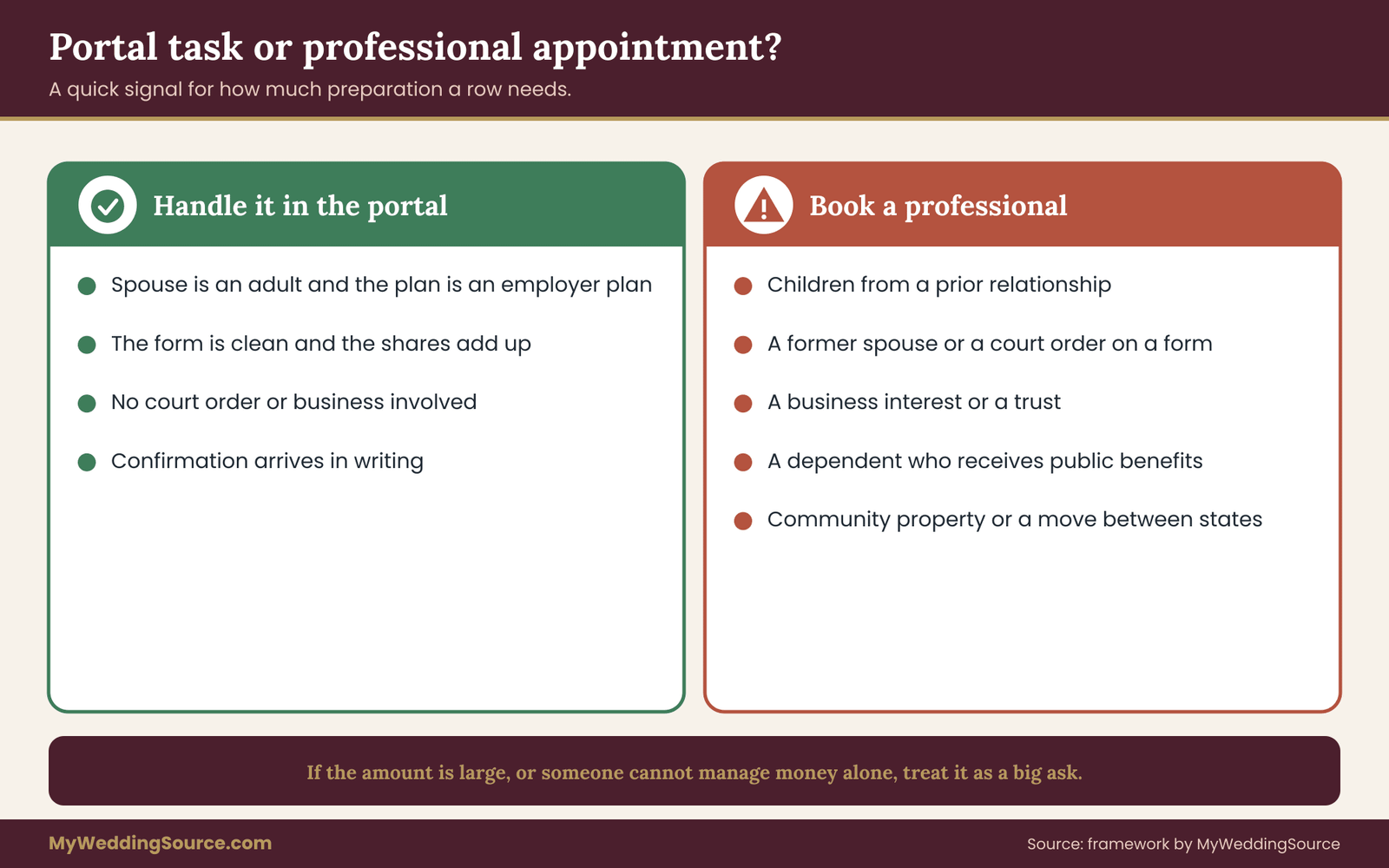
A simple signal helps you decide how much to prepare for the beneficiary review. If a row on your sheet involves money above what you could comfortably replace, a person who cannot manage money on their own, anyone you do not live with, a court document or a business, treat it as a big ask and book a dedicated professional. If it involves an ordinary adult spouse, an employer plan and a clean form, treat it as a small one and handle it in the portal.
Worked example: one couple’s first beneficiary review
The following example is invented, and the figures are round numbers chosen for the illustration. It is not a recommendation about any amount of insurance. Its purpose is to show how the prep sheet, the clocks and the keep-change-ask rule work together.
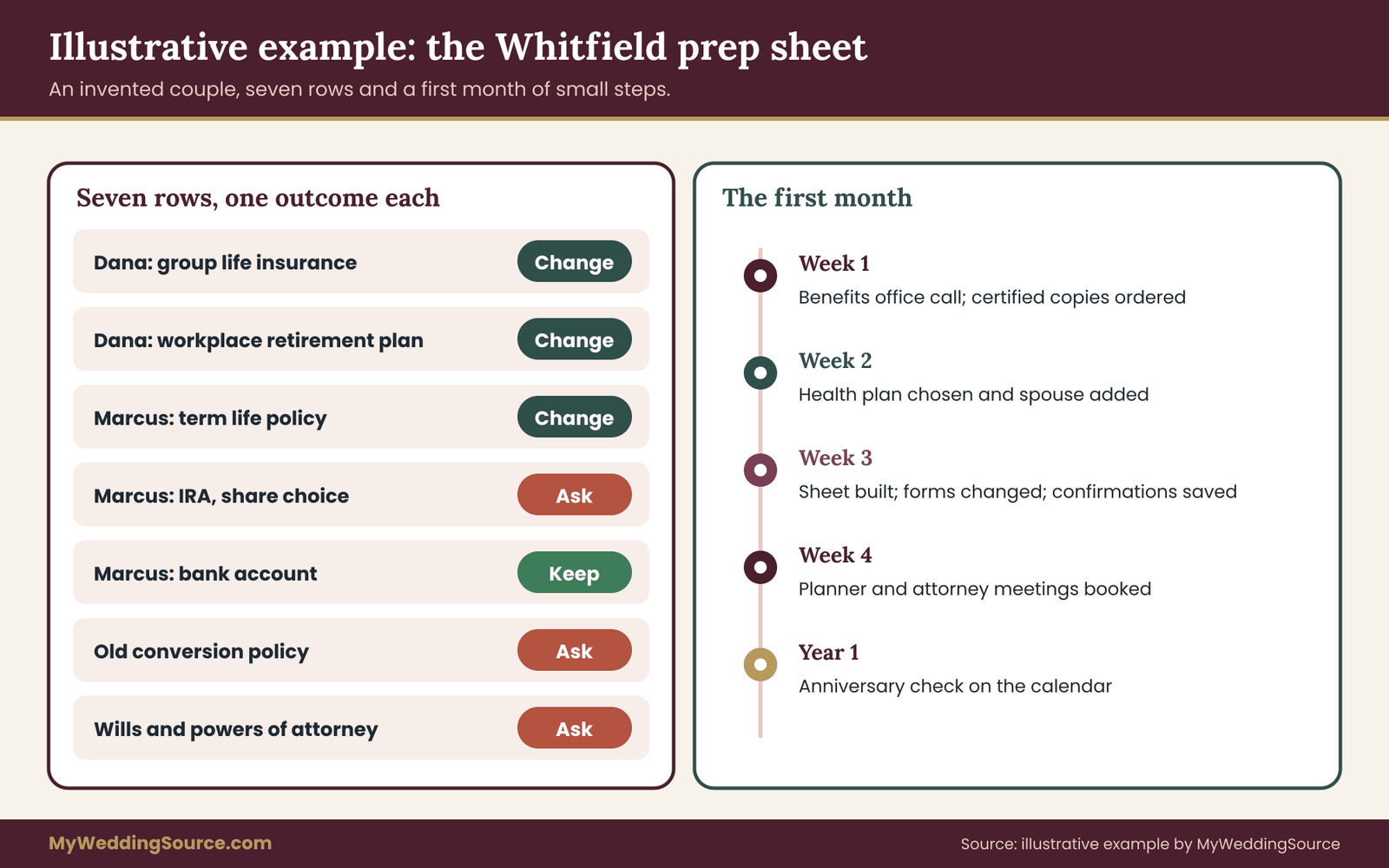
Dana and Marcus Whitfield married in October. Dana works for a hospital system and has employer health coverage, a workplace retirement plan and group life insurance. Marcus is a self-employed electrician with an individual term life policy, an IRA and a bank account with a payable-on-death designation. Marcus had a health plan through the marketplace. Neither has children, Marcus has a will from his twenties, and Dana does not have one.
Step one: the clocks
Dana called her benefits office in the first week. The office said a spouse could be added to the health plan within a window of days from the marriage, with a certified marriage certificate. The Whitfields ordered two certified copies the same week.
Marcus checked HealthCare.gov and found that the special enrollment period after marriage was sixty days, and he wrote the date on the shared calendar. They compared Dana’s employer plan with his marketplace plan, looked at the monthly premium for adding him, the deductible and his current doctors, and chose to enroll him in Dana’s plan, with a start date that matched the end of his marketplace coverage.
That took two evenings and did not involve an adviser. The beneficiary review had not started, but the most urgent clock was handled first.
Step two: the prep sheet
The couple then built the sheet. Each partner listed items on their own and the two lists were read side by side. There were seven rows.
Dana’s group life insurance named her mother. Dana’s retirement plan named her sister. Marcus’s term life policy named his brother. His IRA named his mother, and his bank account named his father. His will, written years ago, named his brother as executor and left everything to his parents. Dana had no will and no power of attorney.
The owner column added a surprise. Marcus’s term policy was owned by Marcus and insured Marcus, so he could change it freely. But when the couple looked at the old group policy through Dana’s former employer, they found a conversion policy that was owned by Dana and carried a name she did not recognize as the beneficiary, a former partner. They had not known the policy existed.
Step three: keep, change, ask
Applying the rule took about forty minutes.
Dana’s group life insurance was a change: she named Marcus as primary and her sister as contingent, in the portal, and saved the confirmation. Her workplace retirement plan was handled by asking the plan administrator, who confirmed that the plan generally gave a spouse rights and sent a form. She named Marcus as primary with her sister as contingent and had her new spouse sign the consent line the form provided.
Marcus’s term policy was a change: he named Dana as primary and his brother as contingent. His IRA was a change, too. The IRA custodian’s form required a full legal name and date of birth for each beneficiary and offered a choice about how a beneficiary’s share would pass if that person died first. Marcus did not understand the choice, so he marked it as an ask for the planner.
The bank account was a keep: Marcus kept his father as payable-on-death for now and added Dana as the contingent, noting that the couple would decide on a different arrangement after talking to an adviser about a joint account.
The old conversion policy with the former partner was an ask. The couple wrote the policy number and called the insurer, which said that the owner could change the beneficiary and would need to sign the company’s form. Dana did, and the company sent a confirmation. Nothing about that policy was complicated. It was simply forgotten.
The will and powers of attorney were asks for an attorney.
Step four: the meeting
The couple booked two appointments. The first was a one-hour meeting with a fee-only planner, who was paid a flat fee, to ask about the IRA share choice, how much coverage made sense given Marcus’s self-employment income and whether to open a joint account. The second was a meeting with an estate attorney to prepare a will for Dana, update Marcus’s, and sign powers of attorney and health care directives naming each other.
They sent each professional only the relevant rows of the sheet, and each meeting stayed on the questions.
Step five: the record
At the end of the month the couple had seven confirmations saved in a folder, a sheet with a date for each row, and a calendar reminder set for their first anniversary. The beneficiary review took about six hours spread over four weeks, plus two paid meetings. The couple made a point of reading the whole sheet aloud one evening, because it was the first time each had learned what the other had arranged.
What the example shows
Three lessons from this beneficiary review carry over to any couple. First, the clock came before the form. The health plan decision had a date, and the beneficiary forms did not. Second, the surprise policy was found only because the owner column forced a closer look. Third, most of the work was small, and the professional time was used on a few real questions, not on gathering facts.
Verification, limits and mistakes in a beneficiary review
A good beneficiary review leaves a trail that another person could follow. That means verifying facts with the organization that issues them, not with a friend, a forum post or a website that sells a product. Use this short list as a standard, and apply it each time a beneficiary review leads to a changed form.
Rules about enrollment and special enrollment periods. Check with the plan administrator, the employer’s summary plan description or HealthCare.gov for marketplace coverage. A dated, written answer is better than a verbal one.
Rules about retirement plans. Check the plan document or ask the plan administrator. The Department of Labor’s Employee Benefits Security Administration publishes participant resources, and the Internal Revenue Service publishes pages on beneficiaries of retirement accounts. Both are general; your plan’s wording controls.
Rules about insurance contracts. Check the policy itself and ask the insurer in writing. Your state insurance department regulates insurers and agents and takes consumer questions, and the National Association of Insurance Commissioners links to each state.
Rules about tax treatment. Check the Internal Revenue Service, whose newsroom publishes a guide for newlyweds, and then ask a tax professional about your own facts. Tax rules change, and what applied last year may not apply this year.
Rules about wills and trusts. Check with an attorney licensed in your state. Do not rely on a template for anything that involves children, a business or property in more than one state.
The identity of an adviser. Use FINRA BrokerCheck, the SEC’s Investor.gov adviser search, the CFP Board’s verification and your state’s insurance and bar lookups. These are free and take minutes.
What a company’s confirmation should show
When you change a beneficiary, the confirmation should include your name, the account or policy, the beneficiary’s name, the share and the date the change was recorded. If any of those are missing, ask for a corrected confirmation. Do not accept “it’s done” over the phone as the final record. A short email from the company, a portal page saved as a PDF or a letter are all useful.
Keep the confirmation with the sheet, and keep the sheet where your spouse can find it. The point is that a surviving spouse or a family member should be able to find the policy numbers and the companies without searching your email. That does not mean putting full account numbers on a shared page. It means putting the company name, the last four digits and the location of the full documents.
Limits of a first beneficiary review
A beneficiary review is not a guarantee that a claim will go smoothly. Companies verify claims, plan documents can contain rules the account holder did not know, and a form that was altered, unsigned or never received may not be honored. A beneficiary review lowers the chance of a problem and creates a record, but it does not remove the need for professional advice in complicated cases.
It also does not cover everything that matters financially. Debts, taxes, a house, a business and children’s needs all deserve their own conversations, and some may need to wait until after the first year of marriage. The goal of the first beneficiary review is to close the biggest gaps and create a system you can repeat.
Running the meeting: before, during and after
A meeting for a beneficiary review is a limited resource. These habits help you use it well.
Before. Send the beneficiary review prep sheet, with only the rows relevant to that person, at least two days ahead. Ask what documents to bring, and whether there is a fee for the first meeting. Write down the three questions you most want answered, and rank them. If the person is an agent or an adviser who is paid by commission, ask in advance whether the meeting involves any sales proposal.
During. Start with the three questions. Take notes and ask the person to repeat anything about deadlines. When a recommendation comes up, ask for the reason, the cost and the alternative. If the answer includes a product, ask what you would do if you bought nothing. Do not sign anything at the first meeting unless it is a routine beneficiary form that you already filled in and understand.
After. Within a day, send a two-line summary by message and ask the adviser to correct it if needed. Update the sheet, saving each confirmation. Put the next clock date on the calendar. If you were given a proposal, wait at least a week, and ask a second professional to review it if the amounts are large.
Signs that a meeting is going the wrong way
A few patterns are worth noticing. A person who will not tell you how they are paid. A person who answers a legal question with certainty when the answer depends on your state. A person who pushes a same-day decision, or tells you that a rate or an option will vanish. A person who recommends moving retirement money into an insurance product without explaining the costs and the alternatives. Any of these is a reason to slow down, ask for the recommendation in writing and compare it with a second source.
None of this requires you to distrust professionals. Most are careful and honest. The habit of writing things down protects both sides.
Common mistakes in a first beneficiary review
Most beneficiary review errors come from a short list. Knowing them in advance makes each one easy to avoid.
Treating the will as the master document. Couples often update a will and assume everything follows it. Accounts with a named beneficiary do not follow the will, so a will can say one thing while the forms say another. Read both together.
Naming each other and no one else. If both partners are named as the only beneficiaries and both die in the same event, or one dies and the survivor never updates the form, the money may go to an estate or a default group. A contingent beneficiary costs one extra line and prevents a long list of problems.
Forgetting small accounts. An old workplace retirement account from a previous job, a small life insurance policy from a credit card or a bank, or an account opened in college can all still name someone from years ago. A search of your email and your credit report for company names often turns them up.
Changing the form but not the confirmation. A signed form sitting in a drawer or an unsent email does nothing. Companies update their records when they receive, accept and process the change. Wait for the confirmation.
Using a nickname or an incomplete name. Full legal names, dates of birth and relationships avoid disputes. After a name change, make sure the form and the identity documents match, or at least that the company knows both names.
Relying on a verbal promise. An adviser or a company representative who says “that will be fine” on the phone has not changed a thing. Ask for the answer in writing, with the date.
Skipping the conversation as a couple. The sheet is a conversation starter. One partner may assume the other wants the same people named, and the assumption may be wrong. Talk about it first, and then fill out the forms. The wedding decision-making guide covers how to settle a disagreement calmly.
Moving all at once. A first beneficiary review does not need to settle every long-term question. Do the urgent clocks, correct the obvious gaps, and put the harder questions on a schedule. A decision made in a hurry about a large amount of money is the one most likely to be regretted.
Talking about the beneficiary review as a couple
The paperwork is the easy part of a beneficiary review. The harder part is the conversation, because a beneficiary form is a small statement about who you trust and who you want to look after. Some couples find it uncomfortable to talk about death in the weeks after a wedding. A few practical suggestions keep it calm.
Pick a time that is not tied to a dispute and not late at night. Start with the facts on the sheet, and treat the first read as an information exchange, with no decisions required. Let each person explain why they named who they did years ago, since many choices have a history. Then ask a plain question for each row: “Does this still seem right to you?” Differences are normal, and a difference on a row becomes an ask, not an argument.
If the topic involves family members who may feel left out, such as parents or children from a prior relationship, decide together how and when to share changes. Nothing requires you to announce a beneficiary form to anyone, but a surprise at a claim can hurt, so the two of you may choose to explain your plans in your own way.
A calm yearly rhythm
After the first beneficiary review, you need a light routine. Put one date on the calendar each year, such as your anniversary, and spend an hour opening the sheet. Check each row for changes in the last twelve months: a new job, a new account, a move, a child, a death in the family, a change in health or a new loan. Log in and confirm that each beneficiary matches the sheet. Save the date and a one-line note.
Also review after any major event. A birth or adoption, a purchase of a home, a start or sale of a business, a divorce of a parent who is named, a move to another state or a change in a partner’s health are all good reasons for a short beneficiary review outside the annual cycle. The sheet is already built, so these reviews take minutes.
What to keep, and where
Store the sheet and the confirmations in a place both of you can reach, and tell one trusted person where it is. The broader wedding records guide discusses access levels, and the same ideas apply: both partners have full access, a trusted person knows where the information is and sensitive numbers stay in a protected place. Keep copies of the beneficiary confirmations, the marriage certificate and the names of your advisers.
If your plan is to track costs for the first year of married life, the wedding budget page explains how to lay out the money, and the cash flow planning guide covers how payments and balances move. Neither replaces professional advice, and both help you see what you own and what you owe, which is the starting point for every question in a beneficiary review.
Your next steps
Pick one evening this week for your beneficiary review. First, find the dates for the short clocks: the health coverage window, the employer benefit deadlines and any open enrollment date. Second, build the prep sheet with six fields for each policy and account, and mark each row keep, change or ask. Third, change the forms that are simple, save the confirmations and book the right professional for the asks.
Then give each ask from the beneficiary review to the role that can answer it, and set a date for the annual beneficiary review. A beneficiary review is not a big project. It is a short list, done once carefully and then repeated on a schedule, and it leaves you with something very practical: a record that shows who you chose and why.
FAQ
What is a post-marriage beneficiary review?
It is a check of every policy and account that names someone to receive money after you die, along with the coverage that changes when you marry. You list each item, confirm who is named, decide whether to keep or change it and record the result. It takes an evening to prepare, and a short meeting with a professional can handle any hard questions.
Does marriage automatically change my beneficiaries?
Generally no. A life insurance policy, an individual retirement account or a bank account keeps the beneficiary on file until the owner changes it. Some employer retirement plans give a spouse rights by law, and some states change wills after marriage, but the details vary. Check each form and ask the plan administrator or an attorney about your own situation.
How soon after the wedding should we do this?
For a beneficiary review after the wedding, handle the short deadlines first, because health coverage enrollment after marriage is generally measured in days or weeks. Confirm those dates in the first week. The beneficiary forms themselves have no fixed deadline in most cases, so aim to finish the first beneficiary review within the first quarter, then repeat it each year and after major life events.
Who should we meet with for a beneficiary review?
Match each beneficiary review question to the role. Your benefits office handles employer plans, a licensed insurance agent handles individual policies, a fee-only planner or tax professional handles money and tax questions, and an estate attorney handles wills, trusts and complicated family situations. Most couples need only one or two of these, and the prep sheet shows which.
Which accounts have beneficiaries?
Life insurance, annuities, workplace retirement accounts, individual retirement accounts, pensions, health savings accounts and many bank and brokerage accounts allow a named beneficiary or a payable-on-death or transfer-on-death designation. Health, auto, renters and homeowners policies do not have beneficiaries in the same sense, though they have insured people and household rules that marriage can change.
Do we need a contingent beneficiary?
A contingent beneficiary is paid only if the primary cannot be, for example if that person has died. Naming one costs a line on the form and avoids the money falling to a default order or an estate. It is a good habit for every row on your sheet, and your plan administrator can show you how the form handles it.
Can a will override a beneficiary form?
Usually not. For accounts and policies with a valid beneficiary designation, the company pays the person named on the form, even if a will says something different. That is why a will and your forms should tell the same story. An estate attorney licensed in your state can explain how the two interact for your accounts.
How do we check that an adviser is licensed?
Use the free lookups. FINRA BrokerCheck and the SEC’s Investor.gov search cover brokers and investment advisers, the CFP Board confirms Certified Financial Planner status, your state insurance department confirms agent licenses and the state bar lists attorneys. Also ask in writing how the person is paid and whether they act as a fiduciary.
Sources
- How to get a copy of a marriage certificate or a marriage license, USAGov
- Special enrollment period, HealthCare.gov
- Retirement topics: beneficiary, Internal Revenue Service
- Tax to-dos for newlyweds to keep in mind, Internal Revenue Service
- Employee Benefits Security Administration, U.S. Department of Labor
- BrokerCheck, Financial Industry Regulatory Authority
- Investor.gov, U.S. Securities and Exchange Commission
- National Association of Insurance Commissioners
- CFP Board
- Consumer Financial Protection Bureau