Wedding contributions from parents, grandparents and other relatives often arrive as a warm offer and a vague sentence, and the vagueness is what causes the trouble later. This guide shows how to document family wedding contributions in plain terms: what each person is giving, whether it is a gift or a loan, who pays which bill, and what, if anything, comes attached.
For every offer of money, sort it into one of four types (outright gift, loan, conditional gift, or direct payment to a vendor). Run the four-answer worksheet with the giver: type, amount, timing, and what happens if plans change. Write the result in a short, friendly summary both sides can read. Then keep a payment ownership log that records, for each bill, who paid it, from which account, on which date, and what it covered. Wedding contributions documented this way protect the relationship, because nobody has to remember a conversation from fourteen months ago.
Most couples who receive help with the wedding never write any of it down. A parent says, “We want to take care of the photographer.” A grandparent says, “Let us cover the flowers.” A sibling offers to put the rehearsal dinner on a card. Everyone is sincere. Nobody says whether the photographer is a full payment or a contribution toward a larger number, what happens if the date moves, or whether the couple is expected to give the money back someday.
Silence feels polite in the moment. Over a long engagement it turns into mismatched memories. One side remembers a gift, the other side remembers a loan. One side remembers “the whole bill,” the other remembers “a good part of it.” The amount of the wedding contributions is rarely the real problem. The surprise is.
This article is about removing the surprise. It covers the vocabulary you need, a worksheet for the conversation, a log for the payments, and the points where the paperwork meets vendors and the budget. It is written for couples, for the relatives who help them, and for anyone coordinating the money on a family wedding.
A note on scope. This is general information, not legal, tax or financial advice, and rules about gifts, loans and contracts vary by state and by situation. Where a rule matters, the article points you to the agency that issues it so you can read the current version yourself.
Why wedding contributions cause conflict
Money offered for a wedding carries more meaning than money offered for most other purchases. A contribution can express love, pride, tradition, obligation, relief, or a quiet wish to be included. The giver may feel generous. The receiver may feel grateful and also a little cornered. Both can be true at once, and neither person says so.
The conflict usually grows from four small gaps rather than from one large fight.
The type gap. The giver means a gift and the couple hears a gift, but the giver privately expects to be repaid when the couple buys a house. Or the giver means a loan and the couple, hearing only “we will help,” spends it as a gift. Nobody lied. Nobody checked.
The amount gap. “We will pay for the venue” can mean the deposit, the whole contract, or the venue fee before taxes and service charges. The final venue bill often includes items nobody mentioned in the first conversation, and then a generous promise meets a larger number.
The timing gap. Vendors want deposits on a schedule. Relatives sometimes mean to pay later, from a certificate of deposit that matures in the spring, or from a house sale that has not closed. The couple pays the deposit from savings, expects a reimbursement, and finds the reimbursement is two months off.
The strings gap. A contribution can come with expectations nobody states: a say in the guest list, a preference for the caterer, a seat of honor, a request that a ceremony tradition be included. Some strings are reasonable and some are not. Unstated strings are the hardest kind, because they surface as hurt feelings rather than as terms.
Documentation closes all four gaps. It does not need to feel like a legal process. A one-page summary that both sides read and say “yes, that is right” to is often enough.
What documenting wedding contributions is, and is not
Documenting wedding contributions means recording, in ordinary words, what was offered and accepted. It is closer to a shared note than to a contract. The goal is a common memory.
It is not a way of testing whether a relative can be trusted, and it is not a way of putting a price on affection. Many families are uneasy about writing anything down, because writing feels like suspicion. The better framing is the one a good vendor uses: “I want to make sure I do exactly what you asked, so let me confirm it back to you.” You are confirming, not doubting.
It is also not a replacement for legal advice where the stakes are large. If a contribution is a large loan, if it is secured against property, or if it involves a trust, a business or a family member who is a creditor, a lawyer or tax professional should look at it. Most wedding contributions are far smaller and simpler than that, and for those, a clear written note goes a long way.
Who this guide is for
Couples who are receiving help are the main audience, because they carry the memory and the thank-you notes. But givers benefit too. A parent who writes “this is a gift, no repayment expected, and I am not asking for any say in the guest list” has just spared the whole family a future awkward dinner. Everyone who touches wedding contributions, on either side of the table, will find something usable here.
Coordinators and the relative who “helps with the money” also benefit. When more than one person contributes, the questions multiply. Who is paying for which vendor? Does the grandparent’s check go toward the same bill as the parent’s card payment? Does one set of parents give more than the other, and does anyone feel they should be told? The tools later in this guide are built to hold several contributors at once.
The two tools you will build
This article gives you two working documents. Both tools exist to make wedding contributions easy to describe and easy to remember.
The first is the four-answer worksheet, a short set of questions you work through with each giver. It turns “we want to help” into a clear statement of type, amount, timing and conditions. It is the gift-versus-loan conversation, made concrete.
The second is the payment ownership log, a running record of every bill paid with contributed money. It answers the question that arises in month ten: “Who actually paid for this, and from what?” It is the financial memory of the wedding.
Neither tool is complicated. Together they take about an hour to set up and a few minutes per payment to maintain, and they are the difference between a family that remembers the wedding fondly and one that argues about it.
Start by naming the four types of wedding contributions
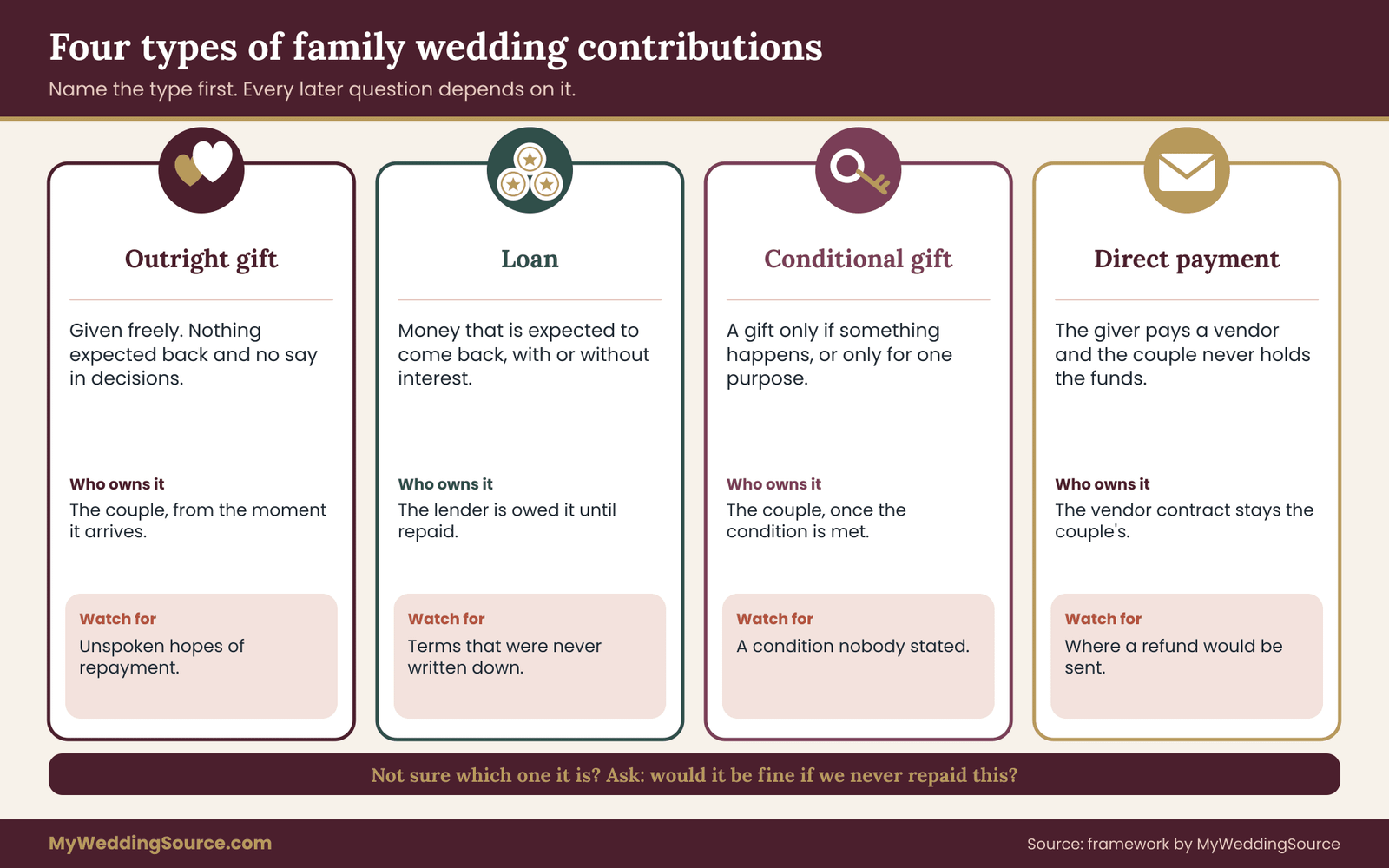
Before any worksheet, everyone needs the same words. Most disagreements about wedding contributions begin with two people using one word to mean two things. “Help” is the worst offender. These four terms are plain enough to use at a kitchen table. These labels apply to all wedding contributions, whatever their size.
An outright gift. The giver hands over money or pays a bill, expects nothing back, and does not expect any say in how the wedding is run. The couple owns the money from that moment. If the wedding is smaller than planned, the couple keeps the difference. If the wedding is cancelled, the couple does not owe a refund unless the giver specifically said otherwise in advance.
A loan. The money comes with an expectation of repayment. A loan can be formal, with a written amount, interest rate and schedule, or informal, with a plain note: “We will repay you over three years, starting next spring.” The defining feature is the expectation that the money returns.
A conditional gift. The money is a gift only if something happens, or only for a particular purpose. “We will pay the venue deposit if the wedding is at the family church.” “This money is for the dress; if you do not buy a dress, send it back.” Conditional gifts are common and perfectly fine, but the condition must be stated, or it will be discovered through disappointment.
A direct payment. The giver pays a vendor directly, rather than giving the couple money. The couple never holds the funds. The giver may pay a deposit, a final balance, or a single line item such as the cake. Direct payments are tidy in one way and tricky in another: the vendor’s contract is usually between the vendor and the couple, so the paperwork has to make clear who has paid and who is still responsible.
Keep a fifth category in the back of your mind, which is the in-kind contribution. A relative who bakes the cake, lends a car or provides their backyard is contributing something real, even though no money changes hands. In-kind help does not usually need a ledger, but it does belong in the conversation, because it affects what other money is needed.
The gray zone between gift and loan
Many family arrangements sit between gift and loan. A parent might say, “Pay us back if you can, no pressure.” A grandparent might say, “Think of it as an advance on what you would receive anyway.” These phrases are kind and they are also unclear. Gray-zone wedding contributions are the ones most likely to be remembered differently by each side.
When you find yourself in the gray zone, do not try to resolve it with a word. Resolve it with a decision. Ask the giver: “If we never repaid this, would that be fine, or would you feel it was owed?” The answer tells you which side of the line you are on. If the answer is “fine,” record it as a gift and move on. If the answer is hesitant, record it as a loan, even if the repayment schedule is generous and informal. A kind loan is better than a gift that turns resentful.
A useful test for any contribution is the mirror question: “If the situation were reversed and we were the givers, how would we describe this money?” People often answer more honestly when they imagine themselves on the other side.
Why the type matters for more than feelings
The type of contribution also changes practical things. A gift generally belongs to the couple, which means they decide how it is spent. A loan creates a debt that belongs on the couple’s list of obligations, which affects their cash flow after the wedding. A conditional gift creates an obligation to track whether the condition was met. A direct payment creates an obligation to track which vendor bills it covered. Treat the type as a fact about your wedding contributions, not as a judgment about anyone’s generosity.
Taxes can be affected too. In the United States, gift tax rules generally apply to the person who gives, not to the person who receives, and most gifts do not result in any tax. Loans between family members can raise separate questions about interest. These are matters for the Internal Revenue Service and a qualified tax professional, not for a wedding blog, but they are another reason to know which type you have. The IRS publishes its own answers on gift taxes, and the sources list at the end of this guide links to them. ## The four-answer worksheet for wedding contributions
The worksheet is a short conversation, not a form to hand across the table. Its purpose is to get four answers from each giver in plain language. You can fill it in together, or you can have the conversation first and write the answers down immediately afterward. Either works, as long as the giver sees the summary and agrees with it.
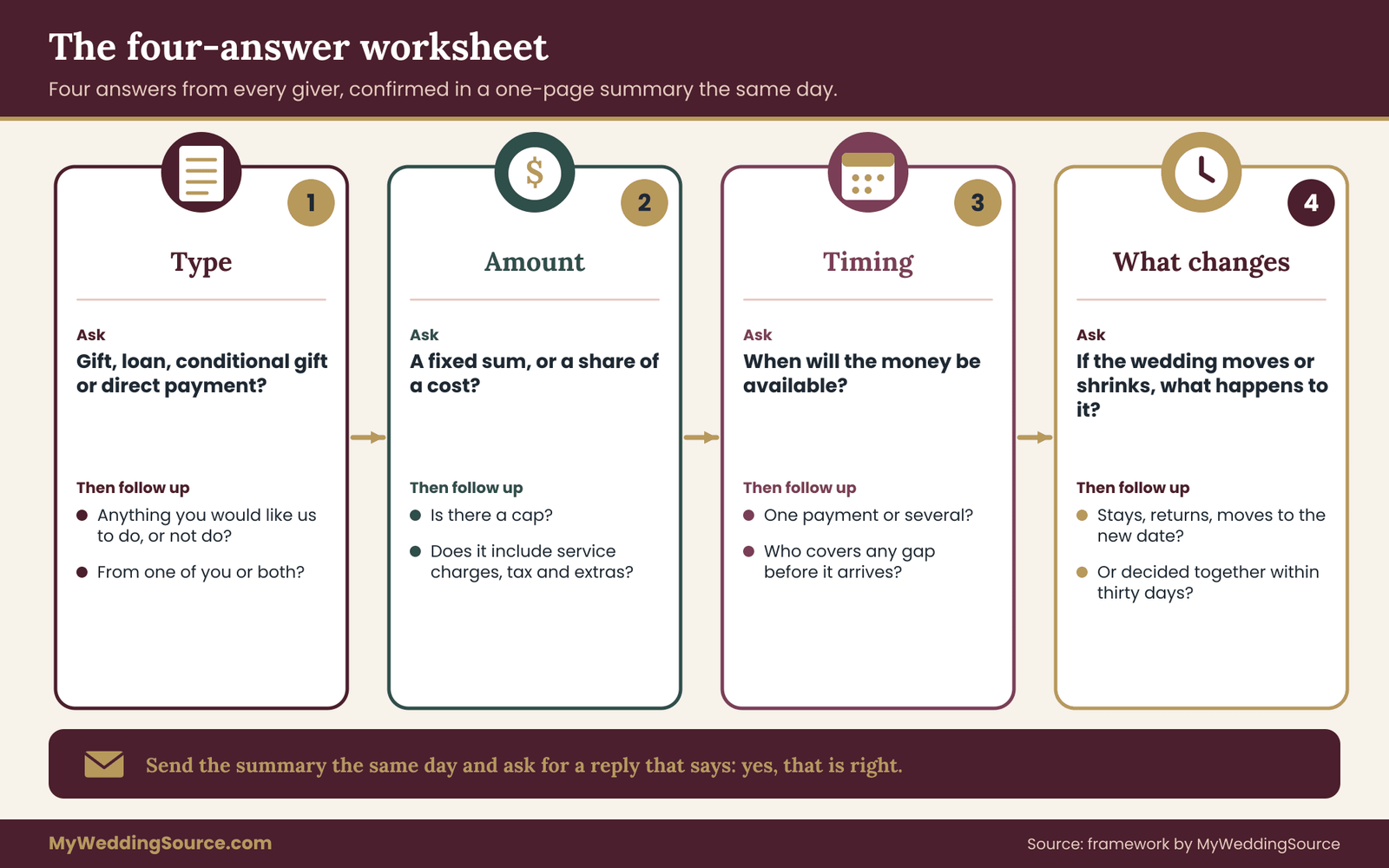
The four answers are type, amount, timing and what changes. Each has a few follow-up questions, and each follow-up exists because someone, somewhere, has been surprised by its absence.
Answer one: the type
Start with the vocabulary from the previous section. Ask the giver which of the four types fits. If they hesitate, use the mirror question or ask whether they would be comfortable if the couple never repaid the money. Getting the type right makes every later answer about wedding contributions easier.
Then ask two quiet follow-ups. First, “Is there anything you would like us to do, or not do, because of this?” That invites the strings into the open. Second, “Is this from one of you or both of you?” Couples who are parents sometimes disagree privately about generosity, and it is kinder to learn that now than at the final balance.
Record the type in a single sentence. For example: “This is a gift with no repayment expected and no request for a say in decisions.”
Answer two: the amount
An amount sounds simple, but it hides three decisions. A clear number is the kindest thing you can ask of wedding contributions.
The first is whether the amount is a fixed sum or a share of a cost. “We will give you eight thousand dollars” is a fixed sum. “We will pay half of the catering” is a share, and it moves when the catering bill moves. Both are valid, but a share needs a cap, or the giver may be surprised by a number they never imagined.
The second is whether the amount includes extras. Catering bills often add service charges, gratuity, taxes, rentals and staff fees. Venue bills may add cleaning, overtime or security. If the giver says “the catering,” ask whether that means the quoted food price or the final invoice.
The third is whether the amount is approximate or exact. “About ten thousand” is a hope. “Ten thousand dollars” is a number. If the giver wants to stay approximate, write down the range and agree that the couple will check in at a fixed milestone, such as when the contracts are signed.
A good habit is to write the amount twice: in dollars and in what it is expected to cover. “Ten thousand dollars toward the reception venue and catering” is far safer than “ten thousand dollars.”
Answer three: the timing
Timing is where good intentions most often collide with vendor calendars. Vendors usually require a deposit at signing, intermediate payments, and a final balance shortly before the wedding. The contract states the dates, and the dates are not flexible just because a relative’s money is arriving later. Timing is where wedding contributions and vendor calendars most often collide.
Ask the giver three timing questions. When will the money for these wedding contributions be available? Will it arrive in one payment or several? And is there a date after which the giver cannot help, for example because of a planned retirement withdrawal or a house closing?
Then compare the answers to the vendor payment schedule. If the giver’s money arrives in March and the venue deposit is due in January, the couple has to cover the January payment and be reimbursed. That is not a problem as long as everyone knows it. It becomes a problem when the couple assumes the giver will pay the January bill and the giver assumes the couple will.
The wedding cash-flow guide on this site goes deeper on how deposits, final balances and reserves line up over time. For the worksheet, you only need the timing answer and an agreement about who covers any gap.
Answer four: what changes
This is the answer people skip, and it is the one that does the most good. Wedding plans change. Dates move. Guest counts shrink or grow. Venues close. A couple may decide to elope. A giver’s own finances may shift. Ask: “If the wedding changes, what should happen to this money?” Wedding contributions are easiest to discuss before anything has gone wrong.
There are four common answers.
Stays with the couple. The gift is unconditional and the couple keeps it, whatever happens to the wedding.
Returns to the giver. The money was for this event only, and if the event does not happen, or costs less, the unused part goes back.
Moves to the next purpose. The giver says, in effect, “If the wedding is cancelled, use it toward the new date, or toward the first year of your marriage.”
Gets decided later, together. This is an honest answer, and it is acceptable if it is written down. “If the wedding changes substantially, we will talk again within thirty days.”
Do not let this question go unanswered because it feels gloomy. The couples who suffer most when a wedding is postponed are the ones whose families never discussed it. A single sentence in the summary spares everyone a very uncomfortable conversation during an already stressful week.
Writing the one-page summary
After the conversation, write a summary of no more than a page. Use plain English. Use the giver’s own words where you can. Include the date, the names, the four answers and a line for each person to confirm. A confirming reply by text or email works as well as a signature for a family arrangement of ordinary size. A page is plenty for most family wedding contributions.
Here is the shape of a good summary:
“Thank you for talking with us today. Here is what we understood. You are giving us a gift of a fixed amount, to be paid in two installments, one before the venue deposit date and one before the final balance. There is no repayment expected and no request for a say in wedding decisions. If the wedding is postponed, the money stays with us and goes toward the new date. Please tell us if anything here is wrong.”
The last line matters. It invites correction, and it frames the summary as service, not suspicion.
Variants for different kinds of giver
Not every giver is a parent with a fixed sum. Here is how the worksheet adapts. The same four answers work for every kind of giver, though wedding contributions from different relatives raise different follow-up questions.
Both sets of parents contribute. Run the worksheet separately with each side. Avoid comparing amounts. If one side gives much more than the other, the couple should decide in advance how they will describe the difference, if it ever comes up. A simple rule works well: each giver’s terms are private to that giver and the couple, unless the giver chooses to share them.
A grandparent gives from savings. Add a question: “Is there anything about your own plans, such as health costs or a move, that we should keep in mind?” Older relatives may want to give generously but may not volunteer constraints. Asking gently and early protects them.
A sibling or friend lends money. Treat it as a loan by default, even among close friends, because their financial slack is usually smaller than a parent’s. Write the repayment terms down, even if casual.
An employer or community group contributes. Some communities pool money for a wedding, and some employers give a gift. These are usually gifts, but they may carry customs about acknowledgment. Ask what form of thanks is expected, and note it.
The giver is divorced, remarried or estranged from a co-parent. Money can become a proxy for a larger story. Keep contributions separate by giver, keep the summaries strictly factual, and avoid assuming one parent speaks for the other. If you are unsure how to include a relative, the guide to wedding decision rights covers how couples and families can share input without losing control.
How to start the conversation without making it awkward
The hardest part of documenting wedding contributions is often the first sentence. People worry that bringing up the topic sounds ungrateful. In practice, most givers welcome the clarity, because they have been wondering the same things themselves. Raising wedding contributions early, and kindly, is the single best way to keep them comfortable.
The conversation goes best in four moves.
Move one: thank, then ask for time
Begin with thanks that is specific, then ask for a short conversation. For example: “Your offer means a great deal to us, and we want to handle it the way you would want. Could we sit down for twenty minutes this weekend to make sure we understand what you have in mind?” The aim is to make talking about wedding contributions feel like part of saying thank you.
This frames the conversation as respect. It also tells the giver this is a short, bounded meeting, not an interrogation.
Move two: choose the setting
Pick a quiet, private setting. A shared meal can work if the conversation is not rushed, but a crowded family gathering is a poor place for money questions, and a group text is worse. If the giver is far away, a phone or video call followed by a written summary is fine. Wedding contributions deserve a calm setting, since the conversation is about trust as much as money.
Avoid doing this at a moment of tension. Do not raise it right after a disagreement about the guest list or the venue, and do not raise it the week of a major payment. The calmest moment is usually early in the engagement, before any deposits are due.
Move three: lead with your own plan
Show the giver you have thought about the wedding budget. You do not need a finished spreadsheet, but a rough picture helps, such as the main categories and the approximate range. It tells the giver their money will be used thoughtfully, and it gives them something concrete to attach their offer to. The wedding budget guide on this site explains how to set up categories if you have not done that yet. Showing your plan makes wedding contributions feel like help toward something real, not a blank check.
Then ask the first worksheet question. “Which kind of help is this, a gift, a loan or something else?” You can say it lightly: “We just want to describe it correctly in our own notes.”
Move four: confirm in writing, the same day
Within a day, send the summary. Delay lets memory blur, and the summary is most useful when it is fresh. Keep it short and friendly. Ask for a reply that says “yes, that is right” or lists the corrections. File the reply with your wedding records. A same-day note turns a spoken conversation about wedding contributions into a shared record.
Scripts for common moments
These short scripts are written for ordinary family conversations. Adjust the wording to match how your family speaks. Use these as starting points for wedding contributions of any size.
When the offer is vague: “That is so generous. To make sure we thank you properly and plan well, could you tell us whether you are thinking of this as a gift, and whether there is a number or a particular vendor you have in mind?”
When you suspect a loan but the giver has not said so: “We want to be sure we have this right. If we never repaid this, would that be fine with you, or would you rather we set up a way to pay it back?”
When you need to decline or reduce an offer: “We are deeply grateful, and we have thought about it. We would like to take a smaller amount, so that we are comfortable and so that nothing feels owed. Could we start with this number?”
When a giver’s offer feels tied to conditions you cannot meet: “We love that you want to be part of this. We can include some of what you suggested, but we cannot commit to everything. Would you be comfortable if the contribution were an unconditional gift, even if the amount is smaller?”
When a giver says “we do not need to talk about it”: “We know. We also know that after a year of planning, the memory of a conversation gets fuzzy. A short note keeps us from ever misremembering your generosity.”
Each script keeps the focus on protecting the giver’s intention. That is the most reliable way to make the conversation feel like care rather than friction.
When a giver resists writing things down
Some people treat any written note as an insult. If a relative resists, do not push. Instead, write the summary privately, send it as a “thank you” message that includes the facts, and let silence count as agreement for ordinary, low-risk gifts. For larger sums, or if the type is unclear, it is reasonable to ask more firmly: “We would feel more at ease if we could confirm it in writing.” Most people relent when they see you are protecting their intentions, not questioning them. Some families see written notes about wedding contributions as cold, so go gently.
If a relative refuses to clarify anything and the amount is large, the cautious path is to treat the money as undefined and avoid spending it until the type is clear. It is better to plan the wedding on money you can count than on a promise you cannot define. ## Wedding contributions with strings: influence, expectations and boundaries
Almost every contribution carries some expectation, even if it is small. A parent who pays for dinner may expect to be seated near the couple. A grandparent who covers the flowers may expect to see them. These expectations are normal, and nothing is wrong with them. The trouble comes from expectations that are neither stated nor agreed. Strings are the part of wedding contributions that families talk about least and feel most.
The goal is to separate three things that often blur together: recognition, input and control.
Recognition is how the giver is thanked. It might be a mention in a toast, a handwritten note, a place in the family photographs or a seat at the head table. Recognition costs the couple little and often matters enormously to the giver.
Input is the right to be heard. The giver may offer opinions about the venue or the guest list, and the couple agrees to listen and consider them. Input does not bind the couple.
Control is the right to decide. A giver with control can veto a vendor, add guests or change the date. Control is the most expensive thing a contribution can buy, and the couple should only accept it knowingly.
Most families work best when contributions come with recognition, welcome some input, and give no control. Writing that down, in a line or two, is very effective.

The strings checklist
During the worksheet conversation, walk through the categories where strings most often appear. You do not need to ask every question of every giver. Use the list as a prompt. Run through these categories with each giver, because strings tend to hide in the same places in most wedding contributions.
The guest list is the biggest source of friction. Does the giver expect to invite a set number of people? Is there a guest they will want included? Does the giver expect to be consulted about any exclusions? If a contribution comes with guest-list expectations, name them early and in numbers. “We would like to invite twelve people” is workable. “We assumed everyone would be invited” is not.
The venue and vendors come next. Does the giver want a particular venue, caterer or photographer? Is the giver paying a vendor they chose, or one the couple chose? If the giver is paying a vendor, does the couple have the final say about the choice? Where the giver’s preference is strong, ask whether it is a preference or a condition. The two feel very different once a contract is signed.
The ceremony and traditions matter to many families. A relative may want a religious element, a cultural custom or a family ritual to appear. Those can be among the most meaningful parts of a wedding, and they are worth including where the couple is comfortable. They should be offered as invitations, not as terms of a payment. If a contribution is genuinely conditional on a ritual, say so, and let the couple decide whether to accept it.
The date and location are practical strings. A giver may want the wedding in their hometown, or at a time when they can travel. Check whether this is a wish or a requirement.
The style and budget can carry strings too, though more softly. “We would rather you did not spend that much” is a kind of string. So is “We want it to be a big celebration.” Both are worth surfacing.
Finally, the future has strings of its own. Some families assume a contribution will be remembered in later decisions, such as where to live or how to raise children. This is the heaviest kind of expectation, and it deserves a direct, kind conversation. If a gift is truly a gift, it carries no future obligations.
Turning strings into terms the couple can accept
Once the strings are visible, you have three options for each one. Once the strings are visible, wedding contributions become a set of choices, not a set of surprises.
You can accept it. If the giver would like the grandmother’s blessing read at the ceremony and the couple loves the idea, say yes and write it down.
You can adjust it. If a giver wants to invite thirty guests and the couple can accommodate fifteen, propose the number you can do and see whether the contribution still works.
You can decline it, and decide whether to decline the money too. This is hard but healthy. A contribution the couple cannot accept on its terms is a loan from future peace of mind. It is usually better to take a smaller amount that comes without conditions.
When you accept a string, record it exactly. When you adjust one, record the adjusted version. When you decline one, record that the giver was told. The point is that each person later has the same memory of what was agreed.
How to say no to a string without refusing the person
The sentence that works best is one that thanks the giver, names the thing you cannot do, and offers an alternative that serves the same purpose. Declining a string does not mean declining the relative, and wedding contributions survive honest boundaries better than silent resentment.
“We cannot add that many guests, but we would love to set up a table where you can host your closest friends, and we would be glad to introduce you to everyone at the reception.”
“We are not able to move the date, but we would love to organize a dinner in your town the month before, so that everyone there can celebrate with us.”
Giving a real alternative shows that the refusal is about capacity, not about the giver. It also keeps the door open, which matters in families that will see each other for decades.
When a giver asks for control after the money is spent
Sometimes expectations appear late. A giver who said nothing about the guest list in January starts to have opinions in July, and the opinions come with an implication about the money. This is uncomfortable and not uncommon. Late expectations are one of the most stressful side effects of undocumented wedding contributions.
The documented summary is your best friend here. Return to it kindly: “When we talked in January, we agreed that this was a gift with no decisions attached, and we have kept to that. We would love to hear your thoughts, and we will decide together with each other.” You are not accusing the giver of anything. You are pointing to a shared memory.
If the giver pushes, decide whether the relationship or the position is more important, and be honest with yourselves about the tradeoff. In rare cases, the couple may choose to repay the money, if they can, to restore their freedom. That is a legitimate and sometimes wise choice, but it should be a decision, not a panic. A trusted third person, such as another relative or a counselor, can sometimes help.
Direct payments and cash gifts for wedding contributions: choosing the cleaner path
Beyond the type of contribution, there is the question of how wedding contributions move. A giver can hand the couple money, or the giver can pay the vendors directly. Both are common. Each has strengths and each has traps. Each route has different record-keeping needs, and the cleanest wedding contributions are the ones where the route was chosen on purpose.
Cash or transfer to the couple
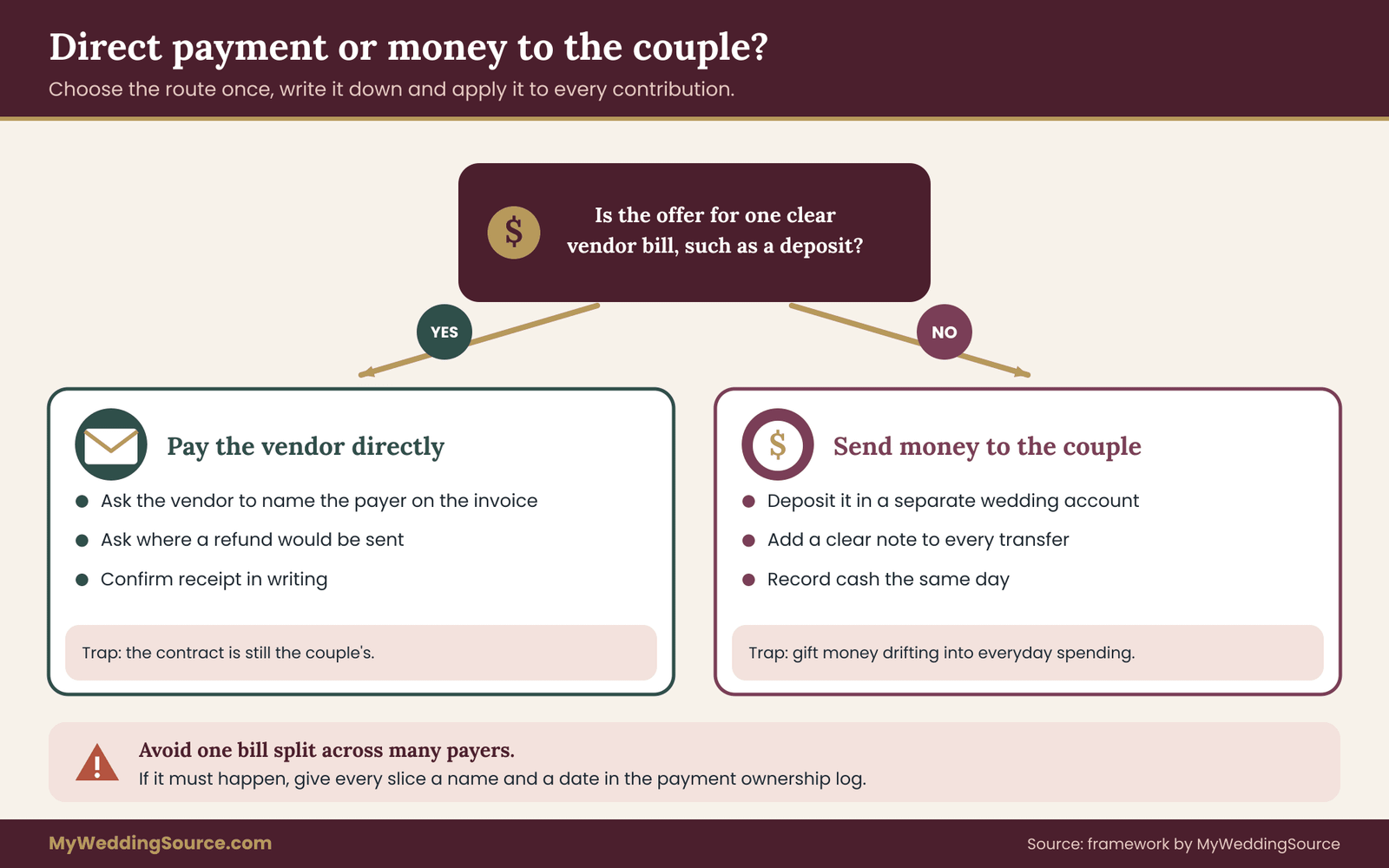
When a giver sends money to the couple, the couple controls payment. They pay vendors on their own schedule, from their own accounts, in their own names. This is the simplest structure for vendor contracts, because the vendor’s counterparty is the couple, and any refund goes back to the couple. Most family wedding contributions reach the couple this way, because it is the simplest for everyone.
The tradeoffs are about trust and tracking. The giver loses sight of how wedding contributions are spent. The couple may feel pressure to show receipts. And the money can slip into everyday spending, so that the wedding ends up underfunded without anyone noticing.
If you receive money this way, protect it with a simple habit: deposit it into a separate account or sub-account named for the wedding, and pay wedding bills from that account. The account statement becomes a free record of what happened. It also makes it easy to answer the question, “Did you use our gift for the wedding?” without anyone feeling interrogated.
If a giver offers cash in an envelope, accept it graciously, and then document it. Write the amount, the date and the giver in your records on the same day. Cash leaves no trail on its own, so the trail has to be yours. Deposit it promptly rather than carrying it around, and be wary of large amounts held in cash for days.
Direct payment to a vendor
A direct payment keeps the couple out of the money loop. The giver pays a vendor, and the vendor applies the payment to the couple’s contract. This has real advantages. The giver can see exactly where the wedding contributions went. The couple cannot accidentally spend it elsewhere. And some givers prefer paying a vendor to handing over cash, because it feels more concrete. Direct payment can make wedding contributions feel more concrete for the giver, as long as the paperwork follows.
The traps are practical.
The contract is not the giver’s. The vendor’s contract names the couple. If the giver pays a deposit, the vendor needs to know whose deposit it is and what it covers. Ask the vendor to put the payment on the invoice or in the contract record, naming the payer and the amount. A vague “payment received” invites confusion.
Refunds follow the contract, not the giver. If a vendor refunds a deposit, the refund usually goes to the party named in the contract or to the original payment method, according to the vendor’s policy. If the giver paid by card, the refund might return to the giver’s card, or it might go to the couple. Ask the vendor how refunds are handled before the giver pays, and tell the giver. If the giver expected a refund to come back to them, say so in the worksheet answer about what changes.
Payment methods carry their own rules. A giver paying by card, check, bank transfer or payment app is subject to the rules of that method and of the vendor’s own terms. Some vendors add card surcharges. Some require a particular method for large amounts. The giver should ask the vendor for the full payment instructions before paying.
Timing can be missed. If the giver pays directly, someone has to remind the giver of due dates, and someone has to confirm the payment arrived. The couple remains responsible to the vendor if payment is late, so confirm receipt in writing.
Which path to choose
A simple decision rule helps. If the giver wants visibility and the couple has no objection, use direct payment for a single, well-defined vendor bill such as the venue deposit or the cake. If the contribution is broad, uncertain or spread across many bills, send it to the couple and track it with the log. Choose the route once, write it down, and apply it consistently across wedding contributions.
Avoid splitting one bill across many payers when you can. A catering bill paid by three relatives and the couple, each paying a slice on different dates, is a recipe for confusion. Where it must happen, use the payment ownership log so that every slice has a name and a date.
Avoid, too, a contribution that is “money toward the wedding” with no vendor attached and no account. It is the easiest to misremember. Pick a path, name the account or the vendor, and write down the choice.
A short note on payment apps and informal transfers
Payment apps make it easy to move money among relatives. They also make it easy to lose track. A transfer labeled with an emoji is not a record. When a giver sends money by app, add a clear note on the transfer itself, such as “wedding gift toward venue deposit, no repayment expected,” and save a screenshot or confirmation.
The Consumer Financial Protection Bureau publishes consumer guidance on payments and money transfers, and its site is a good place to check how protections work for the method you are using. Different methods carry different protections, and informal transfers between people often carry fewer than card purchases from a business. ## The payment ownership log
Apps are convenient for wedding contributions, but convenience is not the same as a record.
The worksheet records what was promised. The payment ownership log records what actually happened. Together they form a complete trail for wedding contributions: the intention and the transaction.
The log is a simple list. Each line is one payment toward one wedding cost. It answers six questions: what was paid, how much, on what date, by whom, from which account, and against which part of the budget. A seventh column, status, shows whether the payment has been confirmed by the vendor.

Why “ownership” is the right word
A bill can be paid by many hands and still belong to one contract. The word “ownership” in this log means two things at once. It identifies who paid each payment, and it identifies whose money it was, that is, which giver’s contribution, or which of the couple’s own funds, it came from. The two names are what let the log describe wedding contributions accurately, even when payments cross between people.
That second part is the one people forget. When a couple pays a deposit from savings expecting a reimbursement, the money is the couple’s now and the giver’s later. When a giver pays a vendor directly, the payer is the giver and the contract owner is the couple. When a gift arrives into the wedding account and then goes to the caterer, the payer is the couple and the money’s source is the giver. Each case is different, and each matters for what happens if something changes.
So the log carries two names on each line: the payer, who moved the money, and the source, whose contribution it was.
What a log line contains
Keep it simple. A single line should hold the following. The fields are few on purpose, because a log for wedding contributions only works if it is quick to fill in.
The date the payment was made, and the date it was confirmed. These can differ by days, particularly for checks and transfers.
The vendor or recipient and a short description of what the payment covers, such as “venue deposit” or “final catering balance.”
The amount, in dollars. If a payment included a fee, such as a card surcharge, write the fee as part of the amount and note it.
The payer, meaning the person or account that actually sent the money, and the source, meaning the contribution it belongs to. For the couple’s own money, write “couple.”
The method, such as card, check, bank transfer or app, and a reference number if there is one.
The confirmation, meaning where the proof lives. A receipt in the vendor file, a screenshot, a statement line or an invoice marked paid.
A note for anything unusual, such as “refundable until the first of March” or “giver expects to be reimbursed when the savings bond matures.”
That is eight or nine small fields. You can keep them in a spreadsheet, a notebook or the notes app on a phone. The format matters less than the habit of filling it in the same day as the payment.
Setting up the log in an hour
Create a spreadsheet with a row for each planned vendor payment. Pull the dates and amounts from your contracts. The vendor payment guidance in wedding vendor contracts explains what to look for in payment schedules, deposits and refund terms. An hour of setup now saves many hours of reconstruction later, especially when wedding contributions come from several people.
Then add a separate small tab for each giver. On each giver’s tab, record the summary from the worksheet: type, amount, timing, what changes, and any strings. Add a running total of how much that giver has contributed so far and how much remains.
Finally, add a reconciliation line at the top of the log. It shows three totals: the total of all payments, the total paid by each source, and the amount still outstanding. If the totals do not agree with the vendor contracts, the log has missed something.
Keeping the wedding contributions log current
Update the log on the day of each payment. If a giver pays a vendor directly, ask them to forward the receipt the same day, and record it. If the vendor confirms a payment, mark the status as confirmed. A current log is what lets you answer questions about wedding contributions in minutes.
Set a monthly reminder to reconcile the log against the bank and card statements. This does two good things. It catches mistakes while there is time to fix them, and it keeps the log honest. A short monthly review also builds the habit of sharing, as you will see in the next section.
Who sees the log of wedding contributions
Decide in advance who can see what. The couple should have complete access. Each giver is entitled to see the part that concerns their own contribution, and many are glad to. Other givers do not need to see each other’s terms. Privacy matters, because wedding contributions are personal and each family has its own comfort level.
A practical approach is to keep a master log that only the couple can see, and to send each giver a short statement of their own contribution at intervals. The statement might say: “Here is where your gift has gone so far: venue deposit, two thousand dollars, paid on this date, receipt attached. Remaining: three thousand dollars, due at the final balance.”
Such statements are a form of respect. They show the giver that wedding contributions are being used as intended, and they answer questions before they are asked. Many families find that a statement at the halfway point and another after the wedding prevents nearly all disputes.
If a giver does not want statements, that is fine. Record in the worksheet that updates are not wanted, and keep the log for your own use.
Linking the log to your other wedding records
The log works best when it connects to the rest of your paperwork. Each line should point to a receipt or contract in your vendor files. If you keep a ledger of cash gifts from guests, keep it separate from the contribution log, because guest gifts are a different category. A separate gifts ledger deals with envelope money from guests, while the log described here deals with the planned financial help of family members. Wedding contributions leave a trail across many documents, and the log is the thread that connects them.
When the wedding is over, the log becomes part of your archive. The guide to wedding records after the event shows how to store, back up and retain these files, and how long to keep them.
Using the log to handle the awkward moments
A good log earns its keep in the uncomfortable moments. Here are the most common, and how the log helps. These are the situations in which documented wedding contributions pay for themselves.
A giver asks, “Where did our money go?”
Open the log, filter by that giver’s source, and send the list. Because each line has a date, a vendor, an amount and a confirmation, the answer is complete in minutes. You do not have to feel defensive. You are giving an account of something they trusted you with, and that is a pleasure rather than a burden.
Two givers remember different amounts
This happens when two relatives each believe they paid the same bill. The log shows who paid which payment on which date. If the log itself is incomplete, check the vendor’s payment record, which names the payments received. The combination of your log and the vendor’s records settles the matter without anyone being right or wrong.
The final balance is larger than expected
A giver who promised a share of the catering may be surprised by a higher final invoice. Return to the worksheet: was the amount fixed or a share? Was there a cap? If the amount was fixed, the couple covers the extra. If it was a share with no cap, ask the giver whether they would like to cover their share of the increase, and give them the invoice and the reason for the difference. A calm, documented explanation usually lands better than a surprise request.
A giver needs the money back
Life changes. A giver may face a medical expense, a job loss or a family emergency. If the contribution was a gift, the couple has no obligation to return it, but they may want to anyway, if they can. If the contribution was a loan, the giver may ask for early repayment. The worksheet answer about what changes should have covered this. If not, discuss it kindly and record whatever you agree.
One partner wants to share less with their own family
Couples sometimes disagree about how much to tell each family. The solution is to agree, as a couple, on a rule before the first payment. A simple rule is that each partner is responsible for communications with their own relatives, using the same worksheet and the same summary format, and each partner shares the other’s relatives’ terms only with permission.
A vendor asks who the payer is
Vendors sometimes need the payer’s name for their own records, particularly for deposits paid by a third party. Give the vendor the payer’s name and contact details only with the payer’s consent. Ask the vendor to note on the invoice that the payment was made by a third party on the couple’s behalf. This protects the giver from any confusion about who owes the vendor what.
A giver wants the money to be anonymous
Some givers prefer not to be known. They may want the couple to describe the money as the couple’s own, or they may want the other side of the family not to know. Honor that, and keep the worksheet and log private. The log can mark the source as “private contribution” with the details held in a separate, restricted note.
Making wedding contributions part of the budget
Documented wedding contributions need a home in the budget, or the budget will lie. There are three simple ways to build contributions into the numbers, and one mistake to avoid. Wedding contributions that live outside the budget tend to be forgotten until the final balance.
Show wedding contributions as a source, not as a reduction
A budget has two sides: what the wedding costs and how it is paid for. Contributions belong on the second side, as a source of funds. They do not make the wedding cost less. If you subtract a contribution from the venue line, the venue line no longer matches the contract, and you can no longer tell whether the venue came in over or under. Seen this way, wedding contributions are a funding source and the cost lines stay true to the contracts.
So record the venue at its true cost, and record the contribution as a source that covers part of it. At the end you can compare total costs to total funds and see exactly where the couple’s own money was needed.
Separate committed, expected and hoped-for money
Not all wedding contributions are equally certain. A gift already received in the wedding account is committed. A gift promised in writing for a specific date is expected. A giver who says “we will see what we can do” is hoped-for. This sorting keeps your budget honest about wedding contributions that have not yet arrived.
Plan the wedding on the first two categories. Treat the third as a bonus, not as a source. A budget that assumes hoped-for money will be there is a budget with a hole, and the hole shows up at the final balance.
Tie each contribution to a purpose, if the giver wants one
If a giver wants their money to go toward a particular cost, label it. “Parents’ contribution: venue and catering.” The label keeps the giver’s intention visible, and it gives you a way to track whether the amount has been used for that purpose. Labels help wedding contributions stay connected to the giver’s intention.
If a giver’s money is unrestricted, label it as general. General funds are the easiest to manage, because the couple can allocate them to wherever the budget is tightest.
The mistake to avoid
The most common mistake is to build the budget around a contribution that has not been confirmed. A couple who books a larger venue because a parent said “we will help” finds themselves committed to a contract whose cost depends on a promise. If you must commit before the wedding contributions are confirmed, commit only to what you can afford without it, and treat the contribution as a margin of safety rather than a foundation. Counting unconfirmed wedding contributions as real money is the most expensive error in this whole process.
The wedding budget guide explains how to set categories and track actual against planned, and the same structure works for contributions. Add a small section for sources of funds, list each giver, and track what is committed, expected and received. ## A worked example of wedding contributions from four relatives
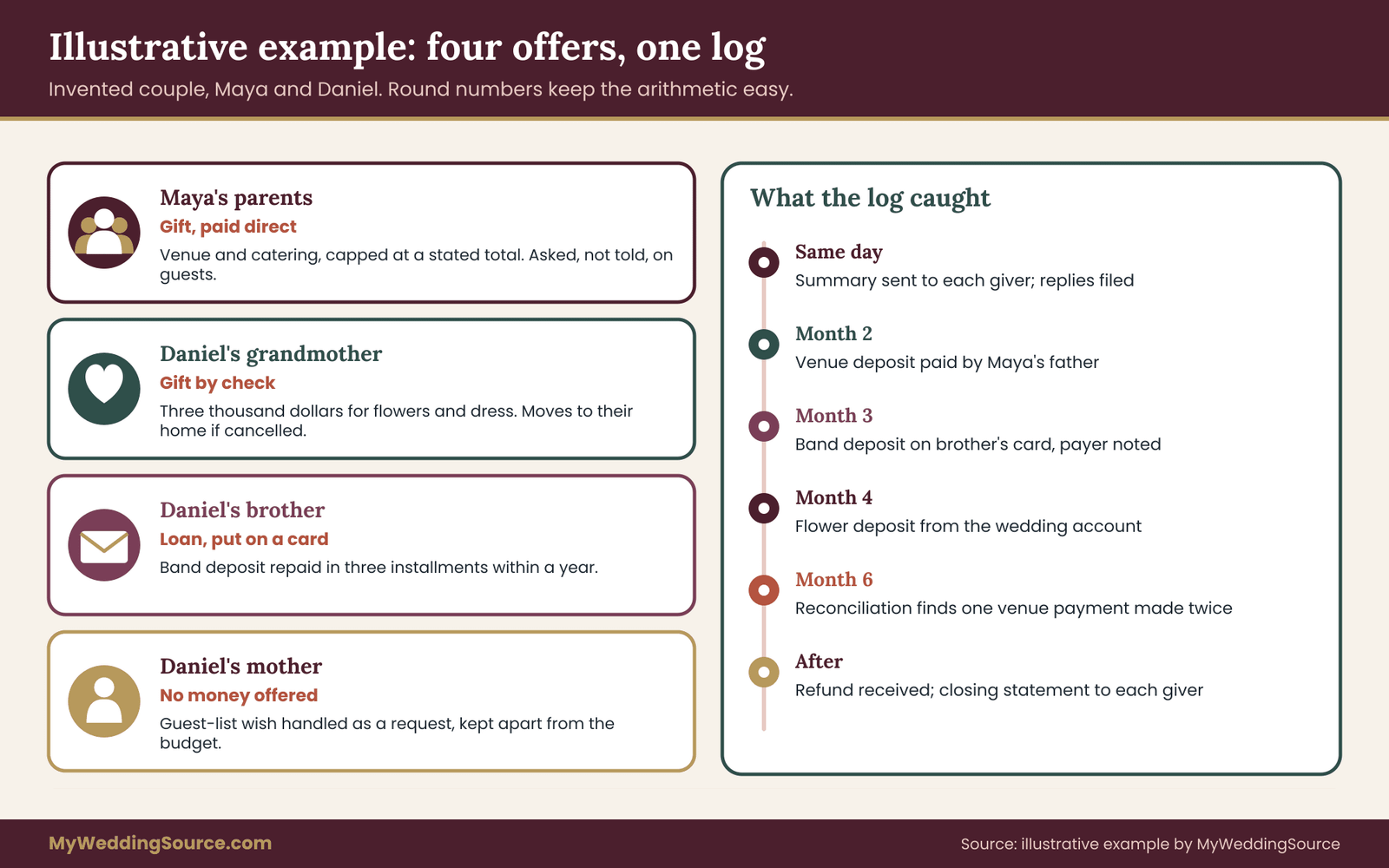
The following example is invented to show the tools in use. The names, amounts and events are illustrative, not real, and the dollar figures are round numbers chosen only to keep the arithmetic easy. The example shows how different wedding contributions can sit side by side under the same two tools.
Maya and Daniel are planning a wedding for about ninety guests. They have savings of their own, and four relatives have offered help. Their total budget is eighty thousand dollars on paper, though they know costs will shift.
The four offers
Maya’s parents said, “We want to cover the venue and catering.” The offer was warm and vague.
Daniel’s grandmother said she would like to give “something for the flowers and the dress.”
Daniel’s brother said he would put the band deposit on his card and “sort it out later.”
Daniel’s mother said nothing about money, but mentioned twice that she hoped her sister’s family would be invited.
Each offer is a different shape, and each needs a different part of the worksheet.
Working through Maya’s parents
Maya sat down with her parents and followed the four moves. She thanked them, asked for twenty minutes, showed a rough budget, and asked which type of help this was.
Her father said, “A gift, of course.” Her mother added, “We would like to pay for the venue and the caterer directly.” That was already two decisions: the type was a gift, and the path was direct payment.
On the amount, the venue contract was thirty thousand dollars, and the catering quote was twenty-four thousand before service charge and tax. Her parents said they would cover “the venue and catering.” Maya asked whether that meant the quoted catering price or the final invoice. They paused. Her father said, “Up to a total of fifty-five thousand, and if it goes beyond that, we will talk.” That became a cap.
On timing, the venue deposit was due in two months, the second payment at six months and the final balance one month before the wedding. Her parents said they could pay the deposit at once and the rest from a certificate of deposit that matured in four months. Maya noted that the second venue payment came due before the certificate matured, so they agreed her parents would pay it from a different account.
On what changes, her mother said, “If the wedding is postponed, the money stays committed to the new date. If it is cancelled, we will talk.” Maya wrote that down exactly.
On strings, her father said, “We would like to invite our friends, and we would like to be asked, not told, about the guest list.” Maya replied that she would like to include about twenty of their friends, and that she and Daniel would make the final call. They agreed, and the summary stated it.
The summary, sent the same evening, was four sentences long. Her mother replied with a heart and “Yes, that is right.”
Working through Daniel’s grandmother
Daniel’s grandmother was more informal. She said she would give “a nice amount” and “not to worry about it.” Daniel asked, gently, whether a specific number would help them plan. She said three thousand dollars.
Daniel asked about the type. “It is a gift,” she said. “I am not paying for the wedding, I am helping you start.” Daniel asked whether she had any preference about which part of the wedding it went toward. She said, “The flowers, and a little for the dress, if there is enough.”
Daniel raised the question of what changes. She said, “If you cancel the wedding, keep it for your home.” That was a gift that moves to the next purpose.
He also asked, gently, whether there was anything about her own plans that they should keep in mind. She said she was planning a move into a smaller home next year and would send the money before then. They agreed on a date.
Because she sent a check, Daniel deposited it into the wedding account, wrote a thank-you note the same day, and recorded the amount, the check number, the deposit date and the purpose in the log.
Working through Daniel’s brother
The brother’s offer was the one most likely to cause trouble. “I will put the band on my card and we will sort it out later” is a loan wearing a gift’s clothes.
Daniel asked directly. “Is this a loan or a gift?” His brother said, “A loan, I guess. Pay me back when you can.” Daniel proposed a schedule: the full amount repaid within one year after the wedding, in three installments. His brother agreed. They wrote it down in a short message and each replied “yes.”
They also noted the card rewards the brother would earn, which they agreed he would keep. A seemingly small point, but it was exactly the kind that can irritate later.
Because the band’s contract was in Daniel and Maya’s names, they asked the band to note on the invoice that the deposit had been paid by Daniel’s brother on the couple’s behalf. They also asked how a refund would be handled if the date changed. The band’s policy was to refund to the original card, so the brother would receive any refund directly. Daniel and his brother agreed that, if that happened, the brother would keep the refunded amount as repayment.
Working through Daniel’s mother
Daniel’s mother had offered nothing, so there was no worksheet to run. But her comments about her sister’s family were a string in disguise. Daniel did not treat it as a contribution matter. He asked her, privately, whether she wanted to invite her sister’s family, and offered a number of seats. That kept the guest-list conversation in the right place, apart from money.
This is an important lesson. Not every expectation is attached to a contribution. When a relative has a request that has nothing to do with money, handle it as a request, and do not mix it with the budget.
The log in practice
Maya and Daniel built a payment ownership log. After the first three months it looked like this in words:
The venue deposit was paid by Maya’s father from his own account. The log recorded the date, the amount, the payer as “Maya’s father,” the source as “Maya’s parents’ gift,” and the confirmation as the venue’s receipt.
The band deposit was paid by Daniel’s brother on his card. The log recorded the payer as “Daniel’s brother,” the source as “loan from Daniel’s brother,” and a note that the loan was to be repaid in three installments.
The flower deposit was paid by the couple from the wedding account, funded by the grandmother’s check. The log recorded the payer as “couple,” the source as “grandmother’s gift,” and the confirmation as the florist’s receipt and the bank statement.
The photographer’s deposit was paid by the couple from their own savings. The source was “couple.”
At the six-month reconciliation, they compared the log to the vendor contracts and their bank statements. Everything matched, with one exception: the second venue payment had been paid twice by mistake, once by Maya’s parents and once by Maya from the wedding account. They caught it because the log showed two entries for the same milestone. The venue refunded the extra payment to the couple’s account, and Maya returned the amount to the wedding account.
Without the log, the duplicate might have surfaced only at the final balance, when it would have been harder to sort out.
What the example shows
Three things stand out. First, each contribution had a different shape, and the worksheet adapted without changing its structure. Second, the log did the work of a good memory. Third, nobody was surprised. Maya’s parents knew what they had committed to, the grandmother knew what her money was for, and the brother knew when he would be repaid. Wedding contributions in any family follow the same pattern, even when the numbers differ.
The example is simple on purpose. Real families have more complexity, and real numbers will differ. The principle is the same.
Checking the vendor side and the official rules
Contributions touch two outside systems: the vendors who receive payment, and the agencies and institutions that set rules about gifts, loans and money transfers. Neither is complicated, but both are worth a moment of verification. Wedding contributions pass through vendor policies and agency rules, so verify both.
What to confirm with each vendor
Whenever a contribution goes to a vendor, either directly or through the couple, confirm four things in writing. These four confirmations keep wedding contributions from being lost between the giver, the couple and the vendor.
Who is the customer of record. The contract usually names the couple. Confirm that a third-party payment will be credited to the couple’s contract and that the vendor will issue a receipt naming the payer.
How refunds are handled. Ask whether refunds go to the original payment method, to the customer of record or to another party. This matters because a giver who paid by card may expect any refund back on that card.
Whether deposits are refundable, transferable or both. Policies differ. Some vendors keep deposits if a date is cancelled, some apply them to a new date, and some refund part of them. Look at the contract’s wording and ask for clarification where it is unclear. The vendor contract guide linked earlier goes into what to look for.
What payment methods are accepted, and what they cost. Some vendors add a surcharge for cards, and some cap the amount that can be paid by card or app. A giver who pays by an unaccepted method may find the payment delayed.
Ask for these answers in an email, and save the reply in the vendor file. The wedding vendor due diligence checklist lists other questions worth asking before you pay anyone. A vendor’s written policy is the best protection if a question arises later.
What to verify with official sources
For rules about gifts and money, use the agencies that issue them. This guide does not repeat specific figures, because limits and thresholds change, and because they depend on your own situation. Rules on wedding contributions change, which is why the agencies themselves are the right place to look.
For federal gift tax, the Internal Revenue Service publishes plain-language answers, including who generally files and how annual limits work. Givers who plan large gifts should read those answers or speak to a tax professional.
For loans among family members, the IRS also discusses how interest and below-market loans can be treated for tax purposes. If a loan is large, a tax professional can advise on whether to charge interest and how to document it.
For consumer payment questions, the Consumer Financial Protection Bureau explains how different payment methods work, what protections apply and how to dispute errors. This is useful when a giver pays a vendor by card or app, and when a payment goes wrong.
For contract and consumer-protection questions, the Federal Trade Commission and your state attorney general publish consumer guidance. Local rules about deposits and cancellation vary by state, so check the one where the vendor operates.
The links at the end of this article lead to these official sources. They are starting points. If a situation is large or contested, a lawyer licensed in your state can tell you what applies. ## When plans change: shortfalls, postponements and cancellations
Even well-documented wedding contributions meet surprises. A date moves, a vendor closes, a relative’s finances change, or the couple decides on a smaller celebration. The worksheet’s fourth answer was designed for these moments. This section shows how to use it, and how to handle the cases the worksheet did not foresee. Wedding contributions are tested most when something changes, which is exactly why they should be documented first.

The postponement
A postponed wedding is the most common change. The money has often been paid out already, in deposits that may or may not move to a new date. Documented wedding contributions make a postponement far easier to manage.
Start with the vendors. Ask each one, in writing, whether the deposit transfers to a new date, whether there is a fee and whether the price changes. Do this before telling any giver the final impact, because their question will be, “How much is lost?”
Then open the worksheet summaries. For each giver, check what they said would happen if plans changed. Most will have said that wedding contributions stay with the couple or move to the new date. Tell each giver the vendor answers and confirm that the wedding contributions are still committed to the revised plan. Update the log with new dates and note any fee.
If a giver said “we will talk if it changes,” schedule the conversation within a few weeks, not months. Bring the vendor answers and a simple revised timeline. Avoid asking the giver to decide before the facts are clear.
The cancellation
A cancellation is harder. If the wedding is cancelled for any reason, three questions arise: what was lost, what can be recovered and what happens to the contributions. Cancelled weddings leave unresolved wedding contributions behind, so clarity matters most here.
For lost money, the vendor contracts decide. Some deposits are refundable, some are not, and the terms vary. Ask each vendor what is returned and in what form, such as a refund or a credit.
For recovered money, the log tells you whose money it was. A refund of a deposit paid by a giver should be handled according to the worksheet answer. If the worksheet said the wedding contributions return to the giver, return them. If it said the money stays with the couple, keep it. If it said nothing, talk to the giver and record the decision. Do not decide alone. This is one of the most delicate conversations in the process, and a short, kind note beats a long explanation.
For loans, the cancellation does not change the debt. A loan from a relative is repaid on its terms unless the lender agrees to different ones. If the couple used loan money for a deposit that was lost, the loan remains. This is hard, and it is better said early and plainly.
A smaller or cheaper wedding
Sometimes the couple chooses to spend less. They may drop a vendor, reduce the guest count or choose a less expensive venue. When costs fall, ask what the giver wants done with the difference. Smaller weddings can leave wedding contributions partly unspent, and the giver deserves a say in what happens to the rest.
If a contribution was a fixed gift, the couple keeps the difference, and may of course decide to share the saving. If it was a share of costs, the share falls with the costs. If it was a fixed amount earmarked for a purpose, the couple should check whether the giver wants to redirect the unspent part.
A kind habit is to offer. “The caterer came in lower than expected. Would you like us to return the difference, or put it toward the honeymoon, or something else?” Most givers will say “keep it,” and they will remember being asked.
A shortfall
A shortfall is the reverse: the costs rise, or a promised contribution does not arrive. Here the log and the budget do the most work. Shortfalls reveal how solid your wedding contributions really were.
Check how much of the shortfall is in committed, expected and hoped-for money. A shortfall in hoped-for money is a disappointment, not a loss. A shortfall in expected money needs a conversation. A shortfall in committed money, such as a giver who cannot pay what was promised, needs the most care.
Before asking any giver for more, list the couple’s options. You can reduce costs, move some spending later, use savings or a contingency reserve, or ask for help. Give the giver the full picture and let them choose. The guide on wedding cash-flow planning explains how reserves and payment timing work, which helps when a shortfall is about timing rather than total cost.
Do not hide a shortfall from a giver who is still contributing. They would rather know early. And do not ask one giver to cover another giver’s missing share without telling both.
A giver changes their mind
Sometimes a giver withdraws or reduces an offer. This can be painful, particularly if the couple has already committed money based on it. Remember that a promise of a gift is not usually enforceable in the way a signed contract is. That is a legal question that varies by place, and it is a reason to rely on money that has actually arrived. Wedding contributions are voluntary, which is what makes a documented plan and a safety margin so valuable.
Etiquette questions about thanks and acknowledgment are covered in the wedding etiquette guide. Respond with calm. Thank the giver for what they have given. Ask whether the change is permanent or temporary. And revise the plan. If you used the committed, expected and hoped-for categories, the damage is limited, because you did not rely on hoped-for money.
If the withdrawn offer leaves the couple in a difficult position, they can ask the giver for a smaller amount, or ask another relative, or adjust the wedding. They should avoid the temptation to argue about what was promised. A documented summary can show what was said, but proving it rarely rebuilds goodwill.
Illness, death or a major family event
Some changes are not about money at all. A serious illness or a death in the family can change a wedding entirely, and it can change what a contribution means. The worksheet and the log are tools, not rules. In these moments, set them aside and attend to people. Notify vendors, ask for compassion where policies allow, and return to the records when there is room to do so.
Limits of documenting wedding contributions, and when to get professional help
The worksheet and the log work for ordinary family contributions of ordinary size. They have limits, and it is better to know them than to discover them. Knowing where simple records of wedding contributions stop is part of using them well.
First, a written summary is not a loan contract. If a loan is large, or if the lender wants security, a formal written agreement drafted with legal advice is appropriate. A lawyer can explain how to write enforceable terms, what interest rules apply and whether any filing is needed.
Second, a note is not tax advice. Gifts, loans and interest can have tax consequences that depend on the amount, the people involved and the year. Ask a qualified tax professional, and read the IRS answers. Do not rely on what a friend or a message board tells you.
Third, the tools cannot resolve a family disagreement on their own. A clear record helps people remember, but it does not change what they feel. If a conflict has grown beyond money, a mediator, a counselor or a trusted family elder may help more than another spreadsheet.
Fourth, rules differ by state and by country. Deposit rules, gift rules and the treatment of contributions in a divorce or estate vary. If a contribution is large, if it crosses borders, or if it is connected to property, speak to a lawyer in the relevant place.
Fifth, a documented contribution is not a guarantee that a relationship will remain smooth. It is a courtesy and a safeguard. It reduces the chances of misunderstanding, and that is all it does.
Signs that you need more than a worksheet
Consider professional help if any of these apply. The contribution is large compared with the couple’s finances. The giver wants repayment with interest, or security. A giver is pressuring the couple, or hinting at consequences. A giver’s ability to give is uncertain. The money is tied up in a business, a trust or a property. Or the couple is unsure whether a contribution is legal in their situation. Larger or more complicated wedding contributions may need more than a worksheet.
In those cases, a lawyer, a tax professional or a consumer-finance counselor can add something a worksheet cannot. The American Bar Association and your state bar can help you find a lawyer, and many states have referral services. A nonprofit credit counselor can help a couple weigh the effect of a family loan on their budget.
Respecting the giver’s privacy
A contribution record contains personal financial information. Treat it with care. Keep the log in a private place, share only what a giver agrees to share and do not forward summaries to people outside the arrangement. If you store the records in a shared drive, check who has access. Delete duplicates you no longer need, and keep the final versions with your wedding records. Records of wedding contributions hold personal financial details, so treat them accordingly.
When the wedding is over, thank each giver again, in a way that matches what they said they wanted. Some will want a note. Some will want a photograph. Some will want nothing at all. The thank-you is the last line of the log, and it is the one that matters most.
A short closing routine
A wedding with documented contributions ends with a short routine. Send each giver a final statement of how their money was used. Close each loan with a repayment schedule. Update the log with final totals. File the summaries, statements and confirmations with your wedding records. And write one line in your notes about what you would do the same way next time, whether for yourselves or for a sibling who asks for advice. A closing routine rounds off wedding contributions neatly and leaves a record for the future.
That is the whole system: a worksheet before the money, a log during it and a closing statement afterward. It takes some hours across a year, and it saves much more than that in confusion. ## Your next steps
Start with one evening and one list. Write down every relative who has offered help, even loosely, and next to each name write what you think the offer is: gift, loan, conditional gift or direct payment. Mark each one you are unsure about. Those marks are your conversations.
Then schedule the conversations, one giver at a time, beginning with the largest or the vaguest offer. Use the four-answer worksheet, send the summary the same day and file the reply. Open a spreadsheet for the payment ownership log, enter the payment dates from your vendor contracts and set a monthly reminder to reconcile it with your statements.
Use the wedding planning checklist to place each conversation on your calendar. Finally, put the contributions into your budget as sources of funds, split into committed, expected and hoped-for. Review the totals after each new contract. Within a few weeks, your wedding contributions will stop being a set of half-remembered promises and become a short, clear record that everyone in the family can trust.
FAQ
Do we really need to write down wedding contributions from family?
Not every small gift needs a document, but any contribution large enough to affect your budget does. A short note covering type, amount, timing and what happens if plans change takes twenty minutes and prevents the most common disagreements. Informal families often find a friendly confirming text or email is enough, and it can be written as thanks.
How do we find out whether a contribution is a gift or a loan?
Ask directly and kindly. A useful question is whether the giver would be comfortable if the money were never repaid. Hesitation usually means they see it as a loan. If the answer is still unclear, record it as a loan with generous terms, so nobody is surprised. You can always convert a loan to a gift later, if the giver chooses.
What should a family wedding contribution agreement include?
Keep it to a page. Include the date, the names, the type of contribution, the amount or cap, the payment timing, what happens if the wedding is postponed or cancelled, and any conditions or expectations. Add a line inviting corrections, and ask for a written reply. Plain language works better than legal wording for ordinary family arrangements.
Is it better for relatives to pay vendors directly or give us the money?
Neither is always better. Direct payment suits a single, well-defined bill, such as a deposit, and gives the giver visibility. Money paid to the couple is simpler for contracts and refunds. If a relative pays a vendor, ask the vendor to record the payer and explain where any refund would go.
How do we handle a relative who expects a say in the wedding?
Separate recognition, input and control. You can thank them publicly and listen to their ideas without giving them the final decision. Say so early, ideally in the worksheet. If expectations appear later, return to the written summary and respond kindly. If you cannot accept the terms, consider taking a smaller gift or declining the contribution.
What happens to contributed money if we postpone or cancel the wedding?
It depends on what was agreed. Ask each giver, ahead of time, whether wedding contributions stay with you, move to a new date, return to them or get decided later. Vendor contracts decide what deposits are recoverable, so check those in writing. A loan generally remains owed unless the lender agrees to change the terms.
Do gifts from parents or grandparents have tax consequences?
Possibly, though most gifts do not result in tax. The Internal Revenue Service explains that gift tax rules generally apply to the person giving, and annual limits change. Loans between relatives can raise separate questions about interest. Because these rules depend on amounts and circumstances, check the IRS guidance and ask a qualified tax professional.
How long should we keep records of family wedding contributions?
Keep the summaries, the payment ownership log and the confirmations at least until every loan is repaid and every vendor file is closed, and longer if tax questions might arise. Many couples keep them permanently with their wedding records, since the files are small. Store them privately, with backups, and share only what each giver agrees to.
Sources
- Consumer Financial Protection Bureau
- Frequently asked questions on gift taxes, Internal Revenue Service
- Internal Revenue Service
- Federal Trade Commission, consumer information
- USAGov
- Federal Deposit Insurance Corporation, resources for consumers
- Federal Reserve Board, consumers and communities
- American Bar Association
- National Association of Attorneys General