
A wedding caricature artist is one of the few reception activities that produces a handmade object for each guest who sits down, and also one of the few that limits how many guests can take part. This guide covers the three things that decide whether the booking works: the space the artist needs, the number of portraits that fit in the time you have, and the permissions that protect your guests and the drawings.
Before you book a wedding caricature artist, do three calculations and write down three agreements. Calculate the footprint (a table, two seats, a clear lane for the line and light on the paper), the throughput (window minutes divided by minutes per portrait plus swap time, times the number of artists), and the coverage (portraits divided by guests). Agree on a guest permission briefing, on what the artist may do with images of your guests, and on who owns and can reproduce each drawing. Put all six in the contract.
Many couples book a caricature artist because the idea is charming and the photos from other weddings look joyful. The idea is sound. The trouble usually starts with arithmetic nobody did. A skilled artist drawing quick, head-and-shoulders portraits can only draw so many in a two-hour window, and a hundred guests who all want one will not be served by a single easel.
The line grows, the people at the back give up, and the wedding caricature artist spends the evening watching a crowd that is slightly annoyed instead of entertained.
The second source of trouble is less visible. A caricature is a likeness of a real person’s face, drawn by someone who is not that person and often photographed, posted or displayed while it is being made. A guest who sits down for a drawing has agreed to be drawn. They have not necessarily agreed to be photographed beside it, shown on the artist’s social feed, or exaggerated in a way that touches something sensitive.
The broader question of guest photo permissions is covered in the wedding photography consent guide. A short briefing that sets those expectations costs almost nothing and prevents most of the awkward moments.
This article is built around a method we call the portrait queue and guest permission briefing. The portrait queue is a plan for how guests move from deciding to sit, through waiting, to leaving with a drawing. The permission briefing is a short, consistent set of words, signs and contract clauses that tell everyone what is being drawn, what may be photographed and what may be shared. Both are tied to numbers you can check before you sign.
A note on scope. This is general planning information, not legal advice. Rules on likeness, privacy, copyright and accessibility vary by state and by situation, so where a rule matters the guide points to the issuing agency or suggests a question for the artist, the venue or a lawyer.
What a wedding caricature artist does at a reception
A wedding caricature artist draws guests, usually live, in an exaggerated but friendly style. That sentence hides several different services, and the differences matter for space, speed and consent. Before comparing quotes, sort the options into formats.
Live drawing on paper. The artist sits across from the guest and draws with markers, paint pens or pencil on a sheet of paper or card stock, usually in a few minutes. The guest watches the drawing appear. This is the classic format. It needs a table, good light and a place for the ink to dry before the sheet is handed over or rolled.
Live drawing on a tablet. The wedding caricature artist draws on a screen, often projected or mirrored so the line can watch. The portrait may be printed on the spot, emailed later, or both. It needs power, a printer or a delivery plan, and a clear agreement about files, which turns this format into a consent and ownership question as much as an art question.
Scene or group caricature. One drawing contains several people, often a couple with a pet, a table of friends or a family. These are slower per drawing but count several guests at once, which changes the coverage math.
Pre-drawn caricatures from photos. The artist works from supplied photos before the wedding and delivers drawings for display or favors. There is no queue, which removes the throughput problem, but the guests never agreed to be drawn, so the consent work moves earlier and becomes your job.
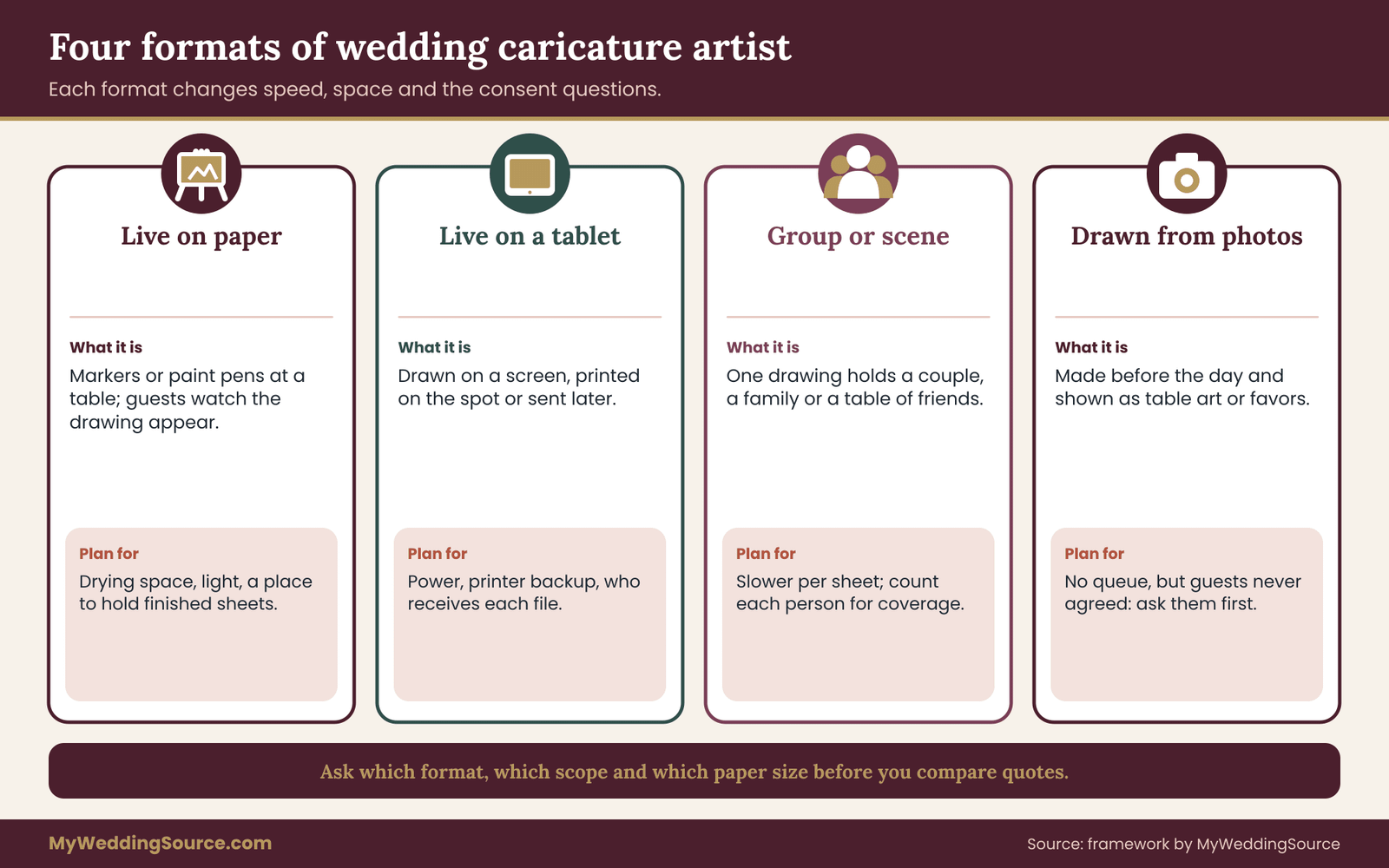
Within each format, the artist sets a scope. A head-and-shoulders portrait is faster than a full-body one. A single subject is faster than two. Color adds time. Hand lettering adds time. A caricature with a theme, such as a sport, a job or a hobby, adds a few details, and the details are where speed is gained or lost. When a quote says “caricatures,” ask which format, which scope and which paper size, because the answer decides the number you can expect.
What the artist is not
A caricature artist is not a photographer, not a photo booth and not a silhouette cutter, even though all of them fill a similar slot in the evening. A photo booth records the guest as they look. A silhouette artist cuts a profile. A caricature artist interprets the guest, and that interpretation is the whole point and the whole risk.
The guest receives something that reflects how another person sees them. Most guests love this. A few find it uncomfortable, and nobody can tell in advance which guests those are.
The cost logic, without invented numbers
You will see two pricing patterns. One charges by the hour for a block of time, with the number of portraits left open. The other charges per portrait or per sitter, sometimes with a minimum. Neither is better in general. Hourly pricing puts the throughput risk on you, because a slow evening still costs the full block. Per-portrait pricing moves some risk to the wedding caricature artist but can push the artist to rush, and it makes your total cost depend on how many guests join the line.
Ask each artist for a written rate sheet, and then run your own coverage number against it. The wedding budget guide explains how to place a vendor like this beside the other reception costs.
For current rates, availability and what is included, rely on written quotes from the artists you are considering. Prices differ by region and season, and this guide will not quote averages it cannot source.
When a wedding caricature artist fits the guest list
A wedding caricature artist suits some receptions very well and others poorly. The fit depends on who is attending, how the evening is structured and how much the couple wants to hold guests in one place. Treat the question as a fit test, not a trend.
Start with the guests. A caricature session is an activity for people who enjoy being looked at in a playful way. It works well with mixed-age groups that include teenagers, cousins and older relatives who like a keepsake. It works less well when a large share of the guests are shy, when the crowd is mostly colleagues who barely know each other, or when guests will worry about how an exaggerated portrait reads. None of that rules it out. It does mean the briefing matters more.
Next, look at the room. A caricature table asks for a patch of floor where people can stand and watch without blocking service. A ballroom with a defined cocktail space handles that easily. A narrow courtyard with the bar at one end does not. The venue technical walkthrough guide explains how to measure and photograph a space before you commit, and the artist’s footprint belongs on that list.
Then consider the evening’s flow. The wedding reception guest flow guide treats a reception as a set of movements, with people going to the bar, the food, the dance floor and the restrooms. A caricature table is a magnet in that system. It creates a standing crowd and a slow-moving line, and both can interfere with other flows if the table is placed carelessly. The next sections show how to place it.
Compare it with the alternatives
If your goal is a keepsake for each guest, several formats compete with caricature for the same slot.
A photo booth produces one print or file per visit, serves a group of guests at once and needs far less staff attention per guest. It is faster, and it records people as they are. If speed and coverage matter most, a booth outperforms a caricature artist, and a couple can reasonably pick the booth.
A silhouette artist is faster than a caricature artist and leaves little room for a guest to feel mocked. Silhouettes suit couples who worry about the exaggeration element.
A live calligrapher or place-card artist fits a more formal evening and makes fewer demands on the line. It is a lower-risk choice for guests who dislike being the subject.
A pre-drawn set, delivered as table art or favors, removes the line entirely, though it requires the work of gathering photos and permission in advance.
A caricature artist is the right choice when the couple wants a lively, visible activity where guests watch the drawing happen, when the guest list includes people who will happily sit, and when the couple accepts that only a share of guests will be drawn. If the real goal is a keepsake for every guest, choose a faster format or add a second artist.
The honest coverage question
Say it plainly to yourselves before signing: only a fraction of your guests will be drawn. That is not a flaw to hide. It is a feature to design around. Some couples draw the line at the couple and the wedding party. Some offer the artist at the cocktail hour only. Some give every household one portrait. These are all reasonable policies. The mistake is to let the line form without a policy and then discover at nine o’clock that half the room was turned away.
The wedding cocktail hour guide covers how the first hour of a reception works, and the cocktail window is a common home for a caricature artist because guests are mingling, standing and open to a short wait. The later sections compare it with an after-dinner window.
The portrait queue: five gates from invitation to hand-off
The portrait queue is the path a guest takes from hearing that a wedding caricature artist is present to leaving with a drawing. Thinking of it as five gates makes problems visible, because each gate fails in its own way.
Gate one: the invitation to sit. How do guests learn the wedding caricature artist is there, and who may sit? This can be an announcement, a sign, a line in the program, or a word from the host. Without this gate, the first guests to notice will crowd the table and the shy ones will never ask.
Gate two: the wait. Where do guests stand or sit while waiting, and for how long? This gate decides whether the activity feels like a treat or a chore.
Gate three: the briefing. Before the pen touches the paper, the guest hears and sees a short statement of what is drawn, what may be photographed and what happens to the image. This is the permission briefing, and it is covered in detail later.
Gate four: the sitting. The guest sits, the artist draws, bystanders watch. This gate has a length in minutes that drives everything else.
Gate five: the hand-off. The drawing is signed, dried, protected and given to the guest or set aside to be collected. If the drawing is digital, the delivery plan is confirmed here.
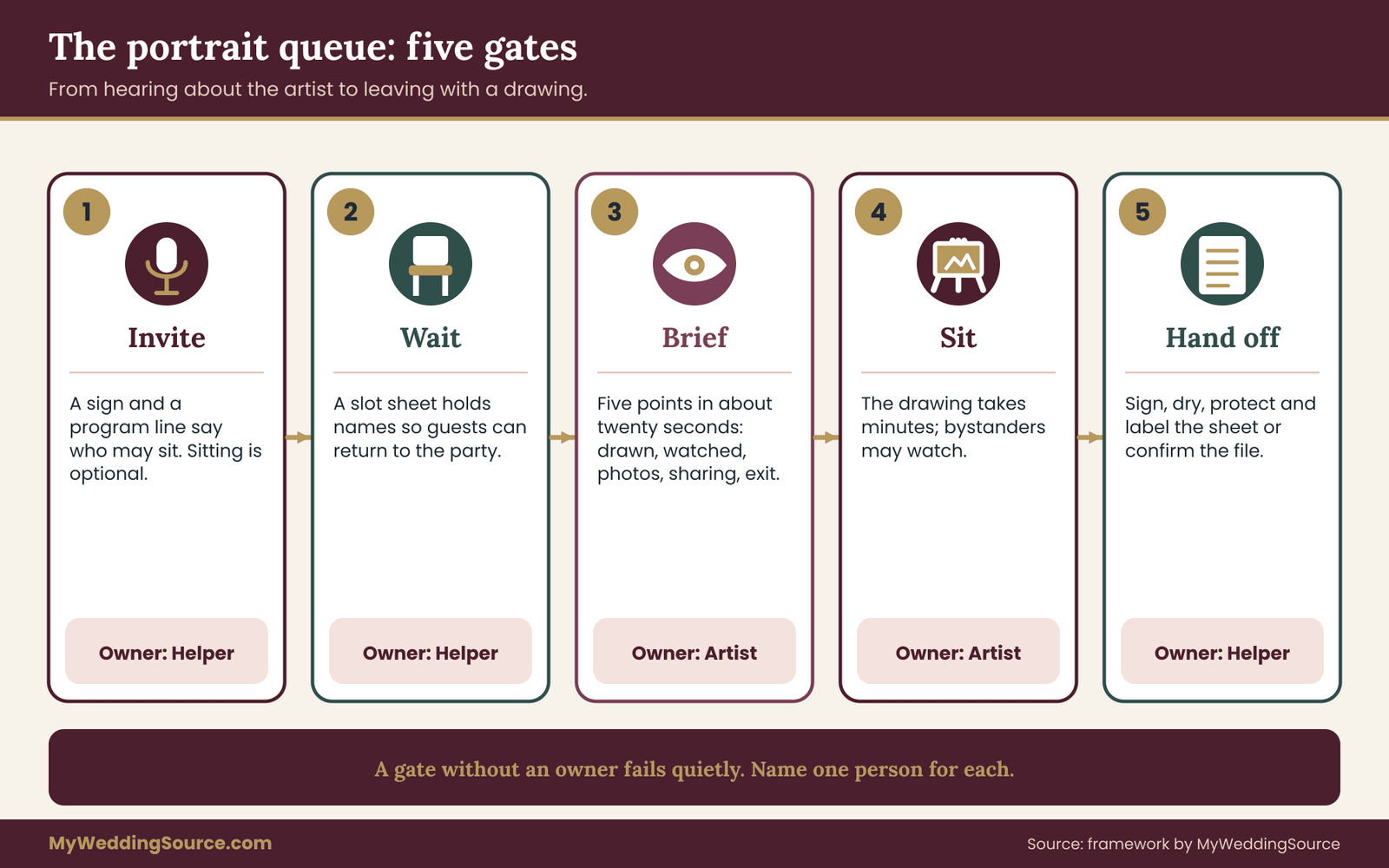
Each gate has an owner. The couple owns the policy, a person such as a coordinator or a trusted friend owns gates one, two and five, and the artist owns gates three and four with the help of a clear script. When no one owns a gate, it fails quietly. The most common orphaned gate is the second one, where nobody is watching the line, so nobody tells the guest at the back that the wedding caricature artist will be done in forty minutes.
Why a physical line is the wrong tool
The instinct is to let guests form a line. A line is simple but it has a flaw: it ties up guests who then cannot enjoy anything else. A better tool is a slot sheet, a clipboard or a set of paper cards that holds names in order, so guests can join and then go back to the bar and the dance floor.
A helper calls the next name when the sitter before them is about half done. The artist always has a sitter ready, and guests do not stand idle.
The slot sheet also gives you a count. After twenty minutes you can see how many names are on the sheet and compare that with the number the artist can finish, and you can close the sheet when the list is full. Closing it politely is better than letting people queue for a drawing that will not happen.
The three numbers that run the queue
Three numbers describe the queue, and you can write them on a card for the helper.
The cycle time is the minutes from one sitter’s seat to the next sitter’s seat, which includes the drawing, the signing, the handoff and the swap. The wedding caricature artist can tell you the drawing time. You should add a minute or so for the swap, since people do not teleport into chairs.
The window is the number of minutes the artist is drawing, not the number of minutes the artist is booked. Setup, breaks and breakdown come out of the booked time before drawing begins.
The cap is the longest wait you consider acceptable. This is a planning choice you make, not a standard from any source. A cap of fifteen to twenty minutes is one reasonable choice, and you can set your own.
With those three numbers you can set the slot sheet size. If the cap is twenty minutes and the cycle is nine minutes, then a guest should never join a list that already has more than two people ahead for one artist. If the list is longer, you either close it, add a wedding caricature artist, or tell the guest honestly when their turn will come.
Throughput per hour: the arithmetic and the live test
Throughput is the number of finished portraits per hour, and it is the single number most couples never ask about. Every other decision, from how many hours to book to how many wedding caricature artists, follows from it.
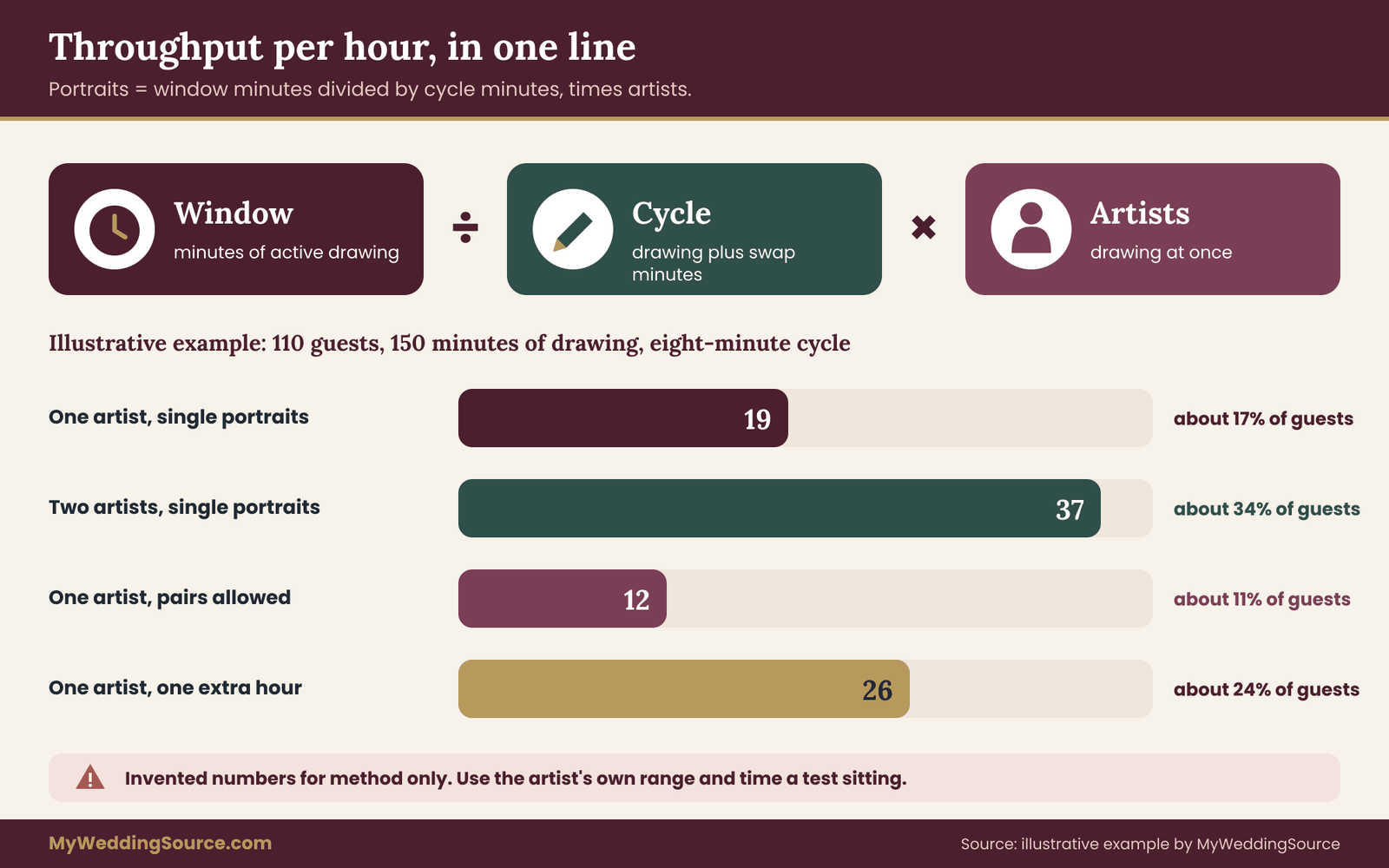
The formula is short. Portraits equals window minutes divided by cycle minutes, multiplied by the number of artists. Coverage equals portraits divided by guests. That is the entire model.
The unknown is the cycle time, and it depends on the wedding caricature artist, the format and the scope. A rough, fast head-and-shoulders sketch in marker takes less time than a colored full-body drawing, and a pair takes more than a single. Ask the artist directly: how many minutes for a single head-and-shoulders portrait, how many for a pair, how many for a full-body, and what do you do when a line forms?
Write the answers down and use them. If a wedding caricature artist declines to give a range, treat that as information.
An illustrative example
The numbers below are invented to show the method and are not averages or benchmarks.
Imagine a wedding with 110 guests. The couple books one artist for three hours, with thirty minutes for setup and a break, which leaves a window of about 150 minutes. The artist says a single head-and-shoulders portrait takes about seven minutes. The couple adds one minute for the swap, which makes a cycle of eight minutes. Window divided by cycle gives about 18 or 19 portraits. Coverage is 19 divided by 110, about 17 percent.
Now change one thing at a time. A second artist doubles the portraits to about 37 and the coverage to about 34 percent. Limiting each sitter to a single-person portrait keeps the cycle at eight minutes, while allowing pairs may push it toward twelve and cut the portraits to about 12 for one artist.
Moving from a three-hour booking to four hours adds roughly 50 to 60 minutes of drawing after breaks, so about 6 or 7 more portraits for one artist. Each choice has a price, and each can be compared with the budget.
The point of the example is not the numbers. The point is that the couple now knows that a single artist cannot give every guest a portrait, and can decide what to do about it before the day.
Run a live test
Numbers from a wedding caricature artist’s mouth are an estimate, so test them. There are three ways, in order of reliability.
Ask to watch the wedding caricature artist work at a public event, if one exists, and time three sittings with your phone. You are not auditing anyone. You are checking that the stated cycle is realistic with the guest’s chatting and the signing included.
Ask the wedding caricature artist to draw two or three people at a short paid trial, such as a friend’s gathering or a small engagement party, and time them yourself. The sample is small, but it tells you more than a promise.
Ask for references from planners or venues who have seen the artist work at a wedding, and ask them one question: how many people did the wedding caricature artist finish in the first hour? A planner will usually remember.
Whichever method you use, write down the figure and the date. The contract section later in this guide shows how to turn the number into a clause.
Choosing the window
Two windows are common. The cocktail hour places the artist while guests are standing and mingling, and it ends when dinner begins, which gives a natural stop. The after-dinner window places the artist during dancing, after the speeches are over, when guests are more relaxed but the dance floor competes for attention. A split schedule, with the wedding caricature artist drawing before dinner and again after, helps when the coverage target is high, though it adds a break and a reset.
A third arrangement uses the artist during the long gaps that appear in many receptions, such as the time between dinner service and the first dance. If the schedule has such a gap, the artist fills it neatly. The same guest flow guide shows how to find those gaps, and the artist’s window should be placed there deliberately, not left to chance.
Avoid scheduling the wedding caricature artist during toasts, the first dance, the cake cutting or any moment when you want every guest facing the same direction. A busy easel in a quiet moment draws eyes and murmurs, and it can annoy the people who are trying to listen.
Space, light and power for a wedding caricature artist
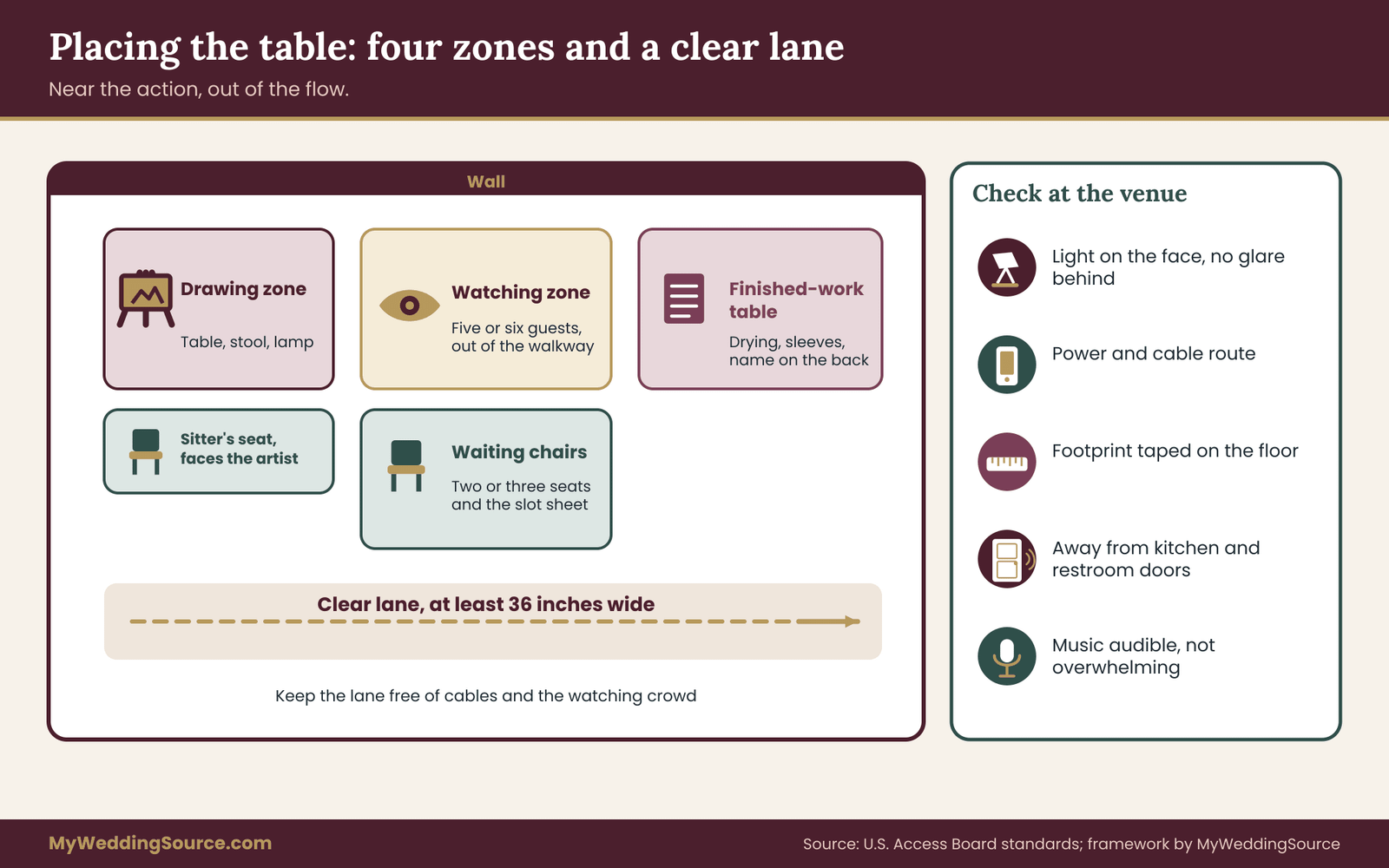
A wedding caricature artist needs less floor than a band and more than a guest book table. The footprint has four zones, and a plan that forgets any one of them creates the problems that make the activity feel clumsy.
The drawing zone. A table or easel for the artist, a stool or chair, and a seat for the sitter facing the artist at close range. Most artists bring their own table, stand and supplies, but you should ask what the footprint is in feet or meters, including the chair for the sitter. A typical working arrangement is compact, yet the wedding caricature artist also needs elbow room and a place for pens, paper and finished sheets.
The watching zone. Guests like to watch the drawing form. A small crowd of five or six standing behind the artist’s shoulder, or a few feet to the side, makes the activity lively. It also blocks anyone trying to pass. Place the table so that the watching zone does not sit in a walkway.
The waiting zone. Seats or a standing area for the next two or three guests, close enough for the helper to call them and far enough that they do not hover over the sitter. A couple of chairs near the table does more than a rope line.
The finished-work zone. A flat, protected place where drawings dry and wait to be collected. Fresh marker or paint-pen ink can smear, and a sheet carried through a crowded room can end up on a sleeve or a dress. A drying rack, a table with a clean cover or a clipboard row works. Mark each drawing with the guest’s name on the back.
Measure before you commit
Walk the actual space, or ask the venue for a floor plan with dimensions. Mark out the drawing zone, the waiting chairs and a clear lane on the floor with tape, and then stand in the waiting zone for a minute and see what you can hear and where people would walk. The venue walkthrough approach, in which you photograph, measure and test each element, works well for a vendor with a small footprint like this one.
Two measurements are worth checking against the accessibility rules. The federal accessibility standards published by the U.S. Access Board generally call for a clear width of at least 36 inches along an accessible route, and a clear floor space for a wheelchair of at least 30 by 48 inches. The standards also set reach ranges and table heights. They apply to places of public accommodation, not to every private party, but they give a reliable target for what a guest using a mobility device needs.
The accessible wedding venue red flags guide covers the broader venue questions. For the exact current requirements, see the Access Board and the Department of Justice ADA pages listed in the sources.
Light
A caricature is a drawing of a face and the artist needs to see it. Dim ballroom lighting, candlelit tables and colored uplighting all make drawing harder, and they make the finished work hard to judge. Many wedding caricature artists carry a small lamp, and some ask the venue for a spot with enough ambient light.
Ask the artist what lighting they need and whether they bring their own. If you plan colored uplighting across the room, tell the wedding caricature artist the color, because strongly colored light can change how markers look until the sheet is carried into a different light.
Avoid placing the sitter directly against a bright window or a harsh spotlight, which can leave the face in shadow or in glare. A neutral wall behind the sitter, a soft overhead light and no flashing effects nearby is a good baseline.
Power and equipment
Paper-and-marker artists need little power. A digital artist needs a plug for the tablet and, if prints are made on the spot, for a printer. Ask about cable length and about the draw of the printer. Tape cables flat, keep them out of the waiting lane and confirm with the venue that the circuit can handle the load.
If you are using a tent or an outdoor setting, ask whether the artist brings a generator or needs yours, and read the venue’s rules about generators, since many venues limit them.
Sound, wind and weather
A caricature is mostly silent work. The artist chats with the sitter and the crowd laughs, and a loud DJ near the table makes conversation hard. Place the table where the music is audible but not overwhelming. Outdoors, wind is the enemy of paper. A breeze lifts sheets, scatters pens and can tip a stand.
Ask the wedding caricature artist what they do in wind, whether they bring clips and weights, and where the backup spot is indoors. For rain, agree on an indoor backup spot before the day.
A placement rule that works in most rooms
A simple rule for placing the table is to put it near the activity but out of the flow. The guest flow planning approach is the right lens here, because the table should sit beside the paths people already use, not across them. Look for a wall, a corner or an alcove within sight of the bar and the dance floor, away from the entrance to the restrooms, the kitchen doors and the main walkway between the ceremony and reception spaces.
A table across from the bar becomes a bottleneck. A table beside the dessert station turns into a snack-and-sketch crowd that never moves. A table in a quiet corner is ignored.
Layouts for three common room types
The right layout depends on the room, so here are three typical situations and what to do with each.
A ballroom or banquet hall. There is usually plenty of floor, so the main question is the lane. Put the drawing zone near a wall, leave at least a few feet behind the artist for watchers, and place the waiting chairs along the wall. Keep clear of the dance floor edge, where people spill into the activity.
A barn or rustic venue. Floors can be uneven, tables are often long rental tables, and the lighting is warm and low. Ask about floor flatness at the table spot. Bring a small solid mat under the sitter’s chair if the floor is gravel, grass or cobbles. Use a lamp. Check where the artist’s table can sit without blocking the bar flow.
A tent or outdoor terrace. Wind, shade, glare and insects dominate. Choose a spot in even shade, out of the sun’s glare, with a windbreak if possible. Pin down sheets, protect the finished work and plan for a damp evening.
In all three, mark the sitter’s chair with a name on the program or a small sign so the helper knows where to direct each guest. The artist should have a place for a water bottle that is not near the paper.
Load-in, insurance and the venue’s rules
Venues often require vendors to provide a certificate of insurance and to follow load-in rules. A solo artist may or may not carry liability insurance. If the venue asks for a certificate, ask the wedding caricature artist early, because it can take days for an insurance agent to issue one. Ask how the artist’s insurance and business details can be verified. Also ask whether the venue charges a fee for an outside vendor or has an approved vendor list.
Do not assume that a vendor you like is welcome. Also ask the venue about crowd limits and exit routes near the table, since a standing audience can crowd an aisle or a doorway. Local fire officials and the National Fire Protection Association set the rules for egress and occupancy, and the venue manager can tell you which apply.
Ask the wedding caricature artist how long setup and breakdown take and where they arrive, park and load. Set the arrival time with enough margin so that the artist is ready before the first guest sits, not still unpacking when the cocktail hour opens.
Consent for guest likenesses at the easel
A drawing of a guest is a likeness of that person. When the guest sits down, they consent to something specific: being looked at closely and drawn. That is a small, clear permission. Everything beyond it is a separate permission that the guest has not given unless someone asked.
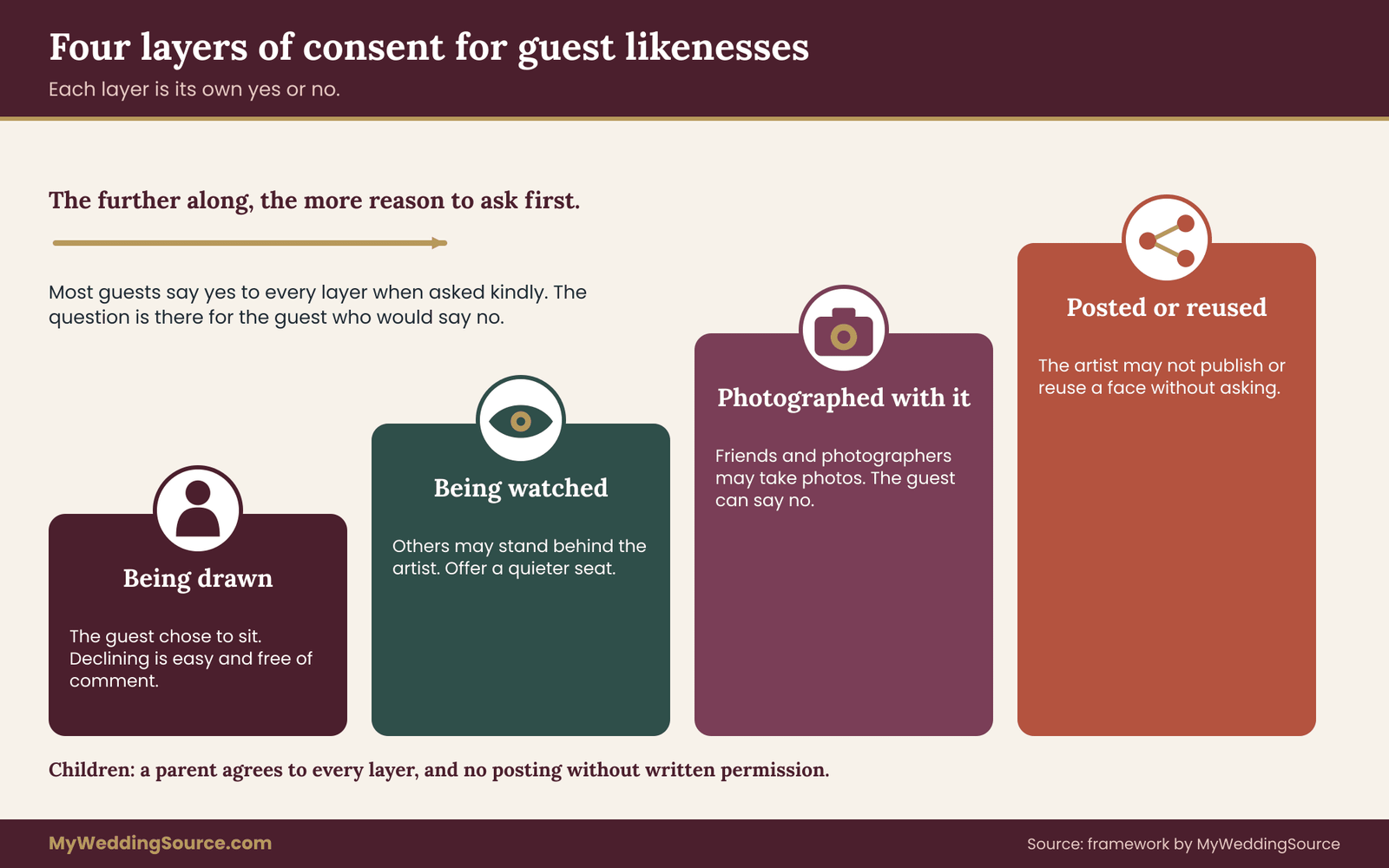
It helps to split the permission into four layers, and treat each as its own yes or no.
Layer one: being drawn. The guest chose to sit. This is the base permission, and it should be a real choice. A guest who is pushed to sit by a cheerful host, a friend or a wedding caricature artist’s patter has not freely agreed. Make declining easy and free of comment.
Layer two: being watched. Caricature is a spectator activity. Others stand behind the wedding caricature artist and see the face form. Most guests expect this, but some do not, and a few find an audience stressful. Tell the guest before they sit that others may watch, and offer a quieter seat if there is one.
Layer three: being photographed with the drawing. Many guests, friends and your own photographer will want a photo of the person holding the drawing. That is a photo of the guest, taken at a moment of mild vulnerability. The couple’s photographer is already covered by the broader photo arrangements, which the guide on photo permissions at weddings explains. Photos taken by other guests and by the artist are separate matters.
Layer four: being published or reused. The artist may want to post a clip of the drawing, show a portfolio, or use the image in advertising. A guest may want to post the drawing to a social account. Each of these is a use of the guest’s face and of the artist’s work, and each needs its own agreement.
Why the layers matter
The layers matter because guests rarely object to the first one and sometimes object to the fourth. A person who happily sits for a portrait may not want a close-up video of their face on a stranger’s business page. Treating consent as one big yes hides the difference and leaves the host to explain after the fact. Treating it as layers lets you say, in a sentence, what each one covers.
There is also a practical benefit. Most guests will say yes to all four layers if asked kindly and briefly. The question is not meant to slow anything down. It is meant to ensure that the guest who would say no has a way to say it before anything happens.
Minors
A child sitting for a drawing raises a separate set of questions. A parent or guardian should be present and should agree to the drawing, the audience and any photos or posts. Do not let the wedding caricature artist engage a child alone, even briefly, and do not let a helper steer a child into the chair without a parent’s word. If a child is nervous, a parent can sit nearby, hold a hand or draw alongside.
For children, the fourth layer deserves the strictest default. Unless a parent has explicitly agreed, the artist should not post, publish or reuse images that show a child. The Federal Trade Commission publishes guidance on children’s online privacy that applies to businesses collecting information from children online, and it is a useful starting point if the artist’s practice includes online posting. See the Federal Trade Commission in the sources, and ask the artist for their written child policy.
Sensitive subject matter
A caricature exaggerates features. Which features are safe to exaggerate depends on the person. Weight, skin, hair loss, a visible difference, a disability, age and religious dress are topics where a joke can hurt, and no guest should have to defend themselves against a portrait they did not ask for. Set a content rule with the wedding caricature artist in writing.
A reasonable rule is that the artist exaggerates expression and distinctive but neutral features such as a smile, a hairstyle or glasses, and avoids body size, medical conditions, disabilities, religion, politics and anything sexual or alcohol-related unless the guest asks for it by name.
Ask the wedding caricature artist what they do when a sitter says, “Make me look like I’m good at golf,” or “Keep it gentle.” Good artists adjust. If a wedding caricature artist’s portfolio shows only a single, harsh style, consider whether that style will suit your guests.
Guests who do not want to be drawn
Some guests will decline. Others will be reluctant to say so. The best way to protect them is to make the invitation open and the refusal easy. A line in the program such as “Our artist will be drawing guests during cocktails, sit if you like” does most of the work. The helper can also ask quietly, “Would you like to be on the list?” and accept a no with a smile.
Avoid anything that corners a guest. Do not call someone up by name from a microphone, do not hand the pen to a guest, do not make the sitting a dare, and do not tie participation to a game or a prize. A coercive moment at a wedding is easy to create and hard to repair.
The guest permission briefing: wording and placement
The guest permission briefing is a short, repeated statement that tells each guest what is going to happen before they sit. It is not a legal waiver, and it should not read like one. It is a courtesy and a set of expectations, delivered in about twenty seconds.
A good briefing has five parts, always in the same order.
First, what happens: the wedding caricature artist will draw a quick caricature, and it takes about this long. Second, who can see: others may watch while it is drawn. Third, photos: the couple’s photographer and friends may take photos, and the guest can ask for none. Fourth, sharing: the artist will not post or reuse images of the guest unless the guest agrees. Fifth, the exit: the guest can stop at any time, and the drawing is theirs to keep or leave.
Here is a version in plain speech that a helper or the artist can say.
“Hi, thanks for sitting. This takes about ten minutes. People may watch, and photos may be taken. Tell us if you’d rather not. The drawing is yours, and we won’t share your image without asking. Ready?”
That is under forty words and covers all four layers. Keep your own wording short, and let the wedding caricature artist adapt it to their style.
Where to put the briefing
A briefing helps only if guests see or hear it before sitting. Use three placements together, so no guest misses all three.
A small printed sign at the table, at eye level for a seated guest, with the five points in a few words each. The sign should be readable in low light, in a plain, large font. Use large type, high contrast and short lines, the same rules that make any wedding sign legible.
A line in the program or on the guest-facing details card, one sentence long, that tells guests the artist is present and that sitting is optional.
A spoken version from the helper or the artist at gate three, one guest at a time.
Do not rely on a microphone announcement for the briefing, because people who are not listening will not hear it, and a group announcement turns the activity into a performance for the room.
The artist’s own policy
Ask the wedding caricature artist for their usual policy on photos, video and posting. Some wedding caricature artists film every portrait for social media as a matter of routine. Others never do. A few ask guests at the table. You are the client, and you decide what is acceptable at your wedding.
If you do not want the artist to post videos of guests, write that into the contract, and tell the artist so they can plan their workflow. If you are comfortable with the wedding caricature artist posting drawings but not faces, say that, since many caricature artists can post the drawing alone.
A card for the helper
The helper handling the slot sheet needs a card, not a speech. Write three lines on it: how to say the briefing, how to record a no, and who to tell if a guest is upset. A no should be written on the sheet as a name with a mark, so the artist knows without discussion. If a guest asks that no photos be taken, the helper tells the couple’s photographer and the table, and the artist keeps the sitter’s face out of any images they capture.
Handling a refusal gracefully
When a guest declines at gate three, thank them, offer a seat if they would like to watch, and move on. When a guest agrees to be drawn but not to be posted, record it and tell the wedding caricature artist. When a guest changes their mind after the drawing, treat the request as binding: delete the file, remove the post, and confirm in writing. The contract should say the artist will honor such a request within a stated period.
Image use and ownership: who can do what with the drawings
A caricature involves two kinds of rights, and people tend to mix them up. One belongs to the artist and covers the drawing as a creative work. The other belongs to the guest and covers the use of the guest’s face and name. Both need to be handled before the event.
Who owns the drawing
In the United States, the person who creates an original drawing is generally its author, and the copyright starts with that person unless something else is agreed in writing. A transfer of copyright ownership generally requires a signed written document. The U.S. Copyright Office explains the basics, including how work for hire is defined.
So a guest who receives a caricature owns the sheet of paper, the way someone who buys a painting owns the painting, but does not automatically own the right to copy or sell the image.
For most guests this makes no practical difference. They take the drawing home and frame it. It matters when the couple wants to reproduce drawings in a thank-you card, a photo book, an album page, a printed keepsake or a website. To do that, the couple needs a license from the wedding caricature artist, and the contract should say what kind. This guide does not provide legal advice. If the use matters, a lawyer who works with creative contracts can read the clause.
Digital files and prints
If the artist draws on a tablet and delivers files, you need to know what exactly is delivered and under what terms. Is it a low-resolution image for social posting or a high-resolution file for printing? Is it the full drawing or a cropped version? Is it delivered the same night or after a delay? Is each guest’s file sent to the guest or to the couple?
These choices affect privacy. A file sent to a guest’s email address requires the guest to hand over that address, which brings a small data-handling question, and the artist should say how they store and delete addresses. Photo booth vendors face the same question about guest email addresses.
The artist’s portfolio and promotion
Most artists want to show their work. Showing a drawing without a face is not the same as showing a video of the sitter. Decide what you are comfortable with and write it in. A common middle path is that the wedding caricature artist may photograph finished drawings that do not show a recognizable guest, may post them without names, and must ask for any image or video that shows a guest’s face. Another path is no posting at all.
The couple’s own photographs raise a different point. If your photographer shoots the artist at work, those images belong under your photography contract, and the photographer’s terms govern. If the artist wants a copy of your photographer’s images for their portfolio, that is a request for the photographer and for you, not a given.
Guest posting and discounts
Guests will post photos of their drawings. That is an ordinary part of the evening and not something to forbid. But if the wedding caricature artist offers guests a perk, such as a free drawing or an extra portrait, in exchange for tagging the business, the Federal Trade Commission’s endorsement guidance may apply, and the guest may be expected to disclose the relationship.
If you would rather not have your wedding turned into advertising, say so in the contract and ask the artist not to run promotions among your guests.
The couple’s keepsake
Many couples ask the wedding caricature artist for a special drawing of the couple, sometimes as a gift that the wedding caricature artist prepares in advance from photos. If the artist works from your photos, be clear who supplied them, who owns them and whether the artist may keep them. Ask for deletion of reference photos after delivery, and ask that the wedding caricature artist not use the portrait in marketing without your approval.
A short ownership checklist
Settle these items in writing, in plain words.
Who owns the physical drawings after the event. The usual answer is the guest, with the couple having a right to any drawings of the couple.
What license the couple receives for reproducing the couple’s own portrait, such as in thank-you cards.
What the artist may post, including drawings only, drawings with faces, or nothing.
How the artist handles a guest’s request to remove an image.
How long the wedding caricature artist keeps files and reference photos, and how they dispose of them.
Whether the artist may sell prints of drawings of your guests. A good default is no.
If the answers are not clear in the artist’s standard contract, ask for an addendum. Most working artists have seen these requests before and can accommodate them.
Contract points to settle with a wedding caricature artist
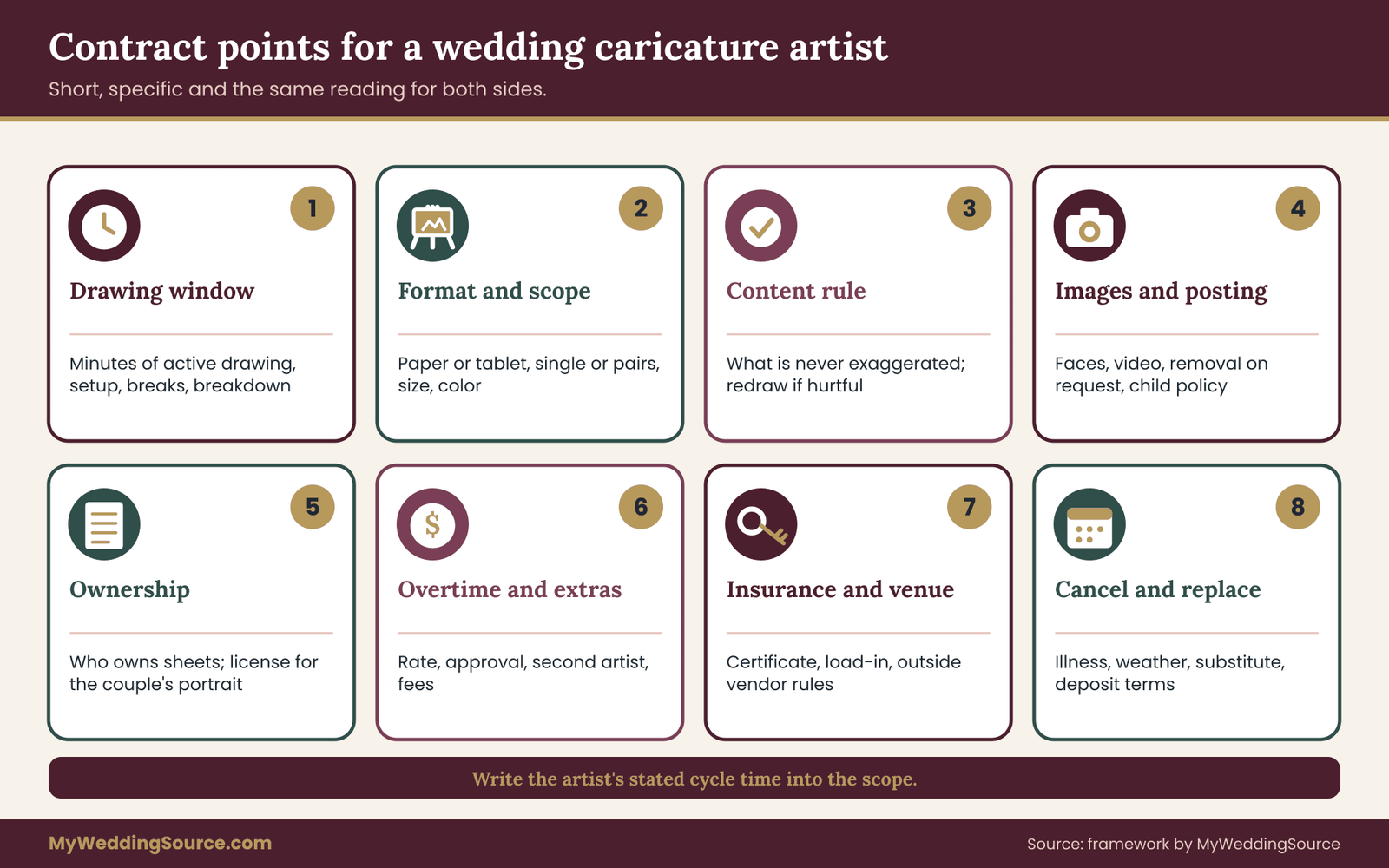
A written agreement with a wedding caricature artist can be short, but it should be specific. A one-line email that says “booked for Saturday, evening” leaves every question in this guide open. The general guidance in the wedding vendor contract article covers deposits, cancellation and liability for all vendors. This section covers the clauses that are particular to a drawing activity.
The parties and the event. Full names of the person or business, the couple’s names, the date, the venue’s name and address, the arrival time and the contact for the day. If the artist is part of an agency, ask who will actually attend, since an agency may send a different artist than the one in the portfolio. Name the wedding caricature artist or require your approval of any substitute.
The drawing window, not just the booking. State the booking hours, the setup time, the minutes of active drawing, any breaks and the breakdown time. If you have booked three hours but the artist needs thirty minutes for setup and a break, the contract should say there are about 150 minutes of drawing. Ask for the window to be described in drawing minutes, since that is the figure that drives coverage.
Format and scope. Paper or digital, single subject or pairs, head-and-shoulders or full body, color or black and white, paper size, hand lettering, themed props. State the scope that the quote is based on. If guests can request more, say what the extras are and who pays.
The target number, with honest wording. Many wedding caricature artists will not promise a number, because speed depends on the sitters. A fair clause says the artist will draw continuously during the window, will not slow the pace to fill time, and will tell the couple’s coordinator if the pace falls well below the figure the wedding caricature artist stated.
You can include the artist’s stated cycle time as a reference. Avoid a fixed promised number that the artist cannot meet, and avoid a clause that invites rushed, poor work.
Overtime. The rate for extra time, who approves it and how it is billed. Decide in advance whether you will extend if the line is long, and who has the authority to say yes on the night.
Additional artists. If the line is large, can you add a second artist at short notice, and at what rate? An agency may be able to supply one. A solo artist may be able to bring a colleague. Settle this in advance, since last-minute addition is rarely possible.
Content rules. The content rule from the consent section goes in the contract: no exaggeration of body size, medical conditions, disabilities, religion, politics or anything sexual unless the guest asks. Add that the artist will redraw or discard a portrait that a guest finds hurtful, at no charge to the guest.
Photo, video and posting. The layers from the consent section appear here as clauses. The wedding caricature artist may or may not film. The artist may or may not post faces. The artist will honor a guest’s request to remove an image within a stated period.
Ownership and license. Who owns the sheets after the event, what license the couple has for their own portrait, what the wedding caricature artist may display, and whether prints of guests’ drawings may be sold. Plain statements here prevent most future arguments.
Breaks and meals. A drawing artist who sits still for hours needs short breaks for rest, hands and comfort. State when the breaks are, how long they last, whether a meal is provided and whether the artist needs a seat in the dining room. A planned break is better than a wedding caricature artist who vanishes when the line is longest.
Insurance. Whether the artist carries liability insurance and whether the venue requires a certificate. The wedding vendor due diligence checklist explains how to verify a vendor’s business details and insurance before paying a deposit.
Payment schedule. The deposit, the due date for the balance, accepted payment methods and whether any card surcharge applies. State what the deposit covers and whether it is refundable. Keep a record of every payment. If you pay by card and a charge is wrong, the Consumer Financial Protection Bureau explains billing dispute rights and the short written-notice window, so check your statement soon after each payment.
Cancellation, illness and weather. What happens if the wedding caricature artist is ill or unable to attend. The contract should name a replacement process or a full refund. What happens if rain, wind or a venue change makes outdoor drawing unsafe or impossible. What happens if you cancel or move the date, and what part of the deposit is kept.
Child policy. Parents present, no posting of children without written agreement, and no one-on-one time with a child.
How to turn the numbers into clauses
The throughput number from earlier fits naturally into two clauses. The first states the artist’s reference cycle time as part of the scope. The second gives the couple a right to add time or a second artist if the list exceeds a stated number at a stated time. For instance, if the slot sheet has more names than the artist can finish by a certain minute, the coordinator may authorize overtime at the contract rate.
You do not need legal language. You need unambiguous statements that two reasonable people would read the same way. If the artist offers a standard form, read it for the points above and ask for an addendum where it is silent.
Reading the artist’s standard contract
Most artists have a standard form. Read it for these signals. A clause that gives the wedding caricature artist unlimited rights to use images of guests is a flag. A deposit that is stated as non-refundable in all circumstances, including the artist’s own cancellation, is a flag. A cancellation clause that allows the artist to cancel without a replacement or refund is a flag.
A clause that shifts all liability for injury or loss to you without any insurance is worth discussing. None of these is a reason to walk away, but each deserves a conversation.
Cost logic before you sign
Add up the full cost, not just the headline rate. Include hours, travel, any parking fee, any overtime, any added artist, any printing and delivery fees for digital portraits, any frames or protective sleeves, and any venue charge for an outside vendor. Then divide the total by the portraits you expect from the throughput calculation.
The result is the cost per portrait. Compare that with the alternatives, such as a photo booth, and decide what the difference buys. If the difference is the watched, handmade experience, that may well be worth it. If you wanted a keepsake for every guest, the number may argue for a different choice.
If you pay a deposit by card, keep the receipt and the contract together. The wedding vendor payment records are easiest to dispute or confirm later when they sit in one folder. Ask the artist for a short written confirmation after final payment.
Vendor questions, test sittings and red flags
Choosing a wedding caricature artist is partly a matter of taste and partly a matter of process. Taste you can judge from a portfolio. Process you can only judge by asking. The questions below are grouped so that you can send them in one email and compare answers across wedding caricature artists in a calm, even way.
Questions about speed and format
How many minutes does a single head-and-shoulders portrait take, on average, in your own experience at weddings? How many for a pair? How many for a full-body portrait? Do you draw continuously or take breaks, and how long are the breaks? What do you do when the line is long?
Have you worked alongside a second artist? What is the largest guest count you have served at one event, and what was the window? These are open questions, and the answers you get should be specific, with the artist’s own ranges, not slogans.
Questions about space and equipment
What is your footprint, including the sitter’s seat? What do you bring: table, stool, lamp, easel, clips and weights? What do you need from the venue: power, a table, a chair, a wall, a quiet corner? How long do you need to set up and break down? What is your plan in wind, rain or poor light? For digital work, what device and printer do you use, and what is your backup if the printer fails?
Questions about consent and images
Do you film or photograph your sitters, and for what purpose? Will you agree not to post any image that shows a guest’s face? Will you ask each guest before posting? How do you handle a guest who asks to remove an image after the event? What is your policy for children? Do you keep reference photos, and when do you delete them? Can you show me the sentence in your standard contract that covers image use?
Questions about content and tone
What do you avoid exaggerating? What do you do when a guest says they are sensitive about a feature? Have you drawn guests of different ages, skin tones, hair types, body sizes and abilities, and can I see examples? How do you handle a guest who asks for something inappropriate, or a guest who is intoxicated? What do you do if a guest dislikes their portrait?
Questions about business and insurance
Are you a sole proprietor or an agency? Who will attend? Do you carry liability insurance, and can you provide a certificate if the venue requires it? What is the deposit, and is it refundable? What is the cancellation and replacement policy? What is the rate for overtime, and for a second artist? Are there extra fees for travel, parking, printing or digital delivery? Check the vendor’s identity, business registration and references before you pay.
The test sitting
A portfolio shows the artist’s best work. A test sitting shows how the wedding caricature artist works with a real person. If the artist lives nearby, ask whether you can book a short trial for one or two people at a modest, agreed fee. Bring someone who is not in the wedding party.
Time the sitting and watch for four things: how long it takes from first stroke to finished sheet, whether the portrait resembles the person in a way that feels kind, how the artist talks to the sitter, and how the wedding caricature artist handles a request such as “keep it gentle.”
If a trial is impractical, watch videos of the artist at work and read reviews from other couples that mention specifics. If the artist works for an agency, ask the agency whether you can speak to a planner who has seen them at a wedding.
Read the portfolio for consistency
A caricature artist’s portfolio often shows celebrities, friends and a few strangers. Look for variety in faces. Does the wedding caricature artist draw older faces and younger faces with equal skill and kindness? Do the drawings of people with different skin tones and hair types look attentive and respectful? A portfolio that shows only one type of face may not serve your guest list. Look for portraits of people with glasses, beards, hats, braids, turbans and wheelchairs, since these show whether the artist treats details with care.
Also look at the pace. A portfolio of elaborate full-color pieces may represent hours of work. A live-event portfolio shows what the artist makes in minutes. Make sure you are looking at the right kind.
Red flags
Several signs suggest a problem. A wedding caricature artist who refuses to give a time per portrait or a rough range. A wedding caricature artist who promises to draw every guest regardless of the count. A wedding caricature artist who is unwilling to put image-use terms in writing. A portfolio where every subject is drawn as the same joke.
A standard contract with no cancellation or replacement clause. Reluctance to discuss content boundaries. A request for full payment well before the event with no refund terms. None of these proves the wedding caricature artist is unsuitable, but each is a reason to ask more questions before paying a deposit.
If you have never met the artist, confirm that a real person and a real business stand behind the quote before you pay a deposit.
Access, comfort and kindness at the easel
A caricature table can be a welcoming spot or an obstacle course, and the difference is often a few details that cost nothing.
Access for guests who use mobility devices
A guest in a wheelchair or using a walker should be able to reach the sitter’s seat, or to sit in their own chair or device, without a detour or a request for help. That means a clear route of the width discussed earlier, a floor that is firm and level, and a sitter’s seat that can be removed or moved so a wheelchair can pull up facing the artist.
If the wedding caricature artist sits at a table, check that the table height lets the sitter see the work. Some artists draw on an easel at a distance, which makes the question of a seat simpler.
For the Americans with Disabilities Act, see the Department of Justice ADA site in the sources. The ADA applies in specific ways to businesses and venues open to the public, and a private wedding can still involve a venue and vendors that have their own duties. Do not assume the rules do or do not apply. Ask the venue and the artist what they provide and plan for the guests you know are coming.
Standing, waiting and fatigue
Older guests and guests with limited stamina may not want to stand for a line. The slot sheet solves most of this: they can sit in the room, and the helper can find them when their turn is near. Provide two or three chairs near the table for guests waiting for the next sitting.
Sensory comfort
Some guests are bothered by crowds, noise and bright lights. A sitter with sensory needs may prefer a short, quiet slot early in the window, before the crowd grows. A helper can offer this quietly. If the artist can draw away from the table in a calmer spot, offer it.
Wash or sanitize hands between sitters if the wedding caricature artist touches a guest’s chair, props or paper, and see the Centers for Disease Control and Prevention for basic hand hygiene. Avoid rushing, touching a sitter’s face or head without asking, and moving close to the sitter without warning.
Guests who are blind, deaf or hard of hearing
A guest who is blind may not want a portrait, or may want one described aloud. A caricature artist who talks through the process can share the experience. A guest who is deaf or hard of hearing can follow the briefing from the sign and a written note. A pencil and a few written lines can replace speech without any fuss.
Language and cultural comfort
Some guests may not read or speak English comfortably. The five-point briefing can be written in the languages of your guests. A guest who covers their hair, face or body for religious reasons may prefer a portrait that does not show what is covered, or may prefer not to be drawn. Respect the answer without asking why.
Kindness as a house rule
The simplest house rule is that nobody is teased. The artist can draw a gentle exaggeration, and the host and helpers can make it clear that no joke will be made at a guest’s expense. If a sitter looks uncomfortable, the artist can soften the lines, change the subject or end the sitting without fuss. If a guest dislikes the result, the wedding caricature artist can offer a second try. A calm response makes a bad moment small.
Edge cases and fixes during the party
Even a well-planned portrait queue meets surprises. These are the ones that come up most often at events with a live drawing activity, and what to do about each. Decide who handles each situation, so that the couple never has to.
The line forms before the artist is ready. Guests arrive early and cluster at the table. The helper starts the slot sheet at the door of the room, not at the table, and tells guests when drawing begins. The artist can use the first few minutes of setup to chat with the helper, not to fend off a crowd.
The wedding caricature artist is running late. Ask the wedding caricature artist to confirm arrival the day before and again that morning, and agree on the latest acceptable arrival time. If the artist is late, shift the window rather than shortening it, and tell guests the new start. The contract’s replacement clause matters here.
The window is half over and the list is full. Close the slot sheet. Tell the next few guests honestly that the list is full and that the wedding caricature artist will draw the couple’s request first thing at the next window, if you have one. Offer a different activity, and thank them.
Two guests want to sit together. Decide in advance whether pairs count as one slot or two. If pairs are allowed, each takes longer, so count them as two slots in the coverage math. A pair is a pleasant moment for friends and a poor use of the window if time is short.
A guest wants a second drawing. One portrait per guest is a fair default until the list is empty. After the list is closed and the artist has time, a second drawing is a favor, not a right.
A sitter has had too much to drink. The artist and the helper can decline politely, and offer a slot later. A sitter who is unsteady, loud or inappropriate is a risk to the sitting and to the drawing. Keep the response friendly and brief, and tell a bartender or a family member if needed.
A guest dislikes the portrait. The wedding caricature artist can offer a second attempt, or the guest can leave the drawing behind. Nobody should be pressed to take home a portrait they feel hurt by. The content rule in the contract covers what happens.
A child becomes upset. Stop at once. The parent decides whether to continue. The artist hands over whatever has been drawn and does not post or keep any image.
The ink smears. Keep a stack of clean sheets, a drying rack and protective sleeves. Ask the artist what the ink needs to dry, and whether guests should carry the sheet flat. If a drawing smears on clothing, treat it as a spill and ask the venue for a damp cloth. Check the artist’s materials, since some inks and paint pens do not wash out of fabric.
The wind picks up. Move the table under cover, use clips, or move the activity indoors. This is why the backup spot in the contract matters.
A VIP or a relative expects priority. A wedding has natural priority guests, such as grandparents and the wedding party. Settle this before the event with a short list that the helper holds. Otherwise the line becomes a negotiation.
The artist’s devices fail. For a digital artist, ask for a backup device or a fallback to paper. For delivery failure, ask for the file within a stated number of days.
A photographer or guest films the wedding caricature artist at work. The briefing covers the guests. The contract covers the artist’s own preferences about being filmed. If the artist wants no video, tell the photographer.
A guest wants the drawing posted to the artist’s page. That is the guest’s choice, and the artist should ask the guest directly. Do not assume.
The day-of run sheet
A short run sheet puts all of this in one place. Write it on a single page and give a copy to the helper and the wedding caricature artist.
Before the event: confirm arrival and load-in, mark the table spot, set up the sign and the slot sheet, place the waiting chairs, and place a drying area for the finished work.
At the start of the window: the helper opens the sheet, the artist starts with a quick warm-up, the couple’s photographer is told where the table is.
During the window: the helper calls names, records refusals, watches the line and the clock, and signals the artist at the half-way point.
At the close: the helper closes the sheet at the planned minute, the wedding caricature artist finishes the last sitter, the finished work is collected and labeled, and any unclaimed drawings are sorted for pickup or for delivery later.
After the event: confirm payment, ask for any promised files, confirm deletion of reference photos, and keep the contract and receipts together.
Worked example: an illustrative evening
The following example is invented to show how the pieces fit together. It is not a report of a real wedding, and the numbers are not benchmarks.
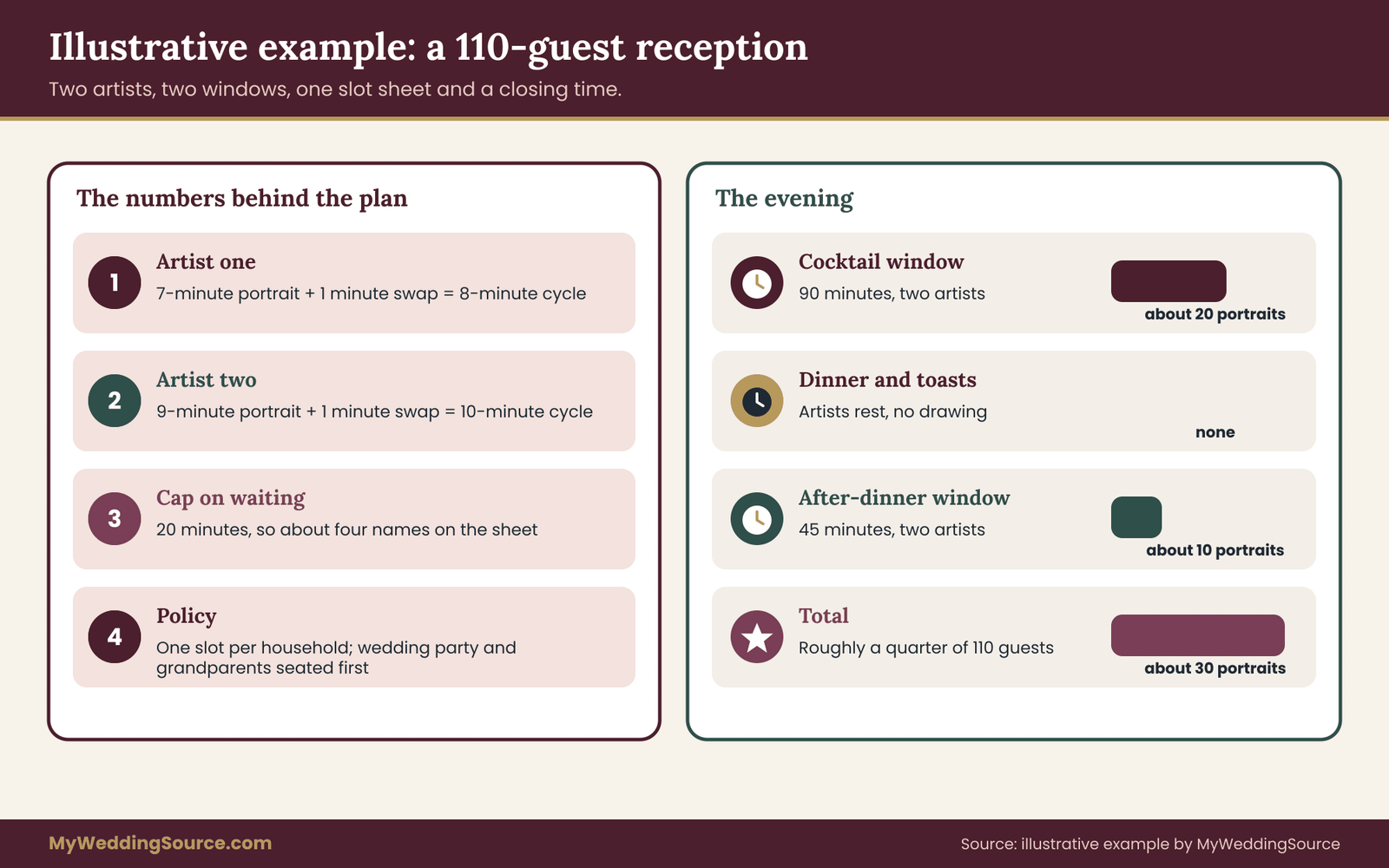
A couple is planning a reception for 110 guests in a hall with a separate cocktail room. They want a caricature activity that feels lively without taking over the evening. They write down their goals: guests should enjoy watching, nobody should feel pushed, and the line should not block the bar.
The couple asks two artists for ranges. The first says about seven minutes for a single head-and-shoulders portrait and about twelve for a pair. The second says about nine and fourteen. The couple adds one minute for the swap and runs the numbers. For a 120-minute window, the first artist yields about fifteen single portraits and the second about twelve. Coverage for one artist is 11 to 14 percent of guests, which is low.
They decide to book two wedding caricature artists for the cocktail window of 90 minutes and a second, shorter window after dinner of 45 minutes. They calculate about 20 portraits in the first window and about 10 more in the second, which comes to about 30 portraits, or roughly a quarter of the guests. They accept that, and give each household one slot, with the wedding party and grandparents given a place first.
They set the cap at twenty minutes. With a nine-minute cycle and two artists, the slot sheet closes when more than about four names are waiting. The helper calls the next name when the current sitter is half done.
For consent, they write a five-point briefing, print it on a sign, and add a single sentence to the program. They add a content rule, a no-posting-of-faces clause and a child policy to the contract. They ask the artists for a certificate of insurance because the venue requires one.
For space, they tape out two drawing zones against the wall of the cocktail room, with three waiting chairs, a clear lane of at least 36 inches and a drying table. They place a lamp at each station and check the plug locations with the venue.
On the night, the helper opens the sheet at the door. The first window fills in about thirty-five minutes. The helper closes the sheet and tells the next guests about the after-dinner window. A guest who does not want to be drawn asks for no photos, the helper notes it and tells the photographer, and the evening continues without a pause.
Your next steps
Here is a sequence you can follow without needing to do everything at once.
- Decide the goal. Is it a keepsake for every guest, a lively activity, or a gift for the couple? The answer decides whether a wedding caricature artist is the right choice.
- Pick a window and measure the room. Use the walkthrough approach and mark the footprint, the lane and the waiting chairs.
- Ask two or three wedding caricature artists for their cycle times, footprint, content rules and image-use policy, using the question lists in this guide.
- Calculate throughput and coverage for each quote. Decide whether you need a second artist or a second window.
- Run a test sitting, or watch video, and check the portfolio for variety.
- Write the contract points, including the drawing window, the content rule, image use, ownership, breaks, insurance, cancellation and a child policy.
- Prepare the briefing: the sign, the program line, the helper’s card and the slot sheet.
- Choose a helper and write the run sheet.
- Confirm arrival and load-in the week before, and again on the morning.
- After the event, confirm payment, files and deletion of any reference photos.
If a wedding caricature artist turns out to be a poor fit, the same planning work transfers to a faster format. The numbers, the briefing and the clauses all apply to a photo booth or a silhouette artist with small changes.
FAQ
How many guests can one wedding caricature artist draw in an hour?
It depends on the artist, the format and the scope. Ask for the artist’s minutes per single portrait, add about a minute for the swap, and divide sixty by the total. A faster head-and-shoulders sketch yields more portraits than a colored full-body drawing. Treat the artist’s own range as the starting point, and test it by timing a sitting before you rely on it.
How much space does a wedding caricature artist need?
The drawing zone is a small table or easel with a stool and a seat for the sitter, but you also need room for watchers, a couple of waiting chairs and a drying area. Ask the wedding caricature artist for the exact footprint. Keep a clear route of at least 36 inches wide, and check lighting and power at the spot before the day.
Do guests have to consent before a wedding caricature artist draws them?
Guests choose to sit, which is the base permission. A short briefing should also cover who may watch, whether photos may be taken, and whether the wedding caricature artist may share the image. Treat those as separate yes-or-no questions. For children, a parent should agree to each one. A guest can stop at any time.
Can a wedding caricature artist post guests’ portraits online?
Only if your contract and the guest allow it. Many artists post their work as a matter of habit, so ask. A sensible default is that the artist may post drawings without recognizable faces and must ask a guest before posting any image that shows the guest. For children, require a parent’s written agreement.
Who owns the caricature drawings after the wedding?
Generally the artist holds the copyright in an original drawing unless it is transferred in a signed writing, and the guest owns the physical sheet. Copying or selling the image needs a license. If you want to reproduce your own portrait in cards or an album, ask for a written license. A lawyer can review the wording.
Should I book a wedding caricature artist for cocktail hour or after dinner?
Cocktail hour suits standing guests and ends naturally when dinner begins. After dinner, guests are relaxed, but the dance floor competes. If the coverage you want is high, split the window into two parts. Avoid toasts, the first dance and the cake cutting, when attention should be on the room.
What should a wedding caricature artist contract include?
At minimum: the parties and the event, the drawing window in minutes, the format and scope, content rules, photo and posting terms, ownership and license, breaks, insurance, payment, cancellation and replacement, and a child policy. Add overtime rates and a way to add a second artist. The vendor contract guide on this site covers general terms.
What if a guest dislikes their caricature?
Stay calm and kind. The wedding caricature artist can offer a second attempt or let the guest leave the drawing behind. Nobody should be pressured to take or display a portrait that hurt them. Put a content rule in the contract in advance, so the artist knows to avoid sensitive features, and make clear that a hurtful portrait will be redrawn or discarded.
Sources
- ADA.gov, U.S. Department of Justice Civil Rights Division
- U.S. Access Board, ADA Accessibility Standards
- U.S. Copyright Office
- Federal Trade Commission, children’s privacy and endorsement guidance
- Consumer Financial Protection Bureau
- National Fire Protection Association
- National Association of Insurance Commissioners
- Centers for Disease Control and Prevention, handwashing and hygiene
- USA.gov, consumer protection and state consumer offices