
Early check-in is a hotel’s courtesy, not a right, and a wedding weekend is exactly when courtesies run short. This guide explains what hotels can actually promise about early check-in for your guests, how to work out who really needs a room before the afternoon, and how to build an arrival-day luggage and changing-room fallback so nobody stands in a lobby in a suit bag at three o’clock.
Ask for early check-in, but never build the day on it. Work backward from the ceremony to find the latest moment each guest must start getting dressed, and compare that with the hotel’s published room-ready time. If there is a gap, climb a four-rung ladder: request early check-in, get bags stored and a ready-text promised, line up a place to change, and only then pay for certainty with a night-before booking or a day-use room. Get every promise in writing, and tell guests plainly what is a promise and what is a hope.
Picture a guest who lands at nine in the morning for a four o’clock ceremony. The hotel says check-in begins mid-afternoon and that early check-in depends on availability. The room is booked, the rate is fine, and nothing has gone wrong. Yet the guest has about six hours with a suitcase, a garment bag, a long-haul body clock and a ceremony to dress for. Multiply that by the twenty or thirty households who travel in on the same morning, and the front desk has a real problem that it cannot solve by being kind.
Most couples learn about this late. The hotel’s room block contract covers rates, dates and the release deadline, and it rarely says anything useful about arrival-day timing. The result is a string of last-minute texts: “Can you ask the hotel if my aunt can get in early?” This article is meant to replace those texts with a method for handling early check-in.
A note on scope. This is general information, not legal, tax or financial advice, and hotel policies, fees and local rules differ by property and change, so confirm every promise with the hotel itself.
Why early check-in matters more at a wedding
A normal traveler with a morning arrival can drop a bag, find coffee and wander. A wedding guest cannot, because the day has a fixed appointment in it. The ceremony starts at a set time, the guest has a set amount of preparation to do, and the preparation needs a mirror, a private space, running water, an outlet and ideally a bed to rest on first. Early check-in is the most direct way to get all of that. It is also the thing a hotel is least able to promise.
There are three reasons the problem is sharper at a wedding than on an ordinary weekend.
Arrivals bunch up. Guests tend to take the same few flights and the same morning trains, because the wedding sets the date and the cheapest or most convenient travel bunches around it. A hotel that can offer early check-in to one guest on a quiet Tuesday cannot offer it to twenty on a Saturday.
Departures bunch up, too, and that decides the supply. A room can only be ready early if the previous guest left early and housekeeping has cleaned it. On a wedding weekend the hotel is often close to full, which means many rooms turn over the same morning and housekeeping works through them in a queue. The rooms most likely to be ready first are not the ones your guests booked.
The cost of being wrong is public. A traveler who waits in a lobby is mildly annoyed. A guest who has to attend a ceremony in travel clothes, or who arrives at the venue with wet hair and a creased dress, is anxious, and so is the couple who hear about it.
None of this means early check-in is unreasonable to request. It means the request deserves a method, and the method begins with understanding what a hotel is actually able to say yes to.
The difference between a request and a promise
Hotels use friendly language. “We will do our best” sounds like a yes and means “we have written it in the notes.” Both parties can feel good about the conversation and still have no agreement. The next section sorts the common phrases into a ladder from a real commitment down to a hope, and gives you a way to ask that produces a usable answer.
A useful habit is to treat the hotel’s answer as a data point about probability, not a fact about the day. If the hotel says the room is “noted for early arrival,” the right reaction is to plan as though the room will be ready at the standard time, and to be pleasantly surprised if it is not. That attitude removes most of the stress, because the fallback then becomes the plan and early check-in becomes a bonus.
Who this guide is for
This guide is written for the couple or the family member who handles lodging, and for anyone coordinating out-of-town guests for a wedding. It assumes there is a hotel or several hotels involved, with or without a room block, and that some guests will arrive before standard check-in time. It does not cover how to choose hotels or negotiate a block, which the site’s guide to coordinating wedding guest hotels already covers in depth. It also does not try to restate how to price rooms across different budgets. Its subject is narrower: the hours between arrival and a usable room on the day that matters.
If you are the couple, you may also be the people dressing at one of these hotels. The same method works for you, with the added point that your own early check-in should be arranged more firmly than a guest’s, because your day starts hours earlier. That is covered where it matters.
What hotels can actually promise about early check-in
Hotels run on a daily cycle. Guests check out during the morning, housekeeping cleans rooms through the late morning and afternoon, and the front desk assigns clean rooms to arriving guests in some order of priority. A published check-in time is the point by which the hotel expects to have a clean room available for most guests. It is a planning figure for the property, not a window in which you are entitled to a room, and the exact time varies by hotel and brand, so read the one printed on your own confirmation.
An early check-in request asks the hotel to hand over a clean room before that figure. Whether it can depends on facts the front desk will not know until the morning of arrival: how many guests stayed over, how many left, how many rooms housekeeping has finished, and whether your room type is among them. That is why most honest answers are conditional.
A ladder of promises
It helps to rank what you might hear. Here is the ladder from strongest to weakest, in plain terms.
Confirmed and paid. The hotel has agreed in writing that the room is yours from a stated time, usually because you are paying for it, for example by booking the previous night. This is the only type of answer that is truly dependable, and it costs money.
Confirmed, no charge. The hotel’s reservations or group-sales office has written that a specific room or room type will be available from a stated time. Rare, and more likely when your group holds a large share of a small hotel or when the hotel has no arrivals competing for rooms. Even then, read the wording for conditions.
Noted on the reservation. The request is in the guest’s file. This tells the front desk that the guest would like early check-in. It does not reserve a clean room, and on a busy day it does not change the order in which rooms are assigned unless the staff choose to prioritize it.
Subject to availability. The hotel will offer early check-in if a room happens to be clean. This is the normal form of an early check-in promise, and it is real, but it is a policy, not a plan.
Standard time only. The hotel says that rooms are available from the published time and not before. A clear answer like this is actually good news, because it lets you plan precisely.
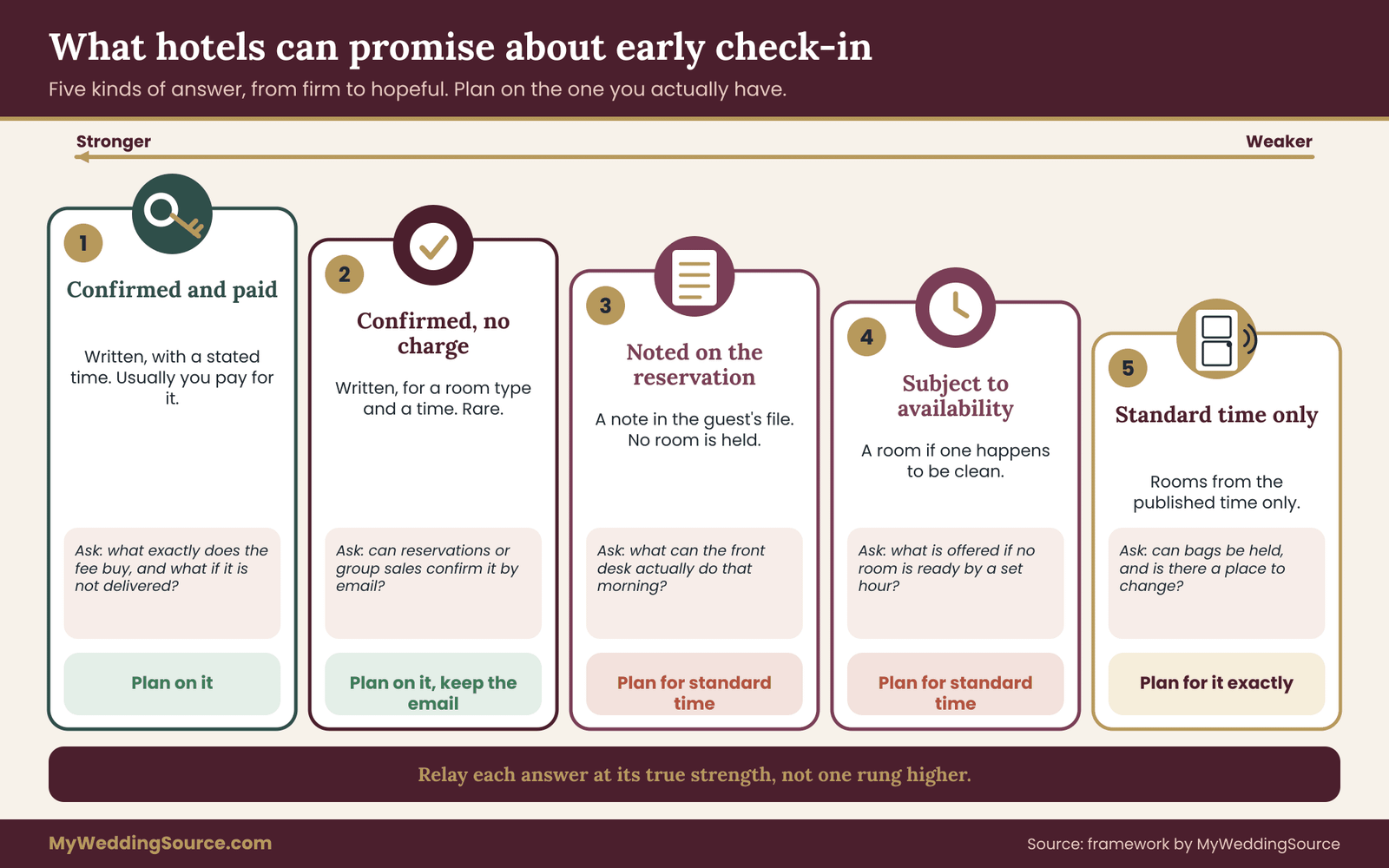
Most of what couples hear about early check-in sits on the third and fourth rungs, and the mistake is to relay it to guests as if it sat on the first. “The hotel said early check-in is fine” turns, by the time it reaches a cousin, into “your room will be ready at noon.” The method in this article keeps the original strength of the answer attached to it.
What a hotel can control about early check-in, and what it cannot
A front desk can control the order in which clean rooms are assigned, whether a bag is stored, whether a guest may use a public restroom or a fitness-center locker room, and whether it will send a text when a room is ready. These are things within a staff member’s discretion, and they are the realistic wins.
A front desk cannot control how many guests stay past their planned departure, whether housekeeping has finished a floor, whether a repair has taken a room out of service, or whether the previous occupant of your guest’s accessible room has left. The more specific the room type, the less flexibility there is for early check-in. An accessible room with a roll-in shower may be one of only a few in the building, so the chance that exactly that room is clean early is smaller than for a standard room.
That has a consequence for accessibility. The federal rule on hotel reservations covers holding and reserving accessible rooms for guests who need them, but it does not say anything about early check-in or arriving ahead of standard time. A guest who needs a particular room type should get the booking right first, and plan the arrival-day fallback more carefully than anyone else, because the room itself has fewer substitutes. The Department of Justice’s ADA site is the place to read the current rule.
The two clocks behind every early check-in decision
Two times matter, and a hotel can only influence one of them. The first is the room-ready time, which the hotel controls in part. The second is the clothes-on time, which the guest controls entirely: the moment they must begin dressing to reach the ceremony calmly. The gap between those times is the problem to solve. If the room is ready before the clothes-on time, there is no problem. If it is not, you need a fallback.
The next section turns this into a short calculation that shows who needs early check-in.
The backward clock: when a guest really needs early check-in
Before asking any hotel for anything, work out which guests need early check-in at all. Many do not. A guest who arrives the evening before has no gap. A guest who arrives at midday with a ceremony at five and a ten-minute drive may be fine with the standard room-ready time. The people who need a fallback are those whose arrival and room-ready time sit too close to, or past, the moment they must start dressing.
The calculation is a backward clock. Start at the ceremony and subtract, one block at a time, until you reach the moment the guest needs a room. Then compare that moment to when the room is likely to be ready.
Building the clock
Use these blocks, in this order, working backward from the time guests are asked to be seated.
Seated time. Ceremonies rarely start the minute guests arrive, and many invitations ask guests to be seated a little before the start. Use the time on your own invitation or program, not the ceremony start, because arriving late to a seat is the real deadline.
Travel to the venue. The time from the hotel door to the venue door on a Saturday afternoon, including parking or a shuttle wait. If the hotel is a short walk away, this block is small. If guests take a shuttle on a loop, count the wait for the next run as part of the block, not only the ride.
Getting dressed. This varies a great deal by guest. A person in a casual suit may need a short stretch to shower and change. A guest in a formal gown with a complicated fastening, a guest who uses a mobility aid and needs more time, a parent who is bringing a child, and a guest who has booked a hair or makeup appointment all need longer. Ask guests, or estimate generously. Rushing is the point of failure.
Resting or showering. A guest who has been awake since before dawn, or crossed a few time zones, benefits from an hour lying down. Do not skip this block for older guests, guests with a medical condition, or anyone traveling with an infant. Whether they get it is a judgment call about people you know.
Buffer. A block of slack for traffic, a slow elevator, a zipper that sticks or a last-minute call. Fifteen to thirty minutes is a sensible default, and more if the travel leg is uncertain.
The sum of those blocks, subtracted from the seated time, gives the clothes-on time for that guest, or more usefully the room-needed-by time if you subtract the resting block as well.
The room-ready side
Now estimate when the room is likely to be ready. You have three numbers.
The published time is the check-in time on the confirmation. You can plan with certainty that rooms will not be assigned before it, unless the hotel says otherwise, and that most will be ready around then, though on a full weekend some arrive later.
The hotel’s stated estimate, if you asked. Some front desks will say that most arrivals before the published time get rooms by early afternoon, or that morning rooms go first to guests who have a reason. Treat any such estimate as conditional.
The worst realistic case. This is the later of the published time and the time housekeeping might still be working, on a day when your group is not the only one arriving. For planning purposes assume the worst case, and treat any early check-in as a gift.
Compare room-needed-by with the worst realistic case. If the room is ready before the guest needs it, there is no gap. If it is not, the size of the gap decides what you do.

Four sizes of gap
Rather than agonize over minutes, sort each guest into one of four sizes. The size tells you who needs early check-in and who can manage without it.
No gap. The room will be ready well before the guest must start dressing. This is a guest who arrives the day before, or one with a late ceremony and a generous window. Nothing to do about early check-in except confirm that the booking is correct.
Small gap. The room is likely ready within about an hour of when the guest wants it. A short wait with bags stored and a seat in the lobby is enough. Early check-in is a bonus here. The only fallback you need is a bag-store promise and a note to call if the room is late.
Medium gap. The guest will arrive and be able to dress only if something goes right. The room may be ready in time, or may not. This guest needs a real fallback: bags stored, a place to change that is not the room, and a decision about when to stop waiting.
Large gap. The guest cannot rely on the room at all, because the room will almost certainly not be ready before the guest has to dress. This is typically a morning arrival for an early or midday ceremony, or an overnight flight into a ceremony the same afternoon. This guest needs something that does not depend on the hotel’s morning: a booking for the night before, a day-use room, or a confirmed alternative place to dress.
The sizes are deliberately rough. A person can look at a guest list and sort it in ten minutes, and the sort tells you where to spend your effort.
Collecting the facts without annoying everyone
You cannot build a backward clock without knowing when each household arrives, how, and whether they have any particular needs on arrival. Ask for it in the same place you ask for everything else, which is the RSVP or a short lodging form attached to the wedding website. Keep the questions few: arrival day, rough arrival time and mode of travel, which hotel they booked, and whether they would like help with arrival-day logistics. A separate line, clearly optional, can invite guests to mention any accessibility or health needs that affect arrival, so you can raise them with the hotel with the guest’s permission.
The site’s guide to RSVP etiquette covers how to word requests so guests feel invited rather than audited. The point here is narrower. Without arrival information you cannot sort guests into gap sizes, and you will end up treating every guest as equally urgent, which means treating nobody well.
Account for flights that do not run on time
A guest’s arrival time is a plan, not a fact. Flights are delayed, rebooked and sometimes cancelled, and a traveler whose flight lands at nine may not reach the hotel until noon. The Department of Transportation’s aviation consumer protection pages explain what airlines owe passengers after delays and cancellations, and are the place to check current rules, because they change and depend on the circumstances.
For your clock, the practical lesson is to add the buffer to the guests with the most travel risk. A guest connecting through a hub in winter, or arriving on a small regional route with one flight a day, has a wider range of possible arrival times than a guest driving from two hours away. If the arrival is near the clothes-on time even in the good case, assume a bad case will push it past, and move that guest to the large-gap category from the start.
What the clock does not tell you
A backward clock treats a guest as a person with a deadline. It does not account for comfort, health or privacy. A guest might have time to dress and still be exhausted. A guest might need a quiet room to take medication or to rest, or to nurse an infant, and a public restroom would not serve. When you sort guests into gap sizes, give extra weight to these needs, and adjust the category upward for them. A guest with a small gap and a significant health or care need should be treated as medium.
From the clock to a ladder of fallbacks
Once you know who has a gap, you need a set of responses that scale with its size. The rest of this guide organizes them as a ladder with four rungs, each more reliable than the one before and each costing a little more effort or money.
The first rung is the early check-in request itself, covered in the next section. The second is a bag and a ready-text, so the guest can leave the lobby unburdened. The third is a place to change, which makes the room irrelevant to the ceremony. The fourth is paying for certainty. A small gap needs only the first two rungs. A large gap goes straight to the third and fourth.
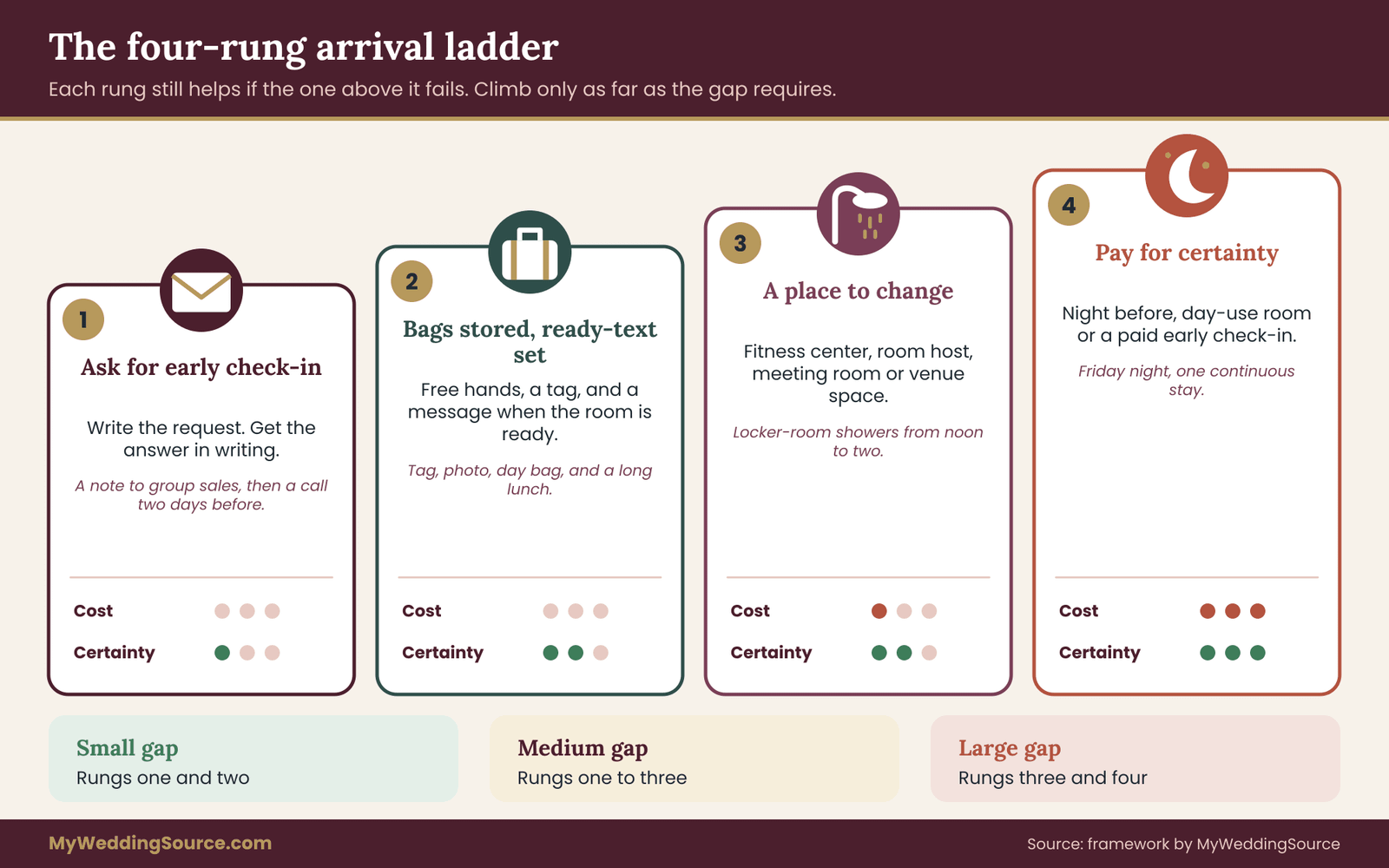
The ladder works because every rung is useful even if the rungs above it fail. If early check-in comes through, wonderful. If not, the bags are already stored. If the room is still not ready, there is somewhere to change. If none of that appeals, a paid room removes the problem. At no point does the guest stand in a lobby wondering what happens next.
Asking for early check-in the right way
The first rung of the ladder is the request. It costs nothing, and it is worth making properly, because a well-made request is noticed and a vague one is not. The difference lies in who asks, when, and what exactly is asked.
Who should ask
There are usually two doors into a hotel, and they lead to different people.
If you have a room block, the group-sales or events contact who signed the agreement is the right door. That person knows how large your group is, which nights it fills, and how much goodwill your business carries. They can add a note to the group’s file, ask the front-office manager to flag arrivals, and sometimes arrange a courtesy that a reservation agent cannot. Put your early check-in request to them in writing, and name the date you want it handled.
If there is no block, or the guest booked independently, the door is the reservation itself and then the front desk. A guest can call the hotel directly, or write to it, and ask. The couple can help by providing the wording, and by explaining which rooms are most important. Group-sales offices work from the contract, so do not expect that office to chase individual reservations.
A third option is worth knowing about: the hotel’s general manager or front-office manager. For a courtesy that goes beyond routine, such as a short list of named guests with documented needs, a polite email addressed to that role can reach someone with real authority over room assignment. Use it once, for a short list, and do not copy it to everyone.
When to ask, and when to ask again
Timing matters because early check-in is decided late. A hotel cannot know on the day you book, months in advance, which rooms will be free on the morning of your wedding. It decides in the last day or two, based on the actual number of guests in the house and the state of housekeeping. That produces a four-step rhythm.
At booking. Make the early check-in request, so it is in the file from the start. This is where you establish that the hotel knows the group is attending a wedding and that some guests will arrive early.
About two to three weeks before. Reconfirm. Ask whether the notes are still in place, whether the hotel has any change in staffing or renovation that affects room availability, and whether the group-sales contact is still the right one.
Two or three days before. This is the call that matters most. The front desk or front-office manager is by then looking at actual occupancy. Ask what they can offer on the arrival morning, and note the name of the person you spoke with.
The morning of arrival. The guest calls or messages the front desk, or the couple’s helper does, to ask whether any rooms are ready yet, and to confirm that bags can be dropped. This is a quick, friendly check, not a negotiation.
If you do all four, the hotel has seen your request four times and knows your group is organized, which is more than most do.
The questions to put to the hotel
An early check-in request should come with questions, because the answers tell you what rung each guest actually stands on. Ask these, in whatever order feels natural.
- What is the published check-in time for the group’s dates, and is it the same on the day of the wedding?
- How does the hotel assign rooms to guests who arrive before that time, and can a request be flagged?
- Will the hotel text or call a guest when the room is ready?
- Can bags be stored before check-in and after check-out, at what hours, and with what security?
- Is there a charge for bag storage, and can a guest get a receipt or tag?
- Can guests who arrive early use a restroom, a fitness center locker room, or another changing space?
- Does the hotel offer a day-use rate or a paid early check-in, and how is it priced?
- If a room is not ready by a stated time, what does the hotel offer?
- Can any of this be confirmed by email?
Ask for the answers in writing. A phone call that ends with “I’ll send you an email confirming that” is a good call. A verbal yes with no follow-up is information you should treat as the third rung at best.
A script for the group-sales contact
Wording carries weight, and these short examples are written to be copied and changed.
“We have a wedding on Saturday and about thirty rooms in the block. Several guests land in the morning for a four o’clock ceremony. Could you note that the group would appreciate early check-in where possible, and tell us what the hotel can offer if rooms are not ready?”
Notice what that message does. It states the size of the group, the reason for the request, the gap, and a modest ask. It also invites the hotel to tell you what it can do, which gives the person on the other end room to say something concrete.
A script for the front desk, two days before
“Hello, I am calling about a group arriving Saturday for a wedding. Could you tell me how many guests you expect to arrive before check-in, and whether any early rooms look likely? We would also like to confirm that bags can be stored at the front desk.”
The question “whether any early rooms look likely” is different from “can you guarantee early rooms,” and the front desk can answer it honestly. Record what you hear and who said it.
How to read the answers
Use the ladder from earlier. Map each answer to a rung, and write it next to the guest’s name or the group.
A reply that says “your request is noted” tells you only that the file has a note about early check-in. Plan for the standard time.
A reply that says “we will do our best” means the same. Plan for the standard time.
A reply that says “rooms are usually ready around noon on a day like this” is an estimate, not a promise. Plan for the later of that and the published time, and treat the early room as a bonus.
A reply that says “the room will be ready at ten, confirmed” is rare. If it comes in writing, treat it as firm, and keep the email.
A reply that says “no early check-in is available, but bags can be held and the fitness center has showers” is a very useful answer, because it tells you exactly which fallback exists.
Keep the priority list short
A hotel can usually offer early check-in to a few guests and little to many. If you ask for early check-in on forty rooms, none stands out. If you present three or four with a clear reason, the front desk has something it can act on. Think of it as spending goodwill on the guests who need it most.
Good reasons for the priority list are concrete: a guest with a medical condition that benefits from rest on arrival, a guest traveling with an infant, an older relative arriving after a long journey, a guest with a mobility need whose room has few substitutes, and members of the wedding party with a hair or makeup appointment. Keep the guest’s consent in mind. Do not pass a health detail to a hotel unless the guest agrees, and pass only what the front desk needs, such as “would benefit from an early room,” not a diagnosis.
Courtesy costs very little
A front-desk agent who agrees to flag an early check-in request is making a small effort for people they will never see again. A thank-you message afterward, or a note to the manager praising a helpful employee, is good manners and good sense. The same goes for bell staff who handle bags. Tipping customs vary by hotel and region, so follow the property’s own practice, and bring small bills in case.
Telling guests, without overpromising
Whatever the hotel says, the message to guests should describe it at its true strength. Put a short paragraph on the lodging page of the wedding website, and repeat it in the arrival reminder. A version that works:
“Hotels generally give rooms to arriving guests from mid-afternoon. If you arrive earlier, the hotel may be able to offer early check-in, but it cannot promise it. The front desk will store your bags, and we have arranged a place for you to freshen up and change if your room is not ready. If you need to arrive before check-in, tell us and we will help.”
This keeps the hotel’s limits visible, offers a fallback, and invites guests to ask. It does not promise what the hotel has not promised. It also saves you from a dozen individual messages, because guests who know the plan do not need to ask.
A short reminder, sent a few days before, should repeat the essentials: the hotel address and phone number, the published check-in time, what the hotel said about early check-in, the fact that bags can be stored, and a named person to call on the day. If you are using a group message thread or a shared page for arrival-day communication, the guide to digital contingency plans for the wedding day explains how to keep that channel working when phones and networks are under strain.
What guests can do for themselves
Guests are not powerless. A guest can book directly with the hotel and ask for early check-in at booking, join the hotel’s loyalty program if it offers a courtesy for members, check in online if the hotel supports it, and call or message the hotel on the morning of arrival. None of these guarantees a room. All of them improve the odds a little, and they ease the load on you.
The most useful thing a guest can do is pack as if the room might not be ready. A small carry-on with a change of clothes, toiletries, medication and a phone charger turns a missed room from a crisis into an inconvenience. The luggage section returns to this, because it changes how a guest uses the hotel’s bag store.
For the wider picture of how a wedding’s logistics fit together, the site’s wedding planning checklist is a good place to see where arrival-day tasks sit in the sequence.
The luggage fallback when early check-in is not available
The second rung of the ladder is the least glamorous and often the most valuable. If a guest can hand over their bags within a few minutes of arriving, they stop being a person with a problem and become a person with free hands and a few hours. They can eat, walk, sit, or go straight to a hair appointment. Early check-in is nice. Stored luggage is what actually lets a guest enjoy the morning.
Most hotels will hold bags for guests who have a reservation, whether or not the room is ready, and many will hold them for a short time even for people who are not staying. The details differ by property, so treat this section as a list of things to ask and to do, not a description of what any hotel offers.
How hotel bag storage usually works
A hotel’s bag storage is run by the bell desk, the front desk or a concierge, and it usually takes one of a few forms. Some properties have a dedicated luggage room with shelves, which is staffed when the bell desk is open. Others use a locked closet behind the front desk. A smaller hotel may simply tuck bags in a back office. A few properties have no storage at all for guests who have not checked in, usually because of space, and tell you so.
When a bag is accepted, a good procedure produces a paper tag or a number, and the guest keeps a matching stub. That matters. A stub tells you which bag is whose, lets staff find it quickly, and gives the guest something to show when they collect. If the hotel stores bags without any record, take your own photo of the bag with the staff member’s name and the time.
Questions to ask about storage
Add these to the early check-in questions from the previous section.
- Where are bags kept, and is the space locked or staffed?
- During which hours can bags be dropped off and collected?
- Is there a charge, and is it per bag or per guest?
- Does the hotel give a tag, a stub or a receipt?
- What is the hotel’s responsibility if a bag is lost or damaged, and is there a posted limit?
- Can bags be delivered to the room once it is ready, and is that automatic?
- Can a bag containing a garment bag be hung rather than piled?
The question about responsibility is the one people skip. Many hotels post notices limiting what they are liable for in stored items. You do not need to argue with the notice, but you should read it, and it should change what goes into the bag.
What goes in the store, and what stays with the guest
A simple rule works: store what you can replace, and carry what you cannot. Bags are handled by several people, stacked, and moved when someone needs space. They are normally safe and sometimes not.
Keep with you, in a small day bag: government identification, wallet and cards, phone and charger, keys, any medication you will need that day, glasses, small electronics, jewelry you plan to wear, and the documents for the booking. The Transportation Security Administration’s website explains rules for carrying medication when flying, and the sensible habit is to keep medicines in the bag that stays with you, both in the air and afterward.
Store: the suitcase, the garment bag, shoes, spare clothes and anything bulky.
Pack the day bag so that it also functions as a fallback kit. If early check-in does not happen and the room is not ready by the time the guest must dress, the kit lets them change somewhere else, which the next section describes. A minimal kit holds the outfit’s essentials, a small toiletry bag, deodorant, a brush or comb, a travel steamer or wrinkle spray if the outfit needs one, makeup if used, and a pair of shoes that can be worn for the ceremony. It does not hold the whole suitcase.
Dresses, suits and the garment bag
The garment bag is the item most likely to cause trouble, because an outfit that has been folded or crushed becomes a problem in a way that socks do not. Several habits help.
Ask for hanging. Some bell desks have a rail or a closet. Others do not. If the hotel can hang the bag, ask where, and ask the staff to keep it separate from other luggage. If it cannot, ask whether the front desk can hold it flat on a shelf and not under other bags.
Pack for wrinkles. The outfit should travel in a bag designed for it, with tissue folded in the creases if the guest knows how. A wrinkled suit can be fixed with a steamer. A crushed dress that cannot be fixed is a different matter.
Ask about steaming and irons. Rooms usually have an iron or steamer, which is no use until the room is ready. Ask whether the front desk lends an iron or whether the hotel has a laundry or valet service that can press an outfit within an hour or two, and ask what it costs. A guest who knows this in advance can budget the time.
Keep shoes accessible. Formal shoes are often stored in the suitcase. If the fallback means changing in a restroom, the shoes need to be in the kit.
Tag, photograph, note
A short routine prevents the usual mishaps and takes thirty seconds.
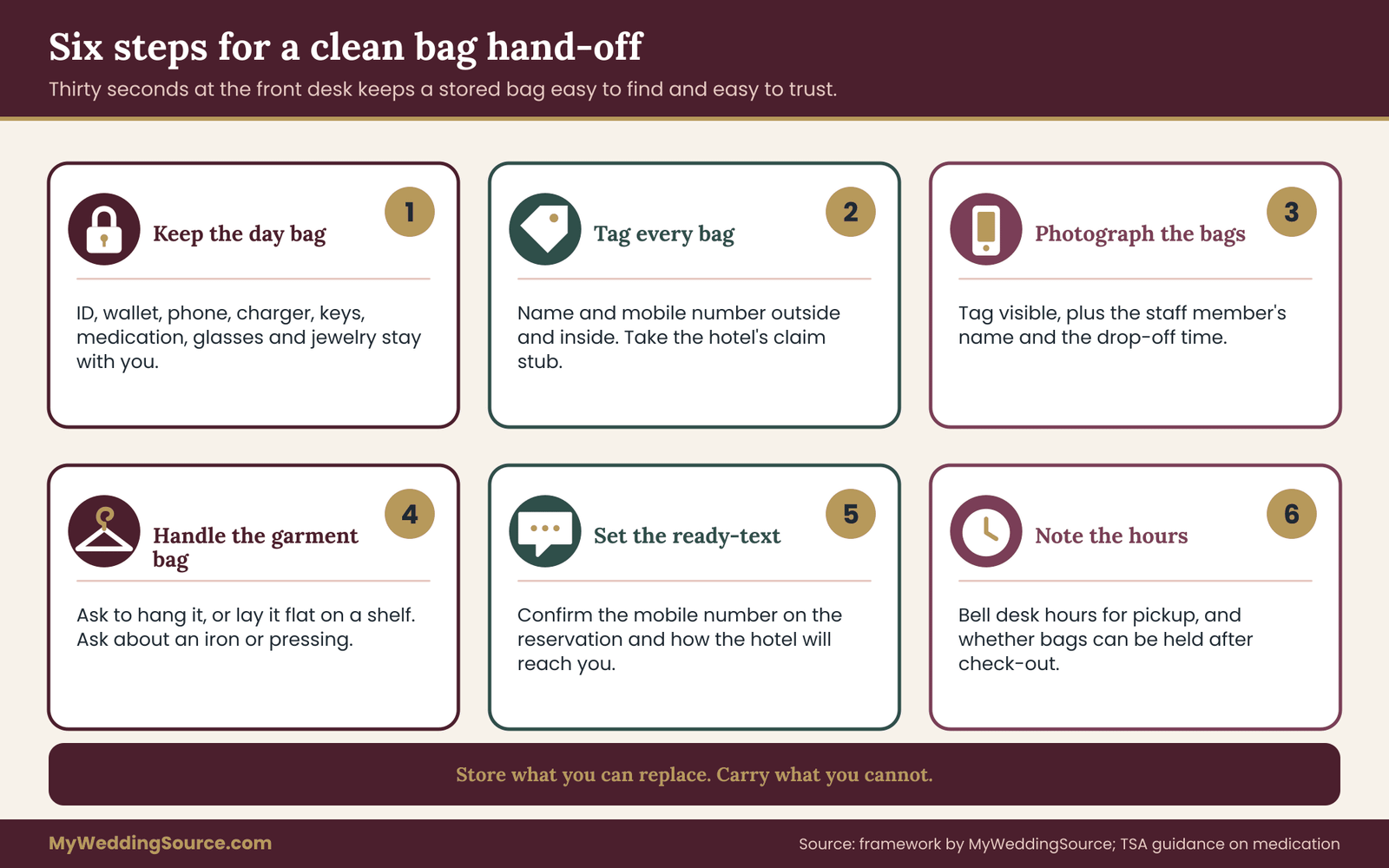
First, put the guest’s name and mobile number on each bag, inside as well as outside. Second, photograph the bags after the tag is on, with the tag visible. Third, write down the time of drop-off and the hours the bell desk is open. Fourth, check that the hotel has the guest’s mobile number on the reservation, so it can send the ready-text. Fifth, ask the staff member to confirm that the bags will be brought up when the room is ready, or that the guest should collect them.
The ready-text
A ready-text is a message from the hotel saying the room is available, which is the nearest thing to early check-in that many guests will get. It is quietly one of the best things a guest can arrange. A guest with a text can leave the lobby and trust the hotel to find them, and a guest without one has to keep walking back to ask.
Not every hotel offers it. Some use an app, some use a phone call, some do nothing. Ask, and make sure the guest’s mobile number is on the reservation. If the hotel does not text, ask whether the guest can call at a set time, such as noon and then one o’clock, to ask for status, and write that rhythm into the day.
Making the wait useful
With bags stored, a ready-text on the way and no early check-in, a guest with a small gap can use the waiting hours well. A café nearby, a short walk, a meal, a visit to a pharmacy for something forgotten, or a rest in a quiet corner of the lobby all work. If a guest has a hair or makeup appointment, the stylist’s studio may provide the best waiting room.
Guests with mobility needs or a condition that makes waiting hard deserve more thought. Check that the lobby has seating that suits them, that the café is reachable without a long walk or steps, and that restrooms are accessible. The site’s guide to accessible venue red flags is aimed at venues, but its habit of checking the route and not only the room applies to a morning spent between a hotel lobby and the street.
When the hotel will not store bags
Sometimes the answer is no. A small property may have no space, or may hold bags only for guests who have checked in. You then have a handful of options.
The venue may have a coat check, a closet or a staffed arrival area that can hold small items. Ask the venue manager, and be specific about the number and size of bags and the hours. A friend or relative who is already checked in may be able to keep bags in their room. A third-party luggage storage service near the hotel, a station or an airport may take bags for a fee. If you consider one, read its terms, hours and liability limits, and check that it is open when the guest needs it.
A car is the last choice. Leaving luggage in a parked vehicle invites loss, and a guest who relies on this should keep valuables with them and not leave anything visible. If the guest arrives by rental car, it is worth asking the hotel whether it has secure parking, and whether the car can be left there before check-in.
Bag storage on the way out
The same service helps on departure day. Guests check out in the morning, and some will leave for a flight in the evening. A hotel that stores bags after check-out gives them a day that is not governed by the checkout time. Ask about it when you ask about arrival storage, and mention it in the guest message, because after a late reception the last thing anyone wants is to discover that bags cannot be held and a flight is at six.
The rule for this rung
If a guest has a small gap, stored bags and a ready-text are all the fallback they need if early check-in does not happen. If the gap is medium or large, stored bags are only the first step, and the guest also needs somewhere to change. That is the third rung, and the next section covers it.
The changing-room fallback: a place to dress that is not the room
The third rung is a place to change that does not depend on early check-in at all. This is the rung that rescues the medium and large gaps. If every guest with a gap knows where they will get dressed if the room is not ready, the hotel’s morning stops being the single point of failure.
There is no perfect answer, and the point of this section is to give you a short menu, with the strengths and the limits of each option, so you can match one to each guest. Several of the options need the hotel’s cooperation, and all of them are easier if someone asks before the day.
The menu of places to change
A public restroom in the hotel. The lobby restroom is the simplest fallback, and it works for a quick change of clothes, a wash and a hair fix. It is poor for anything involving a garment bag, a long dress or a long wait. Look for a single-user restroom, which gives privacy and floor space, and check that it is reachable without steps. A guest who changes here should treat it as a short stop and not take over a shared space.
The fitness center or spa locker room. Many hotels have a fitness center with a restroom, and some have a pool, spa or locker room with showers. These are often reserved for guests who have registered, so a guest might need to check in at the desk first, even if the room is not ready, and ask whether the guest can use the facility. A wristband or key card sometimes follows. Ask about hours, because some fitness centers close early or open late. Showers and benches make this a strong option for a guest who has traveled overnight.
A meeting room or hospitality room. If your group is large or the hotel is hosting parts of the weekend, ask group sales whether a small meeting room, a suite or a hospitality room could be set aside for a few hours as a place to freshen up. Hotels sometimes provide such a space for groups, with or without a charge. This is a bigger ask, but it can serve every guest with a gap at once, and it gives you a place to hang garment bags, set out a steamer and keep a mirror.
A day-use room. Some hotels sell a room for a block of daytime hours at a lower price than a night, and some do not. A day-use room is often cleaner and more private than any shared space, and has a bed. Ask whether it is offered, what hours it covers, what it costs and how far ahead it must be booked. Be aware that a hotel at capacity may not have day-use inventory on a wedding weekend.
The venue. A venue that has a getting-ready suite or a quiet room may be able to hold it for a guest who arrives late from a long trip, usually only if it is not needed by the wedding party. Ask the venue manager, and be specific about the number of people and the hours. Do not assume the answer. Some venues allow it and some do not.
A guest who is already checked in. A friend or relative who arrived the night before, and whose room is clean and quiet, can offer to let a traveler change there. It is a generous option and often the most comfortable. It also needs clear ground rules: a time window, agreement from the host, and an understanding that the host’s belongings stay private.
A salon, gym or other local business. A salon booked for hair may offer a changing area. A gym with day passes has showers. These are workable for a guest who is already booking such a service, and rarely for anyone else.

How to choose
A short list of criteria helps you match options to people.
Privacy. A guest who needs to change clothes completely needs a door that locks. A guest who only needs to freshen up can use a shared space.
Space for the outfit. A formal gown or a suit with accessories needs a place to hang the garment and room to move. A restroom stall does not provide that.
Water and a mirror. If hair or makeup is part of the preparation, the guest needs light, a mirror and an outlet.
Access. A guest using a mobility aid needs a step-free route, a door wide enough to pass, and enough floor space to turn. Ask for specifics and do not assume that a space labeled accessible fits a particular guest’s equipment.
Timing. Some options are only available during certain hours. A fitness center that opens at six is no use to a guest who arrives at five.
Certainty. A day-use room that you have booked is more certain than a spa locker room that you hope to use.
Distance. The farther the changing place is from the hotel and the venue, the more time the guest spends getting there, and the more of the buffer it consumes.
For most guests, the right answer is two options: a primary and a backup. A guest in the medium gap might choose the hotel’s fitness center as the primary and a friend’s room as the backup. A guest in the large gap might book a day-use room as the primary and use the lobby restroom as the backup.
A short example of the thinking
Consider a guest who lands at eight in the morning for a ceremony at four, staying at a hotel with a mid-afternoon check-in. The clothes-on time works out to about one o’clock. Early check-in is unlikely to come through by then. This is a medium-to-large gap, so the guest needs a place to change. The hotel has a fitness center with showers open from six o’clock, and requires registration at the desk.
So the guest arrives, drops bags, registers, takes a key card for the fitness center, showers and dresses. The backup is a relative who checked in the night before. That is a complete fallback, with a primary and a backup, and no one had to pay for a room.
Hair, makeup and professional help
Guests who book a stylist, or members of the wedding party with hair and makeup appointments, add another layer. A stylist who comes to a hotel room needs a room, and a room that is not ready is not available.
Ask the stylist whether the appointment can happen at a salon, or whether the stylist can start later. If a room is needed and early check-in is not confirmed, treat it as a rung-four item and book it. The site’s guide to bridal hair and makeup planning covers scheduling in more detail, and the point to take from it here is that the hair and makeup schedule is built backward from the ceremony, the same way as the clock in this guide, and a room must exist for it.
Accessibility and the changing space
The need for an accessible changing space is easy to overlook. A guest who uses a wheelchair, a walker or a cane, or who needs a bench to sit while changing, needs a space that supports that. A single-user accessible restroom is often the practical choice, but the hotel’s definition of one may not match the guest’s needs, and a locker room with a bench and a roll-in shower may suit better.
Ask the hotel specific questions. Is there a step-free route from the lobby to the space? Is the door wide enough? Is there a bench or seat? Is there room to turn? Can a caregiver or companion accompany the guest? The answers decide whether the plan works for that guest. The ADA National Network and the Department of Justice’s ADA site explain how accessibility rules work, and for a guest with particular needs the safest approach is to ask the hotel directly and get the answer in writing.
Setting up a room-host list
If you have guests who arrived the day before, the simplest and warmest resource you have is their rooms. A room-host list is a short, private list of guests who are happy to let another guest change in their room during a stated window. It works best when a few conditions hold.
The host volunteers, and is never assigned. The window is stated, for example between noon and two o’clock. The host chooses whether to be present. The guest who uses the room knows the ground rules: leave it tidy, do not touch belongings, and be out on time. Room numbers are shared only privately, and never posted in a group chat or on a public page.
You will probably not need many hosts. One or two cover most weddings. The main benefit is that you know a place exists, and the guests with a gap know it too.
Communicating the changing plan
Each guest with a medium or large gap should receive a short, direct message that names their changing place, the time window and a contact. Something like this works:
“Your room may not be ready when you arrive. The hotel will store your bags at the front desk. You can use the fitness center to shower and change between noon and two. If that is not working, call this number and we will arrange something else.”
This names the place, the time and the backup. It does not require the guest to figure anything out on the day, and it does not promise an early room.
The couple’s own early check-in
The couple, and sometimes the wedding party, are in a different position. Their day starts earlier, their preparation is longer, and photographers may arrive hours before the ceremony. For them, relying on early check-in as a courtesy is too risky. A room they have booked for the night before, or a suite they have rented for the day, removes the uncertainty. That is a rung-four decision, and the next section covers the cost and the logic.
The rule for this rung
By two weeks before the wedding, every guest with a medium or large gap should have a named primary place to change and a backup, and should have been told. If you cannot name a place, move the guest to the next rung.
Paying for certainty when early check-in is not enough
The fourth rung exists because some gaps cannot be closed by hoping for early check-in or by a clever fallback. A guest who lands at dawn for a noon ceremony, a parent with an infant and a long journey, a member of the wedding party with a hair appointment at nine, and the couple themselves all have deadlines that cannot wait for a hotel’s afternoon. For them the dependable answer is to pay for a room that is theirs by the time they need it.
This is not an indulgence. It is the one fallback that does not depend on a hotel granting early check-in as a courtesy, and when a missed room would cost more than a night’s rate, it is the sensible choice. The question is which paid option, and who pays.
The four paid options
An extra night before the wedding. The guest books the night before, so the room is theirs when they arrive on the morning of the wedding, and they can go straight to it and sleep or dress. This is the most dependable method, and it also means the guest can arrive early, even in the middle of the night, without the stress of a morning scramble. The cost is a full night’s rate plus taxes and fees.
A day-use room. Where the hotel sells it, a day-use room is a room for a stated block of daytime hours at a price lower than a night. It suits a guest who needs a bed and a shower for a few hours and does not need the room overnight, but it is only available if the hotel offers it and has inventory.
A paid early check-in. Some hotels will sell a firm early check-in for a fee, or will let a guest pay for a room starting earlier than standard time. When offered, it is usually priced as a portion of a night, and it may be limited to certain room types. Ask what exactly the fee buys, in writing.
A different room, ready now. Occasionally a hotel has a more expensive room that is ready early, such as a suite that was not occupied the night before. A guest might pay the difference to take it. This is less predictable than the other options and rarely something you can plan for.
The cost logic
You do not need statistics to decide whether paying is sensible. You need three numbers and one question.
The three numbers are the all-in price of an extra night, including taxes, fees and parking; the price of a day-use room, if available; and the price of a paid early check-in, if offered. Get each from the hotel, in writing, for the actual dates, because prices on a wedding weekend can differ from the usual.
The Federal Trade Commission has adopted a rule on unfair or deceptive fees that covers mandatory charges for short-term lodging, but a paid early check-in is an optional service and a separate item, so ask for its price by name and ask what is included. Read the current rule on the agency’s site before relying on any summary.
The question is: what does it cost the guest if the fallback fails? For a guest with a small gap, the answer is a little discomfort, and paying is not worth it. For a guest with a large gap and no good fallback, a failure could mean attending in travel clothes, missing part of the ceremony or arriving exhausted, and a night’s rate is a reasonable price. For a guest with a health or care need, the weighing leans further toward paying.
A good decision rule is to pay for certainty when both conditions hold: the gap is large, and no fallback below the fourth rung is dependable for that guest. Otherwise, use the free or cheap fallbacks.

Extending a room block by a night
If you have a room block, the simplest way to make the extra night cheap is to ask whether the block can include the night before at the same group rate. Many hotels allow this, especially for a wedding weekend when the Friday night is already part of the picture. It means guests who want it can book Friday and Saturday as one continuous stay at the group rate, and the hotel gains room-nights it would otherwise have trouble selling.
Some points to check before you ask. Does the contract’s cancellation schedule apply to the added night, and when is its release date? Is the group rate available for the extra night, or does the hotel quote a different one? Can the stay be booked as a single reservation in one room, so the guest does not move between nights? And does adding a night change the minimum number of room-nights you are responsible for? The site’s guide to guest hotels across budgets and mobility needs explains how block terms, release dates and budgets fit together, and your own contract is the final authority.
Details that trip people up
Late arrival and no-show rules. A guest who books the night before but arrives in the early morning may find that the hotel released the reservation because the guest did not show up by a certain hour. Tell the hotel the guest will arrive late, or ask how it handles late arrivals, and confirm the reservation is held for the whole night. Hotels differ, and an unannounced late arrival can be treated as a no-show.
Continuous stay. Ask that the night before and the wedding night be one stay in one room. Two separate reservations can lead to a room change or a checkout and re-check-in in the middle of the weekend, which defeats the purpose.
Room type. If the guest needs an accessible room, the extra night needs an accessible room, too. The hotel cannot always move a guest between rooms during a stay, and a guest should not discover on Saturday that the Friday room was a different type.
Check-out time. If a guest booked Friday night and wants to stay put through Saturday, nothing changes about the standard check-out on Sunday. If the guest only wants Friday, check-out is Saturday morning, and the arrival-day problem comes back for Saturday night. Think through the whole stay.
Who pays
This is a delicate question, and it deserves a clear answer in advance. There are three sensible patterns.
Guests pay for their own extra night, because they chose to arrive early or because the gap is theirs to solve. This is the default.
The couple pay for a few specific guests, such as parents, grandparents, a member of the wedding party or a guest who has a particular need. If you do this, decide how: pay the hotel directly for named guests, reimburse receipts, or give a stated amount. Do not offer until you have decided the amount and the method, and tell the guest plainly.
A family member or a group of relatives contributes for someone else. Keep it low-key, and keep the booking simple.
Whatever you choose, tell the guest what is covered and what is not, such as incidentals, parking and meals, so no one is surprised at checkout. If the couple pays through the hotel, ask the hotel how it handles a third-party payment and what authorization it needs. The hotel’s rules, not yours, decide what is possible.
Paid options for the couple and the wedding party
The couple and the people who dress with them are the clearest case for rung four. Their preparation starts early, photographers may arrive hours before the ceremony, and their getting-ready space needs to be a real room. A room or suite booked for the night before gives the couple a place to sleep, a place to dress, a place for photographs and a place to leave belongings. It is also a quiet room in a hotel that is otherwise full of arriving guests.
For the wedding party, the options include a shared suite, adjoining rooms or a room for the hair and makeup team. Treat those as venue-and-hotel decisions, made months ahead, not as arrival-day improvisations.
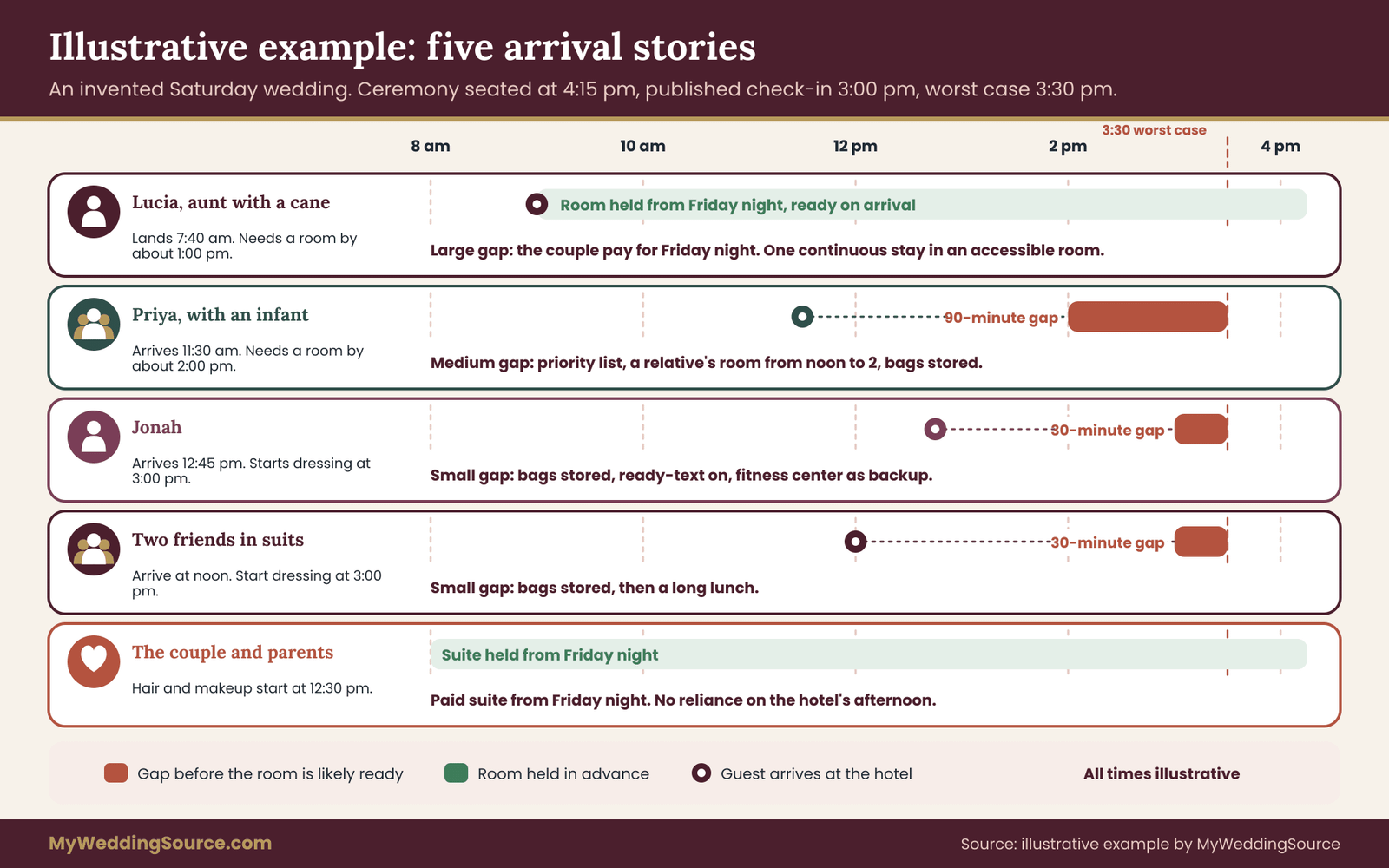
A worked example of early check-in: five arrival stories
The following example is invented, and the numbers are illustrative only. Treat them as a way to see the method run, not as typical prices or times.
A couple are marrying on a Saturday with a ceremony at half past four. Guests are asked to be seated by a quarter past. The hotel is about ten minutes from the venue by shuttle or car, and the couple allow twenty-five minutes for the trip including a wait. They allow twenty minutes of buffer. The hotel’s published check-in is mid-afternoon, and the group-sales contact has written that early check-in is “subject to availability” and that bags can be stored. The hotel has a fitness center with showers, open early.
That gives a seated time of a quarter past four. Subtracting travel and buffer gives about half past three as the latest moment a guest can leave the hotel. Each guest’s dressing and resting time are subtracted from there.
Lucia, an older aunt who uses a cane, lands at twenty to eight in the morning. She needs a generous dressing time and a rest. Her room-needed-by works out at about one o’clock. The room is unlikely to be ready before the published time, which leaves a gap of more than two hours. This is a large gap. The couple decide to pay for the Friday night, as part of the block, in one continuous stay in an accessible room. The cost, for illustration, is a night’s rate that the couple cover. She can go straight to her room on arrival.
Priya arrives with an infant at half past eleven. She needs time to feed and settle the baby and to dress. Her room-needed-by works out at about two o’clock. That is a medium gap. Priya goes on the priority list for early check-in. The primary fallback is a relative who arrived the night before and has offered a room between noon and two, and the backup is the fitness center’s family restroom. The bags are stored on arrival.
Jonah arrives at a quarter to one. He needs half an hour to dress, so he must leave the hotel by half past three, and he needs to start dressing at three. The room is likely ready around half past three. A small gap. Bags go to the front desk, he has the ready-text, and the fitness-center showers are his backup.
Two friends in suits arrive at noon. Their clothes-on time is about three. Same as Jonah, a small gap, and they have a lunch to enjoy.
The couple and their parents. Hair and makeup start at half past twelve. They cannot wait for the hotel’s afternoon. The couple book a suite for Friday night, and the parents’ room is on the same floor.
What the example shows
Notice how little the hotel is asked to do. It stores bags, it sends texts, it lets guests use the fitness center, and it sells one extra night. Nobody depends on early check-in, and one aunt, one parent with an infant and the couple are protected by deliberate choices. The cost to the couple is one extra night for Lucia and a suite, which are decisions they made in advance and not surprises on Saturday morning.
The method also scales. A larger wedding has more Lucias and Jonahs, but the sort is the same, and the number of people who need a real fallback is usually a small fraction of the guest list.
Special situations, limits and what to verify about early check-in
Most weddings fit the pattern above. A few do not, and some features of a weekend change the odds of early check-in or the shape of the fallback. This section covers the common ones, then what to do when a plan breaks.
A hotel at the venue
When the ceremony is on the hotel’s own property, the travel block shrinks, and the buffer can too. The gap may be smaller because guests can walk to the ceremony. The room-ready problem does not shrink, though, because the hotel is also hosting the wedding and may be busy with setup. Ask the group-sales contact whether event days change housekeeping priorities, and whether a meeting room or the venue’s own rooms can serve as a changing space.
Several hotels, different rules
If guests are spread across hotels, each has its own check-in time, its own bag policy and its own fitness center. Keep one short card per hotel with the published time, the early check-in answer you received, the bag storage details, the changing options and a phone number. A guest’s fallback is the one for their hotel, not a general one.
The ceremony time changes everything
A late afternoon or evening ceremony gives the hotel more time, and the gaps shrink or vanish. A morning or midday ceremony does the opposite, and almost every guest who travels that day has a large gap. If the ceremony is early, treat arriving the day before as the default, and say so on the lodging page. If you are still choosing a date and time, the guide to choosing a wedding date explains how travel and guest availability interact, and a later ceremony makes arrival-day logistics easier.
Busy weekends and local events
A festival, a sports weekend, a graduation or a holiday can fill every hotel in town. On such a weekend, hotels run close to capacity and early check-in is rarer, because there are few vacant rooms and housekeeping is stretched. Check the local calendar when you book, and assume the worst case. Weather also matters. The National Weather Service posts forecasts and alerts, and a storm that delays flights or closes roads widens every gap, so keep the day-of contact ready to adjust.
Long journeys and time zones
Guests who cross several time zones, or who travel overnight, need more rest and more time. Their arrival times are also more variable. Treat these guests as medium or large by default, and encourage them, gently, to arrive the day before. Do not insist, because cost and work schedules are real, but do tell them what the arrival day will look like.
Guests who need quiet or privacy
Some guests need a private room for a medical reason, to rest, to take medication, to nurse a baby or to pray before a ceremony. A public restroom does not serve any of these. Ask guests what they need, and where the need is real, move them toward a day-use room, a room host or an extra night. The guide to guest care for babies, children and older relatives covers many of the same needs from the ceremony side, and the arrival hours are where they begin.
Guests who use refrigerated medication need a mini-fridge or a cool place from the moment of arrival. Ask the hotel what it can do, and do not leave this to chance.
Accessible rooms and early arrival
An accessible room is a specific, limited resource. A guest who needs one should book it early, confirm it in writing, and expect that a request for early check-in on it may be harder to meet than one for a standard room. The Department of Justice’s ADA site and the ADA National Network explain the rules on reservations, and the safest practice is to ask the hotel which features the room has and to confirm that it is held for the guest.
For arrival day, pair the accessible booking with a paid night before or a verified accessible changing space, and do not leave the guest depending on early check-in.
Oversold hotels
Hotels sometimes sell more rooms than they have, which can lead to relocating a guest to another property. It is uncommon, but on a full weekend it happens. Ask how the hotel handles it, and ask the group-sales contact whether your group’s rooms are protected. Keep every confirmation email handy.
What you cannot verify, and should not claim
You cannot know a hotel’s housekeeping on the morning of the wedding, whether a particular room will be ready, or what a hotel’s policy will be next month. You should not tell guests anything stronger than what the hotel told you, and you should not rely on a general rule of thumb, because policies are set by the property. Treat everything in this guide as a set of questions to put to your own hotel.
When the plan breaks
Even a careful plan meets the occasional surprise. These are the common ones, with the response for each.
Early check-in did not happen and the room is not ready
Start with the front desk, politely. Ask for an estimate, and ask whether any room of any type is ready, even for a few hours, to change in. If the answer is no, go to the front-office or duty manager and describe the situation in two sentences: the guest, the ceremony time, the fallback request. Then use the fallback: the fitness center, the room host or the day-use room. If a guest paid for early check-in and the hotel could not deliver, ask for a refund of the fee, and keep the paperwork.
A bag is missing or crushed
Go to the bell desk with the tag or the photo, and ask a manager to look. A missing garment bag is an emergency only on the day of the ceremony, so check early. If an outfit is damaged, steam and press options exist, and a nearby tailor or formalwear shop may be able to help. Ask the front desk or concierge for a suggestion. This is why guests keep key items in the day bag.
A flight is late
The guest tells the arrival helper the new time. If the ceremony is close, the guest goes straight to the venue with the day bag, changing in a restroom or a venue room if possible, and the hotel is dealt with afterward. The venue manager may be able to offer a quiet room if asked in advance. The Department of Transportation’s pages explain what an airline owes a delayed or rebooked passenger.
The hotel released the reservation
A guest who arrives to find no reservation should show the confirmation email, ask for a manager and ask the hotel to find a room. Keep the email. If a hotel charged a card for a room it did not provide, the Consumer Financial Protection Bureau explains how to dispute a credit card charge, and the notice generally has to be in writing within sixty days of the statement showing the error.
The helper on the day
Name one person, who is not the couple, as the arrival helper for the day. This should be a calm friend or relative who knows the hotel plan. Give that person a one-page list: each guest with a gap, their changing place, their backup, the hotel’s phone number and the group-sales contact. The couple should not be handling room questions on their wedding morning. The site’s guide to the wedding vendor timeline shows how a day-of schedule can include a named contact for logistics, and the arrival helper fits in the same way.
Your next steps
Start with the guest list and sort it into gap sizes using the backward clock. It takes an evening, and most households fall into no gap or a small gap. Then write to your hotel with the questions from this guide about early check-in, ask for answers in writing, and note which rung each answer stands on.
For each guest with a medium or large gap, choose a primary and a backup changing place, and decide who pays for any extra night. Add a short paragraph to the lodging page, send the arrival reminder a few days before, and name an arrival helper. Then recheck two days before with the front desk. Treat early check-in as a bonus. If the ladder is in place, your guests will be fine whether or not the room is ready.
FAQ
Can a hotel promise early check-in for wedding guests?
Usually not. Most hotels can note a request and give an early room if one happens to be clean, but few will commit to a time. The exception is a paid arrangement, such as booking the night before or buying a stated early check-in, confirmed in writing. Treat any other answer as a hope, and plan for the standard time.
What time should guests arrive to have the best chance of early check-in?
There is no reliable hour for early check-in. Rooms become ready as guests check out and housekeeping finishes them, so the odds improve as the day goes on, and they depend on how full the hotel is. Calling the front desk that morning to ask about status is more useful than guessing. Planning for the published time, with a fallback, is safer.
Should I ask for early check-in for every guest?
No. A short list of guests with real reasons, such as an infant, a health need, a long journey or a hair appointment, is more likely to get a response than a request for the whole block. Ask the hotel what it can do for the group in general, then name a few guests. Get the guest’s consent before sharing personal details.
How much does early check-in cost?
Often nothing, when the hotel simply gives a room that is ready. Paid options, such as a day-use room, a stated early check-in or an extra night, are priced by the hotel and vary by date and room type. Ask for the price in writing for your actual dates, and ask what it includes, so there are no surprises at checkout.
What if the hotel will not hold bags before check-in?
Ask about the venue’s coat check or a closet, a friend who has already checked in, or a luggage storage service near the hotel or station. Read the terms and hours of any service. Keep valuables, medication and the outfit essentials in a day bag rather than in stored luggage, and avoid leaving bags in a parked car.
Where can a guest change clothes if early check-in does not happen?
Options include a single-user restroom in the hotel, the fitness center or spa locker room, a day-use room, a meeting room the group has arranged, a room belonging to a friend who is already checked in, or a space at the venue. Choose one primary and one backup for each guest, check accessibility, and tell the guest in advance.
Is it worth booking the night before?
It is worth it when the gap is large and no cheaper fallback is dependable, such as a morning arrival for an early ceremony, a long journey, an infant, a health need or a hair appointment. For a small gap, a stored bag and a ready-text are enough. Ask for one continuous stay and confirm how the hotel handles late arrival.
What should I tell guests about early check-in?
Tell them plainly that the hotel may offer an early room but cannot promise one, that bags can be stored, and that you have arranged a place to change if the room is not ready. Give a phone number for the day, the hotel’s published check-in time, and an invitation to ask for help. Do not promise more than the hotel has promised.
Sources
- Rule on unfair or deceptive fees, Federal Trade Commission
- Consumer advice, Federal Trade Commission
- Rule on reservations by places of lodging, 28 CFR 36.302, Cornell Legal Information Institute
- Americans with Disabilities Act, U.S. Department of Justice
- ADA National Network
- Aviation consumer protection, U.S. Department of Transportation
- How do I dispute a charge on my credit card bill?, Consumer Financial Protection Bureau
- Forecasts and weather alerts, National Weather Service
- Transportation Security Administration