

Wedding deliveries are simple until a florist, a rental crew, a caterer and a band all arrive at a building with no freight elevator and a staircase between the truck and the room. This guide shows how to plan wedding deliveries for that situation with a stairs-and-equipment risk register and a vendor staffing plan, so the day starts with everything intact, on time and carried by people who were expecting the climb.
If your venue has no freight elevator, plan wedding deliveries item by item: treat every item that must reach the room as a line in a risk register. Record its weight, its awkward dimension, the stairs and turns on its route, the carry distance and the cost of dropping it. Score each line, and use the score to decide whether it is carried as normal, carried with a plan, redesigned, or not carried up the stairs at all. Then give each vendor a written staffing plan and a load-in window, and get the venue to approve both before you sign.
Most couples learn how their wedding deliveries will work from the vendors, and usually in the final week. A rental company asks which floor the event is on. A florist asks whether the building has a dock. A cake designer asks how far the van can park from the door. The answers to those questions were available from the venue months earlier, and in many cases they would have changed which vendors were hired, what was ordered and how the day was scheduled.
A missing freight elevator is not unusual and it is rarely a reason to drop a venue. Lofts, historic houses, upstairs restaurants, rooftop terraces, converted churches and hillside gardens host weddings every weekend with nothing larger than a passenger elevator and a flight of stairs. What separates smooth wedding deliveries from bad ones is whether somebody counted the stairs before the contracts were signed.
This article is about that narrow job. It does not repeat the full site survey in our venue technical walkthrough guide, which covers measuring rooms, power and capacity. Here the question is smaller and more practical: how does every physical item get from the vehicle to its final spot, who carries it, how long does it take, and what happens if it cannot be carried at all?
A note on scope. This is general information, not legal, tax or financial advice, and the safety rules that apply to a particular building, crew or municipality are set by the people who operate and regulate them. Treat everything below as a way to ask better questions and write better requests, and let the venue’s site manager, your vendors’ own safety practices and your local fire and building offices decide what is allowed.
What wedding deliveries look like when a venue has no freight elevator
A freight elevator, sometimes called a service elevator, is built to move goods. It usually has a larger cab, a sturdier floor, wider doors and a higher weight rating than the elevator guests use. Venues that have one often reserve it for events, assign a staff operator and put it on a booking schedule. Venues that do not have one send wedding deliveries through some other route, and that other route is what this article is about.
In practice, “no freight elevator” covers several different situations, and wedding deliveries are not equally hard in each of them.
Stairs only. The room is above or below the delivery entrance, and the only route is one or more flights of steps. Nothing mechanical helps. Every table, speaker and cake box goes by hand or by an equipment method that works on stairs.
A passenger elevator with limits. The building has an elevator, but it was designed for people. The cab may be small, the doors narrow, the weight rating modest and the rules strict. Some venues allow vendors to use it only for small items, only at certain hours or only with a staff member present. A cab that fits a person with a suitcase may not fit a folded banquet table standing on its edge.
A freight elevator that exists but is not available. It may be shared with the building’s other tenants, out of service for inspection, reserved for the venue’s own caterer, or off limits to outside vendors. For planning purposes this is the same as having none, because you cannot count on it.
A ground-level entrance that is still a long carry. There is no flight of stairs, but the delivery door is far from the room, the path crosses a gravel yard, a lawn, a ramp, a bridge or a hill, or the only vehicle access ends at a gate a long walk away. The difficulty here is distance and surface, not height.
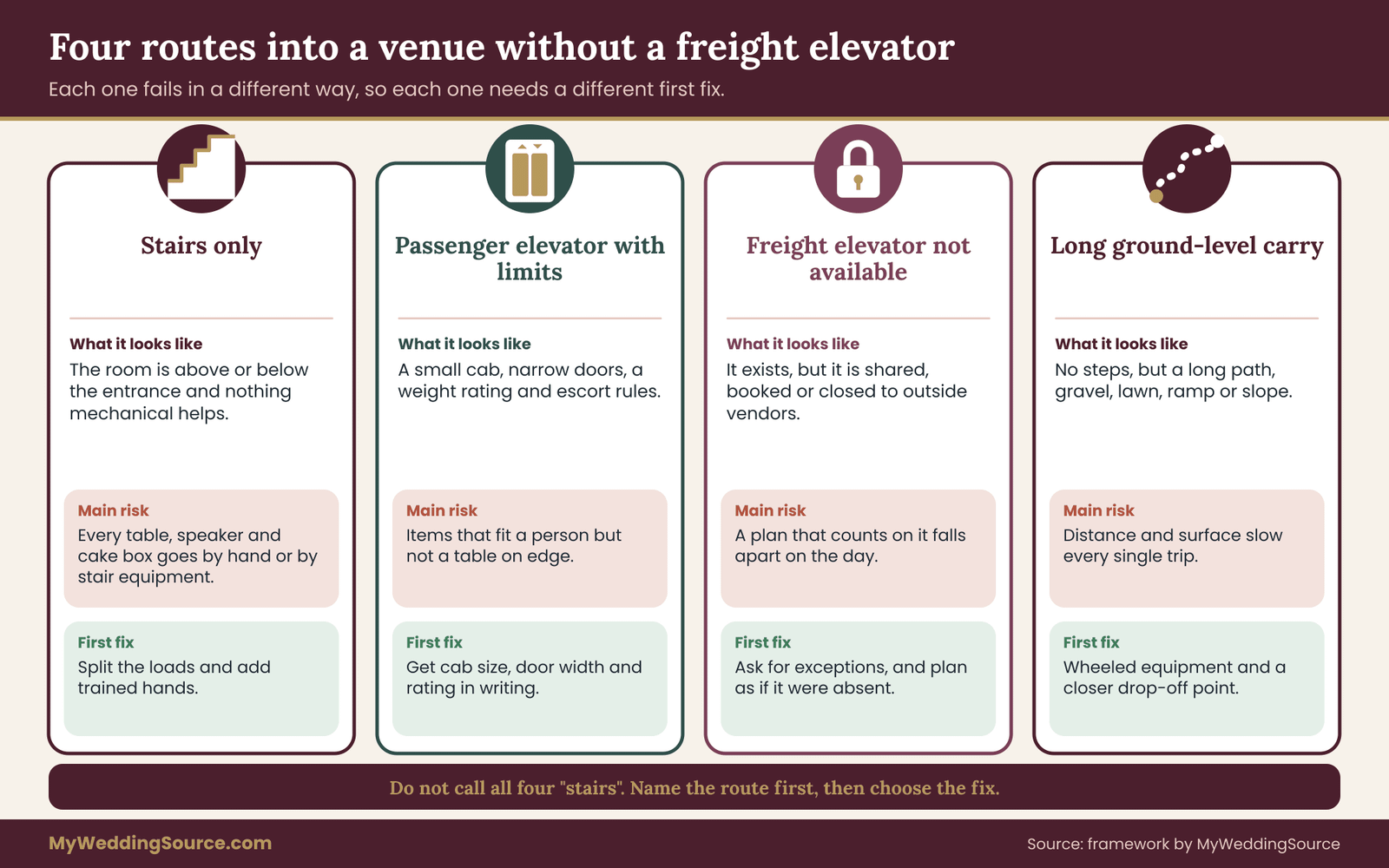
These four situations call for different fixes, and wedding deliveries behave differently in each. Stairs reward splitting loads and adding hands. A restricted passenger elevator rewards precise measurements and a rule about what may ride in it. An unavailable freight elevator rewards asking the venue whether an exception is possible. A long ground-level carry rewards wheeled equipment and smoother routes. A plan for wedding deliveries that treats all four as “stairs” wastes effort in some places and misses risks in others.
What moves, and when
It helps to be concrete about what wedding deliveries actually put on the route. The list is longer than most couples expect, and it moves twice, once in and once out.
Furniture and rentals come first: chairs, tables, linens, dance floor panels, lounge furniture, a ceremony arch or chuppah frame, and sometimes a bar structure. They are bulky, they arrive in quantity and they are often the largest share of the physical work.
Then come flowers and décor: buckets of cut stems, large arrangements, hanging pieces, candles, signs, easels, centerpieces already assembled in glass. Much of this is light, but it is fragile, wet or tall.
Food and drink follow: hot boxes, trays, chafing equipment, cooking gear if the venue has no kitchen, ice, cases of glassware, kegs, bar fridges and the cake. Kegs and full beverage cases are heavy, and a tiered cake is both heavy and easy to ruin.
Sound, lighting and photography round it out: speakers, subwoofers, mixers, stands, truss or lighting trees, cables, a photo booth, a backdrop and camera cases. Equipment cases are usually dense and carry a high replacement cost.
Finally there are personal and ceremonial items: the dress and garment bags, programs, guest books, gifts, favors, luggage and sometimes an elderly relative’s wheelchair or walker. These move at the same time as the rest and are easy to forget in the plan.
Each of these categories is handled by a different vendor with different equipment, different crew size and a different opinion about what counts as a reasonable carry. That is why the plan for wedding deliveries has to be built item by item rather than venue by venue.
The tools this article builds
Three tools do most of the work, and the rest of the article builds them in order.
The first is a short list of questions for the venue about wedding deliveries, so the facts about the route are written down before anyone is hired. The second is the stairs-and-equipment risk register, a single page that lists every item that must be moved, scores it and assigns a response. The third is the vendor staffing plan, which turns the register into names, headcounts, equipment, time windows and approvals.
A worked example later shows all three used together for an invented couple. Before that, it is worth being clear about why this deserves its own plan at all.
Why a missing freight elevator changes wedding deliveries: time, cost and risk
Three things change in wedding deliveries when the freight elevator is missing, and they compound each other.
Time
Stairs turn a load-in into a series of trips, and wedding deliveries are mostly a matter of volume. A vendor with eighty chairs, twelve tables and a pallet of linens does not simply roll in. If a cart can take a limited number of chairs per trip, and each round trip takes several minutes because of stairs, turns and doorways, the arithmetic stacks up quickly. A load-in that would take a short window at a ground-floor ballroom becomes a long, staggered effort, and the vendors who arrive after the heavy deliveries wait for the stairs to clear.
Time also shows up at the other end. Load-out happens when everyone is tired, the guests have gone and the venue wants the building back. Carrying items down stairs at the end of a long night is slower and riskier than carrying them up in the morning, and it is the part vendors forget to price.
Cost
Cost does not usually appear as a line called “no freight elevator.” It shows up in other places. A rental company may add a carry or floor charge or send a larger crew. A caterer may need extra staff to move equipment. A band may bring an additional stagehand or charge for extra setup time. A florist may switch to smaller, lighter arrangements, which changes the design. A venue may require its own staff or an approved labor provider for any carrying, and bill for it.
The honest way to think about the cost of wedding deliveries is as labor hours and equipment, not as a surcharge. Every extra trip costs somebody’s time, and somebody pays for it, either as a visible fee, a higher quote or a compromise in the design. The risk register makes those hidden costs visible before the quotes come back, so you can compare vendors on the same terms. If you are building the money side of the wedding at the same time, the wedding cash flow guide explains how deposits and final balances interact with vendor changes that arrive late.
Risk
Risk comes in three kinds, and each has a different owner.
People can be hurt. Lifting heavy or awkward items on stairs is a recognized source of workplace injury, and the Occupational Safety and Health Administration and the National Institute for Occupational Safety and Health both publish material on safe handling. Your vendors’ crews are their employees or contractors, and their own safety practices apply. As the client, you do not direct how they lift. You do ask whether the plan is realistic and you do avoid creating pressure that pushes people to skip their own rules.
Things can be damaged. Dropped speakers, cracked centerpieces, a collapsed cake tier and scuffed stair treads are all predictable consequences of a rushed carry. The cost lands on whoever owns the item or the building, and a dispute follows if the contract did not say who is responsible.
The schedule can fail. If stairs make wedding deliveries slower than the timeline assumed, the ceremony start, the photographer’s coverage and the caterer’s service all slide. A late delivery rarely stays a single problem.
The cheapest fixes come early
The most useful principle in this article is that the cheapest changes happen upstream. Choosing a rental company that offers lighter chairs or pre-assembled tables costs nothing if done before ordering. Asking a baker to deliver a cake in tiers costs a conversation. Moving a heavy item to a ground-floor space costs a venue question. The same fixes during the final week cost money, goodwill and stress.
That is why the first tool for wedding deliveries is a set of questions asked before you sign, and why the register gets built at the same time as the vendor shortlist, not after. The next section starts there.
Seven questions to ask the venue before you sign
The venue knows its own building better than any vendor will, but it rarely volunteers the details that matter for wedding deliveries. Venue contacts are used to answering questions about capacity and catering. Questions about stairs and carts tend to come up only after something goes wrong. Asking them early, in writing, and in the same order for every venue you consider, makes the answers comparable, and it turns wedding deliveries from a worry into a list of facts.
The seven questions below are designed to produce facts you can put into numbers. A reply like “it’s fine, vendors do it all the time” is friendly, but it is not a fact. Follow it up with the specific measurement or rule behind it.
1. Where do vehicles stop, and how far is that from the room? Ask for the exact drop-off point, whether a truck or van can park there, how long it can stay, and the walking distance and route from that point to the event space. A short carry up one flight is a different job from a long carry across a courtyard and up two.
2. Is there a freight or service elevator, and may outside vendors use it? If yes, ask who operates it, when it can be booked, whether there is a fee and what its weight rating and cab size are. If it exists but is not available to vendors, ask whether any exception is possible for specific items, such as the cake or the dance floor.
3. If only a passenger elevator exists, what are its limits? Ask for the interior cab dimensions, the clear door width and height, the weight rating and any venue rules about vendor use. Ask whether items may ride unaccompanied or only with a staff member, and whether the elevator is shared with other tenants during your load-in.
4. What do the stairs look like? Ask how many flights there are, how many steps in each, how wide the stair is between handrails, how deep the landings are, whether there are turns, and whether any doorways along the route are narrower than the rest. For outdoor stairs, ask about surface and lighting.
5. Who may carry, and what proof of insurance is required? Some venues allow any vendor crew to move its own equipment. Others require venue staff or an approved labor provider for certain items, and many require a certificate of insurance from every vendor who works on site. Ask what is required, who handles it, and the deadline for submitting it.
6. What are the access windows, and who else is in the building? Ask when the building opens to vendors, when load-out must be complete, whether another event, tenant or guest group shares the stairs, and whether there are quiet hours that limit early or late carrying.
7. What protection does the venue require for floors, stairs and walls? Some venues ban certain wheeled equipment, require floor runners or corner guards, or hold part of a deposit against damage. Ask what is allowed, what is prohibited and who supplies the protection.

Why these seven are enough
They cover the physical route, the available machinery, the rules, the people and the clock. Together they answer the question every vendor will ask you in the final weeks: how do we get this in? Good answers make wedding deliveries predictable. If the venue can answer all seven in writing, the rest of the plan is arithmetic. If it cannot, that is useful information about how the venue will perform on the day.
For a deeper survey of the venue as a whole, including measurements for tables, dance floors and power, use the full survey process. The seven questions here are the access subset of that survey, written so you can send them before you visit.
A short message that gets real answers
Venue contacts reply faster and more fully to specific, polite messages than to open questions. Something like this works.
“We are considering your space for a wedding of about ninety guests. To plan our wedding deliveries, could you tell us how vehicles reach the building, whether there is a freight elevator or only a passenger elevator, the number of steps between the drop-off and the event room, and whether outside vendors may carry their own equipment? If it is easier, we can visit and measure.”
The final sentence matters. Offering to visit signals that you want facts, not reassurance, and it often leads to an invitation to walk the route with the site manager.
The timed test carry
When you visit, do one thing that costs nothing and tells you more than any description. Pick a sample item, such as a stack of chairs, an empty crate or a heavy bag, and carry it from the vehicle drop-off to the final spot in the room. Count the steps, note the turns and the doorways, and time the trip with a phone. Then carry it back.
This test gives you a real round-trip time for wedding deliveries on this route, which you will use in the register. It also reveals things a floor plan does not: a door that opens against the stair, a handrail that narrows the path, a corner where a long item has to be tilted, a surface that is slippery when wet. Take photographs of each of these spots. They are useful later when you brief vendors, and they protect you if a dispute over damage arises.
If you cannot visit before signing, ask the venue to measure the route and send photographs, and book the visit as soon as the date is secure.
The stairs-and-equipment risk register
The register is a single page, kept as a spreadsheet or a printed sheet, that lists every item that has to move between the vehicle and its final position. It is not a safety certification and it does not replace the judgment of the crews who carry. It is a planning tool that makes the cost of stairs visible, forces decisions about wedding deliveries early and gives every vendor the same information.
One line per item, not per vendor
The unit of the register is the item or item group, not the vendor. A rental company is not one line, because it delivers chairs, tables, linens and a dance floor that each behave differently. A florist is several lines too: buckets, an arch, centerpieces and a ceremony installation. Splitting vendors into items is the step that most often surfaces the problem with wedding deliveries. The florist’s buckets may be fine and the arch may not be.
For each line, collect these facts. Most come from the vendor’s own spec or a quick message, and the route facts come from your venue answers and the test carry.
What it is and who brings it. The item description, the vendor and the quantity or number of pieces.
Heaviest single piece. Ask the vendor for the weight of the heaviest piece, loaded as it will be carried, not the weight of the empty case. A speaker in a road case, a table with its legs attached and a crate of full glassware are different weights from the bare items.
Awkward dimension. The longest dimension and whether the item is rigid. A six-foot table, a ladder-style arch, a rolled backdrop and a dance floor panel all fit through some doors and not others, and the difficulty is in the shape rather than the weight.
Route facts. The number of flights and steps, the turns and landings, the narrowest clearance and the total carry distance from the vehicle to the final spot. These come from the venue answers and the test carry.
Damage cost. What happens if this item is dropped. A stacked chair costs little. A sound system, a tiered cake or a cut-glass centerpiece costs real money or cannot be replaced at all on the day.
Splittable. Can the item be broken into smaller loads, assembled on site or replaced by a lighter version? The answer often changes the score more than anything else.
Trips and time. How many trips the item needs, and how many minutes a round trip takes on this route. The vendor estimates the first, and your test carry supplies a starting point for the second.
Who carries, and what approvals apply. The names or roles of the carriers and any venue permission, insurance certificate or special equipment required.
That last pair of columns is where the register turns into the staffing plan, which is covered after the scoring system.
Scoring each line
Scoring gives you a consistent way to decide how much attention each part of your wedding deliveries needs. Without it, every item feels equally urgent, or equally fine. Five factors are scored from zero to three, and the total runs from zero to fifteen. The scale is not a scientific measure. It is a shared language between you, the venue and the vendors, and it works because the factors are simple enough to agree on.
Weight. Score zero if one person can carry the heaviest piece comfortably in one hand. Score one if one person needs both hands. Score two if the vendor would assign two people. Score three if it needs a team or mechanical help. The vendor’s own judgment sets the line, because they know their crew and their rules.
Awkwardness. Score zero for compact, balanced items. Score one for items that are bulky but easy to grip. Score two for long, wide or unbalanced items that must be tilted at turns. Score three for items that barely fit the narrowest point on the route or that cannot be tilted without damage.
Stairs. Score zero for no steps on the route. Score one for a short flight with a landing and no turn. Score two for several flights or one flight with a turn. Score three for many flights, tight turns, steps in several places or an outdoor stair that may be wet, dark or uneven.
Distance. Score zero for a short, level carry. Score one for a moderate carry. Score two for a long carry or a carry with several doorways. Score three for a carry that crosses outdoor ground, a yard or a long corridor in addition to the stairs.
Damage cost. Score zero for cheap, replaceable items. Score one for items that would be inconvenient to replace. Score two for items that would hurt the budget or the schedule if damaged. Score three for items that cannot be replaced on the day or that carry safety consequences if they fail.
Add the five scores. The total points to one of four responses, and the next part of the guide explains how to use them item by item.

The four responses
A total from zero to four means the item is carried as normal, and most routine wedding deliveries land here. It needs no special approval, and the vendor’s regular crew can handle it with whatever carts they already bring. Write the line down anyway so nobody is surprised, but spend no more time on it.
A total from five to eight means the carry needs a plan. Name the carriers, confirm the route protection, decide who stands at the top and bottom of the stairs, and give the item a slot in the schedule. Most wedding items land here when the venue has no freight elevator, and that is fine. The plan is the point.
A total from nine to eleven means the item should be redesigned or restaged. Split it into smaller loads, ask for a lighter version, assemble it on site, deliver it in stages, or move it to a different route. If none of those works, hire help that is trained for the carry. This is the band where early conversations save money.
A total from twelve to fifteen means the item should not be carried up the stairs as designed. Either replace it, find another route that a qualified operator approves, such as a ground-floor entrance or a lift supplied by a specialist, or drop it from the plan. A twelve is a signal to stop and ask whether the item is worth the trouble, not a challenge to try harder.
Two escalation rules
Totals hide extremes, so two rules adjust the band.
One high factor in weight or awkwardness raises the band by one level. An item that scores three for weight or three for awkwardness is the kind that injures people and breaks floors, even if everything else about the route is easy. A dance floor panel might total only six, but if its weight score is three it moves up to the redesign band, and the conversation is about splitting the load or adding help.
A damage score of three always gets a named carrier. Something that cannot be replaced on the day, such as the cake, the only copy of a sound system or a framed heirloom, does not move on a general “somebody will take it up” instruction. One person is responsible, and that person knows it.
What the register is not
Three limits keep the tool honest. The register does not tell vendors how to lift, because their training, equipment and insurance govern that. It does not certify that a route is safe, because only the people who operate and inspect the building can say so. And it does not predict the exact time a load-in will take, because crews differ. It does make the shape of your wedding deliveries visible, which is what most wedding teams are missing.
Vendor by vendor: what each one actually carries
The register becomes useful when you run it vendor by vendor and ask each one the same questions. Below are the typical items in wedding deliveries, the usual trouble spots and the fixes that tend to be cheapest. Your vendors will know their own gear better than any general list, so use this as a prompt for the conversation and not as a script.
Rental company
Rentals are usually the heaviest share of wedding deliveries by count. Chairs come in stacks, tables are bulky, linens arrive in bags and crates, and a dance floor is made of heavy panels. Ask what the chairs weigh, whether the tables fold or have removable legs, and how many pieces a standard cart carries. Ask whether the crew delivers to the room or to the curb, because the difference determines who carries up the stairs. Some rental companies deliver to the door only and charge by floor or by distance for anything beyond it.
Rounds and rectangles behave differently. A long rectangular table is hard to tilt through a stairwell turn, while a round table that folds is narrower but heavier. Lightweight chairs and tables exist, and an early question about them is worth more than anything done later. The wedding rental planning checklist covers how to compare rental quotes and what the order should specify, including the delivery floor.
Florist
Florists make some of the most varied wedding deliveries, with a surprising mix of items. Buckets of stems are heavy with water and awkward on stairs because they slosh. Large installations, such as an arch or a hanging piece, are often built on a frame that is rigid and wide. Centerpieces in glass are fragile and heavy for their size.
The fixes are usually design fixes. A florist can build the arch in sections and finish it on site, carry stems dry and hydrate them in the room, and choose lighter containers for centerpieces. Ask when they plan to load in and whether they need a path kept clear of other vendors. Flowers also run on a clock that the schedule must respect, because wilting is a deadline.
Caterer or kitchen
Caterers bring food, hot holding equipment, serving pieces, glassware and sometimes cooking gear. Their crews are used to moving heavy things and often have their own carts and rules. The problem with catering wedding deliveries is volume and timing. Food that is held hot or cold has to move quickly from the vehicle to the staging area, and stairs slow that down.
Ask whether the venue has a catering kitchen, what the caterer needs near it, and how food will travel from the kitchen to the room. If the kitchen is on one floor and the reception is on another, the route is the same problem with a time limit attached. The caterer’s quote should show how many staff are assigned to load-in and whether stairs change that number.
Band or DJ and the sound crew
Audio equipment is dense and expensive, and in wedding deliveries it is the line most likely to need a named carrier. Speakers, subwoofers, mixers and cases are heavy, and they are usually moved in road cases that are sturdy but do not like stairs. A band may bring a drum kit, amplifiers and stands. A DJ may bring a smaller kit, but the speakers and subwoofer still add up.
Ask for the heaviest piece and its weight in the case, and whether the crew carries or uses a stair-climbing cart. Ask when sound check is planned, because it fixes the latest time the equipment must be in place. Some performers will scale down the system for a difficult venue if they know in advance. They will not do so at the door.
Cake or dessert vendor
The cake is a high-value, high-fragility item and often the one that receives the most careful attention among all wedding deliveries. Tiered cakes can be delivered assembled, in separate tiers or in boxes with assembly on site. The choice affects the carry. An assembled cake in a box is a two-person job on stairs and may not survive a turn. Delivering in tiers and assembling in the room is more work for the baker but a far safer path for the cake.
Ask the baker how they usually handle venues without a freight elevator, which route they prefer and whether they need a staff member to hold doors. Also ask where the cake will rest on arrival, since a cake carried up three flights and then left in a warm room is a different problem. Delivery timing connects to cutting and service, so ask the baker for the planned cake timeline too.
Photographer, videographer and photo booth
Photographers and videographers carry cases and stands, and most can manage on their own. A photo booth is another matter, since it can include a frame, a printer, a backdrop and a cabinet. Ask for the heaviest piece, the largest dimension and whether the booth can be built in parts. Photographers also need a place to leave bags and a short window for arrival, often before the guests, so their carry should happen when the stairs are free.
Lighting, draping and production
Uplighting, draping, truss and special effects can involve a lot of cases and cables, and often involve rigging that requires time and trained people. Production vendors usually quote labor hours, and a difficult route changes the number. Ask them to include the stair carry in the estimate and to say how many people they will bring.
Bar service
Bars add kegs, crates of bottles, ice, tubs and glassware. Ice is heavy and melts, so the timing matters, and full kegs are among the heaviest single items on a wedding site. If the venue lacks a freight elevator, ask the bar vendor how they handle wedding deliveries of drinks, and whether they can use cans or bottles instead of kegs, whether they can use smaller containers, and how they plan to bring ice. If drinks are included in the venue package, ask the venue the same questions.
Planner or coordinator
If you have a planner, they hold the register, and the carry becomes part of the schedule they manage. If you do not, someone on your team has to hold it. A coordinator, a trusted relative or a day-of manager can fill the role, as long as the person has the authority to say stop. That authority is the most useful feature of the arrangement, and it is covered again in the sections on the day itself.
Reading the whole register
Once every vendor’s lines are filled in, step back and look at the pattern across all your wedding deliveries. Which vendor has the most lines in the redesign band? Which items could be consolidated, delivered together or replaced? Where do two vendors need the same stair at the same time? The answers show where to spend effort. Most of the time the real problem is not the heaviest item but the clash between several moderate ones.
With the register filled in, the next question for your wedding deliveries is who carries it all, and how many of them there need to be.
The vendor staffing plan for wedding deliveries
The register says what has to move and how hard it is. The staffing plan says who moves it, with what, and when. It is one short sheet per vendor, and it is where wedding deliveries stop being a worry and become a set of assignments.

The five jobs on any carry
Every carry in your wedding deliveries involves the same five jobs, even if one person does two of them. Naming them keeps anything from falling between people.
Carriers. The people who actually lift and move the item. The vendor decides how many are needed and who they are, because they own the crew and the insurance. Your job is to learn the number and check that it matches the register.
Spotters. A spotter stands at a turn, a landing or the top of a flight and watches the carry. The spotter calls out clearance, holds a door, watches the edges of long items and tells carriers to stop if something is wrong. Spotters are most useful for items scoring five or more.
Route keeper. One person is responsible for keeping the route clear of guests, children, other vendors and loose obstacles. For a load-in this may be a venue staff member or the planner. For a load-out it is usually the same.
Truck runner. The person at the vehicle who unloads, stages items in order and keeps the vehicle from blocking anyone. Without one, carriers end up wandering back and forth for the next piece, which wastes time on the stairs.
Approver. One named person on the vendor side and one on the venue side who can say yes to a change. If the carry needs to be altered, the item swapped or the door opened, these two decide in minutes, not in a chain of phone calls.
Setting headcount
For wedding deliveries, start with what the vendor says is the minimum number of people to carry each item safely, using their own rules. Do not argue the number down. Then check it against two limits.
The first limit on wedding deliveries is the stair itself. A narrow staircase handles one team at a time. Two crews on the same stair do not double the speed, they create a queue and a collision risk. If several vendors are scheduled at the same time, the stair is the bottleneck and the staffing plan has to schedule around it, which is covered in the next section.
The second limit is the route. A relay line, in which people stand along the route and pass light items hand to hand, can move chairs, buckets and boxes without anyone walking the full distance. It is a good fit for light, durable items and a poor one for heavy, fragile or oddly shaped ones. Whether a relay is appropriate is for the vendor’s crew lead to decide.
Who supplies the hands
Four sources of labor exist for wedding deliveries, and each has trade-offs.
The vendor’s own crew. The simplest option. It works well when the vendor is experienced with difficult venues and has priced the labor honestly. Ask them to state the crew size and the hours for the stairs in the quote.
Venue staff. Some venues provide carrying help, often at an hourly rate, and some require it. Venue staff know the building, which is a real advantage. The disadvantages are cost and the fact that they work for the venue, not for your vendors, so someone has to coordinate.
A hired labor provider. Moving companies and event labor services supply trained carriers by the hour. They add cost, but they can solve the problem for items that your vendors will not or cannot carry. If you hire one, check that the venue accepts them and that they carry their own insurance.
Friends and family. This is the option most couples are tempted by and the one to be most careful with. Volunteers are usually not trained, may be wearing formal clothes and shoes that do not suit stairs, and are not covered by a vendor’s insurance. A simple rule works well. Friends and family may carry light personal items, such as programs, favors, signs and gifts. They do not carry vendor equipment, rentals, kegs, speakers, a cake or anything scoring five or more on the register.
What goes on the staffing sheet
Each vendor gets a one-page sheet, written in plain language. It should contain the vendor lead’s name and phone, the number of crew arriving, the arrival and departure window, the register lines they are carrying with their scores, the equipment they will use, the route protection they will lay, the roles of spotters and route keeper, the venue contact and the named approvers.
It should also state what happens if something goes wrong. For example: “If the crew is delayed by more than twenty minutes, call the planner before unloading so the stair calendar can be rearranged.” The sheet does not need to be long. Its value is that everyone has read the same thing.
Comparing quotes on the same basis
Quotes for wedding deliveries are easy to compare badly. One vendor includes stair labor in a package price. Another lists it separately. A third says nothing and sends a smaller crew. Ask every vendor to answer the same short questions: how many people for load-in and for load-out, how many hours, what equipment, and what is the charge, if any, for stairs or distance.
Then compare on labor hours, not on the headline figure. A vendor that charges slightly more but plans the stairs honestly is usually cheaper than one that quotes low and asks for more at the door. The wedding vendor purchase order checklist explains how to turn an agreed scope into a written order, which is a good home for the stair details once they are settled.
Weather, clothing and fatigue
Three smaller points affect staffing. Heat, rain and ice change the carry, particularly on outdoor stairs, and the plan should say who decides whether to pause. Formal wear can restrict movement, so anyone in a suit or a dress who is asked to help should not be carrying anything heavy. And crews that load in at dawn and load out at midnight are tired, so a load-out plan that assumes the same people at full energy is optimistic. If the load-out is long, ask whether a fresh crew will handle it.
Building a load-in and load-out schedule for wedding deliveries
A staircase is a machine with a calendar. Only so much can pass through it per hour, and every vendor wants the same hours. The schedule is the tool that does the sharing.
Turn the register into stair minutes
For each register line, multiply the number of trips by the minutes per round trip. The trips come from the vendor, and the round-trip minutes come from your test carry, adjusted for the vendor’s equipment. The total for each vendor is their stair time. Add up all vendors and you have the total stair time for the day.
Compare that total for wedding deliveries with the time the venue gives you. If the number of hours of carrying exceeds the hours of access, something has to change. You can add crews if the stair can take them, spread the load across a longer window, stage some deliveries the day before if the venue allows it, or reduce the load by cutting items. The register shows you which items are worth cutting, because the high scorers are the ones with the worst ratio of benefit to effort.
Order the stairs by what each item needs
A few sequencing rules cover most cases.
In wedding deliveries, heavy and bulky items go first. Furniture, dance floor panels, staging and production gear take the most stair time and need the most space, and everything else depends on them being in place. Putting them early also means they move while the stair is least busy.
Items that depend on others go after them. Linens go after tables. Centerpieces go after linens. Sound check goes after the stage and the dance floor.
Fragile and perishable items go last, as close to their use as the schedule allows. Flowers, cake and hot food should not wait on a staircase behind a crew with a dolly.
No two vendors share the stair unless the venue agrees and the stair is wide enough. This is a simple rule that prevents most of the collisions. Give each vendor a window with a start and an end, and publish the windows to everyone.
Add buffers where the stairs bite
Plan buffers between windows, not at the end of the day, because wedding deliveries rarely run exactly on time. A common failure is a schedule that is perfect on paper and falls apart because one vendor arrives twenty minutes late and everyone after them is stacked. Leave a short gap after the heaviest windows. If the gap is not needed, it becomes a break, and nobody minds.
Set a stairs cutoff
Choose a time when carrying on the stair stops, and tell everyone. After that time, guests, wedding party members and staff use the route, and nothing heavy moves. The cutoff protects the guests and the schedule. Choose it by counting back from the first guest arrival, leaving room for a margin and for the photographers’ early shots. Share it in the staffing sheets. Vendors who cannot finish by the cutoff must either be moved earlier, reduce their load or confirm that they can use another route.
Plan the load-out as carefully as the load-in
Load-out is the weak point of most plans for wedding deliveries. It happens after a long day, often late, and with fewer people. The staffing plan should say which vendors load out first, which items can be staged at the top of the stairs during the reception so they are ready, and which are collected the next day. Ask rental companies when their pickup is, whether items may stay overnight and who is responsible for them. Ask the venue about the end of the access window and what overtime costs.
A useful trick is to ask each vendor to stage their own items before the reception ends, so the load-out is a matter of carrying and not of gathering. Another is to make sure the route keeper is still on site at the end. Stairs at midnight with a tired crew and a few lingering guests are the setting for the avoidable accidents.
Keep a drop list
For every schedule of wedding deliveries, make a short drop list in advance, agreed with the couple. It names the items that will be skipped if time runs short. A lounge furniture set, an extra signage easel and a spare bar tub are examples. Having the list ready removes an argument at a stressful moment. A broader vendor timeline for the full day should include these windows as fixed entries.
Equipment, carry methods and ways around the stairs
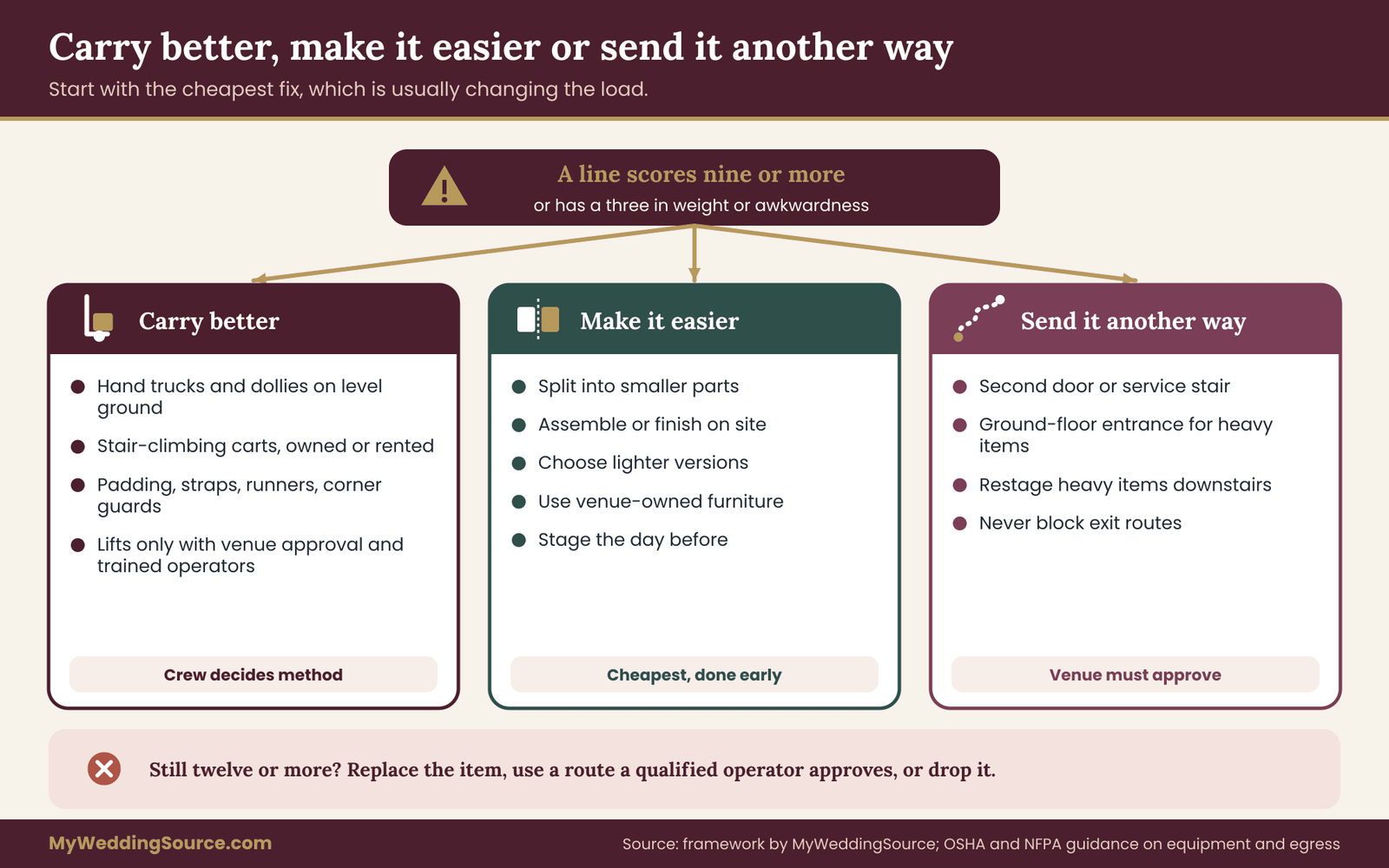
Once the register shows which items are hard, there are three kinds of response: carry them better, make them easier to carry, or send them by a different route. The cheapest answer is usually in the second group, and the most expensive is in the third. Most wedding deliveries use a mix of all three.
Carry them better: equipment that works on stairs
Equipment for wedding deliveries is chosen by the people who carry, and their training and insurance govern what they use. Still, it helps to know what exists, so you can ask sensible questions.
Two-wheel hand trucks and furniture dollies work well on level ground and on short flights when the crew knows the technique. They are not the right choice for very tall stacks or for items that shift. Platform carts move a lot on level surfaces and do poorly on stairs, so they suit the carry from the vehicle to the foot of the stairs and from the top of the stairs to the room, but not the stairs themselves.
Stair-climbing hand trucks and powered stair climbers exist for heavier items. Some crews own them and some rent them. Ask whether the vendor has one before assuming they will rent, and ask whether it is allowed on the venue’s stairs, since some venues restrict tracked or heavy equipment to protect treads.
Straps, padding and covers protect the item, the walls and the stairs. Moving blankets, corner guards and cases are part of any professional crew’s kit. If a vendor shows up without them for a fragile item, ask why.
Temporary ramps can help carts over a few steps or a curb. A ramp is a structure with its own load rating and its own slope limits, and an improvised plank is not a ramp. If a ramp is needed, ask the venue or a qualified equipment provider to supply and approve it. Do not confuse a delivery ramp with an accessible route for guests. The U.S. Access Board sets design standards for the latter.
Lifts and hoists are specialist equipment. A lift-gate truck lowers goods from a truck bed to the pavement, and it does not take them up a floor. Outdoor lifts, material hoists and similar machines need trained operators, may need permits and require the venue’s explicit approval. Powered industrial trucks, such as forklifts, are regulated by the Occupational Safety and Health Administration and need trained operators. If a plan depends on machinery like this, bring in the venue and a qualified provider at the start.
Make them easier: change the load
Changing what has to move is the most reliable response in wedding deliveries, and it costs the least when done early. These are the common versions.
Split the load. For wedding deliveries, ask vendors to break large items into parts that the route can handle. Arches built in sections, dance floors delivered as smaller panels, drum kits and speaker stacks moved in more, lighter cases, and centerpieces carried in crates and placed on site all reduce the peak weight and the awkward dimension at the cost of more trips and some assembly.
Assemble on site. A cake delivered in tiers, a floral installation finished in the room and furniture with removable legs all trade stair difficulty for a bit more time at the destination. This is a good trade when the destination has space and time and a poor one when the room is full of guests.
Carry light, finish heavy. Flowers can travel dry and be hydrated upstairs. Glassware can travel in smaller crates. Drinks can come in cans or smaller containers. A bar vendor can use a smaller ice plan and a freezer at the venue. The aim is to reduce the weight that must climb, not the quality of what the guests see.
Choose lighter equipment. Rental companies offer chairs and tables in different weights. A lighter chair or a table with a lighter top changes the score for the biggest line in the register. This is a design choice as much as a logistics one, and it is easiest before the order is placed.
Use what the venue already has. Many venues own tables, chairs, glassware, linens or a sound system. Using them removes the entire carry for those items. Ask what is included, in what condition, and whether the quantities and styles match what you need.
Reduce the quantity. Some items are not worth their stair time. A second lounge set, an additional signage easel and extra décor pieces each add trips. The drop list from the schedule is the place to decide which of them are optional.
Stage the day before. If the venue allows, bring items the day before and leave them in a secure room. This moves stair time out of the busy day. Ask who is responsible for the items overnight, who holds the keys and whether the venue’s insurance or the vendors’ covers them. Do not assume.
Send them another way
Sometimes the better answer for wedding deliveries is a different route. A venue may have a second door, a back stair with easier turns, a ground-floor service corridor, a garage entrance or a side gate that reduces the carry. Ask for these specifically, since venues do not always offer them unless asked.
Another version of this answer is restaging wedding deliveries. Put the heaviest items on the lowest floor. A bar with kegs can sit at ground level during the cocktail hour. A dance floor can go in a ground-floor room if the venue has one. A ceremony can happen below and a reception above, if the stair is the same for guests, though that creates its own flow questions. Restaging can change the feeling of the day, so it is a design decision as much as a logistics one.
Protect the building
Venues care about their floors, stairs and walls, and rightly so. Wedding deliveries put all three at risk. Ask what protection they require and supply it consistently. Floor runners and plywood sheets protect surfaces, and corner guards protect stairs and walls. Any protection that is laid down needs to be secured so that it does not become a trip hazard, and it should never block an exit, stair or door that must stay clear.
That last point matters more than it sounds. Carts, cases and staged items do not belong on landings or in corridors that serve as exit routes. Fire and building codes govern egress, and the local fire marshal and the venue decide what is allowed. If your staging plan puts equipment where people might need to escape, change the plan. The National Fire Protection Association publishes the codes that many jurisdictions adopt, and the venue’s own fire safety rules, which you should ask for, apply on top of them.
Keeping guests, staff and wedding deliveries apart
A route for wedding deliveries and a guest route are often the same staircase. That fact deserves its own plan, because it creates two kinds of risk at once: guests meeting carts, and equipment blocking people who need the route most.
Separate them by time
The simplest separation is time. The stairs cutoff described earlier is the main tool. Before the cutoff, the route belongs to wedding deliveries, and the wedding party, photographers and guests are directed elsewhere or told to wait. After it, the route belongs to people, and deliveries pause or use another door. A sign at the foot of the stairs, a person at the door and a published schedule keep wedding deliveries and guests apart.
The cutoff also covers return trips. A caterer’s crew may need to carry during dinner, and a band may need to move cases during the reception. Agree on the times and the route, and put a person in charge of the stairs when guests are present. Carts and guests in formal shoes should not share a landing.
Separate them by route
If the venue has a second door, a staff stair or a service corridor, use it for wedding deliveries and keep the main stair for guests. Mark each route with plain signs. If there is only one stair, be explicit about which side of it carts use, and whether guests use the same side. A short conversation with the venue about the width and the handrails usually produces a workable rule.
Protect guests who cannot use stairs
Guests who use wheelchairs, walkers or canes, older relatives and anyone with a temporary injury depend on the elevator, ramp or step-free route that the building offers. If the only elevator is a passenger elevator, wedding deliveries compete with those guests for it. The fix is to reserve the elevator for guests during arrival and any other times they need it, and to keep vendors off it during those windows.
Accessibility in event venues is a bigger topic than wedding deliveries. The Americans with Disabilities Act sets requirements for places of public accommodation, and the U.S. Access Board publishes the technical standards for accessible routes, including ramps and elevators. Questions about what a particular building must provide go to the venue and to those official sources. Our guide to accessible wedding venue red flags explains what to look for when you choose a venue, and a venue with a difficult stair for guests is likely to have the same stair for vendors.
If a venue has no step-free route at all, that is not a delivery problem. It is a guest-access problem, and it deserves a decision on its own before a plan for wedding deliveries is worth writing.
Keep the vehicle area clear
Wedding deliveries create a working area at the drop-off point, with vehicles, carts and crews. Guests should not walk through it. Ask the venue where guests park and arrive, and whether the vendor drop-off is separate. If they overlap, agree on the times when the vendor area is closed, and put a person at the point who can redirect.
The room flip and the dinner service
Two moments mix guests and carrying more than others. The first is the room flip, when a ceremony space becomes a reception space and chairs, arch pieces and signs move while guests are at cocktails. The second is dinner service, when staff carry food and clear plates along the route guests also use.
Plan both on the schedule. Who flips the room, how many people, which route, what is moved and what is left. Who carries food and where it enters. Ask the caterer how they intend to move through the guest area and whether staff routes are separate. These are small details that decide whether the day feels smooth to guests who never see a cart.
Tell the wedding party and family what to expect
The wedding party, hair and makeup artists and family members often arrive early, in parallel with wedding deliveries, with luggage, garment bags and gifts. They also use the stairs. Give them a short note with the arrival time, the entrance to use and the fact that carts may be in use. Ask them to leave heavy bags to the people who are assigned to carry them. A few lines in a group message are enough, and they prevent the most common friction on the day: a relative, kindly and without asking, trying to help with something that is too heavy.
A worked example: a third-floor loft, one passenger elevator and a flight of stairs
The example below is invented to show the tools working together on wedding deliveries. The couple, the venue and the numbers are made up, and the dimensions are illustrations, not typical figures. Use your own venue’s facts.
Nia and Tomas are planning a wedding for eighty-five guests in a converted textile mill. The event space is a loft on the third floor. The building has a passenger elevator and a main staircase, and no freight elevator. Vehicles stop at a loading apron at street level, a short level carry from the door.
What the venue said
Nia sent the seven questions about wedding deliveries and got replies from the site manager within a few days. The elevator cab is about five feet square inside, with a door three feet wide. The venue allows vendors to use it only with a staff escort, and only until three in the afternoon, so that guests who need it can use it from then on. The elevator is rated for a modest load that the site manager gave in writing, and items must stand on a cart and fit with the door closed.
The staircase has two flights with a landing between them. It is wide enough for one team at a time and has a turn at the landing. The venue requires a certificate of insurance from every vendor, allows vendors to carry their own equipment and asks for floor runners on the stairs and in the corridor. Access opens at eight in the morning. Load-out must be finished by one in the morning.
During the walkthrough Nia and Tomas did the timed test carry with a stack of folding chairs. From the apron to the loft by elevator, with the escort, took a few minutes each way. By stairs it took longer, and the turn at the landing caught the stack on the way up. They photographed that corner.
The first pass of the register
They listed the items and scored them with the five factors. Scores below are weight, awkwardness, stairs, distance and damage cost, in that order.
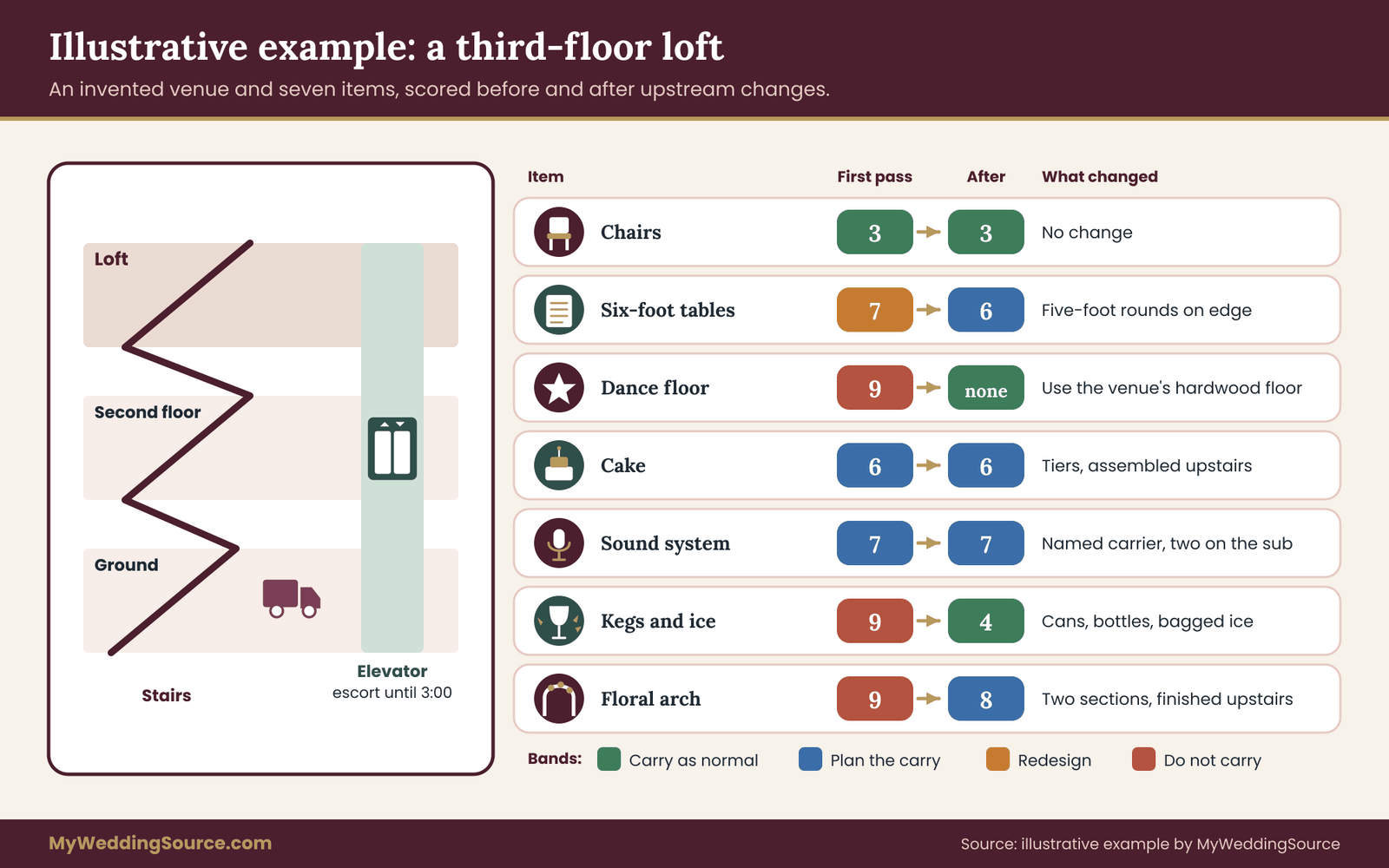
Folding chairs. Light stacks that fit the cart and the elevator. Scores of one, one, zero, one and zero total three. Carried as normal.
Six-foot banquet tables. The tables are longer than the cab is deep, so they must stand on edge on a cart and tilt through the door. Scores of two, three, zero, one and one total seven. The awkwardness score of three raises the band by one, so the tables land in the redesign band.
Dance floor panels. The rental company’s panels are heavy and the stack exceeds the elevator’s rating, so they would go by stairs. Scores of three, two, two, one and one total nine, and the weight score of three raises the band again. Do not carry as designed.
Three-tier cake. Compact but fragile. Scores of one, one, zero, one and three total six. The damage score of three requires a named carrier.
DJ sound system. Two speakers, a subwoofer and cases. Scores of two, one, zero, one and three total seven. A named carrier applies here too.
Two kegs and ice. Full kegs are heavy and would need the stairs because of the elevator’s rating. Scores of three, one, two, two and one total nine. The weight score raises the band. Do not carry as designed.
Floral arch. A seven-foot frame that will not stand upright in the cab. Scores of one, three, two, one and two total nine. The awkwardness score raises the band.
What they changed
Four lines needed changes. The tables sat in the redesign band, and the dance floor, the kegs and the arch had been pushed into the do-not-carry band. The register pointed at the cheapest fix for each.
The dance floor was the easiest. The loft has a hardwood floor in good condition, and the venue was happy for guests to dance on it. Nia and Tomas dropped the rental. That line left the register, and so did the carry, the cost and the risk.
The kegs were next. The bar vendor agreed to serve canned and bottled beer from tubs, with ice delivered by elevator in smaller bags, and to bring a cooler to the loft. Weight dropped to two for the ice and the line fell to four, in the carry-as-normal band.
The florist offered to build the arch in two sections that fit the stairs and be finished in the room. The awkwardness score fell from three to two, which cleared the escalation. The total dropped to eight, so the arch is carried with a plan, using the stairs with two carriers and a spotter at the landing.
The tables took a conversation with the rental company. Instead of six-foot rectangles, they chose five-foot rounds whose tops can stand on edge on a cart and fit the cab. Awkwardness dropped to two and the total to six.
The cake and the sound system stayed in the plan band with named carriers. The baker agreed to deliver in tiers and assemble in the loft, and the DJ named the person who would carry the subwoofer with a second person.
The staffing plan
From the register, each vendor received a one-page sheet. Rentals would bring four people and deliver to the room. The florist would bring three, with two carrying the arch sections and a spotter at the turn. The bar vendor would bring two. The sound crew would bring two and a spotter. The baker would bring two, one of them the named carrier. The venue would assign its staff member to escort the elevator and act as route keeper until the stairs cutoff. Friends and family were asked to carry only programs, favors and signs.
The schedule
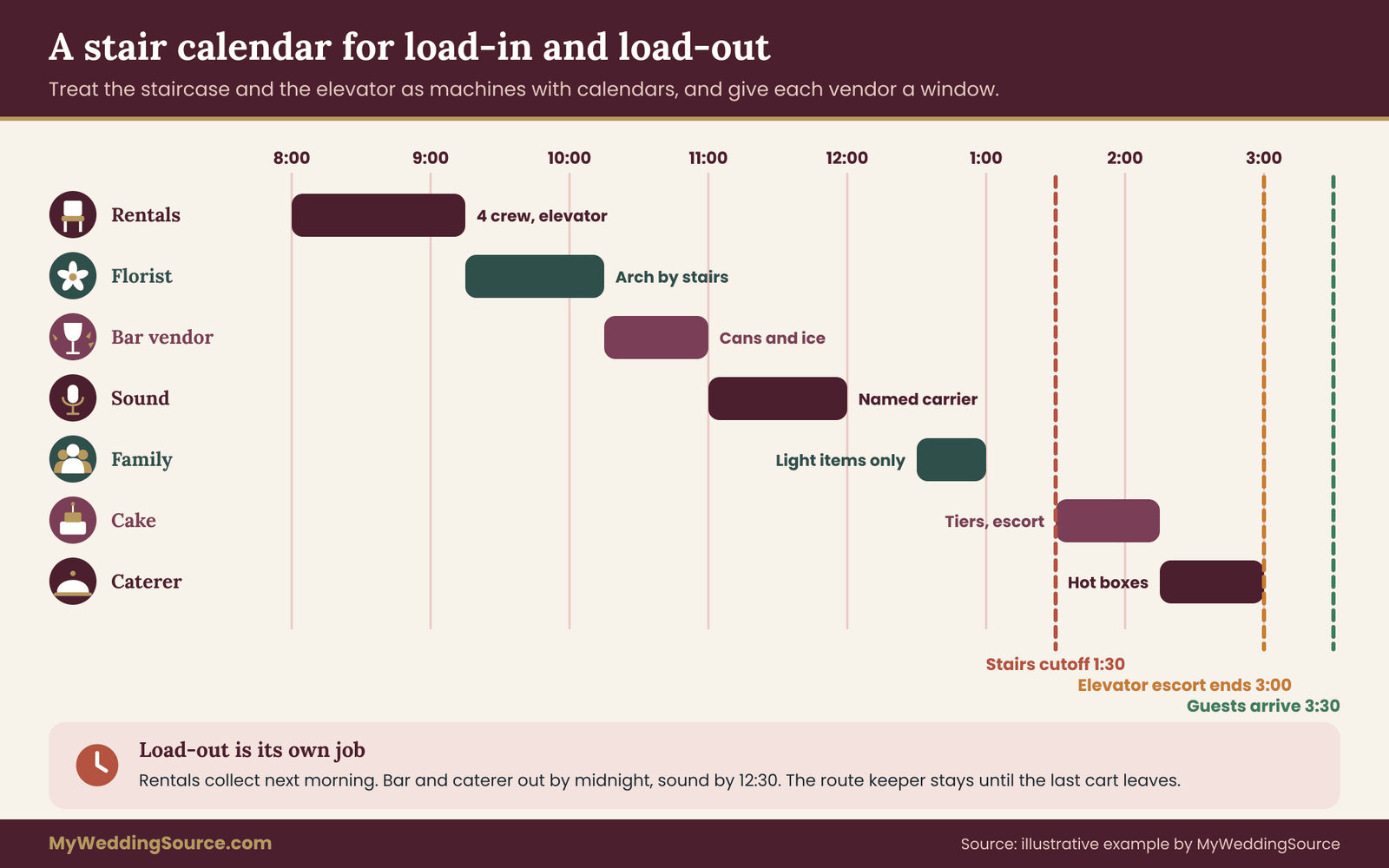
Counting back from guest arrival at three-thirty, they set the stairs cutoff at one-thirty and the elevator escort until three, leaving the elevator free for guests from a quarter past.
Rentals were first, from eight to nine-fifteen, using the elevator. The florist followed until ten-fifteen, with the arch on the stairs while the rentals crew was already inside. The bar vendor took the elevator for cans and ice until eleven, and the sound crew followed until noon, with a sound check afterward. Family carried light décor and signs between twelve-thirty and one. The stairs closed at one-thirty. The baker delivered the tiers at one-thirty, and the caterer’s hot boxes arrived at two-fifteen.
The drop list held two items: a small lounge set and an extra easel. If any window ran more than twenty minutes late, the planner would call the couple and drop the lounge set first.
For load-out, rentals agreed to collect the next morning, so tables and chairs stayed stacked at the back of the loft. The bar and the caterer loaded out by midnight, the sound crew by half past midnight. The route keeper stayed until the last cart left.
The cost logic
The couple did not invent a cost figure for wedding deliveries and neither should you. They asked each vendor to state crew size and hours for load-in and load-out. For the rental company, the difference between delivering to the curb and delivering to the room was four people for about an hour and a quarter, which is five labor hours. If Nia and Tomas had hired labor themselves, the comparison would have been five hours times the provider’s quoted rate plus any minimum. The room-delivery option turned out to be simpler and was the one they signed.
What the example shows
Three lessons about wedding deliveries carry over to other venues. The register worked because it was filled in item by item, not vendor by vendor, which found the arch and the tables. The cheapest fixes were upstream, since dropping the dance floor and changing the table type cost a conversation each. And the schedule used the elevator and the stairs as two separate machines with their own calendars, which let two vendors work at the same time without meeting.
Variations that change the plan
The loft is one kind of venue without a freight elevator, and wedding deliveries differ elsewhere. A few others deserve a short note, because the same register behaves differently.
A basement or lower-level room. The carry goes down, and load-out goes up. Carrying heavy items uphill at the end of the night is the hard part. Ask about water, drainage and slippery steps, and plan load-out as seriously as load-in.
A hillside garden or a venue with a long outdoor path. For wedding deliveries, distance, surface and light matter more than stairs. Ask whether carts can use the path, whether it is lit and what happens in rain. Wheeled equipment that works on pavement often fails on gravel or lawn. A staged delivery with a smaller vehicle shuttling from the gate may be needed, which the venue must approve.
A historic house with a narrow staircase. The building may have protected finishes, tight turns and floors with limits on load. Ask what protection is required, whether any items are banned and who inspects the route. The venue’s caretakers usually know exactly what has damaged the house before, and they are worth listening to.
A rooftop terrace. Elevators and stairs may serve other tenants, and building management may add rules. Wind affects arches, signs and lightweight décor, and weather may close the roof at short notice. Ask who decides about weather and what the indoor fallback is, since a fallback moves the whole delivery route.
A shared or occasionally available freight elevator. If a freight elevator exists but you cannot count on it, plan as if it did not, and treat its use as a bonus. If it is available, the register scores drop, but the schedule becomes a calendar for one more machine.
In each case the method for wedding deliveries is the same. Collect the route facts, score the items, change what can be changed upstream, assign people and set a clock.
Putting the plan in writing
A plan for wedding deliveries that lives in your head, or in a friendly conversation, will not survive the first surprise. The final step is to move every decision about wedding deliveries into documents that the venue and the vendors have seen and accepted. This takes a few evenings and prevents most of the disputes that follow a hard load-in.
What the venue should confirm
After the walkthrough, send the venue a short email that restates what you learned about wedding deliveries, in numbered points, and ask them to reply that it is correct. Include the drop-off point, the elevator rules and hours, the number of flights and steps, who may carry, the insurance requirement and its deadline, the access and load-out windows, the protection required, and the escort or route keeper the venue will provide. Include the fees, if any, with the amounts the venue states.
If you have not yet measured the rooms and doors yourself, the site survey in our technical walkthrough guide is the place to start. If the venue’s contract says nothing about these points, ask that they be added or attached. If the venue prefers a separate vendor information sheet, ask for that and keep it with the contract. The wedding vendor contract guide explains how to read the clauses that matter, and it is worth reading the venue’s section on vendor rules and damage before you sign.
What each vendor contract should say
Vendor contracts for wedding deliveries should name the delivery location in specific terms. “Delivery to the third-floor loft” is a different promise from “delivery to the curb,” and the difference is the whole stair carry. Ask each vendor to state in the contract or in a confirming email the following.
The place of delivery and setup. The crew size for load-in and load-out and the arrival and departure windows. Any stair, floor or distance charge, with the amount. The equipment they will use and the route protection they will bring. The names of the people responsible for items that scored high on the register. The responsibility for damage to the vendor’s goods and to the building. And the certificate of insurance and the date it will reach the venue.
Do not ask the vendor to commit to a particular lifting method. Ask them to commit to the outcome and to tell you if the route does not work for them. Their safety practices belong to them.
Describing the route in words
Vendors who have never seen the venue need a short route description for their wedding deliveries. Write it as a sequence a stranger could follow. “Vehicles stop at the loading apron on the north side. From the apron, enter through the steel door marked service. The passenger elevator is on the left and serves all floors. The stair is straight ahead, two flights with a landing and a left turn. The event room is at the top of the stair on the right.” Add the three or four photographs from your test carry. A page like this answers a dozen questions before they are asked.
A message to a vendor that asks for specifics
Something like this fits most vendors, with the details adjusted.
“The venue has no freight elevator. Vehicles stop at street level, and the event room is up one flight of stairs with a turn at the landing. A passenger elevator is available with a staff escort until three. Could you tell us the weight of your heaviest piece as it will be carried, how many people you plan to bring for load-in and load-out, and whether your quote includes delivery to the room? We would also like to know if any item would be easier to deliver in parts.”
The message does not tell the vendor what to do. It gives facts and asks for theirs. Most professional vendors answer it with enthusiasm, because they would rather solve the problem in writing than at the door.
Keeping the register current
The register for wedding deliveries is not a one-time exercise. Quantities change when the guest count changes. A vendor swap changes the lines. A revised rental order changes the weights. Review it whenever a significant order changes, and certainly at the time of the final headcount. Send updated staffing sheets to any vendor whose lines have changed, and ask them to confirm that they have received them. Decide in advance when each confirmation should go out, and put those dates in your vendor timeline.
A week before the wedding, hold a short call or exchange of messages with each high-score vendor to confirm the sheet. Confirm the venue contact is on site, the elevator escort is booked, the route protection is available and the schedule is the same one everyone has.
Day-of rules and common mistakes
On the day, the plan for wedding deliveries is only as good as the person in charge of it. That person should be able to say stop, and everyone should know who they are.
Start by walking the route
Before the first vendor arrives, walk the route from the vehicle area to the room with the venue contact. Check that the elevator works and that its escort is there. Check that the stairs are clear, dry and lit. Confirm the floor protection is down and secured. Take a few photographs of the route’s condition, including any pre-existing marks or damage. These photographs, with a time, are the simplest record if a question about damage comes up later, and they are usually welcomed by the venue.
Confirm that the printed schedule and the staffing sheets are in the hands of the route keeper, and that the vendor leads have each other’s phone numbers.
Who can say stop
Any person on the carry, whether carrier, spotter or route keeper, can stop a carry that looks wrong. The planner or day-of lead decides what happens next. Reasons to stop include wet or icy stairs, a blocked route, an item that does not fit as planned, a carrier who is struggling or hurt, and a crowd of guests in the wrong place. Stopping costs a few minutes. A fall costs far more.
Tell vendors at the start that they have this permission. Many crews feel pressure to keep going because a client is nearby and a clock is running. A calm sentence from the client removes that pressure: “If anything looks unsafe, stop and tell the planner. The schedule can move.”
If something goes wrong
If someone is injured, get first aid and, where appropriate, emergency services before anything else. The vendor handles their own employee’s report. The venue handles any building incident. Your role is to note what happened and the time, and to keep the route closed until the venue says otherwise.
If an item is damaged, photograph it, note which vendor owns it and who was carrying, and move on with the day. The conversation about responsibility belongs to the following week, with the contract in hand. This is another reason the contract should say who is responsible for damage.
Common mistakes
A few errors appear again and again in wedding deliveries to difficult venues.
Asking only the sales contact. The sales manager knows the event rates and the layout. The site manager knows the stairs. Ask the person who runs the building.
Accepting “it’s fine” as an answer. Ask for the number or the rule behind it, and ask for it in writing.
Scoring only weight. Awkward shapes, fragile items and long carries cause as many problems as heavy ones. The five factors exist for that reason.
Ignoring load-out. In wedding deliveries, the end of the night is harder than the start, and almost no one prices it.
Forgetting the wedding party’s own luggage. Garment bags, makeup cases and gifts use the same stairs at the same time.
Letting willing volunteers carry vendor equipment. It looks generous and is usually a poor idea.
Assuming a shared freight elevator will be free. Anything shared can be taken by someone else on the day.
Overloading a passenger elevator. The rating exists for a reason, and the venue’s rule on escorts exists for the same one.
Blocking exits with staged items. Landings and corridors are exit routes first and storage never.
Not telling the vendors. A well-built register that stays with the couple helps no one. Send the sheets.
Skipping the photographs. Before and after images of the route settle disagreements that memory cannot.
Your next steps
If you are still choosing a venue, send the seven questions to every venue on your shortlist and compare the answers side by side. A venue that answers clearly and in writing is already giving you a preview of how wedding deliveries will run. The wedding venues guide covers the wider comparison of venue types, rules and costs.
If you have signed, take these steps in order.
- Send the seven questions to the venue’s site manager and ask for written replies.
- Visit, do the timed test carry and photograph every tight spot.
- Build the register, one line per item, and score each line with the five factors.
- Change what can be changed upstream: split loads, lighter equipment, venue-owned furniture, a different route.
- Send each vendor a one-page staffing sheet and ask them to confirm crew size, hours and stair charges in writing.
- Set the stair calendar, the stairs cutoff and the drop list, and share them with everyone.
- Ask the venue to confirm the final plan and send certificates of insurance by the deadline.
- Hold a short confirmation call with high-score vendors the week before.
FAQ
Is a venue without a freight elevator a dealbreaker for a wedding?
No. Many good venues are upstairs, historic or hillside and have no freight elevator, so wedding deliveries there are common. The question is whether the route can be handled with a realistic crew and schedule, and whether the cost is acceptable once it is known. Ask the seven questions, build the register and compare the labor hours. If the numbers work and the venue answers in writing, you can plan wedding deliveries there with confidence.
Who pays for the extra labor that stairs require?
It depends on the contract. Some vendors build stair labor into their price, some add a separate charge, and some venues require their own staff or an approved labor provider and bill for it. Ask each vendor to state crew size, hours and any stair or distance charge in writing, and compare on labor hours. A low quote that leaves stairs unmentioned often becomes a higher one at the door.
Can friends and family carry things up the stairs?
For light personal items such as programs, favors, signs and gifts, yes. For vendor equipment, rentals, kegs, speakers, cake or anything that scores five or more on the register, no. Volunteers may lack training, may wear unsuitable clothes and are not covered by a vendor’s insurance. Hand heavy items to the vendors’ crews or to hired labor.
How do I know whether an item will fit in a passenger elevator?
Get the cab’s interior dimensions, the clear door width and height and the weight rating from the venue in writing. Then ask each vendor for the heaviest piece, its longest dimension and whether it can stand on a cart. Measure against the smallest opening, usually the door, not the cab. Ask the venue whether items may ride unaccompanied, because many require an escort.
Should I hire a moving crew or event labor provider?
Consider it for items that scored high on the register and could not be changed, or when vendors will not carry beyond the curb. Check that the venue accepts the provider, that the provider carries its own insurance and that the hours are priced realistically, including load-out. For most weddings, redesigning the heaviest lines first reduces how much outside labor is needed.
How early should I ask the venue about deliveries?
Before you sign. Access facts can change which vendors you hire, what you order and how the day is scheduled, and changes are cheapest at that point. If you have already signed, ask now and visit as soon as you can. Send the seven questions by email, so the answers are in writing, and offer to walk the route with the site manager.
What if the venue only says it will be fine?
Reassurance is not a fact. Ask for the number or rule behind it: the steps, the cab size, the weight rating, who may carry, the hours and the fees. Offer to visit and measure. If the venue cannot or will not provide specifics, treat that as a risk for the day, build extra margin into the schedule and consider whether another venue answers more clearly.
How should I plan load-out at the end of the night?
Treat load-out in wedding deliveries as a separate job with its own crew, time and approvals. Ask vendors to stage their items before the reception ends, agree when rentals will be collected and whether items may stay overnight, and confirm the venue’s access cutoff and any overtime cost. Keep a route keeper on site until the last cart leaves, and set a stairs closing time for tired crews.
Sources
- Introduction to the ADA: Title III, public accommodations and commercial facilities, ADA.gov
- Americans with Disabilities Act standards and guidelines, U.S. Access Board
- ADA Standards for Accessible Design, Chapter 4: Accessible Routes, U.S. Access Board
- A Planning Guide for Making Temporary Events Accessible to People with Disabilities, ADA National Network
- Ergonomics, Occupational Safety and Health Administration
- Walking-working surfaces, Occupational Safety and Health Administration
- Powered industrial trucks, Occupational Safety and Health Administration
- Ergonomics and musculoskeletal disorders, National Institute for Occupational Safety and Health
- Codes and standards, National Fire Protection Association
- Assembly occupancy guideline, Fairfax County Fire Marshal