

Destination wedding guest costs are rarely one big bill; they are a dozen smaller ones, from the flight and the room to the extra dinner and the gift, and the total is easier to manage when you price each piece before you answer the invitation.
Quick answer
Plan on six categories of destination wedding guest costs: transportation, lodging, local transfers and meals, events and extras, attire, and a gift. Add a buffer of about 10 percent for fees you cannot see yet, then compare the total with an amount you could spend without borrowing. The Knot’s October 2024 Guest Study found that guests who flew spent about $1,680 on average and guests who drove about $840, and our own three illustrative trips below range from roughly $910 to $3,965 once a buffer is added. Guests generally pay their own way, so the total is yours to price and yours to decide on.
What destination wedding guest costs include
A destination wedding is generally a ceremony, a reception, or both held away from the couple’s hometown, so most or all of the guests have to travel. That single fact turns a one-evening commitment into a trip, and a trip has a bill that a local wedding does not. Before you can judge whether a particular invitation fits your budget, it helps to know what belongs in the bill and what does not.
The six categories that make up the bill
Every one of the destination wedding guest costs lands in one of six places. Naming them in advance keeps the cheap-looking items from hiding the expensive ones, and it gives you a worksheet that works for a weekend drive and for a week overseas alike.
Transportation and local transfers
Transportation is the way you reach the destination: a tank of fuel and tolls for a drive, a ticket for a flight, or a flight plus a train or ferry. Local transfers cover the last stretch, such as an airport shuttle, a rental car, rideshares, or a taxi to the ceremony site. Guests tend to price the flight and forget the ground legs, which is how destination wedding guest costs creep past a plan that looked affordable on a fare alert. When you build your list, give the airport transfer its own line and note whether the couple has arranged a group shuttle.
Lodging, meals, and events
Lodging is usually the largest single line because it multiplies by the number of nights. Meals are the food and drink the couple is not hosting, which at most weddings includes breakfast, lunch, and some dinners. Events and extras are the optional parts that fill a destination weekend: a welcome drinks evening, an excursion, a spa afternoon, a farewell brunch. Some of these are hosted by the couple and some are pay-your-own-way, and the invitation or wedding website should say which is which. If it does not, asking early is reasonable.
Attire, gift, and time away from work
Attire for a destination wedding can be a new outfit, a rental, or something you already own that suits the setting and the dress code. The gift is a separate line, and etiquette sources agree it remains customary even when you traveled, though the size is your choice. Time away from work is the cost that rarely appears in a spreadsheet: unpaid leave, vacation days spent on someone else’s weekend, or childcare and pet care while you are gone. We keep it outside the totals in our examples, because it depends on your job, and we return to it below.
What is not included in the bill
A budget is only useful if it has edges. Two kinds of spending commonly get blurred into destination wedding guest costs even though they belong somewhere else, and separating them makes your total honest.
Costs the couple hosts
At a typical destination wedding, the couple hosts the reception and the rehearsal dinner. According to The Knot’s guidance on who pays at destination weddings, couples may also choose to host a welcome party, a morning-after brunch, certain group activities, or airport shuttles, though they are not expected to pay for everyone. Anything the couple hosts should not be counted among your destination wedding guest costs. Read the invitation, the wedding website, and any itinerary for the words “hosted,” “included,” and “optional,” and mark each item before you add it up.
Costs of a vacation you would take anyway
If you would be happy to spend a week at the same beach or in the same city regardless of the wedding, part of the trip is a holiday you chose, not a cost the wedding imposed. It is fair to count only the added cost of attending, such as the extra flight leg or the nights you would not otherwise have booked, when you decide whether the destination wedding guest costs are affordable. We suggest that you do this honestly: a vacation you only take because of the wedding belongs fully in the wedding column.
What the surveys say, and what they leave out
Published numbers can anchor your expectations of destination wedding guest costs, but each has a sample, a date, and a definition that limit what it can tell you. Reading them carefully keeps you from treating an average of destination wedding guest costs as a quote.
The Knot Guest Study figures
The Knot’s Guest Study is the most widely cited source for what attending a wedding costs. It is useful because it separates guests by how they traveled, which is the variable that matters most for destination weddings.
Averages by how guests traveled
The Knot reports that the average wedding cost guests about $610, up about $30 from the prior year, with rising lodging costs and more guests booking two-night stays driving most of the increase. By travel scenario, guests who stayed local averaged about $270, guests who drove about $840, and guests who flew about $1,680. The survey covered 1,000 U.S. adults ages 18 to 54, fielded in October 2024, and every respondent had attended at least one wedding in person in 2024. Those figures describe weddings of every kind, so they set a floor for destination wedding guest costs more than a forecast.
What guests said about lodging, gifts, and attire
The same study found that 65 percent of respondents paid for accommodations. Among them, 54 percent stayed in a hotel, 19 percent booked a vacation rental, and 9 percent chose a bed-and-breakfast or inn, and 79 percent said price was the biggest factor in choosing. The average gift was about $150, with about $160 from close friends, family, and wedding party members, about $140 from casual friends, and about $120 from dates or plus-ones. Six percent gave no gift and 25 percent joined a group gift. Forty-six percent said the economy had pushed them to cut spending on attire.
What the destination data says
Surveys of couples tell a different story from surveys of guests, but they explain why destination wedding guest costs look the way they do.
How common destination weddings are
The Knot’s definition piece reports that in 2024, 18 percent of couples hosted a destination wedding, and only 14 percent of those were in another country. It calls the domestic version a “domestination,” and notes that about a third of couples (34 percent) flew to their location, which means many of their guests did as well. Destination weddings usually invite fewer people. The practical lesson for a guest is that the typical invitation is more likely to involve a domestic flight and a few hotel nights than a passport and a week abroad, although both exist.
What the couple’s budget implies for guests
The Knot’s 2025 figures put the average destination wedding at about $39,000, with domestic and international averages of about $39,000 and $41,000 and a hometown wedding at about $32,000. The same article notes that guests usually pay their own travel, that all-inclusive resorts can lower guest costs because room, meals, an open bar, and group activities are often included, and that peak-season travel can raise them. Those are the couple’s averages, not yours, but they confirm the direction of the effect: the venue and the package shape the guest bill as much as the guest’s own choices do. Our guide to the average wedding cost covers how to read the couple’s side.
Why averages are only a starting point
Any average of destination wedding guest costs blends cheap and expensive trips. Knowing why yours might differ from it matters more than the average itself.
Definitions and sample limits
The Guest Study counts adults ages 18 to 54 who attended an in-person wedding in 2024, so it leaves out older guests and anyone who declined because of cost. Averages across all weddings include the local ceremony ten minutes from home. We also did not find a published average that isolates the cost to a guest of a destination wedding alone, and we are not going to invent one. Where we offer figures for destination wedding guest costs, they are our own arithmetic from stated assumptions, and we label them that way.
Why your total will differ
Your destination wedding guest costs depend on your home airport, the season, the length of the stay, whether you share a room, and how much of the weekend you join. A guest living near a hub airport and sharing a rental house with friends can spend far less than the flying average. A guest flying out of a small regional airport during a peak week can spend far more. Use the surveys to check that your estimate is not wildly out of range, then rely on real prices for your actual dates.
Building your own destination wedding guest costs worksheet, line by line
The most reliable way to understand destination wedding guest costs is to price each category with real quotes for your dates. The sections below explain how to do that without double-counting or leaving out the pieces that tend to surprise people.
Transportation: the flight and everything around it
The flight is the line guests think about first, and the one with the most variation. It is worth pricing as a complete journey and not only as a fare.
Use a benchmark, then search your real dates
The Bureau of Transportation Statistics publishes average domestic itinerary fares. For the second quarter of 2026, its page lists a national average of about $445, with city examples ranging from roughly $348 for Las Vegas to $527 for Detroit by origin. Two details matter. The figures include one-way tickets as well as round trips, so a true round trip from your airport can cost more than the number suggests. They also include taxes and fees collected at purchase but exclude baggage fees paid later. Use the benchmark to sanity-check a search result, then trust the search for your dates.
Add the fees fare alerts do not show
Budget for a checked bag if you need one, a seat assignment, a rental car, parking at your home airport, and a ground transfer at the other end. If you are driving, count fuel, tolls, parking at the hotel, and the wear on your car, and decide whether to split fuel with a passenger. If the journey includes a train or ferry, price the connecting leg separately. A short checklist of these extras takes ten minutes to build and often adds a few hundred dollars to a flight-based trip.
Lodging: usually the largest line
Lodging multiplies by nights, so it is the line among destination wedding guest costs where the shape of your stay does the most work. It is also where sharing and timing can change the total the most.
Room block, public rate, or a shared rental
A room block is a group of rooms the couple reserves at a negotiated rate, and it is a common courtesy: Emily Post notes that couples can help guests by reserving a block of hotel rooms, which may secure discounted rates. Whether the block is actually the cheapest option is a separate question, so compare it with the hotel’s public price for the same dates, with nearby alternatives, and with a rental house if several guests want to share. The Knot’s Guest Study found that 19 percent of guests who paid for lodging booked a vacation rental, so it is a common choice, not an exotic one.
What taxes, resort fees, and cleaning charges do to the quote
The headline nightly rate is rarely the final price. Hotels add taxes and sometimes a mandatory daily fee, and rentals add cleaning charges and service fees. In our illustrations we add 15 percent to the room rate as a placeholder for taxes and fees; that is our assumption, and local rates vary, so replace it with the actual figure at checkout. Ask whether the fee is charged per room or per guest, per night or per stay, and whether it is included in the displayed total.

The picture above shows why the sharing decision matters. Using a placeholder room at $250 a night for four nights, plus 15 percent in fees, a solo guest pays about $1,150, and two guests splitting the room pay about $575 each. A rental house at a placeholder $2,100 for the same four nights costs $525 per person with four sharing and $350 with six. These are our own illustrative numbers, not market prices, and sharing is only a saving if you are comfortable with the arrangement.
Meals, events, and extras
After lodging and travel, the next group of destination wedding guest costs is the food and activity spending that fills the free hours around the wedding itself.
Food and drink the couple is not hosting
Count the meals that no one has told you are included. At a resort, breakfast may be part of the room rate or may not; at a city venue, you will likely buy most of your own meals except the reception. A rough way to estimate is to multiply a per-day food and drink figure by the number of days, then subtract the meals the couple has said they are hosting. In our illustrations we use $60 a day for the drive-in weekend, $75 for the domestic trip, and $45 for the resort stay (where more is included). Those are placeholders for you to replace with your own habits.
Optional events and activities
Welcome parties, group excursions, and farewell brunches are often optional, and each has a price or a time commitment. It is reasonable to pick the events that matter to you and skip the rest, and a thoughtful couple will make that easy by labeling each event as hosted or optional. If a group activity has a fee, ask what is included, whether there is a cancellation policy, and whether it needs to be paid before the trip.
Attire, grooming, and the gift
These are the costs that feel smallest, but together they can equal a night of hotel.
Dress code and what you already own
A destination wedding’s dress code depends on the setting and the time of day, and the invitation or website usually states it. A beach ceremony, a vineyard, and a formal hotel ballroom call for different clothes, so check the code before you buy. Our wedding guest dress code guide explains the common categories. Rewearing something you own, borrowing, or renting can cut this line to little or nothing, which is why our drive-in example uses zero while the other two use placeholders of $120 and $180.
Gift size and how to think about it
The Knot’s Guest Study reports an average gift of about $150, and etiquette guidance generally treats a gift as a gesture of goodwill, not an invoice. Many people who travel far feel they have already given a lot of money and time, and some couples explicitly say that attendance is the gift. If you are unsure, our wedding gift etiquette article and the couple’s wedding registry can help you choose an amount that suits your budget. We used $150 in all three examples so the comparison stays fair.
Time away, and costs that do not show on a receipt
Money is not the only thing a destination wedding spends. These items change the true total of destination wedding guest costs even when the receipts add up to something manageable.
Paid leave, unpaid leave, and childcare
A destination wedding usually takes more days than a local one: travel in, the wedding, travel out, and often a day for recovery. If you are paid by the hour or by the shift, unpaid days are a direct loss. As a simple illustration of our own, two unpaid days at $200 a day would add $400 to a trip. If you are salaried, the cost is leave you would otherwise use elsewhere. Add childcare and pet care if you need them, and decide whether your employer’s schedule permits the dates before you accept.
Passports, ID, and paperwork
International trips require a passport, and the State Department notes that some countries require at least six months of validity beyond your travel dates, so check your passport’s expiration early. Renewal by mail is available under certain conditions, and the State Department’s page lists a routine fee of $130 for a passport book, with expedited service costing $60 more. For domestic flights, the TSA says that since May 7, 2025, travelers 18 and older need a REAL ID-compliant license, an enhanced license, or another accepted ID such as a passport. Confirm both before you pay for a nonrefundable ticket.
Three worked trips: what destination wedding guest costs can add up to
To turn the categories into numbers, we built three illustrative trips for a single traveler. Every line is our own placeholder, chosen to be plausible and to show how the pieces interact. None of them is a price quote, a survey average, or a forecast for your wedding.
The assumptions behind the examples
Anyone can make a total look small or large by choosing the inputs. Showing the inputs lets you replace ours with yours.
The inputs we used
The drive-in weekend assumes two nights at $190, $120 for fuel and tolls, $60 a day for meals, no local transfers, no paid extra events, and an outfit you already own. The domestic flight assumes three nights at $230, a $520 flight, $80 for local transfers, $75 a day for meals, $90 for optional events, and $120 for attire. The international resort assumes five nights at $280, a $1,100 flight, $140 for transfers, $45 a day for meals, $200 for events and excursions, and $180 for attire. All three include a $150 gift, 15 percent added to lodging for taxes and fees, and a 10 percent buffer on the subtotal. Our flight placeholder of $520 sits above the BTS national average because the BTS figure includes one-way tickets.
What we left out
We excluded time off, childcare, pet care, a plus-one’s costs, bridal party expenses, and travel insurance, because they depend on circumstances that vary too much to guess. We also left out any discount for sharing a room. If you are bringing a partner, remember that some costs double (flights, attire, a gift is usually shared) while others do not (a shared room). The worksheet in your own notes should include those personal items.
The results
The table lists each line for the three trips. The totals are our arithmetic from the inputs above, and they are rounded to the nearest dollar.
| Line | Drive-in weekend (2 nights) | Domestic flight (3 nights) | International resort (5 nights) |
|---|---|---|---|
| Lodging with 15% taxes and fees | 437 | 794 | 1,610 |
| Transportation | 120 | 520 | 1,100 |
| Local transfers | 0 | 80 | 140 |
| Meals not hosted | 120 | 225 | 225 |
| Events and extras | 0 | 90 | 200 |
| Attire | 0 | 120 | 180 |
| Gift | 150 | 150 | 150 |
| Subtotal | 827 | 1,979 | 3,605 |
| 10% buffer | 83 | 198 | 360 |
| Total with buffer | 910 | 2,177 | 3,965 |
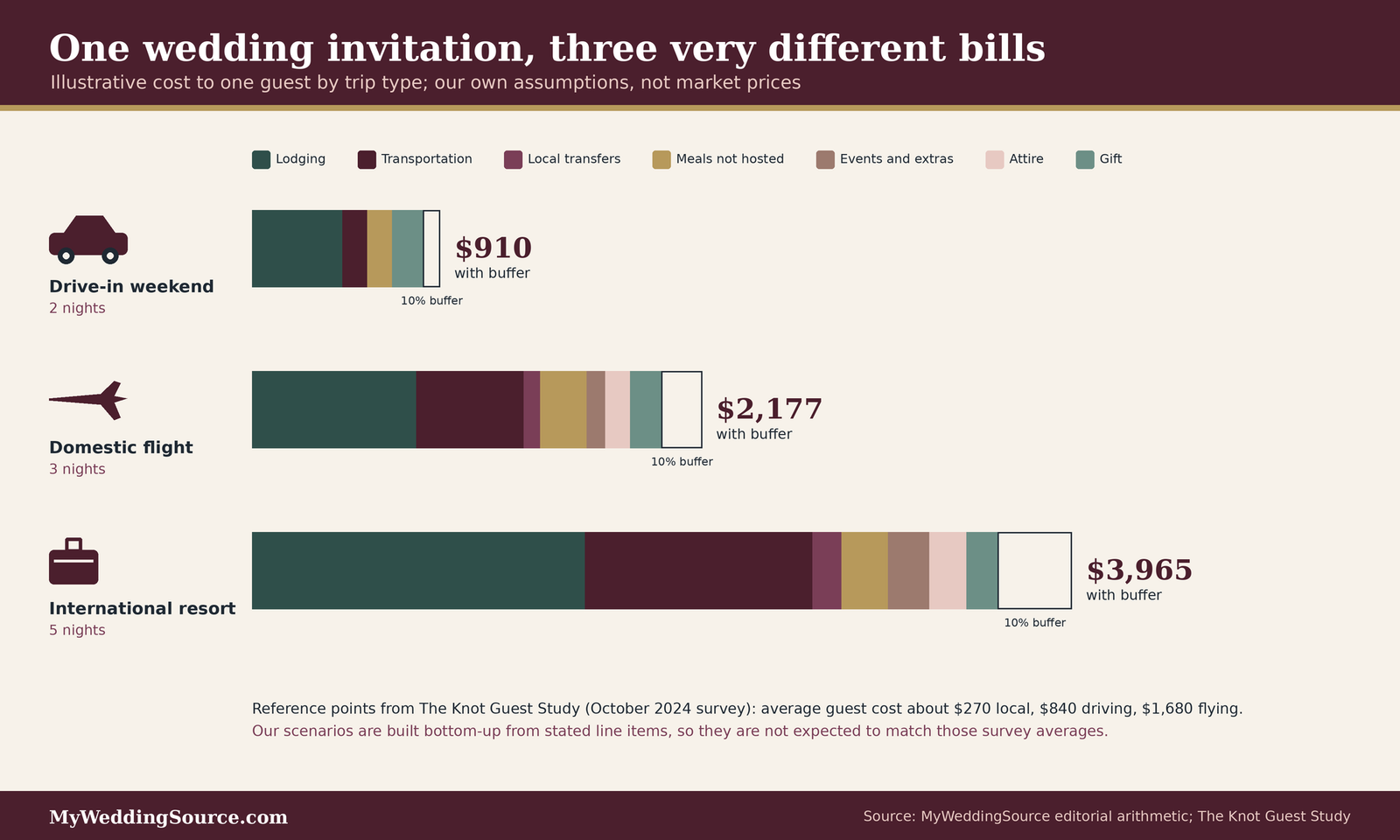
What the pattern shows
In every trip, lodging and transportation together account for more than half of the subtotal: about 67 percent for the drive-in weekend, 66 percent for the domestic flight, and 75 percent for the resort, by our arithmetic. The cheap-looking lines are small individually but add up: meals, events, attire, and the gift together are about $585 of the domestic trip’s $1,979 subtotal, roughly 30 percent. The result is that the two biggest destination wedding guest costs deserve most of your attention, and the small ones deserve a quick check for omissions.
How the examples compare with the surveys
The Knot’s October 2024 averages ($840 for drivers and $1,680 for flyers) cover all weddings, so they are not directly comparable with our trips, which include two to five nights and a fixed gift. Our drive-in total of $910 is close to the driving average, and our domestic and international totals sit above the flying average because they include more nights, ground transfers, and events. That is the pattern you would expect for a multi-day destination weekend, but we would not claim it as a finding. It is a sanity check, not a result.
What this can cost, and where the numbers come from
Survey figures: The Knot Guest Study (October 2024; 1,000 U.S. adults ages 18 to 54) reports about $270 for local guests, $840 for drivers, and $1,680 for flyers, with an average gift of about $150. Government figures: the Bureau of Transportation Statistics lists a second-quarter 2026 national average domestic itinerary fare of about $445, including taxes and fees collected at purchase but excluding baggage fees, and including one-way tickets. Our arithmetic: the three trips above total about $910, $2,177, and $3,965 with a 10 percent buffer. Every input in our trips is a placeholder, so replace each with a real quote before you rely on a total.
Turning an example into your number
The point of the examples is the method for destination wedding guest costs, not the totals. Here is how to convert the method into your own figure in one sitting.
Replace each placeholder with a quote
Open a spreadsheet or a note, list the seven lines, and replace each placeholder with a real price: a fare search for your dates, the hotel’s all-in total, a shuttle fare, a menu price for a typical dinner. Where you do not have a price, keep our placeholder but mark it as an estimate so you know which lines are weak. Our wedding budget calculator is designed for couples, but its line-item approach works for a guest’s trip too.
Choose the buffer on purpose
A buffer is not a pad for spending more. It is a reserve for the costs you cannot see yet: a bag fee, a resort charge, a currency difference, a rebooking. We used 10 percent for simplicity. If you have already paid most of the trip in advance, a smaller buffer is reasonable; if you are traveling abroad and paying in a foreign currency, consider a larger one. The key is to decide before you travel, so a surprise does not become a debt.
Quote traps and refund rules that change destination wedding guest costs
Two guests can see the same advertised price and pay different amounts. The difference is usually in what is included, when it is charged, and what can be undone. This section covers the traps that most often move destination wedding guest costs, and the consumer rules that limit the damage.
Where quotes hide costs
Hidden destination wedding guest costs are not always deceptive; many are simply charged at a different moment than the headline price. Knowing the common ones lets you ask before you pay.
Lodging quotes
Compare the same things across options: nightly rate, taxes, any mandatory daily fee, cleaning or service charges for a rental, parking, and breakfast. Ask whether the displayed price is per room or per person. For a room block, ask what the cutoff date is, whether there is a minimum number of rooms the group must fill, and how cancellations are handled, since those terms can affect you and the couple. Take screenshots of what you saw at booking, and keep your confirmation.
Flight and transfer quotes
A fare may exclude a checked bag, a carry-on on some tickets, seat selection, or a change fee. Ask what the cheapest fare permits. For airport transfers and rental cars, compare a private transfer, a shared shuttle, and rideshare for the distance, and check whether the venue provides a shuttle. If your trip includes a connection, leave enough time that a delay does not strand you for a night at your own expense.
Refunds and protections you can rely on
Even a careful guest sometimes needs to cancel or fix a charge. A few federal rules and consumer resources apply, and knowing their limits is as important as knowing their benefits.
Airline refunds
The Department of Transportation says you are entitled to a refund if an airline cancels your flight and you decline the credit or alternative, and also if the airline significantly changes or delays your flight and you decline the new itinerary. Its examples of significant changes include a departure or arrival three or more hours different on a domestic flight, or six or more hours on an international flight, and a change of airport. For tickets bought at least seven days before departure, airlines must either allow a full refund within 24 hours or hold the reservation for 24 hours at no charge, but the rule does not cover tickets booked through travel agencies. A ticket you simply choose to skip is generally not refundable. Rules change, so confirm on the DOT page before you rely on them.
Card disputes
If a merchant charges your credit card incorrectly, the Federal Trade Commission explains that you can dispute the billing error under the Fair Credit Billing Act. Your written dispute must reach the card issuer within 60 days after the first bill with the error was sent to you, and the issuer is expected to acknowledge it within 30 days and resolve it within 90 days. This covers billing errors, not changes of mind, so it does not turn a nonrefundable booking into a refundable one. Keep receipts and confirmations in one folder from the day you book.
Travel insurance
Travel insurance is optional, and whether it is worthwhile depends on what you have prepaid, what you could absorb, and what is already covered elsewhere.
What it covers and what it excludes
The National Association of Insurance Commissioners describes trip cancellation, interruption, and delay coverage, which reimburses prepaid costs for a covered reason such as illness or severe weather, along with travel medical, medical evacuation, and baggage coverage. It also describes Cancel for Any Reason as an optional add-on that costs more, typically reimburses only part of the trip, and must be bought within a set window after booking. Common exclusions include pre-existing conditions, pandemic-related losses, and civil unrest. Reading the full policy is essential, because each policy defines its own covered reasons. Our honeymoon travel insurance guide goes into the details that apply to any trip.
What it costs and what to check first
The NAIC says policies typically cost about 5 percent to 10 percent of the total trip price, while a Massachusetts consumer-affairs summary of NAIC tips suggests roughly 4 to 8 percent of the nonrefundable trip cost and advises a closer look at a price far below or above about 10 percent. Both advise checking whether your credit card, health plan, or homeowner or renter policy already covers some of the risks, and verifying that the seller is licensed through your state insurance department. As a rough calculation of our own, a 7 percent policy on a $2,000 prepaid trip would cost about $140.
Deciding whether to attend: a framework for destination wedding guest costs
The hardest part of weighing destination wedding guest costs is not the arithmetic. It is the combination of affection, obligation, and a price tag. A short framework can separate the three so you can decide calmly.
Compare the total with what you can afford
Start with your own numbers for destination wedding guest costs, not with the couple’s. The decision is simpler when you know what you can spend without strain.
The three-number check
Write down three figures. The first is your estimated total from the worksheet, including the buffer. The second is the amount you could spend on the trip without borrowing, from savings you have already set aside or from income you can set aside before the payment dates. The third is any credit card balance you would carry if the trip went over. If the first number is larger than the second, the gap is the amount you would be financing, and that is the figure to weigh against how much the wedding means to you. This is a personal budgeting exercise and not financial advice.
Where the money is due and when
Destination wedding guest costs arrive at different times: a flight at booking, a lodging deposit by a cutoff, the balance later, and incidentals during the trip. A trip that fits your finances on the day you book can still strain a month when several balances fall due together. Map the due dates on a calendar. Our wedding planning timeline shows the same approach for couples, and the logic applies to anyone paying in stages.
Weigh the relationship and the alternatives
Affordability is one side of the decision. The other is what attending would mean to you and to them.
How close is the relationship
A sibling, a best friend, or a person who attended your own wedding stands in a different place from a colleague or a distant cousin. A simple test is to ask whether you would take the trip, at your own expense, to see this person even without a wedding. If the answer is clearly yes, the cost may be an investment you are glad to make. If the answer is no, the cost is more likely to feel like a burden, and a warm decline is a reasonable choice.
Options between yes and no
You do not always have to choose between the whole trip and none of it. Some guests attend only the ceremony and reception and skip the surrounding events. Some shorten their stay by a night. Others decline with a note and a gift, a video call on the day, or a plan to celebrate in person after the couple returns. Our wedding etiquette guide and the RSVP etiquette article discuss tone and timing for responding.
How to decline kindly
If destination wedding guest costs do not fit your budget, saying so graciously protects the relationship and spares the couple an uncertain headcount.
Respond promptly and keep it brief
The Knot notes that couples commonly plan on about 20 percent of invited guests declining and that travel distance is one reason to adjust that figure, so a decline is expected and not an offense. Reply by the date on the invitation, thank them for the invitation, say you are sorry you cannot be there, and do not feel obligated to give a detailed financial explanation. A single sentence such as “the travel does not fit our year” is honest and enough.
Say it with warmth
Pair the decline with something specific: a card, a small gift if you wish, an offer to celebrate when they return, or a message on the wedding day. You are not required to send a gift if you do not attend, though many people do. Our RSVP wording guide includes phrasing for the couple’s side of the same exchange.
Ways guests can lower destination wedding guest costs
Once you have decided to go, there are legitimate ways to reduce destination wedding guest costs. None of them requires being rude, and several work best when you start early.
Save on travel and lodging
Travel and lodging are the two biggest destination wedding guest costs, so even modest savings there matter more than clipping small items.
Book flights early and be flexible
Start watching fares as soon as the save-the-date arrives, since the couple’s date and city are usually fixed early. Fare alerts, nearby airports, and flexible arrival days can lower the price, and your arrival day may be earlier or later than the couple’s suggestion if it saves money. Remember the 24-hour refund rule for tickets bought directly from an airline at least seven days before departure, which lets you lock in a fare you like and still change your mind within a day.
Share lodging, and compare against the block
Splitting a room or a rental with a friend or relative can change the lodging line dramatically, as the lodging infographic above shows with our placeholder numbers. Compare the room block with public rates, nearby options, and a shared rental, and keep an eye on cancellation terms. If you stay outside the block, tell the couple so they can track their commitments accurately, and be aware that some couples have attrition clauses they hope to meet.
Save on the rest of the trip
Smaller destination wedding guest costs add up, and a few habits keep them in check without making the trip less enjoyable.
Meals, activities, and ground transport
Eat one meal a day somewhere simple, use a grocery stop for breakfasts if you have a kitchen, and choose the optional events that mean the most to you. Share a rental car or a transfer with other guests, and ask the couple whether a group shuttle is planned before you book your own. If a resort package is all-inclusive, read what is included and what is an upcharge, since premium items are often extra.
Attire and extras
Wear something you own, borrow from a friend, or rent. Our wedding guest dress code article outlines which codes allow the most reuse, and the couple’s invitation usually gives clues. Pack carry-on only if your airline’s fares make that cheaper, bring your own sunscreen and toiletries, and settle on a gift amount early so it does not become a last-minute splurge.
Protect the money you spend
A modest amount of paperwork can save a lot of frustration if plans change.
Keep records and read the terms
Save booking confirmations, cancellation policies, and screenshots in a single folder. Note every deadline in your calendar: the date a hotel deposit becomes nonrefundable, the date the room block releases, the date a travel insurance window closes. These dates matter more than the prices themselves, because they decide which costs you can still undo.

Pay with a method that gives you recourse
A credit card typically gives you more dispute rights than cash or a bank transfer, as the FTC’s explanation of the Fair Credit Billing Act describes for billing errors. Avoid paying large amounts through channels you cannot reverse unless you trust the seller, and be careful with unusual payment requests. The road above puts the main deadlines in order, so you can see which ones arrive before you pay and which after.
For couples: how your choices shape destination wedding guest costs
If you are the one planning, the details you choose determine what your guests pay. Couples who think about destination wedding guest costs early usually receive more yeses and fewer awkward conversations.
What you are expected to cover, and what is generous
Etiquette sources give a clear baseline, with a lot of room for kindness above it.
The baseline
According to The Knot’s guidance, the couple hosts the reception and the rehearsal dinner, and guests pay for their own flights, lodging, meals and drinks outside the wedding events, and any optional activities. Emily Post makes a similar point: hosting out-of-town guests beyond the wedding party is optional but considerate, and guests generally cover their own lodging. You are not expected to pay for everyone’s trip, and saying so plainly on your wedding website avoids guesswork.
Gestures that cost you little and help guests a lot
A welcome gathering, a morning-after brunch, an airport shuttle, and a clear list of lodging options at several price points are common ways to ease the burden. If a particular guest, such as an elderly relative, could not otherwise attend, you may choose to help with travel, and doing so privately avoids comparison. Our wedding planning guide and destination wedding article cover how these choices fit into the larger plan.
Choose a destination and format with guests in mind
Some decisions lower destination wedding guest costs before a single invitation goes out.
Location, season, and length
A city with strong flight access and several lodging price points is gentler on guests than a remote island. Peak season raises costs, as The Knot’s destination data notes, so a shoulder season can matter. A shorter itinerary, with the ceremony early in the weekend and few optional events, means fewer nights. Our guide to all-inclusive wedding venues explains how packages can bundle room, meals, and activities for guests, and our beach wedding article covers a common setting.
Timing and communication
Send save-the-dates early, since guests need time to price flights and arrange leave; our save the date timing and save the date cards guides cover it. Publish a simple cost range for a typical guest if you can, label events as hosted or optional, and state the room block cutoff and any minimums clearly. Our invitation timing and wording article helps with the paperwork.
Plan your headcount realistically
A destination wedding changes the guest list math, and the way you handle it changes what guests feel.
Expect more declines
The Knot says couples often start with a 20 percent decline estimate and should adjust for travel distance and season, and that guests from out of town often decline because of flights, hotels, and time off. Plan for more declines than a local wedding, and do not take them personally. Our guest list article explores the real issues behind invitations and responses.
Handle plus-ones and children thoughtfully
Each added traveler adds a full set of destination wedding guest costs for a guest. Be clear about who is invited, and consider how a policy on plus-ones or children changes the bill. Our plus-one wedding etiquette and child-free wedding etiquette articles discuss the trade-offs, and a clear note on the website saves private awkwardness later.
Wedding party members and special situations
Some guests face a different set of destination wedding guest costs, and some face extra constraints. Naming them helps both sides plan.
The wedding party
Being in the wedding party usually means additional destination wedding guest costs on top of the guest’s trip.
What members usually pay
The Knot says bridesmaids and groomsmen usually cover their own travel, lodging, attire and accessories, and food and drinks outside the wedding events, with hair and makeup typically their expense unless the couple chooses to pay and makes it optional. For a destination wedding, those costs sit on top of attire and pre-wedding events. Our wedding party costs and bridesmaid dresses articles itemize the common expenses.
Talking before you say yes
If you are asked to stand up, ask for a rough estimate of the total, including travel, before you agree, and say honestly if the amount is too high. Couples who discuss costs before announcing the wedding party tend to avoid hurt feelings. If you are the couple, consider offering to cover some items or to scale back the plan so that friends are not stretched.
Guests with extra constraints
A few circumstances change the arithmetic or the logistics, and they deserve a place in your planning.
Accessibility and health
If you or a travel companion needs accessible transport or lodging, ask about it before booking, because options can be limited and price differences can be large. Check that your travel insurance handles pre-existing conditions the way you expect, since the NAIC lists them among common exclusions, and confirm that medical care at your destination is something you can arrange. This is general information and not medical advice; ask your clinician about travel-specific questions.
Families and long journeys
Traveling with children adds airfare, rooms, and childcare during events. Long journeys add a recovery day or two. If a family trip is the only way to attend, price it separately and compare it honestly with your budget, because a wedding the family cannot afford does not serve anyone. Our how to pay for a wedding article takes a related look at financing choices on the couple’s side.
Questions to ask before you commit to destination wedding guest costs
Most surprises in destination wedding guest costs come from questions nobody asked. Keep the lists below handy for your destination wedding guest costs when you read an invitation, call a hotel, or speak with the couple.
Questions for the couple or the wedding website
These are the questions that define your destination wedding guest costs, and a considerate couple expects them.
About what is hosted and what is optional
Ask which events are hosted, which are optional, and which charge a fee. Ask whether there is a group shuttle and where it runs. Ask what the dress code is for each event and whether the weather affects the plan. These questions are not rude; they are the same ones every guest is silently asking, and answers on a wedding website save the couple from repeating them.
About lodging and dates
Ask how many nights the couple recommends, whether the room block has a cutoff date or a minimum, and what the alternatives are if the block fills. Ask whether you may stay elsewhere without penalty to them. Ask when the final details, such as the itinerary, will be shared, so you do not book nonrefundable travel before the plan is settled.
Questions to ask before you book
- Which events are hosted, which are optional, and which have a fee?
- What is the room block rate, the cutoff date, and any minimum or cancellation term?
- Is there a group shuttle, and from which airport or hotel?
- Is the displayed lodging price per room or per person, and does it include taxes and mandatory fees?
- What does the airline fare include, and what are the bag, seat, and change fees?
- Are the refund and cancellation terms of each booking in writing?
- Is my passport valid for the required period, and is my ID acceptable for my flights?
- Do my credit card, health plan, or other policies already cover part of the trip?
Questions for vendors and for yourself
Beyond the couple, a few questions go to hotels, airlines, and insurers, and a few go to you.
Questions for hotels, airlines, and insurers
Ask the hotel what the final total is with every fee, and when the deposit becomes nonrefundable. Ask the airline what the fare rules say about changes and refunds. Ask an insurer, or your card issuer, what is covered, what is excluded, and how claims are filed. Request answers in writing where you can, or write down the date and the name of the person you spoke with.
Questions for yourself
Ask whether you would take this trip without the wedding, how you would feel if the cost ended up 10 percent higher, and what you would give up to pay for it. Ask whether anything in your life in the next year, such as a move or a major expense, could make the trip harder. The honest answers are more useful than any spreadsheet.
FAQ: destination wedding guest costs questions
The basics
How much do destination wedding guest costs usually run?
There is no single figure for destination wedding guest costs. The Knot’s October 2024 Guest Study reports about $840 for guests who drove and $1,680 for guests who flew, across all weddings. Our illustrative trips, built from placeholder inputs, range from about $910 to about $3,965 with a buffer. Your total depends on your airport, season, and length of stay.
Who pays for travel to a destination wedding?
Guests generally pay for their own flights, lodging, meals, and optional activities, according to The Knot and Emily Post. The couple usually hosts the reception and rehearsal dinner and may offer extras such as a welcome party or shuttle. Wedding party members typically cover their own travel and attire too, unless the couple chooses to help.
Do I have to give a gift if I travel to the wedding?
Etiquette treats a gift as a gesture, not a requirement, and many couples regard attendance as meaningful in itself. The Knot’s study found an average gift of about $150, and 6 percent of guests gave none. Choose an amount that fits your budget after the trip is priced, and do not feel pressure to match the average.
Is it rude to decline because of cost?
No. Couples commonly expect a share of guests to decline, and The Knot cites about 20 percent as a starting estimate that rises with travel distance. Reply by the date on the invitation, thank them, and say you are sorry you cannot attend. You do not owe a detailed explanation, and a note or call afterward helps.
Planning and protection
Should I buy travel insurance for a destination wedding?
It depends on what you have prepaid and what you could absorb. The NAIC says policies typically cost about 5 to 10 percent of the trip price and describes optional Cancel for Any Reason coverage that costs more. Read the exclusions, check existing coverage on your card or health plan, and buy early, since storms already named are generally not covered.
When should I book flights and lodging?
Start watching prices when the save-the-date arrives, and book once the dates and the itinerary are firm. Lodging in a room block may have a cutoff date, so note it. Remember that a refund rule gives you 24 hours to cancel a ticket bought directly from an airline at least seven days before departure, but not through travel agencies.
What documents do I need?
For an international trip, a passport, valid for as long as the destination requires; some countries ask for six months beyond your travel dates, according to the State Department. For domestic flights, the TSA says travelers 18 and older need a REAL ID-compliant license, an enhanced license, or another accepted ID such as a passport at the checkpoint.
How can I lower the total without skipping the wedding?
The biggest levers are lodging and travel. Compare the room block with public rates and with a shared rental, watch fares early, and share transfers. Choose only the optional events that matter to you, wear something you own, and keep your gift within your plan. Asking early whether the couple has a group shuttle can also save money.
Your next steps
If you are a guest
Price the trip before you answer
List the seven lines of your destination wedding guest costs, replace each with a real quote, add a buffer, and compare the total with what you can spend without borrowing. Use the wedding budget calculator or a simple spreadsheet. Then decide among attending fully, attending in part, or declining warmly, and reply by the date requested.
Check documents and deadlines
Confirm your passport or ID, then note the dates for any lodging deposit, room block cutoff, and insurance window. If you attend, keep every confirmation in one place. For wedding-week tasks beyond your own trip, the wedding planning checklist is a handy reference.
If you are the couple
Estimate and publish a guest cost range
Run sample flight and lodging searches for your date from a few major cities, label every event as hosted or optional, and share a realistic cost range and the room block terms on your website. Consider the wedding budget hidden costs guide for what to plan on your own side, and our wedding insurance article for the policy questions that apply to couples.
Ask what would make attendance easier
Offer lodging at several prices, explain what you are hosting, and send save-the-dates early. If you want to see the per-head math for your own costs, our wedding cost per guest article shows how to read it, and the wedding transportation guide covers shuttles.
Sources & methodology
How we built this guide
What we relied on
This guide combines The Knot’s guest and couple surveys, etiquette guidance from The Knot and Emily Post, Bureau of Transportation Statistics fare data, U.S. Department of Transportation refund guidance, State Department passport pages, a TSA page on ID requirements, Federal Trade Commission guidance on card disputes, and National Association of Insurance Commissioners guidance on travel insurance. Where a statement comes from a survey or an organization, we say so. The three trips, the lodging comparison, and the percentages are our own arithmetic from the stated assumptions, and they are estimates and not prices or forecasts.
What we did not do
We did not collect new survey data, test bookings, or give legal, financial, or insurance advice. Prices, fees, and rules change, and we could not verify every figure that appeared in earlier versions of this guide, so we left out claims we could not source, such as attendance percentages, resort fee ranges, and room block discount ranges. Confirm current terms with the airline, hotel, insurer, and agency before you rely on them.
Source list
Surveys and etiquette sources
- The Knot, Wedding guest cost (Guest Study): https://www.theknot.com/content/wedding-guest-cost
- The Knot, Destination weddings: who pays: https://www.theknot.com/content/destination-weddings-who-pays
- The Knot, Average destination wedding cost: https://www.theknot.com/content/average-destination-wedding-cost
- The Knot, What is a destination wedding and domestination weddings: https://www.theknot.com/content/domestination-wedding-definition
- The Knot, How many people RSVP no: https://www.theknot.com/content/how-many-people-rsvp-no
- Emily Post, Out-of-town guests: https://emilypost.com/advice/out-of-town-guests
Government and regulatory sources
- Bureau of Transportation Statistics, Average domestic airline itinerary fares: https://www.transtats.bts.gov/AverageFare/
- U.S. Department of Transportation, Airline refunds: https://www.transportation.gov/individuals/aviation-consumer-protection/refunds
- U.S. Department of State, Renew your passport: https://travel.state.gov/content/travel/en/passports/have-passport/renew.html
- U.S. Department of State, Get your passport fast: https://travel.state.gov/content/travel/en/passports/get-fast.html
- Transportation Security Administration, REAL ID: https://www.tsa.gov/real-id
- Federal Trade Commission, Disputing credit card charges: https://consumer.ftc.gov/articles/disputing-credit-card-charges
Insurance consumer sources
- National Association of Insurance Commissioners, Should you get travel insurance?: https://content.naic.org/article/should-you-get-travel-insurance-what-you-should-know-about-protecting-your-trips
- Commonwealth of Massachusetts, Travel insurance tips from the NAIC: https://www.mass.gov/news/travel-insurance-tips-from-the-naic