

Your cousin texts you nine days before the wedding. She wants to know if her toddler is invited. You never said no kids, not directly. You just left the child’s name off the inner envelope and assumed that would read clearly. It didn’t. Now you’re explaining wedding invitation timing wording decisions over text message, during wedding week, to someone who already booked a hotel room and a babysitter she didn’t need.
This scenario shows up constantly, and it’s rarely anyone’s fault. Wedding invitations carry more information than their size suggests: a date, a boundary, a dress code, an RSVP deadline, sometimes an entire travel itinerary compressed onto a five-by-seven card. Make the wording ambiguous or the timing off, and guests fill the gaps with guesses. Some of those guesses turn out wrong, often at the worst possible moment, when there’s no time left to fix them quietly.
This guide breaks down the actual mechanics behind getting it right. That means when to send save-the-dates versus invitations, how to word plus-ones and kid policies so nobody has to guess, and what postage and mailing failures actually look like in practice. It also covers where digital invitations create real security risk instead of just a formality debate, plus the costs that rarely show up on a stationer’s quote and the questions worth asking before you approve a single proof.
Quick Answer
Quick answer first: send save-the-dates six to eight months before a local wedding, mail invitations six to eight weeks out, and set your RSVP deadline three to four weeks before the day itself. Word every boundary, plus-ones, kids, dress code, directly on the invitation suite instead of hoping guests infer it correctly.
Getting wedding invitation timing wording right also means checking postage before you buy stamps, keeping registry details off the invitation card, and treating any RSVP link or QR code with the same suspicion you’d give an unexpected login page. The sections below walk through each piece, plus the costs and mistakes that rarely make it into a stationer’s sample book.
Wedding Invitation Timing Wording: What Nobody Mentions Until It Happens

Stationery websites show finished flat-lays: a calligraphy envelope, a wax seal, a neat stack of RSVP cards. They rarely show the timeline pressure or the wording arguments that produced that photo. Getting wedding invitation timing wording right is less about taste and more about sequencing, and sequencing problems only surface once real deadlines start colliding.
The Timeline Looks Simple Until Real Life Interferes
On paper, the sequence is straightforward: save-the-date, invitation, RSVP, final count. In practice, every step depends on a decision that isn’t finalized yet, and couples routinely start the clock before they’re ready.
Save-the-dates lock a date before details are final
A save-the-date announces a date and a city, sometimes before the venue contract is even signed. That’s normal. It also means guests start making travel plans around information that could still shift, so any later change needs fast, direct communication. A flight booked off an early save-the-date is hard to walk back once it’s ticketed.
Printers and calligraphers have their own queues
A stationer’s advertised turnaround assumes your order goes in today, not after three more rounds of wording debates. Popular vendors book out weeks in advance during peak wedding season, and that queue time eats directly into your mailing window. Spring and early fall are the busiest stretches, so build in extra buffer if your wedding falls during either one.
A single late RSVP can stall your whole headcount
Caterers need a final number, and that number usually can’t move once it’s submitted. One guest who ignores the deadline can hold up seating charts, place cards, and a catering confirmation that everyone else is waiting on. Vendors rarely offer much flexibility once a headcount has been confirmed and paid for.
Guests plan around what you send, not what you meant
If the invitation says six o’clock and the ceremony actually starts at five-thirty for photos, guests plan around six. Intent doesn’t travel through the mail. Only the words on the card do. A guest who shows up right on time, expecting to catch the whole ceremony, deserves an invitation that told them the truth.
Wording Carries More Weight Than Couples Expect
An invitation functions like a quiet agreement between you and each guest. It tells them what’s expected, who’s included, and what to prepare for, and most guests take that information at face value.
An invitation reads as a semi-formal agreement with guests
Guests build real plans, flights, hotel rooms, childcare, around the details you print. Treating the wording as a formality rather than functional information is how good intentions turn into wedding-week phone calls. Guests rarely question a printed detail out loud; they simply build their own plans around whatever they were told.
Vague wording creates more work for you later, not less
Skipping a detail to keep the card simple often just moves that question from the design phase to your inbox, three weeks before the wedding, multiplied by however many guests had the same doubt.
Etiquette rules are guidelines, not universal law
Traditional wording conventions exist to prevent confusion, not to police your taste. You can break from them deliberately. The goal is clarity for your specific guest list, not a passing grade from an etiquette columnist. A convention that confuses more guests than it helps isn’t worth keeping just because it’s traditional.
A rushed invitation suite often costs more to fix than to plan right
A wording error caught after printing means a reprint, a rush fee, and a delayed mailing date. The fifteen minutes spent proofreading a first draft is consistently cheaper than the fix.
Save-the-Dates and Your Invitation Timeline

The sequence between save-the-date and invitation sets the pace for everything downstream. Get the spacing wrong, and either guests feel rushed or your final headcount arrives too late to be useful.
When to Send Save-the-Dates
Save-the-dates exist to protect a date on a calendar before travel gets booked elsewhere. Timing them well is mostly about matching the guest list’s actual travel needs.
Six to eight months out is the standard local window
For a wedding where most guests live within a reasonable drive, six to eight months gives enough runway without feeling premature. Sending much earlier than that risks the date slipping guests’ minds before travel planning even starts. Sending much later compresses the whole planning window, especially for guests coming from out of town.
Destination weddings need more runway
When most guests are flying in, push save-the-dates closer to a year out. Flight prices and hotel availability both tighten as the date approaches, and guests need that lead time to budget realistically.
Save-the-dates lock the date, not the details
A save-the-date only needs the couple’s names, the date, and the general location. Venue, dress code, and registry information can all wait for the formal invitation later.
Skipping save-the-dates changes your invitation math
Without a save-the-date, guests get less total notice, so the formal invitation needs to go out earlier to compensate. A standard fourteen-month engagement without save-the-dates typically calls for mailing invitations around six months ahead instead of six weeks. That earlier mailing date also means your wording and design decisions have to be locked in sooner than most couples expect.
When to Mail the Actual Invitations
The formal invitation carries the real logistics: address, time, dress code, and RSVP instructions. Its mailing date has to leave enough runway for both a thoughtful response and your own final planning.
Six to eight weeks is the classic rule
For most local and regional weddings, six to eight weeks before the date remains the standard window. It gives guests enough notice without so much lead time that the invitation gets buried under other mail.
Out-of-town and international guests need extra lead time
Guests flying in generally need closer to eight to ten weeks of notice to lock down flights at a reasonable price. International guests can reasonably use even more, sometimes several months, depending on visa or travel complexity. A guest juggling a passport renewal or a visa appointment needs every extra week you can realistically give them.
Order invitations ten to fourteen weeks out, not the week you want to mail
Design, proofing, printing, and assembly all take real time before a single envelope reaches a mailbox. Ordering ten to fourteen weeks before your target mailing date builds in room for at least one proof revision.
Holiday weddings compress everyone’s calendar
A wedding near Thanksgiving or Christmas competes with guests’ existing holiday travel plans. Mail those invitations closer to three months out so guests can coordinate before their calendars fill up with other commitments.
Wording That Sets Real Boundaries: Plus-Ones, Kids, and Registries
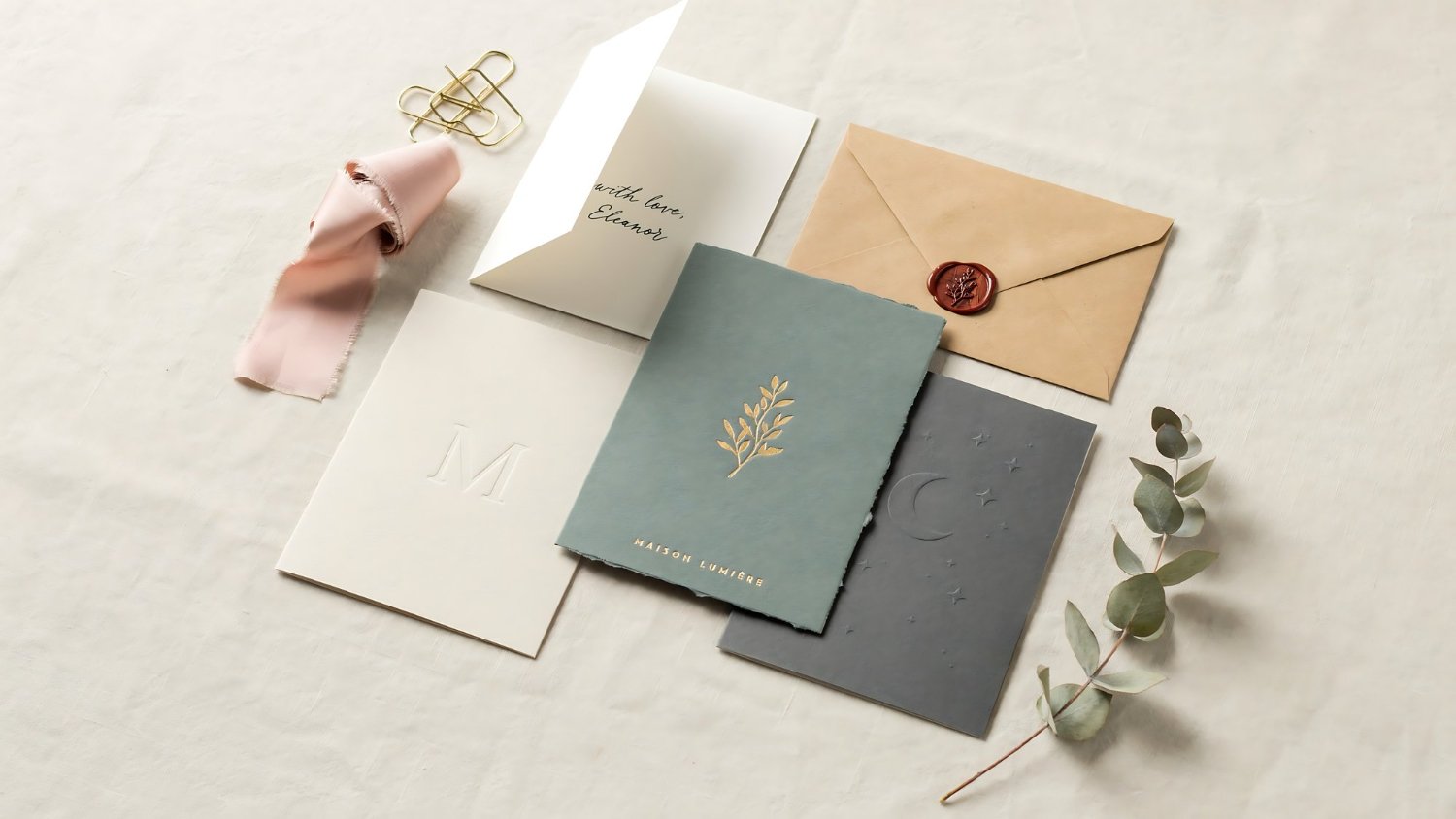
Most invitation wording disputes trace back to three categories: who exactly is invited, whether children are included, and how to mention gifts without sounding transactional. Each one has a workable, tested solution.
Plus-Ones and Guest List Boundaries
A plus-one policy only works if the wording actually communicates it. Vague hints get misread far more often than couples expect, usually in the guest’s favor.
“And Guest” on the inner envelope is the standard tool
When a single guest is allowed a plus-one, the traditional formal approach uses a two-envelope system: the outer envelope names the invited guest, and the inner envelope adds “and Guest.” A short personal note works just as well for less formal invitations.
Married and cohabiting couples are always addressed by name
Established couples, married or living together, get both names printed directly on the envelope. Reducing a real partner to an anonymous “and Guest” reads as a mistake, not a boundary, and usually gets noticed. It’s a small detail, but it tells a guest their relationship is recognized rather than treated as an afterthought.
Adults-only weddings need explicit, not implied, wording
Leaving children’s names off an envelope is the traditional signal for an adults-only guest list, but plenty of guests miss that cue entirely. A direct line on the invitation or wedding website removes any ambiguity.
Enforcing the guest list starts with the envelope, not the RSVP card
If the envelope only lists two names, the RSVP card should only offer two response lines. A generic card with blank lines for “number attending” quietly invites guests to add names you never intended to include.
Children, Dietary Needs, and Registry Mentions
Kids and gifts are the two topics couples most often try to handle through implication. Both work better with a direct approach.
Children’s names on the inner envelope signal inclusion
When kids are invited, listing their names below the parents’ names on the inner envelope removes any doubt. It also lets you invite specific children in a family without inviting every cousin by default. This small step also protects you from an oversized, unplanned RSVP where children nobody accounted for show up anyway.
Omitting a child’s name is the quiet way to say no kids
This convention works for etiquette-literate guests and fails for everyone else. Pairing it with a gentle note, or a clear line on your wedding website, catches the guests who wouldn’t otherwise pick up on the signal.
Registry information belongs on the website, not the invitation
Printing registry details directly on the invitation reads as presumptuous to many guests, even ones who’d never say so out loud. A simple mention that details live on your wedding website keeps the invitation focused on the event itself.
Dietary and allergy questions belong on the RSVP card
A short line for dietary restrictions on the RSVP card, rather than a follow-up email later, gets this information while guests are already thinking about their response. It also gives your caterer real lead time to plan around it.
Mailing, Postage, and the Delivery Failure Points

An invitation that never arrives is functionally the same as one that was never sent, and postage mistakes are one of the most common, avoidable reasons that happens.
Postage Math Couples Get Wrong
Postage looks like a rounding error until you’ve bought two hundred stamps for the wrong weight or shape and have to start over.
Weight adds up fast with inserts
A single card weighs less than an ounce. Add an RSVP card, a reply envelope, a details insert, and a liner, and the whole suite can easily cross the one-ounce threshold, triggering an additional-ounce charge on every envelope. Even a slightly heavier envelope liner can be enough to tip an otherwise light suite over that line.
Square and oversized envelopes cost more
Square, oddly shaped, or heavily embellished envelopes typically require a non-machinable surcharge on top of standard postage, since postal equipment can’t run them through automated sorting. Confirm this before buying a full roll of stamps.
Hand-canceling protects wax seals and specialty envelopes
Standard machine processing can crush a wax seal or damage a delicate envelope. Requesting hand-cancellation at the counter avoids that, usually for a small added fee, and it’s worth asking your local post office about directly.
International postage is its own line item
International rates run well above domestic ones, and they’re calculated separately from any domestic bulk order. Budget for this specifically if even a handful of guests live abroad, rather than assuming it’s a minor add-on. Delivery times also run longer, so factor extra transit days into your mailing timeline for those specific envelopes.
Where Mail Actually Gets Lost
Postage math is only half the problem. The address itself, and how reliably it reaches the right mailbox, causes just as many failures.
Address databases go stale faster than couples expect
A contact list built from an old group chat or a years-old spreadsheet is a common source of returned mail. Confirm addresses directly with guests who’ve moved recently, rather than trusting whatever address you have on file. A quick group text asking everyone to confirm their current mailing address takes minutes and saves real money later.
Return address matters more than it looks
A correct return address means a misdelivered or unclaimed invitation comes back to you instead of vanishing. Skipping it turns a fixable problem into an invisible one.
A test mailing catches problems before two hundred envelopes do
Mailing yourself a fully assembled invitation first checks the actual weight, confirms the postage is correct, and verifies nothing feels flimsy or off before it goes out to your entire guest list.
Mail forwarding doesn’t always work the way people assume
Standard mail forwarding through the postal service typically lasts twelve months and doesn’t reliably apply to every mail class. A guest who moved eighteen months ago may simply never receive anything, with no bounce-back to alert you.
Travel, Dress Code, and the Details Guests Actually Need
Guests plan their whole day, sometimes their whole weekend, around what’s printed on your invitation suite. Missing details don’t disappear. They turn into phone calls and group-text speculation instead.
What Belongs on the Invitation vs the Website
Not every detail needs to live on the formal card itself. Splitting information between the invitation and a wedding website keeps the printed piece elegant while still answering every question guests actually have.
Dress code needs one clear phrase, not three vague ones
“Formal attire” and “cocktail attire” mean different things to different guests, and stacking multiple descriptors together only adds confusion. Pick one specific phrase, and let your website expand on it with examples if needed.
Venue accessibility details save guests an awkward call
A line about parking, stairs, or accessible entrances on your website means guests with mobility needs don’t have to ask you directly, or worse, show up and discover a problem in person. This matters just as much for a guest managing a temporary injury as it does for one with a permanent mobility need.
Weather-dependent logistics deserve a heads-up
An outdoor ceremony with a rain contingency plan should say so somewhere guests will actually see it. Nobody wants to guess whether they need dress shoes or hiking boots. A short note about ground surface, grass, gravel, sand, helps guests choose footwear that actually holds up through a long afternoon outdoors.
Parking and rideshare notes prevent a chaotic arrival
Limited on-site parking, a rideshare drop-off zone, or a shuttle schedule all belong on the website, ideally with a map link. This is exactly the kind of detail that photographs poorly on an invitation but matters enormously in practice.
Travel Logistics for Out-of-Town Guests
Guests traveling any real distance need more than an address. They need enough information to actually plan the trip around your wedding weekend.
Hotel block information needs its own deadline
Room blocks typically release unreserved rooms back to the hotel after a set cutoff date. Communicate that cutoff clearly and early, since a missed block deadline often means a significantly higher rate for guests booking late. A shrinking block can also mean fewer connecting or adjoining rooms left for families traveling together.
Local transportation gaps surprise guests without cars
A venue thirty minutes from the hotel with no rideshare coverage in that area is a real problem for guests who flew in. Flag this clearly rather than assuming everyone will rent a car. A simple shuttle schedule, or even a suggestion to coordinate carpools, closes a gap that otherwise turns into a stressful scramble.
Multi-day itineraries need a separate document
A welcome party, rehearsal dinner, and farewell brunch spread across a weekend deserve their own itinerary page, not a cramped paragraph squeezed onto the invitation. Guests appreciate having it in one clear place.
Time zone confusion is a real, avoidable problem
For weddings that cross time zones, spell out the time zone explicitly next to every listed time. It’s a small addition that prevents a genuinely common, genuinely avoidable mistake.
Digital Invitations, Wedding Websites, and Privacy
Digital tools have changed how couples manage invitations, RSVPs, and guest communication. They’ve also created a new category of risk that traditional paper invitations never had to account for.
When Digital Invitations Make Sense
Digital and paper aren’t purely opposing choices. Many couples use both, matching the format to the specific occasion and guest list.
Digital works well for save-the-dates and pre-events
A digital save-the-date, or a digital invite to a rehearsal dinner or shower, generally reads as perfectly appropriate. The formality expectations loosen for events that aren’t the wedding itself. Guests generally don’t expect the same level of formality from a pre-wedding event that they’d expect from the wedding invitation itself.
Some guests genuinely won’t see a digital invite
Older relatives, or guests less comfortable with email and apps, can miss a digital invitation entirely. Confirm receipt directly with anyone you’re not certain will see it, rather than assuming silence means disinterest.
Formality expectations still apply online
A digital invitation for a black-tie wedding should still read as formal in tone and design, not casual just because it arrived by email. The medium changed. The occasion didn’t.
Cost comparison rarely favors paper by much anymore
Once postage, printing, and assembly are added up, digital invitations often run close to, or cheaper than, a comparable paper suite. Cost alone rarely settles the decision either way.
Protecting Guests From Invitation-Adjacent Scams
Digital invitations introduce a genuine security angle that paper mail never had. This is one of the more overlooked pieces of wedding invitation timing wording planning, and it deserves direct attention.
Phishing scams now impersonate real invitation platforms
The Federal Trade Commission has specifically warned about scam messages disguised as party invitations from services like Evite, asking recipients to enter their email password just to “view” the invite. That single click can hand over full account access. The scam works precisely because it borrows a familiar, trusted brand name, and familiarity lowers people’s guard fast.
RSVP links deserve the same suspicion as any login page
Never ask guests to enter an email password to RSVP. Legitimate RSVP tools never require that. If your platform’s messaging could be mistaken for a credential request, choose a different one. Test the actual RSVP flow yourself before sending it out, specifically checking whether any step could be confused with a login prompt.
QR codes on invitations need a verification habit
A QR code on a physical invitation is convenient, but it’s also unverifiable at a glance. Tell guests directly where it should lead, so anything unexpected stands out immediately as wrong.
What to tell guests if something looks off
Encourage guests to contact you directly, by phone or text, if an RSVP request or link seems unusual. That single habit closes most of the gap phishing scams rely on.
Changes, Reminders, and Last-Minute Updates
Even a perfectly timed invitation can be overtaken by a venue change, a rescheduled ceremony time, or simply a guest who forgot to respond. How you handle the update matters as much as the original wording.
Handling a Venue or Date Change
Changes happen for reasons entirely outside your control: weather, venue closures, family emergencies. What matters is how fast and how clearly the update reaches everyone who needs it.
Speed matters more than polish in a change notice
A plain, fast text or email beats a beautifully designed card that arrives too late to be useful. Prioritize getting accurate information out quickly over making the announcement look nice. A hastily written group text sent immediately still beats a polished card that arrives after guests have already booked their flights.
Phone or text beats a second mailed card for urgent news
Mail takes days. A change that affects travel plans, especially a date or venue shift, needs a channel guests will see within hours, not a card sitting in tomorrow’s mail.
Update every platform, not just the one you remember
Your wedding website, group texts, and any RSVP platform all need the same updated information. A guest checking only one source shouldn’t see outdated details.
A formal change card still has its place for major shifts
For a significant change with enough lead time, a follow-up printed card can supplement, not replace, the faster digital notice. It works well as a confirmation guests can reference later.
Reminders Without Nagging
Some guests need a nudge before an RSVP deadline. There’s a real difference between a helpful reminder and a pattern that starts to feel like pressure.
A week-out reminder catches genuine forgetting
Most missed RSVPs come from simple forgetting, not hesitation. A single, friendly reminder roughly a week before the deadline resolves most of these without any real friction. Guests who genuinely can’t attend also appreciate the nudge, since it gives them one more clear chance to let you know.
Personalize the follow-up instead of mass-texting everyone
A group text to the entire guest list reads as impersonal and can also accidentally reveal who hasn’t responded to people who already have. Reach out individually where it’s practical. It takes longer up front, but it also tends to get faster, warmer responses than a mass message ever does.
Track responses in one place, not three
Splitting RSVP tracking across a physical card system, a website tool, and a spreadsheet creates real opportunities for someone’s response to get lost. Pick one system and route everything into it. Even a simple shared spreadsheet, updated consistently, beats three separate systems that never quite agree with each other.
Know when to just call and ask directly
Past a certain point, chasing a non-response by text stops being efficient. A short phone call gets a real answer faster and avoids the awkwardness of an unanswered message sitting there.
Hidden Costs to Check
The invitation line item on a wedding budget rarely stays where it started. Several real costs sit outside the initial quote, and they matter just as much to wedding invitation timing wording planning as the wording itself.
Costs Baked Into the Invitation Suite
Some costs are predictable once you know to ask about them upfront, before the first proof arrives.
Printing method changes price more than paper choice
Letterpress and foil printing cost meaningfully more than digital or offset printing, sometimes double or triple. Ask for pricing by method specifically, not just by paper weight or color. Request an itemized quote broken out by printing method before committing to a specific look, so the real cost is visible upfront.
Assembly and calligraphy add real labor cost
Hand-addressed envelopes and fully assembled suites, ribbon, wax seal, and all, carry per-piece labor charges that add up fast across a full guest list. Confirm whether assembly is included or billed separately. On a guest list of two hundred, a small per-piece fee can add several hundred dollars nobody budgeted for upfront.
Rush fees apply to invitations just like everything else
A tight timeline caused by delayed design decisions often triggers a rush fee at the printer, sometimes twenty to fifty percent above standard pricing. Ordering early is the cheapest way to avoid this entirely.
Proofing rounds can quietly extend your timeline and bill
Most stationers include one or two proof rounds in the base price. Additional revisions beyond that often cost extra, and each round also pushes your mailing date back by days.
Costs Tied to Mailing and Corrections
These costs only appear after printing, which is exactly why they catch couples off guard during the mailing phase.
Reprints for wording errors cost more than the first run
A missed typo caught after the full order prints means paying for a corrected reprint on top of the original cost, plus whatever delay that adds to your mailing timeline.
Return postage and address corrections add up
Returned mail from bad addresses sometimes needs to be re-sent with corrected postage and a verified address, a small but real cost that scales with how outdated your guest list is. This is exactly why confirming addresses early costs far less, in both time and money, than fixing them after a bounce-back.
A second mailing for late additions isn’t free
Adding guests after the main mailing means a separate, smaller print run, which usually costs more per piece than the original bulk order did. Small reorders often lose the bulk pricing discount entirely, so a handful of late additions can cost disproportionately more than the same names would have during the original run.
Save-the-date and invitation budgets often get tracked separately by mistake
Couples sometimes forget save-the-dates are a separate cost from invitations entirely, and the combined total ends up higher than either number looked on its own.
| Cost item | Typical range | When it applies |
|---|---|---|
| Standard printed invitation suite (per 100) | $300–$900 | Base design, printing, and basic paper stock |
| Letterpress or foil upgrade | $600–$1,800+ | Premium printing method, same quantity |
| Hand calligraphy addressing | $3–$8 per envelope | Outer envelope, sometimes inner too |
| Rush production fee | 20%–50% above standard price | Orders placed inside a stationer’s normal turnaround window |
| Non-machinable postage surcharge | Roughly $0.45–$0.50 per piece | Square, oversized, or textured envelopes |
| Additional-ounce postage | Roughly $0.25–$0.30 per ounce | Suites with multiple inserts, liners, or heavy cardstock |
| Reprint for a wording error | Often the full original order cost again | Errors caught after final printing |
Green, Yellow, and Red Flags in Your Invitation Plan
Not every delay is a crisis, and not every reassurance from a vendor deserves full trust. Sorting your own timeline, and your stationer’s promises, into these three categories keeps decisions grounded.
What a Trustworthy Timeline Looks Like
A well-run invitation process tends to share a few specific traits, regardless of which stationer or platform you’re working with.
A stationer who gives you a written production calendar
Written production dates beat vague promises every time. Knowing the exact first proof date, final proof date, and ship date lets you plan the rest of your timeline around something concrete instead of a guess. It also gives you a clear reference point if a deadline starts slipping, and something to point back to if a vendor’s memory of the schedule shifts later.
Clear proofing steps before anything prints
Good vendors walk you through exactly what to check on a proof: wording, spacing, names, and dates. That habit signals they’ve caught these mistakes before, on someone else’s order, and built a real safeguard around it. A stationer who hands you a proof with no guidance at all is trusting you to catch everything solo.
A realistic mailing date, not an optimistic one
Trustworthy stationers push back when a timeline looks unrealistic instead of agreeing to whatever you ask for. One willing to say “that’s tight, here’s what could slip” earns more confidence than one who promises any deadline without question, then scrambles to keep it. Honesty about a tight schedule now is cheaper than a rushed reprint later.
Guest list finalized before design begins
Starting the design process with a settled guest count avoids costly quantity changes mid-production, which is one of the more common sources of both delay and unexpected cost.
What a Warning Sign Looks Like
These signs don’t automatically mean disaster, but each one deserves a direct follow-up question before you commit to an order.
Vague answers about turnaround time
“It depends” with no further detail, repeated more than once, suggests a vendor who either doesn’t track their own timeline closely or doesn’t want to commit to one in writing. Push for a specific number of business days, in writing, rather than accepting a vague range that never seems to apply to your actual order.
Pressure to skip the proof stage
Any vendor who suggests skipping a proof to save time is asking you to trade a quick check now for a much more expensive fix later, if something’s wrong.
No plan for correcting a wording mistake after printing
Ask directly what happens if an error is caught after the proof is approved but before mailing. A vendor without a clear answer here is a genuine risk worth weighing.
A guest list still moving two weeks before mailing
This isn’t a vendor problem, it’s a planning one, but it’s just as real. A guest list that keeps shifting this close to the mailing date almost guarantees a rushed, error-prone final order.
Questions That Feel Awkward but Are Worth Asking
Some of the most useful questions in this whole process feel uncomfortable to ask, either a stationer you’re trying to build rapport with, or your own partner. Ask them anyway.
Questions for Your Stationer or Printer
Direct questions get direct, checkable answers. Vague ones tend to produce equally vague reassurance.
“What happens if I find an error after I approve the proof?”
This question surfaces the real policy, not the marketing one, and it’s worth asking before you sign anything, not after a mistake actually happens. A vendor with a clear, calm answer ready has clearly dealt with this exact situation for another couple before.
“What’s your actual turnaround, not your advertised one?”
Advertised turnaround times often describe the best-case scenario. Ask what typically happens during busy months, like early spring and early fall, when order volume peaks.
“Do you charge extra for envelope addressing?”
Addressing services sometimes appear as a separate line item that isn’t obvious from the initial quote. Confirm this cost before you’re comparing a final invoice to your original budget.
“What’s your policy on last-minute quantity increases?”
Guest lists shift. Knowing in advance whether a small reorder is fast and simple, or a whole new production cycle, changes how tightly you need to finalize your count.
Questions to Ask Yourselves as a Couple
Some of the harder questions aren’t for a vendor at all. They’re for the two of you, ideally answered before wording decisions get locked in.
“Who actually enforces the adults-only line?”
Deciding this in advance, rather than improvising an answer at the door, avoids putting a family member or wedding party member in an uncomfortable spot on the day itself.
“What do we do if a guest brings an uninvited plus-one anyway?”
Having a calm, agreed-upon answer ready means neither of you is scrambling to improvise a response in front of other guests.
“Are we comfortable if a distant relative finds out late?”
Staggered mailing, or a smaller guest list than some relatives expect, can create hurt feelings. Deciding how you’ll handle that conversation ahead of time beats reacting defensively later.
“Whose phone number goes on the RSVP card?”
Whoever’s number appears should genuinely be available to field questions during the response window. Picking this deliberately avoids one person getting stuck fielding every single call.
Guest Experience Check: Where Confusion Actually Starts
Guests rarely complain directly. They text each other instead, comparing notes and guessing at answers you never actually gave. Understanding what they’re actually asking closes most of the gap.
The Questions Guests Actually Ask Each Other
These four questions come up constantly in guest group chats, almost always because the invitation didn’t answer them directly enough.
“Am I supposed to bring someone?”
If the envelope doesn’t clearly indicate a plus-one, most guests will assume they can’t bring one, but a few will assume they can. That inconsistency is exactly what clear wording prevents. Neither guess is unreasonable on its own, which is precisely the problem with leaving the question open to interpretation.
“Are kids invited or not?”
This is consistently one of the most common points of confusion in wedding invitation timing wording, and it’s also one of the easiest to solve directly with a single clear sentence.
“What does the dress code actually mean?”
“Semi-formal” reads differently to different generations and different regions. A short website page with example outfits removes the guesswork far more effectively than a single printed phrase.
“Did my RSVP go through?”
Without a confirmation, guests genuinely wonder whether their response registered, especially with digital RSVP tools. A simple automated confirmation message resolves this instantly.
Fixing Confusion Before It Spreads
Most guest confusion is preventable with a small amount of upfront structure, not more wording crammed onto the invitation itself.
A wedding website FAQ page catches repeat questions
Once you’ve fielded the same question from three guests, add it to your website’s FAQ page. It answers the fourth and fifth guest before they even have to ask. Over the following weeks, that page tends to become the single most efficient tool you have for cutting down repeat questions.
One point of contact prevents conflicting answers
When multiple family members field wedding questions independently, guests sometimes get different answers to the same question. Designating one point of contact keeps the information consistent.
Confirming receipt for digital RSVPs closes the loop
A brief “we got your RSVP” message, automated or personal, reassures guests their response actually reached you and reduces duplicate follow-up messages.
A little redundancy is not the same as annoying guests
Repeating key details across the invitation, the website, and a reminder message isn’t overkill. It’s what actually gets information to guests who miss things the first time around.
Whose Names Go First: Divorced Parents, Blended Families, and Host Lines

The host line looks like a formatting decision until a real family sits down to write one. Divorced parents, remarriages, and step-relationships all complicate a wording template that assumes one intact couple footing the bill. Getting this piece of wedding invitation timing wording right takes more diplomacy than any other line on the card.
Wording the Host Line When Parents Are Divorced
Traditional invitation wording assumes both parents share a household and a last name. Plenty of modern families don’t, and the wording needs to adjust without turning the invitation into a family org chart.
Traditional host wording assumes one intact couple
Classic formal wording lists “Mr. and Mrs.” as a single host line, which works cleanly for a married couple sharing a name and a household. It breaks down immediately once parents are divorced, remarried, or never married in the first place. Trying to force that template onto a different family structure usually creates more confusion than it solves. A stationer experienced with modern family structures can usually suggest a cleaner alternative on request.
Listing both parents without implying reconciliation
Divorced parents can both appear as hosts, listed on separate lines rather than joined by “and,” which avoids implying they’re still a couple. This keeps both parents visibly involved without rewriting family history on a wedding invitation. Most stationers have seen this exact request many times and can format it cleanly.
Stepparents and blended families add another layer
Whether a stepparent appears on the host line usually depends on their role in raising the couple, not just a formal title. Some families list stepparents by name; others acknowledge them elsewhere, like a program or a toast. There’s no single correct answer here, only the one that reflects your actual family.
When money, not just names, complicates the host line
Traditionally, the host line reflects who’s paying, which gets messy fast when costs are split across multiple households. Many modern couples skip that convention entirely and simply list themselves as the hosts, sidestepping the financial question altogether. That option is available even in a fairly traditional invitation suite.
Ordering Names and Avoiding Old Family Tension
Once the host line is settled, a second question follows close behind: whose name appears first, and in what order relative to everyone else listed.
Whose name goes first isn’t just etiquette, it’s diplomacy
Traditional wording lists the bride’s parents first, then the groom’s, but plenty of couples update this for same-sex marriages or blended families where that order doesn’t map cleanly. Decide together, early, rather than letting it become a last-minute scramble during proofing.
A neutral host line sidesteps a lot of old arguments
Wording the invitation as “Together with their families” or listing only the couple’s own names avoids ranking parents against each other entirely. This option works especially well when family relationships are strained or genuinely complicated.
Grandparents and honorary hosts need their own consideration
A grandparent who raised one partner, or a family friend who played a parental role, sometimes deserves recognition on the host line too. Ask directly whether that inclusion matters to your family before assuming the standard template covers everyone who should be acknowledged. Leaving out someone who genuinely shaped your life rarely feels neutral to the people who notice the omission.
When in doubt, ask the people involved directly
A short, calm conversation with parents about wording preferences prevents a much bigger conversation after invitations are already printed. Most parents appreciate being asked rather than discovering their name’s placement, or absence, on a finished card. This single conversation, however awkward it feels in the moment, is almost always shorter than the alternative.
Accessibility Check: Making Sure Every Guest Can Actually Use the Invitation
An invitation that looks beautiful but is genuinely hard to read fails part of its job. Font choices, digital tools, and communication habits all affect whether every invited guest can actually use the information you send them.
Print and Visual Accessibility
Printed invitations get judged almost entirely on aesthetics, but legibility matters just as much, especially for guests with low vision or reading difficulties.
Font size and contrast affect more guests than couples assume
Tiny script fonts in pale ink on cream cardstock look elegant and photograph well, but they’re genuinely hard for many guests to read, particularly older relatives. Keeping key details, date, time, RSVP deadline, in a larger, higher-contrast font solves this without sacrificing the overall design.
Fancy script fonts can be genuinely hard to read
Decorative calligraphy fonts work well for names and headers but struggle for dense information like addresses or instructions. Pairing a script font for flourish with a clean, simple font for practical details gives you both the aesthetic and the clarity.
A plain-text version of key details helps screen readers
For guests using screen readers or other assistive technology, a plain-text summary of the essential details, posted on your wedding website, matters more than the printed card’s design ever will. This is a simple addition most couples never think to include.
Braille or large-print options exist for guests who need them
If you know a specific guest needs braille or large-print materials, ask directly what would actually help rather than guessing. Some stationers offer this as a specialty service, and a personal follow-up message can cover the gap when they don’t.
Digital and Communication Accessibility
Digital invitations and wedding websites introduce their own accessibility considerations, separate from anything print-specific.
Screen readers need real alt text and clean structure
A wedding website built entirely from images, with no actual text underneath, is effectively invisible to a screen reader. Use real text for key details, and add descriptive alt text to any image that carries important information. This costs nothing extra and typically takes only a few minutes during the initial website build.
Video RSVP tools should offer a non-video option
Some digital invitation platforms lean heavily on video or animation for visual flair. Make sure a simple, text-based RSVP path exists alongside it, since not every guest can or wants to use a video-based interface.
Captioning matters for any digital wedding content
If your invitation suite includes a video message or a livestream link for a virtual guest, captions make that content accessible to guests who are deaf or hard of hearing. Most video platforms now offer built-in captioning at no extra cost.
A single accessible contact method beats scattered channels
Offering one clear way to reach you, a phone number, an email, works better than assuming every guest is comfortable navigating a wedding app or website. List it plainly, and check it regularly during the RSVP window.
Worst-Case Scenario and the Backup Plan
The worst version of this problem isn’t a single confused guest. It’s discovering, during wedding week, that dozens of guests interpreted the same ambiguous wording differently, all at once, with no time left to correct it.
Picture an adults-only wedding where the no-kids policy was only implied by omitted names. Fifteen families show up expecting their children to be welcome, because nobody told them otherwise directly. Or picture invitations mailed with the wrong RSVP deadline printed, leaving a caterer with an unreliable headcount two weeks before the wedding. Neither situation involves bad intentions. Both involve wording or timing that felt clear to the couple and wasn’t clear to the guests reading it cold.
The backup plan starts with redundancy, not perfection. If a wording gap surfaces late, a direct message beats silence every time: a short, warm note clarifying the detail reaches guests faster than hoping they’ll figure it out on their own. Keep your wedding website updated as the single source of truth, and point confused guests there whenever a question repeats.
If a genuine mailing or printing error happens close to the date, prioritize the guests most affected first, out-of-town travelers, anyone with a deadline-sensitive booking, rather than trying to fix everything simultaneously. A phone call resolves in minutes what a mailed correction card would take days to accomplish. Most guests respond well to a direct, honest heads-up. What frustrates them is silence, not an honest correction. Treat every correction the same way you’d want to be treated: told plainly, told early, and told directly by you rather than secondhand.
Build one simple safeguard before you mail anything: ask one trusted person, a parent, a planner, a detail-oriented friend, to review the full invitation suite specifically for ambiguity, not just typos. A second set of eyes catches the wording gaps you’ve read so many times you can no longer see them clearly.
Frequently Asked Questions
How far in advance should wedding invitations be mailed?
Six to eight weeks before the wedding works for most local and regional guest lists. Push closer to eight to ten weeks if a significant share of guests are traveling from out of town. Getting wedding invitation timing wording right here mostly means matching the mailing date to your actual guest list, not a generic rule.
Is it okay to send save-the-dates before we’ve booked a venue?
Yes, as long as you have a firm date and general location. Save-the-dates only need to lock the date itself; venue and full details can follow later on the formal invitation.
How do I word an adults-only wedding invitation without offending anyone?
State it directly and warmly, either on the invitation or your wedding website, rather than relying only on omitted names. A simple line like “we’ve planned an adults-only celebration” reads as clear, not harsh.
What’s the correct way to offer a plus-one on an invitation?
Use the inner envelope’s “and Guest” line for a single invited guest, or address both names directly for an established couple. Avoid leaving it ambiguous on the outer envelope alone.
Should children’s names appear on the invitation if kids are invited?
Yes. Listing each invited child’s name on the inner envelope makes clear exactly who’s included, especially useful in extended families where not every child is invited.
Is it rude to put registry information on the wedding invitation itself?
Most etiquette guidance advises against it. Mentioning that registry details live on your wedding website keeps the invitation focused on the event rather than gifts.
How do I set a wedding RSVP deadline that actually works?
Set it three to four weeks before the wedding date, giving yourself enough buffer to follow up with non-responders and still submit a final count to your caterer on time.
What if a guest doesn’t RSVP by the deadline?
Start with a direct, personal follow-up about a week after the deadline passes. A quick phone call usually resolves this faster than another text or email. If a guest still doesn’t respond after that, it’s reasonable to submit your final count without them and follow up separately afterward.
Are digital wedding invitations considered appropriate for a formal wedding?
They can be, as long as the design and wording match the formality of the event. The format has changed, but guest expectations around tone and detail haven’t.
How do I protect guests from invitation-related phishing scams?
Never ask guests to enter an email password to view or RSVP to an invitation. Choose a reputable platform, and tell guests to contact you directly if anything about a link looks unusual.
What postage do I need for a square wedding invitation envelope?
Square and oddly shaped envelopes generally require a non-machinable surcharge on top of standard postage. Confirm the exact current rate and weigh a fully assembled sample at the post office before buying stamps in bulk.
Should I hand-cancel my wedding invitations at the post office?
It’s worth asking for, especially with wax seals or delicate envelopes, since standard machine processing can damage them. Many post offices offer this for a small additional fee.
What’s the best way to announce a last-minute venue change?
Use the fastest channel available, phone, text, or email, before following up with anything more formal. Speed matters far more than presentation when a change affects travel plans.
Can I mail invitations internationally without extra planning?
International mail needs separate postage and typically more transit time than domestic mail. Build in extra lead time and budget for the higher per-piece cost specifically.
How do I handle an uninvited plus-one who shows up anyway?
Decide your response in advance with your partner and your venue or caterer, rather than improvising in the moment. Most venues can accommodate a small overage quietly if you’ve flagged the possibility ahead of time.
What information belongs on the wedding website instead of the invitation?
Hotel blocks, transportation details, registry links, dress code examples, and detailed itineraries all work better on a website than crammed onto a printed card.
Is it normal for wedding invitation wording to cause family conflict?
It happens more often than most couples expect, usually around guest list boundaries or formality choices. Deciding your approach together, and staying consistent once you’ve decided, helps more than trying to please everyone individually. Most families settle into whatever the couple decides, once it’s clear the decision is final and not up for renegotiation.
Wedding invitation timing wording ultimately comes down to two things: giving guests enough notice to plan, and giving them clear enough information that they don’t have to guess. Neither one requires elaborate design work. Both require deciding your boundaries early and saying them plainly.
Your next concrete step is simple. Pull up your current invitation draft, or your planned wording if you haven’t ordered yet, and read it as a guest who knows nothing about your plans would read it. Check for plus-ones, kids, dress code, and deadlines specifically. If any of those feel even slightly unclear, fix the wording now, while it’s still just a document and not two hundred mailed envelopes. A few careful minutes now costs far less than a reprint, a returned envelope, or a confused phone call during wedding week.
Sources: Federal Trade Commission, Consumer Advice; Emily Post Institute; The Knot. Accessed September 29, 2026.
