
Cultural desserts are the sweets a family has made, named and served for generations at weddings, holidays and milestones, and they carry meaning that a bakery label cannot supply. This guide gives you a family consultation and an authenticity signoff you can run in a few weeks, so the dessert arrives as part of the celebration instead of as a themed prop.
Treat cultural desserts as a family-owned tradition with a name, a meaning, a source and a skilled maker. Hold one consultation with the person who carries the tradition, then run a six-point signoff: name, meaning, source, maker, setting and voice. Get a yes on each point from the keeper of the tradition, taste at least two trial batches, confirm allergens and diet rules in writing, and decide who will explain the dessert to guests. If any point stays unresolved, change the plan before you change the standards.
Most couples who want cultural desserts at their wedding start from a good instinct. A grandmother’s pastry, a regional sweet from a parent’s hometown, a dessert eaten at every family celebration: these belong at a wedding. The trouble with cultural desserts starts in the handoff. A caterer receives a photo and a one-line request, a baker improvises from a search result, a place card says “traditional treat,” and the dish that meant something at the family table becomes a garnish for the reception.
Weak planning of cultural desserts is not a matter of bad intent. It is a matter of missing steps. Nobody asked what the dessert is called in its own language, when it is normally eaten, who is supposed to serve it, or whether the version on the table matches the version the family remembers. This article supplies those steps in order.
A note on scope. This is general information, not legal, tax or financial advice. Food safety, labeling and cottage food rules differ by state and county, so where a rule matters the guide points you to the agency that issues it and asks you to confirm the current version yourself.
What separates cultural desserts from a novelty
The difference is not the recipe. A dessert can be simple, borrowed from a bakery, even rebuilt by a caterer and still be served with respect. The difference is whether the people who own the tradition recognize it, were asked, and have a role in how it appears.
A novelty treats the dessert as a visual: a bright table, a photo opportunity, a conversation starter for guests who do not know its history. The dessert is chosen because it looks different from a cake. Nobody on the planning side can say what it means, and the family’s elders often learn about it from the invitation or the menu card.
A tradition treats the dessert as a message, and well-planned cultural desserts always have someone who can read it. The couple can say where it comes from, who in the family makes it or taught it, what it is served for, and what a guest should know before eating it. Even if guests never ask, the answers exist, and the dessert is served in a way that fits them.
You can test your own plan with three plain questions. Could the person whose tradition this is describe the plan and say, “yes, that is right”? Can you explain the dessert in two sentences without searching? If the family changed one detail, such as the shape or the filling, would you know whether that matters? Three yeses mean you are on firm ground. Any no marks the place to start work.
Why the distinction matters for cultural desserts at the wedding
Novelty service of cultural desserts has practical costs, not only social ones. A dessert that is mislabeled sends a guest who shares the tradition to the family table with a quiet correction. A dish that is meant for a specific moment, such as a toast, a blessing or the first bite shared by the couple, loses that meaning when it sits in a general buffet. A version made without the traditional ingredient may be fine, but only if somebody decided that on purpose.
There is also a family cost to rushed cultural desserts. When the person who holds the tradition is consulted late, the conversation becomes a defense of decisions already paid for. When they are consulted early, they usually become the dessert’s strongest advocate. Planning for that outcome is cheaper than repairing the alternative.
What counts as a cultural dessert
For this guide, cultural desserts means any sweet whose recipe, name, occasion or meaning comes from a specific cultural, regional, religious or family tradition and is being served at your wedding because of that connection. That covers a lot of ground: a pastry eaten at engagement celebrations, a rice or milk sweet served for good fortune, a layered cake that belongs to one region, a fried dough made for festivals, a candy given to guests as a blessing.
It also includes family versions. A dessert does not have to be famous to be traditional. If your grandmother’s version of a common sweet is the one your family means when they say its name, that version is the tradition, and the consultation should protect it.
What it does not include is a dessert chosen only for its look or novelty, even when it comes from a culture you admire. That is a different decision with its own tests, and the guide on this site about wedding menu planning covers how menu choices fit together across a whole meal.
The three voices: who gets a say in cultural desserts
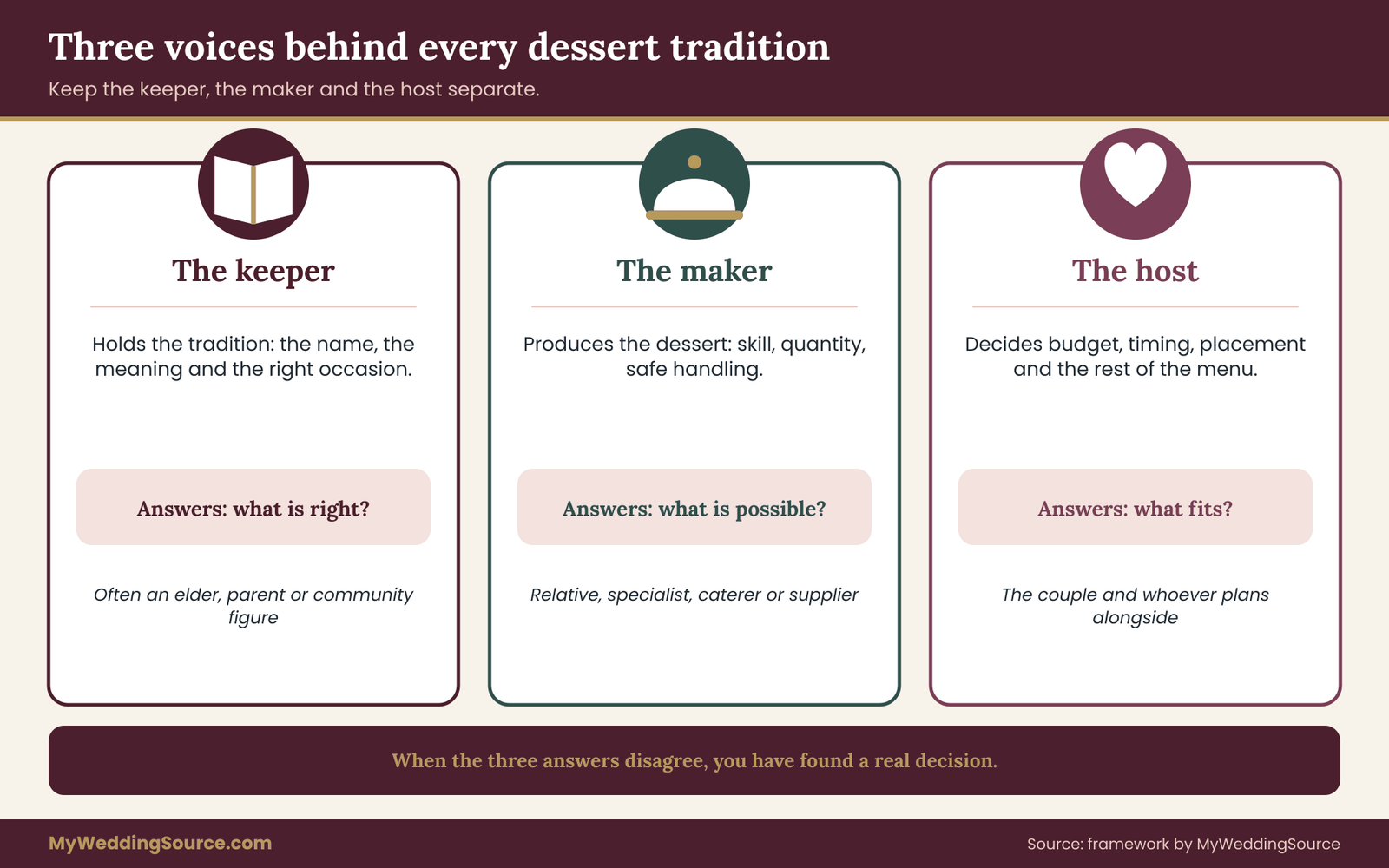
Every set of cultural desserts at a wedding involves three kinds of people, and confusion usually starts when one is assumed to speak for another. Call them the keeper, the maker and the host.
The keeper is the person or people who hold the tradition. Often this is a grandparent, a parent, an aunt or an elder in the community, but it can also be a religious or community figure. The keeper knows the name, the meaning and the right occasion. The keeper is not necessarily the one who cooks.
The maker is whoever produces the dessert for the wedding. That might be a relative, a specialist baker from the community, a caterer who has learned the recipe, or a general bakery working from a description. The maker’s skill decides whether the dessert tastes right, and the maker’s capacity decides how many pieces exist.
The host is the couple, with whoever is paying and planning alongside them. The host decides budget, timing, placement and what the rest of the menu looks like. The host does not decide what the dessert means.
Why the voices must stay separate
If the couple speaks as the keeper, they risk making claims they cannot back up. If the maker speaks as the keeper, the dessert drifts toward whatever the maker finds easy to produce. If the keeper speaks as the host, the wedding becomes unmanageable, because a family elder rarely wants to decide table counts and delivery windows.
Separating the three lets each person answer the questions they can actually answer. The keeper says what is right. The maker says what is possible. The host says what fits. When the three answers disagree, you have found a real decision rather than a vague unease.
When the keeper cannot be reached
Sometimes the person who holds the tradition has died, lives far away, or is estranged from the family. Do not skip the keeper role. Name a stand-in: another relative who remembers the dessert, a community elder, a religious or cultural organization, a cookbook compiled by the family, or a respected specialist from the same community. State who the stand-in is in your planning notes, so the reasoning is clear later.
If no stand-in exists, say so honestly, and slow down. A dessert you cannot get approved by anyone from the tradition deserves a smaller role in the day, such as a favor or a single display, with a plain label describing where it comes from instead of claims about what it means.
The couple’s own position on cultural desserts
Couples sometimes belong to the tradition, sometimes marry into it, and sometimes borrow it from a friend’s family or a place they love. All three can be handled well, but they call for different questions. A partner who grew up with the dessert can often act as keeper for their own family and still needs a second voice from the older generation.
A partner joining the tradition should ask rather than assume, and should expect to be taught. A couple borrowing from outside either family needs the strongest consultation of all, which the edge cases section later in this guide covers.
How the process works in order
The whole method for cultural desserts fits on one page, and following it in order saves rework. Begin with the consultation, where you listen to the keeper without a menu in your hands. Move to the six-point signoff, where each part of the dessert is confirmed or changed. Then settle who makes it, how it is labeled, where and when it is served, and what the safety and vendor paperwork must say.
The sections that follow take those steps one at a time. Each ends with a concrete check, so you can tell whether it is finished. If you only have time for a few things, do the consultation, the trial batch and the allergen confirmation. Everything else supports those three.
How much time to allow for cultural desserts
For cultural desserts made by a relative or a community specialist, allow at least two months between the first consultation and the wedding. That gives time for one trial batch, one correction and a second trial. For a dessert recreated by a caterer or bakery, allow similar time, because the second trial is where problems surface. Shorter timelines work only for desserts with very few ingredients and a maker who has made them many times.
If the dessert depends on a seasonal ingredient, a specific imported item or a long preparation, count backward from the wedding date and confirm availability before you promise it to anyone. The wedding cake timeline shows how production schedules for cake work backward from the final guest count, and the same logic applies to any dessert with a long lead time.
Holding the family consultation for cultural desserts
The consultation is a conversation, not a meeting with an agenda. Its purpose is to learn what the keeper knows, in the order the keeper wants to share it. You are not asking permission yet. You are collecting the facts you will need for the signoff, and building the relationship that lets the signoff happen smoothly.
Plan one sitting about your cultural desserts, an hour or so long, in person if possible, or by video if distance requires. Bring a notebook rather than a laptop. If the keeper agrees, record the audio, since a recipe described out loud often carries details that never make it onto paper: how the dough should feel, what color means done, which pan to use.
Choosing who to invite to the cultural desserts conversation
Invite the keeper first and alone, or with one other family member the keeper trusts. A large group conversation tends to fill with opinions and shorten the keeper’s turn. If more than one person holds a version of the tradition behind your cultural desserts, hold separate sittings and compare notes later, because the differences between versions are part of what you need to learn.
If the keeper is a parent of one partner, that partner should lead the conversation, with the other partner listening. If the keeper belongs to the other partner’s family, the partner from that family should still introduce the conversation and explain why the other partner is there.
Opening the conversation
Start with the person, not the dessert. Ask how they learned it, who taught them, and what it meant at their own celebrations. Let stories run. They carry the meaning, and they will tell you more about the right setting than any list of questions.
“We would love to have your dessert at our wedding, and we want it to be right. Could you tell us how you learned to make it, and when your family usually serves it?”
Resist the urge to describe your own plan in the first ten minutes. If you do, the keeper will respond to the plan and stop volunteering the history. Hold the plan until the keeper has finished the story.
The eight questions to cover for cultural desserts
By the end of the conversation, you want answers to eight questions. You do not need to ask them in this order, and you rarely need to ask them all aloud, but you should check them off before you leave.
- What is it called? Ask for the name in the family’s language, how to pronounce it, and any other names it goes by. Write the spelling the keeper uses, in the keeper’s script if possible.
- What does it mean? Ask when it is served and what it stands for, if anything. Some cultural desserts are plain treats, and that is a valid answer.
- Which version is yours? Ask what makes the family’s version different from others. Regional or family differences are what a bakery is most likely to flatten.
- What are the essential parts? Ask which ingredients, shapes or methods cannot change, and which can. This is the most useful question you will ask.
- Who traditionally makes it? Some desserts are made by a particular person, such as the eldest woman or the groom’s mother. Others are bought from a specialist.
- When is it traditionally served? At a meal, after a ceremony, at a specific moment in a ritual, or as a take-home gift.
- Who serves it, and how? On a particular plate, by a particular person, with a particular phrase.
- What should we avoid? Ask about missteps the family has seen at other events, and about any rules the dessert follows, such as dietary laws or seasonal limits.
Taking notes that someone else can use
Write the answers as short plain statements, one per line, and read them back before you leave. “The filling must be made from the same fruit; the dough can be bought if it is made with butter, not oil” is useful. “Make it like Grandma” is not.
After the meeting, send the keeper a short written summary within a day or two and ask for corrections. This does two jobs. It catches misunderstandings while they are cheap to fix, and it shows that you took the conversation seriously. A summary that comes back with edits is a good sign.
What to do when the keeper is reluctant
Some keepers hesitate. They may worry that the dessert will not be made well, that guests will not understand it, or that the couple is treating it as an accessory. Take that seriously rather than trying to talk past it.
Ask what would make them comfortable. The answer may be as small as a role at the table, a line in the program, or a trial batch they can taste. It may also be larger: they may prefer that the dessert not appear at all, or appear only in a private moment with family. Both are legitimate outcomes. A smaller, accepted role for cultural desserts is better than a large, resented one.
Handling disagreement between relatives
If two relatives remember the dessert differently, do not choose between them in the consultation. Record both versions, note who holds each, and bring the difference back to the keeper with the other version in hand. Often the family already knows about the difference and has a settled view, such as “your aunt’s version is from her husband’s side.”
If the disagreement is real and unsettled, choose a path you can defend: serve one version and name it as one family’s version, or serve both in small portions with clear labels. What you should avoid is blending the two quietly into a third version nobody recognizes.
“Your aunt remembers it with the nuts and your cousin remembers it without. Which one do you think we should serve, and should we mention the other?”
Money, labor and cultural desserts
Do not make the keeper pay for the dessert, and do not assume the keeper will provide the labor for free. If a relative will make the dessert, agree on compensation for ingredients, equipment and time before the conversation about quantities begins. Offer to cover ingredients as a minimum. For large batches, consider paying a fair rate for labor, because a family member who cooks for two days is working, even when no money changes hands.
If you do not settle this, resentment builds. The relative who makes two hundred pieces without being asked what it costs may smile through the wedding and mention it for years. A clear arrangement protects the relationship.
Capturing the recipe for cultural desserts without taking it
If the keeper shares a recipe, ask what they want done with it. Some families are happy for it to be shared with the baker. Some prefer that only the keeper or one chosen maker handle it. Some regard the recipe as private and would rather teach the maker in person.
Never give a family recipe for cultural desserts to a vendor, a blog or a social media post without permission. If the baker needs a recipe to work from, ask the keeper whether they will pass it along themselves, or whether the baker may visit and watch. A recipe given with a handshake is far better than a recipe photographed from a recipe card.
Ending the consultation
Before the conversation ends, state the next steps out loud. You will send a summary. You will arrange a trial batch. You will come back with the plan for how the dessert will be served, and you will ask for a final signoff. Give dates for each.
Thank the keeper of your cultural desserts in a way that matches the relationship, whether that is a handwritten note, a gift of ingredients or an invitation to be seated near the dessert on the day. Do not treat the thanks as a courtesy that comes later. It belongs at the start, because it frames everything that follows.
Researching cultural desserts when no keeper is available
If you cannot hold a consultation, use community sources before you rely on general web pages. Cultural centers, places of worship, community bakeries and food historians from the tradition can often answer the eight questions. The Smithsonian Center for Folklife and Cultural Heritage and the American Folklife Center at the Library of Congress document many food traditions and can help you find reliable material. Treat any single online recipe as one opinion, not a ruling.
Even with good sources, record in your notes that the consultation was indirect. That keeps your claims in the program and on labels modest, which is the right tone when the keeper has not been able to confirm the details.
The check that closes this step
The consultation on cultural desserts is finished when you can write one paragraph, in the keeper’s terms, that covers the name, the meaning, the version, the essential parts and the right moment, and when the keeper has read that paragraph and said it is right. If you cannot write that paragraph, you have not finished. If the keeper has not read it, you are still guessing.
Keep that paragraph. It becomes the source text for your labels, your program note, your vendor brief and the short explanation anyone speaking about the dessert will use. It also protects you later, because it shows what was agreed and who agreed to it. When a vendor proposes a substitution, the paragraph tells you at once whether the substitution touches an essential part or only a detail the keeper said could change.
A last practical point: store the paragraph, the recorded conversation and any photos of the dessert in one folder, shared with the person who is managing the wedding on the day. If you are away from your phone and a vendor asks a question about the dessert, someone else should be able to open that folder and answer without calling the keeper. That folder is also the natural place to keep the keeper’s contact details, so questions on the wedding morning reach the right person quickly and politely.
The six-point authenticity signoff for cultural desserts
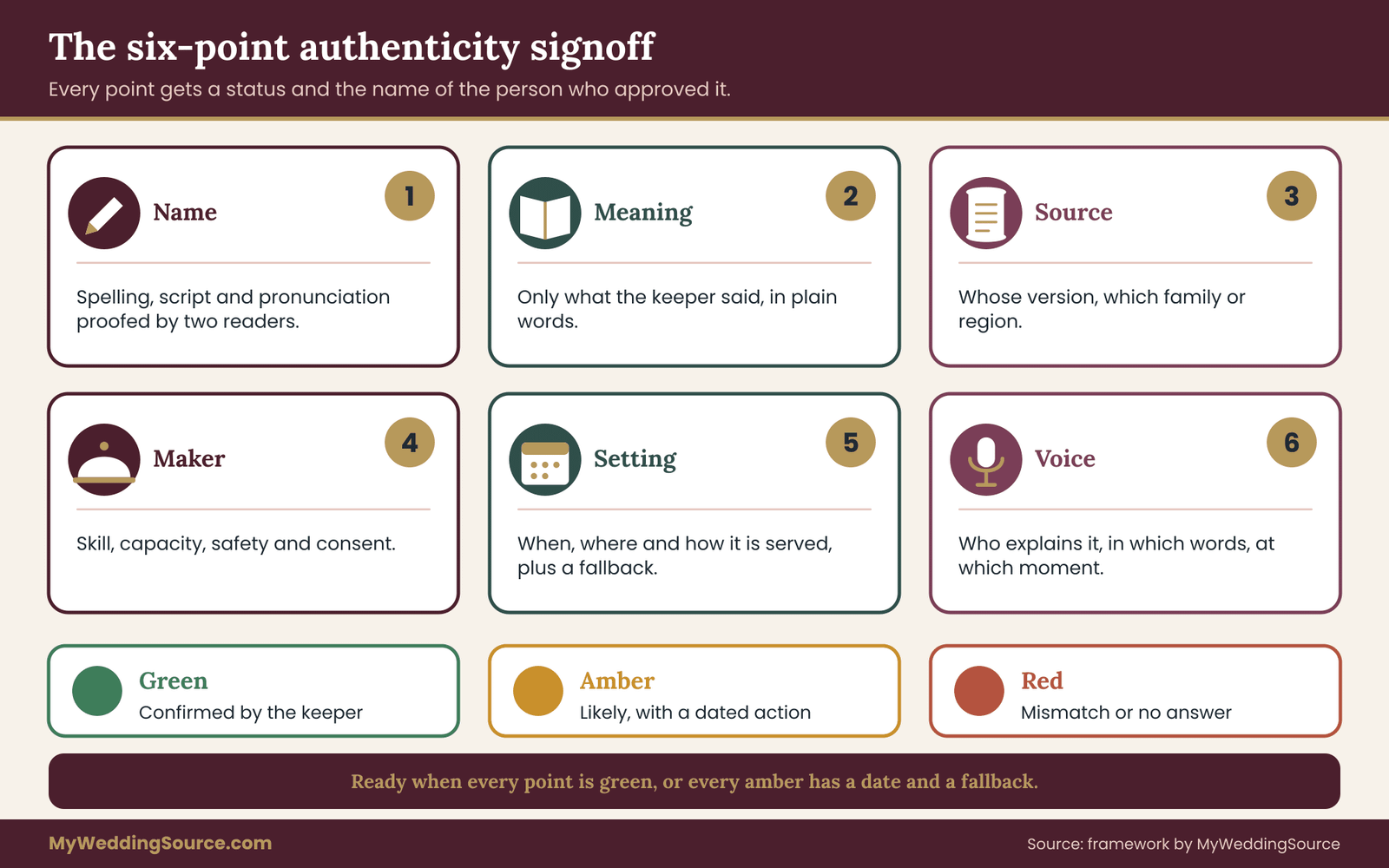
The signoff turns the consultation into decisions about your cultural desserts. It has six points, and each one must be answered in writing before the plan is final: name, meaning, source, maker, setting and voice. For every point you record a status of green, amber or red, and the name of the person who gave the approval.
Green means the keeper, or the named stand-in, has confirmed the point. Amber means the point is probably fine but unconfirmed, or confirmed with a condition. Red means there is a known mismatch or no answer at all. The plan is ready when every point is green, or when every amber has a dated action attached and a fallback you would accept.
Point one: name
The name is the easiest point to get wrong with cultural desserts and the most visible when it is wrong. Confirm the spelling in the original language and script, the pronunciation, and the form to print on menus and labels. If the keeper uses a different name than the one common online, use the keeper’s name, and consider adding the more common name in smaller type so guests can recognize it.
Check the name with two people who read the language. One may be the keeper, and the second should be a different native or fluent reader. Names of cultural desserts that pass through a vendor’s design software often lose diacritics or switch characters. Ask for a proof and read it character by character.
A name also tells guests what they are about to eat. Do not shorten it to a generic English label such as “traditional pastry” if the dessert has a proper name. If a translation helps, put it beside the name, not in place of it.
Point two: meaning
Decide what, if anything, you will say about what the dessert means. Use the keeper’s words, in your own phrasing, and never add symbolism the keeper did not mention. Many online lists attach tidy meanings to traditional sweets that no family would recognize.
Some cultural desserts carry meaning and some are simply loved. Both are fine. A line that says “served at family celebrations for as long as anyone remembers” is a complete and honest statement. A line that claims the dessert symbolizes prosperity, because you read it on a website, is a guess presented as fact.
If the meaning is tied to a specific moment, record that moment. A sweet eaten before vows, after a blessing or on the morning of the wedding belongs there, and the signoff should flag any plan that moves it. If the meaning is private to the family, agree what may be said publicly, and keep the rest out of the program.
Point three: source
The source is the answer to “whose version is this, and where did it come from?” Record the family, region or community and, where relevant, the specific person whose recipe is being followed. Your trial batches of cultural desserts should aim at that version, not at an average of recipes.
For a dessert made by a relative, the source is straightforward. For a dessert recreated by a baker, the source is the keeper’s description and a reference batch, if one is available. For a dessert bought from a specialist, the source is the specialist’s own shop and their stated tradition.
Be careful with the word “authentic.” It has no measurable definition and invites disputes. A safer statement is “made following the Okonkwo family recipe” or “made by a bakery from the same region.” Those statements can be verified. The signoff asks for sources, not for certificates of authenticity.
Point four: maker
The maker point asks whether the person or business producing your cultural desserts can produce them well, in the quantity needed, safely, and with the keeper’s approval. It has four sub-checks: skill, capacity, safety and consent.
Skill is demonstrated by a trial batch that the keeper tastes and accepts. Capacity is demonstrated by a written quantity, a production schedule and the equipment and space to hold the product. Safety is covered by the food safety section later in this guide. Consent is the maker’s agreement to the plan, including how the dessert will be credited.
A maker who is also a family member needs the same checks, kindly applied. Asking a relative about capacity is not an insult. It protects them from a two-day baking marathon with no help.
Point five: setting
The setting point for cultural desserts concerns when, where and how the dessert is served. It covers placement in the evening, the dishes and utensils, the person who serves it, and anything said or done at the moment of service. It also covers what the dessert sits beside. A sweet that belongs at the end of a long family meal reads differently when it sits among a dozen unrelated treats at a late-night station.
The keeper’s answers about the right occasion drive this point. If the keeper says the dessert is only ever eaten after the ceremony, the setting must be after the ceremony, even if the reception schedule makes that awkward. If the keeper says it is a gift to take home, then a favor bag is the right setting. The placement section covers the practical options.
Record one fallback. If the planned setting cannot happen, because the venue will not allow it or the timeline slips, name the second-best setting in advance, and get the keeper to approve it. That way a late change does not turn into an improvised decision made at ten at night.
Point six: voice
The voice point asks who will explain the dessert to guests, in what words and at what moment. Even cultural desserts that have been consulted on, made well and placed sensibly can still be flattened by a careless announcement. The voice may be a printed card, a short line in the program, an announcement by the emcee, or a family member who stands beside the dessert.
Choose the voice for the setting. A short card works for a dessert table. An elder’s personal explanation suits a ritual moment. A line in the program works for a favor. Whatever you choose, the text comes from the paragraph the keeper approved, and it names the family or community, not “our culture” in general.
Recording the signoff for cultural desserts
Keep the signoff as a single page with six lines, one for each point. For each line, write the decision, the status, the person who approved it and the date. Ask the keeper to initial or reply in writing. A text message saying “yes, that is right” counts, as long as you save it.
Review the page with the maker and the vendor. They do not need the family’s private reasoning, but they need the decisions: the spelling, the essential parts, the quantity, the setting and the text for any label. A one-page brief is more likely to be read than a long email thread.
What a red means for cultural desserts
A red point is not a failure. It is information. A red name means the spelling is unresolved, so pause printing. A red meaning means the program text is not final, so leave it out until it is. A red source means you do not know whose version you are serving, so do not describe it as anyone’s.
A red maker means the dessert may not be produced to the standard the keeper expects, so look for a different maker or reduce the scope. A red setting means the dessert could appear at the wrong moment, so fix the schedule. A red voice means nobody can explain the dessert, so choose someone.
If a red cannot be fixed, step down the plan to something you can support. Serve a smaller amount, shift to a favor, or use a plain descriptive label. A modest, accurate presentation beats an ambitious inaccurate one.
Pace the signoff over several weeks
You do not need to complete all six points in one sitting. A reasonable pace is name and source in the first week, meaning and maker in the second, setting and voice by the fourth, with trial batches running alongside. The final signoff, with all six green, should land at least a month before the wedding, because vendors need time to adjust once the details are fixed.
If you are working with several cultural desserts at once, such as one from each family, run the signoff separately for each. Do not average them. Each dessert has its own keeper, its own maker and its own setting, and each deserves its own page. Keeping the pages separate also protects the families from comparison, which is a quiet source of tension at weddings that celebrate two traditions.
Using the cultural desserts signoff with a planner or caterer
If you work with a planner or caterer, give them the signoff page as part of the vendor brief, along with the paragraph from the consultation. Ask them to confirm in writing that they have read it and that the production plan matches it. A planner can enforce a schedule and a caterer can enforce a recipe, but only if both have the same page the keeper approved.
Do not let the signoff become a barrier between you and your vendors. If a caterer says an essential part cannot be met, because an ingredient is unavailable or a method does not fit their kitchen, take it as early notice. Go back to the keeper with the problem and the options, and let the keeper decide whether a substitution is acceptable. Then update the page, so the next person who reads it sees the current decision.
Choosing who makes your cultural desserts
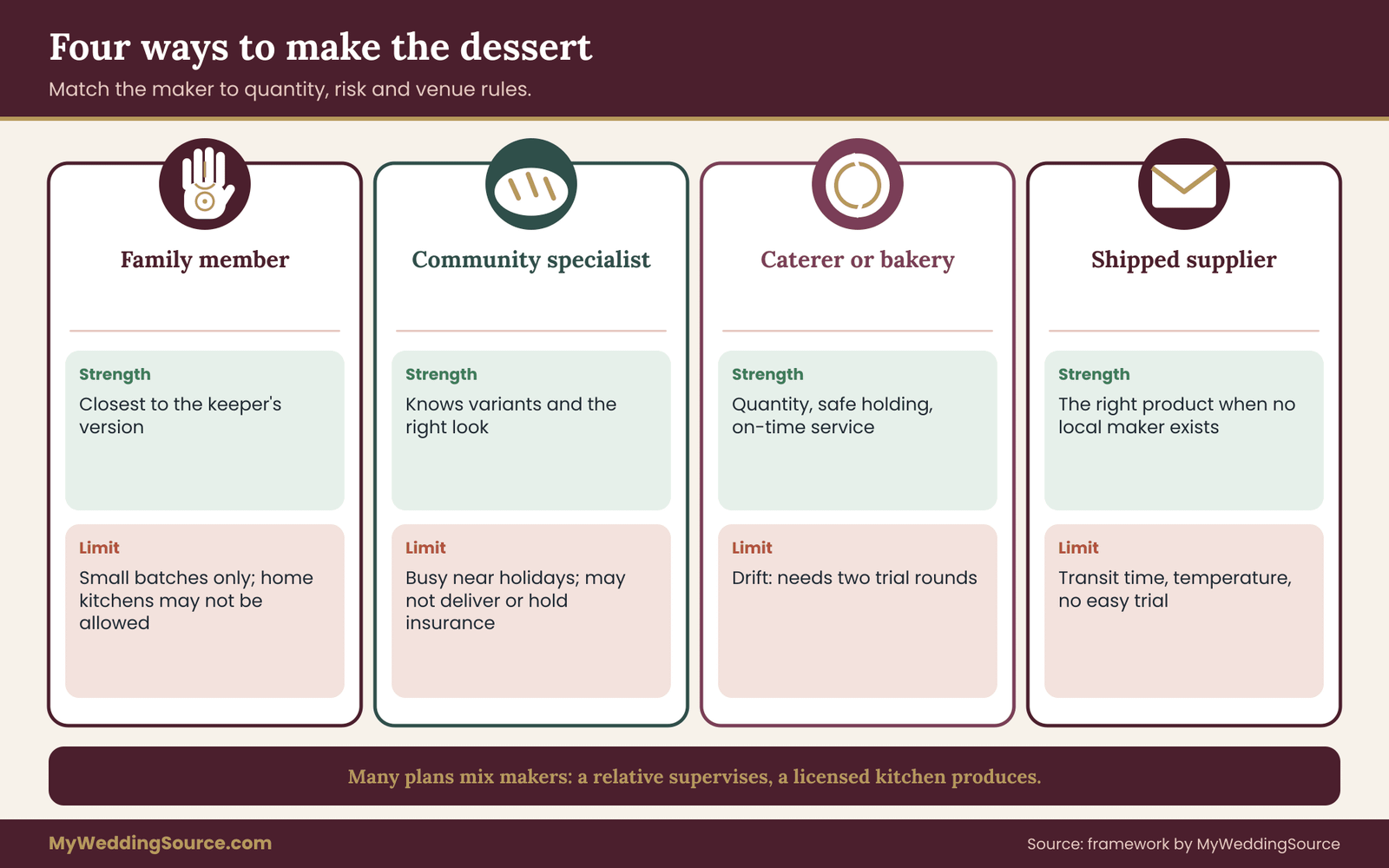
Four kinds of makers can produce cultural desserts for a wedding: a family member, a community specialist, a caterer or bakery recreating the recipe, and a supplier who ships the finished product. Each has strengths and limits, and the right choice depends on the dessert, the quantity and how much risk you can accept.
A family member as maker of cultural desserts
A relative who makes the dessert gives you the closest match to the keeper’s version, often with the keeper’s own hands or supervision. The dessert carries personal meaning, and the family sees its tradition honored directly.
The limits are quantity, safety rules and strain. Making two or three hundred portions is a different job from making a family-sized tray. Home kitchens may not meet the rules that apply to food served to the public, and some venues and caterers will not allow outside food at all. A relative may also feel obliged to say yes and be exhausted by the day itself.
This route works best for small quantities: a ceremonial portion, a single display, a favor for close family. For larger quantities, pair the relative with a professional kitchen, so the relative supervises the recipe while someone else handles volume and food safety.
A community specialist for cultural desserts
A baker or confectioner who works within the tradition, often in a neighborhood shop, usually knows the dessert in depth. They may know regional variants, the right ingredients and the correct appearance. They also tend to have a customer base that notices when it is wrong.
The limits are scheduling and format. Specialist shops can be small and busy near holidays, and some do not produce large wedding orders or deliver. They may not carry the insurance or licensing a venue requires. Ask early and ask directly, and expect to order well ahead.
This route suits desserts with a recognized home market, where several shops make a similar product. Ask the keeper which shops the family trusts. If the keeper names one, you have a strong lead, and a mention of the family’s name often opens a more thoughtful conversation.
A caterer or bakery recreating cultural desserts
A caterer or general bakery can produce quantity, hold food safely, deliver on time and fit the dessert into the service. They may also be the only option your venue allows.
The risk is drift. A kitchen that has never made the dessert will substitute whatever it knows, and its first attempt may taste like something else. This route needs the most careful trial batches. Give the maker the keeper’s paragraph, a reference taste if possible, and a clear list of essential parts and flexible parts. Expect two rounds of tasting. If a caterer says the first batch will be perfect, treat that as a reason for more testing, not less.
A fair question for any recreating kitchen is whether anyone on staff has made this dessert before, and where they learned it. A cook who grew up with the dessert is a stronger signal than a recipe search. A kitchen that says honestly it has not made it, and asks to learn, is better than a kitchen that says it has.
A supplier who ships cultural desserts
Some specialty desserts can be ordered from a shop in another city or country and shipped. This can be the best way to get the right product when no local maker exists.
The limits are shipping time, temperature control, import rules and the lack of a trial. Perishable cultural desserts need cold-chain shipping, and delays can ruin them. Order a trial shipment in the same conditions you expect for the wedding, if the dessert and budget allow. Confirm the supplier’s labeling and allergen information, and ask what happens if the shipment is late. If the dessert includes ingredients that cross borders, check the rules with the relevant agency instead of relying on the seller’s description.
Mixing makers for cultural desserts
Many successful plans use two makers. A relative makes a small ceremonial portion, and a specialist or caterer makes the volume. The two are tasted together before the wedding, so the keeper can confirm that they are recognizably the same dessert. In the program, the card says which is which, so nobody confuses the volume portion with the ceremonial one.
Another common pattern is a family member supervising the production in a licensed kitchen. The relative attends the batch, tastes along the way and approves the result, while the kitchen handles sanitation, labeling and holding. This gives the keeper a real role without shifting liability for food safety to a home kitchen.
Credit and compensation
Whoever makes cultural desserts for you should be credited accurately and paid fairly. Ask a specialist how they want to be named. Some are glad for a mention on the card or in the program. Others prefer not to be named alongside a venue’s catering. Never assume.
If a relative is making the dessert, a credit line such as “made by Aunt Rosa from the family recipe” is a gift, as long as she agrees. Ask her.
Matching the maker to the risk in cultural desserts
A simple decision rule helps. Count the number of portions, rate the dessert’s complexity, and consider how perishable it is. For small, simple, shelf-stable pieces, a relative or specialist is usually enough. For large counts, a perishable filling or a complex process, bring in a licensed kitchen and treat family involvement as supervision. For rare ingredients or a dessert nobody nearby makes, a shipped product with a trial order is often the most honest answer.
Write the decision into the signoff, with the reason. If the keeper later asks why a caterer is making the dessert, the page shows the reasoning: quantity, safety and venue rules, with the keeper’s approval.
Names, labels and the words you print
Written words do much of the work of respect or disrespect. A menu card, a table label and a program line are small, but guests read them closely, and relatives from the tradition will read them with extra care. Getting them right is cheap. Getting them wrong is memorable.
The label formula for cultural desserts
A good label for cultural desserts has four short parts: the name in its own language, a short plain description, the community or family source, and any allergen or diet note. For example, the name, then “a fried dough sweet made for festivals, from the family of the groom’s mother,” then the allergen line. Each part should fit on one or two lines of a small card.
Keep descriptions factual and modest. Say what it is made from, who makes it and when it is usually eaten. Skip adjectives that sell the dessert, and skip claims about meaning unless the keeper has approved them. A plain label reads as confidence, while a decorated one reads as marketing.
Language and script for cultural desserts
If the dessert’s name is written in a non-Latin script, ask the keeper whether to include it. When you do, have the printed version proofed by a fluent reader before it goes to the printer. Designers often substitute fonts that mangle characters, and a printer who cannot read the script will not catch the error.
If you include a romanized spelling, use the form the family uses, even if it differs from a dictionary spelling. Several romanizations exist for many names, and a family tends to prefer one. Ask which. Place the original script first if you include both, and keep the sizes similar, so neither looks like an afterthought.
Do not borrow stories
Avoid origin stories you cannot source. Online articles often attach legends to desserts that the families themselves do not tell. If the keeper tells a story, you may use a short version with permission. If you found the story on a website, leave it out.
Likewise avoid phrases that frame the dessert as exotic, such as “a taste of faraway lands.” For the family it is not faraway, and for many guests it is not either. Describe it the way you would describe your own favorite sweet: where it comes from and when you eat it.
Allergen and diet notes on cultural desserts labels
Every label for cultural desserts should state the major allergens present, using plain names. The Food and Drug Administration lists the major food allergens in the United States, and the list is longer than many hosts expect, since sesame joined it in recent years. Check the current list on the agency’s site, and read the ingredients of every component, including fillings, glazes, oils and decorations.
Also state diet-related facts that matter to guests, such as whether a dessert contains alcohol, gelatin, animal fat or dairy. These notes matter to guests who follow religious or personal rules, and the keeper often knows which ones apply. The wedding signage system guide covers how to keep a set of small signs consistent in style and placement.
Proofing routine for cultural desserts
Run the same proofing routine for every printed word. The keeper checks the name and the description. A second fluent reader checks spelling and script. A person who does not know the tradition reads the card to see whether it makes sense to a guest. The caterer checks the allergen line against the actual recipe. Only after all four have signed off does anything go to print.
Print a few spare cards, and bring a pen. Last-minute changes happen, such as a swapped ingredient or a corrected spelling, and a handwritten correction from a family member is better than a wrong printed line. Keep the digital files with the signoff page, so the next event, whether an anniversary or a family reunion, can reuse them.
Placing and serving cultural desserts on the day
The setting decides whether a dessert reads as part of the celebration or as an extra. The keeper’s answers from the consultation do most of the work here, but you still need to translate them into a schedule, a layout and a service plan that the venue and caterer can follow.
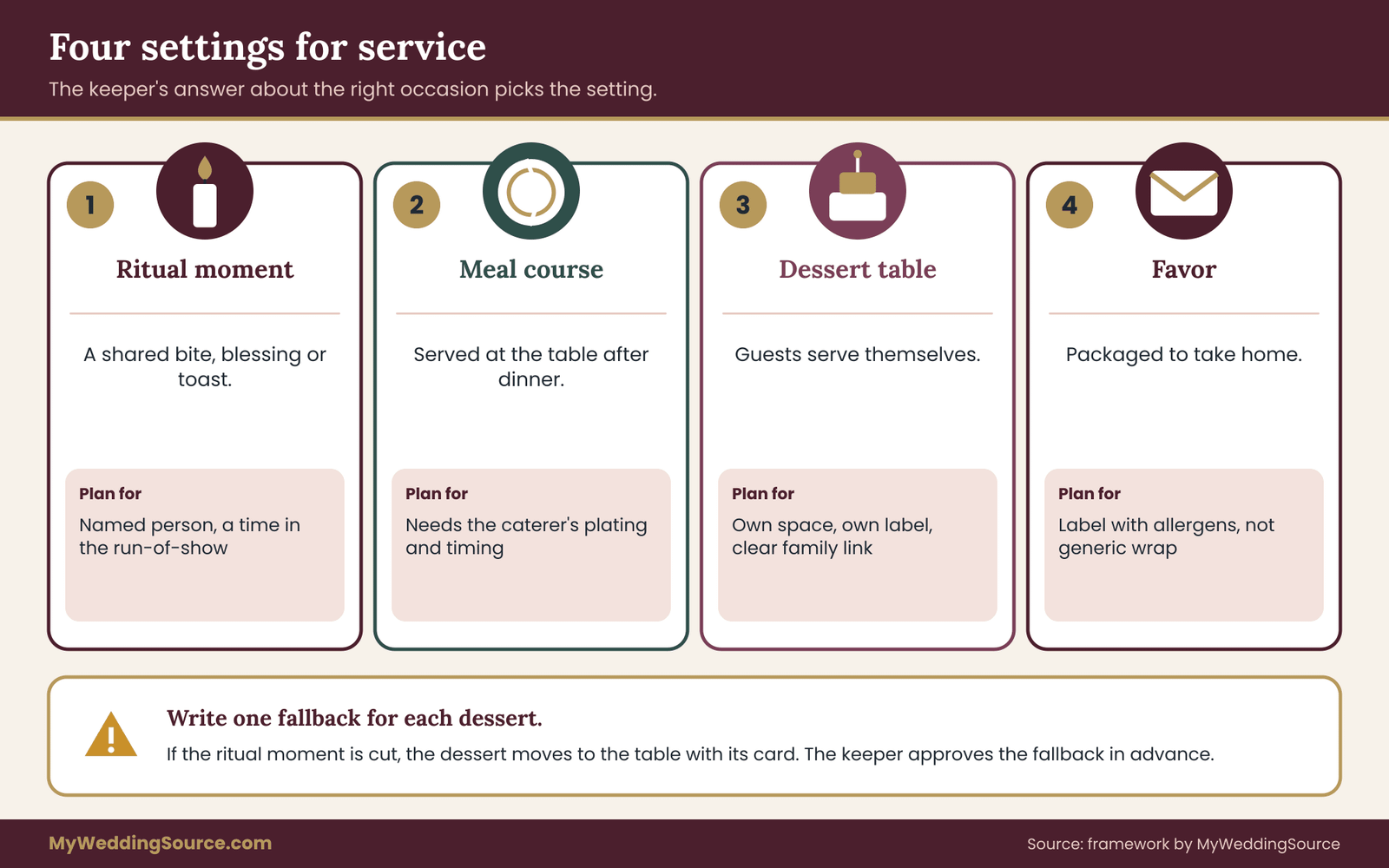
Four common settings for cultural desserts
A ritual moment. The dessert appears at a specific point in a ceremony or custom, such as a shared bite, a blessing or a toast. It is served in small portions, to specific people, with a specific action. This setting needs the keeper’s direct guidance and often an elder to lead it. Put it in the run-of-show with a time and a named person, so it does not depend on someone remembering.
The meal course. The dessert is served at the table as part of the dinner, after the main course, in place of or beside the cake. This works for cultural desserts that belong at the end of a family meal. It needs the caterer’s cooperation, because plating changes service flow.
A dessert table or station. Guests serve themselves from a display. This is the most flexible setting and the one most likely to turn into a novelty if the dessert is lost among many treats. Give the dessert its own space, its own label and a clear visual connection to the family, such as a serving plate that belongs to them.
A favor. The dessert is packaged and given to guests to take home, which suits sweets that are traditionally shared with those who could not attend, or that keep well. Packaging should carry the same label information as a table card, including allergens, and should not look like ordinary party favors.
Choosing among them
Start from the keeper’s answer about when the dessert is traditionally eaten. If the answer is “at the meal,” choose the meal course. If it is “at a particular moment,” choose the ritual setting. If the dessert is a treat with no fixed occasion, a table or favor is acceptable.
Then check the schedule. A ritual moment needs a few minutes of attention from the whole room. A course needs the caterer’s timing. A table needs space and a time guests will actually visit it, which is often not the busiest part of the evening. A favor needs packaging and a handoff moment. If the schedule cannot support the keeper’s preferred setting, pick the nearest alternative and get the keeper’s approval, rather than forcing the dessert into a slot that does not fit.
Cultural desserts alongside the wedding cake
Many couples serve cultural desserts next to a wedding cake. That can work well, as long as neither feels like an afterthought. Decide in advance which one is the main dessert, and reflect that in portion counts, placement and timing.
If the cake is the main event, the cultural dessert can appear as a second course, a table beside the cake or a favor. If the cultural dessert is the heart of the sweets, the cake may become a smaller cutting moment, with a few tiers or a single cake for the photograph. Do not use the dessert as a sidekick to a cake you have already decided on.
Talk to your baker about portions, because guests who eat both will each eat less of each. The wedding cake timeline page helps you work out how a cake order fits around other sweets and a cutting time.
Portion counting for cultural desserts
Estimate portions with a simple rule: count the guests who will actually eat the dessert, decide how many pieces each should get, and add a modest buffer. If the dessert is rich, plan fewer pieces per guest. If it is small and light, plan more.
Ask the keeper what a normal serving looks like. Families know the right size better than any catering rule. A dessert traditionally eaten in two or three bites should be served that way, not enlarged to dinner-plate size.
If your plan includes several desserts, plan the combined count. Ask your caterer how many pieces per guest across all sweets is a reasonable target for your meal and your crowd, then split that among the desserts according to their importance. Avoid running out of the cultural dessert while a tray of generic sweets goes untouched. Run out of the generic items first, if anyone has to.
Who serves cultural desserts
Decide who puts the dessert into guests’ hands. In some traditions the right server is a family member, an elder or the couple themselves. In others, any host will do. If the server needs to speak or perform a gesture, brief them ahead of time.
If servers are catering staff, brief them with the same card guests will read, and one extra sentence about what to say if asked. A server who can say “this is the family’s own recipe, and it contains nuts” is more helpful than one who guesses. Print the brief, and keep it short.
Plates, tools and display
Use plates, trays and utensils that fit the dessert. A sticky sweet needs napkins and small plates, a delicate one needs a flat tray, and a messy one may need a spoon. Ask the keeper what the family uses at home, and match it when you can. A serving dish borrowed from the family adds meaning at no cost, though you should arrange for its safe return and mark it with the owner’s name.
Avoid displays that treat the dessert as decor, such as piling pieces into a novelty stand or adding themed props unrelated to the family. Let the dessert look like what it is. A simple clean platter and a clear label are usually the strongest display.
Timing cultural desserts within the evening
Place the dessert at a time when guests are paying attention and not rushed. Immediately after dinner works for many courses, while a late-night table works for sweets people can pick at. Ritual moments should happen when guests are seated and quiet, not during a dance set.
Check where the dessert sits relative to speeches, dances and cake cutting. If a toast precedes the dessert, the toast can introduce it. If the dessert follows a ceremony in a different space, someone must move it, and that person should be named. The wedding reception guest flow guide covers how to map people and tasks through the evening so these handoffs do not rely on luck.
Venue and catering rules for cultural desserts
Many venues and caterers restrict outside food, require licensed vendors or charge a fee for service. Ask for the policy in writing before you promise anything to the keeper. If outside food is not allowed, find out whether the caterer can make the dessert, whether the venue allows a licensed baker to deliver it, or whether a ceremonial portion is treated differently from general service.
If the venue allows a family member to bring the dessert, ask about handling: where it will be stored, who will plate it and what happens with leftovers. A rule that sounds simple can create surprise on the day if nobody has read it closely.
Fallbacks for the setting of cultural desserts
Write a second-choice setting for each dessert, and share it with the person running the day. If the ritual moment is cut because the schedule runs late, the dessert moves to the table with its card. If the table is crowded, the dessert moves to a favor. The keeper should have approved each fallback in advance.
A fallback does not have to be elegant. It has to be respectful and pre-approved. When the schedule slips, a calm plan beats improvisation, and it saves the keeper from watching an important dessert vanish into the background.
Food safety, allergens and diet rules for cultural desserts
Cultural desserts often involve ingredients and methods that standard catering checklists do not cover, such as raw or lightly cooked fillings, dairy-heavy sweets, nut pastes, eggs, fresh fruit and alcohol. Treat safety as a separate track from authenticity, and give it equal weight. A dessert that honors the tradition and sends a guest to urgent care has failed its purpose.
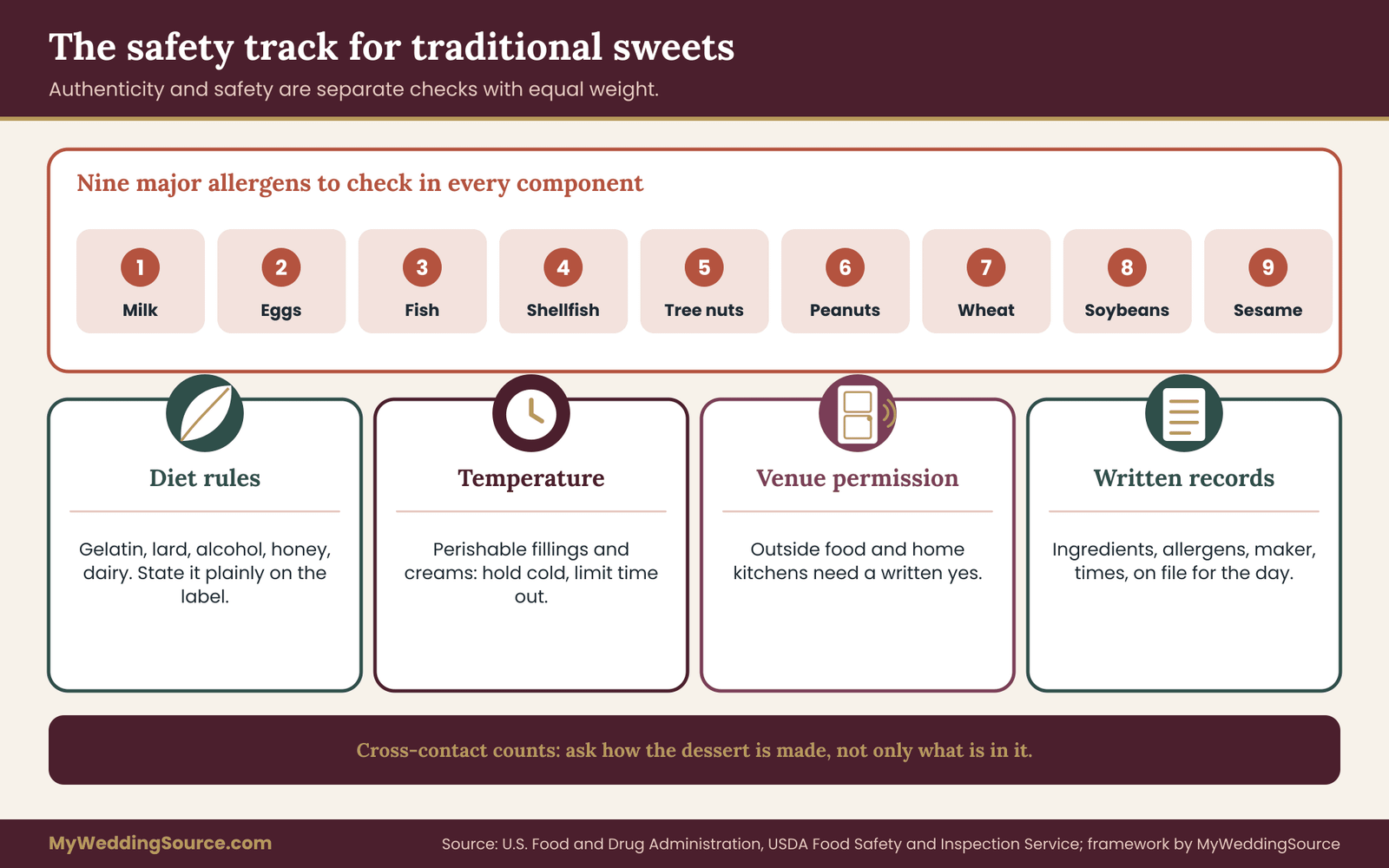
Allergens in cultural desserts
The Food and Drug Administration identifies the major food allergens in the United States, and the list covers milk, eggs, fish, crustacean shellfish, tree nuts, peanuts, wheat, soybeans and sesame. Many traditional sweets use several of these at once, and some use them in forms that are easy to miss, such as nut flours, sesame paste, milk solids and egg wash.
Make a full ingredient list for each dessert, including every component: dough, filling, syrup, glaze, topping and anything used to grease a pan or finish a surface. Ask the maker to check each ingredient against its package label, because brands change formulas. Then list the allergens on the card and in the vendor brief.
Cross-contact is a separate issue. A dessert made without nuts in a kitchen full of nuts may still be unsafe for a guest with a serious allergy.
If a guest has told you about an allergy, ask the maker how the dessert is produced and whether it can be made in a way that avoids cross-contact, and then decide honestly whether to serve it to that guest. The Food Allergy Research and Education organization publishes guidance for hosts and food service. The wedding guest care planning guide covers how to collect and handle guest needs without making anyone feel singled out.
Diet and belief rules for cultural desserts
Some guests follow dietary rules for religious, ethical or health reasons. A traditional dessert may contain gelatin, lard, alcohol, honey, dairy or other ingredients that matter to them. Ask the keeper about any rules the dessert itself follows, and ask guests, early, about the rules they follow.
When a dessert cannot meet a guest’s rules, say so plainly on the label, and offer another option. Do not alter a traditional dessert to fit a rule without the keeper’s approval, since the change may remove an essential part. It is often better to offer a separate item than to change the original.
Temperature and time for cultural desserts
Perishable desserts, such as those with dairy, cream, custard, eggs or fresh fruit, need temperature control. Federal food safety guidance describes a range between 40 and 140 degrees Fahrenheit in which bacteria multiply quickly, and advises that perishable food should not sit out for more than about two hours, or one hour in hot weather. Local health departments apply the Food Code in their own way, so ask the caterer and the venue how they will hold and serve the dessert and what the local rules require.
Shelf-stable sweets, such as dry cookies and some confections, have lower risk, but they still need clean handling and protection from heat and pests at an outdoor event. If a dessert is served on a table for a long evening, plan to refresh small amounts instead of putting everything out at once.
Homemade desserts and the rules that apply
The rules for serving food made in a home kitchen vary by state, county and venue. Some places allow limited sales of low-risk homemade foods under cottage food laws, but those laws usually exclude perishable items and do not necessarily apply to food given at a private event. Many venues and caterers require food to come from a licensed kitchen regardless.
Do not assume a family recipe made at home is acceptable. Ask the venue, the caterer and your local health department what is allowed for your event, and keep the answers in writing. If the rules rule out a home-made dessert, the licensed-kitchen option with family supervision, described earlier, is the usual solution.
Labels, ingredients and records
Keep the ingredient list, the maker’s name, the production date and the allergen statement for each dessert in the signoff folder. If a guest has a reaction or asks a question, someone must be able to answer in minutes. Give the caterer or the person on duty a printed copy.
If a dessert is served by guests to each other, such as a family tray passed at a table, brief the family on allergens before the evening. A short note to relatives in the week before the wedding, listing the dessert, its main allergens and anyone who should not eat it, avoids most problems.
The safety check for cultural desserts
The safety step is done when each dessert has a written ingredient list, an allergen line that matches it, a named person who confirmed the maker’s process, a holding and serving plan with times, and written confirmation from the venue or caterer that the dessert may be served. If any item is missing, treat the dessert as not yet approved. Safety does not work on goodwill.
Vendor questions and contract language for cultural desserts
A vendor who is new to cultural desserts needs more than a name and a photograph. A good brief, a short list of questions and a few lines in the contract protect both sides, and they make it easier for a thoughtful vendor to say yes honestly or no early.
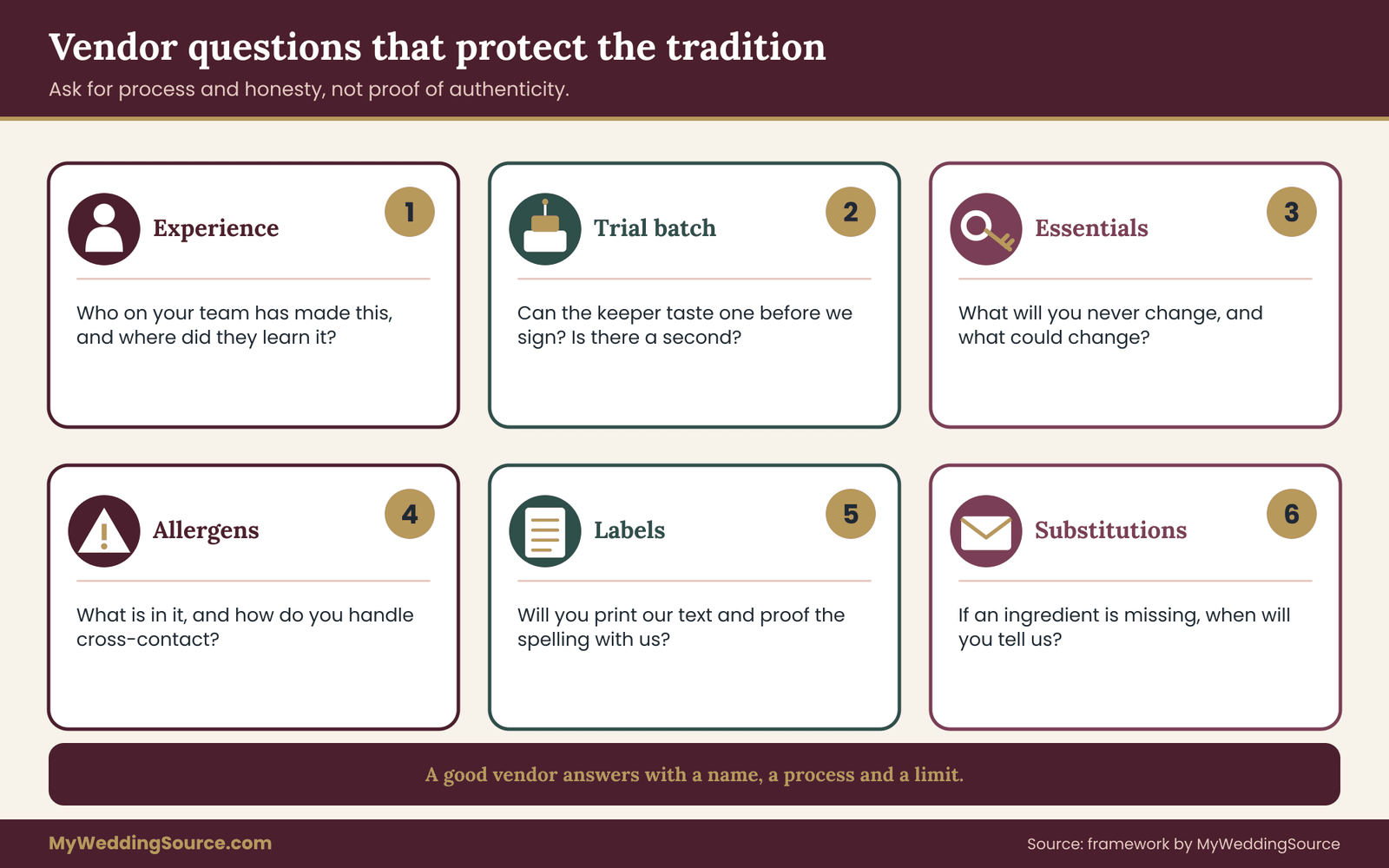
Questions to ask before you hire a maker of cultural desserts
Ask these questions in a conversation or in writing, and keep the answers. Their purpose is to find out how the vendor will handle cultural desserts, not to catch them out.
- Have you made this dessert, or one close to it, and who on your team knows it well?
- Will you make a trial batch, and can the keeper taste it before we sign?
- What parts of the recipe could you change for convenience, and which will you leave alone?
- How will you source the essential ingredients, and what happens if one is unavailable?
- What allergens are present, and how do you handle cross-contact in your kitchen?
- How will the dessert be held, transported and served, and at what temperatures?
- Can you print or supply labels with the text we provide, and will you proof the spelling with us?
- How do you want to be credited, if at all?
- What is the price per portion, and what is included in setup, service and cleanup?
- What is your policy on cancellations, shortfalls and substitutions?
Notice that none of these ask the vendor to prove their authenticity. They ask for process, honesty and accountability. A vendor who answers carefully and admits limits is a better partner than one who promises everything.
Reading the answers
A strong answer names a specific person, a specific process and a specific limit. “Our pastry lead grew up making this, and she will run the trial” is strong. “We can do anything” is not. A strong answer also includes a refusal: “We would not change the filling, but we could change the shape if that fits your oven schedule.”
Be cautious about vendors who describe the dessert in their own terms rather than yours, or who suggest a modern twist before they have tasted the original. A twist can be a creative choice, but it belongs after the keeper has approved the traditional version, and only if the keeper welcomes it.
The trial batch for cultural desserts
Insist on at least one trial batch of your cultural desserts, and plan for two. At the first, the keeper tastes, compares to memory and lists differences. The maker adjusts. At the second, the keeper confirms the result or lists remaining differences. Photograph the approved batch with a ruler or coin for scale, and keep the photo with the signoff.
Judge a trial on a few measurable things: size, shape, color, texture, sweetness, key flavors and how it holds over a few hours. Ask the keeper to rate each as right, close or off, and write the ratings down. If a trial lands off on an essential part, change the recipe or the maker. If it lands off on a flexible part, decide whether the difference matters to the keeper.
Pay for trials, and treat them as part of the work. A vendor who gives free trials will sometimes cut corners, and a vendor who charges for one is paying for ingredients and time. A fair trial fee is a small cost compared with a failed wedding dessert.
What to put in the contract for cultural desserts
The contract should say what the dessert is, in the words of the approved paragraph or an attached brief. It should list the quantity, the delivery or service time and place, the allergen statement, and the price. It should say that the dessert will match the approved trial in the specified respects, and that substitutions require written approval from the host, after consulting the keeper.
Add a line stating that labels and names will use the spelling in the attached proof and will not be altered without approval. Add a line about handling and holding temperatures where relevant. If the vendor will credit a family member or community, state how.
Add a remedy line. If the dessert materially differs from the approved trial, what happens: a replacement, a partial refund or removal of the item from the bill. This line is rare in wedding contracts, but it gives a conversation a place to start if something goes wrong. The wedding vendor contract page walks through the clauses that matter in most vendor agreements, and the vendor due diligence checklist helps you confirm licensing, insurance and references before you sign.
Substitutions in cultural desserts
Substitutions cause most disappointments with cultural desserts. Ask the vendor to commit to a notification rule: if an ingredient becomes unavailable, they tell you as soon as they know, not on the morning of the wedding. Pre-agree which substitutes are acceptable, based on the keeper’s list of flexible parts. Anything outside that list goes back to the keeper.
Put the keeper’s contact in the plan, with permission, so the host can reach them quickly. A substitution decided by a quick phone call is better than one decided by default.
The vendor brief for cultural desserts
Give the vendor a single page with the approved paragraph, the six-point signoff results, the ingredient and allergen list, the quantity, the setting, the label text and the photo of the approved trial. Add the host’s contact and the name of the person on site who can decide. Keep it short enough to read in five minutes.
Send the brief with a brief cover note that thanks the vendor for their care. Vendors respond well to being treated as partners. The more clearly you describe what matters, the more likely they are to protect it.
When a vendor pushes back on cultural desserts
Some vendors will resist the process, saying it is too much trouble, or that they know best. Listen for the reason. A real constraint, such as equipment or capacity, deserves a real solution. A matter of preference, such as “we always do it this way,” is not a reason to override the keeper.
If the vendor will not accommodate a reasonable process, consider whether this is the right vendor. A single dessert is a small part of the day, but it often becomes the part a family remembers. Choosing a vendor who takes it seriously is part of the plan.
A worked example: the Tran and Oyelaran wedding
This invented example shows how the process works for cultural desserts in practice. It is not a report of a real event, and the details are illustrative.
Linh Tran and Tunde Oyelaran are planning a wedding for about one hundred and twenty guests. Linh wants a sweet from her grandmother’s region to appear at the reception. Tunde wants a fried dough sweet his mother makes for celebrations. They worry about doing both well, and about the caterer, who has said “we can handle anything.”
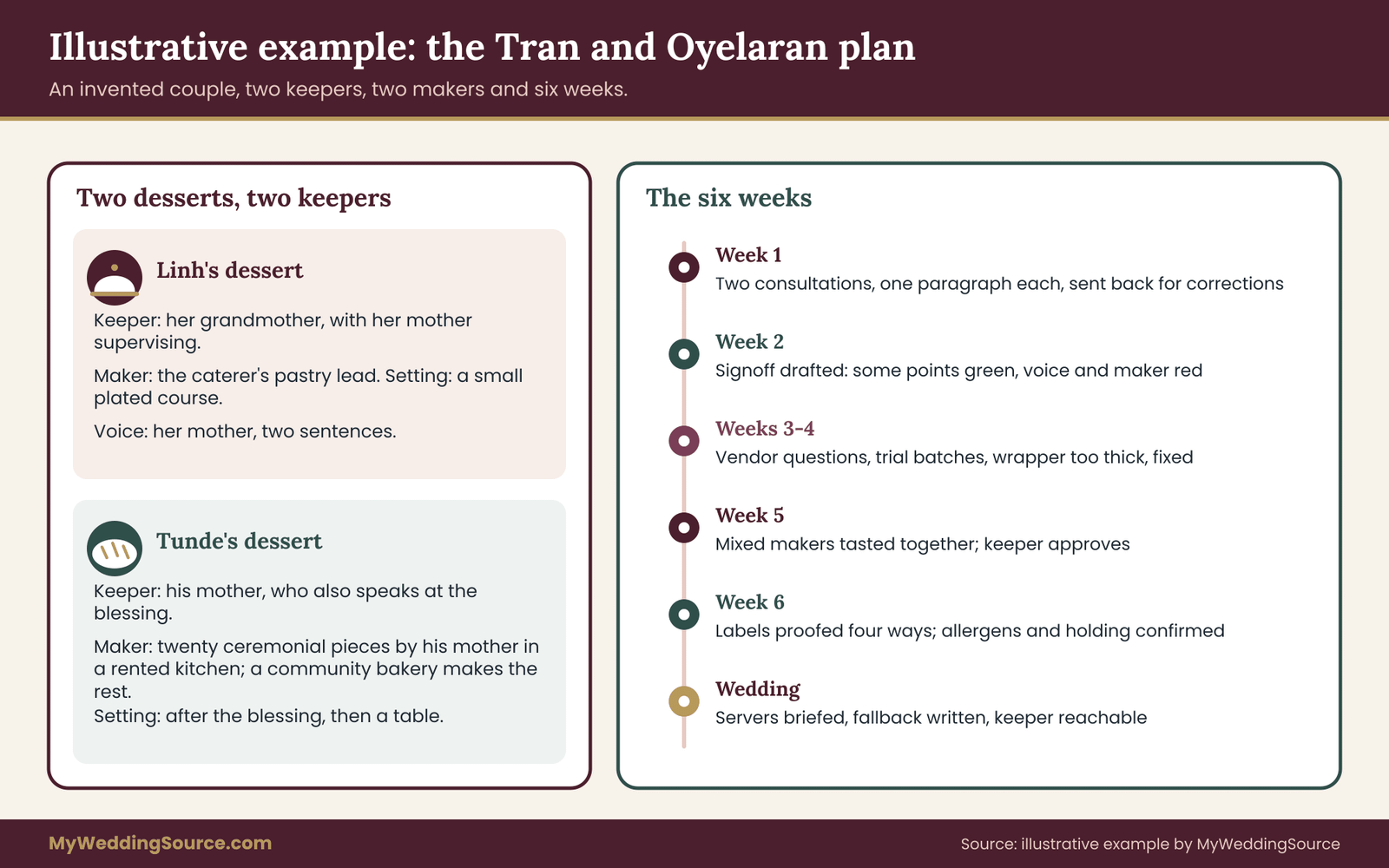
Week one: two consultations
Linh calls her grandmother and holds a conversation over video, with her mother on the line. The grandmother names the dessert, explains that it is served at engagement and wedding celebrations, and says the filling must use a particular bean paste and the wrapper must be a certain thickness. She says the version her sister makes uses a different shape, and that either is acceptable. She is not eager for a caterer to make it, but she agrees if Linh’s mother supervises.
Tunde sits with his mother in her kitchen. She calls her sweet by a name in her language, shows him how it is fried, and says it is served after the blessing at celebrations, not at a general dessert table. She says it keeps well for a day. She prefers to make it herself but admits she cannot produce two hundred pieces.
Week two: the signoff draft
Linh and Tunde fill out a signoff page for each dessert. For Linh’s, the name is green, confirmed by her grandmother and her mother. Meaning is amber, since the grandmother said it is served at celebrations but did not claim a symbolic meaning, so they will print only that. Source is green. Maker is amber, pending a trial. Setting is amber, since the caterer’s table plan is unfinished. Voice is red, since nobody has been named.
For Tunde’s, the name is amber, since his mother uses a spelling that differs from the one he found online, so they will ask her to write it. Meaning is green. Source is green. Maker is red, since his mother cannot produce the quantity. Setting is amber, since the blessing is part of the ceremony schedule. Voice is green, since his mother will say a few words.
Weeks three and four: makers and trials
For Linh’s dessert, they ask the caterer the vendor questions. The pastry lead says she has made a similar sweet and asks for a recipe walkthrough. Linh’s mother agrees to visit the kitchen for a trial. The first trial has a wrapper too thick; the second is accepted by her grandmother over a photo and a mailed sample.
For Tunde’s dessert, they decide his mother will make a ceremonial portion of twenty pieces for the blessing, using a licensed commercial kitchen the caterer rents, with her supervising. A community bakery will make the remaining pieces for the table. The two are tasted together, and Tunde’s mother says they are recognizably the same.
Weeks five and six: setting, voice and safety
They place Tunde’s ceremonial portion after the blessing, with his mother serving the couple and parents. The bakery’s pieces go to a dessert table with a card. Linh’s dessert is served as a small plated course after dinner, with her mother introducing it in two sentences. A short card describes each dessert. The allergen lines list sesame and peanuts for one and soy and wheat for the other. The caterer confirms holding temperatures in writing.
The result and the lessons of the cultural desserts plan
The caterer’s staff learns the pronunciation from a recorded clip and a card. The family sees both desserts served as intended. Neither of the elders is surprised by anything. The cost is higher than a simple dessert order, because of trials and a second kitchen. The couple considers it worthwhile.
The example shows several patterns. Consultation came before vendor choice. Red points were treated as tasks, not failures. Makers were mixed, with the family supervising. Setting followed the keeper’s answers. Labels used the keeper’s words and nothing more. Most of the work was a few conversations and a few pages, not expensive, and it was done early.
What they would change
In the example, the couple notes that they started the trials a week later than they would have liked and had little room for a third batch. They also note that they should have asked about the bakery’s capacity earlier. These are small lessons, and they are the kind a real plan often meets. Build slack into the schedule, because trials rarely land on the first try.
Edge cases: when cultural desserts get complicated
Most plans for cultural desserts fit the method as written. A few situations need extra thought. None has a single right answer, but each has questions that lead to a defensible one.
One partner is not from the tradition behind the cultural desserts
When the dessert belongs to one partner’s family, the other partner should join the consultation as a listener and learner, not as co-owner of the decision. They can still shape the practical side: the budget, the schedule and the venue. They should not overrule the keeper on essential parts.
If the partner outside the tradition feels uncertain, say so to the keeper. Families usually respond warmly to a sincere request to learn. A phrase as simple as asking what a guest from outside the family should know before eating the dessert often draws the best advice for the label.
The couple wants a tradition from neither family
Sometimes a couple loves a dessert from a place they lived, a friend’s family or a culture they admire, and wants it at the wedding. This is the situation closest to the novelty risk, and it calls for the strongest consultation.
Find a real keeper: a friend’s family, a community bakery or a cultural organization willing to guide you. Ask them whether serving the dessert at a wedding is appropriate, in what form and with what words. Be ready to hear no. If the answer is yes, follow the full signoff and credit the source plainly. If the answer is no, or if no keeper can be found, choose a different dessert. Admiration alone is not a source.
Fusion versions of cultural desserts
Some couples want a new dessert that combines elements from both families. That can be a lovely idea, as long as both keepers agree. Present it as what it is: a new dessert created for this wedding, inspired by two traditions, and not as a traditional item.
Ask each keeper to approve the elements taken from their tradition. Avoid claiming either family’s name for the result. If one keeper objects, remove the element or serve the traditional versions separately. A fusion that offends one family has failed, however clever it is.
Sacred or restricted cultural desserts
Some sweets are tied to religious rituals or to specific people, such as an elder, a priest or a married couple. Using them outside the ritual can be inappropriate or disrespectful. If you suspect that is the case, ask the keeper directly whether the dessert may be served at a wedding, and in what circumstances.
If the answer is that it may only be made or served by a particular person, accept the limit. A ceremonial item cannot be reproduced by a caterer. In that case, consider whether a related everyday sweet from the same tradition might serve the same purpose, with the keeper’s blessing.
Families who disagree
Sometimes the families of the two partners disagree about whether a dessert should appear, how it should be served or who should make it. Do not try to settle this by volume or seniority. Each family decides its own tradition, and the couple decides how the two fit together.
If conflict persists, reduce the scope. Give each family a small, clear role, such as a ceremonial moment or a display, and keep the rest of the sweets neutral. A smaller plan that both families accept is better than a larger one that splits the room. The wedding etiquette guide covers general ways to handle family expectations when they pull in different directions.
Distance and timing
If the keeper lives far away, or the dessert needs to be shipped, plan earlier and expect more rounds of video calls and mailed samples. If the keeper cannot travel to the wedding, arrange a short recorded message, a call during the dessert or a printed note read aloud. A keeper who cannot attend should still feel present.
If the keeper is in poor health or advanced age, move the consultation up and record it. Do not wait for the final menu to ask. A recorded conversation is often the most valuable thing the couple takes from the process, long after the dessert is eaten.
A guest from the tradition objects
Occasionally a guest from the tradition notices something they believe is wrong. Respond with courtesy. Thank them, ask what they noticed and share what the keeper approved. Most such moments are small and pass. If the guest raises a serious concern, record it, thank them again and ask the keeper whether anything should change at future events.
Do not argue with the guest on the spot, and do not apologize for the keeper’s decisions. The keeper’s approval is your answer, and the reply can be as simple as saying that the family’s elders reviewed the plan.
Photography and cultural desserts online
Ask the keeper whether photos of the cultural desserts, or of the ritual moment, may be shared. Some families are glad for a public photo, while others prefer privacy for sacred moments. Tell the photographer what is welcome. If you post about the dessert later, use the family’s name for it and credit the maker with permission.
Measurable checks before the wedding
Respect is hard to measure, but readiness is not. These checks turn the cultural desserts signoff into something you can tick off in the final weeks.
Consultation check. One written paragraph exists and the keeper has confirmed it, with the date saved.
Signoff check. All six points are green, or each amber has a dated action and an accepted fallback.
Trial check. At least two trial batches were tasted, the keeper rated the last one right on every essential part, and a photo with scale is on file.
Quantity check. The portion count is written, with the guest count, pieces per guest and buffer shown, and the maker has confirmed capacity in writing.
Label check. Four people have proofed every printed word: the keeper, a second fluent reader, a guest-eyed reader and the caterer.
Safety check. Ingredients, allergens, holding times and venue permission are written down and on file with the person managing the day.
Role check. Every person with a part in service or explanation has a name, a script and a time.
Fallback check. The second-choice setting is written, approved by the keeper and known to the person running the day.
A short day-of routine for cultural desserts
On the morning, one person confirms delivery, checks the labels against the approved proof, confirms holding temperatures and walks the setting. A second person briefs the servers and the family helpers. A third person is the contact for any question about the dessert, with the keeper’s number saved.
Keep the routine short and written. Wedding mornings are busy, and a card with six lines is more likely to be followed than a memory of a long conversation.
After the wedding: closing out cultural desserts
Send the keeper a thank-you, a photo and a short note about how it went, within a week or two. Return borrowed dishes cleaned. Pay the maker promptly. Save the signoff folder, and add a line about what you would change. That folder may be the most useful record in your wedding archive, and the next family event, whether a baby celebration or an anniversary, will start from it.
If your wedding includes several kinds of food from different traditions, the same method applies to savory dishes too, and the wedding menu planning guide shows how the dishes fit together across a whole meal.
Your next steps
Pick one dessert and one keeper this week. Call or visit, bring a notebook, and ask the eight questions. Write the paragraph and send it back for corrections. Then draft the six-point signoff, mark each point green, amber or red, and give every amber a date.
Next, choose the maker with the decision rule in this guide, book a trial and confirm the allergen and venue answers in writing. Print nothing until the keeper and a second reader have proofed the label. By the time the wedding arrives, your cultural desserts should be a plan the keeper recognizes, the vendor can follow and your guests can enjoy without a single awkward moment.
FAQ
How do we ask a relative to share a family dessert without putting pressure on them?
Start with a conversation about the person, not the plan. Ask how they learned the dessert and what it meant at their celebrations. Share your interest, then ask what role, if any, they would be comfortable with. Offer to cover ingredients and pay for labor. Make it easy to say no or to choose a smaller role, and thank them whatever they decide.
What if nobody in the family can make these cultural desserts anymore?
Name a stand-in keeper, such as another relative, a community elder or a specialist bakery from the same tradition. Ask them to taste a trial and confirm the details. If nobody from the tradition can approve a version, give the dessert a smaller role with a plain label that states its source modestly, and avoid claims about its meaning.
Is it disrespectful to serve cultural desserts from a culture that is not ours?
It can be, but it does not have to be. The question is whether someone from that tradition has been asked, agrees and has a real role in how it appears. If you can find a willing keeper, follow the signoff and credit the source. If you cannot, choose a different dessert. Admiration is not the same as permission.
How many trial batches should we plan for?
Plan for at least two. At the first, the keeper tastes and lists differences, and the maker adjusts. At the second, the keeper confirms the result or lists what remains. Build in time for a third in case an essential part is still off. Trials are cheaper than a failed dessert, and most vendors will quote a fair fee.
What should a label for a traditional dessert say?
A short label for cultural desserts works best: the name in its own language, a plain description, the family or community source and the allergen and diet notes. Use the keeper’s words and avoid adding symbolic meanings you read online. Have the keeper and a second fluent reader proof the spelling, and have the caterer check the allergen line against the real recipe.
Can a relative make the dessert at home for the wedding?
It depends on your state, county, venue and caterer. Many venues require food from a licensed kitchen, and cottage food rules usually do not cover perishable items. Ask your local health department and the venue before you promise anything. A common solution is for the relative to supervise production in a licensed kitchen, so the family role is real and the safety rules are met.
How do we handle allergies with traditional sweets that use nuts or sesame?
List every ingredient in every component, check the packaging, and state the major allergens on the label. Ask the maker how cross-contact is handled, and tell guests with serious allergies exactly what is in each dessert. The Food and Drug Administration lists the major allergens, which now include sesame. When a dessert cannot be made safe for a guest, offer a separate option.
What if the dessert cannot be served the way the keeper wants?
Write a second-choice setting in advance and get the keeper’s approval. If the ritual moment is cut, move the dessert to a table with its card, or to a favor. Do not improvise on the day. A pre-approved fallback keeps respect intact, and it saves the keeper from watching an important dessert disappear into the evening.
Sources
- Food allergies, U.S. Food and Drug Administration
- FDA Food Code, U.S. Food and Drug Administration
- Food safety information, FoodSafety.gov
- Food safety, Centers for Disease Control and Prevention
- Food safety and inspection, U.S. Department of Agriculture Food Safety and Inspection Service
- Center for Folklife and Cultural Heritage, Smithsonian Institution
- American Folklife Center, Library of Congress
- Intangible Cultural Heritage, UNESCO
- Folk and traditional arts, National Endowment for the Arts
- Food Allergy Research and Education