
A courthouse appointment change is what happens when the clerk’s office moves, cancels or reshuffles your marriage slot, or when you have to ask for a different time yourself. This guide gives you a booking dependency and recovery checklist: a way to see which of your other bookings are tied to that slot, which can stay put, and what to say to each person so one new time does not cost you the photographer, the lunch table or a guest’s flight.
When a courthouse appointment change lands, do not start calling vendors yet. First get the new slot in writing, then sort every other booking into one of four tethers: tied to the clock time, tied to the date, tied to the place, or loose. Apply a simple rule to each one: move it, hold it, or release it. Move what is tied to the old time and cheap to change, hold what you can keep without paying twice, and release what no longer fits. Write every change in one log and confirm each in writing.
Most couples who choose the clerk’s office plan the appointment first and the rest second. That order makes sense, because the appointment is the one thing nobody else can give you. It also means every other booking quietly depends on it. The photographer arrives at a time that was chosen to match the slot.
The restaurant table is held for the hour after. A sister is flying in on a ticket bought for that weekend. A courthouse appointment change touches all of them at once, and the person who notices first is usually you, on a weekday, in a work meeting.
This article is about that moment and the days that follow. It does not explain how to get the license or what the clerk’s staff will say during the ceremony; the sibling guides on this site cover the day itself and the celebration around it. Here the question is narrower: your slot has moved, so what should move with it, what should stay, and what should be given up?
A note on scope. This is general information, not legal, tax or financial advice. License rules, waiting periods, fees, hours and rescheduling policies differ by county and state and change over time, so confirm each one with the office that issues your license and performs or records your marriage.
Why a courthouse appointment change is a booking problem, not a legal one
When a slot moves, the first instinct is to treat it as a legal matter: Is the license still good? Does the new date break a rule? Those questions are real, and a later section covers them. But for most couples the legal side is solved with one phone call or one form, and the larger damage happens elsewhere. A courthouse appointment change becomes expensive because other people hold commitments that were built around your original time.
Think of the arrangement as a set of strings tied to one nail. The nail is your appointment. Each string is a booking: a photographer, a restaurant, a hair appointment, a rental car, a babysitter, a train ticket, a day of leave from work. When the nail moves, some strings stretch, some go slack and some snap. The goal is not to protect every string. It is to know which strings are attached before you pull on any of them.
The five ways a slot actually changes
Every courthouse appointment change begins with a cause, and the cause shapes how much room you have. Not every courthouse appointment change looks the same, and the right response depends on who caused it and how much notice you have.
The office moves you. Staff rearrange the calendar, a judge or magistrate becomes unavailable, or a room is reassigned. You receive a new time that you did not choose. The office may offer one alternative or several.
The office closes. A weather event, a power problem, a holiday that was added to the calendar or a staffing shortage shuts the building. Everyone with a slot that day is affected at the same moment, which means open times fill quickly.
You move it. A document is missing, a witness cancels, someone falls ill, a work shift changes or you simply need more time. You ask, and the office decides whether and when it can accommodate you.
A document problem pauses it. The license cannot be issued or used until something is corrected: a name that does not match an identity document, a missing record of a prior marriage ending, a form that was filled in wrongly. The appointment waits on paperwork.
A rule changes the timing. A waiting period, a license validity window or a notice requirement means the date you hoped for is not available, and the earliest legal slot is later than the one you booked or wanted.
Each of these produces a different amount of notice and a different set of options. A closure on the morning of the appointment leaves almost no room to negotiate with anyone. A document problem found three weeks out leaves plenty. The dependency method works for all five, but how you use it changes with the notice you have.
What does not change
Some things stay fixed whatever happens to the slot. You are still the same two people with the same intention. The office, not the vendors, decides when the marriage can legally take place, and the rules for who may perform a ceremony sit with it too.
And the bookings you made with other people are contracts or agreements with their own terms, so a changed appointment does not automatically cancel, refund or reschedule any of them. That last point surprises people. A photographer who agreed to a Thursday morning has not agreed to a Tuesday afternoon until you both say so.
The four tethers: how to see what depends on the slot
The core tool of this guide is a classification. For every booking connected to your appointment, ask one question: what exactly is it tied to? The answer falls into one of four tethers, and the tether tells you how much trouble the courthouse appointment change will cause and what to do about it.

Clock-tied bookings. These are bound to the hour. A photographer booked for the ceremony window, a restaurant table timed for the hour after, a parking reservation near the building, a ride arranged for a specific pickup, a hair or makeup artist who finishes just before you leave. If the appointment moves by even an hour, these need a conversation. If it moves by a day, they usually need a full rebook.
Date-tied bookings. These are bound to the day but flexible about the hour. A guest’s flight, a hotel room for one night, a day of leave from work, a child-care arrangement for the day, a bakery pickup. A move within the same day may not touch them. A move to another day touches all of them.
Place-tied bookings. These are bound to the location rather than the time. A particular courthouse, a nearby venue chosen for its walking distance, a photographer who scouted the steps outside. If the office offers an alternative branch or a different building for the new slot, these are the ones that break, even when the date and time barely move.
Loose bookings. These have no real tie to the slot. A celebration dinner weeks later, a party in a backyard, a honeymoon booked for the following month. They are affected only if the courthouse appointment change is large enough to bump them, and often they do not need to change at all.
A single booking can carry more than one tether. A restaurant table for the lunch after the ceremony is clock-tied (the hour), date-tied (the day) and place-tied (it was picked because it is two blocks from the building). That is why the classification takes a few minutes of honest thought, not a quick glance.
Why the tether matters more than the vendor type
A courthouse appointment change hits each booking through its tether, not through its label. It is tempting to sort by vendor: photographers here, restaurants there, family over there. That works for a contact list, but not for a decision. Two photographers can be tied differently. One booked a two-hour block starting at the slot, so she is tightly clock-tied. Another booked a half day and will shoot portraits at a park at any point, so he is date-tied only. Treating them the same wastes effort on one and underprotects the other.
The tether also tells you the order in which to call, which fits neatly into any vendor timeline you already keep. Clock-tied bookings with the least flexibility or the highest cost of failure go first, because those are the ones where a day’s delay can mean a lost slot. Loose bookings go last, and sometimes not at all.
A quick example of tethering
Here is a small courthouse appointment change run through the four tethers. Suppose your slot is a Thursday at ten, and your list looks like this: a photographer booked from nine thirty to eleven thirty, a lunch table at noon at a restaurant a short walk away, your mother’s train arriving Wednesday night, a florist delivering a small bouquet at nine, and a backyard dinner planned three weeks later.
The photographer and florist are clock-tied. The lunch is clock-tied and place-tied. The train and the mother’s hotel night are date-tied. The backyard dinner is loose. If the courthouse moves you to Thursday at two in the afternoon, the clock-tied items need to move by four hours, the date-tied items stay exactly where they are, and the loose item does not care. If the courthouse moves you to the following Tuesday, nearly everything except the backyard dinner has to be reconsidered.
That difference, between a four-hour shift and a five-day shift, is why the first thing to learn from the office is not only the new time but the size of the move. The same courthouse appointment change can be a ten-minute email or a week of rebooking, depending on those two numbers.
Read the notice before you act on it
The most common mistake in the first hour is acting on a message you have only half read. A text that says your slot is now at eleven may not say which day, which building or which room. An email that offers a new time may require a reply before it is held.
A voicemail may be about a different matter altogether. Before you call anyone, you want four facts confirmed in writing: the date, the time, the exact location including the room or window if there is one, and whether the new slot is firmly yours or only offered.
Ask the office a short list of questions, and note the answers in your log.
“Thank you for the update. Could you confirm in writing the new date, time and exact location of our marriage appointment, whether it is held for us now, and what we need to bring that is different from before?”
If the office offers a choice of times, ask how long each is held and whether choosing one releases the other. Some offices hold an offered slot for a short window only. If you cannot decide in that window because vendors have not answered, you may lose the offer. That is a strong reason to classify your bookings first, even roughly, so you know which new time costs you the least.
It also helps to ask why. The answer tells you how likely a second change is. A one-off scheduling conflict is unlikely to repeat. A staffing shortage may. A document problem that has not been resolved certainly may. If the office says the slot could shift again, treat every move you make as provisional and prefer the options you can undo.
Build the dependency map before the next courthouse appointment change
The best time to build the map is before anything moves. If your appointment is still weeks away, spend twenty minutes on it now. If the courthouse appointment change has already happened, spend the same twenty minutes before you start calling. In both cases the exercise is identical, and it produces a one-page document you can read at a glance when you are tired or rushed.
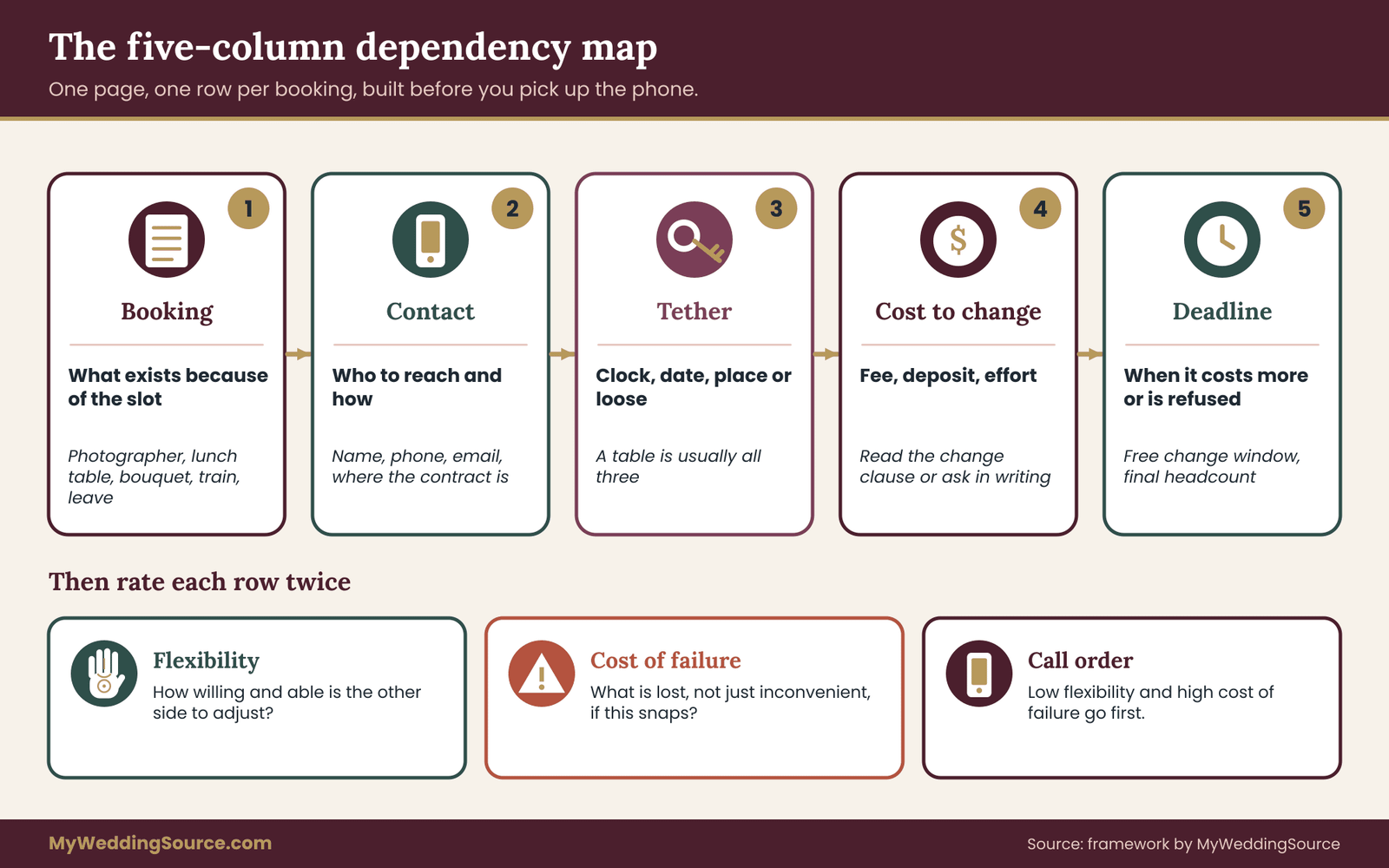
Open a blank page and make five columns. In the first, list every booking, appointment or commitment that exists because of the slot. In the second, write the person or business and how to reach them. In the third, write the tether: clock, date, place or loose.
In the fourth, write what the booking costs to change, based on the contract or the policy you were given. In the fifth, write the deadline after which a change costs more or is refused. Five columns sound like a lot, but most couples with a courthouse wedding have between six and twelve rows.
What to list, and what people forget
A complete map of a courthouse appointment change includes more rows than the obvious vendors. The obvious rows are the photographer, the restaurant, the florist and the guests who traveled. The rows people forget are often the ones that cause the most stress.
Your own time off work. If you requested a day or half-day for the appointment, your employer may need notice to move it, and some workplaces limit how often leave can be rescheduled. Add a row for it, and for your partner’s.
Witnesses. Some offices require one or more witnesses, and some provide staff to act as witnesses; the rule varies by location. If you are bringing your own, each witness has their own calendar. A witness who cannot attend the new slot is a problem you only discover by asking.
Child care and pet care. A sitter booked for four hours does not become available at will. Add the sitter or the neighbor as a row.
Travel for the two of you. If either of you is traveling to the courthouse from out of town, the train, flight, rental car or hotel night is a booking like any other.
Parking and transit. A prepaid garage, a reserved space or a ride-share arranged ahead are small but easily missed, and a mismatch is a classic reason for arriving late.
Hair, makeup and clothing pickups. An alteration appointment, a rental pickup window or a salon slot can be quietly tied to the morning of the appointment.
Paperwork deadlines. The license itself may carry a window in which it must be used, and a certified copy of the marriage record may be needed for something that now falls on a different date. These belong on the map too, even though no vendor is involved.
Celebration plans that ride on the appointment. A dinner that night, a family call, an announcement post you scheduled for the afternoon. Even loose items deserve a row, because “loose” is a conclusion, not an assumption.
Rate each row twice
Beyond the tether, give each row two quick ratings. The first is flexibility: how willing and able is the other party to adjust? A friend with a car is highly flexible. A restaurant with a firm cancellation window is less so. A non-refundable airline fare may be fixed unless you pay a fee.
The second is cost of failure: what happens if this particular string snaps? Missing the photographer is a loss of photographs and perhaps a deposit. Missing a grandmother’s train is something else. These two ratings, flexibility and cost of failure, decide the order of your calls. Low flexibility and high cost of failure go first. High flexibility and low cost of failure can wait, and sometimes a short message is enough.
Use plain words rather than numbers: easy, hard, firm. The point is a ranking you can act on, not a score. If you prefer, mark the three rows that worry you most with a star and start there.
Which bookings are tied to what: the usual suspects, one by one
The same bookings turn up in nearly every courthouse wedding. Here is how each usually behaves when the slot changes, as a starting point for your own map. Every contract differs, so treat these as questions to ask, not rules to rely on.
The photographer
The photographer is often the first booking a courthouse appointment change puts at risk. A photographer is almost always clock-tied, and often place-tied as well. The booking is typically for a time window, sometimes with a minimum, and the photographer may have turned down other work for the day.
A courthouse appointment change within the same day may be absorbed if the photographer is free; a change to another date may need a rebook, a fee, or a forfeited deposit, depending on the contract. The photography guide on this site covers permission and portrait locations. For this purpose, the key questions are whether the contract allows a date change, what it costs, and how soon the photographer needs to know.
Photographers who do not have a contract may still have a stated policy on their booking page. Ask for it in writing before you decide anything. If the photographer cannot make the new time, ask whether they can recommend someone, and ask what happens to your deposit. A calm, early message works better than a late, urgent one.
The restaurant or caterer
A restaurant reservation reacts to a courthouse appointment change through both the hour and the location. A restaurant table is clock-tied and place-tied. Many restaurants hold a table for a short grace period and then release it, and larger parties are often governed by a deposit or a reservation policy. If you booked a private room, the restaurant may have a minimum spend, a deposit and a cancellation window.
The sibling guide on booking a restaurant after a courthouse wedding goes deeper into the deposit and guest-count logic. For a change, the main questions are whether the booking can move to the new date and time, whether the deposit transfers, and whether the restaurant has any availability that matches the new slot.
If the restaurant is full at the new time, the fallback is a different venue, a different meal or a looser plan, which a later section compares.
Guests who are traveling
Traveling guests carry the largest share of any courthouse appointment change. Guests are date-tied. Their flight, train or hotel night was bought for a specific date, and their change costs fall on them, not on you.
This is the hardest part of a courthouse appointment change because the damage is spread across several people and you do not control it. The decision rule is to tell them early, honestly and with your best estimate of how likely a further change is, so they can decide whether to rebook, wait or watch the ceremony remotely.
If a guest has already paid a non-refundable fare, ask whether the airline or carrier offers a change or credit. The U.S. Department of Transportation publishes consumer guidance on airline refunds and changes, linked in the Sources, and travelers can check the current rules there. Do not promise to cover a guest’s costs unless you mean it and can afford it, and say plainly when you cannot.
The officiant or the clerk’s staff
At the clerk’s office, the person who performs the ceremony is usually assigned by the office and has nothing to do with your vendors. If instead you have booked a separate officiant to perform the ceremony after a civil registration, or to speak at a gathering, that person is a vendor with their own calendar.
The officiant requirements guide on this site explains who can legally perform a ceremony and what each type of officiant needs to do, which helps you judge whether a replacement is possible if yours cannot make the new slot.
The florist, hair and makeup
These are clock-tied with small stakes. A bouquet ordered for delivery at a set time can usually be redelivered if the florist has notice, though fresh flowers cannot be held forever. Hair and makeup artists often book in blocks and may charge for a short-notice change. Both tend to be flexible about an hour or two and less so about a day. The sibling guide on transporting a courthouse bouquet covers keeping flowers fresh when plans shift.
The cost of failure: separating what is lost from what is merely inconvenient
A useful habit during any change is to say out loud, or write down, what would actually be lost if a particular booking could not be saved. Inconvenience and loss feel the same at the time, and they are not.
Lost means money that cannot be recovered, an irreplaceable person unable to attend, or a service that cannot be redone. If the only photographer you trust cannot do the new slot, and the ceremony is a once-only event, that is a loss. If a guest’s non-refundable fare is wasted, that is a loss, shared among people.
Inconvenient means extra effort, a few phone calls, a small fee, a shifted schedule. A new restaurant booking that costs a deposit but is otherwise equivalent is an inconvenience. A florist who redelivers at the new time is an inconvenience. Most strings, in practice, fall here.
When you sort the rows into those two groups, two things happen. You stop spending your energy equally on everything, and you notice that the losses cluster around a very small number of rows. Those are the rows to protect first, even if it means letting an inconvenient one go.
A simple test for each row
Use the same short test on every row of your courthouse appointment change map. Ask three questions in order. First, if I do nothing, what happens? Second, what is the cheapest way to keep this booking working with the new slot? Third, if that cheapest way is more than the booking is worth to us, what is the graceful way to let it go? The answers feed straight into the rule in the next section: move, hold or release.
The test also catches a quiet trap. People sometimes defend a booking out of loyalty to the original plan, paying a fee or contorting the schedule to keep a restaurant they were never excited about. Asking what the booking is worth to you today, not what it was worth when you made it, frees you to drop it.
Treat the deadline column as the real boss
The deadline column is where a courthouse appointment change becomes a money question. In the fifth column of your map, you wrote the deadline after which a change costs more or is refused. This is the most useful column. Contracts and policies often step up their charges as the date approaches: a free change at one point, a fee at another, a forfeited deposit after that. If your courthouse appointment change gives you eleven days’ notice and a vendor’s free-change window closes in ten, that single fact sets your priority.
Read each contract’s change or cancellation clause now, not later. If you do not have a contract, ask the vendor to state the policy in a message. The vendor contract guide on this site explains which clauses to look for, including change, cancellation and force majeure language, so you know what a vendor is actually promising. And a vendor communication schedule shows how to sequence the questions you ask, so none of them arrives after its deadline.
The first twenty-four hours after a courthouse appointment change
Speed matters, but order matters more. A courthouse appointment change that is handled in the right sequence usually costs less than one handled quickly and in a panic. The sequence below has five steps. It is built for a courthouse appointment change that arrives with days or weeks of notice, and a shorter version for a same-day change follows.
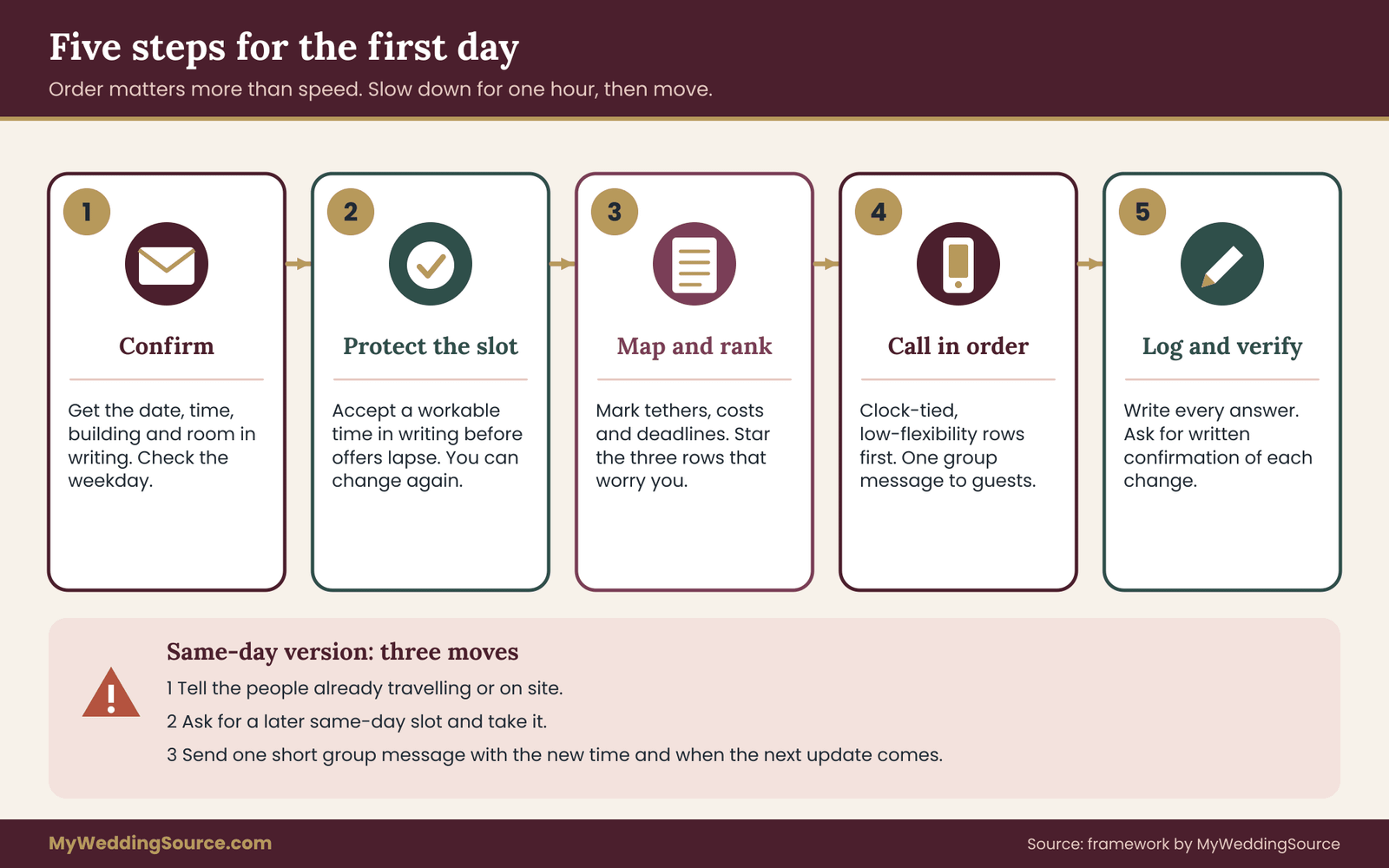
Step one: pause and confirm. Before you tell anyone, get the new slot in writing, as described earlier. Check the date against a calendar, because a surprising number of mistakes come from reading Tuesday as Thursday. Confirm the building, the entrance and what you need to bring.
Step two: protect the new slot. If the office offered a choice, decide quickly, because offered times can disappear. If it offered one time, accept it in writing if it is workable, even before you have checked every vendor, unless you have a better option. A slot you hold can always be changed again; a slot you let lapse may not come back.
Step three: map and rank. Use the five-column map. Spend fifteen minutes marking tethers, costs and deadlines. Mark your top three priorities. If your map already exists, update it with the new time and see which rows turned red.
Step four: call in order. Contact the clock-tied, low-flexibility, high-cost-of-failure rows first, in that order. Use a phone call for anything urgent and a message right after to leave a written record. Contact date-tied bookings next, and guests in a single group message rather than one at a time.
Step five: log and verify. Write down every answer in your log with the name, the date and what was agreed. Ask for written confirmation of each change. A verbal “that should be fine” is not a booking. At the end of the day, reread the map and check that every row has a status: moved, held, released or waiting.
The same-day version
A same-day courthouse appointment change needs a shorter version of the sequence. If the change arrives the same day, for example a closure or a delay, you have almost no time and almost no leverage. Compress the sequence into three moves.
First, call or message the person for whom the courthouse appointment change is most costly if they do not know, usually whoever is already traveling or already at the location, such as the photographer or a parent. Second, ask the office whether a later same-day slot exists, and take it if it does. Third, send one short group message to everyone else, saying that the time has changed, what the new time is if known, and that you will update them again by a stated time.
Do not attempt to renegotiate anything with a vendor in the middle of a crisis. Ask only whether they can still attend and what the cost would be, and settle the rest later.
Keep the message to guests short and complete
Guests need a clear note about a courthouse appointment change, not a long explanation. Guests need four things in a change notice: what changed, the new date and time, whether anything is asked of them, and when they will hear more. A message that gives all four prevents a dozen follow-up questions. A message that only says “Our time changed, details to come” produces worry and a flood of replies.
The sibling article on wedding change notices for guests covers wording and channels in more detail. For a courthouse wedding with a small group, a direct text or a phone call to each person, followed by a written summary, tends to work best.
The license and the clock: what a moved slot can do to your paperwork
A courthouse appointment change can interact with your license in ways that have nothing to do with the vendors. This is the part where you must ask the issuing office, not a website, a friend or this guide. The rules differ by state and sometimes by county, and some of them are strict.
Three kinds of rule are common. Waiting periods require some time to pass between the issue of the license and the ceremony, or between an application and issue. License validity windows require the marriage to take place within a certain number of days after the license is issued, after which it expires and a new one is needed. And some offices require both parties to appear in person on the day the license is issued, or limit who may be a witness, or require certain documents to be current.
If your appointment moves later, the thing to check is whether your license will still be valid on the new date. If it moves earlier, the thing to check is whether any waiting period has been satisfied. If the office offers a different location, the thing to check is whether your license is valid there, since some licenses are valid statewide while others are valid only in the county that issued them.
The USAGov marriage certificate page, linked in the Sources, points to the state-level offices that record marriages, and the state’s own pages usually describe license rules. For the local answer, ask the clerk who issued your license.
Questions to ask the clerk
Keep the questions about the courthouse appointment change short and specific. Keep the questions short and specific. Here is a set you can read from a page.
“Our appointment has moved to a new date. Is our license still valid on that date, and when does it expire? Do we need to do anything to keep it valid? If the office needs to reissue it, is there a fee?”
“Is there a waiting period between license issue and the ceremony in this county, and does the new date meet it?”
“If we need to move the appointment again, how much notice does the office require, and is there a limit on how many times it can be changed?”
“Is the new location able to perform and record the marriage with the license we already hold?”
Write the answers in the log with the date and the name of the person you spoke to. If the answers conflict with what you were told earlier, ask for the rule in writing or a link to the office’s published policy.
When the change is caused by a document problem
A courthouse appointment change caused by paperwork should be handled in a particular order. If the appointment paused because of a document, the paperwork now sits at the top of your map. Find out exactly what is wrong, what evidence will fix it, who must supply it, and how long the office takes to process it. Name mismatches, a missing record that a previous marriage ended, or an expired identity document are common, and each has a different path.
Start the document fix before you start rebooking, but do not wait until it is fixed to tell vendors that a courthouse appointment change may be coming. A vendor who hears early that a date may move can often hold a tentative slot. A vendor who hears at the last minute can only say no. That early notice is a short message, not a commitment: you are asking them to keep an option open, and you will say when you know more.
Do not move the paperwork and the celebration at the same time
A second courthouse appointment change is easier to absorb when the celebration is not tied to the first. A related trap is rescheduling both the legal appointment and the celebration around it in one move, then discovering that the legal date shifts again. Where the legal date is uncertain, keep the celebration plans loose.
Pick a celebration date that does not depend on the appointment (the guide to choosing a wedding date covers guest availability and vendor capacity), such as a weekend two weeks later, and let the appointment fall where it will. If the appointment lands neatly before the celebration, you get a calm sequence. If it shifts again, nothing else has to shift.
This is one of the strongest ways to reduce the damage from any courthouse appointment change. The less your celebration depends on the exact slot, the fewer strings are attached to a nail that might move again.
Move, hold or release: the decision rule for each booking
Once the map is built and the calls are ranked, every row ends up in one of three states. This is the heart of the recovery checklist, and it is simpler than it sounds.
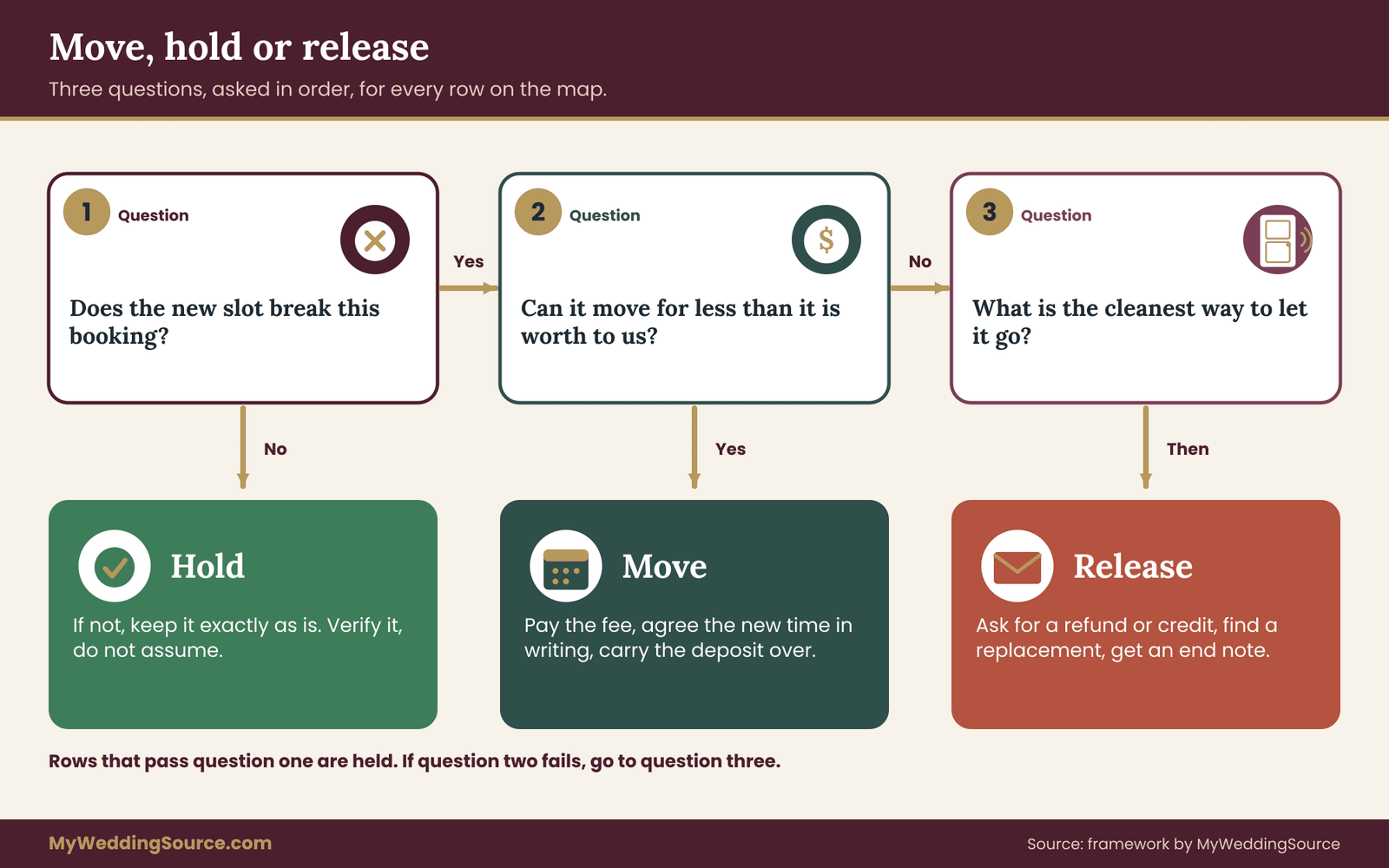
Move means the booking is kept and shifted to fit the new slot. You pay any change fee, you agree a new time or date in writing, and the booking continues. Move what is clock-tied, important and cheap to change.
Hold means the booking stays exactly where it is, because the new slot does not affect it. Hold the loose bookings and any date-tied bookings that survive a same-day shift. Holding costs nothing, but it requires you to check that it really is unaffected, not assume so.
Release means the booking is cancelled or allowed to lapse, with the best refund or credit you can get. Release what is no longer useful, what costs more to move than to replace, or what the vendor cannot accommodate.
The three-question rule
Apply the same three questions to every booking affected by the courthouse appointment change. For each row, ask the same three questions in order.
First, does the new slot break this booking? If not, hold it, and verify. If yes, go to the second question.
Second, can it be moved for less than it is worth to us? Compare the change fee, the lost deposit and the extra effort against the value of keeping that vendor, that guest or that moment. If yes, move it. If no, go to the third question.
Third, what is the cleanest way to release it? Ask for a refund or a credit, find a replacement, or restructure the plan so the booking is no longer needed. If a replacement is needed, ask the original vendor for a referral and a short written note ending the booking, so you are not surprised by a later charge.
Move, hold or release is a conversation, not a decision you make alone
Every row involves another person. A restaurant that says it can move you to Tuesday, or a photographer who offers a half-price rebook, is making an offer you can accept or decline, not a ruling. If a vendor’s offer is poor, you can say so politely and ask what else is possible.
You are allowed to compare it with releasing the booking and booking someone else. Many vendors prefer a smaller refund and a calm customer to a drawn-out dispute, though some are bound by strict terms, and you should read those terms before arguing.
What to say: scripts for every call after a courthouse appointment change
Most of the stress in a change comes from not knowing what to say. The scripts below are short, calm and specific, and you can adapt them to a call or a message. Each one does the same four things: states the courthouse appointment change, asks the question, names your deadline and asks for the answer in writing. Replace the details with your own.
To the photographer
“Our marriage appointment at the courthouse has moved from Thursday at ten to Tuesday at two. Are you available for the new time? If not, what are the options for our booking, and what would a change or cancellation cost under our agreement? We would like to decide by Friday. Could you confirm your answer by email?”
If the photographer cannot attend, add: “Can you recommend someone you trust for the new time, and how would our deposit be handled?” Ask for the answer in a message you can keep in the log.
To the restaurant
“We have a reservation for eight on Thursday at noon. Our ceremony has moved, and we would like to move the table to Tuesday at three, or the nearest time you have. Does the deposit transfer, and is there a fee for the change? Could you confirm the new booking by email, including the guest count and any minimum?”
If the restaurant says the new time is full, ask what the earliest available time is, whether a smaller table or a shared room is possible, and whether a pickup meal could work. Do not ask for a discount in the same message; settle the booking first.
To the guests
“A quick update: our courthouse appointment has moved. It is now Tuesday the date at two, at the same building. If this changes your travel, please let us know by Friday and we will help where we can. The lunch afterward moves with it. We will send one more note on Monday to confirm that nothing else has shifted.”
Notice that the message commits to a time for the next update. That small promise cuts the volume of replies, because guests know when to expect news.
To your employer or the person covering for you
“I need to move the half-day I requested on Thursday to Tuesday afternoon because my appointment time changed. Can you confirm the new leave is approved? I will make sure my work is covered.”
Include this row in the map. A change that is perfect on every booking but unmanaged at work still ends with someone in a bad mood.
To the clerk’s office, when you are asking for a change
“We need to reschedule our appointment currently set for Thursday at ten. What are the earliest dates available, and what is the policy on changes? Is there a fee? Does the change affect our license?”
If you must ask for a change yourself, offer more than one acceptable time. A clerk who can give you one of three times is far more likely to help than one asked for a single specific slot.
Cost logic: how to compare moving, holding and releasing
Numbers do not need to be exact to be useful. The point of cost logic is to stop a vague worry from deciding the outcome. For each row you are comparing three amounts: what it costs to move, what it costs to release, and what it costs to do nothing.
Move cost is the change fee, plus any price difference at the new time, plus the effort. Release cost is what you forfeit, such as a deposit, minus what you get back, plus the cost of a replacement. Cost of doing nothing is what you lose when the booking fails because it no longer matches the slot.
An illustrative example, not a benchmark
These invented numbers show how to weigh a courthouse appointment change and are not a guide to real prices. The figures below are invented to show the logic and do not describe any real vendor’s pricing.
Suppose a photographer’s deposit is one hundred fifty dollars and a date change costs fifty dollars. Releasing forfeits the deposit and requires a new photographer, who might charge more. Moving costs fifty. Moving is the clear choice, unless the photographer cannot attend the new slot, in which case releasing and replacing is the only choice.
Now suppose a restaurant deposit is two hundred dollars, refundable only if you cancel at least a week before, and your change gives you ten days. Moving the booking may be free; releasing is refundable. Both are cheap, so choose by what you prefer. If your change gives you three days, releasing forfeits two hundred, and moving may cost nothing, so move.
Finally, suppose a guest’s non-refundable train ticket costs eighty dollars and the carrier charges a change fee of thirty. That is the guest’s money, not yours. You can offer to cover the thirty or not, but the guest should make the call with full information.
Compare in the same units
Put every cost of the courthouse appointment change in the same units before you compare. The common error is to compare a fee against a feeling, such as “the fee is fifty dollars but it feels like a waste.” Put both sides in the same units. If the choice is between a fifty-dollar fee and the risk of a missing photographer on a once-only day, the question is what that photographer’s work is worth to you. If the answer is more than fifty dollars, pay the fee.
Avoid paying twice for the same thing
The most expensive mistake in a courthouse appointment change is paying for the old booking and the new one. The costly mistake in any rebooking is paying for the old booking and the new one. Before you book a replacement, confirm in writing that the original is cancelled and what you will be charged.
Before you move a booking, confirm that the old time is released and the deposit is carried over rather than forfeited. If you are not sure, ask a direct question: “Will any amount be charged for the original booking if we move?”
The wedding cash-flow guide on this site explains how deposits and balances typically move across a timeline, which helps you see which payments are already made and which are still ahead. Knowing that, you can tell at a glance how much money is truly at risk from a given courthouse appointment change.
When a change fee is a fair price
Some fees are a fair price for a courthouse appointment change, and some deserve a question. A vendor who charges a modest fee for a date change is covering real costs: a turned-down booking, a rearranged calendar, an administrative task. That is usually reasonable.
A vendor who charges the full price of the service for a change with plenty of notice is worth a polite question. Ask which clause of the agreement allows it, and ask whether a lower fee applies when the notice is long. If the agreement is silent, the vendor’s goodwill and your tone matter more than any rule.
You do not have to argue. A calm sentence such as “Could you help us understand how the change fee was calculated?” is often enough to produce a better answer.
Worked example: a Thursday slot that moves to the following Tuesday
The best way to see the method is to run it on a made-up case. The couple below is invented, and the details are illustrative only.
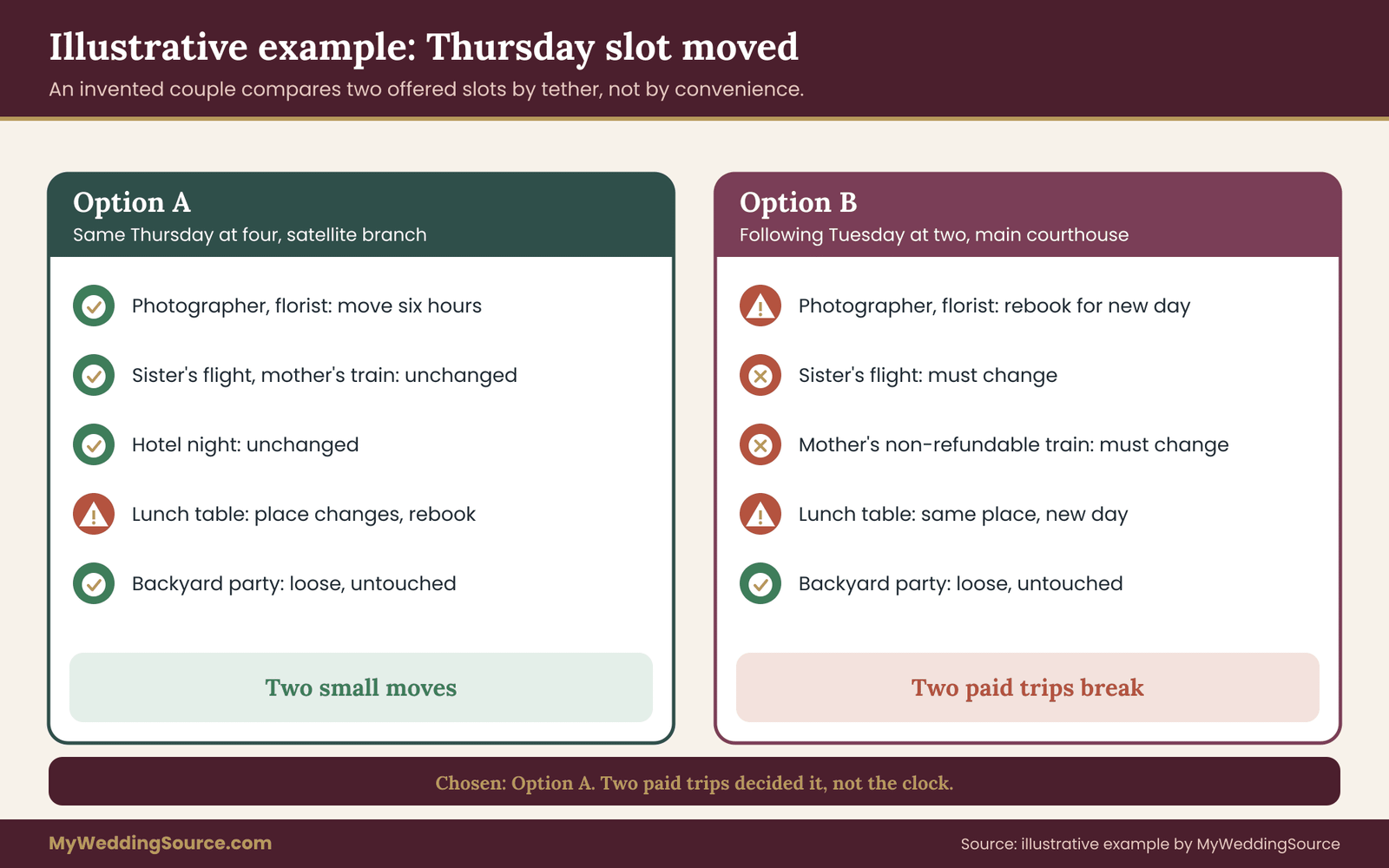
Dana and Marcus have a Thursday ten o’clock appointment at the county clerk’s office. Eleven days before, the office emails that a magistrate will be away and offers two alternatives: the following Tuesday at two, or the same Thursday at four in the afternoon at a satellite branch. They have a photographer, a restaurant table for eight, Marcus’s sister flying in, Dana’s mother taking a train, a small bouquet, and a backyard party planned a month later.
Step one: read and ask
They reply to the email to ask whether the satellite branch can record the marriage with the license they already hold, and how long each offered time will be held. The office answers that the license is valid at both locations and that the offers are held until the next afternoon. They have a little over a day.
Step two: tether the rows
The photographer, florist and restaurant are clock-tied. The restaurant is also place-tied to the main courthouse. The sister’s flight, the mother’s train and the hotel night are date-tied. The backyard party is loose.
Step three: compare the two options
Option A is Thursday at four at the satellite branch. Date-tied items survive entirely. Clock-tied items need to move six hours later. The restaurant is place-tied to a location the couple will no longer be near, so it needs to move or be replaced. Option B is Tuesday at two at the main courthouse. The restaurant’s place tie survives, but every date-tied item breaks, including two trips already paid for.
The cost of failure points to Option A. Two paid trips would have to be changed under option B, and the mother’s ticket is non-refundable. Under option A, the costs are a photographer shift and a restaurant change, both likely cheap.
Step four: act in order
With the choice made, the couple works through the courthouse appointment change in call order. They accept option A in writing, then phone the photographer, who is free at four and confirms by email. They call the restaurant, which has a slot at six and offers to hold it. They message the florist to shift delivery. They send the guest message confirming the new time and location. They log each answer and mark the row status.
What the example shows
The example is small, but it shows how a courthouse appointment change plays out when the map exists. The example shows three things. First, the decision rested on the tethers, not on which option felt more convenient. Second, the time to decide was short, which is why classifying the rows before replying to the office would have helped even more.
Third, nothing was lost, because the loose party was left alone and the date-tied items survived. A courthouse appointment change of this kind costs a few hours and a small fee when the map is ready, and a week of stress when it is not.
Four ways to recover from a courthouse appointment change
Once you know the new slot and the tethers, there are usually four broad ways to reshape the day. They are not a ranking. Each fits a different kind of courthouse appointment change, and the right one depends on how many strings are attached and how much notice you have.

Option one: shift everything to match
Shifting everything is the natural first response to a small courthouse appointment change. You keep the original plan and move each booking to the new slot. This works best when the new time is close to the old one, such as a few hours later on the same day, so that date-tied bookings survive and only the clock-tied ones need a conversation. It keeps the day intact and requires the most calls. Its weakness is that it assumes every vendor can move, and one that cannot breaks the chain.
Option two: split the day
Splitting the day suits a courthouse appointment change that moves the date. You keep the legal appointment at the new time but decouple the celebration from it. The ceremony happens when the office says. The photographer covers only the courthouse portion, or a short portrait session at a time that suits them.
The meal moves to wherever and whenever works for the people who are present. This suits a larger shift, such as a different day, because it stops one change from rippling through every booking. Its cost is some of the sense of a single seamless day, which may or may not matter to you.
Option three: hold the celebration where it is
Holding the celebration still is a strong option when a courthouse appointment change affects only the legal step. You let the appointment move and leave the celebration on its original date. For example, the legal ceremony takes place earlier in the week, and the planned dinner stays on the weekend. Guests who traveled for the weekend still have their reason to be there, the restaurant and photographer remain booked, and only the legal step has shifted.
This only works if the legal appointment can move to a time that does not collide with the celebration, and it may need an adjustment to the announcement, so guests understand which event is which. The guide on celebrating beyond the legal appointment explains how to name and frame the two events.
Option four: reduce the plan
A courthouse appointment change can also be a reason to simplify. You use the change as a reason to simplify. Release the bookings that were most fragile or least wanted, keep the ones that matter, and let the day be smaller. A short courthouse ceremony with two witnesses, a portrait session and a pickup lunch can be a complete wedding. This is not a failure of the original plan. For some couples, a courthouse appointment change makes clear what they cared about.
How to choose between the four
Choosing among the four paths after a courthouse appointment change takes three tests. Use three tests. First, how big is the shift? Hours favor option one; days favor options two or three. Second, how many of your most important people are tied to the original date? If several, option three protects them. Third, how stressed are you? If the answer is very, option four removes strings and is a legitimate choice.
A quick test is to imagine the day under each option, and notice which one makes you feel relieved rather than obligated. That feeling is not a reason to ignore the costs, but it is useful information about what you want.
What each option does to the dependency map
Each recovery path leaves a different mark on the courthouse appointment change map. Under option one, nearly every row is marked move. Under option two, most rows are marked release or hold, and only the legal items are moved. Under option three, the legal row is moved and almost everything else is held. Under option four, many rows are released, and the rest are moved or held. Looking at your map this way shows how much work each option really represents, and it turns an emotional choice into a countable one.
Reading the contract language that decides what a change costs
Before any call, find the paragraph in each agreement that deals with changes. If a vendor has no formal agreement, ask for the policy in writing. The words to look for are change, reschedule, postpone, cancel, transfer, credit, deposit, retainer and force majeure.
A change clause usually states how much notice is needed, whether a fee applies, whether the deposit transfers and whether the new date is subject to availability. A cancellation clause states what you forfeit if you leave. A force majeure clause deals with events outside anyone’s control, and it may or may not cover a closure or a scheduling decision by a government office. Do not assume it does.
The difference between a deposit and a retainer
The wording of a payment decides what a courthouse appointment change costs you. A deposit is usually a part payment against a service, and in many cases is refundable under defined conditions. A retainer is often a fee that secures the vendor’s time and is non-refundable even if the date changes, though it may be transferable.
The distinction affects what happens to your money in a change. The contract guide on this site explains how the two are commonly worded, and if your agreement uses either term without defining it, ask the vendor what it means.
When a courthouse appointment change falls outside what your contract covers
Many agreements for small courthouse weddings are informal, a message thread and a deposit by card. In that case there may be no written change policy at all. The best protection is to create a short written record of what you both understand, by sending a summary and asking the vendor to confirm.
For example: “To confirm, you will move our booking from Thursday at nine thirty to Tuesday at one thirty at no extra charge, with our deposit carried over. Please reply to confirm.” That message is not a contract, but it records the agreement, and it is far better than memory.
Payments and disputes
If a vendor takes a payment and then does not deliver or honor a change, your options include asking the vendor, asking the payment provider and, for a card payment, using the billing-error process. The Consumer Financial Protection Bureau explains how a credit card dispute works, including the written notice a cardholder generally sends within sixty days of the statement showing the charge.
The FTC’s consumer pages also explain how to report a business practice that seems deceptive. These steps are a last resort. Most change problems are solved by a direct, polite conversation and a clear record.
Keep every payment confirmation, because it proves what was paid and when. The vendor payment tracking logic in the cash-flow guide shows how to keep that record without much effort.
Credits are not refunds
Some vendors offer a credit toward a future service instead of a refund. A credit may be acceptable if you will use it, but it is worth asking about its expiry, whether it is transferable and whether it covers the same services. A credit that expires before your celebration is a loss in a different form. If you accept one, write the terms in your log and calendar the expiry date.
Courthouse appointment change edge cases that deserve a plan
The usual change is a time shift with some notice. The unusual ones are where plans fail, so it helps to think them through once. None of the situations below is likely for most couples, but each has a short, practical answer.
The building closes on the day
A closure is the harshest courthouse appointment change because everyone is rebooked at once. A weather event, a facility problem or a staffing shortage can close a courthouse. If it happens, the office usually reschedules everyone, and open slots go fast. Contact the office first by phone, not by email, ask for the earliest available slot, and ask whether the reschedule is treated as a priority. Then run the same-day version of the sequence. Tell the clock-tied people first and the date-tied people second.
If you are traveling, check your own travel booking before the closure is confirmed, because airline and rail carriers sometimes offer more flexible changes when a disruption is widespread. The Department of Transportation page in the Sources explains what airlines must and must not do.
A witness cannot make the new slot
A missing witness can turn a simple courthouse appointment change into a blocked ceremony. If the office requires witnesses and does not supply them, a missing witness stops the ceremony. Ask the office what it requires, whether staff can serve as witnesses and whether a witness must be present in person. Ask a backup witness early, before the courthouse appointment change happens if possible, and keep their number in the log. A friend who is flexible is worth more than a perfectly timed plan.
Someone needs an accessible route or an interpreter
Accommodations should be checked again after any courthouse appointment change. If a guest, a witness or one of you needs an accessible entrance, an interpreter or another accommodation, confirm it again for the new slot. Accommodations are often arranged for a specific time, location or staff member, and a change can reset them. State and local government offices have obligations under the Americans with Disabilities Act, and the ADA site in the Sources explains where to find the rules and how to raise a concern. Ask the office directly and early.
A second change on top of the first
A repeat courthouse appointment change is the best test of your map. A courthouse appointment change that happens twice is the strongest argument for keeping the celebration loose. If the second change arrives, you will already have a map and a log, so you update the rows instead of starting over. Resist the urge to promise guests a firm time until the office confirms in writing, and say plainly that the time is subject to the office.
The change falls close to a legal deadline
A courthouse appointment change near a legal deadline reorders your priorities. If a license is about to expire, a waiting period is about to end or a work visa is about to lapse, the new slot may be the only workable one.
In that case the legal side outranks the rest, and the dependency map is the way to hold what can be held. Ask the office what the shortest path is and what documents are needed, and consider whether any other offices or officiants can perform the marriage legally sooner, if your jurisdiction allows it.
The change is caused by one of you
When you cause the courthouse appointment change yourselves, the method stays the same. If you caused the courthouse appointment change, because of illness, work or a document, the same method applies, but the tone with guests and vendors changes slightly. State the fact without drama, apologize once if it affects them and give the new details. People respond better to clarity than to long explanations.
Measurable checks for a courthouse appointment change
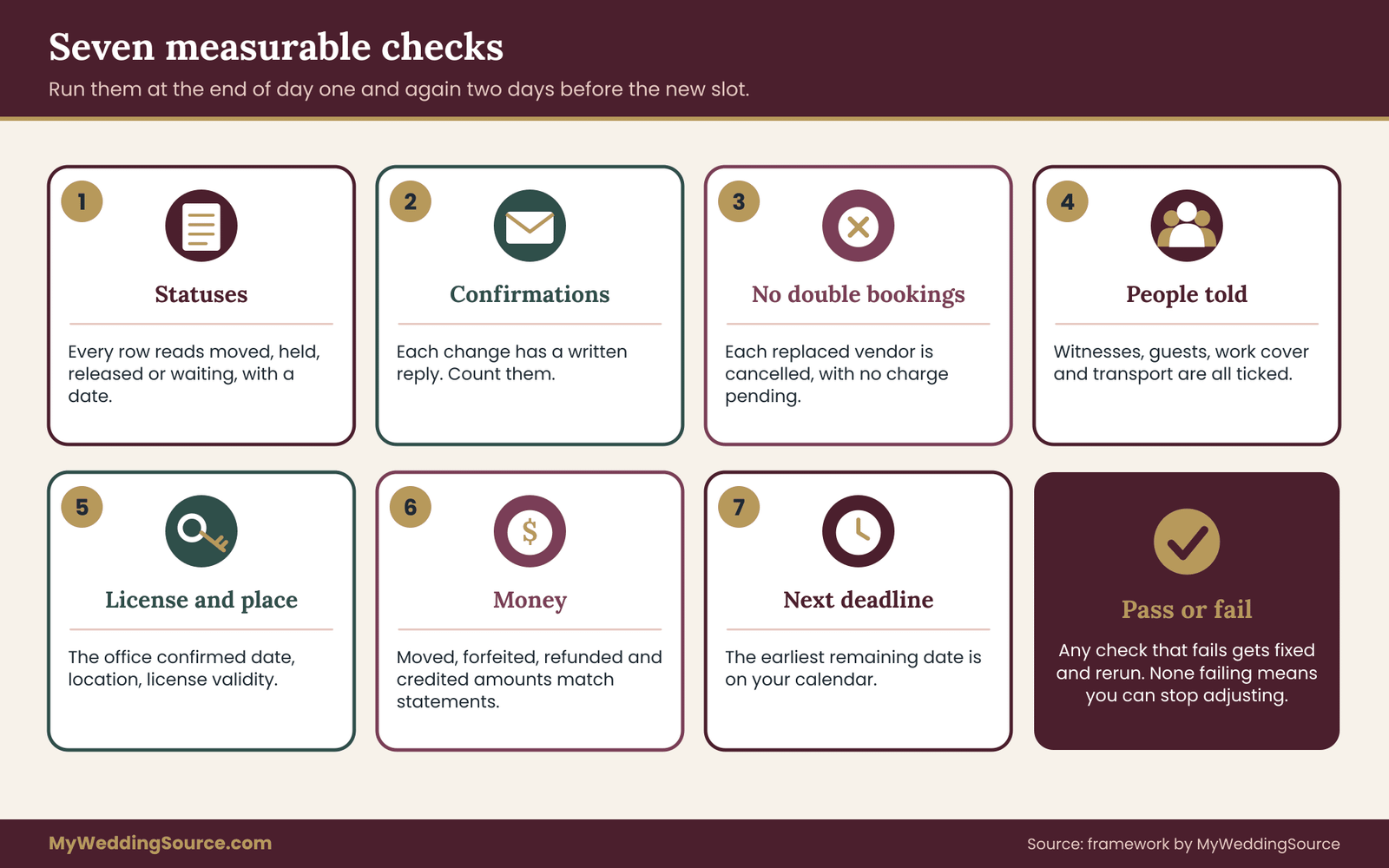
A recovery checklist is only useful if you can tell whether it worked. The checks below are things you can count or confirm, not feelings. Run them at the end of the first day and again two days before the new slot.
Every row has a status. Open the dependency map and look for blank cells. Each row should read moved, held, released or waiting, with a date. A row marked waiting needs a named follow-up date. If more than two rows are still waiting a day after the courthouse appointment change, those are the rows to chase first.
Every change has a written confirmation. For each moved or released booking, find the message or email that confirms it. Count them. If you moved five bookings and have four confirmations, one of them is still only a conversation.
No double bookings exist. For each replaced vendor, confirm that the original is cancelled and that no charge is pending. This is the check that catches the most expensive mistake, which is paying for the same service twice.
Every person who needs to know has been told. List the people who are affected, including witnesses, guests, the person covering your work and anyone providing transport. Tick each one. A single missing name is the usual source of a day-of surprise.
The office has confirmed the license and the location. You should have a written statement of the date, time, location and any change in what to bring. If the license has a validity window, write the expiry date on the map and compare it with the new slot.
The money is accounted for. Add the deposits moved, forfeited, refunded or credited. The total should match your statements within a few dollars. Credits should show an expiry date in your calendar.
You know the next deadline. Find the earliest remaining date after which something costs more or cannot be changed. Put it on your calendar with a reminder. This turns the dependency map into a living tool rather than a one-time document.
A simple pass or fail
You do not need a score. Ask whether any check fails. If none do, the recovery is complete enough for now. If one fails, fix that one and rerun the check. If several fail, the likely cause is a missing log or an unconfirmed vendor, and both are fixable in an hour.
What to do when a check keeps failing
Some checks stay open after a courthouse appointment change, usually because someone has not replied. A vendor who does not reply is the typical stuck point. Try a different channel, such as a phone call after an email, and set a deadline in your message: “If we have not heard by Friday at noon, we will assume we need to make other arrangements.” Then follow through. A calm deadline is fair, and it protects you from waiting past the last moment at which another vendor could be booked.
One page to keep: the courthouse appointment change log
Keep a single log from the first notice until the new appointment is done. It can live in a notes app, a shared document or a sheet of paper. The point is that you and your partner can both read it, and that nothing important lives only in one person’s memory.
For each entry, write the date and time, who you spoke to, what was said or agreed, what happens next and by when. Add a short status word at the end of each line. Keep copies of confirmation messages in the same place, or note where they are.
What goes in the log
The log for a courthouse appointment change records facts and decisions. The first entry is the office’s notice itself, with the old and new slot, the location and the answer to whether the license remains valid. Then each call or message follows in order. Include the answers you did not like. A vendor who said no is as important to record as one who said yes, because it explains why you booked someone else.
Include the decisions as well as the facts. A line such as “Chose option A because two guests had paid travel for Thursday” explains the choice later, when someone asks why you did what you did. Memory softens after a stressful week, and a note written at the time protects you from second-guessing.
Share the log with one trusted person
Pick someone, a witness, a parent or a close friend, who knows where the log is and what is in it. If you are unreachable on the day, they can answer questions from vendors and guests. This is a small step that makes a large difference when something shifts again. The digital contingency guide on this site covers the wider question of what happens when a key person or file is not available on the day, and the idea transfers well to a small courthouse wedding.
The notice calendar: what to do at each stage
How much time you have changes what is possible. The calendar below shows how to scale the method to the notice you have. The numbers are guidelines for planning, not rules, and vendors may set their own windows.
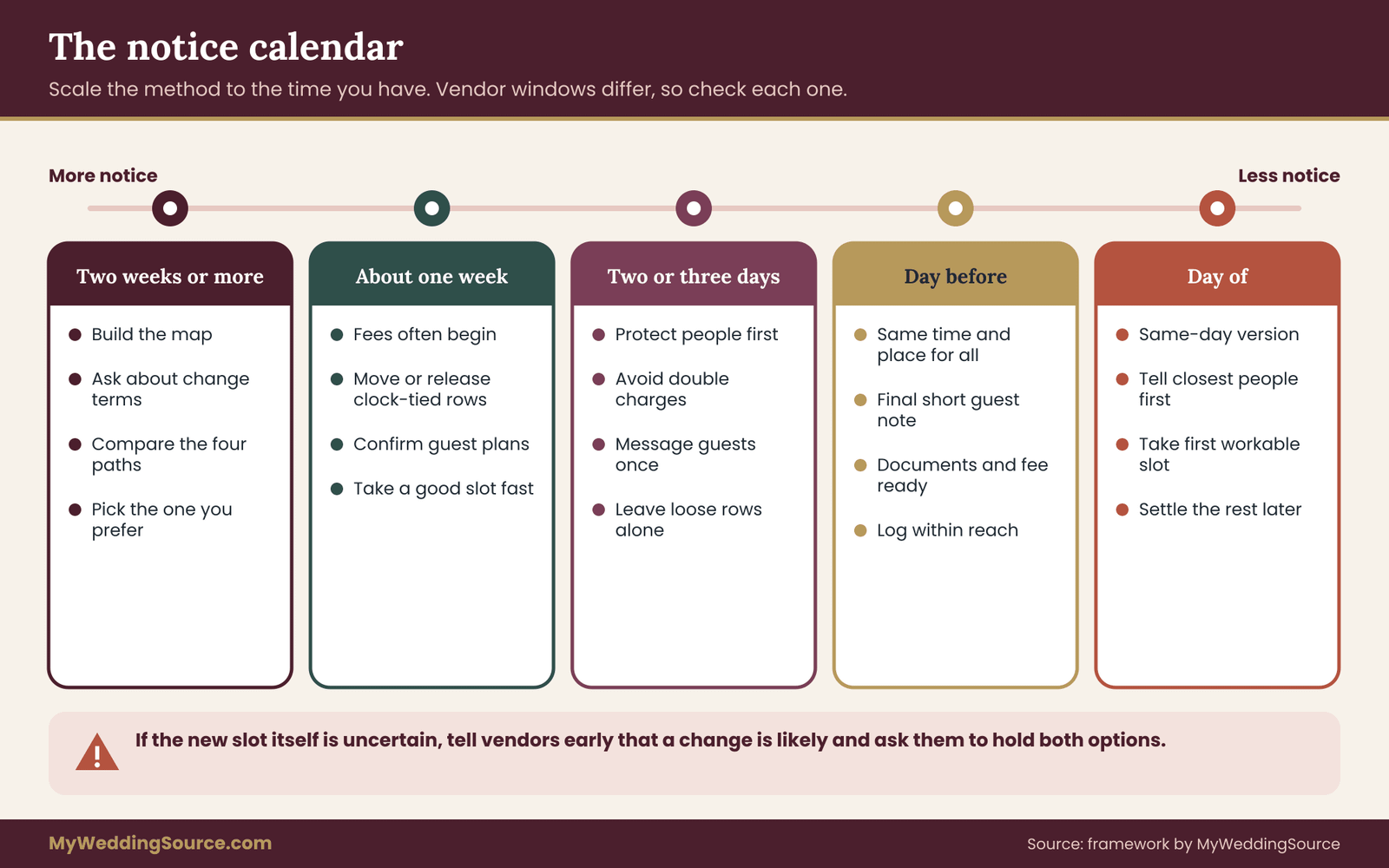
Two weeks or more. You have time to compare options and negotiate. Build the map, ask each vendor about change terms, and compare moving, splitting or reducing. Most free change windows are still open. Use this time to choose the option you prefer, not the first one available.
About one week. Change fees often start to apply. Focus on the high-cost rows. Move or release the clock-tied bookings and confirm guests’ plans. Ask for the office’s best available times and take one promptly.
Two or three days. You are mainly protecting people and avoiding double charges. Call the clock-tied vendors, send a clear message to guests and let loose bookings stay as they are. Accept that some deposits may not come back.
The day before. Confirm that the office, photographer, restaurant and witnesses all have the same time and place. Send a final short message to guests. Charge your phone and put the log where you can reach it.
The day itself. Compress to the same-day version. Tell the people closest to the courthouse appointment change, take the first workable slot and leave the rest for the following days. Nothing about a wedding is lost because a vendor was told an hour later.
Why earlier notice is not always better
Giving vendors early notice is a good habit, but it has an exception. If the new slot is itself uncertain, telling everyone to move on the first notice may mean asking them to move twice. In that case, tell them early that a courthouse appointment change is likely and ask whether they can keep both options open, then confirm once the office has confirmed. A single, definite update is kinder than several tentative ones.
A final audit before the new appointment
The last step is a short review, ideally two days before the new slot and again on the morning. It repeats the checks in a faster form.
Walk through the map from top to bottom and answer one question per row: does this person or business have the correct time, place and number of people? Where the answer is yes, tick it. Where it is no, fix it now.
Check the paperwork: both of you have the identification the office asked for, the license is in hand, any fee is ready in a form the office accepts, and any witness has the new time. Check the route: parking, transit and the entrance, including the security screening that courthouses commonly use, so you allow time to pass through it.
Check the people. Is anyone traveling who has not confirmed the new time? Is anyone who needs an accessible route or an interpreter confirmed for the new slot? Is the person covering your work informed? Check the celebration. Is the table, the photographer and the florist confirmed in writing? Is there a backup if one of them is late?
Keep a margin on the day
A new slot is still a slot with a clock. Build a buffer between each step: arrive early, leave room between the ceremony and the photographs, and do not schedule the restaurant tightly after. The sibling guide on the courthouse day explains how to build those buffers into a timeline. A courthouse appointment change teaches a useful lesson, which is that slack is cheaper than speed.
Know when to stop adjusting
There is a point at which more fixing creates more risk. Once every row has a status and a confirmation, stop. Resist the urge to improve the plan further, add new bookings or revisit decisions that have been made. If something goes wrong on the day, you will have a map, a log and a margin, and the people around you will know how to help.
Your next steps
If you have not had a change, do two things this week. Build the five-column map while everything is calm, and read the change and cancellation paragraph in each agreement, so you know your free-change windows. If a courthouse appointment change has just landed, work in this order: confirm the new slot in writing, ask the clerk about the license, build and rank the map, call the clock-tied bookings first, message guests once with all four facts, and log every answer.
Then choose among the four recovery options with the size of the shift and the notice in mind. Keep the celebration as loose as you can until the office has confirmed. When every row has a status and a written confirmation, stop adjusting and put your energy into the day itself. For the wider timeline of vendor questions, the wedding planning checklist on this site gives the overall order of decisions.
FAQ
What should we do first after a courthouse appointment change?
Get the new date, time and exact location in writing from the office before you contact anyone else. Then ask whether your license is still valid on the new date. Only after that should you list your other bookings and call them in order of how tightly each is tied to the slot, starting with the clock-tied ones.
Does a courthouse appointment change cancel our other bookings?
No. A photographer, restaurant or florist booked for the original time has not agreed to the new one until you both confirm it. Each booking follows its own agreement or policy, so read the change and cancellation terms, ask for the vendor’s answer in writing and keep the confirmation in your log.
Will our marriage license still be valid if the appointment moves?
It depends on your state and county. Some places set a window after issue within which the marriage must take place, and some require a waiting period first. Ask the office that issued the license, in writing if possible, whether it remains valid on the new date and at the new location.
How do we tell guests about a courthouse appointment change?
Send one clear message with four parts: what changed, the new date and time, whether you need anything from them, and when they will hear more. For a small group, call the closest people first. Do not promise a firm time until the office has confirmed it, and say so plainly.
Who pays when a guest has already bought a non-refundable ticket?
Usually the guest, because the contract is between the guest and the carrier. Ask the carrier whether it offers a change or credit, and check the airline refund guidance from the Department of Transportation. You can offer to help, but only if you can afford it, and say clearly what you are able to cover.
Should we move everything or keep the celebration where it is?
Choose by the size of the shift. A change of a few hours usually suits shifting each booking to match. A change of days often works better by splitting the day or keeping the celebration on its original date, because that stops one change from touching every booking. Keep the celebration loose until the office confirms.
What if the photographer or restaurant cannot do the new time?
Ask what the agreement says about your deposit, then ask whether they can recommend a replacement. Confirm in writing that the original booking is cancelled before you pay a new vendor, so you do not pay twice. If the answer is no, release the booking cleanly, and consider the smaller recovery options.
Can a courthouse appointment change happen more than once?
Yes, especially after a staffing problem or an unresolved document issue. Ask the office how likely a second change is and how much notice it needs for further changes. Treat each move as provisional, prefer options you can undo, and keep your map and log current so a second change is a short update.
Sources
- How to get a copy of a marriage certificate or a marriage license, USAGov
- State governments directory, USAGov
- Where to write for vital records, Centers for Disease Control and Prevention, National Center for Health Statistics
- How do I dispute a charge on my credit card bill?, Consumer Financial Protection Bureau
- Consumer advice, Federal Trade Commission
- Aviation consumer protection, U.S. Department of Transportation
- Information and technical assistance on the Americans with Disabilities Act, U.S. Department of Justice
- National Center for State Courts
- Security screening, Transportation Security Administration