
Welcome bag assembly is the stretch between buying the items and handing a finished bag to a guest, and it is where most welcome bag problems are created or caught. This guide gives you a bag assembly station checklist, a counting method that closes to zero, quality checks, storage rules and a transport plan, so an assembly party produces bags you are proud to hand over.
Treat welcome bag assembly as a small production line with four gates. Inspect items when they arrive, build bags at a station laid out in the order of the contents, check every sealed bag against a one-page card, and count again when you load the car. Keep one running equation for the whole bag assembly: items received equal items packed plus items rejected plus items left over plus items unaccounted for. If the last number is not zero, find the gap before the bags leave your hands.
Choosing what goes in a welcome bag is one job. Bag assembly means getting those items into the right number of bags, in good condition, to the right place, is a different job, and it gets far less attention. A couple can pick a thoughtful set of items and still hand guests a bag with a crushed pastry, a missing room number, or a snack that contains an allergen nobody labeled. Those failures rarely come from bad taste. They come from a rushed evening, a loose count and a trunk full of bags stacked on top of each other.
This article is about the second job only, bag assembly. It assumes you have already decided what the bags contain; if you are still choosing items, the site’s guide to guest etiquette is a better place to start, since a welcome bag is partly a question of what guests expect and what feels proportionate. Here the focus is the bag assembly party itself: who comes, what they do, where the bags sit afterward, and how they travel.
A note on scope. This is general planning information, not legal, tax or financial advice. Labels, product claims and venue or hotel delivery terms vary, so confirm the current rules with the manufacturer, the agency that issues them and the property that will receive your bags.
What welcome bag assembly actually involves
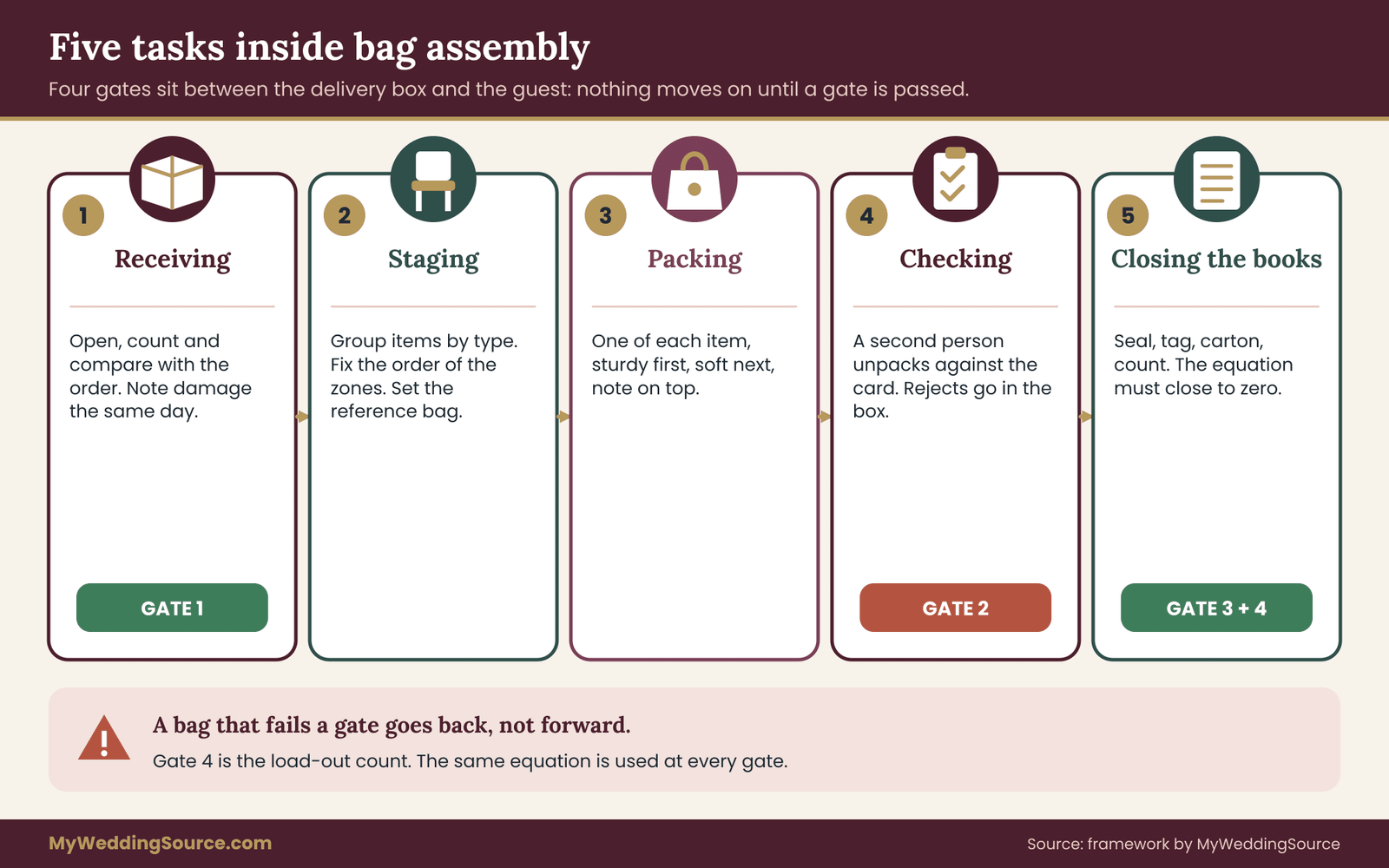
Welcome bag assembly looks simple from a distance: lay out items, put one of each in every bag, tie the bag. Watched closely, bag assembly is five different tasks that happen to share a table.
Receiving. Boxes arrive from several suppliers over several weeks. Someone has to open them, count what is inside, compare it with the order, and note damage. If this step is skipped, you discover a short shipment on the night of the party, when nothing can be reordered.
Staging. Items are grouped by type and placed so the people packing can reach them without walking. This is mostly layout, and layout decides whether eight helpers finish in two hours or four.
Packing. One of each item goes into each bag, in an order that protects fragile pieces and keeps the note or schedule on top where the guest sees it first.
Checking. Someone other than the packer confirms each bag against a card. This is the quality control gate, and it is the cheapest insurance in the whole process.
Closing the books. Finished bags are counted, labeled and stored. Leftover items are counted. The numbers are written down and compared with what arrived. This is inventory reconciliation, and it is the part most couples never do.
Seen this way, a bag assembly party is not a craft night with a goal. It is a small batch operation with a deadline, a fixed quantity and a customer who cannot return the product. That framing does not need to make bag assembly stiff. It just means that the fun part, the music and the snacks and the people, sits on top of a process that is already settled.
Where this article fits among the other welcome bag decisions
Several nearby decisions shape bag assembly at the table, and each deserves its own thinking. What the bags contain, how they handle air travel, how they reach a hotel front desk, what the handwritten notes say and whether the packaging is reusable are all separate questions. This guide touches each only where it changes the assembly work. For example, a bag meant for a guest who flies carry-on only changes what you pack and how you weigh it, but not how you count it.
What belongs here and nowhere else is the station checklist, the reconciliation method and the rules for holding and moving finished bags. If you take only those three, you will have covered the part of welcome bag assembly that is easiest to get wrong and hardest to fix after the fact.
Deciding whether you need an assembly party at all
A party is one of three ways to handle bag assembly. Choosing deliberately saves effort and sometimes money, and it avoids the situation where friends are recruited to a task that a supplier would have done better.
Do bag assembly yourselves, in one or two sessions. This works when the guest count is modest, the contents are simple and you have a clean space. A couple and two helpers can build a few dozen straightforward bags in an evening. The cost is time and a few cartons of mess.
Hold a larger assembly party. This makes sense when the count is high, when the bag has many components, or when you want the social side, for instance when parents or the wedding party want to help. It needs more structure, because more hands means more chances for an item to be skipped or doubled.
Pay for bag assembly. Some suppliers, planners and venues will assemble to your specification for a fee. This is worth pricing if the bags include fresh or fragile items, if you have no workable space, or if the weeks before the wedding are already full.
A decision rule you can use in five minutes
Count three things: the number of bags, the number of distinct items per bag, and the number of hours you can realistically give. Multiply bags by items to get the total placements. A rough planning habit is to assume a careful team places a modest number of items per minute per person once the station is set up, then add time for checking and boxing. You do not need an exact rate. The point is to compare total placements with the hours you have, and to leave slack, because the first twenty bags are always slower than the next sixty.
If the honest estimate leaves no slack, do one of two things: cut an item, or move to paid bag assembly. Cutting one item from every bag often saves more time than recruiting two more helpers, and it also removes one more thing that could be wrong. The couple deciding how much to spend overall may also find the wedding budget guide useful for deciding how much of the bag budget is allowed to go to labor rather than goods.
Questions to ask if you outsource it
If a supplier or planner will handle bag assembly, ask in writing and keep the answers with your order records.
- Who counts the finished bags, and will you receive a count on a delivery note?
- How are allergens and ingredients handled, and will each bag include a list of its contents?
- Where are bags stored before delivery, and for how long?
- What happens to leftover items, and are any returned to you?
- What is the policy if an item arrives damaged or a count comes up short?
- Is the delivery date and time confirmed with the receiving hotel?
A vendor who answers these clearly is probably running a real process. One who answers vaguely, or who cannot say where the bags will be stored, may be assembling on a kitchen table. That is not automatically a problem, but it tells you how much checking you should do on arrival. ## Working backward: a welcome bag assembly timeline
Everything about bag assembly is easier when you anchor it to a single date: the day the bags must be in a guest’s hands, or at the hotel front desk if they are being delivered. Work backward from there, and let the gaps between steps be larger than you think they need to be.
The general wedding schedule in the vendor timeline guide covers when suppliers need final numbers. The bag assembly schedule below sits inside it and only covers the bag.
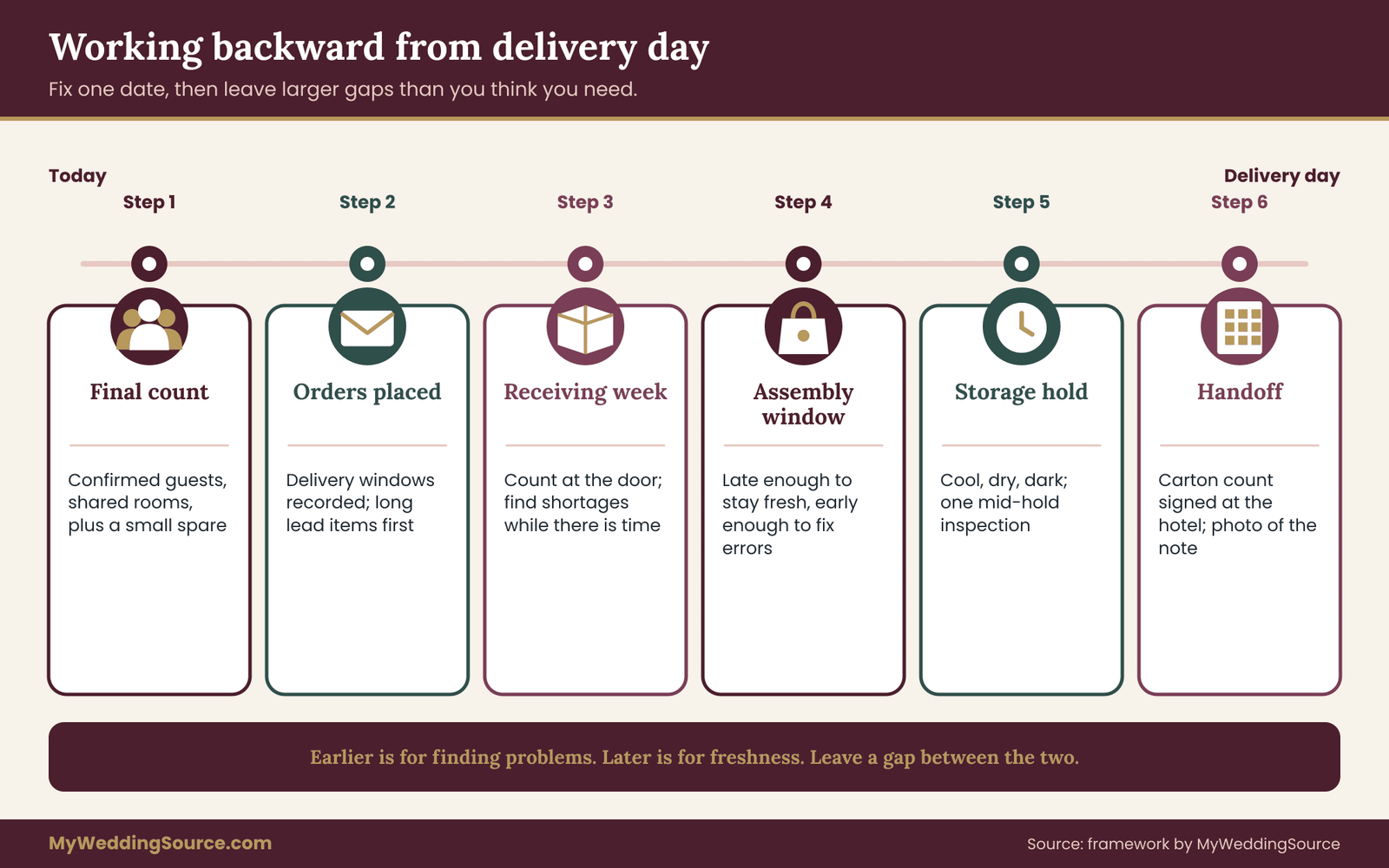
Final guest count and bag count. Settle the number of bags once, in writing, and add a small spare. The count should come from your confirmed list, not your invitation list. A guest who has declined does not need a bag, and a household that shares a room may only need one. The guest list guide explains how to keep a clean final list, and that list is the single input to everything else here.
Orders placed and confirmed. Place every order early enough that a late or substituted item can be replaced. Ask each supplier for a delivery window, and record it. Do not place a final order for quantities until the count is settled, but do order any item with a long lead time, such as personalized printing, as soon as you can commit to the design.
Receiving week. Items arrive and are inspected at the first gate. This week is for finding problems, not for assembling anything. If a box is short, you still have time.
Bag assembly window. Schedule the party as late as possible while still leaving at least a few days before delivery. Late assembly keeps items fresher and lets you absorb last-minute count changes. But it must be early enough that a mistake found at the quality gate can be fixed without panic.
Storage hold. Finished bags wait. How long they wait determines which items are safe to include, which is why the storage section later matters for what you buy.
Transport and handoff. Bags move to the hotel, the venue or your own home base. The final count is taken at loading and again at handoff.
Choosing the bag assembly date
Many couples hold bag assembly on the weekend before the wedding because everyone is free. That is also when everything else is happening, so check three conflicts before you commit: other deliveries, travel by your helpers, and the weather forecast if you will be moving bags in a vehicle. A weekday evening two weeks out is often calmer, provided that the contents tolerate a week or so in storage. During bag assembly, fragile or time-sensitive items, such as a local baked good, should be added in a second, smaller step close to delivery rather than at the main party.
What to send to helpers beforehand
Send each bag assembly helper a short message a few days earlier. It should give the start and end time, the address, what to wear (closed shoes, hair tied back for anyone handling food), a note that hands will be washed before packing, and a plain statement of what you need from them. People generally enjoy being useful, and they enjoy it more when the instructions are short and the finish time is real.
The bag assembly station checklist
The bag assembly station is where the process either runs smoothly or does not. A good station is a line of surfaces, not a heap, and it follows a fixed order so that the same item is always in the same place.
Think of it in six zones, arranged left to right or around a table so that a bag moves in one direction.
Zone one, the empty bags. Open bags are staged here, unfolded, stacked and counted. If you use paper or fabric bags with handles, pre-open them before the party starts, because this is a surprisingly slow task and it is dull enough that people rush it.
Zone two, the heavy and sturdy items. Bottles, jars, boxes and anything with weight go in first, at the bottom of the bag. Put them at the start of the line so they are placed first.
Zone three, the soft and light items. Snacks in pouches, small toiletries, cloth items and the printed schedule go in after the sturdy ones. This zone should be physically separate from anything with a strong scent, so a scented soap does not flavor a cracker.
Zone four, the top layer. The note, the itinerary or the map goes in last, face up, where it is the first thing a guest sees. Many couples add tissue or a final decorative layer here.
Zone five, the check. One person, ideally not the person who packed, stands here with the one-page bag card and a pen. The card lists every item and its required position. This is the gate that catches errors.
Zone six, sealing, labeling and staging. Passed bags are closed, tagged with whatever identifies them (a name, a room number, a group) and set into cartons. This zone needs the cartons, a marker, tape and a labeled spot for rejected bags.
The checklist itself
Before the first helper arrives, walk the bag assembly room once with this list.
- Tables are clean, dry and wiped with a food-safe cleaner, and covered if they are not wipeable.
- Every item type has its own labeled tray or box, with the expected quantity written on the tray.
- A sample finished bag, built by you and checked, sits at the check station as the reference.
- The bag card is printed, one copy per checker, with each item listed in order.
- A “reject” box and a “question” box are labeled. A reject is a bad item or bad bag; a question is anything a helper is unsure about.
- Handwashing is available, or hand sanitizer is on the table for anyone who has to touch food.
- A trash bin, a recycling bin and a box for reusable packaging are within reach, so cardboard does not pile up at the stations.
- A tally sheet is taped to the table with one row per item and a place to write counts at the start and end.
- Cartons for finished bags are open and labeled with a carton number and the number of bags each will hold.
- Pens, tape, scissors, a marker and a box cutter are in one container, not scattered.
- Music is playing at a volume that allows people to say “I think this one is short” and be heard.
The reference bag
The single most useful object in bag assembly is the reference bag. Build one first, with the exact contents in the exact order, and set it where everyone can see it. When a helper wonders whether the note goes on top or whether the candle gets a wrap, the answer is on the table. It also gives the checker something to compare against and keeps the thirtieth bag the same as the first.
Photograph the reference bag from above and from the side, and print the photo. It costs almost nothing, and it gives anyone joining late a quick way to see what the target looks like without interrupting the line.
How many people, and where to put them
For a one-way line, a rough rule is one person per zone plus one floater. A team of six or seven is plenty for most home bag assembly parties; more people tend to crowd the table, and more people can mean more errors, because each additional hand is another chance for an item to be skipped. If many friends offer to come, put them to work on the tasks that sit outside the line, such as pre-opening bags, tying ribbons, writing tags or boxing cartons.
The checker deserves special care. This is the only role that must not be rotated carelessly, because the reliability of the whole bag depends on someone staying alert and unhurried. Give the role to a person who is naturally precise, rest them for ten minutes each hour and replace them rather than letting them tire.
Setting up for the people who need to sit
Not every helper can stand for two hours. Put at least one seated station in the line, preferably the tag-writing or ribbon-tying zone, so anyone with limited stamina or mobility can work at the same table and see everyone else. It is a small adjustment, and it matters if parents or grandparents have offered to help. ## Quality control in bag assembly: five checks per bag
Quality control in bag assembly does not mean inspecting every item at every moment. It means defining what a passing bag looks like and checking each sealed bag against that definition once, by someone who did not pack it. Five checks cover nearly everything that goes wrong.
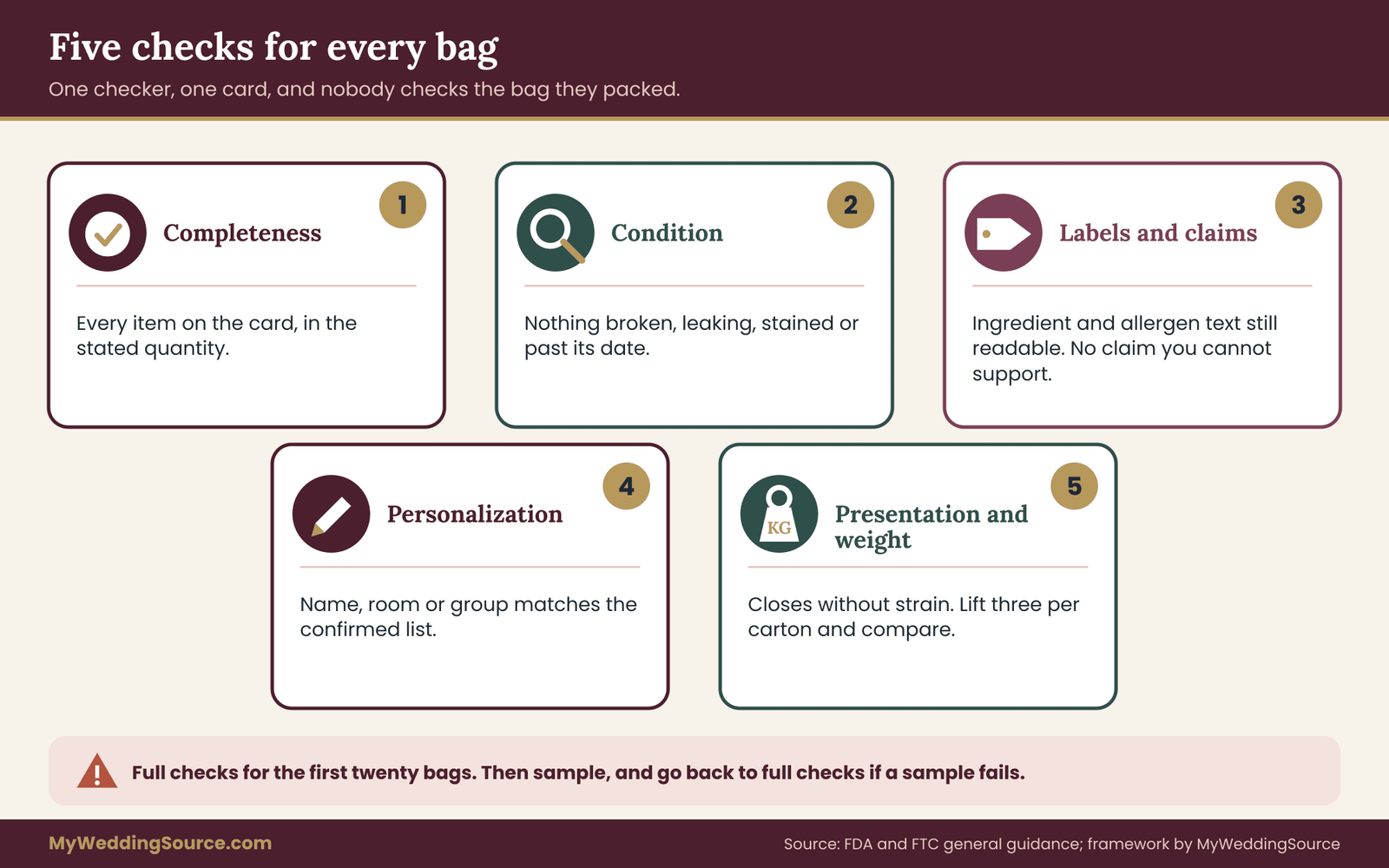
Check one, completeness. Every item on the card is present, in the stated quantity. This is the most common failure, and the easiest to catch with a quick pass down the card. A missing item is nearly always an item that ran out at the station, so a recurring miss tells you which tray needs refilling.
Check two, condition. Nothing is broken, crushed, leaking, stained, faded or past a date printed on it. Sealed packaging should be intact. A snack with a torn pouch or a bottle with a loose cap is a reject, not a “probably fine.”
Check three, labels and claims. Every food item still has its manufacturer label. Ingredient and allergen information is legible and has not been covered by a sticker or a ribbon. Any printed claim, such as “local,” “handmade” or “organic,” is something you can support from the supplier’s own information. The Federal Trade Commission publishes general guidance on truthful claims in advertising, and while a welcome bag is not an ad, the habit is a useful one: do not print or say anything about an item that you cannot support from the label or the supplier.
Check four, personalization. The name, room, group or note matches the guest it is meant for, spelled the way that guest spells it. A name read from a list and written on a tag at speed is a common source of errors. If tags are printed, check the file against the confirmed list. If they are handwritten, the checker confirms each name against the list rather than against memory.
Check five, presentation and weight. The bag closes without strain, stands upright, and is not so heavy that a handle could fail or an older guest would struggle. Lift three random bags per carton and notice the weight. A bag that feels clearly heavier or lighter than its neighbors probably has a doubled or missing item.
What the checker does, in order
The checker takes the bag, opens it, and removes items one at a time in the reverse of the packing order, calling out the item name in a low voice and ticking the card. This is slower than glancing, but it is far more reliable, and with practice it takes under a minute. Then the checker re-packs in order, verifies the top layer, closes the bag and passes it to the sealing zone. A failed bag goes to the reject box with a note on what failed.
An alternative for large batches is a sampling approach: check every bag for completeness (a quick lift and look) and fully unpack only a fraction, such as every fifth bag. That is a practical compromise when you have many bags and few checkers, but it carries a risk. If the sample reveals a systematic error, such as a missing item in an entire carton, you have to reopen everything from that run. Because the cost of reopening is high, many people choose full checks for the first twenty bags, then sample, and return to full checks if a sample fails.
Bag assembly rejects are information
Do not treat rejected bags as embarrassments. Keep a short log of every reject and its cause. If five rejects share a cause, you have found a bag assembly fault rather than a careless helper: a tray placed where it gets knocked, a bag size that is slightly too small, a sticker that keeps covering a label. Fix the fault and the rejects stop.
Rejected items that are still good can go back into stock after a second inspection. Items that are damaged, opened or past a date should leave the table entirely. Do not put a questionable food item back into circulation because supplies are tight; reorder instead, or substitute and document the change.
A short script for the checker
“I am going to open each bag and tick the card. If I find a problem I will set the bag aside and tell the person at the line what it was. I am not criticizing anyone; I am looking for the gaps.”
Saying that out loud at the start of the party matters. People who feel they are being graded pack more slowly and hide mistakes. People who understand that the checker is part of a shared system tend to point out their own errors.
Inventory reconciliation for bag assembly: the count that must close
Inventory reconciliation is the most useful single practice in bag assembly, and it is also the one that sounds most like homework. It is simple. You count items at fixed points and check that the counts agree with each other.
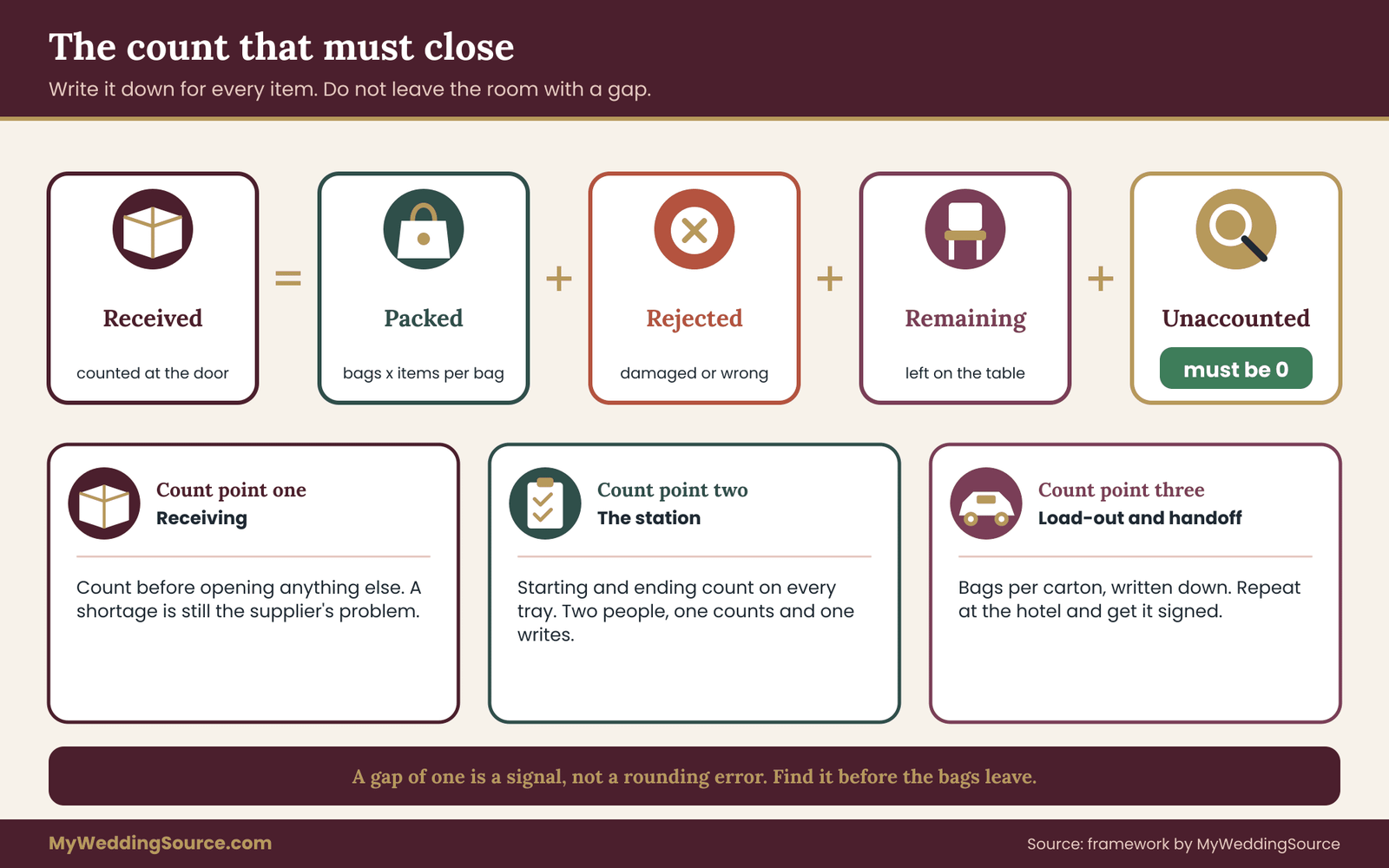
The equation
For each item, the following must be true at the end of the party:
Received = Packed + Rejected + Remaining + Unaccounted
- Received is what arrived, counted at the receiving gate and confirmed against the order.
- Packed is the number of bags multiplied by the quantity per bag.
- Rejected is the number of items removed for damage, errors or labels.
- Remaining is what is left on the table or in boxes at the end.
- Unaccounted is whatever number makes the equation true. It is the number you are trying to bring to zero.
If you received 120 lip balms for 100 bags, packed 100, rejected two, and have 17 left, then unaccounted is one. One lip balm is missing. That is a small gap, but it is a signal. Find it before you leave the room. It might be under a table, in a bag as a doubled item, or in someone’s pocket as a souvenir. If a doubled item is the cause, one bag somewhere contains two lip balms and another contains none, and the checker may have missed it.
The three count points
Bag assembly needs three count points, and each has a different purpose.
Count point one, receiving. When a box arrives, count and write down the quantity before you open anything else. Compare it with the order. Note any short delivery in writing with the supplier and ask when the balance will arrive. This is the only moment when a shortage is the supplier’s problem rather than yours.
Count point two, the station. At the start of the party, write the starting quantity of each item on its tray and on the tally sheet. At the end, count what is left. Do this with two people, one counting and one writing, so that tired arithmetic does not decide the answer. When a tray runs out mid-party, note the time and the number short.
Count point three, load-out. When finished bags go into cartons, count bags per carton, label the carton, and write the total on the tally. Repeat the count when the cartons are handed to the hotel or the next person. If a carton count differs from the tally at handoff, you know the loss happened in transit rather than at the table.
A worked reconciliation for one item
Suppose a bag contains a small jar of honey, and you ordered 110 jars for 100 bags, to allow for a few breaks. The delivery note says 108 jars arrived, and at the door you find two with cracked lids. Received is 108, and those two cracked jars are already counted as rejected.
At the party, the checker finds one more jar with a loose lid, which also goes to the reject box. You pack 100 good jars.
At the end, you count four jars left on the table. Check the equation: 108 received should equal 100 packed plus three rejected plus four remaining, which is 107. Unaccounted is one. Somewhere, a jar is missing or doubled. You look through the reject box, then check the last carton with the checker present. A bag with two jars turns up. Now the count closes, and you have also fixed a bag that would otherwise have gone out heavy.
This is the point of the method for bag assembly. It does not require a clever system. It requires only that you write the numbers down and refuse to leave a gap unexplained.
What to do with leftovers
Bag assembly leftovers should be decided in advance, not on the night. Some items can be saved for hosting guests who arrive late or whose plans change, and a few spares make sense. Others, such as food, may be usable at the rehearsal dinner, in a wedding party gift, or donated if they are packaged, within date and allowed by the receiver. For ideas on handing surplus onward rather than binning it, the waste reduction planning guide covers the options for event surplus in more detail.
Write the destination of each leftover item on the tally sheet. This closes the loop, because remaining stock that has a named destination is no longer a loose end. ## Allergens and labels during bag assembly
A welcome bag is a gift, but when it contains food, drink or anything applied to skin, it is also a product that a stranger will put in or on their body. You are not a manufacturer, and nobody expects you to behave like one. You are expected to take reasonable care and to give guests the information they need to make their own choice.
Food in the bag
The simplest rule is to use only commercially packaged, shelf-stable food in its original wrapper. The label does the work of listing ingredients and the major allergens. The Food and Drug Administration explains that packaged food regulated by the agency has to declare the major food allergens, which currently number nine: milk, eggs, fish, crustacean shellfish, tree nuts, peanuts, wheat, soybeans and sesame. A baked item from a friend or a local bakery may not carry a full label, and that is where problems begin.
Bag assembly makes allergen mistakes easy in two ways. The first is cross-contact at the table, when a helper handles a nut-based snack and then touches a different item without washing. The second is relabeling, when someone transfers a snack into a nicer bag and discards the original package along with the ingredient list.
Ways to reduce both:
- Keep every packaged food in its original wrapper, even if you add a sleeve or a sticker. If a sleeve must cover the label, print the ingredient and allergen text on the sleeve itself or attach the original label.
- If you cannot confirm the ingredients, leave the item out of the bag assembly plan. A guest who has a severe allergy would rather receive no snack than an unlabeled one.
- Assign one zone to food and keep nut-containing items on a separate tray with a separate scoop or glove, so that one dropped almond does not travel.
- Wash hands before the party starts and again after any break, and keep a small card at the table reminding people of this.
- If any guests have told you about an allergy, decide before the party whether any bag will be made differently, and mark that bag in a way that the checker can see. Do not rely on memory.
If the bag includes a locally made or handmade food, ask the maker for a full ingredient list and a statement of whether it is made in a facility that handles the major allergens, and include that list in the bag. The site’s guide on local snacks goes into shelf life and allergen labeling for those items in detail, so it is worth reading before you add a homemade or bakery item.
Drinks and anything that needs to stay cool
Anything that needs refrigeration is a poor fit for a bag that will sit in a car, a closet or a hotel storage room. If a drink or a snack needs to stay cold, it should not be assembled into the bag ahead of time at all. Handle it as a separate delivery, or skip it. The safe temperature guidance from the federal government’s food safety site is clear about the risk of leaving perishable food in warm conditions, and a welcome bag has no way to protect against that once it is sealed.
Skin care, soaps and candles
Cosmetic items such as lip balm, lotion or sheet masks should be commercial products with the manufacturer’s label. The FDA’s cosmetics pages explain that cosmetic products have labeling requirements, and a homemade product that you or a friend made may not meet them. Beyond labeling, fragrance matters: many people react to scented items, and scent travels through a bag and into the food beside it. Where possible, use unscented or lightly scented products, and keep them in a bag of their own inside the main bag.
Candles and anything with an open flame risk need care at hotels and in airports, and many hotels prohibit candles in rooms. A candle that guests cannot use at the hotel is dead weight. If you are not sure, ask the property.
Items for children and small parts
If any bag is for a child, the contents change. The Consumer Product Safety Commission publishes guidance on small parts in products for young children, and a bag meant for a toddler should not contain anything that could be a choking hazard. Child bags should be kept apart from adult bags during bag assembly, labeled clearly, and checked against their own card. The age and safety side of those bags has its own guide on the site, and you can lean on it rather than inventing rules at the table.
Printed claims and the fine print
Be careful with words on the bag. “Local,” “natural,” “handmade,” “sustainable” and “organic” are claims that readers take at face value. If you say it, be able to point to the label or the supplier’s own statement. If you cannot, use a plain description instead, such as “made by a bakery in our town,” which you can verify.
Storing finished bags after bag assembly
Once bag assembly is finished, the bags are at their most vulnerable. The work is done, so people stop paying attention, and bags are pushed into a corner or a closet and forgotten. Storage is the stage of bag assembly where heat, damp, pests and weight do their quiet damage.
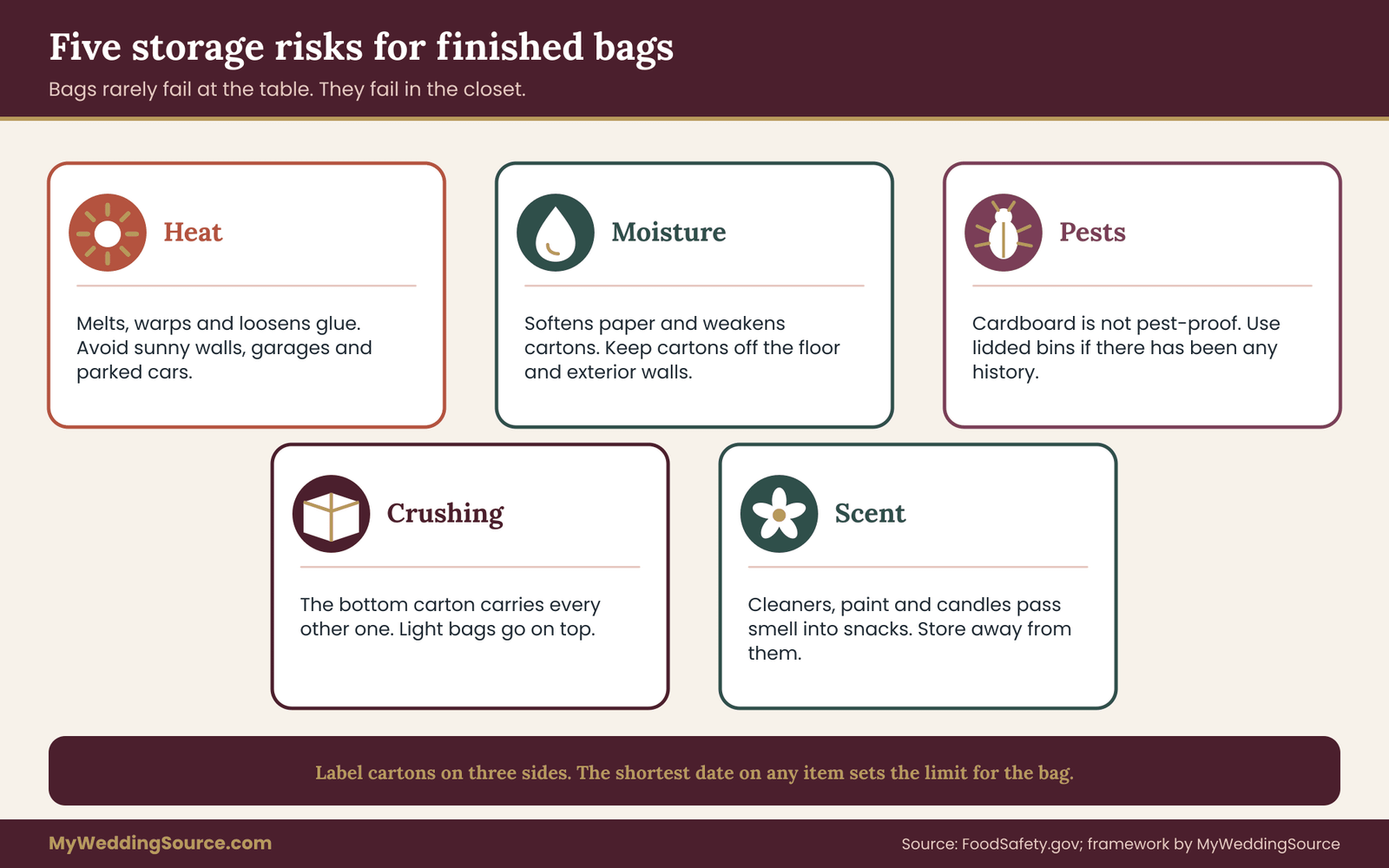
The five storage risks
Heat. Food melts, wax softens, adhesives let go and plastic warps. A closet against a sunny wall, an attic, a garage in warm months, and a parked car are all risky. Choose an interior room with stable temperature, and never leave bags in a car overnight.
Moisture. Basements, bathrooms and rooms with window units can be damp. Paper bags go soft, cardboard weakens, tissue paper wrinkles and metal tins rust. Keep cartons off the floor on a shelf or a pallet, and keep them away from exterior walls.
Pests. Food attracts ants, mice and pantry insects. Sealed packaged snacks are a smaller risk, but cardboard cartons are not pest-proof. If the storage room has had any pest history, use lidded plastic bins instead of cardboard, and do not store bags near pet food.
Crushing. The bottom carton in a stack carries the weight of all the others. Limit stacks to a height that the lowest carton can handle without bowing, and put the lightest bags on top. Never stack loose bags without a carton.
Scent. Strong scents pass from one item to another. Do not store bags in a room that holds cleaning chemicals, paint, mothballs, cigarettes, scented candles or a litter box.
Light and time
Direct sunlight fades printed paper and ribbon, and it warms items quickly. Cover cartons or keep them in a room without direct sun. As for time, a general principle is to keep storage short and to know the earliest date printed on any item in the bag. The shortest shelf life among all the items sets the limit for the whole bag. Check dates at receiving, write the earliest one on the carton and plan delivery with that date in mind.
Labeling cartons
Label each carton on two sides and the top, with a carton number, the number of bags inside, the date sealed and the destination. In bag assembly, a simple scheme such as “Carton 3 of 8, 12 bags, hotel front desk” helps anyone who moves the carton. For bags grouped by hotel, day of arrival or group of guests, write that grouping on the carton too, so the hotel or a helper does not have to open anything to find the right bag.
If bags are personalized, keep a copy of the guest-to-carton list. When a guest arrives early and someone asks for their bag, a list that says “Dana R., carton 5” saves ten minutes of opening boxes.
Checking while stored
Do one bag assembly inspection partway through the hold. Open one carton, check for moisture, pests, softened items, and confirm that a random bag still passes the check. Write the date of the inspection on the tally sheet. If a problem has appeared, such as a smell, a leak or a pest sign, you have time to deal with it. If you wait until delivery, you do not. ## Transport after bag assembly: from your table to the guest’s room
Finished bag assembly work has to travel, even if the trip is only a few miles. Transport adds jostling, heat and handoffs, and each handoff is a place where a count can slip. A short plan for moving bags is cheaper than a replacement bag.
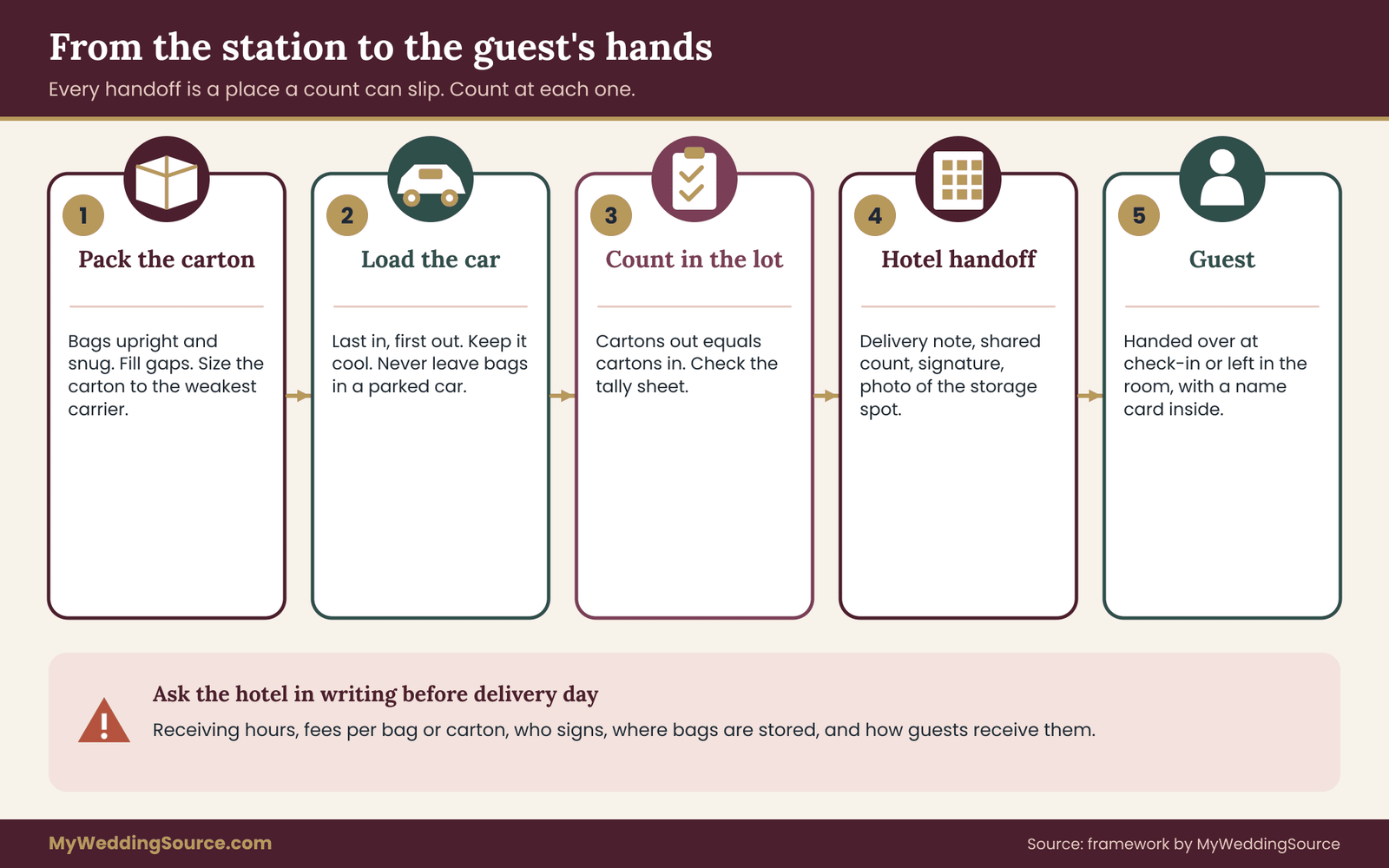
Packing the cartons
For bag assembly cartons, use sturdy boxes with lids or flaps that close. Bags should stand upright, snug against each other, so they cannot tip or slide. If a carton has loose space, fill it with crumpled paper or a folded towel, because empty space is where bags shift and where bottles break. Place heavier bags at the bottom of the carton and nothing on top of a bag that could crush its contents.
Do not fill cartons so full that one person cannot lift them. A carton that is awkward to carry is one that gets dropped. If a helper or a hotel employee will carry it, a carton of a dozen bags is usually more manageable than one of twenty-five. Choose the size by the weakest carrier in the chain.
Loading the vehicle
Load in reverse order of unloading. The cartons that go in last come out first, so put the cartons for the first delivery stop at the back. Keep cartons off the floor of an open trunk if there is a chance of rain or standing water, and do not stack more than two high unless the lower cartons are rigid.
Keep the car cool on the way. Do not park in the sun for a lunch stop with bags inside, and do not make the trip a part of a long errand chain. If the temperature is high, run the air conditioning before you open the doors and put cartons in the cabin rather than the trunk if that is cooler. Count the cartons when they go in and when they come out. This is the third count point, and it is the one most likely to be skipped when you are tired.
The handoff at a hotel
If bags go to a hotel, the handoff is a transaction, not a favor. The guest hotels guide explains how room blocks and lodging arrangements work, and the bag assembly and delivery plan needs to fit within those arrangements, not alongside them.
Before the day, confirm in writing with the hotel:
- Whether they accept deliveries on your date, and the hours the receiving area is open.
- Whether they charge a handling, storage or per-bag fee, and how they bill it.
- Who will receive the cartons, and whether that person’s name can go on your delivery note.
- Where the bags will be stored and whether that space is secure and cool.
- How and when bags will be passed to guests: at check-in, delivered to rooms, or collected from a table.
- Whether the hotel needs a guest list with room numbers, and how it will handle a guest who checks in under another name.
On the day, give the hotel a delivery note listing the number of cartons, the number of bags in each, the guest groupings and your phone number. Ask the receiver to count the cartons with you and sign or initial the note. Take a photograph of the note and of the cartons in their storage spot. If any carton arrives damaged, mention it at once, while you are still there.
Delivering to rooms or to a welcome table
There are two common ways to get a bag to a guest. A bag can be placed in a room before arrival, which is a pleasant surprise but depends on the hotel’s cooperation and a reliable room list. Or it can be handed out at a welcome table or at check-in, which is more flexible when arrival times vary. The best choice depends on the hotel, the number of arrivals per day and how many guests arrive off-schedule. If you hold a table, see the guide on staffing a welcome desk for how to organize the people and the hours.
If bags go to rooms, include a card inside each bag that names the guest, so a bag delivered to the wrong room can be redirected. If bags are held at a desk, the desk staff need a way to find a bag quickly, which means the carton list and the labels you set up earlier.
Air travel after bag assembly
Some bags travel by plane with the couple, or with a relative, to a destination. Liquids, gels and aerosols in carry-on bags are limited by Transportation Security Administration rules, and food items may be inspected.
The rules are published by the TSA, and they change, so check the current guidance before you pack. For a bag that goes to a destination wedding, it is often easier to ship the items to the hotel or to buy them there. The site’s guide for guests flying carry-on only covers the guest side of that problem, and this one only needs you to remember that finished bags can be a nuisance in luggage.
Shipping
If you ship cartons, use a carrier with tracking, insure the shipment for a sensible value, and ask the receiver to inspect on arrival. The United States Postal Service and other carriers publish packaging guidance, and following it reduces damage. Pack as for a rough trip, not a gentle one. Shipping also introduces a wait, so allow extra days. A shipped bag that is late is as useless as no bag.
Running the bag assembly party: roles, pace and the first twenty bags
With the station, the checks and the counts settled, bag assembly itself is about people. A calm host and a clear opening make most of the difference.
The first ten minutes
Open with a short briefing. Show the reference bag. Name the zones and who is in each. Explain the checker’s role and why it matters. Point out the reject box and the question box. Say the end time out loud. Then show the tally sheet and say that two people will do the final count. This takes five minutes and prevents most of the confusion that follows.
“Thanks for coming. Here is the finished bag. Each of you has one zone. If something looks wrong, put it in the question box and keep moving.”
Roles
Host or lead. Keeps time, answers questions, refills trays and watches the tally. This person does not pack.
Packers. Each takes one zone and stays in it. Rotating is allowed at break times, not mid-line.
Checker. Described earlier. One at a time.
Sealer and carton packer. Closes bags, tags them, loads cartons and writes the carton numbers.
Floater. Opens boxes, refills trays, handles trash and recycling, and covers breaks.
Counter. At the end, counts what remains, together with the host, and completes the tally.
Pace and breaks
Two hours is a good length for a first bag assembly session. After that, attention drops and errors rise. If you need to build more bags than a team can do in that time, schedule a second session rather than extending the first. Offer a break at the midpoint, with water and a snack that is not on the packing table. Food and drink for the helpers should be kept in a separate area, away from the items. Thank people as they leave, and send a short message the next day.
The first twenty bags
Build and check the first twenty bags at full care, with every bag unpacked and re-checked. These bags teach you where bag assembly is slow, where the errors cluster and whether the layout works. If you find a problem, stop the line, fix the cause, and then resume. If the first twenty come out clean, shift to sampling if you want to speed up, and keep the checker’s attention high.
When the music is louder than the process
A party atmosphere is nice for bag assembly. It can also encourage chatty packing, where people look at each other instead of the table. A simple counter is to keep the volume low enough to talk and to make the check station physically a bit apart, so the checker is not part of the conversation. A casual rule that nobody talks to the checker while a bag is open works surprisingly well and nobody takes it badly.
Etiquette for helpers and guests
Bag assembly helpers are volunteers, and the usual courtesies apply: feed them, set a real end time, do not criticize and do not ask people to buy supplies. The general principles of asking for help and thanking people are covered in the site’s guide on wedding etiquette, and those principles apply here: a clear request, an easy way to say no and sincere thanks. ## A worked example of welcome bag assembly and where the money goes
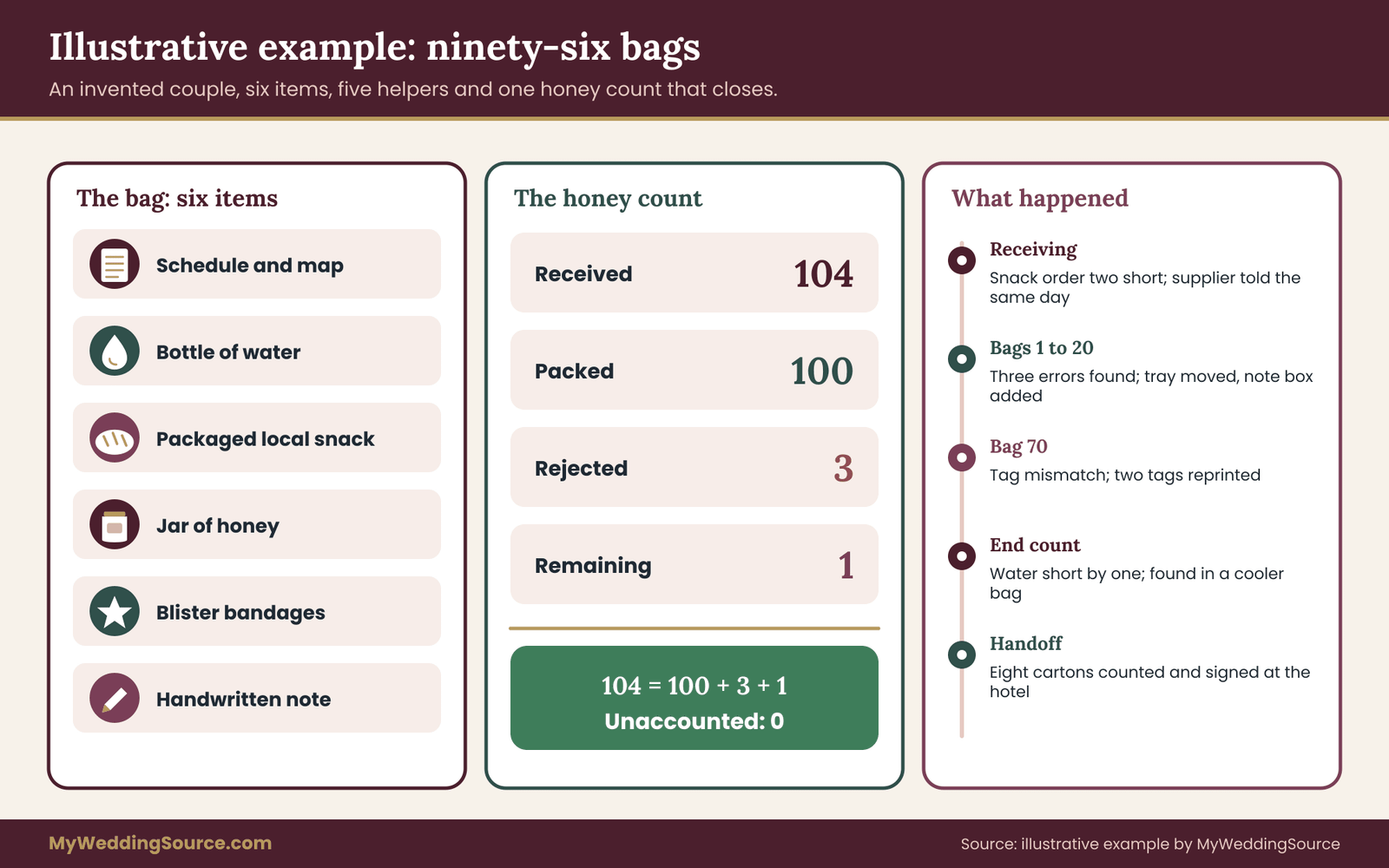
The following example is invented to show the method in numbers. It is not a case study, and the figures are chosen for clarity, not as typical prices or timings. Imagine a couple, Maya and Daniel, with ninety-six confirmed guest households and a plan for bag assembly in their living room two weeks before the wedding.
The setup
The bag holds six items: a printed schedule and map, a bottle of water, a packaged local snack, a small jar of honey, a pair of blister bandages and a handwritten note. They decide on ninety-six bags plus four spares, so one hundred bags in total. That is six hundred placements. They recruit five helpers: Maya’s sister as checker, a friend as sealer, two cousins as packers and Daniel’s father as floater and counter, seated at the tag table.
They order everything with a few spares on breakable items (the honey jars and water bottles) and a smaller cushion on flat items. Each item is ordered from a supplier who gives a delivery window. At receiving, Maya counts every box on the day it arrives and writes it on the tally sheet. The snack order is two short. She emails the supplier that day, with the order number, and the balance ships within a week. Because she counted at the door, the shortage is the supplier’s problem and does not appear at the party.
The bag assembly station
They use two folding tables and a counter. Zone one holds the empty bags, pre-opened the night before. Zone two holds the water and the honey. Zone three holds the snack and the bandages. Zone four holds the schedule and the note. The checker sits at a small table with the card and the reference bag. The sealer has cartons, a marker and a stack of tags.
The tally sheet is taped to the wall with six rows. Each row has a starting count and an ending count. They also tape a second sheet beside it for rejects, with columns for item, reason and who found it.
The first twenty bags
Packers work at their own pace and the checker opens every one. In the first twenty, she finds three problems: a bag with no bandages, one with two notes and a honey jar with a loose lid. The missing bandages are a refill problem: the bandage tray was at the far end of the table and a packer reached past it. They move the tray. The doubled note is a handwriting mix-up with a tag, and they add a checkmark box on the back of each note. The honey jar goes to the reject box.
After the first twenty, the errors stop. The checker moves to sampling, opening one in three bags, and finds no further problems until bag seventy, where a name on a tag does not match the list. She checks the entire carton and finds one other wrong tag. They reprint two tags and the carton is fine.
The count at the end
Here is the closing reconciliation for the honey, in simple form. Ordered: 104. Delivered: 104. Rejected at receiving: one, with a cracked jar. Rejected at the party: two. Packed: 100. Remaining on the table: one. The equation reads 104 received equals 100 packed plus three rejected plus one remaining, which is 104. Unaccounted is zero. The count closes.
The water has a different outcome. Ordered: 104. Delivered: 104. Packed: 100. Rejected: none. Remaining: three. That adds up to 103, so unaccounted is one. They search. A bottle is found in the sealer’s cooler bag, set aside when someone asked for a drink. The count closes at zero, and the bottle goes in the leftover box with the name of its destination, the rehearsal dinner table.
Storage and transport
The cartons, eight of them with twelve or thirteen bags each, are labeled and set on a shelf in a spare bedroom. The room is interior, has no windows facing the afternoon sun and has no pest history. Maya opens one carton a week later, checks a random bag and writes the date on the tally.
The hotel confirmed in writing that it will receive the cartons the day before the wedding and hold them behind the desk. Daniel drives the cartons in two trips. At the hotel, a desk employee counts eight cartons with him and signs the note. He photographs the note and the cartons in storage.
What the bag assembly example shows
Nothing in this bag assembly example required special skill. It required a reference bag, a card, a station order, three count points and a willingness to stop and fix a cause. The couple’s main benefit was not that nothing went wrong. It was that the things that did go wrong were small, found early and logged.
Cost logic for bag assembly: what to compare before you spend
No figure in this guide is a price quote, and prices vary by place and by year. What can be compared is the structure of the cost, and that is what keeps a bag budget honest.
Where the money actually goes
In bag assembly, the goods are the obvious cost. The less obvious costs are labor, packaging, storage, transport, delivery fees and replacement. If you pay a helper or a service, labor becomes a real line. If you fill a bag with fragile items, replacement becomes a real line. If the hotel charges per bag or per carton, delivery becomes a real line. Put each of those on your budget even if the amount is zero, so you can see what you are choosing.
Comparing the three approaches in prose
Bag assembly by yourselves. The money cost is lowest. The time cost is highest. The risk is concentrated in your own attention, which is often stretched in the final weeks. This approach fits small counts and simple contents.
Bag assembly party with volunteers. The money cost is small, mostly food and supplies for helpers. The time cost is shared, but your own time to plan and host is still significant. The risk is variable quality, which the checker and the card reduce.
Paid bag assembly. The money cost is highest. The time cost is lowest for you, and the risk of a poorly handled item shifts to the vendor, provided that you have a written specification and a count at delivery. The risk of misunderstanding is also higher, since you are no longer watching.
None of these is the right answer in general. The right answer is the one for which you can name the main risk and say who manages it.
A simple trade-off test
Ask what each hour of your own time is worth in the final month.
If the answer is that you are already behind on other tasks, paid bag assembly of even part of the bag can be a sensible expense. A middle path is to buy the items yourself and pay only for the packing, or to assemble the dry goods and pay a bakery to deliver the perishable item to the hotel on the day. For a view of the wider budget, see how a budget guide treats contingency money; a small reserve for replacements means a broken jar does not become an emergency.
Vendor questions that matter
If you order from a supplier, put these in writing: the delivery date window, the policy for damaged or short items, whether a substitute can be sent without your approval, whether product claims are documented, and whether a contact person is named. The vendor purchase order checklist shows how to turn those answers into a written order that protects you if something goes wrong.
Before paying a deposit, ask to see ingredient lists for any food item. If the supplier cannot provide one, choose another item. A claim you cannot verify should not appear on a label you put your name on.
Substitutions
Suppliers sometimes run out of an item and send a substitute. Do not accept a substitute without checking it. A different brand of the same snack may contain a different allergen, and a different size may not fit the bag. Compare the new item with the old on the label, the size, the weight and the date, and update your bag card and your allergen notes. If the substitute does not pass, ask for a refund or a replacement and note the date you asked. ## Edge cases that interrupt welcome bag assembly
Even a clean bag assembly plan meets surprises. Most of them are predictable, and a decision made in advance costs less than one made in the middle of a party.
A late RSVP or a plus-one. Keep the spare bags exactly for this. Spares should be complete, checked bags with a blank tag, stored in their own labeled carton. If you run out of spares, build an extra bag from leftover stock, using the same card and the same check. Do not skip the check because the bag is “just one.” If the extra guest has an allergy or a different need, make that bag deliberately rather than pulling items at random.
A guest who cancels after bags are sealed. The bag is not wasted. Open it, return the sealed, in-date items to stock, and keep the personalized note and tag out of circulation. Update the count and the carton list. This is also why a card with the guest-to-carton list pays for itself.
A guest with a severe allergy. If a guest has told you about an allergy, treat it as a design requirement. Either build that guest’s bag from items that are verified safe or, if you cannot verify, give a bag of non-food items. Mark the bag in a way that is visible to the checker and the person handing it out. Do not rely on telling people verbally. If the allergy is serious, it is reasonable to ask the guest directly what they would prefer, since a person with a life-threatening allergy often has firm rules about food from others.
Two hotels or two arrival days. Split cartons by hotel or by arrival day when you label them, not later. A carton that mixes both has to be reopened. If you have only one carton per group, say so on the delivery note. The guest hotel guide describes how guests get split across properties, and a bag plan should follow the same split rather than ignore it.
A shortage discovered during bag assembly. Stop packing the affected item. Check whether the shortage is real by counting the tray and the box. If it is, decide quickly between three choices: pack the bags without the item and add it later, substitute a checked equivalent, or pause the line until more stock arrives. Do not mix the choices within a carton without a note. A carton that holds bags with different contents needs a label that says so.
An item arrives damaged in bulk. If a whole carton is crushed or wet, photograph it before touching it, keep the packaging, contact the supplier the same day and ask for a replacement or a refund in writing. Do not use items from a damaged carton unless you can verify that each one is intact, sealed and within date.
A broken or leaking item in a finished carton. Open the carton, remove the bag and any bag touched by the leak, and inspect the rest. Paper and fabric absorb spills. Sticky leaks attract insects. If a leaked bag cannot be cleaned, replace it from stock and log the reject.
A helper who cannot come. Plan the line with a role that can be absorbed by the floater. If two people drop out, shorten the party and schedule a second session rather than rushing the check.
Weather on delivery day. Heat, rain and wind are the usual ones. Carry cartons in a closed vehicle, use a covered path to the door, and put a sheet of plastic or a large bag over cartons for the short outdoor distance. In heat, make the trip short and avoid leaving cartons in the vehicle while you handle the handoff.
A hotel that cannot hold the bags. Have a fallback: a trusted relative who lives nearby, a room you have booked for the wedding party, or a delivery on the morning of check-in rather than the day before. Confirm the fallback in advance so you do not discover the problem at the desk.
The records to keep
When the bags are delivered, keep a short file: the final tally sheet, the reject log, the delivery note with the hotel’s signature, the photos of the cartons, supplier emails about shortages or damage and the allergen lists. If a guest raises a concern later, or a supplier disputes a count, you will be able to answer with facts rather than memory. The wedding records guide on this site, wedding records after the event, explains how long to keep this kind of paperwork.
A last bag assembly pass before you hand the bags over
On the day of handoff, do a fifteen-minute final review. Open one carton at random and check one bag against the card. Look at the earliest date on the carton label. Confirm the delivery time with the hotel. Check that the carton count equals the tally. Then take the photograph and the signature, and go home. The bags are no longer yours to fix.
Your next steps
Start your bag assembly with the calendar. Pick the delivery date, work backward and book the assembly session with a buffer of several days. Settle the final bag count and write the spare number beside it. Then build the one-page bag card and the tally sheet, and make a reference bag with the first items that arrive.
Next, write the three count points on a page and decide who will do each. Confirm in writing what the hotel or the receiving venue will do with your cartons. Finally, send your helpers a short message with the time, the finish and a simple description of the job. If you take only one habit from this guide, make it the equation: received equals packed plus rejected plus remaining plus unaccounted, with the last number at zero. That habit will make your bag assembly party calmer than most, and it will give your guests bags that are what they appear to be.
FAQ
How many people do we need for a bag assembly party?
For most home parties, five to seven people work well: one packer per zone, a checker, a sealer and a floater. More people tend to crowd the table and add errors. If extra friends offer, give them tasks away from the line, such as opening bags, writing tags or loading cartons. Larger counts are better handled with two sessions than with one crowded evening.
How far ahead should bag assembly happen?
Hold bag assembly as late as is practical while leaving a few days of buffer before delivery. Late assembly keeps items fresher and lets you absorb count changes, while the buffer gives you time to fix a problem the check catches. Items with short shelf lives can be added in a small second step close to delivery. Always let the shortest date on any item set your limit.
Should bag assembly include a check of every bag, or only a sample?
Check every bag for the first twenty, because that is when the line is still settling and errors cluster. After that, many people shift to sampling, opening one bag in three or one in five. If a sample fails, return to checking every bag in that carton. Full checking is safer when bags contain food, personalized tags or a child-specific item.
What if the bag assembly inventory count does not close?
Do not leave until you have looked. Check the reject box, the floor, the last carton and any helper’s bag or cooler. A missing item is often a doubled item in another bag, so unpack a few suspect bags. If you cannot find it, write the gap on the tally with the date, and decide whether any bag could be affected. A gap of one is usually small, but unexplained gaps are worth recording.
Can we include homemade food in the bags?
It is possible, but it carries more risk, since homemade items lack a manufacturer’s label and ingredient list. If you include one, write a complete ingredient list, name the major allergens it contains and keep it away from other food. Many couples choose commercial packaged items for exactly this reason. Check the FDA’s allergen guidance, and ask your own venue or hotel whether it has rules about outside food.
How should we store finished bags?
Keep them in labeled cartons in an interior room that is cool, dry, dark and free of strong smells or pests. Keep cartons off the floor, limit stack height and put the lightest on top. Never leave bags in a car overnight. Open one carton partway through the hold to check for moisture or pests, and write down the date of that check.
What should we tell the hotel before we drop off the bags?
Confirm the delivery date, hours, handling fees, where bags will be stored and who will receive them. Provide a delivery note listing cartons, bags per carton, groupings and a contact number, and ask the receiver to count with you and sign or initial it. Photograph the note and the storage spot. Ask how bags will reach guests, whether at check-in or in rooms.
What do we do with leftover items?
Decide in advance and record it on the tally sheet. Keep a few spare complete bags for late additions. Sealed, in-date items can go to a rehearsal dinner, wedding party gifts or a donation if the receiver accepts them. Do not include open or damaged food. Anything you cannot use or pass on should be recycled or discarded properly, not left in a closet.
Sources
- Federal Trade Commission, business guidance on advertising and marketing claims
- Food Allergies, U.S. Food and Drug Administration
- Cosmetics, U.S. Food and Drug Administration
- FoodSafety.gov, safe food handling and storage guidance
- Consumer Product Safety Commission, small parts and children’s product safety
- Liquids, aerosols and gels in carry-on bags, Transportation Security Administration
- Clean hands, Centers for Disease Control and Prevention
- Packaging and shipping guidance, United States Postal Service
- Safe lifting and ergonomics, Occupational Safety and Health Administration
- Food Safety and Inspection Service, U.S. Department of Agriculture