
Shower thank-yous look simple until two or three people hosted the party, a pile of gifts arrived in different ways, and nobody can say who gave the blue stand mixer. This guide gives you a host gift attribution and mailing tracker: a one-page record that links every gift to its givers, every note to one writer, and every envelope to a mailing status.
For reliable shower thank-yous with several hosts, keep one shared tracker and give each gift one line. Record the credited givers exactly as written on the card, the route the gift took, the host who holds it, the person who owns the note, and the mail status. Assign note owners within two days of the shower, write by household rather than by item, and mail on a schedule you can see. Check the tracker every week until every line reads “mailed.”
Most advice about writing a thank-you note assumes one host, one table of gifts and one person holding the pen. A bridal shower often has none of those. A maid of honor, a sister and an aunt may share the hosting. Some gifts come wrapped in the room, some arrive by courier at a host’s address, some are bought from the registry with a gift message nobody reads, and some are pooled by a group whose names live on a group chat. Every one of those routes can lose a name.
Good shower thank-yous do three things. They reach the right person, they name the right gift, and they arrive while the memory is fresh. The shower thank-yous tracker in this guide exists to make those three things dependable when the work is split across people who are all busy and all doing a favor.
A note on scope. This is general etiquette and planning information, not legal, tax or financial advice. Customs differ by family, culture and region, and what is expected in one community may not be in another. Where a fact depends on an agency or a company, the guide points you to the source so you can confirm the current version.
What shower thank-yous cover when several people host
Start with a plain definition so the rest of the work has edges. Shower thank-yous are the notes sent to guests and contributors after a bridal shower to acknowledge a gift, a favor of time, or both. They are separate from the thank-yous you will send after the wedding, even though the same couple will write both sets.
That separation matters. A shower happens months before the wedding, often in a different household, with a different guest mix. Guests who attended both events deserve two distinct notes, each naming what that event gave you. The broader gift record for the whole engagement belongs in the system described in our guide to organizing wedding records after the event, while this article stays on the shower and its hosts.
Three groups of people receive shower thank-yous:
Guests who brought or sent gifts. This is the largest group and the one most affected by attribution mistakes.
Guests who came without a gift. A note is kind and optional, and it is easy to forget because the shower thank-yous tracker has no gift line to prompt you. The notes section later in this guide covers how to handle them.
Hosts and helpers. The people who paid, cooked, set up, drove or lent a house are owed a thank-you that is separate from the thank-you for any gift they gave personally.
Where a host’s job ends and the honoree’s begins
Etiquette sources such as Emily Post and The Knot generally say that the honoree writes the shower thank-yous for gifts they receive. Hosts usually do not write on the honoree’s behalf. What hosts can do, and what makes the process work, is keep the information flowing: who gave what, who needs an address, and which gifts are still in someone’s trunk.
That division of labor is the foundation of the tracker. The honoree owns the writing. The hosts own the data capture at the party and in the days after. The shower thank-yous tracker is where those two jobs meet.
What this guide does not cover
This guide does not plan the shower itself, set the guest list or decide who pays. If you are still choosing a format or splitting costs, start with the checklist in the wedding planning checklist and the broader wedding etiquette guide, then return here once there are gifts to track. The focus from here on is attribution, ownership and mailing.

Why more than one host makes shower thank-yous harder
A single host sees every gift arrive. Two or more hosts each see a slice. The slices overlap in some places and leave gaps in others, and the gaps are where thank-you notes go missing.
Four ways information gets lost
The split view. Host A stands near the gift table and sees what is carried in. Host B is in the kitchen and sees nothing. Host C opened the package that arrived Tuesday. Nobody holds the whole list, and each host assumes someone else does.
The detached card. Gift cards slide off boxes, drop into bags, get thrown out with wrapping paper or stay stuck to a ribbon in a trash bin. When a card goes, the only link between a gift and a giver goes with it.
The routed gift. A registry purchase may ship to a host, to the honoree or to a store for pickup. The retailer’s gift message is a separate record from the delivery, and neither may name the purchaser the way the guest would sign it. A gift shipped to a host’s home may sit in a hall for a week before anyone connects it to the shower.
The silent group. When five guests chip in on one gift, one person often does the buying and the others appear only in a chat. A thank-you addressed to the buyer alone is a small insult to the other four.
The cost of getting it wrong
The cost is rarely money. It is a note that thanks the wrong person, a gift described incorrectly, a contributor left out, or an envelope that never leaves the table. These are small hurts, and they tend to land on people who were generous. They also cost the honoree something: a guilty week of trying to reconstruct a list from memory.
The two failure patterns to watch for
Most multi-host shower records fail in one of two directions. In the first, everyone assumes someone else is keeping the list, so nobody keeps it. In the second, everyone keeps a list, so there are three versions that disagree. Both patterns have the same fix: one shared tracker with one named keeper and clear rules for who may edit which fields.
“Before we all scatter, can we agree on one place for the gift list and one person who owns it?”
That single sentence, said to the other hosts before the shower, prevents more trouble than any template. The rest of the guide turns it into a procedure.
Respecting different hosting arrangements
Hosting customs vary. In some families the mother and aunts host. In some friend groups the bridal party splits the work. Some showers are hosted by a workplace group, and some by a couple together. Avoid assuming who the hosts are, how they divide cost or what any of them can afford. The shower thank-yous tracker only needs to know who is holding gifts and who is helping with shower thank-yous. It does not need to know who paid for the cake.
The host gift attribution and mailing tracker
Here is the core tool. The tracker is a single sheet, paper or digital, with one line per gift and five fields on every line. It is deliberately small, because a tracker that takes more than thirty seconds per gift will not survive a busy afternoon.
The five fields
Field one, the gift line. A short number and a plain description. “14, ceramic baking dish, large, white.” Numbering makes later reconciliation possible, and the description should be specific enough that the honoree can write about the gift without seeing it again.
Field two, the credited givers. The names exactly as they appear on the card or in the order, plus a note if the spelling or the household composition needs checking. “From Priya and Dev Nair” is a credited giver entry. “From the office” is not, and needs a follow-up.
Field three, the route and holder. How the gift arrived (in person, courier, registry shipment, pooled by a group) and which host or helper currently holds it.
Field four, the note owner and note type. Who writes this note and what kind it is: a gift note, a gift-and-help note, a note for a group, or a note that needs no mail because the giver was thanked in person and the family agrees that is enough.
Field five, the mail status and date. Where the note is on the ladder from logged to mailed, with the date and the address source.

Three rules that keep the sheet honest
One line per gift, not per guest. A guest who brought two items has two lines. A group gift has one line with multiple credited givers. This keeps counting simple.
One note per giving household, not per item. If a couple gives three items, they get one note naming all three. The lines remain separate in the shower thank-yous tracker, but they point to one note.
One owner per note, not a shared responsibility. “We will all write some” produces gaps. Name one person for every note, even if that person is the honoree for the entire list.
Why paper alone and memory alone both fail
Memory fails for the reasons above. Paper alone works for a single host in one room, and it breaks when a second host sees a gift the first host has not. A shared digital sheet works across hosts, but only if people can use it on a phone while standing in a hallway. The next section compares the options and gives a decision rule.
How the tracker differs from a gift ledger
If you already keep a general gift log for the whole engagement, the shower thank-yous tracker is not a replacement. A ledger records what you received. This tracker adds the parts that a multi-host shower needs: attribution to the route and the holder, ownership of each note, and a mailing status. You can paste finished lines into your master list later, and the wedding registry ideas guide covers how registry purchases fit into the larger picture.
Choosing the right format for your shower thank-yous tracker
The best tracker is the one every host will actually open. Pick on the basis of how your hosts work, not on what looks tidy. There are four realistic formats, and each suits a different group.
Option one: a shared online sheet
A shared spreadsheet or document works when every host has a smartphone and a free account on the same service. Everyone can add a line from anywhere, edits show up for all, and the honoree can see progress without asking. Its weak points are access and noise. Someone may not have the account, and someone else may sort the columns and scramble the numbering.
Use this when the hosts are comfortable with phones, the shower has more than about twenty gifts, or some hosts live in different cities.
Option two: one host keeps a notebook
A single bound notebook or a clipboard with printed lines is the lowest-friction choice for a small shower with one host standing at the gift table. Nothing needs a login, and nothing runs out of battery. The weak point is exactly the multi-host problem: gifts that arrive elsewhere never reach the page unless somebody texts the keeper.
Use this when most gifts are opened in the room, the keeper is reliable, and the other hosts agree to text or photograph anything that arrives off-site.
Option three: index cards by household
One card per giving household, filled in as gifts are opened, then sorted into an alphabetical stack. Cards are easy to hand to a writer and easy to split among note owners. They are harder to total, and they make duplicates and group gifts awkward, because a group gift belongs on several cards.
Use this when the honoree will write most shower thank-yous by hand and wants a stack she can carry to a table.
Option four: a registry or retailer export
Some registries and shopping sites list who purchased each item, and some let the honoree download that list. It is a useful cross-check, because it captures purchases made online that nobody saw arrive. It is a poor primary tracker, because it only covers gifts bought through that one system, it may show a purchaser name that differs from the card, and it says nothing about in-person gifts, cash or pooled gifts.
Use an export as a second source, never the only one.
A decision rule
Choose a shared sheet if any host will be away from the gift table or any gift will be shipped. Choose a notebook if every gift will be opened in one room and one person will stay with it. Use index cards as a convenient front end for either. Use registry exports to verify. If you cannot decide, the shared sheet with a paper backup on the day is the safest combination, because it covers both the in-room and the off-site routes.
Questions to ask registry and shipping vendors
Before the shower, spend ten minutes asking the stores and services involved a few direct questions. Their answers shape what your tracker has to capture manually.
- Does the registry show the purchaser’s name and any gift message, and can the honoree export it?
- If the purchaser checked out as a guest, does the order still show a name?
- Where does each order ship by default, and can the shipping address be changed to a host or a pickup point?
- Does the store send the honoree a packing slip with the gift, or is it a gift-receipt-only shipment?
- How long are returns and exchanges allowed, and does the return need the original purchaser?
- If guests pool money for one item through the platform, does it tell the honoree who contributed and how much?
Each answer is a fact to confirm with the company, not an assumption. Policies change, and you should read the current terms before relying on any of this. The principle is simple: wherever the system does not capture a name, your tracker has to.
Setting up the tracker before the shower
An hour of setup before the party saves several hours of reconstruction afterward. Most of the setup is agreement among the hosts, not technology.
Name the keeper and the backup
One host is the keeper of the tracker. This person does not do all the work. They own the master copy, resolve conflicts and press the others for missing information. A second host is the backup, who has edit access and can take over if the keeper falls ill or leaves early.
Ask for these roles directly, and do not assume. A message such as the following works.
“Can you be the keeper of the gift tracker, and can you be backup? It is mostly checking that every gift has a line and a name. I will set up the sheet.”
Agree on the line format
Write the five fields at the top of the sheet and add one example line. People copy patterns faster than they follow instructions. Use short, consistent entries: a number, a plain description, a name copied from the card, a route word such as “in-room” or “shipped to host,” and a status word from a short list.
Keep the status list short. Seven words are enough: logged, attributed, assigned, drafted, written, addressed, mailed. The status ladder later in this guide explains each.
Decide who captures what on the day
On the day, two roles matter. A reader announces or simply holds each gift and its card, and a scribe types or writes the line. If the shower has no formal gift-opening, the roles still exist, only quieter: one host sits near the gift table and handles cards, and another photographs the table at the start and end.
Pre-assign these so nobody improvises. If the honoree opens gifts aloud, the reader is the honoree and the scribe is a host sitting next to them. If gifts are opened privately afterward, a host stays through the opening and keeps the cards.
Prepare supplies
A small box prevents most card loss. Include a roll of painter’s tape or a pack of sticky notes, a fine marker, a gift bag or envelope for loose cards, a pen on a string for the guest book, a phone stand or charger if you will type, and a few extra index cards.
Number each gift with a sticky note as it is opened and place the card with it. The number goes on the sticky note, the card, and the shower thank-yous tracker line. That single habit solves most of the detached-card problem.
Collect addresses in advance
Thank-you notes cannot be mailed without addresses, and mailing addresses are the field most often missing. Check your options before the shower:
- The invitations may already have a mailing list. If hosts mailed paper invitations, the keeper has addresses.
- A reply form on a digital invitation can ask for a mailing address for thank-yous. Ask plainly and say what the address is used for.
- If neither exists, a short guest-book line labeled “address for a thank-you note” can collect addresses on the day. Make it optional.
Treat these addresses as private. Do not post them in a group chat or on a public document. The shower thank-yous tracker’s address column can hold “see the invitation list” with the actual addresses held in one private list kept by the keeper. The principles in our wedding guest list guide apply to how you store guest contact details.
Plan for guests who ship gifts
Guests who cannot attend often send gifts. Decide in advance where they ship: the honoree’s home, a host’s home, or a registry pickup. Put that address in the invitation or the registry notes. If gifts go to a host, that host texts the keeper with the order details as soon as each arrives, and the keeper makes a line immediately.
Capturing gifts on the day without turning the shower into paperwork
The party is not a data entry session. The goal is a clean capture with the least interruption, so that the room still feels like a celebration.
The three-touch routine
Every gift gets three quick touches: a number, a card, and a line.
Touch one, the number. As a gift appears in the room, place a numbered sticky note on it. The number is the only thing a host needs to say out loud to coordinate: “Gift fourteen is the baking dish.”
Touch two, the card. Tape or tuck the card with the gift, or place it in a numbered envelope. If there is no card, photograph the gift and its wrapping and note “no card” in the line. Do not guess a giver.
Touch three, the line. The scribe enters the gift description and the credited names as they read on the card. If a name is ambiguous or illegible, mark it with a question mark rather than choosing a likely answer.
What to write for each type of gift
In-room gift with a card. The easy case. Copy the names exactly. If the card says “Love, Aunt Linda and Uncle Ray,” the credited givers are Aunt Linda and Uncle Ray, with the full names to be confirmed from the guest list.
In-room gift without a card. Record the description and the seating location where it was placed, and note “card missing.” The scribe or a host will check the guest list for a likely source and then ask politely, as described in the edge cases section.
Gift handed to a host privately. Treat it like an in-room gift. The host who received it adds the line, and the numbered sticky note goes on it later.
Cash or gift card. Record that a cash or card gift was received, the form, and the giver. Record the amount in a private column the honoree controls, not in the shared view, if hosts do not need it. A thank-you for cash names the gift as “your generous gift” and a purpose if you have one, rather than the figure.
Registry gift shipped to a host. The host who signs for the package adds a line the same day and photographs the packing slip, if there is one.
Photographing the table
Two photographs, one before gifts are opened and one after, are a cheap safety net. The first shows how many items arrived and how they were wrapped. The second shows what remains unopened. Together they guard against the case where a gift gets carried to a car without a line.
A third photograph, taken of each card before it leaves the table, is worth the thirty seconds. Cards are the single most fragile piece of data in the whole process.
If the shower has no gift opening
Some showers skip opening gifts, either because they are large, because gifts are discouraged, or because the honoree prefers privacy. The three touches still apply. Hosts collect gifts at the door, number them, tape cards on, and place them on a table out of the way. The honoree opens them later with the tracker open, and a host sits with her if possible.
Never push gift opening on someone who would rather not. Attribution works the same either way, and in a mixed-comfort group it is kinder to move the task into a quiet hour than to make it a public performance.

The close-out count
Before the last guest leaves, the keeper counts the gifts physically in the room and compares the count to the last line number in the shower thank-yous tracker. They should match. If they do not, find the missing line while people are still there and can say whose gift it was.
This two-minute count is the single most valuable check in the process. It is also easy to forget, so put it on the host checklist as its own item.
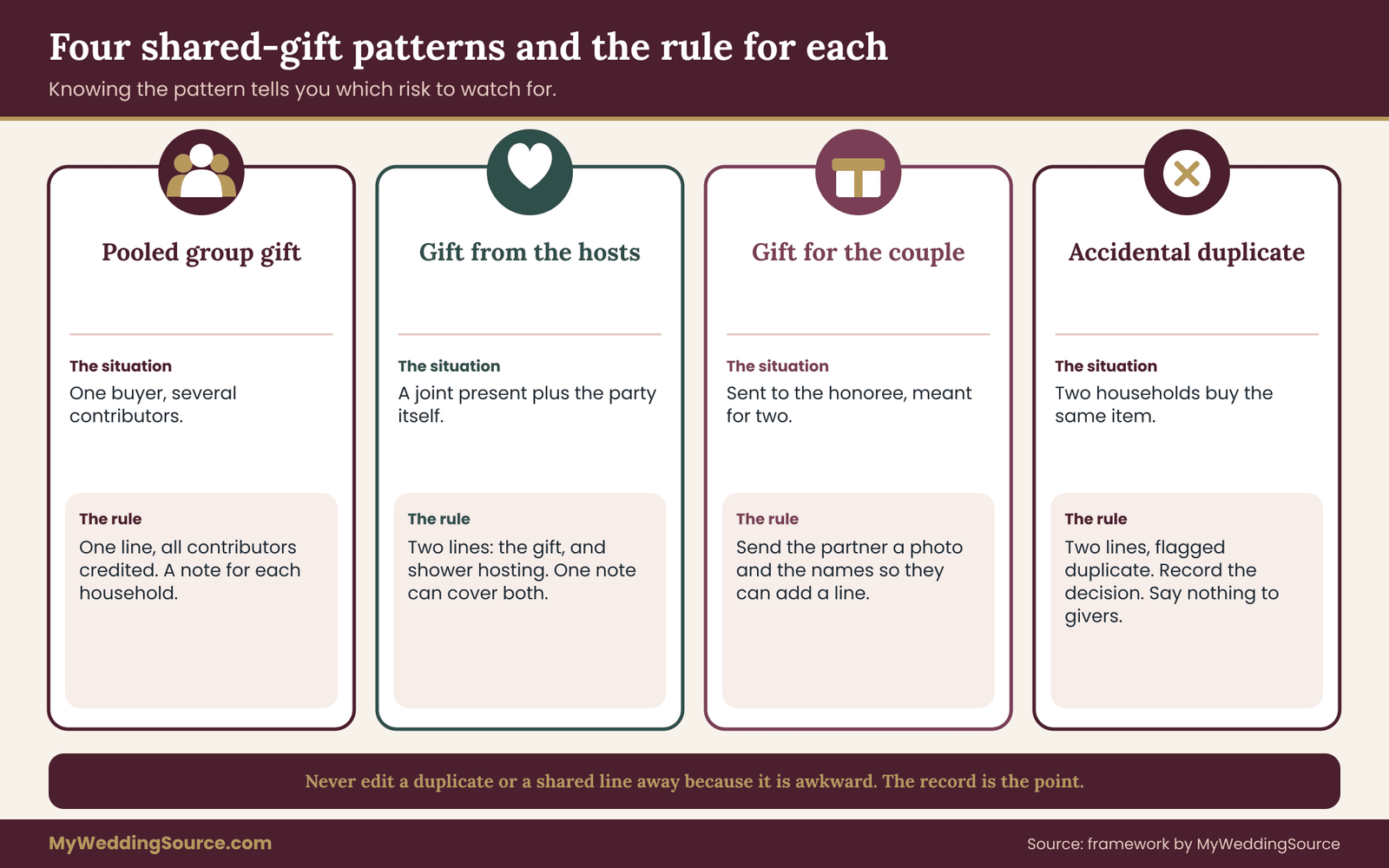
Shared gifts are where attribution earns its keep. A single gift from one household is easy. A gift from a group, from the hosts together, or from a mix of local and remote contributors can easily produce a note that thanks the wrong people. This section sorts shared gifts into four patterns and gives a rule for each.
Pattern one: the pooled group gift
Several guests combine money or effort to buy one larger item. One person usually buys and delivers it, and the rest contribute through a payment app, a registry group-gift feature, or cash.
The rule: one tracker line, all contributors credited, one note per household of contributors where addresses are known. The buyer is not the only giver. The note to each contributor names the shared gift and says plainly that the gift came from the group.
Whether to send one identical group note to everyone or individual shower thank-yous is a judgment call. If the group is small and close, individual shower thank-yous with a line about the shared gift feel warmer. If it is large, such as a whole office, a single note addressed to the group, mailed to the organizer or posted in the group’s own channel, is often the more realistic choice.
Ask the buyer for the full contributor list in writing as soon as the gift arrives. A message such as this keeps it friendly.
“Thank you for organizing this. So we can thank everyone properly, could you send us the names of everyone who chipped in, and a mailing address if they are comfortable sharing one?”
Do not publish or compare contribution amounts. Payment records are private to the people who made them, and the note thanks the group for the gift, not for the dollar figures. If a platform charged a fee on pooled money, that is a separate matter, and the principles on fee transparency in the CFPB’s consumer guidance on payment apps are a starting point for reading a provider’s current terms.
Pattern two: the gift from the hosts
When hosts give a joint gift, whether it is an item, a basket, or the shower itself, the honoree may be unsure whether a separate thank-you for the party is needed in addition to the gift note. The answer is usually yes: a note for the party and a note for the gift can be one note that covers both, written to each host.
The rule: record the gift line with all contributing hosts credited, and add a second line for “shower hosting” that lists everyone who helped with the party, including people who contributed only their time. The hosting line is the thank-you for work. The gift line is the thank-you for the object. They can be combined in one note if the same people are on both lines.
Pattern three: the gift for the couple, sent to the honoree
At a shower for a bride, some guests give items meant for the couple’s shared home. The note names the guest or household who gave it and says how it will be used in a shared household. If the couple is in different cities, the gift may go to one home and the other partner needs to be told. A short message with a photo of the gift and the giver’s name keeps the partner who was not at the shower from writing, later, “thanks for the lovely gift” with no idea what it was.
The rule: the honoree sends a photo and the credited names to the partner after the shower, and the partner can add a line in the shared note if they wish.
Pattern four: the gift that two guests accidentally duplicate
Two households buy the same item, which is a more common problem than most registry users expect. In the shower thank-yous tracker, these are two lines with a flag, and each note thanks the giver for the item without mentioning the duplicate. What happens next is a decision for the honoree: keep both, exchange one under the store’s current policy, or donate. Do not tell the giver you returned the gift unless they ask, and then answer simply and kindly.
The rule: log each duplicate gift as its own line, mark it “duplicate,” and record the decision. Never edit a duplicate away because it is awkward. The record is the point.
A short comparison of the four patterns
The pooled group gift has the most givers and the greatest risk of a missing name. The gift from the hosts has the most overlap between a gift note and a party note. The gift sent to one partner has the largest information gap between the two partners. The duplicate has the smallest tracking burden and the largest etiquette sensitivity. Knowing which pattern a gift belongs to tells you which risk to watch for.
How to credit givers when the card says something vague
Cards like “from all of us,” “from the gang” or “from your friends at work” are common and hard to use. Handle them with a polite follow-up that comes from the keeper, not the honoree, so the honoree can focus on writing.
“We want to thank everyone properly. Who is on the card that says ‘from the gang’? Anything you can send helps.”
If the answer never comes, write the note to the person you know and add a line addressed to the group, rather than guessing at names. A note that thanks “everyone at the shop” is better than a note that names two people and leaves out a third.
Who writes which note: dividing the work among hosts and honoree
Once the gifts are logged, the question shifts from information to labor. Who writes which notes?
The default: the honoree writes the gift notes
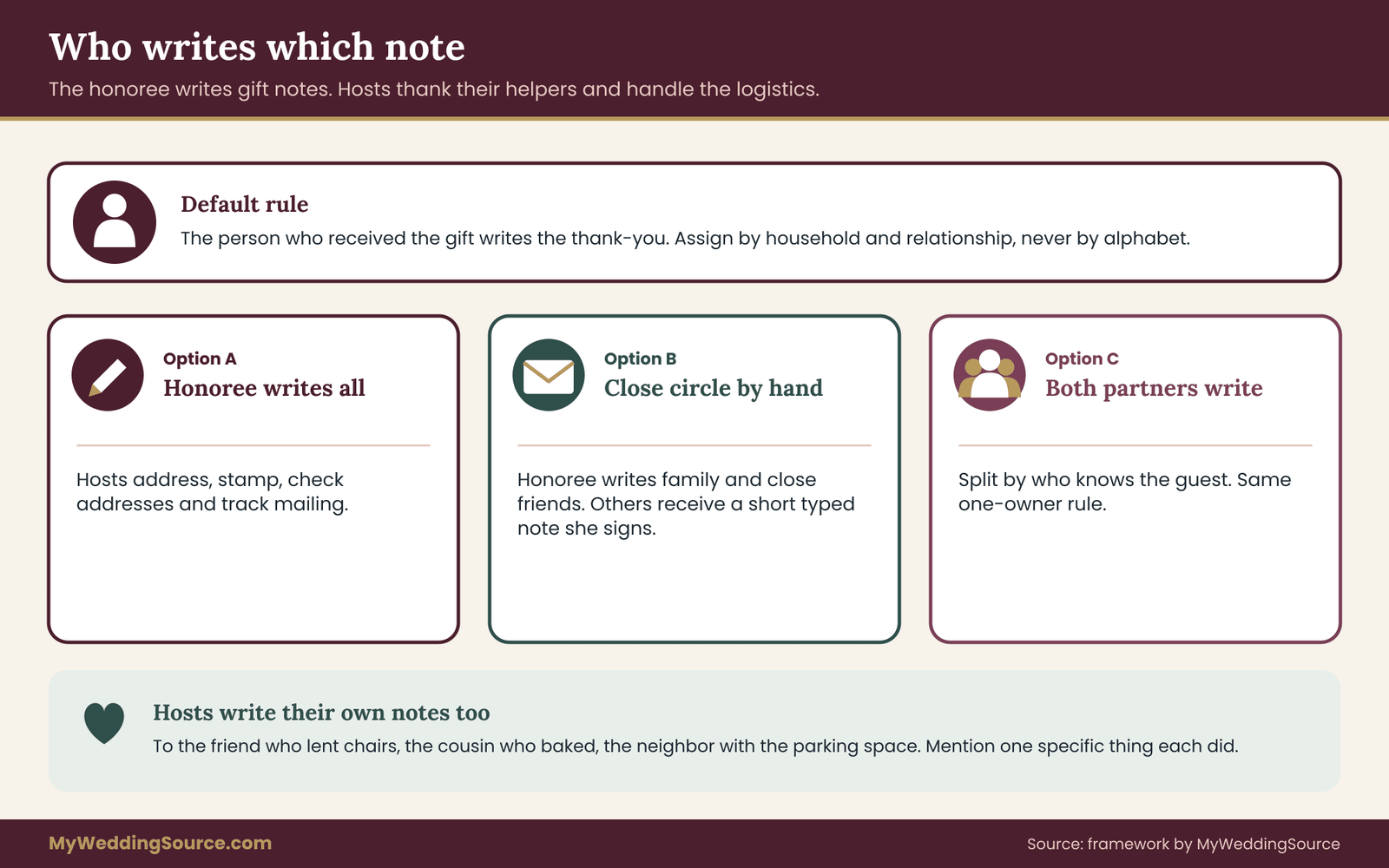
Established etiquette guidance generally holds that the person who received the gift writes the thank-you. A host who writes on behalf of the honoree can come across as impersonal. If a note truly cannot be sent by the honoree, for example because of illness, the honoree can still add a line or a signature.
This default keeps the notes personal, and the tracker supports it by giving the honoree a clean list sorted by household, with the gift description and the specifics she needs.
The hosts write their own thank-yous to each other and to helpers
Hosts have a distinct job. Hosts thank people who helped them host: the friend who lent chairs, the cousin who baked, the neighbor who allowed parking. Those notes come from the hosts, not the honoree. They are not shower thank-yous for gifts, but they belong in the same record because they are the same cohort of people, and you want to catch those who contributed in more than one way.
When more people need to write
Sometimes the honoree cannot write all the shower thank-yous, whether because of a long guest list, an illness, a baby, or a job with travel. Then the question becomes how to share the workload without losing the personal touch. There are three honest options.
Option A: the honoree writes all and the hosts do the logistics. Hosts address envelopes, buy stamps, check addresses and track mailing, so the honoree only writes. This keeps the note personal and cuts the time per note.
Option B: the honoree writes the close-circle shower thank-yous and hosts help with the rest. The honoree writes to family and close friends. For distant acquaintances, a short printed or typed note signed by the honoree is acceptable to many people. Some communities and families expect handwriting, and in that case Option A is the safer choice.
Option C: both partners write. If the shower was for the couple, or if one partner knows the guests better, each partner can take a share by household, keeping the same one-owner-per-note rule.
A simple assignment rule
Assign by household and by relationship, not by alphabet. The person who knows a guest best writes to them. If both partners know a guest, the honoree writes, because the gift was given to her. Hosts write only the notes that are theirs to write.
Every note in the shower thank-yous tracker gets one name in the note owner field. If the owner is the honoree for 40 out of 45 shower thank-yous, that is fine, as long as it is a deliberate decision and the other five are named.
Respecting capacity
Not everyone has the same energy, time or comfort with writing. Do not shame the honoree for needing help, and do not assume that everyone writes quickly or writes well. A tracker that shows progress can reduce the pressure. If the list is long, break it into batches by relationship and set a modest daily or weekly target.
Writing is also not equally easy in every language. If a guest speaks another language, a short line in their language, written by the honoree or checked by a friend, is a thoughtful addition, but it should not delay the note. The principles are similar to those covered in guidance on inclusive invitation wording: be warm, be clear and do not assume one set of customs.
The status ladder from logged to mailed
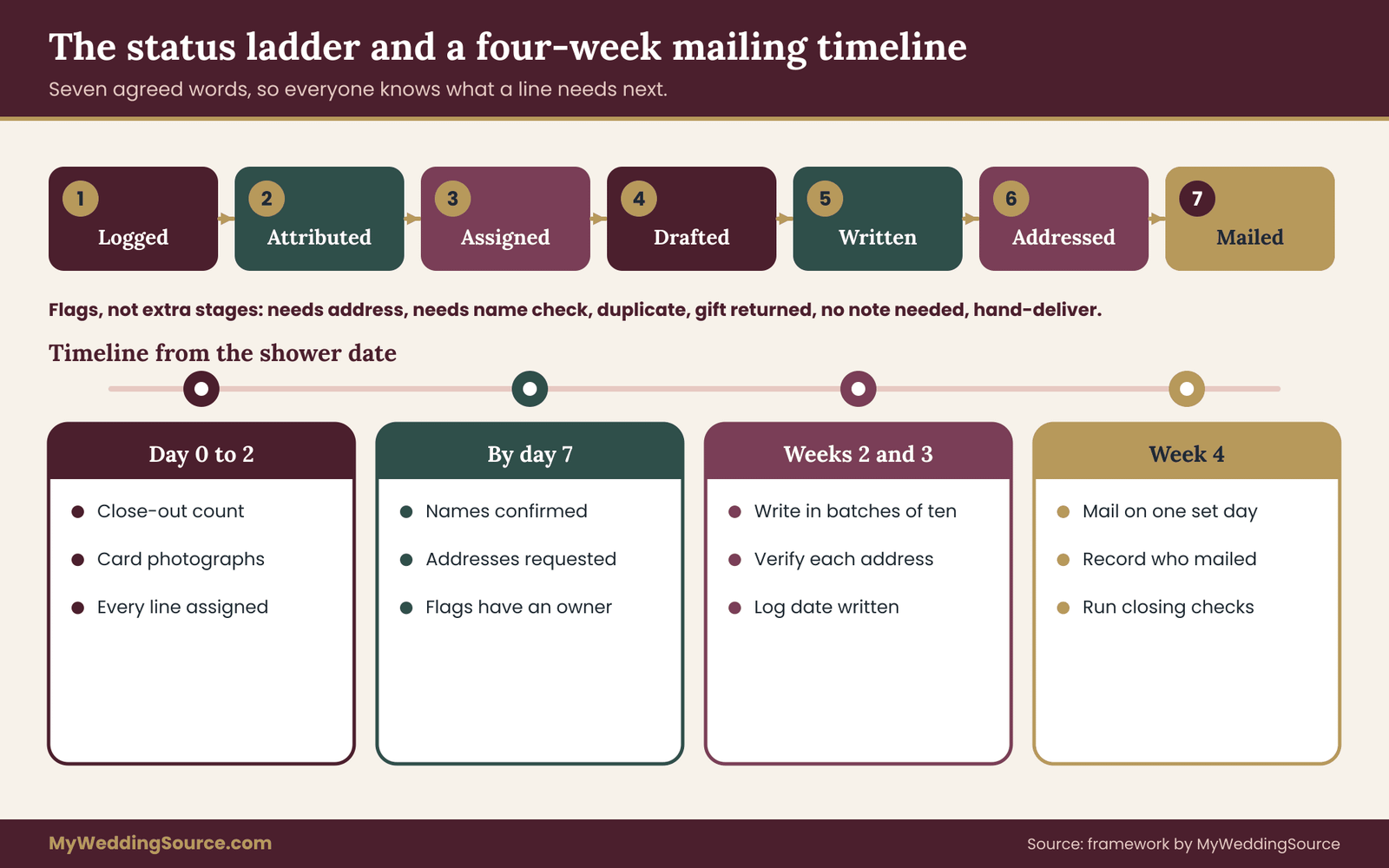
A tracker is only useful if the status field means something. A status ladder, a short sequence of agreed stages, tells everyone exactly where a note stands and what needs to happen next. Seven stages are enough.
Stage by stage
Logged. The gift has a line number and a description. Nothing else is certain yet. This is the stage reached at the party.
Attributed. The credited givers are filled in and confirmed against the card, the invitation list or a follow-up message. A line cannot move past this stage with a question mark in the name field.
Assigned. The note owner and note type are chosen. Within two days of the shower, every line should have reached this stage, even if the note itself is weeks away. This is the first measurable check.
Drafted. A rough note exists, in a document or on scrap paper. For many writers this is the hardest step, so it is useful to track separately.
Written. The final note is written, signed and sealed.
Addressed. The envelope has a verified address and stamp. A note without a confirmed address does not move to this stage; it moves to a “needs address” flag instead.
Mailed. The date is recorded. The shower thank-yous tracker also records which person put it in the mail, so there is someone to ask about a lost item.
An optional eighth stage, “acknowledged,” is useful only if you want to record that a guest has confirmed receipt. Most people do not need it.
Flags, not extra stages
Some situations deserve a flag rather than a new stage. Useful flags are “needs address,” “needs name check,” “duplicate,” “gift returned,” “no note needed,” and “hand-deliver.” Flags let a line carry a problem without losing its place on the ladder.
How to use the ladder in a weekly check
The keeper opens the tracker once a week for ten minutes and answers three questions. How many lines are still below “assigned”? How many have a flag that is more than a week old? Which stage has the most lines stuck in it? That last question tells you where the bottleneck is. If many lines are stuck at “drafted,” the honoree needs a quiet block of time. If many are at “addressed,” someone needs to buy stamps or find addresses.
The status ladder also helps when a host needs to answer a question from a guest. “Did my gift arrive?” can be answered in seconds from the shower thank-yous tracker, and the answer is warm and specific.
Keeping the ladder light
A ladder with fifteen stages would defeat itself. If the group finds seven too many, collapse it to four: logged, attributed, written, mailed. The point is a shared language for progress, not a process for its own sake. What matters is that every line has an honest status and that the status changes when the work does.
Writing shower thank-yous that name the right gift and the right people
With the data in order, the writing gets easier. A good note is short, specific and sincere. It does not have to be long, and it does not have to be clever. The shower thank-yous tracker’s job is to supply the specifics so the writer is not hunting for them.
The four-part note
Most strong thank-you notes follow the same simple shape.
One, the greeting and the thanks. Open with the giver’s name and a direct thank-you. “Dear Priya and Dev, thank you for the beautiful baking dish.”
Two, the specific detail. Say what you will do with the gift or what you liked about it. This is where the tracker’s description pays off. “I made a lemon cake in it the first weekend we had the kitchen set up” works only if you really did. If you have not used it yet, say what you plan to cook.
Three, the personal line. Mention the shower or the person. “It meant a lot to have you there, and your toast made my mother laugh.”
Four, the close. A short warm sign-off. “With love,” “Warmly,” or whatever suits your voice.
Three to five sentences is plenty. A note does not need to run longer to show care.
Wording for a note with a named gift
“Dear Aunt Linda and Uncle Ray, thank you for the stand mixer. We have already planned a batch of bread for the first weekend in our new place. It was lovely to see you both at the shower, and we are grateful for your support. With love, Maya.”
Wording for a pooled group gift
“Dear Jordan, Alex and Sam, thank you all for the beautiful dinnerware. Knowing it came from the three of you makes it more special, and we will think of you each time we set the table. Thank you for celebrating with me.”
If you write one note to each contributor, vary the wording a little so no two shower thank-yous read as copies. If you send a single note to a group, address everyone by name.
Wording for cash or a gift card
“Dear Ms. Alvarez, thank you for your generous gift. We are putting it toward the sofa we have been saving for, and it will remind us of you each time we sit down. It meant so much to have you with us.”
Name the purpose, not the amount. If you have not decided how to use it, say you are saving it for something you will enjoy together.
Wording for a gift you did not choose
Not every gift is a perfect match. A good note thanks the giver for the thought and the effort, and it does not need to claim that you love the object. “Thank you for thinking of us and for the lovely thought behind it” is honest and kind. Avoid saying you will use something you will not, and never criticize a gift in writing.
Wording for a guest who came without a gift
“Dear Rosa, thank you for coming to the shower. It meant a great deal to have you there, and we loved catching up. Your company was the best part of the day.”
This note is optional and welcome. The shower thank-yous tracker should have a line for each guest who attended so these notes are not skipped.
Wording for the hosts
A note to the hosts should thank them for time, effort and the specific things they did, and it should be separate from any note about a gift they gave. If three people hosted, write to each by name and mention something particular to each. “Thank you for the playlist” says more than “thank you for everything.”
“Dear Nia, thank you for opening your home and for the hours you spent cooking and setting up. The lemon cake was a hit, and your care was in every detail.”
Writing for a group of hosts together
If the hosts want one joint thank-you, address all of them and list what each did. This avoids the common sensation of being thanked in a lump and leaves no one wondering whether they were noticed.
Practical tips for the writing session
Write in batches of five to ten shower thank-yous. Keep the shower thank-yous tracker beside you. Read each description before writing, and write the first sentence as soon as you read the name. Use a pen you like, and write on plain stationery that is easy to buy again if you run out. If your handwriting is hard to read, print clearly, or type and sign. Accessible formats such as large print are also fine for a recipient who would find them easier to read.
If you share a household, one partner can write the greeting and the other the close. Do not feel that every note must come from both partners, but do sign it as the person who wrote it.
Mailing shower thank-yous: addresses, timing and a mailing log
Writing is only half of it. A note in a drawer is not a thank-you. The mailing side has its own small risks, and the tracker handles them with a few simple habits.
Timing
Etiquette guidance from sources such as Emily Post and The Knot generally encourages sending shower thank-yous promptly, within a few weeks and not much later than about three months. The closer to the event, the better the note feels. Since the wedding is usually months away, the shower thank-yous should not be bundled with the wedding thank-yous. Confirm with the sources you trust and with your own family’s expectations. In some communities a different timing is customary.
If you are behind, send anyway. A late note is better than none, and a brief line acknowledging the delay is enough. Do not write a long apology.
A practical schedule works backward from the shower date and uses the ladder. All lines assigned within two days. Addresses confirmed within a week. First batch of shower thank-yous written in the second and third weeks. Everything mailed within a month where possible. The timeline figure below lays it out.
Verifying addresses
A single wrong digit sends a note to a stranger. Verify addresses against the source: the invitation reply, the guest list, or a message from the guest. Do not copy from an old note or from memory. The U.S. Postal Service offers an address lookup tool on its website, and its Postal Explorer pages explain address formats and requirements. Use it for any address you doubt.
If an address cannot be verified, flag it “needs address.” Ask the guest, or ask a host who knows them. If you cannot get one, a text or an email with a short thank-you is a reasonable fallback. Say that you wanted to write properly, and that you hope to send a note when you have an address.
Stamps, envelopes and cost logic
Mailing costs are small per note and add up across a long list. Postage rates and rules change, so check current prices with the Postal Service rather than relying on a figure in an article. The cost logic is simple: count the shower thank-yous, check the postage, buy the stamps in one trip, and add the envelope and stationery cost. A quick count from the shower thank-yous tracker gives you the number of households, which is the number of shower thank-yous, not the number of gifts.
Square envelopes, hand-calligraphed addresses, extra inserts or heavier stationery can change the postage category, so check any unusual size or weight before buying stamps. A plain card in a standard envelope is the least risky choice.
The mailing log
Add one line to the shower thank-yous tracker, or a second tab, for each envelope: the household, the address source, the date written, the date mailed and who mailed it. This is the record that answers “did it go out?” months later. It also makes it easy to divide the labor, because one host can volunteer to address and stamp while the honoree writes.
Do not rely on the mail carrier. Drop the shower thank-yous at a post office or a collection box on a set day and record that day. If you want delivery confirmation for a particular note, such as a gift that was large or sent by a distant relative, ask the Postal Service which services are available and what they cost.
Handling hand-delivered notes
Some notes will be handed over in person, for example at a family dinner or at the office. Mark these “hand-deliver” in the tracker and give the note a date. The risk with hand-delivered shower thank-yous is that they sit in a bag. Set a date and a place and treat it like a mailing.
Keeping contact details private
The mailing log holds addresses. Store it where only the honoree and the keeper can see it. If the main tracker is shared with all hosts, put addresses on a separate private page. A guest gave an address for a thank-you, not for sharing. Delete or archive the address list when the shower thank-yous are done, or fold it into the records system you use for the wedding.
A worked example of shower thank-yous with three hosts
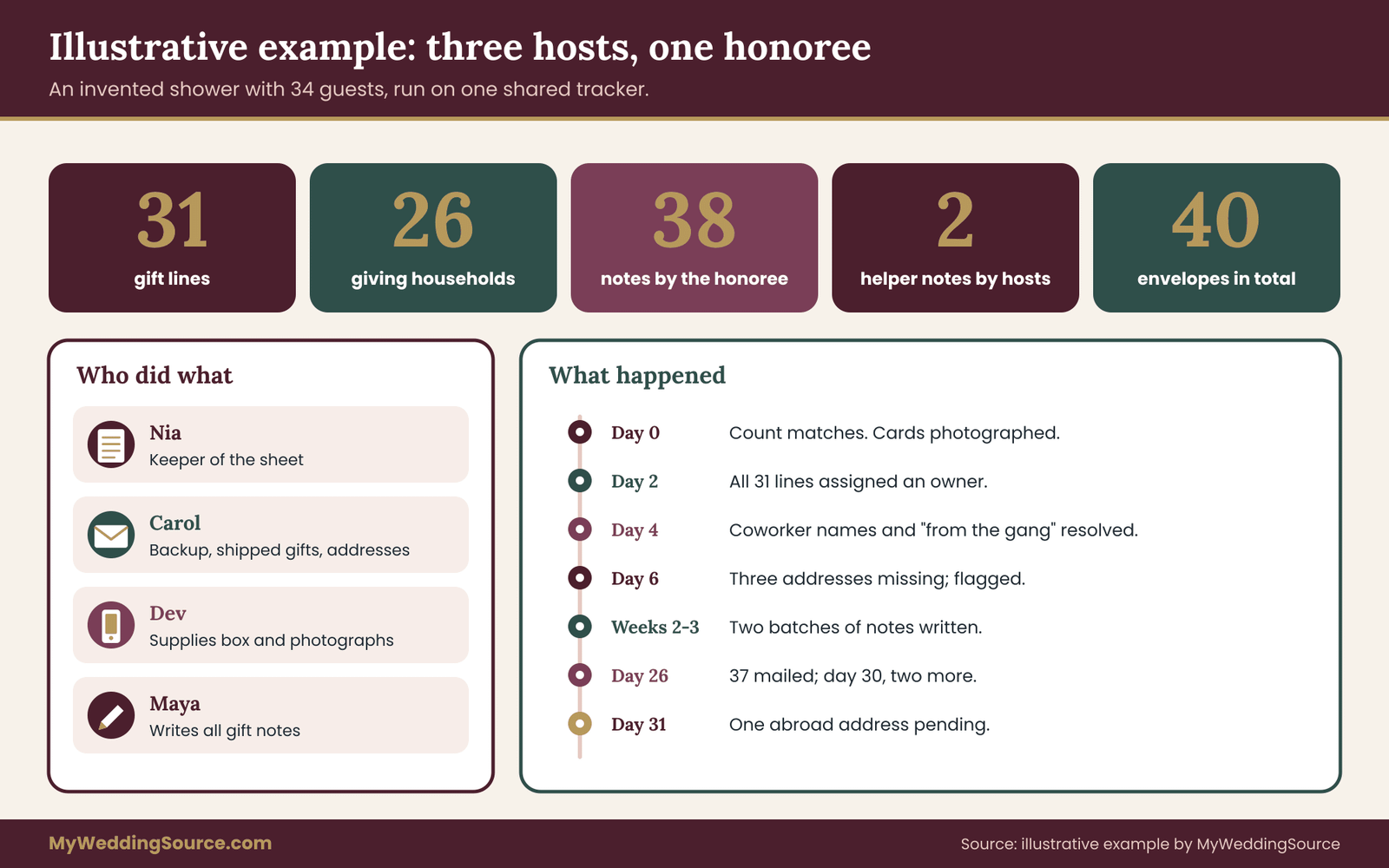
The following example is invented to show the shower thank-yous tracker working. The people, numbers and events are illustrative and not drawn from a real shower. It is meant to show how the five fields, the rules and the ladder behave under ordinary pressure.
The setup
Maya is the honoree. Three people host: her friend Nia, her aunt Carol and her cousin Dev. Thirty-eight guests are invited, and thirty-four attend. Nia keeps the shower thank-yous tracker in a shared sheet, Carol is the backup, and Dev handles the supplies box and the card photographs. Maya will write the shower thank-yous. The hosts will do the addressing and mailing logistics, and they will write two thank-you notes of their own to helpers.
On the day
Dev photographs the table before the gifts are opened, and Nia types lines as Maya opens gifts. Each gift gets a numbered sticky note and its card. Twenty-two gifts are opened in the room. Seven more arrived earlier: five shipped to Carol’s house, two to Maya’s. Carol texted a photo of each packing slip the day it arrived, and Nia had made lines for them before the party.
One gift is a joint present from five coworkers, bought by one of them, Ines. Her card reads “From the team.” Nia logs it as line 30 with “Ines, plus four colleagues, names to confirm.” The hosts’ own gift is line 31, a set of linens from Nia, Carol and Dev, logged with all three credited.
Two lines are flagged “duplicate”: two guests gave the same teakettle. Three households gave two gifts each, so the thirty-one lines map to twenty-six households plus the five coworkers, the three hosts and four guests who attended without a gift.
Before the last guest leaves, Nia counts the gifts in the room and counts the twenty-four gifts physically in the room (the twenty-two opened plus the coworker gift and the hosts’ linens) against their lines in the sheet. They match, which means nothing was carried out unrecorded.
The first week
On day one, Dev uploads the card photographs to the shared folder, and Nia copies the credited names from the photos into the sheet. Nine lines read “names to confirm” because a card was missing or ambiguous.
On day two, Maya and Nia go through the sheet in a ten-minute call and assign owners. Maya takes all thirty-eight shower thank-yous. Carol and Dev each take one helper note: Carol writes to the neighbor who lent a parking space, and Dev writes to the friend who baked. All lines now sit at “assigned,” which meets the two-day check.
By day four, Nia has asked Ines for the names of the four colleagues and received them, and has resolved the card that said “from the gang” with a quick text to the guest list owner. Three households have no mailing address on file, so those lines are flagged “needs address.”
Weeks two to four
Maya writes the first batch of fifteen shower thank-yous in week two and the second batch of twenty-three in week three, using the descriptions in the sheet. Each note takes about five minutes, and she works in batches of ten.
Carol addresses envelopes from the private address list and puts a date next to each in the mailing log. Dev buys stamps after checking the current postage on the Postal Service’s website. The group mails thirty-seven shower thank-yous on day twenty-six, including the two helper notes, and two more on day thirty, once the missing addresses arrive. One address remains outstanding, for a guest who lives abroad, so Nia sends an email and holds the note for a verified address.
What the numbers show
The ledger ended with thirty-one gift lines, thirty-eight shower thank-yous from Maya, two helper notes from the hosts and one flagged item. In other words, forty envelopes, thirty-nine mailed within a month and one waiting on an address. Because the tracker was in place, each of these numbers can be checked against another: lines against notes, notes against households, households against the guest list.
Why the example works
Three decisions made it work. The hosts agreed on a keeper before the party. The numbering habit tied each card to a gift on the day. And the two-day assignment check forced a conversation while memories were fresh. None of this required special software. It required a shared sheet and ten minutes at the right moments.
What could have gone wrong
Without the shower thank-yous tracker, the five shipped gifts might have stayed in Carol’s hall until someone remembered them. The coworker gift would probably have produced one note to Ines and four people left out. The nine ambiguous cards would have become nine guesses. The duplicates would have sat unlogged, and a decision about the kettle would have been made by whoever found it. None of these failures is dramatic. Each is the kind of small slip that makes a generous guest feel overlooked.
Edge cases and awkward situations
Even a good system meets odd cases. Here are the ones that come up most, with a plain way to handle each.
A gift arrives after the shower
Add a line when it arrives, with the route and date, and attribute it as normal. Shower thank-yous for late gifts follow the same ladder, with their own timing. Send the note soon after the gift arrives, not at the end of the batch. If the gift is a big surprise, a phone call or message of thanks right away is a kind extra.
A card is missing or illegible
Do not guess. Check the guest list for who might have given the item, check the registry export, look at the packing slip or order confirmation, and look at the photographs of the table. If none helps, ask, using wording that does not make the guest feel tested.
“We want to be sure to thank everyone properly, and a card went astray. Did you bring a gift to the shower?”
Asking the whole group once, in a general message to all guests, is another way to do it. Say that a few cards got separated from gifts, and invite anyone who gave a gift to reply. This takes the awkwardness out of asking a single person.
Someone else delivers the gift for the guest
A host, a relative or a delivery driver may bring a gift on behalf of someone who could not attend. Record the giver, not the courier, as the credited name, and record the courier in the route field. The note goes to the giver.
A guest gives on behalf of a household that did not attend
If one family member gives a gift for the whole family, thank the household by naming everyone on the card. If the card names only one person, thank that person and, if appropriate, add a line such as “please give my love to everyone at home.”
Different surnames, titles and families
Do not assume that a couple shares a surname, that a household has two adults, or that a title such as Mr., Mrs. or Ms. applies. Copy the names as the guests wrote them, or ask. Use the names as given on the invitation reply if there is one. The principles in a good wedding invitation etiquette guide on respectful forms of address apply equally to thank-you envelopes.
The honoree’s household is changing
If the honoree is moving, merging households or changing a name, record the address where shower thank-yous should reply, and keep the original gift description precise. If the gift will be delivered to a new address, note it in the route field.
A gift is damaged, perishable or unusable
Record the gift, the problem and the date. Thank the giver for the thought. Do not describe the damage in the note unless the giver is likely to know already and would want to help. If a shipped gift arrives broken, check the store’s current return and replacement policy, since policies differ and time windows can be short. This is a case where the registry and shipping vendor questions from earlier save time.
A gift is returned or exchanged
Returning or exchanging a gift does not cancel the thank-you. Write the note for the gift received. If an exchange gave you an item the guest did not choose, you can still thank them for the thought and mention the new item in general terms if you wish. Never tell a giver you returned the item unless they ask directly. If they ask, answer simply: a heartfelt thank-you and a brief honest sentence is enough.
A virtual shower
Gifts at a virtual shower typically arrive by mail, through a registry or through a payment app. Hosts at different addresses may each receive part of them. The shower thank-yous tracker applies unchanged, with route words such as “shipped to host” and “gift card by email” added to the list. For virtual events, record the delivery date and the source in each line, since there is no gift table to photograph. Ask guests to include the sender’s name in the gift message when they order.
The event is postponed, or the wedding is called off
If a shower takes place and the wedding is later postponed, shower thank-yous are still owed, because gifts were received. If a wedding is cancelled, many etiquette sources suggest that gifts be offered back or handled by the guest’s preference, and that a note of thanks goes with any such message. Customs vary, and this is a case where a short conversation with a trusted family member can help. The tracker makes either path easier, because every gift is traceable.
Hosts who disagree
Hosts may disagree on timing, wording or who should do what. The shower thank-yous tracker is a neutral reference. If two hosts disagree on a gift’s attribution, check the card photograph before arguing. If they disagree on process, decide in a short call and write the decision at the top of the sheet.
Guests who ask whether their gift arrived
Keep a short reply ready. “Yes, it arrived safely, and Maya is writing shower thank-yous this month.” Use the shower thank-yous tracker to confirm the date and the item. Do not discuss other gifts, other guests’ contributions or what anything cost.
Common mistakes with shower thank-yous and how to avoid them
Most failures with shower thank-yous come from a short list of habits. Knowing them in advance makes them easy to prevent.
Mistake one: waiting to build the tracker until after the shower
By then, cards are gone and memories have faded. Build the sheet and the supplies box before the day. Setup costs an hour. Reconstruction costs far more, and some of it cannot be recovered.
Mistake two: letting three hosts keep three lists
Each host keeps their own list, and none of them match. Choose one master. If someone insists on a private list, ask them to send lines to the keeper within a day, so the master stays complete.
Mistake three: thanking the buyer and forgetting the group
A pooled gift deserves a note for each contributor. The buyer’s note should not stand in for the others. Collect the names early.
Mistake four: using one note for different kinds of thanks
A single sentence cannot thank a host for a party, a guest for a gift and a friend for a favor without sounding vague. Separate the shower thank-yous when the reasons differ, or write distinct paragraphs.
Mistake five: making the tracker too complicated
A tracker with twenty columns will not be filled in at a party. Stay with five fields and seven stages. If a host wants to add a column, ask what decision it supports. If there is no answer, leave it out.
Mistake six: skipping the mailing log
A note written and not logged is a note nobody can find. The mailing log takes a few seconds per envelope and answers every later question about whether something went out.
Mistake seven: writing amounts or assuming what people can afford
Do not mention dollar amounts in a note or in the shared view of the tracker. Do not assume that a modest gift reflects the giver’s feelings or that an expensive one needs a longer note. A gift is a gift. The note thanks the person and the thoughtfulness, and nothing else.
Mistake eight: treating the process as a chore for the honoree alone
Notes are personal, but the logistics are shared. Hosts who offer to address envelopes, buy stamps and chase missing names carry a real share of the load. Ask for that help directly and name the tasks.
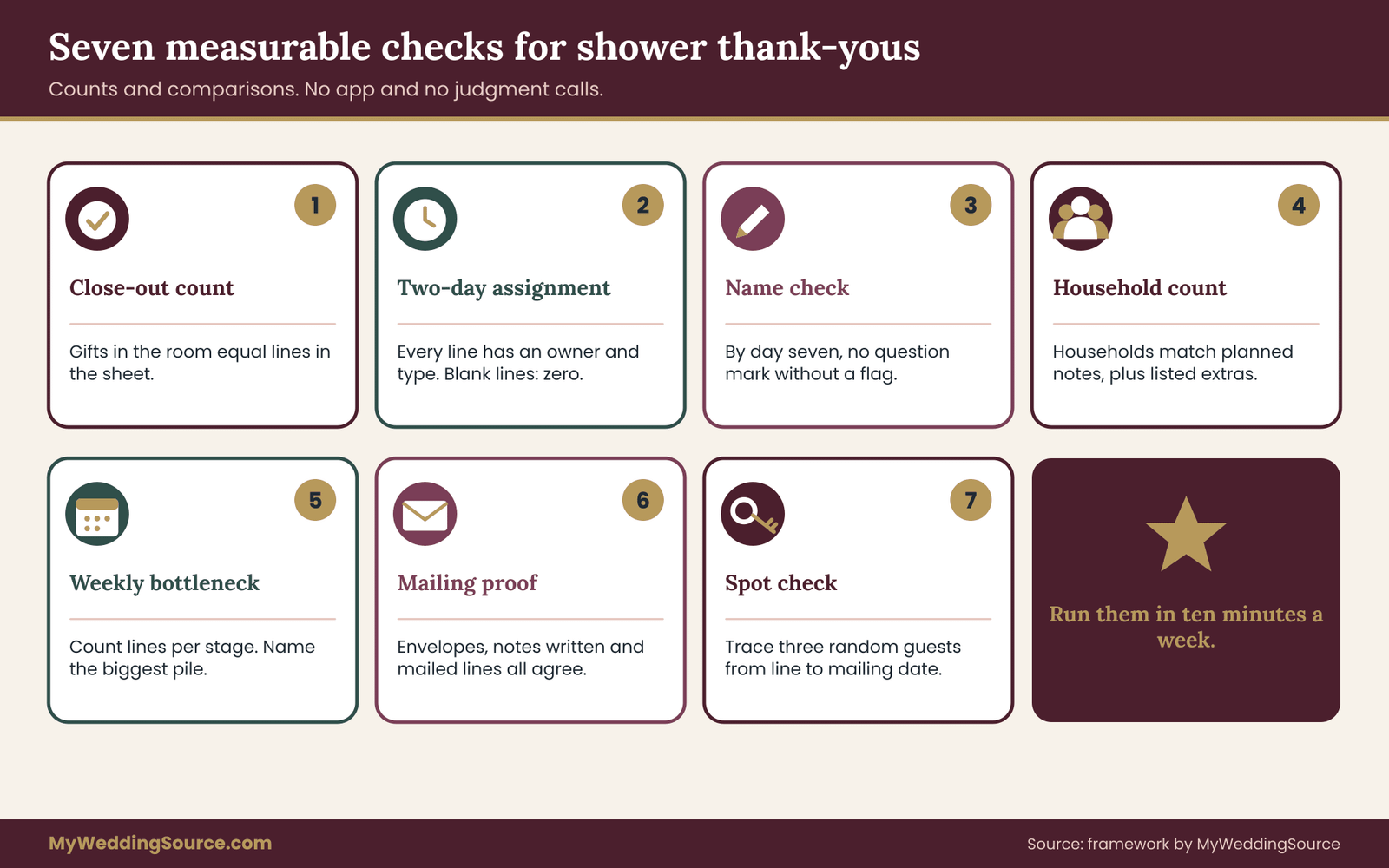
Measurable checks: how to know the tracker is working
A tracker is only as good as the checks you run on it. These are concrete tests that do not depend on judgment or feelings, and each takes a minute or two.
Check one: the close-out count
On the day, the number of gifts in the room equals the number of lines for gifts in the room. A mismatch means a line is missing or a gift left unrecorded. Fix it before guests leave.
Check two: the two-day assignment check
Within two days of the shower, every line has a note owner and a note type. The measure is the number of lines still blank. The target is zero. A line cannot move on without an owner.
Check three: the name check
By day seven, every line has a credited giver with no question marks, or a flag such as “needs name check” with a named person responsible for resolving it. The measure is the number of lines with a question mark and no flag, and the target is zero.
Check four: the household reconciliation
Count the unique giving households in the shower thank-yous tracker. Count the planned shower thank-yous. The two numbers should differ only by the notes you intentionally add (hosts, helpers, guests who came without a gift) and the lines you intentionally mark “no note needed” with a reason. If the numbers do not reconcile, find the difference. A common cause is a household with two lines that was counted twice, or a pooled gift whose contributors were not expanded.
Check five: the weekly bottleneck review
Once a week, count lines at each stage. The stage with the most lines is the bottleneck. Name it in the weekly message to the hosts and say what is needed. “Eleven shower thank-yous are drafted and waiting to be written. Maya needs a quiet evening this week.”
Check six: the mailing proof
When the last note is mailed, count the envelopes mailed and compare to the shower thank-yous written. Then compare to the number of lines at “mailed” in the shower thank-yous tracker. All three should match. If they do not, one of the records is wrong, and it is better to find that now than at the wedding.
Check seven: the guest spot check
Pick three guests at random from the tracker and verify end to end: the line, the credited name, the note owner, the mailing date and the address source. If all three are complete, the system is probably sound. If one fails, check the same step for the rest.
These checks do not require an app or training. They are counts and comparisons that anyone can do with the sheet.
Thank-you etiquette that stays kind across different customs
Shower traditions differ across families, faiths, cultures and generations. The shower thank-yous tracker is a neutral tool, but how you use it should respect those differences. For the wider customs around invitations, gifts and guest behavior, the site’s general guidance on wedding etiquette basics is a useful companion.
Do not assume how people give or receive
Some communities give cash or gold. Some give household items. Some give time and food. Some skip gifts and focus on the gathering. A good note thanks what was given in terms the giver would recognize, and it does not translate everything into an object. If a family tradition includes a particular gift, ask a relative how it is usually acknowledged.
Do not assume who hosts or pays
Do not assume that a mother, a sister or a friend is the host, or that anyone paid for anything. Write shower thank-yous to the people who did the hosting, and let them define their own roles. If a guest is thanked for hosting, ask how they would like to be named in the note, and use that.
Use inclusive wording
Write in plain words that do not assume a gender, a household structure or a religion. “Thank you for celebrating with us” works for everyone. Address people as they have indicated, and avoid honorifics when you are not sure. Where a guest has a non-binary or unspecified title, use first and last name.
Make notes accessible
A guest who is blind or has low vision may use a screen reader or a magnifier. A typed note in a clear, large font or a short email may suit them better than a handwritten card in small print. Ask a mutual friend if you are unsure. A guest with limited English may appreciate short sentences and plain words. Warmth matters more than style.
Keep private things private
Do not include health, financial or family details about a guest in a note unless they have shared them with you and would welcome the mention. Do not post photographs of notes or gifts online without the giver’s agreement. Giving permission is easy to ask for, and some guests prefer privacy.
Handle regifting and secondhand gifts with care
Some guests give items they already own or acquired secondhand, and this is entirely acceptable. It is not the honoree’s place to ask. Thank the giver for the gift, and do not comment on its origin. For gifts that came with a gift receipt, the honoree decides what to do with it.
Thank people even when the gift is not material
A guest who gave a recipe, a poem, a song, a night of babysitting or an afternoon of help gave something real. Add a line for it in the shower thank-yous tracker, since the tracker tracks gifts of every kind. A note for a gift of time is often the most meaningful one the honoree writes.
Keeping shower records alongside the rest of the wedding
The shower thank-yous tracker started as a shower tool, but its data has later uses. Treat the finished sheet as a small, permanent record.
Merge only what you need
When the shower notes are done, copy the useful fields into your main gift record: the credited givers, the gift description and the date of the note. This stops you from asking guests the same questions at the wedding and makes the wedding thank-yous easier. The wedding planning checklist is a good place to add the task so it does not slip.
Archive the private parts separately
The address list and the mailing log contain personal information. Keep them in a private folder, with access limited to the honoree and the keeper, and decide when you will delete them. Many couples keep addresses until the wedding thank-yous are done. Others delete them sooner. Choose a date and write it down.
Keep a short lessons note
A few lines on what worked and what did not will help for the next event. Perhaps the numbering habit saved time, or the card photographs saved three gifts. Perhaps a certain host was the best keeper, or an address form on the invitation worked well. These shower thank-yous lessons are useful for the wedding and for the next shower you host for someone else.
Warranty and return paperwork
Some gifts come with warranty cards, gift receipts or return windows. Attach those to the shower thank-yous tracker line, or keep them in an envelope numbered with the line. Return windows can be short, and a note in the tracker that says “return by” and a date keeps you from missing them. The overall approach to records after the wedding is covered in the guide to organizing wedding records after the event, and the same retention habits apply to shower paperwork.
Taxes and large gifts
Large gifts raise occasional questions about tax treatment. The Internal Revenue Service publishes current guidance on gift tax, and the rules about who pays and when are set by the agency. This article gives no tax advice. If a gift is unusually large, the honoree can check the IRS website or ask a qualified professional. For ordinary shower gifts, shower thank-yous and the shower thank-yous tracker are all that is needed.
Your next steps
Here is a short, ordered path from an empty sheet to a finished set of shower thank-yous. Adjust the timing to your own shower date.
- Before the shower, agree on a keeper and a backup. Send the one-sentence message to the other hosts and name both roles.
- Build the sheet. Add the five fields, the seven status words and one example line. Add a private page for addresses.
- Pack the supplies box. Sticky notes, a marker, tape, an envelope for loose cards, a charger and a few index cards.
- Decide where shipped gifts go. Put the address in the invitation or registry notes, and ask hosts to text the keeper as parcels arrive.
- On the day, use the three touches. Number each gift, keep its card with it, and enter a line.
- Do the close-out count before the last guest leaves, and photograph the cards.
- Within two days, assign every line a note owner and a note type.
- By day seven, clear every question mark in the name field or flag it with a named person.
- Write in batches of five to ten, with the shower thank-yous tracker open beside you.
- Verify addresses, check current postage with the Postal Service, mail on a set day and log the date.
- Run the closing checks: household reconciliation, mailing proof and the three-guest spot check.
- Fold the useful fields into your main gift record and delete or archive the address list on the date you chose.
If you only do three things, make them the numbering habit, the close-out count and the two-day assignment check. Those three catch most of the problems that cause missing or misdirected notes.
FAQ
Who is supposed to write the shower thank-yous after a bridal shower with several hosts?
By common etiquette, the honoree writes the shower thank-yous for gifts she received, and the hosts write their own notes to helpers. Hosts usually support the process by tracking gifts, collecting addresses and handling stamps. If the honoree truly cannot write, she can still sign a note a host prepared. Families differ, so follow the customs your family and guests expect.
How soon should shower thank-yous be sent?
Etiquette sources such as Emily Post and The Knot generally suggest sending within a few weeks of the shower, and not much later than about three months. Sooner feels warmer. Because the wedding thank-yous come later, keep the two sets separate. If you are late, send anyway with one brief line acknowledging the delay, and skip a long apology.
What do I do when a gift card falls off and I do not know who gave the gift?
Do not guess. Check the table photographs, the guest list, the registry export and any packing slip first. If those fail, send a general message to all guests saying a few cards were separated from gifts and inviting anyone who gave one to reply. This avoids singling out a person and usually solves it within days.
How should I thank a group that chipped in on one gift?
Ask the buyer for the full list of contributors. Then send a note to each contributing household that names the shared gift and says it came from the group. For a very large group, one note addressed to everyone, sent through the organizer, can be realistic. Never mention individual contribution amounts.
Do I need to send a thank-you to guests who came but did not bring a gift?
A note is optional and welcome. Guests gave their time and company, and a short, warm note acknowledges that. Add each attending guest to the tracker so that those shower thank-yous are not skipped, and keep the wording simple, such as thanks for coming and for celebrating together.
Should I send a separate note to the hosts for the party?
Yes, if you can. A note for the party is separate from any note for a gift a host gave. Mention something specific each host did, such as the cooking, the playlist or the use of a home. If hosts gave a joint gift, one note can cover both the party and the gift when the same people are on both.
Can one shared spreadsheet really replace a gift notebook?
It can, and it works well when hosts are in different places or gifts are shipped. A notebook is simpler when one person sits at the gift table and every gift is opened in one room. Many groups use both: a notebook on the day and a shared sheet afterward. Choose the format every host will actually open.
How do I keep guests’ addresses private while sharing the tracker?
Keep addresses on a separate private page or file that only the honoree and the keeper can open. In the shared tracker, write only a pointer such as “address on invitation list.” Use addresses only for the notes, and delete or archive the list on a date you set once the thank-yous are done.
Sources
- Emily Post Institute: etiquette guidance on thank-you notes and shower customs
- The Knot: wedding and shower etiquette articles
- U.S. Postal Service: postage prices, address lookup and mailing services
- U.S. Postal Service Postal Explorer: address formats and mail standards
- Internal Revenue Service: gift tax information
- Consumer Financial Protection Bureau: consumer guidance on payment apps and fees
- Federal Trade Commission: consumer advice on online shopping and returns
- USAGov: consumer and mailing resources
- Library of Congress: personal archiving guidance