
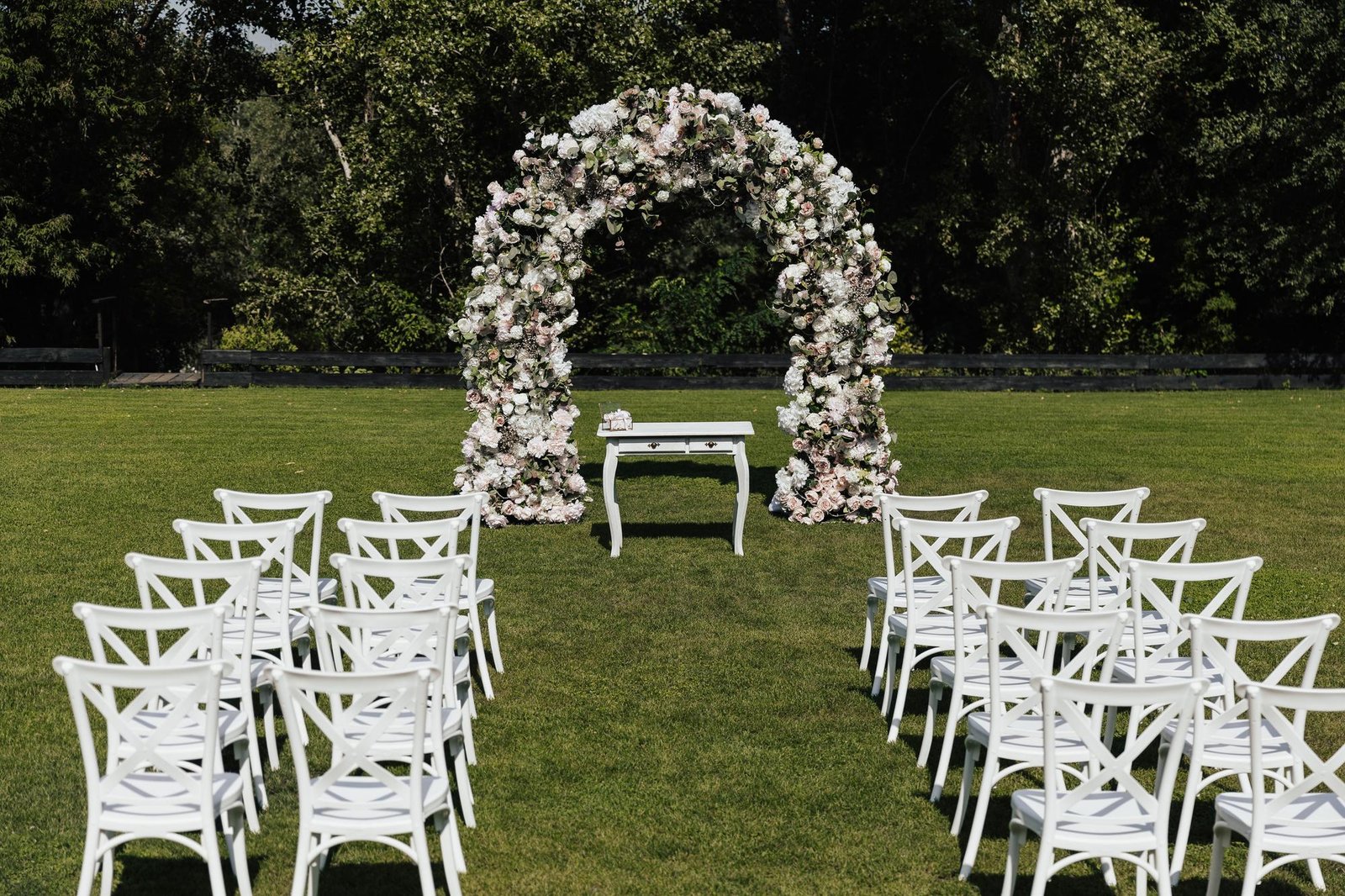
The wedding arch ideas that hold up are the ones your site can support, your wind forecast can survive and your florist can price line by line, so choose the structure and the setting before you fall for a flower palette.
Your florist’s intake form has a question that sounds simple: arch, yes or no? Behind it sit five more. Who supplies the frame, how tall may it stand at your venue, can it be staked into the ground, how much of it do you want covered in flowers, and what happens to it after you say “I do”? Meanwhile your saved photos show a sweeping moon gate on a hillside, a wooden arbor wrapped in pampas grass and a stained glass panel catching late light, and not one caption mentions wind, weight, permits or the price of the ladder it took to install them.
This guide treats the arch as a small piece of temporary architecture that happens to be pretty. It covers the main arch styles and what each asks of your site, how to size one for the people and the photographs, and how wind, rain and lightning change the plan. It then covers venue rules, costs, flower counts, rent versus DIY, fall color choices and reuse. For the wider floral picture, including bouquets and reception pieces, see our wedding flowers guide; this article stays at the ceremony site.
Two honest limits before the numbers. No national survey reports what couples spend on ceremony arches specifically, so the arch prices below come from one professional florist’s published guides, which we label as vendor estimates and which disagree with each other in places. Wind speeds, park rules and fire codes also differ by site and jurisdiction, so every example here is a prompt for your own questions, and the answers belong in writing.
Which wedding arch style fits your ceremony?
An arch style is really three choices bundled together: a shape, a material and a way of standing up. The shape decides how the photographs frame you, the material decides how heavy the structure is and how it handles weather, and the stand decides whether it needs stakes, weights or a floor that tolerates a rental base. Start here, because style questions are cheap to settle on paper and expensive to settle on the lawn.
What are the main arch shapes and materials?
Florist guides group ceremony structures into round, square, triangular and circular frames, plus the chuppah and the lattice-sided arbor, each with its own footprint, weight and trade-offs. Sizes vary by manufacturer, so treat the dimensions below as typical, not exact. The table below summarizes them using one florist’s published descriptions, with our own notes on what to check.
| Style | Typical size and build | Best for | Watch for |
|---|---|---|---|
| Round arch | 7 to 8 ft tall, 4 to 6 ft wide; metal or wood | Most sites; takes clusters, half or full coverage | Wind on a fully covered top |
| Square or rectangular | Four posts, flat top; metal, wood or acrylic | Modern venues, draped fabric | Hard corners need softening |
| Triangle or A-frame | Two legs meeting at a peak; wood | Rustic or boho looks, smaller budgets | Less surface for flowers |
| Moon gate (circle) | Metal ring, usually 7 to 8 ft across | Photo-led ceremonies, gardens | Heavy; needs staking or weights outdoors |
| Chuppah | Four posts with a fabric or floral canopy | Jewish ceremonies; any couple wanting a canopy | Four anchor points, canopy catches wind |
| Wooden arbor | Natural or stained wood with lattice | Gardens, farms | Lattice gives many attachment points |
How do round, square and triangle frames differ in practice?
A round arch is the most flexible shape because its continuous curve accepts a cluster at one corner, a sweeping asymmetrical spray or full coverage, and it reads as classic in almost any setting. A square frame gives you crisp lines that suit modern spaces and draped fabric, but flowers need to cascade over the corners to soften it. A triangle or A-frame uses less surface area, which means fewer stems and often a lower floral bill, though the usual treatment is a single arrangement at the peak.
What do wood, metal and acrylic ask of you?
Metal frames are common rentals and come in finishes such as gold, white and black, and their slim profile lets the flowers carry the look. Wood, whether birch, cedar or reclaimed, adds warmth and gives florists plenty of places to attach garlands, but wood is bulkier to transport and can be harder to set level on a slope. Acrylic and glass-like panels photograph beautifully and are trending, but they add weight and catch wind like a sail, so ask the rental company for the panel material, the total weight and the recommended anchoring before you commit.
Are moon gates, chuppahs and arbors different?
Yes, because each of them comes with its own rules of thumb. A moon gate is a metal ring that one florist describes as heavy and in need of staking or weights outdoors, which means your ground and your venue’s stake policy matter more than the style does. A chuppah is a canopy supported by four posts, and a Jewish couple may have specific traditions about what it is made of and whether it stands open to the sky; the Wikipedia entry on the chuppah outlines the variations, and your officiant or rabbi is the right person to ask about yours.
Which arch looks are trending, and are they worth following?
What do grounded, meadow and circular arches look like?
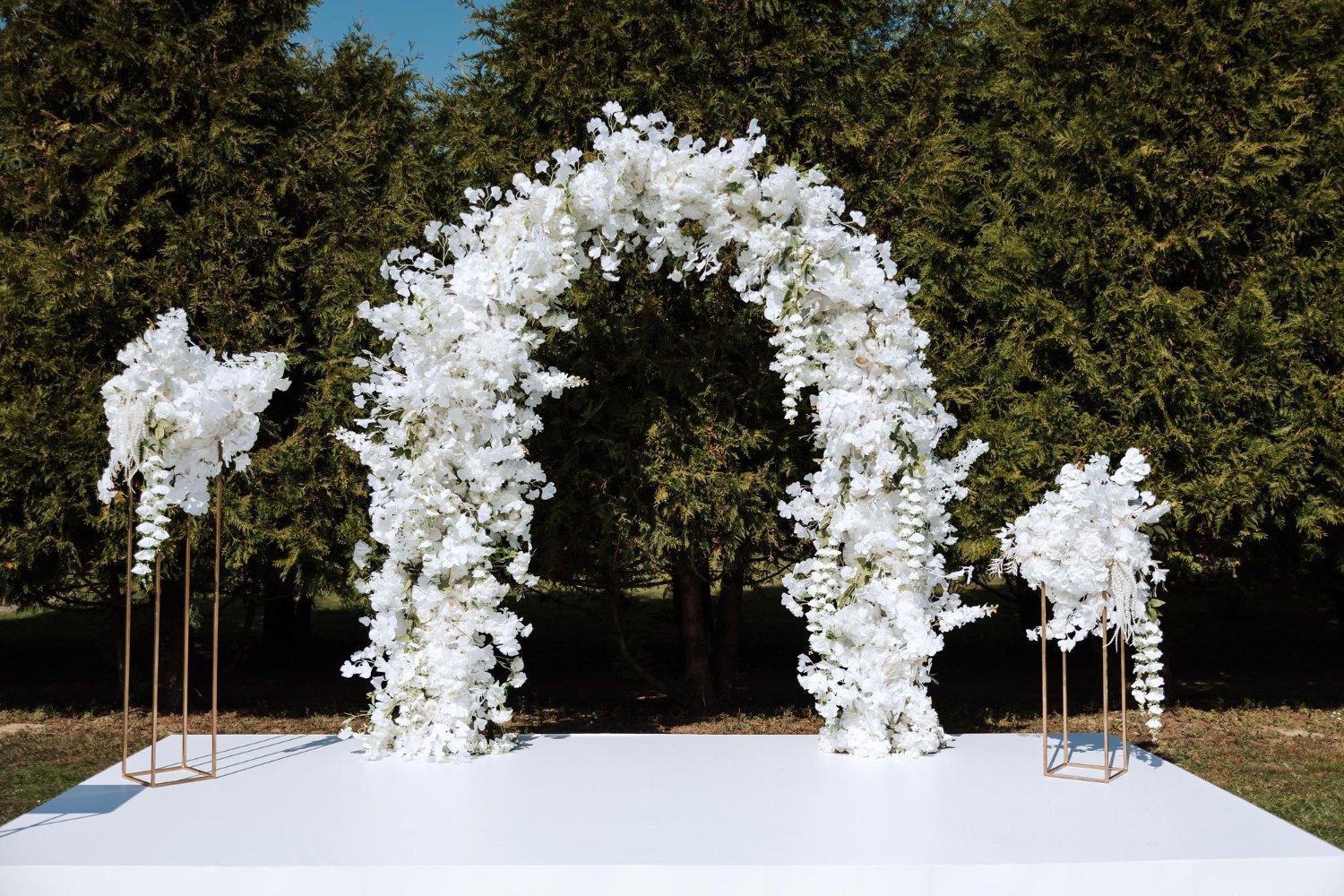
The Knot’s 2026 wedding flower trends piece reports that florists see arches sitting at ground level and framing the couple from the sides rather than spanning overhead, with overhead arches fading except for religious structures such as a chuppah or mandap. The same article describes circular, garden-like shapes with blooms at varying heights that appear to grow from the floor, and meadow-style ground arches with full aisle decor using wispy wildflowers and grasses. These looks resist wind better than tall pieces and suit lawns where the horizon is your backdrop.
What do the Pinterest numbers say about stained glass and drapery?
Pinterest’s 2026 wedding trend report lists “stained glass wedding arch” at +750% and “drapery backdrop” at +1,510%, alongside “flower installations” at +195%. These are platform search-growth figures, not Google search volume and not counts of weddings, and the page does not state the time window or the starting baseline, so a large percentage can describe a small base. The report’s styling section mentions couples layering draped fabrics, stained glass, lace and velvet. For planning, ask your rental company early about availability and about how those materials behave in a breeze.
What about fabric, boho and balloon-free versions?
Fabric arches, whether chiffon, organza or linen, are among the lower-cost ways to get height and softness, with one florist’s guide estimating $100 to $300 for the fabric plus a similar amount for minimal florals. Fabric works well indoors and in tents and is the first thing to misbehave on an open lawn, so a windy site calls for weighted hems or a different idea. If you are leaning balloon-free, that is easy to honor, and there is a rules angle too: Florida’s legislature lists a balloon-release prohibition that took effect July 1, 2024, and other jurisdictions have their own litter and release rules, so confirm local law before any balloon element leaves your hands.
How big should a wedding arch be, and how do you keep it standing?
Size and stability are the same question asked twice. A taller, wider arch frames more of the scene and also presents more surface to the wind, and the plan that keeps it upright usually costs money and ground access that the styling budget forgot. This section starts with the people the arch has to fit around, then moves to the weather it has to survive.
How do you size an arch for the people and the photos?
What height and width do standard arches have?
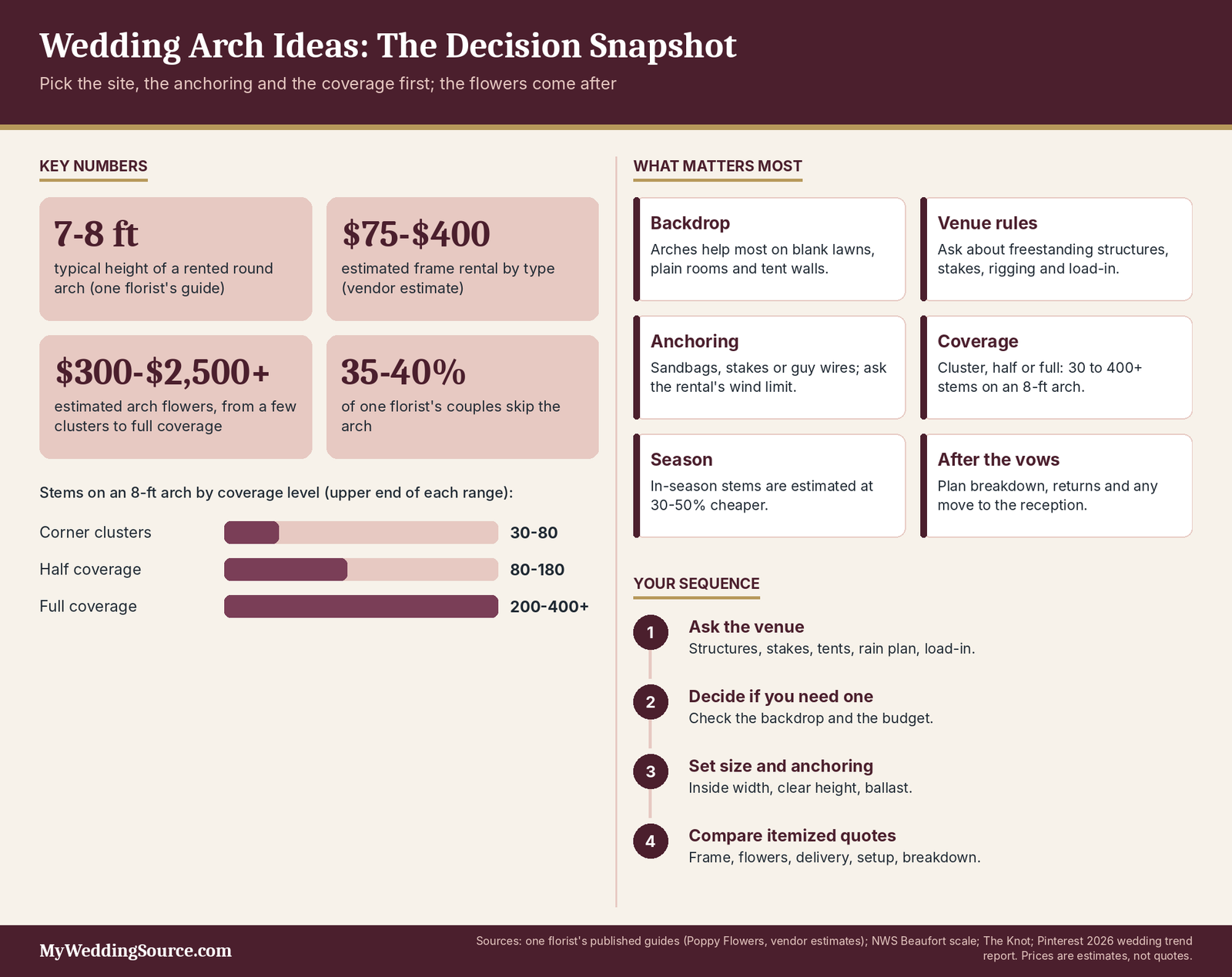
One florist’s guide describes a classic rounded arch as usually 7 to 8 feet tall and 4 to 6 feet wide, a circular moon gate as usually 7 to 8 feet across, and its stem-count table assumes an 8-foot arch. Those are common rental sizes rather than a standard, so ask for the exact inside width and the clear height under the lowest hanging element. A 7-foot arch needs less material than a 9-foot one, and the same guide says each extra 10 percent of coverage adds roughly $100 to $200, so size shows up on the invoice as well as in the photographs.
How much room do you, your officiant and your dress need?
Here is our own arithmetic, not a published standard. A 4-foot opening is comfortable for two people standing side by side in ordinary clothes, but it gets tight once you add a full skirt, a long train or a third person, and a 6-foot opening reads more generous in photographs. Subtract the thickness of any flowers that hang inward, since a cluster at the top can drop 8 to 12 inches and a tall partner in dress shoes may lose their headroom. Ask your florist for the finished clear opening, not the frame’s dimensions.
Where should the arch stand relative to sun, seating and sight lines?
Zola’s 2026 First Look Report notes that couples are planning floral placement around where cameras will capture key moments, which is a useful way to think about arch placement as well. The questions are simple: where will the sun be at the planned ceremony time, can guests in the back rows see over any floral mass, and is there a distracting background such as parked cars or a bright sky that will wash out a pale frame? Check the sunset time for your date and location with your photographer. Walk the site at the same hour as your ceremony if you can, and take one photo from the first row and one from the last.
How do wind, rain and lightning change the plan?
What does a breeze actually do to an arch?
The National Weather Service’s Beaufort scale gives a plain-language ladder: at 13 to 18 mph wind raises dust and loose paper and moves small branches, at 19 to 24 mph small leafy trees begin to sway, at 25 to 31 mph large branches move and umbrellas become hard to use, and at 32 to 38 mph whole trees move and walking against the wind is difficult. A frame dressed in garland and fabric behaves more like a sail than like a trellis, which is our editorial judgment rather than a measured figure, and one florist’s outdoor guide warns that even a gentle breeze can knock over tall arrangements and tip light vases. Wind is also gusty, so the number on your weather app understates the peaks. Ask your rental company whether it publishes a wind limit for each frame and what ballast it recommends, since that is the only figure that applies to your actual structure.
| Wind (Beaufort, mph) | What the NWS scale describes | Editorial planning move |
|---|---|---|
| 13 to 18 | Dust and loose paper rise; small branches move | Lightweight fabric and loose petals may need securing |
| 19 to 24 | Small leafy trees sway | Confirm ballast; keep tall arrangements low or weighted |
| 25 to 31 | Large branches move; umbrellas hard to use | Remove fabric panels and unsecured elements; consider moving the ceremony |
| 32 to 38 | Whole trees move; walking is difficult | Do not hold the ceremony under or beside a freestanding frame |
How do you anchor an arch, and what should you check first?
One florist’s outdoor guide says to secure arches with sandbags, stakes or guy wires and notes that dense greenery and compact flowers help stabilize a design. If stakes are in the plan on private land, call 811, the free service that asks you to contact it a few business days before any digging, because even small projects such as fences and mailboxes count and some utilities are buried only inches down. The same florist’s venue guide notes that some parks and gardens ban stakes or ground anchors altogether, so weights may be your only option.
What is your go or no-go plan for gusts, rain and thunder?
Decide in advance who makes the call and what the triggers are, because a ceremony is a bad moment to debate it. The National Weather Service’s lightning safety guidance is blunt: when thunder roars, go indoors, and outdoor locations offer no protection when storms are nearby, which means an arch is not shelter and neither is a tent without a plan. Wind alerts are issued on local criteria, so the same warning can mean different speeds in different regions. Rain is the plainer problem, and one florist notes that a freestanding arrangement can be moved indoors while a staked, fully installed arch generally cannot, so ask whether your rental can be taken down and rebuilt inside, how long that takes and who pays.
What do venues, parks and fire codes allow for a wedding arch?
An arch looks like decor, but a venue’s rulebook often treats it as a structure, which is why the question “may we bring one?” deserves an answer in writing. The rules fall into three layers: the venue’s own policies about what can be placed or attached, the property owner’s or public agency’s rules, and local fire and building codes. The first is a quick email. The second matters most at parks and historic sites, and the third matters most indoors, under tents and around anything fabric or flame.
What should you ask the venue before you fall for an arch?
Ask early, because venue answers can rule a style out completely: a hanging installation needs rigging points that a garden does not have, and a heavy moon gate needs a surface that a patio of pavers may not give. The florist’s venue guide lists the questions worth asking, and we have grouped them into a checklist you can paste into an email.
| Question | Why it matters | Who usually answers |
|---|---|---|
| Are arches and freestanding structures allowed? Any height limit? | Some sites restrict them for safety or preservation | Venue coordinator |
| Are stakes, ground anchors, nails or adhesives allowed? | Parks and historic sites often say no | Venue coordinator, grounds team |
| Are there rated rigging points, and what is the weight limit? | Hanging pieces often weigh 30 to 80+ lbs | Venue technical contact |
| What is the load-in window and the hard out time? | Late arrivals can shorten setup | Venue, planner |
| Does the venue provide any arches, backdrops or draping? | An included structure can save a rental | Venue coordinator |
| What is the rain plan and who decides? | A staked arch generally cannot move indoors | Venue, planner |
Are freestanding structures allowed, and how tall?
Start with the plainest question: may we place an arch or backdrop, and is there a height or footprint limit? The florist guide recommends asking this directly, and also asks whether the venue supplies any arches, candles or vases of its own. If the venue says yes with conditions, such as weighted bases only or no fabric above a certain height, ask to have the conditions listed in your contract or in a confirming email so your vendors can plan around them.
What about stakes, nails and adhesives?
The same venue guide lists typical no-go surfaces: painted walls, historic woodwork, brick and stone, marble columns and mantels, and most glass, with suction cups on windows sometimes allowed. Historic venues often prohibit nails, screws and adhesive on original surfaces and leaning heavy items against walls. Outdoors, the guide notes that some parks and gardens ban stakes or ground anchors, which is where weights and freestanding bases earn their keep.
When can vendors load in, and when must everything leave?
Timing rules affect arch design more than most couples expect. The venue guide gives examples of a strict load-in window, 2:00 to 3:30 p.m. with no exceptions, and a hard curfew with everything off-site by 11:00 p.m., and it notes that setup typically takes 1.5 to 3 hours depending on the size of the wedding. Ask the venue and your florist to agree on a written timeline that shows when the frame arrives, when flowers go on, when the ceremony starts and who removes everything at the end.
When do public parks and fire rules get involved?
Why do some parks rule out arches entirely?
Yosemite National Park’s wedding permit page is a good example of the strict end. It requires a special use permit for any ceremony, with a nonrefundable $150 application fee and a request window of no less than 21 days before the event, and it states that balloons, arches and other decorations are not authorized, though handheld bouquets and boutonnieres are allowed. Other national park units, state parks and city parks write their own rules, and many are more flexible, but this is the reason to contact the managing agency before you design around a landmark view.
What do fire and egress rules mean for indoor arches and fabric?
Fire codes care about three things in a decorated room: what burns, how close it is to a heat source, and whether it blocks the way out. Seattle Fire Department’s decorations memo, written for holiday decor and updated in 2017, says decorations other than natural cut trees must be flameproof or fire retardant, that natural greenery displayed indoors must stay fire retardant for the display period, and that materials that burn should be kept at least 24 inches from any heat source. It also says decorations must not block exits, sprinklers, fire extinguishers or alarm pull stations. That is one city’s holiday guidance, not a wedding rule, but it shows why a venue may ask for fire-retardant certificates on fabric. Ask your venue what it requires, and ask your rental company whether its drapery carries a flame rating.
How do tents change the picture?
Tents bring their own inspection layer. New Hampshire’s Fire Marshal places-of-assembly page says tents of 400 square feet or more must meet its tent inspection checklist, and that a tent next to a building cannot obstruct egress or sprinkler systems. The Westport, Connecticut tent safety page says tents that do not meet the state building code’s design wind speed provisions need a safety plan submitted to the fire marshal. If your ceremony or reception sits under a tent, the tent company, not the florist, knows what is permitted. A florist’s outdoor guide says tents allow hanging installations from their poles, while venue approval and weight limits still apply.
What does a wedding arch cost, layer by layer?
What do published price ranges say?
What do the national surveys say about flower spending?
The Knot’s average flower cost page reports an average of $2,800 and a median of $1,900 for couples married in 2025, with a middle-half range of $900 to $4,800 and a sample of 10,474 couples, covering bouquets, boutonnieres, wedding party flowers and centerpieces. The page gives no arch figure, but it says an arbor piece “could start at a few hundred dollars and quickly scale up to several thousand,” which is as specific as the survey gets. Zola’s floral budget guide reports a national average near $6,300 for flowers from its Wedding Cost Index, and says large altar or arch pieces cost about $500 for simpler designs and over $2,000 for lush, elaborate installations.
What do florist-published arch prices look like?
One florist, Poppy Flowers, publishes unusually detailed arch ranges in its help center, based on its own orders and consultations, and we use them here as vendor estimates. Its arch and chuppah guide prices flowers by coverage, with stem counts for an 8-foot arch, and the table below reproduces those tiers. The company’s average order is about $3,500 across more than 7,500 weddings according to its pricing data page, which gives context for how much of a typical floral budget an arch can consume.
| Coverage level | Florist price range | Stem count (8-ft arch) |
|---|---|---|
| Greenery only | $200 to $600 | Not specified |
| Corner or cluster accents | $200 to $500 | 30 to 80 |
| Asymmetrical or half coverage | $500 to $1,200 | 80 to 180 |
| Three-quarter coverage | $1,000 to $1,800 | Not specified |
| Full coverage | $1,500 to $2,500+ | 200 to 400+ |
| Dried or preserved | $300 to $1,000 | Not specified |
Why do the ranges disagree with each other?
If you read the same florist’s articles side by side, the numbers do not line up perfectly. The arch guide’s intro starts asymmetrical designs at $500 to $800 and greenery-forward treatments at $300 to $500, while its table gives different bands, and a separate “do I need an arch” article lists a full classic arch at $400 to $2,000+ and “complete” coverage at $1,500 to $2,500+. The practical takeaway is to give every florist the same brief, including frame height, coverage percentage and whether you want a mock-up, and compare itemized totals rather than headline ranges.
What does a full arch quote look like, layer by layer?
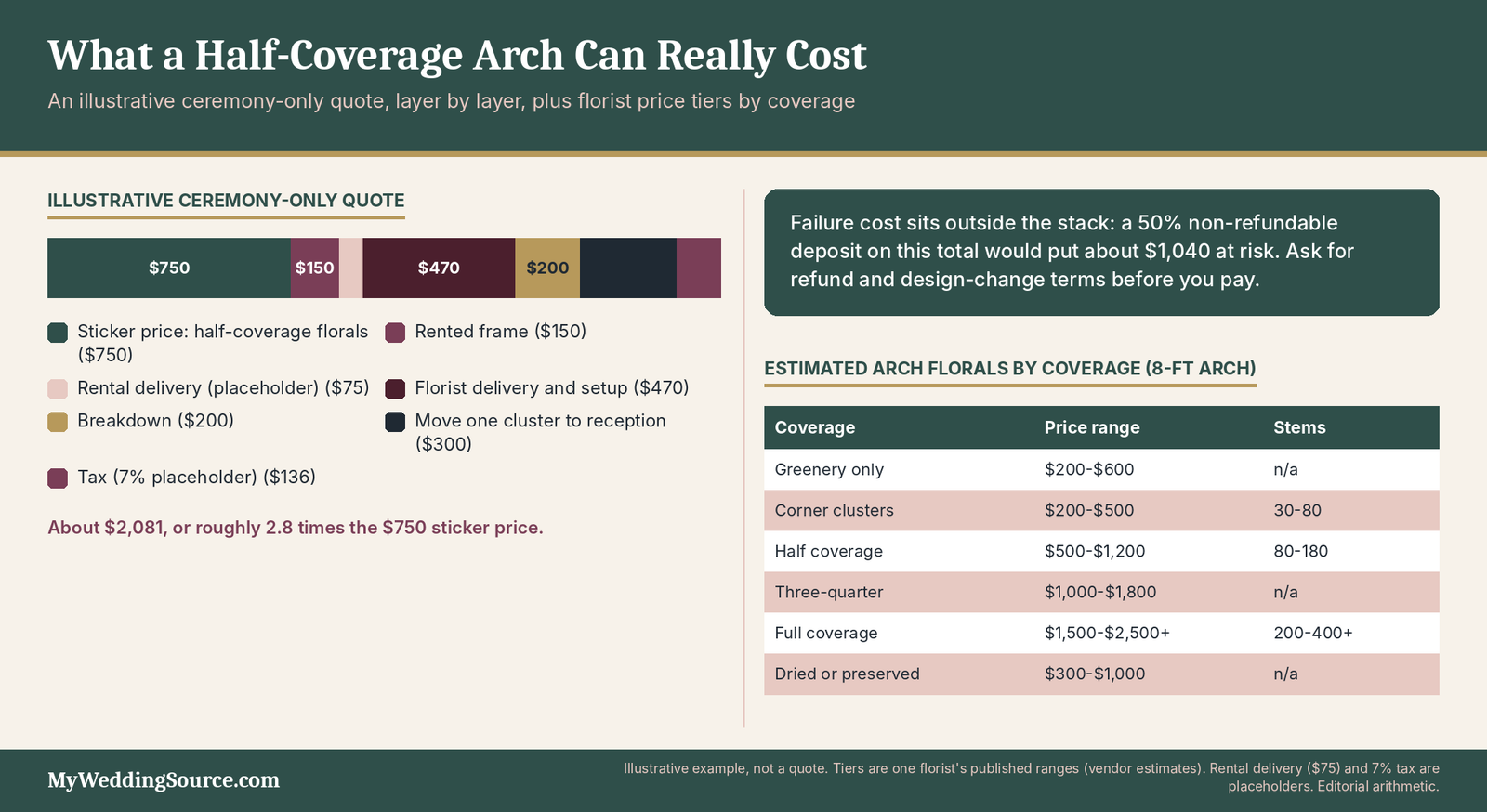
Here is an illustrative example, not a quote. It uses the florist ranges above, picks round numbers in the middle and assumes a ceremony-only order, which is when delivery minimums bite hardest. Every figure is a placeholder you can swap for your own quotes.
What are the sticker price and the required extras?
Say the florist proposes half coverage on a rented round frame, and you pick $750 from the $500 to $1,200 band as the sticker price. Required extras come next. A rented metal frame might run $150 within the guide’s $75 to $400 range for structures, and we add a placeholder $75 for rental delivery and pickup, since no source gives a typical figure. The florist’s delivery and setup fee is the third layer, and Poppy’s published fee is $470, described as 20 percent of the floral total with a $470 minimum, covering the securing of ceremony flowers and the anchoring of arches. Together those required extras add $695, which is 93 percent of the sticker price and is why a headline number rarely tells the story.
Which realistic extras tend to appear?
Realistic extras are the items that appear once you look at your day. Breakdown is a common one, since the same florist charges a flat $200 for removing installations and collecting hardware as an optional add-on. If you want part of the arch moved to the reception, the florist’s guide estimates $200 to $400 for breakdown and relocation, and we use $300. Together they add $500, bringing the running subtotal to $1,945.
What about taxes, fees and the cost of things going wrong?
Tax depends on your state and sometimes your city, and rules about whether delivery, rental and labor are taxable differ, so ask your florist how each line is treated. Using an illustrative 7 percent on the whole subtotal adds $136, for a total near $2,081. The failure cost is a different kind of number: if the florist requires a 50 percent non-refundable deposit, about $1,040 is at risk the day you sign, and design changes may be allowed only until a cutoff, which this florist sets at 60 days before the wedding. If the arch is one line in a larger floral order, the delivery and setup fee is shared across the whole order, which can lower the arch’s share, so ask for both versions.
| Layer | What is included | Illustrative amount |
|---|---|---|
| Sticker price | Half-coverage arch florals | $750 |
| Required extras | Frame rental $150, rental delivery $75, florist delivery and setup $470 | $695 |
| Realistic extras | Breakdown $200, move one cluster to the reception $300 | $500 |
| Taxes | 7 percent placeholder on the subtotal | $136 |
| Total | About 2.8 times the sticker price | $2,081 |
| Failure cost | 50 percent non-refundable deposit | About $1,040 at risk |
How do you lower the total without making the arch look sparse?
The Knot’s saving tips for flowers suggest mixing more greenery or branches into arrangements because blooms cost more per stem, choosing seasonal flowers, limiting the number of arrangements and skipping elaborate installations. Applied to an arch, that means asking for a greenery-forward garland with two or three focal clusters, trimming coverage from full to half, or choosing a ground arrangement that costs less than a tall frame. One florist frames it as cost per minute: a $1,000 arch seen for 25 minutes is about $40 a minute, against about $4 a minute for $1,000 of reception centerpieces seen for four hours. Our wedding flowers cost guide shows how ceremony pieces fit into the full floral budget.
How many flowers does a wedding arch need, and which ones hold up?
Flower amounts for an arch are counted in coverage, not in bouquets, and the same frame can take 30 stems or 400 depending on how much of it you want to disappear. Choosing the amount is a design, budget and weather decision at once, because large flat blooms wilt faster than compact ones and a heavily covered frame weighs more in the wind. This section turns the vague idea of “lush” into numbers you can compare across proposals.
How do you read stem counts and coverage?
Coverage is the percentage of the visible frame that flowers and greenery hide. A cluster at one corner covers perhaps a tenth of it, a sweeping half-arch covers a third to a half, and a fully wrapped frame covers most of what the guests can see. The numbers below come from one florist’s published guidance and are estimates, but they give you a common vocabulary for asking questions.
What do cluster, half and full coverage mean in stems?
The florist’s arch guide puts corner or cluster accents at about 30 to 80 stems, asymmetrical or half coverage at 80 to 180 stems, and full coverage at 200 to 400 or more on an 8-foot arch. Larger blooms such as hydrangeas and dahlias need fewer stems than spray roses or stock to cover the same area, so the count depends on what you choose. The same guide suggests a mix of 20 to 30 premium focal blooms filled out with mid-range flowers and greenery, which is a common way to get a luxurious look without a luxury price on every stem.
What does a fully covered 8-foot arch actually contain?
The table below lists the guide’s full-coverage recipe with estimated stem costs. The line items add up to roughly $535 at the low end and $1,490 at the high end, which is below the guide’s own $1,500 to $2,500+ price for full coverage. The gap is everything that is not a stem: the labor of building the design, the mechanics, conditioning and delivery, and the overhead of running a studio. The Knot’s explainer on why wedding flowers cost what they do describes the same pattern, with florists covering labor across weeks of work, fees for pickup and delivery, and the cost of mechanics and installations.
| Material | Role | Quantity | Estimated stem cost |
|---|---|---|---|
| Garden roses | Focal | 40 to 60 stems | $200 to $480 |
| Spray roses | Fill | 30 to 50 bunches | $90 to $250 |
| Hydrangeas | Volume | 15 to 25 stems | $60 to $175 |
| Carnations | Base | 50 to 80 stems | $50 to $160 |
| Eucalyptus | Greenery base | 30 to 50 bunches | $90 to $300 |
| Italian ruscus | Greenery fill | 15 to 25 bunches | $45 to $125 |
How does greenery change the math?
Greenery-forward designs cost less than flower-heavy ones, which is why greenery-only arches start at the low end of the price table. The florist’s garland guide estimates that a round arch 7 to 8 feet tall takes about 15 to 20 feet of garland, that a rectangular arch with three sides dressed takes 18 to 25 feet, and that garland spans $15 to $50+ per foot depending on content, from greenery only at $15 to $25 to full floral at $45 to $65+. At the guide’s example rate of $20 per foot, a round arch’s garland comes to about $300 to $400, an illustrative figure that you can compare with the $200 to $600 greenery-only band.
Which flowers and mechanics survive sun, wind and time?
Which blooms hold up outdoors?
The florist’s outdoor guide lists standard roses, orchids, chrysanthemums, protea, succulents, carnations, spray roses and zinnias as most durable in heat. It warns that peonies can shed petals within about two hours of direct sun, that dahlias struggle above 85°F, and that sweet peas, ranunculus and lily of the valley are poor choices in direct sun above 80°F. For wind, it advises sturdy flowers such as roses, chrysanthemums and protea and says to avoid thin-petaled varieties such as sweet peas and cosmos in exposed spots.
What actually holds the flowers on the frame?
Mechanics are the unglamorous layer. The florist’s arch guide lists support materials such as stem supports, chicken wire, zip ties and water tubes as part of the cost, and its breakdown article notes that arch florals are usually zip-tied in place, so removal is quick. Reference sources describe floral foam as a non-biodegradable, non-recyclable plastic, which is why some couples ask for foam-free mechanics. If that matters to you, ask the florist what holds the design together, how it will be removed and who disposes of the materials.
When should the arch go up, and how do you keep the flowers fresh?
Timing is the most reliable freshness tool. The florist’s guide says installation typically happens 1 to 4 hours before the ceremony, and as close to ceremony time as possible in heat or direct sun; dried arrangements can go up the day before, and garland with flowers should be made the day of or the night before at the earliest. For the greenery itself, the garland guide says eucalyptus lasts 10 to 14 hours indoors with air conditioning and 6 to 8 hours outdoors in heat. Oklahoma State University Extension’s care and handling fact sheet explains the science behind that advice: flowers held at 41°F may deteriorate up to four times faster than at 32°F, and hard water and stem blockages cut uptake.
Should you rent, build or DIY your wedding arch?
What does each route involve?
| Route | Typical cost signal | Effort and risk |
|---|---|---|
| Rent a frame | $75 to $400 depending on type (one florist’s ranges) | Low effort; ask about delivery, wind limit and ballast |
| Florist builds and dresses a rented or venue frame | Frame plus $300 to $2,500+ for flowers | Low effort; delivery, setup and breakdown add cost |
| Buy or build a frame | Varies; price materials locally | Medium effort; storage, transport and resale are on you |
| Full DIY dressing | Stems plus 20 to 30 percent overage and supplies | High effort; skill gap shows in photos |
What does renting a frame cost, and what should you ask?
One florist’s guide lists rental ranges of $75 to $200 for a basic metal arch in gold, white or black, $100 to $300 for wood such as birch, cedar or reclaimed, $150 to $400 for a circular moon gate, $75 to $200 for a triangular frame and $100 to $350 for a chuppah frame. Those are one vendor’s ranges and local rental companies may differ. Ask whether delivery, pickup, a damage deposit and weighted bases are included. Ask about the frame’s weight, its rated wind tolerance, and whether the company will set it up level on your ground.
When does buying or building a frame make sense?
Buying makes sense if you will reuse the structure, for example as a garden feature after the wedding, or if your venue has no rental option. Building suits couples with woodworking skills and time, though it also means you own the transport, the assembly on-site and the storage afterward. Our own caution is that a homemade arch should be tested for stability before the day, and weighted or staked according to the venue’s rules.
What if the florist dresses a frame you supply?
This is a common and sensible pairing. The florist whose guides we cite says that couples typically obtain the structure through the venue, a rental company or a DIY purchase, and that it designs and installs the flowers on a frame the client sources. That split puts the physical risk with the rental company and the floral risk with the florist, so ask each who is responsible for anchoring and who handles pickup.
When does DIY work?
DIY works best for simple designs, forgiving materials and sites where weather is not a factor. It works poorly for tall, windy, fully covered or hanging designs. The question is not whether you are talented but whether a mistake can be fixed an hour before guests arrive.
What does a DIY greenery garland really cost?
The florist’s DIY comparison estimates that ceremony decor, meaning aisle markers and a simple arch greenery treatment, takes about 2 to 4 hours, and that 30 bunches of eucalyptus and ruscus for a whole wedding runs $100 to $150. The garland guide says a 10-foot garland takes 30 to 60 minutes to assemble, that 50 feet takes about 8 to 11 hours across ordering, assembly and installation, and that you should order about 20 percent more greenery than you think you need. Supplies such as tape, wire, zip ties, chicken wire and shears add roughly $100 to $160 for a whole DIY wedding. These are vendor-published estimates, and the florist has an interest in showing the value of professionals, so use them as planning ranges.
What does a DIY timeline need?
The same comparison suggests ordering flowers two to four weeks before the wedding with delivery two to three days before, practicing at least two or three test pieces weeks in advance, and conditioning flowers 12 to 24 hours before arranging. Greenery-only garland can be made one to two days ahead if stored cool and lightly misted, while garland with flowers should be made the day of. Fresh garland is bulky and fragile, so plan bins, cool transport and a ladder. Add a person whose only job on the day is the arch, because the couple, parents and wedding party should not be on ladders.
When should you hand it to a professional?
Hand it over when the footprint is large, the site is exposed or the design is hanging or overhead. The garland guide recommends professional help for complex installs or when total footage exceeds 50 feet, and the DIY comparison says arches require professional skill and specialized mechanics, a statement that comes from a florist and should be read in that light. A hybrid works well, such as renting the frame and letting the florist handle only the flowers. Whichever route you choose, decide before your final deposit, since design flexibility ends sooner than you think; this florist’s cutoff is 60 days out.
Which wedding arch ideas suit fall, and which colors are couples choosing?
Fall is the most popular wedding season, and it comes with specific arch advantages and complications. The Knot reports that fall accounts for 35 percent of weddings, with October alone at 16 percent, in its seasonal breakdown, and its 2026 study read-out forecasts October as the most popular month for 2026. Popularity means demand for florists and rentals, so book early. For seasonal flower lists and costs by month, our November wedding flowers guide goes deeper than we do here.
What works in a fall ceremony?
Which fall flowers suit an arch?
The florist’s seasonal guide lists dahlias at peak in September and October, chrysanthemums, marigolds and celosia through November, amaranthus, hydrangeas through October, cosmos until frost and scabiosa through October, plus roses all year. It says in-season flowers generally cost 30 to 50 percent less than the same variety out of season, and gives a vivid example: out-of-season peonies in October, imported from South America, run $15 to $25 per stem against $5 to $8 in May. In short, build the arch around what is in season where you are, and let your florist pick the varieties.
Are dried and preserved arches a good fit?
Dried arches, with pampas grass, dried palm, bunny tails and preserved eucalyptus, are a popular fall look, and the arch guide prices them at $300 to $1,000, with the advantage that they can be set up the day before. Dried materials do not wilt, but they can shed, scratch or blow around, and some venues restrict loose material or fire-risk decor, so ask your venue before you commit. Because dried material is generally more flammable than fresh stems, keep it away from candles and heaters and ask whether the venue has flame rules.
How do fall weather and light change the plan?
The Knot’s fall wedding guide notes that outdoor fall weddings often face more frequent rain that leaves the ground damp, soft and slick, that crisp autumn breezes are a concern, and that early snow is possible in November. Soft ground affects stake holding and weighted bases, and slick ground affects heels and aisle placement. The florist’s outdoor guide advises monitoring the weather in fall and covering pre-set arrangements overnight. Light matters too, since sunsets come earlier each week: check the sunset time for your date and ZIP code, and ask your photographer where the arch should face so the light falls on your faces. For ideas that fit a colder, indoor setting, see our winter wedding decor and lighting guide.
How do you choose colors and a finish?
Which colors are couples choosing?
Zola’s 2026 First Look Report, based on more than 11,500 couples marrying in 2026, reports that 53 percent are using green (30 percent sage green), 39 percent white, 19 percent blush pink, 10 percent burgundy or wine, 8 percent dusty blue, 7 percent terracotta, 7 percent rust and 5 percent champagne. Pinterest’s report shows “plum and olive wedding” at +1,380%, “plum wedding theme” at +630% and “dusty olive” at +270%, again as platform search growth. Green is the safest arch color because it ties to foliage, and rust, burgundy and plum read as fall without needing a leaf.
How do you match the frame to the setting?
A white or black metal frame suits modern spaces and tents, wood suits farms and gardens, and gold reads well against deep greens and wine tones. Think about what is behind the arch: a dark tree line makes pale flowers pop, while a bright sky can wash out a light frame. If you are borrowing a trend such as stained glass or drapery, ask what the panels weigh and whether they can be anchored on your ground.
When should you skip the arch?
The florist says about 35 to 40 percent of its couples skip it, and its “do I need an arch” guide suggests skipping when the venue already has a strong backdrop such as windows, a fireplace, a pergola, a large tree or a water view, for ceremonies under 30 guests and when total floral spend is tight. Its alternatives article prices ground meadow arrangements at $200 to $600 for a pair of clusters, a pair of flanking pedestals at $200 to $500, greenery columns at $150 to $400 and fabric drapery with minimal florals at $200 to $400. Those options also reuse more easily and resist wind better. Our wedding bouquet ideas guide can help you carry the same palette into what you hold.
What happens to the arch after the ceremony, and how do indoor and outdoor plans differ?
The arch has a short starring role and then a long supporting one as a backdrop, a photo spot or a pile of rented parts waiting for pickup. Planning that second life protects your budget and schedule, and the setting decides how much engineering the first life needs.
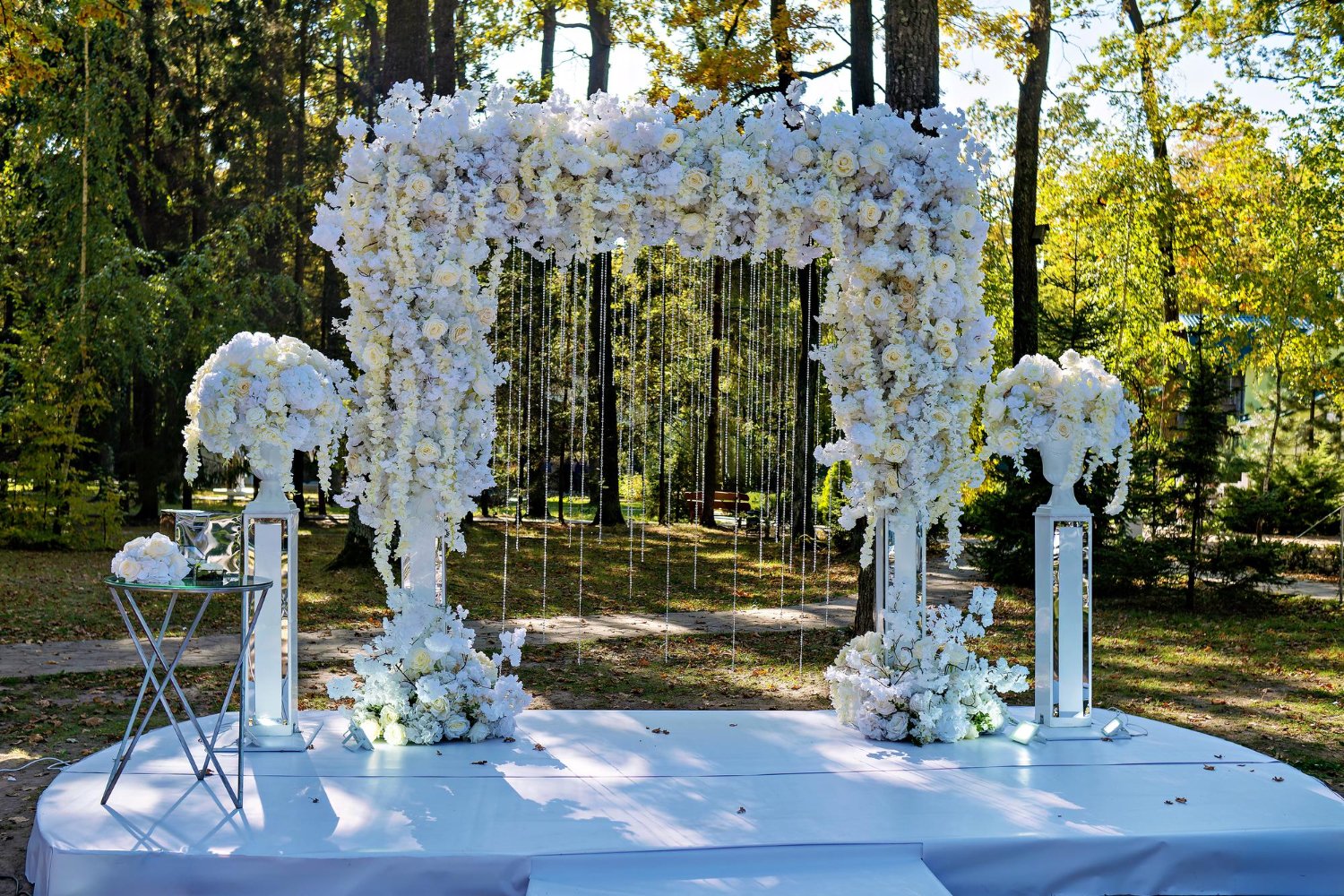
What happens to the arch after the ceremony?
Can the arch flowers move to the reception?
Sometimes, but not as often as couples hope. One florist’s reuse article explains that arch clusters are designed to face the audience and are attached to the frame, so removed stems point skyward and will not sit properly on a flat table, and that full arches are too heavy and complex to move even within the same venue. Lightweight flower clouds (about 11 to 12 pounds in stable dishes), freestanding aisle arrangements and bridesmaid bouquets are easier to repurpose. The florist’s arch pricing article estimates that repurposed clusters can replace $150 to $300 in reception arrangements. If you want this, say so before the design is final, because it changes how the florist builds the piece.
The timing is tight. The same article’s example schedule has the ceremony ending at 3:00 p.m., cocktail hour from 3:15 to 4:15 and guests entering the reception at 4:30, which leaves a working window of about 45 to 60 minutes after guests clear the ceremony space. It advises a cushion of at least 15 minutes and a professional flip for more than four or five pieces. A florist’s relocation fee, estimated at $200 to $400 in the arch guide, can outweigh the savings if the move is complicated, so ask for the number.
How can the arch work as a backdrop or photo spot?
The simplest reuse is to leave the arch where it is and let it frame something else. The florist’s pricing article lists the full structure as a possible sweetheart table backdrop, photo booth frame or dance floor accent, and The Knot’s flower tips suggest asking your florist about repurposing the arch for the reception, for example as a backdrop for the sweetheart table or escort card display. Allow 30 to 45 minutes during cocktail hour for deconstruction and placement if you want the frame moved indoors, and use a vehicle large enough if the reception is at a different site. If the arch stays outdoors, ask whether string lights or power are allowed near the frame.
Who handles breakdown, returns and cleanup?
Name the person, because unclaimed arches have a way of staying on the lawn. The florist’s breakdown article says its optional breakdown service costs a flat $200, takes 60 to 90 minutes and includes removing floral arrangements and installations, collecting florist-supplied vessels and dismantling structural pieces such as arch clusters. It excludes deep cleaning and items the florist did not provide. DIY cleanup, it estimates, runs 30 to 60 minutes with ceremony pieces and 60 to 90 minutes or more with arches and garlands.
How do indoor, outdoor and rain plans differ?
What changes indoors?
Indoors, wind disappears and the building’s rules take over: ceiling height, rigging points, floors and fire rules. The florist’s venue guide says hanging chandeliers, clouds and suspended garlands often weigh 30 to 80 pounds or more and need rated rigging points, and it suggests freestanding arches, weighted bases or clamping to rental furniture where attachments are not allowed. Remember the aisle: the 2010 ADA Standards for Accessible Design include rules on accessible routes and protruding objects, so ask the venue where a wheelchair user or a guest with a cane can pass and keep your arch, easels and floral stands out of that path.
What changes on open lawns, beaches, rooftops and tents?
Open space changes the flower count and the stability plan. The florist’s outdoor guide estimates that scenic outdoor venues such as mountains, beaches and gardens need about 10 to 30 percent less floral volume because the view does some of the work, while blank outdoor venues such as a flat field or plain lawn and tents may need 15 to 25 percent more. It also notes that rooftop and coastal venues have significant wind exposure and recommends grounded arrangements flanking the ceremony instead of a tall arch.
What does a rain plan for an arch look like?
A rain plan is a short document with a decision time, a decision maker and a destination. Decide the time (for example, two hours before the ceremony), name who calls it, and confirm what happens to the arch: it can be moved under a covered area, replaced by a smaller indoor setup or left outside and abandoned. One florist notes a staked, fully installed arch generally cannot be moved indoors, and recommends covering pre-set arrangements overnight in fall. Ask the rental company whether it will disassemble and reinstall, and for what fee. Put the plan in writing and share it with your coordinator, planner and photographer.
FAQ: Wedding arch questions couples ask
Cost and design questions
How much should I budget for a wedding arch?
Start with the three layers: the frame, the flowers and the logistics. One florist’s published ranges put a rented frame at $75 to $400 and arch flowers at about $300 to $500 for a few clusters, $500 to $1,200 for half coverage and $1,500 to $2,500 or more for full coverage, with delivery and setup around $470 and breakdown around $200. Added together and with tax, a mid-range arch can land near $2,000, as in our illustrative example. Compare that with The Knot’s $1,900 national flower median for 2025 weddings to see how much of your floral budget the arch would take.
Do I need a wedding arch at all?
No. An arch helps most when the backdrop is blank, such as an open field, a plain room or a tent wall, and is redundant when the venue already has windows, a pergola, a large tree, a fireplace or a water view. One florist reports that roughly 35 to 40 percent of its couples skip the arch. Alternatives include ground meadow arrangements, flanking pedestals, a fabric backdrop or a living wall of plants.
Is DIY cheaper than hiring a florist for the arch?
Often, but not always, and it depends on the design. A greenery garland of 15 to 20 feet at about $20 a foot is roughly $300 to $400 in materials according to the example above, which is within the florist’s greenery-only price band, so the saving may be small once you count your time and a 20 percent overage. A hybrid, in which you rent the frame and a florist dresses it, can be a better balance than choosing all or nothing.
Venue and weather questions
What wind speed is too windy for a wedding arch?
There is no single number, because it depends on the frame, the ballast, the fabric and the gusts. The National Weather Service Beaufort scale shows that at 25 to 31 mph large branches move and umbrellas become hard to use, which is the range where a fabric-dressed frame deserves a serious conversation. The most useful figure is the rated wind limit from your rental company for that specific frame and base. Agree in advance who decides, and know that NWS wind alerts use local criteria, so check your local forecast office.
Can I stake an arch into the ground?
Maybe. Some private properties allow it, while some parks and gardens ban stakes or ground anchors, and public land can prohibit arches entirely, as the Yosemite permit page does. If stakes are allowed on private land, contact 811 a few business days before any digging, since even shallow projects can hit buried utilities. If stakes are not allowed, ask the rental company about weighted bases and sandbags that can be hidden with greenery or fabric.
Can arch flowers be reused at the reception?
Partly. Full arches and flowers attached to them are hard to move, because the stems face the audience and the structure is bulky, but lightweight clouds, aisle arrangements and bouquets can be repurposed with some planning. Allow 30 to 45 minutes between ceremony and reception for any move, assign a person, and ask the florist for a relocation price. The frame itself can serve as a backdrop for the sweetheart table or a photo spot if the venue permits.
Your next steps
Most arch decisions get easier once the site, the rules and the anchor method are known. The sequence below puts venue questions first, flower decisions second and money last, which is the opposite of how mood boards work and the way that tends to save the most time. The timeline table gives rough lead times that you should confirm with your vendors.
| When | What to settle | Who is involved |
|---|---|---|
| 8 to 12 months out | Venue rules on structures, stakes and tents; start florist search | Venue, florist |
| 6 to 8 months out | Arch or no arch; style, size and coverage; request itemized quotes | Florist, rental company |
| 3 to 5 months out | Book vendors; agree on anchoring, wind plan and rain plan in writing | Florist, rental, planner |
| 60 days out | Design changes cutoff for some florists; confirm palette and coverage | Florist |
| 2 to 4 weeks out | Confirm load-in times, who installs, who moves what to the reception | Venue, florist, coordinator |
| Ceremony day | Install 1 to 4 hours before; weather check; go or no-go call | Florist, coordinator |
| After the reception | Breakdown, rental return, damage check | Florist, rental, venue |
This week
What is the first decision to make?
Decide whether you want an arch at all, and write down the reason in one sentence, such as “our lawn has no backdrop” or “our venue already has a pergola.” If the answer is yes, record your guest count, the venue’s ceremony layout and the height of the tallest person who will stand under it. Collect three photos of your site from the seating area. Share them with your florist and rental company so that every quote starts from the same facts.
What should you send the venue today?
Email the coordinator and ask five things: whether arches and freestanding structures are allowed and any height limit, whether stakes or ground anchors are permitted, the load-in window and hard out time, the rain plan, and whether any arch or backdrop is included. If your venue is a public park, ask the managing agency about permits and decorations. Our wedding venues hub has more venue questions, and our wedding planning hub shows how this step fits the wider timeline. Keep the replies in one folder so your vendors can see them.
Before you pay a deposit
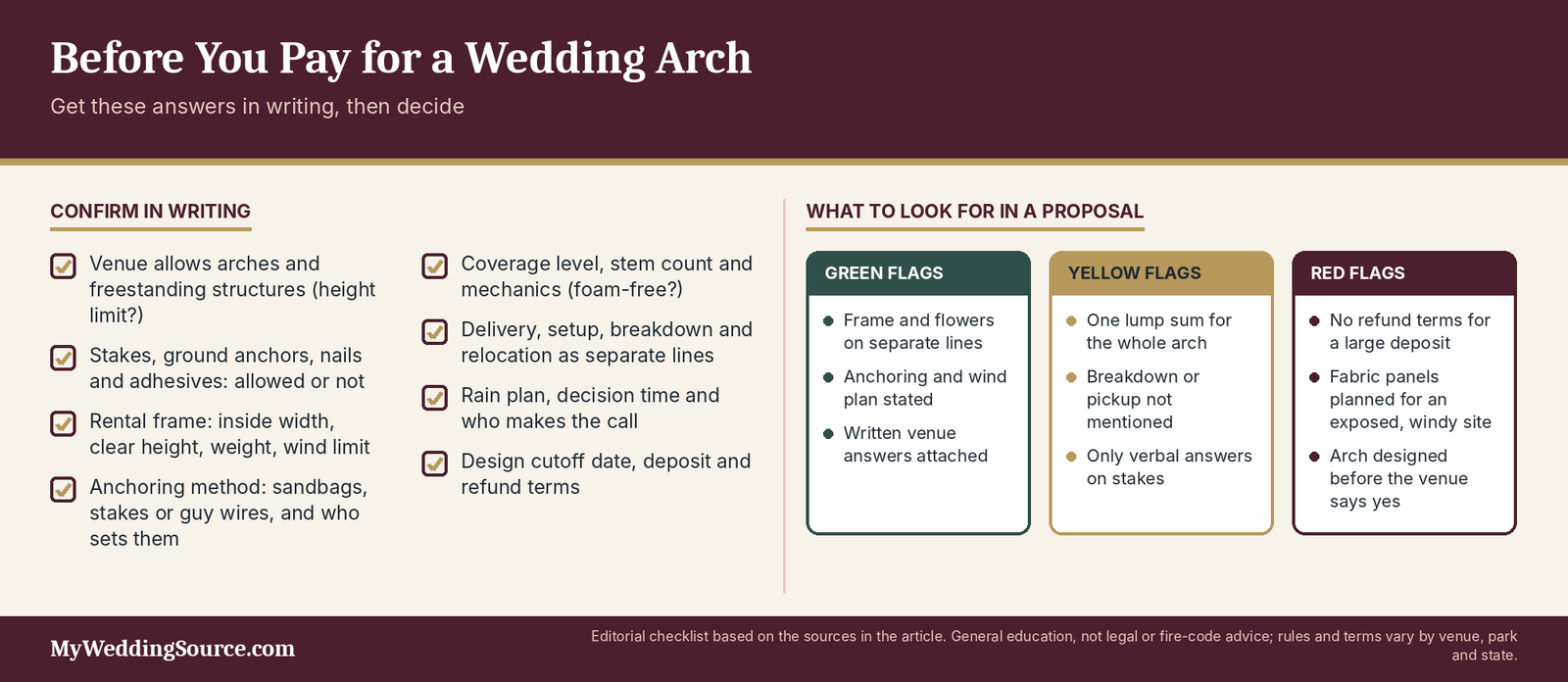
What should the proposal show?
Ask for itemized lines: frame rental, florals by coverage, delivery, setup, breakdown, relocation, taxes and any minimum. Ask for the stem count or coverage percentage, the mechanics, the anchoring method and a mock-up or photo of a similar build. The Knot’s list of florist questions asks about delivery, setup and breakdown fees, mock-ups and minimums, which apply to arches directly. Compare totals only after the lines match, so that a quote with delivery bundled in is not judged against one that lists it separately.
Which terms do you need in writing?
Confirm the deposit and whether it is refundable, the date the design locks, the substitution language for flowers, the cancellation and weather terms, and who is responsible for the rented frame. Add the venue’s answers on structures, stakes and tents, and the rain plan. This is general education, not legal advice, and terms and state laws vary, so read every contract carefully and ask a professional if something is unclear. Then set a calendar reminder for the design cutoff, and book the weather check for ceremony day.
Sources & methodology
- The Knot: average cost of wedding flowers — 2025 weddings: $2,800 average, $1,900 median, $900 to $4,800 middle range, 10,474-couple sample, arbor “few hundred to several thousand,” saving tips.
- The Knot Real Weddings Study data read-out (2026) — 2025 wedding averages and the October 2026 popularity forecast.
- The Knot: wedding flower trends — grounded, circular and meadow-style ceremony arches; installations.
- The Knot: top flower tips — reusing the arch at the reception, flower budget share, florist search timing.
- The Knot: is there an off-season for weddings — fall 35 percent of weddings; October 16 percent.
- The Knot: fall wedding guide — fall rain, soft ground, breezes and November snow risk.
- The Knot: florist questions — delivery, setup, breakdown, mock-up and minimum questions.
- Pinterest: 2026 wedding trend report — stained glass arch +750%, drapery backdrop +1,510%, color trends (platform search growth; no stated window).
- Zola: 2026 First Look Report — color shares, camera-aware floral placement.
- Zola: floral budget guide — ceremony arch pieces about $500 to $2,000+, national flower average.
- Poppy Flowers: arch and chuppah guide — coverage tiers, stem counts, timing, relocation fee (vendor estimates).
- Poppy Flowers: outdoor vs. indoor flowers — wind, anchoring, heat, rain, volume and fee notes.
- Poppy Flowers: reuse ceremony flowers — reception reuse and flip timing.
- Poppy Flowers: breakdown service — breakdown fee and timing.
- Poppy Flowers: venue logistics guide — venue questions, attachments, rigging, load-in.
- National Weather Service: Beaufort scale — wind descriptions by mph.
- National Weather Service: wind products and lightning safety — local alert criteria; “when thunder roars, go indoors.”
- 811: before you dig — free utility-marking service before digging.
- National Park Service: Yosemite weddings — permit, fee and decoration rules for one park.
- Seattle Fire Department decorations memo — flame-retardant decor, clearances and egress (holiday guidance, 2017).
- Poppy Flowers: garland guide and DIY comparison — garland lengths, per-foot ranges, DIY time and supplies (vendor estimates).
- Poppy Flowers: do you need an arch and alternatives — frame rental ranges, 35 to 40 percent skip the arch, alternatives and prices.
- Poppy Flowers: seasonal flower guide — fall flowers and in-season price effect.
- Oklahoma State University Extension: care and handling of cut flowers — temperature and vase-life effects.
- New Hampshire State Fire Marshal: places of assembly and Westport, CT tent safety — tent inspection, egress and wind-related safety plans (two jurisdictions).
- Florida Senate: 2024 bill 321 — balloon-release prohibition effective July 1, 2024.
- ADA.gov: 2010 Standards for Accessible Design — accessible routes and protruding objects.
- Zola: what weddings really cost — flowers and decor cost index context.
Our method: we separate surveys (The Knot, Zola), platform trend signals (Pinterest, which are not Google search volume), government guidance (NWS, NPS, 811, fire marshals), and one professional florist’s published estimates for arch pricing, which are vendor estimates that vary within the same company’s pages. The illustrative arch quote and the wind ladder are editorial constructions based on those inputs, and tax, rental delivery and deposit figures are placeholders. No national dataset reports ceremony-arch prices, and we did not verify any vendor’s current rates directly.
Freshness note: recheck the Pinterest and Zola trend pages each quarter, the florist price pages before you request quotes, and your venue’s, park’s and fire marshal’s rules before you book, since all of them change. Pricing, permits and fire codes vary by location, and the examples here are single jurisdictions.