
Sensory wedding photography is the practice of planning wedding portraits around how a body and a nervous system actually respond to touch, direction, light, noise and waiting, instead of around a standard list of poses. This guide helps couples who dislike extended touching or posing build a written shot brief, brief a photographer with it, and still end up with photos they love.
Write a one-page consent and pose preference shot brief before you sign with a photographer. It names which kinds of touch are fine, which are off, how long any pose can last, how you want to be directed (words, demonstration or not at all), and what signal means “stop.” Attach it to the contract, walk the photographer through it, and schedule portraits in short blocks with breaks. Replace long held poses with walking, side-by-side and parallel-activity shots, which look natural and ask very little of the body.
Many couples dread the portrait hour more than any other part of the wedding. The usual script asks two people to stand close, hold still, tilt their heads, press foreheads together, gaze at each other, laugh on cue and repeat it for twenty minutes in front of a crowd of waiting relatives. For some people that is awkward but easy to ignore. For others it is physically uncomfortable, mentally draining, or simply not them, and the strain shows up in the pictures as a stiff smile.
Sensory wedding photography starts from a different premise. The photographs are for you, and the process of making them should cost you as little as possible. You do not need to explain, justify or diagnose anything to do this. A person with a sensory processing difference, a person who dislikes being touched by strangers, a person recovering from an injury and a person who just hates being posed all benefit from the same tool: a clear written brief that the sensory wedding photography lead can follow without guessing.
A note on scope. This is general planning information, not legal, medical or financial advice. If you want to know how disability rights rules might apply to a business, read the information at ada.gov. If you want an individual view on sensory needs, ask a qualified professional such as an occupational therapist. The sources at the end of this article point to the agencies involved.
What sensory wedding photography covers
The phrase sounds specialized, but the idea is plain. Sensory wedding photography means treating the sensory and social cost of photography as a real planning variable, next to style, price and timing. It is not a separate genre of photography, and you will not find a photographer who offers it as a package. It is a set of decisions you make and communicate, and any competent, flexible photographer can work inside them.
Three features separate this approach from ordinary advice about relaxing in front of the camera. First, it replaces vague wishes (“we’re a little shy”) with specific, testable preferences (“no hands on my shoulders, no more than ten minutes per location, tell me what you want before you move me”). Second, it treats consent as ongoing and revisable, so a preference written down in March can still be changed at 4:15 p.m.
on the wedding day. Third, it gives the photographer alternatives, because a “no” with nothing offered in its place leaves a professional guessing, and guessing usually ends with the standard pose anyway.
What a camera actually asks of your body
It helps to take the pose apart. A single posed portrait can ask for several different things at once, and you may tolerate some and struggle with others.
Contact. Hands on the waist, an arm around the shoulders, a forehead touch, a cheek press, a dip, a lift, a veil being arranged by a stranger’s fingers, a boutonniere being pinned. Contact can come from your partner, from the photographer, from a relative or from a stylist.
Posture and holding. Standing at an angle, chin out and down, weight on one leg, shoulders back, hands in a specific place. The difficulty is not one position but holding it while the photographer adjusts the light and takes several frames.
Attention and expression. Eye contact with your partner for a long stretch, eye contact with the lens, a smile on cue, a laugh on command, “look natural.” Producing an expression deliberately is a different task from having one.
Instruction load. A rapid stream of spoken directions, such as “shift left, chin up, softer, now look at her, now away,” asks you to process language, move your body and manage your face at the same moment.
Environment. Bright flash, a clicking shutter, sun in your eyes, wind, itchy fabric, a crowd watching, a lot of waiting between frames.
Time. Duration matters on its own. Ten minutes of any of the above may be fine and forty minutes may not be, even when each single pose is easy.
You can have different limits on each of these, and your partner can have different limits again. The brief later in this guide gives each one its own line, so nothing hides inside a general complaint.
What this guide does not assume
Sensory wedding photography does not assume that you and your partner share the same needs. It does not assume that a “no” to touching means a “no” to affection; many people are happy to hold hands for a whole afternoon and unwilling to have a stranger adjust their collar. It does not assume that you want fewer photographs, only a different way of getting them. And it does not assume your preferences stay fixed. Fatigue, heat, hunger and nerves all change what feels tolerable, which is why the brief includes a way to revise it on the day.
Where touching and posing demands hide in a wedding day
Most couples picture the portrait session as the only photography obligation. In practice, photographic demands are spread across the whole day, and a few of them arrive without warning. Walking through the day moment by moment lets you decide in advance where you want to speak up.
Getting ready. Photographers often ask for staged moments: fastening a necklace, tying a tie, adjusting a veil, a parent helping with buttons. These are the first touch requests of the day, they come early when nerves are high, and they involve people other than your partner. Decide who may touch your clothing and who may not.
The first look. If you do one, it is usually photographed from a distance with a long lens, which is good news. The pressure comes afterward, when the photographer asks for an embrace, a forehead touch or a long gaze to “finish” the moment.
Couple portraits. This is the densest block of posing. It typically includes several locations, outfit and light changes, and a repertoire of couple poses built on closeness and eye contact.
Ceremony. You have less control here and less need to, because a ceremony is not a photo shoot. The question is whether the photographer handling sensory wedding photography will interrupt it, whether the kiss will be requested twice, and whether anyone expects a re-staged exchange afterward.
Family formals. Groups of relatives arrive in sequence and each combination wants a hug, a hand on the shoulder or a squeeze together. This block combines touch, instruction overload and crowd noise, and it is where unrequested contact from relatives most often happens. The family photo list on this site shows how to keep it short.
Cake, dances and toasts. Cake cutting is often staged for the lens, and a first dance can turn into a request for a dip, a spin or a lingering close-up. Guests also photograph these moments with phones and may ask for selfies.
Exit. A staged grand exit may be photographed more than once, and it often involves running, waiting, sparklers or confetti.
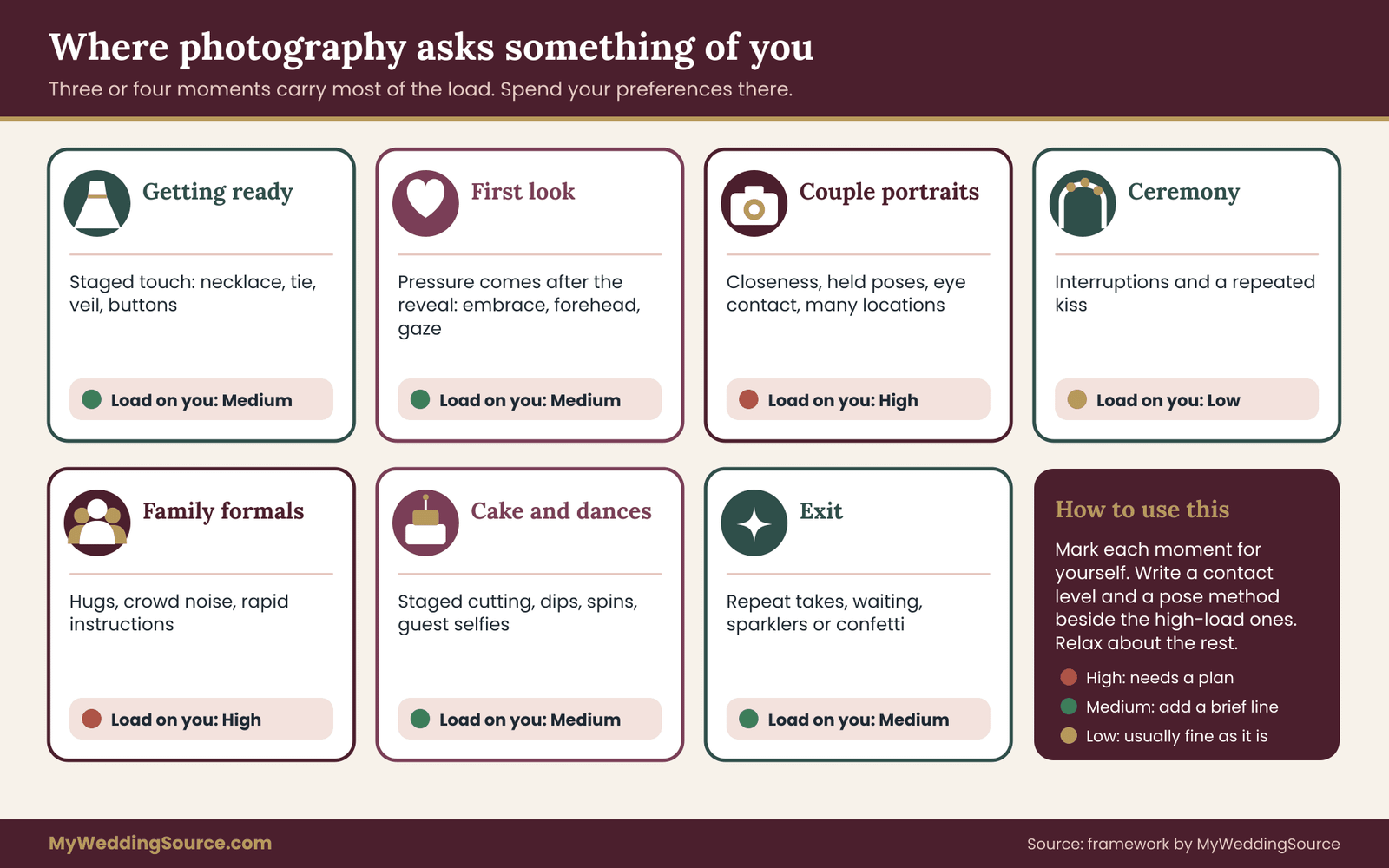
Laying the day out like this has a practical effect. You can see that three or four moments carry most of the load, which means you do not have to renegotiate every minute with the photographer on a sensory wedding photography job. You can concentrate your preferences where they matter and relax about the rest. It also shows who else might be in a position to touch you, direct you or ask you for something, because the photographer is rarely the only person involved.
Separating the photographer’s habits from the photographer’s needs
A good first exercise is to look at each standard request and ask what picture the photographer is really after. A dip and kiss is after a sense of romantic energy. A forehead touch is after intimacy and closeness. A long gaze is after emotion. Walking toward the camera is after movement and ease. Holding a bouquet in a specific way is after a clean composition.
Once you name the purpose, you can often offer a different route to the same image. Intimacy can come from sitting side by side on a bench, shoulders loosely together, looking at something in the distance. Emotion can come from reading each other’s letters on a quiet porch. Ease can come from a walk with a coffee. The sensory wedding photography lead wants a result and you want a method that costs less, and those two goals are compatible more often than people expect.
This is the point at which a simple ceremony cue sheet is useful too. A cue sheet lists what happens in the ceremony and when, and the photographer handling sensory wedding photography can be given a copy so the moments they will photograph are already agreed. The shot brief you build next works the same way, but for portraits and any staged moment. ## The sensory wedding photography shot brief, field by field
The shot brief for sensory wedding photography is a single page, written by the two of you, that tells the photographer how to work with you. Its job is to remove guessing. A photographer who has to infer your limits from your body language during a stressful hour will sometimes get it wrong, and you will be too busy coping to correct them. A photographer holding a clear page can adjust without a conversation in the middle of a shoot.
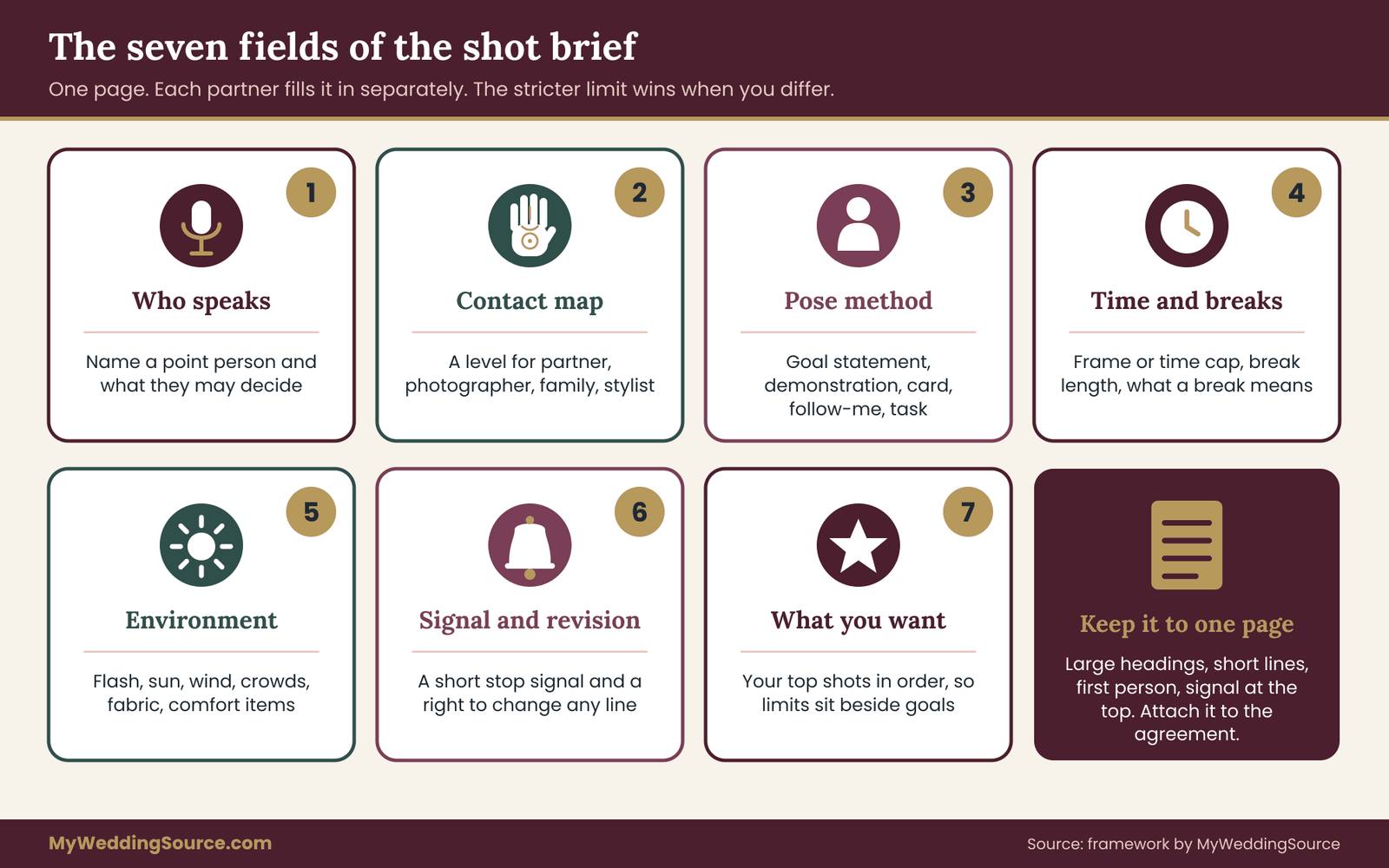
The brief has seven fields. Each field answers one question, and each partner fills in their own answers separately, because the two of you will often differ. Where you differ, the stricter limit applies to any shot that involves both of you. That is the simplest rule to remember and the easiest for a photographer to apply.
Field one: who the brief covers and who speaks
Start with names, pronouns if you wish to share them, and a line about who the photographer should talk to if something needs deciding quickly. Many couples doing sensory wedding photography pick one person as the point of contact, not necessarily one of themselves. A close friend, a sibling or a planner can act as the “voice” during portraits, which spares you from negotiating in real time.
Write the name of that person on the brief, and write a short sentence about what they may decide. For example, they may pause the session, change the location, cut a shot from the list, or call a break. They may not agree to anything that crosses a limit you wrote down. Making that boundary explicit keeps a well-meaning helper from saying “oh, they’re fine with that” when you are not.
Field two: the contact map
This is the heart of the brief. It lists, by type of contact and by who is doing the touching, what is acceptable. The next section explains how to set the levels. On the page it looks like a short list: partner touch, photographer touch, family and guest touch, stylist or hair and makeup touch. For each, you write one of five levels, from none to extended.
Include the small things. People forget that a photographer straightening a lapel, lifting a veil off a shoulder or moving a hand by two inches counts as touch. If you are fine with a verbal request but not a hand on your arm, say so. If a gentle tap on the sleeve is acceptable but a hand on the back is not, say that.
Field three: pose method
This field describes how you want to be directed. The options are covered in detail later, but in short: spoken instruction only, a demonstration by the photographer on their own body, a reference image or card, letting you move freely while they follow, or a mix. Many people on a sensory-aware shoot choose “tell me the goal in one short sentence and let me find my own way there.”
Add a note about instruction load. If a stream of rapid commands is hard to process, ask for one instruction at a time with a pause, or for the photographer on a sensory wedding photography job to show a frame on the camera back and say “like this, but your way.” Some people prefer written cues such as a short shot list on a phone. All of this belongs in field three.
Field four: time and breaks
Write the maximum length of any single pose, the maximum length of a continuous portrait block, and how long a break should last. Be specific and use numbers you chose yourself. For example: no pose held longer than the time it takes to take five frames, a break after every two locations, and a minimum of ten minutes of rest before the next block. These are your numbers. They are not clinical thresholds, and you can change them after a test session.
Also state what a break looks like. A break is not an opportunity for the photographer to shoot “candids” while you try to rest. Specify whether the camera goes down, whether you want to be alone, whether you want water or a snack, and whether someone should guard the area from relatives who want a word.
Field five: environment
Name the environmental triggers that matter to you. Common ones are flash and strobe, a loud shutter, harsh direct sun, wind on the face and hair, scratchy or heavy clothing, strong scents, crowds watching and sudden loud noises. For each, write what you want instead. If flash is a problem, ask for natural light or continuous light and note that you will choose locations accordingly. If crowds are a problem, ask for portraits away from the guests.
You can also record sensory comforts: sunglasses between shots, a cool drink, a change of shoes, a shawl or jacket between locations, permission to stim or fidget quietly. Writing these down turns them into ordinary logistics and keeps them from feeling like special requests. The vendor contract guide explains why details like these are better attached to the agreement than left to conversation.
Field six: the signal and the revision rule
Choose a signal that means “pause now, no questions.” It could be a word, a hand gesture, a card you carry or a text to your point person. The signal should be easy to use when you are overloaded, which usually means it is short and does not require speaking in full sentences. Tell the photographer what the signal means and what you want them to do when it appears: lower the camera, step back, say nothing, and wait for your point person.
Then write the revision rule. Consent at the planning stage is not consent for the day. The rule says that you can change any line on the brief at any time, in either direction, and that a change is never to be argued with. If you said “extended touch is fine” in the spring and your hand is aching by afternoon, the revision rule lets you say “that one is off now” with no discussion.
Field seven: what you do want
A brief that is only a list of limits can read as a list of problems. Close with a short list of what you want to see: the shots that matter most to you, in order of priority. Examples might be a photograph of the two of you walking away together, a candid of your best friend laughing at the toast, a quiet detail shot of both rings on a hand, a wide frame of the room before guests arrive. When a photographer sees a limit next to a goal, they can design around the limit.
Keep it to a single page
The brief works only if it gets read. A photographer on a wedding day is juggling light, schedules, family and equipment, and a three-page document will not be consulted in the moment. Aim for one page with large headings and short lines, plus a second page that is only the contact map if you want a larger version to keep on a clipboard or phone. Put the signal at the top so it is the first thing the photographer sees.
It also helps to write in the first person and in positive terms where you can. “I like to be told the goal and find my own pose” is easier to follow than “don’t tell me how to stand.” “Please photograph us walking” is easier than “no static poses.” The limits themselves can still be plain and direct: “Please do not touch my head, hair or face. Ask first for anything else.”
How the brief becomes part of the agreement
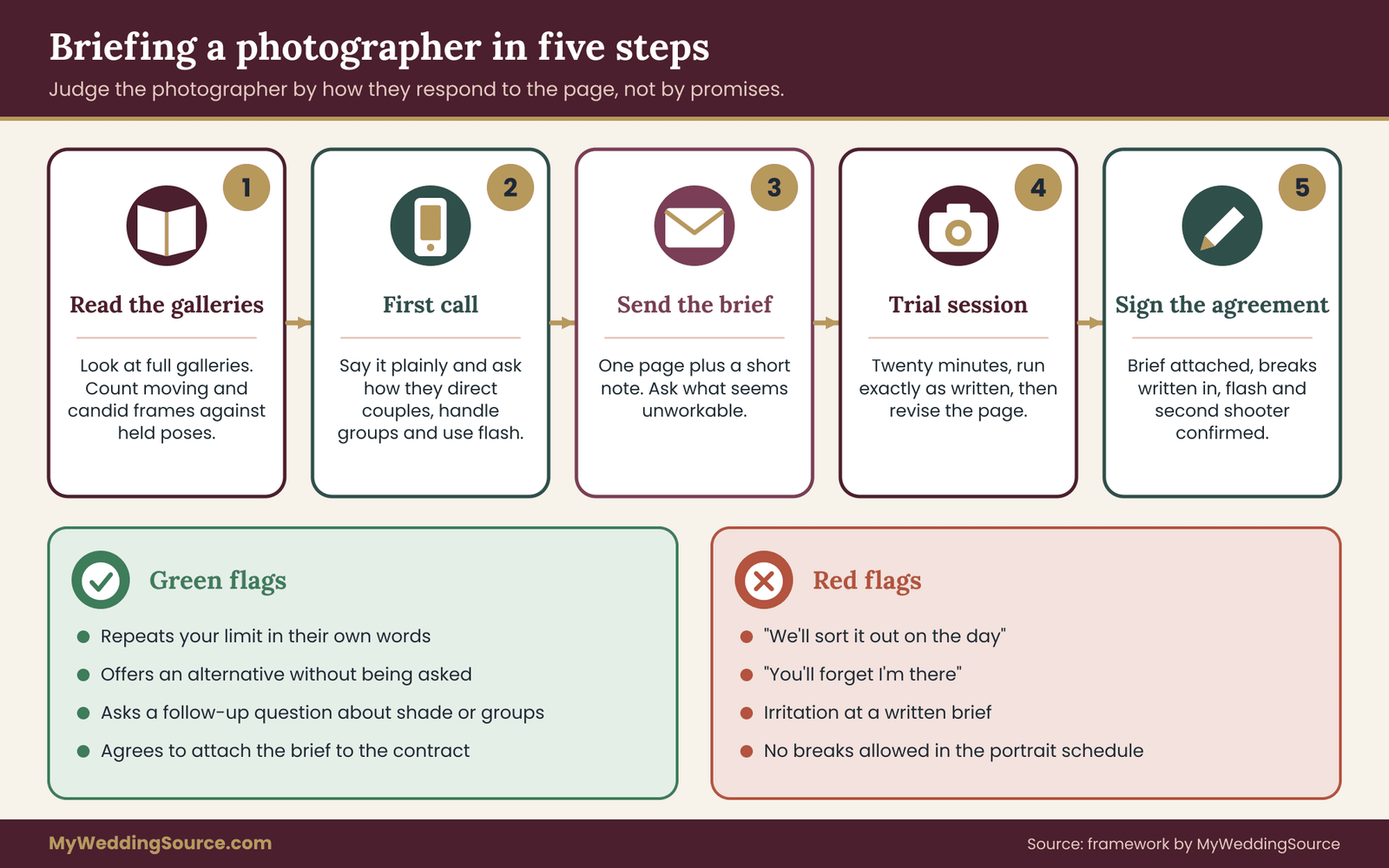
Sending the brief by email is a start, but it only becomes dependable when it is attached to your agreement. Ask the photographer to confirm in writing that they have read it and will follow it, and ask whether they are willing to add it to the contract as an appendix. A photographer who hesitates may have a good reason, such as a fixed workflow for large events, and that conversation is useful information before you pay a deposit. A photographer who says “of course” and reads it carefully has just told you something equally useful.
The brief is also a gift to your future self. Months later, when you are tired and someone suggests “just a quick lift for the picture,” you will not have to decide again whether you are comfortable. You wrote the decision down when you were rested, and it is still in force. ## Setting contact levels and pose methods
Two of the brief’s fields need more thought than the rest in sensory wedding photography, because they decide most of what happens in front of the lens: how much touching is involved and how you are directed. Both are easier to settle with a short scale than with open-ended conversation.
A five-level contact ladder
In sensory wedding photography, the ladder gives you a shared vocabulary. Rather than telling a photographer “we’re not touchy,” you say “level two between us, level zero from everyone else.” It takes ten seconds and carries real information.
Level zero: no contact. No hands on bodies, clothing or hair. Side-by-side and walking shots only, with space between people if that is what you want. A level zero between you and your partner is rare but entirely valid, and it still produces strong pictures.
Level one: self-placed only. You place your own hands, your own bouquet, your own jacket. You may stand close, but no one moves you. A photographer can describe a position and you decide whether and how to take it.
Level two: brief partner contact. You and your partner may touch for a short, self-chosen count, such as holding hands, a shoulder against a shoulder, an arm linked. The photographer asks, and either of you can end it. This is the level many couples choose for portraits.
Level three: sustained partner contact within your time caps. Longer holds such as an embrace, forehead touch or dance position are fine, as long as they stay within the limits in the time field and either person can end them with the signal.
Level four: directed contact by others, with consent each time. A photographer, stylist or relative may adjust something, but only after asking, and only for the thing they asked about. “May I fix your collar?” is a level-four request. A yes covers the collar and nothing else.
Set a level for each of four relationships: your partner, the photographer, family and guests, and anyone who styles you. They are often different. A couple might choose level three for each other, level one for the sensory wedding photography lead and level zero for guests. Someone else might choose level two for the partner and level four for a hairstylist they have worked with for years.

Three rules that make the ladder work
The first rule is that unlisted contact defaults to “ask first.” If something is not covered, the photographer handling sensory wedding photography asks, and silence is not consent. This protects you from the long tail of small things nobody thought to list.
The second rule is that the stricter limit wins whenever two people differ. If one partner is at level three and the other at level one, any shot involving both stays at level one. The partner at level three can still choose to offer more, but nobody should be pushed to match.
The third rule is that levels describe what is acceptable, not what is required. Being at level three does not mean you must use it. A photographer who sees “level three” should not read it as “please do three” but as “this is the ceiling.”
What to say about touch from relatives
Family contact is the hardest to control because it comes from people who love you and do not think of themselves as strangers. A relative who hugs you before every formal photo is not breaking a rule. They are following a habit. The brief helps, because you can give your point person a plain script they can use on your behalf: “They’d love to wave and smile for this one.” That sentence avoids saying that you do not want contact while still redirecting it.
For people closer to you, a short advance message can help. For example: “On the day I may be too busy to hug everyone before photos. I’ll find you afterward. I love you, and this is just about getting through the schedule.” You do not have to explain your reasons. A quick text from the day before gives people a script and lowers the chance of hurt feelings. The photography consent guide deals with guest boundaries and image use more broadly.
Five ways to be directed
The pose method field has five options, and you can combine them. None is better than the others. Each suits a different kind of overload.
Goal statement. The photographer describes the picture they want in one short sentence and then leaves the how to you: “I’d like the two of you looking relaxed, walking toward the tree.” You choose the pace and the posture. This works well if detailed instructions are hard to follow but you can improvise once you understand the aim.
Demonstration. The photographer shows the pose on their own body or with an assistant, then steps back. This suits people who process visual information more easily than spoken instructions. It avoids the verbal stream and gives you a clear target.
Reference card. You review a small set of example images in advance, choose several you like and note a few you do not. On the day, the photographer on a sensory wedding photography job refers to them by number. “Number four, but at your own distance” is shorthand that spares both of you a long explanation.
Follow-me. You do something natural, such as walking, talking or exploring a garden, and the sensory wedding photography lead follows and shoots. There is no pose to hold. The photographer may ask for small adjustments in direction or light, but you are in motion most of the time.
Task-based. You and your partner do a small, real activity together: sharing a drink, reading a letter, tying a ribbon on a gift, looking at a map. Attention goes to the task and the photographer handling sensory wedding photography shoots around it. This is the least demanding approach for people who struggle with making facial expressions on cue.
Choosing a method by what overload looks like
If the problem is too many spoken instructions, choose goal statement, demonstration or reference card. If the problem is holding a position, choose follow-me or task-based. If the problem is eye contact or producing expressions, choose task-based, and tell the photographer on a sensory wedding photography job you prefer shots where you look at something other than the camera or each other. If the problem is a crowd, move the portraits out of sight and use any method that works in a quiet location. If the problem is touch, choose any method that leaves your hands your own.
Most couples end up with a combination: a goal statement for most shots, a demonstration if the sensory wedding photography lead wants something specific, and one or two task-based frames. The key is that you chose it in advance.
Counting frames instead of minutes
Pose duration can be hard to judge from the inside, so many people prefer a count of frames. “Hold for five frames, then move” gives you a clear endpoint, and it matches how photographers actually work. A burst of shots takes seconds, and a photographer who knows your limit can keep each setup short. If time feels more natural, use time, but write down whichever measure you will actually notice.
Try it before the day
A short test session is the best way to find out whether your sensory wedding photography brief is realistic. An engagement session works well, or you can book a short paid portrait session with the same photographer. Run a twenty-minute portrait block exactly as the brief describes, including a break. Afterward, each of you notes what felt fine, what drained you and what you would change, and you revise the brief.
If a photographer is not open to a trial session, the brief can still be tested with a friend who has a camera, using the same rules. A test on a quiet afternoon costs much less than discovering a problem at your wedding. ## Choosing and briefing a photographer for sensory wedding photography
A sensory wedding photography brief is only as useful as the photographer handling sensory wedding photography who receives it. Some photographers work in a documentary style that rarely requires posing, some run a tightly scripted portrait workflow, and many work somewhere between. You are not looking for a “sensory specialist,” although experience with neurodivergent clients is a bonus. You are looking for a person who reads your page, asks sensible questions and adjusts without fuss.
Read the portfolio for method, not only for style
Start with the work. Look at a full gallery, not only the highlight reel. Count how many frames show people moving, talking or interacting with objects, and how many show a held pose. A gallery full of laughing walks, hands, details and mid-conversation moments suggests a photographer who can work without much posing. A gallery full of identical couple poses suggests a photographer who relies on them, which is not a flaw but is a reason for a longer conversation.
Look for variety in how couples touch. If every couple is entwined in the same forehead-to-forehead frame, the photographer’s repertoire may be narrow. If you see couples side by side, walking apart, laughing at something off-camera and holding hands loosely, the repertoire is wider. Also look at group photos. Are relatives standing in orderly rows, or crowded into hugs? You can infer a good deal about how a photographer manages groups from how the finished frames look.
Questions to ask in the first conversation
Open with a short, calm statement and then ask. Here is a script you can adapt: “We would like fewer posed portraits and very little extended touching. We prefer to be directed with short goals instead of long instructions. Can you tell us how you usually work with couples like that?” The way the photographer on a sensory wedding photography job responds is the most useful information you will get.
Then ask specific questions. How do you usually direct couples during portraits? Can you work from a goal statement and let us find the pose? How do you feel about taking breaks mid-session? How do you handle family groups, and can you keep them short? Do you use flash during portraits, and can you work in natural light? Do you ever adjust clothing or hair by hand, and do you ask first? Would you be willing to read a one-page brief and follow it? Would you do a short trial session before the wedding?
Listen for ease more than for perfect answers. A photographer who says “I’d love to see that, send it over” and then asks a follow-up question is promising. A photographer who answers “every couple says they’re awkward, but I’ll get you comfortable” has told you they do not plan to follow your page. That may be a well-meant reassurance, but it is a mismatch with what you are asking.
Green flags and red flags in the replies
Green flags are specific and calm. The sensory wedding photography lead repeats back a limit in their own words, offers an alternative, asks whether anything else would make the day easier, or mentions how they handled something similar in a general way. They do not make you feel like a special case. They treat the brief as ordinary project information.
Red flags are usually phrased as comfort. “Don’t worry, you’ll forget I’m there.” “I promise you’ll love the poses.” “We can work on that on the day.” Each one moves the decision from the page to the moment, which is where you are least able to hold a line. Another red flag is irritation at the idea of a written brief, a refusal to put anything in the contract and a fixed portrait schedule that does not allow breaks.
None of these makes a photographer a bad person. They make it a poor fit for a day with the constraints you have.
You can also apply the general checks in the vendor due diligence checklist to a photographer, such as confirming insurance, backup plans and a business history. Those checks do not replace a conversation about touch and posing, but they belong in the same decision.
What to put in writing
Once you have chosen someone for sensory wedding photography, ask for the following to appear in the written agreement or in an attached document. The wording does not need to be formal. It needs to be clear.
First, a statement that the photographer has received the brief and agrees to work within it. Second, the agreed coverage hours and the portrait window, with the break structure written in. Third, a note on flash, so there is no surprise at the first dance. Fourth, who will be at the wedding: the lead photographer alone or with a second shooter or assistant. A second shooter can take candid frames of guests while the lead works with you, which shortens the time you spend in front of the camera.
Fifth, delivery terms, including the number of images and when you will receive them. Sixth, who holds the copyright and how the photographer may use your images, since a photographer normally owns the copyright in their photographs unless the contract says otherwise; the U.S. Copyright Office explains the basics.
A further point concerns your right to change the plan. Ask what happens if you need to shorten the portrait block on the day. A flexible photographer will confirm that you can end a session early without penalty, and that the contract will not treat a shortened block as a breach. Read the paragraph on cancellations and changes with that in mind. The wedding vendor contract guide covers the usual clauses and how to ask for changes.
Cost logic without invented numbers
The brief changes the cost of sensory wedding photography in a few predictable ways, and it is worth thinking them through before you ask for quotes.
A longer portrait window with breaks needs more coverage hours, and coverage hours are normally priced by the hour or by package tier. A second shooter adds a line to the bill but can lower the load on you. A trial session or an engagement session usually costs money, but it also reduces the risk of a mismatch that would cost far more to fix.
A documentary style may cost the same as a posed style or more, and the price depends on the photographer, not the style. Ask each photographer for a quote based on the same brief so that you can compare like with like. A vendor timeline helps you set dates for those requests so that you are not rushed.
Do not assume that a lower price is a better fit, or that a higher price means more flexibility. Compare how each photographer responded to the brief, not just the totals.
Sending the brief
When you send the brief, include a short covering message. Keep it friendly and factual: “Attached is a one-page brief about how we like to work in front of the camera. We’d appreciate you reading it before our call. It’s not a list of problems, just how we get good pictures with the least strain. Please let us know if anything seems unworkable.” That last sentence invites an honest answer. If something is unworkable, you want to know now.
After the call, confirm in writing what was agreed, in two or three sentences. If the photographer agreed to goal statements, a ten-minute break after every two locations and no hand adjustments without asking, repeat those exact points. A written confirmation is not a sign of distrust. It is how professionals keep shared understanding intact across months and across inboxes. ## Building a schedule that protects your sensory capacity
A good brief for sensory wedding photography can still fail inside a bad schedule. If portraits are squeezed between a late ceremony and a hungry crowd, even the gentlest method will be under strain. The schedule is the second half of the plan, and it is where you can do the most to lower the load without changing a single pose.
Think in energy, not only in minutes
Most wedding timelines, including those for sensory wedding photography, are built from fixed events and travel times. For this kind of planning, add a second column: an honest estimate of how much each block draws on you. Ceremony, family formals and the first hour of the reception often draw the most, because they combine attention, noise and people. A quiet half hour alone, a meal and a walk draw very little. Aim to place the demanding blocks apart from each other, with a recovery block between them.
You can think of it as a simple budget. You have a certain amount to spend across the day, and each block takes some of it. If you spend a large share on a forty-minute portrait block right before the reception, you arrive at the party with little left. If you spread portraits across smaller blocks, with rests between, you arrive with more. Nothing here depends on counting precisely. It depends on noticing that the energy is finite and that someone has to protect it.
Three common portrait arrangements
A first look and portraits before the ceremony. This puts the couple portraits early, when you are fresh and the light is good, and lets you be fully present at the cocktail hour. The downside is that you do the most demanding block while nerves are high and before the ceremony has taken place. If you choose this, keep the block short and add a real rest before the ceremony begins.
Portraits after the ceremony. This is the traditional arrangement. It lets you do formals and couple portraits together, but it puts them straight after the ceremony, often while guests wait and hunger rises. If you choose this, protect the first ten minutes after the ceremony as a private pause with no camera, then begin the portraits.
Split portraits. Some couples take a few quiet frames before the ceremony, family formals immediately after, and the main couple portraits later during golden light, with a break for food in between. This adds some complexity but gives the most recovery. It works best if the photographer handling sensory wedding photography is willing to move between blocks and the venue allows it.
None of these is correct for everyone. Pick the one where the demanding blocks sit furthest from the rest of your obligations, and make sure the photographer agrees.
Build in buffers on purpose
Buffers are the single most useful tool in a schedule built for sensory wedding photography. They do not require anyone to change what they do. They only require that the timeline allow room.
Add a buffer before and after every block that includes the camera. Ten minutes is a practical starting point, because it covers walking to a location, a drink of water and a quiet moment. Add a longer buffer, perhaps thirty minutes, between the ceremony and the reception. If portraits run on schedule, you have a bit of rest. If they run over, the buffer absorbs the overrun and the reception starts on time.
Tell the photographer and the venue coordinator about the buffers. A buffer that only you know about will quietly vanish when someone else is trying to keep the timeline tight. The step-by-step ceremony guide can help you see where the pauses fall.
A quiet place for breaks
Every break needs a place. Without one, a break turns into standing in a corridor while people approach. Choose a spot in advance: a bridal suite, a side room, a parked car, a shaded bench in a courtyard. The ideal spot is quiet, private, cool or warm as you prefer, and close to both the portrait location and the reception.
Equip it. Water, a snack, a change of footwear, sunglasses, a jacket or shawl, headphones or earplugs if sound is a problem, and a printed copy of the brief and the day’s schedule. Tell your point person where it is. Ask the venue whether the space can be held for you during portraits. Many venues have a suitable room and are glad to set it aside if they know it is needed.
Light, weather and the location of the shoot
The environment decides a surprising amount of how long a portrait block feels. Direct sun makes people squint and sweat. Wind makes hair and veils tug at the face. A location with other guests wandering through raises self-consciousness. A cold stone courtyard in a thin outfit tires a person quickly.
Scout locations with those costs in mind. Open shade often gives pleasing light and a cooler body, and it is easy for photographers to work in. A quiet garden path gives you a natural reason to walk. An indoor room with large windows gives soft light without flash. Ask the photographer for two or three backup spots in case of rain or heat, and make sure they are all within a short walk. If the weather turns, you will have a plan that does not require a long negotiation in the middle of the day.
Handling the extra photographers: guests with phones
Your photographer is not the only camera at the wedding. Guests often hold up phones for the portraits and the formals, and some will ask for a selfie as you walk past. For a sensory-aware plan, decide whether you want that. An unplugged moment can be announced, or you can give your guests one clear moment to take their own pictures, such as right after the ceremony, and ask for none during portraits.
If an unplugged request seems too strict for your crowd, a softer option is to give guests a “photo window” of ten minutes during the cocktail hour when you are happy to pose, and ask them to leave you alone at other times. People tend to respect a clear boundary more than a vague hope.
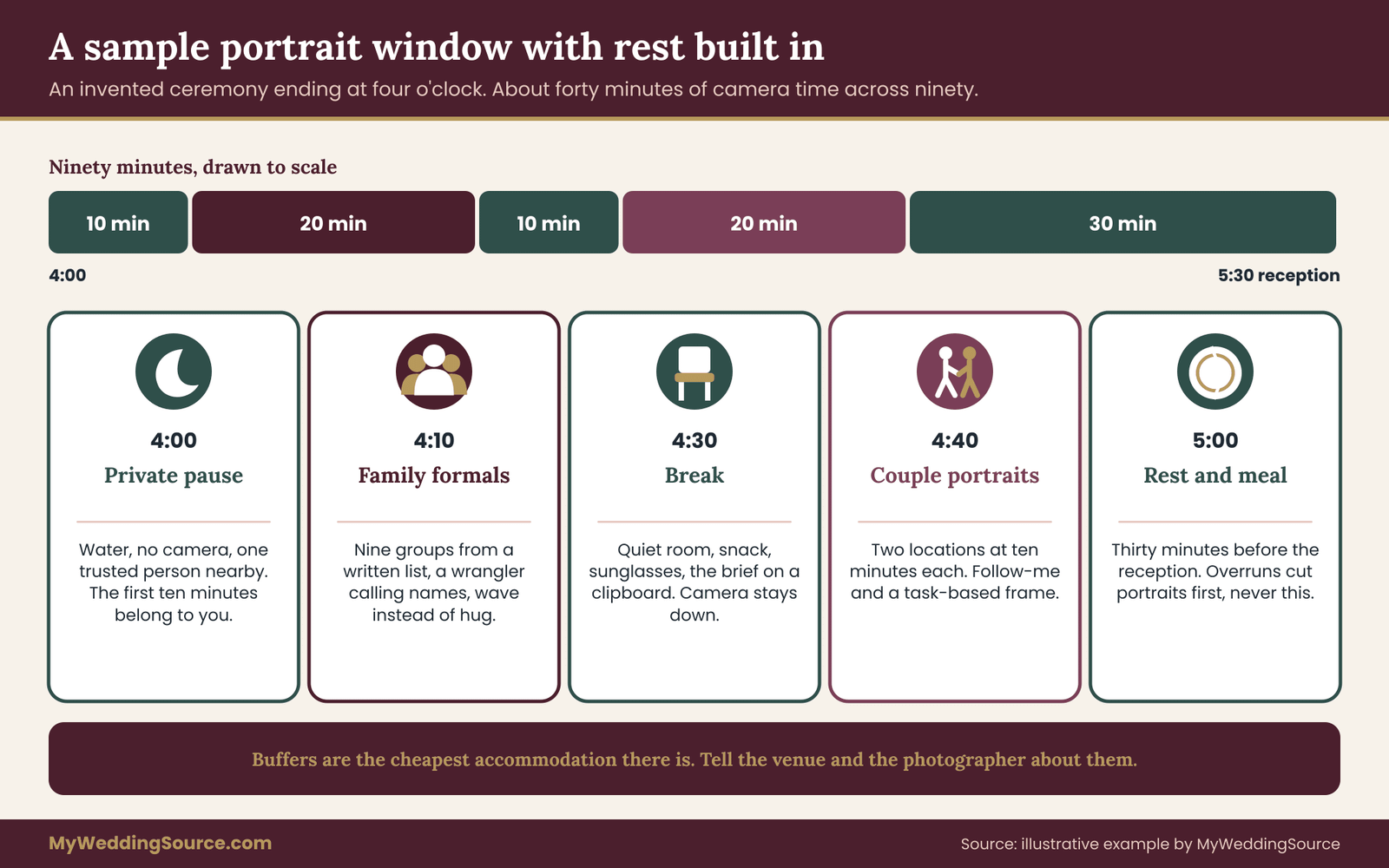
A sample ninety-minute portrait window
To make this concrete, here is one arrangement for a mid-afternoon wedding with a ceremony ending at four o’clock. It is only an example and uses invented times.
At four o’clock the ceremony ends and the couple takes ten minutes alone in the quiet room with water and no camera. At ten past four the first block begins: family formals, scheduled for twenty minutes, with a family photo wrangler calling groups and the photographer working from a written list. At half past four the couple has a ten-minute break.
At twenty to five the second block begins: couple portraits at two locations, each for no more than ten minutes, using follow-me and task-based methods. At five o’clock the couple takes a thirty-minute rest and a meal before the reception begins at half past five.
Notice what this does. It allows about forty minutes of camera time across more than an hour, and the rest of the time is recovery and food. If any block overruns, the rest period is the thing that shrinks last, and the couple can decide at the time whether to cut a shot. A schedule like this takes five minutes to draft and can be shared with the photographer, the venue coordinator and your point person in the same email.
Protect the end of the day
Do not forget the late-evening camera. A staged grand exit, a sparkler send-off or a “one more photo” request after the dancing can ask for a lot from a tired person. If you want an exit photo, consider a short staged one earlier in the evening while you still have energy, or a simple walk to the car with a photographer at a distance. If you do not want a staged exit, tell the photographer that the last frame of the night is whatever happens naturally when you decide to leave. ## Alternatives to extended posing in sensory wedding photography
The strongest argument for sensory wedding photography is that you are not giving up the pictures. A wedding gallery does not need long held poses to feel romantic and complete. What it needs is a range of frames: wide, close, moving, still, serious and funny. Many of the most loved wedding photographs were never posed at all.
The list below goes through the day one moment at a time and offers a substitute for each standard request. Treat it as a menu. You can show it to your photographer as a starting point, and they will usually add ideas of their own.
Getting ready
Instead of staged button-fastening or a parent adjusting a veil, ask for photographs of the objects and the setting: shoes by a window, the dress on its hanger, a hand holding the invitation, the room with the light coming in. For people frames, ask for moments of real activity, such as a friend reading a note aloud or a sibling laughing while you put on a watch.
If a particular touch moment matters to you, such as a parent fastening a necklace, choose that single moment and let the photographer shoot it from a distance with a longer lens, so that the moment is real and brief.
The first look and the private moment
If you hold a first look, ask the photographer to stay far back with a long lens and shoot the whole thing as it happens. After the reveal, let the two of you decide what comes next. Some couples want a long embrace. Others want to laugh, talk and walk. The photographer does not need to direct anything. If you want, you can ask for a second “quiet” camera angle from a second shooter, so that no one needs to repeat the reveal.
Couple portraits
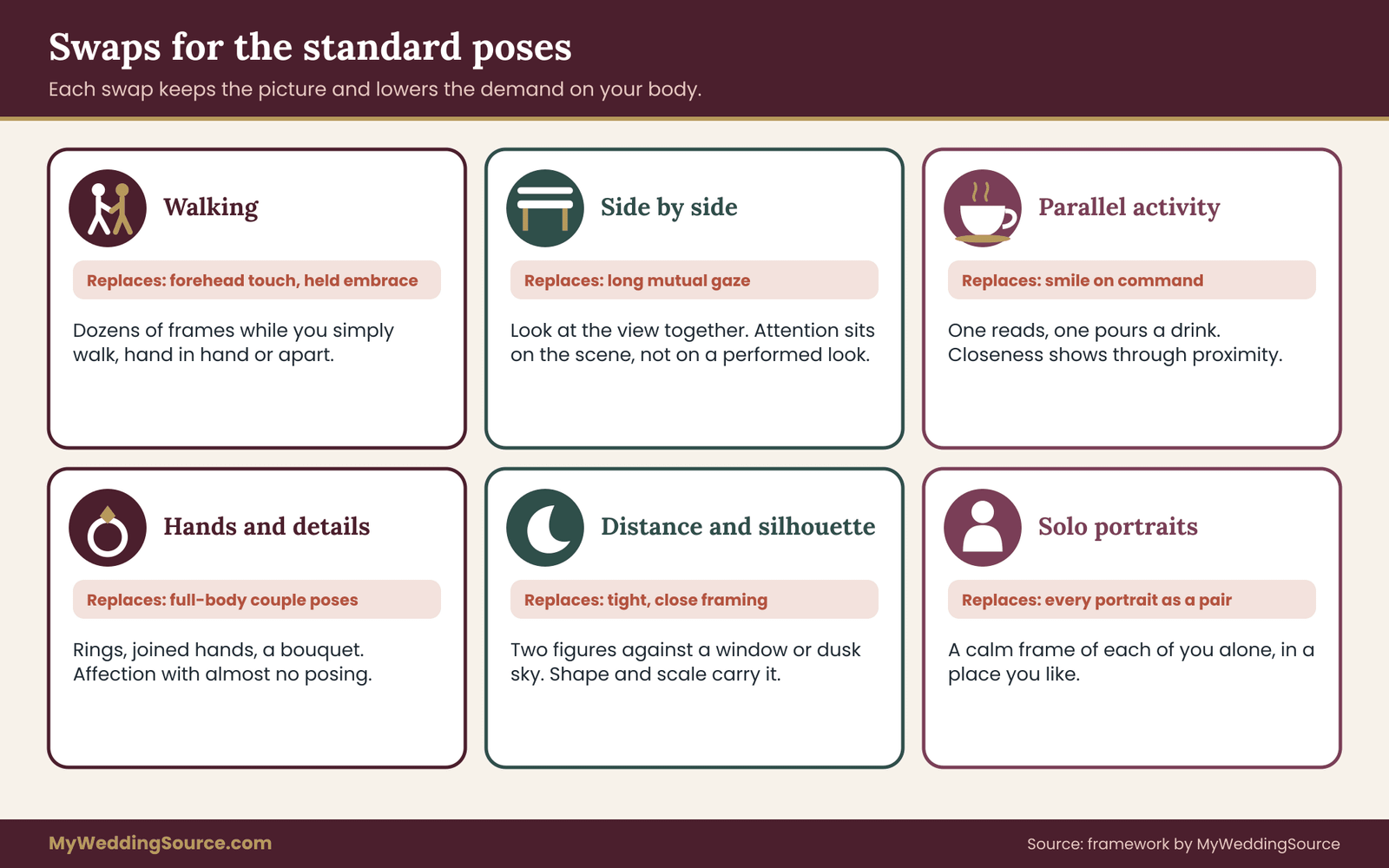
This is where alternatives give the most relief. A set of options that rarely requires extended touch:
Walking. Hold hands or walk side by side along a path, toward and away from the camera. The photographer on a sensory wedding photography job can take dozens of frames while you simply walk, and the result looks natural because it is.
Side by side, looking at the same thing. Sit on a bench or stand at a railing and look at the view. Shoulders may touch if you like. The attention is on the scene, not on each other, which removes the need for eye contact or a performed expression.
Parallel activity. Each of you does something small and separate within the same frame: one reads, one pours a drink, one ties a shoe. The photographer captures the relationship through proximity, not contact.
Hands and details. Rings, joined hands, a bouquet held in two hands, the edge of a sleeve. These frames show affection and are nearly free of posing demands, since only hands appear.
Silhouettes and distance. At dusk or against a bright window, two figures stand at a distance and the photograph shows shape and scale. You can be a few meters from each other and still read as a couple.
Individual portraits. A calm portrait of each of you alone, in a place you like, often says as much about who you are as any couple pose. Some people find this far easier than being photographed together, and the pictures are valued by parents and friends.
The ceremony and the kiss
Ask the photographer to shoot the ceremony without interrupting it and without requesting a repeat of anything. If the kiss matters to you, you can agree beforehand how long it will be and whether the officiant will give a short cue. If you dislike the idea of a public kiss, a forehead touch, a hug or a simple hand clasp can serve as the closing moment instead, and the sensory wedding photography lead will shoot it from where they stand. Nothing about the ceremony requires a posed repeat afterward.
If a photographer typically asks for a “ceremony recreation” after the ceremony, ask them to skip it. The real moment is already captured, and a repeat is just extra posing. If you want to see a more detailed ceremony sequence you can build into the brief, the ceremony cue sheet planning guide shows how to list moments by time, so that the photographer handling sensory wedding photography knows what happens when.
The first dance and the cake
A first dance does not require a dip, a spin or a close-up. Ask for wide frames that show the dance floor and the guests, and let the photographer on a sensory wedding photography job choose moments from a distance. If you do not want to dance, consider a “first conversation” instead, with the two of you sitting at the edge of the floor while the music plays. For cake cutting, choose whether you want to do it at all. If you do, agree on a single take, with the sensory wedding photography lead at a fixed distance and no repeated cutting for the camera.
Family and group moments
Group photos have their own section next, but the principle is the same here: fewer, shorter and with the people who matter most. A short, well-organized list reduces the number of times anyone needs to hug or squeeze in.
Candid coverage as a safety net
In sensory wedding photography, a photographer who shoots candids across the whole day gives you a reserve of pictures that did not cost you any posing. If portraits are shortened or skipped, you still have a gallery. Ask whether the photographer handling sensory wedding photography will shoot candids of the couple during the reception, and tell them whether you are comfortable being photographed while eating and talking, or whether you prefer that those moments be kept private.
Telling the photographer on a sensory wedding photography job what “enough” looks like
Some photographers aim for a long list of portrait setups because they are trying to make sure you have options. You can reassure them by defining “enough.” For example: “We would be happy with six strong couple frames, a handful of walking shots and our ten most important family groups.” A defined target lets the photographer stop when they have it, instead of continuing to look for “one more.”
You can also tell them what you would be sad to miss. A photograph with a grandparent, a candid with a best friend and a quiet frame of the two of you can be more valuable than twenty poses. When the photographer knows what matters most, they can make sure those frames are secure early, before fatigue sets in.
When a pose still happens
Sometimes you will choose to do a pose, because a particular image matters to you or to a relative. That is a legitimate choice. The brief does not forbid anything. It makes sure the pose happens on your terms: asked in advance, kept short, with a clear end, and with a rest afterward. If you decide to go through with a long, close embrace for a grandparent’s sake, tell the photographer how many frames you will give and ask for a break straight afterward.
Family, guests and group photos
Family formals are often the most draining part of a photography day because they combine touch, noise and instruction in a short window. They also involve people who have strong expectations about what the photographs should look like. A little preparation lowers both the demand and the friction.
Make the list short and written
Draft the list of groups in advance with your relatives’ help, and keep it as short as feels comfortable. Each group takes time because people need to be found, gathered and arranged. A list with fifteen groups takes much longer than a list with eight, and it asks more of you.
Print the list and give a copy to the sensory wedding photography lead, your point person and the family member who will call groups. Order it so that the largest groups come first, which means fewer people are waiting around as the groups shrink. Put the groups that include elderly or very young relatives early too, so that they are not waiting for long.
Appoint a wrangler
A family photo wrangler is a person who knows most of your relatives, has a loud, friendly voice and is not you. Their job is to call the next group, move people into place, and keep the line moving. The photographer should not have to do this. A wrangler frees the photographer to concentrate on frames, which shortens the block.
Brief the wrangler on the brief too. They should know about the contact levels, the signal and the time caps. Give them a script for the usual moments. If a relative says “just one more,” the wrangler can say, “We’re on schedule, and they’ll have time to chat at the reception.” If a relative reaches for a hug mid-line, the wrangler can step in with “Wave for the camera, then catch up after.” These small phrases save you from having to say no yourself.
Pose options for groups
Group photographs do not have to involve contact. People can stand in a loose line, in staggered rows or in a natural cluster without touching. The photographer handling sensory wedding photography can ask everyone to place their hands in front of them or at their sides. You can request that no one is asked to put an arm around anyone else. If a relative expects a hug, you can plan a different gesture, such as a handshake, a wave or a hand on the arm, which still reads as warm in the finished picture.
For children, give simple, playful directions that do not rely on being still, such as asking them to hold a flower or point at something. The same goes for older relatives who may find it hard to stand for long. Provide chairs for them and place them at the front.
Guests asking you for photos
During the reception, guests will come up to you for photographs. Consider a single “photo corner” or a timed window where you are happy to pose for them, and tell your point person to steer other requests there. If a guest is persistent, your point person can say, “They’d love one at the photo corner later.” It is better to have one clear, predictable place than to be approached at every table. The questions of image use that arise when guests take photos are covered in the consent guide linked earlier.
What if a relative is offended
Occasionally, a relative will feel slighted by a shorter list or a gesture instead of a hug. You are not obliged to fix this on the wedding day. A phone call or note afterward, thanking them and saying that you wanted to be present for the day, usually works. Most people understand when the reason is simple and is communicated kindly. You can tell them privately that you prefer shorter photographs and that you will see them at the reception. You do not need to explain more. ## A worked example of sensory wedding photography
The example below is invented. Maya and Theo are not real people, and the numbers are chosen only to show how the pieces fit together. It is meant to show reasoning, not to promise any particular result.
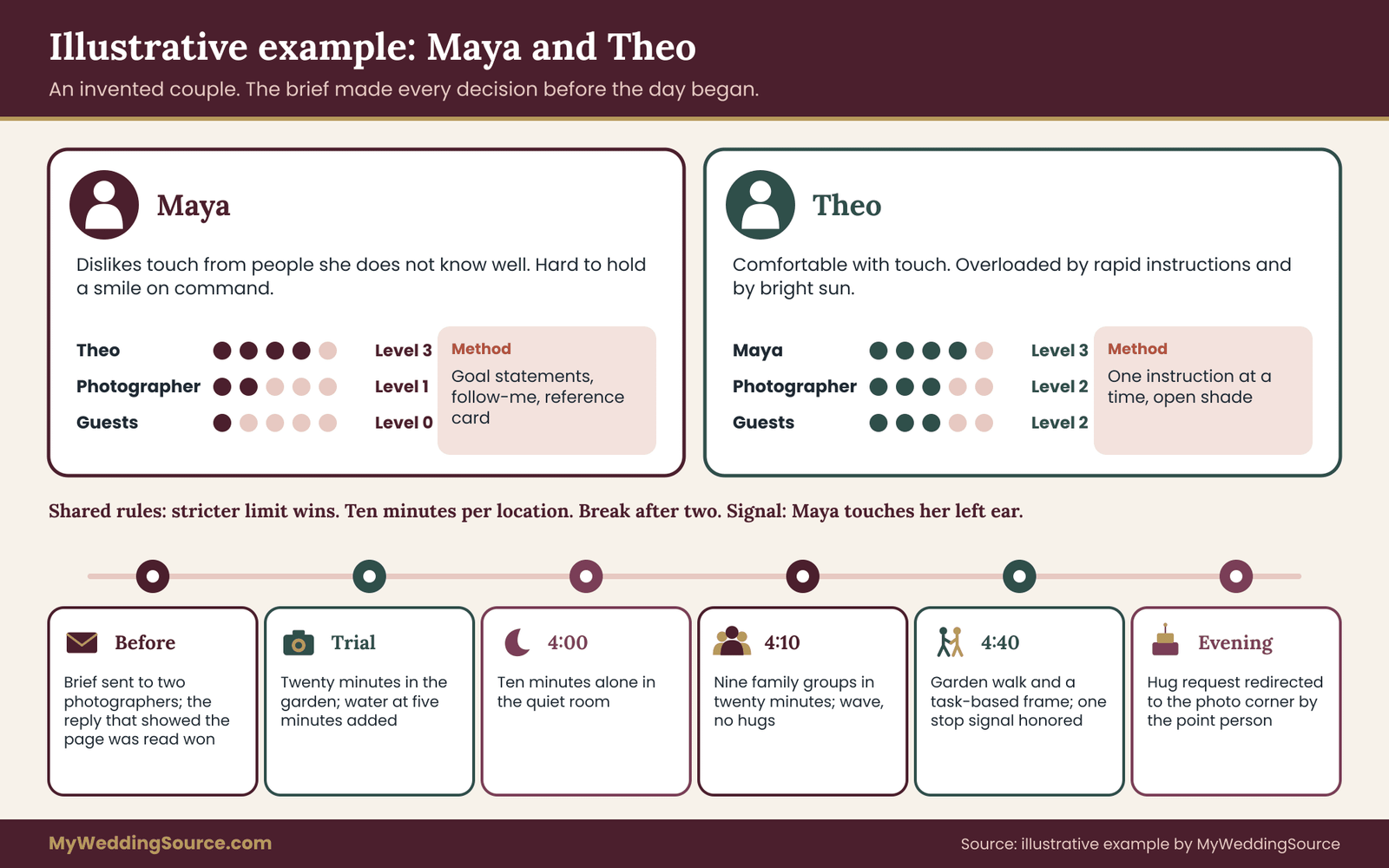
Maya dislikes being touched by people she does not know well, and she finds it hard to hold a smile on command. She is comfortable holding Theo’s hand and leaning on him. Theo has no problem with touch but gets overwhelmed when a person gives him a rapid string of spoken instructions, and he tires quickly in bright sun. They are marrying in a garden venue with a four o’clock ceremony.
Their brief
For the contact map, Maya chose level three with Theo, level one with the photographer and level zero with guests, except for two close relatives. Theo chose level three with Maya, level two with the photographer and level two with guests. The stricter-limit rule applied wherever the two overlapped, so any group shot that involved both of them followed Maya’s levels.
For pose method, both chose goal statements and follow-me, with a reference card for two shots Maya cared about. Theo added a request for one instruction at a time. For time, they set a cap of ten minutes at each location, a break after every two locations and a ten-minute rest after the ceremony before any camera work.
For environment, they asked for open shade, no flash during portraits and a quiet room for breaks. The signal was Maya touching her left ear, or either of them sending a single emoji to their point person. They named Maya’s sister as the point person.
Their “what we want” list had four items: a walk through the garden, a photograph of both sets of parents together, a close frame of their hands with the rings, and a candid of Maya’s grandmother laughing.
The conversation with the photographer on a sensory wedding photography job
Maya and Theo emailed the brief to two photographers and asked each for a quote with the same coverage hours. The first photographer replied that the brief was fine and that they would “sort it out on the day.” The second photographer replied with three questions about shade, the family list and whether a second shooter could cover the cocktail hour. They also asked whether the couple wanted a short trial session. Price was similar. The couple chose the second photographer because the reply showed that the page had been read.
They booked a twenty-minute trial session in the garden. During it, Theo found that he did best when the photographer said a single sentence and then waited. Maya found that her ten-minute cap felt right, but that she wanted a sip of water at the five-minute mark. They added both points and removed one location from the list.
The day, in outline
After the ceremony, the couple took ten minutes in the quiet room. Family formals ran for twenty minutes using a list of nine groups and a wrangler, and Maya’s relatives were told in advance to wave instead of hug. The couple had a ten-minute break. The second block used follow-me for a garden walk and a task-based frame in which they read each other’s notes. Maya touched her ear once, during the second location, and the photographer lowered the camera and waited. The point person offered water and the block ended five minutes early.
At the reception, a cousin asked for a hug before the cake cutting. Maya’s sister said, “They’d love a photo at the corner later,” and the moment passed. The couple chose to cut the cake with a single take and a photographer at a distance.
What the example shows
The photographs were not the main result. The point of the example is that every decision that mattered was made before the day, in writing, by two rested people, and that the day itself followed from them. Nobody had to argue on the spot. The brief also gave the photographer a way to respond to a stop signal without second-guessing it. This is the practical value of sensory wedding photography as a planning method: it shifts the work to the part of the process where you have the most energy and the most control.
Notice also what was not required. Maya did not have to explain anything to anyone, and Theo did not have to pretend that long instructions were easy. Neither partner changed who they were to fit a standard format. They changed the format to fit them.
When sensory wedding photography goes off plan: stop rules and failure conditions
Even a well-made brief for sensory wedding photography can fail. People forget, schedules slip and photographers sometimes drift back to habit. A short list of stop rules, agreed in advance, keeps a bad moment from turning into a bad day.
Stop rules worth writing down
The signal is ignored. If the photographer does not respond to the signal within a moment, the point person calls a halt and the session pauses for the full agreed break. The point person says one sentence: “We need that break now.” The photographer is told in advance that this is the rule.
Unrequested touch. If anyone touches you without asking, the point person steps in and says, “Please ask first.” If it happens a second time with the same person, the point person ends that block. The rule is simple and is not meant to be punitive. It applies to relatives, stylists and photographers equally.
Time cap reached. When the cap for a block is reached, the block ends, even if the photographer has not finished the list. The point person says, “That’s our time,” and the photographer moves to the next item. The photographer should decide in advance which shots are cut first.
One partner is at the limit. If either partner is at their limit, the other does not need to push on. The session pauses. The stricter-limit rule is also a stopping rule: the person who needs to stop sets the pace.
Overrun. If the schedule slips by more than the buffer, cut something. Decide in advance which block loses time first. Many couples choose to shorten the portraits or skip the second location, since those frames are the most replaceable.
What to do when the photographer will not follow the brief
If the photographer pushes back on the day, the point person asks for a short pause and speaks privately. The point person restates the limit and offers the alternative from the brief. If the photographer still refuses, the point person ends the session and asks the photographer to continue with candids only. Sort out any dispute afterward, in writing, and with reference to the agreement.
A photographer who ignores a signed brief has not met the terms of the booking, and you can ask for a remedy such as a partial refund or a reshoot. The vendor contract guide covers how to raise a service problem. Check the exact terms of your contract before you ask for anything specific.
What to do when you are overloaded and there is no break left
Some days are just hard. Heat, a delay, a family conflict or an unexpected noise can all reduce your capacity. When this happens, the best response is to use the revision rule and shorten what is left. Say to your point person, “Cut the list to the three shots that matter.” Choose a photograph you will be sorry to miss and do that one. Then stop. A short list of excellent frames is better than a long list of strained ones.
What the photographs do not need to prove
Some people feel pressure to make the photographs show a certain kind of happiness. You are allowed to look calm, tired, thoughtful, silly or serious. A photograph does not need to show that you enjoyed every moment. The point is that it shows you, on a day you chose, in a way you can look at later without remembering the strain.
A short debrief
After the wedding, spend ten minutes writing down what worked and what did not. Which limits were respected? Which were missed? Which alternatives did you like? If you attend other weddings or ever sit for family portraits, you can reuse the brief with changes. Share it with a friend who is getting married, if they find it useful. The brief is not a one-time document. It is a record of how you like to be photographed, and it improves with each use.
Your next steps
- Each of you fills in the seven fields of the sensory wedding photography brief separately, on paper or on a phone, in ten minutes.
- Compare the pages. Where you differ, apply the stricter-limit rule and note any alternatives.
- Choose your point person and brief them in a short conversation.
- Send the brief to photographers with the same coverage request and compare their replies, not just their prices.
- Book a short trial session with the photographer you prefer, and revise the brief afterward.
- Attach the final brief to the agreement and confirm the break structure in writing.
- Draft the schedule with buffers, a quiet room and a short family list, and share it with the photographer and the venue.
- Tell relatives in advance, kindly and briefly, how you plan to handle photos on the day.
FAQ
Do I need a diagnosis to ask a photographer for fewer poses or less touching?
No. Sensory wedding photography does not require a reason, and a photographer does not need one, and you do not owe one. Preferences about touch, posing and direction are ordinary project requirements, like style or timing. If you want to share a reason, you can, but a short, clear brief works the same either way. If you are curious about disability-related rights, ada.gov explains how the law treats public-facing businesses.
Will we still get good photos without posed portraits?
Yes. Many strong images in sensory wedding photography come from walking, side-by-side, hands, details and candid moments. A photographer can build a full gallery from those frames. The usual risk is not a lack of pictures but a photographer who relies on a fixed set of poses. Review full galleries, ask how they work, and run a short trial session before you commit.
How long should each portrait block be?
There is no correct number in sensory wedding photography. Choose a cap that suits you, such as ten minutes per location with a break after two locations, then test it in a trial session and adjust. Count frames if time is hard to judge. The best length is the one you can sustain without losing the ability to enjoy the reception afterward.
What if my partner is comfortable with touch and I am not?
Use the stricter-limit rule. Any shot involving both of you follows the lower level, while your partner can still choose more contact in moments that involve only them. Neither of you needs to explain or argue. Write both sets of levels on the brief, and make sure the point person knows that the stricter limit decides.
How do I stop relatives from hugging me during formal photos?
Give the family photo wrangler or your point person a short script, such as asking relatives to wave for the camera and catch up at the reception. Send a kind message ahead of time so nobody is surprised. Keep the list of groups short. Most people respond well to a clear, friendly plan.
Can a photographer refuse the brief?
Yes, a photographer may say that a request does not fit how they work. That is useful to know before you pay a deposit. Ask them to say so in writing and choose someone else if needed. If you have already signed, check the contract’s terms about changes and cancellations, and consider asking an advisor for help.
Should we do a trial session first?
A trial session is one of the most effective steps in sensory wedding photography. It shows whether your time cap is realistic, whether goal statements work, and whether the photographer follows the brief. It usually costs money, but it is cheaper than discovering a mismatch on the day. If you cannot book one, test the brief with a friend who has a camera.
What if we are overloaded on the wedding day?
Use the signal and the revision rule. Pause, take the planned break and shorten the list to the shots that matter most. Your point person can handle the conversation. A short set of good frames is better than a long set of strained ones. Remember that you can change any limit on the brief at any time.
Sources
- ADA.gov: U.S. Department of Justice, Americans with Disabilities Act
- CDC: Autism Spectrum Disorder information
- NIMH: National Institute of Mental Health, autism spectrum disorder
- AOTA: American Occupational Therapy Association
- Job Accommodation Network: workplace accommodation guidance
- U.S. Copyright Office: copyright basics for photographs
- NIDCD: National Institute on Deafness and Other Communication Disorders
- W3C Web Accessibility Initiative