
A wedding drink ticket system gives each guest a set number of hosted drinks and lets the guest decide when to spend them, which can protect your budget and keep the bar moving, but it only feels generous when guests know the rules, the numbers fit the length of the evening, and nobody is left thirsty or singled out.
Quick answer
A wedding drink ticket system works best when the hosts want a firm ceiling on bar cost, the guest list is mostly adults who drink, and the plan for what happens after the tickets run out is decided in advance: a cash option, a hosted beer-and-wine tail, or a free nonalcoholic bar. It frustrates guests when the allowance is too small for the evening, when nobody told them in advance, when water and soft drinks are ticketed, or when tickets are handed out unevenly. One retailer guide suggests about two tickets for a two-hour cocktail reception and three to four for a four-to-five-hour wedding, plus a spare ticket or two. Treat that as a starting point and test it against your own timeline using the worksheet in this guide. Rules about who may sell or serve alcohol vary by state, so confirm them with your venue, caterer, or state alcohol agency.
What a wedding drink ticket system is, and what it is not
Most couples meet the idea at someone else’s reception: a small slip, token, or card at the entrance, a bartender who takes one per drink, and a pleasant but slightly awkward moment later in the evening when the tickets are gone. A wedding drink ticket system is that arrangement planned on purpose. Because it sits between the two bar styles guests know best, an open bar and a cash bar, it is easy to misunderstand and easy to run badly. This section pins down the mechanics so the later decisions are about your wedding and not about vague impressions.
The basic mechanics of a wedding drink ticket system
At its simplest, the hosts give every eligible guest a fixed number of tickets, and the bar trades one ticket for one drink. The Knot describes the arrangement as each guest receiving a set number of tickets, with guests going without or paying for more once the tickets are used. It also notes that marked tickets cannot be reused, which is why some hosts choose printed or numbered stock over generic paper. Each of those moving parts, the allowance, the eligible drinks, the handoff, and the rule for extras, is a decision you make before the invitations go out.
The allowance
The allowance is the number of tickets per guest. It is the single most important number in the whole plan because it sets your maximum hosted spend and, just as importantly, the moment in the evening when guests first notice the limit. An allowance that feels fine on paper can run out in the first hour if guests are thirsty, a point we work through in the math section below.
The eligible drinks
Eligible drinks are what a ticket buys. A ticket might buy any drink, one standard pour of beer or wine, a house cocktail, or only alcoholic drinks while water, soda, and mocktails stay free. A retailer guide from a UK wedding supplier suggests agreeing a fixed list with the bar, such as beers, ciders, wines, and simple mixers, and avoiding shots and strong multi-spirit drinks, which cost more and intoxicate faster. That is a UK retailer selling printed tokens, so read it as one vendor’s view, but the principle is sound: the narrower the list, the easier the bar’s job and the clearer the rule for guests.
The handoff and the rule for extras
The handoff is how tickets reach guests, and the rule for extras is what happens next. Some couples let guests pay cash or card for additional drinks, some move to a hosted beer-and-wine tail, and some simply stop alcohol service. Zola describes a ticketed cash bar as a hybrid in which each guest receives one or two vouchers and then pays from the full bar. Whatever you choose, a wedding drink ticket system without a stated rule for extras leaves the bartender improvising, and the guest is the one who feels it.
Where a wedding drink ticket system sits among bar formats
A wedding drink ticket system is not a bar format on its own so much as a way of rationing a hosted portion of one. It can sit in front of a cash bar, in front of a limited beer-and-wine bar, or beside a free nonalcoholic station. Seeing it as a rationing layer helps you compare it fairly with the alternatives.
How it differs from an open bar
In an open bar, the hosts cover consumption, usually priced per person for a set number of hours. Our open bar wedding guide goes through that format from the budget side. The ticket approach differs in one respect that matters to guests: the ceiling is visible. Guests can see it in their hands, which makes the limit transparent and, for some, uncomfortable.
How it differs from a cash bar
A cash bar puts payment on guests from the first drink. The Knot notes that the provider selling alcohol needs the proper license and that only about six percent of weddings in its Real Wedding Study used a cash bar. A wedding drink ticket system is generally experienced as warmer, because the first drinks are a gift, but it keeps some of a cash bar’s friction if guests then have to pay for extras. Decide early which of the two experiences you are actually building.
What a wedding drink ticket system is not
Several things often get bundled with the topic that belong elsewhere. A ticket system does not by itself solve overconsumption, make an unlicensed sale legal, or tell you how much alcohol to buy. It controls how many hosted drinks guests can claim at the bar; it does not control what guests bring in, what they drink at the hotel before the reception, or how fast they drink the tickets they have.
It is not a safety plan
Ticket limits can slow hosted drinking, but they are not a substitute for food, water, a bar team that is comfortable declining service, and a way home. Our wedding bar service planning guide covers staffing and pacing, and our wedding guest transportation planning guide covers the ride home.
It is not a buying plan
How many bottles, kegs, and cases to order is a separate calculation from how many tickets to print. If your caterer or bar provider handles purchasing, they will usually want your ticket count and your menu, not the other way around. For the related ordering details, see wedding bar ice planning and signature cocktail batching for weddings.
Wedding drink wedding drink ticket system benefits: when it helps
The reasons couples choose tickets are real, and a few of them are stronger than they first appear. The benefits below are the ones that sources describe or that follow directly from how the system works. We label which is which, because several claims come from companies that print or sell tickets.
What it does for the hosts
Hosts usually come to a wedding drink ticket system for the budget. It gives them a number they can reason about in advance, and it avoids the situation in which a hosted tab is quietly consumed by a few guests while others barely touch it.
A visible ceiling on hosted drinks
A ticket supply sets a ceiling on hosted drinks. If you print a certain number of tickets and the bar takes one per drink, hosted consumption cannot exceed the tickets in circulation, apart from separate toasts or any exception you build in. An event-ticket printing company says the approach offers predictable, capped alcohol costs and may help hosts negotiate with a venue or caterer. As a vendor, it has an interest in tickets, so treat the negotiation claim as a possibility to test with your own quote, not a promise.
A fairer share of the same hosted pool
A fixed allowance means every guest gets the same hosted share, instead of the share going to whoever visits the bar most often. The UK retailer guide makes this point when it compares tokens with a prepaid tab: on a tab, heavier drinkers can use up the budget early, while on an allowance each guest has an equal portion. Reader comments on a wedding-etiquette blog make the same point about giving every guest the same number, since uneven distribution can make some guests feel slighted. Those are anecdotes, not data, but they match how the system is designed.
Less money handling at the bar
If guests would otherwise pay by cash or card, tickets remove the payment step for the hosted portion. The printing company says the result is faster service and shorter lines. Our own reasoning agrees: a ticket tear takes a second, while a card payment takes several. That advantage shrinks if your ticket plan requires guests to pay for extras, since then you are running both systems at once.
What it does for guests
The best version of a wedding drink ticket system feels like a gift with rules attached. Guests receive something tangible, they know where they stand, and they never have to wonder whether a drink is going to be awkwardly added to anyone’s tab.
A clear, private way to pace the evening
A guest who does not want a crowd watching them order can spend tickets quietly. A guest who wants to save one for the toast, for a first dance, or for a late-evening drink can do that without asking anyone. Used this way, tickets give guests some control over their own pacing. This is our inference from how tickets work, not a measured outcome, but it is why many guests prefer a clear allowance to an unmarked hosted tab.
A choice without a lecture
Unlike a fixed menu, tickets let guests choose among eligible drinks. The UK retailer guide notes that tokens can be exchanged for beer, wine, cocktails, or soft drinks, so non-drinkers and people who dislike the house wine are not left with nothing. That flexibility is also a reason to think carefully about whether nonalcoholic drinks should need a ticket at all, which we take up later.
When the wedding drink ticket system is a good match
Not every wedding benefits equally. A ticket system suits some circumstances better than others, and recognizing yours helps you decide whether to adopt it or move to a simpler format.
Circumstances that favor tickets
Tickets tend to suit weddings where the hosts want a firm cap but do not want guests to pay from the first drink, where the guest list is mostly adults, and where the bar team can handle ticket collection without a long line. They also suit a defined window, such as a cocktail hour, followed by a different arrangement. One reader on a wedding-etiquette blog describes using tickets for one part of the event and switching afterward to a cash bar or stopping alcohol service.
Circumstances that argue against tickets
They are a poor match when the evening is long and the allowance is short, when many guests will not drink and would feel the system is built around alcohol, or when the venue cannot support the handling. In those cases a limited bar, a hosted beer-and-wine bar for set hours, or a dry reception can be simpler. Our guide to welcome drinks versus a full welcome dinner shows a smaller-scale way to host drinks without a wedding drink ticket system at all.
When a wedding drink ticket system frustrates guests
The failure modes of tickets are consistent, and nearly all of them come down to three things: guests not knowing the rules, the number not matching the evening, or the rules feeling unequal. None of the sources we reviewed offers measured complaint rates, so what follows combines the cautions printed by the sources with our own reasoning about how the situation feels from a guest’s chair.
The moment the tickets run out
The Knot lists the central weakness plainly: guests may run out of drinks before the night ends. How that moment feels depends almost entirely on what is waiting on the other side of it.
Running out with no next step
When tickets end and the only next step is an awkward conversation with the bartender, the guest feels the end of the hosting, not the generosity of the first part. If the plan is to switch to a cash bar, guests need to have known that from the invitation, a point Zola makes directly when it recommends telling guests early that they will need cash or a card. A guest who learns at the bar at nine o’clock is the guest who tells the story later.
Running out too early
A related problem is running out hours before the evening winds down. If the allowance is spent during the first cocktail hour, the dinner toast, the dancing, and the late evening all happen with no hosted drinks left. The math section below shows how quickly a small allowance can be spent against a standard pacing assumption.
Guests who feel the system is not for them
A ticket system is designed around drinkers, and it can accidentally make everyone else feel like an afterthought.
Guests who do not drink
If every guest receives drink tickets, a guest who does not drink may feel handed something that does not apply, while a guest who drinks a lot may quietly ask them for theirs. Reader comments on one wedding blog note that heavy drinkers may take tickets from lighter drinkers, which is a reminder that tickets are a form of currency and will move. Make nonalcoholic drinks freely available so nondrinkers get real hospitality, and see our wedding mocktails and wedding nonalcoholic beer and wine guides for ideas that feel like part of the party.
Guests who feel counted
A guest who is handed a small number of tickets in front of the group can feel like they are being rationed, and the feeling is worse if it looks as if other guests, such as the wedding party or older relatives, are quietly given more. The reader comments on one blog suggest that if some people receive extra tickets, it should not be obvious who. We would go further: if the reason for extras is real, such as helpers working the event, consider a different thank-you altogether and keep the guest allowance identical.
Frustrations that start long before the bar
Many problems that show up at the bar are really communication problems from months earlier. A wedding drink ticket system is a message as much as a mechanism.
Surprises about cost or rules
A guest who discovers the limit only when handed the tickets may feel the hosts’ budget has been announced to them. A guest who discovers they must pay for extras at the bar may feel put on the spot. Zola advises telling guests on the invitation and website and offers sample wording for a ticketed version. Our wedding invitation wording guide covers where such a note belongs and how to make it sound like information, not a policy.
Surprises about service
Slower service, a single bar, or a line formed around the ticket table all make an otherwise good plan feel worse. The service numbers come up again in the floor-plan section, but the principle is simple: plan the physical flow for tickets, because the guest feels the line, not the policy behind it.
The wedding drink ticket system math: how many tickets per guest
Numbers are where a wedding drink ticket system succeeds or fails, because the allowance decides both your cost ceiling and the hour at which guests hit the limit. The sources we reviewed give only rough guidance, so this section shows the reasoning step by step, with every assumption labeled, and lets you substitute your own timeline.
Start from how people actually drink at a reception
You cannot choose a sensible allowance without a pacing assumption. A planning guide on Here Comes the Guide offers a common baseline for hosted bars: at least two drinks per adult in the first hour and one drink for each additional hour. That is a rule of thumb for planning purchases, not a measurement of your guests, and it was written for hosted bars, so it likely overstates what a guest does when each drink is visibly counted. We use it here because it is the clearest published baseline we found and because a wedding drink ticket system has to be tested against something.
The baseline in numbers
Using that baseline, a guest who stays for a five-hour reception would be expected to have about six drinks: two in the first hour, then one in each of the next four. At the end of each hour the running total would be two, three, four, five, and six. The same guide gives that arithmetic for a larger group: one hundred adults over five hours is about six drinks each, or roughly six hundred drinks.
What the baseline leaves out
The baseline assumes every adult drinks and that every drink comes from the hosted bar. Real guests do not behave that way. Some do not drink at all, some pace slowly, some arrive late, and some leave early. Because the baseline averages them, a wedding drink ticket system can use it as a stress test (what would happen if everyone followed the baseline?) and not as a forecast.
Read the ticket clock for your own timeline
The most useful way to test an allowance is to ask when the tickets would run out for an average-paced guest. We call that moment the ticket clock. It turns an abstract allowance into a time of night, which is what guests actually experience.

How to read the ticket clock
Take your reception hours and lay the baseline across them: two drinks by the end of hour one, three by the end of hour two, and so on. Then find where your allowance falls. With the baseline, a two-ticket allowance would be spent by the end of the first hour, three tickets by the end of the second hour, four tickets by the end of the third hour, and six tickets would cover the full five hours. These figures are our arithmetic on a published rule of thumb, so they illustrate the timing and do not predict yours.
What the clock tells you about the published ranges
A ticket printing company suggests about two tickets for a two-hour cocktail reception and three to four tickets for a four-to-five-hour wedding or gala, plus a ticket or two of buffer. On the baseline, a two-hour event comes to three drinks, so two tickets would cover roughly two-thirds of it. A five-hour event comes to six, so three to four tickets would cover half to two-thirds. In other words, the published ranges are deliberately lean, which fits their purpose as a cap. The ticket clock shows you the cost of leanness: the evening will run past the tickets, and your plan for that must be good.
Turn the clock into a printed count and a ceiling
Once you have an allowance in mind, the rest of the wedding drink ticket system math is multiplication. The worked numbers below use a round example to show the steps. They are not a forecast for your wedding and not a price quote.
The formula
Tickets to print = adult guests expected × tickets per guest, plus a spare allowance for late additions, lost tickets, and replacements. Hosted drink ceiling = tickets printed. Hosted cost ceiling = tickets printed × the price the bar charges you for a typical ticketed drink. Ask your bar provider how each ticket is priced, because a provider may charge per drink served, per ticket collected, or per drink type, and the terms differ. Bartender fees, taxes, service charges, and gratuity are separate lines unless the contract says otherwise.
A worked example
Suppose one hundred adults are expected and you choose three tickets each. That is three hundred tickets. If you add a ten percent spare supply for late additions and replacements, which is our own planning habit and not a published rule, you would print three hundred thirty. If every ticket is redeemed, hosted drinks are three hundred. If eighty percent are redeemed, hosted drinks are two hundred forty, and at sixty percent they are one hundred eighty. At an assumed round price of ten dollars per redeemed drink, the hosted cost at those three redemption levels would be three thousand, two thousand four hundred, and one thousand eight hundred dollars. Ten dollars is an arithmetic convenience, not a market price, so replace it with the figure in your quote.
What this actually costs
Under a wedding drink ticket system, your hosted drink cost is tickets redeemed times the price per ticketed drink, plus bartender fees, service charges, and tips. Ask whether you pay for tickets printed or for tickets redeemed, because that one term decides whether unused tickets cost you anything. Here Comes the Guide notes that a cash bar still carries setup and bartender costs and a tip of ten to twenty percent of the alcohol bill, and Zola suggests covering bartender gratuities yourself so guests do not tip after paying. Confirm in writing how gratuity is handled.
Check the pour, not just the count
A ticket buys a drink, but a drink is not a fixed unit of alcohol. Before you finalize the allowance, make sure you and the bar mean the same thing by a drink.
What a standard drink is
The National Institute on Alcohol Abuse and Alcohol Addiction defines a U.S. standard drink as fourteen grams of pure alcohol, which is about twelve ounces of five percent beer, five ounces of twelve percent wine, or one and a half ounces of eighty-proof spirits. The same page notes that a twelve-ounce beer at ten percent alcohol by volume contains two standard drinks, and that standard amounts may not match customary serving sizes. The practical lesson for a wedding drink ticket system is that one ticket can mean very different amounts of alcohol depending on what is poured.
Decide the pour before the wedding drink ticket system goes live
Ask the bar whether a ticket buys a single pour, whether a cocktail with two spirits costs one ticket or two, and whether a large-format craft beer counts as one. The answers keep the bartender from improvising and keep guests from feeling that the rules change from person to person. If you offer a signature cocktail, see our signature cocktail batching for weddings guide for how batching affects speed and consistency.
Choosing the tickets, the drinks, and the time windows
With the count in hand, the next decisions are what a ticket buys and when it can be used. These choices change how generous the system feels more than the number does.
What a ticket should and should not cover
A wedding drink ticket system has to answer the question of whether tickets are for alcohol only or for every drink. The answer shapes how inclusive the evening feels.
Keep water and nonalcoholic drinks free
Our recommendation is that water, soda, and nonalcoholic drinks stay outside the ticket system entirely. That recommendation is ours, not a published standard, but it follows the consumer-safety principle that a host should not assume everyone drinks alcohol and should give guests who do not a real alternative. It also removes the cheapest way for a guest to run out of tickets, which is to spend one on a glass of water. For menu ideas, see our guides to wedding mocktails and wedding nonalcoholic beer and wine.
Limit the eligible alcohol list
The UK retailer guide recommends a fixed list of eligible drinks and warns that expensive liqueurs are not necessary to impress guests. Reader comments on a wedding blog suggest similar limits, such as restricting the menu to beer and wine, skipping shots, or offering one signature cocktail. A short menu also speeds service. If you want a ticket plan with real choice, a good middle path is two beers, two wines, one signature cocktail, and one mixer-based option.
Time windows, colors, and wristbands
Tickets can be limited by time or type. That extra control sounds appealing, but each layer is another rule for guests to learn, so add them sparingly.
Time windows
A ticket printing company says tickets can be limited to a time window, such as the cocktail hour. That works well when the hosts want to pay for the opening hour but not the whole evening. It works poorly if guests do not understand the window, so print it on the ticket and repeat it on a sign at the bar. A reader on a wedding blog describes using tickets for one part of the event and moving to a cash bar or ending service afterward.
Colors and wristbands
The same company describes color-coded tickets for different drink categories, and wristbands with detachable tabs for events where people move between spaces. Colors let you, for example, reserve one color for beer and wine and another for spirits. Wristbands reduce the risk of loss and trading but are more suited to festivals and crowd events than to a seated wedding. At a seated reception, a simple printed card in an envelope or at the place setting is usually enough.
Choosing the physical ticket
The ticket is also a small piece of wedding design. It has to survive a pocket, a purse, and a dance floor.
Design and durability
The UK retailer guide warns that homemade tokens can clash with your decor and recommends professional printing, and the printing company says a generic paper ticket handed out at the door can feel tacky while good design and a short explanatory note help. Both are suppliers with a reason to favor professional printing, so weigh the advice accordingly, but the underlying point holds: a ticket that looks like an afterthought tells guests the drink is an afterthought. Choose stock that can survive being carried and is clearly marked so the bar can tell a real ticket from a copy.
Making tickets hard to counterfeit or reuse
The Knot notes that marked tickets cannot be reused. Practical ways to make that true include numbered stock, a stamp at the bar, or tearing each ticket in half. If you use a custom design, tell the bar team what a real one looks like. For a small guest list, simple stock is fine. For a larger one, a mark that is hard to copy at home is worth the small extra cost.
Wedding drink ticket system versus other bar formats
Choosing a wedding drink ticket system means choosing against something. Seeing the alternatives side by side shows what a wedding drink ticket system gives up and what it keeps.
How couples actually split across bar formats
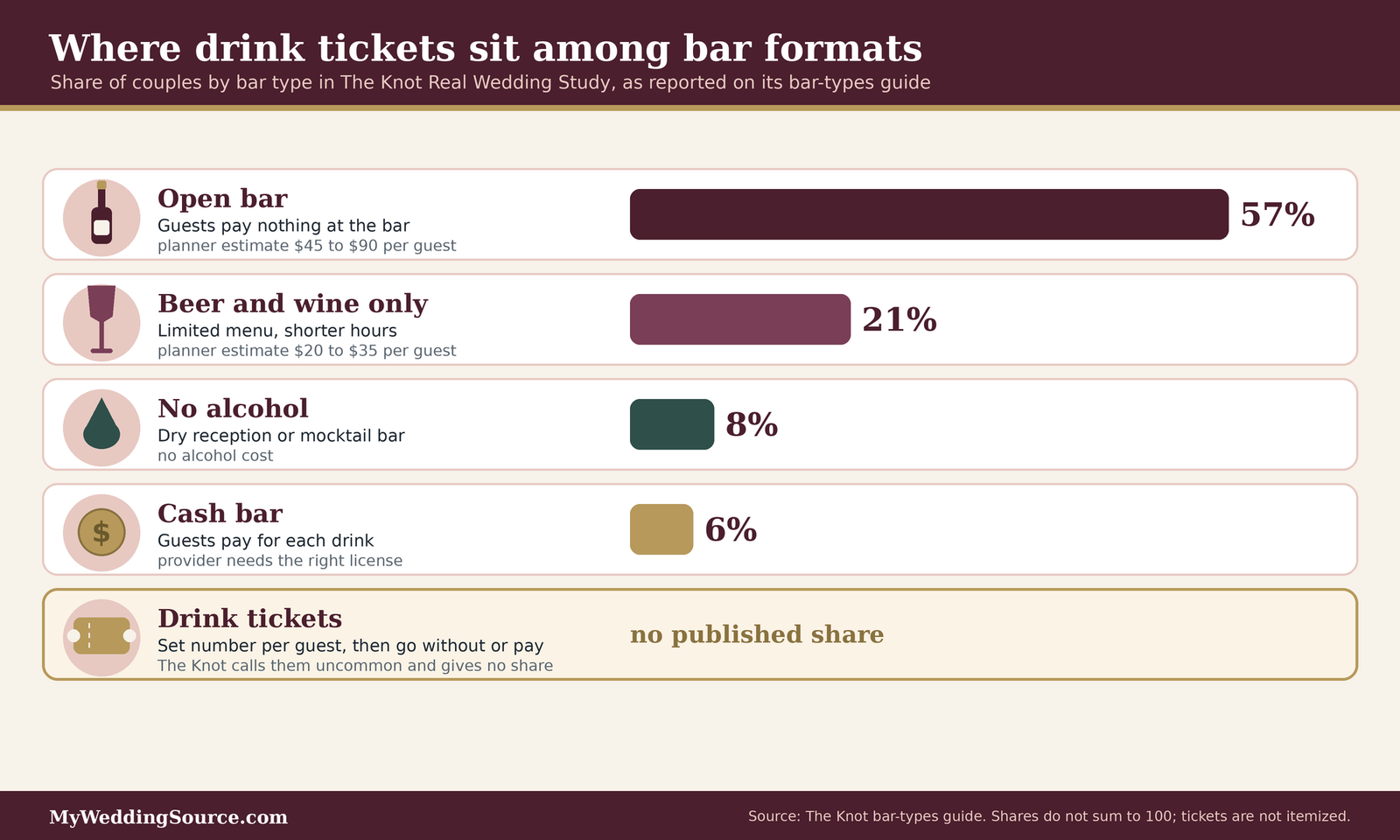
The Knot’s Real Wedding Study, as reported on its bar-types guide, found that the open bar was the most common choice at fifty-seven percent of couples, beer and wine only at twenty-one percent, no alcohol at eight percent, and a cash bar at six percent. The guide describes drink tickets as uncommon and gives no percentage for them. It also reports a planner’s estimate of forty-five to ninety dollars per guest for an open bar and twenty to thirty-five dollars per guest for a limited bar, and says the average spent on wedding alcohol was twenty-four hundred dollars. Those figures are The Knot’s, and pricing differs by region, brands, and hours.
What the split tells you
If tickets are uncommon, a wedding drink ticket system is something your guests may not have seen before. That is not a reason to avoid it, but it is a reason to explain it clearly. A familiar format such as an open or cash bar needs no explanation, and a less familiar one needs a clear sentence on the invitation and a sign at the bar.
What the split does not tell you
The study reports what couples did, not what guests preferred or what worked best. A format being common does not make it right for a particular guest list. Use the numbers to know the landscape and your own budget and guest list to choose within it.
Ticket plus cash: the hybrid most people picture
The most familiar version of the system is tickets for the first drinks, then guests pay. Zola calls it a ticketed cash bar and frames it as a middle ground for couples who want to avoid a pure cash bar.
What makes the hybrid work
The hybrid works when guests are told in advance, when the bar can take payment smoothly, and when someone has authority to decline service. Zola recommends stating the arrangement on the invitation and website, appointing someone with the authority to cut off guests who have had too much, and handling gratuities yourself. Here Comes the Guide describes the same structure, with the host prepaying the first drink or two.
What makes the hybrid frustrating
Zola also acknowledges that cash bars can seem tacky, can slow the bar line, and can make guests feel unwelcome. A hybrid inherits some of that: the moment of switching from hosted to paid is the moment the evening feels different. A venue that can only take cash, or a bar that cannot accept cards, makes the problem worse. Confirm the payment methods and the licensing before you promise guests a pay-for-extras option.
Ticket plus a limited hosted tail, or a free nonalcoholic bar
Not every plan has to end in cash. Two alternatives let the tickets run out without leaving guests stranded.
Hosted beer and wine after the tickets
One approach is to give each guest tickets for any eligible drink and then keep a limited hosted option, such as beer, wine, or both, open for the rest of the evening. That lowers the stakes of running out and still keeps the premium drinks capped. The Knot reports a planner estimate of twenty to thirty-five dollars per person for a limited bar, which you can compare with your own quote to see whether a tail is affordable.
A free nonalcoholic station that never closes
A different approach is to ensure that when tickets end, a rich nonalcoholic option remains: sparkling drinks, mocktails, coffee, and water. Our wedding coffee bar versus espresso cart guide covers a late-evening option. The result is that no guest is ever at a bar with nothing to hold, which is a large part of what makes the end of tickets feel acceptable.
Rules, licensing, and responsibility
Alcohol service is regulated by states and sometimes by localities, and a wedding drink ticket system touches several of those rules at once. This section explains how they tend to work, using examples from two state agencies. It is general information and not legal advice, and your venue, caterer, or state alcohol agency is the authority for your event.
When a license or permit may be needed
The question of whether a permit is needed often turns on whether alcohol is sold, whether guests pay, and who supplies it. A wedding drink ticket system can blur the line, which is the reason to ask.
Examples from two states
Oregon’s liquor agency says a special event license is needed when alcohol is sold, and also when alcohol is available but not sold if payment or a donation is required to attend. Its example of when a license is not needed is a wedding reception where alcohol is provided free and no money is collected. It does not address ticketed drink arrangements specifically and directs those questions to the agency. North Carolina’s alcohol commission describes a limited special occasion permit as generally needed to bring spirits or fortified wine onto a property and serve it at a wedding or party, with an exception for free beer and unfortified wine served to guests over twenty-one at a free event with the owner’s permission. It lists a fifty dollar fee and a fourteen-day lead time, and it too does not say whether guests can be charged under that permit.
What to take from the examples
Two things stand out. First, the rules depend on whether money changes hands, so a plan where guests pay for extras may fall under a different category than a fully hosted event. Second, neither agency’s page answers the ticket question directly. If you plan to charge guests for anything at the bar, ask whether the plan requires a license, who holds it, and whether your caterer or venue already has one. The Knot notes that a cash bar needs a provider with the right license to sell alcohol.
Who is responsible for service under a wedding drink ticket system
At most weddings, the venue, caterer, or bar provider handles alcohol service under its own license and policies. Your contract should say so.
Dram shop and host liability
The Community Preventive Services Task Force explains that dram shop liability holds sellers and servers potentially responsible for harm caused by patrons who were overserved, and that these laws vary by state. It found commercial liability to be an effective strategy for reducing alcohol-related harm. Rules about private hosts differ from rules about commercial servers, and we are not able to explain them for your state. Ask your venue and your insurer, and see our guides to wedding insurance and wedding vendor contracts for how liability and coverage are usually discussed.
Who can say no
Whoever serves the drinks needs the authority to decline service, regardless of how many tickets a guest holds. A ticket is not a promise that a drink will be served. Zola recommends appointing someone with the authority to cut off guests who drink too much. Tell the bar team in writing that they may refuse service to any guest, tickets or not, and that you will back them.
Age, pregnancy, and guests who avoid alcohol in a wedding drink ticket system
A ticket system must not assume that every guest is an adult who drinks. Several groups should not be handed an alcohol voucher without thought.
Age and identification
The Centers for Disease Control and Prevention counts any alcohol use by people younger than twenty-one as excessive drinking. A ticket is not proof of age and should not be redeemed for alcohol by anyone under twenty-one, so the bar, not the ticket, is where identification gets checked. The UK retailer guide advises warning the bar so staff check identification and offering soft drinks to children and teenagers. Our view is that the cleanest practice is to give tickets only to adult guests and still have the bar check identification when a guest looks young or is unknown to the staff.
Pregnancy, recovery, and personal reasons
The CDC treats any alcohol use during pregnancy as excessive drinking, and the NIAAA advises that people who are pregnant, under twenty-one, or recovering from alcohol use disorder avoid alcohol altogether. Do not guess who is pregnant or in recovery, and do not require guests to explain themselves. Offer every guest the same nonalcoholic hospitality and let each person decide what to do with the tickets they receive.
Telling guests about the wedding drink ticket system
How guests hear about a wedding drink ticket system matters as much as the system itself. The same allowance can feel like a gift or a rule depending on when and how it is explained.
What to say about the wedding drink ticket system, and where to say it
Zola advises telling guests early that they will need cash or a card for extra drinks, and stating it on both the invitation and the wedding website. Our wedding invitation wording and wedding RSVP etiquette guides cover where logistics belong, and the general rule is to put the short version where guests will see it and the full version where they can look for it.
Wording that sounds like information
A good note states what is provided, what is next, and what is free, in a friendly tone. For example: “Your hosts are providing a set number of drink tickets for each guest. After those are used, beer and wine can be purchased at the bar by card. Water, soft drinks, and mocktails are always complimentary.” Adjust the middle sentence to your plan. Avoid apologetic language, which makes the plan sound like a problem, and avoid language that sounds like a budget lecture.
Where to put the longer explanation
Use the wedding website for the details: how many tickets, what they cover, what happens afterward, and a line about rides. Our wedding website accessibility audit guide is a reminder to make sure the page can be read by everyone. A guest who reads the website before the wedding will not need to ask the bartender.
How tickets reach guests
There is more than one way to hand out tickets, and each has a different failure mode. The UK retailer guide lists several: ushers handing them out at the entrance, tickets in a favor box or bag at each seat, and a self-service table.
At the entrance, at the seat, or at the table
Handing out tickets at the entrance reaches guests as they arrive, but late arrivals can miss it and a busy entrance can become a bottleneck. Placing them at each seat makes sure everyone present at dinner has them, but guests in the cocktail hour have none. A self-service table asks guests to take their share, which the retailer says only works if you trust guests not to take extra. For most weddings, the entrance, with a short list so that late arrivals can be checked off, is the most controllable.
Why not to mail wedding drink ticket system tickets with invitations
The UK retailer guide discourages sending tokens with invitations because not every invitee attends and some tokens get lost. The practical risk is that tickets leave your control months before the event. Keep them in your control and hand them out on the day.
Making the ticket feel like part of the wedding
A small amount of design effort lowers the odds that the ticket feels like a transaction.
A short card, not just a slip
A printing company suggests a short explanatory note and a design that matches the event. A small card that says what a ticket buys and what is free is enough. That card is also your insurance against the question the bartender gets all night: “what does this cover?”
A sign at the bar
The sign at the bar repeats the rules for guests who left the card in a bag. Our wedding signage guide covers sizes, placement, and wording. Put the three facts that matter on the sign: what a ticket buys, what is free, and what happens afterward.
Running the bar: layout, staffing, and ticket handling
A wedding drink ticket system adds one task to every bar order: take the ticket. That extra step looks tiny but shapes how the bar should be laid out and staffed.
The physical flow of the bar
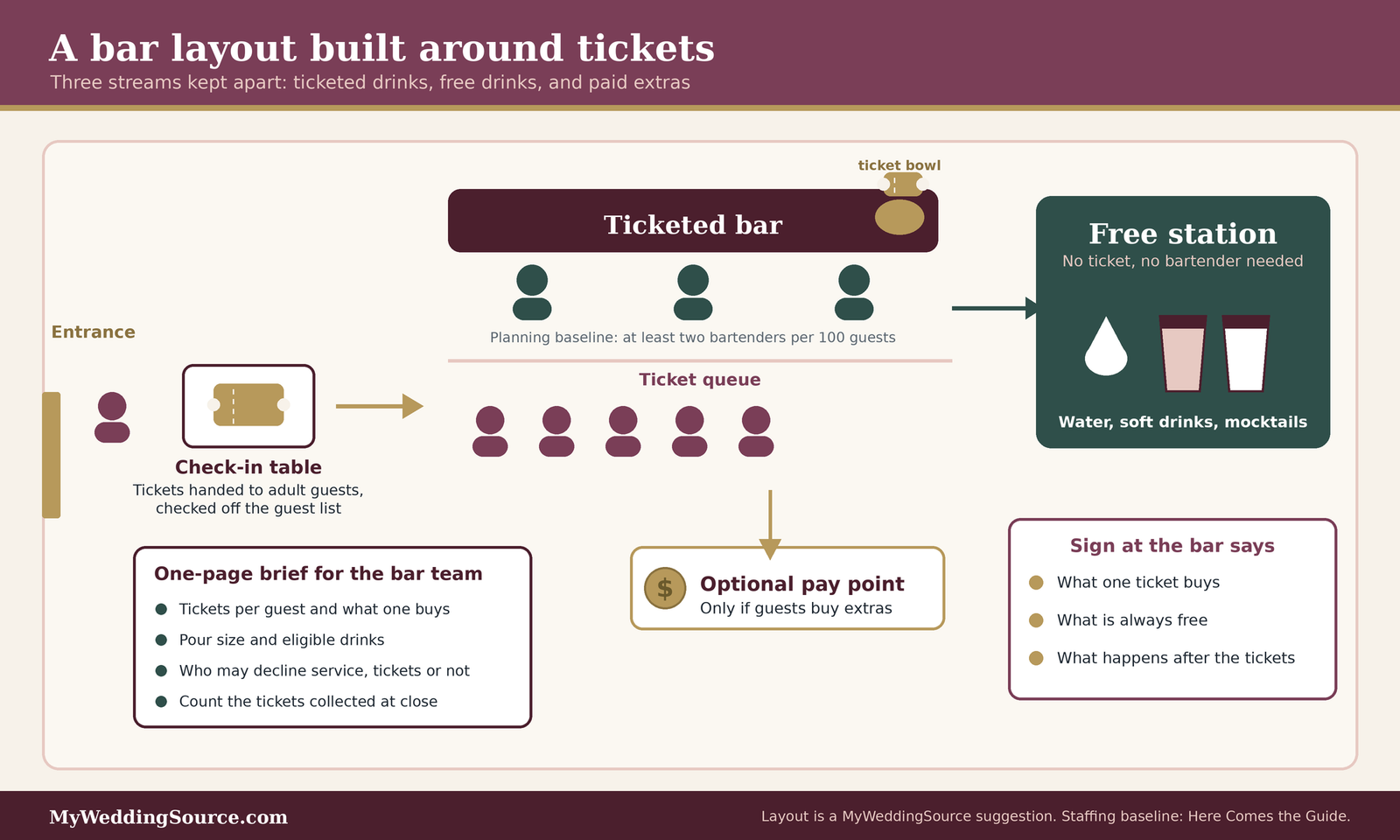
The goal of the layout is to keep three streams from colliding: guests who want a ticketed alcoholic drink, guests who want something free, and guests who want to pay for extras. When all three share one queue, the free drinkers wait behind the ticketed ones.
Separate the free station
Put water, soft drinks, and mocktails at a station that does not take tickets and does not require a bartender. This is our layout recommendation, based on how the queue works, and not a published rule. It shortens the line at the ticketed bar and signals to guests who do not drink that they are served without any special request. See wedding bar service planning for a model of how queue length depends on service time per guest.
Put the ticket collection where the bartender can reach it
Place a small bowl, box, or tray within the bartender’s reach so each ticket can be dropped in without handling. Tickets that go in a pocket get lost, and tickets that go on the bar get reused. Tell the bar to count the collected tickets at the end of the night so you can compare them against the drink count.
Staffing the bar for a wedding drink ticket system
Ticket handling slows each transaction slightly, and a busy cocktail hour is when that adds up. Staffing is therefore a ticket-plan decision, not only a bar decision.
How many bartenders
Here Comes the Guide suggests at least one bar and two bartenders for each one hundred guests as a planning baseline. That figure comes from a planning guide, not a bar operator, so ask your own provider what they recommend for your menu and venue. If your plan concentrates redemption into a short window, such as a one-hour cocktail reception, ask whether a second bar or an extra bartender for that hour is worth the cost.
What the bartender needs to know
Give the bar team a one-page brief: how many tickets each guest received, what a ticket buys, what is free, what happens after tickets run out, the pour size, whether to accept cash or cards, and who has the authority to decline service. Our choosing a wedding bartender guide covers how to find and brief the person behind the bar.
Glassware, ice, and the supply side
A wedding drink ticket system does not change what the bar needs to pour, but it does change when. If most redemptions happen in a short window, the supply of glassware and ice has to peak at the same time.
Glassware and ice at the peak
Ticket redemption tends to cluster at the start, when guests have a full allowance and a fresh drink in mind. Ask your bar provider whether the glassware and ice quantities in the quote are sized for that peak. Our wedding bar glassware rental and wedding bar ice planning guides explain how to size them.
Food safety for the bar
Cut fruit and other garnishes are food, and the federal foodsafety.gov site notes that bacteria multiply fastest between forty and one hundred forty degrees Fahrenheit and recommends refrigerating promptly. That page is about food in general and does not address drinks or ice, so our application to bar garnishes is an inference. Ask the bar how garnishes are kept cold.
The wedding drink ticket schedule: from planning to the day after
This is the working tool of the guide. A wedding drink ticket system involves more tasks than most couples expect, and most of them happen before the wedding. The schedule below lists them in order, with who usually owns each task and what finished looks like. The timing is our suggestion, built from the sources above, and your vendors’ deadlines come first.
Planning and ordering schedule
Treat the table as a checklist that you adapt. If your caterer or venue handles ticketing, many of these tasks move to them, and your job becomes confirming that they are done.
| When | Task | Usual owner | Done when |
|---|---|---|---|
| Before you commit | Decide whether tickets, a hosted bar, or another format fits your budget and guest list | Couple | You can state the rule for extras in one sentence |
| Before you commit | Ask the venue and bar provider whether tickets are allowed and who holds the license | Couple with venue or caterer | You have the answer in writing |
| Early in planning | Choose the allowance using the ticket clock | Couple with bar provider | Allowance and eligible drinks are written down |
| Early in planning | Confirm how the bar prices a ticketed drink and whether you pay for tickets printed or redeemed | Couple | The contract states it |
| With the invitations | Add a short note to the wedding website, and to the invitation if the plan includes paid extras | Couple | Guests can find the rule before they arrive |
| Several weeks before | Order tickets and cards, with a spare supply | Couple or printer | Count matches adult guests plus spares |
| After the RSVP deadline | Reconcile the adult guest count and adjust the ticket count | Couple | Printed count matches confirmed adults |
| One to two weeks before | Brief the bar team in writing, including pour size and who may decline service | Couple with bar lead | Bar lead has confirmed the brief |
| One to two weeks before | Prepare signs and the free nonalcoholic station | Couple or venue | Signs and supplies are approved |
| Week of the wedding | Pack envelopes or boxes and name a person to hand out tickets | Couple, planner, or friend | A named person has the box |
| Day before | Confirm payment methods at the bar if guests can buy extras | Bar provider | Card reader and cash handling are confirmed |
How to use the table
Copy the table into your planning document and add dates against your wedding date. The first four rows are decisions that change the rest, and they are worth completing before you spend money on printing. Our plan wedding timeline guide shows where bar tasks fit into the larger calendar.
What to do when a vendor handles it all
Some venues and caterers already run a ticket or tab system, and then your tasks reduce to approving the allowance, the eligible drinks, and the wording for guests. Ask for their standard terms in writing and compare them with the questions later in this guide. See wedding catering service planning for how bar service fits within catering contracts.
The evening schedule
Within the reception, the wedding drink ticket system can follow the shape of the evening. The suggestions below are ours and are examples to adapt, not rules.
Arrival and cocktail hour
Guests receive tickets as they arrive, and the bar is at its busiest. Have the bar fully staffed before the first guests walk in, keep the free station visible, and have someone near the entrance explaining the tickets in one sentence. The first hour is when the baseline suggests the highest consumption, so this is when a short line is most valuable for any wedding drink ticket system.
Dinner, toasts, and dancing
During dinner, many guests slow down. For toasts, consider providing the toast drink outside the ticket system, so nobody spends a ticket on the moment the room is asked to raise a glass. Zola’s description of a traditional cash bar includes a complimentary toast, which is the same idea. For the toasts themselves, see our wedding speeches guide. When dancing begins, the bar tends to get busy again, which is when a plan for guests who have used their tickets matters most.
Last call and wrap-up
Announce last call with a sign and a quiet word from the bar, not with a public announcement that makes anyone feel singled out. Have the bar count and bag the collected tickets, and record the redeemed total before leaving the venue.
After the wedding
A few tasks remain after the last guest leaves, and they are the ones that make the next plan better.
Reconcile tickets against the invoice
Compare the number of tickets collected with the drinks on the bar’s invoice. If the contract was priced per redeemed drink, the numbers should match closely; if not, ask the bar to explain the difference. If the contract priced tickets printed, unused tickets still count.
Record what your wedding drink ticket system taught you
Write down how many tickets were printed, how many were redeemed, and when the line was longest. The redemption rate is the most useful figure for anyone planning a later event, such as an anniversary party or a family wedding, and it is the only way to replace our assumed percentages with real ones.
Edge cases that quietly cause trouble
Most wedding drink ticket systems run smoothly until one ordinary situation exposes a gap. The cases below are the ones we think are worth settling in advance. The answers are suggestions, not rules, so adapt them to your own plan.
Cases involving guests
People arrive late, bring others, and change their minds. A good plan has a short answer for each situation.
Late arrivals, early departures, and lost tickets
Guests who arrive late should receive the same allowance as everyone else, so keep a checklist at the entrance. Guests who leave early have unused tickets, which is a small cost of fairness and not a problem to solve. For lost tickets, decide in advance whether the bar can replace them. A practical rule is to hold a small reserve with a named person and replace a lost allowance only when a name can be checked against the guest list. The UK retailer guide notes that tokens do get lost, which is one reason a spare supply is worth printing.
Trading, gifting, and sharing
Tickets will move between guests, and you should decide how you feel about it. Reader comments on one wedding blog observe that heavy drinkers may take tickets from lighter drinkers. Gifting a ticket to a friend is harmless in most cases, but a collection of tickets in one person’s hands defeats the purpose of equal allowances. The bar can decline service to anyone who appears to have had enough, no matter how many tickets they hold. If you want a rule, keep it simple: tickets are for the guest named on the card, and the bar may decline service to anyone.
Plus-ones, children, and the wedding party
Decide whether tickets are issued per invitation or per adult attending. Our plus-one wedding etiquette and child-free wedding etiquette guides explain the guest-list side. Give the wedding party the same allowance as everyone else, because reader comments on one blog advise against extra tickets that are visibly uneven. If you want to thank people who helped, do it with a gift and not with extra tickets.
Cases involving the bar and the venue
Some problems arise from the bar’s constraints, not the guests’ behavior. These are worth raising with the provider before signing.
When the venue sets its own rules
Some venues require their own bartenders, restrict outside alcohol, or prohibit certain systems. Our wedding venue questions guide lists questions to ask. The UK retailer guide says the bar must be able to run a tab when tokens are redeemed against one, so confirm that the venue’s system can support the arrangement.
When the plan changes on the night
Plans change. The bar may run out of an eligible drink, the line may be much longer than expected, or the hosts may decide to extend hosted service. Decide in advance who has the authority to change the rules and how it will be communicated. A quiet word with the bartender and a small sign are better than an announcement, which can make guests who have already paid feel penalized.
When it is hot outside
At a summer or outdoor reception, guests tend to drink more water and the bar may need more nonalcoholic options. Our upcoming guide to wedding beverage stations for outdoor heat covers that situation. In heat, the free station matters more than the ticketed bar.
Cases where tickets are the wrong tool
Sometimes the right decision is not to use tickets. Recognizing those cases saves effort.
Alcohol-free and low-alcohol receptions
If the reception is alcohol-free, a wedding drink ticket system has no function. Our upcoming guide to handling an alcohol-free wedding without surprising guests covers that approach, and our guides to mocktails and nonalcoholic beer and wine cover the menu.
When a simpler format would serve better
If your plan requires many exceptions, a limited hosted bar for set hours may be easier to explain and run. Zola describes limited open bars that serve only beer and wine plus signature drinks, and notes the hosts can limit the open bar to cocktail hour. Those options give a cost cap without the handling of tickets. If you are unsure, compare them with our open bar wedding guide.
Questions to ask before you commit to a wedding drink ticket system
These questions turn the wedding drink ticket system guide into a conversation with your venue, caterer, or bar provider. Bring them to the meeting where you decide on the format, and ask for the answers in writing.
Questions for the venue and bar provider
The venue and bar provider control the rules, the license, and the pricing.
Questions to ask the venue, caterer, or bar provider
- Do you allow a ticket system at this venue, and have you run one before?
- Who holds the alcohol license, and does a plan where guests pay for extras change what is required?
- Am I charged for tickets printed or for drinks actually served?
- What does one ticket buy: a single pour, a cocktail, a bottle of beer?
- How are bartender fees, service charges, taxes, and gratuity handled?
- Can the bar accept cards and cash if guests buy extras?
- How many bartenders and bars do you recommend for my guest count and timeline?
- Can your staff decline service to any guest, and will you do so regardless of tickets?
- Where will water and nonalcoholic drinks be served, and are they included?
- What happens to leftover tickets, and how do you count and report redeemed ones?
Questions about the contract
Ask for the ticket terms, pricing basis, and the right to adjust the count after the RSVP deadline in the contract and not only in an email. Our wedding vendor contract guide explains what vendor agreements usually contain.
Questions about your own wedding drink ticket system
Before the meeting, write down your allowance, the eligible drinks, the rule for extras, and the nonalcoholic plan. If you cannot state the rule for extras in one sentence, the plan is not ready, and that is a better thing to learn in a meeting than at the bar.
Questions to ask yourselves
A few questions are about your guests, not your vendors.
Who are our guests, really
Consider how many guests drink, how many are older or traveling a long way, and how many will leave early. A guest list with many nondrinkers makes a free nonalcoholic station more important than the ticket count.
What do we want guests to remember
If you want the evening to feel generous, make sure the final stretch is as warm as the first. A plan that is generous for two hours and then awkward for three leaves the wrong memory.
FAQ: wedding drink ticket system questions
The basics
What is a wedding drink ticket system?
It is an arrangement in which each guest receives a set number of tickets that the bar exchanges for drinks. The Knot says guests go without or pay for more once tickets run out. It sits between an open bar and a cash bar, and it caps the hosted portion of what you spend.
Are drink tickets rude at a wedding?
They are not inherently rude, but they can feel awkward when guests are not told in advance or when the allowance is uneven. Zola suggests stating the plan on the invitation and website. A clear note, equal allowances, and free nonalcoholic drinks go a long way toward making tickets feel hospitable.
The numbers
How many drink tickets should each guest get?
A ticket printing company suggests about two for a two-hour cocktail reception and three to four for a four-to-five-hour wedding, plus a spare ticket or two. Test your own number with the ticket clock in this guide, and compare it with how the evening is structured.
Do I pay for tickets I print or tickets guests use?
It depends on the contract. Some providers charge per drink served and others charge for a set quantity. Ask the bar in writing which applies, because that single term decides whether unused tickets cost you anything. Do not assume. Our worked example in this guide shows how the two compare.
Fairness and safety
Should water and soft drinks cost a ticket?
We recommend they do not. This is our judgment, not a published standard, but it follows the principle that a host should not assume everyone drinks alcohol. Free water and nonalcoholic drinks also prevent guests from spending an alcohol ticket on thirst and keep the bar line shorter.
Can children or guests under twenty-one receive tickets?
Our suggestion is to give tickets only to adult guests and still have the bar check identification. The CDC counts any alcohol use under twenty-one as excessive drinking. Offer children and teenagers soft drinks, and brief the bar so staff know who is who.
Rules and problems
Do I need a license if guests pay for extra drinks?
It may depend on your state and who sells the alcohol. Oregon’s agency says a license is needed when alcohol is sold, while its free-wedding example needs none. Ask your venue, caterer, or state alcohol agency, because rules differ and this is not legal advice.
What should I do when guests run out of tickets?
Decide in advance and tell guests. Options include a cash bar, a limited hosted beer-and-wine tail, or a free nonalcoholic station that stays open. Zola suggests telling guests early about any need for cash or a card, and giving the bartender the authority to decline service.
Your next steps
Decide whether tickets fit
Before you spend anything on printing, settle the choices that shape the rest of the plan.
Run the ticket clock on your wedding drink ticket system
Write down your reception hours and lay the baseline across them. Mark where two, three, and four tickets would run out. If the answer makes you uncomfortable, adjust the allowance or the plan for what happens next. Our wedding budget guide shows where the bar sits in the larger picture.
Ask the three gating questions
Ask your venue and bar provider whether tickets are allowed, who holds the license, and how tickets are priced. Get the answers in writing, and compare formats in our open bar wedding guide if the answers are unfavorable.
Build the plan
Once you have decided to use tickets, make them easy for guests and for the bar.
Write the guest note and the bar brief
Draft the one-paragraph note for your website and the one-page brief for your bartender. Use our wedding reception guide to see where the bar fits in the flow of the evening.
Set up the free station and the schedule
Choose where water and nonalcoholic drinks will be served, then copy the ticket schedule into your planning document with real dates. After the wedding, record how many tickets were printed and redeemed so your next plan is based on real numbers.
Sources & methodology
How we built this guide
What we relied on
This guide combines wedding-planning articles that describe drink tickets and bar formats, a ticket-printing company’s guidance on allowances, a UK wedding supplier’s notes on tokens, reader comments on a wedding blog, federal and national-institute definitions of a standard drink and of risky drinking, two state alcohol agencies’ pages on when a permit is needed, and a public-health review of dram shop liability. Several sources are companies that print or sell tickets, and we say so where we use them. The pacing baseline comes from a planning guide for hosted bars. The ticket clock, the worked example, and the allowance comparisons are our own arithmetic on that baseline, they use assumed round numbers, and they are estimates and not forecasts. We checked these pages on November 12, 2026, and pages, prices, and rules change. Where we state our own recommendation, such as keeping water free, we say it is ours.
What we did not do
We did not interview bar operators, survey guests, or measure real redemption rates, and none of the sources gave measured complaint rates for ticket systems. We cannot tell you what is legal in your state or at your venue, and nothing here is legal, medical, or financial advice. Alcohol laws, permit rules, and liability differ by state and sometimes by city, so confirm them with your venue, caterer, and state alcohol agency. The federal foodsafety.gov home page, the primary reference in our editorial plan, covers food and not drinks, and we used it only for a general point about keeping cut garnishes cold.
Source list
Government, public-health, and regulatory sources
- National Institute on Alcohol Abuse and Alcoholism, What is a standard drink: https://niaaa.nih.gov/alcohols-effects-health/what-standard-drink
- National Institute on Alcohol Abuse and Alcoholism, Basics: defining how much alcohol is too much: https://niaaa.nih.gov/health-professionals-communities/core-resource-on-alcohol/basics-defining-how-much-alcohol-too-much
- Centers for Disease Control and Prevention, Facts about excessive drinking: https://www.cdc.gov/drink-less-be-your-best/facts-about-excessive-drinking/
- Oregon Liquor and Cannabis Commission, Special event licenses: https://www.oregon.gov/olcc/LIC/pages/special_event_licenses.aspx
- North Carolina ABC Commission, Do you need a permit for a special event: https://abc.nc.gov/webform/ncc_permit_application_flowchart
- North Carolina ABC Commission, Limited special occasion and special one-time permit information: https://www.abc.nc.gov/permits/specialpermits
- The Community Guide, Alcohol excessive consumption: dram shop liability: https://thecommunityguide.org/findings/alcohol-excessive-consumption-dram-shop-liability
- FoodSafety.gov, home page: https://www.foodsafety.gov/
Wedding-industry, vendor, and community sources
- The Knot, Wedding bar types: https://www.theknot.com/content/types-wedding-bar
- Zola, Cash bar at a wedding explained: https://www.zola.com/expert-advice/how-to-save-money-with-a-cash-bar-at-your-wedding
- Zola, Open bar weddings: a guide: https://www.zola.com/expert-advice/open-bar-weddings-a-guide
- Here Comes the Guide, How to budget for your wedding bar: https://www.herecomestheguide.com/wedding-ideas/how-to-budget-for-your-wedding-bar
- Eventgroove, What are drink tickets: https://resources.eventgroove.ca/blog/articles/what-are-drink-tickets/
- Bride and Groom Direct, Should I have drink tokens at my wedding: https://brideandgroomdirect.co.uk/blogs/news/should-i-have-drink-tokens-at-my-wedding
- Offbeat Bride, Reader discussion on guests who over-drink: https://offbeatwed.com/guest-over-drinking/