

Wedding bar ice planning is the unglamorous job of working out how much ice you need, where it will be stored, who will deliver it, and how fast it will disappear on the day, so the drinks stay cold and no one has to improvise a bag run during the toasts.
Quick answer
Ice suppliers commonly suggest planning for 1 to 2 pounds of ice per guest, with more for outdoor, warm, or chill-and-serve events, and one major packaged-ice brand’s online calculator lands near 2 pounds per guest for a wedding that both chills and serves drinks. Treat that as a floor for your first wedding bar ice planning estimate, not a promise. Keep ice for drinks separate from ice used to chill bottles and cans, store it in clean food-safe containers out of the sun, and have a delivery or restock plan written down before the day. The ledger later in this wedding bar ice planning guide turns the numbers into a schedule you can hand to your caterer or bartender.
Why wedding bar ice planning deserves its own line item
Most couples spend weeks choosing signature cocktails and almost no time on the frozen water that goes into them. That is understandable. Ice does not appear in a vendor proposal as a showpiece, and it rarely shows up in photos. But a bar without enough cold ice is a bar that serves warm beer, watery cocktails, and long lines, and it is one of the few wedding problems that is almost entirely preventable with arithmetic and a few phone calls.
This guide is written for couples and the people helping them: planners, family members who volunteered to handle drinks, and anyone running a bar themselves. It does not replace your caterer, bartender, or venue, who may already control ice, and in many cases they should. What it gives you is a way to check their approach to wedding bar ice planning, ask better questions, and fill gaps. If you are still deciding how the whole bar will run, start with our guide to wedding bar service planning and come back here for the ice details.
What ice actually does at a wedding bar
Ice has three separate jobs, and they do not all need the same amount, the same container, or the same handling. Treating them as one pile is the most common planning mistake.
Ice chills drinks that are being poured
Every cocktail, highball, and mocktail poured over ice uses some of it, and the amount is roughly predictable once you know how many drinks the bar will serve. This is serving ice, and it is the ice that touches what guests consume. It needs the cleanest handling.
Ice dilutes as it cools
A drink with ice is slightly more diluted by the time a guest finishes it, because melting is part of how ice cools a drink. That is normal and often intended. It also means that very slow melting, such as with large-format ice, and very fast melting, such as small pieces in a warm room, change how a drink tastes over twenty minutes. Ask your bartender what they plan for each recipe instead of assuming that all ice behaves the same.
Ice holds packaged drinks cold
Beer, seltzer, canned cocktails, sparkling water, and soda often sit in tubs or coolers surrounded by ice. This is chilling ice. Because it touches the outside of cans and bottles, and often sits in dirty meltwater, it is not meant to be scooped into anyone’s glass. Later we cover the rule that keeps these two uses apart.
What goes wrong when ice is an afterthought
None of the problems below are dramatic on their own, but each one starts with thin wedding bar ice planning. Together they can turn a good bar into a frustrating one, and several are hard to fix once guests are already thirsty.
The bar runs out during the peak hour
Drink demand is not spread evenly. The pace convention we use later assumes the first hour is the busiest, when guests arrive, mingle, and want something in hand. If the ice supply was sized for an average hour, the bar can run dry at the exact moment the line is longest. The drink-count method for wedding bar ice planning later in this guide builds in that early peak.
Shortcuts creep in
When ice runs low, people improvise. Someone scoops ice from the cooler holding the beer, someone uses a glass to scoop, or a guest reaches in by hand. Each of those shortcuts conflicts with basic ice-handling guidance from public health sources, and all of them are avoidable if a backup plan exists, which is the whole point of wedding bar ice planning.
Emergency ice costs more in every way
A last-minute run means a vehicle, a person who is no longer doing their assigned job, and a trip to a store that may also be low on stock before a holiday weekend. The cost is not only money. It is the attention of the one person who knows where everything is. Our guide to vendor overtime rates for weddings explains how unplanned extra work can show up on a bill when a vendor has to stay or leave.
How much ice a wedding bar needs
There is no single correct number, and anyone who gives you one without asking about your guest count, your menu, your venue, and the weather is guessing. What exists are supplier rules of thumb and a drink-count method you can calculate yourself. Used together they give you a range, and the range is more useful than a point estimate. Wedding bar ice planning works best as a range with a margin, not a single figure.
Rules of thumb from ice suppliers
Packaged-ice companies publish quick guidance because their customers ask the same question constantly. These figures come from sellers of ice, so they reflect that industry’s habits and incentives. They are still a useful starting point because they are consistent with each other. For wedding bar ice planning, agreement across sources matters more than false precision.
One to two pounds per guest
Reddy Ice, a large U.S. packaged-ice company, tells party hosts to plan for about 1 to 2 pounds of ice per guest, with outdoor and warm-weather events at the higher end and indoor winter events lower. Tasting Table, a food publication, gives the same base range for chilling drinks. When two independent sources agree on a range, it is reasonable to use it as a baseline, while remembering that neither source knows your event. Wedding bar ice planning always starts with a range and then narrows it.
What a supplier’s calculator suggests for a wedding
Reddy Ice’s online calculator asks for guest count, event type, and whether the ice is used for chilling only or for chilling and serving. Its event types include an indoor and an outdoor special event such as a wedding. In the company’s own worked examples, a 50-guest outdoor gathering where drinks were only chilled came to about 15 seven-pound bags, and a 75-guest indoor party with cocktails came to about 22 bags. Those work out to roughly 2 pounds per guest, which is our own division, not the company’s wording. The page does not explain the calculator’s assumptions, so treat the output as a data point. In wedding bar ice planning, a calculator is one input, not the answer.
Why the hot-day number doubles
Tasting Table suggests doubling the base amount for hot weather, outdoor parties, or warm indoor spaces, so there is enough to replace ice that has melted. The reasoning is simple: ice that melts without chilling anything is wasted, and a warm environment melts more of it. If your reception is outdoors in summer, the 2-pound end of the range may be your minimum, not your maximum. Our guide to the summer wedding heat plan covers heat planning for the rest of the day.
Build your own estimate from drink counts
A guest-count rule is fast but blunt. A drink-count estimate takes ten minutes and shows you where the ice actually goes, which makes it the more informative half of wedding bar ice planning. The steps below use a pace and a per-drink figure from Tasting Table, which we are borrowing as a planning convention, not a measured fact about your guests.
Estimate the drink pace
Tasting Table suggests assuming about two drinks per guest in the first hour and about one drink per guest in each hour after. For a five-hour reception with 100 guests, that is 200 drinks in the first hour and 100 in each of the next four, or 600 drinks in total. This counts every drink poured, including water, soda, and mocktails, and it assumes everyone drinks at the same pace. Real guests do not. Some will not drink alcohol at all, and some will drink wine at the table without ever visiting the bar. So treat 600 as an upper-leaning planning figure. That is deliberate, since wedding bar ice planning errs better on the side of too much than too little.
Estimate the ice per drink
The same source suggests about three cubes per drink, with each cube weighing roughly one ounce. That is about 3 ounces of ice per drink. Multiplying 600 drinks by 3 ounces gives 1,800 ounces, or about 112 pounds of serving ice for the whole reception. This is our own arithmetic from those assumptions and should be labeled an estimate. A drink served without ice, such as a glass of wine, uses none. A tall highball may use more than three cubes.
Add the chilling ice separately
Chilling ice is a different pile. Tasting Table suggests the same 1 to 2 pounds per guest for chilling drinks, which for 100 guests is 100 to 200 pounds, before any hot-day adjustment. Adding about 112 pounds of serving ice to 100 pounds of chilling ice gives about 212 pounds, or roughly 31 seven-pound bags. That is close to the 2-pounds-per-guest figure from the supplier calculator, which is a reassuring cross-check, though the two methods share some assumptions, so agreement is not proof. Use the pair as the two ends of your wedding bar ice planning range.

Adjust for your own event
The numbers above assume an average mix of drinks, weather, and guests. Real weddings rarely are. These adjustments help you decide which way to lean.
Weather and setting
An outdoor reception in direct sun is the harshest case. The National Weather Service notes that full sunshine can raise the heat index by up to 15 degrees Fahrenheit compared with shady conditions, which is a useful reminder that a thermometer reading in the shade understates what a sunlit bar tub experiences. An air-conditioned ballroom sits at the other extreme. A tent on a warm night sits somewhere in between, and an enclosed tent may hold more heat than open air. When in doubt, build your wedding bar ice planning around the setting that is hotter than your forecast.
The menu changes the math
A bar built around spirits and mixers will generally use more ice than a beer-and-wine bar, because beer and wine are mostly chilled in tubs rather than poured over ice. Ask your bartender how each signature drink is built: whether it is shaken or stirred with ice that is then discarded, whether it is served over cubes, crushed ice, or one large piece, and whether it is served without ice at all. Each answer changes the pounds per drink, and with it your wedding bar ice planning. Batched drinks that are served cold from a dispenser use less at the bar but still need chilling ice for the dispenser. Our guide to signature cocktail batching for weddings explains how batching changes what happens behind the bar.
Not every guest will be drinking alcohol
Do not assume anything about who will or will not drink, or about what is legal for each guest. A wedding can include guests who do not drink, guests who are under the legal drinking age, and guests who prefer nonalcoholic options. Soda, sparkling water, and mocktails still use ice, so a nonalcoholic bar does not need less wedding bar ice planning, just different planning. If you want ideas for the nonalcoholic side, see our guides to wedding mocktails and nonalcoholic beer and wine at weddings. Rules about who may be served, and about bringing your own alcohol, vary by state and venue, so confirm them locally.
Types of ice and what each is good for
Ice is sold in several forms, and the form you buy affects how long it lasts, how fast it chills, and how easy it is to pour. This is a quiet but real part of wedding bar ice planning. The research here is thinner than the marketing, so we stick to what two sources actually say and flag the rest as questions for your bartender.
Cubed ice and block ice
The cleanest published comparison we found comes from a cooler manufacturer, so it reflects that company’s testing and interests. It is still useful for deciding what goes in the tubs.
What the cooler maker says
YETI’s guidance says block ice lasts longer than cubed ice because it has less surface area, while cubed ice chills faster but melts faster. It suggests that choosing well can extend how long a cooler stays cold and recommends layering block ice on the bottom with cubed ice on top. YETI also says it does not guarantee any particular duration, because many variables affect ice retention. That caveat applies to your wedding too. Nobody can promise you how many hours a tub will last.
How that applies to a bar
Packaged drinks that need to stay cold for hours, such as beer and seltzer in a tub, are the natural place for block ice or a block-and-cube layer. Ice that goes into glasses needs pieces that fit a glass and pour well, which usually means cubes. Reddy Ice lists premium packaged ice, packaged block ice, gourmet ice, dry ice, and a craft ice product on its site, which shows that the same supplier offers different forms for different jobs. Ask your supplier or caterer which forms they can deliver and which they recommend for the tub and for the glass. Put the answer in your wedding bar ice planning notes.
Crushed, large-format, and specialty ice
Some cocktails are built around a particular kind of ice. If your menu has one, treat it as a separate line in your ice plan.
Ask what each signature drink needs
We do not have a reliable published source for how much ice a crushed or large-format drink uses, so we will not give you a number. What we can say is that the bartender who designs the drink knows. Ask for the ice form, the pounds per drink, and where that ice will come from. If your bartender plans to make specialty ice in advance, ask where it will be stored and how it will stay frozen until service. Specialty ice belongs in wedding bar ice planning from the first conversation, not the week before.
Decide whether it is worth the complexity
A specialty ice can make a drink look and feel distinctive, but it adds a storage and handling step. If your venue has limited freezer space, or your bar will be working outdoors in heat, a simpler cube may be the safer choice. This is a judgment call, and a reasonable bartender will tell you honestly whether the effect is worth the logistics. Simple choices make wedding bar ice planning easier to carry out under pressure.
Dry ice is a different tool
Dry ice is solid carbon dioxide, not frozen water, and it follows different rules. It appears in wedding conversations because it is used for fog effects and for keeping things very cold.
Why it is not just colder ice
A North Dakota Department of Health fact sheet describes dry ice as about minus 109 degrees Fahrenheit, turning directly from solid to gas. It advises using it only in well-ventilated areas and never in a sealed container, because the gas can build enough pressure to burst the container. It also advises thermal gloves, since skin contact can burn. The carbon dioxide gas is heavier than air and can displace oxygen in enclosed spaces, which is why vehicles and closed rooms are poor places for it.
Dry ice in drinks needs a professional decision
The Association of Food and Drug Officials adopted a 2016 resolution that raised concerns about dry ice and liquid nitrogen as food and beverage ingredients, noting that dry ice can cause frostbite and that its gas can build up dangerously in enclosed spaces. The resolution’s main concern is that dry ice should fully disappear before a drink is consumed. We are not giving legal or medical advice, but our view as editors is plain: do not add dry ice to guests’ drinks unless an experienced bartender, your caterer, and your local health department have each said how it will be done. For keeping packaged drinks cold, ordinary ice is usually sufficient, and it keeps wedding bar ice planning simpler.
Food safety basics for ice
Ice is a food. That one idea makes most of the rules in this section easy to remember, and it explains why a bag of ice has a label and a manufacturer name. Food safety is the part of wedding bar ice planning that guests never notice unless it fails.
Ice is regulated as a food
You do not need to memorize regulations, but knowing the outline helps you ask good questions.
What the FDA says about packaged ice
The FDA regulates packaged ice sold across state lines as a food under its good manufacturing practice rules. It says manufacturers must keep ice clean and sanitary during production, holding, and transport, using safe water. It also says labels must carry the maker’s or distributor’s name and place of business and the net quantity. The FDA does not inspect small producers who sell only within one state or food service establishments that make ice for immediate use. State and local authorities oversee those.
What this means for your event
When you buy ice from a reputable supplier, the packaging tells you who made it. If someone offers to make ice at home for the wedding, or a friend plans to fill bags from a home freezer, ask your caterer and venue whether that is allowed. We are not suggesting it is unsafe by definition, only that home-made ice is outside the labeled, inspected supply chain, and venues and caterers may have rules about it. Local health departments have the final word, and reputable sourcing is the foundation of wedding bar ice planning.
Keep drink ice and chilling ice apart
This is the single most useful rule in the guide, and it is the one most often broken at weddings.
The rule
The FDA Food Code, a model that most state and local food rules are based on, says ice that has been used as an exterior coolant, for example around packaged beverages, may not later be used as food. Washington State’s adopted version of that section states the same prohibition plainly. Because states adopt the Food Code in their own versions, check your local rule, but the principle is widely shared: ice from the beer tub is never drink ice.
How to make it easy to follow
Physically separate the two. Use differently colored or clearly labeled containers, keep the tubs away from the bar’s ice bin, and tell everyone working the bar which is which. If your venue or a rental company provides tubs, ask whether the bar’s ice bin is a separate piece of equipment. Add a line in your bar notes: tubs are for packaged drinks only, the bin is for glasses only. That one line does a lot of work in wedding bar ice planning.
Scoops, bins, and hands
Cleanliness in wedding bar ice planning is mostly about contact. The less a surface or a hand touches the ice, the less can go wrong.
Tools and containers
A District of Columbia Department of Health fact sheet on ice as food advises using scoops or tongs rather than hands, never using a glass as a scoop, storing scoops in a sanitary place when not in use, keeping ice storage containers covered when not in use, and treating ice buckets as food-contact surfaces. It also advises wiping the outside of ice bags before opening them, and it warns against dropping ice bags, since broken ice can puncture the bag. The FDA’s packaged ice page gives similar advice about clean, non-breakable tools and not touching ice with dirty hands or glasses.
People and handwashing
The Centers for Disease Control and Prevention advises washing hands with soap and water for at least 20 seconds before handling food, notes that hand sanitizer does not work well against norovirus, and says people who are sick should not handle food for others, including waiting at least 48 hours after symptoms stop before returning to food work. For a wedding, that means the person running the bar, and any friend or family member helping at it, should know they can step aside if they are unwell, without anyone being upset about it. Build that permission into your wedding bar ice planning.
When glass breaks near the ice
Broken glass in an ice bin is rare but serious, and a plan for it takes thirty seconds to write into your wedding bar ice planning.
Why it matters
Glass fragments mixed into ice could injure a guest, and ice that has been contaminated by fragments is hard to inspect. The DC fact sheet’s advice never to use a glass as a scoop addresses the most common way glass ends up in ice. A glass that chips or breaks near the bin is a problem for the bin, not only for the glass.
A simple protocol
Common practice, and our recommendation, is that if a glass breaks in or directly over an ice bin, the bartender stops service from that bin, discards the ice, cleans and sanitizes the bin, and refills it from sealed stock. That is not a legal standard we can cite, so confirm it with your caterer or health department. Keep a spare sanitized scoop, and a small supply of sealed bags of ice, set aside from the main stock for exactly this situation. Our guide to wedding bar glassware rental covers choosing glassware and planning for breakage.
Storage: where the ice lives before and during the party
Ice that is delivered at two in the afternoon and used at seven has to live somewhere in between. Storage is where most of the avoidable melting happens, and it is where the venue’s facilities decide what is possible. Good wedding bar ice planning treats storage as seriously as quantity.
Cooler capacity and packing
If your ice and drinks will live in coolers or tubs, how they are packed matters as much as how many you own.
The two-to-one starting point
Reddy Ice’s calculator page recommends a 2:1 ice-to-contents ratio for coolers, which means about twice as much ice by volume as drinks. This is a retailer’s rule of thumb and the page does not explain its basis, so treat it as a starting point. It does tell you something useful: a cooler full of cans and a handful of ice is not a plan. If you will chill 100 cans and bottles, you need room for a lot of ice too, which usually means more or larger containers than people expect.
Fuller coolers stay cold longer
A USDA press release on outdoor food safety advises keeping a cooler fully stocked with ice or frozen cold sources and filling empty space with extra ice, noting that a fuller cooler stays cold longer than a half-full one. YETI says less air space means slower melting. The two sources agree, and the advice costs nothing: pack tightly, and fill gaps with more ice, instead of leaving air. This is one of the cheapest wins in wedding bar ice planning.
Pre-chill the container and the drinks
YETI suggests pre-chilling a cooler by filling it with ice or frozen bottles a few hours before packing. The same idea applies to the drinks themselves, and the melt-risks section below shows why. Room-temperature cans and bottles take a surprising amount of ice to cool, so if the venue or caterer has refrigeration, ask whether packaged drinks can be chilled there before the event instead of in the tubs. Our guide to wedding flower refrigeration explains how couples can ask about cold-storage space at a venue.
Where to put the ice
In wedding bar ice planning, location is the second-biggest factor after quantity.
Shade, surface, and air
YETI recommends keeping coolers out of direct sunlight, covering them with a light-colored towel when shade is not available, and raising them off hot surfaces such as pavement or sand. The USDA release likewise advises keeping the cooler in the shade. On a patio, lawn, or beach, that can mean positioning the bar and the storage behind a tent, a wall, or a rented canopy. The National Weather Service point about full sun adding to heat index values is a reminder that the sunny spot is the hot spot.
Close to the bar, away from guests
Ice storage should be close enough that a runner can restock quickly, and out of the way of guests, who may not realize that a tub is not a self-serve station. A cluster behind the bar, or just behind a screened area, works at many venues. Mark it clearly, and ask the bartender to decide where each container goes before service begins, and write the layout into your wedding bar ice planning notes.
Meltwater, drainage, and the venue
What happens to melted ice is a practical question with a hygiene dimension.
Should you drain the water
YETI says cold meltwater helps insulate the remaining ice and suggests draining only to keep items dry or to make room. That is guidance about coolers for camping and tailgating, so for a bar, apply it with care. Meltwater in a tub that holds cans is fine to leave for a while, but meltwater in a food-contact bin that holds drink ice is something your bartender should manage according to their own sanitation practices. Ask them.
Ask the venue what it offers
Some venues have ice machines, freezers, back-of-house refrigeration, floor drains, or loading access that make everything easier. Others have none. Ask what is available, whether you may use it, whether there is a fee, and who is responsible for cleaning it. Venue answers often reshape wedding bar ice planning more than any calculation does. Our list of wedding venue questions and the outdoor wedding infrastructure checklist can help you add ice and cold storage to a venue walkthrough. If you are depending on electric equipment such as a rented freezer or ice machine, power needs to be part of the conversation, and our guide to wedding generator rental explains how to size it.
Delivery: ordering, receiving, and timing
Delivery is where wedding bar ice planning fails quietly. The ice is ordered, the truck is scheduled, and then nobody is at the loading area, or the door is locked, or the ice sits in the sun for two hours.
Who orders the ice
The first question is whose job it is. At many weddings, the honest answer is that nobody knows. Settling it early is the single biggest improvement you can make to wedding bar ice planning.
Caterer, bartender, venue, or you
Full-service caterers and bar companies often include ice in their package, or have a default quantity that is not enough for your specific event. Venues sometimes provide ice or require you to use theirs. If you are hiring a bartender only, ice is often yours to supply. Ask each party directly: do you supply ice, how much, in which form, and what happens if the amount runs short. Our guide to choosing a wedding bartender explains how to compare bar services, including what they include.
Get the quantity and the cost in writing
When a vendor supplies ice, ask them to state the quantity in pounds or bags, the form (cubed, block, other), the delivery time, and what they charge for extra. When you supply ice, write the same details down for yourself. A phrase like “plenty of ice” in a contract is not a number. Our wedding vendor due diligence checklist helps you check what a vendor has actually committed to in writing.
Receiving the delivery
The handoff matters more than most people think.
Name a receiver and a place
Someone with authority should be present when the ice arrives, know where it goes, and have a key or door code if needed. That person might be the venue coordinator, the catering captain, or a planner. If nobody on your team can be there, ask whether the supplier can leave it in a locked or supervised area, and who will carry it. A named receiver turns wedding bar ice planning from a hope into a procedure.
Check the ice when it arrives
Before signing, check that the bags are intact and sealed, labeled with the manufacturer’s name, and not visibly melted or leaking. The FDA says packaged ice labels must show the manufacturer’s, packer’s, or distributor’s name and place of business. If the delivery is short, damaged, or soft, note it on the paperwork while the driver is present.
Timing and backup supply
A delivery time is a trade-off between melting before the event and running out during it, and wedding bar ice planning has to pick a side on purpose.
Deliver as close to service as the venue allows
Ice delivered earlier has more time to melt, particularly if it sits in a hot loading area or an unrefrigerated room. Ice delivered later may arrive after the bartender needs it, or collide with other vendor deliveries and setup. We cannot tell you a universal lead time, and the Reddy Ice calculator page does not give one, so ask your supplier or caterer when delivery is practical and how the ice will be stored on arrival.
Plan a restock source before you need one
Name a backup: a store near the venue, a second supplier, or a volunteer or hired runner with a vehicle and a cooler. Write down the name, the phone number, how far the store is, and who authorizes the spend. If the plan is never used, it cost you nothing. If it is, everyone will be glad it existed. A named backup supplier is the cheapest insurance in wedding bar ice planning.
Cost note
We did not find a reliable national price for bagged ice, and prices vary by region, season, and supplier, so we are not quoting one. Instead, use this formula: the number of bags from your estimate, multiplied by the per-bag price in your quote, plus any delivery fee, plus the cost of any rented tubs, bins, or freezers. For example, if the estimate in the ledger is 31 bags, and a quote were a placeholder of four dollars per bag (this is a made-up number for illustration only), the ice itself would be about 124 dollars. Compare that to the cost of one unplanned run, and the usual conclusion is that buying a little extra is cheap insurance. Our wedding budget guide shows where beverage costs fit in the larger plan.
Melt risks, hour by hour
Melting is not a failure of ice. It is how ice works. The useful question is how much of the melting is doing a job, such as chilling a drink, and how much is lost to heat leaking in from the sun, the air, and open lids. Understanding that distinction makes wedding bar ice planning less mysterious.
The physics, in plain numbers
You do not need a science degree for this, only two numbers and some multiplication. The figures are standard reference values, and the results are our own estimates, not measurements of any particular ice or cooler.
How much energy a bag of ice absorbs
Melting one kilogram of ice takes about 334 kilojoules of energy, according to the Engineering ToolBox reference table. A pound is about 0.4536 kilograms, so a pound of ice absorbs about 151 kilojoules as it melts, and a seven-pound bag absorbs about 1,060 kilojoules. That is the bag’s cooling capacity, spent either on chilling drinks or on warm air, sun, and open lids.
How much a warm can uses up
Liquid water’s specific heat is about 4.18 kilojoules per kilogram per degree Celsius, per the same reference source. A 12-ounce can holds roughly 355 grams of liquid, and we are assuming it behaves like water, which is approximate. Cooling it from 75 degrees Fahrenheit to 38 degrees, about 21 degrees Celsius, takes about 31 kilojoules, which is roughly one-tenth of a kilogram of ice melted, or about 0.2 pounds. One seven-pound bag could in theory chill about 34 warm cans, with no losses at all.
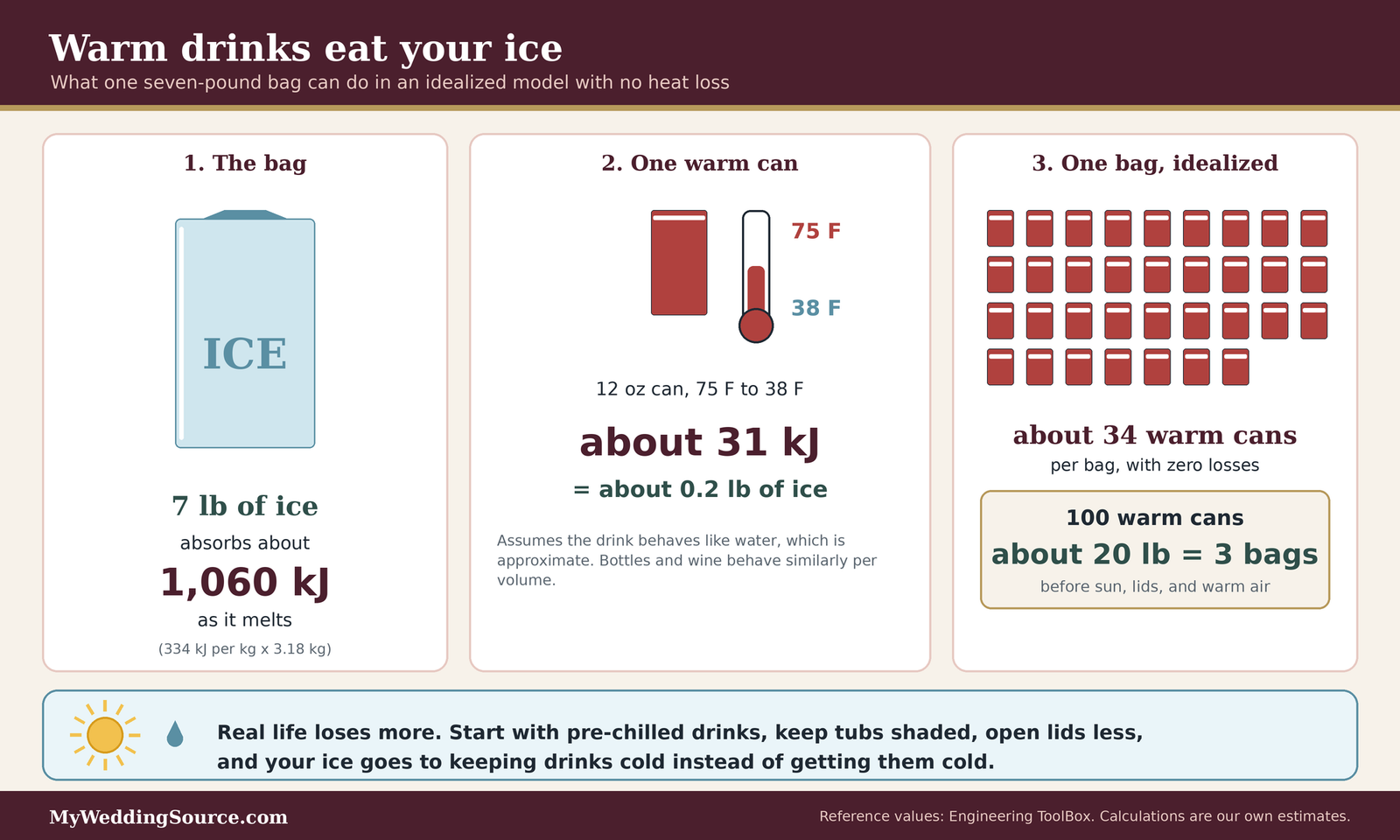
What the numbers mean for planning
In real conditions the losses to heat and open lids are not zero, so a bag chills fewer than 34 cans. The more useful lesson is the contrast. A can that starts at refrigerator temperature needs very little ice to hold its temperature, while a can that starts warm uses up a big share of the bag before it is cold. Chilling 100 warm cans, in this idealized model, takes about 20 pounds of ice before any other losses. If you can start with pre-chilled drinks, you spend your ice on keeping cold, not on getting cold, and wedding bar ice planning gets simpler.
Heat, sun, and humidity
Where the ice sits and what the weather is doing changes the melt rate more than almost any other choice.
Direct sun is a force multiplier
The National Weather Service says that heat index values assume shady, light-wind conditions, and that direct sunshine can add up to 15 degrees Fahrenheit. We can’t convert that into a melt rate, and we won’t pretend to. But a tub of ice on dark pavement in full sun is clearly being asked to do more work than one in shade on a cool floor, and the shade and elevation advice from YETI and the USDA applies directly.
Warm air, tents, and long days
A long reception stretches the ice for hours. A cocktail hour in late afternoon sun, followed by dinner, followed by dancing under a tent, can span very different conditions. If the temperature or sun is changing, the ice schedule in your wedding bar ice planning should too, with more frequent restocks during the hottest hours. Our guide to wedding beverage stations for outdoor heat goes deeper on outdoor setups.
Opening, traffic, and handling
Even in the shade, how often a container is opened affects how long it lasts.
Every lid opening costs something
YETI says each opening lets warm air in and cold air out, and suggests opening less often. The USDA release goes further and recommends separate coolers for beverages and perishable food, because the beverage cooler gets opened often. At a bar, the tub that holds guests’ drinks is opened constantly, so it is the one most likely to lose its ice fastest. Fill it generously and check it often.
Let the bartender set the traffic pattern
A bar that is staffed and organized, where only staff open the tubs, uses ice more predictably than a self-serve station where every guest digs through the pile. If you want self-serve for beer and soda, plan on extra ice and a staff member checking in. If you have a drink ticket system or a limited menu, ice use is also easier to predict. Our guide to the wedding drink ticket system explains how drink limits affect wedding bar ice planning.
The ice order and restock ledger
This is the working tool for wedding bar ice planning in this guide. It converts the estimate into a schedule with times, quantities, and responsibilities. The example uses 100 guests, a five-hour reception, and the planning assumptions explained earlier, so you can swap in your own numbers. Every figure in it is an estimate built from published rules of thumb and our own arithmetic, not a measurement and not a promise.
The ledger, step by step
The ledger has two columns of ice and a column of tasks. Serving ice is the pile that goes into glasses. Chilling ice is the pile that surrounds packaged drinks. Keeping them in separate columns reinforces the separation rule from the food safety section.
The example, hour by hour
The example schedule assumes an early peak, followed by steady pace, as in the drink-count method. The cumulative column helps you see how much ice is gone by each hour, which is what a runner needs to know. Drink counts are rounded and assume every guest drinks at the same pace, which they will not.
| Time block | Phase | Drinks poured (est.) | Serving ice this hour (lb) | Serving ice used so far (lb) | Chilling ice and tasks |
|---|---|---|---|---|---|
| 3:00 pm | Delivery | none | none | none | Receive about 213 lb (31 seven-pound bags); store sealed stock in shade or cold storage |
| 4:00 pm | Pre-chill and setup | none | none | none | Load tubs with about 100 lb of chilling ice; set aside 2 sealed backup bags |
| 5:00 pm | Cocktail hour | 200 | 37.5 | 37.5 | Check tubs at the half hour; skim and top up |
| 6:00 pm | Dinner begins | 100 | 18.75 | 56.25 | Refill bins from sealed stock; check tubs |
| 7:00 pm | Toasts and dinner | 100 | 18.75 | 75 | Restock tubs if more than half melted |
| 8:00 pm | Dancing | 100 | 18.75 | 93.75 | Hottest phase for tents; check tubs hourly |
| 9:00 pm | Late evening | 100 | 18.75 | 112.5 | Final restock; decide whether to extend |
How to read the table
The serving column adds up to the 112.5-pound serving estimate. The 100 pounds of chilling ice at 4:00 pm is the low end of the 1-to-2-pounds-per-guest chilling range, so the ledger starts with the lower number and relies on the hourly checks to catch the need for more. The 213 pounds delivered at 3:00 pm covers the serving estimate plus that first load of chilling ice, with no extra for melting or a hot day. If it is hot, use the doubled figures from earlier, and add the backup bags to the order.
Make the ledger your own
The example only helps if you change it.
Fill in your own rows
Replace 100 with your guest count. Replace the hours with your timeline, using your timeline for the toasts, dinner, and dancing. Replace the drink pace if you know it, for example if your bar closes during dinner or opens late. Replace 3 ounces per drink if your bartender gives you a different figure. Multiply the results out and round up to whole bags, since bags only come in whole numbers. Our wedding vendor timeline guide can help you align the ledger with other vendors’ arrival and setup times.
Add a margin on purpose
A margin is not waste. It is the difference between the estimate and the plan. Decide how much margin you want, for example one extra bag per twenty guests, and write it into the ledger as its own row, so nobody mistakes it for extra that can be returned or ignored. Ask your supplier whether unopened bags can be returned, since policies vary.

Breakage and restock inventory
A bar that runs out of ice may also run out of scoops, clean bins, or glasses. This second list is the breakage and restock inventory: the tools and consumables that keep ice service running, with a starting quantity and a note. The quantities are our suggested starting points, not standards, and your caterer or bartender may have their own list.
Tools and containers to line up
| Item | Starting quantity (our suggestion) | Why it is on the list |
|---|---|---|
| Ice scoops, food-safe | Two per bar, plus one spare | Hands and glasses should not touch ice, per public health guidance |
| Tongs | One set per bar | An alternative to scoops for garnish and small tasks |
| Clean, covered ice bin | One per bar station | Ice storage containers are treated as food-contact surfaces |
| Separate tubs for packaged drinks | At least one per drink type | Keeps chilling ice apart from drink ice |
| Sealed backup bags | About one bag per twenty guests, set aside | Replace ice if a bin must be discarded, and cover surprises |
| Clean towels or a mat | Several | Dry the outside of bags and the floor around the bar |
| Trash and spill containers | At least two per bar | Melted ice creates wet floors and wet trash |
| Light-colored cover for tubs | One per tub | YETI suggests a light-colored cover when shade is unavailable |
Glassware breakage and replacement
Breakage and ice are linked because broken glass near a bin can force a discard, and because wet hands and cold glasses are slippery. Ask the rental company how many extra glasses are included and what the breakage fee is, and ask the bartender where broken glass goes and who clears it. Our wedding bar glassware rental guide covers glass counts and rental terms. Keep a small dustpan and a labeled glass-only container behind the bar, away from the ice, so a breakage stays out of the bin.
Who does what
A ledger with no names is a wish, and wedding bar ice planning without owners rarely survives the day. Assign each task to a person.
Roles at the bar
At minimum, you want someone responsible for receiving the delivery, someone responsible for the bar’s ice bins, someone responsible for the tubs, and someone who can run for more. At a catered wedding, some of these are the caterer’s staff. At a smaller wedding, they may be friends or family, in which case it helps to write down who does what, so that the helpful cousin knows the tubs are not drink ice.
Day-of contact and authority
Name one person who can approve a restock purchase and one who can make a decision about discarding ice. If your planner or venue coordinator fills that role, tell the bar team. If you are running the day yourselves, appoint a friend, and agree that you will not be asked to decide anything about ice during the reception.
Questions to ask about wedding bar ice planning
These questions work for caterers, bar companies, venues, and ice suppliers. Ask for answers in writing, or put them in an email you can refer to later.
Questions worth asking about ice
- Who is responsible for supplying ice, and how many pounds or bags are included?
- What forms of ice can you deliver, and which do you recommend for tubs and for glasses?
- When does the ice arrive, who receives it, and where is it stored until service?
- Is there freezer, ice machine, or refrigerated space at the venue, and are there fees?
- How do you keep ice for drinks separate from ice used to chill packaged drinks?
- What is the plan if we run low, and who approves the cost of extra ice?
- What happens if glass breaks near the ice bin?
- What are our options for nonalcoholic drinks, and does that change the ice count?
Questions for the caterer or bartender
These are about what happens behind the bar.
Quantity and method
Ask how they approach wedding bar ice planning for a wedding of your size and menu, how many bags or pounds they bring, and whether the amount is a minimum or a typical figure. Compare their answer with the range from the ledger. A big gap in either direction deserves a polite follow-up question, not an argument. They may know something about your setup that you do not, or they may be using a default.
Handling and sanitation
Ask what scoops, bins, and tubs they bring, how they keep the ice and tubs separate, and what they do if a bin is contaminated. A professional bar team usually has answers ready. Vague answers are a signal to ask more, not necessarily to worry. Our guide to wedding vendor subcontractors explains how to find out who is actually delivering the service.
Questions for the venue and the supplier
These are about the place and the product.
Venue access and rules
Ask whether there is cold storage, whether outside vendors may deliver ice, when loading access is available, where the nearest loading area is, and whether any restrictions apply to alcohol service and ice handling. Many venues have rules about who may serve alcohol and from where. Our wedding permits guide covers when additional approvals may apply, and local rules about alcohol service vary, so confirm with the venue and your local authority.
Supplier terms
Ask about delivery windows, delivery fees, minimum orders, whether unopened bags can be returned, and what happens if the delivery is late or short. Ask for these in writing. If you are buying ice from a store, ask about quantity limits and whether the store can set aside ice for pickup.
Edge cases and special situations
The standard approach to wedding bar ice planning works for a typical reception. These situations change it.
Heat, power, and remote venues
The farther from services, the more the plan has to carry itself.
Extreme heat
On very hot days, assume the higher end of the range and consider more frequent checks. The USDA release says perishable food should be refrigerated within one hour when the temperature is above 90 degrees Fahrenheit, which is a useful reminder that heat shortens everything, not just ice. If you are serving food from coolers as well as drinks, use the safe-handling rules for food separately from the bar. Our wedding emergency kit guide has a broader list of day-of supplies.
Power failure or no power
If your plan depends on a rented freezer or ice machine and the power fails, the plan needs a backup: sealed bags in coolers, or a quick delivery. A venue without reliable power should be treated as one that has none. Ask what the venue does during outages, and whether a generator is available or allowed.
Remote locations
If the venue is far from the nearest store, the restock plan has to include the drive time in both directions. Order more ice up front, and consider a second delivery rather than a run. Our guide to wedding weekend event planning may help if the ice also has to cover a welcome party or day-after brunch.
Small, large, and unusual receptions
The ledger scales, but not perfectly.
Small weddings
With few guests, the per-guest rule can give a very small number, and a bar with only a few bags of ice has little room for error. Round up, keep a sealed backup bag, and remember that the minimum size of a bag or tub may dominate the plan. For a very small gathering, a couple of coolers may be all you need, but the logic of wedding bar ice planning still applies.
Large weddings and multiple bars
With many guests, split the bar into stations, each with its own ice bin and tubs, and plan restocking by station, not as one big pile. Having a runner per two stations is a reasonable starting idea. A long line at one bar will also drive demand toward the other, so counts are rarely even.
Late-night extensions and after-parties
If the bar stays open later than planned, or an after-party follows, add a row to the ledger. Ice for a late-night coffee service, for example, is a separate need. Our guide to a late-night coffee cart at a wedding may help. Check with the vendor about overtime terms before agreeing to an extension.
When alcohol is not the point
Wedding bar ice planning applies to every drink service, not only alcohol.
Nonalcoholic and alcohol-free receptions
A wedding with no alcohol still serves cold drinks, and lemonade, soda, and iced tea use ice. The ledger works the same way. Do not assume that a dry wedding needs less ice. If anything, guests may drink more soft drinks. Our wedding mocktails guide has ideas for what to serve.
BYOB and venue rules
Some venues allow couples to bring their own alcohol and others require a licensed vendor. We cannot tell you which applies to you, and we do not assume either. Rules about licensing, liability, and service vary by state and by venue, so ask the venue and your local liquor authority, and read our open bar wedding guide for how bar models differ.
FAQ: wedding bar ice planning questions
Quantity and storage
How much ice do I need for a wedding bar?
Ice suppliers commonly suggest planning for about one to two pounds per guest, and more in hot weather or when ice both chills and serves drinks. Build a second estimate from drink counts, compare the two, and round up. Your bartender knows your menu and venue, so ask for their number as well.
Can I use the same ice for drinks and for chilling beer?
No. The FDA Food Code says ice used as an exterior coolant, such as around cans and bottles, may not be used as food afterward. Keep the two supplies in separate, labeled containers, and use fresh ice from sealed bags for anything that goes in a glass. Check your local rules for specifics.
How should I store ice before the reception?
Keep sealed bags in the shade or in cold storage, off hot surfaces, and as close to service as the venue allows. Pack coolers tightly, because fuller coolers stay cold longer, according to the USDA. Pre-chill containers and drinks where possible, and ask the venue what freezer or refrigerated space it offers.
Does block ice really last longer than cubed ice?
According to cooler maker YETI, yes: block ice has less surface area, so it melts more slowly, while cubed ice chills faster. That is a manufacturer’s claim, and it makes no promise about specific hours. For tubs of packaged drinks, ask your supplier whether a block-and-cubed layer is available.
Delivery and safety
When should ice be delivered to the venue?
As close to service as the venue and your other vendors allow, and not so late that the bartender is waiting. We cannot give a universal lead time. Ask your supplier or caterer, confirm who receives it, and plan where it is stored on arrival. Put the arrival window in writing.
What should I do if the ice runs out?
Use the backup plan you wrote beforehand: sealed bags kept aside, a nearby store, a second supplier, or a runner with a cooler. Do not scoop from the tubs that hold packaged drinks, and do not use a glass or hands. Name in advance who can approve the extra cost.
What if a glass breaks in the ice bin?
Common practice, and our recommendation, is to stop serving from that bin, discard the ice, clean and sanitize the bin, and refill from sealed stock. This is not a legal standard we can cite, so confirm it with your caterer or health department. Keep a spare scoop and sealed bags set aside.
Is dry ice safe to put in cocktails?
We recommend against it unless an experienced bartender, your caterer, and your local health department have approved the method. Public health sources warn that dry ice can burn skin and release carbon dioxide gas in enclosed spaces, and a food-safety officials’ resolution raised concerns about using it in drinks. For chilling packaged drinks, ordinary ice is usually enough.
Your next steps
Build your plan
Run both estimates
Work through both wedding bar ice planning estimates for your guest list, the guest-count range and the drink-count figure, then compare. Note the gap and decide whether to lean high or low. Use the ledger to turn the answer into a schedule.
Send the questions
Copy the questions callout into an email to your caterer, bartender, or venue and ask for written answers. Our wedding vendor due diligence checklist can help you check the rest of the vendor conversation, and our wedding rental planning checklist covers tubs, bins, and other rentals.
Lock in the details
Name people and a backup
Assign a receiver, a bar lead, and a runner, and write down the backup supplier and who approves the cost. Add the ice schedule to your day-of timeline and share it with everyone who touches the bar, and keep your wedding bar ice planning notes with your other vendor details. Our wedding reception guide shows where the bar sits in the day as a whole.
Recheck near the date
Weather, headcount, and menu change, and wedding bar ice planning has to change with them. A week before the wedding, rerun the numbers with the latest guest count and forecast, and confirm the delivery window. Update the written plan and send it to your team.
Sources & methodology
How we built this guide
What we relied on
This guide combines U.S. public health and food-safety sources on ice, food handling, and heat, supplier and cooler-maker guidance on how much ice to buy and how to store it, a physics reference for the energy numbers, and our own arithmetic. We say where a statement comes from a seller or manufacturer, because their advice reflects their products and habits. The ice quantities, melt calculations, and the ledger are our own estimates, built from those published rules of thumb and standard reference values, and are not measurements of any particular ice, cooler, or venue. We checked the pages listed below on November 12, 2026, and we have not claimed anything about how current they remain after that date.
What we did not do
We did not test ice, coolers, or venues, and we did not measure melt rates. We do not give legal, medical, or food-safety advice, and local rules on food, alcohol service, and bringing your own alcohol vary by state, county, and venue. Confirm them with your caterer, venue, and local health or liquor authority. Several retailer and manufacturer sources did not explain their assumptions, so we treated their numbers as starting points. We may mention companies by name as examples of published guidance; we have no relationship with any of them and we receive no commission for the mention.
Source list
Government, public health, and regulatory sources
- U.S. Food and Drug Administration, FDA Regulates the Safety of Packaged Ice: https://www.fda.gov/food/buy-store-serve-safe-food/fda-regulates-safety-packaged-ice
- U.S. Food and Drug Administration, FDA Food Code: https://www.fda.gov/food/retail-food-protection/fda-food-code
- Washington State Legislature, WAC 246-215-03324, ice used as exterior coolant (state adoption of Food Code 3-303.11): https://lawfilesext.leg.wa.gov/Law/WACArchive/2024/htm/WAC%20246%20-215%20%20CHAPTER/WAC%20246%20-215%20-03324.htm
- District of Columbia Department of Health, Ice as food fact sheet: https://dmv.dc.gov/sites/default/files/dc/sites/doh/publication/attachments/FS%20-%20ice%20as%20food%202015.pdf
- FoodSafety.gov, home page and the 40 to 140 degree Fahrenheit danger zone: https://www.foodsafety.gov/
- U.S. Department of Agriculture, Don’t Let Your Outdoor Meal Become a Feast for Bacteria: https://www.usda.gov/node/53622
- Centers for Disease Control and Prevention, Norovirus prevention: https://www.cdc.gov/norovirus/prevention/index.html
- National Weather Service, Heat index: https://www.weather.gov/safety/heat-index
- North Dakota Department of Health, Dry ice safety: https://www.hhs.nd.gov/sites/www/files/documents/DOH%20Legacy/Dry%20Ice%20Safety.pdf
Supplier, manufacturer, and reference sources
- Association of Food and Drug Officials, resolution on liquid nitrogen and dry ice as food and beverage ingredients: https://www.afdo.org/?p=4283
- Reddy Ice, How much ice you need for a party: https://www.reddyice.com/how-much-ice-you-need-for-a-party
- Reddy Ice, Ice calculator: https://www.reddyice.com/ice-calculator/
- Tasting Table, How to figure out exactly how much ice you will need for a party: https://www.tastingtable.com/1866410/how-much-ice-for-party-calculate
- YETI, Best ways to keep ice from melting in a cooler: https://www.yeti.com/blog/best-ways-to-keep-ice-from-melting-in-cooler.html
- Engineering ToolBox, Latent heat of melting for solids: https://www.engineeringtoolbox.com/latent-heat-melting-solids-d_96.html
- Engineering ToolBox, Specific heat capacity of water: https://www.engineeringtoolbox.com/specific-heat-capacity-water-d_660.html