
Good wedding tuxedos come down to four decisions you can check one at a time, namely whether the formality and start time of your wedding call for one, how the jacket and trousers fit when you move instead of when you stand still, how much calendar you have for delivery and alterations, and which accessories finish the outfit, so this guide takes them in that order and shows its arithmetic where money is involved.
Quick answer
A tuxedo is the expected choice for a black tie or white tie wedding, and a good fit is judged in five places: shoulders, sleeve length, jacket length, collar, and trouser length. Start the process earlier than feels necessary. Retailer guidance we found runs from two to four months ahead for a rental, and about eight to ten weeks for a custom order, and both assume you leave a few weeks at the end for problems. Budget for the finished outfit, not the rack price, because accessories, alterations, and fees are where totals drift. Then try the outfit on with your real shoes and move in it the way you will on the day.
If you are still deciding between a suit and a tuxedo, our guide to groomsmen suits vs tuxedos covers that choice, and the wider cornerstone on wedding party attire covers who wears what. This page starts after the decision is made. It is about getting wedding tuxedos right: what the term includes, how the pieces should fit, how to set a schedule that survives a bad fitting, what the total really costs, and which accessories matter.
What wedding tuxedos include, and what black tie asks of them
The word “tuxedo” is used loosely by shops, guests, and invitations. Before you compare quotes or fittings, it helps to agree on what is in the outfit and what the formal dress code expects of it. That agreement is also what lets you compare two rental companies, or a rental and a purchase, on the same terms.
The pieces that make a tuxedo
A tuxedo is a matched jacket and trousers plus a small set of formal accessories. None of the individual rules is a legal definition, so different sellers draw the line in different places. A jacket with a narrow band of satin on the lapel and a bow tie might be sold as a tuxedo at one store and a dinner jacket at another. That is why the first job with wedding tuxedos is a written list of what comes in the box.
The jacket and trousers
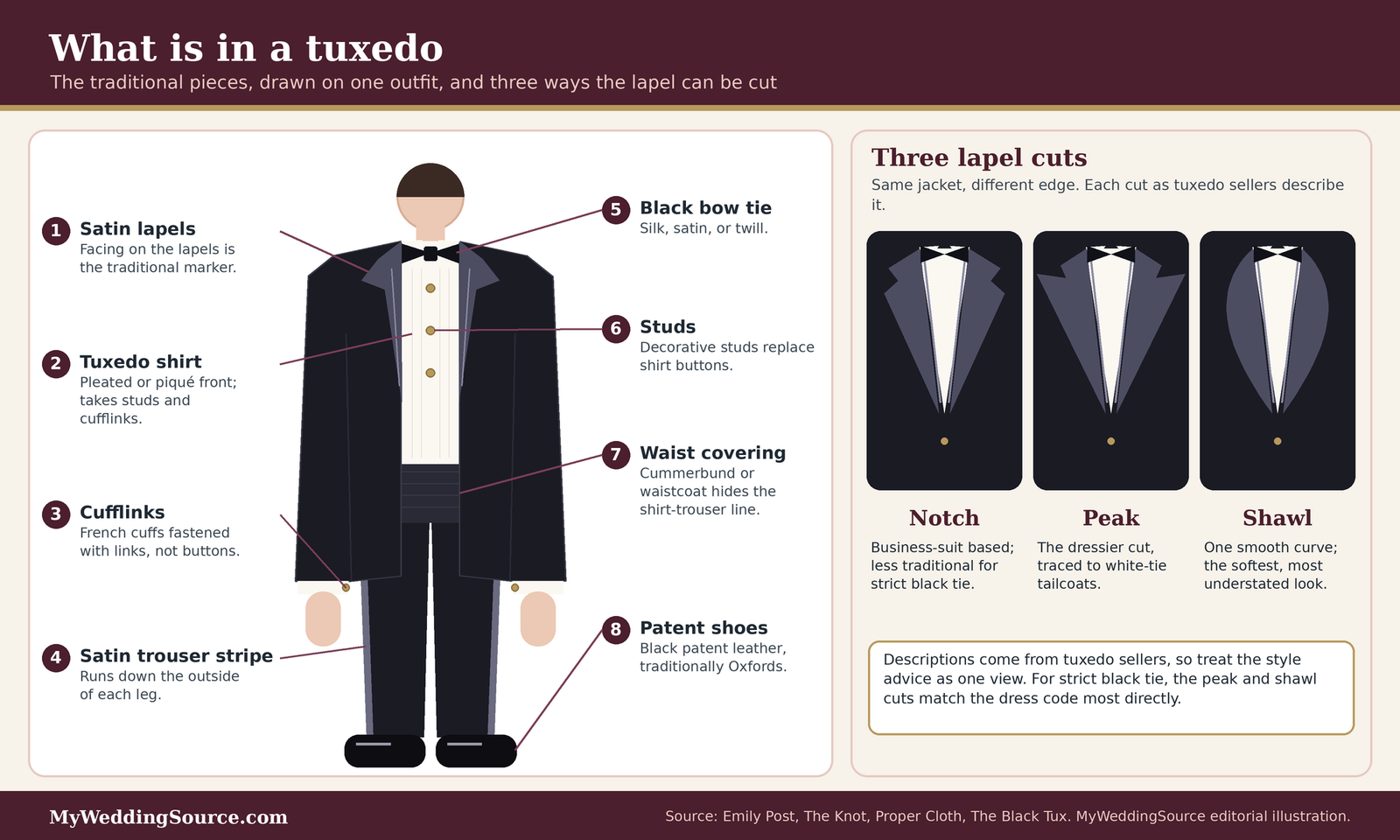
The Knot describes the traditional markers as satin lapels and a satin stripe running down the outside of each trouser leg. Proper Cloth, a clothing retailer, says the same and adds that satin lapels are the defining feature of the jacket. The jacket is most often single-breasted, with one column of buttons. A double-breasted jacket has two columns and a wide overlapping front, which Proper Cloth describes as more formal and bolder. Because that source is a retailer, treat its style opinions as one view, not a rule.
For wedding tuxedos the practical point is that the jacket and trousers are cut and finished to go together. The satin on the lapel should read as the same family as the stripe on the trouser leg, and an odd pairing, such as a rented jacket with trousers from another source, tends to show in photographs.
The shirt, tie, waist covering, and shoes
Emily Post lists the traditional men’s black tie outfit as a black tuxedo jacket with matching trousers, a formal white shirt with a pleated or piqué front, shirt studs and cufflinks, a black bow tie in silk, satin, or twill, a black cummerbund or a waistcoat, black patent shoes with black dress socks, and optionally dressy braces. It says gloves are not part of the outfit. The Knot adds that a tuxedo shirt is made for cufflinks and decorative studs instead of ordinary buttons, and that a cummerbund is traditionally worn with a tuxedo.
Proper Cloth makes one point that is easy to miss when you shop. It says a tuxedo should be worn with a true tuxedo shirt and not a standard dress shirt, because the front is made to take studs and the cuffs are made to take cufflinks. If a rental package bundles a shirt, ask whether it is a tuxedo shirt or a regular dress shirt with a different label. A complete set of wedding tuxedos includes more than a jacket and trousers.
The rules that apply, and where they loosen
Dress codes are conventions, not laws, and they bend with the region and the crowd. Still, a few of them are consistent enough across the sources we read that you can plan around them.
Time of day and dress code level
The Gentleman’s Gazette, a men’s style publication, says black tie is evening wear and defines evening as sundown or 6 p.m., whichever comes first. It also notes that in the United States the tuxedo is widely treated as all-purpose formal wear, more so than in the UK, Western Europe, or Japan, where formal daywear is still a recognized code. In practice that means a ceremony that starts in late afternoon and runs into an evening dinner is a case where wedding tuxedos for the whole day are easy to defend.
On the dress code itself, The Knot says a tuxedo is required at black tie and white tie events and that a black suit is not an acceptable substitute. For black tie optional, it says a tuxedo is not required and a formally styled suit is acceptable, and for cocktail attire and below, it says tuxedos should not be worn. Our guides to the black tie wedding and to cocktail attire walk through how those codes sit next to each other and how hosts word them.
What the wedding party’s tuxedos should do
Beyond the dress code, there is a simple question of what you want the group in wedding tuxedos to look like. The Knot says the couple decides whether the wedding party wears wedding tuxedos or coordinated suits, and that some couples put the groom in a tuxedo and the party in suits, or everyone in wedding tuxedos. The Gentleman’s Gazette notes that at the most formal weddings the average man attends, often only the groomsmen wear tuxedos, while other male guests wear formal suits. Emily Post says attendants pay for their own wedding clothing and accessories, so the choice you make also sets what you are asking others to spend.
That last point shapes everything that follows. If you are asking five or eight people to wear wedding tuxedos, the cost, the delivery date, and the return are now group logistics, not just personal ones. Our wedding etiquette guide covers the expectations around asking people to stand up with you, and the rest of this guide gives you the numbers to say out loud when you do.
Start with fit and function before aesthetics for wedding tuxedos
A tuxedo that looks right on a hanger can still fail on the day if the shoulders pull when you lift your arms, the collar gaps when you turn to face a parent, or the trousers ride up when you sit at the head table. Fit is the part of wedding tuxedos you can verify, so we start there. Style choices come after, in their own section.
Translate body proportions and movement needs into design choices
Every retailer we read asks for a handful of body measurements. They are not all equally important, and some are much harder to fix later than others. Knowing which is which tells you where to be strict at the start and where you can leave room for a tailor.
Explain which measurements matter
Men’s Wearhouse lists the working set: neck, chest, waist, sleeve, inseam, height, and weight. It says to measure the neck at the base where the collar sits, leaving about a finger’s width of slack, and the chest around the fullest part, keeping the tape level. It says to measure the waist at the natural waist, which can differ from your casual pants size because formal trousers sit higher. For the sleeve, it says to measure from the shoulder edge to the wrist bone with the arm relaxed, since a bent arm gives a shorter reading. It says to measure the inseam while wearing the dress shoes you plan to use, because shoe height changes the final length. Generation Tux adds practical advice: use a soft tailor’s tape, get a helper for the chest and sleeve, and if a chest measurement falls between sizes, round up to the first even number.
The Knot makes the point that decides where to be strict. It says the shoulders are the hardest part of a jacket to alter, so check them before buying. That is consistent with how the Gentleman’s Gazette describes shoulders: the seam should extend only slightly past the shoulder bone, fabric that puddles at the shoulder means the jacket is too big, and a shoulder that is too tight restricts the back and arm movement. The working rule for wedding tuxedos is to choose the jacket size by shoulders and chest first, and treat sleeve length and trouser length as the details a tailor, or a rental company’s fit process, can adjust.
Identify where sample sizing distorts expectations
Online photos, in-store samples, and a first home try-on can each mislead you in different ways. We found no source that measures how much they differ, so what follows is our own reasoning, not data. A photo shows one garment on one model, with clips and steaming you will not have. A sample on a store rack is a single size and may not represent the size you would receive. A rental garment has also been worn and cleaned before, which can change how the fabric hangs.
Two things from the sources are worth keeping. First, The Knot says renting is harder if you fall between sizes, because a rental may fit larger or smaller than you want, and Generation Tux says rented garments cannot be altered in the way an owned tuxedo can, even when they fit well. Second, fit tools such as surveys and algorithms estimate your size from the numbers you enter, so the output is only as good as the measurements. The practical response, when you are sizing wedding tuxedos, is to measure twice on different days, enter the numbers exactly, and treat the first try-on as a test of the estimate and not as proof the outfit is settled.

Match fabric and construction to season and venue
The same cut feels different in a cool ballroom in January and a tent in July. Fabric weight, fiber, lining, and construction decide most of that difference, and they are also where rental and purchase options diverge.
Connect weight, lining, sleeves, and ventilation
The Black Tux, a rental and retail company, groups fabric by weight in ounces. It describes lightweight as about 6 to 9 ounces, which breathes well but moves around and looks less structured, medium as about 9.5 to 11, which it recommends for most black tie events, and heavy as about 11 to 14, which has the strongest drape. Generation Tux gives similar bands, with 7 to 9 ounces for summer and warm climates, 9 to 11 for most seasons, and 11 to 14 for cold-weather formal events. Both are sellers, so their advice reflects what they stock.
On fibers, The Black Tux says wool breathes and regulates temperature, while polyester is budget-friendly and wrinkle-resistant but breathes poorly, feels stiff, and can look shiny in photographs. A wool and polyester blend of about 70 and 30 is described as a middle option, and wool with mohair is suited to warm venues. For winter, it points to velvet. It also says budget rentals can have polyester linings while better ones use breathable linings, and that rentals are typically built with fused construction while retail and custom pieces more often use half or full canvas, which affects drape and longevity. For wedding tuxedos, that means a rental can look very good in a photograph but behave differently over a long, warm evening.
Jacket details matter too. The Gentleman’s Gazette says side vents are the most practical choice and should end where the jacket pocket ends, while a ventless jacket is traditional for evening wear and gives a cleaner line but can constrict you if it is cut tight in the seat. If you will be dancing or sitting for hours, vents are a comfort feature, not only a style choice.
Flag mobility, heat, snag, and shine risks
Heat is the risk that is easiest to underestimate when you plan wedding tuxedos. The National Weather Service says heat index values are calculated for shady, lightly windy conditions and that full sunshine can raise them by up to 15 degrees Fahrenheit. Its own example is that 96 degrees Fahrenheit at 65 percent relative humidity produces a heat index of 121. A jacket worn for an outdoor ceremony in direct sun is a different problem from the same jacket worn indoors later, so ask how much of the day is outside and in the shade.
The other risks are practical. A jacket that is tight across the back limits reaching and hugging. Snagging is most likely with coarse accessories and rings on lightweight, loosely woven fabric. Shine is a photography issue, because a high-sheen polyester can look flat or glossy under a flash, which is why The Black Tux describes matte worsted barathea as the classic choice for a deep black. If you can, view a swatch in the light of your actual ceremony. Our wedding photographer shot list is worth reading with this in mind, since the formal group portraits are where fit, shine, and wrinkles are most visible.
| Factor | What it asks of the design | Alteration risk |
|---|---|---|
| Shoulder width or slope | Choose the jacket size by the shoulders first; the seam sits at or just past the shoulder bone | High: the hardest part of a jacket to alter, per The Knot |
| Chest and waist difference | A jacket that closes without pulling, with two fingers of room at the chest | Medium: a tailor can take in a baggy jacket, but cannot easily add fabric |
| Sleeve length | Sleeve ends at the wrist bone, with about a quarter to half inch of shirt cuff showing | Low: a common, routine change |
| Trouser length and waist | Single small break over the front of the shoe; waist sits higher than casual pants | Low to medium: hems are routine, waist changes depend on construction |
| Hot, sunny outdoor ceremony | Lighter weight, breathable wool or a wool-mohair blend, breathable lining | Not an alteration: this is a fabric decision made before ordering |
| Cold or evening indoor venue | Medium to heavy wool, or velvet for winter | Not an alteration: choose before ordering |
| Long dancing or sitting hours | Side vents, room across the back, suspenders or an adjustable waist | Medium: vents and waist adjustments depend on the jacket and trousers |
Choose the look: lapels, color, and the waist covering for wedding tuxedos
Once fit is understood, style is a smaller decision for wedding tuxedos than it looks. Most of the visible choices come down to three things, which are the shape of the lapel, the color and finish of the cloth, and how the waist is covered. Each has a traditional answer, and each has a reasonable modern alternative.
Lapel and jacket style
The lapel is the most visible design detail on wedding tuxedos, and it is the one retailers describe most consistently. The descriptions below come from sellers, so use them as a starting point for a conversation and not as rules about your body.
Notch, peak, and shawl
The Black Tux describes a notch lapel as a small V-shaped cut where the lapel meets the collar, based on the business suit, and less traditional for strict black tie, though it says a well-fitted notch can look polished. It describes a peak lapel as having sharp edges that point up toward the shoulders and as the dressier option, tracing it to white-tie tailcoats. It describes a shawl lapel as one continuous curve from collar to button with no notch or point, the softest and most understated of the three, with roots in Victorian smoking jackets. Proper Cloth agrees on the broad outline, calling notch less formal and less common on tuxedos and shawl rounded with a softer, vintage look.
The same retailer suggests peak lapels for narrower shoulders or heavier builds that want more visual width, and shawl lapels for slim or tall builds because the curve lengthens the frame. Those pairings are one seller’s styling opinion. A more neutral check comes from The Knot, which says standard lapels run about 3 to 3.5 inches wide and that shirt collars and ties should be proportionate to them. For wedding tuxedos at a black tie wedding, a peak or shawl lapel matches the dress code most directly. For a black tie optional evening, a notch is a normal and economical choice.
Single-breasted, double-breasted, and buttons
Proper Cloth says single-breasted is the most common and versatile style. A double-breasted jacket has a wider overlapping front and reads as more formal and more assertive, and it advises against busy shirts with it. The Black Tux’s try-on guidance says to fasten only one button, which on a two-button jacket means the top one. The Gentleman’s Gazette says the buttoning point should sit near your natural waist, roughly at the navel, and that you should be able to pull the front of the buttoned jacket out about two inches. X-shaped wrinkles radiating from the button mean the jacket is too tight.
If your group of wedding tuxedos will include different builds, a single-breasted jacket is usually the more forgiving choice, because it is easier to size and the lines of the waist covering sit more predictably under it. Our reading of the sources is that a double-breasted tuxedo is a deliberate style statement and works best when it is cut for the wearer.
Color, finish, and the waist covering
The traditional tuxedo is black. The alternatives below are all established, but several depend on the light, the season, or the guests’ expectations, so check them against your own venue.
Black, midnight blue, white, and velvet
Proper Cloth says black is the classic choice and midnight blue is a richer alternative under evening light. It says white or ivory suits warm-weather or destination events, and that guests should check with the couple first if they plan to wear it. Emily Post addresses the warm-weather version directly, saying a white dinner jacket can be worn at summer, tropical, or cruise events with black tuxedo trousers and the rest of the black tie outfit. The Gentleman’s Gazette says velvet in a deep color such as bottle green is a popular choice for a dinner jacket and a reasonable option at less formal black tie events. The Black Tux recommends modern velvet tuxedos, which it says use cotton, for winter.
On cost, The Black Tux says non-black colors add roughly $20 to $40 to its rental price. That is one seller’s surcharge, and policies vary, so it is worth asking whether your color choice changes the quote.
Cummerbund, waistcoat, or neither
Emily Post lists a black cummerbund matching the tie, or a waistcoat in its place, as part of the traditional outfit. Proper Cloth explains the difference: a waistcoat is worn under the jacket and suits single-breasted jackets and not double-breasted ones, and a cummerbund is a wide silk waistband that can replace it. The point of either is to cover the place where the shirt meets the trousers, which would otherwise show when the jacket is open or when you reach or sit.
The Gentleman’s Gazette notes that a tie or shirt visible below the buttoning point means the front of the jacket is too open or the rise of the trousers does not match. A waist covering hides that line, which is why wedding tuxedos are usually styled with one. If you plan to wear the jacket open for dinner or dancing, a waist covering is not optional in the way it is when the jacket stays buttoned. Ask for it to be fitted at your try-on, not added afterward.
Build the shopping timeline around alteration reality for wedding tuxedos
A calendar for wedding tuxedos has to be built backward from the date, because the last steps are the ones that cannot flex. A rental has to arrive, be tried on, and be fixed, and a custom or purchased garment has to be ordered, measured, made, and altered. The published windows below come from sellers, so they describe their own processes and not an industry standard.
Work backward from fittings and delivery
The right schedule depends on whether you rent, buy off the rack, or order a made-to-measure garment, and each has its own critical path. The other dimension is the season, because spring and summer are the busy period for weddings.
Show when custom order, rush, or off-the-rack changes the schedule
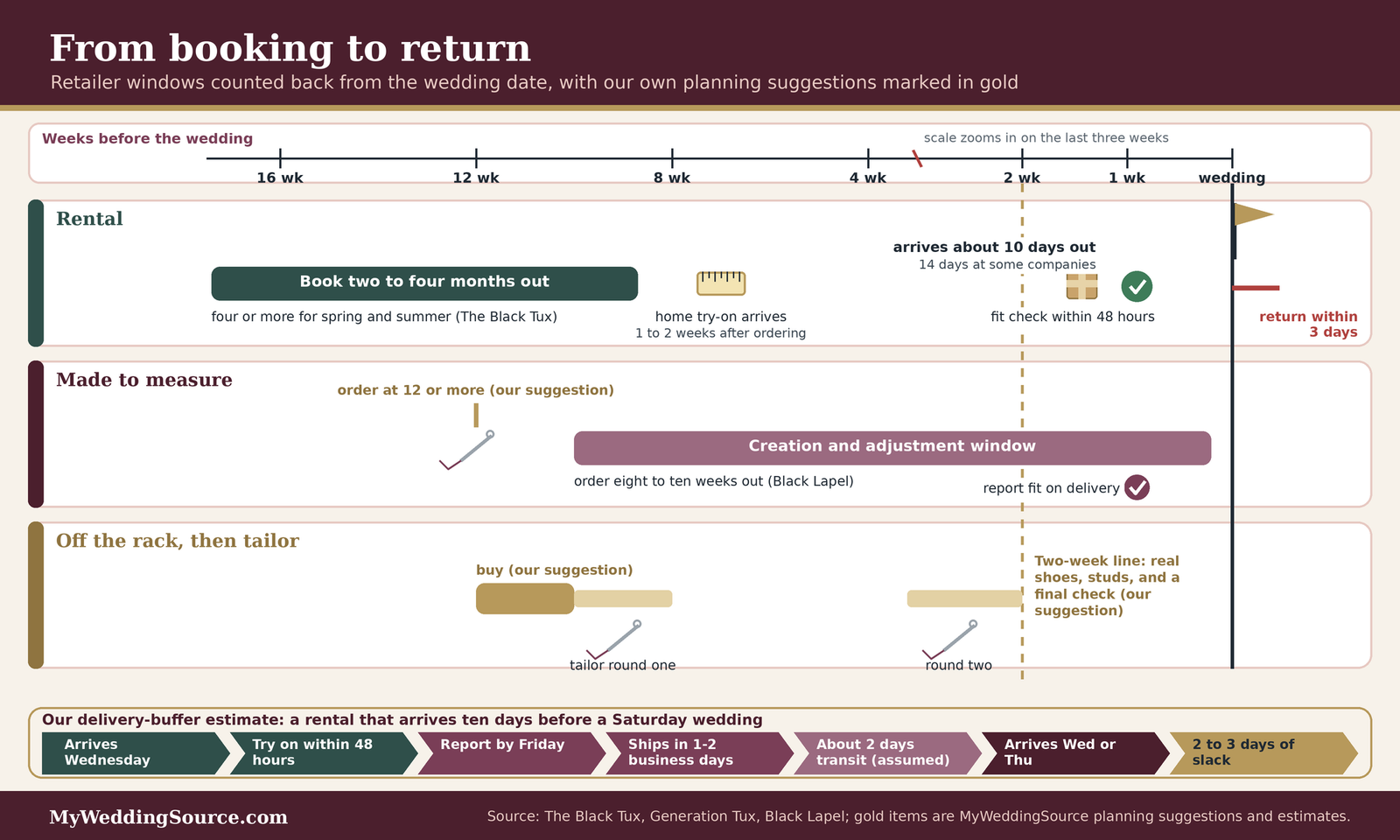
For rentals, The Black Tux says to book two to three months ahead for the widest selection, at least four months out for spring and summer weddings, and six to eight months for destination weddings that need remote measurements. It says a booking two to three weeks out is possible but selection narrows, and orders within two weeks may carry rush fees. Generation Tux says to order about two months ahead and notes you can still secure a rental about three weeks before the event. The Knot lists typical delivery before the event as three to four days at Men’s Wearhouse, four days at Jos. A. Bank, about ten days at The Black Tux and Friar Tux, and about fourteen days at Generation Tux and Menguin.
For a made-to-measure order, Black Lapel recommends ordering eight to ten weeks before the wedding, which it says allows time for creation and adjustments. It says rush services are available but does not give the timeline or the fee. Off-the-rack purchases are quickest to obtain but depend on tailor availability, and we found no published standard turnaround for alterations. Our suggestion, which is our own planning rule and not a sourced figure, is to plan on one to two weeks per round of alterations and to leave room for a second round.
| Milestone | Rental | Made-to-measure | Off-the-rack purchase |
|---|---|---|---|
| Decide dress code, color, and style | Four to six months out (our suggestion) | Four to six months out (our suggestion) | Four to six months out (our suggestion) |
| Book or order | Two to three months out; four or more for spring and summer; six to eight for destination weddings (The Black Tux) | Eight to ten weeks at the latest (Black Lapel); our suggestion is twelve or more | Ten to twelve weeks out (our suggestion) |
| Measure or try on | Home try-on arrives about one to two weeks after ordering and can be kept up to three days (The Black Tux) | Virtual or showroom measurement at the time of order (Black Lapel) | First fitting right after purchase, with the real shoes and shirt |
| Final garments arrive | About ten days before the event (The Black Tux) to fourteen (Generation Tux); three to four days at some store chains (The Knot) | Typically the end of the production window; confirm in writing | Already in hand; alterations are the open item |
| Check fit and request fixes | Within 48 hours of delivery for a free replacement (The Black Tux) | Report on delivery; remake or local-tailor instructions (Black Lapel) | Second fitting two to three weeks out (our suggestion) |
| Test accessories and shoes | At least two weeks out where possible (our suggestion) | Same | Same |
| Wedding day | Steam out any wrinkles; keep the return label in reach | Steam; keep a safety pin kit | Steam; keep a safety pin kit |
| Return or store | Return within three calendar days after the event, per The Black Tux; confirm your own agreement | Clean per the care label and store | Clean per the care label and store |
Add buffer for correction, steaming, and accessories
The most useful number in the rental sources is the window between delivery and the wedding, because it is the time you have to correct a problem. The Black Tux says its rental arrives about ten days before the event and should be tried on within 48 hours, with free replacements shipping in one to two business days if you report a fit issue in that window. It also says orders placed within five days of the event get best-effort handling and no promise of arrival. Generation Tux advises trying the outfit on at least two weeks before the event and reporting problems within 48 hours.
Here is our own arithmetic for a Saturday wedding, as an estimate. Delivery ten days before is a Wednesday. Trying on within 48 hours means a problem is reported by Friday. A replacement then ships in one to two business days and needs some transit time, which we assume to be two days, so it arrives about the following Wednesday to Thursday. That leaves two to three days of slack before the wedding. If the first delivery is late, or the replacement is wrong too, the slack is gone. Booking early does not just widen the selection. It is what turns a delivery delay from a crisis into an inconvenience.
Steaming and small items belong in the buffer as well. The Knot says Men’s Wearhouse and Jos. A. Bank steam wrinkled garments for free at any of their locations, and it is wise to ask whether the retailer you use offers the same. Shoes, studs, cufflinks, and ties are easy to leave until last, and they are the pieces most likely to arrive separately or in the wrong size. Open every box and try every item at your first fitting.
Budget for the finished garment, not the rack price
Cost is where wedding tuxedos are most often compared on the wrong basis. A rental quote that includes shoes and a damage fee is compared with a purchase price that includes neither a shirt nor alterations. The sections below separate what we found in sources from what we calculated, so you can see which figures for wedding tuxedos are quotes, averages, or our own sums.
Separate purchase, alteration, undergarment, and preservation costs
The Knot’s 2025 Real Weddings Study put the average cost of ceremony attire for a male partner at $205, across all kinds of attire from suits to custom tuxedos. The Knot’s rental guide says major retailers such as The Black Tux and Men’s Wearhouse average about $150 per tuxedo rental, with a typical total of $150 to $300 depending on the type and accessories. It lists cufflinks, button studs, pocket squares, and cummerbunds at about $10 to $15 each, and vests and shoes at about $30 each. It says Men’s Wearhouse rental prices include a $12 damage and handling fee added at checkout, and that The Black Tux charges a flat $12 that covers normal wear, cleaning, and restocking.
For purchase, The Knot’s article says buying a tuxedo typically costs about $700 to $1,000 or more before alterations, and The Black Tux puts fine wool at $1,500 and up. The Knot’s tuxedo-versus-suit article lists made-to-measure tuxedos at about $700 to $1,000 and designer ones above $4,000. Alterations vary widely. Thumbtack’s 2026 tailoring guide gives national averages of about $73 to $107 for hemming trousers and about $82 to $122 for shortening sleeves or trouser legs, while a single Baltimore shop it cites charges $16 to hem trousers and $24 to shorten sleeves. That wide gap is why a local quote matters more than any average.
Undergarments and preservation are real costs for which we found no published figures. A garment you own needs a plan: Generation Tux notes that owned tuxedos need regular dry cleaning and safe storage. The Federal Trade Commission’s Care Labeling Rule requires a permanent label with care instructions on clothing, so read the label before you pick a cleaner. Add the cost of an undershirt, socks, and a garment bag to your list.
What it can cost: an editorial estimate
Take six people, the groom and five groomsmen, each renting complete wedding tuxedos. Use the sourced ranges: a base of $150 to $300, studs and cufflinks at $10 to $15 each, a cummerbund at $10 to $15, shoes at about $30, and a $12 handling fee. That is about $222 to $387 per person, or roughly $1,332 to $2,322 for six, before shipping, tax, and any surcharge for a non-black color, which one retailer puts at $20 to $40. For comparison, buying a single tuxedo at The Knot’s $700 to $1,000 range plus a sleeve and trouser hem at the local-shop to national-average range above comes to roughly $740 to $1,230 before shirt, shoes, and accessories. These are our own sums from published ranges, not quotes, and your retailer’s package and fees will differ. For a wider view, our wedding budget calculator can hold the attire line next to everything else.
A quick way to compare renting and buying wedding tuxedos is to divide the purchase price by the rental price. Our own arithmetic: a $700 purchase against that $205 average breaks even at about 3.4 wears, and a $1,000 purchase against a $150 rental at about 6.7. That ignores alterations, cleaning, and storage, so the true break-even is higher, and it assumes the garment really is worn again. Our guide to groomsmen suits vs tuxedos works through that math for a larger party.
Show which design details drive alteration complexity
Not all fixes are equal. The Knot says the shoulders are the hardest part of a jacket to alter, and the Gentleman’s Gazette says a jacket that is too long cannot be fixed well after the fact. By contrast, Men’s Wearhouse says small changes to sleeve length or trouser hems are usually possible but that a tuxedo’s core construction cannot be changed. The Knot’s fit guide lists taking in a jacket that is too baggy and adjusting trousers for a higher or lower rise among the tailorable items. The Black Tux says tuxedo trousers can be waist-adjusted.
So the sequence of risk for wedding tuxedos is clear. Shoulders and jacket length are the decision to get right at the start, because they cannot be fixed later. Sleeve length, trouser length, and some waist adjustment are the details a tailor handles. In our judgment, the more a garment depends on a fixed structure, such as a fitted double-breasted front or a tight ventless seat, the less room there is to correct it, so choose those styles only when the base size is right. A rental has the extra constraint that policies on alterations differ: Generation Tux says rented garments cannot be altered the way an owned tuxedo can, while The Black Tux says it reimburses up to $15 per garment for alterations when you submit a receipt within 30 days of the event. Ask what your retailer allows before you touch the hem.
Accessories that complete wedding tuxedos
Accessories are where wedding tuxedos go from a rented jacket and trousers to something that looks intended. They are also the small items most likely to be forgotten, mismatched, or delivered to a different address. The sources we read agree on the traditional set, and we have added practical checks of our own.
The shirt, studs, and cufflinks
The shirt is the foundation under everything else in wedding tuxedos. It sets the collar line that frames the bow tie, the cuff that shows below the sleeve, and the front that appears when the jacket is open.
Shirt front, collar, and cuffs
Proper Cloth describes three front styles: pleated, piqué bib, and plain. Emily Post lists a formal white shirt with a pleated or piqué front. For the neck, The Black Tux says to button the collar fully and expect one or two fingers of room between your neck and the collar. For the sleeves, The Black Tux says the shirt cuff should end at the wrist bone, and The Knot says the jacket sleeve should leave about a quarter to a half inch of shirt cuff showing, no more than about half an inch.
The shirt is often forgotten in fit conversations because it is the least visible. It is also the piece most likely to be sized from your neck and sleeve measurements, which is why it pays to take those numbers carefully and to check them against what arrives. If the collar gaps or the cuffs hide under the jacket, the whole outfit looks off even if the jacket fits.
Studs and cufflinks
Proper Cloth says traditional tuxedo shirts have no ordinary buttons. They fasten with studs at the front and French cuffs fastened with cufflinks, and it advises matching the studs and cufflinks. Emily Post lists both as part of the outfit. The Knot puts cufflinks and button studs at about $10 to $15 each when added to a rental.
Studs and cufflinks are small, fiddly, and easy to lose. Our practical suggestion is to fasten them once at the first try-on, with whoever will help on the day watching, so that the process is familiar. If a rental includes them, check that the set is complete and that the finish matches the other metal in the outfit, such as a watch or a wedding band.
Bow tie, shoes, and finishing details
These are the items where tradition is strongest. They are also where a small departure is easiest to spot.
The bow tie
Emily Post lists a black bow tie in silk, satin, or twill. Proper Cloth says the bow tie is usually silk and considered required, that a self-tied bow is the traditional choice, and that a pre-tied one is a good option for a beginner. The Gentleman’s Gazette says black is the classic color and shows examples in grosgrain, satin, and barathea, in both self-tie and butterfly shapes.
For wedding tuxedos, the practical question is whether the bow tie’s texture matches the lapel facing. A shiny satin bow tie on a matte lapel, or the reverse, can look mismatched in a flash photograph. We would also suggest not leaving the self-tie decision to the morning of the wedding. If you plan to tie your own, practice weeks in advance, and have the pre-tied version as a backup.
Shoes, socks, and braces
Emily Post says black patent shoes with black dress socks. Proper Cloth says traditionally patent leather Oxfords, meaning closed lacing and not derbies, and it says velvet slippers are acceptable at some formality levels. The Knot says patent or highly polished formal shoes, and notes that chukkas or dress boots suit a regular suit better than a tuxedo. Rental shoes run about $30 each pair, per The Knot, and cannot be broken in, so a pair you already own and have worn is often more comfortable for a long day.
Braces matter for fit as well as looks. The Gentleman’s Gazette says that if trousers do not fit well, suspenders hold the height more consistently than a belt and should be worn during fittings if you plan to use them. The Black Tux says suspenders work with both suit and tuxedo trousers and that tuxedo trousers can be adjusted at the waist. Emily Post lists dressy braces as optional.
Pocket squares and the extras
The Knot lists pocket squares as an inexpensive add-on at about $10 to $15. They are one of the few places where the groom and groomsmen can differ without breaking the uniform look. Emily Post says gloves are not part of the traditional outfit.
Flowers are the exception to who pays. Emily Post says attendants pay for their own wedding clothing and accessories but not for flowers, which suggests boutonnieres are usually the couple’s expense. Because small additions accumulate, put the accessory list in writing before you order, so everyone sees the same package and the same price.
Use the fitting room to test the wedding day for wedding tuxedos
A fitting of wedding tuxedos that only checks how the outfit looks while you stand still in front of a mirror will miss most of the problems that appear later. The aim of this section is to move the wedding day into the fitting room, so that the problems appear while there is still time to fix them.
Move, sit, dance, hug, and walk stairs in the garment
A fitting is a performance test. Wear the shirt and the shoes you will actually use, since The Black Tux says to wear a collared dress shirt and dress shoes so the shirt and trouser length are judged accurately.
Test the actual shoes and trouser length
The Black Tux says trouser fabric should just touch the tops of the shoes with little fold, and that multiple folds mean the trousers are too long. The Knot says the break should land where the ankle meets the foot, and Men’s Wearhouse says to aim for a slight break, with the fabric resting on the front of the shoe in a single small fold. The Gentleman’s Gazette says trousers should have a slight break or none.
Our checklist, which is our own suggestion and not a standard, is to stand, walk the length of the room, climb a flight of stairs if one is available, and sit with your legs crossed. If the hem catches the heel on the stairs, or rides up and exposes a long stretch of sock when you sit, the length or the break needs adjustment. Check the waist at the same time: the trousers should stay put without being pulled tight.
Check collar, shirt front, and jacket under photography movement
The Gentleman’s Gazette says the collar should sit snugly against the neck without choking and should stay flat against the shirt collar when you move, sit, or lift your arms. It says gaps are more common with rounded shoulders and can be corrected by a tailor. The Black Tux says lapels should lie flat when the jacket is buttoned, and billowing lapels mean the jacket is too tight.
Wedding photographs involve a particular set of motions: reaching across for a hug, leaning in for a group shot, raising a glass, and turning to look over a shoulder. Our suggestion is to rehearse each, with a helper watching from behind. Watch for the jacket collar riding up, the shirt front bunching below the buttoning point, and pulling across the back. The Gentleman’s Gazette lists X-shaped wrinkles at the button as a sign of a jacket that is too tight and vertical wrinkles on the chest as a sign of one that is too big. If your photographer will make formal group portraits, our wedding photography guide can help you plan around them.
Document what must change before the next fitting
A fitting that produces no record produces no result, and wedding tuxedos often pass through several hands before the day. The goal here is to leave each appointment with a short list that the next person can act on.
Photograph pin placements and notes
The Black Tux suggests sharing photos with its team when the size is not right, taken standing in bright light, preferably natural, and framed head to toe. We suggest extending that habit to every fitting. Photograph the front, the back, and each side with the pins in place, plus a close-up of any area that was marked. Label each file with the garment and the date, and write the instruction next to it in plain words, such as “sleeves shorter by half an inch.”
A second person’s eyes help here, since The Black Tux says a mirror alone can miss things. A short, dated set of photos also protects you if the work comes back differently from what was marked, and it gives a tailor or a retailer’s help team something concrete to work from.
Get alteration scope and deadlines in writing
Ask for a written list of what will change, who does it, what it costs, and the date it will be ready. The Black Tux says it reimburses up to $15 per garment, jacket or trousers, for alterations when you submit a receipt within 30 days of the event, and The Knot says Friar Tux reimburses up to $15 toward temporary alterations. Those are small amounts relative to a tailor’s fee, so find out in advance who is paying.
Also ask about the end of the process. The Black Tux says rentals must be returned within three calendar days after the event, that a late fee of $60 applies, and that extensions cost $15 for one day, $40 for three, and $80 for seven. It says cancellations 45 or more days before the event are refunded in full and those up to 21 days before earn account credit, but does not address the period between 21 and 45 days, so ask what applies there. Terms change, so confirm each of these in your own agreement.
Questions to ask
- What exactly is in the package: jacket, trousers, tuxedo shirt, bow tie, waist covering, studs, cufflinks, shoes?
- Will the shirt be a true tuxedo shirt that takes studs and cufflinks, or a standard dress shirt?
- When will it arrive, and how many days do I have to report a problem?
- If the fit is wrong, who pays for a replacement or for alterations, and how fast does it ship?
- What are the return deadline, late fee, and cancellation terms, in writing?
- Can I have a color swatch, and does a non-black color change the price?
Coordinating wedding tuxedos for the group without losing the thread
Wedding tuxedos for one person are a personal project. For a wedding party they become a small logistics operation, with several bodies, several addresses, and one date that cannot move. A few habits keep the process from depending on the most organized person’s memory.
Sizing and ordering for several people
When you order wedding tuxedos for a group, the simplest way to avoid trouble is to run every person through the same process on the same schedule. The details differ by company, but the principles are consistent.
One deadline, several bodies
Ask everyone to take the same measurements on the same day, send the numbers in a shared message, and place the order as a group. Several companies have group tools. The Black Tux says its group discounts include $200 off the groom’s outfit when five or more party members have assigned outfits valued at $200 or more, and 20 percent off for groomsmen who buy their assigned outfit. The Knot says Generation Tux offers a free rental with five paid rentals, Menguin offers one outfit free with five or more paid rentals, and Jos. A. Bank has a Group Manager tool where party members can pay online. Those terms change, so confirm them, and note that discounts often cannot be combined.
Spend a few minutes comparing group terms before you commit. A discount that reduces a total by 20 percent changes the arithmetic in the cost callout above, but only if every person actually orders through the same system.
Out-of-town and last-minute members
For people who live far away, The Black Tux advises booking six to eight months ahead for destination weddings that need remote measurements. The Knot says Menguin can use measurements taken from clothing you already own, and several retailers offer fit surveys or calculators. The Black Tux says replacements can be shipped to an alternate continental U.S. address, and that returns from Alaska, Hawaii, or abroad are not reimbursed, with international returns carrying a late fee.
The return is the step most likely to fall into a gap. If a groomsman flies home the morning after the wedding, who mails the box, and by which date? Put a name next to each return before the wedding, and put the dates in your calendar. Our guide to planning a wedding timeline shows where this sits among the other tasks.
The day itself
By the time the wedding arrives, the wedding tuxedos are either ready or not. The final work is small but specific.
Steaming, safety kit, and returns
Pack a small kit for the day: a steamer or access to one, safety pins, a lint roller, a spare set of studs, and the return labels. These are our suggestions, not sourced requirements. Emily Post says the best man gathers and looks after the groom’s wedding clothes and returns any rented items the next business day, and that groomsmen and ushers coordinate their own returns with the head usher or best man. That is stricter than some retailers’ windows, so decide which deadline you will follow.
Keeping costs fair
Emily Post says attendants pay for their own wedding clothing and accessories, which makes cost a matter of fairness as much as budget. Some couples choose to cover part of it when the outfit is expensive or when a groomsman is stretched, and that is a personal decision, not a rule. A simple habit is to set a per-person ceiling before you pick the outfit, so that the budget shapes the style and not the other way around. Our guide to how to pay for a wedding covers ways to think about who pays for what.
Frequently asked questions
Style and rules
Do wedding tuxedos have to be black?
No, though black is the traditional choice. Proper Cloth calls black the classic and midnight blue a richer alternative under evening light, and says white or ivory suit warm-weather or destination events. Emily Post says a white dinner jacket with black tuxedo trousers fits summer, tropical, or cruise events. A strict black tie invitation is the case where black is the safest reading.
Is a notch lapel acceptable on wedding tuxedos for black tie?
It is widely worn, but it is the least traditional of the three. The Black Tux describes the notch lapel as business-suit based and less traditional for strict black tie, though it can look polished when well fitted, and Proper Cloth calls it less formal. For a strict black tie wedding, a peak or shawl lapel is the more direct match.
Do I need a cummerbund or waistcoat?
Traditionally, yes. Emily Post lists a black cummerbund or a waistcoat as part of the outfit, and Proper Cloth notes that a waistcoat suits single-breasted jackets. It covers the line where shirt meets trousers, which shows when the jacket is open or when you reach or sit. If you will wear the jacket buttoned all evening, it matters less.
Can groomsmen wear their own wedding tuxedos?
Often, if the couple agrees and the outfits look coordinated. The Knot says the couple decides what the wedding party wears. Owned tuxedos vary in lapel, color, and finish, so ask everyone to send a photo first, and settle what must match, such as the bow tie and shoes. Emily Post says attendants pay for their own clothing either way.
Fit, timing, and cost
How far ahead should I book wedding tuxedos?
Retailer guidance varies. The Black Tux says two to three months ahead in general, at least four for spring and summer weddings, and six to eight for destination weddings. Generation Tux says about two months. Black Lapel suggests eight to ten weeks for a custom order. Earlier is safer, because it leaves time to replace a garment that does not fit.
Can a rental tuxedo be altered?
It depends on the company. Men’s Wearhouse says small changes to sleeve length or trouser hems are usually possible but the core construction cannot change, Generation Tux says rented garments cannot be altered the way owned ones can, and The Black Tux reimburses up to $15 per garment with a receipt. Ask before a tailor touches it.
What if it does not fit and the wedding is a week away?
Report it immediately and in writing. The Black Tux says problems reported within 48 hours of delivery get a free replacement shipped in one to two business days, but that orders placed within five days of the event are best-effort with no promised arrival. A local tailor can handle sleeves and hems, though not the shoulders, so keep the receipt for reimbursement.
Is renting or buying wedding tuxedos cheaper?
For a single wear, renting usually costs less. The Knot’s 2025 study put the average for a male partner’s ceremony attire at $205, while buying runs about $700 to $1,000 or more before alterations. Our own sum puts break-even at roughly 3 to 7 wears, ignoring alterations, cleaning, and storage. Buying makes sense only if the tuxedo will actually be worn again.
Your next steps
Settle the look
Write the dress code and the outfit in one sentence
Decide the dress code first, then write one sentence about your wedding tuxedos that names the lapel, color, and waist covering, such as “black single-breasted peak-lapel tuxedos with cummerbunds.” Share it before anyone shops. If you are still weighing suits, our guide to groomsmen suits vs tuxedos is the place to settle that first.
Set a per-person ceiling
Use the cost callout above to set a ceiling for the finished outfit, including shirt, shoes, studs, and fees. Put it on the same page as your wider plan in our wedding budget calculator, and tell the wedding party the number when you ask them.
Lock in the logistics
Book backward from the wedding date
Pick the rental or order date from the timeline table, add a buffer, and put the delivery, fitting, and return dates on a shared calendar. Our wedding planning checklist and wedding party attire guide show where attire fits among the other tasks.
Plan the fitting and the photographs
Schedule a try-on with real shoes and a collared shirt, a movement test, and a second look two weeks out. Tell your photographer about the timing of formal portraits, and use our wedding photographer shot list to plan which shots matter most.
If this is on your list, see also Bridal Skincare Timeline: What to Start and What to Stop.
Sources & methodology
How we built this guide
What we relied on
This guide combines etiquette guidance from the Emily Post Institute and The Knot, men’s style guidance from the Gentleman’s Gazette, and published fit, fabric, timeline, and pricing information from tuxedo retailers and custom clothiers. It also uses a federal clothing-label rule, a National Weather Service heat note, and a consumer tailoring price guide. Where a statement comes from a retailer, we say so, because retailer advice reflects the seller’s products, policies, and incentives. The cost callout, the break-even figures, and the delivery-buffer example are our own arithmetic from published ranges and are estimates, not quotes.
What we did not do
We did not rent, buy, or test any tuxedo, and we did not interview tailors. Retailer policies, prices, and lead times change often, and some pages we read were inconsistent or silent on details such as alteration prices and tailor turnaround, so we flagged those gaps instead of filling them. Confirm every term in your own agreement. Nothing here is legal or financial advice.
Source list
Etiquette, style, and fit guidance
- Emily Post Institute, Black Tie Dress Code: https://emilypost.com/advice/black-tie-dress-code
- Emily Post Institute, Wedding Attendants: https://emilypost.com/advice/wedding-attendants
- The Knot, Tuxedo vs. Suit: https://www.theknot.com/content/tuxedo-vs-suit
- The Knot, An Expert-Backed Guide to Wedding Suit and Tuxedo Rentals: https://www.theknot.com/content/rent-or-buy-tuxedo
- The Knot, How Should a Suit Fit? A Wedding Suit Fit Guide: https://theknot.com/content/tips-for-a-perfect-tuxedo-fit
- Gentleman’s Gazette, When to Wear a Tuxedo or Tails: https://www.gentlemansgazette.com/when-to-wear-a-tuxedo-or-tails/
- Gentleman’s Gazette, Black Tie Dress Code Explained: https://www.gentlemansgazette.com/tuxedo-black-tie-guide/etiquette/black-tie-dress-code/
- Gentleman’s Gazette, How a Tuxedo Should Fit: https://www.gentlemansgazette.com/tuxedo-black-tie-guide/basics-101/how-tux-should-fit/
Cost and rental terms
- The Knot, Average Tux Rental Cost: https://www.theknot.com/content/tux-rental-cost
- The Black Tux, Wedding Tux Rental Timeline (retailer): https://theblacktux.com/blogs/resources/wedding-tux-rental-timeline-book-fit-return
- Generation Tux, Rent vs. Buy a Tuxedo (retailer): https://generationtux.com/blog/wedding-planning/rent-vs-buy-tuxedo
- Generation Tux, How Far in Advance Should I Rent My Tuxedo or Suit (retailer): https://www.generationtux.com/blog/how-far-in-advance-should-i-rent-my-tuxedo-or-suit
- Black Lapel, Custom Wedding Suits (retailer): https://blacklapel.com/pages/custom-wedding-suits
- Thumbtack, Tailoring Costs: https://thumbtack.com/p/tailoring-costs
Fabric, lapel, measurement, and try-on guidance
- The Black Tux, Black Tuxedo Fabrics: What Distinguishes Rental From Retail (retailer): https://theblacktux.com/blogs/resources/black-tuxedo-fabrics-what-distinguishes-rental-from-retail
- The Black Tux, Notch vs. Peak vs. Shawl Lapel (retailer): https://theblacktux.com/blogs/resources/notch-vs-peak-vs-shawl-lapel-modern-tuxedo-comparison
- The Black Tux, How to Try On a Suit or Tuxedo (retailer): https://theblacktux.com/blogs/guides/how-to-try-on-a-suit-or-tuxedo
- Proper Cloth, The Ultimate Tuxedo Guide (retailer): https://propercloth.com/reference/?p=9565
- Generation Tux, Suit Fabrics: The Complete Guide (retailer): https://generationtux.com/blog/shopping-guides/the-complete-guide-to-suit-fabrics
- Generation Tux, Tuxedo Measurements (retailer): https://generationtux.com/blog/how-to-guides/tuxedo-measurements
- Men’s Wearhouse, How to Measure for a Tux (retailer): https://www.menswearhouse.com/blog/?p=8690
Government sources
- Federal Trade Commission, Clothes Captioning: Complying with the Care Labeling Rule: https://www.ftc.gov/business-guidance/resources/clothes-captioning-complying-care-labeling-rule
- National Weather Service, Heat Index: https://weather.gov/safety/heat-index