
Wedding party costs are easier to keep fair when you split them into lines, decide who customarily pays each line, and then choose in advance where the couple will step in, instead of letting every attendant discover the total one invoice at a time.
Quick answer
Published etiquette sources agree that bridesmaids and groomsmen usually pay for their own attire, their own travel, and a gift, while the couple usually pays for anything it requires beyond that, such as professional hair and makeup, flowers, and day-of transportation. Sources disagree on lodging and on parties. Our own arithmetic from sourced figures puts one attendant’s wedding party costs at roughly $270 to $1,910 before any shower or bachelor or bachelorette party, depending on distance and choices. Settle three things early: what you require, what you will cover, and a private spending ceiling each attendant can name without embarrassment.
Most advice about wedding party costs begins with a single average, usually the price of a dress. That number is real, but it describes one line of a much longer bill. Someone who agrees to stand beside you is also agreeing to alterations, shoes, a gift, a flight or a gas tank, a hotel room, and, in many friend groups, a bachelor or bachelorette weekend. The couple, meanwhile, has its own set of lines: gifts, flowers, hair and makeup, and the transportation that gets everyone to the ceremony. Looking at both ledgers together is the only way to judge wedding party costs fairly, and to decide whether the arrangement works for everyone to judge whether the arrangement is fair.
This guide is a working method, not a verdict. It separates what customs say from what a given group of friends can afford, shows the arithmetic with every assumption visible, and offers a few simple rules for the moment when money and friendship meet. It does not recommend a retailer, and it does not tell you what a wedding party should cost, because that depends on your date, your location, and the people involved. If you want the wider picture of clothing choices and coordination, our guide to wedding party attire covers formality, color, and timing. This article stays on wedding party costs and who carries them.
We are an editorial team, not accountants, and we are not giving legal, tax, or financial advice. Where a figure comes from a survey, we name the survey and the year. Where it comes from a retailer’s guide, we say so, because a retailer’s range reflects what that retailer sells. Where a number is our own arithmetic, we label it an estimate and show how we got it. Replace every figure here with your own quotes as soon as you have them.
What wedding party costs include, and who they land on
Before anyone argues about fairness, it helps to agree on what is being counted. Wedding party costs are not one thing. They are a set of separate lines that behave differently: some scale with the number of people, some arrive once, some depend on where the wedding is, and some only exist because the couple chose a particular plan. Naming the lines first turns a vague worry about too-high wedding party costs into a list a person can actually discuss.
The six buckets of wedding party costs
A useful way to organize wedding party costs is by what the money buys. In the sources we reviewed, the lines fall into six buckets: attire, fittings and extras, beauty services, events, travel and lodging, and gifts. Each bucket has a customary payer, which later sections cover, and each has its own way of growing.
Costs that come with the role
Some lines exist for nearly everyone in a wedding party. The Knot’s guidance for bridesmaids lists the dress and extra accessories, a gift for the couple, travel and a hotel, and, where applicable, outfits for pre-wedding events such as a shower. Its guidance for groomsmen lists a suit or rental, accessories such as shoes and cufflinks, a gift, and travel and lodging. These are the lines an attendant should expect to see whether or not the couple is generous, so they form the floor of any conversation about wedding party costs.
A smaller category sits next to them: day-of essentials. The Knot mentions toiletries, medicine, touch-up makeup, and a change of clothes for bridesmaids. These are small, personal, and easy to forget, but they are real purchases, and they are a reminder that the bill is rarely one big item.
Costs that come with choices
Other lines appear only because someone decided they should. A destination bachelorette weekend is a choice. So is a requirement that everyone wear a particular shoe, a matching robe, or professionally styled hair. Zola’s advice draws a clear line here: a couple should not ask attendants to pay for new shoes, accessories, or a gown the couple chose, and a bride who requires professional hair and makeup is expected to pay for it.
This distinction is the most useful single idea in the topic, and we return to it throughout. If a cost exists because the role requires it, the attendant carries it by custom. If it exists because the couple required a specific thing, the couple is expected to carry it. Most disputes about wedding party costs are really disagreements about which of those two categories a line belongs in.
Fixed, per-person, step, and minimum-bound lines
Budgeting texts often talk about fixed and variable costs. For a wedding party it helps to be more specific, because the shape of a cost tells you how much control you have. We use four shapes. A fixed cost is paid once regardless of party size, such as a group dinner’s room fee. A per-person cost multiplies with the number of attendants, such as a robe or a gift. A step cost jumps at a threshold, such as an extra hotel night or a shipping-speed upgrade. A minimum-bound cost has a floor that does not shrink however modest the choice, such as a flat handling fee on a rental.
What moves with party size
In wedding party costs, the per-person lines are the ones a couple controls most directly, because they scale with a decision the couple makes: how many people to ask. The Axios report on smaller wedding parties, citing The Knot, says the average wedding party is now about eight people, four per side, down from about ten in 2019. It does not give the year of the current figure, so treat it as a sign of direction. If each additional attendant brings a gift, a boutonniere or bouquet, and possibly a covered service such as hair and makeup, then each extra person adds the same set of lines again. A party that is twice as large has twice the per-person wedding party costs for the couple, even if every other cost is unchanged.
The same logic runs the other way for attendants. A larger group can spread shared costs, such as a group gift or a shower, across more people. A smaller group means each person’s share of those shared lines rises. That trade-off is worth knowing before anyone says a smaller party is automatically cheaper for everyone.
Where minimums and thresholds break simple math
Several wedding party costs refuse to scale smoothly. The Knot’s article on tuxedo rental notes flat handling or damage fees, such as the $12 charged by two named retailers, and warns that other sellers use terms like “damage waiver” or “rental insurance” for extra charges. That is a minimum-bound line: it does not shrink for a modest rental. Zola reports that rush orders during peak wedding season often carry a surcharge of about $50 to $100. That is a step cost: it appears only if timing slips past a threshold, and then it appears in full. The Knot also notes that some retailers charge a small fee for a try-on service that ships several styles. None of these are large alone, but they are the lines that make a quote different from a final bill.
Table 1 is our own synthesis of the cost shapes behind wedding party costs and who controls them. It is a planning aid, not a standard, and the classifications are judgment calls that you can change for your own situation.
| Line | Shape | Scales with | Mainly controlled by | Customary payer in the sources we read |
|---|---|---|---|---|
| Dress, suit, or rental | Per-person | Number of attendants | Couple sets the standard; attendant picks within it | Attendant |
| Alterations | Per-person, uncertain | Fit and fabric | Attendant and seamstress | Attendant |
| Rush fee, try-on fee, handling fee | Step or minimum-bound | Timing and seller rules | Whoever orders late or picks the seller | Whoever triggers it |
| Professional hair and makeup | Per-person, required by couple | Number of people served | Couple, if required | Couple if required; attendant if optional |
| Bouquets, boutonnieres | Per-person | Party size | Couple | Couple or family |
| Day-of transportation | Fixed or step | Distance, vehicles | Couple | Couple or family |
| Attendant travel | Per-person, highly variable | Distance from the wedding | Date and location, set by couple | Attendant |
| Lodging | Step | Nights and room sharing | Couple (if requiring shared suite) and attendant | Disputed between sources |
| Gifts to the couple | Per-person, shared | Group size | Attendant | Attendant, often as a group |
| Thank-you gifts to attendants | Per-person | Party size | Couple | Couple |
| Showers and bachelor or bachelorette parties | Fixed plus per-person | Plan, location, attendance | Organizer and group | Shared; varies |
What is and is not inside the budget
Wedding party costs are easiest to manage when the boundary is written down. Many couples do not realize how much of their wedding party costs is invisible to their own budget, because it sits in other people’s accounts. Our guide to how to pay for a wedding covers the couple’s own funding. The question here is narrower: which wedding party costs belong to the couple’s budget, which belong to attendants, and which belong to the group.
Keep the couple’s lines explicit
The couple’s lines are the ones it can control and should track. Gifts for attendants, flowers, any required beauty services, any required matching items, and the transportation for the day all belong in the couple’s budget. The Knot’s older Real Weddings Study data, from 2017 couples, found that 68 percent paid for bridesmaid gifts and 64 percent for groomsmen gifts, and that 52 percent paid for a hairstylist and 48 percent for a makeup artist. Those figures are dated and describe 2017 weddings, so use them only to see that many couples treat these as couple-paid lines, not to estimate any current percentage.
Our wedding budget calculator is a place to enter those wedding party costs so they do not hide inside a miscellaneous bucket. If you track them separately from the first day, you will know quickly whether a generous gesture, such as paying for hair and makeup, fits.
Distinguish quoted price from all-in price
For the attendant’s lines, the number that matters is the one that actually leaves the bank account. A dress listed at one price may add tax, shipping, a fitting, and a rush fee. A rental listed at one price may add a handling fee and accessories. We build a simple all-in method later in this guide, because it is the cleanest way to compare two options that look different on a product page. The point to hold now is that a quoted price is a starting number, and wedding party costs are judged by what remains after everything has been added.
A useful companion piece: Wedding Makeup: Natural, Soft Glam, Full Glam, and Lighting.
What the etiquette sources agree on, and where they split
Etiquette is not law, and no single authority speaks for all weddings. But three widely read sources, Emily Post, The Knot, and Zola, publish guidance on who pays for what, and reading them side by side shows a strong common core on wedding party costs and a few real disagreements. Knowing which is which keeps a couple from presenting a contested custom as settled fact.
Where Emily Post, The Knot, and Zola agree
On the central points, the sources line up. Attendants carry their own attire and travel and contribute a gift. The couple carries what it requires and thanks the party with a gift of its own. These are the points a couple can state confidently.
Attire, travel, and the wedding gift
Emily Post’s guidance says bridesmaids and the maid or matron of honor pay for their own dresses, alterations, shoes, and accessories, and pay their own travel to the wedding. Zola says the same about the day-of dress and describes bridesmaids covering their own flights and hotel or rental, including for a destination wedding. The Knot says bridesmaids are typically expected to pay for their own dresses, and its groomsmen guidance describes groomsmen covering their attire, accessories, travel, and lodging. Zola’s groomsmen guidance says the groom traditionally chooses the look while the groomsmen pay for their own attire.
On gifts, Emily Post describes attendants chipping in on a group gift for the couple, Zola describes a gift as customary but best kept optional and free of pressure, and The Knot describes a wedding gift as expected while suggesting that attendants pool funds. The Knot’s guest study reported an average of $160 spent on a wedding gift by wedding party members in 2023, a figure that we use in our ledger later and that is a single survey statistic, not a rule.
Pay for what you require
The second point of agreement is subtler and more useful. Zola says a couple should not ask bridesmaids to pay for a gown the couple chose, or for new shoes or accessories, and says a bride who requires professional hair and makeup is expected to pay for it. The Knot says the bride usually covers hair and makeup if she wants professional services, that a bride should not require them unless she is willing to pay, and that the bride buys matching robes or getting-ready outfits if she requests them. The Knot’s groomsmen guidance similarly lists required accessories, such as a distinctive tie or socks, among the groom’s costs. We call this the require-and-pay principle, and it is the most dependable rule of thumb in the sources.
Where the sources differ
There are fewer disagreements than people expect, but the ones that exist concern money that adds up quickly, so it is worth reading them carefully.
Lodging for the wedding weekend
Emily Post’s wedding party article says the couple traditionally arranges and pays for the bridal party’s lodging. Zola says bridesmaids typically pay for their own hotel or rental, and says a couple should not ask for more than one or two nights. The Knot says bridesmaids traditionally pay for their own wedding-day travel and hotel, and describes groomsmen covering travel and lodging with the couple helping through a room block or cost-splitting but not being required to. If a couple requires a shared suite the night before, Zola and The Knot both say the couple should expect to cover it.
This is a real disagreement between published authorities on wedding party costs, not an error by one of them. It means a couple cannot rely on “tradition” to settle lodging, and an attendant cannot assume either answer. The only safe approach is to say who pays for lodging in the first message.
Showers, parties, and the honoree’s share
On showers, The Knot says the host often pays and bridesmaids may split extras such as food and decor. Zola says shower costs are typically split among bridesmaids, sometimes with parents or close friends, and suggests potluck-style food to reduce individual costs. Emily Post says bridesmaids are not required to throw a shower at all.
On the bachelor and bachelorette party, The Knot says each attendee pays their own way and that the group may split the honoree’s costs, but that it is a gesture and not an expectation. Zola says a couple should not expect the group to cover all expenses or to fly to an extravagant destination, and adds that if the couple is willing to spend, it should say so early. Emily Post’s article says the best man organizes the bachelor party but does not say who pays. On wedding party costs, the pattern is consistent in tone, with all three suggesting restraint, but the details of who pays the honoree’s share are left to the group.
Customs are a starting point, not a contract
A published custom helps a couple start a conversation. It does not bind anyone, and it does not account for the people actually involved. The convention is also not universal: Zola notes that in the United States and Australia attendants typically pay for their own outfits, while in the United Kingdom and Ireland the bride or couple more often pays for bridesmaids’ dresses. If your families come from different traditions, you may find each side expects a different answer.
Region, culture, and family expectations
If your attendants or parents come from places where the couple customarily pays, they may be surprised by a request to buy a dress. If they come from places where attendants pay, they may be surprised by an offer. Neither group is wrong about wedding party costs. The way to avoid hurt feelings is to state your plan in plain terms and to say that it is a plan, not a judgment about what anyone ought to do. Our guide to wedding etiquette covers wording for those first conversations.
Your group’s actual circumstances
A custom about wedding party costs assumes the typical attendant. Your attendants may include a student, someone between jobs, someone with a young family, or someone flying across the country. Zola’s guidance on bridesmaid dresses notes that some bridesmaids may only have around $70 to spend while others have a couple hundred, and describes couples quietly covering the difference for someone who cannot afford a preferred dress. The most useful reading of any custom about wedding party costs is as a baseline from which the couple adjusts for the people who are actually standing next to them.

Figure 1 summarizes where the three sources place each line. We drew it from the guidance above, and where the sources split we placed the line in the middle rather than choosing a side.
What wedding party costs look like for one attendant
The most persuasive thing a couple can do about wedding party costs before asking someone to join the wedding party is to add up what the role is likely to cost that person. Not an average, but a range with the assumptions showing. That is what this section does. It uses published figures from named sources and our own arithmetic, and it keeps the two clearly apart.
Reading the published figures carefully
Three kinds of figures circulate about wedding party costs: survey averages, retailer ranges, and anecdotes. They should not be mixed, and each needs a caveat.
Survey averages and retailer ranges
The Knot’s 2025 Real Weddings Study, which covers couples married in 2024 and, per the article’s methodology note, 16,956 U.S. couples recruited by email through Knot and WeddingWire memberships, reports an average bridesmaid dress cost of $128 per person, roughly flat since 2021. It breaks that out at about $140 in the Mid-Atlantic and Northeast, $146 at Gen X weddings, $131 at millennial weddings, and $118 at Gen Z weddings. This is a self-reported average of what dresses cost, and it describes the dress only.
Retailer-style ranges tell a different story, partly because they describe different things. Zola’s guide to bridesmaid dress costs gives a typical range of $100 to $300 and a typical price of about $130 to $150. It lists budget retailers at roughly $60 to $120, mid-range at $90 to $180, and designer at $200 to $400 and up. Zola’s separate article on who pays for dresses gives an average of about $100 to $500. Two pages from one company give two ranges, which is a useful reminder that a range is a description of a market, not a measurement. The pages do not state a year or a method, so we use them as orientation, not as data. For men, The Knot reports that major retailers average about $150 per tuxedo rental and that a typical total runs about $150 to $300 depending on style and accessories, and it lists starting prices from $129 to $180 by retailer.
What the figures leave out
None of these figures include sales tax, shipping, a rush fee, or time off work to attend fittings and events. The Knot does note that alterations, accessories, undergarments, and sometimes hair and makeup add to the dress price, and Zola gives ranges for several of these. Zola reports basic alterations at about $30 to $100, with hemming at about $20 to $40, and puts rush surcharges at about $50 to $100. The Zillow analysis of wedding-related spending, discussed below, states one combined figure without a breakdown. We have no sourced figure for lost wages or for the cost of pre-wedding events other than parties, so we leave them out and flag the gap.
Low, base, and high cases for one bridesmaid and one groomsman
Because the range of wedding party costs is so wide, one average misleads. We built three cases, low, base, and high, from the sources above. Each line uses a published figure wherever one exists, and where we had to make an assumption we say so directly. Please treat the output as an illustration of how the lines combine, not as a forecast for your wedding.
What this can add up to (our estimate)
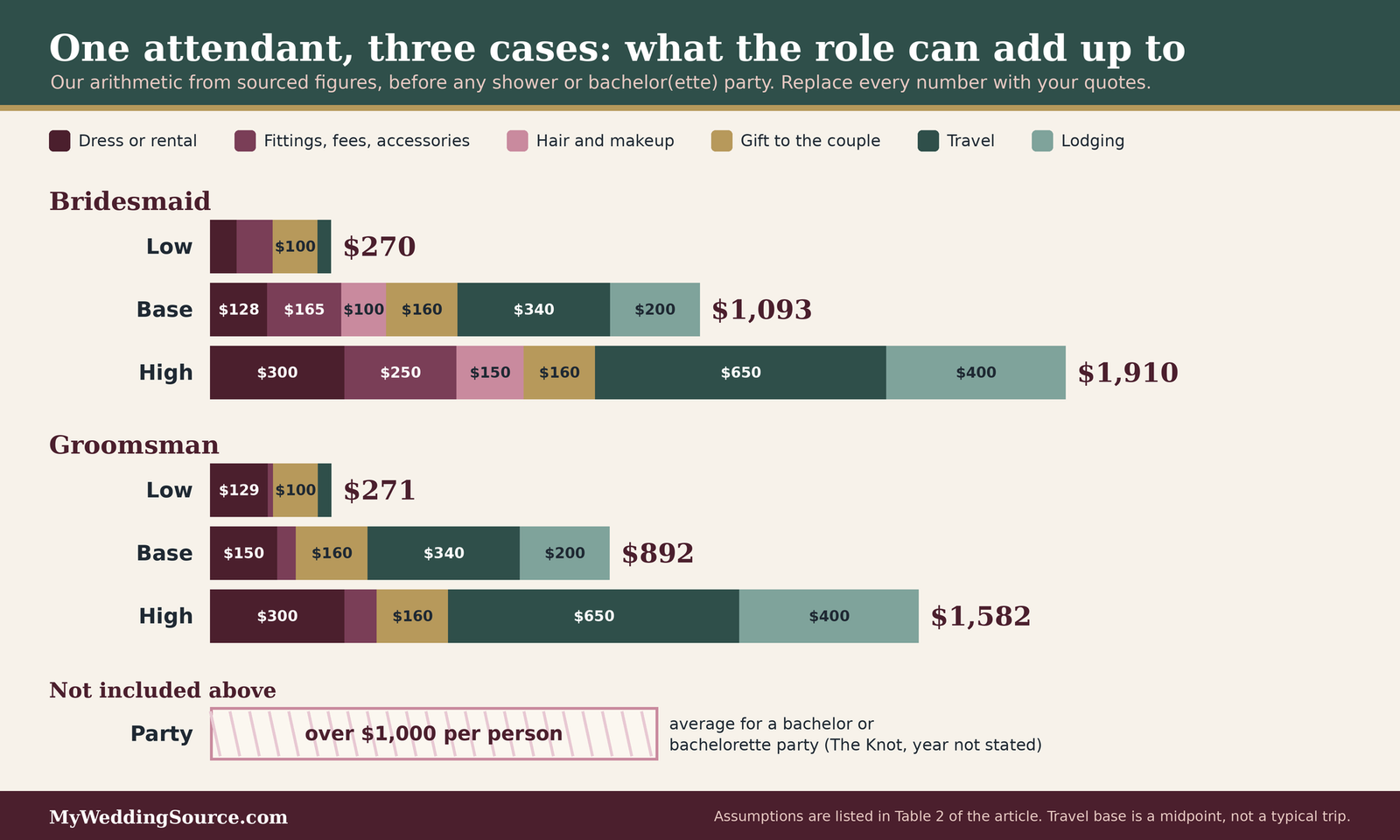
This is editorial arithmetic, not a survey result or a quote. For one bridesmaid we get about $270 (low), $1,093 (base), and $1,910 (high). For one groomsman we get about $271, $892, and $1,582. Both exclude any shower and any bachelor or bachelorette party, which we treat separately because the published average for those parties alone is over $1,000 per person. The biggest swing is travel and lodging, which depend on the wedding’s location, not on anyone’s choices about clothing. Replace our figures with your own quotes.
Table 2 shows the lines and their sources. The totals are simple sums of the cells.
| Line | Bridesmaid low | Bridesmaid base | Bridesmaid high | Groomsman low | Groomsman base | Groomsman high |
|---|---|---|---|---|---|---|
| Dress or rental | 60 | 128 | 300 | 129 | 150 | 300 |
| Alterations (bridesmaid) or fees and extras (groomsman) | 30 | 65 | 100 | 12 | 42 | 72 |
| Shoes, accessories, undergarments (bridesmaid) | 50 | 100 | 150 | 0 | 0 | 0 |
| Hair and makeup, if optional and chosen | 0 | 100 | 150 | 0 | 0 | 0 |
| Gift to the couple | 100 | 160 | 160 | 100 | 160 | 160 |
| Travel | 30 | 340 | 650 | 30 | 340 | 650 |
| Lodging | 0 | 200 | 400 | 0 | 200 | 400 |
| Total | 270 | 1,093 | 1,910 | 271 | 892 | 1,582 |
Our notes on where each cell comes from, so you can check and replace them:
- Bridesmaid dress: low is the bottom of Zola’s budget tier ($60), base is The Knot’s 2024 average ($128), and high is the top of Zola’s typical range ($300).
- Alterations: low and high are the ends of Zola’s basic range ($30 and $100), and base is their midpoint ($65). That midpoint is our arithmetic.
- Shoes, accessories, undergarments: low and high are the ends of Zola’s combined range ($50 and $150), and base is the midpoint ($100). That midpoint is our arithmetic.
- Hair and makeup: low assumes the attendant skips it, base is about $100 from David’s Bridal’s guide, and high is about $150 from Zola. If the couple requires it, the couple pays and this line drops out of the attendant’s column.
- Groomsman rental: low is the lowest starting price The Knot lists ($129), base is the major-retailer average ($150), and high is the top of the typical range ($300).
- Groomsman fees and extras: we assume the $12 handling fee in every case, add one $30 item (such as shoes) in the base case, and one $30 item plus two $15 add-ons in the high case, from The Knot’s price list. The assignment of items to cases is our assumption.
- Gift: low is the bottom of David’s Bridal’s range for a wedding gift ($100), and base and high use The Knot’s 2023 wedding-party average ($160). We found no sourced upper bound, so high equals base.
- Travel: low is about $30 for gas and high is about $650 for a cross-country flight, both from David’s Bridal’s guide. Base is simply the midpoint, $340, which is our arithmetic and not a typical trip.
- Lodging: base is about $200 from David’s Bridal’s guide, which describes it as often covering one or two nights. Low assumes no hotel is needed. High doubles the base for a second stay such as a rehearsal weekend, which is our assumption and is not sourced.
Reading the bridesmaid ledger
The first thing to notice in the bridesmaid column is how little of the high case is clothing. In the high case the dress, alterations, and accessories together come to $550, while travel and lodging add $1,050. Even in the base case, clothing is about $293 of $1,093. A couple deciding whether to ask for matching gowns is focused on the smaller part of its wedding party costs, and the part it controls only indirectly is the larger one.
The second thing is that the gap between low and high wedding party costs is almost all choice and geography. The dress can be $60 or $300 depending on where it is bought. The trip can cost $30 or $650 depending on where the wedding is. A couple who chooses a distant venue has chosen a large share of each attendant’s cost, whether or not that was the intent.
Reading the groomsman ledger
The groomsman column starts lower on clothing, because a rental has a narrower range than a dress and no beauty line. But it ends in the same place on travel, lodging, and gift, so the totals converge toward each other. In the base case, a groomsman’s clothing and fees come to about $192 of $892.
The Knot notes that groomsmen may wear their own wardrobe if the groom allows it, and Zola’s guidance suggests renting or choosing outfits that can be worn again to avoid a large purchase. If your groomsmen already own a dark suit, a plain request for that suit, with a shared tie, can cut the clothing line sharply. Our guide to groomsmen suits vs tuxedos compares the two paths in detail, and our bridesmaid dresses guide does the same for the other side.
The party around the party
Showers and the bachelor or bachelorette party are not part of the table above, because they are optional, unevenly organized, and sometimes the largest single item. They deserve separate attention because they are where good intentions most easily turn into pressure.
Why a single party can outweigh the attire
The Knot’s guide to who pays for bachelor and bachelorette parties cites a Knot study with an average of over $1,000 per person. The article, last updated in September 2023, does not state the study’s year, so treat it as an order of magnitude and not a current figure. If it is even roughly right, one weekend can cost more than the dress and the rental combined.
A Zillow Rentals analysis, announced in August 2025, said attending one wedding plus one bachelor or bachelorette party costs about $2,010, citing The Knot and Bankrate, and compared it with a typical U.S. rent of $2,072 from Zillow’s July 2025 report. The release does not break the total into travel, lodging, attire, or gifts, and it does not report the survey’s sample size. In the same release, 45 percent of the Gen Z and millennial renters Zillow surveyed said they had made a housing sacrifice to afford wedding-related events, and 25 percent said they had declined at least one wedding event because of cost. That analysis describes attendees, not just attendants, but it shows how heavily the surrounding events weigh on people.
How groups keep party costs down
The etiquette sources give consistent practical advice. The Knot says the group should agree on a plan everyone can afford, that a common compromise is for the couple to pay their own travel and lodging while the group covers meals, drinks, and activities, and that having the group cover the honoree’s costs is a gesture and not an expectation. Zola says the couple shouldn’t expect extravagant destinations, and advises that if the couple is willing to spend, they should say so early. David’s Bridal’s guide suggests being flexible on expensive extras and hosting at a family home to cut venue costs.
A fair rule that follows from these is to let the person who is not paying set the ceiling. If the honoree says early that a local dinner is plenty, the group has permission to plan a modest event, and nobody has to be the person who suggested going smaller. If you are the honoree, saying so before the first planning message is one of the most useful things you can do for your wedding party costs.
Deciding what the couple covers
Once you can see the attendant’s ledger of wedding party costs, the couple’s decision becomes concrete: which lines, if any, will you take over? There is no required answer. The sources describe both customs and exceptions, and the right choice depends on your budget, your party, and how much you want to ask of each person.
Four policies and what they cost the couple
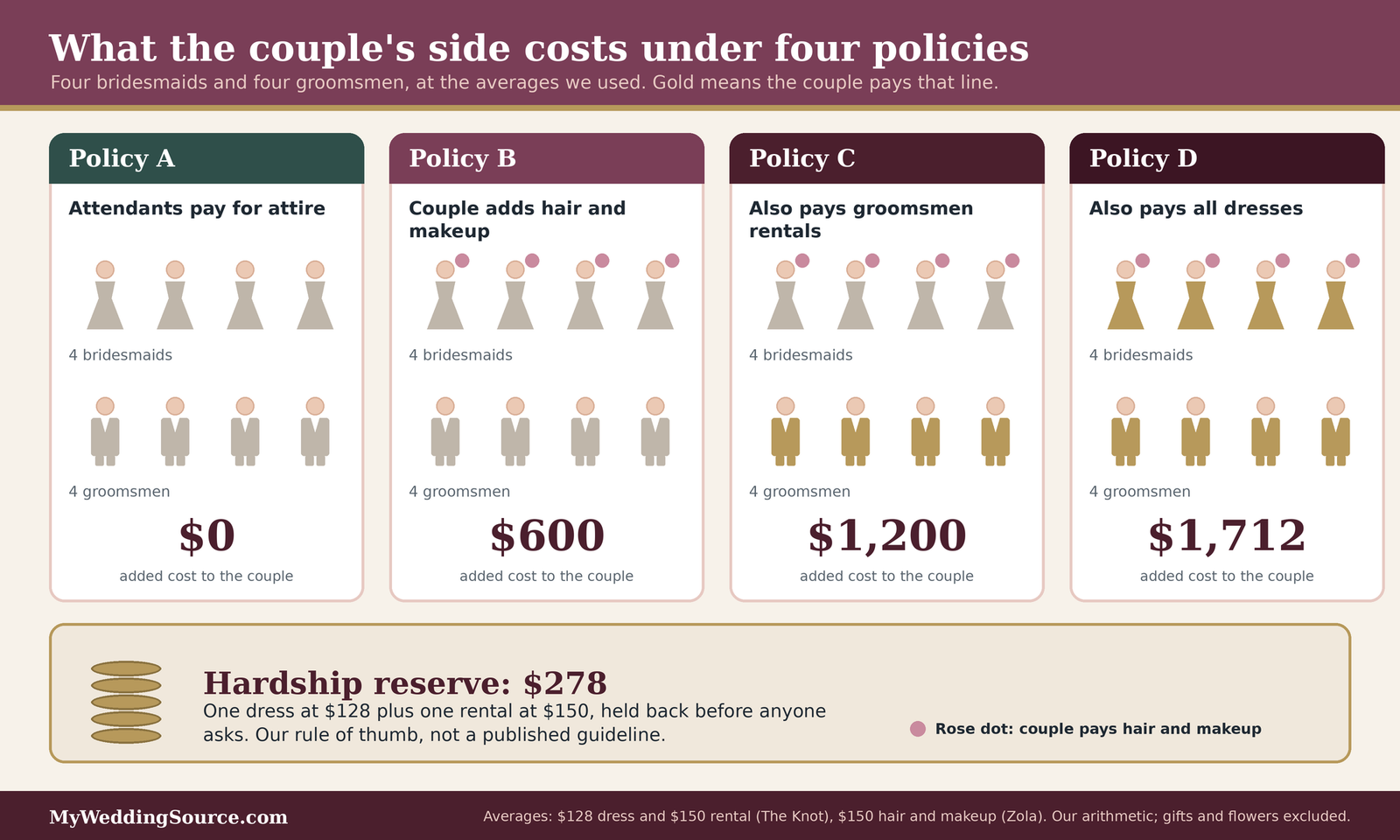
The simplest way to compare approaches to wedding party costs is to price them. We built four policies for a party of any size, then worked the arithmetic for three party sizes. The policies are ordered from least to most couple spending.
From “attendants pay” to “couple covers attire”
Policy A is the traditional baseline: attendants pay for their own attire and the couple pays nothing toward it. Policy B adds the require-and-pay principle: the couple pays for professional hair and makeup for bridesmaids, because it is the line most often required. Policy C adds groomsmen rentals. Policy D has the couple pay for dresses, rentals, and hair and makeup, which is the generous end and is sometimes chosen for small parties.
For the couple’s lines, we used the published figures at the higher end, because underestimating a line you promised to pay is worse than overestimating it. We used $150 per bridesmaid for hair and makeup (Zola’s average), $128 per bridesmaid dress (The Knot’s 2024 average), and $150 per groomsman rental (The Knot’s major-retailer average). We did not include gifts for attendants, flowers, or transportation, because we found no sourced prices for them, and because they apply under every policy.
Table 3 shows the couple’s added outlay under each policy for three party sizes, with a hardship reserve we describe below.
| Policy | What the couple pays | 3 bridesmaids + 3 groomsmen | 4 + 4 | 6 + 6 |
|---|---|---|---|---|
| A | Nothing toward attire | 0 | 0 | 0 |
| B | Hair and makeup for bridesmaids | 450 | 600 | 900 |
| C | B plus groomsmen rentals | 900 | 1,200 | 1,800 |
| D | C plus all bridesmaid dresses | 1,284 | 1,712 | 2,568 |
| Reserve | One dress plus one rental, held for hardship | 278 | 278 | 278 |
We computed the rows from the per-person figures above: B is bridesmaids times $150, C adds groomsmen times $150, D adds bridesmaids times $128, and the reserve is $128 plus $150. These totals exclude sales tax, shipping, and tips.
Why a capped contribution is a fifth option
The table does not include a fifth approach that many couples find easier: a capped contribution. The couple announces a fixed amount it will put toward each person’s attire, for example the average price of a dress, and attendants choose within or beyond it. The Knot’s guidance on bridesmaids advises thrifted or rewearable options, and Zola describes letting bridesmaids choose their own dresses within a set color and silhouette. A cap works well with that approach, because it ties the couple’s spending to a number the couple chose, and it leaves the attendant free to spend more or less without comment.
The weakness is the same as its strength. A cap is visible, and if two attendants spend different amounts, someone may notice. Say plainly that the cap is a contribution, not a target.
The require-and-pay rule, and where it stops
The principle that anything the couple requires is something the couple pays for is the clearest rule in the sources. It is also easy to misapply, so it helps to be exact about what it covers.
A list of requirements and a list of suggestions
Write two lists. The requirements list holds anything a person must do or buy to take part: a specific dress or suit, a particular shoe, a hairstyle, a matching robe. The suggestions list holds everything else: a color family, a neckline range, a preferred length. By the sources’ reasoning, the couple pays for the first list and the attendant chooses within the second.
Our practical addition, which is our recommendation and not a published rule, is to keep the first list short. Every item on it is a line the couple has chosen to own. A short list keeps wedding party costs predictable for you and keeps attendants from feeling managed.
The limits of the rule
The rule does not tell you what to do about costs the couple did not require but that arise from its choices, such as a distant venue, a Saturday-night-only wedding that forces a hotel stay, or a destination. Zola says a couple shouldn’t ask attendants to pay for more than one or two nights of lodging, which is a practical boundary. Beyond that, the sources leave the question open. In those cases, our suggestion is to treat the venue as a choice that shapes everyone’s costs and to ask whether a room block or a shared suite is worth offering. The Knot mentions room blocks and discounted rates as ways couples help with lodging.
Quiet help for an attendant who cannot afford it
Every wedding party eventually includes someone for whom the standard wedding party costs are a stretch. The sources do not treat this as an unusual problem, and they agree on how to handle it.
How to offer help privately
Zola’s guidance describes couples quietly covering the cost for a bridesmaid who cannot afford a preferred dress, and it notes that some bridesmaids may only have a small amount to spend. Zola’s groomsmen guidance says that if a groomsman would be strained, the groom can cover the suit or leave him out of the party. The common thread is privacy. Offer help one-on-one and without a form to fill out, and do not announce it to the group.
A neutral way to start is to ask everyone the same question at the beginning, with no assumptions: “Is there a budget you would like me to stay under for attire?” This lets anyone name a number without asking for help, and it puts the cost conversation on everyone’s schedule instead of one person’s.
Setting aside a reserve
A reserve is money set aside before anyone asks. We suggest, as our own rule of thumb, holding the equivalent of one dress and one rental, which is $278 at the averages we used. This is not a published guideline. It is an amount that lets you say yes to one person on either side of the party without rearranging the budget. If nobody needs it, the money returns to the general budget. The advantage of a reserve is that a request for help is answered with a plan and not with a scramble.
If you track your budget with our wedding budget calculator, you can add the reserve as its own line. Naming it keeps it from being quietly spent on something else.
Keeping wedding party costs fair when the group is uneven
Fairness in wedding party costs is not the same as equality. Giving everyone the same dress at the same price is equal, and it can still be unfair if one person earns a third of what another does. The goal that most of the sources point toward is simpler: nobody should be surprised by a cost, and nobody should have to explain their finances to stay in the group.
Ask for a ceiling, not a confession
The most practical tool in the whole topic is a question that lets people name a limit without explaining it. It works because it is asked of everyone, in the same words, before any choices are made.
What to say in the first message
A first message about wedding party costs that works well covers four things in plain language: what the role involves, what the couple will pay for, what it is asking attendants to cover, and a way to reply privately. For example: “We would love you to stand with us. For attire, we are asking everyone to wear something in a deep green, and we will cover hair and makeup. You would cover your own dress, shoes, and travel. If there is a number you would like us to keep in mind, tell me privately and I will make it work.” That is our wording, not a quotation from any source, and you should change it to sound like you.
David’s Bridal’s guide advises telling bridesmaids the expected dress price and the budget early, so they can save and shop for deals. The same point applies to groomsmen. A date and a number, offered early, do more for fairness than any later gesture.
Build a shortlist inside the lowest ceiling
Once the replies come back, find the lowest ceiling on wedding party costs and choose options that fit under it. That sounds harsh, but it is the opposite: the lowest ceiling is the one that is hardest to meet, so meeting it means everyone else is comfortable too. If the lowest number is far below the shortlist, the couple can cover the gap for that person, in private, or drop to a lower price tier for the group. Zola recommends sharing a budget cap with the party so everyone can shop within their means, and letting each person pick a style within a color scheme, which often costs less.
Lowering the bill without lowering the look
Several of the sources offer the same set of tactics for lowering wedding party costs. They are worth ranking by how much they change the attendants’ wedding party costs, and by what they trade away.
Mix and match, rent, or buy secondhand
Zola’s advice lists a shared color with each person choosing their own style, versatile styles that can be worn again, secondhand or resale purchases, and rental from a dress rental site. Zola notes that rental platforms typically charge a fraction of purchase prices and include delivery and professional cleaning, though it gives no price range. The Knot suggests thrifted or rewearable dresses, and notes that a secondhand dress may need extra alterations because it was tailored for someone else.
Each way of lowering wedding party costs trades something. Mix and match gives up uniformity. Renting gives up ownership and adds a return deadline. Secondhand gives up predictability, since sizing and condition vary. None is better in general. Our bridesmaid dresses guide goes through those trade-offs in more depth.
Cost per wear and what it means
A simple way to compare buying and renting is to divide the price by the number of times you expect to wear the item. This is our arithmetic and a rough guide, not a financial rule. A $128 dress worn once costs $128 per wear. The same dress worn four times costs $32 per wear. A $150 rental worn once costs $150 per wear, though it requires no storage and no further purchase. The point is not that one is wiser. It is that the sticker price alone does not tell you which is cheaper for a particular person.
For many attendants the likeliest answer is that the dress will be worn once, in which case the cost per wear is the price, and a lower price is the most direct saving. For a groomsman who owns a dark suit and would wear it again, the rental is the more expensive choice.
False savings that move the cost elsewhere
A saving in wedding party costs is false when it reduces one line and increases another, or when it creates a risk that the couple or the attendant ends up paying for later. Four patterns recur in the sources.
Rush fees and last-minute orders
Zola reports that rush orders in peak wedding season often add $50 to $100. A dress ordered late to save a few days of decision time can easily cost more than a dress ordered early at a slightly higher list price. The Knot and Zola both advise choosing dresses early, so attendants have time to save, order, and alter. The saving from a late decision is the opposite of a saving.
Cheap sticker prices with expensive finishing
A low price on a dress that needs extensive alterations can cost more than a higher price on one that fits. Zola puts complex changes or multiple fittings at about $80 to $150, against about $20 to $40 for a simple hem. The Knot notes that embellished fabrics cost more to alter. When you compare two options, compare them after the likely alterations, not before. We show how in the working method below.
Skipping insurance on rentals
The Knot’s guide to tuxedo rentals warns that some retailers add charges under names such as “damage waiver” or “rental insurance,” and it names two retailers whose flat fee of $12 covers wear, cleaning, and restocking. We do not know what any particular retailer’s terms say, and we are not recommending for or against any. The point is to read the terms before the order, so that a fee does not appear as a surprise on the pickup day. If a rental does get damaged, the seller’s terms decide who pays.
Group purchases that quietly assign cost
A group gift or a shared house can reduce each person’s share, as The Knot and David’s Bridal both suggest. It can also assign a cost to someone who did not agree to it. If one person books a house for a bachelorette weekend and then divides the bill, anyone who joins is committed to a number they may not have seen. The remedy is a written estimate before booking, with a clear opt-out date. That keeps the saving real.
Whether a smaller party is a fairness decision
The number of attendants is itself a decision about wedding party costs, and it affects fairness in ways that are easy to miss.
What the data says about party size
Axios, reporting in January 2026 and citing The Knot, says the average wedding party is now about eight people, down from about ten in 2019, and cites a 2026 Zola survey finding that 85 percent of engaged couples planned to have a wedding party. Neither figure comes with a stated sample or year in the article, so we treat them as signs of direction. They suggest that many couples are making the party smaller without abandoning it. Our guides to small wedding planning and micro wedding planning discuss how scale changes the other lines of a wedding.
Honorary roles and no-cost ways to include people
If you want to honor more people than you can fund, there are roles that carry little or no cost. The Knot notes that attendants can contribute in non-financial ways, such as planning or day-of help. A reading, a toast, or a task on the day can mark someone as part of the group without a dress or a plane ticket. We are describing options, not a standard practice, and the key is to say plainly what the role involves and costs. A person who is told in advance that the role is a reading and a seat at the front is not being offered a smaller version of the real thing.
Timing, contracts, and protections for everyone’s money
Most of the stress around wedding party costs comes from timing, not totals. A sum that is manageable over six months is hard to pay in two weeks. This section looks at when the money leaves people’s accounts, what rules protect purchases, and how to handle changes.
When the money leaves each person’s account
A fair plan for wedding party costs puts the largest payments when they are easiest to absorb, and tells people the dates early. Our plan wedding timeline shows where these dates fall in the larger schedule.
Order and payment dates
We did not find a single authoritative lead time for ordering attire, and sellers differ, so we do not give one. What the sources agree on is direction: Zola advises picking dresses early so attendants have time to save and order and to arrange alterations, and David’s Bridal advises sharing the expected price early. Ask each seller for its production and delivery estimate in writing, then work backward from the date you need the clothes in hand, and add a margin for alterations. Put every payment date, deposit, and return deadline in one shared note.
A useful discipline is to ask the group to pay for attire in the order the seller requires and no sooner. A person who pays early to meet a deadline you invented has lent you money without being asked.
Cost that arrives late
Some wedding party costs arrive close to the wedding: alterations, accessories, hair and makeup trials, the final installment of a group gift, and last-minute travel. Most people forget these when they say yes. A short reminder, a month before, that these lines are coming helps. It is a kindness to name them early, and it prevents the sense that the costs keep growing.
Returns, delays, and what the rules say
Some protections exist in law, and some exist only in a seller’s policy. Knowing which is which keeps expectations realistic. This is general information, not legal advice, and the rules that apply to a given purchase depend on the seller, the product, and the state.
The federal rule on shipping delays
The Federal Trade Commission’s business guide to its Mail, Internet, or Telephone Order Merchandise Rule says that when an ad does not clearly state a shipping time, the seller must reasonably expect to ship within 30 days of receiving a complete order. If a seller cannot ship on time, it must promptly offer the buyer a choice between accepting a delay and canceling for a full refund. The guide also describes refund timing for different payment methods and says store credit cannot replace a required refund. This is the FTC’s guidance to sellers, and exceptions and details apply, so read the guide itself or ask the seller. Even so, it is useful to know that a late delivery gives a buyer a right to ask, and that an attendant with a long-delayed dress is not stuck.
Seller policies for substitutions and returns
Most of what matters for attire is in the seller’s own terms: whether a custom or altered item can be returned, whether a color can be substituted, and whether a rental has a late fee. The Knot’s article does not cover late fees or alterations for rentals, and we found no authoritative source on typical return windows for bridesmaid dresses, so we do not state one. Before anyone pays, ask the seller for return, exchange, and cancellation terms in writing, and keep the confirmation. Our wedding insurance guide explains what event insurance does and does not cover, and it is worth reading if a large non-refundable payment is involved.
When the party changes
Wedding parties change. Someone’s circumstances shift, a friendship moves, or a venue changes. Plan for it before it happens, and the change is a logistics problem and not a hurt.
A person leaves or is added
If an attendant withdraws after ordering, the attire is the main question, and the answer depends on the seller’s terms. Ask the seller early whether the item can be canceled, exchanged, or resold. Zola’s advice that a couple may quietly cover a bridesmaid who cannot afford a preferred dress is a guide for the other direction: if someone cannot continue because of money, an offer to cover costs is the first thing to try. If they still need to step back, keep the conversation about the friendship, not the invoice.
When someone is added, give them the same information everyone received at the start: the plan, the dates, the number, and the private way to ask. Do not rely on the group to explain it.
Who fronts money, and how it is repaid
The Knot notes that a maid of honor may front group costs until reimbursed. That is a common arrangement, and it quietly turns one friend into a lender. Set a reimbursement date when the cost is incurred, and use a shared record, such as a spreadsheet, that shows who has paid. If someone drops out, you will need that record. A person who fronts a deposit for the group should not wait for months to be repaid, and should be told in advance how repayment works.
Gifts and taxes, briefly
Couples sometimes pay a lot toward wedding party costs, and sometimes parents or others contribute. A short note on gift tax belongs here, because people ask, and because the answer is reassuring in most cases. This is general education, not tax advice, and a tax professional can answer questions about your situation.
The annual exclusion in plain terms
The IRS says on its gift tax frequently asked questions page, last updated July 23, 2026, that the annual exclusion is $19,000 per recipient for gifts made in 2026, the same as 2025. It also says the donor is generally responsible for any gift tax. Covering an attendant’s dress or rental is far below that amount in ordinary cases. At the highest figure in our Table 3, a couple covering all attire for six bridesmaids and six groomsmen is spending about $2,568 across twelve people, which is well under $19,000 per recipient, and the exclusion is applied per recipient.
When to ask a professional
That arithmetic is ours and describes ordinary amounts. If a parent or relative is making a large gift to the couple or to attendants, or if the amounts involved are unusual, a short conversation with a tax professional can settle questions that a general article cannot. We cannot tell you whether a particular payment needs to be reported, and we are not suggesting that yours does.
A working method: normalize every quote, then set the budget lines
This section turns the ideas above into steps you can repeat. It is the part of the guide on wedding party costs you can copy into a notes app and reuse.
Normalize every quote to an all-in number
The most common error in wedding party costs is comparing a sticker price to an all-in price. Fix it by converting every quote to the same five lines before you compare.
The five lines to add
For each option, write down the item price, tax, shipping, expected alterations, and fees or extras. Item price is the listed price. Tax is whatever the seller will charge at checkout in the attendant’s state. Shipping is the delivered cost, or zero if free. Alterations come from a local seamstress’s quote, or Zola’s ranges if you have none yet. Fees and extras include handling fees, rush surcharges, try-on fees, and accessories the item requires. Add the five lines. The total is the number to compare.
A worked example with assumed numbers
Suppose Dress A is listed at $89 with $10 shipping, and Dress B at $139 with free shipping. Assume 7 percent sales tax on both, which is an illustrative number and not any state’s rate. Assume Dress A needs a bodice adjustment at $65, the midpoint of Zola’s range, and Dress B needs only a hem at $30, within Zola’s $20 to $40 range for hemming.
Dress A: $89 plus $6.23 tax plus $10 shipping plus $65 alterations is $170.23. Dress B: $139 plus $9.73 tax plus $0 shipping plus $30 alterations is $178.73. The sticker prices are $50 apart, and the all-in prices are about $8 apart. If Dress A also needed a $75 rush fee, the midpoint of Zola’s $50 to $100 range, it would come to $245.23, which is $66 more than Dress B. All of these numbers are illustrative, and they exist to show how the order of the options can change once you add the lines.
Set the couple’s budget lines and a rule for using them
A budget for wedding party costs is easier to keep when the rules for changing it are written down before there is pressure. Three decisions cover most of wedding party costs.
Decide who can approve changes
Pick one or two people who can approve a change to the wedding party budget. It might be the couple together, or one partner for each side of the party. The point is that the answer to “can we add this?” does not depend on who happened to be asked. Write the rule in your tracker: any change above a stated amount needs both partners to agree. Our wedding planning checklist is a good place to keep it.
Write a rule for the reserve
State what the reserve is for and who may use it. Our suggestion: it is for attendant hardship and for unexpected costs of the couple’s own requirements, such as a rush fee triggered by the couple’s late decision. It is not for upgrades. If you use it, record the amount, and if it is not needed, release it on a date you set, such as a month before the wedding.
Reforecast as inputs change
A budget for wedding party costs made in January is not accurate in June. The party, the quotes, and the dates all move. Reforecasting is a short, regular check that keeps the budget honest.
Update the party, the quotes, and the dates together
When the guest count, a quote, or a date changes, revisit the wedding party costs at the same time, because they are linked. A date change can change travel costs. A guest-count change can change the venue and therefore the room block. Our average wedding cost guide gives context for how these lines sit within the full budget, and The Knot’s 2026 Real Weddings Study press release reports an average wedding cost of $34,000 and an average of 117 guests across 10,474 U.S. couples who married in 2025. The release we read does not include wedding party figures, so we do not use it for those lines.
Track committed, paid, and still estimated money
Use three columns for every line: committed means you have agreed to it, paid means money has left the account, and estimated means you are still guessing. At any moment, the sum of committed and paid is what you cannot easily change, and the estimated column is where surprises live. If the estimated column is large, the budget is not yet a plan. Convert estimates into quotes as early as you can.
For attendants, the same three columns make a simple private tracker. A person who can see what is committed, paid, and still to come is much less likely to be surprised in the final month. Offer the template, and do not require anyone to share theirs.
Questions to ask before anyone commits
Good questions prevent most of the problems with wedding party costs described above. These two groups are written for the two sides of the table: what to ask the people you are inviting, and what to ask the sellers you plan to use.
Questions to ask before anyone commits
- Is there a spending level you would like me to keep in mind for attire, and may you tell me privately?
- Will the wedding location mean travel or a hotel stay for you, and how many nights?
- Which costs will we, the couple, cover, and which are you being asked to cover?
- Is there a date by which each payment is due, and what is the cancellation rule?
- If plans change, what happens to an item already ordered?
- Who is collecting any group money, and when will it be repaid?
Questions for the people you are inviting
Ask the same questions of everyone, in the same words, and make the replies private.
Money and availability
Ask about budget and about the weekend itself. A person who lives nearby and one who must fly have very different bills, and the couple cannot see that difference without asking. Ask early whether the person can attend the shower and the bachelor or bachelorette party, and tell them the likely cost range. If you are the one organizing, say so, and offer a version of each event that costs less.
Comfort and boundaries
Ask whether there is anything about the role that the person would prefer to avoid, such as a dress style, a long weekend away, or a public speech. People often accept a role with an unspoken reservation. A direct question lets them name it, and it gives you a chance to adjust.
Questions for sellers
Sellers answer questions about wedding party costs clearly when asked specifically, and the answers belong in writing.
Price, fees, and timing
Ask for the all-in price, including tax and shipping, any handling or damage fee, any rush surcharge, and the expected delivery date. Ask whether the price changes if the order is placed in stages by different people, and whether there is a group discount, because we found no sourced information on group discounts and so cannot say whether they are common.
Changes and returns
Ask what happens if a person drops out, a size changes, or a date moves. Ask whether altered items can be returned, whether a rental has a late fee, and whether a color or style can be exchanged. Keep every confirmation. If a seller will not put policies in writing, treat that as information.
FAQ: wedding party costs questions
Who pays for what
Who pays for bridesmaid dresses?
In the United States, the sources we reviewed say bridesmaids typically pay for their own dresses, shoes, and accessories. Zola notes that in the United Kingdom and Ireland the bride or couple more often pays. A couple that chooses a specific gown, or requires specific shoes, is generally expected to cover that requirement, so the question depends on what you ask for.
Do groomsmen pay for their own tuxedo or suit?
Usually. The Knot says groomsmen typically pay for their attire and accessories, and Zola says the groom traditionally chooses the look while the groomsmen pay. Zola also describes exceptions: the groom may cover the cost if a groomsman would be strained, if the attire is expensive, or if the groom simply wants to and can afford it.
Who pays for hair and makeup?
If the couple requires professional hair and makeup, Zola and The Knot both say the bride is expected to pay, or to split the cost. If it is an optional extra that bridesmaids may choose, they pay for it. Zola cites an average of about $150 per person, without giving a year or method, so use it as a rough guide only.
Is the couple expected to pay for the wedding party’s hotel?
The sources disagree. Emily Post says the couple traditionally arranges and pays for the bridal party’s lodging. Zola and The Knot say attendants typically pay for their own rooms, and that the couple may offer a room block or pay for a shared suite it requires. Because published guidance splits, say who pays in your first message.
Parties, gifts, and fairness
Are attendants required to give the couple a gift?
Customs describe a gift, often a shared one, but Zola says it should be optional and without pressure, and The Knot suggests pooling funds with other attendants. The Knot’s 2023 guest study reported an average of $160 spent on a wedding gift by wedding party members. Treat that as a survey figure, not an expectation.
What if an attendant cannot afford the costs?
Offer help privately. Zola describes couples quietly covering a dress for someone who cannot afford it, and says a groom can cover a groomsman’s suit or leave him out of the party if the expense would strain him. Asking everyone for a private ceiling at the start lets anyone name a limit without asking for help.
How much does a bachelor or bachelorette party cost?
The Knot cites a study with an average of over $1,000 per person, though the article, updated in 2023, does not give the study’s year. A weekend away costs far more than a night out. Honorees can help by saying early what they want, and groups can agree on a plan everyone can afford.
Does a smaller wedding party save money?
It reduces the per-person lines the couple pays for, such as gifts, flowers, and any covered services. Axios, citing The Knot, reports an average party of about eight people, down from about ten in 2019. But shared costs, such as a group gift, may rise per person. Smaller is cheaper for the couple, but not always for each attendant.
Your next steps
Decide before you ask
Write the two lists
Write your requirements, which you will pay for, and your suggestions, which attendants choose. Keep the first list short. Our wedding party attire guide covers the clothing side of the decision, and our wedding planning guide places it in the wider plan.
Price your own side
Use the policy table to find the couple’s added wedding party costs at your party size, add a reserve, and enter the lines in the wedding budget calculator. Put gifts, flowers, and transportation in too. If hair and makeup is a line you may cover, our bridal makeup guide helps you ask the right questions.
Ask and confirm
Send one clear first message
State the role, the plan, the dates, what you will pay for, what you are asking attendants to cover, and a private way to reply. Use the same words for everyone, and add a date for answers.
Keep the record
Track each line of your wedding party costs as committed, paid, or estimated, and put payment dates and return deadlines in one shared note. Our wedding planning stress guide offers ways to keep the planning manageable, and our wedding jewelry and seasonal wedding flowers guides help with the thank-you gifts and flowers that sit on your side of the ledger.
Sources & methodology
How we built this guide
What we relied on
This guide combines two federal sources (the FTC’s guidance on mail-order shipping and the IRS’s gift-tax FAQ), published etiquette guidance from Emily Post, The Knot, and Zola, a retailer guide from David’s Bridal, survey-based reporting from The Knot and Zillow, and news reporting from Axios. Where a figure comes from a survey, we give its year and scope. Where a statement comes from a retailer, we say so, because retailer advice reflects the seller’s own products. The totals, midpoints, and worked examples are our own arithmetic, and they are estimates. Several pages we read do not state a year or method, and we say so wherever we use them.
What we did not do
We did not survey attendants, price specific products, or test any seller. We found no sourced prices for flowers, day-of transportation, attendant gifts from the couple, or group discounts, so we do not state any. We do not give legal, tax, or financial advice. Check your own contracts and consult a professional for questions about taxes or legal rights.
Source list
Government sources
- Federal Trade Commission, Business Guide to the Mail, Internet, or Telephone Order Merchandise Rule: https://ftc.gov/business-guidance/resources/business-guide-ftcs-mail-internet-or-telephone-order-merchandise-rule
- Internal Revenue Service, Frequently asked questions on gift taxes: https://www.irs.gov/businesses/small-businesses-self-employed/frequently-asked-questions-on-gift-taxes
Etiquette and survey sources
- Emily Post, Inside weddings: the wedding party: https://emilypost.com/advice/inside-weddings-the-wedding-party
- The Knot, What bridesmaids pay for: https://www.theknot.com/content/what-bridesmaids-pay-for
- The Knot, What groomsmen pay for: https://theknot.com/content/what-groomsmen-pay-for
- The Knot, Who pays for bachelor and bachelorette parties: https://www.theknot.com/content/who-pays-for-bachelor-and-bachelorette-parties
- The Knot, Average bridesmaid dress cost (2025 Real Weddings Study, 2024 weddings): https://theknot.com/content/average-bridesmaid-dress-cost
- The Knot, Average tux rental cost: https://www.theknot.com/content/tux-rental-cost
- The Knot, Wedding expenses couples pay for (2017 study data): https://www.theknot.com/content/wedding-expenses-couple-pays-for
- The Knot Worldwide, 2026 Real Weddings Study press release: https://www.theknotww.com/press-releases/the-knot-worldwide-unveils-2026-real-weddings-study
Retailer, media, and industry sources
- Zola, What do bridesmaids pay for?: https://www.zola.com/expert-advice/what-do-bridesmaids-pay-for
- Zola, Who pays for bridesmaid dresses?: https://www.zola.com/expert-advice/who-pays-for-bridesmaids-dresses
- Zola, How much do bridesmaid dresses cost?: https://www.zola.com/expert-advice/how-much-do-bridesmaid-dresses-cost
- Zola, Who pays for the groomsmen suits?: https://www.zola.com/expert-advice/who-pays-for-the-groomsmen-suits
- David’s Bridal (Pearl), The average cost of being a bridesmaid: https://pearl.davidsbridal.com/inspiration/?p=7286
- Axios, Latest wedding trend: smaller entourages: https://www.axios.com/2026/01/17/wedding-party-bridesmaid-groomsmen-cost
- Zillow, Rent or RSVP? Gen Z, millennials make housing sacrifices to attend wedding events: https://zillow.mediaroom.com/2025-08-28-Rent-or-RSVP-Gen-Z,-millennials-make-housing-sacrifices-to-attend-wedding-events