
Wedding venue security is the set of decisions about who may enter your wedding, through which door, at what time, and who has the authority to say yes or no when someone is not on the list. This guide shows how to assign each of those decisions to a named person before the day, and how to handle guest check-in and vendor access without turning a celebration into a checkpoint.
Split wedding venue security into four gates: the arrival point, the ceremony or reception entrance, the vendor and back-of-house door, and private rooms. For each gate, write down who decides, who carries it out and who handles the exceptions. The venue usually controls the building, the couple controls the guest list, and each vendor controls only its own equipment. Settle the overlaps in writing, brief a greeter with a clear exception script, and verify any legal, fire or accessibility question with the venue manager and the local authority.
Most couples picture security as a person in a dark jacket standing near a door. In practice, almost every access problem at a wedding is much smaller and much more ordinary. A guest arrives forty minutes early and wanders into the bridal suite. A florist’s van blocks the fire lane. A cousin who was not invited turns up with a gift and a smile.
A caterer’s staff member props a service door open for air and a stranger walks through it. Nobody planned for these moments because nobody owned them. Good venue security is mostly quiet preparation, not a show of force.
That is the real subject of wedding venue security: ownership. The building has its own rules, your contracts add more, and the day itself produces situations neither side wrote down. If no one is named for each situation, the default owner is whoever happens to be standing closest, and that is usually a bridesmaid holding a bouquet or a venue employee who has no idea what you agreed to. Clear venue security rules protect the people at the door as much as the guests.
This guide is built around two tools. The first is an access-control responsibility matrix, which assigns every gate at your venue to a decider, an operator and an escalation contact. The second is a guest exception workflow, which gives your greeter a short, calm sequence to follow when a name is missing, a guest arrives with extra people, or someone should not be admitted.
Both tools work for a backyard tent and for a ballroom with a security desk. You scale them by changing how many people are involved, not by changing the logic. Both tools make venue security something a small team can run.
A note on scope. This is general information, not legal advice, and fire, occupancy, accessibility and alcohol rules differ by city and by building. Where a rule matters, the guide points you to the issuing authority or to the venue’s own manager, who should confirm it for your site.
What wedding venue security actually covers
The phrase sounds heavier than the reality. For nearly every wedding, venue security covers five plain activities, and only one of them involves anything resembling enforcement. Seen this way, venue security is a planning topic before it is anything else.
Knowing who is expected. This means a guest list that the people at the door can actually use, with household names, plus-ones and known late additions. It also means a short list of vendors and their arrival windows.
Controlling how people arrive. Which entrance is for guests, which is for vendors, where cars may stop, and where the wedding party waits before the ceremony.
Keeping private spaces private. Dressing rooms, the room where gifts and cards are held, the room where the caterer stages food, and any storage area holding personal items.
Protecting belongings. Gift tables, card boxes, coats, bags, the couple’s valuables, and rented items for which you are financially responsible.
Handling the unexpected. An uninvited person, a guest who has had too much to drink, a family conflict that follows someone to the door, a medical emergency that needs a clear path for responders.
Only the last item ever calls for firm intervention, and even then the best outcome is usually a quiet conversation by someone with the authority to have it. Everything else is logistics, and logistics is something couples are already good at planning. Even here, venue security works best when it is calm and private.
What this guide does not try to do
Wedding venue security overlaps with several other topics, and it helps to name the edges so you do not plan the same thing twice. The overall site survey, including measurements, power and load paths, belongs in the venue technical walkthrough guide. Delivery timing, freight elevators, dock hours and vehicle staging belong to that survey too. Here the focus is narrower: who has the authority to admit, refuse and redirect people, and how that authority is shared among the venue, you and your vendors.
Why the access question gets skipped
Planning checklists tend to treat the venue as a single party and the couple as another, with a contract between them. Access sits in the gap. The venue assumes the couple will manage guests. The couple assumes the venue manages the building. The coordinator, if there is one, assumes both have briefed their people. Each assumption is reasonable on its own, and together they leave a doorway with nobody in charge of it.
Another reason is timing. Access matters most in the two hours before the ceremony and the last hour of the evening, which are the two periods when everyone is busiest. Decisions made in the moment, under pressure, tend to be worse than decisions made in a calm planning meeting. So the goal of this guide is to move every decision that can be moved to a quieter time. A written venue security plan is how those quieter decisions reach the day itself.
Four gates: where wedding venue security begins and ends
A wedding venue is easier to think about as a series of gates than as a single building. A gate is any point where a person either belongs or does not, and where someone could reasonably ask. Four gates cover almost every venue type. Thinking in gates keeps venue security specific and easy to hand to someone else.
Gate one: the arrival point. This is where guests first meet the property: the parking area, the front drive, the shuttle drop-off, the main door of the building. The question here is traffic and orientation. Where do cars stop, who points guests toward the ceremony, and what happens to a guest who arrives before the doors are meant to open? At many venues the first gate is not controlled at all, and that is fine, as long as it is not controlled by accident.
Gate two: the ceremony and reception entrances. This is the point at which being a guest becomes relevant. A greeter, an usher, an escort card table or a simple sign can all serve as gate two. It is the only gate where the guest list matters in a practical sense. If your wedding has an open ceremony and a ticketless reception, gate two may be nothing more than a smiling person and a sign.
Gate three: the vendor and back-of-house door. Caterers, rental crews, musicians, photographers and florists all use a different route than guests. This gate is the one most often left unwatched, and it is also where equipment, alcohol and personal bags move in and out. It belongs to the venue’s operations and your vendors, with you in an advisory role.
Gate four: private rooms. Bridal and groom suites, the gift and card room, the cake and food staging area, the coat room, and any storage closet holding personal items. This gate is controlled by a key, a lock code, a person or a closed door with a sign, and it should always have a named holder.

How the gates change with venue type
A hotel ballroom usually has built-in controls: staffed entrances, key-card elevators, a catering office and a house security team. Your decisions concentrate at gate two and gate four. A barn or farm property often has no controls at all, and the entire system has to be built by people you bring. A historic hall or museum tends to have strict rules about which doors may be used and how many people may be in a space, and those rules usually come with a staff member who is assigned to enforce them.
A public park or garden may have no authority to restrict anyone, which changes the conversation entirely: you cannot refuse entry to the public, so you plan around visibility, not exclusion. A private home or backyard puts all four gates on you and your family.
Whatever the type, the first useful exercise for venue security is to walk the property, or the floor plan, and mark where each gate sits., the first useful exercise is to walk the property, or the floor plan, and mark where each gate sits. If you do not know where gate three is, ask the venue manager where the caterer’s staff enters and where the trash goes out. Those two answers usually reveal the back-of-house route, and often a door that guests would otherwise find by accident.
A short list of gate-by-gate questions
Before you assign any names, collect the facts. These questions work for any venue and take about twenty minutes with the site manager.
For gate one, ask where guests may park and where vehicles are not allowed to stop, whether staff direct traffic, and what time the grounds open to you. For gate two, ask whether the venue requires a staffed entrance for events of your size, whether there is a fixed capacity you must stay under, and whether the venue keeps its own record of how many people are on site.
For gate three, ask which door vendors use, whether vendors must sign in, and what hours the vendor door is unlocked. For gate four, ask who holds keys to private rooms, whether those rooms lock from the inside, and what the policy is when a room is left unattended.
Write the answers in one place. They become the raw material for the responsibility matrix in the next section, and they are also what you will want to hand to a day-of coordinator or to a trusted friend who has agreed to be the point person. Keep a single page of venue security notes, so nothing lives only in an email thread.
Gate ownership is not the same as gate staffing
One distinction saves a lot of confusion later. Owning a gate means being the person who decides the rule at that gate. Staffing a gate means being the person physically standing there. They are often different people. The venue manager may own gate three, but a catering captain staffs it. You may own gate two, but a friend or a hired host staffs it.
A staffer who does not know the rule cannot apply it, and an owner who is not present cannot resolve an exception. Every gate therefore needs both a decider and an operator, and a way for the operator to reach the decider within a minute or two.
That pairing is the core of the next section.
The responsibility matrix for wedding venue security
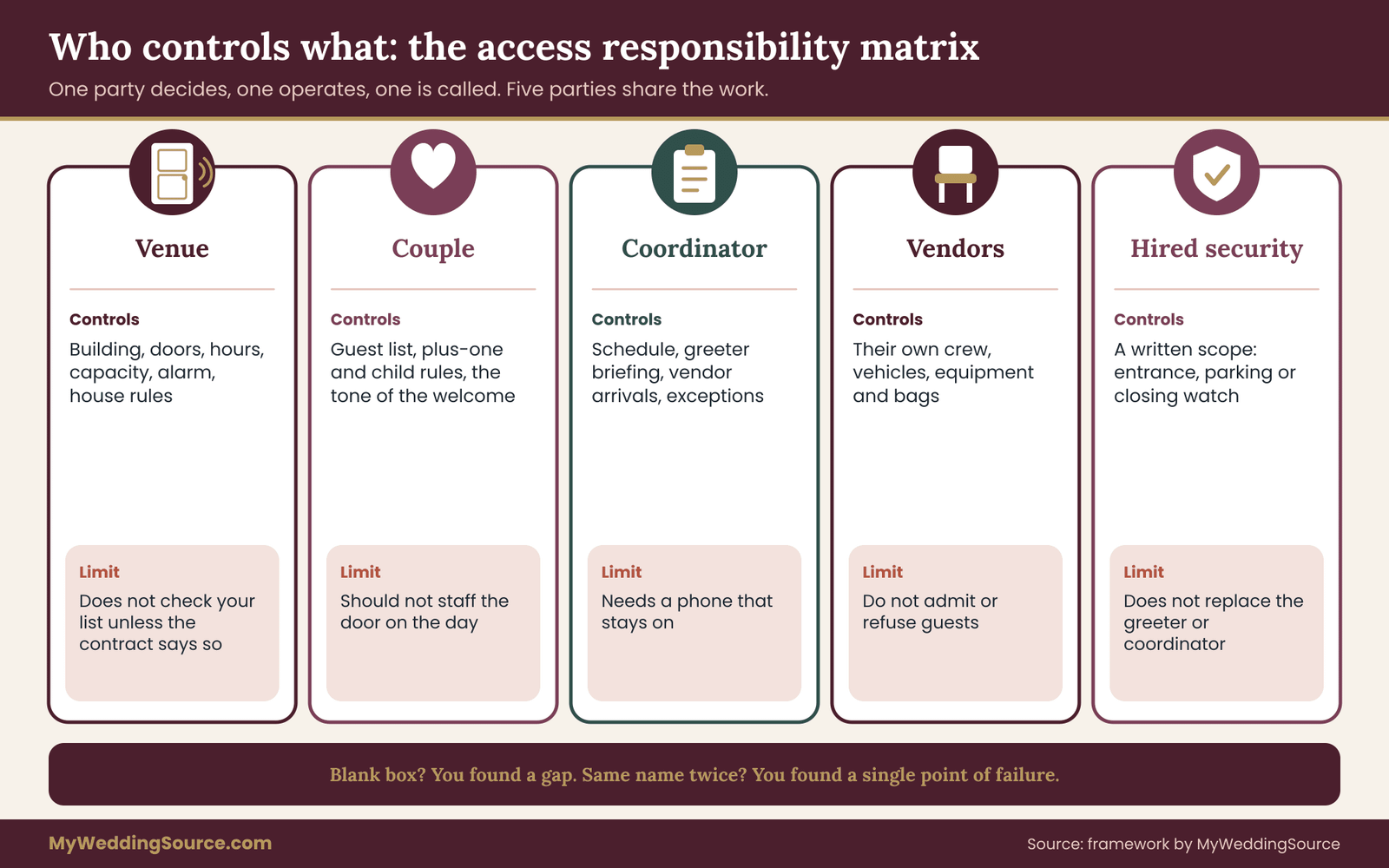
A responsibility matrix is a simple idea borrowed from project management: for each task, one party decides, one party does the work, and one party is called when something goes wrong. Applied to wedding venue security, the tasks are the four gates plus a handful of cross-cutting duties such as the guest list, incident response and end-of-night lockup. The parties are the venue, the couple, the coordinator or planner, the vendors and any hired venue security.
The version below is written in prose rather than a grid, because the useful part is the reasoning, and you can turn it into a one-page sheet for your own event. A matrix like this is the clearest way to see who really holds venue security at each point.
The venue: the building and its rules
The venue controls the structure and, in most contracts, the conditions under which it may be used. That typically includes which doors are open, the maximum number of people allowed inside, quiet hours, fire lanes, alarm systems, key control and the house rules for alcohol. The venue also usually decides whether its own staff, such as a site manager or a night attendant, will be present throughout your event. In short, the venue holds the building side of venue security.
What the venue does not control is who you invite, unless the contract says so. A venue manager may ask for a final head count and may refuse to admit more people than the capacity allows, but the manager will not usually check names against your list. If you expect the venue to do that, say so in writing and ask what it will cost.
The couple: the guest list and the tone
You control who is welcome and what the welcome feels like. That means the guest list, the rules about plus-ones and children, and any request for people to be admitted or declined. You also control the tone, which is easy to underrate. A venue can enforce a rule rigidly or gracefully, and your instructions to the greeter decide which one the guests experience. Your share of venue security is the list and the welcome.
The important caveat is that the couple should not staff the gates on the day. You will be dressed, photographed and busy, and you will be the people most distracted by a conflict at the door. Control the list, delegate the door.
The coordinator or planner: the connector
A professional day-of coordinator, or a friend filling that role, owns the schedule and the communication between parties. In access terms, the coordinator is usually the escalation contact for gate two and the person who briefs the greeter. The coordinator also holds the vendor arrival list and is often the one who tells the venue manager that the florist is ten minutes out. The coordinator is the connector who keeps venue security from depending on one person.
If you have no coordinator, the venue security matrix is where you name a person to act as one. It does not have to be a long job description. It needs a phone that stays on, a copy of the plan, and the authority to say “yes, let them in” or “please wait here, I will check.”
The vendors: their own people and equipment
Each vendor controls its own staff, vehicle and equipment. A caterer decides who in its crew may leave the kitchen area. A photographer decides who may accompany them, such as an assistant or second shooter. A rental company decides who may sign for delivered items. Vendors do not control the building or the guest list, and a contract that blurs that line is worth clarifying.
For example, a DJ should not be the person who decides to admit a guest who was turned away at the door, even if the guest is a friend of the DJ. Vendors share venue security by managing their own crews.
The vendor section of the venue security matrix is also where you record who carries identification, who wears a uniform or wristband, and how to tell a working crew member from someone who has simply wandered in.
Hired venue security: a defined role, not a catch-all
If you hire a licensed security guard or an off-duty officer, the role should be written down as clearly as any other vendor’s. A guard stationed at gate two has a different job from a guard patrolling the parking area. The venue may also have its own rules about which security companies may work on the premises, and some require proof of insurance. A later section covers when hiring security makes sense. For now, treat hired venue security as another party in the venue security matrix whose duties you define in advance.
Putting the venue security matrix to work: the three-question test
For each gate and each duty, three questions should have a name for an answer.
Who decides? The person with authority to set the rule. For example, “guests may enter the reception space only after the cocktail hour ends” is decided by you and confirmed with the venue.
Who operates? The person physically applying the rule at that moment. For the same rule, it might be a catering captain who keeps the doors closed.
Who is called when it breaks? The person who resolves an exception the operator cannot. In this example it would be the coordinator, who can authorize an exception, such as admitting an elderly guest early so they can sit down.
If any of the three is blank, you have found a gap. If two are the same person, you have found a single point of failure. A coordinator who both decides and operates gate two cannot also be handling a delivery at gate three. Spotting that in a planning meeting is much cheaper than discovering it at 4:30 on the wedding day. This simple test is the fastest way to audit venue security before the day.
Where the venue security matrix usually breaks
A few patterns come up repeatedly. The first is the shared gate. Gate three is often used by the caterer, the florist, the band and the photographer, and no one party owns it. The fix is to name the venue’s site manager as the decider and one vendor, usually the caterer, as the day-of operator, with everyone else following the same rule. These are the usual weak points in venue security at a wedding.
The second is the time-sensitive gate. A door may be locked or unlocked depending on the hour, and the person who knows the hour may leave early. The fix is to write the schedule of openings and closings on the plan, with the name of whoever is responsible for each change.
The third is the overlapping authority. If both the venue manager and your coordinator can give instructions to the greeter, the greeter will eventually receive two different ones. The fix is to name one voice for guest-facing decisions, normally the coordinator, and one voice for building-related decisions, normally the venue manager, and to tell the greeter which is which.
The fourth is the absent owner. The person who decided something three months ago may not be there on the day. The fix is for the written plan, not memory, to carry the decision.
Reading the contract for venue security and access terms
The venue security matrix tells you who should own each gate. The contract tells you who is required to. Before you finalize the venue security matrix, read the venue agreement for the clauses that touch access, and read each vendor contract for the same. The language is often buried in the general conditions rather than the pricing pages.

Clauses that deserve a second look
Hours of access. The contract states when you and your vendors may enter the venue and when everyone must leave. These hours are the backbone of the vendor schedule. If a florist needs to start at 9:00 and the venue opens at 10:00, the conflict is yours to solve before the day, not at the door.
Capacity and head count. Many venues set a maximum number of guests and require a final count by a stated date. The head count is also an access control, since it tells the venue what number to expect and how many staff to schedule.
Security requirements. Some venues require hired venue security above a certain guest count, for events with alcohol, or for late hours. Others require that security be supplied by the venue and billed to you. Look for the exact trigger and the exact cost logic, not the headline.
Insurance and liability. Venues commonly ask for a certificate of insurance from you and from certain vendors. Those certificates list the venue as an additional party. Access intersects here because a person who is injured on the premises, or a rented item that is damaged, may involve a question about who admitted whom and who was responsible. A broker or the venue’s own insurance contact can explain what their policy expects. The guide to vendor contracts covers the general reading approach.
Alcohol service rules. Where alcohol is served, the person serving usually has legal responsibility under state and local law, and the venue may impose its own rules about who may bring in or pour drinks. Those rules also affect gate two, because a guest who appears intoxicated may need to be handled by a trained server or by venue staff, not by a friend at the door.
Key and lockout terms. Ask who holds keys to the building, how a door is secured at night, and whether there is a charge for rekeying if a key is lost. Also ask about the alarm: who arms it, who has the code, and what happens when it is triggered by a late load-out.
Incident reporting. Ask what the venue wants to be told, and how fast, if something happens. A short written procedure is far better than an assumption.
Terms that quietly shift control
Two kinds of clause shift control without announcing it. The first is the exclusive vendor clause, where the venue requires you to use its caterer, bar or rental provider. That vendor then operates a large share of gate three, and your matrix has to account for it. The second is the venue staff clause, where the venue reserves the right to place its own staff in any area at any time. That is reasonable for safety, but it means a venue employee may legitimately walk into your bridal suite, and you should ask in advance how that is handled.
Questions to put to the venue manager
Because policies differ so widely, a direct conversation does more than any generic checklist. These questions, asked in writing and answered in writing, usually settle the contract gaps. Their answers are the factual base for your venue security plan.
Who is on site during our event, with names and phone numbers, and are they present from load-in to load-out? Does the venue check guest names or count guests at any point? Which doors will be unlocked, and when? Are private rooms lockable, and who holds the keys? What do you require from us regarding security staff, and what do you require from our vendors? What is the procedure if an unlisted person arrives, or if a guest must be asked to leave? What is the procedure for a medical or fire emergency, and where do responders enter?
If the manager does not know an answer, that is useful information too. It means you will need to decide the point yourself and write it into the plan, so the venue knows what to expect.
Verification and limits
Fire exits, occupancy limits and accessibility features are not matters of preference. They are set by building and fire codes, and the authority having jurisdiction, typically the local fire marshal or building department, decides them. The venue manager can usually tell you what the building’s approved capacity and exit arrangement are. If you plan to change a layout, add a gate such as a ticket table in a corridor, or restrict a door, ask the venue whether the change affects a required exit path.
Locked or blocked exits are a safety hazard and, in many places, a code violation. That is a good example of a rule to verify with the people who are qualified to approve it, rather than to settle between yourselves.
Guest check-in models: choosing the right level of control
Guest check-in sits at gate two, and it is the part of wedding venue security that guests actually see., and it is the part of wedding venue security that guests actually see. The right level is not the strictest one. It is the lightest one that still answers the questions you care about. Those questions differ from wedding to wedding, so start with them before you choose a method.
Decide what the check-in is for
Check-in can serve several different purposes, and each points to a different method.
Counting. You want to know roughly how many people are present, for the caterer, the venue’s capacity limit, or the seating. A tally by a greeter or an usher can do this.
Seating. You want to tell each guest where to sit or which table to find. An escort card display or a seating chart does this, and it is not really security at all, though it happens at the same gate. The guide on wedding seating charts covers that part of the job.
Admission. You want to be sure that only invited people enter. This is the only purpose that is truly about access, and it is the one that calls for a list and a person who can say no.
Accountability. You want a record of who was present, for example if the venue requires it, if the event is large or if there is a specific safety concern. A written or digital log serves this.
Welcome. You want guests to feel expected and cared for. This is not a security function, but it is often the real reason people put a person at the door, and it is worth keeping in view so that the check-in feels warm.
Most weddings need counting, seating and welcome, and need admission only in a light form. A few need accountability. Naming your purposes keeps you from building a heavier system than you need. Naming your purposes keeps venue security proportionate.

The five common check-in models
Open arrival with a greeter. A host stands near the entrance, welcomes people, hands out programs and points toward seating. There is no list. This works for small weddings where every guest is known to the hosts, and for venues where the space itself limits who can wander in, such as a private home or a closed room. It gives you welcome and a rough count, and almost no admission control.
Greeter with a list. The same person holds a printed or digital list, in alphabetical order by household, and checks names quietly as guests arrive. This is the most common model for medium and large weddings. It supports admission, counting and seating, and it also reveals who has not arrived yet, which helps the coordinator hold the ceremony start. Its main weakness is the list itself. If it is out of date, the greeter will be turning away people who should be admitted.
Escort cards or a seating display at the entrance. Guests pick up a card with their name and table. It does not check admission, since anyone can pick up a card, but a missing card is an easy flag. A guest whose card is not there is a natural trigger for the exception workflow. This model pairs well with a greeter.
Ticket, wristband or QR code. Each guest receives a token that is checked at the door. It is more common for very large events, private parties in public venues, and weddings with open-house elements. It adds accountability, but it also adds friction and a technical dependency, and it can feel cold at a family event. It is also easy to get wrong: a lost token, a scanner that fails, a guest who forwarded a code. If you use it, plan a manual fallback.
Staffed check-in with security. A hired guard or the venue’s own staff checks names or identification. This is rarer and is typically a response to a specific concern, a venue requirement or a high-profile guest list. It gives the strongest admission control and the least warmth, so it benefits from a friendly greeter standing beside it.
Choosing by situation
A simple rule of thumb helps. Start with a greeter with a list. Move lighter if every guest is personally known to the hosts and the space is closed. Move heavier only if one of the following is true: the venue requires it, the venue cannot be closed off from the public, there is a specific person who should not be admitted, the guest list is large enough that the hosts cannot recognize most people, or the event includes someone who attracts attention. Lighter or heavier, the choice should follow the real venue security need.
A reception held in the same public garden where tourists walk calls for a different approach from a reception in a rented private room. In the garden, you cannot refuse the public, so you design around signs, a defined perimeter such as ribbons or planters, and a greeter who politely asks whether someone is part of the wedding. In the private room, the closed door does most of the work.
Making the list usable
The most common failure of list-based check-in is not security. It is the list. Before the day, give the greeter a version designed for the door, not for the planner. That means households together, names in the form guests are likely to give, and notes next to the entries that need them: a plus-one whose name is not yet known, a guest who is arriving late from a flight, a guest who needs an accessible route, a child traveling with a nanny who is not on the list.
A usable door list is the cheapest upgrade to venue security you can make.
Update the list as late as the venue allows. Many couples keep one master list and print a fresh door copy the morning before. Mark the last-minute changes clearly. The guide to the wedding guest list covers building the list itself and is worth reading before you build the door copy.
The greeter: who to choose and how to brief
The greeter is the single most important person in your guest check-in, and the choice is often made last. Look for someone who is calm, who knows many of the guests by sight, who is comfortable saying “one moment, let me check” and who will not take it personally if someone is rude.
A relative who is known to everybody and is not part of the wedding party is often ideal. A paid host from the venue or a hired professional is also a good option, provided you brief them. In practice the greeter is the human face of venue security.
The briefing takes ten minutes and should cover five things: the list and how it is organized, the guest exception workflow described below, the name and phone number of the person to call, the times the doors open and close, and the tone you want. Give the greeter a printed one-page sheet. A phone alone is risky, since batteries die and screens are hard to read in sunlight.
Timing the doors
The timing of gate two matters as much as the method. Guests who arrive twenty or thirty minutes early need somewhere to wait. If the doors open at the stated time and not before, say so on the invitation or the wedding website, and have a place for early guests, such as a lobby or an outdoor seating area with water. If the venue lets you open the doors earlier, an early arrival is a pleasant moment for the greeter to get through the list. Door times are part of venue security too.
For the reception, decide whether late arrivals will be admitted after the first course or the toasts, and whether the greeter will keep checking names once the doors are closed. A door that is propped open for the whole evening turns gate two into a gap. If the doors are meant to be closed after a certain time, write down who will close them and who will answer a knock afterward. Also ask the caterer how a guest who comes in after service has started will be fed.
The guest exception workflow
Check-in works well when everyone on the list arrives, one at a time, with the right names. Real weddings do not work that way. The exception workflow is a short sequence for the situations in which the list and the person at the door disagree. It is built to keep the greeter calm, the line moving and the guest’s dignity intact. The same five steps cover nearly every exception. The exception workflow is the working core of venue security at the door.

Step one: greet and keep the line moving
The first move is the same for every guest, whether or not the name is on the list. Smile, say hello, and ask for the name. If there is a problem, do not announce it. Say something neutral such as “Let me find that for you” and keep your voice low. The aim is to avoid making the guest feel accused and to avoid creating a scene for the people waiting behind them.
If a line is forming, ask the next guest to step forward with the second greeter or invite the first guest to step aside to a spot where the greeter can check. A second person at the door, even briefly, makes a large difference to how smooth this feels.
Step two: check the obvious causes
Most missing names are not missing at all. Check the spelling variants, the household name, the surname of a married partner, a nickname, a plus-one listed under the other guest’s name, and the late-additions page. Ask who invited them if it is unclear. Many apparent exceptions are resolved here in under a minute, and the guest never knows there was a question.
Step three: escalate to the named person
If the name is not found after the quick check, the greeter does not decide. The greeter calls or messages the person named in the venue security matrix as the escalation contact, normally the coordinator, and keeps the guest comfortable while waiting. A useful script is “I’m sure we can sort this out. Would you like to have a seat in the lobby while I check with the host?” It is polite, it is true and it gives no information the guest has to respond to.
The greeter should never be asked to refuse someone alone. That is a decision for the escalation contact, and where the situation involves a safety concern, it may belong to the venue manager or to hired venue security.
Step four: decide, using a rule agreed in advance
The escalation contact then applies a rule you set before the wedding. Good rules are short. Here are four that cover most cases.
The plus-one rule. If a guest arrives with an unannounced companion, the coordinator checks whether there is a seat and whether the caterer can cover the meal. Either you decide in advance that one extra is welcome, or you decide that you will politely say that seating is set and offer an alternative such as joining at the cocktail hour or at the dance floor opening.
The family-addition rule. If a relative arrives with children who were not on the list, the answer depends on your child policy and the venue’s capacity. The coordinator checks with you only if the situation involves a close family member, and otherwise follows the rule.
The unlisted-guest rule. If someone says they were invited but is not on the list, the coordinator checks with a designated family member, not with you. The designee can confirm quickly whether the person is expected, and the couple is not pulled into it.
The do-not-admit rule. If there is a specific person who should not be admitted, such as someone subject to a protective order or someone with a history that makes the couple fear a scene, the greeter receives their name and a clear, private instruction. The response is calm, short and routed to the venue manager or security, who are better placed to handle it. This rule is covered in more detail in a later section on sensitive situations.
Step five: record and close the loop
Every exception gets a note: the name, the issue, the decision, who made it and the time. The note takes thirty seconds and is useful afterward when someone asks why a guest was seated at a different table, when the caterer needs a meal count or when the couple wants to know what happened. It also protects the greeter. A decision with a name next to it is much easier to stand behind than a decision made alone at the door.
Close the loop with the guest too. Once a decision is made, tell the guest clearly and kindly what happens next. If a meal cannot be added, offer the alternative. If a guest is admitted, welcome them without further comment.
Scripts that keep things gentle
Short scripts help a greeter who has never done this before. They should be adapted to your voice and kept brief.
For a missing name: “I don’t see it yet. Could you spell it for me? Sometimes we have it under a different name.”
For an unannounced guest: “Thank you for coming. Let me check with our coordinator so we can seat you properly. It will only take a moment.”
For a guest who cannot be admitted: “I’m sorry, I’m not able to admit you at this time. If you’d like, I can ask the host to speak with you privately.” This leaves the door open to a conversation without committing the greeter to an argument.
For a guest who is upset: “I understand, and I’d like to help. Let me get the person who can sort this out.” It names a next step and removes the greeter from the center of the dispute.
What the workflow is not
The workflow is not a screening process, and it is not a way to challenge guests. It is a way to turn an awkward moment into a routine one. Most of the time it will be used for two or three small issues, and it will be resolved in a minute or two. The point of having it written is that the one time it matters, the greeter does not have to invent a procedure while a line grows. Used lightly, it makes venue security feel like hospitality.
Vendor access: load-in, credentials and the back-of-house door
Gate three is where most of the people at your wedding actually pass through, even though guests never see it. A typical reception involves a caterer with a kitchen crew and servers, a bartender or two, a florist and a helper, a rental delivery team, a DJ or band with a few members, a photographer with an assistant, perhaps a videographer, a baker or a dessert supplier, and a lighting or décor crew.
Each brings people, vehicles and equipment, often at different hours. Venue security at this gate is mainly a matter of sequence and identification. Venue security at this gate is mostly a matter of sequence and identification.
Start with the vendor arrival schedule
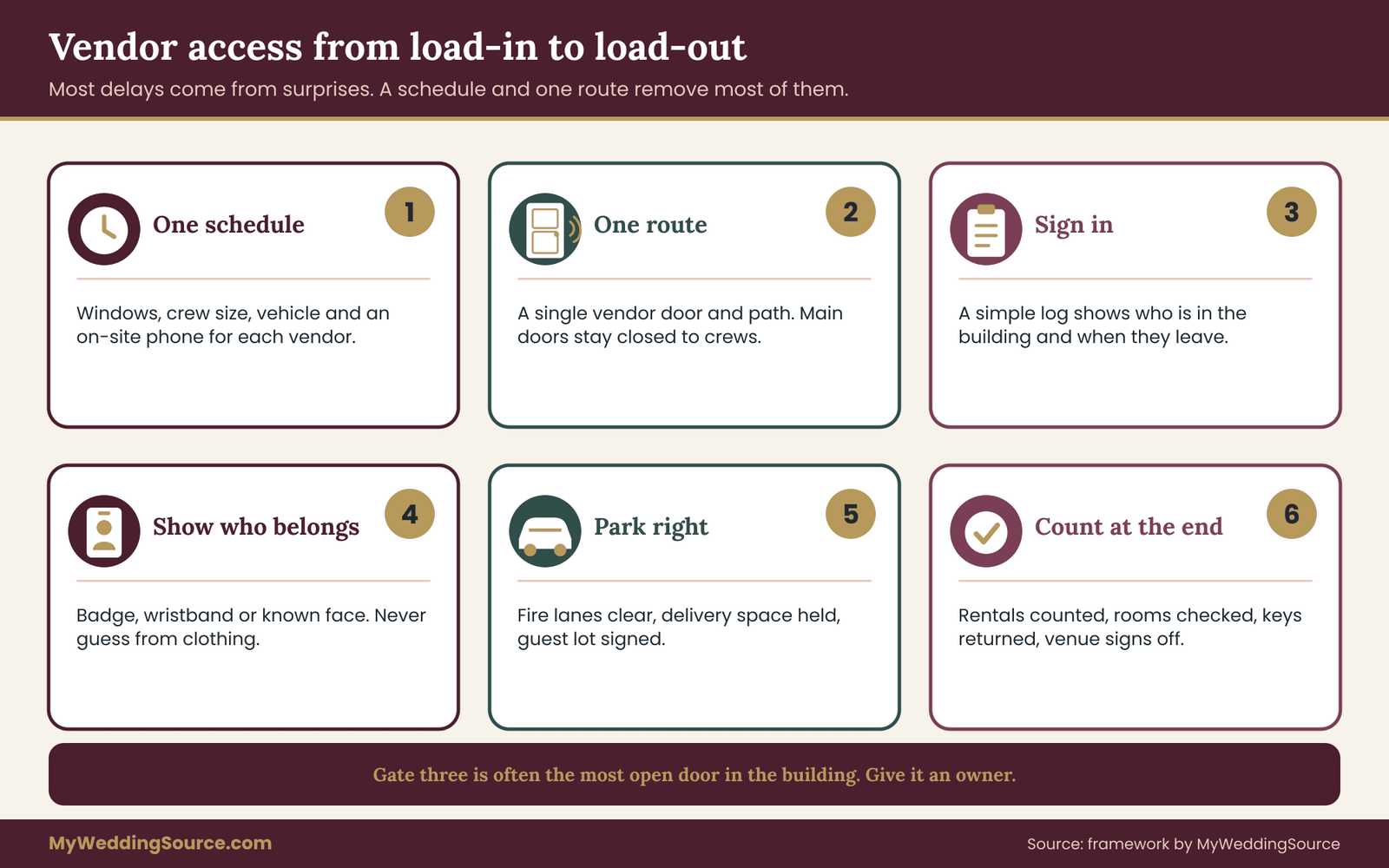
Before any rule about doors or badges, build one schedule that lists each vendor, the arrival window, the approximate crew size, the vehicle type and the departure window. The venue manager needs this, and your coordinator needs it more. A single page is enough. It should also list a phone number for the person who will actually be on site for each vendor, not the sales contact who signed the contract. A schedule is the quiet foundation of vendor venue security.
The schedule solves most access problems by itself. When the florist is expected between 11:00 and 11:30 and a van arrives at 10:15, the person at the vendor door knows it is early and can ask the coordinator whether to admit it. When no schedule exists, every arrival is a surprise, and each one requires a decision.
The vendor timeline guide explains how to build the schedule itself. Here the point is that the same sheet serves as your gate three access list.
One door, one rule
Wherever possible, use a single vendor entrance and a single route to the event space, and state it in writing. A caterer who uses the main lobby with a rolling cart and a florist who carries arrangements through the ceremony garden create the exact exposure that the four-gate venue security model is designed to avoid: vendors and guests sharing a space before the event is ready. One route keeps venue security simple for the venue staff too.
Ask the venue manager to confirm the route and any doors that must stay closed. Then pass the route to each vendor in the arrival email, with a short instruction such as “Please use the service entrance on the north side, check in with the site manager and keep the main doors closed.” Vendors tend to follow a clear instruction. They do not follow one that exists only in the venue’s head.
Sign-in, badges and wristbands
At a venue with a manager on site, a simple vendor log is usually enough. Each vendor checks in with the manager or the coordinator, gives a name and the number of crew, and checks out when finished. The log serves several purposes at once. It shows who is in the building, it makes an emergency head count possible, and it provides a record if an item goes missing or a damage claim arises.
Some venues, particularly large hotels and event spaces, issue vendor badges or wristbands. If yours does, ask how they are distributed and what happens to a crew member who arrives late and does not have one. If the venue does not, you can still use a low-cost version: a colored wristband or a lanyard for working crew, with a different color for the wedding party, so that the person at any door can see at a glance who belongs where.
The system works only if the greeter, the venue staff and the coordinator all know what each color means, so put it on the one-page plan.
Do not rely on appearance. A person carrying a box or wearing black is not necessarily a vendor, and a person in a suit is not necessarily a guest. Identification should depend on a badge, a list or a known face, not on a guess. Reliable venue security depends on lists and badges, not on looks.
Vehicles, parking and fire lanes
Vehicles are a surprisingly large part of venue security. of venue security. A delivery van parked in a fire lane is a safety problem and, at some venues, a source of a fine. A guest who parks in the loading area blocks the next truck. A vendor who leaves a vehicle unlocked with equipment inside is inviting a theft that the vendor, not the venue, will have to explain.
Ask the venue where vendors may stop to unload, where they must move the vehicle afterward, and whether there is a time limit. Ask separately where guests park and how they will know. Then put a person, a sign or both at the point where the two flows would otherwise mix. A friend with a bright vest who points guests toward the right lot is often the simplest and cheapest way to keep delivery space open.
Dock hours, vehicle limits and freight elevator bookings should be confirmed with the venue in writing, since they change from one building to the next.
Alcohol, bags and personal items
Gate three is also where alcohol enters and where bags are stored. Many venues restrict outside alcohol entirely, and some require that only a licensed provider handle it. If you plan to bring wine, champagne or spirits yourself, ask in advance what the rule is, who may carry it in, where it will be stored and who may pour. A bottle that arrives through a side door without anyone knowing can create a legal and contractual issue for the venue, and the venue is likely to treat it as one.
Staff bags and musicians’ cases are another recurring question. A vendor’s personal items need a designated place, away from guests and out of the way of the kitchen, and the vendor remains responsible for them. If a band leaves instruments in a room that is also used as the bridal suite, the venue security matrix should say which party is responsible for locking it.
Contractors who come and go
Some vendors arrive and leave several times: a florist who delivers in the morning and returns to adjust arrangements, a photographer who leaves between the ceremony and the reception, a baker who delivers the cake and comes back for the plates. A single sign-in at the start of the day does not capture that. Give each of these vendors a way to re-enter without a conversation, such as a name on the list at the door or a phone number to call. Make sure the person staffing gate three knows they are expected to come back, not guess.
Rentals and the end of the night
Load-out is the moment when the building is most open and everyone is tired. Rental companies often collect items the next morning, and many venues ask that rented items be removed or secured the same night. Before the event, decide where rentals will be collected, who counts them against the order, and whether anything will be left overnight and in whose care.
Items such as chairs, linens and lighting are priced for replacement, and a missing item will be billed to someone. A short count at the end of the night, with a signature from a rental representative or the venue manager, settles most disputes.
For private rooms, the key question at the end of the evening is who locks up. The venue usually has a closing procedure, and the coordinator or a named family member should be present to confirm that personal items have been collected. A bag left in a dressing room that is locked at midnight is a better problem to solve in a planning meeting than the next morning.
Private rooms, gifts and belongings
Gate four is small but emotionally important. It holds the dressing rooms, the gift and card table, the cake and any hot food waiting to be served. It also holds things that cannot be replaced: a grandmother’s jewelry, the rings between the ceremony and the exchange, envelopes with cash, a passport for the honeymoon trip, a phone holding the day’s photographs. Venue security here means locks, keyholders and visible belongings.
Dressing rooms and suites
A private dressing room should lock, and someone should hold the key. Ask the venue whether the door locks from the inside, from the outside or both, and whether staff can open it. If the room is a shared space with a window or a second door, check that too. Tell the wedding party which room is theirs, and tell guests, through a sign or a greeter, that it is not open.
Decide in advance who may enter. A good rule is that the wedding party, the photographer and a named handful of family members are permitted, and everyone else knocks and waits. The photographer will often ask to be admitted early to take pictures of details, and this is a reasonable request, but the room should be tidied and valuables put out of sight beforehand.
The card box and gift table
Gift tables attract two risks: loss and confusion. Cards with cash or checks are the most targeted items at a wedding, and the simplest control is to place the card box where a person can see it, ideally near the greeter or a seat held by a family member. A box with a slot and a lid, rather than an open basket, makes a difference. At the end of the evening, a named person takes the box, and the cards go into a bag or a car that is accounted for.
If you expect bulky gifts, decide whether guests may leave them at the table or whether you would prefer a different arrangement, such as taking gifts to a hotel room or asking guests to send them to your home. A simple list of who gave what, kept by a family member at the table, saves a lot of effort during thank-you notes.
Rings, documents and small valuables
Rings are best kept with the best man, maid of honor or officiant until the moment they are needed, and not in a room that anyone can enter. Marriage license paperwork and travel documents belong with the person who is responsible for them, not on a table. If a coordinator is present, ask whether they will hold a small bag for valuables, and make sure they know who may collect it.
Coat check and bags
At winter weddings or large indoor events, a coat check is a form of access control in its own right, because it concentrates a lot of belongings in one place. It should be staffed or locked, and it should have a simple ticket system. If there is no coat check, tell guests where to put coats and bags, and consider asking them to keep valuables with them.
Food and the cake
The kitchen and the staging area are controlled by the caterer, and venue and health rules about food handling apply there. That is a reason to keep guests out, but also a reason to be considerate: a guest who wanders in to look for a drink or a restroom should be redirected politely. A sign on the door and a staff member who is told to keep an eye on it does the job.
The cake table, once the cake is in place, needs a person or a visible position so that it is not moved or touched, and so that a child does not reach it.
A short test for gate four
Walk the property with the venue security matrix in hand and ask four things for each private space. Is it clear that it is private? Does it lock, and who holds the key? Who may enter, and who decides? What leaves it at the end of the night, and who checks? If any of these answers is “I don’t know,” it is a gap worth closing in the same meeting that you use to set the greeter’s instructions. This short test turns private-room venue security into a checklist.
When wedding venue security needs trained people
Most weddings do not need hired venue security. Some do, and a few venues require it. The decision is easier when it is made on the basis of specific triggers, not on a general feeling of unease. This section covers how to decide, what to hire, what to ask and how to fit hired staff into the venue security matrix. Choosing the level of venue security is a risk decision, not a status symbol.
Triggers that justify hired venue security
Consider adding trained staff when one or more of these is true.
The venue requires it. Some venues set a threshold, such as a guest count, a closing hour or the presence of alcohol, above which licensed security must be present. If the contract says so, the question is not whether but how, and whether the venue’s own provider or yours.
The space cannot be closed. An open park, a public beach, a restaurant that remains open to the public or a building with several entrances and no staff at them all leave gate two exposed. A guard or a trained host at the entrance can ask whether someone belongs to the wedding in a way that a relative cannot.
There is a specific, known concern. A guest who should not be admitted, a family situation involving threats or a protective order, or a guest with a public profile who is likely to attract attention. In these cases the couple should consider speaking with the venue manager and, where appropriate, local law enforcement or a professional security adviser about what is reasonable.
Alcohol and a large, late event. A large reception with an open bar running late may benefit from a staffed presence near the entrance and the parking area at closing time, for orderly departures. The caterer or bar provider is responsible for alcohol service, and the guide to wedding bar service planning covers how bar rules and staffing interact.
Valuables and cash. If a lot of cash, gifts or expensive rented equipment will be on site overnight, a guard or a locked room with a keyholder is a reasonable precaution.
Parking and traffic. A large event in a lot shared with other users may need a staffed parking attendant, not a security guard. Be clear about which you need.
What kinds of staff exist
The terms people use are loose, and it helps to know the differences. A licensed private security guard is employed by a security company, generally licensed by the state, and may be unarmed or armed depending on the state and the contract. A venue’s own staff, such as a site manager, a night attendant or a facilities worker, work for the venue and follow its policies.
An off-duty police officer may be available through an arrangement with a local department, and rules about this vary widely by locality. A trained event host or usher is not a security professional but a person experienced with guest management, sometimes supplied by the caterer or a coordination company. A parking attendant handles traffic and vehicles, not guest admission.
Each has a different legal status and a different set of powers. A guest has no obligation to obey a friend at the door, but may reasonably be expected to follow a venue employee or a licensed guard. Local rules govern what any of them may do about removing a person, and the venue manager or the security company can explain them. If you want an armed presence, ask the venue first, since many venues prohibit it, and consult the local licensing authority about the requirements.
How to evaluate and brief a security provider
Treat a security provider as you would any vendor, with a written scope. The vendor due diligence checklist gives the general approach. For security in particular, confirm these points. Their written scope should match the venue security matrix.
Is the company licensed in your state, and can it provide proof? Does it carry liability insurance, and will it provide a certificate that names the venue if the venue asks? How many staff will be assigned, for how many hours, and at what hourly rate, with what minimum? What is the uniform, and how will staff present themselves to guests? Who is the on-site supervisor, and how do you reach them? What is the escalation procedure when someone refuses to leave or when police are needed?
Then brief the provider on the venue security matrix. A guard who is told “keep unwanted people out” is likely to interpret that more strictly than you intend. A guard who is told “welcome guests warmly, check names against the list, call the coordinator for any exception and never confront a guest alone” is far easier to work with. Give the guard the do-not-admit list privately, with a photograph if you have one and the guest consents to it being used, and make sure the guard knows whom to call.
What security does not replace
A security guard does not replace a greeter, who handles welcome and the list. A guard does not replace the coordinator, who handles the schedule. A guard does not replace the venue manager, who knows the building. And a guard does not replace clear rules. The best use of hired staff is to add a calm, visible, trained presence to a system you have already designed. Trained staff are one layer of venue security, not all of it.
It is also worth being honest about cost. Hourly rates, minimum shifts and supplementary charges vary by region and provider, and no general figure is reliable. Ask for a written quote that lists the hourly rate, the minimum hours and any extra fees for late or holiday hours. Compare it with the alternative that actually fits your situation, which might be a second greeter and a clear closing procedure, or an extra venue staff member for part of the evening. The point is to match the control to the risk, and not to buy reassurance.
Emergencies, alcohol and the moments that test the system
Check-in and vendor access rules are tested when something goes wrong. The same matrix that sorts out a missing name should also tell people what to do in a medical event, a fire alarm, a severe weather warning or a guest who has had too much to drink. This section is not a substitute for the venue’s own emergency plan, which the manager should share with you. It is about making sure your people know the plan exists. Emergency readiness is a part of venue security that guests never notice until it is needed.
Know the venue’s emergency plan
Ask the venue manager for the emergency procedures that apply to your event: where the exits are, where people should gather, who has the authority to evacuate and who calls responders. Ask where the nearest first aid kit and defibrillator are, if there is one, and which staff members are trained. Ask how emergency vehicles reach the building and whether a gate or a barrier needs to be opened. A vendor door that is locked from the outside can be a problem if an ambulance needs access, and a gate with a code needs someone who knows the code.
Share this information with your coordinator and your greeter, in one sentence each. The greeter’s rule is simple: if there is an emergency, call the venue manager and the number for emergency services, and direct arriving responders to the entrance the manager names. The coordinator’s rule is to confirm that the venue’s emergency plan is being followed and to keep guests calm.
Fire safety and blocked exits
Fire codes set the rules for exits, capacity and decorations. Exits must stay unobstructed, and a ticket table, a signage easel, a rented photo booth or a stack of gifts that blocks a door is a hazard, not just an inconvenience. If your layout adds a gate in a corridor or restricts a door, check with the venue manager whether the change affects an exit route.
The U.S. fire code bodies publish general guidance, but only the local authority, usually the fire marshal, can approve what applies to your building. If a venue asks you to keep certain doors clear, treat that as a rule, not a suggestion.
Medical situations
A guest who is unwell, an elderly relative who falls, a child with an allergic reaction: these moments are more common than a security incident, and they are the reason the path to the entrance matters. The greeter should know which entrance responders will use and should keep it clear. If a guest needs help, the first call is to emergency services, and the second is to the coordinator, who can manage the room without alarming guests.
If you know that a guest has a serious medical condition, ask them quietly whether they would like you to tell the coordinator or the venue manager, and which seat or entrance would be most convenient. This is a courtesy, not a requirement, and it should be the guest’s choice.
Intoxicated guests
Alcohol service is a legal responsibility of the server, and the venue or caterer sets the rules. At the door and in the room, however, a friend or relative can help prevent trouble. If a guest seems unwell or unsteady, the best approach is quiet and personal: a family member offers water, food and a ride, and the coordinator informs the bar manager.
The greeter should not be the person who tells a guest to leave. If a guest must be asked to go, that conversation belongs to the venue manager, a trained server or hired venue security, and the guest’s transport should be arranged before the conversation ends. Departure planning is a quiet but important part of venue security.
Plan the departure in advance. Ask the venue about rideshare pickup points, taxis, shuttles and designated drivers, and put the information where guests will see it, such as signs, the program or the wedding website. A well-signed pickup spot reduces the number of guests who walk to their cars out of habit.
Weather and sudden changes
A storm warning, extreme heat or a power cut changes the access picture quickly. If guests must move from an outdoor space to an indoor one, gate two effectively moves with them, and the greeter and the coordinator need to know the backup route. Ask the venue about the rain plan, who decides to trigger it and how the decision is communicated. The guide to reception guest flow is a useful companion if the move changes how guests enter and seat themselves.
Sensitive situations and guest privacy at the door
Some access decisions carry emotional weight. They involve family conflict, safety worries, privacy and the comfort of vulnerable guests. These situations are rare, but they are the ones that people remember, and handling them well depends mostly on preparation and discretion. This section covers the main cases and the habits that help. Sensitive venue security cases depend on discretion.
The estranged or unwelcome guest
Many families include a person who is not invited, and sometimes that person decides to come anyway. The usual mistake is to leave the problem to the greeter and the moment. A better approach is a short private conversation, weeks before, with a trusted family member who will act as the designated contact, and a clear decision about what happens if the person appears.
The decision should include three things: whether the person will be admitted at all, who speaks with them if they arrive and where that conversation takes place. A calm, private conversation away from the entrance, held by a relative who knows the person, resolves most of these situations without any security involvement. The greeter’s job is only to notify the designated contact, not to argue.
If the person may be hostile, or if there is a history of violence or harassment, the situation is different. The couple should tell the venue manager in advance, and where there is a legal order in place, consider speaking with local law enforcement or a victim-advocacy organization about what is reasonable at the venue.
The venue can often suggest practical steps, such as stationing staff near the entrance, using a side door for the couple or arranging for a quiet exit. The couple does not need to explain every detail, and the manager does not need to be given more than the working facts.
The do-not-admit list
A do-not-admit list should be short, private and held by as few people as possible: the coordinator, the venue manager and hired venue security if any. It should contain names and, where useful, a description or a photo that the couple is comfortable sharing. The greeter does not need to carry it. If the greeter is given a name, the instruction should be simply to call the coordinator if that person appears and to avoid any exchange. Venue security here depends on privacy more than on force.
Keep the list out of shared spreadsheets, group chats and printed pages that could be seen by guests. Remember that a list in a shared document is one forwarded link away from becoming a story.
Children, custody and pickup
If a child at the wedding is subject to a custody arrangement, or if a parent has asked that a child not be released to a particular person, the childcare arrangement needs its own authorization process. A sitter or a children’s room is a gate four situation, and it should have a named adult in charge, a sign-in and sign-out record, and a rule that a child leaves only with a person on an agreed list.
The guide to wedding guest care planning covers children, babies and caregivers at length, and the access rule from this guide fits neatly into that plan.
Privacy, photos and who is in the room
Venue security and privacy overlap in two ways. The first is who is allowed to take pictures and where. A venue may restrict photography in certain rooms, and a guest with a legitimate reason to avoid appearing in photographs, such as a person in a protective program or a relative with a sensitive job, may ask not to be photographed. A quiet instruction to the photographer, with a plan for how the photographer will recognize the person, handles most of it. The guide on wedding photography consent goes through how to set those boundaries without making guests feel watched.
The second is who is in the room and what they can overhear or see. If a conversation or a document must be kept private, such as legal paperwork or a family discussion before the ceremony, use a closed room and a named door-keeper. A hallway is not private.
Online posts and location privacy
A couple who is concerned about a particular person finding them may want to limit what is posted online during the event. Live posts from guests can reveal the location, the time and the arrangements. Some couples ask guests to wait before posting, or to avoid tagging the venue, and some use an unplugged ceremony.
These are requests, not controls, but they reduce the chance of an uninvited person learning where the reception is. Where the concern is serious, the couple should talk through the specific risk with the venue and with a qualified adviser, and not rely on a social media request alone.
Guests who need a different arrival
A guest with a disability, a guest with a service animal, an older relative who cannot manage the main entrance and a guest who arrives in a wheelchair are all part of the access picture. Venue security should work for them too, and the next section deals with it directly.
Accessibility at the gates: security should not become a barrier
Access control can create new barriers while solving old ones. A locked side door that is the only step-free route, a check-in table placed up a small flight of stairs, a ticket scanner that does not work for a guest who cannot hold a phone: each is a small design choice that can exclude someone. Handling accessibility at the gates is part of good wedding venue security, and in the United States, accessibility obligations also have a legal side. Accessible venue security is simply better venue security.
What the law covers, in plain terms
Title III of the Americans with Disabilities Act applies to businesses and nonprofit organizations that serve the public, which often includes venues and some of their vendors. The Department of Justice explains the basic requirements on its ADA site. A private wedding itself is not a place of public accommodation, but the venue, the caterer and other commercial businesses are, and their obligations do not disappear because the event is private.
The venue can usually tell you which areas are accessible and what accommodations it provides. For questions about a particular requirement, the ADA site, the venue’s manager and a qualified professional are the right sources. This guide does not interpret the law for your situation.
Gate-by-gate accessibility checks
At gate one, confirm that there is an accessible drop-off point and accessible parking close to the entrance, and that signs show the step-free route. If the nearest entrance is a service door, ask whether it can be unlocked for the event and who will staff it.
At gate two, check that the check-in table is on a step-free route, that the height of any table or counter works for a person seated in a wheelchair and that a greeter can step out from behind it. If a list is the check-in method, make sure the greeter does not require guests to hand over a device or to read small print. A QR code or a ticket scanner needs a manual alternative.
At gate three, remember that vendors and staff may also have accessibility needs, and the vendor door route should not rely on stairs for everyone.
At gate four, confirm that accessible restrooms and any quiet rooms are open and clear. A room kept locked for security can cut off a guest who needs a place to rest, take medication or care for a baby.
Service animals
The Department of Justice describes a service animal as a dog individually trained to do work or perform tasks for a person with a disability. Staff are generally limited in what they may ask: whether the animal is required because of a disability and what task it has been trained to perform. They may not demand documentation or ask about the person’s condition.
A greeter should be told this in advance, so that a guest with a service dog is welcomed without a conversation. If a venue has its own pet or animal policy, ask how it treats service animals, and confirm the rule with the venue manager.
Communication and sensory needs
Some guests find a crowded, noisy check-in difficult. A deaf or hard-of-hearing guest may need written information or a different way to confirm a name. A guest with a sensory sensitivity may prefer a quiet arrival time or a quieter room. A short line on the wedding website, such as an invitation to contact the couple with any access needs, gives guests a chance to ask in advance, and the greeter’s sheet can then note the arrangements.
The guide to accessible venue red flags lists the things to look for when you tour a venue, many of which bear on the gates described here.
Balancing safety and access
Sometimes a security measure and an accessibility need seem to conflict. For example, the venue may want a single entrance for guests, while a guest cannot use that entrance. The resolution is almost always an exception route, staffed by the same greeter or a second one, and documented in the plan. Do not solve it by removing the control. Solve it by adding a path, and make sure that path is also covered by the venue security matrix, so that someone owns it. Good venue security adds paths, it does not remove them.
Public, outdoor and home venues: adapting the venue security matrix
The four gates and the venue security matrix apply everywhere, but the practical answers change with the setting. Three common settings deserve their own notes. Each setting changes the venue security answers, not the questions.
Public parks, beaches and gardens
In a public space, you generally cannot exclude people, and a permit usually gives you the right to a defined area for a stated time, not exclusive control. Read the permit for what it says about boundaries, amplified sound, alcohol, vehicles and how many people it allows. Then design the arrangement around visibility and courtesy. A ribbon, a row of planters or a sign that says the area is reserved for a private ceremony helps. A greeter who welcomes guests and gently asks passers-by to give the ceremony some room does more than a barrier does.
Gate two in a public space is partly about the people who are not guests. Decide how you want to deal with a curious onlooker, a photographer who is not yours or a passer-by who starts a conversation. The answer is usually warmth and a clear request, and the park’s staff or the local authority is the right contact if the situation escalates.
Barns, farms and private estates
A private estate often has few controls and a lot of paths: gravel roads, side gates, outbuildings and fields. The owner knows the property, and you should ask them to walk it with you and name the places a guest or vendor could wander into by mistake, such as a livestock area, a pond, a workshop or a stretch of road without a shoulder. Mark those areas and decide who will keep an eye on them. The guide to barn wedding venues covers what to ask about this kind of property.
On such sites, gate one is often the most important gate. A clear sign at the road, a person at the entrance and a defined parking area do more for safety than anything at the door.
Home and backyard weddings
When the wedding is at a family home, all four gates sit with you and your relatives. The simplest approach is to assign each gate to a named person in the family, to put the private rooms off limits with a sign and a closed door, and to agree with the neighbors about parking and noise. Keep valuables, medications and personal papers out of the areas guests will use, and decide in advance who will lock up. The guest exception workflow still applies, and the greeter at the front door can be a trusted cousin.
Multi-site and shuttle weddings
If the ceremony, reception and lodging are in different places, each location has its own gates, and a shuttle or a convoy adds a fifth point, the loading and unloading of guests. A shuttle driver who knows the list, a coordinator at each stop and a clear rule for who may ride reduce confusion and keep uninvited passengers off the bus. Keep the schedule simple and give the driver a phone number for the coordinator.
A worked example: Harlow and Dube at a historic hall
The following example is invented to show how the tools fit together. The couple, the venue and the numbers are illustrative, and your own situation will differ. Priya Harlow and Daniel Dube are planning a wedding for about one hundred and twenty guests at a restored historic hall with a ceremony in the garden and a reception in the main room. The hall has one site manager, a front door, a garden gate, a service door on the side and a small room upstairs that the couple will use for dressing. It shows venue security built from ordinary decisions.
Step one: the gates
During a walkthrough with the site manager, they mark the four gates. Gate one is the street entrance and the small lot behind the hall. Gate two is the garden gate for the ceremony and the double doors for the reception. Gate three is the service door on the side, which leads to the catering kitchen. Gate four is the upstairs dressing room, the coat closet and a small office where the cake will wait.
They learn that the garden gate cannot be locked from the outside, that the hall’s approved capacity is stated in its occupancy certificate, and that the service door is unlocked only between the hours written in the contract.
Step two: the matrix
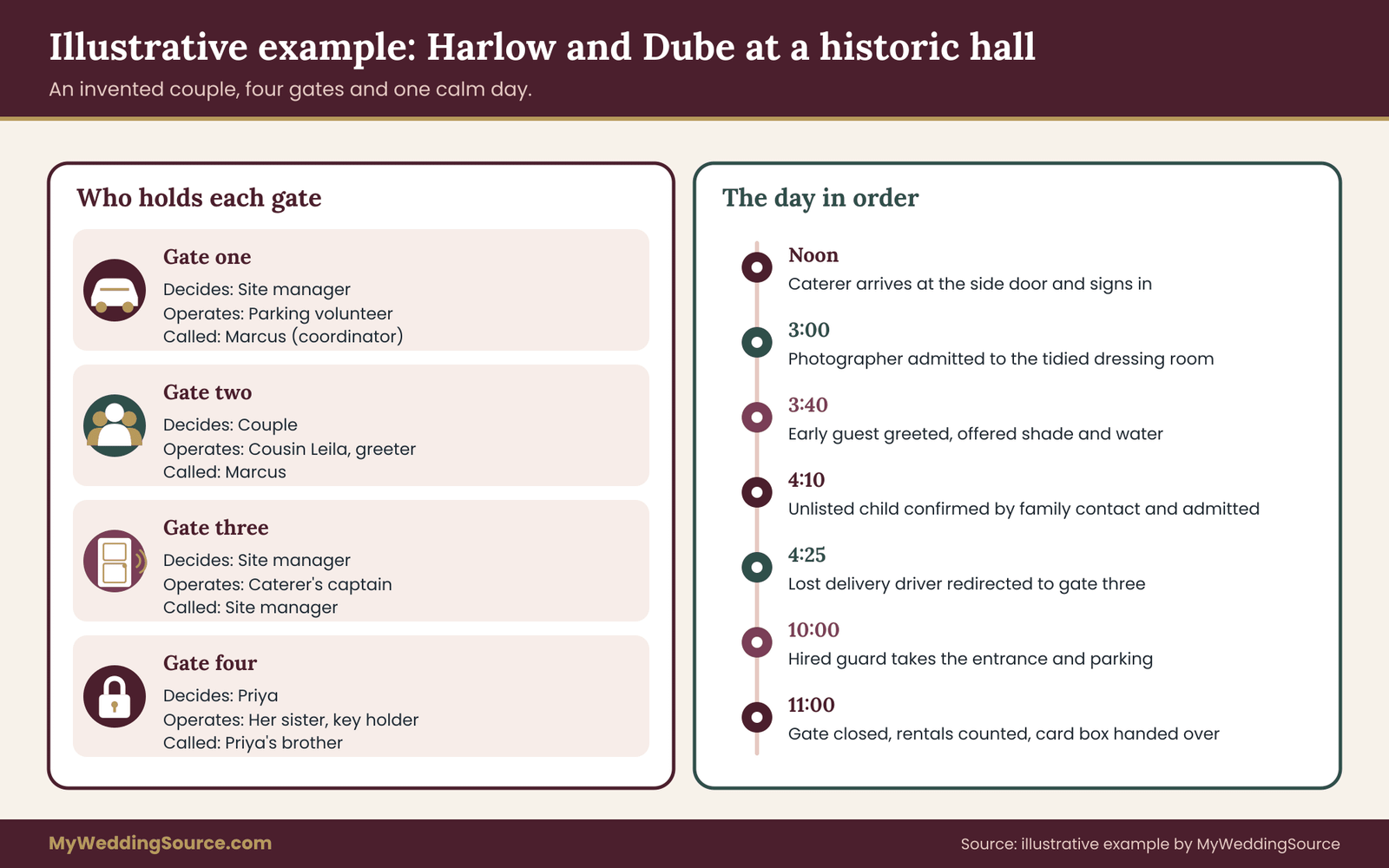
They sit down with the site manager and their day-of coordinator, a friend named Marcus who has agreed to take the role for a modest gift. For each gate they fill in the three questions. At gate one, the site manager decides where vehicles may stop, a parking volunteer operates and Marcus is the contact. At gate two, Priya and Daniel decide who is admitted, a cousin named Leila operates as greeter and Marcus is the escalation contact.
At gate three, the site manager decides the rules, the caterer’s captain operates and the site manager handles exceptions. At gate four, Priya decides who may enter, her sister holds the key and Marcus is the contact.
They notice two gaps right away. Nobody is named to close the garden gate once the ceremony ends, so the caterer’s captain takes it on. And Marcus is both the escalation contact for gates one, two and four, which is too much for a single phone. They add a second contact, Priya’s brother, for the dressing room and the parking area.
Step three: the contract read
Reading the venue agreement, they find a clause that requires licensed security for events with alcohol that continue after ten at night. The reception is planned to end at eleven. They ask the manager what the venue prefers, and the manager explains that the hall works with one security company and that the cost is billed through the hall. They request a written quote and compare it with the alternative of ending the event earlier.
After a few days of thought, they decide to keep the eleven o’clock end and use the hall’s provider for the last two hours, with the guard stationed near the front door and the parking area. They add the guard to the matrix, with the instruction that the guard calls Marcus for any exception.
Step four: the check-in model and the exception rules
Because the garden is enclosed by a fence and the guests are mostly known to the family, they choose a greeter with a list at the garden gate, plus escort cards for the reception. They agree on three rules. A plus-one who arrives without notice is admitted if the caterer confirms a spare meal, otherwise offered a seat at the cocktail hour.
An unlisted relative is confirmed by Priya’s brother, not by the couple. And there is one name on a private do-not-admit list, held by Marcus, the site manager and the guard, because of a long-running family conflict that Daniel’s mother has asked them to take seriously.
Leila receives a one-page sheet with the list, the three rules, the scripts, the phone numbers and the door times. She practices the scripts once with Marcus, which takes five minutes.
Step five: vendors and private rooms
The vendor schedule shows the caterer arriving at noon, the florist at one, the rental crew at two and the band at four. All use the side door, check in with the site manager and sign the vendor log. The band’s second van is asked to park in the rear lot, not on the street.
Priya’s sister keeps the dressing room key, and the photographer is admitted at three, when the room has been tidied and the rings and documents are in a bag with the best man. The card box is placed near the greeter’s table and moved by a named aunt at the end of the evening.
Step six: what happens on the day
At 3:40, a guest arrives early and the greeter walks her to a shaded seat and offers water. At 4:10, a couple arrive with a young child who is not on the list. Leila checks the late-additions page, finds nothing and follows the script. Marcus confirms with Priya’s brother that the child belongs to a cousin who sent a note the week before and forgot to update the list. The child is admitted and the note is added to the log.
At 4:25, a delivery driver arrives at the garden gate by mistake, and the parking volunteer redirects him to the side door. During the reception, a guest who seems unwell is helped by a family member, and the site manager is told quietly. The event ends on time, the guard walks the last guests to their cars, the garden gate is closed and the caterer’s captain counts the rentals against the order with the rental representative.
None of this was dramatic, and that was the intention. Each issue had a name attached, a short script and a way to resolve it in a minute or two.
A day-of timeline for venue security and check-in
A schedule helps the matrix survive contact with a real day. The times below are placeholders to adapt, based on a ceremony in the late afternoon. What matters is the order, not the clock.
Morning: the walk-through and the briefing. The coordinator arrives before the first vendor, walks the four gates with the site manager and confirms which doors are open, which are closed and who holds each key. The greeter and any host receive their sheets. The vendor log is placed at gate three.
Early afternoon: load-in. Vendors arrive in their windows, check in at gate three and are directed to their spaces. The coordinator keeps an eye on the schedule and adjusts it as needed. Valuables are moved to gate four rooms and the keyholder confirms.
Two hours before: the dress rehearsal for the door. The greeter sets up the table, tests the list, places the escort cards and confirms the exception contacts. The parking volunteer takes position. Signs are placed.
One hour before: the wedding party in private. The dressing room is closed to everyone except the named group. The coordinator is reachable. The photographer is admitted when ready.
Thirty minutes before: the doors open. Early guests are welcomed and directed. The greeter checks names and keeps the line short. The coordinator watches the count and decides when to start.
Ceremony: the doors close. Late arrivals are seated quietly at the back by an usher. The greeter holds the list and the log, and the venue manager stays reachable.
Cocktail hour: the transition. Guests move between spaces. The route is marked and staffed, the vendors are reminded that the vendor door stays closed to guests, and the reception room is opened only when the caterer is ready.
Reception: the steady state. The greeter becomes a roaming host or stays near the entrance for late arrivals. The card box stays visible. Any exception goes through the workflow.
Closing: the exit. The bar closes at the agreed time, the guard or the host guides guests to rides and parking, the coordinator checks the dressing rooms and gate four, and vendors load out in the order agreed. The venue manager signs off.
The one-page sheet
The most valuable output of all this venue security work is a single page that the greeter, the coordinator, the site manager and a trusted family member each have. It lists the four gates and their owners, the arrival schedule, the key phone numbers, the exception rules and scripts, the do-not-admit instruction in a private version only for those who need it, the closing procedure and the emergency contacts. If you can hand a stranger this page and they can run gate two, the system works. It is the portable version of your venue security plan.
Common mistakes in wedding venue security
Leaving venue security to the venue by assumption. The venue controls the building, not your guest list. Ask what it will and will not do, and get the answer in writing.
Staffing a gate with the wrong person. A bridesmaid holding flowers cannot also be the greeter. A parent who is upset by a family conflict should not be the person who decides on an exception.
Having an owner but no operator. A decision that nobody applies is not a control. Make sure each gate has someone standing at it when it matters.
Over-engineering the check-in. Tickets, scanners and ID checks for a seventy-person family dinner create friction and invite failure. Use the lightest model that answers your question.
Under-briefing the greeter. A greeter without a list, a script and a phone number is a smiling obstacle. Spend ten minutes.
Forgetting the vendors. Gate three is often the most open gate in the building. A schedule, a single route and a sign-in cover most of it.
Forgetting the exits. Check-in measures must not block a required exit or an accessible route. The local authority decides what is required, not the couple.
Treating the do-not-admit list like a secret in a group chat. Keep it short, private and in the hands of the people who need it.
Skipping the end of the night. Most losses happen at load-out. Name the person who locks up, counts rentals and collects the card box.
Ignoring accessibility. A venue security plan that works only for guests who can climb stairs is not finished.
Your next steps
Start your venue security work with an hour at the venue, or on the phone with the manager. Walk the four gates and write down who controls each one now. Then fill in the three questions for every gate: who decides, who operates and who is called. Read the venue contract for hours, capacity, security requirements, insurance, alcohol and key terms, and send your written questions to the manager.
Next, choose the lightest check-in model that answers your needs. Build a door copy of the list, name a greeter, write three exception rules and give the greeter a one-page sheet with scripts and phone numbers. Add the vendor schedule, a single vendor route and a sign-in. Decide whether hired venue security is required or sensible, and if so get a written quote and brief the provider on the venue security matrix.
Finally, check each gate for accessibility, and confirm any fire, capacity or exit question with the people who are qualified to approve it. If you are still choosing a site, the wedding venues guide will help you compare options, and the venue technical walkthrough covers the rest of the site visit.
FAQ
Who is responsible for wedding venue security, the venue or the couple?
Responsibility for venue security is shared. The venue controls the building, its hours, its capacity and its house rules. The couple controls the guest list and the welcome. Vendors control their own crews and equipment. Write the split down for each entrance and room, name a decider, an operator and an escalation contact, and confirm the venue’s part with the manager in writing.
Do we need hired venue security at our wedding?
Not always. Venue security can often be handled by staff you already have. Consider hired staff if the venue requires it, if the space cannot be closed to the public, if there is a specific safety concern or if a large event serves alcohol late. Otherwise a briefed greeter, a coordinator and clear rules often cover it. Ask the venue first, then get a written quote and compare it with the alternatives.
What is the simplest guest check-in that still works?
For venue security at the door, a greeter with a printed list organized by household, a phone number for the coordinator and a one-page sheet of exception rules. It supports welcome, counting and light admission control without adding tickets or scanners. Add escort cards if seating matters. Move to heavier methods only when the venue, the setting or a specific concern calls for them.
What should the greeter do when a guest is not on the list?
Good venue security stays friendly: check spelling variants and the late-additions page, then call the named escalation contact instead of deciding alone. Keep the guest comfortable while waiting, and apply the rule you agreed in advance. Afterward, write a short note with the name, the decision and the time. Never ask the greeter to refuse someone alone.
How do we control vendor access without slowing them down?
Vendor venue security starts with a single arrival schedule with windows, crew sizes and vehicles, and give vendors one route and one check-in point. Use a simple sign-in log and, if helpful, colored wristbands. Tell vendors where to park and which doors stay closed. Most delays come from surprises, and a schedule removes most of them.
Can we ask a venue to check names at the door?
On venue security, you can ask, but many venues do not do it by default, and some charge for staff time. Ask what the venue’s own staff will do, whether they will count guests and whether they can staff an entrance. If you want name checking, put it in the agreement, with the cost and the hours, and give the venue the door copy of the list.
How do we handle someone who should not be admitted?
For this kind of venue security, decide in advance who speaks with them and where, and share the name privately with only the people who need it: the coordinator, the venue manager and any hired venue security. The greeter should simply call the coordinator and avoid an argument. If there is a legal order or a safety concern, speak with the venue and local law enforcement first.
Does the Americans with Disabilities Act affect wedding check-in?
Venue security and the ADA meet at the door: venues and many vendors that serve the public have accessibility obligations under Title III of the ADA, even for private events. Make sure the check-in point is on a step-free route, that a service dog is welcomed and that security measures do not block accessible paths. For questions about a specific requirement, check the ADA site and ask the venue manager.
Sources
- Introduction to the ADA, Title III: public accommodations and commercial facilities, U.S. Department of Justice
- Service animals, ADA requirements, U.S. Department of Justice
- Physical security, Cybersecurity and Infrastructure Security Agency
- Fire code and safety resources, National Fire Protection Association
- Emergency action plans, Occupational Safety and Health Administration
- Make a plan, Ready.gov, Federal Emergency Management Agency
- Alcohol and tobacco, Alcohol and Tobacco Tax and Trade Bureau
- Protecting personal information, Federal Trade Commission
- Find your state or local government, USAGov