

A hotel block deadline is the date after which your guests can no longer book rooms through the special wedding link or code, and handling it well comes down to three things: telling guests the date early, reminding them on a schedule they can predict, and being honest about what happens to the price and availability once the hotel block deadline passes. This guide gives you a messaging calendar and a short fallback-rate disclosure you can copy into your own words.
Count backward from the hotel block deadline, not forward from the wedding. Send a first message when booking opens, then reminders at roughly four weeks, two weeks, one week and two days before the hotel block deadline, and one short notice on the day it passes. Every message should repeat the date, say how to book, and state in one plain sentence what happens afterward. Never promise a rate or a room after the hotel block deadline unless the hotel has confirmed it in writing.
Most couples treat the hotel block as a one-time setup task. They sign the agreement, paste a booking link into the wedding website, and move on to flowers. Then, a few weeks before the hotel block deadline, the link stops working for some guests, three relatives ask whether they can “still get the wedding rate,” and the couple discovers they never wrote down what the answer is. The hotel block deadline is not complicated, but it is the one date in the whole lodging plan that guests can truly miss, and the consequences land on them, not on you.
This article is about that narrow problem. It does not explain how to choose hotels or negotiate a block from scratch. If you are still deciding where guests should stay, the guide on coordinating wedding guest hotels across budgets and mobility needs covers the selection side. Here we assume the block exists and ask a more specific question. How do you make sure every guest hears about the hotel block deadline in time, and what do you tell the people who miss it?
A note on scope. This is general information, not legal, tax or financial advice, and hotel contracts differ, so the terms in your own agreement and the answers your hotel contact gives you always come first.
What the hotel block deadline actually is
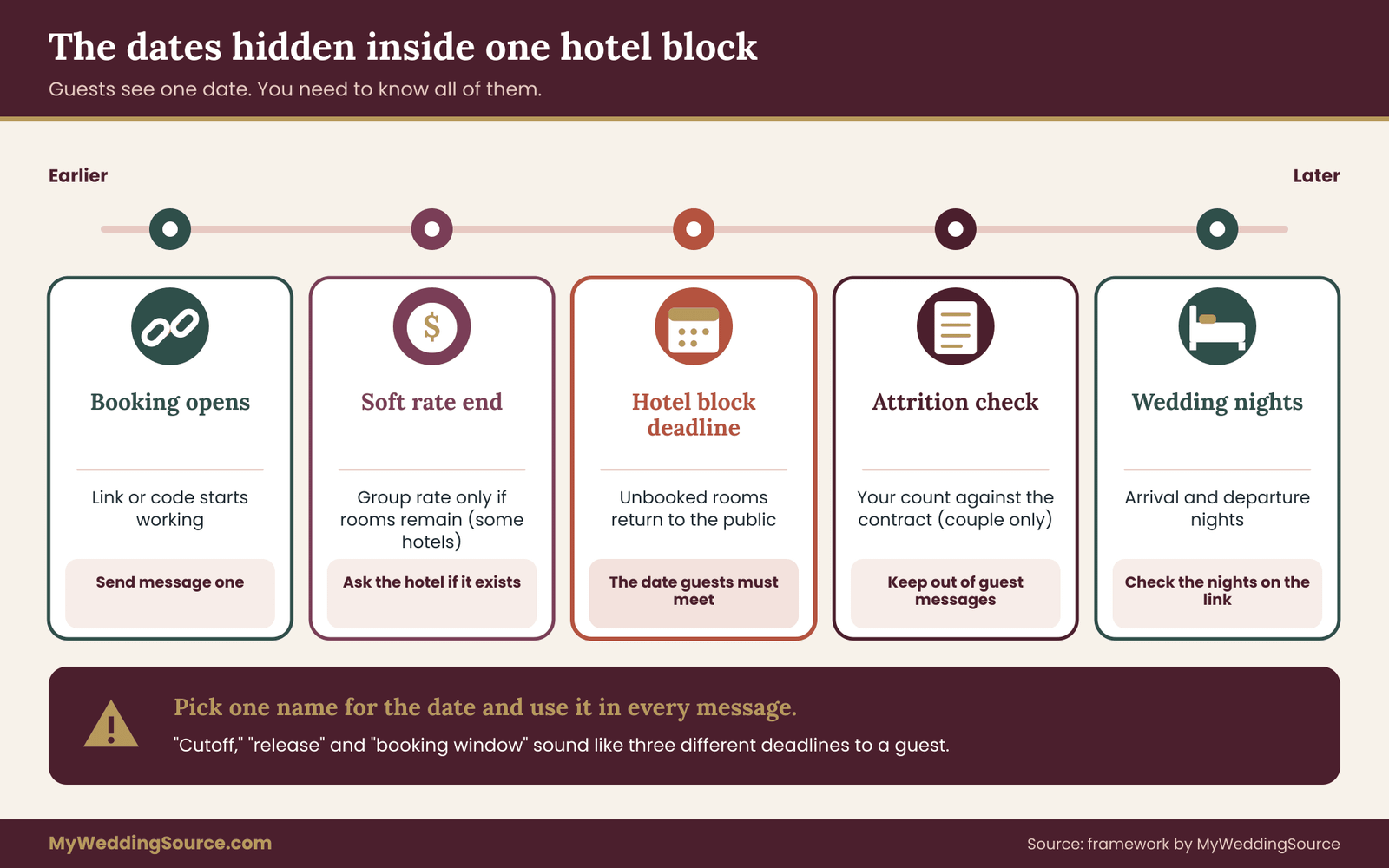
The phrase sounds like one date, but a block usually has several dates that get mixed up in conversation. Separating them is the first step, because you cannot remind guests of a date you have not pinned down.
The booking opening date. This is when the reservation link or code starts working. Some hotels open a block the day the agreement is signed. Others open it later, when you are ready to send invitations.
The release date. This is the date, set in the hotel’s agreement, when any rooms in the block that nobody has booked go back into the hotel’s general inventory. It is sometimes called the cutoff date, the cut-off, or the release. For guests, this is the hotel block deadline, because after it the special rate and the held rooms may no longer be there.
The rate expiry. Occasionally the date on which the rate stops applying is different from the date rooms are released. A hotel might release unsold rooms thirty days out but allow booking at the group rate “based on availability” until two weeks out. If your agreement says something like that, you have a soft deadline and a hard one. Guests need to hear about both, in that order.
The wedding dates. Arrival and departure nights. Guests who book the link for the wrong nights tend to discover the problem only when they call to extend.
The deposit or attrition checkpoints. These are dates that matter to you, not to guests. Many agreements ask the couple or planner to confirm a rooming list or to accept responsibility for a share of the block by certain dates. They belong in your records but not in guest messages.
When you write to guests, use one name for the date and use it every time. Calling it “the cutoff” in one message, “the release” in the next and “the booking window” in a third makes people think there are three deadlines. Pick “the hotel block deadline” or a plain equivalent such as “the last day to book at the wedding rate,” and repeat it exactly.
Why the hotel block deadline exists
It helps to understand the hotel’s side, because it explains why the date is not negotiable in the way guests assume. A hotel sets aside rooms for your group instead of selling them to the public. Every night those rooms sit empty is revenue the hotel does not get. The release date is the point where the hotel decides it would rather sell the unclaimed rooms to anyone than keep holding them for people who may not come.
For you, the same date is a risk transfer. In some agreements the couple signs for a number of rooms and is responsible if too few are booked. In others, the block is a courtesy hold with no financial liability, and the only cost of a poor turnout is that the hotel releases the rooms and guests pay whatever the public rate is. Which kind of block you have changes how hard you need to push reminders, a point the next sections return to.
For guests, the date is simply the edge of a convenience. Before it, they book a room at a known price near the venue. After it, they take their chances.
How a hotel block deadline differs from a courtesy hold on the venue
Couples sometimes mix this up with the date a venue sets for deposits. A venue’s hold or courtesy date is about the space where the wedding takes place. The hotel block deadline is about guest lodging only, and the two have no connection except in your calendar. If you want to see how venue holds work, the site has a separate guide on that topic. Here the point is only that you should keep the two lists apart so that a venue date is never described to guests as a hotel date.
Why guests miss the hotel block deadline
Reminders work better when they are built around the real reasons people miss dates. In most groups the reasons are ordinary and predictable, and none of them is laziness.
The date was never clear. The invitation said “reserve by” with a month and no day. Or the website said “mid-March” and the hotel’s system said March 9. A date that can be read two ways will be read the wrong way by someone.
The guest was waiting for something else. Many guests will not book a room until they know their flights, their time off from work or whether a partner or child can come. They are not ignoring the block. They are holding a decision until another one resolves, and the deadline passes in the meantime. A good reminder gives them a way to book now and change later, if the hotel allows it.
The booking link looked like an ad. Long tracking links in an email, a link that opens on a page that does not mention the wedding, or a code with a confusing format can make careful people suspicious. Guests who hesitate over trust will drift past the date.
They assumed someone else was handling it. Couples in a group of friends often book together, or older relatives expect a child to book for them. Everyone thinks the room is taken care of, and nobody actually booked it.
The rate looked too high or too low. A guest who sees a price above what they want to pay will keep shopping. A guest who sees a price that looks too low may assume it is a mistake or a deal with strings. Both behaviors burn time, and the hotel block deadline arrives while they decide.
The message arrived once and got buried. A single announcement months before the hotel block deadline is read, filed and forgotten. Guests do not distinguish between “important, date-bound” and “nice to know” unless you show them the difference through repetition and wording.
They did not know the date had consequences. People understand that hotels sell out. They are less sure that the specific wedding rate and the specific rooms stop being available on a specific day. If your message does not say what happens after the hotel block deadline, many guests assume it is flexible.
These reasons suggest the shape of the fix. The hotel block deadline date must be written clearly and identically. Messages must arrive more than once and carry different information each time. The booking path must look trustworthy. And guests must be told what the date means in plain terms. The rest of this guide turns that into a schedule and into wording.
What reminders cannot fix
It is worth being honest about the limits. A well-run reminder sequence will catch most of the guests who would otherwise miss the hotel block deadline by accident. It will not change the plans of people who are undecided about attending, people whose budgets do not fit the block rate, or people who prefer to stay with relatives or in a rental house. Those guests are not failures of communication. They are outcomes to plan for, and that is the job of the fallback section later in the article.
Who owns the reminders
Before you build a calendar, decide who sends the messages. In most weddings the couple is too busy and the hotel is too passive, so the reminders fall through the gap between them.
The couple or one named partner. This works if the guest list is small enough to message directly, and it carries the weight of a personal note. The risk is that the job disappears into a busy month.
A relative or friend as lodging contact. A sibling, a parent or a close friend can be the named person guests write to with hotel questions. This takes load off you and gives guests one human to ask. It only works if the person is organized, has the contract summary and knows the date by heart.
A planner or coordinator. If you have one, confirm that guest lodging messages are in scope. Many planners include them, some do not, and the difference is usually in the agreement.
The hotel’s group sales contact. Hotels can sometimes send a reminder to a booking list or give you a pickup report showing how many rooms have been booked. They rarely write to your guests on your behalf, and you should not assume they will.
Whoever owns the messages should also own one document, a single page that states the hotel name, the booking link or code, the hotel block deadline, the rate and what it includes, the arrival and departure nights, the hotel’s group contact and the cancellation terms. Every message is built from that page. When a fact changes, you change it in one place and re-send.
The wedding planning checklist on this site is a good place to see where guest lodging sits among the other planning tasks, which helps when you are deciding how much time the reminder calendar deserves in a busy month.
Reading the hotel block deadline in your agreement
You do not need to be a contracts expert to read a hotel block agreement, but you do need to read it with a specific purpose. Here the purpose is to extract every fact a guest message depends on. Keep a short list beside the document and fill it in as you go. If the hotel’s wording is unclear, write to the group sales contact and ask for the answer in writing before you tell guests anything.
The six facts to pull out
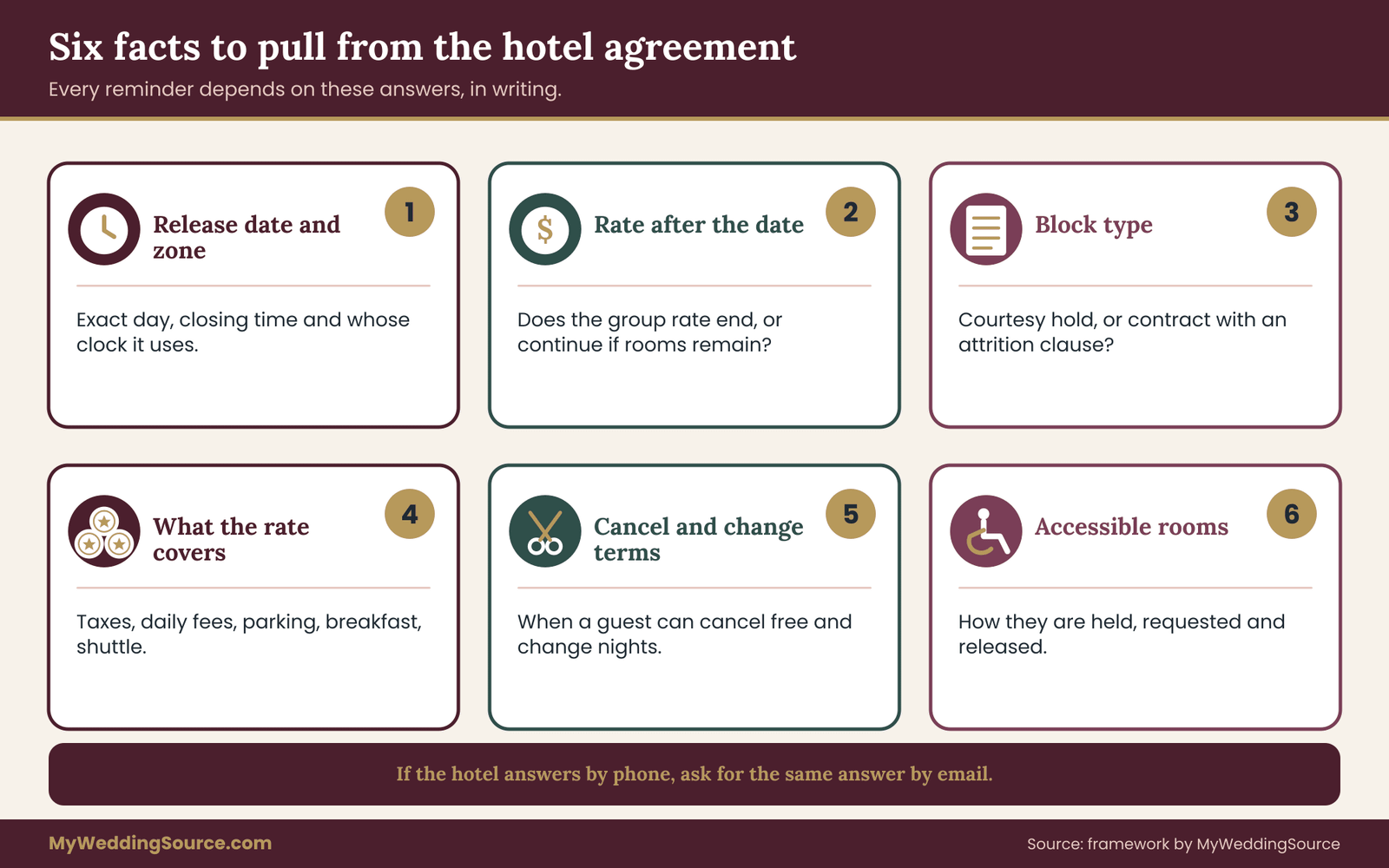
One: the exact release date and time zone. Find the date in the agreement, not in a marketing email. Some hotels release rooms at the end of the day, some at a stated hour. If the hotel and your guests are in different time zones from you, say whose clock the date uses. A guest booking at eleven at night on the final day wants to know whether that counts.
Two: what happens to the rate after the release date. Ask the question in these words: “After the release date, can a guest still book at the group rate if rooms are available, or does the group rate end completely?” The answer decides whether you describe the hotel block deadline as a hard stop or a soft one. Do not guess. Hotels word this differently, and the difference is the most common source of angry messages from guests.
Three: whether the block is a courtesy hold or a contract with attrition. A courtesy hold generally means you are not financially responsible for unbooked rooms. A contracted block may include an attrition clause, which says you owe the hotel for some portion of unbooked rooms if guest bookings fall short of a stated threshold. Read the clause closely, because it tells you how much each missed booking could matter to you and, therefore, how much effort the reminders deserve.
Four: the rate and what it covers. Confirm the nightly rate, whether taxes are included, any mandatory daily fees, parking charges and breakfast or shuttle inclusions. Guests will compare the wedding rate with what they see on public booking sites. If you cannot explain what the rate covers in two sentences, your reminders will draw questions you cannot answer.
Five: the cancellation and change terms. Ask when a guest can cancel without a charge, whether there is a deposit and whether changes to arrival or departure dates are allowed after the hotel block deadline. A guest who knows they can cancel a refundable reservation without penalty will book earlier. Many guests who delay are really afraid of being stuck with a charge.
Six: how accessible rooms are held. If the block includes accessible rooms, ask how they are reserved, whether guests can request them through the booking link and what the hotel does if an accessible room is not needed. Federal rules on hotel reservations address how hotels handle accessible rooms, and the ADA website is the place to read them. For your messages, the practical point is that guests who need an accessible room should know they can contact the hotel directly and that the date applies to them too.
Questions worth asking the hotel
You can often get useful details by phrasing your questions around the guest experience instead of the contract language. Consider asking the group sales contact the following, in writing.
- “If a guest tries the link after the release date, what do they see?” Some systems show an error page. Others redirect to the hotel’s general booking page, where the guest pays the public rate. Knowing which it is lets you tell guests exactly what to expect.
- “Can you send me a pickup report once a week, and more often in the last two weeks?” A pickup report lists how many rooms are booked against the block. Without it you are sending reminders blind.
- “If a guest calls the hotel directly after the hotel block deadline and mentions the wedding, what are the front desk or reservations staff told to do?” This question shows you whether a human exception path exists.
- “Is there a process to extend the release date if bookings are close to the target?” This one matters in a later section on moving the date.
- “Can the booking link be paused and reopened?” Some systems allow it, and it can be handy for a short extension.
Record each answer, the date you received it and the name of the person who gave it. If the hotel says something in a phone call that is not in the agreement, ask them to confirm it by email. A promise that lives only in a conversation will not help you when a guest is at a front desk with a different story.
What not to promise
The restraint you show here protects you later. Do not tell guests any of the following unless the hotel has confirmed it in writing.
- That the wedding rate will continue after the hotel block deadline.
- That rooms will still be available after the hotel block deadline.
- That a particular room type, floor or view will be assigned.
- That the hotel will accept late bookings if you ask.
- That an accessible room will be available on request after the hotel block deadline.
- That a refund policy will apply to a guest who booked outside the block.
Hotels make their own decisions on all of these. The most you can say is what you know and where to ask. The U.S. Department of Transportation maintains consumer information on air travel, and its aviation consumer protection pages are worth a look if guests are also worried about flight changes, but nothing in your hotel messages should speak for an airline either.
Courtesy blocks, contract blocks and no block at all
The kind of block you have changes your reminder plan, so it is worth taking each in turn. If you are weighing whether to have a block at all, that is a different question, because a plan with no block has no hotel block deadline to remind anyone about. What follows applies when there is a block.
The courtesy block
In a courtesy block, the hotel holds rooms at a negotiated rate and you take on no financial risk. The hotel releases unbooked rooms at the release date. For you, the downside is low. For the hotel, the deadline matters because it governs when they sell the rooms to others.
With a courtesy block, your reminder emphasis is on guest benefit: a known price, a convenient location, shared transport to the venue. You can afford a light touch. Three or four messages are enough for most groups.
The contracted block with attrition
In a contracted block, the couple agrees to a number of room nights. If guests book fewer, the agreement may require a payment. These agreements usually have tolerance, such as a percentage below which you owe nothing, but the details differ from one hotel to another.
Here the hotel block deadline is also a financial checkpoint for you. You want pickup high and you want to see it early. Plan more reminders, ask for weekly pickup reports and set an internal threshold, for example “if we are below our target two weeks before the hotel block deadline, we personally message every guest who has not yet booked.”
The block that is mostly symbolic
Occasionally a hotel offers a “block” that is just a discount code with no held rooms. Booking still works the same way for guests, but the hotel block deadline may be a promotional end date for the code rather than a release of inventory. Ask the hotel which one you have. The wording of your reminder changes if there are no held rooms, because “rooms may sell out” becomes “the code may stop working.”
Two or more hotels
If you offered guests a choice of hotels at different prices, each hotel has its own date, its own rules and its own link. Keep a separate line for each in your one-page document. In reminders, show only the information that applies to the guest. Someone choosing between a budget option and a mid-range one needs both dates side by side, in the same format, so they do not mistake one for the other.
The ten-minute pickup check
Whatever type of block you have, build a short habit of checking pickup. Ten minutes a week is enough.
Ask the hotel for the numbers or log in to the booking dashboard if one exists. Write down four figures: rooms in the block, rooms booked, rooms still open and the number of days left until the hotel block deadline. Put them in a note with the date. Over several weeks you will see a pattern, and the pattern tells you which reminders to strengthen.
A common pattern is slow bookings until a reminder goes out, then a burst of activity for a day or two. That burst is useful information. It confirms that guests respond to a clear message and that the next gap between messages should be short enough to catch the next group. If the numbers do not move after a reminder, the problem is probably not attention. It may be price, location or trust in the link, and the next message should address that instead of repeating the date.
You can also compare pickup to your own guest list. If you expect forty rooms and have twelve bookings with two weeks to go, the gap is a prompt to act. If your RSVP data shows that most guests are local, a low pickup may be perfectly normal. The wedding RSVP etiquette guide explains how to collect responses in a form that is easy to cross-check against the hotel list.
Matching bookings to your guest list
The hotel’s list is only a list of names. Not every guest books under their own name, and some book under a spouse, a company or a travel agent. When you receive a pickup report, compare it to your guest list and mark the people who are confirmed, the people who clearly have local plans and the people who are unknown. The unknown group is the group your next reminder is really for. Write to them, directly if the group is small enough, and make the message about them: “We have not seen a booking under your name yet, and the date is next Friday.”
Keep this list private. Guests should not see who has and has not booked, and no message should name individuals. The aim is a helpful nudge, not pressure.
What the count tells you about your own risk
If your agreement includes attrition, the pickup figure is also a financial indicator.
Tracking it against the clause lets you decide, before the hotel block deadline, whether a polite extra push is worth it. The cost of a few more personal messages is small compared with a charge for unused rooms. You do not need to calculate the exact exposure here. You only need to know where your agreement says the line is and compare the pickup figure to it. For the budgeting side, the wedding budget guide explains how to hold a line for items that may change, and the wedding vendor contract guide explains what to look for in agreements generally.
The hotel block deadline messaging calendar
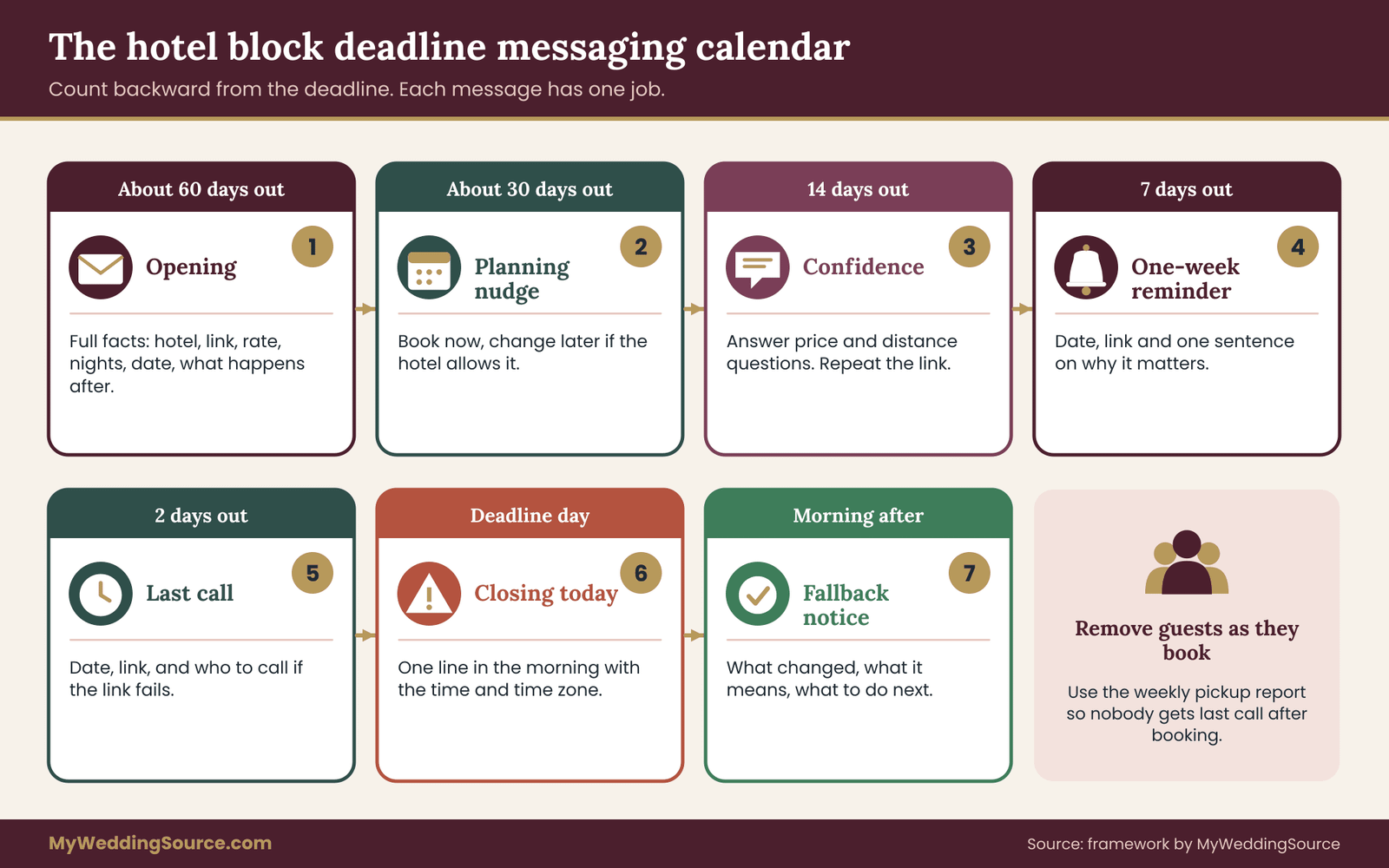
This is the core of the guide. The idea is simple. Instead of scheduling reminders by calendar month, you count backward from the hotel block deadline and give each message one job. A guest who receives all of them hears the date six times, but never hears the same message twice.
Call the hotel block deadline day zero. Each message is named by how many days before day zero it goes out. That naming makes the schedule portable. If the hotel moves the date by a week, every message moves with it, and you do not rebuild anything.
The seven messages
Message one: the opening, about sixty days out. This is the announcement that the block exists. It carries the full set of facts, because it is the first time guests see them. Hotel name, how to book, the rate and what it includes, the nights covered, the hotel block deadline written out with the weekday and the month, and one sentence on what happens afterward. If your invitations already include a lodging line, this message is the longer version.
Message two: the planning nudge, about thirty days out. The job of this message is to remove the reasons guests wait. It says that rooms can be booked now and, where the hotel allows it, changed or cancelled later. It reminds guests that the date is four weeks away and offers a way to ask questions. It also repeats the booking link in full. This is the message that works for the guest who was waiting on flights or time off.
Message three: the confidence message, about fourteen days out. By now some guests have booked and others have not. This message addresses the second group without scolding. It names the date again, says how many days remain and offers a short answer to the two questions guests ask most, usually about price and distance to the venue. If you have numbers you can share truthfully, such as “most of the block is still open,” include them. If you do not, leave them out.
Message four: the one-week message. Short. It carries the date, the link and one sentence about why the date matters. Nothing else. This is a clean reminder for someone who has been meaning to book and needs a clear, easy path.
Message five: the last-call message, two days out. Even shorter, and the only one that can reasonably sound urgent. It says the hotel block deadline is the day after tomorrow, gives the link, and tells guests what to do if the link has a problem. It also tells them who to contact if they need an accessible room or a special arrangement.
Message six: the day-of notice. On the date itself, send one line in the morning that the link closes tonight, with the time and time zone. People who were going to book this week will often do it that day. This message is optional for small groups and valuable for large ones.
Message seven: the after notice. The day after the hotel block deadline, send the fallback-rate disclosure, which gets a full section later in this guide. Here we only need its place in the sequence. It tells guests, in plain words, that the block is closed or changed, what they can still try and who to ask. It is not an apology and not an invitation to complain. It is a short factual note that spares the couple a flood of individual questions.
You might wonder if seven messages is too many for one date. The answer depends on the group. For fifteen guests who all text the couple, three personal messages may be plenty. For a group of one hundred and fifty, spread across several states and several generations, seven short messages across eight weeks is not heavy, especially since each one is a few lines. The guide on wedding guest list planning helps you work out who counts as an out-of-town guest in the first place.
Matching the message to the channel
Different guests read different channels. Choose the primary channel for each guest or group and use a second channel for the last-call messages.
Email. The best home for message one, because it can carry the full set of facts and a link. It is the weakest channel for urgency. Subject lines matter. “Hotel booking for [couple names]’s wedding, book by Friday, March 8” is more useful than “Quick update.”
Text message or group chat. The best channel for messages four, five and six. Short, direct and likely to be read within minutes. If the couple is not comfortable sharing their number with a large group, a trusted relative can send them, or you can use a broadcast tool that keeps recipients’ numbers private. Keep each text to a few lines, since the lodging use needs nothing more.
The wedding website. The best channel for the durable version of the facts. Put the hotel block deadline near the top of the lodging page, with the date in a bold line, and update the page whenever something changes. Every message should point to it.
Printed material. Invitations and save-the-date cards are useful for the first mention. Since print is permanent, avoid putting details on paper that are likely to change. The wedding invitation etiquette guide explains how to word lodging information on printed pieces so the page stays accurate.
A phone call. For older relatives or guests who do not use email or text, a call from the couple or a family member may be the only thing that works. Put these guests on a short list and make the call after message three.
Choosing the dates without a spreadsheet
You do not need a tool. Take the hotel block deadline, subtract sixty days, and write the date next to message one. Do the same for each message. Then check three things.
First, avoid sending messages on dates that collide with other wedding mail. If invitations or RSVP reminders go out on the same day, guests may not tell the two apart, so move the hotel message by a day or two.
Second, look at holidays and busy periods. A reminder that lands on a major holiday weekend will be missed. Shift it forward or back by a few days and keep the spacing roughly the same.
Third, check for the time zone of your guests. If most of the group is on the other side of the country, a message sent at six in the morning your time is a message sent at three in the morning theirs, and many people will read it as one of a pile the next day.
What each message must contain
To keep the messages consistent, build a short list of the elements that appear in every one of them.
- The date of the hotel block deadline, written the same way each time, with weekday, month and day.
- The booking link or code, in full, copied from the single source page.
- One sentence stating what happens after the hotel block deadline.
- A contact person for questions, with a way to reach them.
- A pointer to the wedding website page that holds the full facts.
Everything else is optional and depends on the message. This simple consistency means a guest who reads only the last-call message still has what they need to act.
Adjusting the calendar for different guest groups
Not every guest needs every message. The seven messages are the full sequence, and you can shorten it by group.
Guests who have already booked. After a guest books, take them off the reminder list. Receiving “last call” after booking creates confusion and extra questions. This is where the weekly pickup check pays off, because it tells you who to remove. A simple “thank you, you are all set” note after booking helps keep this group quiet.
Guests with a long travel path. People flying in from another country or a long way across the country often book earlier and need more detail, such as airport options or the ground transport plan. Send them message two directly, with a short personal line.
Guests who need accessible rooms. Give them a direct path to the hotel’s reservations desk in addition to the booking link, and send the reminders on the same schedule. They are not a separate track with a separate date, since the hotel block deadline applies to them as well. A longer lead time simply helps, because accessible rooms are limited.
Guests who live nearby. These guests may not need rooms at all. If your RSVP data identifies them, remove them from the list so they do not wonder why they are getting hotel reminders.
Guests staying in a family home or rental. A short note saying “no action needed” is better than silence if you are unsure. It lets you drop them from the list while keeping the door open for a change of plans.
A shorter version for small weddings
Couples with a guest count in the dozens can compress the calendar to four messages, still counted backward from the hotel block deadline. The opening at about forty-five days out. A planning nudge at about three weeks out. A one-week reminder. A last-call message two days out. The after notice is still worth sending, because it is the one that answers the question guests will otherwise ask you individually.
What not to do with the calendar
Do not send reminders at a faster pace than the one above because the date is approaching and you are anxious. A burst of daily messages in the last week reads as pressure, and it teaches guests to ignore you. Do not shorten the opening message to save space, because everything later depends on it. And do not change the date in the middle of the sequence without a clear explanation, since guests who see two different dates will trust neither.
Writing the reminders: wording that guests act on
A reminder can be accurate and still fail. The difference is usually wording. This section gives you a structure for each message and sample text you can adapt. None of it is magic. It is the habit of putting the most useful fact first and leaving out anything that does not help the guest decide.
The anatomy of a good reminder
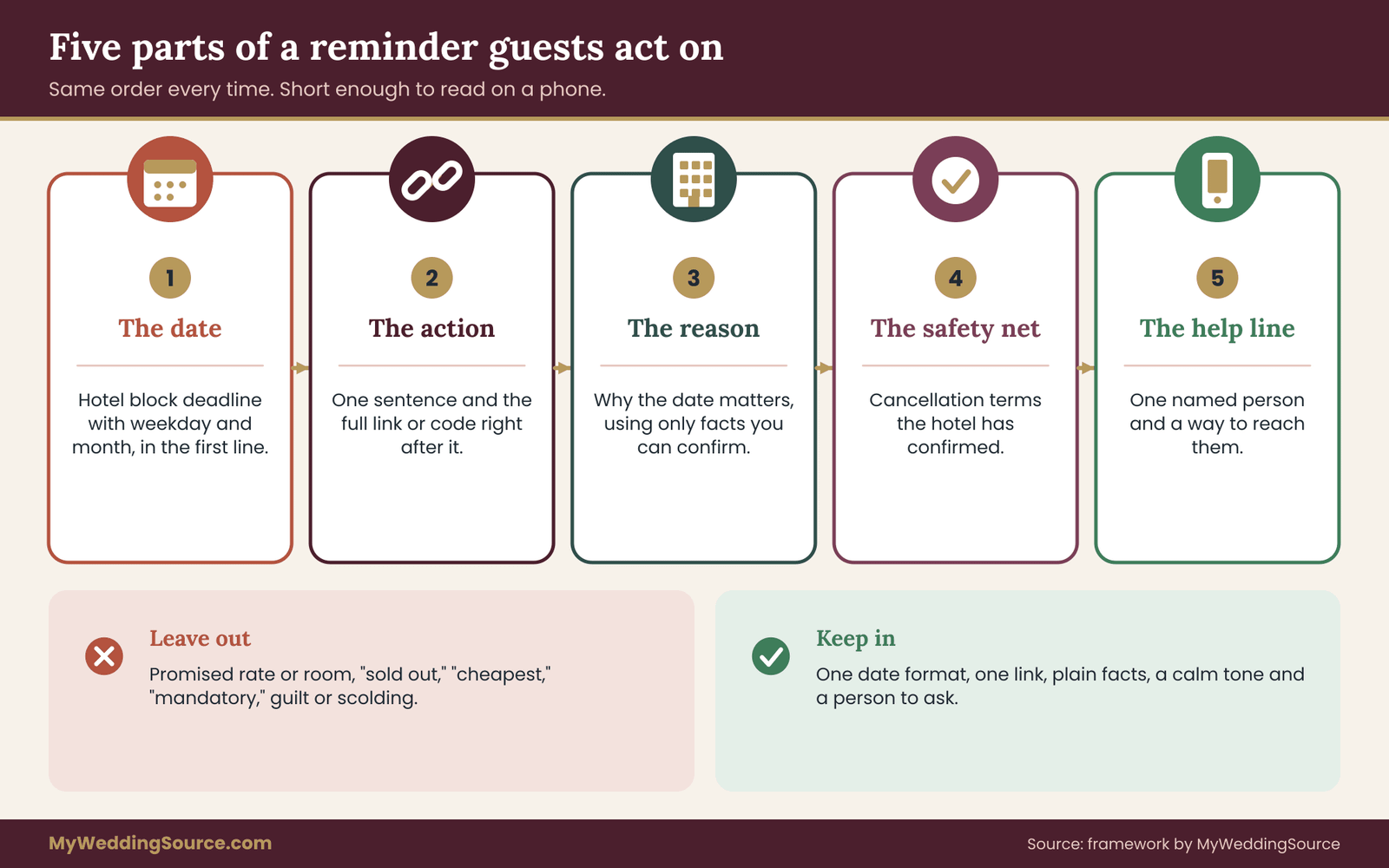
Every reminder, long or short, can be built from five parts, in this order.
The date first. The first line names the hotel block deadline with weekday and month. A guest who reads nothing else knows what matters.
The action second. One sentence says what to do, usually “book through this link.” The link or code follows immediately, not several paragraphs later.
The reason third. A short explanation of why the date matters. Keep it truthful and concrete. “After this date the hotel may sell the remaining rooms to the public” is a reason. “Rooms are going fast” is not, unless you have a pickup report that supports it.
The safety net fourth. One sentence about flexibility, such as the cancellation terms the hotel has confirmed. This is the part that moves hesitant guests.
The help line last. A name and a way to ask questions, so a guest with a problem has somewhere to go that is not a reply-all thread.
Sample wording for each message
Adjust the details to match your agreement. The samples avoid pressure and avoid claims that you cannot confirm.
Message one, the opening.
Hello, and thank you for celebrating with us. We have set aside rooms at the Harbor Street Inn for the wedding weekend. To book at the wedding rate, use this link by Friday, March 8: [link]. The rate is per night, and the hotel can tell you about taxes and parking when you reserve. After March 8, the hotel may release unbooked rooms to the public, so the wedding rate may no longer be available. Questions are welcome. Write to Dana at the address on our website.
The name of the hotel and the date are invented placeholders for this example. Replace them with your own details.
Message two, the planning nudge.
A quick note on the hotel for our wedding. The last day to book at the wedding rate is Friday, March 8, about four weeks from now. If you are still waiting on flights or time off, you can book now and check the hotel’s cancellation terms on the booking page, which say when you can cancel without a charge. The link is here: [link]. If anything about the booking is unclear, ask Dana.
Message three, the confidence message.
Two weeks until the hotel block deadline on Friday, March 8. If you have not booked yet, the link is [link]. Two things guests have asked about: the hotel is a short drive from the venue, and the rate covers a room for the nights of Friday and Saturday. If you need an accessible room, call the hotel’s reservations desk directly and mention our wedding, and book before the hotel block deadline.
Message four, one week out.
One week left to book at the wedding rate. The hotel block deadline is this Friday, March 8. Link: [link].
Message five, last call.
The hotel block deadline is the day after tomorrow, Friday, March 8. Book here: [link]. If the link gives you trouble, call the hotel and mention our wedding, or write to Dana.
Message six, day of.
Today is the last day to book the wedding rate at the hotel. The link closes tonight at 11:59 p.m. Eastern time: [link].
Message seven, after.
The hotel block deadline has passed. If you have not booked, the hotel may still have rooms, but the wedding rate may not apply and availability is up to the hotel. You can check the hotel directly, and we have listed two nearby options on our website. If you need an accessible room, please call the hotel and tell them. Write to Dana if you get stuck.
Notice what the samples do not say. They do not claim rooms are “almost gone.” They do not scold. They do not promise that a late booking will work. They use the same date and the same link in each case. And each is short enough to read on a phone in the time it takes to wait for a coffee.
Making the booking path look trustworthy
Guests are used to scams, and a hotel link in a mass message can look like one. A few small choices reduce hesitation.
Use the hotel’s own link or the group booking page the hotel provides, and avoid shortening it with an unfamiliar tool. State the hotel’s name and the name of the wedding in the message. Put the same link on the wedding website, so guests can verify it. Offer a phone number for the hotel’s reservations desk as an alternative to the link. And never ask guests to send payment details to you or to any person other than the hotel.
For a guest who is nervous about online booking, the phone path matters. Tell them the number to call and a sentence to say, such as “I am calling about the room block for the wedding on March 8.” The hotel’s staff will know what that means if you have told them to expect it.
Tone: calm, clear and kind
A reminder is a favor to the guest, not a demand. Write it the way you would speak to a friend who is on your side. That means short sentences, plain words and a willingness to be helpful about the awkward parts, such as money.
Avoid language that implies fault. “As we mentioned earlier” and “please remember” can feel like a reprimand. A better opening is a statement of fact. “The hotel block deadline is next Friday” says the same thing and invites action.
Avoid humor that depends on guilt, such as jokes about guests who have not booked. It will land badly with the person who has not booked because their budget is tight.
Avoid exclamation marks as a rhythm. One in a thank-you line is fine. Five in a row in a last-call message turns the note into noise.
Words to leave out
Some phrases cause trouble in hotel messages.
- “Promised rate” and “promised room.” You are not the hotel. Say what the agreement says, and say it as the hotel’s term, for example “the group rate offered by the hotel.”
- “Sold out.” Unless the hotel has told you the block is full, do not say it.
- “Cheapest.” The rate you negotiated may be the best option for most people, but a guest who finds a lower price elsewhere will feel misled. Say “the wedding rate” instead.
- “Mandatory.” Staying at the block hotel is a convenience, not a requirement, and guests who feel forced may resent it.
For the arrangements that sit outside hotels, such as a shared shuttle or a welcome table at the hotel, the site has separate material, and nothing in a hotel block deadline message needs to repeat it.
One page, many messages
Remember the single source page from earlier. When you write a message, open that page and copy from it. Do not retype the link or the date from memory. If you change the page, change the next message too. That discipline prevents the common slip where an early message has one rate and a later message has another.
If you use a tool that schedules messages ahead of time, enter all seven in one sitting while the facts are in front of you. Check the date and link in each one after you save it. If the hotel later changes a term, you can edit the scheduled messages instead of writing them from scratch.
Handling replies
Replies are part of the job. Expect questions such as “Can I book a different room type?” “Can I extend my stay?” “Does the rate include breakfast?” and “What if I need to cancel?” Keep a short answer sheet with the hotel’s confirmed answers and paste from it. Where you do not know the answer, say so and direct the guest to the hotel instead of guessing.
For a guest who writes after the hotel block deadline asking whether you can “just get them the rate,” a kind and honest reply helps. Tell them you cannot change the hotel’s terms, point them to the hotel’s reservations desk and, if the fallback disclosure lists alternatives, share them. Offer to pass a request along only if the hotel has said it accepts such requests.
A note on guests who are family
Some of the people most likely to miss the hotel block deadline are the people closest to you. Parents, grandparents and siblings often assume a room is arranged and may not read mass messages. Do not rely on the group message for them. A short personal conversation, or a call from you or a relative, is worth the few minutes it takes. Ask if they have booked, offer help with the link and, if the cost is a concern, talk about it privately. The guide to coordinating guest hotels across budgets covers how to approach those conversations about price, and the same private tone applies here.
The fallback-rate disclosure after the hotel block deadline
The seventh message in the calendar deserves its own section, because it is the one most couples skip and the one that saves the most time. A fallback-rate disclosure is a short, honest statement that tells guests what is true after the hotel block deadline passes. It names the rate situation, the availability situation and the next step. It is not a promise. It is a map of what you know.
The word “fallback” refers to the guest’s position once the block is no longer the easy path. They have fallen back to something else, and the disclosure tells them what that something else looks like. Writing it before the hotel block deadline, while you have the hotel’s answers in front of you, means you can send it the next morning without scrambling.
Why a disclosure works better than silence
Without a disclosure, three things tend to happen. Guests who missed the date write to you one by one, asking if there is anything you can do. Some of them assume the worst and book at a higher price somewhere inconvenient. And a few arrive at the hotel with a screenshot of an old email and an expectation that the front desk will honor it.
A disclosure heads off all three. It answers the common questions in one place, it sets an accurate expectation and it gives guests the next step. You are not apologizing for the hotel’s policy. You are being clear about it.
The three states
After the hotel block deadline, your block is in one of three states. Which one applies depends on the agreement and on what the hotel has told you. Find out which state you are in before you write the disclosure.

State one: the rate continues, subject to availability. The hotel releases unbooked rooms to general inventory but will still sell remaining rooms at the group rate to wedding guests who ask. This is the friendliest outcome. Your disclosure tells guests they can still ask for the wedding rate, that rooms are not assured and that they should call the hotel and mention the wedding.
State two: the rate ends, rooms may remain. The hotel releases unbooked rooms and applies its normal public rates from that point. Guests can still book, but at whatever the hotel’s price is that day. Your disclosure says the wedding rate has ended, tells guests where to check current prices and mentions nearby alternatives.
State three: the block is full or closed. All rooms in the block are booked, or the hotel will not accept further bookings under the wedding code. Your disclosure says so plainly and lists other places to stay, with a short description of how far each is from the venue.
You may find that you are somewhere in between, for example a hotel that will accept a few more bookings at the group rate for a week before moving to public pricing. If so, describe exactly that and give both dates. Nothing in the disclosure should be vague.
What a fallback-rate disclosure contains
Whichever state applies, a good disclosure has the same five elements, in order.
- What changed. One sentence stating that the hotel block deadline has passed.
- What it means for the rate. One sentence using the language of the matching state above.
- What it means for availability. One sentence that does not promise anything the hotel has not confirmed.
- What guests can do. Two or three concrete options: call the hotel, check the hotel’s website, consider a named alternative.
- Where to ask. The same contact person as in the earlier messages.
Keep it under about one hundred and twenty words. The point is to be useful, not to explain every possibility.
Sample disclosures
The details here are invented. Use the version that matches your own state.
State one.
The hotel block deadline has passed. The hotel has told us it may still offer the wedding rate to guests who ask, depending on what is available. Please call the reservations desk, mention our wedding on March 8 and ask. We cannot promise a room or a price. If it does not work out, the Maple Court hotel is about ten minutes from the venue. Questions go to Dana.
State two.
The hotel block deadline has passed, and the wedding rate has ended. Rooms may still be available at the hotel’s regular price, which changes by day, so please check the hotel’s website or call. We have listed two nearby options on our website with their distance from the venue. If you need an accessible room, call the hotel and tell them what you need. Questions go to Dana.
State three.
The hotel block deadline has passed, and the rooms we reserved are fully booked. Thank you to everyone who booked. For guests still looking, we have listed three other places to stay, with distance and parking information, on our website. If you need an accessible room or help with a booking, write to Dana and we will help you find options.
Because each sample names the facts and makes no promises, none of them can turn into a conflict at the front desk later.
Listing alternatives without endorsing them
Your disclosure may mention alternatives. Keep two principles in mind.
First, describe, do not recommend. “A hotel about ten minutes from the venue” is a fact. “A great place to stay” is an endorsement, and if the guest is unhappy, it becomes your responsibility. Limit alternatives to location, rough distance and whether they have parking or accessible rooms if you have verified those points yourself.
Second, check that the alternatives exist for your dates. Before you list a hotel, look at whether it has availability on the wedding weekend. A list of fully booked places helps nobody. If you are not sure, say “check availability” and leave it at that.
For help thinking about the full range of alternatives, including rental homes and staying with relatives, the guide on wedding guest hotels across budgets covers the options in depth. Here we only need to treat them as fallback paths.
The fallback-rate disclosure and your own costs
There is a financial thread in all this. If your agreement includes attrition, guests who book outside the block may reduce your pickup and increase your exposure. That is a reason to push hard before the hotel block deadline and a reason to ask the hotel, in advance, whether bookings made after the hotel block deadline under the wedding name still count toward the block. Some hotels do count them, some do not. If yours does, tell guests in the disclosure, because it changes the advice. “Please still mention the wedding when you book” becomes meaningful.
If the hotel does not count late bookings, there is nothing to ask of guests. Do not ask them to protect you from a risk that you chose to accept when you signed the agreement. Keep the disclosure focused on their needs.
Disclosure and honesty about commissions and perks
Some hotels give couples a benefit for filling a block, such as a complimentary room, points or a discount. If you receive a perk tied to guest bookings, it is fair for guests to know the booking link is part of an arrangement with the hotel. You do not need to make a speech. A single plain sentence on the lodging page, such as “Our hotel agreement includes a courtesy for the couple when guests book through this link,” is honest and short. It also prevents a guest from wondering why you push the link so hard.
If your agreement has no such perk, say nothing and do not invent a disclosure.
Do not describe a perk as a savings for the guest. It is a benefit to you, and presenting it as the guest’s gain is misleading.
When to send the disclosure
Send it the morning after the hotel block deadline. A same-evening message feels hasty. A message a week later arrives after guests have already found their own solutions, so it is mostly noise.
If you do not know the hotel’s state yet, say so and set a time. “We are checking with the hotel about what happens after tonight and will write tomorrow” is better than a guess. The thing you must avoid is writing a disclosure that later turns out to be wrong. A corrected disclosure costs trust.
Keeping the disclosure in sync with the website
The lodging page on your wedding website should say the same thing as the disclosure. Replace the booking link with a short note on the new state, keep the contact line and list the alternatives. A guest who lands on the page weeks later, after an old reminder, should see the current situation without having to hunt for it.
The page needs only the current state, the alternatives and one contact.
A decision rule for the wording
When you are not sure how to phrase a sentence in the disclosure, test it with a simple rule. Ask: could a guest show this sentence to the hotel front desk and be told it is wrong? If the answer is yes, change it. A sentence that survives that test is one you can send. For example, “the hotel will give you the wedding rate” fails, because the desk may say otherwise. “The hotel told us it may still offer the wedding rate to guests who ask” passes, because it describes what the hotel said and does not promise an outcome.
A worked example of one hotel block deadline
Abstract schedules are easier to trust once you see them applied. The following example is invented. The couple, the hotel and the numbers are illustrative only, and nothing here describes a real wedding or a real hotel.
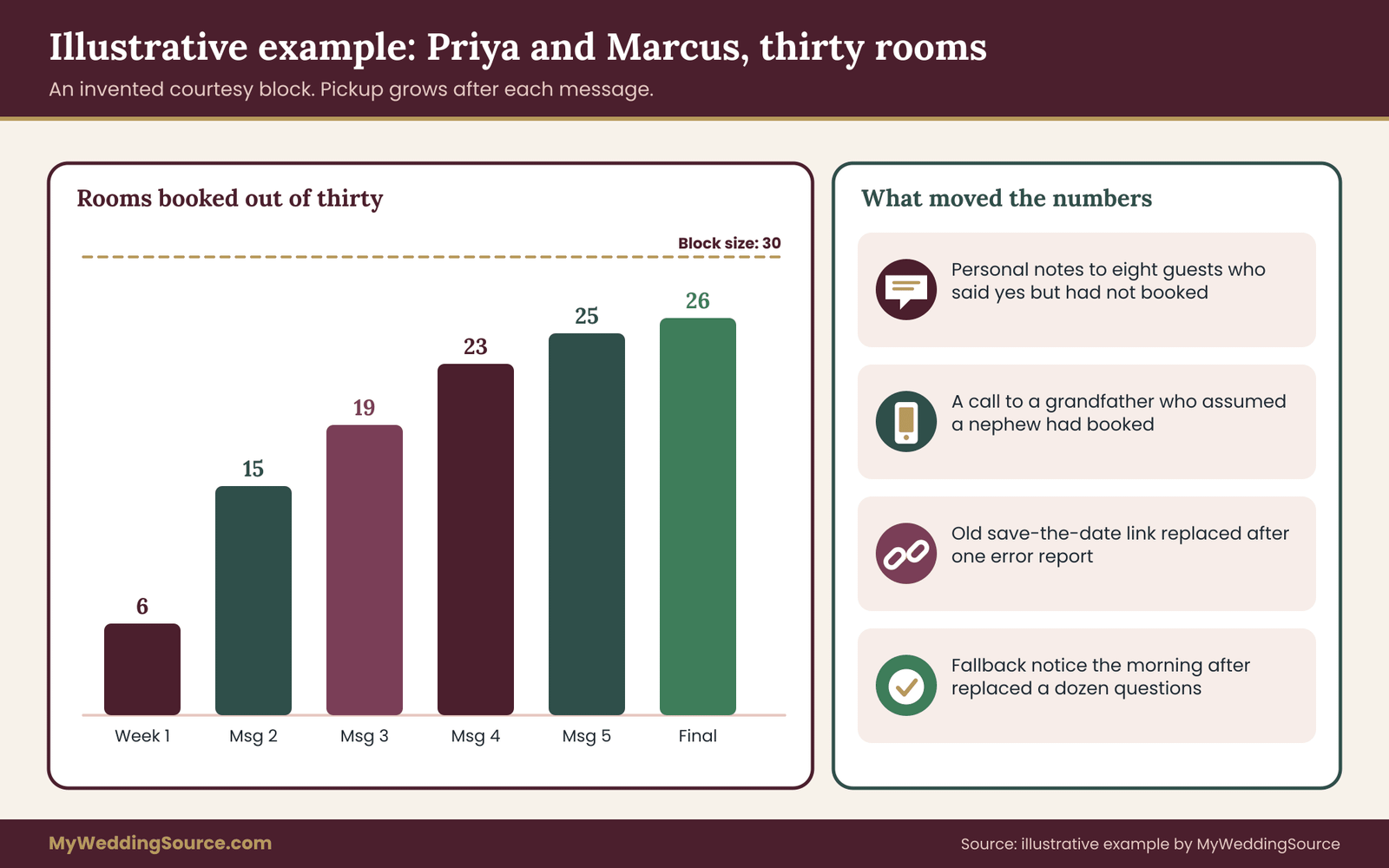
Imagine Priya and Marcus, who are marrying on a Saturday in late May. They have a block of thirty rooms at a mid-range hotel six minutes from the venue. The agreement is a courtesy block. The hotel block deadline, which the agreement calls the release date, is Friday, April 12, thirty days before the wedding weekend. The hotel has told them in writing that after that date unbooked rooms return to general inventory and the group rate ends, so they are in the second state from the fallback section.
Their guest list has about one hundred and ten invited guests. Roughly forty live within an hour’s drive and are unlikely to need rooms. About fifty are traveling from other regions, and about twenty are undecided or have not yet replied.
Building their calendar
Counting back from April 12, Priya writes the dates beside each message.
- Message one, about sixty days out: Monday, February 12.
- Message two, about thirty days out: Wednesday, March 13.
- Message three, fourteen days out: Friday, March 29.
- Message four, seven days out: Friday, April 5.
- Message five, two days out: Wednesday, April 10.
- Message six, the day itself: Friday, April 12.
- Message seven, the morning after: Saturday, April 13.
She notices that Friday, March 29 falls on the weekend before a holiday in some regions, so she moves message three to Tuesday, March 26. Her sister, Anita, who lives nearby, becomes the named contact for guest questions. Anita gets the one-page document with the hotel’s details and the answers the hotel confirmed.
What happens week by week
Priya sends message one by email with the full facts and posts the same facts on the lodging page. Within a week, six rooms are booked. Anita checks the pickup report each Monday and logs the numbers in a note.
By message two, nine more rooms are booked. Priya notices from RSVPs that several guests said yes but have not booked. She writes a short personal note to eight of them, offering to answer questions about the rate. Two reply that they are waiting on flights, and she sends them the cancellation terms from the hotel page. Both book that week.
After message three, pickup reaches nineteen rooms. The couple’s target was twenty-four. Anita compares the pickup list to the RSVPs and finds that five guests who need rooms have not booked. Marcus calls his grandfather, who assumed his nephew had booked for him. The nephew had not. Marcus helps with the booking, and two more guests who were sharing a room do the same.
At message four, the count is twenty-three. The one-week reminder goes only to guests who have not booked, which is now a short list, so Anita sends it as a text instead of an email.
Message five goes out on April 10. One guest replies that the link shows an error. Anita calls the hotel and learns that the guest used an old link from the save-the-date. She sends the right link. The error was a reminder of why one source page matters, because the old link was still circulating.
The disclosure and what it did
On April 13, with twenty-six rooms booked, Priya sends the fallback disclosure. It says the wedding rate has ended, that rooms may still be available at the hotel’s regular price, and that two nearby alternatives are listed on the website. Three guests write to ask about alternatives, and Anita answers from the list. Nobody arrives at the front desk expecting a rate that no longer exists.
Two guests who missed the date book at the hotel’s public rate, which is higher. One of them, an older relative on a fixed budget, tells Priya she was frustrated. Priya acknowledges it, says she wishes she had called earlier and does not offer to cover the difference. If they had wanted to help her, that would have been a separate, private decision, not part of the plan.
What the example shows
Four lessons come from this made-up case.
First, the reminder calendar did most of its work through repetition with variation. The messages were short, and each had one job.
Second, personal contact filled gaps that group messages could not. The calls to the grandfather and to the guests waiting on flights were the most effective steps of the whole sequence.
Third, the pickup report and the RSVP list were a better guide than guesswork. Priya and Anita knew who to write to, and they did not send “last call” to people who had already booked.
Fourth, the fallback disclosure turned a handful of awkward individual conversations into one calm message.
The hotel block deadline for guests who need extra care
Reminders that suit most guests can fall short for people with specific needs. Planning for them is not a separate project, since the same calendar works with a few adjustments.
Guests who need an accessible room
For these guests, the hotel block deadline carries more weight, because accessible rooms are fewer and a late search can leave nothing. Do these things.
Include a line in the opening message saying that guests who need an accessible room should say so at booking or contact the hotel’s reservations desk directly. Provide the hotel’s phone number. Ask the hotel how accessible rooms in the block are released if nobody asks for them, and what the hotel’s usual process is for guests who need specific features, such as a roll-in shower or a visual alert kit. You cannot promise those features, so avoid describing them in your messages as certain. Use the hotel’s own language.
Encourage guests to tell the hotel about their needs by phone as well as in the booking form, since the form may not capture the details. Federal guidance on hotel reservations for accessible rooms is on the ADA website, and the guest or the hotel can consult it. Your own role is to make the path easy and the date clear, not to adjudicate the hotel’s duties.
If a guest who needs an accessible room writes to you after the hotel block deadline, treat it as a priority. Contact the hotel, explain, and ask what they can do. If the hotel cannot help, offer to help the guest find another accessible option, since the original block no longer applies.
Guests traveling a long way
Guests flying in often need clarity about arrival and departure nights, airport transfers and whether the hotel has a shuttle. Link the hotel messages to your travel information and make sure the dates are consistent. If your own travel plans change, it is easy to update the nights without changing the hotel block deadline, so keep them separate in your notes.
Because flights can change, tell these guests how to alter their hotel dates. The hotel’s cancellation and modification rules are the answer, so ask the hotel to confirm them. For air travel questions, the Department of Transportation’s aviation consumer protection pages explain passenger rights in general terms, and you can point guests there for flight issues. The wedding itself might need a plan for missed connections, and the site has a guide on wedding day digital contingency planning that helps with communication when plans fall apart.
Guests with children or a caregiver
Parents often need a room type that fits the family, such as two beds or a connecting room. Ask the hotel what is available in the block and tell guests honestly. A parent who expects a crib or a rollaway bed should ask the hotel, not you. If the block has only one room type, say so up front, so guests do not book and then discover it does not fit.
Caregivers who travel with a guest, such as a helper for an older relative, may need an adjoining room. Treat that as a question for the hotel, with a note in your messages inviting the guest to call.
Guests on tight budgets
The most considerate thing you can do for guests who cannot afford the block rate is to make that fact easy to handle quietly. Say on the lodging page that other options exist and list them. Do not write “for those who can afford it.” The hotel block deadline applies only to the block, so a guest who chooses a cheaper hotel has no date to meet, and they should not feel they are missing something.
If you are comfortable helping with costs for a few guests, do it privately and without attaching strings. A public offer invites comparisons.
Guests who are unsure they can attend
Some guests have a conflict that will not resolve until after the hotel block deadline. Tell them the cancellation terms and encourage them to book if they can cancel without a fee. If the hotel’s terms are strict, tell them honestly and let them decide. Do not push anyone to take a financial risk for you.
Guests who prefer to stay somewhere else
A guest who tells you they will stay with relatives or in a rental has made a decision. Thank them and take them off the reminder list. Do not ask them to reconsider, and do not mention the block again. This is also a courtesy to the hotel, because the pickup count reflects real demand.
When the hotel block deadline needs to move
Sometimes a date has to change. The hotel may offer an extension, a flood of RSVPs may arrive late, or a venue change may shift the whole weekend. How you handle the change matters more than the change itself.
Asking the hotel for an extension
If pickup is behind and the hotel has rooms to spare, ask for a short extension. Write to the group sales contact, state the current date and the date you would like, and give a reason, for example “several guests are waiting on travel confirmation.” Ask for the response in writing. Hotels often say yes if the rooms are not otherwise in demand, and if they say no, you have lost nothing.
Do not tell guests an extension is likely until the hotel has said yes. A rumor of a longer window will cause guests to wait, and if the hotel refuses, they will have lost time.
Telling guests about a new date
When the date moves, send one message that does three things. It states the old date and the new date together. It says the link and rate are unchanged. And it names the new hotel block deadline in the same format you used before. Then shift the remaining calendar messages to count back from the new date.
Update the lodging page and the one-page document first, so that every message and page shows the same date. If you have scheduled messages, edit each of them.
When not to extend
An extension is not always wise. If the hotel is asking for a fee or a higher rate to extend, or if the wedding weekend is a busy time and the rooms will not be available later, a short extension may only delay the problem. A firm date has value too, since it tells guests the date is real. If you extend once, be ready to explain why you will not extend again.
Your backup plan once the hotel block deadline has passed
Even with a careful calendar, some guests will end up without a room at the wedding rate. The backup plan is what you do about them. It has a clear order of steps, and the order matters, because each step is cheaper and kinder than the one after it.

Step one: find out who is left
The day after the hotel block deadline, compare the hotel’s final list with your guest list. Mark every guest who needs a room and does not have one. Be careful with the “needs a room” part. Many guests on the list may be local, staying with family or still undecided. Your target group is the people who told you they were coming from far away and did not book.
Keep the list short and private. It exists so you can help, not so you can keep score.
Step two: ask the hotel what is possible
Before offering anything, call the group sales contact and ask three questions. Can the hotel still sell rooms at the group rate to these guests? If not, what is the public rate for those nights? Does the hotel have any rooms left at all? The answers put you in one of the three fallback states and tell you what to say.
If the hotel can still help a few guests, ask whether it will do so on the same wedding code or whether the guests should call. Write down the name of the person who gave the answer.
Step three: reach out personally
For each remaining guest, a short, direct message works best. It names the situation, shares what you know and offers help.
Hi Jordan, we noticed the hotel block has closed and we have not seen a booking for you. The hotel says it may still have rooms at its regular price. If it helps, here is the number to call, and here are two other places near the venue. Let us know if you would like a hand.
Do not suggest the guest did something wrong. The aim is a solution, and many guests will have a reason you cannot see.
Step four: share alternatives you have checked
If the hotel cannot help, offer alternatives. Check each one for availability on your dates, list the distance to the venue and the ceremony hotel, and note parking or accessible rooms only if you have confirmed them. Share the list on the lodging page and in direct messages.
Options include other hotels in the same area, short-term rentals, rooms with local friends or family and, for guests with a car, a hotel a little farther away. Keep your descriptions factual. A guest who chooses a farther hotel needs to know about the drive, and this is where the single most useful fact is the travel time on the wedding day, not the distance on a map.
Step five: handle transport
A guest staying at a different hotel needs a way to reach the venue. If you plan shared transport from the block hotel, say whether guests elsewhere can use it. If they cannot, point them to local taxi or ride options and give them the venue address in a form that is easy to paste. Leave the details of who pays to the plan you already made.
Step six: decide what you will and will not cover
Some couples choose to help a guest with a cost difference, and some do not. Both are fine. Decide in advance, privately, and stay consistent. A single exception tends to become a pattern. If you decide to cover something for one person, keep it between the two of you.
Step seven: close the loop
After the wedding weekend, note what worked and what did not. Which messages drew the most bookings? Which guests needed personal calls? If you are helping a friend or relative plan their own wedding later, those notes become advice that comes from experience instead of guesses. A page of notes is enough.
Common mistakes with the hotel block deadline
These are the errors that turn up again and again when the date goes wrong. They are not moral failings. They are the kind of slip that happens when a plan has too many moving parts.
Writing the date in more than one format. “March 8,” “3/8” and “the second Friday of March” are three ways to confuse someone. Use one format and use it everywhere.
Giving the hotel’s date instead of the guest’s date. Some couples set their own earlier date to leave themselves room. That is sensible, but the date shown to guests has to be the one the hotel applies, or guests who book on the last day will wrongly think they are late. If you use a buffer, keep it for your own planning.
Not telling guests what happens afterward. A reminder that says “book by March 8” and nothing more leaves guests guessing about the consequences. One sentence fixes this.
Sending the same message every time. If every reminder reads the same, guests learn to skim. Vary the content: the first has the full facts, the second removes obstacles, the later ones are brief.
Reminding people who already booked. It creates confusion and extra messages. Update your list after each pickup report.
Promising what the hotel did not promise. A rate after the hotel block deadline, an accessible room on request, an upgrade, a late checkout. Say only what the hotel has confirmed.
Forgetting the old links. Save-the-date cards, early emails and website pages may carry an earlier version of the link. Replace or remove them. If you cannot remove an old link, make sure it still works or redirects somewhere sensible.
Ignoring the time zone. A date without a time zone is a date with an argument built in. State the zone when the closing time matters.
Treating the hotel as the only reminder system. The hotel may send a confirmation email, but it will not remind your guests about your date. The reminders are yours.
Letting the plan live in one person’s head. If you are the only one who knows the date, the contact and the answers, a busy week or an illness can sink the plan. Share the one-page document with a second person.
A short note on etiquette
Reminders should never feel like a tax on the guest’s goodwill. The wedding etiquette guide on this site covers the principle that guests are doing you a favor by traveling, not the other way around. Wording that thanks guests and respects their budgets and choices fits that principle.
Records to keep about the hotel block
A small file of records protects you and helps anyone who helps you later.
- The signed agreement and any amendments.
- The one-page summary of dates, rates and terms.
- Written answers from the hotel, with dates and names.
- Each version of the booking link and the dates it was in use.
- Copies of every message sent, with the date.
- The pickup reports, kept in order.
- The fallback disclosure and the date it was sent.
If a guest later says they were told something different, or if the hotel disputes a count, these records settle it. Keep them with your other vendor files.
Your next steps
Here is the work, in the order that makes sense.
- Find the hotel block deadline in your agreement and confirm it with the hotel in writing, including the time and time zone.
- Ask the hotel what happens to the rate and the rooms after the hotel block deadline, so you know which fallback state applies.
- Write the one-page document with the hotel name, link, rate, nights, date and contact.
- Count backward from the date and write down the seven message dates, adjusting for holidays and other wedding mail.
- Draft all seven messages in one sitting, using the same date format and link, and schedule or save them.
- Name one person to field guest questions and give them the one-page document.
- Set a weekly ten-minute pickup check and compare it to your RSVP list.
- Draft the fallback-rate disclosure before the hotel block deadline, so you can send it the next morning.
FAQ
How far ahead should I tell guests about the hotel block deadline?
Tell guests as soon as booking opens, which for most weddings is about two months before the hotel block deadline. Include the date in the first message and again on the wedding website. Repeating it in later reminders matters more than starting very early, because guests forget a date that is not near. If invitations already mention lodging, add the date there too, or point guests to the lodging page.
How many reminders are too many?
For a large group, seven short messages spread over about eight weeks is reasonable, as long as each has a different job and guests who have already booked are removed from the list. For a small group, three or four are enough. Daily messages in the final week feel like pressure and teach guests to ignore you, so keep gaps of several days.
Can I promise guests the wedding rate after the hotel block deadline passes?
No, not unless the hotel has confirmed it in writing. Some hotels continue the group rate subject to availability, and some end it completely. Ask the group sales contact which applies, then describe exactly that. A sentence like “the hotel told us it may still offer the rate to guests who ask” is accurate. A promise you cannot back up invites conflict at the front desk.
What if a guest who needs an accessible room misses the hotel block deadline?
Treat it as a priority. Contact the hotel, explain the need and ask what it can do, since accessible rooms are limited and a late request may be harder. If the hotel cannot help, offer to find another accessible option. Federal guidance on hotel reservations for accessible rooms is available at ADA.gov, but the hotel’s own staff decide what is available on your dates.
Should I add a buffer before the hotel’s actual date?
A private buffer in your own planning is fine, but the date you show guests should be the one the hotel applies. If you tell guests an earlier date than the real one, you lose the ability to help the guest who books on the true last day. Use the buffer to schedule your final reminder, not to change the public date.
What if the hotel agrees to an extension?
Wait for the hotel to confirm in writing before telling guests. Then send one message that states the old date and the new date together, says the link and rate are unchanged, and names the new hotel block deadline in the same format as before. Update the website and shift the remaining reminders so they count back from the new date.
Do I need to remind guests who live nearby?
Usually not. Use your RSVP data to identify guests who live within driving distance and remove them from the hotel reminder list, so they do not wonder why they are getting it. If you are unsure about someone, a short note saying no action is needed is better than silence, and it lets them tell you if plans change.
What should I do if I am not sure which fallback state applies?
Ask the hotel before the hotel block deadline arrives. The three questions are whether the group rate continues after release, what the public rate is for your nights, and whether any rooms remain. If you still do not know on the morning after, tell guests you are checking and will write the next day, instead of guessing in a disclosure that may turn out wrong.
Sources
- U.S. Department of Transportation, Aviation Consumer Protection
- Americans with Disabilities Act, ADA.gov
- U.S. Access Board
- Federal Trade Commission
- Consumer Financial Protection Bureau
- Transportation Security Administration, TSA Cares
- Federal Aviation Administration
- USA.gov consumer guidance
- National Weather Service