
Wedding venue loading dock rules decide which vehicles can reach your venue’s back door, when they can arrive, how long they can stay and what each visit costs. This guide gives you a truck access grid and a load-in slot booking form, so you can compare venues, brief every vendor and avoid the Saturday-morning argument at the dock.
Quick answer
Ask every venue for its loading dock rules in writing, then sort them into seven groups: vehicle size, time windows, fees, insurance, staffing and equipment, route protection, and exceptions. Fill in a truck access grid for each vendor, with the vehicle they will really send, and a load-in slot booking form that gives each vendor one arrival window and one departure time. Add up the fees on the same basis for every venue you compare. Then get the venue’s reply by email before you sign. A rule that exists only in a conversation will not help you when a truck is idling at 8 a.m.
Most couples hear about the loading dock for the first time on the wedding week. A florist calls to say the van cannot clear the gate. The rental company wants to know which door to use. The caterer asks whether there is a fee for the freight elevator, and nobody knows, because nobody asked when the contract was signed.
None of this is unusual. A wedding is a temporary delivery operation: twenty or thirty vendors, several vehicles, one back door and a deadline that cannot move. The loading dock is where that operation either works or jams. Understanding your venue’s loading dock rules early is one of the cheapest ways to protect the day, because the questions cost nothing and the answers shape your vendor choices, your timeline and your budget.
This article is about that narrow job. It does not repeat the full site survey described in our venue technical walkthrough guide, which covers measuring rooms, power and capacity. Here the focus stays on the dock itself: vehicle sizes, time windows, fees and the paperwork that holds them together.
A note on scope. This is general information, not legal, insurance or safety advice. Dock rules, fire lanes, curb permits and fees vary by venue and by city, and they change, so the article points you to the people and offices who issue the current version.
What wedding venue loading dock rules actually cover
A loading dock is the part of a building designed for receiving goods: a raised platform or a service door where vehicles unload, usually away from the guest entrance. Some venues have a true dock with a bay and a leveling plate. Many wedding venues do not. A barn may have a gravel yard and a side door. A hotel may share a dock with the kitchen and every other business in the building. A historic mansion may have a driveway and a back porch. A park pavilion may have a service road and a gate.
Whatever the physical setup, the venue has rules for how it is used. Those rules are rarely collected in one place. They live in the rental agreement, a vendor packet, a house rules sheet, an email from the manager and the memory of the person who opens the door. Part of your job is to pull them together. In practice, wedding venue loading dock rules fall into seven groups.
Vehicle size. The maximum length, height, width and weight of a vehicle that can reach the unloading spot, and whether trailers, box trucks and tractor-trailers are allowed at all.
Time windows. When vendors may arrive, how long they may stay, when the dock is closed because of another event or guest arrival, and when load-out may start.
Fees and deposits. Any charge connected to dock use: a flat vendor access fee, an hourly staffing charge, freight elevator time, overtime, cleaning or a refundable damage deposit.
Insurance and paperwork. Certificates of insurance, named parties, vendor registration and sign-in requirements.
Staffing and equipment. Whether venue staff must be present, whether vendors may use the venue’s carts, dollies or lift, and who may operate powered equipment.
Route protection. Floor protection, door and wall protection, rules on propping doors open, fire lanes, idling, noise and trash.
Exceptions. What happens when a vehicle is too large, a vendor is late, the weather is bad or the schedule changes, and who can approve a one-time deviation.
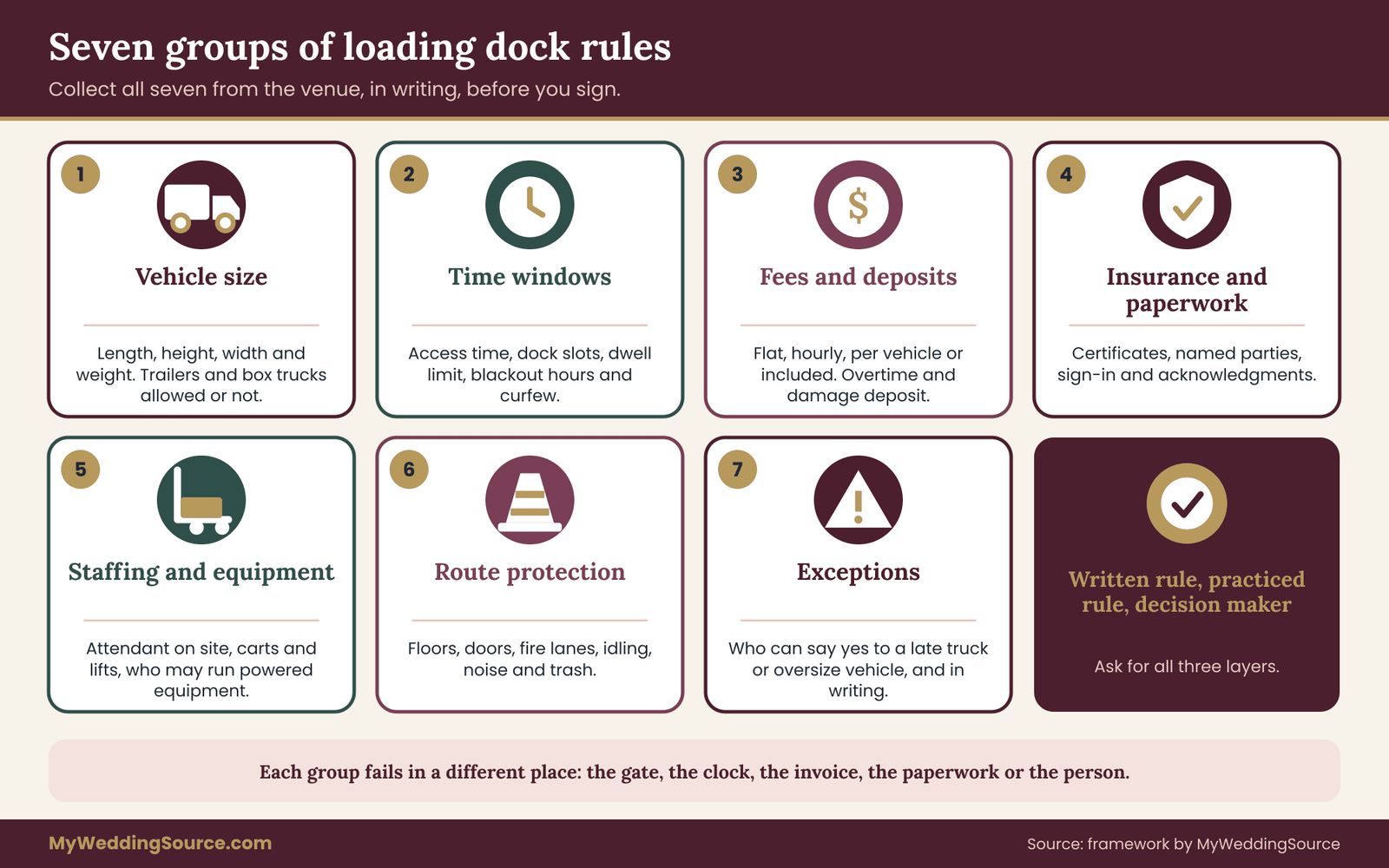
Seeing the groups of loading dock rules separately helps because they fail in different ways. A vehicle-size rule fails at the gate. A time-window rule fails when two vendors arrive at once. A fee rule fails on the final invoice. An insurance rule fails when a certificate is missing on the morning of the wedding. An exception rule fails when nobody on site has the authority to say yes.
Rules versus habits in loading dock rules
One more distinction is worth making before you start asking questions. Some of what vendors call “the rules” are actually habits. A venue may have never written down that deliveries stop at 3 p.m., but the staff has always closed the dock then because the kitchen needs it. That is fine, as long as you know about it. The goal of collecting loading dock rules is not to catch the venue out. It is to turn habits into information that every vendor can read.
You will usually find three layers when you ask. The first is the written rule, quoted from the contract or vendor packet. The second is the practiced rule, which is what the staff actually enforces. The third is the person-dependent rule, which depends on who is working that day. Ask for the first layer in writing, ask the manager about the second layer directly, and ask who has the authority to adjust the third. Our guide to reading a wedding vendor contract explains why the written layer matters when anything goes wrong.
Why wedding venue loading dock rules matter more than most couples expect
It is easy to treat the dock as a vendor problem. The vendors are professionals, the thinking goes, so they will figure it out. Often they do. But three things make the couple’s involvement worthwhile.
First, the rules shape your choices before the vendors are even hired. If a venue allows only vehicles that fit under a low gate, a rental company that delivers in a large box truck may not be able to serve you, or may need to transfer the load to a smaller vehicle at extra cost. If the venue’s dock closes at 2 p.m. and your caterer cooks on site, the schedule has to be built around that. Learning the loading dock rules after you hire is much harder than learning them before.
Second, the costs travel. A vendor who pays a dock fee, an after-hours fee or a longer labor bill does not usually absorb it. It tends to show up as a line on the final invoice or a surcharge in the contract. You may never see the dock fee as a dock fee, but you pay it. Comparing venues on the sticker price alone misses this.
Third, the dock is a safety space. Trucks, carts, forklifts, heavy items and people in formal clothes should not share the same few square yards without a plan. The venue and local officials set the rules about fire lanes, blocked exits and equipment. You do not need to be an expert, but you need to know that those loading dock rules exist and to avoid pressuring a vendor into breaking them because the timeline is tight.
A short story of how the dock goes wrong (illustrative)
Imagine a couple booking a ballroom in a downtown hotel. The tour is lovely. Nobody mentions the dock. In the final weeks, the rental company reports that the hotel requires vehicles under a certain height and that its truck is taller. The caterer learns that the freight elevator is shared with a conference and that it must be reserved by the hour. The band’s trailer is not allowed on the ramp. The florist has a van that fits, but the dock is closed from noon to three for the hotel’s own deliveries.
Each problem is solvable on its own. Together, in the last two weeks, they mean new vehicles, new fees and a rebuilt timeline. A one-page conversation at the start, supported by the right questions, would have caught every one of them. The example is invented, but the pattern is a common one in event logistics.
Who should ask about loading dock rules
The couple is not the right person to negotiate every detail, but the couple is often the best person to start the conversation, because the venue contract is theirs. Here is a sensible split.
- The couple asks the venue for its written rules, shares the answers with vendors and keeps the master copy. If there is a planner or coordinator, that person usually takes over the follow-up.
- The venue manager or catering manager knows the dock, the staff and the real constraints. Ask for the vendor packet, the dock policy and the contact for access on the day.
- Each vendor knows what vehicle they will send, how much they bring and how long they need. They should fill in their own line of the truck access grid. Do not guess for them.
- A planner or day-of coordinator, if you have one, owns the slot schedule on the day and is the person who can call a driver who is late.
If there is no planner, name one person among friends or family who will hold the schedule and answer the phone during load-in. It should not be either partner. Our wedding vendor timeline guide can help you shape the broader schedule that the dock slots fit into.
“Could you send us the written rules for vendor access and the loading dock, including vehicle limits, hours and any fees? We would like to share them with our vendors.”
That one message, sent before you sign, is enough to start gathering the loading dock rules. If the venue has nothing in writing, ask them to confirm the key points by email. A short reply from the manager is better than nothing, and it can be forwarded to each vendor.
Vehicle sizes in loading dock rules: building the truck access grid
The first question every vendor asks is simple: “What can I bring?” The honest answer is rarely a single number. Vehicle limits in loading dock rules usually combine several measurements, and the one that matters is the one that fails first. A truck can be short enough for the driveway, narrow enough for the gate and still too tall for the overhang by the dock door.
The tool that keeps loading dock rules organized is a truck access grid. Think of it as a one-page record with a line for each vendor and the same set of questions answered on every line. You can keep it in a spreadsheet, a shared note or on paper. The illustrated version later in this section shows the idea, and the details below explain what to put in each line.
What goes on each line of the truck access grid
For every vendor that will arrive in a vehicle, record the following.
- Vehicle type and count. A car, an SUV, a cargo van, a small box truck, a large box truck, a van with a trailer, or a tractor-trailer. Include the number of vehicles and trips.
- Overall length, with any trailer or hitch. A van pulling a trailer is longer than a van, and the turning room changes with it.
- Overall height, at the highest point. Include roof racks, vents, antennas and, for a truck with a liftgate, whether the lift is stored under the bed or folds up at the back.
- Overall width, mirror to mirror. Gates and tight turns are measured against mirrors, not doors.
- Loaded weight. For a van or a small truck, this is a practical question only when the surface is soft or the route crosses something unusual. For a large truck, it matters a good deal more.
- What the vehicle needs at the dock. A leveled dock, a ramp, a liftgate, a flat firm surface, space to swing a door, or room for a pallet jack.
- How long it will stay. Unload only, or the whole event, as with a food truck, a mobile bar or a photo booth trailer.
- Where it goes after unloading. A named parking area, a remote lot, or off the property.
- Venue answer. Approved, approved with conditions, or not approved, with the name of the person who answered and the date.
That last line is the one that turns a list into a working document. Without a named person and a date, the grid is only your assumptions.

The five vehicle classes and how venues treat them in loading dock rules
Venues rarely list every vehicle model in their loading dock rules. They tend to sort vehicles into rough classes, and each class raises its own questions. The illustration above shows relative sizes only. It does not give measurements, because the numbers that matter are your venue’s.
Cars and SUVs. Photographers, officiants, makeup artists, bakers delivering a single cake and many small vendors arrive this way. They are usually the easiest to accommodate and often need only a parking spot and a path to a door. The questions are about where to park and which door to use, not about clearance.
Cargo vans. Florists, musicians, DJs, photo booth operators and decorators often use these. A van is generally low enough for most gates, but a high-roof van or one with a rack may not clear an overhang. Ask the vendor for the height and whether the van has anything mounted on the roof.
Small box trucks. Caterers, larger floral installations, rental companies delivering a modest order and lighting crews might use a truck in this class. The question that matters is whether the venue treats any box truck as a “truck” with separate rules, such as a fee, a scheduled dock slot or a requirement for an escort.
Large box trucks. A full rental delivery of tables and chairs, a tent crew or a large production team may need one of these. Turning room, ground firmness and height clearance become real limits. Some venues allow them only at specific hours or only on specific sides of the property.
Tractor-trailers and very large vehicles. These are rare for weddings, but they do appear for large tent installations, stage builds or major productions. Many venues do not allow them, or allow them only at a nearby staging point with smaller vehicles shuttling goods in. If a vendor says they will send one, ask why, and ask whether a smaller vehicle would do the job in two trips.
How to read a venue’s answer on loading dock rules
When the venue replies, look for the limiting measurement. A reply like “no trucks over twelve feet” is a height limit, the kind of line that appears in many loading dock rules, but it does not say where that height is measured or whether it includes a roof vent. A reply like “no large trucks” is almost useless, because “large” means different things to different people.
Ask for numbers in the loading dock rules, or at least for a named example: “Is a sixteen-foot box truck allowed? Is a twenty-six-foot one?” Box length is how rental and delivery trucks are usually described, so it is a language both sides understand.
If the venue cannot give numbers, ask for a drive-in test. A vendor’s vehicle, or a similar one, makes a trial approach during a walkthrough. That is a request many vendors are willing to accommodate, particularly for a big installation. The site survey stage of a venue walkthrough is the best time to schedule it, since the venue manager, the vendors and the route are all in the same place.
Height, the limit most often missed
Height limits are the part of loading dock rules that surprises people most, because nobody looks up. Walk the approach and look for gates with crossbars, covered drop-offs, canopies, low tree branches, utility lines, parking garage entrances, tent edges and signs that hang across a driveway. Ask the venue where the lowest point is on the route to the dock, and ask for a height in feet and inches. Many rental trucks post their height inside the cab, and the rental company can confirm it. For a vendor’s own vehicle, the vendor should know.
Remember also that height changes when a truck is loaded, when a liftgate is raised or when something is strapped to the roof. A van with a ladder rack is taller than the same van without one. Ask the vendor for the height as the vehicle will actually arrive.
Weight, surface and turning room in loading dock rules
Weight is less often a question at wedding venues, but it matters in three situations. The first is a soft surface: a lawn, a gravel yard, a field or a dirt road after rain. A loaded truck can sink or rut, and a venue may refuse large vehicles on grass for that reason. The second is a structure: a bridge, a ramp, a drive over an underground vault or a historic driveway may have a rated limit. The third is the dock equipment itself, because leveling plates and lifts are rated for certain loads.
Turning room is the other hidden limit. A truck that fits a straight lane may not make the final turn into a narrow service yard. Ask whether trucks must back in, whether there is a spotter, and whether the turn is blind. If the venue has a one-way service loop, write it down and share it with every driver.
Dock height, liftgates and equipment under loading dock rules
A true loading dock has a platform at truck-bed height. Large trailers often line up with it. Smaller box trucks and vans usually sit lower, which means a vendor may need a ramp, a liftgate or a dock leveler to bridge the gap. A liftgate lets a vendor lower a loaded cart to the ground and roll it in at ground level, which is often a better route than the dock itself.
Ask three direct questions about equipment.
- Is there a ground-level door near the dock? For many wedding deliveries, a ground-level service door is easier than a raised dock.
- Can vendors use the venue’s cart, dolly, ramp or lift? Some venues allow it, some prohibit it, and some require their own staff to operate it.
- Who is allowed to operate powered equipment? Workplace safety rules cover forklifts and other powered industrial trucks, and the Occupational Safety and Health Administration publishes guidance on them. A venue may reasonably say that only trained staff run its forklift. Vendors should not be asked, or allowed, to improvise.
Write the answers on the grid. If a vendor needs a pallet jack and the venue has none, the vendor can bring one, but only after the venue confirms that its floors and doors can handle it.
A decision rule for choosing the vehicle on the grid
Here is a rule that prevents most surprises with loading dock rules: write down the largest vehicle each vendor could realistically send for your wedding, not their usual one. A florist who normally drives a van might use a box truck for a large installation. A caterer with a cold-storage need might add a refrigerated trailer. A rental company may send its biggest truck because your order is the biggest of the day. Ask each vendor, “What is the biggest vehicle you could send, and under what circumstances?” Then ask the venue to approve that vehicle, with fallbacks.
If the answer is no, you have time to ask whether the vendor can use a smaller vehicle, make two trips, stage at a nearby lot or choose a different method. If the answer is yes, you have a sentence in writing that covers the worst case, and every smaller vehicle is covered too.
“Which is the largest vehicle you might send to our venue on the wedding day? Could you give us its length, height and whether it has a liftgate?”
Send that to each vendor and paste the answers into the grid. It takes a day or two to collect, and it replaces a month of guessing with a record of how your vehicles measure against the loading dock rules, which the venue can approve in one pass.
Time windows in loading dock rules: arrival, dwell time and load-out
If vehicle size decides who can come, time decides who comes first. The time rules in loading dock rules are often the least clear part of a venue’s policy, because venues describe them in different ways. One venue says “vendors may arrive from 9 a.m.” Another says “load-in is between 10 and 2.” A third says “the dock is booked in thirty-minute blocks.” These are different rules, and treating them as the same causes a lot of trouble.
The six kinds of time rule
When you read a venue’s loading dock rules, sort what you find into six categories.
1. Building access time. The earliest moment vendors may enter the building or the grounds. It usually follows your rental period. If your rental begins at 10 a.m., a vendor arriving at 9:30 may be turned away, or may be charged for early access.
2. Dock appointment. A specific block of time assigned to a specific vendor or vehicle. This is the most useful rule, because it protects you from collisions. Some venues require appointments. Others never mention them, and you create them yourself with the slot booking form described later.
3. Dwell limit. How long a vehicle may stay at the dock before it must move. Dwell is a term from freight work for the time a vehicle spends at a loading position, and the idea transfers neatly to weddings. A venue might say “unload and move within thirty minutes,” or it may expect vehicles to stay only until they are empty.
4. Blackout periods. Times when the dock is closed to wedding vendors: the hotel’s kitchen deliveries, another event’s load-in, the hour before guests arrive, or quiet hours set by neighbors or the city.
5. Load-out window. When breakdown can begin, and the time by which everything must be gone. This is often the most strictly enforced rule of all, because staff want to go home.
6. Storage and pickup. Whether items may stay overnight, and when they may be collected the next day. This matters for rentals, decor and equipment.
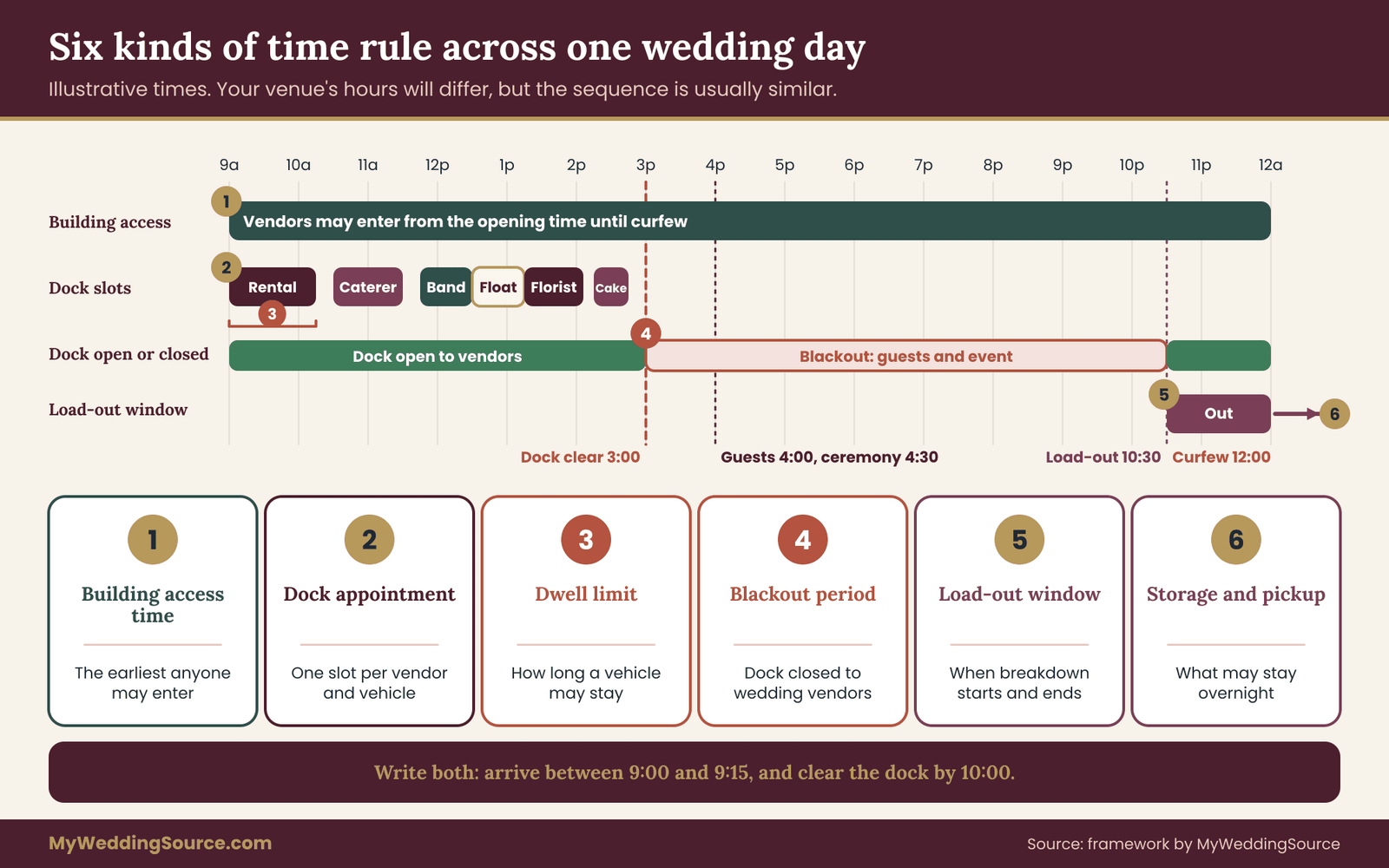
The timeline illustration above uses invented times to show how these rules sit side by side across one day. Your venue’s loading dock rules will differ, but the sequence rarely does: access opens, vendors load in one after another, the dock closes before guests arrive, a quiet middle period holds the event itself, and load-out begins only after the venue says so.
Arrival window versus occupancy window
Two ideas that sound the same are different. An arrival window says when a vendor should show up, for example between 9:00 and 9:30. An occupancy window says how long the vendor may hold the dock, for example from 9:00 to 10:00. A vendor can follow the first rule and break the second, and many do.
Write both on your schedule, next to the loading dock rules they come from. A good slot is expressed as “arrive 9:00 to 9:15, clear the dock by 10:00.” That tells the driver when to appear, how much grace there is and when the next vendor will be waiting. If the venue’s loading dock rules list only one of these, ask for the other.
Working out how long a vendor really needs
You cannot assign a sensible slot without knowing how long each vendor needs. The simplest way to learn is to ask. A vendor who does this work every weekend can usually say how long it takes from the moment the truck stops to the moment it leaves. Ask for that number, then add a buffer.
“From the time your vehicle arrives to the time it leaves the dock, how long do you usually need for our order? Would two trips change that?”
A reasonable rule of thumb is to add roughly a quarter to the vendor’s own estimate, and more for a vendor you have not worked with before or a venue with a long carry. If a vendor says forty minutes, give them an hour. The extra time covers a slow elevator, a locked door, a missing staff member or a driver who needs to find a place to park. The buffer costs little when everyone is on time, and it saves a cascade when someone is not.
If the vendor’s estimate and the venue’s dwell limit do not match, you have found a conflict while there is still time to fix it. The options are a longer slot, a second crew, a staging area for items that can wait, or a vendor who works faster. Do not assume the venue will relax its rule on the day.
Stagger, do not stack
Most wedding docks can handle one vehicle at a time, sometimes two, and loading dock rules are usually written with that limit in mind. When two vendors arrive at the same moment, one of them waits in the driveway, blocks the road or parks in a fire lane. The cure is a stagger: slots that follow each other with a short gap in between.
A gap of fifteen to thirty minutes between slots is a common starting point. Use the shorter gap when the dock has room for a second vehicle and a staff member is directing. Use the longer one when the dock is a single bay and the route is shared. The gap is not wasted time. It is the margin that absorbs a late truck without wrecking the afternoon.
The order of the stagger is its own question, and the section on sequencing vendors later in this guide gives a method. For now, note that your window rules set the outer limits: the earliest anyone may come in, and the dock-clear time before guests arrive.
Set a dock-clear time from the loading dock rules
Ask the venue for a time by which the dock must be empty of vendor vehicles. Many venues have one, because they do not want trucks in view of arriving guests, or because the dock serves the kitchen service during dinner. If the venue has no formal rule, set your own. A simple way is to work backward from the time guests start arriving, then subtract a buffer for the last delivery to be carried inside and for the driver to leave.
Treat that time as a hard line in your schedule, and write it at the top of every vendor’s copy of the loading dock rules. Everything that has to arrive by truck is done before it. Anything that arrives later, such as a late cake or a forgotten item, uses a different method: a hand-carry from the car park, a side door or a staff escort.
Soft windows and hard windows in loading dock rules
Some loading dock rules on time are firm, and some are flexible, and you should know which is which. A hard window is one the venue enforces, such as a noise curfew, a lock-up time or a rule set by the city. A soft window is one the venue prefers but can adjust, such as a suggested arrival time. Ask the manager directly: “If a vendor is thirty minutes late, what happens?” The answer tells you how much slack you actually have.
Late arrivals deserve a written entry in the loading dock rules. Some venues give the next slot to the next vendor and send the late one to the back of the queue. Others make a late vendor wait until the dock is clear. Others charge for extra staff time. Ask which applies and share it with vendors, so that a driver who is running late calls ahead rather than showing up and hoping.
Neighbors, noise and early mornings
Not every one of the loading dock rules comes from the venue. Cities and neighborhoods often set quiet hours, and some restrict commercial deliveries or idling in residential areas. A truck backing up with a beeping alarm at 6 a.m. can annoy neighbors, and a venue in a residential zone may restrict dock activity because of complaints. Many places also regulate how long an engine can idle, and the Environmental Protection Agency publishes information on idle reduction for trucks through its SmartWay program.
You do not need to learn every ordinance behind the loading dock rules. Ask the venue, “Are there any city or neighborhood rules on delivery hours, noise or idling that apply to our vendors?” The manager will usually know, since the venue has dealt with complaints before.
Load-out is its own problem
Planning for load-in is easy, because people are fresh and the room is tidy. Load-out comes at the end of a long night, when the band is tired, the dock may be dark and the staff want to close up. Because of that, loading dock rules for load-out tend to be stricter and less forgiving.
Ask these questions in advance.
- When may load-out start? Some venues allow vendors to begin as soon as the formal program ends. Others wait until the last guest leaves.
- What is the end time? And what happens if a vendor runs over? Overtime is a common fee.
- Who opens the dock, supervises and signs off? A staff member may need to inspect for damage or check a vendor out.
- What must leave tonight? Rentals, perishables and equipment often must go. A few items, such as a large sculpture or a rented arch, might be allowed to stay until morning, but only with permission.
- Is the dock lit and clear? Ask about outdoor lighting, ice or mud, and whether a person will guide drivers.
Give each vendor a load-out slot just as you gave them a load-in slot. A rental company that arrives to pick up chairs at 11:30 p.m. while the band is still wrapping cables will block the dock for both. Staggering works at the end of the night as well as the beginning.
Fees in loading dock rules: what you pay, who pays it and how to compare venues
Fees are where loading dock rules become real money, and they are also where venues differ most. Two venues with the same rental price can have very different dock costs once you count every vehicle, every staff hour and every overtime minute. The goal of this section is to help you see what loading dock rules cost clearly enough to compare venues on equal terms.
The kinds of dock-related fees
Not every venue charges every fee, and some include them all in the rental price. When you ask for the fee section of a venue’s loading dock rules, look for these.
- Vendor access or load-in fee. A flat charge per vendor, per vehicle or per event for the privilege of using the dock and service entrance.
- Staff attendance. A venue employee, security officer or building engineer who must be present while the dock is in use, usually charged by the hour, often with a minimum.
- Freight elevator time. Reserved by the hour, sometimes with an operator, sometimes with a separate minimum.
- Overtime and after-hours charges. Applied when load-in starts early or load-out runs past the agreed time. They are often higher than the standard hourly rate.
- Waste and cleaning. Trash removal, dumpster use, floor cleaning after a messy load-out or a charge for leaving items behind.
- Damage deposit. A refundable amount held against scuffed floors, broken door frames or chipped walls.
- Parking, curb or permit costs. Charges for vendor parking, validation or a city permit for street loading.
- Penalties. Fees for exceeding a dwell limit, missing a slot, blocking a fire lane or failing to provide insurance paperwork.
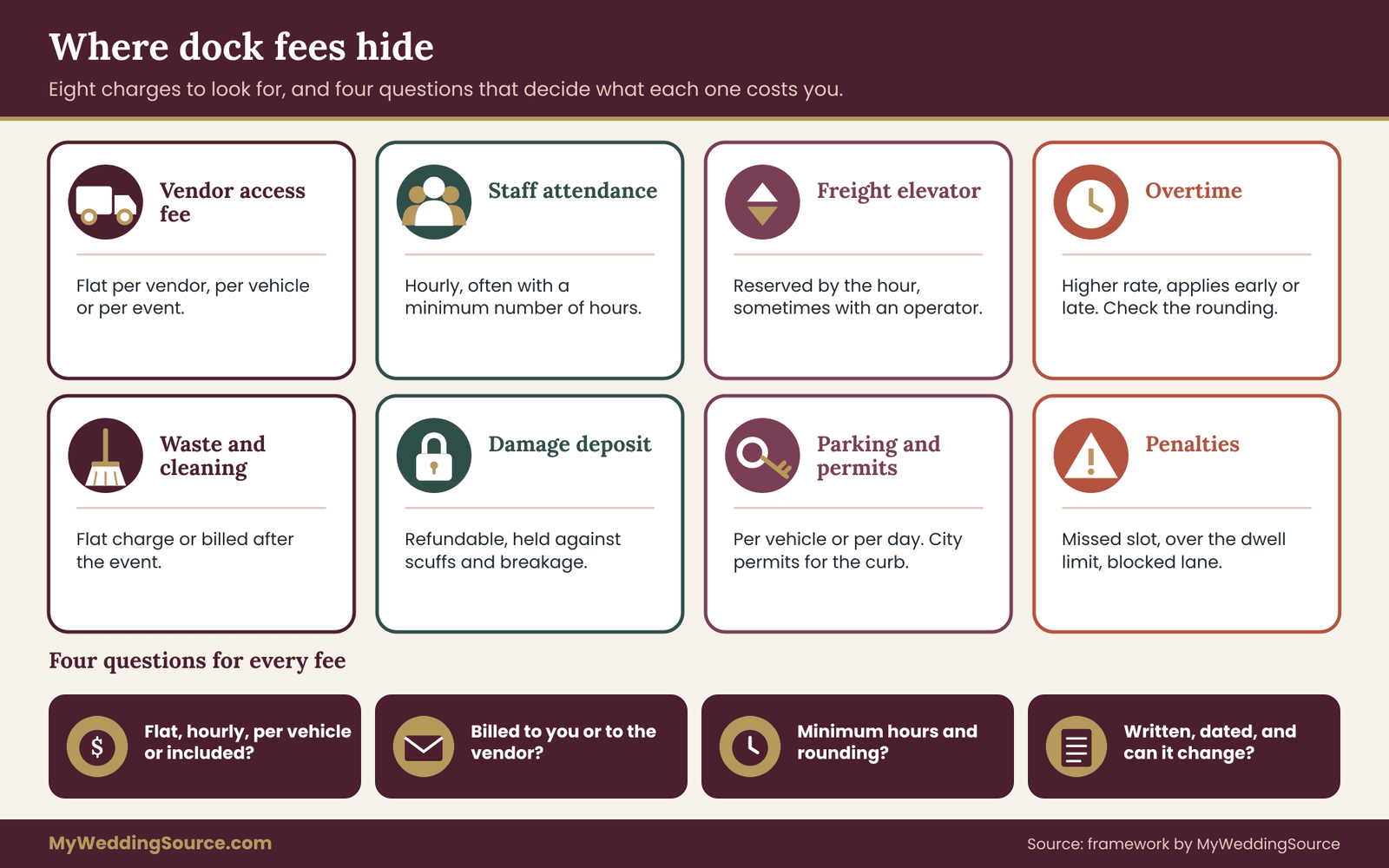
For each fee, the illustration shows the four questions that matter: is it flat, hourly, per vehicle or included, and who gets billed? The answers change the total more than the headline number does.
Who actually pays under loading dock rules
There are three common ways dock fees reach your budget.
The venue bills you directly. The charge appears on the venue’s invoice, often as a line under “vendor fees” or “services.” This is the clearest case, because you see it and can compare it.
The venue bills the vendor, and the vendor passes it on. The vendor’s quote may include a line such as “venue access fee,” or a general surcharge that covers it. You may not see the dock cost separately, but you pay it.
The venue absorbs it. Some venues include dock use in the rental price, especially all-inclusive packages. In that case the question is not what the fee is, but what is covered and what falls outside.
Ask both sides. Ask the venue, “Which fees are billed to us, and which to our vendors?” Ask each vendor, “Does your quote include any venue access or dock fees, and will you tell us if the venue’s charges change?” If a vendor is new to the venue, they may not know, and the fee can appear late. Our guide to wedding vendor due diligence lists questions that belong in the same conversation.
The overtime trap in loading dock rules
The most expensive dock fee is rarely the one on the schedule. It is overtime, and it usually appears at load-out. A band that finishes at 11:00 and needs ninety minutes to pack, a curfew at midnight and a staff member who must stay until the last truck leaves can add up to a surprise charge.
Ask these questions before you sign.
- What is the hourly rate for after-hours dock attendance, and is there a minimum?
- How is time rounded: to the quarter hour, the half hour or the full hour?
- Who authorizes overtime on the day, and can we set a limit?
- Does the clock start when the first vendor arrives or when the dock is opened?
Then write a standing instruction for the day: no overtime without a call to a named person. A driver or a band member does not know what the couple is willing to pay, and the staff member at the dock has no reason to ask. A single phone call from a coordinator, “can the last two vendors finish in fifteen minutes?”, is often enough to avoid an hour of overtime.
Comparing two venues’ loading dock rules on the same basis
Here is a method for comparing the loading dock rules of two venues when their fee structures are different. It uses invented numbers to show the arithmetic. They are not market prices, and your venues will quote their own.
- List the vendor visits. Count each vehicle that will use the dock for load-in and for load-out. Suppose you have seven vehicles arriving and seven leaving, which is fourteen visits, but only the arrivals are charged at Venue A.
- List the staff hours. Add up the hours the dock must be attended. Suppose load-in runs four hours and load-out runs two.
- List the elevator time. Suppose the freight elevator is needed for three hours in total.
- Apply each venue’s rates. Multiply and add.
Venue A charges a flat $75 per arriving vehicle, includes dock staff and charges $90 per hour for the freight elevator. The dock cost is seven vehicles at $75, which is $525, plus three elevator hours at $90, which is $270. The total is $795.
Venue B charges no per-vehicle fee and includes the freight elevator, but it requires an attendant at the dock for every hour it is in use, at $55 per hour. Six hours of attendance is $330. The total is $330.
On a quick read, Venue A’s “no attendant fee” looks friendlier, and Venue B’s hourly charge looks like a catch. The arithmetic says otherwise in this example. The point is not that one structure is better. It is that the structures need to be converted into a single number for your wedding before you compare them. A deposit that comes back to you is a cash timing item, not a cost, so keep it on a separate line.
Run the same sums again with a stressed version of your schedule. What if load-in takes an hour longer, or load-out runs over by thirty minutes? A venue that looks cheap on the base case but expensive under stress is a different risk from one that stays steady.
Putting loading dock rules and fees in writing
Verbal fee estimates are the weakest kind of information, and verbal loading dock rules are no better. Ask for a written fee schedule, and ask for its date. Fees change, and a schedule from last year may not apply to your wedding. Ask whether the venue can change fees before your date, and ask for the right to see the final charge before it is billed.
Many contracts include a clause that points to the loading dock rules or to vendor fees and additional charges, so read the section carefully, and look for words like “at the venue’s discretion” or “as determined on the day.” If the clause is open ended, ask for a cap or a list.
Keep a small record of every fee conversation. A reply that says “there is no fee for vendor access” is useful if a bill later says otherwise.
Insurance, staffing and permits behind loading dock rules
Fees get most of the attention, but the insurance and staffing parts of loading dock rules cause more last-minute scrambles, because they depend on paperwork that takes time to produce.
Certificates of insurance
Many venues require every vendor who enters the building to provide a certificate of insurance. It is a one-page document from the vendor’s insurer that proves coverage. Standard certificate forms are published by ACORD, an insurance industry standards organization. The venue often asks to be listed on the certificate as an additional insured, and it may specify the exact wording, the coverage amounts and the deadline.
What matters for you is the process and the timing.
- Ask the venue for the exact requirements in writing. Name, address, wording and amounts.
- Ask who collects the certificates. The couple, the planner or the vendors directly to the venue.
- Set a deadline well before the wedding. An insurer may need several days to issue a certificate with specific wording, and a vendor who learns about the requirement a week out is in a hurry.
- Ask what happens if a certificate is missing. Some venues refuse dock access. Others allow it with a fee or a waiver. You want to know before a truck arrives.
Vendors who work as sole proprietors, such as a solo photographer or a friend with a van, may not carry the coverage a venue expects. If a friend or relative is delivering anything, ask the venue what is required of them too. The venue’s rule is rarely different for people you know.
Staffing, escorts and in-house labor
Some venues require a staff member to be present whenever the dock is used, or to escort vendors along the route. Some urban venues and large buildings also have rules about who may do certain work, such as moving heavy items by elevator or handling equipment. Ask whether any part of load-in must be done by venue staff or by a contracted labor company, and ask how it is charged. If your venue has such a rule among its loading dock rules, it shapes both the schedule and the budget, so it belongs on the slot booking form.
Permits and public space
If the dock is not on private property, or if a truck must stop on the street, the rules change. A city may regulate curb loading zones, temporary no-parking signs, street closures and truck routes. Fire officials set rules about fire lanes, blocked exits and access for emergency vehicles.
These are not among the venue’s own loading dock rules, so the venue cannot waive them. They are public rules, and the venue manager should be the one to tell you which apply. If a vendor needs a curb permit, the right person to ask is the venue, and the right office to confirm with is the local transportation or public works department.
Fire safety deserves a specific mention. A dock door often doubles as an exit, and a fire lane exists so that emergency vehicles can reach the building. Neither is a convenient place to park a truck for ten minutes. Local fire officials, such as a fire marshal’s office, publish their own guidance for assembly occupancies, and the standards organization NFPA publishes the model fire codes that many jurisdictions adopt. Your job is not to interpret them. It is to make sure no vendor is ever asked to break them in the name of the schedule.
The load-in slot booking form: one page every vendor fills in
By now you have a picture of the loading dock rules. The next step is to turn them into something each vendor can answer in five minutes and the venue can approve in one pass. That is the job of the load-in slot booking form. It is a one-page document, sent to every vendor who arrives with a vehicle, that records what is coming, when and how, and ends with a space for the venue’s decision.
The form matters because it moves the conversation from “what are the loading dock rules?” to “does this plan comply with them?” Vendors do not read policies for fun, but they will answer specific questions about their own truck. The form asks those questions in a fixed order, so the answers are comparable across vendors and the schedule can be built from them.
The sections of the form
The illustration below shows the structure. Each section has a purpose, and each field earns its place by preventing a particular failure.

Section A: vendor and day-of contact. Business name, the name of the person who will be on site, and a mobile number that will be answered on the day. Do not accept a general office line. A driver stuck in traffic needs to reach a human being.
Section B: vehicle. Type, number of vehicles, overall length including any trailer, overall height, overall width and whether the vehicle has a liftgate. This section is the truck access grid in form shape, so the answers can be copied across without rewriting.
Section C: load-in request. The requested arrival window, the estimated time at the dock, the crew size, the number of trips, the largest single item and its dimensions, the equipment needed (cart, ramp, pallet jack), and the final destination inside the venue. The largest item is the question that catches the most surprises, because it tells you whether the route can handle it.
Section D: parking after unloading. Whether the vehicle leaves, moves to a lot or stays for the event. A food truck or a mobile bar trailer is a special case, and it needs a clear answer.
Section E: load-out request. The requested window, the estimated time, and any items the vendor wishes to leave overnight. Asking at the same time as load-in prevents the end-of-night scramble.
Section F: acknowledgments. A short list where the vendor confirms that they have read the venue’s loading dock rules, that they have sent a certificate of insurance, and that they understand any fee that applies. Initials beside each line are enough.
Section G: venue decision. The approved slot, any conditions, the name of the person approving and the date. This is the line that ends the argument if a question comes up later.
Keep the form to a single page, and keep it faithful to the loading dock rules. A long form is not completed, and a vendor who ignores it is a risk you want to know about early.
When to send it and what happens next
Send the form once a vendor is booked and the venue’s loading dock rules are in hand. A common rhythm is to send it about two months before the wedding, collect the responses within two weeks, send a consolidated schedule to the venue for approval, and confirm the final version about a week before the date. Adjust that rhythm to your own calendar, since a small wedding with five vendors needs less lead time than a large one with twenty.
The process has five steps.
- Send. The couple or the planner emails the form with a short note and a return date.
- Collect. Responses go into one master copy, which is the first draft of the schedule.
- Check. Compare each line against the venue’s loading dock rules and the truck access grid. Flag anything that exceeds a limit or collides with another vendor’s slot.
- Submit. Send the consolidated schedule to the venue manager. Ask for approval or corrections in writing.
- Lock. Once the venue approves, label the schedule with a version number and a date, share it with every vendor, and tell them how to request a change.
Treat the form, and the loading dock rules it records, as part of your vendor paperwork rather than a separate favor. If you issue written purchase orders or scope agreements, attach the slot form so that each vendor’s obligations and dock arrangements are in the same file. Our guide to wedding vendor purchase orders explains how to tie a scope of work to an acceptance process.
A filled-in line, in prose (illustrative)
To show how the answers read, imagine a florist’s form for a ceremony installation. The vendor is a small floral studio, the day-of contact is the lead designer, and the vehicle is one cargo van, about twenty feet long with nothing towed, a standard roof and no liftgate. The largest item is a ceremony arch built in two sections, each about three feet wide.
The florist requests an arrival between 1:00 and 1:15 p.m., needs about fifty minutes at the dock, brings two people and makes one trip. The van leaves after unloading and returns at 9:30 p.m. for load-out, taking about twenty minutes. The certificate of insurance was sent on a stated date.
The venue’s decision line then reads “Approved, 1:00 to 1:50, use north service door, no elevator needed,” signed and dated by the manager. Every detail can be checked. If the florist later says the van will be a larger one, the form has to be corrected, and the venue has to approve the change. That is the habit the form builds: changes go through the page, not through a hallway conversation.
Handling changes and non-responses
Plans change. A vendor swaps the van for a truck, a band adds a second vehicle, a rental company changes its route. Set a rule at the start, alongside the loading dock rules: any change in vehicle, arrival window or crew size goes back through the form, and the revised version replaces the old one. A short message to the coordinator is enough, as long as it updates the schedule and the venue’s approval.
If a vendor does not return the form, call them. Many vendors know their logistics well and simply prefer to talk. Ask the questions by phone, fill in the form for them and send it back for confirmation. If a vendor still does not respond, treat that as information. A vendor who cannot provide a vehicle size and an arrival window weeks before the wedding may be a risk on the day.
Day-of copies
Print the final schedule, with each vendor’s slot, a one-page summary of the loading dock rules, the venue’s contact for access and the coordinator’s number. Keep one copy at the dock, one with the coordinator and one with the venue’s on-site manager. A pocket-sized summary, with just the vendor name, vehicle and time, is useful for whoever is meeting trucks. Screens go dark and signals fail, so paper is a sensible backup.
Sequencing vendors through one dock under your loading dock rules
With the form complete, you have a stack of requests. The next question is the order. It is tempting to sequence by who asked first, but a better order comes from asking what each vendor needs in place before they can start and what has to be done by when.
Foundation, fill and finish
A simple way to sort is into three waves.
Foundation. Anything others build on, or anything bulky that takes space: furniture and rentals, structures, staging, lighting rigs and large equipment. These arrive first, because nobody can set a table before the table exists, and because they take the longest to move.
Fill. Items that populate the space once the foundation is down: catering equipment and supplies, sound and audio gear, linens, decor, signage and décor pieces that are not perishable.
Finish. Items that are fragile, perishable or temperature sensitive and that should arrive as late as the schedule allows: flowers, cake, desserts, a photo booth and last-minute deliveries.
The idea behind the waves is simple, and it fits inside most loading dock rules: heavy and long-dwell first, fragile and perishable last. The dock-clear time still applies, so “last” means last before that line, not at the last minute before the ceremony.
The earliest and latest check
Give every vendor two times: the earliest they can start and the latest they can finish. The earliest depends on what must exist first. A florist cannot install an arch before the chairs are placed if the arch sits in the aisle. A band cannot set up on a stage that has not been built. The latest depends on the program: the ceremony start, the cocktail hour or the first guest arrival.
When the earliest time for a vendor is later than their latest time, you have a conflict. The fix is rarely to squeeze the vendor. More often the venue can open earlier, a different vendor can go first, or the work can move to another location, such as building an installation off site. Finding that out on the form is much cheaper than finding it on the day.
Two vendors with the same earliest time need a decision. Use the dependency rule: if one vendor’s work blocks the other’s, that vendor goes first. If neither blocks the other, use dwell time: the shorter job goes first so the dock turns over sooner. Our wedding rental planning checklist is a useful companion for the foundation wave, because rental deliveries usually dominate the first hour.
Split the route
If the dock has one bay, but the building has a ground-level service door, split the traffic. Large vehicles and heavy items use the dock. Small vehicles and light items use the door. The split halves the queue, and the vendors on the lighter route can arrive in parallel. Confirm that the door is staffed, that the route inside is clear and that nobody is asked to carry fragile items across a long distance on a surface that was not built for it.
Keep one slot open
Build one empty slot into the schedule, about thirty to forty-five minutes, somewhere after the foundation wave and before the dock-clear time. This is a float, a pressure valve. It absorbs the rental truck that arrives late, the elevator that sticks or the vendor whose estimate was optimistic. If everything runs on time, the float becomes a quiet period in which staff can reset the dock and vendors can catch their breath. If it is used, you will be glad it was there.
Load-out order
Load-out is not simply the reverse of load-in. Those who finish earliest should leave first. A band or a photo booth often finishes before the venue closes. Caterers may need the dock to remove equipment and waste. Rental companies may pick up the next morning if the venue allows. Build a load-out order from the actual end times in your program, and keep the same stagger you used at the start of the day.
When the vehicle, the dock or the loading dock rules do not fit
Sooner or later a vendor’s vehicle will not match the venue’s loading dock rules, or a time window will not match a vendor’s needs. That is normal, and it is the reason to build the truck access grid and the slot form early. The question is what to do when a line on the grid reads “not approved.”
The decision flow below is a way to think it through one vehicle at a time. It asks five questions in order, and each “no” points to a different fix.
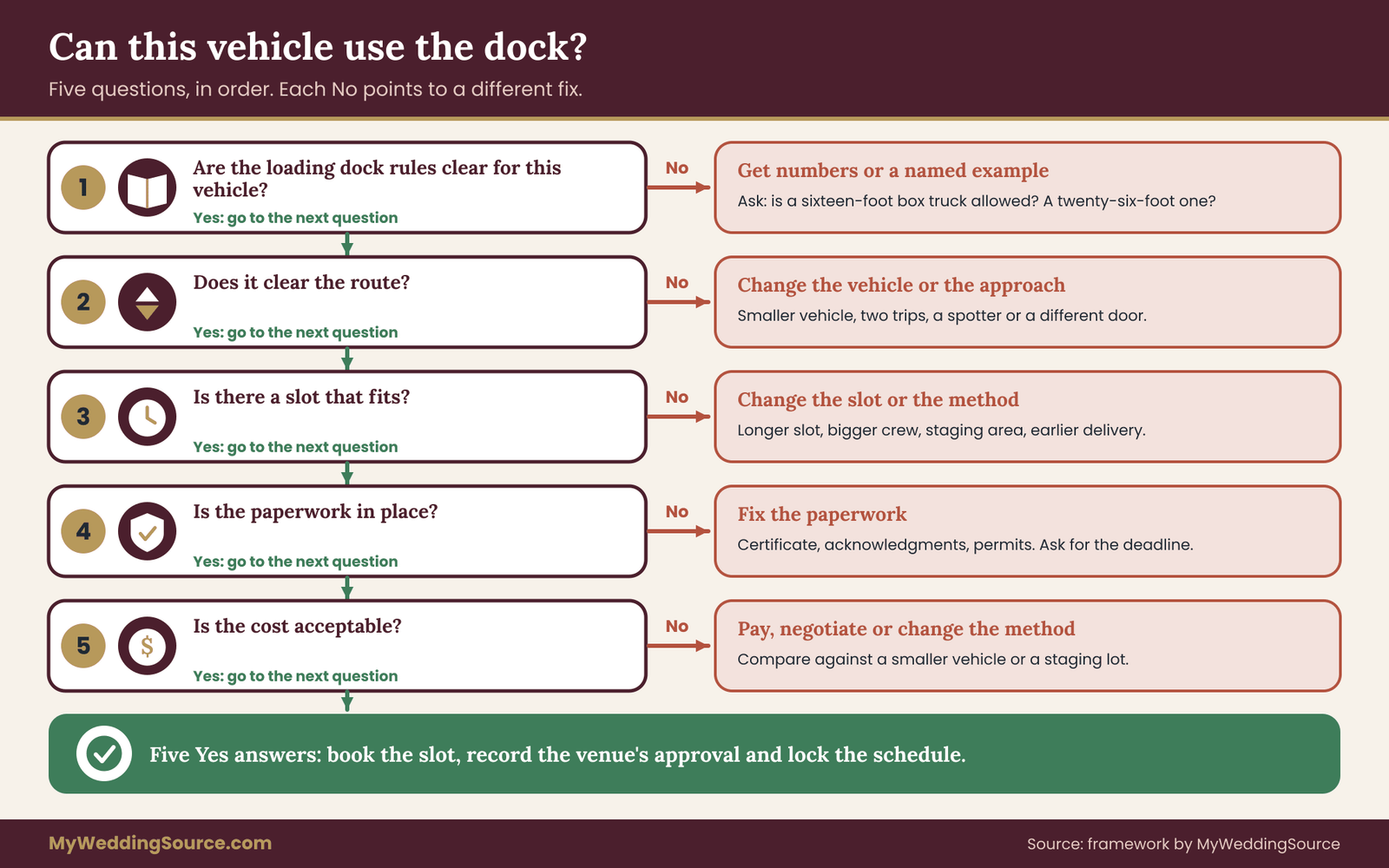
Are the loading dock rules clear for this vehicle? If the venue’s answer is vague, such as “no large trucks,” get a number or a named example before going further. Everything else rests on this answer.
Does the vehicle clear the route? Height, length, width, weight and turning room all count, and the failing one tells you what to change. A height problem may need a smaller vehicle. A turning problem may only need a spotter or a different approach.
Is there a slot that fits? Check the time limits in the loading dock rules, the dwell limit and the dock-clear time. If the vendor needs more time than the slot gives, the fix is a longer slot, a larger crew or a staging area.
Is the paperwork in place? Insurance certificates, acknowledgments and any permits. This is the easiest problem to solve and the most common reason a truck is turned away.
Is the cost acceptable? If the fees are higher than expected, you can pay, ask for a different arrangement or change the method.
If every answer is yes, book the slot. If one is no, the decision flow offers three exits: ask for an exception, change the method, or change the plan.
Asking for an exception
Exceptions are normal in a business that hosts many kinds of events, but the way you ask makes a difference. Four habits tend to help.
- Ask the right person. The front-desk staff cannot waive a rule. The venue manager, the operations manager or the owner can. Ask who has the authority.
- State the specific request. “Can the florist’s van, which is a few inches taller than your posted limit, enter at 1 p.m. with a staff member watching?” is easier to answer than “Can we bend the rules?”
- Offer something. An escort, an attendant at your cost, an earlier slot when the dock is quiet or a vehicle test beforehand all reduce the venue’s risk.
- Get the answer in writing. An exception is only as good as the record of it. A short email from the manager will do.
If the venue says no, accept it. The rule may exist because of a gate, a neighbor or an insurance requirement that the manager cannot change. Switch to another exit in the decision flow.
Changing the method
When a vehicle cannot reach the dock, the cargo can often still get there. The usual alternatives are these.
- A smaller vehicle, or two trips. A rental company or caterer may be able to split an order across two vans.
- A staging point and a shuttle. The large truck stops at an approved lot nearby, and smaller vehicles carry the goods the last stretch. This costs extra labor and handling, and it adds a transfer where items can be dropped, so confirm who bears that risk.
- Early or late delivery. A vehicle that cannot arrive during the event window might be allowed the day before, or the morning after, with a rule for overnight storage.
- A different route. A ground-level door, a gate on another side or a service road may avoid the limit.
- A different method of work. A florist can build an installation in smaller pieces, or a decor team can assemble on site.
Whichever route you choose, update the truck access grid and resubmit the form. A changed method is a changed plan.
Venues with no real dock
Plenty of wedding venues have no dock at all. A barn, a garden, a vineyard, a historic house, a park pavilion or a rooftop will have a service entrance of some kind, but it may be a gravel lane, a back porch, a gate in a fence or a freight elevator in an older building. Loading dock rules at these places are usually about the access path rather than a platform.
Ask what the equivalent of a dock is, and what the loading dock rules say about it. Where do vehicles stop? Is the ground firm after rain? How far is the carry to the room, and are there steps or a slope along the way? Is there power, light and a person to open the gate?
Some sites require ground protection for heavy vehicles on lawns. Public parks and other public land often have their own permit conditions for vehicles and events, which the park authority issues. At a historic property, the rules may protect floors and doors with extra care.
Shared docks in hotels and mixed-use buildings
A hotel or a mixed-use building often shares its dock with a kitchen, a laundry, other tenants and other events. The result is a different set of loading dock rules: the dock may be closed to you at times that suit the building’s own deliveries. Ask the hotel for its dock schedule, ask which other events share the day and ask whether a freight elevator is shared. Find out who controls the dock, since it may be a banquet manager, an engineer or a security desk, and get their name and number onto your schedule.
Food trucks, mobile bars and vehicles that stay
A vehicle that stays on site for the entire event is a different category from one that unloads and leaves. A food truck, a trailer bar, a coffee cart or a photo booth trailer takes up space, may need power or water, and may sit near the route that other vendors use.
Ask whether the venue allows it, where it may park, how it connects to power, whether it needs a fire-lane clearance and which local permits apply. Rules for mobile food operations are set by local health departments, and your venue may have its own policy about outside food vendors.
Friends and family who deliver
If a cousin is bringing the cake, an aunt is driving a rented truck of decor or a friend is hauling the sound system, the dock does not care that they are not professionals. The venue’s loading dock rules apply to anyone who arrives with goods.
Brief them as you would a vendor: give them the slot, the door, the contact number and the vehicle limits. Ask the venue whether insurance paperwork applies to them. A person driving a rented truck for the first time may not know its height, so have them read it from the cab or the rental paperwork before the day.
Weather and the unexpected
Rain, mud, snow and ice change the way a dock works. A lawn that was fine in sunshine may be closed to heavy vehicles after a storm. A paved ramp may be slick. Heat affects perishables that sit in a van while the vendor waits for a slot. Ask the venue whether its loading dock rules include a bad-weather policy for vehicles and what its alternate route is. Ask vendors whether they have a backup vehicle plan for a breakdown, and keep a short call list so the coordinator can reach each driver.
Guests, accessibility and the service route
The dock is a working area, and guests should not be sent through it in the ordinary course of things. There are exceptions, and they deserve care. In some buildings the service route is the only step-free way in, or the shortest accessible path from the car park to the room.
Venues that serve the public have obligations under the Americans with Disabilities Act, and the Department of Justice publishes the rules for public accommodations. Ask the venue how a guest who uses a wheelchair or walker reaches the room, and do not assume the answer is the dock. If the dock is used, ask whether the route is safe, lit, staffed and clear during the time guests will use it. Our guide to accessible wedding venue red flags covers what to look for.
Keep guest traffic and vendor traffic apart wherever you can. Our guide to wedding reception guest flow explains how to plan the guest side of arrival so that cars, shuttles and guests on foot do not meet the dock.
When loading dock rules conflict
Occasionally the written contract says one thing and the manager says another. A contract might allow vendors from 9 a.m., while the manager says 10. Ask for the difference to be resolved in writing. In general the signed contract controls unless both sides change it, so a short email amendment, signed off by the manager, is worth having. If the venue’s vendor packet disagrees with its contract, ask which one governs.
A worked example: one dock, six vendors
To show how the pieces fit, here is an invented example. The numbers are made up to illustrate the method. They are not typical figures, and your venue’s loading dock rules will differ.
Harbor Hall is a fictional venue with one dock bay and a ground-level north door. Its written loading dock rules say vendors may enter from 9:00 a.m., vehicles must be under twelve feet high at the gate and no longer than a twenty-foot box truck, and the dock must be clear of vendor vehicles by 3:00 p.m. because guests arrive at 4:00 for a 4:30 ceremony. The venue charges a flat $120 dock fee for the event, which includes an attendant from 9:00 to 3:00 and again from 10:30 p.m. to midnight. The curfew is midnight.
The couple collects six vendors’ forms. Each vendor gives an estimate of time at the dock, and the couple adds roughly a quarter as a buffer.
- The rental company sends a twenty-foot box truck with an estimate of sixty minutes, so the slot is 9:00 to 10:15.
- The caterer sends a small box truck, estimate forty-five minutes, and gets 10:30 to 11:30.
- The band sends a cargo van, estimate thirty-five minutes, and gets 11:45 to 12:30.
- The florist sends a cargo van, estimate forty minutes, and gets 1:15 to 2:05.
- The photo booth operator sends a van with a short carry, estimate twenty-five minutes, and uses the north door from 1:15 to 1:45, in parallel with the florist.
- The baker sends an SUV, estimate twenty minutes, and uses the north door from 2:15 to 2:45.

Look at what the arrangement does within Harbor Hall’s loading dock rules. The rental company goes first because everyone else needs furniture in place. The caterer and band follow in the fill wave. A forty-five-minute float sits between 12:30 and 1:15, and the two fragile items, the cake and the florals, arrive last, before the 3:00 dock-clear time. Splitting the route sends the photo booth and the cake through the north door, so the dock is never double booked. Gaps between dock slots are fifteen minutes.
What happens when the schedule slips
Suppose the caterer’s truck arrives thirty minutes late. The caterer takes 11:00 to 12:00. The band moves to 12:00 to 12:45, which is later than they asked but still inside the rules, and the float shrinks to thirty minutes. Nothing else moves. Without the float, the late truck would have pushed the band into the florist’s slot, and the florist into the dock-clear deadline.
Load-out and the final cost
At the end of the night, the photo booth leaves first through the north door at 10:30. The band loads out from 10:45 to 11:30. The caterer follows from 11:30 to midnight. The rental company is allowed to collect furniture at 9:00 the next morning, with the venue’s morning attendant present, and the form records that permission. Everything finishes inside the attendant’s included hours, so the dock cost is the flat $120.
The example works because the couple asked three questions about the loading dock rules early: how big, when and how much. Each answer went onto a form, each vendor got one slot and the venue approved the whole schedule in writing. The same method scales to a larger wedding with more vendors. It simply takes more lines.
Verifying wedding venue loading dock rules and getting them in writing
Everything in this guide depends on the answers you collect, and answers go stale. A venue can change its hours, replace its manager, renovate the service yard or add a rule after a bad weekend. So the last step in working with loading dock rules is to verify them locally, confirm them in writing and check them again before the date.
Who decides what in loading dock rules
Different people own different parts of the answer, and knowing who owns what keeps you from asking the wrong person.
- The venue owns its own loading dock rules: vehicle limits at its gate, hours, fees, vendor paperwork and house policies. The manager can tell you, and the manager can approve an exception.
- The local fire official owns fire lane access, blocked exits and similar life-safety rules. A venue cannot override them to help a vendor, and neither can you.
- The city or county owns curb permits, street closures, truck routes, noise limits and often idling rules. The venue can usually tell you which apply, and the local transportation or public works office issues the permits.
- The local health department owns the rules for mobile food operations and food handling.
- A vendor’s insurer issues the certificate of insurance. The venue owns the wording it requires, and the insurer owns the speed of delivery.
- Public road rules on truck size and weight come from federal and state law. The Federal Highway Administration describes the national framework, and the Federal Motor Carrier Safety Administration oversees commercial carriers. For a wedding, though, the limit that matters is almost always at the venue’s gate, not on the highway.
When you do not know who owns an answer, ask the venue manager, “Who would decide this?” That single question has saved many a long email chain.
Ask, confirm and re-confirm
A reliable way to verify loading dock rules is a three-step rhythm.
Ask early. Request the written rules and fee schedule before you sign, and ask the date on every document. If the venue has nothing in writing, ask the manager to answer your questions by email.
Confirm in writing. After any call or meeting, send a short summary and ask the manager to reply “correct” or to fix it. A reply from the manager turns a conversation into a record.
Re-confirm before the date. About a month before the wedding, and again a week before, ask whether anything has changed. Ask in particular about hours, fees, the gate, construction, other events on the same day and the name of the person who will open the dock.
“To confirm what we discussed: vehicles up to twenty feet may use the dock between 9 a.m. and 3 p.m., with a flat vendor fee. Is that right, and has anything changed?”
Keep the reply with the schedule. When a driver says “nobody told me,” you can forward the message.
What the written confirmation should contain
A single email can carry the whole record. It should state, in plain words, the vehicle limits and who approved them, the earliest access time, the dock-clear time, the dwell limit, the load-out window and curfew, every fee and how it is billed, the insurance requirement and deadline, the staffing arrangement, the name and mobile number of the day-of contact and the date of the confirmation. If the venue approves the vendor schedule, attach it. If there is a condition, such as “a staff member must escort the box truck,” repeat it.
Why verification matters more than any example
The numbers in this guide are invented to show a method, and the sources at the end explain general frameworks. Neither tells you what your venue allows. Federal agencies describe workplace safety, accessibility and road standards, and national standards bodies publish model codes. Local officials and venue managers decide how those apply to a particular site on a particular day. Always send readers, vendors and yourself back to the issuing office for the current rule.
Common mistakes with loading dock rules
The same errors show up again and again. Checking your own plan against this list takes five minutes.
Asking only “is there a loading dock?” The question has a yes-or-no answer and tells you nothing about size, time or cost. Ask for the written rules instead.
Collecting answers without names. A rule with no name and no date is a rumor. Record who said it and when.
Planning around the vendor’s usual vehicle. The worst case is the vehicle that counts. Ask each vendor for the largest vehicle they might send.
Forgetting load-out. The end of the night is where overtime, curfews and tired crews collide. Give every vendor a load-out slot.
Comparing venues on rental price alone. Dock fees, attendants and elevator time can change the real cost. Convert each venue’s fees into one number for your own schedule.
Letting vendors schedule themselves. If every vendor picks the time that suits them, they will pick the same time. One person should own the schedule.
Treating friends and family as exceptions. The dock treats a cousin with a rental truck the same as a professional. Brief them the same way.
Leaving out the dock-clear time. Without it, trucks and guests share the driveway.
Having no day-of contact. The best schedule fails if nobody can reach the driver who is lost. Put a name and a mobile number on every vendor’s form.
What this guide cannot tell you
This guide cannot tell you what your venue allows, what it charges or what your city requires. It does not replace the venue manager, a fire official or an insurance professional. It gives you a method: gather the rules, put each vehicle in a grid, give each vendor one slot, price the dock on equal terms and get the venue’s reply in writing. The method works because it turns opinions into records. The facts still have to come from the people who own them.
For the measuring, power and capacity work that sits beside the dock, use the site survey method.
For a broader look at choosing and comparing venues, our wedding venues guide covers the questions that come before the dock: capacity, style, packages and contract terms.
Your next steps
Start with one message. Ask your venue for its written loading dock rules, the fee schedule and the name of the person who handles vendor access. While you wait, list every vendor who will arrive in a vehicle and send each of them the question about the largest vehicle they might send.
Next, build the truck access grid from the answers and flag any line that exceeds a limit. Send the load-in slot booking form to each vendor, collect the responses and draft a schedule with a float slot and a dock-clear time. Submit it to the venue and ask for approval in writing.
A month before the wedding, confirm again. Print the final schedule, share it with every vendor and name the person who will meet the trucks. By then your wedding venue loading dock rules will be a page of facts rather than a source of worry.
FAQ
What are wedding venue loading dock rules?
They are the venue’s requirements for how vendors bring goods in and out. Typical items include the maximum vehicle size, the hours when vendors may arrive and leave, how long a vehicle may stay, any fees, insurance paperwork, staffing and equipment limits, and what happens if something goes wrong. They may be in the contract, a vendor packet or an email, so ask for them in writing.
What size truck can a wedding venue’s loading dock handle?
It depends entirely on the venue. Limits usually come from the lowest point on the route, such as a gate or an overhang, the turning room in the service yard, the strength of the surface and the dock itself. Ask for the maximum height and length in feet and inches, and ask whether a sixteen-foot or a twenty-six-foot box truck is allowed.
How long do wedding vendors usually get for load-in?
There is no standard. Some venues give a broad window, such as a morning, and others book dock slots by the hour. Ask each vendor how long they need from arrival to departure, add roughly a quarter as a buffer, and leave a gap of fifteen to thirty minutes between vendors who share one dock.
Do wedding venues charge fees for vendor loading dock use?
Some do, and others include it in the rental price. Fees can be a flat vendor charge, an hourly attendant, freight elevator time, overtime, cleaning or a refundable deposit. Ask which are billed to you and which to your vendors, and ask for the fee schedule in writing with its date, since charges change.
What is a load-in slot booking form?
It is a one-page form each vendor completes with their vehicle details, requested arrival window, time needed, crew size, largest item, parking plan and load-out request. The venue then approves or adjusts it. The completed forms become one schedule, so vendors do not collide and nobody relies on memory on the wedding day.
Should the couple or the vendors ask about loading dock rules?
Both have a role. The couple, or a planner, asks the venue for the written rules and keeps the master record. Each vendor knows their own vehicle and timing, so each should fill in their own line. One named person should own the schedule on the day and be reachable by phone throughout load-in.
What if a vendor’s truck is too big for the venue?
First get the exact limit and the vehicle’s actual dimensions. Then consider a smaller vehicle, two trips, a staging lot with a shuttle, delivery at another time or a different method of work. You can also ask the venue manager for an exception, offering an escort or a vehicle test, and get any approval in writing.
Do venues without a loading dock still have vendor access rules?
Yes. A barn, garden, park or historic house will have its own access path, with limits on vehicles, ground conditions, hours, gates and carrying distance. Ask where vehicles stop, how far the carry is, whether the ground is firm after rain and who opens the gate. The same grid and slot form work for any access point.
Sources
- Introduction to the ADA: Title III, public accommodations and commercial facilities, ADA.gov
- Americans with Disabilities Act standards and guidelines, U.S. Access Board
- A Planning Guide for Making Temporary Events Accessible to People with Disabilities, ADA National Network
- Powered industrial trucks, Occupational Safety and Health Administration
- Freight size and weight, Federal Highway Administration
- Federal Motor Carrier Safety Administration, U.S. Department of Transportation
- SmartWay program, U.S. Environmental Protection Agency
- Codes and standards, National Fire Protection Association
- Assembly occupancy guideline, Fairfax County Fire Marshal
- Certificate of insurance forms and standards, ACORD