
A loading zone is the stretch of curb where a vendor’s van or truck is allowed to stop long enough to unload, and on a city street that curb belongs to the city, not to your venue. This guide shows you how to find out which loading zone each vendor will use, whether a permit is needed, and how to time deliveries so every vehicle arrives, unloads and leaves legally.
Treat the curb as its own piece of venue research. For each vendor, write down which loading zone they will use, who controls it, what the posted rules say, and whether a permit, reservation or temporary sign is needed. Ask the venue first, then the city. Keep every answer in a research log with the date, the name of the person who gave it and the proof. Then build a curbside timing plan with one arrival window per vehicle, so no two trucks need the same space at the same minute.
Most couples picture load-in as something that happens inside the building. The florist carries buckets through a door, the band rolls cases down a hallway, the caterer wheels carts to a kitchen. What they rarely picture is the few minutes before that, when a loaded van sits on a public street looking for somewhere legal to stop. At a venue with a private lot or its own dock, that moment is the venue’s problem. At a venue on a city block, it can quickly become yours.
A parking ticket is the mild version of what goes wrong. The more expensive versions are a vendor who circles the block for twenty minutes while a cake waits in the heat, a rental truck that is turned away because the only legal space is a bus stop, or a delivery that is blocked by a street cleaning schedule nobody checked. Almost all of these come from one gap: nobody asked who controls the loading zone and what that authority requires.
This article covers that gap and nothing wider. It does not explain how to measure a building, read a contract or build a full day-of schedule; those jobs are covered elsewhere on the site. It is about the street edge. You will learn how to read the curb, how to find the office that controls it, how to keep a municipal permit research log, and how to turn the answers into a curbside delivery timing plan that every vendor can follow.
A note on scope. This is general planning information, not legal advice, and rules for curbs, permits and fees differ from city to city and change over time. Where a rule matters, the article points you to the office that issues it so you can confirm the current version yourself.
What a wedding vendor loading zone permit really means
The phrase “loading zone permit” sounds like a single document, and in a few cities it is. More often it is shorthand for a cluster of different things that cities handle in different ways. Before you search for a form, it helps to separate them.
A standing loading zone with no permit. Many cities mark commercial loading zones along the curb. A vehicle that is actively loading or unloading may use one during the posted hours, for a posted maximum time, and no application is required. The sign is the rule. Nothing is issued to you, and nothing protects you if the space is occupied.
A permit to use a loading zone. Some cities require a placard, a decal or a registered commercial vehicle status to use certain zones, or they limit who may use them. A florist’s van that is not registered as a commercial vehicle might not qualify, even though it is loaded with flowers. Whether this applies depends entirely on the city.
A reservation of curb space. A city may let a business or event reserve a stretch of curb for a set period. The reservation can involve temporary signs, bagged meters, cones or a fee. Lead times vary, and in some places the application must go in weeks ahead.
A street, lane or sidewalk permit. If vehicles or equipment will block a travel lane, close a street, occupy a sidewalk, or place a tent, stage or staging area in the public right-of-way, the city may require a right-of-way, street use or special event permit. This is a bigger step with insurance and notice requirements attached.
A private arrangement. Sometimes the answer is not municipal at all. A neighboring parking garage, a church lot across the street or a business that is closed on Saturday can give vendors a legal place to stop. That is an agreement with a private owner, and it may need its own written permission.
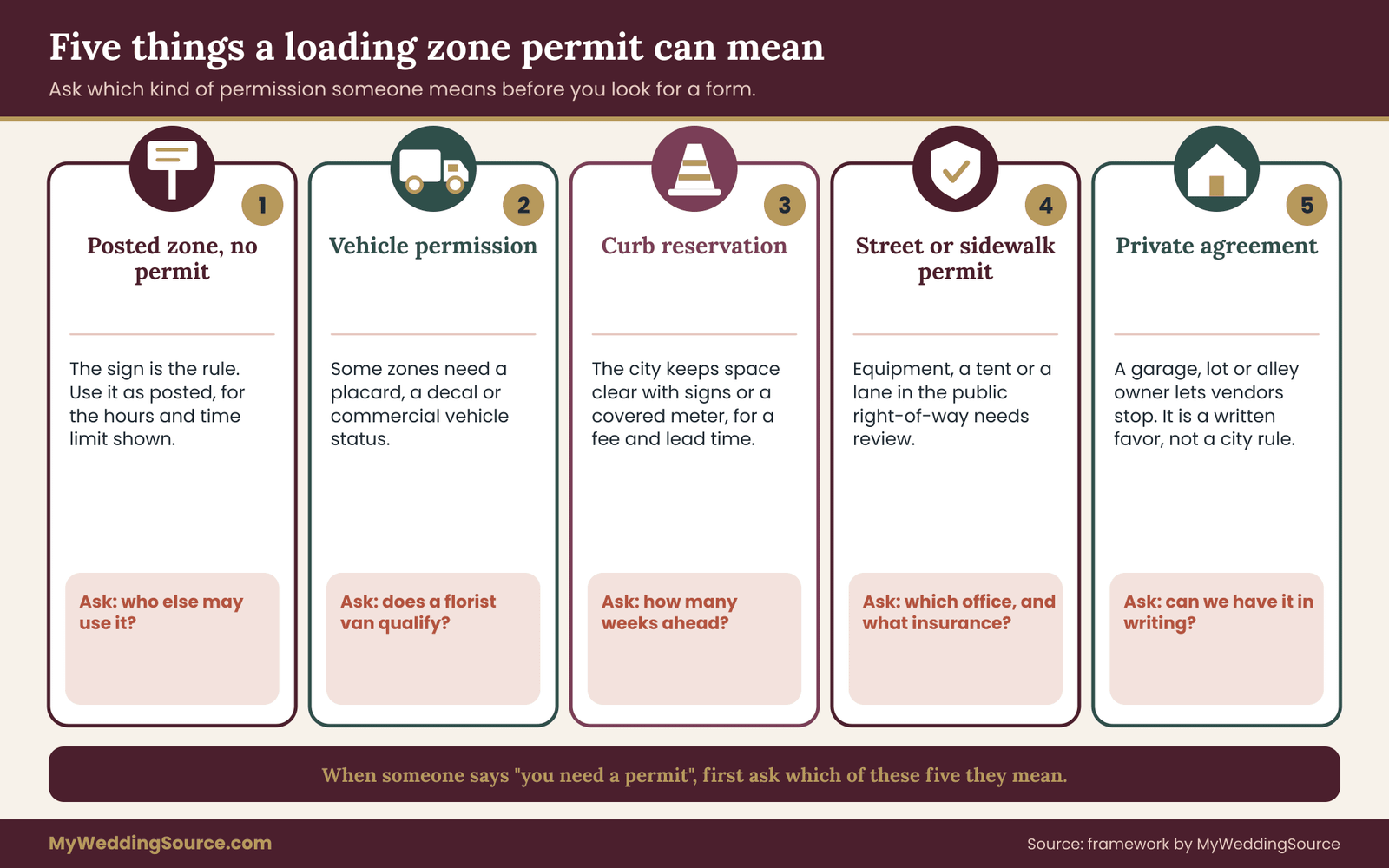
Seeing these five as separate cases keeps you from asking the wrong office the wrong question. When someone says “you need a loading zone permit”, your first reply should be, “Which of these do you mean?” The answer determines who you call, how far ahead you must start and what you must be ready to show.
Why the loading zone matters more in a city
At a rural estate, a barn or a venue with its own driveway, the vehicle route ends on private property. The owner can say where vans park, how long they stay and who guides them in. A city venue often has no such place. The front door opens onto a sidewalk, the sidewalk meets a public curb, and the curb is governed by signs, meters, schedules and local ordinances that the venue does not write and cannot waive.
That leads to three practical consequences. First, the venue manager may know the informal truth about the curb, such as where vendors usually stop, but may not be able to promise it will be available. Second, the rules can change by day and hour: a space that is a loading zone at nine in the morning may be a travel lane at four in the afternoon, and a meter that is free on Saturday may be enforced on Friday.
Third, enforcement is by a different body than the one that owns your contract, so a ticket or tow arrives with no warning and no one at the venue to argue it.
None of this makes city venues a bad choice. Many couples choose them for good reasons: walkable surroundings, hotel proximity, architecture. It only means the curb deserves the same attention as the room, and it is cheaper to ask early than to solve it in the street.
What this guide leaves to other pages
The venue’s own dock, freight elevator and internal vehicle rules are a related but separate subject. Loading dock access, with its vehicle sizes, time windows and fees, and freight elevator use, which covers what happens after the vehicle has been unloaded and the goods go upstairs, are separate questions to ask the building. Think of this article as the stage before both: getting a vehicle legally to the point where either of those begins.
The broader site survey, which includes measuring routes, doors and power, is described in the wedding venue technical walkthrough guide. If you have already done that walkthrough, you probably noted where vendors will enter. This article asks the question that walkthrough often leaves open: where, legally, can the vehicle stop to let them?
Two questions that decide almost everything
You can spend hours reading ordinances and still miss the point. Two questions sort almost every situation into manageable pieces.
Question one: where will each vehicle physically stop? Not “near the venue” but a specific place: a marked loading zone on the north side of the block, the venue’s own driveway, the alley behind the building, a metered space with the meter bagged, a lot across the street. A vendor who cannot answer this has not planned the stop yet.
Question two: who has the authority to say yes to that spot? For a private driveway it might be the property manager. For a marked commercial loading zone it is the city, and the answer might be “anyone loading may use it, first come first served”. For a reserved space it is a city permitting office. For a closed lane it could be both the transportation department and the police or fire authority. If you cannot name the authority, you cannot get a firm answer.
When both questions have answers, you have a plan. When either is blank, you have a research task, and the rest of this article gives you a method for doing it without wasting anyone’s time.
A short script for the first call
If you only do one thing from this guide, make this call to your venue’s event or operations manager: “We have several vendors who will arrive by vehicle. Where do you tell vendors to stop and unload, and is any part of that on a public street? If it is, do you know whether a city permit or reservation has been needed for events here before?” Then listen.
A good manager will either describe a routine they use every weekend or admit the answer is unclear. Both are useful. The first gives you a starting point to verify, and the second tells you the research falls to you.
Write down the answer in the log you will build in the next sections, with the date and the manager’s name. Do not rely on memory. A permit question that seems simple in March can look very different in September when a second vendor asks about it.
Reading the curb: six kinds of space near your venue
Before you contact anyone, spend ten minutes with a map and a street-level view of the block, then, if you can, stand on the actual curb on a weekday and a weekend at the hours when your vendors will arrive. You are looking for six kinds of curb space. Names, colors and painted markings vary widely between cities, so treat the descriptions below as categories to look for rather than local rules. The sign, not the paint color, is what a parking officer reads.
Commercial loading zones. These are intended for vehicles that are actively loading or unloading goods. Posted hours often apply, and a time limit is common. Some cities require that the vehicle be commercial in some way. The zone may be empty at your vendor’s arrival time or filled by a delivery for the shop next door.
Passenger loading zones. These are meant for dropping off or picking up people, usually for a few minutes. A florist unloading buckets may not be covered by the rule, even though no one will complain about a van that is clearly moving things. Ask before assuming.
Metered or timed parking. Ordinary parking spaces can be legal for a vendor van if the meter is paid and the time limit is long enough, but the time limit is often shorter than a full load-in, and a van that stays for the entire reception may exceed it. Some cities let a business or event place a covering on a meter for a fee, which is a form of curb reservation.
No-stopping, no-standing and rush-hour lanes. Some curb lanes are travel lanes during commuting hours and parking at other times. A signed restriction on a Friday afternoon can catch a vendor who has used the same block on Saturdays without trouble.
Fire lanes, hydrants and bus zones. These are the spaces vendors must never use, even for a minute. Fire access is a safety matter, and a bus stop is a transit matter. A vendor who stops there is risking a citation and, more importantly, blocking something other people depend on.
Private frontage. A driveway, a service entrance, an alley or a forecourt that the venue or a neighbor controls. Rules here are set by the property owner, subject to local law. The venue may say, “Our vendors always use the alley”, which is useful, but you should confirm that the alley is not shared and that no delivery schedule for other tenants collides with yours.

How to survey the block
A good survey takes one afternoon and produces a few photos and a short list. Walk the block that fronts the venue’s main entrance, the block that fronts any service entrance and the nearest cross street. Photograph every sign that governs the curb, with the text readable. Stack your photos in the order you walked so you can recreate the path later.
Write down the following for each stretch of curb: what the sign says, the posted hours, any time limit, whether the space was occupied at the time, and the distance in steps from that spot to the door vendors will use. Note the ground between curb and door too. A beautiful loading zone one hundred yards away is of limited use to a band carrying amplifiers, and a spot right outside the door with a no-standing sign is of no use to anyone.
If the block has bike lanes, bus lanes, a streetcar line or a protected lane, note these. They affect where a van may stop and whether a vendor must cross something to get from the curb to the sidewalk. If the street has a market, a parade route, a construction project or a street cleaning schedule, note it too. These are the surprises that a one-time visit rarely reveals, so take a second look on the day of the week your wedding falls on.
Visit at the right hour
A loading zone that is empty on a quiet Wednesday can be full on a busy Saturday.
The best single piece of curb research is a visit at the hour your first vendor will arrive, on the same weekday and ideally the same time of year. It tells you things no map can: whether the loading zone is occupied by an idling truck, whether restaurants on the block receive deliveries then, whether a school drop-off line stretches around the corner, whether a farmers market or a street fair is in progress. If your wedding is on a Saturday, a Wednesday visit can mislead you completely.
If you live far from the venue, this is a job for a friend, a family member, or a planner. Give them the photo list and ask for pictures at the target hour. An hour of someone’s time at the curb is a small price compared with a vendor stuck in traffic with melting buttercream.
Sorting the curb into usable and unusable
When the survey is done, sort what you found into three piles. The first pile contains spaces that look legal and available for vendor use, subject to confirmation. The second contains spaces that might work with a permit or reservation. The third contains spaces vendors must avoid. Most blocks produce at least one item in each pile, and the second pile is where your research effort goes.
For each space in the first two piles, record the exact sign text and a photo. If a vendor later tells you they were ticketed there, the photo and the sign text show whether the space was truly the one you described.
Who controls the loading zone
The most common mistake in curb research is asking the wrong person. A venue manager can tell you about the venue’s practice. A city office can tell you about city rules. A property owner can tell you what they allow on their frontage. These are three different answers, and each can contradict the others without anyone being wrong.
The venue. The venue controls its own property and sets its own vendor rules, but it does not control the public street. A venue that says “vendors may park out front” is describing a custom, not a right. If the custom depends on a city loading zone, the loading zone’s rules still apply.
The property owner or building manager. In a building with several tenants, such as a hotel, an office building with a ballroom or a historic hall in a mixed-use block, the owner may control the service entrance, the alley and the dock, and may have its own scheduling system. That system has its own timing and its own contacts.
The city or county. The department that manages streets and curbs goes by many names: transportation, public works, parking authority, traffic engineering, right-of-way office. The name matters less than the question you bring. Look for a page about curb management, commercial loading, special events, temporary signs or right-of-way permits. The federal government’s local government directory at USA.gov can help you find the website for a given city or county.
Police and fire. Enforcement and safety review often involve other offices. If an event plan affects a travel lane, a fire lane or a hydrant, expect review by fire or police, and expect their requirements to be different from those of the transportation office.
Transit and other special authorities. A bus zone belongs to the transit agency in many places. A street on a university campus, a state road or a park road can belong to a different jurisdiction than the surrounding city. If your venue sits near a boundary, confirm which agency owns the specific street.
A way to find the right office
Start with the venue, then the city. Ask the venue, “Which city office handles curb use or temporary signs on your street?” Many managers know the name, because they have dealt with it. If they do not, search the city website for the words “loading zone”, “curb”, “temporary no parking”, “special event” or “right-of-way permit”, and look for a page with a phone number or a general contact form. A short, specific question to a general contact line often gets routed correctly.
When you reach someone, describe the event in operational terms. Instead of “We are having a wedding,” say, “Several vendors will unload goods from vans and one box truck on this block on a Saturday morning, for about ninety minutes in total. Is there a permit or reservation we should have?” That framing tells the office what you want to do and lets them tell you the rule that applies.
What a city office can and cannot promise
City staff can describe the rules and the application process. They usually cannot promise that a loading zone will be empty on your day, because enforcement of who is parked where is not theirs to guarantee. A reservation, when available, is the exception, because it takes the space out of general use. If you need certainty, ask whether a reservation exists. If it does not, ask what the office recommends when a loading zone is occupied.
Keep in mind that answers from the front desk can differ from answers from the staff who actually issue permits. If a person gives a clear answer, ask for the name of the rule or the page where it is written, and ask whether you can have the answer by email. A written answer is worth far more than a phone call when you later need to show a vendor or an officer what you were told.
Who should do this work
Someone on the couple’s side should own the curb research, even if a planner or venue coordinator is involved. That person does not need legal knowledge. They need patience, a notebook or spreadsheet, and the willingness to make five phone calls. The research log in the next section gives them the structure.
If you work with a planner, ask whether curb work is part of their scope, and agree who does what in writing. Our guide to vendor due diligence covers the broader habit of verifying claims before you rely on them, and the curb is a good place to apply it.
The municipal permit research log for each loading zone
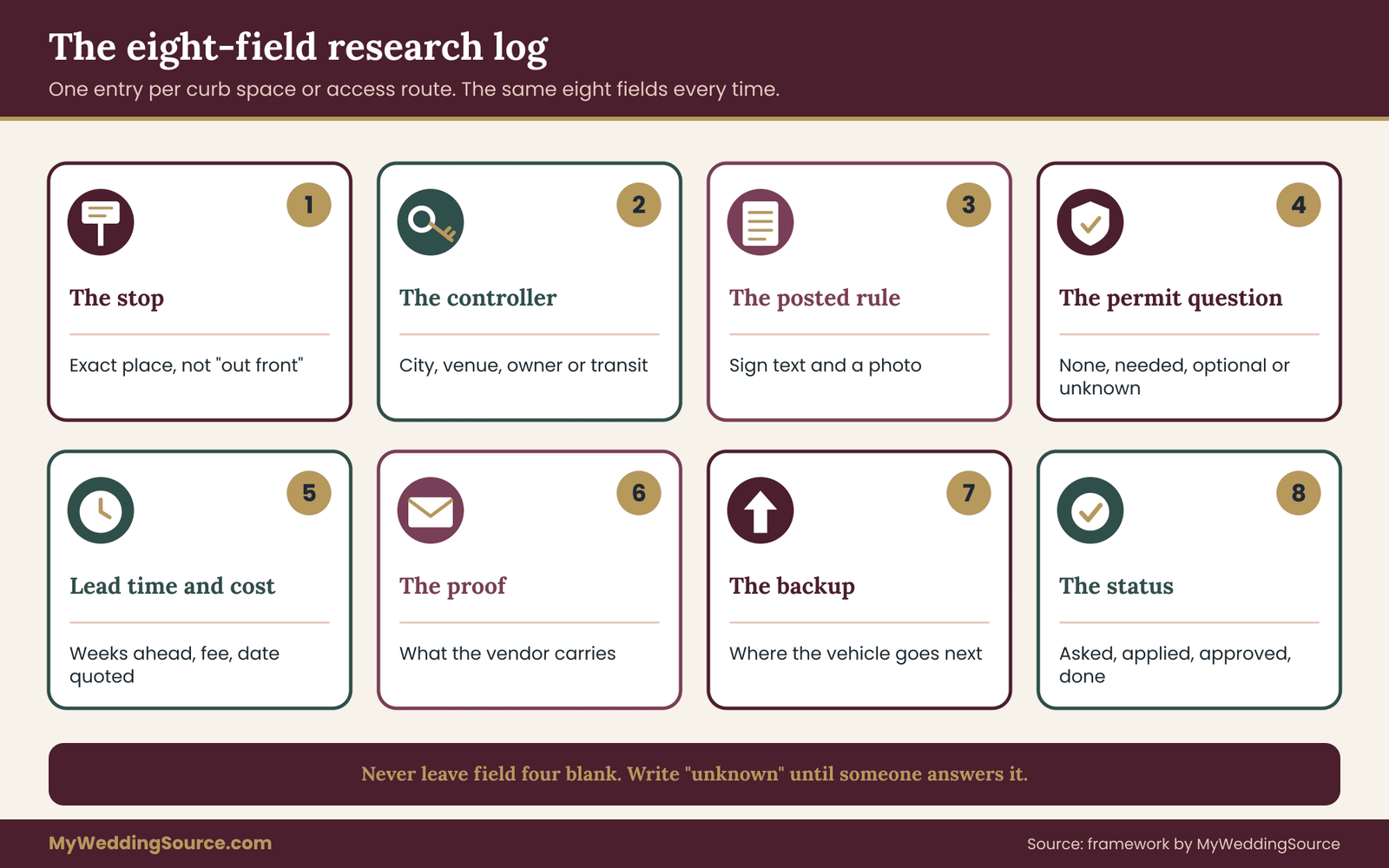
A research log is a plain record of what you asked, who answered and what you now know. It is the first of the two original tools in this guide. The idea is simple: each curb space or access route that a vendor might use gets its own entry, and each entry has the same eight fields. Because the fields are the same every time, gaps show up immediately, and you can hand the log to a planner, a venue manager or a vendor without explaining it.
Here are the eight fields.
One: the stop. Describe the exact place. “North curb of Maple Street, between the venue entrance and the corner, posted commercial loading zone” is a stop. “Out front” is not.
Two: the controller. Name who has authority over it: the city transportation office, the venue, a neighboring owner, a transit agency. If more than one, list each.
Three: the posted rule. Copy the sign text exactly, including days, hours, time limits and any vehicle conditions. Attach the photo.
Four: the permit question. Does this stop require a permit, placard, registration, reservation or temporary sign? Possible answers are “none needed”, “needed”, “optional but available” and “unknown”. Never leave this blank; write “unknown” until it is answered.
Five: lead time and cost. How far ahead must the application go in, how long does review take, and what does it cost? Quote the office’s own words and the date of the answer, because fees and processing times change.
Six: the proof. What must the vendor have in the vehicle or at the curb? A printed permit, a placard, a reservation number, a copy of an email, an insurance certificate? Write down who holds the proof and where it will be on the day.
Seven: the backup. If this stop is unavailable, where does the vehicle go next? Every entry needs a fallback, even if the fallback is “call the venue manager”.
Eight: the status. Open, asked, confirmed, applied, approved, or rejected, with a date. Update it every time something changes.
Filling in a line the first time
Take the example of a florist who will arrive in a cargo van at eight in the morning. Field one is the curb space on the side street next to the venue’s service door. Field two is the city, since the space is public. Field three is the sign text: the loading zone is a commercial loading zone from seven in the morning to six in the evening, with a time limit of thirty minutes. Field four starts as “unknown”, because the sign does not say whether a permit is needed for a private cargo van.
You call the city’s curb management contact. They say commercial loading zones are open to any vehicle that is loading, with no permit, as long as the vehicle stays with the load. Field four becomes “none needed”, with the date and the name of the person who said it. Field five reads “none”. Field six is “printed copy of the email, in the van”. Field seven is “venue service door, with the manager’s cell number”. Field eight is “confirmed”.
That entry took fifteen minutes and gave you something you can show a ticketing officer, a nervous florist or yourself six months later.
What to write when the answer is “it depends”
You will hear this often, and it is not a failure. Write down what it depends on. “It depends on whether the loading zone is occupied” means the answer is no reservation and you need a backup. “It depends on the size of the vehicle” means you must get each vendor’s vehicle length and height before you can answer. “It depends on whether the sidewalk is blocked” means you should ask what blocking means, in inches or feet, and whether equipment such as a ramp or a cart line counts.
Do not close an entry with “it depends.” Turn each condition into a follow-up question, add it to the log and ask it. Eventually the log will tell you either that a stop is workable or that it is not.
Keep one log, share one view
Every loading zone, alley and staging lot you consider belongs in the same log.
Use a single document that you and your planner can edit, or a shared spreadsheet. Avoid spreading entries across texts, emails and sticky notes. When a vendor sends their own questions, add them to the log instead of answering in a side channel. Share a read-only copy with the venue so they can correct errors in your understanding of their practices. The goal is that nobody ever asks, “Where did we hear that?” because the log answers it.
When a loading zone needs a permit and when it does not
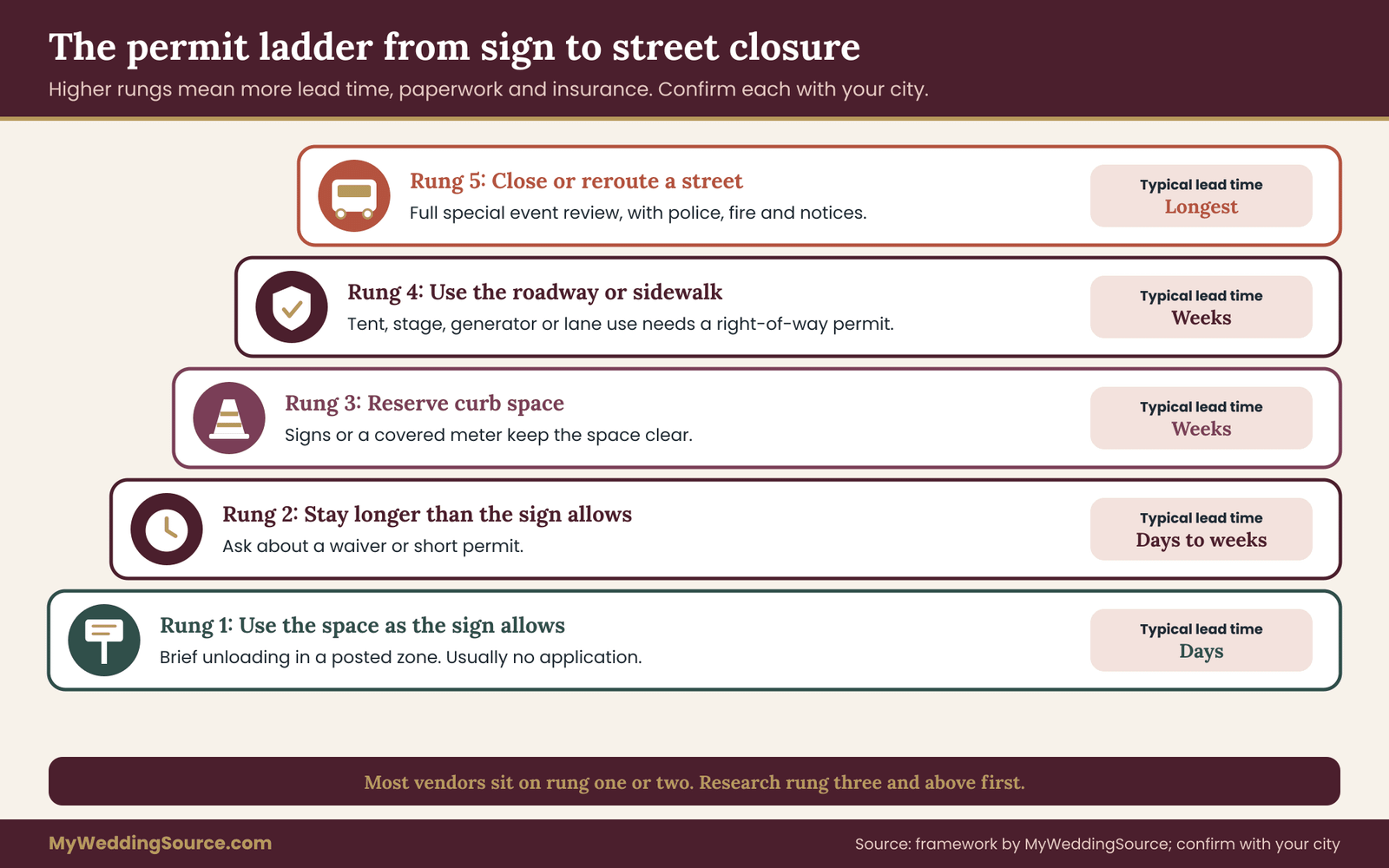
Cities vary so much that no general rule can say, “This street needs a permit.” What a general guide can offer is a ladder of escalating situations, each with a typical question. The higher you go on the ladder, the more lead time, paperwork and insurance you should expect.
Rung one: briefly using an existing space the way the sign allows. A vendor pulls into a posted loading zone, unloads, and moves the vehicle. This normally needs no application, but check whether the space is limited to registered commercial vehicles or specific hours.
Rung two: using a space in a way the sign does not clearly allow. A caterer needs to stay for an hour to finish unloading and set up, and the loading zone has a fifteen-minute limit. Or a band wants to use a passenger zone for a load-in. Here the question is whether the city offers a waiver, a short-term permit or a way to request longer use.
Rung three: reserving curb space. You want a space kept clear at a set time. Ask whether the city offers temporary signs, meter coverings or event curb reservations, how far ahead the request must be made, who posts the signs, how much notice before the day they must go up and who removes them. Ask what happens if a vehicle is parked there anyway, because the answer tells you whether the reservation is enforced.
Rung four: using the roadway or sidewalk. Equipment, a stage, a tent, a generator, a lane closure or a staging area that extends into a travel lane or blocks pedestrians. This usually triggers a right-of-way, street use or special event permit, with review of traffic, safety and accessibility.
Rung five: closing or rerouting a street. A procession, a plaza closure or a ceremony in the street. This is a full special event application, often with police and fire review, liability insurance and neighbor notice. It is outside the scope of most weddings, though it is the right step for a baraat or a procession that moves along public streets. If that applies to you, start the application early and involve the venue, because a procession adds route, noise and safety review to the usual curb questions.
How to place your wedding on the ladder
For each vendor, ask three questions. How big is the vehicle, in length and height? How long will it stay at the curb, door to departure? Does anything go beyond the curb, into the lane or across the sidewalk? Almost every vendor lands on rung one or two. A rental company delivering tables by box truck, or a stage and lighting team with a trailer, may reach rung three. A couple who wants a tent in the street, a food truck at the curb or a closed block is on rung four or five.
Placing each vendor on the ladder gives you a short list of permits that matter, instead of a long list of possibilities. It also gives you the right urgency. Rung one items can wait for the final month. Rung three and above should be researched as soon as the venue and date are fixed, because lead times may be weeks.
Typical permit triggers, in plain terms
These are the circumstances that, in many places, prompt a city to ask for a permit or reservation. They are not universal, and the specific rule is for the city to say.
A vehicle will occupy a space longer than the posted time limit. A vehicle is larger than a standard passenger van or exceeds a length or weight limit for the street. A vehicle is not commercially registered and the loading zone requires it. Equipment will stand in the roadway or on the sidewalk.
A generator, tent or stage will be placed in the public right-of-way. A food truck or vendor cart will operate on a public street. Traffic cones, barricades or signs will be placed in the street by someone other than the city. A lane, parking area or street will be blocked at any time.
If none of these applies to a given vendor, the answer is most likely “no permit, follow the sign”. If one applies, add it to the research log and ask.
Federal guidance and local control
The federal government sets safety and design guidance, such as the Manual on Uniform Traffic Control Devices for signs and markings, and agencies publish information on freight and commercial vehicles. But curb management and permits are decided locally. The federal pages are useful for understanding what a sign is meant to say, not for deciding whether you need a permit. Always check the city.
What to do about vendors’ own knowledge
Experienced vendors who have worked at your venue often know the curb better than you do. Ask each of them, “Where have you parked at this venue before, and have you needed any permit?” Treat the answer as a lead, not as a confirmed fact. Vendors may remember a rule that has since changed, or a space that was empty only because of an unusual day. Write their answer in the log with their name, then verify with the venue or the city.
Ask each vendor early whether they can produce a certificate of insurance, because a city office or a property owner that asks for one will want it quickly. Our guide to renting for a wedding also covers delivery questions to settle with rental companies, whose trucks are often the largest vehicles on the block.
Fees, insurance and paperwork behind a loading zone permit
Curb access is rarely free of paperwork once it goes beyond the sign. The costs and documents that appear are usually modest individually, but they arrive from several directions, and the surprise is often about who is expected to pay and who is expected to produce a document.
Fees
A basic loading zone is often free to use, and the charges described next apply only when you go beyond it.
Common charges, where they exist, include an application fee, a daily or hourly fee for reserved curb space, a charge for covering meters, a fee for temporary signs or barricades, an inspection or review fee for larger permits and a deposit or bond for street use. Some cities charge nothing for a simple loading zone reservation, and some charge by the foot and the hour. Parking enforcement fines are a separate category and should never be treated as a planned cost.
Ask for the fee schedule in writing with its date. Fees change with the budget year, and a figure you read in spring may be different by the time you apply. If the office quotes a number by phone, write it down with the date and the person’s name, and ask whether the number is final or subject to review.
Decide in advance who pays. A city fee for a reserved space at the venue’s entrance could reasonably fall to the couple, the venue, the rental company or the caterer, depending on the contract. If a vendor’s contract says “all access fees are the client’s responsibility”, you may be paying for a permit you did not know about. Our guide to reading a wedding vendor contract explains where such terms hide and how to ask for changes before you sign.
Insurance
A simple loading zone stop rarely raises insurance questions, but a reservation or street use permit often does.
A city office that issues a street use or special event permit often asks for proof of liability insurance, sometimes with the city named as an additional insured. A property owner or venue may ask for the same for vendors who use their private frontage. For a simple loading zone use, none of this is typical, but if a permit request involves equipment in the street or a closed lane, expect the question.
Do not assume that your own homeowner or renter policy covers any of this. A planner, a venue or the issuing office can tell you what they require, and the vendor’s insurance agent or broker can say what a certificate would show. Vendors who work professionally usually carry business liability coverage and can request a certificate from their insurer. Ask each vendor early, not the week before.
Vehicle and driver documentation
Some city offices and enforcement agencies pay attention to commercial vehicle status, registration, weight ratings and driver qualifications. The federal agency that regulates commercial motor carriers publishes information about when federal rules apply to commercial vehicles, and many ordinary wedding vendor vans and small trucks fall outside the heavier requirements. Still, a rental company that delivers with a large truck may have to follow route and weight restrictions, and truck routes in many cities are posted.
If a large vehicle is part of your plan, ask the vendor for its length, height and weight rating and ask the city whether the street is open to it.
Keep copies of anything a vendor might be asked to show: the permit or reservation number, the email from the city, the insurance certificate if required, the venue’s access letter and the name and phone number of someone at the venue who can vouch for the delivery. Put these into a single page that goes in the vehicle’s cab.
The access letter
A one-page access letter from the venue is one of the most useful and least used documents in this process. It states the date, the venue’s address, the vendor’s name, the expected arrival window, the loading zone that has been approved and a contact name and phone number. It does not override the city’s rules, but it shows an officer or a neighbor that the vehicle is expected and that someone is responsible for it. Ask the venue whether they have a template. If they do not, you can draft one and ask them to approve it.
Put it in the contract
Whatever the permit work produces, make sure the contracts reflect it. Vendors should know which stop they are to use, which time window applies, who holds the permit or reservation, and who pays if a fee or fine results. A line in the vendor’s agreement saying, “Vendor will use the approved loading location and arrival window listed in the client’s curbside plan” avoids a lot of later argument. For a rental company, add a line about delivery location and truck size. If the vendor refuses to follow the plan, you want to know before the wedding, not at the curb.
The curbside delivery timing plan
The second original tool in this guide turns the research log into a schedule. A curbside delivery timing plan is not a general timeline of the wedding day. It is a map of the loading zone over time: which vehicle uses which stop, from what minute to what minute, with a buffer and a backup. Its job is to make sure that the space everyone is counting on is not needed by two trucks at once.
Why timing is its own problem
A loading zone has capacity. A single stop might fit one van or one box truck. If three vendors arrive at nine, two of them will circle, double park or wait at a corner. A vendor who waits is billed for the wait in some contracts. A vendor who double parks risks a ticket and blocks traffic. A vendor who gives up and goes elsewhere may arrive late to the room.
At a venue with a dock, a similar problem is solved by dock slot forms. On a public curb you have fewer tools, since the city does not hand out slots. You rely on your own timing, the vendors’ cooperation and, where available, reserved space.
The five inputs for each vehicle
For every vehicle, collect five facts. The first is vehicle type and size: a car, a cargo van, a sixteen-foot box truck, a trailer. The second is the vehicle’s own unloading time, from the moment it stops to the moment the last item has left the curb. The third is whether the driver can leave the vehicle to carry goods, or must stay with it, which matters in zones that require the driver to remain.
The fourth is the earliest and latest acceptable arrival, based on when the room will be ready and when the goods are needed. The fifth is where the vehicle goes after unloading: back to the shop, to a parking garage or to a nearby lot.
Vendors often underestimate unloading time. A florist who says “ten minutes” may mean the time to hand over three buckets, not the full load of arches and arrangements. A rental company that says “half an hour” may be thinking of the trucks, not the pallets staged on the sidewalk. Ask each vendor to describe their last event at a similar venue, count the trips between vehicle and door and estimate from that. Add a quarter for the unexpected, and treat the result as the planning number.
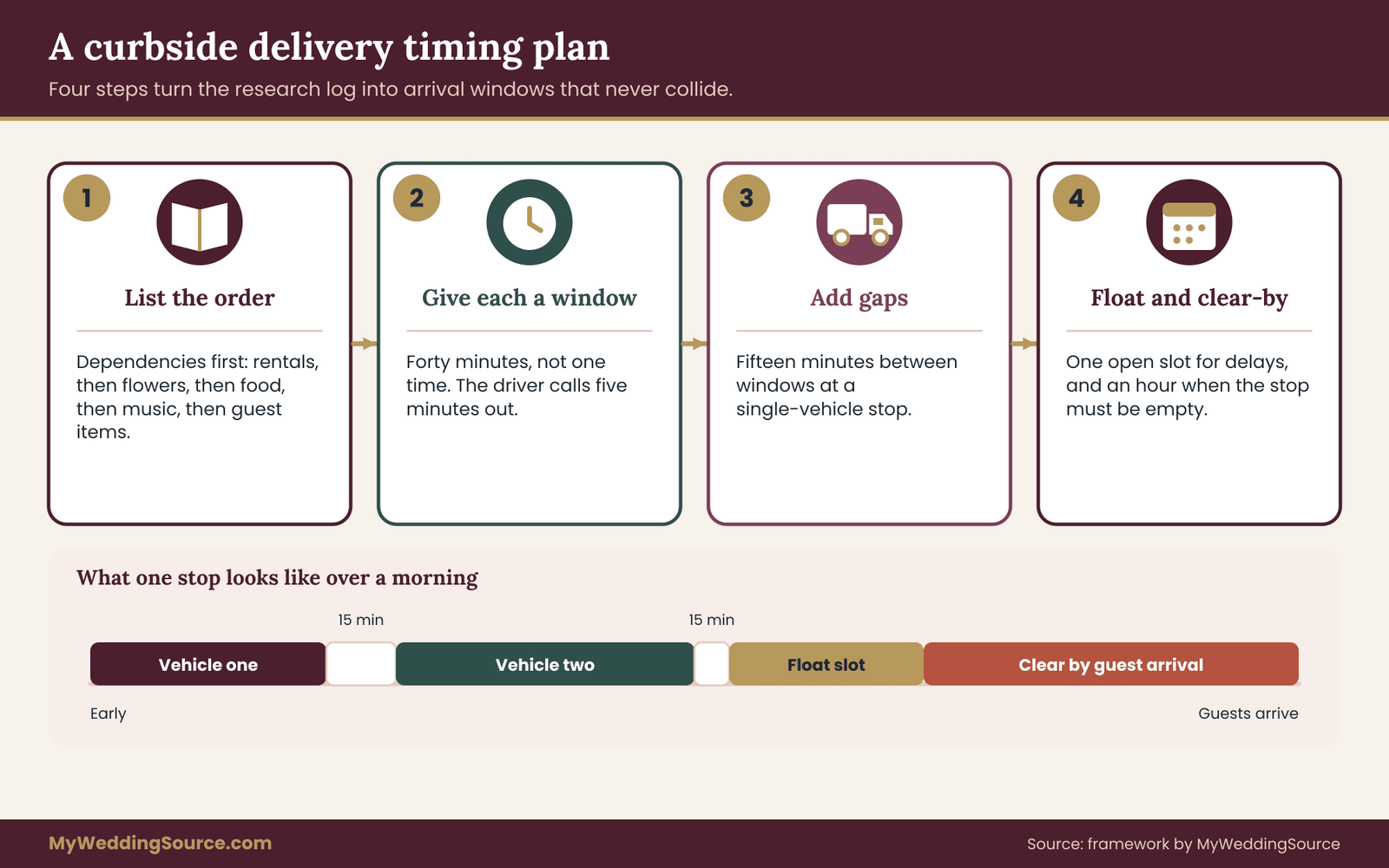
Building the plan in four steps
Step one: list the vehicles in the order they must arrive. A dependency rule works well. Anything that must be in place before another vendor can start goes first. Rentals such as tables, chairs and linens usually lead, then florals and decor, then food and beverage, then music and lighting, then guest-facing items such as the cake and signage. The exact order is your venue’s to approve, and some venues will assign it.
Step two: give each vehicle a window, not a time. A window of forty minutes, say eight to eight-forty, gives a driver room to hit traffic or a long carry without breaking the plan. Within the window, ask the driver to call the named contact when they are five minutes away.
Step three: separate the windows by a gap. If the stop is single-vehicle, a fifteen-minute gap between windows allows one vehicle to finish, a second to pull in and a buffer for delays. If the loading zone is long enough for two vehicles, the gap can be smaller, but check the length of the curb against the length of both vehicles.
Step four: add a float slot and a clear-by time. The float slot is an unassigned window that absorbs a delay or a late vendor. The clear-by time is the moment after which the stop must be empty of vendor vehicles, for example because a restriction begins, guests start to arrive or a neighbor’s delivery is due.
Reading the plan against the posted rules
When the plan is drafted, compare each window to the posted rules in your research log. Does the loading zone’s time limit cover the vendor’s unloading time, or does it need an extension? Do the hours of the loading zone cover the window, or does a restriction begin partway through? Is any window on a street cleaning day, a game day or an event day when the rules change? If a window falls outside what the sign allows, change the window or add a line to the log: “needs reservation” or “needs waiver.”
At this point you may find a conflict that cannot be fixed by timing alone. For example, two large vehicles need the same short zone at the same early hour, and neither can start later. That is the moment to explore a reserved space, a second stop or an off-site staging point. The next sections show those options.
Matching vendor types to the curb
Different vendors stress the loading zone in different ways, and the plan works best when it reflects those differences. These are patterns, not rules, and each vendor should confirm their own.
Rental companies. Tables, chairs, linens, tents and dance floors come on the largest trucks and take the most time to unload. They often need the earliest window and the biggest buffer. Ask for the truck’s length and height, whether it has a lift gate, how many people are in the crew and whether pallets or carts will sit on the sidewalk. If the truck is too large for the loading zone, ask whether a smaller truck with two trips would work.
Florists and decor teams. Vans, sometimes with a trailer. Loads are fragile and time-sensitive, because flowers and greenery are affected by heat and wind. They usually need a short, close stop and a predictable one. If the loading zone is far from the door, ask whether the venue can provide a cart or a helper.
Caterers and bartenders. Food has temperature requirements and often arrives in several trips: equipment first, then food, then ice and beverages. Caterers may need to return later for service items or to remove waste. Their windows should include the return trip, or they will look for curb space at an inconvenient time.
Bands, DJs and lighting teams. Heavy cases and stands, sometimes a trailer. Their unloading is slow because items are bulky, and their load-out happens late at night, when curb rules may differ. Check evening and overnight restrictions along with the morning ones.
Photo booths, rentals of specialty items and cake deliveries. Smaller vehicles, but often strict timing. A cake in particular must be moved carefully and quickly, and the driver should not have to hunt for a space. Give the cake the cleanest stop and a short window, and ask the venue whether staff can meet the vehicle.
Guest transport and valet. Shuttles, buses, rideshare drop-offs and valet operations create a second stream at the same curb. Passenger loading and vendor loading should not share a space at the same time. If your venue uses valet, confirm how it interacts with vendor stops and whether the valet operator holds its own permit.
Dwell time and the driver rule
Every loading zone measures dwell time in its own way, so read the sign for how it counts.
Some zones require the driver to stay with the vehicle or to remain within sight of it. This matters when a vendor arrives with only one person. If that person must carry goods inside, the vehicle is unattended. Ask the city or read the sign carefully for such conditions, and plan for two people where needed. A helper from the couple’s side, a venue staff member or a hired runner can watch the vehicle while the driver unloads.
Dwell time, the total minutes a vehicle sits at the curb, is the number the sign cares about. A vendor who says “I will be out of there in twenty minutes” is promising something that is worth checking against a thirty-minute limit and the realities of a long carry. If the limit is tight, break the load into two stops or ask whether the city allows a longer stay with a permit.
The morning-of check
On the day, one named person monitors the loading zone. They check the stop an hour before the first window, look for obstacles such as parked cars, construction, delivery vehicles for neighbors, a market setup or street sweeping equipment, and call the venue manager if the loading zone is blocked. If the loading zone is blocked, the backup in the research log activates, and the person tells each affected vendor by phone, not by text alone.
This person should not be one of the couple. Choose a planner, a coordinator, a trusted friend or a venue staff member. Give them the research log, the timing plan, the access letters and a list of vendor phone numbers. Our guide to the wedding vendor timeline covers how to fit this role into the broader schedule of the day.
Loading zone access, accessibility and guests at the curb
The curb is not used by vendors alone. Guests, wedding party members, older relatives and people with mobility needs also arrive at the curb, and a vendor stop that fills the space can create a barrier. Planning the loading zone for vendors and the same curb for guests as a single problem avoids conflict.
Separate vendor and guest flows
Where possible, put vendor stops and guest drop-offs in different places and at different times. Vendors typically load in well before guests arrive, and load out well after they leave. The overlap is the period around the ceremony and the end of the reception, when a caterer’s van, a band’s trailer and a line of rideshares may all want the same entrance. Look at your guest arrival time, your cocktail hour and your departure time, and set a clear-by time on the vendor stop so that it is empty when guests arrive.
Our page on wedding reception guest flow explains how to plan arrival and exit from the guest’s point of view. The curb is where those two plans meet, so compare them.
Accessible routes at the curb
Venues that serve the public have obligations under the Americans with Disabilities Act, and the Department of Justice publishes information on those obligations. The U.S. Access Board publishes accessibility guidelines for facilities and for public rights-of-way. For wedding planning, the practical question is simple: if a guest who uses a wheelchair, walker or cane arrives by car, where do they get out, and is the path from the curb to the entrance clear?
A vendor van parked across a curb ramp, a cart line blocking the sidewalk, or a stack of rental chairs on the walkway can turn a good venue into an obstacle course. Tell each vendor that curb ramps, accessible parking spaces and the main entrance route are not to be blocked, even briefly. Make that a line in the vendor’s instructions.
If a guest has a specific need, such as an accessible vehicle that needs a long loading space, ask the venue or the city whether a passenger loading space can be held for them. Our guide to accessible wedding venue red flags explains what to look for when you assess a venue’s access.
Noise, neighbors and hours
Residential and mixed-use blocks often have rules about noise and deliveries during early morning and late night hours. A rental crew that drops metal tables on pavement at six in the morning may draw a complaint that leads to a visit from a code officer. A band that loads out after midnight may face similar issues. Ask the city or the venue whether there are quiet hours for commercial activity on the street, and set windows accordingly.
It is also worth a friendly note to neighbors, particularly if a stop is in front of someone’s door or business. A short, polite message a week before, saying what is happening, for how long and who to call, prevents many complaints. Do not promise things you cannot guarantee, such as an empty street. Say what you know and give a phone number.
Weather and surface
Bad weather changes which loading zone is practical, even when the rules stay the same.
A loading zone in the rain is a different place. Pavement is slick, carts are harder to push, dress and floral deliveries need covering, and drivers will look for closer spots. Check whether the stop has an overhang or a covered entry. If the weather forecast is poor, ask the venue whether a closer stop, a covered one or a longer window is possible. Snow and ice add curb restrictions in some cities, such as snow emergency routes that ban parking, so check the forecast and the city’s snow rules if your wedding is in winter.
What to do when the loading zone is not available
A good plan assumes that sometimes the loading zone will be occupied. It might hold a truck for a neighbor, a construction crew or a vehicle someone parked without reading the sign. The aim is not to avoid every disruption but to have a response that is calm, quick and legal.
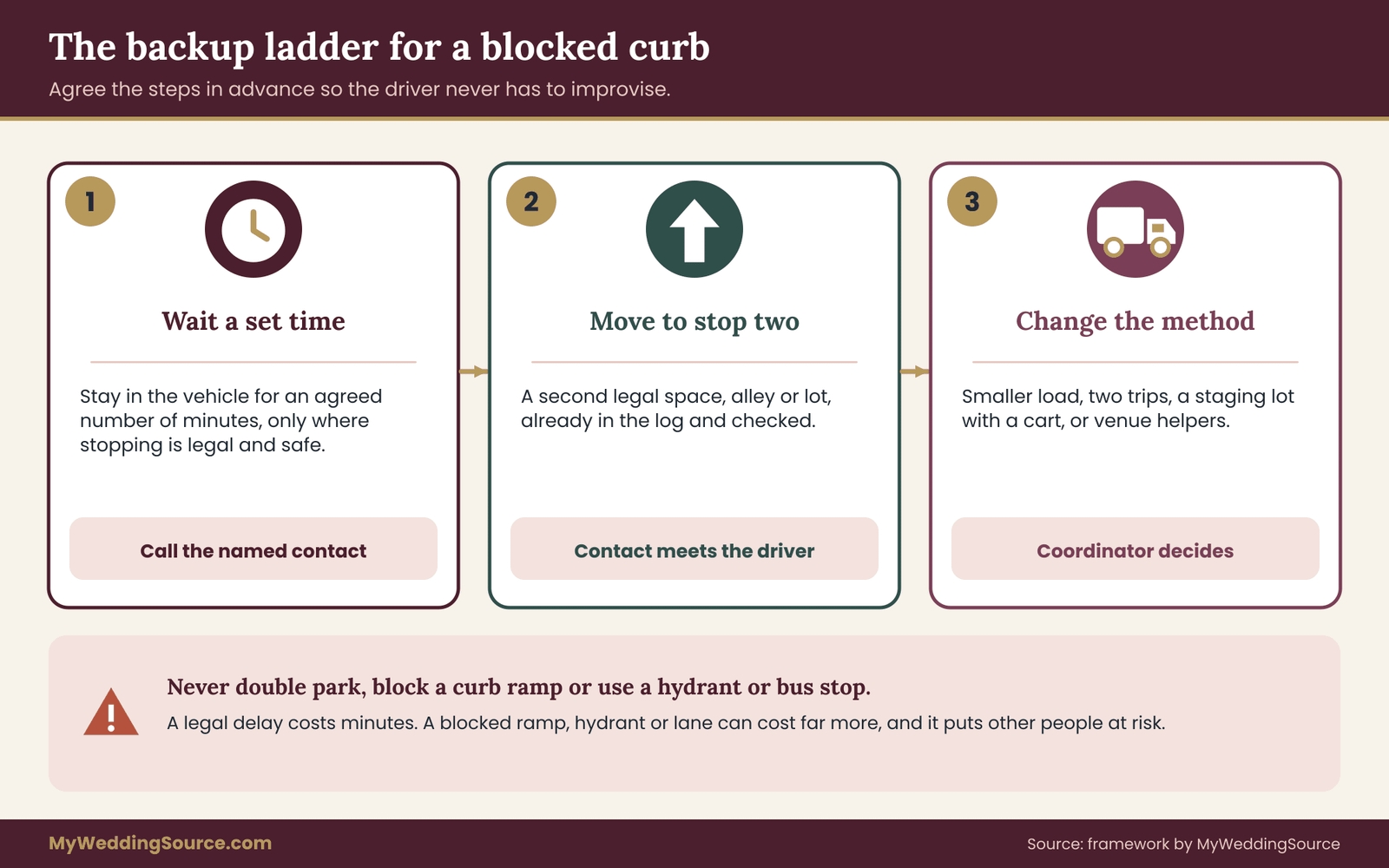
The backup ladder
For each stop in your log, set a backup ladder of three steps, from cheapest to most involved.
First, wait a short, defined time. If the stop is blocked, the driver waits in the vehicle, with flashers on only where it is legal and safe, for a set number of minutes. Agree the number in advance, such as ten. This avoids rash decisions and double parking.
Second, move to the secondary stop. This is a second legal curb space, a nearby garage entrance, a lot or an alley, recorded in the log and checked in advance. The driver calls the contact, who meets them if needed.
Third, change the method. Reduce the load per trip, send a smaller vehicle, split the delivery into two runs, use a staging point with a shuttle or have venue staff help carry from a farther stop. This step costs time, and the plan should note who decides to use it.
Staging lots and private agreements
Sometimes the best answer is a private lot or garage close to the venue. A church, a business that is closed on the wedding day, a public garage with a loading bay or a school lot can provide space for vehicles to wait or to unload. These arrangements are private, and the owner sets the terms. Ask for permission in writing, with the date, hours, number of vehicles and a contact for the day. Ask about insurance and any fee. Do not assume a lot is open because it looks empty.
If vendors will park at a staging lot and carry goods to the venue, check the walking route, the surface and the time it adds. A two-block carry with a cart can double unloading time. Ask the venue whether it can provide a cart, a luggage trolley or a few staff or volunteers.
When a permit is delayed or denied
If a reservation or street use permit is delayed or denied, do not assume the plan is dead. Ask the office what is missing and whether a different form of the request would be approved, such as a shorter period, a smaller vehicle, a different time or a different location. Offices often have options that are not on the form. If the answer is no, return to the backup ladder and revise the timing plan to fit the remaining space.
Tell the venue and your vendors the same day. Changes in curb access can affect their pricing, timing and equipment. Our guide to venue technical walkthroughs explains how to record such changes with the rest of the site’s facts, so that all parties are working from one version.
Verifying loading zone rules and getting answers in writing
Rules about curbs, fees and permits change, and information you find online may be out of date, incomplete or written for another neighborhood. Verification is not about distrust. It is about making sure that the version of the rule you are relying on is the version that will be enforced on your wedding day.
The three-source check
The loading zone rule that matters is the one an officer will apply, so the check below always starts from what is posted.
For each loading zone entry in your log, try to confirm the key fact from three places: the sign on the curb, the issuing office’s own words and the venue’s practice. If they agree, you can be reasonably confident. If they disagree, the sign and the issuing office win over custom, and the disagreement is a question to resolve before the wedding.
The sign is the most immediate source because it is what an officer reads. The issuing office is the authority on permits and exceptions. The venue is the authority on what it expects from vendors. A vendor’s past experience is a fourth source and a useful lead, but the weakest of the four.
What counts as written
An email from a named person at the issuing office, with the date, is good. A permit, a reservation confirmation or an application receipt is better. A page on the city’s official website is useful, but print it or save it with the date, because pages change. A phone call is a starting point; follow it with an email that restates what you were told, such as, “Thank you for speaking with me today.
To confirm, you said that vendors may use the commercial loading zone on Maple Street without a permit on Saturdays, for up to thirty minutes. Please let me know if I have misunderstood.” A reply of “correct” is enough.
Never write an email that invents a rule or pushes a staff member to approve something outside their authority. State facts, ask for confirmation and thank them.
The quarterly and final refresh
Set two reminders. The first is a check about a quarter of the way through your planning, to catch rule changes and new construction. The second is a final refresh about three weeks before the wedding, when you confirm that permits and reservations are still in place, the posted signs and rules have not changed and the weekend does not collide with a city event, road closure or construction project. If the venue’s neighborhood hosts a regular market, festival, race or game, ask the city’s special events office whether any is planned for your date.
If your wedding date coincides with a large local event, expect changes to curb rules, traffic and enforcement. Notify vendors early so they can adjust their routes and timing.
When the information is thin
Some small towns and counties have no formal curb permit process at all, and the answer is “park where the signs allow.” Others have rules scattered across several offices. If you cannot find a clear answer, call the general number for the city or county, describe what you plan to do and ask which office handles it.
If no one is sure, ask the venue’s neighbors, the local business association or a planner who works regularly in the area. Record “no formal process found, confirmed by phone on this date with this person” in the log. That is a legitimate result.
Special situations at the curb
Not every venue fits the standard city block. Several common settings change the questions.
Hotels and event halls
A hotel’s own loading zone is usually private, so the city’s curb rules may not apply to it at all.
A hotel or event hall on a busy street may have a porte-cochere or a service entrance with its own loading bay, staffed by hotel employees. The hotel may control the space entirely, and the city is not involved. Ask the hotel for its vendor access instructions and whether there is a scheduling system. If the hotel shares its dock with other events, timing becomes a coordination problem that the hotel’s catering or events office can solve.
Historic buildings and districts
Historic districts may restrict vehicle size, ground loads and hours, and some historic buildings have narrow streets or courtyards that cannot take a box truck. A historic house museum or a civic hall may have preservation rules that limit where and how vendors may carry equipment. The venue should know, and its written vendor rules will usually say.
Campuses, parks and waterfronts
A university, a park, a harbor or a botanical garden is often governed by its own authority, not the city. Roads inside may be private or managed by a park agency, with gates, permits for commercial vehicles and special rules for events. Ask the venue which authority controls access and whether it issues a vehicle pass, a gate code or an escort.
Alleys and shared service lanes
Many city venues are served from an alley. An alley can be a convenient route, but it may be shared with other businesses, trash collection and deliveries, and it may be narrow, unlit or closed at certain hours. Visit the alley at the hours of your windows, note the trash pickup schedule and ask the venue or property manager about gate access and lighting. Do not assume that an alley that is legal for a van is legal for a larger truck.
Rooftops, piers and upper floors
If the event is above street level, the loading zone question connects to a freight elevator or hoist, and the elevator’s schedule becomes part of the timing plan. The stop at the curb and the elevator at the building must work together. A vehicle that arrives on time but waits an hour for the elevator ties up the curb, so build the elevator queue into the vehicle windows.
Food trucks, carts and mobile vendors
A food truck or a mobile bar that serves guests at the venue is a different matter from a vendor that merely unloads. Many cities regulate mobile vending, with licenses, location rules and fire and health requirements. If you plan to hire one, ask the vendor which permits it holds and whether the venue and the city allow it at that address.
The vendor should know the process, and you should keep a copy of the permits in your log. Fire safety standards, such as those published by the National Fire Protection Association, may apply to cooking equipment, so ask the local fire authority what it expects.
Load-out, the second trip to the curb
Most planning attention goes to load-in. Load-out is a separate event, with a different set of risks: it happens late, people are tired, curb rules may have changed for the evening, and several vendors may leave at once. A plan that handles the morning but not the night leaves a gap.
Evening and overnight rules
A loading zone that is open all morning may be closed, reserved for something else or turned into a travel lane by evening.
Posted loading zone hours often end in the early evening. After that, the space may become a parking space, a tow zone or a travel lane. Some blocks fill up with restaurant and bar traffic by nine. Check whether the loading zone that worked in the morning is legal for a late load-out, and whether the venue’s evening activity makes it harder to use. If it is not, schedule load-out at a different stop or time, or arrange a reservation that covers the evening.
Sequencing the exit
Load-out should follow the same logic as load-in, in reverse. Anything fragile or valuable leaves first, rentals and the largest items usually leave last, and some may be collected the next morning by agreement. Set a clear-by time for the stop, name the person who will oversee it and give each vendor a window. Ask the venue about the end-of-event curfew and any rule about vendors on the premises after the event ends.
Vendors who are paid by the hour will prefer to leave promptly, and vendors who are tired may take shortcuts, such as stopping in a restricted space or leaving equipment on the sidewalk. A friendly reminder from the coordinator and a clear plan reduce that risk.
Waste, rentals and returns
Trash, recycling and returned rentals also use the curb. A dumpster on the street, a bin trolley, boxes of returned items and a rental truck waiting at the end of the night all need space. Ask the venue where waste goes and who takes it, and add a window for the rental pickup, which sometimes happens the next day.
If pickup is the next day, confirm that the loading zone is legal and available then, since Sunday and Monday rules differ from Saturday’s. The rental planning guidance mentioned earlier is a good companion for the return side of the process, and the vendor contract should say who is responsible for items left on the curb.
A worked example: one city block, six vendors, three stops
The example below is invented for illustration. The couple, the street and the city rules are made up, and your own city’s rules will differ. What matters is the method.
Dana and Eli are marrying on a Saturday in a restored civic hall on a city block. The hall has a front entrance on a main street and a service door on a side street. Guests arrive at four in the afternoon. There is no dock and no private lot. Dana takes on the curb research and starts a log with one entry per stop.
What the survey found
Dana walks the block on a Saturday morning at eight and finds three candidate stops. Stop A is a posted commercial loading zone on the side street, next to the service door, with a thirty-minute limit and posted hours that run through the early evening. Stop B is an alley behind the hall, which the venue says vendors have used for years. Stop C is a stretch of metered curb in front of the main entrance, which Dana notes would be the natural place for a large truck but is also where guests will arrive.
The venue manager confirms the alley and the side street as the usual stops and says she does not know whether the front curb can be reserved. She sends Dana the name of the city office that handles curb use for events.
What the city office said
Dana emails the office and then calls. In this invented example, the office says that the commercial loading zone is open to any vehicle that is actively loading and needs no permit, and that the alley is private and belongs to the venue. For the front curb, the office offers a temporary curb reservation: the city posts signs, requires a short application a few weeks ahead and charges a fee that Dana records with the date. The office also says the reservation does not guarantee that no vehicle will be there, only that parking there would be a violation.
Dana asks the rental company how long its truck will stay. They say about an hour and that the truck is a twenty-six-foot box truck with a lift gate. That is too long for the thirty-minute zone and too large for the alley. The front curb, reserved for the early morning and cleared before guests arrive, is the only workable stop. Dana files the application and records it as “applied”, with the date and fee.
The timing plan
With the stops and rules in hand, Dana builds the curbside delivery timing plan with the venue manager:
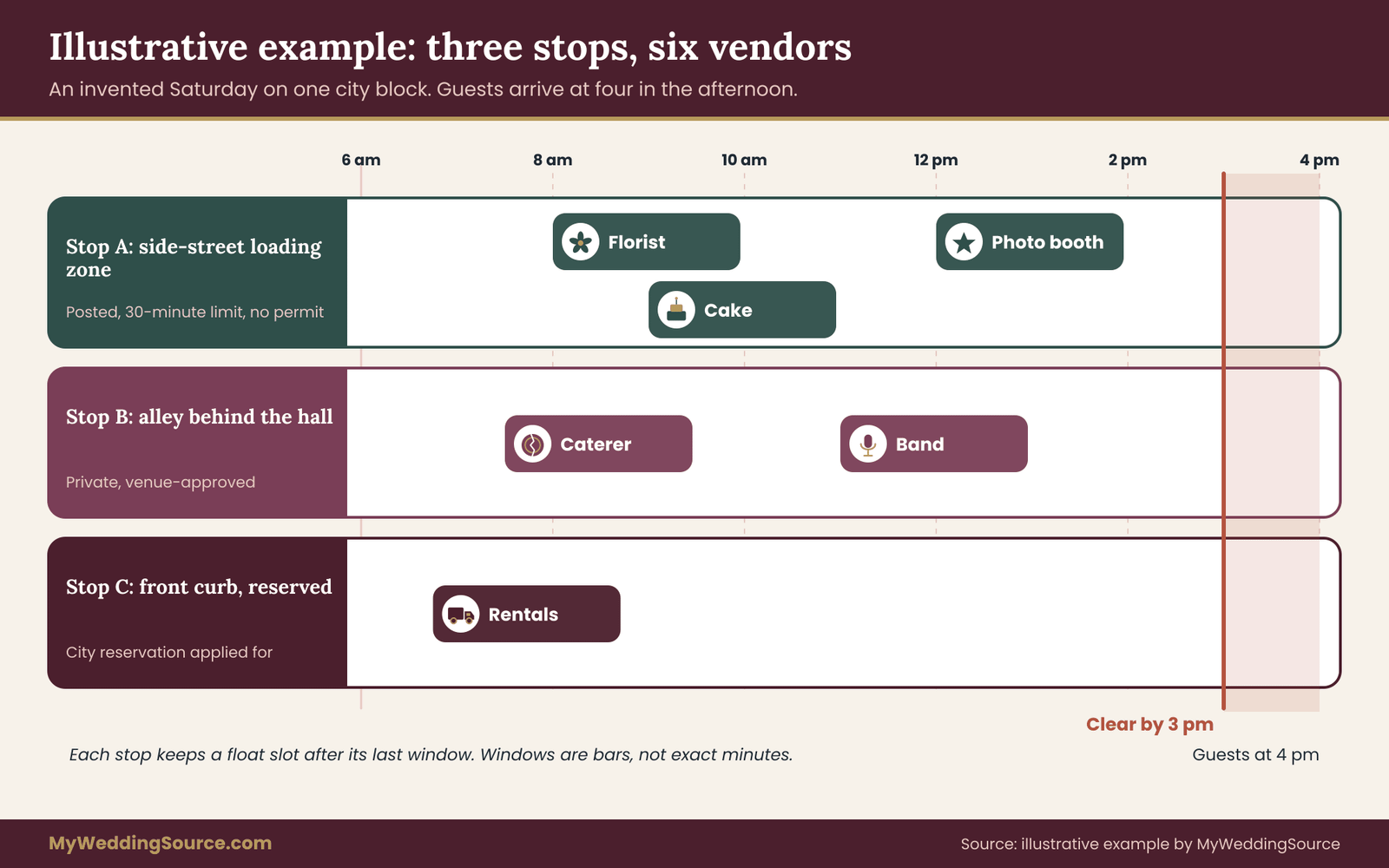
The rental truck takes the reserved front curb from early morning, with a clear-by time well before guests arrive. The caterer unloads at the alley in the early morning, with a helper from the venue. The florist’s van uses the loading zone on the side street, with a window long enough for two trips but within the posted limit. The cake arrives in a short window at the same stop, after the florist has left.
The band uses the alley at mid-morning, where its heavy cases do not block a public street. The photo booth uses the loading zone in a short midday window. A float slot sits after the photo booth. All stops are clear of vendor vehicles by mid-afternoon.
What Dana put in the log
Each of the three stops has a full entry with the eight fields. Stop A has “none needed” as its permit status, with the email confirming it. Stop B is “private, venue-approved”, with the manager’s name and a note about trash pickup in the alley. Stop C has “reservation applied”, then “approved” when the confirmation arrives, with the reservation number and the printed copy that the rental driver will hold.
The backups are named: if the loading zone is blocked, the florist uses the alley; if the alley is blocked, the caterer uses the loading zone after the florist; if the front reservation fails, the rental company splits the delivery between two smaller vehicles at the loading zone with extra time.
What went right, and what could still go wrong
The loading zone on the side street was the least certain piece of the plan, which is why it had the most backups.
The plan is not perfect. A neighbor’s delivery could still occupy the loading zone. A rainstorm could slow carrying. The reservation could be delayed. But the possible problems now have named responses and owners, and the vendors have a single page that says where to go. When Dana reviews the log three weeks before the wedding, she calls the city again to confirm the reservation and the signs, checks the block for new construction and sends the final plan to all vendors and the venue.
The general lesson is that a few hours of research and one well-organized page can replace a morning of chaotic phone calls. The research does not guarantee a smooth day, but it keeps the problems small.
Common mistakes with loading zones and permits
These are the mistakes that recur most often, with the simple fix for each.
Assuming the venue controls the street. The venue controls its property. Ask who controls the curb and verify with the city.
Treating “out front” as a stop. A stop needs a specific location and a posted rule. Write down the sign.
Researching only the hours of the morning. Evening and overnight rules can differ, and load-out is a separate trip.
Relying on a vendor’s memory. Past experience is a lead, not a confirmation. Verify with the sign and the city.
Starting a permit request too late. Reservations and street use permits can take weeks. Ask early, then relax.
Letting the loading zone overlap with guest arrival. Set a clear-by time and give guests a separate drop-off.
Skipping the backup. Every stop needs a second option. A plan without one fails at the first blocked curb.
Forgetting who pays. Fees and fines should be assigned in the contracts, not discovered later.
Blocking accessible routes. Curb ramps, accessible spaces and the main entrance route stay clear.
Treating a phone call as proof. Follow every call with an email that restates the answer.
If you want a broader look at selecting a venue before you reach this stage, the wedding venues guide covers the questions that come before the curb: capacity, style, packages and contract terms. Reading it with the curb in mind will help you ask each venue about access before you fall in love with the ballroom.
Your next steps
Start with the venue. Ask where vendors stop and unload, whether any part of that is on a public street, and which city office handles curb use. Walk the block, photograph every sign and sort the spaces into usable, possible with a permit, and unusable.
Next, open the municipal permit research log and give each stop its own entry. Ask the issuing office the permit question in plain operational terms, and follow each call with an email. Place each vendor on the permit ladder so you know which ones need early attention.
Then build the curbside delivery timing plan. Collect vehicle size, unloading time and arrival limits from every vendor, set windows with gaps, add a float slot and a clear-by time, and write a backup for every stop. A month before the wedding, refresh the log, confirm any permit or reservation and give every vendor the final page. Your loading zone will then be a set of facts instead of a worry.
FAQ
What is a wedding vendor loading zone permit?
It is a general phrase for permission to use curb space for loading and unloading. In some cities a posted loading zone needs no permit, and in others a placard, reservation or street use permit is required. The rule depends on the city, the street and the vehicle, so ask the city office that manages curb use.
Do wedding vendors need a permit to use a loading zone?
Often not, when they use a posted commercial loading zone the way the sign allows, but local rules differ. Vehicle type, time limits and registration can matter. A permit becomes more likely when a vehicle stays longer than the sign allows, a space must be reserved, or equipment goes into the street or sidewalk.
Who do I ask about a loading zone near my venue?
Start with the venue manager, who may know the usual stop and the right city office. Then contact the city or county office that handles curb management, special events or right-of-way permits. For private alleys or lots, ask the property owner. Always ask for the answer in writing, with the date.
How far ahead should we ask about a loading zone permit?
Start as soon as the venue and date are fixed, because some reservations and street permits take weeks to review. Simple questions about a posted loading zone can wait, but confirming them early is cheap. Do a final check about three weeks before the wedding, since rules and construction can change.
Can the venue guarantee a loading zone space?
Usually not on a public street, because the curb belongs to the city. A venue can describe its habits and can control its own driveway or alley. A city curb reservation, where offered, is the closest thing to a guarantee, and even then enforcement is separate. Plan a backup stop for every vendor.
What should a vendor carry to the curb?
Whatever proves permission: a permit or reservation number, a printed email from the city, the venue’s access letter, an insurance certificate if one was requested and the name and phone number of the person meeting them. Put it on one page in the vehicle’s cab so the driver can show it quickly.
What if the loading zone is blocked on the wedding day?
Use the backup ladder. Wait a short, agreed time. Move to the secondary stop recorded in your log. If that fails, change the method with a smaller load, two trips or a staging point. Call the named coordinator rather than double parking, and tell the venue so staff can help carry.
Who pays for a loading zone fee or a parking ticket?
It depends on the contracts. A city fee for a reservation might fall to the couple, the venue or a vendor. A ticket from a vendor’s mistake is usually the vendor’s cost, but only if the contract says so. Agree this in writing before the day, and never treat fines as part of the budget.
Sources
- Introduction to the ADA: Title III, public accommodations and commercial facilities, ADA.gov
- Americans with Disabilities Act standards and guidelines, U.S. Access Board
- Manual on Uniform Traffic Control Devices, Federal Highway Administration
- Freight management and operations, Federal Highway Administration
- Federal Motor Carrier Safety Administration, U.S. Department of Transportation
- State and local governments directory, USA.gov
- Codes and standards, National Fire Protection Association
- U.S. Department of Transportation
- Occupational Safety and Health Administration