
A room flip is the stretch of time when a ceremony space becomes a dinner room while your guests are somewhere else, and the plan for it lives or dies on who does each job and how long each job really takes. This guide shows how to build a room flip timeline from measured task times, named owners and a protected buffer, so cocktail hour ends on schedule instead of running late.
Break the room flip into single tasks, give every task one owner and one checker, and time each task in a short test at the venue instead of trusting a guess. Add up only the tasks that must happen one after another, since that chain is your critical path. Keep a buffer of about one fifth of that chain, in one block at the end, and compare the total with the real window between the last guest leaving and the doors reopening. If it does not fit, change crew size, order or cocktail hour length before the wedding day.
Most couples hear “we will flip the room during cocktail hour” and nod. It sounds like one event. In practice it is thirty or forty small jobs, handled by people from four or five different companies, in a room that cannot be used for anything else while the work happens. Nobody is careless. The trouble is that each company sees only its own piece, and the piece nobody owns is the one that runs late.
A late room flip has a cost that guests feel directly. They stand in the cocktail area past the point where they are hungry, the toasts start behind, the caterer’s kitchen timing slips, and the photographer loses the best window of light. Fixing it on the day means somebody makes quick, expensive decisions with half the information. Fixing it a month before the wedding costs a few phone calls.
A note on scope. This is general planning information, not legal, safety or financial advice, and fire, access and electrical rules for your room are set by your venue and local authorities, so ask them for the current requirements.
This article is about one narrow question: how to plan and test the timing and the labor for a room flip. It does not repeat the wider site survey of a venue, which the venue technical walkthrough guide covers in full, or the general question of how to choose a place, which belongs to the wedding venues guide. Here the room is already chosen. The question is what happens in it during one particular hour.
What a room flip timeline has to cover
A room flip timeline is a written sequence of tasks with a start, a duration, an owner and a finish line, covering everything between the last guest leaving the ceremony and the first guest entering the reception. It is shorter than the full day-of schedule and more detailed than anything in it. Where the full wedding timeline might say “4:50 to 6:00, cocktail hour, room flip,” the room flip timeline says who lifts the first chair and who signs off the last candle.
Four things make up a usable one.
The task list. Every physical change from the ceremony layout to the reception layout, written as a separate line. Chairs come out. Aisle décor moves. Tables go in. Linens go on. Place settings, centerpieces, signs, the bar, the dance floor and the sound system each get their own line.
The owner of each task. One person or one company, never “the team.” The section on labor ownership later in this guide shows how to decide who that is when the contract is silent.
The measured duration of each task. A number from a test, from a vendor’s written estimate, or from the venue’s own records of similar events. A guess is allowed, but it must be labeled as a guess so it gets a larger margin.
The dependencies. Which tasks cannot start until another finishes. Tables cannot be linened before they stand in position. Place settings cannot go on a table that is not yet dressed. These dependencies, not the total number of tasks, decide how long the room flip takes.
Why this is different from the cocktail hour itself
The cocktail hour is a guest experience: food, drinks, music and mingling in another space. The room flip is the labor happening behind it. They share a clock but not a plan, and mixing them causes trouble. If the cocktail hour is described as “one hour,” people assume the room flip has one hour. It does not.
The room flip has the hour minus the time guests need to leave the room, minus the time the venue needs for a final check, minus whatever buffer you want to keep. The wedding cocktail hour guide covers the guest side of that hour. This guide covers the side guests are not supposed to see.
Where the room flip window really begins and ends
The window is shorter than most couples expect, because both ends are soft.
At the start, the room is not empty the moment the officiant says the last words. Guests collect their things, family members linger for hugs, a parent stops to speak to someone in the aisle, and the photographer may want a few frames of the empty chairs or a posed family photo before the florals are touched. A reasonable plan treats the first ten minutes after the ceremony as a clearing period during which work can start only in zones that are already empty.
At the end, the room is not ready the moment the last centerpiece goes down. Someone with authority should walk the room, check that exits are clear, confirm that candles and electrical items are placed as the venue approved, and open the doors. That check takes minutes and it belongs inside the window, not after it.
The usable window is therefore the cocktail hour minus the clearing period at the front, minus the final check at the back. For a one-hour cocktail hour that is often close to fifty minutes. Everything else in this article is built on that smaller number.
What the room flip plan is not
It is not a contract clause, although it should feed several of them. It is not the vendor’s job to write for you, although vendors will happily supply the numbers. And it is not an excuse to over-engineer. A couple with a hundred guests, an outdoor ceremony and a separate dinner tent has no room flip at all. A couple whose ceremony and dinner share a hotel ballroom has one of the most demanding hours of the day. The rest of this guide helps you tell which situation you are in and plan accordingly.
Flip, split or hold: choosing how the room will change
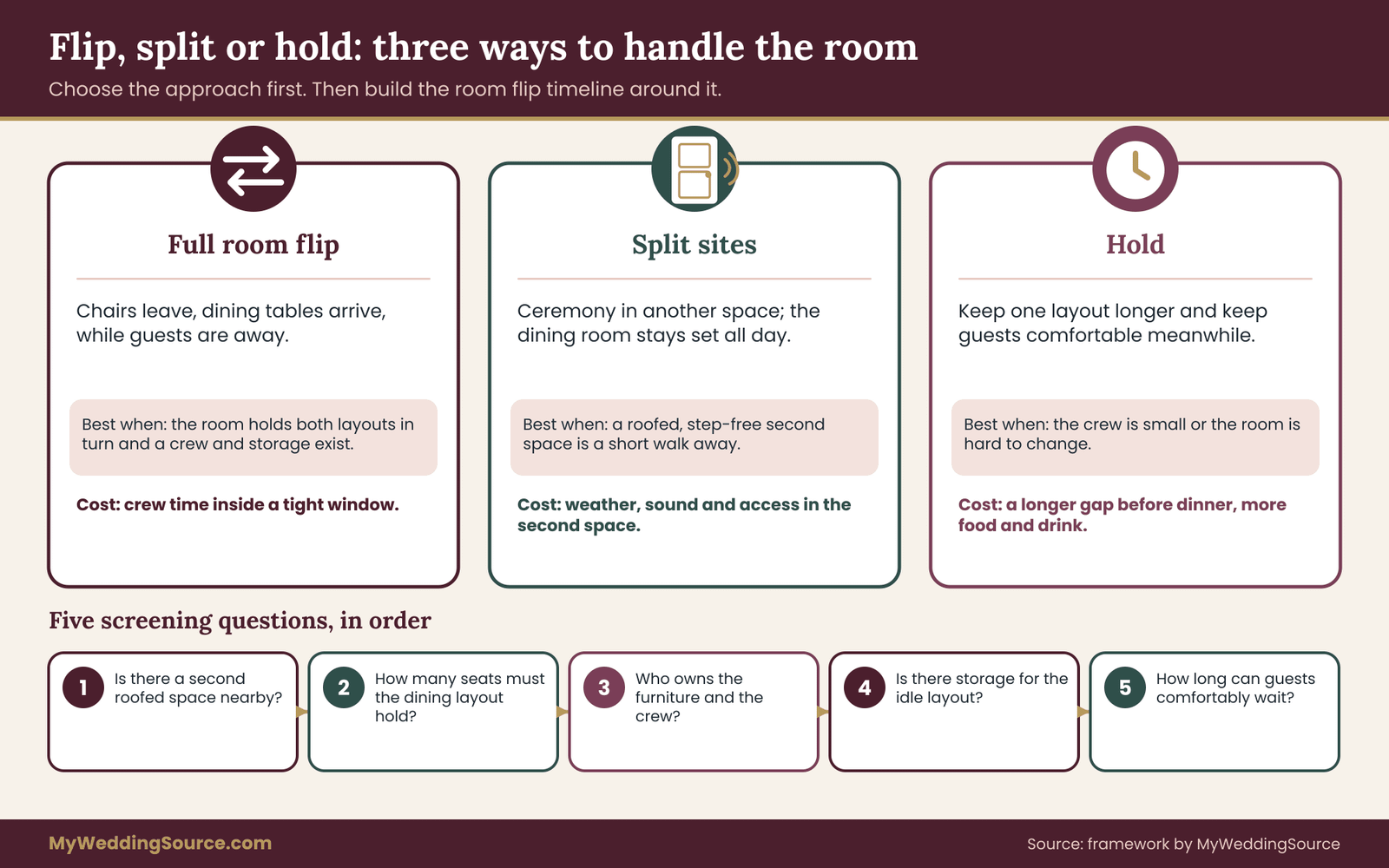
Before building a timeline, check that a room flip is the right approach. There are three basic ways to handle a space that must host a ceremony and a meal, and the right one depends on the room, the headcount and the crew.
The full room flip. Ceremony chairs leave, dining tables arrive, and the whole room changes while guests are away. This works when the room is large enough to hold both layouts one after the other and the venue has a crew and storage space for the furniture that is out of use.
The split. The ceremony happens in a different space, such as a garden, a terrace, a lobby, a side room or a lawn, and the dining room stays set the whole time. There is no room flip at all, only a transfer of guests. This is the most reliable approach and usually the first one to ask about. The cost is that you must manage weather, sound and access in the second space.
The hold. The room stays in one layout for longer, and guests are kept comfortable in the meantime, by a long cocktail hour, a receiving line, a photo session or a seated cocktail period. A hold trades time for certainty. It makes sense when the crew is small or the room is difficult to change but the guest list can tolerate a longer gap.
There is also a hybrid that many venues quietly prefer: a partial room flip. The ceremony uses only part of the room, perhaps the front third, so that most tables can be pre-set behind a divider or screen. When the ceremony ends, only the ceremony zone changes. That shrinks the room flip from the whole room to a fraction of it. Ask about it if your room is wide and your guest count is modest.
A quick screening of the three approaches
Ask five questions in order. Is there any second space with a roof and a decent floor within a short, step-free walk? If so, price the split first. If not, how many guests will sit at once, and how many tables will the dining layout need? A hundred guests at ten round tables is a different job from two hundred and fifty at twenty-five. Does the venue own the furniture and the crew, or does a rental company deliver both?
Is there a place to store ceremony chairs out of the way for an hour? And how long can your guests comfortably wait? The answer to the last one is not infinite, and it differs for an older family, a group with small children and a group that is mostly friends in their twenties.
If the answers point to a full room flip, the next step is to decide who does the work. That is where most plans quietly break, so it comes first.
Who owns each job in a room flip
The usual failure in a room flip is not slowness. It is a gap in ownership. The rental company delivered the chairs and assumes the venue will move them. The venue assumes the rental company will. The caterer sets tables but did not agree to place them. The florist expects someone to carry the arch out of the way before she can begin on the centerpieces. Everyone is willing, and nobody is assigned.
The fix is to name three roles for every task, and to name them in writing before the wedding.
The owner decides how the task is done and answers for the result. One person, one company.
The doer is the crew that physically performs it. Often the same company as the owner, but not always.
The checker confirms it is finished correctly before the next task depends on it. Usually the venue site manager, the coordinator or a captain.
For a task like “strike ceremony chairs,” the owner might be the rental company’s delivery lead, the doers its four-person crew, and the checker the venue’s banquet captain, who confirms the floor is clear and the chairs are stacked in the approved storage spot. Nothing exotic, but written down it removes a surprising amount of argument.
The cast of characters
Weddings vary, but most room flips involve some version of these roles. Not every wedding has all of them, and one person sometimes wears two hats.
The venue site manager or banquet manager. Controls the building, the rules and often the house labor. Usually the final checker, and the person who can say yes to a change in the layout or the schedule.
The house crew or banquet staff. Venue employees who set and strike furniture they own. Their availability, hourly cost and any overtime thresholds are in your venue agreement, not in the vendors’ contracts.
The rental company crew. Delivers, sets and sometimes strikes chairs, tables, linens and dance floors. Ask what the rental price includes. Delivery and pickup are common; a mid-event move often is not.
The caterer’s captain and servers. Own food and beverage setup: place settings, glassware, bars, service stations. They may be willing to do more, and they may also refuse anything that falls outside their quote.
The florist or décor team. Own the movement and reuse of florals, aisle décor and any arch or backdrop that appears in both layouts.
The coordinator or day-of lead. Holds the master timeline, runs the checkpoints and makes the calls when something slips. If you have no coordinator, this role still exists. It simply lands on someone else, which should be chosen deliberately rather than by accident.
The DJ, band or AV tech. Owns sound equipment and sometimes lighting, and needs a defined window to move from ceremony audio to reception setup.
The photographer. Not part of the labor, but part of the schedule. Their needs for the empty room, for family photos and for the first look at the reception layout affect when work can begin.
For a wider view of how the vendors around the day connect, the wedding vendor timeline sets out the usual order of contact and deadlines. Use it alongside this guide, not instead of it.
Finding out who the contract says does the work
Start with the documents, because they answer most ownership questions faster than a meeting does. Pull four of them: the venue agreement, the rental or furniture order, the catering contract and any décor or floral proposal. In each, search for the words “setup,” “strike,” “turn,” “reset,” “flip,” “labor,” “overtime” and “storage.”
You are looking for three things. First, who is described as moving furniture between layouts, and whether that is a listed service or an assumption. Second, any labor charges: an hourly rate, a minimum number of hours, a per-person fee for staff beyond a certain headcount, or a surcharge for work between certain times. Third, any limits: a rule that vendor crews may not use the venue’s service elevator during dinner service, a requirement that only the venue’s staff may move venue-owned furniture, or a cap on the number of outside workers allowed in the room at once.
The wedding vendor contract guide explains how to read these agreements in general. For the room flip, the most useful habit is to highlight every line that says who, and every line that says when, and to list the gaps afterward.
Closing the gap in writing
When a task has no owner, do not assume the answer. Send a short written question to the venue manager and the vendor involved, in plain language, and ask for a written reply. An example:
“We plan to move from a ceremony layout to a dinner layout between 4:50 and 6:00. Can you confirm in writing who will remove the ceremony chairs, who will place the dining tables, and whether there is a labor charge for either?”
Notice what that message does. It states the window, asks about named tasks, and asks about cost in the same breath. It is short enough to be answered in a reply, and a reply is a record. If two parties give two different answers, you have found the gap while there is still time to resolve it.
Three common ownership gaps
Some gaps show up so often that it is worth checking for them directly.
The ceremony décor that has to travel. An arch, a set of pedestals, an aisle runner or a signing table has to be moved somewhere before dinner. If the florist installed it, the florist may assume it stays until the end of the night. If the venue wants the space clear, it needs to move. Decide where it goes, who moves it, and whether any of it is reused as a reception centerpiece or photo backdrop.
The chair itself. Ceremony chairs and dining chairs are sometimes different. If the rental company brought both, does anyone remove the ceremony ones from the room, or do they simply stack them in a corner? If they are venue chairs, are there enough dollies and is there storage? Count chairs in both layouts. A mismatch of even ten is a task nobody planned for.
The final walk. Someone has to look at the finished room and say it is ready. If the caterer says the venue will, the venue says the coordinator will and the coordinator is outside greeting guests, the room opens unchecked. Name a checker, name a backup, and put both in the timeline.
Labor cost and who pays for what
Labor is the quiet line in a room flip budget. Venues may include a basic setup and a single flip in their package and charge for more, or they may charge by the hour from the first chair to the last. Rental companies may include delivery and pickup but quote a second visit separately, as the wedding rental planning checklist points out when it lists what a rental order should state.
Caterers may include the staff needed for service but bill for additional hands during setup. When asked, many are glad to give a specific number, and a specific number is better than “it depends.”
When you compare quotes, compare the same unit, such as total flip labor for the stated window, rather than hourly rates alone. A lower hourly rate with a four-hour minimum can cost more than a higher rate with a one-hour minimum. If the price is hourly, ask what happens if the room flip finishes early and what happens if it runs over.
Also ask whether crew size can be increased for the room flip window alone, for example from four people to six, and what that adds. The worked example later in this article shows how a two-person increase can be worth more than ten extra minutes of cocktail hour.
Union, house labor and other special rules
Some venues, especially hotels, convention-style halls and certain historic buildings, require that specific work be done by their own staff or by a particular labor arrangement. You may not be allowed to bring your own crew to move venue furniture, even if you would pay them. Ask early, because the answer changes the whole flip plan. If the rule is strict, your job shifts from choosing who does the work to confirming the venue has enough hands for the window you need.
Writing the ownership down
When the ownership questions are answered, put them in one place. A simple page with a line per task, listing owner, doer and checker, is enough. Share it with every party who appears on it, ask each to reply with “confirmed” or a correction, and keep the replies. A page like this is not elaborate. It is the thing everyone will point to at 5:10 on the wedding day when someone asks “whose job is this?”

One more point on ownership concerns authority, not labor. Decide in advance who can approve a change to the plan on the day. If the florist wants to move a centerpiece, if the venue manager suggests removing the head-table riser, or if the DJ asks for ten more minutes, one person should say yes or no. In most weddings that is the coordinator, with the venue manager holding a veto on anything that affects safety or the building. Telling the couple at 5:20 that a decision is waiting for them is exactly what a good room flip plan avoids.
Breaking the room flip into tasks you can time
Once ownership is clear, the next step is the ledger: a complete list of the tasks that turn one layout into the other. A room flip that is described in a sentence cannot be timed. A room flip described in thirty lines can, and the exercise often reveals tasks nobody had mentioned.
Build the ledger from two floor plans. Get the ceremony layout and the dining layout as drawings or even photographs of sketches. Hold them side by side and walk through the room mentally, zone by zone. Whatever exists in one layout and not the other is a task. Whatever exists in both but in a different place is also a task.
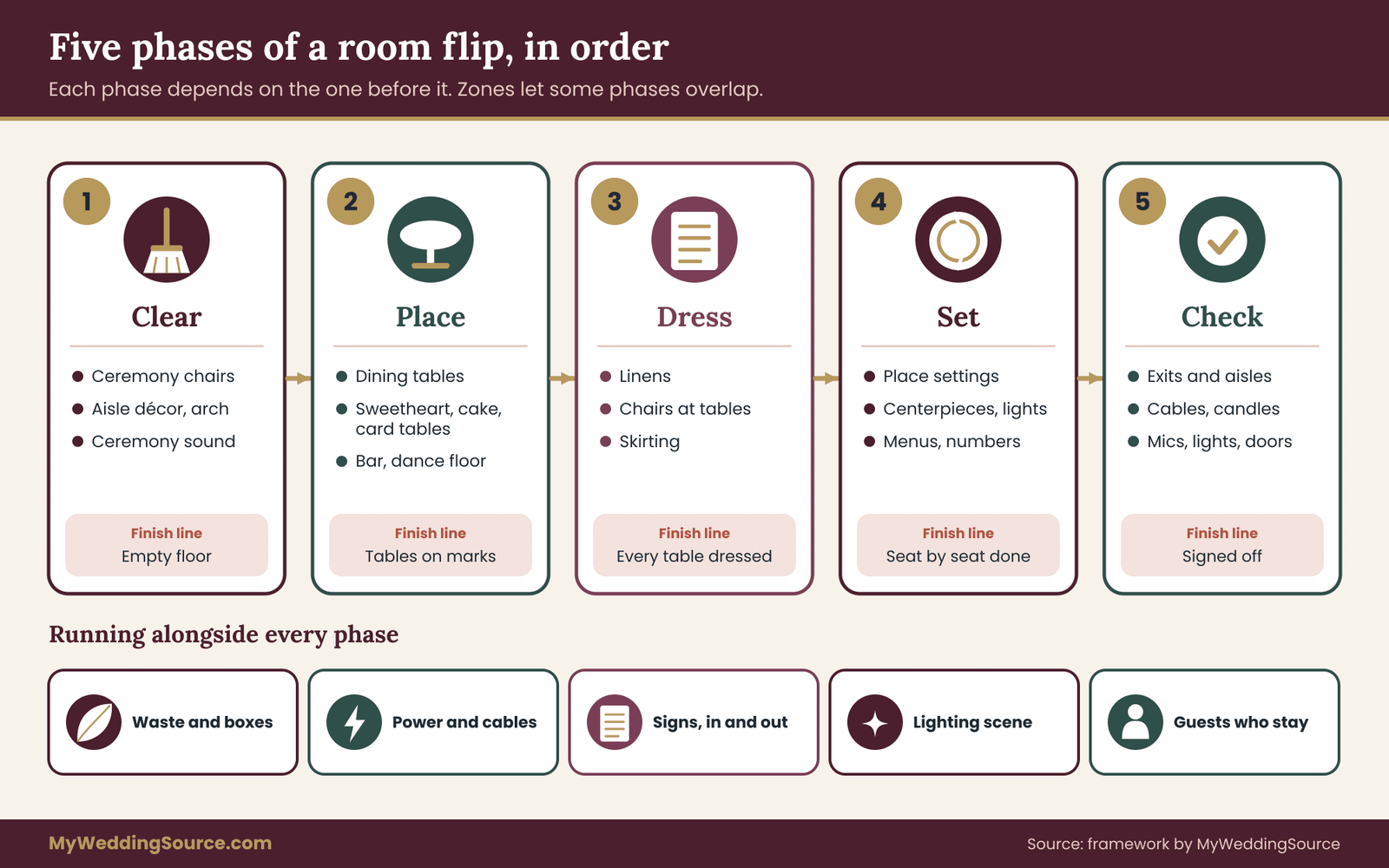
The five phases
Most flips follow the same order of operations. The names differ from venue to venue, but the logic is stable.
Phase one: clear. Ceremony chairs, aisle décor, the arch or backdrop, the officiant’s table, any sound equipment used for the ceremony alone. The goal is an empty floor. Nothing else can start in a zone until it is clear.
Phase two: place. Dining tables, the head table or sweetheart table, the cake table, the gift and card table, the bar if it is moving, the DJ or band setup, the dance floor. These are the large objects. Their positions are marked on the floor plan and, if possible, on the floor itself.
Phase three: dress. Linens, chairs at tables, skirting on the cake and gift tables, chair covers if any. Dressing is faster than placing, but it depends on placing being done.
Phase four: set. Place settings, glassware, menus, place cards, centerpieces, candles or lights, table numbers, favors. This is usually the longest phase because it is per-seat work and scales with headcount.
Phase five: check. Walk the room, confirm exits, aisles and egress paths are clear, test microphones and lights, verify that anything with a flame or a plug is placed as approved, adjust anything crooked, and open the doors.
A sixth phase is quietly running the whole time: moving the displaced ceremony items to storage or to the next place they are needed, and bringing in whatever the reception needs from storage, loading docks or a vendor van.
Writing each task so it can be timed
A good task line has five parts: a verb, an object, a quantity, a location and a finish condition. “Set tables” is not a task line. “Place fourteen round tables on the floor marks, level, and stand them with the seam toward the wall” is one. The quantity is what lets you time it, and the finish condition is what lets the checker sign it off.
Here are examples of how a vague line becomes a usable one.
“Clear the ceremony” becomes “Remove 140 ceremony chairs to the south storage alcove, stacked in fours, leaving the aisle zone free of debris.”
“Do centerpieces” becomes “Place fourteen centerpieces and one sweetheart arrangement on dressed tables, centered, with no stems over eye level.”
“Check the room” becomes “Walk all egress paths and confirm each exit door opens freely, that nothing blocks an aisle, and that candle and cable placement matches the approved layout.”
This level of detail feels fussy until the day, at which point it saves arguments.
The zone method
For a larger room, divide the floor into zones and treat each as a mini room flip. A rectangular ballroom might have a front zone near the ceremony focal point, a middle zone and a rear zone near the doors. The ceremony chairs may occupy the front and middle zones while the rear stays free for early work.
If the rear is free from the start, tables can be placed there while the front is still clearing. Zones turn what looks like a strict sequence into partial overlap, and overlap is the main tool for shrinking a room flip without adding people.
A caution: overlapping work in a room where guests might wander back is a safety question. Decide with the venue how to block the doorways, who stands guard and what the signal is that the room is open. Do not let overlap become an excuse for work being done near people who are not wearing the right shoes or paying attention.
Tasks people forget
After building a ledger, read it again with these in mind, because they are the lines that most often go missing.
Power and cables. Ceremony audio may run on one set of cables and the reception on another. Someone has to move, cover or tape cables, and the electrical placement has to match what the venue approved.
Signs and directional pieces. Ceremony programs, unplugged-ceremony signs and welcome signs often need to be removed, while table numbers and the seating display need to appear. Sort them into ceremony signs, which leave, and dinner signs, which arrive.
Trash and recycling. Flowers drop petals, aisle runners shed, boxes come out and packaging goes in. If there is nowhere for waste to go during the room flip, it ends up behind a curtain until the end of the night.
The aisle runner and its tape. Easy to underestimate. Pulling up tape from a good floor can take a surprising amount of care, and a venue may have rules about what adhesive is allowed.
Water and ice. Glasses, pitchers and bar setups need supply, and the route for it must not cross the zone where something else is happening.
Lighting changes. Some rooms use one lighting scene for ceremony and another for dinner. Someone has to set it, and often it is the only task that requires a specific person with access to the panel.
Accessibility. If your ceremony layout included a reserved space for a wheelchair or a mobility device, the dining layout must also have one, and the path to it must remain clear. The accessible wedding venue red flags article explains how to spot access problems before they become day-of issues.
People. A grandparent who stays seated in the ceremony room because stairs are a problem is a person the room flip must work around. Decide in advance where such guests will wait, who will keep them company and how they will rejoin the group.
Marking the ledger with dependencies
When every task has a line, mark each with the tasks it needs finished first. This takes five minutes and exposes the shape of the room flip. Chairs cannot be stacked before they are free of the aisle. Dining tables cannot be leveled in a zone until it has been cleared. Linens depend on tables. Place settings depend on linens. Centerpieces depend on settings, or at least on a dressed table. The final check depends on everything.
You may find that many tasks have only one or two prerequisites. Those are your flexible tasks, the ones that can slide earlier or later without affecting the end time. Others, like the strike of the first rows, are rigid, because everything waits on them. This distinction, which sounds academic, is exactly what the critical path section later uses to decide where a delay would hurt and where it would not.
Splitting the ledger by crew
The final step in the ledger is to assign each task to a crew and count how many people each crew has. A crew of four people is not four times faster than a crew of one on every task. Some work, like carrying a long table, needs two people regardless. Other work, like setting chairs around tables, scales almost linearly. Some work, like a lighting cue, does not scale at all. Note which tasks are which, because the question “what happens if we add two people?” has different answers for different lines.
By this point you have, on one or two pages, a complete description of the room flip: what changes, who does it, in what order, with what dependencies. What you do not yet have is how long any of it takes. That is the subject of the next part, and it is the part couples skip most often.
Timing tests: how to measure a room flip before the wedding day
A duration written in a plan is only as good as its source. There are four possible sources, and they differ in how far you can trust them.
A measured test. Someone actually performed a small version of the task with the real equipment, and you recorded the time. This is the most reliable.
A vendor’s written estimate from their own experience. Reliable when the vendor has done flips in this exact venue, less so when they have not.
The venue’s records of similar events. Venues that hold weddings regularly know how long their crew needs for a standard flip. Ask for it, and ask what room size and guest count that figure assumed.
A guess. Allowed, but you must flag it and give it extra margin.
The goal of a timing test is to replace guesses with measurements for the tasks that matter most. You do not need to test everything. You need to test the long tasks and the ones with the most uncertainty.
Which tasks deserve a test
Rank tasks by two things: how long they are likely to take and how unsure you are. A task that takes two minutes and that everyone agrees about needs no test. A task that takes twenty minutes and that three people estimated differently needs one. In most weddings the tasks worth testing are chair strike and set, table placement, linens, place settings and any lighting or audio changeover.
How to run a small test
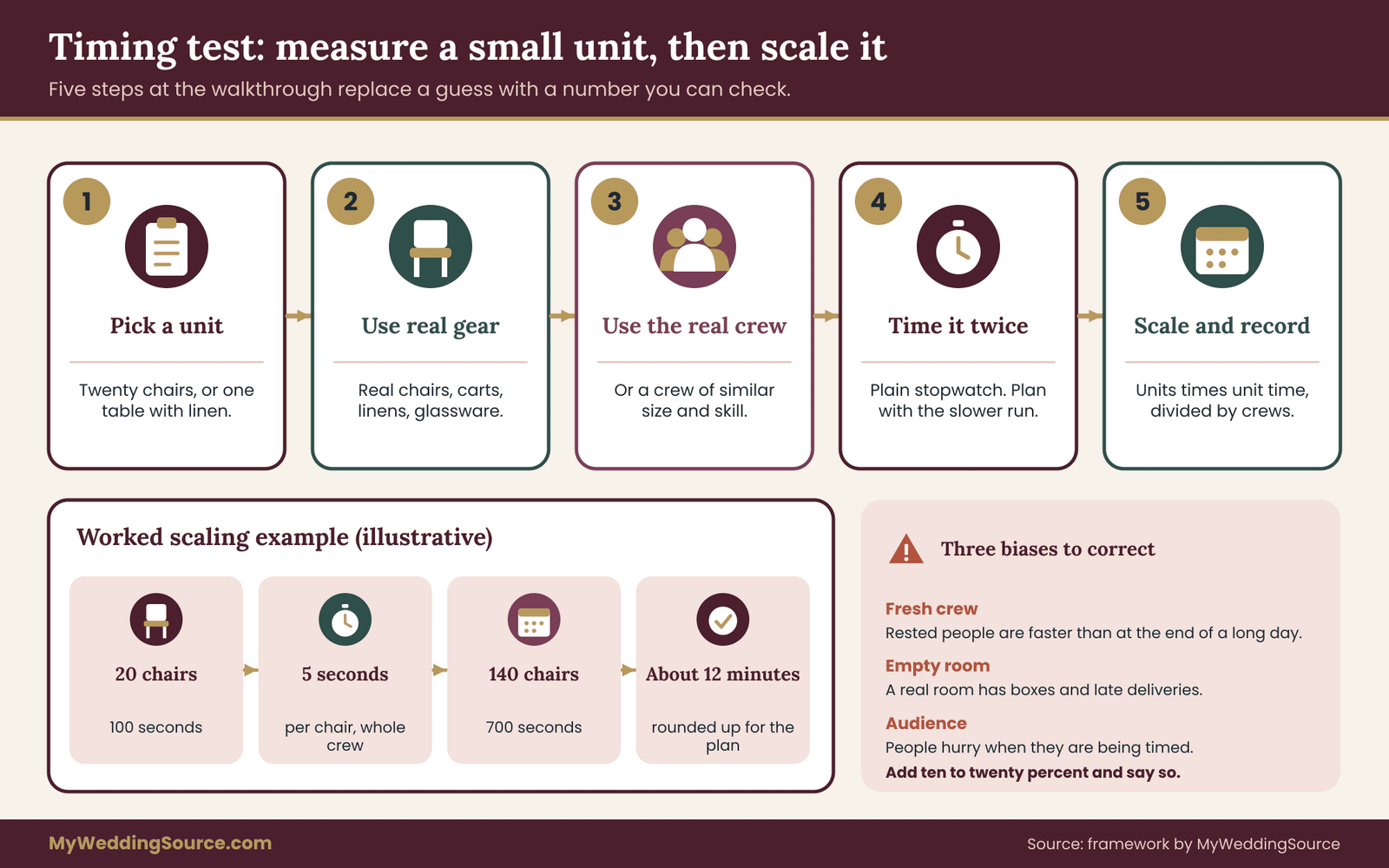
The method is simple. Take a small sample of the real task, perform it at normal working pace with the people who will do it on the day, time it, then scale up with arithmetic.
Step one: pick a unit. A unit might be twenty chairs, one round table with its linen, or one place setting for ten guests. The unit should be small enough to run in a few minutes, and big enough that start-up effects do not dominate.
Step two: use the real equipment. Real chairs, real dollies, real linens, real glassware. A test with the wrong gear measures the wrong thing. If the real chairs are stackable and heavy, a test with folding chairs from a closet will be too fast.
Step three: use the real people if you can. The crew that will work on the day is best. If not, a crew of similar size and skill. If the venue’s crew cannot spare an hour at a site visit, ask them how long a unit usually takes and note that it is a reported figure and not a measured one.
Step four: time with a plain stopwatch. Start when the first person picks something up and stop when the checker would sign it off. Do the unit twice. If the second run is much faster than the first, use the slower figure for planning, since the first run is closer to what will happen under pressure.
Step five: scale and record. Multiply the unit time by the number of units, divide by the number of crews working at once, and write the result in the ledger with a note on how it was derived.
A worked scaling example
Suppose a test shows a crew of four striking twenty chairs in one minute forty seconds. That is 100 seconds for twenty chairs, or five seconds per chair for the whole crew. For 140 chairs the arithmetic gives 700 seconds, about eleven minutes and forty seconds, which a planner rounds up to twelve.
Now suppose the rental company can send six people instead of four. If the work scales roughly in proportion, the same job takes about eight minutes. The word “roughly” matters. Six people sharing one narrow doorway get in each other’s way, so check whether the extra hands have room to use.
The same logic applies to tables. If one pair places and levels a round table in ninety seconds, and the plan has fourteen rounds, one pair takes twenty-one minutes. Two pairs take about eleven. Three pairs take about eight. The figures are illustrations of method, not benchmarks for your venue.
The testing visit
The best time for a flip test is the walkthrough you already planned, with the people you already invited. If your site visit is the one described in the venue technical walkthrough guide, add a few extra minutes at the end for the timing units. If that visit is already past, ask whether the venue manager can arrange a short test with the house crew at a quiet time, or whether the rental company can time one unit at its warehouse.
Some venues will not allow a test inside the room because another event is using it. In that case a warehouse test still tells you how long the unit takes, and a floor plan check tells you how far the equipment travels. Add the travel time separately, since it is easy to miss. Measure or estimate the walking distance from the storage area to the room and from the room back, then divide by a realistic pace with a loaded cart. A long corridor with one narrow door can add more minutes than the task itself.
Reading the results honestly
A single test is a point, not a range. Two or three runs are better, and the spread between them tells you how uncertain the task is. If five runs give a spread of ten percent, the task is steady. If the spread is forty percent, the task is fragile, and it deserves a larger share of the buffer later on.
Be wary of three biases. The first is the fresh-crew bias: a test done at the start of the day, with rested people, is faster than the same work at the end of a long event day. The second is the empty-room bias: a test in an empty room is faster than a room flip in a room full of wedding décor, boxes and last-minute vendor deliveries.
The third is the audience bias: people work faster when they know they are being timed. Adjust each way. A simple rule is to add ten to twenty percent to every tested time and say so in the ledger, so the number is honest and the reader knows where the margin is.
What to do when you cannot test
Sometimes you cannot test at all. The venue is booked, the vendor is out of town, the wedding is two weeks away. Then ask for estimates from each owner, in writing, and ask three questions of each. What did you assume about crew size? What did you assume about the room? And what is the longest this has taken you? The third answer is more useful than the first, because it shows the tail of the distribution.
Compare the estimates against each other. If the rental company says chairs take ten minutes and the venue says twenty, the gap is information. Ask both what they assume. The difference is often a hidden assumption, such as where the chairs are stored or whether the aisle runner has to come up first.
Recording numbers so they can be checked
In the ledger, put the following beside each task: the quantity, the duration, the crew size, the source (tested, estimated by a named vendor, venue record, or guess), and the date of the source. When the wedding is near, review the ledger and ask whether anything has changed since a figure was measured. Headcount changes, a different layout, a new vendor or a new crew leader can all alter a number.
When a test shows the plan does not fit
Sometimes the testing step delivers bad news: the arithmetic says the room flip takes longer than the window allows. That is good news in disguise, because it arrives while there is still time to act. The next part shows how to read the whole ledger, find the chain of tasks that sets the minimum time, and decide how much buffer to hold. Then the question of what to change becomes a clear decision and not a vague worry.
A note on reading vendor claims. A vendor who says “we can flip any room in thirty minutes” is describing their usual experience, not your room. That may be true for a ballroom with pre-staged furniture and a large crew. It is rarely true for a smaller room with limited storage. Treat the claim as a starting point and ask the same three questions: what crew size, what room, what is the longest it has taken.
Also keep your own role clear. You are not asked to become a stopwatch technician. The point is to put the right questions to the right people and to write the answers down. A page of timed units and named estimates, reviewed once, is worth more than a confident verbal reassurance on a phone call a month before the wedding.
The critical path of a room flip and the buffer you protect
With a ledger of timed tasks and dependencies, you can find the number that actually matters: the critical path. It is the longest chain of tasks that must happen one after another. No amount of effort on side tasks shortens it. Only changing the chain, or the crew working on it, does.
Finding the chain
Start at the end. The final check cannot begin until the last centerpiece is down. The last centerpiece cannot go down until its table is set. That table cannot be set until it is dressed, and so on back to the first chair being lifted. Each link is a task that waits on the one before. Add up the durations along the longest such chain and you have the critical path in minutes.
Other tasks run alongside it. While place settings go down, the DJ may be setting up music, the bar team may be stocking and the florist may be staging arrangements. These tasks have slack, meaning they can slip a little without moving the end time. A task that slips beyond its slack joins the critical path and starts to matter. Knowing how much slack each side task has tells you which delays are shrugs and which are alarms.
Here is a simple way to read the ledger. For each task, ask: “If this takes ten minutes longer than planned, does the doors-open time move?” If the answer is yes, it is on the critical path. If no, ask how many minutes it could slip before the answer becomes yes. That number is its slack.
Parallel work is the main lever
Because the critical path is the longest chain, the most powerful way to shorten it is to turn serial work into parallel work. Four common ways to do this:
Zones. Clear and set different parts of the floor at different times, as described earlier.
Crews. Add a second crew that works in a different zone, or on a different phase, at the same time. A venue crew places tables while the caterer’s captains dress the first ones.
Pre-staging. Move work to before the room flip begins. Place settings can be loaded onto bus carts or in lined tubs by table, so that setting is a matter of placing, not assembling. Centerpieces can be staged by table number at the room’s edge. Linens can be folded and labeled by table type.
Removing the task. Some tasks do not have to happen in the window at all. A seating display could be placed in the cocktail area from the start. Programs could be handed out outside the room. Candles could be replaced by LED versions that are placed earlier because they are not a flame.
The last one is the most underrated. Every task you remove from the window is a task that cannot run late. Before adding crew, ask whether the task has to exist in this hour.
The buffer, and why it belongs at the end
A room flip plan that adds up exactly to the window has no room for anything to go wrong, and something always does. A buffer is time you hold deliberately for the unexpected. Two decisions govern it: how big it is and where it sits.
On size, a useful rule of thumb is about one fifth of the critical path, rounded up. A critical path of fifty minutes gets a buffer of ten or eleven. The figure is not a law. It comes from the observation that tasks measured in a test tend to run somewhat longer under real conditions, and that a fifth is a reasonable allowance. If your tests were carefully done with the real crew, you might use less. If many durations are guesses or the crew has never worked together, use more, perhaps a quarter or a third.
On placement, keep the buffer in one block at the end, immediately before the final check, rather than sprinkling a few minutes after every task. A padded task invites the crew to use the padding, and then the buffer is gone before anything goes wrong. A single block at the end is visible to the coordinator, who can watch it shrink against checkpoints and make decisions while there is still some left.
Adding a named slip for the riskiest task
Beyond the general buffer, find the one task with the highest uncertainty and give it its own labeled allowance. If the ledger shows that place settings have the widest spread in your tests, write “settings: plus five minutes if glassware count is short” and note who authorizes that use. The named slip is part of the plan, not a secret reserve. It tells the coordinator what the likeliest problem is and what the pre-agreed response looks like.
Comparing the chain to the window
Now put the two numbers side by side. Critical path plus buffer on one side. The usable window on the other. The usable window is the cocktail hour minus the clearing period at the start and minus the final check at the end, as described in the first part of this guide.
If the first number is smaller, the plan fits. Note the spare minutes, which become your extra margin. If the first number is larger, the plan does not fit, and you have a decision to make before the wedding. The options, in the order most couples should consider them:
- Reduce the chain with parallel work or pre-staging. Costs little or nothing. Try this first.
- Add crew for the room flip window. Costs labor, but it is predictable, and it is often the best value when the chain is made of work that scales with people.
- Remove tasks from the window. Costs a decision about the look of the day. Often cheap.
- Lengthen the cocktail hour. Costs a small amount in food and drink and changes the day’s rhythm, so check the effect on the schedule and on guests.
- Change the layout. A partial room flip, a split between two rooms or a different table layout may reduce the work more than any other change, but it affects the experience most.
- Hold the ceremony in another space. The most reliable, and the most disruptive to the original plan.
Resist the urge to leave the problem unsolved and hope. A room flip that does not fit on paper does not fit on the day.
The cocktail hour is a variable, not a given
Many couples treat the cocktail hour as a fixed hour because it is traditional. It is not. It is a variable you control. A longer cocktail hour gives the room flip more time, and the cost is more passed appetizers and drinks, a later dinner and a tighter evening. A shorter one reduces the cost but squeezes the room flip.
The right figure comes from your window arithmetic and your guests, not from habit. If many guests are elderly or travelling, a long standing hour is hard for them, and the answer might be more seating in the cocktail area rather than a shorter gap.
The guest side of that hour, including where people stand, what they eat and how they are moved from one place to another, is covered in the wedding reception guest flow guide. The two should be planned together, because the number of minutes you can hold guests comfortably is a limit on the room flip.
What else lives on the clock
Several other events want the same hour, and they affect the usable window.
Family photographs. If group photos happen right after the ceremony, in the ceremony room, they delay the start of the room flip. Move them to another place, schedule them before the ceremony, or give them a fixed end time that appears on the room flip timeline.
Wedding party photos. A portrait session in the empty reception room before dinner looks lovely and uses the room at the worst possible time. Ask the photographer for their needs, and decide whether it happens before the room flip, after it or elsewhere.
Sound checks and cue changes. A DJ’s reception check, a band’s line check or a microphone test during the final check can hold up the doors. Give them a slot.
Caterer arrival and service timing. The kitchen needs to know when guests will sit down. If the room flip runs late and nobody tells the kitchen, hot food ages and cold food warms.
The wedding ceremony cue sheet guide is useful for the ceremony side of this handoff, since it sets out who does what at the end of the ceremony and which cue marks the end.
A short checklist for reading your own numbers
Before moving on, check that the following are true.
- The window has a written start, set by when the room is actually clear, and a written end, set by the final check and not by the doors.
- Every task on the critical path has an owner and a source for its duration.
- The buffer is in one block, with a written size.
- The riskiest task has a named slip.
- Someone, by name, can authorize using the buffer.
- The kitchen, the DJ and the photographer have the final times.
If any of those is missing, the plan is incomplete. Fix that first, then move on to what to do when time starts to slip.

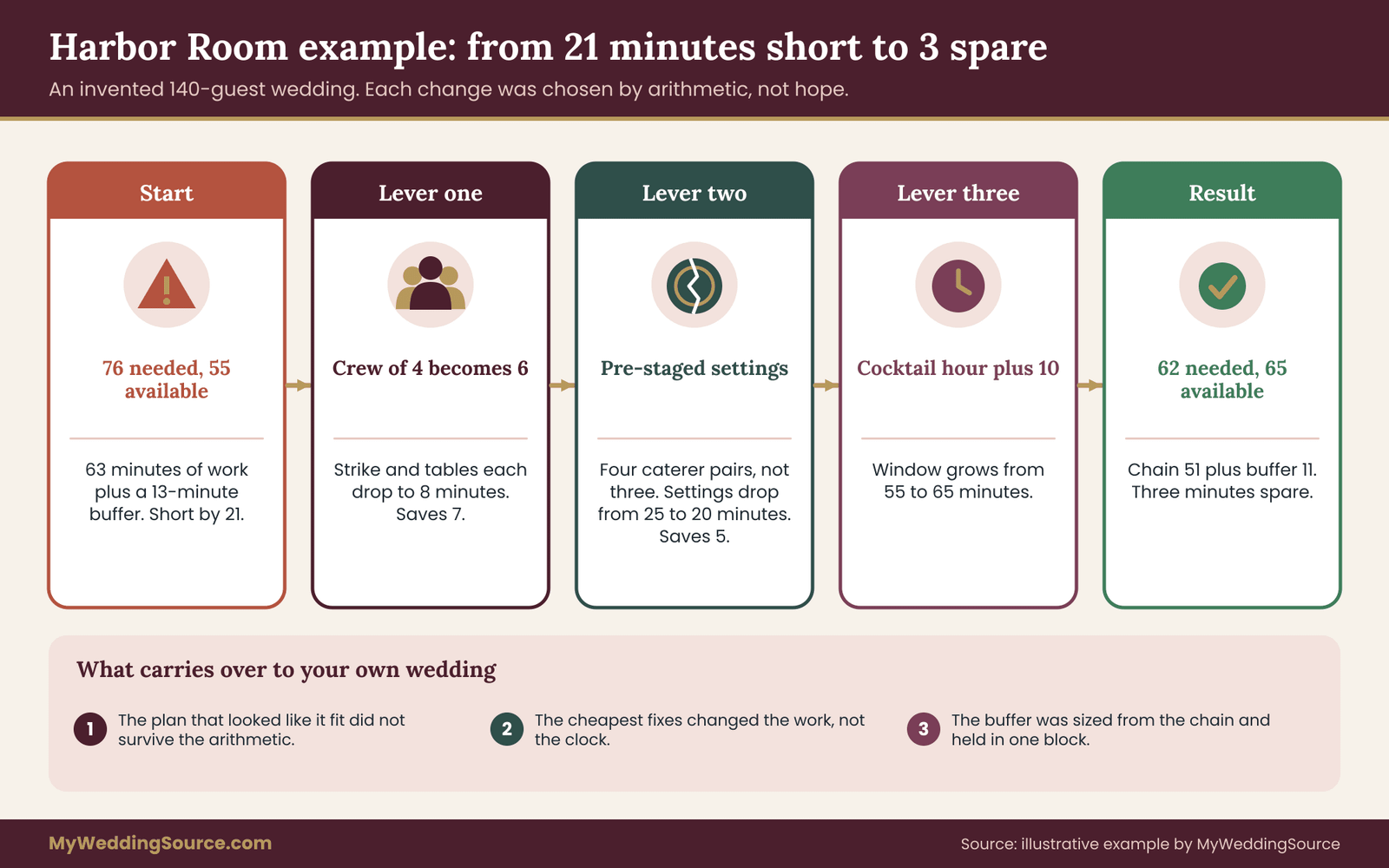
A worked room flip: the Harbor Room example
The following example is invented to show the method. The couple, the venue and every number are illustrative, and your own tests will give different figures. What matters is the sequence of reasoning.
Imagine a couple with 140 guests holding a ceremony and a dinner in the same hall, which the venue calls the Harbor Room. The ceremony ends at 4:40. A photographer wants a few frames of the room and family, and the venue’s rule is that the room must be cleared of guests before work starts, which the coordinator expects to happen by 4:50.
Cocktail hour is planned for one hour in an adjoining lounge, so the dinner doors would open at 5:50, and the venue wants a five-minute final check before that. The usable window is therefore 4:50 to 5:45, which is 55 minutes.
Let us follow the planning in order.
Step one: the ledger and its timings
The ledger has the five phases described earlier. After a short test at a site visit and a call with the caterer, the tested and estimated figures are as follows, with crew sizes in brackets.
Striking 140 chairs, tested at twenty chairs in one minute forty seconds by four people, scales to twelve minutes. Placing fourteen round tables and standing them on marks, tested at ninety seconds per table for a pair, takes eleven minutes with two pairs. Dressing seventeen tables with linen, including the sweetheart table, the cake table and the card table, takes nine minutes for two captains at about a minute per table.
Setting chairs around the tables fits inside that same nine minutes because it runs beside the linens. Place settings, tested at five minutes for a table of ten by a pair, take twenty-five minutes for three pairs. Centerpieces and lights take six minutes.
Step two: the critical path
The chain runs strike, tables, linens, settings, centerpieces. In minutes that is 12, 11, 9, 25 and 6, for a total of 63. Chair setting is parallel to linens and does not extend the chain.
The window is the 55 minutes just described. The chain is already eight minutes too long before any buffer is added. A one-fifth buffer on 63 minutes is 13 minutes. So the plan needs 76 minutes in a window of 55. It is short by 21.
This is the moment the method pays for itself. On the day, the crew would have been told “one hour,” would have worked hard and would have opened the doors about twenty minutes late, with no one having decided anything.
Step three: choosing the changes
The couple and the coordinator go through the options in order.
First, more crew. The rental company confirms that six people are available instead of four for the room flip window, at an added hourly cost they quote in writing. With six people, striking 140 chairs takes about eight minutes, and three pairs placing tables take about eight minutes as well. That removes seven minutes from the chain.
Second, pre-staging. The caterer agrees to load place settings into labeled bus tubs by table before the ceremony and to put four pairs on settings instead of three. Setting drops from 25 minutes to 20. That removes five more.
The chain is now 8, 8, 9, 20 and 6, a total of 51 minutes.
Third, the cocktail hour. A buffer of one fifth of 51 is about 10.2, which rounds up to 11, so the plan needs 62 minutes. The window is still 55. The couple decides to lengthen the cocktail hour by ten minutes, so doors open at 6:00 and the final check finishes at 5:55. The window is now 4:50 to 5:55, or 65 minutes. The plan needs 62 and has three spare.
A couple that preferred not to lengthen cocktail hour might instead have asked for a partial room flip, or reduced settings by moving place cards to the cocktail area. Both options would have been valid. What matters is that the decision was made against numbers, in advance.
Step four: the named slip and the checkpoints
The widest spread in the tests was in place settings, because the caterer’s glassware count could be off. The ledger gets a named slip: if the glass count is short, the caterer’s captain may use up to five minutes of the buffer to resolve it, and must tell the coordinator the moment that happens.
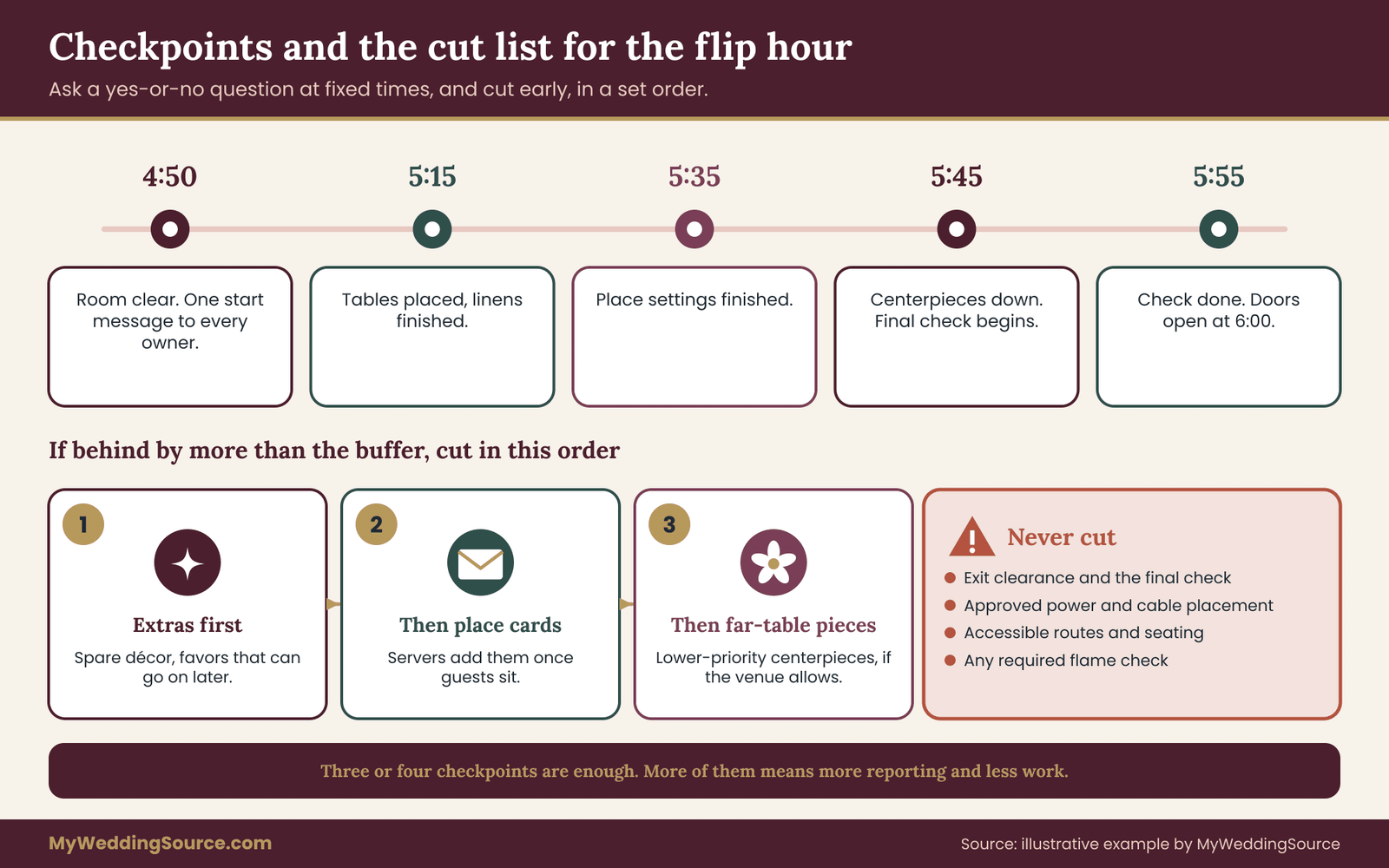
Checkpoints are set at three times. At 5:15, tables must be placed and linens finished, since the revised chain reaches that point at 5:15. At 5:35, place settings must be finished. At 5:45, centerpieces must be on the tables, which the plan reaches at 5:41, and the final check must be about to begin. At each checkpoint the coordinator compares the room to the plan and decides whether the buffer is intact, partly used or gone.
Step five: the written page
The couple does not hold the plan in their heads. The coordinator holds it on a single page, shared with the venue manager, the rental lead, the caterer’s captain and the florist. Each of them replies “confirmed” or sends a correction. By the week before the wedding, the page includes the final guest count, the final floor plan, the confirmed crew sizes and a phone number for each owner.
The example ends there, and it is meant to feel unspectacular. The couple’s work was a few phone calls, a short test and some arithmetic. The wedding day will still have surprises. But the surprises now arrive in a plan with a buffer, instead of a plan with none.
Reading the example for your own wedding
Three lessons carry over. First, the plan that looked like it fit, one hour for a room flip, did not survive the arithmetic. Second, the cheapest fixes were the ones that changed the work, not the clock. Third, the buffer was sized from the chain and held in one place. If your own numbers look different, the method still works: list, time, chain, buffer, compare, decide.
Running the room flip on the day: checkpoints, cut lists and messages
A plan is only useful if someone runs it. On the day, the coordinator, or the person who has been named to act as one, has three jobs: start the clock cleanly, watch the checkpoints and make cut decisions early.
Starting cleanly
The room flip begins when the room is clear, not when the ceremony ends. Before anyone lifts a chair, the coordinator confirms with the venue manager that the room is empty of guests, that the photographer has finished in it, that exits are clear and that the doorways to the cocktail area are staffed. Then a single message goes out to every owner: the time work begins, the time of each checkpoint and the time doors will open. A single, shared start prevents the creeping start that costs ten minutes before anyone notices.
Watching checkpoints
Checkpoints work because they ask a yes-or-no question at a specific time. “Are tables placed and linens begun?” is easy to answer by looking at the room. “Are we on track?” is not. Keep checkpoints to three or four so that people do not spend the hour reporting.
At each checkpoint, the coordinator looks at the room and compares it with the page. Three outcomes are possible. On time: nothing changes. Slightly behind, with buffer left: say so to the owners and keep going. Behind by more than the buffer will hold: use the cut list.
The cut list
Decide in advance what gets cut first, because the worst time to design a cut list is under pressure. Order the list by guest impact, starting with what guests will notice least.
First to go are the extras that add nothing to the meal itself: a second row of décor, table favors that can be placed after guests sit, or decorative pieces that can be added once dinner is served. Next, place cards and menu cards can be set on tables later by a server if the seating chart is on display. Then, centerpieces on lower-priority tables, such as those farthest from the entrance, can be placed after the doors open, if the venue allows servers or florists in the room during seating.
What never gets cut: exit clearance, the final safety check, power and cable placement as approved, accessible routes and seating, and any candle or flame check the venue requires. A late room is a minor problem. An unsafe room is not one to open.
Messages that work under pressure
People under time pressure do not read long messages. Use short, specific, written ones. A few examples:
“5:15 check: tables placed, linens started. On plan.”
“5:35 check: settings at two thirds, about four minutes behind. Using four of eleven buffer minutes. Doors still 6:00.”
“Cut 1 now: place cards will be set by servers after guests sit. Please move on to centerpieces.”
Each message states the time, the status and the action. It is readable in two seconds, and it leaves a record.
Telling the people who are waiting
Guests do not need to know about the room flip, but the people hosting them do. If doors will open later than planned, someone should tell the lounge staff, the kitchen and the DJ early enough for them to adjust: more appetizer rounds, a delayed first course, a longer playlist. A five-minute delay announced at 5:40 is a non-event.
The same delay discovered at 6:00 by guests standing in the lounge is a problem. The couple, meanwhile, should be kept out of it. Their job during the room flip is to eat something, rest for a moment and be ready for the entrance.
After the doors open
The room flip is not finished at the doors. Someone should stay in the room for the first few minutes, since a candle can tip, a cable can loosen or a table can wobble the moment guests lean on it. The venue’s site manager or the coordinator should do a last pass once guests are seated, with the same checklist used before opening. And at the end of the evening, a short note about what took longer or shorter than planned helps the venue and the vendors, and gives you something to compare with if a friend asks for advice.
Safety, access and approvals that shape a room flip
Speed is the goal of a room flip plan, but it must never be bought with safety. The rules that decide what the finished room may look like come from your venue, its insurer and local authorities such as the fire marshal or building department. You are not expected to interpret them. You are expected to ask the venue what they are, in writing, and to build the room flip around the answers.
Egress and capacity
Rooms used for assembly have posted capacities and required exit paths. A dining layout with many round tables can leave narrow paths between them, and a dance floor, a bar and a band riser can reduce the open space further. Ask the venue whether a layout drawing must be approved, whether aisle widths are specified, and whether any exit signs or doors can be blocked by décor.
If an approved drawing exists, give it to every owner and treat it as the reference for the final check. The venue technical walkthrough guide explains how to confirm capacity, exits and clear paths during a site visit.
The final check should always include exits. Walk to each one, confirm the door opens without a key or a lock, and confirm nothing sits within the path to it. Do not let the check be skipped because the hour is running short. If something has to give, it should be a centerpiece.
Accessibility during and after the room flip
A ceremony layout often includes a reserved space for a wheelchair or other mobility device, and an accessible route to it. The dining layout needs the same thing. Count the accessible seating positions and spaces at the tables, check that routes between tables remain wide enough, and confirm that nothing blocks a ramp or an accessible entrance.
The U.S. Department of Justice publishes information on how the Americans with Disabilities Act applies to places of public accommodation, and the Access Board publishes the technical standards. Use them as reference points when asking the venue what its room can do, and ask the venue about its own policies for temporary event layouts.
If a guest will need extra time or a quiet place during the room flip, arrange it before the day. A short written note to the venue and a named host for that guest solves most of it.
Flames, power and equipment
If your ceremony or reception uses candles, ask the venue what is permitted and who may light and extinguish them. Many venues prohibit open flame or limit it to enclosed containers, and many require that a named person stays responsible. Electric candles and battery lights remove the question and often remove a task from the window, since they can be placed earlier.
For power, confirm which outlets and circuits may be used for audio, lighting and any other equipment, and who is allowed to connect them. Cables across walkways should be covered or taped, as a trip hazard in a room full of guests in dress shoes is a real risk. If extension cords are used, ask what the venue allows. When in doubt, the venue’s electrician or site manager is the person to ask, not a vendor’s assumption.
Lifting, carts and crew safety
The people doing the work are at risk too. Chairs, tables and heavy décor can injure a crew that is hurrying, and a crew working against a clock is more likely to cut corners. The Occupational Safety and Health Administration publishes general guidance on safe lifting and on keeping work areas clear. You do not need to supervise it. You need to avoid designing a plan that depends on people rushing. A plan with a buffer reduces the pressure to hurry, and that reduces risk as well as lateness.
Written approvals worth collecting
Before the wedding, gather in one folder: the approved floor plans for both layouts, written confirmation of capacity, written rules on flame and power, the venue’s list of what outside crews may and may not do, and the name and phone number of the person with authority to approve a change on the day. When someone asks “is that allowed?” the answer is then a page, not a debate.
Costs, contracts and the questions to ask before you sign
A good room flip plan is cheaper to build than to repair on the day. Costs come from four places: labor, extra time, extra equipment and changes in layout. None needs an invented figure here. Your own quotes and your own venue contract hold the real numbers, and the right move is to ask for them clearly.
What to ask the venue
Ask whether a room flip is included in the rental fee, how many staff are included, what the hourly charge is beyond that, whether there is a minimum, whether overtime applies after a certain hour, and whether a storage area is available for the furniture out of use. Ask what the venue’s own record shows for the time a room flip takes in this room for a similar headcount. Ask whether a second room is available during the ceremony, at what price, and whether it can hold guests during the room flip.
What to ask rental and catering vendors
Ask the rental company whether the quote covers moving furniture inside the room at a set time, or only delivery and pickup. Ask what crew size is included and what an added crew member costs. Ask whether the room flip is a single visit or two. Ask the caterer whether staff will set tables, what time the kitchen needs the room ready and whether pre-staging place settings is possible. Ask each for the answers in writing.
What to change in contracts
If a contract is silent on the room flip, add a line before you sign, not after. Something simple works: the vendor’s crew will perform specified tasks between specified times, with a stated number of people, for a stated fee. Do not rely on a verbal promise. A good venue or vendor will not object to writing down what they already plan to do, and the exercise often brings up a mismatch that is much easier to settle early.
Buying time versus buying hands
When the plan is too long, the two cheapest levers are usually more crew and a longer cocktail hour. They cost differently. More crew costs labor for a short window and has no effect on the guests. A longer cocktail hour costs food and drink and changes the evening. Compare them using your own quotes. In some weddings a few more people for an hour is cheaper than another round of appetizers for the whole room, and in others the reverse is true. The arithmetic, not a rule of thumb, decides.
Edge cases: outdoor, split sites, small rooms and rain
Not every wedding fits the ballroom pattern, and the method flexes.
Outdoor ceremony, indoor dinner. There is no room flip, but there is a transfer: chairs outside may need to be stacked, aisle decorations may be reused inside, and guests must move. The timing question becomes how long guests walk and wait, and the labor question is who moves the décor. The rain plan then matters more than the sunny plan, because a rain move turns a transfer into a room flip with less notice.
Tent weddings. A tent often hosts both ceremony and dinner. The room flip happens in a space with a grass or temporary floor, limited storage and no walls to hide work. Ask the tent company about pace, flooring and lighting, and give extra thought to power and lighting changes.
Ceremony at one site, dinner at another. No flip at all, but the travel time between the sites is the room flip window, and the dinner site has its own setup that must be finished before guests arrive. The same ledger logic applies to the second site.
Small rooms and small guest lists. A room with fewer than fifty guests may need only a short reset of a few chairs and a table or two. Even so, name an owner, because a short job with no owner is still late.
Last-minute headcount changes. Ceremony and dining headcounts can differ, since some guests may attend only one. The room flip depends on the dining headcount for tables and the ceremony headcount for chairs, so confirm both near the date and update the ledger.
Delays outside your control. A ceremony that runs long, a late-arriving vendor or a storm can all shorten the window. The buffer and the cut list exist for exactly these. Review them with the coordinator the week before and again on the morning, so everyone knows the plan has room to absorb a small hit.
Venues with a very short turnaround. Some venues schedule another event in the room soon after yours. If the room must be fully cleared by a fixed time, build the end-of-night strike into the same ledger, with the same method.
Your next steps
Work through these in order. Each takes a short time, and together they turn a vague hope into a plan.
- Decide whether you need a room flip at all, or whether a split, a hold or a partial room flip would reduce the risk.
- Collect the venue agreement, rental order, catering contract and décor proposal, and highlight every line about setup, strike, labor and storage.
- Write the ledger from the two floor plans, with quantities and finish conditions.
- Name an owner, a doer and a checker for every task, and ask each to confirm in writing.
- Run or request timing tests for the long and uncertain tasks, and record the source of every duration.
- Find the critical path, add a buffer of about one fifth in one block at the end, and compare the total with the real window.
- If it does not fit, change crew, order, tasks or cocktail hour length, using your own quotes to compare the options.
- Set three or four checkpoints, write the cut list, and agree who can authorize using the buffer.
- Collect written approvals for layout, capacity, flame and power, and share the final page with everyone who appears on it.
- Review the numbers the week before and the morning of the wedding.
FAQ
How long does a wedding room flip usually take?
It depends on the room, the headcount and the crew, so no single figure is reliable. Many venues quote somewhere between thirty minutes and an hour and a half. The only trustworthy answer comes from your own task list, a short timing test and the venue’s record for similar events. Ask for that record in writing, together with the crew size and room size it assumed.
Who is responsible for flipping the room, the venue or the vendors?
The contracts decide, and they are often silent. The venue usually controls its own furniture and staff, while the rental company or caterer may only be paid to deliver or to serve. Ask each party in writing who will clear chairs, place tables and dress them, and whether any labor fee applies. A named owner for every task closes the gap.
Can a room flip be done during a one-hour cocktail hour?
Sometimes, but not by default. The usable window is shorter than the hour, because guests need time to leave the room and the venue needs time for a final check. Compare the sum of your critical path and buffer with that window. If it does not fit, add crew, reduce tasks, pre-stage items or lengthen cocktail hour.
What is a critical path in a room flip?
It is the longest chain of tasks that must happen one after another, such as clearing chairs, placing tables, dressing them, setting them and checking the room. Side tasks like sound setup have slack. Finding the chain tells you which delays move the opening time and which do not, and it shows where extra crew will actually help.
How much buffer should I leave in a room flip timeline?
A common starting point is about one fifth of the critical path, rounded up, held in one block just before the final check. Use more if many durations are guesses, if the crew has not worked together, or if the room is awkward. Name one person who may approve using it, and tell the kitchen and DJ the final times.
Is it better to hold the ceremony in a different room?
A separate ceremony space removes the room flip entirely and is usually the most reliable option, though it brings its own questions about weather, sound, access and guest movement. Price it alongside a full room flip and a partial room flip. The best choice depends on your venue, your headcount and how long your guests can comfortably wait.
What should be cut first if the room flip runs late?
Cut what guests notice least and what does not affect safety: extra décor, favors that can be placed later, then place cards that servers can add once guests sit. Never cut exit checks, approved power and cable placement, accessible routes or any required flame check. Agree on the cut list before the day, not during the hour.
Do I need a coordinator to run a room flip?
You need someone who holds the timeline, watches the checkpoints and can approve changes. A professional coordinator does this well, but a venue manager or a trusted friend with a written plan can also do it. Avoid making it the couple. They should rest, eat and be ready for the entrance while someone else runs the clock.
Sources
- ADA.gov, Title III: public accommodations and commercial facilities
- U.S. Access Board, ADA Accessibility Standards
- Occupational Safety and Health Administration (OSHA)
- National Fire Protection Association (NFPA), codes and standards
- U.S. Fire Administration, FEMA
- Consumer Product Safety Commission (CPSC)
- National Weather Service
- Federal Trade Commission, consumer advice
- U.S. Department of Energy, energy safety guidance