

Wedding veil traditions are not one custom with regional accents but many separate, living practices, each with its own reasons, vocabulary, and room for family choice, so the respectful way to honor or borrow one is to learn the specific tradition before you copy its look.
Quick answer
Across the sources we read, wedding veil traditions cluster into a few families: a veil that covers the face and is lifted at a set moment (Jewish bedeken, the Chinese honggaitou, the Japanese wataboshi), a head covering worn out of respect in a place of worship (a Sikh bride’s dupatta in the gurdwara, a Catholic or Orthodox woman’s lace covering), a veil that belongs to a married woman’s life in some communities (the South Asian ghunghat), and ornate textiles that protect or announce a bride (Amazigh, Tunisian Bedouin, and Central Asian pieces held in museums). Almost every source stresses that practice varies by family and community. If you want to include one, ask the people who own the tradition, learn what it means to them, and choose an adaptation they would recognize as respectful. For the Roman, Victorian, and museum-lace story behind the Western veil, see our guide to wedding veil meaning and history.
Wedding veil traditions are living practices, not one story
The phrase “bridal veil” makes people picture a single object, usually white tulle on a long comb. Around the world the same word covers a red square of silk, a white cotton hood, a lace shawl on a tall comb, a scarf drawn over the hair in a house of worship, and a cloth that a groom lowers over his bride’s face minutes before a ceremony. This guide is about wedding veil traditions as they are practiced now, by region and faith, and about how couples who are not part of a tradition can take part respectfully.
What this guide covers, and what it leaves to another article
We organize the material by community instead of by century, because that is how a couple usually meets it: through a grandmother’s instruction, a partner’s family, a faith community, or a guest invitation. We deliberately do not retell the Roman flammeum, Queen Victoria’s 1840 wedding, or the museum record of Western lace here. Our companion piece on wedding veil meaning and history covers that ground and separates documented history from modern storytelling. This article picks up where it stops and asks a different question: what do people in these communities actually do today, and what do the sources let us say about it?
Scope: bridal covering customs, not a ranking
Across these wedding veil traditions, by “veil” we mean any cloth or headpiece that covers the bride’s face or head as part of the wedding, whether the source calls it a veil, hood, headcloth, or scarf. We did not rank customs, and we do not suggest that any one is more authentic than another. Each section describes what the sources say, who is doing the practice, and where the sources go quiet.
Why this is not a complete world tour
The sources we could verify for wedding veil traditions are uneven. Some traditions, such as the Jewish bedeken, are described in detail by religious institutions. Others, such as bridal headwear in much of Sub-Saharan Africa, appear in the sources we read mostly as headwraps or jewelry rather than veils, and a few communities have very little verifiable published material in English. We say so where that happens, because a careful gap is more useful than a confident guess.
How to read a claim about a custom
Wedding customs travel through retellings, and each retelling tends to sound more certain than the one before. A few habits help you read any claim about wedding veil traditions, including the ones in this guide.
Separate what is done from why it is done
What people do is usually observable and fairly consistent within a community: who places the veil, when it comes off, what color it is. Why they do it is where sources split. The Jewish bedeken alone is explained in the sources we read by a matriarch’s modesty, a case of mistaken identity in Genesis, a legal duty to clothe a wife, and a focus on inner beauty. We try to report the practice first and then the reasons, one by one, with attribution.
Treat “this is the tradition” as a question
Practices vary within a single faith and even within a single family. A source describing one community’s custom is not describing all of them. We use phrases such as “in some communities” and “one guide says” on purpose, and we recommend that you do the same when you write your program or explain a custom to guests.
South Asian traditions: ghunghat, dupatta, sehra, and sacred space
South Asia is home to some of the most varied wedding veil traditions in the world, and the sources we read describe practices tied to region, religion, and family rather than a single “Indian veil.” Hindu, Sikh, Muslim, Christian, and Jain communities each have their own customs, and the same community can differ from one state or one household to the next.
Hindu customs: the ghunghat, the dupatta, and regional variety
Hindu wedding veil traditions differ widely, as Hindu wedding customs do generally. Wikipedia’s article on Hindu weddings, which we use only as a lead, says there is no single standard Hindu wedding, because sequences differ by region, family, local custom, and resources. That caution applies to veiling as well.
The ghunghat and where it is practiced
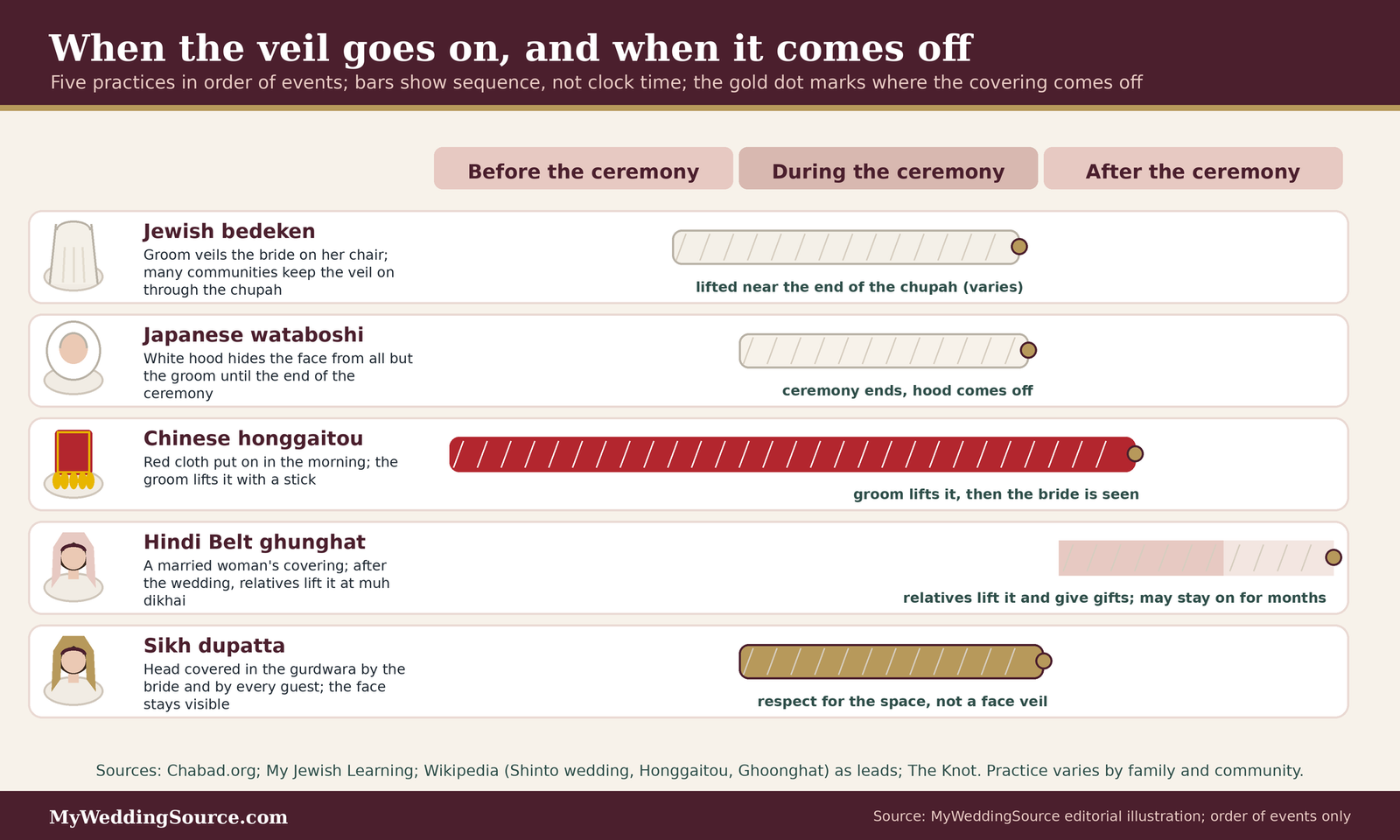
A ghunghat (also spelled ghoonghat) is a head covering, often the loose end of a sari or a long scarf, drawn over the head and sometimes the face. Wikipedia’s article on the ghoonghat, again used as a lead and labeled as such, describes it as worn mainly by some married Hindu and Jain women, and says facial veiling by Hindu women is now mostly limited to the Hindi Belt, with Haryana, Rajasthan, western Uttar Pradesh, parts of Sindh, and northern Gujarat named. The same article cites a 2004 to 2005 national survey in which about 15 percent of Indian women practiced some form of ghoonghat, mostly in Hindi-speaking states. We could not verify that figure against the survey itself, so treat it as a rough pointer, not a statistic to quote.
The ghunghat is mostly about married life, not only the wedding day
The same article ties the ghunghat to the social position of a married woman, including limiting interaction with senior male in-laws, and describes a post-wedding custom called muh dikhai, in which relatives lift the new bride’s veil, see her face, and give gifts. It cites scholarship that the bride’s veil at the wedding can symbolize the move between households. These claims come from academic works that Wikipedia cites; we have not read those works, so we present them as a lead and not as settled fact. What we can say with confidence is that for many couples the veil question is not limited to the ceremony: it is also a question about how the bride will be introduced and what her daily life with her new family will look like.
Dupattas, saris, and the modern Hindu bride
Outside the communities that practice the ghunghat, many Hindu brides cover the head lightly with a dupatta or the end of a sari during particular rituals. The Knot’s guide to Indian wedding dresses describes sheer veils in several examples, a sheer sari draping over the hair, and brides choosing a lehenga, sari, or sharara depending on custom. It notes that red is the most common bridal color and that ivory and pastel outfits have also become popular. The Knot does not describe veil customs or their meanings in that article, so we do not attach a meaning to the draped fabric you may see in those photographs. If you are a guest or a partner, ask the family what the cloth means in their household.
Punjabi, Bengali, and Maharashtrian details
The Knot’s guide to Indian wedding traditions gives a few concrete regional details that show how different “veiling” can be. Treat them as examples, not a complete map.
The groom’s veil: sehra and Sehrabandi
In some Punjabi weddings, according to The Knot, the groom wears a sehra, a beaded veil that covers the face, and his sister places it in a ceremony called Sehrabandi. Wikipedia’s article on veils adds that in parts of India, Pakistan, Bangladesh, and Nepal the sehra may be made of flowers, most commonly marigolds, or beads, and covers the face and neck. The point for couples is that in South Asia the veil is not always the bride’s.
Bengali Subho Dristi and a face covered by leaves
The Knot says that in a Bengali ceremony the bride covers her face with betel leaves during Subho Dristi, a custom in which the couple first look at each other. It also notes that the groom applies sindoor to the bride’s forehead as the final step. These are described briefly, and we do not claim to explain their meanings.
Maharashtrian and other regional looks
The same guide says Maharashtrian brides typically wear a sari with a beaded headband, and Punjabi brides often wear a gold nose hoop. We mention these to show how much of “bridal head covering” in South Asia is jewelry and headband as well as cloth, and how much changes from one region to the next.
Sikh customs: the dupatta in the gurdwara
Sikh weddings offer a good example of wedding veil traditions in which a covering’s meaning is about the place, not about the bride alone.
What The Knot describes
The Knot’s guide to Sikh weddings says the Anand Karaj, the Sikh wedding ceremony, takes place in a gurdwara in front of the Guru Granth Sahib, and that brides drape a dupatta over their heads as a sign of respect there. It also says guests must cover their heads inside the gurdwara, and that everyone present, including vendors, must have their heads covered in the darbar hall. The groom wears a turban. The bride sits beside the groom to show equality, and the couple circles the scripture four times during the laavan, with the groom leading and the bride following.
Not a face veil
In that source the covering is a respect practice for the whole community in a sacred space, so a guest’s scarf and a bride’s dupatta serve the same purpose. Wikipedia’s ghoonghat article, as a lead, notes that Sikh teaching includes the Guru Amar Das condemning purdah and the veiling of women, which fits the picture of a head covering in the gurdwara as a practice of respect and not as a face veil, though that reading is ours. If you are planning a Sikh or interfaith wedding, ask the gurdwara what it expects for head coverings before you choose a headpiece, and do not assume that a face veil is part of the ceremony.
Muslim customs in South Asia and beyond
Wedding veil traditions among Muslim communities are as varied as the communities themselves, and the sources we read stress this repeatedly.
What the sources say about the bride’s covering
The Knot’s guide to Muslim weddings says Arab brides may pair a long-sleeved wedding dress with a hijab, and that Muslim women at Indian weddings may wear a sari or a lehenga. Mecca Institute’s wedding guide says South Asian brides most often wear red with a matching dupatta, and that Indonesian brides typically wear a kebaya with a hijab or veil. It also notes that European Muslims follow local traditions and that white dresses are popular in Slavic countries. Wikipedia’s article on veils says its Islamic content concerns everyday hijab, niqab, and burqa, not a wedding veil, and neither The Knot nor Mecca Institute describes a single “Muslim bridal veil.” We therefore do not claim one exists.
The nikah, the mirror, and the walima
The Knot says the nikah (marriage contract) is the core of a Muslim wedding, with a mahr (a gift from the groom) and witnesses, and that some South Asian weddings include an arsi mushaf, in which the groom sees the bride’s face in a mirror. The reception, the walima, is generally hosted by the groom’s family. Whether a bride’s face is covered at any moment depends on the family and region, so the right question for a couple or guest is “what do you do in your family?” and not “what does Islam require?”
Jewish wedding veil traditions: the bedeken and its variations
Of all wedding veil traditions, the Jewish bedeken is among the most carefully documented in religious-institution sources, which makes it a good model for how to describe a custom: the practice, the reasons offered, and the many ways communities adapt it.
What the bedeken is
Chabad.org describes the badeken (the spelling varies; we use bedeken except in titles) as the ceremony in which the groom veils the bride’s face before the chupah, the wedding canopy. My Jewish Learning’s “Ask the Expert” piece says the bedeken is an Ashkenazi custom, that the Yiddish word comes from a Hebrew root meaning “to check,” and that veiling is a custom, not a requirement of Jewish law. It adds that the custom is not common in Sephardi or Mizrachi tradition.
The sequence on the day
According to My Jewish Learning’s description of events before the ceremony, the bride and groom each hold a reception at the same time. The bride sits on a decorated chair surrounded by family and friends, and the groom’s party, with his father and father-in-law, escorts him to her with singing and dancing. Chabad.org says the groom places the veil over the bride’s face, and afterward the fathers and grandfathers of both sides bless her. My Jewish Learning says the veil is called a dektich and that the groom is then escorted back to prepare for the chupah.
Who does the veiling
In the traditional form, the groom veils the bride. My Jewish Learning’s article on pre-ceremony customs notes that in some communities the rabbi performs the veiling and recites a blessing for the bride. The same article says that some customs it describes may not be observed by liberal Jews, and that some communities practice them in more egalitarian ways. Practice, again, is not uniform.
Why people veil: the reasons the sources give
No single reason is correct in every community, and the sources present several side by side.
Rebecca, Jacob, and Leah
My Jewish Learning says the most common explanation links the bedeken to Jacob’s wedding in Genesis 29, when Laban substituted Leah for Rachel, and that the custom is often said to let the groom confirm that he is marrying the right woman. It also says the author’s teacher linked the veil to Rebecca covering herself when she first saw Isaac in Genesis 24. Chabad.org’s article names Rebecca as the origin and does not mention Jacob or Leah. Wikipedia’s article on veils, used as a lead, mentions both stories too. Different institutions emphasize different texts, and each is a respectable reading.
Inner beauty, modesty, and law
Chabad.org gives a Kabbalistic reading in which the veil shows that the groom values the bride’s inner beauty, which does not fade, along with a commitment to love and respect all of her. It also cites an opinion that the legal act of marriage under the chupah is accomplished when the groom spreads his cloth over the bride, which the veiling accomplishes. My Jewish Learning lists further readings: modesty, protection from lustful glances, a focus on character, and a rabbinic view tied to the groom’s legal duty to clothe his wife. We list these because a couple choosing a bedeken usually benefits from picking the reading that matches their own values and saying it in the program.
Variations: opacity, jewelry, and egalitarian adaptations
In Jewish wedding veil traditions the core idea is stable, yet the details differ more than most guides admit.
How dense the veil is
Chabad.org says Chassidic custom calls for a veil dense enough to hide the bride’s face fully, and that the veil should not include silver or gold threads because the couple wears no jewelry to the chupah. My Jewish Learning adds that Hasidic, some Oriental Jewish, and old Jerusalem communities use an opaque veil so that the bride can neither see nor be seen. Chabad.org says the bride stays veiled during the entire chupah, which gives her privacy and has a technical legal reason related to the ring. Other communities lift the veil earlier; the sources we read do not give a complete survey, so ask your own rabbi or cantor.
Alternative bedeken ceremonies
My Jewish Learning’s article on alternative ceremonies describes a “mutual” form in which the groom veils the bride and the bride helps dress the groom in a kittel or tallit or places a kippah on his head. It describes another in which both partners decorate each other with kippot and flowers and recite verses from the Song of Songs. A third is a veil-free, back-to-back ceremony in which the couple receives blessings from their families and then turns to face each other. A fourth, written for two brides, has them enter with eyes closed, receive their mothers’ blessings, and turn to see each other “as if for the first time.” The article also says the bedeken was not widely practiced outside Orthodox circles for many years, that some feminists saw the veil as tied to troubling ideals of modesty, and that couples have revived it with changes that suit their beliefs.
Planning a bedeken, or attending one
Whether you are a couple, a guest, or a friend asked to help, a few practical points about this part of Jewish wedding veil traditions follow from the sources.
If you are Jewish and choosing
Talk with your officiant early, because the bedeken usually happens in a specific room before the ceremony and affects the timeline and photographer access. My Jewish Learning says it can be held with a few close family and friends or fully publicly. Decide whether you want the opaque or sheer veil, whether the veil stays on during the chupah, and who veils whom. Our wedding officiant guide helps you frame those conversations.
If you are not Jewish but marrying into the tradition
Ask the family which version they would like and whether they want you to take part. Follow their lead on how much you take part, since a custom explained and offered by the family is a different thing from one borrowed for its look. If the ceremony is interfaith, see our notes on wedding ceremony structure for how to slot a pre-ceremony custom into the day.
Christian wedding veil traditions: Orthodox, Catholic, and the mantilla
Christian wedding veil traditions involve more than one church, and veiling in church has a long history of its own. As in the previous sections, we focus on what is practiced now and on what the sources let us say.
Eastern Orthodox crowns and the veil
Orthodox weddings are known for the crowns, so Orthodox wedding veil traditions, where they exist, are secondary, and the sources we read treat the veil as an accessory, not the center.
What the church service emphasizes
The Annunciation Greek Orthodox Cathedral’s guide to the marriage service describes two parts, the Service of Betrothal and the Sacrament of Marriage, with the priest placing crowns (stefana) on the bride and groom, joined by a ribbon, a shared cup, and a walk around a table holding the Gospel and the Cross. Its description does not mention a veil, and it gives no guidance on the bride’s attire. We therefore cannot say that Greek Orthodox churches expect or forbid a veil from that source.
Where a veil appears
Wikipedia’s article on marriage in the Eastern Orthodox Church, used as a lead, says that if the bride wears a veil, the crown is placed simply on top of it, and it lists no other attire or head covering requirements. Its description covers the Byzantine rite only. Wikipedia’s article on the mantilla says that Eastern Orthodox women in Russia wear the mantilla without a peineta, often white, with the ends crossed over the neck and draped over the opposite shoulder, and Lace & Favour, a veil retailer, repeats that Orthodox styling. Because both are secondary descriptions, the practical rule for an Orthodox wedding is to ask your priest, because parishes and jurisdictions differ.
Catholic customs and the chapel veil
Catholic wedding veil traditions grow out of the head covering for women often called a chapel veil or mantilla. It is mostly a church-going practice, but it feeds into how some brides dress.
A voluntary practice
An article on CatholicMom.com, written by a Catholic author, says that canon law no longer requires women to veil and that the practice is “no longer binding” but remains acceptable as a voluntary devotion. The author gives several personal reasons: imitating the Blessed Mother, reflecting that sacred things are often veiled, and setting aside distractions at Mass. It is an opinion piece, so we read it as a statement of how some Catholic women explain the practice. It says women of many backgrounds veil, including cradle Catholics, converts, young and old women, and married and single women.
How this shows up at a wedding
A Catholic bride may wear a bridal veil, a mantilla, or no veil at all, and the sources we read describe none of these as required. Wikipedia’s mantilla article says a white mantilla is appropriate for a church wedding. If the ceremony is in a Catholic church, ask the parish whether it has any preferences for attire.
The mantilla in Spain and Latin America
The mantilla is the veil most closely associated with Spanish and Latin American wedding veil traditions in the Catholic world, so it deserves a careful description.
Spain: lace, comb, and occasion
Wikipedia’s mantilla article describes a traditional lace or silk veil worn over the head and shoulders, which came into use in warmer parts of Spain toward the end of the sixteenth century and became popular in lace form in the seventeenth and eighteenth centuries. It says the peineta, a large ornamental comb, holds it up, and that in Spain women still wear mantillas at weddings and during Holy Week. It says use had largely narrowed by 1900 to church services, formal occasions, bullfights, Holy Week, and weddings. The article cites printed works, which we did not read, so treat these dates as a lead.
Latin America: transmission and local meaning
Wikipedia says Spanish Christian missionaries brought the practice to the Americas, citing a 2018 book on Mexican Catholic women. It also reports a colonial bishop who required mantillas to be opaque, which we could not verify from a primary source, so we mention it only as a reported episode. Lace & Favour, a retailer, says the mantilla is favored in Spanish, Latin, and Italian cultures and became popular among Catholic women from the late sixteenth century, first at Mass and later at weddings. The sources do not give a country-by-country account of Latin American bridal customs, so we do not generalize beyond them. A bride who wants a mantilla for a family reason should ask which relatives wore one and how they styled it.
Wearing a mantilla: a retailer’s practical notes
Lace & Favour describes the mantilla as traditionally circular with a thick lace edge, placed a couple of inches behind the hairline and often worn over a comb, and says it suits most hairstyles except high buns. These are a retailer’s suggestions, not a rule. For comb placement and how to pair a veil with other hair jewelry, see our guides to wedding tiaras and wedding hairstyles.
Other Christian customs, and where our sources are thin
Christian communities around the world have their own wedding veil traditions, and we have verified very few of them.
Scandinavia and Eastern Europe
Wikipedia’s veil article says that in Scandinavia the bridal veil is worn under a traditional crown and does not cover the face, and that in Eastern Europe Christian women wear a head covering after marriage as well as during worship. It gives no detail, so treat both statements as leads, and look for a local source before relying on them.
Ethiopian and Eritrean Orthodox customs
We looked for authoritative detail on bridal head coverings in Ethiopian and Eritrean Orthodox weddings and did not find it. The Knot’s guide to Ethiopian weddings describes the habesha kemis, the Harari siyaasa head piece, and the kaba cape with head jewelry, but says nothing about veils, and it says customs depend on the couple’s denomination. We would rather say the sources are thin than describe a veil custom we cannot support.
Middle Eastern, North African, and Central Asian bridal textiles
For wedding veil traditions in this region, the best evidence we found comes from museum collections, which describe particular objects instead of whole peoples. That makes it a useful corrective to generalization, and a good example of why a museum label is worth reading closely.
Tunisian and Bedouin veils in museum collections
Two American museum records document Tunisian wedding veil traditions through pieces from the late nineteenth and early twentieth centuries.
A Bedouin bridal veil that conceals the face
The Rhode Island School of Design Museum describes a bridal veil of sheer silk with metal embroidery, early 1900s, Tunisian, made for a Bedouin woman’s wedding ceremony. Its label says the veil conceals the bride’s face from onlookers and is orange on one side and green on the other, with birds and fish along the edges that suggest fertility and abstracted khamsa (hand-shaped) symbols near the corners. The label adds that the metal-strip embroidery technique was once unique to Jewish communities around the Mediterranean and has since spread more widely. It is one museum’s interpretation of one object, not a rule about Tunisian brides.
Protective motifs on a bride’s clothing
The Metropolitan Museum of Art’s record for a late nineteenth-century Tunisian wedding tunic and ensemble says the tunic is embroidered with stylized symbols meant to bring fertility and good fortune, and that bridal clothing often carries protective motifs because the bride is considered especially vulnerable during a major life transition. The record lists a veil as part of the ensemble but gives no separate description or meaning for it. That is typical of museum records and a reminder that the veil is often one piece in a larger set of garments.
Amazigh weddings in Morocco
Amazigh wedding veil traditions sit within a rich textile culture in which weaving is central to women’s lives, and the sources we read make clear how local each practice is.
A wedding veil, the tadghart
The Bowers Museum’s collection record describes an early twentieth-century woman’s wedding or ceremonial veil called a tadghart, made by the Ida or Nadif Amazigh in the central Anti-Atlas Mountains of Morocco. It is wool, resist-dyed and painted with henna, and has silk pompoms along the sides. A henna-painted motif sits on the part that covers the back of the neck, and the record says scholars have assumed it is fertility symbolism. The museum adds that skills and designs pass from mother to daughter and that textiles can function as riddles or metaphors. It describes one object from one community.
A procession with the bride’s face covered
A book excerpt on Amazigh arts, hosted by Project MUSE, describes a three-day wedding among the Ait Khabbash, one Berber group, in which the bride is carried so her feet do not touch the ground, protecting her from a force called thiqaf, and in which her face is covered while women of the groom’s family welcome her with song. It describes only that community. It does not claim to describe Moroccan or Berber brides in general, and we do not either.
Central Asian veils: Tajik and Uzbek pieces
Central Asian wedding veil traditions give us two museum descriptions that show how much one word can hide.
The Tajik ruband
HALI, a textile publication, describes a nineteenth-century embroidered Tajik veil (ruband) with a cotton netting panel that lets the wearer see while hiding her face. It calls the object a threshold between visible and invisible realms and says veiling a Tajik bride’s face marks her move into a new social status. That is the publication’s interpretation of one object.
A veil with an uncertain attribution
The Horniman Museum catalogues a bridal veil with a central panel of striped white gauze, chain-stitch embroidery, glass beads, metal pendants, and fabric amulets, and says the attribution is provisional: it may be Uzbek, but it could be Tajik. A British Museum record for a Middle Eastern textile cannot say whether it is a woman’s veil or a man’s turban. These records show how honest museums handle uncertainty, and they are a model for how a couple can describe a family heirloom: say what you know, say what you do not, and avoid inventing a tradition around the gap.
What the Middle East record does and does not tell us
The Ottoman and Balkan wedding attire in the Met’s galleries
The Metropolitan Museum of Art’s exhibition on wedding attire from China, Japan, and Ottoman Turkey and the Balkans describes pieces from the eighteenth to the early twentieth century and says fabric, color, and motifs were chosen for their meanings, often relating to a woman’s change in status and to wishes for fertility, prosperity, and longevity. The page does not mention veils or head coverings, so we cite it only for its general point that bridal clothing carries meanings.
Where we are thin
We did not find a reliable English-language source we could verify for bridal veil customs in the Levant, the Gulf, or Iran, and the Muslim wedding guides we read describe hijab and dress choices without a distinct wedding veil. We would rather leave that gap visible. If your family has a tradition from these regions, your relatives and your community are the best authority.
East Asian wedding veil traditions: China, Japan, and Korea
East Asian wedding veil traditions are among the most visually distinctive, and they are also among the most changed by the white Western wedding. The sources we read describe both the older forms and the modern blend.
The Chinese honggaitou
The honggaitou (also called gaitou, “head cover”) is the best known of the Chinese wedding veil traditions, and Wikipedia’s article, which we use as a lead, supplies the main facts.
What it is and when it is used
Wikipedia describes it as a square of red fabric worn by Han Chinese brides to cover the face during the ceremony before the wedding night, with a red wedding dress. It says red symbolizes good luck, happiness, and celebration, and that white, the color of Western Christian weddings, was once avoided because it is associated with death in Chinese culture. It says the custom dates to the Song dynasty, citing a social history of middle-period China. We did not read that book, so we present the date as a lead.
Lifting the veil, and how weddings have changed
The same article says the groom lifts the veil with a stick, and that most Chinese brides today wear white dresses and white veils under Western influence, though the red custom continues. The Metropolitan Museum’s exhibition page describes a Qing dynasty woman’s wedding jacket and skirt in silk and metallic thread embroidery, reminding us that clothing at Chinese weddings was also a matter of embroidered symbolism. For a couple, the practical takeaway is that the sources describe the red custom and the white Western look as existing side by side. Ask which family elder knows the details of the custom and how it was done in your family.
Japanese shiromuku, wataboshi, and tsunokakushi
Japanese wedding veil traditions at a Shinto ceremony include distinct head coverings, and the sources describe them with unusual clarity.
The hood and the horn-hider
Wikipedia’s article on Shinto weddings, used as a lead, says the shiromuku is a pure white over-kimono that symbolizes purity, worn with a wataboshi, an all-white hood described as the counterpart to the Western bridal veil, which hides the bride’s face from everyone except the groom until the end of the ceremony. It describes the tsunokakushi (“horn-hiding”) as a rectangular cloth headdress that covers the high topknot of the bride’s wig, said to veil the bride’s metaphorical “horns” of jealousy, ego, and selfishness. It says the wataboshi is adapted from the katsuki, a hood worn outdoors by married women in samurai families, and that younger women adopted it from the Edo period onward.
How recent the Shinto wedding is
The same article says the first mention of a wedding in a Shinto manual was in 1872, that Shinto weddings spread widely after 1945, and that they are declining as Christian-style white weddings become more common. It gives a figure that Shinto weddings fell from 90 percent of ceremonies to 50 percent since the 1990s, which we did not verify, so we treat it as a loose indication. The article marks several claims as needing a citation, so we cite only what it states plainly. The reading of the tsunokakushi as a symbol of obedience is the article’s report of what the headdress is said to mean, which is one account among others, so ask the family or the shrine what it means to them instead of assuming.
The Korean jokduri
Korean wedding veil traditions are a case where the Western veil is explicitly contrasted with a local one.
A crown, not a veil
Korea.net reports on an exhibition at the Ulsan Museum recreating Joseon-era wedding procedures. It says brides wore a heavy ceremonial headpiece called a jokduri in five vibrant colors, pinned binyeo hairpins to ward off evil spirits and attract good fortune, and wore a purple and green wedding robe called a wonsam. It says these items reminded brides to approach the ceremony with reverence and to accept the responsibility of uniting two families, and that, unlike the Western white veil, which signifies purity and beauty, traditional Korean attire signified propriety.
What the source does not say
The article does not mention hand coverings or face makeup, so we do not discuss them. We also did not find a modern survey of how Korean brides dress today, so we do not describe current trends. For a couple whose heritage is Korean, the closest we can say is that the headpiece and hairpins were part of a bundle of symbols about family and responsibility.

African bridal headwear: where the word veil may not fit
This section is the shortest on purpose, because wedding veil traditions in Sub-Saharan Africa are thinly documented in the sources we could verify. The sources we could verify for Sub-Saharan Africa describe headwraps, fabric, and jewelry more often than veils, and applying the word “veil” would flatten them.
Nigeria and the gele
Nigerian wedding customs differ by community, and our sources address only some of them.
The gele as a headwrap
The Knot’s guide to Yoruba traditional weddings says brides wear garments made from aso oke, a hand-crafted patterned fabric, including a buba top, an iro wrapper skirt, an ipele shoulder sash, and a gele, a headwrap. It says nothing about a face covering. A gele is a headwrap to be admired, not a veil, and our sources do not suggest it hides the face.
Families choose the colors
The same article says colors and patterns are typically agreed by families, that guests may wear aso-ebi in a fabric the family chooses, and that traditions are not always followed as strictly as in the past. Mecca Institute’s wedding guide says Nigerian brides and families may wear colorful lace or Ankara fabric with matching headscarves where required. This reminds us that headwear in Nigerian weddings is part of coordinated family dress.
East Africa and the Horn
We looked for authoritative sources on bridal head coverings across East Africa and found limited material.
Kenya, Tanzania, and Ethiopia
Mecca Institute’s guide says brides in Kenya and Tanzania wear kanga or kitenge, sometimes with matching headscarves. The Knot’s guide to Ethiopian weddings describes the habesha kemis dress, the Harari siyaasa head piece, and the kaba with head jewelry. None of these sources describes a bridal veil, and the details differ by community.
What this tells us
When a tradition has headwear but no veil, the right words to use in your program or invitation are the community’s own words. Naming a gele a veil would be inaccurate, and it would miss what the headwear is for.
Textile traditions as a record
Textiles are sometimes the best surviving record of bridal customs.
Mali, Morocco, and the limits of textiles
HALI’s survey of wedding textiles describes a wedding hanging woven in Mali for an elite family’s daughter by weavers whom patrons supported for several months, and silk sashes from Fez worn by brides and elite women. These are not veils, and we do not draw conclusions about veils from them. They simply show that bridal textiles are often made by specific makers for specific families.
A caution about “African wedding traditions”
Africa is a continent of many peoples, and the phrase “African wedding veil traditions” hides far more than it shows. If your family traces to a particular community, name that community in your plans, and avoid describing the custom as pan-African.
Borrowing and adapting wedding veil traditions respectfully
Many couples want to honor a heritage, a partner’s family, or a place they love, and wedding veil traditions are an obvious thing to borrow because they are visual and easy to photograph. The sources we read are consistent on one point: the people who own a tradition should be the ones who decide how it is shared.
Appreciation and appropriation: a working distinction
We are not the authority on this, and we do not claim a rule that settles every case. We can report what a wedding publication that addresses the topic says.
What one wedding publication says
Equally Wed, a wedding publication for LGBTQ+ couples, describes cultural appropriation as adopting another group’s customs or practices without acknowledgment or in an inappropriate way, often by members of a more dominant group. It says context and presenter matter, and that “respect over aesthetics” should guide the choice. It advises researching the tradition, avoiding sacred religious items chosen only for their look, avoiding the rituals and symbols of a religion neither partner practices, and using extra caution with groups that have been subject to colonial violence. As examples of appreciation it lists a Nigerian partner and their spouse both wearing traditional Nigerian clothing, and guests wearing saris or lehengas to a Hindu wedding. As an alternative to borrowing, it suggests creating new traditions. This is one publication’s view, and you may weigh it differently.
Questions that help you decide
From that guidance and from the sources throughout this guide, a few questions are useful. Where does this custom come from, and who owns it? Does it carry sacred meaning? Do we or our families actually practice it? Are we including it to honor a heritage, or only for how it looks? Who is explaining it, and in what setting? If the answers are uncomfortable, a simpler adaptation may serve you better.
How communities adapt their own customs
One reason the respectful path is not “do nothing” is that communities adapt their own wedding veil traditions all the time.
Examples from the sources
My Jewish Learning’s alternative bedeken article describes couples who revived the custom with changes that suit their beliefs, including mutual versions and a veil-free ceremony. The Knot’s guide to Indian wedding dresses describes fusion looks that blend Indian designs with Western silhouettes, and ivory and pastel outfits becoming popular partly through Bollywood. Wikipedia reports that most Chinese brides now wear white dresses and veils. The Knot’s Sikh guide says that how traditional or modern a wedding looks depends on the couple and their families. Change from inside a community is part of the living tradition, and it is different from change imposed from outside.
What this means for you
If you belong to a community with its own wedding veil traditions and want to adapt them, talk with elders and clergy about which parts are core and which are flexible. If you do not belong to it, the safest adaptation is the one the family proposes.
Couples from two traditions
Many readers will combine two sets of wedding veil traditions, and the sources suggest a few ways to handle that.
Let each tradition have its own moment
A wedding can hold more than one custom without blending them. A bride may wear a veil for an hour of a ceremony in one tradition and change into another outfit for another. The Knot’s description of Muslim weddings says couples in the United States often blend heritage traditions with American customs, and the Chinese and Japanese sources above describe red or white changes during one day. Giving each custom its own place in the timeline lets each be understood on its own terms.
Say what each custom is in the program
A short note in the program that names the custom, the community, and its meaning in the family’s words prevents guests from guessing. Keep it plain, avoid claiming that a custom is “ancient” unless a source says so, and say that practices vary. Our wedding ceremony guide helps with the order of events, and our wedding etiquette guide covers how to explain customs gracefully to guests.

Planning: how to bring a veil tradition into your wedding day
Once you know what a custom is, the work is practical. Wedding veil traditions affect your timeline, your hair, your attire, and your photographs, and they are easier to include when you plan for them early.
Talk to the right people first
Start with the community, not a vendor, because the people who keep wedding veil traditions alive can tell you what is fixed and what is flexible.
Elders, clergy, and the family that owns the custom
Ask who in the family knows how the custom is done and what it should look like. For a religious custom, ask your officiant, rabbi, priest, imam, or granthi what the house of worship expects. The sources show how much this varies: Chabad.org and My Jewish Learning describe different details of the bedeken, and The Knot says Sikh guests and vendors alike must cover their heads in the darbar hall. Our wedding officiant guide has a list of questions for the first meeting.
Write down what you learn
Keep a short note of what each person tells you, including disagreements. If two relatives remember a custom differently, ask them to talk to each other or choose one version, and record it in the program. That respects both and avoids guests hearing a confident but contested story.
Build the day around the custom
Timeline and photography
Among wedding veil traditions, a pre-ceremony custom such as the bedeken needs its own room and its own time. A veil that covers the face changes where a photographer should stand and what they can capture. Ask your photographer early about low light, closed doors, and any customs that restrict photography, and give them the sequence. Our wedding photographer shot list and wedding photography guides cover how to brief them.
Hair, headpieces, and fit
A mantilla needs a comb and a hairstyle that holds it, a wataboshi or tsunokakushi depends on a particular hairstyle, and a dupatta needs pins that will not slip. Whether you inherit a piece or buy one, decide the moment it will be worn before you decide the piece, because wedding veil traditions often attach to a specific moment. Bring the actual piece to your hair trial. Our guides to wedding hairstyles and wedding tiaras cover trial timing, and our wedding ceremony guide helps you sequence the moments.
Budget, sourcing, and alterations
What this actually costs
We do not quote prices for wedding veil traditions because we found no published, methodologically clear survey of what heritage veils, hoods, or headpieces cost, and prices differ widely between a family heirloom, a rental, and a custom commission. What you can plan for are the cost drivers: whether the piece is handmade by a specific artisan, whether it must be shipped or imported, whether it is a rental or a family loan, and how much tailoring or hair-trial time it needs. Our wedding budget calculator can hold a line for attire and accessories until you have real quotes.
Buy from, or ask, the community
If you are buying a traditional piece, check whether the listing names the community behind its wedding veil traditions, and prefer makers from the community the piece comes from, and ask how they describe it. A museum label is a good model: say who made it, where, and what is known. Be cautious with listings that describe a piece as “traditional” without saying whose tradition it is, and with listings that assign meanings the seller cannot support.
Alterations and care
Delicate lace, metal embroidery, and beaded pieces may need professional handling. Our wedding dress alterations guide covers timing, and a professional can advise on how a heritage piece should be cleaned or stored. We did not find reliable guidance in our sources on conserving specific heritage textiles, so we recommend consulting a textile conservator or the community that made it.
Two scenarios
These illustrate how wedding veil traditions can sit side by side; they are not predictions.
A Jewish and Catholic couple
Imagine a Jewish bride and a Catholic groom who want to honor both families. They might hold a short bedeken in a side room with both families present, then have her wear a lightweight veil for the ceremony, perhaps asking the rabbi whether the veil should stay on or be lifted early. If the Catholic family would like a mantilla moment, they could handle it at a family blessing, not in place of the bedeken. The point is that each custom keeps its own meaning instead of being merged.
A destination or beach ceremony
If a couple marries away from home, the venue may have its own rules. Our guides to destination weddings and beach wedding dresses cover the practical side. If the ceremony will be held in a house of worship at the destination, ask about head covering and photography rules before you pack, because The Knot says Sikh guests and vendors must cover their heads, and a dupatta or scarf costs little to bring.
Questions to ask before you borrow or include a veil custom
Use these questions for any of the wedding veil traditions in this guide, and adapt them to your own family.
Questions worth asking
- Whose tradition is this, and who in the family or community can explain it?
- Is it a custom, a religious requirement, or a regional habit?
- Does it carry sacred meaning, and are we part of that faith or community?
- Who places the veil, who lifts it, and when?
- Does it cover the face, the head, or both, and how opaque should it be?
- What should be said about it in the program, and who should say it?
- What do the officiant or house of worship require for head coverings and photography?
About meaning and ownership
Ask the community, not only the internet
When you ask about wedding veil traditions, ask a relative, an elder, or the officiant, and keep your questions open: “What does this mean in our family?” is better than “Is this the right way?” Sources disagree and so do relatives, and the answer you want is the one that your family recognizes.
Decide what you will not borrow
It is fine to decide that some things are not yours to borrow. The Equally Wed article suggests creating new traditions as an alternative, and many couples find that a custom of their own, described honestly, feels better than a borrowed one.
About logistics and documentation
Timeline, space, and photography
Ask how long the custom takes, where it is held, who must be present, and whether photography is allowed. Put it in writing with your photographer and venue.
Piece, fit, and care
Ask the maker or seller what the piece is made of, how it should be pinned, and how it should be stored. For a family heirloom, ask a relative how it was worn and whether it has been repaired.
FAQ: wedding veil traditions
Meaning and practice
Is there one right way to do wedding veil traditions from a culture?
No. Nearly every source we read says practice varies by family and community. Even the Jewish bedeken, one of the best documented, differs in veil opacity, who performs the veiling, and when the veil is lifted. Treat any description as one community’s version, and ask your own family or officiant what they do.
Do all brides in a tradition wear a veil?
No. Sources describe wedding veil traditions as customs within some communities, not universal rules. My Jewish Learning says the bedeken is Ashkenazi and not common in Sephardi or Mizrachi tradition, and Wikipedia says ghoonghat facial veiling by Hindu women is now mostly limited to parts of northern India. Many brides choose none.
What is the difference between a veil and a head covering?
In wedding veil traditions, a veil usually covers the face or hangs from the head as part of the wedding look, while a head covering such as a Sikh bride’s dupatta in the gurdwara is a sign of respect in a sacred space. Sources describe both, and some pieces do both, so ask what the family intends before choosing words.
Choosing and adapting
Can I wear a veil from a culture that is not mine?
It depends on the tradition, the people who own it, and how you do it. One wedding publication advises prioritizing respect over aesthetics, researching meaning, avoiding sacred items chosen for looks, and asking whether you or your families actually practice the custom. If you are unsure, ask a person from that community and consider a simpler alternative.
How can a couple from two traditions combine veil customs?
Give each custom its own moment instead of merging them. For example, hold a short pre-ceremony custom in one room, then use a different covering for the ceremony itself. Explain each in the program in the family’s words, ask the officiants on both sides what they expect, and brief your photographer on the sequence.
Do I have to wear a veil in a Catholic or Orthodox church?
The sources we read do not say you must. A Catholic author writes that canon law no longer requires women to veil in church, and the Greek Orthodox cathedral guide we read describes crowns and gives no guidance on a veil. Practices vary by parish, so ask your priest.
Practical questions
Where can I find an authentic piece?
Prefer makers from the community the piece comes from, and ask how they describe it. A museum label is a good model for honest description: who made it, where, and what is known. Be cautious with sellers that give confident meanings the sources do not support, and with the word “traditional” when no tradition is named.
What if sources or relatives disagree about what a custom means?
That is normal. Even Chabad.org and My Jewish Learning offer different emphasis about the bedeken, citing Rebecca, Jacob, and Leah, inner beauty, and legal duty. Pick the explanation that matches your family’s values, name it as one reading in the program, and avoid presenting a single origin story as the only one.
Your next steps
Learn before you choose
Talk to the person who owns the custom
Start with the relative, elder, or officiant who knows the wedding veil traditions in your family. Ask what it is called, what it means in your family, who takes part, and what is flexible. Write down what you hear, including disagreements. If you want background on how the veil reached the modern Western wedding, read our wedding veil meaning and history guide.
Decide what you will do and what you will leave alone
Choose which wedding veil traditions belong in your ceremony, which belong in a separate moment, and which you will leave to the people they belong to. Keep the list short, and make sure each item has a plain explanation you could give a guest in a sentence.
Make it work on the day
Brief the people who handle the details
Share the sequence with your photographer, hair stylist, and venue, and bring any heritage piece to the hair trial. Our wedding planning checklist can hold the tasks, and our wedding party attire guide helps you coordinate what others will wear.
Write the program note
Draft one or two sentences per custom that name the community, the practice, and your family’s reading of it, and ask a relative to check them. Say that practices vary, and thank the people who taught you.
Sources & methodology
How we built this guide
What we relied on
This guide combines pages from religious institutions and communities (Chabad.org, My Jewish Learning, a Greek Orthodox cathedral, CatholicMom.com), museum and textile-publication records (the Bowers Museum, the Rhode Island School of Design Museum, the Metropolitan Museum of Art, the Horniman Museum, the British Museum, and HALI), a Korean culture news page (Korea.net), wedding publications (The Knot, Equally Wed), a veil retailer (Lace & Favour), and an academic book excerpt. Wikipedia appears only as a lead, labeled in the text, and we repeat its claims only with the caution that we did not read the works it cites. Where we found little, we said so.
What we did not do
We did not interview anyone, attend ceremonies, or inspect objects, and we did not verify claims that Wikipedia attributes to printed works. We found no reliable English-language source we could verify for several regions, including the Levant, the Gulf, Iran, and most of Sub-Saharan Africa for veils specifically, and we did not fill those gaps from memory. Nothing here is religious, legal, or cultural authority, and practice varies by family and community. Ask the people who own the tradition.
Source list
Religious institutions and communities
- Chabad.org, Badeken (Veiling): https://www.chabad.org/library/article_cdo/aid/477333/jewish/Badeken-Veiling.htm
- My Jewish Learning, Ask the Expert: Veiled Bride: https://www.myjewishlearning.com/article/ask-the-expert-veiled-bride/
- My Jewish Learning, Before the Jewish Wedding Ceremony: https://www.myjewishlearning.com/article/before-the-jewish-wedding-ceremony/
- My Jewish Learning, Alternative Bedeken Ceremonies: https://www.myjewishlearning.com/article/alternative-bedeken-ceremonies/
- Annunciation Greek Orthodox Cathedral, Learn About Your Upcoming Wedding: https://www.anngoc.org/ministry-life/liturgical-ministries/special_services/marriageceremony
- CatholicMom.com, Why women are wearing chapel veils again: https://www.catholicmom.com/articles/2018/12/03/why-women-are-wearing-chapel-veils-again/
- Mecca Institute, Muslim wedding guide to traditions, service, dress, and more: https://meccainstitute.org/muslim-wedding/
Museums, textile publications, and academic sources
- Bowers Museum, Veil (tadghart): https://collections.bowers.org/objects/144814/veil-tadghart
- Rhode Island School of Design Museum, Bridal veil: https://risdmuseum.org/art-design/collection/bridal-veil-20174534
- Metropolitan Museum of Art, Wedding tunic and ensemble: https://www.metmuseum.org/art/collection/search/85641
- Metropolitan Museum of Art, Wedding Attire: Three Cultures, One Celebration: https://www.metmuseum.org/ja/exhibitions/wedding-attire-three-cultures-one-celebration
- Horniman Museum, Bridal veil: https://www.horniman.ac.uk/object/1999.117.1
- British Museum, Veil or turban: https://www.britishmuseum.org/collection/object/W_As1968-10-35
- HALI, Wedding textiles around the world: https://hali.com/editorial/wedding-textiles-around-the-world
- Project MUSE, book excerpt on Amazigh arts in Morocco: https://muse.jhu.edu/books/9780292795914/9780292795914-9.pdf
- Korea.net, Traditional Korean wedding exhibition report: https://www.korea.net/NewsFocus/Culture/view?articleId=293794
Wedding publications and retailers
- The Knot, Indian wedding traditions: https://www.theknot.com/content/indian-wedding-traditions
- The Knot, Indian wedding dresses: https://www.theknot.com/content/indian-wedding-dresses
- The Knot, Sikh wedding: https://www.theknot.com/content/sikh-wedding
- The Knot, Muslim wedding ceremony rituals: https://www.theknot.com/content/muslim-wedding-ceremony-rituals
- The Knot, Yoruba traditional wedding: https://www.theknot.com/content/yoruba-traditional-wedding
- The Knot, Ethiopian wedding traditions: https://www.theknot.com/content/ethiopian-wedding-traditions
- Equally Wed, Cultural appropriations to avoid at your wedding: https://equallywed.com/cultural-appropriations-to-avoid-at-your-wedding/
- Lace & Favour, What is a mantilla wedding veil: https://www.laceandfavour.com/us/veil-faqs/what-is-mantilla-wedding-veil/
Wikipedia (used only as leads)
- Wikipedia, Ghoonghat: https://en.wikipedia.org/wiki/Ghoonghat
- Wikipedia, Hindu wedding: https://en.wikipedia.org/wiki/Hindu_wedding
- Wikipedia, Mantilla: https://en.wikipedia.org/wiki/Mantilla
- Wikipedia, Honggaitou: https://en.wikipedia.org/wiki/Honggaitou
- Wikipedia, Shinto wedding: https://en.wikipedia.org/wiki/Shinto_wedding
- Wikipedia, Marriage in the Eastern Orthodox Church: https://en.wikipedia.org/wiki/Marriage_in_the_Eastern_Orthodox_Church
- Wikipedia, Veil: https://en.wikipedia.org/wiki/Veil