

Wedding toast timing for a plated dinner comes down to one question: when does the kitchen stop, and when does it start again? This guide shows how to place toasts between courses so hot food is not left waiting, glasses are full, the room is quiet, and everyone on your team hears the same cue at the same moment.
Treat each toast as a planned pause in the kitchen’s service, not as an entertainment item that happens to fall near dinner. Pick a slot between courses (the gap after the first course is cleared suits most rooms), then run four cues in order: Hold, Pour, Go, Release. Write your wedding toast timing in relative minutes instead of clock times. Ask the caterer for two numbers, how long hot plates take from the “fire” call to the table and how long finished plates can safely wait at the pass, and label everything else an assumption until someone confirms it.
Picture a ballroom at the moment a best man stands up. The salad plates are cleared, the wine is poured, the room has gone quiet. Behind a closed door, a kitchen team is plating 120 entrées, because nobody told them the toast was starting. The doors open halfway through his second story. Servers stand with loaded trays while guests look at the food and then back at him. He can feel the room leaving, and the food is getting cooler on the trays.
Nothing in that scene is anyone’s fault in the usual sense. The speaker was fine, the kitchen was fine, the servers were fine. What failed was the link between them. Wedding toast timing is mostly a coordination job: you are connecting two schedules that were built separately, the speaking schedule that lives in the couple’s heads and the service schedule that lives in the caterer’s.
This article is about that link, and about wedding toast timing for the specific case of a plated, served dinner. Buffets and food stations behave differently, so they are left aside.
You will get a way to choose a toast slot, a four-cue sequence for the captain and the DJ, a method for writing the timeline in relative minutes, a worked example, special cases, recovery rules for a late evening, and a list of what to confirm versus what to leave marked as an assumption. Together they make a wedding toast timing plan you can hand to a caterer.
A note on scope. This guide is general information, not legal, tax or financial advice. It also gives no food-safety, capacity or egress guarantees: those belong to your caterer, your venue and the local authorities, and the sources at the end point to the agencies that publish the current rules.
Why wedding toast timing is a kitchen problem first
Most advice about toasts starts with the speaker: how long to talk, what to say, who goes first. Those questions matter, but they come second to wedding toast timing. At a plated dinner the room is on a conveyor belt that someone else is driving. A toast that ignores the belt will either stop it at a bad moment or collide with it, and that is what poor wedding toast timing looks like in practice. So the first job is to understand what the belt looks like.
How a plated dinner moves from kitchen to table
A plated dinner has a few stages that repeat for every course. Caterers use their own words, so treat the terms below as a rough vocabulary and ask your team to translate. Each term returns in the cue sheet, so learn them before you start writing your wedding toast timing.
Fire. The kitchen’s call to start cooking or finishing a course. For a hot entrée this is the moment the clock starts. Some courses are mostly prepared ahead and finished quickly; others need real cooking time. Either way, “fire” is the decision point that a toast should be built around.
Plate-up. The kitchen team assembles the plates, often on a line, one component at a time, until the whole room’s worth of plates is ready or a first wave of tables is ready.
The pass. The counter or rack where finished plates wait for servers. Plates on the pass are the ones a late toast puts at risk. Hot plates lose heat there, cold plates lose chill, and sauces and garnishes do not improve.
Pick-up and service. Servers take plates from the pass to tables, usually in a set order and often in a coordinated wave so that everyone at a table is served at roughly the same moment.
Clear. Servers remove plates once guests are finished. The pace of clearing depends on how fast the slowest table eats, which is why a round of toasts placed at “everyone is done” quietly depends on the last few tables.
The captain. Banquet captains, head servers, floor managers and catering leads all do a version of the same job: they run the dining room and talk to the kitchen. In this guide “the captain” means whoever on the caterer’s team holds that two-way line. If your venue has no one in that role, the first thing to learn is who does the job instead.
What a toast does to each stage
A toast does not slow every part of the belt equally, and that is useful. It means you can often keep the kitchen busy and pause only the dining room.
Before the fire call, a toast costs the kitchen nothing. The next course has not been cooked yet. The cost is borne by the guests, who are sitting at a table with no food in front of them, and by the schedule, which has just lost some minutes. Before fire is the cheapest moment for food and the most demanding moment for the room’s patience.
After the fire call and before the pass, a toast costs a little. Plates are being built, and the kitchen can usually keep building, though the finished plates will wait.
Once plates are on the pass or on trays in the hall, a toast costs the most. This is the point at which hot food is waiting for a speech to end, and the caterer’s quality and food-safety rules begin to matter. Agencies such as the U.S.
Department of Agriculture and the Food and Drug Administration publish temperature and time guidance for hot and cold food, and those figures are the caterer’s responsibility to follow. Your job is not to know them. Your job is to avoid creating a schedule that forces the kitchen to choose between your speaker and the guidance.
During service, a toast also costs the room. Servers walking behind a speaker, plates landing on tables and cutlery moving all compete with the voice at the microphone. Guests give the food their attention, and they are right to.
After the room has been served and is eating, a toast competes with the very thing guests came for, and it asks them to put down their forks. That is workable for a short, warm moment; it is a poor idea for a long one.
Put differently, the question “when should the toasts happen?” has a more useful form: “at which point on the belt is a pause cheapest for the food and the room together?” The answer is almost always a gap between courses, and the rest of this guide is about making that gap real in your own wedding toast timing.
The people who share one clock
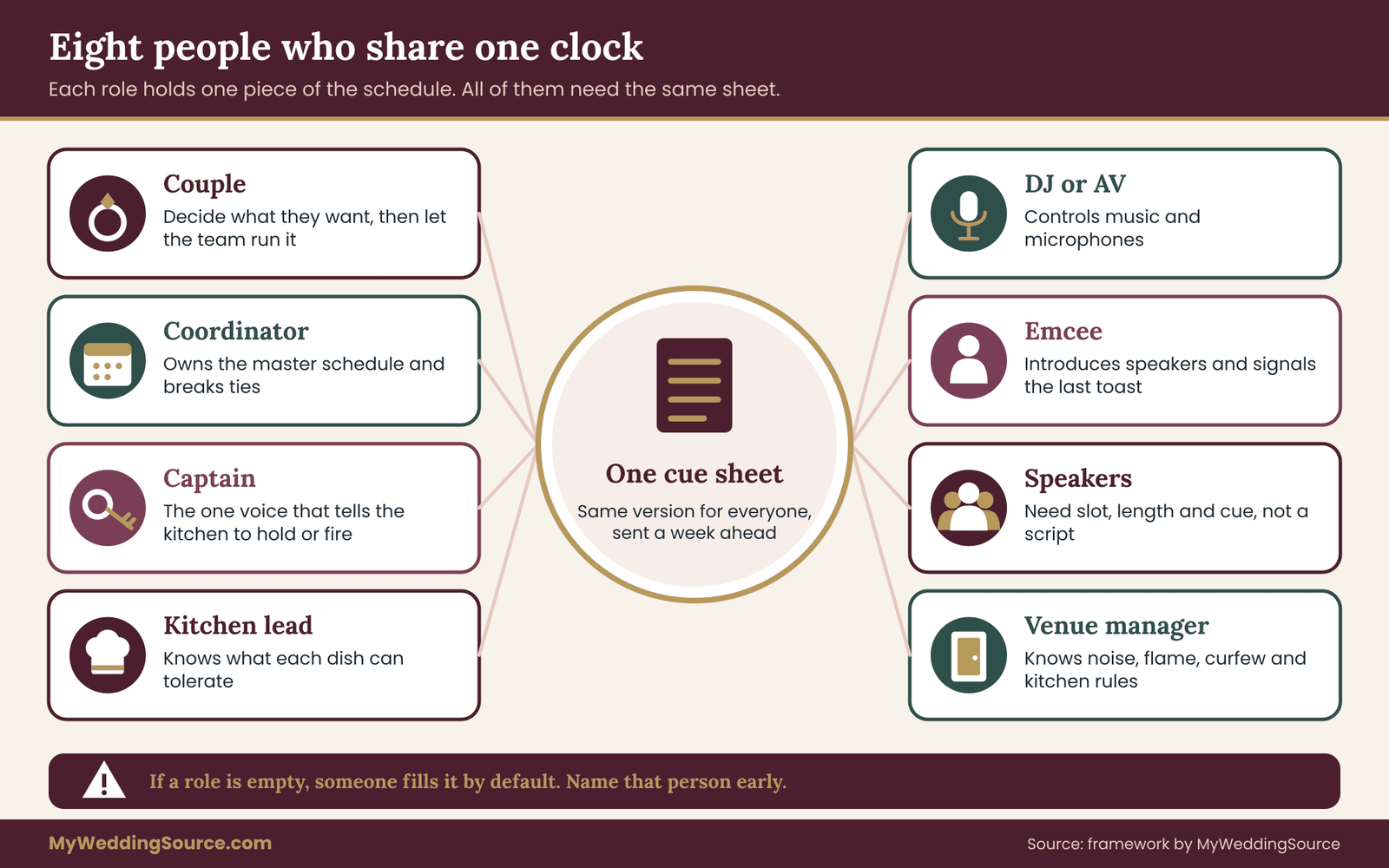
Wedding toast timing fails when one person holds the plan in their head. A plated dinner with toasts involves at least these people, and each needs the same written schedule:
- The couple, who decide what they want and who agree to let the team run it.
- The coordinator or planner, if you have one, who owns the master schedule and is the tie-breaker when two vendors disagree.
- The captain, who is the only person who can tell the kitchen to hold or fire.
- The kitchen lead or chef, who knows what the food needs and what it can tolerate.
- The DJ, bandleader or AV technician, who controls the music and the microphones.
- The emcee, who may be the DJ, a friend or a family member, and who introduces speakers.
- The speakers, who need to know their slot, their time and who will cue them, not what to say.
- The venue manager, who knows the building’s rules about noise, candles, curfews and who may enter the kitchen.
If any of those roles is vacant, someone else is doing it by default, and it is better to name that person now. A friend acting as emcee who has never met the captain is a common weak link. So is a DJ who has not been told that the kitchen’s schedule exists.
The broader flow of a reception, including entry, seating, food and exit, is covered in the site’s guide to reception guest flow. This article zooms in on one moment in that flow and treats the rest as the background it has to fit.
The practical consequence of everything above is a single rule for wedding toast timing that you can carry through the rest of the guide. Do not schedule toasts against clock times. Schedule them against kitchen events: after this course is cleared, before that course is fired, until this cue is given. Clock times are a result, not an input. Once you see that, your wedding toast timing gets much easier to write, and much easier to repair when the evening drifts.
The four slots for wedding toast timing in a plated dinner
A plated dinner offers a small number of natural gaps. Each one has a different cost for the food, for the speakers and for the room, and choosing among them is the first real decision in wedding toast timing. Here they are in the order they occur, labeled A to D so the rest of the guide can refer to them.

Slot A: before the first course. Guests are seated, the entrance is done, and nothing has been served. This is the quietest the room will be and the cheapest slot for the kitchen, because every course is still ahead. It suits a short welcome from a parent, a blessing, or a few lines of thanks.
It does not suit a long list of speakers: guests have been standing, mingling and drinking, and an empty place setting makes a patient audience out of fewer people than you would hope. If the cocktail hour was light on food, treat Slot A as short. The guide to the cocktail hour explains how the amount of food before dinner changes how guests arrive at their tables.
Slot B: between the first course and the entrée. The cold or light starter has been eaten and cleared, and the hot course has not yet reached the tables. For many couples this is the best slot for the main round of toasts, and it is the one most wedding toast timing plans are built around.
Guests have had a drink and something to eat, they are settled in their seats, and nobody is waiting on a plate that is going cold. The cost is an idle table: if the entrée is held until the last speaker finishes, the room waits for a lead time while the kitchen finishes, and that wait needs filling. Later sections show how to shorten it.
Slot C: after the entrée is cleared, before dessert or coffee. Everyone has eaten and the evening feels relaxed. Hot food is no longer at risk, because the only things still to come are desserts, coffee and the dancing. The weaknesses are on the guest side.
People are leaving their seats for the bar and the restrooms, older guests and families with young children may be close to leaving, and clearing noise can run under the speeches. A toast at Slot C tends to work best in wedding toast timing when it is short and warm: the couple’s thanks, a parent’s closing words.
Slot D: after dessert, just before the dance floor opens. No service competes with the microphone. The trouble is that guests are restless, speakers have waited all evening, and a speech here sits between the audience and the music they are ready for. If you choose Slot D for your wedding toast timing, put a firm cap on the total and tell the DJ when the dance floor opens whether or not speeches have finished.
Not a slot: while plates are being delivered or eaten. It is tempting to place speeches “during dinner” to save time. Wedding toast timing in that mode creates three competing demands on guests: eat, listen and watch servers move. Servers cannot go still because the plates are the clock, and they walk behind the speaker.
The speaker loses part of the room immediately. If you are told your venue “always does toasts during the entrée,” ask what happens to the hot plates when a speaker runs long, and how many servers will be moving at that time.
Choosing a slot with five questions
You do not have to pick a slot by feel. Five questions narrow the choice quickly, and each one ties wedding toast timing to something the caterer or the guest list already tells you.
How many toasts, and how long in total? Count the speakers and multiply by the length you have asked them to hold to, then add about half a minute per speaker for handoff. A total under about five minutes can fit in any slot. A total over fifteen minutes should be split across slots, because no audience at a seated dinner gives fifteen minutes of attention equally to each speaker.
Which course is the most sensitive to waiting? If the entrée is the dish most likely to suffer, the safest speaking slot is before the entrée is fired (Slot B). If the entrée is a slow-cooked dish the chef is comfortable holding, Slot C becomes easier. Ask the kitchen, and do not guess from the menu.
Who leaves early? If you have many guests who are likely to depart soon after the meal, such as older relatives or families with young children, keep the toasts that matter most to them in Slots A and B.
How long since people last ate? A late ceremony followed by a short, light cocktail hour means hungry guests at Slot A. A long cocktail hour with plenty of food means patient ones.
Is the caterer comfortable holding the kitchen? Some teams are used to stopping the fire call for a toast; others keep the line moving because their equipment, staffing or service style make a hold hard. Their comfort level is not an annoyance to work around. It is a constraint to plan inside.
A common and sensible result for wedding toast timing is a split: a short welcome at Slot A, the main toasts at Slot B, and the couple’s thanks at Slot C. Another is all toasts at Slot B for a short dinner with few speakers. The sections that follow keep these two patterns in view.
How course type and hold tolerance shape wedding toast timing
Every course has a different tolerance for waiting, and wedding toast timing has to respect that. The right slot depends partly on which course is next, and the right answer comes from your caterer, not from a general rule. What follows is a list of questions, not a list of rules.
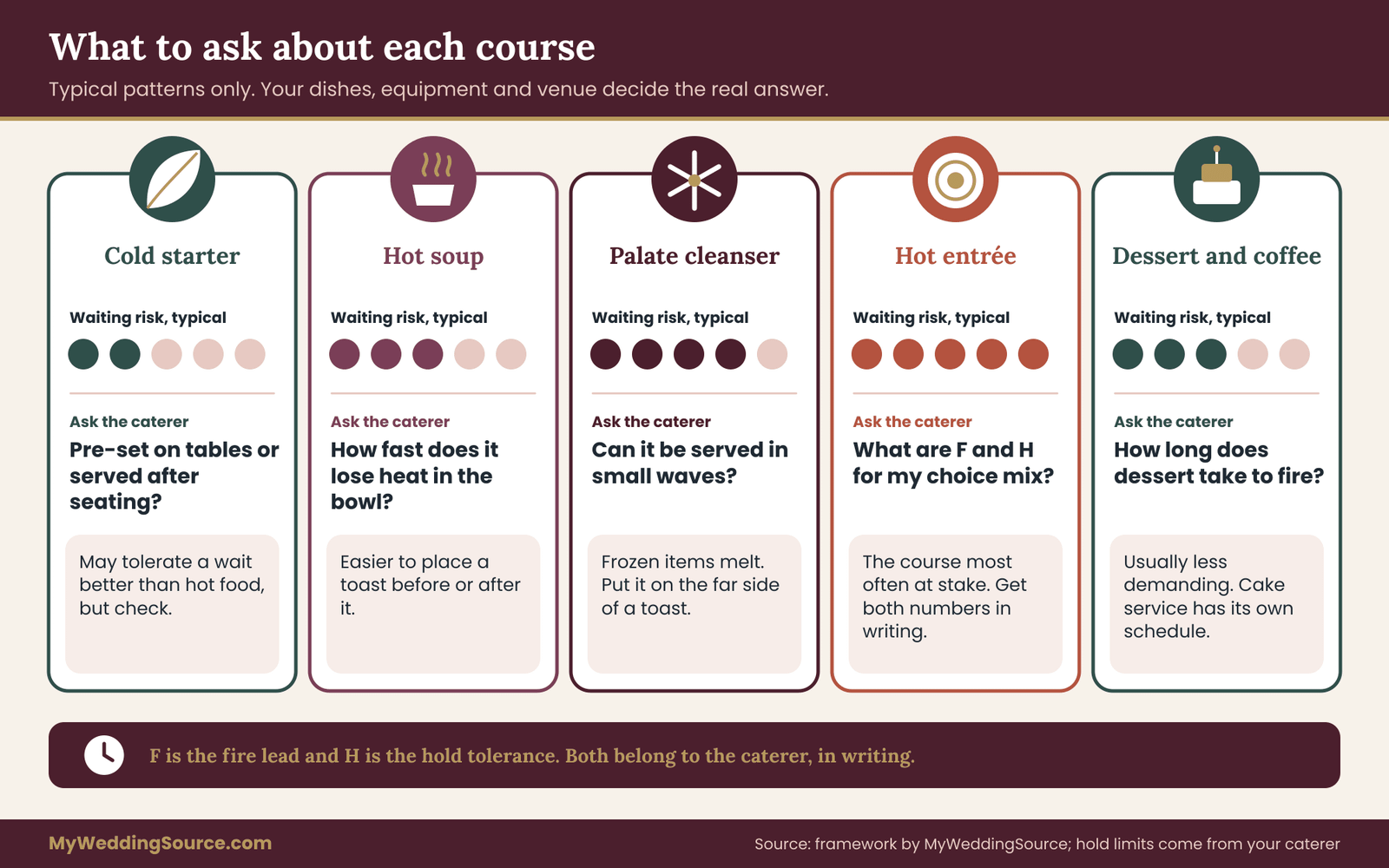
A cold plated starter. Composed salads, chilled soups and similar dishes often tolerate time on a table better than hot food tolerates time under a lamp. That is one reason a toast after the cold course is popular. If the starter is pre-set on the tables before guests sit down, the picture changes: guests begin eating the moment they arrive, and a toast at Slot A competes with food that is already in front of them. Ask whether the starter is pre-set or served after seating.
A hot soup. Soup loses heat quickly in a wide bowl, and a speech delivered while it is on the table asks guests to choose between listening and eating it warm. If soup is the first course, a toast is easier before it is served or after it is cleared.
An intermezzo or palate cleanser. Frozen items melt. If your menu includes one, ask whether it can be served at the table in a smaller wave, and whether it should sit on the far side of a toast rather than the near side.
The hot entrée. This is the course most often at stake. The kitchen’s time-to-table, how it plates for the number of choices on your menu, and how well your particular dishes hold on the pass all vary. Some dishes are designed for holding and some are not. Do not accept “it’ll be fine” without asking for the two numbers below.
Dessert and coffee. Plated desserts, ice cream and hot coffee all have their own sensitivities, but they are usually less demanding than the entrée. They are also a lower priority for the speeches, since most couples want dessert to lead into cake and dancing. Cake service has its own schedule, and it is better to treat it as a separate item than to fold it into the toast plan.
The two numbers to ask for
For the entrée and any other hot course that falls after a toast, ask your caterer for two figures, in minutes, in their own words and ideally in writing.
Fire lead, which this guide calls F. How long from the moment the captain calls “fire” until the first plates reach tables, and until the last tables are served? Ask for both: the first-plate time and the last-plate time. The gap between them is the length of service, and the guests at the last table wait through it.
Hold tolerance, which this guide calls H. If the kitchen has plated the course and the room is not ready, how long can finished plates wait before the kitchen would rather remake them, or before quality or food-safety rules say they should not be served? Hold tolerance depends on the dish, the equipment and the venue, and it is entirely the caterer’s number.
There is also a third figure under your control, and it is the one your wedding toast timing choices change directly: L, the length of the toast block, from the first cue to the moment servers can walk. A later section turns these three into a simple decision rule. For now the point is that F and H are facts about the kitchen, L is a fact about the plan, and the only person who can supply F and H is the caterer.
If your caterer says “it depends,” ask what it depends on. Group size, the number of entrée choices, special-diet plates and whether the venue has a separate finishing kitchen are all common answers, and each one tells you what to bring to your planning meeting. If the caterer simply gives you a figure, ask them to put it in the event order or banquet event order, the document that lists the evening’s service plan. A written number can be checked at the walkthrough; a spoken one tends to drift.
Public agencies publish guidance on how long hot and cold food may stay at temperatures that allow bacteria to grow, and the figures differ slightly between the Food and Drug Administration’s Food Code and the U.S. Department of Agriculture’s consumer pages. Professional caterers follow their own written procedures and local health rules. That is a good reason not to put a number from the internet into your wedding toast timing schedule. Put the caterer’s number in, and let the caterer own the food-safety side of the answer.
Why more courses add gaps and more risk
A formal menu with a starter, soup, fish course, entrée and dessert has more natural gaps, but more courses also means more points at which a toast can interrupt a plate that was already moving. A good rule of wedding toast timing for longer menus: use the gap that sits just before the most sensitive course, and leave the other gaps alone.
Splitting toasts across three or four gaps sounds generous, but each gap needs its own hold, pour, go and release, and each adds the chance that one cue goes wrong. Two slots are a comfortable maximum for wedding toast timing at most dinners.
The other half of the picture is how the course will be served. If the entrée goes out in waves, with the head table first and the rest of the room by table number, a toast can sit between waves. That is rarely a good idea, because guests in the second wave watch their neighbors eat. Ask the captain to serve every table in as tight a window as the kitchen allows, and place toasts before or after that window.
The Hold, Pour, Go, Release cue chain
A toast slot on paper is not a toast slot in the room. Something has to turn the plan into four moments the whole team can feel. Those moments are the working core of wedding toast timing. This guide uses four cues, always in the same order of ownership, so that the people involved do not have to improvise under pressure. The names are deliberately plain: Hold, Pour, Go and Release.

Hold. The captain tells the kitchen that the next hot course will not be fired until a named signal. This cue is given early, usually when the previous course begins to be cleared, and the kitchen lead repeats it back. A hold that nobody repeats is a hold that nobody heard. The point of the cue is not to stop the kitchen working: prep, plating components and staging can continue. It stops one decision, the call to fire.
Pour. The captain sends servers to fill the glasses for the toast, whatever is in them: sparkling wine, still wine, water, juice, a non-alcoholic option. Servers then stop moving and move to the edges of the room. Two things have to be true before the next cue: every guest has something to raise, and nobody is walking through the room with a tray.
Go. The captain signals the DJ, bandleader or emcee that the room is ready. The music fades, the first speaker is introduced, and the microphone changes hands. This is the only cue the guests hear. It should be the last thing to happen, never the first, because a speaker who starts before the pour is finished has to compete with servers.
Release. The kitchen is told to fire, or the held plates are sent. Servers move again, the DJ brings the music back to conversation volume, and the evening resumes. Release is where the two clocks meet again, and it is the cue most often forgotten, because everyone is watching the speaker and nobody is watching the kitchen door.
Two orders for the last two cues
The four cues stay the same in both versions of the plan; only the order of the last two changes.
In hold-first, the sequence is Hold, Pour, Go, then Release when the last speaker finishes. The kitchen waits until the toasts are over to fire the entrée. Food is as safe as it can be, but the room waits for the full fire lead after the last speech with an empty table and nothing to do. It is the cautious version of wedding toast timing, and it is a perfectly good choice.
In overlap, the sequence is Hold, Pour, Release, Go: the captain fires the course just as the first speaker is introduced, so that the plates are being built while the toasts are in progress and arrive soon after the last one ends. The room saves most of the waiting time. The risk is that a long speech leaves finished plates waiting at the pass. The next section shows how to decide between the two with arithmetic from the caterer’s own numbers. Overlap is the efficient version of wedding toast timing, with more to manage.
What each person says
Scripts for wedding toast timing do not need to be elaborate, but they do need to be agreed. Short, repeatable phrases are what survive a loud ballroom.
Captain to kitchen lead: “Hold the entrées until I call fire. Please repeat back.”
Captain to servers: “Pour for the toasts at every place, starting at table one. When your station is done, step to the wall and wait for my signal.”
Captain to DJ or emcee: “Servers are set and glasses are full. You are clear in thirty seconds.”
Emcee to the room: “Please find your glass. We have a few words from the people who know these two best.”
Emcee to captain after the last speaker: a raised hand and the words “last toast done,” or whatever visual signal you rehearsed.
Captain to kitchen after Release: “Fire entrées now, all tables, same timing as agreed.”
If your dinner uses radios or earpieces, all the voice cues above are simple. If it does not, decide in advance how the captain and the DJ will communicate across a room: a visual signal, a runner, or a coordinator who stands between them. The usual failure here is not a lack of cues; it is that the DJ and the captain stand fifty feet apart and have never been introduced.
Who owns what, and who covers
Each cue in wedding toast timing needs a primary owner and a backup, because the person who owns it can be pulled away.
The captain owns Hold, Pour and Release; the DJ or emcee owns Go; the coordinator or planner owns the clock and holds the written schedule; the kitchen lead owns the honest answer to “are we ready?”; the venue manager is the backup for anyone who cannot be found.
That sentence is the whole assignment. If the captain is called to the kitchen at the wrong moment, the coordinator takes the cues until the captain returns. If there is no coordinator, the lead server steps in. Name the backup before the evening, and put it on the cue sheet.
What a failed cue looks like, and the fix
Wedding toast timing tends to break at one of four places, and each break has a recognizable look.
A missed Hold. The entrée plates appear while the first speaker is introduced. The fix is for the captain to tell servers to keep the plates in the kitchen or at the pass until the speaker finishes, then to go back to the kitchen lead and agree on how long the plates can wait. Nobody should carry plates into a room that is listening to a toast unless the caterer has said that is the plan.
A late Pour. The emcee is ready, but half the glasses are empty. The fix is for the captain to hold the Go cue until the pour is done. A thirty-second delay at this point is cheap. A pour finished during the first speech is not.
A premature Go. The music fades before the servers have cleared the aisle. The fix is to bring the music back up for ten seconds, let the servers finish, and try again. A speaker who is told “one moment” is better off than one who starts over the noise of trays.
A forgotten Release. The last speaker sits down, the room applauds, and nothing happens. The fix is for the emcee to fill with music and a single line, such as “dinner is on its way,” while the captain fires. This is the reason the Release owner needs a visual cue: the captain has to see the last toast end.
Wedding toast timing is not improved by adding more cues. It is improved by removing ambiguity from the four you already have, so that each one has a clear owner, a clear moment and a clear repeat-back.
Building your wedding toast timing in relative minutes
Clock times are tempting for wedding toast timing because they fit on a one-page schedule. They are also the first thing to go wrong, because a dinner that starts ten minutes late makes every later time false. Relative minutes avoid that. You anchor the plan to events in the service, and you measure from those anchors.
Choose anchors that the kitchen also recognizes
An anchor is an event that the captain can see and call. Good anchors for a plated dinner are:
- S0: guests are seated and the music or announcement for dinner has begun.
- C1: the first course is cleared (the moment the last table is clear, not the moment the first plate leaves).
- E: the entrée is fired. This one is the pivot of the whole plan.
- E+F: first entrée plates reach tables.
- D: dessert or coffee service begins.
Every toast cue is expressed as an offset from one of those anchors: “C1 plus two: Pour begins.” If the dinner slips ten minutes, the anchors slip with it and the plan stays correct.
Do the arithmetic once, in plain minutes
Three numbers drive the choice between hold-first and overlap in wedding toast timing, and the first two come from the caterer:
- F, the fire lead: minutes from the fire call to the first plates at tables.
- H, the hold tolerance: minutes finished plates can wait before the caterer would not serve them.
- L, the length of the toast block: minutes from the Go cue to the moment the last speaker finishes and servers can walk.
Add two numbers you choose yourself. B is an overrun buffer, a minute for each speaker is a reasonable starting point if some of them tend to run long. M is your own safety margin on the caterer’s hold figure, so that you do not plan to its limit.
The rule for wedding toast timing is short. If L plus B is no larger than F plus H minus M, overlap is workable: fire at Go. If it is larger, use hold-first, or shrink the toast block until it fits. Notice that this also tells you which lever to pull when the plan fails. Shorter toasts lower L. A caterer who confirms a longer hold raises H. A lighter menu or a smaller guest count may shorten F.
Here is the comparison in minutes, with invented numbers. Say the pour takes 3 minutes, F is 12, H is 5, L is 8, B is 2 and M is 2. Hold-first costs the pour, plus the toasts, plus the full fire lead: 3 + 8 + 12 = 23 minutes of the evening before plates arrive.
Overlap costs the pour plus the longer of toasts and fire lead: 3 + 12 = 15. Overlap saves 8 minutes, and the check passes, since 8 + 2 = 10 is no more than 12 + 5 − 2 = 15. These numbers are placeholders. Your caterer’s numbers will differ, and so will your answer.

What the rule does not tell you
The arithmetic is only as good as its inputs, so treat it as a screening tool for wedding toast timing, not a verdict.
It does not tell you whether the caterer is willing to fire against a speech. Some teams prefer hold-first as policy, even when the numbers say overlap is possible, and that preference is theirs to have.
It does not know the speakers. Four people who have each promised three minutes are not the same as four people who have never spoken in public. Wedding toast timing for a nervous group should carry a bigger B.
It does not account for the last table. A first-plate time of 12 minutes with a last-plate time of 20 means the final guests wait eight minutes longer than the first. Whenever you choose overlap, decide whether the room’s patience is measured against the first plate or the last.
And it does not guarantee food quality or safety. Those depend on the dish, the equipment, the venue and the caterer’s procedures. The rule only helps you decide which question to put to the caterer next.
Working backward from hard stops
A good wedding toast timing plan is built from both ends. From the front, you have the seating time and the anchors above. From the back, you have fixed points that do not move: a venue curfew, a shuttle departure, a child’s bedtime, a band’s contract end.
Write those at the bottom of the page, subtract the length of the dance block and any cake service, and see how much slack remains for toasts. If the answer is “none,” the plan needs fewer toasts or fewer courses, and it is better to learn that on paper than at 8:40 p.m. on the day.
Keep one more number visible: the drift budget. It is the number of minutes the evening can run late before something important is squeezed out. Every overrun in the plan draws from that one budget, and the recovery rules later in this guide spend it in a set order.
A worked example of wedding toast timing: 120 guests, three courses, four speakers
The example below is invented. It exists to show how the pieces of wedding toast timing fit, not to suggest numbers for your own dinner. Every figure marked “confirmed” is a figure the couple got from the caterer; every figure marked “assumed” is one they decided to plan around until someone proved otherwise.
The setup
Priya and Daniel are hosting 120 guests at 12 tables of ten. The dinner has three plated courses: a salad served after guests sit down, an entrée with three choices (chicken, fish and a vegetarian plate), and dessert with coffee. They have four toasts in mind: a welcome from Priya’s father (about two minutes), a speech from Daniel’s best friend (three), one from Priya’s sister (three), and a thank-you from the couple themselves (three). The venue has a fixed curfew at 11 p.m., and the DJ’s contract ends at 10:30.
They have hired a day-of coordinator and the caterer provides a banquet captain. Both will see the wedding toast timing sheet. The ceremony ends at 5:15, cocktail hour runs from 5:30 to 6:30, and guests are asked to take their seats at 6:30. That time becomes S0.
What the caterer confirmed, and what is assumed
At the planning meeting, the couple asked for the two numbers from earlier and a few more that affect wedding toast timing. The caterer’s written answers went into the event order.
Confirmed:
- Fire lead (F): 12 minutes from the fire call to the first entrée plates at tables, and about 20 minutes to the last table.
- Hold tolerance (H): 5 minutes for finished entrées at the pass before the kitchen would rather remake plates.
- Pouring a toast drink at 12 tables takes the dining room team about 4 minutes.
- The salad is served after guests sit down, not pre-set.
- The captain and coordinator will both carry radios; the DJ has a handheld microphone and a second one on a stand.
Assumed:
- Speakers will keep to their three minutes. (Nobody has proven this yet.)
- The first course will be cleared about 40 minutes after seating.
- The DJ can fade the music and take the first speaker’s microphone within a few seconds of the cue.
- Guests will be at their tables by 6:40.
- Dessert’s fire lead will be about 8 minutes. (The caterer said “less than entrées” and did not give a figure, so the couple wrote down their own guess and flagged it.)
Separating these two lists is the most valuable habit in wedding toast timing. When a confirmed number changes, the plan changes. When an assumed number turns out wrong, the plan has a place to be corrected.
The first draft fails the rule
The couple’s first idea was to put all four toasts in a single block after the salad. That block would include the welcome (2), best friend (3), sister (3) and thank-you (3), plus about four minutes of introductions and microphone handoffs, so L is 15. Giving each of the four speakers a minute of overrun buffer makes B equal to 4.
With F at 12, H at 5 and a margin M of 2, the right-hand side of the rule is 12 + 5 − 2 = 15. The left-hand side is 15 + 4 = 19, which is larger. Overlap fails. Hold-first would work for the food but add 12 minutes of waiting after the last speech, and the couple would lose a quarter of an hour of the dinner.
So they changed their wedding toast timing instead of the rule. The welcome moved to Slot A, a short one before the salad. The thank-you moved to Slot C, after the entrée is cleared. The block at Slot B is now just the two longer speeches: L is 3 + 3 + 2 minutes of handoff, which is 8, and B is 2. The left-hand side is 10, comfortably below 15. Overlap works, and the room waits only 4 minutes after the last speech.
The timeline, in relative minutes
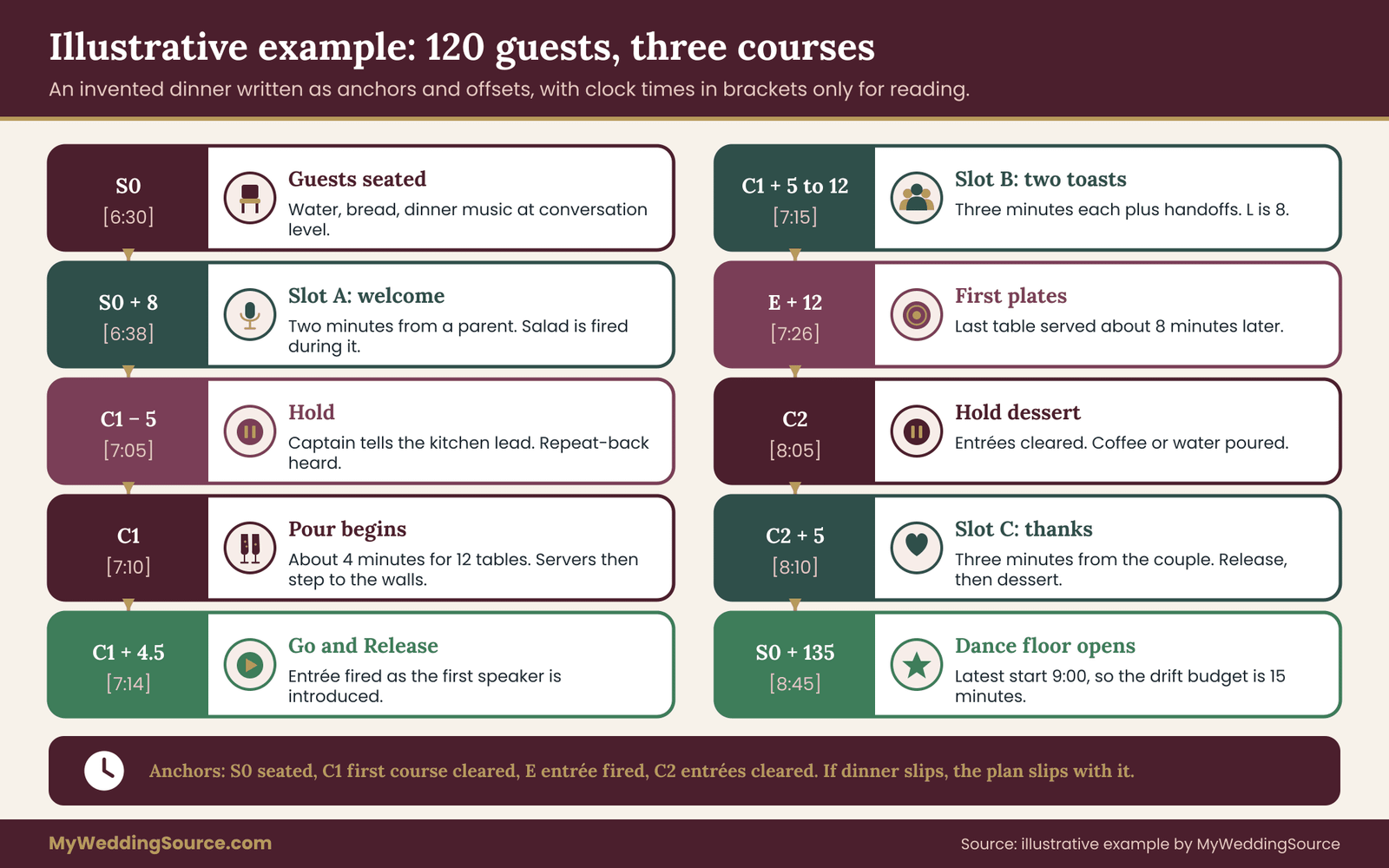
The anchors for this wedding toast timing example are S0 (seated), C1 (first course cleared), E (entrée fired) and C2 (entrées cleared). Clock times appear in brackets only to make the example readable.
- S0 [6:30]. Guests are seated. Water is poured, bread goes out, the DJ plays dinner music at conversation level.
- S0 + 5. Couple’s entrance, if they want one. The DJ announces it.
- S0 + 8 (Slot A). Priya’s father gives a welcome of about two minutes. No Pour is needed beyond the water already on the table, and servers are asked to hold at the walls for these two minutes. The salad is fired during the welcome so that it arrives soon after.
- S0 + 15 to C1. Salad is served and eaten. The captain reports to the coordinator when clearing begins.
- C1 − 5 [about 7:05]. Hold. The captain tells the kitchen lead not to fire entrées until called, and the kitchen lead repeats it back.
- C1 [about 7:10]. Pour begins. Servers fill glasses with sparkling wine or a non-alcoholic alternative.
- C1 + 4 [about 7:14]. Pour complete. The captain tells the DJ, “servers are set, you are clear in thirty seconds.”
- C1 + 4.5. Release and Go together, because the rule passed: the captain calls fire as the DJ fades the music and introduces the first speaker.
- C1 + 5 to C1 + 12. Best friend, then sister, with a microphone handoff between them. The DJ holds a card for a one-minute warning and keeps it low.
- C1 + 12 [about 7:22]. The music comes back at conversation level. The room waits a few minutes for the first plates, and the couple takes the moment to move between tables.
- E + 12 [about 7:26]. First entrée plates arrive. Service runs for roughly eight more minutes to the last table.
- C2 [about 8:05]. Entrées are cleared. The captain tells the kitchen to hold dessert, pours coffee or water, and sends the DJ the ready signal.
- C2 + 5 (Slot C). The couple thanks their guests, about three minutes. Release is given at the end, and dessert is fired.
- About 8:45. The dance floor opens.
The drift budget and the overrun case
The couple’s dance block is planned to run from 8:45 to 10:30. They decided that anything shorter than 90 minutes of dancing would feel wrong, so the latest they can open the floor is 9:00. That gives them a drift budget of 15 minutes for everything from seating to dessert, and their wedding toast timing has to fit inside it. They put the figure at the top of the cue sheet.
Now suppose the two speeches at Slot B run long and put the wedding toast timing under strain. If they take 12 minutes instead of 8, the plates are ready exactly when the speakers finish, and the evening loses nothing. If they take 15, plates wait 3 minutes at the pass, which is inside the 5-minute hold the caterer confirmed, but it uses up the margin.
If they take 18, the plates would wait about 6 minutes, longer than the caterer’s tolerance, so the plan sets a soft wrap signal at 10 minutes after Go and a hard stop at 15. At the soft wrap, the DJ raises a card. At the hard stop, the emcee thanks the speaker and takes the microphone. The couple told both speakers about these two signals in advance, without discussing what their speeches should contain.
What if the caterer’s answers had been different
Three variations show how the same wedding toast timing responds.
If the caterer had said H is zero. Plates cannot wait at all. The rule becomes L + B ≤ F − M, so 10 ≤ 10, which passes on paper with nothing to spare. The couple would still choose hold-first for their wedding toast timing, because an overrun of even a minute would send finished plates past the limit.
If the caterer had said F is only 8. Now 8 + 2 = 10 against 8 + 5 − 2 = 11. It still passes, but by a single minute. They would probably keep the toast block shorter, perhaps one speaker at Slot B and the other at Slot C.
If the caterer had said the kitchen can hold fire indefinitely. There is still no case for rambling, since the room has limits even when the kitchen does not. This is why L is part of the rule instead of H alone.
The one-page cue sheet and the speaker note
The wedding toast timing sheet that went to the coordinator, the captain, the kitchen lead and the DJ held five things: the anchors, the cue owners and backups, the confirmed numbers, the assumptions, and the drift budget. It did not include the speeches. The wedding vendor timeline is a useful companion for getting that kind of sheet to everyone who needs it, in the same version, before the day.
The speakers each received a short message with timing only. It said when they were on, who would introduce them, how long to plan for, what the one-minute card means, and where to stand. A sample reads like this:
“You are on after the salad is cleared, second of two. The DJ will introduce you and pass the microphone. Please plan for about three minutes. A card near the DJ booth means one minute left.”
That is the whole note. It sets wedding toast timing expectations for the speaker and leaves the content to them.
Special cases that break a clean wedding toast timing plan
The wedding toast timing above assumes everyone is served at the same time and every speaker shows up on cue. Real dinners are less tidy. The cases below are the ones most likely to push a neat timeline off course, with a decision rule for each.
Special-diet plates
Guests with allergies, religious dietary rules or medical needs often receive plates that are prepared separately. Kitchens commonly plate and serve these plates first, with extra care for labeling and hand-off, so a guest with a restriction may be served a few minutes ahead of their table.
That affects wedding toast timing in two ways. First, the hold you ask for has to cover these plates too, or a single plate arrives mid-speech. Second, the captain needs to know whether special plates go out with the main wave or ahead of it, because a lone server crossing a quiet room is conspicuous.
Ask the caterer how special-diet plates are timed relative to the main service and who carries them. If the answer is “ahead of the wave,” ask whether that timing can shift to just after the last speech so that those guests are not served in the middle of a toast.
Do not ask the kitchen to rush or compress any allergen procedure to save a minute. Those steps belong to the caterer, and the Food and Drug Administration and its food-allergy resources explain why labeling and separation matter. If you are still choosing dishes, the wedding menu planning guide covers how to build a menu that works across dietary needs.
Children’s plates and early service
Children are often served before the adults, which is sensible. For toasts, the question is the opposite one: where are the children when the speeches begin? Young children at a table with nothing to do are the most likely source of noise in a quiet room.
If you have many of them, a toast before their plates are served (Slot A) is harder than one after they have eaten. Consider placing the main toasts when the children have just been fed, or accept a short block with a lower B. The wedding guest care planning guide covers how to plan for babies, children and older relatives across the evening.
Waves, head tables and the speakers’ route
When entrées go out in waves, say the head table first and then tables by number, a toast between waves leaves some guests eating while others wait. The better fix is not to place the toast there but to ask the captain to serve every table inside the tightest window the kitchen allows, and to hold the toast either before the first plate or after the last.
Where the speakers sit matters as much to wedding toast timing as when they speak. A speaker seated at a far table who has to cross a dance floor or a service route will take longer than a speaker seated within a few steps of the microphone. Seat the two speakers in each block near the mic position, and keep the route clear of server stations. If you have not yet worked out table placement, the wedding seating chart guide is the right place to start.
More entrée choices, a longer fire lead
Every additional choice adds plating steps and gives the kitchen more things to coordinate. A caterer’s F for a single, plated protein is not the F for a three-way choice with special-diet plates mixed in. When you ask for F, tell the caterer your final choice counts, or at least your expected mix, and ask for the number that matches. If your choice counts change a week before the wedding, ask whether F changes too. Treat F as a living number in your wedding toast timing until the final count is in.
Shared or family-style courses
A shared first course, such as platters passed around the table, does not behave like a plated one. Guests serve themselves, so the “course” is over when the table is ready, not when the servers clear. If your dinner mixes shared and plated courses, treat the transition between them as the natural toast gap. The cue chain still works for wedding toast timing, but the anchor C1 is harder to see, so give the captain a visual definition, such as “when platters are removed from the last table.”
Traditions with several toasts or a toastmaster
Some wedding traditions include a long sequence of toasts, a designated toastmaster or a toast after each course. Those are real and worth keeping. The planning consequence for wedding toast timing is that the number of speakers is no longer the useful limit.
Plan by the total minutes of speaking instead, and split them into short blocks at two or three slots, each with its own Hold, Pour, Go and Release. Tell the caterer early, because three holds are a larger request than one. If a toastmaster runs the sequence, treat that person as the emcee and give them the cue sheet.
A speaker who is missing or late
Someone will be in the restroom, taking a call or stuck in the bar line when their name is called. Set a rule in advance: the emcee waits for one minute at most, then moves on to the next speaker, and the missing speaker is offered a place later or at the next block. Keep an on-deck speaker seated near the microphone. A coordinator or a friend with the speaker list can quietly confirm at the start of Pour that everyone in the block is in the room.
Outdoor or tented dinners
Wind, heat, rain and insects change the room itself, and with it wedding toast timing. A tent can make a microphone sound different from a ballroom. Heat increases the pressure to move food quickly.
Weather can change the whole evening: if lightning is in the area, the National Weather Service’s safety guidance is to move people indoors, and a toast is not a reason to delay that. Ask the caterer and venue what their weather plan is for the dinner and which decision-maker calls it. Your wedding toast timing should have a version that works inside, with the same cue chain.
A band, a playlist or no music professional
The Go cue in wedding toast timing assumes someone can fade the music and run the microphone. With a live band, the bandleader plays that role and needs to know when the band will pause.
With a playlist and no DJ, a friend or venue staff member has to take the job, and that person must be briefed on the schedule and have access to the sound controls. If you are still deciding what music you need, the guide to wedding reception music planning explains how dinner music and toasts fit into the energy of the evening.
Interpreters and translated toasts
When a speech will be interpreted or translated, whether in sign language or another language, the time and positioning change. The block needs more minutes, and the interpreter needs a place to stand where the people relying on them can see them clearly, with light on them. Confirm those needs with the interpreter or translator, not with a guess, and give them the speaker list and cue sheet in advance.
Drinks, microphones and room readiness
Wedding toast timing depends on three physical conditions: everyone can raise a glass, everyone can hear, and nobody is walking through the room. Each takes a little planning.
The Pour
For wedding toast timing, decide what is in the glass, who pours it and how long it takes. Ask the captain for a confirmed pour time for your headcount and glassware. The time depends on the number of servers, the glassware, whether bottles are open or need opening and the table layout, and the captain will have a better figure than any estimate here.
Offer a toast drink for everyone: sparkling wine, still wine, a non-alcoholic sparkling option, water or juice. Many guests do not drink alcohol, and a pour that skips them should not make them stand out. Ask servers to offer quietly and let guests choose. Children and anyone who has declined can be given the non-alcoholic option, in the same glass style as everyone else, without comment.
If you have a bar, ask whether it will pause service during the toast. Many couples ask the bar to close from the Go cue to the Release cue so that guests do not queue during speeches. The guide to wedding bar service planning covers how bar and dinner service interact. If the bar pauses, tell the bar manager the planned length of the pause and the signal that ends it.
Public health sources such as the Centers for Disease Control and Prevention and the National Institute on Alcohol Abuse and Alcoholism explain that drinking on an empty stomach has a stronger effect, since food slows absorption. A toast at Slot A, before anything is served, is a reasonable place for a smaller pour or a water option. That is a general principle, not advice for any individual guest.
Microphones
A few practical points about sound keep wedding toast timing from falling apart.
Count and type. Plan for at least two working microphones and a stand, so that a failed handheld does not stop the toast. Ask the DJ or AV technician to confirm the count and to bring spare batteries.
Test with the room full. A sound check in an empty ballroom tells you less than one with guests. People absorb sound, so the room that was loud and echoing at the walkthrough can sound drier and quieter at dinner. Ask for a quick check at the farthest table once guests have arrived, and ask the technician to set a ceiling on volume so feedback is avoided.
Wireless equipment. Professional wireless microphones rely on radio frequencies, and the Federal Communications Commission regulates their use. This is the technician’s domain. Ask that they use properly authorized equipment and have a backup, and leave the details to them.
Hands and notes. Speakers who hold a microphone in one hand and notes in the other tend to drop one. A stand, a clip-on or a short handoff from the emcee solves this. The emcee should bring the microphone to the speaker rather than send them across the room.
Hearing. Many older guests use hearing aids, and a loud or poorly placed speaker can cause squeal or discomfort. Ask the technician to point loudspeakers away from the microphone and to keep guests from sitting directly beside a loud cabinet. If you have guests who rely on assistive listening devices, ask the venue what is available. The Americans with Disabilities Act and its guidance on effective communication are published by the Department of Justice, and a venue is the right party to tell you how its obligations apply.
Light and background
Put light on the speaker, a small detail of wedding toast timing that guests notice at once. A speaker standing in the dark or backlit by a bright window is hard to follow, and guests who rely on seeing a face depend on it.
Ask the lighting provider or venue whether a single warm spot, or raising house lights slightly, is possible at the Go cue. Keep candles and open flame out of the speaker’s reach and away from the microphone cable. Ask the venue what its rules are for open flame in the dining room.
The readiness check
Before the Go cue, the captain, coordinator or emcee runs one silent check. Are glasses full at every table? Are servers at the walls with no trays in motion? Is the kitchen door closed? Is the microphone live and the first speaker next to the stand? Is the music ready to fade? If any answer is no, Go waits. A 30-second delay costs almost nothing, and starting the toast while the room is not ready costs the speaker the first minute of attention, which is the minute that matters most.
Confirmed versus assumed: what to ask before you lock wedding toast timing
A schedule is a set of claims, and wedding toast timing is no exception. Some claims have been checked by the person who controls them, and some have not. The problem with most wedding schedules is that the two kinds look identical on the page. A good plan keeps a short ledger with three states for every important number: confirmed in writing, confirmed verbally, and assumed.
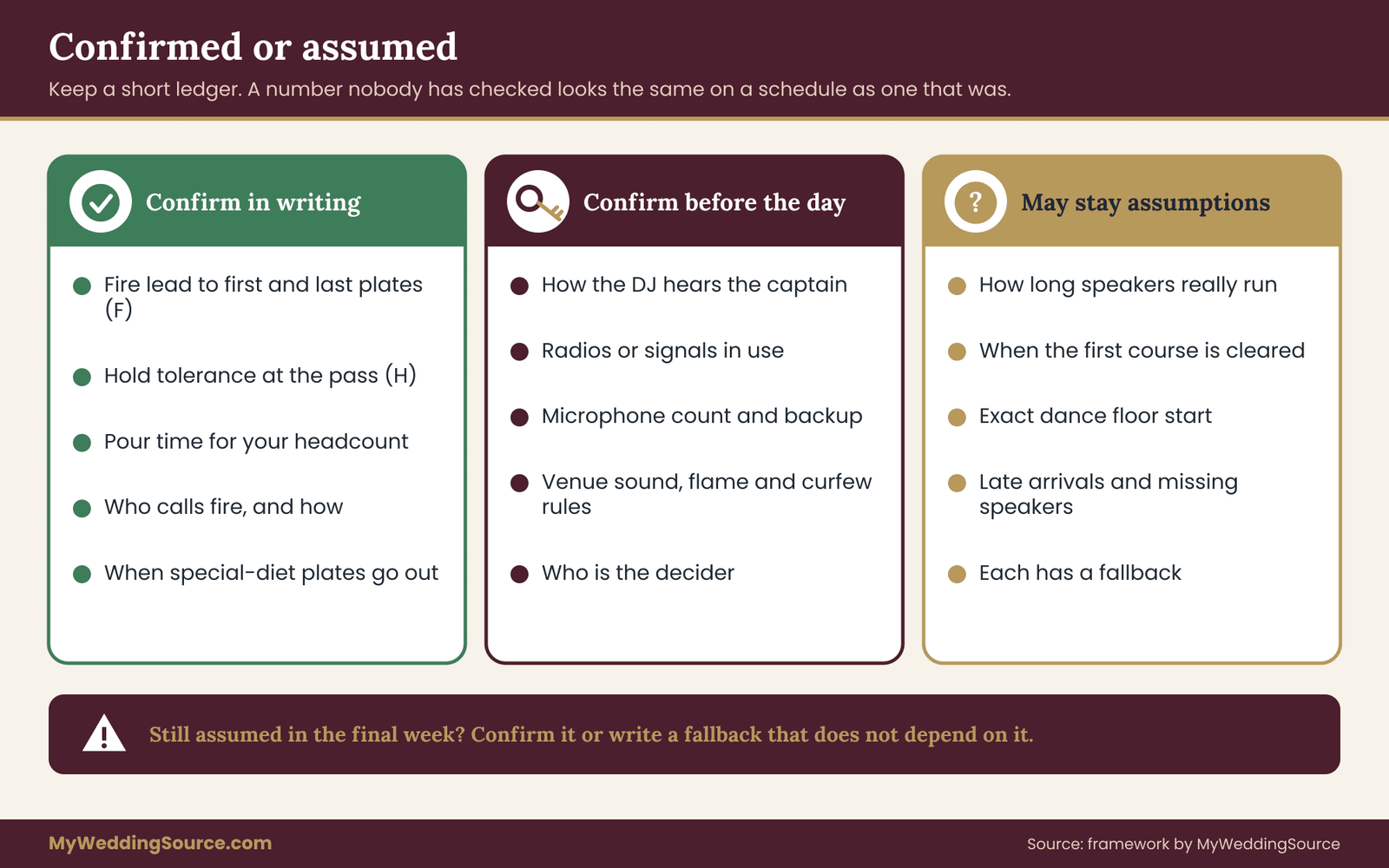
Each line in the ledger has an owner (the person who can confirm it) and a date. By the final planning meeting, every assumed item should either be confirmed or be given a fallback that does not depend on it. That is all the ledger is. It takes twenty minutes to build and spares you the middle of the dinner.
Questions for the caterer
The caterer controls the most important numbers for wedding toast timing, so start there. These questions are written to be asked in a planning meeting, and most can be answered in a sentence.
- How long from the fire call to the first entrée plates at the tables, and to the last tables, for my guest count and my choice mix? (This is F.)
- How long can finished plates wait at the pass before you would remake or not serve them? (This is H.)
- Who calls fire: the captain, the chef or the kitchen lead? How do you want to be told about a hold?
- How long does it take your team to pour a toast drink for every table, with the glassware we have chosen?
- Do servers clear or walk during speeches? Can they pause for a toast, and for how long?
- When are special-diet plates served relative to the main wave, and who delivers them?
- What happens to plates if the toasts run longer than planned? Is there a point at which the kitchen decides, and who tells the coordinator?
- Does a hold or a longer service window change staffing hours, and is anything in the contract tied to the length of dinner?
That last question is a cost question, and it deserves a direct answer. A dinner that runs longer can mean servers and kitchen staff on site for longer, and your contract may state an hourly rate for time past an agreed window. Do not assume either way. Ask, read the service-window language in your agreement, and decide whether a hold is worth a possible overtime charge.
Ask the caterer to put the answers into the event order. A number in writing can be checked on the day and revisited at the walkthrough. A number on the phone tends to be remembered as a friendlier number than the one that was said.
Questions for the venue
Venues set rules that caterers and DJs have to work within, and those rules do not always reach the people who need them. They shape wedding toast timing as much as the caterer’s numbers do.
- Which doors do servers use, and where are they in relation to the speaker’s position?
- Are radios or earpieces allowed for the captain and coordinator, and who may enter the kitchen?
- What are the sound limits and the curfew, and what happens to overtime if the evening runs late?
- Can the DJ or band communicate with catering staff directly, or only through the coordinator?
- What are the rules about candles or open flame in the dining room, and about changing lights at a cue?
- What are the venue’s own limits on room capacity and exits? Do not rely on a general figure; ask the venue and the local fire authority, who set the numbers that apply to your room.
Questions for the DJ, bandleader or AV technician
The person running sound has to hear the captain’s signal and act on it, so they need to be part of your wedding toast timing, not a bystander to it.
- How will you receive the Go cue: radio, a visual signal or a runner?
- How many microphones will you bring, what types, and how will you handle a failure?
- Can you fade music cleanly and bring it back to conversation level on Release?
- Will you hold a one-minute card or another signal for speakers, and where will you stand?
- Have you worked with this caterer or in this venue, and do you have a copy of the cue sheet?
Questions for the coordinator or planner
If you have a coordinator, they hold the clock. Ask who has authority to change the plan when the evening drifts, whether they will carry the cue sheet and a copy for every key person, and who covers the cues if the captain is called away. If you do not have a coordinator, the question becomes: who is that person, and have they agreed? A trusted friend or relative can do the job if they have the sheet, the phone numbers and the authority to speak to the captain.
What may stay an assumption, and what may not
Some items can reasonably remain assumptions on the morning of the wedding: how long the speakers will actually take, how quickly the last table finishes the first course, and whether the dance floor opens at 8:45 or 8:55. These are the numbers that will move anyway. Plan fallbacks for them and move on.
Other items must be confirmed before the day. These are F, H, the pour time, who calls fire, whether the kitchen can accept a hold, and whether the DJ and captain can communicate. If any of them is still an assumption in the final week, your wedding toast timing is not ready.
A small piece of wording can help here. A line in the event order might read: “Entrée fire is called by the captain after the Go cue for the second toast block. First plates are expected within the confirmed fire lead. Finished plates may wait at the pass for no more than the confirmed hold tolerance.” That is sample wording to adapt, not contract language. Ask the caterer to describe the policy in their own words, and let them correct it.
Run the cue chain once before the day
The best moment to test the plan is the venue walkthrough. The guide to a venue technical walkthrough covers measurements, access routes and vendor needs in general. For wedding toast timing, add one ten-minute dry run: the captain, DJ and coordinator stand in their positions, and someone plays the speaker. Run Hold, Pour, Go and Release with real radios or signals. You will find out in ten minutes that the DJ cannot see the captain, or that the kitchen door opens behind the stand. It is a cheap test.
When the evening runs late: recovery rules for wedding toast timing
Even with good wedding toast timing, the evening will drift. The ceremony starts late, cocktail hour stretches, the first course takes longer to clear, a speaker runs over. The difference between a calm recovery and a messy one is whether you agreed on the order of cuts before the pressure arrived.
Spend the drift budget in order
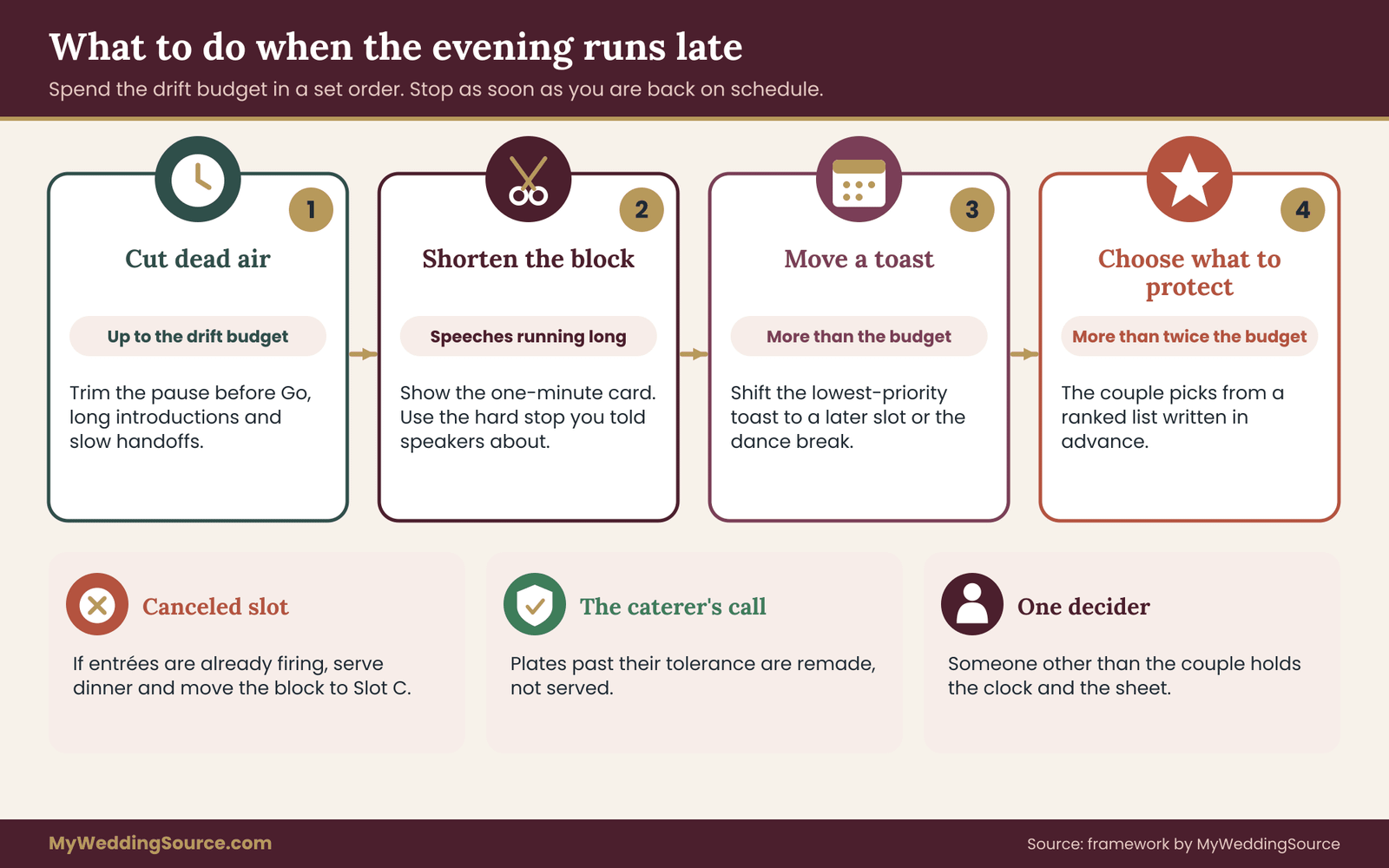
Recall the drift budget in your wedding toast timing: the number of minutes the evening can run late before something important is squeezed out. Call it D. When the evening is late, spend it in this order and stop as soon as you are back on plan.
First, take out dead air. The pause between the end of Pour and the start of Go, a second round of announcements, a slow microphone handoff and long introductions all cost minutes without anyone noticing. The captain and DJ can recover several minutes here without changing anything the couple cares about.
Second, shorten the block. If the speeches are running long, the one-minute card and the hard stop from the worked example do this job. Decide the hard stop in advance and tell the speakers about it. A speaker who knows the limit is rarely hurt when it is enforced.
Third, move a toast. If dinner is more than D behind, move the lowest-priority toast from its slot to a later one, for example the couple’s thanks from Slot C to just before the dance floor opens or into the first dance break. Decide in advance which toast moves first, and who has to be told.
Fourth, drop or shorten something else. If the night is more than twice D behind, the couple has to choose what to protect. Their choices might be the cake cutting, a parent dance, a long toast from an elder relative, or a full dance floor. It should be a couple’s decision, not a vendor’s, and it should have been written on the cue sheet in advance as a ranked list.
Which toasts to protect
When something has to give, wedding toast timing should favor guests who will leave early, so ask which speakers matter to them. Older relatives and families with young children are often the first to go. Place their toasts in Slots A and B, and place the toasts that matter to the people staying through the dancing later. If you must choose, protect the first group. The people staying late will see the later toasts and the dancing anyway.
A canceled slot
Sometimes a slot is simply gone. If the captain did not place the Hold by C1 minus five minutes and entrées are already being fired when the toasts were due to start, Slot B is canceled. Do not pause plates in the hall to rescue the plan.
Serve the dinner, give the room a few minutes to eat, and move the block to Slot C, after the entrées are cleared. The coordinator makes this call and tells the DJ and the speakers. It is one of the benefits of writing the wedding toast timing rule down: nobody argues about it while hungry guests watch.
The caterer’s call comes first
When the kitchen says plates have waited too long, the kitchen’s decision beats the wedding toast timing schedule. Do not ask the caterer to hold food past their own tolerance, to shorten any safety procedure or to serve a plate they would rather remake. If the plates have to be remade, the cost to the evening is a delay. That is a better cost than the alternatives. Public guidance from the Department of Agriculture and the Food and Drug Administration exists for exactly this situation, and your caterer is the person who applies it.
Who decides, and in what words
Name one decider for the evening’s wedding toast timing, and make it someone other than the couple, who should be enjoying their dinner. It can be the coordinator, a parent or a friend with the clock and the cue sheet. The decider talks to the captain, the DJ and the speakers, and makes the calls above in order. They do not need to consult the couple on every move: only on the fourth step, when something important has to give.
Here are three sentences the emcee or decider can use when the plan has to bend:
“Thank you. Let us raise our glasses to them.”
“Dinner is on its way. We will hear from the others a little later.”
“Please enjoy your meal. A few more words after dessert.”
Each takes under five seconds and none blames anyone. A smooth recovery is mostly a matter of having the sentences ready.
After the evening
Within a week, write three lines for yourself: what ran as planned, what drifted and which confirmed number was wrong. If you are a planner, these notes improve the next event. If you are a couple, they are a small record of what worked. The broader guide to reception guest flow is a good companion for the rest of the evening’s moments, and the cue chain here fits inside it.
The last week and the day itself
By the last week, the design of your wedding toast timing is done. What remains is making sure that every person with a cue has the same version of the sheet and knows their one job. This is mostly a matter of sending the right things to the right people at the right moment.
Seven days out
Send the caterer your final headcount and your entrée choice counts, and ask whether F and H still hold for those numbers. A change in the mix of choices or the number of special-diet plates can move F, and it is far better to learn that now. Your wedding toast timing depends on those numbers.
Send the one-page cue sheet to the captain, the kitchen lead, the DJ or bandleader, the coordinator, the venue manager and the emcee. Include the anchors, the cue owners and backups, the confirmed numbers, the assumptions, the drift budget and the ranked list of what to protect. Ask each person to reply with one line confirming they have read their own part. A reply is a tiny act that turns a document into a commitment.
Send each speaker the timing note: the slot, who introduces them, how long to plan for, what the one-minute card means and where to stand or sit. Keep it to those items. What a speaker says is theirs. If you are unsure how a speaker will react to a time limit, a brief, friendly phone call is better than a long message.
Name the decider, the person who calls the plan when it needs to bend, and make sure the captain and the DJ both know who it is.
The day before
Print four copies of the wedding toast timing cue sheet, one each for the coordinator, the captain, the DJ and a backup. If your venue allows it, ask the captain to walk the dining room with the coordinator to confirm where servers will stand during Pour, where the microphone will be and which door the kitchen uses. If you have a wireless microphone setup, ask the technician to test it in the room.
Prepare the one-minute card, if you are using one, and give it to the DJ. A simple sheet with a large number is enough.
On the day
Fifteen minutes before seating, the coordinator checks in with the captain and the kitchen lead. Is the service on track? Does anything change about F or H? Is the toast drink ready? Is there any shortage that could change the pour time? Then the coordinator confirms that the DJ has the sheet and has met the captain.
When seating begins, the coordinator keeps a very short wedding toast timing log: the time guests are seated (S0), the time the first course is cleared (C1), the time of the Hold, the time of Go, the time of Release and the time the last plate reaches a table. This takes seconds, and it makes the evening easy to repair. It also gives you the number you will wish you had the next time.
At about five minutes before C1, the coordinator or captain calls the Hold, and the kitchen lead repeats it back. Then Pour, Go and Release follow in the order agreed. If a step is missed, return to the previous one rather than skipping ahead.
Seat the speakers, and where possible ask them to have a glass in hand when Pour completes. If they are not in the room, send a runner. If someone cannot be found, use the missing-speaker rule: one minute, then move on.
Mistakes that repeat
Most wedding toast timing problems come from a short list of habits.
Scheduling by the clock. A wedding toast timing schedule that reads “7:15, toasts” cannot adjust when the first course is late. Anchor to events.
No repeat-back. A hold that the kitchen lead acknowledges with a nod is a hold nobody can prove. Ask for the words.
A DJ who has never heard of the kitchen. The DJ controls the cue that the whole room hears. They need to know what the captain is waiting for and why.
Too many slots. Three or four toast blocks each need a full cue chain, and each is another chance for a miss. Two blocks is a comfortable maximum.
Planning to the caterer’s limit. A plan that passes the fire-gate rule with nothing to spare will fail the first time a speaker runs a minute over. Keep a margin.
Treating the first plate as the last. Guests at the last table wait longer than guests at the first. Decide which one you are measuring against.
Leaving assumptions unlabeled. A number that nobody confirmed looks the same on a schedule as one that was checked. Label it.
Having no decider. When the plan bends and nobody has authority to say so, three people give three instructions. Name one person.
None of these wedding toast timing mistakes is dramatic, and each is easy to avoid once you have seen it. The point of wedding toast timing is not an elaborate schedule. It is a small number of clear cues, owned by the right people, built on numbers somebody has actually checked.
Your next steps
Pick one evening this week and do four things. First, choose your slots: a short welcome at Slot A if you want one, the main toasts at Slot B, and the thanks at Slot C if they do not fit earlier.
Second, ask your caterer for F, H and the pour time, and ask them to put the answers in the event order. Third, do the arithmetic from the fire-gate rule with those numbers, and adjust the length of the block until it passes with a margin. Fourth, write the one-page cue sheet with anchors, owners, backups, confirmed numbers, assumptions and the drift budget.
Then share the sheet, run the ten-minute dry run at the walkthrough, send each speaker a timing note, and name your decider. After that, good wedding toast timing is mostly a matter of letting the people you have briefed do their jobs, and enjoying a dinner that arrives while the room is still warm from the last toast.
FAQ
When is the best time for wedding toasts at a plated dinner?
For wedding toast timing at many dinners, the gap after the first course is cleared and before the entrée is served works well, because guests are settled and hot food is not waiting. A short welcome can go before the first course, and the couple’s thanks can go after the entrée is cleared. The right slot depends on your caterer’s kitchen, so ask them before you decide.
Should toasts happen before or after the entrée is served?
Before the entrée is fired is cheapest for the food, since nothing hot is waiting, but the room has to fill the lead time. After the entrée is cleared is easy on the kitchen but can feel late to guests who leave early. Many couples split the toasts across both. Your caterer’s fire lead and hold tolerance decide which version is workable.
How long should the whole toast block be?
There is no universal figure for wedding toast timing. Start from your caterer’s fire lead and hold tolerance, add the number of speakers, and allow a minute or two for introductions and microphone handoffs. If the total will not fit inside the caterer’s limits with a margin, shorten the block or split it across two slots. Many couples ask each speaker to plan for a few minutes.
Who tells the kitchen to hold the entrée?
In most dinners it is the banquet captain, head server or catering lead, who talks to the kitchen lead and asks for a repeat-back. If you have a coordinator, they hold the clock and make sure the captain acts. Ask your caterer who calls fire and how they want to be told, then write that name on the cue sheet.
What if the toasts run long and the food is waiting?
For wedding toast timing, follow the caterer’s own tolerance, not the schedule. Plan a one-minute card and a hard stop in advance, and tell the speakers about both. If finished plates have waited too long, the kitchen decides whether to serve or remake them, and the evening absorbs the delay. Never ask a caterer to ignore their food-safety procedures to save a speech.
Can toasts be given while guests are eating?
Wedding toast timing during the meal is possible, but it is difficult. Servers walking behind the speaker, plates arriving and cutlery moving all compete with the microphone, and guests have to choose between listening and eating. If your venue does this routinely, ask how they handle hot plates and noise. For most plated dinners, a gap between courses is calmer.
Do we need a toast drink for every guest?
It is a kind gesture, and it takes planning. Offer sparkling wine, still wine, a non-alcoholic sparkling option and water or juice, and let servers offer quietly so that guests who do not drink alcohol are not singled out. A smaller pour or a water option is sensible if the toast comes before any food is served.
What if we have no captain or coordinator?
Wedding toast timing still needs someone to do the jobs. Ask your caterer who runs the dining room, name that person as the captain on your sheet, and ask a trusted friend or relative to hold the clock and the cue sheet. Introduce that person to the DJ before the day, and run the cue chain once at the walkthrough.
Sources
- Food safety information, Foodsafety.gov, U.S. Department of Health and Human Services
- Food safety guidance, U.S. Department of Agriculture Food Safety and Inspection Service
- FDA Food Code, U.S. Food and Drug Administration
- Food allergies, U.S. Food and Drug Administration
- Weather safety, National Weather Service
- Alcohol and public health, Centers for Disease Control and Prevention
- National Institute on Alcohol Abuse and Alcoholism, National Institutes of Health
- Americans with Disabilities Act, U.S. Department of Justice
- Wireless microphones and equipment authorization, Federal Communications Commission