

Audience participation in a wedding ceremony can make a room feel like a community instead of a crowd, but only when every guest can say yes or no without anyone noticing. This guide gives you a consent-based menu of audience participation ideas, ready-to-use opt-in wording, timing math, venue checks and a worked example, so nobody gets put on the spot.
Sort every audience participation idea into four rungs: witnessing (nothing is asked), shared voice (a short group response anyone can skip), small gestures (something done from the seat) and named roles (a person who said yes in advance). Never move a guest up a rung without warning. Ask role-holders privately and early, tell everyone else in the program and in the officiant’s opening words, and always leave a quiet way to opt out. Check venue and officiant rules before you plan anything involving flame, petals or movement.
Most of us have sat through a ceremony where the officiant suddenly asked the whole room to stand, turn to a stranger and say something heartfelt. A few guests loved it. Several froze. One or two quietly decided to look at their phones. The couple, who meant it kindly, never saw the discomfort, because the people feeling it were being polite.
That gap between intention and effect is what this article is about. Audience participation is not the problem. Guests at a ceremony are not a passive audience in the first place; they are witnesses, and many couples want that role to feel real. The problem is how audience participation is introduced. A surprise request that forces a public yes or no turns a loving gesture into a small test, and the guests with the most reasons to hesitate are the ones who feel it most.
The approach here is simple to state and takes some care to carry out. You decide how much each moment asks of people, you tell them what is coming before it arrives, and you build in a graceful way out for every ask. Done that way, audience participation tends to feel warm and a little moving. Done the other way, it tends to feel like a pop quiz.
A note on scope. This is general planning information, not legal, tax or financial advice. Marriage license rules, witness requirements, venue policies and fire codes differ from place to place and change over time, so where a rule matters, this article points you to the office or agency that issues it and asks you to confirm the current version yourself.
What audience participation at a wedding really means
When couples search for audience participation ideas, they usually picture one of a handful of familiar moments: guests saying “we do” to a question, passing the rings around the rows, giving a blessing together, tossing petals, singing a verse. Those are real examples, but they are a narrow slice. It helps to widen the definition before you choose anything, because the widest version gives you the most options and the safest ones.
In this guide, audience participation means any moment in the ceremony where the guests do something other than sit and watch. That includes standing, speaking, singing, moving, holding an object, touching another person, answering a question, or taking a named job. It also includes some things that people do not usually count, such as being asked to put phones away, or being invited to make a silent wish. Each of these asks something of the guest, and each can be done gracefully or awkwardly.
The spectrum from quiet to loud
Think of audience participation as a spectrum. At the quiet end, a guest is simply present, and the officiant tells them that their presence matters. At the loud end, a guest is standing in front of a hundred people holding a microphone. Everything between is a choice about how much visibility, effort and risk you are asking someone to accept.
The useful question is not “should we have audience participation?” but “how much should we ask, of whom, and how will they know?” A couple who wants a communal feeling can often get it from the quiet end of the spectrum alone. A couple who wants a livelier ceremony can add louder moments, as long as they are chosen deliberately and introduced fairly.
Audience participation is different from a role in the ceremony
Readers, ushers, ring bearers, witnesses who sign the license and family members who give a blessing are part of the ceremony design, and they are covered in a wedding ceremony cue sheet, where the handoffs and timing are written down. This guide is about the larger group: the guests in the seats. Some moments sit in between, such as a small circle of friends who agree to hold a cord or a canopy pole. Those are named roles, and they have their own rung in the framework you will see in a later section.
What a good result looks like
You can judge audience participation by three outcomes. Every guest who wanted to take part could, without needing courage. Every guest who did not want to take part could stay out without anyone noticing or minding. And the ceremony stayed on schedule, because every moment was cued and timed instead of improvised. If all three hold, the audience participation worked, even if the room was quieter than you imagined.
Why audience participation goes wrong
Before you build a menu, it is worth understanding the ways audience participation fails, because the failures are quite consistent. They rarely come from bad intentions. They come from a few design mistakes that are easy to avoid once you can name them.
The surprise ask. A guest who learns what is expected at the moment it happens has no chance to prepare, adjust or decline gracefully. This is the single most common cause of discomfort. The fix is advance notice, which later sections cover in detail.
The public refusal. Some asks can only be answered in front of everyone. “Raise your hand if you promise to support this marriage” makes silence visible. A guest who does not raise a hand, for any reason, has just made a statement they did not intend. The fix is to choose formats where staying out looks the same as taking part, such as a response that is spoken in unison or a gesture done from the seat.
The mismatch of belief. Guests come from different families, cultures and faiths. A request to pray aloud, bless in a particular tradition, or make a gesture with religious meaning can be a warm invitation for one guest and a real conflict for another. The couple often cannot predict who will feel which way, which is why neutral wording and clear alternatives matter. A separate guide on interfaith ceremony planning goes deeper on ritual ownership when two traditions share one ceremony.
The physical barrier. Standing, turning, passing objects, singing, reading from a card and hearing a spoken cue each assume a body and senses that not every guest has. A grandparent with limited mobility, a guest who is Deaf or hard of hearing, a guest who uses a wheelchair and a toddler are all in the room, and a plan that does not account for them quietly excludes them.
The time overrun. Audience participation always takes longer than it looks on paper. Thirty seconds to organize a group response becomes two minutes when the officiant has to explain it, a row has not heard the cue and a child is crying. Overruns put stress on the cue caller, the musicians and the photographer, and they use up the goodwill of guests who are standing in the sun.
The family politics. A guest who is asked to participate may feel obliged to say yes, because the person asking is a parent, a boss or a close friend. A guest who is not asked may feel left out. Both are real, and neither is the guest’s fault. Naming roles clearly and offering a few different ways in reduces the pressure on everybody.
The cost of getting it wrong is mostly social
It is worth being honest that a clumsy audience participation moment rarely ruins a wedding. Nobody leaves. Nobody remembers the exact words. What stays is a faint impression that the ceremony asked too much, or that some people were pulled in while others were left out. That impression is hard to see from the front of the room, and it is why couples who care about the guest experience put some thought into audience participation instead of treating it as a quick add-on.
The rest of this guide gives you a way to do that thinking in an evening. First comes the framework: a four-rung ladder that sorts every idea by how much it asks of the guest.
The consent ladder for audience participation
The framework for audience participation in this article is a ladder with four rungs. Each rung describes how much an idea asks of a guest and how much warning the guest needs. You do not have to climb all four. Many warm, memorable ceremonies use only the first two rungs of audience participation. The point of the ladder is that you always know which rung an idea sits on, so you can match the wording and the notice to the rung.

Rung zero: witnessing
Nothing is asked of the guest except to be there. The officiant says, in some form, that everyone present is a witness to this marriage, and that their presence is part of what makes it real. No one stands, speaks, sings or touches anything. This sounds like the absence of audience participation, but it is the foundation of it. A good witnessing moment tells guests that they matter before the ceremony asks anything else of them.
Because witnessing asks nothing, it is the quietest form of audience participation, and it needs no advance notice and no opt-out. It does need a place in the script. A sentence at the start and a sentence near the end, in the officiant’s own voice, are enough. Many couples also like to look up at the guests briefly during the vows, a small gesture that costs nothing and says “you are here with us.”
Rung one: shared voice
The guests say or sing something together, briefly, in unison. A group response such as “we do” or “we will” is the classic example. A short song with a simple refrain is another. A line of a poem read together from the program is a third. The defining feature is that the voice is collective. No single person can be heard clearly, so a guest who stays silent is indistinguishable from one who spoke.
Shared voice is the lowest-risk way to include everyone, which is why it appears in most ceremonies that use audience participation at all. It still needs a little notice. A printed line in the program, plus a sentence from the officiant, lets guests who dislike speaking aloud decide to move their lips softly or simply listen. It also needs to be short, because guests will not sustain more than a couple of lines without a leader.
Rung two: small gestures from the seat
The guest does something physical but small and private, without leaving their place. Examples include holding a petal or a small stone and making a silent wish, passing a ring along a row so each person can hold it for a moment, placing a hand on their own heart, tying a loop in a ribbon, or touching the shoulder of the person next to them if they are comfortable. The gesture is visible to people nearby but not to the whole room, and it can be skipped by simply holding the object and passing it on.
Gesture-based audience participation raises a few practical questions that shared voice does not. Does everyone have the object, and who hands it out? Can a guest with limited hand mobility pass it, and what happens if it drops? Is touch part of the gesture, and if so, what is the alternative for a guest who does not wish to touch? Because of these details, gestures work best when they are explained in the program and demonstrated once by the officiant.
Rung three: named roles
A specific person has been asked in advance, said yes, knows exactly what to do and has been told where to stand or sit. Readers, blessing-givers, circle holders, a guest who plays a short piece of music, friends who hold a canopy or a cord, a child who carries a basket. Named roles are the highest rung of audience participation because they put one person in front of the room, so the ask has to be private, early and easy to decline.
It is easy to underestimate how much a named role takes from the person. They have to think about what to wear, what to say, what to do with their hands and how to get through it if they are nervous. They may need a rehearsal. They need a clear end point so they know when to sit down. A guest who has not been given those details will feel exposed, even if they agreed gladly.
The one rule of climbing
You can move an idea up the ladder deliberately, but you must not move a guest up the ladder by surprise. A guest who arrived expecting rung zero should not be handed rung three. If a moment changes on the day, because a reader falls ill or the officiant wants to add a line, the replacement should come from the named roles, not from a cold call to the third row. This single rule prevents most of the problems described in the previous section.
Five questions to test any audience participation idea
The ladder sorts ideas by rung. Five short questions test whether a specific audience participation idea belongs in your ceremony at all. You can ask them about a Pinterest photo, a friend’s suggestion or something the officiant offered. If an idea fails more than one question, it is probably not ready.
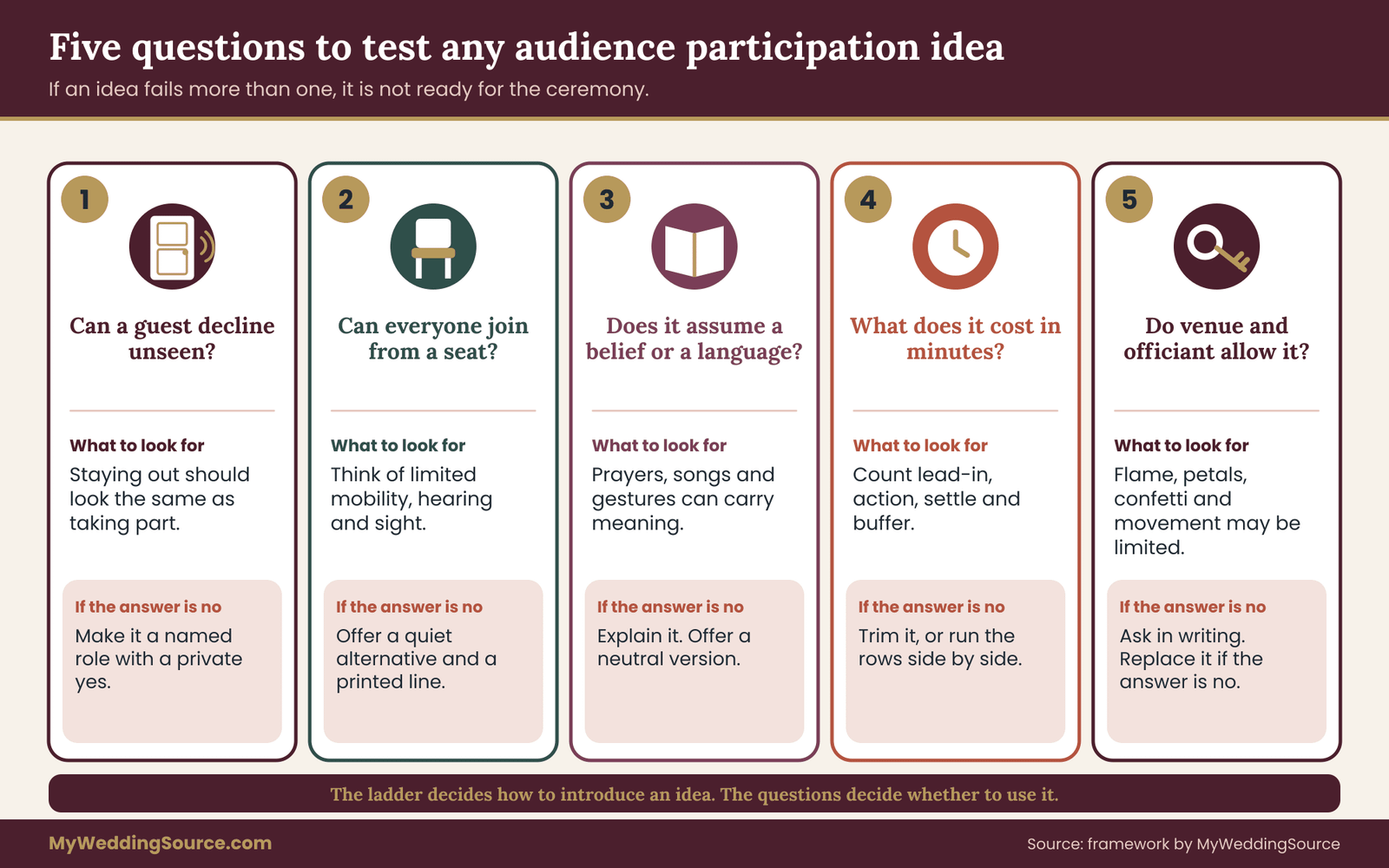
Question one: can a guest decline without anyone noticing? If the answer is no, because declining is visible, the idea is not ready for the main ceremony. It might work as a named role, with an advance yes, but not as a general ask. This is the most important test, and a lot of popular ideas fail it. “Everyone stand and turn to a neighbor” is visible to the whole room. “Everyone hold a petal” is not.
Question two: can every guest take part from their seat? Ask whether someone who cannot stand, cannot easily turn, cannot hear a spoken cue or cannot see a gesture can still join in or can still feel included. If not, plan an alternative that is offered quietly, such as a printed card or a seat-side helper. Doing so protects the guest’s dignity. It also keeps the gesture from becoming an exercise in who is able.
Question three: does it assume a belief or a language? A blessing in one tradition, a prayer, a song in a language many guests do not speak, or a gesture with a specific meaning can be beautiful and still exclude. This is not a reason to avoid them. It is a reason to explain them briefly, to offer a neutral version, and to keep them to a single short moment instead of a long run.
Question four: what does it cost in minutes and in setup? Count the officiant’s explanation, the time for the action itself, the time for guests to settle and the time for anyone who is late to catch up. Count the setup too: who hands out the petals, where the basket sits, who collects things afterward. An idea that needs more than a minute of ceremony time and more than one volunteer should justify its place.
Question five: does the venue or officiant allow it? Open flame, loose petals, confetti, bubbles, sparklers, live animals and moving guests around a lawn may each be restricted by the venue, a fire code, a landscaping rule or a religious house policy. The officiant may also have standards for what can happen in the ceremony they lead. Ask before you fall in love with an idea. A later section lists the checks to make.
How the questions and the ladder work together
Use the ladder to decide how to introduce an idea, and the five questions to decide whether to use it. A moment that fails the first question can be rescued by moving it to rung three, with a private ask. A moment that fails the second can often be rescued by adding an alternative.
A moment that fails the fifth may need replacing entirely. If you run all your candidate audience participation ideas through this process, you will end up with a short menu you trust, and the planning conversation with your officiant becomes much easier because you can explain why each idea is there.
Tiny ceremonies and big ones
The ladder works at any size, but the proportions change. In a ceremony of twenty guests, everyone knows everyone, and an audience participation moment can be more personal, with named roles and spoken blessings. In a ceremony of two hundred, shared voice and small gestures carry most of the audience participation, because named roles would eat up time and the back rows would not hear individual voices. A couple who plans audience participation for the number of people who will actually attend, instead of the ceremony they have in mind, tends to choose better.
Choosing how much audience participation your ceremony needs
Not every ceremony needs it. A couple who wants a quiet, formal ceremony may find that rung zero is all they want, and that is a complete choice, not a missing one. There is no rule that says a good ceremony has a participatory moment. The ladder is a tool for couples who do want one, and a guard against adding one out of habit.
A few signals suggest that a little audience participation would suit your ceremony. Your guests come from two communities that have not met and you hope the ceremony will bring them together. Your families have a tradition of group blessing or song. You are planning a small ceremony where the line between guests and family is blurry. Or you simply want the room to feel part of what is happening. Each of these points toward rung one or rung two, at one or two moments, not a ceremony built around audience participation.
A few signals suggest the opposite. A guest list with many people who barely know the couple, a venue with limited space and a long travel day for the guests, a tight schedule with a hard end time, a ceremony with a strong liturgical order that leaves little room, or couples who are anxious about public speaking. In each of those cases, a lighter approach reduces risk and keeps the ceremony close to what you want.
The next section turns the ladder into a menu of specific ideas, rung by rung, with notes on what each one asks of guests and where it tends to go wrong.
The audience participation ideas below are grouped by rung. Each one comes with a plain description, what it asks of guests, and the places it tends to go wrong. None of them is required. Treat the list as a menu you order from, and expect to choose two or three items, not twelve.
Rung zero audience participation ideas: witnessing that costs nothing
The witness line. The officiant tells the room, near the start, that everyone present has been invited to witness the marriage, and that their presence is part of it. This is short, sincere and works in almost any ceremony, religious or secular. The risk, as with any audience participation, is a stock phrase delivered on autopilot. Ask the officiant to say it in their own words, and to look at the guests when they say it.
The look-around. At a calm moment, before the vows or just after them, the couple turns to face the guests for a few seconds and takes in the room. Guests tend to respond with a smile or an unprompted ripple of applause, which means they have joined in without being asked. It needs no explanation and no opt-out. It does need a cue on the sheet, so the photographer and the officiant know it is coming.
The held breath. The officiant invites a few seconds of stillness, with no instruction beyond “let us take a moment.” Guests can pray, think of someone, or simply breathe. This is among the most inclusive moments you can offer, because it holds any belief and demands no action. Keep it short, about ten to twenty seconds. Longer silences become uncomfortable in a room of mixed ages, and children begin to fidget.
A printed welcome. A line in the program that tells guests what the ceremony will ask of them, and promises that nothing is required, can do as much for comfort as any ceremony element. It belongs on rung zero because it asks nothing and quietly removes the dread that some guests carry into any ceremony that “might involve us.”
Rung one audience participation ideas: shared voice
The community response. The officiant asks whether those present will support the couple, and the guests answer together. In many traditions this is a standard and expected moment. The wording matters. A neutral version such as “Will you, their families and friends, celebrate with them and support them?” lets guests answer without taking a position they dislike. Avoid questions that ask guests to promise something specific or long term, which some will not want to say aloud.
A line read together. A single sentence from the program, in plain language, that the guests read in unison with the officiant leading. A short blessing works well. Keep it under fifteen words, print it large, and have the officiant say it first so the pace is clear. People feel brave reading a line that everybody else is also reading, and the brief shared rhythm is moving in a way a solo reading often is not.
A simple refrain. If your community already sings together, a short refrain with a familiar tune can anchor a ceremony beautifully. If it does not, a refrain will sound thin and some guests will feel exposed. Be honest about your guest list. A room of people who sing together at services will join without prompting. A room of colleagues and college friends probably will not.
The cheer. At the kiss, or when the couple is presented, the officiant invites applause. This is so common that it barely feels like audience participation, but it is one, and it is a good example of how a cued moment works: the officiant signals, the room responds, nobody is asked to do more than clap. Many couples add a second layer, such as a short cheer, which still works because the voice stays collective.
Rung two audience participation ideas: small gestures from the seat
Ring warming. The rings travel through the rows, and each guest holds them for a moment, thinking of a wish. It is among the best-known audience participation ideas, and one of the most fragile. The rings are valuable, the route is long, and rows take different amounts of time.
A common workaround is to pass a ribbon or cord holding the rings, which cannot be dropped, or to pass the rings in a closed pouch with a loop of string. In larger ceremonies, pass a symbolic stone instead, and keep the actual rings with the best man or the officiant. Whoever manages it should cue the start and end, so the process does not drift.
Petals, stones or leaves with a wish. Guests receive a small natural item as they arrive, hold it during the ceremony and make a silent wish. At the end, they place it in a bowl, toss it or carry it out with them. The advantage is that the item gives each guest something to hold, which relieves the question “what do I do with my hands?” The risk is the item itself. Loose petals and leaves may be banned by a venue, may stain, and can blow around in wind.
Hand on heart. The officiant invites guests to place a hand on their heart while the couple exchanges vows. This works for most guests, takes no setup, and nobody can really see who did or did not. It does touch on personal feelings, so keep the language loose and optional: “if you like, place a hand on your heart.”
A touch on the shoulder. The officiant invites each guest to place a hand on the shoulder of the person next to them. This is warm for the right group and uncomfortable for the wrong one. Many people do not want to be touched by a stranger, and some have good reasons. If you use it, make it explicit that the gesture is optional, and offer an alternative, such as placing one’s own hand over one’s heart.
A ribbon, a knot or a stitch. Guests receive a short length of ribbon and tie a small knot in it during the ceremony, then drop it in a basket on the way out. The knots become a keepsake. As audience participation goes, it is quiet, takes thirty seconds, and gives people something to do with fidgety fingers. The risk is logistics. Somebody has to cut the ribbon, hand it out and collect it, and the basket needs a stable table.
Rung three audience participation ideas: named roles
Guest readers and blessing-givers. A friend or relative reads a passage, or offers a short blessing in their own words. This is the best-known named role and covered in more detail in the cue sheet material on briefing and handoffs. Ask early, give a word limit, and confirm the text in advance.
The circle. A small group of family or friends gathers around the couple for a blessing, a hand-on-shoulder moment or a handfasting. Because the circle is a named group, it works at rung three even though it feels communal. Choose people who said yes happily, and choose a number that fits the space.
A translator or a second-language line. A guest reads a line in a language that matters to the couple, followed by the English. This is a lovely way to include a grandparent or a relative who might otherwise feel on the edge of the ceremony. Ask the person privately, share the text, and let them practice.
A guest musician. A friend plays or sings during a prelude or interlude. This is a named role with a performance aspect, so give the musician a clear time slot, a sound check and an exit plan.
A witness signature. If the marriage license needs witnesses, two named guests sign it during or just after the ceremony. Rules on whether witnesses are required, how many and who can serve vary by state, so check with the office that issues the license. The officiant requirements guide explains who can legally solemnize a marriage and what the paperwork asks of them.
Audience participation before and after the ceremony
Some of the best audience participation takes no ceremony time at all. It happens at the door, at the guest book table or during the exit. Guests drop a flower in a shared vase as they arrive, write a short wish on a card and slip it into a box, sign a ribbon, or choose a stone from a dish. The ceremony itself stays tight, and guests who enjoy taking part can do it at their own pace, while guests who prefer to watch can walk straight to their seats.
The exit is another natural place. Guests might blow bubbles, wave ribbon wands, or toss something biodegradable as the couple walks back up the aisle. Many venues have strict rules about what may be thrown, so check before you buy anything. If the venue says no, the exit still works as a cheer, a clap or a song.
A short note on what to leave out
Some popular audience participation ideas are difficult to make consent-friendly, and are worth skipping unless you have a strong reason to keep them. Anything that asks guests to share a personal story in front of the room, anything that asks guests to confess or pledge something about their own relationships, anything that asks them to hold hands with strangers in a long chain, and anything that depends on a guest accepting a role on the spot.
These are not forbidden. They simply put guests on the spot, which is exactly what this guide is trying to avoid. If a moment like that is important to you, move it to rung three and ask the person well in advance.
Opt-in language for audience participation: what to say, where and when
An audience participation plan is only as kind as its wording. The same moment can feel inviting or coercive depending on a few words. This section gives you principles for wording audience participation, a sequence of places to say it, and scripts you can adapt. The goal is for every guest to know what is coming, how long it lasts, and how to sit it out.
Four ingredients of a good ask
Every piece of opt-in language for audience participation, written or spoken, should contain four things.
First, what happens. Say it in plain words, with no mystery and no surprise. “During the vows we will pass a small stone along each row” is clear. “Get ready for a special moment” is not.
Second, how long it takes. A guest who knows a moment lasts thirty seconds is more willing than one who does not know whether it lasts three minutes.
Third, that it is optional, said as a fact and not as an apology. “Join in if you like, or simply watch” is enough. A heavy reassurance such as “please don’t feel any pressure at all, we completely understand” can make the guest feel watched.
Fourth, what to do instead. A person who does not want to hold the stone still needs something to do with their hands. “If you prefer, simply pass it along” gives them a role in the chain without asking them to hold it.
Where to announce audience participation, and in what order
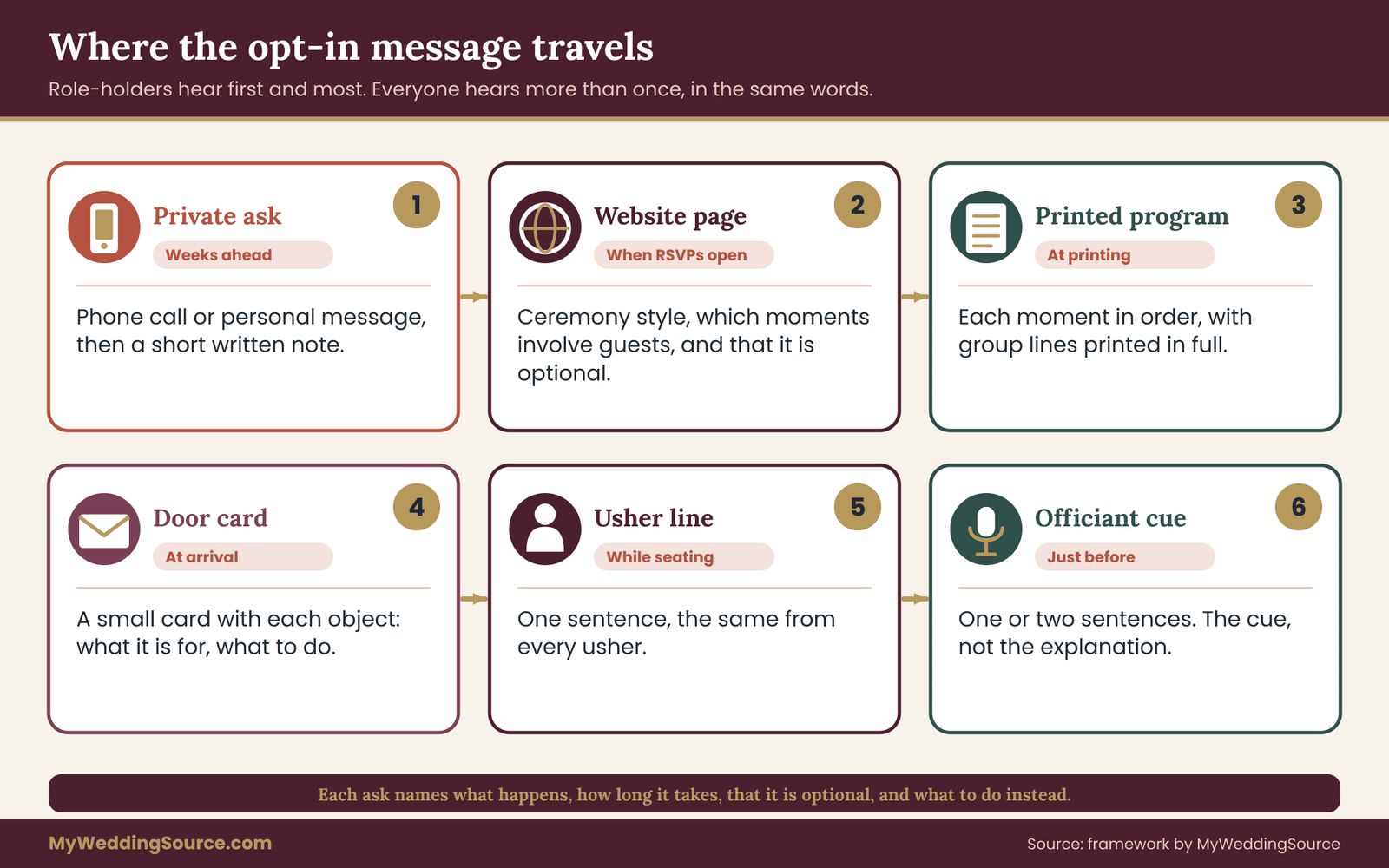
Different guests need different amounts of notice. Role-holders need the most, general guests the least, and everyone should hear about it more than once. The sequence below goes from earliest to latest.
Weeks ahead, in a private message to role-holders. Anyone you hope to ask for a rung three role should hear from you directly, not through a group chat, and well before the invitation goes out. A phone call or personal message is best, followed by a short written summary so they can refer to it later.
On the wedding website. A short ceremony page can describe the style of the ceremony, mention any moments that involve the guests, and say that taking part is always optional. Guests who worry about this sort of thing will read it, and it saves the couple from answering the same questions a dozen times. The wedding invitation etiquette guide covers what belongs on the invitation itself and what belongs online.
In the printed program. For audience participation, the program is the most reliable place because every guest holds it at the right moment. Print each audience participation moment as a short line in the order of the ceremony, with any text the guests will say printed in full. Use a larger type size for anything they will read aloud, and keep the explanation next to the line.
On a seat card or a small card handed at the door. If you use objects, a small card handed out with the object, saying what it is for and what to do with it, reduces confusion. Cards also help guests who arrive late and miss the officiant’s explanation.
From the ushers. The ushers can add a quiet sentence as they hand out the objects: “This is for a silent wish during the vows. Hold it, then pass it along.” Brief them in advance so every usher says the same thing.
From the officiant, just before the moment. The officiant gives the final spoken instruction, in one or two sentences, immediately before it happens. This is the only place where the spoken language is brief, because the guests already know what is coming. It is the cue, not the explanation.
Audience participation scripts you can adapt
The wording below is a starting point. Change it to match your voice, and read it aloud to check that it sounds like something you would say.
Private ask to a role-holder.
“We would love it if you would read a short blessing during our ceremony. It would take about a minute, near the middle. There is no pressure, and if the idea makes you nervous, please tell us. It will not change anything between us. If you would like to do it, we will send the text and a short rehearsal time.”
This script names the task, the time, the position and the out. It also promises that a no changes nothing, which is what the person needs to hear.
Website line.
“Our ceremony is short, about twenty minutes. At two moments we invite guests to join in, with a response said together and a silent wish. Taking part is always optional, and nothing will be asked of anyone individually.”
Program line for a group response.
“Community response. Our officiant will ask whether those gathered will support us. If you like, answer together with ‘We will.’ You are welcome to simply listen.”
Program line for a gesture.
“A silent wish. You will find a small stone on your seat. During the vows, hold it and think of a wish for us. Afterward, place it in the basket by the exit. If you would rather not, simply leave it where it is.”
Usher line.
“Good afternoon. This stone is for a silent wish during the ceremony. You can hold it, or leave it on your seat. There is a basket by the exit afterward.”
Officiant line, spoken just before the moment.
“In a moment, we will ask for your support. Only if it feels right to you, please answer together with ‘We will.’”
Officiant line before a gesture.
“If you have a stone, you are welcome to hold it now and make a wish for them. If you do not, you can just close your eyes or look at the couple.”
Notice what these scripts leave out. They do not tease, they do not say “get ready,” and they do not ask the guests to prove their enthusiasm. They state the ask and move on.
Swapping wording that pressures for wording that invites
Some phrases sound friendly but push. A few swaps show how small the changes can be.

“Everyone please stand” becomes “If you are able and would like to, please stand.” The first is an order and excludes guests who cannot. The second is an invitation.
“Turn to the person next to you and say” becomes “If you like, turn to a neighbor and smile.” It replaces a speaking task with a smile.
“I need everyone to participate” becomes “Join us as you wish.” The first claims all the guests, whether they like it or not.
“Raise your hand if you support them” becomes “Say ‘we will’ with us if you like.” A raised hand can be seen and counted. A spoken group response cannot.
“This is going to be so fun” becomes a plain description of what is happening. Promising fun adds pressure, because a guest who does not find it fun feels like the problem.
What to do when someone says no
Asking about audience participation carefully includes being ready for refusals. A guest, or a person you hoped to ask for a role, may say no. The right response is a short thank you, with no questions about why and no second attempt. “Thank you for telling us. We will find another way” is enough. If you explain, bargain or ask again, you put the person back on the spot.
Have a replacement ready for every named role. Keep a short list of backups who also said yes, and tell each of them that they are first or second in line. A last-minute substitution is much smoother when the backup was told in advance. It also helps the cue caller, who can see on the sheet who steps in if someone cannot do their part.
Wording for guests who might be uncomfortable
Some guests deserve a direct conversation instead of a program line. A guest with a religious objection to certain gestures, a guest who recently lost a spouse and may find a marriage ceremony heavy, a guest with social anxiety or a guest with a disability that affects how they would take part.
A short private message from the couple or a close family member, saying what is planned and offering any adjustment, is much more welcome than a general notice. Keep it light and brief. For example: “We wanted you to know that during the ceremony we invite guests to hold a small stone and make a wish. You are welcome to join, or to simply sit. Let us know if there is anything that would make the day easier.”
A message like this is not about singling someone out. It is about making sure a guest who has reasons to be careful hears about the plan privately before the day.
Keep the wording consistent across channels
Finally, check that the website, the program, the usher card and the officiant’s script say the same thing. A guest who reads “optional” on the website and hears “everyone, please stand” from the officiant will trust the second message. Put the audience participation moments on one page, check them against each other, and give the officiant that page. Your audience participation language is then a single, short document that everyone follows, and the cue sheet can refer back to it.
Fitting audience participation to your guests, their faiths and their bodies
Once you have a short menu, the next step is to look at it from the seats. Every idea on your list will land differently depending on who is sitting where. This section walks through the guests who most often fall outside the default plan, and shows how small changes keep them inside it. The adjustments to audience participation are usually cheap, and most of them improve the experience for everyone.
Audience participation for guests who cannot stand, turn or reach
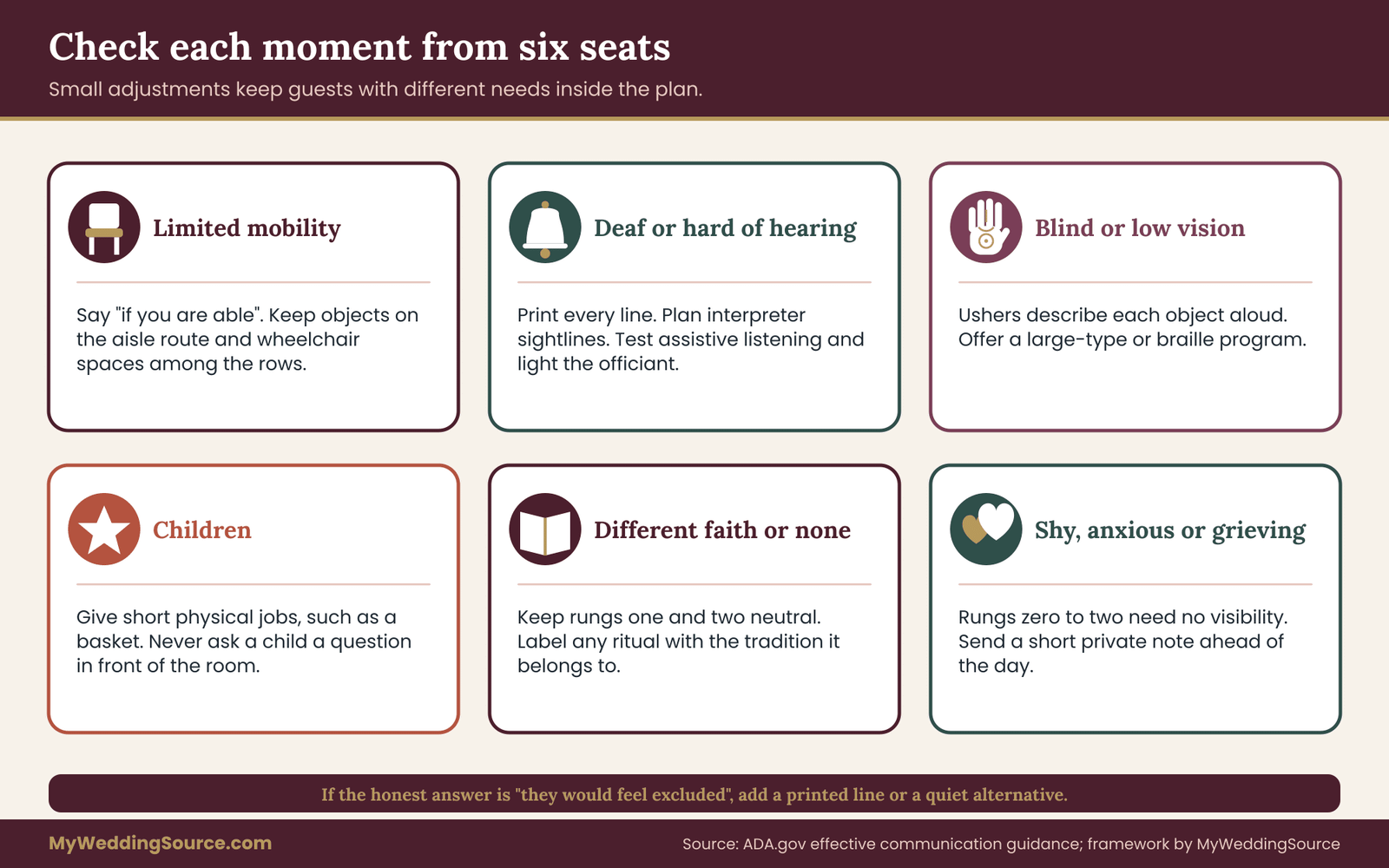
A guest who uses a wheelchair or a walker, a grandparent with limited mobility, and a pregnant guest in the late stage all share one requirement: no moment should depend on standing or twisting. Where a gesture involves passing an object, make sure the aisle seats and the wheelchair spaces are on the route, and that nobody has to stretch across a gap.
If you invite guests to stand, always phrase it as “if you are able.” Plan the accessible seating at the start of your layout instead of adding it later, and keep it among the other rows, not isolated at the back. The accessible venue guide lists warning signs in a venue that make this harder, such as long gravel paths or steps without an alternative.
Audience participation for guests who are Deaf or hard of hearing
A spoken instruction is useless to a guest who cannot hear it, and a group response is a mystery if they cannot tell when it starts. The fixes are mostly in print. Put every instruction and every group line in the program, so the guest can follow along.
If you have a guest who uses sign language, talk to them about whether they would like an interpreter and how to position one so they can see both the couple and the interpreter. Ask the venue and sound vendor about assistive listening, and test the system before the ceremony. The general rules on effective communication are explained at ADA.gov, which is also a good place to learn the vocabulary that makes the conversation with a venue easier.
For gestures, a visual cue helps everyone. The officiant can raise a hand, or the cue caller can nod to the ushers, and the ushers can cue the rows near them. If a guest depends on seeing the officiant’s face, make sure the officiant is lit and not backlit by a window.
Guests who are blind or have low vision
A guest who cannot see will miss any gesture that depends on watching others. If you pass an object, the person next to them will probably place it in their hands, and that is fine, but tell the ushers to offer a short spoken description: “This is a small smooth stone for a wish.” Print a large-type or braille program on request. If you have a guest who has told you they need it, ask them how they prefer to be guided to their seat and how they would like to take part.
Children and teenagers in audience participation
Children respond to audience participation the way they respond to everything: with delight or with boredom, both unpredictable. A child can be a wonderful participant if the task is simple, short and physical, such as carrying a basket of stones along the row. A teenager may not want to be singled out at all and may prefer a role at the back.
Offer tasks, not performances, and do not make a child answer a question in front of the room. Remember that a child who is told to be quiet for twenty minutes needs something to do. A small gesture on rung two, like holding a petal, is often welcomed by parents for exactly this reason.
Older guests and long ceremonies
Older guests often have the strongest feelings about tradition, and some love a lively ceremony and some do not. What they share is that sitting and standing repeatedly is tiring. Limit standing, keep the ceremony short, and keep tasks within arm’s reach. If a guest is hard of hearing, as many older guests are, treat that as a general rule for the whole ceremony and not a special case.
Guests of different faiths, and guests with none
Faith is where audience participation most often misfires, because the stakes are personal and invisible. A guest who belongs to a tradition that does not use certain prayers, gestures or songs may feel conflicted about joining in, and a guest with no religious belief may find a spoken prayer awkward. The couple often cannot predict who will feel what.
The best protection is to keep rung one and rung two moments neutral. A wish, a thought, a hand on the heart and a shared “we will” fit nearly any belief. If a moment is specifically religious, such as a blessing from a tradition, a communal prayer or a chant, make that clear in the program, say that guests can join in however they are comfortable, and present it as a named role or a short, bounded segment.
In an interfaith ceremony, the principle of clear ritual ownership applies: say whose tradition each moment belongs to, so guests from another tradition can choose how to be present. The interfaith ceremony guide covers this in detail. If you are writing a ceremony without a religious frame, the non-religious ceremony script guide shows how to build a meaningful structure without borrowing religious language.
Guests who are shy, anxious or grieving
Some guests do not want to participate at all, and the reasons are private. A guest may be shy, or anxious in groups, or recently bereaved, or newly divorced. They may be at a wedding for the first time since a loss. They are not being difficult. The design of rung zero through rung two protects them, because none of those rungs needs a guest to be visible. If you hear that a specific guest is struggling, a quiet private note from a close friend or family member is kind, and there is no need to change the whole plan.
Guests who do not share the couple’s language
Guests who speak another language may not understand a spoken instruction. Printing the program in two languages is a common fix. If you invite a group response, give the line in both languages and ask a bilingual friend to lead the second language. This is also a chance to include a guest in a named role, as a reader of a short line in their own language, with the translation printed right beside it.
A quick sweep before you finalize
Before you finalize the plan, imagine the ceremony from five seats: the wheelchair space at the end of a row, a seat in the very back row, a seat beside a guest who is Deaf, a seat held by a child, and a seat held by a guest who does not share the couple’s religion. For each moment on the menu, ask what that guest would do. If the answer is “feel excluded” or “have to ask someone,” the plan needs a small change, usually a printed line, a spoken cue with a visible partner or an alternative offered quietly.
Checking the venue, the officiant and the vendors before you commit to audience participation
An idea that works on paper can be turned down by a venue manager in one sentence. Checking early saves you from redesigning the ceremony a week before the date. These are the questions to ask, and who to ask, so the answers are written down.
What to ask the venue
Venues set rules about audience participation for good reasons: fire safety, insurance, cleanup and the protection of grounds and buildings. Ask in writing and keep the reply with your other contract papers.
Open flame. Candles, a unity candle, lanterns and sparklers are each treated differently, and some venues allow none of them indoors. Fire codes are set locally, and the fire marshal or the venue’s insurer may have the final word. The National Fire Protection Association publishes the model codes that many jurisdictions build on, and the Consumer Product Safety Commission has safety guidance for consumer fireworks and sparklers. If you want guests to hold anything lit, ask the venue directly, and be ready to hear no.
Petals, confetti, rice, seeds and bubbles. Many venues ban confetti and rice, some allow dried petals, and some allow only bubbles or ribbon wands. Reasons include cleanup cost, slip risk on stone steps and harm to birds or grounds. Public parks and protected sites often have their own rules, so ask the managing agency; the National Park Service is one example of an agency that sets conditions on ceremonies in the places it manages. Always ask what the venue permits before you order a large quantity.
Moving guests around. If a gesture needs guests to stand, form a circle or walk to a table, ask whether the space and the permit allow it. Check the capacity of the ceremony area, the surface underfoot and whether any steps lack an alternative route.
Sound and microphones. A group response needs the officiant to be heard and, ideally, a microphone that picks up the guests a little. Ask what the venue provides, whether the system supports a handheld mic for a guest reader and whether there is a hearing loop or an assistive listening option.
Cleanup and handing out objects. If you hand out stones, ribbons or cards, ask where the table can go, whether staff will help and who collects the baskets afterward.
What to ask the officiant about audience participation
The officiant leads the ceremony and usually has firm views on what fits. Some officiants love audience participation, some prefer none, and some have rules grounded in their tradition or their organization. Ask early, and ask specifically.
- Which moments of audience participation have you used, and which would you not do?
- Are there parts of the ceremony, such as the legal declaration, where you prefer no interruptions?
- Will you explain each moment aloud, or would you prefer that it live in the program?
- How do you handle a guest who speaks out of turn or a moment that goes long?
- Are you comfortable cueing the guests with a gesture as well as words?
The officiant also has legal duties. In most places the officiant is the person who signs and files the marriage license, and rules about who can solemnize a marriage, how many witnesses must be present and who can serve as a witness differ by state. USAGov explains where to start for a marriage license, and the issuing office can tell you what its rules are. Any guest who will serve as a witness is a named role, and should be told ahead of time that they will be asked to sign. The officiant requirements guide goes through these checks.
How audience participation affects the photographer, videographer and DJ
Audience participation changes what other vendors need to do. A photographer wants to know when guests will move, when the couple will turn toward the room and when a gesture will produce a good picture. A videographer needs to know if sound from the guests matters. A DJ or musician needs cues for any song or shared refrain.
Send each of them the audience participation lines on the ceremony sheet, and ask whether anything on the list causes a problem. If your guests will use phones, for example to take part in a shared moment, the advice in the wedding photography consent guide on setting guest boundaries is a useful companion.
Put the answers in one place
Gather every answer into a short list with the date, the person who confirmed it and the exact words. If a venue says “dried petals only, no confetti,” copy it as written. This list becomes an attachment to the ceremony sheet, so the cue caller, the coordinator and the officiant all work from the same rules.
Check again close to the date
Rules change, and staff change. A week before the ceremony, confirm the major items again. This is also the time to verify any official point, for instance with the issuing office for the marriage license, because a rule that was true when you applied may have been updated. Official offices remain the final source for what is currently required, not a blog post, a vendor or a friend.
Timing and cueing audience participation on the ceremony sheet
Audience participation moments are small, but they sit in the middle of a ceremony that has a start time, a photographer, a musician and a venue that books the next event. Timing them honestly is part of respecting the guests, because nobody enjoys a moment that drags. This section shows a way to count the minutes and write the cues so the ceremony stays calm.
Counting the real cost of a moment
An audience participation moment has four parts, and most plans only count the second one.
- The lead-in. The officiant says what is about to happen. Budget ten to twenty seconds for a simple one, longer for anything with objects.
- The action. What the guests actually do. A group response takes a few seconds. A silent wish takes twenty to thirty. A gesture along rows takes longer, and the math below shows why.
- The settle. Guests need time to return their attention to the front. Allow five to ten seconds after most moments, longer after laughter or applause.
- The recovery buffer. Something small will go wrong. A child will drop a stone, a row will start late, a guest will ask a question. A buffer of about twenty percent of the moment protects the schedule.
Add the four numbers for each moment, and sum all the moments. That total is the time audience participation adds to your ceremony, and it is the number to compare against the length you want.

The arithmetic behind a passed object
Passing an object through a crowd is the item that most often runs long, and the reason is that guests add up. Suppose you have 120 guests in twelve rows of ten, and each guest holds the object for four seconds before passing it along. These numbers are assumptions for the example, not measurements. If the object travels through every guest in one long chain, the passing alone takes 120 times four seconds, which is 480 seconds, or eight minutes. That is far too long for a ceremony of twenty minutes.
If instead you start one chain at the end of each row, so twelve chains run at the same time, each chain handles ten guests and the passing takes ten times four seconds, or forty seconds. Add twenty seconds to start the chains and twenty to collect the object at the end of each row, and the moment takes about eighty seconds. The design choice, parallel chains in place of one long chain, cuts the time by roughly a factor of six, and that is a much better trade than asking guests to hurry.
The same logic applies to anything that touches every guest. Split it into rows, give each row its own object and its own start, and let the rows run side by side.
Writing the cues
The cue sheet is the document that holds timing and owners, and the wedding ceremony cue sheet guide explains how to build one line by line. For each audience participation moment, add a line with five facts: the trigger, the action, the owner, the backup and the time budget. A line might read, in words: “On the officiant’s line ‘let us hold a quiet moment,’ the ushers confirm each row has its object. Owner: head usher. Backup: second usher. Budget: eighty seconds.”
Some points make audience participation lines easier to follow.
Use triggers, not clock times. The trigger should be something a person says or does, such as a phrase from the officiant or a nod from the cue caller, because clock times drift when a ceremony runs late.
Name an owner for the objects. Someone must hand out, check and collect whatever the guests hold. If nobody owns it, it will fall to the couple’s family at the worst moment.
Name the person who ends the moment. A moment with no end point tends to stretch. The officiant or the cue caller should signal the end, with a line, a gesture or a change in the music.
Write the fallback. If a moment takes too long, the sheet says what to cut. For example: “If we are more than three minutes behind, skip the look-around.” A short fallback saves the schedule without anyone having to improvise.
Attach the opt-in wording. The program text and the officiant’s spoken lines should be printed or linked on the same page, so the cue caller and officiant are looking at the same words.
Where audience participation fits in the ceremony
The placement matters as much as the length. A few practical principles help.
Put the quietest moments around the emotional center, where the room is already still. A silent wish during the vows, or a held breath after them, uses that stillness instead of breaking it.
Put the loudest moments at the edges. A cheer at the start or at the kiss, and an exit with bubbles or applause, keep the energy where it naturally rises.
Do not put an audience participation moment right before the vows or right before the legal declaration. The officiant needs the room’s full attention for the legal words, and a lively moment just before can make it harder to get it back.
Keep two moments apart. If guests are asked to do something every few minutes, the ceremony stops feeling like a ceremony and starts feeling like an activity. Two or three moments across a twenty-minute ceremony is a comfortable range for most rooms.
Rehearsing audience participation
Audience participation is hard to rehearse because the guests are not at the rehearsal. You can still rehearse the parts you control. Walk the ushers through the handout and the collection. Read the officiant’s lines aloud with the cue caller listening. Time the longest moment with the people who will be in the front.
Test the microphone for a group response with a few volunteers answering from the back. If you are using a visual cue for a Deaf guest or an interpreter, run it once with them. A short rehearsal of this kind catches most of what would otherwise go wrong in front of guests.
A worked example of audience participation for a mixed, one-hundred-twenty-guest ceremony
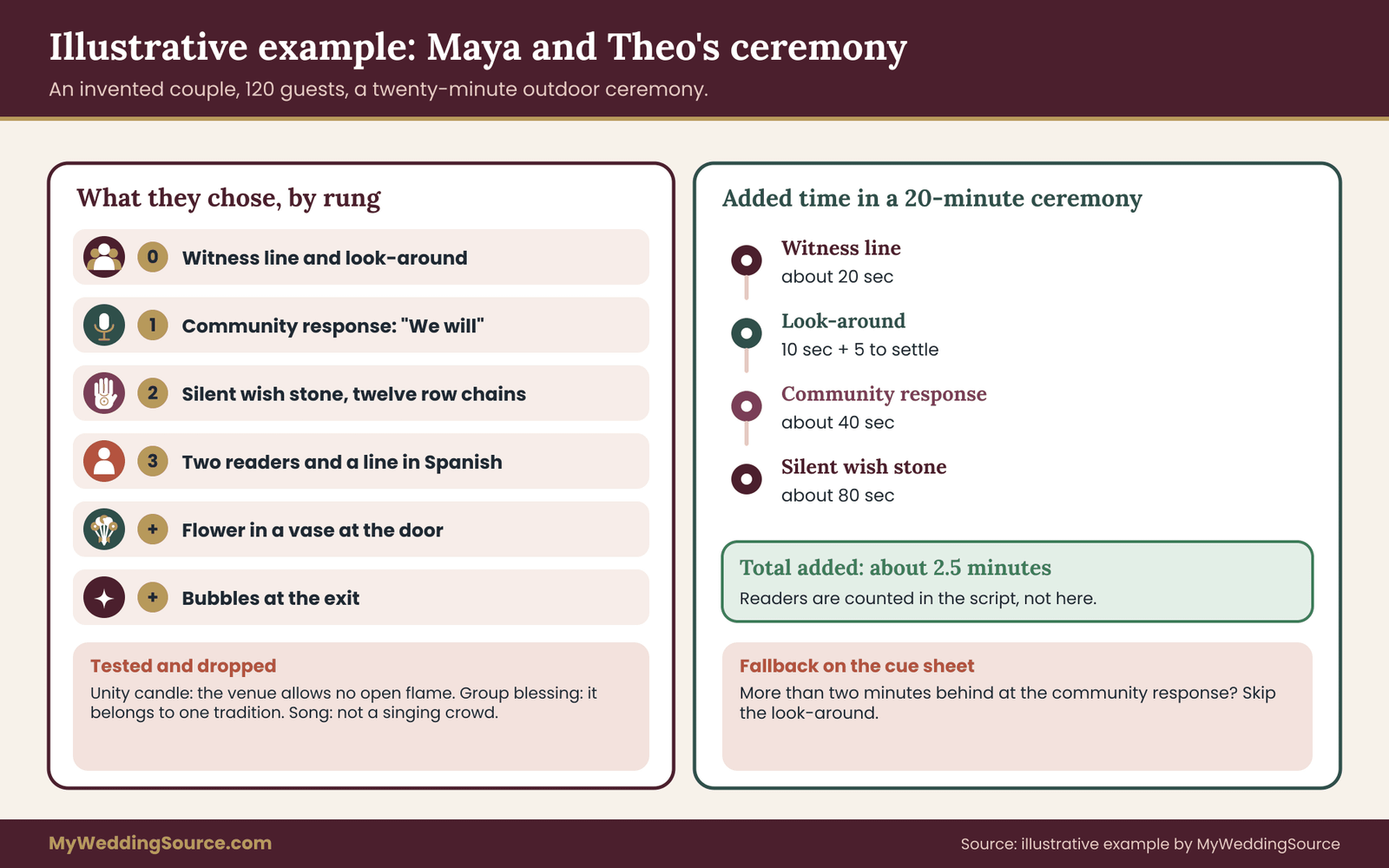
The example below is invented, to show the framework in use. The couple, Maya and Theo, are planning a twenty-minute outdoor ceremony for 120 guests. Their families come from two religious backgrounds, a few guests do not share either. Theo’s grandmother uses a wheelchair, Maya’s cousin is Deaf and will bring an interpreter, and about fifteen guests are children. The venue allows bubbles and dried petals but no confetti and no open flame. Their officiant is comfortable with simple audience participation and wants to keep the legal vows undisturbed.
Step one: list candidates, then test them
Maya and Theo begin with a list of every audience participation idea they have seen and liked: ring warming, a unity candle, a group blessing, a song, petal toss, a community response, a story from a friend. They run each one through the five questions. The unity candle fails the venue test, so it is dropped.
The group blessing fails the belief test because it comes from one tradition, so it is replaced with a neutral line. The song fails the honesty test: their guests are not a singing crowd. Ring warming passes in principle but would take too long, so they replace it with a stone passed along each row.
Step two: place the survivors on the ladder
Rung zero: a witness line from the officiant near the start, and a look-around by the couple just before the vows. Rung one: a community response, “We will,” in the middle of the ceremony. Rung two: a silent wish with a small stone during the vows, with twelve chains of ten guests. Rung three: two readers, who are Theo’s brother and Maya’s friend, and a short line in Spanish read by Maya’s aunt, followed by the English. Before the ceremony, guests drop a flower in a shared vase at the entrance. At the exit, guests blow bubbles.
Step three: write the opt-in language
The website says the ceremony takes twenty minutes and includes two moments where guests may join in. The program lists each moment in order, with the community response printed in full and the wish stone explained in one sentence. The ushers hand out stones and say a single line. Maya writes a private message to the three readers and to her aunt, and Theo writes a short note to his grandmother and to Maya’s Deaf cousin, describing what is planned and offering any change that would help.
Step four: time it
They add up the moments, with the four parts counted for each. The witness line takes about twenty seconds. The look-around takes ten, plus five to settle. The community response takes about forty seconds including lead-in and settle. The wish stone takes about eighty seconds using parallel chains. The readers’ moments are counted in the script, not here.
The audience participation total comes to roughly two and a half minutes, which they accept as a fair price for the feeling they want. Because the venue’s schedule is tight, they write a fallback: if they are more than two minutes behind at the community response, the look-around is skipped.
Step five: check the room from five seats
Maya and Theo imagine the ceremony from the wheelchair space, the back row, the seat beside their Deaf cousin and the interpreter, a child’s seat and the seat of a guest from a third tradition. They add an usher by the wheelchair space who will pass the stone along, a printed copy of the community response in the program, a clear line of sight for the interpreter, and a plain sentence in the program that anyone is welcome to simply watch.
What the audience participation example shows
The audience participation in this ceremony asks little of its guests and nothing of anyone in public without a yes. It includes a shared voice, a shared gesture and three named roles. It fits the venue and the schedule. Most of the work is not in the ceremony at all but in the preparation, which happens on a few evenings and a few short messages. That ratio is typical. The ceremony moments are small, and the care sits around them.
When audience participation goes sideways: recovery lines and edge cases
Even a careful plan meets surprises. The aim is not to prevent every one but to have a calm response ready, so that the room reads the surprise as part of a warm ceremony and not as a mistake. Most of the recoveries below are a single sentence from the officiant, and the officiant should have them on paper.
The response is quiet. The officiant asks for the group response and hears almost nothing. This is common, especially in a large or reserved room, and it is not a failure. The officiant can smile and say “I think that was a yes,” or simply continue. Do not ask for a repeat at higher volume, which makes the quiet guests feel worse. Plan for a soft response and treat it as normal.
Someone speaks out of turn. A guest answers a rhetorical question, calls out a joke or adds a comment. A brief, friendly acknowledgment from the officiant, with a return to the script, is enough. “Thank you, and yes” lets the room laugh and move on. The officiant should have discussed this in advance, because some are comfortable with a little banter and some prefer none.
A child makes noise. Children are unpredictable. A moment of delight or a cry is part of a wedding, and most guests are fond of it. Keep a quiet exit route near the aisle for parents, and tell guests in the program that children are welcome. Do not stop the ceremony for it.
The object is dropped. A stone, a petal or a ribbon falls. Guests tend to rescue it without being asked, and the moment usually passes in two seconds. If the object is valuable, such as the actual rings, a pouch or a cord reduces the risk. This is another reason to avoid passing the real rings through a crowd.
A chain stalls. One row finishes early and one is slow, or a guest holds on too long. The row owner, usually an usher, nudges it along with a hand gesture. The officiant should not wait for the slowest row. Set a rule on the sheet, such as “move on when most rows are done,” and let the rest finish quietly.
The sound fails. A microphone dies in the middle of a group response. The officiant should have a plan: speak louder and slower, let the guests follow the program, and carry on. A printed program with the lines on it is a good backup for sound problems, which is another reason to print them.
Weather changes the plan. Wind makes petals fly, rain makes stones slippery, heat makes a long standing moment hard. Decide in advance which audience participation moments are weather-dependent and what replaces them. A bubble exit can become a cheer, and a standing gesture can become a seated one. The cue sheet should list the rain plan beside the original.
A guest declines publicly. Someone says “I would rather not” out loud, or hands the object back. This is allowed. The officiant, or the nearest usher, should answer warmly and move on. Nothing more is needed. The point of the opt-in design is that a no is a fine answer.
A named role-holder cannot do it. The reader is ill or the blessing-giver is overcome. The backup steps in, as agreed. If no backup exists, the officiant reads or paraphrases the text, and the moment shortens. A smooth substitution is much easier than a cold call to the third row.
Edge cases worth planning for
Guests joining by livestream. Some couples stream the ceremony for relatives who cannot travel. Remote guests can take part in rung zero and rung one, as long as the officiant addresses them and the program is shared digitally. A response can be said at home. A wish can be made with an object the guest chose themselves. A stream is not a reason to give remote guests a named role, which adds technical risk. Photograph and recording rules for any stream are a separate topic, covered in the photography consent material on the site.
An elopement or a very small ceremony. With ten guests or fewer, rung three is the natural fit. Everyone is, in practice, in a named role. Ask each person privately and keep the moments personal and short.
A ceremony held inside a religious building. The house rules of a church, temple, mosque or other place of worship come first, and they may exclude certain gestures or require specific wording. Ask the clergy or the building manager what is welcome. If your ceremony follows a Christian service, the ceremony text may already include a congregational response, which counts as your rung one moment.
A second marriage or a ceremony with children from earlier relationships. Children can be part of the ceremony as named participants, with a small role and a simple promise from the couple to them. Ask each child privately, and ask parents first. Some children want to be involved and some do not, and both are fine.
A guest who is clearly uneasy. If you notice a guest who looks distressed during a moment, the closest usher can quietly offer a drink of water, a seat or a step to the side. Nothing needs to be said to the room.
What audience participation cannot do
It is worth being clear about the limits, because audience participation can be oversold. Audience participation does not make a ceremony more meaningful by itself. A ceremony with no guest moments at all can be deeply moving, and a ceremony stuffed with them can feel busy.
It does not create closeness between guests who do not know each other, though it may give them a shared memory. It does not replace the vows, the officiant’s words or the couple’s own presence. And it does not fix a ceremony that is too long, too hot or too far from the venue’s restrooms.
The framework in this article also has limits. It cannot predict how any individual guest will feel, because feelings differ and some are private. It cannot decide what is allowed at your venue or in your faith community, because rules vary. It cannot replace a conversation with the officiant, or the advice of the office that issues your marriage license. For questions about witnesses, signing and filing, ask the issuing office. Use the ladder as a thinking tool, not as a rulebook, and adjust it to the people you know.
If you remember only one idea, let it be this one: ask less, ask earlier and always leave a quiet exit. Almost every well-liked audience participation moment follows that pattern, and almost every poorly-liked one breaks it.
Your next steps
Start with an evening and a blank page. Write down the three moments you most want your guests to feel part of, then place each on the ladder and run it through the five questions. Pick no more than three for the ceremony and, if you like, one or two for arrival or exit.
Next, make the calls. Ask your officiant what they welcome and what they avoid, and ask your venue what it allows, in writing. Ask any named role-holders privately and early, with a clear out, and line up a backup for each. Then write the opt-in wording once, for the website, the program, the ushers and the officiant, and check that all four match.
Finally, add the moments to your cue sheet with a trigger, an owner, a backup and a time budget, and do a short rehearsal with the ushers and the officiant. A week before the wedding, confirm the venue and any legal points again. When the day comes, the audience participation will take only a few minutes, and your guests will have been told everything they need, so they can join in or simply enjoy watching.
FAQ
What are good audience participation ideas for a wedding ceremony?
Low-pressure ideas work best: a spoken group response such as “we will,” a silent wish made while holding a small stone, a hand placed over the heart during the vows, or a cheer at the kiss. These let guests take part from their seats and stay quiet without being noticed. Choose two or three, not a long list.
How do we include guests without making them uncomfortable?
Tell them in advance, keep each ask short, and make staying out look identical to taking part. Print the plan in the program, have the officiant say it once more just before the moment, and phrase everything as an invitation. Ask people for a named role privately, with a clear way to say no, and never call on someone without warning.
Should audience participation be mentioned on the invitation or website?
A brief line on the wedding website is helpful, since guests who worry about this will read it. Describe the style of the ceremony, mention any moment where guests may join in, and say that taking part is optional. The invitation itself is usually too small for details, so the program carries the specifics on the day.
How long does audience participation add to a ceremony?
Each moment has a lead-in, an action, a settle time and a small buffer. A short group response may take under a minute in total, and a silent wish passed along rows may take about a minute and a half. Two or three moments across a twenty-minute ceremony typically add a few minutes. Count your own numbers and test them.
Can we skip audience participation entirely?
Yes. Many ceremonies include none beyond the officiant welcoming the guests as witnesses, and they feel complete. Audience participation is an option for couples who want the room to feel involved, not a requirement. If you are unsure, start with the witness line and a cheer at the kiss and see how the ceremony feels.
What do we do if a guest refuses to take part?
Nothing needs to be done. A refusal is a valid answer, and the design of the moment should make it easy. If a guest hands back an object or says no out loud, the officiant or nearest usher responds warmly and moves on. Do not ask why, and do not ask again. The ceremony continues exactly as planned.
Do guests need to sign the marriage license as witnesses?
It depends on where you marry. Some states require one or two witnesses, and others require none, and rules about who may serve differ. Check with the office that issues your marriage license, and see the USAGov marriage license page for a starting point. If witnesses are needed, ask them privately and early, since signing is a named role.
Can audience participation work at a religious or interfaith ceremony?
Yes, with care. Follow the house rules of the place of worship, keep any shared moments neutral, and label any specific ritual with whose tradition it belongs to, so guests can decide how to be present. A short group response and a silent wish are usually welcome across traditions. When in doubt, ask the officiant or the clergy.
Sources
- Get a marriage license, USAGov
- How to get a copy of a marriage certificate, USAGov
- Where to write for vital records, Centers for Disease Control and Prevention, National Center for Health Statistics
- Effective communication, ADA.gov
- Americans with Disabilities Act information and technical assistance, U.S. Department of Justice
- Accessibility guidelines and standards, U.S. Access Board
- Codes and standards, National Fire Protection Association
- Fireworks and sparklers safety, Consumer Product Safety Commission
- Weddings and special park uses, National Park Service
- Hearing loss and communication, National Institute on Deafness and Other Communication Disorders