
A wedding pronouncement is the sentence that turns two people who have just exchanged vows into a married couple in front of their guests, and the name announcement that follows tells the room who to applaud. This guide gives you a bank of inclusive wording options, a four-part builder, a legal check and a worked example, so the moment sounds like you and holds up in your state.
Build your wedding pronouncement from four parts: an authority line (who is declaring it), a status word (what you are now), a closing cue (a kiss, an embrace or a held pause), and a name announcement (how the room hears your names). Pick each part separately, say the full version out loud with your officiant, confirm with the county office that issues your license that nothing legally required is missing, and give your music and photo teams the exact last words that signal their cue.
Most couples spend months on vows and almost no time on the thirty seconds that come after them. That is a missed opportunity, and sometimes a small embarrassment. The default wedding pronouncement in many officiant templates assumes a bride and a groom, a shared surname and a kiss, and that is not the ceremony many couples are having. Guests notice when the words do not fit the people standing in front of them, and so do the two people being described.
The fix is not complicated. A wedding pronouncement has only a few moving parts, and each one has several good options. Once you see the parts separately, you can mix them the way you would mix a menu: one choice from each course, and nothing that clashes. The rest of this article lays out those options, explains the legal floor beneath them, and shows how to rehearse the moment so it lands cleanly.
A note on scope. This is general information, not legal advice. Whether specific words are required, who may officiate, and what the license must say all depend on the state or country where you marry, so the article points you to the issuing office for the current rules.
What a wedding pronouncement does in the ceremony
Think of the ceremony as a sequence of handoffs. The processional hands the room’s attention to the couple. The readings and any personal remarks hand it to the meaning of the day. The vows and rings hand it to the commitment itself. The wedding pronouncement is the last handoff: it tells everyone that the commitment has taken effect and that the event is shifting from ceremony to celebration.
That job has three practical effects. First, it marks a clear end, so guests know when to applaud and when to stand. Second, it frames the couple’s new status in language the couple chose. Third, it gives the photographer, videographer, musician and coordinator a single, predictable cue. A vague ending produces a ragged one, with half the room clapping and the recessional starting late.
The pieces of a typical wedding pronouncement
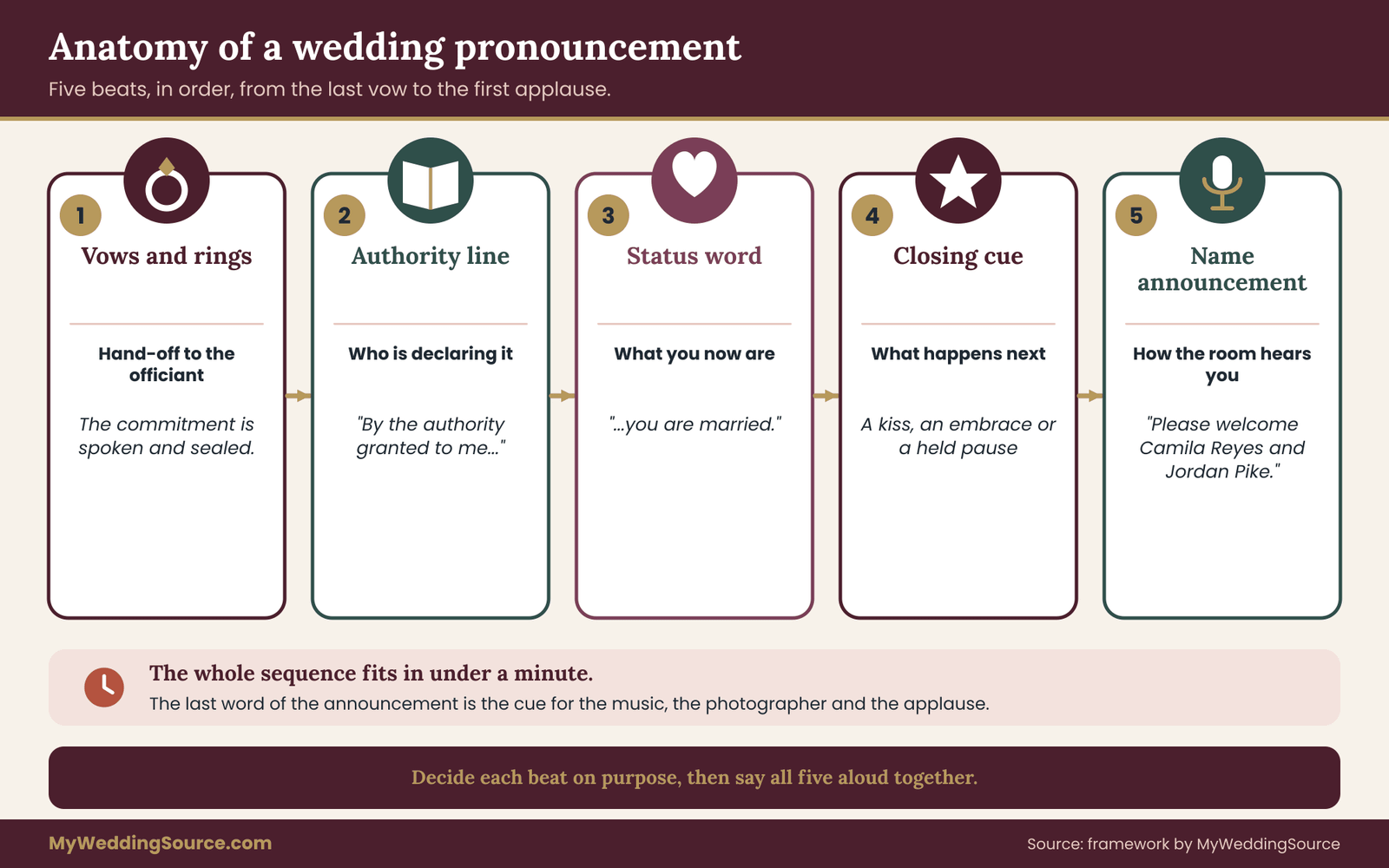
Most ceremonies, whatever their style, include some version of these elements. Not every one is required, but each is worth deciding on purpose.
The authority line names who is speaking and on what basis. Examples include “By the authority granted to me by the state,” “By the power vested in me,” or a statement from the couple’s community or faith. The status word names the relationship: spouses, married, partners in marriage, husband and wife, wife and wife, husband and husband, or something personal.
The closing cue is what happens next, usually a kiss, though many couples prefer an embrace, a bow, a shared glass or a long look. The name announcement introduces the newly married couple to the guests, with or without titles, and with or without a new surname.
Some ceremonies add a fifth element, a blessing or wish for the couple, which can sit before or after the status word. Others leave out the authority line entirely because the couple will be married by a license signing, not by a spoken declaration. Both choices are legitimate, as long as the legal side is handled somewhere.
Where the wedding pronouncement sits in the running order
The usual order is vows, ring exchange, optional blessing, wedding pronouncement, closing cue, name announcement, recessional. Some couples invert it: the name announcement comes first, then the kiss, then the recessional music. A few add a short closing remark from the officiant, such as a thank you to guests, before the announcement.
Whichever order you pick, write it into the cue sheet. The wedding ceremony cue sheet guide explains how to turn the sequence into a one-page document for your officiant, musicians and coordinator, and the wedding pronouncement is the line that most often needs an exact trigger phrase written beside it.
The legal floor under a wedding pronouncement
Before choosing words, find out what the law actually asks of you. People often assume that the officiant’s declaration is what legally marries a couple. In practice, the legal act in most places is a combination of a valid license, a qualified officiant or other authorized solemnizer, the couple’s expressed agreement to marry, any required witnesses, and the filing of the signed license with the proper office. The spoken declaration is part of the ritual, and its legal weight differs by place.
That means two things for your planning. You may have more freedom than a template suggests, because many jurisdictions do not prescribe a specific pronouncement script. And you may have an obligation you did not expect, such as a requirement that the couple declare in the presence of the officiant and witnesses that they take each other as spouses. Those words can usually be woven into the vows or the declaration of intent, but they need to be spoken, not just implied.
What to ask the issuing office
USAGov points readers to their state or local marriage license office for the rules that apply to them. When you contact that office, which is often a county clerk or a similar records office, ask questions in plain terms. Is there any wording that must be spoken during the ceremony? Does the officiant have to say a specific phrase? Do we need witnesses, and how many? What does our officiant need to file, and by when?
Write down the answers with the date and the name of the person you spoke with. If the office tells you the wording is up to you, that is useful to have on record when a relative insists that “you have to say husband and wife.” If it tells you certain words are needed, you now know what must survive every edit of your script.
Officiant authority and the authority line
The authority line is where legal and ceremonial meanings meet. If your officiant is ordained through an organization, a judge, a clergy member or a court official, they will usually say some version of “by the authority granted to me.” The exact phrase varies. Some officiants are authorized by a state, some by a religious body, some by a temporary designation for a single ceremony, and the correct words follow from that source.
Ask your officiant what their authority is and how they normally phrase it.
A guest who knows the officiant was ordained online may smile at “by the power vested in me by the State of Ohio” if the officiant is not a state official, and an officiant who is uncomfortable with a phrase that does not describe their real standing will deliver it stiffly. Honest wording, such as “as your officiant” or “with the authority I have been given to solemnize this marriage,” sounds better and is more accurate. For deeper background on who can legally officiate and what paperwork follows, read the guide to wedding officiant requirements.
Things the law may care about more than the wording
The part of the ceremony that regulators actually care about is usually the paperwork. The license must be valid on the date of the ceremony, signed by the right people, with names and dates that match your identification, and returned within the window the issuing office sets. A beautifully worded pronouncement does not fix a license that was signed in the wrong place or filed late.
For that reason, treat the wedding pronouncement and the paperwork as two tracks that meet at the end of the ceremony. The officiant says the words, and then the officiant, the couple and any witnesses sign. Many couples save the signing for a private moment after the ceremony or for the cocktail hour. Decide where it happens and who holds the pen, and put that on the same cue sheet. If you later need certified copies of the record, the guide to wedding records after the event covers how to order and check them.
Self-solemnizing and unusual arrangements
A few places allow couples to marry without a traditional officiant, or allow a friend to be authorized for a day. Those arrangements change who speaks the wedding pronouncement, and sometimes whether anyone does. If your state works this way, the couple may say the declaration to each other, and a friend may only add a blessing. If this describes you, confirm with the issuing office what the license form needs and keep the ceremonial wording separate from the legal wording in your notes.
The same caution applies to destination ceremonies. A symbolic ceremony abroad followed by a legal ceremony at home is a common arrangement, and the wedding pronouncement at the symbolic ceremony may be entirely your own wording because the legal steps happen elsewhere. In that case it is kind to tell guests, in the program, which moment is the legal one, so nobody feels misled later.
Why wording choices matter more than they seem
A wedding pronouncement is short, so each word carries weight. Consider three small changes. “I now pronounce you husband and wife” tells a room something very specific about the couple, and it is right for many couples and wrong for others. “I now pronounce you married” is true for everyone. “I now pronounce you partners for life” is warm but may not match the legal term used on your certificate, which is a detail some couples care about and others do not.
The test is not whether a phrase is traditional or modern. The test is whether it is accurate for these two people, comfortable for them to hear in front of their families, and understandable to a mixed audience that may include grandparents, children, coworkers and guests from other cultures. Ask each partner separately which words they would be happy to hear and which words would make them wince, then compare notes. Disagreements here are valuable information, and it is far easier to settle them at a kitchen table than at the front of a room.
Inclusion is mostly about accuracy
Inclusive wedding pronouncement wording does not mean removing all gendered language or sounding clinical. It means the words describe the actual couple. Two grooms should not be told they are husband and wife. A couple where one partner uses they/them pronouns should not hear “man and wife.” A bride who keeps her name should not be introduced with a surname she did not take. A couple with an older guest list may want familiar words, and a couple with a younger one may want fresh ones.
The same principle covers other parts of the ceremony, such as how the officiant refers to “the bride” or “the groom” in transitions. If your officiant uses a stock script, review every line and mark anything that does not fit. Chances are good that the wedding pronouncement is not the only place where a template needs editing, and the guide on non-religious wedding ceremony script options and the one on Christian wedding ceremony script wording both show how complete scripts handle these lines in different traditions.
The four-part builder for your wedding pronouncement
The builder is a way to assemble a wedding pronouncement from interchangeable pieces instead of editing a template line by line. It works in four slots, always in the same order: authority, status, closing cue, announcement. You fill each slot with one option from the bank, read the combined result aloud, and adjust only if the rhythm is off.
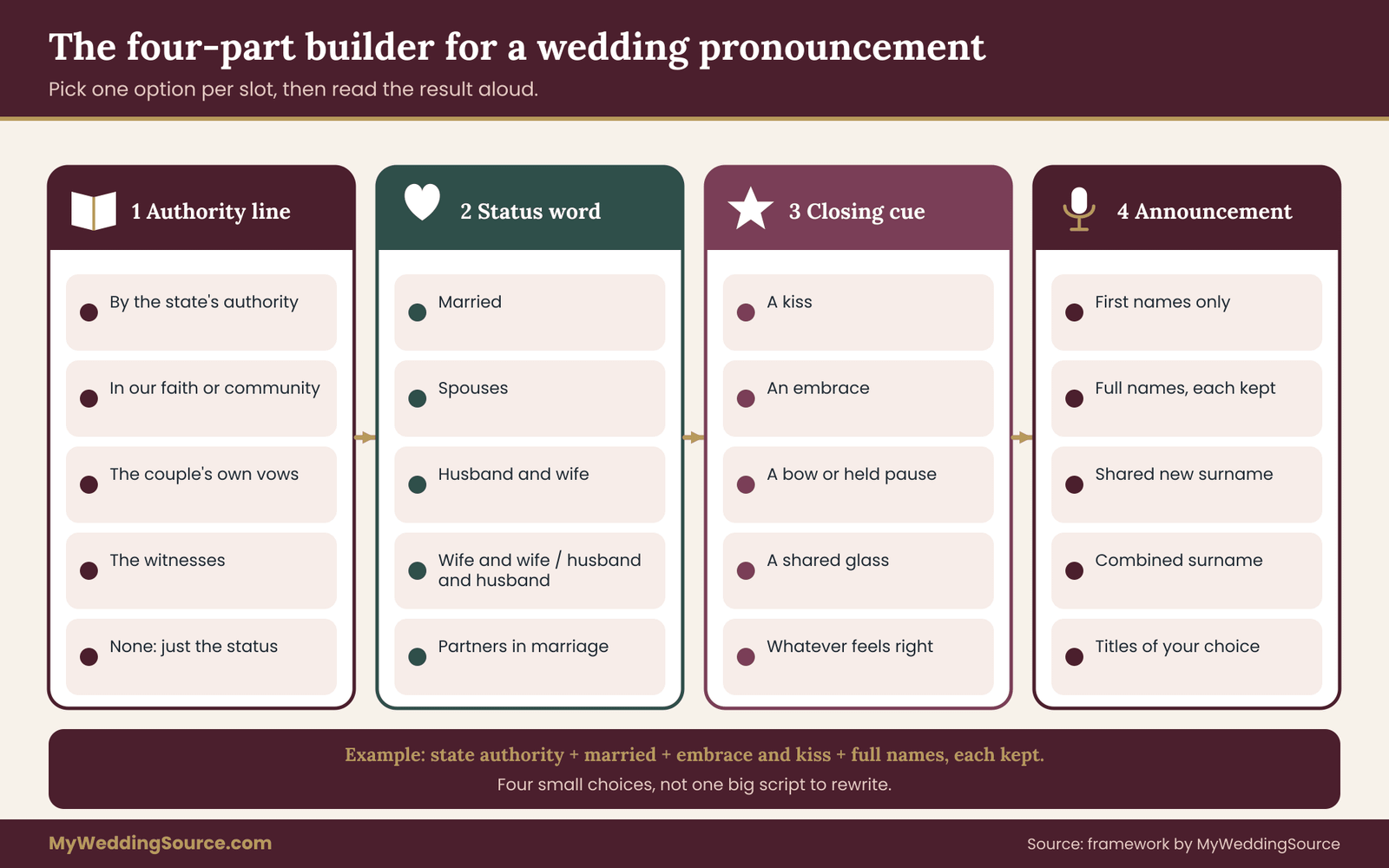
The builder is useful because it keeps decisions small. Instead of asking “What should our wedding pronouncement say?” you ask four narrower questions that each have a short list of answers. It also makes disagreements easier to locate. When one partner says “I do not like it,” you can ask which slot bothers them, and the fix is usually one phrase, not a rewrite.
Slot one: the authority line
The authority line answers the question “who is declaring this?” There are five common families of answer.
The state or the law. “By the authority granted to me by the State of [name]” or “By the authority of the county and the laws of this state.” This suits civil ceremonies and officiants who are legally authorized by a government body. It is formal and accurate.
A faith or community. “In the presence of God and this community” or “Before this congregation and in keeping with our tradition.” This fits religious ceremonies, and it works well when the officiant is a clergy member. The legal line may still be spoken separately.
The couple themselves. “You have declared your vows to one another, and so you are married.” This puts the couple, not the officiant, at the center and suits ceremonies where the officiant is a friend who is not comfortable claiming legal authority in a speech.
The witnesses. “Having heard your vows and witnessed your rings, we celebrate your marriage.” This is a gentle option for ceremonies built around community. It pairs best with a separate legal signing.
No authority line at all. The officiant simply says the status word: “Congratulations, you are married.” This is the shortest option and often the most natural for a small ceremony.
Slot two: the status word
The status word is the heart of the wedding pronouncement, and it gets its own section below, because this is where most couples want the widest range of choices. For the builder, you only need to know that this slot takes one word or one short phrase, and that it should match how you describe yourselves in everyday life and how your marriage record will describe you.
Slot three: the closing cue
The closing cue tells everyone what to do next. A kiss is the classic choice, and it comes with its own set of preferences about public affection, cultural comfort and photography. You can offer the officiant an exact phrase, such as “You may now seal your marriage with a kiss,” or a looser one, such as “Share a kiss, or a hug, or whatever feels right to you.”
Other options include an embrace, a forehead touch, a bow to each other, a shared sip from one glass, a handfasting knot pulled tight, the breaking of a glass if that fits your tradition, or simply a pause with applause. The cue should name an action or a signal that the guests can recognize, since it is also the moment the room learns it may clap.
Slot four: the announcement
The announcement introduces the couple by name, usually in the form “Please welcome” or “It is my honor to introduce.” The next section covers it in depth. For now, treat it as a separate slot with its own choices, because couples often love the wedding pronouncement and then discover the announcement leaves one of them out.
Putting the four slots together
Here is how three different couples might assemble the same slots. These are invented examples meant only to show the range.
The first couple wants a traditional, formal sound and is comfortable with gendered terms. They choose a state authority line, “husband and wife,” a kiss, and an announcement with titles and a shared surname.
The second couple has a quieter, more personal style. They choose a couple-centered authority line, the status “married,” an embrace and a kiss at their discretion, and an announcement with first names and the phrase “newly married.”
The third couple is two grooms who plan a short ceremony with a friend officiating. They choose “with the authority I have been given to solemnize this marriage,” the status “husband and husband” because both like it, a kiss, and an announcement that uses both first names and the surnames they are each keeping.
None of these is more correct than the others. Each is consistent, and consistency is what makes a wedding pronouncement sound intentional.
Reading it aloud before you commit
Write the assembled pronouncement on a card and read it aloud, both together and in the officiant’s voice if you can arrange it. You are listening for four things. Does any phrase sound like someone else’s wedding? Does the rhythm have room for a pause before the kiss? Is any word hard to say in a nervous moment? Is the whole thing under about thirty seconds?
If the answer to the last question is no, cut. A long wedding pronouncement drains energy that the vows just built, and the guests start to look at their phones. A good target is four to six short sentences, with the status word and the kiss cue as clear landing points. If you want more words, move them earlier into a blessing, so the wedding pronouncement itself stays crisp.
Status words in a wedding pronouncement: the option bank
The status word is the part people usually mean when they talk about wedding pronouncement wording. Below are the main families of options, each with what it communicates and when it fits. You can choose one word, or you can ask the officiant to say a short pair, such as “spouses and partners.”
Traditional gendered pairs
“Husband and wife” remains common and is the right choice for many couples. It is clear to every guest, matches the older language in many licenses and requires no explanation. Variations include “wife and wife” and “husband and husband,” which are simple, plain and accurate for same-sex couples who like the traditional shape of the phrase.
One practical note: some couples like the sound of the traditional pair but dislike the idea that one person is described by a role. If that is you, consider the neutral options below, or ask whether both of you feel the same about the word.
Neutral and inclusive options
“Spouses,” “married,” and “partners in marriage” work for any couple. “Spouses for life” and “married partners” add warmth. “Newly married” and “newlyweds” are friendly and informal. Each of these avoids assigning a gendered role and none requires explanation, though “spouses” can sound slightly formal to some ears.
Another approach is to use the couple’s own words about each other. If you call each other “my person” in daily life, an officiant can say “I am delighted to say that you are now each other’s person, and legally married.” That phrase should only be used if the legal term follows, so no guest wonders whether the marriage has actually happened.
Options for couples with nonbinary partners
When one or both partners are nonbinary, the best approach is to ask them what they want to hear. Many prefer “spouses,” “partners,” or simply “married.” Some want their own word, such as “spouse and spouse” or “life partners,” or ask that no status word be used and that the officiant says only “You are married.” All of these are fine.
If the officiant needs help, give them a one-line instruction in writing: “Please use the word married or spouses, and no gendered terms for either of us.” Officiants appreciate a clear note much more than a vague worry, and a written line is easier to follow when nerves rise.
Religious and cultural phrasing
Many traditions have established words for the moment a marriage takes effect, and a wedding pronouncement in those traditions may differ from the civil version in both wording and order. Some use a blessing in place of a declaration. Some include a response from the congregation, such as a spoken affirmation. Some include a symbolic action that carries the meaning, such as a cord, a canopy or a circling of a flame.
If your ceremony is religious, ask the officiant what is customary and what is optional. A faith leader will often know which phrases are fixed and which can be adapted. If your ceremony blends two traditions, the guide to interfaith wedding ceremony planning covers how to sequence elements from each so neither feels like an afterthought, and the wedding pronouncement is often the best place to give each tradition a sentence.
Bilingual and translated wedding pronouncement wording
In a bilingual ceremony the status word has to work in both languages. The easiest approach is to say the wedding pronouncement in the primary language and repeat just the status word and the closing cue in the second language. Repeating the whole thing doubles the length and loses momentum.
A native speaker should check the translated version, since a word that sounds right in a dictionary may carry a formal or old-fashioned tone. Ask the person who will say it to read it aloud once before the day. Also confirm how the second language handles gendered terms, since some languages require a gendered form that English does not, and you may need a neutral alternative the speaker is comfortable using.
Personal and playful wording
Some couples want a status word that carries their own humor or private meaning: “partners in crime and now in marriage,” “official teammates,” or a nod to a shared hobby. These can be delightful in a relaxed ceremony. They work best when the legal fact is stated first and the playful phrase follows, so the sequence reads as “you are married, and you are each other’s favorite teammate.”
The trap is the joke that depends on a story only half the room knows. If a phrase needs an explanation, it is probably better in the toasts than in the wedding pronouncement, where the room should be able to react instantly with applause.
Sorting the options by the audience
The same status word can land differently in front of different rooms. A short way to choose is to picture the three most conservative and the three most open-minded guests, and ask whether the word would be understood and respected by both groups. That does not mean you should adapt your ceremony to the least accepting person. It means you should know what reaction to expect, so it does not surprise you in the moment.
If a family member is likely to object to a particular word, a quiet conversation beforehand, ideally from one partner to their own relative, is far better than a reaction during the ceremony. You cannot control how anyone feels, but you can control whether they hear it first from you.
Writing the status word into a sentence
Once you have chosen the word, build the full sentence around it. Four patterns cover most needs.
The first is a plain statement: “You are now married.” The second is a wedding pronouncement: “I now pronounce you spouses for life.” The third is a recognition: “Having heard your vows, I am glad to recognize you as married partners.” The fourth is a handoff to the guests: “Everyone, these two are married.” The recognition pattern is gentle and works when the officiant is not comfortable with the older “pronounce” wording, while the handoff pattern is brisk and suits a lively ceremony.
Notice that “pronounce” itself is not essential. If the word feels too formal or too much like a judge’s ruling, drop it. A wedding pronouncement can be a wedding recognition or a wedding announcement and still do its job, provided the sentence is unmistakable and the room knows the vows are complete.
Closing cues: the kiss, the embrace and what the room does next
The closing cue is the physical or symbolic action that follows the status word. It is also the cue that most often goes wrong, because the couple, the officiant and the photographer may each assume something different about it.
Choosing the cue that suits you both
A kiss is the default, but it should be a choice. Some couples are not comfortable with public kissing, some come from families where it would cause distress, and some simply prefer a hug. Others want a long, romantic kiss for the photos. These preferences can differ between the two partners, so talk about them directly and early.
If you want something other than a kiss, write the alternative into the script. An officiant who says “you may kiss the bride” to a couple who agreed on a hug will create an awkward beat that the video will preserve. A better line is “Seal your marriage however you like,” followed by silence, which lets you do the kiss, the hug, or both without a prompt.
Cues that work for every couple
Several closing cues are inclusive by design. “You may now seal your marriage with a kiss” does not mention a bride or a groom. “Share your first moment as a married couple” leaves the action open. “Embrace, and let us celebrate with you” invites guests to clap on the officiant’s cue. If you plan a ring-kiss, a tap of glasses, or a held pause, say so to the officiant and describe it in your own words.
The point of an inclusive closing cue is not to avoid tradition. It is to avoid assuming that one tradition fits everyone. A couple who wants the traditional kiss line can still have it, as long as it uses language that suits them, such as “you may now kiss” without the extra words.
How long the pause should be
Rehearse the pause between the status word and the cue. A pause that is too short makes the kiss feel rushed, and a pause that is too long invites a nervous laugh. Two seconds is usually enough for the room to take in the status word, and another beat before the kiss gives the photographer time to focus. Practice with the officiant and agree on a signal, such as a nod, that tells them when you are ready.
If you want applause held until after the kiss, ask the officiant to say “Please hold your applause for one moment.” If you want the room to clap immediately after the status word, ask for a brief pause and a smile. Either way, the aim is a clean peak, not a trailing off.
Photographers, videographers and the closing cue
Photographers love the closing cue and will plan a position for it. Share the exact words and the order. If the officiant will step aside before the kiss, tell the photographer, since a clear line of sight changes the framing. If you plan to turn and face the guests after the kiss, mention that too, because the best photographers will already be pointed at the aisle.
A common mistake is for the officiant to step into the shot at the moment of the kiss. Ask the officiant to move a step back and to the side during the closing cue. The wedding photography consent guide explains how to tell your photographer about family preferences and privacy limits, which is relevant if some guests do not want to be filmed at the ceremony’s peak moment.
Special cases: children, pets and family members
If children or a pet are part of the ceremony, the closing cue needs to include them or keep them safe. A child who stands next to the couple may be confused when the officiant says “kiss,” and a dog may bark at the applause. Decide whether they stay in place, join a group hug, or walk back down the aisle first. Say so in the cue sheet, and give the adult who is supervising them a clear signal.
If a parent or other relative will stand beside the couple, ask them to hold their position until the couple turns. Otherwise the recessional can start with relatives in the wrong place.
Couple name announcements: choosing how the room hears you
The name announcement follows the closing cue, and for many couples it is the most personal part of the wedding pronouncement. It is the first time guests hear the couple introduced as married, and it is the moment when titles, surnames and nicknames either match what the couple expects or do not.
Why the announcement deserves its own decision
Couples often assume the announcement will take care of itself, because the officiant has the names. In practice, the officiant may have only the names on the license, which may differ from the names you use. They may say a middle name you never use, assume a new shared surname, or skip a preferred first name entirely. A wedding pronouncement that ends with the wrong name is hard to forget.
Make a short written note with the exact words you want the officiant to say, including spelling and phonetics. This one-line note is the single most useful thing you can give them after the vows. It is far less work than fixing a mistake after the fact, and it ensures that the announcement matches your invitations, program and place cards.
The main styles of name announcement
There are six common styles, and the right one depends on how you plan to live your names after the wedding. Each one can follow any wedding pronouncement.

First names only. “Please welcome Dana and Priya.” It is warm, quick and impossible to get wrong about surnames. It suits couples who have not settled their names or who want to keep the focus on the two people.
Full names, each partner keeping their own. “Dana Whitfield and Priya Raman.” It is accurate for couples who keep their names and makes the choice visible without comment.
A shared new surname. “Mr. and Mrs. Lee,” “Dana and Priya Lee,” or “the Lee family.” This is right when both partners take the same name. It is also the style where an officiant’s habit can cause trouble, because “Mr. and Mrs.” assumes one husband and one wife.
A hyphenated or combined surname. “Dana and Priya Whitfield-Raman.” The officiant must say the hyphen as a pause or as “hyphen” if you want it spoken, and the spelling in the program should match.
Titles chosen by the couple. Some couples want “Mr. and Mr.,” “Mrs. and Mrs.,” “Mx.,” “Dr. and Mr.,” or no title at all. Titles are personal, and a title the couple does not use in daily life may feel stiff. If you plan to use one, tell the officiant exactly which, and check that your invitations and place cards use the same.
A family-style introduction. “The new family: Dana, Priya and Mateo.” This suits couples with children who want them included in the first introduction. It should only be used if the child is comfortable being named in public.
Matching the announcement to your future names
Your announcement is also a small public statement about your names. If one partner will change their name and the other will not, say so in the way that matches the facts: “Dana Whitfield and Priya Raman-Whitfield.” If both keep their names, the plain pair of full names is the correct form. If the change will happen later, or if you are still deciding, use first names, which will not need to be corrected.
Remember that the announcement may precede the legal name change by weeks or months. The legal steps follow a particular order, starting with an updated Social Security record. If you are planning a change, the Social Security Administration explains what it needs and the order in which agencies and employers usually ask for updates. The guide to wedding records after the event summarizes that order in a calm sequence, so the ceremony and the paperwork stay in step.
Wording the introduction line
The line that introduces the announcement sets the tone. “Please welcome,” “It is my honor to introduce,” “For the first time as a married couple,” and “Everyone, meet” are all common. A traditional formal line might be “I present to you for the first time.” A relaxed one might be “Say hello to the newlyweds.” If a title is included, the officiant should read it exactly as written.
Avoid lines that assign roles, such as “Mr. and Mrs. John Smith,” when the couple does not want them. This traditional form names a wife by her husband’s first name and is unwelcome to many couples, including many heterosexual ones, so do not assume it is the default. If your grandparents expect it, a short conversation about what you prefer will usually settle the matter.
Names that are long, uncommon or hard to say
If any of the names include sounds the officiant may find hard, add a phonetic guide. Write it as an ordinary person would say it, not in formal phonetic symbols: “Siobhan (shi-VAWN),” “Nguyen (win),” “Szymanski (shi-MAN-skee).” Pronunciation guides are also a form of respect, and they save the officiant from guessing under pressure.
If a name has two common pronunciations, say which you use. If a person goes by a nickname at home and a formal name at work, decide which one belongs in the announcement. A guest hearing the formal name may not realize who is being introduced. Keep names consistent across every printed piece, so what the officiant says matches what guests have read.
The announcement and the recessional music
Most couples pair the announcement with a burst of music: a trumpet, a song or the opening bars of a recessional. The cue should be the last name, not the whole sentence. Tell the musician which word to listen for, such as the final surname or the word “married,” and agree on whether the music begins as soon as the name is spoken or after a beat of applause.
If the officiant speaks softly, make sure there is a microphone. Applause and music can drown out a name if the officiant speaks at the same time, so ask the officiant to leave a one-second pause after the final name before the music starts. A short pause often makes the moment feel larger.
Pronunciation, spelling and microphones
The best wording can still stumble if the officiant mispronounces a name, if the program spells it differently, or if the sound system fails at the key moment. This section covers the practical details that protect the wedding pronouncement from small, avoidable mishaps.
Create a one-page name card for the officiant
A name card is a short document with each partner’s full legal name, the name each prefers to hear, the pronunciation, the title if any, and the exact text of the announcement. Give it to the officiant at least a week before the ceremony and again on the day. Include the status word you chose and the closing cue.
Add two items most couples forget: how to say the names of the parents or other family members who might be mentioned, and how to say the names of any children who are being introduced. A one-page card is easier to read than a long email, and the officiant can tuck it into their script.
Check spelling across every printed piece
The announcement should match the program, the invitation, the seating cards and any sign that displays your names. Mismatches look careless and sometimes confuse guests, particularly when hyphens, accents or alternate spellings are involved. If you are correcting a printed error, fix it before the day and hand the officiant the corrected spelling.
If your names include accented letters, check that your printer and your officiant’s notes preserve them. A name card typed in a basic font may drop an accent, and the officiant will then read the unaccented spelling aloud. Print the card on paper so you can see exactly what the officiant will see.
Plan the audio
At small ceremonies the officiant’s natural voice may carry. At larger or outdoor ceremonies it often will not, and wind, traffic and a crowd of children can bury a quiet line. Ask whoever runs the sound whether the officiant will have a handheld or a lapel microphone, whether it will be on during the wedding pronouncement, and who will turn it off afterward.
Test the microphone at the volume the officiant will use. Many officiants use a calm, low voice during vows and need to project during the announcement. Agree on a simple signal so the audio person raises the level at the right moment, and ask them to be ready for the recessional cue.
Handling a mistake gracefully
Even with preparation, a name may be mispronounced or a line dropped. Decide in advance how you want to handle it. Most couples prefer to let a small slip pass, smile and move on, since the guests rarely notice. If a name is wrong in a way that matters, a quick, friendly correction by the couple, such as “It is actually pronounced…” delivered with a laugh, keeps the moment light.
Tell the officiant in advance that you would prefer to be corrected gently if needed and that you do not mind a restart of the announcement. That permission removes pressure, and an officiant who feels relaxed usually makes fewer errors.
Religious, cultural and officiant limits on a wedding pronouncement
Not every officiant has the same freedom to edit a wedding pronouncement. A judge or a civil celebrant may be happy to use any wording that is accurate. A clergy member may be bound by a denomination’s rites. A friend who was authorized for a single day may follow the couple’s lead but have little experience with ceremony language. Knowing which situation you are in saves arguments later.
Start by asking what is fixed
Ask the officiant a direct question: “Which parts of the wedding pronouncement are fixed, and which can we change?” Most will answer in specifics. A priest may say that the declaration is fixed but that the blessing is flexible. A rabbi may explain that a particular phrase is part of the ritual and that the announcement is yours to shape. A civil officiant may say that nothing is fixed beyond what the law asks.
Write down the answer. If a phrase is fixed and you dislike it, you have three choices: accept it, ask whether a different officiant is available who can use other wording, or add your own words before or after the fixed phrase. Many couples choose the third option, since a personal sentence beside a traditional one often feels better than either alone.
When the tradition and the couple disagree
Sometimes the tradition assumes a bride and a groom, and the couple is not that. Some religious bodies will not officiate a same-sex marriage, and some will. Some are willing to bless a marriage but not to say a particular phrase. It is kinder and more useful to learn this early than to discover it at the rehearsal.
If an officiant is not comfortable with your wording, you do not have to argue. A respectful conversation can reveal whether the issue is the phrase, the ceremony as a whole, or something else. Then you can decide whether to adjust, to bring in a different officiant for the legal part, or to hold a separate civil moment. The aim is a ceremony where the person speaking believes the words they are saying.
Two officiants, one wedding pronouncement
Some ceremonies have two officiants, for example a faith leader and a civil officiant, or two clergy from different traditions. In that case, decide in advance who says which part of the wedding pronouncement. A common arrangement is that one officiant says the authority line and the status word, while the other offers a blessing and the closing cue.
The core rule for handoffs is simple: write the speaking order on the cue sheet and rehearse it once. Two voices in rapid succession can confuse guests if the handoff is unclear, and the room may not know when to clap.
Cultural customs that sit beside the wedding pronouncement
Many cultures have actions that mark the moment of marriage and that do not have a spoken equivalent. These might include the lighting of a unity candle, the exchange of garlands, the circling of a fire, the covering of the couple with a cloth, the breaking of a glass, or the presentation of tea. In these ceremonies, the spoken pronouncement may come before, during or after the action, and the order matters to the families involved.
Ask a respected elder or the officiant which order is customary, and decide whether you want to follow it exactly. Then write the order into the script, including the exact words that signal each action. If you are blending customs, give a short explanation in the program so guests who are not familiar with a tradition can follow along without a running commentary during the ceremony.
Language that needs care
Some phrases are meaningful in a religious context but may be misunderstood in a mixed audience. A phrase such as “what God has joined” is sincere for a believing couple and may feel imposed on a guest who is not religious. Conversely, a secular phrase may feel thin to a family that expects a blessing. The aim is not to please everyone but to avoid surprise.
If you worry that a particular phrase will cause discomfort, discuss it with the person most likely to be affected. Many families respond better to being asked than to being surprised. If you are unsure whether a phrase suits a mixed audience, offering a short note in the program, such as “Our ceremony includes a traditional blessing,” is a courteous alternative to a long explanation.
Checking the wedding pronouncement before the day
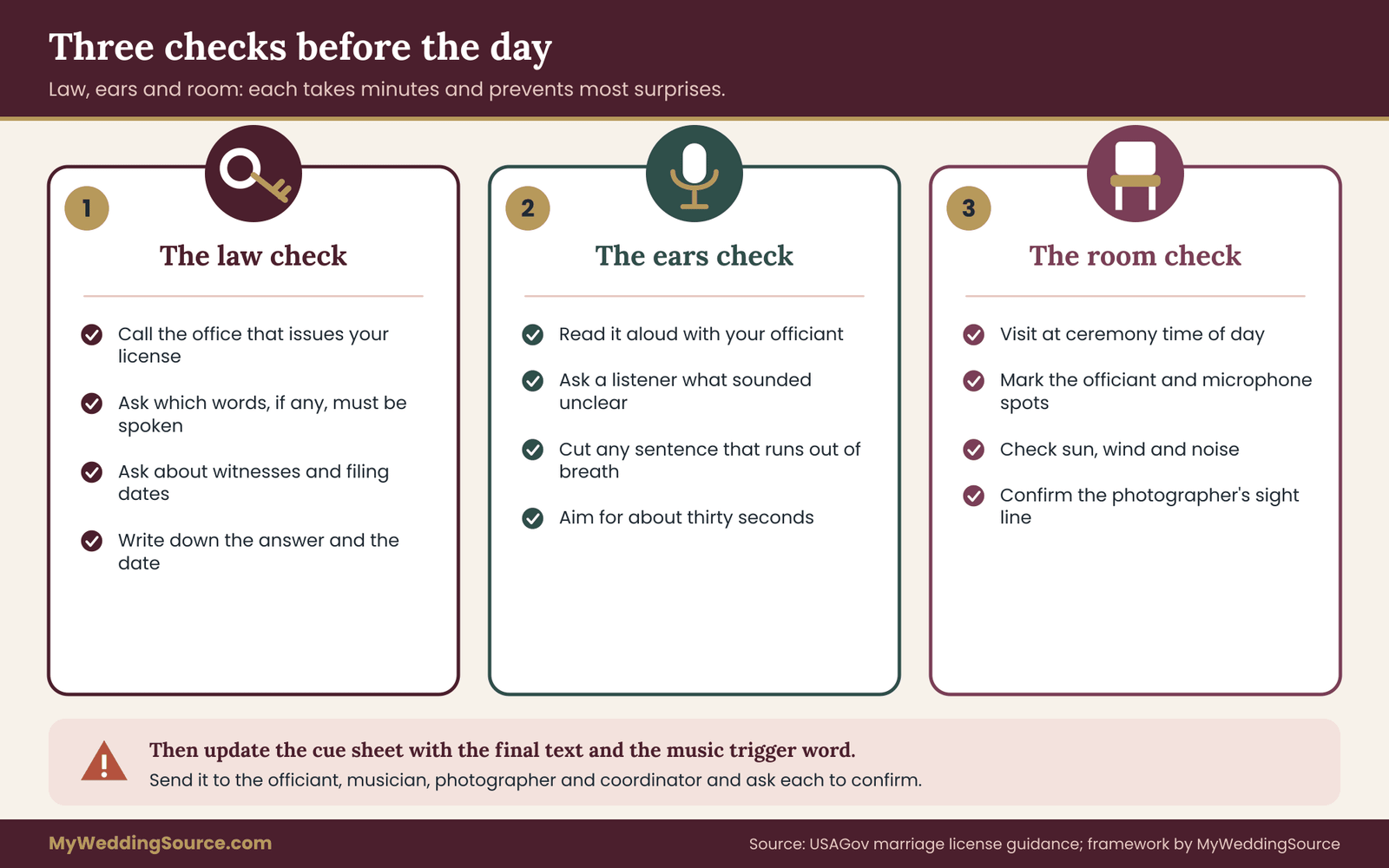
A wedding pronouncement that has been written is not yet a wedding pronouncement that has been tested. Three checks catch most problems: a law check, an ears check and a room check. Each takes only a few minutes, and together they take the guesswork out of the moment.
The law check
The law check confirms that your wedding pronouncement and your signing process meet the requirements of the issuing office. You do this once, early, by contacting the office that issues your license and asking the questions listed earlier. Write down the answers and keep them with your license.
Then compare your script with those answers. If the office says the couple must declare in front of witnesses that they take each other as spouses, find the place in your ceremony where that happens. If it is already in the vows, no change is needed. If it is not, add a short exchange, such as “Do you take this person as your spouse?” and “I do,” before the wedding pronouncement.
The USAGov page on marriage licenses is a good starting point for finding your local office and for understanding which steps are the same in most places. Rules differ widely, so always confirm with the office that will actually accept your license.
The ears check
The ears check is a read-aloud test with the officiant and, if possible, a friend who has not seen the script. Read the entire wedding pronouncement and announcement at normal speaking speed, then ask the listener three questions. Did anything sound unclear? Was there a word they stumbled over? Did the ending feel like an ending?
Listen for rhythm as well as meaning. Long sentences that look elegant on a page can run out of breath when spoken. Words that sound alike, such as “wedded” and “wetted” in a noisy room, or “spouse” and “spouses,” can blur. If you hear something unclear, rewrite it with shorter words and shorter sentences.
The room check
The room check is a walk-through of the physical space at the time of day when the ceremony will happen. You want to know where the officiant will stand, where the microphone will be, where the photographer can safely move, where guests will look when the couple turns, and where the music will play from.
Stand in the spot where the couple will be during the wedding pronouncement and look at the guests. Can you see their faces? Is the sun in your eyes? Is there a pillar or a flower stand that blocks the view? These details shape how the moment feels and how it photographs. If the ceremony is outdoors, check for wind and noise. A gust can carry away a quiet pronouncement, and a nearby road can drown out an announcement.
Putting the results on the cue sheet
After the three checks, update the cue sheet with the final text of the wedding pronouncement, the exact trigger phrase for the music, the placement of the officiant and the signal for applause. The wedding ceremony step by step guide shows how the wedding pronouncement fits into the full running order, which is useful when you want to confirm that nothing important comes after it.
Give a copy of the cue sheet to each person who has a role: the officiant, musician, coordinator, photographer, videographer and sound technician. Ask each of them to confirm in writing that they have read the wedding pronouncement section. A short reply such as “Got it, I will start the music on the final surname” is enough, and it removes a source of anxiety.
Rehearsal logistics
At the rehearsal, practice the wedding pronouncement at least twice. The first time, simply walk through the words and the positions. The second time, do it at ceremony speed, with the musician and the photographer present if possible. Practice the pause, the closing cue and the announcement, and agree on what to do if something goes wrong.
Many rehearsals focus on the processional and skip the ending, which is the part most likely to go astray. Because guests are not watching, a rehearsal is also the safest place to try a different status word or to test a pause. If something feels wrong, change it. It is much easier to adjust at the rehearsal than on the day.
The sixty-second sequence around a wedding pronouncement
When the vows and rings are done, the final minute of the ceremony runs as a short sequence of cues. Writing it as a timeline helps everyone see how long each step takes and where the handoffs are.
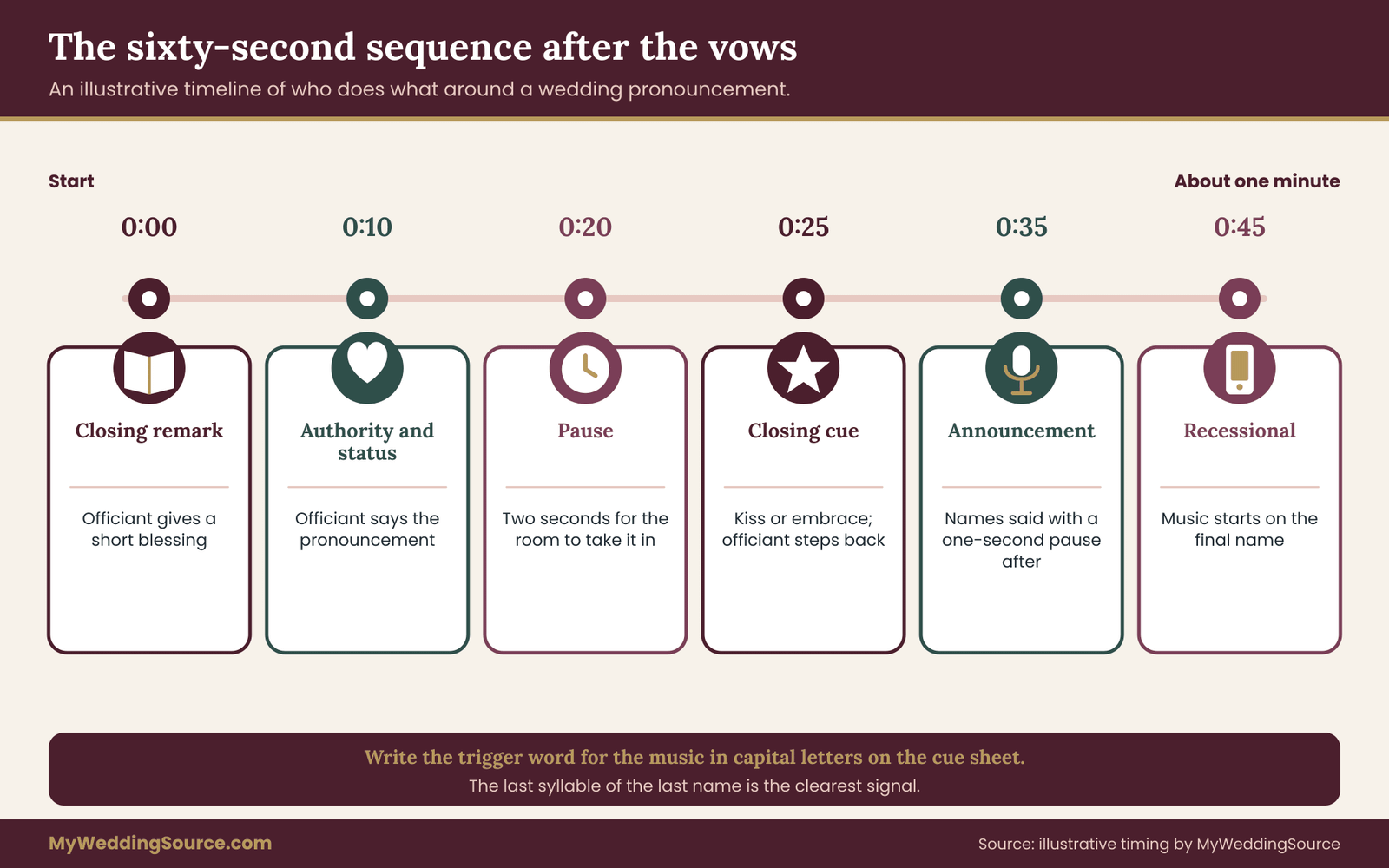
A sample sequence
This is an illustrative sequence, not a rule. Adjust the times to fit your ceremony.
At the start, the officiant gives a short closing remark or blessing, about ten seconds. Then the officiant says the authority line and the status word, about ten seconds. A two-second pause follows, which lets the room take it in. The closing cue comes next, and the couple kisses or embraces for another five seconds or so. The officiant steps back, and the room applauds.
After a few seconds of applause, the officiant raises a hand or smiles and says the announcement, about ten seconds. The musician starts the recessional on the final name, and the couple walks back down the aisle. Altogether the sequence takes under a minute, and that brevity is a feature. A short ending keeps the energy up, and a long one lets it settle.
Who does what
The couple’s job is to hold still, listen, and then enjoy the moment. The officiant’s job is to speak clearly, pause, give the cue and step aside. The musician listens for the trigger. The photographer positions for the kiss and then for the walk back. The coordinator watches the officiant’s hand signal and prepares the next step, such as asking guests to stay seated until the couple has left or releasing the first rows.
Make sure the coordinator knows when the legal signing will happen. If it is right after the wedding pronouncement, the officiant and witnesses need to be ready, and the couple needs to know whether to walk to a table or walk out first. If the signing is later, tell guests nothing, and just let the recessional run.
Cues for guests
Guests take their cue from the officiant. If the officiant smiles, steps back and says “congratulations,” they will clap. If the officiant wants them to stand, they should say “Please stand” before the announcement. If you want guests to cheer, say so in the program or ask the officiant to invite them.
Small cues like these make the ending feel confident. An uncertain ending leaves guests looking around to see whether they should clap, and the pause after the closing cue is when that uncertainty shows most.
The recessional trigger in detail
The recessional trigger is the exact word that tells the musician to begin. The most reliable trigger is the last syllable of the last name in the announcement, because it is clear, it is unique, and it is at the end of the sentence. Avoid triggers such as “kiss,” which may come in the middle of a longer line, or “and,” which may appear several times.
If the announcement uses first names only, the trigger is the last first name. If it uses a shared surname, the trigger is the surname. If the officiant adds a closing line, such as “Go and enjoy your day,” the trigger moves to that line, and the musician should be told. Write the trigger on the cue sheet in capital letters.
A worked example: two couples, one option bank
The following examples are invented. They show how two couples with different needs use the same four slots to reach a wedding pronouncement that suits them.
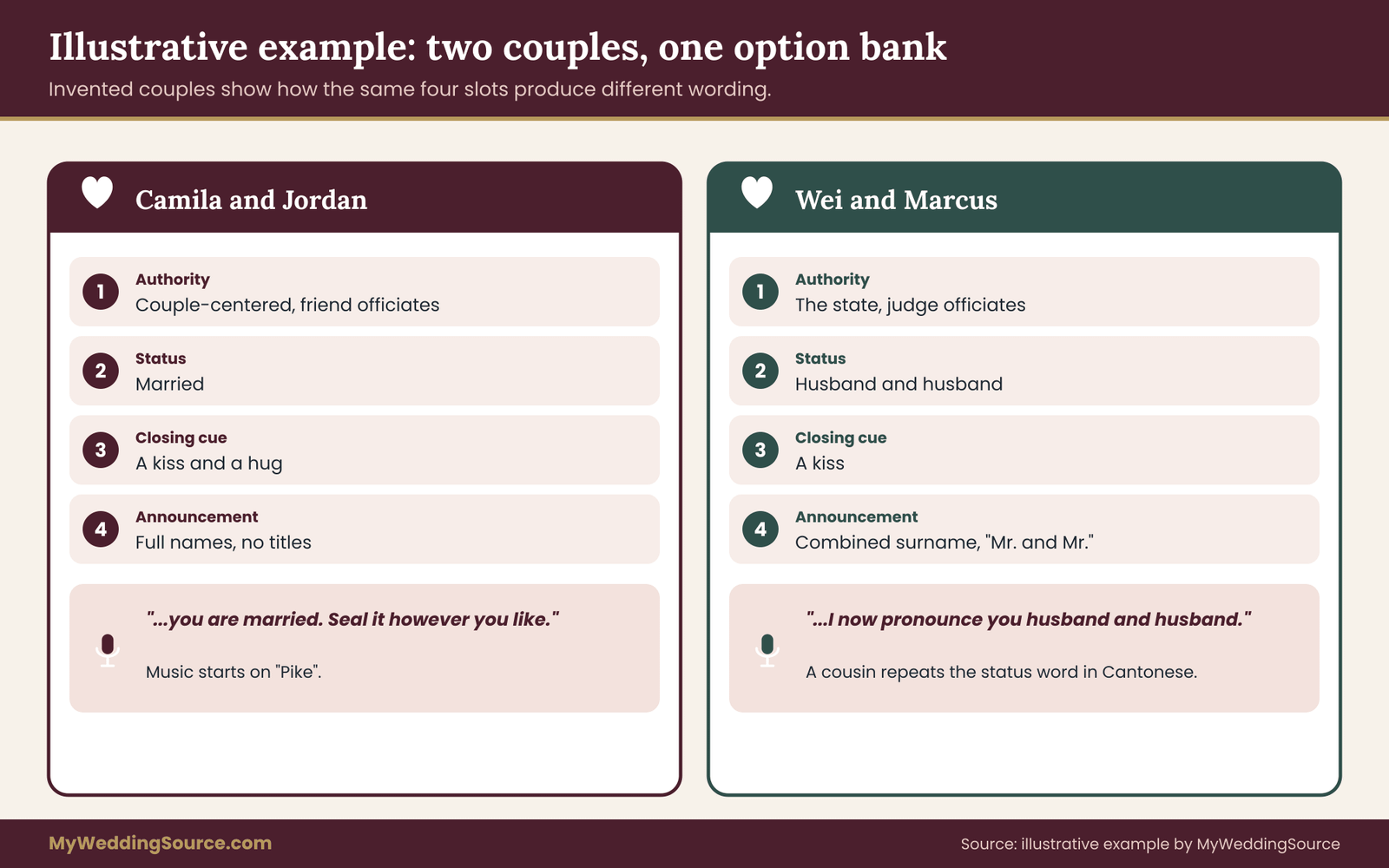
Couple one: Camila and Jordan
Camila and Jordan are planning a ceremony of about sixty guests in a garden, with a friend officiating. Camila will keep her surname, and Jordan will keep his. They want a warm, informal tone and neither wants “husband” or “wife” because they do not use those words. They are comfortable with a kiss.
Their builder choices are these. For the authority line, they pick the “couple-centered” form, because their friend is a one-day officiant and would feel awkward claiming a state’s power. For the status word, they choose “married.” For the closing cue, a kiss and a hug. For the announcement, full names with no titles.
The assembled wedding pronouncement reads: “Camila and Jordan, you have spoken your promises in front of the people who love you, and with the authority I have been given today to solemnize this marriage, you are married. Seal it however you like.” After the kiss, the officiant says, “Everyone, I am delighted to introduce Camila Reyes and Jordan Pike.” The musician starts on “Pike.”
Law check for Camila and Jordan
Their county office tells them that the couple must state in front of the officiant and witnesses that they take each other as spouses, and that the officiant must sign and return the license within a set number of days. The couple adds a short exchange before the wedding pronouncement: “Camila, do you take Jordan as your spouse? Jordan, do you take Camila as your spouse?” with two spoken replies.
They then add a line to the cue sheet: the officiant will sign during the cocktail hour, with two witnesses, and a groomsman will carry the license to the mail drop on Monday.
Notice that none of this changed the wording they loved. It added one required exchange and an administrative step, both of which were easy to place once they knew what was needed.
Couple two: Wei and Marcus
Wei and Marcus are two grooms having a ceremony of about one hundred guests in a hall, with a judge officiating. They like the traditional sound of the older wording, but only if it fits. They are both comfortable with “husband and husband,” and they plan to share a surname by combining theirs. Marcus’s grandmother will attend and speaks mostly Cantonese, so Wei’s cousin will repeat the key line in that language.
Their choices: for authority, the state line, which the judge will say naturally; for status, “husband and husband”; for closing cue, a kiss; for announcement, a combined surname with “Mr. and Mr.” in the formal introduction. The judge asks for the pronunciation of the combined surname and the cousin writes the Cantonese phrase on a card.
Their wedding pronouncement reads: “By the authority granted to me by the state, I now pronounce you husband and husband.” The cousin then repeats the status phrase in Cantonese, the couple kisses, and the judge says, “Please welcome, for the first time, Mr. and Mr. Lin-Okafor.” The musician starts on “Okafor.”
What the two examples show
The two couples reached different wedding pronouncement wording from the same bank, and both are consistent. The first uses plain, informal words and leaves the exact closing gesture open. The second uses formal words and fixes each detail. Neither is better. Each matches the couple’s style, the officiant’s authority and the room.
The other lesson is about the order of work. Both couples decided the legal needs first, then the status word, then the cue, then the announcement. They checked pronunciation and spelling after the words were final, and they gave the musician a trigger last. A couple who starts with the announcement and discovers a legal requirement later has to rewrite, which is why the order matters.
A short script template you can adapt
Use this template as a starting frame. Replace the bracketed parts with your own choices.
“[Names], you have made your promises in front of [community]. [Authority line], I am glad to say that you are [status word]. [Closing cue].” After the cue and applause: “[Introduction line] [announcement].”
Read it aloud with your own words in place, and cut anything that does not sound like you. The shortest version that still feels complete is usually the right one.
A second template for a blended or two-tradition ceremony
“[Names], you have made your promises and exchanged your rings, [blessing from tradition one]. [Blessing from tradition two]. [Authority line], you are now [status word]. [Closing cue].” After the cue: “[Introduction line] [announcement].” If a second language is used, the second speaker repeats only the status word and the introduction line.
This template gives each tradition one sentence, and neither dominates. If you have three traditions, consider moving one blessing earlier in the ceremony, so the wedding pronouncement stays short.
Pitfalls and edge cases for a wedding pronouncement
Most problems with a wedding pronouncement are small, and nearly all of them are predictable. This section lists the ones that come up most often, along with a simple fix for each.
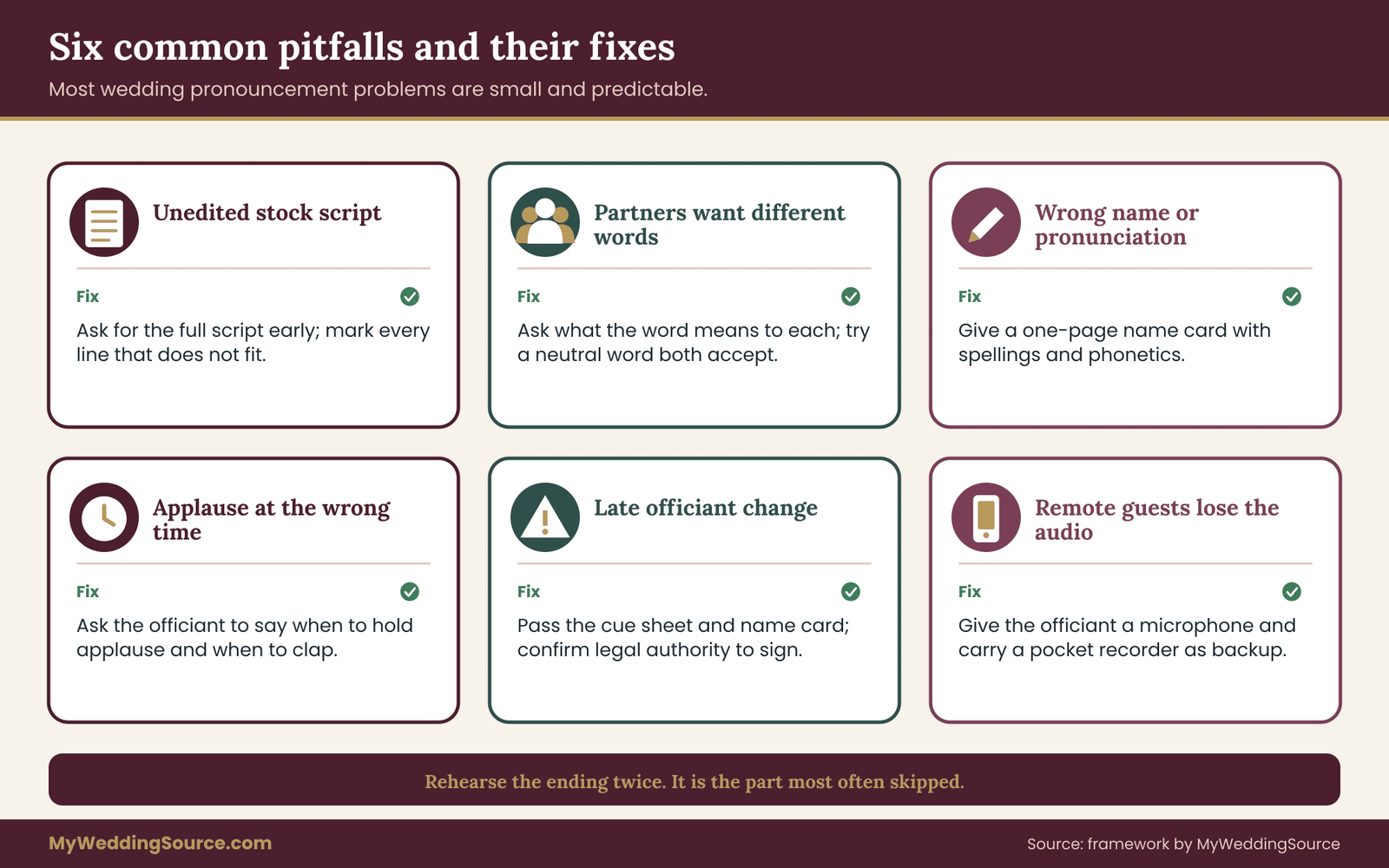
The template nobody edited
The most common pitfall is a stock script that the officiant reads word for word. It may say “bride and groom” three times before the wedding pronouncement, include a kiss line the couple did not choose, or introduce the couple with a title they do not use. The fix is to ask for the full script early, mark every line that does not fit, and return it with the changes. Do this at least two weeks before the ceremony, so the officiant has time to rehearse the new version.
If the officiant resists changes, that is a useful signal. A person who will not adjust a few lines for the couple may also be less flexible about other things, such as timing or the microphone. It is better to learn that early and decide whether to continue.
The two partners who want different words
Sometimes one partner loves a traditional status word and the other does not. This is a real disagreement, and it deserves a real conversation, not a quick compromise that leaves one person unhappy. Ask each partner to say what the word means to them. A word may carry family, faith or identity in ways the other person has not heard.
Often the answer is a different word that both can accept, such as “married” or “spouses.” Sometimes it is a layered version: the officiant says the neutral word, and one partner adds the traditional one in their vows or in a short toast. A wedding pronouncement should not be a place where one person gives up something important just to keep the peace.
Guests who respond out of turn
A guest may shout, cheer or clap before the officiant finishes, or a child may call out. Do not worry about this. A small interruption rarely hurts the ceremony and sometimes makes it warmer. If you want a quieter room, ask the officiant to say “Please hold your applause for just a moment” before the closing cue.
A more serious case is an objection or a comment aimed at the couple. These are rare, and they are best handled by a trusted person, such as the coordinator or a family member, who can step in quietly. Tell your coordinator in advance who that person is.
Accessibility during the wedding pronouncement
If any guest is deaf or hard of hearing, or blind or has low vision, the wedding pronouncement needs extra planning. An American Sign Language interpreter or live captioning can be arranged with the venue, and the interpreter needs the script in advance, including the status word and the announcement. Tell the officiant to pace the words so the interpreter can keep up, and to leave pauses.
For guests with low vision, a program in large print and an officiant who describes actions aloud, such as “Please stand,” help. The Americans with Disabilities Act is the federal law that covers accessibility in public places, and the ADA website explains the basics. Your venue and your vendors can tell you what is available, so ask early.
Livestream and recorded ceremonies
If the ceremony is livestreamed, remote guests rely entirely on audio and video. A clear microphone for the officiant matters even more, and the videographer needs the exact words and cues. Tell the video team when the wedding pronouncement will happen, so the camera can be on the couple at the peak and on the guests at the applause.
Also check that the stream has a backup audio source. A single microphone failure can silence the most important line. A small portable recorder in the officiant’s pocket is a low-cost safeguard that preserves the audio even if the stream drops.
Short ceremonies, elopements and micro weddings
In a ceremony of just a few people, the wedding pronouncement can be intimate and brief. The officiant may say it conversationally, and the couple may reply. The legal requirements still apply, so confirm witnesses, signatures and filing. Keep the cue sheet even for a tiny ceremony, since a short page prevents confusion when only a few people are present and each person has more than one role.
For elopements with a photographer, agree on the closing cue so the photographer can capture it. A few extra seconds of stillness before the kiss gives the photographer time to react, and it also gives the couple a quiet beat to take in what has happened.
Vow renewals and second ceremonies
A vow renewal does not create a new marriage, so the wording should not claim to. Instead of “I now pronounce you,” an officiant might say “I am glad to witness your renewed promise” or “May your marriage be blessed for many more years.” If a couple is marrying for a second time, the same options apply, and the legal side follows the same steps as any other marriage.
If you are renewing vows after a legal ceremony elsewhere, say so in the program. A guest who hears a wedding pronouncement at a renewal may be confused about whether the marriage is happening for the first time, and a single line in the program prevents that.
When the officiant changes at the last minute
Illness, travel problems and scheduling conflicts can change who stands at the front. If a replacement officiant steps in, give them the full cue sheet, the name card and the exact text of the wedding pronouncement as soon as possible. Meet them before the ceremony if you can, and ask them to read the text aloud once.
Check that the replacement is legally authorized to sign your license. This step is easy to miss in the rush. If the replacement is not authorized, you may need to keep the original officiant for the legal part or arrange a short signing afterward. The wedding officiant requirements guide explains how to confirm authority, which is worth doing at the same time as sharing the script.
What to do after the wedding pronouncement
The announcement ends the ceremony, but a few tasks follow. The first is the signing, covered earlier. The second is confirming that the officiant has returned the license on time. The third is ordering certified copies of the record once the office has recorded it. The fourth, for couples who are changing names, is starting the update process.
Because the wedding pronouncement has just introduced your names, take a moment afterward to check whether the announcement matches the names you plan to use. If you announced a new surname, begin the legal update and keep the certified copies handy. If you announced first names only, you have time. The records guide mentioned earlier explains the sequence in detail, and the Social Security Administration and the Department of State explain what each agency requires.
Keeping a record of what you said
A written copy of the final wedding pronouncement and announcement is a small keepsake. It may be the text in your program, the officiant’s script or the transcript of a recording. Keep it with your ceremony notes. Years later, you may be glad to have the exact words, and if a question arises about what was said or promised, the record settles it.
If your ceremony was recorded, store the file with your other wedding videos. The audio of the wedding pronouncement is often the part couples replay most, so make sure it is in the backup.
Your next steps
Start with the legal check, since it decides what must stay in your script. Call or visit the office that issues your license, and ask what wording or declaration is required, who may officiate, and when the signed license must be returned. Write the answers down and keep them with your cue sheet.
Next, build your wedding pronouncement in the four slots. Choose an authority line, a status word, a closing cue and an announcement, and write the assembled version on a card. Read it aloud with your partner and then with your officiant. Adjust anything that sounds off, and cut it until it fits in about thirty seconds.
Then prepare the supporting pieces. Give the officiant a one-page name card with spellings and pronunciation. Give the musician a trigger word and the photographer the closing cue. Walk the room at ceremony time, and rehearse the wedding pronouncement twice at the rehearsal. Finally, add the signing and filing steps to your cue sheet, and return to the cue sheet for officiant, music and readers if you want a template for the whole page. After that, you are ready for the moment.
FAQ
Is the wedding pronouncement legally required?
It depends on where you marry. In many places the legal requirements center on a valid license, an authorized officiant, the couple’s spoken agreement and the filing of the signed license, and the specific pronouncement wording is not prescribed. Some places require certain words or a declaration. Ask the office that issues your license what must be said, and keep the answer in writing.
What can we say instead of “husband and wife”?
Common alternatives include “spouses,” “married,” “partners in marriage” and “newly married.” Same-sex couples may choose “husband and husband” or “wife and wife,” and some couples prefer a personal phrase. The best choice is the one that is accurate for both partners and that each of you is comfortable hearing in front of family. Always confirm it with your officiant before the ceremony.
Do we have to kiss at the end of the ceremony?
No. A kiss is customary but not required. You can choose an embrace, a bow, a shared glass, a held pause or any gesture that suits you. Tell the officiant the exact cue you want, so they do not say “kiss” by habit, and tell the photographer so they can frame the moment. The guests only need a clear signal to applaud.
Should the couple name announcement use titles?
Only if you want them. Many couples introduce themselves with first names, or with full names and no title. If you choose a title such as “Mr. and Mr.” or “Mx.,” tell the officiant exactly how to say it. Make sure your program and signs match, and avoid forms that name a wife by her husband’s first name unless you both prefer them.
What if our officiant will not change the script?
Ask which parts are fixed, and which are open. Some traditions prescribe certain phrases, and in that case you can add your own sentence before or after. If the officiant is unwilling to adjust anything that matters to you, consider asking a different officiant, or splitting the legal and ceremonial roles between two people. It is better to decide early.
How long should the wedding pronouncement be?
Short. About thirty seconds for the wedding pronouncement and closing cue, and another ten for the announcement, is plenty. Four to six short sentences usually do the job. If you want more words, move them into a blessing or a closing remark earlier in the ceremony, so the ending stays crisp and the applause comes at the right moment.
How do we handle a bilingual wedding pronouncement?
Say the full wording in your main language, and repeat only the status word and the announcement in the second language. Ask a native speaker to check the translation and to practice the pronunciation with the speaker. Check whether the second language needs a gendered form, and choose a neutral alternative if that does not fit your couple.
Does the announcement have to match the names on our license?
No, but it helps to know the difference. The announcement is ceremonial, so you can use the names you go by. The license and your certified record carry your legal names, and any name change follows its own steps with the Social Security Administration and other agencies. Use first names in the announcement if you are still deciding.
Sources
- Marriage license, USAGov
- How to get a copy of a marriage certificate or a marriage license, USAGov
- Where to write for vital records, Centers for Disease Control and Prevention, National Center for Health Statistics
- How do I change or correct my name on my Social Security number card?, Social Security Administration
- Corrected card for a U.S. citizen adult, documents required, Social Security Administration
- Change or correct a passport, U.S. Department of State
- Marriage means making changes before next filing season, Internal Revenue Service
- Americans with Disabilities Act, U.S. Department of Justice
- ADA National Network, accessibility guidance