
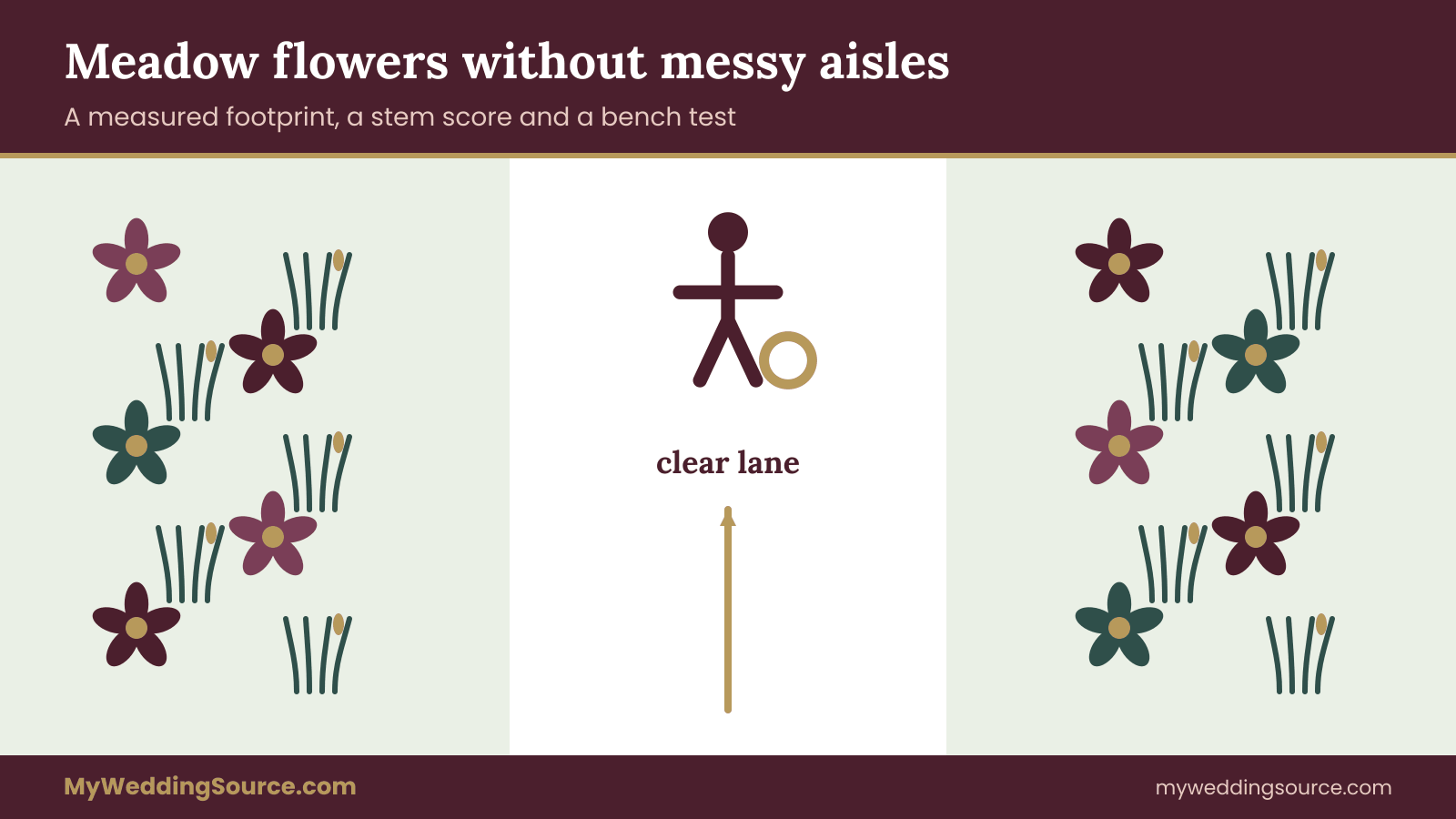
Meadow flowers are the loose, uneven, wild-looking arrangements that look as if they grew beside the aisle instead of being placed there. This guide shows how to keep that look without a messy walkway: an aisle footprint drawing that gives every petal, stem and seed head a place to be, plus a bench test you can run before you approve a single design.
Draw the aisle from above as four bands: a walk lane that stays empty, a hem band beside it, a drop band where loose material may fall, and a feature band where the meadow flowers live. Measure each band in inches, give every stem family a drop score, and test a sample bunch on a tray before you approve the design. An aisle of meadow flowers is safe for guests when nothing it sheds can land in the walk lane, snag a hem, or stain a shoe.
Meadow flowers have a particular promise. They suggest ease, a little disorder, and a day that feels unforced. The promise is easy to keep in a photo and harder to keep on a real aisle, where seventy people walk, a bride may drag a train, a grandfather may lean on a cane, and a child may carry a basket with no sense of where the edge of the path is.
The trouble is rarely the flowers themselves. It is the footprint. A tight round arrangement stays where the florist puts it. A loose one reaches, droops, drops, and tilts toward the sun, and the space it needs is larger than the space it appears to take up. If nobody draws that space, the first guest to arrive discovers it by stepping on it. Meadow flowers need more room than they appear to take up.
This article is about drawing it. You do not need design training, and you do not need to know the Latin name of a single plant. You need a ruler, a sketch of your aisle, a few honest questions for your florist, and an hour with a sample. Everything here is written for couples who like the wild look and still want the aisle to work.
A note on scope. This is general information, not legal, tax or financial advice, and it does not replace the advice of a trained florist or a plant safety professional about the specific plants you choose. Where a rule or a safety fact matters, the article points you to the agency or organization that publishes it so you can confirm the current version.
What meadow flowers mean at a wedding
The phrase gets used loosely, so it helps to pin it down. In wedding work, meadow flowers usually means an arrangement built from many small and medium blooms of different heights, mixed with grasses, seed heads and airy filler, and arranged so that the outline is irregular on purpose. Stems cross at angles. Some bend. Some are taller than the rest and break the silhouette. Nothing is clipped to a clean dome.
That description tells you what the style needs physically. It needs room at the edges, because the edges are the point. It needs stems of unequal length, which means the arrangement has no single base of a predictable width. And it needs material that moves: grasses that sway, petals that open fully, buds that keep opening as the day warms.
Each of those traits is attractive and each is a source of risk on an aisle. The edges reach into walking space. The unequal stems poke at shins and hems. The moving material drops things. This is not an argument against the style. It is an argument for planning the style with the same care you would give a candle or a cable.
What meadow flowers are not
Two things are often confused with the style, and separating them saves arguments later.
First, meadow flowers are not the same as foraged or wild-collected flowers. A florist can build a meadow look entirely from farmed stems grown for cutting. Actual wild collecting from roadsides, fields or public land raises separate questions about permission, local rules and what may legally be taken, and this article does not recommend it. A later section covers the sourcing questions to ask.
Second, meadow flowers are not the same as a color story. A meadow can be soft pastel, saturated and warm, or nearly white and green. If you are still deciding hues, the wedding color palette guide covers how to choose and test a palette first, and the footprint work below applies whichever colors you pick.
Why the aisle is the hard place
A bouquet is held by one person who can adjust it. A table arrangement sits where guests mostly look at it rather than walk through it. The aisle is different because it is a working surface. People move along it in a fixed order, at a fixed time, often in dress shoes on grass or gravel, with a photographer walking backward in front of them.
An aisle also has a few features that change how meadow flowers behave. It is narrow compared with the room around it. It has a start and an end where people bunch up. It is often lined by chairs that can pinch the available width. And it is the one path that guests are explicitly asked to keep clear, so anything on it feels like a mistake.
If your aisle is a lawn between rows of chairs, the walk lane is the strip of grass the wedding party uses. If it is a hallway, a nave, a dock or a barn floor, the lane is the same idea at a different width. A venue such as the ones described in the barn wedding venues guide often has an uneven floor or a gravel center, which makes spills harder to see and harder to sweep, so the lane needs more thought there than on a smooth surface.
Six ways meadow flowers make a mess
Before drawing anything, name the failures you are trying to prevent. A florist who hears “I don’t want it messy” will nod and still not know what you mean. Six specific failures cover almost everything that goes wrong with meadow flowers on an aisle, and each has a different fix.
Petal drop. Some blooms open fully and release petals at the slightest knock or at the end of a warm afternoon. Petals on a lawn are charming from a distance. Petals on a polished floor are slippery, and wet petals under a heel can slide.
Floret and bud shatter. Spiked flowers carry many small buds along a stem. In heat or after a bump the small flowers can fall off in a scatter that is harder to sweep than whole petals, and the bare spike looks tired.
Seed, fluff and dried bits. Grasses and seed heads give the meadow its texture and also shed. Some drop seed. Some release fluff. Some leave dust on dark clothing.
Pollen and stain. A few common flowers carry heavy pollen that can mark fabric, skin and veils. The fix is usually simple, such as removing the pollen-bearing parts, but it has to be asked for.
Water and sap. Wet stem ends drip. Some stems exude a sticky or irritating sap. A fresh arrangement set on a ledge can leave rings or a trickle, and a tall vessel with open water can tip.
Reach and snag. Long stems lean out. A branch at ankle height or a rigid stem at hem height catches a train, a veil, a cane tip or a toddler’s sleeve.
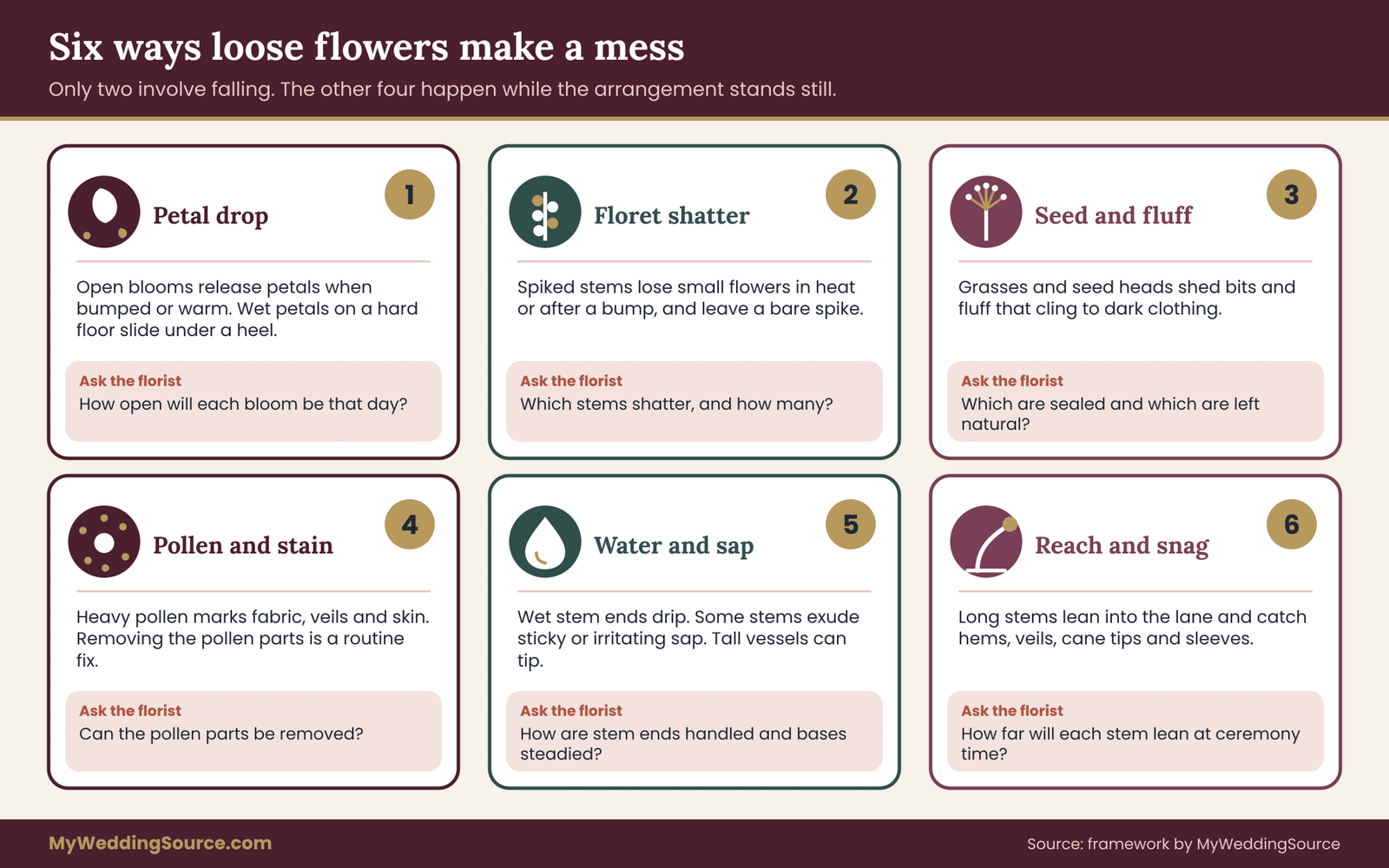
The infographic above pairs each failure with the question that catches it. Notice that only two of the six involve the flowers falling. The other four are about what the arrangement does while it is standing still: dripping, leaning, staining, and reaching. A drawing that only tracks falling petals will miss most of the risk.
Why couples miss these problems
Most couples approve flowers from images. A photograph freezes an arrangement at its best minute, shot from one angle, with the aisle empty and the grass swept. It cannot show how many petals are on the ground after an hour, how far a stem leans when the wind picks up, or whether a hem would catch.
There is also a timing problem. The florist finishes setting just before guests arrive. The first moment the meadow flowers meet real traffic is the ceremony itself, with no chance to adjust. A drawing and a sample test move that first meeting earlier, to a table in a kitchen or a studio, where fixing it costs a few minutes instead of a delay.
A simple way to think about the work
Treat the whole job as three questions asked in order. Where do people need to be? What can reach that space? What can fall into it? The first question gives you the walk lane. The second gives you the hem band and the reach rules. The third gives you the drop band and the stem scores. The feature band, where the meadow flowers live, is simply the space left over once those three are answered, and it is usually larger than couples fear. That is how meadow flowers stay wild while the lane stays clear.
The next section turns those questions into a drawing you can sketch on a printout of the venue map, or on plain paper with a ruler.
The aisle footprint drawing in four bands
An aisle footprint drawing is a top-down sketch of the aisle with four labeled bands measured outward from the center line. You draw it once, share it with the florist, the venue and the coordinator, and use it to approve every placement. Because it is measured, it replaces phrases like “keep it airy” and “not too close” with numbers that a setup crew can follow without guessing.
The four bands, from the center outward, are these.
Band one: the walk lane. This is the clear strip people and trains travel along. Nothing is placed in it, and nothing is allowed to lean, drip or fall into it. It is measured as a clear width, floor to a head-height line, with no exceptions for a single pretty stem.
Band two: the hem band. This is the strip just outside the lane that long skirts, trains, robes, veils, canes, walkers and small hands can reach. Flowers may enter it only if they are soft, short, and fixed in place. Rigid stems, sharp wire ends and heavy vessels do not belong here.
Band three: the drop band. This is the strip where loose material can fall and still be swept away without crossing into the lane. Whatever sheds, drips or leans is placed here, away from the walk lane by at least the distance the material can travel in a light breeze.
Band four: the feature band. This is where the meadow flowers actually live: the tall, loose, uneven masses that give the aisle its look. The feature band can be as deep as the venue allows. It is the band that guests photograph.
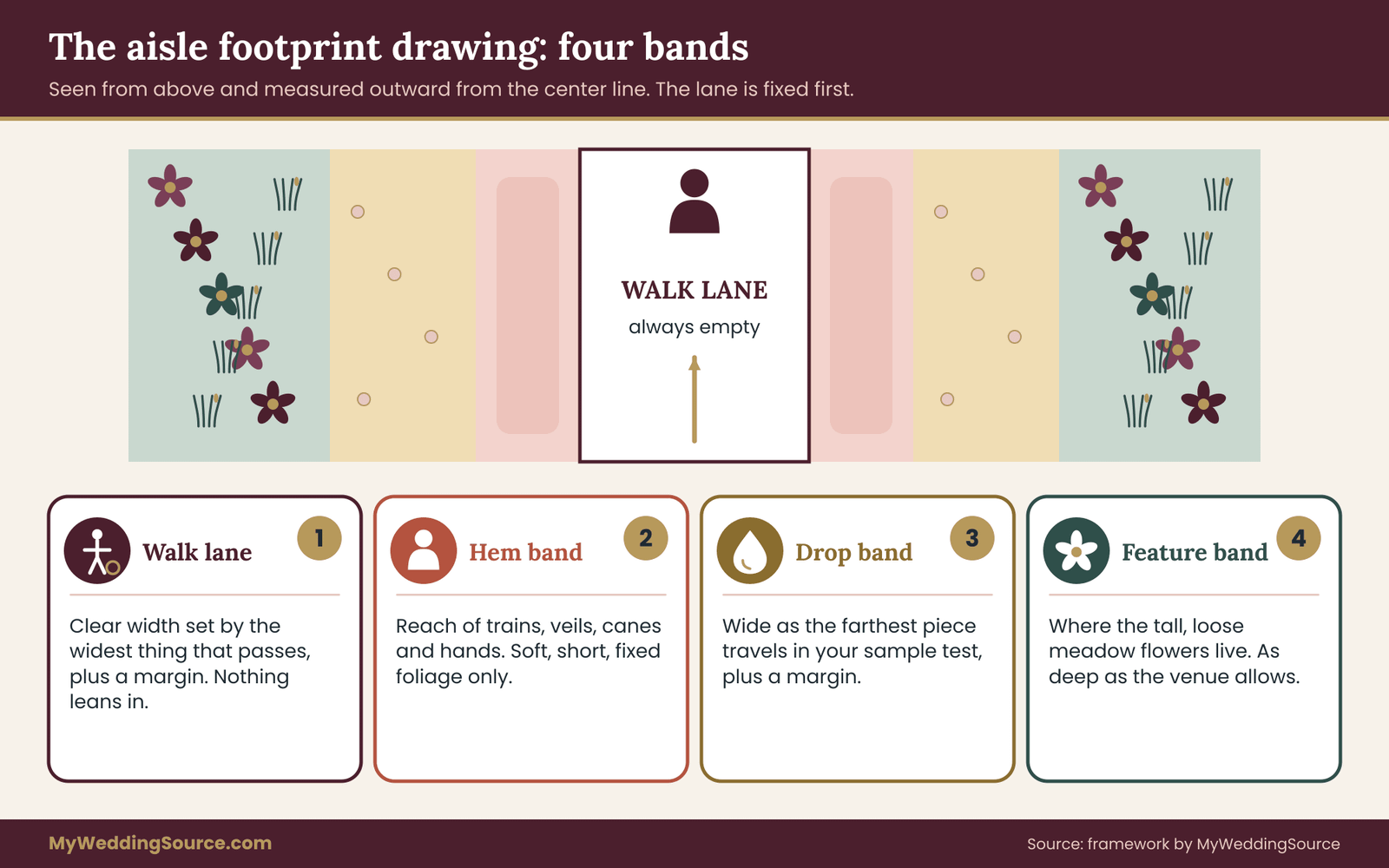
The order matters. The walk lane is fixed first, because it is a safety and access requirement. The hem band and the drop band are fixed second, because they protect the lane. Only then does the feature band get whatever space is left. Couples who start with the feature band end up crowding the lane to make the meadow flowers look generous, and then spend the ceremony hoping nobody trips.
How the bands change with the surface
Grass, gravel, stone, carpet and hardwood all treat loose material differently. On grass, a few petals are almost invisible and sweep up easily with a rake. On gravel, small material sinks between stones and is hard to remove. On polished floors, any petal is a slip risk, and a drip leaves a mark. On carpet, pollen and sap stain.
So the same arrangement may need a wider drop band indoors than outdoors, or a catch layer under it. The section on stem scores returns to catch layers, which are low trays, cloth, or a bed of foliage that hold what falls so it never reaches the lane.
Who uses the drawing
The drawing has four readers. The florist uses it to size arrangements and choose stems. The venue uses it to confirm that nothing blocks access routes or breaks house rules. The coordinator, or a trusted friend if you have none, uses it to supervise setup. And you use it as the benchmark when you walk the aisle the morning of the ceremony. Everyone who touches the meadow flowers works from the same page.
If you are also checking exits, power, loading and room access, the venue technical walkthrough guide covers the measurements a walkthrough should capture, and the aisle footprint drawing fits alongside them as one more item on the same visit.
Measuring the bands for meadow flowers: lane, hem and drop
The walk lane is the one band that is not a design choice. Everything else on the drawing flexes to protect it. So the first measurement is the lane’s clear width, and the way to find it is to work from the widest thing that has to pass, not from the width of the aisle you happen to have.
The widest-thing rule
List everything that will travel the aisle and note which is widest in motion. For many weddings that is a person in a full skirt with a train, or two people walking side by side with linked arms. For others it is a wheelchair or walker, a stroller carrying a young ring bearer, or a pair of attendants carrying something together. Add the photographer or videographer, who will often walk backward ahead of the group.
Take the widest of those and add a margin on each side so that nobody has to hold their breath to pass a stem. The margin is your decision, but write it down. A common mistake is to measure the lane with nobody in it, find it comfortable, and forget that real bodies move side to side as they walk. Meadow flowers should never be the reason a lane gets narrower.
Accessibility standards give a useful floor for public routes. The federal ADA guidance and the U.S. Access Board describe minimum clear widths for accessible routes and limits on how far objects may protrude into a walkway at head height. Those documents are written for public buildings and may not govern a private lawn, but they are a reasonable benchmark for a guest who uses a wheelchair or a walker. Check the current version at the source rather than relying on a number remembered from elsewhere.
Measure with the chairs in place
The aisle is rarely as wide as the plan says. Chairs creep. Guests at the end of a row pull their seats toward the aisle to stretch their legs, bags go on the floor, and a chair with a bow or a flower on the back extends the width further.
Measure the lane after the chairs are set, with a sample of chairs occupied if you can manage it. A friend and a few stand-ins sitting in the end seats will show you the true width in a minute. If the clear width falls below your number, the fix is to move the chairs, not to trim the lane, and that is a decision to make before the flowers arrive, not after.
Height matters as much as width
A lane has a ceiling. Hanging stems, tall arrangements at the lane edge, and branches leaning inward can all enter the head-height space. A guest who is tall, who wears a hat, or who is looking at the couple instead of the path may not see them.
Set a head-height line, measured from the floor, above which nothing may hang into the lane. Many accessibility references treat objects that project into walkways at a certain height range as hazards, particularly for people who use canes and cannot detect an overhang with the cane. Keep meadow flowers at the lane edge either well below that range, or fixed firmly out of the lane, and keep the ankle zone free of anything a cane cannot detect.
Mark the pinch points
Every aisle has a few places where the lane narrows or where people bunch. Mark them on the drawing with a symbol, because meadow flowers placed at a pinch point cause most of the trouble.
The usual pinch points are the start of the aisle, where the procession gathers and the first rows sit close; any step, ramp or threshold; a turn or a gap in the chairs; the point where the aisle meets the ceremony space; and the end of the aisle, where the couple and officiant stand. The ceremony step-by-step guide covers the order of the processional, which tells you where people pause and where they travel fast, and pauses are where a hem is most likely to brush a stem.
At each pinch point, shorten the hem band demand. Keep meadow flowers there low, soft and back, and put the tall wild statements where the aisle is open and everyone is moving at a steady pace.
Setting the hem band and the reach rules
The hem band is a buffer. It exists because people and fabric do not stay in a neat strip. A train fans out when the wearer turns. A hem lifts in a breeze. A child steps sideways to look at something. A guest with a walker moves in a wider arc than a guest without one. Choose meadow flowers for this band by touch and not by sight: soft, bendable and short.
Four heights, four rules
It helps to split the space above the ground into four heights and give each a simple rule. The heights below are illustrative, and your florist and your own tests should fix the actual numbers for your venue.
Ground to ankle. Nothing rigid, nothing sharp, nothing that a cane tip or a small foot can catch. Soft foliage can enter this zone if it is fixed so it cannot swing into the lane. Any vessel here must be wide at the base and heavy enough that a bump does not move it.
Ankle to knee. The hem and train zone. Keep stems short, bendable and secured. A stem that is longer than the distance to the lane edge is a hazard, because it will lean over when it is bumped or when the arrangement settles.
Knee to shoulder. The hands, hips and sleeves zone. This is where meadow flowers read best as a styling element and where they can brush a sleeve. Keep stems soft. Avoid anything with thorns, rough leaf edges or woody spikes at the lane side.
Shoulder and above. The face and head zone. Keep this entirely out of the lane. If a tall stem leans, it should lean away from the lane, because the lean should be your design decision and not the stem’s.
Vessels and bases
Meadow flowers often sit in tall buckets, cones, jars, crates or stands, and the base is where an aisle accident starts. A vessel that looks light and rustic may be top-heavy once it is full of wet stems.
Ask the florist what each vessel weighs when filled, how it is stabilized, and what it sits on. A wide, low base is safer than a narrow, tall one. A vessel on grass can sink or tilt as the ground softens, so ask whether it will be set on a flat board or a small mat to spread the weight. Wire, floral tape ends and cut stem tips should be hidden or capped. A bare wire end at knee height is an injury, not a detail.
Fabric and fixing
If someone in the ceremony wears a long train, a veil, a cape or a flowing robe, ask them to walk the aisle at the real pace with the real garment before the ceremony. The rehearsal is the best moment to catch a stem that tugs a hem, because the wearer can feel it and tell you. If the garment is borrowed or rented, ask the owner before you change anything about the hem to suit the flowers.
When something does catch, do not tug. Stop, free the fabric by hand, and then move the stem. A rehearsal is the time to find out which stem it was.
Measuring the drop band with a light-breeze test
The drop band has the most uncertainty, because it depends on how much your chosen flowers shed and on how far the material travels. You cannot guess it from a photo. You can measure it from a sample. Meadow flowers rarely shed the same amount twice, so measure instead of assuming.
Ask the florist for a sample bunch built from the same stem families, at about the same stage of openness you will have on the day. A sample made from the cheapest similar stems is not a test. If the real design uses spiked flowers, grasses and a few fully open blooms, the sample needs to contain all three.
A simple procedure
Place the sample in a vase on a tray or a large sheet of paper on a table. Draw a ring on the paper at several distances from the vase, such as every few inches, so you can read where pieces land. Shake the table gently ten times, the way a bump would. Count what falls and note how far the farthest piece traveled. Then point a small fan at the sample on its lowest setting for a minute, or stand it near an open door on a breezy day, and repeat the count.
Record two numbers: the farthest distance a piece traveled, and the number of pieces in each distance ring. Those numbers are your first drop band measurements. Add a margin, because the real arrangement is larger than the sample and the real wind is not a fan. The point is not scientific precision. It is to turn “it probably will not spill much” into an observed fact that you can write on the drawing.
What to do with the result
If the drop distance is smaller than the gap between the arrangement and the lane edge, the position works. If it is larger, you have three options: move the arrangement farther from the lane, change the stems, or add a catch layer. The next section covers the stems and the catch layers.
Be honest in the record. If the test shows that a favorite flower drops a handful of petals every time you touch it, write that down and decide whether you love it enough to give it a larger band. Couples often keep one or two showy but messy flowers and give them a spot where mess is harmless, such as an arch, a table or a back wall.
Mark the wind and sun arrows
Draw two arrows on the footprint. One shows the direction the wind usually blows across the aisle at the ceremony time, which you can estimate from a morning visit or from the venue’s own knowledge. The other shows where the sun will be.
Loose material drifts downwind, and many open more or wilt faster in direct sun. A placement that works on a calm morning can fail at four in the afternoon. The venue contact and the florist often know the pattern better than the couple does, so ask them directly and mark what they say. Meadow flowers drift downwind, so the arrow tells you which side needs the wider band.
Scoring meadow flowers by how they shed
A drop band is only as accurate as the list of stems behind it. Meadow flowers are a mix, and each stem family in the mix behaves differently. The fix is a short score for every family, which lets you place each one by its behavior instead of by its looks.
Ask your florist for the full stem list for the aisle pieces, grouped into families: the tall airy stems, the mid-height blooms, the fillers and grasses, the foliage and the fixed greenery. For each family, you want to know five things: how it sheds, how it stains, how it drips, how it leans, and how it holds up in the heat. Most florists know these answers from daily work and will give them freely if you ask a clear question. Scoring turns a pretty list of meadow flowers into a set of placement rules.
The four-point drop score
Give each family a score from zero to three. The scale is deliberately simple so a florist, a venue manager and a friend on the setup crew can all use it.
Score zero: holds. The material stays on the stem when touched and when the air moves. Sturdy foliage, many woody stems and tightly structured flowers tend to belong here. Even so, a zero can lean or drip, so it still needs a place.
Score one: occasional bits. A few petals, leaves or flecks drop over a day, but not in a way that is visible at a distance. These families can sit close to the hem band as long as nothing else on the list is worse.
Score two: noticeable shedding when touched. Touch it and a small shower follows. A breeze moves a little material. These families belong in the drop band or the feature band, beyond the measured drop distance, with a catch layer under them.
Score three: sheds heavily or marks. A light touch drops many petals or florets, the pollen stains, or the sap marks fabric. These families go in the feature band only, as far from the lane as the layout allows, or they go somewhere else in the wedding entirely, such as an arch, a back table or a photo backdrop.
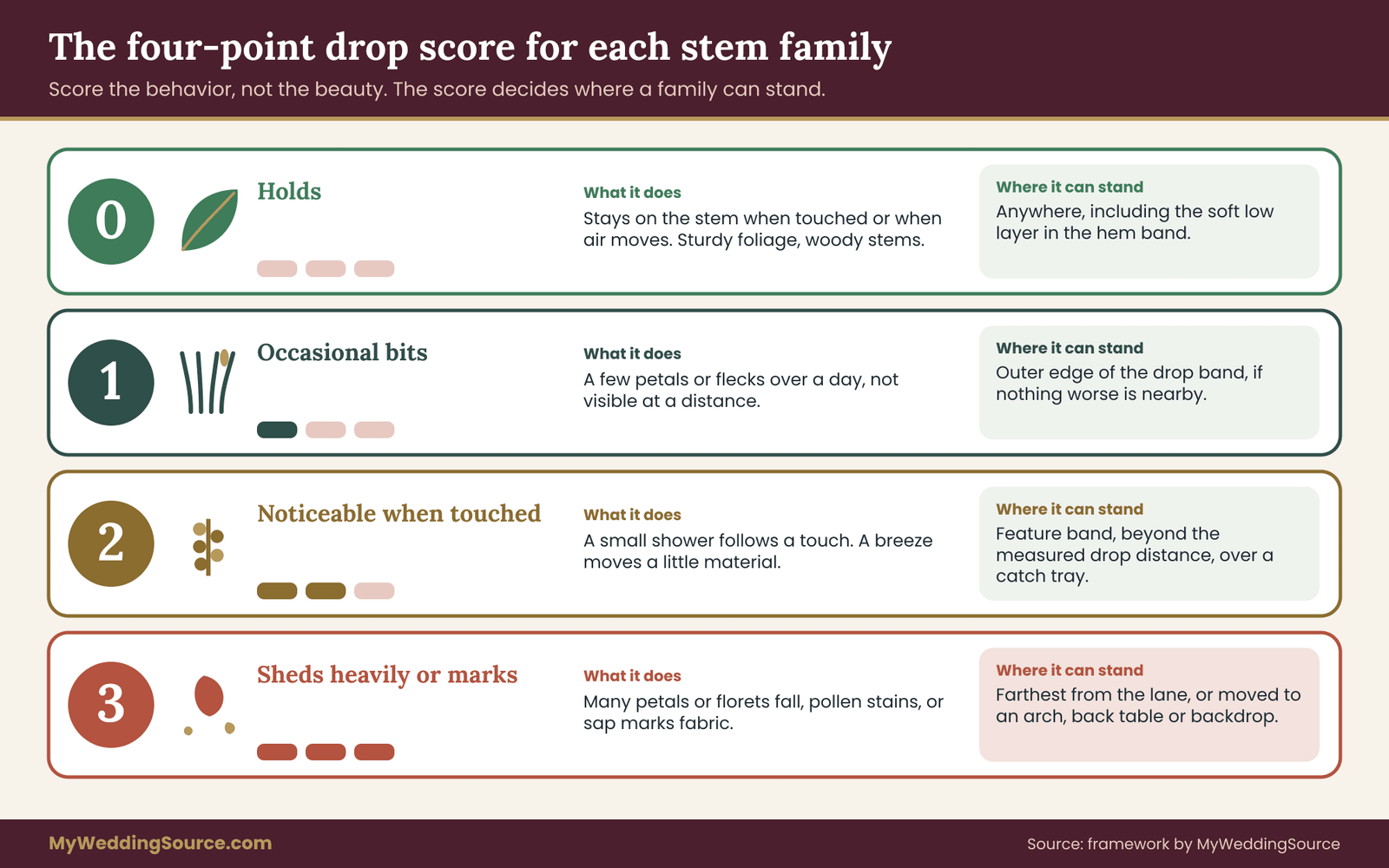
The scores are a sorting tool and not a judgment of the flower. A score-three bloom can be the most beautiful thing in the room. The score only tells you where it can safely live. Even the most beautiful meadow flowers have a safe place to live.
Six behaviors to ask about
The score is built from six behaviors, and it helps to ask about each by name. The examples are general patterns, not a guarantee for any variety. Behavior depends on the variety, the age of the bloom, the heat, and the handling, so confirm with your own florist and your own sample.
Petal fall. Some open-faced flowers release petals easily when fully open. Poppy-type blooms are widely known for dropping petals quickly. Ask how open each flower will be on the day and whether the florist can choose a tighter stage.
Floret shatter. Tall spiked flowers can lose small flowers from the stem in heat or after a bump. Ask whether the stems will be conditioned, and how many are in the design.
Seed and fluff. Grasses, seed heads and dried material add texture and also shed. Some give off fluff that clings to clothing. Ask which are treated or sealed and which are left natural.
Pollen. Some flowers, lilies being a familiar example, have heavy pollen that stains fabric and skin. The common fix is to remove the pollen-bearing parts, which florists do routinely. Ask for it by name if any such flower is in the design.
Sap and water. Cut stems drip, and a few release a sticky or irritating sap. Ask how stem ends are handled and whether anything with a milky sap sits at hand height.
Posture. Stems lean and droop as they age or warm up. Ask which families hold their line and which bow, and how far they bow.
Building the stem list on one page
Make a one-page list with a row for each family. Write the name the florist uses, your drop score, the main behavior, and the position it is allowed to take. Add a note for anything the florist wants to substitute if a stem is not available, so you are not surprised by a swap that raises the score.
A short example of how a line reads in prose: the tall spiked family, score two for floret shatter, allowed in the feature band only, at least as far from the lane as the measured drop distance plus a margin, with a catch layer under it. That sentence is the whole rule for that family. Every family gets one.
If you want to understand how substitutions are handled in a contract, the vendor contract guide explains what to check in clauses on changes and replacements, and the footprint list gives you a ready-made basis for approving a swap.
Catch layers and containment
Once you know which stems drop, the question is where the dropped material goes. A catch layer holds it so it never reaches the lane, and it can be almost invisible.
What a catch layer can be
The simplest catch layer is a low tray, a mat, a board or a shallow dish placed under an arrangement, hidden by foliage. It collects petals and drips. On grass, a flat board under a heavy vessel also keeps the base level.
A second option is a bed of moss or greenery around the base. It is both a visual finish and a place where petals disappear into texture. A third is a fabric runner or piece of cloth laid beneath, which traps fallen material and rolls up in one piece at the end of the day. A fourth is a raised stand that lifts the arrangement above the drop line so material falls into a tray rather than onto the path.
Each choice trades off cost, look and cleanup. A tray is the cleanest, but visible edges can show. Moss is beautiful but can be damp. A cloth is easy to roll but can shift in wind unless it is pinned or weighted. A florist who builds meadow flowers regularly will usually have a preferred method. Catch layers let meadow flowers look free while the lane stays clean.
Containment for the walk lane
Some couples also add a physical boundary to the lane, such as a low edge, a rope on short stakes, or a row of chairs that defines the line. This is optional, and it changes the look. If your aisle is formal and the lane is clear by design, no boundary is needed. If the aisle is an open lawn and guests wander, a subtle edge helps both the flowers and the guests.
Whatever you use, check that the boundary is not itself a hazard. A rope at ankle height can trip a person using a cane. A stake can catch a hem. If you use markers, make them visible and fixed.
Stems that need extra thought
A handful of categories deserve a second look because they combine two or more behaviors.
Flowers with sharp or woody elements, such as thistle-like heads and some thorny stems, are safe in the feature band and risky near the hem band. Flowers with heavy pollen need the pollen-bearing parts removed or need a position far from fabric. Flowers with sticky or milky sap need stem ends handled carefully and should stay out of reach of small hands. And flowers that wilt fast in the sun need a shaded position or a late set time.
None of these are reasons to exclude a flower. They are reasons to attach a rule to it. The more specific the rule, the less the florist has to guess.
A drop budget for each position
A useful final step is to give each position on the drawing a drop budget. A position at the outer edge of the feature band, far from the lane, can hold stems with a score of three, because anything that falls lands in a catch layer or a place nobody walks. A position just outside the drop band can hold scores up to two. A position at the inner edge of the hem band is limited to zero or one.
Writing the budget onto the drawing as a simple number beside each position makes setup faster, because the crew can match stems to places without calling anyone. It also gives you a way to say no, kindly, to a late addition. If a friend arrives with a bucket of something lovely, the answer is a position, not a refusal. A budget gives the meadow flowers a place instead of a refusal.
The bench test: five checks before you approve meadow flowers
A drawing says where things go. A bench test says whether they will behave there. The test is a set of five small checks done on a table with a sample, and it takes about an hour of attention spread across a day. It replaces a leap of faith with a record.
Ask the florist for the sample at least a few weeks before the date, when changes are still cheap. Some florists charge for a sample bunch or a mock-up, and some include one with a consultation. Ask the price before you ask for the sample, and treat it as part of the cost of the design. If the florist offers a mock-up of a full arrangement instead of a bunch, that is even better, since it shows the real footprint. Meadow flowers are easiest to judge in person, so the sample is worth its cost.
Write the pass rules before you run the checks. If you decide afterward what counts as a pass, you will talk yourself into whatever you saw. The pass rules in each check below are suggestions. Adjust them to your venue, and keep them on paper.
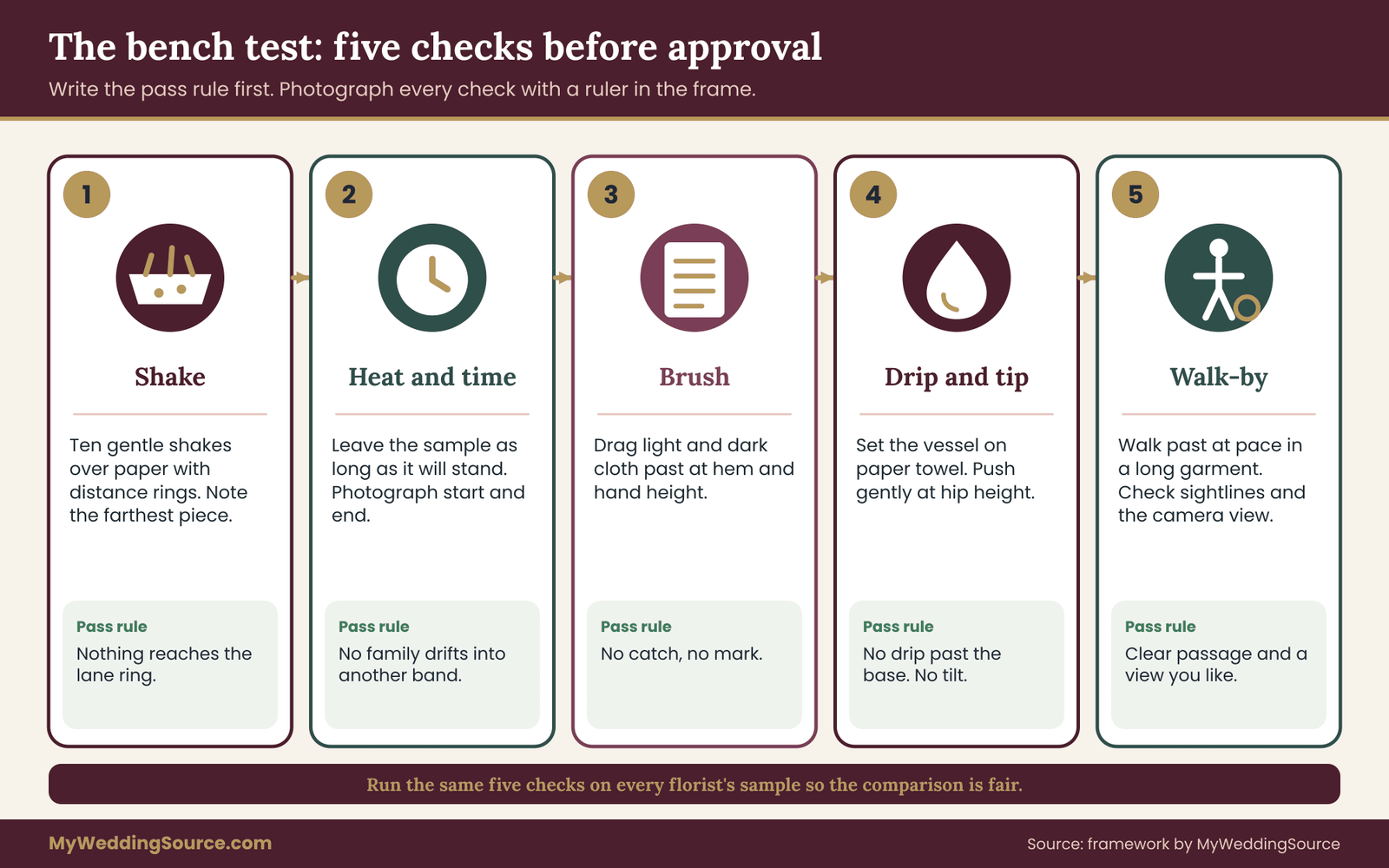
Check one: the shake test
Place the sample on a tray or a sheet of paper, with rings drawn at regular distances. Shake the table gently ten times. Count what falls in each ring and note the farthest piece. This is the measurement that sets the drop band, and the lane measurements section describes it in detail.
Pass rule: nothing lands in the ring that corresponds to the lane edge, and the total drop is small enough that a person with a soft broom can clear it in a minute or two. Photograph the tray after the shake, with a ruler in the picture.
Check two: the heat and time test
Meadow flowers change over a few hours. Put the sample in a room at about the temperature of the venue, near a window if the aisle is in the sun, and leave it for as long as the arrangement will stand before the ceremony ends. For a late-afternoon ceremony with an early setup, that may be several hours.
At the start and the end, photograph the sample from the same spot. Look for drooping stems, opened buds, dropped petals and any leaning. Note which families changed most. This is the check that tells you whether the design should be set late, whether some stems should be swapped for more stable ones, and whether a shaded position is needed.
Pass rule: no stem family moves far enough to enter a band it was not assigned to, and no family drops more over the full period than the shake test suggested.
Check three: the brush test
Take a scrap of the same kind of fabric as the longest train, veil or hem in the party, or a plain white cloth and a dark cloth if you do not have one. Draw it across the sample at hem height and at hand height, the way a person would brush past.
Look for snags, pulled threads, snagged stems, pollen marks, sap marks and clinging fluff. If the cloth catches on a stem, find out which one. If it leaves a mark, note the family. A white cloth shows pollen and sap best, and a dark cloth shows fluff best.
Pass rule: no catch, no mark. If one family fails, it moves to a position out of reach, or the florist treats it, or it is replaced.
Check four: the drip and tip test
Set the vessel on paper towel and leave it for an hour. Look for rings, drips and puddles. Then give the vessel a gentle push at the height a passing hip or a child’s hand would reach, and see how far it moves before it settles. Never test a vessel full of water over a valuable surface.
Pass rule: no drip beyond the base, and no tilt that would spill. If the vessel moves, ask the florist about a heavier base, a wider footprint or a board underneath. If the real setup is on grass, repeat the push test on grass, because soft ground changes the result.
Check five: the walk-by test
The final check puts the sample in the position it will take and has a person walk past at the real pace with the real fabric, or a stand-in fabric of about the same length. If you can, have another person watch from a guest’s seat and from where the photographer will stand.
Look at three things. Does the fabric clear? Does the sample hide anything, such as the couple’s view of the officiant or a guest’s view of the couple? Does it look right from the camera’s point of view? The photographer may prefer the meadow flowers lower or farther back so they do not cover faces in the frame.
Pass rule: clear passage, clear sightlines, and an image you still like.
Keep the evidence
Take photographs at each stage. Write the date, the stem list and the pass or fail result for each check on one page. Share it with the florist. It becomes the reference for what you approved, and it is a calm way to settle any disagreement later about what the sample looked like. If you are comparing florists, run the same five checks on each sample, which makes the comparison fair. Photographs of the meadow flowers before and after each test make the strongest record.
A worked example: a lawn aisle with meadow flowers
The example below is invented to show how the numbers fit together. It is illustrative and not a recommendation for any dimension. Your own aisle, garments and flowers will give different numbers.
Imagine a couple holding a ceremony on a lawn, with an aisle running between two blocks of chairs. The bride will wear a skirt with a short train, and her father will walk beside her with linked arms. A guest in the third row uses a wheelchair and will arrive before the ceremony, so the lane must also work for a wheelchair.
Step one: set the lane
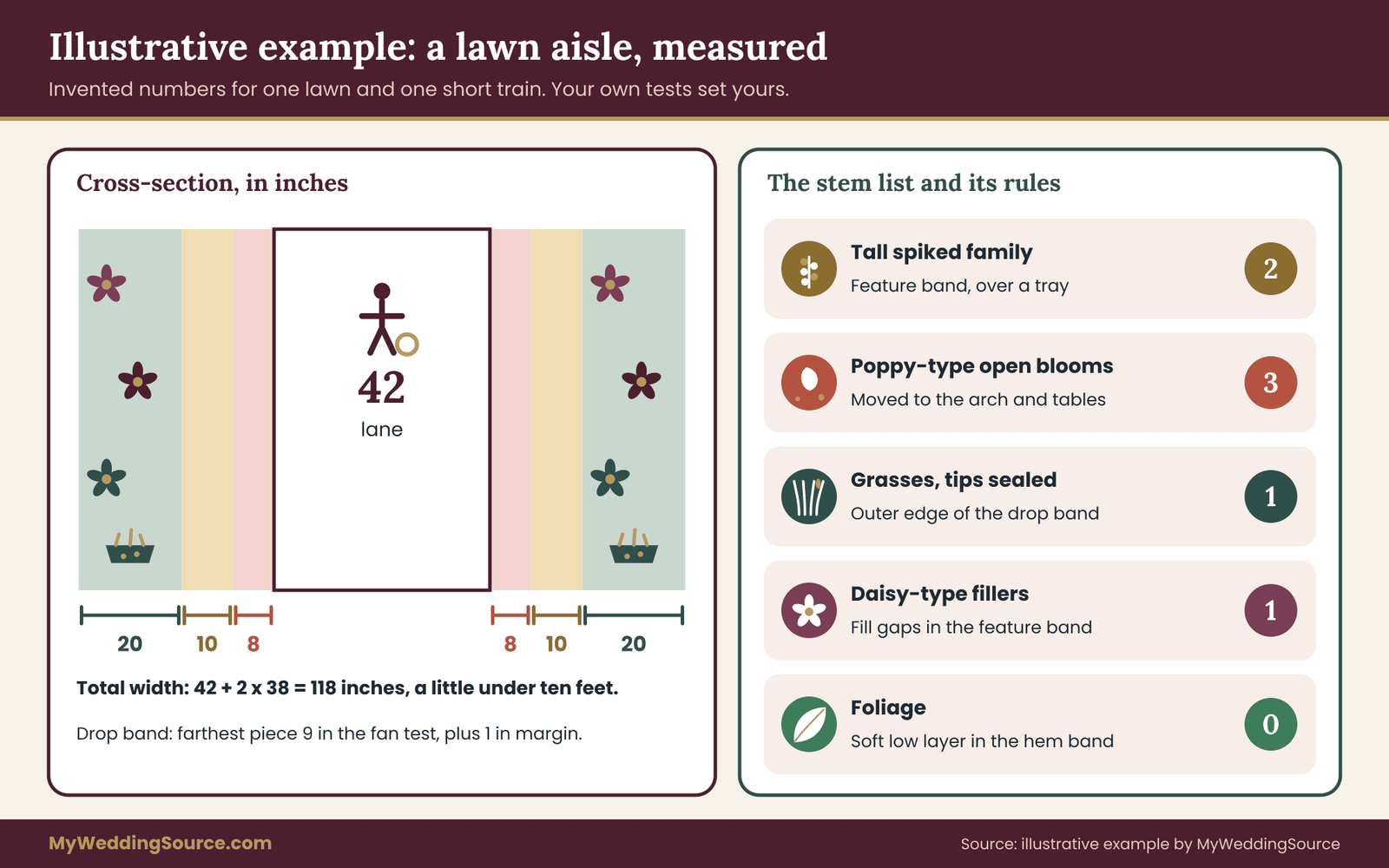
The couple walks the aisle with a friend in a spare long skirt. The widest thing passing is the pair of arms-linked walkers with the skirt. They measure it, add a margin, and set the walk lane at forty-two inches clear, from floor to a head-height line. They check that a wheelchair fits easily within that width and that chairs, once occupied, do not push into it.
Step two: set the hem and drop bands
The hem band is eight inches beyond the lane on each side, because of the short train. Nothing in it is rigid, and only a low layer of soft foliage is allowed.
They run the shake and fan tests. The farthest piece travels nine inches in the fan test. They set the drop band at ten inches beyond the hem band, a small margin above the observed distance, and they require a catch tray under any arrangement whose stems score two.
Step three: set the feature band and the stem list
The feature band is twenty inches beyond the drop band, which is where the tall, loose meadow flowers go. The florist’s stem families are scored.
The tall spiked family scores two for floret shatter, so it goes in the feature band with a tray. The open-faced poppy-type family scores three for petal fall, so the couple moves it to the arch and the reception tables, where nothing is walked on. The grasses score one and may lean toward the outer edge of the drop band, with the florist sealing the tips. The daisy-type fillers score one and fill the gaps. The foliage scores zero, so it forms the soft low layer in the hem band.
Adding the bands, each side takes up eight, ten and twenty inches, which is thirty-eight inches, and the lane is forty-two. The whole footprint is therefore one hundred eighteen inches wide, or a little under ten feet, with the chair rows starting after the feature band.
Step four: handle the pinch points
At the entrance the aisle narrows slightly where a gate meets the lawn. The couple shortens the feature band there to a low planting and leaves the hem band to foliage only. At the front, near the officiant, the meadow flowers are placed behind the couple’s standing spot instead of beside the lane.
Step five: write down the setup rules
The drawing and the stem list go to the florist, the venue contact and the friend who will supervise setup. The setup rule is that nothing enters the lane or the hem band except soft foliage, trays go under every arrangement, and the meadow flowers are set as late as the florist can manage. The cleanup rule is that one person sweeps the lane lightly before guests arrive.
The result is still a loose, wild aisle. It is wider than a tight design would be, and the couple accepted that in exchange for the look. What they gave up was a few feet of seating width and one flower family, which moved to the arch. What they gained was a lane they had measured, a drop band they had tested and a list of rules that anyone could follow. The meadow flowers stayed wild, and the lane stayed clear.
Comparing layouts: four ways to place meadow flowers on an aisle
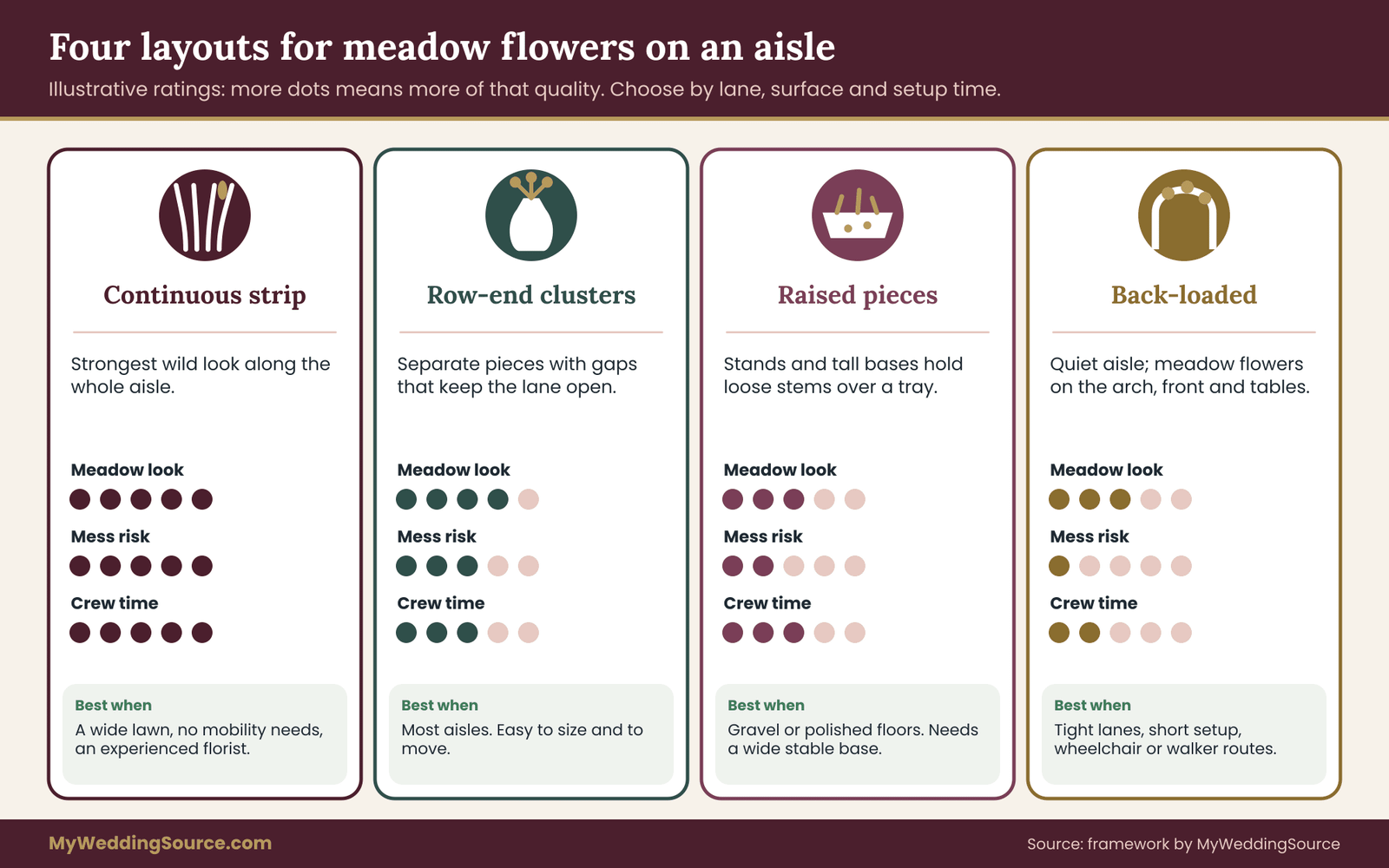
The footprint drawing works for any layout, but the layout decides how much mess you are managing in the first place. There are four common ways to place meadow flowers along an aisle. Each makes a different trade between look, safety, cleanup and cost, and the right one depends on your surface, your guests and your setup time. The same drawing works for meadow flowers in any of them.
Continuous ground planting. A long, loose strip of flowers and grasses runs beside the lane on both sides. It gives the strongest meadow look, and it is also the layout with the biggest footprint and the most to clean. It needs a wide drop band, a catch layer along its whole length and a longer setup. It suits a wide lawn with no mobility needs on the lane and a florist who has built it before.
Row-end clusters. Separate arrangements sit at the ends of chair rows, either at every row or at every second or third one. The gaps between them let the lane read as open, and each cluster has its own tray. This layout is easier to control, easier to move and easier to size to the venue, and it is the most common solution for couples who want a loose look without a long strip.
Raised or contained pieces. Arrangements sit on stands, in tall containers or on low pedestals, so the loose material hangs above a tray instead of on the ground. This reduces ground mess and keeps stems away from low hems, at the cost of a more formal, less wild look and a higher risk of tip-over if the base is narrow.
Back-loaded styling. The aisle itself stays quiet, perhaps with a few low, fixed pieces and a plain runner or none at all, and the meadow flowers go behind the couple: on an arch, a backdrop, a pair of large pieces at the front and the reception tables. The aisle has the lowest mess risk and the loose style still dominates the photographs.
How to choose
Start with the lane, not the look. If the lane has to serve a wheelchair, a walker or a stroller, favor row-end clusters or back-loaded styling, since both leave the longest unbroken strips at the edges. If the surface is polished or has a gravel center, favor raised pieces with trays or back-loaded styling, since material is harder to clear from those surfaces.
If setup time is short, favor clusters and back-loaded styling. A continuous planting takes the longest to place and the longest to check. If your florist is also handling ceremony and reception, extra aisle work can compete with other tasks, and the florist may need an assistant. Meadow flowers set in clusters are quicker to check than a long continuous strip.
If the look matters most, spend the budget on one strong feature at the front instead of a long, risky strip. A single large meadow-style arrangement or arch can carry more visual weight than forty feet of border, and it costs less to protect.
Mixing layouts
Layouts can be combined. Row-end clusters near the front where the aisle is wide, and low foliage only near the entrance where the aisle pinches, is a sensible mix. So is a plain aisle with one wild feature at the front and several loose pieces at the reception. The footprint drawing makes mixing easy, because each segment of the aisle gets its own bands and its own stem rules.
A note on cost logic
Meadow flowers often need more stems than a compact design to look full, and the stems may be more delicate to condition and transport. Some florists price by the arrangement, others by the stem and the hour. Ask which basis applies, since a wider footprint can change the stem count and a continuous planting can add labor.
The protective measures themselves are cheap compared with the flowers. Trays, boards, a layer of moss and a soft broom cost little. The real costs are labor time and the flowers you decide to place elsewhere. If a design needs a sample, a longer setup or an assistant, ask for the figure in writing and compare it with the cost of the cleaner alternatives. A layout that looks cheaper on paper may cost more once its protection is added, and the reverse can also be true.
Meadow flowers outdoors and indoors: weather, surfaces and venue rules
An outdoor aisle is the natural home of the meadow look and the harder place to control it. The footprint drawing needs a few extra notes for the weather.
Wind
Wind is the single biggest variable for loose material. It moves petals, tips tall stems and carries fluff farther than a still-air test would. A drop band measured in a quiet room is a minimum, not a forecast. Meadow flowers lose more to a breeze than to a bump.
Add a wind margin to the band on the downwind side. Ask the venue which direction the breeze usually comes from at ceremony time, and mark the arrow on the drawing. Check the forecast the week of the wedding and the morning of it. If the wind is stronger than expected, have a rule for what changes: tall stems are laid down or removed, trays are weighted, and light cloth layers are pinned.
Sun and heat
Direct sun speeds wilting and opening. Flowers that looked fine at the studio may sag in an afternoon ceremony in full sun. The heat and time test above tells you which families are sensitive. Use it to choose which are set last, which stay in water until the final moment and which go in shade.
If the aisle runs along a sunny side, consider putting the delicate families on the shaded side and sturdier ones on the sunny one. This is a detail a florist can usually adjust easily when told about it.
Grass and ground
Grass is forgiving for petals and not forgiving for bases. A vessel on soft ground can lean as the turf compresses, and wet grass makes a tray slide. Boards or flat mats under heavy pieces give them a steady footing. If the lawn has recently been watered or rained on, check the ground before setting and reposition anything that sinks.
Heels and mobility aids also behave differently on grass. A lane with narrow gaps and meadow flowers close by can catch a heel or a cane. Choose the lane’s route over firm, level ground whenever you have a choice.
Insects
A meadow-style design with open, pollen-rich flowers can attract bees and other insects, especially in warm weather. Most are harmless, and some guests will be anxious or allergic. Ask the florist whether the flowers in the design are likely to attract insects, and place the most attractive families away from seating and the lane. For anyone with a known allergy, the safety section covers how to ask and what to prepare.
Rain
Rain adds slip, soaks petals and makes some flowers collapse. If your plan B is a tent or an indoor room, apply the footprint drawing again to the new space. Wet petals on a hard floor are a hazard, so the drop band indoors needs an extra margin, and the setup may need to change entirely. A short, written rain version of the drawing saves an anxious conversation on the day.
Indoor surfaces and venue rules for meadow flowers
Indoor venues bring their own constraints. Surfaces are harder, rules are stricter, and nobody wants a deposit withheld over a stain.
Surfaces
On carpet, pollen and sap stain and petals ground in. On polished wood, stone or tile, any loose petal is a slip risk and a drip can mark. On historic floors, some venues forbid water on the floor at all.
Ask the venue what each surface can take. A catch layer that works on grass may not be enough on a finished floor, where a waterproof tray or a sheet of plastic under cloth may be required. Ask about it before the florist builds.
House rules
Many venues have written rules about loose petals, confetti, candles, nails, tape, wire and anything affixed to walls or floors. Some require approved vendors or insurance. Some set load limits on stands. Ask for the rules in writing and share them with the florist. The venue’s rules should shape the drawing, not surprise it.
If you are using a venue that also hosts the reception, ask whether ceremony pieces will be moved to the reception and by whom. The reception guest flow guide covers how guests and objects move through a room, and moving fresh arrangements is the point where a loose design is most likely to shed.
Cleanup responsibility
Decide who sweeps, who returns trays and who disposes of the material. Some venues expect the couple’s vendors to leave the space as they found it. Others charge a cleaning fee. Make sure the florist’s contract states whether strike and cleanup of the aisle area are included, and note the time window the venue allows. The day-of schedule below describes the timing.
Plant safety, allergies and sourcing for meadow flowers
Safety around plants is plant-specific. A flower that is harmless to most adults can still be a problem for a cat, a toddler or a guest with hay fever, and the same plant name can cover varieties that differ. So the footprint drawing includes a short safety pass, and it relies on the people and organizations that publish plant information instead of a general rule of thumb.
Toxicity: check each stem by name
Ask the florist for the common and botanical name of every stem family that goes into the aisle and ceremony pieces. Then check each against a reliable source. The ASPCA publishes searchable lists of plants that are toxic and non-toxic to dogs, cats and horses. Poison control centers publish guidance on plants that can harm people. If a plant appears on a list of concern, you have three choices: remove it, place it out of reach with a clear rule, or choose a substitute.
Do not rely on a pretty photo or a florist’s casual remark that “it’s fine.” Florists know their craft, and many are careful, but a plant safety statement should have a named source. If the florist offers a list, ask where it comes from, and compare it with the ASPCA and your poison control center for any plant that will be near pets or small children. A named source is the standard for meadow flowers as for any other plant.
Some common meadow-style flowers appear on lists of concern for pets, and a few are widely known as risky if eaten. Because behavior and toxicity vary by plant part, variety and amount, this article does not list them as a rule. Look up each stem you are using.
Skin and sap
Some stems release sap that can irritate skin. Some leaves and stems are rough or sharp. If any family in the design has a milky or sticky sap, keep it away from hand height at the lane and tell the florist and any helper to wear gloves when handling it. Place a short written note in the setup instructions so the crew does not discover it by touch.
Pollen and fragrance for guests
Guests with hay fever or asthma may react to pollen, and some may react to strong fragrance. Grasses are a common source of pollen, and meadow designs often include them. You can reduce exposure by choosing lower-pollen alternatives where possible, by removing pollen-bearing parts from certain flowers and by keeping the most pollen-heavy pieces away from the seating.
You can ask guests in advance. A line on the wedding website or the RSVP, such as “Let us know of any allergies we should plan for,” is enough. Do not ask guests for medical detail. If someone tells you, quietly place them toward the back or the far side from the heaviest planting and tell the florist what the concern is, without naming the guest.
Children
Children at a wedding are curious and close to the ground. They may pick petals, taste a stem or crawl under a chair. If children will walk the aisle, keep the hem band clear of rigid stems and keep any toxic or sharp stems out of reach. A flower girl who tosses petals needs a venue that allows it, a surface that will not turn slippery, and an adult who will clear the path afterward.
The guest care planning guide covers supervision for babies, children and older relatives. Assign one adult to watch the aisle edges once setup is complete, particularly during the cocktail hour when children can wander back to the meadow flowers.
Pets
Pets at weddings are increasingly common. If a dog or cat will attend, confirm in advance which plants in the design are on the ASPCA lists, and keep those out of reach. A dog that walks the aisle on a leash will sniff, and a cat that is not present at the ceremony may still reach the meadow flowers at home or in the hotel afterward when the flowers are taken back. Remove any flagged stems before the bouquet and arrangements leave the venue.
Older guests and mobility
Older guests may be less steady, may use canes or walkers, and may not see low obstacles well. The footprint drawing’s emphasis on a clear lane and ankle zone serves them first. If a guest has told you they use a mobility aid, walk their route yourself and ask them whether it feels comfortable. A confident person who says “this is fine” is more useful than a ruler, so listen.
Sourcing meadow flowers: farmed, foraged and invasive concerns
The wild look raises a sourcing question that tight arrangements rarely do: where do these stems come from, and what happens to them afterward?
Farmed versus wild-collected
Most florists source meadow-style stems from flower farms, wholesalers and their own gardens. Farmed stems are grown for cutting and are usually conditioned for the vase. Wild collecting from roadsides, parks, fields or conservation land is a different matter. Rules about what may be picked, where and by whom depend on the land owner and local law, and some plants are protected. The National Park Service and local land managers publish their own rules. Ask each source how it grows and handles its meadow flowers.
If someone in your family offers to gather wildflowers for the wedding, thank them and ask first. Whether the land is public or private, check with the owner or manager, and ask a local extension service or native plant group whether any plant in the area is protected. Loose gathered stems also arrive with insects, seeds and soil, and they have not been conditioned, so they behave less predictably than farmed ones.
Invasive plants
Some plants that look at home in a meadow are listed as invasive in parts of the country, which means they spread easily and harm local ecosystems. Seed-bearing stems from such plants can spread when discarded. The National Invasive Species Information Center, run by the federal government, links to lists of invasive plants by state and region.
Ask your florist whether any stem in the design is considered invasive where you live, and whether seed heads are mature. If the answer is yes, ask about alternatives, or plan the disposal so the seed goes to a place that will not spread it, such as sealed trash. The wedding waste reduction guide covers how to sort materials after the event. Meadow flowers that go to seed are the main concern.
Treatments and preservatives
Flower farms and wholesalers sometimes treat stems, and dried grasses may be sealed, dyed or bleached. Ask whether anything in the design has been dyed or sprayed, and whether that matters for your circumstances, for instance if anyone will handle the stems or if the meadow flowers will be given to guests afterward. Ask where the dried material comes from if you are concerned about sustainability or sensitivity.
Questions to ask about meadow flowers, and what to put in writing
By this point you have a drawing, a stem list, a set of scores and test results. The final step is to turn them into a short conversation with the florist and a few lines in the contract.
Questions for the florist
Ask these in your own words, and write down the answers.
First, can you work from a footprint drawing, and will you build to the measurements on it? A florist who agrees has accepted a clear standard. Second, can you give me a sample of the aisle design for the bench test, and what does it cost? Third, which stem families in the design shed, stain, drip or lean, and how would you rate them? Fourth, what are the common and botanical names of each stem, and where is each sourced? Fifth, which families are most sensitive to heat and wind, and when will you set them?
Sixth, what do you use under the meadow flowers to catch material, and how is the base stabilized on the surface at my venue? Seventh, who sets, who checks and who clears, and how long does each take? Eighth, what will you substitute if a stem is unavailable, and will you ask me first? Ninth, what is the plan if the weather changes?
A florist who answers these easily is a good sign. A florist who gets defensive may simply be unused to the questions, so give them time to check.
What to put in the contract
Ask that the contract or its attachments reference the footprint drawing and the stem list. Include the substitution rule, which should require your approval for any change that raises a drop score. State the setup and strike times and who handles cleanup of the aisle area. State the sample and the date by which you will approve the design. State the venue’s rules as the florist understands them. And attach the date by which any change in the footprint must be made, since a change after a certain date can alter the cost.
If a vendor will not put the items in writing, take that as information. The contract does not need to be long. A short page that matches the drawing is enough.
Day-of schedule, cleanup and edge cases for meadow flowers
The drawing, the stem list and the bench test come together on the wedding day. A schedule for the day keeps them from dissolving into improvisation. It does not need to be long. It needs a few clear points: when things are set, who checks the lane, who watches it during the ceremony and who clears it afterward.
Set late, in a fixed order
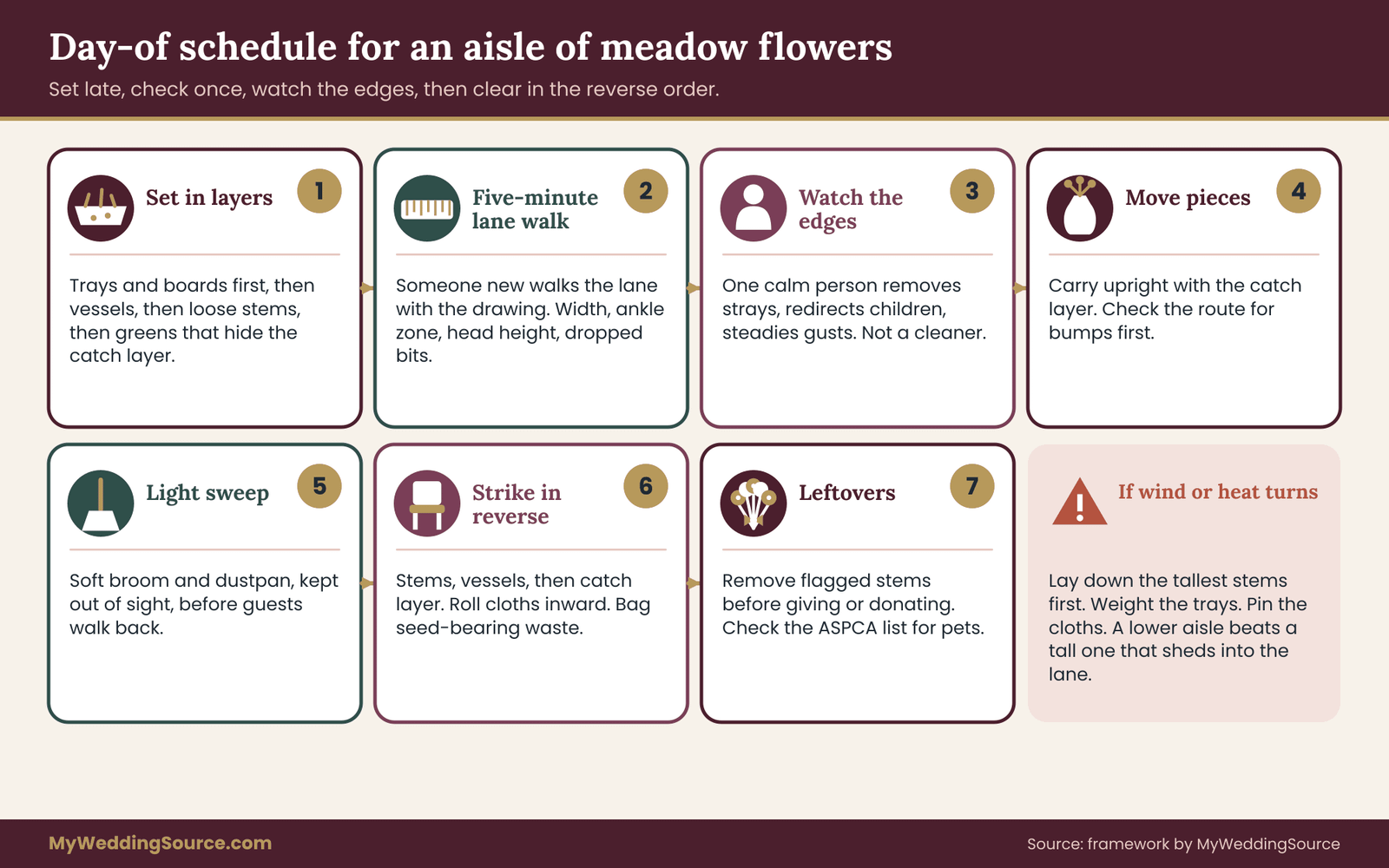
Set the aisle flowers as close to the ceremony as the florist can manage, because every extra hour in warm air raises the shed. Agree on a start time that leaves a buffer for a final check and for a delivery that arrives late. Meadow flowers that wait in warm air shed more than those set late.
Set in layers. Place trays, boards and mats first, then the vessels, then the loose stems, then the final greenery that hides the catch layer. This order lets the crew check the base before any stem is in the way. Ask the florist to mark the lane edge with something removable, such as a soft tape line on a hard floor or small flags on a lawn, so the setup crew can see it.
The five-minute lane walk
When setup is finished, one person walks the lane slowly, with the footprint drawing in hand. Ideally it is someone who was not part of the setup, such as a coordinator, a family member or a friend. They check four things: the clear width at the pinch points, the ankle zone, the head-height line, and any visible dropped material in the lane.
They also look at the aisle from a guest’s seat. Does anything look as though it is leaning into the lane? Does a vessel look unstable? Fix it now. If something cannot be fixed quickly, the florist should have a rule for what to remove, since removing one stem is better than a trip.
During the ceremony
Assign one person to watch the aisle edges from a discreet spot. Their job is simple: if something drops into the lane before the procession, remove it; if a child wanders toward an arrangement, redirect them; if a gust tips something, catch it. This person is not a cleaner and is not part of the ceremony. Watching the meadow flowers as well as the lane catches problems early.
The photographer and videographer should know the footprint. A photographer who steps back into the hem band to frame a shot can crush an arrangement or knock a vessel. Tell them the bands, and tell them which pieces are fragile.
Between ceremony and reception
If the aisle pieces will be moved to the reception, assign movers and a route. Fresh meadow flowers shed most when lifted and carried, so move them with the catch layer, if possible, and carry them upright in both hands. A small cart can help, but check the path for bumps. The reception planning pages on this site cover the movement of guests and items through the room, which is worth checking before you decide who carries what.
If any piece is left in place, sweep the lane lightly before guests walk back down it. A soft broom and a dustpan kept out of sight are enough.
Strike and disposal
Most venues set a time by which the aisle area must be cleared. Put it on the schedule and tell the florist, since a crew that is surprised by the time will rush the cleanup.
Strike in the reverse of setting. Remove loose stems first, then vessels, then the catch layer. Roll cloth layers inward so they hold what they caught, and carry trays level. Do not shake out cloths or trays on the lawn if any seed-bearing or possibly invasive material is among the debris. Bag it. The venue walkthrough is a useful reminder to confirm access routes and trash rules for the strike crew.
What to do with leftovers
If the meadow flowers will be offered to guests or donated, remove any stem that you flagged for toxicity or sap, and tell the recipient what the flowers are. If they go home with you, keep them away from pets until you have checked the stems against the ASPCA list. If they will be composted, confirm that your composter accepts the material, and keep any seed-bearing stems out of an open pile that could spread them.
Edge cases and judgment calls
Even a good drawing meets situations it did not predict. These are the common ones, with a way to think through each.
The wind is stronger than forecast. Lay down or remove the tallest stems, weight the trays and pin the cloths. A lower aisle with a stronger back drop is better than a taller one that sheds into the lane. Plan for this by agreeing in advance which families come out first.
The ceremony moves indoors. Redraw the bands for the new space and apply the indoor surface rules. A smaller, quieter aisle can still carry the meadow look if a few pieces are moved to the front. Do not carry the outdoor layout into a room without a fresh check.
A guest arrives who uses a wheelchair or walker, and the lane is tight. Widen it, even by moving a few chairs. If the layout is a continuous planting, remove a section on that side and put the pieces elsewhere. This is a good reason to design the lane wider than the minimum from the start.
A friend brings a large bunch of flowers on the day. Accept it graciously, and place it according to its likely score. A large, loose bunch with an unknown behavior is best placed in the feature band or at the back, away from the lane, with a tray.
A stem is substituted at the last minute. Ask the florist for the replacement’s name and behavior. If the replacement scores higher than the original, move it to a position with a larger drop band, or ask for a different stem.
The photographer wants a closer position. Offer an alternative that does not enter the hem band. Photographers can often get the shot from a different angle or with a different lens.
The train is longer than planned. If the dress changes or the final fitting shows a longer sweep, adjust the hem band. A longer train needs more distance and a lower, softer layer along the lane.
A small ceremony with only a few guests. The aisle may be short or absent. You can apply the drawing to the standing area instead: a lane to the couple, a clear space around them, and the loose meadow flowers behind and beside. The bands are the same, only the lengths change.
A barn, farm or garden venue with uneven ground. The surface matters more than the width. The barn and farm venue guide describes the kinds of venues where an uneven floor is common, and in those places the lane should be placed over the firmest ground and the flowers kept at the margins.
A bold color story. Vivid, saturated petals show on a pale surface and stain pale fabric more easily than soft ones do. If your palette is dark or strongly saturated, test for stain as well as drop. The color palette guide covers how to choose and check hues before you commit.
Your next steps
Start with the drawing, because everything else hangs on it. Print or sketch the aisle from above. Measure the widest thing that must pass and write down a lane width. Add the hem band, the drop band and the feature band, using placeholder numbers if you do not have test results yet. Mark the pinch points and the wind and sun arrows. Meadow flowers will cooperate once the footprint is written down.
Then ask your florist for the stem list in families and for a sample. Score each family from zero to three and give each position a drop budget. Run the five bench checks, write down the results and photograph the sample.
Finally, put the drawing, the stem list and the substitution rule in writing with the florist and the venue. Choose one person to run the five-minute lane walk before the ceremony and one to watch the aisle during it. With those pieces in place, your meadow flowers can be as loose and wild as you like, because the aisle will already be safe.
FAQ
What are meadow flowers in a wedding?
Meadow flowers are a loose, uneven style of arrangement that mixes many small and medium blooms, grasses, seed heads and airy filler, so it looks as if it grew where it stands. The outline is irregular on purpose, and the stems are different heights. Florists can build it entirely from farmed stems. The look is easy to love and takes some planning on an aisle, because loose material reaches and drops.
How wide should the walk lane be?
Measure the widest thing that must pass, such as two people with linked arms and a long skirt, or a wheelchair, then add a margin on each side and write the result down. Accessibility guidance from the ADA and the U.S. Access Board gives minimum clear widths for accessible routes. Those documents are written for public buildings, so use them as a benchmark and check the current version at the source.
Which meadow flowers shed the most?
It depends on the variety, how open each bloom is, the heat and how it is handled, so ask your own florist. In general, fully open blooms can drop petals, spiked flowers can lose small florets, and grasses and seed heads can shed fluff. Score each stem family from zero to three, run a shake test on a sample and place the families that score highest farthest from the lane.
Can meadow flowers work on gravel or a polished floor?
Yes, with more protection. Gravel hides small pieces that are hard to sweep, and polished floors turn any petal or drip into a slip risk. Use a wider drop band, a tray or board under each arrangement and a lower share of high-shedding stems. Ask the venue what the surface can take, and consider placing the looser material at the front or on an arch instead of along the aisle.
How far from the aisle should meadow flowers sit?
There is no single distance. Measure it with a sample: shake it gently on a sheet of paper with rings drawn at set distances, repeat in a light breeze, and note how far the farthest piece travels. Add a margin and use that as your drop band. Keep soft, short foliage in the hem band beside the lane and the tall, loose stems beyond the drop band.
Are meadow flowers safe for pets and children?
Safety depends on the plants, so check each stem by its common and botanical name. The ASPCA lists plants that are toxic and non-toxic to dogs, cats and horses, and poison control centers give guidance for people. Keep any flagged plant out of reach, keep sap-bearing and sharp stems away from hand height, and assign an adult to watch the aisle edges during events with young children.
Should we use foraged wildflowers?
It is usually better not to. Gathering from roadsides, parks or conservation land may be restricted, some plants are protected, and unconditioned stems arrive with insects and seeds and behave less predictably. A florist can build the same look from farmed stems. If someone offers to gather flowers, check with the land owner or manager first, and ask your florist whether the plants are considered invasive in your area.
How do we keep meadow flowers from wilting before the ceremony?
Set them as late as the schedule allows, keep stems in water until the final placement, and avoid full sun where you can. A heat and time test on a sample tells you which stem families wilt first. Place the sensitive families on the shaded side or at the front, and agree with your florist on which stems come out first if the weather is hotter than forecast.
Sources
- Toxic and non-toxic plants, ASPCA
- Poison control, Poison Control (American Association of Poison Control Centers)
- ADA standards and accessibility guidance, U.S. Department of Justice
- Guides to the ADA accessibility standards, U.S. Access Board
- National Invasive Species Information Center, USDA National Agricultural Library
- PLANTS Database, USDA Natural Resources Conservation Service
- Invasive plants, National Park Service
- Walking-working surfaces and slips, trips and falls, Occupational Safety and Health Administration
- Composting at home, U.S. Environmental Protection Agency
- Cooperative extension offices, USDA National Institute of Food and Agriculture