

A guest cooking class can be the warmest part of a destination wedding weekend, and it is also the one activity where every guest handles food, knives and heat in a room they have never seen. This guide gives you an original allergen intake form, group size and station ratios, a kitchen safety question set and an accessibility check, so you can decide whether a guest cooking class fits your group and run it calmly if it does.
Before you book a guest cooking class, collect dietary and access needs from every invited guest with one short form, sort the answers into go, adjust or decline, and send the operator a written summary. Ask for station size, the instructor-to-guest ratio, how allergens are separated, who holds first-aid training and whether the room is step-free. If one guest has a severe allergy, design the whole menu around it rather than relying on a separate corner of the kitchen. Put every answer in writing before you pay a deposit.
A guest cooking class looks simple on a travel itinerary: a chef, an apron, a long table and a meal at the end. For the couple organizing it, the questions are different. Who is allowed to touch the peanut sauce? Can the guest who uses a wheelchair reach the counter? What happens when twenty-four people with two hours of jet lag each hold a sharp knife? A guest cooking class combines food safety, crowd management and accessibility in one booking, and a generic excursion checklist covers none of them well.
This article is written for couples and the family members who help them. It is not written for the chef. The goal is a decision process you can follow from your kitchen table: a form to send, a way to read the answers, a short list of numbers to ask the operator about, and a plan for the day. Where a rule or a fee matters, the text points you to the agency or the operator who owns it, because those details change by country and by season.
A note on scope. This is general planning information, not legal, medical or insurance advice, and it cannot replace what a guest’s own doctor has told them or what the local authority requires of a kitchen.
Why a guest cooking class needs its own safety plan
Most destination wedding activities put guests next to something: a view, a boat, a tour guide. A guest cooking class puts guests inside the work. That changes the risks in three ways.
First, food is handled by many hands. In a restaurant, a kitchen team controls what reaches a plate. In a guest cooking class, guests chop, stir, taste and carry. A guest who is careful about an allergen has to trust eleven neighbors to wash their hands and keep their utensils to themselves.
Second, the room is a working space. Knives, hot pans, open flames or induction hobs, boiling water and wet floors share a small area. Good operators run this safely every day, and a group of wedding guests, some of whom are hungry, tired or holding a glass of wine, is a different crowd from a group of sober, rested customers.
Third, the people are not strangers to you. When something goes wrong at a commercial class, the operator deals with a customer. When something goes wrong at your class, the guest is your aunt, your college roommate or your future in-law, and the story follows you for years. That is not a reason to skip the guest cooking class. It is a reason to ask the questions before the booking rather than during the first aid.
What this guide does not repeat
Pricing, deposits and cancellation terms for group excursions belong to the guide on group excursion fees. City tours and cooking classes given as registry gifts have their own articles on this site. Here the topic is narrower: what a group needs to know and decide so that the people in the kitchen are safe and included.
How the question set is built
The set has five parts, shown in the first figure below. The intake form collects what guests need. The triage step turns answers into decisions. The ratios step checks that the room and the staff can carry the group. The kitchen safety questions test the operator. The access check makes sure nobody is quietly left on a stool in the corner. Each part has a measurable output: a count, a yes or no, or a written reply you can file.

You will notice the sequence puts guests before the operator. That is deliberate. If you interview chefs before you know your group’s needs, you will choose on charm and price. If you know that one guest carries an epinephrine injector and another cannot stand for more than ten minutes, the same chefs sound very different.
Deciding whether a guest cooking class fits your group
A guest cooking class is a good fit for some wedding groups and a poor fit for others. Decide this before you collect a single quote, because the honest answer is sometimes no.
Four fit questions for a guest cooking class
How many guests will actually come? A guest cooking class works best between about eight and thirty people, depending on the kitchen. Fewer than eight can be expensive per person, and more than thirty usually means splitting into waves or finding a larger venue. Count only the guests likely to opt in, not the full invitation list. The planning guide on optional destination experiences explains how to estimate opt-in without pushing anyone.
How much energy will guests have on that day? Cooking is standing, chopping, heat and noise for two to four hours. If the guest cooking class falls on the arrival day, many guests will be tired, and a tired person with a knife is a risk. A second or third day, in the morning or early afternoon, usually suits better.
How wide is the range of needs? A group of twenty adults with no allergies and no mobility needs is easy. A group that includes children, older relatives, a guest with a severe nut allergy and a guest who uses a wheelchair can still enjoy the guest cooking class, but only if the menu, the layout and the staffing are chosen for them. Wide range does not mean decline. It means the form and the questions matter more.
Is the guest cooking class the right kind of activity? Some groups would be happier with a tasting, a market walk or a demonstration where the chef cooks and guests watch. The section on class formats later in this guide compares these in plain terms.
A simple go, adjust or decline rule for the guest cooking class
Use this rule at the first decision point, before intake data arrives. Go ahead with a guest cooking class if you expect at least eight guests to opt in, the date gives people a rest day, and you can name the person on your side who will handle the form. Adjust the idea, toward a demonstration or a tasting, if the group is very mixed in age or mobility or if most guests arrive the same morning.
Decline the idea if you cannot find an operator who will answer allergy and access questions in writing. An operator who will not put answers in writing is telling you something.
Who coordinates the guest cooking class on your side
Name one person as the guest cooking class coordinator. This is often a sibling, a cousin or a close friend rather than the couple, because the couple will have a long list of other tasks that week. The coordinator sends the intake form, reads the answers, talks to the operator and holds the final written summary.
The couple still decides which class to book and signs off on the budget, but the coordinator carries the detail. The guide on wedding guest care planning describes how to hand work like this to helpers without losing track of it.
Give the coordinator a short brief with three items: the date by which intake answers are due, the name and number of the operator’s contact, and the decision rule for severe allergies that appears later in this guide. With those three items, the coordinator can act without asking the couple at every step.
What the first call with an operator should and should not cover
Keep the first conversation short. Ask whether the operator runs private group classes for your size, which dates are open and whether the operator has run classes for groups that included guests with food allergies. Hold back on price and menu until you have read the later sections, because those questions are easier to ask once you know your group.
You are checking only whether this operator is a candidate. A clear, specific answer on allergies at this stage is a good sign, and a vague promise to accommodate everyone is a reason to keep looking.
Write down the date of the call, the person you spoke to and what they said. If the operator later denies an answer you were given in a call, a dated note helps, but a reply in writing helps far more. Ask for a short email that confirms the main points, and file it with the rest of the booking papers. That habit pays off at every later step of this guide.
The allergen intake form for a guest cooking class
The intake form is the most useful single document in this whole process. It tells the operator what to prepare, tells you whether the guest cooking class is workable, and tells guests that you took their needs seriously. It should be short enough that nobody skips it and specific enough that an operator can act on every answer.
When to send it and who sees it
Send the form with the activity invitation, not months earlier and not the week of the trip. Guests decide whether to join a guest cooking class at the same moment they decide on other optional activities, and a form attached to that decision gets a better response than a stand-alone email. Set a clear return date, usually five to six weeks before the guest cooking class, so the operator has time to adjust the menu and order ingredients.
Decide before you send it who will read the answers. The best arrangement is one reader, the guest cooking class coordinator, who shares only what the operator needs. Medical details are private. The operator needs to know that a guest cannot eat shellfish, and the other guests do not. State on the form who sees the answers, in one plain sentence, so guests can answer honestly.
The twelve questions on a guest cooking class form
The form below is written in plain language and can be copied into any survey tool or a shared document. Each question has a reason, and the reason is what lets you decide whether to keep it.
- Name and the name of anyone attending with you. Allergies are personal, and a plus-one has needs of their own.
- Will you join the guest cooking class? Yes, no or maybe. Only yes and maybe need the rest of the form.
- Do you have any food allergy, intolerance or medical diet? Yes or no, with a free text field.
- If yes, which foods? Offer the major allergen groups as checkboxes and a free field. In the United States, the Food and Drug Administration names nine major food allergens: milk, eggs, fish, crustacean shellfish, tree nuts, peanuts, wheat, soybeans and sesame. Lists differ in other countries, so keep a free field and ask the operator which list it uses.
- How serious is the reaction? Choices: mild discomfort, a doctor has told me to avoid it, I have needed emergency treatment. This question drives the severe allergy rule later.
- Do traces matter? Some guests can eat food made near an allergen. Others react to cross-contact from a shared board, a spoon or airborne flour. Ask directly, with plain choices.
- Will you carry prescribed emergency medicine? Yes, no, not applicable. If yes, the coordinator and one neighbor at the guest cooking class should know where it is.
- Religious, ethical or personal diet. Vegetarian, vegan, halal, kosher, no alcohol and similar. These are not allergies, but they shape the menu and the tasting.
- Do you have any condition that affects handling knives, standing or heat? Optional, with an example list such as limited grip, balance, dizziness, pregnancy, or a mobility aid.
- Mobility and access needs. Wheelchair or walker, no stairs, seating while working, hearing or vision support, language support.
- Age, if under eighteen. Operators often have rules for minors near knives and heat, and some require an adult at each station.
- Anything else the operator should know? A free text field. This often yields the most useful answer.
Wording that gets honest answers
Guests sometimes hide needs because they do not want to be the difficult one. Open the form with a sentence that removes that pressure. Something like: “We would like everyone to cook and eat comfortably. Any answer you give is shared only with the guest cooking class coordinator and the operator, and it will not change your invitation.”
“If you are unsure whether something counts, include it. We would rather ask the chef than guess.”
That single line lowers the number of half-answers. Also avoid a form that sounds like a medical interrogation. You are collecting planning data, so thank guests briefly at the end and tell them you will confirm what the operator can do.
What the form should never ask
Do not ask for diagnoses, test results, medication names or doctors’ contact details. You do not need them, you cannot verify them, and storing them creates a privacy duty you did not plan to have. If a guest volunteers more, thank them and keep it in a private note that is not shared with the operator unless the guest says so. The guide on guest travel assistance privacy covers the same principle for other personal details collected in wedding planning.
Delete the raw form responses after the weekend. Keep your summary for the operator until the guest cooking class is over, and then remove it too.

Following up with guests who do not answer
Silence is information, but not always the information you want. Send one reminder a week before the deadline and one on the deadline day. Make the second message personal rather than a forwarded form. If a guest still does not answer, assume the guest has no restrictions but tell them, kindly, that the menu will be set on a date, and that late changes may not be possible.
Do not guess on a guest’s behalf. A guest who joins the guest cooking class without having answered the form should be told, on arrival, to speak to the instructor privately before touching food.
Some guests will answer late or change their answers after the deadline because a doctor visit or a new diagnosis intervenes. Keep a short rule for that: late needs are handled as well as the operator can, but the couple does not promise a full accommodation after the menu has been ordered. Say so in the reminder so that no one feels blindsided.
Turning intake answers into a go, adjust or decline decision
Once the answers arrive, sort them. Sorting is the step most couples skip, and it is the one that stops a vague worry from becoming a bad Saturday. The goal is to move from a pile of individual notes to three decisions: go, adjust or decline.
Triage the guest cooking class answers into three groups
Green answers need nothing beyond a menu note. A guest who dislikes mushrooms, a guest who prefers vegetarian food, a guest who avoids pork for personal reasons. The operator can plan around these with ordinary care.
Amber answers need a change. A guest with celiac disease or a wheat allergy who must avoid flour in the air and on boards, a guest with a mild sesame allergy who can eat food prepared near sesame but not food that contains it, a guest who uses a wheelchair and needs a lowered or open-knee station, a guest who is pregnant and avoids raw egg or alcohol in the tasting. Amber answers are workable with the right menu or layout.
Red answers can change the decision about the whole class. A guest who has needed emergency treatment for peanuts or tree nuts, shellfish or another allergen and who reacts to traces, particularly when the room will have flour, nut oils or fish sauces in the air and on the surfaces. A guest who cannot enter the building because of stairs and there is no ramp. These are not automatic cancellations, but they are the cases where the severe allergy rule matters.
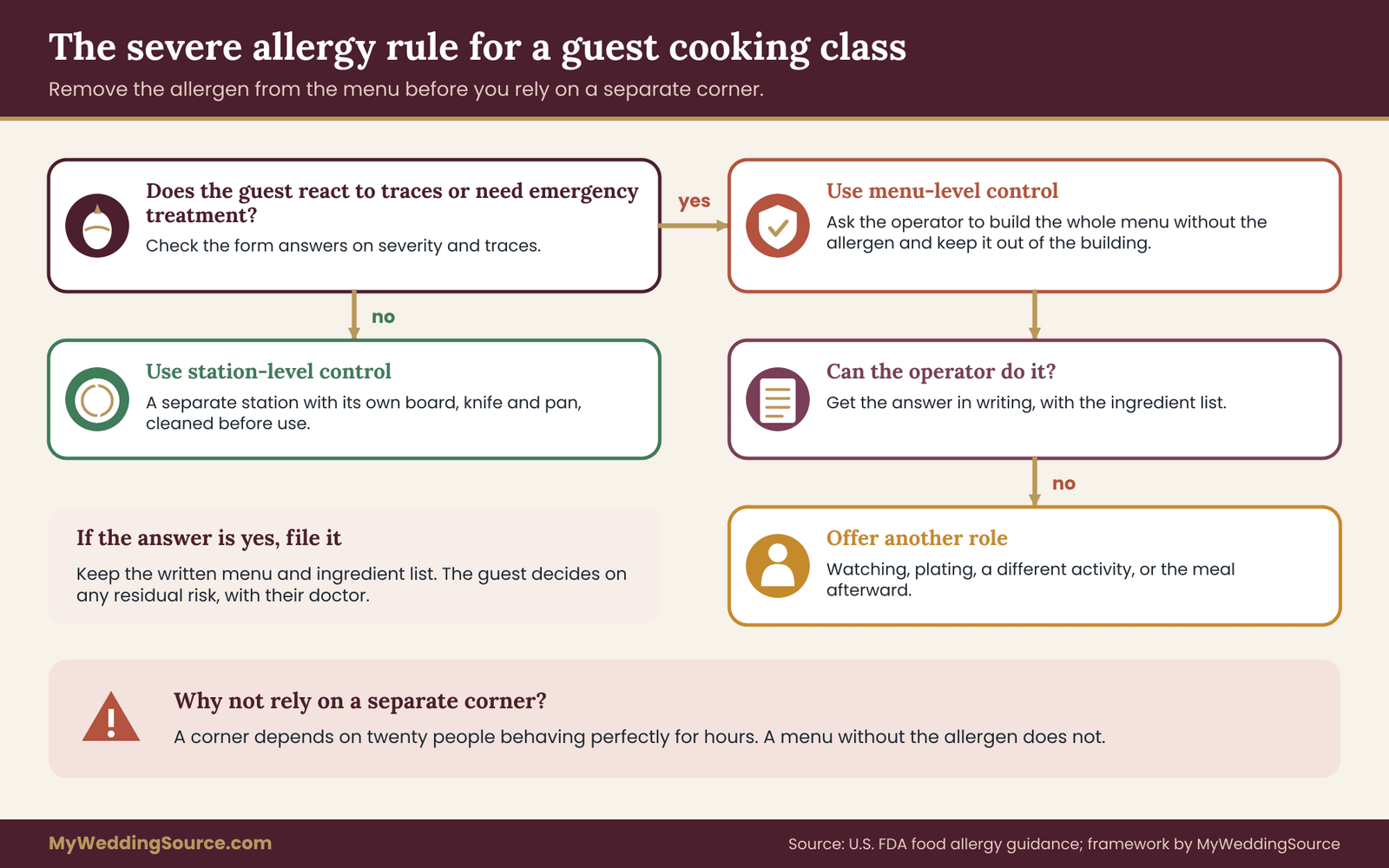
The severe allergy rule
Here is the rule in a form you can paste into an email to the operator. If any guest has a severe allergy and reacts to traces, ask the operator to design the entire menu without that allergen, and to keep the allergen out of the building for the class. If the operator cannot do that, do not ask the guest to cook near the allergen with a separate corner, and do not tell the guest it will be fine.
Offer the guest a watching role from a safe distance, a different activity during the guest cooking class, or a separate meal after. If the guest wants to take part and accepts the residual risk, that decision belongs to the guest and the guest’s doctor, and you should record it.
The reasoning is simple. In a shared kitchen, a separate corner relies on twenty people behaving perfectly for three hours. Removing the allergen from the menu removes the dependency. The U.S. Food and Drug Administration’s guidance on food allergies explains that the only way to avoid a reaction is to avoid the food, which is why a menu-level solution beats a layout-level one.
Writing the guest cooking class summary for the operator
Give the operator a one-page summary, not the raw form. A good summary has the date, the group size, the number of adults and minors, the allergens to remove from the menu, the allergens to separate, the diet notes, the access notes and the name of the coordinator with a phone number.
List allergens by food, not by guest, unless the guest has asked to be named so the instructor can check in. Keep the summary under one page. If it is longer than that, the operator is less likely to read it all.
Ask the operator to confirm the summary in writing, and to return a menu with ingredients listed. Compare the two before you tell guests what to expect. If an ingredient on the menu contradicts the summary, fix it at that stage, because it is much harder to fix on the day.
Group size and station ratios for a guest cooking class
Group size is where a guest cooking class most often goes wrong. Too many people per instructor, too many per station or too few stations for the group, and the experience turns into a queue with a knife. The numbers below are planning starting points to compare with what the operator actually runs. They are not rules, and no regulator sets them for private classes in the way a building code sets exits. Treat them as questions to ask and answers to compare.
Four numbers to ask the operator about the guest cooking class
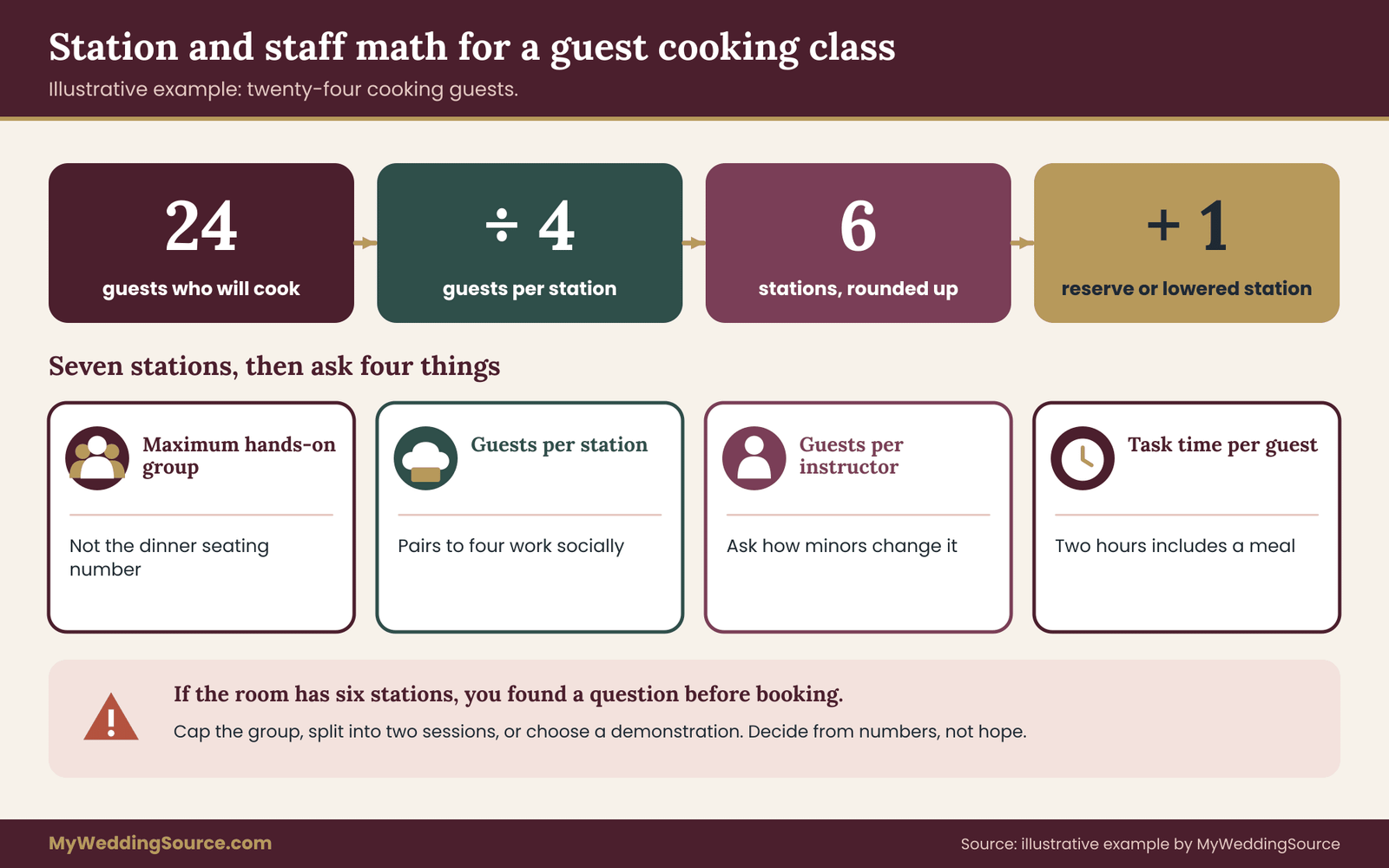
Maximum group size. Ask for the largest group the room can host for hands-on cooking, not the number it can seat at a table. A room that seats thirty for dinner may cook comfortably for twelve.
Guests per station. A station is one work surface with its own board, knife, burner or oven access, and sink access nearby. Ask how many people share a station. Pairs and groups of three or four usually work for social cooking. Larger groups mean some guests watch while others work.
Guests per instructor. Ask how many instructors and assistants will be on the floor, and whether the number includes the person who is also cooking the demonstration. Ask how that changes if the group has minors or guests with mobility needs.
Total working time and tasks per guest. A two-hour class for twenty-four guests can give each person a real task or a small one. Ask how the operator divides tasks and how the menu is paced.
A way to compute the station count
Take the confirmed number of guests who will cook, divide by the guests per station the operator proposes, and round up. Then add one open station for anyone who needs seated work, a lowered counter or a low-allergen surface. If twenty-four guests will cook and the operator proposes four per station, that gives six stations, plus one reserve station, seven in total. If the room has only six stations, you have just found a question to ask before booking.
Next, compute the instructor count. Divide the number of stations by the number of stations one instructor can supervise. Many operators supervise a handful of stations per person, and the figure depends on how hot or sharp the tasks are. Ask for the operator’s own number and check it against the menu. A menu with a knife-heavy first half and a hot-pan second half needs closer supervision than a menu of assembly dishes.
How the numbers change for different groups
Groups with children. Ask whether minors may use knives, hobs or ovens, and whether each minor needs an adult at the station. Some operators give children simple tasks such as washing, stirring cold mixtures or shaping dough. Plan one adult per minor or per pair of minors until the operator says otherwise, and tell parents in advance.
Groups with guests who have mobility needs. A lowered or open-knee station takes more floor space than a standard one. If the room is tight, ask the operator how the stations will be arranged and whether the guest can reach sinks and the serving table.
Groups with several allergen needs. A larger number of allergen needs means more cleaning between tasks, more labels and more checking by staff. If three or more different allergens must be avoided, the cleanest answer is again a menu that avoids them all.
Mixed alcohol and knives. If the guest cooking class includes a welcome drink, ask the operator when drinks are served. A common pattern is drinks after knife work or with the meal, not during chopping.
When the group is too large for one session
If the opt-in count is larger than the room’s hands-on limit, you have four options. Split the group into two sessions, one earlier and one later, with the meal at the end of each. Split the work, so that half the group cooks while the other half takes a market tour or a tasting and then they swap.
Choose a demonstration format, where the chef cooks and guests watch with some hands-on tasks. Or limit the guest cooking class to a smaller circle, such as the wedding party and close family, and offer another activity to the rest.
Each option has a cost. Two sessions double the instructor time and mean some guests miss time with the couple. A swap takes coordination and a second activity. A demonstration is safer and cheaper but less active. A smaller circle can cause hurt feelings. There is no right answer, and the best choice depends on the group. What matters is to decide it from numbers, not from hope.
A worked check on ratios
Suppose the operator says the room has six stations of four, two instructors and one assistant, and a maximum of twenty-four guests. Twenty-four guests would fill every station with no reserve. Now add the intake results. One guest uses a wheelchair and needs a lowered station, and one guest has an allergy that requires a cleaned surface.
If those two guests share one station with two companions, that station works, but only if the counter is lowered and the others at the station agree to use the same ingredients. Otherwise you are at twenty-four guests and seven stations, and the room has six.
The honest conclusion is that twenty-four is too many for this room with these needs, or that the group must be twenty-two. Finding that out in an email costs nothing. Finding it out at the counter costs a miserable hour for the guest at the table by the wall.
Time and pacing checks
Ask for a run-of-show with times: arrival and welcome, safety briefing, handwashing, preparation, cooking, a break, the meal and cleanup. A two-hour guest cooking class that includes a thirty-minute meal leaves about ninety minutes of work, and that is plenty for most menus. If the operator’s schedule shows more than three dishes in that time for twenty-four people, the pace is probably rushed.
Ask what the instructors will cut if the group runs slow. A good answer names the dish that will be simplified or finished by the staff, so guests do not rush with knives.
Check also the gap between arrival and start. Guests who walk in while the instructor is still explaining safety miss the briefing. A fixed start time, with doors closing for the briefing, is a safety measure and not a rudeness. Tell guests the start time is firm and give them the transport plan in the same message.
How to read the operator’s answers
Operators vary in how they answer ratio questions. Some give exact numbers immediately, and that is reassuring. Some say “we handle all group sizes,” and that is not an answer. Ask again with a number: “For twenty-two guests including two minors and one guest who uses a wheelchair, how many stations, how many staff and which layout?” A specific question usually gets a specific answer.
If it still does not, the operator may not have run a group like yours before, and you should weigh that as a risk. The guide to vendor due diligence lists the broader checks to run on any supplier before a deposit, and the same reasoning applies here.
Kitchen safety questions to ask the operator
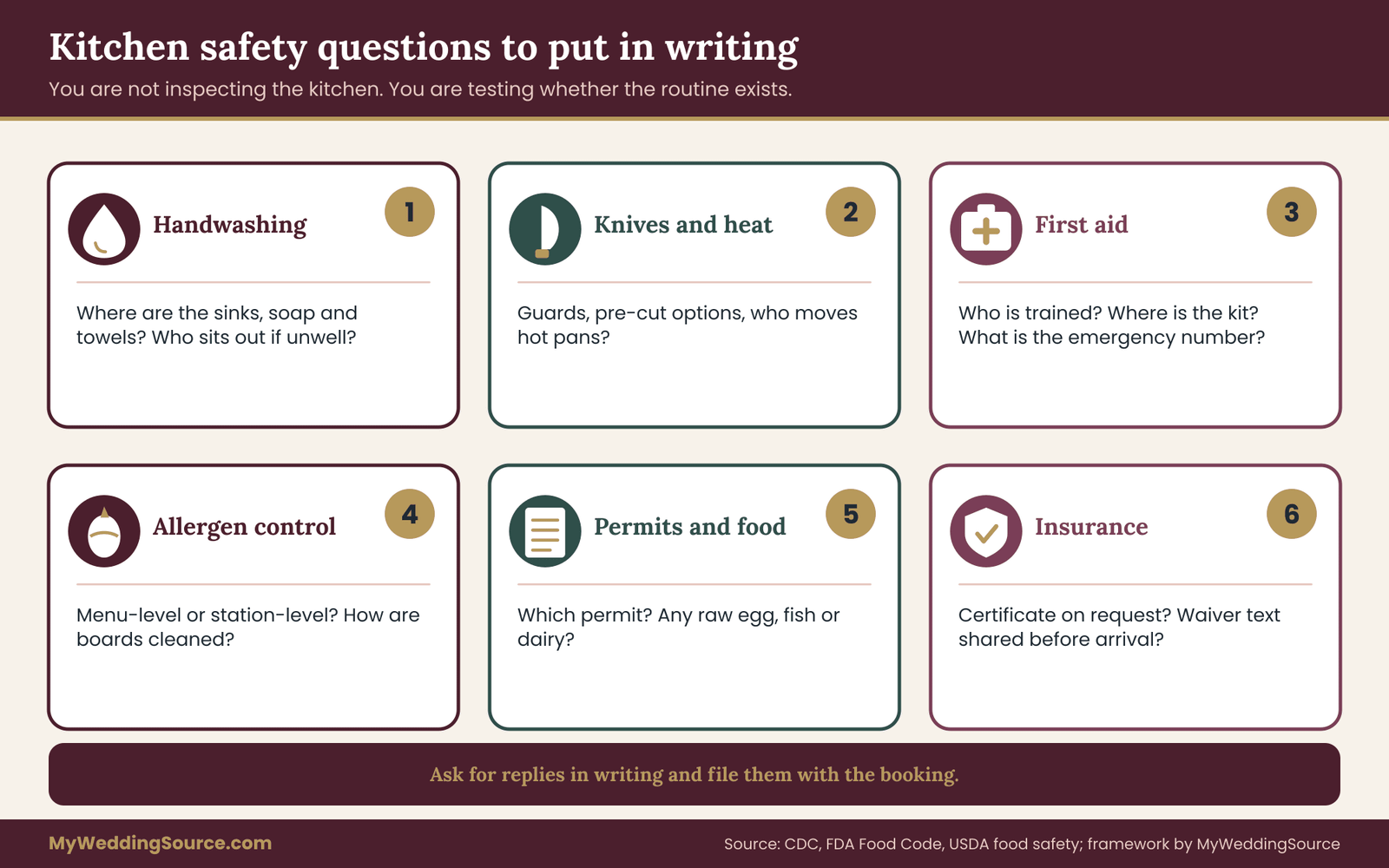
A well-run cooking class has a routine for safety, and the operator should be able to describe it without hesitation. Your job is not to inspect the kitchen. It is to ask questions whose answers show whether the routine exists. The questions below are grouped by area and written so that you can paste them into an email and ask for replies in writing.
Hygiene and handwashing in a guest cooking class
Ask how guests wash their hands before starting and during the guest cooking class, where the sinks are and how many there are for the group. Ask whether soap, paper towels and a bin are at every station or only at one sink. Ask what the operator does when a guest is unwell, and whether guests who have had stomach illness in the past few days are asked to sit out.
The U.S. Centers for Disease Control and Prevention explain that handwashing with soap and water, and keeping raw and cooked foods apart, are basic steps to prevent food poisoning. A good operator uses the same logic and can say so in a few sentences.
Ask also about aprons and hair. Aprons are useful for clothing and for hot splashes. Long hair and loose sleeves near a flame are a safety issue, and a short reminder in your guest message helps.
Knives, heat and floors
Ask how the operator introduces knife safety, and whether it provides guards, cut-resistant gloves or a short skills demonstration. Ask whether guests who are not confident can use pre-cut ingredients without being singled out. Ask how hot tasks are handled, who moves pans from the heat, and whether guests carry hot dishes or the staff do. Ask about the floor: is it non-slip, and how are spills handled? Ask whether the group may move freely or must stay at stations.
Ask about the heat source. Open flames, gas hobs and induction hobs have different risks, and a guest with a long scarf or a swinging bag near a gas flame is a hazard. Induction hobs stay cool beside the pan but can still burn if a pan has just been moved. The operator knows which applies in its kitchen. Ask what the instructors say about it during the safety briefing.
First aid and emergency access
Ask whether any staff member holds current first-aid training, and how recently. Ask where the first-aid kit is and whether the kitchen has a fire extinguisher or fire blanket and a clear exit. Ask how the operator would reach emergency services from the building, including the local emergency number and the address as an ambulance would need it. Ask whether staff are trained to recognize and respond to a serious allergic reaction.
You do not need to audit certificates. You need to see that the operator answers without surprise. A confident, specific answer tells you the matter has been thought about. Surprise or a joke tells you it has not.
Food safety and permits
Ask whether the operator holds the food business registration or permit that the local authority requires, and which authority issues it. Rules differ by country and region, and the operator is the right party to name them. Ask how food is stored, how long it is kept at room temperature during the guest cooking class and what happens to leftovers. Ask whether any dishes use raw or lightly cooked eggs, raw fish or unpasteurized dairy, because pregnant guests, older guests and young children face higher risks from some of those foods.
The U.S. Department of Agriculture’s food safety pages explain safe handling and cooking temperatures in general terms, which is useful background when the operator describes how it cooks poultry, eggs and seafood.
Ask for the menu with cooking methods. If the menu says “soft egg” or “rare” for a group that includes guests who should avoid it, ask for a different dish. The cost of a changed dish is small.
Insurance and liability for a guest cooking class
Ask whether the operator carries liability insurance for guests, and whether it will give you a certificate. Ask whether the operator requires guests to sign a waiver or a safety acknowledgement, and ask to see the text in advance so you can share it with guests. Waivers are common. They are a normal part of activities with knives and heat, and guests should be told about them before arrival rather than handed a form at the door.
The guide to certificates of insurance for wedding vendors explains what a certificate does and does not show. Treat the answers as documents to file, not as proof of safety.
The question set to paste
Here is a compact version you can send, with the reply requested by a date:
“We are planning a private class for about twenty-four guests on a date in spring. Please tell us: the maximum hands-on group size; guests per station and per instructor; where handwashing happens; how knives and hot pans are handled; who has first-aid training; how you separate allergens; how you handle guests with a severe allergy; whether the room is step-free; what insurance and permits you hold; and what you ask guests to sign.”
This message is deliberately plain. It reads as a list of concerns, and it should get a list of answers.
Allergen control is where good intentions meet physical reality. A kitchen can be clean and still carry traces of nuts, flour or fish. Understanding what an operator can promise and what it cannot helps you set honest expectations with guests.
What an operator can reasonably promise
An operator can design a menu without named allergens, buy ingredients with clear labels, wash boards and utensils between tasks, label each dish and tell guests which ingredients are present. An operator can brief the instructors on which guests have restrictions and keep an allergen-free station for a guest who needs one. An operator can refuse a request that it cannot meet safely.
What an operator generally cannot promise is the absence of every trace. Flour, nut dust and fish vapor travel. Packaged ingredients may carry warnings about traces, and those warnings follow the supplier’s own practices. A kitchen that handles a wide range of ingredients across other classes cannot honestly say that nothing else has touched a surface. If an operator does promise absolute safety, treat it as a sign that the operator may not understand the problem.
Menu-level control and station-level control
There are two ways to protect a guest with an allergy. Menu-level control removes the allergen from the guest cooking class. Station-level control keeps the allergen in the room but separates it. Menu-level control is stronger because it does not rely on behavior. Station-level control can work for allergens with a milder risk profile, for guests who do not react to traces and for ingredients that do not become airborne.
A practical way to choose: if the guest reacts to traces or has needed emergency treatment, use menu-level control. If the guest reacts only to eating the food and the allergen is a solid ingredient such as shrimp in a single dish, a separate station with its own board, knife and pan may be fine. Always ask the guest which they prefer, because the guest knows their own history.
Labeling, tasting and hand-offs
Even when the menu is safe, labeling matters. Ask the operator to label each dish with its main ingredients, and ask the instructors to say the allergen list aloud at the start of each course. Ask that nobody taste from a shared spoon, and that tasting spoons are used once. Ask that sauces and oils are labeled when they come from bottles that may have nut or sesame content.
The guide on labeling wedding buffet ingredients explains why a label is information and not a promise of safety, which applies equally here. A label tells a guest what the kitchen believes is in the dish. It does not prove that nothing else touched it.
The meal after the guest cooking class
The meal is the second risk point. Guests who cooked safely may then pass dishes around a long table. Ask the operator to serve plates for guests with allergies first, from a clean station, and to mark the plates. Ask the coordinator to sit near the guest if the guest agrees. Make sure drinks, bread and desserts are covered by the same plan, because a safe main course followed by an untested dessert is a common gap.
If the operator brings in dessert or bread from another supplier, ask who the supplier is and whether the product carries a label. This is a small question, and it closes a gap that is easy to miss.
Allergy cards and chef communication
Some guests carry a written card that lists their allergens in the language of the destination. Offer to help guests prepare one, and give the operator the translation before the guest cooking class. A card does not replace a conversation, but it gives the instructor words they can read quickly. If the guest and the instructor do not share a language, ask the operator who will translate, and do not let a child or a relative serve as the only link.
Accessibility and comfort in a working kitchen
A kitchen is built for staff who stand, reach and move quickly. Guests are a different group, and a guest cooking class that works only for the fittest people in the room is not a group activity. Accessibility here covers mobility, standing time, sensory needs, language and age. It also covers comfort, which matters to everyone after a long trip.
Getting into the building and around it
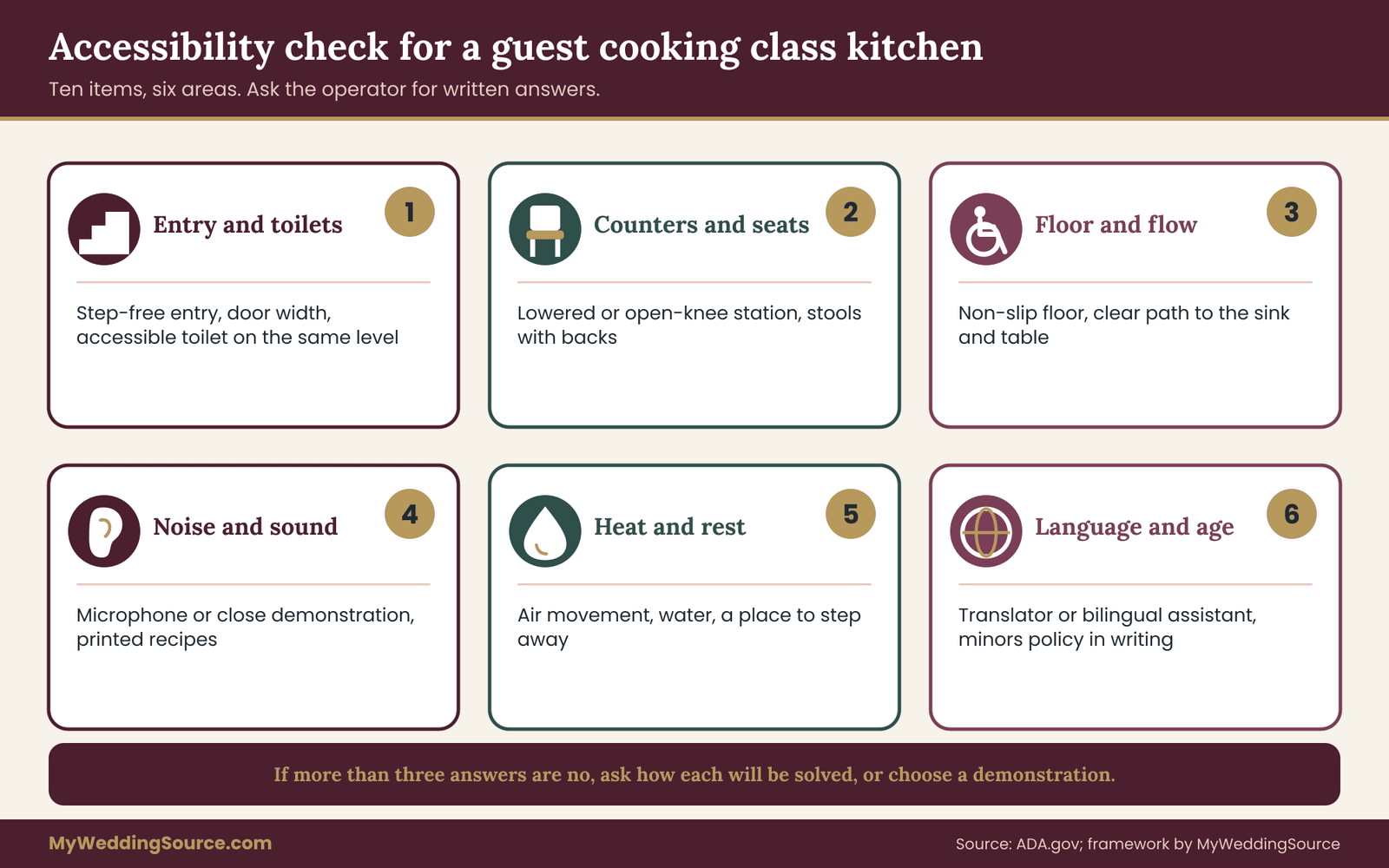
Start at the door. Ask whether the entrance is step-free, how wide the doorway is, whether there is a ramp or a lift and whether the path from the street to the kitchen is level. Ask whether the toilets are on the same floor and whether they are accessible. Ask where a guest who uses a wheelchair or walker would park a vehicle or be dropped off. Ask whether the kitchen floor has thresholds, mats or cables that could trip someone.
If the operator answers “we can help carry the chair,” treat that as a no for step-free access. Carrying is sometimes a workable emergency option, but it is not an accessible entrance, and a guest should never be asked to rely on it without choosing it. The checklist in the guide to accessible wedding venue red flags shows what to look for in a building and applies directly to a kitchen venue.
Work surfaces and seating
Ask whether any station has a lowered work surface or open space under it for knees, and whether stools with backs are available. Ask whether a guest can do the work seated, and whether tools such as a lightweight knife, a cutting board that does not slip or a peeler with a large handle are available. Ask where the sink is and whether a guest at a seated station can reach it or whether staff or a companion will bring water.
A guest who does not need a lowered station may still prefer to sit for part of the guest cooking class. Offer stools at every station and tell guests they can sit whenever they like. A guest who has a balance problem or who gets dizzy in heat will not say so aloud, and a standard seat makes the choice private.
Sensory comfort: noise, heat, light and smell
Kitchens are loud and warm. Extraction fans, mixers and many voices make it hard to hear instructions. Ask whether the instructor uses a microphone or a demonstration area with the group close, and whether a written recipe is given in advance. Guests with hearing difficulties benefit from a seat near the instructor and a printed menu. Guests with vision needs may need good light at the station, high-contrast boards and a clear description of where items are placed.
Heat matters for older guests, pregnant guests and anyone taking medicine that affects temperature. Ask whether the room is air-conditioned or ventilated, whether water is provided and whether guests can step outside. Strong smells, such as frying fish or garlic, can be unpleasant for some guests, especially during pregnancy or illness, so ask whether there is a place to step away.
Language and instruction
If the instructor does not speak the guests’ main language, ask how instructions will be given. A translator, a bilingual assistant, printed recipes in two languages and visual demonstration all help. Safety instructions deserve the clearest delivery. A guest who does not understand “hot pan, handle toward you” has a real risk, which is a different thing from missing a joke.
Children, teens and older relatives
Children and teens often love cooking classes, and they add energy to a group. Ask the operator about its policy on minors: whether there is a minimum age, whether adults must be with them, which tasks are allowed. Give parents the policy in writing. If the group has several children, ask whether the operator can offer a children’s task list such as shaping dough, washing herbs or decorating, with the hot and sharp steps handled by adults.
Older relatives may want to take part at their own pace. Offer a seat, a clear task and permission to leave early. A grandmother who joins to watch and taste is still part of the day, and the plan should make that role feel welcome and not like a fallback.
Guests who do not want to cook
Some guests will not cook, because of a disability, a fear of knives, a religious practice or plain preference. Give them a role: tasting, plating, pouring, photographing if the guests agree, or joining for the meal only. The broader guide to guest care planning covers the broader approach to including guests with different needs, and the same ideas apply here. Ask the operator whether a guest can join for the meal only, and what it costs.
Never make the choice public. Ask guests privately, in the intake form, what role they would like, and tell them it will be handled quietly on the day.
A short accessibility checklist for the operator
Ask for a written reply to these ten items: step-free entry; door width; accessible toilet on the same level; lowered or open-knee station; seats with backs; non-slip floor; microphone or close demonstration; printed recipes; air movement and water; and a place to step away. If more than three of these are no, ask the operator how it would solve each one for your group, or consider another venue.
Timing, transport and alcohol
A guest cooking class does not exist in isolation. It sits in a weekend with flights, hotels, rehearsal dinners and ceremonies. Its timing and its transport shape how safe and enjoyable it is.
Choosing the day and the hour
Avoid the arrival day for most groups. Travel stress, delayed flights and jet lag shrink attention, and a late arrival means a missed briefing. The day after the main group arrives is usually better, in the late morning or early afternoon. Avoid the wedding day itself and the day before it, because the couple and the wedding party will not have the time, and because food-related illness would affect the event.
Keep a buffer between the guest cooking class and any formal event. If the guest cooking class ends at four and guests must be dressed and on a bus by five, the schedule is tight and the cleanup will feel rushed. A gap of at least ninety minutes is a reasonable starting point, and the operator may suggest a different one based on how long guests usually stay.
Moving the group
Ask where the kitchen is relative to the hotels, how long the trip takes and whether the operator can arrange transport. The guide to coordinating guest hotels across budgets and mobility needs explains how to think about distance and access for different guests, and the same reasoning applies to a guest cooking class: a guest who uses a mobility aid needs a vehicle that can carry it, and a guest with limited stamina needs a short walk.
Tell guests the meeting point, the start time and what to wear in the same message. Closed shoes, tied-back hair and clothes that tolerate stains make the day easier. Ask guests to bring any prescribed medicine with them, and to eat a light snack beforehand if they are likely to feel faint. Make sure the meal at the end is part of the plan, so nobody expects a full dinner afterward.
Alcohol and the knife line at a guest cooking class
A welcome drink is a pleasant touch and a common request. The simple rule is to keep alcohol away from the first hour of work. Serve a non-alcoholic drink on arrival, hold wine for the meal and ask the operator to be the one pouring. If the operator includes drinks in its price, ask how many and when. A group that has been drinking on a boat all morning should not start the guest cooking class with a blade, and the operator may refuse to serve guests who appear intoxicated.
Remember that some guests do not drink for health, religious or personal reasons, and a pregnant guest will want a non-alcoholic option that does not look like an afterthought. Ask the operator for a drink menu that offers a good alternative.
Weather, heat and seasonal factors
Weather affects kitchens more than people expect. A hot day makes a poorly ventilated kitchen unpleasant, and a storm can interrupt transport. Ask the operator what happens in a power cut, a heat wave or a strike affecting transport, and whether it can reschedule. Seasonal closures and local rules can change, so confirm the date and the operator’s status close to the event, rather than relying on a quote from many months earlier.
Check official travel guidance for the destination, as the U.S. Department of State’s travel pages explain current advisories and entry rules. If the advisory affects the area where the class is held, decide in advance who makes the call to cancel, and what the cancellation terms say. The guide on excursion fees explains how to read those terms, and the general principle is to get them in writing before paying.
Packing and flying with medicine
Guests who carry prescribed emergency medicine will be flying with it. The Transportation Security Administration publishes what travelers may bring through screening, including medical items, and guests should check it before they pack. Suggest that guests carry medicine in hand luggage, with its original label and a letter from their doctor if they have one, and that they check the rules of the destination country as well as those of the departure airport.
Comparing guest cooking class formats before you choose
“Cooking class” covers several formats, and each fits a different group. Comparing them in plain terms helps you pick the one that matches your intake answers, rather than the one with the nicest photographs.
Hands-on class
Every guest cooks at a station and eats what the group makes. This is the format most people imagine. It gives the most participation and the most risk, because more people handle more food and equipment. It needs the strongest ratios, the clearest allergen control and a room that can hold the group. It suits groups with few severe allergies and good mobility, and it works best for eight to twenty-four guests.
Demonstration with tasting
The chef cooks at the front while guests sit, watch and taste. A few guests may help with simple tasks. This format keeps the guest cooking class sociable while reducing knife and heat exposure. It suits large groups, mixed ages, guests with mobility limits and groups with several allergy needs, because the chef controls the food. The trade-off is less activity and a less personal result.
Market visit followed by a class
Guests walk through a local market with a guide, buy ingredients and then cook. It adds culture and movement, and it adds transport, walking and weather. It suits energetic groups and daytime schedules, and it is a poor fit for guests with limited stamina, for crowded markets with narrow passages and for hot days. Ask how the walking route handles guests who need to rest, and whether there is a vehicle option.
Chef’s table or private dinner
A small group sits at a table while a chef prepares a multi-course meal, with some guest involvement. This format is closer to a dinner than a guest cooking class. It offers the best allergen control, because the kitchen prepares everything. It suits small groups, usually the couple and close family, and costs more per person in many places. Ask whether the chef can adapt each course to individual needs and how the staff track them.
Choosing a guest cooking class format by intake answers
Match the format to the results from your form. If you have a severe allergy that reacts to traces and a wheelchair user in the same group, a demonstration with tasting or a chef’s table is usually safer and more inclusive than a hands-on class. If you have a young, healthy, energetic group with minor dietary needs, a hands-on class or a market visit will be more fun.
If the group is large and mixed, split the plan: a demonstration for everyone and an optional hands-on session for the smaller group who want it.
A short decision rule: count the red answers. With none, any format works. With one or two red answers, choose a format with menu-level control. With three or more, choose a demonstration or a chef’s table, or reconsider the activity.
Cost logic for a guest cooking class without invented numbers
This guide does not quote prices, because prices differ by country, season and operator, and any figure would be a guess. What you can do is compare quotes on the same basis. Ask each operator for the cost per guest, the minimum group size, what the price includes (ingredients, drinks, recipes, transport, tips), the deposit, the cancellation terms and the cost of a smaller or larger group. Convert each quote to a cost per cooking guest and a cost per attending guest, then compare.
Be careful with the cost of accommodations. A separate menu, an extra instructor or a private station may carry a surcharge, and you should ask before assuming. If the operator charges extra for allergen handling, ask what it covers. Also check who pays: the couple, the guests or a split. The article on group excursion fees explains how pricing, deposits and cancellation terms work in detail, and that is the right place to read before you sign.
A worked example: twenty-four guests, one kitchen
The following example is invented to show the process. It is not a real couple, a real operator or a real result.
The setting
A couple is planning a three-day wedding weekend in a small coastal town. Thirty-two guests are invited to the weekend, and twenty-four say yes or maybe to a guest cooking class on the second morning. The guest cooking class coordinator is the groom’s sister. She sends the twelve-question form with the guest cooking class invitation, with a return date five weeks before the guest cooking class.
What the form returns
Twenty-two of the twenty-four guests answer. Fifteen have no restrictions. Two are vegetarian. One does not drink alcohol. One is pregnant. One has celiac disease. One has a peanut allergy and has needed emergency treatment in the past, and reacts to traces. One has a shellfish allergy and avoids shellfish but is comfortable near others eating it. One uses a wheelchair. Two are teenagers, fifteen and sixteen. One guest needs a seat for part of the work because of back pain.
The sister follows up with the two who did not answer. One replies and has no restrictions. The other does not reply, and she notes that the person will be told to speak to the instructor on arrival.
How the answers sort
The green answers are the vegetarians, the guest who does not drink and the guest who needs a seat. The amber answers are the pregnancy, the celiac disease, the shellfish allergy and the wheelchair. The red answer is the peanut allergy with reaction to traces.
Applying the severe allergy rule, the sister asks the operator for a menu without peanuts and without peanut oil, with a note that no peanut-containing product will be in the building. She also asks for a menu without shellfish, because removing it costs little and removes a dependency. She asks for a gluten-free option for each dish, and for no raw egg and no alcohol in the tasting, which also suits the pregnant guest.
The numbers
The operator offers stations of four. Twenty-four guests need six stations, and the sister asks for one lowered station and one reserve, which makes seven. The operator has six full stations and a lower counter that can be used by a wheelchair. The sister asks how the stations will be arranged, and the operator proposes a layout in which the lowered counter sits at the end near the sink. The operator brings two instructors and an assistant. The two teenagers are paired with adults.
The operator’s room can hold twenty-four in this layout but with no reserve. The sister decides to cap the hands-on group at twenty-two and give the last two guests a seat at the serving table with tasting and plating tasks.
The written reply
The operator sends a reply that confirms the menu, lists every ingredient, states that no peanut products will be in the building, confirms that the entrance has a ramp, names the staff member with first-aid training and attaches its insurance certificate and its local permit number.
The sister compares the menu to the summary and finds one sauce that lists sesame oil. Sesame is not a problem for this group, but the sister asks the operator to confirm the sauce has no peanut content, and the operator replies within a day.

What the example shows
The process did not need special skill. It needed a short form, a sorting step, one written summary, a few numbers and a reply to file. It also needed the coordinator to treat a vague answer as a question and to keep the guest in control of the allergy decision. If the operator had refused to remove peanuts, the sister would have offered the guest a seat at the table or another activity, and the guest cooking class would have gone ahead for the others.
What would have changed the plan
Change one fact and the result changes. If the peanut-allergic guest had a mild reaction only to eating peanuts, a separate station might have been enough. If the building had stairs and no lift, the wheelchair user would have needed a different venue or a demonstration held elsewhere. If twenty-eight guests had said yes, the sister would have booked two sessions or chosen a demonstration. A good process is one that tells you which of these paths you are on.
The day-of run sheet and what to do if something goes wrong
A plan is only useful if the people on the day know it. A one-page run sheet, shared with the coordinator, the operator and one or two helpers, turns the earlier work into actions.
The guest cooking class run sheet in order
One week before. Reconfirm the headcount, the menu and the summary with the operator in writing. Confirm transport, the start time and the contact number for the day. Send guests a short message with the meeting point, what to wear and what to bring. Remind guests with prescribed emergency medicine to carry it.
The day before. Ask the operator to confirm that the kitchen and the allergen plan are unchanged. Send the coordinator the final list of names and station assignments, if the operator uses them. Check weather and transport.
On arrival. The coordinator meets guests, checks names and says hello to the instructor. Guests with allergies speak privately to the instructor, and the instructor repeats the allergen list to the group. Everyone washes their hands. Guests put away phones and bags, tie back hair and put on aprons.
During the guest cooking class. The instructor gives the safety briefing: knives, heat, floors, who to call. The coordinator watches the guests who need help and keeps drinks out of the work period. Nobody tastes from a shared spoon.
At the meal. Plates for guests with allergies are served first, from a clean station and labeled. The coordinator checks that drinks, bread and dessert match the plan.
At the end. Guests thank the staff, take recipes and leave in the same order they arrived. The coordinator collects any belongings and confirms the bill matches the quote. The guide on wedding menu planning is useful afterward if the couple wants to carry a favorite dish into the wedding menu itself.
Who is allowed to decide what
Assign decisions before the day. The instructor decides on kitchen safety, such as stopping a task or removing a guest from a station. The coordinator decides on guest logistics, such as who sits where and when to move to the meal. The couple should not be the decision makers on the day, because they will be busy and their attention is limited. Tell the operator who the coordinator is, and tell the coordinator that the instructor has the final word on safety.
If a guest has a minor injury
Cuts and small burns are the most likely events. The operator should have a first-aid kit and a procedure. The coordinator should stay with the guest, make sure the staff member with training attends, and note what happened. Do not rely on a guest who happens to be a nurse or doctor to take over, because they are also on holiday, and the operator has its own duty of care. If the injury needs more than a plaster, call a local clinic or emergency services, and keep the group calm.
If a guest has a serious allergic reaction
A serious allergic reaction is an emergency. Signs can include difficulty breathing, swelling of the lips or throat, widespread hives, vomiting and dizziness, and they can develop quickly. The Centers for Disease Control and Prevention and the Food and Drug Administration both explain that the response to a severe reaction is to use prescribed epinephrine as directed and to call emergency services right away. The guest’s own medicine is the first tool, and the instructions that came with it are the guide.
Find the local emergency number and the address of the kitchen before the guest cooking class. In some countries the emergency number is not the one you know from home, and a call that wastes a minute is a bad one. Put the number and the address on the run sheet and on the wall near the entrance.
Make sure two people know where the guest’s medicine is and how it is used. If a guest has told you that they carry medicine, ask for permission to tell the instructor and one neighbor.
This section is general information and does not replace medical training or the guest’s own doctor’s advice. If your group includes a guest with a history of severe reactions, ask the guest what their doctor has told them to do and whether they want a short briefing for the people near them.
If the kitchen fails to match the plan
Sometimes the room on the day does not match the room in the email: a lowered station is missing, a menu item has changed, a product has been substituted. The rule is simple. Stop and ask. Tell the instructor what the written plan said and ask how the kitchen will fix it. If the fix is not possible, offer the affected guest another role, and be ready to move the guest cooking class to a demonstration for the day.
Do not let the group go ahead with a known problem to avoid awkwardness. Afterward, write down what happened and send it to the operator, because it may matter for a refund or a review.
Edge cases worth a decision in advance
A guest arrives intoxicated. The operator has the right to refuse participation, and the coordinator should agree in advance to support that. Offer water and a seat at the table.
A guest asks to change an answer on arrival. Treat it as new information. Tell the instructor, and ask what can be changed in the time available.
A guest brings an uninvited plus-one. Check the ratio and the menu before agreeing. The operator may decline, and the coordinator should be ready with a kind explanation.
A guest wants to take photographs or video. Ask the operator about its policy. The guide on wedding photography consent is relevant if you want to share images of guests in the kitchen.
The guest cooking class falls on a religious fast or observance. Check the intake answers for diet and ask the guest privately whether to adjust the time or role.
A guest has an allergy that was not on the form. Stop the work at that station, tell the instructor and move the guest to a safe role. Ask the guest what they need. Do not push a guest to carry on to avoid a fuss.
Your next steps
Start with three actions this week. First, name the guest cooking class coordinator and write the one-page brief with the return date, the operator’s contact and the severe allergy rule. Second, copy the twelve-question form into a survey tool and send it with the guest cooking class invitation, with a return date five to six weeks before the guest cooking class.
Third, send two or three operators the question set from this guide and ask for written replies, including station size, instructor ratio, allergen approach, first aid, step-free access and insurance.
When the replies arrive, sort them against your intake answers, compute stations and staff with the simple method above, pick the format that matches the group and file the written confirmation. Then tell guests the plan in one short message. A guest cooking class that has been checked this way is not free of risk, and no kitchen is. It is a guest cooking class where the people who need to know do know, the numbers fit the room and everyone has a place at the counter.
FAQ
How early should we collect allergy information for a guest cooking class?
Send the intake form with the activity invitation and ask for answers five to six weeks before the guest cooking class. That gives the operator time to adjust the menu and order ingredients, and it gives you time to follow up with guests who do not reply. Late answers are possible, but the operator may not be able to change a menu that has already been ordered.
What is a reasonable group size for a guest cooking class?
It depends on the room, not on a fixed rule. Many hands-on classes work best with eight to about twenty-four guests, grouped at stations of three or four. Ask the operator for its maximum hands-on number, its guests-per-station figure and its instructor ratio, then compare them with your headcount. If the group is larger, consider two sessions or a demonstration format.
Can a guest with a severe nut allergy join a hands-on guest cooking class?
Sometimes, but the safest approach is a menu without nuts and with no nut products in the building. A separate corner relies on everyone behaving perfectly for hours. If the operator cannot remove the allergen, offer the guest a different role or activity. If the guest chooses to take part, that is their decision with their doctor’s advice, and you should record it.
Should we ask the operator to promise that the kitchen is allergen free?
Ask what the operator can control and how, rather than for an absolute promise. Operators can design menus, label ingredients, clean surfaces and brief staff. They usually cannot rule out every trace in a shared kitchen. A clear, specific description of the process is more reliable than a general promise, and an operator who claims perfect safety may not understand the risk.
What accessibility questions matter most for a guest cooking class?
Ask about step-free entry, door width, an accessible toilet on the same level, a lowered or open-knee station, seats with backs and a non-slip floor. Also ask about noise, heat and printed recipes. If several answers are no, ask how the operator would solve each one for your group, or choose another venue or a demonstration format.
Is it safe to serve alcohol during a guest cooking class?
It is safer to keep alcohol away from the knife and heat portion of the guest cooking class. Offer a non-alcoholic welcome drink, serve wine with the meal and ask the operator to handle the pouring. Some guests do not drink, so provide a good alternative. The operator may also refuse service to a guest who seems intoxicated, and you should support that.
Do children and teenagers need special arrangements?
Often, yes. Ask the operator about its minimum age, whether adults must be at each station and which tasks are allowed for minors. Give parents the policy in writing before the day. Plan simple tasks for younger children and pair teenagers with adults for knife work and hot steps unless the operator says otherwise.
What should we do if a guest has an allergic reaction during the guest cooking class?
Treat it as an emergency. Help the guest use their prescribed emergency medicine as their doctor directed and call local emergency services immediately. Know the local emergency number and the kitchen’s address in advance, and make sure two people know where the guest’s medicine is. This is general information, not medical advice.
Sources
- Food allergies, U.S. Food and Drug Administration
- Food allergies, Centers for Disease Control and Prevention
- Food allergy guidelines, National Institute of Allergy and Infectious Diseases
- Food safety, Centers for Disease Control and Prevention
- FDA Food Code, U.S. Food and Drug Administration
- Food safety and inspection, U.S. Department of Agriculture
- Information and technical assistance on the Americans with Disabilities Act, U.S. Department of Justice
- International travel information and advisories, U.S. Department of State
- Travelers’ health, Centers for Disease Control and Prevention
- What can I bring, Transportation Security Administration