
Excursion fees are the charges that sit around the headline price of a group activity at a destination wedding: taxes, service charges, transport, permits, payment costs and the cost of changing your mind. This guide shows how to turn every quote into one all-in price per person, compare operators on the same footing, and read the cancellation terms before your guests pay.
Ask every operator for a written all-in price per person that names taxes, service charge, gratuity, transport, entry fees, equipment and payment costs. Put each quote on the same comparison sheet. Check the group pricing rules (minimums, tiers and headcount deadlines) and the cancellation ladder, meaning what happens at each date and when the operator cancels. Sign only when the contract repeats the written price, names who collects the money, and says what is refunded and how. Surprise excursion fees almost always live in the gaps between those lines.
A group outing at a destination wedding looks simple on a brochure. A catamaran afternoon, a vineyard tour, a cooking class, a day on a mountain trail. The listed price is usually one number, and it is rarely the number your guests end up paying. A fuel surcharge appears at the dock.
A guide expects a tip you did not budget for. The operator wants cash in the local currency. Four guests drop out and the per-person price jumps because the group fell below a minimum. Each of these is a typical way for excursion fees to grow after the first quote.
None of this is dishonest by default. Tour operators price in layers, and each layer is reasonable on its own. The problem for a wedding group is that you are buying for people who are not in the room when you sign, and you are spreading the cost across guests with different budgets. Excursion fees that a couple can absorb become an awkward group message when they land on thirty households. The sections below treat excursion fees as something to be measured, not feared.
This guide is about that narrow problem: how excursion fees are built, how to expose them before signing, how group pricing changes the math, and what the contract and cancellation terms need to say. It does not cover which activities to offer or how many to schedule. For that planning question, the guest care planning guide covers pacing and comfort, and this article deliberately stays on money and paper.
A note on scope. This is general information, not legal, tax or financial advice. Consumer rules, licensing and payment protections differ by country and by operator, and they change. Where a rule matters, the article points you to the agency that publishes it so you can confirm the current version.
What excursion fees really are at a destination wedding
An excursion fee is any amount a guest or the couple pays because of a group activity, beyond the cost of the venue and lodging. People often use the phrase for the headline price only, and that habit is where the trouble begins. In practice, the total cost of an outing has several layers, and an operator may quote only the first. Put differently, excursion fees are everything on top of the sticker price that a guest would be surprised to learn about at the dock.
The base price. This is the number on the website or in the first email. It may be per person, per vehicle, per boat or per group, and the unit matters more than the amount. A “per boat” price that looks cheap can cost more per head once your group needs two boats.
Mandatory add-ons. Taxes, a service charge, a fuel or environmental surcharge, a harbor or park entry fee, a permit fee. Some are legally required, some are the operator’s choice, and some are quoted separately only because the website was built that way.
Optional add-ons that are not optional in practice. Equipment rental, a photo package, a lunch that is “included” but excludes drinks, a gratuity that is customary and quietly expected.
Cost of the transaction. Currency conversion, card fees, bank transfer charges, a deposit that is non-refundable in a way the page does not mention.
Cost of change. What it costs when a guest cancels, the group shrinks, the weather turns or the operator cancels. This layer is the least visible and often the most expensive. Cost of change is the layer where excursion fees grow fastest, because it only shows up when plans move.
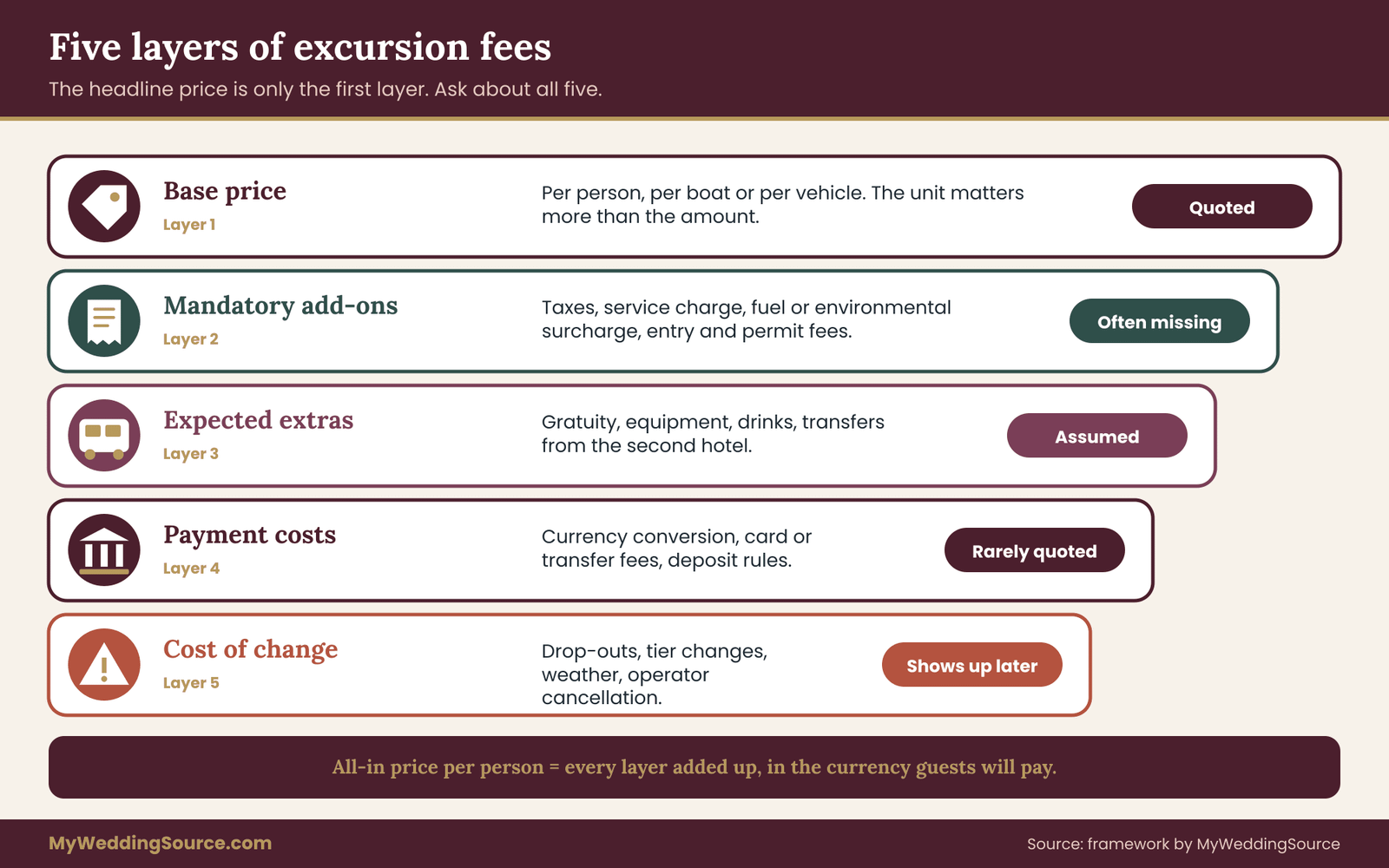
When you see excursion fees as layers rather than a single number, a useful habit follows. You stop asking “how much is it?” and start asking “what is the total per person, on the day, for a guest who pays by card and might cancel?” That question has a real answer, and a good operator can give it in writing.
Why group weddings make fees harder to see
A solo traveler compares two tours, reads the totals at checkout and decides. A wedding group does not get that clean moment. Several features of group buying hide excursion fees.
First, the quote is often negotiated by email, so it exists as a conversation rather than a checkout page. Conversations omit things. An operator who says “it is eighty per person” may mean eighty before tax, before tip and before transport from the hotel.
Second, group pricing introduces conditions, and it is worth reading the wedding vendor contract basics before you sign anything with an operator. A rate that is valid for twenty-five people is not valid for nineteen. A rate that includes lunch may exclude the vegetarian guests’ alternative. These conditions are mentioned once, in an email thread, and never again. Hidden conditions are one of the quietest sources of excursion fees.
Third, the buyer and the payer are different people. The couple or a planner signs, and guests pay. If the number changes after guests have committed, someone has to explain it, and the person who explains it is usually the couple.
Fourth, the timeline is long. A deposit may be due many months before the wedding, while the final headcount is due a few weeks before it. Currency, fuel prices and local taxes can move in between, and the contract decides who carries that movement. A long timeline gives excursion fees time to drift.
What this guide will and will not do
The aim is practical. By the end you should be able to turn any excursion quote into one comparable all-in number, read group pricing without being surprised by a minimum, request the exact contract language that protects you, and explain the price to your guests in a single plain message.
It will not tell you what fair excursion fees are. Prices vary by country, season and operator, and no honest article can give you a safe average. What it can do is show you how to test a price against the operator’s own written terms, so that “fair” becomes something you can check instead of something you feel.
The all-in price rule: one number per person
The core of this guide is one rule about excursion fees. Never compare, approve or announce an excursion price until it is an all-in price per person that the operator has confirmed in writing. Every other technique in the guide supports that rule.
An all-in price per person is the total a single adult guest pays, from first payment to last, to take part in the outing on the date and in the conditions you describe. It includes every tax, charge, fee and tip that is expected, in the currency the guest will actually pay.
It excludes only things that are truly optional and that the guest chooses on the day, such as souvenirs. This is the cleanest definition of excursion fees that a guest can actually use, because it is the total they pay.
The seven-line build
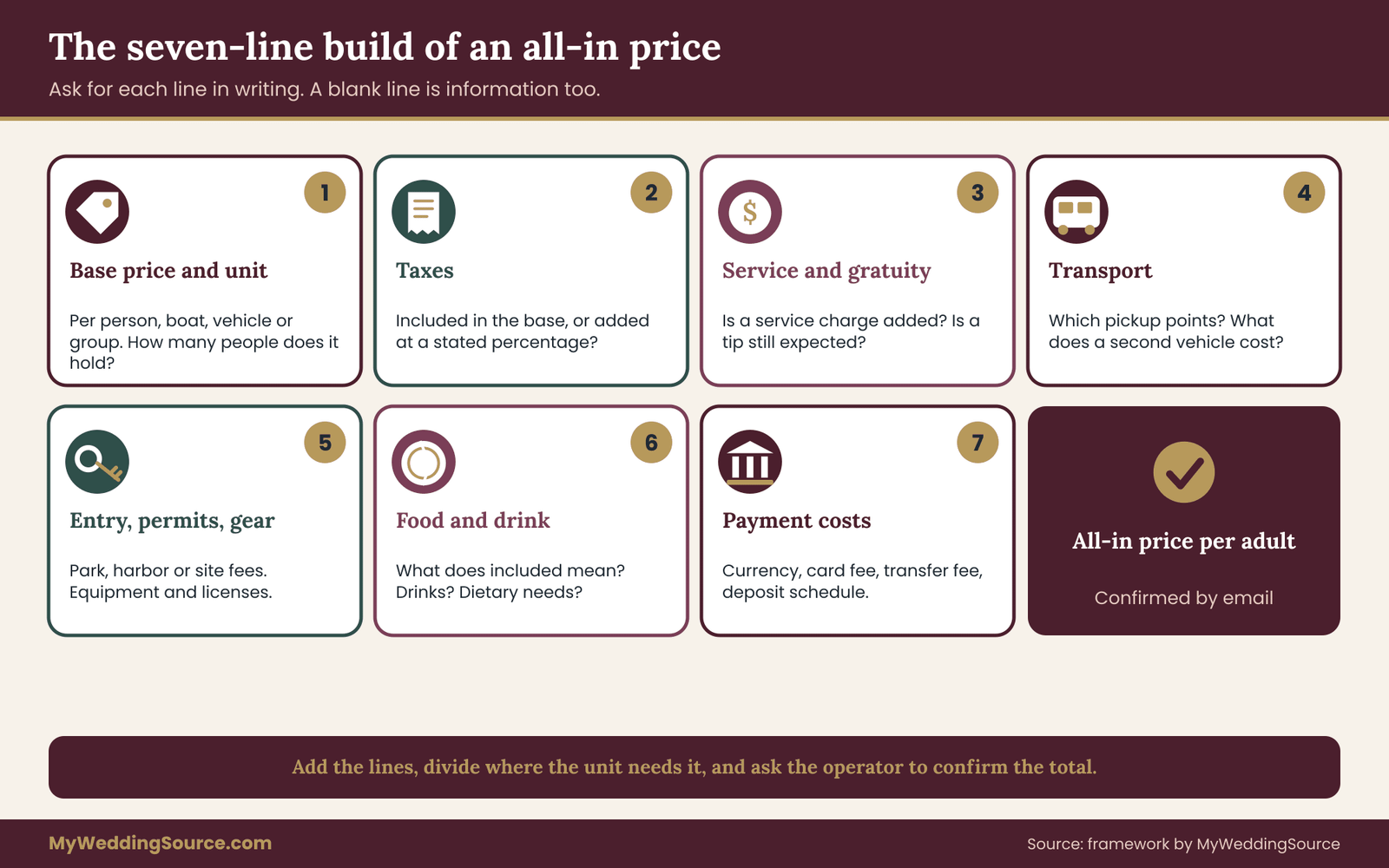
To build the number, ask for these seven lines, in this order. If an operator cannot fill a line, the blank is itself information.
Line one: base price and its unit. State whether it is per person, per vehicle, per boat or per group, and how many people the unit holds.
Line two: taxes. Say whether the base includes local sales or value-added tax, and what percentage is added if it does not.
Line three: service charge and gratuity. Say whether a service charge is added, whether it goes to staff, and whether a tip is additionally expected. These are different things, and operators often use the words loosely.
Line four: transport. Say whether transfers from the hotel are included, what the pickup points are, and what a second vehicle costs if the group is larger than expected.
Line five: entry, permits and equipment. Park fees, harbor fees, site tickets, safety equipment, rental gear, guide licensing charges passed on to guests.
Line six: food and drink. What “included” means, whether drinks are covered, how dietary needs are handled and whether there is a charge for them.
Line seven: payment costs. The currency of the quote, the exchange rate rule, card or transfer fees, and the deposit schedule. Payment costs are small per guest and large across a group, so they belong in the count of excursion fees.
Add the lines, divide by the people the unit holds where needed, and you have the all-in price per person. Then ask the operator to confirm the total in an email. A short confirmation is enough: “Your all-in price per adult is X, in this currency, including everything above.” If they hesitate to put that sentence in writing, treat the hesitation as a signal. Doing this once per operator turns scattered excursion fees into a single comparable figure.
A short script for asking
Many couples worry that asking for a full breakdown will sound suspicious. It does not. Operators who work with groups are used to it. A neutral message works well.
“We are comparing a few options for a group of about thirty guests. Could you send an all-in price per adult that includes taxes, service charge, any fuel or entry fees, transport and payment costs, plus your cancellation terms?”
Notice that the message does not accuse anyone and does not ask for a discount. It asks for completeness. That tone gets a better answer than a request that sounds like haggling, and it gives you a document you can place next to the other quotes. Operators who handle groups regularly will recognize this as a normal request about excursion fees.
Where excursion fees hide: a line-by-line map
Knowing the seven lines is one thing. Knowing where each one tends to hide is what lets you catch it early. This section walks through the most common places excursion fees appear and what to do about each. Each place below is a common source of excursion fees that guests discover too late.
Taxes and “plus plus” pricing
Some operators quote a price that excludes tax and service charge and mark it with a note such as “plus applicable taxes.” On a single ticket that is a small footnote. Across thirty guests it changes the budget. The fix is simple: ask for the percentage, apply it yourself, and confirm the all-in number.
Never assume that a price shown on a booking page, a hotel concierge sheet and a quote email follow the same tax rule. They often do not. Tax is the easiest of the excursion fees to calculate and the easiest to forget.
Service charge versus gratuity
A service charge is a fee the business adds, and the business decides where it goes. A gratuity is a tip, and custom decides how much. Some operators add a service charge and still expect a tip. Others add nothing and rely on tips for guide wages. Neither approach is wrong, but your guests need to know which one applies before they arrive, so that nobody is surprised at the dock and nobody tips twice by accident.
A clean contract line reads something like: “Service charge is included in the all-in price. Gratuity is at guests’ discretion and is not required.” If the operator wants a gratuity built in, ask that it be named as a fixed line instead. Naming gratuity in the contract keeps excursion fees from doubling up at the dock.
Fuel, environmental and seasonal surcharges
Boats, buses and helicopters burn fuel, and some operators pass fuel price changes on to customers. Parks and marine reserves may add environmental or conservation fees. Peak-season or holiday surcharges also appear. The question is not whether a surcharge exists but whether it can change after you sign. Ask whether the price is fixed once the deposit is paid, and ask for that promise in the contract.
A surcharge that can be added later is an open-ended number, and open-ended numbers cannot be budgeted. Surcharges are the excursion fees most likely to change between booking and the outing.
Entry, permit and site fees
A winery tasting may include a tasting fee. A ruin or museum visit may require a separate ticket. A national park may charge a per-person entry plus a vehicle fee. The operator sometimes includes these and sometimes tells guests to pay at the gate. Both are acceptable.
What matters is that you know which, and that you know the amount, because gate fees are a classic place for guests to discover that “included” meant “included in the tour but not the entry.” Gate fees are the excursion fees guests most often discover on arrival.
Transport inside the price and outside it
Transfers deserve their own attention. A price that includes pickup at the main hotel does not include pickup at the cheaper hotel across town where half your guests are staying. Ask for the pickup points, the number of vehicles the price assumes and what happens if the headcount grows.
The guest hotels guide explains why guests end up in different places, and that spread is exactly what turns a single pickup into a pricing question. Transfers that look free often turn into excursion fees when guests sleep in different places.
Currency and payment costs
If the quote is in a local currency and your guests pay in dollars, someone converts, and the rate and the fee for converting are part of the excursion fees. A card terminal may offer to charge in your home currency at a rate set by the merchant, which can be less favorable than your card issuer’s.
Ask which currency the contract uses, whether a card fee is added, and whether paying by bank transfer changes the price. A later section covers payment methods in detail. Currency effects are the least visible of all excursion fees, because the guest sees them only on a statement.
The dependent price
Some prices depend on a condition that is easy to miss. “Includes lunch” may depend on a minimum number of guests. “Private boat” may depend on a minimum spend. “Free for children under a certain age” may depend on an adult ticket. List these conditions next to the price, because a condition you violate is a fee you pay. A condition that is breached is how excursion fees appear without anyone changing the quoted price.
Group pricing: how tiers, minimums and attrition change excursion fees
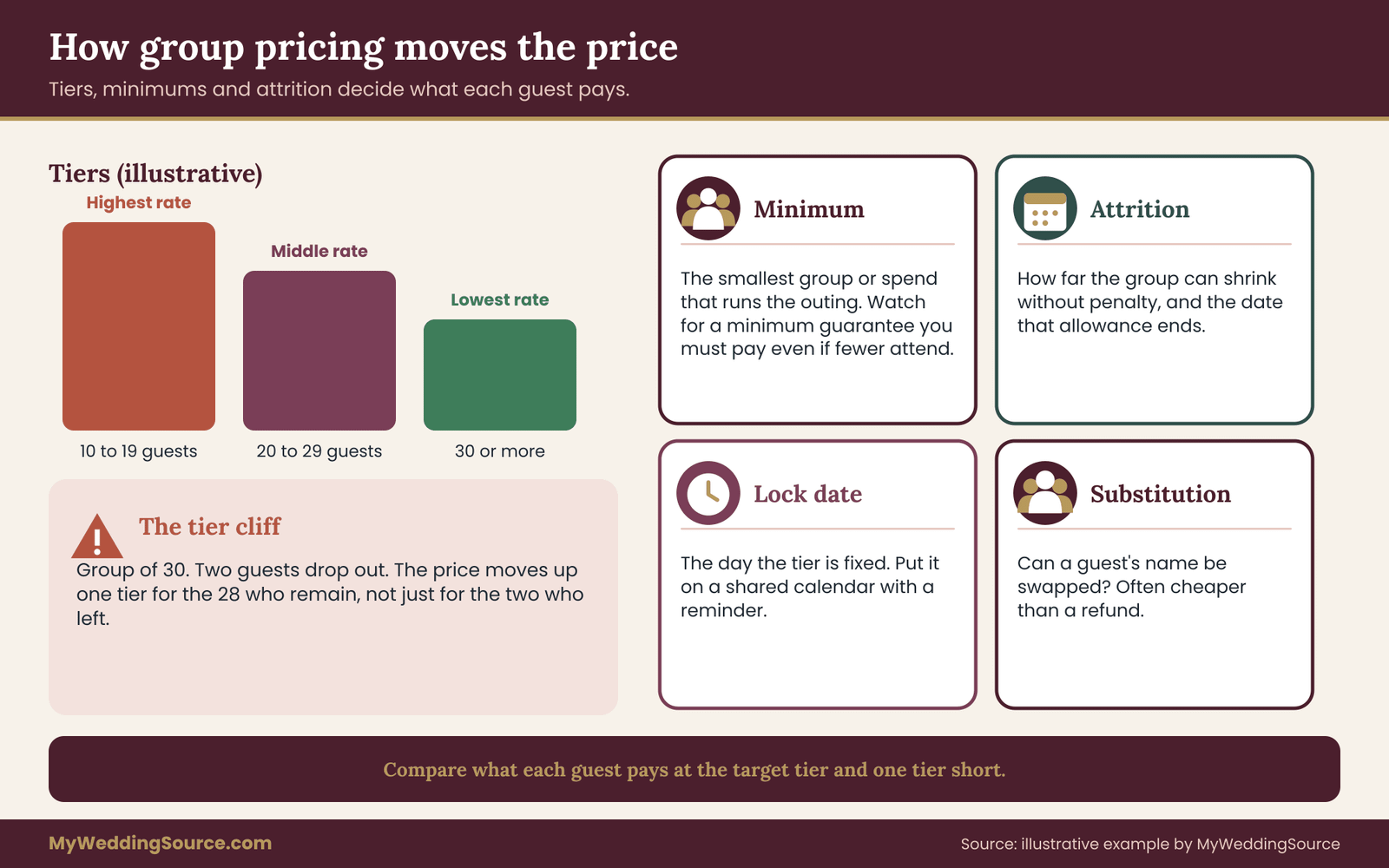
Group pricing is the part of a quote that most surprises couples, because it behaves differently from a retail price. Instead of one number, you get a structure. Three mechanisms matter: tiers, minimums and attrition.
Tiers
A tiered price falls as the group grows. For example, an operator may offer one rate for ten to nineteen people, a lower rate for twenty to twenty-nine and a lower one again for thirty or more. Tiers reward certainty. They also create cliffs. If your group is exactly thirty and two guests drop out, everyone’s price moves to the next tier up.
The difference is not two guests’ worth of money. It is the price change multiplied by every person who stayed. Tiers are the part of group pricing that most directly moves excursion fees from guest to guest.
When you receive a tiered quote, ask three questions. What are the exact boundaries? On what date is the tier locked? And if the group ends up in a more expensive tier, does the operator bill the difference to the couple or to each guest? The answers decide whether a small drop-out raises excursion fees for the whole group.
Minimums
A minimum is a condition for running the outing at all. Typical forms include a minimum number of guests, a minimum total spend or both. Minimums protect the operator from running a half-empty boat. They also protect you in a different way if the operator must cancel when the minimum is not met, because the contract should then require a full refund.
Read minimums for a trap that points the other way: a minimum that you must pay for even if fewer people attend. That is a minimum guarantee, and it turns an optional outing into a financial commitment. If you are offering the outing as optional for guests, a minimum guarantee puts the shortfall on you. A minimum guarantee shifts excursion fees from the guests who attend to the couple who signed.
Attrition
Attrition is the allowed drop between your first headcount and your final one. A contract may say you can reduce the group by a stated percentage without penalty until a stated date, and after that you pay for the original number. The idea is familiar from hotel room blocks. The hotel room block idea applies equally here: the dates that matter are the final-headcount date and the date the attrition allowance ends, and they should sit on a shared calendar.
For group excursions, ask whether names can be changed after the headcount is final. A guest who cannot travel is easier to replace than to refund. A contract that allows name substitution until a few days before the outing can turn a loss into a non-event. Substitution is the cheapest way to keep excursion fees from rising when someone drops out.
A rule for choosing a tier target
A practical decision rule helps you avoid tier cliffs. Take the number of guests who have said yes when you first collect interest, and quote the tier that applies to that number minus a cushion for drop-outs. Then compare two scenarios: what each guest pays if you hit the tier, and what each guest pays if you fall one tier short. If the second number is still acceptable to most guests, you can proceed.
If it is not, either negotiate a price floor, switch to a per-vehicle or per-boat structure with a clear cap, or lower the outing’s scope so the group is not on the edge of a cliff. Running both scenarios in advance keeps excursion fees from becoming a group argument.
Comparing group pricing with all-inclusive packages
Some resorts and venues sell all-inclusive packages in which activities are included. The all-inclusive wedding venues guide covers how those packages are built. For excursions, the question to ask about an inclusive package is what the included activity list actually contains, whether guests pay for upgrades, and whether non-participants still subsidize the cost.
An inclusive package can reduce excursion fees, but only when the included list matches what your guests want to do. A package can lower excursion fees, but only if the included list matches what guests will do.
Reading a quote the way a procurement team would
Large organizations do not trust a quote until it has been normalized. They place each vendor’s offer into the same format and compare like with like. You do not need a procurement department to do this, and the wedding budget page is a good place to keep the resulting numbers. You need one habit: rewrite every quote into your own sheet, in your own words, before you discuss it with anyone else.
The act of rewriting does something useful. It forces you to notice what is missing. When you cannot fill a cell in your own sheet because the operator never said, you have found a gap. You send one email asking about the gap, and you do it before you discuss price. Price talk without completeness is how excursion fees survive into the final bill. Completeness first, price second, is the order that keeps excursion fees visible.
A common failure is comparing a quote that includes lunch with a quote that does not and concluding the second is cheaper. The comparison sheet in the next section prevents that by giving every quote the same seven lines and the same cancellation ladder, so that a cheaper headline price with more hidden lines shows up as what it is.
The comparison sheet: one page for every excursion quote
The sheet is the original tool in this guide. It is a single page, one per operator, with the same fields in the same order. You fill it in from the operator’s written replies, never from memory or a phone call. When two or three sheets sit side by side, the difference between a good excursion quote and a cheap-looking one becomes visible. It is a way to see excursion fees in the same format across every operator.
The sheet has two halves. The top half builds the all-in price. The bottom half records the cancellation ladder and the group rules. Neither half judges quality, safety or the pleasure of the activity. Those matter, but they are separate questions. This is about money and paper.
The top half: the all-in price
Write the operator’s name, the activity, the date and the group size you assumed. Then fill in the seven lines from earlier: base price and unit, taxes, service charge and gratuity, transport, entry and equipment, food and drink, and payment costs. Next to each line, write one of three marks: confirmed in writing, mentioned but not written, or unknown. Every blank you cannot fill is a possible source of excursion fees.
At the bottom of the top half, write two totals. The first is the all-in price per adult based only on confirmed lines. The second is the all-in price per adult if every unknown line turns out at the high end of what the operator hinted. The gap between the two totals is your uncertainty, and a large gap is a reason to send another email before you compare operators. The gap is a direct measure of how much excursion fees could still move.
The bottom half: rules that change the price later
Record the group pricing rules: tier boundaries, the lock date, the minimum, any minimum guarantee, the attrition allowance and the final headcount date. Record the children’s rule and the rule for guests who need special food or help with access. Then record the cancellation ladder, which the next section explains in full.
Finish with three yes-or-no checks. Is the price fixed after the deposit? Can names be substituted? Is a refund promised in writing if the operator cancels? A “no” or “unknown” on any of these is not a deal-breaker. It is a negotiation item and a budget risk, and the sheet makes that visible. A no answer here usually means excursion fees can rise later without your consent.
How to use two or three sheets together
Lay the sheets side by side and compare in a fixed order, which prevents the loudest number from steering the decision.
First, compare the confirmed all-in totals. Second, compare the gap between the confirmed and the worst-case totals. Third, compare the group rules, particularly any minimum guarantee. Fourth, compare the cancellation ladders. Only then look at the base price on its own.
This order often reverses the first impression. An operator with the lowest base price may show the largest uncertainty gap and a harsh ladder. An operator with a higher base price may show a small gap and a flexible ladder. Which one is better for your group depends on how certain your headcount is.
A group that is sure of its numbers can accept a strict ladder in return for a lower price. A group that is uncertain should pay more for flexibility, and the sheet gives that trade a number. The order is designed so that excursion fees, not the headline, steer the decision.
Scoring without pretending to be scientific
Some couples like to score each operator. If you do, keep the scoring honest. Use a simple three-step scale for each field and do not weight the scores in ways you cannot explain. The aim is to surface differences, not to produce a fake precision that hides judgment. A short written note at the bottom of each sheet, such as “cheapest, but price can change after deposit,” tells you more than a score of seventy-two. Scores should explain excursion fees, not replace the reasoning about them.
A worked example with three illustrative quotes
The following example is invented to show the sheet in use. The numbers are round and illustrative, not real prices, and they do not describe any actual operator or destination.
A couple is planning a half-day boat outing for a group they expect to be about thirty guests, with the final number uncertain between twenty-four and thirty-two. They collect three quotes.
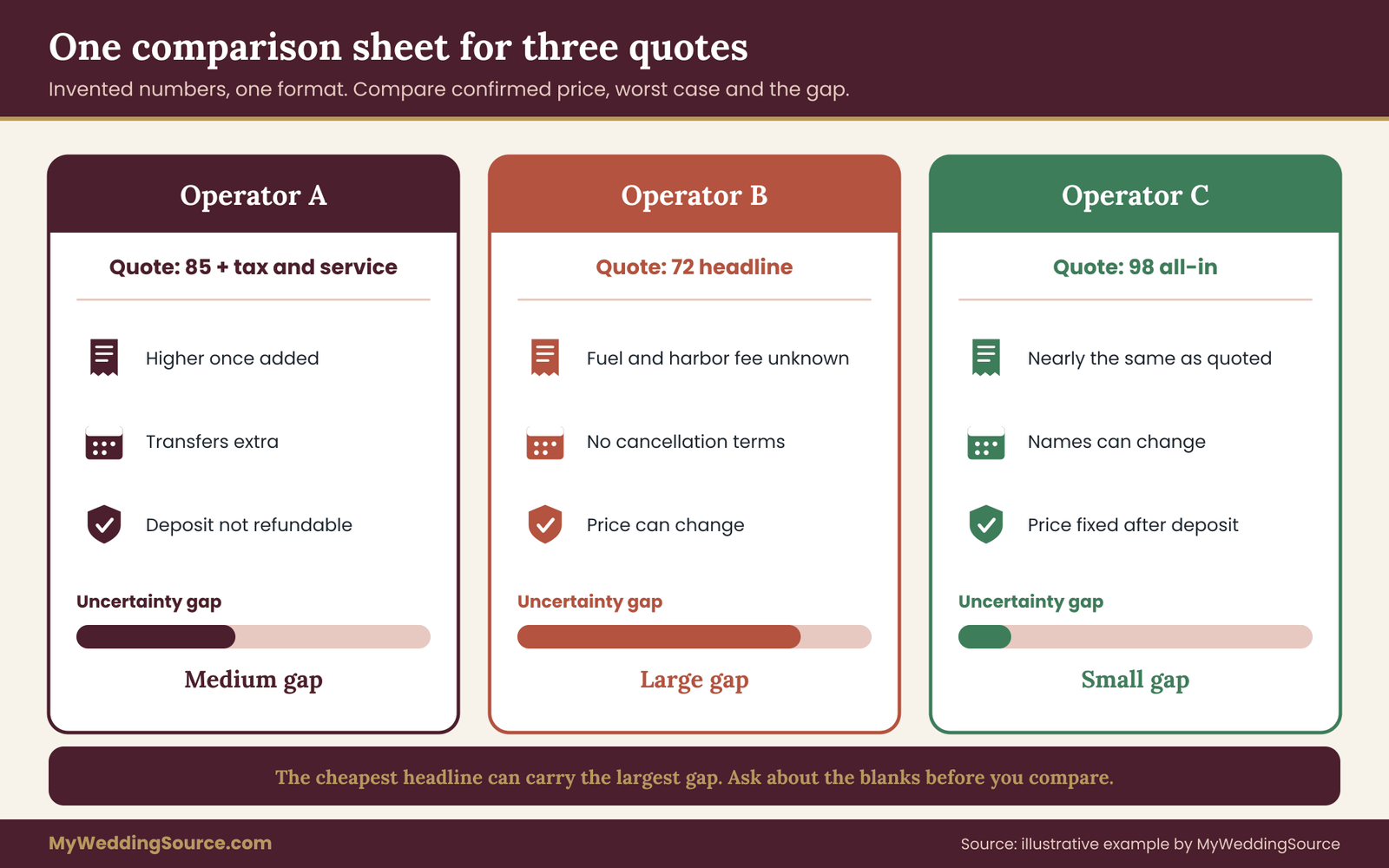
Operator A quotes eighty-five per adult. The email says “plus tax and service.” On request, A confirms tax at a stated percentage and a service charge of a stated percentage, both added to the base. Transfers are not included. Lunch is included, drinks are extra. The price is in local currency. A requires a deposit that is non-refundable and a final headcount sixty days before.
Operator B quotes seventy-two per adult. The base is the lowest of the three. B adds a fuel surcharge that “may change,” a harbor fee payable at the dock and a requirement to pay by bank transfer. No cancellation terms are stated in the email. B offers a lower tier at thirty guests.
Operator C quotes ninety-eight per adult, described as all-in. Tax, service charge, transfers from two hotels and lunch are included. Drinks are extra. The price is fixed after the deposit. Names can be substituted until seven days before. The deposit is partially refundable on a stated schedule.
Filling in the sheet
For A, the confirmed all-in price per adult comes out higher than eighty-five once tax and service are added, and transfers would be an extra cost if guests need them. For B, the confirmed price is seventy-two, but two lines are unknown: the fuel surcharge and the harbor fee. The worst-case total could land above A’s. For C, the confirmed and worst-case totals are nearly identical, because there is little left to discover. The added lines are excursion fees that the first email never mentioned.
When the couple reads the three sheets side by side, the comparison changes. The headline order was B, A, C from cheapest to most expensive. The all-in order, once unknown lines are priced at the high end, is closer to C, A, B or even a tie. The more important difference is the uncertainty gap, which is large for B, moderate for A and small for C. Seeing the excursion fees side by side is what changes the order.
The tier cliff in the example
B offers a lower price at thirty guests. The couple’s group is expected to be between twenty-four and thirty-two. If the group lands at thirty-one, B is attractive. If it lands at twenty-seven, the lower tier is lost and B’s price rises for everyone. C has no tier. Its per-adult price is stable across the range, so the couple can state a single number to guests and keep it.
That stability has value that does not show up in the headline price. It lets the couple announce the price once. It avoids the awkward message that says, “the price went up because three people dropped out.” Stable excursion fees are worth paying a little more to get.
What the couple decides
Using the sheet, the couple writes one sentence for each operator. A: reasonable, but needs transfers and has a strict deposit. B: lowest headline, but three open lines and no stated cancellation terms; ask before deciding. C: highest headline, most complete, most flexible.
They email B with a short list of questions about the fuel surcharge, harbor fee and cancellation terms, and they ask A whether transfers can be added at a fixed price. After the replies, they update the sheets and decide. The decision is not magical. It is simply made on complete information, which is what the sheet is for.
When a quote arrives as a package from the wedding venue or planner
Sometimes the quote does not come from the operator at all. A venue coordinator, hotel concierge or destination planner offers a menu of excursions at a stated price. This is convenient, and it adds a layer. The planner may add a handling fee, a markup or a coordination charge, which is a legitimate business practice as long as it is disclosed.
Ask the intermediary two things. Is the price you are quoted the operator’s price plus a fee, and if so what is the fee? And who is the contracting party, the intermediary or the operator? The second question matters for refunds, because a refund may have to travel back through two businesses, and the contract between you and the intermediary decides how long that takes.
Where purchase orders and scope agreements are involved, the vendor purchase order checklist shows a clean way to document who is responsible for what. A markup is a legitimate part of excursion fees as long as it is disclosed.
A quote from an intermediary goes on the same comparison sheet as any other, with one extra line for the intermediary’s fee. If the intermediary will not disclose it, you can still compare the all-in price, which is the number that counts. What you lose is the ability to see whether a direct booking would cost less.
In some cases it will, and in others the intermediary’s access and support are worth the difference. The sheet lets you decide with eyes open. The intermediary’s line is one more item in the total of excursion fees.
Cancellation terms: the ladder behind your excursion fees
Cancellation terms are where excursion fees are decided after the fact. Two operators with the same all-in price can cost very different amounts if one is flexible and the other is not. Most guests never read this part until they need it, so the couple has to read it for them. Many of the largest excursion fees are never charged unless a plan changes.
Think of cancellation terms as a ladder with rungs by date. At each rung, the guest or the group gets a different refund. Writing the ladder out, in plain numbers and dates, is the second half of the comparison sheet. The ladder shows when excursion fees stop being refundable.
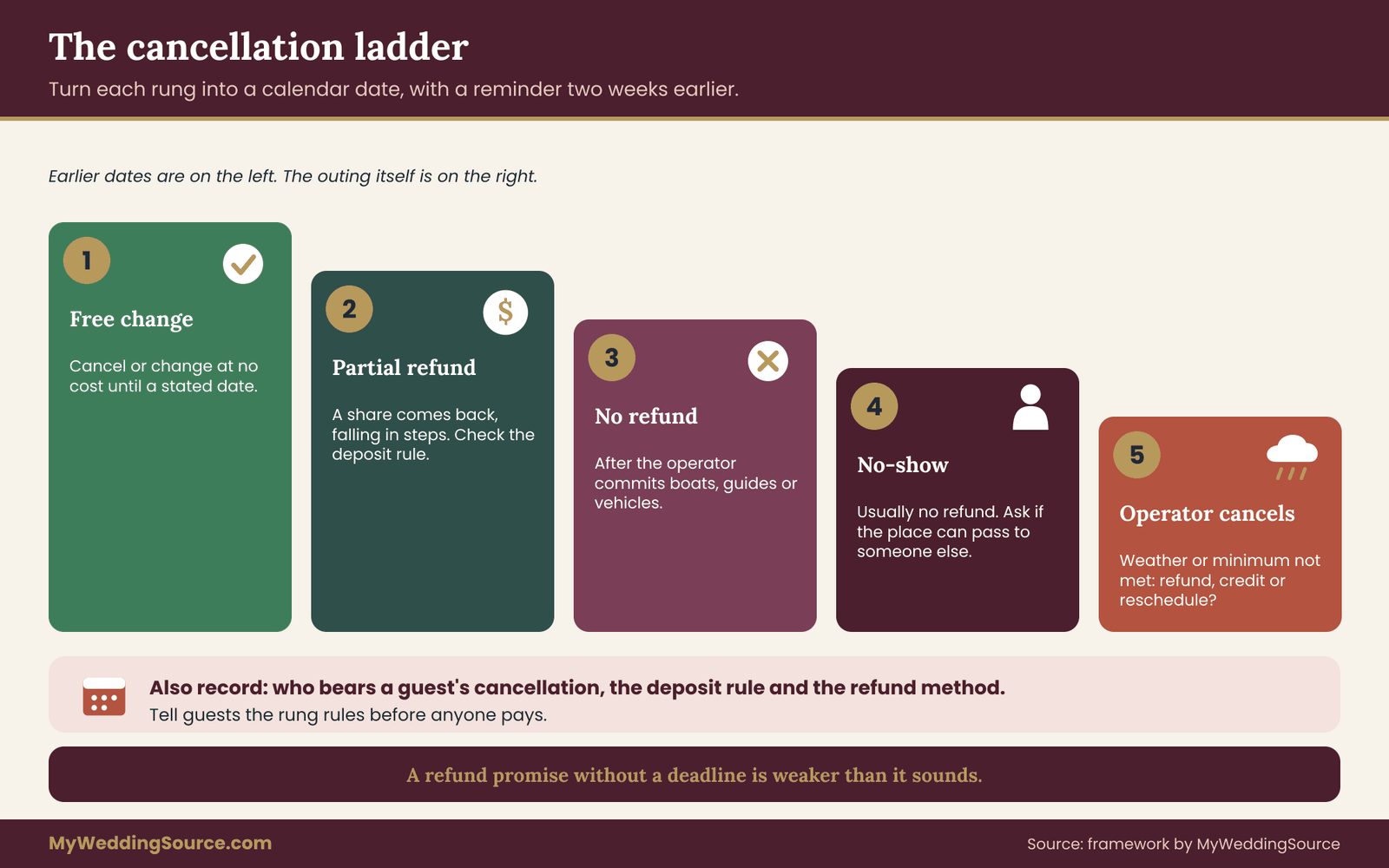
The five rungs
Rung one: free change. Until a stated date, a guest can cancel or change without cost. Some operators offer this until a few weeks before the outing. Others offer nothing at all. Write the date down, or write “none.” The longer this window, the lower the risk of excursion fees for a group with an uncertain headcount.
Rung two: partial refund. After the free window, a share of the price is refunded. The share often falls in steps. Record each step and its date. Pay attention to whether the deposit is treated separately from the balance, because some operators refund the balance but keep the deposit.
Rung three: no refund. After a stated date, nothing comes back. Note that date. It is usually the date by which the operator has committed boats, guides or vehicles.
Rung four: no-show. A guest who does not arrive is generally treated as a no-show, which usually means no refund. Ask whether a no-show can transfer their place to someone else.
Rung five: operator cancels. This is the rung most often missing from quotes. If the operator cancels because of weather, a minimum not met or a staffing problem, what does the guest receive: a full refund, a credit, a reschedule or nothing? And how long does a refund take? Quotes rarely cover this rung, yet it decides whether excursion fees are returned.
Convert the ladder into a calendar
A ladder written in a contract is hard to use. A ladder converted into dates on your own calendar is easy. For each rung, subtract the number of days from the outing date and write the resulting calendar date next to it, with a reminder two weeks earlier. Keep these dates on the same shared calendar as the rest of the wedding schedule, so a deadline for a boat does not hide behind a deadline for a florist.
Then decide in advance what the couple will do at each rung. For example, at the end of the free-change window, send guests one message with a reminder of the date and a request to confirm or cancel. That message costs nothing and prevents most late cancellations. This is the cheapest way to keep late excursion fees away.
Cash, deposit and balance timing
The ladder interacts with payment timing. If a deposit is due at booking and a balance is due on the day, then the early rungs involve losing the deposit and the late rungs involve losing the deposit plus the balance. If the full payment is due months ahead, every rung is a larger loss.
Where possible, prefer payment schedules that pay later. A small deposit and a balance close to the date reduce the money at risk during the period when a headcount is still moving. The cash-flow planning guide explains how to place deposits and balances against your own reserve so that an excursion deposit does not collide with a bigger vendor payment. Later payments mean fewer dollars exposed to excursion fees while the headcount moves.
Who bears a guest’s cancellation
A subtle point is who absorbs the loss when a guest drops out. In a group booking, the operator’s ladder applies to the couple or planner who signed, not to the individual guest. If a guest cancels after the free window, the couple may owe the operator, and then has to decide whether to pass the cost to the guest.
State that policy in advance, in the guest message, before anyone pays. Something like: “If you cancel after this date, we may not be able to return your payment unless someone takes your place.” A guest who has read that sentence can decide with full information, and a couple who wrote it does not have to negotiate after the fact. Telling guests before they pay keeps excursion fees from becoming a surprise bill after the fact.
Weather, safety and operator cancellations
Most destination excursions are outdoors, and the weather decides some of them. A contract that does not say what happens when the weather turns leaves the decision to the operator on the day, and the operator’s incentives are not always yours.
What a good weather clause says
A usable clause names who decides the outing is unsafe, such as the captain, the guide or a local authority. It states what happens next: a reschedule to another date, a full refund, a credit with an expiry or a partial refund after costs. It states how long the operator has to pay a refund. And it avoids language like “at the operator’s sole discretion” for anything other than a genuine safety call. Without it, the operator’s judgment on the day decides who carries excursion fees.
Ask a simple question: if the outing is cancelled on the day for weather, what does each guest receive and when? Then ask: is the answer different for a delay of a few hours versus a full cancellation? A delay may still run, with a shortened program, and the clause should say whether the price changes.
Official sources for safety and travel conditions
Operators may be right to cancel for conditions that guests cannot see from the hotel. They may also be wrong, or may cancel for convenience. You are not an expert on sea state or trail safety, and you do not have to be. What you can do is check official travel information for the destination before you commit. The U.S. Department of State publishes travel advisories by country, and the Smart Traveler Enrollment Program lets travelers receive country alerts.
The Centers for Disease Control and Prevention publishes health information for travelers. These do not decide whether a specific outing runs, but they tell you whether the destination as a whole has a known problem. Conditions change, so check close to the date and send guests to the same sources.
Operator-initiated cancellation and minimums
If the operator cancels because the minimum group size is not met, the contract should return all money promptly. If the operator cancels for any reason that is not the guest’s fault, a full refund is the baseline expectation, and anything less should be written clearly. A credit instead of a refund can be acceptable, but only if it can be used on dates that work for your group, which for a wedding group is often not the case, since guests leave when the wedding weekend ends.
Ask whether a refund goes back to the original payment method. A refund to the same card is simpler to track than a refund by transfer in a different currency, and the difference can be a few percent after conversion.
Insurance and what it does not do
Travel insurance can cover certain cancellations, but coverage varies by policy and by reason for cancellation. It is individual, personal and subject to exclusions, so a couple cannot buy a single policy that covers every guest’s excursion. What you can do is let guests know that they may want to review their own policies and that excursion fees paid for optional outings may or may not be covered.
State insurance regulators and the National Association of Insurance Commissioners publish consumer information on travel insurance. Do not recommend a specific product to guests, and do not describe coverage you have not read.
The special case of private groups versus shared tours
A private group outing and a seat on a shared tour behave differently, and the difference changes how excursion fees work.
On a shared tour, the operator already runs the outing, and your group buys seats. A small cancellation is often absorbed because the operator can resell the seat. Ladders are usually simple, and group pricing may be a modest discount. The risk is that your guests are mixed with strangers and have little control over timing.
On a private outing, the operator commits a vehicle, boat or guide for your group alone. The price is often per vehicle or per boat, and cancellations are harder to resell, so ladders are stricter and minimum guarantees more common. The benefit is control over schedule and group experience, and the cost is that every empty seat is a fee you pay.
A good decision rule is to ask how confident you are in your headcount at the lock date. High confidence favors private, because the per-person price may be lower and the experience more personal. Low confidence favors shared tours, or a private outing with a clear cap and a flexible ladder.
If neither is available, reduce the scope: a smaller group, a shorter outing, or two smaller private groups instead of one large one, so the downside of any single no-show is limited. Private outings concentrate excursion fees on the couple, and shared tours spread them out.
Contract clauses that stop surprise excursion fees
A written price is only as strong as the contract that repeats it. Many couples receive a short booking confirmation instead of a contract and assume the confirmation is enough. Sometimes it is. Often it omits exactly the lines that matter. For a general overview of how to read and negotiate vendor paperwork, see the wedding vendor contract guide. The clauses below are the ones that specifically govern excursion fees. Several clauses decide whether excursion fees can change after you sign.
The price clause
The contract should state the price per person, the unit it applies to, the currency, and what it includes. It should say that the price is all-in, and it should list any exclusions by name. A price clause that says “plus applicable charges” without naming them leaves an open door. Ask that the clause list the taxes, charges and surcharges by name, or that it state that none apply beyond the stated price.
The price-lock clause
A price-lock clause says the price does not change after a stated date or payment. It is the single most useful protection against fuel surcharges, seasonal adjustments and quiet increases. If the operator will not lock the price, ask for a cap: the price may rise by no more than a stated amount or percentage, and the operator must tell you in writing at least a stated number of days before.
A cap turns an open-ended number into a bounded one. It is the single best defense against excursion fees that appear after the deposit.
The headcount and attrition clause
State the final headcount date, the attrition allowance and the consequences of going below it. State whether the operator bills a minimum guarantee. State whether names can be changed and until when. These four items are the group pricing rules from earlier, and they belong in the contract, not only in an email.
The payment and refund clause
State the deposit amount, the balance due date, the accepted payment methods and any fee for each. State the refund method, the currency of the refund and the number of days the operator has to pay it. A refund promise without a deadline is weaker than it sounds. A phrase such as “refunds are issued to the original payment method within a stated number of days” is clearer than “refunds will be processed.”
The cancellation and force majeure clause
Force majeure refers to events outside either side’s control, such as severe weather, government orders or natural disasters. Contracts often use the term to excuse the operator from performing. What matters for you is what happens to your money. A good clause states that if the outing cannot run for these reasons, the operator refunds or credits the guests under defined terms. A bad clause excuses the operator and keeps your payment. Read it for what it says about refunds, because that decides who carries excursion fees.
The substitution and subcontractor clause
Operators sometimes use partner boats, drivers or guides. Ask whether the contract allows substitution of the operator or the vehicle, and whether the quality and the price stay the same. Ask whether the person who runs the outing carries the required local license and insurance, and request a certificate if that is customary. Ask the operator to describe their liability coverage in writing, and keep the reply with the contract. A substitution can change quality or excursion fees without anyone telling you.
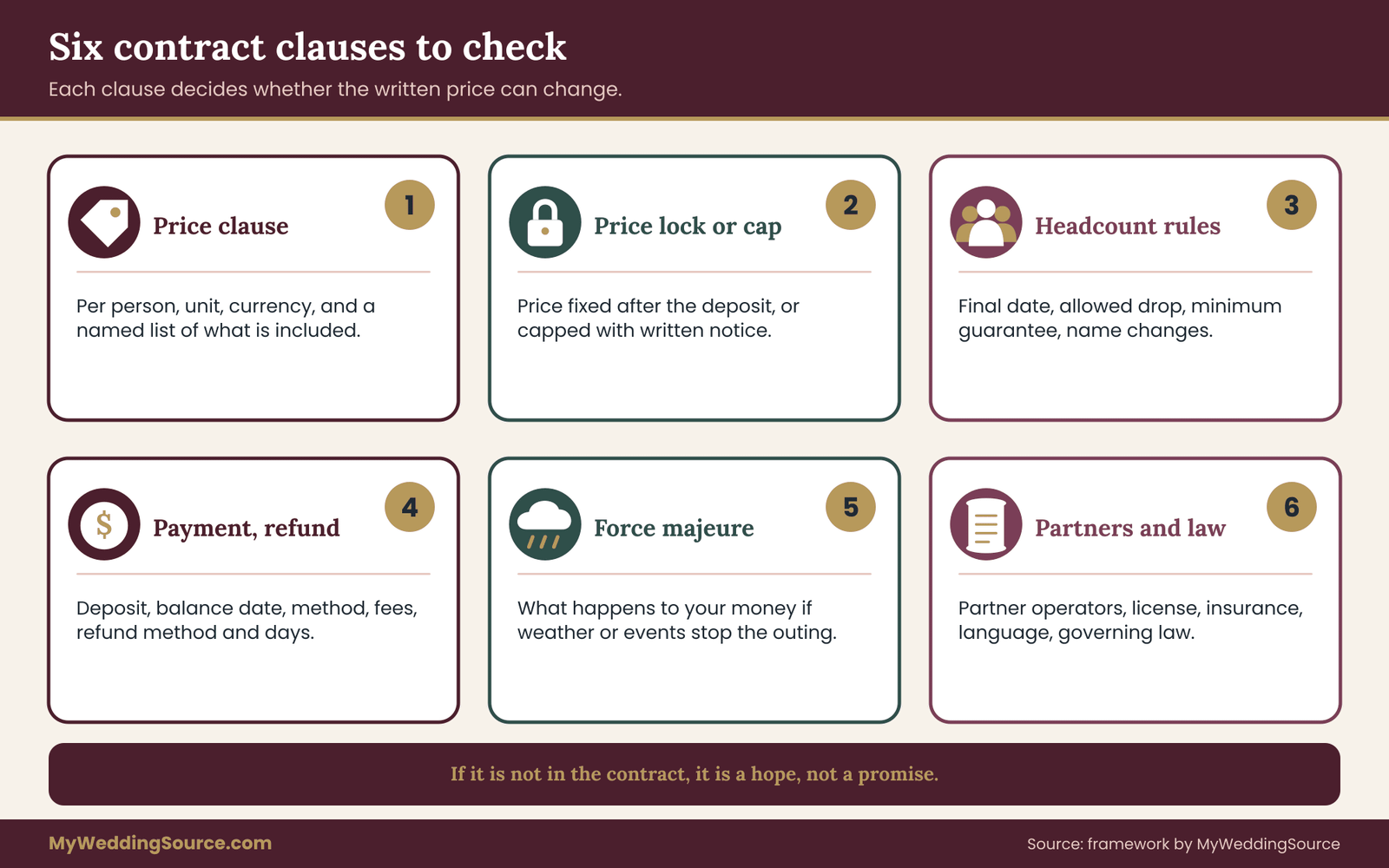
The language, law and dispute clause
If the contract is in a language your group does not read well, ask for a translation of the key clauses, or at least of the price, payment, cancellation and refund sections. Note which country’s law governs and where disputes are heard. You are unlikely to dispute an outing in a foreign court, but the clause tells you how practical it would be, and it shapes how seriously you weigh the cancellation ladder.
Due diligence before you sign: checking the operator behind the quote
Even a clear contract is only useful if the business behind it exists and performs. A short due diligence pass takes less than an hour per operator and prevents a different kind of surprise. A reputable operator makes excursion fees easier to predict, not harder.
Check that the operator has a verifiable business address and a working phone number, not only a social media page. Look for a license or registration where the destination requires one for tours, boat charters or guiding. Search for the operator’s name together with words like complaint or refund, and read what comes up with caution, since single reviews can be unfair in either direction. Ask for two references from groups of similar size.
For payment safety, be careful with operators that request unusual payment methods, such as payment only by gift cards, cryptocurrency or wire to an individual’s account. The Federal Trade Commission publishes consumer guidance on common payment scams and on what to do if you paid someone who was not legitimate. If the operator cannot accept a payment method that provides some dispute rights, factor that into your risk.
The site’s vendor due diligence checklist gives a broader process, and the excursion version only adds destination-specific points: the operator’s local license, the vehicle or vessel’s safety equipment, the guide’s qualifications and the emergency plan for a medical issue far from town. Ask the operator to describe the emergency plan in a sentence or two. A calm, specific answer is a good sign. A vague one is information.
Questions to ask every operator, with plain scripts
Questions work best when they are few, specific and sent in writing. Here are twelve, grouped by purpose, each with a short script. Copy what helps and drop the rest. The scripts below target the questions that expose excursion fees fastest.
About the price
“Is your quoted price per person, per vehicle or per group, and how many people does the unit hold?” Then: “Please list every tax, service charge, fuel or environmental surcharge, entry fee and gratuity that applies, or confirm that none apply beyond the quoted price.” And: “Can you confirm the all-in price per adult in writing, in this currency?”
About group pricing
“What are your group tiers and the exact boundaries? On what date is the tier locked?” Then: “Is there a minimum number of guests or a minimum spend, and do we pay if the group falls below it?” And: “What is the final headcount date, how much can the group shrink without penalty, and can names be substituted?”
About cancellation
“What is the refund at each date before the outing?” Then: “What happens if you cancel, for weather or any other reason? Is it a refund, a credit or a reschedule, and how many days to pay?” And: “Is the deposit refundable, in whole or in part?”
About payment
“Which payment methods do you accept, and does any carry a fee?” Then: “Is the price fixed in this currency after the deposit, and if we pay in another currency, which exchange rate do you use?”
How to read the replies
Treat a prompt, specific answer as a good sign, and a vague or partial answer as a reason to ask again. If an operator answers two questions out of twelve, the next email should repeat the other ten, not move on to a discussion of price. Keep every reply in one folder. Contracts, replies and receipts in one place are easy to find when a refund or dispute comes up.
Collecting money from guests without absorbing excursion fees
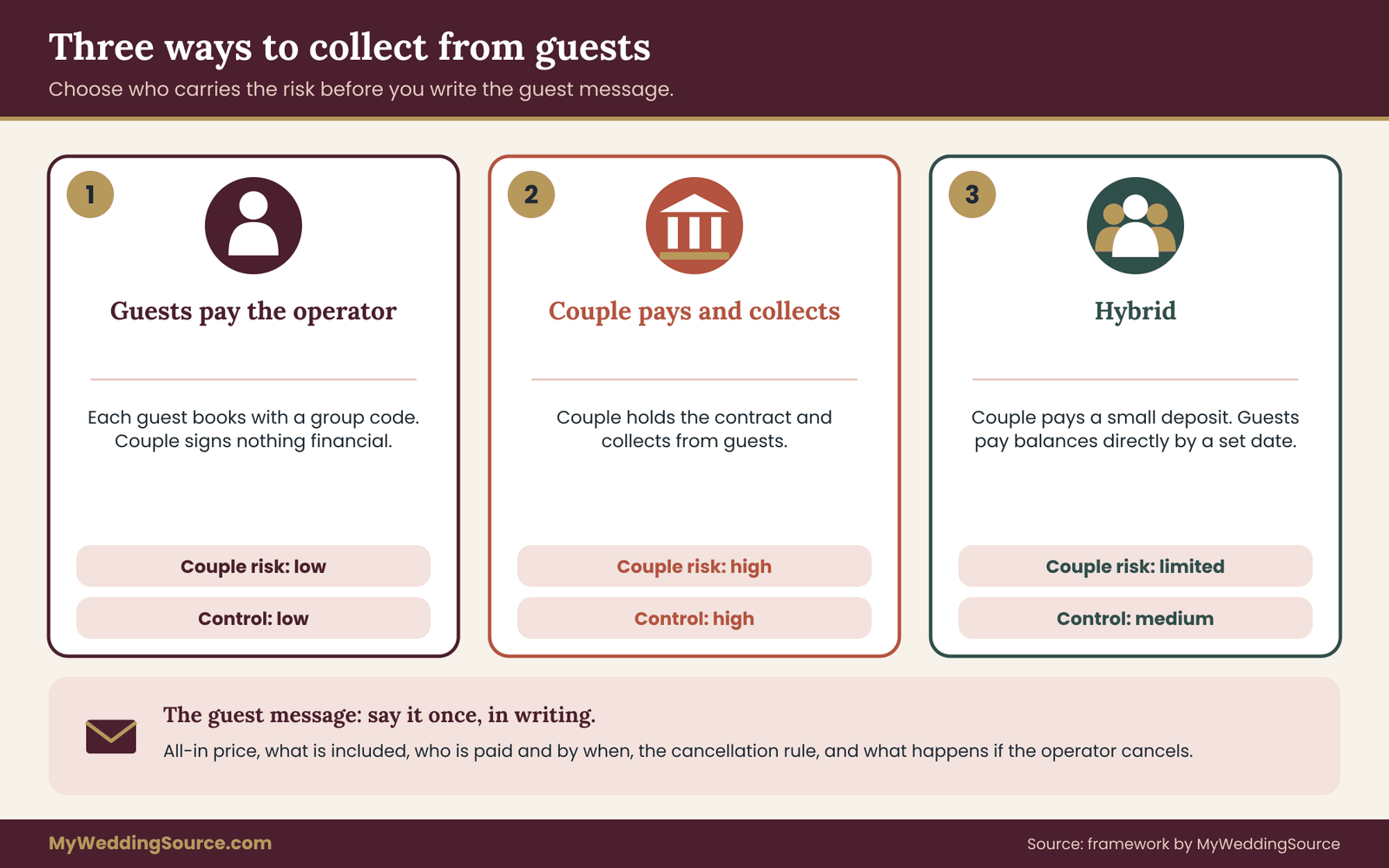
Who pays whom is the part of excursion fees that most affects friendships. There are three common models, and each moves risk to a different person. Choose the model first, then write the guest message, then sign. The payment model decides who carries excursion fees when plans change.
Model one: guests pay the operator directly
Each guest books and pays the operator, using a group code or link. The couple signs nothing financial. The operator carries the collection risk, and the couple carries almost none. The ladder applies to each guest individually, so a cancellation is between the guest and the operator.
The cost is control. The couple cannot guarantee the price, the headcount or the experience, because they do not hold the contract. Some operators will not accept individual bookings at group rates. Others will, if the couple confirms the group in advance. This model suits optional outings where the couple wants to offer without committing money. Direct payment keeps excursion fees off the couple’s books, and it also means the couple cannot guarantee them.
Model two: the couple pays and guests reimburse
The couple signs, pays the deposit and balance, and collects from guests. This gives the couple control of the contract and the price, and it makes them the bank. If a guest does not pay, the couple absorbs the shortfall. If the headcount drops after the free window, the couple owes the operator.
This model works when the couple can afford the downside and when the group is close and the headcount is firm. If you choose it, collect money well before the operator’s balance date, and use a payment method with a clear record. The same reserve-timing logic you use for other vendor payments applies to money that guests will repay. Do not spend collected funds before the operator’s deadline for refunds has passed.
Model three: a hybrid
The couple signs and pays only a small deposit, and guests pay the balance directly to the operator by a set date, with a final headcount date that matches the operator’s. The couple’s risk is limited to the deposit, and guests still get a group rate. This model asks the operator to accept split payment, which many do for groups.
A good hybrid contract says clearly that guest balances are due by a given date, that the operator will confirm each guest’s payment to the couple, and that the operator will release any unclaimed spots by a given date. That last point protects the couple from paying for empty seats.
Writing the guest message
The guest message should do four things in plain words. State the all-in price per adult and what it includes. State the payment method, the due date and who receives the money. State the cancellation rule that applies to the guest. State what happens if the outing is cancelled by the operator or by weather. One clear message about excursion fees saves many private questions later.
A short version might read: “The sunset boat outing is optional. The all-in price is X per adult, which includes tax, service, transfers and lunch. Drinks are extra. Please pay the operator by this date using the link below. If you cancel after this date, the operator may not refund your payment unless someone takes your place. If the operator cancels, you will receive a refund.” Sending this once, clearly, prevents most of the confusion that follows.
Children, plus-ones and non-participants
Specify the price for children by age band, in the operator’s terms, not yours. An operator may define child pricing by age, height or seat. A guest who brings a plus-one should be told the plus-one’s price in the same message. And guests who choose not to join should hear that clearly, with no suggestion that the outing subsidizes someone else. Good guest care means keeping optional events from becoming obligations, and money wording is part of that.
Payment methods, currency and protection for excursion fees
How the money moves changes what protection you have if something goes wrong. This section explains the main options without pretending the rules are identical everywhere. Payment method decides how much protection you have if excursion fees turn out higher than quoted.
Credit cards and billing disputes
Paying by credit card generally gives a payer more dispute rights than paying by cash, bank transfer or a peer-to-peer app. In the United States, the Consumer Financial Protection Bureau explains how to dispute a charge on a credit card bill, including that a billing error generally needs to be reported in writing within sixty days of the statement that shows it.
Rules differ by country and card. A dispute is not a substitute for a good contract, and it usually works better when you can show the promise the operator made and the service that was not delivered. That is one more reason to keep the written price confirmation.
Bank transfers and cash
Many local operators prefer bank transfer or cash because card fees cut into their margins. That is a reasonable preference, and it moves risk to you. A bank transfer can be hard to reverse. Cash on the day leaves no record unless you get a receipt. If an operator asks for a transfer, ask for an invoice with their business name and the account in the same name, and confirm the account details by a second channel, such as a phone call to a number from their official website, to guard against payment scams.
Ask whether transfer or cash changes the price, since that can add to excursion fees.
Currency and conversion
If the price is in a local currency, a guest paying by card may see a conversion by the card issuer and possibly a foreign transaction fee. If a terminal offers to charge in the guest’s home currency, the rate used may differ from the issuer’s rate. The safe approach is to state the currency in the contract, to let guests know that conversion costs may apply, and to avoid promising a fixed amount in a different currency unless the operator states it.
Some couples choose to quote guests a price in dollars with a small buffer for conversion. If you do that, say how the buffer is handled. A buffer that is quietly kept is a fee. A buffer that is refunded if unused is a deposit. Name it as the second.
Fees for paying by card
Some operators add a surcharge when a guest pays by card. Whether this is allowed depends on the place and the card network. Ask whether a surcharge applies, and add it to the all-in price if it does. A single-line answer in writing is enough.
Keeping a payment record
Keep, for every excursion, the written price confirmation, the contract, each payment and receipt, and the final invoice. When a guest says “I already paid,” a record ends the conversation in a minute. When an operator claims a balance is due, the record settles it. This does not need software, only a shared folder and a naming habit, such as the operator, the date and the type of document. These records are the proof behind any complaint about excursion fees.
Edge cases that change the math
Real groups are messy, and a few situations deserve a short rule each. Each case below can add excursion fees if nobody plans for it.
A guest arrives late or leaves early. If a guest cannot make the outing because of flight timing, treat it as a cancellation under the ladder. Offer name substitution if the contract allows it. Do not promise a refund the contract does not provide.
A guest has mobility needs. Some outings cannot accommodate them safely. Ask the operator in writing what access is available before the guest pays, and offer an alternative activity at a comparable price. This is a fairness point as much as a safety point, and it avoids a guest paying for something they cannot do.
Dietary restrictions. Ask whether alternatives are included in the price or billed separately, and whether the operator can handle allergies safely. If not, tell guests plainly before they pay.
The operator raises the price after the deposit. Point to the price-lock clause. If there is none, ask for the increase in writing with the reason, and ask whether a guest can cancel without penalty. A price change that arrives after guests have paid is a change in the deal, and a fair operator will discuss a cap or a split. Late increases are the clearest example of excursion fees that a price-lock clause would have prevented.
The group is much smaller than planned. Consider asking the operator to move you to a shared tour, a smaller vehicle or a shorter program. Many operators prefer a changed booking to a cancelled one, and the conversation is easier before the final headcount date than after.
The wedding date moves. Ask each operator for their date-change terms. A change of date may be treated as a cancellation, or as a free change if made early. This is a good reason to hold off on large deposits until the wedding date is firm, and to prefer operators who offer flexible date changes in writing.
Something goes wrong on the day. Document it calmly, with photos, times and names, and write to the operator within a day or two, stating what was promised and what happened. Do not argue on the dock. Keep the tone factual, since a factual record supports a refund request, a card dispute or a review.
Common mistakes that create surprise excursion fees
Most surprise charges come from a short list of avoidable habits. Each of the following is common, easy to understand and easy to fix. Almost every case of unexpected excursion fees traces back to one of these habits.
Comparing headline prices. The first number is rarely the last. Fix: use the sheet, and compare all-in prices only.
Accepting a verbal quote. A phone call is a pleasant way to start and a poor way to finish. Fix: send a short email after every call summarizing what was said, and ask the operator to confirm it.
Ignoring the unit. Per person, per boat and per vehicle are not interchangeable. Fix: write the unit next to every price, and divide by the realistic number of people.
Trusting “included.” Included in what, and for whom? Fix: ask for a list of what is included, and what is not, in plain words.
Locking in too early. A large deposit months before the headcount is known puts money at risk for no reason. Fix: negotiate a small deposit and a later balance, and keep the free-change window as long as you can.
Letting the headcount drift. A group that does not update its numbers drifts into a worse tier or an attrition penalty. Fix: put the lock date and the final headcount date on your calendar, and send guests one reminder a week before each.
Skipping the guest message. A price announced casually in a group chat gets remembered differently by everyone. Fix: send one written message with price, inclusions, deadline, payment method and cancellation rule, and pin it.
Treating optional as free of risk. An optional outing for which the couple signs a minimum guarantee is not optional for the couple. Fix: avoid guarantees you cannot afford, or collect payment before you commit.
Assuming insurance covers it. Coverage differs by policy and reason. Fix: tell guests to read their own policies, and do not claim coverage you have not read.
Forgetting the paper trail. When a refund is late or a balance is disputed, a missing record weakens your case. Fix: keep every confirmation, contract and receipt in one folder, named in a consistent way.
Measurable checks before you sign
A calm decision benefits from a short checklist you can answer yes or no. If any answer is no, either fix it or make a note of the risk and decide on purpose. Every item below is about whether excursion fees are known before you commit.
Price checks
Have you written the all-in price per adult from confirmed lines only, and has the operator confirmed it by email? Is the unit stated and divided correctly for your headcount? Is the currency stated, and do you know how guests will pay it? Is the gap between the confirmed and the worst-case price small enough that you could announce one number to guests?
Group checks
Do you know the tier boundaries, the lock date, the minimum and any minimum guarantee? Is the final headcount date on your calendar, with a reminder? Can names be substituted, and until when? Is your expected headcount at least one tier-width away from a boundary, or have you accepted the risk of a cliff?
Cancellation checks
Have you written each rung of the ladder as a calendar date? Do you know what the operator does if it cancels, including the refund method and the number of days? Is the weather clause specific about who decides and what each guest receives? Do you know how a guest cancellation affects the couple?
Contract and payment checks
Does the contract repeat the written price and include a price-lock or cap? Is the refund method and deadline written? Is the payment method one you are comfortable with, and have you confirmed account details by a second channel if you are paying by transfer? Have you checked official travel information for the destination close to the date?
The tolerance rule
Set a tolerance before you start, such as the largest all-in price per guest that you would announce without feeling uneasy, and the largest amount the couple would absorb if the group shrinks. Write both numbers down. When a quote arrives, the decision is mostly arithmetic: does the worst-case price fit under the first number, and does the worst-case loss fit under the second?
Setting these limits before negotiating protects you from the pressure of a friendly operator and a closing date. Decide what level of excursion fees you can live with before you see a single quote.
For the money you are willing to commit overall, the wedding budget planning page helps you decide how much of the budget belongs to optional guest experiences, which is a different decision from how much the couple is willing to risk on one booking.
A short framework to keep: the five-day review
If you want one repeatable process for any outing, use a five-day review spread over a week of evenings.
Day one: request. Send the same written request to each operator, asking for the all-in price per adult, group rules and cancellation terms.
Day two: sheet. Fill in one comparison sheet per operator as replies arrive. Mark every line confirmed, mentioned or unknown.
Day three: gaps. Send one follow-up email per operator, listing only the unknown lines and the contract clauses you need.
Day four: compare. Compare the confirmed totals, the uncertainty gaps, the group rules and the ladders, in that order. Choose, or choose to ask for more.
Day five: paper and message. Read the contract against the sheet. Check payment details. Send the guest message. Put every date on the calendar.
The review does not remove all risk. Weather happens, people get sick, flights are missed. What it removes is the category of risk that comes from not asking, which is where most surprise excursion fees come from.
Your next steps
Start with one outing, not all of them. Pick the activity with the most guests interested, and send the written price request to two or three operators this week. Build one sheet per reply, and note what is unknown. Send the follow-up email for the gaps. Set your tolerance numbers before you read the second round of replies. Starting small makes it easy to see where excursion fees hide in your own quotes.
When you have chosen, read the contract against the sheet, check the price-lock and refund clauses, and decide which payment model fits your group. Write the guest message, send it once, and put each deadline on a shared calendar. Keep every confirmation, receipt and reply in a single folder. If you repeat the process for later outings, it takes less time each round, because the sheet stays the same.
FAQ
What are excursion fees at a destination wedding?
Excursion fees are all the amounts attached to a group activity beyond the venue and lodging: the base price, taxes, service charges, fuel or entry fees, transport, payment costs and any cost of cancelling or changing. The quoted price is often only the first layer, so ask for an all-in price per person in writing.
How do I ask an operator for an all-in price?
Send a short written request asking for the price per adult, including taxes, service charge, gratuity, surcharges, entry fees, transport and payment costs, in a stated currency. Ask for the group rules and cancellation terms in the same message. Then ask the operator to confirm the total by email so you have a document to compare.
Should the couple or the guests pay the operator?
It depends on risk. If guests pay the operator directly, the couple carries little financial risk but has less control over price and headcount. If the couple pays and collects, they control the contract and carry shortfalls. A hybrid, with a small couple deposit and guest balances paid directly, often balances both.
What is a group minimum or minimum guarantee?
A minimum is the smallest group or spend the operator needs to run the outing. A minimum guarantee goes further: you pay for that number even if fewer guests attend. Read for this wording carefully, because it turns an optional outing into a financial commitment for the couple.
What should a cancellation policy say?
It should give dates and amounts for each step: free change, partial refund and no refund. It should say what happens if the operator cancels or the weather stops the outing, how the refund is paid and how many days it takes. Convert those dates into your own calendar with reminders.
Does travel insurance cover excursion cancellations?
Sometimes, but coverage depends on the policy, the reason for cancelling and its exclusions. Each guest holds their own policy, so a couple cannot cover everyone. Encourage guests to read their own terms, and do not describe coverage you have not read. State insurance regulators publish consumer information on travel insurance.
Is a credit card safer than a bank transfer for an excursion?
A credit card generally gives more dispute rights than a transfer, cash or a peer-to-peer app, although rules differ by country and card issuer. In the United States, the CFPB explains how billing disputes work. Whatever you use, keep the written price, the contract and your receipts.
What if the operator raises the price after the deposit?
Check the contract for a price-lock or cap. If there is none, ask for the increase in writing with the reason, and ask whether guests can cancel without penalty. Offer to discuss a split or a smaller scope. Keep the exchange in writing, and avoid announcing the new price to guests until it is confirmed.
Sources
- Travel advisories, U.S. Department of State
- Smart Traveler Enrollment Program, U.S. Department of State
- Travelers’ Health, Centers for Disease Control and Prevention
- How do I dispute a charge on my credit card bill?, Consumer Financial Protection Bureau
- Consumer advice, Federal Trade Commission
- Business guidance, Federal Trade Commission
- Aviation consumer protection, U.S. Department of Transportation
- Consumer protection and complaints, USAGov
- Consumer information on insurance, National Association of Insurance Commissioners
- Travel, U.S. Department of State