
Destination wedding excursions are the optional tours, outings and shared activities a couple offers guests around a wedding abroad or far from home. This guide gives you a free-time framework and an opt-in schedule, so guests can say yes to what they want, skip the rest, and still arrive at the ceremony rested and glad they came.
Sort every plan into three layers: anchors (the few events everyone attends), offers (destination wedding excursions guests may join) and open time (hours with nothing scheduled at all). Protect open time first, then add offers. Allow one offer per day, keep each under about four hours, keep the wedding day free of outings, and open sign-ups early with a firm confirmation date. Price each offer on its own, say who pays, and write down what happens if weather or a vendor cancels.
Most couples who ask guests to travel feel a mix of gratitude and guilt, and planning destination wedding excursions is where that guilt tends to turn into overbooking. Guests have paid for flights, taken time off and maybe arranged care for children or pets. The couple wants the trip to feel worth it, so they look at the destination and start filling the calendar: a boat day, a food tour, a hike, a spa afternoon, a group dinner every night.
Each idea is reasonable by itself. Together, a full list of destination wedding excursions can leave guests exhausted, short of money and unsure whether skipping something will offend anyone.
Destination wedding excursions work best when they are designed as a menu, not a program, and the wedding etiquette guide explains the courtesy side of what couples may ask of guests. A menu has a few clear choices, honest prices, and no penalty for ordering nothing. A program has a fixed order and assumes everyone follows it.
Guests at a wedding abroad are a mixed group: grandparents next to college friends, a family with a toddler, a coworker traveling alone, someone recovering from surgery. A single schedule rarely fits more than a third of them.
This article is built around a simple structure you can reuse for any destination. It treats destination wedding excursions as one layer of the weekend, not the whole of it. It covers how to measure guest load, how to size each day, how to match offers to different kinds of guests, how to handle money, and when to send each message.
It ends with three invented case examples and a short set of next steps. Everything here is general information, not legal, tax or financial advice, and rules for travel, permits and refunds vary by country, so check current requirements with the agency or supplier that issues them.
If you are still deciding on dates, hotels and the shape of the weekend, the wedding planning checklist on this site covers the broader sequence. The rest of this guide stays on one question: what do guests do with the hours that are not the wedding?
What destination wedding excursions are, and what they are not
An excursion, in this guide, is any activity away from the main venue or hotel that costs time, money or physical effort beyond the core wedding events. A morning snorkel trip is one. So is a guided walk through an old town, a cooking class, a winery visit, a rented-boat afternoon, or a shared taxi to a nearby beach. A hotel pool day is not, because it needs no booking and no group.
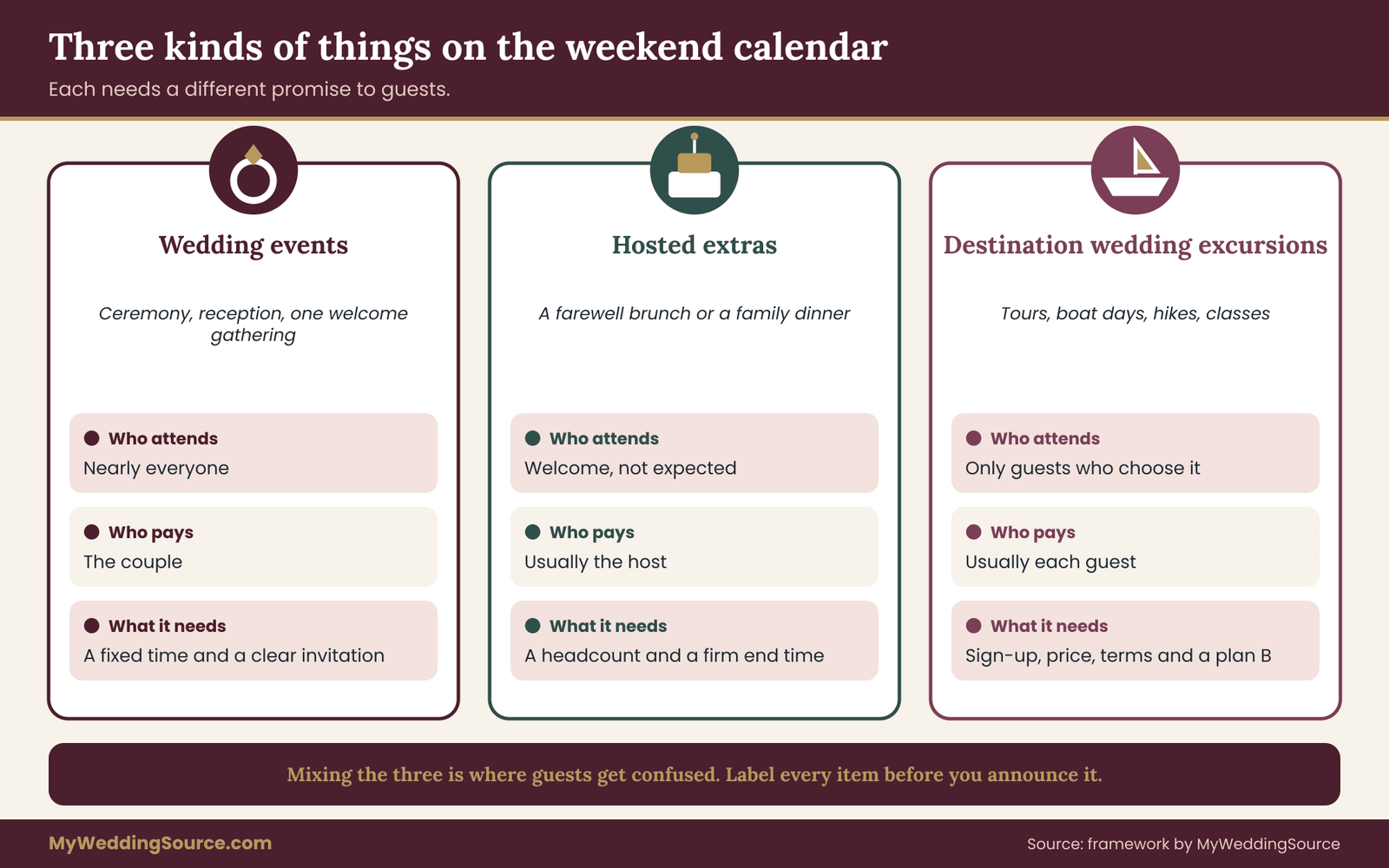
It helps to separate three things that often get blended together. The first is the wedding itself, which sits outside destination wedding excursions: the ceremony, the reception and any events the couple treats as required, such as a welcome gathering. The second is hosted extras, where the couple or their families organize something and invite everyone, such as a farewell brunch. The third is destination wedding excursions proper: things guests may choose, often paid for individually, often run by a local company rather than by the couple.
This distinction decides almost everything that follows about destination wedding excursions. A required event needs a firm time and a clear invitation, and the couple usually pays for it. A hosted extra needs a headcount and a polite way to say that attendance is welcome but not expected. A true excursion needs a sign-up system, a price, terms, and a plan for the guests who say no. Mixing the categories is where guests get confused, and confusion is where resentment starts.
Another thing excursions are not is a test of enthusiasm. Guests who skip the boat day have not decided they care less about the couple. They may get seasick, have a bad knee, be saving money for the flight home, be traveling with a baby who naps at noon, or simply want to read a book. A well-designed set of destination wedding excursions makes skipping unremarkable. Nobody should have to explain.
Why destination wedding excursions overload guests
Overload from destination wedding excursions rarely comes from one big mistake. It comes from small additions that nobody counted. A welcome drinks hour, a rehearsal dinner for a subset, a group tour, a ceremony, a reception, a farewell brunch: each is only a few hours. Added up over three days, with transfers between them, there may be no stretch longer than an hour in which a guest can shower, rest, eat on their own schedule or call home.
There are four kinds of load, and a schedule can fail on any of them. Time load is the number of scheduled hours. Energy load is how physically or socially demanding those hours are: a quiet museum walk and a six-hour sailing day are not the same. Money load is what each activity costs on top of flights, lodging and gifts. Decision load is the effort of figuring out what is expected, what is optional, who is going, and what happens if you change your mind.
Couples tend to notice time load and ignore the other three, and destination wedding excursions are where the other three hide. A tour that lasts two hours but starts with a ninety-minute drive, requires closed shoes and a swimsuit, costs a meaningful sum per person and has a prepayment deadline is a heavy item, even though the calendar entry looks short. Counting all four kinds of load for each of your destination wedding excursions is the habit this guide tries to build.
Jet lag and travel fatigue add to all of it. Guests arriving from other time zones may be awake at odd hours, hungry at the wrong times and slow on the first day. Heat, altitude, unfamiliar food and noisy rooms all take a toll. For a general overview of health preparation, the Centers for Disease Control and Prevention publishes destination-specific traveler guidance, and guests who have medical conditions should read it early and talk to their own clinician.
A couple does not need to give medical advice. They only need to avoid scheduling in a way that punishes anyone who needs rest.
The guest-experience problem hiding behind the schedule
A schedule is a promise about how time will feel. When guests receive an itinerary with something planned at every hour, many read it as an expectation, even if the cover note says “optional.” People take cues from structure. If the table of events looks like a conference agenda, guests behave as though attendance is tracked.
The reverse also matters. A weekend with no information at all leaves guests guessing. They may arrive without knowing whether there is a welcome event, whether they should book a hotel pool cabana, or whether the couple will be reachable on the day before the wedding. The aim is a middle path: a short, clear list of fixed events, a short menu of destination wedding excursions with plain terms, and an open statement that everything else is free time.
Think about who is quietly absorbing the cost of an overloaded schedule. Often it is the guests with the least slack: parents of young children, people who paid for flights out of savings, relatives who need extra time to move, and guests who are anxious in groups. These are not people who will complain. They will go along, feel strained, and say little. Designing for them makes the trip better for everyone else too, because relaxed guests are better company.
Finally, consider the couple’s own load. Hosting five group activities means being present, tracking headcounts, answering questions and settling problems, all in the days when they most want to be calm. Every one of your destination wedding excursions also becomes a job for someone. Deciding in advance who owns each job is part of the framework, and a later section covers it.
A quick test before adding any excursion
Before an idea goes on the list, run it through six plain questions. Who is it for, and who will it exclude by cost, fitness, age or schedule? How many hours does it take door to door, including transfers and waiting? What does it cost per person, and who pays? What happens if it rains, if a boat is cancelled or if the operator closes? Who runs it on the day, and can they be reached? And what will guests who skip it be doing?
If you cannot answer all six in two sentences each, the idea is not ready, and destination wedding excursions that cannot pass this test belong on a waiting list. That is not a reason to drop it, only to hold it back until you have talked to the supplier. Many couples find that half their ideas shrink into smaller, cleaner options once they see how many answers are missing.
The last question matters most. An excursion that leaves the skippers with nothing to do, no meal plan, no ride and no company, is not truly optional. A morning tour should come with a note about where non-participants can have breakfast and who else is staying behind. When the answer is “they sit in the hotel lobby,” the offer is a quiet obligation.
For the larger question of who has a say in these choices, especially when families have strong views, the section on shared decisions later in this guide shows how to share input without losing control of the plan.
The free-time framework for destination wedding excursions
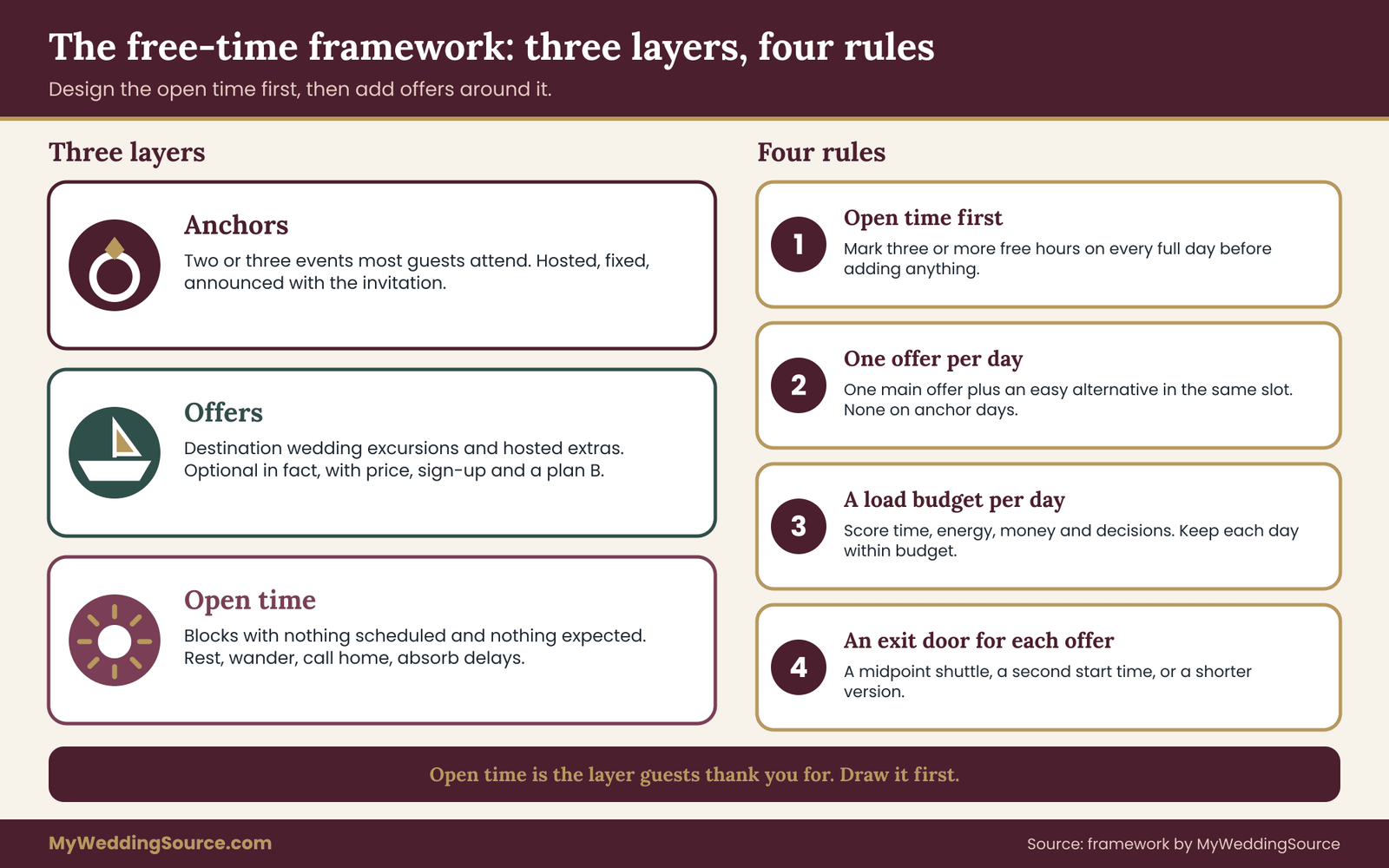
The framework has three layers and four rules, and it keeps destination wedding excursions in proportion. The layers describe what kind of thing is on the calendar. The rules describe how much of each layer a stay can hold. It works for a two-night weekend in a nearby state and for a week on another continent, because it scales by days, not by destinations.
The first layer is anchors, which sit apart from destination wedding excursions. An anchor is an event the couple genuinely needs most guests to attend: the ceremony, the reception, and often one gathering before it so people meet. Anchors are few, fixed in time, hosted and paid for by the couple, and announced with the invitation. A three-day stay might have two or three. More than that and the stay starts to feel like a conference.
The second layer is offers. These are the destination wedding excursions and hosted extras guests may join. Offers, which include every one of the destination wedding excursions, are optional in fact, not just in wording. They have a price or a stated cost-sharing rule, a sign-up step, a minimum and maximum group size, and a cancellation rule. Each offer gets a one-line description in plain language: what it is, how long it takes, how hard it is, what it costs.
The third layer is open time. Open time is a block with nothing scheduled, nothing expected and nothing to apologize for. It is the layer most couples forget to design, and it is the one guests thank them for later. Open time lets people sleep, wander, spend an afternoon with a cousin they rarely see, find their own lunch, or take a phone call. It also absorbs delays, because an anchor that runs late does not collide with an offer.
The four rules
Rule one: open time first. Draw the open blocks before adding offers. For each full day, mark at least one block of three or more consecutive hours as open, and mark the late evening before any early start as open as well. If an offer does not fit around the open blocks, it moves or it goes.
Rule two: one offer per day. Guests can choose, but they should not have to choose between two things in the same slot, and they should not feel they are missing a second one in the afternoon. One main offer per full day, with a short, easy option beside it if you like, keeps the choice clean. Two destination wedding excursions in one day is the pattern that most often leaves guests flat. On a day with an anchor, the limit drops to zero or to a very short item.
Rule three: a load budget per day. Give each offer a score, add the scores, and keep the total within a budget. The next part explains the scoring. The budget is a planning aid, not a measurement, and you can adjust the numbers to fit your guests. Its main value is that it forces you to count transfers, gear and money, not just the time on the program, which is the honest way to compare destination wedding excursions.
Rule four: an exit door for every offer. Wherever possible, build in a way to leave early or join late: a return shuttle at the midpoint, a second meeting time, or a shorter version of the same activity. Guests who tire quickly or have a change of plans should not be trapped on a boat or a bus for another three hours.
Scoring the load of one of your destination wedding excursions
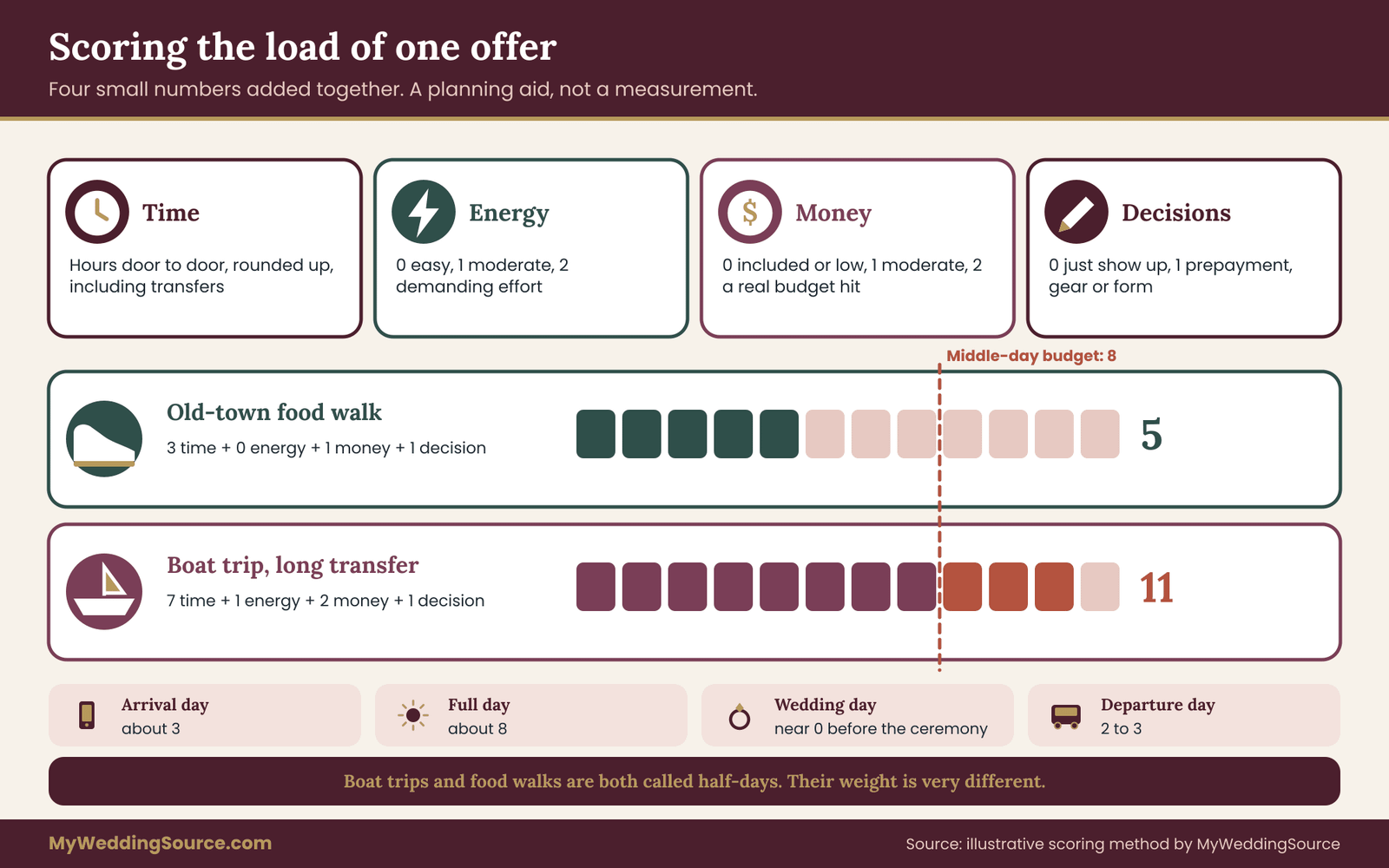
The scoring uses four small numbers. Time points equal the hours from leaving the hotel to being back, rounded up, including transfers and waiting. Energy points run from zero for seated or easy walking, to one for moderate effort such as a long walk or a swim, to two for demanding effort such as a steep hike, a long sailing day or a day with heat and little shade.
Money points run from zero for included or low cost, to one for a moderate sum, to two for a sum many guests would notice in their budget. Decision points are zero if there is nothing to do except show up, and one if the offer needs a prepayment, a waiver, special gear or a medical or dietary check.
Take a food walk in an old town, one of the simplest destination wedding excursions to score. Two hours on site and thirty minutes of walking each way gives three time points. Easy walking on flat ground is zero energy, a modest price is one money point, and a prepayment with a dietary form is one decision point. The total is five. A boat trip with a ninety-minute transfer each way and four hours on the water carries seven time points, one for energy in calm water, two for money and one for the prepaid waiver, which makes eleven.
The exercise shows that two outings both called a half-day can carry very different weight, and that the boat trip needs shortening or a closer departure point before it can fit.
Now set a budget for each kind of day. On an arrival day, guests have already spent energy on travel, so a budget of about three points leaves room for one gentle thing, such as a short walk or a drink at the hotel. On a middle day with no anchor, a budget of about eight points allows one medium offer.
On the wedding day, the budget before the ceremony is close to zero for guests, and after the ceremony the anchors take over. On departure day, flights and checkout matter, so a budget of two or three, mostly a late brunch, is generous.
Treat the numbers as a conversation starter, not a rule of nature. If your guests are mostly in their twenties and love long active days, the middle-day budget can rise. If many are older or traveling with infants, it should fall. What matters is using one scale across all offers, so that a “light” outing and a “heavy” one are visibly different on paper before they are different in the heat. Used this way, scoring makes destination wedding excursions comparable.
How the layers fit together on a three-day stay
Imagine a stay with Friday arrival, Saturday wedding and Sunday departure. Friday has a short welcome gathering, which is an anchor, kept to two hours in the evening. Saturday morning is open. The ceremony and reception are the anchors. Sunday has a late brunch as a hosted extra, with a firm end time so people can reach airports.
Where do destination wedding excursions fit? Friday daytime might hold a short, easy offer for early arrivals, with the open evening before. Saturday holds none before the ceremony. Sunday holds none that conflicts with the flights.
That leaves the stay with almost no destination wedding excursions, and that is sometimes the right answer. A two-night wedding is rarely the time for a full tour program. Couples who want guests to experience the place can instead extend the stay on either side: a day or two before the wedding, or a day or two after, treated as a separate and clearly optional window. Guests who can take more time off join the extended stay. Guests who cannot arrive for the anchors and leave without guilt.
On a five-day stay, the layers have room to breathe, and destination wedding excursions can take a modest share. Two or three days can each hold one offer, with open time on the others. Even then, resist filling every available day. A pattern that works for many groups is one offer on the first full day, nothing on the wedding day, one on the day after, and then open time. The rhythm gives guests a reason to explore without turning the week into a tour.
For help with hotels, the section on room mix and mobility in the guide to coordinating wedding guest hotels is worth reading beside this one, because where guests sleep changes how far every offer really is.
What the framework changes in practice
Using the layers changes the way you talk about the weekend and about destination wedding excursions. Instead of “here is the itinerary,” you can say “here are the three things we hope everyone joins, here are the options if you want company, and here is the time that is yours.” That sentence is honest about what the couple cares about, and it removes the guesswork about whether the boat day is a test. Guests quickly learn what is truly expected.
It also changes how you evaluate destination wedding excursions. A friend suggests a sunset catamaran. Under the framework, the questions are practical: which day does it fit, what is its load score, who runs it, what is the exit door, what do the skippers do? If it fits and scores low enough, it joins the menu. If it needs a full evening that is currently open, it competes with open time, and open time wins unless there is a strong reason.
Finally, the framework gives you a way to say no kindly to relatives and friends who want to add events. A cousin offers to organize a late-night bar crawl. Rather than refuse, you can point to the structure: the stay has a fixed number of hosted items, and guests are welcome to organize their own meetups in the open time without it being part of the official menu.
That keeps the official schedule clean and still lets people spend time together. Destination wedding excursions stay on the official menu only when they pass the same tests.
How many destination wedding excursions fit in one day
The right number of destination wedding excursions in a day is usually one, and on some days it is none. The reason is not that guests lack stamina. It is that a day has fixed costs: meals, showers, transfers, rest, and the social effort of being with a large group. Once those are subtracted, a typical day holds a single block of about four hours that guests can give to a group activity without feeling squeezed.
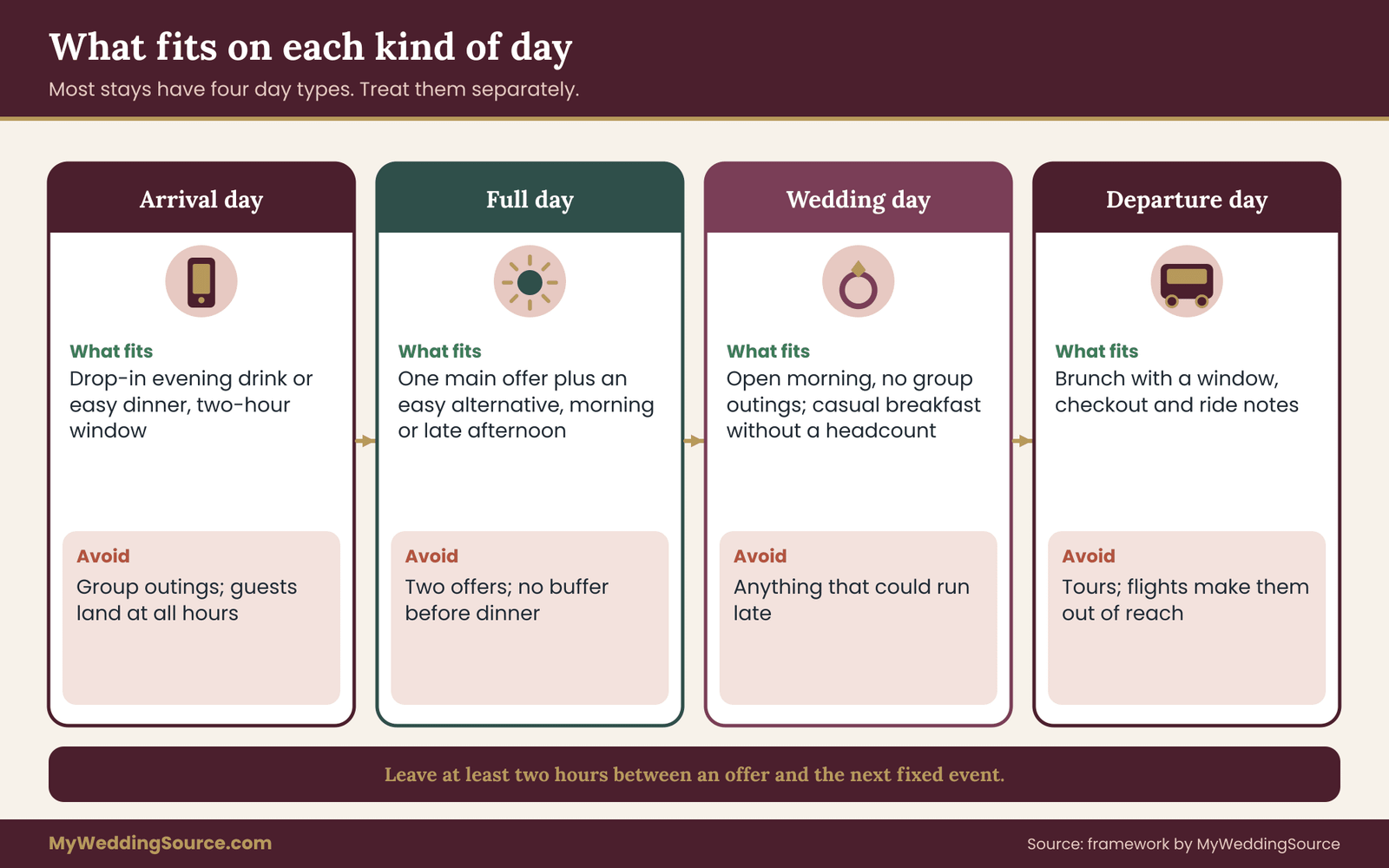
Start by laying out the day types, because destination wedding excursions fit differently into each. Most stays have four: arrival day, full days without an anchor, the wedding day, and departure day. Each has a different job, and treating them separately avoids the mistake of applying one pattern to all.
Arrival day
Guests arrive on different flights over many hours. Some check in at noon, some after midnight. Because nobody arrives together, a group outing on arrival day, which includes any of the destination wedding excursions, rarely works, and anything scheduled early will exclude the people who most need to join in a welcome. The better design is a loose, drop-in element in the evening: a hosted drink or an easy dinner with a two-hour window, where people can come when they land and leave when they tire.
If some guests arrive early and want something to do, point them to a self-guided option rather than a hosted one. A short list of nearby cafes, a safe walking route, a market, and a note about pharmacies and ATMs is more useful than a tour. This list costs the couple nothing and spares them from managing a half-full group at midday. It also fits inside the arrival-day budget of a few load points.
Full days without an anchor
These are the days where one of your destination wedding excursions fits. Place it in the morning or in the late afternoon, not in both, and choose the time with the climate in mind. In hot places, the cool morning hours are best for anything outdoors, which means an early start, which means open time the night before. In places with strong afternoon storms, a morning start leaves the afternoon as a built-in weather backup.
Between the offer and the next fixed event, leave at least two hours. That buffer absorbs late buses, slow lunches and the simple need to shower and change. If an offer finishes at three in the afternoon and a group dinner starts at four, guests will arrive tired and rushed. Moving the dinner to half past six, or dropping it, changes the evening completely.
One of the destination wedding excursions per day does not mean one choice for everyone. A useful pattern is a main offer and a light alternative running in the same window: a half-day coastal hike beside a short seated lunch at a nearby viewpoint, or a boat day beside a guided town walk. Guests with different energy can choose without anyone being left out. Keep the alternative genuinely appealing, because an alternative that looks like a consolation prize labels the people who pick it.
The wedding day and the day before
On the wedding day, keep guests’ mornings free of group destination wedding excursions. Even a short outing can run late, and a delayed bus on the morning of the ceremony puts the whole timeline at risk. Couples sometimes offer a casual breakfast or a pool gathering as a soft start. If you do, treat it as an open-time convenience with no schedule and no headcount, not as an event with a start time. Your venue and photographer need the real timeline, and plan the evening itself as its own sequence.
The day before the wedding deserves the same caution, and strenuous destination wedding excursions belong earlier in the stay. A strenuous or sun-heavy outing leaves guests sunburned, tired or unwell on the day that matters. A calm lunch, or open time with the rehearsal or welcome gathering in the evening, is safer. Alcohol-heavy offers belong earlier in the stay if they belong at all, because a hangover on the wedding morning is an avoidable problem.
Departure day
Guests leave on flights at all hours, so a group event the morning after the wedding will lose a large share of the room. A brunch with a stated window, such as ten to noon, lets early departures say goodbye and late ones linger. Do not attach a tour, or any of the destination wedding excursions, to departure day. If a guest has a midday flight and a two-hour airport transfer, a ten o’clock outing is not optional in any real sense. It is simply out of reach.
The best use of departure day is a gentle send-off and a clear checkout and transport note. Say when hotels expect rooms back, where luggage can be stored, and how to book airport rides. These small details do more for the end of the trip than another activity.
Matching destination wedding excursions to different guests
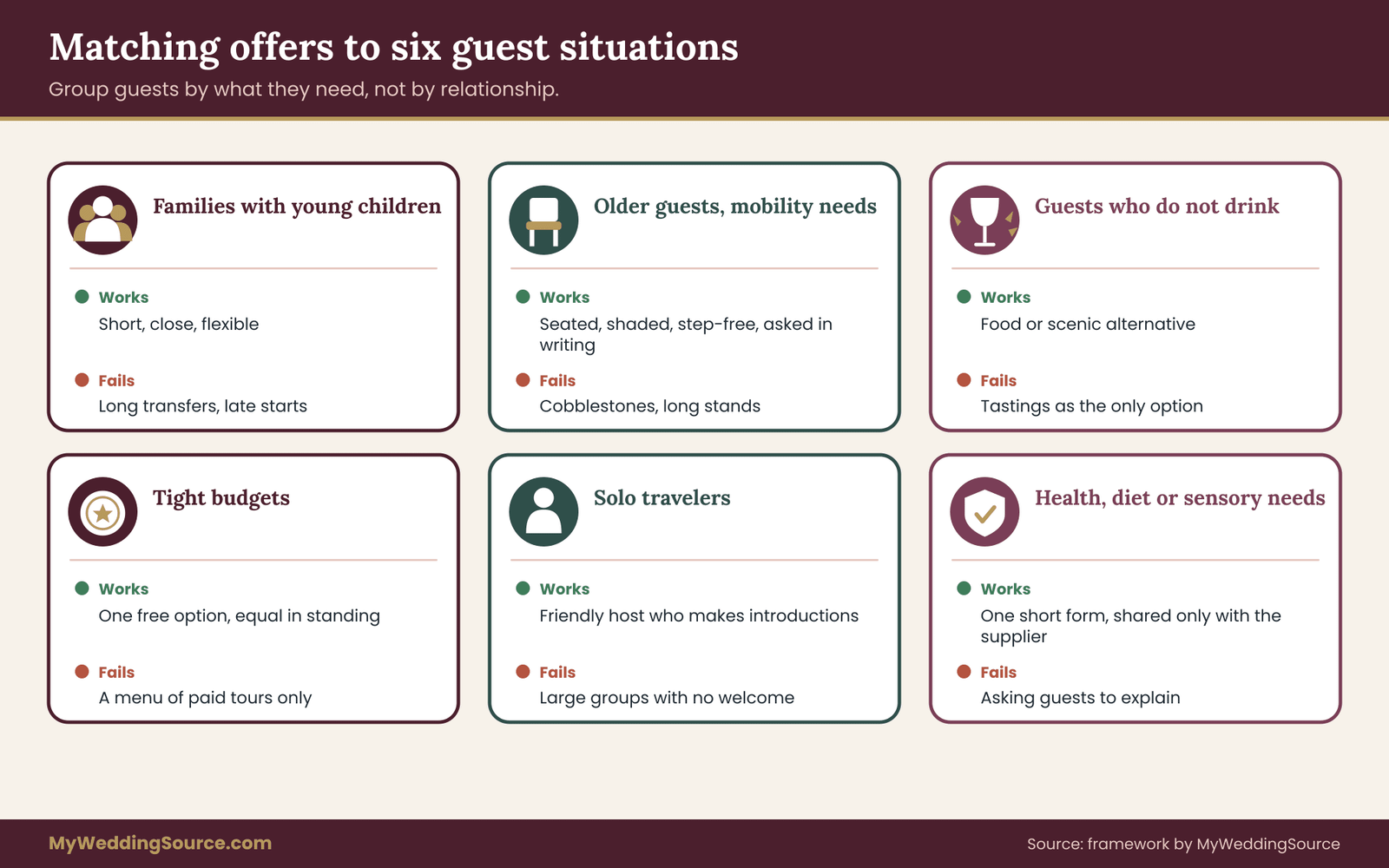
A menu of destination wedding excursions works only if the dishes suit the diners. The easiest way to design for the real guest list is to group guests by situation, not by relationship, and ask what each group needs from free time. Six situations cover most weddings, and a guest can belong to more than one.
Families with young children. Children have naps, meal times and limits that do not flex. Destination wedding excursions that suit them are short, close and flexible: a beach morning near the hotel, a playground, a short boat ride with life jackets sized for kids. Long transfers and late starts fail.
Remember that parents may also want a few hours without children, which depends on childcare arrangements the couple should not take for granted. The wedding guest care planning guide covers how to handle babies, children and older relatives without making it the couple’s job.
Older guests and guests with mobility needs. Distance, stairs, uneven ground, heat and the length of time without a seat all matter. Ask suppliers specific questions: how many steps, how far from vehicle to site, are there seats, is there shade, are restrooms available, can a wheelchair or walker be accommodated. Do not assume. If a historic site has cobblestones and no ramp, say so in the description and offer a seated alternative nearby.
Guests who do not drink. Among destination wedding excursions, winery tours, brewery stops, bar crawls and boat days built around drinks leave non-drinkers either paying for something they do not use or feeling out of place. If a drink-centered offer exists, pair it with a food-centered or scenic alternative, and never price non-drinkers into subsidizing someone else’s wine. Plain wording like “tasting included, a non-alcoholic option is available” saves awkwardness.
Guests on tight budgets. For many guests, the flight, hotel and gift already stretch their finances. Destination wedding excursions priced per person can quietly exclude them. Keep at least one free or very low-cost option on the menu, such as a group walk, a picnic, or a sunset gathering at a public beach. Do not make the free option feel like a lesser tier.
Solo travelers. A guest who arrives alone may know only the couple. A well-run group offer is a way to meet people, but only if it is welcoming. Consider a host or two, perhaps friends of the couple, who agree to make introductions at the start of an outing. This costs nothing and changes the experience of someone who might otherwise spend the weekend alone.
Guests with health, dietary or sensory needs. Allergies, medical conditions, pregnancy, anxiety in crowds and sensitivity to noise can all shape what is comfortable. Collect needs once, through a short form, and share relevant details only with the supplier that needs them, not with the whole group. Guests should be able to say “I will pass on that one” without giving a reason.
Reading the room without guessing
Couples often guess which guests will want which destination wedding excursions. A useful correction is to ask. A short interest survey sent before the menu is final, with three or four possible activities and a “none of these, I will use the open time” option, gives real information. It also tells guests that open time is a legitimate choice.
When you read the answers, look for the middle, not the loudest voice. If six guests enthusiastically want a long hike and thirty want something calmer, the hike may still be worth offering, but as one item, not the headline. Resist the instinct to design around the most energetic, since those guests are also the likeliest to organize something themselves.
The survey also shows you cost sensitivity. If most answers lean toward low-cost options, a menu of three expensive tours will draw a small turnout and a lot of private discomfort. If the answers lean toward adventure, a longer offer on a free day may justify its place. In either case, the survey replaces a guess with something you can point to when relatives disagree about what guests want.
Paying for destination wedding excursions without awkwardness
Money is where well-meant destination wedding excursions most often go wrong. A guest who thinks an outing is a gift and then receives a bill at checkout feels ambushed. A guest who pays eagerly and later learns that others joined free feels cheated. The fix is not a particular payment model. It is stating the model in the first message, in plain words, before anyone commits.
There are four common models for paying for destination wedding excursions, and each fits certain situations. In the first, the couple pays for everything they host. This suits one or two events, such as a welcome gathering or farewell brunch, and the cost belongs in the wedding budget. In the second, guests pay for their own place, and the couple only lists the option and shares the supplier’s price. This suits true destination wedding excursions run by local operators, and it keeps the couple out of the money chain.
In the third, the couple pays a base and guests pay for extras. A hosted boat day might be covered, with guests paying for their own drinks or an upgraded lunch. In the fourth, costs are shared by whoever joins: a charter price is divided among the group, and the per-person figure depends on headcount. This is common with private boats, vans and guides, and it is the model that most needs a clearly stated minimum and a clear rule if the group is smaller than expected.
Stating who pays, every time
Every description on the menu should end with one line that says who pays and how much, or how the amount will be worked out. “Paid by guests directly to the operator, about the price shown on their website” is clear. “Hosted by the couple, no cost to guests” is clear. “Shared cost, see below” is not clear until the below is written.
Avoid collecting money for destination wedding excursions yourself unless you have a reason to. When a couple takes guest payments and pays the operator later, they become the point of failure if the operator changes terms, a guest cancels, or a refund is due. Where possible, guests should pay the supplier directly and receive the supplier’s confirmation.
The couple then only needs to confirm who is signed up. If you do collect money for a shared-cost item, keep a simple ledger of who paid what, and refund promptly when plans change.
For couples managing their own cash flow, the wedding cash flow planning guide explains how deposits and final balances stack up, which matters if you pay a deposit on a hosted offer before the headcount is known.
A worked example of shared cost, with invented numbers
Suppose an operator offers a private boat for a flat price of 2,400 in local currency, with room for twenty. At twenty guests, each pays 120. At twelve guests, each pays 200. At eight guests, each pays 300. The same boat day costs more than twice as much per person depending on how many join.
That is why destination wedding excursions need a minimum headcount, stated up front. A line like “this runs if at least twelve people sign up by the confirmation date, at 200 each or less” tells guests what they are committing to.
Now add a rule for the shortfall. If only ten sign up, the couple can cancel, the group can pay more, or the couple can cover the difference. Pick one rule before opening sign-ups and write it down. Changing the rule afterward, especially upward, is what produces complaints. If the couple is willing to cover small shortfalls, say so, with a ceiling: “we will cover up to the cost of two empty seats.”
Also ask what the price includes. Many operators quote a base price with separate charges for taxes, fuel, port fees, equipment, gratuity, or transport to the departure point. A quote that looks low can rise noticeably once those are added. Request an all-in figure in writing and compare operators on that number. The wedding vendor contract guide shows what to look for in terms about deposits, cancellations and changes, and the same questions apply to a boat charter or a guide.
Deposits, currency and card protection
Operators of destination wedding excursions often require a deposit. Ask when it is due, whether it is refundable, and under what conditions. If you pay by credit card, keep the confirmation and the written terms. The Consumer Financial Protection Bureau explains how billing errors and disputes work for card payments in the United States, including time limits for reporting problems, and the Federal Trade Commission publishes consumer advice on travel purchases. Guests paying abroad should know that foreign transaction fees and exchange rates can change the final cost.
State the currency clearly. A price in euros, pesos or baht means something different to a guest paying in dollars, and the conversion changes daily. Say “about” when you convert, and say which currency the operator charges in. Tell guests that exchange rates and card fees are their own to check, since you cannot control them.
What to do about cost differences between guests
Some guests will join every one of the destination wedding excursions, and some none. That is fine. What matters is that the cost of the weekend is not a hidden sorting mechanism. If you notice that a large share of the group cannot afford even the cheapest offer, the answer is not to host everything. It is to make sure the open time is rich enough to be a real choice: a free beach, a shared picnic, a list of low-cost places to eat.
The opt-in schedule: from invitation to final headcount
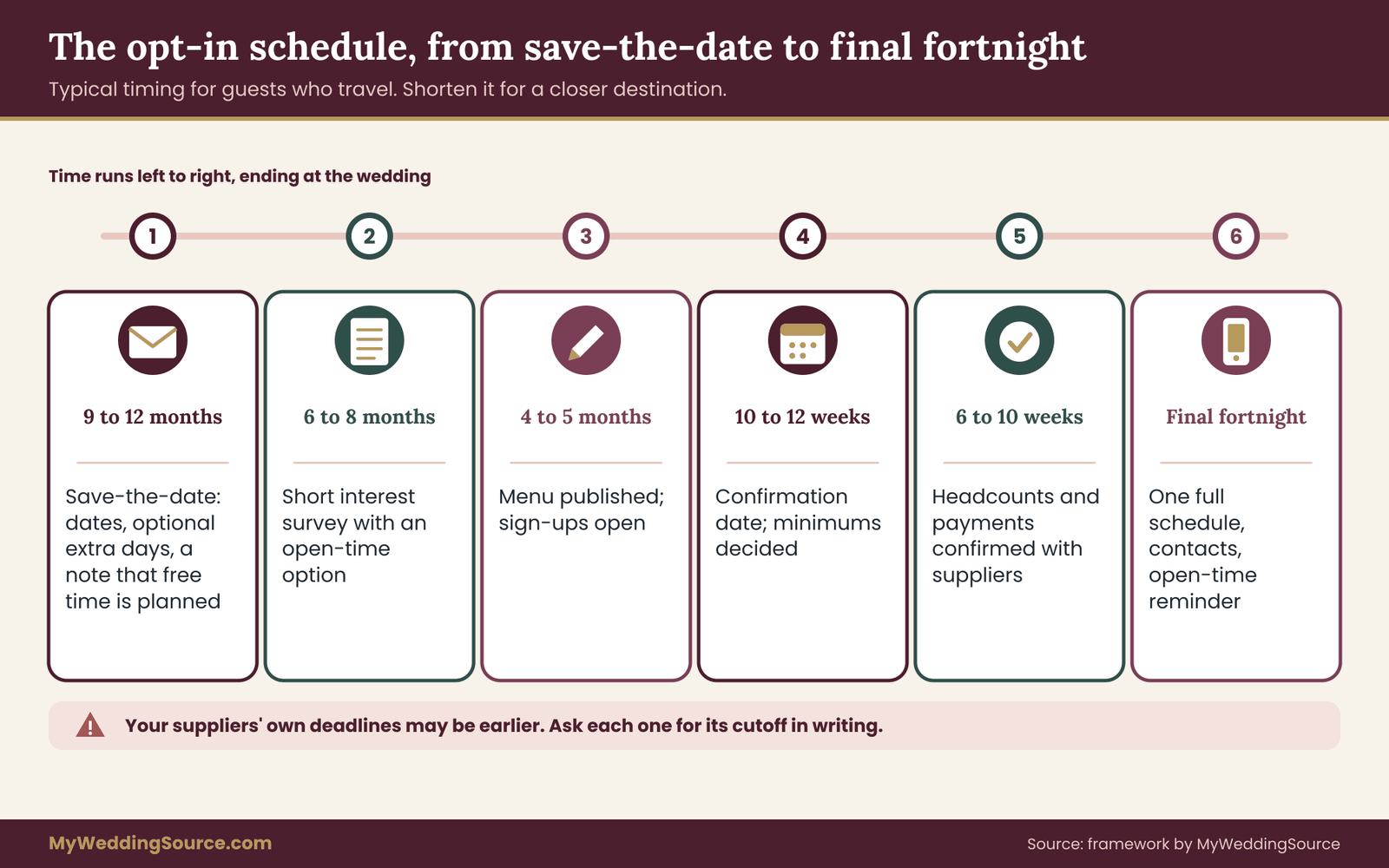
An opt-in schedule for destination wedding excursions is a dated sequence of messages and decisions that turns an idea into a confirmed headcount. Its purpose is to give guests enough time to decide and the couple enough lead time to book, without pressuring anyone. The timing below suits a wedding that guests travel to; shorten it for a closer destination.
Nine to twelve months before
At the save-the-date stage, tell guests the dates of the stay and, if relevant, whether there will be an optional extended window before or after. Do not describe specific destination wedding excursions yet; you may not have chosen them. Simply say that there will be some optional activities and plenty of free time, which sets the tone early. Send the message with enough lead time that guests can book flights while fares are reasonable, and for guests who need to arrange leave from work.
During this window, privately do the groundwork for destination wedding excursions: scout the destination, talk to two or three operators for each type of activity, and ask for written terms. Note which operators have the capacity to handle your group size and which require large minimums. Check seasonal factors, such as storm seasons or periods when attractions close. The National Hurricane Center describes the Atlantic hurricane season as running from June 1 through November 30, and similar seasonal patterns apply elsewhere, so ask suppliers what their weather policy is.
Six to eight months before
Send the interest survey about destination wedding excursions. Keep it short: four to six possible activities, a scale or checkbox for interest, a free-text box for needs, and an explicit “I will use the open time” option. Tell guests when the menu will be final. Use the answers to cut the list down to what fits your load budget.
Then build the menu. Each item gets a name, a short description, a duration including transfers, a difficulty note, a price or cost rule, the minimum and maximum group size, the sign-up deadline and the cancellation rule. Put it on the wedding website in one place, not scattered across messages. For tone, the advice on guest etiquette and expectations is a useful companion, especially on how to word requests to guests.
Four to five months before
Open sign-ups for destination wedding excursions. A simple form works: name, which offers, number in the party, dietary or access needs, and a contact number. Say what happens next: guests will receive a confirmation, and the supplier will contact them if payment is direct. Set a confirmation deadline that is far enough ahead of the event to let you book, and not so far that guests cannot know their plans. Ten to twelve weeks before the wedding is a typical point, though your suppliers’ own deadlines may set it earlier.
Be firm about the deadline but not harsh. A late sign-up can be accepted if the supplier has room, and you can say so. The point of a deadline is to give you a number, not to punish indecision. Where the supplier will not accept changes after a date, tell guests that date, and say that it comes from the supplier.
Six to ten weeks before
Confirm headcounts with suppliers, collect or confirm payments, and send each guest a confirmation that restates the details: date, meeting point, start time, what to bring, cost and cancellation rule. If an offer has not reached its minimum, decide now. Cancel it, extend the deadline once, or cover the gap according to the rule you wrote earlier. Tell affected guests immediately and offer the nearest alternative.
Do a second check on access and safety details with each operator. Ask for the meeting point with a map link, a local phone number for the day, and the policy for weather cancellations. Many problems on the day are meeting-point problems: guests at the wrong pier, the wrong gate or the wrong hotel entrance.
The final fortnight
Send a single message with the full schedule for the stay: anchors, confirmed offers and who is on each, plus the open time. Include local emergency numbers, the address of the nearest hospital or clinic, and a note about transportation. The Department of State’s Smart Traveler Enrollment Program lets U.S. citizens register trips abroad for safety notices, and guests may want to know it exists. Keep the message short enough that people read it.
After this message, change as little as possible. Each change is a chance for confusion, and guests will have made plans around what you sent.
Wording that does not pressure
The words you use shape how the menu of destination wedding excursions feels. Compare “Please let us know by June 1 which tours you’ll be joining” with “If any of these appeal, you can sign up by June 1. If not, no need to reply about them.” The second tells guests that silence is acceptable. Likewise, “We’d love everyone on the boat” creates an obligation, while “A few of us are going out on a boat that day, and there is room for more” invites without expecting.
Avoid language that ranks guests by enthusiasm, such as “the more the merrier” or “don’t miss it.” Avoid deadlines described as final unless they truly are. And repeat the open-time message in every communication: “Saturday afternoon is free for resting, exploring or doing nothing.” Saying it often is what makes it believable.
A sample menu entry, written out
Seeing one finished entry makes the template for destination wedding excursions concrete. Here is an invented example for a guided old-town walk, written the way it might appear on a wedding website. “Old town walk, Friday morning. A guided walk through the historic center with a local guide. About three hours door to door, including a ten-minute shuttle each way. Easy pace, mostly flat, with two seated stops; not suitable for wheelchairs because of cobblestones. Cost: paid by guests directly to the guide, about the price on the guide’s site, which includes entry to one museum.
Minimum six, maximum fourteen. Sign up by March 1. Cancellation: full refund up to seven days before, per the guide’s terms. If it rains, the walk moves to the covered market and a museum. If you skip it, breakfast is served at the hotel until eleven and the pool is open.”
Notice what the entry does. It states the real duration, not just the activity time. It names the access limitation plainly. It says who is paid and how. It gives the numbers that decide whether it runs. It names the weather plan. And its last sentence tells the guest who skips what their morning looks like.
Every entry on the menu should be as complete as this, even if that makes each one a few lines longer. A menu of five entries like this is easier to read than a page of vague enthusiasm.
Keeping a sign-up record that survives changes
Plans change, so the record has to be simple enough to update. A shared spreadsheet or form response sheet with one row per guest and one column per offer works for most groups. Add columns for party size, needs shared voluntarily, payment status where the couple handles money, and the date of the last change. Name one person as owner of the sheet, and give edit access to no more than two people.
Review the record at each checkpoint: after sign-ups close, at the confirmation date, and in the final fortnight. At each review, compare the sheet against the suppliers’ headcounts and write down any gap. A guest who told a cousin they were joining but never filled in the form is a common source of day-of confusion. The cure is a short reminder message with a plain request: “if you plan to join the old-town walk, please confirm on the sign-up form by Friday.”
Keep the record after the wedding for a few weeks. If a supplier disputes a headcount or a guest asks about a refund, the sheet and your message history are your evidence. Delete personal details such as dietary or health notes once they are no longer needed, and do not share them beyond the supplier who needs them.
Vetting local operators and managing risk
Once the menu exists, someone has to turn each item into a booking with a real company. This is the part of destination wedding excursions that couples tend to underestimate, because the company is in another country or region, speaks another language, and runs its business under rules the couple has never read. A careful vetting step for destination wedding excursions takes a few evenings and prevents most of the problems that guests remember.
The general approach to checking any wedding supplier is covered in the wedding vendor due diligence checklist. This section adds what is specific to activities that take guests away from the hotel, where the main risks are physical safety, schedule failure, and unclear money.
What to ask every operator of destination wedding excursions
Ask for the following in writing, by message or email, before you commit. Keep the replies in one folder.
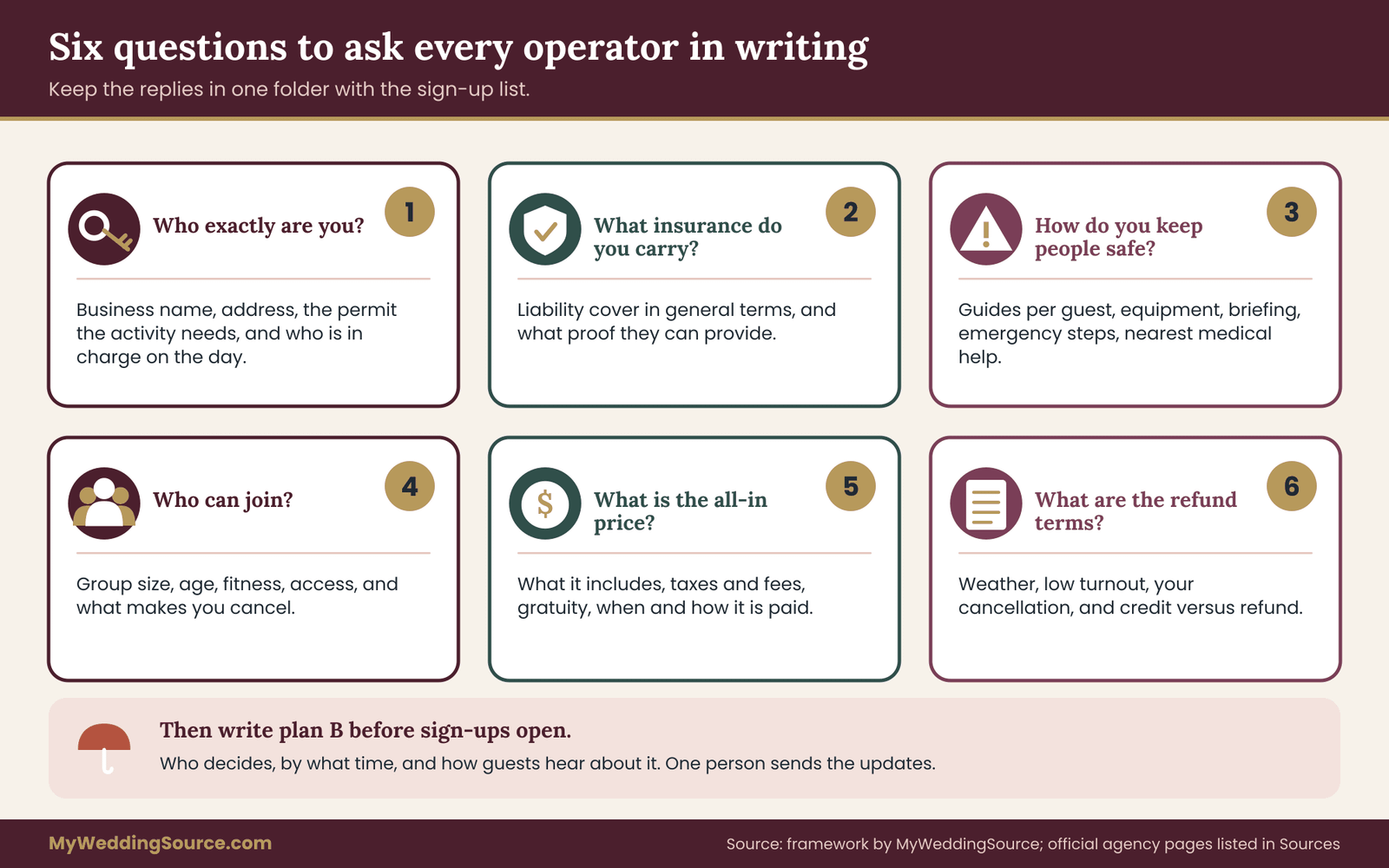
First, the legal identity: the business name, the address, the license or permit the activity requires locally, and the name of the person responsible on the day. Rules differ widely. Boat operators, mountain guides, diving outfitters and tour companies may each need different permits, and the official body that issues them differs by country. Ask the operator to say which permit applies, and verify with the local authority where you can.
Second, insurance. Ask whether the operator carries liability coverage for passengers, what it covers in general terms, and whether they will provide a certificate if your venue or group requires one. Standards for proof of coverage vary abroad, so ask what documents the operator can actually provide.
Third, the safety practice for the specific activity: how many guides per guest, what equipment is provided, how briefings are done, what the emergency procedure is, and how far the nearest medical help is. For anything on the water, ask about life jackets in the right sizes, including children’s sizes, and whether the vessel has communication equipment.
Fourth, capacity and conditions: the maximum group size, the age and fitness requirements, accessibility, and any conditions that make the operator cancel. Fifth, the exact price, what it includes, and when and how it is paid. Sixth, the cancellation and refund terms in full, including weather, low turnout, and cancellation by the operator.
Reading supplier terms in plain language
Terms of service for destination wedding excursions often hide the details guests care about. Look for three things. First, who decides whether weather is bad enough to cancel, and what happens next: a refund, a credit, or a reschedule? A credit is useless to a guest flying home the next day. Second, what changes the operator may make without notice, such as swapping a boat or a route. Third, what deposits are refundable, and whether a guest who cancels earlier can get money back.
If the terms are in another language, ask the operator for an English summary and confirm the key points by message so you have a record. Do not rely on a phone call. If a supplier will not put basic terms in writing, treat that as information. A small, honest operator may have simple terms but will usually write them down.
One more point on trust. If an operator offers the couple a free trip, a commission or a discount in exchange for sending guests, that is a commercial relationship, and guests should know. A simple line such as “the couple received a complimentary booking from this operator” lets guests weigh the recommendation fairly. Never present a referral arrangement as a neutral choice.
Travel advisories, permits and seasonal closures
Conditions change, and destination wedding excursions are the first thing to feel it. The U.S. Department of State publishes travel advisories by country, with levels that range from normal precautions to do not travel, and updates them as situations develop. Check the advisory for your destination when you start planning, again when you open sign-ups, and again in the final fortnight. Guests may rely on your message, so if an advisory changes, tell them what changed and where to read it.
Attractions close for repairs, holidays and weather. Parks may limit visitors, protected areas may need advance permits, and some sites restrict group size or photography. Ask the operator whether the site needs a permit for a group of your size and who obtains it. For natural sites, ask about seasonal conditions such as river levels, snow, heat limits or wildlife restrictions. For public holidays, check that the operator and the sites are open.
For guests traveling from the United States, entry and customs rules, passport validity and health requirements are set by the destination country and by U.S. agencies. The State Department and Customs and Border Protection publish current guidance, and the CDC lists health notices by destination. A couple can point guests to these pages without giving personal advice.
Weather and backup plans for destination wedding excursions
Every one of the destination wedding excursions needs a plan B, written before sign-ups open. For a boat day, the backup might be a land tour or a shorter harbor ride. For a hike, it might be a museum visit or a seated lunch. The plan should say who decides, by what time, and how guests are told. A decision made at six in the morning with no way to reach guests is not a plan.
Agree with the operator on the decision point. Many operators decide a few hours ahead, based on forecasts from the national weather service or marine forecasts. The couple does not need to forecast anything. They need to know who makes the call, when, and how to hear about it. If you are using a group chat, name one person as the voice for updates, so guests are not trying to interpret five conflicting messages.
Build slack for transport too, since destination wedding excursions depend on it. Local drivers may run late, roads may close, and ferry schedules may change. If an excursion has a firm start that depends on a ferry, ask the operator how they handle late arrivals and who waits for whom.
Safety on the day of destination wedding excursions
Name a lead for each of the destination wedding excursions. This is not a staff job for the couple. It is a trusted friend or family member who agrees to arrive first, keep a headcount, hold the supplier’s phone number, and make a call if something goes wrong. Give that person the guest list for the outing, with each guest’s emergency contact and any medical needs that were shared voluntarily.
Brief guests on the basics at the start: where the group meets, the safety briefing, how to leave the group safely, and who to tell. For alcohol, keep the couple’s role simple: do not push drinking, and do not serve guests beyond what the operator supplies. If children are present, say so and confirm that the operator is comfortable with them.
For guests with medical needs, encourage them to carry their own medications, copies of prescriptions in the original packaging, and the name of their condition in the local language where it matters. The couple is not responsible for giving medical advice. They are responsible for not scheduling activities that make care difficult.
Keep a first-aid kit and a list of nearby clinics for each outing, and confirm that the operator’s emergency plan works if phone service is poor. The wedding day digital contingency plan explains backup communication, which is exactly what this situation calls for.
When something goes wrong
Even good planning of destination wedding excursions cannot remove all risk. Decide ahead of time what you will do if a guest is injured, an operator cancels at the last minute, or weather ends an outing early. The sequence is simple: look after the person first, contact the operator, tell affected guests, then deal with money later. Keep a short written record of what happened, who was told and what was decided. Refund questions are easier to settle with a record.
Travel insurance is a matter for each guest, including for destination wedding excursions. A couple can mention that guests may want to consider coverage, and can point to the State Department’s travel pages for general information, but should avoid recommending specific policies or acting as an agent. Different policies cover different things, and guests are best placed to read the terms for their own trips.
Language, gear and the small details guests ask about
Most guest questions about an outing are small and practical. What should I wear? Should I bring cash? Is there a restroom? Will there be food? Can I bring a camera or a drone? If the menu entry answers these, the couple receives fewer messages. A short “what to bring” line on each entry covers the common cases: sun protection, closed shoes, a light jacket for the water, a swimsuit, a refillable bottle, any cash for tips or entry fees, and a copy of identification if the site requires it.
If the operator’s guides speak a language that some guests do not, ask whether English-speaking guides are available for the group, and whether audio guides or printed notes exist. For guests who speak neither language, a short card with the meeting point and the local phone number can prevent a missed pickup. Where the activity involves a border, a ferry between countries or a protected area, ask what documents each guest needs. Passport rules are set by governments, and guests should check the State Department’s guidance for their own situation.
Small gear rules matter too. Many boat operators ban certain shoes, large bags or hard-sided luggage. Some sites restrict tripods, flash photography or drones. Guests with medical equipment should ask about power, storage and seating. These are easy to answer in advance and awkward to learn on the dock.
Three case examples, built from invented couples
The three examples of destination wedding excursions below are illustrative. The couples, numbers and destinations are made up to show how the framework behaves under different conditions. They are not reports of real weddings, and none of the prices or outcomes should be treated as data. The load scores follow the method described earlier, and your own scale may differ.
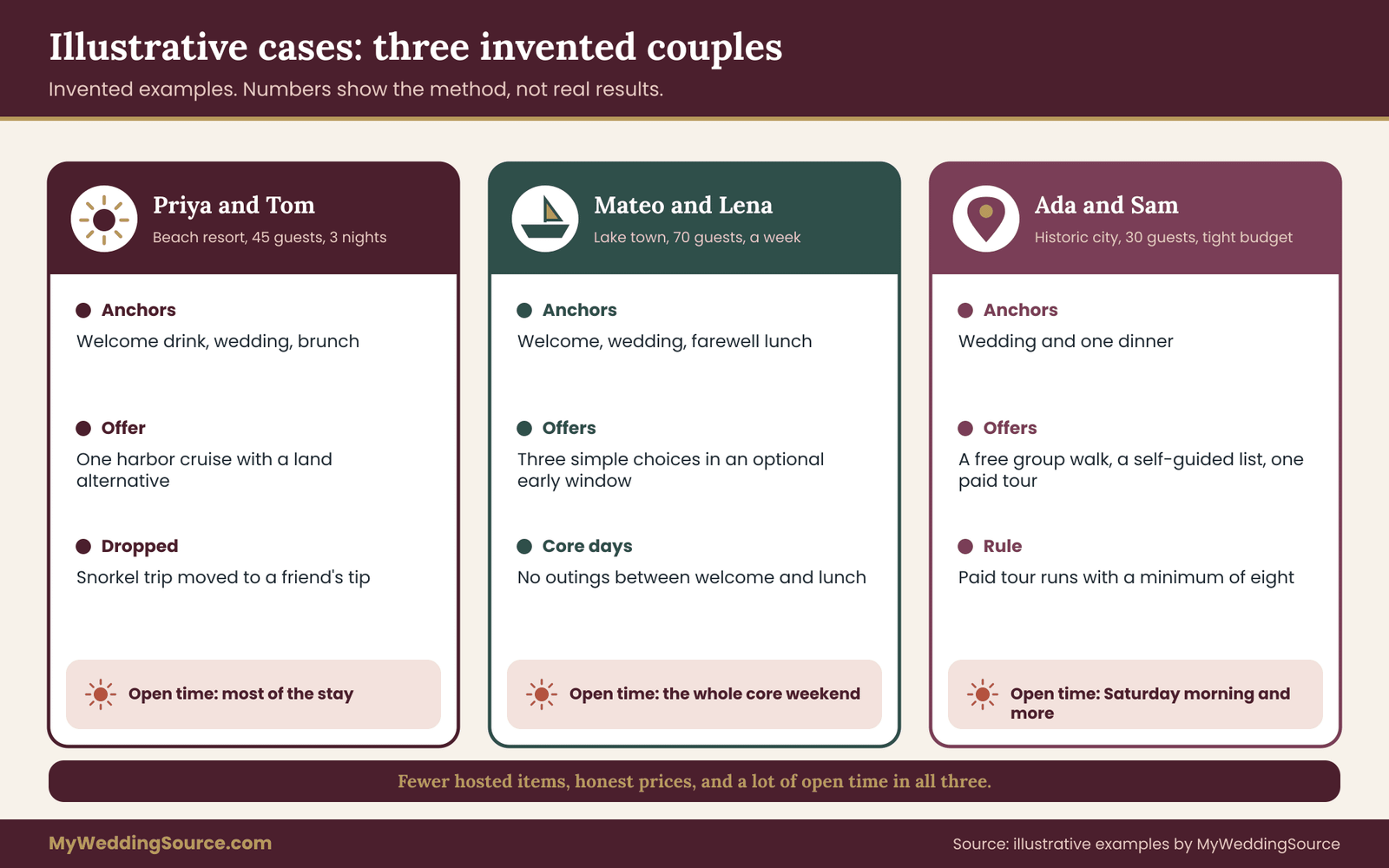
Case one: a three-night beach wedding with forty-five guests
Priya and Tom are marrying at a seaside resort in a warm country. Guests arrive on Thursday and leave on Sunday. Their first draft schedule had a snorkel trip on Thursday, a sunset sail on Friday, the wedding on Saturday and a beach brunch on Sunday. Their interest survey told a different story. About half the guests chose “none of these, I will use the open time” for the snorkel trip, several mentioned seasickness, and four families with children asked about shorter options.
Applying the framework to destination wedding excursions, Thursday became an arrival day with a two-hour drop-in drink in the evening and a self-guided list of nearby cafes and a pharmacy. Friday became the single offer day. The sunset sail, scoring high on energy and money, moved to a shorter harbor cruise in the late afternoon, with an equal-time alternative of a seated beachfront tasting for those who prefer land.
The welcome dinner dropped to a casual meal at the resort, which cut the day’s load below eight points for guests who joined the cruise.
Saturday kept the morning completely open, with a note that breakfast is available from seven and the pool is a good place to meet. The ceremony and reception were the anchors. Sunday became a brunch window from ten to noon with checkout details attached. The snorkel trip was dropped from the official menu, but one friend who loved snorkeling shared a link to the operator in the open-time section, with a line saying it was a personal tip, not an event.
What changed in the destination wedding excursions is worth noticing. The couple went from four hosted items and one outing to two hosted items, one dual-choice outing and a lot of open time. Costs fell, headcounts became manageable, and the couple spent the weekend with guests, not with clipboards. The trade-off is that fewer guests came away with a shared “big activity” memory. For this couple, a shared dinner and a long wedding evening filled that role.
Case two: a week at an Italian-style lake town with seventy guests
Mateo and Lena are holding a wedding in a lake town that guests will reach by plane, train and a final bus ride. Many guests are older relatives and some are traveling from far away. The couple wants guests to enjoy the region, but they know a week-long program would be too much.
They divided the stay into two windows. The core window is Thursday to Sunday, with the wedding on Saturday. The extended window is the Monday to Wednesday before, labeled as optional on the save-the-date. In the extended window, guests who can spare the time may arrive early, and the couple lists three simple destination wedding excursions: a gentle lakeside walk, a half-day boat ride and a guided visit to a nearby village. Each offer is paid by guests directly to the operator, with the couple only coordinating headcount.
In the core window, the anchors are a Thursday evening welcome, the ceremony and reception on Saturday, and a Sunday farewell lunch. There are no excursions between Thursday evening and Sunday lunch. Friday is open, and the couple writes a short guide to the town: a ferry timetable link, a list of seated cafes with views, a pharmacy and the nearest clinic. For guests with limited mobility, the couple checked ahead which village paths are flat and which ferries have step-free boarding.
The risk in this design is that the extended window creates a two-tier guest list: those who can come early and those who cannot. The couple addresses this by saying clearly that no event in the extended window carries any wedding business, no gift is expected and no one will be left out of anything important.
Their cost rule for offers is stated up front: guests pay their own way, and the couple pays only for the Thursday and Sunday gatherings. Weather risk is handled by giving each extended-window offer a land-based alternative on the same day.
Case three: a city wedding for thirty guests on a tight budget
Ada and Sam are marrying in a historic city, with about thirty guests, most of whom are paying out of pocket and flying in. The couple has little money for hosted events. They want guests to see the city, but not to spend more than they must.
Their menu of destination wedding excursions has four items. The first is free: a group walk through the old town on Friday morning, led by a friend who knows the city, with a stated route, a three-hour limit and a mid-way café stop where everyone pays for their own coffee. The second is a self-guided list of five museums with free or low-cost days and opening hours, which the couple checked against each museum’s own site.
The third is a paid guided tour, offered through a local company with a stated price per person and a minimum of eight people. The fourth is open time on Saturday morning.
The load scores stay low: the walk scores four, with three hours, easy effort and no cost. The guided tour scores about six. The couple is explicit that the paid tour is fully optional and that the free walk is the main shared outing. For the paid tour, the minimum matters. If fewer than eight sign up, it is cancelled, and guests who prepaid are refunded under the operator’s stated policy, which the couple confirmed in writing before listing it.
What this example shows is that good destination wedding excursions do not require spending. It requires a clear idea of what each guest can afford, in time and in money, and a willingness to name low-cost choices as first-class parts of the weekend.
Edge cases for destination wedding excursions
Some situations cut across the three examples. A guest asks to bring a child to an adult-oriented offer: check the operator’s age policy, and if it allows children, say so, but do not make exceptions the operator will not honor. A guest arrives with severe jet lag and misses an offer they paid for: ask the operator in advance whether a guest can swap dates or receive a credit, and tell guests the answer. An operator cancels forty-eight hours before: have the alternative ready and tell guests the same day.
Another case in destination wedding excursions is a family that wants to host its own event, such as parents arranging a dinner for relatives. Treat it as a family matter outside the official menu, and ask only that it not collide with the anchors or the couple’s open time. A third is a guest who wants a private excursion for a small group, such as a hike with six friends.
That is fine. The couple can note that guests are welcome to arrange their own plans and share nothing more than the time and place.
A subtler case is the couple’s own rest. Couples often forget to put open time on their own calendar. If you are at every offer, greeting every guest and answering every question, you will arrive at the ceremony tired. Choose which offers you will attend and which you will skip, and say so. Guests understand that the couple needs time, and most will respect a clear boundary.
Limits of the framework
The scoring scale for destination wedding excursions in this guide is a planning aid. It has not been tested against measured outcomes, and no study here supports a particular number. It is useful because it forces you to count transfers, effort, cost and decisions, and because it gives you a common scale to compare offers. Treat it as a way to think, not as a standard.
The framework also assumes you have some control over the schedule. If your venue ties you to a package with fixed activities, or a family insists on certain events, you may not be able to apply every rule. In that case, apply what you can: make as many of the fixed items optional as possible, add open time around them, and be honest with guests about what is flexible and what is not.
Finally, the framework cannot replace local knowledge of the destination wedding excursions on offer. A planner or venue coordinator who knows the destination well may know that a particular boat operator is reliable, that a site is closed on Mondays, or that a road floods in the wet season. Use their knowledge, and ask for it in writing where possible. A destination wedding coordinator is a supplier like any other, and the same questions about terms, fees and commercial relationships apply.
Your next steps
You do not need to build the whole system in one sitting. Work through these in order, and stop when you have what your wedding needs.
First, write your anchors. List the two or three events you genuinely need guests to attend, with dates, and put them on the calendar before anything else. Everything else is an offer or open time. Second, draw the open blocks for each day, using the day types in this guide: arrival, full day, wedding day and departure. Mark at least three consecutive free hours on every full day.
Third, make a long list of possible destination wedding excursions, then send a short interest survey with an explicit “I will use the open time” option. Fourth, score each remaining idea for time, energy, money and decisions, and cut or reshape anything that pushes a day over budget. Fifth, contact two operators for each surviving idea and ask the six questions from the vetting section, in writing.
Sixth, write the menu of destination wedding excursions: one description per offer, with duration, difficulty, cost rule, minimum and maximum, deadline, cancellation rule and a plan B. Seventh, set the opt-in dates and open sign-ups. Eighth, in the final fortnight, send one clear message with the full schedule, local contacts and the open-time reminder. If you are still shaping the broader sequence of tasks around the wedding, the full planning checklist can sit beside this guide as the master timeline.
A last check before you publish the menu of destination wedding excursions: read it as a guest who is tired, on a budget and traveling with a relative who walks slowly. If that guest can see a good weekend in it, the design works.
FAQ
How many destination wedding excursions should a couple offer?
Offer fewer destination wedding excursions than you think. One main outing per full day, plus a lighter alternative in the same time slot, is enough for most groups. A three-day stay often holds just one or two, and some weddings hold none beyond a welcome and a farewell. Open time is part of the design, not a gap to fill, and guests usually value it as much as any tour.
Should the couple pay for guests’ excursions?
Not necessarily. Hosted events such as a welcome gathering usually belong in the wedding budget, but true optional destination wedding excursions are normally paid by the guests who join them. What matters is stating who pays before anyone commits. If the couple covers part of the cost, say how much, and write down what happens if fewer people sign up than expected.
When should guests be told about optional activities?
Mention in the save-the-date that there will be optional activities and free time. Send an interest survey six to eight months out, publish the menu with prices and rules soon after, and open sign-ups four to five months before. Set a confirmation date that fits your suppliers’ deadlines, and send one full schedule in the final fortnight.
How do we keep guests from feeling pressured to join?
Use wording that makes silence acceptable, such as “if any of these appeal, you can sign up.” Avoid phrases that rank enthusiasm. Keep one free or low-cost option available, build an appealing alternative for each outing, and repeat the open-time message in every communication. Guests who see that skipping is normal will feel free to choose without explaining.
What if too few guests sign up for one of the destination wedding excursions?
Decide the rule before sign-ups open. State a minimum headcount and what happens below it: cancel, extend the deadline once, let the group pay more, or have the couple cover a limited shortfall. Then follow the rule. Tell affected guests promptly and offer the nearest alternative. Changing the rule afterward, especially to raise prices, is what usually causes complaints.
What should we ask a local operator before booking?
Ask for the legal business name and any permit the activity needs, liability insurance in general terms, safety practice and emergency procedure, group size limits, age and fitness requirements, the all-in price and what it includes, and the full cancellation and refund terms, including weather. Get the answers in writing and keep them with the sign-up list.
How do we plan for bad weather?
Write a plan B for every outing before sign-ups open, and agree with the operator who decides, by what time, and how guests are told. Choose one person to send updates so guests receive a single message. Ask about seasonal patterns, such as storm seasons, when you pick dates, and check official forecasts and advisories again in the final fortnight.
Can we skip destination wedding excursions entirely and just offer free time?
Yes. Many weddings work well without destination wedding excursions, using a few anchors and a short list of local suggestions that guests can use on their own, with no booking by the couple. This is often the best choice for short stays, small budgets or groups with many older guests or young children. A clear guide to the area can do more than a hosted program.
Sources
- U.S. Department of State, Bureau of Consular Affairs: country travel advisories, passport and entry information for U.S. citizens.
- Smart Traveler Enrollment Program: free registration of trips abroad for U.S. citizens, with safety notices.
- Centers for Disease Control and Prevention, Travelers’ Health: destination health notices and traveler preparation guidance.
- National Hurricane Center, NOAA: Atlantic hurricane season dates, outlooks and storm advisories.
- National Weather Service: official U.S. forecasts, marine forecasts and weather warnings.
- U.S. Customs and Border Protection: rules for returning to the United States, including what travelers may bring home.
- Consumer Financial Protection Bureau: guidance on credit card billing errors, disputes and time limits.
- Federal Trade Commission, Consumer Advice: consumer guidance on travel purchases, refunds and scams.
- U.S. Department of Transportation, Aviation Consumer Protection: airline refund and passenger rights information.
- U.S. Coast Guard: recreational boating safety guidance, including life jackets.