
A wedding beach day is a gathering on the sand or at the water’s edge that every guest should be able to reach, sit through and leave comfortably, whatever their mobility. This guide gives you a route test, a shade plan and a vendor checklist, so one beach day can work for a grandparent with a walker, a guest in a wheelchair, a toddler and a strong swimmer at the same time.
Plan the beach day as a route, not a spot. Walk five legs in order: arrival and drop-off, the crossing from hard ground to the seating area, the seat and shade itself, the restroom and water access, and the way back out. Check each leg for surface, width, slope and distance, and fix the weakest leg first. Put shade where the group will sit at the start, middle and end of the day. Name a water watcher, ask vendors for proof instead of promises, and write a plan B for heat, wind and tide.
Couples who marry far from home often add a beach day to the weekend because the setting is the reason they chose the place. It is a good instinct. A beach is open, informal and photogenic, and it gives families something to do together that does not cost much.
The trouble is that a beach is also one of the least accessible places an event can happen. Sand is soft, uneven and hot. Shade is scarce and moves. Water adds risk for anyone who tires easily. A beach day that looks easy on a mood board can quietly exclude the people whose presence matters most.
This article is about the planning decisions that prevent that. It treats the beach day as a small operation with a route, a layout, a set of vendors and a schedule. The goal is not to make every guest do every activity. The goal is that no guest is stranded, overheated or left out of the group photo because of how the day was set up.
A note on scope. This is general planning information, not legal, medical, tax or financial advice. Accessibility rules, beach regulations, lifeguard coverage and permit requirements differ widely by country, region and even by individual beach, and they change by season. Where a rule matters, this guide points to the agency or operator that sets it so you can confirm the current version.
The guide stays on one question: how to design a single beach day around mixed mobility, shade and water safety. If you are still choosing the wider shape of the weekend, the wedding guest hotels guide covers lodging across different budgets and mobility needs, and this article picks up where the room choice leaves off.
What a beach day has to solve, and who is on the sand
A beach day for a wedding group is not one activity. It is a stack of small problems that each guest meets in a different order. Before choosing a beach, a tent or a caterer, it helps to name those problems plainly.
The five problems every beach day has
Getting there. Guests have to travel from the hotel or venue to the beach, and then from the car or shuttle to the place they will sit. For some guests the second part is harder than the first.
Crossing the surface. Most beaches have a hard edge, such as a parking area, boardwalk or road, and then soft sand. The crossing between them is where walkers, wheelchairs, strollers and canes fail.
Staying comfortable. Sun, heat, wind and glare affect everyone, and they affect some guests much more than others. Comfort is mostly a question of shade, seating and cool drinks.
Using the basics. Restrooms, drinking water, a place to change and a place to lie down briefly are not extras. If one is missing, some guests leave early or never come.
Staying safe near water. Even a group that never swims will stand at the water’s edge. Waves, currents and slippery wet sand matter for anyone with limited balance, and swimming adds a layer of risk for everyone.
A beach day works when each of those five problems has an owner and a fallback. It fails when the couple solves the photogenic part, such as the arch or the chairs, and leaves the rest to chance.
Why mixed mobility is the normal case, not the exception
It is tempting to think of accessibility as a special request that one or two guests will raise. In a group of fifty or sixty wedding guests spanning several generations, the mix is usually wider than the couple realizes.
Some mobility needs are visible. A guest uses a wheelchair, a walker or a cane. Others are not. A guest may tire quickly because of a heart or lung condition, may be sensitive to heat because of a medication or a condition such as multiple sclerosis, may be recovering from surgery, or may be pregnant. A guest may have low vision and find glare and uneven ground hard to read. A parent may be pushing a stroller or carrying a toddler who cannot walk far in sand.
None of this requires you to ask for medical details. It requires you to plan for a range, and to give every guest an easy, private way to say what would help. A later section shows how to word that request.
There is also a practical reason to design for the least mobile guest: the plan that works for them tends to work for everyone. A firm, shaded, short route to a seat is welcome to the guest in a wedding dress, the best man with a bad knee and the parent with a stroller as much as it is to the guest with a walker.
The mixed-needs group map
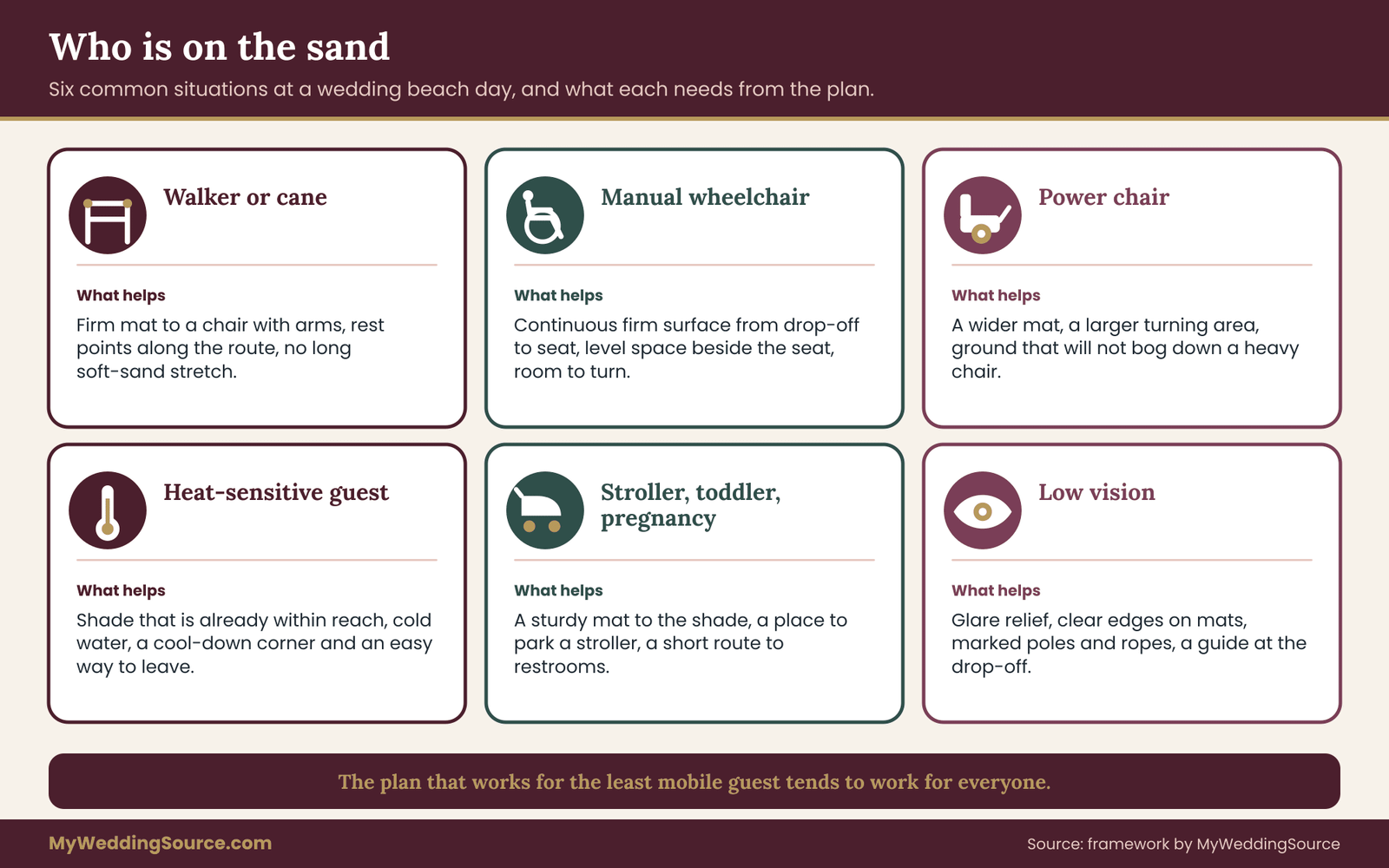
The first figure sorts a typical wedding group into six common situations and shows what each one tends to need from the beach day. Use it as a prompt for your own list. The point is not to label guests. The point is to make sure each kind of need has at least one concrete answer in the plan.
For example, a guest who walks with a cane needs a firm path and a chair with arms near the ceremony, but may be comfortable on a short stretch of packed sand.
A guest who uses a manual wheelchair needs a continuous firm surface from drop-off to a seating position, plus space beside the seat. A guest who uses a power chair needs the same, with a wider turning area and a surface that will not bog down a heavy chair. A guest who cannot manage heat needs shade that they can reach quickly, cool water and permission to leave without explaining.
Treat the map as a living document. As RSVPs arrive and guests share what helps, move names and needs onto it, then check that every need has an answer in the route, the shade layout or the vendor list.
Three decisions to make before anything else
Three early decisions shape everything that follows, and they are cheap to make now and expensive to reverse later.
First, decide what the beach day is for. Is it a hosted gathering with food and a group photo, an optional social afternoon, a ceremony location, or all three? A short hosted gathering is far easier to make accessible than a ceremony that needs chairs, an aisle, sound and a long run time. This guide assumes a gathering of a few hours that guests may join in whole or in part.
Second, decide the target group size. The shade, seating and restroom plans all scale with the number of people. A group of twenty can fit under one well-placed structure. A group of sixty needs several, plus a way to move between them.
Third, decide who owns access. Pick one person, ideally not either partner, to be the access lead for the day. That person walks the route in advance, talks to vendors, and has authority to change the layout on the day. Without a named owner, access decisions drift to whoever is closest and most rushed.
For a deeper look at vetting vendors in general, the vendor due diligence checklist explains how to confirm that a business is real, insured and able to deliver. This guide builds on that with the questions specific to sand, shade and water.
Choosing the beach for your beach day: access before scenery
Most couples choose a beach by looking at photographs. For a group with mixed mobility, the better order is to screen on access first and look at scenery second. A beautiful beach that fails the access screen will cost you more in fixes than a plainer one that passes.
Three kinds of beach, three kinds of problem
Public beaches. These are usually free to enter and often have lifeguards, restrooms and parking, but you may not be able to reserve space, bring large structures or control who is nearby. Some public beaches have permanent accessible paths, firm mats or beach wheelchairs for loan. Others have none. Permits for group gatherings, tents, music or alcohol are common. The local authority that manages the beach sets those rules, so ask it directly.
Resort or hotel beaches. These often have loungers, shade, staff, restrooms and food close by, and some have a hard path to the water. The weak points are usually the last stretch between the building and the loungers, and the fact that the best seats may be reserved for other guests. Ask what is private to your group and what is shared.
Private or hired beach spaces. A beach club or a private stretch gives you control over layout, noise and setup, and often includes tents and staff. It also gives you full responsibility for the access details, because nobody else is covering them. Treat a private space as a venue and apply the same questions you would ask of any venue, including those in the accessible wedding venue red flags article.
None of these is automatically best. A resort beach with a boardwalk can suit a group with limited mobility, while a public beach with a lifeguard tower may suit a group that wants to swim. The right choice is the one that passes the screen below.
The first-pass access screen
Before you visit or call, run a first-pass screen using photographs, satellite maps and the operator’s own pages. You are looking for answers to six questions.
- Is there a hard surface, such as pavement, boardwalk or packed material, that reaches the beach edge?
- Is there parking or a drop-off point on that hard surface, and how far is it from the sand?
- Is there any mat, ramp or beach access route, and does it reach a place where a group could sit?
- Where are the restrooms, and is any of them described as accessible?
- Is there natural or built shade in the area where the group would gather?
- Is there a lifeguard, a beach patrol or a staffed water-safety service, and during which hours?
If you cannot answer at least four of the six from published information, treat the beach as unverified. That is not a rejection. It means you must call, visit or hire a local planner before committing guests.
Reading satellite and street views honestly
Satellite imagery is a useful first tool and a poor last one. It shows where parking lots, boardwalks and tree lines are. It does not show whether a path is smooth, how steep a ramp is or whether a gate is locked. It also shows one moment in one season, and beaches change shape with storms, tides and sand movement.
Use imagery to rank beach day candidates, then confirm with a human. A local event operator, a venue manager or the beach authority can tell you what changed last season. Ask specifically about the hard-edge-to-sand transition, because that is the point imagery hides best.
What to ask the beach manager
When you reach a person, keep the questions concrete. A vague question such as “is it accessible?” tends to get a vague yes.
- “How far is the nearest vehicle drop-off from the sand where a group could sit, in meters or feet?”
- “Is there a mat or path onto the sand, how wide is it, and where does it end?”
- “Do you lend or rent beach wheelchairs, and how many are there?”
- “Which restrooms are closest, and does at least one have a level entrance and enough room for a wheelchair?”
- “Is a lifeguard on duty at this spot, and what are the hours in the season I am booking?”
- “What permits do we need for chairs, a tent, music or catering?”
Write down the answer and the name of the person who gave it. If the answer matters, ask them to confirm it in writing. That habit pays off later if the situation on the day differs from what you were told.
The five-leg route test for a beach day
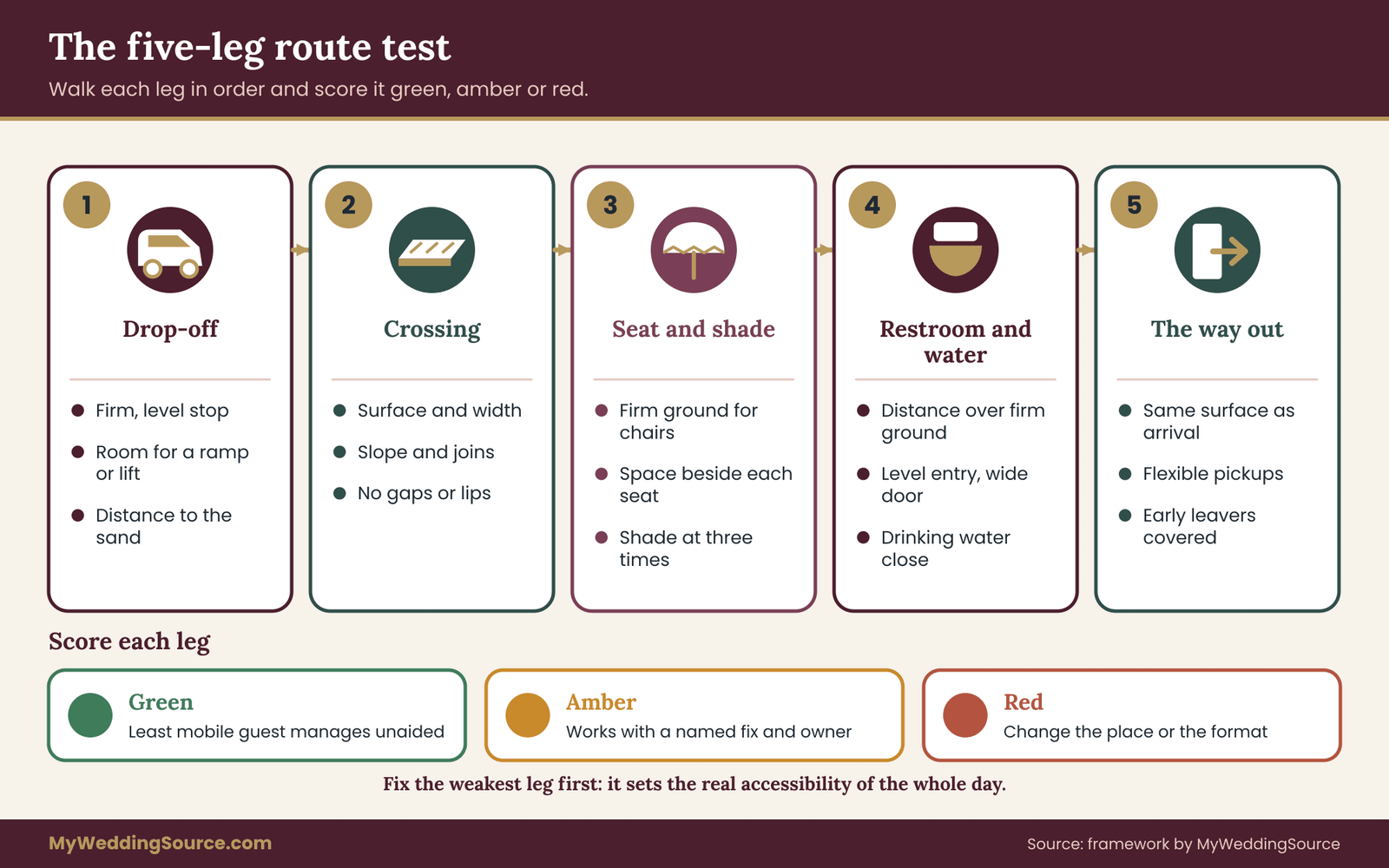
The central tool in this guide is the five-leg route test. It turns the vague idea of “accessible” into five checks that you can walk, measure and score. Do it in person if you can, or ask a trusted local contact to do it and send photographs with measurements.
Leg one: arrival and drop-off
For a beach day, start where the guest starts, which is a car, a shuttle or a taxi. Look for a spot where a vehicle can stop on firm, level ground close to the beach entrance, with room to open a door fully and to deploy a ramp or lift if the vehicle has one.
Measure the distance from that drop-off to the first piece of sand. Then measure from the drop-off to the planned seating area. As a working rule for this guide, a short, firm route is one the least mobile guest can complete without stopping to rest, and a route that needs a rest should have a bench or chair on it. That is a planning rule, not an official standard.
Check that shuttle vehicles can actually reach the drop-off. Some beach roads restrict large vehicles, and some lots are far from the sand.
Leg two: the crossing
The crossing is the stretch between hard ground and the seating area. It is where most beach days fail. Look for four things: the surface material, its width, its slope and its continuity.
Continuity means no gaps, steps or lips between sections. A mat that starts a step above the ground or stops short of the seats is worse than none, because it creates a false sense of access.
For reference, United States federal accessibility standards generally treat 36 inches as the minimum clear width of an accessible route and 1 in 12 as the steepest standard ramp slope, and the U.S. Access Board publishes guidance on beach access routes. These are useful benchmarks even when you are abroad, but local rules differ, so treat them as a yardstick and not a promise. If you want to compare, the Access Board and the ADA information site listed in the sources explain the U.S. standards.
Leg three: the seat and the shade
At the destination of the crossing, check three things: is the ground firm enough to hold a chair or wheelchair without sinking, is there level space beside each seat for a wheelchair or walker, and is the seat itself suitable, meaning a stable chair with arms and a firm back rather than a low sling chair that is hard to rise from.
Also check the shade at this spot at the start, middle and end of the planned window. The shade section later in this guide explains how.
Leg four: restroom and water
Walk from the seating area to the nearest restroom and to drinking water. Measure the distance and check the surface. A restroom that is two hundred meters away over soft sand is out of reach for some guests, even if it is technically accessible.
If the restroom is far or has a step, plan for a portable accessible unit placed near the seating area on firm ground, and check that its door opens wide enough and that the floor is level with the ground or has a ramp. Ask the supplier for the unit’s interior dimensions and for photographs of the entry.
Leg five: the way out
Guests leave a beach day at different times. Someone will tire, someone will need to take a child to a nap, and someone will want to stay for the sunset. The exit route should be as good as the entrance, and a vehicle should be available to meet people at the drop-off when they need it, not only at the planned end time.
Test the beach day exit for the same surface, width and slope as the entrance, and check that the end-of-day shuttle schedule allows a flexible pickup for early leavers. This is the leg that couples forget most often, because the planning energy goes into arrival.
Scoring the route
Give each leg of the beach day a simple score, such as green, amber or red, and write one sentence explaining the score. Green means the least mobile guest could manage it without help. Amber means it works with a specific fix, such as a mat or a staff member. Red means it does not work and needs a different solution.
Then apply a decision rule. If any leg is red and cannot be fixed within your budget, change the location or the format of the beach day before you invite anyone. If legs are amber, assign each fix to an owner and a date. If all five are green or amber with fixes in place, the beach day can go ahead.
The weakest leg sets the real accessibility of the whole beach day. A perfect shaded seating area on a beach day is no use if the crossing is red, and a perfect crossing is no use if the restroom is unreachable. Fix the weakest leg first, then the next.
A short script for the site visit
If you or a local contact visit, bring a measuring tape or a measuring app, a phone for photos and a copy of this checklist. Photograph each leg from the guest’s eye level, including the ground surface close up. Time the walk from drop-off to seat at a slow pace, then double it as a rough guide to the time a guest who walks slowly would need.
When you speak with staff, you can use wording like this: “We are bringing a group that includes guests who use wheelchairs and walkers. Could you show us the firmest route from the drop-off to the beach, and tell us where it ends?” Staff who know their beach will usually point out the best route and the problems in the same breath, which is exactly the information you need.
Surfaces for a beach day: firm, mat and soft sand
Surface is the single biggest physical barrier on a beach day, and it is the one that photographs hide. Soft, dry sand takes a great deal of effort to walk on, and it stops many wheelchair casters, walker feet and stroller wheels outright. Packed wet sand near the waterline is firmer but is also where waves, slippery patches and tides come in.
The three-zone map
Think of the beach as three zones and decide which beach day activities live in which zone.
The firm zone. This is any hard, level surface: pavement, a boardwalk, a patio, packed gravel or a permanent beach access route. Guests with limited mobility can use this zone without help. Put anything that matters to them on the beach day here, such as the welcome table, the food, the restrooms and the main seating.
The mat zone. This is a temporary surface laid over sand, such as roll-out mats or interlocking panels. It extends the firm zone onto the beach. It is useful but fragile: mats shift, curl at the edges, heat up in the sun, and end somewhere. Plan exactly where each mat starts and stops.
The soft zone. This is natural dry or loose sand. Guests who are comfortable in sand will go here for the water, the photographs and the activities. Treat it as optional on any beach day. Nothing essential to the event should require a guest to cross it.

The map is a layout rule. Anything essential goes in the firm or mat zone. Anything optional can go in the soft zone. If the group photo is in the soft zone, the guests who cannot reach it need a plan, such as taking a second photo from the mat so nobody is missing from the album.
Testing a surface before you rely on it
Do not trust a surface because a vendor says it is “wheelchair friendly”. Test it with the equipment your guests will use, or something close to it.
Push a folding wheelchair or a stroller across the surface. Roll a wheeled suitcase or a walker if you have one. Walk across it in smooth shoes and in sandals. Watch for sinking, tipping, lips at joins and the way the surface behaves when it is wet.
If you cannot test in person, ask the vendor for the mat’s width, its material, how sections connect, whether it has been used on this specific beach and how it handles wet sand. Ask for a photograph of the mat in use with a wheelchair on it. A vendor that has done this before will have one. A vendor that has not may still be fine, but you should then ask for a trial, even a short one, before the day.
Roll-out mats and panels
Mats and panels are the most common way to extend a firm path onto sand. A few details decide whether they work.
Width. A narrow mat forces a wheelchair user to stay on a single line with no room to pass or turn. The 36 inch figure mentioned earlier is a reference minimum for a route. A wider mat is more comfortable, especially where two people may meet. Ask what widths the vendor stocks.
Edges. Loose edges catch toes, walker feet and wheels. Ask how the mat is anchored and whether edges are tapered or secured.
Joins. Where two sections meet, there should be no gap or lip. Test joins in person.
Heat. Some mat materials get hot in direct sun. Ask about the material and whether a section in full sun is hot to touch at midday. A hot surface is a problem for bare feet, for pets and for small children.
Length. Mats are sold and laid in lengths, and a short mat leaves a gap between its end and the seats. Measure the route and order the length you need, plus a spare section.
If a mat is unavailable or too costly, ask whether the beach has a permanent boardwalk, a ramp or a service road that reaches near the sand. Sometimes a small change of meeting point solves more than any equipment.
Beach wheelchairs and other equipment
A beach wheelchair has wide, soft tires or a floating design that lets it roll over sand and, in some models, into shallow water. Some beaches lend them for free, some rent them, and some do not have any. Many are designed to be pushed by another person rather than self-propelled, which matters for guests who value independence.
Ask the beach or a rental company how many are available, whether they can be reserved for your date, whether they can be used in the water, what the weight limit is, and how a guest transfers into the chair. Ask whether a trained person can help with the transfer and with pushing.
A guest should always have a choice about whether to use such equipment. Some guests will gladly use a beach chair for a short sandy stretch. Others will prefer to stay on the mat and watch. Both are fine, and the plan should not rely on anyone using equipment they have not chosen.
Walkers, canes and strollers
Not everyone who struggles on sand uses a wheelchair. A walker or cane can sink in soft sand and fail to give support. A stroller can become immovable. For these guests, a firm mat route to a seat is usually more important than equipment.
Offer a chair with arms near the arrival point so a guest can rest and then continue, and avoid placing the only seating at the end of a long stretch of soft sand. Consider placing a few chairs along the route as rest points. For guests with strollers, a sturdy mat that reaches the shade is helpful, and a spot to park a stroller out of the way matters too.
Slippery and uneven ground
Wet sand, algae, wet boards and ramps all become slippery. Ask the beach manager about wet-weather surfaces and whether boardwalks are treated or textured. In the weeks before the day, check recent news for storm damage, because a boardwalk or ramp may have been closed or repaired.
If a surface is damaged on the day, have a short list of alternative routes. A beach day should never depend on one fragile ramp.
Shade planning for a beach day
Shade is the next most important comfort factor on a beach day, and it is the one that couples tend to underestimate. A beach is open by design. Natural shade can be thin, and artificial shade has to be set up and sized properly.
Why shade is a health and access issue
Shade on a beach day is not only about comfort. Guests who are older, very young, pregnant, living with some chronic conditions or taking certain medications can be more vulnerable to heat and sun. The U.S. Environmental Protection Agency recommends limiting midday sun exposure and seeking shade as part of sun protection, and the Centers for Disease Control and Prevention publishes guidance on heat-related illness. Both are listed in the sources.
For mobility, shade has an extra role. A guest who cannot move quickly cannot easily relocate when the sun reaches their seat. Shade must be where they already are, and it must stay there.
The sun moves: the three-time shade check
Shade is not a fixed feature on a beach day. As the sun moves across the sky, a shadow that covers a seat at ten in the morning may be gone by noon. The sun’s apparent position shifts roughly fifteen degrees an hour, so over a three-hour beach day the shade can travel a long way.
Use the three-time check. Visit, or ask a local contact to visit, at the planned start, the midpoint and the planned end, ideally at the same time of year. Photograph the seating area each time and note which seats are shaded. If you cannot visit, use a free sun-path or shadow tool online to model where an umbrella or tent would cast shade at those times, then confirm in person on arrival.
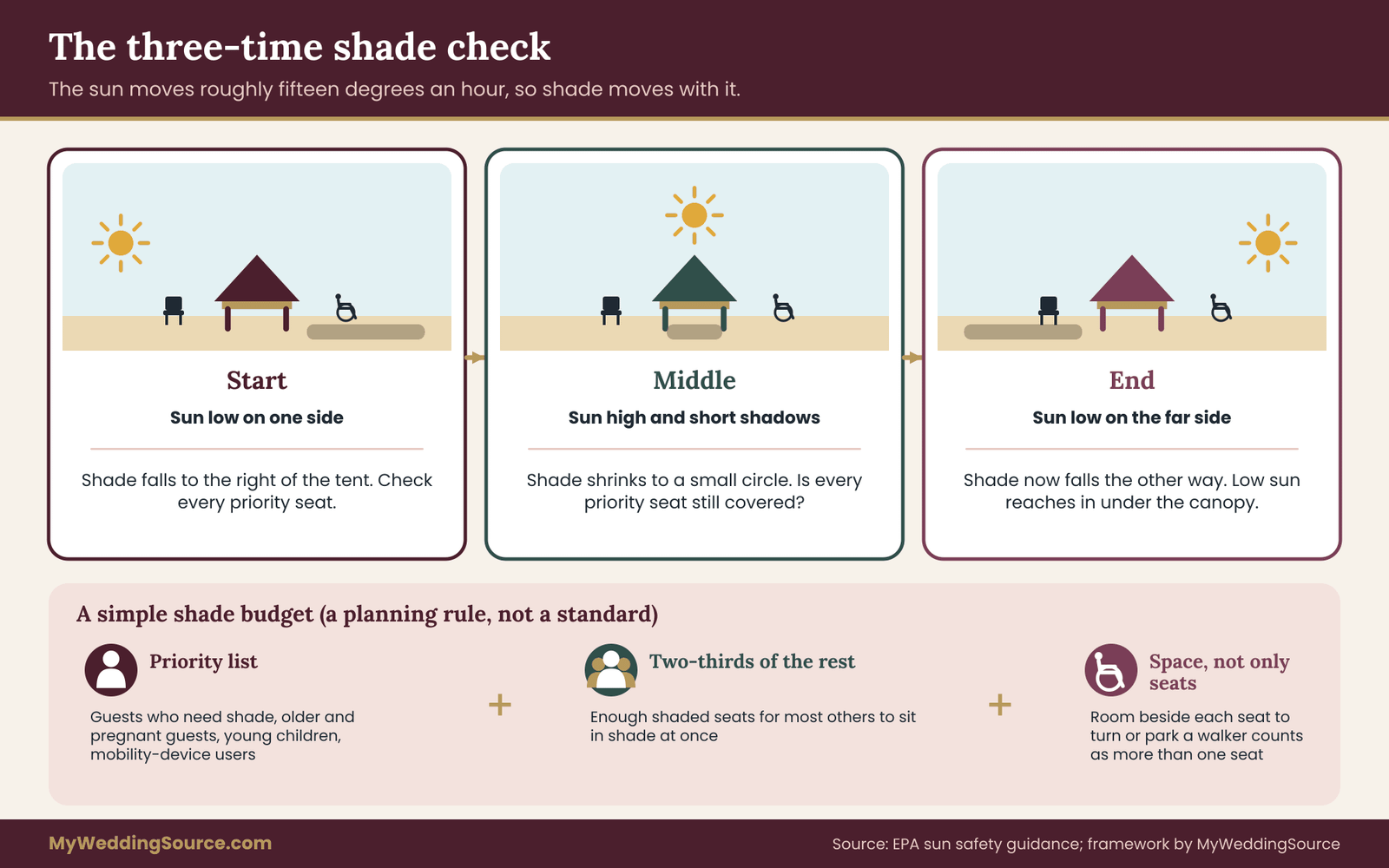
Pay attention to the afternoon. Many couples schedule a beach day late in the day for softer light and cooler temperatures, but late sun comes in low and can reach under a canopy from the side. A shade structure that works at noon may fail at five.
Shade options compared
Each kind of shade has strengths and weak points. Describe your seating area to the vendor and ask which options fit, instead of choosing by appearance.
Natural shade. Trees, buildings, dunes or cliffs cost nothing and can be very effective, but they are fixed in place and may be far from a firm path. Check for fallen branches, insects and tree rules on public land.
Beach umbrellas. They are cheap, quick and flexible, and they cover only a few people each. In wind they can lift and become hazards. Ask how they are anchored in sand and what wind they can tolerate. Sand anchors vary in strength.
Pop-up tents and canopies. They cover more people and offer side protection, but they are light, so they need proper weights or stakes. Many beaches limit tents or require permits. Ask the vendor how the canopy is secured and what wind limit it has.
Frame tents and sail shades. Larger frames and shade sails offer big coverage, and they often need professional installation and permission from the beach authority. They can be the right choice for a group of fifty or more, and they cost more.
Cabanas and rented lounge areas. Resort beaches often have these. They can give each group its own shade and seating, but the access route to each cabana still has to be checked.
The shade budget
Here is a simple planning rule that you can adapt. Count the people who will be on the beach at the peak of the day. Make sure there is shaded seating for every guest on the priority list, which means anyone who has said they need shade, anyone who is older, pregnant or has a young child, and anyone who uses a mobility device. Then add enough shaded seats for at least two-thirds of the rest of the group, so most guests can sit in shade at the same time.
That rule is a planning aid, not an official standard. You may choose a higher share if the weather is hot or the group is older. Write the number down, then count the shaded seats you have planned, using the three-time check, and compare.
Space matters as well as seats. A wheelchair user needs room beside the seat and room to turn, and a walker needs space to park. Plan shade that covers those spaces, not just the chairs. Count each wheelchair position as more than one seat for this purpose.
Shade that people can actually reach
A shaded area that is across soft sand fails the people it was meant for. Put priority shade on the firm or mat zone, directly at the end of the accessible route. Then add secondary shade in the soft zone for guests who like to be near the water.
Think also about where shade falls on the route itself. A long, sunny mat can be too hot for guests who walk slowly. If shade over the route is not possible, plan a shaded rest point halfway, with chairs.
Wind, glare and other practical details
Wind is the common enemy of beach shade, and of any beach day with canopies. Ask each vendor for a wind limit and decide, in advance, who is allowed to call the structure down if the wind rises. Ask what happens to the structure at the limit, who inspects it and how guests are moved.
Glare is another overlooked factor, especially for guests with low vision or light-sensitive eyes. Sand and water reflect strongly. Provide some seating positions facing away from the water glare, and encourage hats and sunglasses. Offer a few spare pairs of sunglasses and some wide-brim hats if your budget allows.
Finally, think of the structure’s footprint. Poles, ropes and anchors create trip hazards. Mark them with brightly colored tape or flags, and keep them out of the path.
Heat, water and swim safety on a beach day
Heat and water are the two health risks that a beach day adds to an ordinary wedding gathering. Both can be managed with simple preparation, and both become dangerous mainly when nobody is watching for them. This section is general information, not medical advice. Guests with health conditions should follow the advice of their own clinicians.
Heat: who is at more risk and what to watch for
Anyone can be affected by heat, but the Centers for Disease Control and Prevention notes that older adults, young children, pregnant people and people with certain chronic conditions or medications can be at higher risk. A beach adds reflected heat from sand and water, and sea breezes can hide how much a guest is sweating.
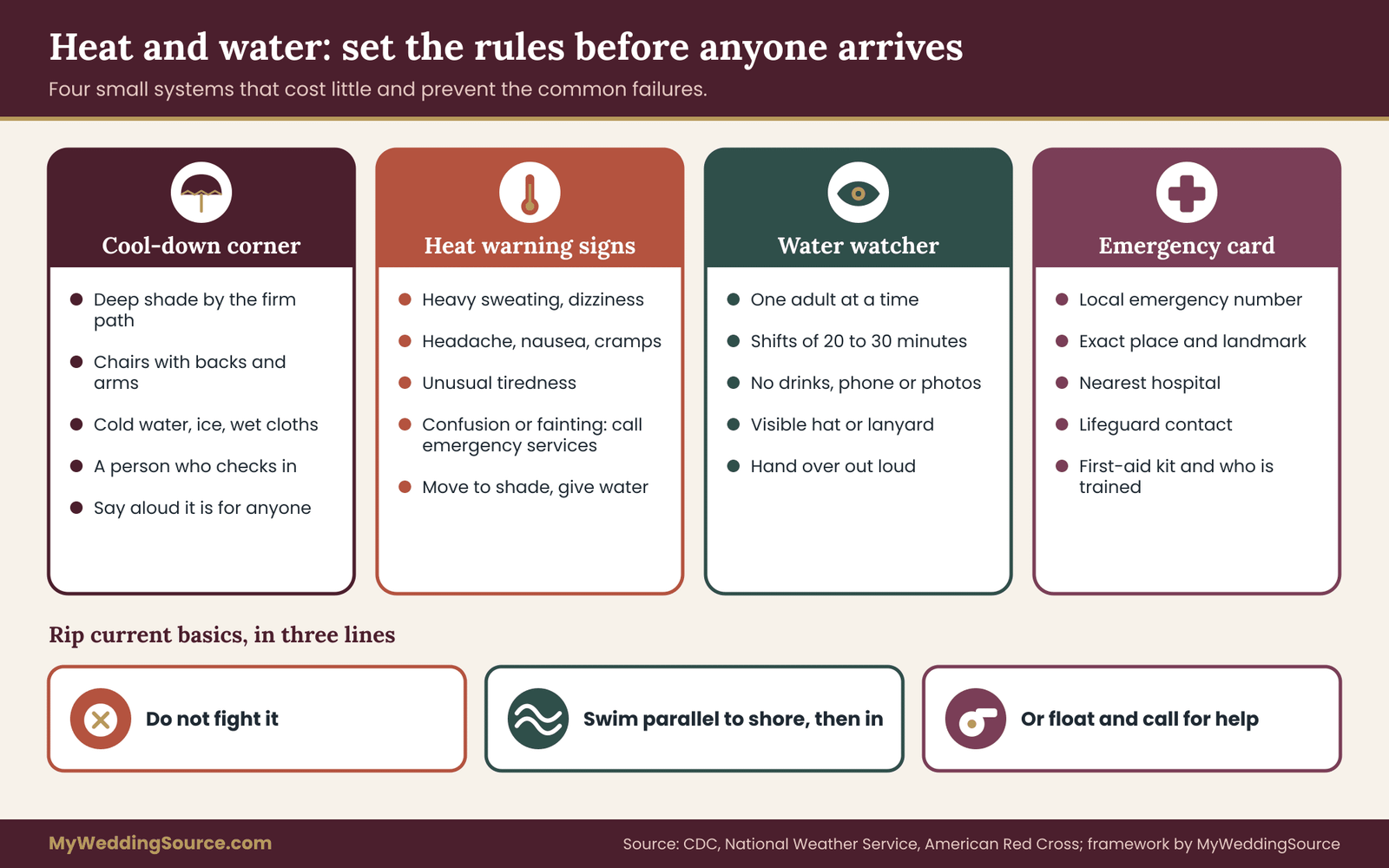
For the planning team, the useful thing is to know the early signs and have a response ready. Heat illness can show up as heavy sweating, dizziness, headache, nausea, muscle cramps or unusual tiredness, and it can progress to confusion, a very high body temperature, or fainting, which are emergencies. Check the current CDC guidance on heat illness before the day and print the response steps for the access lead.
Do not rely on guests to say they are struggling during a beach day. Some will downplay symptoms to avoid spoiling the day. Give a few people, such as the access lead and two friends, a simple job: scan the shade area every twenty minutes, offer water and ask quietly whether anyone would like to move somewhere cooler.
The cool-down corner
Set up a small cool-down corner in the best shade, close to a firm path. It does not need to be elaborate. It needs these things:
- Chairs with backs and arms, in deep shade.
- Cold water and a cooler with ice, refilled through the day.
- Wet cloths or towels guests can place on the neck or wrists.
- A portable fan or misting fan if power or batteries are available, tested in advance.
- A person who knows it is their job to check on whoever is sitting there.
Tell guests the corner exists, and make clear that using it is normal. Guests are more likely to use a cool-down corner if the host says out loud that it is for anyone who wants a break, not for people who are unwell.
Fluids, food and alcohol
Plan drinking water for everyone on the beach day, and more than you think. Plain water should be easy to find and not hidden behind a bar. Add some drinks that are not sweet or alcoholic, and make sure children and older guests are offered them.
Alcohol deserves a plain word. It dehydrates, it can dull judgment about heat and water, and the CDC advises against drinking alcohol while swimming or boating. If the beach day includes a bar, consider serving alcohol only after the water time ends, or only in the shaded zone away from the water. The wedding bar service planning guide covers how to structure service so drinks do not push a group into trouble.
Food in heat needs care as well. Keep perishable items in coolers with ice, limit how long they sit in the sun, and ask the caterer how they will keep food at safe temperatures. Choose items that hold up in warmth over items that need strict refrigeration, and plan to serve small quantities at a time.
Sun protection that guests will actually use
Sunscreen, hats, sunglasses and covering clothing all help, and the EPA’s sun-safety guidance lists these steps together with seeking shade. Give guests an easy chance to use them. Put sunscreen in a visible basket at the entrance and near the shade, and consider a few options for sensitive skin. Place a note in the invitation or the welcome message encouraging hats and light clothing.
Guests who use wheelchairs or who stay seated for long periods often get more sun on the same side of the body than active guests do, and a person with a limited ability to shift position may not notice. Shade over the seat is better than relying on sunscreen alone.
Setting a heat rule in advance
Decide before the beach day what conditions will change the plan. For example, the plan might say that if the forecast heat index or air temperature passes a level you set, the beach day moves to the early morning or evening, shortens, or shifts to an indoor or covered location. You should check the local forecast from the national weather service in the country, and update the plan the day before and the morning of.
Put the beach day rule in writing, name the person who makes the call, and state when guests will be told. A heat rule decided in the moment, with food already ordered and photographers booked, tends to be too optimistic.
Swim safety on a beach day with mixed abilities
Swimming is optional on most beach days, but water is always present. A group of wedding guests may include strong swimmers, weak swimmers, non-swimmers and children, and they will be in different moods after a long trip and perhaps a drink or two. The safest approach is to plan for the weakest swimmer and the most distracted adult.
Start with the water, not the guests
Before the beach day, find out what the water is like on that particular beach in that season. Ask the beach authority or a local lifeguard service about currents, rip currents, waves, jellyfish or other marine life, water quality advisories and tides. Beaches differ in a way that is easy to underestimate. A calm lagoon and an open ocean beach need very different plans.
The National Weather Service publishes rip current safety guidance. Its key message is that rip currents are strong channels of water flowing away from shore, and that a swimmer caught in one should not fight it directly, should try to swim parallel to the shore and then angle back in, or float and call for help. Review the current guidance and brief your team.
If the beach has lifeguards, ask where they are stationed, what hours they work, which section they cover and how their flag system works. Flag colors and meanings are not standardized everywhere, so ask someone local what each flag means instead of assuming. The United States Lifesaving Association promotes swimming at guarded beaches, and its guidance is a good starting place for general safety principles.
Marking the swim zone
Decide where guests are permitted to swim, and mark it. Use the lifeguard’s area if there is one. If there is none, treat the whole beach as unguarded and be more cautious: shorter swim periods, more watchers and shallower areas only.
Give a clear sentence to guests: “Swimming is only in front of the flags, and only when a watcher is on duty.” Repeat it on arrival, at the start of water time and on a sign near the shade. Signs must be readable in sun glare, with large letters and strong contrast.
The water watcher
Drownings can happen quickly and quietly, often when a nearby adult assumes someone else is watching. Water-safety organizations such as the American Red Cross recommend that a responsible adult be assigned to watch the water without distractions.
Apply that idea directly. Name one adult at a time as the water watcher, in shifts of about twenty to thirty minutes. The watcher does not drink, does not use a phone, does not take photographs and does not chat. They have one job: keep their eyes on the swimmers. At the end of each shift they hand over verbally to the next watcher, saying who is in the water and who has just come out.
Make the watcher visible, for example with a brightly colored hat or lanyard, so guests know whom to alert. Have a list of shifts before the day and share it with the people on it. It takes no money and removes the most common failure.
Children and weak swimmers
Children need an adult within arm’s reach in the water, and young children near any water need constant, close supervision. The same applies to adults who are not confident swimmers.
Ask the guests who bring children to state who is responsible for each child at all times, and let parents know that the water watcher supports them but does not replace them. For weak swimmers, consider life jackets that are approved by the relevant authority. The U.S. Coast Guard’s recreational boating pages describe approved life jackets, and a local operator can tell you what is accepted at your destination. Water wings and inflatable toys are not safety devices.
Plan some shallow, supervised water play for those who want it, and be clear that nobody is expected to go deeper than they like. The wedding guest care planning guide discusses how to handle childcare and older relatives around events like this one.
Getting into and out of the water
For guests with limited mobility, the water itself can be an area where they want to take part, and it can be done safely with the right equipment and help. Some beaches have access ramps into the water, floating wheelchairs or trained staff. Ask the beach or local rental companies what is available.
Entering water is physically demanding. Waves can knock someone off balance, wet sand is slippery and getting out can be harder than getting in. If a guest wants to enter the water, plan for at least two helpers who know what they are doing, ask the guest what support they prefer and let them lead. Never lift or move a person without their consent and without a plan.
For guests who prefer not to enter the water, plan a way to be near it, such as a mat that ends at a viewing spot or a shaded seat close to the edge, so they are still in the group during the water time.
An emergency plan that fits on a card
Every beach day needs a short emergency card, in print and shared with the leads. It should include the local emergency number, the exact location with a nearby landmark or address in the local language, the nearest hospital, the lifeguard’s contact or station if any, the name of the first-aid trained person present and the location of a first-aid kit.
For a destination abroad, the U.S. Department of State’s travel pages and the Smart Traveler Enrollment Program help U.S. citizens prepare, and a local planner can confirm the correct emergency number. Do not assume the number is the same as at home.
Check phone coverage at the beach. If it is weak, plan a backup, such as a staffed lifeguard post or a person who can walk to a place with signal. Phone coverage on beaches can vary, and an emergency plan that depends on a phone with no signal is not a plan.
The vendor checklist for a beach day
A beach day usually involves five or six outside businesses: a beach or venue manager, a shade and furniture supplier, a mat or equipment supplier, a transport provider, a caterer or bar, and sometimes a water-safety provider or first-aid service. Each of them can make or break access, and each answers questions better when you ask for specifics and for proof.
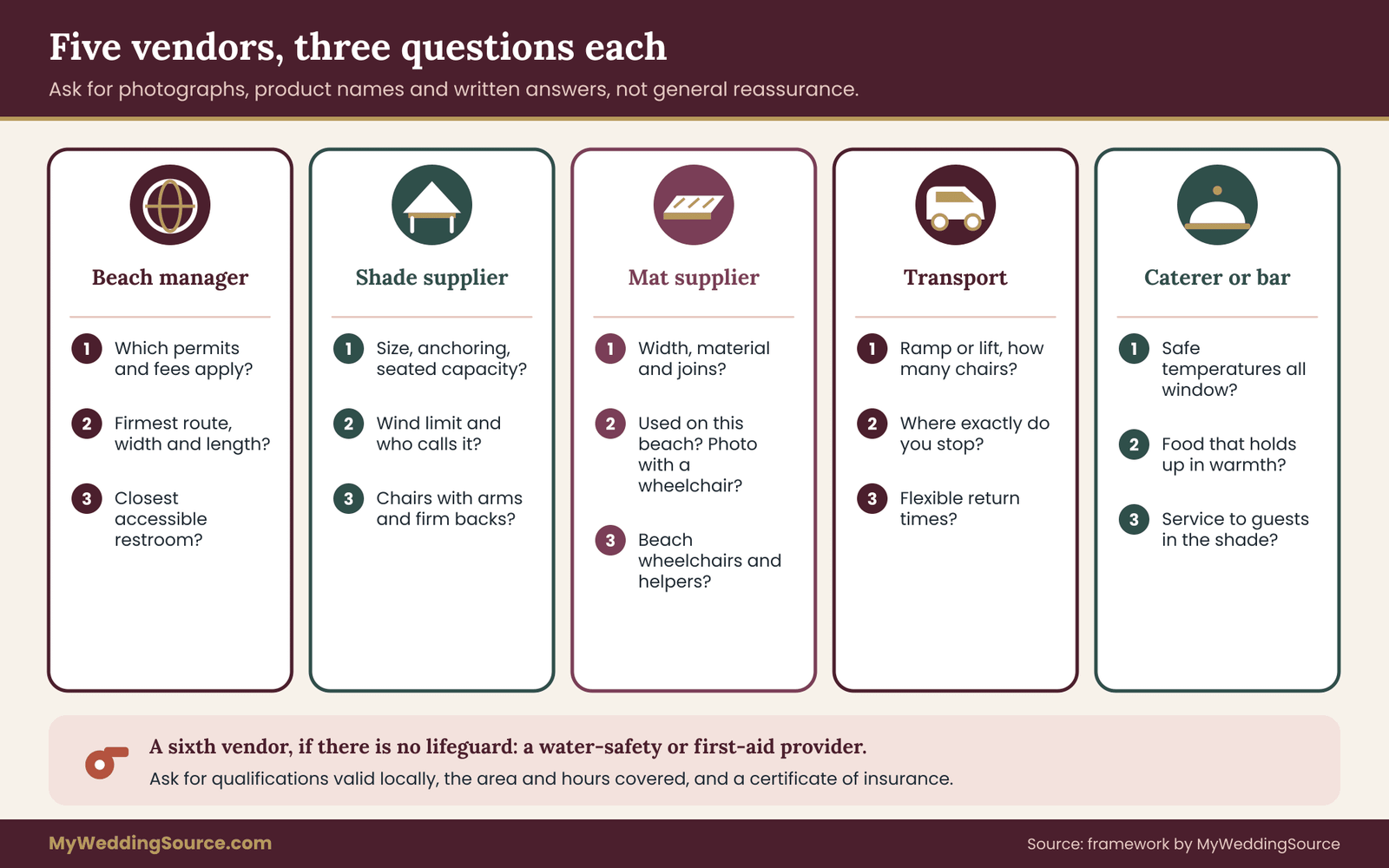
The sixth figure summarizes the five vendor types and the three questions that matter most for each. The sections below expand them. The general approach to confirming that a business is real, insured and bound by a clear contract is covered in the vendor due diligence checklist and the wedding vendor contract guide. Here the focus is on what is specific to sand, shade and water.
How to ask for proof, not promises
Vendors are often keen to say yes about a beach day. A vendor who says “we do this all the time” may be telling the truth, and may also not have thought about your specific needs. A few habits convert reassurance into evidence.
Ask for photographs of similar setups, ideally with people using wheelchairs or walkers on the surface in question. Ask for the exact product names, sizes and quantities, written into the quote. Ask for the wind limit or capacity of any structure in writing. Ask who will be on site, with what training, and how to reach them on the day. If an answer is vague, ask again in simpler words, then record the reply.
Also ask what the vendor will do if something goes wrong, such as a mat that arrives too short or a tent that cannot be erected because of wind. The answer reveals how they handle problems, and it often shows whether they have really done this kind of work.
Vendor one: the beach or venue manager
The beach manager is the authority on the site. Questions to ask are practical.
- What permits, fees or approvals do we need for the number of guests, structures, music, food and alcohol we plan, and who issues them?
- What is the firmest route from drop-off to the beach, and what are its width and length?
- Which restrooms and water points are closest, and are any adapted for wheelchair users?
Also ask about hours, capacity, closure risks, tide times, lifeguard hours, whether the area is shared, and who is the on-site contact on the day. Request the answers by email so you have a record. Where permits are involved, ask for a copy or reference number, and check the validity dates against your date.
Vendor two: shade and furniture supplier
Shade and seating are the second layer. Questions include:
- What exactly will you set up, in what dimensions, for how many seated people, and how is it anchored for sand and wind?
- What is the wind limit, and what is the process if the limit is reached on the day?
- Do you supply chairs with arms and firm backs, and can you provide a number of them, plus a few higher seats for guests who struggle to stand from low chairs?
Ask also about setup and takedown times, how structures handle rain, and how you can check the layout on site before guests arrive. A supplier who offers to place a test chair and a tent during a site visit is showing a useful level of care.
Check what is included in the price. Delivery to a beach can add fees, as can anchoring, labor and after-hours pick-up. Compare quotes on the same specification, and avoid choosing only on headline price. The wedding rental planning checklist covers general rental questions such as damage terms and return times.
Vendor three: mat and equipment supplier
This vendor decides whether the crossing works. Questions include:
- What are the mat’s width, material and length, and how do sections join and anchor?
- Have you laid it on this beach, and can you show a photograph with a wheelchair or walker on it?
- What beach wheelchairs or other equipment can you supply, with what weight limits, and who helps guests use them?
Ask about delivery, setup and removal, and what happens if the mat sinks or shifts. Ask what staff will be available during the day to adjust it. If the beach itself lends equipment, ask how to reserve it and whether the reservation is confirmed for your date.
Vendor four: transport provider
Transport is often the quiet weak point. Many shuttles and taxis cannot take a wheelchair, and many cannot stop close to the beach. Questions include:
- Do you have vehicles with a ramp or lift, how many, and how many wheelchair positions does each have?
- Where exactly will you stop, and can you reach the firm drop-off point?
- Can you run a flexible return schedule so early leavers do not wait until the end?
Ask whether a wheelchair user can travel in their own chair, whether the vehicle has securing straps, and whether staff are trained to use them. Where airline travel is involved, the U.S. Department of Transportation’s aviation consumer pages and the Transportation Security Administration’s passenger support information explain the rights and the process for guests traveling with mobility devices, and you may wish to point guests to them.
Vendor five: caterer or bar
Food and drink in heat and sand have special needs. Questions include:
- How will you keep food and drinks at safe temperatures for the full window, and how will you check?
- What is on the menu that holds up in warmth, and which items are served only briefly?
- How will drinks and food reach guests who are seated in the shade or in wheelchairs, so they do not have to cross sand?
Ask about plates, cups and cutlery suitable for people with limited grip, and about napkins and wet wipes. Consider table-service options in the shade for guests who cannot carry plates across sand. Ask about dietary needs and how allergens will be labeled. The general approach to menus is covered in the site’s menu guides, and this section only adds the beach specifics.
Vendor six: water-safety and first aid
If the beach has no lifeguards, or if your group is large, ask whether you can hire a qualified lifeguard or water-safety provider, and whether a first-aid-trained person can be on site. Questions include:
- What qualifications does your staff hold, and are they valid in this country?
- Which area will you cover, for what hours, and what is your procedure in an emergency?
- Do you carry insurance, and can you provide a certificate?
A certificate of insurance matters for any vendor who handles risk on your behalf. Ask for the certificate before you pay a deposit, and check the dates and the named coverage against your event.
Putting vendor answers into one document
As answers arrive, record them in a single sheet or document with the vendor name, the answer, the date, who gave it and where the written confirmation is. At the end you should have one page per vendor and one overview page that shows the five route legs, the shade plan and the water plan, with owners.
Share the overview with the access lead, the photographer and a trusted family member. If anyone is injured or confused on the day, this document is the fastest way for someone else to take over.
The beach itself may be well prepared and the beach day can still fail on the road. Many guests with limited mobility will decide whether to come to the beach day based on how easy the journey is, not on what the beach looks like.
Choosing the time window
The best window for a beach day depends on heat, light, tide, wind and the energy of your guests. Early morning is often cooler and calmer, and the light is soft. Late afternoon can also be pleasant, but the sun is lower and can reach under shade structures, and wind often rises. Midday is the hardest for heat and the easiest for harsh shadows.
For a group with mixed mobility, a shorter window of two to three hours is usually easier than a full day. Guests who tire can leave, and nobody is trapped. If you want a longer event, split it into two parts with a rest in the middle, so guests can go back to their rooms to cool down and return for the second part.
Check the tide table for the date of your beach day. Tides change the width of the beach, the position of wet sand and, in some places, the safety of the water. A beach that is wide at low tide may be narrow or covered at high tide. Ask the beach manager or a local source for the tide times and plan your seating and your mats accordingly.
The transport plan
Decide how each guest gets to the beach and back, and make sure the plan includes accessible options. A small number of accessible vehicles may be needed in sequence, so plan the timing with the provider. It is better to stagger arrivals over thirty minutes than to expect a large group to board at once.
Give guests a single page with pick-up times and places, drop-off point, the phone number of the transport coordinator and the plan for returns. For guests who prefer their own transport, give the exact address and a plain description of the drop-off area, with a photograph.
Name someone to meet each arriving vehicle at the drop-off. That person guides guests along the route, hands out water and offers help without insisting. A friendly face at the start of the route turns a possible stumbling block into a welcome.
Flexible returns
Plan beach day returns at several times, not one. A guest who has had enough after an hour should be able to leave without waiting for the end. Ask the transport provider about a simple pattern, such as a vehicle at the start, one at the midpoint and one at the end, with a phone number for extra pick-ups. If you plan to use ride-hailing apps, check in advance whether accessible vehicles are available at the destination, because they often are not.
The beach day rule is that nobody should depend on another person’s schedule to leave. Say so in the invitation: “Come for any part of the day, and leave when you like.” That sentence does more for access than many pieces of equipment.
Timing and the rest of the weekend
A beach day sits within a larger weekend, and it affects guests’ energy for the other events. A long, hot beach day the afternoon before a ceremony can leave older guests exhausted. Place it earlier in the stay when possible, keep the wedding day free, and make sure there is a clear rest period afterward. This follows the same logic as the free-time planning described in the site’s guides to optional events, and it is worth thinking through before you fix a date.
Remember that guests often arrive tired from travel, so a beach day needs care. A beach day on the very first afternoon may be too much for some. If it must happen then, make it shorter and gentler, with seating near the entrance and no pressure to go onto the sand.
Money, invitations and the run sheet for a beach day
Three practical topics remain before the day: who pays for access, how to word the invitation so guests can ask for what they need, and how to turn all the decisions into a one-page run sheet. They are less glamorous than shade and mats, and they decide whether the plan is actually used.
Who pays for access
On a beach day, access features should not be a surcharge on the guests who need them. If a guest must pay extra for a mat, a shaded seat or an accessible vehicle in order to take part, the beach day is not really open to them. The simplest fair rule is that the host covers the access features that make the gathering usable, such as mats, shade, seating, restrooms and an accessible transport option, and treats them as part of the cost of hosting.
That does not mean the couple must cover everything. Optional extras, such as a boat ride, a paid activity or an upgraded cabana, can follow whatever pricing the couple chooses for optional items. The line to hold is between the baseline day, which everyone should be able to attend at no extra cost, and the extras, which can be priced separately.
If the budget is tight, rank the access items by impact. A firm, shaded route to a seat and an accessible restroom usually matter more than decorations, additional seating styles or a larger setup. Placing these costs beside the rest of the wedding budget helps, and shifting a small amount from decoration to access is often enough.
When you compare quotes, list the access items separately so they do not disappear in a bundle. A tent price that includes sidewalls, flooring and lighting may be the right choice, but only if the shade coverage and anchoring meet your needs. Ask each vendor to price mats, shade and seating as separate lines so you can see what each costs and decide where to trim.
Be careful with free offers on a beach day. A venue may say that equipment is free to borrow, and then not have enough on the day. Reserve it in writing, ask for the quantity, and ask what happens if it is unavailable. Do not build the plan around an item that you cannot guarantee.
Wording the invitation and the access question
Guests are more likely to share what helps with a beach day if the invitation makes it easy and private. For a beach day, a short, warm line works better than a form that asks for medical detail.
An example of wording you can adapt: “The beach day will have a firm path to shaded seating, cold water and an accessible restroom. If you would like anything arranged, such as a seat near the path, a ride at a certain time or a beach wheelchair, please tell us by this date. You are welcome to come for any part of the day and to leave when you like.”
Notice what the wording does. It describes what exists, so guests know what to expect. It invites requests without asking why. It sets a date, so you can order equipment. It gives permission to come and go, which relieves pressure on guests who fear holding anyone up.
Send the question to everyone, not only to guests you think might need help. People’s needs are often not visible, and a general question avoids singling anyone out. Offer more than one way to answer, such as a short form, a reply to a named contact, or a phone call. Make sure the contact is someone who will respond kindly and keep the answer private. Details about health and mobility belong only to the people who need them to make arrangements.
When a guest replies, answer promptly with what you will arrange, and ask whether it suits them. Avoid long questions. If you cannot meet a request, say so plainly and offer the nearest alternative. The wider etiquette of asking guests about their needs and responding well is covered in the wedding etiquette guide.
Staying clear about what you promise
Do not promise what you cannot deliver about the beach day. If you write “fully accessible beach day” and the mat ends fifteen meters from the seats, a guest may arrive and be stuck. Describe what exists in concrete terms: “a firm mat route of about forty meters from the drop-off to the seating area”. If part of the beach is not accessible, say so, and say what is available instead.
Where you are unsure of a detail, say that you will confirm it by a date, and then do so. Honest, specific information is a form of respect, and it lets guests decide with full knowledge whether to attend.
The run sheet
The run sheet turns your decisions into a timeline that the access lead, the vendors and a few helpers can follow. It should fit on one page. The key is to put access tasks on the timeline, not only the events.

A typical run sheet for a three-hour beach day, working back from the start, might look like this in outline.
Before arrival, about two hours. The access lead meets the vendors on site. Mats are laid and checked by walking and rolling the full length. Shade is placed according to the three-time check, with the afternoon position confirmed. Chairs are set, with arm chairs close to the path. Restrooms are checked for supplies and access. The cool-down corner is stocked. Signs are placed. The water watcher list is confirmed and the first watcher is briefed.
Arrival window, about thirty minutes. Greeters meet each vehicle at the drop-off. Guests are walked along the route, offered water and shown the shade, the restrooms and the cool-down corner. Guests who need equipment are helped.
Main window, about two hours. Food and drink arrive in the shade first. The group photograph happens early, while the light is soft and guests have energy, and it is taken on the mat or firm ground so every guest can be in it. Water time is announced with a clear start and end, and watchers rotate. The access lead and a helper scan the shade every twenty minutes.
Departure window, about thirty minutes. Vehicles run on a flexible schedule. Greeters help guests back along the route. The team checks that no belongings or people are left in the shade. Vendors remove structures according to the plan, and the access lead confirms that the beach is left as found, because a clean beach matters for the local authority and for the next guest.
The check-in call the day before
Call or message each vendor the day before the beach day and confirm the arrival time, the setup plan and the contact number. Check the forecast, tide times and any local advisory on water quality or storms. Decide whether the heat rule or the wind limit changes the plan, and tell guests if it does. Share the run sheet with the helpers, and make sure each knows where to stand and what to do.
This call costs ten minutes and removes many surprises. It is also when you confirm that the equipment promised in writing will be there.
The photographer and the photo plan
Photographs are one reason couples choose a beach day, and they can also exclude guests. If the plan puts the group on soft sand for the photograph, guests who cannot get there are left out. Put the main group photograph on the mat or firm ground, and consider taking a second set in the soft zone for those who want it.
Brief the photographer on the route, the shade and the water plan. Ask them to be aware of wheelchairs and walkers, to avoid asking guests to stand for long in the sun, and to take photos in shade where possible. Remember that photographers on sand are also at risk from heat and glare, so give them shade and water too. Plan the family group shots so that older and less mobile relatives are photographed early and comfortably.
A worked beach day, and the edge cases that change it
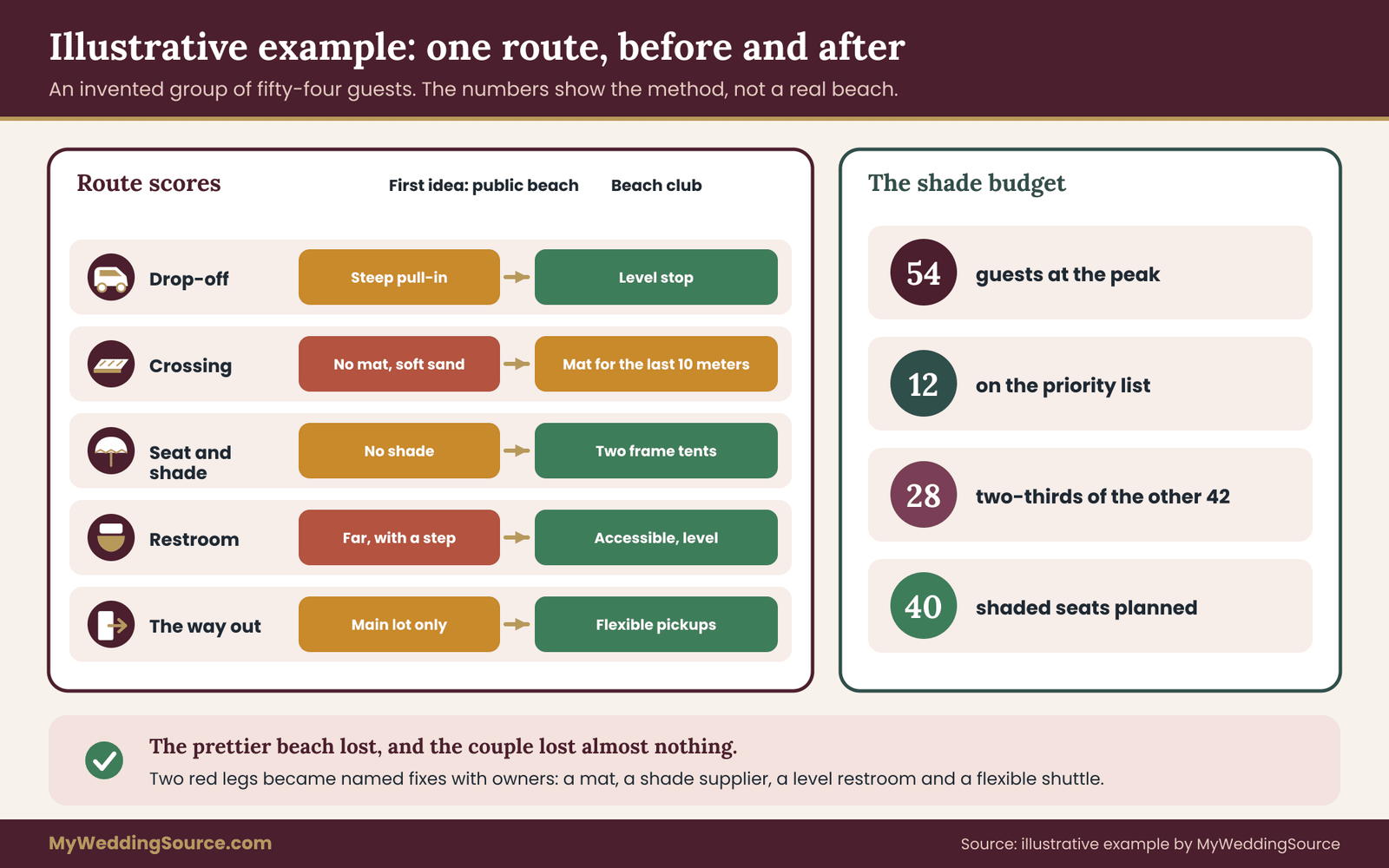
The ideas above are easier to judge when applied to a case. The example below is invented, and its numbers are illustrations of the method, not measurements from a real beach or a real event. Use it to see how the route test, the shade budget and the vendor checklist fit together.
The invented example
Imagine a couple planning a three-hour beach day on the second afternoon of a four-day wedding weekend abroad, for fifty-four guests. The group includes a grandmother who uses a walker, an uncle who uses a manual wheelchair, a friend with a heat-sensitive condition, a cousin who is seven months pregnant, a family with a toddler and a stroller, a guest with low vision, and a group of keen swimmers in their twenties.
The couple’s first idea was a pretty public beach with a view. The first-pass screen showed a parking area and a boardwalk, but the boardwalk ended about sixty meters short of the sand where they hoped to sit. There was a lifeguard post but no information on hours, and the only restrooms were in a building at the far end.
The route test. A local planner walked the five legs for them. Leg one, the drop-off, was amber: a stopping area existed, but it was a steep pull-in. Leg two, the crossing, was red: no mat, and soft sand for the whole stretch. Leg three, the seat, was amber: firm packed sand near the waterline, but no shade. Leg four, the restroom, was red: far and with a step. Leg five, the exit, was amber: the shuttle would only stop at the main parking area.
The decision. Two reds meant the plan could not go ahead as imagined. The couple considered fixing both with equipment and found the cost high. Instead they asked about a second option, a beach club a few minutes away with a level drop-off, a short boardwalk reaching the seating area, an accessible restroom and its own shade. The route test there gave four greens and one amber, the amber being the surface at the final ten meters, which a roll-out mat could fix.
The fixes and their owners
The fixes were ordinary. The beach club agreed to place a roll-out mat across the last ten meters and to confirm its width and the join with the boardwalk.
A shade supplier set up two frame tents near the end of the boardwalk and several umbrellas in the soft zone, and the couple checked the afternoon position with a sun-path tool, then confirmed it on site. The shade budget was simple: the priority list had twelve people, the peak group was fifty-four, so they planned shaded seating for the twelve plus about two-thirds of the other forty-two, which came to forty shaded seats in total.
They chose one accessible van for guests who needed a ramp, plus ordinary shuttles. The beach club offered a beach wheelchair, which the uncle chose to try for the water’s edge while keeping his own chair on the mat. A cool-down corner went inside the larger tent. Six adults agreed to take twenty-minute water-watcher shifts, and the club’s lifeguard covered the swim area during the whole window.
What the example shows
Three things stand out. First, the pretty beach lost to the accessible one, and the couple lost almost nothing: the beach club had a perfectly good beach. Second, the failure points were not the dramatic ones. They were a missing mat, a distant restroom and an unshaded seat. Third, a short written route test turned a vague worry into a list of named fixes with owners, which is exactly what a busy couple needs.
If a similar plan involves an all-inclusive resort, the same route test applies to its beach, whatever the brochure says is included.
Edge cases and backup plans for a beach day
Even a good beach day plan meets surprises. A few cases come up often enough to think through in advance.
The mat is the wrong length or arrives late. Have a plan to shift the seating closer to the firm zone, to use a second location, or to run the event on the boardwalk or patio for the first hour. A backup that needs no mat saves the beach day.
The wind rises. Shade structures have limits. Name the person who decides to lower a canopy, and have a backup indoor or covered area. If umbrellas have to come down, move guests to the firm zone and keep drinks and food flowing.
The tide is higher than expected. Wet sand shrinks the dry space and can reach mats. Plan the layout so that the mats and seating stay on higher ground, and check the tide times again on the morning.
A guest becomes unwell from heat. Move them to the shade, give cool water, loosen tight clothing, and call local emergency services if they are confused, unresponsive or not improving. Follow current CDC guidance, and make sure someone stays with them.
A guest does not want to be on the mat. Some guests prefer a spot away from the main group. That is their choice. Make sure they have shade and water and that someone checks on them without hovering.
The beach authority changes the rules. Closures, flag changes and restrictions can come at short notice. Ask the authority how it communicates changes, and designate someone to check on the day.
A lifeguard is not on duty. Do not allow swimming if the lifeguard is absent and the conditions are not clearly safe. Limit the water to the shallows, with watchers, or skip it. A shorter beach day with no swimming is better than a longer one with a risk nobody is ready for.
A vendor cancels. Keep a short list of backup suppliers for shade, mats and transport, and ask each primary vendor about its cancellation terms. Where money is at stake, keep written records of what was promised and paid.
When the beach day is the wrong choice
Sometimes the honest conclusion of the route test is that a beach is not the right setting for this group. If most of the legs are red and the fixes are costly, if the weather risk is high, or if the group’s needs are very mixed and the beach cannot meet them, consider alternatives. A shaded terrace overlooking the sand, a beach club’s covered pavilion, a garden near the water, or a boat-free waterside lunch can give the feeling of the sea without the barriers. Guests who want sand and water can go in small groups with helpers.
If you are comparing alternatives, the accessible venue red flags list shows what to look for in a covered space.
Choosing the alternative is not a failure. It is the result of a method working as intended: it showed you where the plan would have left people out.
Your next steps
Work through these in order, and you will have a beach day plan that holds up.
- Define the beach day. Decide the purpose, the length, the target group size and the access lead.
- Screen beaches. Use the six-question first-pass screen on two or three options, then call the managers with concrete questions.
- Walk the five legs. Visit or send a trusted local, score each leg green, amber or red, and fix the weakest first.
- Map the zones. Put essentials in the firm or mat zone, and treat the soft zone as optional.
- Plan shade. Run the three-time check, set a shade budget and write down the wind limit and who calls it.
- Set the heat and water rules. Name the water watchers, mark the swim zone, set the heat rule and fill in the emergency card.
- Collect vendor proof. Ask the three questions for each vendor, get answers in writing and keep one sheet.
- Invite well. Use wording that asks everyone what would help, keeps answers private and invites guests to come and go.
- Write the run sheet. Include access tasks, and make the day-before check call.
- Keep a plan B. Know what you will do for wind, heat, tide, a late mat or an absent lifeguard.
If you do only three things, make them these: walk the five legs, put shade where people will actually sit, and name a water watcher.
FAQ
How do we plan a beach day for guests who use wheelchairs?
Start with a continuous firm route from the drop-off to a shaded seating spot, using a boardwalk or a mat that is wide enough to turn on and has no lips at the joins. Test it with a wheelchair or stroller. Add level space beside each seat, an accessible restroom within reach, and a beach wheelchair for guests who want to go further, offered as a choice.
How much shade do we need for a beach day?
There is no official number for a wedding gathering, so use a planning rule. Cover every guest on your priority list, including older guests, pregnant guests, young children and anyone who has asked for shade, and add shaded seats for about two-thirds of everyone else. Check the shade at the start, middle and end, because the sun moves and shadows travel.
What surface works for walkers and canes on sand?
Soft dry sand is hard for walkers, which can sink, and canes, which lose their grip. A firm mat, boardwalk or packed surface is far better. Place chairs with arms along the route as rest points, and keep essential activities such as food and seating on the firm or mat zone. Let guests choose whether to go onto the soft sand at all.
Who should be the water watcher on a beach day?
Any sober, responsible adult can take a shift, ideally in rotations of twenty to thirty minutes, so nobody tires or gets distracted. The watcher should not drink, use a phone or take photographs. They should wear something visible and hand over verbally at each change. A lifeguard is a separate, qualified service, and the watcher supports it rather than replacing it.
Should the host pay for access features at a beach day?
The fairest rule is that the host covers the features that make the baseline gathering usable, such as mats, shade, seating, accessible restrooms and an accessible transport option. Optional extras can be priced separately. A guest should not pay a surcharge to reach a seat. Ask vendors to price access items as separate lines so you can see the cost and decide where to trim.
How do we ask guests about mobility needs without being intrusive?
Send one general question to everyone, describing what the beach day will include and inviting requests by a set date. Do not ask for medical detail. Offer several ways to reply, name a kind, private contact, and say that guests are welcome to come for any part and leave when they like. Reply promptly with what you will arrange.
What if the weather turns hot, windy or stormy?
Decide your rules in advance. Set a heat threshold that moves or shortens the day, a wind limit for each shade structure and a named person who makes the call. Check the forecast and tide times the day before and the morning of, tell guests early, and have a covered backup such as a terrace or pavilion. Never run water time without a lifeguard or watchers.
When is a beach day the wrong choice for a mixed group?
When the route test shows several red legs that cannot be fixed within budget, when there is no reliable accessible restroom, shade or lifeguard cover, or when the weather risk is high. In those cases a shaded terrace, a beach club pavilion or a waterside garden can give guests the sea view without the barriers, and small groups can still visit the sand with helpers.
Sources
- U.S. Department of State, Bureau of Consular Affairs: country travel information, advisories and guidance for travelers, including those with disabilities.
- U.S. Access Board: federal accessibility guidelines, including guidance on accessible routes and outdoor recreation access.
- ADA.gov, U.S. Department of Justice: information on the Americans with Disabilities Act and accessibility standards.
- National Weather Service, Rip Current Safety: rip current science and what swimmers should do.
- Centers for Disease Control and Prevention, Heat and Health: heat illness signs, risk groups and response guidance.
- American Red Cross: water safety, first aid and swimming guidance.
- United States Lifesaving Association: beach safety and open-water swimming guidance.
- U.S. Environmental Protection Agency, Sun Safety: sun protection steps, including seeking shade.
- U.S. Coast Guard: recreational boating safety, including approved life jackets.
- Transportation Security Administration: passenger support information for travelers with disabilities and medical conditions.