
A wedding change notice is the short, corrected message you send when a detail on your printed invitation stops being true: a new venue, a new time, a new date, a new dress code or a new parking plan. This guide shows you how to grade the change, confirm the new facts, choose a channel for each guest, write the change notice and keep a delivery log that proves everyone got it.
Quick answer
Do not send a change notice until the new facts are confirmed in writing by the venue or vendor. Then grade the change on a four-level ladder: informational, logistical, attendance-affecting or date-changing. Send the change notice by the channel each guest actually reads, and use a second channel for anyone who might miss the first. State what changed, what stays the same, what the guest must do and by when. Keep a delivery log with one line per household, and close each line only after you have a sign of receipt.
Invitations go out with a kind of finality that real life does not respect. A venue floods. A caterer closes. A ceremony site loses its permit, a flight schedule shifts, or a family emergency moves a date. The envelope is already in a hundred mailboxes, and the information on it is now wrong. The problem is no longer design. It is a communication problem with a deadline, an audience that varies in age and tech habits, and a fixed number of ways to fail.
The usual failure is not a badly worded change notice. It is a change notice that reaches most guests and quietly misses a few. Great-aunt Lena never opens email. A college friend muted the group text. A cousin’s household moved in the spring and the card went to the old address. On the wedding day those misses become guests standing at the wrong door in good shoes.
This guide treats the change notice as a small operations project. It has an input (the confirmed new facts), a set of routes (channels), a message (the wording) and a record (the delivery log). Each piece gets its own section, followed by a worked example with an invented couple and a section on vendors, costs and paperwork.
A note on scope. This is general information, not legal, tax or financial advice. Contracts, postal rules, text-messaging rules and marriage license rules differ by state and by provider, and they change. Where a rule matters, the guide points you to the agency or the vendor that issues it, so you can confirm the current version yourself.
What a change notice is, and when you need one
A change notice is any message that corrects or replaces information a guest already received. It is not a new invitation, and it is not a save-the-date. Its single job is to make sure that no guest acts on outdated information. That narrow job is the reason it should be short, specific and easy to verify.
You need a change notice whenever a fact on the invitation, the wedding website or an earlier message would lead a guest to the wrong place, at the wrong time, in the wrong clothes or with the wrong expectations. The test is practical: if a guest followed the old information exactly, would something go wrong? If yes, send a change notice. If the answer is only “they would be slightly less informed,” a website update may be enough.
Changes that always need a change notice
Some changes are never optional to announce. A new ceremony or reception location is the clearest case. A new date or start time is another. A change in the order of events, such as moving the ceremony to the afternoon and the reception to the evening, also counts, because guests plan travel and childcare around that order.
Changes in who is invited to which event belong here too, though they call for more care. If a guest list is reduced because a venue’s capacity dropped, the change notice itself becomes sensitive, and the guest list guide covers how to approach that conversation before you send anything in writing.
Changes that rarely need a change notice
Small changes often belong on the website and in a short update to the people directly affected. A different dessert, a swapped musician or a changed color palette does not send anyone to the wrong place. The risk with these is the opposite one: over-announcing. A guest who receives six corrections for trivial details starts ignoring them, and then misses the one that matters.
Why timing matters more than polish
A plain, accurate change notice that arrives on time beats a beautiful one that arrives late. Guests commit money and time based on what you told them. The closer the wedding, the less room they have to rebook, rearrange childcare or request time off. So the working rule is to send the first message as soon as the new facts are confirmed, and refine the formatting afterward if needed.
That does not mean sending in panic. It means a short confirmation window of a day or two to check the facts, followed by a prompt message. The next sections show how to use that window well.
What this guide leaves to other pages
The wider topic of invitation etiquette, including wording for the original invitation, lives in the wedding invitation etiquette guide. The production side, from proofs to quantities to printer handoffs, lives in the wedding invitation print production guide. This article starts after both of those are finished and something has gone out wrong or out of date.
Grade the change before you write the change notice
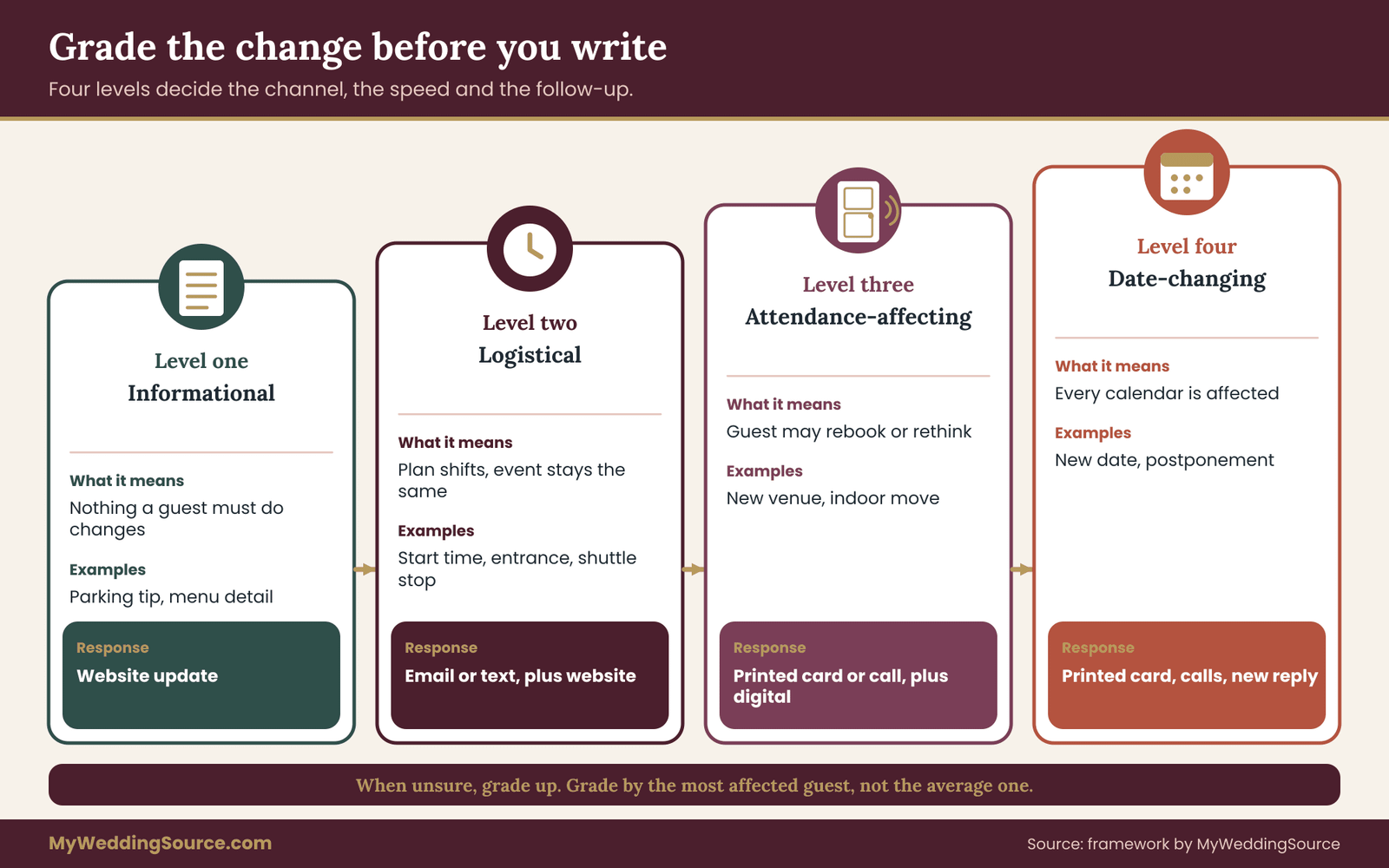
Not every change deserves the same response. A four-level ladder keeps you from either underreacting to a serious change or turning a minor one into a crisis. Grade the change first, because the grade decides the channels, the speed, the wording and the follow-up.
Level one: informational. Nothing a guest must do changes. Examples include an updated parking suggestion, a new menu detail that does not affect dietary needs, or a dress code clarified from “cocktail” to “cocktail, with a warm layer for the patio.” The right response is a website update and, if you like, a short note in your next regular message.
Level two: logistical. The guest’s plan is affected but the event is the same. A start time moves by thirty minutes, the entrance changes to the north door, or the shuttle pickup moves to another hotel lobby. Send a change notice to everyone, by their usual channel, within a few days of confirming.
Level three: attendance-affecting. The change could cause a guest to rethink coming, rebook travel or arrange new care. A new venue in a different town fits here, as does a change from outdoor to indoor that alters the dress code, or an added event that requires a separate commitment. These need a first-class change notice, a second channel for anyone at risk of missing it, and a direct phone call to guests who are older, traveling a long way or known to be hard to reach.
Level four: date-changing. The date moves, or the wedding is postponed or relocated to a new region. This is the heaviest category. It usually means a new invitation or a formal printed card, a fresh RSVP, a hotel block update and an apology that does not over-explain. The section on special cases returns to it.
How to grade when you are unsure
When a change sits between two levels, grade it up. Ask three questions. Could any guest arrive at the wrong place or time if they never see this? Could any guest have to spend money or rearrange their life because of it? Would a guest reasonably feel they should have been told? One yes means level two at least. Two yeses mean level three.
Grade by the most affected guest, not the average one. A shuttle time change is level two for most guests and level three for a guest who relies on that shuttle because they do not drive. The change notice goes to everyone, but the follow-up goes to that guest.
Write the grade at the top of your log
Put the grade in the first line of your delivery log, which a later section builds in detail. It tells whoever helps you, whether a sibling, a planner or a friend, how hard to chase unconfirmed guests. A level-one change can close with silence. A level-three change should not close until every household is accounted for.
Verify the new facts before any change notice goes out
The most expensive mistake in this whole process is sending a change notice and then having to send a correction to the correction. Guests stop trusting a second round of changes, and a third one can feel chaotic. So spend a short, disciplined window confirming each new fact with the party who controls it.
The confirmation sheet
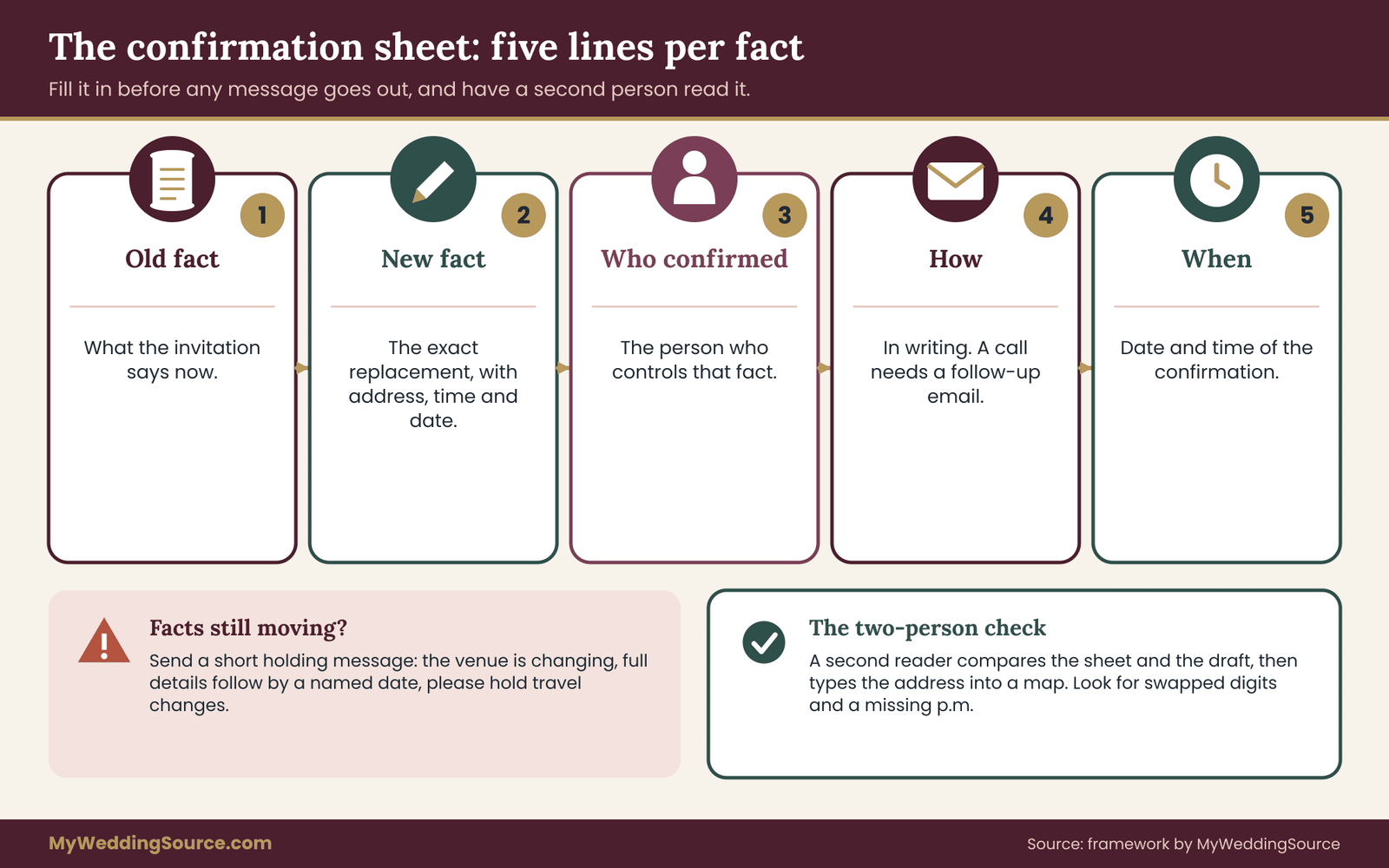
Before you write a word, fill in a one-page confirmation sheet with five lines for every fact that changed: what the old fact was, what the new fact is, who confirmed it, how they confirmed it and when. “The venue manager confirmed by email on Tuesday afternoon” is a usable entry. “I think the new place has parking” is not.
The how matters. A written confirmation, such as an email or an amended contract, survives a staff change. A verbal promise does not. If a vendor offers only a phone call, send a one-line email afterward that begins “To confirm what we discussed” and ask them to reply yes. That reply becomes your record.
Who controls which fact
Different parties own different facts, and a change notice that quotes the wrong source goes wrong quickly. The venue controls the address, the load-in and access hours, the capacity and any rule that limits guest behavior, such as candles or amplified sound. The caterer controls the meal service times. The officiant controls the ceremony length and any requirement that affects where the ceremony can occur. A transportation company controls pickup times and locations.
You control the guest-facing wording, but not the facts behind it. If a shuttle company says pickups begin at 3:15, you cannot write 3:00 to give guests a cushion and also call it confirmed. Build any cushion into a separate line, such as “please arrive at the pickup point by 3:00.”
Official checks that apply to specific changes
Some changes trigger a check with an official body rather than a vendor.
If the venue moves to a different county, your marriage license may be affected. Licenses are issued by a local or state office, and the rules about where a license can be used and how long it remains valid vary. Contact the issuing office and ask in plain terms: “We changed the ceremony location from this county to that one. Does our license still work, and does the officiant need anything additional?” Do not assume.
If the date moves, a license with a validity window may need to be checked against the new date, and an officiant’s availability must be confirmed in writing. If the change involves an outdoor site, the local government office that manages the property may require a permit change, and a park or public space can have its own notice rules.
For the weather side of any outdoor decision, the National Weather Service publishes forecasts and alerts at weather.gov, which is useful for the final go or no-go conversation but not a substitute for the venue’s own weather policy.
Check your contracts before you announce
A change of venue or date is rarely free. Read the contract clauses on changes, cancellation and rescheduling before you tell guests. A fee, a different minimum or a new vendor availability can change what you are able to promise. The wedding vendor contract guide explains common clauses in plain language, and the final section of this article returns to who pays for what.
The two-person check
Have one other person read the confirmation sheet and the draft change notice against each other. This is not about grammar. It is about the traps: a swapped digit in a street number, a time that is correct but missing “p.m.,” a ZIP code that belongs to the old address. A fresh pair of eyes catches these more reliably than a tired author does. The second reader should also open the map link or type the address into a map and confirm it lands where you mean.
What to do if the facts are still moving
Sometimes a venue says the new space is “likely” available but the confirmation is two days away. Resist sending a conditional change notice unless the original information is already false. If it is still true, wait. If it is false, send a brief holding message: “Our venue is changing.
We are finalizing the new location and will send full details by Friday. Please do not make travel changes until then.” That is honest, it prevents guests from acting on the old plan, and it sets a date for the real notice.
Build the audience list for the change notice
A change notice reaches the people on the list you give it. The list is therefore the thing to get right. Most couples start with the guest list they used for invitations. That is a good base, but it needs three adjustments before it is a delivery list.
Add everyone with a stake, not only guests
People other than invited guests often need to know. Parents who are hosting need to hear first, and ideally before you tell anyone else, so that a guest who calls them with a question does not find them uninformed. The wedding party needs the new information for their own travel. Vendors need it as part of change orders, which the last section covers. Children’s caregivers, drivers, helpers and anyone who is arriving on a guest’s behalf, such as an aide for an older relative, may also need it.
Keep two lists: a guest list for the change notice and a stakeholder list for a separate, more detailed message. The guest message is brief. The stakeholder message can include timings, load-in and contact numbers that guests do not need.
Group by household, then by channel
Invitations usually go to a household, so the log should too. One envelope often covers two adults and several children, and a single email address or phone number may belong to only one person in that household. Group your list by household first so you can see who has a verified way to be reached. Then tag each household with the channels you know work: mailing address, email, mobile number, a messaging app or a trusted intermediary.
The tags matter more than the names. A household with three verified channels is easy. A household with only a mailing address is where problems hide. Often these are older guests, and they are often also the guests with the most to lose from missing the change notice.
Sort by risk of missing the message
Within the list, mark the households most likely to miss a digital change notice. Common signals include older relatives who do not use email, guests who responded by mail and never gave a phone number, households you have not spoken with in months, and guests who are traveling internationally. Mark the opposite group as well: guests who answer messages within the hour. They are a useful source of fast confirmation and can sometimes help you reach their relatives.
Do not guess. If you do not know how a guest prefers to be reached, ask a person who does. A parent or a sibling often knows that Uncle Raymond only answers his landline before noon.
Respect privacy when you collect and share contact details
Contact details you gathered for the wedding were given for a specific purpose. Use them for the wedding. Do not forward a guest’s phone number to a group without asking. In a group message, replies to a shared thread can expose phone numbers to people who never had them. If you must send a broad message, use a method that keeps recipients’ details separate, such as blind copy for email or individual messages for text.
The Federal Trade Commission publishes general consumer guidance on protecting personal information at ftc.gov, and it is a reasonable reference for what “careful” looks like.
The final audience count
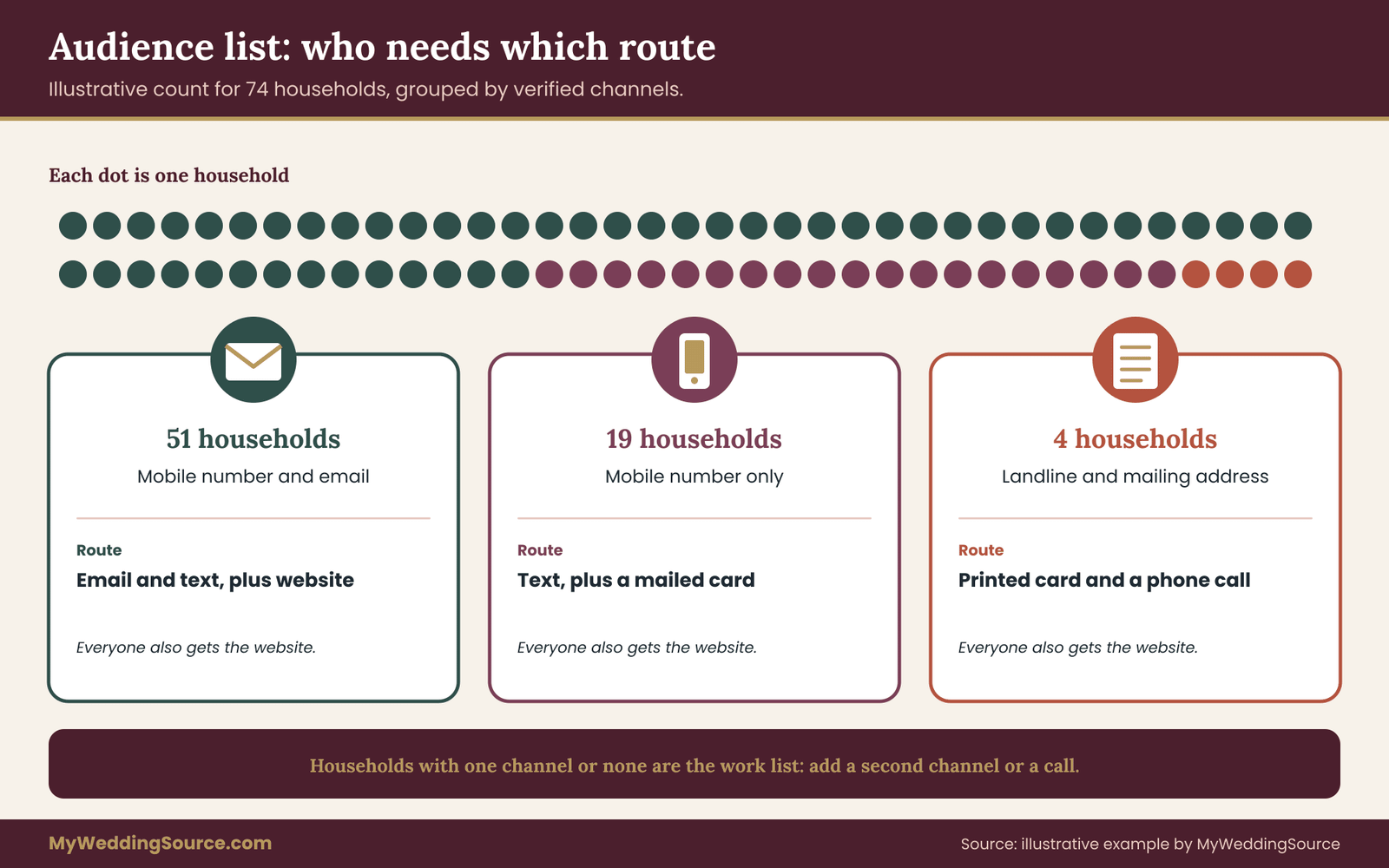
When the list is ready, count three numbers and write them at the top of your log: total households, households with at least two verified channels, and households with only one. The third number is your work list. Every household in it needs either a second channel or a direct human follow-up, and the next section explains how to match channels to guests.
The channel ladder for a change notice
Different guests read different things. A change notice that goes only through the channel you personally prefer is a change notice that fails for a predictable slice of your list. The channel ladder is a way to match message, urgency and guest, so you are never relying on one route.
The five rungs
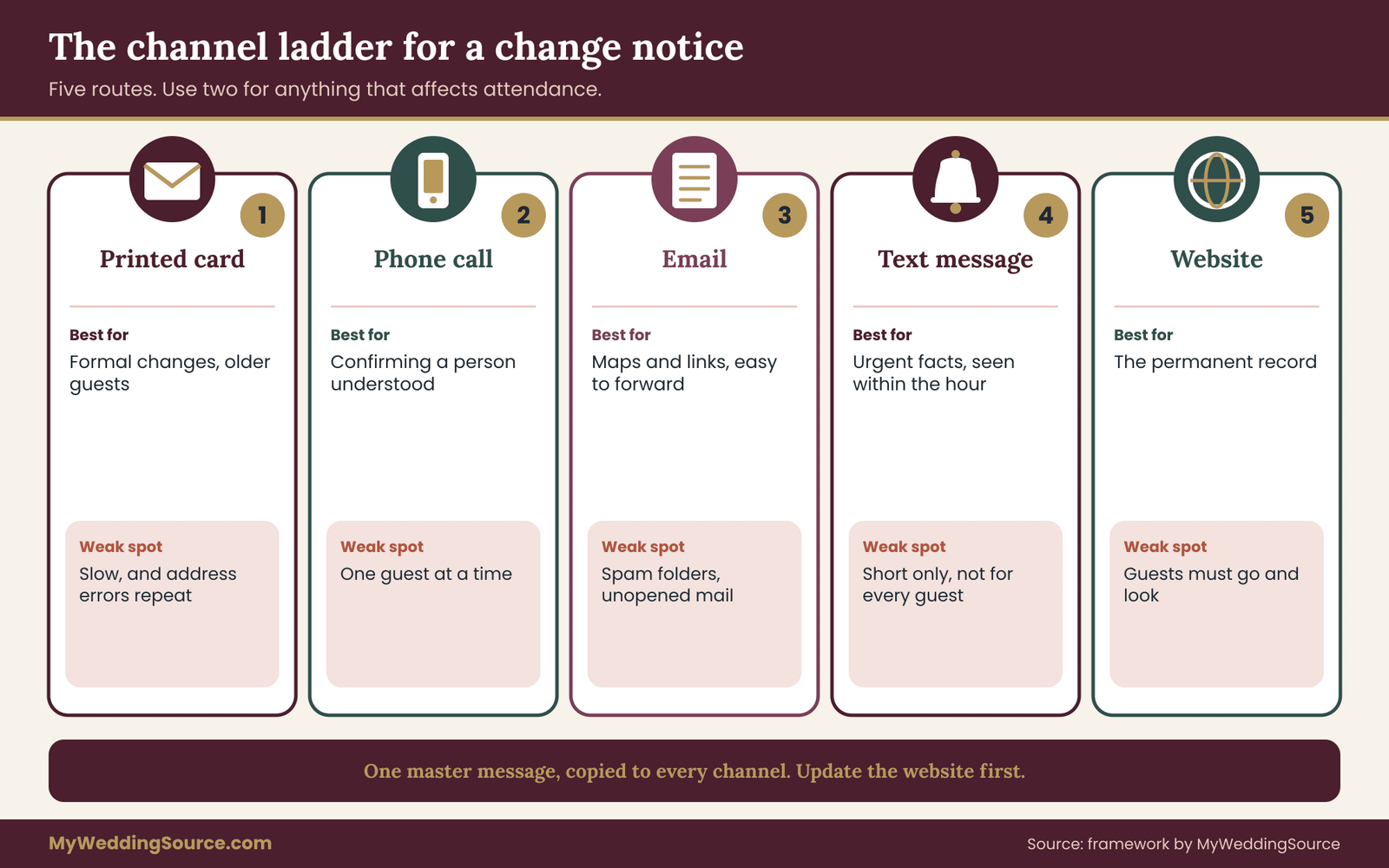
Think of five channels, ordered from most reliable for formal changes to least.
Rung one: a printed card or letter, mailed. It matches the format of the original invitation, it is easy for older guests to keep on a refrigerator and it does not depend on a device. Its weakness is speed. It takes days, and any address error repeats the original failure.
Rung two: a phone call. Slower per guest, but unmatched for confirming that a person understood. A call is the right rung for level-three changes and for guests who are older, traveling far or hard to reach.
Rung three: email. Fast, easy to attach a map and easy to forward to a partner. Its weakness is that it can land in a spam folder or sit unopened, and many guests treat wedding email as low priority.
Rung four: text message. The most likely to be seen within an hour, which makes it ideal for urgent, short facts. It is poor for long explanations and poor for guests who do not text.
Rung five: the wedding website. The permanent reference. It should always be updated, but it works for guests who go looking, not guests who need to be told. Treat it as the place where the change notice lives, not the way the change notice is delivered.
Matching a rung to a level
For level one, the website alone is acceptable. For level two, use email or text plus the website, and add a printed card for guests with no digital channel. For level three, use a printed card or a call as the main route, plus a digital copy, plus the website. For level four, send a printed card, make calls where needed and update everything else.
The point of the ladder is redundancy. A guest who gets the same correct information through two routes is far less likely to arrive confused than a guest who got one. The log records which two.
One source of truth
Whatever channels you use, they must all say the same thing. Pick a single master version of the change notice, written once and approved once. Every channel is a copy of that master, adjusted only for length. A text message is a shorter version of the master, not a new draft. Copying from a master avoids the quiet inconsistencies that cause confusion, such as an email that says 4:30 and a card that says 4:00.
Label the master with a version number or a date, and put that in the log. If you update it later, a guest who has an older copy can be identified and fixed rather than left to compare two versions on their own.
Who sends what
Decide before sending who is the sender. For printed and formal notices, it is usually the hosts or the couple. For a text or a call, the sender is often the person closest to the guest: a sibling calling an aunt, a friend texting a friend. That is not a shortcut. It is how the change notice gets read. Give each helper a short script and a list of the specific households they are responsible for, and ask them to report back in the log within a day.
When not to use a channel
Avoid a group text for a serious change notice. It scatters replies, exposes numbers and makes it impossible to see who has read it. Avoid social media posts as the primary route; many guests will not see them, and you cannot confirm receipt. Avoid sending a change notice by a vendor, such as a planner’s mass email, unless you have agreed on the content, because the tone can come across as unfamiliar.
A phone script for helpers
Helpers who call guests need words they can say without improvising. Give each helper a short script and ask them to stick to it. Something like: “Hi, this is Priya, Marta’s sister. I am calling about a change notice for the wedding. The ceremony has moved to Maple Hall on River Street. The date and time are the same. Do you have a pen handy so I can give you the address?”
Then wait. Let the guest write it down, read it back and ask questions. Close with a clear line: “We are mailing a printed change notice today, and the website has the same information. Is there anyone else in your household I should tell?” That last question catches the adult child who drives a grandparent, and it often surfaces a better phone number for the log.
If the call goes to voicemail, leave the facts, not just a request to call back. A message that says only “call me about the wedding” makes guests worry. A message that gives the new address and the reply date lets them act at once, and it counts as a first channel even though it is not a sign of receipt. Note it in the log and try again the next day.
When the change notice goes to a large guest list
Past a hundred or so households, one person cannot hold the whole log in their head. Split the list into blocks of fifteen to twenty-five households, give each block to a named helper and ask for a short report at a set time each day. The couple should still own the master change notice and the confirmation sheet, because they are the only people who can answer a question about the facts. Helpers handle delivery and record what they hear.
Writing the change notice: required elements and wording
The wording of a change notice is not literary work. It is a short, structured statement in which each element has a purpose. A guest scanning it on a phone in a grocery line should be able to find the correction in a few seconds.
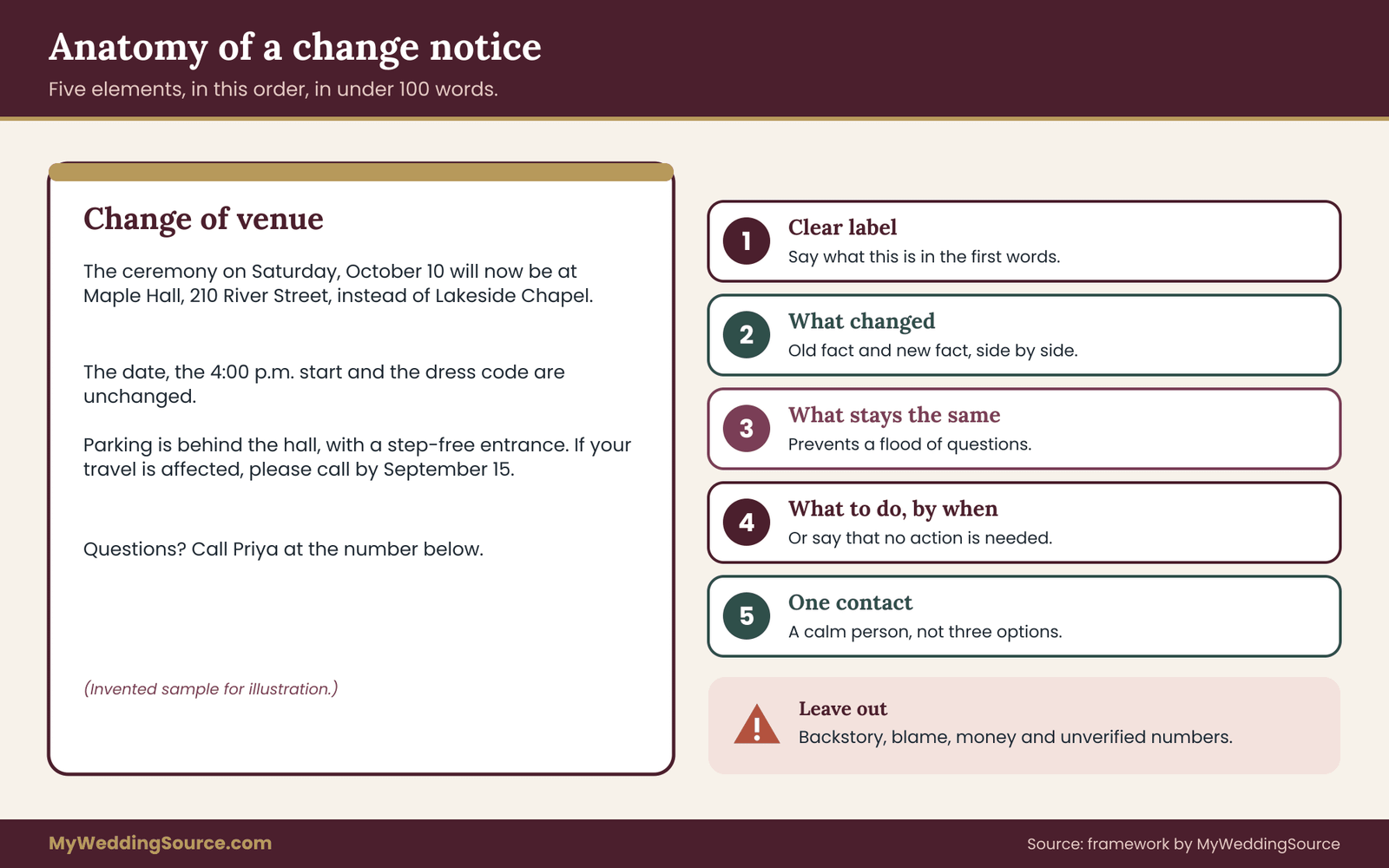
The five required elements
A good change notice contains five things, in this order.
1. A clear label. Start with words that say what this is: “Change of venue,” “Updated time” or “New date.” Do not bury it in the middle of a friendly paragraph. If the subject line of an email can carry the label, let it.
2. What changed. State the old fact and the new fact in one or two sentences. “The ceremony will now take place at Maple Hall, 210 River Street, instead of Lakeside Chapel.” Naming the old fact prevents guests from assuming the change notice refers to something else.
3. What stays the same. Many guests worry that a change means more changed. If the date, time and dress code are unchanged, say so. This single line prevents a flood of questions.
4. What the guest needs to do. If nothing, say “no action is needed.” If they need to update travel, confirm attendance or tell you about access needs, say precisely what and by when.
5. How to reach you. Give one point of contact, not three. A phone number for a calm human is better than a form, especially for older guests.
Tone: calm, specific, brief
You do not need to apologize at length, and you do not need to explain every reason. A short, honest sentence about why is enough, such as “Our original venue is unable to host the event.” Avoid over-explaining the reason, which invites debate, and avoid blaming a vendor in writing. A calm tone gives guests a sense that someone is in control.
Sample wording for a venue change
Here is a version that carries the five elements:
Change of venue. Our wedding on Saturday, October 10 will now take place at Maple Hall, 210 River Street, instead of Lakeside Chapel. The date, the 4:00 p.m. start and the dress code are unchanged. Parking is available behind the hall, and we will send a map with step-free access marked. If this change affects your travel, please call or text Priya at the number below by September 15. We are sorry for the confusion and cannot wait to celebrate with you.
That is under 100 words. It names the old and new venue, says what is unchanged, gives an action and a date, and has one contact point. The same structure shortens to a text and expands to a letter.
Sample wording for a time change
Updated start time. The ceremony will begin at 5:00 p.m. instead of 4:00 p.m. Everything else, including the location and the dress code, stays the same. Doors open at 4:30. No reply is needed unless the new time creates a problem for your travel, in which case please call Priya by September 15.
Note that “no reply is needed” is not filler. It tells guests they do not have to respond to this message to remain on the list.
Sample wording for a date change
A date change deserves a formal version because it replaces the information on the invitation entirely:
Because of circumstances beyond our control, the wedding of Marta Lopez and Ben Carter will now take place on Saturday, November 14, instead of October 10. The location, Maple Hall, is unchanged. A new reply card is enclosed; please return it by October 12, even if you replied before. If the new date does not work for you, we understand, and we would be glad to hear from you.
Sample wording for a weather or access change
Update for Saturday. The ceremony will take place indoors in the garden room because of the forecast. Please wear shoes you can walk in on a short gravel path to the entrance. Seating is first come. If you need step-free access, use the side door by the ramp, and our ushers will direct you.
Do not include these
Leave out the long backstory, accusations, details about money, any guest-list reasoning, and anything that you would be uncomfortable seeing forwarded. A change notice may be shared far beyond its first recipient. Also leave out digits that you have not verified, such as the number of guests or a cost. If it is not essential for the guest to act, it does not belong in the change notice.
Accessibility of the message itself
Keep type large enough to read comfortably on a printed card. Use plain words and short sentences. In email, put the key facts in the body text, not in an attached image, because screen readers and some email programs cannot read an image of text. If you attach a map, describe the route in a sentence as well. The ADA.gov site is the federal source for accessibility requirements, but for wedding invitations the practical goal is simple: every guest can read and use the information.
Printed change notice: cards, inserts and postage
A printed change notice is the formal route and the right main channel for level-three and level-four changes. It also brings a set of production questions that a text message never raises. The questions are small, but they decide whether the card arrives and is believed.
Choose the format: card, insert or reprint
There are three practical formats. A correction card is a small card, often the size of an insert, that states the change in a few lines. An insert is a card placed in a second envelope or, for guests who have not yet mailed an RSVP, inside a reply envelope. A full reprint replaces the whole invitation and is usually reserved for a date change.
Pick by scale. If the change affects every guest, a correction card mailed to everyone is simple and consistent. If it affects only one group, such as guests invited to the ceremony only, a targeted card is enough. A full reprint is rarely worth the cost and delay unless the invitation would otherwise mislead guests in several ways.
The same principle that governs the original design applies: the card should look like it belongs to the wedding, but it should not try to be the invitation. Use the same typeface and paper color if you can, and use a plain heading such as “Change of venue.” A card that mimics the invitation too closely can be mistaken for a second invitation and filed away.
Stickers and overprints: use with caution
Some couples cover the old line with a sticker. It is cheap and quick, but it can peel, mismatch and look improvised. If you choose stickers, test them on a spare invitation and check that they stay put in a mail stream. Mark the corrected line clearly. For anything more than a single changed line, a card is clearer.
Ask the printer before you order
If you used a stationer or a print shop, call them first. They may hold your artwork, paper and color matches, and a short correction card often costs far less than a new run. Ask for a proof before printing, even for a small job. The same proofing habits from the site’s proofing and printer handoff guide apply here, just on a smaller scale: check names, addresses, times and punctuation, and have a second person read it.
Ask how long the turnaround is and what the cutoff is for the quantity you need. Order a few more than your household count. Extras cover errors, late additions and the vendors who need a copy.
Postage and size: verify with the post office
Do not assume that a correction card uses the same postage as the original invitation. Size, thickness, shape and weight all affect how a piece is processed and priced. The United States Postal Service publishes its mailing standards in the Domestic Mail Manual, and its pricing and size rules for letters and postcards change from time to time. Bring a finished sample, with the envelope, to a post office counter and ask them to confirm the postage before you buy stamps in volume.
If your correction card is a postcard, check that it meets the minimum and maximum size for a postcard and that the address side has the space required for the address and postage. If it is a letter in an envelope, check for thickness and rigid elements such as buttons or ribbons that can cause extra charges. Square or unusual envelopes often need more postage. Ask in person; the counter staff can weigh and measure a sample.
Address checks before printing labels
The addresses on your original list may be right or wrong. Before you print new labels, check the list against any returned invitations and any guest messages that gave a new address. Returned mail from the first mailing is a signal worth acting on, because a guest who did not receive the invitation also has not seen your RSVP request. The same log-and-verify habit used for returned mail applies: confirm each address from two sources before you print.
Timing the mailing
Mail the printed change notice as early as the confirmed facts allow, and add a digital copy the same day. Mail takes several days, and you need a buffer for slow delivery and for any guest who is away. For a level-three change, add the phone call within a day or two of the mailing rather than waiting to see whether the card arrives.
For a level-four change, mail as early as possible and ask guests to reply by a date that leaves you time to chase the quiet ones.
Handing off the finished cards
When the cards arrive, count them against the log, address them from the master list and stamp them as a batch. Keep a few blank cards with envelopes in a folder for last-minute households. Photograph one finished card and file it in the log. It is a record of exactly what you sent, which helps if someone asks later what the change notice said.
Digital change notice: email, text and website rules
Digital channels are faster, cheaper and easier to update. They also fail in quieter ways, because you rarely know whether a message was seen. The rules below are about reducing that uncertainty and treating guests’ contact details with care.
Email: subject line and structure
An email change notice lives or dies on its subject line. Put the label first and the date second: “Change of venue: October 10 wedding.” Guests scanning an inbox should know the topic without opening it. Avoid vague or promotional subject lines, which are more likely to be ignored or filtered.
In the body, use the five-element structure from the previous section. Keep the message short, put the key facts in plain text, and include one link to the updated website page. If you add a map, also write the address in text. Do not rely on images for essential details.
Send from an address guests recognize, and send in small batches or individually if the list is large. A large blast with every address visible shows names to people who may not know each other, and a long blind-copy list can trip spam filters. A simple mail merge that sends each household its own message is a better option when your email service supports it.
Text messages: short, personal and consent-aware
A text change notice should fit on one screen: the label, the new fact, what is unchanged, the action and the contact. For example: “Change of venue for our Oct 10 wedding: Maple Hall, 210 River St. Time and dress code unchanged. Details and map: [website link]. Questions? Call Priya.” That is plain and checkable.
Only text numbers that guests gave you for wedding communication. If you want to send a long series of updates, consider asking guests whether they would like text updates, which a short opt-in note on your website can handle. The Federal Communications Commission publishes consumer information about text messaging rules at fcc.gov. Personal wedding messages sent one to one are very different from automated marketing texts, but a quick look at the agency’s guidance is sensible if you plan to use any bulk or automated tool.
Messaging apps and group threads
Many guests live in messaging apps rather than texts. They are fine for one-to-one notices, and they let you see when a message was read in some apps, which can serve as a soft receipt. Group chats are riskier. A change notice in a group chat can be buried within minutes under replies, and a guest who joined late will not see it. If you use a group chat, pin the message and also send individual messages to anyone who matters most.
The website: the permanent record
Update the website the moment the facts are confirmed, before you send anything else, so that every message can point to a page that already says the right thing. Put the change at the top of the page, not in a footnote. Use a dated heading such as “Updated September 3: change of venue” and keep the old information off the page. If you leave the old venue visible, you invite mistakes.
Check the site on a phone. Confirm that links open, that the map pin is correct and that any printable page matches the change notice. If the site goes down at a critical moment, the wedding website outage plan explains fallback options, since the same preparation that protects wedding-day information also protects a change notice.
Protect the guest list while you send
Use strong, unique passwords on any account that holds your guest contact details, and turn on two-step sign-in where it is offered. The Cybersecurity and Infrastructure Security Agency publishes plain guidance on account security at cisa.gov. A guest list is a list of names, addresses and phone numbers, and it deserves ordinary care. Avoid sending a spreadsheet of guest details by email. Share a view-only link with named helpers and remove access when the change notice is done.
Watch for scams that borrow your change
Change announcements can attract scams. A fraudster who sees a venue or date change might email guests or vendors pretending to be you and asking for money or a changed payment destination. Tell vendors and family to confirm any request involving payment by calling a known number. The Federal Trade Commission describes common impostor scams at ftc.gov, and a one-line warning in your stakeholder message costs nothing.
Special cases that need more than a change notice
A standard change notice handles most corrections. Some guests and some situations need an extra step, because the change touches something the change notice cannot fix by itself. Treat these as add-ons to the main routes, not replacements.
Out-of-town and international guests
Guests who have already booked flights and rooms carry the real cost of a change. For them, the change notice should come first by their fastest channel, and it should be followed by specifics: the new airport if the venue moved, the new drive time, the new hotel if the room block changed.
If a hotel block was set up around the old venue, contact the hotel before you tell guests anything about rooms. The guest hotels guide explains how blocks, cutoff dates and rate changes work, and a change of venue can make a block inconvenient even if it stays technically valid.
For international guests, write times with the time zone or at least a clear local label, and avoid shorthand dates that can be read two ways. “Saturday, October 10” is clearer than “10/10,” and “Saturday, October 10 at 4:00 p.m. local time” removes doubt. If a visa letter or travel document was based on the old date or location, ask the guest to check with the relevant authority about whether a change matters.
Older guests and guests who do not use digital channels
For guests who rely on mail and the phone, the printed card and a call are the main route, not the backup. Call them. Read the key facts slowly, ask them to repeat the new address or time back to you and offer to mail a copy. If a relative usually coordinates their travel, tell that relative too, with the guest’s knowledge.
Think about the physical change as well. A new venue may involve stairs, a longer walk from parking or a different restroom location. Add one sentence about step-free access and where drop-off is, because an older guest may decide whether to attend based on that detail.
Guests with access needs
If any guest has told you about a mobility, hearing, vision or sensory need, check that the new venue meets it before you send the change notice, and tell that guest specifically. A line in the general notice is not enough. Call or write to them separately: “The new hall has a ramp at the side entrance and an accessible restroom on the ground floor.
Does that work for you? If not, let’s talk about options.” That conversation protects the guest and prevents a last-minute surprise. The accessible venue red flags guide lists what to ask a new venue.
Guests with children or caregivers
A new location or time can break a childcare arrangement. If you invited children or arranged care at the old venue, tell those households early and ask whether the new arrangement works. If there was a sitter or a child-friendly space planned, confirm what happens now and say so in a short, direct message.
Guests whose RSVP is already in
A guest who has already returned a reply card may assume nothing more is needed. State plainly whether earlier RSVPs still count. For a venue or time change, say, “If you have already replied, you do not need to reply again unless the change affects your plans.” For a date change, ask everyone to reply again, because a yes for October does not guarantee a yes for November. The RSVP etiquette guide covers how to handle late replies and gentle reminders.
Date changes and postponements
A date change is the heaviest case because it breaks every guest’s calendar. The change notice should be formal, brief and sympathetic, and it should be followed by a fresh reply request. Consider these extra steps: send a printed card to everyone, call guests who are close family or need to travel, update the website with the new date before the change notice goes out and check that the new date does not collide with a major event in the same town or with a school or holiday period.
The choosing a wedding date guide explains how to test a date against guest and vendor availability, which is worth doing before you commit a second time.
Be honest about what you do not yet know. If the new date is a decision between two options, say so, and give a date by which you will decide. Guests tolerate uncertainty better than silence.
Cancelled events within the wedding
Sometimes one event, such as a rehearsal dinner, brunch or welcome party, is cancelled. The change notice should go to the specific guests invited to that event, and it should say what happens instead. If the cancelled event was the only reason some guests were traveling, call them.
Bilingual and multilingual households
If the original invitation was bilingual or some guests read another language more comfortably, make the change notice available in that language too. Have a fluent person who knows the guest check the translation, rather than relying only on a tool. Keep dates, times and addresses identical in both versions, and put them in the same order. A change notice that is clear in one language and muddy in another can be worse than none.
The delivery log: proving every guest got the change notice
A change notice is finished when you can show that each household has the correct information, not when you have pressed send. The delivery log is a simple record that makes that visible. It does not need software. A shared spreadsheet or a printed sheet will work, as long as one person owns it.
What each line records
Use one line per household and keep the same fields every time. The fields are: household name, who is responsible for reaching them, the channels you have verified, the channel used first, the date and time sent, a sign of receipt, a second channel if used, the date closed and a notes field. That is nine pieces of information, and the discipline of filling them in is what gives the log its value.
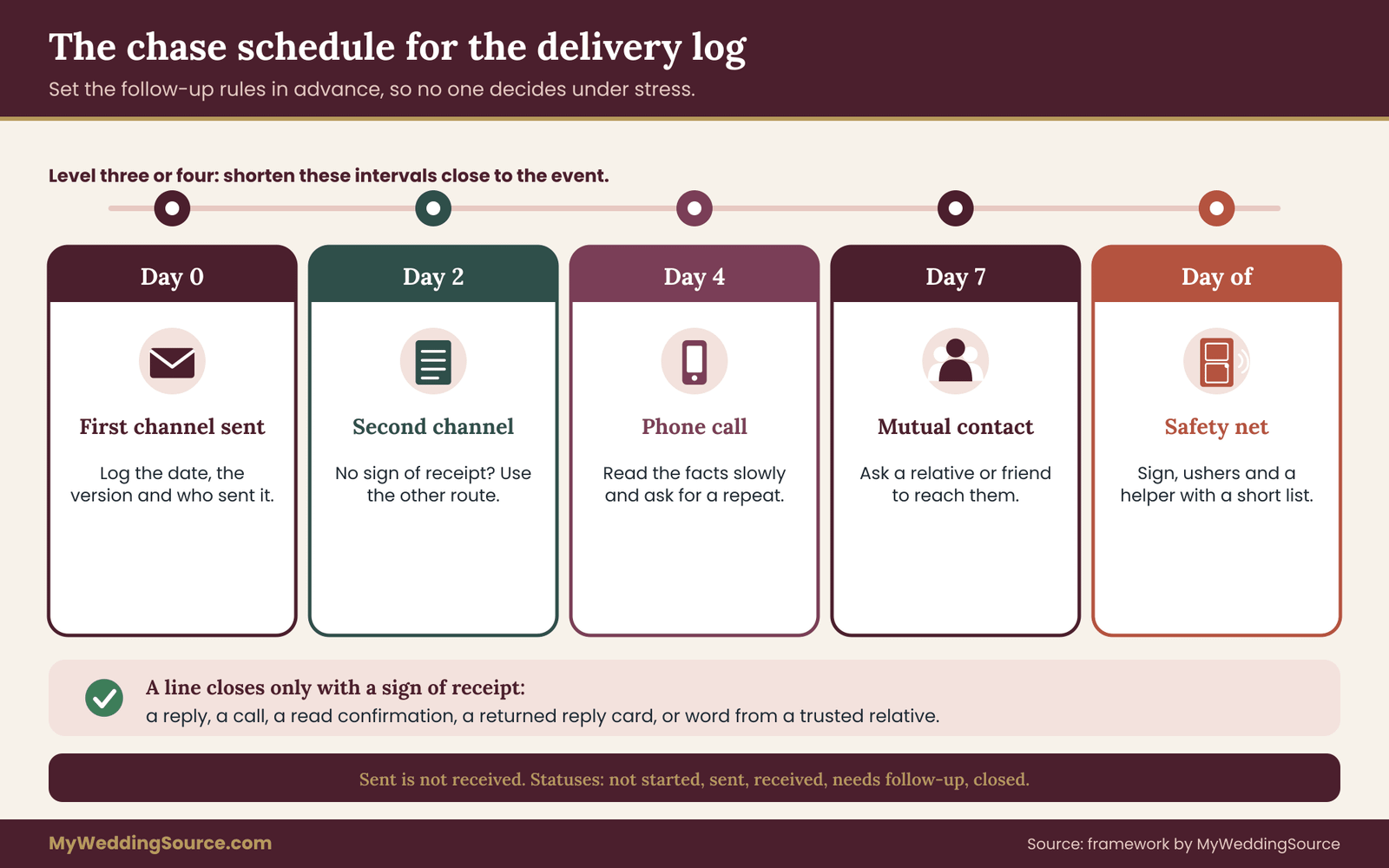
The sign of receipt is the field people skip. A sent message is not received. A sign of receipt is a reply, a phone conversation, a read receipt, a returned reply card or confirmation from a trusted relative. “Sent text, no reply” is not a sign of receipt, and it should not close the line.
Status codes
Keep the status simple: not started, sent, received, needs follow-up and closed. Add a note about the grade at the top. For a level-two change, a household can close at “sent” when you have used two channels and had no bounce. For level three or four, closing requires a sign of receipt.
Chase rules
Set the follow-up schedule in advance so you are not deciding under stress. A workable rule is: if a household shows no sign of receipt after two days, send the second channel; after four days, call; after a week, ask a mutual contact to reach them. For a date change or a level-three change close to the event, shorten those intervals. The point is to avoid being surprised on the wedding day by a guest who never knew.
When you reach someone by phone, make a note of what they said, in a few words. “Confirmed new address, will carpool” is enough. Later, if two helpers have contacted the same household, the log prevents duplicate calls and conflicting information.
Handling bounces and returns
Bounced emails, failed texts and returned cards are signals, not dead ends. Mark the line “needs follow-up,” note the reason if you know it and switch channels. If an email bounces, there may be a typo; check it against the original reply. If a card comes back, treat it like any returned mail: verify the address from more than one source before you resend.
Keep the log private
The log contains names, addresses and phone numbers, so share it only with the people who need it and only for as long as they need it. Limit editing rights, and remove helpers’ access when the change notice is closed. If you used a shared spreadsheet, delete or archive the file after the wedding according to your own records plan.
Close the log with a count
At the end, write three numbers: households closed with a sign of receipt, households closed by a second channel without a sign of receipt and households you could not reach. The third group is the list to give a day-of helper: a person at the new entrance who knows that those households might arrive at the old location and can redirect them. That backup is cheap and can rescue a guest.
A sample of log entries
Here is how a few lines of a delivery log might read in plain words, using invented households. The Okafor household: reached by text and email on September 9, reply received the same afternoon, closed. The Reyes household: text sent September 9, no reply by September 11, email sent September 11, phone call September 13 reaching the father, who confirmed the new address, closed.
The Hoang household: card mailed September 9, call made September 10 and left as a voicemail with the facts, second call September 12 reached the daughter, who will tell her parents, follow-up call in two days, still open.
Notice that the last line is not closed. The daughter is a useful contact, but she is not the guest. The log keeps that line open until someone has heard from the parents or confirmed that the daughter delivered the change notice. That is the kind of detail that a quick “sent” column would hide.
Keep the change notice and the log in step
If you revise the master change notice after it has gone out, add a line to the log that records the new version, the date and the households that received the older one. Send those households a brief update, and mark the old version as replaced. Do this only when the facts change, not for wording preferences. One master and one revision, if needed, is manageable. Four versions is how guests end up holding contradictory information.
A short day-of safety net
Even a well-run delivery log leaves gaps. Ask someone to stand at the old location, if it is accessible and safe to do so, with a sign that points to the new venue. Ask your ushers to carry a card with the new address and the phone number of a calm contact. Mention the change in the first lines of the welcome announcement if guests may be arriving in stages. These steps take little effort and cover the one guest in a hundred who did not see anything.
A worked example: a venue change five weeks out
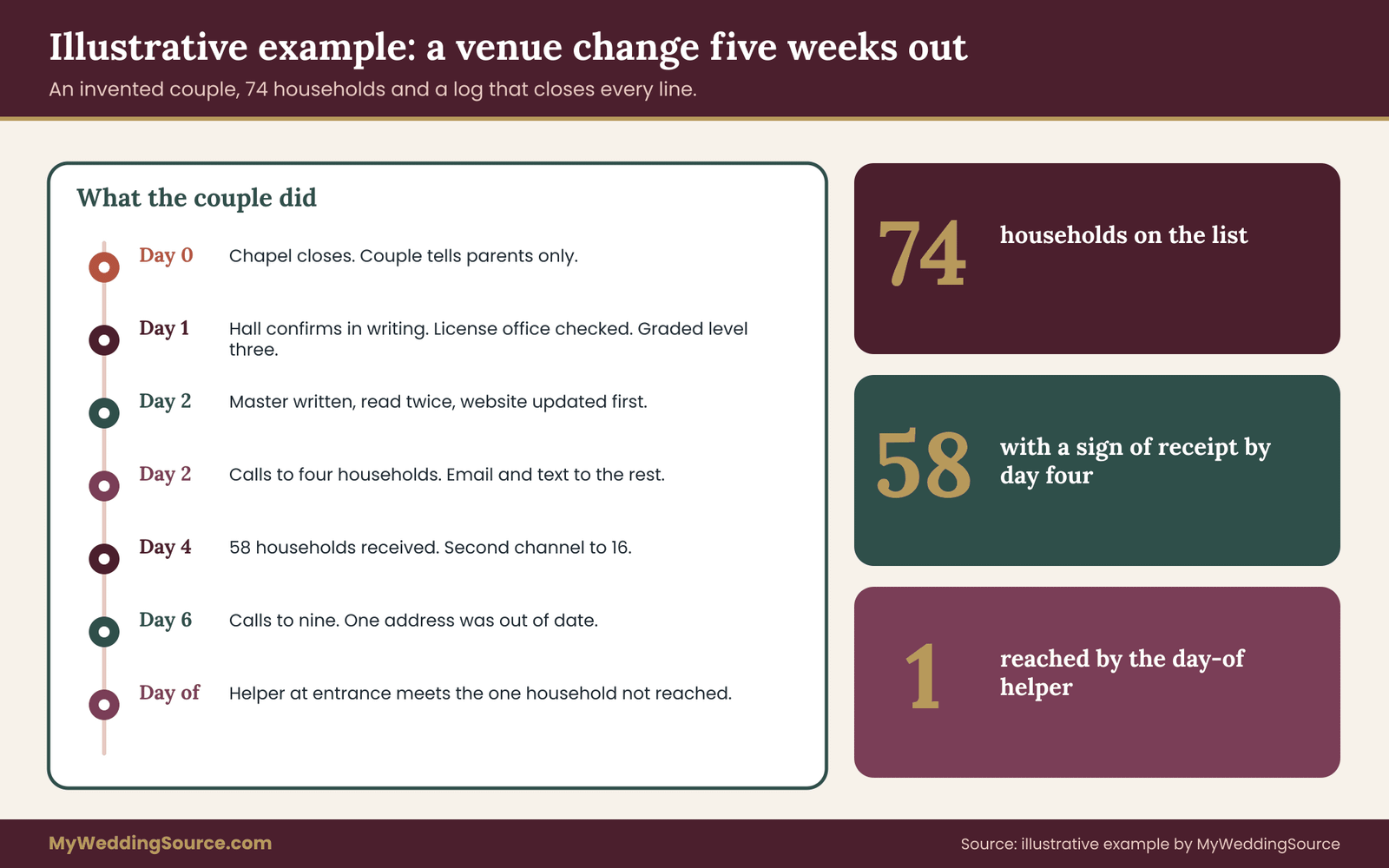
The example below is invented, and the names and numbers are illustrative. It shows how the pieces fit together under time pressure. Marta Lopez and Ben Carter are marrying on Saturday, October 10 at 4:00 p.m. They mailed 74 household invitations in August. Thirty-three days before the wedding, the manager of Lakeside Chapel calls to say that storm damage has closed the building until further notice.
Day zero: hold the news, protect the facts
Marta’s first impulse is to text her family group chat. She waits instead. She writes down the facts as she knows them: the chapel is closed, the date and reception hall are unaffected, and the chapel will send a letter. She asks the manager to put the closure in an email that afternoon, and the email arrives.
Then she opens a one-page confirmation sheet. The old fact is “ceremony at Lakeside Chapel.” The new fact is not yet known. She calls the reception hall, Maple Hall, which is eleven miles away, and asks whether the ceremony can move into the garden room.
The manager says it is likely, pending a check of the calendar and the capacity, and promises an answer by noon the next day. Marta decides not to announce anything yet, because the original information is still technically true until the chapel formally closes.
She does tell her parents and Ben’s parents, in a call that evening, so that no one is surprised by a guest’s question. She asks them to hold the news until the change notice goes out.
Day one: confirm and grade
At 11:40 a.m., the Maple Hall manager confirms the garden room by email: the room seats 120, the ceremony can start at 4:00 p.m. and the reception hall flips afterward as already planned. Marta adds the date, the time and the manager’s name to the confirmation sheet.
She then calls the county office that issued the marriage license. The ceremony is moving to a location in the same county, but she asks anyway, and she asks the officiant to confirm in writing that the new site works for the ceremony. Both answers are yes.
She grades the change. It is a new ceremony location, with a different drive and different parking. Some guests who booked a hotel near the chapel may have a longer drive, and one guest uses a wheelchair. That makes it level three: attendance-affecting. The grade goes at the top of the log.
Day one: build the audience and channel map
Marta and Ben open a shared spreadsheet with one line per household. There are 74 lines. They tag each household with its verified channels. Fifty-one have a mobile number and an email. Nineteen have a mobile number only. Four, all older relatives, have a landline and a mailing address.
Using the second-channel rule, the four mail-and-landline households need a printed card and a phone call. The nineteen text-only households get a text and a mailed card. The fifty-one with both get an email and a text. All 74 get a website update. Marta writes the numbers at the top: 74 households, 51 with two or more digital channels, 23 with one or none. The 23 are her work list.
She also makes a stakeholder list: both sets of parents, the wedding party, the officiant, the photographer, the caterer, the florist and the shuttle driver.
Day two: write once, copy everywhere
Marta drafts the master change notice using the five elements. The label is “Change of venue.” It names the old and new place, says the date, time and dress code are unchanged, includes a step-free route and asks guests whose travel is affected to call her sister Priya by September 15. A friend reads it against the confirmation sheet and finds a missing “p.m.” and a street number with two digits swapped. Both are fixed.
She shortens the master to a text of two lines and expands it for the printed card. All copies carry the same date stamp: “Version 1, September 9.”
The website is updated first. The old chapel details are removed, and the top of the page says “Updated September 9: change of venue.” She checks the page on her phone, taps the map link and confirms it lands on Maple Hall’s entrance, not the loading dock around the corner.
Day two: send in an order that makes sense
Priya takes the four older households. She calls each, reads the new address slowly and asks each guest to repeat it. She mails each a printed card the same day. Marta’s father calls two uncles who are hard to reach. A college friend of Ben’s, who coordinates the group of out-of-town friends, forwards the change notice to them after Marta sends it to him directly.
Marta and Ben send the email and text to everyone else. They send the email individually through a mail merge, so no one sees others’ addresses. They send texts one at a time, not in a group. They also order 90 correction cards from the stationer, who prints them in two days at a modest cost; Marta has already asked the stationer for the quote and a proof.
For the guest who uses a wheelchair, Marta writes a separate message: “Maple Hall has a ramp at the side entrance and an accessible restroom on the ground floor. Does that work for you?” The guest replies within the hour, and Marta confirms the route with the hall.
Days three to seven: chase using rules, not worry
By day four, the log shows 58 households with a sign of receipt: a reply, a call or a read confirmation. Sixteen show only “sent.” Under the chase rules, Marta sends those sixteen a second channel. The ten who got an email now get a text. The six who got a text now get a mailed card, which had already been sent but not yet arrived.
By day six, nine households are still silent. Marta and her helpers call. Seven answer. Two do not. One of those two is a couple who moved in the spring. The printed card went to their old address, and the original invitation did too. Marta messages their sister, who confirms the new address and passes on the change notice. That is a returned-mail lesson in the middle of a change notice, and it is exactly why the log exists.
By day eight, one household remains. Marta writes “could not reach” in the log, notes the household’s likely arrival time and gives the note to the day-of helper.
Vendors, in parallel
While the guest change notice goes out, Ben sends each vendor a change order by email. It lists the old and new ceremony location, the new load-in route, the revised timeline and a request to confirm back. The photographer asks for the new address for scouting and for a note about the garden room’s light. The florist asks whether the arch is allowed in the garden room, and the hall manager says candles and open flames are not. The shuttle service updates its pickup point.
Ben also checks the contract with Lakeside Chapel to see what happens to the deposit. The contract’s closure clause leads to a refund request, which he sends in writing and records in his vendor file, with the date and the name of the person who promised it.
The day before and the day of
The day before the wedding, a helper walks the route from the parking area to the garden room and photographs the path and the step-free entrance, sending the images to the guest who uses a wheelchair. Priya prints two copies of the change notice for the ushers, and Marta gives the day-of helper the single “could not reach” household’s name.
On the wedding day, the helper stands at the hall’s front entrance with a clear sign. The household that was never reached arrives, walks to the front of the hall at 3:35 p.m., hears the new plan from the helper and is seated before the processional. No guest goes to Lakeside Chapel.
What the example shows
The change notice succeeded because of a few decisions. The couple confirmed facts first. They graded the change and matched it to channels. They wrote one master and copied it. They used people, not just devices, for hard-to-reach guests. They watched a log with a sign of receipt, not a send button. And they kept a day-of safety net for the one household that never answered.
None of these steps needed money or software. They needed a sheet, a calm tone and a willingness to pick up the phone. The exact numbers in this example are made up, so use your own counts and your own deadlines.
Where the example could have gone wrong
Three small decisions kept it from going wrong. Had Marta texted the family group chat on day zero, the news would have spread before the facts existed, and at least one version in circulation would have named the wrong room. Had she skipped the second read, the missing “p.m.” would have produced a few uncertain replies. And had she counted a sent message as a received one, the household that moved in spring would have shown up at a closed chapel.
Each of those is an ordinary slip. The process is designed so that no one has to be perfect, only consistent.
Vendors, costs and paperwork behind a change notice
Guests see the change notice. Vendors see a chain of obligations that the change touches. A venue or date change affects contracts, deliveries, staffing and money, and the guest message only works if the vendor side is handled in parallel.
Send vendors their own change order
Do not rely on a vendor reading the guest change notice. Send each vendor a short written change order with the same five-line discipline as the confirmation sheet: what was agreed, what is changing, what it affects for them, the new details they need and a request for written confirmation. Use the new address, the new load-in route, the revised times and a named contact on the day.
Include vendors who may not seem affected. A cake maker needs the new delivery address and the elevator or door situation. A rental company needs the new delivery window and ground conditions. A musician needs the new power and sound rules. A vendor timeline that lists who needs what and when is a useful checklist when a venue changes under you.
Cost logic: who pays for a change
Money is where changes get tense, so settle it in writing. Start with the contract. Look for clauses about changes of location, rescheduling, force majeure, cancellations and refunds. A venue that closes the building may owe you a refund or a transfer. A date change that you request may carry a fee or a new price.
A vendor who cannot serve the new location may have a right to cancel, or you may have a right to a refund. These clauses differ widely, and none of them can be assumed.
Then separate the costs into groups so you can see them. There are reprint and postage costs for the change notice itself. There are vendor fees for moving the service. There are changes to guest-related spending, such as shuttle routes or hotel block adjustments. And there may be a refund due from the original venue. Write each group down with the amount and who is responsible, even if the amount is still a question mark.
If you paid by credit card, keep the statement entries. If a vendor does not deliver or a refund is promised and not paid, the Consumer Financial Protection Bureau publishes information on billing disputes at consumerfinance.gov, and a card issuer’s own rules set the deadlines. Write down the date of the promise and the name of the person who made it. Check any replacement vendor before you pay, just as you checked the first one.
Insurance and paperwork
If you bought event insurance, read the policy and the claims process before you spend more. Whether a venue closure or a date change is covered depends on the policy, and some require notice within a set time. Call the insurer, ask what they need and note the date. Keep a copy of the closure email, the confirmation sheet and any quotes for the new arrangement.
Check any certificate of insurance a venue requires from your vendors. A new venue may ask for its own named-insured language, and a vendor may need a day or two to produce it. Ask at the same time you send the change order, not the week before.
What a change notice cannot do
A change notice is a communication tool, and it has limits.
It cannot make a guest able to attend. If the new venue is too far, too costly or inaccessible for someone, a perfectly written notice will not fix that. What helps is a direct conversation and, where you can, an option such as a livestream or a ride.
It cannot undo a vendor’s rights or your own contract terms. It cannot guarantee delivery on every channel. And it cannot replace a human check for people who are hard to reach. These limits are the reason the log and the day-of safety net exist.
It is also not a place to settle family disagreements about the change. If a relative objects, listen briefly, restate the facts calmly and move on.
Keep the records
When the wedding is over, file the confirmation sheet, the master change notice, the delivery log, the vendor change orders and any refund correspondence together. If a dispute or a question about a refund arises months later, the file answers it. Delete the guest contact details in the log when you no longer need them.
Your next steps
If something on your invitation has just stopped being true, work through these in order.
- Hold the news for a day. Do not announce anything until the new facts are confirmed in writing by the party that controls them.
- Fill in the confirmation sheet. Old fact, new fact, who confirmed, how and when. Have a second person read it.
- Grade the change. Pick one of the four levels, and grade up if you are unsure.
- Check official and contract questions. Ask the license office, the officiant and your vendors what the change affects, and read the relevant contract clauses.
- Build the audience list. Group households, tag verified channels and count how many have only one.
- Write one master change notice. Five elements, under 100 words, with a version date.
- Update the website first, then send by the channel ladder, adding a call for guests who might miss a digital message.
- Run the delivery log. Close each household only with a sign of receipt, and follow the chase schedule.
- Send vendors a change order, and settle costs in writing.
- Plan the day-of safety net: a sign at the old location if possible, ushers with the new address and a name for the households you could not reach.
For the broader context, the guide to proofing and printer handoffs, linked earlier, explains how to order corrected cards cleanly.
FAQ
How soon should I send a change notice after the details change?
Send it as soon as the new facts are confirmed in writing, usually within a day or two. A short wait to verify the details prevents a second correction, which is harder on guests than a slightly later first message. If the old information is already false, send a brief holding message that names a date for the full notice.
Do I need to send a printed change notice, or is email enough?
It depends on the grade of the change and the guest. For a small logistical change, email or text plus the website often works. For a new venue or date, use a printed card or a call as the main route and a digital copy as backup. Guests without email need a mailed card and a phone call.
What should a wedding change notice say?
Five things: a clear label, what changed, what stays the same, what the guest needs to do by when, and one person to contact. Keep it brief, give the old and new fact side by side and leave out backstory and cost details. A change notice under about 100 words usually fits on one screen.
Do guests who already sent an RSVP need to reply again?
For a venue or time change, usually not, unless the change affects their plans. Say so in the change notice. For a date change, ask everyone to reply again, because a yes for the old date does not guarantee a yes for the new one. Be explicit about which case applies.
Should I use a group text to announce a change?
Avoid it for a serious change. Replies bury the message, numbers become visible to people who may not know each other, and you cannot confirm who saw it. Send individual messages or a mail merge, and use a group chat only for light updates, with the key message pinned.
How do I know every guest received the change notice?
Keep a delivery log with one line per household and a sign of receipt, such as a reply, a call, a read confirmation or a returned card. A sent message is not a received one. Follow a set chase schedule, and give a day-of helper the names of households you could not reach.
Who pays when a venue change forces new printing and vendor fees?
It depends on your contracts and the reason for the change. Check clauses on changes, cancellations and refunds. A venue that closes may owe a refund or transfer, while a change you request may cost more. Get each agreement in writing, keep records and ask the vendor or venue directly.
What if the venue changes counties or the date changes after I have my marriage license?
Contact the office that issued the license and ask whether it still works for the new place or date, and whether the officiant needs anything more. Rules on where a license can be used and how long it stays valid differ by jurisdiction, so confirm with the issuer and get the answer in writing.
Sources
- USPS Domestic Mail Manual, mailing standards
- United States Postal Service
- Federal Communications Commission, consumer information
- Federal Trade Commission, consumer protection and personal information
- Cybersecurity and Infrastructure Security Agency, account security
- Consumer Financial Protection Bureau, billing disputes
- ADA.gov, U.S. Department of Justice accessibility information
- National Weather Service forecasts and alerts
- USA.gov, government services and local offices