
A guest city tour is a guided outing in the wedding city that you offer to travelling guests, and the main choice is whether to book it as a private tour for your own group or as a seat on a public join-in tour run by an operator. This guide compares the two formats on mobility fit, timing, headcount and booking terms, so you can pick one before invitations or save-the-dates carry the details.
Choose a private guest city tour when your group is large enough to fill a vehicle or a guide’s comfortable group size, when guests have mixed mobility, or when the guest city tour must start and end at a fixed time and place. Choose a join-in guest city tour when only a handful of guests will go, when the schedule is loose, and when everyone can manage the standard route. Run five checks before you decide: mobility, timing, headcount, booking control and group mood. If two checks point opposite ways, protect mobility and timing first.
Most couples who invite people to a destination wedding want to give them something to do on the free day, and a guided walk or drive through the city is the easiest thing to suggest. It asks little of the guest, it needs no special skills, and it fits almost any age.
The trouble starts when the couple has to book it. A search for a guest city tour returns two very different products that look similar on a booking page: a guest city tour built around your group, and a seat on a guest city tour that runs whether you come or not.
That choice shapes everything downstream. It decides who controls the start time, how many people can fit, what happens if three guests cannot climb stairs, and who is responsible when the group is eight minutes late. It also decides whether you must collect money and names early or can let guests handle themselves. The format is not a detail to settle at the end.
This guide stays on that one decision. It does not cover pricing models or fee splitting, and it does not try to cover the whole subject of optional guest activities. For the wider question of which activities to offer at all, see the planning hub on designing a destination wedding and the guide to wedding guest hotels. Here the question is narrower: once you have decided a city tour belongs on the weekend, which format should you book?
A note on scope. This is general planning information, not legal, tax or financial advice. Supplier terms, permits, seasonal closures and travel warnings change, so confirm every detail with the operator and with the issuing agency before you commit or send anything to guests.
What counts as a guest city tour, and what does not
The phrase covers more ground than it seems to. For this guide, a guest city tour is a guided outing of roughly two to five hours that moves through one city or district, led by a person who explains what guests are looking at. It can be on foot, by minibus, by bicycle or by boat. It is built for visitors, and it has a start point, an end point and a guide.
A few things sit nearby but are different. A museum visit with a timed entry ticket is a venue booking, not a guest city tour. A food crawl is a tour, but it brings dietary and alcohol questions that belong in a separate conversation. A day trip to a vineyard, an island or a mountain is an excursion with a long transfer, and it has its own logistics.
A hop-on, hop-off bus is transport with commentary, and it hands the guide’s role to a recording. All of these can be good ideas. They simply do not fit the comparison that follows.
Within a guest city tour, the two formats are easy to describe.
Private tour. The operator reserves a guide, and often a vehicle, for your group only. The route and pace can be adjusted. The start time is yours. You usually pay for the guide or vehicle as a unit, and the operator expects a headcount range and a deposit.
Join-in tour. The operator runs a scheduled departure, often called a small-group or shared tour, and sells seats to anyone. Your guests buy seats, or you buy seats for them. The route, pace, language and meeting point are fixed. Strangers are on the guest city tour with you.
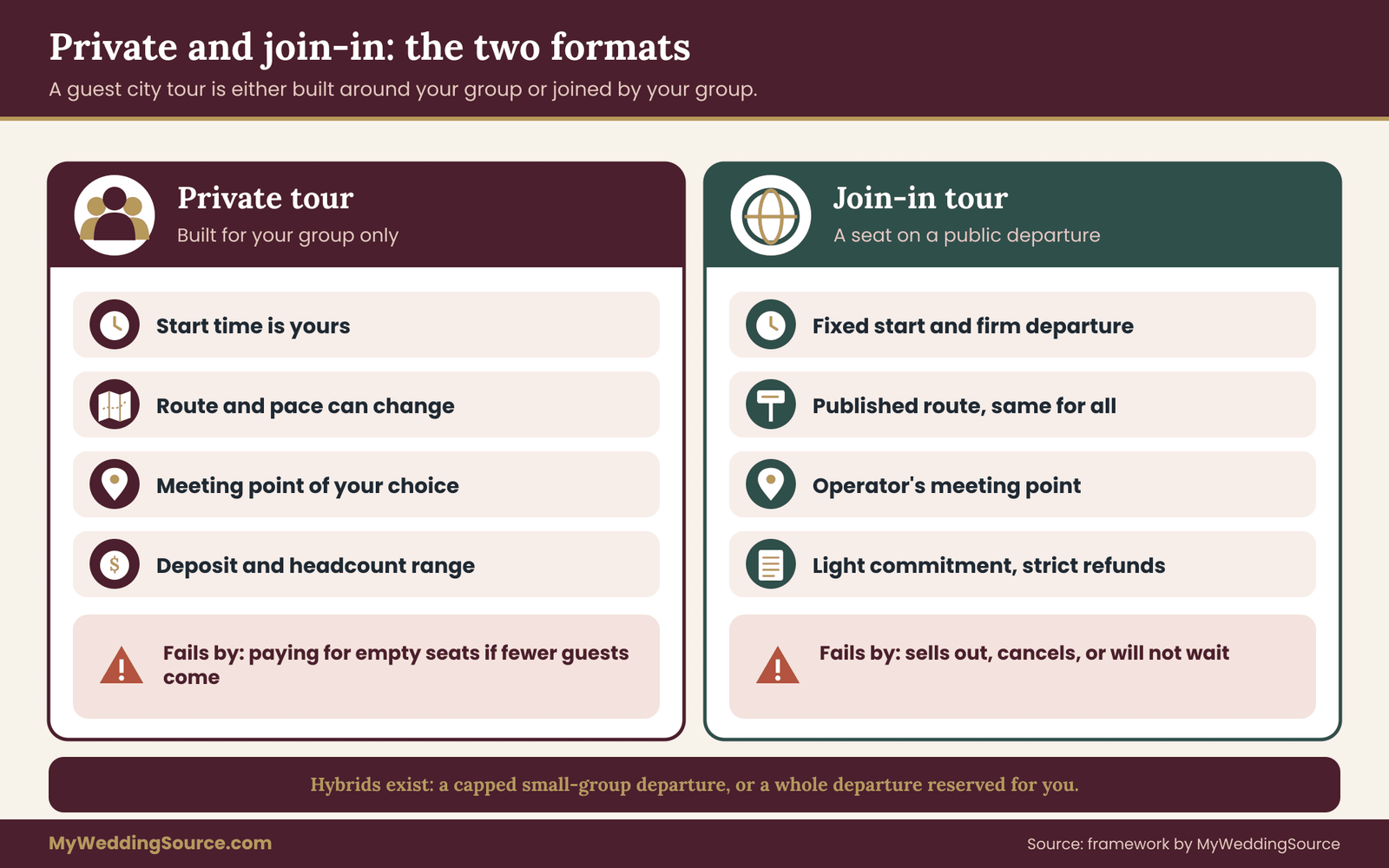
Some operators blur the line with a middle option: a private departure with a cap, or a shared departure that you can effectively fill by booking most of the seats. That hybrid is covered later, because it changes the headcount math. For now, hold the two ends clearly in mind.
Why this choice is worth a full decision
It is tempting to treat the format as a pricing preference, pick whichever looks cheaper and move on. That tends to backfire for reasons unrelated to money.
A join-in departure cannot wait. If one family of five stops at a pharmacy on the way, the guide leaves on time, because thirty other people paid for that departure. A private tour can wait, but only within the time the operator has blocked, and the next booking may start right after you.
A private tour carries a minimum commitment. If you reserve a vehicle for twenty people and eleven come, the operator may still be owed the full booking. A join-in tour carries almost no commitment, which can feel like freedom until the departure sells out and your last six guests cannot get seats together.
Neither format is better in general. Each fails in a specific way, and the format that fails in a way you can tolerate is usually the right one. The rest of the guide is built to help you name those failure modes before they happen.
The five-gate format test for a guest city tour
Many comparison articles list pros and cons and stop there. A list does not tell you what to do when the pros and cons point in different directions, so this guide uses a simple method: five gates, answered in order, each leaning toward one format. The gate that matters most is the one that fails hardest, not the one that sounds nicest.
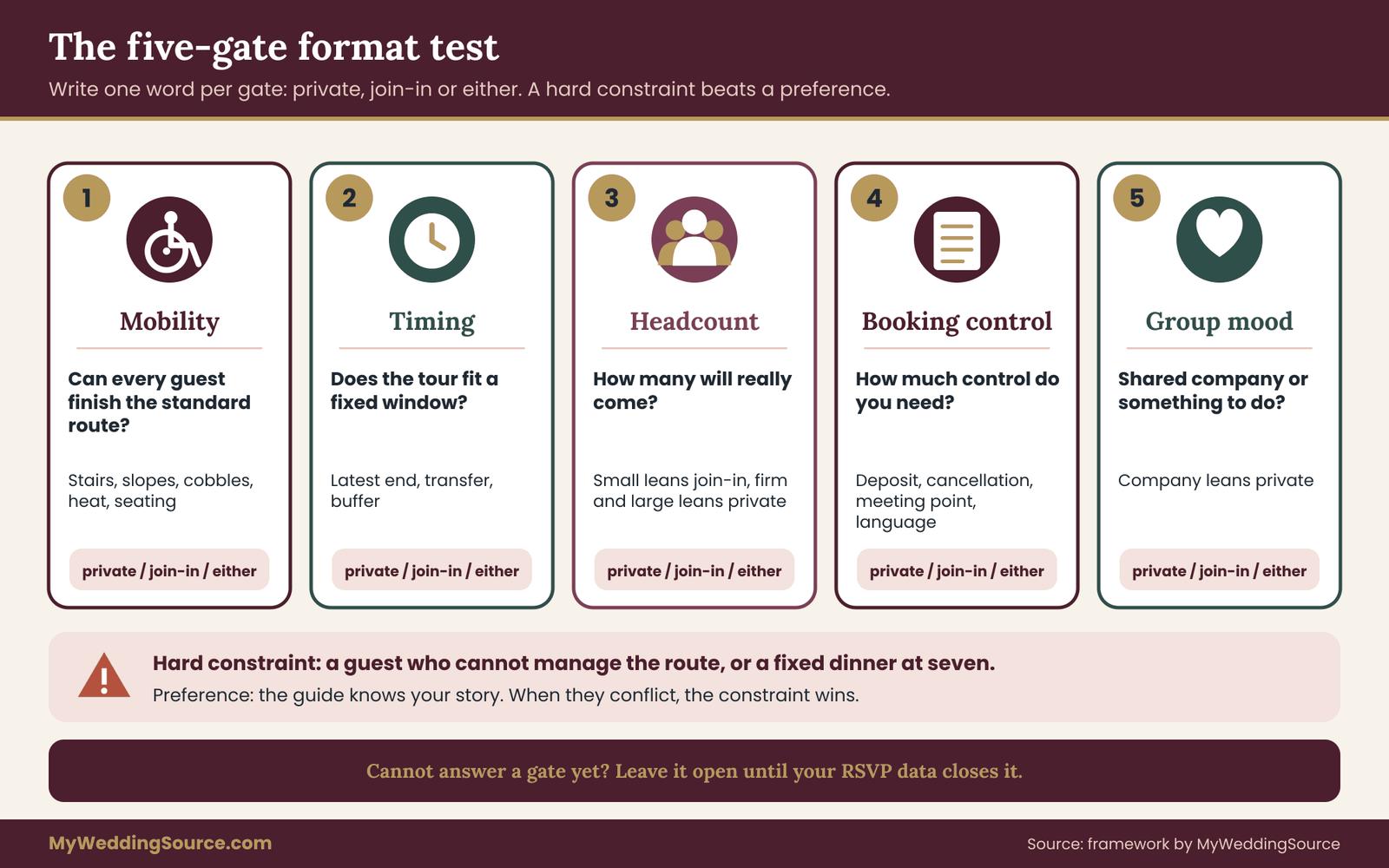
The five gates are mobility, timing, headcount, booking control and group mood. Each gets its own section later. Here is the short version of what each asks.
Gate one, mobility. Can every guest you expect to attend complete the standard route at the standard pace, including stairs, slopes, cobbles, heat and standing? If not, the standard route is the problem, and only a private tour can change it.
Gate two, timing. Does the guest city tour have to fit a fixed window, such as between a hotel breakfast and a rehearsal, or can it float? Fixed windows favor private. Floating windows favor join-in.
Gate three, headcount. How many guests will realistically come, and how sure are you? A small number favors join-in. A large and confirmed number favors private.
Gate four, booking control. How much do you need to control the deposit, the cancellation terms, the meeting point and the guide’s language? More control favors private.
Gate five, group mood. What is the guest city tour for? A shared experience for your people favors private. A relaxed thing to do on their own favors join-in.
How to score the gates without false precision
You do not need numbers. For each gate, write one word: private, join-in or either. Then count. If four or five gates say the same thing, you are done. If the answers split, look at which gates are hard constraints and which are preferences.
A hard constraint is something that, if violated, ruins the outing for a guest or for the weekend schedule. A guest who cannot physically manage the route is a hard constraint. A rehearsal dinner at six o’clock is a hard constraint. A preference is something that would be nice. Wanting the guide to know your story is a preference.
When a hard constraint and a preference conflict, the constraint wins every time. When two hard constraints conflict, you do not have a format problem, you have a schedule problem, and the answer may be to move the guest city tour to a different day or to drop it. The later sections give worked examples of each situation.
One more rule of thumb helps. If you cannot answer a gate yet, because you do not know how many guests will come or what their mobility needs are, do not guess. Treat the gate as open and hold the decision until your RSVP data can close it. The booking section explains how long you can safely wait.
Mobility fit: the gate that overrides the others
Mobility is the gate to check first, because it is the only one where the wrong answer can physically exclude a guest. A tour that cannot be completed by a grandparent, a guest using a cane, or a guest pushing a stroller is not a group activity, it is an activity for part of the group. Couples often discover this only when someone arrives and quietly stays behind.
The first step is to separate the two things people mean by mobility. One is the ability to move through the route: walking distance, stairs, slopes, uneven ground. The other is the ability to tolerate the conditions: heat, standing, crowds, noise, and being away from a restroom. A guest can be fine on the first and struggle with the second. Plan for both.
Why a join-in route is hard to adjust
Join-in operators publish a fixed route because they sell the same route repeatedly, and because their other guests booked it as described. A guide might be kind enough to shorten a stretch for you, but the guide is serving everyone on the departure and cannot change the plan for one family without changing it for thirty strangers.
That matters most with the details that tour descriptions rarely state plainly. A listing may say “walking tour, easy pace” and still include a long staircase to a viewpoint, a cobbled lane, or a tram with high steps. “Easy” is the operator’s word, and it is not a standard. If you are choosing a join-in tour for a group that includes anyone with limited mobility, you need specific answers, not the marketing label. A later section lists the questions that get those answers.
A private tour can change the route, the pace and the number of stops. It can also swap a walking route for a vehicle route, or add a seated stop every twenty minutes. This flexibility is the strongest single argument for private, and it is the reason mobility is the first gate.
What to do when only a few guests have mobility needs
Often the problem is a small minority: two older relatives and a guest who uses a wheelchair, out of forty travelling guests. Booking a private tour for everyone because of three people can feel like overkill, and it may be.
There is a better option than forcing one format on everyone. Offer two. Book a join-in or a standard walking tour for guests who want it, and arrange a separate, shorter private car tour with a seated guide for the guests who need a gentler route. The private option may cost less in total than a full-group private tour, and it avoids the awkward moment where the group splits at the bottom of a staircase.
When you offer two formats, name them by what they involve and not by who they are for. “Morning walk, about three hours, includes stairs” and “Morning drive, about three hours, minimal walking” let guests choose for themselves without being singled out. The guide on accessible wedding venues explains how to spot access problems before they become surprises, and the same habits apply to tour routes.
Timing a guest city tour around the wedding weekend
Timing is the second gate, and it is where most schedules quietly break. A wedding weekend is a chain of fixed points: arrivals, a welcome event, a rehearsal for the wedding party, the ceremony, the reception, a farewell meal and departures. A guest city tour has to fit into the gaps, and the gaps are smaller than they look on paper.
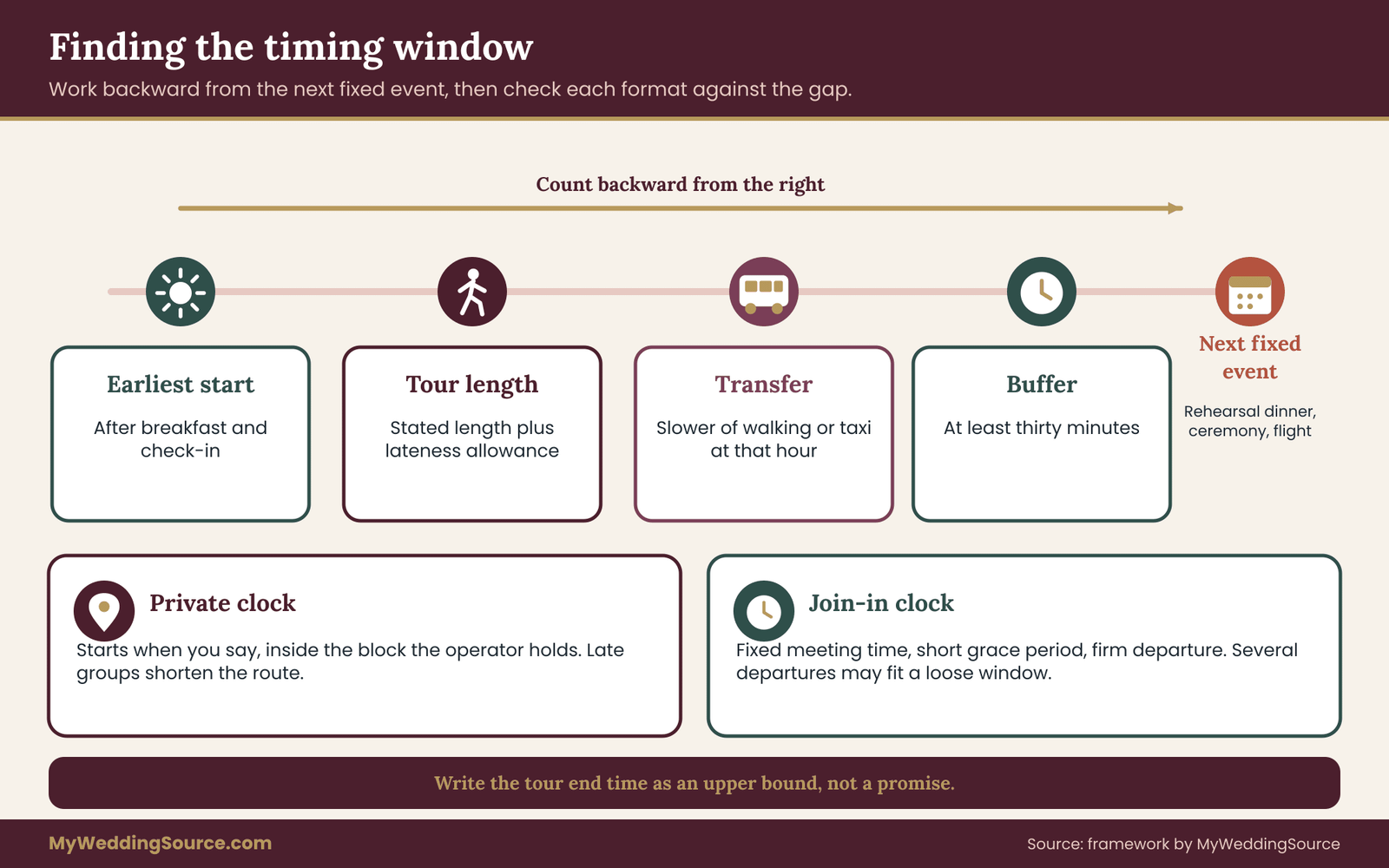
The right first question is not “what time is the guest city tour?” but “what is the latest time this tour can end, and what is the earliest time anyone can start?” Work backward from the next fixed event, add the realistic transfer time, and then add a buffer. What is left is your window. Only then do you compare formats against it.
Where a tour fits and where it does not
Three slots tend to work. The first is the day before the wedding, between late morning and mid-afternoon, once most guests have arrived. The second is the morning after the wedding, for guests who are not leaving yet, though the energy and the sleep levels may be low. The third is a free day earlier in the weekend, which exists only if the guests have arrived early.
Several slots rarely work. The morning of the wedding is a poor choice for any guest who has a role in the day or who is traveling with someone who does. The hours just before a welcome event create pressure and lateness. A late-afternoon tour the day before a ceremony risks heat, tired feet and a missed rehearsal dinner. If you offer a guest city tour in a risky slot, be ready for a guest to skip it, and do not read that as rudeness.
A useful habit is to write the guest city tour’s end time as an upper bound, not a promise. If a guest city tour is scheduled for two and a half hours, assume three, because the guest city tour starts a few minutes late, the group lingers at a stop, and the last leg ends somewhere other than where guests started. Then ask what happens to a guest who needs to be elsewhere at that point.
How each format handles the clock
A private guest city tour starts when you say it starts, within the block the operator holds. If your group is late, the operator can usually start late and shorten the route, or run over if the guide is free afterward. The cost is that you pay for the block, and a long delay can swallow the guest city tour.
A join-in guest city tour starts when the operator says. Most departures have a stated meeting time, a short grace period and then a firm departure. A guest who misses it may lose the booking with no refund, which is worth checking in the terms. The operator is also free to cancel a departure that does not sell enough seats, which can leave your guests without a guest city tour on short notice.
Neither is wrong. The question is which clock your weekend can live with. If your free window is wide and loose, a join-in schedule gives guests more choice, because many operators run several departures a day. If your window is tight and shared, a private block lets you fit the guest city tour into it exactly.
The meeting point problem
Even guests who are on time can be in the wrong place. A meeting point on a booking page is often described in a sentence, such as “outside the cathedral steps,” and in a busy square that sentence is not specific enough. Several groups may gather at the same landmark, guides may hold small signs, and guests who have never been to the city may stand ten meters from the right spot and not know it.
With a private tour you can pick the meeting point to suit your group. The best pick is usually the hotel where most guests are staying, because it removes one transfer and one chance for confusion. The guide can wait in the lobby with a sign, and the group leaves together. If your guests are spread across several hotels, choose the one with the best access for the guests who have mobility needs, or ask the operator whether a vehicle can collect from more than one door.
With a join-in tour you accept the operator’s meeting point. Check it on a map, check how far it is from your hotels, and check whether the route there is itself difficult. A tour that starts at the top of a hill, or in a pedestrian zone that vehicles cannot enter, may be easy to describe and hard to reach. If the meeting point is the weak part, ask whether the operator offers hotel pickup, and whether that is included or an add-on.
A timing check you can run in ten minutes
You can test any proposed tour against the schedule with five steps and a sheet of paper.
Write the fixed event that follows the guest city tour, and its start time. Subtract the time your guests need to change, eat or rest. Subtract the travel time from the tour’s end point to the next event, using the slower of walking or taxi estimates at that hour. Subtract a buffer of at least thirty minutes. The result is the latest acceptable end time. If the tour’s stated length plus your lateness allowance does not fit, it is the wrong tour for that slot, whatever the format.
Then write the earliest anyone can reasonably start. Think about flight arrivals, hotel check-in times and breakfast, and be honest about the guests who will arrive the night before. If the window between earliest start and latest end is shorter than the guest city tour, you cannot hold the guest city tour on that day. Change the day or choose a shorter route.
Season, daylight and heat
Timing is not only about the clock. Daylight, temperature and local closures all shape what a tour can do. A route that is lovely at ten in the morning in spring may be uncomfortable at two in the afternoon in midsummer. Opening hours for historic sites and churches often have midday closures or restrict access during services, which affects both formats. Seasonal events can close streets or change routes without much warning.
For a private tour, tell the operator the season, the likely temperature, and your guests’ needs, and ask them to build the route accordingly. For a join-in tour, ask whether the route changes seasonally, whether the departure runs in rain or high heat, and what the operator’s policy is when conditions are poor. Official weather services publish forecasts, and the operator’s own terms should state when they cancel. Check both close to the date, and again the day before.
A note on early arrivals and late departures
Weddings attract guests with different travel patterns. Some arrive three days early to enjoy the trip, and some arrive the night before. A tour on the day before the wedding catches both groups, but only if it is late enough for the late arrivals to join. Others leave the morning after the wedding, so a post-wedding tour is only for those who stay longer.
If your guests are spread across several days, a join-in format has a quiet advantage, because many operators run departures on most days. Your guests can pick whichever suits them, and you are not responsible for gathering everyone at once. If your guests are concentrated in one window, private is easier to arrange, and it can be a small shared event rather than a long list of separate bookings.
Worked example: matching format to a fixed window
Consider an invented couple, Dana and Ravi, marrying on a Saturday in a European port city. Forty-four guests are traveling in from abroad. The rehearsal dinner for twelve is on Friday at seven in the evening. Most guests arrive on Thursday and Friday. Dana’s grandmother and two great-aunts walk slowly and use handrails on stairs.
They want a Friday tour. The window opens around eleven, after a hotel breakfast, and closes at three, because the wedding party needs time to rest and dress before the rehearsal dinner. Walking from the likely end point to the hotel takes about twenty minutes at the older relatives’ pace. That leaves a latest end time of about two thirty, and a guest city tour of three hours with a thirty-minute allowance would need to start at eleven.
The public join-in departure in the city starts at ten and runs three hours, which would end at one and arrive at the hotel by half past one. That fits, but the ten o’clock start is before most Thursday arrivals will have eaten or slept. A second departure starts at two and ends at five, which breaks the window. So the join-in format offers one workable departure, early, with fixed pacing and a long staircase in the second half.
Here the timing gate and the mobility gate point the same way. A private tour at eleven, ending at about two, with a seated vehicle segment for the older relatives, solves both problems at once. If the headcount gate says that only fifteen guests will join, the couple still has a sensible choice: one private small-group tour with a vehicle, instead of forcing a standard walk on a group that includes the grandmother.
The example shows the habit to copy. The couple did not ask which format was cheaper. They wrote the window, tested each option against it, and let the hard constraints decide. The rest of the story, including how they cap the headcount and handle late sign-ups, continues in later sections.
When two departures both fit
Sometimes two join-in departures fit your window. That is a good problem to have, and it is a reason to prefer join-in for flexibility. Guests can choose the one they like. You can also spread headcount across both and reduce the chance that the group is too large for the guide.
The risk is fragmentation. When guests choose different departures, the group that returns to the hotel is smaller and less coordinated. If the point of the outing is shared time, you may prefer a single private group even though two join-in options exist. Ask yourself whether the point is the city or the company. If it is the city, offer choice. If it is the company, offer one time.
What to tell guests about timing
Whatever format you pick, guests need the schedule in the form they will actually use it. A short note with four lines is enough: the meeting place with a nearby landmark, the meeting time, the expected end time and where guests will be when it ends. Add a phone number that works locally for someone who is lost. For join-in tours, add the booking reference and the exact name the operator uses on the departure.
Send the note twice. Send it when guests commit, and send it again the evening before, because people lose emails. Keep the second message shorter than the first. Keep the reminder to those details and let the operator’s confirmation carry the rest.
Headcount thresholds for a guest city tour
Headcount is the third gate, and it is the one most couples guess at. They imagine that most of their guests will want to go, they book for that number, and then fewer people sign up than expected. Or the reverse: a few more commit than the group size allows, and the extra guests are left standing at the meeting point. Both mistakes are easier to prevent with a few planning rules than to repair on the day.
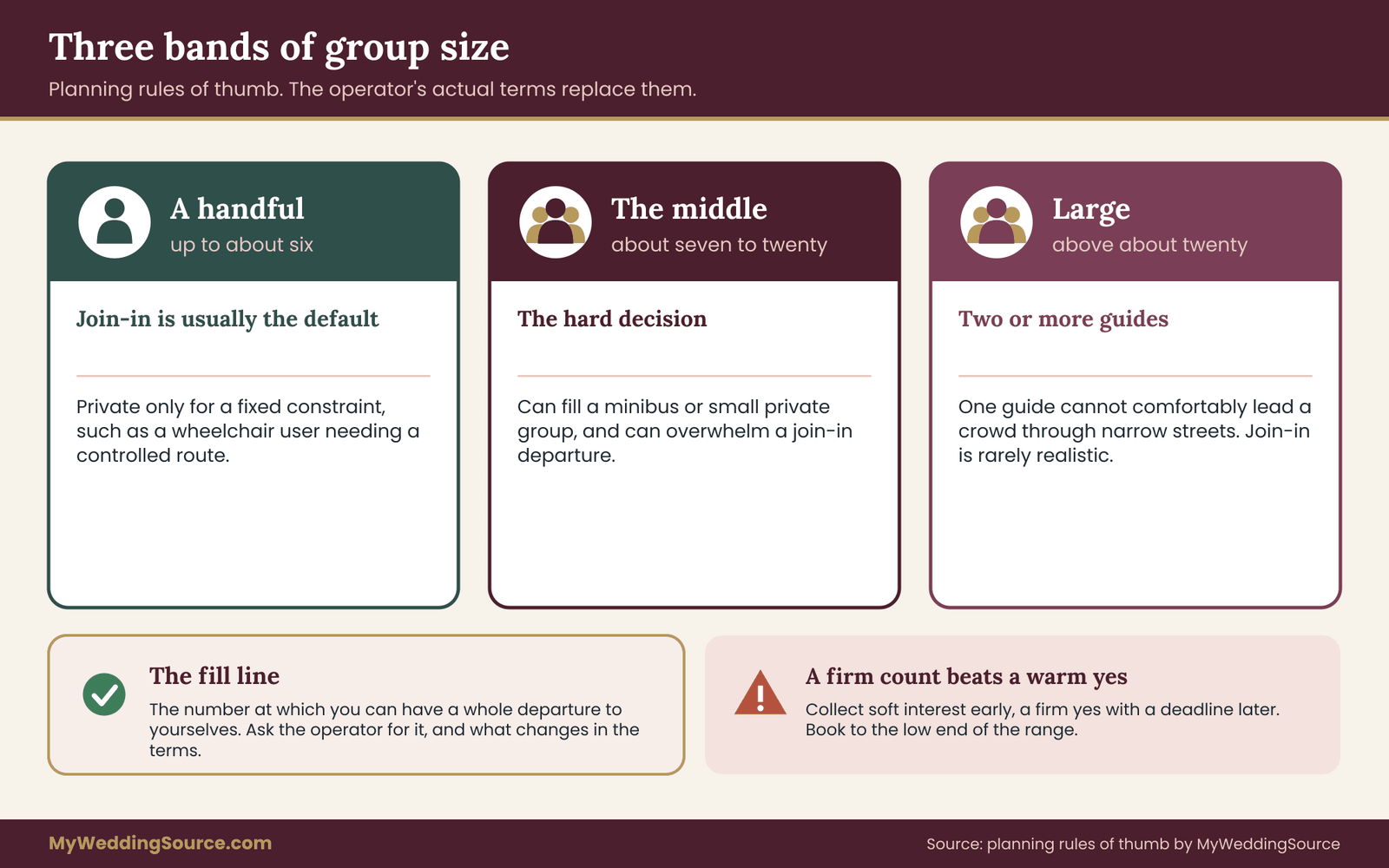
The numbers in this section are planning rules of thumb, not industry statistics. Operators set their own group sizes, and local rules in some cities cap how many people a guide may lead at a historic site. Treat the thresholds as a starting point for your questions, and let the operator’s actual terms replace them.
Three bands of group size
It helps to think in three bands, because each band suggests a different format.
A handful, up to about six guests. At this size a join-in tour is usually the sensible default. The operator’s departure has room, the guests are not a group in any real sense, and a private guide may cost far more per person than the outing is worth to those guests. The exception is a handful with a fixed constraint, such as a wheelchair user, where a private tour or a private car is the only way to control the route.
A middle band, roughly seven to twenty guests. This is the band where the format decision is hardest and the stakes are highest. A group this size can fill a private minibus or a small-group private guide, and it is also large enough to overwhelm a join-in departure. A group of twelve arriving at a departure with fourteen seats leaves the other guests as outsiders, and the guide can feel like they are leading a private event on a shared ticket.
A large band, above about twenty. Here two issues arise. One guide cannot comfortably lead twenty-five people through narrow streets, and many places have rules that cap a group’s size. So private at this size usually means two or more groups, each with its own guide. Join-in at this size is rarely realistic, because the operator would have to hold many seats on one departure.
If your numbers fall near a boundary, such as five or six, or nineteen or twenty-one, treat the band as open and ask the operator. A guide with a ten-seat vehicle will price a group of nine and a group of eleven very differently.
The fill line: how join-in turns into private
A middle path exists, and it is worth knowing before you choose. Many operators will let you book most or all of a scheduled departure, which turns a join-in tour into a nearly private one at the operator’s regular price per seat. Others will privatize a departure for a flat fee if you reach a certain number of guests.
The point where a group can fill a departure is what this guide calls the fill line. Below it, you are buying seats on someone else’s tour. At or above it, you may be buying the whole tour. The exact line is whatever the operator says it is, and the useful question is simply: “At what number of guests can we have the departure to ourselves, and what changes in the terms when we do?”
Be careful about one trap. If you book seats on a join-in departure for a large group, and the operator does not formally mark the departure private, other travelers can still book the remaining seats. Your group may then share the guest city tour with strangers after all. If you want a closed group, get that in writing.
How sure is your number?
The harder question is not the size of the band, but the confidence in the number. A guest who says “we’d love to” in a conversation is not a booking. People’s plans change with flights, jobs and health, and the free day before a wedding is the least protected block in the schedule.
Two habits improve the number. First, ask for a firm yes with a deadline, and make the ask specific: a day, a start time, a price if relevant and a date by which the guest must confirm. A vague poll such as “who is interested in a city tour?” tends to produce more enthusiasm than attendance. Second, collect the number in stages. Ask for a soft interest count early, which lets you choose a band, and a firm count later, which lets you set the final booking.
If you must book a private tour before the count is firm, book to the low end of your realistic range, and ask the operator whether the vehicle or the guide can scale up. It is safer to add a second small group later than to pay for a large vehicle that rides half empty.
What operators usually need from you
Whatever the format, the operator will need four numbers: how many adults, how many children and their ages, how many guests need mobility support, and how many need dietary or medical notes if food is part of the guest city tour. Children matter for pricing, for vehicle seat belts and booster rules, and for the pace of the route. Mobility needs matter for the route. Having these numbers ready makes your first conversation with the operator more specific and your quote more accurate.
Operators also need the language the guide should use. A group where most guests speak one language but several speak another can strain a join-in tour that runs in a single language. A private guide can switch between languages or can provide a second guide. If translation matters, add it to the gate list as a hard constraint, not a preference.
When the headcount is uneven by age
A group that mixes toddlers, teenagers, parents and grandparents is a hard group for any tour. Their attention spans differ, and so do their needs for seats, shade, snacks and restrooms. Setting the guest city tour at three hours for such a mix often leads to a tired group at the end.
Two simple adjustments help. Choose a shorter tour than you think you need, closer to two hours for a mixed-age group. And decide in advance whether children join at all. A guest city tour is not always the right place for babies and small children, and the guide on wedding guest care explains how to arrange supervised care so that parents can take the outing without worrying about a nap.
How a guest city tour is booked: deposits, names and cancellation
The fourth gate is booking control. It sounds administrative, and it is, but the administrative details are where a guest city tour’s risk lives. The format determines who holds the money, who holds the names, and who bears the loss if plans change.
Booking a private guest city tour
A private tour is booked as a contract between you and the operator, and it is worth treating that way, even when it is a short email exchange. The contract should state the date, the start time and place, the end point, the length of the guest city tour, the maximum number of guests, the language, the route or the type of route, whether a vehicle is included and its capacity, what is included in the price, and what is excluded.
Ask four things about the money. How much is the deposit and when is it due? When is the balance due? What happens to the deposit if the headcount falls? And what happens if the operator cancels? The first three tell you what you are exposed to. The fourth tells you whether the operator shares any of the risk.
A well-written private booking also names a single point of contact on both sides. For the guide, it should be a local mobile number that works on the day. For you, it should be someone who is not the couple, because on the wedding weekend the couple will not answer. The vendor guide on wedding vendor contracts covers the clauses worth reading carefully, and the same logic applies to a modest tour booking.
Booking a join-in guest city tour
A join-in tour is usually booked online, either by the guest or by you on the guest’s behalf. The operator sets the cancellation window and the refund rule, and these are published on the booking page. They are also often strict: free cancellation until a day or two before, then a partial or no refund.
You have two choices for how to handle this. In the first, guests book for themselves. You publish the operator, the departure time and a link, and each guest pays and manages their own booking. The benefit is that you carry no financial risk and no administrative load. The drawback is that you have no control over who books which departure, so the group may spread out.
In the second, you book seats for guests who commit. You collect names, make a single booking, and take on the cancellation risk. This keeps the group together and lets you request seats together, but it ties you to the operator’s refund rule for every seat. If the rule is strict, tell guests the cutoff clearly, and set your own earlier cutoff so that you have time to act.
Names, ID and children
Operators may ask for the full names of everyone on the guest city tour. Some ask for passport numbers if the route crosses a border or enters secure areas. Join-in tours sometimes need the name used on the ticket for entry to a site that requires one. Gather what the operator asks for, not more, and keep it private.
Do not circulate a spreadsheet of passport numbers by email or in a group chat. If the operator needs identity details, ask whether there is a secure form and let guests enter their own.
For children, ask about the operator’s age rules. Some tours set minimum ages, some require a car seat for young passengers, and some price children differently. Never assume the answer, and never rely on a friend’s memory of a different operator.
The cancellation question to ask first
If you ask only one question about any booking, ask this one: “What happens if the weather or an official closure prevents the guest city tour from running?” The answer tells you whether the operator will refund, reschedule or credit, how much notice they give, and how they decide. A good operator gives a clear answer. A vague answer is a reason to look at other options or to ask for the policy in writing.
Be equally clear about what happens when a guest cancels. For a private tour, know whether the balance is due regardless of headcount. For a join-in tour, know the last moment for a free refund. Put both dates in your own calendar, with a reminder a few days earlier.
Payments and receipts
Pay in a way that gives you a record. A card payment through the operator’s system gives you a receipt and a basis for a billing dispute if something goes wrong. The Consumer Financial Protection Bureau explains the dispute process for credit card errors, and the window for reporting a billing error is short, so keep your confirmations and check the statement soon after the booking.
For anything outside the card system, such as a bank transfer or cash on the day, ask for a written receipt that names the date, the amount and the service.
Avoid paying a large deposit to someone you cannot verify. The checklist on wedding vendor due diligence covers how to confirm that a supplier is real, licensed where required, and insured, and the same questions are worth asking of a guide.
Group mood and a side-by-side reading of the guest city tour
Gate five: what the tour is for
The fifth gate is the softest, and it is the one couples skip because it feels like a matter of taste. It is really a question of purpose. A guest city tour can be a shared moment for your people, or it can be a good thing to do with spare time. The format that serves one purpose serves the other poorly.
Start by writing a sentence that begins “The guest city tour is for…” and finish it honestly. For some couples the sentence is “so our two families can spend a relaxed morning together before the wedding.” For others it is “so guests who arrive early have something to do.” These are different goals, and they lead to different formats.
When the point is company
If the purpose is to bring people together, a private tour is almost always the better tool. Your group stays together, you can choose who sits next to whom, and the guide speaks to your group and not to a crowd of strangers. Conversation flows easily because everybody knows somebody. Guests who do not know each other well, such as relatives from the two sides, can meet in a low-pressure setting with something to look at.
A private guest city tour also lets you make small adjustments that serve the purpose. A coffee stop at a place where the group can sit, a longer pause at a viewpoint for photos, and a finish near a place where the group can eat lunch together are all reasonable requests. A join-in departure cannot offer them.
The cost of this purpose is control that you must exercise. Somebody has to arrive early, count heads and keep the group moving. If neither partner can do that on the day, name a friend or a family member as the tour lead, and tell them the plan.
When the point is something to do
If the purpose is to give early arrivals a pleasant outing, join-in is often better. Guests choose their own pace and their own company, they can book a departure that suits their flight, and nobody feels obliged to spend a morning with relatives they would rather not. Some guests prefer the quiet anonymity of a public tour, which asks nothing of them socially.
Here the couple’s job is to recommend, not to host. You can name two or three reputable operators, say which departure times work with the weekend, and leave the rest to guests. That keeps your workload small and keeps expectations modest.
A caution applies. If you name an operator, you are lending your reputation, and guests will tell you if it goes badly. Only recommend operators you have checked yourself, with the questions in the next section, and never suggest a guest city tour you could not defend if a guest had a poor experience.
The mixed purpose problem
Some weekends have both purposes. The couple wants one shared outing, but also wants early arrivals to have something to do. The solution is to separate the two. Make the main tour a private event on one fixed day, and recommend join-in options for the other days. That way guests are not asked to treat a public tour as a family event, and the private tour is not stretched to cover every arrival pattern.
If you want only one tour and want to serve both purposes, you will probably serve neither well. A private tour on a fixed day will leave early arrivals bored on other days. A join-in tour will leave the group without the shared moment. Decide which purpose matters more, and let the other go.
Private versus join-in: a side-by-side reading in plain language
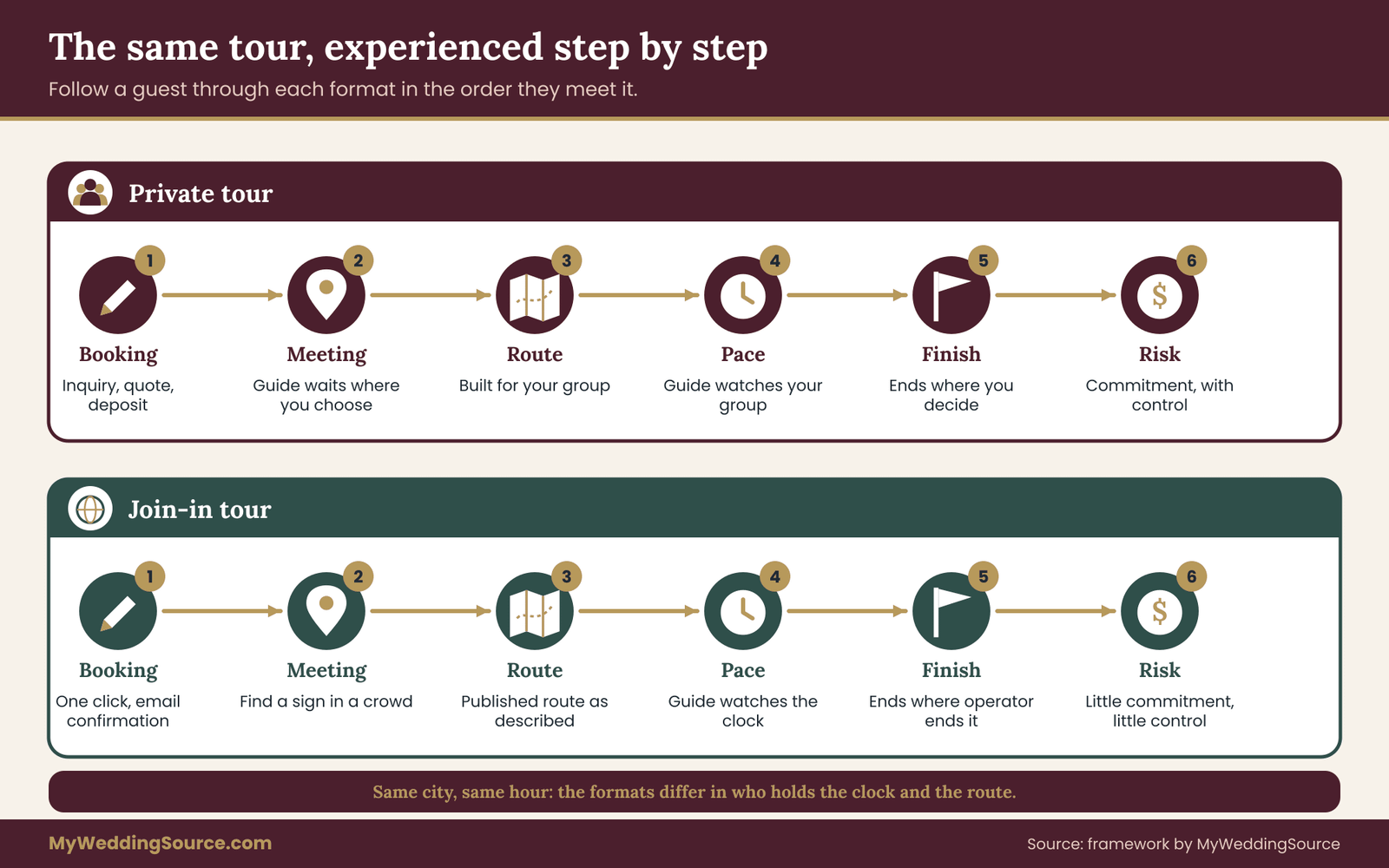
By this point you have the five gates and a sense of where your weekend sits. It helps to read the two formats against each other in prose once, in the order a guest would experience them, because a pros-and-cons list hides how the pieces connect.
Begin with the booking. A private tour begins with an inquiry, a quote, a deposit and a confirmation. It takes time, it demands your attention, and it produces a written plan. A join-in tour begins with a click and a confirmation email. It takes minutes. This difference is the main reason join-in feels lighter, and it is also why join-in leaves the less documented plan.
Move to the meeting. In a private tour, the guide waits where you choose. Guests are counted by someone you know. In a join-in tour, guests find a landmark, look for a sign among other groups and check in with a guide who has never met them. Guests who are confident travelers will not mind. Guests who are anxious or older may find it stressful.
Then the route. The private route is built for your group, within what the city allows. The join-in route is the route, as published. If it suits your guests, that is a feature, since the operator has refined it over many departures. If it does not suit them, it is a wall.
Then the pace. A private guide watches your group and slows or speeds as needed. A join-in guide watches the clock, because the next departure and the next group depend on it. The difference is small in a good tour and large in a bad one.
Then the guide’s attention. A private guide answers your questions and your children’s questions, and can tailor stories to the group, including a few words about why you chose the city, if you want. A join-in guide has thirty people to look after and will answer questions briefly.
Then the finish. A private tour ends where you decided. A join-in tour ends where the operator ends it, which may be a half-hour walk from your hotel. For older guests, that finish point is not a detail, and it has surprised more than one family.
Finally, the money and the risk. A private tour asks for commitment and gives control. A join-in tour asks for little and gives little. If your guests are all healthy, all on time and all sure about their plans, the difference matters little. If any of those are uncertain, it matters a great deal.
Hybrids: private departures and shared departures with a cap
Several operators offer something in between. A private departure on a fixed day can sometimes be set up at a lower price when the operator is already running a similar tour. A small-group departure with a cap of eight or ten guests offers some of the intimacy of private while keeping the schedule fixed. And a “reserve the whole departure” option, mentioned earlier, can serve a group that fits the cap.
These are worth asking about, but treat each one as a different product with its own terms. Ask what the cap is, whether the departure still runs if only your group books, whether the route can be adjusted at all, and what the refund rule is if the group shrinks. A hybrid inherits the weaknesses of both formats if you do not read the terms closely, and the benefit is real only when the terms match your needs.
Questions to ask a guest city tour operator before you book
You can learn most of what you need from five short conversations, one for each gate. The questions below are written to be asked by email or phone, and to get answers that can be compared across operators. If an operator cannot or will not answer, that tells you something too.
Questions about mobility
Ask for the route in detail, not the summary. How far does the group walk in total, and in what segments? Are there stairs, and how many steps in each flight? Are there slopes, cobbles, uneven ground or places without handrails? Where are the restrooms, and are they step-free? Are there places to sit, and how often? Is any part of the route in direct sun for long stretches?
Then ask about vehicles. Is the vehicle step-free or does it have a lift or ramp? How many seats, and how many mobility aids can it carry? If a guest uses a wheelchair or a walker, can the guide help with boarding, and has the guide done it before? The answers to these questions are specific facts, and an operator who has run accessible tours will answer them easily.
For general guidance on what accessibility standards cover, the U.S. Department of Justice and the Access Board publish material on the Americans with Disabilities Act, though rules abroad differ and the operator’s own description is what counts on the day.
Questions about timing
Ask when the guest city tour starts and ends, and how reliably. How long does the operator allow for gathering? What is the grace period for late guests? Can the start time shift by thirty minutes for a private booking? What is the buffer between your tour and the next booking for the same guide? Does the guest city tour run in rain, heat or other conditions, and who decides? These answers turn the timing gate from a guess into a plan.
Questions about headcount
Ask what the minimum and maximum group sizes are, and what the price or terms do at each boundary. What happens if fewer guests than expected arrive? Can the booking scale up, and with how much notice? For join-in, how many seats are left on the departures you want, and how soon do they sell out? For private, is the guide or vehicle still available if you add a second group?
Questions about booking control
Ask for the cancellation terms in writing. What is the deposit, and is it refundable? What is the deadline for the final count? What happens if the operator cancels? Does the operator carry liability insurance, and can they send proof? Is a license required for guides in this city, and does the guide hold one? The agency that issues travel guidance, such as the U.S. Department of State, publishes country information that is worth checking for any destination that has travel advisories or entry requirements.
Questions about the guide and the group
Ask about the guide’s languages, experience with groups like yours and style. Ask whether the guide has led wedding groups before, and whether the route can include a place to sit and rest. Ask whether the operator can send a short written plan for the day, with times, stops and a phone number. A written plan from a private operator is a small request that most professionals can meet, and it is the document that keeps your tour out of dispute.
Worked example: a guest city tour for a mixed group of thirty
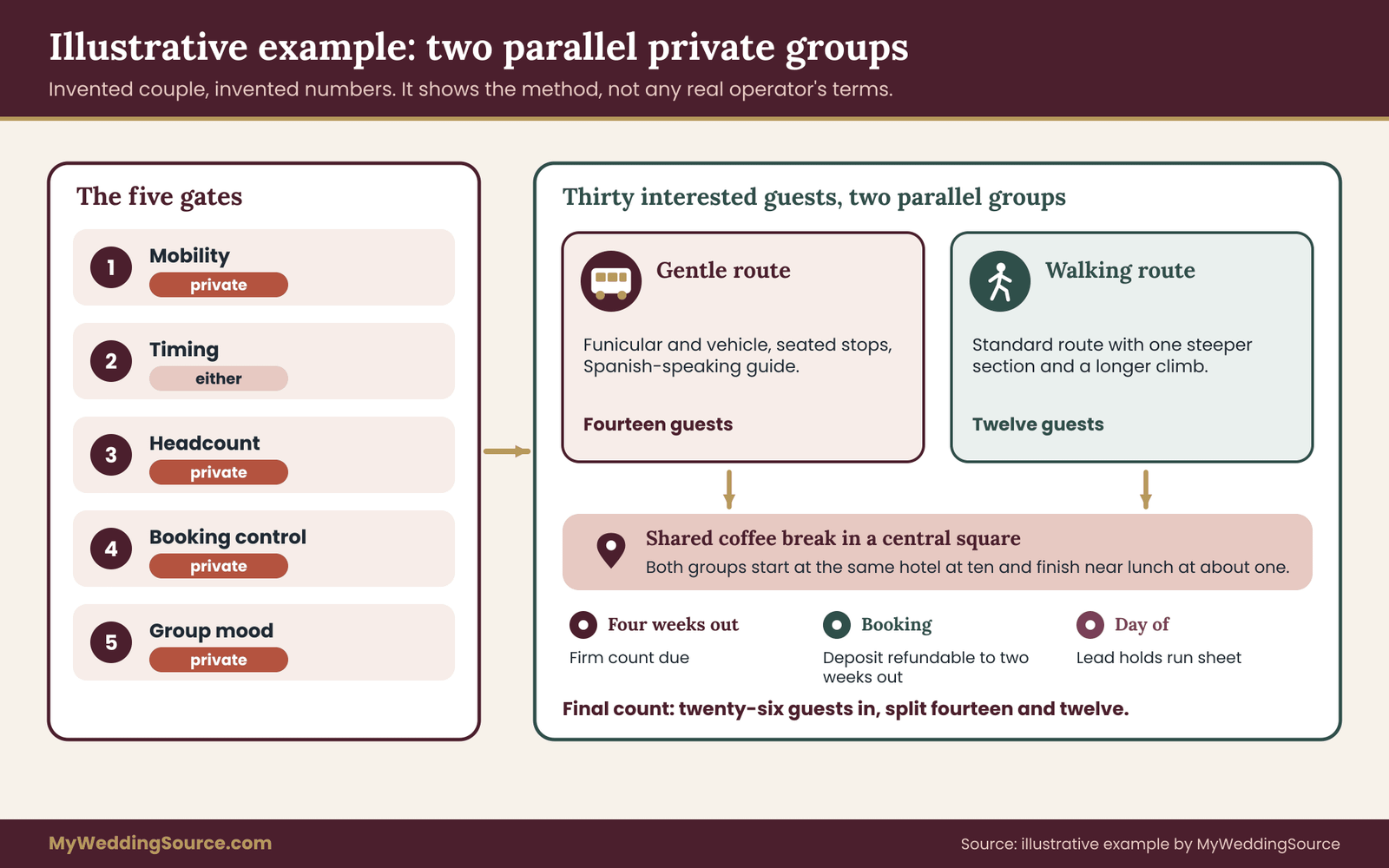
Now put the gates to work on a second invented couple, Maya and Jonas, who are marrying in a hillside city in southern Europe in late spring. This example is illustrative, with invented numbers, and it shows the method rather than any real operator’s terms.
About fifty guests have been invited from abroad. After the first RSVP round, thirty say they would like a free-day outing on the Friday. Of those thirty, four are children under ten, three are guests aged over seventy, and one uses a wheelchair part of the time. Maya’s cousin speaks little English, and her family of four prefers Spanish. The old town is steep and cobbled, with a funicular and several long staircases.
Step one: write the gates
Maya writes one word for each gate.
Mobility: private. The hills, cobbles and staircases are a problem for the three older guests and the guest who uses a wheelchair. The standard walking tour includes a long climb, and the published description does not mention step-free options.
Timing: either. Friday is free until a seven o’clock dinner, so a morning or an early-afternoon tour both fit.
Headcount: private, probably. Thirty is in the large band. One guide cannot comfortably lead thirty people through narrow streets, and join-in departures do not have thirty free seats on the same day.
Booking control: private. The group needs a language plan and a fixed meeting point near the main hotel.
Group mood: private. Maya wants the two families to spend a morning together.
Four gates say private and one says either. The decision is clear. But the numbers also tell Maya that a single private tour is not realistic, because thirty is too many for one guide. The next step is to design the private format.
Step two: design the private format
Maya asks two operators for quotes on two parallel private groups of about fifteen each. One group would follow a gentler route that uses the funicular and a vehicle for part of the route, with seated stops. The other would follow a standard walking route with a steeper section. Both groups start at the same hotel at ten, meet at a central square for a short shared coffee break, and end near the restaurant district at about one.
This design solves several things at once. The older guests and the wheelchair user are in the gentle group, but they are not singled out, because both groups are named by route and not by need. The two groups meet in the middle, so the shared-company purpose is served. The Spanish-speaking family goes in whichever group has the guide who speaks Spanish, and the operator confirms that one guide does.
Step three: set the commitment line
The operators ask for a firm count by a date four weeks before the wedding and a deposit at booking. Maya asks what happens if the count drops. Operator A says the deposit is non-refundable but the balance depends on the final count within a range. Operator B says the deposit is refundable until two weeks before and the balance is due on the day. She picks B for the more flexible terms, with the written plan attached.
She also asks the operator to confirm that a second guide is available if the count rises, and what the notice would be. The operator says a week’s notice is enough. Maya records all of this in a short email thread and keeps it with her other vendor paperwork.
Step four: communicate and collect
Maya sends one message to the thirty interested guests. It names the two routes, the meeting time and place, the expected end time, and the date by which guests must confirm their group. It asks for names and ages of children, the languages needed, and any mobility notes.
She does not mention costs in this message, because the couple is covering the guest city tour. If the couple were asking guests to pay, she would add the amount and the payment method, and keep the money logistics in a separate message so that the schedule stays clear.
By the confirmation date, twenty-six guests are in, split fourteen and twelve. Maya sends the final count to the operator, who confirms the two groups and the vehicle.
What the example teaches
Three lessons carry over to other weddings. First, the gates did their job quickly because Maya wrote them down. Second, a large group was not a reason to give up on private, but a reason to design two parallel groups. Third, the commitment line was the part of the booking that mattered most, because it set the couple’s exposure if the count changed. Compare any operator’s offer on that line before you compare it on anything else.
Edge cases and how to handle them
Real weekends rarely match a neat example. These are the situations that most often complicate the decision, and a sensible way to handle each.
One guest cannot do the tour at all
Sometimes a guest has a condition that makes any group tour impractical: severe fatigue, a medical need that requires frequent rests, or anxiety about crowds. Do not try to fit them into the guest city tour. Instead, offer something comparable that they can manage, such as a seated lunch with a few relatives, a short drive with a friend, or a quiet visit to a garden. The aim is that no one feels left out, not that everyone does the same thing.
A join-in tour sells out
If you have recommended a join-in tour and the departure sells out, guests will turn to you. Do not scramble to fix every booking. Offer the next departure, an alternative operator or a self-guided route with a printed map, and keep your own tour plans separate from guests’ independent bookings. Early recommendation helps: tell guests about the join-in option as soon as the date is firm, so they book before seats run out.
The operator cancels a join-in departure
Operators can cancel a departure for low demand, weather or staffing. Ask for the operator’s policy before booking, and check the refund and rebooking terms. If it happens, notify your guests quickly. Have a backup in mind, such as a second departure or a casual walking route that the group can do without a guide.
A private guide runs late or does not arrive
Rare, but possible. Keep the guide’s mobile number, the operator’s office number and the operator’s emergency contact together on a card that the tour lead holds. If the guide does not appear within a stated time, such as twenty minutes, the tour lead calls the operator and, if needed, moves the group to a nearby café while a replacement arrives. Ask the operator beforehand what its replacement policy is.
A guest brings a plus-one you did not plan for
A guest who adds a person after the final count affects a private tour’s vehicle capacity and, on a join-in tour, the seat count. Set a rule early: additions are possible until the confirmation date, and after that the tour lead will do their best but cannot promise a seat. Say it kindly. Then, if there is room, say yes.
Children and sleep schedules
A tour that suits adults can be a long march for young children. Offer a shorter route or a break at a playground, or let parents choose to skip it. The guide on wedding guest care explains how to arrange supervision so that parents who want the outing can take it. Do not put a nap schedule at the mercy of a guide’s timetable.
Alcohol, food and dietary needs
If the guest city tour includes a tasting or a meal, it becomes a different kind of event with different risks. Ask the operator for the ingredients and any alcohol content, ask how the operator handles allergies, and give the operator your guests’ needs in writing. A tour without food is simpler, and a coffee stop at a place you have chosen is easy to manage.
Religious services, closures and dress rules
Churches, temples and some historic sites close to visitors during services or on certain days, and many have dress rules for shoulders and knees. A route that includes such a site can change on the day. Ask the operator whether entry is included, whether the route changes if the site is closed, and what guests should wear. Let guests know about dress rules ahead of time, so nobody is turned away at a door.
Travel advisories and permits
Some destinations have temporary restrictions, local protests, strikes or disruptions that affect tours. The U.S. Department of State publishes travel advisories and country information, and local authorities publish notices about closures and events. Check them before you commit, and again a week before the guest city tour. If a closure or advisory affects the route, talk to the operator about changes, and note the refund rules that apply.
When the couple does not attend
A guest city tour may run without the couple. In fact, on a wedding weekend it often should. Name a tour lead who is not the couple, give them the written plan and the contact numbers, and tell the operator who is in charge. If the couple does join, treat it as a bonus. A tour that depends on the couple’s presence is a tour that may not happen.
A guest asks to bring a dog or a stroller
Ask the operator before saying yes. Vehicles, historic sites and some trails restrict animals and strollers. If the answer is no, offer a way for the guest to still take part, for instance by meeting the group at a later stop.
Telling guests and running the day of the guest city tour
A good format choice can still go wrong if guests do not understand it. Most confusion comes from three sources: guests do not know the guest city tour exists, they do not know whether it is private or shared, or they do not know what they are expected to do. A few short messages, sent in the right order, deal with all three.
What to say on the wedding website and invitation suite
The invitation itself should not carry tour details. Keep it for the wedding. Put the outing on the wedding website, in a section for the weekend schedule, and describe it in plain terms. Give the day, the likely time window, the format, who it is for, and what to do next. If it is private, say that the couple has arranged it and guests should sign up by a date. If it is join-in, say that the couple recommends it and guests should book directly with the operator.
Describe the physical demands honestly. Write the approximate walking distance, whether there are stairs and what the ground is like. A line such as “about two hours on foot, with some cobbled streets and one short staircase” is far more useful than “easy walk.” Offer the gentler alternative by name, and invite guests to ask questions privately. The guide on wedding RSVP etiquette covers how to ask for responses without pressure, and the same tone works for tour sign-ups.
The sign-up message
When you collect commitments for a private tour, one clear message beats several chatty ones. It should include the date and time, the meeting point, the route type and length, the format, the deadline for confirmation, what you need to know from each guest, and the way to reply. Keep it to a short paragraph and a few lines of details. Send it to the guests who have shown interest, and post the same text on the website.
Avoid asking guests to pay in the same message unless that is part of your plan. If guests are paying, keep the payment instructions separate, with the amount, the date due and the method. Mixing money and logistics makes both harder to read.
The reminder
A reminder goes out two or three days before the guest city tour and again the evening before. The two-day version repeats the plan, adds weather expectations and suggestions for clothing and shoes, and mentions water and sun protection. The evening-before version is shorter: the meeting time, the meeting place with a nearby landmark, the tour lead’s phone number and the operator’s number.
If the guest city tour is a join-in tour that guests have booked themselves, your reminder should ask them to bring the booking confirmation and arrive fifteen minutes before the start. If it is private, your reminder should tell them where the group gathers and who will be holding the sign.
Setting expectations without pressure
Guests have their own plans. Some want to rest, some want to explore alone, some have family obligations. Make it easy to say no. A line such as “no need to tell us if you’d rather do your own thing” signals that attendance is optional. This matters for the guest city tour itself, because a group that attended out of obligation is a quiet, tired group.
Running the day: a tour lead, a run sheet and a backup
The day of the guest city tour is the part of the plan that the couple will not control, so assign it. A tour lead is a friend or relative who knows the plan and has the authority to make small decisions. They count heads, keep time, talk to the guide and call the operator if something goes wrong.
The one-page run sheet
Give the tour lead a single page. It should list the meeting time and place, the guide’s name and mobile number, the operator’s office number, the planned stops with approximate times, the end point and the expected end time. Add the number of guests in each group, the names of guests who need extra help and the plan for those guests. Add the location of the nearest pharmacy and hospital, and the local emergency number. Put the page on paper and on the lead’s phone.
A run sheet is easy to write if you have collected the facts as you booked. Copy the details from the operator’s written plan, and do not invent anything the operator did not confirm.
The head count habit
Counts are the simplest safety measure. The lead counts the group at the start, at every stop and at the end. If the group is split, each sub-group has its own count. Children are counted with their parents, and the lead confirms that each child has an adult. After any stop where people could wander, count again. A group that loses someone at the third stop and notices at the sixth has a much bigger problem than one that counts every time.
Pace, shade, water and rest
Check the weather the night before, and again in the morning. If it is hot, ask the guide to favor shaded routes and to add a stop for water. If it is wet, make sure guests have a plan for rain, such as a covered stop or an umbrella. Ask the guide to include a seated rest at least once an hour for mixed groups. These are small adjustments, and a private guide can make them without argument.
A backup that does not depend on the guide
Have a plan for the group if the guest city tour cannot run. It can be as simple as a café near the meeting point, a self-guided walking route printed on a card, or a booking at a museum with flexible entry. Tell the lead what the backup is. When the guest city tour is canceled, guests tend to dissolve into the hotel, and a clear alternative keeps the morning from falling apart.
Measurable checks for choosing a guest city tour
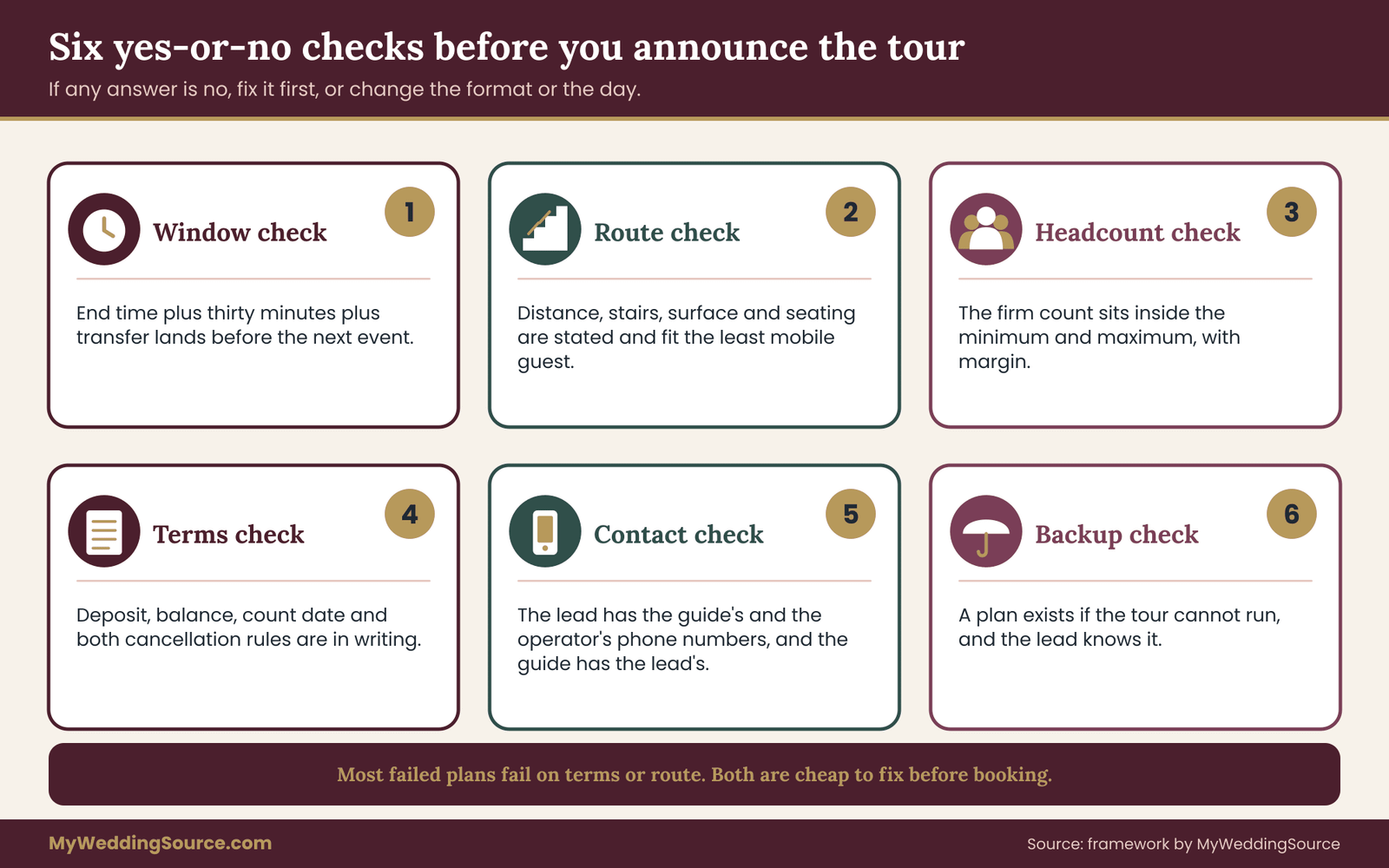
The final test of any plan is whether it can be checked. Instead of asking whether a guest city tour feels right, run a handful of checks that give a yes or a no. They are quick, and they turn gut feeling into evidence.
The first is the window check. Does the guest city tour’s end time plus a thirty-minute buffer plus the transfer to the next event fall before that event’s start time? Yes or no.
The second is the route check. Has the operator stated the walking distance, the number of stairs, the surface and the seating? Is the answer within the limit of the least mobile guest you expect? Yes or no.
The third is the headcount check. Is the firm count inside the operator’s minimum and maximum, with a margin on each side? Yes or no.
The fourth is the terms check. Do you have the deposit, the balance, the final-count date, the cancellation rule and the operator’s cancellation rule in writing? Yes or no.
The fifth is the contact check. Does the tour lead have a working phone number for the guide and the operator’s office, and does the guide have the lead’s? Yes or no.
The sixth is the backup check. Is there a plan if the guest city tour cannot run, and does the lead know it? Yes or no.
If any answer is no, fix it before you announce the guest city tour. If you cannot fix it, treat the format or the day as the problem and consider the alternative. Most plans that fail these checks fail on the terms or the route check, and both are cheap to repair before the booking and expensive after.
Common mistakes that these checks catch
Booking before the count is known is the most frequent error. It leaves the couple holding a large vehicle for a small group. A close second is trusting the label “easy” without asking about the route. A third is giving the meeting point as a landmark without a time buffer or a phone number. A fourth is leaving the cancellation terms to memory. And a fifth is assigning no one to run the day, which leaves the couple answering calls during hair and makeup.
None of these are dramatic, and none requires special expertise to avoid. They simply require that someone writes the plan down and checks it against the facts. The vendor guide on wedding vendor timelines shows how to fit small bookings like this into the wider weekend schedule.
Reviewing the tour afterward
After the weekend, take ten minutes to record what happened. Did the guest city tour start and end on time? Did any guest struggle with the route? Did the group size work? Was the guide good? Keep a few notes with your vendor records. If you wrote a review, be specific and fair, and never publish a guest’s personal details.
If something went wrong and the operator promised a refund or a credit, note the amount and the date, and follow up in writing. The notes help you if you ever need to dispute a charge, and they help any couple you recommend the operator to.
Your next steps
Work through these in order, and stop at any point where an answer is still open. An open answer is a reason to wait, not a reason to guess.
First, write the sentence that begins “The guest city tour is for…” and decide whether the purpose is shared company or something to do. Second, write the window: the earliest anyone can start, the latest the guest city tour can end, and the fixed event that follows. Third, collect a soft interest count from guests, and a list of mobility and language needs. Fourth, run the five gates and write one word for each: private, join-in or either.
Fifth, if the answer is private, request quotes from two or three operators with the same written brief, and compare them on the commitment line before price. If the answer is join-in, shortlist two operators, check the route, the meeting point and the refund rules, and publish a short recommendation. Sixth, name a tour lead who is not the couple. Seventh, send the sign-up message, the reminder and the evening-before note.
Finally, put the confirmation date, the balance date and the cancellation cutoff in your calendar. If you are still deciding which activities belong in the weekend at all, return to the broader wedding planning guide, and if guests are still choosing where to stay, the page on wedding hotels for guests will help you place the meeting point near where most of them sleep.
FAQ
Is a private guest city tour worth it for a small group of wedding guests?
Usually not for six guests or fewer, unless someone has a mobility need that the standard route cannot meet. At that size a join-in departure is simpler and carries little risk. A private guest city tour starts to make sense once the group can fill a vehicle or a guide’s comfortable group size, or when a fixed schedule leaves no room for a public departure’s start time.
How many guests can one guide lead on a city tour?
It depends on the city, the route and local rules, so ask the operator for its maximum. Narrow streets and historic sites often limit group size, and a guide who leads a large group through crowds may lose people at crossings. For mixed-age wedding groups, many planners keep each guide to a smaller group and add a second guide when the count rises.
What if some guests cannot walk the standard route?
Offer two clearly described options instead of one. A walking route for those who want it, and a gentler route, perhaps by vehicle with seated stops, for those who need it. Name the options by what they involve, not by who they are for. Ask the operator for specifics about stairs, surfaces, seating, restrooms and vehicle access before you promise anything.
Can we book seats on a join-in tour for the whole group?
Often yes, but it does not automatically make the guest city tour private. Other travelers may still book the remaining seats unless the operator marks the departure as closed to others. Ask whether the departure can be reserved for your group, what the minimum number is, and whether the terms change when you do. Get the answer in writing before collecting money from guests.
When should we book a guest city tour for a wedding weekend?
Book once your firm count is close to settled, but early enough that your preferred day and guide are still available. Collect soft interest early, ask for a firm yes with a deadline, and book to the low end of your realistic range. Join-in departures can sell out in busy seasons, so recommend them to guests as soon as the weekend dates are firm.
Who should be in charge of the tour on the day?
Someone who is not the couple. Choose a reliable friend or relative as tour lead, and give them a one-page run sheet with the meeting time and place, the guide’s and the operator’s phone numbers, the stops and the end point. The lead counts the group at every stop, talks to the guide and calls the operator if anything changes.
What should we ask about cancellation and weather?
Ask what happens if weather or an official closure stops the guest city tour, what the refund or rebooking rule is, and how much notice the operator gives. For a private tour, also ask what happens to the deposit if your headcount falls. For a join-in tour, find the last moment for a free refund. Ask for all of it in writing and keep the confirmation.
Should the couple pay for the tour or ask guests to pay?
That is your decision, and it depends on your budget and your guests. What matters for the format choice is clarity. Tell guests before they sign up whether the outing is hosted or self-paid, keep money details in a separate message from the schedule, and use a payment method that gives a receipt. For a join-in tour that guests book themselves, each guest handles their own payment.
Sources
- U.S. Department of State, Travel.State.Gov
- ADA.gov, U.S. Department of Justice Civil Rights Division
- U.S. Access Board
- Federal Trade Commission, consumer advice
- Consumer Financial Protection Bureau
- CDC Travelers’ Health
- National Weather Service
- National Park Service
- USA.gov, travel and tourism
- U.S. Department of Transportation