Dessert bar servings are the number of bites, slices and small plates your guests will actually eat from a dessert table, and that number changes how much wedding cake you need. This guide gives you a simple three-scenario method for setting the cake and the dessert bar together, so you do not pay for the same appetite twice or watch the table run empty at nine o’clock.
Do not size the cake from the guest count alone. Count the guests who will really eat dessert, choose a low, a base and a high estimate of how many pieces each of them takes, and decide what share of those pieces should be cake. Order the cake for the base case, build the dessert bar to flex, and round every item up to the bakery’s own unit. Your dessert bar servings and your cake servings should always be planned as one pool, with one written number that the baker confirms.
Most advice about wedding cake servings assumes the cake is the only dessert. One slice per guest, plus a few extra, and you are done. That arithmetic stops working the moment a dessert bar appears beside the cake. Guests who take two cookies and a tart often skip the slice, and guests who skip the dessert bar servings often take the biggest slice on the table. If you order a full cake and a full dessert bar, you are probably buying two desserts per guest and serving about one and a half.
This article is about that overlap. It does not repeat how to schedule a cake from the final guest count to the cutting, which the wedding cake timeline guide covers step by step. Here the question is narrower, and it is all about dessert bar servings: once you have a dessert bar, how many dessert bar servings do you need, how many cake servings are left, and how do you keep the arithmetic honest.
A note on scope. This is general planning information, not legal, tax or financial advice, and a bakery or caterer has the final word on its own portions, structure, temperatures and allergen handling.
Why dessert bar servings change the wedding cake math
Think of dessert as a fixed amount of appetite that guests bring to the end of the meal. People are full after dinner. They have a limited amount of room, and they are choosing between what is offered. When you add choices, you do not add appetite; you split it, and that is the whole reason dessert bar servings and cake servings have to be planned together.
That has three practical effects.
The first is that a cake plus a dessert bar rarely needs to cover the full guest count twice. A cake that was going to feed everyone now feeds some people, and the dessert bar feeds others. Total servings across both still need to cover the eaters, with a margin, but the margin is smaller than the sum of two full orders.
The second is that the split is uncertain. Nobody can tell you in advance whether your guests will favor the cake or the table. Some crowds line up for the cutting and treat the cake as the main event. Others drift toward the dessert bar servings, and the cake is a photograph that gets a handful of slices. A good plan accepts this uncertainty and writes it down as scenarios instead of pretending to know.
The third is that the two items fail differently. A cake that is too small leaves people without a slice and cannot be fixed on the spot. A dessert bar that is too small runs out of the best item first, which guests notice. A dessert bar that is too large leaves trays of small items that are hard to repurpose.
Because the cake is hard to change late and the dessert bar servings are easy to flex, the sensible approach is to fix the cake on the base case and let the dessert bar servings absorb the uncertainty.
Where dessert bar servings fit in the larger plan
If you are still deciding whether to have a dessert bar at all, that is a menu decision, and the broader wedding menu planning guide deals with how dessert fits next to dinner service and dietary needs. This article assumes you have decided to do both and want the numbers to hold together.
Four inputs drive everything that follows. They are the count of guests who will eat dessert, the role the cake plays, the number of pieces each person takes, and the unit in which your bakery sells things. The rest of the guide takes them one at a time, then combines them into a single worked example with a fictional couple.
What this method does and does not promise
The method gives you a defensible range and a way to choose inside it. It does not give you a statistic about what guests at weddings eat, because no single number would fit a ballroom dinner for older relatives and a backyard reception with a lot of children. Every per-person figure in this guide is a planning assumption that you adjust. When a figure is labeled that way, treat it as a starting point to test with your baker, not as a measured rule.
Start with eaters, not the guest list
The guest list is the wrong starting number. The number that matters is the count of people who will eat dessert, and it is almost always smaller than the number of invitations.
Work down from the guest list in plain steps.
Start from attending guests. Use the number that matches your final RSVP count, not the invitation count. If you are still collecting responses, use your best estimate and label it as an estimate. Your caterer will ask for a final guarantee on a deadline, and the bakery will want a number soon after.
Subtract guests who will not eat dessert at all. Infants and very young toddlers rarely eat cake. Some guests avoid sugar for medical or personal reasons. A few will leave before dessert. You will not know precisely, so use the people you are fairly sure about, such as babies on laps, and do not guess at the rest.
Add people who are not guests but will eat. Photographers, musicians and some planners are fed by many venues, and a vendor meal is usually separate from the guest count. If vendors will be offered dessert, add them. Staff who are not offered anything do not count, and you should not assume otherwise.
Subtract double-counting. Couples sometimes count themselves in the guest total and again in the cake plan. Pick one way and write it on the page.
The result is your eligible eater count. Call it E. Everything else is a multiple of E.
A short script for counting E
Write this on a single page where both partners and your caterer can see it:
Attending guests: . Minus infants and children who will not eat dessert: . Plus vendors who will be offered dessert: . Eligible eaters (E): .
If E is within a few people of the guest count, that is fine. The point of the page is not that the difference is large; it is that the number was chosen on purpose. When the baker later asks how many servings you need, you can say what E was and how you got it.
Why E can move late
E is not final until RSVPs are. Late replies, plus-ones that change, and a family that decides at the last minute to bring a child all shift E by a few people. A few people matter less than you might fear, because the method has a margin built in. Still, put the date on the page, and when your final count settles, recompute. The timeline article explains how the guarantee and the baker’s own deadline interact, and it is worth reading before you commit to a number.
The four jobs your cake can have
Before you count pieces, decide what job the cake has. This one decision moves your cake servings more than any other, and couples often skip it because they have not noticed there is a choice.

Job one: the cake is the dessert. Every eligible eater is expected to receive a slice, and the dessert bar is a small extra. Here the cake is sized close to E, and the dessert bar servings are a light supplement. This suits a seated dinner where cake is served to each table.
Job two: the cake is one dessert among several. Guests choose between a slice and the dessert bar servings. The cake is sized to a share of E, perhaps a third to a half, and the bar carries the rest. This is the most common reason couples ask about dessert bar servings, and it is the main case in this guide.
Job three: the cake is the cutting moment. The couple cuts a small display cake, and the kitchen serves from a sheet cake or a second cake out of sight. The visible cake might serve a few dozen, and the dessert bar does most of the work. The structure and the servings are then two different numbers, and you need both.
Job four: the cake is mostly for show. Some couples order a modest decorated cake for the photographs and the first slice, and they let the dessert bar be the real dessert. The cake serves the couple, close family and a handful of people who want a slice.
None of these is better than another. Each leads to a different share of the pieces, and that share is the second variable in the method. Choose the job now, say it out loud to your partner, and write it next to E. If you change your mind later, you change one number rather than rebuilding the plan.
How the job changes what you tell the bakery
A baker who hears “we need cake for 130” will quote a cake for 130. A baker who hears “we need about 110 servings of cake, and we are ordering a dessert bar from you as well” will answer differently, and may suggest tier sizes, a sheet cake in the kitchen, or a sheet-cake backup you can cut if the dessert bar servings run short. The more clearly you describe the job, the more useful the baker’s answer. The next section turns the job into numbers.
The three-scenario method for dessert bar servings
Here is the whole method in one place. It has five steps, and each takes a minute with a calculator. We will go through them slowly, and then in the worked example you will see them with real numbers.
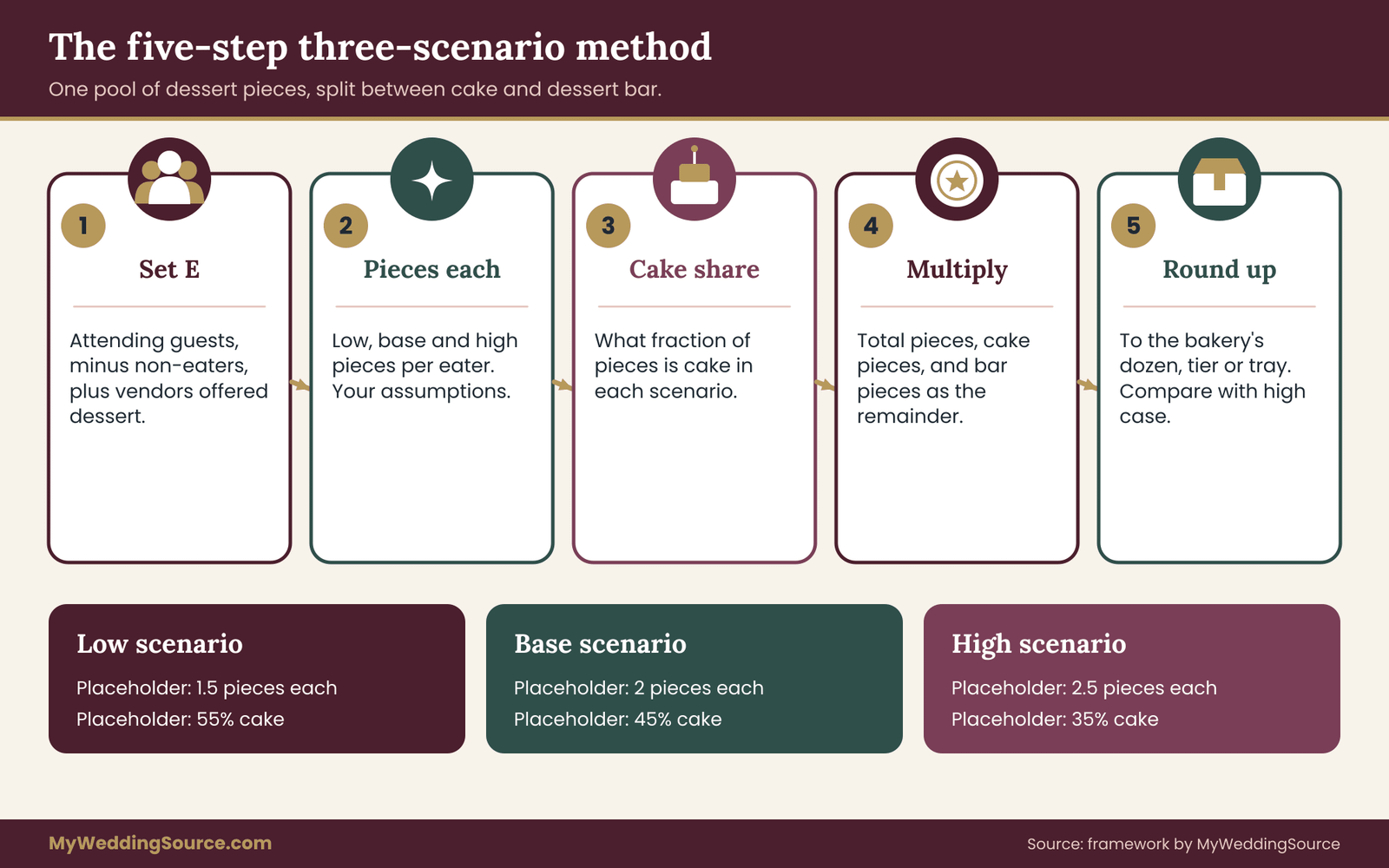
Step one: set E. The eligible eater count from the last section.
Step two: pick pieces per eater for three scenarios. A “piece” is one bakery-defined portion, either a slice of cake or one serving from the dessert bar. Choose a low, a base and a high number of pieces each eater takes. These are the figures you adjust for your crowd. A group that is full after a large dinner and leaves early will sit near the low end. A group that dances late and snacks will sit near the high end.
Step three: pick the cake share for each scenario. This is the fraction of all pieces that will be cake. It depends on the job from the last section. If the cake is the dessert, the share is high. If the dessert bar is the headline, the share is low. Notice that the cake share often falls as the number of pieces rises, because the guests who take more desserts take more from the bar, where items are small.
Step four: multiply. Total pieces is E times pieces per eater. Cake pieces are total pieces times cake share. Dessert bar servings are total pieces minus cake pieces, so the bar is always the remainder after the cake.
Step five: round up to the unit. Bakeries sell by the dozen, the half-dozen, the tier or the sheet. Round each item up to the next full unit, then compare the rounded total to the base and high scenarios to see how much cushion you bought.
That is all of it. The rest is judgment about the inputs.
Why three scenarios and not one number
A single estimate hides its own uncertainty. If you decide guests take two pieces each and the real figure is two and a half, you are short by a quarter of the whole order, and you will not know that until the table is empty. If you decide guests take one and a half and the real figure is one and a half, you have paid for dessert nobody ate.
Three scenarios show you the spread. When you see that the low case needs 200 pieces and the high case needs 330, you also see that your decision is not about being right. It is about where in that range you are willing to risk being wrong, and what it costs each way. Running short of cake is embarrassing and hard to fix. Running short of cookies is easy to survive. Having 40 extra brownie bites is a small expense. That asymmetry is what you are designing around.
Choosing pieces per eater without inventing facts
You are looking for three numbers, and none of them should be borrowed from a claim about “the average wedding guest,” because there is no reliable average that fits your crowd. Instead, derive them from how your reception will run.
Ask yourself these questions and move the numbers accordingly.
- Is dinner large and plated, or is it light, like heavy appetizers? A large dinner pushes pieces per eater down, and a light one pushes it up.
- When does dessert appear? Right after dinner, people are full. Two hours later, after dancing, they are hungry again. Late service raises the high case.
- Is dessert advertised? A dessert bar that is visible from the start of the night is eaten over a longer period than one that is wheeled out at the end.
- Who is attending? A room with many children, many teenagers or many people who plan to stay late pushes upward. A room of older guests who leave after the cake pushes downward.
- Are there other late-night snacks? If a pizza or taco service follows, desserts compete with it.
A reasonable first draft is to set the low case at one and a half pieces per eater, the base at two, and the high at two and a half. Those are placeholders that give you something to argue with. Treat them as a starting position, and your baker’s experience with similar receptions as the next input. If your baker says a crowd like yours tends to take less, lower the numbers. Write the baker’s words down.
Choosing the cake share
The cake share is easier to get wrong because couples choose it by feel. Anchor it with the job.
If the cake is the dessert, the share is high, probably above seventy percent in the base case. If the cake is one dessert among several, a base share between a third and a half is a sensible place to start. If the cake is mostly for the cutting and the photographs, the share might be a quarter or less.
Then ask whether the share should differ by scenario. It often should. When guests take fewer pieces, they tend to take the familiar thing, which is cake, so the low case has a higher share. When guests take many pieces, they are sampling, and the dessert bar servings take a bigger share, so the high case has a lower share. A pattern such as fifty-five percent, forty-five percent and thirty-five percent across low, base and high is a reasonable way to express that. Again, it is a placeholder to test, not a finding.
Reading the result
When you finish, you will have three cake numbers and three bar numbers. Look at the cake numbers first. If they are close to each other, that is good news: the cake decision is stable and the baker can build it with confidence. If they differ a lot, the cake is the risky item and you should talk to your baker about flexibility, such as a kitchen sheet cake that is cut only if needed.
Then look at the dessert bar servings. These will probably spread widely. That is normal, and it is why you plan the bar as the flexible item.
A method for dessert bar servings built on “pieces” fails if the pieces are different sizes. A slice of wedding cake is not the same as a macaron, and neither is the same as a scoop of pudding in a cup. Before anyone orders, you need a shared definition of a serving, and you need it in writing.
Why bakeries disagree about cake servings
Bakeries calculate cake servings with their own charts, and the charts differ. A common difference is slice size. A tall, narrow slice from a tiered cake looks small on a plate but is a sensible dessert after a large dinner. A larger slice gives guests more but yields fewer servings from the same cake. Some bakeries quote wedding servings at one size and party servings at a larger size, and the difference can change the total by a meaningful amount.
Do not assume your baker’s chart matches a number you saw online. Ask for the bakery’s wedding serving size in writing, and ask what the quoted serving count assumes. Then use the bakery’s figure in your arithmetic. If a bakery will not describe its serving size, treat that as information about the bakery.
The related question of stand-in tiers, where one or more layers are not edible, has its own set of arithmetic problems, which is why couples who use decorative layers need a separate conversation about what is actually cut.
The dessert bar unit problem
A dessert bar mixes units. Cookies and brownie bites are counted by the piece. Mini tarts are counted by the piece but are larger. Pudding cups and parfaits are counted by the cup. Cupcakes are counted by the cupcake and can be a full serving by themselves. A candy table is counted by weight, and nobody can say how many pieces of candy equal a serving.
The way through for dessert bar servings is to convert everything to a common unit, which you can call a piece, and to be strict about what counts. A reasonable rule is that a piece is a single portion that a guest could eat in two or three bites and consider “one dessert.” A cupcake is one piece, though some guests will eat half.
A cookie is one piece. A cup of pudding is one piece. Two brownie bites might be one piece, if each bite is very small. Candy is handled separately, because it does not convert cleanly and it should not be allowed to hide a shortfall in real desserts.
Write the conversion for your dessert bar servings in your notes, then ask your baker to review it. A baker who sells brownie bites by the dozen might say that a dozen is twelve bites and that two bites make a piece. Now you know a dozen is six pieces, and your order changes accordingly. This kind of correction is the point of writing the unit down.
Why candy and snacks stay out of the count
Many dessert tables include candy, popcorn or similar items. They add atmosphere and give people something to pick at, but they distort the count. If you let candy count as pieces, your calculation will suggest you need fewer real desserts than you do, because the candy was answering appetite on paper that it will not answer in practice. A better approach is to treat candy as a bonus. Include it on the table if you like, but plan the real dessert bar servings as though it were not there.
A short test of your definition
Pick any item on the dessert list and ask two questions. Could a guest reasonably call this “my dessert”? Could the item be counted without arguing about size? If the answer to either is no, the item needs a clearer definition or belongs on the bonus list.
How guest groups change dessert bar servings
So far we have treated E as one lump. In reality your guests are several groups with different habits, and a quick split by group often improves your estimate more than any adjustment to the overall numbers. You do not need a formal survey. You need a reasonable sense of who is in the room.
Children and teenagers
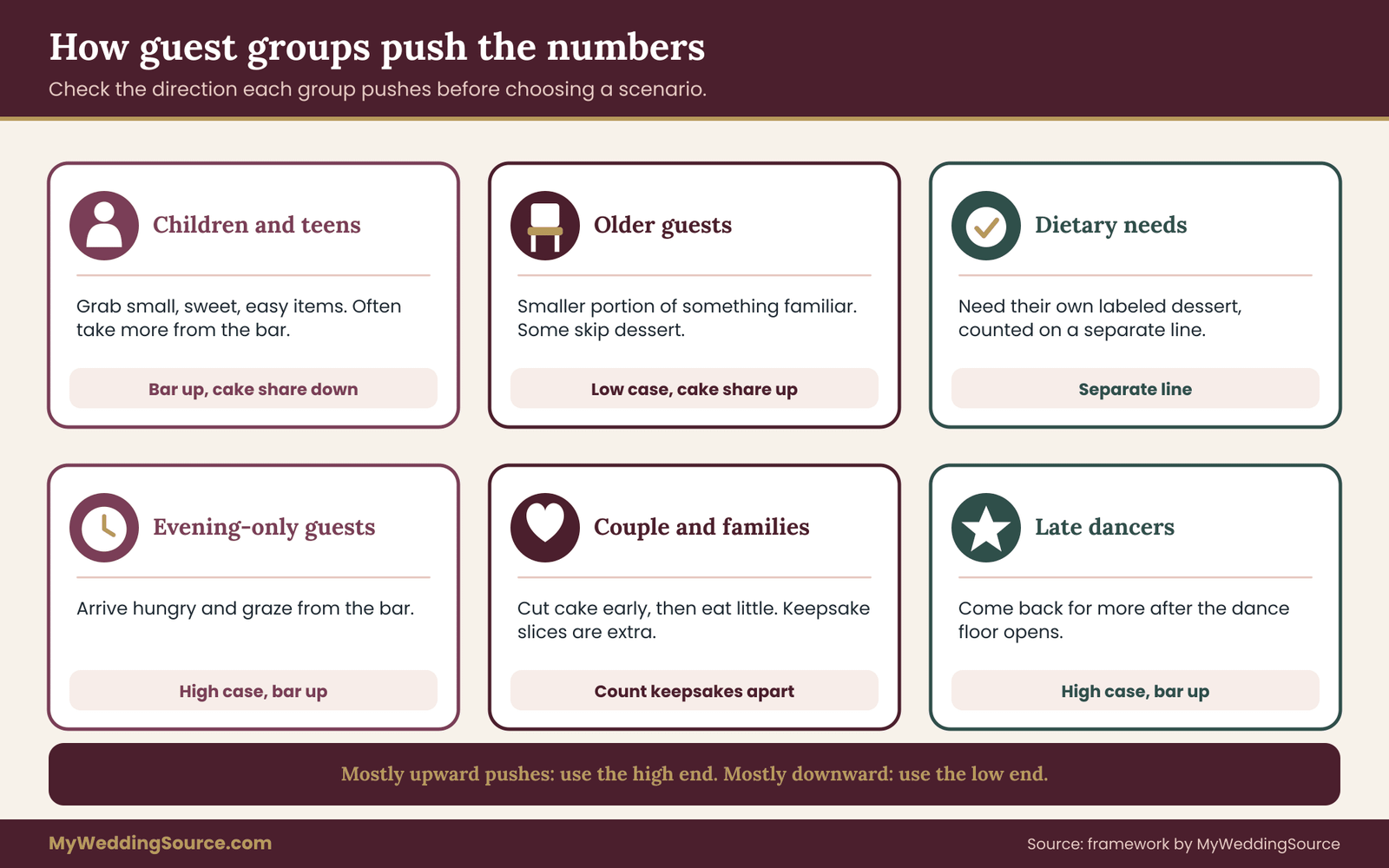
Young children often pick the item that looks like candy or has frosting, and they often take one piece and leave. Many of them also share with a parent. Teenagers can take several pieces and come back. In a room with many children, the dessert bar servings tend to be more popular than the cake, and small items that are easy to hold do better than anything that needs a fork.
If your guest list has a lot of children, move your cake share down and your piece count for the dessert bar servings up by a little.
Older guests
Older guests commonly want a small portion of something familiar, and many will take cake because it is what they expect. Some will skip dessert because of the hour, a medical diet or the length of the evening. A room weighted toward older guests often leans toward the low case for pieces per eater and toward a higher cake share.
Guests with dietary needs
Guests who avoid gluten, dairy, eggs, nuts or other ingredients are a separate planning problem, because their dessert may need to be a different item entirely. Do not count them inside the general bar math and then hope the main table covers them. Count them as a separate small group, and plan a specific, clearly labeled dessert for them. The allergen section later in this guide covers how to handle that safely. For now, subtract them from the general count and plan them on their own line.
Late arrivals and the after-dinner crowd
Some guests arrive for the evening only. A late-arriving group is hungry in a way the dinner crowd is not, so they take more pieces, and they take them from the dessert bar servings. If you invite evening guests, count them in E, and consider adding them to the high case in particular. The same is true for guests who stay for the last two hours of dancing.
The couple, the wedding party and the families
The couple and the closest family tend to take a slice during the cutting and then eat very little afterward, since they are busy. The wedding party is likelier to eat well. If the families have a custom about cake, such as sending cake home to people who were not able to come, that sends your total up. In some families, a slice is wrapped for every household as a keepsake. If that is your plan, it should be a separate, clearly written line in the order and not hidden inside the main count.
A simple way to use group information
Do not build a complicated model. Write the groups on a sheet of paper with a guess at how many are in each, and look at which direction each group pushes. If most of the pushes are upward, use the high end of your ranges for pieces per eater. If most are downward, use the low end. If they cancel, stay in the middle. This is a judgment call, not a calculation, and that is fine. The three-scenario method exists so that a wrong judgment is survivable.
Splitting the total between the cake and the dessert bar
Once you have the cake share, the total splits into cake servings and bar servings. This section is about the second half: how to divide the dessert bar servings among its items so it looks full, tastes varied and does not collapse when one favorite runs out.
Choose the number of items first
A dessert bar with three items looks sparse to some guests. One with a dozen can look generous but costs more in variety and creates many half-empty trays. For most receptions, four to six items is a workable range, and the number rises with the guest count. The goal for your dessert bar servings is for every guest to find something they like without the bakery making a dozen small batches.
Weight the items by appeal, not equally
Guests do not pick items equally. Chocolate is usually the most popular, fruit items are often less so, and anything unusual goes more slowly. If you split dessert bar servings evenly across five items, the popular one runs out early, and the unpopular ones sit untouched. Instead, weight the list by likely appeal. A first draft might give the most popular item thirty percent, the next twenty-five percent, then twenty, fifteen and ten. Those weights are guesses, and you can ask the baker to adjust them.
Set a floor for each item
A weighting alone can leave your least popular item with a laughably small number, such as a dozen pieces for a hundred and thirty guests. A table with twelve tarts looks like an accident. Set a minimum quantity for every item, based on a fraction of E. A floor of around fifteen percent of E gives every item a visible, respectable presence. With 130 eaters, that is about twenty pieces. Again, that figure is a starting point to review with your baker, not a rule.
Round to the unit, then look at what you bought
Now round each item of the dessert bar servings up to the bakery’s unit, usually a dozen. A weighted need of 36 stays at three dozen. A need of 43 becomes four dozen, which is 48. A need of 29 might become three dozen. After rounding, add up the new total and compare it to the base and high scenarios.
The difference is your cushion. If rounding has put you between the base and high cases, you have bought some protection against a strong appetite at no extra planning cost. If rounding left you short of base, you need to add a unit somewhere.
Make the bar flexible where it counts
A flexible item is one you can add to late, or one you can stretch. Cookies from a bakery that can deliver a second box that evening, or items that can be made from a freezer reserve, are flexible. A tray of delicate fruit tarts is not. When you choose the mix, put at least one flexible, popular item on the list, and tell your baker or caterer that it is the item that gets topped up if the dessert bar servings run short. Ask the vendors whether that is realistic and what it costs.
Where the cake flexes
If the dessert bar servings are the flexible side and the cake is the fixed side, the cake needs its own flexibility, and the most common way to build it is a kitchen reserve. A small extra cake, or a sheet cake, kept in the kitchen can be cut and plated if the display cake runs out.
It also lets the display cake be cut conservatively for photographs. Ask your baker whether this is available, what it costs and who handles it. The wedding cake timeline guide explains the cutting and service handoffs in more detail, and the same handoff applies here.
A comparison in plain words
Consider two approaches. In the first, you order a cake sized for everybody and a modest dessert bar. You will almost certainly have leftover cake, and the cake will serve as a safety net. You will pay for the extra cake, but guests will rarely feel anything is missing.
In the second, you order a cake sized for about half the room and a generous dessert bar. You will likely have less waste, and you may spend less overall, but you depend more on the dessert bar servings being sized right, and you need a kitchen reserve for safety. Neither approach is wrong. What matters is that you have chosen one on purpose and told both vendors.
What to ask the bakery before you commit to dessert bar servings
Your arithmetic for dessert bar servings is only as good as the bakery’s assumptions. Several of those assumptions are invisible unless you ask, and a few change the totals enough to matter. Collect the answers in writing, preferably in an email thread you can find later, and make sure the final order or contract reflects them. The wedding vendor contract guide explains what a clear written agreement should contain, and a bakery order is a small version of the same thing.

Questions about servings and size
What serving size do you use for wedding cake, and what does your chart assume? The answer tells you what a serving is. Ask whether the quoted number is for a wedding slice or a party slice, and whether it counts every edible tier.
Does the serving count include the cutting cake? Some bakeries count the small top tier that couples save or cut for photographs, and some do not. If the top tier is one you will not serve, subtract it from the usable total.
How do you count dessert bar items, and what is one of your dessert bar servings? Ask how each item is sold, in what unit, and what a unit contains. A dozen of anything is twelve, but a “dozen” of brownie bites might be a dozen bites and not a dozen pieces by your definition.
What is the minimum order for each item? Some bakeries have a minimum per flavor or per item type. A minimum can force you to buy more of an unpopular item than your weighted plan calls for.
Questions about how much the bakery will adjust
Can the dessert bar quantity change after the order is placed, and until when? The date matters as much as the answer. A bakery that can add two dozen cookies the week before the event gives you a safety valve that a bakery with a three-week freeze does not.
Can you make a small backup batch on the day? Some bakeries keep a few extra trays for emergencies. Others cannot, and that changes how much cushion you should build in at the start.
What happens to the price if the guest count drops or rises? Ask for the deadline and the pricing rule in writing. A change in the count after the deadline might be charged in full, and that matters for the three-scenario plan.
Questions about delivery and setup
Who delivers and sets up the dessert bar, and is that included in the price? Delivery and setup of a table with many small items takes real time. Ask whether the bakery sets out the items, whether the caterer or the venue does, and who refills trays. If nobody is assigned to refill, the dessert bar servings will look empty even when there is more in the kitchen.
What do you need from the venue? Some items need refrigeration, some need a table of a certain size, and some cannot sit near a heat source. Ask the baker to list their requirements, then check them with the venue and the caterer. The wedding reception guest flow guide explains how to place stations so a line does not block a doorway, which is relevant when the bar sits near the dance floor or the bar service.
How long can each item sit out? This is also a safety question, and the next section covers the rule. Ask the baker to name the items that need to be kept cold and the items that tolerate room temperature.
Questions about allergens and labeling
What allergens are in each item, and how do you handle cross-contact? A bakery that works with nuts, wheat, milk and eggs in a shared kitchen cannot honestly promise an allergen-free item unless it has a process for it. Ask for a written list of ingredients and ask how the dedicated item will be made, packaged and delivered.
Will you provide ingredient and allergen labels for the table? Labels reduce the number of questions guests have to ask staff, and they are particularly useful when the dessert bar servings are self-serve. Ask whether the bakery prints them or whether you should.
What to write down
After the conversation, put the answers about dessert bar servings in one short document. Include the serving size, the unit for each item, the minimums, the freeze date for changes, the backup options, the delivery and setup arrangement, the allergen list and the price. Send it to the baker and ask for a reply that says “confirmed” or marks anything that is wrong. That reply becomes the document you rely on if something goes differently on the day.
How to say it without sounding difficult
Bakers get a lot of questions, and most are happy to answer clear ones. A message like this works:
We are planning a cake and a dessert bar from your shop for about 130 dessert-eating guests. Could you tell us your wedding serving size, the unit for each dessert bar item, your minimums, and the last date we can change quantities? We would like to size the cake for roughly half the room and let the bar cover the rest.
That message gives the baker the context, asks specific questions and states your plan, so the baker can correct it if it is unrealistic. It is also short enough to answer quickly.
Food safety, allergens and temperature on a dessert bar
A dessert bar is a buffet, so its servings follow buffet rules, and food safety rules for buffets apply to it. The rules are not complicated, but they are easy to forget in the middle of an event. This section gives the practical points. For current official guidance, use the sources at the end, and ask your baker and caterer what they follow.

The time and temperature rule
The federal food safety guidance for perishable food is simple. Perishable foods should not sit out at room temperature for more than two hours, and the limit drops to one hour when the temperature is above 90 degrees Fahrenheit, as it can be at a summer outdoor reception. The reason is that bacteria multiply quickly in the range between 40 and 140 degrees. For desserts, this matters most for items with cream, custard, cheesecake, mousse, fresh fruit toppings and anything made with eggs or dairy that is not shelf-stable.
Ask your baker which of the items on your list are perishable under that rule. Shelf-stable items such as many cookies, brownies and unfilled baked goods are lower risk, though you should confirm that with the baker. Items with cream cheese frosting or whipped filling are not.
The rule shapes the dessert bar in three ways. First, it limits how long you can leave perishable dessert bar servings out. A dessert bar that opens at nine and stays out until midnight is a problem if the items are perishable and it is warm. Second, it affects how you refill. Replacing a tray with a fresh one from refrigeration is safer than topping up a warm tray, and it also means the kitchen needs a plan for staging trays.
Third, it affects which dessert bar servings you offer at all. If the reception is outdoors in summer, choose items that tolerate heat, and leave the custard tarts for another season.
Who watches the clock
Someone must be responsible for noting when each perishable tray goes out and when it is taken away. It might be a caterer, a bakery attendant or a venue staff member. Ask who. If the answer is “nobody in particular,” ask the caterer to include it in their service, or assign a trusted friend with a written instruction. Do not hand that job to a member of the wedding party who has other things to do.
Cakes and temperature
Cakes covered in buttercream, whipped cream or cream cheese behave differently in heat, and some fillings need refrigeration. The practical details of outdoor temperatures and frosting types are covered in more depth by the site’s guide to buttercream and ganache for warm weather, and your baker is the final authority on how a particular cake should be kept.
For the arithmetic in this article, the point is that a cake that has to be held in a cooler cannot be sitting on a display table for hours, so its cutting time and its serving time have to be planned together.
Allergens
Food allergies can cause serious reactions, and the guidance from official sources is that cross-contact is a risk when allergens are handled with shared surfaces or utensils. A dessert bar is a place where cross-contact is easy: shared tongs, shared trays, crumbs falling between items.
Three habits reduce the risk. Keep allergen-free items physically separate and covered, with their own utensils. Label every item with its main allergens. Offer the allergen-friendly dessert to the affected guest directly, plated or boxed, instead of asking them to serve themselves from a shared table. If a guest has a severe allergy, ask them or their family what they are comfortable with and speak to the bakery directly.
A safe approach to counting is to plan allergen-friendly desserts as their own small line. If six guests need one, order for six, plus one or two extra in case a plate is dropped. Do not count them inside the general dessert bar servings. They are not part of the flexible pool, because they cannot swap items with other guests.
A caution about promises
Be careful with the words on the label. A baker can describe what is in the item and how it is made, but “allergen-free” is a strong claim, and many kitchens cannot make it. Prefer wording like “made without” a specific ingredient, and let the baker decide what they can truthfully print. If the answer is that the shop cannot guarantee separation from an allergen, then plan a sealed, store-bought or specially made item for the affected guest instead.
Cost logic: what a smaller cake does and does not save
Couples often add a dessert bar hoping to save money on the cake. Sometimes that works and sometimes it does not, and you can see which by following the cost logic instead of guessing. This guide does not quote prices, because bakery prices vary by region, design and season. It gives you the structure to compare real quotes.
The three cost lines
Your dessert spending has three parts. The cake has a price that is usually per serving, with extra charges for design, flavors and fillings. The dessert bar has a price that is usually per item or per dozen, and may include a display or setup fee. And there are the service costs, such as a cake-cutting fee from the venue or caterer, delivery, and rental of stands, trays and linens.
Looking at these separately matters for dessert bar servings because the lines move in different directions. Reducing cake servings lowers the first line only. Adding bar items raises the cost of dessert bar servings, the second and may add to the third. A cake cutting fee, if there is one, applies whether you cut a large cake or a small one, and it may apply to the bar too if the caterer plates it.
Per-serving prices and the effect of design
A plain cake costs less per serving than an elaborately decorated one, and many bakeries price extra decoration into the whole cake. When you shrink the cake, you often keep the design, which means the cost per serving rises even as the total falls. Ask the baker for a quote at two sizes, a full-size and a reduced one, with the same design. The difference between those two numbers is what the reduction actually saves. It may be smaller than you expect.
Dessert bar servings can cost more than cake servings
Small items are labor-intensive. A tray of individually decorated mini desserts can cost more per piece than a slice of cake. A dessert bar that replaces a large part of the cake therefore might raise your total, even if it reduces waste. If the main goal is saving money, a simple bar of basic items usually costs less than a complex one. If the main goal is variety, accept the cost and make the cake smaller to offset some of it.
Waste is a cost too
Leftover desserts are money spent on something nobody ate. The three-scenario approach can help here. If you order to the base case, your expected waste is smaller than if you order to the high case. But the cost of being short is not zero either. Short on cake means unhappy guests and a hard fix. Short on a bar item means a mild disappointment. That is why ordering the cake to base and the dessert bar servings to base-plus-cushion usually makes sense.
A short way to compare two quotes
Take two plans. Plan A has a full cake and a small bar. Plan B has a half-size cake and a larger bar. For each plan, write the cake price, the dessert bar price, the service fees and the expected leftovers, and total them. Then ask which plan leaves you more comfortable if the real appetite is at the low end, and which if it is at the high end.
Plan A is safer at the high end. Plan B may cost less at the low end. If the plans are within a few percent of each other, choose the one you prefer to serve. If one is much cheaper, check that the quotes assume the same serving sizes, the same delivery and the same service.
For the wider picture of where dessert fits in your total spending, the wedding budget guide explains how to set category limits, and dessert is one category among many.
Ask about fees tied to dessert
Venues and caterers may charge a fee to cut and serve a cake brought in from outside. That fee might be per person or flat, and it might apply to the dessert bar when staff plate or refill it. Ask the caterer what they charge and what is included. A cake-cutting fee can change which plan is cheaper, so find it out before you finalize anything.
A worked example: the Delgado and Whitfield reception
Here is the method applied to an invented couple. The numbers are made up to show the process, and the per-piece assumptions are placeholders, not findings about real weddings.
The setup
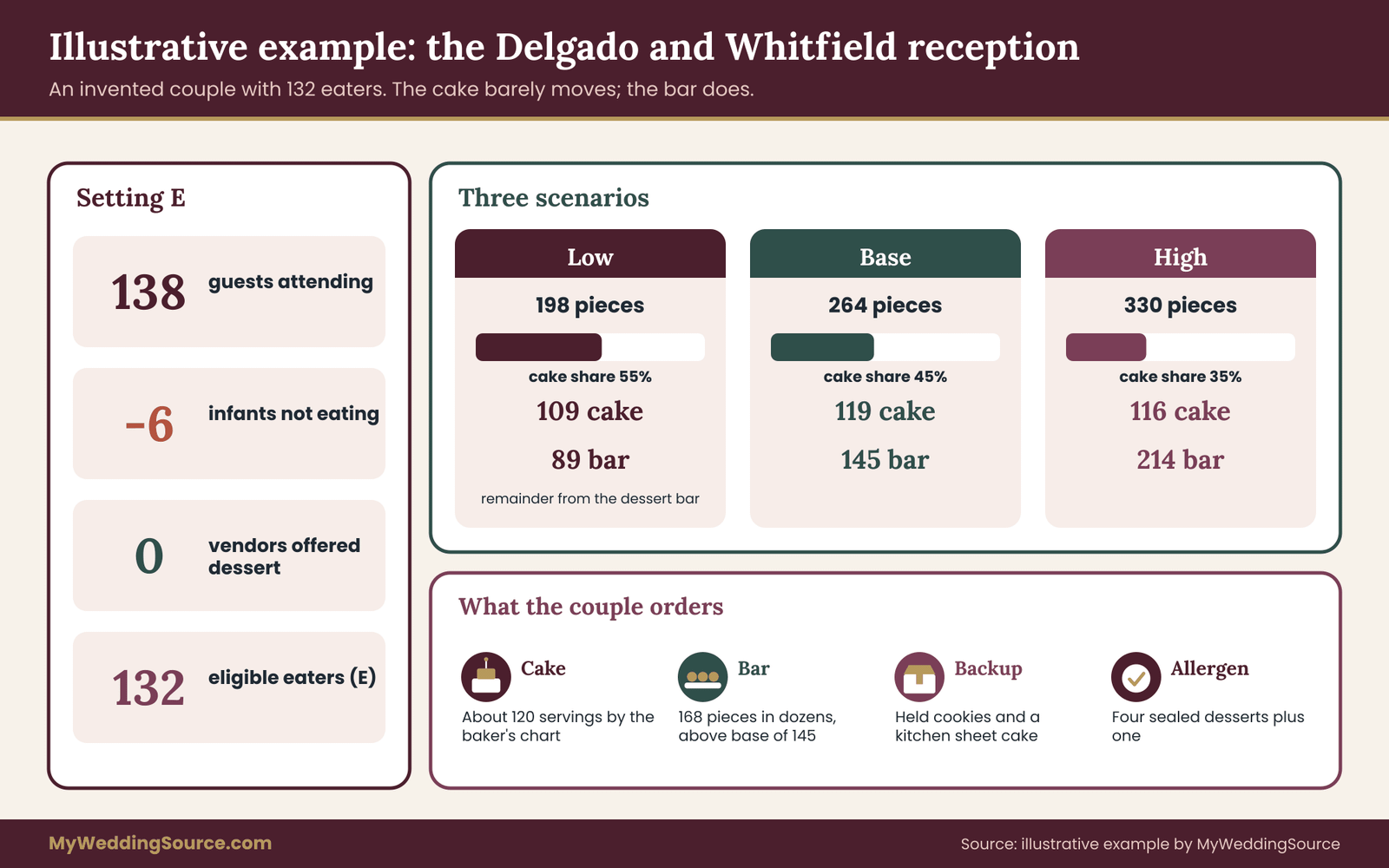
Maya Delgado and Owen Whitfield have 150 invitations out. Final RSVPs give 138 attending guests. Six of them are infants who will not eat dessert. The couple will not count the DJ and photographer, because the venue feeds vendors separately and does not offer them dessert. So E is 138 minus 6, or 132.
They have decided on job two: the cake is one dessert among several. The cake will be cut for photographs and served from the kitchen, and a dessert bar with five items will open after the first dance. The reception is indoors, in the evening, in a venue with climate control, so perishable items are manageable.
Step two and three: scenarios
They choose pieces per eater of one and a half, two and two and a half. They pick cake shares of fifty-five, forty-five and thirty-five percent, reasoning that the low case is a quiet, early-ending room where cake dominates, and the high case is a long, danceable night where the dessert bar servings dominate. They write these down and label them as assumptions.
Step four: the arithmetic
For the low case, 132 eaters take 1.5 pieces each, which is 198 pieces. At fifty-five percent cake, that is about 109 cake pieces and 89 bar pieces.
For the base case, 132 eaters take two pieces each, which is 264 pieces. At forty-five percent cake, that is about 119 cake pieces and 145 bar pieces.
For the high case, 132 eaters take 2.5 pieces each, which is 330 pieces. At thirty-five percent cake, that is about 116 cake pieces and 214 bar pieces.
What the numbers show
Look at the cake: 109, 119 and 116. It barely moves across the three scenarios, because the cake share falls as the total rises. That means the cake decision is stable, and the baker can build it with confidence.
Now look at the dessert bar servings: 89, 145 and 214. That is a spread of more than double between low and high. This is the number that carries the uncertainty. If the couple orders for the base case and the room behaves like the high case, the dessert bar servings will run short by about 70 pieces. If the room behaves like the low case, they will have about 56 pieces left over.
Step five: rounding and the decision
The couple asks the baker for a cake with about 120 wedding servings. The baker proposes tiers that yield around that number using the shop’s own chart, and the couple writes down the baker’s serving size.
For the dessert bar servings, they weight five items at thirty, twenty-five, twenty, fifteen and ten percent of the base need of 145. That gives about 44, 36, 29, 22 and 15 pieces. They set a floor of about twenty pieces, which lifts the last item. They then round to the baker’s dozens, and the baker sells the items in a way that works out to 48, 36, 36, 24 and 24 pieces, for a total of 168.
That is 23 more pieces than the base need, and it sits between the base and high cases. It does not cover the high case fully, and the couple knows it. To manage that risk, they agree on two protections. First, the baker will hold a reserve of two dozen cookies at the shop until noon on the event day and can add them to the order if the couple asks. Second, the caterer will keep a small sheet cake in the kitchen to plate if the display cake runs out.
Allergen line
Four guests have reported allergies or restrictions. The couple does not include them in the general count. They ask the baker to make four sealed, labeled desserts for those guests, and one extra, and they ask the caterer to hand them out directly.
The one-page result
The couple ends with a single page that lists E, the three scenarios, the cake size, the bar items with their quantities, the reserve arrangements, the allergen line and the baker’s confirmation. When anyone asks “how did you decide?” the answer is on the page. When RSVPs shift by three people, they can recompute in two minutes.
What would change the answer
If the couple expected a late-night crowd, they would move toward the high case and reserve more flexible items. If the guest list were mostly older relatives, they would move toward the low case and raise the cake share. If the reception were outdoors in July, they would remove perishable items, shorten the time the dessert bar servings are out, and probably add a cooler for backup trays. The method does not decide for them. It shows them what each choice does to the numbers.
Day-of service, edge cases and mistakes to avoid with dessert bar servings
The numbers are only half the job. The other half is making sure the right amount of food reaches guests at the right time, in an order that does not create a line, a mess or a safety problem. This section covers the evening itself, then the unusual cases, then the mistakes that come up most often.
Shape the evening so dessert bar servings are eaten, not wasted
When the dessert bar opens changes how many pieces guests take. A bar that opens right after the cake cutting competes directly with the cake, and guests who just ate a slice will take fewer pieces. A bar that opens an hour later, after dancing has started, catches people who are hungry again and tends to lift the piece count. If you want guests to eat from both, space them. If you have trouble deciding, remember that late service pushes toward your high case, and plan the extra pieces accordingly.
There is also a relationship with other food service. A cocktail hour with heavy appetizers, described in the wedding cocktail hour guide, affects how hungry guests are at dessert, and a late-night snack changes it again. List the food that appears during the evening in order, and ask where dessert sits in the sequence. A dessert bar that opens at the same moment as a late snack service will split attention and may leave one of them underused.
The cutting moment
The cake cutting is usually a short ceremony. The couple makes the first cut, there are photographs, and then the cake goes to the kitchen. The key planning point is that the cut cake should reach guests quickly or be set aside. If you serve slices to tables, the caterer needs a plan for who cuts, who plates and who carries.
If you use the cake as a display and serve from the bar, the cutting is purely for photographs and the dessert bar servings are the real dessert. Both are fine, but they must match what you told the baker and the caterer, because the staff and the timing are different.
Refills without panic
Decide in advance when and how each tray of dessert bar servings gets refilled. A practical rule is to refill an item when it falls to about a quarter of its starting quantity, and to put out fresh trays instead of adding to old ones. Assign one named person, either a caterer, a bakery attendant or a venue staff member, to watch the dessert bar servings for the first hour. If the staff are busy with dinner service, ask whether the bakery can provide an attendant.
Write the rule on a card for the person who will follow it. A card might say: “Refill when a tray is about one quarter full. Use fresh trays from the kitchen. Perishable trays come out for no more than two hours, or one hour if the room is above 90 degrees. Do not top up an old tray.” That card replaces a conversation that nobody has time for on the day.
Who does what
The failure point in many receptions is not the quantity but the handoff. List the tasks and the person for each: receive the delivery, check the order against the confirmation, set up the bar, place labels, refill trays, plate cake, serve allergen-friendly items, clear and pack leftovers. If a task has no name next to it, it will not be done. Put the list in the same document as your servings plan, and share it with the caterer, the venue coordinator and the baker.
The wedding planning checklist is a useful place to add the dessert items, so they sit alongside your other vendor tasks and deadlines and are not tracked in a separate thread.
Leftovers
Leftover cake and dessert bar servings are a planning topic, not an afterthought. Decide who takes what home. Perishable items need to be refrigerated promptly, and items that have been out for more than the safe time should be thrown away, however much was left. Ask the caterer or venue what their policy is, since some venues do not allow staff to pack food, and some caterers have rules about what leaves the building.
Bring containers, or ask the bakery for boxes, and name a person who will take them. Some couples donate unserved, safely stored items; if you want to do that, arrange it before the event, because most organizations have rules about what they will accept.
Edge cases that change the dessert bar servings math
The method works for a typical reception. Some situations bend it.
A small guest list
With thirty or forty guests, rounding to the baker’s units matters a lot, because one extra dozen is a large fraction of the total. A bar of five items at twenty guests means every item is a very small batch. In that case, reduce the number of items to three or four and accept that you will have leftovers, or use a cake as the main dessert with a small selection beside it. A bakery may have a minimum order that exceeds your need, and you should ask early.
A large guest list
At three hundred guests, the dessert bar servings need more attention to flow than to quantity. One table will create a line, so consider two stations or a longer table with access from both sides. The cake may also be served by staff to avoid a line, which reduces the share of dessert bar servings. The method is the same, but the reception guest flow becomes the limiting factor.
Cupcakes in place of cake
If the cake is replaced by cupcakes, the unit problem changes. A cupcake is a whole serving by itself, and some guests will take one and leave. The pieces-per-eater idea still works, but the share held by cupcakes is a share of pieces, and each cupcake is one piece. If cupcakes sit next to a dessert bar, treat them as one of the bar items for counting, and keep a small decorated cake for the cutting.
A second cake or a groom’s cake
Some families add a second cake for a cultural or family reason. Count it as its own item with its own role, and decide which share of the pieces it takes. A second cake used as a keepsake and not served should not count toward servings at all. A second cake served in the same way as the main cake takes share away from the bar, so it lowers the dessert bar servings you need.
Dessert traditions and cultural items
Some receptions include traditional sweets, such as a family recipe, a regional pastry or a custom that involves sharing a particular item. These deserve their own line in the plan, and they may be served at a different time from the bar. If a tradition requires every guest to receive a specific item, it is a fixed requirement, and the pieces are not part of the flexible pool.
Count them first, then plan the rest around them. The broader menu decisions around such items belong in the same conversation as dinner, and the menu planning guide mentioned earlier is a good place to keep them together.
A late change in guest count
If E changes after you have ordered, recompute the three scenarios with the new number. A change of up to five or ten percent can often be absorbed by the cushion from rounding. A bigger change calls for a conversation with the baker about what can still be adjusted. This is the reason to ask early about the date after which quantities are frozen.
A couple who will not eat the cake
Some couples do not want cake, or do not want to cut one. The method does not require a cake. If you skip it, the dessert bar becomes the only dessert, and the share is one hundred percent bar. In that case, set the piece count to the base figure and add more variety, since there is no cake to catch guests who want something familiar.
A venue or caterer that controls dessert
A few venues require their own dessert or add a fee for outside food. If so, you may be buying a dessert you did not plan. Ask early what the contract requires, and put that product in the count. If the venue supplies a plated dessert for everyone, your cake and bar become extras and should shrink in the plan.
The mistakes that come up most often
Ordering a full cake and a full dessert bar. This is the most common error and the one the method exists to prevent. If both items are sized to the full guest count, you will have close to double the dessert you need.
Using the guest list instead of eaters. Infants, early leavers and guests who skip dessert are already out of E. Ignoring them inflates every number.
Relying on one estimate. A single guess hides risk. Three scenarios show the spread and let you choose where to take it.
Assuming serving sizes match. A baker’s wedding serving, a party serving and a bar piece are different things. Always get the bakery’s definition in writing.
Counting candy as dessert. Candy decorates a table and does not answer appetite. Keep it out of the count.
Forgetting the allergen line. Guests with allergies need their own dessert. Do not assume they can pick from the bar.
Leaving the refill to nobody. The bar empties from the front, and a bar with a full kitchen behind it still looks empty. Name a person.
Skipping the time and temperature rule. Perishable items need a clock. A beautiful bar with the wrong item in the wrong heat is a safety problem.
Never writing the plan down. If the plan lives in a conversation, it will change in someone’s memory. Put it on one page and have the baker confirm it.
A one-page worksheet, written out
Because the plan should fit on a single page, here is how to lay it out. You can copy it into any document or notes app.
Line one: eaters. Attending guests, minus infants and non-eaters, plus any vendors offered dessert. The result is E, with the date you set it.
Line two: the cake’s job. One of the four jobs, in a few words, such as “one dessert among several.”
Line three: scenarios. For low, base and high, write pieces per eater, cake share, total pieces, cake pieces and bar pieces. Six numbers per scenario is plenty.
Line four: the cake order. The bakery’s serving size, the number of servings ordered and the date the bakery confirmed it.
Line five: the dessert bar servings order. Each item, the unit, the quantity in pieces and the quantity in the bakery’s unit, with the total compared to the base and high cases.
Line six: the special lines. Allergen-friendly desserts, tradition items and keepsake slices, each with its own count.
Line seven: the safety plan. Which items are perishable, how long they may be out, who watches the clock and where trays are staged.
Line eight: the backups. The reserve at the bakery, the reserve in the kitchen, the date after which quantities freeze and who decides to call in a top-up.
Line nine: the people. The name next to each task on the day.
If every line, including dessert bar servings, is filled in, you have what a caterer, a baker and a coordinator need. If a line is blank, that blank is the next thing to ask someone about.
Scripts for the caterer and the venue
The baker is not the only person who needs the plan. A caterer or venue coordinator will handle the cake and the bar on the day, and their cooperation matters. A short message helps.
We have a cake and a dessert bar from our baker. The cake will be cut for photos at about nine and served from the kitchen. The bar opens after the first dance. Could you tell us who will set out the dessert bar servings, who will watch the perishable trays, and whether you charge a cutting or service fee for either?
Then ask for the answer in writing. If the venue sets limits on outside food, ask whether the dessert bar counts as outside food and whether anything must be done to comply. If there is a fee, ask whether it is per person, per item or flat, and whether it changes if you shrink the cake.
If the caterer will keep a reserve cake in the kitchen, ask where it will be stored and who will cut it. If the answer is “we have no room,” you need another plan, such as a bakery top-up or a smaller reserve.
A last review before you finalize
A few days before the quantity freeze, read the page once more with fresh eyes. Check four things. Does E match the latest RSVP count? Does the cake number match what the baker confirmed? Does the dessert bar servings total sit between the base and high cases, or is it below base? Does every task on the day have a name next to it?
If any answer is no, fix it now while the order can still change. After the freeze, you are managing what you ordered and not what you meant to order. The wedding guest list guide is a useful companion at this stage, because the dessert plan is only as good as the final headcount behind it.
Keeping the perspective
A dessert plan is a small part of a wedding. Nobody will remember whether the dessert bar servings numbered 168 pieces or 150. They will remember whether they got a dessert they liked without a long wait, and whether the evening felt generous. The method here is not about precision for its own sake. It is a way to avoid two familiar problems, the table that runs out and the pile of food that goes in the trash, and to spend less attention on dessert so you have more for everything else.
Your next steps
Start with one page and one phone call. This week, set E using your current RSVP count, write down the cake’s job, and run the three scenarios for dessert bar servings with the placeholder numbers in this guide. You will have a cake range and a bar range in about twenty minutes.
Then send your baker the short message about dessert bar servings from this guide, and ask for the serving size, the units, the minimums and the freeze date in writing. When the answers arrive, adjust the pieces and shares if the baker’s experience says your crowd is different, and round up to the bakery’s units.
Finally, name the people for the day, and put the dates on your calendar. When your final count settles, recompute once. If you want the wider production schedule around this, the full wedding cake production schedule shows how the deadlines fit together.
FAQ
How many cake servings do I need if I have a dessert bar?
It depends on the cake’s job and your guests. Count eligible eaters, choose how many pieces each will take, and decide what share should be cake. In many receptions where the cake is one dessert among several, the cake covers roughly a third to a half of all pieces. Confirm the number with your baker, whose serving size controls the final math.
How many dessert bar servings should I plan per guest?
There is no universal figure, so treat any number as a planning assumption. A common way to start is one and a half pieces per eater for a low case, two for a base case and two and a half for a high case. Adjust for dinner size, the hour dessert opens and who is attending, then ask your baker.
Should I still order a cake for every guest?
Usually not, if the dessert bar is a real dessert and not a small extra. A cake sized for everyone plus a full bar means paying for two desserts per person. Many couples size the cake for a share of guests and add a kitchen reserve for safety. If cake matters to your families, size it larger and keep the bar modest.
What if the dessert bar runs out?
Plan for it before the event. Round items up to the bakery’s unit, ask about a top-up batch the bakery can add before a freeze date, and keep a small reserve cake in the kitchen. Put the most popular item on the flexible list. Assign one person to watch trays, so a low tray is replaced before guests notice.
Do candy and snacks count as dessert bar servings?
No. Candy and similar items decorate a table and give guests something to pick at, but they do not convert into dessert pieces. If you count them, you will underorder real desserts. Plan the dessert bar servings as though the candy were not there, and treat the candy as a bonus on top of that.
How long can desserts sit out at a reception?
Federal food safety guidance says perishable food should not sit out more than two hours, or one hour when the temperature is above 90 degrees Fahrenheit. That matters for items with cream, custard, eggs or dairy. Ask your baker which items are perishable, and assign someone to track when trays go out and when they are replaced.
How should I plan desserts for guests with allergies?
Treat them as a separate line, not part of the general bar. Count the guests, order a specific labeled dessert for each, plus one or two extra, and keep it sealed and apart from shared trays and utensils. Talk with the guest or their family and with the baker about what is realistic. A baker cannot always promise an allergen-free product.
Can I save money by shrinking the cake and adding a dessert bar?
Sometimes, but not always. A smaller cake lowers one line, while a bar of small decorated items can cost more per piece than cake slices. Ask for quotes at two cake sizes and for the dessert bar servings by item, and add any service fees. Compare total cost and expected waste across both plans before you decide.
Sources
- Food safety at buffets and outdoor events, FoodSafety.gov
- Food safety for parties and holiday meals, U.S. Department of Agriculture Food Safety and Inspection Service
- Danger zone and safe temperatures, U.S. Department of Agriculture
- Food safety guidance for consumers, Centers for Disease Control and Prevention
- Food allergies, U.S. Food and Drug Administration
- Food information for consumers, U.S. Food and Drug Administration
- Consumer advice on contracts and payments, Federal Trade Commission
- Nutrition and food information, Nutrition.gov
- Government services and consumer guidance, USAGov