
Late arrival meals are the plates a caterer sets aside, holds at a safe temperature and hands off to wedding guests who reach the reception after dinner service has ended. This guide gives you a four-gate method for deciding what to hold, how long to hold it, who serves it and when it has to be thrown away.
Decide the window first: how late could a guest arrive, and how many people might that be? Then choose dishes that survive holding, or ask the kitchen to cook them to order. Keep hot food at or above the hot-holding temperature your health department uses, keep cold food at 41°F or below, and never let a plate sit in the danger zone for more than two hours in total (one hour on a hot day). Label every plate with the guest’s name, allergens and a throw-away time. Name one person who hands it over, and put the routine in the catering order.
Most couples think about dinner as an event with a start and an end. The salad goes out at a set time, entrees follow, plates are cleared, and the kitchen starts breaking down. That picture works until a flight lands two hours late, a groomsman finishes a shift at the hospital, or a grandparent’s ride takes the long way around. Then someone walks into the room at 9:40 p.m., hungry, and the only food left is a cold dinner roll and the cake. Late arrival meals exist to prevent that moment.
Late arrival meals solve a small problem, but they involve a real food safety question, and that is why they deserve a procedure rather than a vague promise to “save a plate.” A plate of chicken left under foil on a prep table is not a hospitality gesture. It is a plate that can make a guest sick. The good news is that the rules are not complicated, and a caterer who works in commercial kitchens already knows most of them. Your job, when planning late arrival meals, is to decide what you want, ask the right questions and get the answers in writing.
This guide is narrow on purpose. It does not cover how to build a whole menu, how to handle dietary needs across the full guest list, or how to choose between plated and buffet service. For those, see the broader wedding menu planning guide on this site. Here the question is only how late arrival meals are handled: what happens to the food, and to the person, after the main service is over.
A note on scope. This is general information, not legal, tax or financial advice, and food safety rules vary by state, county and caterer, so confirm the current requirements with your local health department and your caterer.
What late arrival meals cover, and who needs them
The phrase covers any situation in which a guest is expected to eat a real meal at your reception but cannot do it during the scheduled dinner. It does not cover guests who simply choose a snack later in the evening. A late-night food station is a different decision with different risks and a different budget, and it appears later as one of the alternatives.
Think of each of your late arrival meals as a promise with three parts: a specific plate, a time limit on how long that plate can wait, and a person responsible for delivering it. If any of the three is missing, the promise tends to fall apart on the day.
The six common reasons guests miss dinner
Guests miss dinner for ordinary reasons, and most of them can be predicted well enough to plan for. Seeing the list helps you estimate how many late arrival meals you might need.
Travel delays. A flight lands late, a connection is missed, or a long drive runs into traffic. This is the most common reason for out-of-town guests, and the delay is usually unknown until the guest is already in transit.
Work shifts. Nurses, paramedics, restaurant staff, police officers, firefighters and many retail workers cannot always get the day off. Some will tell you in advance that they are coming after a shift ends. Others will only tell you at the last minute.
A split schedule. If the ceremony is at one site and the reception at another, with a gap between them, guests who attend a long ceremony, a family event or a religious observance may reach the reception after dinner begins.
Family logistics. A guest may be driving an older relative who cannot move quickly, waiting for a babysitter, or coming from another event the same day, such as a graduation or a funeral.
Shuttle and parking problems. A late shuttle, a lost driver or a full lot can add forty-five minutes to an arrival that looked easy on paper.
Fasting and religious observance. Some guests will not eat until sunset, or until a particular observance ends. This is a predictable late arrival that deserves its own handling, since the guest may need a full meal at a specific hour and may follow dietary laws that change what you can serve.

Not all of these guests need the same kind of late arrival meals. A traveler who has been eating airport food for eight hours might want a light plate and a drink. A nurse coming off a twelve-hour shift probably wants a full dinner. A guest who has been fasting wants a proper meal on a schedule you can plan to the minute. The method in this guide asks you to sort guests by need before deciding anything about food.
Why a plan beats an improvised plate
You can handle one surprise late guest by walking into the kitchen and asking nicely. Some caterers will oblige, and good ones often do. The trouble starts with the second and third guest, or with a kitchen that has already packed up. By the time the last entree leaves the pass, the cooks may have shut off equipment, the servers may be clocking out, and the person you ask may not be the person who knows what is available.
An improvised plate also creates three specific risks. The first is food safety. Food that was served to someone else, cleared and set aside is not a late arrival meal, it is a leftover, and a leftover from the buffet line has had unknown exposure to the room.
The second is allergens. The person who plates in a hurry may not know that the late guest cannot eat the sauce. The third is awkwardness. A guest who arrives late and has to ask for food from strangers feels like a burden, and a couple standing at the entrance in the middle of a photo cannot be the ones who fix it.
A short written routine for late arrival meals removes all three. It does not need to be long. It needs to answer who, what, when, how and until when.
What this method does and does not do
The method in this guide helps you plan a reasonable number of late arrival meals for guests you can name or reasonably predict. It does not make a hot plate safe if you ignore temperature, it does not replace your caterer’s own food safety plan, and it cannot guarantee that no guest will ever be left without a meal. What it does is turn a vague hope into a procedure that you and the kitchen both understand.
It is also scaled to the situation. A backyard wedding with a friend cooking, a hotel ballroom with a banquet kitchen and a restaurant buyout with a full line each work differently. The principles are the same, and the specifics change with the kitchen, so the questions in later sections are written to be asked of any of them.
How many plates is reasonable
Before you pick dishes for late arrival meals, pick a number. The simplest approach is to count the guests you already know might be late, add a small buffer, and round up to a number the caterer can work with.
Start with named guests. Go through your RSVP list and look for notes, travel dates and known work schedules. Anyone who has said they may arrive late is a named late guest. Anyone flying in on the day of the wedding is a candidate. Anyone you know works a shift is a candidate. For help tracking those details through the RSVP process, the guide to wedding RSVP etiquette explains how to ask guests for the information without making it awkward.
Then add the buffer. Many couples settle on a small, fixed number such as two to four extra plates for the unexpected, but the right number depends on the size of your guest list, how far people are traveling and how late the reception starts. A reception with a hundred and fifty guests and forty out-of-town travelers needs a bigger buffer than a thirty-person dinner at a neighborhood restaurant. Treat the buffer as a decision, not a guess: write down the number and the reason for it.
Finally, decide which of your late arrival meals should be a full meal and which should be a lighter option. The next sections show how to make that call. For now, hold on to three numbers: how many named late guests, how many buffer plates, and how many of the total need a full dinner. Everything else about late arrival meals hangs on those three numbers.
Food safety limits that shape late arrival meals
Every decision about late arrival meals comes back to two measurements: temperature and time. Bacteria that cause foodborne illness grow fastest between 40°F and 140°F, a range the U.S. Department of Agriculture calls the danger zone. Food does not become unsafe the moment it enters that range, but the clock starts, and the clock is the part couples tend to forget.
You do not need to become a food safety expert. You only need enough to plan late arrival meals sensibly. You need to know the handful of numbers that matter, understand which ones your caterer controls, and recognize when a plan breaks them.
The two-hour clock
The USDA’s consumer guidance says perishable food should not sit in the danger zone for more than two hours, and for no more than one hour when the air temperature is above 90°F. That is a cumulative limit. Time out of temperature control adds up across the whole life of the food: the minutes on the serving line, the minutes on a counter during plating, the minutes in a car if it was transported, and the minutes on a table in front of the guest.
For late arrival meals, where a plate is going to wait, the practical lesson is that the clock does not restart because the food moved from one place to another. A plate that spent forty minutes on a buffet line before being set aside has already used a large part of its allowance. This is one reason a plate pulled from the buffet is a poor basis for late arrival meals. Its history is unknown, and in a busy room nobody is timing it.
The same logic applies to outdoor weddings in summer. If the reception is in a tent on a ninety-five-degree afternoon, the limit drops to one hour, and a plan built around two hours will fail. Ask the caterer how they handle heat, shade and refrigerated storage, and write down what they say.
Hot holding and cold holding
Food held for service should stay out of the danger zone altogether. For hot food, that means keeping it hot enough that bacteria cannot grow. The numbers differ slightly between sources. The FDA’s Food Code, the model that most state and local health departments build their rules on, uses 135°F for hot holding. USDA consumer guidance recommends keeping hot food at 140°F or above. Local rules may be stricter or looser than either, and your caterer follows whichever applies in your county.
For cold food, the shared number is 41°F or below. Salads, cut fruit, dairy-based desserts, cold proteins and anything with mayonnaise belongs on this side of the line. A cold plate that has been sitting on a counter beside a warm kitchen is not cold holding. It is a countdown.
The point for you, as you plan late arrival meals, is not to memorize the exact figures but to understand what the caterer is promising when they say “we will hold it.” Holding means a piece of equipment actively keeps the food at a set temperature, and somebody checks that it is working. It does not mean covering a plate with foil and putting it somewhere out of the way.

Reheating and the 165°F rule
Reheating is a separate step with its own number. USDA guidance says leftovers and previously cooked food should be reheated to 165°F, measured with a food thermometer in the thickest part. A microwave can do this if the food is rotated and stirred, and the thermometer is the only way to know it worked.
Reheating matters for late arrival meals because one common plan is to cool a plate and reheat it later. That can be done safely, but it adds steps, and each step needs a record: when the food was cooled, how it was cooled, how it was stored, and what temperature it reached when reheated. Many caterers prefer to avoid it for plated entrees and will propose a different approach, such as holding hot or cooking a fresh portion.
Cooling, and why you should not do it yourself
If the plan is to chill food and bring it back later, the cooling step is where things go wrong most often. The Food Code sets a two-stage standard: food cooled from 135°F to 70°F within two hours, then from 70°F to 41°F within four more hours, for a total of six. A large pan of rice or pasta left on a counter to cool does not meet that standard, because the center stays warm for hours.
This is a commercial kitchen’s job. It involves shallow pans, ice baths, blast chillers or similar equipment, and a thermometer. A couple, a family helper or a venue coordinator should not be trying to cool and store a dinner plate in a household refrigerator. If a caterer proposes chilling and reheating, ask how they do the cooling, and ask to see the written procedure or a clear description of it.
The four-hour option, and why to ask about it
Some jurisdictions allow a caterer to use time alone as a safety control for certain foods, rather than temperature. Under that approach, the food is marked with the time it left temperature control and discarded after a fixed period, commonly four hours, with a written procedure and often a health department approval behind it. Whether this is available at your venue depends on local law and on whether the caterer has the paperwork.
You should not assume it applies. Treat it as a question to ask. If the caterer says they use time as a control for some foods, ask which ones, how long, and how they mark it. If they hesitate or cannot explain it, plan around temperature control instead.
Foods that deserve extra caution
Not all foods carry the same risk when they wait, and the differences affect which dishes you pick for late arrival meals.
Cooked rice and starches. Rice left too long at room temperature can grow a bacterium whose toxin is not destroyed by reheating. The USDA and CDC both advise cooling rice quickly and refrigerating it promptly. A held side of rice is fine in a hot cabinet at temperature. A tray of rice left to sit is not.
Eggs and dairy-based sauces. Hollandaise, aioli, cream sauces and custards are temperature-sensitive and break down in texture as well as safety if held too long.
Seafood and raw preparations. Fish, shellfish, ceviche and sushi are high risk if the temperature slips, and they are poor candidates for any plate that will wait.
Poultry and ground meats. These must reach safe internal temperatures when cooked and must not drift into the danger zone while waiting. Chicken is also the dish most couples serve, so it is worth knowing how it holds.
Fresh, cut produce. Cut melon, sprouts and pre-cut salad greens have a history of foodborne illness and should stay refrigerated.
Guests who face higher risk
Some guests are more vulnerable to foodborne illness: pregnant guests, older adults, young children, and people with weakened immune systems. Federal food safety guidance identifies these groups. If you know that a late guest is in one of them, make the plan for their late arrival meals more conservative. That might mean choosing a fully cooked dish held hot, avoiding anything raw or lightly cooked, and keeping the hold time shorter than you would for a healthy adult.
You do not need to announce this to the guest. You need the kitchen to know it.
Who is responsible for what
A common source of confusion with late arrival meals is who owns the food safety decision. Under most arrangements, the caterer holds the food permit and is responsible for how the food is cooked, held, cooled and served. The venue may add its own rules, especially if it has an in-house kitchen or a restriction on outside food. The couple is responsible for making a clear request and for not asking the caterer to cut corners.
That division matters when one of the late arrival meals needs to be handed to a guest by someone who is not the caterer. If the handoff is made by a friend, the plate should already be in a form that can be safely served: lidded, labeled and within its time limit. The friend does not need to judge whether it is safe. The label does that work.
Thermometers, logs and what a good answer sounds like
A caterer who takes this seriously will mention thermometers without being asked. Probe thermometers are the standard tool, and a good kitchen calibrates them, for example by checking that they read 32°F in ice water. Many keep a log of temperatures at set times during an event.
When you ask how they will hold late arrival meals, a good answer sounds specific. It names the equipment, the temperature, the maximum hold time and the person responsible. A weak answer is vague: “we will take care of it,” “we always save a few plates,” or “we will figure it out on the night.” Those answers are not dishonest. They simply do not tell you whether a procedure exists.
A realistic holding limit for your plan
There is a difference between how long food can be held safely and how long it stays good, and both limits apply to late arrival meals. A hot plate can remain at a safe temperature for a long time in a properly run holding cabinet and still be unpleasant by the end. Sauces thicken, vegetables turn gray, crisp surfaces go soft, and proteins dry out.
For the couple, the useful concept is two limits. The safety limit is set by temperature and time rules and is the caterer’s domain. The quality limit is how long the dish actually tastes like something you would be happy to serve. For most plated entrees, the quality limit is shorter than the safety limit, and it often decides how late a plate can reasonably be offered. Ask the chef for the quality limit of each dish you are considering for late arrival meals. The answer will shape the window in the next section.
The four-gate method for planning late arrival meals
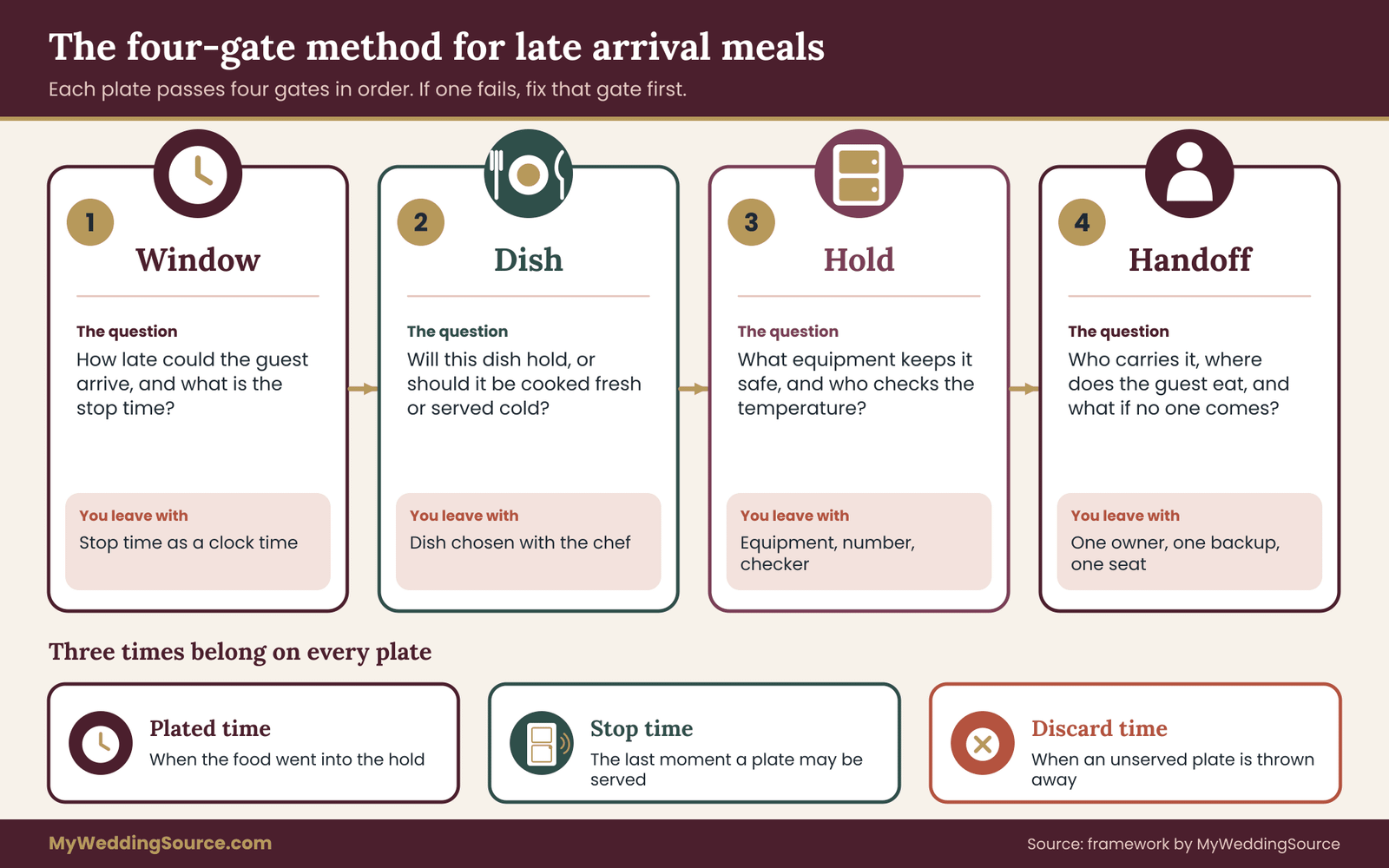
A procedure is easier to follow when it is short enough to remember. The method here for late arrival meals has four gates, and each plate has to pass through them in order. If a plate cannot pass a gate, you change the plan at that gate rather than hoping the problem solves itself later.
The gates are Window, Dish, Hold and Handoff. Each one asks a single question.
Gate one: Window
How late could this guest realistically arrive, and what is the last moment you are willing to serve a plate? The window starts when the main dinner service ends and closes at a stop time that you and the caterer agree on in advance.
Write the stop time for late arrival meals as a clock time, not a duration. “Service ends at 8:15 p.m. and the last late plate is served by 10:15 p.m.” is a rule a server can follow without arithmetic. “We will hold plates for a couple of hours” is a rule that gets argued about at 10:20.
How do you pick the stop time? Three things set it. The first is the kitchen’s schedule: many caterers need to break down by a certain hour, and venues often set a hard end for kitchen activity.
The second is the quality limit for the dish you are serving. The third is the realistic latest arrival among your guests. If the quality limit is ninety minutes and your latest expected arrival is two and a half hours after dinner, no plate in a warming cabinet will bridge that gap. You have a choice: shorten the guest’s arrival window by asking them to come earlier, or change the Dish gate so the kitchen can cook to order.
A simple way to read the window is to sort it into four bands, based on how long after service ends the guest arrives.
Under forty-five minutes. The easiest case. The kitchen is still fully staffed, the entree is probably still being plated or just finished, and a fresh plate is often possible. Ask for a plate from the line.
Forty-five to ninety minutes. Holding works well for most dishes. A properly held entree is still good, and the kitchen is usually still on site. This is the sweet spot for a held plate.
Ninety minutes to two and a half hours. Holding is possible but quality becomes the constraint. Choose dishes that hold well, or plan for a simpler cooked-to-order plate if the kitchen is still working.
Beyond two and a half hours. Most plated entrees will not be at their best, and many kitchens will have left. Switch the plan to a different kind of meal: a boxed meal, a late-night station, a room delivery, or a plate prepared by a different arrangement.
Gate two: Dish
What is on the plate, and can it survive the window? This gate separates dishes that hold from dishes that do not, and it is where most of the quality decisions are made. The next section goes through the choices in detail. For now, apply a quick test.
Ask the kitchen three questions about each dish: Does it hold hot without drying out or breaking? Does it reheat well if cooled? Does it contain anything that makes holding riskier, such as raw components, egg-based sauces or delicate seafood? If the answers are yes, yes, no, the dish is a good candidate. If any answer goes the other way, mark it for a different treatment.
Keep late arrival meals simple. The late guest does not need a six-course tasting. A single entree with a starch and a vegetable, plus a small salad or bread, is a complete meal and is easier to hold than a plate with many components.
Gate three: Hold
How will the plate be kept at a safe temperature until it is served, and who is checking? The answer names a piece of equipment: a hot-holding cabinet, a warming drawer, a covered chafing setup with fuel, or a refrigerator for a cold plate. It also names a person and a check interval.
A plate that is plated, covered and placed in a hot cabinet at the target temperature is held. A plate that is covered with foil and put on a warm shelf is not. The distinction sounds fussy, but it is the difference between a plan the caterer can defend to a health inspector and one they cannot.
Hold also covers labeling. Every held plate needs a label with the guest’s name, the dish, any allergens, the time it was plated and a throw-away time. The label is what allows a different person to hand off the plate safely at 10 p.m. without asking the cook.
Gate four: Handoff
Who brings the plate to the guest, where does the guest eat, and what happens if the guest does not show? The handoff is the gate that couples most often skip, and it is where plans fail in practice.
Name one person for the handoff, and one backup. Often it is a server or the catering captain, who already works the room and knows how to carry food. A friend or family member can do it when the caterer allows, but the caterer has to approve, because the plate passes from a controlled environment to the open room.
Decide the place. A guest who arrives in formal clothing after a flight should not have to eat standing in a service corridor. A reserved seat at a table, a quiet corner of the lounge or a seat near the bar all work. The point is to pick the location in advance, so that when the guest arrives, the server knows where to go.
Decide the no-show rule too. If the plate has not been claimed by the stop time, what happens to it? The answer is nearly always that it is discarded. Saying so in advance spares everyone an awkward discussion at the end of the night.
The stop time, the discard time and the pass rule
Three times belong on every late plate, and it helps to keep them separate.
The plated time is when the food was plated or placed in the hold. It starts the quality clock.
The stop time is the last moment the plate may be served to a guest. After it, nobody serves the plate, even if the guest appears.
The discard time is when the plate is thrown away if it has not been served. It is the same as or later than the stop time, and your caterer sets it based on the safety limit for that dish.
The pass rule connects the gates for all late arrival meals. A plate passes if it fits inside the window, the dish holds, the hold is controlled and the handoff has a name attached. If any one gate fails, the plate does not pass, and you fix that gate first.
Applying the method to a guest list
Run each expected late guest through the four gates on a single sheet of paper. A short line per guest is enough: name, expected arrival, window band, chosen dish, hold method, handoff person, stop time. Anyone who does not fit is a flag for a conversation with the caterer.
This sheet, the working record of your late arrival meals, becomes the document you hand to the caterer and the coordinator. It is more useful than a long email, because it can be scanned in a minute during a busy evening.
A short script for the caterer
When you bring the method for late arrival meals to your caterer, give them the structure rather than a vague request. Something like this works as a starting point, in your own words:
“We expect up to six guests after service ends. Could you walk us through how you would hold or cook late arrival meals for them, what stop time makes sense for each dish, and who on your team would hand them over?”
A good caterer will answer one gate at a time, and the answers will tell you quickly whether the plan is realistic. If they have never done it, that is fine. They will often be glad to have a clear request.
When the method says no
Sometimes the answer at a gate is that the plan for late arrival meals will not work. The kitchen leaves at 9 p.m., the venue forbids holding equipment, or the guest will not arrive until midnight. The method is useful in these cases because it tells you early. You can then switch to an alternative that fits, such as a boxed meal delivered to the guest’s hotel room, a grazing station that stays out under controlled conditions, or an agreement with a nearby restaurant that stays open late. Those options appear in a later section.
Think of the four gates as a way to plan late arrival meals instead of learning at 9:45 p.m. that nothing was planned.
Choosing what to hold and what to make fresh
Once you know the window, the most useful thing you can do is match the dish to it. Some foods are almost made for holding, and some fall apart in twenty minutes. The same kitchen can serve both on the same night, so the choice is yours and the chef’s, not a limit of the venue.
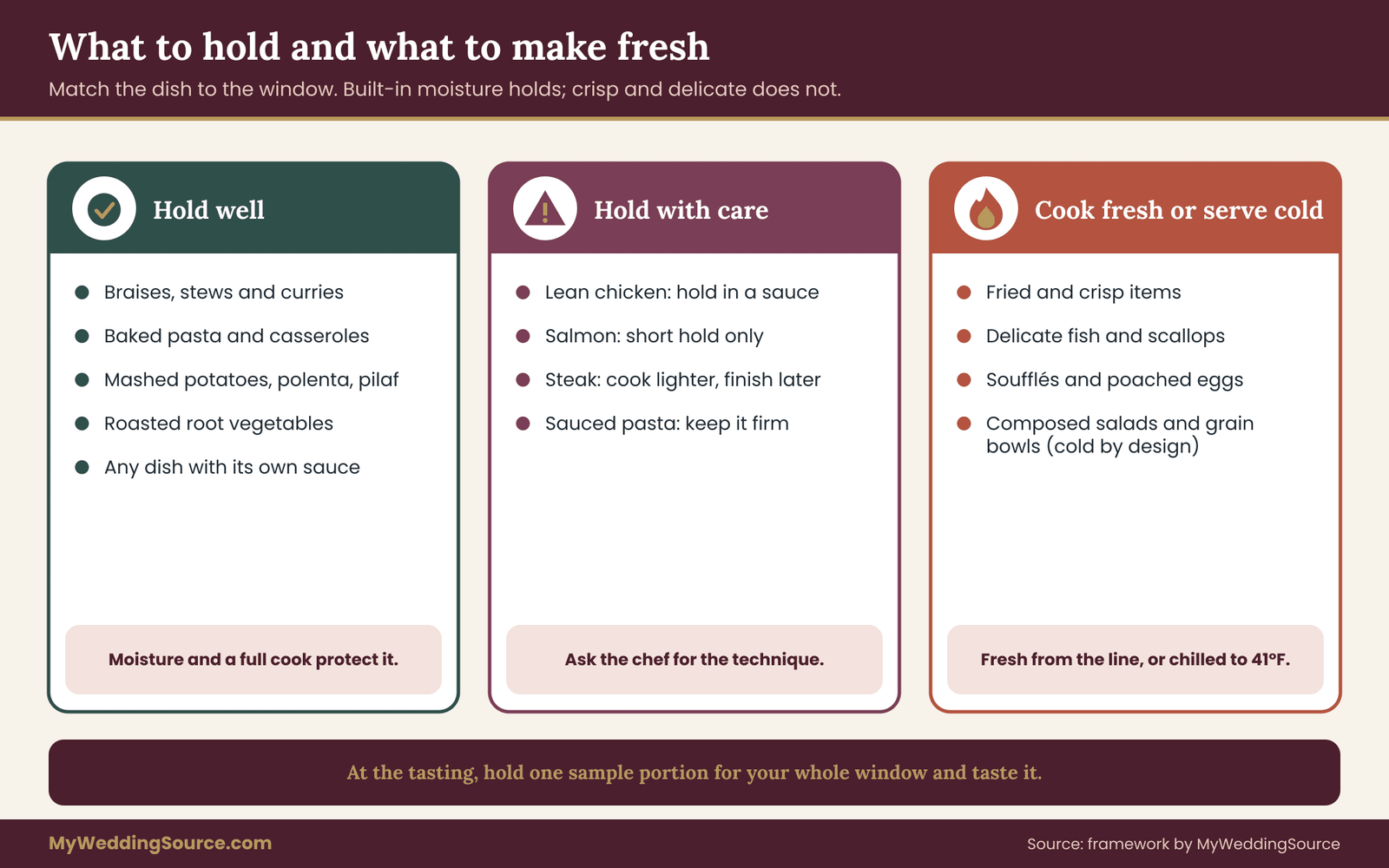
Three categories cover nearly every menu of late arrival meals: dishes that hold well, dishes that hold with care, and dishes that should be cooked fresh or served cold by design.
Dishes that hold well
Braised and slow-cooked foods are the natural fit. Short ribs, pot roast, pulled meats, stews, curries, cassoulets and similar dishes were built around long, gentle heat. Their sauce protects them, they are cooked to a safe temperature in the first place, and a hold of sixty to ninety minutes often leaves them unchanged or better.
Baked pasta and casseroles also hold well when they are made in a pan that can stay in a cabinet. Lasagna, baked ziti, enchiladas and gratins keep their shape, and the kitchen can portion them cleanly. If your menu already includes one, it is a strong candidate for late arrival meals.
Roasted root vegetables, braised greens, mashed potatoes in a covered pan, polenta and many grain pilafs hold respectably, provided they are kept covered and at temperature. Moisture is the key. A dish that sits in its own steam stays tender. A dish that sits uncovered turns dry.
The common thread is a dish with built-in moisture, cooked fully before holding, with no crisp surface to protect. If the main entree on your menu fits that description, plan to hold it. You may not need any special dish for the late guests at all.
Dishes that hold with care
Some foods hold, but only with adjustments. The adjustment is usually technique, and the chef will know what to do.
Roasted chicken breast and other lean proteins are the standard example. They dry out quickly when held for long. A chef may hold the chicken in a sauce or jus, slice it just before service, or finish it with a fresh pan reduction. Skin-on thighs hold better than breasts, because the fat and bone protect the meat.
Fish is possible but demanding. Firm, oily fish such as salmon tolerates a short hold better than delicate white fish, and most chefs will advise against holding fish for more than a short period. If your menu features fish, ask whether the kitchen would prefer to cook a fresh portion when the guest arrives, which is often better.
Steak is a case where the doneness matters. A steak cooked to medium-rare keeps cooking in a hot cabinet and may arrive well done. A kitchen may cook it a little lighter, hold it, then finish it on the grill. Again, the chef decides.
Pasta tossed with sauce can be held if the sauce is generous and the pasta is slightly firm to start, but it often sets into a block. Many kitchens would rather cook a fresh portion in a minute or two, if the line is still running.
Dishes best cooked fresh or served cold by design
Fried and crisp items do not hold. A schnitzel, tempura or fried chicken turns soft in a covered tray. If one is the centerpiece of your menu, late arrival meals should be something else, or the kitchen should fry a fresh portion.
Delicate plated items, such as seared scallops, soufflés, a poached egg or a fresh pasta that must be al dente, fall into the same group. These belong on a menu for a seated service where they go out in minutes.
Cold plates are a different strategy. A composed salad with grilled protein, a grain bowl, a cold noodle dish or a charcuterie plate is meant to be served cool. It can be assembled in advance, held in a refrigerator at 41°F or below and handed off without reheating. This approach avoids the hot-hold problem entirely, and it can be a better choice for a guest who just arrived on a long flight and wants something light.
Match the dish to the kitchen, not the other way around
A caterer with a banquet kitchen, hot-holding cabinets and staff until midnight has options. A food truck, a restaurant with a skeleton crew or a venue with a prep-only kitchen has fewer. Ask early what equipment is on site and what staffing remains after service ends. The answer determines how much of the menu above is realistic.
When the kitchen is limited, the best late arrival meals are often the simplest. A single braised dish, a roll, a vegetable and a cold salad, assembled before the line closes, is a more reliable plan than a plan that depends on a cook who may be gone.
Designing the menu with the late plate in mind
If you have not signed the menu yet, you have a chance to make late arrival meals easy. Choose at least one entree that holds well and make sure it is available in a vegetarian or vegan version that also holds. That one decision covers most late guests without extra work.
If you have already chosen, review the menu with the question: if one plate had to wait ninety minutes, which of our entrees would we trust? The answer may suggest swapping a dish, or at least identifying which one to hold and which to cook fresh.
A tasting is a good moment to test this. Ask the chef to hold a sample portion in the cabinet for the time you plan and compare it with a fresh one. You do not need to do a full trial for every dish. One test of the entree you expect to serve most often is enough to tell you whether the plan is sound.
Portion size and the shape of the plate
Late arrival meals do not have to match the size of a plated dinner. Many guests who arrive late have eaten something on the way, and a full portion can feel like too much. Others have not eaten for hours and want the whole thing.
Offer one standard portion of each of your late arrival meals and let the guest decide. A server can ask, “Would you like the full plate or something lighter?” and adjust. If your caterer offers a smaller half portion, it is a courteous option for guests who have eaten. Do not shrink the plate by default, because a guest who is hungry and gets a small plate is quietly disappointed.
Also think about how the plate is presented. A lidded plate that arrives at the table with a cloth napkin and silverware feels like part of the evening. A plastic clamshell that arrives at the bar feels like leftovers. The food can be identical. The difference is about two minutes of effort.
Special diets and the late plate
Every dietary need on the main menu raises a question for late arrival meals. If a guest eats vegan, gluten-free, kosher, halal or has an allergy, the late plate has to meet the same standard as the main meal, and it has to be handled with the same care.
Holding adds a wrinkle: the more special-purpose late arrival meals you hold, the more you have to track. A plate that must be free of a specific allergen has to be plated separately, covered and labeled before it goes into any shared cabinet.
A kosher meal is usually sealed in its own package from the source and should be handed over unopened. The allergen section later in this guide covers these rules in detail. At the dish stage, the rule is simple: whatever dietary plates you are serving at dinner, assume the late guest needs the same one, and ask the kitchen to confirm that it can be held in a way that protects it.
Matching late arrival meals to your cocktail hour and dessert
One more option is to treat the late arrival as someone who missed part of a progression and give them a short version. The cocktail hour, for example, often has hors d’oeuvres that are easy to hold or replenish. Details of how to run that hour are in the guide to wedding cocktail hour planning, and the same trays can sometimes serve a late guest a small first course.
Dessert is also easy. A slice of cake, a plated dessert or a box of treats can be offered when the guest arrives, and it makes them part of the cake moment instead of a stranger in the corner. This works alongside any of your late arrival meals and costs the kitchen almost nothing, since cake is already held at room temperature or refrigerated according to its filling.
What to ask the chef about each dish
Take this short list to the chef when you discuss late arrival meals. For each entree, ask how long it can be held without losing quality, at what temperature, in what container, and what the reheating or finishing step is. Ask whether a fresh portion can be cooked in under ten minutes if the line is still open. Ask what the vegetarian or vegan equivalent is and whether it holds. And ask what they would choose, if it were their wedding.
The last question is not a joke. Chefs often have a strong opinion about what survives a warming cabinet, and the answer is usually more reliable than any general rule.
Holding methods and temperature checks for late arrival meals
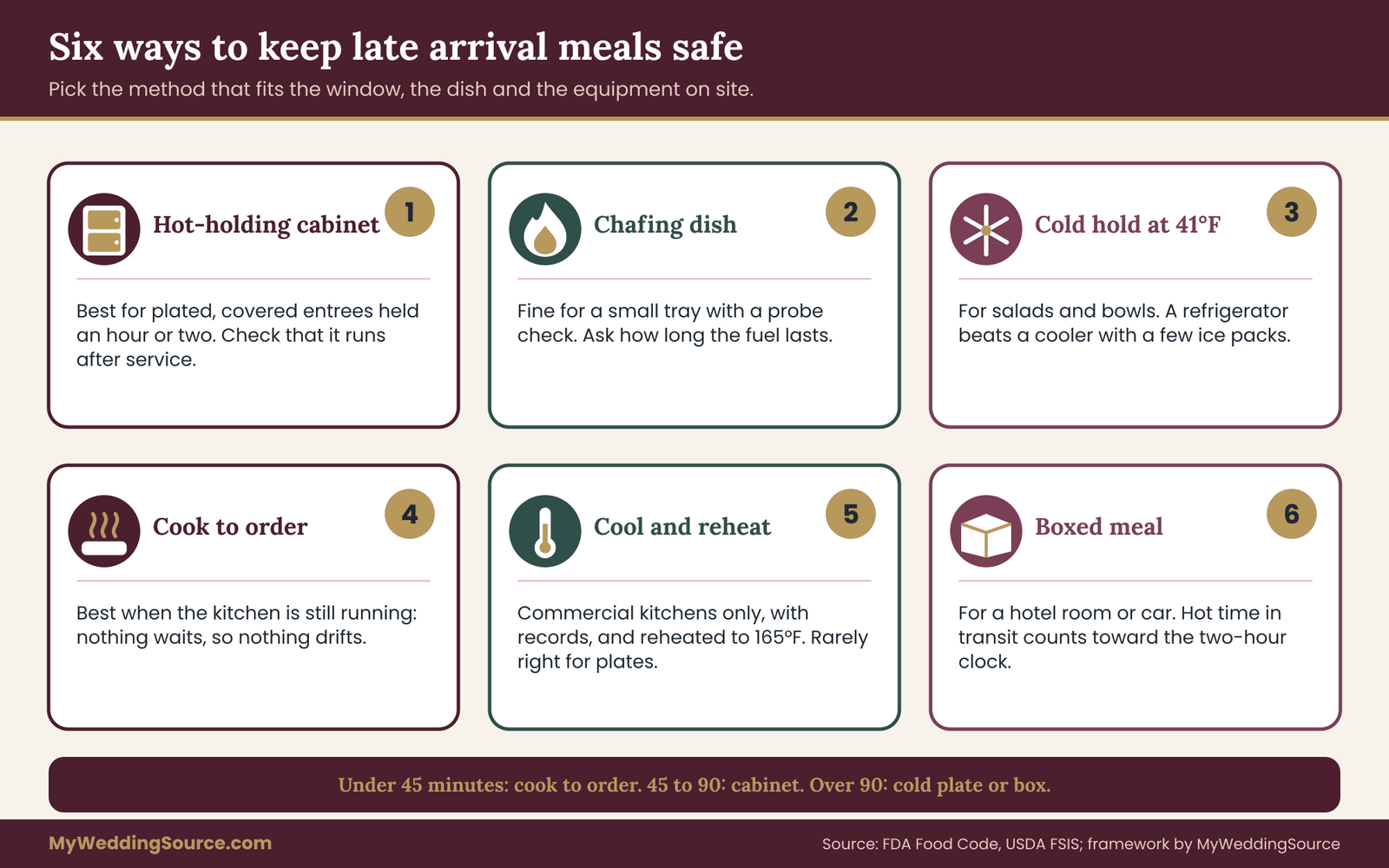
Knowing what to hold is half the work of late arrival meals. The other half is how. A caterer has several ways to keep a plate safe until a guest arrives, and each one fits a different situation. The right choice depends on the equipment on site, the length of the window and the kind of dish.
Hot-holding cabinets and warming drawers
This is the standard tool in a banquet kitchen. A hot-holding cabinet keeps food at a set temperature, typically at or above the hot-holding limit, and the door keeps heat and moisture in. Plated meals can be covered and stacked on racks, and the cabinet’s thermostat gives the kitchen a number to check.
The strengths are consistency and capacity. The limits are quality and access. Food in a cabinet keeps cooking gently, so delicate items suffer, and the cabinet lives in the kitchen, so the plate has to be carried out. For most plated late arrival meals held for an hour or two, it is the best choice.
If the venue or caterer says they have a cabinet, ask whether it will still be running after the main service, whether it is dedicated to the late arrival meals or shared with other food, and who checks the temperature.
Covered chafing dishes with fuel
A chafing dish uses a water bath heated by canned fuel or electric elements. It is common at buffets and works for a tray of food, but it is less precise than a cabinet. Fuel burns out, lids are lifted often, and the temperature can drift.
For late arrival meals, a chafing dish is a reasonable choice only if someone is checking it with a thermometer and the food is in a covered pan. It is not a good choice for a single plate, because a single plate in an open tray cools in minutes. It is better suited to a small tray of a dish like braised meat or baked pasta that can be portioned to order.
Because fuel is limited, ask how long the fuel lasts and who replaces it. A chafing dish that went cold at 9:30 p.m. is an unsafe tray by 10:00.
Cold holding for chilled plates
A refrigerator or an iced, insulated container keeps a cold plate at 41°F or below. This works for composed salads, grain bowls, sandwiches and desserts. It is simple, and it avoids the hot-hold quality problem.
The risks are different. A plate that is “kept cold” in a cooler with a few ice packs can drift above 41°F, especially if the lid opens repeatedly. A food thermometer is the only way to know. If the plan relies on coolers, ask how the temperature will be checked and when the plate will be pulled.
A refrigerator on site is better than a cooler, and a refrigerated truck or a catering fridge is better still. Many caterers carry them to every event.
Cook-to-order from a still-running kitchen
If the kitchen is still staffed and the line is still working, the best late arrival meals are often cooked fresh. A cook fires a portion when the guest arrives, and the guest eats something that was never held at all.
The strength is quality and safety. Nothing has been waiting, so there is nothing to worry about. The limit is availability. It depends on the kitchen being open, and on the cook who is willing to do it. The kitchen needs to know in advance that a late order may arrive, and which dishes it can cook quickly.
If your window is short, this is the method to ask for first. A kitchen that can cook a plate in ten minutes at 8:45 p.m. is a better tool than a cabinet that is holding a dried-out plate.
Cool and reheat
The slowest and riskiest method is to cool the plate and bring it back to temperature later. It requires a documented cooling process, cold storage and reheating to 165°F. It can be done correctly in a professional kitchen. It is a poor fit for a plated entree, because reheating changes texture, and a plate that has been plated and chilled often looks tired.
Where it works better is with items that reheat naturally: soups, stews, curries, baked pastas and braises. A chef may cool a separate tray of one of these dishes in a controlled way and reheat a portion to order. If a caterer suggests this method, ask for the cooling steps and the temperature at which it is reheated, and expect clear answers.
Boxed or packaged meals
For guests who will be eating somewhere else, such as a hotel room or a car, a boxed meal is practical. The food is packed in a vented or sealed container, labeled and kept at temperature until pickup. Cold boxed meals are the easiest to manage safely. Hot boxed meals need an insulated carrier, and the time they spend traveling counts against the two-hour clock.
If you offer a box, tell the guest how long it keeps. A simple instruction card, such as “refrigerate within two hours and reheat to steaming hot,” protects a guest who might otherwise leave it on a dresser overnight.
A decision rule for choosing the method
A short rule for late arrival meals can help when you are standing in front of a caterer with a menu in your hand.
If the window is under forty-five minutes and the kitchen is running, ask for cook-to-order. If the window is forty-five to ninety minutes and the dish is moist, ask for a hot-holding cabinet. If the dish is a salad or a cold plate, ask for refrigeration. If the window is longer than ninety minutes, ask whether the dish should change to a cold plate or a packaged meal.
Anything that falls outside this rule deserves a conversation about whether a different plan is safer.
Temperature checks: who, how often, what number
Holding late arrival meals only works if someone checks. The check does not need to be elaborate, but it does need to be done. A reasonable routine is to check the cabinet or tray temperature when the plate goes in, again at intervals the caterer sets, and once more when the plate comes out. Each check is recorded with a time and initials.
The probe goes into the thickest part of the food, not the air above it. Surface temperature is not enough. In a plated meal, a thermometer can be inserted into the protein or the starch, and the result compared with the hot-holding limit.
Ask the caterer what number they use, because it affects how you read their answer. If they say 135°F, they are following the Food Code figure. If they say 140°F, they are using the more conservative consumer guidance. Either is reasonable, and the point is that they have a number.
What to do when a plate falls out of range
A plate that drops below the hot-holding limit is not necessarily unsafe, but it is on the clock. If the kitchen can document how long it was below temperature and the period is short, many food safety programs allow reheating to 165°F within a limited time. If the temperature loss is unknown or long, the plate is discarded.
The couple’s role in this is simple: accept the decision. A caterer who throws away a plate because it drifted out of range is doing what the health department requires, and they should not be pressured to serve it anyway. If it means a guest waits ten minutes for a fresh plate, that is a better outcome than the alternative.
Venue rules that can change the plan for late arrival meals
Some venues do not allow the caterer to hold food after the main service, do not provide holding equipment, or require that all food be removed by a set time. Some have a separate kitchen for the venue and a separate one for outside caterers. Others have an in-house chef who handles all food and does not take outside requests.
Ask the venue directly about three things: whether the kitchen remains open after service, whether holding equipment is available, and whether there is a rule about serving food after a stated hour. If a restriction exists, find out early, because it affects which alternative to choose. If the venue has strict end-of-night rules, the guide to wedding vendor timelines can help you see how the kitchen’s schedule fits with everyone else’s.
Allergens, dietary needs and labeling for late arrival meals
Late arrival meals have to be right at the moment of service, and that includes what is in them and what they have touched. Allergen control matters more for late arrival meals than for the main dinner, because the usual safeguards, such as a server who knows the table, may not be present when a plate comes out of a cabinet at 10 p.m.
The nine major allergens
United States federal law identifies nine major food allergens: milk, eggs, fish, crustacean shellfish, tree nuts, peanuts, wheat, soybeans and sesame. The FDA publishes a page on food allergies that explains these and the labeling rules for packaged food. Restaurants and caterers are not required to label every dish in the same way as packaged food, but a good caterer knows the nine and can tell you which are in each dish.
Your job is not to guess. It is to give the caterer a precise list of any guest’s allergies and to get a specific answer in return. Ask which of the nine are present in each dish, which are present in the kitchen, and how a dish is prepared to prevent cross-contact.
Cross-contact on held late arrival meals
Cross-contact happens when an allergen is transferred from one food to another through a shared surface, utensil, pan, oil or hand. A plate that is safe at plating can become unsafe if it is stacked under another plate, covered with a lid that touched a different dish, or lifted with the same tongs.
For held late arrival meals, the rules are practical. Plate the allergen-free meal first, using clean utensils and a clean surface. Cover it immediately. Label it. Hold it on a separate rack or on the top shelf of the cabinet, so nothing drips onto it. Hand it over with a clear statement of what it is and who prepared it.
None of these steps is difficult, but each one has to be agreed in advance. A caterer who says they are used to doing this has a procedure. A caterer who says “don’t worry, we’ll be careful” has not described one.
No promise of an allergy-safe meal
No caterer can honestly promise that a meal is free of every trace of an allergen, because shared kitchens carry some risk. What a good caterer can promise is a process: a separate prep area, clean tools, careful labeling and trained staff. Ask for that process, and ask what the plan is if the guest reports a reaction.
A guest with a serious allergy should be told directly what is on the plate and what the kitchen did to protect it. The decision to eat is theirs. If the guest has an epinephrine auto-injector, they should have it with them. You should not attempt to manage the allergy for them.
The label: what goes on every held plate
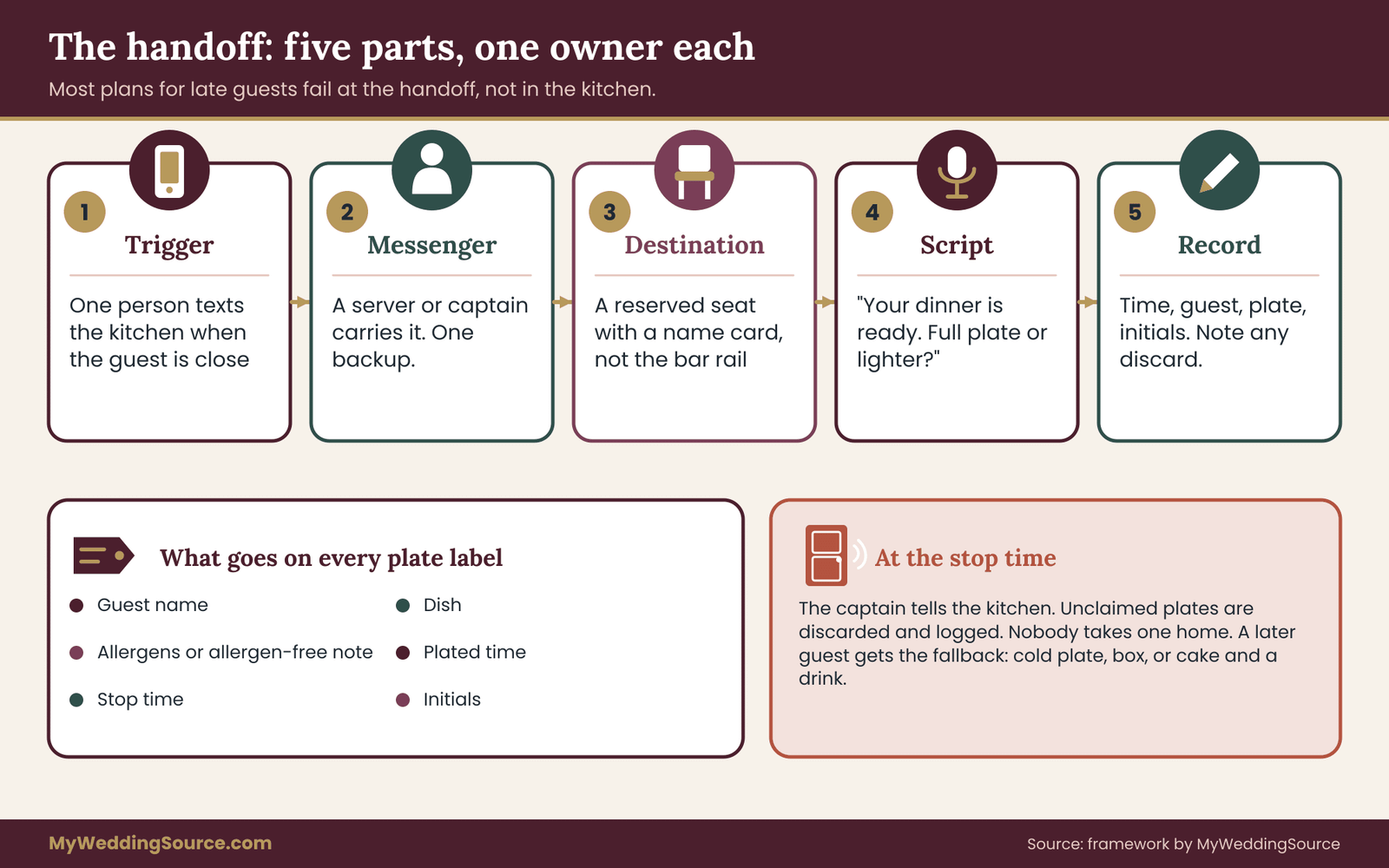
A good label is short, legible and consistent. It should contain the guest’s name, the dish, the allergens present or the allergen-free claim being made, the time it was plated, the stop time and the initials of the person who plated it. A plain adhesive label or a tag on a lid is enough.
A label protects against two kinds of mistake. The first is serving the wrong plate. The second is serving a plate that has been in the cabinet too long. When a server who did not cook the food has the label in hand, both mistakes become easy to catch.
Kosher, halal and other religious meals
Meals prepared according to religious dietary law have rules that go beyond ingredients, including equipment, supervision and sealing. A kosher meal, for example, is often prepared by a certified provider, sealed and delivered, and it is served in its container so that the seal is visible. A halal meal depends on sourcing and preparation by a supplier who meets the relevant standard.
If a guest needs one of these, do not leave it to chance among your late arrival meals. Raise it with the caterer when you book, and agree on how the meal will be held and served. Ask whether it can be ordered as a sealed meal, how it is stored, and who hands it over. Never ask a kitchen to improvise a religious meal at the last minute.
Children, older adults and swallowing needs
One of your late arrival meals may be for a child, an older adult or someone with a medical need. A child’s meal may need smaller pieces. An older guest may prefer softer food. A guest with a swallowing difficulty may need a particular texture. These needs are rarely complicated, but they have to be known in advance, and the kitchen needs time to prepare something suitable. Add them to the guest sheet next to the dish, and mention them to the server who will hand off the plate.
Who tells the guest
The couple should tell the guest, in advance, that a plate is waiting and what it is. A short text before the guest arrives is enough: “Your dinner will be waiting at the table. It’s the braised short rib, with no nuts, and the server will bring it as soon as you sit down.” That message does two things. It calms a stressed traveler, and it gives the guest a chance to correct any mistake before the plate is plated.
For a guest with an allergy, the message should include a request to call or text if anything is wrong. A clear line of communication is better than a surprise.
The handoff on the day: who brings late arrival meals and when
The handoff is the moment the plan for late arrival meals meets the room. It is also where most plans for late arrival meals fail, not because the food is wrong, but because nobody knows who is supposed to act. A guest walks in, looks around, sees a party in progress, and does not know where to go. A server sees a stranger and assumes someone else is looking after them. Twenty minutes pass.
A good handoff for late arrival meals has five parts: a trigger, a messenger, a destination, a script and a record.
The trigger: how the kitchen knows a guest has arrived
The kitchen needs a signal. The simplest signal is a text or call from one named person, who is usually the day-of coordinator, a venue manager or a family member whose job is to greet guests. That person watches the entrance during the window or receives a message from the guest when they are close.
Decide the signal in advance and give it a single channel. If three people text the kitchen and one calls the catering captain, the plate may be served twice or not at all. One person owns the trigger. If the guest has a flight or a shift, ask them to text that person when they leave the airport or the hospital, which gives the kitchen a twenty-to-forty-minute warning and lets a cook fire a fresh plate in time.
The same person should know what to do when the guest is later than the window. The decision should already be made: if the stop time has passed, the plan switches to the alternative, which is covered in the worked example that follows.
The messenger: one person, one backup
Late arrival meals are carried by one named person and one backup. In a catered event, the best choice is a server or the catering captain, because they already handle plates safely, carry them without spilling and know the room. A venue coordinator is another good choice.
A friend or family member can do it when the caterer allows, but be careful. Plates leave a controlled environment when they leave the kitchen, and a helper who does not know the rules may set a plate down somewhere warm, leave it for the guest to find or carry the wrong one. If a family member is the messenger, give them the label and a short instruction: pick up the plate at the kitchen door, carry it directly to the guest, and tell the guest what it is.
Avoid asking the couple to do any part of this. They are in the middle of the evening and should not be responsible for it.
The destination: where the guest eats
Pick a place before the day. A seat at a reserved table works best. If the guest knows other people, seat them with friends. If a table is full, set one extra place at a table that has an open chair. A quiet corner of the lounge is a second choice, provided there is a table and a chair.
Avoid the kitchen door, the bar rail and the dance floor edge. A guest who has traveled all day does not want to eat while standing, and a plate that has to be balanced on a knee will be left unfinished.
Mark the reserved place discreetly. A small card with the guest’s name, set at the seat, tells the guest they were expected and tells the server where to bring the plate. If the guest arrives and the place is taken, the server can move quickly instead of looking around.
The script: what to say to the guest
A guest who arrives late is often a little embarrassed. A warm, matter-of-fact welcome helps. The person who greets them can say something simple:
“We’re so glad you made it. Your dinner is ready, and we’ve saved you a seat. Would you like the full plate or something lighter?”
Notice what the script does not say. It does not say “you missed dinner,” it does not apologize for the kitchen, and it does not draw attention to the delay. It tells the guest they are expected and offers a choice.
For a guest with a dietary need, the server adds a sentence: “This one is the vegan dish, made without nuts, and the chef prepared it separately.” That sentence gives the guest the information they need to decide.
If the plate is not ready, because the kitchen needs ten minutes to cook it fresh, say so plainly and offer a drink and a roll in the meantime. People tolerate a short wait when they are told about it, and they dislike an unexplained one.
The record: what to write down
A short record protects everyone. At the moment of handoff, the server notes the time, the guest and the plate, and initials the label. If the plate is discarded, the record notes the time and the reason. The record can be a line on the guest sheet, a photo of the label or a note on a phone.
This is not paperwork for its own sake. If a guest later reports feeling unwell, a record of what was served and when allows the caterer to respond properly. It is also how you learn what worked for next time.
What happens at the stop time
At the stop time, the plan ends, and so does the obligation to serve any of the late arrival meals you were holding. The person who owns the trigger tells the kitchen, and the kitchen discards any unclaimed plate according to its procedure. This is not wasteful, and it is not rude. It is the safe outcome.
The couple should not ask to keep the plate for later, take it home or give it to a friend. A plate that has been in a cabinet for two hours and is then carried home becomes a leftover with an unknown history. If a guest arrives after the stop time, the plan switches to the alternative: a cold plate from the refrigerator, a box of food, cake and a drink, or a simple sandwich. The guest is still welcome, and still fed.
Edge cases that come up
The guest arrives and does not want to eat. Some guests will say they ate on the road. Thank them, offer a drink and dessert, and let the plate go to the discard routine at the stop time. Do not press.
Two guests arrive at once. A cabinet and a server can handle two plates, but check that the labels match the right people before they leave the kitchen. This is a good place for a second person to double-check.
A guest brings an unexpected plus-one. Be gracious, offer the buffer plate if one is available, and make a different plan if not. A cold plate or a sandwich is better than nothing, and the couple should not be responsible for sorting it out.
The guest arrives early. A guest who was expected at 10 p.m. and arrives at 9 p.m. may find the kitchen not yet in its late mode. The plate may be in the cabinet and ready, or it may need to be fired. Either way, the same process applies.
The kitchen cannot find the plate. This is why the label matters. If a plate has been put in the wrong place, a label on the lid tells the staff what it is and who it belongs to, and they can find it quickly.
Telling the right people
Give the late guest sheet to three people: the caterer, the coordinator and the person who owns the trigger. Keep it to one page. If the wedding has no coordinator, ask the venue manager, a friend or a family member to take the role, and make sure they can reach the caterer’s captain by phone. A group message is not a procedure. A single name is.
The guide to reception guest flow covers how to move people through a room so that a late guest has a clear path to a seat. If your venue has an awkward layout, it is worth a look.
Costs, contract wording and questions for the caterer
Late arrival meals are not free. Late arrival meals cost the same as any other plate, and sometimes more, because it requires equipment, labor and a delay in breaking down the kitchen. A clear understanding of the cost avoids a surprise on the final invoice.
How caterers usually charge
Caterers have several ways of pricing late arrival meals, and it helps to know which one yours uses. Some charge the full per-guest price for each late plate, since the plate is another guest’s dinner. Some offer a reduced rate for a plate that is a smaller or simpler version. Some include a small number of extra plates in the base price, as a courtesy. Some add a labor charge if staff must remain after the scheduled end of service.
None of these is unreasonable. What matters is knowing which applies, and whether it is written down. Ask for the price of a late plate in the same format as the price of a regular plate, so the two can be compared.
The cost logic
A simple way to think about the cost of late arrival meals is to count three things: the food, the labor and the risk of waste.
The food is the plate itself. If you expect six late guests and your per-guest price is a round number, say a hundred dollars for the sake of illustration, six plates is six hundred dollars before any adjustment. If the caterer allows a reduced price for a lighter plate, the number drops.
The labor is any extra time a cook or server stays on duty after the scheduled end. Ask whether this is covered in the contract or billed separately. A cook who stays an extra hour is a real cost, and a good caterer will tell you the rate.
The waste is the plates that nobody eats. You are paying for a buffer, and some of it will be thrown away. This is the price of being prepared. If the buffer is two plates and neither is used, you have paid for two dinners that were never served. Most couples find that cost acceptable. If you do not, reduce the buffer to match the number of guests you can name.
The decision rule for late arrival meals is simple: pay for named late guests, pay a small fixed buffer, and do not pay for a large buffer unless you have a specific reason. Review the number a week before the wedding, once RSVPs and travel plans have settled. Do not pay for plates because a vague fear told you to.
Contract wording to ask for
Whatever you agree with the caterer about late arrival meals should be in writing. The wording does not need to be formal. A short paragraph in the contract or an addendum is enough. It should cover the number of late arrival meals, the dishes, the hold method, the stop time, the price and who is responsible for the handoff.
A sample of what to ask for, in your own words: “Caterer will prepare up to a stated number of late arrival plates, to be held at a safe temperature or cooked to order, and served to named guests until a stated stop time. Unserved plates will be discarded. The price is a stated amount per plate.” That is enough to avoid most misunderstandings.
If you are asking for something unusual, such as a sealed religious meal, a plate for a guest with a serious allergy or an extension of kitchen hours, put that in writing too. For general guidance on reading catering and other vendor agreements, the guide to the wedding vendor contract explains the clauses that tend to matter.
Questions worth asking the caterer
Bring a short list to the conversation. Ask how many late arrival meals they have handled at previous events and what happened. Ask what equipment they will have on site after the main service, and who will be on duty. Ask what temperature they hold hot food at and how they check it. Ask what they do with plates that are not claimed. Ask whether they have a written food safety plan and a current permit, and ask what they would do differently if the kitchen has to close early.
Listen for specifics. A caterer who answers with names, numbers and procedures has done this before. A caterer who answers with reassurance but no detail may be willing but untested, and that is something you can plan around by choosing simpler dishes and a shorter window.
Questions worth asking the venue
The venue may have rules that override the caterer’s plan. Ask whether the kitchen can stay open after service, whether holding equipment is available, whether there is a time after which no food may be served, and whether there is a charge for after-hours kitchen use. Ask whether outside caterers have access to a refrigerator for the whole event. And ask where a late guest should enter, so the greeter is in the right place.
Venue answers may differ from what the caterer expects. If they do, ask both parties to speak directly, so the plan does not depend on you relaying messages.
When to settle the plan
Settle the broad plan for late arrival meals when you book the caterer, and the details a month before the wedding. At that point, you know most of your guests’ travel plans and the menu is final. Send the late guest sheet to the caterer and coordinator about a week before. Confirm the trigger, the messenger and the destination the day before.
If a new late guest appears in the last forty-eight hours, tell the caterer immediately, and be ready to accept that a plate may need to be a simple one. A short notice is better than none, and a caterer who knows early can almost always find a solution.
A worked example of late arrival meals, with fallback options
An invented example shows how the four gates fit together for late arrival meals. The couple, the venue and the numbers below are made up for illustration, and your own situation will differ.

The setting
Priya and Tom are marrying at a hotel ballroom with its own banquet kitchen. They have a hundred and twenty guests. Dinner is a plated, three-course service that begins at 6:45 p.m. and finishes around 8:15 p.m. The kitchen will stay staffed until 10:30 p.m. The entree choices are braised short rib, roasted chicken in a pan sauce, and a vegan mushroom and lentil dish.
Reviewing the RSVP notes a month before the wedding, Priya finds five guests who may be late. Two cousins are flying in on the wedding day and expect to land at 7:30 p.m., with a ninety-minute ride to the hotel. Two friends are nurses finishing a shift that ends at 7 p.m., with a forty-minute drive. One uncle is observing a religious fast that ends at sundown, around 8:40 p.m., and he is driving from another city.
Gate one: the window
Service ends at 8:15 p.m. The earliest of the late guests is the uncle, who may arrive near 9 p.m., forty-five minutes after service ends. The nurses should arrive between 8 and 8:30 p.m., which may overlap with the end of service. The cousins are the latest, with a realistic arrival between 9:30 and 10 p.m., ninety minutes to a hundred and thirty-five minutes after service ends.
The couple and the hotel agree on a stop time of 10:30 p.m., which is when the kitchen closes. Any guest who arrives after that is moved to the fallback plan. The window falls into two bands: the uncle and the nurses are in the shorter bands, and the cousins are in the third band, where holding is possible but quality matters.
Gate two: the dish
The chef recommends the braised short rib for the cousins and the nurses, since it holds well for ninety minutes or more in a covered pan with its sauce. The chicken is not a good choice for a long hold, so the chef offers to cook a fresh portion for any guest who arrives before 9:30 p.m., while the line is still running. The vegan mushroom and lentil dish holds well, and the chef agrees to hold it in a covered tray.
For the uncle, the couple asks about a meal that meets his dietary practice. The hotel does not prepare a certified meal on site, so the chef suggests ordering a sealed meal from a supplier the uncle trusts. Priya calls him, learns what he would accept and asks the hotel to order it two weeks ahead. The sealed meal will be heated in its own container and handed over unopened.
Gate three: the hold
The hotel has a hot-holding cabinet that stays on until closing, and the chef holds at 140°F, using the more conservative figure. Plates are covered, labeled and placed on a separate rack from the main service food. The chef assigns a sous chef to check and log the temperature every thirty minutes and when each plate goes in or out.
Two plates are held for the cousins, one short rib and one vegan. Two are held for the nurses, both short rib. A fifth plate is held for the uncle in its sealed container. The chef recommends one extra buffer plate, a short rib, and Priya agrees. The total is six plates, five for named guests and one buffer.
The plates are labeled with the guest’s name, the dish, the allergens, the plated time of 8:30 p.m. and a stop time of 10:30 p.m. The vegan plate also notes that it was prepared separately. One cousin has a tree nut allergy, so that plate is prepared first on a clean surface, covered immediately and labeled with a note to keep it on the top rack.
Gate four: the handoff
The hotel’s banquet captain owns the trigger. Priya’s cousin Maya has the captain’s number and the guest sheet, and she is the one who sends an update when a guest texts that they are close. The captain and one server handle the handoff, with the sous chef as backup.
Each guest has a reserved seat at a table with friends. Place cards are set out with their names. The cousins sit with Priya’s college friends, the nurses with Tom’s coworkers, and the uncle with his own relatives. Priya texts each guest the day before: “Your dinner will be waiting at your table. The server will bring it when you arrive. Text Maya if you’re running later than expected.”
What actually happens
The nurses arrive at 8:35 p.m. and are served short rib within ten minutes of sitting down. The uncle arrives at 8:50 p.m., and his sealed meal is heated and handed over unopened. The cousins call from the road at 9:20 p.m. and say they will be there in twenty minutes. The captain tells the kitchen, which pulls the plates from the cabinet, checks the temperature at 148°F and sends them out as the cousins sit down at 9:45 p.m.
At 10:30 p.m., the captain checks with Maya. No one else is coming, and the buffer plate is discarded and logged. Everyone has eaten, nobody had to ask for food, and the couple did not leave the dance floor.
What the example shows
Three things in the example of late arrival meals are worth noticing. The couple did not try to save plates for every possible latecomer. They identified named guests, added a small buffer and left the rest to the fallback plan. The chef decided which dishes would hold and which would be cooked fresh, rather than trying to force a single answer. And one named person owned the trigger, so there was no confusion about when to act.
Notice also what the couple did not do. They did not pull plates from the buffet, ask a relative to keep food in a car, or leave the plan to chance. Each decision had an owner and a time attached.
Fallback options when a held plate does not work
Sometimes the four gates produce a no for late arrival meals. The kitchen closes early, the guest arrives after the stop time, or a flight lands at midnight. A fallback plan means nobody goes hungry.
A cold plate from the refrigerator. A composed salad with a protein, a sandwich or a grain bowl can be assembled in advance and kept at 41°F or below. It is simple, safe and quick. Ask the caterer to prepare a few and to keep them labeled in a refrigerator.
A boxed meal for the hotel room. If the guest arrives after the stop time, a cold or sealed box can be handed over with a note about when to refrigerate or eat it. For guests staying at the hotel, the front desk may be able to hold it.
Cake, dessert and a drink. A slice of wedding cake and a coffee is a warm gesture and uses food that is already part of the evening. It does not replace dinner, but it is a welcome greeting.
A late-night snack station. A small station of sliders, pizza or tacos, planned for the whole room, solves several problems at once. It adds cost and its own food safety needs. Ask the caterer about holding, and about how long the food can stay out.
A nearby restaurant that stays open. For guests who arrive very late, a local restaurant, a delivery order to the hotel or a pre-arranged meal at a late-night spot is practical. Choose one before the wedding, and confirm that it is open on that night.
Each of these is a decision about the guest’s needs and your budget. None is a failure. The best fallback is the one the guest can eat comfortably at the hour they arrive.
Your next steps
Work through these in order, and you will have a complete routine for late arrival meals without much extra effort.
- List the guests. Review your RSVPs for anyone who may need late arrival meals, meaning guests who arrive after dinner service ends: travelers, shift workers, guests with another event the same day and guests observing a fast. Add a small buffer.
- Set the window. Find out when service will end and when the kitchen closes. Pick a stop time as a clock time.
- Choose the dishes. Ask the chef which entrees hold well, which should be cooked fresh and which should be cold plates. Make sure a vegetarian or vegan option is included.
- Confirm the hold. Ask what equipment the caterer will have, what temperature they hold at, who checks it and what happens to unclaimed plates.
- Plan for allergies and diets. Give the caterer exact details for each guest, and agree on how those plates will be prepared, labeled and handed over.
- Name the handoff. Choose one person to own the trigger, one to carry the plate and one backup. Reserve a seat and tell each guest where to go.
- Put it in writing. Add the number of late arrival meals, the dishes, the hold method, the stop time and the price to the contract or an addendum.
- Pick the fallback. Decide what happens for a guest who arrives after the stop time, and tell the coordinator.
If you want a wider view of the whole menu before you finalize these details, the full menu guide shows how the pieces fit, and the plan for seating late guests is easier once your wedding seating chart is settled.
FAQ
How long can late arrival meals be held?
It depends on the dish, the equipment and the temperature. Food held at or above the hot-holding temperature your health department uses can stay safe for longer than food left out, but quality usually runs out first. Many plated entrees stay pleasant for an hour or two. Ask your caterer for the safety limit and the quality limit for late arrival meals, and set a stop time as a clock time.
Can the caterer simply save a plate from the buffet or main service?
It is better not to. A plate taken from the main service has an unknown history: it may have spent time on a line, on a counter or in a warm room, and that time counts toward the two-hour limit. A plate that is plated, covered and held for a named guest from the start is safer and easier to track.
What temperature should hot late arrival meals be held at?
The FDA Food Code uses 135°F for hot holding, and USDA consumer guidance recommends 140°F or above. Your local health department decides which applies, and many caterers choose the higher number. Cold food should stay at 41°F or below. Ask your caterer which numbers they use and how they check them with a probe thermometer.
Is it safe to reheat a plate that has cooled?
It can be, if a professional kitchen cools it quickly and reheats it to 165°F, with the steps recorded. Cooling is the risky part, since large portions stay warm for hours. Many caterers prefer to hold hot, cook fresh or serve a cold plate instead for late arrival meals. Do not cool and reheat plates at home or in a venue lounge.
What if a guest eating late arrival meals has a food allergy?
Give the caterer the exact allergens in writing and ask how the plate will be prepared, covered and labeled to prevent cross-contact. No kitchen can promise zero risk, but a good one can describe a process. Tell the guest what is on the plate before they eat it, and ask them to keep any prescribed medication with them.
How many late arrival meals should we order?
Count the guests you can name as likely to be late, then add a small buffer, often two to four plates depending on the size of the wedding and how far people travel. Review the number a week before, once RSVPs and travel plans settle. Pay for named guests and a small buffer rather than a large cushion.
Who should hand over late arrival meals to the guest?
A server or the catering captain is the best choice, because they know how to carry and serve food safely. A venue coordinator also works. A friend or relative can help if the caterer agrees and the plate is already labeled. Avoid asking the couple to do it, since they should be enjoying the evening.
What if the guest arrives after the stop time?
Switch to the fallback. That might be a cold plate from the refrigerator, a boxed meal, cake and a drink, or a pre-arranged meal at a nearby restaurant. A plate that has passed its discard time should not be served, even if it looks fine. The guest is still welcome and still fed, just in a different way.
Sources
- U.S. Food and Drug Administration: Food Allergies for the major food allergens and cross-contact guidance.
- U.S. Food and Drug Administration: Food Code for the model hot-holding, cold-holding and cooling standards used by state and local regulators.
- USDA Food Safety and Inspection Service for the danger zone, the two-hour rule and reheating guidance.
- FoodSafety.gov for federal food safety guidance, including advice for people at higher risk of foodborne illness.
- Centers for Disease Control and Prevention: Food Safety for information on foodborne illness and prevention.
- U.S. Food and Drug Administration: Food for current retail food protection and consumer guidance.
- U.S. Department of Agriculture for federal food safety and nutrition programs.
- National Association of County and City Health Officials for finding your local health department and its catering and temporary food rules.