
A catering minimum is the floor in your food contract: either a dollar amount you must reach or a headcount you must pay for, whether or not the money is spent or the guests arrive. This guide shows how to turn that clause into plain numbers, with service charge and tax included, so you can compare a spend minimum with a guest minimum before you sign.
Do not compare a catering minimum spend with a catering minimum guest count by looking at the headline figures. Convert both to the same units. Divide a spend minimum by the countable price per guest to get its equivalent guest count, then run your low, likely and high guest counts through both clauses with the service charge and tax added. Compare the cost per attending guest and the dollars that buy nothing. The clause with the lower floor at your likely headcount is usually the safer one, unless the contract excludes your bar, rentals or fees from what counts.
Most couples meet a catering minimum at the worst possible moment: a venue tour, a proposal in their inbox, a deposit due on Friday. The number looks like a single fact, such as “$15,000 food and beverage minimum” or “100 guests minimum.” It is not a single fact. It is a rule for how the final bill is built, and the same rule can cost very different amounts depending on how many people come, what counts toward the catering minimum, and when the fees are added.
That is why this article exists. It does one job: it teaches the contract math behind a catering minimum, in a form you can run on paper in about half an hour. It covers the difference between a spend floor and a guest floor, what to look for in the clause, how a service charge and tax change the result, a scenario calculator you can fill in, a worked example with invented numbers, and the points where negotiation tends to work.
A note on scope. This is general information, not legal, tax or financial advice. Contract law, sales tax and service-charge rules differ by state and sometimes by city, and the terms in your own contract control. Where a rule matters, the article points to the agency or document that settles it so you can confirm the current version yourself.
The broader process of turning a scope agreement into an accepted deliverable is covered in the guide to wedding vendor purchase orders. This article stays with one clause and one calculation.
What a catering minimum is, and why vendors write one
A catering minimum is a promise from you to the caterer or venue about the smallest bill you will generate. The vendor writes it because a wedding costs them most of their fixed expense before the first plate is served. Staff must be scheduled, ingredients ordered, equipment reserved, and a Saturday evening held that could have gone to another event. If a couple books a room and then invites forty people, the vendor has the same labor and the same lost opportunity for a much smaller sale. The minimum protects that sale.
It helps to see this from the vendor’s side, because it explains which terms they will bend and which they will not. A caterer is usually protecting one of two things. One is revenue: the bill must reach a certain size to justify the date. The other is volume: the kitchen and staffing plan was built around a certain number of plates. A spend minimum protects revenue. A guest minimum protects volume. Many contracts quietly protect both, and some state one and imply the other through a per-person price that only works at a certain size.
The two common forms
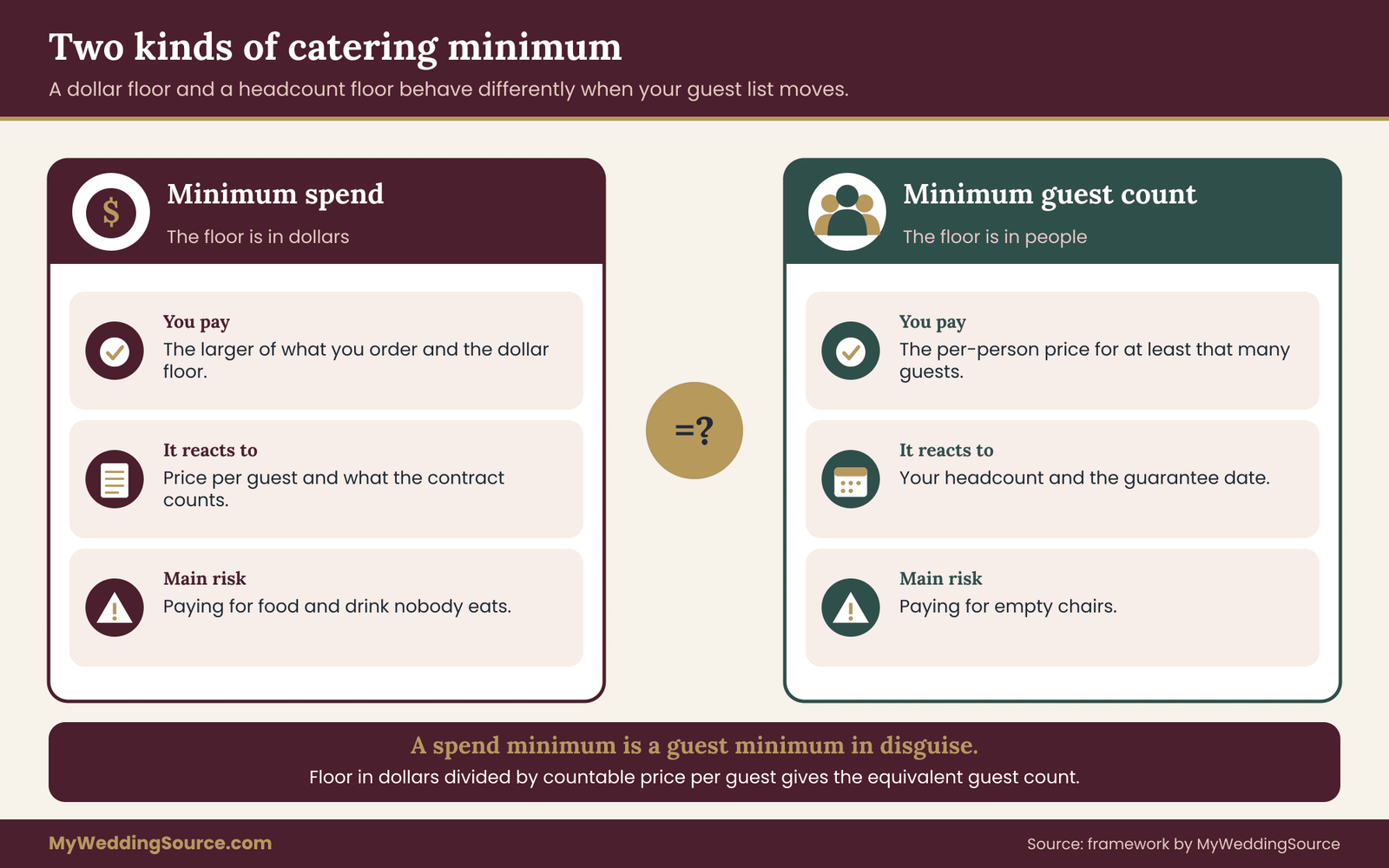
A minimum spend (also called a food and beverage minimum, or a “F&B minimum”) sets a dollar floor. If your countable charges add up to less than the floor, you pay the difference anyway. If they add up to more, you pay what you ordered. The floor is in dollars, so it does not care how many guests you have. It cares what they eat, drink and use.
A catering minimum guest count (often called a guarantee, a minimum headcount or a minimum number of covers) sets a headcount floor. You pay the per-person price for at least that many guests. If more people come, you pay for the extra. If fewer come, you still pay for the minimum. The floor is in people, so it does not care how expensive each person’s meal is, because the per-person price is already set.
These two clauses can look similar in a proposal, but they behave differently when the guest list changes. The next sections show exactly how.
Where a catering minimum often hides
The clause is easy to miss because it rarely sits under its own heading. It can appear in a pricing summary (“Saturday evening events require a food and beverage minimum”), in a menu page, in a venue rental agreement that is separate from the catering agreement, or in a footnote under the package prices. Sometimes the venue sets one minimum and its exclusive caterer sets another. If your venue requires its own caterer, you may be reading two documents that each contain a catering minimum, and the fees in one may not match the other.
Read every page of every agreement, including attachments and the terms linked from a quote email. If a number appears in a proposal but not in the signed contract, the contract is the version that counts. The guide to wedding vendor contracts explains how to read the whole agreement; here the focus is only on the catering minimum.
Catering minimum spend vs guest count: the practical difference
The cleanest way to understand the difference is to ask what happens when your guest count moves.
Suppose your caterer’s countable price is $130 per guest, and you are comparing a $15,000 spend minimum with a 100-guest minimum. At 100 guests the countable subtotal is $13,000. Under the spend minimum you owe $15,000, which means $2,000 of the bill buys nothing. Under the guest minimum you owe $13,000, because 100 guests at $130 is exactly the catering minimum. Same per-person price, same guest list, different bills.
At 116 guests the two clauses give the same answer, because the spend minimum has stopped biting: 116 guests at $130 is $15,080, which is above the floor. Above that headcount, the clauses behave identically. Below it, the spend minimum is the more expensive floor.
That small example hides a rule worth remembering. A spend minimum is a guest minimum in disguise. Divide the dollar floor by the countable price per guest and you get the headcount at which the floor stops mattering. In the example, $15,000 divided by $130 is about 115.4, so the spend minimum acts like a guest minimum of 116. The rest of this guide calls that number the equivalent guest count, and it is the single most useful figure in the comparison.
Why the headline numbers mislead
Two things make the headline figures unreliable. First, a spend minimum and a guest minimum are measured in different units, so they cannot be compared until you convert one into the other. Second, the “countable” part of each clause is defined by the contract, not by common sense.
If the bar package, the cake cutting fee, the rentals or the service charge does not count toward a spend minimum, then the equivalent guest count is much higher than it looks. In the worked example later in this guide, excluding a $38 bar package moves the equivalent guest count from 116 to 164. That is the difference between a floor you will clear comfortably and a floor you will pay your way into.
When each form tends to suit a couple
There is no universally better clause. There is a better clause for your likely guest count and your likely menu. Some patterns hold often enough to be useful starting points.
If your guest list is firm and your likely count sits well above the equivalent guest count, either clause costs you the same, and you can choose on other terms such as the guarantee date, attrition and the price per person.
If your guest list is uncertain, with a wide range between low and high, a guest minimum set below your likely count is gentler, because it sets the floor in the unit you can estimate. A spend minimum with a high countable price per guest can behave the same way, but only if the clause counts most of what you will actually buy.
If you plan a small wedding, a spend minimum set high can be a poor fit, because it forces you to buy upgrades to reach the floor. A guest minimum can also be a poor fit if it sits above your guest list.
In both cases the clause is signaling that the vendor expects a larger event than yours, and you may be paying for a service you will not use. Another vendor, a different day or a different format may serve you better. The guide to building a wedding menu covers how format choices such as buffet, plated or stations change the per-person price, which feeds directly into this math.
A short vocabulary check
Contracts use these terms loosely, so confirm what each one means in your document.
Countable spend is the portion of the bill that counts toward the floor. Excluded charges are items the contract lists as not counting, which often include tax, service charge, gratuity, rentals, venue fees and sometimes alcohol. Shortfall or minimum charge is the difference between the floor and your countable spend, charged to you when you fall below. Guarantee is the headcount you commit to pay for, usually due a set number of days before the event.
Attrition is the allowed drop from your first estimated count to your final guarantee without penalty, and it varies widely. Overage is the per-person price for guests above your guarantee. Service charge is a percentage added by the vendor, usually described as covering staff, and it is not the same as a voluntary tip. Later sections return to each of these, because every one of them changes the arithmetic.
Reading the catering minimum clause line by line
Before any arithmetic, you need the clause in front of you, in writing, with the definitions it relies on. A short, careful read can change the math more than any negotiation will. Work through the contract in this order, and mark each answer in the margin or in a note you can reuse for every proposal you compare.
Question one: what is the floor measured in?
Find the sentence that creates the catering minimum. It will say something like “a minimum of” followed by dollars or guests. Note the unit. If you find both a dollar figure and a headcount, as in “a minimum of 100 guests and a food and beverage minimum of $15,000,” treat them as two separate floors and calculate each. The bill will be set by whichever one is higher at your actual guest count, and the contract may not say which governs.
If a proposal states only per-person prices, with no minimum anywhere, ask directly: “Is there a food and beverage minimum or a minimum guest count for my date, and where is it written?” A pricing sheet that quotes a package for “up to” a number of guests may be hiding a headcount floor in the lower end of its range.
Question two: what counts toward it?
This is the question that moves the most money. For a spend minimum, list every line item you expect to buy and mark whether the contract counts it. Typical items include the food, the non-alcoholic beverages, the bar package or bar tab, the cake cutting or dessert service, the late-night snack, the rentals the caterer provides, the staff fees, the venue or room fee, the service charge and the tax.
Contracts differ here, and there is no safe assumption. A common pattern is that food and beverage count while tax, service charge and gratuity do not. Another is that alcohol counts only if the venue serves it. A third is that rentals and fees never count. Any of these is reasonable. What is not reasonable is discovering the pattern after the final invoice. Ask for the list in writing, line by line, not as a general reassurance.
For a guest minimum, the matching question is who counts as a guest. Ask whether children count, whether children’s meals are priced differently, whether the photographer, the DJ and other vendors’ meals count toward the catering minimum, and whether a guest who attends only the ceremony or only the cocktail hour counts. A guest minimum of 100 means very little until the contract says what a “guest” is.
Question three: when is the number locked?
Guest minimums are usually tied to a guarantee date, the day by which you must give the final headcount. After that date you can often add guests but cannot reduce below the guarantee. Spend minimums are tied to the final invoice, which is usually issued after the event, so the shortfall is calculated once and billed once.
Write down three dates. First, when the catering minimum becomes binding on your estimated count, which may be at signing. Second, the guarantee date, if any. Third, the date the final bill is calculated. Between the first and the second you have some flexibility. After the second you have almost none. The timeline infographic later in this guide places these three dates on a single line so you can see them against your own wedding date.
Question four: how are fees applied?
Ask whether the service charge and the tax are calculated on the amount you actually order, or on the greater of your order and the catering minimum. This single sentence can change the total by hundreds or thousands of dollars when you fall below a spend minimum. If fees apply to the catering minimum, you pay fees on money that bought nothing. If they apply to your actual order, you pay fees only on what you used, and the shortfall may be charged flat.
Ask next whether the tax applies to the service charge. In some places it does, in some it does not, and the contract may not say. The arithmetic section shows how much difference this makes, and the Federation of Tax Administrators publishes links to each state’s tax agency, which is the right place to confirm a local rule.
Question five: what happens to a shortfall?
When your countable spend falls below the catering minimum, the contract may call the difference a minimum charge, a shortfall, a facility fee or a guarantee fee. Read how it is billed and whether it is refundable, creditable or lost. Some vendors will let you apply a shortfall to a related purchase, such as a next-day brunch or a rehearsal dinner, if you ask. Others treat it as a fixed forfeit. Whichever the contract says, you want to know before the event, when you can still spend toward the catering minimum, not after.
Question six: what changes the minimum?
A minimum is rarely fixed for the whole planning period. It can change if you move the date, shift from a Saturday to a Friday, add hours, change the menu format, move the ceremony onto the property, or add a second event. Ask whether the catering minimum is tied to the date and the room, and what happens to it if you change either. Ask what happens if the venue changes its minimums for future dates after you sign. Your signed contract should fix the figure for your date.
Question seven: what is the remedy if the vendor changes something?
The catering minimum assumes the vendor delivers. If a menu item is unavailable, a room is not available for the whole window, or a service is dropped, the contract should say whether the countable amount is reduced and whether the catering minimum moves with it. A floor that stays fixed while what you can buy shrinks is a mismatch worth raising before signing.

Questions worth sending in writing
A short written message works better than a phone call, because it creates a record and gives the vendor time to answer accurately. Here is one pattern you can adapt, in plain language and without accusations.
“Before we decide, could you confirm in writing how our catering minimum works for our date? Specifically: is it a dollar amount or a guest count, which charges count toward it, whether service charge and tax are calculated on our actual order or on the minimum, when the final guest number is due, and how any shortfall is billed.”
That one message covers the first five questions. The answers often come back as a short paragraph, and you can paste them into your comparison notes.
Reading the answers
Treat the vendor’s answer as one of three kinds. A clear answer gives a number or a rule and points to the clause. You can use it directly. A soft answer, such as “we usually work with couples on that,” tells you the term is flexible but unwritten, and it should be turned into a contract amendment before you rely on it. A no answer, such as silence or a generic reply, means you should assume the least favorable reading and price your scenarios that way. If the least favorable reading is unaffordable, that information is already useful.
A word about verbal promises
Verbal promises disappear when staff change. The contract, any signed amendment and the vendor’s confirming emails are what you will have if there is ever a disagreement. If a coordinator says “oh, the bar counts toward the catering minimum,” ask for the sentence to be added to the agreement, or at least confirmed in an email that the vendor replies to. A scope agreement that is written down, dated and acknowledged by both sides is what holds up when you reach final acceptance.
Why this step comes before the math
It is tempting to start calculating with the numbers in the proposal. Resist that. The calculator in this guide is only as good as the definitions you feed it. Two couples can read the same proposal and get a bill that differs by thousands of dollars because one of them confirmed that the bar counts and the other assumed it did.
When you work through the clause questions, you are gathering the inputs for the formula, and each unanswered question is an input you will have to estimate. Mark each estimate as an assumption so you can see which ones the final answer depends on. Often only one or two assumptions drive nearly all of the uncertainty, and those are the ones worth clearing up with the vendor before you sign.
Common wording that changes the meaning
A few phrases deserve a second look because they sound routine and are not.
“Minimums are exclusive of tax and service charge.” This means the fees are added on top of your countable spend. It does not tell you whether fees are also added on top of any shortfall.
“Food and beverage minimum.” The word beverage may include alcohol or may not. If the bar is run by a separate bartending company, the caterer’s minimum may not count it at all.
“Guarantee of guests” or “final count.” This can mean the number you must pay for, or it can mean the number the kitchen will prepare for. Ask which.
“Subject to availability and seasonal adjustment.” This is a flag that the figure in the proposal may change. Ask for the minimum to be fixed in the contract for your date.
“Applies to events during peak season.” Ask for the dates that count as peak, in writing, and confirm whether your date falls in or out of the range.
“Final guest count is due at least fourteen days prior.” This is a typical shape, but the number of days varies. Put your own guarantee date on your calendar the day you sign.
Each of these phrases is common, and each can be fine. The point is that they all leave a question open, and the open question is where a surprise charge usually starts.
How service charge and tax change a catering minimum
Fees are the second half of the contract math. A catering minimum sets the base, and the service charge and tax are layered on top of it. Because the fees are percentages, they scale with whatever base they are applied to. That makes the order of operations matter more than most people expect.
The illustrative rates in this guide are a 22 percent service charge and a 7 percent sales tax. They are invented for the example. Your vendor’s service charge may be higher or lower, and your state or city decides whether and how food is taxed. Use your own contract’s figures.
Three questions that define the fee stack
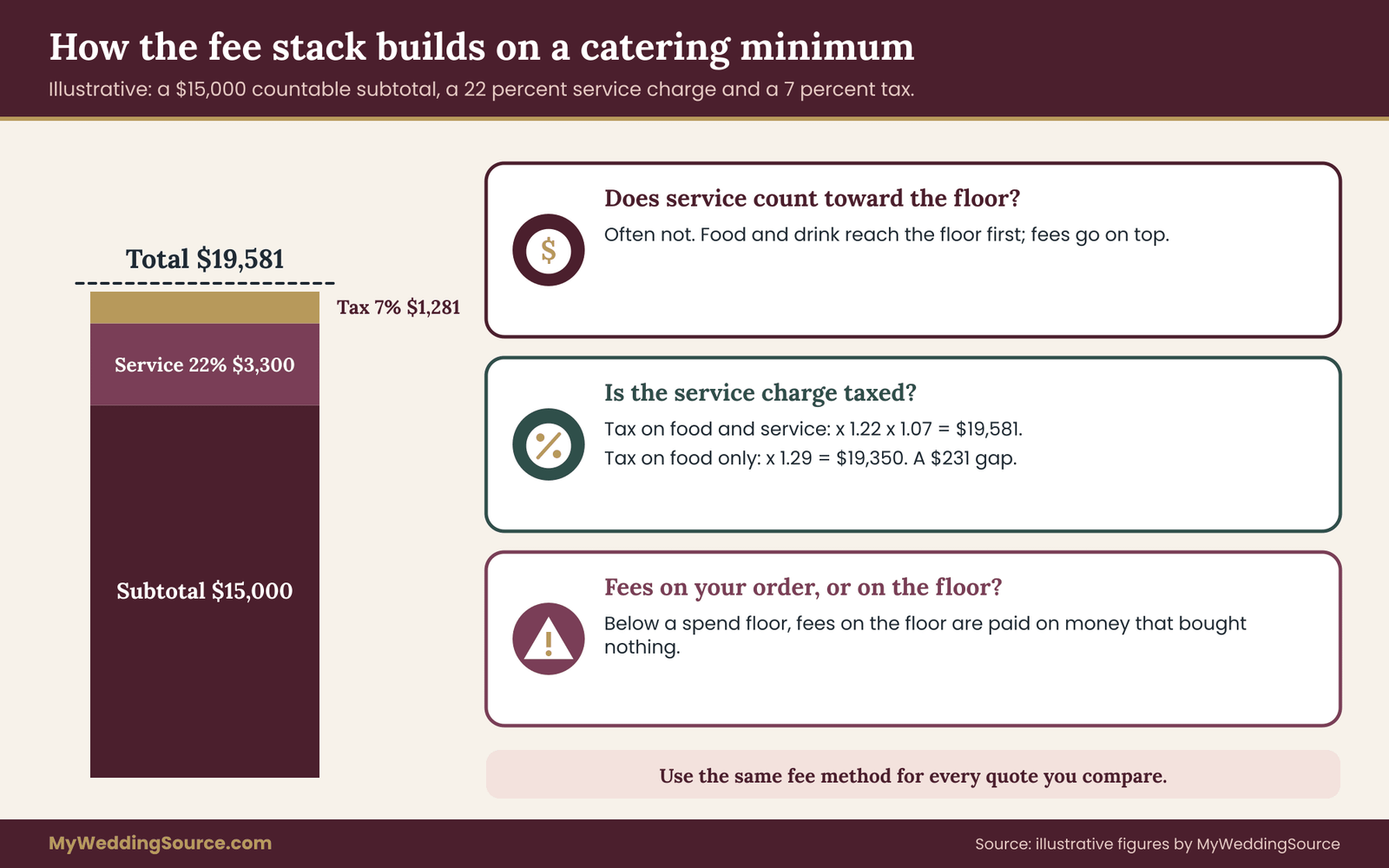
Does the service charge count toward the catering minimum? Often it does not. If it does not, your food and beverage must reach the catering minimum first, and the fee is added afterward.
Does the tax apply to the service charge? In some places a mandatory service charge is taxable along with the food, and in others it is not. Tax agencies in each state publish their own guidance, and the Federation of Tax Administrators lists those agencies. If your contract is silent, ask the vendor how they have charged it on previous events, and confirm with the state tax agency if the amount is large.
What are the fees calculated on when you fall below a spend minimum? If the vendor calculates fees on the catering minimum, you pay fees on the shortfall. If it calculates fees on your actual order, you do not. This is the most expensive of the three questions when your guest count is below the equivalent guest count.
Two ways the fee stack can be built
Take a countable subtotal of $15,000, a 22 percent service charge and a 7 percent tax.
If the tax applies to food and service charge together, multiply by 1.22 and then by 1.07. The total is $15,000 times 1.3054, which is $19,581.
If the tax applies to food only, add the two rates to the base. The total is $15,000 times 1.29, which is $19,350.
The difference is $231 on this subtotal. That is small enough that you may not care, and large enough that you should know which reading your contract uses before you compare quotes from two vendors who handle it differently. When comparing, always use the same fee method for both quotes, or your comparison will contain a hidden difference.
Service charge is not the same as a tip
A service charge is a mandatory fee set by the vendor. A gratuity or tip is voluntary. Contracts sometimes use the words interchangeably, which is confusing, because the legal and tax treatment can differ. The Internal Revenue Service publishes guidance explaining that mandatory service charges and voluntary tips are treated differently for payroll purposes, which is one reason vendors are careful about the label.
For you, the practical question is simpler: ask whether the service charge is the only gratuity expected or whether the vendor also expects a tip for the staff on top of it. Write the answer into your budget either way.
A few vendors also describe a “venue fee,” “administrative fee” or “facility fee” in addition to the service charge. Treat each as a separate line in your calculation, with its own answer to the question of whether it counts toward the floor and whether it is taxed.
Where the fees bite hardest
Fees amplify the effect of a floor in two situations.
The first is when you fall below a spend minimum and fees apply to the catering minimum. In that case the floor itself is multiplied by 1.3054 in our example, so a $3,300 shortfall in the countable spend costs $4,308 once the fees are included.
The second is when excluded charges are added on top of a floor you are already paying. If the bar package does not count toward the catering minimum, then every dollar of bar spend is added to a floor that is already above your countable total. Fees then multiply that too.
A quick sanity check on any quote
Take the vendor’s total and work backward. Divide the total by the combined fee multiplier, and you should land on the countable subtotal or on the floor. If you land on a number that matches neither, something in the quote is not in the contract language you were given. That is a prompt for a question, not an accusation.
A second check is to compare the fee total with the base. A 22 percent service charge on $15,000 is $3,300, and 7 percent tax on $18,300 is $1,281, which together equal the $4,581 gap between $15,000 and $19,581. If the invoice shows a different pair of numbers, ask for the formula.
Converting a catering minimum into an equivalent guest count
Now we can put the two kinds of floor on the same scale. The method has three steps and uses one division.
Step one: find the countable price per guest
This is the amount per guest that counts toward the catering minimum, before fees. Add together the per-person price of everything that counts, according to the contract. If the dinner is $92 per person and the bar package is $38 per person and both count, the countable price is $130. If the bar package does not count, the countable price is $92.
For a plated dinner, the per-person price is usually printed in the proposal. For a buffet, stations or family-style service, it is the same idea, though the vendor may quote a price range. Use the middle of the range for your first pass and the high end for the cautious pass.
Step two: divide the floor by that price
For a spend minimum, divide the dollar floor by the countable price per guest. The result is the equivalent guest count. Round up to the next whole guest, because 115.4 guests means that 115 guests are still below the catering minimum.
If the catering minimum is $15,000 and the countable price is $130, the equivalent guest count is 116. If the countable price is $92, it is 164.
For a guest minimum, you already have the number. It is the minimum headcount in the contract, at the price per person that applies at that count.
Step three: compare the equivalent count to your likely count
If your likely guest count is above the equivalent guest count, the catering minimum will not bind in your most likely scenario, and the clause is mostly a risk-management tool for the vendor. If your likely count is below it, you will pay for guests who are not there, and the size of that payment is the gap between your count and the equivalent guest count multiplied by the countable price per guest, then multiplied by the fee stack if fees apply to the floor.
Here are three plain readings of the comparison.
Your likely count is well above the equivalent count. The catering minimum probably does not matter. Spend your energy on price per person and on the terms of the guarantee.
Your likely count is close to the equivalent count. The catering minimum matters when guests decline late. Look at the low scenario with particular care, and ask about attrition and about moving the catering minimum.
Your likely count is well below the equivalent count. The minimum is the largest cost driver in the contract. Compare the vendor against others, ask whether a smaller format has a lower floor, or consider whether this vendor fits your wedding.

Why this conversion tends to change decisions
Two proposals can differ on price per person and on floor in ways that cancel each other out. A vendor with a lower price per person and a higher spend minimum may produce a lower total at a large guest count and a higher total at a small one. Without the equivalent guest count, couples tend to focus on the lower price per person and discover the floor later. With it, you can see the headcount at which each proposal is the better deal, which is the crossover that matters.
You can find the crossover between two spend proposals by comparing their equivalent guest counts, but only after confirming that the countable prices are defined in the same way. A proposal that counts the bar and another that does not are not comparable until you adjust for it. The adjustment is simple: use the countable price each contract defines, and take the excluded items out of the base before you compute the equivalent count.
The equivalent count in plain terms
Say it out loud once to make sure it makes sense. “This floor behaves like a guest minimum of 116 guests at $130 each. If we invite fewer than that, we pay for empty chairs.” Empty chairs is a useful phrase, because it describes the real cost of a floor above your likely count.
The chairs are not literal. The cost is a dollar amount for food and drink that nobody eats. For some couples that is an acceptable cost of a favorite venue. For others it is a signal to look elsewhere. The point of the conversion is to let you decide on purpose.
Special case: both a dollar floor and a headcount floor
If the contract has both, calculate each and use the larger bill at each guest count. For example, a 100-guest minimum at $130 sets a countable floor of $13,000, and a $15,000 spend minimum sets a higher floor. The $15,000 one governs until the guest count exceeds 115. If the contract has both, ask the vendor why, and whether one can be removed. A vendor who needs the revenue is protected by the spend minimum, and a headcount floor on top of it adds nothing for them while adding risk for you.
Special case: price tiers
Some vendors set a lower per-person price at higher guest counts. A guest minimum can then interact with the tier. If the price is $130 at 100 or more guests and $140 for 80 to 99, then dropping from 100 guests to 90 does not lower your cost per guest. It raises it, because each guest is now $10 more. We return to step pricing in the section on guarantees, with numbers.
A catering minimum scenario calculator in seven steps
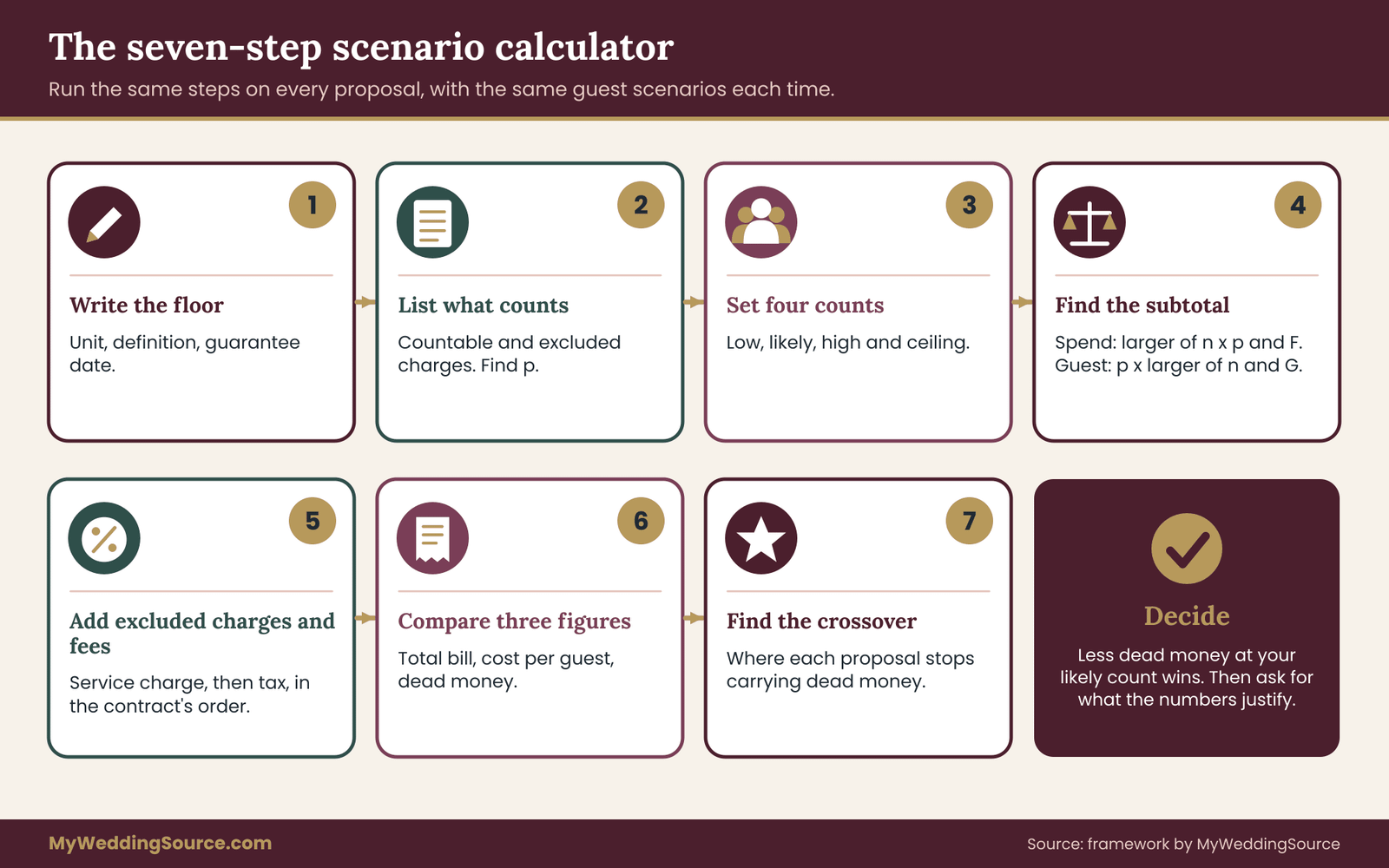
This is the working method. It needs a pencil and a calculator, or a blank spreadsheet if you prefer, and it produces a small set of numbers you can put side by side for any number of proposals. Do it once per proposal, with the same guest scenarios each time.
The symbols are simple. Let F be the dollar floor in a spend minimum, G the guest floor in a guest minimum, p the countable price per guest before fees, n the number of guests actually billed, s the service charge rate, and t the tax rate. If a contract has only one kind of floor, ignore the other.
Step one: write the floor and the definitions
Copy from the contract the exact floor, its unit and the sentence that defines what counts. If you could not find the definition, write “not stated” and treat the answer as an open question for the vendor. Add the guarantee date and the date the final bill is calculated.
Step two: list countable and excluded charges
Make two short lists. In the first, put every line item you expect to buy that counts toward the catering minimum. In the second, put every line item you expect to buy that does not. Next to each, write its per-guest price or its flat price. Add the per-guest prices in the first list to get p. Add the flat prices and per-guest prices in the second list to get the excluded charges per guest or in total, which we will call x.
If the contract is unclear on an item, put it in the second list, the excluded one, for the first pass. That is the cautious choice. If the vendor later confirms that it counts, move it up.
Step three: set four guest scenarios
Choose four headcounts, not one. A single estimate hides the risk that the catering minimum is built to catch.
Low is the count you would reach if the declines you are most worried about come true. Likely is your honest best estimate based on your invited list and the replies you expect. High is the count you would reach if most maybes say yes. Ceiling is the most the room or the budget will allow. You will not plan for the ceiling, but pricing it shows how fast the bill rises once you clear the catering minimum.
A decent first pass is to take your likely count, subtract about a tenth for low and add about a tenth for high, then adjust for what you know about your own guests. If many guests are traveling, if the date is a holiday weekend, or if older relatives may decide late, widen the range. The guide to cutting a wedding guest list helps when the ceiling is higher than the budget. Treat these percentages as a starting point, not a forecast, and replace them with what your own replies tell you.
Step four: compute the countable subtotal at each scenario
For a spend minimum, the subtotal at each scenario is the larger of n times p and F. For a guest minimum, it is p times the larger of n and G. If the contract has both, calculate both and take the larger.
At this stage fees are not yet included. Write the subtotal for each of your four scenarios next to the scenario name.
Step five: add the excluded charges and the fees
Add the excluded charges, which are the charges that do not count toward the catering minimum but that you still pay. These are usually priced per guest, so multiply x by n. Then apply the service charge and the tax in the order your contract uses.
If tax applies to the service charge, multiply the subtotal plus excluded charges by one plus s, then by one plus t. If tax applies to the food only, multiply by one plus s plus t. If your contract applies fees only to what you actually order, calculate fees on n times p plus excluded charges, then add any flat shortfall on top.
Do this for both readings if you cannot yet confirm which one is correct. The difference between the two totals is a measure of how much the vendor’s answer matters to you, and it is worth knowing before you send the question.
Step six: compute three comparison figures
For each scenario in each proposal, calculate the following.
Total bill. The result of step five.
Cost per attending guest. The total bill divided by n. This is the cleanest way to compare proposals that have different floors and different prices. A proposal that looks cheaper at the likely count but is far more expensive per guest in the low scenario is carrying a risk.
Dead money. The part of the bill that buys no food or service. For a spend minimum, it is the shortfall times the fee multiplier if fees apply to the catering minimum, or the shortfall alone if they do not. For a guest minimum, it is the number of empty guests times p times the fee multiplier. If you are above the catering minimum, dead money is zero.
Dead money is the number to watch. It is the cost of the clause itself, separate from the cost of the dinner. When two proposals have similar totals but one has much more dead money in the low scenario, that proposal is the more fragile one.
Step seven: find the crossover and decide
Look across your four scenarios. Find the guest count at which each proposal stops carrying dead money, which is the equivalent guest count for a spend minimum and G for a guest minimum. Then place your likely count against it.
Make the decision with the following rules, in order.
Rule one: if one proposal has less dead money at both your low and likely counts, it is the safer choice, even if its price per person is a little higher.
Rule two: if the proposals swap places, with one cheaper at low and the other cheaper at high, choose the one that is cheaper in the scenario you think is more probable, and ask the other vendor whether the catering minimum is negotiable.
Rule three: if the dead money in your likely scenario is more than you would spend on the best optional upgrade, consider spending the gap on something you value instead of paying it as a pure penalty. The section on closing a gap explains when this works.
Rule four: if the catering minimum is above your ceiling-scenario spend, the contract is asking for more than your wedding will use. Treat that as a reason to talk to a different vendor or ask for a different format.
Keeping the notes tidy
The calculator creates a small set of numbers per proposal, and it is easy to lose track of which assumption belongs to which vendor. Keep a single page per proposal with the catering minimum, the definitions, the confirmed answers and the unconfirmed assumptions at the top. Put the scenario results beneath.
When the vendor answers a question, update the page and note the date. If you have a planner, share the page so they can send the follow-up questions. If you are managing vendors yourself, the same page becomes the reference you use when the final invoice arrives, and you can compare the invoice against your own prediction.
How the calculator treats the bar
The bar is the line most likely to be mishandled, so decide in advance how to enter it. If the contract has a bar package priced per guest, treat it like any other per-guest item and enter it as countable or excluded depending on the definition. If the bar is a consumption tab, meaning you pay for what is poured, you cannot know the total in advance.
Estimate it from the package price a vendor quotes for the same hours, then mark it as an estimate. If the bar is run by a separate company, enter it as excluded unless the caterer confirms otherwise, because a separate vendor’s sales are not the caterer’s sales.
The guide to wedding bar service planning covers package, tab and cash-bar models in more depth. For this calculation, you only need to know which model you are in and whether the clause counts it.
What the calculator does not do
It does not predict your guest count. It does not tell you whether a vendor is worth the price. It does not capture items that cannot be priced, such as a venue you love, a caterer whose food your family has praised, or a date that matters for a personal reason. The method exists to take the contract math off the list of unknowns, so that the remaining decision is about what you value. A floor is not a reason to reject a vendor. It is a reason to know what the catering minimum costs before you say yes.
A worked catering minimum example: two proposals, four guest counts
The following example uses invented numbers and an invented couple, Alvarez and Brooks, to show the calculator at work. It is not a price guide. Real prices, fees and definitions vary widely, and nothing here should be read as typical for any region. What matters is the method.
The setup
Alvarez and Brooks are planning a Saturday evening wedding. They expect about 100 guests, with some chance of late declines and some chance of late additions. They have two catering proposals.
Caterer A offers a spend minimum. The catering minimum is $15,000. The dinner is $88 per guest and the bar package is $36 per guest, and the contract says both count toward the catering minimum. The countable price is therefore $124 per guest.
Caterer B offers a guest minimum. The floor is 100 guests. The dinner is $92 per guest and the bar package is $38 per guest, so the countable price is $130 per guest. There is no dollar minimum.
Both contracts add a 22 percent service charge, and both apply a 7 percent tax to the food and the service charge together. The fee multiplier is therefore 1.22 times 1.07, which is 1.3054. In Caterer A’s contract, the fees are calculated on the greater of the order and the catering minimum.
The couple chooses four scenarios. Low is 90 guests, likely is 100, high is 110 and the ceiling is 125.
Step by step: the equivalent guest count
For Caterer A, the equivalent guest count is $15,000 divided by $124, which is about 120.97, rounded up to 121. Below 121 guests, there is a shortfall. For Caterer B, the guest floor is 100.
Compared with the likely count of 100, Caterer A’s floor is more than twenty guests above where the couple expects to be. Caterer B’s floor sits exactly at the likely count. The conversion has already told them something the price per person alone would not: Caterer A is built for a larger wedding.
The totals at each scenario
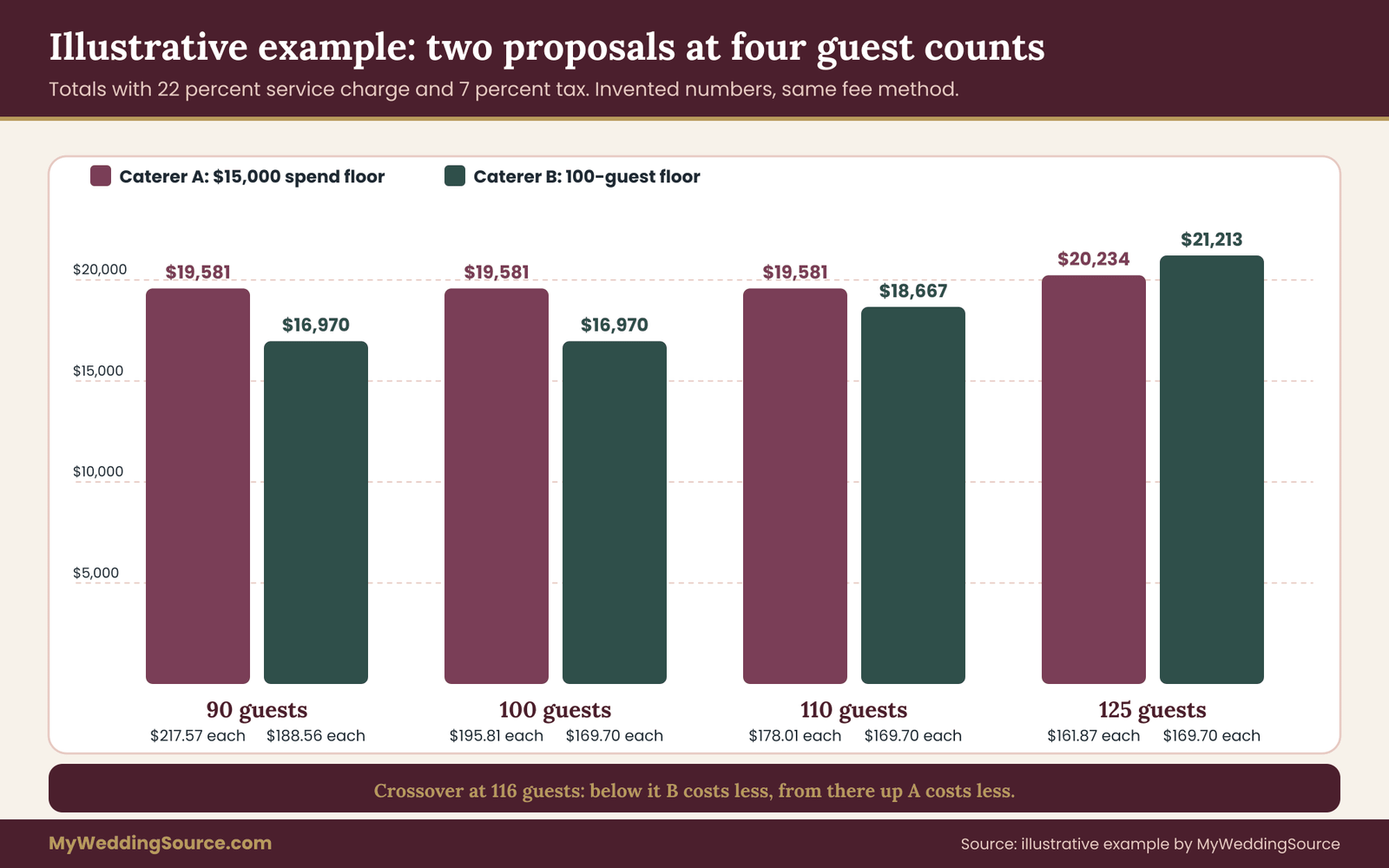
At 90 guests. Caterer A’s countable subtotal is the catering minimum, $15,000, because 90 times $124 is only $11,160. With fees, the total is $19,581, which is $217.57 per guest. Caterer B’s subtotal is 100 times $130, which is $13,000, because the guarantee is 100 even though only 90 attend. With fees, the total is $16,970.20, or $188.56 per guest. Caterer B costs $2,610.80 less.
At 100 guests. Caterer A is still on its floor: 100 times $124 is $12,400, below $15,000. The total is $19,581, or $195.81 per guest. Caterer B’s subtotal is exactly $13,000 and the total is $16,970.20, or $169.70 per guest. Caterer B again costs $2,610.80 less.
At 110 guests. Caterer A’s actual order is $13,640, still below the catering minimum, so the total stays at $19,581, or $178.01 per guest. Caterer B’s subtotal is now 110 times $130, which is $14,300, and the total is $18,667.22, or $169.70 per guest. Caterer B costs $913.78 less.
At 125 guests. Caterer A’s order is $15,500, above the catering minimum, and the total is $20,233.70, or $161.87 per guest. Caterer B’s subtotal is $16,250 and the total is $21,212.75, or $169.70 per guest. Now Caterer A costs $979.05 less.
The crossover falls at 116 guests. Below that, Caterer B costs less because Caterer A’s floor is carrying dead money. At 116 or above, Caterer A costs less because its price per guest is lower.
Reading the dead money
At the likely count of 100 guests, Caterer A carries $2,600 of countable shortfall, which becomes $3,394.04 once the fee multiplier is applied. That money buys nothing. Caterer B carries none at 100, and at 90 guests carries ten empty guests at $130, which is $1,697.02 with fees.
Notice what this says about price per person. Caterer A’s price per guest is lower, by $6. At 125 guests that makes it cheaper. At 100 guests it makes it far more expensive, because the catering minimum overrides the price per guest. A couple who compared only the price per person would have chosen A and then paid more than $2,600 extra for the same dinner.
Variation one: fees on the order, not the floor
Suppose Caterer A’s contract says the service charge and tax are calculated only on what is actually ordered, with the shortfall charged as a flat amount. At 100 guests, the order is $12,400. Fees apply to that, giving $16,186.96, and the $2,600 shortfall is added flat, for a total of $18,786.96. That is $794.04 less than the $19,581 under the first reading.
The savings are the shortfall times the fee rate: $2,600 times 0.3054. This is the dollar value of one sentence in the contract, and it is why the fee question comes before the signature. It does not change which caterer is cheaper at 100 guests. Caterer B still costs $1,816.76 less at that count. But at 110 guests, the order is $13,640, the shortfall is $1,360, and the total comes to $19,165.66 under this reading, still above Caterer B’s $18,667.22. The reading narrows the gap and does not close it.
Variation two: the bar does not count
Now suppose Caterer A’s contract counts only the $88 dinner toward the catering minimum and treats the $36 bar package as an excluded charge. The countable price is $88, and the equivalent guest count rises from 121 to 171, because $15,000 divided by $88 is about 170.5.
At 100 guests, the dinner portion is $8,800, which is far below the catering minimum, so the countable subtotal is $15,000. The bar package adds $3,600 on top. The subtotal is $18,600, and with fees the total is $24,280.44, or $242.80 per guest. Under the original definition the total was $19,581. The definition alone adds $4,699.44.
This is the most important lesson in the example. Nothing about the food, the guests or the price per person changed. One definition did. That is why the clause questions come before the math, and why “does the bar count” belongs at the top of every question list.
Variation three: negotiating the floor
The couple asks Caterer A whether the floor can be reduced, since their likely count is 100. Suppose, for the sake of the example, the caterer agrees to a $12,500 floor. The equivalent guest count becomes 101, since $12,500 divided by $124 is about 100.8.
At 100 guests, the countable subtotal is $12,500, and the total is $16,317.50, or $163.18 per guest. That is below Caterer B’s $16,970.20. At 90 guests, the catering minimum still binds and the total is the same $16,317.50, which is again below B. At 110 guests, the subtotal is $13,640 and the total is $17,805.66, below B’s $18,667.22. At 125 guests, the total is $20,233.70, which is below B’s $21,212.75.
Under that lower floor, Caterer A is cheaper than Caterer B at every scenario. The caterer is not obliged to agree. The point is that the conversion tells the couple exactly what to ask for and what the request is worth. A $2,500 cut in the catering minimum changes a $2,610.80 disadvantage at the likely count into a $652.70 advantage.
What the couple decides
With the original proposals and a likely count of 100, Caterer B is the safer choice. It has no dead money at the likely count, and a modest amount in the low scenario. If the couple believed that 120 or more guests was probable, Caterer A would be competitive on price.
Because the likely count is 100, they have a better move: ask Caterer A for a lower floor in writing, and keep Caterer B as the fallback. They also confirm the bar definition with Caterer A in writing, since variation two shows that one sentence can swing the total by thousands.
Write down what each choice commits you to. With Caterer B, they have committed to paying for 100 guests no matter what. With Caterer A at the original floor, they have committed to paying for the equivalent of 121 guests. The couple decides they are more comfortable committing to the number they believe in.
Using the example with your own numbers
Replace the invented figures with your own. The structure holds even if every number changes. Compute the countable price, find the equivalent guest count, run your four scenarios, add the fees in the order your contract uses, and compare total, cost per guest and dead money. If a vendor will not give you a definition in writing, run the version that is least favorable to you and see whether you can live with it. Many decisions become easy at that point, in one direction or the other.
Catering minimum guest counts: guarantees, attrition and step pricing
A guest minimum is only part of the headcount terms in a catering contract. Three other mechanisms decide what you pay when your guest list moves: the guarantee, the attrition allowance and any step pricing. They are written in different places and they interact, so look at them together.
The guarantee date and what it locks
The guarantee is the final headcount you commit to pay for. The contract sets a date, commonly a week or two before the event, though the range is wide and you should use your own contract’s number. Before that date, you can usually change your estimate. After it, you can often add guests, subject to the kitchen’s ability, but you cannot go below the guarantee.
Put the guarantee date on your calendar the day you sign, and build your RSVP deadline backward from it. If the guarantee is due fourteen days before the wedding, an RSVP deadline of four weeks before gives you two weeks to chase replies, call the people who did not answer and settle the count. An RSVP deadline set too close to the guarantee leaves you guessing on the day the number is locked. The guide to the guest list on this site covers the invitation side, and this guide covers what the number does once it reaches the caterer.
A useful discipline is to send the caterer an updated estimate before the guarantee date, even when it is not required. It lets the vendor flag a catering minimum problem while you can still act, and it creates a written record of your estimate.
Attrition: the allowed drop
Attrition is the percentage by which your final guarantee may fall below your original estimate without penalty. A clause might say that you can reduce the count by up to a stated percentage before the guarantee date, with the reduction priced at no charge. If you reduce by more, the extra reduction is billed at the full per-person price, or you pay a fee.
The mechanics matter. Ask what number the percentage is applied to. If it is applied to your count at signing, an optimistic early estimate gives you more room to fall than a cautious one, though a high estimate may raise your deposit. If it is applied to a count you provide at a later checkpoint, the room to fall shrinks as the date nears.
Ask also whether attrition can be used more than once, and whether it applies to a guest minimum or only to a count above the catering minimum. In many contracts, attrition does not lower the catering minimum, which means that it is useless when your guests are already near the catering minimum.
Think of attrition as a cushion above the catering minimum, not a way through it. If your likely count is 100 and the floor is 100, attrition does nothing for you. If your likely count is 110 and the floor is 100, attrition helps only as long as you stay above 100.
Overage: what extra guests cost
Guests above your guarantee are usually billed at the per-person price, sometimes with a premium for late additions. Ask whether the vendor will honor additions after the guarantee date, and up to what number, because the kitchen cannot always prepare more food at short notice. Ask whether the overage price is the same as the base price. An extra guest at the same price is straightforward. An extra guest at a premium, or at a different tier, is a cost you should add to your high scenario.
Who counts as a guest
This was in the clause questions, and it matters for the guest minimum in particular. Settle these in writing.
Children’s meals are often priced lower. If a child counts as a full guest toward the catering minimum but eats a half-price meal, you pay the difference in dead money. If children do not count, you may need more adult guests to reach the catering minimum.
Vendor meals, for the photographer, the band, the DJ and the planner, are commonly offered at a reduced price. Ask whether they count toward the guest minimum, and whether you are expected to feed them at all. Your contracts with those vendors may require a meal.
Guests who attend only part of the evening, such as a cocktail hour or a dessert and dancing window, can be a source of confusion. Ask how the vendor counts them.
Special meals, for dietary needs or religious practices, can carry a different price. If several guests need them, add that to your price assumptions. Planning the menu around varied dietary needs from the start keeps the per-person price from creeping up for everyone.
Step pricing: when fewer guests cost more per guest
Some vendors quote a per-person price that falls as guest count rises. This is called step pricing or tiered pricing, and it can interact with a guest minimum in a way that surprises people.
Suppose a caterer charges $130 per guest for 100 or more, and $140 per guest for 80 to 99. The contract’s floor is 80 guests. At 90 guests the subtotal is 90 times $140, which is $12,600, and with the 1.3054 fee multiplier the total is $16,448.04. At 100 guests the subtotal is 100 times $130, which is $13,000, and the total is $16,970.20. Moving from 90 to 100 guests adds ten guests and only $522.16 to the bill.
At 99 guests the subtotal is $13,860. That is more than the subtotal for 100 guests. A couple at 99 guests would pay less by adding one more guest. This is the tier trap. It is a feature of the pricing, not a mistake, and it matters because you can sometimes bring your headcount to the tier line cheaply.
Three questions help here. Does the lower price apply to every guest once you cross the line, or only to guests beyond it? Is the tier measured on your guarantee or on the final count? And what happens if you cross the line after the guarantee date? Write down the tier boundaries and put them on your scenario list, because they are among the few places where a larger guest list is less expensive.
Summary of the headcount terms
If you want a short check before you sign, confirm six facts: the catering minimum, the definition of a guest, the guarantee date, the attrition allowance and what it applies to, the overage price, and the tier boundaries. Six answers are enough to model the guest side of the catering minimum fully. The timeline infographic in this guide shows how the dates fall relative to the wedding.

Closing a catering minimum gap without wasting money
When your likely count is below the equivalent guest count, you have a gap. The gap is the dollar amount of countable spend you would need to add to reach a spend floor. You have several ways to deal with it, and the right one depends on whether the gap is large or small, and on whether the fees apply to it.
First, check whether the gap is real
Recheck the inputs. Is the countable price per guest correct? Does the bar count? Are there line items you plan to buy anyway, such as a late-night snack, a dessert table or extra bar hours, that you have not yet added to the order? A gap that looks large at the base menu often shrinks once the items you actually want are included. Add them, recompute, and look at what remains.
The fee rule for upgrades
The most useful decision rule is about fees. If the vendor applies the service charge and tax to the catering minimum, then the fees are already built into the shortfall. In that case, upgrades that fit inside the gap cost you nothing extra in either dollars or fees, because the total does not change until you pass the floor. If the vendor applies fees only to what you order, then each dollar of upgrade carries the fee rate, because it replaces a flat shortfall with a taxable purchase.
Here is a worked case from the earlier example. At 100 guests, Caterer A’s order is $12,400 and the floor is $15,000. Under the first reading, where fees apply to the catering minimum, a $22 per guest late-night snack, worth $2,200, fits inside the $2,600 gap, and the total stays at $19,581. The snack is effectively free. Under the second reading, where fees apply only to the order, the same snack lifts the order to $14,600 and leaves a $400 shortfall. The total rises from $18,786.96 to $19,458.84, an increase of about $672, which is the fee on the snack.
In both cases you should still ask whether you want the snack. A “free” upgrade that no one eats is a cost in food waste, in staffing for the extra service, and in the opportunity to spend the same dollars somewhere you would value. Buy things you would have wanted at that price, and skip things you would only accept because they are free.
Options for closing the gap
Add guests, if you want them. If you have a short list of people you would genuinely like to invite, and a guarantee date still ahead, adding them is the most direct use of a floor, because each added guest is food you receive. Do this only if the guests are people you want there. Inviting people to fill a catering minimum rarely makes a better party.
Move spending that you were going to do anyway. If the same caterer offers a rehearsal dinner, a welcome reception or a next-day brunch, ask whether the shortfall on the wedding can be applied to that event. Some vendors will agree in writing, and some will not.
Upgrade the parts guests notice. An extra course, a raw bar, a pour of a better wine, an added station or an extended bar window are common ways to use a gap. Choose by what your guests will enjoy, and keep an eye on the guarantee and on the extra service staff the item requires.
Change the format. A plated dinner, a buffet, stations and a cocktail-style reception have different per-person prices, and they can change both the countable price and the number of staff. A floor that is too high for a plated dinner may fit a station format with more items per guest.
Change the date. Many vendors set lower floors for Fridays, Sundays, weekdays and off-peak months. If the date is flexible, ask for the floor on two or three alternative dates and compute the equivalent guest count for each. The guide to choosing a wedding date covers the trade-offs of date choices.
Change the vendor. If every option still leaves a large gap, the vendor may not fit your size. This is a legitimate outcome of the calculation.
Order of attack
When the gap is large, work in this order. First, confirm the definitions in writing. Second, ask for a reduced floor or a different one for a different date. Third, add the items you were already considering. Fourth, consider more guests or a second event. Fifth, accept the remaining gap as the price of the venue or vendor, or look elsewhere. This order puts the cheapest and most flexible changes first, and it keeps you from paying for upgrades before you have asked whether the floor can move.
A note on leftovers and waste
When you pay for food that guests do not eat, ask whether you may take it home, whether the venue permits it, and whether the caterer’s policy covers it. Food safety rules for handling and holding prepared food are set by local health departments, with the FDA Food Code as a model many of them follow, and caterers often have strict rules about what leaves the building. If a vendor will not release extra food, ask whether the shortfall can be converted into a donation of prepared food or a different service.
Negotiating a catering minimum without souring the relationship
Negotiation works best when you arrive with numbers. Because you have computed the equivalent guest count and the dead money at your likely count, you can ask for specific changes and explain what they are worth, instead of asking for a discount in general. Vendors tend to respond to a clear, small request better than a vague, large one.
What vendors can often adjust
Many vendors have more flexibility on the structure of a catering minimum than on the price per guest. The following asks are common, and each is a reasonable thing to raise politely. None is certain.
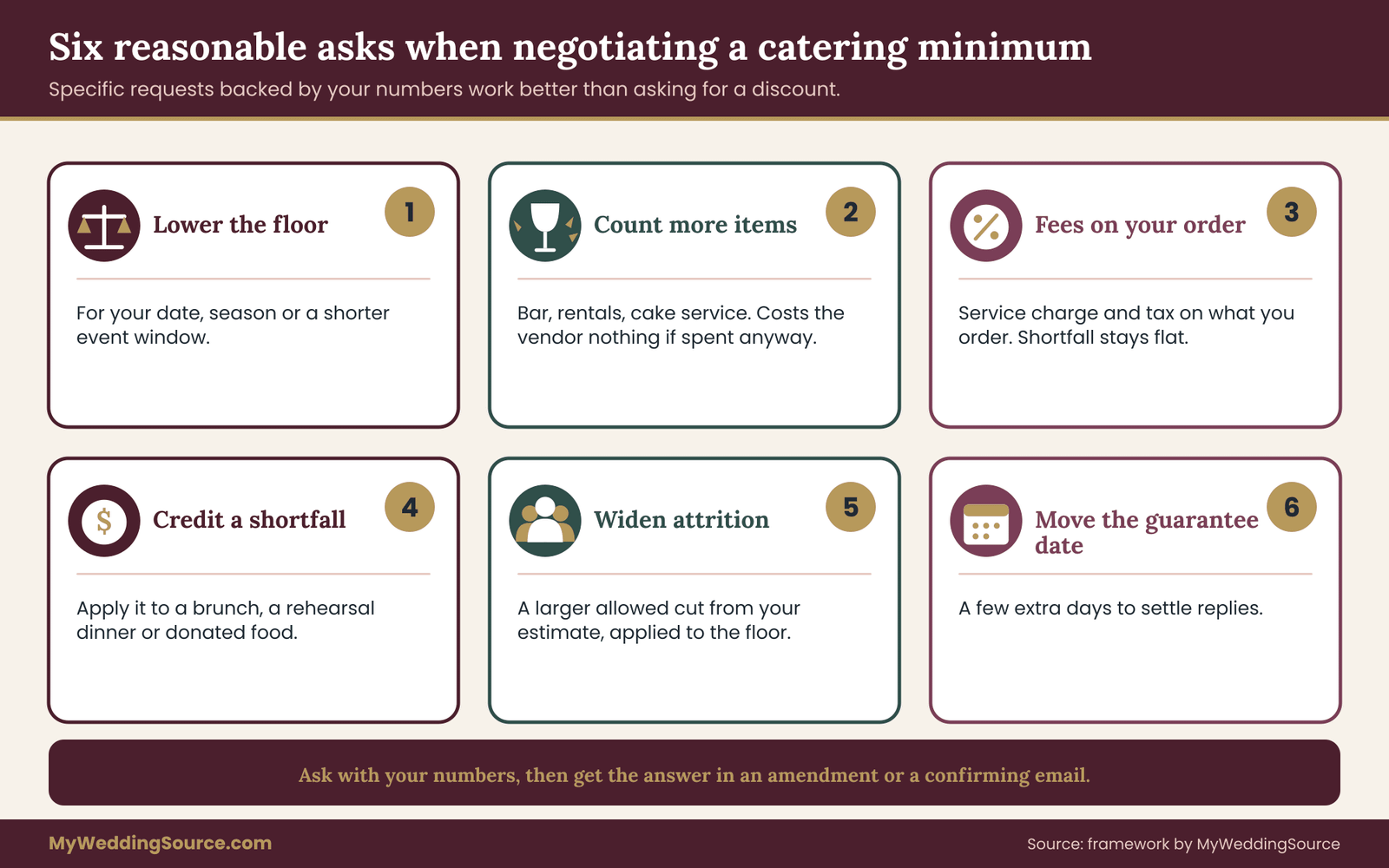
Lower the catering minimum for your date. Ask whether a lower minimum is available on a different day or season, or for a shorter event window. Present your likely guest count and say that you would like a catering minimum close to it.
Count more items toward the floor. Ask whether the bar, the rentals, the cake service or the service charge can count. A change in definition may cost the vendor nothing, since the money is spent either way, and it can be worth more to you than a discount.
Apply fees to the order, not the catering minimum. If the contract charges fees on the minimum, ask for fees to be calculated on what you actually order, with any shortfall charged flat. The vendor is still covered for the catering minimum.
Allow a credit for a shortfall. Ask whether a shortfall can be applied to another event with the same vendor, to a future purchase or to a donation of prepared food.
Widen attrition. Ask for a larger allowed reduction from your estimate, or for attrition to apply to the catering minimum itself.
Fix the price tier. If tiered pricing applies, ask whether the lower per-person price can hold at your guarantee even if the count falls slightly below the tier boundary.
Move the guarantee date later. A later guarantee gives you more time for replies. Vendors need lead time for ordering and staffing, so the answer is often a few days, not weeks.
How to ask
Lead with what you want to do, not with a complaint. A message might read like this.
“We would like to book with you. Our likely count is about one hundred, and the current minimum works out to roughly one hundred and twenty-one guests at our menu prices. Could the minimum be adjusted to better fit our count, or could the bar count toward it? Either would help us move forward.”
That message is specific, shows you did the math, offers two paths and signals that you are ready to commit. It gives the vendor an easy way to say yes to one of them.
If the answer is no, ask what the vendor can do. A “no” on the floor sometimes comes with a “yes” on another term, such as an added course at no charge, a longer bar window, a lower service charge or a flexible guarantee date. Compare those offers with the same calculator, because a concession that looks small can change the dead money at your likely count.
What not to do
Do not hide your likely count in order to get a lower floor, and then plan to invite fewer guests than you stated. The vendor priced the date on your estimate, and a floor that was lowered on a premise that later changes can come back as a surprise fee or a strained relationship. Do not ask for a waiver of fees that you cannot explain, and do not pressure a coordinator to promise something verbally. Put every change in an amendment or a confirming email, and keep it with the contract.
Do not compare a vendor’s quote with another vendor’s quote while implying a number you do not have. If you say that another caterer will do it for less, be ready to show the proposal. Being honest and specific tends to produce better replies, and it preserves a relationship you will rely on for the day itself.
Special situations that change the catering minimum math
Most weddings fit the pattern above. A few arrangements add a layer.
A venue with an exclusive caterer
If the venue requires its own caterer, the venue sets the catering minimum, and you may have no alternative to compare. You can still run the calculator, and you can still ask the clause questions. Use the result to decide whether the venue is affordable at your likely count and which of the negotiating asks apply. Venues are sometimes more flexible on the minimum than on the price, because they set it themselves.
Bundled all-inclusive pricing is the setting where a floor is hardest to see, so ask for the per-person price and the minimum as separate lines.
A venue minimum plus an outside caterer
Some venues allow outside caterers and still set their own food and beverage minimum, or charge a fee if you do not use the house menu. In that case you may face two floors, one from the venue and one from the caterer. Calculate each separately, and ask whether purchases from the outside caterer count toward the venue’s floor. In most cases they will not, but it is worth asking.
A weekend with more than one event
A rehearsal dinner, a welcome party or a next-day brunch with the same vendor can change the math. Ask whether the catering minimum applies to each event separately or to the combined spend. A combined floor can be easier to reach, because a larger share of your spending counts. A separate floor for each event is harder on a smaller rehearsal dinner. Ask for the answer in writing, since it affects the budget for the whole weekend.
A destination wedding or a remote venue
Travel and lodging for the caterer’s staff, a delivery fee for equipment, or a catering minimum linked to a rental package can show up as separate lines. Determine whether they count toward the floor, and whether the service charge and tax apply to them. Local rules on what is taxable can differ from the rules where you live.
A wedding with a large share of children or a long list of dietary needs
Children’s meals, kosher, halal, vegan or allergen-sensitive meals and other special preparations can change the per-person price and sometimes the staffing. If these meals are a large share of the count, calculate a blended price per guest. A blended price is the total countable cost of all meals divided by the number of guests, and it is a better input than the headline adult price.
A wedding where the budget is tight
If the likely floor already strains the budget, run the low scenario and ask whether you could absorb it. Then look at the rest of your cost plan. The guide to wedding cash flow planning shows how deposits, balances and a reserve fit together, which helps you decide how much risk you can carry. The broader wedding budget guide explains how to place catering within the total. A floor is easier to live with when the final balance and the reserve are already planned.
The limits of this method, and when to ask for help
The calculator is a planning tool. It has limits you should keep in mind.
It depends on the contract language, and you may be working from a proposal rather than a final agreement. A change in wording can change the result. Rerun the numbers whenever the contract changes.
It uses your estimates of guest counts and prices. Real counts move, menus are adjusted and some prices change before the contract is signed. Keep the scenarios wide enough to be honest.
It simplifies the fee stack. Real invoices can include administrative fees, delivery fees, rental surcharges, equipment charges, corkage and other items that vary. Add each one as its own line.
It does not interpret the law. Whether a floor is enforceable, whether a service charge is lawful in the way a vendor describes it, whether you can recover a payment if a vendor fails to deliver and how disputes are handled depend on your state and the contract. The Federal Trade Commission’s consumer advice site and the Consumer Financial Protection Bureau publish plain-language guides on consumer rights and payment disputes, and your state attorney general’s consumer protection office can tell you what applies where you live. USAGov lists state consumer offices.
Consider a contract attorney when the contract shifts unusual risk onto you, when a large sum is involved, or when the vendor refuses to put promised terms in writing. An hour spent reviewing the payment, minimum and cancellation clauses is often a small share of the amount at stake.
A planner or coordinator can help if you want someone to hold the vendors to the dates. For the whole contract rather than one clause, see the wedding vendor contract guide mentioned earlier, and for the paper trail after signing, the guide to vendor purchase orders from scope agreement to final acceptance shows how to track the deliverable until you accept it.
The freshest part of this guide is the method. Fees, tax rules, definitions and vendor policies change over time, so confirm the current version with the vendor, the state tax agency and the contract itself before you rely on any figure here.
Your next steps
- Collect the written terms from each caterer or venue you are considering: the catering minimum, the definitions, the guarantee date, attrition, overage and any step pricing.
- Send one written message with the clause questions and ask for answers in writing.
- Fill in the countable price per guest for each proposal and divide the floor by it to find the equivalent guest count.
- Choose four guest scenarios for your wedding and run each proposal through the seven steps with the fees in the order the contract uses.
- Compare total bill, cost per attending guest and dead money, and note where the proposals cross.
- Decide what to ask for: a lower floor, a wider definition, fees on the order or a later guarantee date. Ask in writing.
- Put the guarantee date, the attrition deadline and the final invoice date on your calendar, and set your RSVP deadline to leave time before the guarantee.
- Keep the signed contract, every amendment and the vendor’s confirming emails together, and compare the final invoice with your own calculation.
FAQ
What is a catering minimum for a wedding?
A catering minimum is the smallest bill or headcount your catering contract will charge for, however much you use. It may be a dollar amount, called a food and beverage minimum, or a number of guests you pay for. If your real spend or attendance falls short, you still pay the difference, and the contract should define what counts toward it.
Is a minimum spend or a minimum guest count better for a wedding?
Neither is better in general. A spend minimum behaves like a guest minimum equal to the dollar floor divided by the countable price per guest. Convert both to the same scale, then compare the cost per attending guest at your low, likely and high counts. The clause with less wasted money at your likely count is the safer one, once you confirm what counts.
Does the service charge count toward a catering minimum?
Often it does not, but contracts differ and you cannot assume. Ask whether the minimum is measured before or after the service charge and tax, and whether fees are calculated on your actual order or on the catering minimum. Put the answer in writing. The difference can reach thousands of dollars when your guest count falls below a spend minimum.
What happens if my guest count falls below the minimum?
You usually pay the difference. With a guest minimum, you pay for the minimum number of guests, even if fewer attend. With a spend minimum, you pay the shortfall between your countable spend and the floor. Fees may apply to that amount. Check the attrition terms, because some contracts let you reduce the count by a small percentage without penalty.
Can I negotiate a catering minimum?
Often, yes, within limits. Vendors commonly adjust the floor for off-peak dates, widen what counts toward it, apply fees to the actual order, allow a shortfall credit or extend the guarantee date. Ask for specific changes with your numbers, not a general discount, and get any agreement into a signed amendment or a confirming email.
Do children and vendor meals count toward a guest minimum?
It depends on the contract. Some count every meal served, while others count only adult guests, and children’s meals are often priced lower. Vendor meals, such as the photographer or band, are frequently discounted and may be counted differently. Ask for the definition of a guest in writing before you sign, and model your guest scenarios accordingly.
How do I calculate the true cost per guest with a minimum?
Take the total bill at a given guest count, including any floor, excluded charges, service charge and tax, and divide it by the number of guests who attend. Do this for several guest counts. The figure rises when the floor is binding and settles at the base price with fees once you clear the floor.
When should I ask a lawyer to review a catering minimum?
Consider a contract attorney if the clause shifts unusual risk onto you, if the amount is large relative to your budget, if the vendor will not put promised changes in writing, or if the minimum interacts with cancellation or refund terms. Local law varies.
Sources
- FTC Consumer Advice: Federal Trade Commission
- Federal Trade Commission: Advertising and Marketing Guidance
- Consumer Financial Protection Bureau: Consumer Tools
- USAGov: State and Local Consumer Protection Offices
- National Association of Attorneys General
- Federation of Tax Administrators: State Tax Agency Directory
- Internal Revenue Service: Tip and Service Charge Guidance
- FDA Food Code
- FoodSafety.gov