
Wedding kids meals are the food you plan for the children at your reception, and the three realistic ways to serve it are smaller portions of the adult dinner, a separate menu for kids meals, or shared dishes the whole table passes. This guide compares those three options and gives you an age-banded plan, a family opt-in form and a set of written instructions for your caterer.
Sort the children on your guest list into age bands, then match each band to one service style. Babies and toddlers usually eat what their parents bring or order, preschoolers and young school-age children are the group a separate plate serves best, and older children and teens are often happiest with a reduced adult portion. Ask families to opt in by a fixed date, send the caterer one written page covering counts, allergies and timing, and serve the children before the adults whenever the schedule allows. Confirm every ingredient and cross-contact question with the caterer directly.
Most couples settle the question of wedding kids meals in about thirty seconds. Someone says “chicken fingers and fries,” the caterer prints a line on the quote, and nobody looks at it again until a four-year-old refuses a plate of fried food at nine at night. The problem is not that the chicken fingers are a bad idea. The problem is that one line on a quote does not tell you who actually needs a child’s plate, when they need it, what the plate costs, or what happens when a child has an allergy.
Kids meals look small on the invoice and cause outsized trouble on the day, because children are the guests least able to wait, least able to explain what they cannot eat, and most likely to be hungry at an hour when the adults are still on the second course. A good plan costs very little. It takes a few decisions made in the right order, and it fits on one page.
A note on scope. This is general planning information, not legal, tax or financial advice, and it cannot replace what your caterer, your venue and a licensed food safety professional tell you about your own event. Where a rule matters, such as allergen labeling or safe holding temperatures, the guide points you to the agency that publishes it so you can read the current version yourself.
What wedding kids meals actually have to solve
Before you compare menus, be clear about the job. A children’s meal at a wedding is not a smaller version of a restaurant kids menu. It has to do five things at once, and a plan that misses one of them is the plan that fails.
Feed the right children, not every child. A baby in a carrier does not need a plate. A toddler may eat three bites from a parent’s dinner. A twelve-year-old may eat more than some adults. Counting every person under eighteen as one “kid meal” overbuys food in some bands and underbuys it in others. The first job is a headcount by age, not a single number.
Arrive at a sensible time. Adults at a plated reception may wait ninety minutes or more between the ceremony and the entree. Children in that window are tired, bored and increasingly difficult to feed. The meal has to land early enough that the child eats while still in a good mood, and the schedule has to allow it.
Be safe for that child. Children carry the same food allergies adults do, they often cannot describe them, and young children face choking risks from certain shapes and textures that have nothing to do with taste. The plate has to be safe for the specific child sitting in front of it.
Be food a child will really eat. Familiar, mild and easy to handle beats creative. A plate that is technically nutritious and untouched is the most wasteful item on the invoice.
Cost something you can predict. Caterers price kids meals service in several different ways, and the same wedding can end up with very different totals depending on which one you choose. You need to see the cost logic before you sign, not after.
Everything else in this guide is a way of meeting those five requirements without turning a simple question into a project. If your main concern is the whole-menu question of balancing ages and diets across all your guests, the guide on building a wedding menu that works across different ages and dietary preferences covers that broader picture. This article stays narrow and deals only with the children. Planning kids meals this way keeps the whole decision small.
Why the plan matters more than the menu
Notice that none of those five requirements is about which food to pick. Couples tend to spend their energy on the menu itself: pasta or chicken, fruit or fries. The menu is the easy part, and most caterers have a kids meals offering they have served many times. The hard part is the system around it: who counts, who tells the caterer, who checks the plate, and who is responsible when the plan and the room disagree. Good kids meals are mostly a matter of process.
That is why the rest of this guide leans on process. You will see an age-band table in prose form rather than a menu list, a decision rule for choosing among the three service styles, an opt-in message you can send to families, a one-page caterer brief, and a worked example with invented numbers so you can check your own against it.
The three options for wedding kids meals, side by side
Every approach to kids meals at a reception is a version of one of three ideas. Knowing the three clearly makes every later decision faster.
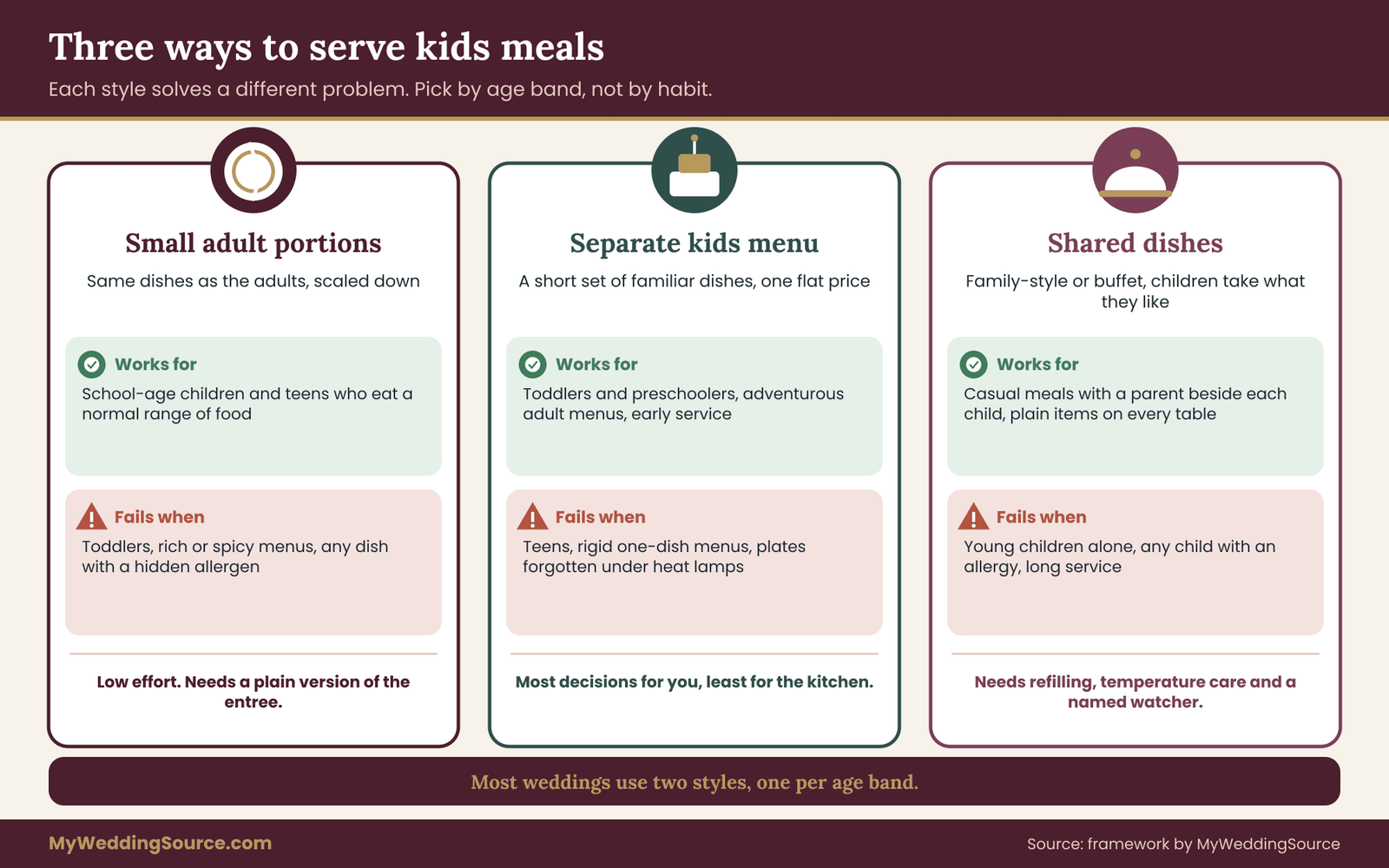
Smaller portions of the adult menu. Children receive the same dishes as the adults, scaled down. The kitchen plates the same entree, usually with simpler sides or a lighter sauce on request, and charges either a reduced price or a percentage of the adult plate.
A separate menu for kids meals. The caterer prepares a distinct set of dishes for children, typically familiar items such as pasta, chicken tenders, quesadillas or sliders with fruit and vegetables on the side. This is the version most people picture when they say “kids meal.”
Shared dishes. Instead of individual plates, food arrives in the middle of the table or on a buffet or family-style spread, and children take what they want, often with a parent serving. Children and adults eat from the same dishes, and the caterer may add a few children-friendly platters.
None of the three is correct in general. Each wins in some conditions and loses in others, and a single wedding often uses two of them for different age bands. The sections that follow take each option in turn, then give you a way to choose. The right choice for kids meals is the one that fits the children, the room and the kitchen.
What each option costs you in effort
Cost is not only the price per plate. Each option asks something different of you and of the caterer, and that effort is the part couples tend to forget.
Smaller portions of the adult menu ask the least of the couple and a moderate amount of the kitchen, because the kitchen plates familiar dishes in a different size. The risk is that a child dislikes the entree, and there is nothing else to offer. That is the trade for kids meals served this way.
A separate menu asks the most of the couple in decisions, because you pick the dishes, but it often asks the least of the kitchen if the caterer already has a standard children’s plate. The risk is that the kids meals come out at a different time or from a different station than the adults’ food and gets forgotten.
Shared dishes ask the most of the service plan. Someone has to be responsible for refilling, for keeping hot food hot and for noticing which child is allergic to what is on the table. They can be very relaxed for families and very hard on children with food restrictions.
A short vocabulary so you and the caterer mean the same thing
Caterers use terms loosely, and a quote can hide differences in the words. Settle these before comparing prices.
“Child” may mean under twelve, under ten, under thirteen or “not served alcohol.” Ask for the exact age range in writing, because a thirteen-year-old counted as a child at one price and as an adult at another is a common source of surprise on a final invoice.
“Kids meal” may include the drink or exclude it, and it may include a dessert or exclude it. The wedding cake may be offered to children at no extra cost, or a separate kids meals dessert may be priced individually.
“Vendor meal” and “kids meal” are different line items. Vendor meals feed your photographer, band and planner. They are sometimes confused with kids meals service on quotes that group “non-guest” meals together.
“Plated,” “family-style” and “buffet” describe how the food reaches the table, not what is in it. A child can be served a plated kids meal at a buffet wedding, and a buffet can offer a children’s line. Treat service style and menu as two separate decisions.
Age bands: who is eating what
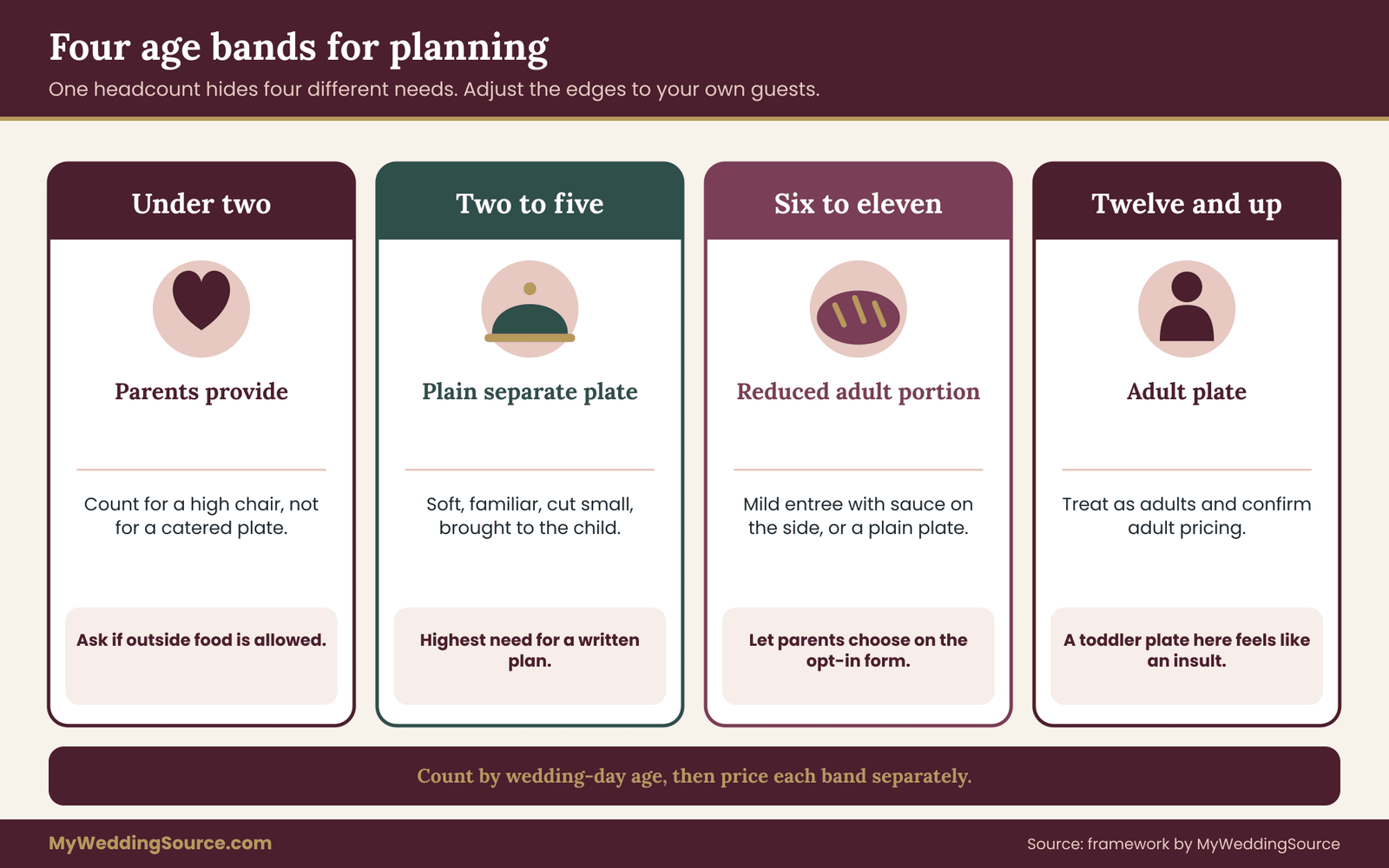
An age-banded plan replaces one number with four. It is the single most useful change you can make, because the best answer for a two-year-old and the best answer for a fourteen-year-old are almost never the same answer.
The bands below are planning groups, not medical categories. Adjust the edges to fit the actual children on your list, and ask the caterer how they define a child plate before you rely on any single cutoff.
Babies and young toddlers, roughly under two. These children almost never need a catered plate. They eat what their parents bring, which may be formula, breast milk, pouches or a few soft foods from home. Count them for seating and for a high chair, not for food. Ask their parents what they plan to bring and whether the venue allows outside food for an infant, and the guide to caring for babies and children at a wedding covers the seating and care side of that.
Toddlers and preschoolers, roughly two to five. This is the band that most needs a deliberate plan. These children eat small amounts, eat them unpredictably and refuse unfamiliar textures. They are also the group where choking risk and allergy exposure matter most, because they cannot judge a food for themselves. For kids meals in this band, a separate plate of plain, soft, familiar food is usually the right answer, served early, cut into small pieces and brought to the child rather than left for a parent to collect.
School-age children, roughly six to eleven. These children can eat much of an adult meal, but many will not, and they get bored quickly. They are happy with a smaller adult portion if the dish is mild, and happy with a separate plate if the choice is familiar. This band is where couples have the most freedom, and where opt-in forms help most, because parents know whether their child will eat a sauced chicken breast or only a plain one.
Older children and teens, roughly twelve and up. Treat these guests as adults for food and ask the caterer whether they are priced as adults. Many teens eat a full portion, and a “child plate” that arrives looking like a toddler’s meal can feel like an insult. If the cost matters, ask whether a reduced adult portion is available, rather than a separate menu for kids meals.
Notice what this does. You no longer have one decision called “kids meals.” You have a small set of decisions, each tied to a group of children and a kind of plate. The caterer can price each one, and you can see which ones are doing the work. Kids meals become a short list of decisions you can review in five minutes.
How to count the children you will actually feed
A list of ages is not yet a plan. Turn it into counts in four steps.
First, list every child you have invited or whose attendance you expect, by name and age on the wedding date, not their age today. A child who is three on the invitation date and four at the wedding moves bands, and the plan should reflect the wedding date.
Second, mark which children are expected to sit at their own table, which will sit with parents, and which will be with a sitter or in a children’s room during dinner. The way the room is arranged changes the kind of meal you need. The seating guide on wedding seating charts explains how those arrangements work in practice.
Third, mark which children will arrive late or leave early. A child who leaves at seven thirty does not need a dessert plate. A child who arrives after the ceremony may need a meal sooner than anyone else.
Fourth, add a small buffer. Families change plans, a cousin’s child may be added by parents who did not mention it, and a few children eat twice. Ask your caterer how they handle a headcount change after the final guarantee, because a buffer you cannot use is just waste.
The count goes on the contract, not in your head
Whatever the count is, it belongs in writing. Caterers typically require a final guarantee of attendees by a deadline some days before the event, and it is easy for children to fall outside that number if they were never entered as a separate group. Put the number of children in each band into your emails to the caterer and into the final guarantee, labeled by service style. If the caterer’s form has only one line for children, add a note to it.
The simplest way to handle kids meals is to serve children the same food as everyone else in a smaller size. It sounds like the obvious choice, and for the right children it is.
How it works
The kitchen plates the same entree for children, with smaller proteins and smaller sides. Many caterers offer this at a reduced price, often described as a percentage of the adult price, though the terms differ and you should ask for the specific number in writing. Some caterers will also swap one component, such as plain pasta in place of a sauced side, at no charge.
The service is easy to schedule because the kids meals are produced in the same service flow as the adults’. The kitchen does not need a separate station, the servers do not need a separate set of instructions, and the kids meals look like the adults’ plates, which matters to older children.
Where it works well
It works for school-age children and teens who eat a normal range of foods. It works for weddings with a strong menu identity, such as a regional or cultural menu, where serving chicken tenders alongside a careful tasting menu would feel strange. It also works where the caterer is a small kitchen with no separate kids meals offering and a short prep line. The dishes the couple chose are the dishes the children eat. Kids meals built this way are the easiest to schedule.
It works particularly well for cultural menus where the children are expected to share the family meal. The same logic holds for any menu built around a family tradition: if the meal is part of the occasion, children eating it is part of the occasion.
Where it fails
It fails for toddlers and preschoolers when the adult menu is rich, spicy, heavily sauced or built on textures young children avoid. A half portion of braised short rib is still short rib. The child will not eat it, the portion goes to waste, and the child is hungry at the first dance.
It fails when the menu has no plain option. If every entree includes a sauce, a spice blend or a mixed dish, a child who eats plainly has nothing to eat. Ask the caterer for a plain version of the entree before assuming that a smaller portion solves anything.
It fails on allergens when children eat the same dishes as the adults and one of those dishes contains something a child cannot have. The same dish may be fine for the adult next to them and unsafe for them. A reduced portion is not a reduced risk.
And it fails when the pricing is not what you assumed. A “children’s portion” priced at three quarters of the adult price is a modest discount for a plate that is half the food. Ask what the price is for the child, what is in it and whether the same number holds for the number of children you actually expect.
Scripts that make this option work
If you choose smaller portions, say so in writing and ask for the exact variations. A message like this is enough:
“For the children aged six to eleven, we would like reduced portions of the adult entree. Please confirm the price, the portion size, and whether you can plate the protein plain, with sauce on the side. Please also confirm which of the entrees contain any of the major allergens.”
Keep the question concrete. “Can you do something for the kids?” gets a general answer. “Can you plate the chicken without sauce and with the side vegetable steamed plain?” gets a yes, a no or a price.
The second approach is a menu written for children. It is the most familiar option and the one most caterers have ready.
How it works
The caterer offers a fixed set of kids meals dishes, often one or two choices, priced as a flat per-child amount. A typical kids meals offering is built from familiar items: a pasta with butter or tomato sauce, a chicken item, a cheese item, and a fruit or vegetable side. Some caterers include a dessert and a drink in the price, and some do not.
The kitchen usually prepares these plates separately, which means they have to be timed and delivered separately. That is the part to plan carefully, because separate plates can be served on a separate clock.
Where it works well
It works for toddlers, preschoolers and young school-age children, where familiarity matters more than anything. It works when the adult menu is adventurous, since a child is not asked to eat an unfamiliar dish. It works when you want to serve the children first, because a separate plate can be produced in advance, and the kitchen can plate and send it out before the adults’ service begins.
It works for managing allergies, if the caterer can prepare it that way. A children’s plate that is built from a short list of plain ingredients is often easier to check than an adult dish with a sauce or a marinade. The question, again, is cross-contact, and the caterer has to answer it, not the couple.
Where it fails
It fails when children are older and notice. A fourteen-year-old handed a plate of nuggets at a formal dinner will feel it. Offer a choice for older children, or let them eat from the adult menu.
It fails when the plate is treated as an afterthought. The kids meals come out cold because they were plated early, or they come out after the adults because the kitchen was busy. Ask how and when kids meals are held, and who is responsible for taking them to the table.
It fails when the menu is rigid. A single option, such as chicken tenders, fails for the child who does not eat meat, the child who does not eat gluten and the child who will not eat anything fried. If the caterer cannot offer a vegetarian or allergy-aware option, ask whether a parent may bring a safe meal for their own child, and whether the caterer will heat and serve it. A rigid set of kids meals is a common complaint from parents.
It fails on cost when the flat per-child price is close to the adult price. A separate menu is sometimes priced at nearly the same level as a reduced adult plate, because the kitchen still has to cook it. Compare the actual price of a separate plate to the actual price of a reduced portion before assuming that “kids” means cheaper.
Choosing the dishes
If you design the plate, keep it plain and flexible. Pick one protein that can be served plain, one starch, one fruit or vegetable that can be cut small, and a drink. Avoid whole grapes, whole nuts, raw hard vegetables in round pieces, popcorn and large chunks of meat for young children, and ask the caterer how they cut these foods for small children. The American Academy of Pediatrics and the Centers for Disease Control and Prevention both publish guidance on choking hazards for young children, and the sources at the end of this guide point to both.
Write the dishes into your own document rather than relying on the caterer’s menu card. The more specific your instruction, the less the kitchen has to guess. “Plain buttered pasta, no sauce, chicken cut into small pieces, cucumber slices cut lengthwise” is a plate. “Kids pasta” is a hope. Your own wording is what the kitchen will follow for kids meals.
The third option is to skip individual kids meals and let children eat from shared dishes, with a parent or a server helping.
How it works
Food arrives in serving dishes at the center of a table, on a family-style service, or on a buffet or station line. Children take what they want, usually with a parent beside them. The caterer may add a few dishes that children tend to like, such as plain pasta, bread, cut fruit or a mild vegetable, so that every table has something familiar on it. Some caterers charge children a reduced rate for shared service, some charge the same as an adult, and some charge a flat kids meals price that is independent of how much a child eats.
This style is common at casual weddings, backyard weddings, home-style cultural meals and receptions where the guest list is largely family. It is the style in which kids meals disappear as a separate category, because the children simply join the meal.
Where it works well
It works when children are used to eating family-style at home and are comfortable choosing for themselves. It works for older children who can serve themselves. It works when parents are sitting with their children and are expected to manage their plates, and it works for families who would rather not be told what their child eats. For those children, kids meals as a separate category are simply unnecessary.
It also works when the menu has a lot of plain, naturally child-friendly components. A spread with rice, roasted vegetables, bread, a mild chicken and a salad gives every child something to eat without a separate menu. The point is not that the food is “kids meals.” The point is that the table offers enough plain choices that none is needed.
Where it fails
It fails for young children who cannot serve themselves, because the plate depends entirely on an adult who may be somewhere else at the moment the food arrives. In a crowded room, a parent who is photographed, dancing or greeting guests when the dishes come out is not helping a three-year-old fill a plate.
It fails for children with food allergies. Shared serving utensils, shared dishes and nearby foods create cross-contact opportunities that are hard to control. A shared platter of a nut-containing dish next to a plain one is a risk that the parent must watch continuously. If any child in the group has an allergy, shared service needs a stricter plan than the other two options, or a separate plate for that child. Shared kids meals need a stricter plan than the other two options.
It fails when the timing is long. Shared dishes at a table of ten take time to pass, and children at the end of the table may wait. If the service is staggered, the youngest children eat last, which is the opposite of what you want.
It fails on cost control. Shared dishes are often priced per person at the adult rate and the portions are generous, which can make the total more than a reduced-portion plan. Ask the caterer to explain how they count children for shared service and whether the kids meals price changes with the style.
And it fails in hygiene and temperature terms if food sits out. Hot food that is left for long stretches in the temperature range between 40 and 140 degrees Fahrenheit is a concern, and the Food Safety and Inspection Service of the U.S. Department of Agriculture publishes the guidance that caterers follow. Children, especially young ones, are more vulnerable to foodborne illness than healthy adults, so ask the caterer how they keep shared dishes hot or cold across the service window.
A hybrid that often works
Many weddings do best with shared dishes for most guests and a separate plate for the youngest children and any child with a restriction. The shared food keeps the menu simple. The separate plate solves the toddler and the allergy problems. If you take this route, you are choosing two options for two age bands, and the age bands make that decision easy to explain to the caterer. Splitting kids meals by age band is the simplest way to do it.
A decision rule for choosing between the three kids meals options
Now you can compare. Rather than debating which option is “best,” run each age band through four questions in order. The first question that gives a firm answer decides the band.
Question one: can the child safely eat the adult food? If a child has an allergy, a medical diet, a strong texture restriction or is young enough that adult food is a choking risk, the answer is a separate, simple plate prepared for that child, whichever service style the rest of the room uses. Stop here for those children.
Question two: will the child actually eat the adult dish? If the parents say yes, a smaller portion of the adult menu is the efficient choice and the child gets what everyone else gets. If they say no or “maybe,” move on.
Question three: is there a reliable adult at the table to manage the plate? If yes, shared dishes may work, because a parent can steer the child to the plain items. If no, because children sit at a separate table or the parents will be busy, choose an individually plated option.
Question four: what does the schedule allow? If the children can be served before the adults, a separate menu is easy to time. If they must be served with the adults, a reduced adult portion keeps the kitchen on a single clock.
Write the answer for each band on a single line. For example: “Under two: parents provide. Two to five: separate plain plate, served early. Six to eleven: reduced adult portion with plain option. Twelve and over: adult plate.” That line is the foundation of the caterer brief you will write later, and it is the line you will use to compare quotes. Those four lines are your whole plan for kids meals.

Using the rule when the family disagrees
Family members often have strong feelings about kids meals. A grandparent may insist that “children need the real meal,” a parent may insist that their child eats only pasta, and a relative may think any separate menu is cheap. The decision rule helps because it moves the conversation from taste and tradition to practical questions about safety, behavior and timing.
If you have to disagree, you can say something calm and short:
“We are offering a reduced portion of the dinner for school-age children and a plain plate for the youngest ones. If your child needs something different, tell us by the response date and we will work it out with the caterer.”
That wording leaves the door open, sets a deadline and does not ask anyone to defend a preference.
When two options are better than one
You do not have to pick one option for the whole wedding. Two is common, and it is usually the right number. The most common pairing is a separate plain plate for the youngest band and a reduced adult portion for everyone else. A second common pairing is shared dishes for all guests with a separate plate for any child who needs one.
A third is a children’s table with its own plated menu while teens sit with the adults and eat from the adult menu. Three or four separate styles in one room is rarely worth the complexity, because the kitchen and the servers have to hold all of them in mind.
Allergies, cross-contact and kids meals
Food allergy is the part of catering for kids meals where a mistake does the most harm, so it gets its own section. This section is a way to ask better questions, not a safety guarantee. No plan can promise an allergen-free meal, and no one should tell a family that one exists.
What to know about allergens
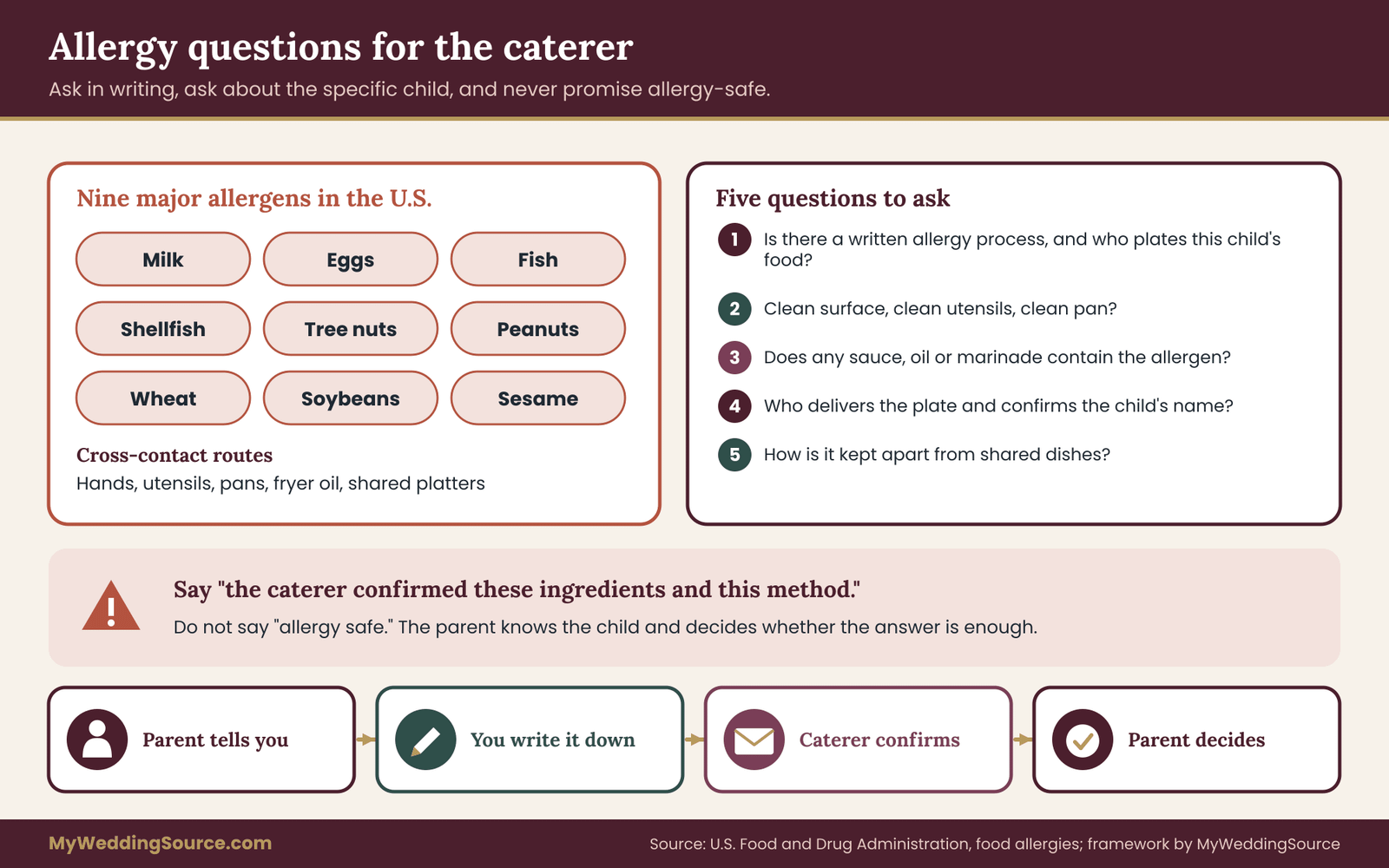
The U.S. Food and Drug Administration identifies nine major food allergens in the United States: milk, eggs, fish, crustacean shellfish, tree nuts, peanuts, wheat, soybeans and sesame. Packaged foods must declare these on the label, and the FDA’s food allergy pages explain what that does and does not cover. A catered meal is not a packaged food, so labels are not there to read, and the information has to come from the kitchen.
Cross-contact is what happens when an allergen is transferred from one food to another, through hands, utensils, surfaces, fryer oil or serving dishes. Cooking does not remove an allergen. The FDA and other agencies describe cross-contact as a main route of unintended exposure, which is why a “nut-free dish” that was made on a surface used for nuts is not nut-free in the sense that a family cares about.
What you can and cannot promise
You can promise that you asked, that you passed the information to the caterer in writing and that you confirmed the answer. You cannot promise that a meal is free of an allergen, and you should not repeat that phrase to a family unless the caterer has told you in writing exactly what they can do and the family has accepted it. Use language like “the caterer has confirmed these ingredients and this preparation method,” not “allergy safe.”
This is not a legal technicality. It is the difference between telling a parent what is known and telling a parent what to rely on. The parent of a child with a severe allergy is the person who knows the child’s tolerance, and they decide whether the information is enough.
Questions to ask the caterer about each allergy
Ask in writing, and ask each question about the specific child’s allergen, not about allergies in general.
Does the kitchen have a written process for allergy requests, and who will prepare this child’s plate? Will the plate be made on a cleaned surface with clean utensils and a clean pan, or in the same space as the allergen? Does any ingredient, sauce, oil or marinade contain the allergen, including in small amounts? Will the plate be labeled and delivered by a named person, and will the server confirm the child’s name at the table? How will the plate be kept separate from shared dishes at the table?
If the answers are vague, treat that as information. A caterer who says “we can accommodate allergies” without describing how is not yet a plan. A caterer who describes the preparation step by step is a more reliable partner, and you can ask a licensed food safety professional to review the process if the stakes are high.
The family’s part
Ask parents of children with allergies to tell you the allergen, the severity as they describe it and whether the child carries emergency medication. Ask them to confirm what the child can eat from the caterer’s description, and tell them directly that you are passing the information on and cannot guarantee the outcome. Parents often bring a meal for their own child, and the caterer may be willing to heat and serve it. Ask the caterer about that option in advance, since some kitchens and venues have rules about outside food.
Make sure at least one adult at the venue, other than the couple, knows which children have allergies, where their parents are and what the plan is if something goes wrong. The couple should not carry that responsibility on the wedding day.
The family opt-in: how parents tell you what kids meals they need
You cannot plan kids meals well from a guest list alone. A list tells you that a child is invited. It does not tell you whether the child will eat the entree, whether a parent is bringing food, or whether the child has an allergy. The simplest solution is an opt-in form: a short set of questions that families answer by a fixed date, with a default plan if they do not.
Why opt-in works better than opt-out
An opt-out system says “your child will get the children’s meal unless you tell us otherwise.” It produces wasted plates, because many families do not read the fine print and many children will not eat what was ordered. An opt-in system says “tell us what your child needs by this date, and here are the choices.” It produces accurate counts and gives parents a feeling of control, which most of them appreciate. Opt-out kids meals produce waste.
Opt-in does not mean refusing to feed children who were not reported. It means you have a default for non-responders that you have chosen in advance. A typical default is the reduced adult portion for children over five and a plain separate plate for younger children, and you tell the families what that default is.
Where to collect the answers
If you already collect responses through a wedding website or a reply card, add the children’s questions there. The guide on RSVP etiquette covers the wording of response requests, and the same tone works for a meal question: plain, specific and with a date. If you are not collecting responses online, a short message to the parents, by text or email, with a single deadline works as well.
Collect answers about children in the same place and at the same time as the adult responses, because families answer once and resent being asked twice. If you must follow up, send one reminder, not three.
What to ask
Keep the form short. Six questions are enough, and they should be answerable without a conversation. A short form gets more answers about kids meals.
For each child, ask for the first name and age on the wedding date. Ask which meal the family prefers from the options you offer, written in plain terms, such as “a small portion of the adult dinner,” “a plain children’s plate” or “we will bring our own food.” Ask whether the child has any food allergies or dietary needs the caterer should know, and ask the parent to describe them in their own words.
Ask whether the child will sit with the parents or at a children’s table. Ask whether the child will need a high chair or booster seat. And ask whether the child will arrive late or leave early.
Do not ask for medical documentation, and do not ask for details beyond what the caterer needs. The parent decides how much to say. The form’s job is to surface the information that changes what is on the plate.
Sample opt-in wording
A short note on a wedding website or in a message works well. Adapt it to your voice.
“We want every child to have a good meal. For each child in your family, please let us know their age on the wedding day, whether they would like a small portion of the adult dinner or a plain children’s plate, and any food allergies we should pass to our caterer. Please reply by the response date. If we do not hear from you, we will plan a plain children’s plate for children under six and a smaller adult portion for children six and older.”
That message states the goal, lists the choices, gives a deadline and describes the default. It does not promise what the caterer cannot deliver and it does not ask parents to defend their choices.
What to do with the answers
Put the answers in a single sheet, one row per child, with columns for age, band, meal choice, allergy note, seating and arrival. Then count by band and by choice. The counts are what you send to the caterer, and the allergy notes are what you read twice.
Check the sheet against the guest list, so that no child is missing. Check it against the seating plan, so that every child with an allergy is seated where a named adult can see them and where servers know the child’s name or table. Check it against any children’s care arrangement, so that a child who will be in a separate room during dinner has a plan to be fed. Kids meals planning depends on that cross-check.
What if families do not respond
Some will not. Send one reminder a week before the deadline, and tell the families what the default will be. Then apply the default without drama. If a family later says the default is wrong, adjust if the caterer’s guarantee allows it. If the guarantee has passed, tell the family honestly that you cannot change it and suggest they bring a snack for the child, which the caterer or venue may allow.
Writing the caterer instructions for kids meals
The caterer should receive one page that covers the children, not a trail of messages. A single written brief prevents the most common failure, which is that the person who takes the order and the person who plates the food never speak to each other.
What the one-page brief contains
Start with the counts, by age band and by service style. For example: three children under two, who need no plate; six children aged two to five, who need a plain separate plate; nine children aged six to eleven, who need a reduced adult portion; five children aged twelve and over, who need an adult plate. Add the number of each band that has a recorded allergy or restriction.
List each allergy or restriction on its own line, with the child’s first name, the allergen and the parent’s note. Add the caterer’s confirmation of how each will be handled once you have it.
State the timing. Say when the kids meals should be served, relative to the schedule, and who has authority to approve a change. Say where each child will sit, and whether kids meals should be brought to the table or collected from a station.
Describe the plate. Name the dishes, the cut and the temperature. Specify that foods that pose a choking risk for young children should be cut or avoided, and list the foods you want to avoid. Include drinks, and say whether water, milk or juice is available.
State the pricing. Copy the caterer’s quoted price for each band and the age cutoffs they use, so that both sides are working from the same numbers.
End with the contact: the person on the day who can answer questions, and the person the caterer should call if a child’s plate has a problem. This is a named person who is not the couple.

A sample brief in prose
The brief does not need to be elaborate. A version that works looks like this:
“Kids meals for the reception. Counts: six children aged two to five (plain plate), nine aged six to eleven (reduced adult portion), five aged twelve and over (adult plate). Under two years: no plate. Allergies: one child aged four with a peanut allergy at table nine, one child aged seven with an egg allergy at table nine.
Please confirm in writing how these two plates will be prepared and delivered. Service: kids meals at the start of dinner, before the adult entrees, brought to the table by a named server. Plain plate: buttered pasta, chicken cut into small pieces, cucumber and melon in small pieces, milk or water. Our day-of contact is the venue coordinator.”
Everything that matters is there: numbers, restrictions, timing and a named person. That is all a caterer needs to price kids meals correctly.
Questions worth asking before you sign
Use these to compare caterers, and write down the answers.
How do you define a child for pricing, and by what age? What is the price for each type of kids meals service you offer? Is a child’s dessert or drink included? Can children be served before the adults, and how do you hold their plates? How do you handle a child with a food allergy, and who prepares that plate?
Can a parent bring a meal for their own child, and will you heat and serve it? What is the deadline for the final count, and what happens to a child who is added or removed afterward? What happens to leftover kids meals, and is there a charge for plates that go unused?
The last question matters more than it looks. Some caterers charge for plates they prepared whether or not they were eaten, and some will box leftovers. Knowing in advance prevents a surprise.
Reading the quote line by line
When the quote arrives, compare it with your brief. Look for the line labeled “children,” and check what it includes. Check whether the age cutoffs match. Check whether service charges and taxes apply to the kids meals price in the same way as to the adult price. Check whether the kids meals are counted in the minimum spend or minimum guest count the caterer requires.
If the venue has a minimum, the guide to reviewing a wedding vendor contract shows where those numbers tend to appear. Then ask for a revised quote if anything is unclear. A clear quote costs a day and can save an awkward argument at the final payment.
Timing and service: when kids meals should reach the table
A children’s meal that is perfect on paper fails if it arrives at the wrong moment. Timing is the part of kids meals that couples control least, because the schedule belongs to the whole reception, and it is the part that determines whether a child is cheerful or exhausted.
Serve the children early, if you can
The strongest single improvement is to serve children before the adults. Young children get hungry on a different clock, and a plate that arrives while a child still has energy is eaten, while one that arrives after a long wait is not. If the schedule permits, serve the kids meals when guests are seated, or during the last part of the cocktail hour, so that the children are finished before the first adult course arrives.
Serving early also helps the adults. Parents who have finished helping a child with dinner can eat their own meal in peace, make toasts without interruption and dance later. It is a small kindness that guests remember. Early kids meals are one of the kindest things a couple can arrange.
The tradeoff is that early service needs a clear signal to the kitchen and the servers. Someone must know that the kids meals go first, that they are a priority and who delivers them. Put that in the brief and repeat it to the venue coordinator on the day. The guide to the wedding cocktail hour explains how that part of the evening can be organized, and a kids meals snack table there can bridge the gap if dinner will start late.
A bridge snack for the long wait
If dinner is more than an hour after the ceremony, children will be hungry before they are served. A small bridge, such as bread, cut fruit, cheese cubes or crackers, put out during the cocktail hour or on arrival, keeps the youngest children comfortable without spoiling their dinner. It does not have to come from the caterer. Many couples ask the caterer to add a plain platter, which also helps adults who are hungry early.
Be careful with what you put out. Check that the bridge snack does not contain a major allergen that a child at the party cannot have, and keep the platter away from the plates of children with allergies. Cut foods small, and avoid whole grapes, whole nuts and similar items for young children.
Where the children sit
Where children sit changes how they eat. Three arrangements are common.
Children sit with their parents. This works for the youngest children, because a parent can help, and for shared service, because a parent can serve. The kitchen needs to know which children at a family table need a plate, since the table’s count will otherwise be adults only. Tell the servers which seats belong to children.
Children sit at a children’s table. This works for school-age children who enjoy being with other children. It needs a responsible adult nearby, such as a relative or a hired caregiver, because children’s tables fall apart without supervision. It also makes serving easy, since the plates all go to one place. The guide to guest care and children at weddings covers supervision in more detail.
Children sit in a separate room or with a sitter during dinner. This works at long evening receptions and for babies and toddlers who need quiet. The food has to travel to the room, so someone needs to be responsible for that. Do not assume the caterer will find the room on their own.
Whatever the arrangement, record it on the seating chart and give the servers a copy that shows which seats are children’s. The wedding reception flow guide, designing guest flow from entry to exit, explains how food, seating and movement fit together in the room.

Service during a plated, buffet or family-style dinner
The three service styles change how kids meals are handled.
At a plated dinner, kids meals can be produced on their own track. The risk is that the servers treat the kids meals as lower priority than the adults’, and they sit under heat lamps. Ask that the kids meals be sent out first, and that a named server be responsible for them.
At a buffet, children are at the mercy of the line. Ask whether children can go first, ask whether the line has a children’s station with plain options at a height they can reach, and ask whether the buffet has sneeze guards and serving utensils that are changed or cleaned during service. Parents will have to accompany the young children, so tell the guests that. Kids meals at a buffet need the most advance planning.
At a family-style dinner, food arrives for the table. Ask the caterer to add one or two plain dishes to every table that has children, and ask them to place the allergy plate separately, with a name card or a note, so it does not get mixed into the shared dishes.
Food safety on a long evening
Food safety matters more with children. The USDA Food Safety and Inspection Service explains the temperature range between 40 and 140 degrees Fahrenheit in which bacteria multiply quickly, and recommends limits on how long perishable food stays in it. A caterer follows these standards as a matter of course, but it is reasonable to ask how they hold kids meals if they are prepared early, and how they keep cold items, such as cut fruit and dairy, cold.
For anything that comes from home, such as a parent’s own meal for a child, ask the venue and caterer about reheating and storage. If a parent brings a cooler, find out where it can stay and how it will be kept cold.
What kids meals actually cost: the cost logic
Do not guess about price. You can reason about it with a short checklist, using the numbers on your own quote, and you will see where the money goes. This section describes the logic, not typical prices, because prices differ by region, caterer and menu. Use the figures on your own quote. The cost of kids meals can be reasoned out in advance.
Four ways caterers price children
Caterers usually use one of four approaches, and you should know which one yours uses.
A percentage of the adult price is the most common approach for reduced portions. The caterer takes the adult per-person price and applies a percentage. The percentage and the age range are negotiable.
A flat kids meals price is common for separate menus. The caterer sets one price for a children’s plate, regardless of what the adult price is.
A full adult price with no discount is common for shared service and for older children. If the child eats from the shared dishes, the caterer counts them as a guest.
A free or near-free price for the youngest children is common for babies and toddlers who do not eat from the caterer’s menu. Some caterers charge a service or rental fee, such as for a high chair, and some do not.
Where costs hide
Three places surprise couples. First, service charges and taxes. A percentage added to the food total applies to kids meals too, so a small discount on the plate is a smaller discount after the added charges. Second, minimums. A venue or caterer minimum may be based on the number of guests, and whether children count toward it can change what you owe.
Third, unused plates. If you order a plate for every child and half do not eat it, you have paid for food that went in the trash. A few uneaten plates are the cost of safety, since a plate for a child with an allergy has to exist even if the child eats less than expected.
A way to compare the three options in numbers
You can compare the three options with arithmetic you do yourself. Take the number of children in each band. Multiply each count by the price per child for each option, using your caterer’s actual figures. Add any extra fees for service, rental, labor or a separate station. Add the cost of the bridge snack if you plan one. The totals are what the options cost you.
Then add the cost you cannot see on the quote. A separate menu may need extra servers, and a shared service may need extra food because adults eat from the kids meals dishes. A reduced portion may need an extra plain item. These are the places where the cheapest per-plate option stops being the cheapest total. If the difference between two options is small, choose the one that is safer and easier to serve, because the difference will not matter once the day goes wrong.
Where to save, and where not to
Save money by not ordering plates for babies who will eat from home, by using reduced portions for children who will actually eat them, and by limiting the kids meals menu to one or two simple dishes. Save money by serving a plain, familiar plate rather than a fancy one. Careful counts keep kids meals affordable.
Do not save money by skipping the allergy plate, by cutting the bridge snack when the wait is long, or by seating children where no adult can reach them. These are the places where a small cost prevents a large problem.
If you are tracking the whole food budget, the wedding budget guide explains how to set up categories so that kids meals service sits on its own line rather than disappearing into the dinner total. Seeing it on its own line makes the decisions above easier to check.
A worked example of kids meals for one reception
Numbers make the framework concrete. The couple below is invented, and so are the prices. The point is the sequence of decisions, not the figures, so substitute your own. This example shows how kids meals are planned from first headcount to the final plate.
The setup
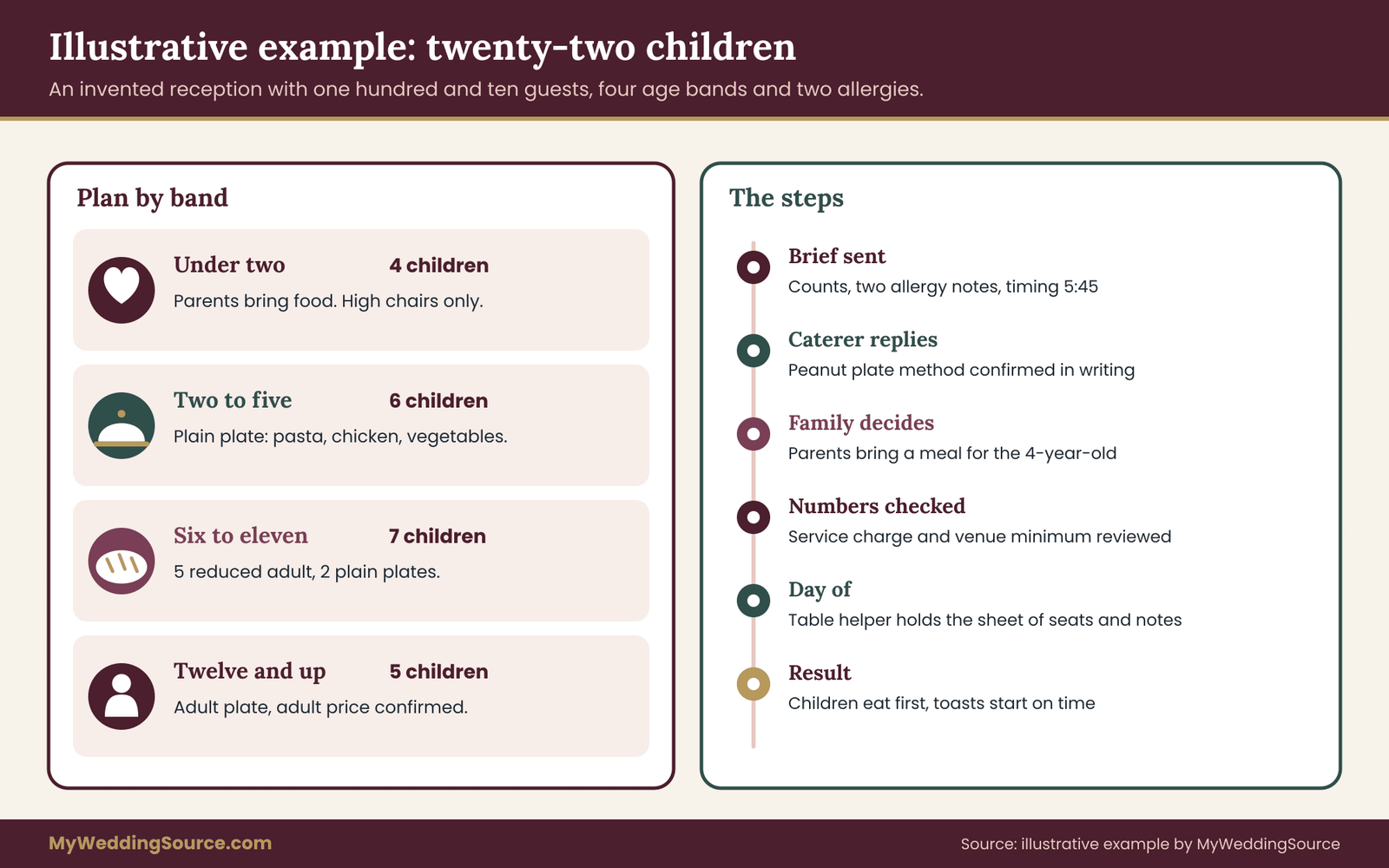
Imagine a reception for one hundred and ten guests at a venue that serves a plated dinner. Twenty-two of the guests are children, listed by age on the wedding date: four under two, six aged two to five, seven aged six to eleven and five aged twelve and over. Two of the children have a recorded allergy, a four-year-old with a peanut allergy and a nine-year-old with an egg allergy. The ceremony ends at four thirty, the cocktail hour runs to five thirty, and the adult entrees are planned for six fifteen.
The couple’s goals are modest. They want the youngest children fed before they fall apart, they want the older children to feel like guests rather than an afterthought, and they want the two allergies handled with care rather than with promises. Their approach to kids meals is deliberately plain.
Step one: run each band through the decision rule
The four under two need no plate. Their parents will bring food, and the couple confirms that the venue allows it. The count goes to the venue for high chairs, not to the caterer for meals.
The six children aged two to five fail the first question for adult food, since the entree is a braised dish with a sauce. They get a plain separate plate. The four-year-old with the peanut allergy is in this group, so the caterer must describe how that plate is prepared.
The seven children aged six to eleven are in the middle. The couple asks parents through the opt-in form. Five families choose a reduced portion of the adult chicken entree, with the sauce on the side, and two choose the plain plate. The nine-year-old with the egg allergy is in this group, and the family chooses the reduced portion, provided the caterer confirms that the sauce and the side contain no egg.
The five aged twelve and over get an adult plate. The couple asks the caterer to confirm they are priced as adults, and the caterer does.
Step two: send the brief
The couple writes a one-page brief and sends it to the caterer. It lists three counts: six plain plates, five reduced adult portions with sauce on the side and two reduced portions served plain, and five adult plates. It lists the two allergies with the parents’ own descriptions. It asks the caterer to confirm in writing how the peanut-allergy plate will be made, and which of the sauces and sides contain egg. It asks for the kids meals to be served at five forty five, before the adult entrees, and to be carried to the table by a named server.
The caterer replies that the plain plate is buttered pasta with chicken, cut small, and steamed vegetables. The caterer confirms that the peanut-allergy plate will be prepared first on a cleaned surface with clean utensils, but says that the kitchen handles peanuts in other dishes, so it cannot promise an environment free of them. The couple passes that answer to the child’s parents exactly as written. The parents decide to bring a meal for their child from home, which the caterer agrees to heat and serve.
That outcome is a good one. Nobody was promised something the kitchen could not deliver, and the family made the final call.
Step three: the numbers
Suppose the caterer quotes the adult plate at a certain price per person, the reduced portion at a lower price, and the plain plate at a flat kids meals price. The couple multiplies each count by its price. They add the service charge, which applies to every line. They notice that the five reduced portions cost only a little less than the adult plates after the service charge, and ask whether the discount applies before or after it. The caterer explains that the discount applies to the food price, and the charge is added afterward, which is the normal order.
The couple also adds a bridge snack of bread, cheese cubes and cut melon at the cocktail hour, which costs a small amount. They decide it is worth it, because the plain plates are not served until five forty five and the children have been up since the morning.
Last, they check the minimum guest count in the venue contract. The four babies do not eat from the menu, and the couple asks whether they count toward the minimum. They do not, and the couple confirms that the number the venue uses matches the one on the caterer’s quote. If the two had disagreed, this is the point at which the couple would have found out, and not at the final payment.
Step four: the day
On the wedding day, a family member is assigned as the children’s table helper, and the venue coordinator holds a printed sheet listing each child’s seat, band and allergy note. The servers have the same sheet. The bridge snack goes out at the start of the cocktail hour. The plain plates and the reduced portions go out at five forty five, brought by a named server. The parents of the peanut-allergy child collect the home-prepared meal from the kitchen at five thirty and check it on the way to the table.
Nothing dramatic happens, which is what a good plan looks like. The children eat, the adults eat after them and the speeches start on time. That is what well-planned kids meals look like.
Common problems with wedding kids meals and how to prevent them
Most failures in catering for kids meals are small and predictable. Here are the ones that come up most often, with the step that prevents each.
The count is wrong. The caterer has one number for children, the venue has another, and the guest list has a third. Prevent it by keeping one sheet of children’s counts by band and sending the same numbers to every vendor, updated on the same date.
The plates arrive late or cold. Children’s plates are treated as a lower priority. Prevent it by naming a server and a time in the brief, and by asking the coordinator to check on it the day before.
The meal is the wrong kind for the child. A toddler gets a sauced adult dish, or a teenager gets a toddler plate. Prevent it by using age bands and the opt-in form, and by reading the plan once against the actual list of children.
A parent did not tell you about an allergy. The child’s plate is not prepared in a way that suits them. Prevent it by asking every family a direct allergy question with a deadline, and by telling every family that late information may not be accommodated.
The caterer does not know an allergy exists. The couple knew, the parent knew, the caterer did not. Prevent it by sending allergy information in writing, getting written confirmation of how it will be handled and giving a named person on the day a copy.
A shared dish contaminates a safe plate. An allergy plate sits next to a shared platter, or a serving utensil moves between dishes. Prevent it by keeping the plate separate, labeling it and having a named adult in charge of it.
Food waste and overspend. Plates are ordered for children who do not eat them. Prevent it by counting by band, using opt-in, and asking in advance what happens to unused plates.
An adult eats the kids meals. It happens at family-style tables, and the kids meals dishes are gone before the children arrive. Prevent it by asking the caterer to portion kids meals dishes separately and to serve them first.
What to do when the plan fails on the day
Even a good plan can fail. A child refuses the plate. A late guest arrives with children. A server misplaces an allergy plate. The rule for those moments is to have one person with authority, who is not the couple, and who knows where the extra food is.
Ask the caterer in advance whether they keep a small reserve of plain items, such as bread, pasta or fruit, for a child who refuses the plate or for a child who was not counted. Ask who decides about a late addition. If a child has an allergic reaction, the response is the one the parents and a medical professional have agreed on, and an adult at the event should know where the child’s parents are and how to call emergency services. A venue address and the nearest emergency number on the day sheet cost nothing.
Edge cases that change the kids meals plan
Some situations do not fit the standard plan. Each of these changes one or two decisions, and none needs a new system. Kids meals can be adjusted for each of them without a new system.
Only a few children are invited
At a mostly adult reception with three or four children, a separate menu for kids meals is rarely worth it. The kitchen may not want to prepare a handful of different plates, and the per-plate price may be higher than a reduced adult portion. For kids meals in a small group, ask for a reduced portion with a plain protein and sides, and ask each family what their child eats. If a child will not eat anything on the menu, a parent-supplied meal that the caterer heats is often easier than a custom plate.
Children are in the wedding party
Flower children and ring bearers eat on a different schedule from other children. They are often dressed, photographed and managed in a tight sequence, and they may miss the bridge snack or the early service. Assign one adult to the children in the wedding party and give them a plan to eat before the ceremony, with something simple that does not stain. The care side is a separate job, and the food side is simply a plain meal at a predictable time.
Cultural, religious or family food rules
Children may follow dietary rules from their family’s faith or culture, such as halal, kosher or vegetarian practices. Ask in the opt-in form whether a child follows a particular diet, and pass the answer to the caterer, who will tell you what they can and cannot offer. A kitchen that cannot prepare a certified meal may be able to arrange one from a specialist supplier, and a parent may prefer to bring a meal. Treat the family’s rule as a fact to plan around, not as a preference to be negotiated.
Children with sensory or texture restrictions
Some children eat a very narrow range of foods for reasons that have nothing to do with allergy. A parent knows what the child will eat and often travels with it. Ask the family what would help, and offer to ask the caterer for a specific plain food or to heat a meal brought from home. Do not treat it as a behavior problem. A child who eats a safe, familiar meal at a wedding is a child who is not melting down at the toast.
The venue limits outside food
Some venues and caterers prohibit outside food or require that it be handled by their staff. Ask early, because the answer decides whether a parent can bring a meal for an allergic or restricted child. If outside food is not allowed, ask whether the venue makes an exception for medical or allergy reasons, and ask the caterer to describe what they can do. Get the answer in writing, because the venue manager on the day may not be the person who agreed to it.
Dessert and the wedding cake
Children care about dessert more than almost anything else on the menu. Decide whether children get cake, a separate kids meals dessert or the same dessert bar as the adults, and check it for allergens. A cake with nuts, egg or dairy needs to be labeled, and a child with an allergy may need a separate treat that a parent supplies.
Tell the caterer or the baker whether children will have their own dessert, so it is counted. The wedding cake guides on this site cover servings and cutting, and the children’s portion can be a small slice or a cupcake. Kids meals include dessert in the minds of most children.
Late-evening children
At a reception that runs late, children who arrive after dinner or stay past it will want food again. A late snack table, a few pizzas or sandwiches or simple finger foods, can help. If it is an option, order it from the caterer and set a time, so that it does not appear in a haphazard way. Ask the caterer whether late snacks are priced separately.
A day-of checklist for kids meals
On the wedding day, the couple should be doing something other than checking on the kids meals. This list helps hand off the job. Print it and give it to the person in charge. A written list keeps kids meals from becoming the couple’s job on the day.
Confirm the final counts by band with the caterer in the morning, and confirm that the kids meals are in production. Confirm the timing for the bridge snack and for the kids meals, and the name of the server who will deliver them. Check that the allergy plates are labeled, that the preparation was done as agreed and that the server knows the child’s name and table. Walk the room and check that the children’s seats are marked and that high chairs and boosters are in place.
Make sure the sheet with every child’s allergy note and seat is with the coordinator and the table helper. Make sure the parents of children with allergies know where their child’s plate is coming from and who to ask. Check that drinks for children are available, including water, and that cups suit small hands.
During service, the coordinator watches the first plates go out and confirms that the kids meals went to the right tables. After the meal, they check with the caterer about any unused plates and note anything that should change next time.
If you do the work in advance, this list takes minutes. If you do not, it can take over the day.
Your next steps
Pick one evening this week and do three things. First, sort the children on your guest list into the four age bands, using their age on the wedding date, and write one line for each band saying which of the three options it gets. Second, write the opt-in message and set a response date that is at least two weeks before the caterer’s final guarantee.
Third, write the one-page caterer brief with the counts, the allergy notes, the timing and the pricing questions, and send it with a request for written confirmation. Kids meals are a good first task because the answers are quick to collect.
Then keep it simple. Update the sheet as responses arrive, send one reminder, send the final counts to the caterer and the venue on the same day, and give a named person on the day a copy of the sheet. When the plan lives on one page, your kids meals are one of the least stressful parts of the reception, and the children, who have the least patience of anyone in the room, get to eat when they are hungry. For the wider question of balancing the whole menu, return to the guide on wedding menu planning across ages and diets.
FAQ
How much should a wedding kids meal cost?
There is no fixed number, because prices vary by region, caterer and menu. Caterers usually price children as a percentage of the adult plate, as a flat kids meals price or at the full adult price, and some add service charges and taxes. Ask for the price for each age band in writing, along with the age cutoff and what the plate includes, then compare the totals using your own counts.
At what age should a child get a children’s plate instead of an adult plate?
There is no single rule, and caterers set their own cutoffs, so ask for theirs in writing. Many couples use a plain children’s plate for ages two to five, a reduced adult portion for ages six to eleven and an adult plate from twelve up. Treat those ages as planning bands and adjust them for the actual children and the parents’ answers.
Do babies and toddlers need a catered meal?
Usually not. Babies and young toddlers typically eat what their parents bring, such as formula, milk, pouches or soft foods, and may share bites of a parent’s plate. Count them for seating and high chairs, ask whether the venue allows food brought from home, and ask the caterer whether there is a charge for a child who does not eat from the menu.
Is it better to serve children first or with the adults?
Serving children first usually works better, because young children get hungry earlier and become difficult to feed if they wait. Ask the caterer whether kids meals can go out before the adult entrees, who will deliver them and how they will be held. If the schedule does not allow that, a bridge snack at the cocktail hour helps.
How do we handle a child with a food allergy at the reception?
Ask the parents for the allergen and any notes in writing by a set date, pass them to the caterer in writing and ask how the plate will be prepared, labeled and delivered. Do not promise an allergy-safe meal. Tell the parents what the caterer confirmed and let them decide, including whether to bring their own food. Review the FDA’s food allergy pages for background.
Can parents bring their own food for a child?
Often, but it depends on the venue and the caterer, so ask early and get the answer in writing. Some will heat and serve a parent’s meal, and some prohibit outside food except for medical reasons. This is especially useful for children with allergies, strict diets or narrow food preferences, and it is better to agree on it in advance than to discuss it at the door.
Are shared, family-style dishes safe for children?
They can be, for older children with a parent nearby, but they are harder to manage for young children and for any child with an allergy. Shared utensils and dishes allow cross-contact, and food may sit out between servings. If you choose shared service, ask the caterer how they keep food at safe temperatures and how an allergy plate will be kept separate.
What should we tell the caterer about children?
Give the caterer one written page with the counts by age band, the meal type for each, each child’s allergy or dietary note, the seating, the serving time and the pricing you were quoted. Add the name of a day-of contact who is not you. Ask for written confirmation of how allergy plates will be prepared and delivered, and send the same final counts to the venue.
Sources
- Food allergies, U.S. Food and Drug Administration
- Food safety, U.S. Food and Drug Administration
- Food allergies, Centers for Disease Control and Prevention
- Food safety, Centers for Disease Control and Prevention
- Danger zone, 40 F to 140 F, USDA Food Safety and Inspection Service
- Safe food handling, USDA Food Safety and Inspection Service
- Federal food safety information, FoodSafety.gov
- MyPlate, U.S. Department of Agriculture
- HealthyChildren.org, American Academy of Pediatrics