
A heritage wedding menu is a dinner built around dishes that carry your family’s history, and the hard part is not the cooking but the hiring: finding a caterer who can make those dishes well, and describing them to guests honestly. This guide gives you a two-document method, a written family recipe brief and a caterer capability interview, so you can choose a kitchen without overselling what it can do.
For a heritage wedding menu, before you contact any caterer, write a one-page brief for each dish you care about: its name, who in the family makes it, the parts that cannot change, the parts that can, and the ingredients you know are in it. Sort each dish into one of three claim levels so you know what you may truthfully say on the menu card. Then ask every candidate the same questions about experience, technique, sourcing, scale and allergens. Taste before you sign, and put dish descriptions and ingredient rules into the contract. Never accept an allergy promise you cannot verify.
Almost every couple who wants a heritage wedding menu has a picture in mind. It might be a grandmother’s slow-cooked stew, a dumpling that takes an entire afternoon of folding, a rice dish that has to be served at a particular moment, or a dessert that someone’s aunt makes for every family occasion and nobody has ever written down. The picture is emotional, and it is specific. It is also very hard to hand to a stranger and say, “please make this for a hundred and twenty people.”
Two things tend to go wrong. The first is capability. A catering company can be excellent at plated chicken and still have no idea how to build a traditional dish that depends on a particular method, a particular ingredient or a particular texture. The second is description. A menu card that says “Grandma’s authentic recipe” over a dish a kitchen invented last Tuesday sets up a small dishonesty that the older relatives will notice before the first course is cleared, and that other guests may repeat for years.
This article treats both problems of a heritage wedding menu as things you can prepare for. It is written for couples who are hiring a professional caterer, as opposed to cooking at home or asking relatives to cook, though some of the thinking carries over. It is written for any heritage, and for any heritage wedding menu: the method does not depend on which cuisine you are starting from, and it does not assume that your caterer shares your background or that they do not. What matters is whether a kitchen can reproduce a defined thing and whether you describe it truthfully.
A note on scope. This is general information, not legal, tax or financial advice. Food safety rules, licensing and labeling vary by state and locality, and your caterer’s permits and your venue’s policies decide what is allowed in your case, so the guide points you to the agencies that publish the current rules.
A standard wedding dinner is built from a catalog, and a heritage wedding menu is not. The caterer has a few proteins, a few starches, a few vegetables, and a set of sauces that have been scaled up many times. Most of what makes those dishes work at volume has already been solved. The kitchen knows how long a tray takes in the oven, how many portions come out of a pan, and what holds well on a buffet line for ninety minutes.
A heritage wedding menu pulls the opposite way. The dishes you care about were designed for a family table, usually for six to twelve people, and usually cooked by someone who adjusts by taste. The recipe may exist only as a memory. The ingredient may be hard to find. The technique may break down when you multiply it by twenty. Several specific problems show up again and again when a heritage wedding menu meets a catering kitchen.
The recipe was never written down. Many family dishes live in a cook’s hands. Quantities are “a handful,” timing is “until it looks right,” and the proportions shift with the weather or the season. A caterer cannot copy a feeling. Someone has to turn the dish into numbers and steps before a professional kitchen can reproduce it, and that someone is usually you, with help from the relative who makes it.
The method does not scale in a straight line. A pot of stew for eight does not simply become fifteen pots for a hundred and twenty. Browning, reducing, resting and holding all behave differently in volume. Some dishes, such as hand-rolled or hand-folded items, scale by labor rather than by pan size, and the labor has a real cost that does not appear on a standard per-plate quote.
The ingredient is specialized. A particular chile, flour, fermented paste, cut of meat, fish, or fat may be central to the dish. A caterer who substitutes a similar-looking ingredient has changed the dish, whether or not they tell you. Some ingredients are available from regional suppliers only, and some have lead times.
The dish has an order and a moment. Certain foods are served in a set sequence, at a set point in a ceremony or celebration, or eaten in a particular way. A caterer who treats a meaningful dish as just another station will place it badly. This is a question about meaning, and it needs a conversation with your family as well as with the kitchen.
The claim attached to the dish matters. If the card, the toast or the website says a dish is traditional, or authentic, or your family’s own, you have made a statement that people may rely on. Guests who share that heritage will judge it. Guests who do not will take your word for it.
None of this means a heritage wedding menu is a bad idea or that it needs a specialist caterer from the same background. It means the ordinary way of choosing a caterer, which is to look at a sample menu, taste a few items and compare quotes, does not test the right things. You need a different set of questions, and you need to ask them before you fall in love with a venue package that includes catering you cannot change.
What this guide leaves to other pages
Several neighboring questions are covered elsewhere on the site. The broad topic of building a full dinner, including service styles, courses, dietary mixes and budgeting per plate, belongs to the wedding menu planning guide. Cocktail hour food, passed appetizers and bar choices have their own page, the wedding cocktail hour guide. This article stays narrower. It is about hiring for specific traditional dishes, deciding what you can truthfully say about them, and verifying that the kitchen can do what it says.
If you are still weighing venues or considering a package that bundles catering, read the venue’s catering terms before anything else. Some venues require their own caterer or a short approved list, and that constraint changes how much of this guide you can use. The later sections show how to handle that situation as well.
The method for a heritage wedding menu rests on two documents that you write, and one scale that you apply to every dish. They are short on purpose. If a document runs past a page it will not get used.
Document one is the family recipe brief. There is one card per dish. It says what the dish is, who makes it, what must not change, what can change, what you know about the ingredients, and what you want guests to understand about it. It is the thing you hand to a caterer so they are answering your question and not their own.
Document two is the caterer capability interview. It is a fixed list of questions asked in the same order of every candidate, with room to write down what they said. Using the same questions for every kitchen makes the answers comparable, and it protects you from the charm of the last person you spoke to.
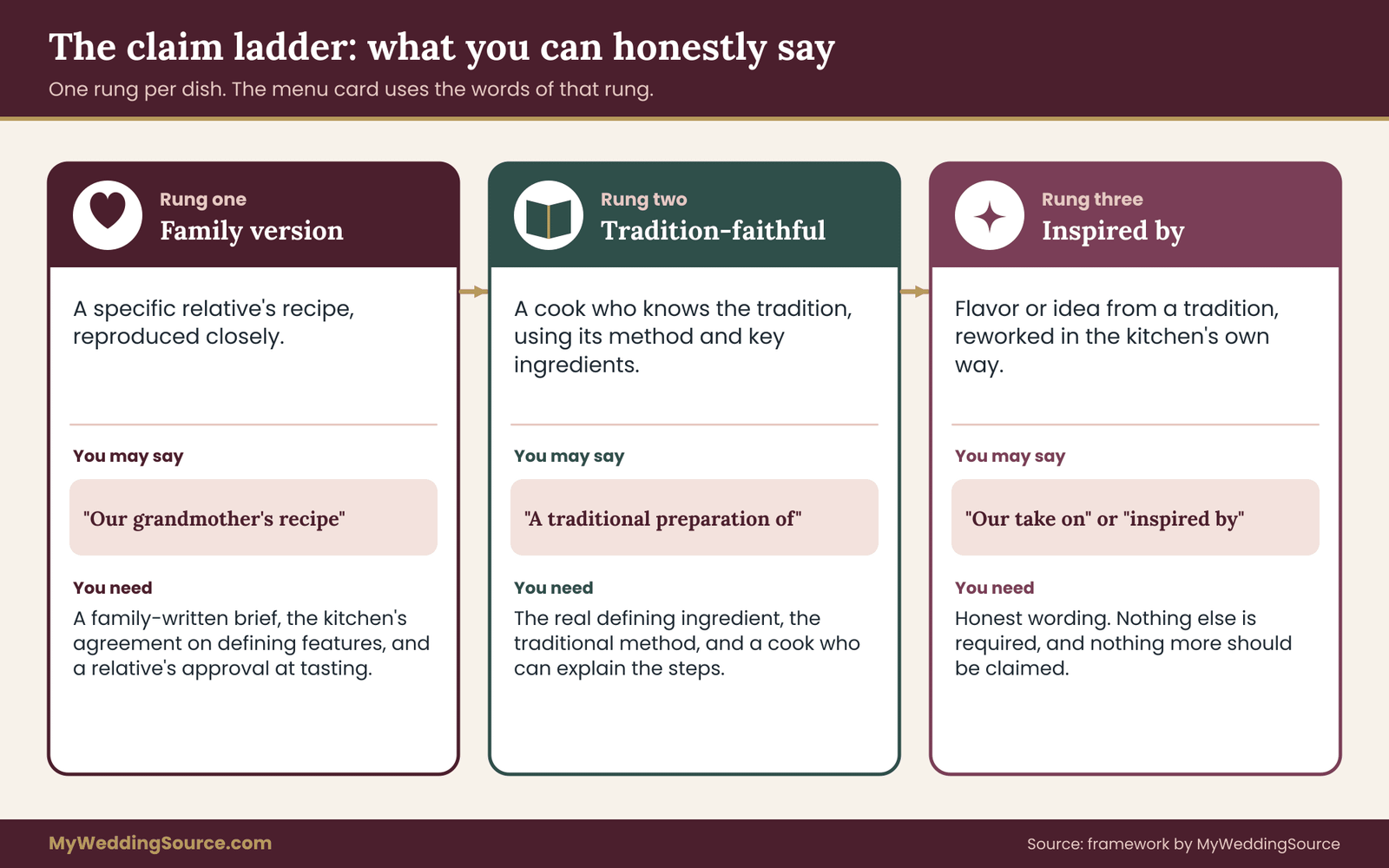
The scale is the claim ladder. It has three rungs. A dish is either a family version, a tradition-faithful version, or an inspired-by version. Each rung permits different words on the menu card and implies different expectations from the kitchen. Assigning a rung to every dish is the single most useful decision in planning a heritage wedding menu, and it is covered in its own section below.
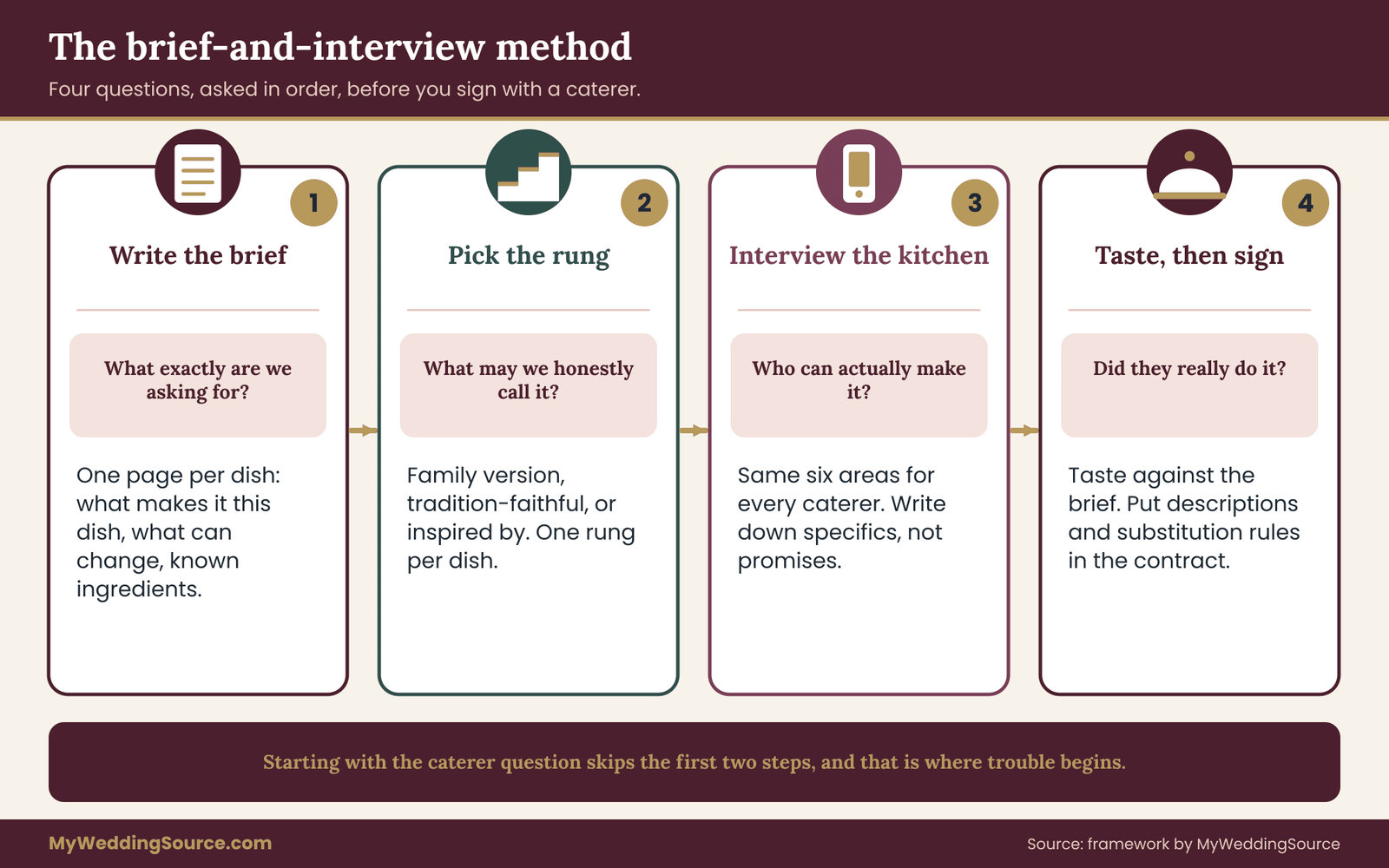
Together the two documents and the ladder answer four questions, in order.
- What exactly are we asking for? The brief.
- What may we honestly call it? The ladder.
- Who can actually make it? The interview.
- Did they really do it? The tasting and the contract.
The order matters on a heritage wedding menu. Couples often start with question three, ask caterers whether they can “do” a cuisine, and receive reassuring answers that mean very little. The phrase “we can do Italian” or “we do a lot of Indian weddings” tells you the caterer is willing, not that they can reproduce your grandmother’s version of a particular dish. A brief and a ladder rung turn a vague hope into something a kitchen can say yes or no to.
Three kinds of couples, and how the method bends
Not everyone starts from the same place, so it helps to say how the method adapts.
Some couples share one heritage and want most of the menu to reflect it. For them the main risk is scope. A full dinner of traditional dishes asks a lot of one kitchen, and the method will probably push them to keep a few core dishes at the family or tradition-faithful rung and let the rest be simpler.
Some couples combine two heritages, and each partner has a short list of dishes that matter to their family. Here the risk is balance and sequencing. The briefs help each side say what they care about without a family negotiation happening at the tasting. A shared page also lets you notice, early, if one family’s dishes are all labor-heavy and the other’s are all easy.
Some couples want a single meaningful dish, perhaps one course, one station or a late-night snack, inside an otherwise ordinary dinner. A heritage wedding menu of one dish still counts. For them the method is lighter. One brief, one claim rung, and one targeted interview may be enough, and the contract can focus on that dish alone.
Whichever group you are in, the same logic applies to your heritage wedding menu: write down the dish, decide what you can claim, test the kitchen, and record the agreement.
The brief for a heritage wedding menu is not a recipe. If you have a full written recipe, attach it, but the brief does something different. It captures the identity of the dish, which is the set of features that make it recognizably itself, and separates those from everything a caterer is free to adjust. A kitchen that reads a good brief can make decisions without calling you at ten o’clock the night before.
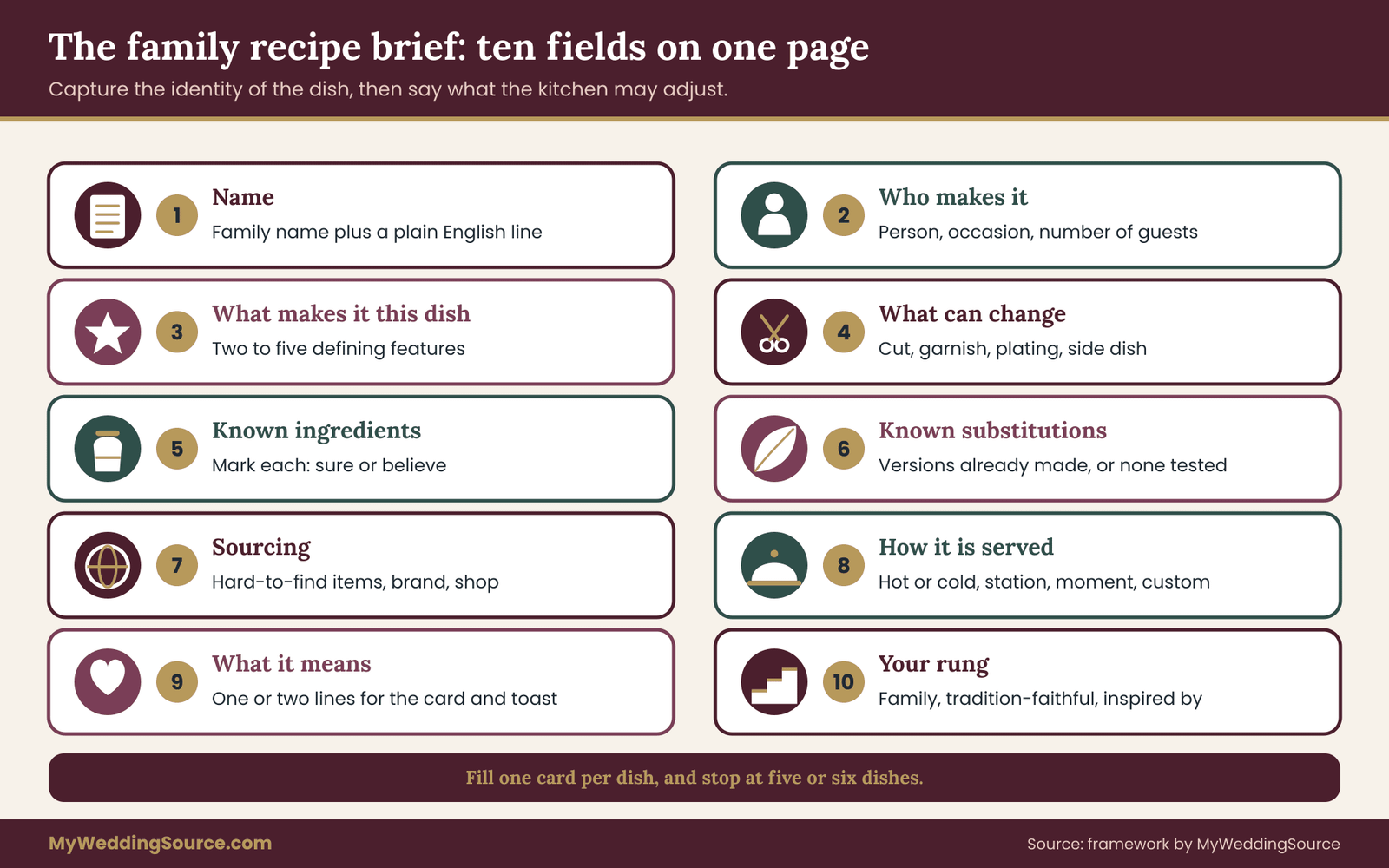
Here is the card for a heritage wedding menu in its plainest form. Fill one in for each dish you plan to serve, and keep each to a single page.
The ten fields
One: name. Use the name your family uses, and add a plain English description if the name is not obvious. A guest who reads only the English line should understand what they are about to eat.
Two: who makes it. Write the person, the occasion and the setting. “Aunt Rosa, every Christmas Eve, for about thirty people” tells a caterer more than any adjective. If the person is willing to talk to the kitchen, say so, and ask whether they can attend a tasting or a prep session. If the person has died, say what you remember and who else holds the knowledge.
Three: what makes it this dish. List the two to five features that define it. These might be a main ingredient, a cooking method, a texture, a sauce base, a spice blend, or the way it is served. If a feature were removed, would your family still call it the same dish? If not, it belongs on this list. This is the most important field on the card.
Four: what can change. List what the kitchen may adjust without asking. Portion size, garnish, plating, side dishes, a different cut of the same protein, or a vessel for serving are common examples. Being explicit about flexibility makes you easier to work with, and it keeps the kitchen from treating every detail as sacred or none of it.
Five: known ingredients. Write what you are sure is in the dish, including fats, sauces, stocks, thickeners, and anything that came from a jar or a bag in the family’s usual version. Mark each as “sure” or “believe.” This field exists for allergens and dietary needs as much as for flavor, and the distinction between knowing and believing will matter later, because you cannot pass belief along to a guest as fact.
Six: known substitutions. If the family already makes the dish two ways, for example one version for a guest who avoids a certain ingredient, record both. If you have never tried it without a particular ingredient, say that too.
Seven: sourcing. Note any ingredient that is hard to find or brand-dependent. If the family always buys a certain product from a certain shop, write the product and the shop. A caterer may be able to order the same thing, or may tell you honestly that it cannot be sourced in the quantity you need.
Eight: when and how it is served. Hot, cold, room temperature, at the table, from a station, passed, at a specific moment, with a specific accompaniment. If a ritual or a custom attaches to it, describe it briefly in your own words and state whether the kitchen needs to be involved.
Nine: what the dish means to the family. One or two sentences. This is not for the caterer’s recipe; it is for the person writing the menu card and for the person who will give the toast. It also reminds you, when you are tired of negotiating, why this dish is on the list.
Ten: your rung. The claim level you expect to be able to honestly use. You may revise it after the tasting, and the next section explains what the three levels mean.
A short filled example
The card below is invented, and it is meant to show the level of detail, not to describe any real family’s recipe.
Name: Sunday braise, as the family calls it. A slow-cooked beef and onion dish served over egg noodles.
Who makes it: The groom’s grandfather, most Sundays in winter, for six to ten people.
What makes it this dish: The beef is browned hard before braising. The onions cook down until they nearly disappear. The sauce is thin and savory, not thick, and finished with a little vinegar. It is served over wide egg noodles, never rice.
What can change: Cut of beef within the same braising family, serving vessel, garnish, and the vegetable served beside it.
Known ingredients (sure): Beef, onion, vegetable oil, black pepper, vinegar, egg noodles. Believe: A spoonful of tomato paste and a bay leaf.
Known substitutions: None tested.
Sourcing: The noodles come from a local bakery and are not a packaged brand.
Served: Hot, in a deep dish at the table, with the noodles under the beef.
Rung: Family version.
That card is short. It already tells a caterer what to test, what to leave alone, and what to verify. It also tells the couple what they still do not know: the tomato paste and the bay leaf are beliefs, and the bakery noodles are a sourcing problem. The brief has already earned its place.
How to gather the facts when nobody wrote anything down
Most of the work of a brief for a heritage wedding menu is conversation. Ask the person who cooks the dish whether you can watch, and bring a notebook or your phone. Measure what they do, because a handful of salt is a quantity you can weigh later. Ask what they do when something goes wrong, because the corrective moves often reveal the defining features of the dish.
Take photographs of the dish at several stages, not only the finished plate. A caterer can match the color of the browning or the thickness of the sauce from a picture more reliably than from a sentence. Note any equipment that matters, such as a particular pot, a steamer or a wooden spoon, because those details sometimes explain a texture that the ingredient list does not.
If the person is not available, ask two other relatives to describe the dish independently, then compare the answers. Where they agree, you have likely found a defining feature. Where they disagree, you have found a variation, and that is useful too, because it tells you where flexibility already exists in the family itself.
The word “authentic” causes more trouble than any other word in this subject. It sounds like a fact, but it is a judgment, and people judge it differently depending on where they grew up, which generation they belong to and which cook taught them. Two relatives from the same village can disagree about whether a dish is made correctly. A professional chef from the region may cook it in a way your family would not recognize. Neither is lying.
Because the word cannot be settled, this guide avoids relying on it. Instead of asking whether a dish is authentic, ask what the kitchen is actually doing and what you can truthfully say about it. The claim ladder has three rungs, and each is defined by something you can check.
Rung one: family version
A family version is a dish made the way a specific person in your family makes it, reproduced as closely as the kitchen can manage. The claim you may make is about the family and not about a culture: “our grandmother’s recipe,” “the way my father makes it,” “adapted from my aunt’s braise.”
To use this rung honestly you need three things. You need a written brief that comes from the family. You need a caterer who has agreed to the defining features in that brief. And you need a tasting that a family member has approved. If any of the three is missing, the words “our family’s recipe” on a menu card are a stretch.
The family rung is the most personal and the most demanding rung of a heritage wedding menu. It asks the kitchen to subordinate its own habits to someone else’s, and not every caterer will accept that. It is also the rung where a relative’s approval counts for more than any outside opinion.
Rung two: tradition-faithful
A tradition-faithful dish is made by a cook who knows the culinary tradition, using the methods and the key ingredients that tradition uses, even though it is not your family’s particular version. The claim you may make is about the dish as a type: “a traditional preparation of,” “made in the regional style,” “prepared with the classic technique.”
On a heritage wedding menu this is often the realistic rung for dishes your family eats but does not cook from a handed-down recipe, or for dishes you want on the menu because they belong to your heritage even though no one in your household makes them. It works well when you hire a caterer who comes from that tradition or has trained in it, and it works when the kitchen is willing to follow the method and not simplify it.
What you can check is concrete. Does the kitchen use the defining ingredient and not a stand-in? Does the cook follow the technique that the tradition treats as essential? Can they explain the steps in plain language? If the answers are yes, the claim is reasonable. If the answers are vague, drop to the next rung.
Rung three: inspired by
An inspired-by dish takes a flavor, an idea or a format from a tradition and reworks it. The kitchen uses its own methods and available ingredients. The claim you may make is modest and accurate: “inspired by,” “our take on,” “a modern version of.”
There is nothing second-class about this rung on a heritage wedding menu. Many caterers do their best work here, and many guests prefer a dish that tastes good and is described honestly to one that claims a pedigree it cannot back up. The error is not choosing this rung. The error is putting a dish on this rung and describing it as if it belonged on one of the others.
The rule that holds the ladder together
Every dish on the heritage wedding menu gets one rung, written on its brief, and the menu card uses the language of that rung. If the tasting shows the kitchen cannot reach the rung you hoped for, you have two honest options. You can move the dish down the ladder and change the wording. Or you can change the kitchen. You cannot keep the wording and hope for the best.
That rule sounds severe, but it removes a great deal of anxiety. Once the rung is assigned, the question “is this authentic enough?” stops being an open debate at the dinner table and becomes a question with an answer: does the dish meet the standard of its rung?
Worked examples of rung decisions
A few short scenarios show how the ladder behaves. They are invented, and the dishes are described in general terms.
A bride’s mother makes a particular filled pastry every holiday and has agreed to demonstrate it for the caterer. The caterer has made similar pastries before, follows the demonstration, and produces a sample the mother approves with one adjustment. This is a family version. The card can say it is the mother’s recipe, because it is.
A groom wants a noodle dish served at weddings in his grandparents’ home region, but nobody in the family cooks it. He finds a caterer who trained in that region’s cooking and who makes the dish in the traditional way, with the traditional broth base. This is tradition-faithful. The card can name the region and the dish, and it should not say “my grandmother’s recipe.”
A couple loves a spiced rice dish from one partner’s heritage but cannot find a caterer who can make it traditionally at their scale. The kitchen proposes a version using a standard rice pilaf technique with a similar seasoning blend. This is inspired by. The card says so. The couple may decide it is not worth including, and that is also a good outcome.
Why this protects your relationships, not only your guests
A menu card for a heritage wedding menu is read by family. A dish described in a way that overstates its origin can feel like a small insult to the person who actually makes the real thing. An aunt who has brought that dish to every gathering for forty years may be quietly hurt to see a caterer’s version described as the family’s own, or described as more traditional than hers.
The ladder lets you be generous. A family version can credit the cook by name. A tradition-faithful dish can credit the tradition. An inspired-by dish can credit the caterer’s interpretation. Each rung has someone to thank, and thanking the right person is a good thing to do on a wedding day.
What not to claim
A few claims cause trouble on any heritage wedding menu, regardless of rung, and they are worth avoiding in your own materials.
Do not say a dish is “the” authentic version of anything. There is rarely one version, and the word invites argument.
Do not say a dish is “traditional” if it has been changed to suit a modern kitchen in ways you know about, such as replacing the defining fat or the defining cooking method.
Do not say “homemade” or “made from scratch” unless you can verify it, because the caterer may use purchased components, and because a claim about preparation can matter for allergens and food safety as well as taste.
Do not borrow the name of a restaurant, a brand or a protected regional product unless the actual item is used. Some food names are tied to a place or a producer, and using them for something else is misleading. If you are unsure, describe the dish plainly and leave the protected name off.
Do not describe any dish as safe for an allergy, allergen-free or free from a particular ingredient unless a person responsible for the kitchen has confirmed it in writing and you are repeating exactly what they said. The Food and Drug Administration publishes the list of major food allergens on its food allergy page, and that page is the place to start when you are listing ingredients.
Where you search shapes what you find when you are hiring for a heritage wedding menu. A search for “wedding caterer” returns companies that specialize in weddings, and most of them are excellent at doing what weddings usually need. A heritage wedding menu often needs something narrower, and the best candidates may not have the word “wedding” in their name at all.
Start with the places where the food is already cooked well
For a heritage wedding menu, restaurants that serve the cuisine you want are an obvious source, especially family-run ones that cook the dishes you have in mind every day. Many restaurants cater events, and some have a separate catering arm. Ask whether they cater weddings of your size, whether they can scale the specific dishes, and whether they hold the permits to cater off-site.
Cultural and community organizations are another source. A community center, a house of worship, a cultural society or a grocery that serves a particular community often knows which cooks and caterers handle large celebrations. Referrals from these places are worth more than a listing because the people recommending the caterer are also the people who will judge the food.
Venues sometimes keep a list of approved caterers that includes specialists. Ask the venue coordinator directly whether any approved caterer has cooked your cuisine. Do not assume the answer is no because the list looks generic.
Families who have held similar weddings are the fourth source. If a relative or friend had a wedding with food from the same tradition, ask who cooked and what they would do differently. A direct recommendation from someone who has been through the same process saves a great deal of time.
Do not assume a cultural match decides your heritage wedding menu
There are two opposite assumptions to avoid. One is that only a caterer from the same background can cook your food. The other is that any good chef can cook anything. Both are wrong often enough to cost you.
A caterer from a community may know the food deeply, or may run a modern catering company that adapts it heavily. A caterer from outside the community may have trained with a cook from the tradition, spent years specializing, and be more careful than a relative. The thing you are testing for your heritage wedding menu is the kitchen’s actual ability to reproduce defined dishes, and that shows up in the answers to specific questions, not in the caterer’s name or biography.
For the same reason, treat enthusiasm as information but not as evidence. A caterer who says “I love that dish, I’ll figure it out” may be sincere and may still not be ready. The capability interview in the next section separates what a caterer hopes to do from what they have done.
Home cooks, cottage food rules and why permits matter
Some of the best cooks of traditional dishes are not licensed caterers, which complicates a heritage wedding menu. A relative’s neighbor who makes the best version of a dish in the community may offer to cook for your wedding, and it can be tempting. Two questions need a clear answer before you say yes.
The first is legal. Rules about selling or serving food prepared in a home kitchen vary widely. Many places permit limited categories of home-made food for sale under cottage food laws, and those categories usually exclude foods that need temperature control, such as meat, dairy, cooked rice and many sauces.
A wedding dinner, and a heritage wedding menu in particular, is largely made of the foods that fall outside such rules. Your local health department can tell you what is allowed. The Food and Drug Administration’s Food Code is the model that most state and local rules are built on, and it is a useful background reference even though your local rules are what apply.
The second is practical. A home cook who has never served a hundred and twenty people may not have the equipment, the refrigeration, the transport or the staff. Venues often require that a caterer hold a license and carry insurance. If your venue does, a home cook will not be allowed to serve.
There are middle paths. A licensed caterer can prepare most of the dinner while a relative or community cook is brought in to teach the kitchen one dish, or to provide a small, clearly labeled, non-hazardous item such as a dry cookie or a sealed sweet that the rules permit. Another path is a family dish served at a separate, informal event such as a rehearsal dinner, a brunch or a family gathering, where the rules and the stakes are different.
What to ask for before you book a call
Before speaking with any candidate about your heritage wedding menu, send each the same short message and see how they respond. A good message includes your date, your guest count, your venue, a rough budget range for food, a list of the dishes you want to discuss with the rung you have given each one, and a request for sample menus and any examples of similar dishes they have made. Mention that you have written briefs and will share them on the call.
The way a caterer answers this message is itself useful. A company that responds specifically, mentions the dishes by name and asks sensible questions is behaving differently from one that sends a standard package PDF. You are not judging politeness. You are judging whether the kitchen is listening to the actual request.
When you begin to compare quotes, the wedding vendor contract guide explains what a contract normally has to include, and the wedding vendor due diligence checklist lists the general background checks, such as licenses and insurance, that apply to every vendor. This guide focuses on the food-specific questions for a heritage wedding menu that sit on top of those basics.
The interview for a heritage wedding menu is a conversation of forty-five minutes to an hour, ideally by video or in the caterer’s kitchen. Ask the same questions of every candidate and write the answers down. You are looking for specifics: names of dishes, quantities, methods, suppliers and past events. Confidence is cheap. Detail is hard to fake.
Bring the briefs. Share them at the start of the call, one dish at a time, and ask for the caterer’s first reaction before you ask anything else. Their reaction to the card tells you a lot. A kitchen that reads “what makes it this dish” and says “so the browning and the noodles are fixed, and I can move the garnish” is already working with you. A kitchen that says “sure, we can do that” without a follow-up question is not.
The questions below for a heritage wedding menu are grouped into six areas. They are not a script to read aloud like a form. They are a list to make sure you leave the call with every answer.
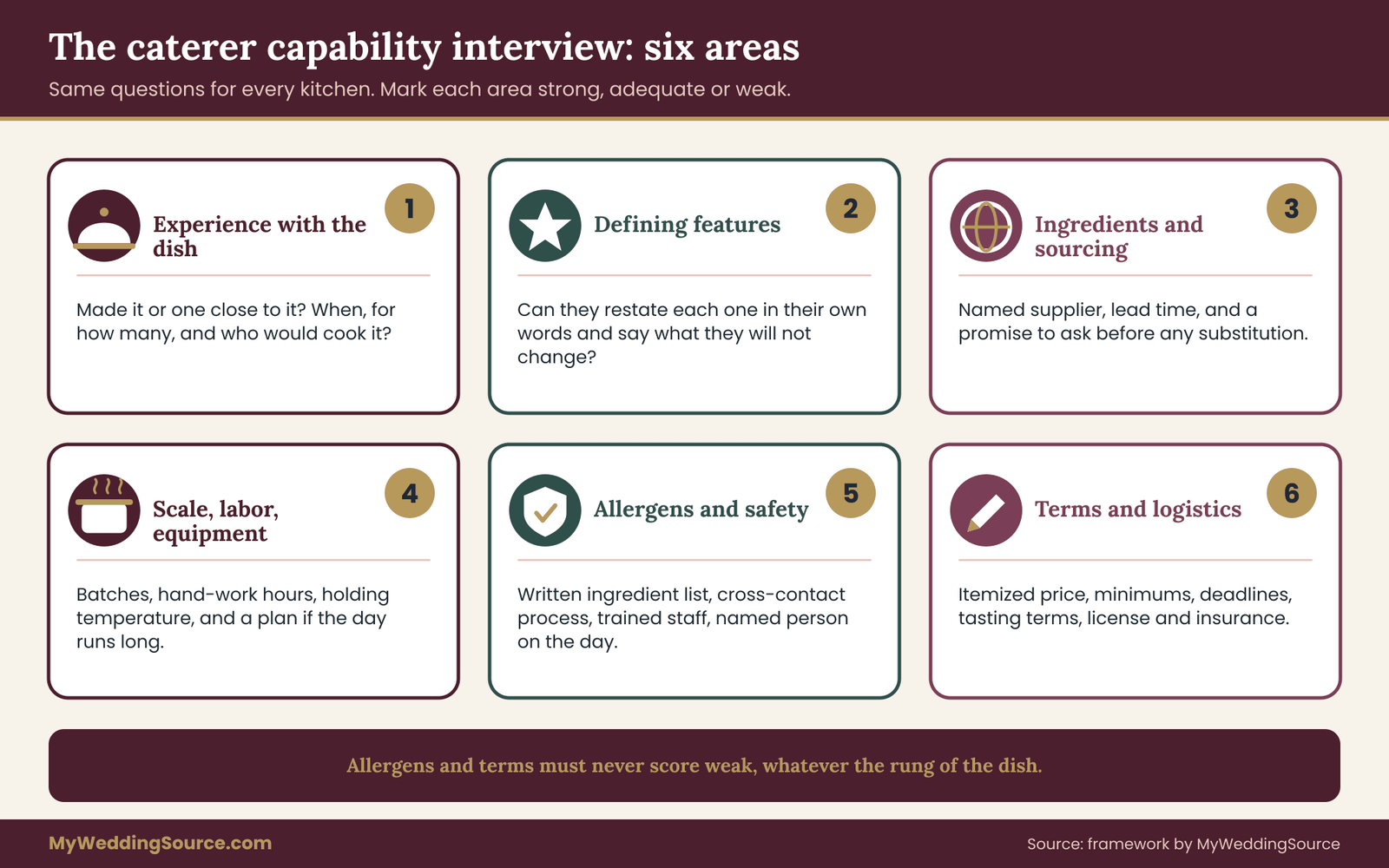
Area one: experience with this specific dish
Have you made this dish, or one very close to it, for an event? When, and for how many people? What did you do to make it work at that size?
Who in your kitchen would actually cook it? Have they cooked it before, or is it a new item for the team?
Where did you learn the technique? A caterer might have learned from a relative, a former employer, a cooking program or a period of work in a particular region. Any of these is fine. What you want is a real answer, not a deflection.
What is the hardest part of this dish at volume, and what would you change to make it hold? A knowledgeable cook answers this immediately. A cook who has not thought about it will say “nothing, it’s easy.”
Area two: the defining features
Read back the features you listed in “what makes it this dish.” Ask whether the kitchen can honor each one. Ask them to say, in their own words, what they will do about the browning, the sauce, the texture or whatever your card names.
Ask what they would substitute if a certain ingredient were unavailable, and whether they would tell you first. The right answer is that they would call you and not change it quietly.
Ask how they would handle a dish that does not hold well. Many traditional dishes are best served immediately and degrade on a buffet. A good caterer will suggest a service style or a timing that suits the dish. Ask them to explain the reasoning, because that reasoning shows whether they understand the food.
Area three: ingredients and sourcing
Where do you buy the defining ingredient? Is it in stock year-round, and how far ahead do you need to order?
If the ingredient is hard to find, will you tell me when you have confirmed the supply? Can you give me the brand or the supplier name?
How will you handle a shortage or a substitution that affects the dish? Will you ask me before you change anything on the brief?
Can you list every ingredient in the dish, including stocks, sauces, oils, thickeners and seasoning blends? Will you put it in writing? This question matters twice: it protects the integrity of the dish, and it protects any guest with a food allergy.
Area four: scale, labor and equipment
How many portions of this dish can you produce in a single batch, and how many batches will you need for my guest count? What does the production schedule look like on the wedding day and the day before?
Does the dish depend on hand work, such as folding, rolling, shaping, stuffing or wrapping? If so, how many people, for how many hours, and is the cost in the quote?
What equipment does it need? Do you have it, or will you rent it? If the venue kitchen is small or limited, how will you manage?
How will you hold the dish between cooking and serving, at what temperature and for how long? What happens if the ceremony runs long?
Area five: allergens, diet and kitchen safety
Which of the major allergens does this dish contain, according to your ingredient list? Which could be present by cross-contact in your kitchen? How do you prevent it?
What training do your staff have in allergen awareness and safe food handling? Is someone on the team certified in food protection, and does the license in your jurisdiction require it?
How do you handle a guest who reports an allergy at the table? Who is the responsible person on the day?
Will you tell guests the ingredients on request, in writing, for each dish? Will you provide a printed ingredient list for the day?
A good answer to the allergy questions describes a process. A weak answer promises safety. No kitchen can promise that an allergen will never reach a plate, and a caterer who says otherwise is telling you something about how they work.
Area six: terms and logistics
What is your per-plate price for this heritage wedding menu, and what does it include? What is charged separately for labor-heavy items, special ingredients, rentals and service staff?
What are your minimums, deadlines for final counts and policies for changes?
What do you need from me, and by when? Will you cook a tasting of the dishes on this card? Is it free, credited toward the final bill, or charged?
What happens if a key person is unavailable on the day? Is the dish’s preparation dependent on one cook?
Do you hold a current food service license for the area where the event will take place, and general liability insurance? Can you provide a copy of the certificate? The broader checklist for these background items is on the site’s vendor due diligence page.
Scoring the interview without turning it into a spreadsheet
After each call, give the caterer one of three marks for each of the six areas: strong, adequate or weak. A strong mark means the answers were specific and the kitchen asked its own questions. An adequate mark means the answers were fine but general. A weak mark means evasion, over-promising or silence.
No area should be weak for a dish that sits at the family or tradition-faithful rung. For a dish at the inspired-by rung, weak marks in area one or two are acceptable, because you are not asking the kitchen to reproduce a particular thing. Allergens and terms must not be weak for any dish.
If two candidates for the heritage wedding menu score about the same, do not choose by price at this stage. Hold both for the tasting, which tests the one thing the interview cannot.
Warning signs worth taking seriously
A few behaviors in an interview about a heritage wedding menu deserve caution.
The caterer promises to match a family recipe they have not read or tasted. A kitchen that agrees to everything before it has seen the card has not listened.
The caterer cannot name a supplier for the defining ingredient, or says “we’ll use something similar” without asking you.
The caterer speaks dismissively about the dish or the tradition, or treats your requests as something to be talked out of. A professional can push back with reasons. Dismissiveness is a different thing.
The caterer will not put ingredient lists or allergen information in writing. This is a firm line. You need that information for your own guests, and a kitchen that does not keep it is a kitchen that does not control it.
The caterer will not do a tasting of the dishes you care about, or will only show you items from their regular menu. If the dishes matter enough to hire for, they matter enough to taste.
A tasting is the only part of choosing a heritage wedding menu caterer that tests the food itself, and it is easy to waste. Two kinds of mistakes are common. Couples attend alone, taste a series of small portions in a quiet room, say “this is lovely,” and leave without having tested the thing they care about. Or they bring relatives who are so keen to be kind that no one gives an honest answer.
Plan the tasting of your heritage wedding menu so it can say no.

Who should come
Bring the partner whose family the dish belongs to. Bring one relative who knows the dish well, preferably the person who makes it, and who is willing to be honest. If that person cannot attend, ask them to send a short written description of what the finished dish should look and taste like, and read it aloud before the first bite.
Bring one person whose job is to judge calmly, perhaps the other partner or a friend. Their role is to notice when the room is being polite.
Keep the group small. Four people can give honest feedback. Eight cannot.
What to taste, and in what form
Taste the dishes of your heritage wedding menu that you care about first, before anything else tires your palate. Taste them in the form they will be served: if the dish will be held on a buffet, ask whether the kitchen can hold a portion for the same length of time and serve it after that. A dish that is excellent from the pan and flat after forty minutes in a warming tray is a problem you want to find now.
Ask for a portion scaled the way the kitchen will make it for the wedding, not a special pot made for you. If the sample is cooked in a small, careful batch, it tells you what the best case looks like, but not what a batch for a hundred and twenty will taste like. Ask the caterer honestly how the sample was made and how the production version will differ.
Taste against the brief, not against your memory
Memory flatters when you judge a heritage wedding menu. The dish you remember from childhood is a blend of the dish itself, the room, the people and your age. Use the brief as the standard. Go through the defining features one at a time and ask: is the browning there, is the sauce the right thickness, is the texture right?
Write short notes in three columns on paper: what matches, what is different but acceptable, and what is wrong. A difference that is acceptable is a change within the “what can change” field. A difference that is wrong is a defining feature that the kitchen missed. Be specific. “Needs more salt” is useless; “the sauce is thick and this dish is thin” is useful.
If the person who knows the dish says it is not right, believe them. Ask what is missing, and ask the kitchen whether the gap is something they can fix. If they can, ask for a second tasting of just that dish. If they cannot, move the dish down a rung or find another kitchen.
The signs of a good tasting
A kitchen that is right for your heritage wedding menu will often do several things unprompted. It will ask what you think and write down the answer. It will explain what it changed and why. It will tell you what is easy at volume and what is not. It may say “this version was made with the closest ingredient we could find, and I would like to source the real one before the wedding.” That sentence is a sign of respect for the dish.
A kitchen that is not right will treat the tasting as a sales moment. The plates will be handsome, the descriptions vague, and the answers to difficult questions will be redirected to the price.
After the tasting
Send the caterer a written summary within a day or two. Name each dish, say what matched, say what needs to change, and say what you want to see again. This protects both sides, because a verbal comment fades and a written one becomes part of the file. It also gives you the first draft of a contract clause.
If you are hiring more than one vendor for different parts of the heritage wedding menu, keep a single tracking sheet. The wedding vendor purchase order checklist shows how to keep orders, quantities and delivery details straight across several suppliers, which is useful when specialized ingredients or rentals come from outside the main caterer.
Traditional dishes are not riskier than modern ones, but they are often less documented, and a heritage wedding menu therefore needs more paperwork. A catering company with a printed menu has an ingredient list for every item. A family dish may have been made for decades without anyone writing down what is in the sauce. That gap is where most problems on a heritage wedding menu begin.
The principle is simple. Every dish served must have a written ingredient list that someone responsible for the kitchen has checked, and every guest who needs that information must be able to get it. The rest of this section shows how to build that list when the recipe started as a family memory.
Turn the brief into an ingredient list
Go back to field five on each heritage wedding menu card, the one that separates “sure” from “believe.” The caterer will need to convert it into a complete list, and that conversion has to be done by looking at actual packages, not by recalling what the family usually buys.
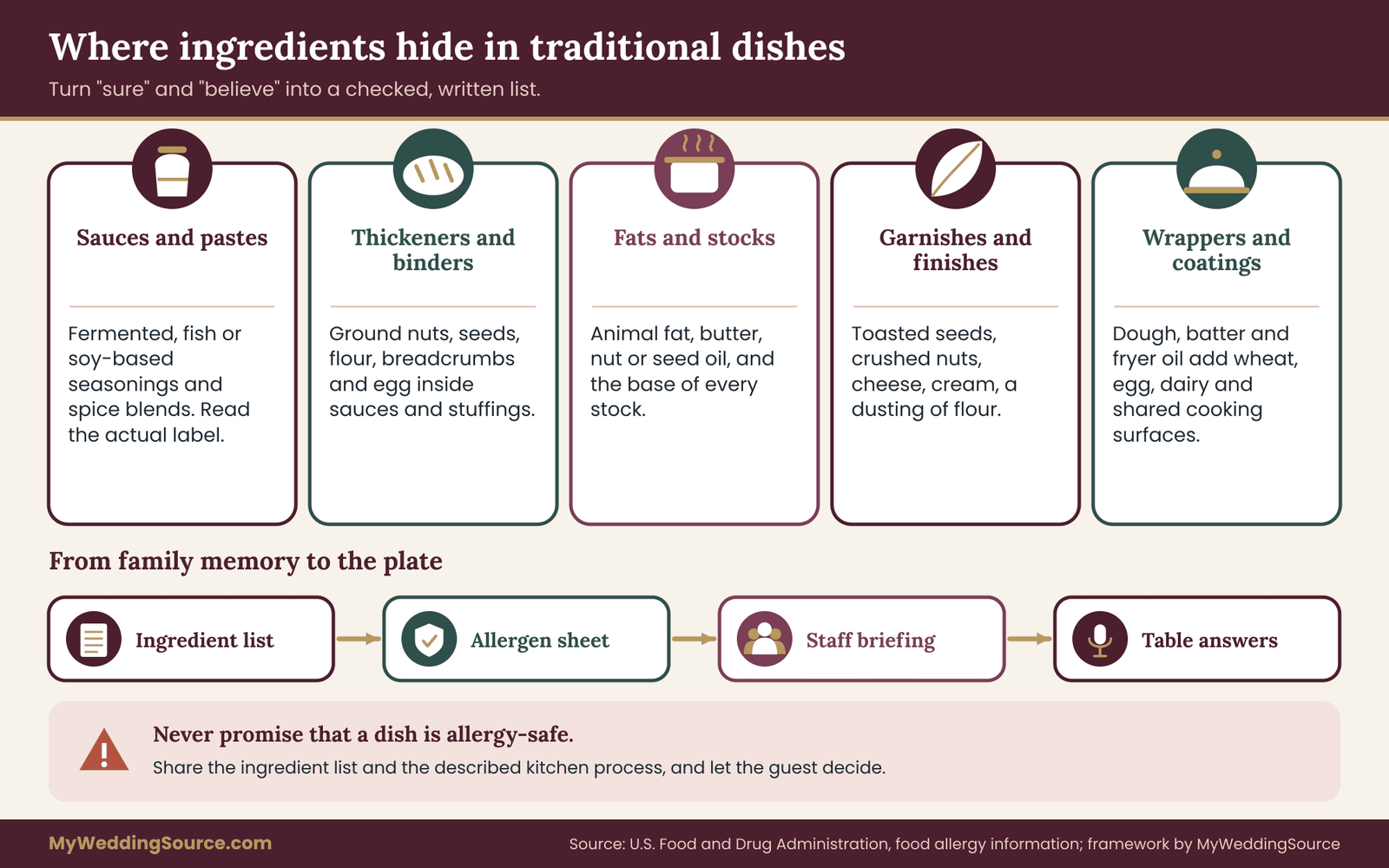
Traditional cooking draws on ingredients that are easy to overlook on a list. A few categories deserve a deliberate check on every dish.
Sauces and pastes. Fermented pastes, fish-based sauces, soy-based seasonings and prepared spice mixes often contain allergens such as fish, shellfish, soy, wheat, sesame or tree nuts, and the label may use unfamiliar names. Ask the kitchen to read the label of each product used, not the name on the jar.
Thickeners and binders. Ground nuts, seeds, flours, breadcrumbs and egg are common thickeners and binders in traditional sauces, stuffings and dumplings. A sauce that looks plain may depend on one of them.
Fats and stocks. The fat used for cooking and the base of a stock may be an animal product, a nut or seed oil, or butter. This matters for allergies, and it also matters for guests who avoid certain animal products for religious, ethical or health reasons.
Garnishes and finishing touches. Toasted seeds, crushed nuts, grated cheese, a splash of cream or a dusting of flour are easy to leave out of a description and easy to forget when listing ingredients.
Wrapped, filled and fried items. Dough, wrappers and coatings introduce wheat, egg and dairy. Frying oil may be shared with other items, which creates cross-contact.
The Food and Drug Administration lists the major food allergens on its food allergy page, and the agency’s labeling rules explain how those allergens appear on packaged food. The kitchen already works with these rules, so ask the person in charge to use them to check your list.
What cross-contact means for a family dish
An ingredient list covers what is meant to be in the dish. Cross-contact covers what might reach it by accident: a shared cutting board, a spoon moved between pots, a fryer that cooks several foods, hands that handled a nut garnish and then plated another item. A dish can be built entirely from ingredients that are safe for a guest and still be unsafe if the kitchen handles it carelessly.
A heritage wedding menu often has more shared-surface tasks than a standard one, because of hand work: folding, rolling, shaping, stuffing and assembling happen at tables, often with flour or nut dusting. Ask the caterer where that work will happen, who will do it and how the area will be cleaned between items.
You cannot eliminate cross-contact in a catering kitchen, and no responsible caterer will say they can. What you can do is ask for a described process, written down: which dishes are prepared apart, which equipment is dedicated, how serving utensils are kept separate on a buffet, and how plates for a guest with an allergy are prepared and delivered. A kitchen that can describe the process in detail is more reliable than one that offers a reassuring phrase.
Collect guest needs early and pass them on correctly
Ask for allergies and dietary needs on the response card or the wedding website, well before the heritage wedding menu tasting, and ask for specifics: which food, how severe, and whether the guest carries medication. Then share the list with the caterer in a form that names the guest and the table, and ask the caterer to confirm in writing how each case will be handled.
Resist the temptation to reassure guests about the heritage wedding menu. A message that says “all our food is safe for nut allergies” is a promise you cannot keep. A message that says “we have asked the caterer for a full ingredient list for each dish and will share it with you on request” is accurate and kind. Guests with serious allergies are used to reading labels, and they will usually prefer a clear list to a vague assurance.
The broader work of handling mixed dietary needs and the full range of guests’ preferences is described in the wedding menu planning guide. This guide’s contribution is to remind you that traditional dishes need the same documentation as any other, and often more.
Dietary and religious rules need their own conversation
Some heritage wedding menu choices are shaped by religious or cultural dietary rules, such as rules about which animals may be eaten, how they are prepared, how meat and dairy are kept apart, or what is eaten on particular days. These rules differ among communities and among families within a community, and they are not something a caterer should guess at.
If a rule applies to your wedding, decide who is the authority for your family. It may be an officiant, a community leader, a certifying organization or an older relative. Ask that person what the rule requires in practice, and ask the caterer whether they can meet it. If the rule requires certification, the caterer needs to hold that certification or work under a supervisor who does, and you should ask to see the evidence.
Do not use a label such as kosher, halal or any other term that signals compliance with a religious standard unless the kitchen has actually met that standard and you can show how. A casual use of such a label can mislead guests who rely on it, and it can offend the people for whom it is a serious commitment.
Temperature, time and the long reception
A wedding dinner is a long event, and a heritage wedding menu is no exception. Food may be cooked in the morning, transported, held, set out and eaten over several hours. The rules that protect guests from foodborne illness are published by the U.S. Department of Agriculture’s Food Safety and Inspection Service and by the Food and Drug Administration in its Food Code, and your local health department applies them in your area.
Some traditional dishes call for particular care. Cooked rice and other cooked starches, dairy-based sauces, dishes with eggs, cooked meats and fish, and anything served cold that contains raw or lightly cooked ingredients all need controlled temperatures and limits on how long they sit out. A licensed caterer knows these rules and has procedures to follow them. A relative bringing a dish from home may not.
If a relative will bring or cook a dish, talk to the caterer and the venue first. Many venues and caterers do not permit outside food, because they carry the responsibility and the insurance for what is served. If they do allow it, ask what conditions apply: how the dish is transported, how it is kept hot or cold, whether it is served from the caterer’s line, and who is responsible. If you wish to include a dish that is simply too important to leave out, consider asking a licensed kitchen to prepare it with the relative present, so that it is made correctly and safely.
The one page every guest should be able to read
By the week of the wedding, for your heritage wedding menu, the kitchen should give you a single document that lists every dish served, its ingredients, the major allergens it contains and any known cross-contact risks. Ask for a printed copy at the venue, kept with the person in charge of service, and ask whether the staff can answer questions from guests without guessing.
This document is the factual counterpart to the menu card. The card says what the dish is called and what story it tells. The page says what is in it. Both are needed, and neither should contradict the other.
For a heritage wedding menu, the page also protects the story. If a guest asks whether a dish is what the card says it is, the staff can answer with the same words the brief used, and the answer will be consistent from the first interview to the final plate.
The couple in this example is invented, and so are their families, their caterers and every number. The point is to show a heritage wedding menu planned from start to finish, including the parts that do not go smoothly. Treat the figures as assumptions for illustration. Your own caterers will give you their real ones.
Ana and Tomas are planning a dinner for one hundred and twenty guests. Ana’s grandmother makes red chile pork tamales for every family celebration. Tomas’s family has a potato-and-cheese dumpling that his aunt makes by hand and that they have eaten at every Christmas Eve. Both want these dishes at the wedding, along with a dessert Ana loves from a bakery near her childhood home. They are not sure the rest of the dinner needs to be traditional at all.
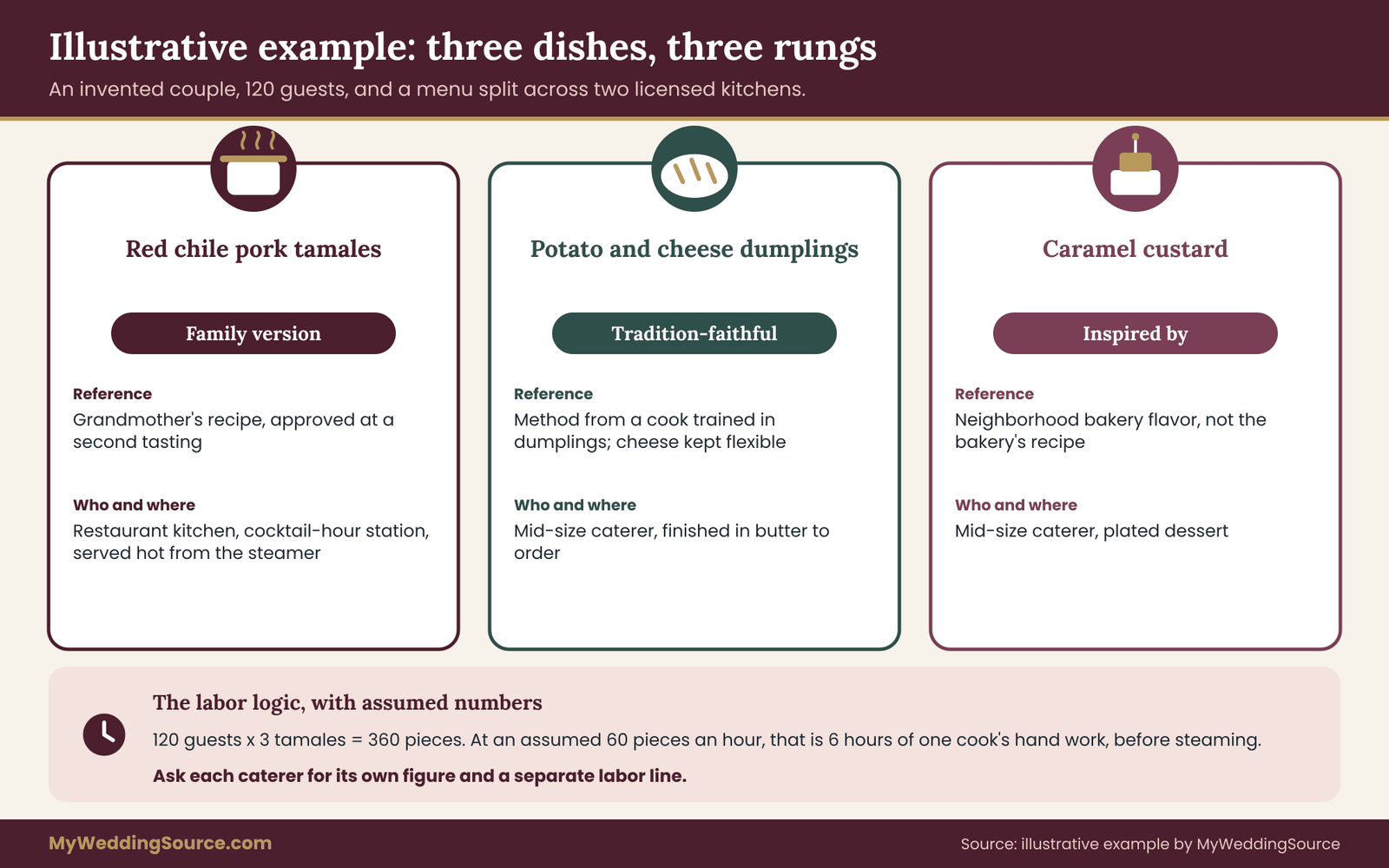
Step one: three briefs and three rungs
They write one card per dish for the heritage wedding menu. The tamale card lists the defining features as a coarse, moist masa, a red chile sauce cooked down until dark, pork cooked until it shreds, and corn husk wrapping steamed rather than baked. The flexibility field says the kitchen may choose the exact pork cut, the plating and the side dishes. Ingredients are marked “sure” for pork, dried chiles, masa and lard, and “believe” for a little cumin and garlic. Ana’s grandmother is willing to meet the kitchen.
The dumpling card lists a thin dough, a filling of potato and a mild cheese with fried onion, boiled then pan-finished in butter, and served with sour cream. Tomas’s aunt will not be at the tasting, so Tomas writes down what she told him on the phone, and Ana asks one other cousin to describe the dumpling separately. They agree on everything except the cheese, which means the cheese is a flexible field.
The dessert card is simple: a caramel custard from the bakery, which neither family makes. The couple assigns it the inspired-by rung, because they want the same flavor but do not need it to match.
They also assign rungs to the first two. The tamales are a family version, because the grandmother’s recipe is the point. The dumplings are tradition-faithful, because nobody will be able to reproduce the aunt’s exact hand but any capable cook can follow the method. The cards now say what they can honestly claim.
Step two: the search and the interviews
Ana and Tomas speak with three kitchens. The wedding caterer attached to their venue is polished and organized, and it handles one hundred and twenty plates without effort. A family restaurant that specializes in the region where the tamale recipe comes from caters events but has never served more than eighty at a seated dinner. A mid-size caterer on the venue’s approved list has a cook who trained at a bakery that made dumplings and filled pastries.
They send each the same message and the three briefs for the heritage wedding menu, then run the same interview.
The venue caterer says it can do anything and asks for a budget. When Ana reads out the defining features of the tamales, it replies that the kitchen will “do a version” with its own braised pork and a steamed corn wrapper. It cannot say who would make them or where it would buy masa. Area one is weak. Area four is strong, because it knows how to manage a large service. Allergens and terms are adequate.
The family restaurant answers the tamale card at length. It uses the same chile, steams in husks daily and uses fresh masa from a local mill. It has never held tamales for a seated buffet, and it admits that hand-wrapping several hundred pieces would be a whole day of labor for a team. Area one and two are strong. Area four is weak. Allergen answers are detailed and honest.
The mid-size caterer has not made tamales but describes dumplings with confidence, including how they are held, how they are finished to order in butter, and what it would not do. Area one is strong for the dumpling and weak for the tamale. Area four is strong.
Step three: the labor logic
The family restaurant raises the question of cost. A hundred and twenty guests at three tamales each means three hundred and sixty tamales. Suppose a trained cook can spread and wrap sixty in an hour, an assumption for this example. That is six hours of one person’s hand work, plus cooking and steaming time, before service staff and rentals. The restaurant gives a separate line for it. The couple notices something they would have missed with a flat per-plate quote: the labor-heavy dishes cost much more than the rest of the menu, and the cost does not shrink if a guest takes only one.
They decide on a plan for the heritage wedding menu. The venue allows an outside licensed caterer to run one station with proof of insurance, so the restaurant will make and serve the tamales as a single dish at the cocktail hour, in smaller pieces. This also suits the dish, which is better hot from the steamer than cooling on a line. The mid-size caterer will make the dumplings and the main dinner. Ana and Tomas check that the venue’s catering terms permit this before they commit, and they confirm the arrangement in writing with both caterers.
The decision to place the tamales at the cocktail hour is worth noticing. A heritage wedding menu does not have to follow the order of a standard dinner. A dish that suits a station or a passed course can take that slot, and the cocktail hour guide on this site describes how to set up food that guests eat standing.
Step four: the tasting finds a problem
At the tasting, the restaurant serves tamales to Ana, Tomas, the grandmother and a cousin. The grandmother tastes one and says the masa is too dense. The sauce is good. The restaurant explains that its sample was made with a stone-ground masa that it normally uses for a firmer style, and that it can switch to a coarser, moister grind. It sends a second sample two weeks later. The grandmother approves, with one note: the pork should be shredded finer. The restaurant writes that down.
The dumpling tasting goes well on the dough and the filling, but the cheese is too sharp. Tomas writes: “filling is right except for the cheese, which should be mild and slightly sour.” This is a flexible field on the card, so the caterer is free to adjust, and it brings a milder cheese the second time.
The dessert tasting is simple. The caramel custard tastes good, the kitchen says plainly that it is not the bakery’s version, and the couple agrees that “inspired by” is accurate.
Step five: the written agreement
For each dish on the heritage wedding menu the contract lists the name, the defining features from the brief, the rung, the approved sample date and the agreed substitution rule: no change to a defining feature without written approval from the couple. It names the person responsible for allergen information and states that a written ingredient list and allergen sheet will be delivered one week before the event. It lists the labor line for the tamales and the cocktail-hour timing. It includes the grandmother’s two notes as written changes after the tasting.
The contract does not use the word “authentic” anywhere. It does not promise that any dish is free of a particular allergen. It says that both kitchens will follow written procedures for allergens and that the staff will be told which guests have reported needs. The general rules for vendor contracts, including cancellation and payment terms, are in the vendor contract guide.
Step six: the menu card
The menu card for the heritage wedding menu says, in plain words, “Abuela Lucía’s red chile pork tamales, her family recipe, made fresh at the cocktail hour.” It says “Potato and cheese dumplings, a traditional Christmas Eve dish from the Wieczorek family, finished in butter.” And it says “Caramel custard, inspired by a favorite neighborhood bakery.” A short line at the bottom explains that the kitchen has a full ingredient list for every dish and that guests may ask.
The wording is accurate for each dish. The first credits a person, the second credits a family, and the third credits a source of inspiration. Nothing claims more than the kitchen delivered.
What the example shows
The best kitchen for the whole heritage wedding menu was not the best kitchen for every dish. The couple found that out because they tested each dish against its own brief and not against a general impression. Splitting the work added coordination, and it also made the dishes better and the claims honest.
It also shows that planning a heritage wedding menu is not about finding a perfect caterer. It is about finding the right match for each dish, saying what you were told, and being able to answer questions at the table without embarrassment. If the restaurant had failed the second tasting, Ana and Tomas would have moved the tamales to a lower rung and changed the card, or chosen another dish. Either outcome would have been acceptable. The one outcome the method rules out is the one that causes trouble later: serving a stand-in and calling it the original.
A tasting settles what each dish of the heritage wedding menu should be. The contract settles what the kitchen is obliged to deliver. Many couples have a good tasting and then sign the caterer’s standard agreement, which says “menu per attached proposal” and lists dish names with no description. If the day goes differently from the tasting, the standard agreement gives you almost nothing to point to.
The clauses below for a heritage wedding menu are written as ideas, not as legal text. Ask the caterer to draft the final wording, and consider asking a lawyer licensed in your state to review a large or unusual agreement. The wedding vendor contract guide covers the general terms that every vendor agreement should have, and this section adds the ones specific to traditional food.
Describe each dish, not just name it
Attach each dish’s brief or a short version of it to the agreement. The description should include the name, the defining features, the approved tasting date, any written changes after the tasting and the claim rung. A line such as “prepared according to the attached description” ties the kitchen to the thing you tested.
If the dish is a family version, state that the family recipe is the reference, and name the family member who approved the sample. If a relative’s approval matters to you, say that the sample was approved on a particular date and that a later change needs approval again.
Control substitutions
Substitutions are the most common way a dish on a heritage wedding menu drifts. A supplier runs short, a cook has a preference, a cheaper ingredient is available, and the dish changes without anyone deciding. A clause that handles this has three parts.
First, no change to a defining feature without the couple’s written approval. Second, a duty to notify the couple promptly when an ingredient becomes unavailable, with the proposed alternative and the reason. Third, a fallback: if no approved alternative is available, the dish is replaced by an agreed substitute, or removed from the menu with an agreed adjustment to the price.
Keep flexible fields flexible. A clause that locks every detail will make the caterer uneasy, and it will lead to price padding. The brief’s “what can change” field exists so that you can protect what matters and release the rest.
Ingredient and allergen documentation
The agreement should require a written ingredient list and allergen declaration for every dish, delivered by a stated date before the event, and updated if anything changes. It should name the person responsible for the allergen process on the day and say that this person will brief the service staff.
It is reasonable to ask the caterer to describe its cross-contact controls in the agreement or an attached procedure. It is not reasonable to ask it to promise that no allergen will ever contact a dish. A clause that tries to force that promise either will not be signed or will be signed by someone who does not understand the risk. Neither helps you.
Labor and timing for hand-made items
If a dish depends on hand work, the agreement should list the labor as a separate line, state the timing of production and describe how the dish is held and served. It should also state what happens if a key cook is unavailable: who covers, and whether the dish is still made the same way.
For a station or a passed item, specify the service window, the number of staff and the serving temperature.
Tasting terms
State whether the tasting is free, credited or charged, how many are included, and whether a second tasting for changed dishes is allowed. If the first tasting reveals problems, you want the right to a follow-up without a new fee.
Claims and credit
If the caterer will publish photographs or describe your menu in marketing, say what they may say. The easiest rule is that they may not describe any dish as “authentic,” “traditional” or “the family recipe” beyond what the agreement itself says. This also keeps your own card and their descriptions consistent. The Federal Trade Commission explains, on its website, the general principle that advertising claims must be truthful and not misleading, and that principle applies to a business describing food.
When the venue requires its own caterer
Many venues require couples to use an in-house caterer or a short list. This is common, and it does not make a heritage wedding menu impossible. It changes how you approach it.
Start by asking the venue exactly what is allowed. Can the in-house kitchen prepare custom dishes from a brief? Can an outside licensed caterer provide one item or one station? Are outside desserts, cultural snacks or a cocktail-hour item permitted, and under what conditions? Is there an outside-vendor fee or an insurance requirement? Get the answers in writing.
If the in-house kitchen is willing, run the same interview. A venue caterer that has not made your dishes but is willing to learn, taste and adjust may do well on a family or tradition-faithful dish. A venue caterer that insists on a standard menu is telling you that the inspired-by rung is all they can offer, and you should name the dishes that way.
If the venue allows an outside licensed caterer for a limited part of the menu, use the labor logic from the worked example: place the labor-heavy or hard-to-hold dish at the point where an outside kitchen can serve it fresh, and confirm the insurance, license and delivery details in writing.
If the venue allows neither, decide whether the heritage dishes matter enough to change venues, or whether they belong at another event such as a rehearsal dinner or a family brunch. Both are legitimate choices, and neither means the dishes mattered less.
Three practical matters remain for a heritage wedding menu: what the food will cost, how to talk to the people who care about it, and how to make sure the people serving it know what they are carrying.
Reading a quote for a heritage wedding menu
Caterers price weddings in several ways, a heritage wedding menu included, and the structure of a quote tells you what the kitchen has accounted for. A flat per-plate price is simple, but it can hide the difference between easy and labor-heavy dishes. A quote that itemizes by dish, labor, ingredients and service is more work to read and far more informative.
Look for these lines: the food cost per dish, any labor charge for hand-made items, specialty ingredient surcharges, equipment rentals, service staff, a gratuity or service charge, delivery fees and sales tax. Ask the caterer which lines would change if the guest count moves, and which would not.
Hand-made items are the main place where a heritage wedding menu costs more than expected. Their cost depends on labor hours, which grow with the number of pieces. Reducing the portion per guest, serving the item as a small tasting-size piece, or giving it to a single course can control the cost without removing the dish. Ask the kitchen to price two or three versions so that you can see the tradeoff.
Specialty ingredients can also change the price. If a dish depends on a particular imported or regionally sourced ingredient, the cost may be higher than a standard substitute, and the lead time longer. Ask whether the price is fixed or depends on market conditions, and when the order must be placed.
Do not compare quotes on price alone. A lower price from a kitchen that scored weak on the interview is not a saving if the dish fails. A fair comparison puts the interview marks and the tasting notes next to the numbers. Where the food fits into your overall plan is a question for the wedding budget guide, which describes how to divide money across categories.
Talking to the family
A heritage wedding menu is rarely only about food. It touches relationships, memories and sometimes disagreements about what is correct. A few habits make the conversation easier.
Invite the person who makes the dish to help with the heritage wedding menu, not to approve a finished decision. Asking “can you show us how you do the sauce” lands very differently from “we have hired someone to make your dish.” If they cannot or do not want to take part, thank them and ask permission to use their recipe.
When relatives disagree about how a dish should taste, return to the brief and the rung. The brief lists the defining features, and the ladder says what you will claim. A family dispute about a detail that is a flexible field can end with “the kitchen will choose.” A dispute about a defining feature needs a decision from the person whose recipe it is.
If an older relative objects that no caterer can cook as they do, you can agree and still go ahead. A script that often helps is: “You are right that nobody cooks it the way you do. We are asking the kitchen to follow your method as closely as possible, and we want you to taste it and tell us what to fix.” That respects the person and keeps the process moving.
If a relative wants to cook the dish themselves, thank them, and check what the venue, the caterer and local food rules allow. If it cannot be done on the wedding day, suggest that they cook it for the rehearsal dinner, or that they teach the kitchen, or that they supply a recipe card to be displayed. Many families find that the recognition matters as much as the cooking.
Telling guests what they are eating
Guests care about two things: what is in the dish and why it matters. The menu card, a short sign at a station or a line in the program can supply both.
Keep descriptions on the heritage wedding menu short and plain. Name the dish, say whose it is or where it comes from, and say how it is served. “Abuela Lucía’s red chile pork tamales” tells a guest more than three adjectives. If a guest asks a question, the servers can answer from the ingredient sheet.
For guests who share the heritage, a card that names the dish correctly is a small gesture of respect. For guests who do not, it is an invitation to ask. Avoid long explanations of cultural meaning on the card, especially about traditions that are not your own. A sentence from the family, in the family’s words, is better than an explanation from the caterer.
Briefing the service team
A kitchen can make a dish perfectly and a server can still describe it wrongly. A few days before the wedding, ask for a short staff briefing. It should cover the dish names and pronunciation, how each is served, the ingredients and allergens, the guests with reported needs and who to call with questions.
On a heritage wedding menu, pronunciation is a courtesy and worth the minute it takes. Provide a short phonetic note on the brief, or record a relative saying the name, and ask the caterer to share it with servers. It prevents awkward moments and tells the family that the names were taken seriously.
Appoint one person on your side, perhaps a family member or a planner, who knows the brief and can answer a server’s question. The kitchen should have a clear contact on the day, and so should you.
Your next steps
You do not have to do all of this heritage wedding menu work at once. The work falls into a sensible order, and each step makes the next one easier. Work through them across several weeks, and give yourself more time than you think a food decision needs, because specialized dishes and second tastings take longer than a standard menu.
- Write one brief per dish. Start with the dishes that matter most, and stop at five or six. A heritage wedding menu with a few dishes done carefully is better than a long list done loosely. Mark “sure” and “believe” in the ingredient field.
- Assign a rung to each dish. Decide whether it is a family version, a tradition-faithful dish or inspired by. Be willing to lower a rung if the facts do not support it.
- Check your venue’s catering rules. Find out whether you must use an in-house caterer, a list, or whether outside licensed caterers are allowed. Put the answer in your notes before you contact anyone.
- Send the same message to three or four kitchens. Include the date, the guest count, the briefs and a request for relevant examples.
- Run the interview and mark each area. Strong, adequate or weak. Do not choose on price before the tasting.
- Hold the tasting with a relative who knows the dish. Taste against the brief, write down what matches and what does not, and send a written summary to the kitchen within two days.
- Request a second tasting for anything that missed. If the second try misses, change the rung or the kitchen.
- Put the descriptions, the substitution rule and the allergen documentation in the contract. Ask the caterer to draft it and, for a large agreement, consider having a lawyer licensed in your state read it.
- Write the menu card with the language of each rung. Credit the right person for each dish.
- Brief the service team the week of the wedding. Share names, pronunciations, ingredient sheets and guests’ reported needs.
If you are also thinking about how guests move around the room and when food reaches them, the wedding reception guest flow guide explains how to plan entry, seating, food service and exit so that a labor-heavy dish arrives when it should. And if your wider menu still needs shaping, return to the broader menu planning page for service styles and courses.
Finally, remember what a heritage wedding menu is for. The goal is not a menu that wins an argument about authenticity. It is a dinner where the dishes that matter to your families taste like themselves, where the words on the card are true, and where every guest can find out what they are eating.
FAQ
How do I choose a caterer for a heritage wedding menu?
For a heritage wedding menu, write a one-page brief for each dish, interview each candidate with the same questions about experience, technique, sourcing, scale and allergens, and taste the actual dishes before signing. Compare the answers and the tasting notes, not only the price. A caterer who asks follow-up questions about your brief and describes a clear process is usually a better match than one who says yes to everything.
Does my caterer have to share my cultural background?
No. What matters is whether the kitchen can reproduce a defined dish and describe it truthfully. A caterer from the community may know the food deeply or may adapt it heavily, and a caterer from outside may have trained carefully and specialized. Judge by specific answers about methods, suppliers and past events, and by the tasting, rather than by anyone’s background.
What does it mean to say a dish is authentic on a menu card?
There is no single standard, and people from the same tradition may disagree. A safer approach is to describe what the dish actually is: a family recipe from a named relative, a traditional preparation made by a cook trained in that style, or a dish inspired by a tradition. Plain, accurate wording avoids arguments and respects the people who cook the real thing.
Can a relative cook for a heritage wedding menu instead of a caterer?
Sometimes, but check first. Venues often require a licensed caterer with insurance, and local rules limit what can be sold or served from a home kitchen, especially foods that need temperature control. Ask your venue and your local health department. If it is not allowed, a licensed kitchen can make the dish while the relative teaches the cook or tastes the result.
How do I handle allergies on a heritage wedding menu built from family recipes?
Turn each recipe into a written ingredient list, checking the actual packages for sauces, pastes, stocks, thickeners and garnishes. Ask the caterer for an allergen sheet and a described process for cross-contact, and share guests’ reported needs in advance. Do not tell guests any dish is allergy-safe. Offer the ingredient list and let guests decide.
Why can a hand-made traditional dish cost more than the rest of the menu?
Because its cost depends on labor hours, not only on ingredients. Folding, rolling, shaping or wrapping hundreds of pieces takes a team time that standard dishes do not. Ask the caterer to itemize the labor and to price smaller portions, a single course or a station. That shows the tradeoff and lets you keep the dish at a cost you can plan for.
What if the tasting does not taste like our family’s dish?
Compare the sample to the brief’s defining features and write down what matches and what is wrong. Ask the person who knows the dish what is missing, and give the kitchen the notes in writing. Request a second tasting. If it still misses, change the wording to a lower rung, such as inspired by, or choose another kitchen or another dish.
Should the contract for a heritage wedding menu mention the family recipe?
Yes. Attach the brief or a short description of each dish, name the person who approved the sample and the date, and state that defining features cannot change without your written approval. Also require a written ingredient and allergen list before the event. Specific wording protects you if a supplier runs short or a cook changes the dish.
Sources
- Food Allergies, U.S. Food and Drug Administration
- FDA Food Code, U.S. Food and Drug Administration
- FoodSafety.gov, U.S. Department of Health and Human Services
- Food Safety and Inspection Service, U.S. Department of Agriculture
- Food Safety, Centers for Disease Control and Prevention
- Federal Trade Commission, advertising and marketing guidance
- Licenses and permits, U.S. Small Business Administration
- Food allergy, National Institute of Allergy and Infectious Diseases