
Wedding cake support is everything that carries the weight of a tiered cake from the top tier to the floor: the boards, the dowels or rods, the base, the stand, the table and the ground under it. This guide gives you a baker-to-venue setup sheet for the stand, the surface and the cutting, so that nobody finds out about a weak link while guests are watching.
Treat wedding cake support as a chain with seven links: the tier itself, the board under each tier, the dowels or rods between tiers, the base board, the stand, the surface and the room conditions. Ask your baker to describe the first four in writing, including the assembled weight and how the cake is held together. Ask your venue to confirm the surface, the floor and a spot away from heat, sun and dancing, and settle who supplies the stand. Then agree who cuts, who takes the supports out and where that happens. If any link has no named owner, the plan is not finished.
Most couples picture a wedding cake as a design, and give wedding cake support no thought at all. Flavors, flowers, a shade of ivory. The structure under the design rarely comes up until something goes wrong, and when it does, it goes wrong in public. A tier that leans, a stand that wobbles when a guest brushes the table, a base board that bows because the table underneath was never meant for the load. None of this is common when professionals are involved, but it is common enough that experienced bakers and venue managers have a quiet list of conditions they watch for.
The aim of this guide is to put that quiet list on paper, so that wedding cake support is planned as carefully as the flavors. It is written for couples and planners who are coordinating a baker and a venue that may never speak to each other directly. You do not need to understand engineering. You need to know which questions belong to the baker, which belong to the venue, and which belong to both. A good wedding cake support plan fits on a single page, and the page is shared before the wedding week rather than during it.
A note on scope. This is general information, not legal, tax or financial advice, and your baker’s and venue’s written instructions come first wherever they differ from anything here. Food safety limits, serving counts and assembly methods are decisions for a licensed bakery, so this guide tells you what to ask and where to verify, not what to build.
What wedding cake support covers
People use “support” loosely. Some mean the dowels inside the cake. Others mean the stand the cake sits on. In practice, wedding cake support is a stack of separate pieces, each supplied or controlled by a different person. Naming the pieces is the first step, because most failures happen at the handoff between two of them.
Inside the tier. The cake itself, often with filling, a dam of icing around the filling and a cover of buttercream, ganache or fondant. A soft, tall tier is a structure in its own right. Its firmness depends on the recipe, the temperature and how long it has been out of the refrigerator.
Under the tier. A thin board cut to the size of the tier. It keeps the tier in one piece when it is lifted, and it spreads the load from whatever sits on top.
Between the tiers. Dowels, tubes or a plate-and-pillar system that carry the weight of the tier above down to the board below, so the upper tier never rests on soft cake. Many bakers also run one longer rod through the center of the stack to hold the tiers in line.
The base. A sturdy board, often called a drum, under the whole cake. It is wider than the bottom tier, so there is a border for finishing touches and a rim where hands can grip it during setup.
The stand. A pedestal, a platform or a tiered display that lifts the cake off the table. It may come from the baker, the venue, the caterer or a rental company.
The surface. The cake table and its linens, and the floor beneath it. This is the part of wedding cake support that couples most often forget, because it belongs to the room rather than the cake.
The environment. Heat, sun, air from vents, outdoor wind, humidity and the vibration of a dance floor. These do not carry weight, but they change how well everything else holds.
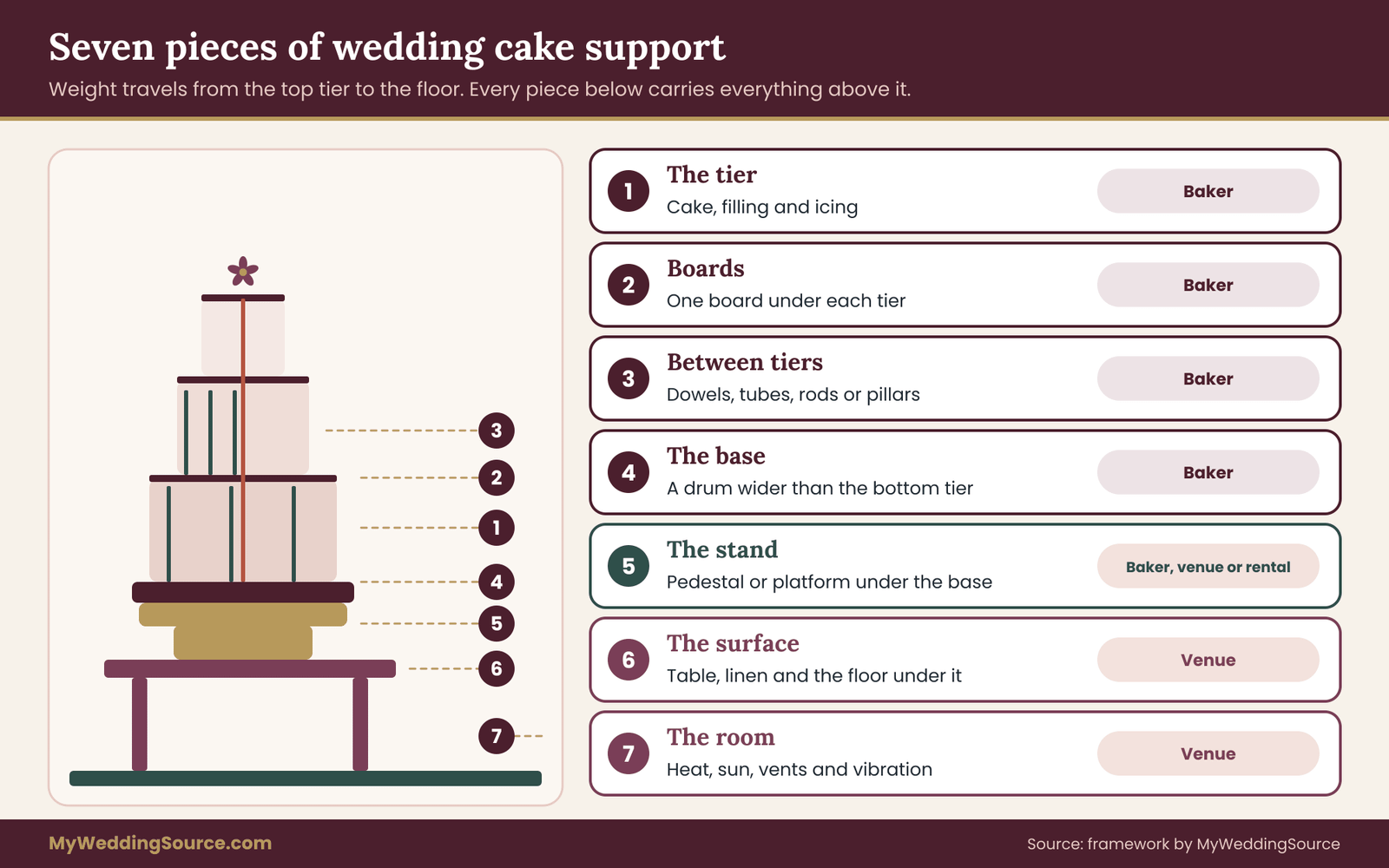
Looking at the pieces side by side makes one thing obvious. Four of the seven belong to the baker, and the other three belong to the venue, the rental company or whoever supplies the stand. The baker can describe the first four with confidence, and that is where wedding cake support starts. They cannot see the venue’s table. The venue can describe the table, but cannot tell you whether a tier is built to hold a heavy sugar-flower spray. The couple, or the planner acting for them, sits between the two parties and carries the answers across. That is the whole job.
Why couples are the right people to run this
Bakers and venues are both busy, and each assumes the other has the details. A baker who delivers to forty venues a season usually has a routine, but the routine assumes a standard table in a standard room. A venue coordinator who hosts a wedding most weekends usually has a standard cake table, but rarely knows how tall the cake is until it arrives. If nobody connects the two, the cake table in the venue’s floor plan might be a lightweight folding table in a corner that the baker’s four-tier design would strain.
You do not need to be technical to close that gap. You need to ask the same short list of questions of both sides and put the answers in one place. The rest of this guide gives you that list, explains what each answer means, and shows a worked example.
If you are still deciding on the size and flavors of the cake, the wedding cake timeline covers the order of decisions from the final guest count to the cutting. This article starts where that one hands off: once the design is chosen, how do you make sure the structure can handle it?
The load path behind wedding cake support
Every part of a stacked cake is pushing down on the part below it. Engineers call the route that weight takes to the ground the load path. You do not need the vocabulary, but the idea is useful because it tells you where to look. For wedding cake support, the question is never “is the cake strong?” in general. The question is “what is each piece resting on, and can that piece take it?”
Start at the top. The top tier sits on its own board. That board rests on supports, either dowels pushed through the tier below or the pillars of a plate system. Those supports stand on the board of the tier below, and so on down the stack, until the bottom tier sits on the base. The base rests on the stand or directly on the table. The table rests on the floor. At every step, the thing underneath has to carry everything above it, plus the pieces it touches along the way.
Two features of this path catch people out.
The load adds up. The base and the lowest tier carry the weight of every tier above them. The top tier might be a small, light cake, but the table under the whole stack carries the sum. When a baker says “assembled weight,” that is the number the table, the stand and the floor care about. Ask for it as a plain figure in the order confirmation, and expect it to be the baker’s estimate rather than a lab measurement.
The weakest link decides. A cake with expertly placed dowels can still fail if it stands on a table that flexes. A very stable stand can still lose to a floor with a slope. The strength of the strongest piece does not help when one piece is marginal. This is why a wedding cake support sheet covers every link rather than just the parts that are easy to describe.
What “failure” looks like in practice
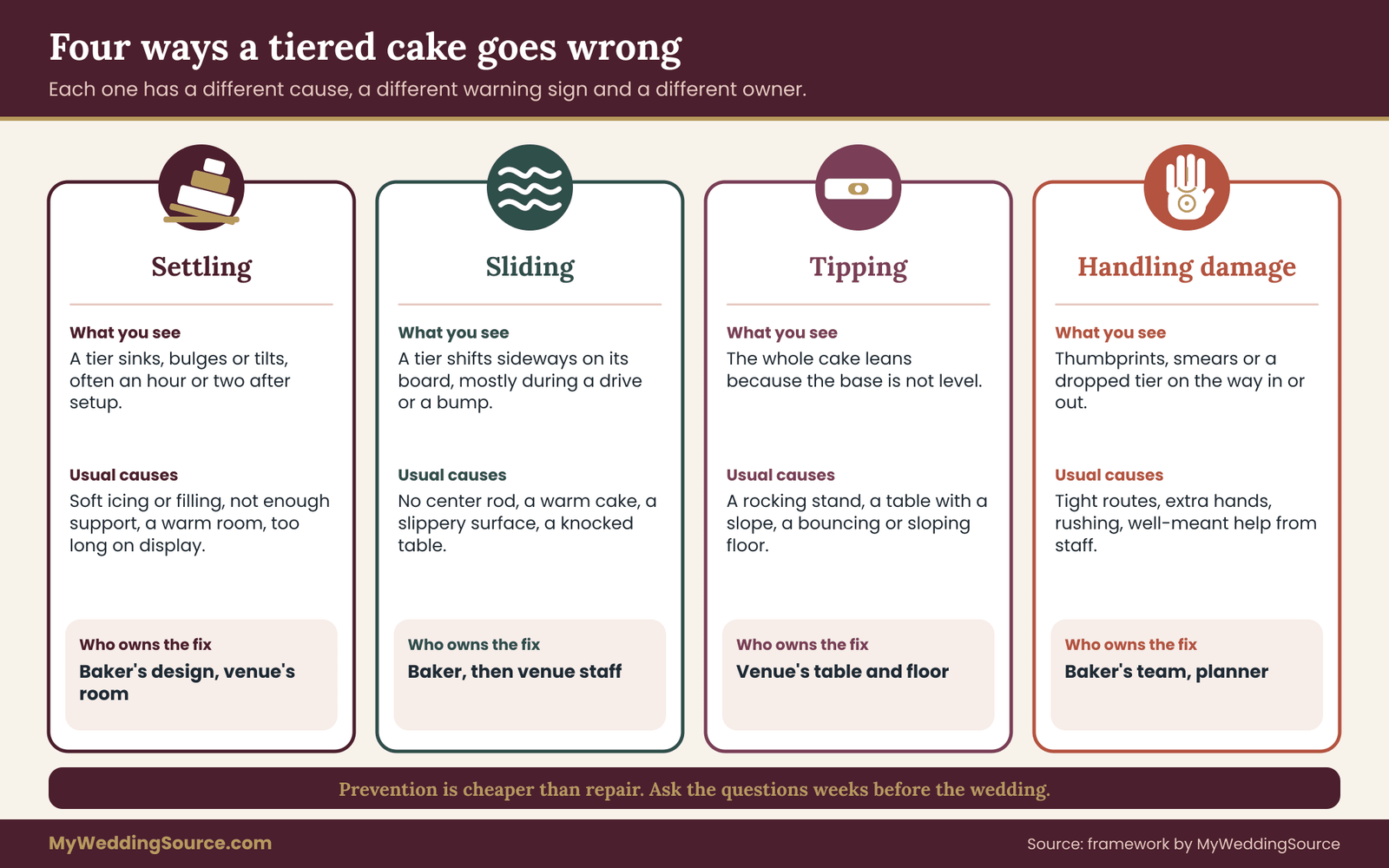
Failure is not always a collapse. In planning terms there are four different outcomes, and they need different responses.
Settling. A tier slowly sinks, bulges or tilts because the cake underneath cannot hold the weight above it, or because softened icing lets the layers slide. It usually shows up an hour or two after assembly, which is why heat and time out of refrigeration matter so much. Prevention sits with the baker’s design and with the venue’s room.
Sliding. A tier moves sideways on its board, often during transport or when the table is bumped. A center rod, firm chilled tiers and a non-slip surface under the base reduce this. It is a problem of friction and bumps.
Tipping. The whole cake leans because the base is not level or the stand rocks. This one is mostly about the surface: a table with an uneven top, a stand with one short leg, a floor that slopes toward a door.
Damage in handling. A thumb through the icing, a crumb coat smeared by a sleeve, a wedge dropped during cutting. These are not structural, but they happen when the route to the table is tight or when too many hands are involved.
Each of the four has a clear owner and a clear fix, and each belongs on the setup sheet.
The three-block setup sheet
To keep the questions manageable, this guide groups them into three blocks. The three-block setup sheet is a single page with a block each for the stand, the surface and the cutting.
The stand block records how the cake is built and what it stands on: tier count, assembled weight, how the tiers are joined, what the base is, and who supplies the stand. The baker fills this in, and the venue only reads it.
The surface block records where the cake goes: the table, the floor, the position in the room, the conditions around it and how the cake gets there. The venue fills this in, and the baker reviews it before delivery.
The cutting block records the end of the cake’s job: who cuts, when, where the cake goes afterward, who removes the supports and who counts what comes out. Baker, venue and caterer fill this in together, because three people touch the cake in this phase.
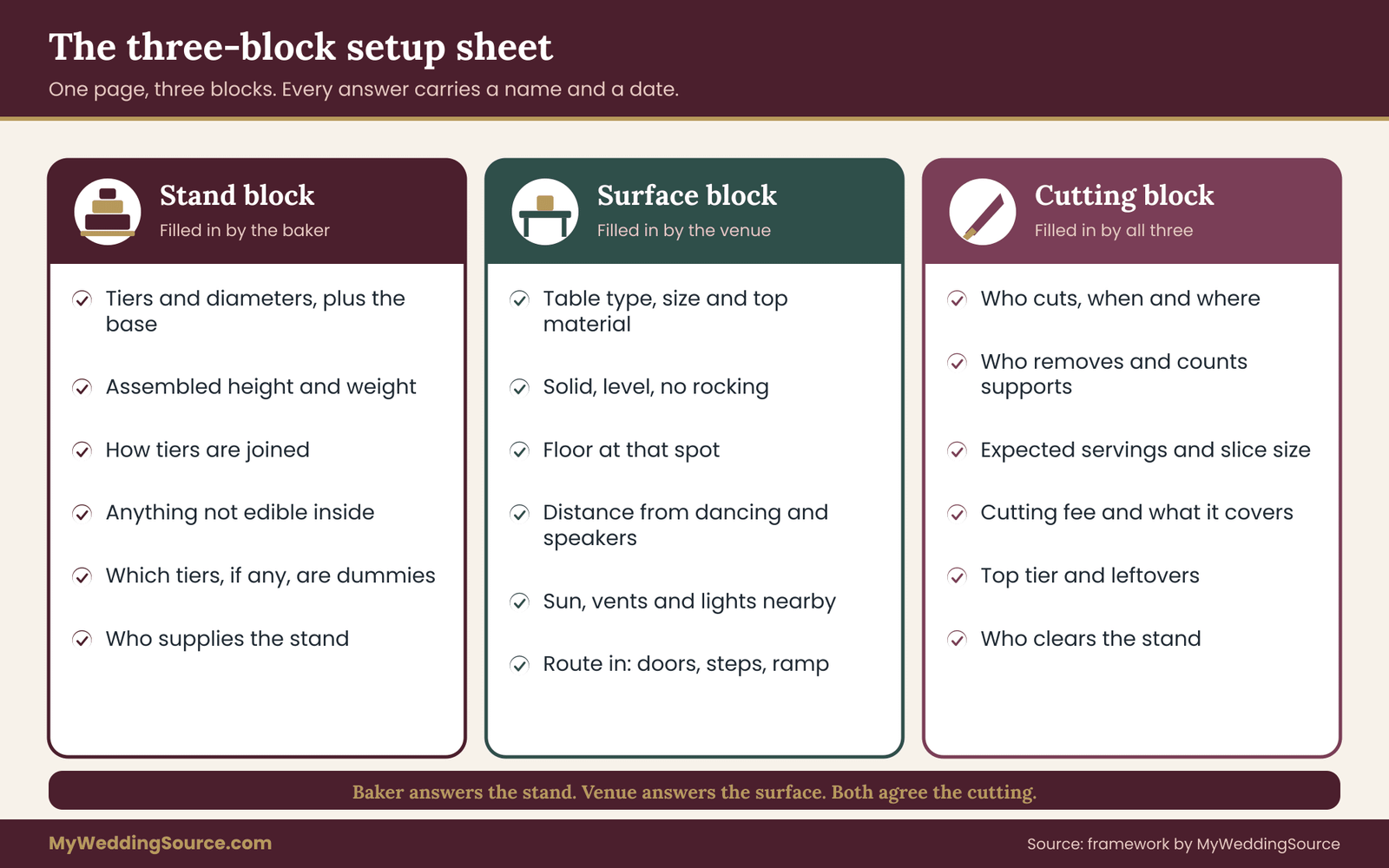
Later sections explain each block in turn. A blank copy of the sheet is simple to describe: three headings, each with a “baker confirms” column and a “venue confirms” column, and a name and a date next to every answer. The date matters. An answer from eight months ago about a table that was later swapped is no answer at all.
Where to start if you only have an hour
Some couples reach this subject late. If you only have an hour, do these three things first, in this order.
- Ask the baker for the assembled height, the base width and the assembled weight, in writing.
- Ask the venue to describe, in writing, the cake table: its type, its size, what it is made of, and where it stands in the room.
- Put the two descriptions side by side and look for a mismatch. A tall, heavy cake on a small, light table is a mismatch. So is a cake that is wider than the table, or a cake placed in a spot the venue has already assigned to a speaker or a heater.
Those three steps will not catch everything about wedding cake support, but they catch the most common problems, and they take a short email each. The rest of the guide goes deeper. If you are working through a longer checklist for the whole event, the wedding planning checklist is where the cake items sit among everything else.
Inside the tiers: boards, dowels, rods and pillars
The inside of a tiered cake is the part most guests never think about and the part of wedding cake support that matters most to a baker. A couple does not need to design it. A couple does need to know the vocabulary well enough to ask for a plain description and to recognize when the answer is complete.
This section describes the usual pieces of wedding cake support and the common ways bakers combine them. Wedding cake support methods vary between bakeries, and a good baker may use a method not listed here. That is fine. The point is to get the baker’s method in writing, in a form that a venue manager or caterer could read.
Boards, drums and the base
Each tier normally sits on its own board, cut to the tier’s diameter. The board keeps the cake in one piece when it is lifted, and it gives the tier above a flat, firm place to rest. Boards come in several materials. Thin cardboard is common for the inner tiers. Thicker foam-core or hardboard boards are used where more strength is needed. Some bakers wrap boards in foil or food-safe coating so that moisture from the cake does not soften them.
The base is different. It is usually a thick board, often called a drum, wider than the bottom tier so that there is a border all around. The border gives the baker a place to finish the edge and gives the setup team somewhere to put their hands. Bakers sometimes cover the drum in fondant, ribbon or foil to match the design.
For wedding cake support, the important facts about boards are simple. They should be firm enough that they do not flex when the tier is lifted. They should be sized to the tier. And the base should be wide enough to give the cake a steady footprint on the stand. If the stand’s top is narrower than the base, ask how the baker handles the overhang.
Dowels, tubes and straws
A dowel is a rigid rod, cut to the height of a tier, that is pushed down through the tier into the board beneath. The tier above then rests on the tops of the dowels rather than on soft cake. Dowels used in wedding cake support come in wood, plastic and metal. Some bakers use wide hollow tubes or sturdy food-safe straws instead, because they are easy to cut flush and easy to find when the cake is taken apart.
The number, spacing and material are the baker’s call. They depend on the weight of the tier above, the softness of the tier below, the height of the tier and the kind of filling. A tall tier with a soft fruit or cream filling needs more thought than a short tier of dense cake. If a baker offers a number in a quote, do not treat it as a spec for you to approve. Treat it as a sign they have thought about their wedding cake support.
What a couple can usefully ask about dowels is short.
- What are they made of, and are they food-safe?
- Does every tier carry supports, or only some?
- How will the kitchen know how many to remove when the cake is cut?
That last question comes back in the cutting section. Hidden supports are a hazard only when nobody counts them.
The center rod
Many bakers also push a single long rod, or a few of them, through the whole stack from top to base. The rod is usually sharpened or threaded so that it can pass through the boards, and it holds the tiers in line. It does not carry much of the weight. Its job is to stop sliding and tipping, especially during the drive.
A center rod is a good sign for a cake that travels assembled, and it comes with a note. The rod has to be removed or worked around when the cake is cut, and a hole through the top tier is something the design has to hide. A baker will normally cover the top with a topper, flowers or a decoration. If you plan to keep the top tier for an anniversary, ask how the rod hole is handled.
Plate-and-pillar systems
A separator system uses plates and pillars to hold tiers apart, so that each tier sits on its own plate and the pillars carry the weight down to the next plate. The tiers can be spaced with air between them, and the design can show the pillars or hide them.
The load path in this kind of wedding cake support is different. The cake itself carries little of the weight above it, because the pillars carry it. The trade-off is more hardware and more points where something can be misaligned. A pillared cake is usually assembled on site, because the tiers cannot ride together without risk. That puts more weight on the assembly step and on the setup time, which the delivery section covers.

Real tiers, dummy tiers and tiers delivered in pieces
Three more choices change the wedding cake support plan, even though they look like design decisions.
Dummy tiers. A dummy tier is a foam or similar form, iced to look like cake. It is much lighter than a real tier and it does not feed anyone. Bakers often use dummies to add height for photographs while a kitchen cake or a sheet cake supplies the servings. If any tier is a dummy, the baker should tell you which one, and your serving count should come only from the real tiers. This is also a question of expectation. Nobody wants to discover at the cutting that the middle tier is foam.
Tiers delivered in pieces. Some designs are too tall, too heavy or too delicate to travel assembled. The baker delivers each tier separately and stacks them on site. This reduces transport risk and increases setup time and the number of people who need to be in the room. It also means a baker’s helper may be working in a space the venue has not yet finished preparing.
Fresh, sugar or heavy decorations. Sugar flowers, hand-modeled figures, a metal topper, a cascade of fresh flowers: each adds weight to a specific spot, usually the top. The baker should know about every decoration before the build is planned, not after.
How to get the structure into writing
A couple can usefully ask the baker for a short wedding cake support summary, in plain language, as part of the order confirmation or in an email. It does not need drawings. It needs five facts.
- The number of tiers and the diameter of each, plus the base.
- The assembled height and the assembled weight, as the baker’s estimate.
- The method: dowels, center rod, plate-and-pillar or a combination.
- The list of components that are not edible and that must be removed before serving.
- Which tiers, if any, are dummies.
Here is the kind of message that gets this kind of answer.
“Could you send a short summary of how the cake is built and supported? We would like the assembled height and weight, how the tiers are supported, what is inside that is not edible, and whether any tier is a dummy. We will share it with the venue and caterer.”
The last sentence is not a trick. It tells the baker who will read the answer and why. Most bakers respond to that kind of question with a clear paragraph, because they have answered it before.
Signs of a complete answer, and signs of a thin one
A complete wedding cake support answer names materials, names the method, gives a weight and mentions the cutting step. A baker who writes “we use dowels and a center rod, supports are removed at the venue by our team, here is the weight” has told you most of what you need.
A thin answer sounds reassuring and contains no facts. “Don’t worry, we do this every weekend” may be perfectly true, and it is still not a description. Ask again, politely, for the specifics. If the second answer is also empty, that tells you something about how the cake will be handled on the day.
None of this is meant to turn a conversation with a baker into an inspection. Bakers are craftspeople, and many will be glad to talk about construction if you ask. The goal is to move the wedding cake support details from the baker’s head to a document that other people can use.
Edge cases that deserve a direct conversation
Some designs push the usual wedding cake support methods. If your cake has any of these, raise them early.
Offset or stepped tiers. A tier that sits off-center, or that overhangs the tier below, shifts the center of weight. The baker may use a different internal support for the overhang.
Gravity-defying or tilted designs. These usually rely on a hidden armature. Ask whether the baker has built that kind of structure before, and ask what the venue needs to provide, such as a firmer table or an extra support point.
Very tall single tiers. A tall tier can bulge or lean as it warms. Ask how the baker keeps it firm and whether the tier is built in sections.
Hanging elements. Garlands, ribbons with weights, or suspended decorations can pull on a tier. Ask about their weight and anchoring.
Cakes built for a very hot day. The structure may be the same, but the recipe and finish can change. This belongs to the section on heat, though the conversation starts here.
For each of these, the answer you want from a baker is not “yes, that’s fine” but a short explanation of how they will handle it. If the explanation involves something the venue must provide, add it to the surface block of your sheet.
A note on keeping it proportionate
Not every cake needs this level of discussion. A single-tier cake, or a small two-tier cake on a sturdy stand, has very little of this to worry about. The wedding cake support conversation scales with the height, the weight, the softness and the ambition of the design. A two-tier cake with a plain finish takes a few minutes, and a five-tier cake with a fresh-flower cascade takes a proper exchange. Match the effort to the design and do not let the checklist take over the planning.
The next section moves from what is inside the cake to what is underneath it: the stand, the table and the floor.
Stands, tables and floors: where wedding cake support meets the venue
Everything inside the cake can be perfect and the cake can still wobble, because the stand, the table and the floor are chosen by other people for other reasons. A venue picks tables to seat guests. A rental company picks stands to look good in photographs. Neither picks them for a particular tiered cake they have not seen. This section covers the surface block of the setup sheet, the part of wedding cake support that is mostly about asking the venue for facts they already know but have never been asked for.
The stand: who owns it and what it is rated for
Start with a plain question: whose stand is it? There are four common answers. The baker brings one. The venue has one that it lends or includes. A rental company supplies one as part of a décor package. Or the couple bought one themselves, perhaps an heirloom or a piece they liked.
The answer matters for wedding cake support because each owner treats the stand differently. A baker’s stand is usually chosen with the cake in mind and reused for years. A venue’s stand may be pretty and untested for a heavy cake. A rental stand has a return date and a damage policy. A couple’s own stand has an unknown history and nobody who will vouch for it.
For any stand, the baker should be able to answer four things. Does the top surface match the base of the cake in width, or will the cake overhang? Is the stand stable on its own, with no wobble when pressed? Is it suited to the assembled weight? And if it is a pedestal with a narrow foot, does it need the table beneath it to be steadier than usual?
If the stand belongs to a rental company, ask them for its dimensions and any weight rating they publish. If there is no rating, ask the baker whether they are comfortable with it. If neither can say, pick another stand. Wedding cake support is not the place to rely on an item that nobody has actually tested.
Two practical points sit alongside the stand. The first is a deposit or damage clause. If a stand is lent or rented, the agreement may hold you responsible for chips or scratches, including those from dowels or a base board. The second is the return. Someone has to remove the stand at the end of the night and clean it, and the baker, the venue and the rental company may each assume it is somebody else’s job. Name the person.
The table: type, top, legs and position
The cake table gets less attention than the table for the couple, and in wedding cake support terms it often does a harder job. Here are the usual types and the questions each raises.
Folding banquet tables. Common, light and usually fine for a modest cake. Ask whether the legs lock fully, whether the top is solid, and whether the table rocks on the floor. A folding table with a hinged top, or one that has been repaired, is a concern for a heavy tiered cake.
Round tables. A round table with a center pedestal can be very stable, or can tip if the base is small and the cake is tall and off-center. Ask where the cake will sit relative to the base. A cake placed over the center of a sturdy base is a different case from a cake placed near the edge.
Rustic or farmhouse tables. Often heavy and solid, which is good. Check the top for gaps between planks and for rough surfaces that could tilt the base.
Borrowed furniture. A dresser, a side table or a family piece looks lovely and may have a finish that marks easily. It may also be shorter than expected or have a top that slopes slightly. Ask the baker to see a photo or visit if the cake is large.
Small bistro or cocktail tables. These are usually too light and too small for a tiered cake. If one is planned, raise it with the venue early.
A few questions about wedding cake support apply to every table type, and the answers should be written down: the table’s dimensions, the material of the top, whether it rocks, and who is responsible for moving or replacing it if the baker is not comfortable. The baker should be told the table type before the final design is set, not at delivery.
Linens, skirts and the base of the cake
The tablecloth is a small detail with real consequences. A smooth cloth over a firm table is ideal. A wrinkled cloth under the base can tilt the cake by a few degrees, which is enough to matter on a tall stack. Slippery fabrics such as satin make the base easier to push. A cloth that hangs to the floor can catch on a sleeve or a cart.
Ask the venue to set the cloth flat, with the table top as clear as possible, and to leave the cloth alone once the cake is placed. A baker may put a non-slip mat or a small board under the base. That is a good sign, not a worry.
Skirting is a separate matter. A skirt that hides the area under the table is fine as long as nothing is stored there that might be bumped or that might alter the table’s position. A crate of plates stacked right under the front edge is one such risk.
The floor: stable, level and quiet
The floor is the last link in the wedding cake support chain and the one that most surprises people. Three features matter.
Stability. Concrete, tile and thick hardwood are steady. A raised wooden floor on joists, a temporary dance floor, a deck or a plank floor in a converted barn can flex and carry vibration. A cake on a firm table in the middle of a bouncy floor moves with the floor, and no amount of wedding cake support inside the tiers can undo that.
Levelness. Old buildings and outdoor spaces are rarely level. A slope of a degree or two will not trouble a table but may show in a tall cake. Ask the baker to bring a small level and ask the venue for permission to shim a table leg.
Vibration and bumps. Dancing, bass from speakers and children running past can all rattle a table. Place the cake table away from the dance floor’s edge and away from speakers and walkways. Guests backing away from the dance floor, carts moving between the kitchen and the tables, and staff clearing plates are all sources of accidental bumps.
Barns and farm venues deserve a special mention because their floors vary so much. Many have plank floors with gaps, uneven boards or open gaps, and many are used for dancing. If your venue falls into that family, the barn wedding venues guide explains what to ask about floors, power and weather, and the same questions apply here.
Outdoor and tent settings
Outdoor receptions change the wedding cake support picture. Grass is soft, and table legs can sink unevenly. Tent flooring may be a temporary deck or interlocking panels. Wind can move a table or a tablecloth. Sun adds heat that no support can overcome.
Ask the venue, or the tent company, three questions. What is the ground under the cake table? Can the table be placed on a firm, level surface such as a section of flooring? And if the weather turns, is there a fallback indoor location for the cake, and who moves it? That last question is covered in more detail in the heat section, but it belongs on the surface block as well.
Where to place the table in the room
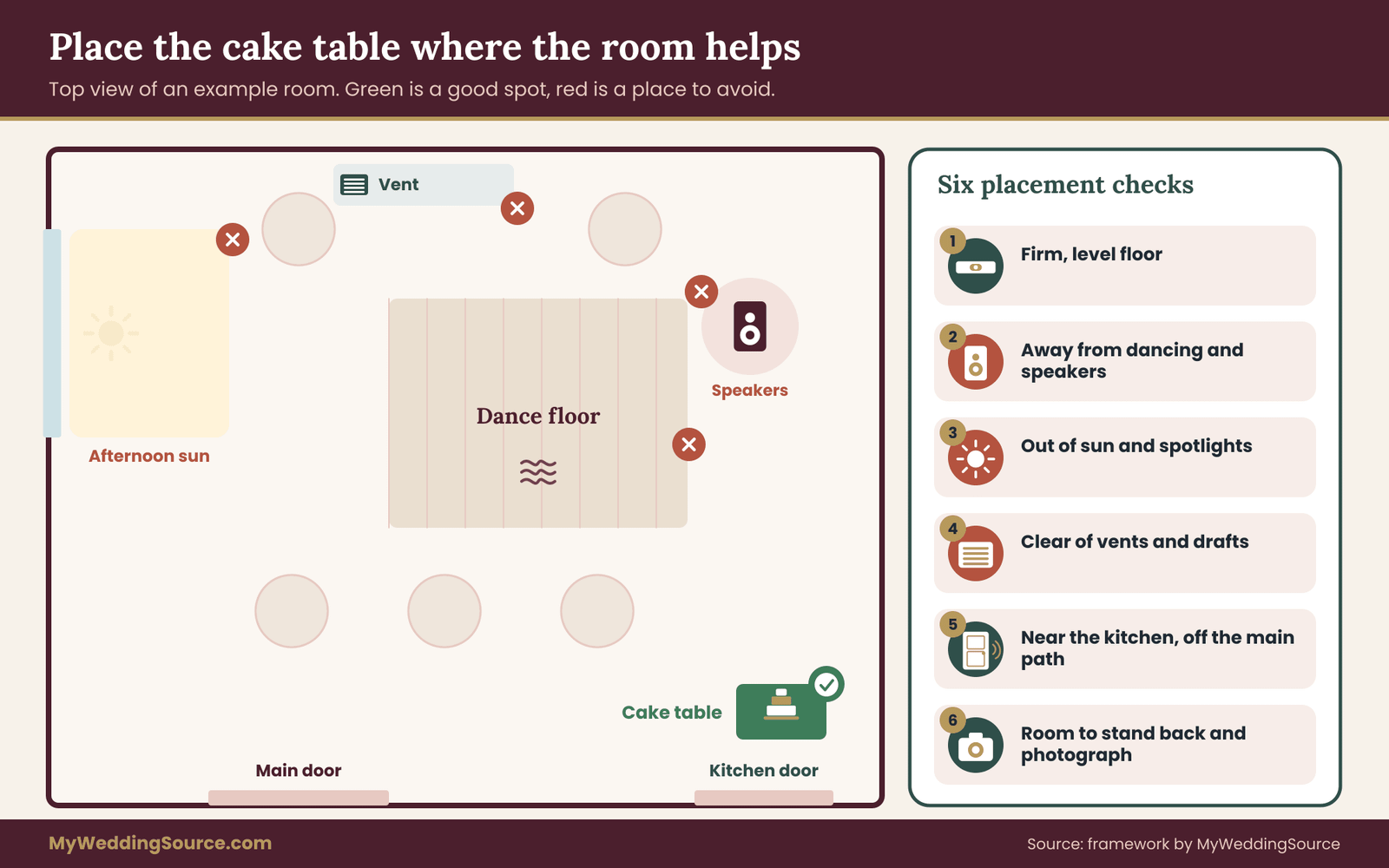
Position matters to wedding cake support as much as to photographs. Good places for a cake table share a few features: away from the dance floor, speakers and doors that swing; out of direct sun and not under heat from lights or vents; close enough to the kitchen that the staff can reach it without crossing the whole room; visible for the cutting; and with room around it for the couple, the photographer and a few guests.
Bad places are easier to spot. A table by a window in afternoon sun. A table under a spotlight. A table next to a door that propped open all evening. A table in a narrow aisle that every guest will pass.
The wedding reception guest flow guide treats the room as a traffic system, and the cake table should fit into that system rather than sit apart from it. It is also worth checking the layout against the venue technical walkthrough, since measurements, power and access routes are collected there.
A table that is only for the cake
A small rule protects wedding cake support and saves a lot of trouble. The cake table is for the cake and the cutting tools. Cards, gifts, centerpieces and drinks belong elsewhere. Extra items add weight, crowd the cutting area and tempt guests to lean on the table.
If the venue places its own décor on the table, ask for it to be limited to light items, set at the back, and not heavy or tall enough to threaten the cake. Candles and open flames raise a separate issue, because many venues have rules about them, and some local fire codes restrict them. Ask the venue what its policy is before you assume candles or sparklers are allowed.
Questions the venue should answer in writing
The surface block of the wedding cake support sheet is mostly questions for the venue. Here they are in one place, in a form you can paste into an email.
“We would like to confirm the cake setup. Could you tell us the type and size of the table that will hold the cake, what the top is made of, whether it is solid and level, and where in the room it will stand? Could you also tell us what the floor is made of at that spot, how far the spot is from the dance floor and speakers, whether it gets direct sun or air from a vent, and who will move or replace the table if our baker asks?”
That is a long question, but each part has a short answer. A well-run venue can answer it in a few lines, often from memory. If they cannot, ask for a photo of the spot and the table. That alone settles most doubts.
If the venue’s table does not fit the cake
Sometimes the answer is that the planned table is too small or too light. There are three fixes, in order of ease.
Swap the table. A rental company can usually supply a sturdier one, at a cost. Do this before the final headcount, because delivery and setup fees are lower when they are part of a larger order. The wedding rental planning checklist covers how to compare rental terms, delivery windows and damage clauses.
Change the position. Moving the table to a steadier spot, or a spot over a joist or a firm area, can solve the problem at no cost.
Change the cake. If neither works, a lighter or shorter design may be the safest solution. A baker who says so is protecting your cake and its wedding cake support, and that is worth more than a taller silhouette on the wrong table.
Any of the three is easier four weeks before the wedding than on the morning of it. The surface block, filled in early, is how you find out in time.
Delivery and assembly: moving wedding cake support through the building
A cake that is perfectly built at the bakery can still be damaged between the bakery and the table. Transport, doorways, stairs and the first fifteen minutes on site are where much of the risk sits, and they are also the moments when no couple is present to catch a problem. This section turns delivery and assembly into a short set of wedding cake support decisions that can be made weeks ahead.
Decide early: assembled or in pieces
The first decision is whether the cake travels assembled or arrives in sections to be stacked at the venue. Bakers have their own habits here, and some always deliver tiers separately. Either way, it is a wedding cake support decision as much as a logistics one. Where a baker is open to either, a simple route test helps.
Walk the route from the vehicle to the cake table, on paper or on foot, and answer five questions.
- Doors and corners. Does the widest piece clear every doorway and turn with room for hands on both sides?
- Steps. Are there steps, a curb or a threshold that cannot be avoided, and is there a ramp?
- Elevator. If there is one, is it large enough for the assembled cake on a cart, and is it reserved for that time?
- Distance. Is the carry short, or does it cross an entire building or a lawn?
- People. Will there be two trained people, from the baker’s team, to carry?
If every answer is comfortable, an assembled cake may be fine and the wedding cake support inside it can do its job all the way to the table. If any answer is doubtful, deliver in pieces and plan extra setup time. The route test does not ask you to judge the carrying. It asks you to give the baker the facts, so that the baker can decide.
Make the answers part of the surface block. A venue coordinator can usually describe doors, steps, ramps and elevators in a paragraph, and a photo of the loading entrance is better than a description.
The delivery details the baker needs
Many delivery problems are not about the cake or its wedding cake support at all. They are about where to park and whom to ask for. The delivery details sheet is short and worth sending to the baker a week before the wedding.
- The exact address of the loading entrance, which is often not the main address
- Where the vehicle can stop and how long it may stay
- The name and phone number of the person who will meet the baker
- The hours when the room is accessible
- Whether the kitchen or a cooler is available for storing parts of the cake or spare boxes
- The location of the cake table, with a photo
Write the person’s name next to the phone number. A baker standing at a locked door at the wrong end of a building, calling a number that goes to the bridal suite, is a problem that a single line could have prevented. Share phone numbers by text or on the sheet itself, and do not put any email address in a public place.
Transport is the baker’s job
Wedding cake support is tested hardest in the vehicle. Cakes travel in a vehicle with air conditioning, usually on a flat, non-slip surface, in a box or on a board that keeps them from sliding. Bakers who deliver regularly know how to do this, and the wedding cake support plan assumes it is their work. The couple’s role is to not interfere.
There is one case that needs a different conversation. If a friend or relative is baking the cake, or if a cake from a store is being collected by the couple, the same rules apply, but the amateur chain has more gaps.
Ask the person making the cake for written transport instructions: how to carry it, what to put it on, how cold it should be and how long it can be out. Choose a vehicle with a flat floor and cool air. Do not put a tiered cake on a car seat. A single-tier or two-tier cake on a flat, non-slip surface is manageable, and a four-tier cake from a home kitchen is a serious project that deserves a second pair of professional eyes.
Timing: the room has to be ready before the cake arrives
A cake and its wedding cake support need a room in a particular state. The table should be in place, level and dressed with the cloth. Other vendors should not be working in the same corner. The floor should be dry. Power or lighting that is near the table should be installed before the cake, not after. If the cake arrives before the florist, the florist’s crew will be reaching over or around the finished cake, so decide the order of arrival and write it into the day-of schedule.
A common failure is a cake delivery that lands in a room still being set up. The baker waits, then works around ladders and linens, then rushes. Agree on a delivery window with the baker and tell the venue, so that the table is ready when the baker arrives.
Ask the baker how long the setup takes, and add a buffer. Pillared or in-pieces cakes take longer, and a cake with fresh flowers or sugar decoration takes longer again. Setup time for wedding cake support belongs on the day-of timeline right next to the florist, the rentals and the lighting.
Carrying is a two-person job, and it is not the venue’s job
Tiered cakes are heavy and awkward. Bakers train for carrying them and use carts or boards to avoid lifting the full weight. Public guidance from the National Institute for Occupational Safety and Health on manual lifting is a useful reminder that awkward, heavy loads cause injuries, and that the answer is more hands, shorter distances and a clear path.
For you, the rule is simple. The baker’s team carries the cake. The venue’s staff do not carry it unless the baker asks them to. A helpful staff member who grabs the base to be kind may be the one who damages the cake. If the venue offers, thank them and ask them to clear the path instead: hold doors, remove obstacles, and keep guests out of the way.
Assembly on site, step by step
When the cake is assembled at the venue, the sequence is usually this. The baker checks the table for level and stability. The base is placed on the stand or the table. Tiers are lifted into place one by one, from the bottom up, each on its own board and over its supports. A center rod, if used, is driven through. Seams are finished and decorations are added. Fresh flowers, if any, are placed last. A final check follows.
Couples do not need to supervise wedding cake support work. They do need to know that this sequence takes time and attention, and that the time before guests arrive is not a good place to cut corners. A baker who is working quickly because a coordinator keeps asking when they will be done is a baker more likely to miss something.
Ask the baker what the final wedding cake support check includes. A good answer covers level, steadiness, visible leaning, finish damage and a gentle test that the table does not shift. A better answer includes a photograph of the finished cake, taken before the baker leaves, and sent to the couple or planner with a time on it. That photo is a small record, and it settles any later question about what condition the cake was in when handed over.
Flowers and decorations from other vendors
Fresh flowers on a cake are one of the most common reasons for a handoff problem. The baker may place them, the florist may place them, or the florist may deliver them and the baker places them. Decide which, and write it down. Questions to settle: who cuts the stems, who wraps or sleeves them, and how the flowers are kept from touching the icing. Some flowers and greenery are not safe to eat, and a baker has a procedure for keeping them separate. The florist does not know that procedure unless told.
The same applies to toppers, ribbons and other items from outside vendors. Weight, wire, adhesive and sharp edges all matter. Ask the baker to approve anything that touches the cake before the wedding week.

The handoff: who owns the cake after the baker leaves
At some moment, custody of the cake passes from the baker to the venue and caterer. Make that moment explicit. Four items belong in the handoff of wedding cake support from baker to venue.
A named receiver. Someone at the venue confirms receipt, by name, in a text or on a delivery slip.
A do-not-move note. The baker, or the venue, tells staff that the table and the cake are not to be moved without calling the baker.
An emergency contact. The baker gives a phone number that will be answered during the reception, and says what they can do if there is a problem, such as bringing a repair kit or advising by phone.
A photograph. The baker’s final photo, time-stamped, goes to the couple or planner.
These four items cost nothing and take a few minutes. They also answer the question that nobody wants to ask at the end of the night, which is who was responsible for the cake when something happened. If your contracts include delivery and liability terms, the wedding vendor contract guide explains what to read for, and the baker’s order form should say where responsibility transfers.
When delivery is split across times
Some weddings have a ceremony in one place and a reception in another, which means the cake arrives while everyone is elsewhere. Name a receiver who will be there, and keep the baker’s phone number on a card at the venue. In other weddings, the cake is delivered early and held in a cooler until the reception. In that case the final assembly happens later, and the baker should be told the exact window. Ask the venue whether a cooler or a cool room is available, how long the cake can be held there, and whether anyone else has access to it.
Delivery and assembly are the last stage of wedding cake support that the baker controls alone. After this, the cake is in the room, and the room has its own effects on it. The next section explains what heat, humidity and light do over the hours of a reception.
Heat, humidity, light and heavy designs: testing wedding cake support over time
A cake is at its strongest at the moment the baker finishes it, and it spends the rest of the evening slowly losing that advantage. Every hour at room temperature softens icing a little, relaxes fillings and gives gravity more time to work. This is why wedding cake support is never only a question of dowels. It is also a question of how long the cake will be out, how warm the room is and what is shining on it.
This section covers the conditions around the cake and the way they change wedding cake support. It is part of the surface block, but it deserves its own space because the answers are not fixed. They depend on the season, the room, the guest count and the plan for the evening.
Time out of refrigeration
Public food-safety guidance is consistent on one point. The U.S. government’s foodsafety.gov site advises that perishable food should not sit out for more than two hours, and for no more than one hour when the temperature is above 90 degrees Fahrenheit. A cake is not always a perishable food in the same sense as a plate of chicken, and the rule applies differently to a fondant-covered fruitcake than to a cake filled with whipped cream or custard. That is exactly why the baker has to decide.
Ask the baker for two things in writing. First, how long the cake can safely stand at the venue, given its filling and icing. Second, what the baker recommends if the schedule is likely to run beyond that window. Do not guess a safe number for your cake, and do not rely on a general rule as a substitute for the baker’s own. Temperature, allergens, structural assembly and serving counts are all decisions that belong to the bakery.
Once you have the baker’s display limit, plan the evening around it. If the cake will be delivered at two o’clock and cut at nine, the cake will be out for much longer than a typical window. There are several ways to handle that, and each changes the wedding cake support plan.
Late delivery. The baker arrives as close to the display time as the venue allows.
Cooler storage. The cake waits in a cooler or a cool room, and is brought out for the reception. This needs space, and it needs someone to carry the cake again, so ask about both.
Display dummy and kitchen cake. A decorated dummy stands on the table, and the servings come from a kitchen cake or a sheet cake. This is a common solution for hot days.
Earlier cutting. The cake is cut sooner in the reception, which shortens the display and moves the dessert into an earlier part of the evening.
Pick one based on the baker’s guidance. The decision is easier if you make it weeks ahead and put it in the timeline.
How different icings respond to warmth
Bakers use many finishes, and they respond differently to heat. Without suggesting that your baker should use one rather than another, it helps to know the general pattern, because icing is part of wedding cake support too.
Butter-based buttercream softens as it warms. Meringue-based buttercreams are usually more stable than simple butter-and-sugar types, though they still soften. Ganache is firm when cool and slumps when warm. Whipped cream finishes are the least tolerant of heat. Fondant holds its shape well, but it can form droplets of moisture when a cold cake is brought into a warm, humid room. That condensation can dull colors and soften decorations.
None of this means you should pick a finish for the sake of the weather. It means that the baker’s recommendation for a summer outdoor reception may differ from the recommendation for a winter ballroom, and you should ask the question honestly. “Here is the venue, the month and the plan for the evening. What would you change in the finish or the fillings?” is a normal question.
Room conditions the venue can describe
The venue knows the room better than the baker does. Ask the venue to describe the conditions at the cake table, since they decide how long wedding cake support stays reliable.
Temperature. Is the room air-conditioned or heated, who controls the thermostat and does the system keep up when the room is full of people? A room that is comfortable at four o’clock can be warm at nine, with a hundred guests and a hot kitchen next door.
Sunlight. Does the table sit near a window, and does the sun reach it at the time of day when the cake will be displayed? Afternoon sun through glass can heat a surface quickly.
Lighting. Spotlights, uplights, string lights and photography lights all give off heat. A spotlight aimed at the cake is a warm place to put a stack of buttercream.
Airflow. Vents blowing directly on a cake can dry out the icing, and a draft from a propped door can stir flowers or tilt a light topper.
Crowds. Guests crowd around the cake at the cutting, and that adds body heat and a risk of bumps. Plan the space around the table so that there is room to stand back.
The answers go on the surface block, with a note for each one that is a concern. If the venue has more than one possible spot for the table, use these answers to choose between them.
Fire and open flames
Candles, sparklers and flame-based toppers show up on cakes more often than people expect. Many venues restrict open flame, and local fire codes may apply. The National Fire Protection Association publishes the standards that many jurisdictions build their rules on, and the venue, caterer or local fire authority is the right place to confirm what is allowed. Ask the venue before the cake is designed. A cake with a sparkler fountain that the venue prohibits is a problem that is expensive to fix on the day.
Outdoor weather
Outdoor receptions add three conditions that are harder to control: sun, wind and rain. The U.S. National Weather Service publishes heat safety information, including how the heat index differs from the plain temperature, and it is worth reading before an outdoor summer wedding. For the cake, the practical points are these.
Shade is not optional on a warm day. A tent or a covered area is a baseline. Shade should be real shade at the time of display, not shade that will be gone by the time the sun moves.
Wind can move tablecloths, tip toppers and push fresh flowers off the cake. A windbreak, a heavier topper or a lower design can help, and the baker should know about the setting.
Rain creates a different problem, which is the route. The path from the vehicle to the tent might be wet and slippery. A cake in transit under a tarp or umbrella is a hazard to the person carrying it.
Plan a fallback for wedding cake support too. An indoor room, a kitchen or a cooler where the cake can wait if the conditions turn bad is a good idea, and the person who will make that call should be named. Ask the venue where that room is and whether it is available.
Heavy designs and the weight that sits on top
Heat and time are not the only things that test wedding cake support. Decoration weight does too, and it is usually concentrated at the top, where it does the most harm. Sugar flowers, a metal or ceramic topper, a floral arrangement and a tall ornament all add weight to the topmost tier, which passes it down through every dowel below.
The baker needs to know the weight and size of every decoration before the wedding cake support is planned, whatever its source. If a florist is adding flowers, the florist’s estimate of the arrangement’s weight and the width of its base should go to the baker. If a family heirloom topper is part of the plan, the baker should hold it, or see it, before the wedding week.
A good rule for wedding cake support and heavy decorations is to treat the baker’s approval as a condition. Anything that adds weight, wire or an unusual shape should be approved by the baker in writing. If the baker says no, the topper can often go beside the cake on its own stand, which carries the same message with none of the risk.
Dietary tiers and the structure that holds them
Many weddings include a tier or a separate small cake for guests with allergies or dietary restrictions. Dietary tiers are a wedding cake support question as well as a food question. A gluten-free, nut-free or dairy-free tier is often a separate cake, made with separate tools, sometimes in a separate space. It may sit on its own board, or beside the main cake, or at another station.
The U.S. Food and Drug Administration publishes information on food allergens, and your baker will have their own procedures for handling them. For wedding cake support, the key points are practical. Mark each tier clearly in the baker’s summary. Keep serving tools separate for each tier. And decide who will serve that tier and how guests with restrictions will know which slices are safe. The wedding menu planning guide explains how dietary needs fit into the whole meal, and the cake belongs in that plan too.
All allergen handling and labeling decisions remain with the baker and the caterer. The couple’s role is to ask clearly, put the answers in writing and make sure the room’s staff know which tier is which.
A trigger and action list for the evening
Even carefully planned wedding cake support can show signs of strain. Decide in advance what counts as a warning and what happens next. A small list is enough.
- Visible lean or bulge. Call the baker and tell the coordinator. Nobody touches the cake.
- Icing softening or shine. Tell the coordinator, who checks the room’s temperature and moves people away from the table.
- Table shift or wobble. The venue stabilizes the table, with the baker advising by phone.
- Drips or condensation. The baker advises. Do not wipe.
Name one person, a coordinator, planner or trusted friend, as the wedding cake support watcher. Their job is to glance at the cake every so often and to make the phone call. They do not touch it, and they do not take over its handling. A short written list kept near them makes the plan real.
That list also tells the baker what you expect from wedding cake support on the day. A baker who knows there is a watcher and a phone number is more likely to answer the phone.
Cutting and breakdown: taking wedding cake support apart
The cutting block is the third part of the setup sheet, and it gets the least attention. Couples tend to plan the moment of the cut, the photograph and the music, and then assume that the kitchen will somehow turn the cake into slices. In between those two ideas sits the last stage of wedding cake support, a short and fairly delicate job: taking apart a structure that was designed to stay together, without leaving anything hard or sharp in a slice.
Taking wedding cake support apart is not complicated for a baker, and it is easy to get wrong for someone who has never seen the inside of the cake. That gap is the reason for this block.
The ceremonial cut
The photograph of the couple cutting the cake is usually the only cut that happens at the table. It is symbolic, and it should be safe. Before the cake is set, ask the baker three questions about that moment.
Where can the first slice be taken? A baker knows where the dowels and the rod sit. A cut made through the wrong spot can hit a support and jam the knife, damage the tier or send the cake sideways. The baker can tell you which tier and which side to cut, and can sometimes mark or pre-score the spot.
Which knife? Many couples have a decorated cake knife. Those are often dull, or small, or both. Bakers usually have a serrated or long knife that they prefer, and they can supply it. If you want to use your own, show it to the baker in advance and ask whether it is suitable.
What happens after the photo? The couple takes a slice, feeds each other if they wish, and moves on. Then the cake is either moved to the kitchen, or cut where it stands. That decision belongs to the baker, the caterer and the venue, and it should be made before the day.
Plan the ceremonial cut for a moment when the cake has not been out for too long. The display window the baker gave you is the guide. A cake that has been under hot lights for hours is harder to cut cleanly and harder to take apart.
Where the cake gets cut and who does it
For most weddings the cake is wheeled or carried to the kitchen after the ceremonial cut, and a team slices and plates it there. For some, the cake is cut at a side table or a serving station in the room. A few caterers cut it on the cake table itself. Each choice changes the wedding cake support plan.
Cut in the kitchen. This is the safest for the structure. The cake leaves the table and the supports can be removed on a clear counter. It does require carrying the cake again, which is a risk if the route is long or the cake is tall. Ask the baker whether the cake should be carried assembled or taken apart in the room.
Cut at a station. The cake stays in view. This suits a lively reception. The supports have to be removed with the cake still in the room, so staff need to be careful and quick.
Cut where it stands. This is simple, but it leaves the cake on the table in the middle of the room while hidden supports are exposed. It is the option that requires the most knowledge from the person cutting.
Whichever you choose, someone has to know the cake’s inner structure, and the person is usually not the couple. There are three realistic arrangements for taking wedding cake support apart.
- The baker, or someone from the bakery, returns or stays to cut. This is the most reliable and sometimes carries a fee.
- The caterer’s staff cut, with a written breakdown note from the baker.
- The venue’s staff cut, with the same note.
The third is the one that deserves the most care, because venue staff may not have taken a cake apart before. What matters is not who does it but that the person who does it has been briefed.
The breakdown note
A breakdown note is a short paragraph from the baker to whoever will cut the cake. It is the document that makes wedding cake support safe to take apart. It should say, in plain words, how the cake is built, how to take it apart and what to remove. Here is an example of the kind of text that works.
“Four tiers on separate boards. Each of the lower three tiers has hidden supports; please remove every support before slicing and place them in a bowl. One center rod runs through all tiers; lift off the top tier first and pull the rod out. The top tier is a keepsake and should be boxed, not cut. The sugar flowers on the front are edible; the wire stems are not.”
The values are invented for the example, and your baker will have their own. What you want from the wedding cake support note is the same shape: tiers, supports, rod, tier boards, decorations that are not edible and anything that is to be saved. If the baker does not supply one, ask. If they say they will explain it in person on the day, ask whether they can also put it on a card.
Counting what comes out
Supports are small and look like part of the cake. Dowels, tubes, plastic plates, a center rod and the wire in a sugar flower are all things that no one wants in a slice. The best protection is counting.
The baker’s wedding cake support summary says how many supports are in each tier. The person taking the cake apart collects them in a bowl, counts them and compares. If the numbers match, the cake is clear. If they do not, someone looks for the missing piece before anyone is served. This is not a ceremony. It is a ten-second habit, and it is a good example of what a written wedding cake support summary gives you in practice.
Boards need the same attention. A thin board under each tier will come away with the tier, and sometimes with a layer of cake stuck to it. Staff should lift tiers off their boards before slicing, and set the boards aside.
Serving counts and cutting size
How many slices a cake will give depends on the sizes of the tiers, the height, the number of real tiers and the slice size. The serving count is the baker’s call, based on their own cutting style, and it is one of the decisions that depends on the bakery. Do not take a number from the internet and set it against your guest list. Ask the baker for the number of servings per tier at the cut size they recommend, and for the total.
Then compare it with your guest count, remembering that not everybody takes a slice and that some guests will want a small one. If the cake is a mix of real tiers and dummies, the dummy tiers do not feed anyone. If the cake will not stretch, a kitchen cake or a sheet cake from the same baker is the simple answer, and the wedding cake timeline walks through planning cake production from the final guest count to cutting service, including how the guest count feeds into the serving plan.
Record the expected servings on the cutting block, with the cut size the baker assumed. If the caterer cuts larger slices than the baker expected, the cake will run out, and nobody is to blame except the lack of a shared number.
Fees, plating and the questions about cost
Venues and caterers often charge for cutting, plating and serving cake that comes from an outside bakery. The fee can be a flat charge, a charge per slice or part of a package. It is useful to know what it includes, because the real cost of wedding cake support at the end of the night is partly labor.
Ask the venue or caterer in writing: is there a cake-cutting fee, how is it calculated, and does it include removing the supports, plating, boxing and clearing the table? A fee that covers all of those is often a fair price for a service that requires care. A fee that covers only slicing leaves the supports and boxes to somebody else. Compare it with the baker’s own price for breakdown, if they offer it. Do not assume that either is cheaper until you have both numbers.
Accessibility at the cutting
Cutting a cake is a visible moment, and the table should be usable by everyone in the room. A table that is too tall for a guest who uses a wheelchair, or a cake surrounded by steps, excludes people from an event that is meant to be shared. The U.S. Department of Justice’s ADA website is the official source for accessibility requirements that apply to public accommodations, and venues are expected to know their obligations.
For wedding cake support at the table, the practical points are modest. Leave clear floor space around the table. Keep the path to it free of steps and cords. If the couple or a family member uses a wheelchair, tell the baker and the venue so that the stand height and table can be set accordingly. Paths and clear space belong to the layout of the whole room, and the cake area should fit into that layout.

The top tier and leftovers
Many couples save the top tier for an anniversary. The top tier, with its rod hole and its decorations, needs thought. Ask the baker how it should be boxed and stored, how long it is likely to stay good, and how it should be thawed. Some bakeries provide a box and written instructions. Ask the venue where the tier will wait until you leave, and who will hand it over.
Leftover slices follow the same rule as other perishable food. The foodsafety.gov guidance on leftovers advises refrigerating food within two hours. If the party will run long, ask the caterer what happens to cake that is still on the table and whether it will be boxed and chilled.
Breaking down the stand and returning gear
At the end of the night, someone clears the table and the last pieces of wedding cake support. The stand, the knife, the cake server, the plates and any rented items have to go back to the people who own them. If the baker owns the stand and the knife, they need to be collected, perhaps the next morning. If the venue owns them, they must be cleaned and returned to storage. If a rental company supplied them, they need a return slot and a count.
Assign this job by name. A coordinator, a family member or a vendor should have the job of making sure that the stand does not disappear into a closet where the baker cannot reach it. Take a photograph of the stand and the table when the cake is gone, in case there is a damage question later.
What the cutting block contains
By now the cutting block has a clear shape. It records who cuts, where and when. It names the person who removes the supports and the person who counts them. It records the expected number of servings and the cut size. It says where the top tier goes and who hands it over. And it names the person who clears the stand and gear. Six short lines, each with a name beside it, are enough.
A worked example of wedding cake support, from baker to venue
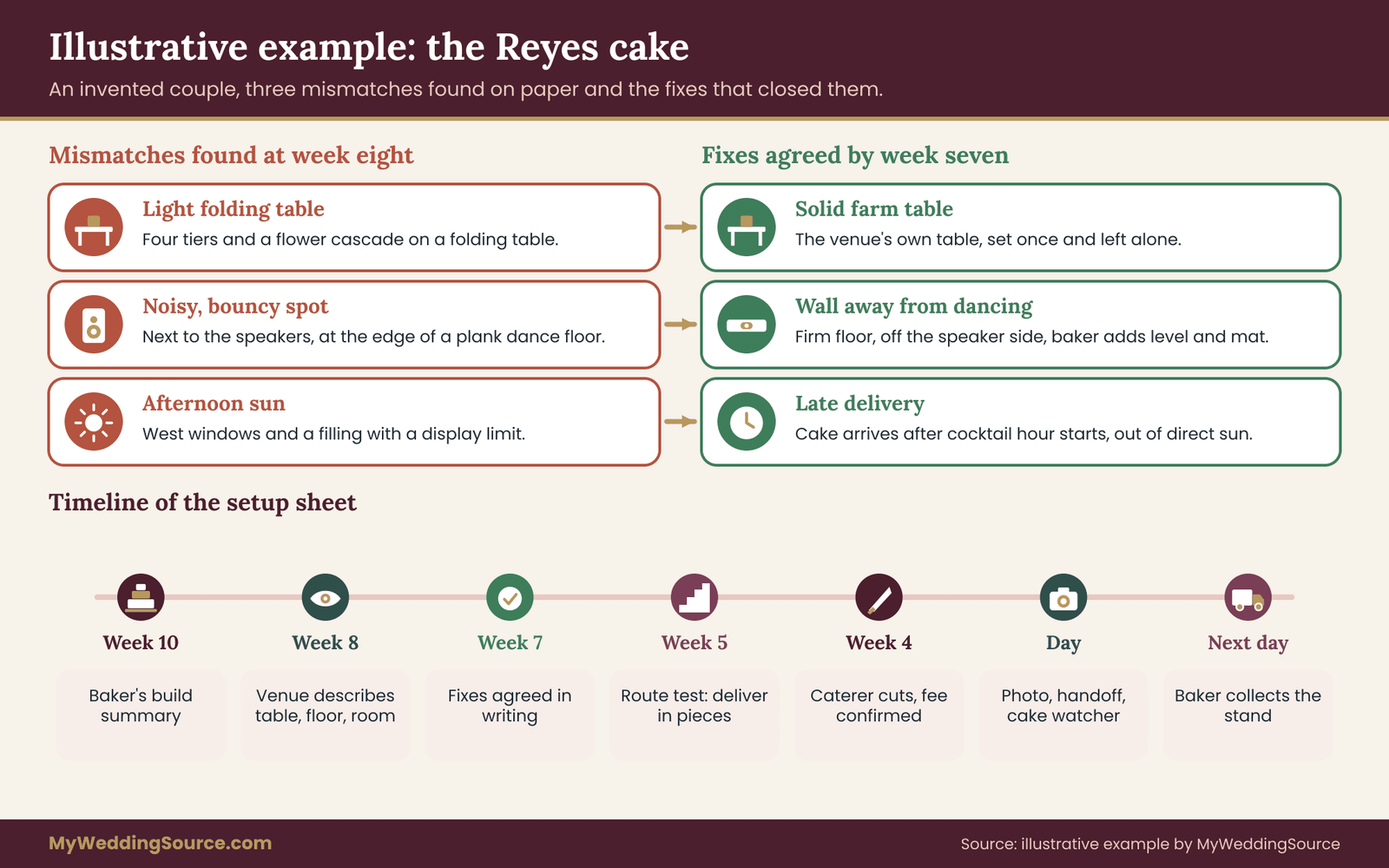
The easiest way to see how the three blocks of wedding cake support work together is to follow one invented couple. Ana and Jordan Reyes are not real, and their venue and baker are made up. The details are chosen to show how mismatches appear and get fixed, not to suggest typical conditions.
The plan. A late-June wedding with the ceremony at four o’clock and the reception in a converted barn. The cake is four tiers with a lemon filling and buttercream, a fresh-flower cascade from the florist, and a small separate gluten-free cake for two guests. The top tier is a keepsake. The baker is a small local bakery with its own stand.
Ten weeks out: the stand block. Ana asks the baker for a wedding cake support summary, using the message from the inside-the-tiers section. The baker replies the next day. The cake is stacked with supports in each of the lower tiers and a center rod. Each tier has its own board and the base is a drum. The assembled height and weight are given as figures, which Ana copies onto the sheet. The baker flags two points: the flower cascade will make the top heavy, and the lemon filling limits how long the cake can stand in a warm room. The display limit goes on the sheet.
Eight weeks out: the surface block. Jordan sends the venue the questions from the surface section. The venue manager replies with a paragraph. The cake table in the floor plan is a folding table in the corner by the main door, near the speakers and the edge of the dance floor. The floor is old plank, level in most places, with a noticeable bounce when people dance. The west windows get strong sun in the late afternoon.
Put beside the baker’s summary, the reply shows three mismatches.
- A folding table for a heavy four-tier cake with a top-heavy cascade.
- A spot beside the speakers and the dance floor, on a floor that bounces.
- A room that gets afternoon sun, with a cake that has a display limit.
Nobody did anything wrong. The venue answered the question as asked and the baker built a good cake. The wedding cake support mismatches exist only because the two descriptions had never been placed side by side.
Seven weeks out: the fixes. Ana and Jordan ask the venue for three changes, and the venue agrees to two of them.
- The cake table moves to a wall away from the speakers and the dance floor edge, in a spot where the floor is firm. The venue agrees.
- The folding table is replaced by a solid farm table that the venue keeps in storage. The venue agrees and notes that nobody will move it after setup.
- The venue cannot change the sun, so the answer comes from the schedule. The cake is delivered late, after the cocktail hour is underway, so it is out of direct sun and out for a shorter time.
The baker reviews the revised plan and says yes. The baker adds a small level, a non-slip mat and a spare set of supports to the day-of kit, and asks for the cascade’s weight from the florist.
Five weeks out: delivery and handoff. Using the route test, the venue describes the loading entrance. There is a side door with two steps and a ramp, a gravel path and no elevator. The baker decides to deliver the tiers separately and assemble on site, and asks for extra setup time. Ana writes the delivery window, the receiver’s name and phone number, and the baker’s emergency number on the sheet. The florist is told to place the cascade after the baker finishes, and the baker is told to approve it.
Four weeks out: the cutting block. The baker will not stay for the cutting. The caterer’s team will cut in the kitchen. The caterer confirms in writing that its cutting fee covers taking out the supports, plating and boxing the top tier, and the baker sends a breakdown note. The expected servings are copied from the baker’s summary at the baker’s recommended slice size, with a sheet cake from the same bakery added to cover the gap for the guest count. The gluten-free cake gets its own server and a table card.
The day. The baker’s team sets the cake, sends a time-stamped photo and leaves a contact number. A coordinator watches the cake and knows what to do if it softens or leans. The couple cuts one slice from the side the baker indicated, and the kitchen takes it from there. The next morning the baker collects the stand.
What the example shows
Four rules sit underneath this story, and they work for any cake.
The mismatch rule. Put the baker’s description and the venue’s description on one page, and look for any place where one does not fit the other. Most problems appear there.
The two-yes rule. A design goes ahead only when the baker and the venue have both said yes in writing to the same version of the plan. A yes from one side and silence from the other is not an agreement.
One owner per link. Every link in the chain, from the boards to the cleanup, has a named person. A link with no name is a gap.
Dated answers. Every answer has a date. If something changes, such as the table or the guest count, the relevant answer is checked again.
None of these wedding cake support rules needs expertise. They need a habit of asking, writing and comparing.
When the baker and the venue disagree
Sometimes the venue cannot or will not change the table or the spot, and the wedding cake support plan stalls, and the baker is not comfortable. This is a real situation, and the first rule is to take the baker’s concern seriously. A baker who declines to assemble a tall cake on a surface they consider unsafe is protecting the cake, the guests and their own work.
Take the disagreement back to the sheet. State what the baker needs, in plain terms, and ask the venue what it can offer. If the venue has a different table, a different spot or a rental option, the gap can often be closed. If it cannot, the options are to change the design, to move the cake to a place the venue controls less, or to bring in a rental table at your own cost. Each option is cheaper and calmer when taken a month ahead than on the morning of the wedding.
Verifying wedding cake support with vendors and official sources
This guide gives you questions and a way to organize the answers. It does not replace the information that your baker, your venue and your local authorities can give. A few verification steps are worth taking.
Read the baker’s contract. Look at what it says about delivery, setup, who is responsible after the handoff, what happens if the room is unsuitable and whether there is a fee for returning to collect the stand. If the contract is silent on something the setup sheet covers, ask for it to be added or confirmed in writing. Delivery, setup and handoff terms are the clauses to look for.
Ask about insurance and outside-vendor rules. Many venues have rules about outside vendors, and some require proof of liability insurance. Ask the venue whether it has a policy on outside bakers, what documents it needs and by when. Ask the baker whether they carry insurance and can provide a certificate if asked.
Check licensing if a friend or relative bakes. Rules for selling and serving home-baked food differ by state and locality. Some venues and caterers will not serve cakes from an unlicensed kitchen. Ask the venue, and check with your local health department, before the cake is ordered.
Use the official sources for general rules. For food handling and time out of refrigeration, the foodsafety.gov site, the U.S. Department of Agriculture’s Food Safety and Inspection Service and the Centers for Disease Control and Prevention are the starting points. The Food and Drug Administration covers food allergens and its Food Code, which many local health rules build on.
For lifting and carrying, the National Institute for Occupational Safety and Health has guidance. For accessibility, the ADA website of the U.S. Department of Justice. For open flame, the National Fire Protection Association and your local fire authority. For heat, the National Weather Service. The Sources section below lists each one.
If you are still choosing a venue, the cake questions fit naturally into a site visit. The wedding venues guide covers what to ask on a tour, and the cake table, the floor and the room’s temperature are easy to look at while you are there.
What this guide does not cover
A few limits of this wedding cake support guide are worth stating plainly.
This guide is not an engineering manual, and it does not tell your baker how to build a cake. It gives no dowel counts, weights, serving numbers or temperature limits, because those are decisions for a licensed bakery and depend on the particular cake. Where numbers would help, the guide tells you to ask for them in writing.
It does not cover every design. Unusual cakes, such as very tall, tilted or hanging designs, need a direct conversation with a baker who has built them. It does not replace local rules on food service, fire safety or accessibility, which vary and change. Fees and venue policies also change, so check the current terms with the people who set them, and revisit the sheet after any change in the plan.
The article is also written for a general audience, and it does not describe any real bakery or venue. The Reyes example is invented.
Your next steps
Start with the order of questions rather than the whole sheet. Within a week of reading this, ask your baker for the structure summary and ask your venue for the table, floor and room description. Put the two answers on one page and look for mismatches. That single step finds most of the problems.
Then work outward. Fix any mismatch with a table swap, a new position or a design change. Settle the delivery route and the handoff. Record who cuts, who removes the supports and who clears the stand. Set a date on each answer and a date to review the sheet, ideally a few weeks before the wedding and again in the final week. Finally, share the finished page with the baker, the venue manager, the caterer and your planner or coordinator, so that everyone is working from the same wedding cake support plan.
FAQ
How do tiered wedding cakes stay up?
Each tier sits on its own board, and supports such as dowels, tubes or a plate-and-pillar system carry the weight of the tier above down to the board below, so no tier rests on soft cake. Many bakers add a center rod to keep the stack aligned. The base, stand, table and floor carry everything beneath. Ask your baker to describe their method in writing.
What should I ask my baker about wedding cake support?
Ask for the number of tiers and the diameter of each, the assembled height and weight, the method used to hold the tiers together, any parts that are not edible, and whether any tier is a dummy. Also ask who delivers, how long setup takes and who is briefed to take the cake apart. Request the answers in an email so the venue and caterer can read them.
What kind of table does a tiered cake need?
It needs a solid, level table that does not rock, with a top large and strong enough for the base and stand. Light folding tables, small bistro tables and tables with damaged legs are poor choices for heavy cakes. Ask the venue for the table type, size and top material, and show the baker a photo before the design is final.
Can a tiered wedding cake sit outdoors or on grass?
It can, with planning. Soft ground lets table legs sink unevenly, and heat, wind and rain all affect the cake. Ask for a firm, level surface such as flooring under the table, shade at the time of display, and a nearby indoor fallback. Your baker may recommend a different finish or a shorter display time for an outdoor summer event.
Who should cut and take apart a tiered cake?
Whoever does it needs to know where the supports are. The most reliable choice is the baker or someone from the bakery. If the caterer or venue staff do it, ask the baker for a written breakdown note listing supports to remove and which tiers are not edible. Confirm in writing what the cutting fee includes.
Why do some cakes include dummy tiers?
A dummy tier is a decorated foam form that adds height or visual impact without adding weight or cost, and it can reduce the risk of a very heavy stack. It does not feed anyone, so servings come from the real tiers and often a kitchen cake. If any tier is a dummy, ask the baker to tell you which one, and plan the serving count accordingly.
Is it safe for a friend to drive the cake to the venue?
It can be, if the baker agrees and gives written instructions. A tiered cake needs a flat, non-slip surface, cool air, a slow drive and enough hands to carry it. A car seat is not suitable. For large or fragile designs, professional delivery is the safer choice, and it usually includes setup and a handoff that a friend cannot provide.
What should we do if the cake starts to lean during the reception?
Do not touch it. Call the baker, using the emergency number from the handoff, and tell the coordinator so that guests are kept back. Follow the baker’s advice, which may include steadying the table, moving the cake to a cooler spot or cutting earlier. A named cake watcher and a short written trigger list make this calm rather than chaotic.
Sources
- FoodSafety.gov, U.S. Department of Health and Human Services
- Food Safety and Inspection Service, U.S. Department of Agriculture
- Food, U.S. Food and Drug Administration
- FDA Food Code, U.S. Food and Drug Administration
- Food allergies, U.S. Food and Drug Administration
- Food safety, Centers for Disease Control and Prevention
- National Institute for Occupational Safety and Health, Centers for Disease Control and Prevention
- ADA.gov, U.S. Department of Justice Civil Rights Division
- Heat safety, National Weather Service
- National Fire Protection Association