

A sunset ceremony time is the sunset ceremony time you choose for your vows after reading the sunset table for your venue, your date and your photographer’s needs. This guide shows how to read the table, count backward from sunset to a sunset ceremony time, and check your venue’s real horizon so the light you are counting on is actually there.
Look up sunset and the end of civil twilight for your venue’s location and date, in local clock time. Decide whether the ceremony will happen well before sunset or at sunset. Then count backward from sunset by adding up the ceremony length, the family photographs, the walk or transition, the couple portraits and a buffer. The total is how far before sunset the ceremony should start. Finally, check the horizon at the venue, because hills, trees and buildings can end direct light long before the table says the sun sets.
Most couples hear one piece of advice about light: get married in the hour before sunset. It is not bad advice, but it hides a lot of work. Sunset moves by about two minutes a day for much of the year. It falls at a different clock time a few hundred miles away. It can happen behind a ridge, a tree line or a hotel tower twenty minutes before the table says it does. And the hour that suits portraits does not always suit a ceremony. Picking a sunset ceremony time is a small piece of arithmetic wrapped around a few facts you have to verify yourself.
This article is built for the planning stage, when you have a date and a venue but have not yet fixed the sunset ceremony time in writing. It covers how sunset tables work, a method for counting backward from sunset, what changes across the seasons, how to verify the horizon at your actual site, how to work with a photographer on the timeline, and a worked example with invented numbers. It does not tell you which lens or camera setting to use, and it does not replace a conversation with the people who will photograph your day.
If you are still deciding the date itself, start with the guide to choosing a wedding date and come back once the date is set.
A note on scope. This is general planning information, not legal, tax or financial advice. Venue rules, permits and contracts differ from place to place, so where a rule matters, the guide points you to the office or vendor that issues it, and you should confirm the current version there.
Choosing a sunset ceremony time: two approaches
The phrase “sunset ceremony” is used for two quite different plans, and mixing them up is the most common way couples end up with a timeline that fits neither.
Approach one: ceremony before sunset, portraits at sunset. The ceremony starts well ahead of the sun going down, often by an hour and a half to two hours or more. Guests sit in daylight that has already softened. When the ceremony ends, family photographs and a short cocktail break follow, and the couple walks out for portraits when the sun is low. Light is working for you twice: during the ceremony and during the portraits.
Approach two: ceremony at sunset. The vows themselves happen as the sun reaches the horizon. The setting is dramatic, and the guests remember it. But the plan has a hard edge: the sun does not wait for a late processional. Photographers working a ceremony at sunset are also working against falling light, fast changes in exposure and often a bright sky behind the couple. After the kiss, usable direct light disappears within a few minutes.
Neither is wrong. They suit different venues, different photographers and different tolerance for risk. Whichever you choose, the sunset ceremony time is the number everything else hangs from. The sections that follow use the label “light window” for the span of time when the light is good enough for the photographs you care about, and the question becomes where the ceremony sits inside that window.
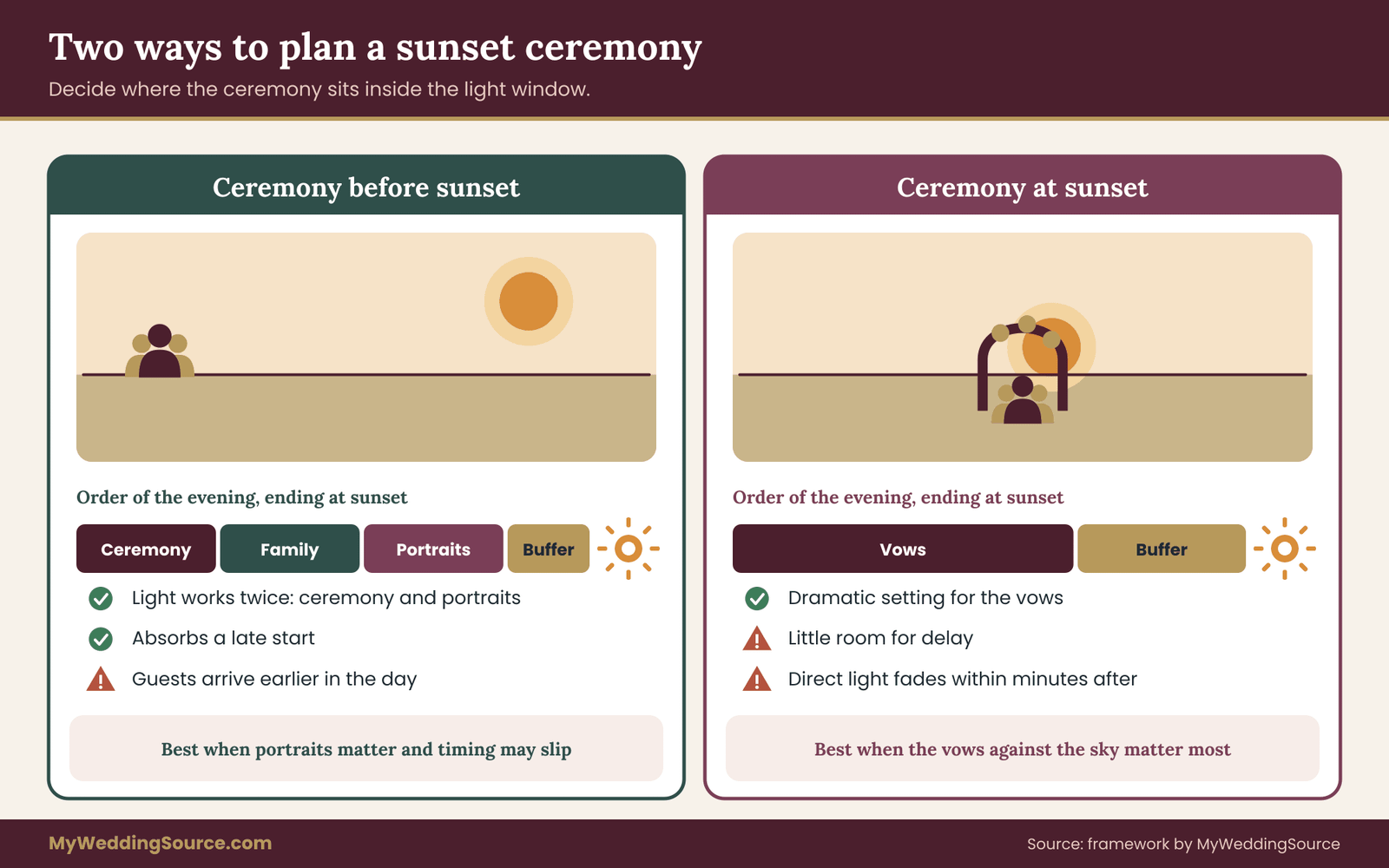
Which approach fits you
A few honest questions sort most couples quickly.
Do you want family photographs and couple portraits in good light, or is the ceremony photograph the one that matters most? If portraits matter, approach one gives you room. If a single image of the vows against a glowing sky is what you picture, approach two is the one to plan for.
How much slack do you have for lateness? A ceremony that starts twenty minutes late is a minor annoyance in the afternoon and a real problem at sunset. If your family or wedding party has a habit of running behind, approach one absorbs that without damage.
How long will the ceremony be? A ten-minute civil ceremony fits at sunset easily. A ceremony with readings, a unity ritual and a long processional might take forty minutes. The longer it runs, the more it needs to begin earlier. Your guide to the step-by-step ceremony can help you estimate the running time, and a cue sheet will turn the estimate into a schedule.
Where will the sun be? At some venues the sun sets behind the guests and lights the couple’s faces. At others it sets behind the couple and turns them into silhouettes. The same sunset ceremony time works well in one layout and poorly in the other, and a later section explains how to check which you have.
Why this matters for photography specifically
Light affects almost every other choice a photographer makes. Direct midday sun is harsh and produces squinting and hard shadows. Low sun is warm and flattering but changes quickly. After sunset the sky glows for a while, then fades into a level of light that needs flash or lighting equipment. Because of that, a photographer asked about your sunset ceremony time will almost always ask first about sunset, and then about the direction your ceremony faces.
None of this means you must schedule around the camera. The ceremony is the point of the day, and guest comfort, family travel and religious or cultural timing may outrank light. The aim of the method here is to make an informed trade about your sunset ceremony time, not to treat the sun as the boss of the wedding.
What a sunset table shows, and what it leaves out
A sunset table is a list of times, usually for one location, showing when the sun sets on each date of the year. The best-known sources in the United States are the U.S. Naval Observatory, which publishes rise, set and twilight data for specific places, and the National Oceanic and Atmospheric Administration, whose solar calculator gives sunrise, sunset and the sun’s position for a latitude, longitude and date. The National Weather Service also posts sunrise and sunset for forecast locations. These are the sources to use for planning, rather than a general weather app that may round or use a nearby city.
Learn the vocabulary before you read a table, because the terms are specific.
Sunset. In the standard definition, sunset is the moment the upper edge of the sun disappears below an ideal, flat horizon. The center of the sun is already below the horizon by then, and the sky is still bright. The table gives a precise minute.
Civil twilight. This is the period after sunset, and before sunrise, when the sun is less than six degrees below the horizon. In clear weather there is enough natural light to see ordinary objects outdoors. Tables list the time when civil twilight ends. At mid-latitudes in the United States the gap between sunset and the end of civil twilight is often around half an hour, longer at high latitudes and near the summer solstice, and varying by date. Read your own table for the actual number.
Golden hour. This is a photographers’ term, not an official one. It means the period of low, warm light after sunrise or before sunset. Because it has no official definition, no table lists it, and different photographers use different lengths. When a photographer says “golden hour,” ask what clock window they mean for your date.
Blue hour. Also informal. It is the period around civil twilight when the sky holds a deep blue color. Some portrait photographers like it. Others prefer to be finished before it begins.
What the table assumes
A published sunset time is computed for a perfectly flat horizon at sea level, with standard assumptions about how the atmosphere bends light. That is a reasonable assumption on an open beach or flat plain and a poor one almost everywhere else. If a hill, a ridge, a tree line, a wall or a nearby building sits between your ceremony spot and the western sky, the sun will disappear behind it earlier than the table says. The table is not wrong. It simply answers a question about an idealized horizon, and your venue does not have one.
The table also gives a single point, not a venue. Sunset moves slightly as you travel east or west within a time zone, because the clock does not shift by longitude the way the sun does. Within a single time zone, places on the western edge see sunset noticeably later by the clock than places on the eastern edge, roughly four minutes per degree of longitude. For a venue that is only a few miles from the location in the table, the difference is small. For a destination wedding in a different part of the time zone, it is not.
What the table leaves out
Beyond the horizon, the table says nothing about weather, haze or wildfire smoke, which can dim and redden the sun early and flatten the sky. It does not tell you the direction the sun sets relative to your ceremony space. It does not know when your guests will be seated, when your photographer needs to be set up, or how long your processional takes. All of those are your inputs. The next section shows how to read the table properly, and the one after it shows how to turn the number into a sunset ceremony time.
Reading a sunset table step by step
Reading a table sounds trivial until you notice how many small ways it goes wrong. Work through these steps in order and write each answer down.
Step one: use the right place. Enter the venue’s address or its latitude and longitude, not the nearest big city. If the venue is rural, use the coordinates from the venue’s own map listing. A table for a city fifty miles away can differ by a few minutes, which matters if you are counting on the last ten minutes of light.
Step two: use the right date. Use the wedding date, not a date near it. Then look at the rows for a week before and a week after. In spring and fall, sunset changes by roughly two minutes a day at mid-latitudes, so a week is a fourteen-minute swing. Around the summer and winter solstices the change per day is tiny, and the date matters much less. Knowing which situation you are in tells you how much a date change would affect your light.
Step three: check the time basis. Tables come in local standard time, local daylight time, or universal time, depending on the source and the settings. Confirm that the time shown is the local clock time guests will see on their phones on your wedding date. If your date falls near a clock change, double-check this twice. The sun does not care about the clock, and a table in the wrong basis is wrong by an hour.
Step four: record two numbers. Write the sunset time and the end of civil twilight. Sunset tells you when direct light is gone on a flat horizon. Civil twilight tells you how long usable sky light lasts afterward.
Step five: write the azimuth, if the source gives it. The NOAA solar calculator shows the sun’s compass direction, called azimuth, at any time. In the northern hemisphere the summer sun sets in the northwest, the equinox sun sets nearly due west, and the winter sun sets in the southwest. This will matter when you decide where the couple should stand.
Step six: pick a rehearsal date. If you can, choose a date close to your wedding, at the same time of day, and visit the venue to see where the sun actually goes. A visit is the best verification there is, and a later section explains what to look for.
Common reading errors
A wrong reading quietly moves your sunset ceremony time by an hour or more, so check each of these.
A few errors recur often enough to name.
Reading the wrong day is the first. A table that lists the whole month can be misread by a row, especially on a phone. Check the date label, then check the next row to confirm the trend makes sense.
Mixing the table’s time zone with the venue’s is the second. If your ceremony is in one time zone and the table you found defaults to your home city in another, the sunset time will be off by whole hours. The fix is to enter the venue’s coordinates.
Treating sunset as the end of light is the third. Sunset is the beginning of the end. Good direct light usually fades earlier, and usable sky light continues after. Which of those matters depends on your photographer and your plan.
The fourth is forgetting that tables are predictions, not promises. The calculation is precise, but the sun’s visible moment depends on what is in front of it.
The light window method for a sunset ceremony time
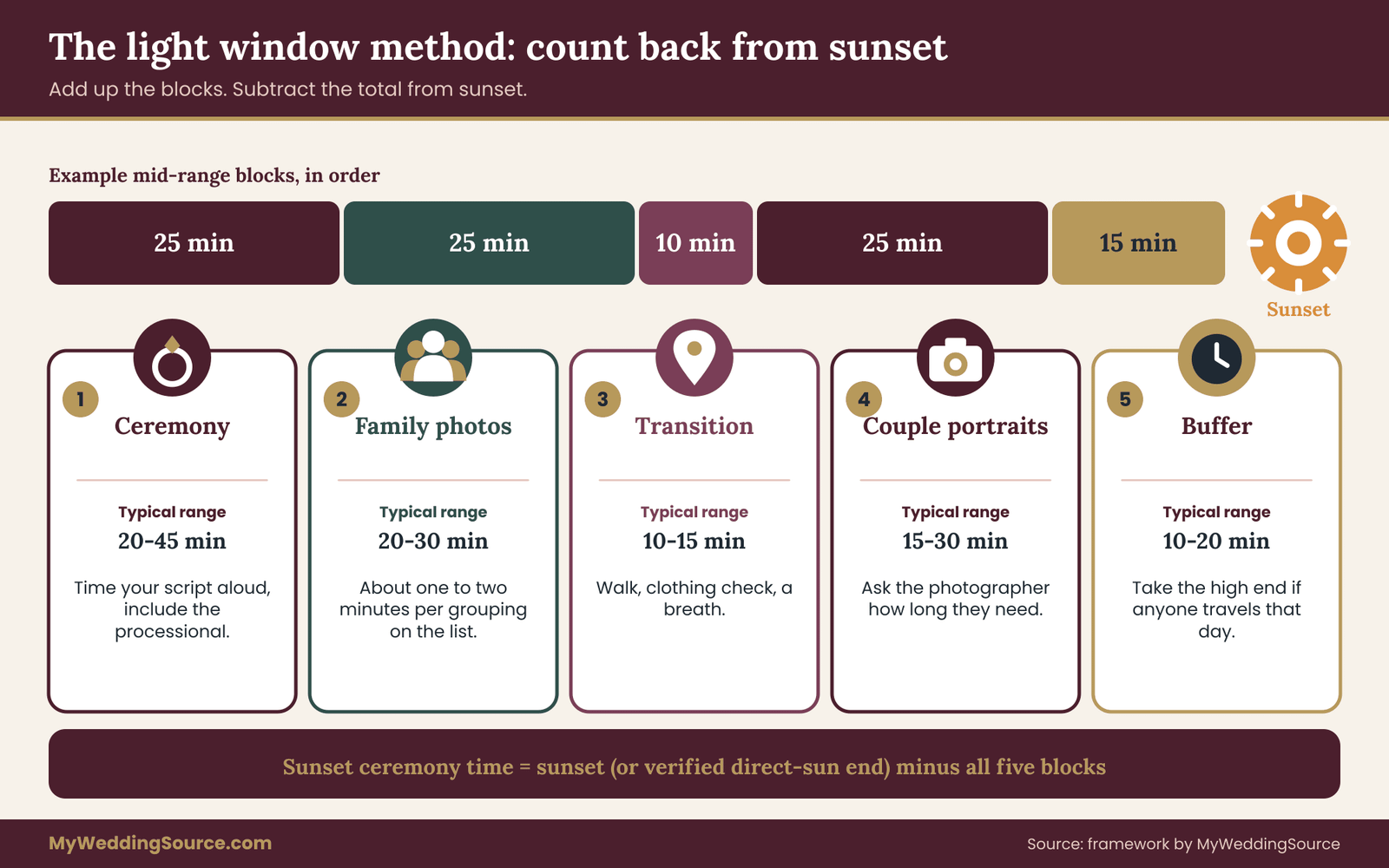
Once you have the sunset time, the question is how far before it the sunset ceremony time should fall. The method here counts backward from sunset by adding up the blocks that have to fit before the light is gone. It is a framework, not an industry standard, and you should adjust the blocks to your plan and your photographer’s advice.
The shape is simple:
Start time = sunset time minus the sum of the blocks.
The blocks, listed in the order they happen after the ceremony begins, are these.
Block one: the ceremony itself. Use the realistic running time, including the processional, the vows and the recessional. A short ceremony may run ten to fifteen minutes. A ceremony with a reading, a ritual and music can run thirty to forty-five. Add a couple of minutes for the guests to settle at the beginning. If you do not know the length, read your own script aloud with a timer.
Block two: family and wedding party photographs. These are the formal groupings listed on your shot list. Each grouping takes roughly a minute or two when the people are present and organized, and longer when someone is missing. A list of eight groupings might need twenty to thirty minutes. The family photo list guide helps you decide which groupings are worth the time.
Block three: the transition. This is the time to move from the ceremony space to the portrait location, adjust clothing, check hair and take a breath. Ten to fifteen minutes is common. Longer if the walk is long or the venue is large.
Block four: the couple’s portrait session. In the best light, a short session of fifteen to thirty minutes usually gives a photographer enough to work with. Some photographers will do it in less. Ask yours.
Block five: buffer. Things run late. Add a margin of ten to twenty minutes. If your family is punctual and the venue is compact, take the lower number. If any of the key people are traveling that day, take the higher.
The arithmetic, in minutes
Here is the sum in a form that is easy to adjust. Take the middle of each range and the total comes to about two hours before sunset: twenty-five for the ceremony, twenty-five for family photographs, ten for the transition, twenty for the portrait session and fifteen for the buffer is ninety-five minutes. Add the time the guests need to be seated before the ceremony, and the sunset ceremony time lands near one and three-quarter hours before sunset.
That result matches the common guidance that many photographers offer, of starting a ceremony between one and two hours before sunset. But the method shows you where the guidance comes from, and it lets you change the answer when your plan changes. A short ceremony with a first look and family photographs taken earlier in the day needs far less lead time. A long ceremony with many family groupings needs more.
Moving blocks out of the sunset window
The blocks are not fixed, and a sunset ceremony time can change a lot when one of them moves.
The most effective way to get a later sunset ceremony time is to move blocks to a different part of the day. Three moves do most of the work.
Take family photographs before the ceremony. Many couples photograph the wedding party and family before the ceremony, either at the same venue or just before guests arrive. This removes block two from the sunset window entirely and shortens the lead time by twenty to thirty minutes. The trade is that some families feel strongly about not seeing each other before the ceremony, and you should honor that.
Do a first look. If you and your partner are comfortable seeing each other before the ceremony, a first look allows portraits earlier in the day. You then need only a short sunset session, perhaps ten minutes, for a few images in the best light.
Split the portraits. A few portraits at the ceremony location, and a short return to the sunset spot later, during dinner, is a pattern many photographers suggest. The couple steps out for ten minutes while guests are eating. This keeps the sunset images without leaving guests waiting during cocktail hour.
Each of these moves lets the sunset ceremony time slide later, and each buys time, but each costs something too: a surprise, a break in a tradition, or a moment away from your own reception. The method helps you see the trade clearly.
The sunset ceremony time for approach two
If you choose approach two, with vows at sunset, the arithmetic for the sunset ceremony time is shorter and the tolerance is smaller. Count back from the moment you want the sun to touch the horizon, usually the kiss or the vows, not the start. A ceremony of twenty minutes that should reach the vows at sunset starts about ten to twelve minutes earlier, with a buffer of at least ten minutes beyond that. All other blocks move to before the ceremony, or to civil twilight afterward, using lighting.
Two cautions apply. First, the sun’s visible moment may come earlier than the table says if the horizon is blocked, so a ceremony timed to the table may end in shade. Second, photographing into a bright sky is technically demanding. Photographers differ in how they handle it, and some will want to flash or light the couple from the front. Ask what your photographer needs, including whether they carry lighting and whether the venue allows it.
A simple check on your own number
Once you have a sunset ceremony time, run a quick test. Does it leave at least twenty minutes of usable light after the family photographs and before sunset? If it leaves less, ask which block can move. Does the schedule still work if the ceremony starts fifteen minutes late? If not, add buffer or move a block. Does the guest experience hold up, with seats not in glare and no long wait in direct sun? A later section covers that, but ask the question now so the sunset ceremony time is a draft, not a decision.
Write the draft sunset ceremony time down as a reverse timeline, from sunset back to the guest arrival time. A draft sunset ceremony time is only a draft until others have read it. Share it with your photographer and your planner or venue coordinator, and use their feedback to fix the weak spots. A sunset ceremony time that has survived those three readers is a good deal safer than one built from a single number.
Seasonal light windows and your sunset ceremony time
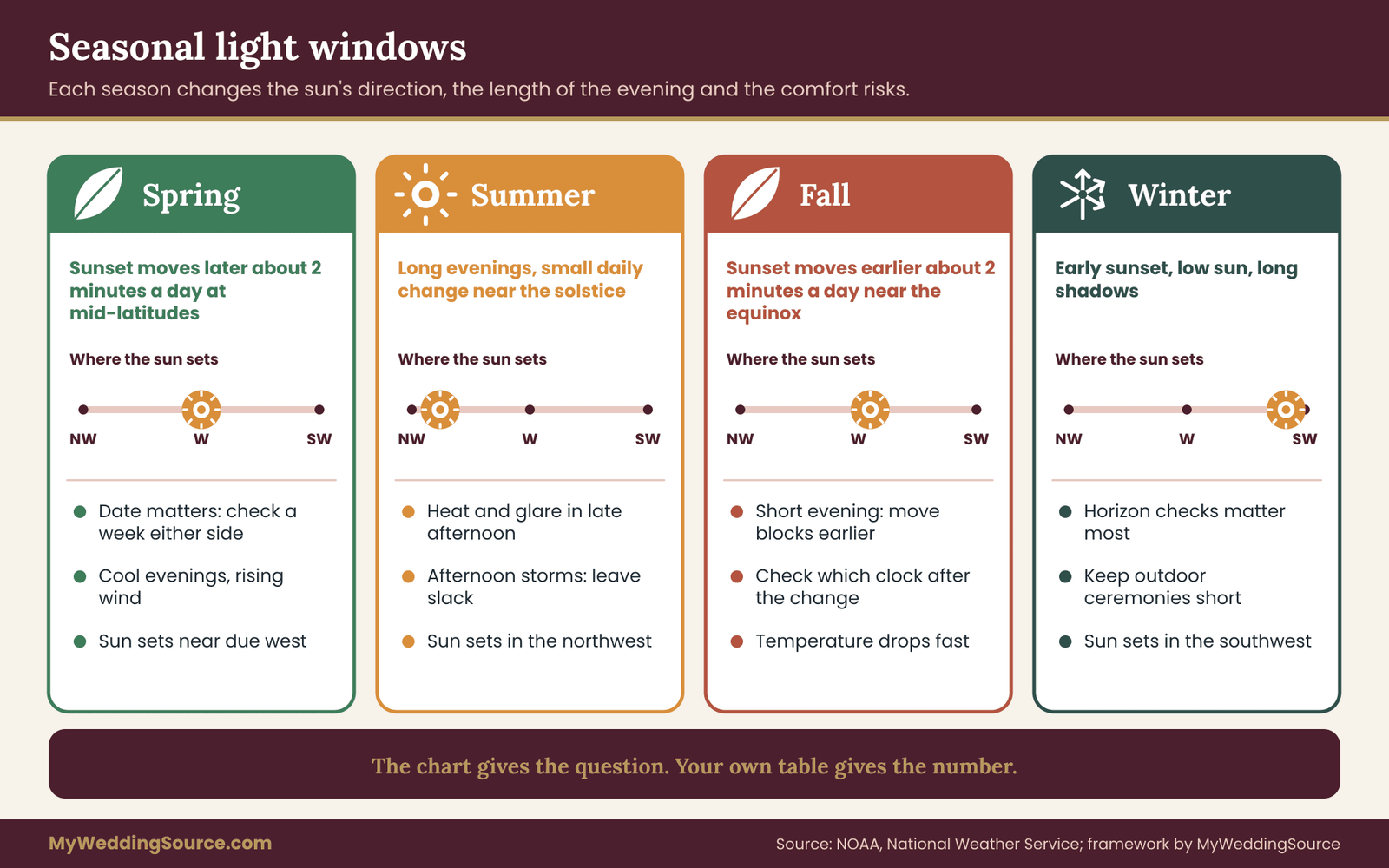
The same method gives very different answers across the year, because the length of the evening, the direction of the sun and the temperature all change. The seasonal light-window chart below is a way to see those differences at a glance. It does not list clock times, because those depend on your location. It lists what changes, so you know which questions to ask for your own season.
Spring
In spring, sunset moves later by the clock almost every day, by about two minutes a day at mid-latitudes. That makes the date matter. A ceremony planned for the first weekend of April and one planned for the last weekend of May are in different evenings entirely, even though both are called spring. If your date is early in the season, check the table for the week before the wedding and the week after, in case you move the date.
A spring sunset ceremony time carries its own risks. Spring light is often described as clear and soft, but spring weather is changeable. Cool evenings are common, and in many regions wind picks up as the sun goes down. A ceremony that starts earlier loses less warmth than one that waits for sunset, which is one reason many spring couples choose approach one. Guests in light clothing will feel the temperature drop in the last half hour of light, so a sunset ceremony time that keeps the guest portion short and the seating in sun can be kinder than one that runs into the chill.
The sun sets in the west or slightly north of west, and the direction moves north through the season. A ceremony space that faces the sun in March may no longer do so in June.
Summer
In summer, sunset comes late and the day is long, which gives you the most flexibility on paper. Around the solstice, the daily change in sunset is small, so a date move of a week changes little. The sun sets in the northwest, and the twilight after sunset can be long, particularly in the northern states.
The risks to a summer sunset ceremony time are heat and glare.
Late afternoon in summer can be hot, and an outdoor ceremony at four or five o’clock may put guests in strong sun with few places to hide. The National Weather Service publishes heat safety guidance and heat advisories, and guests who are older, pregnant or traveling from cooler climates may be affected before the couple notices.
A later start spares guests the hottest part of the afternoon, but a later start also means a longer wait for the sun to drop and fewer hours between ceremony and sunset if something runs late. Shade, water, fans and seating placed out of direct sun are practical fixes, and a covered or shaded ceremony area changes the arithmetic considerably.
Summer storms are the other factor. Afternoon thunderstorms are common in many regions. A sunset ceremony time that leaves room for a delay of thirty to sixty minutes, and a plan for where guests will wait, can save the evening. The section on weather later in this guide covers it.
Fall
Fall gives a sunset ceremony time the least room for error.
In fall, sunset moves earlier by about two minutes a day around the equinox and keeps moving earlier into November, so the date matters again. A fall wedding is often chosen for the low golden light, and that light is real: the sun is lower for a longer part of the day. But the evening is short. A ceremony at five o’clock in late October may leave only an hour of light, and the family photographs will compete with the dark.
The clock change in early November, when daylight saving time ends in most of the country, moves sunset about an hour earlier on the clock. If your date falls just before or just after it, confirm which clock your table uses and tell guests which time applies. In fall, most couples either move the ceremony earlier than they would in summer, photograph the family beforehand, or accept a shorter portrait session.
Temperature drops quickly after the sun goes down in fall. A ceremony that ends before sunset keeps guests warmer, and cocktail hour indoors is the usual next step.
Winter
A winter sunset ceremony time can arrive before the workday ends for many guests.
In winter, sunset is early, often before five o’clock, and the sun sets in the southwest, low over the horizon. A low sun means long shadows and light that is warm, but it also means that any tree or building to the southwest of your venue will block direct sun for a large part of the afternoon. Horizon checks matter more in winter than in any other season.
Winter ceremonies often happen indoors, in which case sunset still matters if the room has windows. A chapel or hall with western windows can be bright and warm at four and dark at five. Ask your photographer how they would use the room’s light at your time.
Cold is the main comfort risk for a winter sunset ceremony time outdoors. An outdoor ceremony in winter is usually short, with the guest portion kept to ten or fifteen minutes and a warm place ready afterward. Where sunset is as early as four-thirty, a ceremony start between one and three o’clock is common, and the sunset session becomes a few minutes with the couple while guests are inside.
Using the chart for your own date
Pick your season, read the row for the question that matters most for you, and then look up the numbers. If heat is the key risk, aim for a later start and shade. If the evening is short, move blocks to before the ceremony. If the sun is low and the horizon is crowded, verify the site early. The chart gives the question; the table gives the number; your own sunset ceremony time is the answer you build from both.
Latitude, longitude and the time zone edge
The sunset times people remember from their own homes do not travel. If you live in one part of the country and marry in another, or if your venue is near the edge of a time zone, the numbers change in ways that are easy to miss.
North and south
At higher latitudes, the daily swing in sunset is larger and the seasons are more extreme. In the northern states, summer evenings are very long and winter evenings are very short. In the southern states, the seasons vary less, and sunset on the longest day and the shortest day are closer together. A couple planning a winter wedding in the northern United States has far less light than one planning the same date in the south, and the method gives a shorter lead time.
Twilight also changes with latitude. At lower latitudes the sun drops more steeply, so the interval between sunset and darkness is shorter. At higher latitudes, particularly in summer, the sun descends at a shallow angle and twilight lingers. This matters for approach two: a ceremony at sunset in the far north has a longer afterglow than the same plan in the far south.
East and west within a time zone
A time zone is a band that shares a clock. Within the band, the real position of the sun differs, so sunset falls later by the clock as you move west. The shift is roughly four minutes for each degree of longitude. For a venue on the western edge of a time zone, sunset can be a half hour or more later by the clock than for a venue on the eastern edge, on the same date.
This explains why a friend’s advice from a different city may not apply. It also matters for guests: a sunset ceremony time that feels late to guests traveling from the eastern part of the zone may feel ordinary to the locals. For most weddings the effect is minor. It becomes a concern when the venue is far from the location in the table, or when you are comparing two possible venues in different places.
Time zone borders and travel
If your venue is near a time zone boundary, confirm which zone it uses. A few places sit on or near the line and some counties differ from their neighbors. The venue can tell you in one sentence, and it is worth asking because it changes every clock time on the schedule. If many guests will travel across a boundary on the wedding day, tell them clearly which time applies.
Elevation and terrain
Terrain can move a sunset ceremony time by more than a time zone does.
Venues in mountains, valleys or canyons have the strongest horizon effects. A venue in a valley can lose direct sun more than an hour before the table’s sunset, because the western ridge blocks it. A venue on a mountaintop or an open hillside can see the sun set at the table time and keep the sky glow afterward. Because terrain differs so much, the next section is the one that most affects a sunset ceremony time for many couples.
Verifying the horizon before you lock a sunset ceremony time
Verification is the step most plans skip, and it is the one that most often changes the answer. The goal is to find out when direct sun actually leaves the ceremony space on your date, which is what the guests and the photographer will experience. The table gives a starting estimate. The verification gives the answer.
Method one: visit at the same time of year
The most reliable check is to stand at the ceremony spot, at the time of day you are considering, in a season close to your wedding date. Watch where the sun goes. Note the time when it passes behind the first obstruction and the time when it reaches the horizon, if it ever does. Photograph the view with your phone, standing at the spot where the couple will stand.
A visit a few weeks before or after the date is a good proxy because the sun’s path changes slowly. A visit six months away is not, since the sun’s path is far apart between summer and winter. If you can visit only at the wrong time of year, use the next methods to fill the gap.
Method two: measure the obstruction with your hand
If you can be at the site but not at the right time, you can estimate how much of the sky is blocked. Hold your arm straight out in front of you. The width of your closed fist at arm’s length covers about ten degrees of sky, and the width of your little finger covers roughly one degree. These are rough astronomical rules of thumb, and hands differ, but they are good enough to size a ridge or a tree line.
Face west, or toward the point on the horizon where the sun will set on your date, and stack fists from the true horizon up to the top of the obstruction. If the tree line reaches one fist, it is about ten degrees high. If it is half a fist, about five.
Then convert the angle into minutes. Near the equinoxes at mid-latitudes, the sun drops by roughly a fifth of a degree each minute as it nears the horizon, so a five-degree obstruction costs about twenty-five minutes of direct light, and a ten-degree one costs closer to fifty. Near the summer solstice the sun descends more slowly, so the same obstruction costs even more minutes. These figures are approximate and meant for planning. They show why a modest-looking tree line can cut off direct sun a half hour early, and why the time on the table cannot be taken at face value.
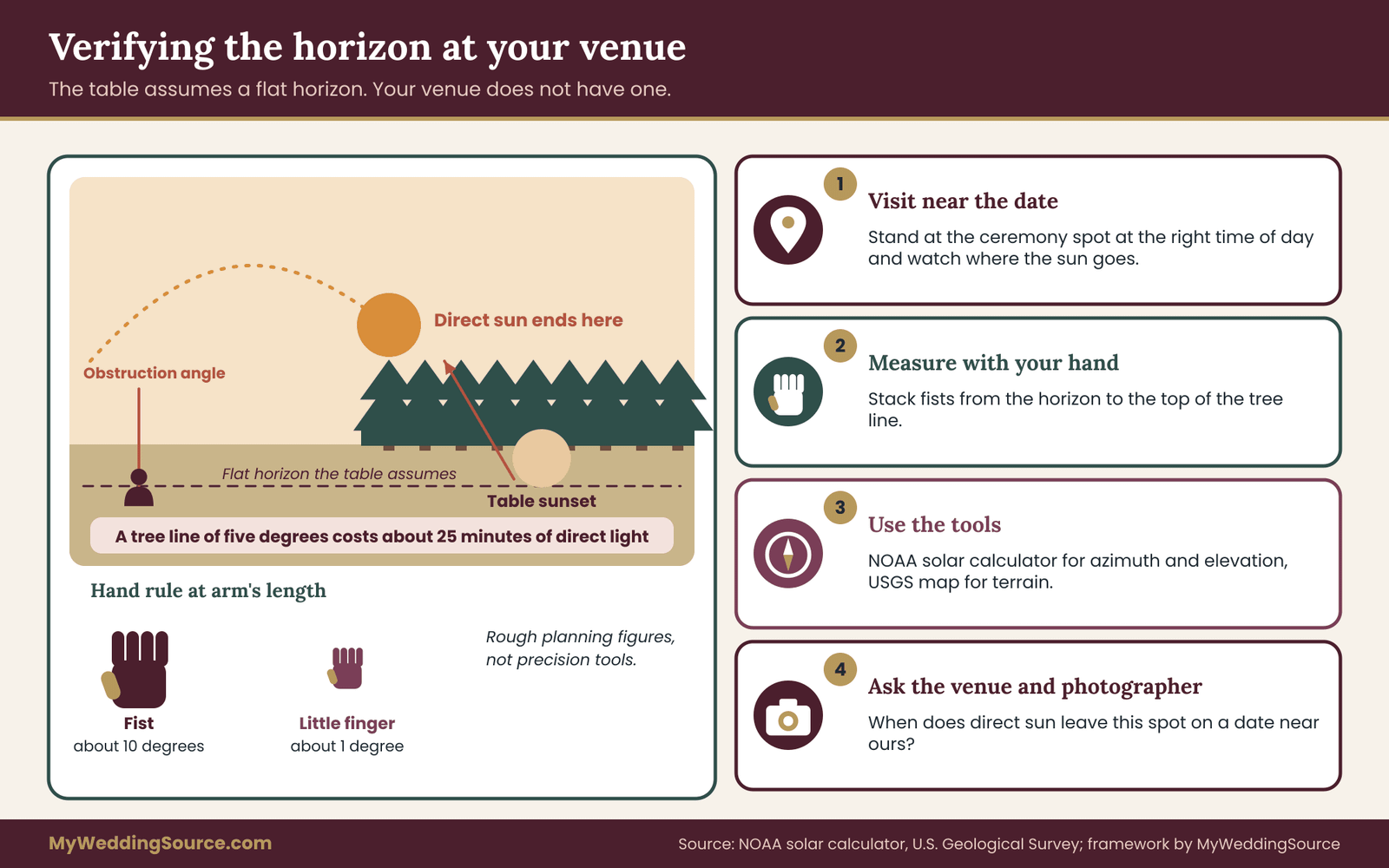
Subtract the lost minutes from the table’s sunset. The result is your working estimate of when direct sun leaves the spot. If the estimate is early enough to remove the portrait window you wanted, you have found the problem while it can still be fixed.
Method three: use the tools for position and terrain
Several free tools help you check the sun’s position before you visit.
The NOAA solar calculator reports the sun’s azimuth and elevation for any latitude, longitude, date and time. Enter the ceremony spot and the time you are considering. You will see where the sun is in the sky and how high it is, and you can step through the evening to see when it falls below the angle of your obstruction.
The U.S. Geological Survey publishes topographic maps and elevation data through The National Map. A topographic map of the venue and the land to its west shows whether a ridge or hillside sits in the way, and roughly how tall it is. Satellite imagery shows the tree line and nearby buildings. Combined with the sun’s azimuth, these let you draw a rough line from the ceremony spot toward the sunset direction and see what is on it.
The sun’s path is predictable, so you can check several dates in one sitting. Look at your wedding date and at the date a month either side. You will see how fast the sunset point moves along the horizon and whether a gap in the trees opens or closes.
Method four: ask the venue and the photographer
Venue staff who have watched hundreds of evenings often know when the sun leaves the lawn in each season. Ask the venue coordinator, “On a date near ours, when does direct sun leave the ceremony area, and where is the best light for portraits at that time?” Ask your photographer the same question. If they have photographed at the venue before, they may have a good sense of the answer. If not, ask whether they can scout the site. Some offer a short site visit, and some will review your photographs and the sun-position data remotely.
A sunset ceremony time based on a coordinator’s memory is still a guess. Treat answers as information to confirm, not as promises. A coordinator’s recollection of a summer evening does not settle a late-October question.
Recording the result
The verified answer, not the table, should set the sunset ceremony time.
Write down the verified answer in a sentence you can hand to others: “On [date], direct sun at the ceremony spot ends about [time], which is [number] minutes before the table’s sunset, because of [obstruction].” Put it on the timeline next to the table’s sunset time. When you build the reverse timeline, count back from the verified time, not the table time, if you want direct light on the couple.
If the verified time is much earlier than the table, you have three options. Move the ceremony earlier. Move the ceremony to a different spot at the same venue with a clearer view. Or accept that direct sun will be gone and plan for soft shade light, which many photographers like for portraits and which is gentler on faces than direct sun.
Sun direction, glare and where to place the ceremony
Knowing when the sun sets is half the answer. The other half is where it is, relative to the people in the photographs. At a typical venue you can arrange the ceremony in three basic ways, and each gives different light for the same sunset ceremony time.

Sun behind the guests, in front of the couple. The couple faces the sun’s direction of travel, with guests looking toward the couple and away from the sun. The couple’s faces are lit by low, warm light, and guests are not looking into the sun. The risk is that the couple squints, particularly during the vows, when they are standing still for many minutes. Many photographers like this arrangement, though the couple may find the glare uncomfortable.
Sun behind the couple, in front of the guests. The guests face the sun and the couple stands against it. This is the setup behind the glowing, backlit images people love, with the sky and flare around the couple. It is also the setup where guests squint into the sun, and where the couple’s faces may fall into shadow unless the photographer uses fill light or exposes for the faces and lets the sky blow out. If you choose it, think about guests who are sensitive to glare, including older relatives and anyone with eye conditions.
Sun to the side. The couple and guests are lit from the side. Side light gives texture and dimension, and faces are less likely to squint. Shadows lengthen across the aisle. Many couples find this the most comfortable for everyone, and it often looks natural in photographs.
A fixed sunset ceremony time can work in any of the three layouts. Which arrangement is best depends on the tools you have and the compromises you will accept. You can improve any of them with shade structures, an arch or a chuppah, umbrellas for guests, or a ceremony space moved a few feet.
How to find the sun’s direction at your spot
Use the NOAA solar calculator to find the sun’s azimuth at the time of the ceremony and at sunset.
Azimuth is measured in degrees clockwise from north, so 270 is due west, 290 is a little north of west, and 250 is a little south of west. On a map or a phone compass, stand at the ceremony spot and note which way the aisle runs. Then compare the aisle’s direction with the sun’s azimuth. If the aisle points toward the sun, the sun is in front of the couple or behind them depending on which end they stand. If it runs at a right angle, the sun is to the side.
Your sunset ceremony time and the sun’s direction go together. The sun’s direction shifts through the evening by a few degrees, and shifts further across the season. An arrangement that is perfect in July can be wrong in September. Check the azimuth for your own date.
Practical fixes for glare
If the sun is where you do not want it, there are several simple adjustments.
Turn the ceremony before you move the sunset ceremony time. Rotating the aisle by ninety degrees, if the space allows, changes the whole geometry. Ask the venue whether chairs can be arranged differently from their standard layout.
Move the sunset ceremony time earlier or later. A change of twenty or thirty minutes can take the sun from glare height to a gentler angle, or behind a tree.
Add shade or reflection. A shade structure over the couple, a tree behind them, or a light-colored wall that bounces fill light can help the photographer.
Tell guests. A short line on the program or from the usher, “Sun will be in your eyes for the first few minutes; sunglasses are welcome,” keeps guests comfortable and reduces fidgeting. It costs nothing.
Talk to the photographer about angle. A photographer who knows the direction of the sun can choose a position and a plan, and may suggest a small adjustment that costs little.
Ceremony structures and permanent features
Arches, pergolas, chuppahs and tents change the light.
A tent can cut direct sun but also dims the space, so the photographer may need to raise the ISO or add light. A pergola casts striped shadows that move across the couple as the sun drops, which can be attractive or distracting depending on the time.
Ask the photographer to see the structure in the light before the day, or at least to see photographs of it. If your venue has a fixed ceremony site, such as a garden arch, the structure’s position fixes the geometry and the rest of the plan flexes around it. If your venue has options, the horizon and direction checks help you pick the one that suits your time.
Working with your photographer on the sunset ceremony time
The photographer is the person most affected by your sunset ceremony time, and the person most able to tell you what your venue will do with it. A photographer is the person most affected by the light, and the person most able to tell you what your venue will actually do. A good conversation takes about thirty minutes and can change the whole timeline. Have it before you send invitations that state the sunset ceremony time, because moving a printed time is expensive and confusing.
What to bring to the conversation
Bring the following, written down or in one shared note.
The venue address and the ceremony spot, with a photograph of the space. The wedding date and the sunset and civil twilight times from the table, with the source. Your draft reverse timeline from the light window method. The verified time when direct sun leaves the spot, if you have one. The shot list, including the family groupings and any images you cannot do without. The expected length of the ceremony. And the direction the aisle faces, if you know it.
With this in hand the photographer does not have to guess, and the questions can go straight to judgment.
Questions worth asking
The photographer’s answers will test your sunset ceremony time from a second angle.
Ask them one at a time and write down the answers.
“Given sunset at this time and this spot, when would you want the ceremony to start, and why?” The reasoning matters more than the number. A photographer who explains what they plan to shoot, and when, is giving you the information you need to judge.
“How much light do you need for the couple portraits, and how long do they take?” Some photographers can do a strong session in ten minutes. Others want thirty. The answer feeds block four.
“Where would you put the couple and the guests, and which way should the aisle face?” Let them propose the layout, then compare it with your own direction check.
“Do you carry lighting for after sunset, and does the venue allow it?” Some venues restrict flash or stands in the ceremony space. Ask before assuming.
“What happens if the ceremony starts late?” You are asking how much flexibility the plan has and what the photographer would cut or move first.
“Can you visit the venue or review the sun position before the date?” Some photographers will, sometimes at no charge, sometimes for a fee. If a visit costs money, weigh it against the risk of a poor guess.
“Is there anything about the sunset or the site that worries you?” This open question often produces the most useful answer.
What the contract should say
A timeline that depends on sunset is only as firm as the contract around it. Check that the coverage hours cover the full sequence, from the first preparation shot to the last sunset portrait, and that the end time leaves room for the portraits to happen. If the plan puts the couple portraits during or after dinner, the photographer needs to be there then. A coverage window that ends at the toast can quietly remove the sunset session.
Check that the contract still works with your sunset ceremony time, then look at how overtime is charged and who authorizes it. The wedding vendor contract guide explains the clauses worth reading, including coverage hours and overtime rates. If the plan includes a second shooter for the ceremony, confirm who is covering what, and when each person arrives.
If you need the venue’s cooperation, such as access to a rooftop, a field or a dock for the portrait session, get that in writing from the venue as well. Photographers cannot promise access they do not control.
Sharing the plan with the videographer and other vendors
A videographer also needs light, and their needs differ. Video can often handle a bright sky better or worse than stills, depending on equipment, and the person recording audio needs quiet and a clear line. If you have both a photographer and a videographer, share the same timeline with both and ask whether they see any conflicts, such as two people wanting the same position.
Once the sunset ceremony time is agreed, tell the officiant, the musicians and the coordinator about the sunset ceremony time and about any fixed sunset moment. A cue sheet helps here, and the ceremony cue sheet guide shows how to put each moment on a clock so that everyone works from the same document. If the ceremony includes a moment you want at the horizon, say so plainly, and name who will give the signal.
A short note for guests who take photographs: if you plan to ask guests to put their phones away during the ceremony, that choice affects glare and flash too, and your photography consent guide covers how to set guest boundaries respectfully.
Scripts that help
Here are a few sentences you can adapt.
To a photographer: “Our venue lists sunset at about this time on our date, but there is a tree line to the west. Could you look at the site and tell us when direct sun will leave the ceremony area?”
To a venue: “We are planning a ceremony that depends on the evening light. Could you tell us when direct sun leaves the lawn in this season, and whether we can use the north side if it leaves early?”
To a family member who will arrive late: “The ceremony needs to begin on time because of the light. Please plan to be seated by this time, and we will save you a seat near the back so you do not miss it.”
None of these is difficult, and each one removes a guess from the plan.
Guest comfort and ceremony design around the light
A ceremony timed beautifully for photographs can still be unpleasant for the people sitting through it. Because the sunset ceremony time pushes the ceremony toward the evening, the weather, the glare and the length of the program all land on the guests. A few decisions soften that.
Seating and shade
Think of guests first when you fix the sunset ceremony time. Place the seats so that guests are not looking directly into the low sun for the whole ceremony. If the aisle must face the sun, ask whether the chairs can be turned slightly, or whether the couple can stand off-center so that the sun is at an angle. If there is a natural shade source, such as a large tree, plan the seating so that the older guests and anyone sensitive to sun have the shaded seats. A basket of sunglasses or fans, if the weather calls for them, is a modest cost.
For hot ceremonies, a station with water at the entrance is a courtesy. The National Weather Service explains the signs of heat illness and how to reduce the risk, and it is worth reading before a summer afternoon event. For cool ceremonies, a few blankets or a warm drink can help, and a short ceremony helps more.
Length and pacing
Program length decides how early the sunset ceremony time has to be.
The sunset ceremony time gets harder to keep if the ceremony runs long. Edit the program to what matters. Readings, musical interludes and rituals each add minutes, and each minute is a minute of light. A ceremony of twenty minutes starts a half hour later than one of forty-five and still ends in the same light. Read the program aloud with a timer, and cut or move the items that matter least. The step-by-step ceremony guide linked earlier shows how long common elements tend to take.
Plan the processional with the light in mind. A long processional with many attendants is lovely and slow. If the sun will be low, a shorter processional gets the couple to the vows in better light.
Guest arrival and seating time
Tell guests to arrive earlier than the sunset ceremony time, usually fifteen to thirty minutes before. That gives time for parking, restrooms and finding seats, and it stops late arrivals from walking down the aisle in the middle of the processional. Print the sunset ceremony time on the invitation or the wedding website, and write the guest arrival time too. Some couples print an earlier time on the invitation than the real start. That is a common courtesy trick, but it can backfire when guests arrive extremely early and stand in the sun, so match the buffer to the weather.
If parking is far from the ceremony site, or the walk is long, add that to the arrival time. Guests with mobility needs may need a shuttle or a drop-off point, and a long walk in the heat or the cold changes how they feel when they sit down.
The cocktail break
If the plan has the couple stepping away for portraits after the ceremony, the guests need something to do. A cocktail hour with drinks, snacks and seating gives them a comfortable break, and it can also be where the sun is best for the portraits. Make sure the cocktail hour is not so long that dinner is delayed past the point where guests are hungry, and make sure the couple has a short moment to eat or drink something themselves. A guide on the cocktail hour covers how to set it up.
Keeping the schedule honest
The sunset ceremony time works only if the day around it runs close to plan. The morning needs to leave enough time for hair, makeup, dressing and travel, and the earlier items on the schedule need a realistic margin. Read the wedding day timeline from the end back to the start, and check that every step has a person responsible and a time they know about. The wedding vendor timeline can be used as a base for the day’s vendor arrivals.
When the day starts late, the first items to cut are the ones with the least effect: an extra family photograph, a third song, a long walk. The ceremony start is the last thing to move, because every minute of delay is a minute of light.
A worked example: one venue, one date, three options
The example below is invented. The couple, the farm and every number are made up to show the method, and they are rounded on purpose. Your own table, your own horizon and your own photographer will give different figures, so treat this as a pattern for working, not as a recommendation for any date.
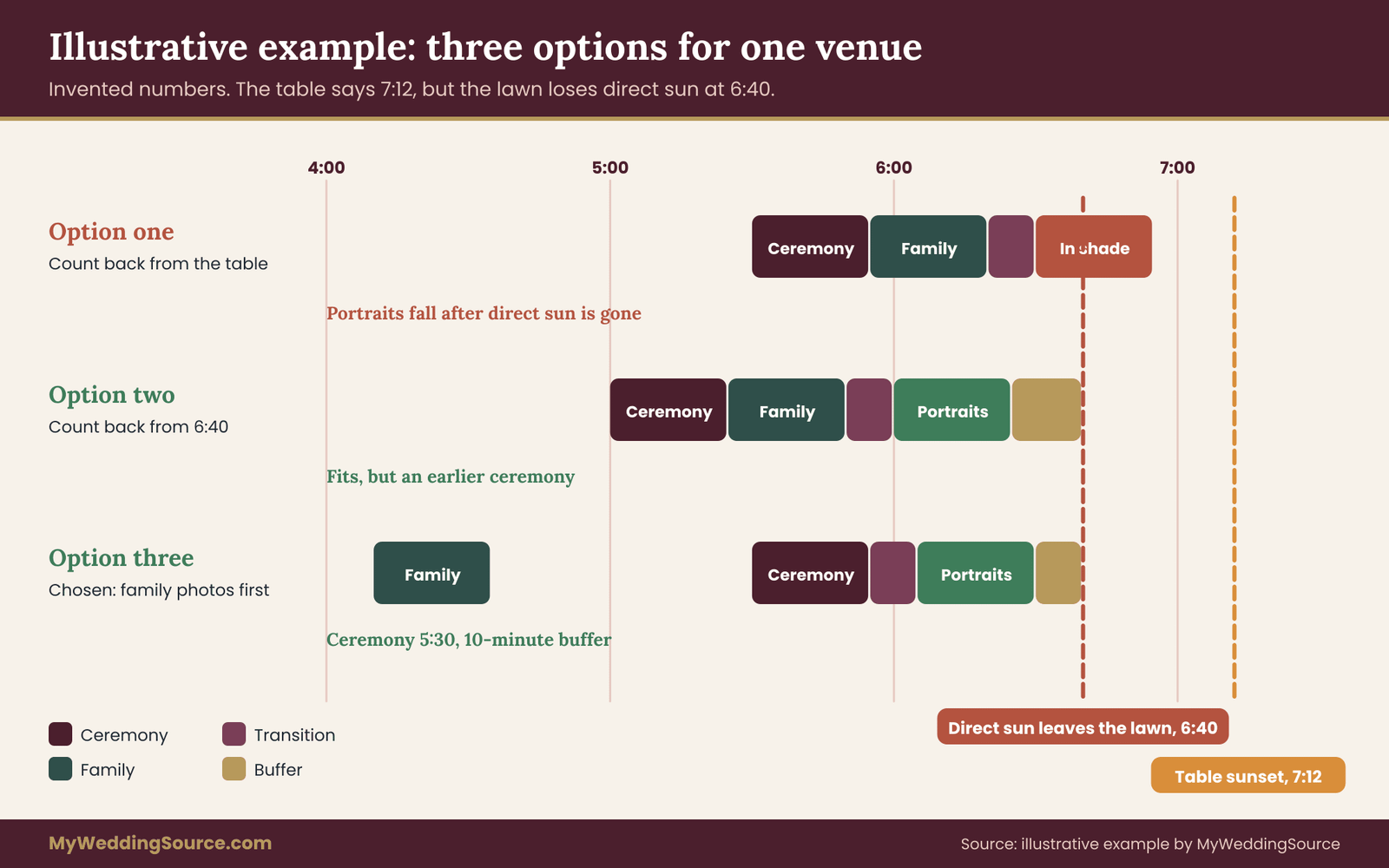
Maya and Daniel are marrying at a small hilltop farm on a Saturday in mid-September. They want an outdoor ceremony, a short cocktail hour and portraits in warm light. They have not printed invitations. They look up the venue’s coordinates and read the sunset table for their date, using the U.S. Naval Observatory data and the NOAA solar calculator to cross-check.
What the table says. Sunset is 7:12 p.m. local daylight time. Civil twilight ends at 7:41 p.m. The sun’s azimuth at sunset is a little north of due west, about 274 degrees.
What the site visit says. The site visit changes their sunset ceremony time more than any other step. Maya and Daniel visit the farm on an evening two weeks before the date. The ceremony lawn sits just below a rise. A line of tall trees stands to the west of the lawn. Using the fist method, they measure the tree line at about six degrees, a bit more than half a fist. Near the equinox the sun drops about a fifth of a degree a minute, so six degrees costs roughly thirty minutes. They watch the evening itself: direct sun leaves the lawn at about 6:40 p.m.
So the verified time when direct sun leaves the ceremony spot is about 6:40, not 7:12. The table time is the sunset; the lawn’s sunset is half an hour earlier.
The blocks. They estimate the ceremony at twenty-five minutes, including the processional and recessional. Their shot list has eight family groupings, which the photographer estimates at twenty-five minutes. The walk from the lawn to the portrait spot takes ten minutes. The photographer wants twenty-five minutes for couple portraits in the best light. They choose a buffer of fifteen minutes. The blocks add up to one hundred minutes.
Option one: count back from the table
If Maya and Daniel count back from the table’s 7:12 and subtract one hundred minutes, the ceremony starts at about 5:30. Family photographs run from 5:55 to 6:20, the transition to 6:30, and couple portraits to 6:55. But the lawn loses direct sun at 6:40, so the portraits in the best light would happen in shade. The plan looks fine on paper and fails at the site.
This is the most common way a sunset ceremony time goes wrong: the arithmetic is right and the input is not.
Option two: count back from the verified time
If they count back from 6:40 instead, the ceremony starts at about 5:00. Family photographs run from 5:25 to 5:50, the transition to 6:00, couple portraits to 6:25, and the last fifteen minutes are buffer before direct sun leaves the lawn. Nothing is missed. The cost is an earlier ceremony, with guests seated in warm afternoon sun and a longer cocktail hour before dinner. Daniel’s grandmother, who tires in the heat, is seated in the shade of the trees.
Option three: change the spot
The farm has a second spot, an open field at the top of the rise with an unobstructed western horizon. The table’s 7:12 would apply there, within a minute or two. A ceremony at sunset in the field, with vows reached at about 7:05, is possible. But the field is a ten-minute uphill walk from the parking area, which is hard for some guests, and the evening is cooler at the top. Civil twilight ends at 7:41, leaving little time for portraits after the ceremony. The photographer would need lighting for the family photographs, which would have to happen before the ceremony or in the dark.
What they choose
The choice shows how a sunset ceremony time follows from the site, not the other way around.
Maya and Daniel prefer the lawn, which is easier for guests, and they are comfortable photographing the wedding party and immediate family before the ceremony. So they take a version of option two with one change: they move the family photographs to before the ceremony, from 4:10 to 4:35, before guests arrive. That removes twenty-five minutes from the sunset window. The ceremony now starts at 5:30, the transition ends at about 6:05, and couple portraits run until 6:30. A buffer of ten minutes remains before direct sun leaves the lawn at 6:40.
They also plan for lateness. If the ceremony starts fifteen minutes late, the portraits shrink from twenty-five minutes to about fifteen. The photographer says that is enough for a strong set, and Maya and Daniel agree that if the ceremony runs later than that, they will do a ten-minute portrait session during dinner in the soft light that remains.
What the example shows
The final sunset ceremony time, 5:30, is about an hour and forty minutes before the table’s sunset.
Three lessons carry over. First, the table’s sunset time and the venue’s sunset are different things, and the difference can be as large as the portrait session. Second, moving a block out of the window, as Maya and Daniel did with the family photographs, is often cheaper than moving the ceremony. Third, writing down the fallback before the day makes it easy to use when it is needed, instead of improvising under pressure.
Weather, delays and venue limits that change the plan
A sunset ceremony time that works on a clear evening must also work on a hazy, wet, windy or late one. And the venue, the city or the park may put limits on the hour that no table can change.
Cloud, haze and smoke
Weather rarely changes the sunset ceremony time itself, but it changes what the time is worth.
Cloud cover can end direct sun early. A heavy cloud bank on the western horizon can hide the sun while the table says it is still up, and the light turns flat and gray. Haze and wildfire smoke can dim the sun, turn it orange and shorten the golden light, and in some regions the air itself can be a health concern for guests. The National Weather Service forecasts clouds and sky cover, and the AirNow site run by the Environmental Protection Agency reports air quality. Check both in the week before, and again the morning of.
Flat light is not a disaster. Many photographers like overcast light for portraits because it is even and forgiving. What changes is the drama. If your plan depends on a vivid sunset, tell yourself and your guests that the sky is not promised.
Rain, wind and storms
Every outdoor sunset ceremony time needs a weather plan. Ask the venue where the ceremony would move in rain, how long the switch takes, and who decides. Rain plans need a decision time, usually a few hours before the ceremony, and the decision should be assigned to one person. The venue technical walkthrough guide covers how to check backup rooms, power and access routes before the date.
In regions with summer thunderstorms, consider a sunset ceremony time that leaves a gap before sunset, so a delayed ceremony can still happen in some light. The National Weather Service advises moving indoors when thunder is heard, and a lightning delay can run thirty minutes or more after the last strike. Name a shelter for guests, and a person responsible for calling the pause.
Wind can be a bigger problem than rain for outdoor sound and for veils, flowers and signage. Ask the sound technician and florist what limits they work with.
When the day runs late
If the ceremony cannot begin on time, decide in advance what moves. A good order is to cut the least valuable family groupings first, shorten the portrait session next, and move the portraits to dinner last. The ceremony start itself is the last item you change, because it is the one guests are waiting for. Share the rule with your coordinator or a trusted friend so the decision does not fall on the couple.
If you will be late because the venue is late, document it. Contracts often state hours of venue access. A late start caused by the venue is a conversation to have with the manager, and your notes make it easier.
Venue, permit and neighborhood limits
Some venues limit the ceremony hours, the ceremony spot, the use of lighting or the noise. A park, a beach or a public garden may require a permit, and permits often fix a window of hours. Many national parks, for example, list ceremony and permit rules on the National Park Service website, and local parks departments set their own. Ask the permitting office for current rules rather than relying on a blog or a friend.
Noise rules may end amplified sound at a set hour. If the ceremony plan includes amplified music or a late event, confirm the local limit with the venue. If the venue is residential or rural, the neighbors’ tolerance can matter as much as the ordinance.
Drone footage, if you plan it, has its own rules. The Federal Aviation Administration sets requirements for small drone pilots, including rules for flights around twilight, and some venues, parks and cities prohibit drones altogether. Ask the pilot about certification and ask the venue about permission before you rely on aerial images at sunset.
Finally, consider access time. If the venue allows the photographer into the space only thirty minutes before the ceremony, they cannot scout the light that day. Ask for earlier access, or arrange a visit before the date.
Common sunset ceremony time mistakes, limits of this guide and what to verify
Most problems with a sunset ceremony time come from a short list of habits. Knowing them lets you catch them in your own plan.
Using the table’s sunset as the lawn’s sunset. The table assumes a flat horizon. If anything stands between the ceremony spot and the sky to the west, direct sun ends earlier. The fix is a horizon check, by visit, by hand measurement or by map.
Counting back from sunset without counting the blocks. A couple who decides “an hour before sunset” without adding up the ceremony, the photographs, the transition and the buffer may find the schedule has no room. The fix is to write the blocks down and add them.
Ignoring the date’s slope. In spring and fall, a date change of two weeks moves sunset by almost half an hour. In midsummer and midwinter it hardly moves. If you might change the date, check the table for the new one before you commit.
Forgetting the clock. A table in the wrong time basis is off by an hour. Confirm that the table uses local clock time on your date, and that your invitation, your vendors and your guests are all using the same clock.
Not asking which way the sun will be. A great start time can still put the sun in the guests’ eyes, or behind the couple in a way the photographer did not plan for. The fix is to check the azimuth and the aisle direction.
Treating golden hour as a fixed hour. There is no official golden hour, so two people can mean different windows. Ask for clock times, not terms.
Building a sunset ceremony time with no slack. A plan that works only if everything starts on time will not work. Buffer is cheap, and the day will use it.
Leaving the plan in one head. If only one partner knows the reasoning, the other cannot adjust when the schedule changes. Share the reverse timeline with the photographer, the coordinator and the wedding party.
Forgetting guests. Heat, cold, glare and long waits all land on guests. A plan that is perfect for photographs and hard on the people who came to see you is not a good plan.
What this guide cannot tell you
Your sunset ceremony time depends on facts this guide cannot see. It uses general astronomical facts and common photographic practice. It cannot tell you your venue’s horizon, your photographer’s technical needs, your venue’s rules or the weather on your date. The rules of thumb for hand measurement and for minutes lost to an obstruction are approximations, useful for planning and not for precision. The block durations are typical ranges, not standards, and your own ceremony and shot list will differ.
It also cannot decide the trade-offs for you. Some couples will give up a sunset portrait for a ceremony that suits grandparents. Some will move the ceremony to a less convenient spot for a particular view. Both choices are reasonable. The aim is to make them knowingly.
What to verify, and with whom
Every input to your sunset ceremony time has a source worth naming.
Use this short guide to decide whom to ask.
Sunset, civil twilight and the sun’s direction on your date: the U.S. Naval Observatory or the NOAA solar calculator.
The local forecast, heat and storm risk: the National Weather Service. Terrain and elevation near the venue: the U.S. Geological Survey’s National Map and satellite imagery. The current clock time: time.gov, run by the National Institute of Standards and Technology. Air quality in smoky seasons: AirNow.
Park and beach ceremony permits: the managing agency, such as the National Park Service for national parks, or the local parks department. Drone rules: the Federal Aviation Administration. Venue hours, lighting rules, rain plans and noise limits: the venue manager, in writing. Coverage hours, overtime and lighting equipment: your photographer and videographer, in the contract. Religious or cultural timing tied to sunset: your officiant or religious leader, who should confirm the exact time for your date.
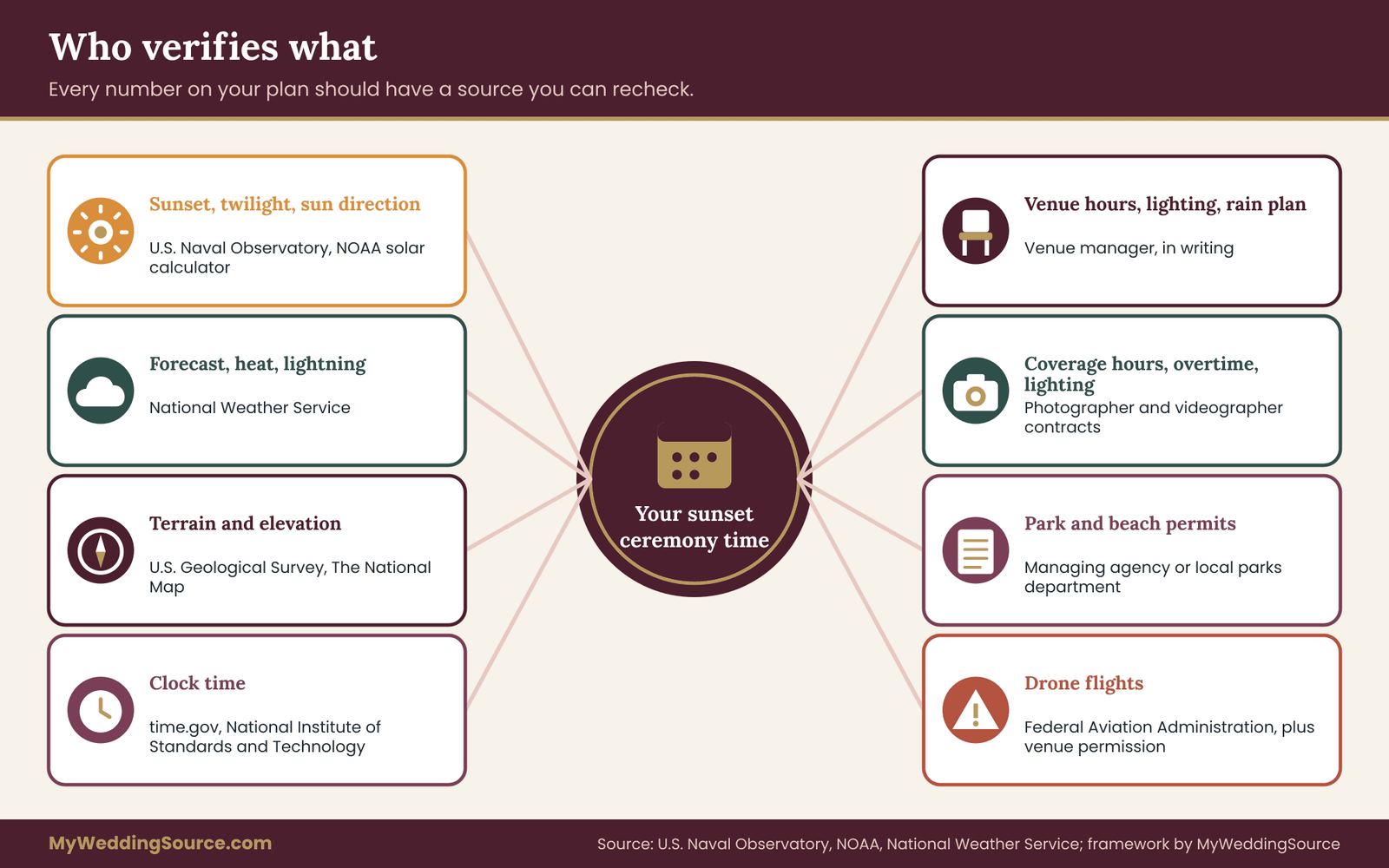
When you are unsure whether a number is current, check the source for the date you need and write the source next to it. A number with a source can be rechecked. A number from memory cannot.
A one-page summary you can keep
If you want the whole method on a single page, write these lines in order. Venue and ceremony spot. Wedding date. Sunset and civil twilight from the table. Verified time that direct sun leaves the spot. The direction of the sun at that time compared with the aisle. The ceremony length. The family photograph time and whether it happens before the ceremony. The transition time. The couple portrait time. The buffer. The resulting sunset ceremony time. The fallback if the ceremony starts late. The person who decides about weather. The people who received the plan, and the date they confirmed it.
That page is short enough to hand to a photographer and complete enough to hold up on the day.
Your next steps
Start with the numbers. This week, enter your venue’s location and your wedding date into the Naval Observatory data or the NOAA solar calculator, and write down sunset, the end of civil twilight and the sun’s direction. Add the rows for two weeks before and after, in case the date moves, and note the time basis.
Next, check the horizon. Visit the ceremony spot at about the right time of day if you can, or measure the tree line with your fist and read the map. Write down the verified time when direct sun leaves the spot.
Then build the reverse timeline for your sunset ceremony time from the light window method, with your own block lengths, and decide which blocks can move out of the window. Share it with your photographer and your venue coordinator, and ask the questions in this guide. Once the plan has survived their comments, fix the time in writing and put it on your invitations and your guest website.
If the date is still open, a sunset table can also inform that choice, and the guide to picking the date around guests, vendors and travel covers the other pieces. Whatever the date, a sunset ceremony time that has been counted, verified and shared is one you can stop worrying about, and the evening can then be about the wedding.
FAQ
What is a good sunset ceremony time?
There is no single time. A common starting point is one and a half to two hours before sunset, because that leaves room for the ceremony, family photographs, a short transition and portraits in warm light. Add up your own blocks instead of copying a number. If you move family photographs before the ceremony, or plan a first look, the start can be later and still leave good light.
Should the ceremony be at sunset or before it?
It depends on what you want from the light. A ceremony before sunset leaves time for portraits in low sun and tolerates lateness. A ceremony at sunset gives a dramatic setting but leaves little room for delay, and direct light fades within minutes afterward. Ask your photographer which they prefer at your venue, and weigh guest comfort and ceremony length before deciding.
Where do I find an accurate sunset table for my venue?
Use the U.S. Naval Observatory data service or the NOAA solar calculator, and enter the venue’s coordinates and your wedding date. The National Weather Service also lists sunrise and sunset for forecast points. Confirm that the time shown is local clock time on your date, since a table in the wrong time basis can be off by an hour.
Why does sunset at my venue look earlier than the table says?
Tables assume a flat horizon at sea level. Hills, trees, walls and buildings to the west block the sun before it reaches the true horizon, so direct sun can end tens of minutes before the table time. Verify by visiting at the right time of day, measuring the obstruction with your fist at arm’s length, or checking terrain with a topographic map.
What is civil twilight, and does it matter for a wedding?
Civil twilight is the period after sunset when the sun is less than six degrees below the horizon and there is enough sky light to see outdoors in clear weather. It matters because the sky can glow for a while after sunset, which some photographers use for portraits. The gap after sunset varies with place and date, so read the end of civil twilight from your own table.
How much does a date change affect the light?
It depends on the season. Around the spring and fall equinoxes, sunset moves by about two minutes a day at mid-latitudes, so a two-week change shifts it by roughly half an hour. Around the summer and winter solstices the daily change is small. If you may change the date, check the table for the new date and rebuild the timeline from there.
What if the weather is cloudy or smoky on the day?
Cloud, haze and smoke can dim the sun early and flatten the light, so direct golden light may not appear. Many photographers still like soft, even light for portraits. Check the National Weather Service forecast and AirNow air quality in the week before, keep a weather plan with a named decision maker, and tell your photographer early if conditions change.
Do I need my photographer to visit the venue?
It is not required, but it helps when the site has a crowded horizon, an unusual layout or a tight window of light. Some photographers visit for free or for a fee, and others review the sun position and photographs remotely. If they have worked at the venue before, ask what they saw at similar times of year. Get any access arrangements in writing from the venue.
Sources
- Astronomical Applications Department, U.S. Naval Observatory
- Solar calculator, NOAA Global Monitoring Laboratory
- National Weather Service, NOAA
- Heat safety, National Weather Service
- Lightning safety, National Weather Service
- The National Map, U.S. Geological Survey
- Official U.S. time, National Institute of Standards and Technology
- AirNow air quality, U.S. Environmental Protection Agency
- Weddings and special events in national parks, National Park Service
- Unmanned aircraft systems, Federal Aviation Administration