

Wedding installments are payment plans that split a wedding purchase into smaller scheduled payments, and buy now, pay later is the newest and most heavily advertised version. This guide compares them with cash and credit cards on total cost, explains where the fees and risks hide, and gives you a five-gate check for deciding whether a plan belongs in your wedding budget at all.
Wedding installments make sense only when the plan costs you nothing extra, the payments fit comfortably inside your monthly cash flow, and you know what happens to the plan if the vendor cancels, the date moves or the purchase is returned. Compare the total you will pay under cash, a card and the installment plan, test the worst month, and read the refund terms before you click accept. If any gate fails, use a vendor payment schedule, savings or a smaller purchase instead.
Couples meet the offer in a predictable place. A checkout page for a dress, a rental order, a florist’s online deposit form or a honeymoon booking shows a small line under the price: four payments of an easy-looking amount. It looks like a payment schedule, and in some ways it is one. But a payment schedule offered by your photographer and a loan offered by a financial company at the checkout of that photographer’s website are very different animals, even when the monthly number looks identical.
This article is about that difference. It is written for couples who are weighing wedding installments in the months before the date, for the partner who handles the spreadsheet and for the partner who would rather not look at it. It does not tell you to avoid wedding installments, and it does not tell you to use them. It gives you a way to price them honestly, to find the clauses that matter and to decide purchase by purchase.
A note on scope. This is general information, not legal, tax, financial or borrowing advice, and fees, payment rights and deposit obligations vary by contract, lender and state. Where a rule matters, the article points to the agency that publishes it so you can read the current version yourself.
What wedding installments are and how they work
The phrase covers several different products that share one feature: you receive the goods or service now, or lock in a booking now, and the price arrives in pieces. The pieces can be owed to the vendor, to a lender, or to your card issuer. Who you owe changes almost everything that follows, so it is worth learning the four common shapes.
The short pay-in-four plan. The most familiar buy now, pay later product splits a purchase into four equal payments, the first due at checkout and the rest about every two weeks. Many wedding installments of this kind charge no interest if you pay on time. The provider usually earns its money from a fee charged to the merchant, and from late fees or other charges on customers who slip. For wedding installments, this shape suits small and mid-sized purchases that arrive soon: attire, shoes, a rental order, a welcome-bag order.
The longer installment loan. Some providers, and some banks, offer plans of three, six, twelve or more months on larger purchases. These usually carry an annual percentage rate, which can range from zero on promotional offers to a high figure that rivals or exceeds a credit card. The offer you see depends on the provider, the merchant and sometimes on a credit check. Because the term is long, this shape of wedding installments is the one most likely to overlap with other wedding payments and with life after the wedding.
The vendor’s own payment schedule. A photographer or caterer may let you pay a deposit, a second installment and a final balance on dates written into the contract. This is the original wedding installment, and it usually carries no interest. The vendor holds the risk of not being paid, and in return you owe the vendor, not a third party. If you have not yet read how deposits and final balances are normally timed, the guide to wedding cash-flow planning explains the standard rhythm.
The card issuer’s or retailer’s plan. Some credit cards let you convert a purchase into fixed monthly payments for a fee. Retail store cards sometimes advertise deferred interest, where the interest is waived only if the whole balance is paid by a date. Each of these is credit under a card agreement, with the consumer protections that come with card accounts.

Looking at the four shapes side by side makes one point clear: the label “wedding installments” tells you nothing about the cost. The same four-payment plan can be free or can carry penalties; the same twelve-month schedule can be a vendor courtesy or a loan. Always identify the shape first. A useful habit is to write one sentence for every plan you are offered: “We would owe ___ [the vendor, a lender or our card issuer] a total of ___ in ___ payments, and the first is due on ___.” If you cannot fill in the blanks from the checkout page, you are not ready to accept.
The money moves differently than it looks
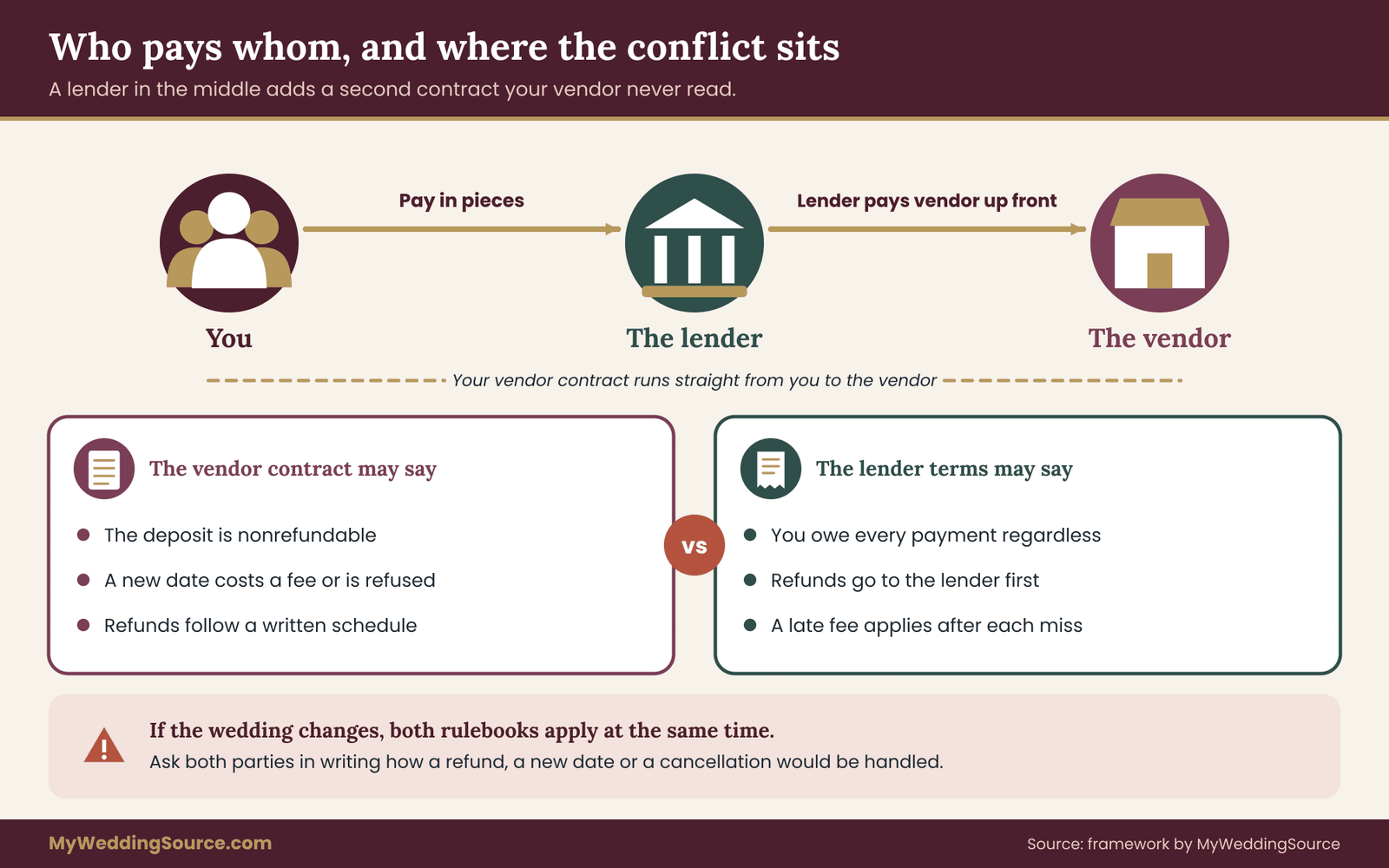
At the checkout of a buy now, pay later plan, the lender normally pays the merchant, and you then owe the lender. The merchant gets paid quickly and takes less risk. You, in turn, take on a new relationship with a new company that has its own app, its own payment dates, its own customer service and its own rules about late payments and returns.
That has a practical consequence for weddings. Wedding vendors live and die by their contracts, and contracts have schedules that were built for a direct relationship between couple and vendor: deposit, interim payment, final balance, a cancellation clause and sometimes a rescheduling fee. When a lender sits in the middle, the vendor’s contract may still say your deposit is nonrefundable while the lender’s terms say you owe the installments whether or not you get anything back.
Two sets of rules, written by two different parties, may point in opposite directions. The sections ahead show how to find those conflicts before they cost you.
What wedding installments are not
Wedding installments are not a way to make a wedding cheaper. Splitting a price across months does not reduce the price. At best it moves the same dollars to different dates. At worst it adds interest, fees and a second contract. The honest reason to use one is timing: you need the purchase now, and the cash will arrive later through paychecks you can already count on.
That is a narrow and legitimate use. The dishonest reason, which every checkout page quietly invites, is to buy something the budget does not cover and hope the future version of you will sort it out.
It is also not a substitute for a plan. The broader work of deciding how much to spend, when each bill falls due and what reserve to hold belongs to the wedding budget and to the cash-flow ledger described in the guide linked above. Wedding installments sit inside that plan as one tool. Treat wedding installments as a line in the ledger, not as a way around it.
Why wedding installments appeal, and why weddings are a hard fit
The appeal of wedding installments is easy to understand and not foolish. Weddings concentrate large bills into a short period. Deposits arrive a year out, final balances land weeks before the date, and a thousand small purchases fill the gaps. Even couples with healthy incomes often face a month in which several bills fall due before the next paycheck. A plan that spreads one of those bills over six weeks can feel like relief.
There are four honest attractions. Smooth cash flow is the first: a payment in four parts is easier to absorb than a single large one. Speed is the second: approval is usually instant and often needs no paperwork beyond a few fields. Simple pricing is the third: a clearly stated payment amount is easier to picture than a card balance with an interest rate. Keeping savings intact is the fourth: some couples want to leave an emergency fund alone and pay for a dress from income instead.
Each of those is real. The trouble is that weddings have features that make the same plan riskier than it looks in an ordinary shopping cart.
Weddings have fixed dates and fixed deadlines
Most purchases are flexible. If a pair of shoes arrives late, you wait. A wedding purchase usually has a hard date behind it, and that date interacts with the payment plan in two directions. A late-stage order, such as a rush alteration or a replacement item, can force you into a plan because cash is tight right then. And a plan that runs past the wedding date means you are still paying for a day that is over, while newer costs, such as a move, a honeymoon or a new household, have started.
The question to ask is not only whether you can afford the payment today, but whether you can afford it in the month after the wedding, when gift income, travel and ordinary life all arrive together.
Weddings are purchases with unusually high cancellation risk
Dates move. Venues close. A family illness changes the guest list. Because a wedding rests on many contracts at once, a change in one often forces changes in others. Vendors protect themselves with nonrefundable deposits and cancellation schedules. A lender protects itself with an obligation to repay. When both are in force and the wedding changes, you can end up owing money for services you will not receive. Much of wedding planning exists to prevent that outcome, and the later sections of this guide return to it with a decision rule.
Weddings invite stacked wedding installments
One plan is manageable. Five plans from five providers, each with its own app and its own due dates, are not. Wedding purchases come from many sellers, and each checkout page offers its own version of wedding installments. Because every approval is instant and every payment looks small, it is easy to accumulate overlapping obligations without ever seeing the total.
The couple who budgets carefully for the venue can lose track of nine separate pay-in-four plans for décor, attire, favors and travel. Stacking is the single most common way wedding installments go wrong, and it is hard to see from inside any one app.
Emotion and pressure change the math
Wedding spending carries social pressure that ordinary shopping does not. A relative’s opinion, a social-media image or a vendor’s gentle push can turn “we cannot quite afford this” into “it is only four payments.” The size of the payment hides the size of the purchase. A simple defense is to evaluate the price, not the payment. If you would not buy the item at its full price today from savings, a plan that makes the first payment small does not change whether you should buy it. It changes only how it feels.
The rest of this guide gives you ways to look past the feeling: a fee map, a contract check, a total-cost comparison, a five-gate decision and a set of alternatives. None of them requires financial training. They require a calculator, a quiet hour and the willingness to read the terms before you tap accept.
The fee map for wedding installments
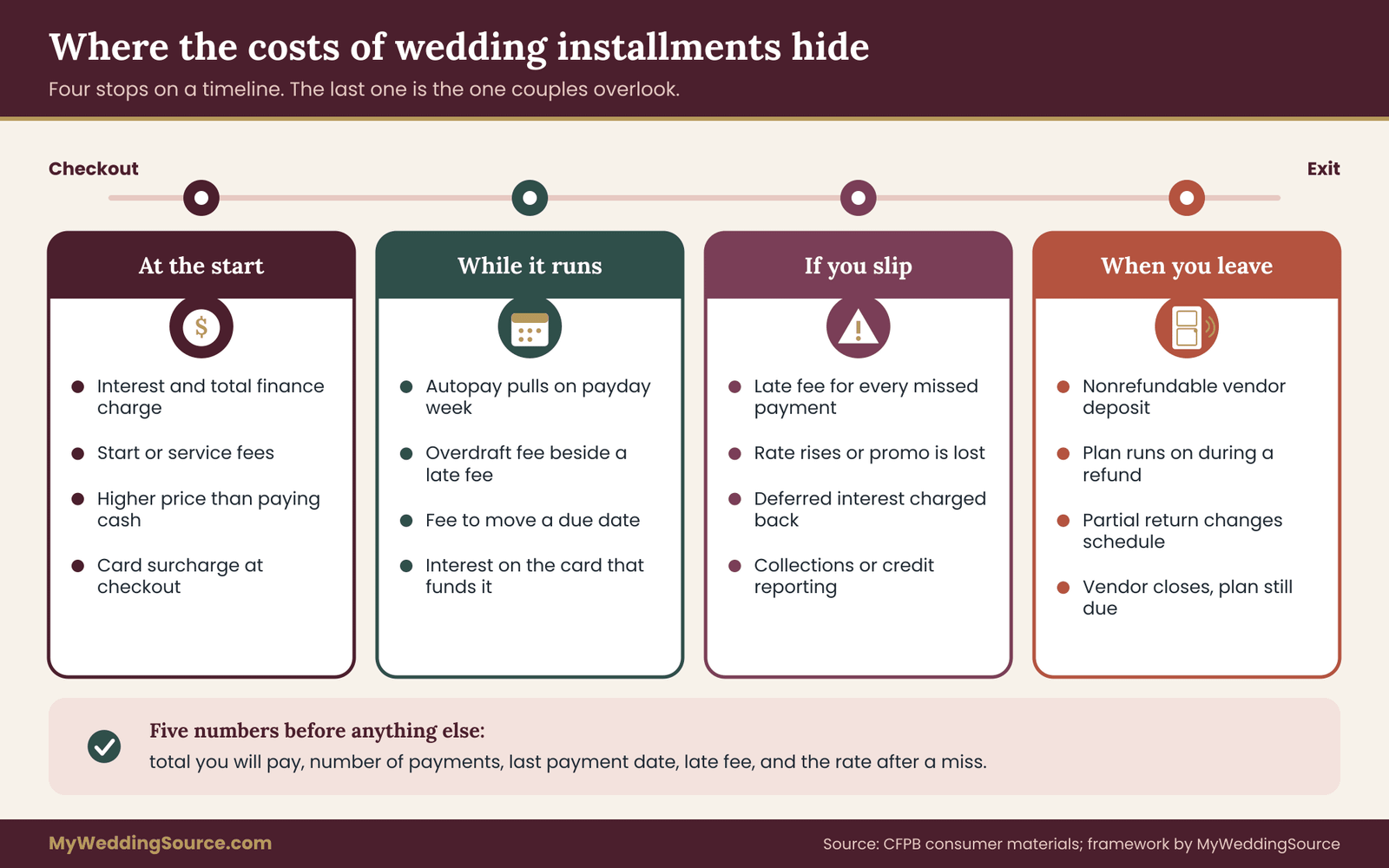
Costs in wedding installments rarely sit in one place. They are spread across the life of the plan, and some of them only appear when something goes wrong. A useful way to see them is as a timeline: what you pay at checkout, what you pay while the plan runs, what you pay if you slip, and what you pay when you try to leave. The picture below lays out that timeline, and the sections that follow explain each stop.
Costs at the start
Interest or finance charges. A plan that advertises zero interest may still carry a cost in another form. A plan that does carry interest must tell you the annual percentage rate and the total finance charge before you commit, because federal consumer-credit rules require disclosures for credit offered to consumers. Read the number, not the headline. A payment of a round amount for twelve months is not the same as a price with no interest, and the way to know is to multiply the payment by the number of payments and subtract the purchase price.
Origination or service fees. Some longer wedding installments add a fee at the start, either folded into the amount financed or charged separately. A fee of a few percent on a large balance is a real cost even when the monthly rate looks gentle. If the checkout does not show a fee, check the full terms page rather than the summary.
A higher price for financing. Occasionally a merchant lists one price for cash and a higher price when a plan is used, or applies a card surcharge on a different path. Compare the checkout total across payment methods before you choose one. The merchant, not the lender, controls what the shelf price says.
Costs while the plan runs
Autopay mechanics. Most wedding installments pull each payment from a linked debit card or bank account on a schedule. That is convenient and also dangerous. If the account lacks money on the due date, the lender may charge a late fee and your bank may charge an overdraft or returned-payment fee, so one missed balance can produce two fees. Before you link an account, check how its balance behaves around payday, around rent and around the dates when your other wedding vendors pull payments.
Card funding. If you attach a credit card to the plan, you may be paying interest on the card for what the plan already spreads out, or you may lose a card’s dispute rights in practice because the charge is to the lender and not the vendor. Read how the lender describes the charge and how your card issuer treats it.
Rescheduling and changes. Some providers allow you to move a due date once; others charge for it or do not allow it. A payment moved to avoid a late fee may be a good use of the feature, but it can also stretch the plan beyond the date you intended. Learn the rule before you need it.
Costs if you slip
Late fees. A late fee may be a flat amount, a percentage or a capped sum. Fees that look small, such as a few dollars, repeat for each missed payment. A four-payment plan with two late payments produces two fees. The point is not to scare you with a number; it is to ask for the schedule of fees before accepting, since it is a normal part of the terms.
Interest after a miss. Some zero-interest wedding installments start charging interest or lose their promotional treatment if you miss a payment. A deferred-interest offer, usually from a retail card, is the sharpest version. The interest is waived only if you pay the full balance by the end of the promotional period, and if any balance remains, interest may be charged from the original purchase date. A small remainder can trigger a large charge, a pattern the Consumer Financial Protection Bureau has written about in its consumer materials on deferred-interest promotions.
Collections and credit reporting. An account that stays unpaid may be placed with a collector and may appear on a credit report. How and whether a provider reports differs, so the later section on credit reports gives the questions to ask.
Account restrictions. Missing a payment can block your access to new purchases through the same provider, sometimes immediately. That matters if you planned to use the same provider for a second wedding purchase.
Costs when you try to leave
This is the category couples overlook most often, and it is the one that interacts with wedding contracts.
Returns and refunds. If you return an item, the merchant refunds the lender and the lender adjusts your remaining payments. Timing varies. You may keep paying for a period while the refund is processed, and a partial return may change the schedule in ways that are hard to predict. Keep your payment going until the lender confirms in writing what the new balance is.
Nonrefundable deposits. Many wedding vendors state that deposits are nonrefundable. If you paid that deposit through wedding installments and then cancel, the vendor keeps the deposit and the lender still expects the installments. You are paying twice in the sense that matters: once for the deposit and again for the interest, fees or time you spent paying it down.
Vendor failure. If a vendor closes or fails to deliver, you may have a dispute right, but it depends on how you paid and on the lender’s rules. This is a topic where the specific terms and the law in your state matter, and where a consumer-finance resource or a lawyer who reads contracts will give you better answers than a general guide.
Costs on the merchant’s side that reach you
Lenders charge merchants for taking part. Merchants may recover that cost by raising prices, by declining to discount for cash, or by choosing not to offer a plan at all. If a vendor is reluctant to accept installments, that reluctance may be a sign that the vendor would rather offer its own schedule, and its own schedule is usually the better deal for you. Do not push a small vendor to take a plan that costs them money; offer to follow their payment schedule exactly, and you will often get both a calmer relationship and a lower total.
A short habit for reading any fee page
When you open the terms for wedding installments, find five numbers before you read anything else: the total you will pay, the number of payments, the date of the last one, the fee for a late payment, and the interest rate that applies if you miss one. If any of the five is missing from the page, treat the plan as unpriced. Wedding installments you cannot price are wedding installments you should not sign.
How wedding installments meet your vendor contracts
Most of the harm from wedding installments does not come from the fee page. It comes from the gap between two documents: the vendor contract and the lender’s agreement. Nobody reads them side by side at the checkout, and nobody at the checkout has a reason to point out where they conflict.
What a normal wedding contract says about money
A typical wedding vendor contract states a total price, a deposit that secures the date, a schedule of later payments, a final balance due before the event, and a cancellation clause that sets what you owe if you cancel at various points. It may state that the deposit is nonrefundable, that the date is held only while payments are current and that rescheduling costs a fee or is subject to availability.
The guide to wedding vendor contracts covers these clauses in detail, and the vendor due diligence checklist helps you decide whether the vendor is a reliable counterparty to begin with.
Now overlay wedding installments on that contract. Your obligation to the lender begins at checkout and runs on its own schedule. The vendor’s obligation to you runs from the contract. The two are linked only by the original purchase, and neither document normally mentions the other.
Five conflicts to look for
The timing conflict. The vendor may require the final balance two weeks before the wedding. A four-payment plan started a week before that date will still be running after the balance is due, which is fine, but a twelve-month plan taken for a deposit will still be running long after the wedding. Make sure the end date of the plan falls where you want it.
The refund conflict. The contract may promise a refund under some conditions, such as a vendor cancellation. The lender’s terms may say the refund goes back to the lender, who then adjusts your balance, and not to you. In practice that is often fine, but you should know whether you are owed cash or a balance reduction, and how long it takes.
The rescheduling conflict. If the date changes, the vendor may transfer your deposit to a new date, charge a fee or decline. The lender will not care about any of that. Your payments continue. If a postponement is plausible, avoid long plans on deposits, since the deposit is the part most likely to be tied up in a date.
The substitution conflict. Some contracts allow the vendor to substitute equivalent services, such as a different lead photographer or alternate flowers. If the substituted service is not what you ordered, you may want to dispute the charge. A dispute with a lender is different from a dispute with a card issuer, and the rights that apply may differ.
The assignment conflict. If a vendor sells or closes its business, someone else may take the contract. Your obligation to the lender stays with you whoever performs the service.
Questions to put in writing before accepting a plan
Write to the vendor and ask, in plain words:
- Do you accept this provider, and is the price the same as paying by card or by bank transfer?
- If you cancel the event or I cancel it, how is the refund handled when the payment came through a lender?
- If you reschedule or I do, is the deposit transferable, and does the plan continue unchanged?
- Is there a fee for using the plan, and who pays it?
- Can I instead pay your own installment schedule at the same price?
Keep the reply with the contract. It costs nothing, and a vendor who answers clearly is telling you something good about how the relationship will go. A vendor who avoids the questions is telling you something too.
Ask the lender, too
The lender’s customer terms should answer a parallel list: what happens to my payments if I return the item, if the merchant refunds me, if a dispute is open, if I miss a payment, and if I want to pay the plan off early? Many providers allow early payoff without a penalty, and early payoff is the simplest exit if the situation changes. Confirm it before you accept, because a few longer loans carry prepayment terms.
A rule of thumb for deposits
Because deposits are the most likely wedding payment to be lost when things change, they are also the worst candidates for long wedding installments. Paying a deposit from savings and financing a later, deliverable item has a simpler downside. If you must use a plan for a deposit, use the shortest one and avoid any plan that ends after the date on which the vendor’s cancellation schedule has made your money nonrefundable. The question you want a clear answer to is: at which date is the money gone, and would we still be paying on that date?
A total-cost comparison: cash, card and wedding installments
The cleanest way to judge wedding installments is to price the same purchase several ways and compare the totals. This section builds one worked example. The numbers are invented for illustration, the rates are assumptions and not offers, and your own terms will differ. What matters is the method, which you can repeat with real numbers in ten minutes.
The example purchase
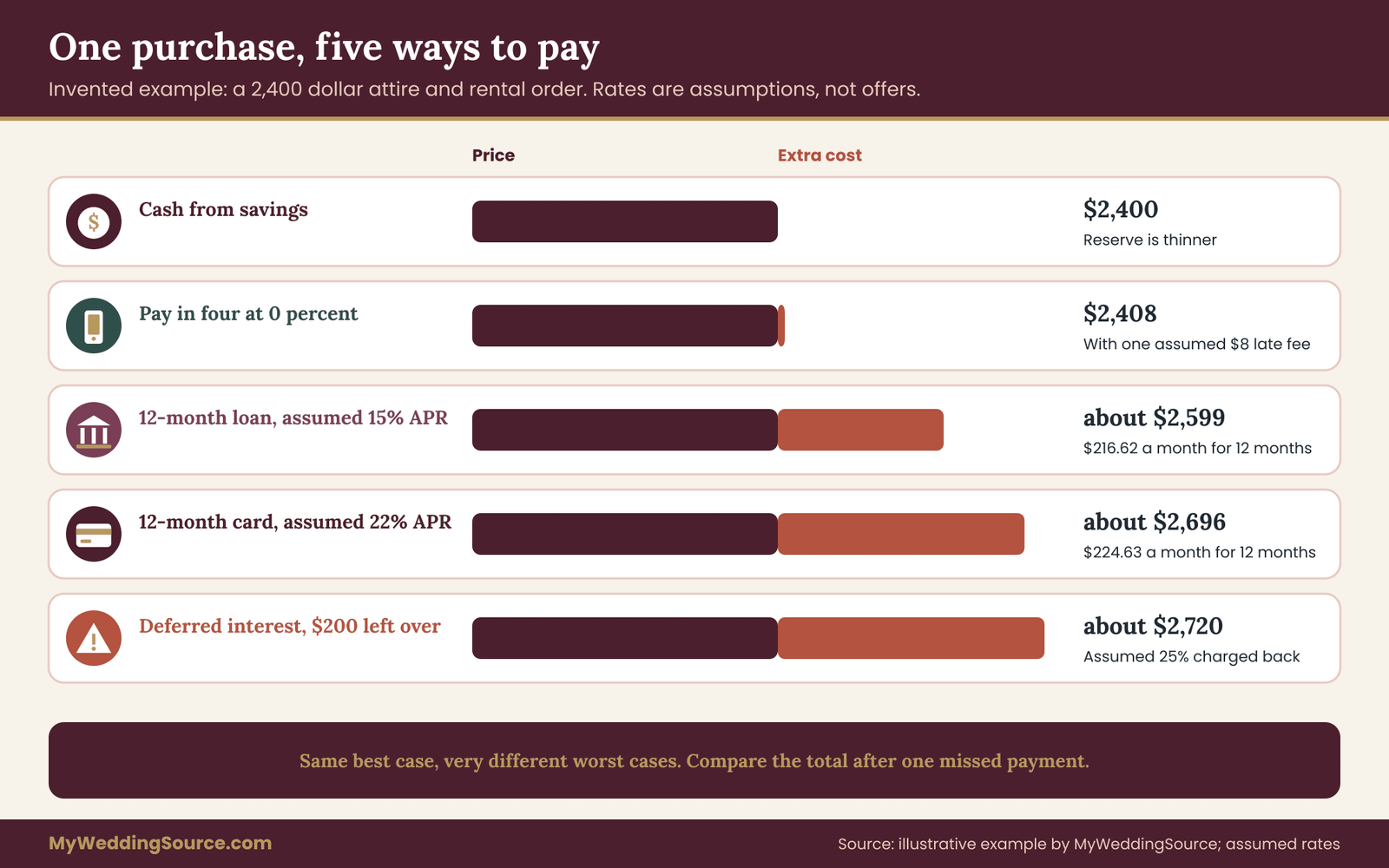
Imagine a couple who need to pay a bundle of attire, alterations and rental items totaling $2,400. The order is due about eight weeks before the wedding. They have savings, but the savings are earmarked for the final catering balance, which falls due five weeks later. Their joint take-home income is steady, and they get paid every two weeks. Here are the options they weigh.
Option one: cash from savings. They pay $2,400 now. Total cost: $2,400. The downside is that the catering balance has to be covered by income and a smaller reserve, which has its own risk.
Option two: a four-payment plan at zero interest. They pay $600 at checkout and $600 every two weeks for three more payments. Total cost if all goes well: $2,400. If one payment is late and the plan charges an assumed fee of $8, the total is $2,408. The risk is not the fee; it is that all four payments fall inside the eight weeks when other wedding bills also arrive.
Option three: a twelve-month plan from the lender at an assumed 15 percent annual rate. The payment works out to about $216.62 a month, so the total paid is about $2,599, or roughly $199 more than the price. The monthly number is gentle, and the plan runs for nine months after the wedding.
Option four: a credit card at an assumed 22 percent annual rate, paid over twelve months. The payment is about $224.63 a month, with a total of about $2,696, or roughly $296 more than the price. The card has one advantage the plan may lack: if the purchase is disputed, card-billing-error rules apply, a point the later section on payment rights discusses.
Option five: a card with a zero-percent introductory period of twelve months, paid down at $200 a month. If the couple pays $200 a month for twelve months, the balance is cleared and the total is $2,400. But in a variation, where they pay $200 for eleven months and leave $200 at the end, a deferred-interest promotion with an assumed 25 percent rate could charge interest back to the first day, adding roughly $320.
A true zero-percent introductory rate, which does not charge back interest, would instead start charging interest only on the leftover $200 after the period. The difference between those two promotions is the biggest trap in this category, and the card agreement states which one you have.
Reading the comparison
Three conclusions come out of the example, and they apply well beyond this purchase.
First, the cheapest options by headline are cash, the zero-interest four-payment plan and the zero-percent card. They tie at $2,400 when everything goes right. The difference is in what happens when something goes wrong: the four-payment plan adds a small fee, while the deferred-interest card adds a large one. A plan with a tiny downside and a plan with a large downside are not equal just because their best cases match.
Second, a longer plan with interest costs real money, but it may be a rational choice if it solves a timing problem that would otherwise cost more. Suppose using $2,400 of savings would force the couple to put the catering balance on a card at 22 percent for a year. Then the cash option’s true cost is not $2,400. It is $2,400 plus the interest on the card they would use for the next bill. Total-cost thinking means following the money one step further, not stopping at the first purchase.
Third, the lowest total is not always the lowest risk. Cash has no fee and no loan but leaves the couple thin. A set of wedding installments that preserves the reserve while charging nothing is attractive only if the payments truly fit. The next section provides a way to test that.
The steps to run your own comparison
- Write the full cash price. Include tax, shipping and any card surcharge the vendor adds for card payments.
- For each financing option, write the payment amount, the number of payments, the fees at the start, and the total of all payments. Subtract the cash price to get the extra cost.
- Add the late-payment fee and the interest rate that applies after a miss. Run the total again assuming one missed payment, because that is the realistic bad case.
- Add the cost of the alternative use of cash. If paying cash would force you onto a more expensive form of credit later, count that cost.
- Mark the date of the last payment. Ask whether you would still be paying after the wedding, and whether that is acceptable.
- Pick the option with the lowest total that you can still comfortably pay in the worst month, not the lowest monthly payment.
If you prefer a calculator, a loan calculator from the Consumer Financial Protection Bureau’s website or the one inside your own bank’s app will do the monthly math. The principle behind them is simple: multiply the payment by the number of payments and subtract the price.
A caution about monthly wedding installments
Wedding installments that reduce a large bill into a small monthly payment are working as designed. It is also hiding the total, because the total is a bigger number and is less persuasive. When you compare options, put the total and the last-payment date first and the monthly amount last. If the page puts them in the other order, that is information about what the page wants you to look at.
The Five-Gate Check for wedding installments
A total-cost comparison tells you what a plan costs. A decision also needs to answer whether the plan is safe to take. This guide uses a five-gate check for that purpose. Each purchase has to pass all five gates, in order, before any wedding installments are accepted. Failing a gate does not mean the purchase is bad. It means the purchase should be paid for another way.

Gate one: Is the purchase fixed or flexible?
Sort the purchase by how much it can move. A fixed purchase has a date and a consequence: a venue deposit that secures the room, a rental order that must be in by a deadline. A flexible purchase can wait, shrink or be dropped: extra décor, additional favors, an upgraded accessory. Wedding installments belong, if anywhere, with fixed purchases that deliver on a known date. They do not belong with flexible purchases, because the right answer for a flexible purchase you cannot pay for is usually to skip or scale it.
Gate two: Does the plan cost nothing extra, or is the extra cost worth it?
Use the total-cost comparison. If the plan adds nothing and charges nothing unless you slip, it passes this gate easily. If it adds interest or fees, the added cost must buy something specific, such as protecting a reserve that would otherwise be drained at a worse rate. Write that specific thing down. If you cannot, the gate fails.
Gate three: Can we pay the worst month?
Take the month in which the most payments overlap, usually the one right before the wedding. Add every wedding installment due that month, every vendor balance, and your ordinary bills. Then subtract a modest cushion for one surprise. If your income minus that total is negative or uncomfortably close to zero, the gate fails. A plan that works only if nothing unexpected happens in a month with a wedding in it is not a plan.
A second, simpler test comes from the couple’s actual accounts. If you did not have the installment option, would you spend this money from this month’s income? If the answer is no, the plan is borrowing from the future to cover a gap, and the gap deserves its own conversation.
Gate four: Do we know the exit?
Before accepting, answer three questions in writing. What happens to the plan if the item is returned? What happens if the vendor cancels or the date moves? Can we pay it off early without a fee? If any answer is unknown, ask the vendor and the lender, and wait for the written reply. If the answer is that you would owe the plan regardless and that the deposit is lost, ask whether the purchase belongs in the plan at all.
Gate five: Does the total fit the plan we already have?
Add the new payments to every existing plan, card and loan. Compare the combined total to the budget lines in the ledger. Stacking is the failure that this gate guards against. It also guards against the simplest form of drift in wedding installments, in which every individual plan looks reasonable and the sum does not. If you hold more than two active wedding installments, stop adding new ones until the total is written in one place.
How the gates work together
The gates run in order because earlier gates are cheaper to answer. Gate one costs nothing. Gate two costs ten minutes with a calculator. Gate three needs the ledger. Gate four needs two emails. Gate five needs the whole picture. Most purchases fail at gate one or gate two, which is the point: the check is meant to stop a plan quickly when it should not exist and to give real confidence when it passes.
A purchase that passes all five gates is not certain to be wise, since no checklist can promise that, but it is one you have priced, tested and documented. That is the difference between using an installment plan and drifting into one.
Credit reports, account effects and payment rights
Once the price and the exit are clear, the next question is what a plan does to the rest of your financial life. Three areas matter for couples: your credit file, your accounts, and your rights if something goes wrong. None of the answers is the same for every provider, so this section gives you the questions to ask and the places to read the current rules.
What wedding installments can do to your credit file
Credit reporting for pay-later products has been uneven. Some providers report plans to the national credit bureaus, some report only certain products, and some report only missed payments or accounts sent to collections. The industry and the scoring companies have been changing how these accounts are handled, so any statement written today may be out of date next quarter. The Consumer Financial Protection Bureau has published research on the pay-later market and explains in its consumer pages how these products relate to credit reports. Use those pages and the provider’s own policy for the current picture.
Rather than guess, ask three direct questions of the provider before you accept:
- Does this plan involve a credit check, and is it a soft check that does not affect your score, or a hard inquiry that appears on your report?
- Do you report on-time payments, late payments or both, and to which bureaus?
- What happens to the account if I am sent to collections?
Write down the answers with the date. If the provider does not answer in writing, check its published terms.
Then check your own file. You are entitled to free credit reports through the official site AnnualCreditReport.com, which the three national bureaus operate together under federal law. Look at the reports before you start financing wedding purchases, so you know the baseline, and look again a few months after the wedding, so you can see what your wedding installments did. A pay-later account that shows up in an unexpected place is something to question early.
Why timing matters if a mortgage or lease is coming
Many couples carrying wedding installments marry in the year they also plan to rent a new place or buy a home. A landlord or mortgage lender will usually look at your recent credit activity and your monthly obligations. A new loan, even a small one, adds to your monthly obligations while it runs. Several recent applications may draw questions. A twelve-month plan taken in the spring of a wedding year can still be on the books when you apply for a lease in the autumn.
If you know a large application is coming, finish the plans before it, or choose cash for the purchases that would otherwise overlap. A mortgage lender or the leasing office can tell you how it treats recent installment accounts.
Whose name is on the plan?
Wedding installments are normally in one person’s name. That person is the one the lender contacts, the one whose credit file carries the account and the one who is responsible for the payments. If you are engaged and not yet married, your partner is not a party to the agreement simply because you share a household or a wedding budget.
After the wedding, the rules about shared responsibility for debts depend on your state and the type of debt, and they are a legal question. If it matters to you, a lawyer who handles family or consumer matters in your state can explain what applies.
A practical approach is to decide in advance whose name goes on each plan, and to keep a single shared record of every plan regardless of whose name it is under. Surprises usually come from one partner using an app the other never opens.
Your bank account and autopay
Most wedding installments collect through a debit card or bank link. Before you connect an account, decide which account the payments will leave, and set a calendar reminder two days before each due date to confirm the balance. Consider the risk of a pull on the same day that rent, a vendor balance or a credit card payment leaves the same account. If your bank offers alerts for low balances, turn them on. An overdraft fee on top of a late fee is a very avoidable cost.
Security and scams
Pay-later brands are well known, and scammers use them. Be cautious about texts or emails that claim you owe a plan payment, links that lead to look-alike sign-in pages and any request to pay a “fee” by gift card or wire transfer to unlock a plan. Open the provider’s app or type its web address yourself. The Federal Trade Commission’s consumer pages explain how to spot and report these scams, and a real provider will never need you to pay through an unusual method.
Payment rights when wedding installments go wrong
Your rights depend on how you paid, so this is the place where the difference between a card and a plan can matter most.
If you paid by credit card. Federal law gives card users a process for billing errors and certain disputes. Under the Fair Credit Billing Act, if you notice a billing error on a statement, you generally must notify the card issuer in writing within 60 days after the statement containing the error was sent, and the issuer has to acknowledge and investigate within set time limits.
The Consumer Financial Protection Bureau and the Federal Trade Commission both explain the process in their consumer guidance. Card networks also have their own dispute procedures, and many issuers apply them for services not delivered. Dispute rights are not a promise of a particular outcome; they are a process with a deadline.
If you paid through a pay-later provider. Whether the same card-style rights apply has been unsettled. The Consumer Financial Protection Bureau issued an interpretation in 2024 about how these products fit under existing credit-card rules, and the agency’s approach has shifted since then. Because the situation has moved, do not assume that a pay-later plan carries the same dispute rights as a credit card. Read the provider’s terms for its own dispute and refund process, and check the CFPB’s current statement before you rely on any particular right.
If you paid the vendor directly. Your rights come mostly from the contract and from your state’s consumer-protection rules. Keep the contract, the receipts and every written message.
What to do when a vendor fails to deliver
If a vendor does not perform, send a written notice to the vendor describing the problem and the remedy you want, and keep the message. Notify the lender or card issuer promptly, following its dispute process, and keep paying any plan until the lender tells you in writing that the payments are suspended or the balance is adjusted. A missed payment during a dispute can still generate late fees and reports.
If the amount is significant, speak to a consumer-protection office in your state or a lawyer who reviews contracts, since the facts and the terms decide the answer. The guide to wedding records after the event shows how to store the file in a form that makes a dispute easier to support.
A note on keeping evidence
For every plan, save the order confirmation, the terms in effect on the day you accepted, the payment schedule, each payment confirmation and every message about a refund or return. Wedding installments often change terms through app updates, and the version you agreed to is the one that matters. A screenshot of the terms page on the day you accept is a cheap piece of insurance.
Alternatives to wedding installments
If a purchase fails one of the five gates, you still have to decide how to handle it. The alternatives below run from the cheapest and simplest to the most expensive and risky. Think of them as a ladder, and try the lower rungs first.

Rung one: change the purchase
The cheapest financing is a smaller bill. Before comparing any payment method, ask whether the purchase can shrink. A rental instead of a purchase, a shorter coverage window, one fewer table arrangement, a simpler alteration or a smaller order of favors can bring a bill down far more than interest ever could. Be specific with vendors: “Our budget for this line is $X. What can you do within it?” Vendors who work with weddings every week usually have a version of the service that fits, and the answer costs nothing.
It also helps to look at what the purchase is for. A guest-facing item that few people will notice is a candidate for cutting. An item tied to something you care about, such as the photographer, a ceremony element with family meaning or the attire, deserves protection. The guide to wedding decision-making offers a way to sort those without an argument.
Rung two: pay on the vendor’s own schedule
Many vendors offer deposits and staged balances as their standard way of doing business. A payment schedule written into the contract is a form of wedding installments with no lender, no interest and no second set of terms. If a vendor’s standard schedule does not fit your cash flow, ask for a different one, for example moving a due date by two weeks to follow your paycheck, or splitting a balance into two parts. Many will agree when asked politely and early, and a request made months ahead is easier to grant than a plea the week before.
When you ask, offer something in return. Paying a little earlier than the contract requires, agreeing to autopay or confirming the final headcount promptly all make the vendor’s life easier. Put any agreed change into a written amendment so that the new dates are part of the contract and not a verbal favor.
Rung three: time the payments with your income
Sometimes the problem is not the total but the order. Looking at your payment ledger, you may find that moving one payment two weeks, or choosing the card statement closing date with care, removes the squeeze. Couples who are paid every two weeks have two months a year with three paychecks, which can be set aside for a specific wedding bill. A little work with dates often solves what an installment plan would only disguise.
Rung four: use savings and rebuild the reserve
Paying cash and rebuilding the reserve afterward is not glamorous, but it is the lowest-cost route in most cases. The condition is that the reserve is not drained below the amount you set for emergencies. If paying cash would leave you with nothing, that points to a budget that is too large, and the answer is Rung one, not a plan.
Rung five: a zero-interest credit card, used carefully
A credit card with an introductory zero-percent rate can work as a free installment plan if you meet strict conditions. You must know whether the offer is a true zero-percent rate or a deferred-interest promotion. You must divide the balance by the number of months, leave a margin of at least one month, and pay it automatically.
You must not add other charges to the same card. You must confirm what rate applies after the introductory period. And you must have a way to pay the balance if income changes, because the promotion does not stop at the date you wish it would.
The cost of a misstep is high, as the worked example showed. If you cannot meet all five conditions, skip this rung.
Rung six: a credit union or bank loan
A fixed-rate personal loan from a credit union or a bank is a conventional loan with clear disclosures. Credit unions often offer lower rates than other lenders to their members, and the National Credit Union Administration’s consumer site explains what membership means and how to find a federally insured credit union. A loan is a heavier commitment than an installment plan at checkout, so use it only for a larger purchase with a clear payoff plan, and compare at least two offers on the annual percentage rate, fees and prepayment terms.
Rung seven: family help, stated plainly
Some couples receive financial help from family. If you accept, state the terms: a gift, a loan, or a contribution toward a particular item. Unwritten expectations cause more trouble than any interest rate. If it is a loan, write the amount and the repayment dates. If it is a gift, say that it is a gift. Tax rules for large gifts are a matter for the IRS and a tax professional, not for a wedding guide.
What to avoid
A few options look like alternatives and are not.
Borrowing from retirement accounts. Taking money out of a retirement plan can trigger taxes, penalties or lost growth, and the rules differ by account. The Internal Revenue Service and your plan administrator explain what applies. Do not treat a retirement account as a wedding fund without advice specific to your situation.
A cash advance on a credit card. Cash advances usually start charging interest immediately and often carry a fee. They are among the most expensive ways to move money.
Payday or other high-cost short-term loans. Their cost is out of proportion to any wedding purchase.
Stacking wedding installments to avoid a limit. Splitting a large purchase into several small wedding installments from different providers is the stacking problem by choice. It also hides the true total from your own ledger.
A decision rule for choosing among alternatives
Walk down the ladder and stop at the first rung that works for the purchase. If rung one, two or three solves the problem, do that. If you reach rung five or beyond, write the reason in the ledger and the date by which the balance will be gone. If you reach rung six or seven, ask whether the wedding you planned is the wedding you can afford, which is a question about the budget and not about financing.
When a vendor offers wedding installments at checkout
Some vendors partner with a financing company and mention it as a courtesy. Treat it as an offer to evaluate, not an endorsement. The vendor receives something from the arrangement, and the offer may not be the cheapest route. Ask for the same price and the vendor’s own schedule in writing. If the vendor is flexible about dates, you may not need the plan at all.
The small-purchase trap
Large purchases get scrutiny. Small ones do not, and wedding planning is full of them. Eight pay-in-four wedding installments of $150 each look harmless in eight separate apps. Together they are $1,200 of obligations with eight different dates. A simple rule helps: for any purchase under a threshold you set, such as $300, pay with cash or a debit card, or skip it. Wedding installments are for deliberate decisions, not for impulse purchases made easier by a button.
Talking through wedding installments with a partner, family and vendors
Wedding installments are as much a conversation as a calculation. Two people with different habits about money will read the same offer differently, and a few well-chosen sentences, said early, prevent months of low-level friction. The scripts below are starting points; change the words to sound like you.
With your partner
Money talks go badly when they begin with a verdict. Start with the facts of one purchase and the question you both need to answer. Something like: “The rental order is $2,400 and it is due in eight weeks. Here are three ways to pay for it and what each costs in total. Can we look at them together and pick one by Friday?” That sentence names the amount, the deadline, the options and a time limit, and it asks for a decision rather than an opinion.
If one partner is comfortable with wedding installments and the other is wary, avoid arguing about the principle. Argue about the particular plan. The wary partner can name the specific fear: “I am worried about stacking more than two plans,” or “I do not want to be paying for this after the honeymoon.” The comfortable partner can respond with a specific safeguard: a cap on the number of plans, a fixed end date or a rule that every plan is entered in the shared ledger the day it starts. Most disagreements dissolve when each side’s concern becomes a rule.
Agree on four rules before the first plan. First, the maximum number of active plans at one time. Second, the maximum total owed across all plans. Third, the latest end date, which for most couples should fall before the wedding or soon after. Fourth, who records each plan and who checks the ledger each month. Write these in two lines in the shared document, and they will settle many questions before they become arguments. The decision frameworks in the wedding decision-making guide are useful here when you disagree about priorities and not just numbers.
With family who are paying or offering to pay
When parents or relatives contribute, they often have views on how the rest is financed. Say plainly what you are doing and why, without defending it. “We are paying the balance from savings and a vendor schedule, so there are no loans.” Or: “We are using a short plan for the attire and it ends before the wedding.” Clear statements reduce the chance of surprise later.
If a relative is uncomfortable with any borrowing, listen, then decide what you are willing to change. You are not required to adopt their rules, and you are also not required to prove them wrong.
If someone offers to cover a plan’s payments, make the arrangement explicit. The plan remains in your name and your responsibility to the lender, so if the helper stops paying you still owe the money. Write down who will pay, how, and when, and keep a record of each payment.
With the vendor
The vendor conversation is mostly about asking early and in writing. You might say: “We would like to pay the balance in two parts instead of one. Could we pay half on the original date and half two weeks later? We would be glad to sign an amendment.” Or, if you were offered a plan at checkout: “Before we use the payment plan, can you tell us whether the price is the same as paying by card, and how a refund would work if the date changes?”
Vendors hear these questions all the time. A professional answer is short and concrete. If the answer is vague, ask for the policy in writing. If a vendor pressures you to use a plan, for example by saying the offer ends today, treat that as a reason to slow down. A legitimate vendor can usually hold a date for a short time. Ask what the hold covers, how long it lasts and what happens to any money you have paid if you decide against the plan.
With the lender
You rarely need to speak to a lender before accepting, but you should read its terms and know how to contact it. If you are in trouble with a payment, contact the lender before the due date, not after. Many providers offer a short extension, a revised schedule or a hardship option, and they are more likely to offer one to a customer who asked early.
Ask in writing when possible and keep the reply. If the lender refuses, ask about the cost of the missed payment and decide whether to pay a late fee or borrow elsewhere for a few days.
A word on honesty with each other
Hidden wedding installments do more damage than visible ones. A partner who discovers three plans in an app they never knew about will react to the secrecy more than to the sum of the wedding installments. If you have taken a plan without telling your partner, say so now and add it to the ledger. The point of the ledger is not surveillance; it is to make sure that two people see the same numbers.
When plans change: postponement, cancellation and wedding installments
Most of the risks in this guide show up when the wedding does not go as planned. This section walks through the common changes and what to do about the wedding installments in each.
The date moves
Suppose you postpone by several months. For each vendor, the contract will say whether the deposit moves with you. For each installment plan, the schedule will not move at all unless the lender agrees. List every active plan and its remaining balance, and mark how much of each is for a purchase tied to the old date. Then do three things in order. Ask the lender whether the plan can be paused or rescheduled and what it would cost.
Ask the vendor whether the purchase can transfer to the new date. And decide whether paying off the plan early, if allowed without penalty, is better than carrying it to the end. Often the cleanest outcome is to pay off small wedding installments now and keep any large vendor deposit in place.
If a postponement is a realistic possibility, a good guideline is not to open new long plans for date-linked purchases until the date is firm. The guide to choosing a wedding date explains how to weigh the factors that make dates move, and the same factors can tell you how much risk a long plan carries.
The vendor cancels
If a vendor cancels, the contract generally controls the refund. Ask the vendor in writing how it will refund the money and when. If the purchase was paid through a lender, find out whether the refund goes to the lender and how the balance will be adjusted. Keep making payments until the lender confirms a change. If the vendor does not respond, follow the dispute process described earlier and keep copies of every message.
You cancel the purchase
If you cancel, the vendor’s cancellation schedule decides what you owe. Because the plan may continue, calculate the total loss: the nonrefundable amount plus any interest or fees you will still pay. That calculation sometimes shows that paying off the plan and walking away costs less than a dispute, and sometimes the reverse. When the numbers are large, ask a consumer-protection office or a lawyer who reviews contracts before you decide.
The wedding is cancelled or the engagement ends
This is painful, and there is no use pretending the money is not part of it. Wedding installments for attire, travel and deposits can continue after the occasion has ended. List each plan, the remaining balance and the refund terms, and see whether any can be returned or resold. Decide whose name each plan is under and how you will divide payments, and put the agreement in writing, even if it is a plain note you both sign.
State law may govern how shared costs are divided, and a lawyer can explain what applies. Do not let a few late fees add to the stress.
A plan is already in trouble
If you have fallen behind, the order of action matters. First, list every plan and its next due date. Second, pay the ones with the most severe consequences first, such as anything that reports to credit bureaus or that carries high interest after a miss. Third, contact each lender before the due date to ask about options.
Fourth, stop opening new plans. Fifth, look at the ledger for flexible purchases to cancel or return. A nonprofit credit counseling agency can help with a larger problem, and the Consumer Financial Protection Bureau’s consumer site explains how to look for a reputable one. Avoid anyone who charges large upfront fees or promises to erase your debt.
Stacked wedding installments and the monthly sweep
Because stacking is the hazard most likely to go unnoticed, build a habit that catches it. On the same day each month, open every app that holds a plan, write down the remaining balance and the next due date, and compare the total to your ledger. If the total is higher than you expected, find the reason before you spend anything else. It takes ten minutes and prevents the kind of surprise that appears as a string of small notifications in the month before the wedding.
Tracking wedding installments in your cash-flow ledger
Wedding installments you cannot see are wedding installments you cannot manage. The simplest fix is to give wedding installments their own place in the ledger you already keep, and to look at it on a schedule. This does not need software. A shared spreadsheet or a page in a notebook works if both partners will open it.
What each plan gets: one line, eight facts
For every plan, record the provider, the item it paid for, the person whose name is on it, the start date, the payment amount, the number of payments, the last payment date and the account the payments leave. Add one more column for the refund note: a short phrase such as “refund goes to lender” or “vendor deposit nonrefundable after June 1.” That column is the one people skip, and it is the one that matters when a date moves.
Below the plan lines, add a row for the combined monthly total and a row for the combined balance remaining. Then add each month’s vendor balances and your ordinary bills so that the sheet shows how much is left after everything. The worst month shows up as the column with the smallest remainder, and you can decide what to move before it arrives.
The monthly sweep
Once a month, on a fixed day, update the balances from each provider, confirm the next due dates, and compare the total to the plan you made. Check that the linked account has enough for the coming payments. Note any change in terms that the provider has announced. Two people can split this: one updates the numbers, the other reviews them. If the totals have drifted, treat that as a signal to stop adding purchases, and talk through what changed.
Closing a plan
When the last payment clears, do not just stop thinking about it. Save the final confirmation, check that the balance shows zero, and make a note in the ledger. If the plan paid for a vendor service, add the confirmation to that vendor’s file. If it reported to a credit bureau, check your report a month or two later to see that it closed as expected. Closed wedding installments are easy to forget, and an error that is not found early is hard to correct later.
A worked example of wedding installments: one couple, three purchases
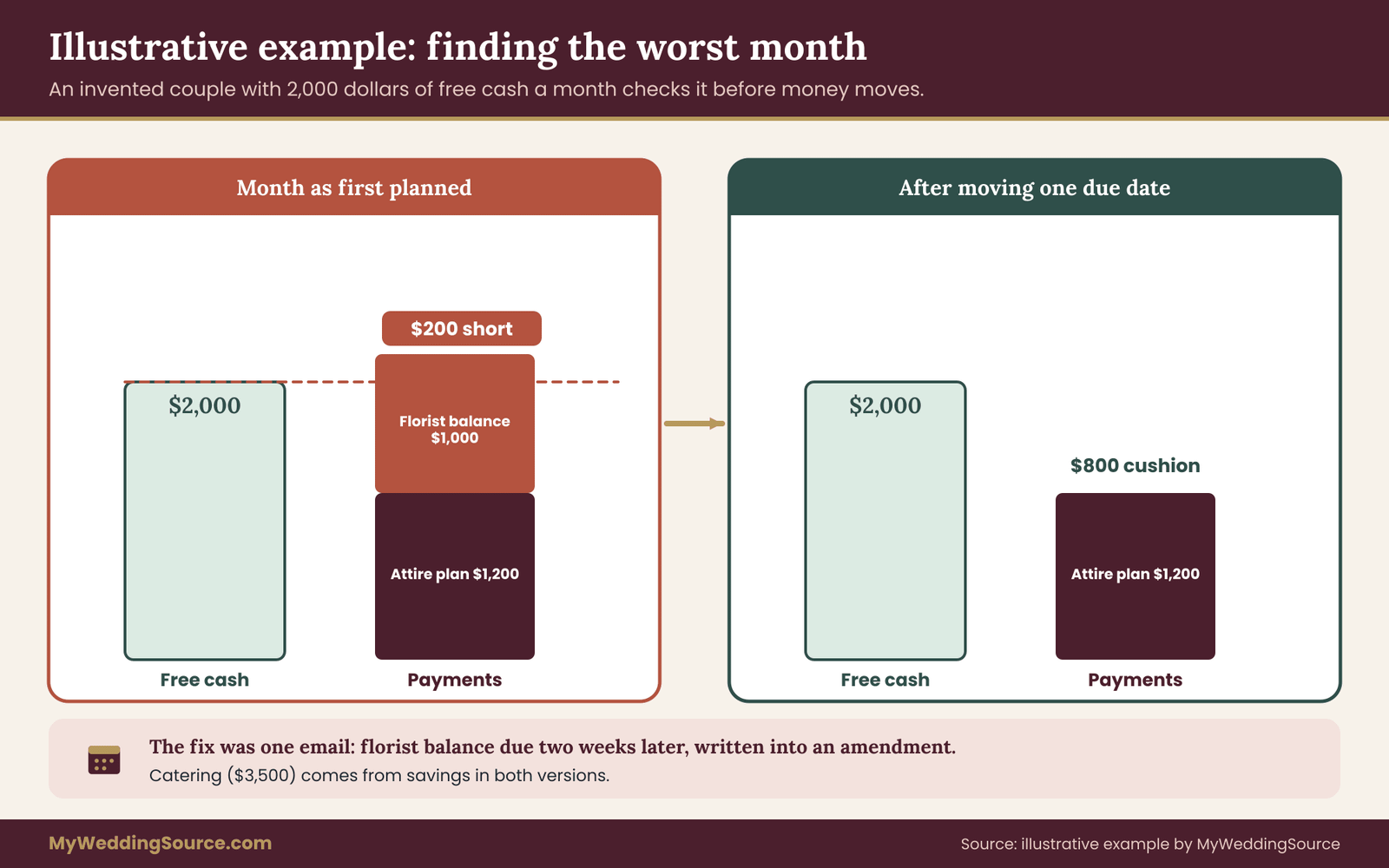
This example is invented to show the method. The couple, the amounts and the dates are illustrative, and the plans are not offers from any real provider. Dana and Marcus are planning a wedding in about four months. Together they take home about $7,000 a month, and their ordinary bills run about $5,000, which leaves about $2,000 a month in free cash. They have savings, a reserve they agreed to keep and a ledger.
Three purchases come up in the same fortnight, each with a plan on offer.
Purchase one: the florist’s deposit, $1,500
The florist’s checkout offers a twelve-month plan. They run the gates. The deposit is a fixed purchase, so gate one passes. But the plan carries an assumed rate and would run for eight months after the wedding, so gate two asks them to name what the extra cost buys, and they cannot. Gate four fails too: the florist’s contract says the deposit is nonrefundable after a certain date, and a postponement is a real possibility because Marcus’s family is traveling from abroad.
They decide the deposit is the worst possible thing to put on a long plan. They pay it from savings on the florist’s schedule and ask for the balance to be due two weeks after the original date so it lands after a paycheck.
Purchase two: attire and alterations, $2,400
This is the example from the total-cost section. A four-payment plan at zero interest would put $600 due at checkout and $600 every two weeks. They check gate three by placing the payments on the ledger. Two of the four payments fall in the same month as the final catering payment of $3,500, which comes from savings, and the florist’s $1,000 balance, which would come from income.
The month’s free cash is $2,000, and the plan adds $1,200 to the same month. Without the florist change, that month would run about $200 short before any surprise. With the later florist date, the florist balance moves to the next month and the month closes with a comfortable cushion.
They read the provider’s terms, find that the plan allows early payoff without a fee and that returns reduce the balance, and note the late fee of an assumed few dollars. The plan ends three weeks before the wedding, so it passes the exit gate. They accept it, enter it in the ledger with the refund note “returns credit the plan balance,” and set a reminder two days before each payment.
Purchase three: favors and extras, $300
The same checkout shows four payments of $75 each. They look at the purchase itself. Favors do not matter to either of them, and the item is flexible. They cancel the order. Total cost: nothing. The small-purchase rule they wrote earlier says that anything under $300 is paid in cash or skipped, so the question was already answered before the gates began.
What the example shows
Three purchases, three different answers, and one set of questions. The couple did not decide that wedding installments are good or bad. They decided about each purchase, using the same checks. The long plan failed on the exit gate, the short plan passed on cost, timing and exit, and the small purchase was dropped at gate one. The ledger was what made the decision visible: it showed the month in which the free cash ran out, and that is where they made their one real change, to a vendor’s due date and not to a loan.
How the example would change
If their free cash were $500 a month instead of $2,000, the attire plan would fail gate three and they would move down the alternatives ladder. If they were certain of the date and the florist’s deposit were refundable, a short plan on the deposit might pass. If the attire retailer did not allow early payoff, the exit gate would be weaker. The point is that every one of these changes is visible on paper before money moves, which is what the method is for.
Your next steps
Pick the next purchase that is about to meet a checkout page and work through these steps in order.
- Write the full cash price of the purchase and the date by which it must be paid or delivered.
- List every way to pay: cash, card, the vendor’s schedule and each plan on offer. For each, write the total of all payments and the date of the last one.
- Find the late-payment fee and the rate that applies after a miss. Rerun the total with one missed payment.
- Run the five gates in order: fixed or flexible, cost worth it, worst month, exit known, total fits. Stop at the first gate that fails.
- Email the vendor and ask the refund, rescheduling and fee questions. Keep the reply.
- Read the lender’s terms for returns, disputes and early payoff, and save a screenshot of the version you accept.
- Enter the plan in the ledger with a refund note and set reminders two days before each due date.
- On the same day each month, run the sweep. Stop adding wedding installments if you hold more than the number you agreed on.
If you are still building the underlying plan, the wedding budget guide and the wedding planning checklist show where each purchase fits, and the vendor purchase order checklist helps you confirm what you are paying for before any money moves.
FAQ
Are wedding installments a good idea?
They can be, for a narrow purpose: moving a payment to a date that matches your income when the plan costs nothing extra and the exit is clear. They are a poor idea when they cover purchases the budget does not support, when they stack across several providers or when they tie up a nonrefundable deposit. Price each plan, test the worst month and decide purchase by purchase.
Does buy now, pay later affect my credit?
It depends on the provider and the product. Some plans involve a soft check, some a hard inquiry, and some providers report payments or missed payments to credit bureaus while others report only certain events. Ask in writing before you accept, and check your own reports through AnnualCreditReport.com before and after the wedding to see what actually appears.
Can I use wedding installments for a vendor deposit?
You can, but deposits are the riskiest thing to spread over a long period. Many are nonrefundable, and a postponement can leave you paying a lender for a date you no longer have. If you must use a plan, choose the shortest one, confirm how a refund would work and make sure it ends before the money becomes nonrefundable.
What is the difference between deferred interest and zero-percent interest?
With a true zero-percent offer, interest starts only on any balance left after the promotional period. With deferred interest, the interest is waived only if you pay the entire balance by the end, and a remaining balance can trigger interest charged back to the purchase date. The card agreement states which applies, so read it before you rely on the offer.
What happens to wedding installments if the wedding date changes?
Your plan normally does not move on its own. The lender follows its own schedule, while the vendor’s contract decides whether your deposit transfers or is lost. List each plan, ask the lender about pausing or rescheduling and ask the vendor about moving the date. Avoid long wedding installments on date-linked purchases until the date is firm.
Will a vendor charge more if I use wedding installments?
Sometimes. A lender may charge the merchant a fee, and some merchants pass that cost along through a higher price or a card surcharge, while others absorb it. Compare the checkout total for each payment method, and ask the vendor whether its own payment schedule costs the same as paying in full.
Do I have the same dispute rights with a pay-later plan as with a credit card?
Not necessarily. Credit card billing errors are covered by federal rules with a written-notice deadline, while the treatment of pay-later products has been changing. Read the provider’s own dispute process, check the Consumer Financial Protection Bureau’s current guidance and keep your contract, receipts and messages together.
What should I do if I cannot make a payment?
Contact the lender before the due date and ask about an extension or a revised schedule, and put the request in writing. Pay the plans with the most serious consequences first, stop opening new plans and look at the ledger for purchases you can return or cancel. A nonprofit credit counseling agency or a consumer-protection office can help with larger problems.
Sources
- Consumer Financial Protection Bureau
- Federal Trade Commission, consumer advice
- Federal Reserve Board, consumer resources
- AnnualCreditReport.com, the official free credit report site
- Federal Deposit Insurance Corporation, consumer resources
- National Credit Union Administration, MyCreditUnion.gov
- Internal Revenue Service
- USA.gov, consumer protection and complaints
- Federal Trade Commission, reporting fraud