

Reusable wedding cups look like an easy win until someone has to wash, carry and count them. This guide compares reusable and disposable drinkware as a piece of logistics: how much washing each option creates, how many times it has to be moved, and how many cups you should expect to lose, so you can choose with real numbers and the right questions for your vendors.
Quick answer
Judge every drinkware option on three workloads: wash (who cleans it, where, and how fast), carry (how many crates move, how many times, and by whom) and lose (breakage, cups that walk out the door, and miscounts). Reusable wedding cups win when a vendor owns all three workloads in writing. Disposables win when the venue has no wash capacity, no return route or no room for glass. Neither is better by default, and neither is automatically “green” without a place for the used cups to go.
Most advice about drinkware at a reception stops at a slogan: reusable is better, disposable is wasteful. Real receptions are messier than that. A glass that has to be trucked forty miles, washed in a rented dishwasher and replaced when it breaks is a different thing from a sturdy cup that guests carry out the door as a keepsake. A paper cup that goes into a bin with no composting program behind it is different again from one that is collected and handled properly.
The useful question is not which cup is virtuous. It is which cup your reception can actually handle. That depends on your venue, your bar team, your guest count, your rental company and the hours between the first pour and the last cleanup. Once you see those pieces, the choice usually gets simple, and often the answer is a mix: real glasses for the toast, sturdy reusable wedding cups for the lawn, and a small stock of disposables as a safety net.
This guide gives you a method for deciding on reusable wedding cups, or against them. You will map the path every cup takes, count how many you need, price the three workloads, run the options through four gates, and walk into vendor conversations with specific questions. A worked example with invented numbers near the end shows the method on a 120-guest reception.
One note on scope. This is general planning information, not legal, tax or financial advice. Health codes, waste rules and rental terms vary by place and change over time, so the guide points you to the agency or vendor that sets each rule instead of stating a number for you.
Reusable wedding cups versus disposable drinkware: what you are really comparing
When couples compare drinkware, they usually compare two things: the price per cup and a feeling about waste. Those matter, but they are only the visible part. Underneath sit the tasks that make a cup appear in a guest’s hand, take it back out again and get it ready to be used (or thrown away) at the end.
The usual comparison leaves out the work
Picture two quotes. One is for 700 disposable cups at a flat price, delivered in boxes. The other is a rental of reusable wedding cups at a per-cup fee. The second looks cheaper or greener or fussier depending on who is reading it. But the second quote almost never answers the questions that decide whether the day goes smoothly. Who collects the used cups from the tables and lawn? Where do they get washed? What happens to a cup that is cracked, or one that a guest drops in a handbag? Is washing included, and if so, is it included on site or after pickup?
Disposables have hidden work as well, just in different places. Someone has to unbox and stack 700 cups, keep the bar stocked so service does not stall, collect the used cups, and move bags of them to wherever the venue’s waste leaves from. If the cups are labeled compostable or recyclable, someone has to make sure they land in the right stream. A cup that goes into the wrong bin is simply trash.
So a fair comparison of reusable wedding cups and disposables puts the labor and the movement on the page. That is what the ledger in this guide does.
The three workloads: wash, carry and lose
Every drinkware option creates three workloads, in different amounts.
Wash. This is the work of turning a used cup into a clean one. For reusable wedding cups it means collecting, scraping or rinsing, running through a dishwasher or sink line, sanitizing, drying and storing. For disposables the wash workload is zero, but there is a matching disposal workload: collecting and sorting.
Carry. This is every time a cup, crate or bag changes location: from the rental warehouse to your venue, from storage to the bar, from the bar to the tables, from the tables back to the wash area, from the wash area to the truck. Each leg takes people, time and sometimes a loading window that the venue controls.
Lose. Cups disappear in three ways. They break. They leave with guests, in bags, cars and hotel rooms. And they get miscounted, so you pay for cups that came back or never got delivered. Disposable cups have a version of this, too: waste from over-ordering, and stock that gets crushed or soaked before use.
Think of the three workloads of reusable wedding cups as dials rather than yes-or-no questions. A rented glass has a heavy wash dial if it is washed on site, a moderate carry dial and a loss dial that depends on the breakage terms. A paper cup has no wash dial, a light carry dial and a loss dial that is mostly over-ordering. The ledger asks you to write down where each dial sits for each option, then decide which workloads your reception can absorb.
What this comparison covers and leaves out
This guide is about drinks served in cups and glasses at a reception: water, soft drinks, wine, beer, cocktails, coffee and the toast. It covers rented glassware, reusable plastic cups, cups from a cup-return service, keepsake cups that guests take home and single-use cups of several kinds.
It does not try to cover the whole subject of reducing waste at a wedding. For food, flowers, signage, favors and the rest of the day, see the broader wedding waste reduction audit, which walks through a materials inventory and a measurement method. The two articles fit together: that one tells you where waste appears, and this one handles the single decision about drinkware in detail.
It also does not claim that reusable wedding cups are better for the environment in every case. That depends on the material, how far the cups travel, how they are washed and how many times they are used. Those facts belong to your vendors, and the verification section later in this guide shows how to ask for them. When a figure matters, the U.S. Environmental Protection Agency and the Federal Trade Commission are the places to look for how reuse and environmental claims are treated.
Why drinkware deserves its own plan
Reusable wedding cups, like any drinkware, are among the few items at a reception that every guest touches several times. A guest may pick up four or five cups across a long evening, and every one of them has a path. If that path is unplanned, you tend to see the same set of problems: a bar that runs out of clean cups during cocktail hour, a table covered in half-finished drinks, broken glass on a dance floor, a pile of dirty cups blocking the service corridor, and a final bill with a line for missing items that nobody can explain.
Those problems are not caused by choosing reusable wedding cups. They are caused by choosing any cup without thinking about the loop it travels. A disposable cup order can fail just as badly, with a bar that runs out of cups because someone counted guests instead of drinks, or a venue that refuses to haul 40 bags of mixed waste.
There is also a cost to the people working your event. Bartenders, catering staff and venue crews do the real lifting. A plan that asks them to wash 600 glasses in a service kitchen they share with the caterer, in the middle of dinner service, will be a plan that does not happen. Writing the workloads down early gives you a chance to pay for the labor or to choose a lighter option, and it keeps you from discovering the problem at 9 p.m.
How to use this guide
Read the sections in order the first time through. The cup loop comes first, because every later calculation hangs on it. Then comes cup math, then the three workloads in turn, then a look at disposables, then a comparison of five options. After that, four gates turn the ledger into a decision, a set of vendor questions and scripts turns the decision into conversations, and a worked example shows all of it on paper.
If you are earlier in planning and still deciding what your venue even allows, the wedding planning checklist is a good place to see where drinkware decisions sit in the overall order of work. Most couples settle drinkware after the venue and the bar approach are known, and well before final headcounts.
Start with the cup loop for reusable wedding cups
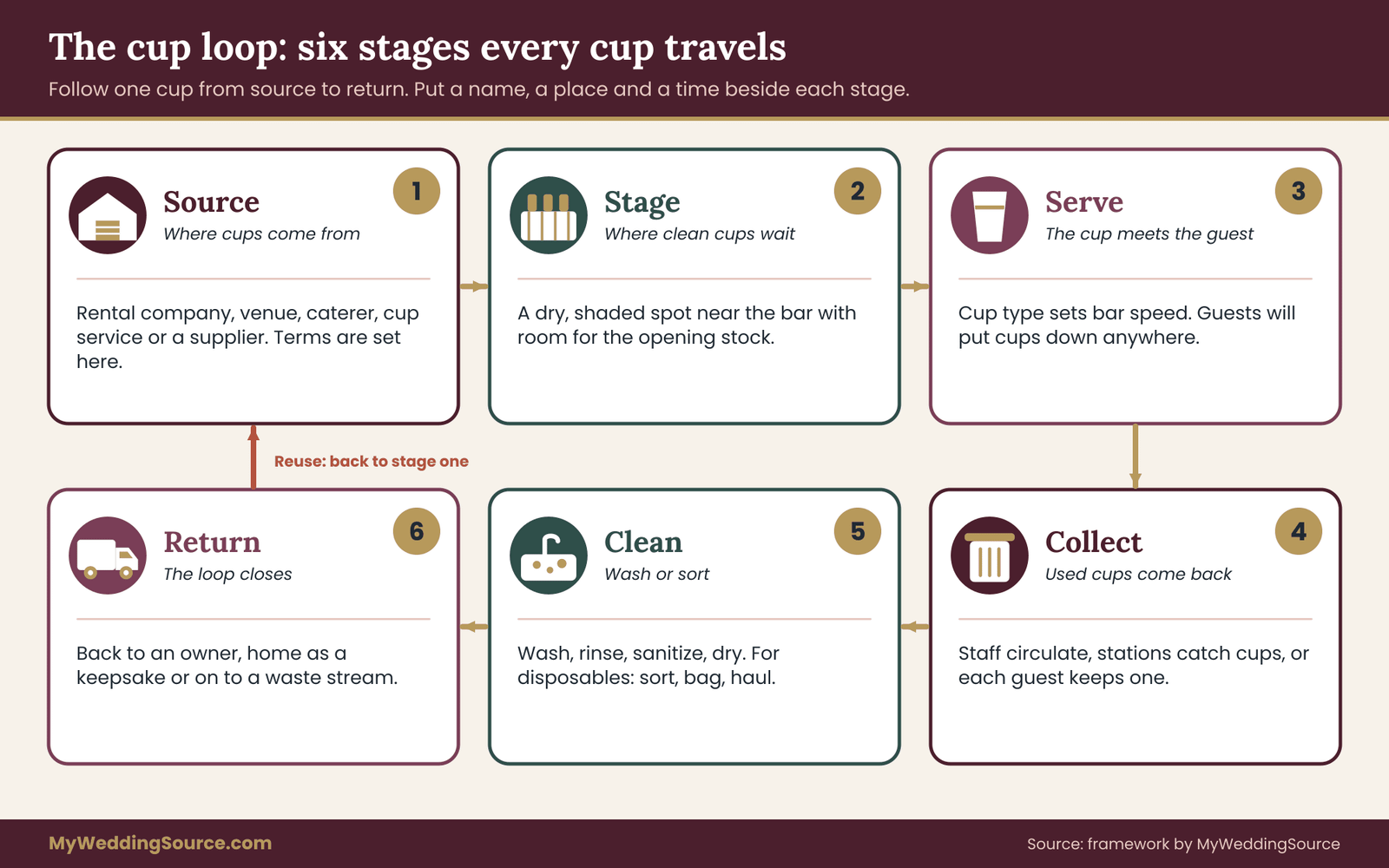
A cup is not a product; it is a route, and reusable wedding cups follow the same route as every other kind. The cup loop describes that route in six stages. Any option, reusable or disposable, goes through all six. The difference is what happens at the stage where a cup finishes its first use.
The six stages are source, stage, serve, collect, clean and return. In the next part of this guide each one gets its own look, and the first stage is where most planning mistakes begin.
Stage one: source
Source is where the cups come from. For reusable wedding cups the source might be a party-rental company, a caterer’s own inventory, a venue that keeps glassware on hand, a cup-return service that delivers and collects, or a set you buy yourselves. For disposables it is a supplier, a warehouse club or an online order.
The source decides the terms for everything that follows. A rental company sets the price per cup, the rack or crate size, the delivery window, the damage and missing-item charges and the condition in which cups must come back. A venue with its own glassware often folds the cost into a package, which can look free but may carry rules about who is allowed to touch the glass. A buyer of disposables has fewer terms but more risk of waste, because unopened cases may or may not be returnable.
Ask each source for its terms in writing before you compare prices. A quote that lists only a per-cup price is a quote with the other half of the ledger missing.
Stage two: stage
Staging is where cups wait before guests see them. It sounds minor and it is not. Clean cups need a dry, shaded, reachable spot near the bar, off the floor and away from the kitchen’s grease and steam. Disposable cups need protection from rain, wind and dirt, and they need a place that does not block the service path.
For a reception in a tent or on a lawn, staging may mean a covered table and a plan for rain. For a ballroom, it may mean a back-of-house corridor that the venue also uses for deliveries. Either way, the staging spot has a capacity. A full rack of glasses takes up room, and so does a case of cups. If the staging area cannot hold the opening stock, the bar team will be refilling constantly.
Stage three: serve
Serving is the moment the cup meets the guest. Here the cup type shapes the bar’s speed. Rigid cups stack and pour quickly. Delicate glasses take care. Stemware is slower to carry and easier to knock over. A cup with a lid, or a tumbler that a guest can set down without spilling, changes how people move around a lawn or dance floor.
This stage also creates the first loss risk. A guest with a drink in hand may put it down anywhere, walk away to dance and come back for a new cup. Plan on guests abandoning cups at tables, on windowsills, on stair rails and on the grass. Plans that assume a tidy return behavior usually fail by cocktail hour.
Stage four: collect
Collection is the stage that most often breaks the loop. Somebody has to gather used cups from tables, bars, lounges, restrooms and outdoor spaces, and carry them to the place where they will be washed or thrown away. At a plated dinner, servers clear drinkware along with plates. At a cocktail hour or a standing party, nobody does, unless you assign it.
You have three basic ways to collect. Staff can circulate with bus tubs. You can set up drop-off stations with signs, bins and a person nearby. Or guests can keep one cup for the evening, marked with a name or a color, so collection happens only once at the end. Each method has a different workload and a different loss pattern, which the later sections explain.
Stage five: clean
For reusable wedding cups, cleaning is the center of the loop. A cup may be washed during the event so it can be used again, or only afterward, so the cups are returned clean to the owner. For disposables, this stage is disposal: sorting, bagging, hauling.
Cleaning is where health rules come in. The FDA Food Code is a model code that many state and local health departments base their own rules on, and it describes how food service equipment and utensils are washed, rinsed and sanitized. Whether those rules apply to your caterer’s kitchen, a rented wash station or a venue’s bar depends on where you are. The wash section later in this guide covers the questions to ask, and the answers come from your local health department and the vendor, not from this article.
Stage six: return
Return is the end of the route. Reusable wedding cups go back to the rental company, the venue or the caterer, or home with guests as keepsakes. Disposable cups go to a hauler, a compost facility, a recycling bin or a landfill. Both endings have rules, windows and fees.
A return has a clock. A rental company may pick up the morning after, or within a set window, or require that you drop items off by a certain hour. If your reception ends at midnight and the venue’s loading dock is only open until noon the next day, the return window is part of the plan. A disposables hauler has its own schedule, and a venue may require trash out by a set time.
The key habit is to follow one cup, in your head, through all six stages, and to write a name beside each stage: who does this, where and by when. A stage with no name beside it is the stage that will fail.
How many reusable wedding cups you actually need
Cup math for reusable wedding cups is where couples either overspend or run short. The mistake is to use one number for everything, usually guest count times two. Different options and different wash plans need very different stock levels, and the difference can be large.
Clean stock versus total stock for reusable wedding cups
Separate two numbers. Total stock is the number of cups that exist for your event, clean or dirty, in a guest’s hand or in a crate. Clean stock is the number of cups available to pour into at any moment.
If every used cup is washed only after the event, total stock has to cover every drink served, because no cup gets a second life during the party. If cups are washed during the event, total stock can be much smaller, because the same cups come back clean. The price of the smaller stock is wash capacity: you need people and equipment that can keep up when the bar is busiest.
This is the single biggest lever in reusable wedding cups logistics. A couple who rents enough glasses for every drink avoids on-site washing, at the cost of renting more cups and carrying more crates. A couple who rents a smaller stock saves on cups and crates but needs a wash line that works during the party. Neither is wrong. They are different workloads.
The single-use count behind reusable wedding cups
Start with the count you would need if every drink got a fresh cup. Estimate the number of drinks, not guests. A rough way to do it is to split the evening into service periods, such as cocktail hour, dinner, dancing and late night, and estimate drinks per guest per hour in each. Your bar team and caterer know their own patterns better than any rule of thumb, so ask them for their estimate and write it down.
Then multiply: guests, times drinks per guest per hour, times hours of service, summed across the periods. That is your single-use count. It is the number you would use if you were ordering disposables, and it is the upper bound for total stock of reusable wedding cups with no on-site wash.
Include water. Many receptions have a water station or table water that uses a separate cup, and guests who drink water in a hot tent can go through several. If the same glass is meant for water and wine, say so on the order.
The in-circulation count
If washing happens during the party, work out the count in three pieces.
Cups in hands. At any moment, a share of your guests are holding a drink. During a busy cocktail hour that might be most of them. Estimate it by thinking about the busiest quarter hour.
Cups in the dirty queue. These are used cups waiting for the wash line: in bus tubs, on trays, on a counter. The size of the queue depends on how fast cups come in and how fast the wash line clears them.
Cups in the wash cycle. These are cups inside a machine or sink line, not available to anyone. If a cycle takes about forty minutes from drop-off to clean and dry in the vendor’s real setup, then forty minutes of demand is sitting in the machine at all times.
Add the three, then add a buffer for breakage, cups that leave and cups that go missing. The result is your clean-stock plan. If it is close to the single-use count, then on-site washing is saving you very little, and you may be better off renting the full count and washing afterward. If it is a third or half of the single-use count, on-site washing may be worth planning.
Peak hour, not average hour
Plan around the busiest period, not the average. A reception where guests drink slowly across five hours has a very different cup curve from one with a heavy cocktail hour and a quiet dinner. Cups run out at the peak, and when a bar runs short of clean cups, the usual fix is a case of disposables from a back room. That is a useful safety net, but you want to decide in advance that it exists, rather than discovering it when the line is ten people deep.
Add a buffer, but not a pile
Buffers are meant to cover loss. A general habit is to add a modest percentage to the stock, and to set the percentage after you read your rental terms. If the rental company counts breakage against you, a larger buffer means a larger bill if the cups are not used, and a small one means more chance of running dry. Ask the vendor how many cups customers like you typically order beyond the headcount-based estimate, and what they charge for unused cups, if anything. Treat their answer as a starting point rather than a rule.
Write the numbers down once
Keep one page with four numbers: single-use count, clean-stock plan, buffer and the final order. Next to each, write who supplied the assumption and when. When the guest count changes, you change one line and the rest follows. A page like this also helps your bar team and your rental company talk about the same numbers, which they will thank you for.
You now have the route and the stock. The next three sections price the work, one workload at a time, starting with the one that surprises people most: washing.
The wash workload behind reusable wedding cups
Washing is the workload people skip over when they price reusable wedding cups, because on the quote it is invisible. A per-cup rental fee may include washing, or it may assume you return the cups only scraped and racked, or it may leave the whole job to you. Those are three very different weekends.
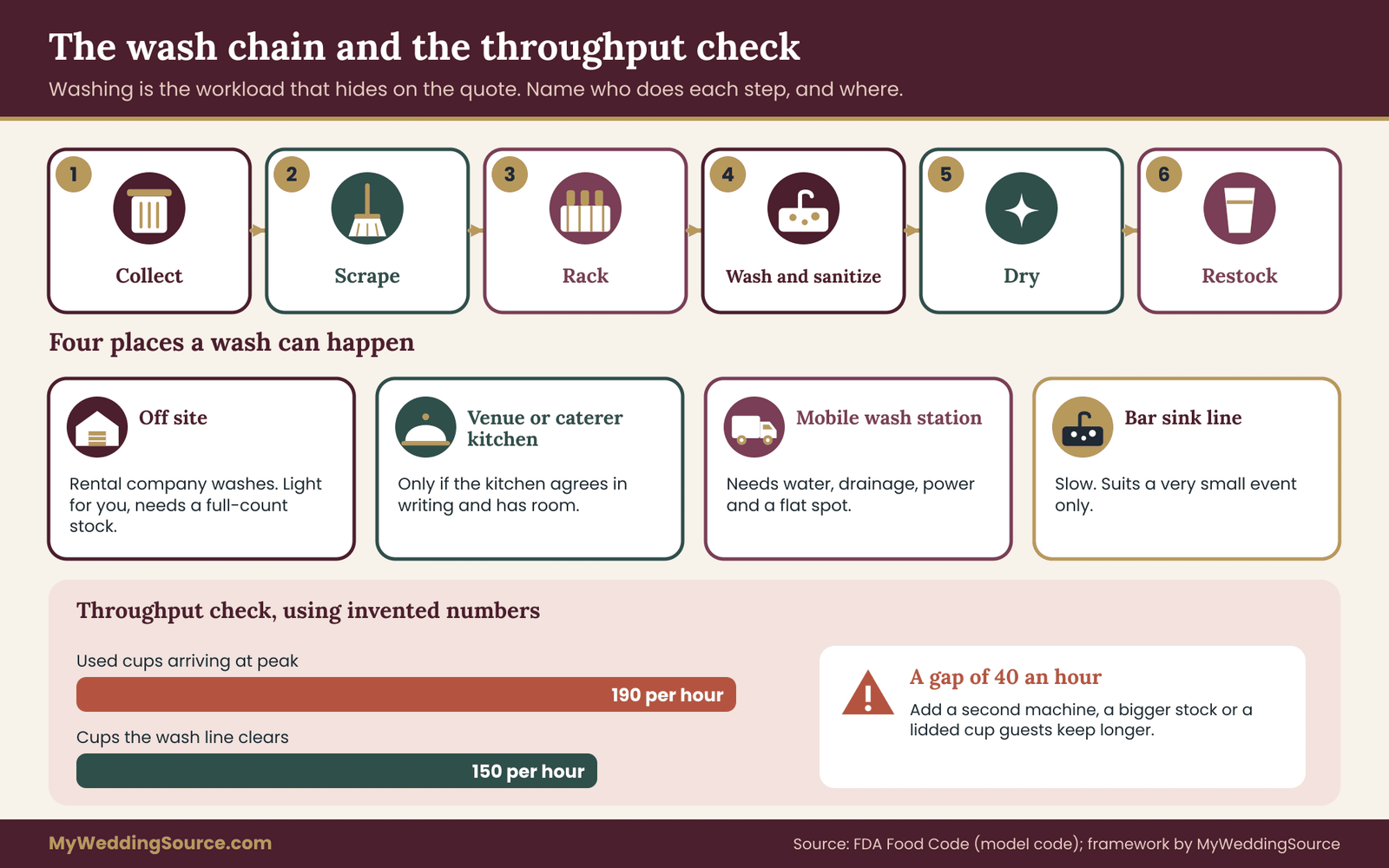
Four places to wash reusable wedding cups
Where the cups are washed matters more than how many there are. There are four common arrangements.
Off site, by the rental company. You return the cups used, in the crates they came in, and the company washes them at its own facility. This is the lightest workload for you and your venue. It also means you need enough total stock for every drink, because nothing is washed during the event. Many rental companies work this way for glassware, often with a rule about scraping off food and removing straws, napkins and garnishes before the cups go back in the rack.
On site, in the venue’s or caterer’s kitchen. Cups travel from the bar to a service kitchen with a commercial dishwasher. This can work well when the kitchen is large and the caterer is already staffed for it. It can fail badly when the kitchen is small, shared by two vendors and busy with dinner service. Never assume it is available. Ask each party, separately, whether they are willing and able, and get the answer in writing.
On site, at a rented or mobile wash station. Some companies bring a portable dishwasher or a small trailer, and some bring staff to run it. This takes pressure off the venue kitchen. It needs water, drainage, power, a flat spot and space for dirty and clean areas that do not touch. A venue may have rules about where such equipment can sit and what it can drain into.
By the bar team, in a sink line. For small receptions, a three-bin sink set-up at the back of the bar can wash a modest number of cups. This is slow, and the bar staff doing it are not pouring. It suits a very small event, not a 150-person cocktail hour.
A rule of thumb for choosing: let the wash stay with the party that already owns the equipment, the permits and the insurance for it. Volunteers, even enthusiastic ones, are not a wash plan. A cousin with good intentions does not know the venue’s rules, and a spill or injury in a kitchen they should not have been in is a problem for everyone.
Wash capacity for reusable wedding cups: cups per hour
Every wash method for reusable wedding cups has a throughput, a number of cups it can clean per hour. If your busiest hour pushes more used cups into the dirty queue than the wash line can clear, the queue grows, clean stock shrinks and the bar eventually stalls. This is the failure behind most “we ran out of glasses” stories.
Ask the vendor for the throughput in plain terms: how many racks per hour does this machine clear, how many cups per rack, how long from the moment a rack goes in until it can be used again. The answer includes drying time, which is easy to forget. A cup that comes out hot and wet cannot go straight into a guest’s hand.
Then compare it with your own peak-hour estimate from the cup math. If the wash line clears 150 cups an hour and your peak is 190, you will be short by 40 every hour of the peak. The fix is one of three: a second machine, a larger stock so the backlog is absorbed, or a smaller peak, for instance by moving to a lidded cup that guests keep for longer.
Rules that touch washing
Washing drinkware is not only a chore; in a commercial setting it is regulated. State and local health departments set requirements for how food service equipment is washed, rinsed and sanitized, and many base them on the FDA Food Code. A caterer’s licensed kitchen has to follow those rules. A venue may follow them for its own bar. A portable wash station may or may not fall under them, depending on who operates it.
You do not need to interpret the code yourself. You need to ask the vendor one clear question: does your wash process meet the local health department’s requirements for food service ware, and can you tell me how? A professional will answer that without hesitation. A vendor who hesitates may be a vendor to think twice about for this task.
Also ask about the practical side of sanitizing. Some machines use high heat and some use chemical sanitizer, and plastic cups have temperature limits that glass does not. A cup that warps in a high-heat cycle is a cup that cannot be reused, and the cost is usually charged to the customer. The rental company knows which cups can go through which cycle, and it is worth asking.
Preparing cups for washing
The cleaning workload shrinks or grows depending on what guests do to the cups. Wine is easy. Cake frosting, lipstick, glitter, floral petals, lime wedges, cocktail straws, cigarette ends, gum and napkins are harder. Rental companies often charge extra when cups come back with debris or heavy staining, or when racks are overloaded, and some will not accept a rack with anything other than a cup in it.
Two simple steps keep the wash workload low. First, place a bin or tray near each drop-off point for trash: straws, garnish, napkins. A guest who has somewhere to put a lime wedge will usually use it, and one who does not will drop it in the cup. Second, ask the rental company how it wants cups racked and scraped, and tell the bar team. A rack that goes back right saves a fee, and the person who loads it needs the instructions before the evening, not after.
The people side
Washing takes hands. Count them.
For on-site washing, you need at least one person at the dirty end loading racks, and one at the clean end unloading, drying and restocking. For a larger event, a runner who carries clean racks to the bar and dirty tubs back is a third. If the caterer or bar company supplies these people, find out whether the price is included, whether they are working overtime and whether they have other jobs during the same hours.
For off-site washing, the labor is smaller but not zero. Someone has to load racks at the end of the night, in a way that satisfies the rental company, and stack crates for pickup. If your cleanup crew is thin and your bar team leaves when the bar closes, that job may fall to a family member at one in the morning. Say who it will be.
Cost logic for washing
You cannot compare the price of reusable wedding cups without wash costs, so put them on the same line. A simple way to do this is to write one total for each option: the cup fee, plus the wash fee or labor, plus any equipment rental, plus the cost of extra staff, plus penalties for damaged, stained or missing cups. Then divide by the number of drinks you expect to serve, if you like, to get a cost per drink that can be compared fairly with a disposable.
You should expect that a rental company’s per-cup price will sometimes include washing and sometimes not. If a quote does not say, ask. If it says “washing included,” ask what that means: scrape-and-rack, full wash, or a fee that applies only if cups come back clean. An unexamined line item can turn into a large surprise at pickup.
When the wash workload is too heavy
Some receptions cannot support on-site washing at all: a tent with no water, a historic venue that forbids heavy equipment, a site with a septic system that cannot take extra load, a remote property with a long drive to the nearest truck. In those cases you are choosing among three options: reusable wedding cups with off-site washing and a full-count stock, a cup-return service that handles all of it, or disposables. The comparison in later sections puts them next to each other.
Choosing off-site washing and a full count of reusable wedding cups is not a failure of reuse. It is reuse at a different scale, with more crates and a longer return trip. Whether that is better than disposables depends on the rest of the ledger, and in particular on the carry and loss workloads.
The wash workload for reusable wedding cups ends when every cup is clean, dry and accounted for, or when every used cup is in the right bin. The carry workload, which follows, begins before the first cup is poured and continues after the last guest has left.
The transport workload of reusable wedding cups
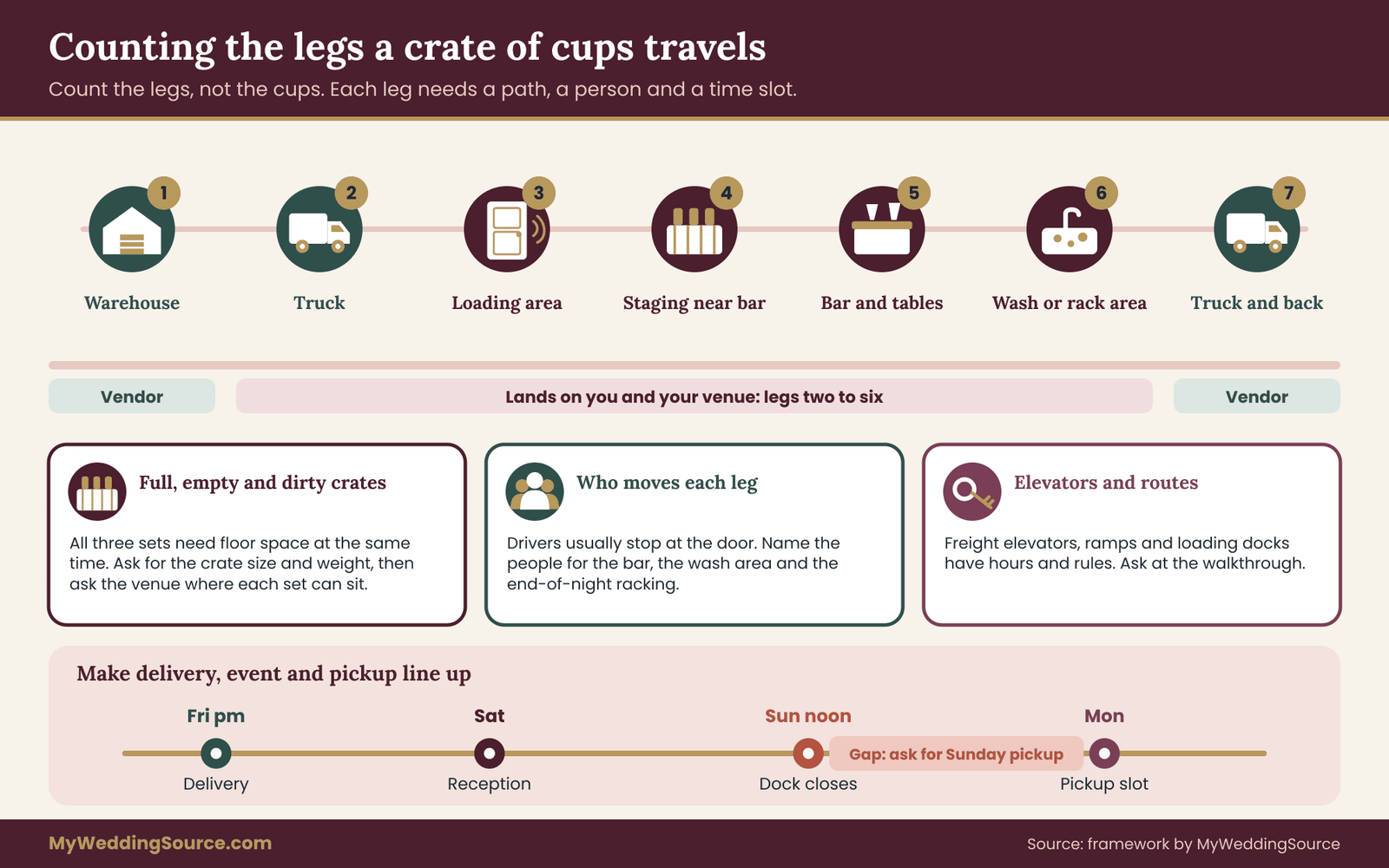
Carrying reusable wedding cups is the workload that looks smallest on paper and grows the most on the day. Count the legs, not the cups. A single rack of glasses may travel six times before it is done, and each trip needs a path, a person and a time slot.
Count the legs of reusable wedding cups
Write out every movement for one crate of cups, in order.
- The rental company’s warehouse to its truck.
- The truck to your venue’s loading area.
- The loading area to the staging spot near the bar.
- The staging spot to the bar itself, as cups are used.
- The bar and the tables back to the wash area or collection point.
- The wash area to the truck, ready for return.
- The truck back to the warehouse.
Your side of the ledger is legs two through six. Legs one and seven are the vendor’s, but they decide the delivery and pickup windows, and those windows land on your venue.
For disposables the legs are shorter and lighter: delivery to the venue, to the bar, then bags to the waste area and out. The weight and volume are different, though. A case of paper cups is light and bulky. A rack of glasses is heavy and fragile. Multiply by the number of crates, and by the stairs, ramps and corridors in between.
Crates and racks for reusable wedding cups
Reusable wedding cups arrive in crates or racks, and each takes floor space. A single crate is easy. Dozens of crates, both full and empty, take real room, and both sets, full and empty, need to be somewhere at the same time. Many couples remember to plan for the full crates and forget the empty ones, so the room fills as the evening goes on.
Ask the rental company for the size and weight of a loaded crate, how many cups it holds and whether crates stack. Then ask your venue where full, empty and dirty crates can sit without blocking a fire exit, a service path or a guest area. A venue coordinator knows the answer to the second question, and a technical walkthrough is the right moment to ask. The venue technical walkthrough guide covers measurements, access routes and loading questions in more detail, and drinkware belongs on that list.
Delivery and pickup windows
Rental companies and venues each have their own hours. A delivery window might be a four-hour block the day before or the morning of. A pickup window might be the next morning, or the next business day, or a specific hour. If the venue is closed on Sunday and your reception is on Saturday, you may have a gap to solve. Cups sitting overnight in a vacant tent or a locked loading area carry their own risk of weather, theft and damage.
Tie these three together before you sign: when the cups arrive, when you will be done with them and when the vendor takes them back. If any two do not match, you have found a cost. Early delivery may require paid storage. Late pickup may mean a venue fee for equipment left overnight, or a late-return charge from the rental company.
Who carries what
Name the people who handle each leg, including the ones who will be there only because you asked them to. Delivery drivers usually bring cups to the door or a designated spot, and carrying to the bar is up to someone else. If the venue’s rules say vendors must use a loading dock and a freight elevator, the plan should say whose job it is to run the elevator and when.
For the end of the night, decide who will rack the cups, who will stack the crates and who will remain until the truck arrives or until the crates are in a safe place. This task is easy to leave for the last hour, when everyone is tired and the venue’s closing time is near. A written plan, even a short one, keeps it from falling on a parent or a friend who would rather be saying goodbye.
Distance and trip count
Distance matters for reusable wedding cups, and so does the number of trips. A rental company that is twenty minutes away and has its own truck is a different case from one that delivers from a depot two hours away or ships cups by freight. Ask where the cups come from, whether a single trip covers delivery and pickup or whether each is separate, and whether the company charges for distance or for each trip.
This is also where claims about environmental benefit deserve a pause. A reusable cup that has to be driven a long way, washed in hot water and delivered in a half-empty truck does not carry the same benefit as one that travels a short distance and has many uses. The honest answer depends on those details, and no article can supply them for you. Your job is to ask your vendors for the facts they have and to avoid repeating claims you cannot back up.
Transport for disposables
Disposable cups need a transport plan too, just a lighter one. They arrive in cases or sleeves, they need a dry spot, and the used ones leave in bags. Bags are heavier than they look when they contain melting ice and the last of the drinks. Ask the venue where bags go, how often the bins are emptied and whether you or the venue arranges pickup.
If you choose compostable cups, add another leg: the trip to a composting facility that accepts them. If no facility accepts them, they will be handled as trash, and the plan has to reflect that. Many municipal programs accept only certain products, and some do not accept any foodware labeled compostable, so the answer depends on your location. The EPA’s pages on recycling and composting explain why local rules are the controlling ones.
A carry plan on one page
Put the transport plan on one page: the legs, a name beside each, a time beside each and a place beside each. Share it with the venue coordinator, the bar team and the rental company. Ask for corrections. It takes about fifteen minutes to write and it prevents the common situation in which each vendor assumes someone else is moving the crates.
The loss workload: breakage, walk-aways and miscounts
Loss is the third workload, and for reusable wedding cups it is the one most tied to money. Every cup that does not come back costs something. The skill is in estimating how many will go missing, setting terms that are fair and arranging the room so fewer do.
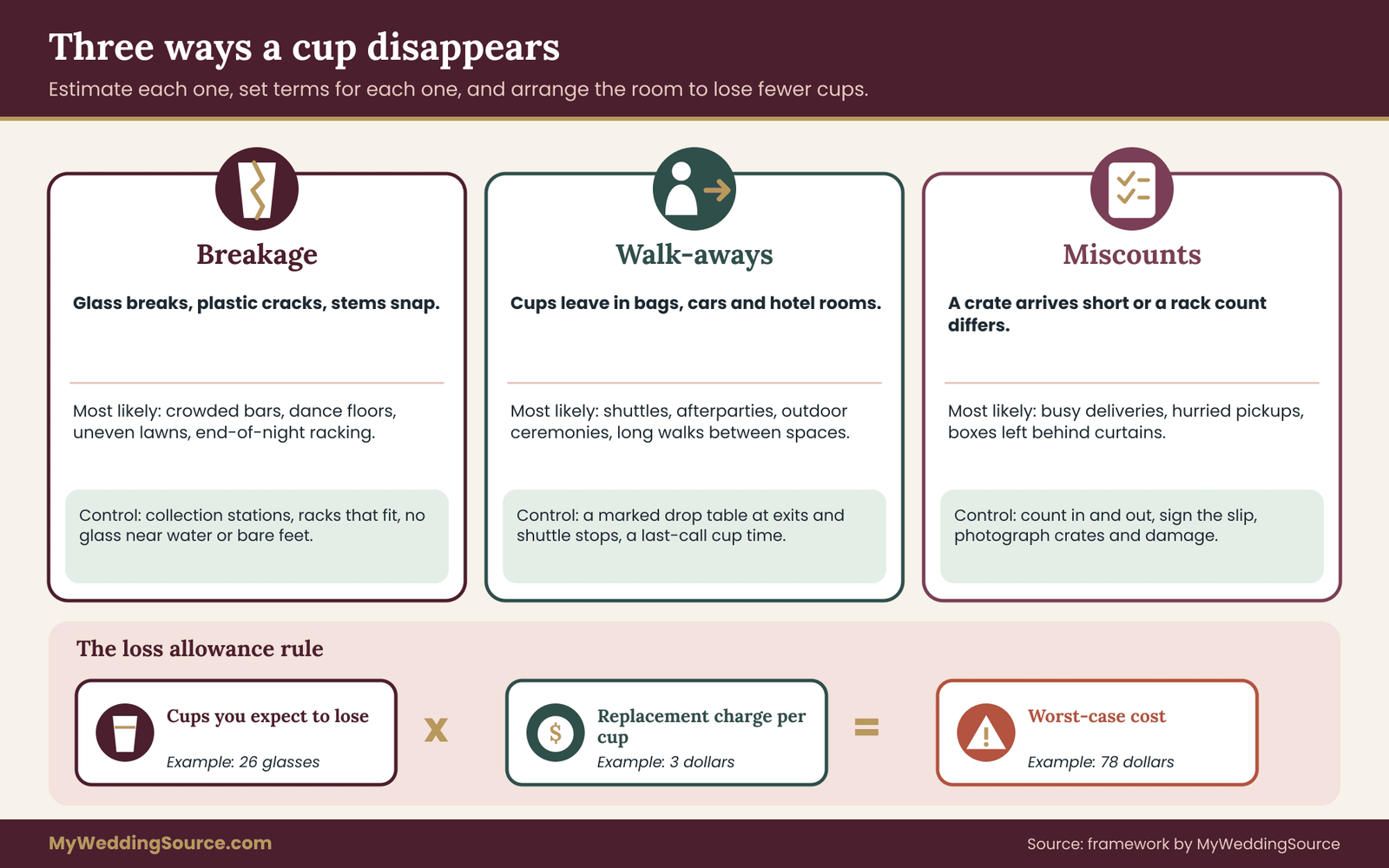
Three ways reusable wedding cups disappear
Breakage. Glass breaks, plastic cracks, stems snap. Breakage is most likely during collection, in crowded bars, near dance floors, on uneven lawns, and during racking at the end of the night. A rental contract may charge a full replacement price for each broken piece, or it may allow a percentage of breakage without charge. That difference matters enormously, and the terms should be read, not assumed.
Walk-aways. Guests carry cups to cars, hotel rooms, rooftops, restrooms and group photos. With sturdy cups, some guests will consider them souvenirs. With glassware, some will leave with it by accident, still holding the last of a drink when the shuttle comes. Walk-aways are higher at weddings with shuttles, afterparties, outdoor ceremonies far from the reception and venues with a long path between spaces.
Miscounts. Sometimes a cup is not missing but uncounted. A crate arrives short. A rack is returned with a different count than the rental company recorded. A box of cups is left behind a curtain. A dispute over a count is a dispute over paperwork, and the best protection is a record made at the time.
Read the loss terms for reusable wedding cups before you sign
Ask for the terms on breakage and missing reusable wedding cups in plain language and in writing. Several questions matter.
- Is there a breakage allowance, and is it a percentage or a fixed number of cups?
- What is the replacement charge per cup, and does it differ for glass, plastic and stemware?
- Who counts the cups at delivery and at pickup, and is the count signed or photographed?
- If cups come back dirty, stained or chipped, what charge applies?
- What happens to cups that guests take home? Are they counted as missing?
- Is there a deposit, and when is it refunded?
Those are questions about a contract, not about cups, and the wedding vendor contract guide explains how to read and negotiate such clauses. The point to carry from it is that anything the vendor will do for you should be written, and anything that is not written is something to ask again.
Count on the way in and the way out
A count at delivery and a count at pickup are the best defense against a disputed charge. Take both in the presence of the delivery person, if possible. Count by rack or crate and by individual cup, or at least by a sample, and record the total on the delivery slip. Photograph the loaded crates, and photograph any damage you find on arrival, so the record exists before the first guest arrives.
At pickup, repeat the process. If the driver is in a hurry, ask for a copy of the pickup slip. If the count is disputed, you will have your own number, with a time and a date, and a photograph of the crates being loaded.
Design the room to lose fewer cups
You can lower the loss rate with layout and habits.
- Put collection points where guests naturally finish drinks: exits, the edge of the dance floor, the bar and the door to the lawn.
- Use one cup type for each purpose so staff can tell at a glance what goes where.
- Avoid glass near water, pools, hot tubs and bare feet, and anywhere the venue prohibits it.
- Offer a clearly marked “take it with you” option, such as a cheap keepsake cup, so the cups you want back are not the cups guests want to keep.
- Set a time when the bar stops handing out cups outside, so guests are not carrying drinks to the parking lot.
- Place a table with a sign at the shuttle pick-up area for cups that guests are carrying.
None of these steps costs much. They work because guests respond to a clear place to put something down.
Walk-aways as a feature
Some couples decide that walk-aways are part of the point of their reusable wedding cups. If the cups are a branded keepsake, a printed tumbler, a stainless cup with the date, then every cup that leaves is meant to leave. In that case the loss workload becomes a purchasing decision: you are buying one cup per guest and a few spares, and the question is what you pay per cup and whether guests will use them.
That choice carries its own logic. Keepsake cups are only reusable if guests use them again. A cup in a drawer is a durable item that does not do the job of reuse. If you go this route, a modest quantity of well-chosen cups serves better than a pile, and a plan for leftovers, such as donating them or offering them to the wedding party, avoids a box of cups in a closet.
Setting a loss allowance
Make a loss allowance for each option, including your reusable wedding cups. For rental glassware, set it by the vendor’s breakage terms and your estimate of walk-aways. For reusable plastic, assume more walk-aways and fewer breaks. For a cup-return service, ask how the service handles a missing cup. For disposables, the loss allowance is simply the over-order you accept.
Write it as a number of cups and as a dollar amount. A number is useful for the order. A dollar amount is useful for the budget. If the dollar amount makes you nervous, change the option or add a control, rather than hoping the loss comes in low.
With wash, carry and lose all written down, you can compare the options that actually exist. First, though, you should know what the disposable path looks like when you take the same care, because a disposable cup is not a free pass on logistics.
Disposable drinkware: the same loop without a return leg
Disposable cups are not the villain of this story, and they are not a loophole. They run through the same six stages as reusable wedding cups, and the stage that changes is the last one: instead of returning to an owner, each cup goes to a waste stream. That stream is where the real differences between disposables appear.
Four kinds of single-use cups
Plastic cups. The most common and the cheapest. Many are made from plastics that some local programs accept for recycling and some do not, and a cup soiled with drink residue may not be accepted even where its material is. Whether a plastic cup is recyclable in your area depends on your local program, not on the symbol printed on it.
Paper cups. Many are lined with a thin coating that keeps liquid from soaking through. That coating can complicate recycling, and programs differ on whether they take lined paper cups at all. Ask the local program.
Compostable cups. These are made from plant-based materials and are meant to break down in a composting facility. They only deliver that benefit if a facility that accepts them is available to you, and if the cups reach it separated from the trash. A compostable cup in a landfill is simply a cup. Third-party certification, such as the standards that bodies like the Biodegradable Products Institute check against, tells you the product meets a testing standard. It does not tell you that your local hauler will take it.
Reusable-grade disposables. Some plastic cups are thicker and meant to be washed and reused a few times. They sit between categories. If you buy these, treat them as reusable wedding cups and run them through the ledger, including the wash workload, rather than as disposables you happen to rinse.
The disposal workload
For disposables, the wash workload has a twin, the disposal workload. Write it down the same way: who collects used cups, where they are sorted, who hauls them and where they end up.
At a venue with a single dumpster and no sorting, all four kinds of cup go to the same place. Having compostable cups there changes only what is printed on the cup. If the venue offers separate streams, find out which ones, how they are labeled and who empties them. If you hire a hauler for compost, ask for the destination facility and whether it accepts your specific cup.
Sorting works best at a staffed station, with a person who can tell a guest where to put a cup. A bin alone is a hope. Guests moving between a dance floor and a bar will drop a cup in whatever bin is nearest, and a stream with the wrong item in it can be rejected as a whole load. The full wedding waste reduction planning guide goes into station design and signage in more depth.
The over-order trap
Disposable cups tempt over-ordering, because they are cheap and nobody wants to run out. A large surplus costs money, and unopened cases may or may not be returnable. Open cases may not be reusable at all. Surplus is also waste in the sense that matters to people who care about reducing waste, since it was made and shipped for nothing.
Use the single-use count from the cup math, add a measured buffer and agree with the supplier or caterer on what happens to unopened cases. If you cannot return them, think in advance about where they might go: the venue, a charity event, a staff party or a home pantry.
When disposables are the right call
Disposables are a reasonable choice in several real situations.
- The venue does not allow glass, and no plastic reusable option is available.
- There is no wash capacity at all, and the full-count off-site plan is not workable.
- The reception is a drop-in or a casual lawn party with fluid guest numbers and no staff to collect cups.
- The budget is tight and a reusable plan would require adding labor.
- A backup stock is needed for the part of the evening when the clean stock runs low.
In each, a disposable is not a failure of values. It is a choice made with the facts you have. What matters is that it is made deliberately, and that you do not claim more for it than it delivers.
What to say about disposables
Be careful with the words you use for them, whether on a sign, a website or a social post. The Federal Trade Commission’s Green Guides describe how marketers should handle environmental claims, including general claims like “eco-friendly” and specific claims about recyclability and compostability. A wedding couple is not a marketer, but the same logic applies: a claim you cannot support with a local fact is a claim to leave out. “Compostable” on a sign, where there is no compost stream, sends guests to a bin that does not do what the sign says.
A plain sign works better: “Cups go here. Our venue sends these to landfill” is honest and it is better than a hopeful word. If you have a compost stream, say so and name it.
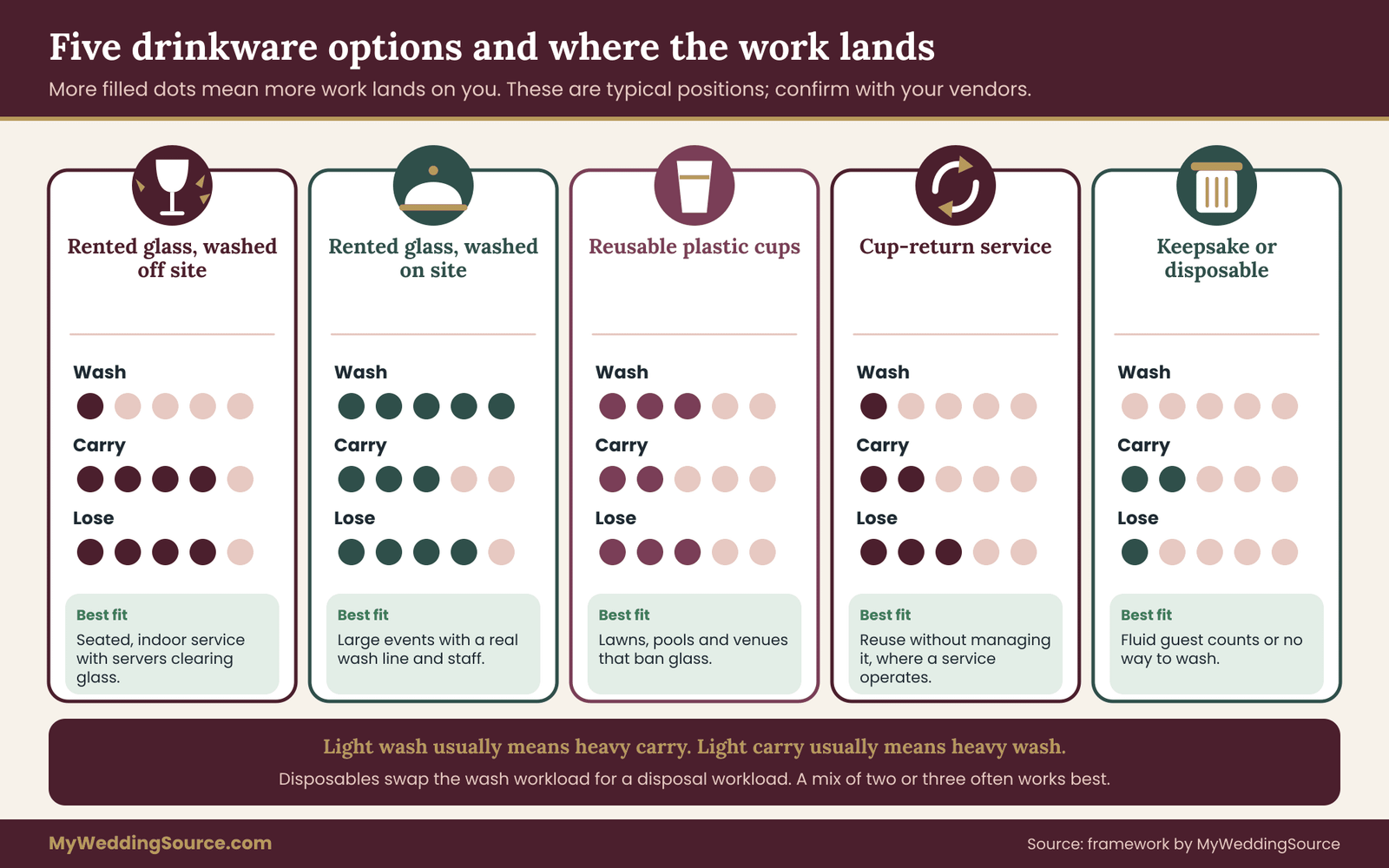
Five drinkware options through the ledger
With the three workloads defined, you can put the options side by side. The descriptions below are in prose, not scores, because the true numbers depend on your vendors. For each option, think about where the wash, carry and lose dials usually sit, and what the option asks of you.
Option one: rented glassware, washed off site
This is the classic reception choice. The rental company delivers racks of glasses, you use them and you return them used, scraped and racked, and the company washes them.
Wash workload: light for you, because the company does the cleaning. You still scrape and rack. Carry workload: heavy, because you need a full-count stock and every rack is delivered and collected. Loss workload: moderate to high. Glass breaks, and some walks out.
It suits a seated reception with servers who clear glassware, a ballroom or indoor space and a venue that allows glass. It strains at a standing lawn party, where glasses end up on the grass.
Option two: rented glassware with on-site washing
The same glasses, but washed during the event so a smaller stock is needed.
Wash workload: heavy, with staff, equipment and a place to do it. Carry workload: moderate, because fewer racks are involved, though racks move more often within the venue. Loss workload: moderate, with the same breakage exposure.
It suits a larger event with a caterer or bar company that has a wash line and the people to run it. It fails when the kitchen is shared and small.
Option three: reusable wedding cups in plastic, rented or owned
Sturdy cups designed to be reused, supplied by a rental company, a cup service or purchased outright.
Wash workload: moderate, but sensitive to the wash cycle’s temperature, and they can be harder to dry. Carry workload: lighter than glass, since cups are lighter, stackable and less fragile. Loss workload: breakage is lower but walk-aways are higher, because guests treat sturdy cups as keepers.
It suits lawn receptions, outdoor events with a pool or uneven ground, and venues that prohibit glass. Make sure the cups look like something you want in your photos.
Option four: a cup-return service
A company delivers, collects, washes and takes back reusable wedding cups, often with a system of deposits, tracking or collection stations.
Wash workload: very light for you, since the company handles it. Carry workload: light to moderate, since the company carries. Loss workload: depends on the contract, which may charge for cups that do not return.
It suits couples who want reuse without managing it, in an area where such a service operates. Ask for the details of the service rather than assuming it works like a glass rental, and ask what the company does with cups that are not returned and how it counts them.
Option five: keepsake cups for guests, or disposables
Two choices share this slot because both take a one-cup-per-guest approach. Keepsake cups are bought, labeled and given away. Disposables are bought and discarded.
Wash workload: none for you, if guests keep their cups. Carry workload: light, with boxes in and nothing back. Loss workload: no loss, since leaving is the plan, though you may have extras.
Keepsake cups, a special case of reusable wedding cups, suit smaller receptions where each person can have one. Disposables suit receptions with fluid numbers or no way to wash. In both, the question is what happens to the cup afterward, and whether anyone will use it.
Mixing options with reusable wedding cups
Many receptions work best with two or three. Use real glasses for the toast and for dinner, where servers clear, and reusable plastic or disposable cups for the lawn and the late-night bar. Keep a small stock of disposables behind the bar as a safety net. A mix reduces risk, since a failure of one option does not stop the party. It also increases the number of things to coordinate, so write it on one page and give a copy to the bar team.
Reading the ledger as a whole
Once you have the five options in front of you, look for the pattern in how reusable wedding cups trade against disposables. Options with a light wash workload usually have a heavier carry workload, since cups must travel to a place where someone else cleans them. Options with a light carry workload usually have a heavier wash workload, since cleaning happens on site. Options with a light loss workload often rely on guests keeping cups, which only works if guests want them.
Because the three dials trade against each other, no choice of reusable wedding cups or disposables wins on all three. Your task is to choose the combination your venue, your vendors and your budget can carry.
Four gates that decide whether reusable wedding cups will work
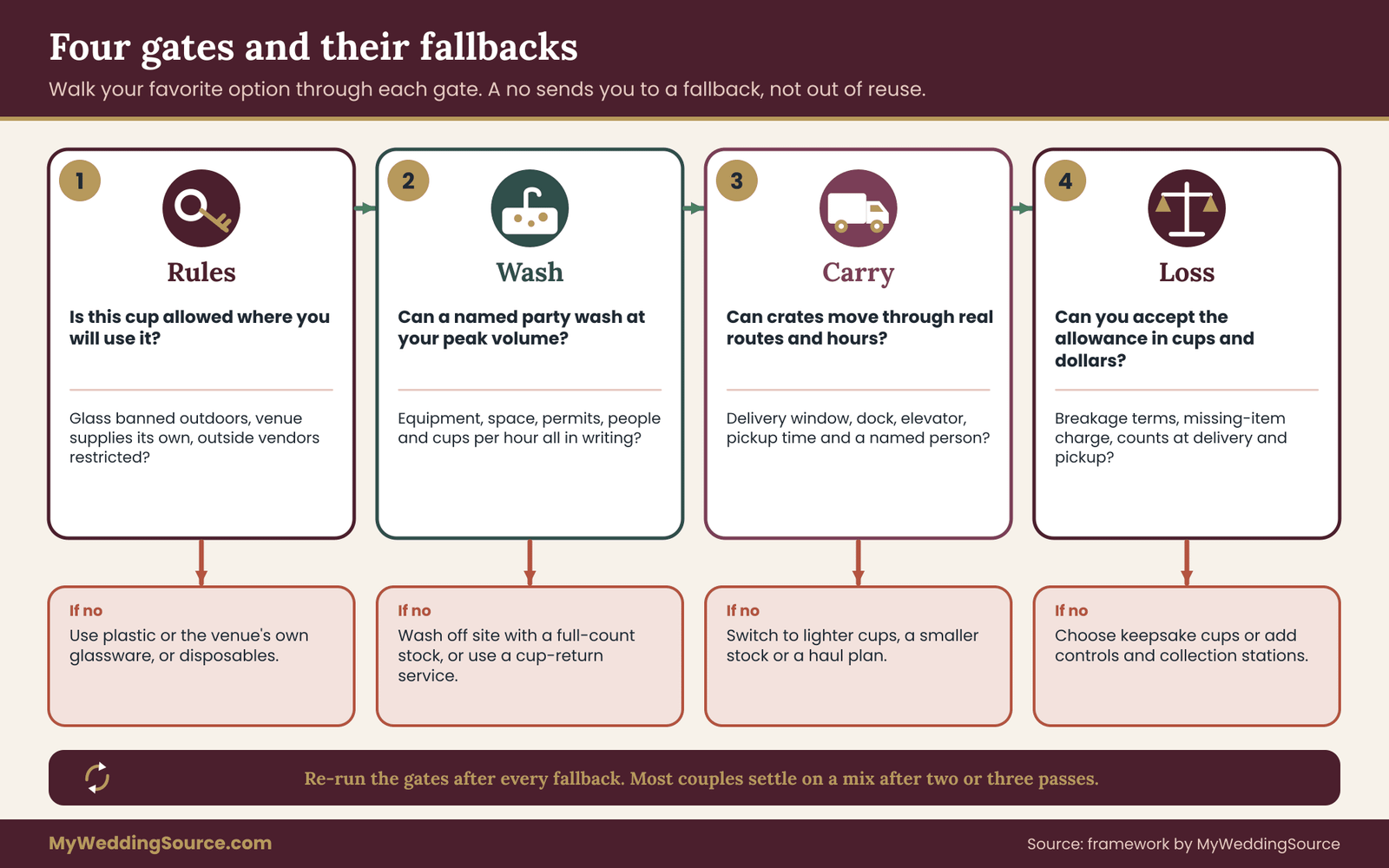
The ledger describes each option. The gates turn it into a decision. Take your favorite option, the one you would choose if everything worked, and walk it through four gates in order. A gate is a yes-or-no test with a written answer. If the answer is no, you do not abandon reuse; you move to the fallback listed for that gate and run the new option through the same gates.
Gate one: rules
Can this cup type be used where you plan to use it? This is the venue gate, and it comes first because a no here ends the option before any money is spent.
Questions at this gate: Does the venue allow glass, and where? Are there outdoor areas, pools, docks, gardens or historic floors where glass is not allowed? Does the venue require its own caterer or bar company to supply or wash cups? Are outside rental companies allowed, and does the venue charge a fee for them? Does the venue’s insurance or alcohol policy say anything about the type of container?
Some venues ban glass outdoors, some allow it only at the bar, and some supply their own glassware at a fixed price. Your contract and the venue coordinator are the sources. Do not rely on a website summary.
If the answer is no: switch to a cup that the venue permits, which usually means reusable plastic or disposables, or add the venue’s own glassware to the plan if it offers it.
Gate two: wash
Does a named party have the equipment, space, permits and people to wash the cups at the volume your peak hour requires? Use your peak-hour number from the cup math and the vendor’s throughput. If the line clears fewer cups per hour than you use, the answer is no unless you add stock or equipment.
If you chose off-site washing with a full-count stock, this gate asks a simpler question: will the vendor accept cups returned scraped and racked, and what does that cost?
If the answer is no: move to off-site washing with full-count stock, to a cup-return service that handles washing or to disposables.
Gate three: carry
Can the crates move through the venue’s real routes within the venue’s real hours? Check delivery windows, loading dock access, elevators, distance from staging to bar and pickup timing. Check whether a named person moves crates at the end of the night and whether the venue allows them to stay while the crates wait for the truck.
If the answer is no: switch to a lighter option: fewer cups through a smaller stock with on-site washing, plastic in place of glass or disposables with a haul plan.
Gate four: loss
Can you accept the loss allowance, in cups and in dollars, in writing? This is a budget test and a contract test. If the vendor’s breakage terms leave you open-ended, or the missing-item charge makes a walk-away expensive, the answer is no until terms or controls improve.
If the answer is no: change the option to one where leaving is the plan, such as keepsake cups, or add controls: collection stations, a clear take-home option and a count at delivery and pickup.
Run the gates once, then again
Use the gates like a loop. Suppose you start with rented glassware and on-site washing. Gate one passes. Gate two fails, because the caterer’s kitchen is small and will be busy. You fall back to off-site washing with a full-count stock. Run it again. Gate two passes, since the rental company takes cups scraped and racked. Gate three fails, because the loading dock closes at noon the next day and pickup is scheduled for Monday. Now you look at a pickup window change or a cup-return service. Each fallback reveals the next constraint, and by the third pass the picture is clear.
Most couples planning reusable wedding cups end up with a mix after two or three passes, and that is normal.
Venue and bar team rules that surprise people
A few rules show up often enough to mention.
Alcohol service. Venues and licensed bar companies often have rules about how drinks are poured, what containers are used and who may handle them. The wedding bar service planning guide explains how bar size and staffing fit together. A guest-brought cup may be refused at a bar, or the bar may ask for a particular style. If you want guests to use keepsake cups at the bar, ask whether staff may fill them.
Cup type for each drink. Hot drinks, such as coffee and tea, need a cup that can handle heat. Cold cups may not. The toast needs a glass or flute guests can hold comfortably. Water may need a separate cup, so it does not mix with the wine glass.
Outdoor areas. Lawns, gardens and beaches have different rules. Some forbid glass for safety. Some forbid cups that could blow around and litter. Ask what the venue needs and ask what it expects at the end of the night.
Insurance. Some venues ask for event insurance, and some rental companies may ask for proof. Whether any of them involve glassware is a question for the venue and the insurer.
Staff roles. Bartenders pour. Servers clear. Neither is the same as a wash crew. If you expect any of them to take on a new task, such as collecting cups from the lawn, ask them and expect a price.
Time of last service. If the bar closes at eleven but the party continues, the cups that remain need a plan. Guests who walk off with a cup at eleven fifteen are guests with no collection point.
How the cocktail hour changes the math
The first hour of drinking is often the busiest for cups, because guests arrive at once, drinks are fresh and the bar is open to everyone. Reception planners know this, and the wedding cocktail hour guide explains how it is usually structured. For reusable wedding cups, treat cocktail hour as your peak and test your plan against it. If the plan holds there, it will hold through dinner and dancing.
Vendor questions for reusable wedding cups, with scripts
By now you know what to ask about reusable wedding cups. This section groups questions by the person who can answer them, so you can use the list in real conversations. Keep the answers in one document, and keep the answers in writing, since a promise in a phone call is hard to hold anyone to.
Questions for the venue
- Is glass allowed, and where? Are there areas where it is not?
- May we bring in an outside rental company, and is there a fee or a required vendor list?
- Is there a kitchen or wash area, and may any outside vendor use it?
- Where may full, empty and dirty crates be placed, and where can a truck load?
- What are the delivery and pickup hours, and what is the charge for equipment left overnight?
- What waste and recycling streams do you provide, and who empties them?
A short script for the first call: “We are comparing real glassware with reusable wedding cups for the reception. Could you tell us where glass is allowed, whether an outside rental company can deliver, and where crates can go on the day? We would also like to know your pickup hours.”
Questions for the caterer or bar company
- Do you supply cups or glassware, and what do you charge?
- If we rent from outside, will you handle the cups at the bar, and is there a fee?
- Can your kitchen or crew wash cups during the event? What is the throughput?
- How many cups per guest do you plan for in our service style?
- Who collects used cups from the tables and lawn, and is this in the price?
- Do you carry disposable cups as a backup?
Script: “If we use reusable wedding cups, what would you want us to know about how you work with them? Who would collect used cups during cocktail hour, and would that change your staffing?”
Questions for the rental company about reusable wedding cups
If you are renting tables, linens and other items from the same company, the wedding rental planning checklist covers counts, delivery and pickup windows for the whole order.
- What does the per-cup price include: delivery, pickup, washing, breakage allowance?
- How many cups per rack or crate, and what does a loaded crate weigh?
- What is the delivery window and the pickup window, and what are the charges for changes?
- What is the charge per broken, missing, stained or chipped cup?
- How are counts taken, signed and disputed?
- Is there a deposit, and when is it returned?
- What are the wash instructions for cups we return, and how must racks be loaded?
- What do you do with cups that are lost or damaged, and where do your cups go at the end of their use?
- Can you put these terms in the quote or contract?
Script: “We are choosing between rented glasses and reusable wedding cups. Could you send a quote that spells out washing, breakage, missing-item charges and delivery windows? We would like to compare it with another option on the same terms.”
Questions for your own team
Ask your planner, coordinator or helpers who will rack cups at the end, who will stay for the truck, who is in charge of the collection stations and who has authority to approve a change on the day. A role that has a name beside it gets done.
How to compare quotes for reusable wedding cups
Put every quote on the same page with the same lines: cup fee, delivery, pickup, washing, equipment, extra labor and penalties. Add the loss allowance in dollars. Then divide by your expected drink count, if you want a cost per drink. You will find that quotes which look cheaper on the cup line are not always cheaper on the page. Gaps are the signal: a blank line means a question to ask.
If a vendor will not put terms for reusable wedding cups in writing, take that as information. The wedding vendor purchase order checklist is a good model for turning agreed scope into a written order and for confirming delivery and acceptance, and drinkware fits the same pattern.

A worked example of reusable wedding cups: 120 guests, invented numbers
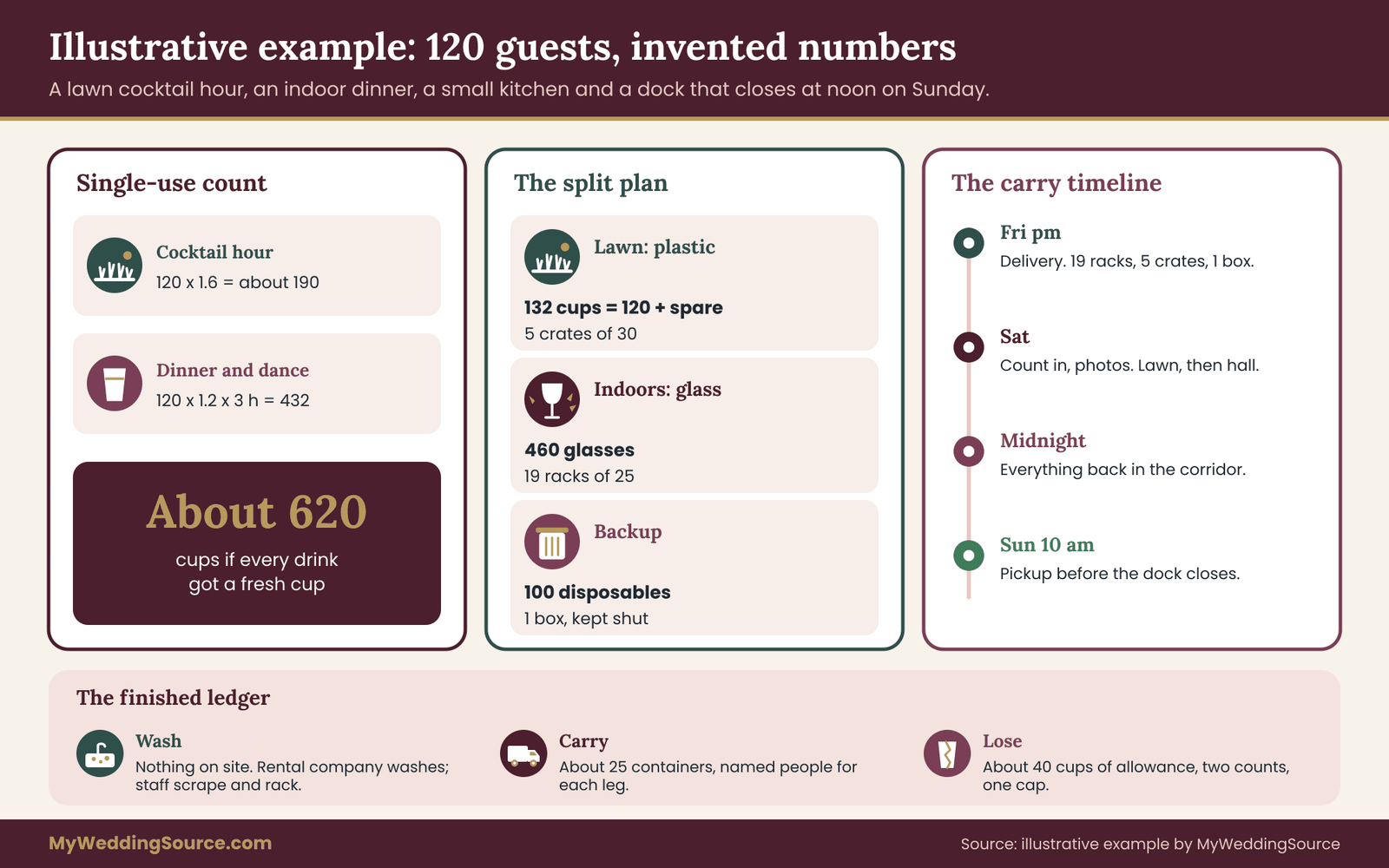
The couple below is invented, and so are all of the numbers. Real prices, rack sizes and breakage terms differ, and your vendors will tell you theirs. The point of the example is the method: how the single-use count, the gates and the three workloads turn into an order.
The setup
Marlowe and Teague are planning a reception for 120 guests. The venue has a lawn for a one-hour cocktail hour, then an indoor hall for dinner and dancing across three hours. The bar team estimates 1.6 drinks per guest in the cocktail hour and 1.2 per guest per hour afterward. The venue bans glass on the lawn, has one small kitchen that the caterer needs for dinner, and closes its loading dock at noon on Sunday. A rental company can pick up on Monday.
The single-use count
Cocktail hour: 120 guests times 1.6 drinks is about 190 cups. Indoors: 120 guests times 1.2 drinks times 3 hours is 432 cups. The single-use count is about 620. That is the number they would order if every drink got a fresh disposable cup, and it is the upper limit for any reusable plan with no washing during the event.
Pass one: rented glass everywhere, washed on site
Their first idea is rented glassware for the whole evening, washed in the venue kitchen so they can rent fewer. Gate one fails on the lawn, because glass is banned there. Gate two fails for the whole plan, because the kitchen is small and the caterer will not give it up during dinner. Two gates, two fallbacks: reusable plastic for the lawn and off-site washing for the glass.
Pass two: split the plan for reusable wedding cups
Lawn cocktail hour. Instead of giving every drink a fresh cup, the bar team agrees, if local rules allow it, to refill a single marked plastic cup for each guest. The stock becomes 120 cups plus a 10 percent spare, which is 132. At 30 cups per crate that is 5 crates, with room to spare. The workload moves from stock and washing to a clear collection moment at the end of cocktail hour, when guests hand cups to staff at the hall door.
Indoor dinner and dance. They rent glassware for the 432 drinks and add a loss allowance of 6 percent, about 26 glasses, for a total of 458. They round up to 460. At 25 glasses per rack that is 19 racks, or 475 glasses with a few extra. Glasses go back scraped and racked, so there is no wash workload beyond racking.
Backup. A box of 100 disposable cups stays in a back room for the case where the bar runs short or a lawn cup is lost. The box is meant to stay shut.
Pass three: the carry gate
Delivery is Friday afternoon, which the venue allows. Pickup is the problem: Monday is after the dock closes at noon on Sunday, so racks would sit in the hall or a locked room for a day. The couple asks the venue whether that is allowed and the rental company whether a Sunday morning pickup is possible and what it costs. The answer, in this invented story, is yes for both, with a modest weekend fee. They choose a Sunday 10 a.m. pickup and write it into the order.
They then write the carry plan: 19 racks, 5 crates and 1 backup box delivered Friday and staged in the back corridor, 5 crates at the lawn bar, racks moved to the hall at the end of cocktail hour, and everything returned to the corridor by midnight. The bar manager racks glasses, the planner’s assistant stacks crates, and a named groomsman holds the dock door on Sunday at 10 a.m.
Pass four: the loss gate
The rental terms list a replacement charge per broken or missing piece and a count at delivery and pickup. In this example, the invented charge is 3 dollars per glass. The glass loss allowance of 26 glasses is therefore about 78 dollars at most, and the lawn cups carry a similar small allowance for the 10 percent spare. The couple adds two controls: a marked table at the hall door for lawn cups, and a sign near the shuttle stop asking guests to leave cups there. Both counts, in and out, are photographed.
The finished ledger for the reusable wedding cups
- Wash: nothing washed on site. The rental company washes all cups. The bar manager scrapes and racks glasses, and the lawn cups are returned in crates.
- Carry: about 25 containers, delivered Friday and collected Sunday morning, with named people for each leg.
- Lose: about 40 cups of allowance in total, with a written cap and two counts.
A comparison with disposables only
If they had ordered only disposables, the count would be about 620 plus a 10 percent buffer, so roughly 680, and they would round to 700. The wash workload would be zero, but the disposal workload would be a few hundred cups going into the venue’s single dumpster. If the cups are labeled compostable and the venue has no compost stream, the cups still go to landfill. The carry workload would be lighter, since 14 cases of 50 are easier than 25 containers. The loss workload would be only the surplus.
Neither plan is correct in the abstract. The plan with reusable wedding cups costs more attention and more coordination, and it leaves no pile of used cups behind. The disposable plan is lighter to run and creates a pile. The couple in the example chose the split plan because every gate could be passed with named people and written terms. A couple with a different venue, a different kitchen or a different budget could reasonably choose otherwise.
If the guest count changes
The single-use count scales with the guest count, so a change from 120 to 150 raises the cup numbers by about a quarter. The gates do not scale the same way. A bigger crowd puts more pressure on the carry gate and on the loss allowance, and a small increase in guests can push a plan past the capacity of a staging space. Re-run the gates whenever the number changes by much.
Claims, limits and common mistakes with reusable wedding cups
Checking what you are told
Vendors may describe reusable wedding cups as eco-friendly, sustainable, zero-waste, or a number of times better than disposables. Treat each description as a question. Which material? Compared with what? Under what use pattern? With what washing method and what distance? A claim that cannot be answered in a sentence or two is a claim to leave out of your own materials.
The U.S. Environmental Protection Agency describes a waste hierarchy that puts reducing and reusing ahead of recycling and disposal, which is a sound starting point, and its pages on recycling explain that local programs set what they accept. The Federal Trade Commission’s Green Guides explain how environmental marketing claims should be qualified so they are not misleading. You are not a marketer, but you may be writing a website, a sign or a thank-you note, and the same care is a good habit. Where a number matters, ask the vendor for the source, and where you cannot get one, say less.
The wedding vendor due diligence checklist is a useful companion for checking a vendor’s claims, insurance and references before you sign.
Limits of this guide on reusable wedding cups
This guide does not know your venue, your vendors or your local rules. It gives a method, not a verdict. Health codes differ between jurisdictions. Waste facilities differ between cities. Rental terms differ between companies. Reusable wedding cups are not always the lower-impact choice, and a disposable is not always the higher-impact one, because the answer depends on materials, distance, number of uses and what happens at the end. If a decision turns on any of those facts, ask the people who hold them.
The example in this guide used invented numbers to show the method. Do not use them as benchmarks. Your bar team’s drink estimates, your rental company’s rack sizes and your venue’s rules are the numbers that count.
Edge cases for reusable wedding cups
Rain or heat. Outdoor cups blow, melt and get soaked. A rain plan for staging, and a water plan for hot afternoons, matters for any cup type.
Accessibility. Some guests have trouble with stemware, with lightweight cups that tip or with lids they cannot manage. Offer a sturdy option with a stable base or a handle, and put a few at each station. Staff can carry drinks for guests who need it.
Children and teens. Reusable plastic suits younger guests, and the cups should be clearly different from the ones used at the bar so no one is confused about what is in them.
Allergens and dietary needs. Washed cups are cleaned for general use. If a guest has a serious allergy and a drink contains an allergen, the bar team’s own protocols apply, and cup type is only a small part.
Ceremonial cups. A cup used in a ritual or family custom is not part of this plan. Keep it separate, treat it as a heirloom item and tell the venue and the bar team so it does not go into a crate.
Small and large events. A micro-wedding of twenty may find that a few dozen real glasses from home or a caterer are all it needs. A very large reception may need a cup-return service just to manage scale. The method stays the same, and the numbers change.
Destination and remote venues. Where water, power or a rental company is not available, disposables or keepsake cups can be the realistic choice. Where local waste facilities are limited, reduce the number of cups rather than choosing a compostable one that has nowhere to go.
Common mistakes with reusable wedding cups
- Comparing only the per-cup price and not the cost of washing, carrying and loss.
- Planning on-site washing without asking the kitchen, in writing, whether it can happen.
- Forgetting empty crates, which take as much room as full ones.
- Choosing a compostable disposable without a place to compost it.
- Leaving the end-of-night racking to whoever is still around.
- Skipping a count at delivery and pickup.
- Assuming guests will return cups without stations, signs or staff.
- Letting the plan change on the day without telling the bar team.
- Making environmental claims on signs or posts that the vendors cannot support.
A few closing principles
Keep the plan for reusable wedding cups short. Write names beside each task. Prefer options you can verify to options that sound good. Mix when it makes sense, and keep a small safety stock. Accept that some cups will be lost and decide in advance how many. And when the numbers do not support reuse for your reception, choose the disposable that fits your local waste options and say only what is true about it.
Your next steps
- Write down your venue’s rules on glass, outside rentals, kitchen use, loading and waste streams, and keep the answers in one document.
- Get an estimate of drinks per guest per hour from your bar team or caterer, and calculate a single-use count, with a separate peak-hour number.
- Decide whether you want washing during the event or only afterward, and ask a named party whether it can do it.
- Request written quotes from two sources that list washing, delivery, pickup, breakage, missing-item charges and deposit on the same lines.
- Run your preferred option for reusable wedding cups through the four gates, and use the fallbacks where a gate fails.
- Write a one-page carry plan with names, times and places, and share it with the venue, the bar team and the rental company.
- Set a loss allowance in cups and dollars, and arrange counts and photos at delivery and pickup.
- Decide on a small stock of backup cups and where they will be kept.
- Choose your words for any sign or post about the cups, and keep them factual.
FAQ
Are reusable wedding cups cheaper than disposable cups?
Sometimes, but not reliably. A per-cup rental fee looks low until you add washing, delivery, pickup, equipment, extra labor and charges for breakage or missing cups. Disposables carry their own costs for over-ordering and disposal. Put each option on one page with every line item, divide by your expected drink count and compare. The honest answer comes from your own quotes, not a general rule.
How many reusable wedding cups do I need for my guest count?
It depends on washing. If cups are washed only after the event, you need roughly one for every drink served, which you estimate from drinks per guest per hour and hours of service. If cups are washed during the event, you need cups in hands, cups waiting to be washed and cups in the wash cycle, plus a buffer. Ask your bar team for its estimate.
Who washes reusable wedding cups at the reception?
It should be a party with the equipment, space, permits and people to do it: a rental company off site, a caterer with a licensed kitchen, a mobile wash service or a bar company with a sink line. Avoid relying on friends or relatives. Ask each vendor, in writing, whether it can wash at your peak volume and what it charges.
Are glass or plastic reusable wedding cups better for a wedding?
Neither wins everywhere. Glass suits seated indoor service where staff clear tables, though it is heavy and breaks. Reusable plastic suits lawns, outdoor areas and venues that ban glass, though more of it may walk away with guests. Start with your venue’s rules, then check wash capacity, carrying and loss terms for each type.
What happens when guests take reusable wedding cups home?
You may be charged for missing cups, unless the cups are meant to be keepsakes. Read the rental terms on missing items and deposits, and ask whether a cup taken by a guest counts as lost. Put collection stations at exits and shuttle stops, or choose keepsake cups on purpose and buy only as many as you need.
Are compostable cups better than reusable wedding cups?
Not automatically. A compostable cup only helps if a composting facility that accepts it is available and the cup reaches it separated from the trash. Without that, it is handled as ordinary waste. Reusable wedding cups avoid that question but bring washing, carrying and loss workloads. Check local facilities and compare the whole ledger.
What should I ask a rental company about reusable wedding cups?
Ask what the price includes, how many cups fit in a rack or crate, the delivery and pickup windows, the charge for broken, missing, stained or chipped cups, how counts are taken and disputed, whether there is a deposit and how racks must be loaded. Request that the answers go into the quote or contract.
Can I make environmental claims about my reusable wedding cups?
Keep claims specific and true. Say what you did, such as renting glassware or providing a keepsake cup, and avoid broad words like eco-friendly unless a vendor can support them. The Federal Trade Commission’s Green Guides explain how environmental claims should be qualified. If you cannot verify a claim about recyclability or compostability locally, leave it out.
Sources
- Sustainable Management of Materials, U.S. Environmental Protection Agency
- Non-Hazardous Materials and Waste Management Hierarchy, U.S. Environmental Protection Agency
- How Do I Recycle? Common Recyclables, U.S. Environmental Protection Agency
- Composting at Home, U.S. Environmental Protection Agency
- Environmental Claims: Summary of the Green Guides, Federal Trade Commission
- Guides for the Use of Environmental Marketing Claims, Federal Register
- FDA Food Code, U.S. Food and Drug Administration
- Compostable Product Labeling, Minnesota Pollution Control Agency
- Biodegradable Products Institute