

Wedding childcare vetting is the process of checking a childcare provider before you trust them with other people’s children at your wedding. This guide gives you a five-gate method: confirm the provider’s legal status, look closely at the people, test the operating plan, write a pickup authorization workflow, and put everything in a contract.
Before you hire anyone, count how many children will really use wedding childcare and for how many hours. Then run each provider through five gates: fit, legal status, people, operating plan and release of children. Ask the state licensing office, not the wedding childcare provider, whether the arrangement is regulated. Ask which background checks staff have had and who ran them. Get the provider’s staffing numbers in writing and compare them with local rules. Agree on a pickup workflow that releases a child only to a named adult.
Most couples who think about wedding childcare start with a price quote. That is the wrong first question. A quote tells you what a wedding childcare provider charges, not whether the provider is licensed, who will actually show up, how many children one adult will watch at 9:30 p.m., or what happens when an adult nobody knows walks up and says they are Maya’s uncle.
The right first question is simpler: what would have to be true for you to feel calm about this arrangement? Wedding childcare vetting turns that feeling into a short series of checks, each with a clear pass, hold or fail outcome. You do not need to be an expert in child care law to run them. You need to ask specific questions, write down the answers and compare them with an official source.
A note on scope. This article is general information, not legal, licensing or safety advice, and it does not set staffing ratios or safety standards for you.
The article works alongside the broader wedding guest care planning guide, which covers babies, children and older relatives together and gives a short overview of the childcare options. This one goes deep on a single job: hiring someone, checking them properly and handing children back safely at the end of the night.
What wedding childcare vetting covers
Wedding childcare is any arrangement in which someone other than a child’s parent supervises children during part of your wedding. It might be a licensed company that brings staff and activities to the venue. It might be a hotel’s kids’ program. It might be one sitter you hired through an agency, or a sitter a family brought from home. Each of these needs a slightly different kind of checking, and the differences are the reason a single generic checklist falls short.
Vetting, in this article, means five things:
- Confirming what the wedding childcare provider legally is, and which rules apply to them where your wedding takes place.
- Confirming who the individual staff members are and what screening and training stands behind them.
- Understanding how the provider will actually run the room: staffing numbers, space, activities, food, illness and emergencies.
- Agreeing on how children are signed in and released, including the awkward cases.
- Recording all of it in a written agreement, with the right insurance and a fair payment schedule.
It does not mean investigating private individuals on your own. If you want a background check on a specific person, the provider or a regulated screening service should run it, with that person’s knowledge. It also does not mean second-guessing a provider’s professional judgment about activities or child development. You are checking that the wedding childcare provider is who they say they are and that they have a plan, not designing the plan for them.
Who is responsible for what
Three groups share responsibility, and mixing them up is a common source of trouble.
Parents remain responsible for their own children. Hiring wedding childcare does not transfer that responsibility to the couple. What it does is give parents an option, and they decide whether to use it. This is why parents, not you, should sign the provider’s registration and authorization forms.
The wedding childcare provider is responsible for supervising the children in its care, following the rules that apply to it and keeping its own staff screened and trained. If the provider is regulated, a state agency sits behind that responsibility. If it is not, the contract and the wedding childcare provider’s insurance are all you have.
You, as the couple, are responsible for choosing with care, for giving the provider accurate information, for arranging space and access with the venue and for making sure parents know how it works. That is a meaningful responsibility, but it is not the same as being the childcare provider.
This split matters when something goes wrong. A couple who hired a provider with open eyes, asked the right questions and kept the answers is in a very different position from one who took a friend’s recommendation and never asked about licensing.
Where wedding childcare fits in the bigger picture
Hiring a provider is a mid-sized decision in a wedding. It can cost more than a centerpiece budget and take longer to arrange than a flower order, but it touches fewer guests than a menu. For that reason it benefits from a short, structured process rather than weeks of worry. Plan on about two to three months for a licensed provider in a busy season, and less for a simple sitter arrangement. If you keep a master task list, the wedding planning checklist is a good place to slot the vetting steps in beside the venue and catering tasks.
Decide whether you need wedding childcare at all
Do not start vetting providers until you know what you are vetting for. A wedding childcare provider chosen for fourteen children aged two to ten is the wrong provider for four teenagers and one toddler. Work out demand first, because the numbers determine whether you need a company, a sitter or nothing beyond a quiet corner and a few crayons.
Count the children by age band
Pull the children from your guest list and group them by age band. The bands matter because supervision needs, activities and regulations differ widely between infants, toddlers, school-age children and teenagers.
- Infants and young toddlers. These children need close, hands-on care, feeding on a parent’s schedule, a safe sleep space and often a parent within reach. Many event providers limit or decline very young infants. If you have several, ask about this early.
- Toddlers and preschoolers. The age group that most needs a dedicated adult, an enclosed space and a calm routine. They tire quickly and cannot be left to self-organize.
- School-age children. Usually the easiest group to occupy. They do well with structured games, a movie corner and a snack table.
- Tweens and teenagers. Often a poor fit for a childcare room. They can feel talked down to. Consider a separate plan, such as seating them together and giving them a small role.
Add the counts. Then add the number of families, because a provider thinking about a room of fourteen children from twelve families has a different pickup problem than fourteen children from three families.
Ask parents what they would actually use
Counting names is not the same as counting need. Some parents want to keep their children close. Others would love two uninterrupted hours. Ask, and keep the question neutral so that no one feels judged either way.
“We are considering hiring childcare for part of the reception. If we did, would you use it for your children? There is no right answer, and we will not share your reply with other guests.”
Send it to families with children, by text or in a short form. Give a deadline of about two weeks. Expect a wide spread of answers, and expect that some “maybe” replies turn into “yes” once parents see who is running it.
A practical rule for interpreting replies: plan for the “yes” count plus about half of the “maybe” count, and ask the wedding childcare provider how flexible it is if the real number differs on the day. A provider that insists on exact numbers six months out is telling you something about how it operates.
Decide hours and location before you shop
Providers quote by the hour, so fix the window before you request prices. Most couples choose one of three patterns.
Dinner-hour care. Children are in the room from the start of dinner until just after the toasts, or until the dancing starts. Short, cheap and well suited to families who want their kids to eat together.
Ceremony-to-dinner care. Children are looked after during the ceremony, the photos and cocktail hour, then rejoin their parents for dinner. This pattern suits ceremonies that are long, held in a formal or quiet space, or where parents will be in the wedding party.
Evening care. The room stays open into the night so that parents can dance, with a quiet area for children who fall asleep. It runs longest, costs the most and creates the biggest pickup challenge, because tired parents, a bar and sleepy children are in the same building.
Then decide where the room is. It should be inside the venue or a connected building, away from the bar and the loudest speakers, with a clear route to a restroom and a parent-friendly entrance. If the venue cannot offer a suitable room, you may need a hotel suite or a nearby rented space, and that changes the vetting because the wedding childcare provider’s rules about locations, supervision and transport come into play.
When the answer is no
Sometimes the honest conclusion is that you do not need to hire anyone. If four children are coming and all of their parents want them nearby, a relative with a craft box, a set of quiet games and a reserved table gets you most of the benefit. The broader guide covers that path. This article assumes you have decided to bring in an outside provider, or that a guest family has asked you about one, and you want to do it carefully.
One caution on the opposite side. If parents have said they need childcare in order to attend, treat it as an access question and not a luxury. Making that call early gives you time to find a provider who is licensed and available on your date. Good providers book up for peak wedding weekends, and the choice narrows quickly if you start in the final month.
The five-gate method for wedding childcare vetting
A gate is a checkpoint a provider must pass before you move on. The method has five, in a fixed order, because each answer changes how much effort the next one deserves. A wedding childcare provider who cannot explain their legal status does not earn the time it takes to check their staff.
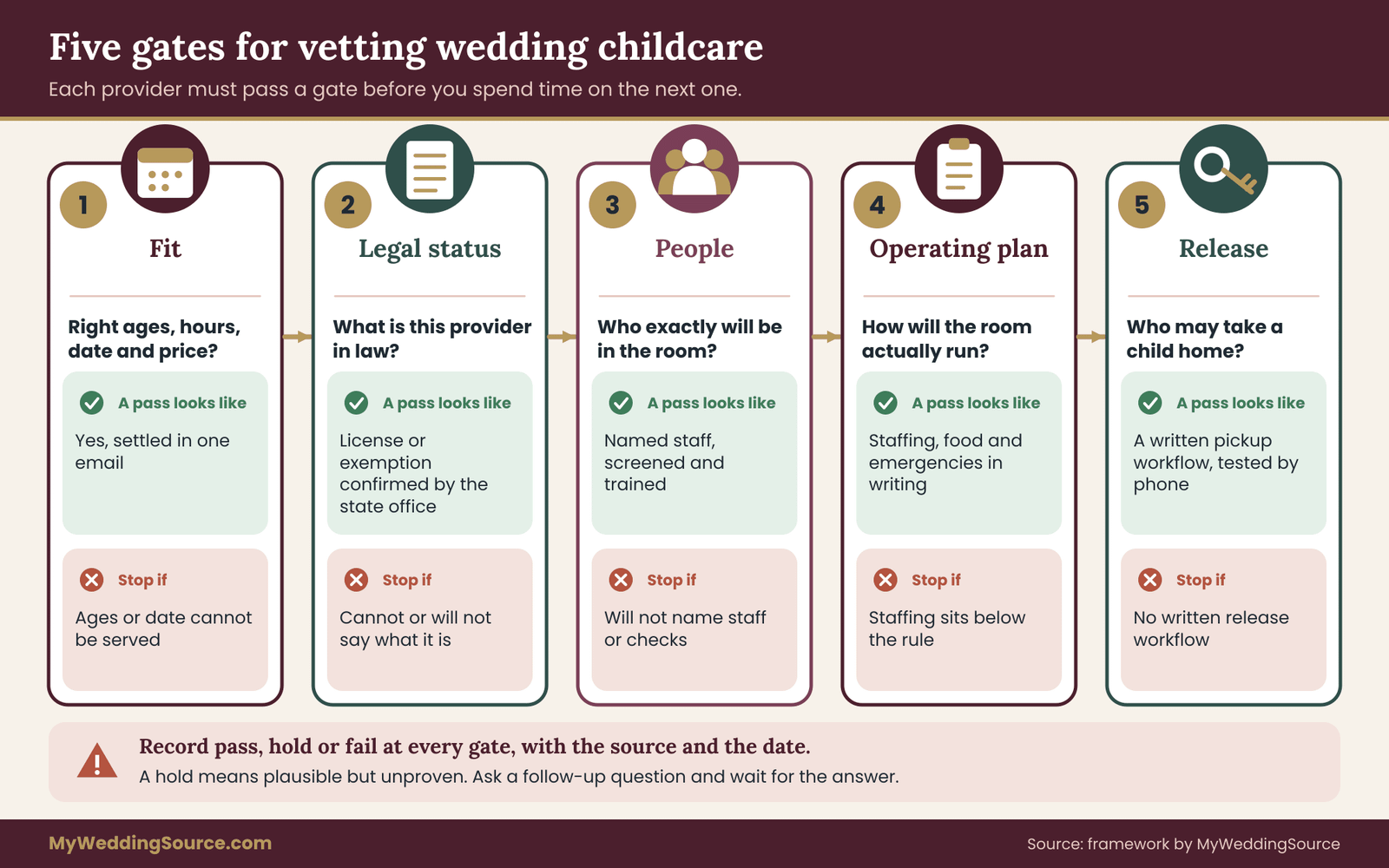
Gate one: fit. Does the wedding childcare provider serve the ages you counted, in the hours and place you need, on your date, at a price you can accept? This is a quick screen, usually settled with a single email.
Gate two: legal status. What is the wedding childcare provider, in law, where your wedding is held? Licensed center, licensed family home, registered event service, independent sitter, or something else? Which office confirms it?
Gate three: people. Who will actually be in the room, what screening have they had, and what training do they hold? Names and roles, not a brand.
Gate four: operating plan. How many staff for how many children, in what space, doing what, with what rules for food, illness, emergencies and breaks?
Gate five: release. How are children signed in, and under what exact conditions does a child leave with an adult?
After the five gates comes paper: a written agreement and proof of insurance. The money section later in this guide covers it, but keep it in mind from the start, because a provider who resists putting answers in writing has often told you what you need to know.
Pass, hold or fail
For every gate, give the wedding childcare provider one of three outcomes.
Pass means the answer is clear, specific and backed by something you can check. “We are licensed by the state, here is our license number, and you can look it up on the agency’s site” passes.
Hold means the answer is plausible but not yet proven. “We are fully compliant with all regulations” is a hold. It sounds fine, and it tells you nothing you can verify. A hold is not a rejection. It means you ask a follow-up question and wait.
Fail means the answer reveals a problem, or the provider refuses to answer. A fail on legal status, on staff screening or on pickup procedures should usually end the conversation. A fail on a smaller item, such as a lack of craft supplies, is something you can resolve by asking them to add it.
Keep a simple record. One page per provider, five gate names down the side, an outcome and a date beside each, and the source of each fact: “told us on the phone,” “license record on the state site,” “certificate received.” This record is useful if you later need to explain why you chose one provider over another, and it stops you from remembering a verbal promise more generously than it was made.
Three kinds of evidence: say, verify, prove
A wedding childcare provider’s claims fall into three tiers, and it is worth being strict about which tier a fact belongs to.
Say. The wedding childcare provider tells you something. A website, a brochure, a phone call, a friendly email. This is where every fact starts. It is useful, but nobody has checked it.
Verify. An independent party confirms it. The state licensing office confirms the license is active. An insurer’s agent confirms the policy. A training organization confirms a certificate. You, or the wedding childcare provider on your behalf, carry out the check.
Prove. A document that shows the fact is in your hands. A certificate of insurance naming you and the venue, a copy of the license, a signed staff list, a signed agreement.
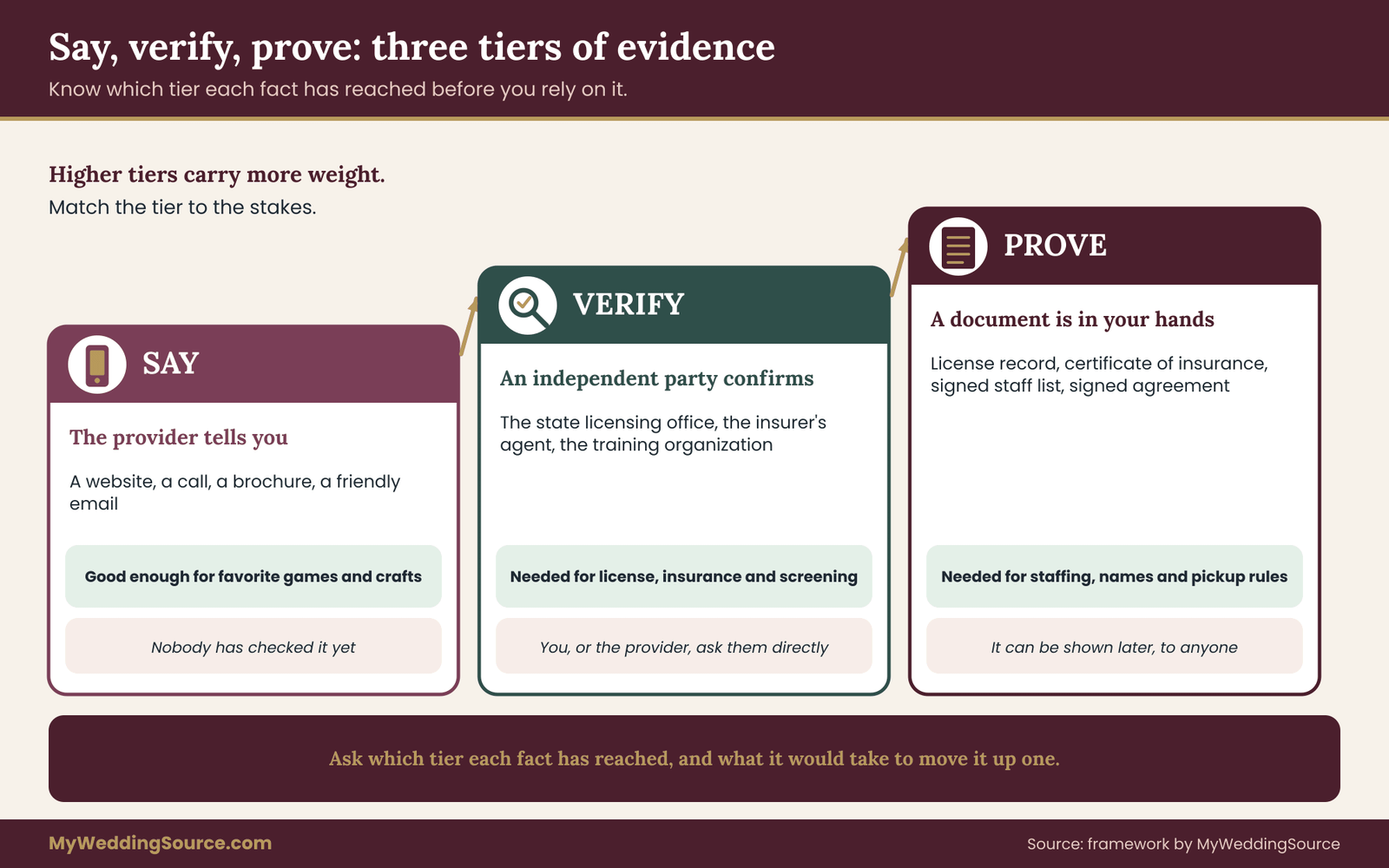
You will not need all three tiers for every fact. A provider’s favorite games and activities can stay at the “say” level, since there is no official record of them. The legal status, insurance and screening of staff should reach “verify” at least, and the final agreement should “prove” the things you were promised. A useful habit when reading any answer is to ask which tier it sits in and what it would take to move it one tier up.
Where to find providers
Look in several places, and expect each to give you a different slice of the market.
Your venue and your planner. Venues that host many weddings sometimes keep a short list of childcare providers who have already worked in the building. This has a real advantage: the wedding childcare provider knows the access routes, the quiet rooms and the venue’s rules. A recommendation is not a vetting, though. Run the gates anyway.
Hotel concierge and event managers. Hotels that host wedding blocks often know local sitter agencies and event childcare companies. Ask for two or three names.
Your state or local child care resource and referral agency. Most states have one, and the federal ChildCare.gov site points to state resources. These agencies can often tell you how to look up a license and whether event care is classified differently from daycare.
Parents on your guest list. Parents who have used childcare at events know which providers handled drop-off well and which did not. Treat what you hear as a lead, not as evidence.
Online searches and directories. Useful for volume, weak for quality. Anyone can build a good-looking site. Look for specific details: a license number, a named director, a described ratio policy and a written pickup procedure. A site that lists only smiling photographs and a contact form does not pass gate one yet.
A word about large care marketplaces. They list individual sitters with ratings and background-check badges. Those badges vary a great deal in what they cover. Treat them as the “say” tier until you know exactly what the platform checks and how recently.
The first message to a provider
Your first message should do two jobs: give enough detail for the provider to say yes or no, and ask the questions that decide gates one and two. Keep it short.
“We are getting married on a Saturday in October at a venue in the city, and we are looking for wedding childcare for about twelve children aged two to ten, from 5:30 to 10:00 p.m. Are you available, and what are your rates for that window? Could you also tell us whether you are licensed or registered in our state, and where we can confirm it?”
Notice what it avoids. It does not name a price you expect to pay, it does not give the guest list or any family names, and it does not sound suspicious. The licensing question is asked as an ordinary part of the first exchange. A good provider will not mind. Some will answer the licensing question in the first line of the reply, because they expect it.
Reading the first reply
Within a few days you should have a reply that covers availability, price, license status and a first description of how the wedding childcare provider works. Read it for specifics.
Warning signs at this stage are small and cumulative. Vague phrases like “all of our staff are fully screened” with no description of the screening. A reluctance to give the legal name of the business. A promise to “handle everything” with no description of how. A price that is far below the others with no explanation, which often means fewer staff or no insurance. Pressure to pay a large deposit before you have seen any paperwork.
Good signs are equally small. A wedding childcare provider who asks about the ages, the allergies, the layout of the room and the number of families. A wedding childcare provider who volunteers their ratio policy before you ask. A provider who says “you should check our license, here is how.”
Narrowing to a shortlist
Aim for two or three providers who pass gate one. One is risky because you have nothing to compare, and more than three costs time without improving your decision. If you can only find one provider available on your date, that is still workable: run the gates and be ready to accept a hold or a fail as a real answer, and to fall back on a family-run arrangement.
Ask each shortlisted provider for a call or a video meeting. Prepare the questions in advance, take notes and send a short written recap afterward: “Thanks for the call today. To confirm what we discussed…” The recap does the same thing as a contract in miniature. It lets the wedding childcare provider correct any misunderstanding while the conversation is fresh and gives you something to refer back to.
Gate two: licensing and legal status of a wedding childcare provider
Gate two is the one most couples skip, and it is the one that most changes what you can expect. The reason is simple. The legal category a wedding childcare provider falls into decides who regulates it, what standards it must meet, whether anyone inspects it and what happens when a parent complains.
Why there is no single answer
Child care in the United States is regulated mainly at the state level. The federal ChildCare.gov site explains that state licensing agencies set and enforce requirements, and that those requirements differ by state and by type of care. A provider that is clearly regulated in one state may be exempt, or classed differently, in the next. Even within one state, a center, a family home program, an occasional care service and a babysitting agency may sit under different rules.
So the question “is this provider licensed?” is only the beginning. The better questions are: licensed as what, by whom, for which kind of care, at which location, and does that license cover what they will be doing at my wedding?
The categories you are likely to meet
The labels vary by state, so treat these as rough groupings and not as legal definitions.
A licensed child care center or program. A business licensed to care for groups of children, usually in a fixed building. Some of these also offer off-site or event services, and others do not. A center license for its own building does not automatically cover care provided at a hotel ballroom. Ask directly whether the license covers the event, and ask the licensing office to confirm.
An event or occasional-care service. Companies that specialize in weddings, conferences and parties. Some states regulate short-term or occasional care under their own rules. Others treat it as outside licensing, particularly where parents stay on the premises. Some event services hold a regular center license in addition to their event work, and others operate under a business license only.
A hotel or resort kids’ program. Run by the property, sometimes by a contractor. Regulation depends on the state, the structure of the program and whether parents remain on site. Ask who employs the staff and which agency, if any, oversees the program.
A sitter agency. An agency that screens individual sitters and places them with families. The agency is the one making the screening claims, so the details of its process matter. Some are regulated as employment agencies, and many are not regulated as child care at all.
An independent sitter or nanny. A person hired directly by you or by a family. Individuals working one-to-one in a family setting are often outside child care licensing. That puts more weight on references, your own screening choices and the contract.
A guest or relative running the kids’ table. Not a wedding childcare provider in a regulatory sense. A different level of care and a different kind of risk, covered more fully in the broader guide.
What the licensing office can tell you
The state or local child care licensing office is the authority on how an arrangement is classified. It is a neutral party with no stake in your choice, and it can answer questions the wedding childcare provider cannot answer for you. A short call or email often settles in ten minutes what a wedding childcare provider’s website leaves vague.
You can ask:
- Is this business licensed, and is the license current?
- Does the license cover care at an off-site location, such as a hotel or event venue?
- Have there been inspections, violations or substantiated complaints, and how can I see them?
- How is care for a one-day event classified here, and is a license required for it?
- If parents remain in the building, does that change the answer?
“Hello, I am hiring a company to provide childcare at a wedding on a Saturday evening in your area. Could you tell me whether the company named [name] holds a current license, whether that license covers an off-site event, and where I can read any inspection reports?”
Write down the date, the name of the person you spoke with and what they said. If the answer is that your arrangement falls outside licensing, you have learned something important. It does not mean the provider is unsafe. It means the safeguards are contractual and not regulatory, and you should treat the other gates with extra weight.
Many state agencies publish license lookups and inspection records online. Others require a request. Both are acceptable. What matters is that the confirmation comes from the agency and not from the wedding childcare provider’s own materials.
Reading a license number
When a provider gives you a license number, confirm four things on the official record. The legal name on the license matches the business name on the contract. The license is active, not expired or suspended. The address or service area is consistent with how the wedding childcare provider is describing the service. The license type is appropriate to the care being offered, in terms of ages and group size.
A mismatch is not always sinister. A business might operate under a trade name, and the license might sit under a parent company. But every mismatch deserves an explanation in writing before you sign anything.
When “we don’t need a license” is the answer
Some providers will tell you they are exempt. Sometimes they are right. Sometimes the exemption is narrower than they believe, or it depends on conditions such as parents remaining on site or care lasting below a time limit, and the conditions will not be met at your wedding.
Respond calmly and ask for specifics. Which exemption, under which rule, and who confirmed it? A wedding childcare provider that has been through this before will answer without discomfort, and may even have a letter from the licensing agency. A wedding childcare provider that gets defensive, or that says only “everyone does it this way,” has moved to a hold at best.
If the wedding childcare provider is truly exempt, you are not stuck. You can raise the other gates to a stricter standard, ask for a written description of its voluntary policies, ask for proof of insurance and write the safeguards you care about into the agreement. Some couples decide, at this point, that an unregulated provider is acceptable for a small group of older children but not for toddlers. That is a reasonable line to draw, and it is yours to draw.
Independent sitters and the household-employer question
If you or a family hires an individual sitter directly, the legal picture shifts. In many circumstances a person who works in someone’s home or provides one-to-one care is treated as a household employee or as an independent contractor, not as a child care program. Your obligations as an employer, if any, are a tax and employment matter, not a child care licensing matter. Rules vary and it is beyond the scope of this guide to resolve them. The IRS and your state labor agency explain the basics, and a tax professional can say whether your situation counts.
For a one-day wedding job, most couples ask whether the sitter has a business arrangement, such as an agency or a sole proprietor’s business license, and whether the sitter carries insurance. Ask, and note the answer.
For sitters brought by guests, the guest family is the employer. You can still set rules for who may be in the children’s room, and you can ask that any outside sitter check in with the lead provider or with your care lead on arrival.
Out-of-state and traveling providers
If the provider is based in another state or travels to weddings across several, ask which state’s rules they follow when they work in yours. Where licensing is a state matter, a license from the wedding childcare provider’s home state does not necessarily carry over. Ask the licensing office in the state where the wedding takes place, and ask the wedding childcare provider whether they have worked in that state before.
Disability and inclusion
If a child with a disability is attending, or if you want to tell families that wedding childcare is open to every child, ask early about inclusion. The Americans with Disabilities Act generally applies to private child care providers that serve the public, with some exceptions such as religious organizations.
In plain terms, a covered provider generally cannot turn a child away because of a disability and is expected to consider reasonable adjustments. What counts as reasonable depends on the child, the program and the circumstances, so the right approach is a conversation between the parent and the wedding childcare provider well before the day.
Ask the provider how they have handled such requests before, and whether staff can be briefed on a child’s needs. Pass the parent’s contact details along only with the parent’s permission. The ADA.gov site has plain-language guidance, and the access adviser or disability service organization in your area can help families who are unsure of their rights.
Recording the outcome of gate two
By the end of this gate you should be able to write one sentence for each provider: “Licensed as ___ by , confirmed on by ,” or ”Not licensed; the licensing office confirms an event service of this type is exempt under ,” or “Status not confirmed.” The last one is a hold. Do not move a wedding childcare provider into a signed agreement while their legal status sits in hold, unless you have deliberately decided that the other safeguards are enough and have written that decision down.
Gate three: background checks, training and references for wedding childcare
A license describes an organization. Gate three is about the individuals. At the end of the night, a child is in the care of three or four specific people, and what you want to know is who they are and what stands behind each one.
“Background check” is not one thing
When a provider says “all of our staff are background checked,” the sentence sounds complete and is not. A background check can mean many different things, and they vary widely in depth.
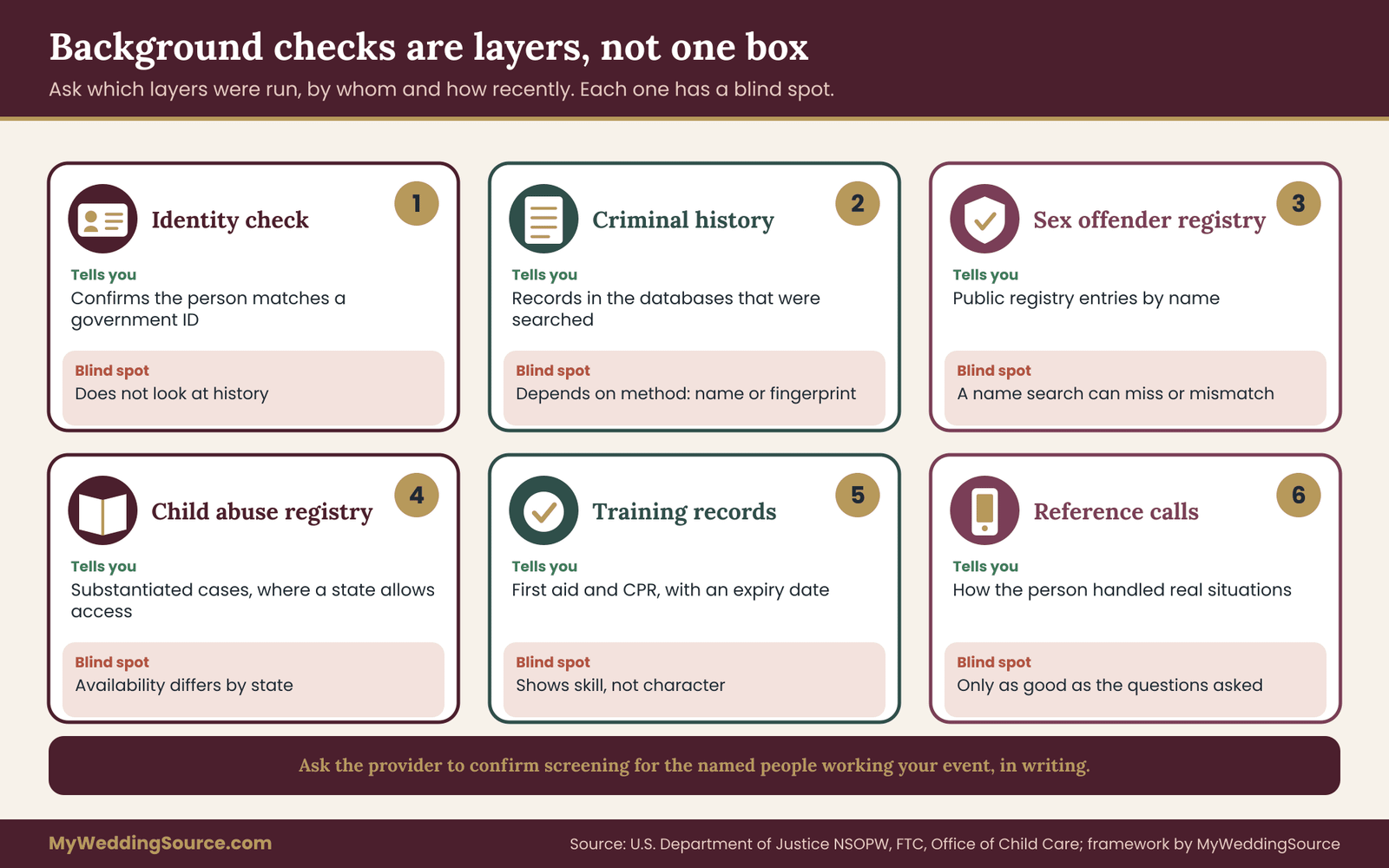
An identity check. Confirming that the person is who they say they are, usually by examining government identification. It is the foundation, because every other check relies on the name and birth date being right.
A criminal history check. A search of criminal records. The reach depends on the method. A name-based search of a commercial database may cover some jurisdictions and miss others. A fingerprint-based search through state and federal systems is generally considered more thorough because it matches a person to records regardless of the name used. States set their own rules about which one providers must use.
A sex offender registry check. A search of registries kept by states and other jurisdictions. The U.S. Department of Justice runs the National Sex Offender Public Website, which lets anyone search state and territory registries from a single page. It is a name-based tool and has limits, but it is a useful public check.
A child abuse and neglect registry check. Some states keep a registry of substantiated cases and allow checks for people who will work with children. Availability and access differ by state.
A driving record check. Relevant only if staff will drive children, which is rare at a wedding but worth asking about if the wedding childcare provider handles transport.
Reference checks. Calls to former employers or families. Not a database search, and often the most revealing step when it is done properly.
Each of these answers a different question, and none of them is a guarantee. A clean criminal check tells you that nothing was found in the records searched. It does not describe how a person behaves with a frightened five-year-old at 9 p.m.
What to ask about screening
Rather than asking “are they background checked?”, ask questions that make the provider describe the process.
- What checks do you run on every staff member who will be at our event, and which ones are required by your state?
- Who runs them, an agency, an outside screening company or you yourselves?
- Are they fingerprint-based, name-based or both?
- How recently were they run for the people who will staff our event, and how often are they repeated?
- Do you check the sex offender registry and any child abuse registry?
- What do you do if a check turns up something, and who decides?
- Do you use the same screening for event staff and for temporary or seasonal staff?
- Can you give us the names of the people who will work our event, so we can match them at the door?
The last question matters more than it looks. Some providers screen their permanent staff carefully and then fill large events with temporary workers who have been screened less thoroughly, or not at all. Ask whether the people at your wedding are the screened people.
A regulated provider will usually be able to say which checks the state requires and point to its records. In some federally funded programs, for example, federal law sets out the kinds of checks required for staff. The Office of Child Care in the U.S. Department of Health and Human Services publishes information about those requirements. A private event service may or may not fall under them, so ask the wedding childcare provider and the licensing office rather than assuming.
What you should not do yourself
It is tempting to hire a cheap online service and run checks on the sitters yourself. In most cases you should not.
First, checks about a person’s history are regulated. In the United States, using a consumer reporting agency to screen someone for employment generally requires that person’s written permission and follows federal rules about notice and disputes. The Federal Trade Commission explains these rules for employers. If you are hiring an individual directly, you may become an employer for this purpose.
Second, results from low-cost search sites are often incomplete, out of date or attached to the wrong person with the same name. A false result can wrongly hurt someone. A missing result can leave you falsely reassured.
Third, it is the wedding childcare provider’s job. A wedding childcare provider that cannot describe its own screening and expects you to run it is a provider you should think twice about.
The practical approach is to ask the wedding childcare provider to confirm its screening in writing, to ask for named staff, and to let the licensing office and the provider’s insurer stand behind the rest. If you are hiring one sitter directly and want a check, ask the sitter whether they have a recent one, or use a regulated screening service with the sitter’s written consent.
Training and certifications
Screening tells you what is not in someone’s record. Training tells you what they know how to do. The training that matters for a short event falls into a few areas.
First aid and CPR for children and infants. Ask which staff hold current certification and for which ages. Certifications expire, so ask for the dates, not just the claim. The American Red Cross and other national organizations run courses, and a certificate shows the issuer and the expiration date.
Child development and supervision. Some staff will have formal early childhood education. Others will have years of experience. Neither is a guarantee, but you want to hear how the wedding childcare provider trains people to supervise, particularly for events.
Allergy and medication awareness. Staff should know the signs of an allergic reaction, where the medication is kept and who can give it, if anyone. Whether staff are allowed to give medication at all is a policy question. Many providers do not, which means a parent must come.
Mandated reporter and safe-conduct training. In many places, people who work with children must report suspected abuse, and providers train staff on it, along with rules about physical contact, one-to-one situations and bathroom help. Ask the provider to describe its code of conduct for staff.
You do not need to rate the training yourself. You need to find out whether the wedding childcare provider has any, in what form, and whether the staff at your event have actually received it.
References
A reference from a past client is the closest thing you will get to a field test. Ask for two or three, preferably from events like yours: evening events, mixed ages, families who do not all know each other.
Ask the reference concrete things.
- Were the staff on time and prepared, and how many were there?
- How did drop-off and pick-up go?
- Was there a time when a child was upset or hurt? How did the wedding childcare provider respond, and how did they communicate with parents?
- Did the number of children or the schedule change on the day? How did they handle it?
- Would you hire them again?
Listen for specifics. “They were wonderful” is nice and tells you nothing. “They had a sign-in sheet at the door, and a staff member walked a late child back to his parents instead of letting him wander” is evidence. If the wedding childcare provider cannot offer any references, ask why. New businesses exist, but a new business should then be able to show strong evidence elsewhere: a real license, experienced staff and clear policies.
The named staff list
By two weeks before the wedding, ask the provider for a written list of the people who will work your event: first name and last initial, role, and the date of their most recent screening and first aid certification. Ask the wedding childcare provider to confirm that no one else will be added without notice to you or your care lead.
On the day, the care lead checks the arriving staff against the list. This takes a minute, and it closes a gap that is easy to miss: a provider sends a different, unscreened person because someone called in sick. Staff should be expected to carry photo identification and to show it on request. A good provider will not mind. Most will have their own badges.
Teen volunteers and guests who “just help”
A common situation is a helpful cousin or a teenager offering to supervise the children. Treat it as a job and be honest about what it is. It does not carry the screening of an organization. Do not leave a volunteer alone with children for long stretches, and do not place a volunteer in a role that a licensed provider is supposed to fill.
A volunteer works beside the wedding childcare provider, or runs a small activity in the open, with a clear start time, a break and a thank-you. If you are hiring a provider and also have volunteers, tell the wedding childcare provider who they are and what they will do, so that the volunteers do not become an unsupervised extra door into the children’s room.
Recording the outcome of gate three
At the end of gate three, write what you know: which checks are done, by whom, covering which staff; which certifications are current; what references said; and what remains unconfirmed. Mark the wedding childcare provider pass, hold or fail. A wedding childcare provider that is licensed but vague about who will staff your event is a hold. A provider that will not tell you which checks exist is a fail.
Gate four: ratios, space and the operating plan for wedding childcare
Gate four tests how the provider will run the room. You are not telling the wedding childcare provider how to do their job. You are checking that they have thought through the practical questions, that their answers fit the law where you are, and that the plan holds up when the real day looks different from the plan.
Ratios: a method and not a number
A staffing ratio is the number of children one adult supervises. Ratios are set by state and local rules for regulated care, and they usually depend on the children’s ages: younger children need more adults per child. This guide will not suggest a number, because the right one depends on your state, the provider’s classification, the ages in the room and the setting. What it can give you is a method for checking whatever number the wedding childcare provider quotes.
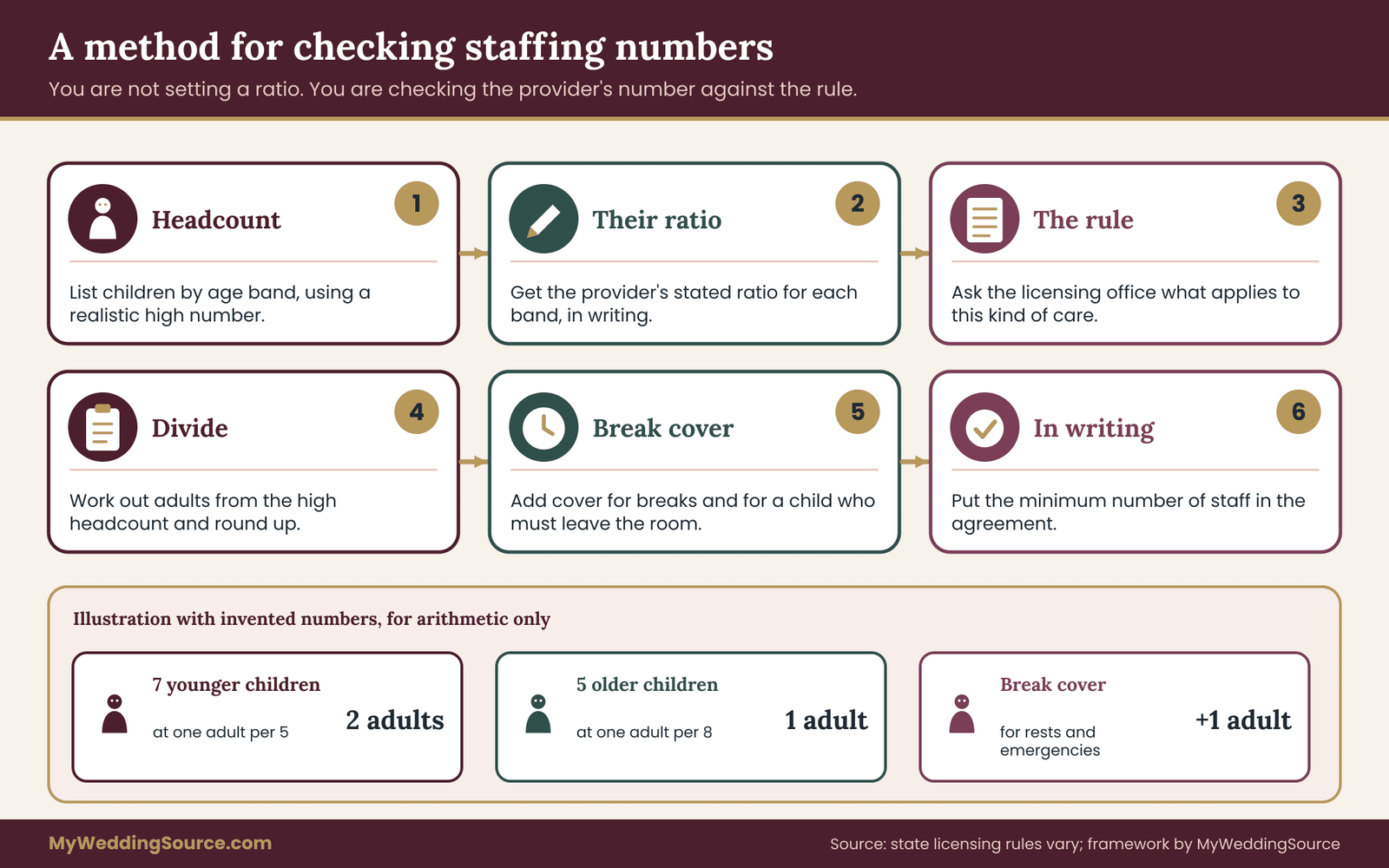
Step one: write the headcount by age band. From the count you made earlier, list the expected number of children in each age band, and a realistic high number, not just the average.
Step two: ask for the wedding childcare provider’s stated ratio for each band. Ask for it in writing, and ask whether it is their own policy or a legal requirement.
Step three: compare with the official rule. Ask the licensing office what ratio applies to this kind of care in your state, or whether none applies. If the wedding childcare provider’s number is lower than the rule, find out why. If the provider’s number is stricter, that is a point in their favor. If there is no official rule, the wedding childcare provider’s written policy is the standard.
Step four: work out the number of adults from the high headcount. Divide, and round up. If the provider’s policy says one adult for every six children in a given age band, and you expect fourteen children in that band, the arithmetic says three adults, not two. The numbers here are invented to show the arithmetic and are not a recommendation.
Step five: add coverage for breaks and emergencies. The ratio describes the adults in the room at a given moment. During a four-hour event, staff take breaks, and one may need to leave the room with an ill or injured child. Ask how the wedding childcare provider covers this without leaving the room short. Many providers keep an extra adult for this reason. Some use a policy that at least two staff are always present, so that no adult is ever alone with children. Ask what their policy is, and why.
Step six: decide the staffing number in writing. The agreement should state the minimum number of staff for the event, and say what happens if the number of children turns out higher.
Mixed ages and the youngest-child rule
When children of different ages share a room, many programs apply the ratio for the youngest child in the group or split the room. Ask how your provider handles it. A group with two babies and a dozen school-age children behaves differently from either group alone, and the provider may suggest a separate small area for the youngest, with its own adult, or a policy that infants must stay with a parent.
Be honest with yourself about infants. Many event providers do not take babies, or require a parent to stay close. If an infant’s parent expects the wedding childcare provider to take the baby for the dinner hour, find out at gate one and not gate four.
Space
The room is part of the safety plan. Ask for a description, or better, a visit. Look for:
- One controlled entrance that staff can watch, with the other doors closed to the children’s area, while still allowing a clear exit in an emergency. Do not block or lock any fire exit. Ask the venue and the fire code rules for what is permitted.
- A nearby restroom that staff can reach without taking children through the party, and a plan for how they accompany young children to it.
- Distance from the bar and the dance floor, both for noise and so that adult guests do not wander in.
- Floor and furniture suited to the ages: soft floor space, small tables, no stacked chairs or loose cords.
- A quiet corner where a tired child can lie down, with dim lighting.
- Water and hazards. If the venue has a pool, pond, fountain or hot tub, ask the wedding childcare provider how children will be kept from it. The Centers for Disease Control and Prevention recommends close, constant supervision by a designated adult around water. For your wedding, the simplest approach is to keep the children’s room well away from it and to say so in the agreement.
- Temperature and air. Rooms with open doors, heaters or air conditioning vents matter for small children.
Take photos of the room during a walk-through, and share them with the wedding childcare provider so that they can plan the layout.
Activities and screens
Ask the provider what children will do for four hours. A good answer is specific and flexible: a craft table, a quiet corner with books, a short movie, a few structured games and free play, with the ability to change course when children lose interest. It also says something about the wedding itself, such as a small role for the children or a way to bring them back to the reception for the first dance.
Ask about screens. Many providers use a movie to settle a room, and that is a fair choice. What you want to know is who chooses the content, how it is rated and whether the wedding childcare provider will check with parents about restrictions. Ask about any craft with small parts, glitter, scissors or paint, and about balloons. The Consumer Product Safety Commission has public guidance on choking hazards from small parts and balloons, and a good provider will already know this.
Food and allergies
Food is where a childcare plan and the catering plan meet, and gaps there cause real harm. Ask:
- Who provides food for the children: the caterer, the provider or parents?
- How are allergies collected, recorded and communicated to the person handing out food?
- Do staff know the signs of an allergic reaction, and is there a clear plan for emergency medication and calling emergency services?
- Are there rules about outside snacks and shared food?
- Who gives a child their medication, and what authorization does the parent need to give?
The U.S. Food and Drug Administration and organizations such as Food Allergy Research & Education publish guidance on managing allergies in group settings. The simple rule is that every allergy is written down, in one place the staff can see, and that no child gets food from anyone but a designated staff member. Share the catering menu with the wedding childcare provider ahead of time, so the staff know what is in each dish. The wedding menu planning guide covers menus for different ages and dietary needs from the caterer’s side.
Illness, injury and emergencies
No one enjoys planning for these, and a good provider will have done it already. Ask for a written summary of their emergency procedures, and read it for answers to specific questions.
- Who is in charge on site, and who is the second in charge?
- What happens when a child is hurt? Who calls the parents, how, and how quickly?
- What first aid supplies are at the event, and who is trained to use them?
- What is the plan for a child who becomes sick, with a fever or vomiting, and how is that child kept apart from the others?
- How do staff reach a parent who is on the dance floor or in the photo session? A printed list of numbers is not enough if no one is looking at it. Ask where each parent will be and how staff will find them.
- What is the plan if the fire alarm sounds or the venue must be evacuated with a room full of children?
- What is the plan if a child goes missing from the room?
- How do they document an incident, and when do parents see the record?
For the evacuation question, ask the venue manager for the exit route from the children’s room, and make sure the provider knows it. For the missing-child question, a short, rehearsed procedure matters more than a long document. A good answer describes who does what in the first sixty seconds.
Parent communication
The wedding childcare provider and the parents need an easy way to reach each other. The simplest option is a number that rings on a staff member’s phone, printed on a card that parents receive at sign-in. Ask whether staff will have phones in the room, and whether the wedding childcare provider uses group messaging or any app. If an app collects information about the children, ask what it collects, where it is stored and whether it will be deleted after the event. Collect only what is needed, and apply the same care to your own forms.
Noise, bedtime and the end of the night
Children tire in the evening, and an event that runs past their usual bedtime will end with some of them asleep. Ask where sleeping children will be and who watches them. Decide, with the wedding childcare provider, at what point the children’s room closes, and what happens to children whose parents have not come by then. This leads directly into gate five, because the hardest moments for any childcare provider at a wedding come at the end, when the parents are tired, the bar has been open for hours and the children are waiting.
Recording the outcome of gate four
Gate four is the longest and produces the most paper. By the end you should have: the staffing number for your headcount, the layout of the room, a description of activities, food and allergy handling, an emergency summary and a parent communication method. If the provider cannot supply most of that in writing, mark a hold. If the staffing number sits below the official rule, mark a fail until it is corrected.
Gate five is the one that decides whether a child leaves the room safely. Everything before it is about the provider. This gate is about the process the wedding childcare provider, the parents and your care lead follow in the last ten minutes, and it should be written down before the wedding, not invented at the door.
Why the end of the night is the risky part
Think about the scene. It is late. Music is loud. Some parents have been drinking, some are tired, and several are talking to people they have not seen in years. Children are in various states of sleepy. Staff are tired too. A relative arrives to “pick up the kids” and is not one of the adults the parents mentioned. Another parent hands a child to a friend and says “just take him to his dad.” A staff member who has met none of the guests has to decide, in seconds, whether to hand over a child.
A workflow turns that moment into a routine. It does not rely on staff recognizing faces or on anyone’s judgment under pressure. It relies on a list, a token and a rule.
The five steps of the workflow
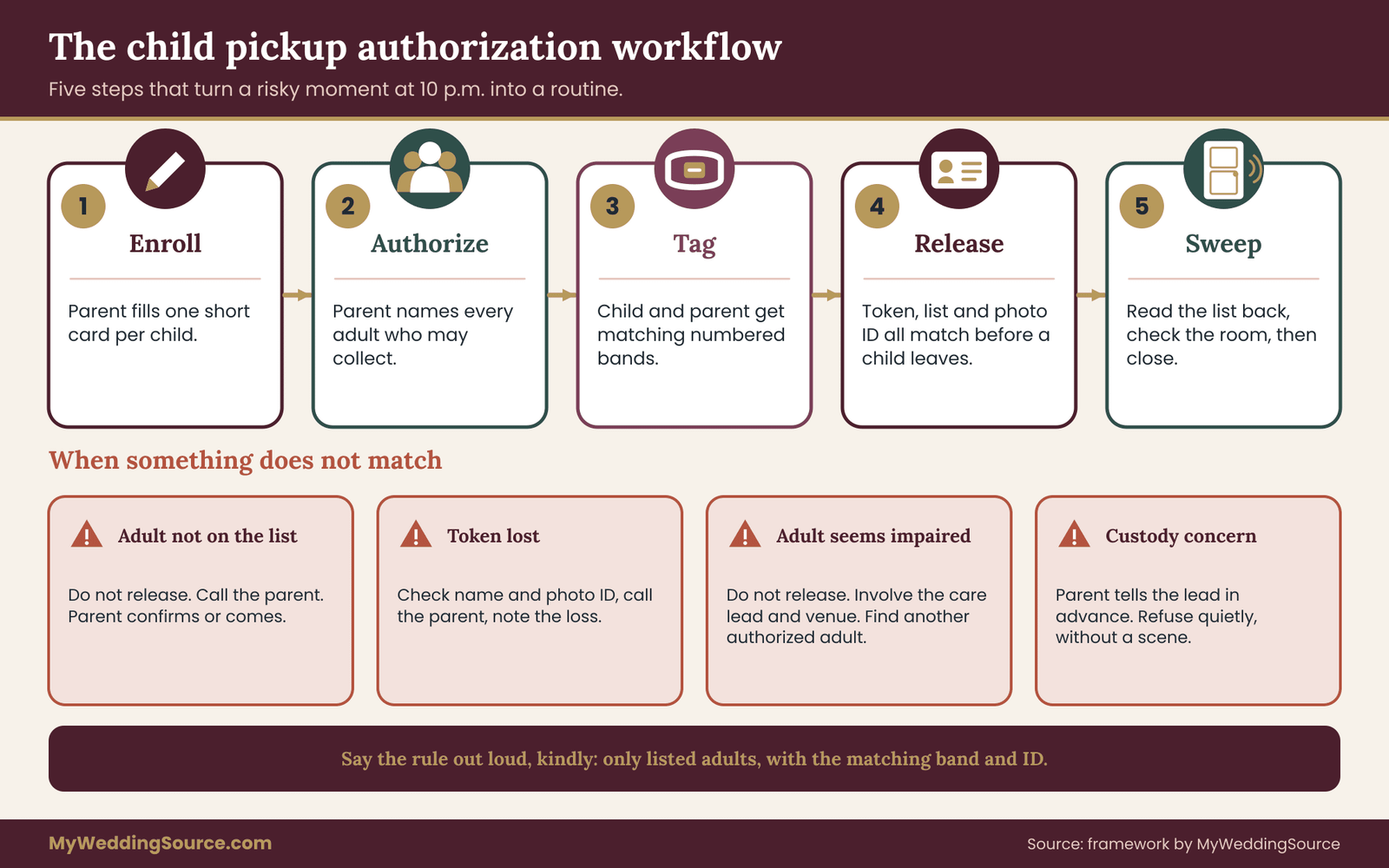
Step one: enroll. Before the wedding, or at arrival, a parent completes a short registration for each child: the child’s name and age, the parent’s name and mobile number, any allergies, medications or special needs, and the names of adults authorized to collect the child. The form is brief. The provider may have its own, and you can use it. If you create a form, collect only what the provider needs, as the data section later explains.
Step two: authorize. The parent lists every adult who may pick up the child, by full name, with a phone number. The default is that if a name is not on the list, the adult cannot collect the child. A parent can add a name on the night by speaking to the lead staff member in person or by calling the number on the card, but the change must come from the parent, not from the person who wants to collect.
Step three: tag. The child and the parent receive matching tokens, such as numbered wristbands or cards with the same number or a simple code. The child wears one, and the parent keeps the matching one. The staff record the number beside the child’s name. The goal is to link the person at the door to the child at the table with something harder to fake than “I know her.”
Some providers use a different system, for example a printed card with a photograph of the child, or a password a parent chooses. Any of these is fine if staff can apply it quickly and consistently. Do not put the child’s full name on a visible wristband, since a stranger can read it and use it. A number works better.
Step four: release. When an adult arrives, staff follow a fixed sequence. They ask for the matching token. They check the adult’s name against the authorized list. They ask for photo identification if they do not personally know the adult by sight, because the person who signed the child in is not always the person who collects. They then call the child by name, hand the child over and record the time and the name. If any step does not match, they do not release the child and they call the parent.
Staff should say the rule out loud and without apology: “We hold to a simple rule here. I can only release a child to someone on the list, and I will need to see your ID.”
Step five: sweep. At the end, one staff member reads out the sign-in list and confirms that each child has left with an authorized adult. The lead staff member then does a physical sweep of the room, including under tables and in corners where a sleeping child may be. Only then does the provider close the room. Your care lead signs off that the sweep happened.
The exceptions list
Most pickups follow the workflow without drama. A few do not, and the wedding childcare provider should have a stated response to each.
An adult who is not on the list. The staff member does not release the child. They call the parent. If the parent confirms, the parent comes to the room or gives a verbal permission that the staff member records with a time, and the adult shows identification. If the parent cannot be reached, the child stays.
A token that is lost. Staff verify the adult by name, identification and a quick call to the parent, if necessary, and record that the token was lost.
An adult who appears impaired. At a wedding with an open bar, this is not hypothetical. Providers should have a policy for it, and you should know it. The usual approach is to decline to release the child to an adult who appears unfit to care for them, to inform the lead staff member and the care lead, and to find another authorized adult or the other parent.
Staff should not argue or accuse. They should say “I am not able to release him right now, let’s find someone to help” and involve the care lead and the venue manager. If there is any immediate danger to a child, staff call emergency services.
A custody dispute. A parent may tell the wedding childcare provider that the other parent, or another relative, is not permitted to collect the child. The provider is not able to settle a legal dispute at the door. A court order, if there is one, is the authority.
The provider should ask the parent to say so privately and in advance, record it with discretion and involve the care lead if it comes up. Staff must be able to refuse a release without causing a public scene. If you know of a situation like this in your families, speak privately to the parent before the day, and ask the wedding childcare provider how they handle it.
A parent who is late or cannot be found. The staff member calls the parent and then the next number on the list. The care lead helps find the parent. A child should not be left alone with one staff member for long. If a parent cannot be reached, the provider’s policy and the agreement should say what happens, and by what time. Do not leave this open.
An older sibling who wants to take a younger child. A teenager is usually not an authorized adult unless the parent has named them, and even then, the provider may have an age rule. Ask the provider for their policy and share it with the parents.
A child who wants to leave the room alone. Younger children do not leave the room unless they are with a staff member. An older child who wants to go to the restroom, or to find a parent, goes with a staff member or a buddy, depending on age. Ask the wedding childcare provider how they handle it.
The authorization form
A good form is short and fits on one side of a page. It asks for:
- The child’s name and age.
- The parent’s name, mobile number and where they will be seated.
- Allergies, medications and any condition the staff need to know about.
- The names and phone numbers of the people who may collect the child.
- A line to confirm that the parent understands the release rule.
- A line to confirm that the parent has been told how to reach staff.
Avoid asking for details that are not needed for the evening, such as home address, a child’s date of birth beyond the age, the child’s school or any photograph. Each extra field is something you must protect and delete later. If the provider uses a digital form, ask who can see it, how long it is stored and how it is deleted.
“Thank you for letting us look after the children tonight. Please complete one card per child. Only the adults you list can collect your child, and they will be asked for the matching wristband number and a photo ID.”
Put that message at the start of the form so that parents understand the process, and a few lines in the printed program or on the sign at the door will help the late arrivals.
Briefing the parents
The best workflow fails if parents do not know it. Tell families, in the invitation website or a short message a week before, where the children’s room is, when it opens and closes, and how pickup works. Use plain, friendly wording.
“Children’s room opens at 5:30 and closes at 10:00. Please bring your child to the sign-in table to complete a card and receive matching wristbands. Only adults named on the card may collect your child. You can change the list any time by speaking to the lead staff member.”
Remind parents to keep their token with them, and that if they hand it to someone else, that person must also be on the list.
The role of your care lead
Name one person who is not the couple and not in the wedding party, someone who stays in the room for the sign-in hour and the pickup hour. This is the care lead described in the broader guide to babies, children and older relatives. In the childcare context, the care lead is the link between the provider, the parents and the venue. They keep a copy of the authorized list, know where the parents are seated and can step in when an exception comes up. The provider’s staff should know the lead’s name and face before the doors open.
Test the workflow once
Walk through the workflow with the wedding childcare provider on a call before the wedding, using three scenarios: a normal pickup, an unlisted uncle and an adult who seems unwell. Ask how staff would respond to each. You are listening for calm, specific answers. If the wedding childcare provider says “we would use our judgment,” ask what rule that judgment follows. If you can, ask to see their written policy.
Contracts, insurance and costs for wedding childcare
Once a provider has passed the five gates, put the result on paper. A written agreement is not a sign of distrust. It records what each side promised so that a misunderstanding in November does not turn into a dispute in December.
What the agreement should say
Cover these points, in plain language.
- The parties. The legal name of the provider, a business address and a contact person for the day.
- The date, time and place. Start and end times of the service, including setup and cleanup, and the exact room.
- The scope. The age range and the maximum number of children, what the wedding childcare provider will do, and what it will not, such as diaper changing, medication, transport or care for children under a certain age.
- Staffing. The minimum number of staff, the named staff list, and what happens if a staff member is absent.
- Screening and training. A statement that all staff at the event have had the checks and the certifications described, and that the provider will give you confirmation.
- Licensing. The license type and number, or a statement of the provider’s legal status, and a promise to follow the rules that apply.
- Procedures. A reference to the pickup workflow, the emergency summary and the allergy process, attached as part of the agreement.
- Insurance. The coverage the provider will carry and the certificate it will provide.
- Fees and payments. Total price, deposit, balance, what is included, and what happens if the headcount changes.
- Cancellation. What happens if you or the wedding childcare provider cancels, and how far ahead.
- Incidents. How and when the provider reports an incident, and to whom.
- Data. What information the provider collects about children, how it is stored, who sees it and when it is deleted.
For general guidance on reading vendor agreements, the wedding vendor contract guide walks through the clauses that tend to cause trouble. Keep the childcare agreement as simple as the ones you have already signed with other vendors, and have the wedding childcare provider’s own standard form reviewed if anything in it concerns you. If you want legal advice on liability terms, ask a licensed attorney.
Insurance: what to ask for
Insurance is a place where couples lose track of the details, so be specific. Ask the wedding childcare provider for a certificate of insurance showing general liability coverage, and ask whether it covers events at locations other than their own. If the provider has professional liability or abuse and molestation coverage, ask about that too. Many venues require vendors to carry specific coverage and to name the venue as an additional insured. Ask your venue what it requires, and give the provider that list early.
A certificate is a summary issued by the insurer’s agent, not the policy itself. Check that the named insured matches the provider’s legal name, that the policy dates cover your wedding, and that the certificate names the venue if the venue requires it. If you are unsure what the certificate means, the insurance agent who issued it can explain.
Also check whether your own policies play a role. If you have event insurance, ask the insurer whether it covers claims involving a hired childcare provider. The answer is often no, or limited to the couple’s own liability, and the exclusions and limits are the part that matters. Ask the insurer to put the answer in writing.
What it costs, and how to think about price
Prices vary widely by region, season and provider type, and this guide does not quote averages. The pricing structure matters more than the number. Providers commonly charge an hourly rate per staff member, a flat fee for the event, or a per-child fee, sometimes with a minimum number of staff or hours. Ask which applies, and ask about:
- Minimum hours, and whether setup and cleanup count.
- Rates for overtime if the event runs late.
- Travel fees or parking costs for staff.
- Supply costs for crafts, snacks, movies and equipment.
- A fee for each additional staff member if more children arrive.
- Deposits, and when the balance is due.
- Taxes, fees and gratuity, if any.
When you compare quotes, compare the staffing number first. A low quote with fewer staff for the same number of children is not a cheaper version of the same service. Convert each quote to a cost per staff hour and a cost per child hour. The arithmetic helps you see what is being offered. If two providers differ widely, ask the cheaper one what is different.
Decide who pays. Some couples cover the whole cost. Others cover a base amount and ask parents to pay a share. Either approach is fine if it is clear in advance. If you ask parents to pay, decide how that money moves, in writing, and with a refund rule if the parents cancel. The wedding budget guide is useful for placing wedding childcare among your other costs.
Deposits and cancellations
Pay deposits in a way you can trace, ideally by card or another method with a record, and keep the receipt. Ask what happens to the deposit if you cancel or if the number of children drops. Ask what happens if the wedding childcare provider cancels, and insist on a refund of everything you paid. A provider that cannot commit to refunding a deposit when it cancels is not offering much of a commitment.
Coordinating wedding childcare with the venue and other vendors
A provider who passes every gate can still be undone by a venue that was never told. Coordination is its own job, and it is easy to underestimate because it involves five or six people who rarely speak to one another.
The venue
Ask the venue three things before you sign with a provider, not after.
First, does the venue allow outside childcare, and does it have conditions? Some venues require vendors to be on an approved list, to hold specific insurance or to name the venue as an additional insured. Others restrict which rooms can be used for children. Ask for the policy in writing.
Second, which room is available, and what does it have? You need the dimensions, the restroom access, the exits, the power outlets, the temperature controls and whether the room can be closed off from the party. The venue guide explains how to compare spaces more generally.
Third, what are the venue’s rules for children moving around the building? Some venues have stairs, loading areas, kitchens, pools or parking lots that children must not enter. Ask for a map and mark the areas that are off limits. If your venue has any accessibility concerns, such as a long route from the room to the restroom or a step without a ramp, the accessible venue red flags list shows what to look for, and it helps when a child or a parent uses a wheelchair or a stroller.
Invite the wedding childcare provider to a walk-through if they can come, or send photographs and a floor plan. A provider who sees the room two weeks before can make a sensible layout, and one who sees it on the day makes it up.
The caterer
Share the provider’s headcount and the allergy list with the caterer, and agree who serves the children. Common choices are a children’s meal served at a table in the children’s room, a plate prepared in the kitchen and brought in, or a buffet that staff supervise. Ask the caterer to label the children’s meals and to separate any allergen-free plates. If children are eating in the children’s room and parents are eating at the reception, agree on a time that suits both. Remember that a hungry child is a difficult child.
The photographer and videographer
Children’s images are sensitive, and the provider’s staff should know the rules. Ask the wedding childcare provider about its own policy on photographs of children in its care, and whether staff are allowed to take photos on their phones. Decide, with the photographer, whether the children’s room is a photo-free zone, or whether photographs are allowed only with parental permission. Whatever you decide, tell the parents. The wedding photography consent guide covers how to ask guests about images, including children, and how to put a policy in writing.
The DJ, band and coordinator
The DJ or band should know that a children’s room exists, where it is and when it closes. A loud speaker pointed at the wall of the room helps no one. If the program includes an announcement for parents, such as “children’s room closes in fifteen minutes,” agree on wording and timing. Your coordinator, if you have one, is a natural person to keep the timeline and to know when each group is expected to be where. If you do not have a coordinator, the care lead takes on this role for the children.
Transport and hotel-based events
If the children’s room is in a hotel, rather than in the venue, you add the questions of how children get there and who walks with them. Do not put children in vehicles with staff unless the provider has a written policy on transport, appropriate car seats and licensed drivers. The National Highway Traffic Safety Administration publishes information on car seats and booster seats by age and size. In most cases, the simplest plan is to keep the children’s room inside the venue and to have parents handle transport.
A timeline from signing to the last pickup
Work backward from the date. The pace below suits a licensed provider in busy season. Shorten it for a simpler arrangement.
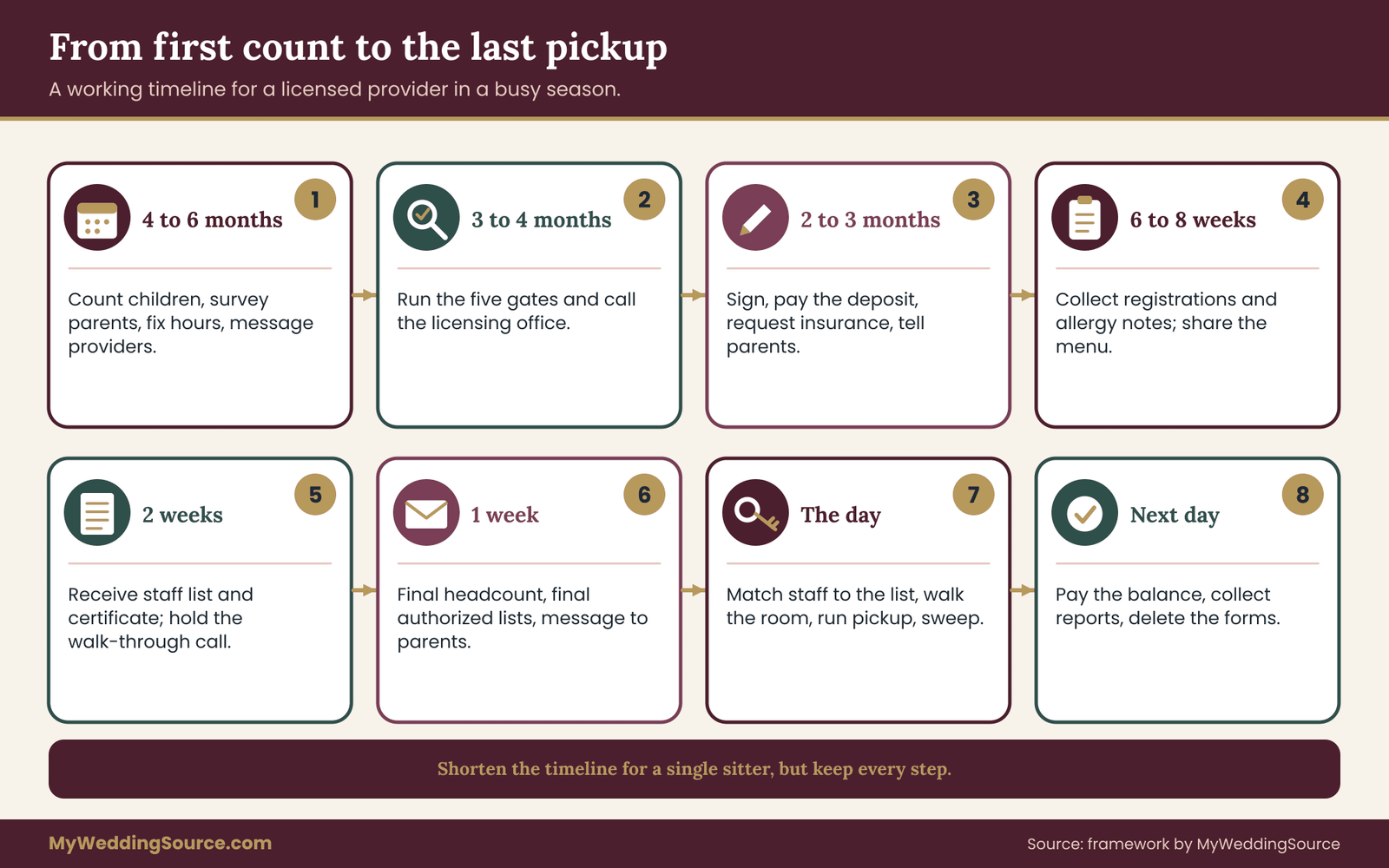
Four to six months out. Count children, survey parents, fix the hours, and send first messages to providers. Ask the venue about its rules for outside vendors.
Three to four months out. Run the gates. Make calls to the licensing office. Check references. Get written answers on staffing, screening and pickup.
Two to three months out. Choose a provider, sign an agreement, pay the deposit and request the certificate of insurance. Tell parents that childcare is available, in what hours, and how to register.
Six to eight weeks out. Collect registrations and allergy information through the wedding childcare provider’s form. Confirm the final headcount range. Share the caterer’s menu with the wedding childcare provider.
Two weeks out. Receive the named staff list and the certificate of insurance. Hold the walk-through call. Share the venue map and the room plan with the provider and the care lead.
One week out. Final headcount to the provider, final authorized adult lists, a short message to parents with pickup details. Confirm the emergency contact for each staff member and the care lead.
The day. Care lead meets the provider on arrival, matches staff to the list, walks the room, confirms exits and the restroom route, checks the sign-in table and posts a sign. Pickup follows the workflow. The sweep closes the room.
The next day. Pay the balance when the work is complete. Collect any incident reports. Delete the registration forms and any lists you hold, in line with the agreement. Send a thank-you to staff.
A worked example of wedding childcare vetting
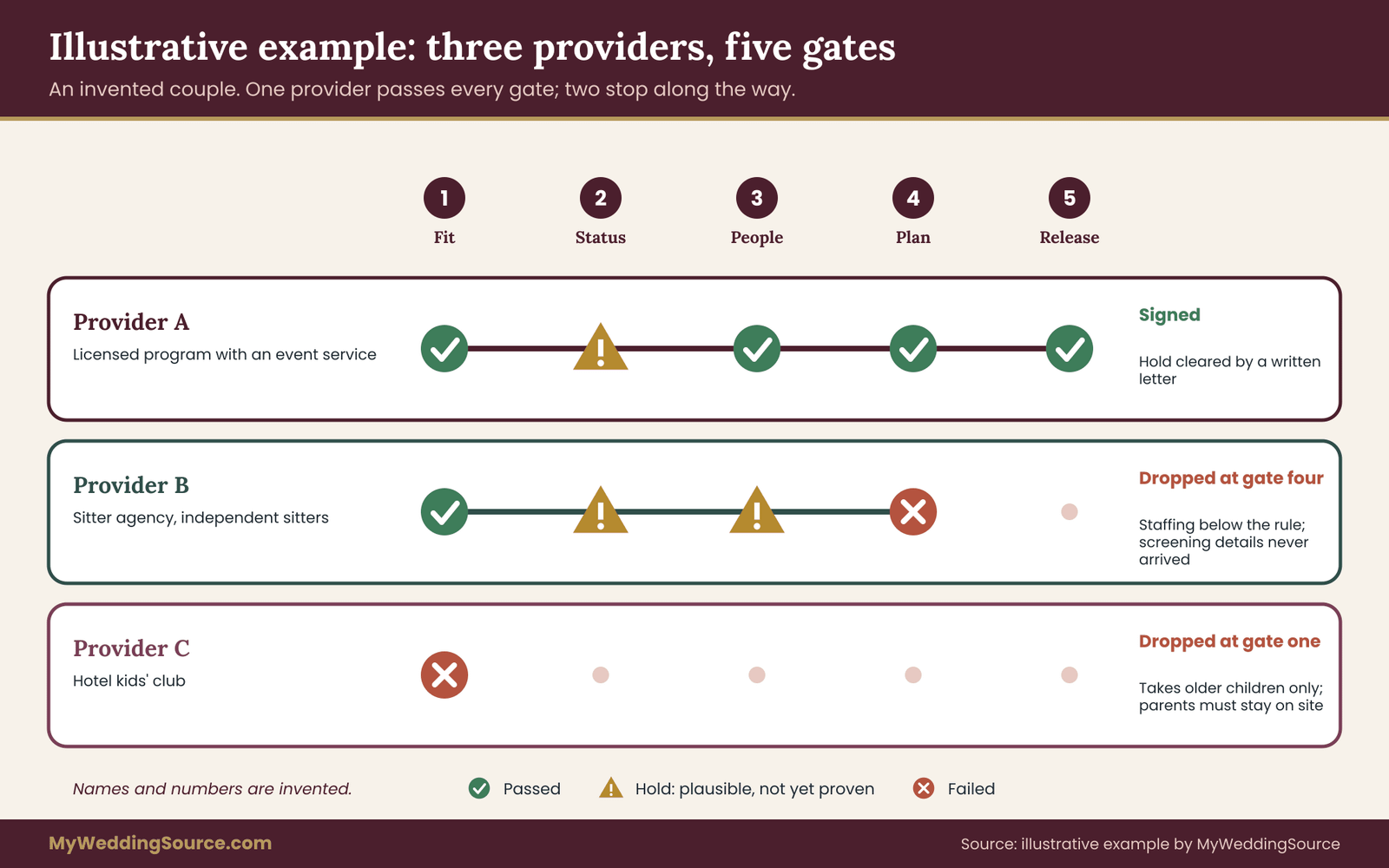
The following example is invented for illustration. The names, the numbers and the staffing ratios are made up to show how the method works. Do not use them as targets.
Mara Nguyen and Theo Brooks are marrying on a Saturday in October at a restored warehouse venue. Their guest list has eleven children from nine families: three children aged two or three, four aged four to seven, four aged eight to eleven, plus two teenagers whom they decide to handle separately. They send the short parent message. Seven families say yes, two say maybe. They decide on evening care from 5:30 to 10:00 p.m., in a room the venue has offered next to the main hall.
Gate one: fit. They contact three providers. Provider A is a licensed child care program that also runs an event service. Provider B is a sitter agency. Provider C is the kids’ club at the hotel where many guests are staying. Provider C only takes children over four and requires parents to stay on the hotel’s premises, while the wedding is at a different building. It does not fit and drops out.
Gate two: legal status. Provider A gives a license number. Mara calls the state licensing office. The office confirms that the license is active and covers the program’s own building, and says that event care at an off-site location is handled differently and that the wedding childcare provider should confirm it with them. Provider A says it has done so and promises a letter.
Mara marks a hold, and the letter from the licensing office arrives before signing and clears it. Provider B says it is not a child care program and that its sitters work as independent contractors. The licensing office says it does not regulate individual sitters hired for a single event. Mara marks it as unregulated, not a fail on its own.
Gate three: people. Provider A says its staff have fingerprint-based checks required by the state, plus a registry check, and that they hold current infant and child first aid certification. It provides names and certification dates for the four staff it proposes. Provider B says its sitters are “fully screened” by a third-party company. When Mara asks what the company checks, who runs it and how recently, the agency cannot say. She marks a hold and asks for the details in writing. They never come.
Gate four: operating plan. Provider A states a policy of one adult for every five children under six and one for every eight older children, and says it always keeps at least two adults in the room. Mara does the arithmetic with a high headcount of seven children under six and five older children. Seven children under six need two adults. Five older children need one.
That makes three, and Provider A proposes a fourth adult to cover breaks and any child who needs to leave the room. The state licensing office says the ratios for licensed centers are set by rule and gives her the figures for the ages concerned. Provider A’s policy is stricter than the rule, which is a point in its favor. Provider B proposes two sitters for the same group, with no policy on breaks. Mara marks a fail on staffing, and Provider B drops out.
Gate five: release. Provider A shares its own authorization form and wristband system. Mara and Theo walk through three scenarios on a call: a normal pickup, an unlisted uncle and an adult who seems unwell. The lead staff member explains each response without hesitating, and says the staff would hold the child and call the parent.
One of Theo’s cousins has told him privately that her ex-husband must not collect their daughter. Theo asks the provider how it handles such a situation, and it explains that the cousin should tell the lead staff member before the doors open, and the lead should note it discreetly. The cousin agrees.
Paper. The agreement names Provider A’s legal business, the date, the room, the four named staff, the minimum number of staff and what happens if more children arrive. It attaches the pickup workflow and the emergency summary. The certificate of insurance names the provider, and the venue requires being named as an additional insured. Provider A sends a corrected certificate a week later. The agreement says the registration data will be deleted within a set period after the event.
The day. Mara’s cousin, who agreed to be the care lead, arrives early, matches the four staff to the list and walks the room with the lead staff member. Parents sign children in during cocktail hour. Of the two “maybe” families, one uses the service and one does not. Eleven children are registered, nine attend.
Pickup runs smoothly. At 9:40 a relative who is not on the list asks to collect a child. Staff do not release the child, call the mother, who confirms by phone, and ask the relative for identification before handing over the child. The whole exchange takes three minutes. After the sweep, the care lead signs off.
What the example shows. Nothing dramatic happened, and that is the point. The gates found a provider that could answer every question and eliminated two that could not. The work took a few hours spread over several weeks. It cost nothing extra apart from the wedding childcare provider’s fee. The example does not show how the process looks for a small-town wedding with a single sitter, where several gates become conversations with one person, and where references and the written agreement carry more weight.
Mistakes, edge cases and limits of wedding childcare vetting
Common mistakes
Choosing on price or charm. A friendly provider with a low quote is attractive. The gates exist because friendliness and safety are different things.
Treating a license as a guarantee. A license is a baseline. It says something about the organization and its inspections. It does not tell you who will staff your event.
Accepting “fully screened” without detail. Ask what, by whom, when and for which staff.
Leaving pickup until the day. If you do not set a workflow, staff will invent one at 10 p.m., under pressure.
Forgetting the youngest and oldest. Infants and teenagers both fall outside the standard group. Plan separately for them.
Hiring without telling the venue. A venue that learns about the childcare room on the day may close it.
Sharing more data than needed. Group chats, shared spreadsheets and photos of children spread information widely. Keep it small and delete it.
Assuming the couple is not responsible. The couple chooses the provider. The choice is yours to make carefully.
Edge cases
A guest brings their own sitter. The guest family is the employer. Ask the sitter to check in with your care lead, keep the sitter’s charge with the family, and do not allow the sitter to collect other children.
A child needs one-to-one support. Talk with the parent and the provider at least a few weeks ahead. The family may prefer to supply their own support person. Ask the provider about inclusion without asking for the child’s medical details.
A wedding childcare provider cancels at the last minute. Have a fallback: a second provider on a short list, a relative-run children’s table or a quiet room with an activity kit. Ask each provider, in the agreement, how soon they will tell you if they cannot staff the event.
The headcount doubles. Agree in advance on the highest number the provider will accept and the price for each additional staff member. If the number passes the limit, parents are told on arrival that some children must stay with their families.
A child is unwell on arrival. Ask for the provider’s illness policy and apply it politely. A child with a fever stays with the parent.
Parents want to leave the venue. Whether parents may leave the building while children are in a provider’s care depends on the wedding childcare provider’s license and policies. Ask the provider and tell parents what applies.
The wedding runs late. Agree on a hard closing time and a fee for overtime. A room that closes at 10 p.m. while the party runs until midnight creates its own pickup problem.
What this guide cannot settle
This guide cannot tell you what the law requires in your state, whether a particular provider is safe, or what staffing is appropriate for your children. It does not replace the state licensing agency, a qualified childcare professional, an insurance agent or an attorney. Licensing, background check requirements, staffing rules and insurance practices differ by place and change over time.
Verify the current rules with the issuing office before you rely on anything here. If a family has questions about a specific child, such as a medical condition or a disability, they are the experts on their child and the wedding childcare provider is the expert on its own program. Your part is to make sure that they can talk to each other.
Finally, be wary of treating any checklist as a substitute for attention. The gates will tell you a lot about a provider. They cannot tell you everything. If something in a conversation or a room feels wrong, and you cannot say why, treat that as information and keep asking until you are satisfied. A wedding childcare provider that welcomes the questions is usually a good sign. A provider that resents them is usually a better reason to decline than anything on the license.
Your next steps
Start with these three steps this week, then follow the timeline above.
- Count and ask. List the children by age band and send the short message to parents. Decide the hours and the room.
- Message two or three providers. Ask about availability, price, licensing and where you can confirm it. Call the state licensing office with your questions.
- Name your care lead and ask your venue about outside vendors. Get the venue’s policy and insurance requirements in writing.
Keep one page per provider with the five gates, the evidence behind each outcome and the date. For the wider checks that apply to every vendor you hire, the wedding vendor due diligence checklist is a useful companion.
FAQ
Do we need to hire wedding childcare at all?
Not always. If only a few children are attending and their parents want them close, a quiet table with activities and a relative who helps may be enough. Hiring makes sense when many children attend, the schedule is long or parents have told you they cannot come without care. Ask families what they would use before spending money.
How can we check whether a wedding childcare provider is licensed?
Ask the provider for its license type and number, then confirm it with your state’s child care licensing office, not just the provider’s website. Ask whether the license covers care at an event venue, how a one-day event is classified and whether inspection records are public. Write down who you spoke with and the date.
What background checks should a wedding childcare provider run?
It depends on state rules and on the wedding childcare provider’s type. Ask which checks every staff member at your event has had, whether they were fingerprint-based or name-based, who ran them and when. Also ask about sex offender registry checks and, where available, child abuse registry checks. Ask for the names of the people who will staff your event.
What staff-to-child ratio is right for a wedding?
This guide cannot give a number, because ratios are set by state and local rules and depend on the children’s ages and the type of care. Ask the provider for its written ratio, compare it with what your licensing office says applies, and work out the staff needed for your highest expected headcount, with extra cover for breaks.
How should child pickup work at a wedding?
Parents register each child and list the adults who may collect them. Children and parents receive matching wristband numbers. At pickup, staff check the token, the name on the list and photo ID if they do not know the adult. A final sweep confirms every child left with an authorized adult. Decide how to handle exceptions before the day.
What should we do if an adult who looks impaired comes to collect a child?
Staff should not release the child, and should say so calmly without accusation. They involve the care lead and venue manager and contact the parent or another authorized adult. If a child is in immediate danger, they call emergency services. Ask your provider for its written policy before you sign, so that it is settled before the bar opens.
What insurance should a wedding childcare provider carry?
Ask for a certificate of insurance showing general liability coverage that applies to events away from its own premises, and ask about any professional liability coverage it carries. Your venue may require it to name the venue as an additional insured. Check that the business name and policy dates match your agreement, and ask the issuing agent if anything is unclear.
Can a teenage cousin or friend run the kids’ table instead?
Yes, as a helper beside a provider or for a small group of older children in an open space. A volunteer does not come with the screening, training or insurance of an organization, so keep the role clear, give a start time, an end time and a break, and do not leave one person alone with a large group of young children for a long stretch.
Sources
- ChildCare.gov: Child care licensing
- U.S. Department of Health and Human Services, Office of Child Care
- ADA.gov: Americans with Disabilities Act
- U.S. Department of Justice: National Sex Offender Public Website
- FBI: Identity History Summary Checks
- Federal Trade Commission: Business guidance and consumer protection
- American Red Cross: First aid and CPR training
- CDC: Drowning prevention
- FDA: Food allergies
- NHTSA: Car seats and booster seats